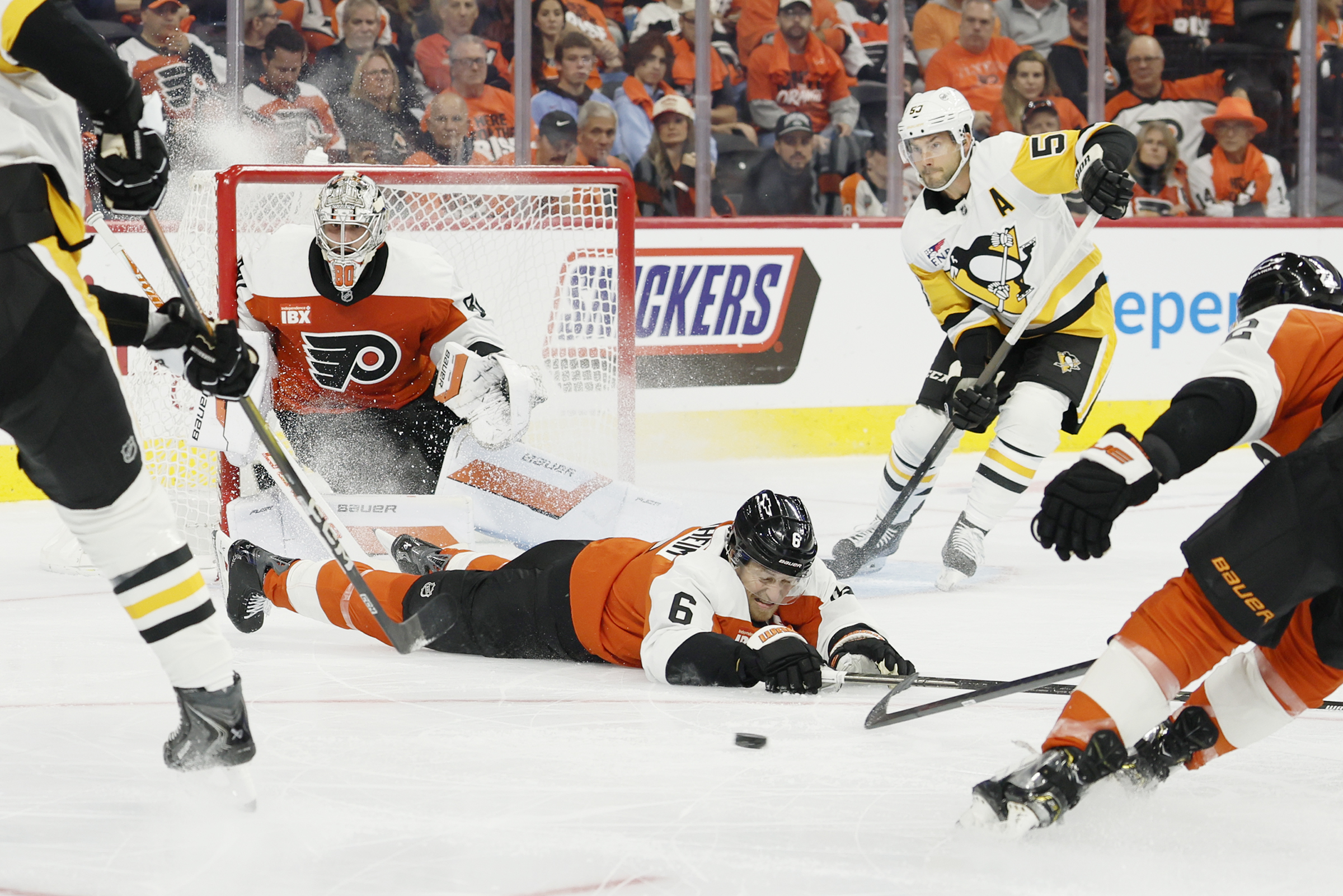
Speaking to the media following Saturday night’s overtime loss to the Carolina Hurricanes, Flyers forward Trevor Zegras was asked if there is a concern about the number of shots the team has given up.
“I know they had a ton, but a lot of them, for the most part, were them flinging it from the outside,” he said. “I still think we gave up maybe one too many from inside the house, but that’s their kind of game, and their M.O. is to put pucks on the net.
“So I’m probably more concerned with how many shots we had, opposed to how many they had, but we’re getting better. We’ll learn from it and keep going.”
The Flyers allowed 40 shots to the defending Stanley Cup champion Carolina Hurricanes, compared to their own 18.
Carolina, which eliminated the hometown team from the playoffs in a sweep, is a high-shot-volume team that throws pucks from everywhere. That was to be expected.
But the issue isn’t that the Hurricanes purely outshot them more than two-to-one. It isn’t that this was the third straight game they allowed a team to eclipse the 37-shot mark, and the second straight past 40, or that they are averaging the fourth-fewest shots (20.7) in the NHL themselves. And it isn’t that, according to NHL Edge, they have spent 46% of the time in the defensive zone.
The more concerning issue is where the shots from their opponents are coming from because a team that has prided itself on protecting the middle of the ice in the defensive zone is allowing teams to walk right in and take high-danger shot attempt after high-danger shot attempt. They are forcing goalies Dan Vladař, who didn’t get much prep time due to an upper-body injury in the opening period of his only preseason game, and new addition Joseph Woll to stand on their heads.
| Year, Coach (Numbers via Natural Stat Trick) |
HDCF | HDCA | HDCF% | HDGF | HDGA | HDGF% |
|---|---|---|---|---|---|---|
| 2026-27, Tocchet | 24 | 48 | 33.33 | 2 | 4 | 33.33 |
| 2025-26, Tocchet | 993 | 878 | 53.07 | 100 | 99 | 50.25 |
| 2024-25, Tortorella/Shaw | 916 | 837 | 52.25 | 117 | 127 | 47.95 |
| 2023-24, Tortorella | 1005 | 900 | 52.76 | 113 | 129 | 46.69 |
| 2022-23, Tortorella | 933 | 1090 | 46.12 | 122 | 131 | 48.22 |
The “house” or “home plate” is the area where the analytic community believes a player has a higher probability of scoring. Although it can be subjective, especially when talking about shot attempts, it is accurate that shooting from the slot down to the goal line gives a player a greater opportunity to score.
Analytics site, Natural Stat Trick, , assigns a high-danger shot as “any shot attempt on net (goals and shots on net) that qualifies as a high-danger scoring chance.”
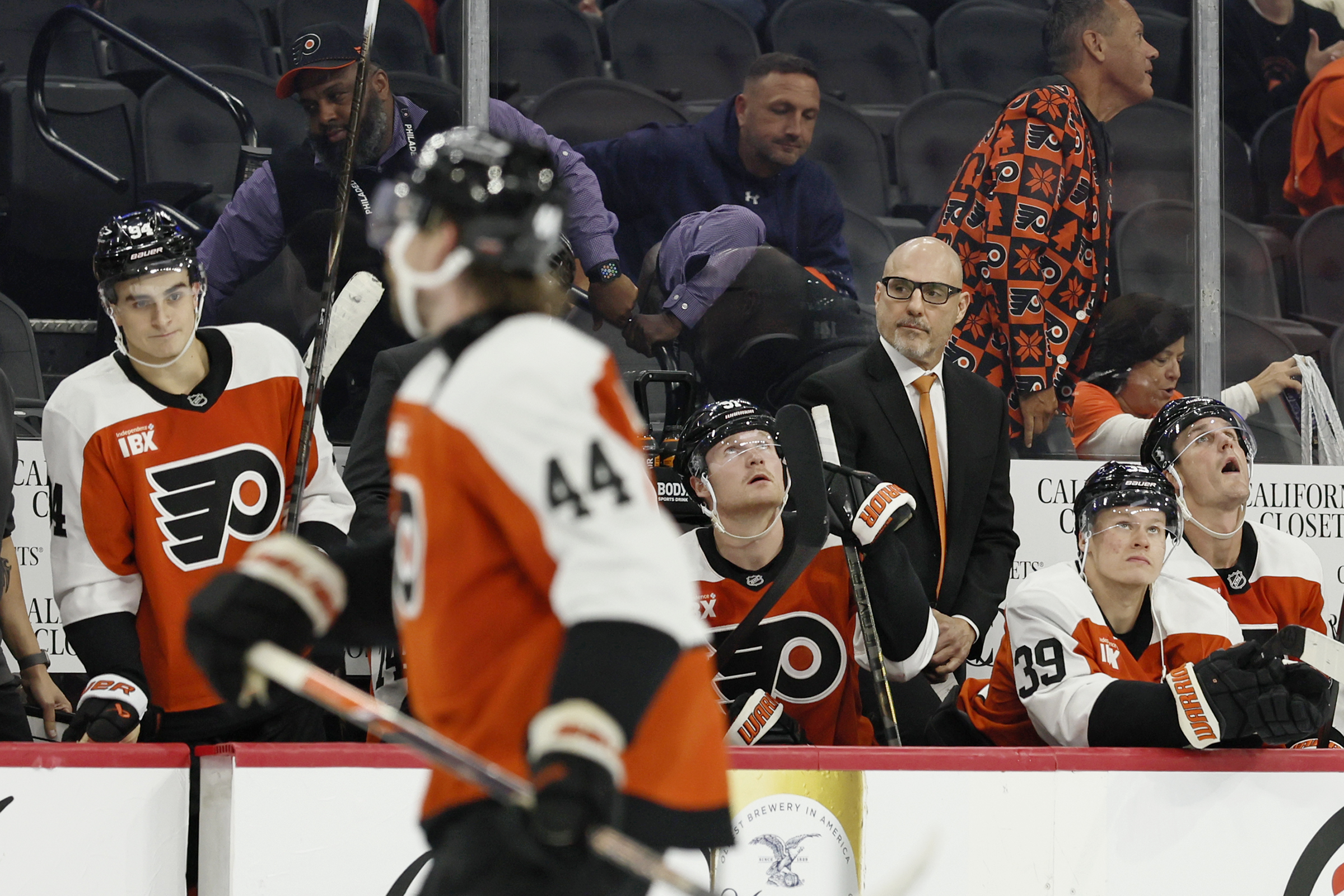
A high-danger scoring chance is any “scoring chance with a score of 3 or higher,” and they assign anything straight down the middle, from the slot to the goal line, as a high-danger scoring chance. A shot from a spot assigned a two can become a three if it’s off the rush or on a quick rebound attempt.
The Flyers have two high-danger goals: Rasmus Ristolainen’s redirect of a Travis Sanheim point shot from atop the crease during a delayed penalty on the New Jersey Devils, and the one an untouched Matvei Michkov finished against the Hurricanes. The opposition has four across all strengths.
“We shot ourselves in the foot on a couple of them,” Sanheim said after the 7-0 loss to the Pittsburgh Penguins in the season opener. “We gave them probably half their goals.”
Pittsburgh scored three high-danger goals on 21 high-danger chances at all strengths, as the Flyers’ defensive zone looked messy, reverting to the six weeks leading up to the Olympic break when shots from the middle and weak-side goals against were a dime a dozen. The Devils had 14 chances, scoring once, to the Flyers’ five for the second straight game.
On Saturday, Philly finally found itself on the plus side; they registered 14 high-danger chances to the Hurricanes 13 at all strengths. Woll stood on his head again, including stopping William Carrier near the goal mouth. This backs up what Zegras said about many of Carolina’s shots being weaker attempts from the perimeter.
It may sound like an insignificant improvement, but winning the high-danger chance battle was noteworthy, especially for a team struggling to create in the early going, and whose entire defensive zone strategy is built on protecting the middle.
Although the Flyers primarily employed the box-and-one when Tocchet came on board — during training camp, he called it “a very aggressive zone” — the bench boss tweaked the structure after speaking with his fellow Hockey Canada coaches at the Olympics when things started going south last season. “We’re not strict man-on-man, but we’re trying to be more aggressive,” he said back in March.
The changes worked. The Flyers ended the regular season seventh in high-danger chances for percentage (53.07%) and allowed the third-fewest high-danger chances (878) in the NHL.
Tocchet said in March he was keeping the changes simple and would make it more complex as the team graduates. If that’s the case, it could take a little more time to get back on track.
But when it does, the hope is that it will right the ship at both ends and get the Flyers up the ice more and back to attacking the middle in the offensive zone too. Entering Sunday, they ranked 22nd in high-danger shots, per NHL Edge, with 12.
“Well, I think that just comes with our systems, and eventually, once it becomes second nature, your systems, it’s easier to read off, you know exactly where each guy is going to be,” Sanheim told The Inquirer on Saturday morning. “Right now, it just feels like we’re off just a little bit, and guys aren’t exactly where you think they’re going to be or where they need to be.
“Just continue to work on that, watch film, get better in those areas, and as a group, once that kind of clicks, I feel like it’s just going to come natural, and it’s going to be easier to make those plays, understand where the puck needs to go, and should look a lot cleaner.”
Leave a Reply