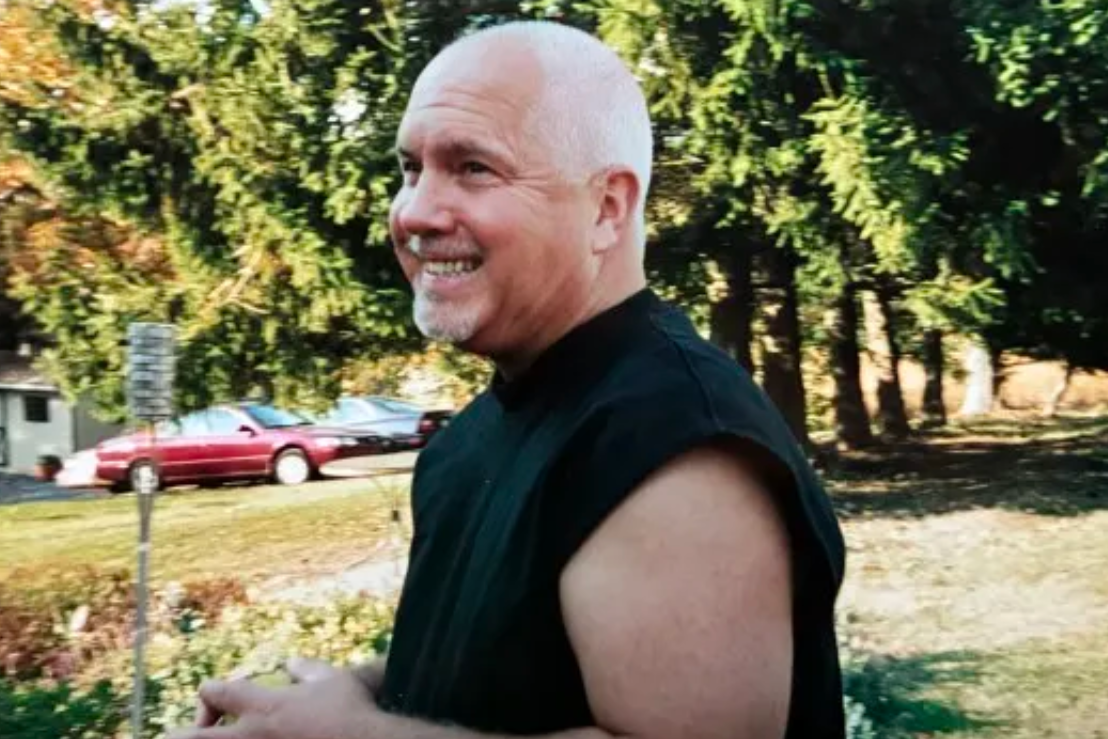
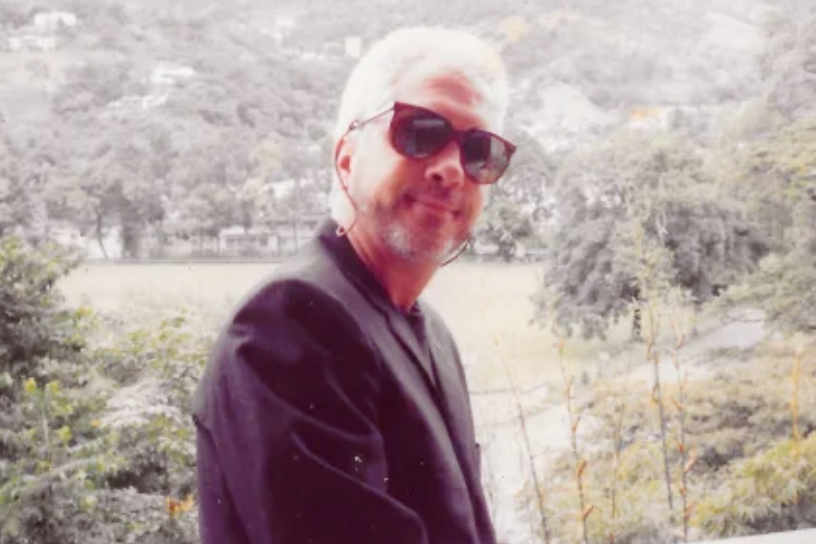
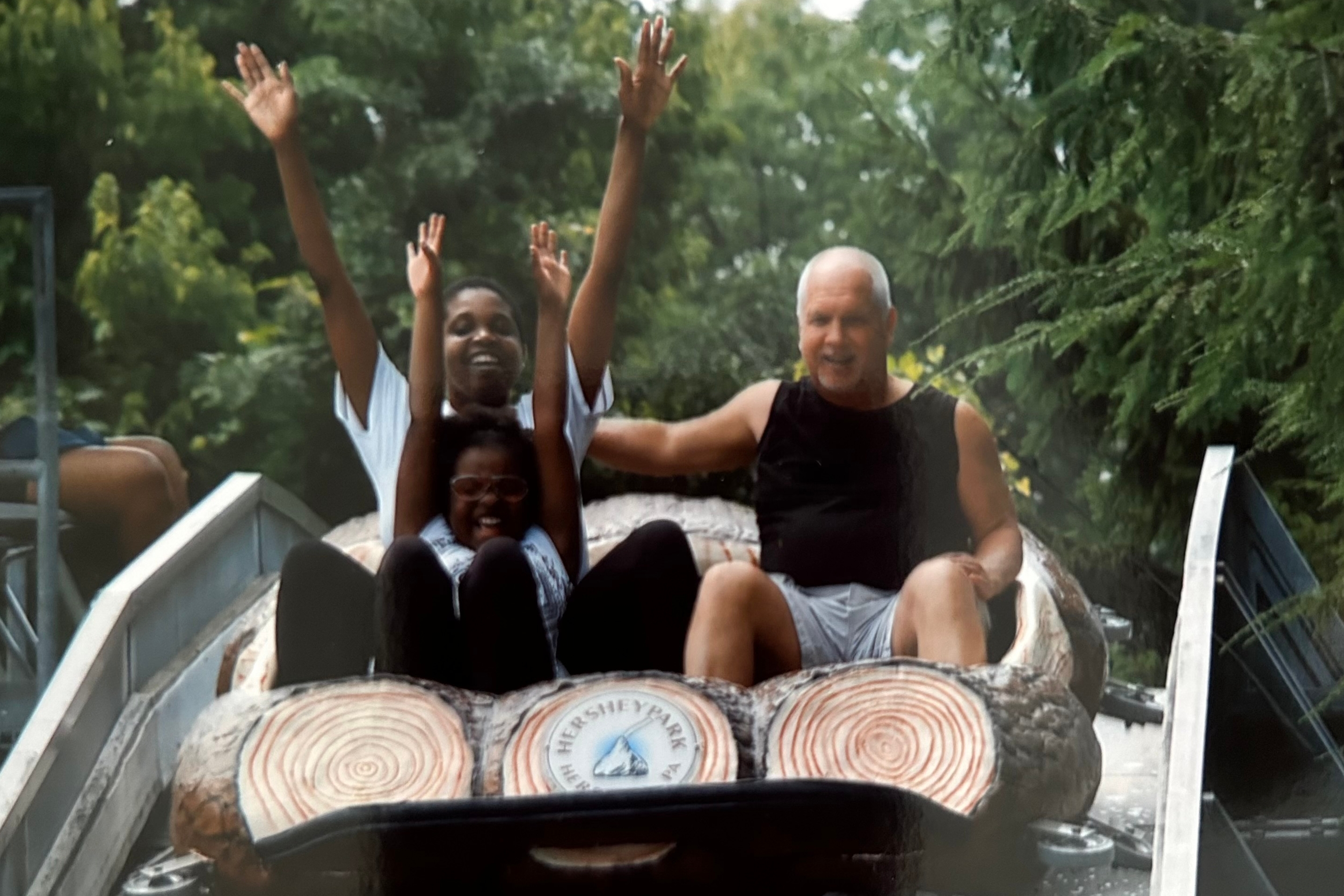
Jeff Scott, 72, formerly of Hilltown, Bucks County, longtime award-winning TV and video scriptwriter, director, and producer, former columnist and editor at the Quakertown Free Press, and green-thumb gardener, died Saturday, Sept. 19, of pulmonary fibrosis at Hunterdon Medical Center in Flemington, N.J.
Born in Philadelphia, reared in Hilltown, and a graduate of Pennridge High School, Mr. Scott turned his lifelong interest in sports, affable collegiality, and writing, reporting, and editing skills into an award-winning career as a TV and print journalist that spanned more than four decades.
For 32 years, from 1983 to 2015, Mr. Scott wrote scripts, directed talent, and produced shows for TV, film, video, radio, and DVDs. He worked for Major League Baseball Productions through Phoenix Communications from 1988 to 2015 and wrote more than 1,000 TV show scripts for ABC, NBC, ESPN, Fox, and other networks, including 176 episodes of ESPN’s Major League Baseball Magazine and 450 consecutive episodes of the popular This Week in Baseball.
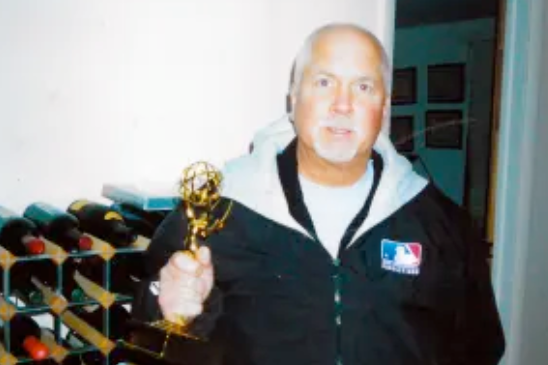
His dramatic scripts detailed many memorable baseball seasons, went behind the scenes with championship teams, and shared stories about star players on and off the field. They were narrated by iconic announcers such as Mel Allen, Curt Gowdy, Bob Costas, and Harry Kalas, featured thousands of players, coaches, and managers, and earned 16 New York Emmy Awards.
Mr. Scott earned 16 New York Emmys.Courtesy of the family
Former colleagues at MLB Communications posted a video tribute to Mr. Scott on X and noted his “indelible impact” on This Week in Baseball. Buzz Brainard, a former narrator for This Week in Baseball, said on Facebook: “Honored to bring his words to life every season for 11 years.”
Earlier, from 1983 to 1988 at the old Halcyon Days Productions, Mr. Scott wrote scripts for the weekly This is the USFL for ABC and other shows about John Madden, Mike Schmidt, and other sports and entertainment notables. Sports reporter Jayson Stark said on X: “You may not know the name, Jeff Scott. But you should.”
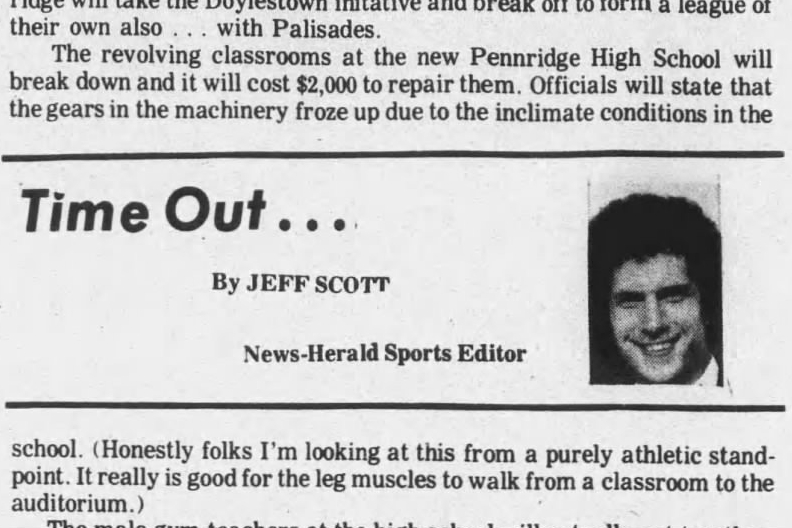
In print, Mr. Scott was a columnist and weekend magazine editor for the Free Press in the early 1980s. In the 1970s, he was sports editor and a features writer for the Perkasie News-Herald, and a part-time sports reporter for the Doylestown Intelligencer.
At the Free Press, he won awards and covered all kinds of local stories, including his publisher’s triple-bypass heart surgery. At the News-Herald, he wrote a sports column called “Time Out” and a news feature called “Know Your Community.”
To know Mr. Scott, a friend said, “was to like him.”Courtesy of the family
In 1976, he opened a News-Herald sports story with: “Some would call it luck. Some might call it breaks. And some might even consider the fact that somebody upstairs is carrying the fate of the Pennridge football team this year. We prefer to call it pure, unadulterated hustle.”
A former Pennridge baseball player said in a tribute: “It always was a big deal when he came to our games.” A former colleague at the Free Press said: “He made me feel important, and he made sure I knew that he was my friend.”
Other former colleagues praised Mr. Scott’s “sense of humor,” “warmth and kindness,” and “quick wit that never waned” in online tributes. “To know Jeff was to like him,” longtime friend and colleague Jim Burger said. “To know him well, which I had the good fortune to do, was to love him.”
Jeffrey Llewellyn Scott was born Nov. 18, 1953. He played street hockey in Hilltown and baseball at Pennridge, and attended what is now West Chester University.
Mr. Scott wrote a sports column in Perkasie in the 1970s.Newspapers.com
After college, he drove a truck, worked as a disc jockey, and traveled across the country. He married and divorced Lorrie Greenly and Amber Hudson.
He met Lenore Homeward on vacation in Tobago, and they married in 1991 and lived in Manhattan and Pittstown, N.J. He created seven flower beds on their property and tended many flower pots. “It was like a full-time job,” his wife said.
Mr. Scott enjoyed music and followed the Phillies, Eagles, 76ers, and Flyers. “He was a homebody,” his wife said.
His niece Shanice said: “My uncle Jeff had a big heart and meant the world to me.” A longtime friend said: “The world will be a less warm and kind place without him in it.”
Mr. Scott enjoyed time with his family.Courtesy of the family
His wife said: “He was loyal, funny, humble, and compassionate. He had the ability to see the better in people. He was friends with everybody.”
In addition to his wife and niece, Mr. Scott is survived by a sister, Kathleen, and other relatives. Three brothers and one sister died earlier.
Private celebrations of his life are to be held later.
Tom Schafer was a hulking man when he played one preseason game with the Eagles in the summer of 1984. The undrafted free agent center stood at 6-foot-2 and 270 pounds, with a booming voice and an unabashed confidence to match.
By the fall of 2009, his broad frame had hollowed out. His voice had been reduced to a rasp. Schafer could walk, but only gingerly, and for short distances.
Yet here he was, sitting in a West Chester University parking lot, handing out fundraising pamphlets and preaching to tailgaters about his long-lost teammate.
It was not the way most people battling cancer would have chosen to spend their time. But Schafer was not most people.
When Schafer was told the disease he’d battled two decades prior had returned in 2008, he had already made a commitment and was determined to see it through, no matter how many rounds of treatment he would have to endure.
“He still had that fire about the statue,” said former West Chester center Joe Walsh. “He was talking then about everything we see now.”
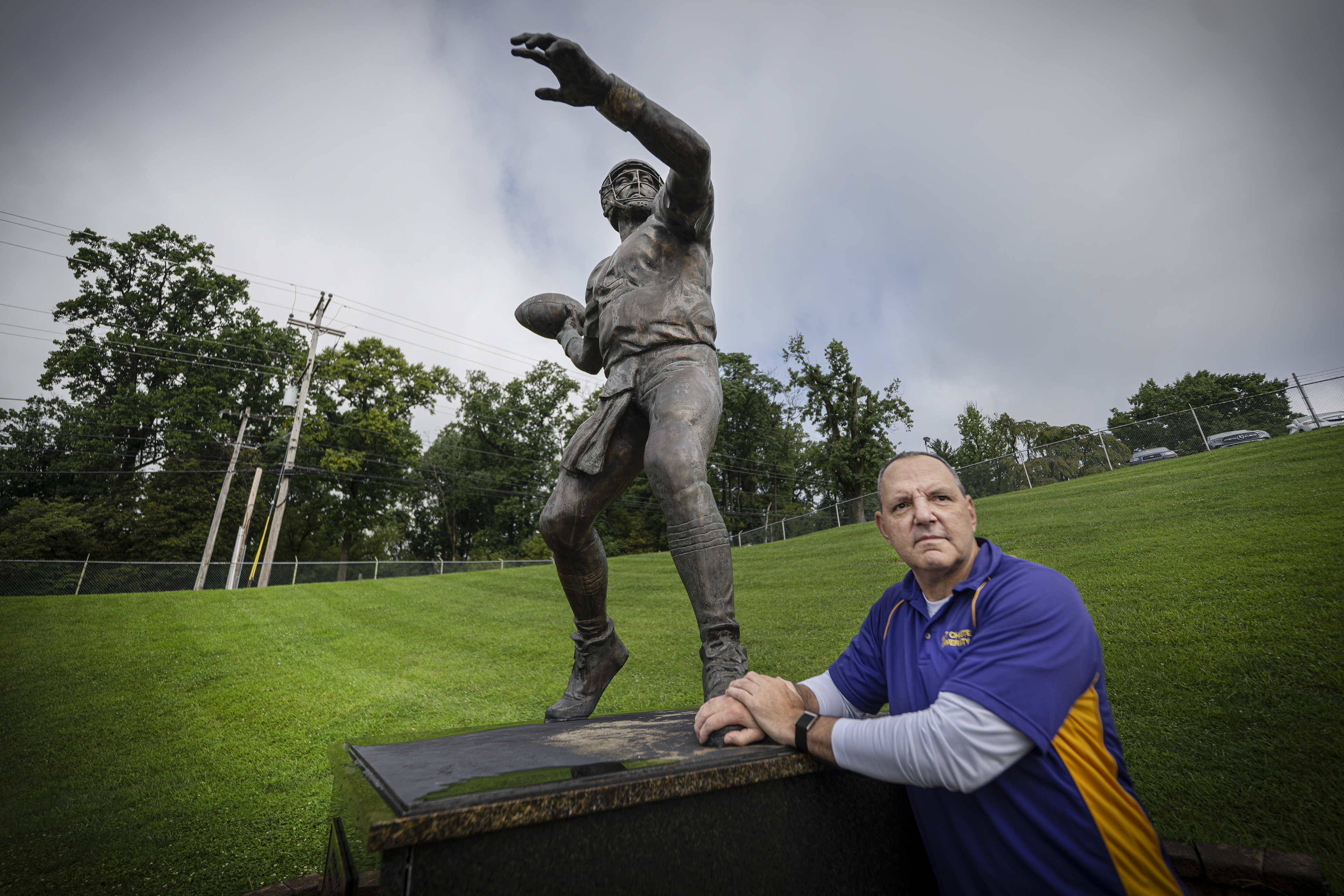
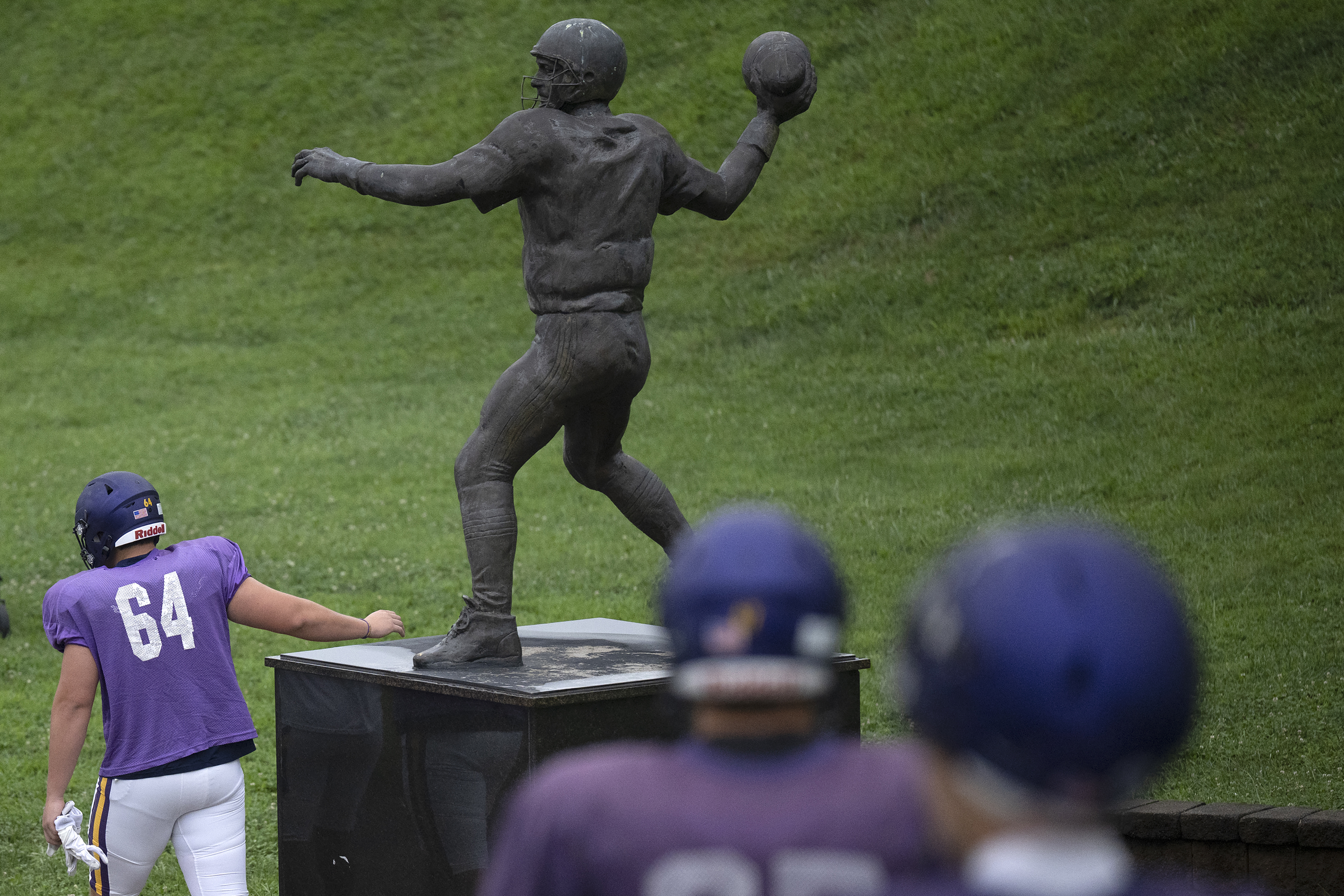
Walsh motioned to the northwest corner of Farrell Stadium. There, at the base of a hill, stood a bronze likeness of a quarterback, his left foot firmly planted, his right arm cocked, ready to uncork a spiral.
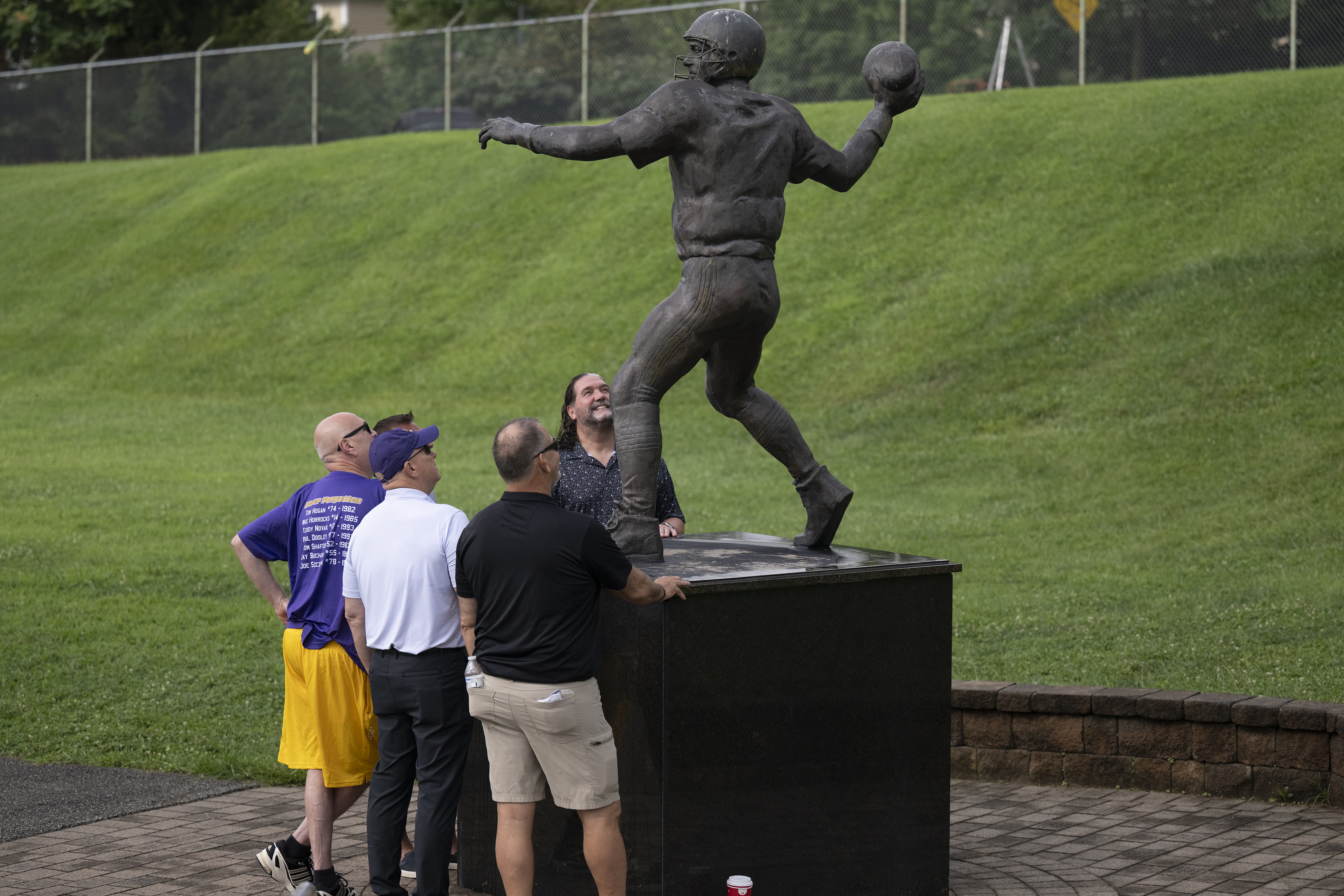
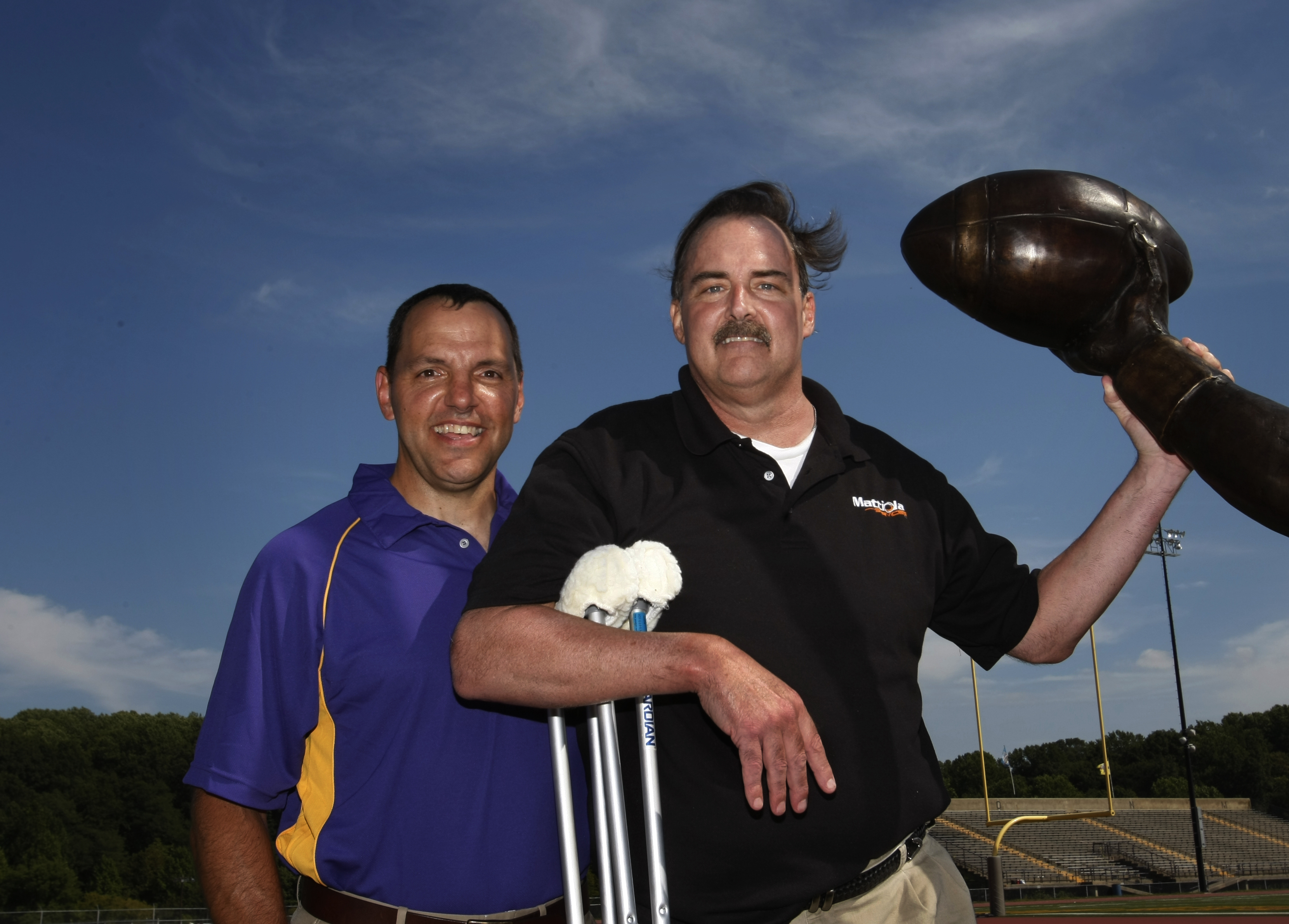
Former teammates John Mininno (left) and Tom Schafer (right) visit the statue of Michael Horrocks which was unveiled Sept. 11, 2010. Michael S. Wirtz / Staff Photographer
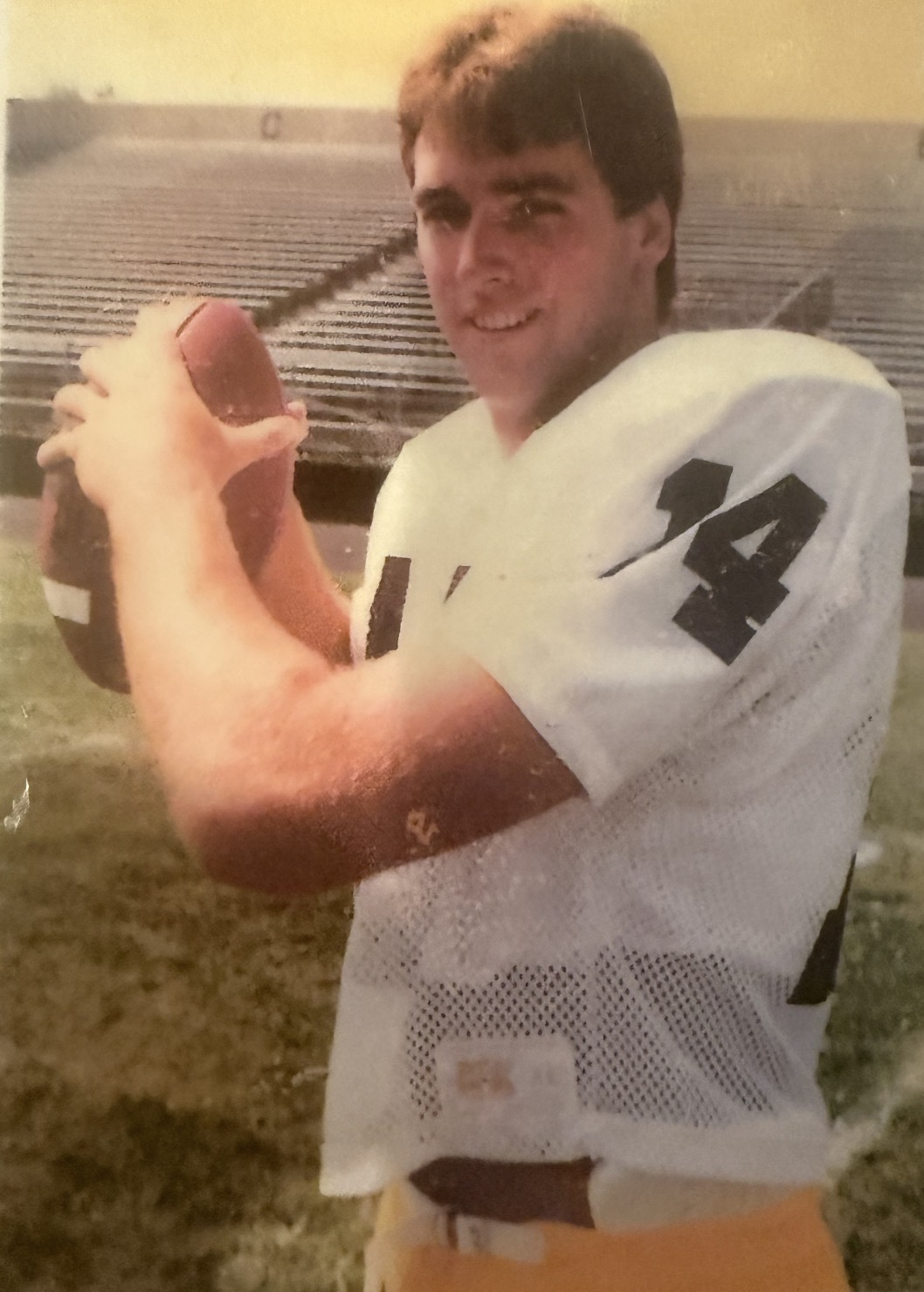
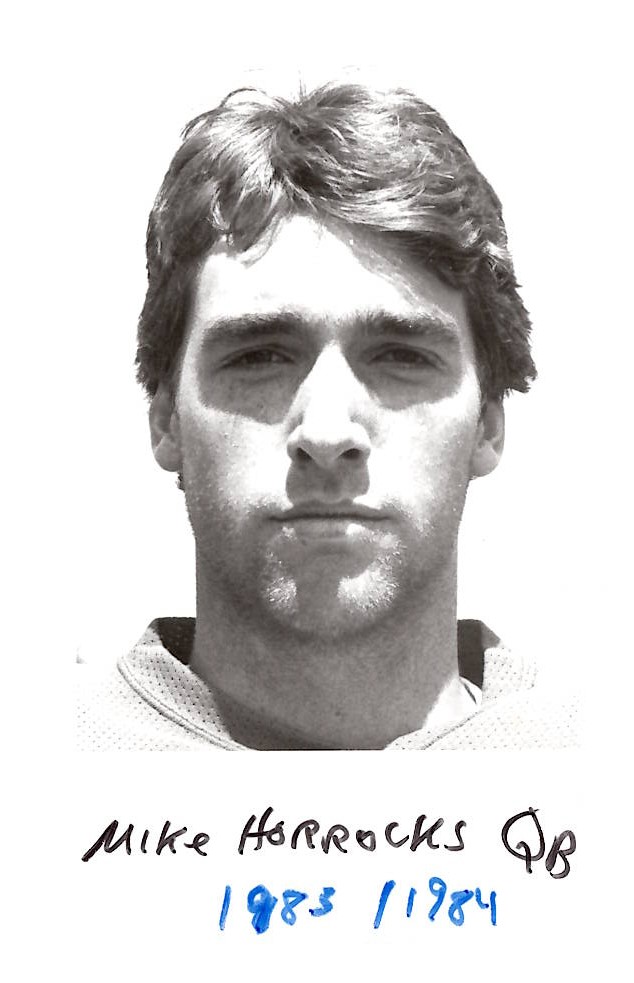
The man was Michael Horrocks, Class of 1985. He and Schafer overlapped on the football team for twoseasons, but Schafer took a liking to the sophomore’s goofy personality.
And when he found out that that same sophomore had been a copilot of Flight 175, the plane that hit the South Tower on Sept. 11, 2001, he was distraught.
Years passed, and Schafer began to coach high school football throughout the region. Some of his players joined West Chester’s program. None knew of Michael Horrocks. Not of his tragic place in history, or of his greatest moment on the field, when he led the Golden Rams to a 35-27 upset win over Delaware in 1983.
They didn’t know of his service in the Marines, or his devotion to his kids, and his wife, and his friends. They didn’t know his name at all. And Schafer desperately wanted them to.
So he and his teammates came up with a plan to ensure Horrocks’ presence would be felt for years to come. From 2008 to 2010, the West Chester alums raised $150,000 for a scholarship endowment and a statue to commemorate the late quarterback.
They faced all sorts of challenges, some of them logistical. West Chester had never built a statue on campus before, and had no clear guidelines on the process to have one erected.
Former West Chester University football player John Mininno is photographed near a statue honoring his former teammate, quarterback Michael Horrocks.Jose F. Moreno / Staff Photographer
In an initial conference call with Horrocks’ teammates, school officials tried to persuade them to build something smaller, like a plaque or a bench. They warned the former players of the money they would need, and the bureaucratic hurdles they would face.
But Schafer was undeterred.
“Tom went in there and said, ‘F— you, we’re not doing a plaque. We’re doing a statue,’” said Class of 1988 linebacker John Mininno. “And he was not to be denied.”
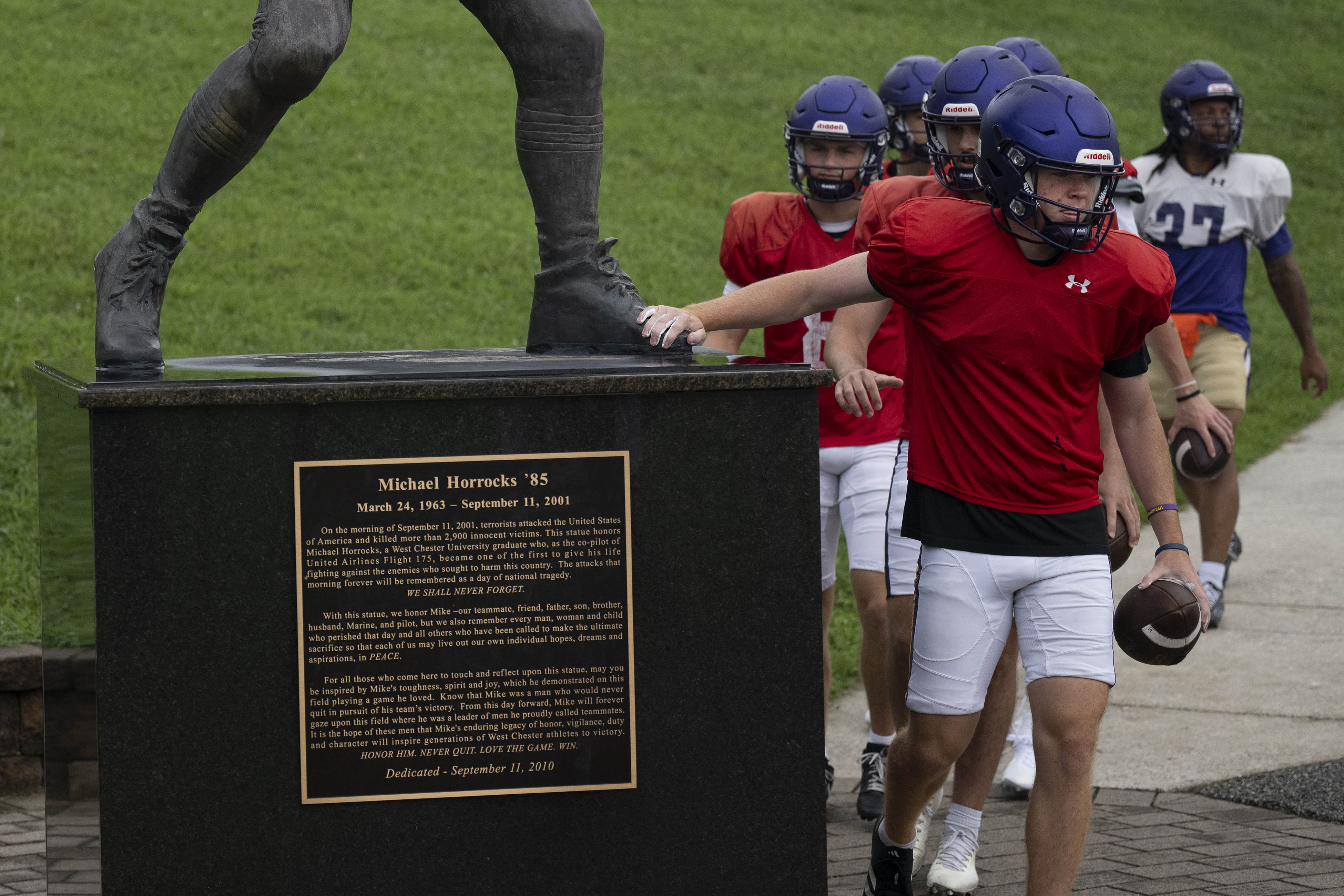
The result was not just a statue, but a tradition. Since it was unveiled in 2010, West Chester’s players have tapped Horrocks’ left foot before every practice and game.
They have done this so often that you can see scuffs of gold peeking out from beneath the bronze. Horrocks is not here in the physical sense, but this version of him — fearlessly driving down the field, leading his men — is now preserved.
And his teammates intend for it to stay that way.
“We want this to be a legacy,” Mininno said. “We want this to be here for much longer than we’re going to be around.”
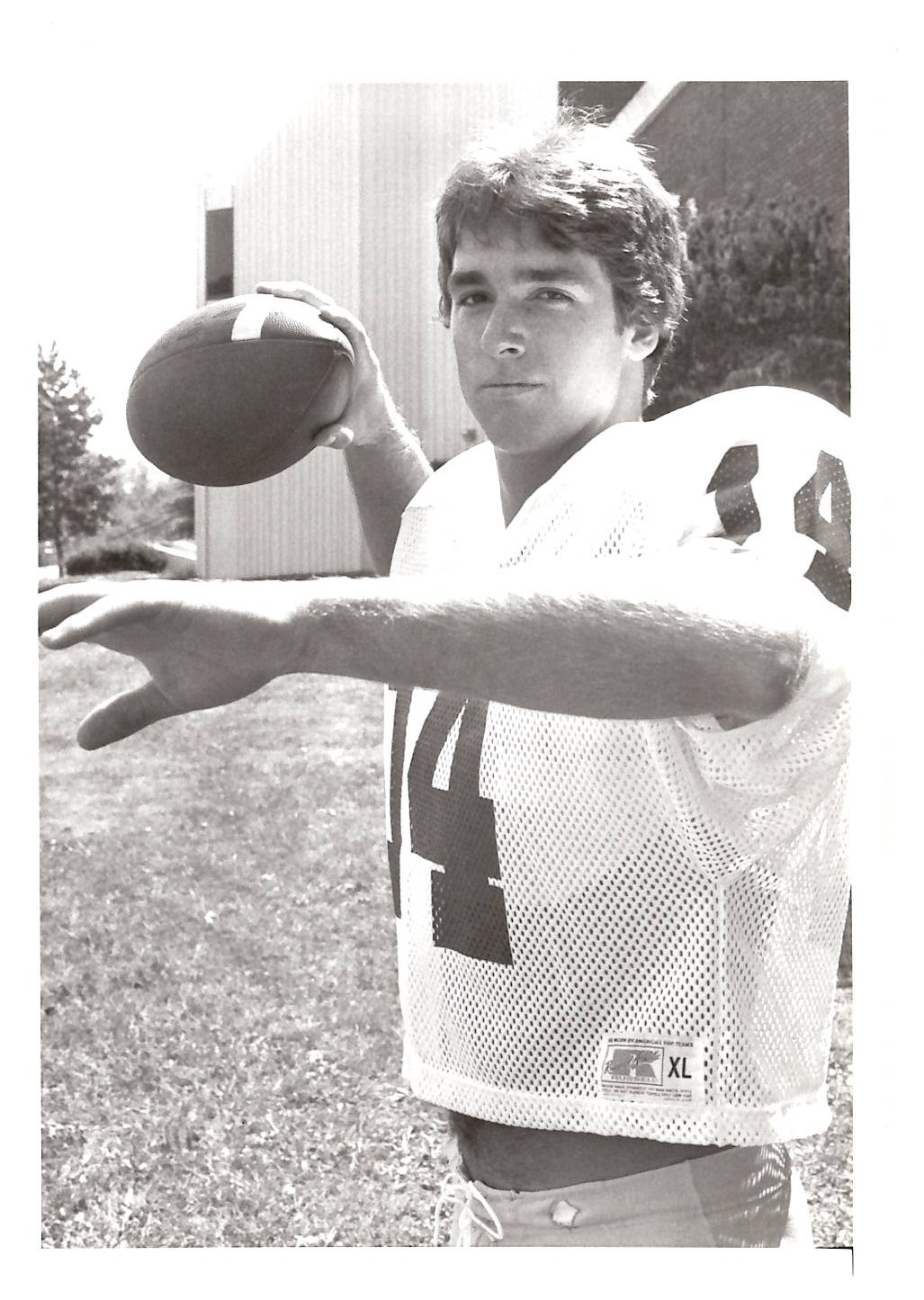
Michael Horrocks emerged as a starting quarterback and a trusted leader at West Chester.provided by Mark Gosik
‘A pilot the entire time’
Horrocks was born and raised about 70 miles west of West Chester, in Hershey, Pa. He attended Hershey High School, where he played varsity football under head coach Robert “Gump” May.
May was tougher than most coaches. His team did three-a-days throughout the summer: an unusually heavy workload, which had the intended effect of whittling unreceptive players from the roster.
The coach would start camp with 75 kids. Two weeks later, he would be left with 30.
One kid, in particular, was always in that lattergroup.
“Mike stayed,” May said.
Horrocks was fighting for playing time with Scott Campbell, a quarterback who would go on to have a six-year career in the NFL. Locals were skeptical that the backup would perform in the opportunities he did get, but he quickly proved them wrong.
Over his one season as a starter at Hershey, and in limited appearances before that, Horrocks led his team to a litany of come-from-behind wins, including one against rival Palmyra High School, which took a 21-point lead in the first quarter.
“After Scott Campbell graduated, everybody thought, ‘Well, they lost their big gun,’” May recalled. “Well, Mike jumped in and he was just as big a gun.”
Michael HorrocksSpecial Collections, West Chester University
Gump reached out to a friend, Rick Daniels, a part-time assistant who later became West Chester’s head coach, and sent him some film of Horrocks. In the spring of 1981, the quarterback drove to campus for a visit.
Daniels was already impressed by what he saw on film. Horrocks didn’t just have a strong arm; he was also quick on his feet, and he had an air of unflappability about him. He joined West Chester’s team that fall as a backup quarterback.
Once again, Horrocks found himself in the unenviable position of filling in for an NFL-caliber player in Ron Gaynor, who later bounced around training camps with the Seahawks, Eagles, and Bills.
Nevertheless, the aspiring starter worked with the intensity of a seasoned veteran. Horrocks and tight end Al DePippo would regularly put in extra hours, throwing after practice and then heading to the weight room. If it was locked, they would use the neck machine beneath the stands.
Horrocks coupled his drive with a lighthearted composure that allowed him to thrive in intense situations. The first time he interacted with Schafer was in 1982,when Horrocks was a sophomore.
Gaynor had gotten hurt; Horrocks was asked to fill in.
“He crouched down in the middle of the huddle, looked up at us, and said, ‘Ah, the big boys,’” Schafer recalled to The Inquirer in 2010. “I said, ‘Shut up and call the play.’”
It was a precursor of huddles to come. Some players got stiff when they first entered regular season games. Horrocks was the opposite. He would walk onto the field with a toothy grin and a laugh, confident in the hours of prep behind him.
Michael Horrocks led West Chester to a rare win over rival Delaware in 1983. Special Collections, West Chester University
This continued even after he was named the starting quarterback in 1983. Horrocks was known to play pranks, like tying teammates’ shoelaces together, or putting slices of cheese in a friend’s textbook.
West Chester had some of its greatest moments under Horrocks and his playful persona. In his first game as a starter, Sept. 10, 1983, the Golden Rams faced the University of Delaware on the road.
It was a harrowing matchup. West Chester played in Division II, while Delaware played at what was then known as the Division I-AA level. The Blue Hens had won their last 15 games against the Golden Rams, a streak that dated back to 1957.
But West Chester was unafraid. After a scoreless first quarter, the Golden Rams jumped to a 21-3 lead in the second. They upped it to 35-3 in the third and held on for the win.
Horrocks finished the day 10-of-18 for 129 passing yards and two touchdowns.
West Chester’s campus erupted into a giant party, as if the team had won the national championship. But the quarterback at the center of it all was already focused on his next game.
When he returned home that night, he recapped different plays and passes to his housemates on Magnolia Street.
“He would talk about even some of the plays that he missed,” said his friend Chris Conner. “He never got too big. Even though he had just beaten Delaware, he was still the same guy.”
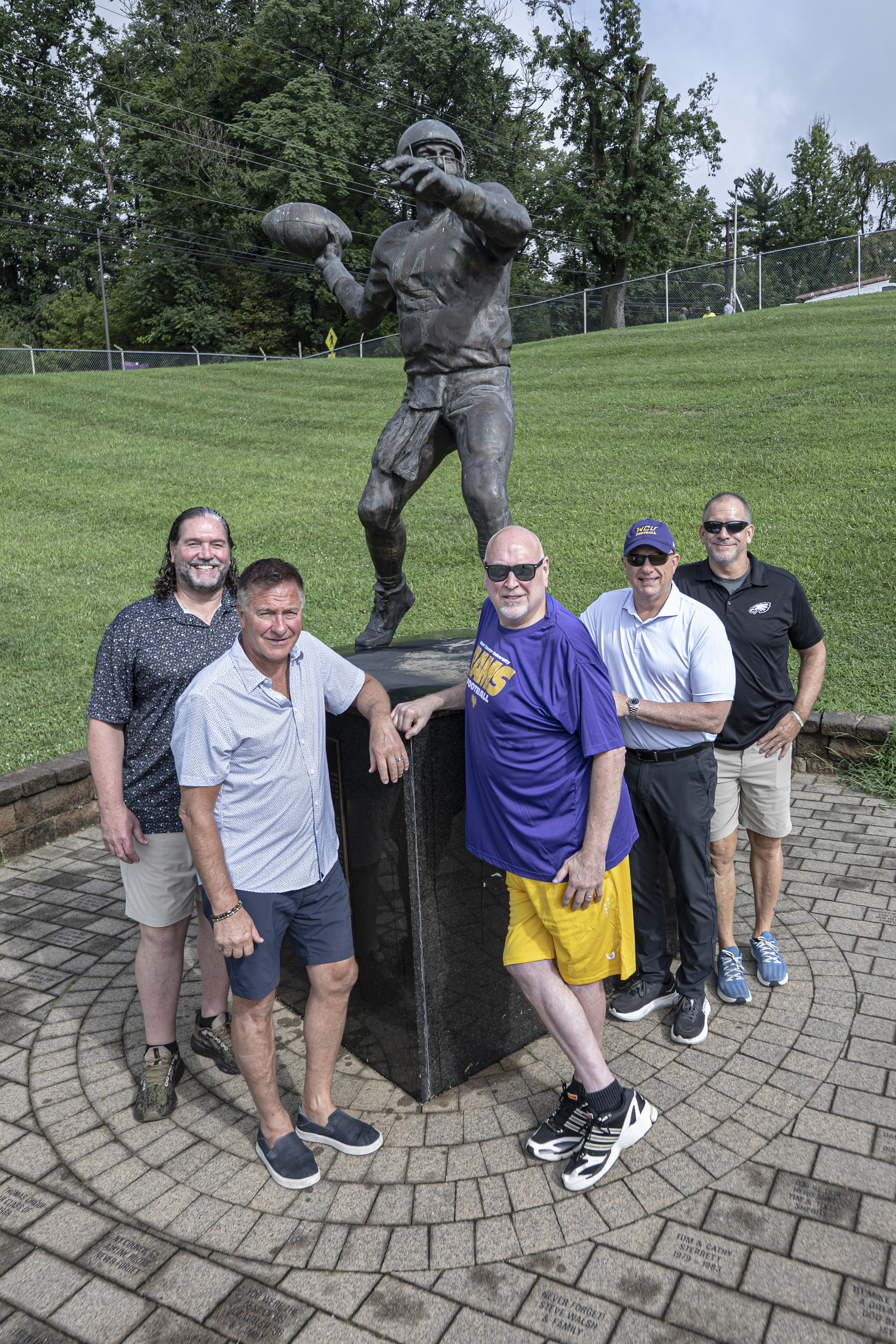
From left, West Chester University football alumni Tom Weaver, Mike Esposito, Bob Campbell, Mike Hudson and Dean DiPasquale pose for a photo with a statue honoring their former teammate Michael Horrocks last month. Jose F. Moreno / Staff Photographer
In 1984, West Chester hired a new head coach, Danny Hale, who brought in a new I-formation attack that incorporated elements of the West Coast offense. This system was different from what the team was accustomed to running (a split-back veer offense), and Hale, who was hired late, had limited time to teach it.
He and quarterbacks coach Bill Hart met with Horrocks every day in the football office on campus. They would draw up plays on the chalkboard and quiz their pupil about different coverages and fronts he would face.
Hale’s system allowed Horrocks the ability to audible if the situation called for it, and the head coach wanted him to be well-prepared. But Hale and Hart soon learned that that wouldn’t be a concern.
The Golden Rams went 7-3 in 1984, and 5-1 in their conference, falling just shy of winning the Pennsylvania State Athletic Conference’s Eastern Division title.
When DePippo looks back, he realizes that the same qualities that served Horrocks in the air were those that made him a good quarterback: a natural leader, a hard worker, a man who could balance an easygoing nature with intense focus.
“It comes back to what kind of pilot do you want?” DePippo said. “Do you want somebody that’s going to panic when the s— hits the fan, or do you want a guy that’s going to be confident?
“And Mike was that confident guy; a pilot the entire time. We just didn’t know it.”
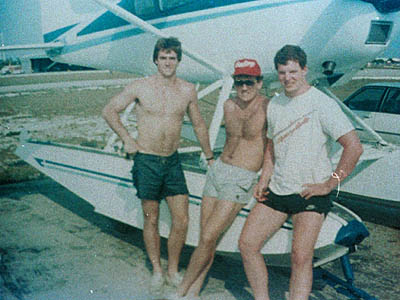
Pilot Michael Horrocks (left) was introduced to flying in the 1980s. (Photo provided by Mark Gosik)INQ WILLIAMS
From football to flight
The first time Horrocks flew a plane was in 1983. He was in Fort Lauderdale, Fla., for spring break with two friends, Mark Gosik, a former guard for West Chester, and Rob Jeffries, a tight end at Lehigh.
They were visiting a family friend of Horrocks’, Bill Blauer, who worked for a commercial airline. One afternoon, Blauer invited them aboard his four-seat aircraft.
Gosik and Jeffries sat in the back, with headgear on, as Horrocks rode up front. About halfway through the two-hour ride, Blauer turned to Horrocks and told him to grab the controls.
Horrocks obliged and cruised the plane down, close enough to see the beachgoers below. As he flew over the ocean, with waves rippling beneath him, he realized he had found his calling.
The former quarterback felt that his best route to commercial flight would be through the Marines. Horrocks knew he would get the best training there, and he liked the idea of a new challenge. So, after graduating West Chester in 1985, he enrolledin Officer Candidates School.
He got his wings at a naval air station in Corpus Christi, Texas, and was stationed in the early 1990s at Marine Corps Air Station Cherry Point in North Carolina, where he joined a marine aerial refueler transport squadron.
Horrocks flew KC-130 turboprop aircraft, which were used to refuel helicopters and jets, but also to transfer cargo, passengers, ammunition — anything that needed to be moved. It was a daunting transition, one that many young pilots struggled with.
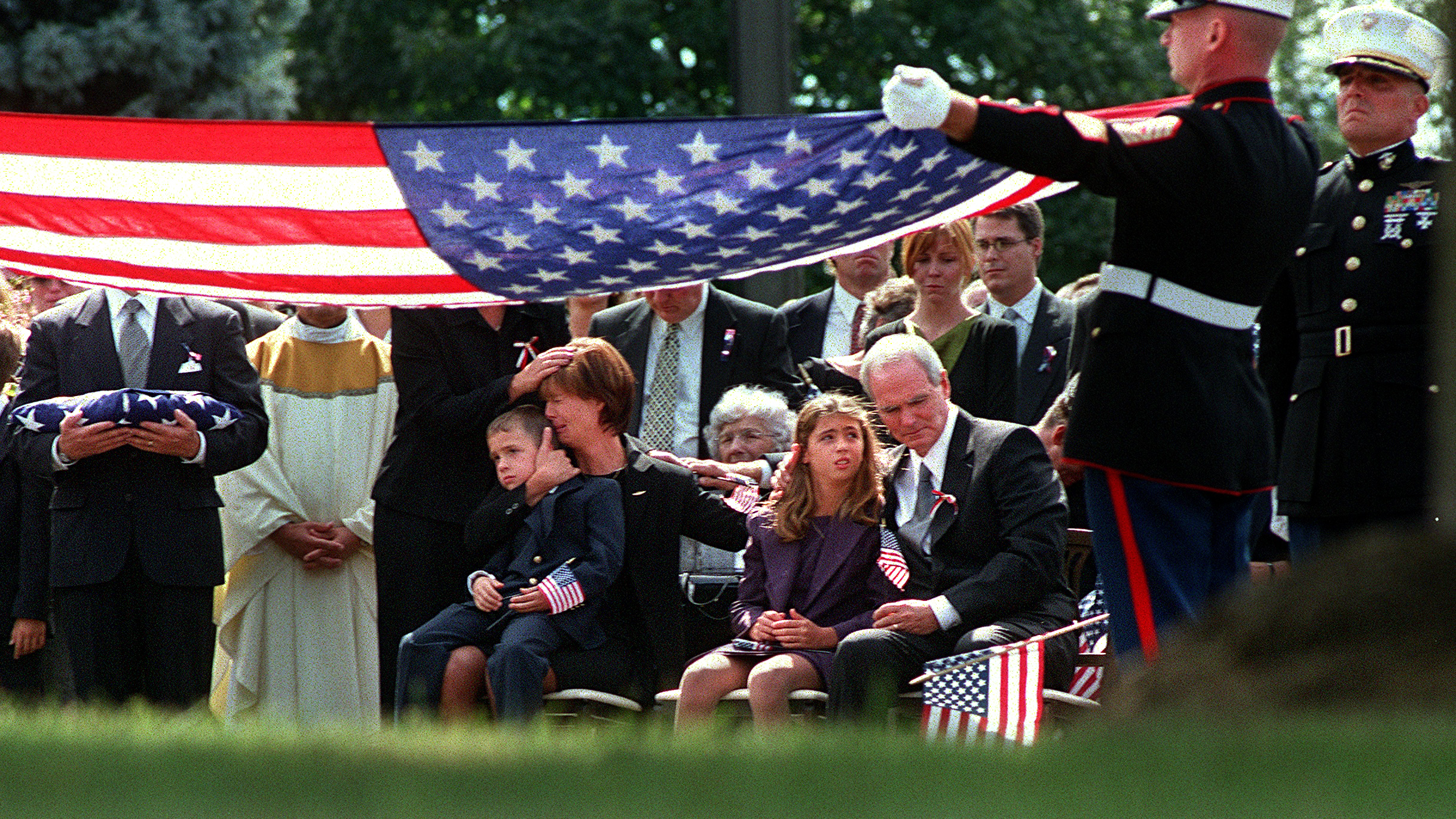
Miriam Horrocks (center, left) cradles her son Mick, 6, as her father-in-law William Horrocks (center, right) sits with her daughter Christa Horrocks, 9, as a US Marine Corps Honor Guard folds up the American flag following a memorial mass and service for her husband Michael Horrocks on Sept. 17, 2001.Tom Gralish / Staff Photographer
In training, they would be flying a single-engine plane, which stretched maybe 18 to 20 feet long. Now, as lieutenants, they were manning a plane five times as big, with three more engines, moving whatever needed to be moved at 30,000 feet in the air.
It was anything but a routine job. Horrocks’ operations officer, now-retired Lt. Col. Bill Franchi, said that when his squadron deployed to Bahrain during the Gulf War, they did so knowing that there was a good chance they would be targeted heavily.
But Horrocks was a natural, and quickly proved he could be relied upon. He went on a number of deployments, to the Middle East throughout the Gulf War, to Europe, to Central America, and became Franchi’s “go-to guy.”
Once, during a three-week detachment to Norway, a panel in the squadron’s KC-130 caught fire. As Franchi tried to put the fire out, he asked Horrocks to redirect the plane back to the local airport.
This was not a scenario that the young pilot had practiced in a simulator. Horrocks would be landing downwind, without flaps on his wings, which helped the plane maintain lift while slowing it down.
With a full-face oxygen mask on, and vapor from a fire extinguisher filling the cockpit, Horrocks guided the aircraft onto the runway, preventing what surely would have been a disaster.
“I told him, ‘I credit you with having saved about six people,’” Franchi said. “Because I didn’t have to do a thing. He had it. And that was sort of typical of Mike. You know?”
Horrocks spent his last few years in the military instructing Marine, Navy, and Coast Guard pilots in Florida. In 1997, his active duty came to an end. He enrolled in new-hire pilot training at United Airlines that summer.
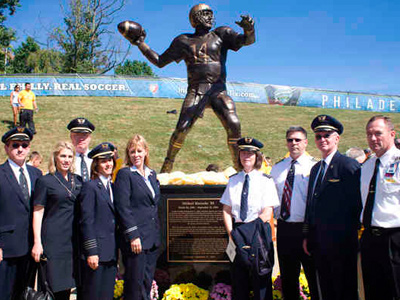
United and Continental Airlines pilots and crew, all friends of Michael Horrocks, stand by his statue at Farrell Stadium in 2010. (Ed Hille / Staff Photographer)
He soon was flying commercial airplanes full-time and living in Glen Mills with his wife, Miriam, and their two young children, Christa and Mick.
Now that Horrocks was local again, he was able to reconnect with old teammates like Bob Rafferty, a former West Chester halfback and quarterback.
They would often see each other in Media, running errands at the Granite Run Mall. In December 2000, while shopping for Christmas gifts, they crossed paths one last time.
Horrocks was walking out of the mall, and Rafferty was walking in. They chatted about family. Horrocks mentioned that he had recently started working transatlantic flights for United.
The two men said goodbye and went their respective ways. Nine months later, Horrocks boarded a Boeing 767 at Logan International Airport in Boston.
Rafferty watched as it hit the South Tower of the World Trade Center. Few, if any, of his teammates knew that Horrocks was piloting commercial aircraft. The idea of him being on that plane didn’t even occur to them.
But Rafferty had a feeling.
“He was the first person I thought of,” he said.
West Chester University quarterback Colin O’Sullivan taps a statue honoring former quarterback Michael Horrocks before practice last month. Jose F. Moreno / Staff Photographer
‘Think of Mike’
Without social media, news of Horrocks’ death at age 38 spread slowly.Some West Chester football alumni found out when they saw Miriam Horrocks on the front page of The Inquirer, at her husband’s funeral in Upper Providence Township.
Others heard through teammates. DePippo was working on Wall Street and lost about 40 or 50 colleagues in the attack. He couldn’t process that Horrocks was gone, too.
In late September, Gosik and two friends, Tim and Patrick Dever, took a train to New York. They spent the day at ground zero, walking through rubble, picking up pieces of people’s lives off the ground: photos, notebooks, newspapers.
Gosik still remembers how dust and soot filled the air. So did the sound of car alarms, blaring for their owners. A few days earlier, a neighbor had made Gosik a lapel pin to commemorate Horrocks, with his No. 14 written on a felt football.
Gosik wore it on his jacket as he traversed the site where his teammate perished.
“We just felt like we needed to be there,” Gosik said. “We just wanted to go.”
Years went by, and the West Chester alums began to wonder why no tribute to their quarterback existed on campus. They were worried that Horrocks would be forgotten, and realized that their fears were well-founded.
West Chester University football players tap a statue honoring former quarterback Michael Horrocks before practice last month. Jose F. Moreno / Staff Photographer
“I don’t recall any of us even being aware of it beforehand,” said Tim Keyser, a wide receiver who graduated in 2013. “That wasn’t something I knew when I was a true freshman on campus or anything.”
The former players began to meet with the school about the prospect of a statue in 2008. Bill Zwaan Sr., who was head coach of the football program at the time, sat and listened as an official from the foundation tried to convey how complicated, and costly, it would be to build such a structure.
Horrocks’ teammates ended the meeting emphatically: by standing up and reiterating, for the umpteenth time, that they were going to move forward with the statue. After they left, the foundation official turned to Zwaan.
“And he said, ‘Do you think they really understood what we were talking about?’” Zwaan recalled. “And I said, ‘They do. And they’re going to do a statue. And you guys have got to be prepared for that.’”
It was a slow, arduous process. The former players not only would have to raise $50,000 for the statue itself, but also would donate $100,000toward a scholarship endowment, which DePippo and another teammate, Bruce Blake, started in 2004.
At this point, most of them had full-time jobs and families of their own, and carving out time was not easy. But they made it happen.
DePippo oversaw the money. Mininno began a letter-writing campaign to raise funds. Walsh served as a liaison between the alumni and the current coaching staff.
Schafer worked as a partner of a local concrete cutting company. He and another West Chester alumnus, Paul Vanscovich, donated their construction crews and equipment for free.
Other teammates chipped in through a team banquet and a Super Bowl pool. A few local businesses, and the pilots union, contributed as well.
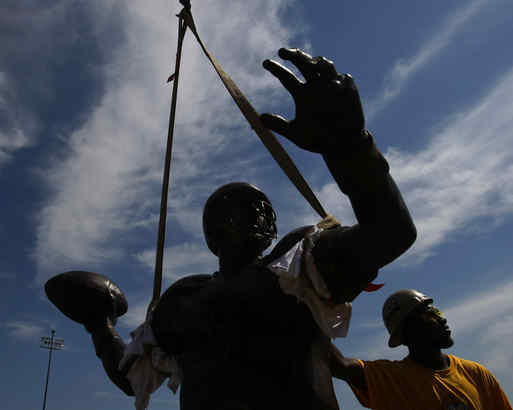
The statue of Mike Horrocks at West Chester.MICHAEL S. WIRTZ / Staff Photographer
“I’d kick in $1,000, John would kick in $1,000, Jim O’Donnell would kick in $1,000,” DePippo said. “And then we would get on a text chain, and berate each other in team fashion. Like, ‘You’ve got to do this.’
“We raised money basically only through grassroots. I was specific about that. I didn’t want any corporate sponsorship.You know, ‘CBS Sports presents the Mike Horrocks statue.’ I didn’t want that.”
In the months before construction of the statue was finished, former players would visit West Chester to share stories of their late teammate with the current roster.
Walsh, DePippo, and Blake visited them the day before the dedication. Wearing purple and yellow practice jerseys, the team took a knee as Walsh began to speak.
He explained that one day, Horrocks’ teammates wouldn’t be able to share his story, and that it would be up to the next generation of players to do so.
Then he asked them to close their eyes, and think of a loved one: a sibling, a friend, a parent.
“And when you go down that hill tomorrow, and you touch [the statue of] Mike, think of Mike,” Walsh said. “Say his name. And think of someone else who is special in your life. And thank God that you have them with you today.”
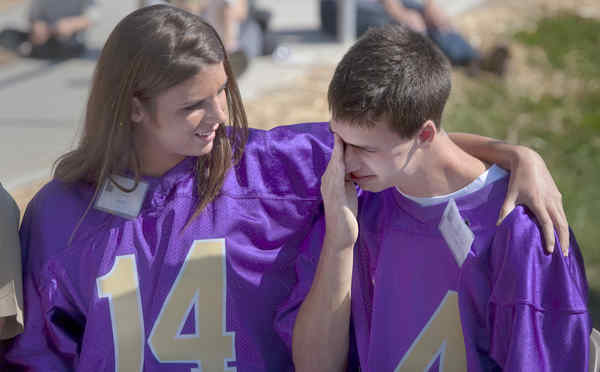
Nine years after their father’s death, Christa Horrocks comforts her brother, Mick, at the unveiling of the statue of Michael Horrocks at West Chester University in 2010.
The statue was unveiled at 10:30 a.m. on Sept. 11, 2010, a perfect autumn day in Chester County. The school arranged a ceremony beforehand, with bagpipes, a marching band, and a flyover.
Miriam Horrocks and the children, now teenagers, were in attendance; Christa gave a speech about her father.
Sitting next to the podium, with crutches by his side, was Schafer. He was unable to speak to a large crowd, but sat throughout the entire ceremony with a smile on his face, shaking hands with football men young and old.
He died of cancer just over a month later, at his home in Phoenixville.
Last August, during a team reunion in West Chester, a thought occurred to Walsh. He pointed to the bricks surrounding Horrocks’ memorial, which contained inscriptions honoring the late quarterback.
He suggested adding a small stone, maybe toward the back, with the number 52 on it; a nod to a teammate who put another above himself, even when his body was failing.
“Tom just believed in his heart that it needed to be a statue,” Walsh said. “And he was right. He was right.”
Like every American who lived that fateful day, I can vividly remember where I was on Sept. 11, 2001.
I was in the middle of chairing a hearing as a city civil service commissioner when my administrative assistant burst into the room. She told me a plane had hit the World Trade Center in New York. I postponed the hearing immediately.
But unlike millions of Americans who were frozen in place watching the heartbreaking visuals of the second plane hitting the second tower, I was already on the phone with the Philadelphia Police Department, the Philadelphia School District,and the Human Relations Commission.
I knew there would be an immediate backlash against the Arab and Muslim American community.
Like every other minority community in this country’s history, our community knew too well the playbook that isdeployed following a tragedy. The provocations from talking heads on television, the incendiary questions expedited by the broader 24/7 media landscape, even the inflammatory comments made by elected officials —the very people who weresupposed to protect us.
I could see it coming. In America, we always search for an enemy to blame, and sadly, on Sept. 11, 2001, Arab and Muslim Americans were the ones unfairly blamed.
In those first few days, thanks in part to our partners in law enforcement and our wider community outreach, we managed to head off the worst of it for the Arab and Muslim American community in Philadelphia. We had some threats and attacks on stores, and some people were targeted with violence. But even thoughthat was horrific and traumatizing, in comparison to others, inPhiladelphia our community was surprisingly fortunate.
Across the country, Arab American businesses and mosques were literally burned to the ground. Arab Americans were arrested, and some were held for a long period of time without charge. Other Arab Americans —and those perceived to be Arab — faced targeted violence and,horrifically, a few people were murdered.
These serious hate crimes and attacks by both lone actors and, sadly, also the government, were widely underreported by the media, then and now. Our community still feels that pain every day.
We weren’t even given the time to mourn the tragedy ourselves,including the many victims on 9/11 who themselves were Arab and Muslim Americans.
While our country mourned the thousands dead in New York, we as Arab Americans also had to mourn our place in American society,which has never recovered. It was the way the country changed after 9/11 that has been so difficult for our community. It was a transformation that hit every American, but it felt targeted at us.
The response to 9/11 fundamentally shifted what the U.S. stood for. We were dragged into two devastating wars, first in Afghanistan, and then in Iraq. Those conflicts took hundreds of thousands of innocent Afghan and Iraqi lives and thousands of our own soldiers.
Then came the Transportation Security Administration, a government organization that utilized racial profiling in what never once felt like “random” checks.
The Patriot Act expanded government spying into the private lives of all Americans, but particularly Arab and Muslim Americans, who faced extraordinary government surveillance.
Other law enforcement agencies followed, with their own prejudiced practices, especially the New York Police Department, whichstarted sending undercover agents into mosques to record worship services. Their “Demographic Unit” went to gatherings, restaurants, and clubs to survey the community. They made lists of our businesses and started infiltrating student groups.
On top of that, the federal government started the NSEERS program, forcing thousands of men visiting the U.S. from Muslim-majority countries to be fingerprinted and registered like criminals. No terrorists were found among those profiled.
We also now know the extent to which the government used torture against mainly Arab and Muslim prisoners at black sites, and most notoriously at Guantánamo Bay. We now know that many of those prisoners were innocent and had nothing to do with 9/11, let alone al-Qaeda. That didn’t stop theCIA and its contractors, all of whom escaped justice for their role in the torture program, from using waterboarding and extraordinary rendition on these prisoners, all while denying their basic rights.
After 9/11, if you were Arab or Muslim, there was no such thing as being innocent until proven guilty anymore.
Even now, more than a dozen men are still sitting in Guantánamo Bay without ever facing a trial, due in part to the very torture program the government once tried to say was necessary.
And in the decades since, some things have gotten worse.
There continue to be travel bans targeting people from predominantlyArab and Muslim nations.
Groups in places like Texas are trying to ban Sharia law — a grotesque, Islamophobic distortion that pretends Sharia is a legal system challenging the Constitution rather than a set of guidelines for moral and ethical conduct in a religious context.
And attempts to silence and censure Arab American voices, particularly on issues like Palestine, continue at universities, corporations, and state capitals across the country.
It hasn’t all been dark, though.
The pressure our community has faced since 2001 has made us stronger in a lot of ways. It forced us to build real, lasting ties with our religious allies, especially our Jewish and Christian neighbors. That’s how the Interfaith Center of Philadelphia got its start.
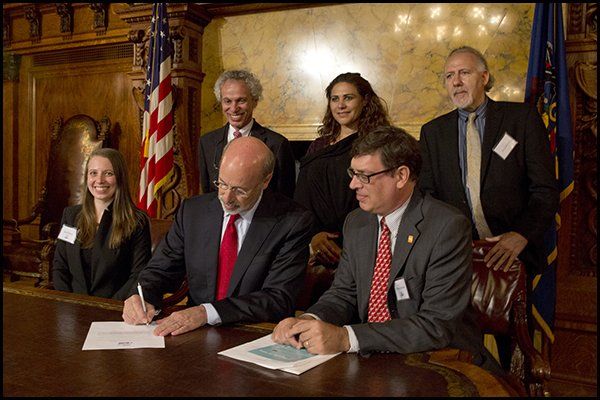
The author (seated at right) watches Gov. Tom Wolf sign “The Pledge to Combat Bigotry,” a public commitment to speak out against bigotry toward Muslims and Arabs, in Harrisburg on Sept. 30, 2015.Courtesy of Marwan Kreidie
It solidified our political presence, too.
Now, we have more leaders than ever standing up for our inclusion in the city and the state. Many elected leaders have rallied to support us, and our community has the greatest number of people elected to local, state, and federal offices we’ve ever seen.
By working together with allies to make the U.S. freer, and toprotect the importance of what it means to be an American citizen, Sept. 11 showed the resilience of our community.
I could not be prouder of that.
Twenty-five years ago, even as those terrorists tried to break us, and others inside our own country tried to divide us, America prevailed.
We nearly lost our democracy on that fateful day, as our democratic system was hijacked in the name of “security.” But we, as Americans, came together.
And today we must continue to live the words of the great Benjamin Franklin: “Those who would give up essential liberty, to purchase a little temporary safety, deserve neither liberty nor safety.”
Marwan Kreidie teaches political science at West Chester University and is the executive director of the Philadelphia Arab-American Development Corps.
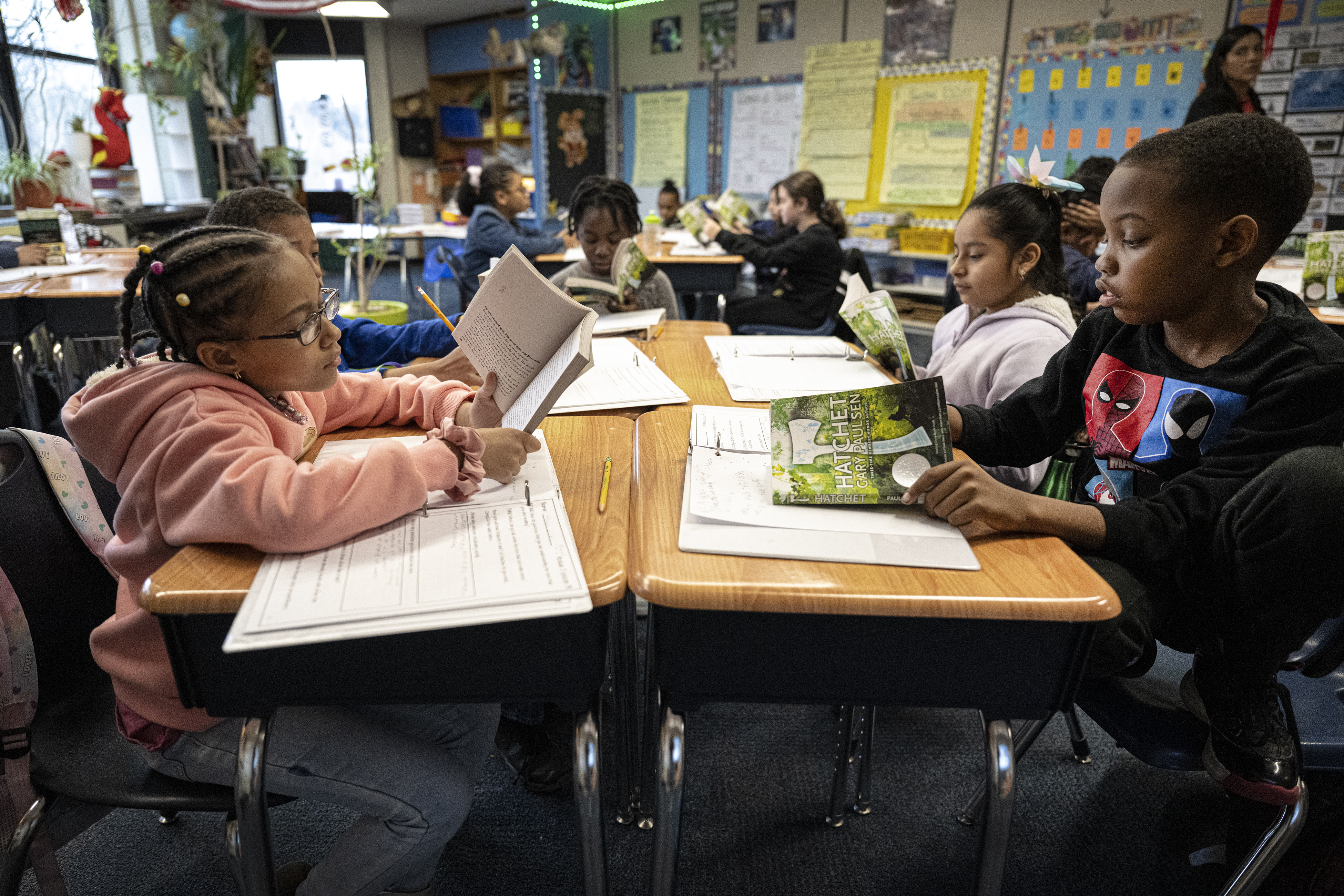
Nearly half of educator preparation programs are failing to adequately train future teachers in how to teach reading, according to a new report, even as states across the country have passed laws to overhaul reading instruction.
And in Pennsylvania, even more teacher preparation programs may be falling short, according to the National Council on Teacher Quality, which released a report this week reviewing whether colleges and universities had aligned their instruction for future teachers with the so-called science of reading.
Of 23 graduate and undergraduate programs evaluated in Pennsylvania, five received A’s, according to the report. Just as many received F’s.
Pennsylvania is “among the lowest-performing states in this analysis,” said Ron Noble, NCTQ’s director of teacher preparation.
Some colleges have criticized the group’s methodology, and literacy advocates had mixed reactions to the findings.
Still, progress has been made since 2023, Noble said, as more states have made changes to how reading is taught amid fierce debate over best practices and deepening concern about poor reading scores. Here is what the group found, and how Pennsylvania universities and colleges fared:
How reading instruction is evaluated
For decades, the predominant approach to reading in many schools, balanced literacy, sought to foster a love of reading in children by focusing on stories and de-emphasizing skills-based instruction.
The National Council on Teacher Quality scored education programs on how well they prepare teachers in the “five core components” of scientifically based reading instruction: phonics, fluency, vocabulary, comprehension, and phonemic awareness — the ability to identify units of sounds in spoken words.
The group, which evaluated course syllabi, curricula, and lecture schedules, also considered whether programs taught debunked practices, including “three-cuing” — prompting students to guess words based on context clues — and running records, an assessment that involves listening to a child read aloud to determine what level of book is appropriate.
Programs that earned A’s are adequately covering all five core components, Noble said, while not teaching more than three practices “that run counter to the science of reading.” Those that received F’s, meanwhile, are not adequately covering more than one of the core components, or teaching enough contrary practices that their letter grades were reduced, Noble said.
How Pa. colleges scored
Nationally, the percentage of programs receiving A’s more than doubled from 2023, from 26% to 53%.
(function(){function e(){window.addEventListener(`message`,function(e){if(e.data[`datawrapper-height`]!==void 0){var t=document.querySelectorAll(`iframe`);for(var n in e.data[`datawrapper-height`])for(var r=0,i;i=t[r];r++)if(i.contentWindow===e.source){var a=e.data[`datawrapper-height`][n]+`px`;i.style.height=a}}})}e()})();
Among them was East Stroudsburg University. Brooke Langan, dean of the university’s College of Education, said the school had produced more records in this review.
East Stroudsburg also reviewed its coursework after Pennsylvania required structured literacy competencies to be embedded in teacher preparation programs in 2022, Langan said.
“It really made us take a moment and think about: Did we structure those correctly? Are they scaffolded well for our students developmentally?” Langan said.
Other schools getting top grades were Carlow University, Millersville University, Pennsylvania Western University, and Shippensburg University.
At the other end, Cheyney University, the Commonwealth University of Pennsylvania, Lincoln University, West Chester University, and Widener University’s graduate education program received F’s.
Julie Stellfox, a spokesperson for Commonwealth University, said the school “does not subscribe” to NCTQ’s research methodology. She noted a statement about the report from the American Association of Colleges for Teacher Education, which voiced concern about relying “primarily on document review as a proxy for the quality of educator preparation.”
Nancy Gainer, a spokesperson for West Chester, said that school also disagrees with NCTQ’s methods. She noted that West Chester complied with an “open source request” from the group in 2023 and received a B in its report then; this time, the school did not receive such a request, and West Chester did not supply information, she said.
An NCTQ spokesperson said the group submitted a formal records request to West Chester.
Mary Allen, a Widener spokesperson, said the university had asked NCTQ to reassess the graduate education program “and include additional courses that focus on reading instruction, which were not included in their review.”
“Academic rigor and student success are our top priorities, and we have aligned our teacher education programs to all the required competencies related to structured literacy and the science of reading outlined in Pennsylvania Department of Education guidelines,” Allen said.
Noble acknowledged the criticism of a review process limited to records. But, he said, NCTQ is evaluating whether colleges adequately cover foundational reading skills, and it was “highly unlikely that something that doesn’t appear in course materials” is being taught.
Fewer Pennsylvania programs agreed to be evaluated by NCTQ this year — the program reviewed 33 in 2023, compared with 23 in the latest report. Overall, 63% of Pennsylvania teacher preparation programs did not participate.
Of schools nationally that declined to be reviewed after participating in 2023, NCTQ said, more than 60% had received F’s previously.
It also said that it identified textbook requirements for more than 80% of nonparticipating programs, and found they used textbooks misaligned with the science of reading at the same rates as programs receiving D’s and F’s.
Noble noted that the four largest teacher preparation programs in Pennsylvania either did not participate in this year’s review — Pennsylvania State and Temple Universities — or received F’s, in the case of West Chester and Commonwealth.
“It’s even more concerning: The places producing many of Pennsylvania’s newest teachers are either a black box for us or did not perform well,” Noble said.
Calls for more state oversight
Rachael Garnick, Pennsylvania Literacy Coalition manager with the Teach Plus group, which advocates for structured literacy implementation, said there was value in the report’s effort to evaluate how well colleges are preparing future teachers.
But “I don’t think it’s a conclusive verdict,” including about schools that did not participate, Garnick said, noting that one university she had spoken with said NCTQ had sent its request for information to the incorrect administrator.
Pennsylvania itself needs to do more to hold teacher preparation programs accountable for reading instruction, Garnick said. While the state now requires structured literacy in teacher preparation programs, it does not set requirements for the number of courses or hours of instruction.
And the state’s certification exam for new teachers has not been aligned with the science of reading. For instance, it still includes questions on three-cueing, Garnick said — even though Pennsylvania has banned that practice. The coalition is pushing the state to adopt a standalone exam to test teaching candidates on reading.
The failure of teacher preparation programs to adopt the science of reading has ripple effects, said Kate Mayer, a consultant with Keystone Structured Literacy Partners. Mayer, who has advocated for many Philadelphia-area families whose children are struggling with reading, said she sees area school districts working with universities to make changes to their reading instruction that still are not best practices.
“In my experience, the bar is even lower than it should be for what we’re looking at,” said Mayer, who served on a committee that worked with NCTQ on its scoring rubric in 2019. She said “there should be no excuses” for universities that are not adequately covering the five reading components.
Some states, including Ohio and Indiana, have significantly improved teacher preparation programs through new accountability measures, including audits and the prospect of revoking accreditation, Noble said.
“When you’re providing teacher preparation programs with really clear standards” and consequences for not meeting them, “that’s a recipe for pretty dramatic” changes, Noble said.