SCRANTON — Four of Mike Parry’s tenants can no longer afford to pay their rent. Suddenly, their financial pain is his.
“It’s the affordability of everything that’s the problem,” said Parry, 60, of Clarks Summit, Lackawanna County. “We’re all feeling it now.”
With the war in Iran rocketing gas to almost $5 a gallon, inflation surging to 3.4% from 2.6% in 2025, and food prices up nearly 3% over last year, the high cost of living is weighing on the minds of many voters — and candidates — as the midterm elections draw near.
Nowhere is that more critical than in four tightly contested Pennsylvania congressional districts that could decide the control of the U.S. House — in Bucks County, the Lehigh Valley, the Harrisburg area, and Northeast Pennsylvania.
Mike Parry of Clark Summit, Lackawanna County.Courtesy of Mike Parry
Parry, a Republican and supporter of President Donald Trump, said he is aware that many Americans hold the president and his party accountable for the affordability crisis, including in the 8th Congressional District, where Parry plans to back GOP U.S. Rep. Rob Bresnahan over Scranton Mayor Paige Cognetti, the Democratic nominee.
But other voters might not be so kind to Trump-aligned incumbents this fall.
Among likely voters in Pennsylvania, 75% disapprove of how Trump is handling the cost of living, compared with just 25% who approve, according to a recent poll fromThe Inquirer, the New York Times, and Siena University. And 73% disapprove of how he has handled gas prices, vs. 24% who approve. About 65% disapprove of his handling of the economy, vs. 34% who approve.
“It doesn’t matter what party you’re in,” Parry said. “We’re all getting hammered the same.”
‘Spend less’
At his local Wawa gas station in Allentown, P.J. Santos, 32, removed his finger from the pump trigger before his tank filled.
“So I buy less than I need,” he added, tightening his gas cap. “Same goes for date nights with my wife: Spend less.”
That is harder when you’re buying food, said Tammy McCoy, 52, of Easton,in the same district.“Walk into any grocery store,” said McCoy, a Democrat and professional cook. “It’s like you have to hand them $50 at the door.”
(function(){function e(){window.addEventListener(`message`,function(e){if(e.data[`datawrapper-height`]!==void 0){var t=document.querySelectorAll(`iframe`);for(var n in e.data[`datawrapper-height`])for(var r=0,i;i=t[r];r++)if(i.contentWindow===e.source){var a=e.data[`datawrapper-height`][n]+`px`;i.style.height=a}}})}e()})();
Trump, she remembered, promised to lower priceson Day 1 of his presidency. Not only did that not happen, she added, he raised tariffs, making imported staples like coffee, nuts, and olive oil more expensive. “Because of that,” McCoy added, “I’m against him and Republicans.”
Tapping into the frustration over food prices, Democrat Janelle Stelson’s campaign is pointing to the cost of hamburgers as she seeks to oust Republican U.S. Rep. Scott Perry in the 10th Congressional District.
Janelle Stelson (left) and Rep. Scott Perry, R-Pa.(right) from a Stelson campaign photo in 2024, the last time the two squared off against each other in a bid to represent the 10th Congressional District. Stelson Campaign, AP
Stelson eats a burger in a TV ad that says Americans now pay $7.29 for a pound of ground beef —a result of tariffs Trump imposed and Perry supported.
But criticism of Trump’s tariffs will not sway Tammy Green, 60, a Republican voter in the 8th Congressional District who supports Bresnahan over Democrat Cognetti.
“Because he’s a businessman, President Trump understands the economy. … He’s negotiating fair prices with tariffs,” said Green, a former travel agent who lives in West Wyoming, Luzerne County.
More households need help
On a hot September day in Levittown, people gathered to celebrate the grand opening of the new headquarters of the United Way of Bucks County. Focused on helping anyone experiencing financial hardship, the building features an expanded HELP Center, where diapers, fresh produce, and clothing are available at no charge.
As need skyrockets, the nonprofit expects a 40% to 50% increase in demand this year, Marissa Christie, president and CEO, said in an interview.
“Folks are telling us that in the grocery store, their budget is not going as far as it used to,” Christie said. “When they go to fill up their gas tank, their money is not going as far as they expected.”
Attending the event alongside other local lawmakers was U.S. Rep. Brian Fitzpatrick (R., Bucks), who secured $4.15 million in federal funds for the building and said the agency will “always be in that top-10 list” of key nonprofits helping those in need.
U.S. Rep. Brian Fitzpatrick (R., Bucks) speaks outside the U.S. Capitol about legislation to put national restrictions on gerrymandering on Sep. 16, 2026.Sam Janesch / Staff
The cost of living has become a focal point in the 1st Congressional District race as Fitzpatrick fends off a challenge from Democratic County Commissioner Bob Harvie in the Bucks County-based swing district.
Pennsylvania Democrats, including Harvie, have centered their campaign messaging on affordability in hopes of appealing to voters across the political spectrum.
“Costs are what affect people every single day … whether it’s at the pump, whether it’s in the grocery store,” Harvie said in an interview with The Inquirer’s Editorial Board. “Housing costs obviously are huge. It’s a major issue here in this district, especially in the county.”
(The Editorial Board, which runs The Inquirer’s opinion pages and decides endorsements, operates independently from the newsroom. Newsroom editors and reporters have no role in endorsements, and opinion staffers have no role in news coverage.)
Fitzpatrick, too, acknowledged in an interview at the U.S. Capitol last month that affordability is the top issue not just in this election, but in every election.
“The No. 1priority, the No. 1 focus, has to be on affordability — has to be,” he said. “That’s the issue that got Trump elected in ’24. It’s what got [New York Mayor Zohran] Mamdani elected in ’25. It’s what people care about.”
‘Affordability front and center’
Demonstrating their awareness of voter focus on the high cost of living, Trump administration officials and local Republicans repeatedly emphasized “affordability” as they touted their work to combat rising electricity prices at a PPL Electric Utilities facility in Allentown last week.
“This is a quick way to lower electricity prices and increase reliability,” U.S. Energy Secretary Chris Wright said as he announced up to $71.5 million in federal funding for PPL, which was among $2 billion in new spending aimed at improving the electric grid.
Upgrades to existing transmission lines will include new technology like sensors to detect weather conditions, improving efficiency and ultimately lowering electricity costs, according to the Energy Department.
Asked how quickly consumers might see those improvements, Wright did not specify a timeline but noted that new, large-scale energy users — like data centers — are negotiating with utilities about how much of the increased demand they will cover.
Mackenzie, a freshman lawmaker whose district includes the Lehigh Valley and Poconos, also emphasized a bill he supports that would set federal standards for data centers to pay for their electricity use, and another to promote transparency around retail electric costs.
President Donald Trump invites 7th District U.S. Rep. Ryan Mackenzie (right) to the stage to visit Mack Trucks in Macungie, outside Allentown in the Lehigh Valley, in June.Tom Gralish / Staff Photographer
Mackenzie said energy policy needs tokeep“affordability front and center.”
The war’s economic consequences
Some Trump voters say they are willing to pay more for gas and other essentials as the president pursues his policy goals at home and in Iran.
“We incur a cost that stinks now to avoid another Sept. 11 later,” said T.J. Fitzgerald, 60, a Republican bail bondsman from Nanticoke, Luzerne County, in the 8th Congressional District. “Fighting Iran, a terrorist organization, is worth inflation at the pump.”
Ryan Kavulich, a 37-year-old project manager from Dunmore in nearby Lackawanna County, disagreed with that logic.
“The war’s a nightmare with what it’s costing for diesel,” said Kavulich, a Democrat who plans to back Cognetti in November.
(function(){function e(){window.addEventListener(`message`,function(e){if(e.data[`datawrapper-height`]!==void 0){var t=document.querySelectorAll(`iframe`);for(var n in e.data[`datawrapper-height`])for(var r=0,i;i=t[r];r++)if(i.contentWindow===e.source){var a=e.data[`datawrapper-height`][n]+`px`;i.style.height=a}}})}e()})();
People in the 8th District know that Bresnahan voted against ending the war with Iran in September, Kavulich said.
“And that makes voting for Paige [Cognetti] in November the easiest choice ever,” he said. “So many people around Scranton have a blue-collar, kitchen-table, commonsense vibe. They know going into Iran isn’t what you do. They know it’s time to be over Bresnahan and Trump.”
As the cost of fuel continues to climb, even some longtime Republicans in the district are expressing their doubts about the economic consequences of Trump’s war.
“I voted for Trump three times,” said Greg Kerrick, 58, a Republican voter from Scranton.
“But I don’t like him pushing up gas prices,” added Kerrick, who is unemployed. “And I feel for anyone paying over $4 a gallon.”
Kathryn Pilgrim knew the century-old Victorian she bought in Dunkirk, New York, came with old plumbing. She replaced pipes she suspected of containing lead and later installed a kitchen filter designed to remove heavy metals.
But six years after buying the house, she still can’t be sure that her tap water is lead-free because she doesn’t know what material was used for the pipe that runs under her front yard and connects to the city water supply. Dunkirk is nearly two years behind schedule on an inventory that would give Pilgrim and other residents that information.
Dunkirk, which supplies water to about 5,000 homes and businesses, is one of more than 1,300 public water systems cited by the U.S. Environmental Protection Agency for failing to meet an October 2024 deadline to hand in an inventory of the water lines that could be leaching the heavy metal into Americans’ drinking water, an Associated Press analysis of the agency’s enforcement data shows.
Roughly 6,300 water systems serving 3.8 million Americans have still not submitted a required list of how many lead service lines remain in use.
Those inventories are critical for cities to replace all lead pipes by an upcoming 10-year deadline. Failing to document the lines also means residents won’t know if their homes have a potential source of lead exposure.
Pilgrim, a special education teacher who has fostered teenagers, had been educated on the dangers of lead, especially in paint. The colon cancer survivor’s concerns extended to her drinking water.
“I just thought there was some stuff in the water that might not be great,” she said.
Officials with the city of Dunkirk did not respond to requests for comment.
Lead pipes are abundant across New York and many communities around the country with older infrastructure. The city of Buffalo’s data shows 45% of its service lines — which connect homes and businesses to the water supply — are made of lead, the third-highest rate of any major city. The city of Fredonia, which neighbors Dunkirk, reported 28%.
Lead is a priority under Trump administration
Lead is a neurotoxin that can stunt children’s development, lower IQ scores, and increase blood pressure in adults. Roughly 4 million homes and businesses are still connected to water utilities via lead pipes, according to the EPA’s latest estimate.
How much lead is entering the building depends on factors like the water chemistry and the pipe’s condition, but lead service lines remain the most significant source of the heavy metal, according to the EPA.
The EPA has touted its work on lead lines as a key environmental win. About three-quarters of the drinking water enforcement orders issued by the EPA since President Donald Trump’s return to office were related to missing inventories.
Most water systems with missing inventories are small — 84% provide drinking water to fewer than 500 people, the AP analysis shows. Many are small housing developments, mobile home parks, or schools.
The EPA said it turned to enforcement only after efforts to help water systems comply were unsuccessful. Utilities need the inventories to prepare for a 2027 deadline requiring most drinking water providers to replace their lead lines within 10 years, the agency said. The Trump administration has also defended that aggressive deadline, enacted under Biden, in court.
Rob Hayes, a senior director with Environmental Advocates of New York, said it is a rare environmental regulation the Trump administration has not sought to scrap.
“It speaks to the universal popularity of getting lead out of drinking water,” he said.
Inventories are not easy
About 3,500 water systems reported they don’t know what their service lines are made of. One in five service lines nationwide were reported as having unknown materials.
Many utilities are racing to identify unknown pipes by next year, when they must begin replacing them.
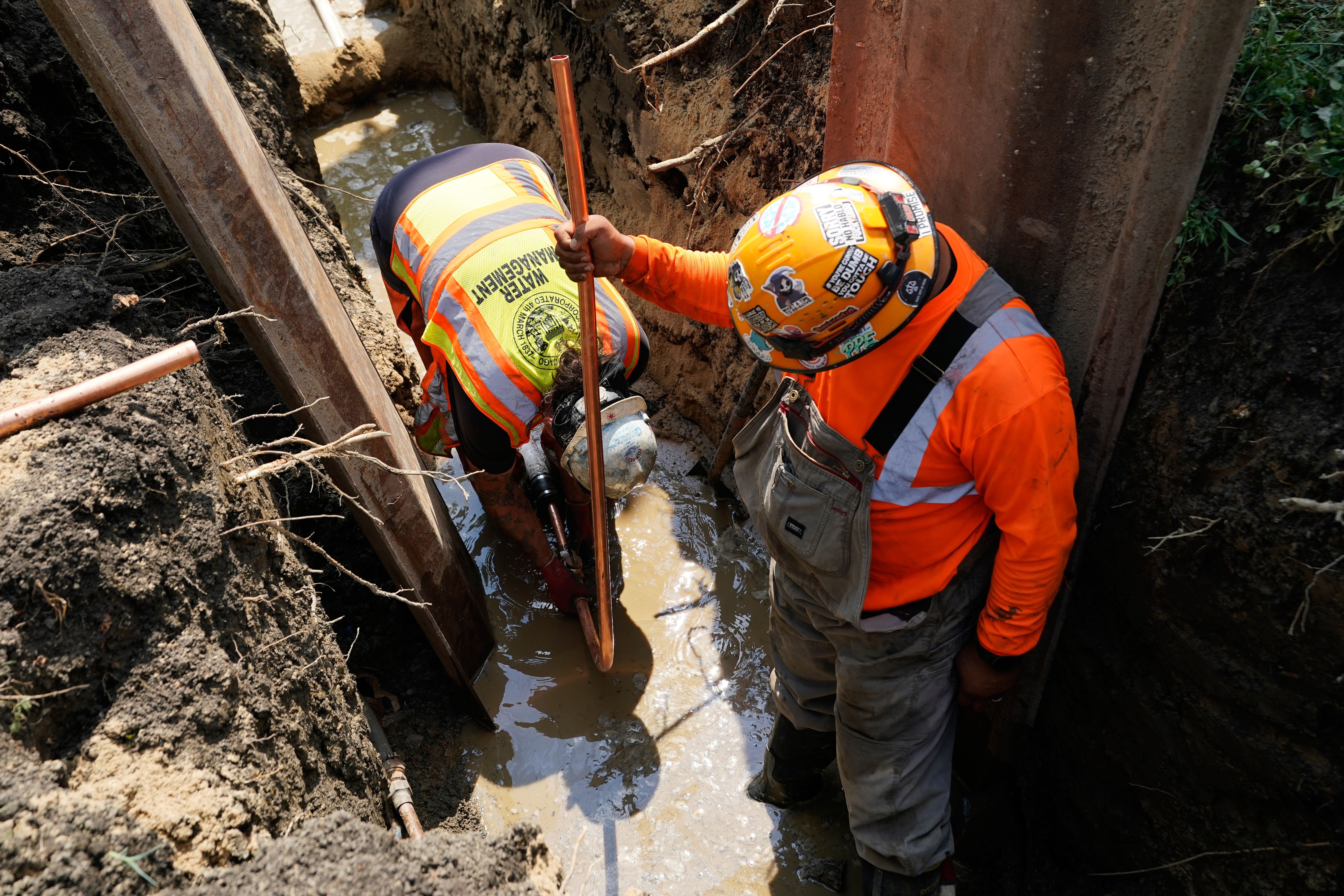
In Chicago, home to the most lead lines of any city in the country, crews are working block-by-block, digging up the pipes that branch off from the utility’s main line. The city still doesn’t know the material of close to one in 10 service lines. So in those cases, crews may have to excavate them to check the material, said Patrick Schwer, the city’s water quality director.
“We are digging through every single piece of information that we have associated with every single service line trying to find any indications of the material,” he said. “We’re scouring millions of work orders, trying to pull at little threads of information.”
Lead pipes for public water date as far back as the late 1800s and were prevalent all the way to the 1950s. Lead was a preferred material at the time because it was resistant to corrosion, and as a result, the original lines remain in use decades later.
Chicago advises residents with unknown lines to assume they are made of lead if their building predates 1986, when it was banned under the U.S. Safe Drinking Water Act.
Records of the installations were often lost, incomplete, or illegible. Lapses in recordkeeping have made it difficult for some utilities to complete their inventories, said Joshua Klainberg, senior vice president with the New York League of Conservation Voters.
Still, Klainberg said, leaving residents in the dark about whether they should take precautions by not submitting an inventory at all is “unforgivable.” Even an incomplete inventory can alert people they may have a lead service line, allowing them to take precautions such as running the tap, using filters — the highest-quality of which can remove most lead — and cooking only with cold water, he said.
Limited funds for replacements
For utilities, not knowing what is in the ground will carry an even stiffer consequence beginning in 2027. Starting then, they are required to replace 10% of lead water pipes each year, usually with copper or plastic pipes. But lines made of unidentified materials will be included in that target, said Erica Galante-Johnson, a lead policy analyst with the Environmental Policy Innovation Center.
“The more unknowns, the more lines a system needs to replace every year,” Galante-Johnson said.
In Chicago’s case, “the city is actively going after every single dollar that we can,” from the federal and state governments, Schwer said. The city still needs to replace about 393,000 lead service lines.
Most funding for identifying and replacing lead pipes comes from the 2021 bipartisan infrastructure law, with states distributing it. This is the final year of dedicated federal funding for lead projects, though previously allocated money will continue flowing to communities.
Water systems without an inventory will fall even further behind as national efforts shift toward replacements, Hayes said.
“If they can’t even get an inventory together, how the heck are they going to get the resources and the manpower and the kind of coordination between governments together to actually get workers out on the street and dig these pipes out of the ground?” he said.
If you give a computer a task, it’s going to need electricity to perform it. The more difficult the problem, the more resources it requires. This is at the heart of the fight against the data centers behind AI – often an incredibly complex and power-hungry process.
You might think that tech giants that build and use data centers would cover 100% of the costs. However, the knock-on repercussions of this heavy power drain could impact the amount you owe on your Peco bill. Let us explain.
1946
The first “data center”
If you needed help with a calculation 80 years ago, you could use the ENIAC, the first general-purpose computer, built at the University of Pennsylvania.
It was 1,440 times faster than a hand calculator but at a cost: high energy demands. The ENIAC had its own dedicated power lines and consumed 150 kWh of electricity.
2000
Powering search engines
By the mid-2000s, we could solve the same problem at a fraction of the ENIAC’s speed thanks to search engines like Google.
Data centers don’t just power search engines; they also sustain streaming services, social media, and much more. However, workflows are increasingly shifting to use artificial intelligence.
story continues after advertisement
2022
AI in everything, everywhere, all at once
Today, unless you actively opt out, your Google search will likely be augmented by AI. “Historically, you would just get hyperlinks, and then you would have to click through and read the webpages yourself,” said Benjamin Lee, professor of computer science at the University of Pennsylvania and visiting scientist at Google. “In some sense, generative AI is doing the reading for you and trying to anticipate the actual answer you were looking for.”
The average Google Gemini prompt uses about 10 times the energy of a pre-AI Google search. This is partly because AI technology involves complex algorithms that require more computing power, but it’s also because between the 1960s and 2010s the basic building blocks of computer chips were increasingly getting smaller and more power-efficient. Within that timeframe, our computational ability multiplied by sixfold with only a 6% increase in power usage, according to Lee.
But those efficiency gains eventually stalled.
“When AI came along in late 2022, we realized we needed hundreds – or thousands – times more [computational power], and the transistors weren’t keeping up,” Lee said. “The hardware side slowed down, even as the computational demands went up by a lot.”
To put it in perspective, in a single hour, a hyperscale 1,000,000-kW data center running at peak capacity can consume more electricity than every household in Philadelphia combined.
Hyperscale data centers can consume a city’s worth of electricity in an hour
ENIAC
150 Philly households' energy usage
Conventional
Hyperscale
The typical Peco customer uses about 0.94 kW per hour in July.
If all 679,428 households in Philadelphia consumed that amount of electricity …
… it would still be less than a hyperscale 1 million kW facility’s electricity use – the equivalent of over 1 million Philly households.
A report by Wood Mackenzie, an energy research firm, found that utility customers might already be shouldering some of the cost of servicing heavy users of electricity, including data centers. These hyperscale facilities and their projected demand for power could impact all three categories on your bill: generation, transmission, and distribution.
Let’s walk through each one.
Generation
Generation refers to how power stations produce electricity from primary energy sources like fossil fuels, solar, or wind. Pennsylvania generates about 60% of the state’s electricity with natural gas, according to the American Gas Association.
“There's only so much gas in the market and, with data centers coming online, there's increased competition for it,” said Elizabeth Marx, executive director of the Pennsylvania Utility Law Project, a statewide legal aid program representing low-income consumers and protecting their access to affordable energy and water.
story continues after advertisement
Pennsylvania Gov. Josh Shapiro recently proposed that hyperscale data centers supply their own power to reduce the burden on residential customers to pay for infrastructure costs. However, not everyone agrees that it will work.
“Unless they are building clean generation that doesn't rely on and constrain our gas supply, [data centers are] having an impact on the price of gas,” Marx said, “and [that cost] flows into your electricity bills.”
PJM has a capacity market, where utilities – like Peco – pay power plants to guarantee enough power to meet future energy needs. This ensures that enough electricity will be available at high usage and to avoid blackouts.
“The biggest impact that we're seeing already from data centers is on capacity market prices,” Marx said. In 2024, AI companies started shopping around for power purchasing agreements directly with power suppliers.
The increased demand for capacity without greater supply increased the cost of electricity. The capacity price during the 2024/2025 auction was about $46 per MW/day, according to Monitoring Analytics, an independent market monitor for PJM. The following year, it surged to $297 per MW/day.
In a recent quarterly report, Monitoring Analytics said that “large data center loads have already had a significant and irreversible impact on PJM customers.” Between 2016 and 2025, Peco customers saw a $20.46 increase in the supply portion of their bill, which includes generation and transmission.
Peco’s Price to Compare has increased steadily since 2022
6
8
10
12
14 cents
Jun 2022
Jun 2026
JuneJune
Source: Peco’s Price to Compare is what customers pay if they do not shop around for an alternative electricity supplier
Pa. law requires that Peco is not allowed to profit off generation and transmission; you are just paying the rate set at PJM wholesale auctions. “Supply costs are set by the competitive market, are not controlled by Peco, and do not generate a profit for the company,” said Candice Womer, communications manager at Peco.
Distribution
Distribution is the final phase, where electricity moves from a transmission station to your home. It makes up 50% of your electric bill and, unlike the supply side of the electricity equation, can generate a profit for utility companies.
Almost two-thirds of Americans believe that a major reason behind their rising home energy costs is utility companies’ bottom line, according to a recent Pew Research Center survey.
In its second quarterly report of 2025, Peco reported $136 million in adjusted earnings, compared with $93 million in the same period in 2024. The company said in its earnings report that it used the profits to improve distribution infrastructure.
When utility companies invest in the electric grid to ensure it is ready for peak demand or storms, those investments are often baked into distribution costs. “Peco must balance its obligation to serve new customers with the risk of overbuilding infrastructure,” Womer said. “When distribution upgrades are needed, those costs are paid up front by the data center customer through a Contribution in Aid of Construction, ensuring there is no impact to other customers.”
One of the fees baked into distribution charges on your monthly bill is the Universal Service Fund. This helps fund programs like Peco’s Customer Assistance Program that help low-income households afford their utilities. In her testimony before the Pennsylvania House Energy and Consumer Protection, Technology, and Utilities Commission earlier this year, Marx said that in Pennsylvania, “universal service costs are only allocated to residential customers.”
Despite their direct impact on rising costs, data centers pay nothing to support these programs, she said.
“It’s very hard to reduce the electricity you use in a significant way,” said Vik Patel, managing attorney of the energy and utilities unit of Community Legal Services. “If it's cold outside, you need to have the heater on. Otherwise it can be unsafe. [It’s the] same thing in the summer; you have to have access to cooling.”
story continues after advertisement
Even if electricity feels unaffordable, it can be difficult for customers to lower their use and, therefore, their bill. But if customers can’t pay their bill, they risk losing power completely.
Last year, about 25,000 households in Philadelphia had their electricity terminated and could not afford to have it restored, according to Patel. “There are a lot of collateral effects when someone's electricity is terminated,” he said. “They can get evicted. [They can] lose custody of their kids.”
What happens next
Data centers and their projected demands on the grid are not the only reason electric bills are increasing, but that has not lessened some residents’ concern about their expansion.
There are already dozens of conventional data centers in Philadelphia, according to Data Center Map, a private company that tracks such facilities nationwide. Two hyperscale campuses are being built in nearby Bucks County and Cumberland County, N.J.
At least four more data centers have been proposed in Chester and Montgomery Counties. These local proposals face a groundswell of opposition from residents who worry about the environmental and financial ramifications of having these hyperscale facilities in their backyard.
Note: Amazon’s 600,000-kW data center is currently under construction in Falls Township, as is the 300,000-kW hyperscale data center in Vineland.
“I don't deny we need to upgrade our grid,” Marx said. “And, quite frankly, more frequent storms are absolutely going to cause more infrastructure costs. But I think there's a lack of transparency in what's necessary and what is nice to have. Who’s it for? Who pays for it and at what expense?”
Staff Contributors
Reporting: Charmaine Runes
Design and development: Charmaine Runes, Sam Morris
Graphics: John Duchneskie
Illustration: Glenn Harvey
Editing: Sam Morris, Cynthia Henry
Copy Editing: Addam Schwartz
Subscribe to The Philadelphia Inquirer
Our reporting is directly supported by reader subscriptions. If you want more journalism like this story, please subscribe today
When IBEW Local 614 and Peco started negotiating a new contract earlier this year for call center employees, linemen, and other field workers, one thing was clear to local union president Larry Anastasi: He needed to get pensions back for all of his members.
Roughly 600 of his 1,500 members, hired since 2021, weren’t offered a pension. The rest had differing plans.
Clawing back pensions for the whole union wouldn’t just be a reversal of Peco’s trajectory. It would buck a cross-industry trend.
“The trend my entire career, which is now more than 40 years in this business, has been employers want to get away from defined benefit plans, and unions want to maintain them and get them in more places,” said Wendell Young IV, president of United Food and Commercial Workers Local 1776, which represents workers in Pennsylvania and neighboring states.
In early July, after a three-day strike, Peco and its worker union reached a deal that includes a pension plan for all workers. But it’s not your grandparent’s pension.
The traditional defined-benefit retirement plan peaked in popularity in the 1970s, whenup to 62% of private-sector workers relied on a pension as their sole retirement plan, according to the New York Times. That number shrank to 1% of private-sector workers in 2022.
Employers in the gas and electric utility industry started moving away from traditional pensions in the 1990s,according to William Dwyer, a professor at the Rutgers University School of Management and Labor Relations, who once worked at PSE&G in New Jersey.
Under the new Peco union contract, workers will get a cash-balance plan — where employees are promised a specific amount of money in retirement without having to contribute to it themselves. The benefit accrues throughout a worker’s career, unlike the old-school pension that is typically based on total years of employment and how much a worker is earning in the final few years of their career.
It’s an increasingly popular compromise, said professor Olivia Mitchell of the Wharton School. With workers living and working longer than they used to, traditional pensions become unpredictably costly for employers. The cash-balance option is a chance for both company and worker to better see the future.
“They accumulate benefits more evenly over a worker’s career,” she said, “making them easier to understand and often less costly and less risky for employers.”
By getting a pension of any sort, said Young, of UFCW, Peco’s unionized workers “rode against the current” and “achieved a really amazing benefit.”
Wendell Young, president of UFCW Local 1776, gathers with supermarket workers outside the Whole Foods at 2101 Pennsylvania Ave on Nov. 24.Ariana Perez-Castells / Staff
What is a cash-balance pension plan?
Cash-balance plans are often seen as a hybrid of the traditional pension and the “defined-contribution” plan, such as a 401(k).
These plans debuted in the 1980s and gained popularity in recent decades. Some 23,000 employers offered them in 2020, up from 1,477 in 2001, the Wall Street Journal reported.
Traditional pensions “typically have benefit formulas that rise sharply late in a career, making them expensive for employers with long-tenured workforces and less valuable for employees who change jobs before retiring,” said Mitchell of Wharton.
Bank of America was the first large company to introduce one, in the 1980s.It offered young employees some flexibility to take their cash balance plan elsewhere if they switched jobs.
By 1996, some 200 “large companies” had cash balance plans, the New York Times reported. The Campbell’s Co., the food giant based in Camden, was one of them.Some companies faced backlash.
Despite adoption at several well-known companies, cash-balance plans still aren’t the norm in the private sector. A recent study by the International Foundation of Employee Benefit Plans found that 21% of corporations surveyed had a defined benefit plan, with 5% being the hybrid kind.
Then CEO of Campbell’s, Mark Clouse, at the company’s investor day on Sept. 10, 2024, in New York City.Ariana Perez-Castells
How Peco retirement evolved
Peco employees were given the option to transition to a cash-balance plan in 2001, and roughly 80% of them did so, the union has said, while others kept their traditional pension. This was before Peco workers unionized with IBEW.The company has also offered 401(k)-based retirement programs.
Peco’s retirement options“have evolved over time in a manner consistent with broader employer and utility industry practices,” the company said in a statement earlier this month.
Larry Anastasi, president and business manager of IBEW Local 614, joined other Local 614 bargaining committee members as they speak to the media about contract negotiations with Peco outside the Hilton Penn’s Landing Hotel on July 6. Jose F. Moreno / Staff Photographer
As IBEW laid out its goals for the new contract, including pensions for all, Peco laid out its own position. The companysaid it wanteda contract that maintained affordable service for customers.
Unlike other private sector businesses that can raise prices at their sole discretion to cover labor costs, Peco leaders mustget approval from the state’s regulating entity, the Pennsylvania Public Utility Commission (PUC) for rate hikes, which is a lengthy process.
Peco did raise rates in 2025 and tried to do so again this year. While the company’s 2025 profits were up 48% from the previous year, leaders said the business still needed to increase rates to meet customer demand for energy.
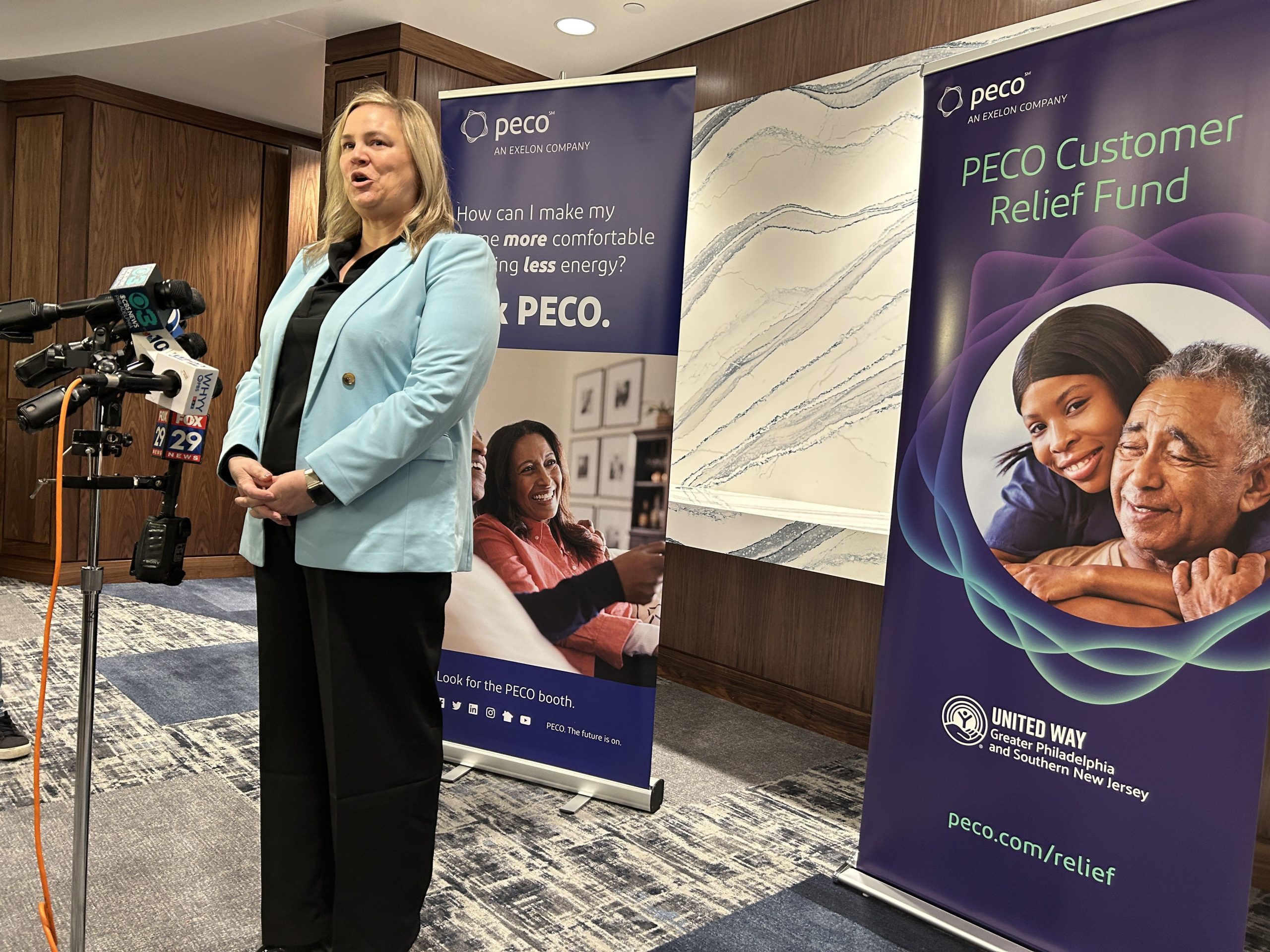
At Peco, “90% of what we receive [from ratepayers] goes right back into our infrastructure, and that includes paying for the wages and benefits for employees so they can go out and restore power and improve our grid,” Peco’s chief operating officer, Nicole LeVine, said earlier this year during bargaining.
Nicole LeVine, Peco’s chief operating officer, took questions from reporters on March 31 about the contract negotiations and a proposed rate hike.Ariana Perez-Castells
When pensions came up at the bargaining table this year, the cash-balance option prevailed.
The plan’s similarities with a defined contribution plan, such as a 401(k), make it easier for employees to understand, said Joseph Hicks, consultant and co-owner of Keystone 74 Benefits and Administration, which worked with IBEW local 614 during the recent bargaining process. If employers are spending money on a benefit, they want their workers to be able to understand and appreciate that benefit, Hicks said.
Peco, upon reaching the tentative agreement July 6, said the deal “recognizes the contributions of our employees while supporting our responsibility to deliver reliable, affordable service across Southeastern Pennsylvania.”
Camden County officials announced a $400 million master plan Tuesday to protect the county’s network of rivers, lakes, and streams such as the Cooper River.
They are hoping voters will approve a referendum in the fall to help pay for itover the next decade.
That waterway network is threatened by aging infrastructure, stormwater runoff, industry, and changing regulations that have left it degraded. A comprehensive plan is imperative, officials said.
An ultimate goal, they say, is that residents may one day be able to swim safely in Cooper River Lake without a health risk.
“Repair. Replenish. Recreate,” County Commissioner Jeffrey Nash said. “Those three words summarize the generational change that Camden County is about to embark on to improve the quality of our water bodies.”
County, state, and local officials made the announcement at the Camden County Municipal Utilities Authority headquarters in Camden, backed by representatives from various environmental groups and nonprofits.
To raise the money, officials are assembling federal, state, and government grants and loans, as well as help from private nonprofits.
Voters could be key
But they also said a planned voter referendum on increasing the county’s open space tax to $0.03 per $100 of assessed property value is key to secure permanent funding. Voters will weigh in on Election Day, Nov. 3.
The rate would nudge up from $0.02. That means someone with property assessed at $500,000 would pay $150 a year toward open space, up from the current $100.
Waterways that would see increased protection include:
Cooper River Lake,which spans Camden, Pennsauken, Cherry Hill, Collingswood, and Haddon Township.
Kirkwood Lake in Lindenwold.
Atco Lake in Waterford Township.
Pennsauken Creek,which runs through Pennsauken, Maple Shade, and Cherry Hill.
Big Timber Creek, which spans multiple towns.
Evans Pond and Wallworth Lake in Cherry Hill and Haddonfield.
Nash said the county’s populationgrowth over the last 100 years can be attributed to people drawn to the waterways. But increasedpopulation also resulted in the need for moresewer lines and attention to aging infrastructure.
“We stand at a crossroads, and we have a choice to make: Either we’re going to shrug our shoulders and pass this problem on to the next generation, or we’re going to do something that is generational,” Nash said.
The cost breakdown
The plan calls for:
$200 million to fix aging combined sewer systems that overflow during storms.
$75 million for dredging and other methods to reduce sediment.
$50 million for rehabilitation of sanitary sewer systems across multiple towns.
$50 million to restore recreational lake areas.
$25 million for green infrastructure.
And it includes an unspecified amount for continued planning, monitoring, and management.
Scott Schreiber, executive director of the Camden County Municipal Utilities Authority, called the plan “a comprehensive strategy that addresses every major factor affecting the health of our rivers, lakes, and streams.”
He said it represents a new way of thinking about water quality by coordinating across towns, rather than planning by one municipality at a time.
“Water doesn’t recognize political boundaries or municipal borders,” Schreiber said.
The biggest chunk of money will go to address combined sewer overflows (CSOs), which are now antiquated. A combined sewer system collects rainwater runoff and household sewage into one pipe. Normally, it can transport all of that to a sewage treatment plant. But storms can bring so much water that they can exceed the system’s capacity. When that happens, untreated stormwater and wastewater flow intobodies of water, such as the Delaware River.
Schreiber said projects are being designed and built to capture and treat much more stormwater before it reaches the Delaware.
Separately, money will be used to repair and rehabilitate aging sewer systems, reducing leaks and groundwater infiltration that pollutes waterways.
He said the infrastructure money will also be used to install rain gardens, permeable pavement, and bioswales, which are typically sloped channels covered with vegetation and designed to capture or slow stormwater.
The county will start a regular dredging operation to remove decades of accumulated and contaminated sediment in lakes and ponds to improve aquatic habitat, restore ecological function, and create overall healthier waterways.
And the county plans to restore recreational lakes by improving public access, bolstering shorelines, and boosting overall water quality.
Officials plan to finance part of the plan through the New Jersey Water Bank, an independent state authority that provides low-interest loans for water quality infrastructure projects.
However, Schreiber said, the voter referendum will be key. If voters approve it, the referendum would provide $7 million per year that could be used to pay off that debt and pay for other improvements.
‘Vibrant waterfront communities’
Don Baugh, founder of the nonprofit Upstream Alliance, which has helped Camden County build its first water trail, called the master plan a major step.
“I feel like I should pinch myself,” he said. “This is the dream of restored waterways, swimmable waterways, kids playing in the water, and vibrant waterfront communities.”
Daniela Solano-Ward, mayor of Collingswood, one of five towns that border Cooper River Lake, said the new coordination by the county is vital.
“Collingswood can do very little to alter our geographic reality,” she said. “We are bordered by Cooper River to the north and Newton Lake to the south. Ultimately, protecting urban watersheds has fallen to local government. But with 35 municipalities in Camden County, the weight of this lift is too heavy for any one of us to shoulder alone.”
Peco and its worker union reached a tentative agreement on a new contractlate Monday, ending the first strike in the company’s history on its third day.
Roughly 1,500 unionized linemen, field workers, call center staff, and other Peco employees have been without a contract for more than three months, since their most recent five-year agreement expired on March 31. They walked off the job on the Fourth of July.
The union characterized the five-year agreement as a “historic contract victory” in an announcement late Monday, noting that it included cash balance pension plans, full retirement medical coverage, and “significant wage increases” for all members.
“We said from day one that our members’ top priorities were restoring pensions and retirement medical coverage for all members, and we won that and more,” Larry Anastasi, president of IBEW Local 614, said in a statement.
Wage increases for field workers are 4% annually for the first four years and 4.5% in the fifth year, according to the union, and call center workers are to get 3% raises annually throughout the five-year contract.
Peco announced the agreement Monday night in a company statement.
“We value our long-standing relationship with IBEW Local 614 and appreciate the efforts of both bargaining teams in reaching this agreement,” Peco’s statement said. “The proposed contract recognizes the contributions of our employees while supporting our responsibility to deliver reliable, affordable service across southeastern Pennsylvania.”
With the agreement in place, Peco and the union said, the work stoppage will end while union members vote on ratifying the contract.A union spokesperson said members would return to work Wednesday and a date to vote on the contract has not yet been decided.
Peco and the union had held daily bargaining sessions since last Wednesday to reach an agreement. Over the weekend and into Monday, workers picketed outside Peco’s headquarters in Center City.
Larry Anastasi, president and business manager of IBEW Local 614, and Stuart Davidson, general counsel for the union, speak with the media Monday amid contract negotiations and day three of the worker strike.Jose F. Moreno / Staff Photographer
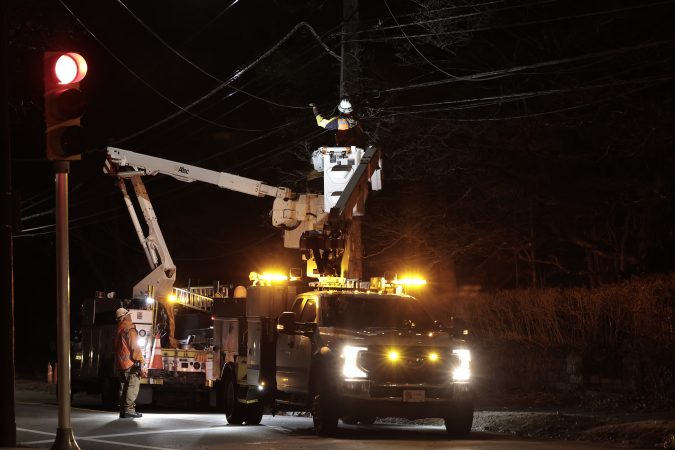
Meanwhile, Peco has been contending with outages following thunderstorms in recent days. The company had a contingency plan in place, which included workers from outside the region.
Over 57,000 customers were without power on the night of July Fourth at the height of the outages, Peco said, but within less than 24 hours, that number was reduced to less than 6,000. As of Monday afternoon, the company reported roughly 4,400 outages on its webpage, and the number was just over 100 a day later.
The tentative deal marks a pivotal moment in what have been challenging negotiations between the union, IBEW Local 614, and Peco. Bargaining turned ugly in April, as each side accused the other of using unfair tactics.
In addition to raises and better healthcare benefits, the union wanted its contract to include a uniform retirement plan for all members. Currently, roughly 600 of the 1,500 union workers do not have pensions, the union has said, and pension benefits vary for the other 900 or so.
Utility companies started moving away from providing pensions to new hires in the 1990s, according to William Dwyer, a professor at the Rutgers University School of Management and Labor Relations, who once worked at PSE&G in New Jersey. That left 401(k) as the typical retirement benefit. At Peco, that happened later — the company stopped putting new hires into its pension plan in 2021, according to the union.
The tentative agreement includes a requirement that call center workers get 24-hour notice of mandatory overtime, as well as better upgrade pay for union members who complete tasks outside their typical job description, according to the union.
In Southeastern Pennsylvania, Peco provides electricity to 1.7 million customers and natural gas to 553,000.