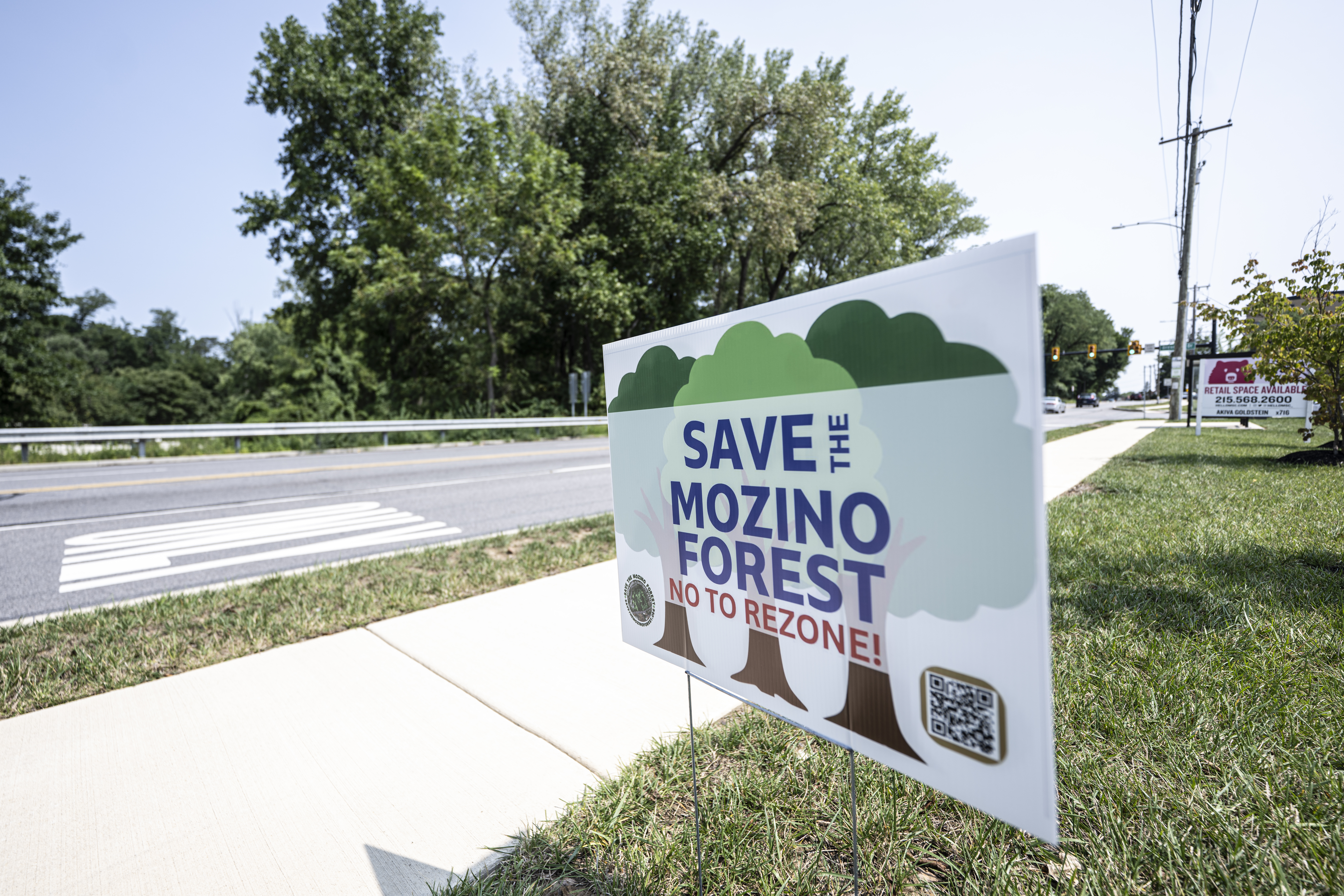
Fifteen acres of undeveloped land in Upper Darby Township face an uncertain fate as environmental groups rush to secure funding to purchase and protect the site.
Upper Darby residents and environmentalists are working to pull together $8 million to secure the purchase of the Mozino Tract, a parcel of land in Drexel Hill that, until recently, was slated to become a mixed-use housing and retail development.
Upper Darby’s council in August voted to table a proposal to rezone the land, currently zoned for residential use, to allow for a blend of single-family homes, townhouses, apartments, commercial spaces, and community gathering spots. Township staff at the meeting said they worked with the developer to create the mixed-use zoning proposal, a plan they said would help meet core township goals of increasing tax revenue and adding diverse housing options far more than an initial proposal to put 56 single-family homes on the site.
Now, developer Greg Lingo of Rockwell Development Group says he has abandoned the plans to build the mixed-use development and is giving organizers a chance to purchase the land for open space preservation.
If they can’t pull the money together, Lingo will go back to his original plan to put 56 single-family homes on the Mozino Tract, a proposal that is already permitted under the current zoning and won’t require special approvals.
As the high price tag looms, organizers say they’re confident they can find the money to keep the Mozino Tract wild.
What is the Mozino Tract?
The Mozino Tract is a 15-acre wooded parcel located between State and Township Line Roads in Drexel Hill. The land is currently owned by the Peter S. and Catherine G. Mozino Deed of Trust and is under contract to be sold to Lingo’s Rockwell Drexel LLC.
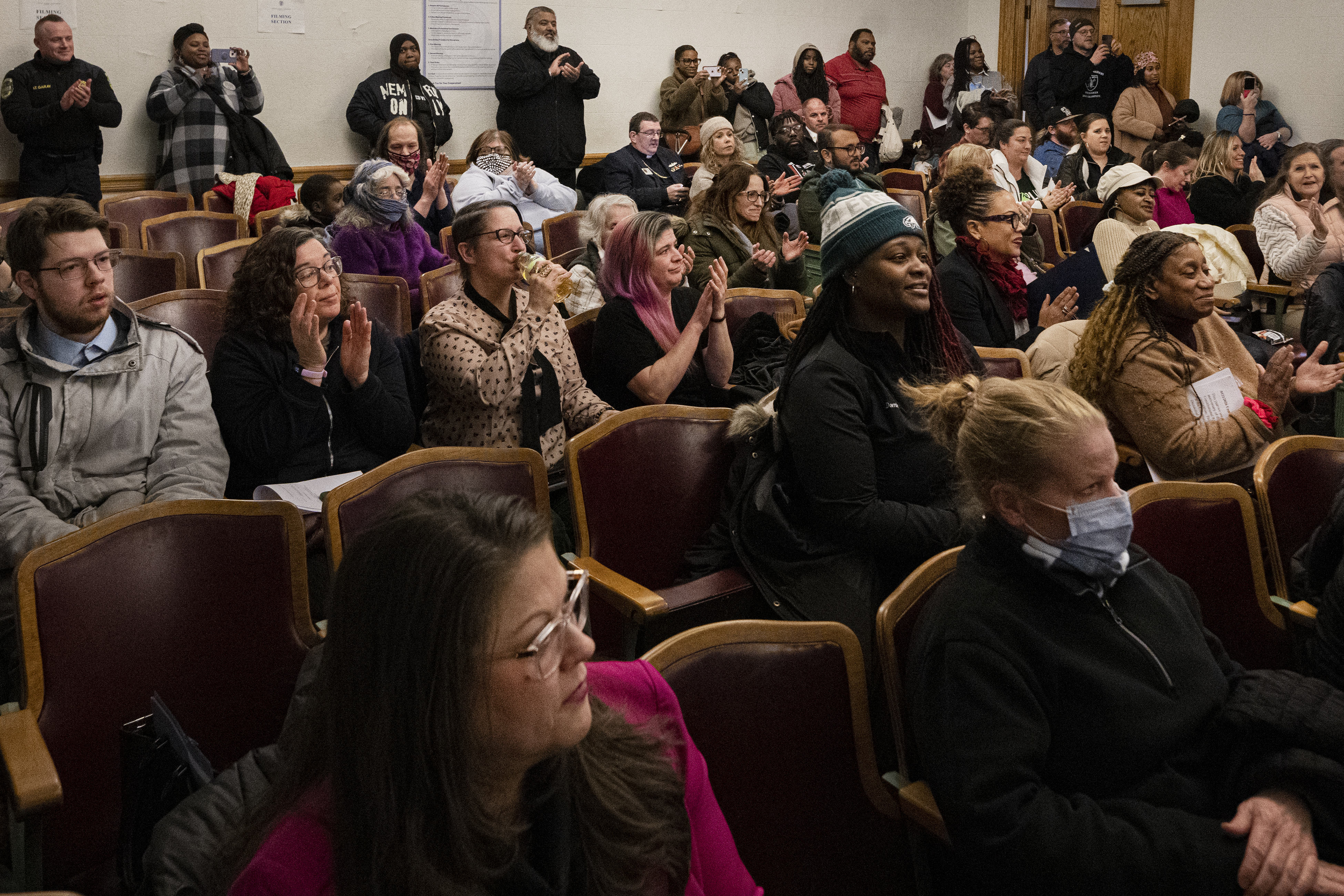
At an August meeting, Upper Darby residents packed the council chambers, urging the township to reject the plan for a mixed-use development and asking council topurchase the land to preserve it as open space. Many described spending time in the wooded area that, while not officially a public park, has been a place to commune with nature.
Amid pushback from residents, Lingo at the meeting said he would be willing to sell the property to the township, despite thinking that it would not be “a great use,” and approximated the cost of the sale at $8 million. Council unanimously tabled the zoning ordinance and voiced an openness to purchasing the property if funds could be raised.
The property’s assessed value is $446,920, according to Delaware County property records.
Lingo in an email on Sept. 15 wrote that it was immediately clear when he first met with neighbors that “they did not want any development” of the Mozino Tract, so he thought it best to work with thetownship on the mixed-use plan to “maximize open space, introduce different housing types across different price points, improve pedestrian mobility, maximize taxable income to the township and to dedicate a public park.”
Lingo’s email affirmed his commitment to Upper Darby, where he grew up, and said it was his “fault for assuming that I knew what was best” in proposing the mixed-use project.
If the environmental groups can’t find the funding to purchase the property, Lingo plans to enter into an agreement with a public or national homebuilder to build the 56 single-family homes.
Rockwell Development Group is “communicating regularly” with the environmental groups, Lingo wrote.
Organizers ‘have all confidence’ in raising funds
Bonnie Hallam, an organizer spearheading the effort to preserve the Mozino Tract, said local environmentalists “have all confidence” that they will be able to raise the $8 million.
“We really believe that this is going to be conserved, and we want the township to get on board with that,” Hallam said.
Hallam said she and other organizers submitted their first grant application on Sept. 25 to the Open Space Institute and have been in conversation with local and national funding groups, including the William Penn Foundation and the Pennsylvania Department of Conservation and Natural Resources. The group is going to start a community fundraising effort through the Foundation for Delaware County, she said.
The environmental leaders are also hoping to secure money through an open space referendum on the ballot in Delco this November. If the referendum is approved by voters, the county could spend $120 million financing land conservation projects, including “protecting natural areas from development.”
“We’re really going to work hard to secure that because we feel that the county is very much interested in this piece of property as well,” Hallam said.
Delaware County “has not had any conversations with Mr. Lingo regarding the purchase of the tract,” according to county spokesperson George Basile.
Hallam hopes Upper Darby Township will agree to be the title holder for the land, an agreement they have not made yet.
Upper Darby Township is “exploring its options right now” and “hoping for a resolution soon” regarding the Mozino Tract, public information officer Rob Ellis said in an email.
For Hallam and her co-organizers, preserving the open space — its wildlife, tall trees, and bubbling creek — is priceless. The Save The Mozino Forest group is organizing a rally on Saturday at Collenbrook Church.
“We have a really unique piece of property here that’s doing hard-working environmental services for the township,” Hallam said.
This suburban content is produced with support from the Leslie Miller and Richard Worley Foundation and The Lenfest Institute for Journalism. Editorial content is created independently of the project donors. Gifts to support The Inquirer’s high-impact journalism can be made at inquirer.com/donate. A list of Lenfest Institute donors can be found at lenfestinstitute.org/supporters.
Marson Weh, 39, was also convicted of possession of an instrument of crime in the April 2023 death of Michael Garr, a sophomore at Upper Darby High School.
Weh will be sentenced in November to life in prison for stabbing Gar 11 times, including once in the throat, according to District Attorney Tanner Rouse.
The two were strangers, Rouse said, and had “no earthly connection.” The DA said Weh offered no motive for the stabbing.
Michael Garr was killed in April 2023 as he walked to his home in Upper Darby.Handout
The prosecutor said the case would make the “worst episode of Dateline,” one without any twists and leaves no room for alternate theories or interpretation.
No one else was near Garr that night, he said, as Weh was seen “hunting, stalking” the teenager for more than a mile.
When Weh was arrested, he was still wearing parts of his “kill suit,” nondescript clothing that included thermal underwear stained with Garr’s blood, Rouse said. And he was still carrying the murder weapon, a folding knife that matched the dimensions of Garr’s fatal wounds and still had his dried blood caked in its handle.
“See this for what it is,” Rouse said. “Because when you only consider the blood on his pants, the blood on his knife, that alone proves he is guilty. There is no other explanation, no reasonable doubt.”
After the killing, investigators quickly identified Weh through surveillance footage, which recorded him following Garr for more than a mile. Gradually, prosecutors said, he closed the distance between them, and attacked Garr as they approached Brunswick Avenue near Bridge Street in Drexel Hill.
Weh’s attorney, Ian McCurdy, conceded in his closing arguments that it would “strain credulity” to say there wasn’t evidence to prove that Weh killed Garr.
Still, he urged jurors to consider that prosecutors had failed to explain his intent in doing so.
“As horrible as this situation is, the death of a young man killed way too early his life, this boils down to did the Commonwealth prove the case beyond a reasonable doubt,” he said
McCurdy supported his contention by citing a two-minute window of time where neither Garr nor Weh were recorded on surveillance video.
“The point is we just don’t know what happened in that small bit of time,” he said. “And that’s why I suggest to you the Commonwealth hasn’t proven that Marson Weh killed Michael Garr with malice.”
In responding to McCurdy’s theory of the case, Rouse, the district attorney, did not mince words: The evidence that Weh intentionally killed Garr, a crime that constitutes first-degree murder, he said, is overwhelming.
Beyond that, he said, Weh confessed to killing Garr during an interview with detectives. And he showed what Rouse described as a consciousness of guilt by soaking the hoodie and he gloves he wore on the night of the attack in ammonia — detectives found the items in that condition when they searched his home days later.
Rouse urged the jurors to convict Weh of first-degree murder, likening doing so to parents protecting their children from the evils of the world.
“There is simply no getting around the evidence,” he said. “You cannot stab someone in the throat and not mean it.
Upper Darby passed an ordinance on Wednesday aiming to restrict the township’s cooperation with federal immigration agents.
Township council unanimously approved legislation banning local police from assisting ICE and other federal agencies with immigration enforcement activities. The legislation bars federal agents from using township property to stage immigration raids, prohibits township staff from providing resident information to federal agents for civil immigration enforcement, and bans township personnel from recording or maintaining data about residents’ immigration statuses, unless it is required by law.
It also prohibits township police officers from wearing masks or obscuring their identities in most cases and “formally requests” that federal agents clearly identify themselves and do not wear masks.
The ordinance includes exemptions, including cases in which immigration agents possess a judicial warrant or there is a criminal law enforcement matter requiring Upper Darby officials’ cooperation.
At the more than three-hour meeting on Wednesday, residents decried the actions of federal immigration agents and President Donald Trump and described a rich patchwork of races, religions, and backgrounds that defines Upper Darby, where nearly a quarter of the population is foreign-born.
Some described immigrant neighbors currently living in fear, unable to answer the door or go to religious services due to the anxiety of potentially being apprehended by ICE. Many said they moved to Upper Darby specifically for its diversity.
“Our history reminds us that legality and morality are not the same thing. Upper Darby Township cannot determine federal immigration policy, but it can determine how our own lawful authority and resources are used,” said State Rep. Heather Boyd, who spoke during public comment and represents parts of Upper Darby in the Pennsylvania House.
A smaller contingent of residents, however, pushed back against the proposal, warning that the ordinance makes few tangible changes to the police department’s policies while potentially putting a target on Upper Darby’s back for the federal government to strip away funding.
When asked if he believes the legislation is in the best interest of the police department, police superintendent Timothy Bernhardt said the ordinance “isn’t going to change what the Upper Darby Police Department does.”
The department has never been an immigration enforcement body, worn masks, worked with ICE under a 287(g) agreement, or stopped individuals simply to ask about their immigration status, Bernhardt said.
“I have no objection to it. It’s not going to change what we do every day, day in and day out,” the police superintendent added.
Township council members described the ordinance as a set of responsible guardrails for local officials in a municipality defined by its immigrant population.
“It’s an issue of establishing trust and making sure that people know that in Upper Darby, if you need help, you can call because this community serves you,” said council member Kyle McIntyre, who helped to draft the legislation.
“We will follow the law, but we will do everything in our power to protect our community and keep everyone safe,” Mayor Ed Brown said.
This suburban content is produced with support from the Leslie Miller and Richard Worley Foundation and The Lenfest Institute for Journalism. Editorial content is created independently of the project donors. Gifts to support The Inquirer’s high-impact journalism can be made at inquirer.com/donate. A list of Lenfest Institute donors can be found at lenfestinstitute.org/supporters.
One of the many things we won’t forget about the Trump era is how much the family of POTUS 47 has enriched itself — not only the president but his children, including Donald Trump Jr., who is said to be now worth at least $500 million and growing. So it was no surprise when his second marriage to Palm Beach, Fla.’s Bettina Anderson in May was a lavish affair on two private islands in the Bahamas. What is a surprise — as we now know from some stunning work by a team of reporters from ProPublica — is who paid: a very close associate of Russian dictator Vladimir Putin. So maybe the “Russia, Russia, Russia” folks were onto something?
Pa. Democrats are alarmed at the rapid growth of ICE-police deals. But can they stop them?
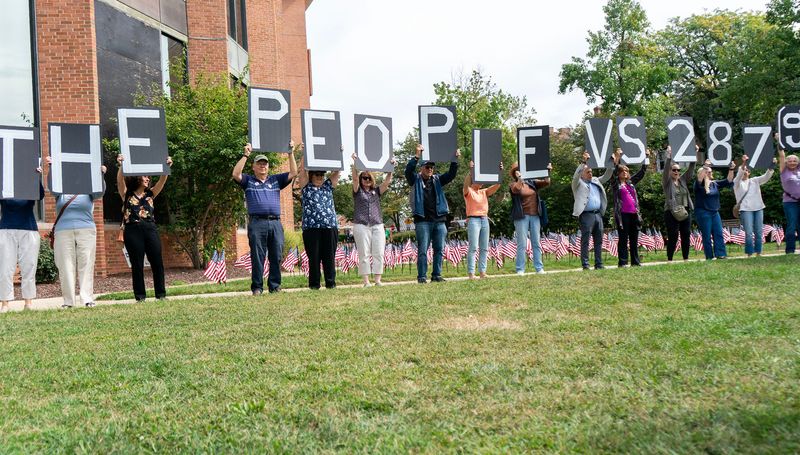
Immigrants’ rights advocacy group members and their supporters hold up letters that read “The people vs 287(g)” during a rally last September in Doylestown against the Bucks County sheriff’s efforts to implement a 287(g) program.Daniella Heminghaus | Bucks Coun
The big, mostly under-the-radar story around the Donald Trump regime’s relentless push to arrest and remove immigrants from the United States has been this year’s explosion of so-called 287(g) agreements. These allow local cops to act as immigration agents, working collaboratively with U.S. Immigration and Customs Enforcement, or ICE.
But if you look at a national map to understand how these 287(g) agreements have spiked from just 135 when Trump retook office in January 2025 to more than 2,500 such pacts today, you’ll notice that one state sticks out like a sore thumb.
In Pennsylvania, amped-up promises of federal cash incentives have meant a soaring number of localities where local beat cops are now working with ICE to make arrests — up from just a handful at the start of the year to some 130 now. Most 287(g) collaborators are in Trump-voting pockets of the Keystone State — northeast and south-central Pennsylvania, or out west near the Ohio border.
But when you look at the rest of the Northeastern United States, the 287(g) map is very sparse. That’s partly because most local pols across the region agree with their constituents about opposing Trump’s mass deportation policies, and in several states it’s also the result of legislation that aims to ban the program altogether.
In late August, New York enacted the Local Cops, Local Crimes Act — backed and signed by its Democratic Gov. Kathy Hochul — which calls on police departments and county sheriffs to terminate their 287(g) agreements, although several counties are still challenging the measure in court. Maryland has a similar law on the books, while New Jersey, which had long prevented such pacts under an attorney general’s directive, also passed a law this spring to codify the ban.
There’s a growing number of Pennsylvania lawmakers who want to pass a similar law here, but there’s one big problem: Republicans. They control the state Senate in Harrisburg — currently by a 27-23 margin — and GOP lawmakers have no interest in rebuking the president on immigration policy.
“The reason we exist alone is because of our split legislature,” State Rep. Heather Boyd, a Democrat who represents heavily immigrant Upper Darby and adjacent parts of Delaware County, told me. Last year, Boyd circulated proposed legislation to ban 287(g) deals in Pennsylvania, and while dozens of Democrats in Harrisburg are supportive, any move is on hold until a November election that could shift the balance of power. Boyd said lawmakers are wary of “starting any culture wars” ahead of the vote.
I pressed the office of Gov. Josh Shapiro, who’s running for a second term and who is seen as a possible top contender for the 2028 Democratic presidential nomination, for his position on reining in the 287(g) program here.
“Governor Shapiro has been clear that law enforcement should be focused on keeping Pennsylvanians safe — not sowing fear in communities or targeting people who are working hard, raising families, and contributing to our Commonwealth,” his press secretary, Rosie Lapowsky, said. She noted that the governor has barred Pennsylvania State Police from any formal ICE collaboration, and he would urge local police to take a similar stance.
She added: “Ultimately, however, these decisions rest with local law enforcement agencies. The governor does not have the unilateral authority to dictate whether individual sheriffs or police departments enter into these agreements.”
Many of those local law enforcement agencies have instead rushed to join 287(g), with ICE promising small-town departments an initial $100,000 cash windfall and additional incentives for training officers to make arrests and to cover the cost ofworking overtime on the program.
Last week, I reported from Schuylkill County in east-central Pennsylvania, where some 14 law enforcement agencies have raced to adopt 287(g), more than any other county in the state. Since the spring, local cops there have arrested about 100 immigrants at highway stops or by assisting ICE in job site raids. The blitz has prompted rising complaints about alleged racial profiling, the handcuffing of U.S. citizens, and a sense of fear that permeates a growing Latino community in Pennsylvania coal country.
Statistics obtained from the U.S. Department of Homeland Security by advocates show that local police in Pennsylvania have arrested and turned over to ICE more than 1,200 immigrants this year — ranking the state fourth in the nation on a list in which the other leading states are all south of the Mason-Dixon Line.
In Washington, some of the state’s Democratic House members say they’re fed up with a lack of transparency over who is being detained and how the 287(g) program is working here. Last week, four of them — Reps. Mary Gay Scanlon and Madeleine Dean from the Philadelphia suburbs and Reps. Chris Deluzio and Summer Lee from Western Pennsylvania — sent a letter to ICE’s acting director David Venturella demanding information on why the agency’s data lack any specific details about which departments are making arrests, which is required by law.
“It is unacceptable to me that ICE is hiding information from Pennsylvanians about who ICE is working with in their mass deportation regime,” Deluzio — viewed as a potential 2028 primary challenger to embattled Sen. John Fetterman — told me in an emailed statement.
Deluzio also summed up the growing unease by many over the speedy growth of 287(g) in the state. “Let’s keep local law enforcement focused on local public safety, rather than enlisting them in extreme federal immigration enforcement that has ripped away American liberties and targeted so many law-abiding families,” he said. Indeed, 287(g) data guru Andrew Thrasher has reported that a whopping 70% of the immigrants arrested in Pennsylvania under the program have no criminal record or pending charges.
“People in my community are getting smashed off the streets,” said Boyd, the Upper Darby lawmaker. That Delco township is about to vote on a local ordinance to restrict its cops from collaborating or sharing data with ICE.
Statewide, Boyd says she’s one of about 50 House Democrats in a Welcoming Pennsylvania Caucus with an extensive list of proposed bills that would not only bar 287(g), but look to expand opportunities for noncitizens to do things like obtaining driver’s licenses or gain professional certification. But any serious action hinges on November, when Democrats are hoping a blue wave at the ballot box will flip at least three more Senate seats and create a trifecta for their party in Harrisburg.
“Even if we can’t stop ICE from picking them up on the streets, we have to protect their rights,” Boyd said. “And right now, there are barriers to that in the state of Pennsylvania.”
Yo, do this!
The issue of wrongful convictions is back in the news here in Philadelphia — but for all the wrong reasons. Some reckless and seemingly wrongheaded moves by Philadelphia District Attorney Larry Krasner and his underlings have the vultures who’ve always opposed criminal justice reform circling. The shame is that the real crisis around wrongful conviction is the thousands of mostly Black and brown folks who remain behind bars for crimes they did not commit. I cannot say enough about a book that came out earlier this year from Brown University (yay!) sociologist Nicole Gonzalez Van Cleve called Crime Fictions: How Racist Lies Built a System of Mass Wrongful Conviction. She mines the most outrageous prosecutions — often of young Black teens and boys — to make a compelling argument that wrongful convictions aren’t a flaw in the criminal justice system. They are the system.
If timing is everything, then you’ve got to hand it to my freshman dorm pal at Brown who became Washington bureau chief for Mother Jones, David Corn. On the heels of ProPublica’s bombshell reporting on ties between the Trump family and Vladimir Putin, Corn is out Tuesday with his newest book: How Russia Won — Donald Trump, Vladimir Putin, and the Fight for America. It promises a raft of new information about Russia’s efforts to meddle in U.S. elections in 2020 and 2024, the ongoing close links between Team Trump and Team Putin, and how the current president’s pro-Russian slant has changed the world.
Ask me anything
Question: What happens when [House Speaker Mike] Johnson refuses to seat newly elected Dems in January? — David Minckler (@audivita.bsky.social) via Bluesky
Answer: Suddenly, Jan. 3 — the date the 120th U.S. Congress begins, and new members who won their November elections are to be sworn in — has become the new Jan. 6. Summer vacations are over, and the body politic is focused on the looming midterms, and — more importantly — with polls showing the Democrats on track to retake one and possibly both chambers. So there’s been a surge of speculation that the Trump-allied Johnson will do what former Vice President Mike Pence would not do on Jan. 6, 2021, and somehow fail to certify Democratic winners. That’s based on an assumption that Trump’s election-meddling tactics like stopping mail voting — blocked on Monday by the U.S. Supreme Court — won’t work, yet Team MAGA will attempt to undo the election after the fact, as was tried unsuccessfully in 2020-2021. Lawfare has published the most detailed analysis of a so-called rogue clerk theory in which Johnson appoints a MAGA loyalist to serve as House clerk with the understanding that some Democratic wins won’t be certified. Its article notes that such a gimmick is unlikely to pass muster in the courts, but that won’t necessarily stop Trump and the GOP from trying. My only guidance is: Fasten your seat belts.
What you’re saying about …
It turns out readers of the newsletter aren’t eager to join the punditocracy. Only a few of you responded to last week’s question about the chances of a Democratic-led Senate in 2027, and one of them was to give me a verbal tongue-lashing for even asking this. (Frequent writer Daniel Fleisher called it “a pointless exercise in predicting the unpredictable.”) That said, Cathy King has her eye on Abdul El-Sayed in Michigan, her home state, writing that “he seems to be following [Zohran] Mamdani’s playbook.” Meanwhile, in Iowa, Mary Chilton thinks the Dems’ Josh Turek has a real shot in a state won three times by Donald Trump, noting that farmers are up in arms “over the data center issue, imported beef, water pollution and the soaring cancer rates …”
📮 This week’s question: Suddenly, everyone is talking about one thing: the Silicon Valley whistleblowers saying there’s not a trivial chance that a swarm of angry artificial intelligence agents could wipe out humankind by the end of the decade. Are you worried by this, or do you think Big AI is deflecting here to draw attention away from other issues like data center opposition or the stock market bubble? Please email me your answer and put the exact phrase “the AI threat” in the subject line.
Backstory on that other thing that could kill humanity
A barge on the Ohio River moves past the Mountaineer Power Plant, a coal-fired power plant near New Haven, W.Va., in March.Carolyn Kaster
This weekend, a Bluesky post went super viral almost the second its author, a scientist named David Ho, hit the button to post it. “I resigned from ExxonMobil today,” he wrote. “I spent the last three years doing fossil fuel extraction research at both BP and ExxonMobil. Neither company is acting responsibly. They are racing to maximize extraction while the window to act closes, and gambling with our lives.”
It’s a safe bet that many of the 13,000 people who liked Ho’s post truly believed they were sharing the words of a brave whistleblower — but instead the post was satire from a leading climate scientist based at the University of Hawaiʻi at Mānoa. Ho would never work for a Big Oil giant. He was trying instead to mimic — and thus make a point about — the recent posts from Silicon Valley whistleblowers that triggered the new freakout over whether AI robots are a threat to human existence.
Climate change is a threat to society, and it’s even closer to reality. Maybe we should freak out about that?
Ho absolutely has a point. Just before his post, it was announced that August had been tied for the hottest month ever recorded in the history of the planet. That doesn’t come without consequences. In the Himalayas between Nepal and Tibet, a glacier and the adjacent bedrock of mountains at 17,000 feet abruptly collapsed in a region plagued by higher-than-normal temperatures, sending a 150-foot-high cocktail of floodwater and debris down a populated valley at 100 mph. At least 1,386 were killed, and thousands more remain missing. Here in the U.S., a summer of record heat triggered wildfires across the Pacific Northwest.
Robots didn’t do this. Humans did. Maybe that’s why humans — at least the ones that are running Donald Trump’s America — are reacting so differently to the danger of AI than the way they’re dealing, or not dealing, with the lethal pollution from burning fossil fuels. In the case of artificial intelligence, even tech leaders like Anthropic’s Dario Amodei, whose firm makes the Claude program, have urged a slowdown until we better understand the risk from rogue AI agents.
But in the case of climate change, willful ignorance rules the day. The latest outrage from a Trump regime that’s expensively killing off wind farms while racing to extract as much fossil fuel as possible? The now ironically named Environmental Protection Agency is repealing the rule that limits greenhouse-gas emissions from power plants that burn coal or natural gas. A president who spent his summer sweltering on the golf course continues to insist climate science is “the greatest con job ever perpetrated on the world.”
There’s one last irony here. Increasingly, the biggest new sources of climate-altering pollution are the massive data centers that power AI. An Amazon data center proposed for Pecos County, Texas, would likely become the world’s largest source of carbon dioxide if it opens, spewing out 33 tons from natural gas generators every year. Slowing down the AI arms race would also help the planet. Artificial or not, that would be intelligence.
What I wrote on this date in 2019
Joe Biden performing badly in a presidential debate? Say it ain’t so, Joe. We all remember what happened on that 2024 stage in Atlanta (“The night the lights went out in Georgia,” I called that one), but I was almost as unimpressed with the future 46th president during a Democratic primary debate on this date seven years ago. That put me at odds with the punditocracy. I wrote, “The cable TV news show that both channels and is most revered by Washington’s elites — MSNBC’s Morning Joe — is at times so over the top in its bias toward Barack Obama’s former wingman that it could be renamed Morning Joe Biden.”
Summertime is over, and the living is no longer easy. I published my monthlong investigation into local cops collaborating with ICE under the controversial 287(g) program in semirural Schuylkill County, northwest of Philly. I found U.S. citizens handcuffed, families hiding behind blanket-covered windows, and a community wrestling with what it means for neighbors to be treated as suspects. Over the weekend, I delved into the astonishing $850 million or so Trump World has raised in campaign contributions since his reelection — despite the fact that he’s barred from seeking office again. You don’t think he has a scheme to pocket the excess cash, do you?
Dante only had Nine Circles of Hell, but the downward spiral of Pennsylvania Sen. John Fetterman seems to be never-ending. It’s one thing to profoundly disagree on a political and moral issue such as the war crimes of Israel’s right-wing government in Gaza, but recent reporting suggests things are far, far worse in Fettermanland. No senator — regardless of how much their ideology has flip-flopped — should be blowing off their home-state constituents, or clocking out of committee hearings after five minutes. The Democratic senator’s surprise video appearance at the midterm miniconvention of Donald Trump’s GOP, introducing his new best buddy, Republican Sen. Dave McCormick, did nothing to dispel the sense of utter betrayal among liberal voters who now see his winning 2022 campaign as a big lie. The next two years will be crazy as Democrats line up to primary Fetterman, amid rumors the hoodie-clad politico might run as an independent or even change parties. The only sure thing is that The Inquirer will be there for every move. Join us. Subscribe!
By submitting your written, visual, and/or audio contributions, you agree to The Inquirer’s Terms of Use, including the grant of rights in Section 10.
Upper Darby is set to consider a sweeping ordinance that would restrict if and how federal immigration agencies can operate in the township.
The ordinance, which will be introduced Wednesday with a public hearing scheduled for Sept. 16, would ban local police from assisting with federal immigration enforcement activities, prohibit immigration agents from using township property as staging areas for raids, and void agreements with neighboring municipalities that partner with U.S. Immigration and Customs Enforcement, among other provisions.
Kyle McIntyre, a Democratic council member spearheading the bill, said in a statement he hopesthe ordinance will become a “legally workable municipal framework” that other communities can adopt.
President Donald Trump’s second administration has brought a surge of ICE arrests to the Philadelphia region, stoking anxiety inUpper Darby, a diverse township whose slogan is “the world in one place” and where nearly a quarter of the population is foreign-born, according to estimates from the U.S. Census Bureau. In January, Parady La, 46-year-old Cambodian immigrant and Upper Darby resident, died in ICE custody while receiving treatment for severe drug withdrawal.
In February, Upper Darby High School students walked out in protest of ICE, and Upper Darby passed a resolution affirming that the township would not enter into an agreement with the agency through the 287(g) program, which deputizes local police officers to carry out immigration enforcement.
Upper Darby residents gather at a township council meeting on Jan. 21. The legislative body is set to consider an ordinance that would restrict if and how federal immigration officials could operate within the township. Jose F. Moreno / Staff Photographer
Under the proposed ordinance, no township resources, including funding, facilities, or databases, could be used to assist with federal immigration enforcement actions. Township officials could not provide information to federal agencies for the purpose of immigration enforcement, including housing records, employment details, or custody statuses. Township personnel could not assist with immigration enforcement operations, and Upper Darby could not record or maintain data about residents’ immigration status unless required to by state or federal law. Immigration enforcement agencies would also be barred from using township property as staging locations for immigration raids.
The ordinance carves out exceptions, including cases when federal agents possess a judicial warrant or when there is a legitimate criminal law enforcement matter that requires cooperation.
A judicial warrant is a warrant signed by a judge that allows law enforcement officers to make an arrest, search, or seizure. An administrative warrant signed by an ICE agent can only be executed in a public place and does not authorize officials to enter private property to make arrests.
Upper Darby’s proposal would also ban township police officers from wearing masks and would require that they clearly identify themselves with nameplates and badges. Township police would be exempt from the mask and identification rules in specific cases, including operations where there would be risk of chemical agents or hazardous environmental conditions.
Township police would be barred from stopping, questioning, detaining, or transferring individuals solely based on immigration status, civil detainers, or administrative warrants.
The ordinance also formalizes the February resolution barringUpper Darby from entering into a partnership with ICE through the 287(g) program, anddeclares that any municipality who cooperates with ICE through 287(g) will be considered “incompatible” with Upper Darby, and any agreements with those municipalities will be void.
In the Philadelphia suburbs, only the Lansdowne Borough Constable’s Office in Delaware County and the Pennsylvania State Constable Office Honey Brook Precinct 1 in Chester County participate in 287(g) agreements with ICE.
Upper Darby’s ordinance also “formally requests” that federal agents clearly identify themselves by name, badge number, and agency, and refrain from using masks while carrying out law enforcement operations.
The Upper Darby ordinance has many parallels to an aggressive seven-bill package passed by Philadelphia’s City Council in April, which prohibits federal immigration agents from using city property as staging or processing areas, bans data sharing between the city and ICE, and bars Philadelphia police from concealing their identities.
A Philadelphia bill that banned law enforcement agents from obscuring their identities with masks, also passed in April, was struck down by a federal judge in July. The order from U.S. District Judge Chad F. Kenney argued that the Constitution’s Supremacy Clause prevents municipal governments like Philadelphia from dictating requirements for federal agencies.
This suburban content is produced with support from the Leslie Miller and Richard Worley Foundation and The Lenfest Institute for Journalism. Editorial content is created independently of the project donors. Gifts to support The Inquirer’s high-impact journalism can be made at inquirer.com/donate. A list of Lenfest Institute donors can be found at lenfestinstitute.org/supporters.
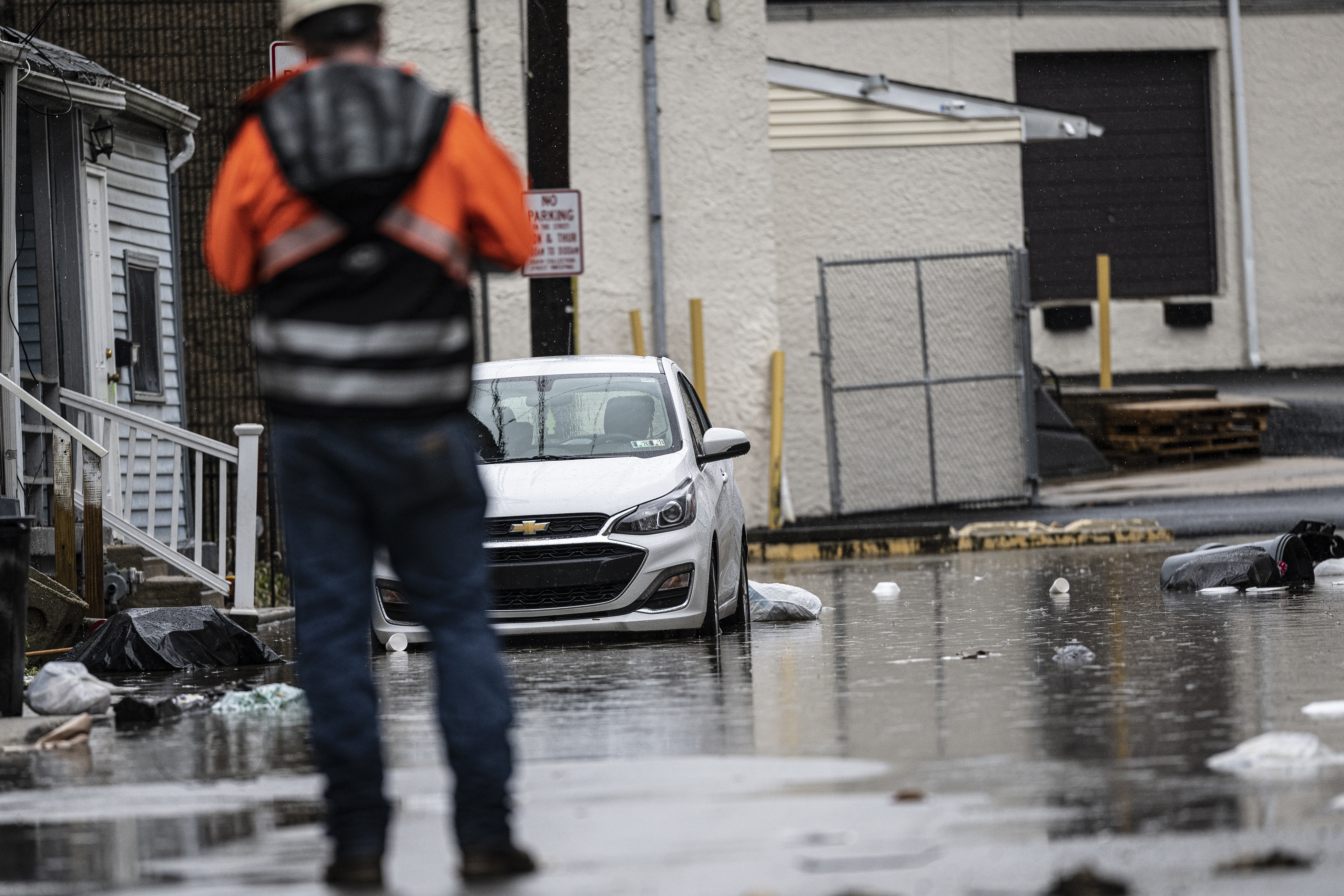
A new tool may help Delco officials better understand flooding in the county.
Delaware County recently acquired 70 AWARE flood gauges, which officials say will help track data, improve response to flooding events, and allow the county to better plan for the future as extreme weather events challenge the region’s aging infrastructure.
Here’s a rundown of what flood gauges do and how they’ll fit into stormwater management in Delco.
What are flood gauges?
Flood gauges are tools placed in and around bodies of water that measure water levels — think giant measuring sticks.
Delaware County’s flood gauges will be placed throughout the county and report data to a public access portal in real time, allowing municipalities and residents to track water levels online.
The county is seeing flooding in areas where it used to be rare, Burritt said, and water-proximate areas are becoming more vulnerable to serious storm damage. Flooding is of particular concern in Delco, where much of the land is low-lying and close to the Delaware River and its tributaries.
“We always kind of say that we’re downstream of everywhere,” Burritt said. “All of the watersheds, they flow to the Delaware River, so we’re at the very bottom of that watershed.”
Gauges will help the county understand where flood risk is the most acute, said Burritt, informing decision-making for county planners and emergency responders.
The flood gauges may also eventually provide early warning detection, though Burritt noted that this capability is still being developed.
Philadelphia installed a similar flood monitoring system earlier this year, with flood sensors and cameras put in nine locations, including Cobbs Creek, Darby Creek, and the Manayunk Canal. Residents can see flood monitoring data on a live portal.
The creek at Rolling Green Park in Springfield. Delaware County is planning to install 70 flood gauges to measure levels in and around waterways. Tyger Williams / Staff Photographer
Where will the gauges be installed?
In draftingits Act 167 plan, a state-mandated stormwater management blueprint, the county and consultant Jacobs Engineering have identified 87 potential flood gauge locations.
The first batch of flood gauges will be installed on county-owned sites like bridges and parks. Once the initial round of gauges are placed, Burritt said her department hopes to work with other landowners, like the state, PennDot, and local municipalities, to place gauges in other key sites.
Potential locations outlined in the draft plan include Smedley Park, Catania County Park along Little Crum Creek, Sun Village Park, Clayton County Park, and numerous county-owned bridges, according to the county’s draft Act 167 plan.
Officials have identified 230 “flood problem areas” across the county, 130 of which fall under the “high priority” category. Some of the highest priority flood risk areas in Delaware County include the intersection of 69th Street and Marshall Road in Upper Darby, Brookhaven Memorial Park, and the section of Baltimore Pike that crosses Brandywine Creek at the border of Chester County. The highest priority areas were identified by the frequency and severity of flooding that occurs there, as well as impacts to emergency services, roads, and structures.
Delco’s Act 167 plan is in preliminary drafting stages, according to the county, and will be further refined, including with feedback from municipalities and the Commonwealth’s Department of Environmental Protection.
Installation of the first batch of gauges will cost $95,000, an expenditure coming out of the county’s capital budget. Burritt said the county is in the request for proposal process and does not yet know exactly how many gauges will be installed in the first round.
This suburban content is produced with support from the Leslie Miller and Richard Worley Foundation and The Lenfest Institute for Journalism. Editorial content is created independently of the project donors. Gifts to support The Inquirer’s high-impact journalism can be made at inquirer.com/donate. A list of Lenfest Institute donors can be found at lenfestinstitute.org/supporters.
Justin Smith was grasping for the gun that his pregnantgirlfriend had pressed to her temple, he told a Philadelphia jury last week, when the weapon accidentally went off, firing 12 shots in a matter of seconds — 11 of them into her head.
Smith, 28, took the stand at his trial on murder and related charges in the death of Dianna Brice, 21,in Southwest Philadelphia and said the shooting was an accident.
But a jury rejected Smith’s account and convicted him of first- and third-degree murder on Friday in the 2021 death of Brice and her unborn child. Smithwas also convicted of abuse of a corpse, arson, and related crimes after he admitted to committing those acts to cover up the killing.
Common Pleas Court Judge Anthony Kyriakakis sentenced him to life in prison without the possibility of parole.
During closing arguments, Assistant District Attorney Lauren Crump cast doubt on Smith’s explanation of how his girlfriend died, saying it was impossible for that many shots to have fired into a concentrated area if the gun accidentally went off during a struggle over the weapon, as he suggested.
She pointed to other problems with Smith’s defense, urging jurors to reject his contention that the Glock handgun modified with a semiautomatic “switch” was Brice’s, not his.
And she dismissed Smith’s argument that he covered up the crime and fled Pennsylvania after the killing because he was scared, bidding jurors to recall his swift actions — setting his car on fire and disposing of Brice’s body in trash bags — before heading to Florida in an attempt to reach Cuba.
“That is not panic,” Crump said. “That is premeditation.”
Brice, 21, of Upper Darby, was 14 weeks pregnant with Smith’s child when she died on March 30, 2021, Lindsay Simon, chief medical examiner for the Philadelphia Medical Examiner’s Office, testified during the trial.
Prosecutors said she was last seen with Smith that day driving from a Delaware County laundromat to Philadelphia, where the couple got into a volatile argument after Brice learned she had tested positive for herpes and accused her boyfriend of giving her the sexually transmitted infection.
It was the last time Brice was seen alive.
Police discovered her body seven days later in a wooded area near 58th Street and Eastwick Avenue in Southwest Philadelphia, covered in black trash bags and wrapped in a tan blanket.
She had been shot in the head 11 times at close range and struck once in her right shoulder. Simon, the medical examiner, said the shots would have almost certainly killed Brice instantaneously.
Philadelphia police quickly identified Smith as a suspect: Cell phone records from the day Brice died showed her phone traveling the same path as Smith’s phone — until 1:38 p.m., when the phone’s trail went dark, said Anthony Vega, a former Philadelphia police detective who testified at the trial as a cell site expert.
Police also found Smith’s dark gray Ford Fusion, burned to a blackened shell, near 59th Street and Florence Avenue, about a mile from where Brice’s body was discovered.
Investigators traced the vehicle to Brice’s makeshift grave site, and to where it was found burned, using video footage from street surveillance cameras, Philadelphia Detective Thorsten Lucke testified.
But the cameras did more than capture the Fusion’s path: It also showed Smith and an accomplice, Tylydia Garnett, wearing gloves and loading what appeared to be a large object into the back of a Hyundai, which police traced to the same locations and to a gas station where its driver purchased a canister of fuel used to set the Fusion ablaze, prosecutors said.
While detectives soon suspected Smith was involved, he was not arrested until 2025, when Atlanta police took him into custody after he gave an officer a fake name during a routine traffic stop and fled.
Meanwhile, Philadelphia police arrested his accomplice, Garnett, in April 2021. She pleaded guilty to arson, abuse of a corpse, and related crimes, and was sentenced to 11½ to 23 months.
Last week, Garnett, 27, told jurors at Smith’s murder trial that he had confessed to her that he shot Brice.
She testified that she had helped him flee to Florida before he moved to Georgia, though Smith’s attorney, Samuel Stretton, suggested the woman had inflated details of her story to earn a more lenient sentence.
When Smith testified, he told jurors Brice’s death was a tragic, shocking accident.
During their argument in the car, he said, the exchange escalated as he drove. He denied cheating on her, he said, but Brice became agitated and held a gun to his head before turning the weapon on herself.
“I tried to hurry up and pull it from her,” he testified. Instead, he said, “it went off, and she died.”
In fear for what might happen to him, Smith said, he hatched a plot to dispose of her body and burn the car with the gun still inside it. The gun was never found, prosecutors said.
“Why didn’t you come to your senses and call for help?” Stretton, his attorney, asked.
“I just felt like this wasn’t going to go my way,” Smith said.
Following the jury’s verdict, Brice’s family, who had lined three rows of the courtroom during the three-day trial, expressed relief for the guilty verdict.
Upper Darby may soon hand out tickets for more than a dozen property maintenance and “quality of life violations,” including improper waste disposal, overgrown grass, and illegal dumpster placement.
Upper Darby’s council earlier this month advanced an ordinance that would allow the township’s licenses and inspections department to dole out “quick tickets” for 17 property-related violations. Tickets would range from $50 to $100 and would, according to officials, allow the township to enforce property-related infractions without engaging in a drawn-out compliance process each time.
“This is something that we really need. Our inspectors really need it,” Amrinder Singh, Upper Darby’s director of licenses and inspections, said at an Aug. 19 meeting.
Singh said the program would give inspectors “another practical tool to address routine violations more quickly and encourage prompt, corrective action” with the ultimate goal of “trying to change human behavior.”
Council voted to advertise an ordinance establishing the property maintenance quick ticket program and is set to vote on the ordinance on Sept. 2.
Upper Darby currently addresses property issues through a violation and compliance process, which Singh said can be lengthy and delay corrective action. Under the existing system, code enforcement officers conduct an inspection, either proactively or following complaints.If a violation is detected, the property owner receives written notice describing the infraction and required action with a deadline. After the compliance period, the property is reinspected, and, if the issue isn’t corrected, enforcement actions can be taken, including fines, citations, and criminal proceedings before a district judge.
Ultimately, Singh said, many property owners just ignore the citations.
The proposed program would send tickets straight to property owners after violations are documented, bypassing the existing, and sometimes protracted, process. Money collected through tickets would go into Upper Darby’s general fund. Property owners will be able to appeal tickets to the township, Singh said. The township’s existing violation process would still exist, Singh said, and would work in tandem with the quick tickets.
The townshipselected the 17 specific violations because they contribute to unsafe conditions, neighborhood blight, pests, and pedestrian obstructions, Singh said.
Upper Darby’s licenses and inspection department has received over 7,000 complaints this year, according to Singh, with around 40% being for grass and trash violations.
At recent council meetings, residents have complained of rat infestations and improper trash storage in their neighborhoods.
If passed by council, the quick ticket program ordinance would go into effect immediately, but fees and penalties wouldn’t be collected until Jan. 1. Singh said the four-month wind-up would allow the department to train inspectors, establish payment procedures, and engage in education and outreach with residents.
Council members at the Aug. 19 meeting seemed poised to approve the program. Council member Myron McNeely said it is “way overdue.”
Here’s a full list of the violations proposed for enforcement under the quick ticket program:
Accumulation of rubbish, garbage, or debris
Improper dumping or disposal of waste
Failure to clean up animal waste
Improper storage of trash containers or recyclables
High weeds or overgrown grass
Overgrowth obstructing sidewalks or public rights of way
Outside placement of indoor furniture or appliances
Exterior accumulation of construction debris or materials
Improper storage of hazardous materials
Illegal placement or storage of dumpsters without authorization
Unregistered, uninspected, unsafe, immobilized, or inoperative motor vehicles
Unsafe or noncompliant swimming pools
Snow and ice removal violations
Graffiti defacement
Failure to obtain required permits
Failure to post required permit placards
Failure to secure vacant unoccupied structures
This suburban content is produced with support from the Leslie Miller and Richard Worley Foundation and The Lenfest Institute for Journalism. Editorial content is created independently of the project donors. Gifts to support The Inquirer’s high-impact journalism can be made at inquirer.com/donate. A list of Lenfest Institute donors can be found at lenfestinstitute.org/supporters.
Maleka Evans waited outside Octapharma Plasma in South Jersey at 8:30 on a recent sweltering morning, sweat beading on her face. A dozen other prospective donors had arrived before her, and the line was still growing a half hour before doors opened.
One woman sat on an overturned shopping cart pilfered from the nearby Walmart. Another brought her own folding chair. A man held a bicycle tire, removed to protect his bike from being stolen once he was inside and hooked up to a machine that extracts antibody-rich blood plasma needed for medical treatments.
Every Monday and Friday for the last three years, Evans has trekked to the Audubon strip mall for what she considers her second job. She takes a 45-minute bus ride from her Willingboro home to Camden, then walks another 45 minutes to the donation site with a slogan posted in its window: “When it pays to give hope. That’s plasmagic.”
The 37-year-old single mom has noticed the lines growing in the last year, as others are seeing at donation sites elsewhere in the Philadelphia region and across the nation. The for-profit business is booming as more and more Americans, both poor and middle class, struggle to straddle the gap between stagnant wages and increased living costs.
Evans relies on the $50 that she typically earns for each plasma donation — loaded onto a prepaid debit card — to help with bills that she cannot cover with her $18-per-hour job packing boxes at a warehouse.
“Prices for everything — food, rent, transportation, electricity — are just getting higher and higher,” Evans said. “You have to work two jobs to make ends meet, and you’re still living paycheck to paycheck.”
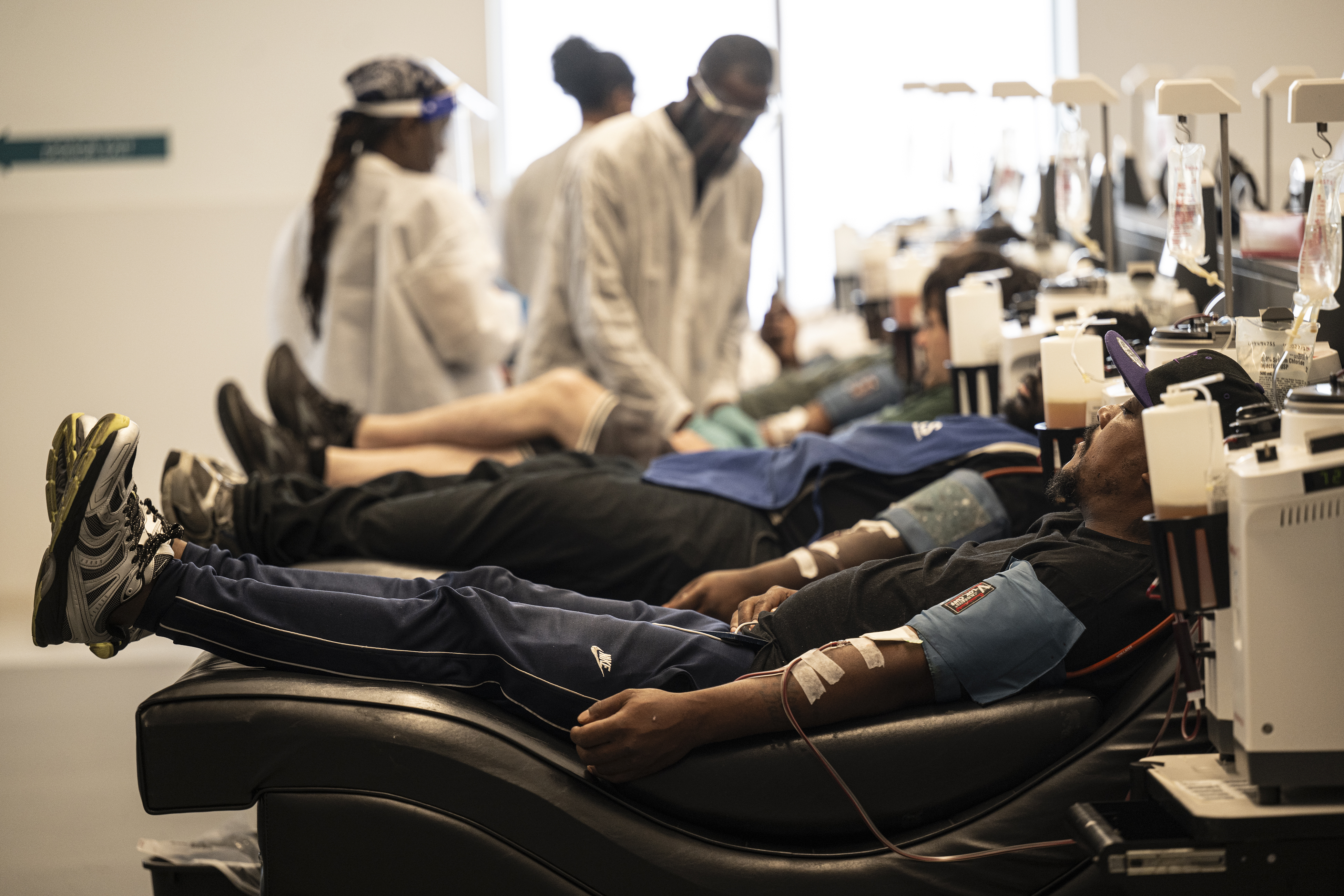
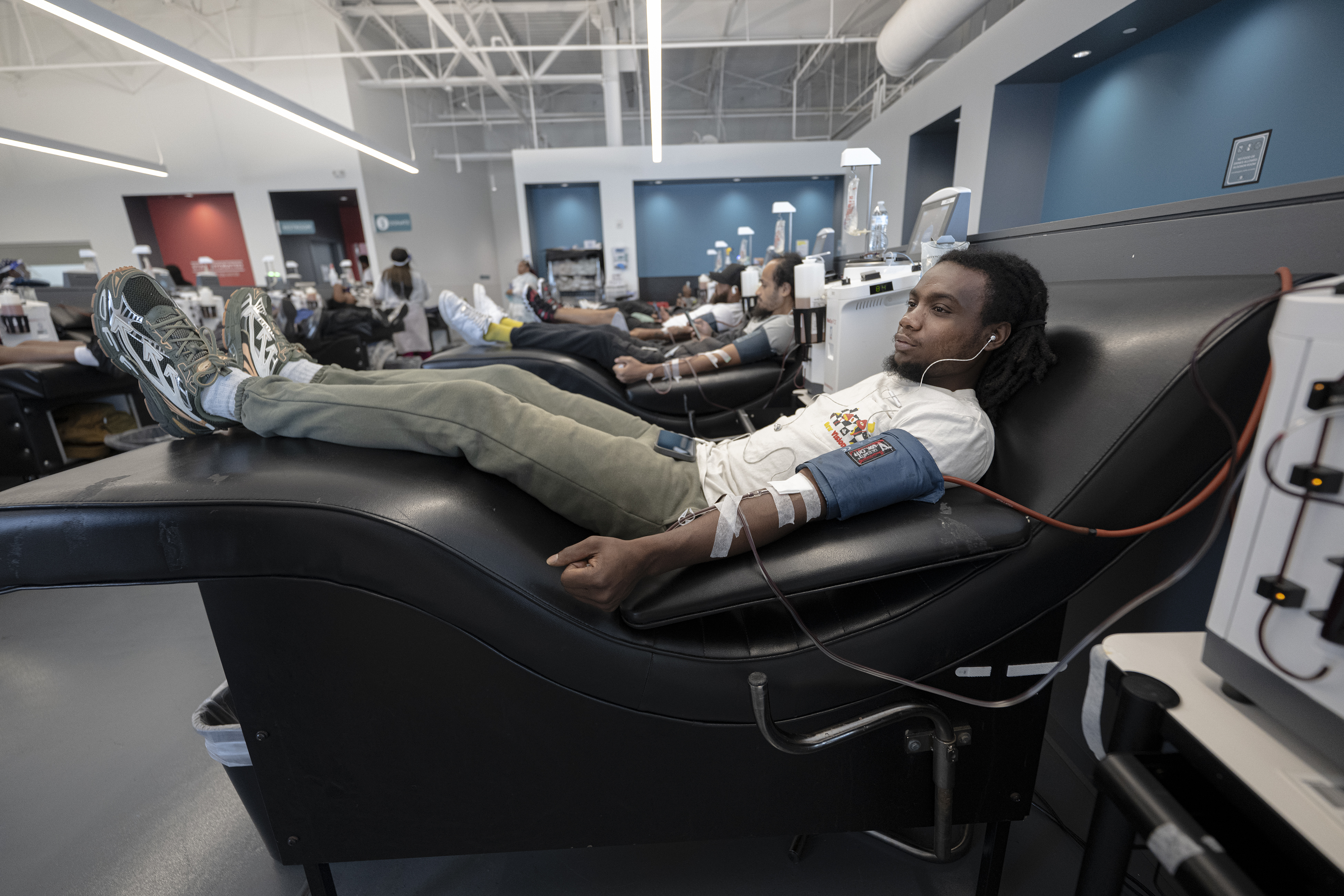
An increasing number of people in the Philadelphia region are selling their blood plasma for money. Here, local donors sit in recliners with needles in their arms at B Positive Plasma in Montgomery County.Jose F. Moreno / Staff Photographer
The U.S is one of about a dozen countries where it is legal to pay donors for plasma. It is among only three countries where people are allowed to donate two times over seven days, though not on back-to-back days, per U.S. Food and Drug Administration regulations.
Nearly 70% of the world’s plasma comes from donors in America, fueling a multibillion-dollar global industry. Plasma, a straw-colored liquid in blood, contains antibodies and other proteins used for treating a wide range of patients with immunodeficiencies, neurological conditions, kidney disease, and bleeding disorders.
Last year, U.S. donors produced 62.5 million liters of plasma — the highest volume ever collected and an 8% increase from the previous year. That trajectory has continued into this year, according to Georgetown University professor Peter Jaworski.
“When the price of most staples goes up, so does the amount of plasma donations,” Jaworski said. “If I fell on hard times, the very first thing I would do is become a regular plasma donor.”
Donating plasma is widely considered low-risk, with millions of people doing it each year without reported health problems. However, the long-term health effects of donating twice weekly for years have not been well-studied. Safety concerns raised by the deaths of two people in Canada who had recently donated at for-profit clinics run by the healthcare company Grifols haveprompted an investigation there.
In the U.S., an FDA investigation into 34 deaths of people who had donated plasma between 2016 and 2020 did not find a link between donations and fatalities.
Some donors experience lightheadedness, fatigue, bruising, bleeding, or dehydration. Drinking water and eating foods high in iron and protein can help alleviate those side effects, according to U.S. health guidance.
Security guard Danny Morales of North Philadelphia said he feels “tired” after donating. But that has not deterred him from heading to CSL Plasma in the city’s Olney neighborhood twice a week, as soon as he finishes his overnight shift at 6 a.m.
Morales can earn $520 a month donating plasma, which helps to offset rising expenses that have the 35-year-old father feeling ever more drained: The cost to fill up his Honda Civic’s gas tank jumped from $30 to $80 in the last year; a package of ground beef increased by $8; and even the brand of mac and cheese that his 8-year-old daughter and 2-year-old son enjoy costs about $1 more, he said.
“It’s just getting worse and worse,” said Morales, whose plasma donations supplement his $18 hourly security job wage. “Stuff is just getting so expensive. Groceries are ridiculous.”
CSL opens at 6 a.m., but a line starts to form around 4:30 a.m. In late July, it snaked past the building, wrapping around the corner. The sight caught the attention of nearby Olney resident Tony Reed.
“There’s always a line there, especially toward the end of the month and definitely on Monday mornings,” Reed said. “People are broke.”
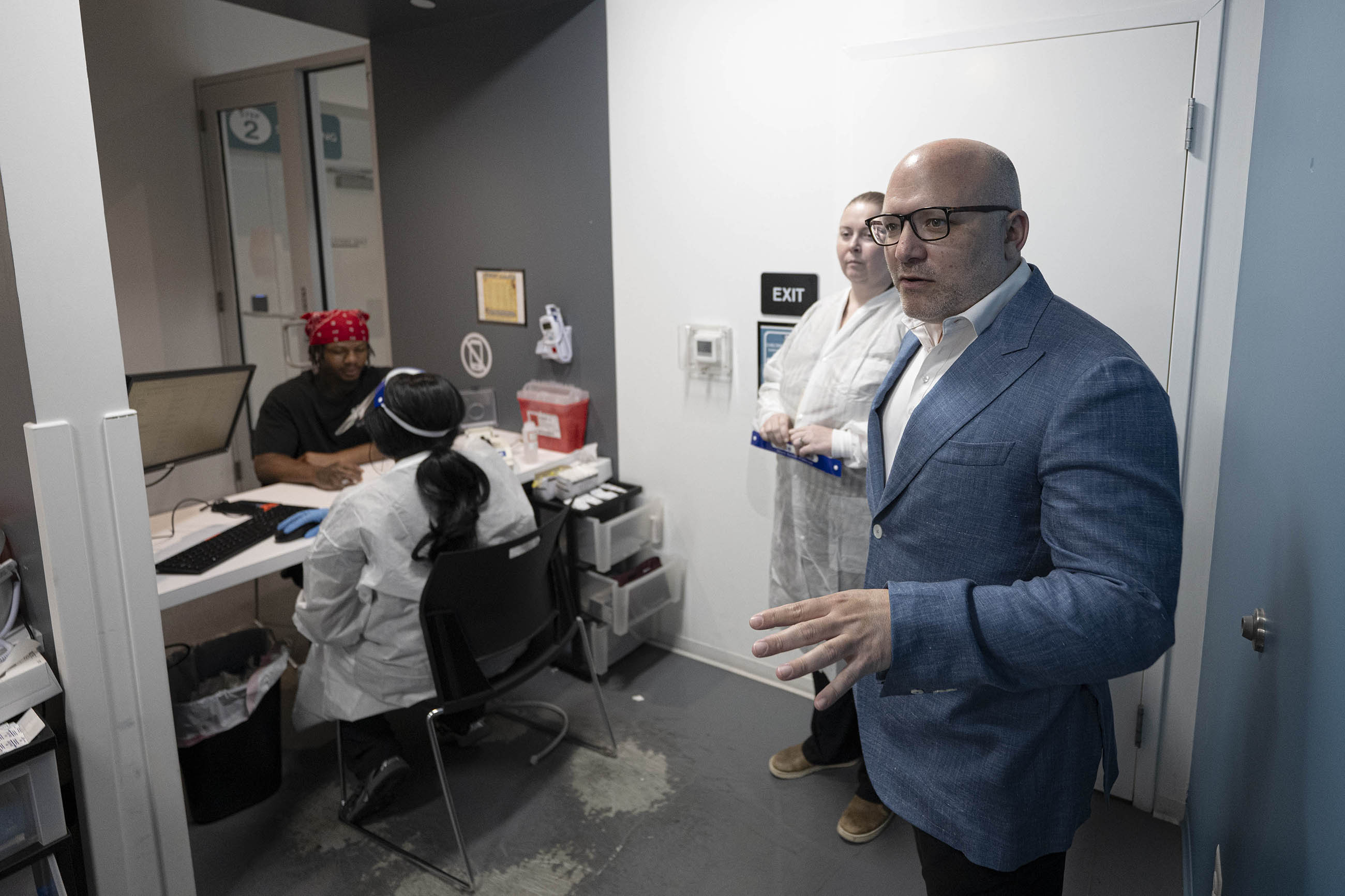
Ben Ruder, CEO and founder of B Positive Plasma, and Pearl Dixon, an assistant manager and phlebotomist, explain the donor intake process. Each donor fills out an extensive health questionnaire, undergoes a medical exam, and gets a finger prick to test their blood for iron and protein levels. Jose F. Moreno / Staff Photographer
Inside the booming industry
On a recent Wednesday afternoon at B Positive Plasma in Montgomery County, a steady stream of donors checked in at kiosks in the lobby.
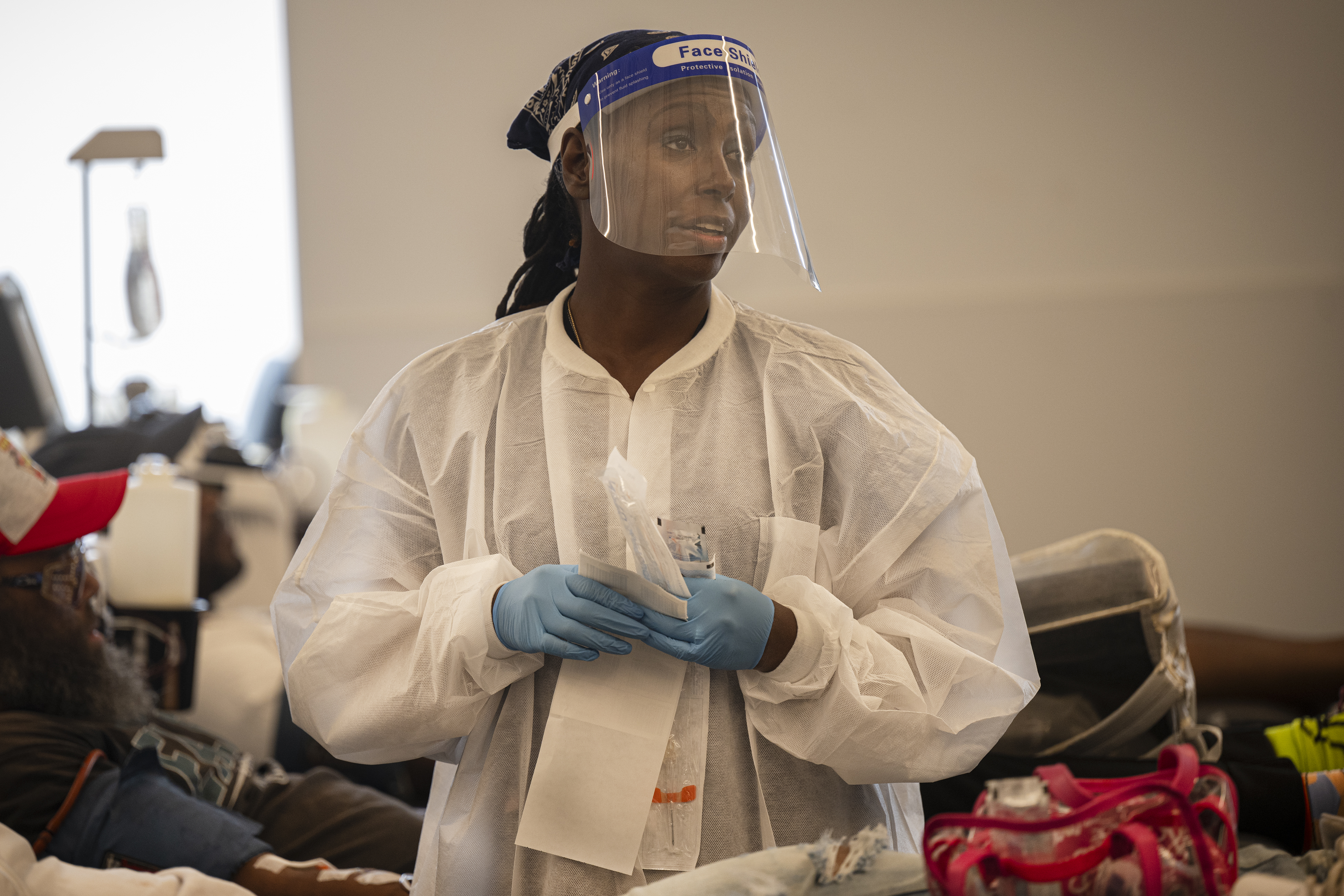
After filling out an extensive health history questionnaire, each new donor undergoes an on-site medical exam by a licensed practical nurse. Repeat donors must get annual exams. At each visit, a medical tech checks their vitals, including blood pressure, pulse, and temperature, and performs a finger prick to test their blood for protein and iron levels. Donors must weigh at least 110 pounds.
“We make sure they’re healthy and well,” said Ben Ruder, founder and CEO of B Positive Plasma, noting that the plasma itself is tested for HIV and hepatitis B and C before being sold.
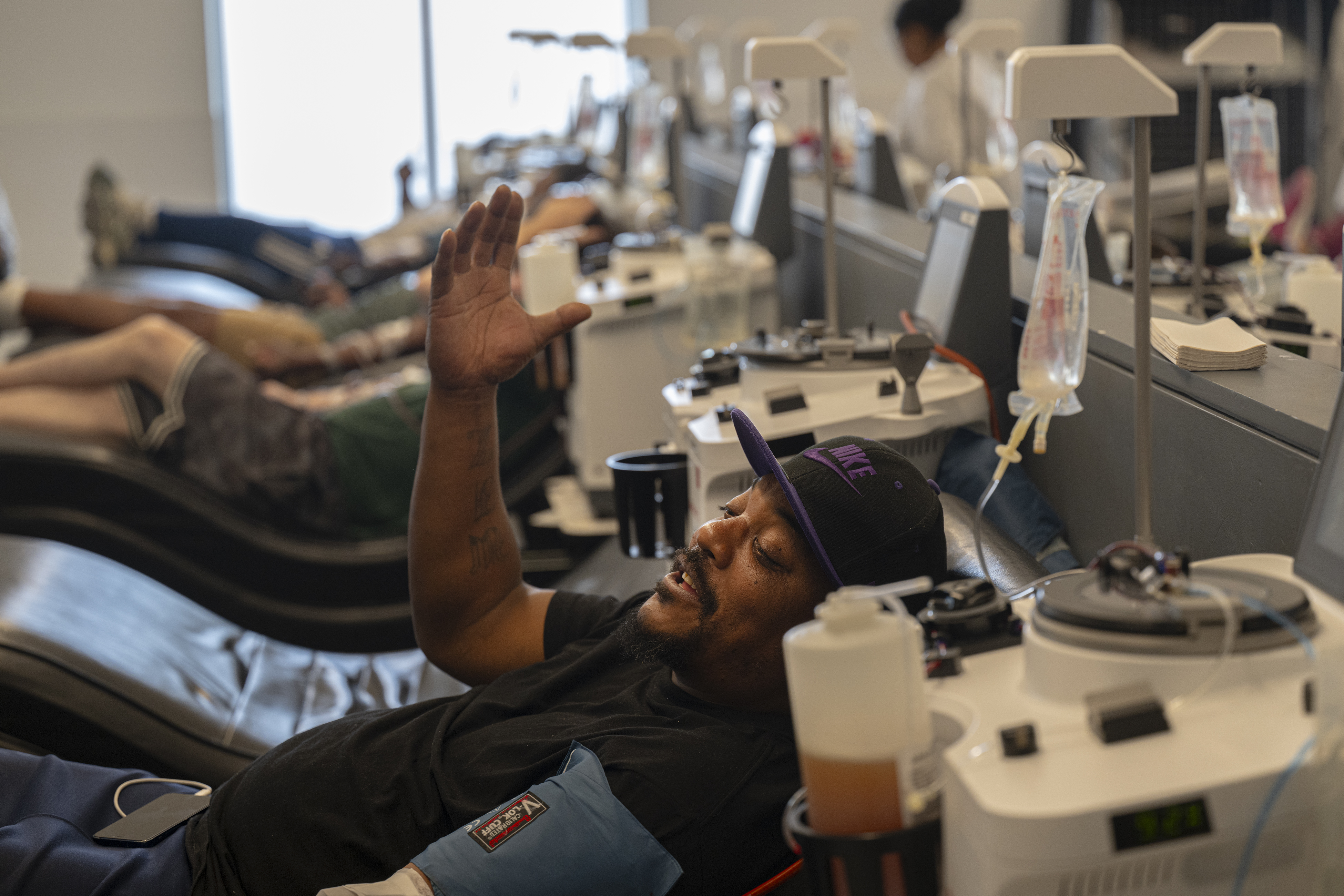
Next, plasma donors are hooked up to a machine that draws out blood, spins off the plasma, and then returns the red blood cells back to the donor, a process that typically takes 45 minutes to an hour.
At 2 p.m., 18 of the 24 cushioned recliners at the Wyncote location on Cheltenham Avenue were occupied by donors, each with a needle in one arm. They included a Philadelphia police officer who had donated more than two dozen times since May 2025; a casino cleaner who earns $120 a week donating to support his young daughter; and a home health aide who donates twice a week to help cover his $750 monthly apartment rent.
Jason Johnson, 29, of East Mount Airy, has donated plasma 68 times at B Positive Plasma in the past two years. He makes an extra $120 a week donating twice weekly. The money helps supplement the $17.80 an hour he earns as a cleaner at Live! Casino & Hotel Philadelphia. “In the beginning, I was doing it for the extra money, but once I learned that I’m helping people out in their life, it made me want to come back even more,” Johnson said. Jose F. Moreno / Staff Photographer
Plasma donation differs from whole blood donation, a faster process that relies on unpaid volunteers who can donate only once every 56 days in the U.S.
B Positive Plasma is on track to see a record year, with 180,000 donations, peaking this holiday season, when people need extra money for gifts. Last year, the company saw 150,000 donations at about 1 liter per person.
Ruder, 42, who lives in Center City, opened his first plasma donation center in Cherry Hill in 2012 and rapidly expanded to 12 locations in New Jersey, Pennsylvania, and Delaware. He plans to open two more sites in Maryland next year and another in Allentown later this year.
B Positive Plasma, like other plasma companies, structures payments to incentivize twice-weekly donors. For instance, donors whose weight and physical health yield the maximum amount of plasma — 1,001 to 1,200 milliliters — will receive $45 for the first visit and another $90 if they return that same week. Plus, the company offered a $50 bonus for anyone who donated eight times in August.
Donyele Wilkins, 48, a phlebotomist and medical assistant, works in the donation room at the B Positive Plasma in Montgomery County. She suffers from lupus, a chronic autoimmune disease for which she receives plasma-derived infusions to control her symptoms.Jose F. Moreno / Staff Photographer
Phlebotomist Donyele Wilkins works 12-hour shifts, four days a week, at B Positive Plasma.
For Wilkins, the paycheck is not the only benefit of working there.
The 48-year-old Northeast Philadelphia resident suffers from lupus, an autoimmune disease in which the body’s immune system attacks its own tissues and organs. Wilkins said she relies on plasma-derived medication, infused through an IV every four to five months, to help control symptoms like inflammation and joint pain.
Knowing how plasma is processed makes her feel “safe,” she said. She also likes getting to know “the regulars” who donate.
“It makes me feel like I know exactly where it’s coming from, and I know the people who are doing it,” Wilkins said. “A lot of them really need the money, so they’re helping me, on top of me helping them.”
‘Blood money’
Paying donors for plasma has sparked ethical debate, with some accusing the industry of exploiting poor people.
In her 2023 book, Blood Money: The Story of Life, Death, and Profit Inside America’s Blood Industry, Kathleen McLaughlin, a Montana-based journalist, found that donors in many U.S. regions are disproportionately Black and brown people.
McLaughlin, who has a rare autoimmune disease treated withmonthly plasma-derived infusions, said today’s rise in donations is “a symptom of our broken economic system.”
While the FDA regulates health safety at plasma centers, the pay rate is set by the companies, McLaughlin found. She thinks donors should be paid more and the amount should be standardized.
“Right now, it’s a capitalist free-market system, where the pricing isn’t transparent,” McLaughlin said. “The profit margins are crazy for these plasma companies, and it’s gamified to make you donate twice a week, every week, in perpetuity.”
Jaworski, the Georgetown University professor, said donors are compensated fairly. A donor whosits for an hour and a half makes “significantly more than” New Jersey’s $15.92 minimum hourly wage and Pennsylvania’s $7.25. Plus, he stressed, donors save “hundreds of thousands of lives.”
Wallace Smith, 45, of Upper Darby, prides himself on making an honest living. He earns $15 an hour as a home health aide. He makes an extra $130 a week selling his blood plasma. The money helps cover cigarettes, rent, and his phone bill. Jose F. Moreno / Staff Photographer
Recently published research suggests that communities can benefit when a new plasma center opens, because fewer young people take out high-interest payday loans and area crime drops, mostly driven by decreases in property and drug-related offenses.
“It helps you from having to do something wrong,” plasma donor Wallace Smith said.
When Smith was in his late 20s, he got arrested for selling drugs. Now 45, he is still struggling to find a job that pays a living wage, he said.
Smith, of Upper Darby, works three days a week, earning $15 an hour, as a home health aide. He earns $130 a week donating plasma, which helps pay for cigarettes, his phone bill, and rent, he said.
Like many donors, Smith said he likes the win-win of earning extra cash and helping patients who depend on plasma.
“They say there’s a job’s out here for everybody, but when you become a person who made mistakes in life, then they look at your background, so there’s only certain jobs you can do,” Smith said as his blood flowed into a spaghetti-thin clear tube at B Positive Plasma.
“With that being said, you don’t go back to your old ways,” he said. “You find better resources like this.”
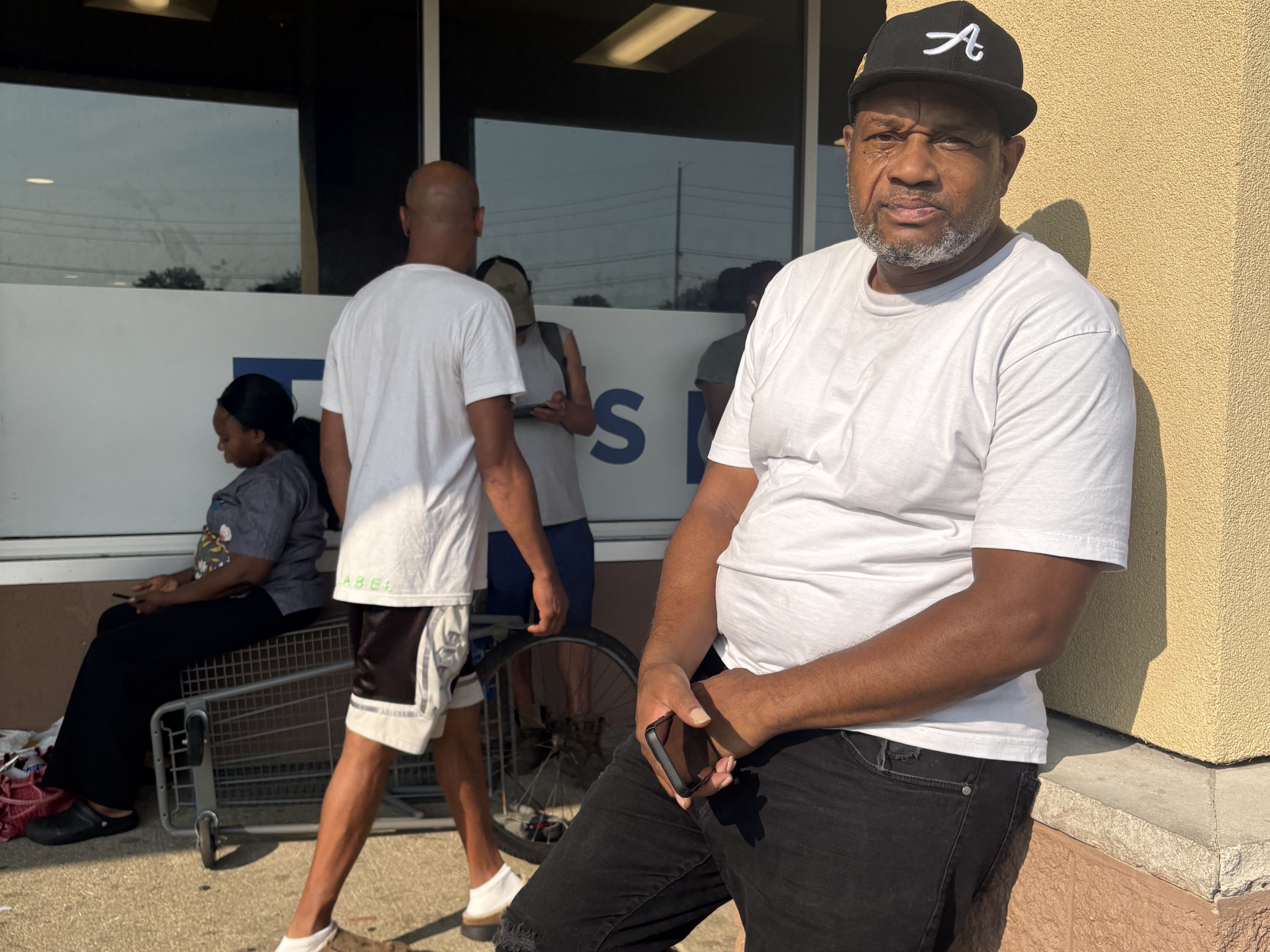
On a hot August morning, donors line up outside Octapharma Plasma in South Jersey to sell their blood plasma for money. They arrive before the doors open at 9 a.m. to beat the wait. Donor Carl Davis, 56, of Camden, donates every Saturday and Monday, earning $70 each time. The extra money helps supplement his $900 monthly Social Security Income disability check. “I get SSI disability, but it’s not enough at all to pay my bills and buy food,” Davis said.Wendy Ruderman
Beach boardwalk fun
At Octapharma Plasma in South Jersey, the wait time can be as long as three hours, donors said. When a sewer pump broke and bathrooms stopped working earlier this year, the company trucked in a row of porta-potties to accommodate donors and staff.
On a recent August morning, Brittany Barr, 36, and her three sons — 5-year-old twins and a 6-year-old — waited outside Octapharma as her husband donated. The family had walked roughly two miles from their Gloucester City home.
When Barr learned her friend had kidney failure and needed plasma infusions, she wanted to help. Barr was unable to donate plasma because she is anemic, so her husband agreed to do it.
In the month since Barr’s husband started donating, the family has earned more than $500. It has helped with groceries and their phone bills to supplement her husband’s income as a shipping manager.
“With only one income, money is tight these days,” Barr said. “Everything is messed up.”
The boys, clad in their bathing suits, climbed up on Barr as she sat on a tipped-over shopping cart. They were headed next to Atlantic City for a beach day.
“This week, the money is going toward fun. They’re going to play arcades and have ice cream or whatever their little hearts desire,” Barr said. “Next week, it’s going to school supplies.”
Brittany Barr, 36, seated with her boys (from left) Cooper, Cannon, and Colton, waits outside for her husband to finish donating plasma at Octapharma Plasma in Audubon, N.J. The family from Gloucester City was next headed down the Shore, where they planned to spend the extra money earned from donating plasma on arcade games and ice cream.Wendy Ruderman / Staff
Upper Darby will consider buying a 15-acre forested property at the heart of a conservation fight after dozens of residents packed a public meeting and demanded the township look into purchasing options before rezoning the parcel for mixed-use development.
The Upper Darby Township Council on Wednesday considered moving forward an ordinance to create a mixed-use zoning district on a tract of land between State and Township Line Roads. The tract, known by residents as the Mozino Forest, contains unmaintained forest. Though the land is private property — owned by Peter Mozino and under contract to be sold to the Rockwell Development Group — residents have long utilized it as a place to walk, hike, and commune with nature.
Rockwell Development Group has proposed developing the property with a blend of single-family homes, townhouses, apartments, and ground-floor commercial spaces, as well as dedicated community and recreation spots and pedestrian walkways.
Rita LaRue, Upper Darby’s director of community and economic development, said Rockwell originally came to the township with a plan to build 56 single-family homes on the site, a proposal that would be allowed under the site’s existing zoning and would not require special zoning approvals. The township then asked Rockwell to consider an alternative, higher-density plan that would combine diverse housing types, retail, and community amenities, LaRue said. Over several months, Rockwell worked with the township’s solicitor, engineer, and planning staff to bring the mixed-use zoning ordinance.
Upper Darby officials have said putting a denser, mixed-use development on the tract, rather than the 56 single-family homes, would help fulfill core township goals by bringing in more tax revenue and adding diverse housing options.
“We are very committed to having a mixed-use space that is not simply, you know, brick and mortar. We want it to be a place that adds to community life for everybody in Upper Darby,” LaRue said.
At the meeting, Rockwell president Greg Lingo touted his Upper Darby bona fides, telling the crowd he was not the ill-intentioned, outside developer he had been portrayed as. The developer said he graduated from Upper Darby High School, is a taxpayer in the township, and has invested significantly in the Drexel Hill neighborhood over the years.
Lingo said that while he understands residents’ concerns about preserving green space, the land is private property and could be developed into a residential neighborhood regardless of whether the zoning amendment is passed.
“This isn’t necessarily a decision between open space and a future mixed-use development,” Lingo said. “This property is not open space. I’m pleased to hear that people have just been using it as open space over the years. It’s private property. It’s property that’s been neglected for as long as I can remember.”
Lingo said he would be willing to sell the property if the township wanted to purchase it, but added that as a taxpayer, he does not “think that that’s a great use.” Lingo approximated the cost of the land at $8 million.
There were 15 proposals to purchase the property, none of which involved maintaining it as open, green space, planning commission member Debbie Nifong said at a June 8 meeting.
The planning commission voted 3-2 to recommend approval of the zoning changein June.
At the Wednesday night council meeting, residents packed the council chambers, donning green shirts and spilling out into the hallway in protest of the proposed zoning change. They described tranquil walks through the Mozino Forest and warned of environmental consequences if the land were to be developed.
“I believe that having some open space, it’s future gold in terms of urban planning,” said Dolores Lombardi, a resident and former chair of the township’s shade tree commission. “Many cities are preserving open space, and creating more. An overdeveloped heat zone is not an attractive place to live in.”
“The whole forest is a natural sponge for our area. There will be severe downstream flooding,” said resident Gail Grant, who warned of increased stormwater runoff should the green parcel be paved.
Residents questioned why the forested tract should be developed when the township has numerous vacant storefronts and existing corridors in need of redevelopment.
Members of the township’s environmental advisory committee urged the council to strike down or table the zoning ordinance and said that, if given more time, they could put together a proposal for the township to purchase the land with supporting funds from local conservancies or state or federal bodies.
They cited the $13 million purchase of the Oakwell estate in Villanova by the conservation nonprofit Natural Lands and the Wyncote Foundation. The lush estate was once slated to become athletic fields for the Lower Merion School District but was sold to the nonprofits after significant community pushback.
The council voted unanimously to table the ordinance, citing a need for more information from both Lingo and the environmental advocates.
“I know the administration wants to look into seeing what sources we have available to see if we can come to some type of agreement,” council member Kyle McIntyre said.
McIntyre said he did not want to “get everyone’s hopes up” and described “two trains running parallel to each other.” While the township will “do everything in our power to possibly strike a deal” to buy the land, McIntyre said, he expressed a desire to work with Lingo to “make sure that what we’re building for this community actually does benefit it” if a sale does not happen.
“We did learn a lot of things tonight, and I’m eager to have those conversations with the township and see where we fit in and what we can do, so that we can make a decision that’s good for everybody,” Upper Darby Mayor Ed Brown said.
This suburban content is produced with support from the Leslie Miller and Richard Worley Foundation and The Lenfest Institute for Journalism. Editorial content is created independently of the project donors. Gifts to support The Inquirer’s high-impact journalism can be made at inquirer.com/donate. A list of Lenfest Institute donors can be found at lenfestinstitute.org/supporters.