The U.S. Mint will soon begin producing $1 gold-hued coins, featuring the face of President Donald Trump, Treasury Secretary Scott Bessent announced this week.
The coins will be created at the Mint’s Philadelphia production facility on Independence Mall, the nation’s first and oldest mint. A Treasury Department spokesperson said the coins will be available in the fall, and there’s “no gold in this coin but [it] has a gold-like finish.”
The designs boast a direct-gaze portrait of President Trump, with the phrase “In God We Trust” written next to his face. This side of the coin also includes the dual date, “1776 ~ 2026,” which is the same motif featured on the dimes, nickels, quarters, and half-dollars in the U.S. Mint’s Semiquincentennial program released at the start of the year.
On the reverse side, the $1 coin shows a variation of the Great Seal, an insignia of an eagle that is only used by the U.S. Department of State to impress upon official documents and treaties. The version on the coin includes the same eagle holding an olive branch and arrows in its talons. Its shield, however, includes the number “250,” commemorating the 250th anniversary of the signing of the Declaration of Independence.
In his announcement on X, Bessent said the coin “celebrates the strength of American values, and the promise of a nation dedicated to preserving freedom for all.”
In response, Bessent has cited a 2020 law that allows the Treasury to mint $1 coins with “designs emblematic of the U.S. semiquincentennial.” However, the same law reaffirms that no head-and-shoulders portrait of any person, “living or dead,” may be included on the coins.
Bessent pointed to historical precedent. “During the 150th, there was a Calvin Coolidge coin, so we can put living presidents’ images on a coin,” he told Fox Newsin an interview.
I’m the CEO of Gaudenzia, one of Pennsylvania’s largest behavioral health nonprofits. We serve thousands of people in addiction and mental health treatment across the commonwealth. And for the past year, I’ve been restructuring this organization from the inside because the alternative was watching it slowly fail while pretending everything was fine.
We are not alone.
Across Pennsylvania, behavioral health organizations are quietly closing programs, losing staff, and reducing capacity. Not because they’ve lost their mission. Because the economics have changed faster than anyone could adapt.
Here’s what happened: In July 2025, the One Big Beautiful Bill Act cut $664 billion from state Medicaid budgets over the next decade. Pennsylvania’s behavioral health providers, most of whom depend on Medicaid for the majority of their revenue, absorbed that shock overnight.
Simultaneously, managed care organizations began holding budget allocations and, in some states, retroactively clawing back payments already made to providers.
Meanwhile, our workforce costs rose 30% to 40% in key roles. Behavioral health nurses now turn over at the highest rate of any nursing specialty: 22.8% annually. We’re competing for staff against hospital systems and telehealth platforms that offer sign-on bonuses we can’t match. From a fiscal standpoint, we’re also having to contend with Medicaid reimbursement rates that haven’t kept pace with inflation for a decade.
The math doesn’t work. And everyone in this field knows it. We just haven’t said it publicly. But I’m saying it now.
At Gaudenzia, we’ve responded by restructuring our leadership model, investing in staff training and accountability systems, consolidating programs that were no longer financially viable, and preparing for payer changes we could see coming. We chose to act rather than hope the old model would somehow start working again.
But individual organizations cannot fix a structural problem alone. What Pennsylvania’s behavioral health system needs is straightforward:
Rate adequacy. Medicaid reimbursement rates must reflect the actual cost of delivering care in 2026, not 2016. Every year the gap widens, another program closes. Another community loses access.
Payer-provider partnership. The system works when providers can plan and patients can stay in care. That requires contract stability, transparent rate-setting, and network adequacy standards that reflect real capacity rather than paper networks. When providers and managed care organizations operate as genuine partners, communities keep access and outcomes improve.
Workforce investment. Pennsylvania needs a behavioral health workforce pipeline that treats this field as the essential infrastructure it is, not an afterthought funded with whatever’s left after acute care gets its share.
I didn’t write this to complain. I wrote it because the people we serve — Pennsylvanians in crisis, in recovery, in the hardest moments of their lives — need organizations that are financially stable and structurally resilient enough to be here in five years.
Right now, that’s not guaranteed for many of us.
The CEOs I talk to know this. The boards know this. The frontline staff certainly know this. It’s time the public and our policymakers heard it directly from someone willing to put their name on it.
Behavioral health is not a luxury service. It is infrastructure. And infrastructure that is underfunded, understaffed, and destabilized does not slowly improve. It collapses.
We can prevent that. But only if we stop being quiet about what’s happening.
Deja Gilbert is the president and CEO of Gaudenzia Inc., a behavioral health nonprofit serving communities across Pennsylvania, Maryland, and Delaware.
BERLIN — No one starts a war expecting it to last forever.
Yet, since Vietnam, American presidents have repeatedly gotten into conflicts that seem like they could last forever, at least until the next president — or the one after that — decides that the expense and political pain are not worth it, declares victory and goes home.
On Iran, President Donald Trump may have fallen into the same trap.
He campaigned for office vowing to end wars, not start them, and to never get involved in a forever war, let alone one in the Middle East. And yet he risks doing so in Iran, his critics say.
The war that Israel and the United States began with such force has alternated between moments of negotiation and military strikes. They have failed to reach Trump’s stated goals of regime change or ending Iran’s nuclear program, while the war has created a new, seemingly intractable problem, bottling up the Strait of Hormuz.
With diplomacy at a dead end, at least for now, a frustrated Trump finds himself back at war, the ceasefire broken, the strait blocked. The memorandum of understanding he said “achieves everything we set out to accomplish” — despite wildly divergent interpretations of it — is in tatters after less than a month.
“Both sides looked to the memorandum of understanding as the continuation of the war by other means, not as a bridge to peace,” said Ali Vaez, Iran project director for the International Crisis Group.
Without a long-term strategy to produce a sustainable settlement, he said, there’s a risk of creating “the circumstances for a forever war.”
The idea of the “forever wars” began with 9/11 and the “global war on terror,” pulling the United States into long military engagements, with troops on the ground, in both Afghanistan and Iraq. Those conflicts, which began by toppling hostile regimes before turning into counterinsurgency campaigns, ended either inconclusively or in defeat after considerable expenditure and loss of life.
Powerful leaders with powerful militaries are prone to fall into “the short-war fallacy,” said Lawrence D. Freedman, emeritus professor of war studies at King’s College, London, who last year wrote an article, “The Age of Forever Wars.” “They think they can win quickly and not suffer adverse consequences,” he said.
Like Trump in Iran and Russian President Vladimir Putin in Ukraine, “they fail to appreciate the limits of military power and so set objectives that can be achieved, if at all, only through prolonged struggle,” Freedman said.
And even the most sophisticated military forces are not enough, if there’s no strategy to turn battlefield superiority into lasting political and diplomatic success. Trump faces the added challenge of trying to win using only air and sea power, without politically unpalatable use of ground troops on Iranian soil.
The Persian Gulf war of 1991 was quick and succeeded in its aims, because President George H.W. Bush had a limited political objective — drive Saddam Hussein out of Kuwait. That was a lesson lost on his son, President George W. Bush, in the second war against Iraq, which ended up enhancing Iran’s power in the region. In Afghanistan, after the younger Bush drove out the Taliban, he and his successors tried vainly to remake the society, but when Washington tired of the effort, the Taliban returned.
There is an argument, sometimes made by Trump himself, that he went to war in Iran to finally end what he considered a 47-year war between the United States and Iran, which began with the fall of the Shah of Iran in 1979 and the taking of more than 60 American hostages.
The U.S.-Iran “forever war,” argued Vali Nasr, a professor at the Johns Hopkins School of Advanced International Studies, is just another round of a conflict that has sometimes blown hot and sometimes resulted in agreement, like the 2015 nuclear deal Trump tore up in 2018.
Aaron David Miller, a senior fellow at the Carnegie Endowment for International Peace, said Trump, urged by Israel, has also inserted himself in a parallel “forever war” — the one between Israel and Iran, which is being played out with Iran’s proxies in Lebanon, the Palestinian territories, and Yemen.
Trump still has the ability to sell this unpopular war to his base as a victory of some kind and go home. But to the surprise of many, he seems to be doubling down, albeit with no clear path to a diplomatic settlement. And his commitment to keep the Strait of Hormuz open, while Iran insists on maintaining control, could mean a very long U.S. military engagement, even with the help of allies.
Still, the Iran war is different, especially compared to Afghanistan and the second war against Iraq. In both of those wars, thousands of U.S. troops were on the ground for long periods and ended up fighting militias and terrorists opposed to new governments propped up by the United States — not fighting a state like Iran.
And unlike the case in Vietnam, Iraq, or Afghanistan, Iran can inflict economic pain on the United States by blocking access to the Strait of Hormuz, which gives the government in Tehran more effective leverage and is a prime reason it will refuse to give up control.
There will be no return to the situation before the war, said Suzanne Maloney, director of foreign policy at the Brookings Institution. As in Iraq, American assumptions and misperceptions changed the balance of power in the region, she said, and now the days of the Strait of Hormuz fully free for transit are probably over.
There can be “a new normal,” she said, “but with a much higher American force posture in the region” given Iran’s ability to hit ships whenever it pleases.
Because Washington’s stakes in this war are simply smaller than those for Iran, said Nasr, who worked on the Afghan war, “the pace begins to slow, while the other side is willing to keep the same level of intensity.” As the United States began to withdraw from Afghanistan, as from Vietnam, “the balance began to shift.”
But a negotiated end to the war in Iran still feels far away. Both sides have proved they can’t even stick to a minimal framework agreement that defers all the substantive issues to the future, Vaez said. If they can’t even do that, he added, “that could remove the last barrier between episodic confrontation and a forever war.”
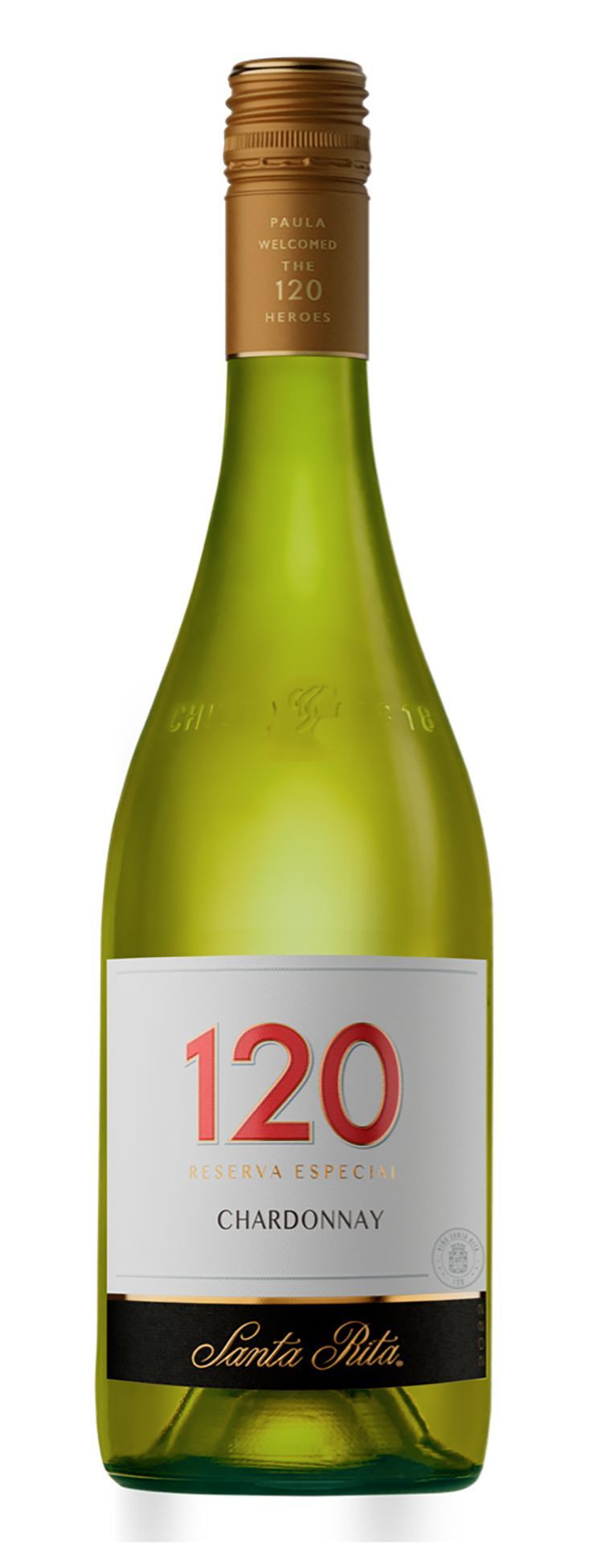
Chile is among the world’s leadingexporters of fresh fruit, and grows outstanding wine grapes as well. But here in the United States, the country’s top wines don’t get much attention. What we do see, however, is that bottles in the Chilean section of the wine store perform well in the value-oriented tier. This chardonnay is a perfect example, delivering far better quality and more finesse than anyone has a right to expect nowadays from a $10 bottle — and with slightly less alcohol than usual for this style, too.
This wine is made in Chile’s Valle Central, or Central Valley, a vast wine appellation anchored by the capital city of Santiago. Think of it as the equivalent of California in the U.S., or Mendoza in neighboring Argentina. Every facet of this region’s geography seems tailored to boost the quality of its wines. Its terrain is made up of a series of four short-but-scenic valleys sandwiched between the snow-capped peaks of the Andes to the east and the chilly Pacific to the west. These dueling influences are a natural form of refrigeration at night, slowing how long it takes for grapes to ripen while preserving the freshness of flavor.
Best of all, the region’s Mediterranean climate rarely sees rain during grape growing season, which reduces risks from both insect pests and fungal disease. These ideal conditions allow vintners to make balanced wines that have great ripeness and preserve the acidity necessary for refreshment. It also allows them to do so at very low cost.
This easy-drinking chardonnay is lightweight in texture but vibrant and surprisingly concentrated in flavor. It tastes of fresh-picked apricots and honeydew melons, but with the zingy finish of a good homemade lemonade. Plus, it has a great synergy with summer salads and shellfish.
Santa Rita 120 ChardonnayCourtesy of Viña Santa Rita
Some of the country’s biggest football stars have brought back a decade-old internet trend where people douse themselves in ice water to raise money for research into amyotrophic lateral sclerosis, a neurodegenerative disease known as ALS.
Former Tennessee Titans running back Chris Johnson put ALS and the Ice Bucket Challenge back in the spotlight in late June when he announced his diagnosis on “Good Morning America.”
“Years ago, the ALS Ice Bucket Challenge united millions of people around the world around one cause and helped change the fight against this disease,” Johnson wrote on social media after his announcement. “Today, I’m asking you to help me do it again.”
It was a callback to the original challenge, which raised over $100 million for ALS research when it originated in 2014, and is now described as one of the more notable success stories in an age of social media-driven activism.
More than a decade later, experts say that windfall transformed ALS research by drawing more scholars into the field and powering breakthroughs in ALS diagnosis and care. They hope a revival of the trend might do the same as researchers continue to hunt for a cure.
“We can do so much more now than we could then,” said Eva Feldman, a professor of neurology and director of the Scott Pranger ALS Center at the University of Michigan.
The simple premise of the Ice Bucket Challenge in 2014, to film yourself getting an icy splash, make a donation and nominate three friends to do the same, was primed to spread across the internet and came as Facebook debuted hashtags and “trending” topic lists to boost viral videos. Celebrities, politicians and around 17 million people participated in the trend, according to the ALS Association.
“It brought extreme recognition to the disease,” Feldman said.
The swell of attention and funding from the Ice Bucket Challenge “spawned a generation of young investigators” who were newly drawn into ALS research, said Nicholas Maragakis, a professor of neurology at Johns Hopkins University.
Experts said among the biggest breakthroughs in the past decade include the identification of over a dozen genes associated with ALS.
Mutations in genes can cause cells to produce abnormal proteins that damage neurons and can lead to ALS, and identifying which genes carry these mutations has helped scientists understand the disease. New treatments for ALS include drugs that target these faulty genes.
“Many of the genes we’ve identified are directly related to [funding from] the Ice Bucket Challenge,” said Calaneet Balas, the CEO and president of the ALS Association.
Other areas where ALS research has progressed include the use of stem cells to model the behavior of neurons to better understand how they deteriorate, and the identification of more biomarkers, such as chemicals in blood or spinal fluid, associated with ALS.
Those indicators can allow doctors to gauge the presence or severity of ALS in a patient, which has helped with diagnosing patients as well as evaluating the effectiveness of drugs in clinical trials.
“We understand the disease much better than we did in 2014,” Maragakis said.
The quality of care for ALS patients has also increased by “light-years,” Balas said. Research into brain implants has allowed some people with ALS to communicate, work and even reclaim their voices. Johnson gave his GMA interview using a device that uses recordings of his voice to synthesize speech, according to the program.
“To be able to do all of that did not exist 10 years ago,” Balas said.
The ALS Association says more work will be needed. A study last year funded by the ALS Association that analyzed a region of Italy projected that ALS prevalence could increase in the U.S. by around 16 percent from 2024 to 2040 — to an estimated total of around 42,000 cases — as the country’s population ages and ALS patients live longer.
Further funds raised could go toward larger-scale studies on risk factors of ALS and ways to make the disease more livable, Feldman said.
A cure for ALS may not be imminent, and there “won’t be one silver bullet,” Balas said. But she added that she is optimistic about making ALS livable with further advancements in patient care and treatment.
The internet has changed in the years since the Ice Bucket Challenge’s heyday. But even if this revival does not eclipse the original challenge, Balas said it is reminding the public about ALS, and the power of a bit of viral goodwill.
“I think it’s wonderful to have the resurgence, whether it matches what happened in 2014 or not,” Balas said.
2026 Toyota bZ XLE FWD Plus vs. 2026 Volvo EX30 Twin Motor Performance Electric Ultra: A little EV battle.
This week: Toyota bZ
Price: $40,468 as tested. Options were few, floor mats and such. Lots standard for this trim level.
What others are saying: “Highs: Smooth and nearly silent powertrain, excellent efficiency, comfortable front seats. “Lows: Long wet stopping distance, no one-pedal driving ability, lacks some expected EV-specific features, compromised driving position, meager small-item storage,” says Consumer Reports.
What Toyota is saying: “Miles and miles of innovation.”
Reality: Whoa, dropping that letter and number from the name really helped this EV.
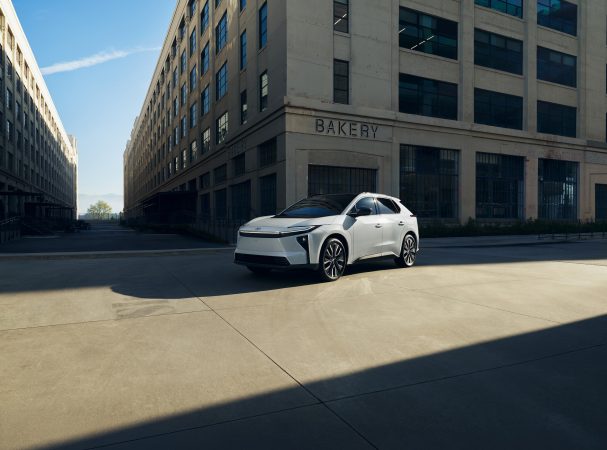
What’s new: Toyota has given a bit of a rethink to the bZ4X, rebranding it now as simply the bZ. (Even I could not remember the old name, and I get paid to remember the name. Then again, I never had the pleasure of testing one, just the Subaru Solterra clone.) They’ve also stretched the range to 314 miles, at least on the version tested. Comforting. It has a new sleeker look too.
It’s part of Toyota plotting its own path on EV, with the improved bZ and larger bZ Woodland, a path that was cut years ago and now they’re stuck with it. But could it mean a resurgence of EVs, when they’ll finally come in to their own? When a consistently trustworthy brand like Toyota jumps in head first, it could open up new possibilities. Especially if oil prices stay high.
Up to speed: Like most EVs, the bZ climbs to 60 mph with seemingly no effort. There may be a Sport mode; I didn’t feel the need to look for it. There is an Eco mode, and I didn’t bother turning it on.
The front-wheel-drive versions of the bZ create 221 horses, and hit 60 mph in 6.2 seconds, according to Car and Driver, which puts it into respectable fast-car territory. The all-wheel drives have a second motor, 338 horsepower, and get to 60 mph in 4.4 seconds, according to Motor Trend, more like an EV.
Shiftless: The bZ has a nice dial shifter on the console; push down and twist counterclockwise for Reverse, or clockwise for Drive. Press a button for park. The tiny parking brake lever is conveniently nearby.
On the road: The aerodynamics and heavy batteries make driving a rewarding experience. There’s a little bit of fun but there’s mostly just a smooth glide as you zip along.
The front-wheel-drive version does a great job of not feeling like one. Oversteer or lurching to the side on corners is limited, although the torquey motor meant the bZ left rubber behind on occasion when the light turned green.
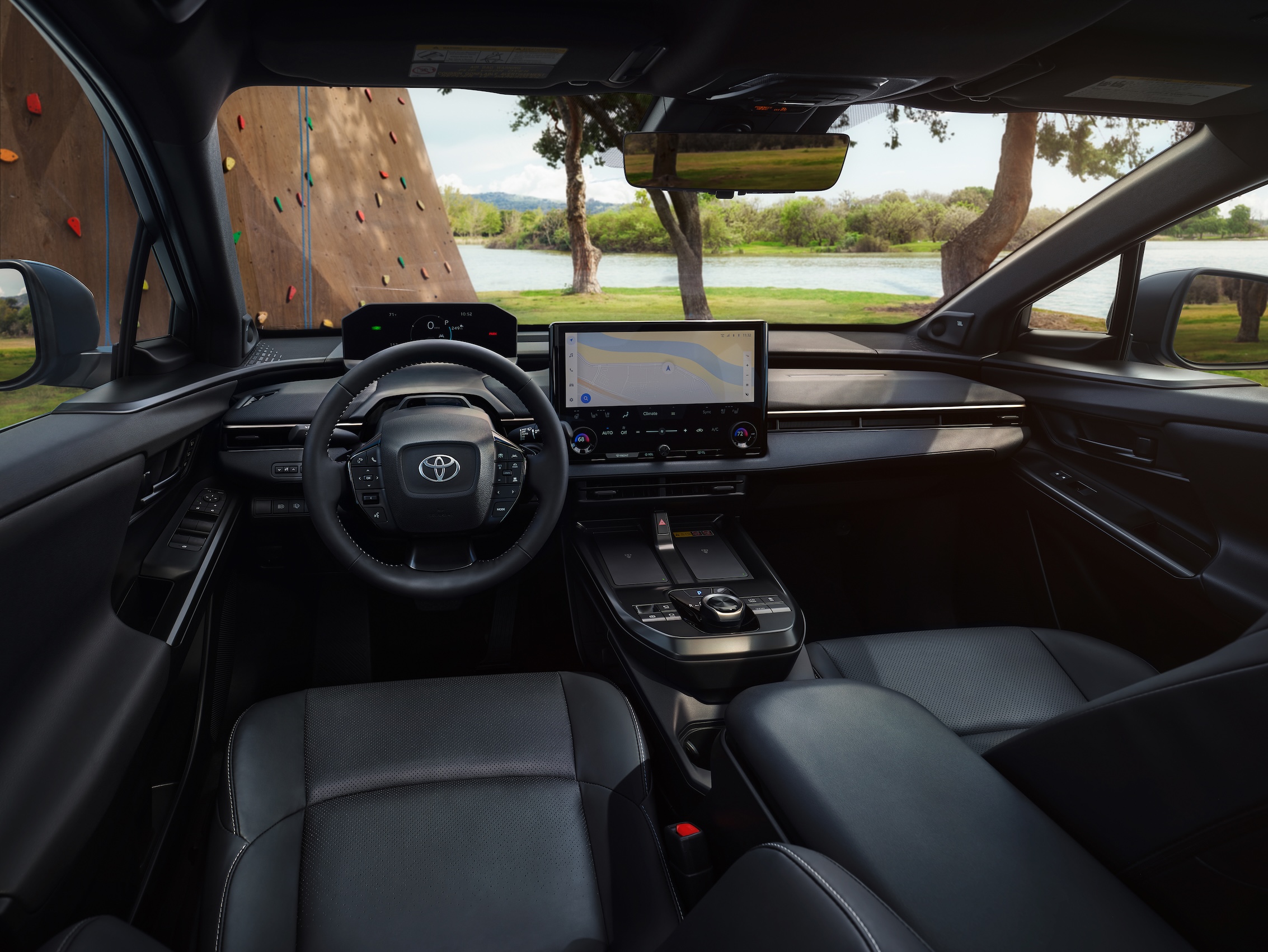
The interior of the 2026 Toyota bZ provides comfort up front, sadness in the back, at least with the cloth seats in the test model.Toyota
Driver’s Seat: The cloth seats provided great comfort and support. Toyota makes a superb basic seat; it was the main selling point in Sturgis Kid 1.0’s first car, a 2016 Scion iM, and every family member who drove it agreed those were refreshing. The bZ carries this spa-day mantel.
The faraway gauge pod pretends to be mounted on the steering column. I’d found it cumbersome and somewhat hard to read in my Solterra test, but this time I was charmed. The Lovely Mrs. Passenger Seat commented on how neat it looked.
The sloped front windshield makes for a welcome cockpit for anyone who ever spent time in a 1990s GM dustbuster minivan.
Friends and stuff: Here, the bZ starts to lose its charm. Rear-seat passengers will find plenty of legroom, and decent headroom. Foot room is a little snug but there’s so much legroom.
But the real downfall is the rear seat. The seat cushion is so crushable it’s almost like sitting on an air mattress, and so short from front to back it’s like sitting on a log. So I guess it’s an air log?
Cargo space is 38.1 or 56.1 cubic feet.
Play some tunes: The 14-inch Toyota audio multimedia screen is perched liked an iPad on the dashboard, complimenting the gauge screen nicely and giving the bZ a very Prius-like feel. Getting around the system is almost entirely through the touchscreen, but it’s big enough that it’s not too impossible.
Sound from the system is very good, an A. Extremely clear audio.
Keeping warm and cool: The Lovely Mrs. Passenger Seat commented on the round temperature control dials’ attractiveness. I explained how they meant swiping something else on the screen by accident, but then couldn’t replicate my errors when asked. Sigh.
The rest of the controls are on the ebony portion of the touchscreen, and do require some eyes-off-the-road time. The fan is especially difficult to operate. Notably, the bZ alerted me to keep my eyes on the road, and I told it, “You know, this is all your fault. But it won’t be YOUR insurance rates going up.” No response. No apology. Jerk.
Range: The vehicle reported a 314-mile range. The best mileage comes in the low-priced offering, which is a nice touch. The next level Limited range drops to 299 miles, and the Limited all-wheel drive will only travel 278.
It was fairly quick to charge on my home 110-volt outlet, adding 20% range overnight, and it advertises that it takes eight hours to fully charge on a 240-volt standard home charger.
It’ll charge from 10-80% in 30 minutes on a fast charger, slightly slower than the 20 minutes on other carmakers’ EVs.
The Pennsylvania Department of Environmental Protection has declared a statewide code red air quality day due to Canadian wildfire smoke blowing into the Philadelphia region.
The poor air quality prompted the start time for the Phillies-Mets game to be moved an hour earlier. A Phillies game was postponed in June 2023 due to air quality issues caused by wildfire smoke.
A heat advisory is also in effect in Philadelphia, where the heat index could reach 100 degrees. There’s also the potential for an isolated thunderstorm this evening between 4 p.m. and 11 p.m.
// Timestamp 07/16/26 7:00pm
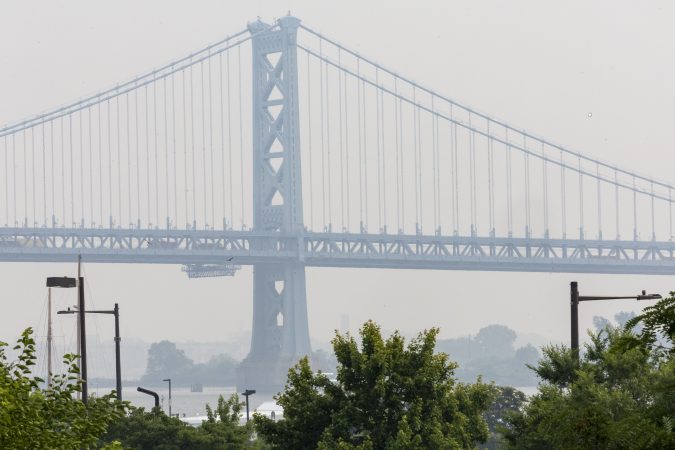
Suffocating dome of smoke descends over Philly region
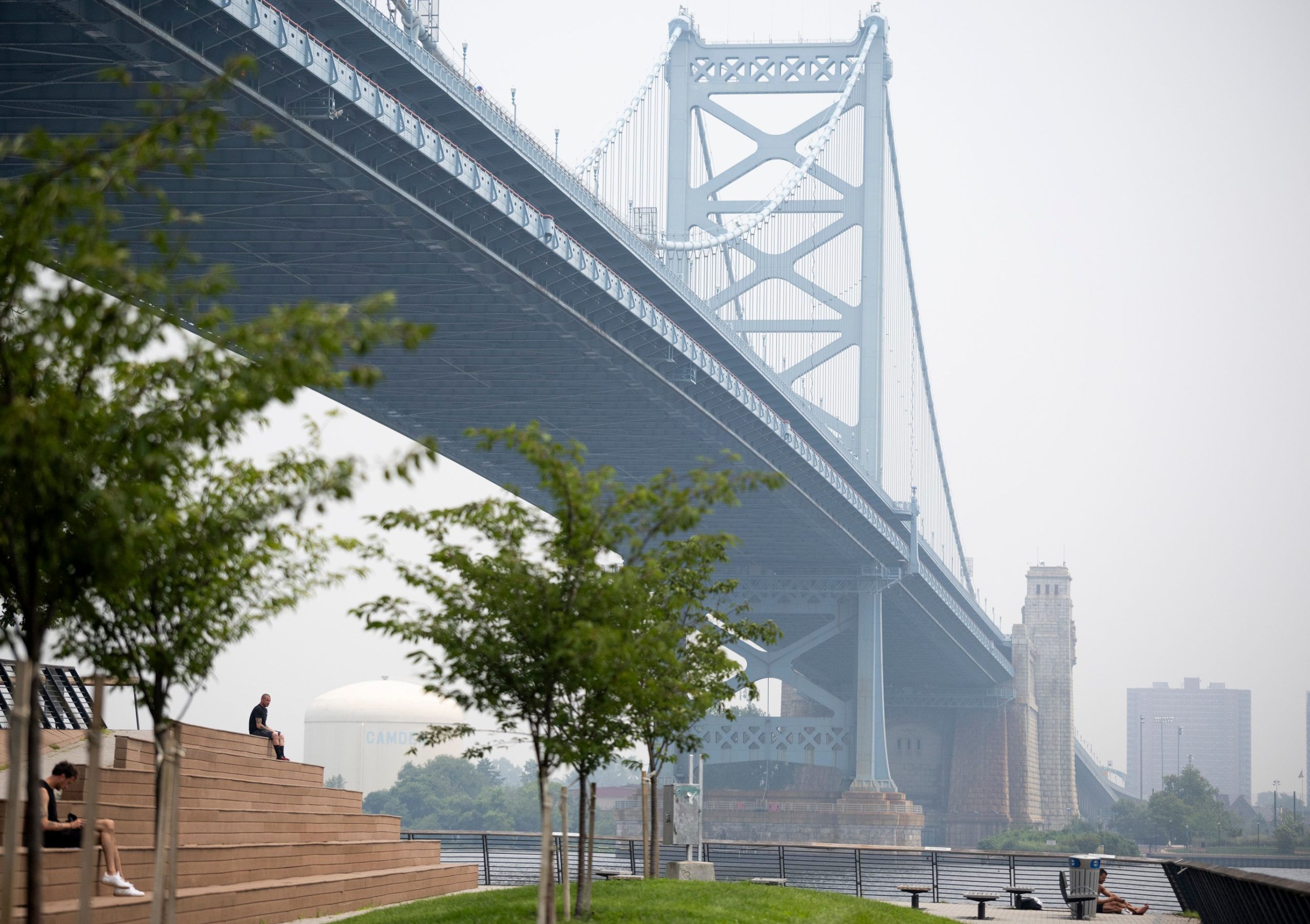
John Burns Jr., of Grays Ferry Philadelphia, Pa., sitting out at Cherry Street Pier with the wildfire smoke from Canada in Philadelphia, Pa., on Thursday, July 16, 2026.Tyger Williams / Staff Photographer
The polluted campfire-like vaporfrom Canadian wildfires plummeted air quality Thursday, lowered visibility enough that flights were delayed at Philadelphia International Airport, and prompted cancellation of a concert at Cooper River Park in Camden County.The Phillies moved Thursday night’s game up one hour due to air quality concerns.
The smoke, which was expected to blanket the region at least through Friday, originated from fires burning in Western Ontario, said Sarah Johnson, a meteorologist at the National Weather Service’s Mount Holly office.
It was swept in by winds that mixed to keep it closer to the ground.
“It’s just a factor of the winds at all levels kind of working together,” Johnson explained.
It is difficult to pinpoint when the air quality might return to normal, she said. Those forecasts come from state environmental protection departments and are usually no more than 48 hours out.
What to know about the wildfire smoke in Philly and its health impacts
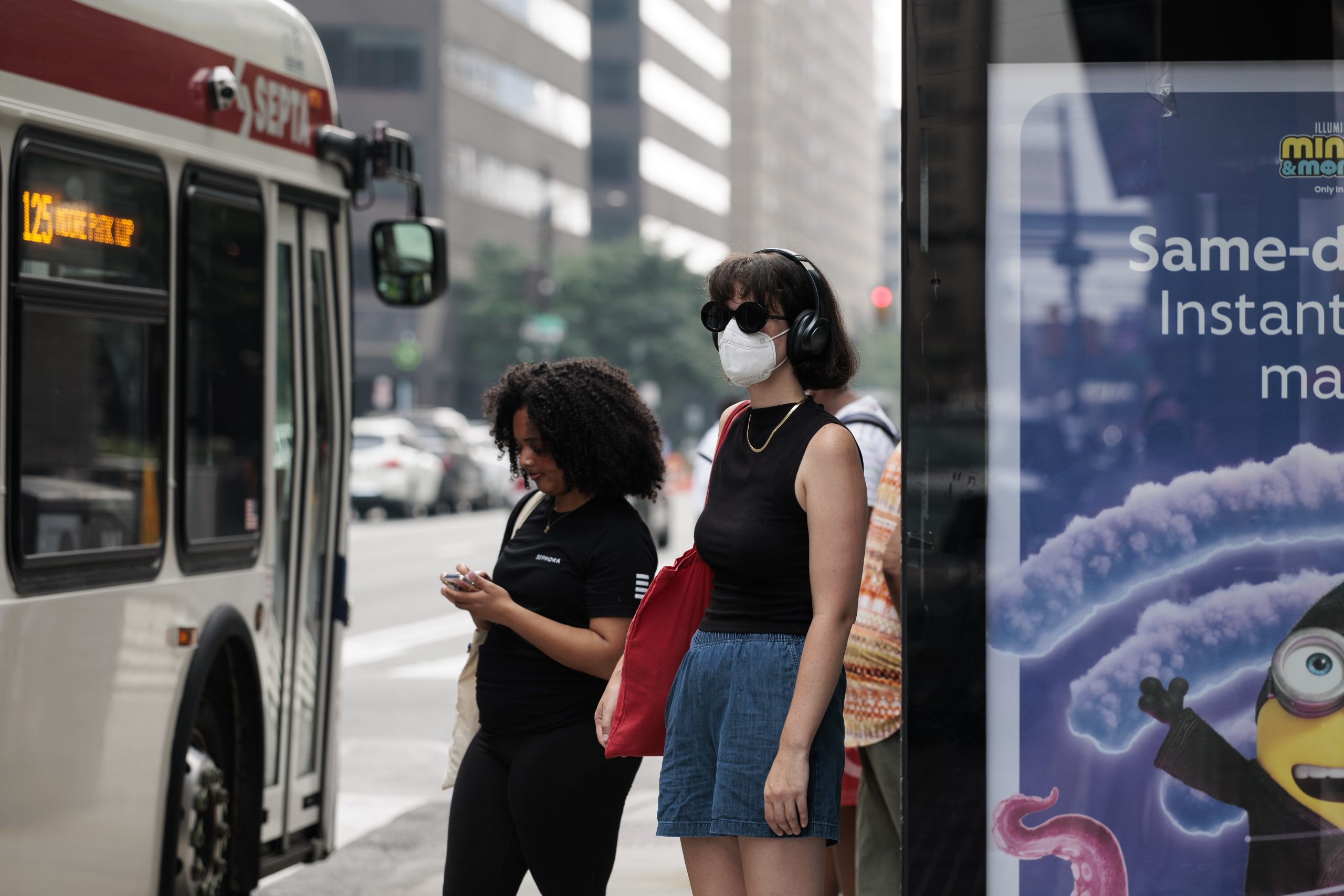
Penn State graduate student Ray Boone waits for the bus with a face mask on because of the air quality, on Thursday, July 16, 2026 at 17th Street and JFK Boulevard in Philadelphia. The Pennsylvania Department of Environmental Protection has declared a statewide Code Red air quality day due to Canadian wildfire smoke blowing into the Philadelphia region.Monica Herndon / Staff Photographer
As Canada grapples with hundreds of active wildfires, the rest of North America is feeling the impactsstruggles with air quality alerts.
In Philadelphia and elsewhere, the air quality score is considered unhealthy, particularly for the most sensitive people.
Whether you are planning on going out or staying home, here’s what three experts had to say about staying healthy and what precautions are needed:
Pennsylvania DEP issues statewide code purple alert for Friday
Air quality is expected to continue to deteriorate Friday, with the Pennsylvania Department of Environmental Protection issuing a code purple alert for the entire state as smoke from wildfires in Canada and Minnesota continue to blanket the area.
A code purple alert indicates “very unhealthy” air quality conditions, which could effect the general population. It is the second-highest step on the U.S. Environmental Protection Agency’s color scale, with only maroon — which indicates a “hazardous” air quality — outranking it.
Department officials advised all residents to limit their time and exertion levels outside. Sensitive groups — including children, elderly people, and people with respiratory illnesses — are advised to avoid outdoor activities altogether.
Friday’s code purple alert is one step above Thursday’s code red.
The state DEP advised that residents and businesses should avoid using gas-powered lawn and garden equipment, and not burn leaves or trash to help keep fine particulate pollution levels down amid the alert.
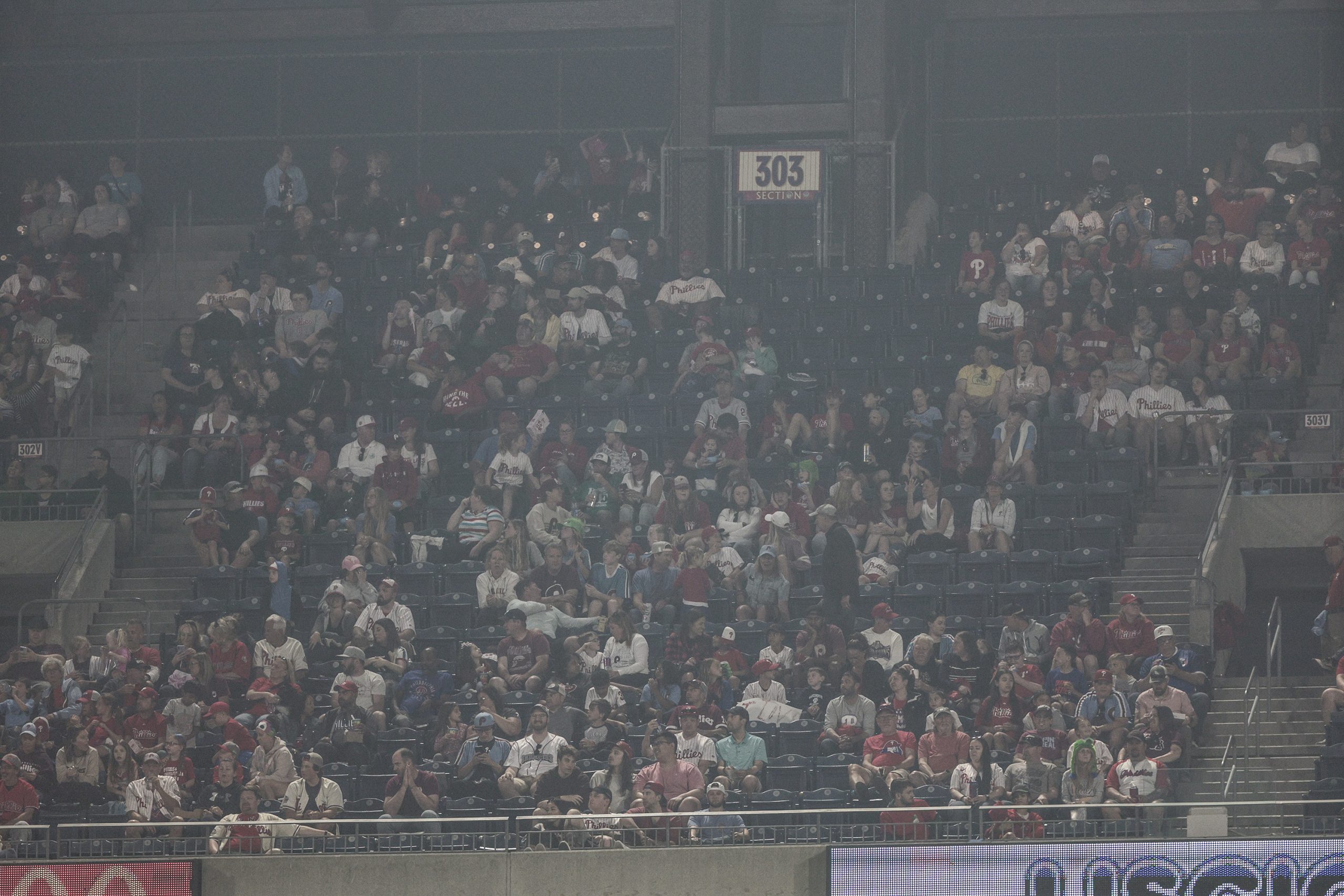
The Phillies’ game against the New York Mets will begin an hour earlier than initially scheduled, due to air quality concerns.
Now, the game will start at 6:10 p.m., the Phillies announced Thursday afternoon. Gate opening times, however, will stay the same, with third base and left-field entrances opening at 5:10 p.m., and all other gates opening a half hour later.
Thursday’s game was initially scheduled to start at 7:10 p.m., and will kick off a three-game series against the Mets at Citizens Bank Park.
In 2023, the Phillies postponed a game against the Detroit Tigers over air quality issues from Canadian wildfires.
Air quality is ‘potentially pretty dangerous’ for sensitive groups
Thursday’s smoky air is not just overshadowing Philadelphia’s summer sky; it’s also clouding your lungs.
The city’s air quality score is in the red stage, according to the Philadelphia Department of Public Health. It is not as hazardous as the maroon level, but the air is still considered unhealthy — particularly for more sensitive populations.
“It’s potentially pretty dangerous air quality to individuals who are fragile,” said Dr. Michele Columbo, the allergy and immunology chief at Main Line Health. “They can have difficulty breathing, dry cough, wheezing, tightness in the chest, and even feel light-headed because of high heat.”
You might not consider yourself “fragile,” but Columbo said people 65 or older, folks with asthma or any kind of lung issues, individuals with cardiovascular disease, children, and pregnant women are the most affected by the current air conditions.
While most of the city is continuing daily life as normal, Columbo cautions people in the sensitive category against staying outside for more than a couple of minutes at a time, and even encourages rescheduling outdoor activities.
Children in particular are at risk because they breathe faster than adults. And pregnant people in the third trimester may already be experiencing difficulty breathing without the added contaminants to their lungs.
Folks falling in this category should stay inside, where setting the air-conditioning to recirculation can help, Columbo said. For people who can’t avoid going outside, wear an N-95 mask, he added.
Columbo also urged patients with chronic respiratory problems to make sure to carry and use their inhalers when outside.
A statewide code red air emergency and heat advisory is not stopping global EDM phenomenon Deadmau5 from headlining FIFA Fan Festival in Lemon Hill Thursday night.
As air quality reaches unhealthy levels, according to five monitoring stations across the city, and the heat index could read 100 degrees, Fan Fest officials said the festivities and Deadmau5 performance would go on as scheduled.
“We encourage the public to take proper precautions if attending Fan Fest today,” said Melissa Ferdinand of Philadelphia Soccer 2026, the host city committee that runs the festival.
The festival opens from 5 p.m. to 9 p.m., with Deadmau5 taking the stage at 7 p.m. The Ghosts N Stuff producer posted to Instagram three hours ago that he was en route to Philly, and just so happened to bump into his contemporary and global DJ icon, Zedd, Thursday morning.
Wildfire smoke not dampening some tourists’ time in Philly: ‘It’s much worse out west’
Julie and Bill Guise, 66 and 72, respectively, basked in the somewhat cool breeze billowing from a giant fan inside the President’s House complex at around 1 p.m. hoping to get relief from the oppressive air. The Flagstaff, Ariz., residents, however, were unaware of what exactly was causing it.
“We couldn’t figure out what it was,” Bill Guise said of the haze in the atmosphere.
It wasn’t out of lack of familiarity with wildfire smoke. It was the opposite. Their region of the country is so often affected by this kind of smoke, and at much closer range, that this level of smokiness didn’t even register to them as wildfire-related.
The couple was in town visiting their son, a jazz bassist and University of the Arts graduate. While the smoky air is uncomfortable for them, as is the general humidity that the desert-dwellers are unaccustomed to, they said it’s unlikely to change their plans for the day.
“We have such limited time here and so many things to do,” Bill Guise said.
The couple was meeting with their son later at Valley Green Inn for dinner and planning on seeing a play tomorrow morning at Penn’s Landing. They don’t plan on letting the haze get in the way.
“It’s much worse out west,” Julie Guise added, likening the western smoke, when it’s extra bad, to sitting next to a campfire.
For father-daughter duo David and Brayden DeMaria, this level of smoke is somewhat of a reprieve from what they were experiencing in Syracuse, N.Y., before they traveled down to Philly.
“We left yesterday morning and it was, like, orange leaving the house,” Brayden DeMaria, 19, said standing outside Independence Hall around 1:30 p.m. “The color of the sky is completely different.”
The two came to town for Wednesday’s Tame Impala concert (though they were mostly there for the opener, Djo) and will return home later today. They planned on packing the day with finishing their trip to Independence Hall, thrifting, and then hitting up Franklin Fountain for ice cream.
Deteriorating air quality appears to be heading toward Philly
Air quality is deteriorating rapidly in Central and Western Pennsylvania this afternoon as smoke from Canadian wildfires pours across the U.S. border, data from government air sensors show.
Air sensors in Centre County recorded an air quality index of 345 at 1 p.m., or hazardous, the highest and most dangerous level tracked by the Environmental Protection Agency. Other sensors in Lycoming and Bradford Counties recorded AQIs above 200, or very unhealthy.
Under these conditions, according to the EPA, the entire population is at risk for adverse health effects with prolonged exposure.
The worst conditions appeared to be gradually drifting southeast across Pennsylvania Thursday afternoon. Forecasts show the thickest smoke reaching the Philadelphia region late Thursday into Friday morning.
(function () {window.addEventListener(‘message’, function (e) { var message = e.data; var els = document.querySelectorAll(‘iframe[src*=”‘ + message.id + ‘”]’); els.forEach(function(el) { el.style.height = message.height + ‘px’; }); }, false); })();
Flights delayed into Philadelphia due to low visibility
The Federal Aviation Administration issued a ground delay on flights headed into Philadelphia International Airport Thursday due to low visibility caused by wildfire smoke.
According to FlightAware, 148 flights have been delayed heading into PHL Thursday. Currently, the posted delay is 66 minutes and scheduled to remain in place until 11:59 pm.
There are currently no delays on planes departing PHL.
Travelers are encouraged to check with their airlines for the latest flight information, as the impact of Canadian wildfires is expected to linger across the Philadelphia region Friday.
Concert featuring Beach Boys co-founder canceled due to poor air quality
The poor air quality across the Philadelphia region is beginning to impact events scheduled to take place outdoors.
A concert featuring Al Jardine, co-founder of the Beach Boys, scheduled to take place at Cooper River Park in Pennsauken, N.J., at 8 p.m. on Thursday has been canceled, organizers announced.
The show has been rescheduled for Tuesday, Aug. 4.
There has yet to be any announcements regarding Thursday night’s Phillies game against the New York Mets at Citizens Bank Park, which is scheduled to begin at 7 p.m.
Temple doc says smoke-filled air has a ‘uniquely toxic profile’
Eric Balaban, a pulmonary and critical care fellow at Temple University, was hesitant but still went running Thursday morning, even as smoke from Canadian wildfires smothered the region.
“If I didn’t have an addiction to running, I would not have gone. And I would recommend other people not to run. Do as I say, not as I do,” he said with a laugh.
But exposure to the smoke is a serious matter, Balaban said. He said that smoke that travels “carries a uniquely toxic profile that poses severe health risks to both healthy individuals and vulnerable populations.”
Balaban said the smoke, which has traveled hundreds of miles, undergoes what’s known as “photochemical aging,” meaning it interacts with oxygen, heat, and sunlight to help generate high levels of ground-level ozone and highly irritating aerosols.
That’s in addition to the ground-level ozone also produced by weather conditions such as on Thursday.
Ground-level ozone is a pollutant that forms when nitrogen oxides and volatile organics emitted by vehicles, power plants, and industry react in sunlight, especially during hot days. It can cause airways to constrict, leading to shortness of breath, so it can especially affect those with asthma, emphysema, and chronic bronchitis.
Balaban also explained that the fine particulate matter (PM2.5) within the smoke is small enough to cross from the lungs directly into the bloodstream, bringing a body-wide exposure that can increase the risk of heart attacks and strokes, in addition to causing acute chest tightness, shortness of breath, and dizziness in otherwise healthy people.
Those risks are amplified for those with preexisting conditions like asthma or COPD, he said.
He suggests people replace home air-conditioning filters to improve indoor air quality and, if they have existing conditions, to make sure they have extra respiratory medications and inhalers on hand.
Balaban emphasized the world is undergoing an environmental crisis with climate change, and encouraged the public to address the “root cause” of it through civic action.
“We have opportunities to mitigate and prevent these environmental catastrophes from happening, but it is something that we need to agree to do together,” he said.
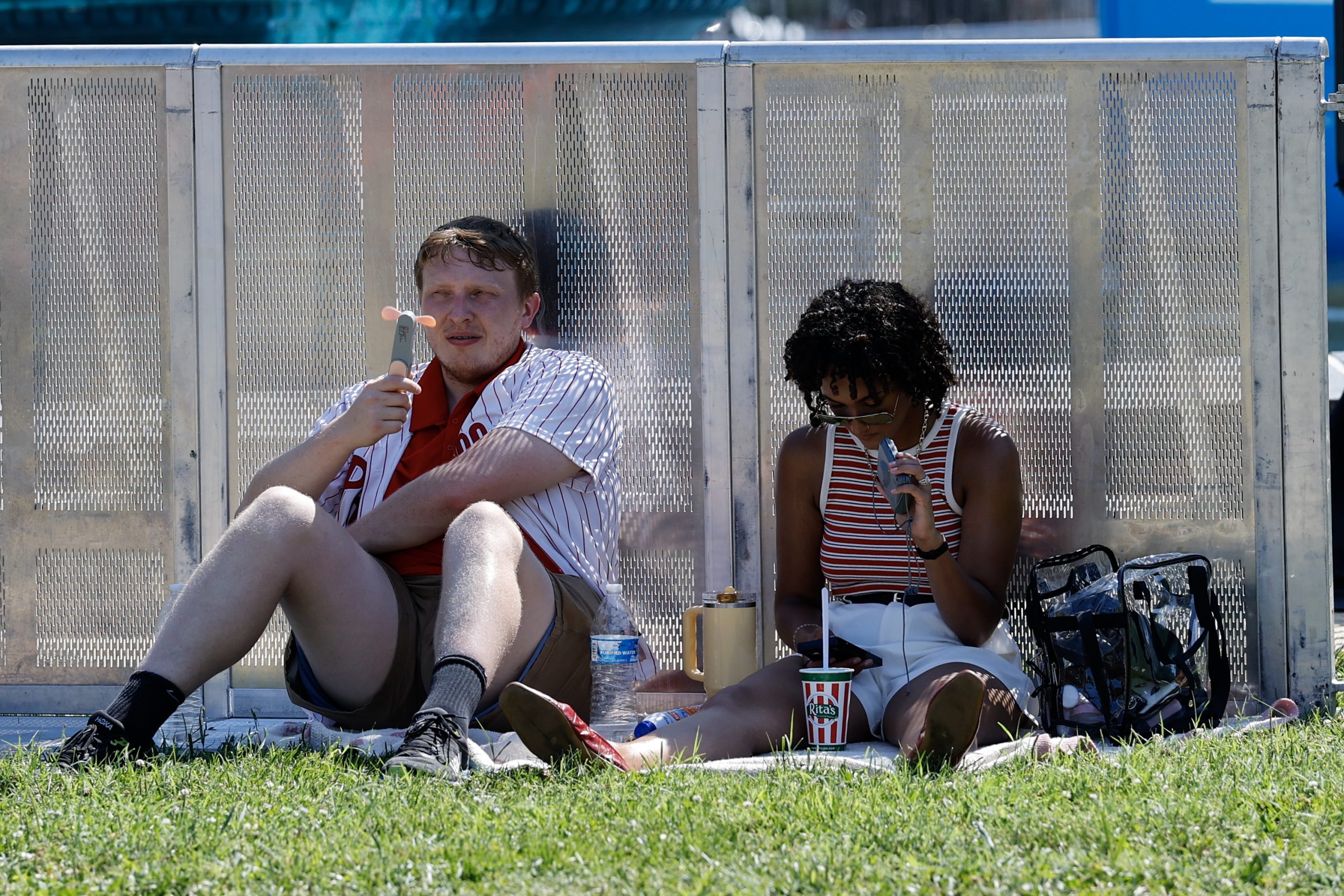
People try to beat the heat with a hand fan in limited shade in Center City.Yong Kim / Staff Photographer
Ruth McDermott-Levy, a professor at Villanova University’s school of nursing, says that not only has air quality become a risk today for those already with health issues, but for everyone.
“All of us are at risk today,” McDermott-Levy said. “Certainly there are groups of people at greater risk, from pregnant women, children, older people, and those with cardiac and respiratory illnesses. But we’re at an unhealthy level for everyone.”
She has previously written an article about the impact of wildfire smoke on health. This newest round of wildfires from Canada, as well as the second heat dome to descend on the area in as many weeks, indicates climate change, she said.
Wildfire smoke is particularly damaging, she said. Wildfires carry not only smoke from burning trees, but from buildings it sweeps up, and pollutants already in the air. That can include pollution coming into Philadelphia from Boston and New York, McDermott-Levy said.
“Wildfire smoke is among the most toxic air pollution that we have,” she said.
She said that pollution not only can penetrate the human bloodstream, but also settles on crops and livestock.
She suggested that those with tickets to tonight’s Phillies game reconsider going, especially children whose lungs are still developing. A Phillies-Tigers game was postponed in 2023 because of Canadian wildfire smoke, but no announcements have been made regarding Thursday’s game.
Meanwhile, high heat and sunlight combine with gases in the air to produce more ground-level ozone.
“This is climate change and we are living it,” she said.
Philly health officials urge residents to limit outdoor activities
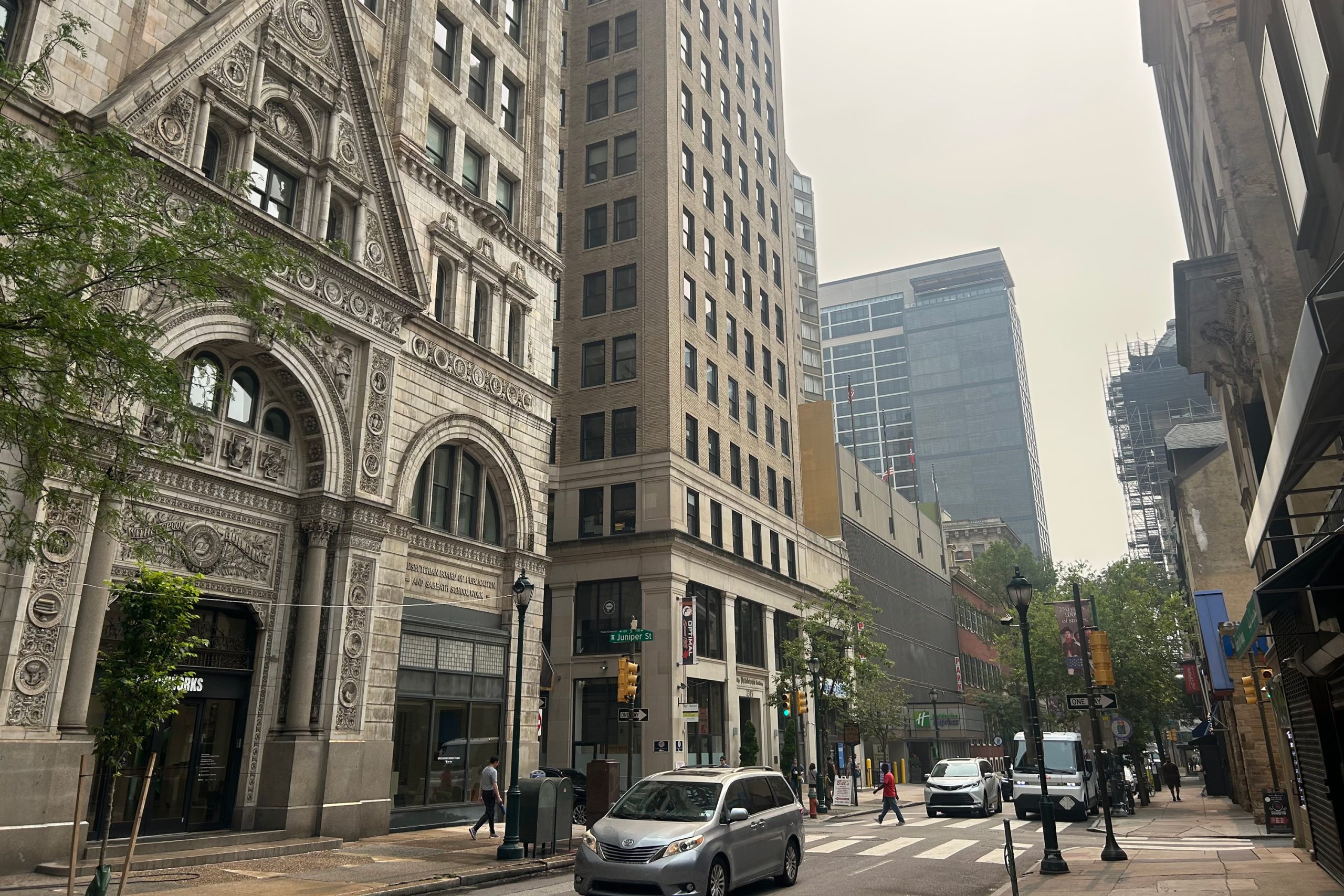
Hazy conditions in Center City Philadelphia Thursday, caused by wildfires in Canada.Denali Sagner / staff
With Philadelphia under a Code Red Air Quality Alert, city officials are urging residents to limit their time outdoors.
“Today is not the day to start your marathon training plan,” Palak Raval-Nelson, commissioner of the city’s Department of Public Health, said in a statement.
As of 11 a.m., Philadelphia’s Air Quality Index was 182, solidly in the middle of the “unhealthy” range, which means conditions are bad enough for members of the general public to experience health effects.
Especially at risk are residents with heart or lung conditions, who should take “extra special care” outdoors Thursday, Raval-Nelson said. Children, older adults, pregnant women, and people with weakened immune systems are also at higher risk.
People experiencing symptoms including trouble breathing, heart palpitations, nausea, or dizziness are encouraged to seek immediate medical attention.
Despite the warning, city services will operate normally. Employees working outdoors are being encouraged to take frequent breaks and should consider wearing a mask, the city said.
Most Philly Parks and Recreation activities will operate normally
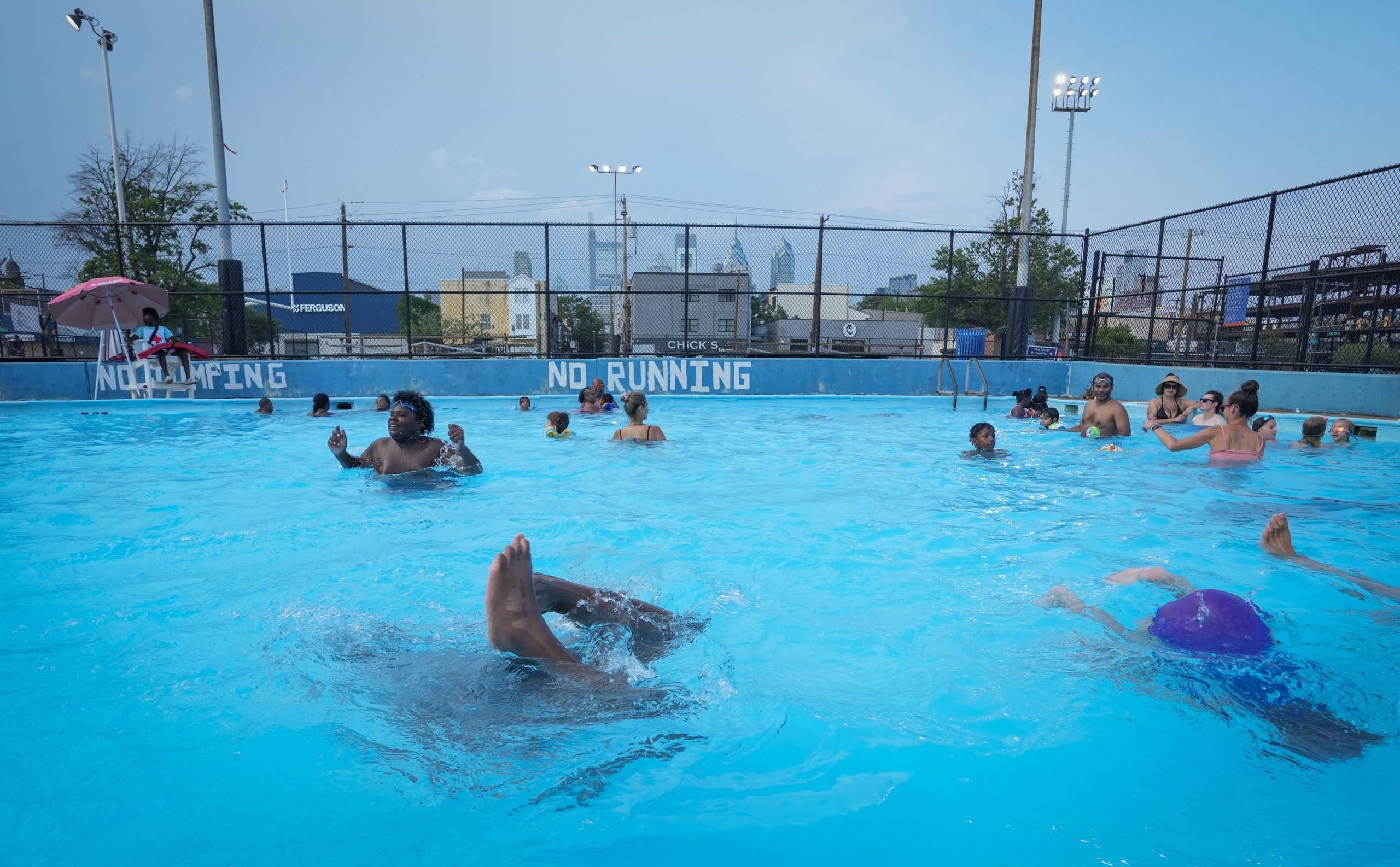
City pools will be open Thursday and won’t have restrictions based on air quality.Jessica Griffin / Staff Photographer
The wildfire smoke will not disrupt most Philadelphia Parks and Recreation facilities or activities on Thursday, according to spokesperson Ra’Chelle Rodgers.
The city’s pools and parks will not have restrictions based on air quality, she said. Summer camps may cancel some trips, outdoor sports or other activities on a case-by-case basis, but will otherwise remain open and move indoors.
The department is following the city’s health guidance on air quality, and instructing leaders to monitor the situation and use their best judgment, Rodgers said.
Poor air quality threatens the Phillies-Mets game in South Philly
The Phillies were forced to play in smoky conditions in June 2023, ultimately forcing the team to postpone a game.Steven M. Falk / Staff Photographer
Wildfire smoke from Canada is creating air quality issues in Philadelphia, threatening to derail the Phillies’ return to the diamond.
The Phillies are scheduled to kick off a three-game series against the New York Mets Thursday at Citizens Bank Park beginning at 7 p.m., but the game could be postponed if conditions in the city don’t improve.
As of 9:30 a.m., Philadelphia’s Air Quality Index was 181, solidly in the middle of the “unhealthy” range, which means conditions are bad enough for members of the general public to experience health effects.
Air quality levels are expected to fluctuate during the day, but issues are forecast to linger through tonight and potentially into Friday, according to Paul Fitzsimmons, lead meteorologist at the National Weather Service’s Mount Holly office.
“I think this evening there still will be air quality issues the Philly area and surrounding areas” Fitzsimmons said. “It’s tough to say exactly how bad they will be.”
The Phillies did not respond to a request for comment. The team isn’t scheduled to play Friday, so shifting the game back a day wouldn’t create much of a scheduling headache.
It wouldn’t be the first time the Phillies were impacted by smoke. In June 2023, the team postponed a game against the Detroit Tigers due to air quality issues stemming from Canadian wildfires.
The Phillies-Mets game is the only MLB matchup on the schedule Thursday, as the league restarts following the All-Star break. MLB games scheduled Friday in Toronto, Boston, and New York City, which are all experiencing air quality issues.
The Washington Spirit defeated Gotham FC in National Women’s Soccer League action Wednesday night at Citi Field in New York City, and players said the smoky air had an impact.
Air quality is expected to improved for Sunday’s men’s World Cup final between Spain and Argentina, which will be played at MetLife Stadium in East Rutherford, N.J.
Smoke in Philly could linger into Friday afternoon
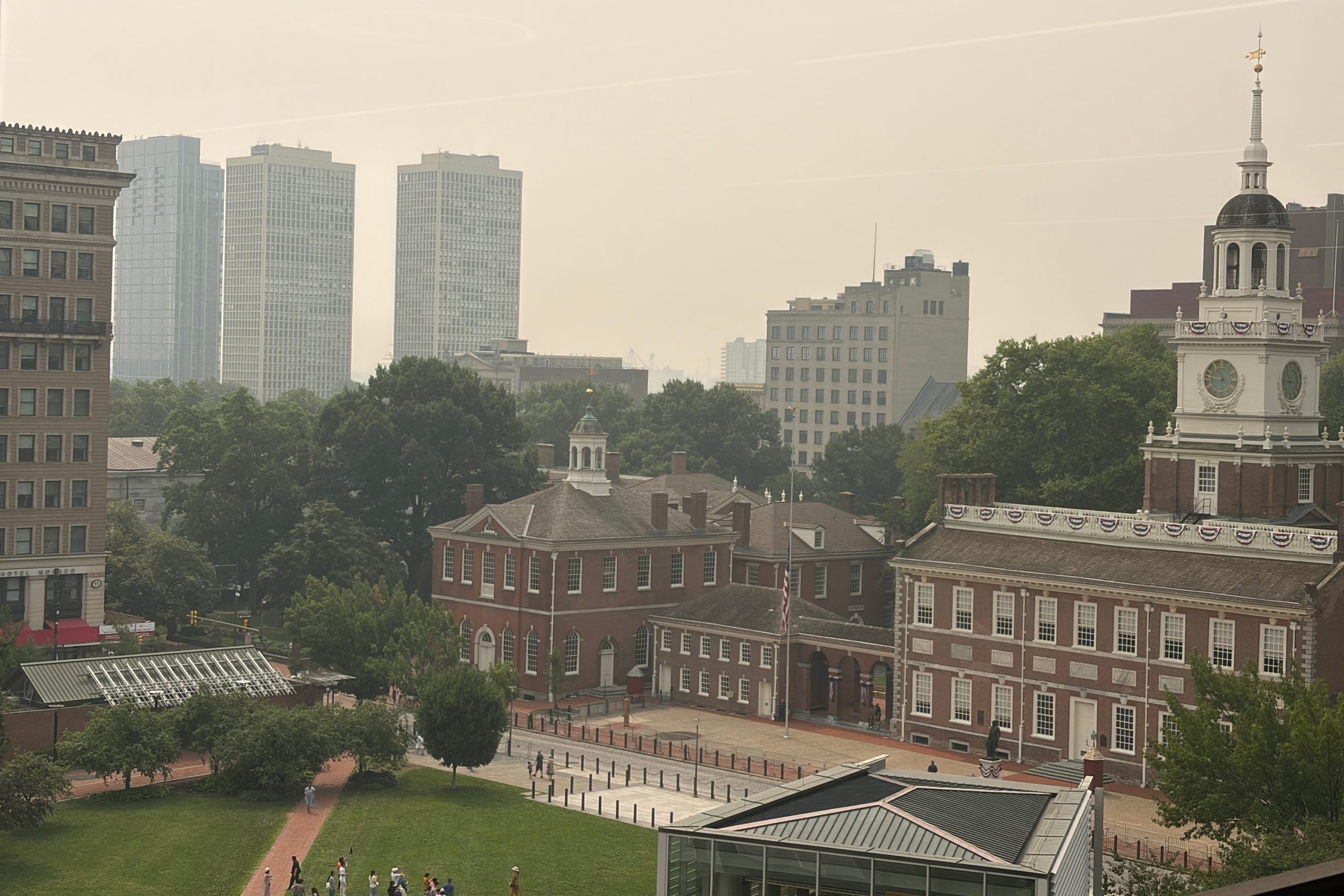
Hazy skies at Independence Hall and across Center City Philadelphia Thursday.Michelle Myers / staff
The smoke we’re experiencing in Philadelphia is from fires burning in western Ontario and the impact could be felt through at least Friday afternoon, said Sarah Johnson, a meteorologist at the National Weather Service’s Mount Holly office.
The smoke had been lingering high in the atmosphere since Tuesday, but changing wind patterns caused it to mix closer to the ground by late Wednesday afternoon, she said.
“It’s just a factor of the winds at all levels kind of working together,” Johnson explained.
Visibility in the immediate Philadelphia area has dropped to between three to five miles. Visibility of beyond six miles is typical for a sunny, smoke-free day.
Visibility worsens farther north, Johnson said. In the Poconos and Central New Jersey, for example, it has dropped to around one to two miles. Reading is at two miles.
Johnson said that conditions are similar to, but not quite as severe yet, to June 2023 when smoke from Canadian wildfires were so bad they caused the Phillies to postpone a game against the Detroit Tigers.
It’s difficult to pinpoint when the air quality might return to normal, she said. Those forecasts come from state environmental protection departments and are usually no more than 48 hours out.
But she expects the haze to persist through Thursday and Friday, and that air quality could potentially deteriorate further overnight.
“Getting the exact visibility is still pretty challenging when we’re talking about smoke, more than several hours out,” Johnson cautioned.
Air quality in Philly ‘unhealthy’ due to wildfire smoke
You might want to skip that morning run or wait a few days to mow the lawn.
Smoke from hundreds of Canadian wildfires has descended over the Philadelphia region, casting a haze, causing a campfire-like smell, and producing poor air quality.
The Air Quality Index by the U.S. Environmental Protection Agency is in the unhealthy range for Center City, Northeast Philadelphia, Chester, Norristown, and Camden. The index ranges from 0 to 500. Unhealthy is from 151 to 200. Center City was the highest in the area at 184, as of 7:30 a.m.
(function () {window.addEventListener(‘message’, function (e) { var message = e.data; var els = document.querySelectorAll(‘iframe[src*=”‘ + message.id + ‘”]’); els.forEach(function(el) { el.style.height = message.height + ‘px’; }); }, false); })();
The index measures a range of pollutants, including really fine particulate matter, known as PM2.5; carbon monoxide; sulfur dioxide; and nitrogen dioxide.
The National Weather Service has issued an air quality alert until midnight Thursday.
And the Pennsylvania Department of Environmental Protection has issued a Code Red Air Quality Action Day for fine particulates. An Air Quality Action Day means that air quality within the region may approach or exceed unhealthy standards.
Code red means that young children, elderly people, and those with respiratory problems, such as asthma, emphysema, and bronchitis, are especially vulnerable and should avoid outdoor activities. Everyone else should reduce prolonged or heavy exertion.
In addition, the NWS has issued a heat advisory until 8 p.m. Thursday with the heat index to hover near 100.
Code red air quality alert has been issued for the Philly area
The sun tries to peek through the clouds and wildfire smoke from Canada over houses in Ridley Park Thursday.Torin Sweeney / Staff
Smoke from Canadian wildfires began enveloping the region Thursday, creating a haze, a faint smell of charcoal, and a potential danger for people with respiratory issues.
The National Weather Service has issued a code red air quality day for Philadelphia and surrounding counties through midnight. That means air quality across the region is forecast to approach or exceed unhealthy standards.
By daybreak, air quality was tumbling to unhealthy levels in Philadelphia and a broad swath of Pennsylvania and New Jersey, according to an Inquirer analysis of dozens of public sensors.
Early Thursday morning, the amount of fine particulate matter in the air, measured by the Environmental Protection Agency in a metric called the Air Quality Index, or AQI, had risen sharply.
Air with an AQI above 150 is considered unhealthy to breathe with prolonged exposure for most individuals, according to the EPA. In air quality alerts issued by the National Weather Service, forecasters recommended avoiding prolonged outdoor exposure, and particularly avoiding common activities like exercise.
It was unclear when the smoke would dissipate across the region, but the National Weather Service said it could linger into Friday.
This map shows air quality in the Northeastern U.S.
(function () {window.addEventListener(‘message’, function (e) { var message = e.data; var els = document.querySelectorAll(‘iframe[src*=”‘ + message.id + ‘”]’); els.forEach(function(el) { el.style.height = message.height + ‘px’; }); }, false); })();
Canadian wildfire photos: How things look elsewhere
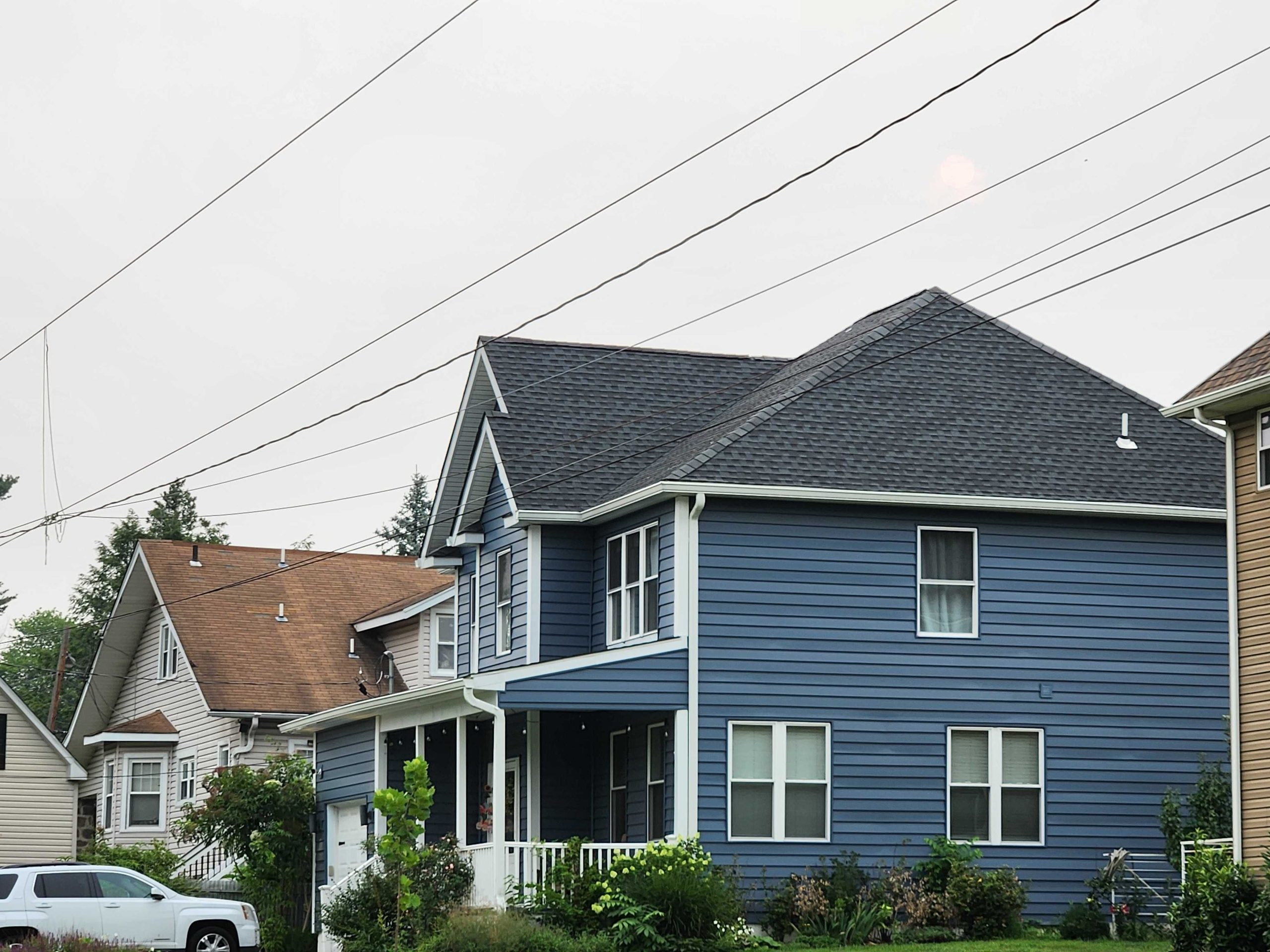
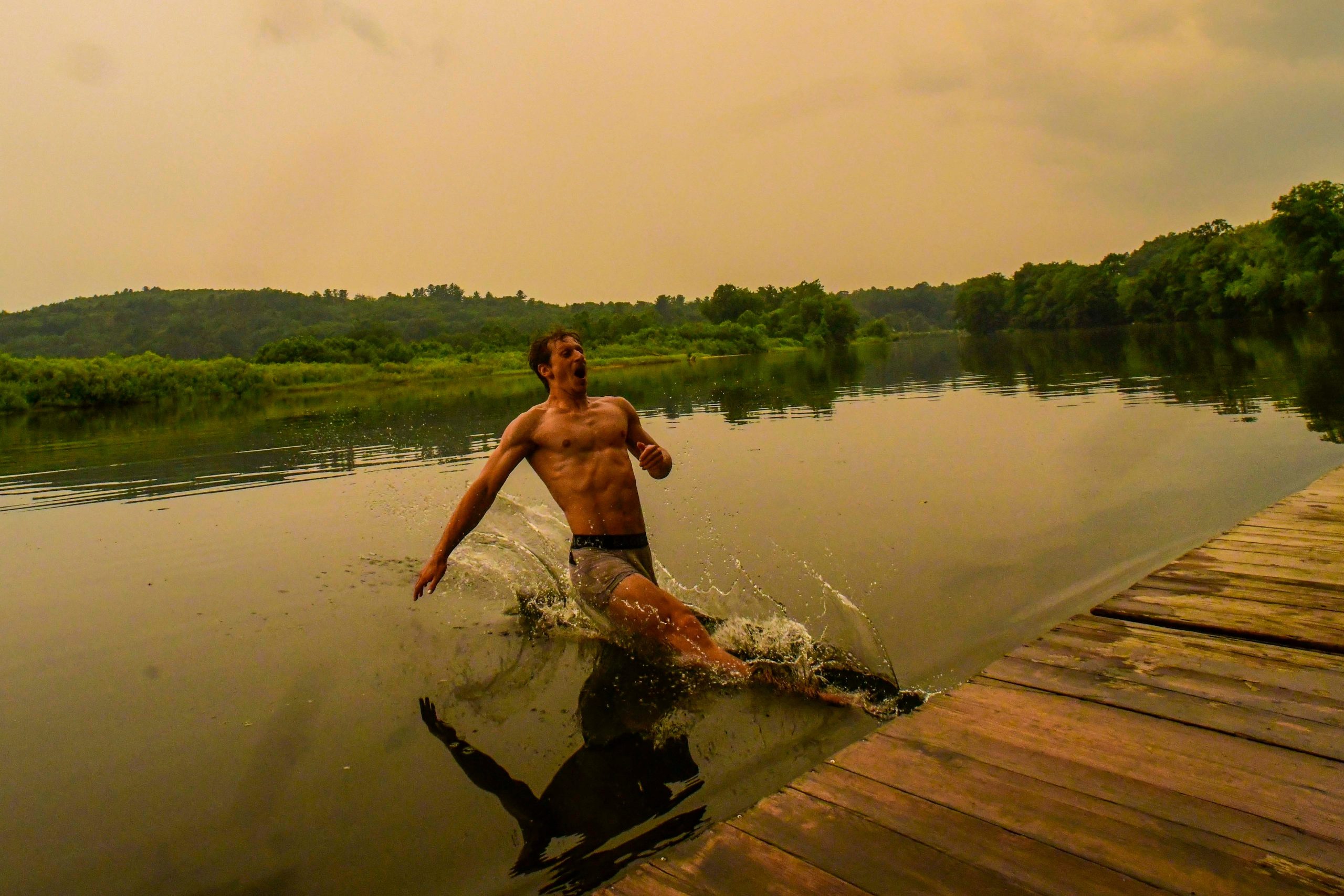
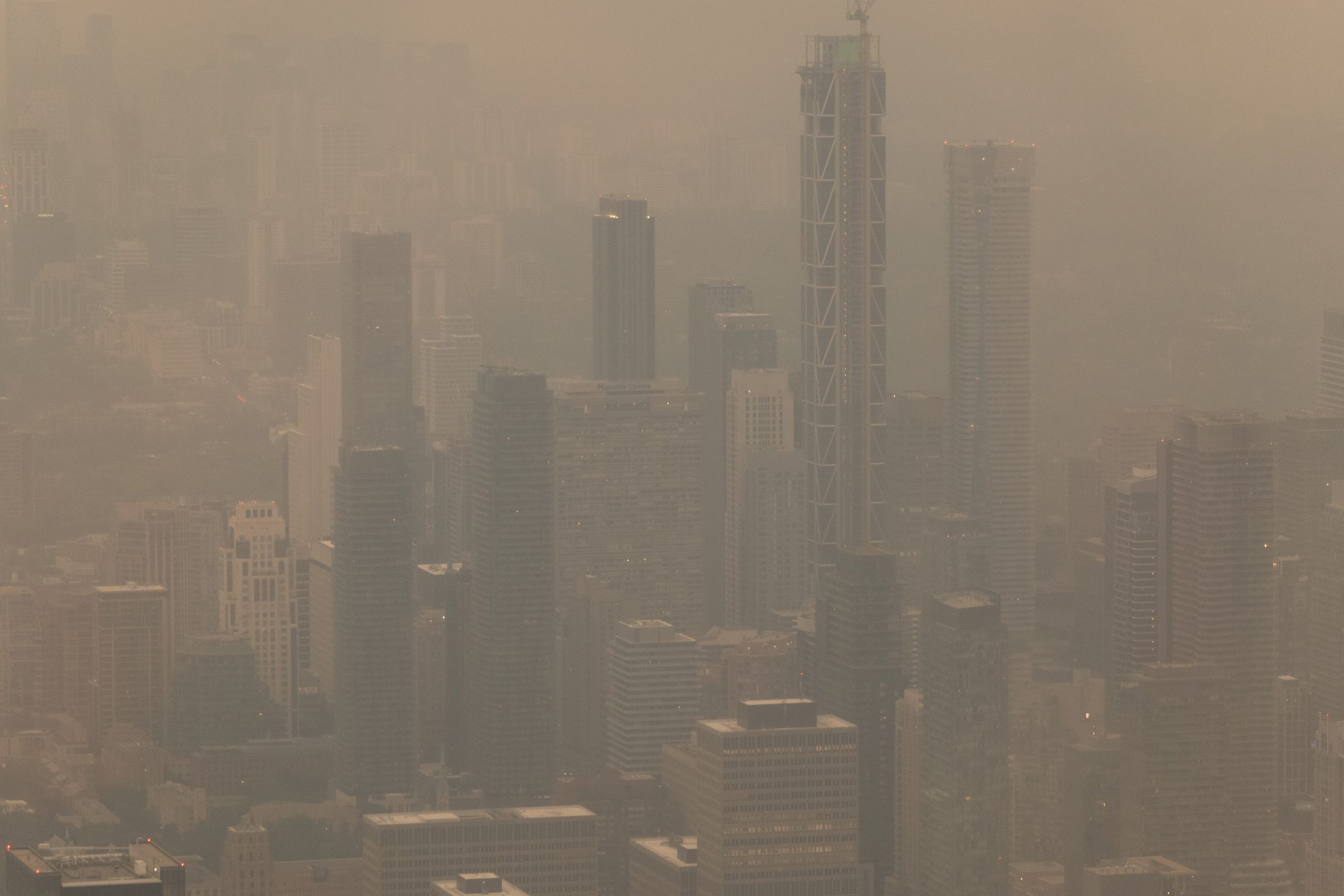
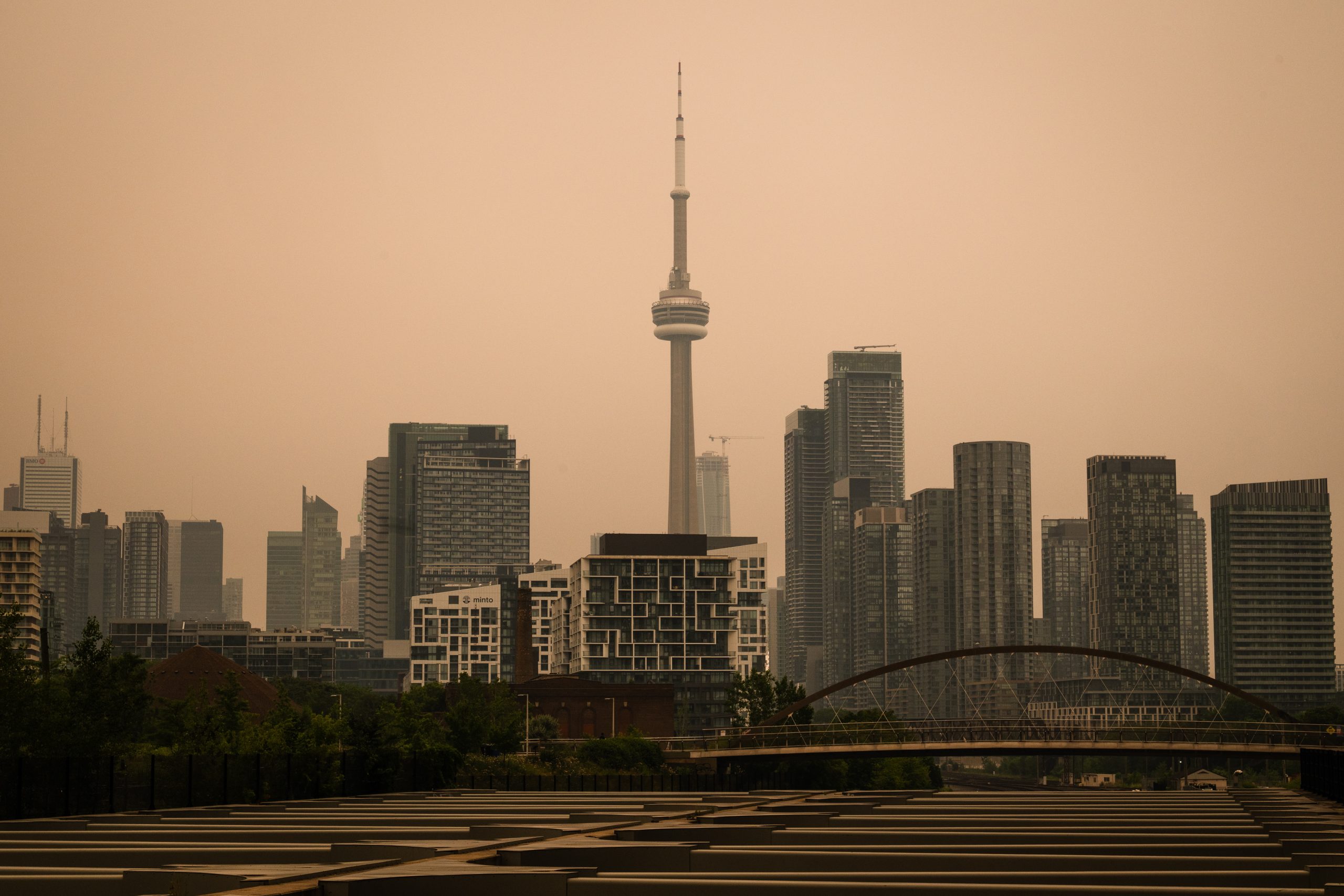
Julian McTaggart is playfully pushed into Vermont’s West River as smoke from Canadian wildfires creates an orange haze over the area.Kristopher RadderWildfire smoke blankets downtown Toronto Wednesday after wildfires swept across Ontario.IAN WILLMSThe CN Tower is pictured in Toronto as wildfire smoke fills the city.Laura Proctor
MONROEVILLE, Pa. — When Michelle Parsons was planning her wedding in 2007, she had only one honeymoon destination in mind.
“My fiance asked, ‘Where do you want to go?’” Parsons recalled. “And I said, ‘The Monroeville Mall.’”
The modest two-story shopping complex, 20 minutes from downtown Pittsburgh, might not seem like the most romantic choice. But to horror lovers like Parsons, the Monroeville Mall is “a holy place” — not to mention one of the largest and longest-standing movie sets in the country.
In the late 1970s, George A. Romero, the creator of the modern zombie genre, took over the building to shoot “Dawn of the Dead,” a blood-soaked tale of four survivors who hide out in an abandoned mall as they try to fend off bloodthirsty creatures and greedy bikers. As Romero once told Rolling Stone, the Monroeville Mall epitomized “the false security of the whole consumer America trip,” making it the perfect backdrop for a gory allegory about 20th-century capitalism run amok.
Since the film’s U.S. release in 1979, “Dawn of the Dead” has attracted generations of fans to Monroeville, including Parsons, a 46-year-old X-ray technologist from Yarmouth, Nova Scotia. When she finally arrived at the mall after her wedding, Parsons began to cry.
“I was in heaven,” she said.
The marriage didn’t last. But Parsons’ love for the movie, and for the mall, has endured.
Last month, she was back in Monroeville for the Living Dead Weekend. This year, it united an estimated 3,000 “Dawn of the Dead” aficionados with more than 60 cast and crew members, its organizer, Kevin Kriess, said. Together, the “Dawn of the Dead” faithful celebrated the building’s history — and began the uneasy process of saying goodbye to the mall.
In October, Walmart announced it had teamed with Cypress Equities, a development company, to buy the property for $34 million. According to a filing, there are plans to demolish the mall and build a multiuse center. The Living Dead Weekend, which has been held since 2015, will need to find a new home.
“I’m in denial,” Parsons said. “You just kind of hope there’s a Hail Mary, that maybe they’ll save some part of this.”
Many Living Dead Weekend attendees expressed a similar disbelief. How could their beloved gathering space simply disappear?
“It’s hard to fathom, because it’s so iconic to so many people,” said Greg Nicotero, a Pittsburgh native and an executive producer of “The Walking Dead” who got his start as a special-effects makeup artist with help from Romero. “I’d equate visiting the mall to going to Georgetown and standing at the bottom of the steps where Father Karras lands in ‘The Exorcist,’” he said. “Or going to Martha’s Vineyard and seeing Quint’s shack from ‘Jaws.’”
Given the mall’s imminent closure, the mood over the weekend was bittersweet. There were panel discussions, autograph sessions and VIP parties where former zombies mingled with revelers. Fans, some of whom paid $50 for a three-day pass, re-created their favorite scenes — like a shootout on the mall’s top floor — and met up with other enthusiasts, including people from New Zealand, Sweden and Britain.
“I’ve told friends and family, ‘If you love this movie, get down here as soon as possible,’” said Joseph Lilagan, a warehouse traffic-support specialist from Mesa, Arizona, who has visited the mall nearly a half-dozen times, and was attending this event for his 38th birthday. “Being here widens the fan vibe within you. Who wouldn’t want to come and enjoy whatever’s left?”
Retail decay
As attendees overtook the mall, the building’s declining health was hard to ignore.
A handful of prominent businesses were shuttered, including a vast Forever 21 store that sat in darkness. Some smaller stores looked as though they’d been abandoned in a hurry: In one hollowed-out location, all that remained were a few skeletal fixtures and a lone red hat; in another store, a limp “Grand Opening” sign sat on the floor.
Such images of retail decay would no doubt feel familiar to dead mall scholars — as well to viewers of “Backrooms,” the industrial-space horror film playing at the Monroeville Mall’s movie theater.
“We’ve gone from deindustrialization to de-mallization,” noted Tony Buba, an 82-year-old documentarian who has spent decades chronicling the plight of working-class Pennsylvania. Buba, who had a small role in “Dawn of the Dead,” admitted he was no fan of malls, having watched them put mom-and-pop stores out of business. But even he was feeling sanguine about the Monroeville Mall’s current state. “I think someone should buy it and turn it into an indoor zombie amusement park,” he said.
During the convention’s first two days, the number of shoppers trickling in was notably low. “It looks like a zombie apocalypse happened here, which is kind of spot-on,” said Scott Yesh, 52, a regional manager for AAMCO Transmissions from Houston who was posing next to a bust of Romero in the courtyard.
Dennis Biondo, the mayor of Monroeville, said that while the sale of the building had been completed, no plans for its development had been submitted to the municipality. No closing date has been announced.
In a statement, Walmart said it had no new information, noting only that, “We believe this transformation will create a vibrant, community-centered destination that helps shape a strong, exciting future for the Monroeville area.”
But given that some tenants have been told to vacate by April 2027, the building’s end seems near.
A few of the storefronts, including a giant-size former Party City, had been converted into halls for the weekend. On Saturday afternoon during the weekend of the event, Tom Savini, the makeup effects wiz on “Dawn of the Dead” and other classic movies like “Friday the 13th” — and who acted in “Dawn” — signed autographs close to where he had executed a daring stunt.
“I dove off this balcony into cardboard boxes,” Savini, who played a machete-wielding biker in the film, said. “I can’t even look at it now without my knees getting weird.”
Savini, 79, said he was taking a stoic approach to the building’s demise. “What can you do?” asked Savini, who directed the 1990 remake of “Night of the Living Dead.” “There are petitions out there, but they’re not going to do a bit of good.”
Stumbling on escalators
Such a fate seemed impossible when the mall opened its doors in 1969. Hailed by its founders as “the U.S.’s largest enclosed shopping center,” the building featured an ice-skating rink, a $125,000 clock tower that hosted puppet shows, and more than 100 stores and businesses.
“It was busy all the time,” remembered Beverly Galando, 76, a longtime Monroeville resident who had stopped by the celebration to do some people-watching. “I used to meet my mom here for walks, and now my sister and my friends walk here. This place is a gem.”
Romero felt the same way when he toured the mall in 1974. By that point, the Pittsburgh-based filmmaker had been running from zombies for years. After the success of his 1968 thriller “Night of the Living Dead” Romero was inundated with requests for a sequel. “I was just resisting completely,” he recalled in the 2004 documentary “The Dead Will Walk.” “I didn’t want to get typecast.”
Romero’s visit helped inspire the screenplay for “Dawn of the Dead,” which filmed in late 1977 and early 1978. The cast and crew members shot in the evening and wrapped by 7:05 a.m. the next day. That’s when the mall’s automatic Muzak system switched on, and local cardiac patients arrived for their morning exercise, passing blood-splattered zombies on their way in.
“The mall was sort of our home,” said Gaylen Ross, a documentarian who played one of the human survivors in “Dawn of the Dead.” “We had complete freedom to roam around,” she said. “And we spent a lot of time waiting for blood to be cleaned up.”
Romero shot additional sequences at various Pittsburgh-area locations, including a regional airport and a gun shop (both now gone). But nearly all of the action was captured at the mall. That’s where the zombies try to reconnect to their human pasts: They wander through department stores, stumble along escalators and even take to the ice.
In one exchange from the film, Ross’ character struggles to understand the creatures’ behavior.
“Why do they come here?” she asks.
Her boyfriend, played by David Emge, says, “Some kind of instinct.”
“Memory of what they used to do,” the character adds. “This was an important place in their lives.”
A hopeful future
Though Romero took aim at me-decade commercialism in “Dawn of the Dead,” he surrounded that message with plenty of chaos and carnage, not to mention lots of gnarly special effects. That led the U.S. ratings board to slap the movie with an “X,” making it a tough sell in America (Romero ultimately decided to release it in theaters unrated). The movie proved too much for some critics, including Janet Maslin of The New York Times, who left “Dawn of the Dead” after just 15 minutes.
Nonetheless, the low-budget film eventually became a box-office hit, powered by action sequences — including scenes of motorcycles and cars tearing through the mall — as well as wry humor and an unlikely upbeat message.
“There’s a family component to the movie, because the survivors only have each other,” said Carl Hoelzl, 61, an insurance-industry employee from Stonybrook on Long Island. He was relaxing in a massage chair in the middle of the mall. “‘Dawn of the Dead’ gives you the sense of, OK, even though the world’s falling apart, people can come together and start building for a hopeful future.”
Romero would likely never have guessed that the building he used to symbolize excess would become a product itself. And there were plenty of spending opportunities for the Living Dead Weekend attendees: Autographs of many of the zombie actors cost $20 to $60, while old bricks from the mall were available for $75 each.
On Saturday night during the event, Dan Bertha was killing time near the food court, an unlit cigar in his hand. Bertha, 79, had a long history with the mall: He’d worked on its construction, and played hockey on its ice rink. He’d even starred as a SWAT team member in “Dawn of the Dead.” This was the third convention he’d attended for the film, and it was going well: The fans had been friendly, and he estimated he’d made about $1,000 a day signing autographs.
For those who wanted a more immersive zombie experience, daily tours of the mall (for $50) were conducted by Larry DeVincentz, 51, an enthusiastic “Dawn of the Dead” authority from Fort Mill, South Carolina. At one point, DeVincentz rolled on the ground for about 100 tour guests, re-creating a scene in which zombies gobble a biker’s guts.
DeVincentz was confident the “Dawn of the Dead” celebrations would continue.
He won’t have to wait that long: Over the course of the weekend, word got out that another Living Dead Weekend had been set for October. (Since 2017, the event has been held twice a year, with other installments dedicated to different horror films.) That will allow “Dawn of the Dead”-heads to revisit their beloved mall one last time.
Parsons said she would be among those returning. Many of the fans here, she noted, had come to feel like family. Last year, she even served as a maid of honor at a wedding of two friends she’d met at the Living Dead Weekend.
“George Romero brought us all together for this one thing,” Parsons said. “And this is the only vacation I take.”
In the fall of 1874, Philadelphia entrepreneur Robert M. Green was looking to make his fortune selling soda fountains. So, he set up a stand at the grand exposition feting the Franklin Institute’s 50th birthday.
The monthlong fair — held near City Hall where Wanamakers would stand just two years later — drew hundreds of people a day. To Green’s dismay, another soda fountain manufacturer showed up to make his fortune, too.
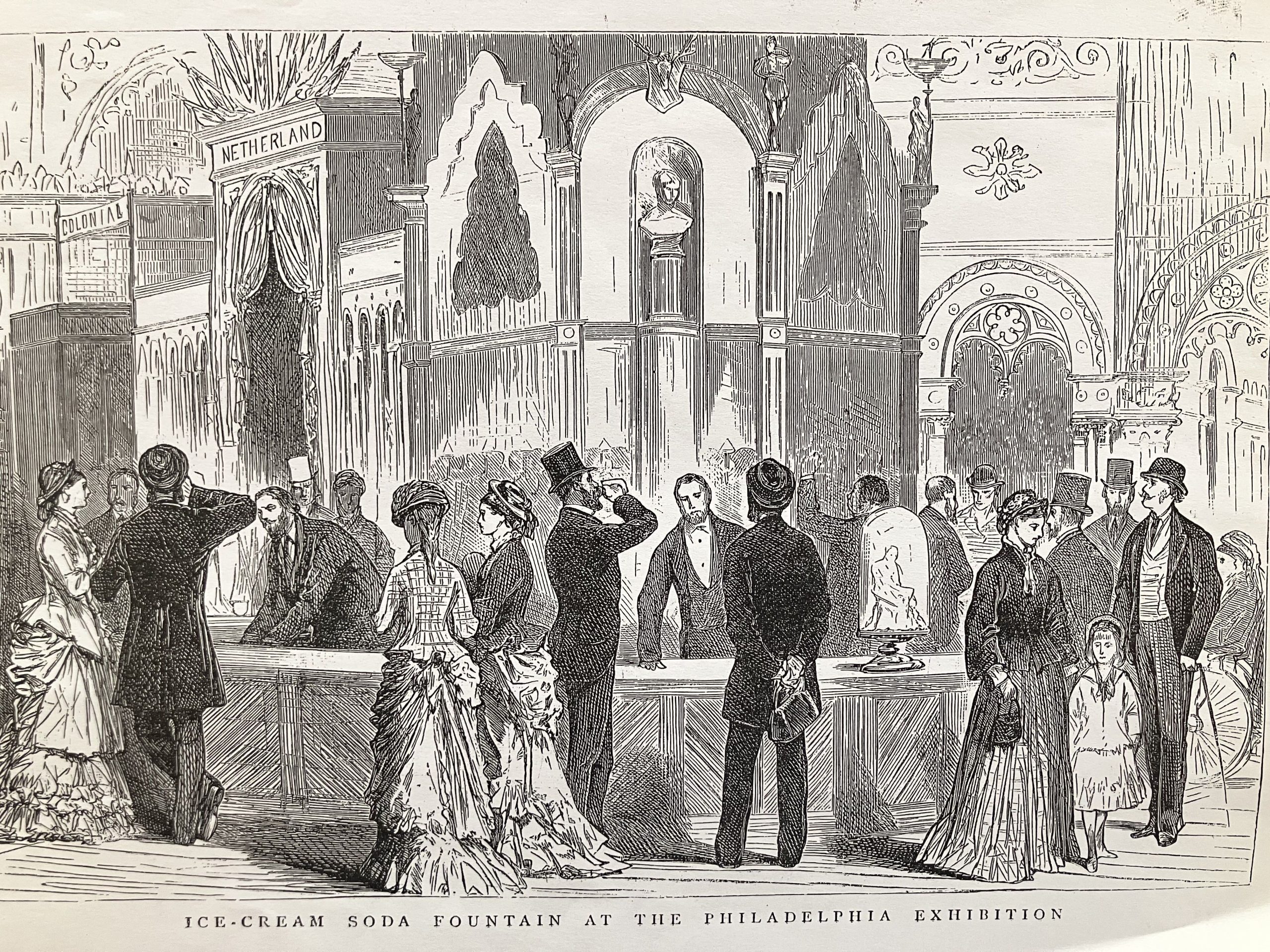
An ice cream soda fountain pictured at the Philadelphia World’s Fair.Colibri Workshop
To lure more fairgoers to the flavored soda water he was hawking at 10 cents a pop, Green added a dollop of vanilla ice cream. (Green purchased the ice cream from Henry Snyder, a confectioner at the corner of 13th and Vine.)
“The ice cream soda came out of a moment of desperation,” explained Eric Berley, self-anointed ice cream historian and owner of Franklin Fountain in Old City. “It started to fizz and bubble up creating a real 19th-century experience.”
The Philadelphia Historic District will honor ice cream soda’s effervescent beginnings at Franklin Fountain, Saturday July 18, from 11 a.m. to 1 p.m. It will be the district’s 29th firstival, part of a yearlong party celebrating America’s 250th birthday.
The first ice cream soda was served at the 50th birthday fete for the Franklin Institute back in 1874 by soda fountain salesman Robert M. Green.Colibri Workshop
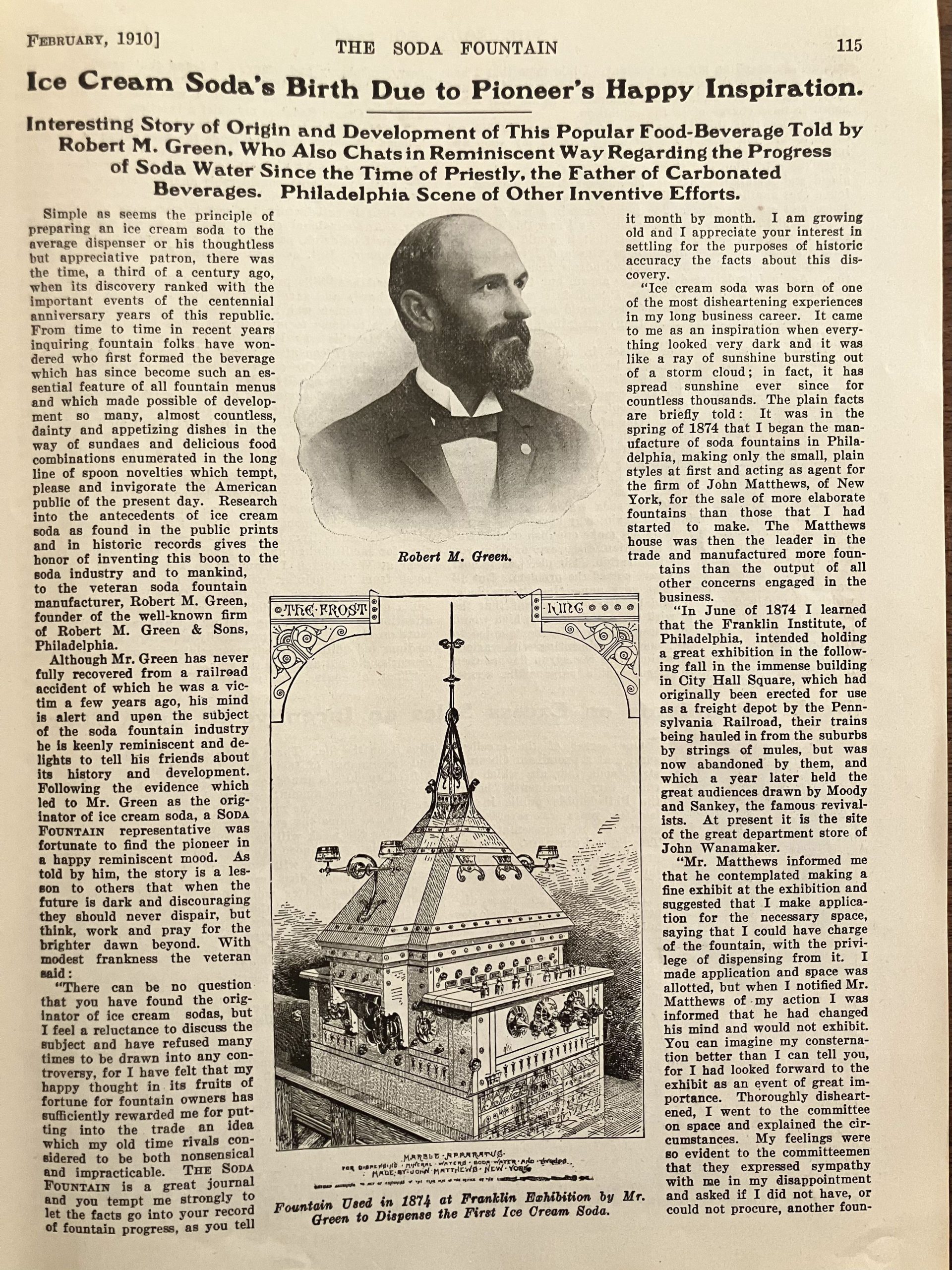
Green made $8 that first day of ice cream soda sales. But he knew he could do better. According to a 1910 article in Soda Fountain, the next day he printed handbills advertising the creamy concoction. He gave teenagers free tastes and paid them to crowd around his booth to drum up interest.
By the end of the fair Green was pulling in $200 a day — $5,793 in today’s money.
Word of the sweet treat traveled throughout the country and ice cream sodas became a drugstore staple. Up until then, soda fountains were only used to make medicinal drinks like Alka-Seltzer. Ice cream helped turn drug stores into hot spots.
Ice cream sodas, according to an article in the 1920 Philadelphia Evening Ledger were the precursors to the “sundae, the banana split, and the various egg drinks and a score or more of the tasteful and appetizing things which are now offered to the public.”
Robert M. Green recounted how he made the first ice cream soda in a 1910 article printed in the trade magazine The Soda Fountain.The Berley Bros. Collection.
Green opened Robert M. Green & Sons, at Broad and Vine, in the late 19th century where he sold soda machines and made a fortune. He’s buried in West Laurel Cemetery in Bala Cynwyd where his tomb stone reads: “Here lies the originator of the ice cream soda.”
While it’s tempting to end the ice cream soda story here, there is more to this sweet saga.
At the 1876 Centennial, Philadelphia-based pharmacist Charles Hires introduced the temperance drink Root Beer, a spicy blend of 16 wild roots and berries.
Seventeen years later, Frank J. Wisner, owner of a Colorado-based brewing company, plopped in a scoop of vanilla ice cream, inventing the Root Beer float.
The terms ice cream soda and ice cream floats are used interchangeably these days, Berley said.
“But it’s clear without Philadelphia you wouldn’t have an ice cream soda or a root beer float.”
The Ice Cream Soda Firstvial will be held, Saturday is Saturday, July 18, 11 a.m.-1 p.m. at the Franklin Fountain, 116 Market St.
New JerseyGov. Mikie Sherrill and Philadelphia Mayor Cherelle L. Parker are assessing whether they’ll need to ask the federal government for help following recent storms in Philadelphia and Camden as President Donald Trump rejects more disaster aid from blue areas.
Sherrill and Parker have both signaled they anticipate seeking federal emergency aid, but first they need to see if there’s enough damage to qualify. New Jersey is still trying to get aid for a snowstorm that took place just one month into Sherrill’s term — a request that Trump denied — and Pennsylvania has faced several Federal Emergency Management Agency request rejections in recent years.
Sen. Andy Kim, a South Jersey Democrat who serves as the ranking member on the subcommittee that oversees FEMA, recently led a group of senators accusing the Trump administration in a letter of a “significant partisan disparity” in federal disaster aid.
“Right now, there’s no predictability with this administration, and that’s just scary when you’re dealing with disaster response,” Kim said in an interview Wednesday.
Here is what to know about federal emergency aid at this moment.
How does FEMA aid work?
First, local officials work to assess the extent of the damage after a storm and report it to the county, which works with the state to assess the damage. If the disaster has caused more harm than the local and state government can address, the governor can request the president declare a major disaster. That’s required to unlock public FEMA aid.
Individuals can only apply directly for FEMA aid if the president approves individual assistance as part of a disaster declaration.
Residents should report damage to their insurance companies and begin the claims process as soon as possible and report damage to the Office of Emergency Management, said Joseph Walsh, a sergeant first class with New Jersey’s Office of Emergency Management.
“There are technical things we need to meet,” Sherrill said during her visit to Camden after the storm. “I think we probably will, but we’re collecting that now.”
Sean Higgins, a Sherrill spokesperson, said in a statement Wednesday that the governor’s team “has been working around the clock to ensure communities have the support they need and we will ensure that New Jersey applies for any and all help that we qualify for.”
In Philadelphia, Dominick Mireles, the city’s director of emergency management, said earlier this week thatthe city is figuring out the “financial price tag” of the damage, a process that will continue in the coming weeks. Then the city will determine what may be needed — and what it’s eligible to receive — from state and federal resources.
“This might be something above and beyond what we can navigate on our own,” Mireles said.
Camden Mayor Victor Carstarphen shows New Jersey Gov. Mikie Sherrill visuals of the recent storm in Camden on a tablet on Tuesday.Tyger Williams / Staff Photographer
Has Trump denied FEMA aid to Pennsylvania and New Jersey?
New Jersey is in the process of appealing a FEMA rejection for Winter Storm Hernando from February of this year, Walsh said.
The rejection was part of a $227 million denial in disaster aid requests from four Democratic-led states, along with New York, Rhode Island, and Massachusetts. Higgins said more than $84 million of that pool represented costs from New Jersey municipalities and counties.
“Without that aid, our local governments will be stuck with the costs of an unprecedented snowstorm that didn’t care about political boundaries. … Sherrill will continue to fight for every dime that New Jerseyans are owed, regardless of political party,” Higgins said in a statement.
FEMA data also show a 2018 rejection for a severe storm and flooding event in New Jersey during Trump’s first term. Walsh said the state requested aid for several counties even though the damage did not meet the threshold for federal assistance.
The data show that Pennsylvania faced denials from the Trump administration during his first term for awinter storm in March 2017 and storms and landslides fromFebruary to April2018, following a close2016 win for Trump in Pennsylvania during Democrat Tom Wolf’s gubernatorial administration.After losing the 2020 election to former President Joe Biden, Trump on Nov. 18 rejected requests for aid in Philadelphia and surrounding counties for the August 2020Tropical Storm Isaias.
Pennsylvania’s appeal for the 2017 storm was rejected for not meeting the “severity and magnitude” for a disaster declaration, and an appeal for the 2018 incidents were rejected for being “separate and distinct” and not meeting the required threshold, according to documents from the Pennsylvania Emergency Management Agency.
The state did not appeal the rejection for damage from Isaias.
The commonwealth also faced rejections during Biden’s administration following flooding in July and September 2023, and a snowstorm in November 2024 after Trump flipped back Pennsylvania.
Sen. Andy Kim and other Democratic senators have asked for a meeting with FEMA to discuss disaster assistance.Alejandro A. Alvarez / Staff Photographer
What is Andy Kim accusing Trump of?
Kim said Wednesday that Trump has been treating government money like “his own personal slush fund.”
“These are about families that are struggling, and you can’t punish them because of political retribution,” the senator said.
He was joined by 16 members of the Senate Democratic caucus in writing a letter last month to Russell Vought, the director of the federal Office of Management and Budget, citing a Politico report that said Trump’s second administration rejected disaster aid for Democratic-run states at the highest rate in the 47 years that FEMA has existed.
Trump has approved 23% of disaster declaration requests from states with a Democratic governor and two Democratic senators, compared with 89% of requests from states with a Republican governor and two Republican senators so far during his second term, and Democratic-led states also had longer wait times to find out the decision, the report said.
“To be clear, this reporting suggests that in the wake of disasters, as President, President Trump, who has the sole authority to grant or deny this assistance, may be punishing Americans who live in states with Democratic Senators and Governors, by denying access to disaster relief funding,” the senators said in the letter.
FEMA did not respond to a request for comment on the letter. White House spokesperson Abigail Jackson has previously told news outlets that “there is no politicization” in Trump’s disaster relief decisions and that he “provides a more thorough review of disaster declaration requests than any Administration has before him.”
The senators contendedthere are specific approval criteria and called for more transparency on the administration’s process.
In response to their letter,the budget office told the senators to talk to FEMA, so they sent the letter to FEMA to ask for a meeting and are awaiting a response, Kim’s office said Wednesday.
President Donald Trump has touted FEMA funding for states with candidates he supports.Julia Demaree Nikhinson
In the meantime, the president has attempted to use the agency to advance his agenda.
A report by House Democrats found the Trump administration improperly diverted resources from FEMA by sending staffers to help with immigration enforcement, Trump’s hallmark policy.
His administration also recently threatened to withhold FEMA terrorism prevention money for states that don’t run their elections the way the president wants them to.
During his first term, Trump opposed disaster funding for Puerto Rico and said he wanted more aid to go to Texas and Florida, according to news reports.
Recently, Trump touted FEMA funding for states with candidates he supports.
But the administration’s efforts haven’t always succeeded.
Pennsylvania and New Jersey were part of a lawsuit against the Trump administration for cutting certain FEMA funding meant for preventing harm from natural hazards through infrastructure upgrades. That program, called Building Resilient Infrastructure and Communities (BRIC), has since been reinstated. As a result, Pennsylvania was awarded nearly $838,000 for recovery from the 2024 Tropical Storm Debby.
Trump signed BRIC into law during his first term, but during his second term FEMA criticized it for being too “focused on ‘climate change’” under Biden.
Kim said he has advocated for the program’s expansion to help prevent damage from major weather events before they happen.
“This is not a shock that Camden had the flooding that it did,” he said. “We’ve known for a long time that their drainage and sewage and other types of efforts to mitigate flooding are just not to the level that is needed for the people there.”