Tag: topic-link-auto

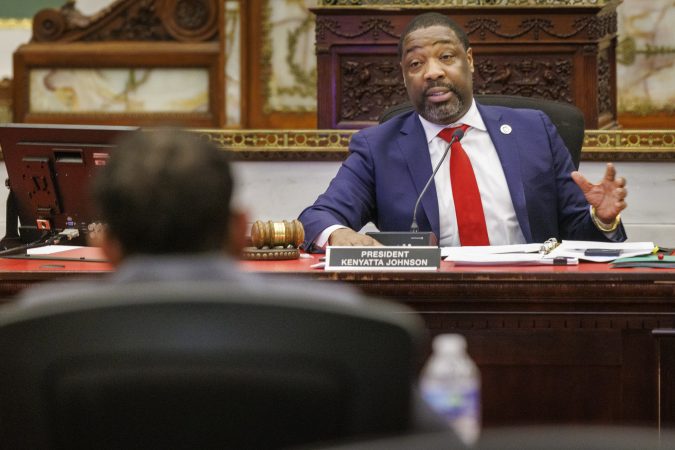
  • A sweeping audit of the Philadelphia School District’s management and operations is coming, at City Council President Kenyatta Johnson’s request

    A sweeping audit of the Philadelphia School District’s management and operations is coming, at City Council President Kenyatta Johnson’s request

    The Philadelphia School District is about to face significant new scrutiny, with City Council President Kenyatta Johnson asking for a sweeping performance audit of the school system’s management and operations.

    City Controller Christy Brady has agreed to the request, which came via a letter in recent weeks signed by all 17 Council members, Johnson’s office told The Inquirer. The comprehensive review will go beyond the audit Brady’s office performs annually, delving into areas such as staffing and outside contractors.

    Council laid out no deadline for the audit but made clear it is expecting the results in time for next budget season, which will begin in the new year and ramp up in the spring.

    The district, one of the largest in the United States, has a $4.6 billion budget, which funds education for 113,000 students in 213 district schools and 65,000 in 81 charters. About $2 billion of that money comes directly from the city.

    “While the SDP is subject to regular financial statement audits that examine the accuracy of financial reporting and compliance with applicable accounting standards, this request seeks a performance audit focused on evaluating the efficiency, effectiveness, and management of financial and operational practices, including budgeting decisions, resource allocation, internal controls, and long-term fiscal planning,” Johnson said in a statement Thursday.

    The news comes during a period of heightened tensions between Council and the district, spurred by members’ frustration over the school board’s move to close 17 schools and a separate $300 million structural deficit that took Council by surprise.

    Last week, at a news conference where several members “begged” the district to come to the table to negotiate over school closings, Councilmember Curtis Jones Jr. said Council has “tools in our tool belt that we will use” if the board does not change its mind about some building closures.

    Jones has sponsored legislation to hold hearings on creating an independent financial authority, like the Pennsylvania Intergovernmental Cooperation Authority, to oversee the district’s finances.

    Council sources told The Inquirer that there is no indication that the district has conducted malfeasance, but that given the billions that flow to the district from city coffers, Philadelphia officials want a closer accounting of how the money is being spent.

    After the board voted to begin the closure process in April, multiple members of the public also called for increased financial scrutiny of the district.

    Reginald Streater, the school board president, said in a statement Thursday that the board and district will work with the controller’s office “to continue strengthening our financial processes and procedures.”

    Streater said the audit squares with the board’s approach to governance.

    “Good governance is not about assuming we have all the answers; it is about asking the right questions, using evidence to guide decisions and being willing to improve. We look forward to understanding the proposed scope of the audit and ensuring that the examination is constructive and focused on helping the district work well for students, families and educators,” Streater said.

    Superintendent Tony B. Watlington Sr. stressed the district’s academic strides, history of audits with no material weaknesses, and moves to solidify its credit rating.

    Frustration over a budget deficit and school closings

    Johnson, in his statement, said that the audit will reassure Council that “resources are being managed effectively and operations are functioning efficiently by the SDP,” and that he believes its findings will help inform priorities for next fiscal year’s budget.

    This year’s budget season was chaotic.

    After Mayor Cherelle L. Parker introduced her initial budget, Watlington ordered $225 million in cuts, including some school cuts, with 300-plus teachers, counselors, and climate staff slated to lose their positions.

    The problem, Watlington underscored in remarks in March, was “not because we’re not good stewards of the dollars, but because of historic underfunding.” (The district achieved its highest credit rating ever under Watlington, who has said he wants to be the superintendent to retire the system’s structural financial issues permanently.)

    Philadelphia’s school system cannot raise its own revenue but instead depends on the city and state to bankroll it, unlike every other district in Pennsylvania.

    City Hall seemed shocked at the news of the deficit and job cuts, despite the fact that Watlington had warned officials in 2025 that a budget gap was coming. The school district spent $300 million in reserves that year to avoid layoffs and program cuts as federal COVID-19 funds dried up.

    After Watlington said he would be forced to make the school cuts, Parker then upped her proposed 20-cent-per-trip rideshare tax to a $1-per-trip levy. That frustrated a Council already catching heat from city residents anguished over plans to close schools.
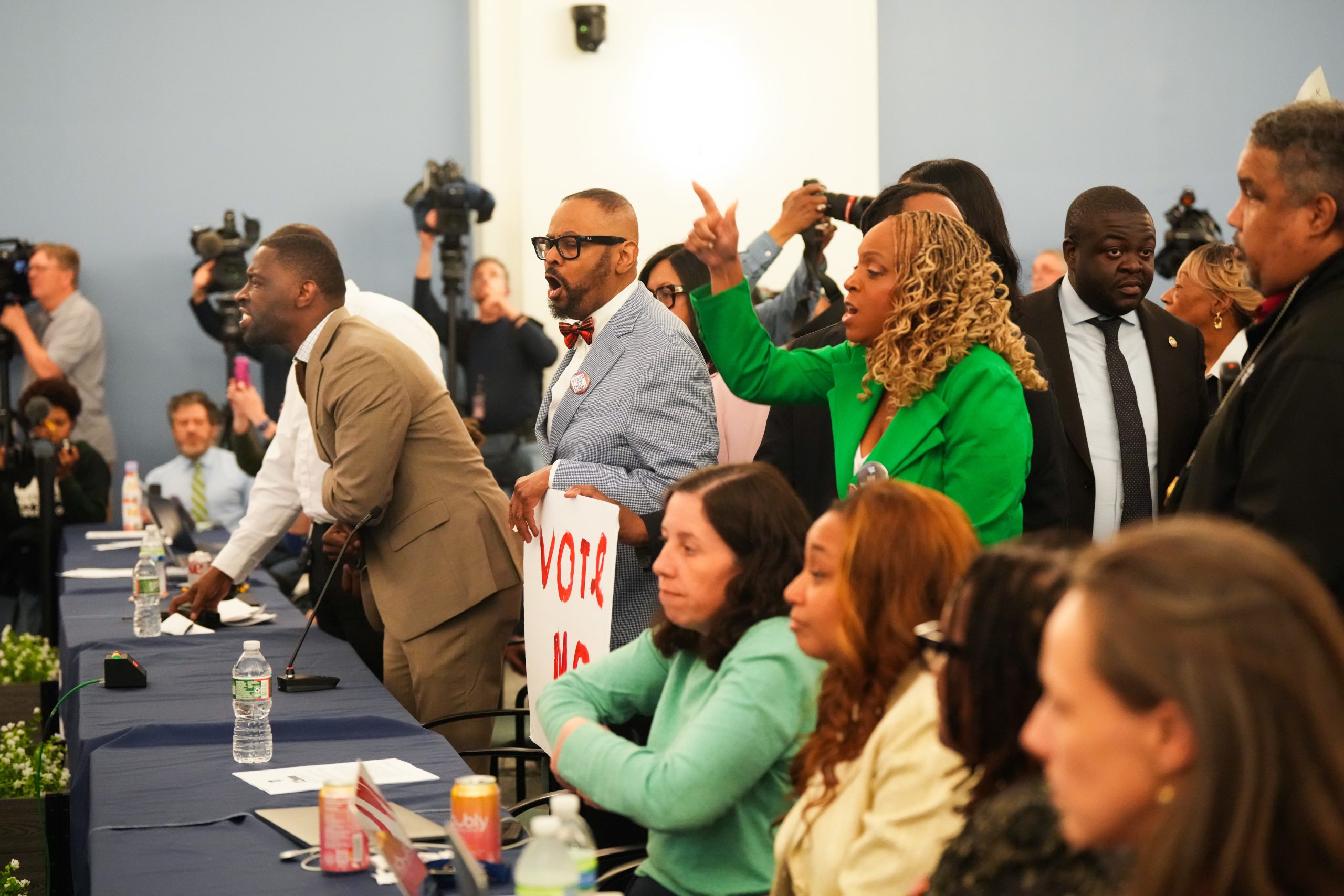
    (Left to Right) Councilmembers Isaiah Thomas, Curtis Jones Jr., and Jamie Gauthier protest at Thursday’s school board meeting as the board prepared to vote on the facilities plan.Jessica Griffin / Staff Photographer

    In April, several Council members took the dramatic step of repeatedly disrupting the school board’s vote in an attempt to get it to reconsider the closures of a handful of schools, including Lankenau and Robeson High Schools and Overbrook Elementary.

    The school board proceeded anyway — Council approves school board members, who are appointed by the mayor, and the city’s budget, but had no formal authority over the closures.

    The rideshare tax ultimately died.

    Eventually, Parker, Watlington, Council, and the school board worked out a deal to save the 300 jobs, with the city promising $216 million over five years from yet-unspecified sources.

    But it quickly became clear that some Council members remained frustrated with the school system and were looking for a way forward.

    Councilmember Isaiah Thomas has said he will not vote to reconfirm any school board member who voted for the closings; he and others have also said they believe it is time to rethink the school board’s governance structure.

    The city, as a primary funder of the district, needs a clearer picture of what is going on, they say.

    “Given the SDP’s current budget challenges, requests for additional public revenue, and recent proposals involving school closures and operational reductions, City Council believes a comprehensive performance and management review is warranted to ensure transparency, accountability, and informed public decision-making,” Johnson said in the statement. “The City of Philadelphia has a responsibility to ensure that all available revenues, expenditures, obligations, and funding strategies have been thoroughly reviewed before significant decisions affecting students, families, educators, neighborhoods, and public assets are implemented.”

    What will the special audit examine?

    City Controller Christy Brady (second from left, standing next to Mayor Cherelle L. Parker) is seen in this January file photo. Alejandro A. Alvarez / Staff Photographer

    Brady, in a statement, said the audit will “ensure resources are being managed effectively, operations are functioning efficiently and students are receiving the support they deserve. We’ve been encouraged by the SDP administration’s response to our previous audits and the steps it has taken to implement our recommendations. We expect this audit will continue that collaborative approach and continue to produce positive results for the benefit of students, educators and taxpayers.”

    Council has asked Brady to go deep, from probing into the current structural deficit and the projections used to get there to the status of Philadelphia Parking Authority revenues, both expected and received.

    Brady will also look at the district’s use of reserves and its administrative costs, and she will explore “the effectiveness and efficiency of administrative and operational expenditures, including central office functions, non-instructional spending and other costs not directly tied to classroom instruction.”

    She will look into how the district’s budgeting methods and long-term planning square with industry best practices, and examine contract management and consultant utilization to try to find areas “for improved accountability, transparency, and cost efficiency.”

    Brady is also charged with a deep dive into the financial effects of forthcoming school closings, and the potential ramifications of the closings on surrounding neighborhoods.

  • How one French wine region manages to keep prices steady

    How one French wine region manages to keep prices steady

    Red Côtes-du-Rhône is consistently one of the best bargains to be found in the French wine aisle. Not only have their prices held reasonably steady over the past decade as other French regions have seen notable price increases, but their price-to-quality ratio has remained reliably high as well.

    Côtes-du-Rhône is a generic regional wine appellation that covers most of France’s Rhône Valley as the river flows from Lyon to the Mediterranean. In practice though, only wines made in the stony flats of the southern Rhône are affordable enough to be sold under this name. While 21 different grapes are technically permissible in this appellation, the Grenache grape dominates, typically comprising at least 60% and up to 100% of any given red Côtes-du-Rhône.

    Grenache is capable of producing excellent wine at a lower cost than most other grapes due to its freakish ability to produce large volumes of flavorful fruit even in arid conditions — vintners can rely on bumper crops to keep production costs low. The weakness of Grenache is that its grapes contain lower levels of the dark phenolic compounds in grape skins that give red wine its color and help it resist oxidative spoilage. This explains why vintners here typically blend in at least two other local grapes, Syrah and/or mourvèdre. Both are thicker-skinned varieties that deepen wine’s color and boost its antioxidant properties.

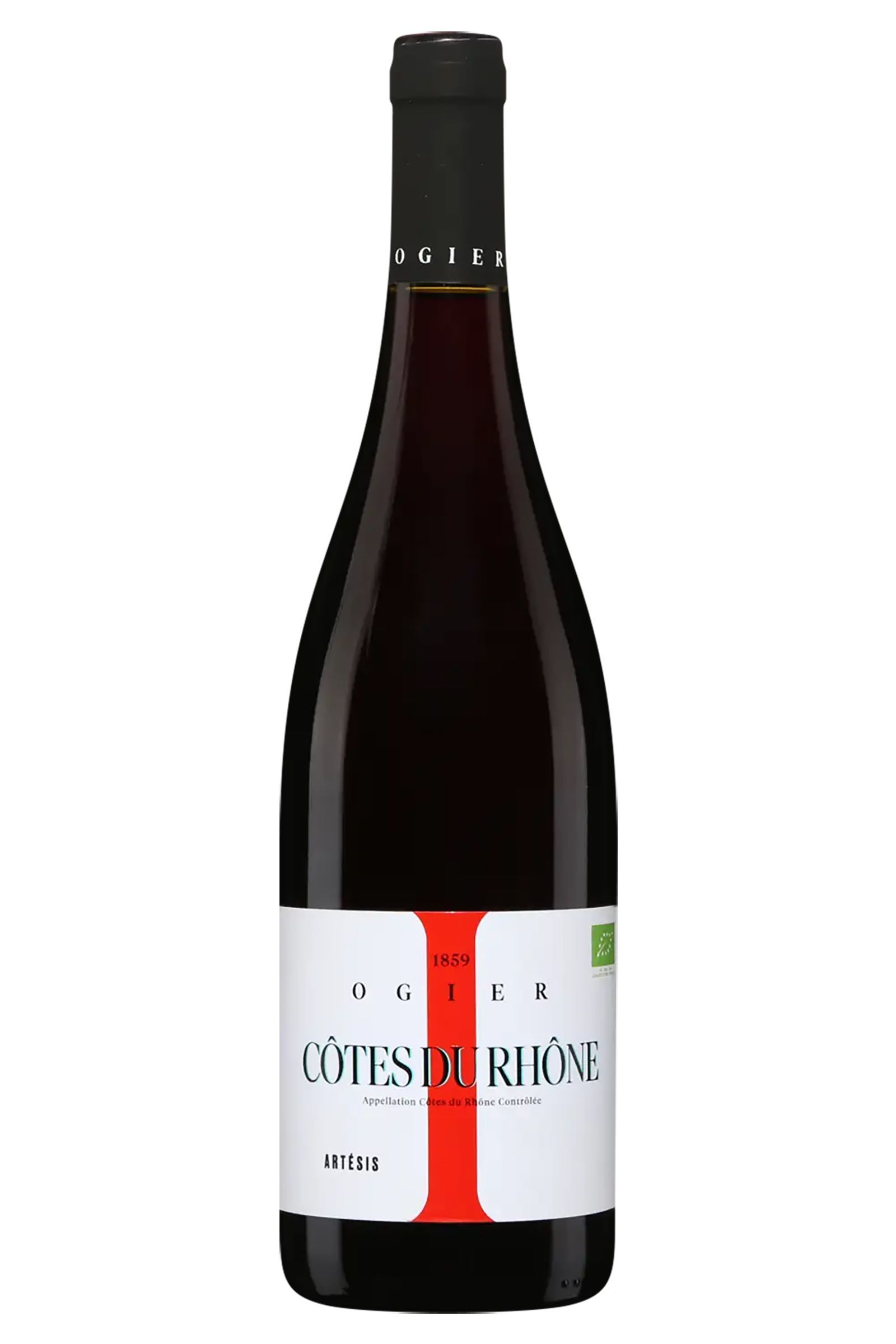
    This wine from one of the region’s most historic producers features vibrant flavors of fresh blackberry and red cherry, and an appetizing spiced-meat aroma reminiscent of soppresata salami.

    Ogier Côtes-du-Rhône “Artésis”Courtesy of Maison Ogier

    Ogier Côtes-du-Rhône “Artésis”

    Rhône Valley, France; 14.5% ABV

    PLCB Item #100048783 — on sale for $12.99 through Aug. 30 (regularly $14.99)

    No alternate retail locations within 50 miles of Philadelphia, according to Wine-Searcher.com

  • Senate committee votes to hold Fauci in contempt for refusing to answer COVID questions

    Senate committee votes to hold Fauci in contempt for refusing to answer COVID questions

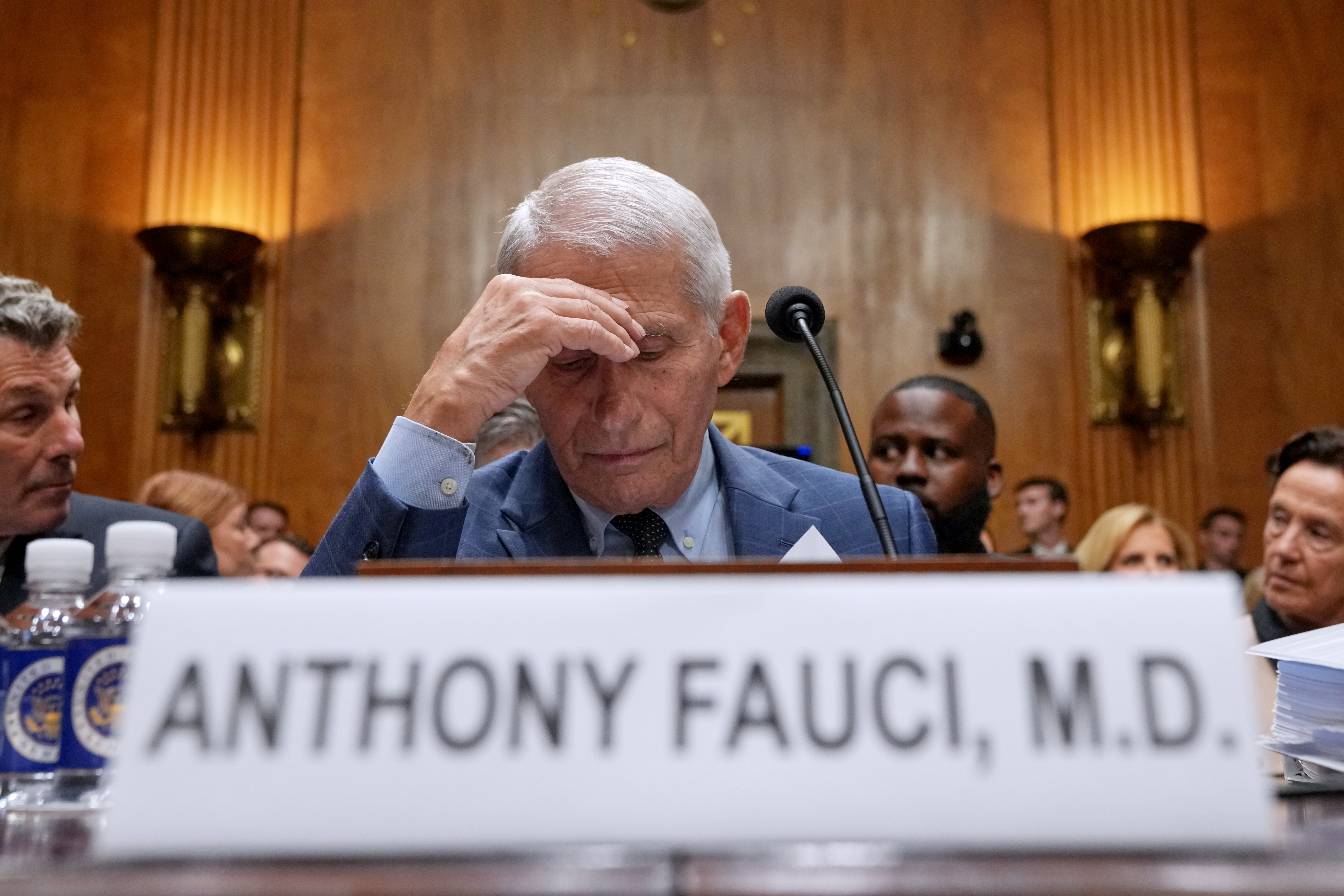
    WASHINGTON — A Senate committee on Thursday voted to hold Dr. Anthony Fauci in contempt of Congress and refer him to the Justice Department for potential prosecution over his refusal to answer questions at a hearing last week focused on his handling of the COVID-19 pandemic.

    The party-line vote approving the contempt resolution came a week after Fauci invoked his Fifth Amendment right against self-incrimination more than 100 times when he appeared before the Senate Committee on Homeland Security and Governmental Affairs.

    Republican Sen. Rand Paul of Kentucky, the committee chairman, said that constitutional protection did not apply since Fauci last year received a pardon from Democratic President Joe Biden and thus did not have to worry about the threat of prosecution. Fauci and Democrats who opposed the contempt resolution said he had a well-founded fear of self-incrimination given a public desire by Republicans to seek his prosecution.

    “Dr. Fauci faced no risk of federal prosecution,” Paul said at the outset of a hearing. ”All he had to do was tell the truth.”

    Paul noted that the vote had nothing to do with Fauci’s policies, opinions or anything he has said in previous congressional appearances.

    Instead, the senator said, “We are voting on whether a witness who has received the benefit of a sweeping pardon can be ordered by this committee to answer questions and then defy that order without consequence.”

    Fauci, in a statement explaining his decision to invoke his Fifth Amendment rights, said he had good reason to fear the possibility of criminal charges given what he said was Paul’s determination “to get me to say something, anything, that could vindicate his repeated public pledges that I end up, in his words, quote, behind bars, unquote.”

    The pardon from Biden covered acts from 2014 through the January 2025 day it was issued. It does not shield Fauci from state-level prosecutions or from investigations into any testimony that he did give that lawmakers thought was false.

    The referral goes to the U.S. attorney’s office in Washington, which will decide whether or not to investigate or potentially attempt to prosecute the doctor for contempt.

    Paul, who has previously sent referrals on Fauci on his own, acknowledged on Wednesday that contempt resolutions have often gone through the full Senate but said he did not “want to waste time” with that route. The resolution there would be unlikely to muster the required 60 votes needed to advance.

    No matter the outcome, the episode raises fresh and complicated questions about lawmakers’ ability to compel testimony from previously pardoned witnesses — and the outcome could resonate beyond Fauci given the possibility that Trump may also grant clemency to his own aides before leaving the White House.

  • 2026 Volkswagen Jetta GLI: A quick bargain that may be gone in a flash

    2026 Volkswagen Jetta GLI: A quick bargain that may be gone in a flash

    2026 Volkswagen Jetta GLI Autobahn vs. Hyundai Elantra N vs. Mazda3 2.5T Premium Plus AWD Hatchback: Let’s have some fun without breaking the bank.

    This week: Volkswagen Jetta GLI Autobahn

    Price: $35,670 as tested. And that comes pretty tricked out, with heated and ventilated seats, and premium audio. Just $650 for the 18-inch black rims and black side mirror caps. Autobahn is simply a top trim level, with one special feature noted below.

    What others are saying: “Highs: Just as quick as the GTI, as playful as ever, kind of a hot deal. Lows: We still prefer the manual even if it’s slower, annoying exhaust drone at highway speeds, deserving of a summer-tire option,” says Car and Driver.

    What Volkswagen is saying: “It’s the kind of car that’s hard to ignore.”

    Reality: It actually is quite easy to ignore, with all the exterior excitement of a Buick sedan, but it’s worth paying some attention.

    What’s new: Volkswagen has been having some financial problems and is planning to cut 100,000 jobs, according to BBC. As those in the know handicap which models may be cut from the lineup, Car and Driver is betting the GLI could be on the short list.

    Until then, though, let’s take this baby out for a ride. Fun seems to be harder to find these days, with war in Iran and tariff roulette costing us all money, so it seems like a good time to see which little cars might return a smile to our faces with little-ish price tags. With that comes a comparison of the Jetta GLI, Hyundai Elantra N, and the Mazda3 Turbo.

    Competition: In addition to the comparison vehicles, there are the Honda Civic Si, Honda Civic Type R, Toyota GR Corolla, Volkswagen Golf GTI, and Volkswagen Golf R.

    Up to speed: Woo hoo, the Jetta GLI Autobahn will get you to 60 quickly. Car and Driver says it gets there in 5.6 seconds, and I’m skeptical. It feels faster than that; I thought for sure I’d find a sub-5 time. But whatever, the 2.0-liter turbocharged four-cylinder engine creates 228 horses, and it really gets the small sedan around in a hurry.

    Zipping past cars on the highway is easy, so is getting the Jetta to 65, 70, and beyond, if you’re not looking. This is not the car to hand over to a teen to take to college.

    On the road: In fact, the Jetta GLI gets moving with more force than the front-wheel-drive system can adequately handle. Stomp on the accelerator while turning from a red light and the Jetta GLI Autobahn can quickly lose its composure and start dancing from side to side. All-wheel drive would be such a blessing to this little car.

    After you get rolling, give the GLI free rein in and out of turns and it’ll go exactly where you point it. The highway seams are not as brutal as you’d think in this sporty little sedan (unlike the unforgiving Toyota Sienna XSE I tested on a recent Minnesota drive) and there’s certainly plenty of gusto for passing your fellow motorists.

    Shifty: The Jetta in all its forms offers Volkswagen’s typical D-S shifter, where a double pull adds to the performance, and a push to the (wrong) right side gives you shift capabilities (the left side is the right side for shifting, people). Then a push forward lets you upshift — also incorrect, because a pull was mandated in documents carried by Moses from the Mount. The shifter is also a little too mushy for shifting, so maybe opt for the paddles.

    Or the stick shift. The Jetta GLI is one of the last few vehicles to let you shift for real, with a 6-speed manual also on offer.

    The interior of the 2026 Volkswagen Jetta GLI continues a tradition of no-nonsense colors and functionality.JAMES LIPMAN

    Driver’s Seat: The leather-covered, red-accented Driver’s Seat offers more performance than comfort; it’ll hold you firmly in place, but it’s not ache-inducing. (Ask me about my back problems; I have aged into the perfect Goldilocks for all your Driver’s Seat insights.)

    The controls and gauges haven’t changed much in the past 10 years. You go, Volkswagen. Save those pennies.

    Friends and stuff: The rear seat has decent headroom and legroom, although foot room under the front seat is a little snug. The center seat is tight behind the console, of course. The entire seat is comfortable enough, especially for the price point.

    Cargo space is 14.1 cubic feet; the seats fold down for a pass-through.

    In and out: The Jetta sits sports-car low, so brace yourself for the ups and downs.

    Play some tunes: The stereo interface is also classically inspired, with volume and tuning knobs and an 8-inch screen. Like the 0-60 time, the little screen really punches above its weight; I searched and searched to make sure I didn’t have some larger upgrade, but no.

    Sound from the Volkswagen Premium Audio system, part of the Autobahn trim level, is quite good, an A- almost hitting an A.

    Keeping warm and cool: Dials control temperature, and buttons handle everything else. The blowers provide plenty of air on the hot days, something we’ve had more than our share of this summer, and the ventilated seats help with cooling as well.

    Fuel economy: The vehicle averaged 29 mpg over the last 1,500 miles, including a few hundred of mine.

    Where it’s built: Puebla, Mexico. The parts are 36% Mexican and 17% German.

    How it’s built: Consumer Reports predicts the Jetta reliability to be a 2 out of 5.

    In the end: You’re basically getting an Audi A3 for a Volkswagen price, so why wouldn’t you take it? Still, gotta check out the competition.

    Next week: We try the Hyundai Elantra N.

  • 2 soldiers killed in Lebanon in the first Israeli deaths since June truce with Hezbollah

    2 soldiers killed in Lebanon in the first Israeli deaths since June truce with Hezbollah

    BEIRUT — Two Israeli soldiers were killed in an explosion in southern Lebanon, Israel’s military said Thursday, the first Israeli deaths since a shaky truce between Israel and the Lebanese militant group Hezbollah began nearly two months ago.

    Four other soldiers were seriously wounded, the military said. An Israeli military official, who spoke on condition of anonymity in accordance with the army’s policy, said that “an explosion was detonated” when the soldiers entered a site in the village of Majdal Zoun and that the nature of the explosive was under review.

    Israeli media reported the two deaths a day earlier.

    The Israeli army launched strikes Wednesday in southern Lebanon in response to what it described as Hezbollah’s violation of the ceasefire and called on residents of the village of Mansouri to flee — the first such warning Israel has issued in Lebanon for weeks.

    Lebanon’s Health Ministry said one person was killed and 12 wounded in an Israeli strike in the town of Tebnine Wednesday and another eight wounded in overnight strikes on the village of Burj al-Shemali. Artillery shelling also targeted the areas of Mansouri and Majdal Zoun, the state-run National News Agency said.

    There was no immediate statement from the Iran-backed Hezbollah.

    The latest Israel-Hezbollah war erupted on March 2, when Hezbollah fired rockets across the border two days after the U.S. and Israel launched their attacks on Iran. More than 4,000 people have been killed by Israeli strikes in Lebanon since then, including hundreds of civilians. About 40 soldiers and three civilians – including a military contractor – have been killed on the Israeli side.

    A precarious truce between Israel and Hezbollah has largely held since June 20, but Israeli forces have continued to occupy swaths of southern Lebanon and to carry out periodic airstrikes and shelling.

    The latest escalation came as Lebanese and Israeli negotiators met in Rome to discuss implementation of a June 26 deal reached between Israel and the Lebanese government under which Israeli forces are supposed to withdraw from areas they occupy in southern Lebanon and allow the Lebanese army to take control, in exchange for Hezbollah’s disarmament.

    Hezbollah has refused to disarm and opposed the direct Lebanon-Israel talks. It was not a party to the deal. The group has accused the Lebanese government of making too many concessions without guaranteeing an Israeli withdrawal.

    Wednesday’s talks ended early due to the escalation on the ground, but were set to resume Thursday.

    The talks in Rome have focused on implementation of “pilot zones” where Israeli forces would withdraw and the Lebanese army would take control. Implementation began last month with an initial pilot zone in an area that wasn’t occupied by Israeli forces but had previously sustained Israeli fire.

    The Lebanese army entered the town of Zawtar al-Gharbieh and some civilians returned, although many came only to find their homes destroyed and left again.

    A diplomat familiar with the negotiations who spoke on condition of anonymity because they were not authorized to comment publicly said earlier this week that Lebanon had asked for the next pilot zone to be either in the town of Khiam or Bint Jbeil. Both areas saw heavy fighting in the latest Israel-Hezbollah war and are currently occupied by Israeli forces.

    But U.S. Ambassador to Lebanon Michel Issa suggested ahead of the three-day talks that no new pilot zones would be immediately implemented, saying that “moving too quickly risks jeopardizing the very civilians this process is meant to protect.”

  • North Korea conducts ballistic missile test days before US and South Korea begin drills

    North Korea conducts ballistic missile test days before US and South Korea begin drills

    SEOUL, South Korea — North Korea launched a short-range ballistic missile toward the sea on Thursday, South Korea’s military said, resuming weapons tests days before its rivals the U.S. and South Korea begin annual military drills that North Korea views as an invasion rehearsal.

    The launch from North Korea’s eastern coastal Wonsan area was detected around 5 p.m., South Korea’s Joint Chiefs of Staff said, explaining that South Korea’s military has bolstered its surveillance posture and is closely coordinating with the U.S. and Japan.

    Japan’s Defense Ministry also said North Korea fired a possible ballistic missile but there was no impact in or around Japan, where the coast guard urged ships around the coast to use caution and notify authorities if any fallen objects were found.

    The ballistic missile launch was North Korea’s first since late June, when it tested a tactical ballistic missile with a “special mission” warhead and other weapons. After watching the testing activities, leader Kim Jong Un underscored the need to bolster the military’s “deadly and destructive offensive posture.”

    Thursday’s launch also came ahead of large-scale, annual exercises to be conducted by the U.S. and South Korean militaries later this month. U.S. and South Korean officials say the training is defensive in nature, but North Korea says the maneuvers are a practice invasion and often responds with its own missile tests and warlike rhetoric.

    South Korean and U.S. officials haven’t formally released details about this year’s joint exercise, but the drills are typically held in the latter half of August.

    Kim has been focusing on enlarging its nuclear and missile arsenals since his high-stakes diplomacy with U.S. President Donald Trump collapsed in 2019. Experts say Kim wants international recognition as a nuclear state so that he can demand the lifting of international economic sanctions on North Korea.

    U.N. Security Council resolutions ban North Korea from launches involving its huge stockpile of ballistic missiles. Tests of other weapons including cruise missiles and artillery systems are not banned, but experts say they still pose a threat to South Korea and the U.S.

    In early July, Kim supervised tests of a nuclear-capable cruise missile aboard a new 5,000-ton destroyer. After years of prioritizing ballistic missile development, Kim has increasingly turned his focus to naval capabilities, including the construction of a nuclear-powered submarine.

    In recent years, Kim has boosted his diplomatic credentials by expanding ties with Russia. North Korea has supplied conventional weapons and troops to Russia to support its war against Ukraine.

    Kim also has pushed to deepen cooperation with China, the North’s economic pipeline. Chinese President Xi Jinping visited the North Korean capital Pyongyang in June for the first time in seven years.

    In response to Trump’s repeated outreach to restart diplomacy, Kim has suggested talks can resume if the U.S. drops its demand for North Korean denuclearization as a precondition.

  • Before the Phillies could sell you a beer, fans were throwing them at the umpires

    Before the Phillies could sell you a beer, fans were throwing them at the umpires

    The Phillies tell me they sell more than 40 brands of beer, priced from $6.99 for a 12-ounce can of nonalcoholic beer to $17.69 for a 24-ounce premium can. Beer is everywhere at Citizens Bank Park, including at a humongous walk-through cooler on the main level.

    I recently strolled into that cooler and found a lager — at $38.48 for two 19-ounce cans — that paired nicely with chicken fingers and the Fightin’ Phils. OK, so 64 ounces of the exact same beer costs $11.99 at Acme, but you can’t watch the Phils live from Acme, can you?

    “Sometimes, things become clichés because they’re true: A cool beer on a warm summer day at the ballpark is among the great joys of fandom,” says the avuncular Glen Macnow, the former Inquirer reporter (and colleague) and sports talk-show host whose What’s Brewing PA beer show appears on the NBC Sports Philadelphia networks.

    Macnow — who is, full disclosure, also the part-owner of Conshohocken Brewing Co., which vends two of its brands at the ballpark — adds: “I’ve spent many an afternoon (or evening) with a beer in one hand, a hot dog in the other, juggling both so I can fill out the scorecard balanced on my knees.

    “Those are simple and eternal pleasures. Baseball isn’t designed for trendy cocktails in a can; it’s designed for the tradition of leisurely enjoying a cold brew over several innings as you try to convince the guy in the next seat that the manager (whoever he is) is the dumbest one in Phillies history.”

    OK, but just in case you don’t care for a brewski, the Phillies also sell about a dozen different trendy cocktails in cans, with prices running from $14.55 to $23.99. These are no bargains, either, but consider the alternative: The Phillies used to not sell booze at all.

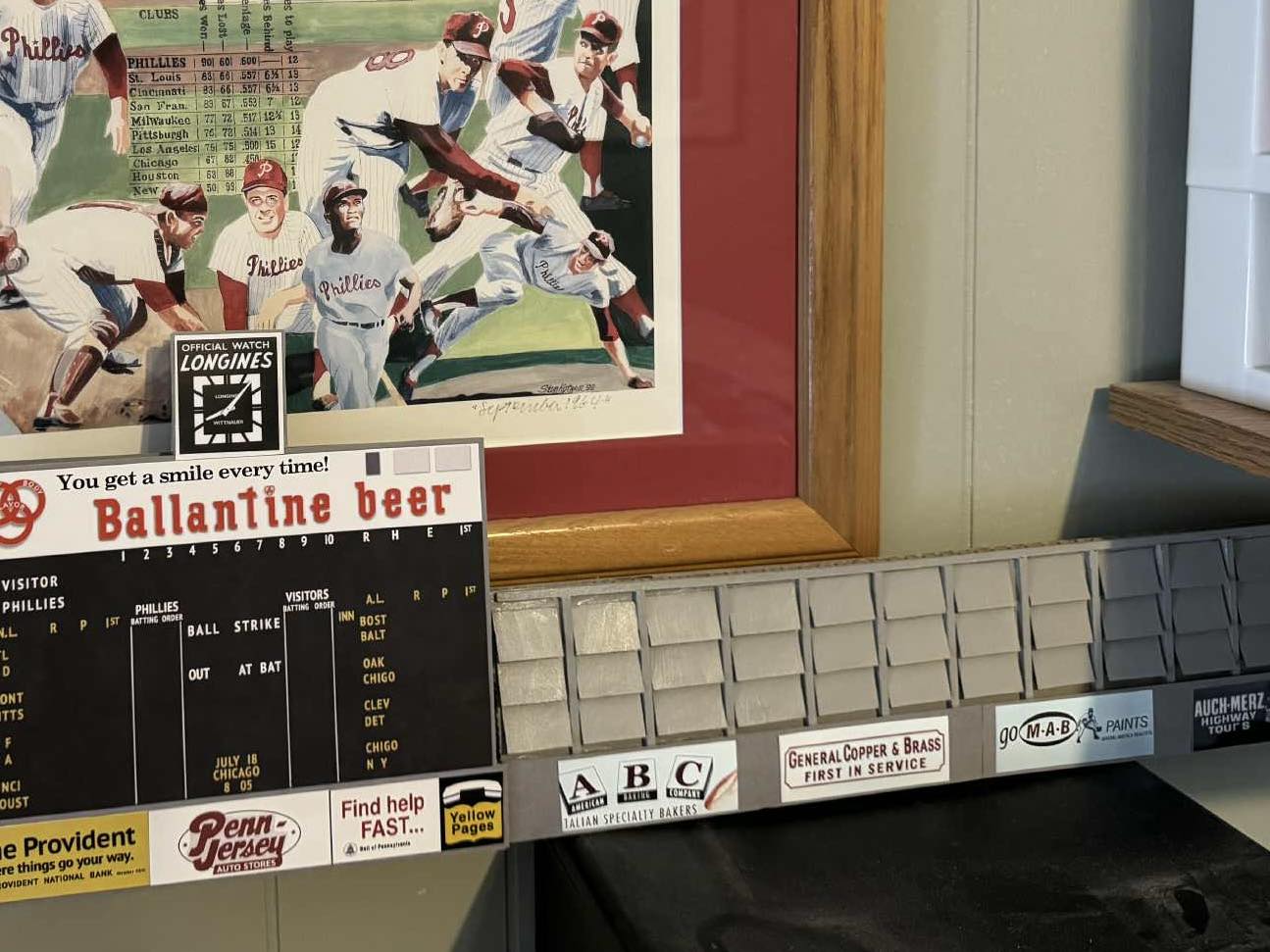
    Baby boomers like me vividly remember the towering, then-state-of-the-art right field scoreboard at Connie Mack Stadium, topped by a gigantic advertisement for Ballantine Beer (and its three-ring logo, for Purity, Body, and Flavor).

    A handmade model of the iconic Ballantine Beer scoreboard at Connie Mack Stadium by Phillies fan Bernie Valente.Courtesy of Bernie Valente

    Well, that scoreboard was erected in 1956, five years before beer was sold there.

    The Phillies first legally sold beer inside Connie Mack Stadium, their musty old park in North Philadelphia, on Aug. 7, 1961, when they put seven local brands of bottled beer on sale for 35 cents, first poured into a paper cup by eight vendors working the aisles.

    The paper cup was a vital part of the transaction, because, prior to legal sales, Phillies fans used to sneak in cans of beer, often sold in “cold packs” at nearby bars like Charlie Quinn’s Deep Right Field Cafe at 20th and Lehigh.

    Beer cans were heavier in those days, so they tended to become missiles when the umpires missed a call, or if the Phillies stank, which was quite often.

    The low point probably came on June 12, 1959, when a twi-night doubleheader against San Francisco was halted after five innings because of rain. The Phillies were no-hit — but even worse, fans were denied rain checks to both games because the first game was official.

    As Frank Fitzpatrick, the now-retired Inquirer reporter who attended the game as a 9-year-old, recalled in the paper in 2016: “Suddenly, one empty can fluttered toward the field. A second followed quickly. Soon, it was a dangerous deluge. So many were tossed that cans obscured the tarp, from the mound to the batter’s box.”

    That was not good news for Robert R.M. Carpenter, the Phillies owner, who dearly wanted a new ballpark for his team. Plans had been drafted for a 45,000-seat, $8 million stadium in the Torresdale section of Philadelphia, with an adjoining theme park, yacht basin, and bird refuge park adjacent to I-95. Beer sales would bring in some cash for that amazing project.

    On June 20, 1961, the Pennsylvania Senate passed a previously approved bill by the state House that would permit the sale of beer every day but Sunday at sporting events at stadiums in the state that seated more than 25,000. (The Pittsburgh Pirates also happened to be looking for a new ballpark.)

    But they faced stout foes. After voting against the bill earlier in 1961 that would have enabled the Phillies to sell beer, a Democratic state assemblyman from Philadelphia, Charles Heavey, predicted that the sale of beer would actually “contaminate” youngsters.

    So … first the beer had to be poured into a paper cup before drinking, preventing another beer can pileup on the field like the one in 1959. And there would be more than one starting pitcher: Schmidt’s, Esslinger, Old Dutch, Horlacher, Neuwiler and, yep, Ballantine were all included in the original sudsy rotation.

    A 1962 newspaper advertisement for Ballantine beer.

    Larry Merchant provided statistics in his Daily News column the next day: A total of 3,739 beers were served to 5,586 who attended that Aug. 7 game, a 3-1 Pittsburgh victory on a Monday, which was also the Phillies’ 10th straight loss. No bottles or cans were thrown on the field, he reported, but fans did pop the cups and try to throw those onto the field — often in vain.

    “For serious drinkers, it was about a four-beer game, just two and a half hours long,” Merchant joked. “For serious Phillies fans, it was a six-beer job. They look better that way.”

    Merchant made note of signs at the entrances that read, “Bringing in of canned beer or bottled beverages will be a cause for ejection from the park.” Nonetheless, he reported, seven would-be beer smugglers were caught at the gate, their brews returned when they left the park.

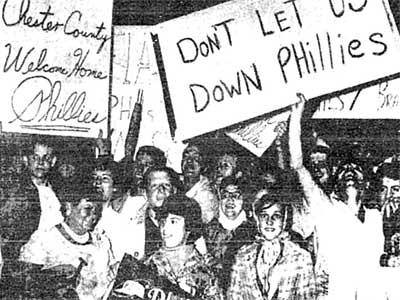
    Those 1961 Phillies were so lousy that their losing streak grew to 23 games, still a modern record. After the Phillies beat Milwaukee, 7-4, on Aug. 20 in the second game of a doubleheader, their flight home was welcomed by 500 fans at 1 a.m. the next day at the airport.

    About 500 Phillies fans welcomed the team home at the airport like conquering heroes after the club broke a 23-game losing streak in August 1961.

    “They are selling rocks at $1.50 a pail,” Phillies pitcher Frank Sullivan, looking out of the plane, joked to his teammates.

    He then wisecracked: “Leave the plane at five-minute intervals. That way, they can’t get us all with one burst.”

    In truth, the beer ploy sales did not seem to provide much of a boost to the 1961 Phillies, who lost 107 games and finished last in the National League in home attendance in 1961, averaging only about 7,600 per home game. But a door, or many brewskis, had been cracked.

    Beer would not be sold at Sunday home Phillies games until 1972, after the Phillies moved to Veterans Stadium, following the amendment of the ancient Pennsylvania Blue Laws, intended to curtail activities on Sundays (including Phillies and A’s home games until 1934).

    “My parents didn’t drink, so I always associated the public consumption of alcohol as something dark and troubling,” Fitzpatrick told me recently. “That feeling was confirmed in spades at that 1959 game.

    “By 1966, the summer I worked at the ballpark, I felt differently. I was a soda vendor, and beer suddenly was a precious commodity. Now I envied the beer sellers, because they made the most money and had the least amount of walking. Occasionally, rowdy fans would harass young vendors like me, hurling popcorn containers or wadded-up cups at us, [but] it definitely was comforting to know you wouldn’t have to dodge metal cans. On the other hand, in ’66 the smell of spilled beer now permeated the place. I don’t remember that same aroma when fans brought their own.”

    Carpenter never did get his Torresdale stadium. After a one-year delay because of construction, however, the Vet opened in 1971 in South Philadelphia. A few fans grumbled about paying 75 cents for a 12-ounce beer served there by a vendor, perhaps because those same items were 40 cents and 60 cents, respectively, at Yankee and Shea Stadiums in New York.

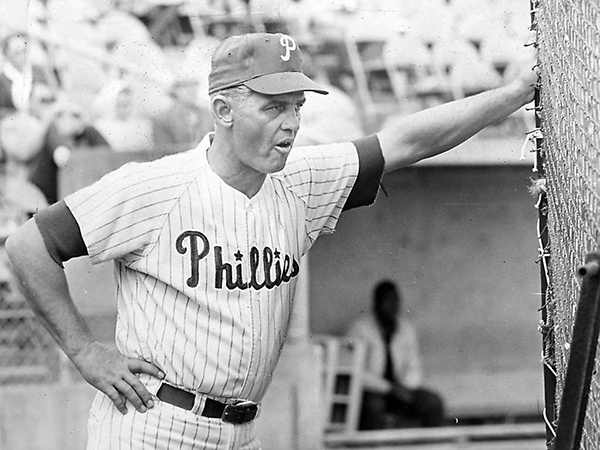
    Gene Mauch managed the Phillies during their historic 107-loss season in 1961. That team dropped 23 straight contests.

    The pricing was actually meant to be sort of a deterrent. Bud Vye, the Connie Mack stadium manager, told The Inquirer, “At these prices, they’ve got to bring a bankroll just to get bombed out.”

    But beer stuck around. A 1998 Daily News exposé into how Ogden Entertainment, then the vendor at the Vet, was caught skimming a half million dollars in annual beer sales led to a price reduction. Local brands, kicked to the side by the national brews, were sold again when the Phillies moved to Citizens Bank Park in 2004. (Large premium drafts then sold for $6.)

    Cups were eventually discontinued, and most beer at the ballpark is sold in much lighter cans (which, it should be noted, are opened by the cashier, lest someone try to hurl a full can on the field). Dozens of different brands of beer can be spotted at any Phillies game.

    “A big part of this is marketing,” Macnow tells me. “Beer at the ballpark is no longer poured into paper cups, so there’s a long-term benefit to seeing people walking around the park holding cans of your beer. Labeling becomes important. Naming beers becomes important.”

    And so is the vessel itself. The Phillies continue to sell “beverage bats,” large hollow plastic souvenir baseball bats that can be filled with any beverage. Those are not cheap, either. Phillies fans may be held captive by the prices, but beer and baseball are inseparable.

    Dave Caldwell lives in Manayunk and covered sports for The Inquirer from 1986 to 1995.

  • Michigan Senate primary shows Democratic establishment has lost its grip

    Michigan Senate primary shows Democratic establishment has lost its grip

    Michigan’s bitter Senate primary was the clearest signal yet: The Democratic establishment is gasping.

    The narrow victory of former health official Abdul El-Sayed over four-term Rep. Haley Stevens, who had the near-unanimous backing of senior establishment figures in Washington and Michigan as well as a more than 8-to-1 television spending advantage, marked yet another stumble by the traditional power brokers.

    It also amplified how out of touch they have grown with the angry left that has become the party’s ascendant force.

    This time, the victory by a progressive insurgent happened not in a deep-blue enclave, such as New York City, where Democrats are pretty certain to win no matter what candidate they put up. It was in a statewide contest in Middle America. Donald Trump won Michigan twice, in 2016 and 2024.

    In 2026, the stakes could hardly be higher. Democrats currently hold the Michigan seat being vacated by the retirement of Sen. Gary Peters. Should El-Sayed lose in November against Republican nominee Mike Rogers — a former congressman who came within a third of a percentage point from winning Michigan’s other Senate seat in 2024 — the party’s uphill effort to win back control of the Senate will become even steeper.

    Much criticism has focused on how Senate Minority Leader Chuck Schumer and the campaign arm that he effectively steers, the Democratic Senatorial Campaign Committee, have attempted to orchestrate the primary process. They have boosted favored contenders in three primaries this year. Michigan marked the second one — the first having been Maine — in which Schumer’s anointed contenders were rejected by Democratic voters.

    “What voters have been screaming from the rooftops is they’re sick of the status quo. They’re sick of the establishment. They want something different,” said Lis Smith, a Democratic consultant who worked for Mallory McMorrow, a state senator who dropped out of the race after failing to gain traction in a middle lane.

    Nor were Democrats in a critical swing state persuaded by the argument that Stevens was more “electable.”

    “If you listen to focus groups or interviews with Michigan voters, they are very interested in winning,” former Obama White House official Dan Pfeiffer wrote Monday in his Substack. “They want to pick a winner; they just don’t trust Democratic politicians to tell them who can really win. This is a very understandable impulse after 2024 and every Democratic leader backing Biden when he clearly shouldn’t have run.”

    The stresses and divisions within the Democratic Party, including over support for Israel and the role of money in politics, were on full display in Michigan. El-Sayed rarely missed an opportunity to mention that Stevens had benefited from $62 million in advertising spending by outside groups, led by the American Israel Public Affairs Committee, the influential pro-Israel lobby.

    The entire race, El-Sayed argued in the candidates’ final debate, “really comes down to how you are funded.” Rarely has a candidate been so effective at that kind of political jujitsu, using the weight of campaign money against its intended beneficiary.

    Late polls that had El-Sayed comfortably ahead of Stevens were wrong. The race turned out to be a photo finish.

    The results also complicated any clean story about a party moving left. El-Sayed ran up his margins in the counties with the youngest and most highly educated voters. Stevens carried the poorest counties and the areas with the most Black residents — the parts of the Democratic coalition that have historically decided general elections in Michigan. An insurgent left that wins on campuses and in college towns but loses in Detroit’s suburbs and the state’s poorest counties has proved it can win a primary. It has not yet proved it can win a state.

    Stevens quickly endorsed El-Sayed after the race was called. “I spoke with Abdul a few moments ago to offer him my full support as we work to defeat Mike Rogers this November,” she posted on X. But given the acrimony of their battle, it is unclear whether Democrats can bind their wounds and regroup behind their new nominee.

    Progressives in Michigan notched other victories Tuesday: William Lawrence, co-founder of the climate action group Sunrise Movement, defeated two more moderate Democrats to win the Democratic nomination in a swing district that includes Lansing. And incumbent Rep. Shri Thanedar lost to Michigan state Rep. Donavan McKinney, a democratic socialist.

    The implications could well extend beyond November. The Democratic National Committee has tentatively approved Michigan to vote fifth in the 2028 presidential primaries — making it the biggest prize on the early calendar.

    Should the progressives who were chosen Tuesday win this November, that may strengthen the hand of 2028 prospects who hew to the left. But if they lose, the party may be seeking a more centrist standard bearer.

    With the 2026 primary season coming to an end, more optimistic Democrats are hoping that raging battles over their party’s identity will move to the back burner as they refocus their energies on Trump and the Republicans.

    “We’re gonna have a great November. We’re gonna win the House, and I’m still bullish on the Senate,” former Virginia governor Terry McAuliffe, who also chaired the Democratic National Committee, said in an interview. “This is going to be about the party in power, plain and simple.”

    Clara Ence Morse contributed to this report.

  • Why Republicans could still keep control of the House

    Why Republicans could still keep control of the House

    Democrats are favored to flip the House, but Republicans could still save their majority under the right conditions.

    Historically, midterm elections are a referendum on the party that holds the White House, which voters are prone to punish. This year, the Democratic Party is well positioned to win a House majority, buoyed by voters’ dissatisfaction with President Donald Trump and the war in Iran that he started.

    But Trump’s party could defy conventional wisdom and still eke out a win, election analysts say. Here’s how.

    Voters aren’t angry enough to vote blue

    Registered voters support Democrats over Republicans in Congress by five percentage points, according to a Washington Post average of July “generic ballot” polls that ask preferences for parties rather than individuals.

    Analysts estimate that Democrats need to win the national House vote by three to four points to win the majority. Democrats have a bigger advantage among highly motivated voters, who are more likely to turn out in November.

    But polls also show that the Democratic brand is bruised.

    The Democratic Party is less popular than before the 2018 midterm elections, when a blue wave delivered 41 new seats, according to a CNN poll released in late July.

    Just before that 2018 election, 46 percent of adults rated Democrats favorably while 45 percent rated them unfavorably. Now, 30 percent rate Democrats favorably while 51 percent rate them unfavorably, almost identical to ratings for the Republican Party.

    Much of that discontent comes from Democrats who are unhappy with their own party but unwilling to vote for Republicans.

    Democrats are counting on people who don’t like them but are fed up with a GOP-controlled Washington to vote blue. That might be a harder sell by November if voters aren’t as outraged.

    “Republicans have to hope that gas prices come down and that the war fades from the news a bit,” said David Wasserman, a senior elections analyst with Cook Political Report, a nonpartisan race handicapper.

    A redrawn map protects GOP majority

    A party needs 218 seats to control the House, and Republicans hold a razor-thin majority with several vacancies.

    Aggressive redistricting to favor parties in congressional elections has resulted in a smaller battleground for control of Congress.

    As of mid-July, Cook Political Report deemed 37 districts competitive. Eighteen were toss-ups, while 10 leaned Democrat and 9 leaned Republican.

    Republicans made it unusually hard for Democrats to win the majority by launching a national battle to redraw electoral maps mid-decade. While Democrats tried to gain their own seats, the redistricting gambit proved advantageous for the GOP.

    Because the two parties are competing on the new map, November’s results could be close even in a difficult year for Republicans, Wasserman said.

    If Democrats win all of the most competitive districts classified by the Cook Political Report, they would win 235 seats under the 2024 map. But under the current map, they would only win 223 seats.

    Big money saves vulnerable Republicans

    In June, a Supreme Court ruling granted Republicans financial leverage to spend big to boost their candidates.

    The high court lifted limits on how much political parties can spend in coordination with candidates, allowing the political parties’ national committees and their House and Senate campaign committees to funnel as much money as they want in coordination with candidates.

    This will allow political parties to boost their candidates with more ads, probably at lower costs because candidates get cheaper rates than parties and super PACs from the Federal Communications Commission, which regulates the airwaves. Republican committees have more money to spend than Democrats on those efforts.

    Conservatives could also benefit from Trump’s super PAC, MAGA Inc., which ended June with $400 million in the bank. It’s unclear whether that money will go toward midterm races.

    The Republican campaign committees have also not yet detailed how they will spend their money in the coming months but said after the Supreme Court ruling that they were “ready to fully support our candidates and put them in the strongest position possible.”

    The Democratic Congressional Campaign Committee, the House Democrats’ campaign operation, disputed that the GOP’s financial resources would sway the midterms out of Democrats’ reach. They pointed to special elections in which Democrats won despite being outspent by Republican opponents.

    “Donald Trump’s money won’t save the vulnerable Republicans who have spent the last two years making life worse for the American people,” DCCC spokesperson Viet Shelton said.

    Weak candidates lose winnable races

    In past elections, Republicans lost competitive congressional races after more hard-line conservatives emerged from primaries. Now Democrats have a similar problem.

    Primary victories by several progressive candidates have made some in the party establishment worry about losing winnable seats.

    Most of these candidates have been in blue districts, but Matthew Dunlap in Maine and Randy Villegas in California beat more moderate, DCCC-endorsed candidates in primaries. Amish Shah, who lost a 2024 race in an Arizona battleground district, defeated a former Republican endorsed by the DCCC to run again.

    On Tuesday in Michigan, Sunrise Movement co-founder William Lawrence, a progressive, bested two moderate Democrats in the battleground 7th Congressional District. The DCCC did not endorse any candidate before the primary.

    Manny Rutinel defeated a more moderate opponent in a beef-producing Colorado district where some Democrats fear his history of animal rights activism and liberal voting record in the state House could render him unelectable.

    Those districts could still go for Democrats, according to national analyses, and progressives argue that their preferred candidates are better at turning out voters even if they turn off some moderates.

    Doug Heye, a Republican strategist, said that while Republicans have a “very narrow” path to the majority, they could defy expectations if the party successfully casts its opponents as extreme and out of touch. They include candidates affiliated with the Democratic Socialists of America, a growing political movement with far-left views.

    “With every candidate on the DSA side that succeeds, that makes that argument that much easier,” Heye said.

    In an analysis this week, the University of Virginia’s Center of Politics said “Democratic candidates flopping is integral to GOP chances” in several states.

    Scott Clement contributed to this report.

  • A new $10 million fund is a ‘first step’ toward recovery for Pa. farmers after a disastrous April freeze

    A new $10 million fund is a ‘first step’ toward recovery for Pa. farmers after a disastrous April freeze

    For the second time in five years, a freeze wiped out all of Morgantown farmer Ed Weaver’s peaches this spring.

    What was an unassuming late April frost for most Pennsylvanians this year created devastation for farmers across the state. High temperatures at the beginning of the month accelerated orchards’ blooming process. But an ensuing sudden drop below freezing quickly killed what had grown. The freeze hit 13 states on the East Coast, costing Pennsylvania fruit farmers almost $200 million.

    Along with the peaches, the cold decimated nectarines and cherries at Weaver’s Orchard in Berks County. Now, just 15% of the apples and pears there remain, and about half of the berries are gone. Weaver estimates the freeze caused him to lose between 70% and 80% of his orchard’s revenue this year.

    Weaver is not alone. A surge in extreme weather has taken a toll on fruit farmers’ crops across the state, in an industry growing increasingly sparse from rising costs.

    Weaver — who has overseen his family’s nearly-100-year-old business for four decades — said many farmers are starting to question whether losses from extreme weather are a new standard and are determining the best next steps to maintain stability.

    “How do we move forward? How are we going to mitigate these risks? And is this a new type of normal for us?” he said.

    Attempting to reclaim some of the lost money from the frozen crops, Weaver plans to apply for a Freeze Disaster Assistance Recovery Grant — a $10 million initiative approved last month in the Pennsylvania state budget to assist farmers who have lost 30% or more of their crops.

    Pennsylvania Agriculture Secretary Russell Redding said the department is still determining how the funding will be distributed to eligible farmers, but is hopeful the money can be given by fall, when farmers typically see profits from their spring fruit crops.

    “We wouldn’t forget about the harm that was done through this frost, and the lingering effects of it. So we’re here to deliver on that promise,” Redding said last month.

    The funding comes after Democratic Gov. Josh Shapiro’s administration called for federal assistance to further offset the impact of the freeze. Last month, the United States Department of Agriculture expanded low-interest loan options for some Pennsylvania apple growers with federal crop insurance. Additionally, 17 counties have been designated by the USDA as disaster areas, making farmers there eligible for low-credit loans.

    Berks County, home to Weaver’s Orchard, lost 85% of its crops in the freeze. But the county still hasn’t received the federal disaster designation, Weaver said. State officials have said they’re pushing for more assistance.

    Weaver said the state’s grant program is a great first step, but that it’ll take years for his orchard to recover.

    He said much of the financial strain is born from costs like pruning and fertilizer for the decimated crops.

    Weaver said his orchard is fortunate to have other sources of income, like its market and storefront, rather than relying entirely on its fruit crops. But the freeze impacted Weaver’s “pick-your-own” service, where customers can harvest their own fruit, since there are so few fruit crops available.

    Typically, Weaver said that when farmers’ crops are damaged, they can buy fruit from other growers to sell, but that has been challenging this year, because the freeze was so widespread.

    A flower bud with a brown center, which indicates the apple tree couldn’t produce apples due to the frost, at Highland Orchard in West Chester, on Friday, May 8, 2026.Tyger Williams / Staff Photographer

    For Norm Schultz, farmer at Linvilla Orchards in Media, the freeze took out nearly all of his peaches and apples.

    Schultz said much of his orchard’s rebuilding will rely on the fall season, and how Linvilla’s pumpkin sales fare.

    But the harvest lost in the April freeze will have lingering impacts come fall, he said. Apple crops were affected, meaning that candy apple and cider sales could take a hit.

    The freeze was the latest blow to Pennsylvania’s fruit farmers.

    Both Weaver and Schultz said it’s becoming harder for farmers to pass down their land to their families, partly because of financial unpredictability but also because land is worth more if sold instead.

    The number of farms in Pennsylvania has fallen by 18% over 10 years from 2012 to 2022, according to the most recent agriculture census data.

    Schultz said he hopes the state’s newest grant for affected farmers “can keep the people who only grow fruit in the game, because so many farms and fruit growers go out of business in this area.”

    Similarly, Weaver said there are costs burdens in needing to continually upgrade equipment and make capital investments to maintain facilities, which could reduce profitability and efficiency for future generations.

    “If we’re going to have a good food supply of these kinds of crops in Pennsylvania, it needs to be something that the next generation wants to do,” he said. “And if it burns them financially, they’re going to make a decision of whether they want to [farm] or not.”

    In the meantime, Weaver said it’s important for people to purchase storefront goods from local farms or make use of other services.

    “Especially right now, it’s so important for people to get out and support the local farms and buy local.”

    Natalie Javitt is an intern with the Pennsylvania Legislative Correspondents’ Association. She can be reached at natalie.javitt@gmail.com.