The Leagues Cup still doesn’t capture many Union fans’ imaginations, between its newness and the perennial sense that it’s a cash grab for MLS. But there’s going to be a storyline on Sunday night that many around Subaru Park have been looking forward to.
Julián Carranza is back in town for the first time since his departure from the Union two summers ago, to lead Necaxa against his old club (7:30 p.m., Apple TV). The striker, now 26, moved to Mexico in January after 18 months in Europe didn’t go how he hoped.
“I had a lot of experiences over there, in the Dutch League [with Feyenoord], also in the English Championship [with Leicester City],” he said in a news conference Saturday morning at the stadium. “So I’ve grown a lot, mentally and obviously fútbol-istically. … A lot of things happened in those two years, and I’m really happy that happened, and I’m really happy to be here as well.”
If absence makes the heart grow fonder, an absence of goals from current strikers Bruno Damiani and Ezekiel Alladoh has made Union fans especially fond of their former star. Carranza scored 43 goals in 95 games here, tied with Mikael Uhre for No. 3 in club history. (Sébastien Le Toux’s 56 and Dániel Gazdag’s 72 are the top two.)
Julián Carranza wants a say in the Golden Boot race.
It’s only fair to say Carranza wasn’t missed as much last year, when Uhre and Tai Baribo led the way to the Supporters’ Shield. But this year’s squad has missed exactly the kind of skill set Carranza brings: pace, precision, and creation off the dribble at the right moments.
“He is a very important player for us: he is our goleador, our center-forward,” said Necaxa assistant coach Marcos Villano, who will stand in on the bench Sunday with manager Martín Varini suspended for a red card in Thursday’s 2-0 loss at the Chicago Fire. “Beyond just his goal-scoring ability, he is vital to our style of play, the way he drops deep to link up with the midfield. So he is incredibly important, and we’re fortunate to have him on our team.”
Club officials aren’t going to say publicly that the Union could use him right now. Certainly not in the way fans have begged the team on social media to not let him leave the building Sunday night. But his old teammates know what he means to the Union’s history books.
“I love him, he’s my brother, but on the field, there are no friends,” midfielder Jesús Bueno said. “What can I say? He made history in the club, he is a fantastic player, I think that he fit in very well with the team. And no matter what happens with him in his career, I wish him the best.”
Julián Carranza (center) celebrating a goal in 2023 with Jesús Bueno (left) and Dániel Gazdag.Elizabeth Robertson / Staff Photographer
Quinn Sullivan called Carranza “a great dude, and he’s a warrior. I know he’s going to want to score a goal back here again, and it’s our job to stop him from doing it.”
Nor was Carranza going to say aloud that he’d like to return eventually. He has six goals in nine games for Necaxa, after all, including a goal in each of Los Rayos’ first three games of the Liga MX season that kicked off in late July.
Still, it sure tugged at the heartstrings when he said Saturday morning: “It feels special to be back home. I feel like since I got here yesterday, there’s been a lot of memories coming back to my head.”
Carranza keeps in touch with a lot of former colleagues, too. He name-dropped Bueno, Sullivan, and Alejandro Bedoya. And on Thursday, he commented on Bedoya’s Instagram post teasing the Union’s new third jersey that’s coming soon: “Save one for me.”
It didn’t take long for fans to jump on that.
This still stands as one of my favorite Julián Carranza goals for the Union.
— Jonathan Tannenwald (@thegoalkeeper) June 14, 2024
Then came Saturday morning, with not just Carranza’s words but hugs and handshakes for all the familiar faces. He said he’d head to the Union’s training facilities afterward to see more friends and his old locker.
“I still talk to everyone — Paulie [Rushing, the team’s longtime head athletic trainer], the physios, players,” Carranza said. “I’m still very attached to this institution, especially because of the great things that we lived here.”
He remembered, too, how he didn’t really get to say goodbye when he left. That was partly because of how the deal with Feyenoord came together, but also because he didn’t want a public send-off, even though he could have had one.
Now the time will finally come for Union fans to salute him, however many are in the stands Sunday night.
“I feel like it’s going to be special,” he said. “I think me and the fans, we had a really good connection all my time here. So hopefully tomorrow, they can show a little bit and yeah, I’ll be grateful.”
The crowd at a raucous Plymouth Zoning Hearing Board meeting on Thursday repeatedly shouted down an attorney and expert witness representing developer Brian O’Neill’s plans for a hyperscale data center on the site of aclosed steel mill.
The hoots and hollers, which included some expletives, provoked repeated pleas for order from the board’s solicitor David Sander, who said the outbursts interfered with the court reporter’s ability to make accurate transcripts of the meeting.
Although the two-and-a-half hour meeting was largely procedural, it was emblematic of flaring tempers throughout the region when it comes to data centers.
The hearing, the first of at least several quasi-judicial proceedings, was held at Colonial Middle School to accommodate the number of residents expected to attend.Many have expressed fears about potential power and water usage, and pollution by a data center.
The hearing also came on the heels of a recent social media post by Pennsylvania Gov. Josh Shapiro calling O’Neill’s plans “the exact wrong way to do development,” and public opposition by township council and Montgomery County commissioners.
O’Neill, stung by the attacks, went on the offensive in the days before the meeting, releasing a study showing the economic might he says the data center will flex. In an interview with The Inquirer, he called his proposalthe “opportunity of a lifetime” for the township, and said officials have bowed to political pressure by residents misinformed by social media.
But residents at Thursday night’s meeting weren’t interested in the economic argument, which was set to establish who could testify and which experts could be admitted as the township considerszoning for the site.
Frances Wood, who lives on West Elm Street, about 400 feet from the steel mill, was allowed to testify after outlining her personal health concerns regarding the data center’s potential air emissions.
“I walk my dog every day by that building,” she said. “I also have respiratory distress and asthma related to my health as well. I will be breathing the air immediately because it is right there.”
Residents interjected so frequently during Thursday’s meeting that Sander admonished them, especially after someone shouted an epithet.
“We can’t get a record, and the zoning board can’t decide this case if we can’t hear the questions and answers because someone’s screaming and yelling at everything that the witness says or the counsel says,” Sander said.
O’Neill’s lawyer, Edmund J. Campbell Jr., suggested there should have been security at the meeting.
“I would ask that those who repeatedly disrupt the proceedings be removed,” Campbell said, to more jeers.
What is O’Neill’s data center proposal?
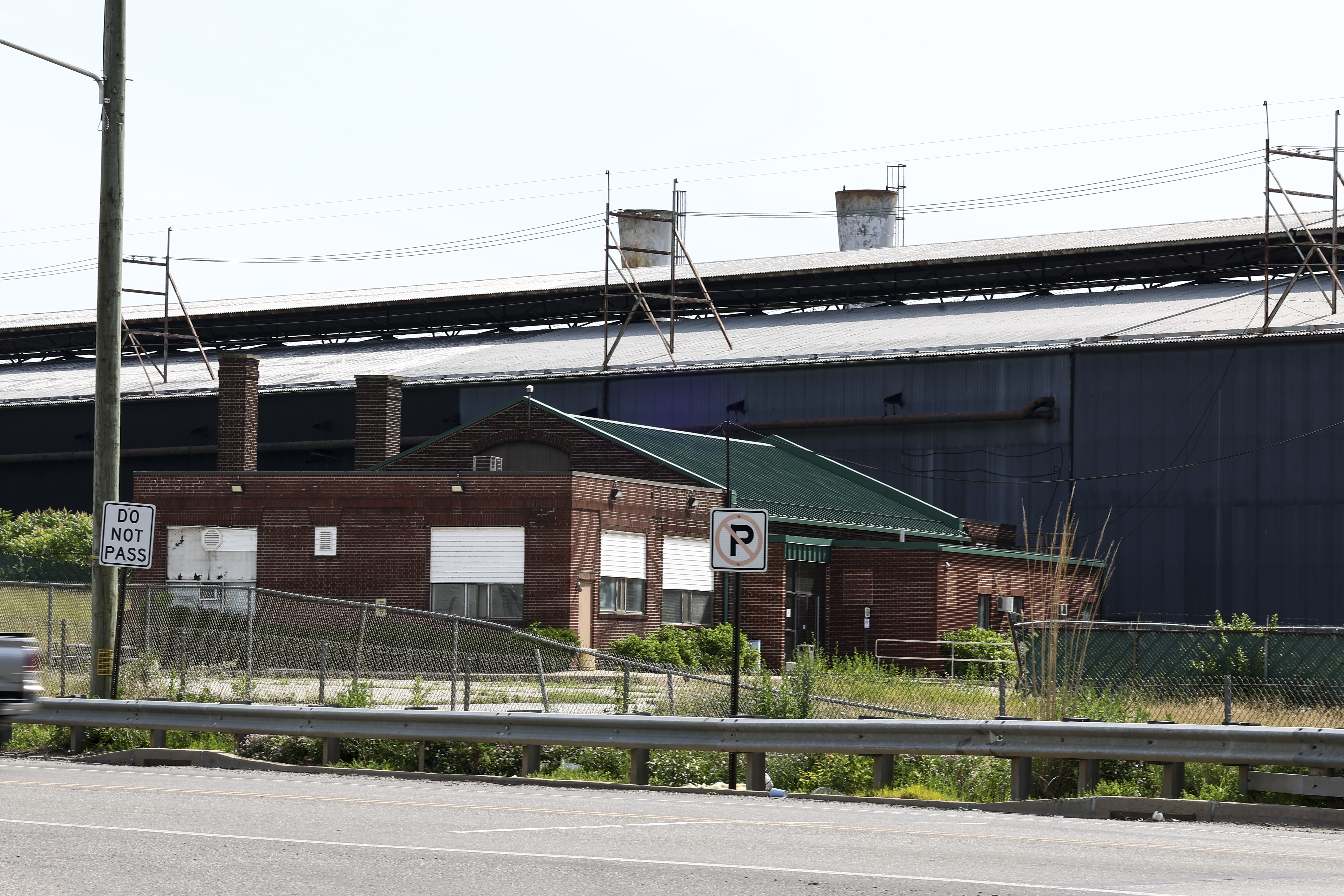
O’Neill wants to build a 2 million-square-foot data center at the shuttered Cleveland-Cliffs steel mill at 900 Conshohocken Rd., a 66-acre site along the Schuylkill. It would sprawl over 10 existing buildings as part of a reuse of a current industrial-zoned site.
O’Neill, who did not testify at Thursday night’s meeting, cited Alan Wood, who founded what became the now-closed Cleveland-Cliffs steel mill, as an example of a job creator. That’s the same site where O’Neill wants to build a data center.
And he noted John Ellwood Lee, who founded the nearby Lee Tire and Rubber Company, the site of which O’Neill has since developed into an office park. Both the steel mill and tire company once employed thousands.
O’Neill said he hoped to kick-start thousands of construction jobs.
“We’re bringing new technology to town, and we’re bringing it in a way that is sensitive to our neighbors and sensitive to the town,” he said.
The hyperscale AI data center just outside Conshohocken would generate $21.11 million a year in taxes, according to a report O’Neill commissioned by 4Ward Planning. And it would create 5,000 construction jobs a year over a three-year period, the report said. It would result in 371“direct data center jobs” and 468 “indirect and induced jobs,” according to the report.
But opponents of the plan are concerned about light, noise, and air pollution. They worry about emissions from on-site power generation that’s been proposed, water use, and the impact on electricity costs, as well as the proximityto existing homes.
O’Neill has said the facility would provide its own on-site electricity generation via natural gas-fired turbines. The operation, he has said, would be cooled by a closed-loop system that does not require outside water.
O’Neill said the facility would utilize “dark sky standards” to ensure there is not light pollution, with outdoor lighting“less than a single soccer field.”
He asserts that the proposed data center would not violate local noise ordinances and that his team has hired sound consultants.
O’Neill has not named an operator or tenant, but said he is “negotiating with multiple large tenants.” He has indicated those tenants would be related to life sciences.
(function(){function e(){window.addEventListener(`message`,function(e){if(e.data[`datawrapper-height`]!==void 0){var t=document.querySelectorAll(`iframe`);for(var n in e.data[`datawrapper-height`])for(var r=0,i;i=t[r];r++)if(i.contentWindow===e.source){var a=e.data[`datawrapper-height`][n]+`px`;i.style.height=a}}})}e()})();
Who decides whether to allow a data center?
O’Neill has applied for a special zoning exception so the data center can be built in the township’s heavy industrial zoning district. He argues that zoning should include data centers.
The township zoning code allows a warehouse or laboratory, but does not specifically cite data centers.
The township council has taken the position that a data center is not the same use as a warehouse. Theysaid O’Neill’s application for a special exception must be decided by the zoning hearing board.
If that exception is granted, the project would move onto the township’s land development process, which includes additional reviews, public meetings, and approvals.
Richard Roseberry, an engineer at Colliers Engineering & Design who O’Neillhired, testifiedduring Thursday’s zoning meeting that data centers fit in with other heavy industrial uses.
But Charles Campbell, an attorney representing nearby property owners, said O’Neill’s team has not supplied enough information to make informed decisions, including a drawing of what’s being proposed.
“It’s clear as day that this application is insufficient,” Campbell said. “It does not include what the applicant intends to put on the property. It talks generally about a data center … but does not provide a scale plan as required.”
What does O’Neill say?
Under Pennsylvania law, O’Neill argues,municipalities must have zoning for all legitimate land uses, and data centers have been recognized by the courts as a legitimate commercial or industrial use. Developers have, as a result, targeted industrial or commercial zones for data center proposals.
A municipality cannot ban data centers under Pennsylvania law. As a result, many municipalities have raced to craft ordinances to limit their impacts.
But municipalities are allowed to treat a land use not specifically mentioned in a zoning ordinance as a special exception or conditional use. That requires a developer to go through a zoning hearing board.
If a municipality refuses to classify data centers as a legitimate use, a developer can file what’s known as a “substantive validity challenge,” which O’Neill says he has done because some township officials are on record as saying they don’t support his application.
“If they don’t work with us in good faith, we’re going to get it by right,” O’Neill said.
Sander, the zoning hearingboard solicitor, ended Thursday’shearing without setting a date for the next, saying it would likely continue in September.
This story has been updated to say that developer Brian O’Neill did not testify at the meeting, and clarified the estimated number of jobs that would be associated with the data center.
A federal judge in Camden approved settlements with DuPont and 3M that will pay New Jersey up to $2.5 billion over the next quarter century to remediate damages from decades of manufacturing and use of PFAS chemicals in the state.
The order Friday by Renée Marie Bumb, chief U.S. district judge for New Jersey, ends a legal battle over so-called forever chemicals that started in 2019 and resulted in agreements last year that survived objections by counties, municipalities, and others over the settlement’s structure.
“This is truly a historic moment for New Jersey, which has experienced disproportionate and extensive pollution impacts from decades of PFAS manufacturing and use by DuPont and 3M,” Ed Potosnak, acting commissioner of the New Jersey Department of Environmental Protection, said in a news release.
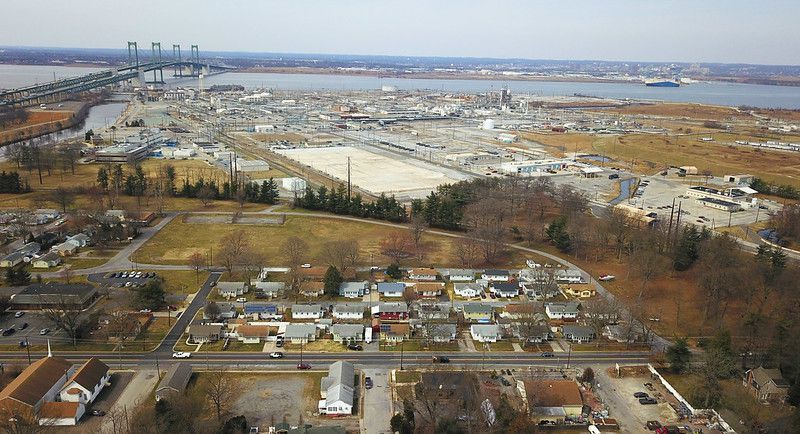
The DuPont portion of the settlement covers two South Jersey manufacturing sites: Chambers Works in Pennsville and Carney’s Point, Salem County, and Repauno Works in Greenwich Township, Gloucester County. Two additional DuPont locations covered by the settlement are in Middlesex and Passaic Counties.
3M did not manufacture per- and polyfluoroalkyl chemicals in New Jersey, but it sold a significant share of the firefighting foam that contained PFAS. It was used in military facilities, firefighter training academies, state government, and local fire departments across the state, according to state officials.
Neither DuPont nor 3M responded to emails requesting comment Saturday.
The approved agreements call for annual payments over 25 years. 3M will pay a total of $400 million to $450 million and DuPont and related companies will pay a total of $875 million into funds used to restore natural resources and abate damage to drinking water systems, according to Bumb.
The DuPont entities are responsible for additional remediation commitments worth $1.2 billion, Bumb said.
PFAS have been manufactured in the United States since the 1940s to make household, consumer, and industrial products. The World Health Organization in 2023 classified them as likely carcinogens. Health experts have associated them with high cholesterol, developmental issues in fetuses, and other health problems.
Inside the Graham Athletics and Wellness Center at Penn Charter, 76ers guard Tyrese Maxey leaned forward, staring at a painting gifted to him by 33-year-old Florida native Brett Marron, also known as 1uv1bmarron on social media.
“I got to get a picture of this,” Maxey said.
“This is for you,” Marron said.
“I definitely got some wall space to fill,” Maxey responded.
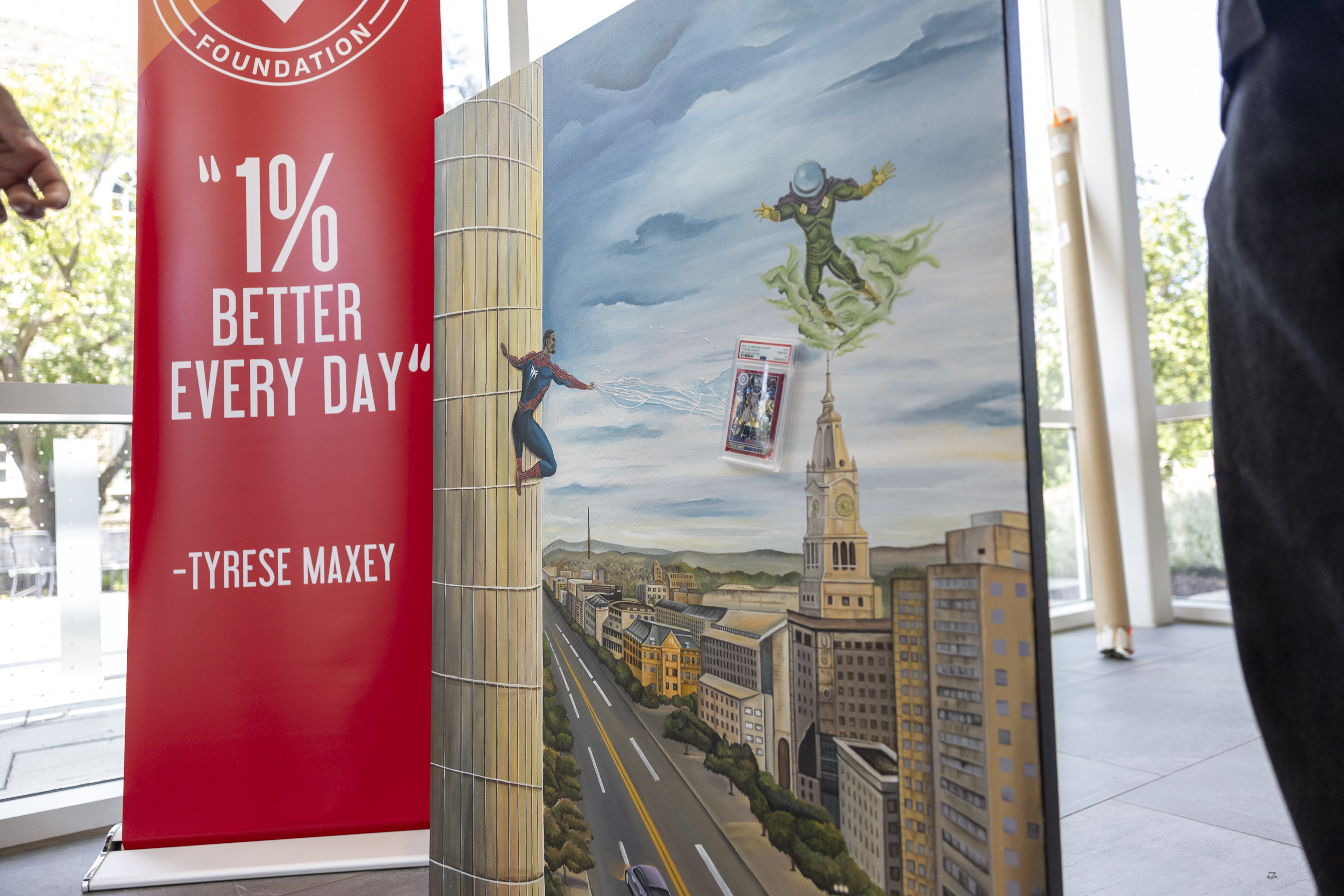
The painting by Los Angeles-based artist Savvy featured Maxey in a red, white, and blue uniform. But it was unlike his typical Sixers jersey. Instead, the two-time All-Star was dressed in a Spider-Man suit climbing on a Philadelphia skyscraper, battling his enemy, Mysterio.
With one hand holding onto the building, the other shot web at the villain — but at the end of the web was a special collectible professional sports authenticator slab taped onto the canvas that featured the same design.
Artist Brett Marron, also known as 1uv1, gifted Tyrese Maxey Spider-Man inspired artwork pic.twitter.com/y6LSLHsBTd
“When I started my brand, I was just on Maxey’s page and I saw that he was a die-hard Spider-Man fan,” Marron said. “So, when I saw that … I just had this inspiration where it would be cool to have him as Spider-Man shooting the web at his PSA slab.
“And once I had the idea, I didn’t even know that I was going to get the piece to Maxey. I was just confident that he loved Marvel, I knew the piece would be dope and I just made it happen.”
Maxey has seen Spider-Man: Brand New Day twice, and it has only been out for a little over a week.
“I loved it, man,” he said. “I went to the premiere, that was amazing, and watched it again — I forget when I watched it, but I watched it again, and it was just really good. I think the biggest thing for me was they brought him back down to a street-level character. We love seeing Spider-Man in space and fighting Thanos and stuff like that. But it was really cool to see The Punisher and Hulk and then Jean Grey. That was all really cool, and I enjoyed it.”
Marron didn’t initially have plans to actually get the piece to Maxey, but one of his followers reached out to help. He had known Maxey’s uncle and business manager, Brandon McKay, since high school and reached out about arranging a time to give Maxey the art.
”We tried to catch him at the end of the season, but it didn’t work out, and we just sat on the piece for a few months until this came up, and we made it happen,” Marron said.
Marron has been building his brand, 1uv1, for the last six months. It focuses on making art that gives sports card collectors a way to display those cards through fine art. So with every card made, there’s a painting on canvas to go along with it.
Marron has gifted his art to several athletes, including Sixers legend Allen Iverson, Eagles defensive tackle Jalen Carter, and Las Vegas Raiders defensive end Maxx Crosby.
”My brand, 1uv1, is big on just gifting art to different GOATs out there,” Marron said. “Just go from city to city just blessing them with a piece for the man cave.”
Marron also gifted Maxey a portrait of him and LeBron James that was painted by Philly artist Bill Strobel.
Lane Johnson is considering retiring following the 2026 season, the five-time All-Pro right tackle said Saturday.
“As you get older, things change in your life,” Johnson said at a news conference. “Priorities. Your children get older, parents get older. It puts things in perspective. So it’s looking like, potentially, this is probably going to be my last year. I am getting to that point where priorities away from football are starting to merge.”
Johnson, 36, is entering his 14th NFL season, all with the Eagles. He cited his parents’ health issues as one of the reasons for his announcement. He was a key member of the Eagles’ Super Bowl championship teams in the 2017 and 2024 seasons. He has earned six Pro Bowl selections and five All-Pro honors, including first-team citations in 2017 and 2022.
Johnson was excused from four days of practice earlier this week because of a personal matter. He returned to practice Friday morning, albeit in a limited role.
Johnson is part of an offensive line that is adjusting to a new scheme under first-year coordinator Sean Mannion and a new position coach in Chris Kuper, who succeeded longtime coach Jeff Stoutland.
“Not that I don’t enjoy it,” Johnson said. “I love this game and preparing for it, but that’s kind of where I’m at in my career. I’m looking forward to this year playing the best I can and stay healthy.”
Johnson said his decision is a motivating factor toward another All-Pro honor. He said he feels slighted when he reads NFL offensive lineman rankings and doesn’t see his name.
“I still feel like I can be a premier tackle in this league,” Johnson said. “I’m here, my team supported me, and I’m where I need to be.”
In Johnson’s absence this week, 2026 third-round pick Markel Bell took the bulk of the first-team right tackle reps. Johnson praised the 6-foot-9, 346-pound Bell on Saturday.
“He’s one of the best rookies I’ve been around,” Johnson said.
Johnson posted four straight All-Pro seasons from 2021 to 2024, but was limited to 10 games in 2025 because of a Lisfranc foot injury suffered in Week 11 vs. the Detroit Lions. He also missed the Eagles’ wild-card loss to the San Francisco 49ers. Fred Johnson replaced him during that stretch.
Luxury homes in the Philadelphia area sold faster this spring than the overall market’s already fast pace, even as the minimum price to be considered a luxury sale hit a record high.
Strong demand for luxury homes is outpacing supply in the Philadelphia metropolitan area, which is helping boost prices.
The multiple listing service Bright MLS defines luxury homes as those sold for prices in the top 5% of the market. In the Philadelphia area this spring, that meant homes that sold for at least $1.15 million. Thatprice is 7.5% higher than at the same time last year, according to Bright MLS.
(function(){function e(){window.addEventListener(`message`,function(e){if(e.data[`datawrapper-height`]!==void 0){var t=document.querySelectorAll(`iframe`);for(var n in e.data[`datawrapper-height`])for(var r=0,i;i=t[r];r++)if(i.contentWindow===e.source){var a=e.data[`datawrapper-height`][n]+`px`;i.style.height=a}}})}e()})();
An ‘accelerating’ luxury market
In the Philadelphia region, the luxury market is “accelerating,” with homes selling quickly, said Lisa Sturtevant, chief economist at Bright MLS. In the second quarter of the year, half of the luxury homes for sale in the region sold in six days or less, compared to 11 days or less for homes overall.
Across the Mid-Atlantic, one-third of luxury homes sold this spring were paid for with cash. The Philadelphia area had a higher share of all-cash luxury sales — 42%. In comparison, 24% of all spring home sales in the Philadelphia region were cash sales.
Sturtevant predicts that the luxury market will continue to be more active than the rest of the market for the second half of 2026.
Main Line community and Shore town are among top luxury zip codes
Two local zip codes ranked in the 10 areas in the Mid-Atlantic with the highest shares of luxury home sales this spring, according to Bright MLS.
In the Wayne area’s 19087 zip code, 37 of 88 home sales classified as luxury sales — roughly two in five sales.
Down the Shore in Long Beach Island’s 08008 zip code, 34 of 36 home sales were luxury sales.
Demand for luxury
Luxury home buyers are less deterred by elevated mortgage interest rates and rising prices than entry-level and mid-market buyers. And gains in the stock market have helped boost luxury buyers’ purchasing power and demand for homes.
The number of new pending luxury sales rose in the second quarter of the year in the Philadelphia region. They were up roughly 9% from the same time last year to a total of 1,056.
More luxury homeowners in the Philadelphia area listed their homes for sale in the second quarter of the year than during the same time last year. The number of new luxury listings — 1,647 — increased by about 4%.
But the Philadelphia region doesn’t have enough luxury homes for sale to meet the demand from buyers. The number of active luxury listings — 1,102 — was down almost 5% at the end of the second quarter compared to the same time last year.
The number of closed luxury sales this spring — 889 — was relatively flat from the same time last year. Sales ticked up 0.5%.
The number of sales would be higher if more luxury homes were on the market, Sturtevant said.
“Unlike the entry-level and mid-market homeowners, luxury homeowners are not as likely to need to move in response to changing family or financial circumstances,” she said in a statement. “And right now, luxury homeowners, by and large, are not exercising their discretion to sell.”
A stalled market for starter homes
While luxury homes sold quickly and at a premium this spring, at the other end of the housing market, starter homes lingered.
In June, the number of starter homes for sale in the Philadelphia area was up 14% from the same time last year, according to an analysis by Zillow. And sellers cut prices in a quarter of these listings that month.
The number of starter homes sold in May was down almost 7% from the year before.
Zillow considers starter homes to be those in the 5th to 35th percentile of home values.
Buyers of these homes have more choices than last year, since supply is up, said Kara Ng, senior economist at Zillow. But these buyers are also facing “financial pressures” that make saving for a down payment and taking advantage of opportunities more difficult.
I’ll never forget how deeply the wildfires in Australia during the 2019-2020 “Black Summer” affected my son, Nick. Scientists estimate that nearly three billion more-than-human relatives (also known as animals) were killed or displaced. Incomprehensible devastation.
The 2019-2020 Australian bushfire season, known as the “Black Summer,” had catastrophic environmental impacts — with more than 59 million acres burned, three billion animals killed or displaced, and smoke impacting weather conditions on other continents. In the photo, fire burns near Bumbalong, south of the Australian capital of Canberra, in February 2020. Rick Rycroft
We ordered T-shirts to support the recovery effort. The image was an outline of Australia, one edge consumed by flames, its interior filled with the country’s beloved wildlife.
Nick and I had no firsthand experience with wildfires, living in this area, but for many people, fire season is an inescapable reality that evokes fear and demands respect and attention.
I learned about wildfires while living in Montana. I moved there for graduate school, where many classmates studied fire science. I stared at the constant helicopters flying over Hellgate Canyon, where I lived, on their way to do aerial water drops into burning areas.
An aircraft dumps water on the edge of the Elmo Fire burning on the western shore of Flathead Lake, Mont., in August 2022.Hunter D'Antuono / AP
I remember the smell. The thick air. Wondering what the inside of my lungs looked like.
Fire was simply part of everyday conversation. People knew the weather, fuel conditions, evacuation routes, and the difference between a prescribed burn and a wildfire. I realized how privileged I had been never to need that knowledge.
Last year, I had the honor to sit in a circle in Lubrecht Experimental Forest with an elder of the Confederated Salish and Kootenai Tribe, from the Flathead Reservation, who told my class about his tribe’s traditional fire practices. He explained that prevention is the key, something Indigenous peoples have known since time immemorial.
Sadly, Indigenous fire management was a casualty of colonialism. Their knowledge was forced underground, and generations of fire stewardship were interrupted just as landscapes became increasingly vulnerable to catastrophic fire.
It is well known in climate science that those who do the least damage to Mother Earth suffer the effects of climate change the most. The scientific consensus is clear that climate change is lengthening fire seasons and increasing the conditions that produce larger and more severe wildfires. The threat is real, and it is reaching places that once believed themselves safely outside fire country.
Which is why the recent political response to the Canadian wildfires is so baffling. Rather than asking how two neighboring countries can confront a shared ecological crisis, President Donald Trump threatened to impose tariffs on Canada over wildfire smoke. As if punishment were an effective response to an ecological crisis.
Not only is this an abominably foolish threat, but it created a scapegoat in a time of great fear.
Ontario’s premier, Doug Ford, responded to the president’s threats by saying that those who share Trump’s opinion that Canada has been “willfully negligent … have a very short memory.”
I remember sitting in school on 9/11 and hearing that first responders from Canada were headed to New York City. Many diverted international flights landed in Atlantic Canada, while the small town of Gander welcomed nearly 7,000 stranded passengers — almost doubling the town’s population. Newfoundlanders welcomed passengers with open arms, rooms, and cupboards.
And while conducting research in Nova Scotia last fall, I learned about the Halifax Explosion of 1917, which killed almost 2,000 people and injured approximately 9,000. Boston was the first to respond, and Nova Scotia has been sending a Christmas tree to Boston as a token of thanks since 1971.
Learning about all of this propelled me to seek out more examples of cooperation between our northern and southern borders. Read enough of these stories, and nationalism masquerading as patriotism begins to dissolve.
We must seek out what unites us as North Americans and acknowledge our shared history, good and bad, to move through an ever-worsening climate crisis that will require all of us to work together if we wish our future generations to survive.
Maybe all you can do now is buy a T-shirt, like Nick and I did in 2019. Maybe you can start that conversation. Maybe you can volunteer. No act is too small. Make no mistake — you have a dog in this fight. When your neighbor is in trouble, regardless of the effect on you, pitch in.
Nick understood this instinctively. He didn’t know fire science. He simply saw suffering and wanted to help. In an age of climate change, that childlike impulse — to care before we condemn — may be exactly what survival requires.
Natural disasters don’t recognize borders. Neither should our compassion.
Meredith Elizalde is Nick’s mom. A former Philadelphia high school teacher, she is currently a graduate student at the University of Montana.
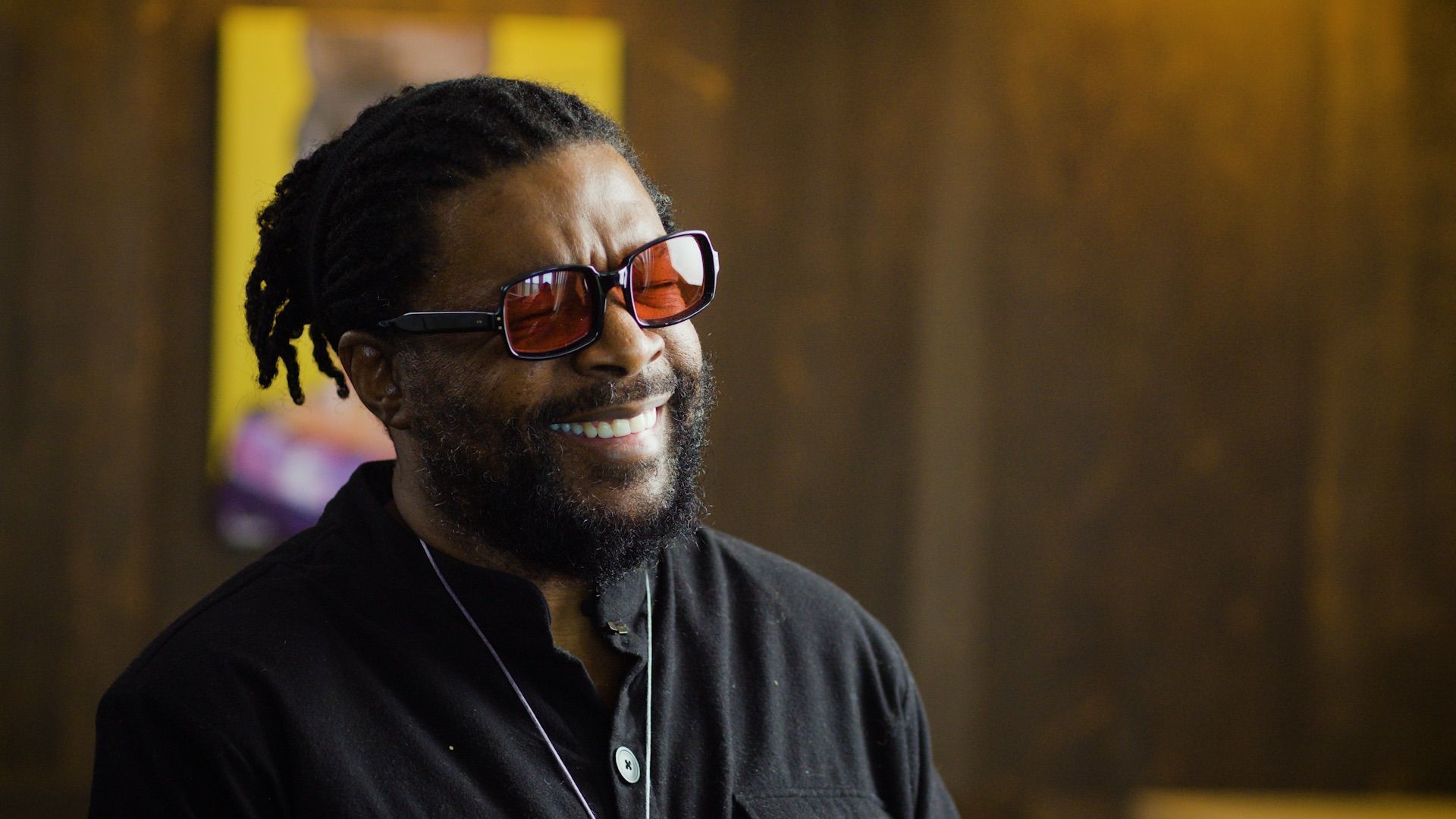
An educator who has been a behind-the-scenes mentor to many of Philadelphia’s most prominent musicians, gets his just due in a new film premiering at the BlackStar Film Festival this weekend.
The list of Hines’ mentees include highly regarded Philly musicians, such as Christian McBride, Immanuel Wilkins, Justin Faulkner, Bilal Oliver, Derrick Hodge, the late Joey DeFrancesco, and Ahmir “Questlove” Thompson of The Roots, who is Morelli’s brother.
The film begins with a poem, written and soothingly spoken by Morelli.
“Flower and seed, orchard from tree / Like a stream of golden sun and urban sky you shined through … the Philadelphia Sensei is Lovett Hines.”
Many of the most prominent mentees of Hines, 83, who also taught at the Settlement Music School, give testimonials in the short documentary, praising him for his loving way of nurturing talent, rather than acting like a disciplinarian obsessed with technique.
“The first thing is, he finds your strength,” Roots drummer Questlove says in the film. “He describes the importance of listening and absorbing. Really, he was just super encouraging.”
Ahmir “Questlove” Thompson in “Philadelphia Sensei: Lovett Hines.” Donn Thompson Morelli / Philadelphia Sensei
“I always think of him as the most perfectly balanced teacher that I’ve ever had in music,” says McBride, bassist and host of NPR’s Jazz Night in America. “He always gave us room to make our own mistakes. He never said, ‘You have to do it this way, you must do it the way it says on the paper.’ He would let us find our own personality.”
When McBride attended South Philly High School for the Creative and Performing Arts in the late 1980s in an illustrious period when DeFrancesco, The Roots, and Boyz II Men were also students. When he was starting out, McBride realized he needed to follow the path of Philly heroes like McCoy Tyner and Benny Golson and move to New York to make a name for himself.
“Mr. Hines was like, ‘Cool, you wanna go to New York. Let’s make sure you have what you need, so when you go to the Big Apple you’ll be straight.’”
In the film, Hines talks about growing up in North Philly, and how he learned from his mother, who was a community builder who encouraged appreciation of the arts and history. She often gathered up neighborhood children on weekends and took them to the Philadelphia Museum of Art or Independence Hall.
His family worshipped at the United House of Prayer for All People near 12th and Poplar Streets.
“Of course, it had music,” Hines, an alto saxophonist who also plays bass clarinet and piano, tells Morelli. “They had the piano player, they had the choir. But they also had the band. And that was my first introduction to instrumental music.”
Christian McBride in “Philadelphia Sensei: Lovett Hines,” which premiered Sunday at the BlackStar Film Festival.Donn Thompson Morelli / Philadelphia Sensei
On a mild April day, 12-year-old Sam Okyere reviewed his wish list with his mom during their drive to the Make-A-Wish Foundation’s Bala Cynwyd office.
First choice: Legoland andDisney World.
Second choice: meeting Eagles Jalen Hurts and Saquon Barkley.
Third choice: hanging out with Philly rapper Lil Uzi Vert.
But when Sam, his mom, and two members of the Make-A-Wish crew squeezed into the office’s tiny Lego-themed room for the official discussion, something different flashed to mind.
“I want to help the homeless,” Sam told them.
Sam has sickle cell disease.He’s endured a lifetime in and out of hematologists’ offices, white-knuckling through blood transfusions and bursting into hospitals when “pain crises,” agonizing sensations caused by disruption in the blood flow, tore through his body. This was his chance to do one completely selfish thing, and he chose to be selfless.
“Are you sure this is what you want to do?” Maude Gambrah, Sam’s mom, asked as she started the car to drive them home to Drexel Hill. She knew Sam had a soft spot for homeless people. He was always encouraging her to give money to panhandlers around Philly. But this was his only wish.
“Yeah, Mommy,” he responded. “This is what I want to do.”
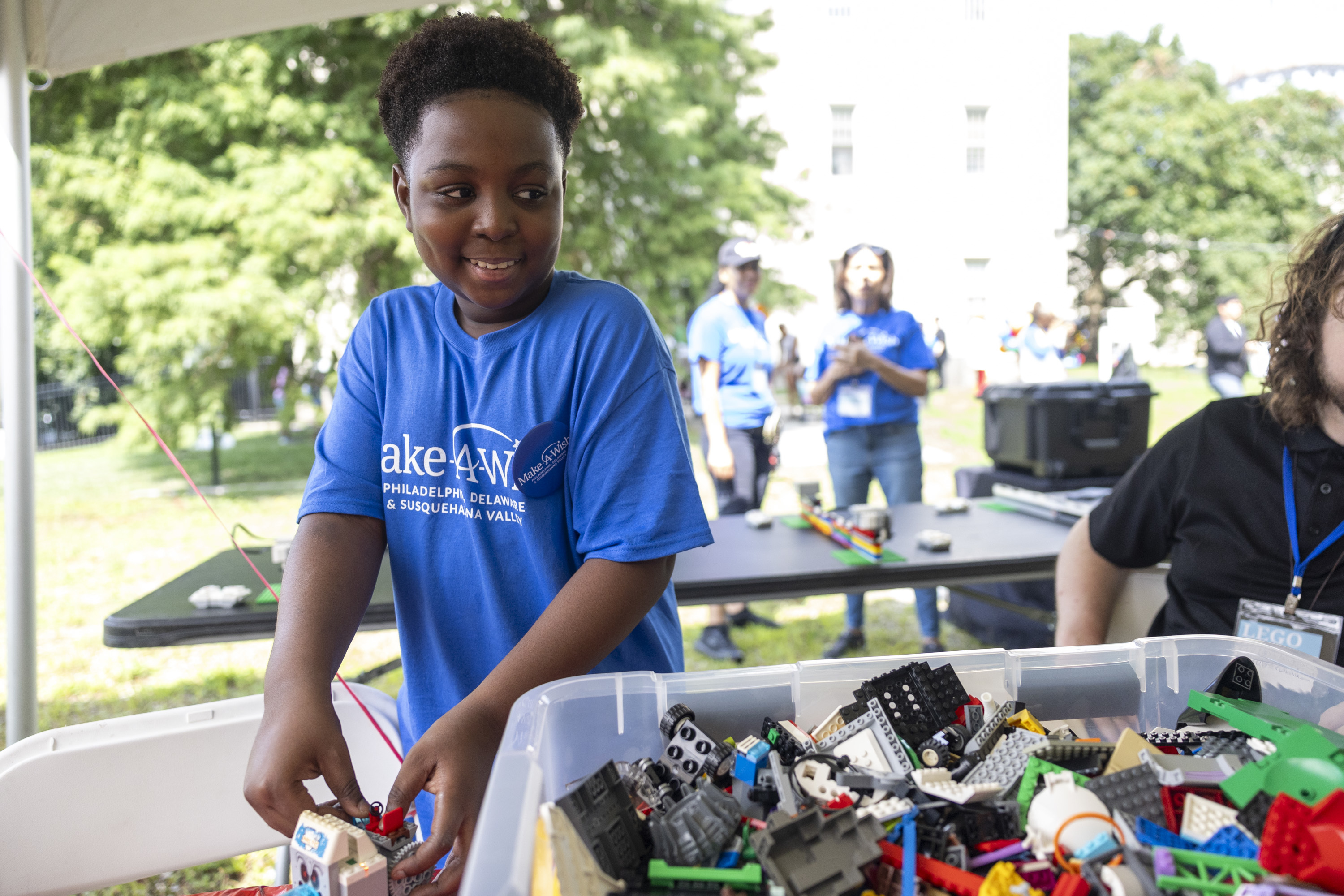
Make-A-Wish settled on Families Forward Philadelphia, a homeless shelter in West Philly, as the recipient of Sam’s wish and hosted a monthlong donation drive for the facility leading up to “Sam’s Perfect Day” last month. The carnival-style extravaganza on the shelter’s front lawn, attended by dozens of families experiencing homelessness as well as Sam and his family, featured Lego displays, a petting zoo, a Lego-inspired bounce castle, and water ice provided by Sam’s family’s Southwest Philly water ice business, Willkay’s.
Making a wish a reality
Word of the wish quickly spread around the office of Make-A-Wish Philadelphia, Delaware, & Susquehanna Valley following the April meeting. Anika Goyal, one of the staffersresponsible for carrying out wishes, knew this one had to be hers.
The chapter, which grants about 335 wishes a year, regularly fulfills shopping sprees, vacations to Disney World, and room makeovers, but it rarely gets one like Sam’s, Goyal said.
So Goyal got to work. Sam emphasized that helping homeless children, specifically, was important to him, so Goyal selected Families Forward as the beneficiary shelter because it emphasizes keeping families intact during their stays.
She reached out to small businesses and nonprofits — as many as she could find that also had Make-A-Wish connections. Oshun Family Center, which Goyal asked to host a table on Black maternal health and to distribute childcare kits, was founded by a mom of a Make-A-Wish recipient. Jam-Rock Kitchen, a local Jamaican restaurant owned by another Make-A-Wish family, slathered up their jerk chicken and spiced up their rice and peas for the big day.
Goyal also looped in staff at the King of Prussia Lego store, a former contestant on the reality TV competition series LEGO Masters, and Swoop, the Philadelphia Eagles mascot, to make the event quintessentially Sam.
Alana Deluca, manager at King of Prussia’s Lego store, talks to Sam Okyere, 12, during his Make-A-Wish donation drive and block party.Tyger Williams / Staff Photographer
“It’s not about him,” Goyal said. “But it is about him.”
As Goyal and the Make-A-Wish team prepared the logistics, Sam contended with a life-altering decision. Sickle cell can be treated through a bone marrow transplant. The ideal donor is a sibling who is a match. Will Okyere, Sam’s 25-year-old brother, was. So Sam and his family scheduled a transplant for the end of August. The process starts with chemotherapy and ends with in-home isolation for several months, requiring Sam to miss most of his seventh-grade year with his friends.
“It’s a bummer,” Sam said. “But, it’s like, anything to get me better.”
“I just want to get sickle cell over and done with,” he added.
Sam Okyere, 12, hanging out with his friend Mosiah Saddick, 12, during Sam’s Perfect Day at Families Forward Philadelphia homeless shelter.Tyger Williams / Staff Photographer
While sickle cell disease is not inherently fatal, it can increase the risk of life-threatening infections, acute chest syndrome, stroke, and chronic organ damage, particularly without medications or interventions such as a bone marrow transplant or gene therapy.
Cynthia Norris, Sam’s attending hematologist at Children’s Hospital of Philadelphia, who referred Sam for the wish, said he stood out among all her eligible patients because he has the most severe variation of the disease and has had a number of complications. His grace and thoughtfulness, she said, also set him apart.
“He’s just a very special young man,” Norris said. “He has so much empathy.”
Sam Okyere, 12, with his dad Akwasi Okyere, Delaware Blue Coats mascot Coaty, and Philadelphia Eagles mascot Swoop during Sam’s Perfect Day Make-A-Wish donation drive and block party at Families Forward Philadelphia homeless shelter.Tyger Williams / Staff Photographer
Living out a perfect day
After months of waiting and preparation, Sam’s Perfect Day finally arrived.
Shiny new yellow, red, and blue soccer balls and Hula-Hoops lined the main hall of the Families Forward office building. Tubs along the mirroring wall brimmed with sunscreen bottles, toothbrushes, and soap. A giant poster sandwiched in the middle bore Sam’s likeness in Lego form — tiny Afro and all.
Some of the donations for Sam Okyere’s Perfect Day Make-A-Wish donation drive and block party.Tyger Williams / Staff Photographer
Families Forward could never have afforded this bounty on its own, said Jessica Main, the nonprofit’s chief development officer. Grant money the shelter receives is often tied to specific types of services like mental health and education. Its budget for toys and recreational materials is around $3,000 annually, Main estimated. That would probably barely cover the glimmering new basketball hoop and sports equipment Sam’s donation drive brought in.
Sam Okyere, 12, with his sister, Kayla, at the petting zoo during his Make-A-Wish donation drive and block party at Families Forward Philadelphia homeless shelter.Tyger Williams / Staff Photographer
Sam nestled into a blue canvas chair in the petting zoo as two goats nibbled food out of Dixie cups he held in each hand.
“I’m naming this one Ashton,” Sam announced to no one in particular, looking at a brown and white goat.
“Food! Anybody want food,” he shouted to the tiny goats (one wearing a feathered bowler hat), bunnies, and one black pig that dragged its rotund paunch on the ground wherever it went.
Sam Okyere, 12, is holding Penelope the pig at the petting zoo during his Make-A-Wish donation drive and block party at Families Forward Philadelphia homeless shelter in Philadelphia, Pa., on Wednesday, July 29, 2026.Tyger Williams / Staff Photographer
“Zane, Kai, Lloyd,” he said, pointing at two goats and then the pig, naming all after characters on his favorite show Ninjago, which the uninitiated will be unsurprised to learn is a show about Legos.
Soon a 3-year-old named Saga, wearing a white dress smattered with images of heart-shaped lollipops, entered the petting zoo enclosure, mouth agape as she stood eye-to-eye with the recently named Ashton the goat and gently patted the silver nubs on either side of its bony head. This was her first experience with farm animals.
Her mother, Quechera Jowers, 32, followed closely. The pair have lived at the shelter for about four months.
“I’m not going to lie, it’s a little nostalgic,” Jowers said, taking in the carnival sights as they waited in line for cotton candy, which, based on crystallized red formations encrusted around Saga’s mouth, it appeared she’d already indulged in.
Throughout the afternoon, gleaming toddler cheeks transformed into butterfly wings, kitten whiskers, and dragon scales with face paint. Pink and purple beads were strung into friendship bracelets, and technicolor swimsuits (each child got one through Sam’s donation drive) grew soaked from a sprinkler raining down on the kids as they descended an inflatable slide adjoined to the bounce castle. Navigating the pipe system of the old converted asylum-turned-shelter facility was the challenge of the morning, Main said.
Beyoncé blared from a portable DJ booth, chubby fingers grasped balloons on strings and absentmindedly released them into the stratosphere, and a topless toddler with wild curls boogied near the mouth of a bubble machine, a diaper band peeking out from his khaki shorts.
Sam Okyere, 12, is trying out the DJ set with Nashirah Felder, of Fishtown, during his Perfect Day Make-A-Wish donation drive and block party at Families Forward Philadelphia homeless shelter in Philadelphia, Pa., on Wednesday, July 29, 2026.Tyger Williams / Staff Photographer
Sam, meanwhile, alternated between the Lego games, petting zoo, and basketball station.
After discreetly lowering his game controller in the middle of a Lego joust, allowing a friend to overtake his spacecraft and win the game, Sam sauntered over to the goats situated in a kennel in the back of a truck to bid them farewell.
Sam Okyere, 12, plays against Corey Samuels, 41, of Princeton, N.J., a LEGO Masters winner, during his Make-A-Wish donation drive and block party at Families Forward Philadelphia homeless shelter in Philadelphia, Pa., on Wednesday, July 29, 2026.Tyger Williams / Staff Photographer
“I don’t want them to leave,” he mused as he delicately scratched a tan one on the chin and, with an understated graciousness rare to find in adults, let alone children, allowed the petting zoo staff to take them away.
As the afternoon drew to a close, Sam settled into a chair in the hallway full of donations and futzed with a small Lego vehicle. An event organizer informed him that the Lego store employees offered to gift him all the leftover toys. Sam politely declined and requested they instead be given to the kids at the shelter.
Asked in the final moments what could have made Sam’s Perfect Day more perfect, he contemplated.
Philadelphia’s chief paramedic said in a whistleblower lawsuit that he was stripped of his leadership position for sounding the alarm about allegations of favoritism in the city’s fire department.
Jason Centofanti, who joined Philadelphia’s emergency medical services in 2007, says fire department leadership punished him for escalating a report accusing a captain of being lenient with a subordinate who had failed to fill outrequired patient records because of a personal friendship.
Centofanti, who was elevated to the role of fire paramedic services chief last year, investigated and suspected the captain attempted to cover up the conduct by falsifying an official record. But when Centofanti elevated these concerns, the suit says, he was met with a brick wall and punished.
His plight made its way to the Philadelphia Office of the Inspector General and the fire commissioner, according to the complaint. Even though some higher-ups acknowledged the retaliatory nature of his transfer in conversation with Centofanti, the suit says, it was not enough to stop it.
The lawsuit, which was filed Wednesday in Common Pleas Court, accuses the city of violating whistleblower protections and asks a judge to order the city to end the retaliation against Centofanti, pay him for lost wages, and compensate him with more than $50,000 in damages.
A spokesperson for the city’s law department declined to comment on the active litigation. Amanda Martinez, Centofanti’s attorney, said in a statement that the lawsuit speaks for itself.
Centofanti launched an investigation in January shortly after a lieutenant complained to him about the captain’s favoritism, according to the complaint.
The lieutenant also accused the captain of harassment, but the lawsuit does not describe the nature of the allegation.
Centofanti discussed the allegation with the accused captain, and escalated a report to department leadership and human resources.
During the investigation, Centofanti came to believe that the captain had altered a document to cover up the alleged conduct, the lawsuit says.
“Plaintiff explicitly stated that he believed that [the captain] submitted a falsified document for an official PFD investigation,” according to the complaint.
The aftermath of the investigation was not what Centofanti expected.
Martin McCall, a deputy commissioner for EMS, moved the captain to a new building at her request “to shield her,” the suit says. McCall also informed Centofanti that due to “work performance” he was being transferred back to field duty, according to the complaint, despite the chief’s work having been rated “superior” and “satisfactory” in a recent performance evaluation.
McCall also moved the lieutenant to a new post because, the suit says, she made the accused captain “uncomfortable.”
“The two reporters of the wrongdoing … were being transferred to less desired positions and punished for speaking out,” the lawsuit says.
Centofanti went to the department’s top leaders and claims they were sympathetic. But that sympathy did not change his fate. An official whistleblower complaint with the city’s inspector general was not enough to reverse the transfer, either.
He was formally transferred out of EMS administration to a field assignment in May, the suit says. His office schedule was replaced with a field rotation that requires nights, weekends, and holidays, according to the complaint. Centofanti lost his office, staff, and car.
Coworkers have been taunting Centofanti since he returned to the field, the complaint says.
“When are you going to learn to shut your mouth,“ one captain texted him, according to the complaint. ”Enjoy your paycut.”