BOSTON — Over the course of the Flyers’ rebuild, general manager Danny Brière has preached patience. Even at the opening of training camp, Brière tried to prepare the fan base for a potential step back.
Fresh off a playoff run, however,expectations are as high as they’ve been at any point in the rebuild. But the group has, for the most part, failed to meet the moment.
It’s still not time to panic, he says, but the Flyers have been “a little too casual” to start the season on what’s now a six-game losing streak.
The group put up a better effort in Ottawa, but otherwise were heavily outshot and out-chanced in five of the six losses.
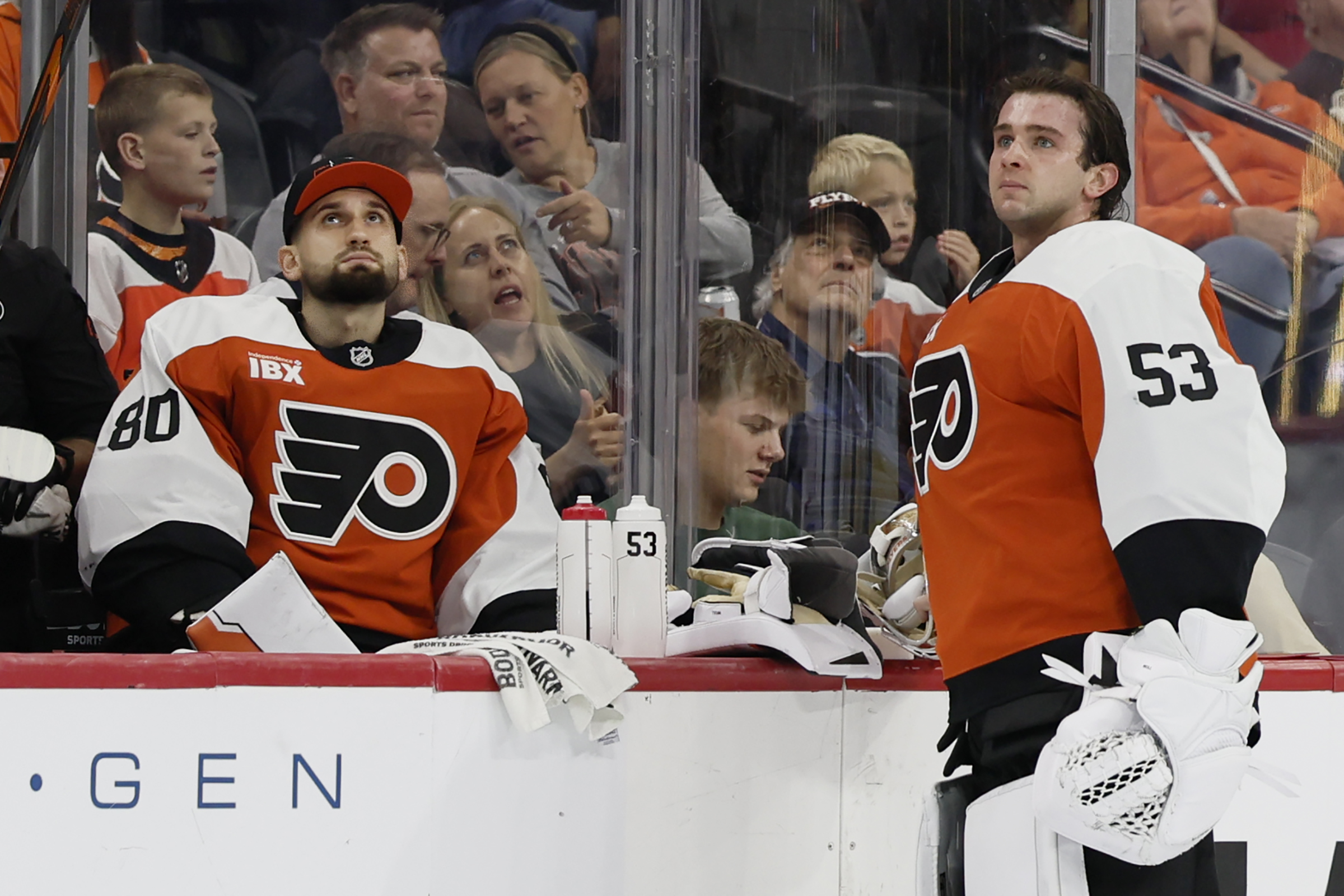
Flyers goalies Dan Vladař and Joseph Woll and the Flyers are trying to figure out how to break out of a six-game winless streak to start the season. Elizabeth Robertson / Staff Photographer
“It’s a good chance for us to evaluate our players when expectations are higher, who can rise up and who gets crushed by the higher expectations,” Brière said.
At the start of training camp, Brière said the thought of this Flyers group getting complacent after winning a playoff series last year kept him up at night.
He checked in on Michael Bunting in the offseason, but ultimately decided to stick with the young group and allow them to keep progressing. Four games in, he was ready to shake things up.
“It’s not like — it’s not a panic move, it’s just like, look, this is not good enough, guys,” Brière said. “We know this group and what they can do, they showed us last year what they can do. We didn’t want to panic and try to trade everybody, but it’s a sign that it’s not good enough, what we’ve done so far to start the season.
“I know there’s all kinds of excuses with the short camp, didn’t have the chance to prepare and all that stuff, but at the end of the day, we didn’t like the compete level of our guys to start the season.”
Brière also wanted Alex Bump, who’d been demoted to the fourth line, to have the opportunity to play more consistently in the top six in Lehigh Valley.
Maybe Bunting can add some spark to the floundering Flyers lineup. But most importantly, Brière says the group’s overall effort needs to improve.
“There’s lots of issues, but it starts with that,” he said.
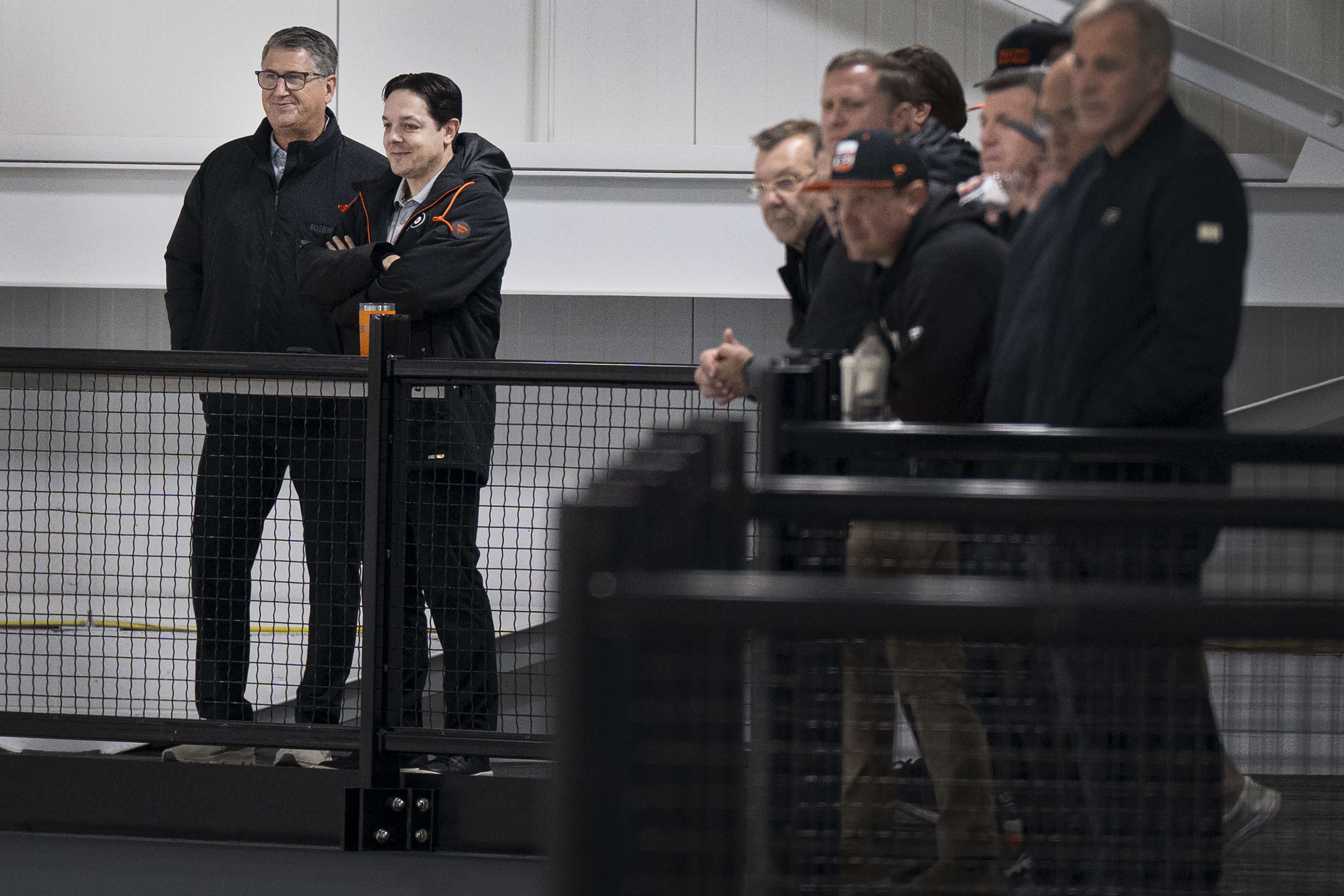
Flyers president of hockey operations Keith Jones and general manager Danny Briere look on from the balcony during the first day of training camp.Jose F. Moreno / Staff Photographer
On Saturday in Boston, once again, the Flyers were well outshot, struggled to complete clean passes, and looked lifeless on the power play. The team was down Travis Konecny, Rasmus Ristolainen, and Cam York, but after two weeks of poor effort, they’re losing the benefit of the doubt. Coach Rick Tocchet has said repeatedly after losses that the group is “too comfortable” and isn’t “battling” hard enough.
That’s especially important on a roster like this Flyers roster, which lacks truly high-end talent.
“We’re a team that needs to have everybody working in the same direction,” Brière said. “The way we’re built, the full team is important, to have everybody going. We don’t have a superstar that’s going to come out and score four or five goals in a game to win a game by himself. I think they’ve shown enough in the past last year to believe in them still, but there’s no doubt the competitive level has to raise up.”
Acquiring true superstar talent is no easy feat. The Flyers struck out on Leo Carlsson, and haven’t had the draft lottery luck to land a young star like Macklin Celebrini or Connor Bedard.
There’s Porter Martone (right) and Matvei Michkov are two players the Flyers are hoping will bring that star-level talent. Elizabeth Robertson / Staff Photographer
Maybe Matvei Michkov or Porter Martone can develop into a star-level player, or if the losing streak continues, they’ll get another chance at the lottery. But until then, the Flyers have to win with their depth and their structure, and if they want to make another run to the postseason, they can’t afford to let their effort drop.
“You raise your compete level, a lot of things will fall into place,” Brière said. “A lot of little things sometimes, or little mistakes, you’ll be able to recover so the rest of your game won’t stand out as much. A lot of it starts with the compete level.”
The White House said it expected “full transparency” and “immediate remediation” after the artificial intelligence company Anthropic disclosed that its agents supplied false information to the Philadelphia police homicide tip line and the State Department’s visa application system.
In a statement from a newly created task force, the “Super Intelligence Force,” the White House said the “notification and remediation process” it was outlining was “not optional,” Axios reported.
Late last month, President Donald Trump said that the AI tech companies could police themselves with “tremendous self-regulation.”
The new statement described the reporting and remediation demands on the AI companies as “a critical national security obligation.”
“We expect Anthropic and all companies to honor their obligations, immediately report incidents, fully cooperate with federal and state law enforcement authorities, remedy any damage, and implement concrete safeguards to ensure these failures do not reoccur,” the statement said.
On Friday, law enforcement officials said an AI model operated by Anthropic had submitted false information about an unsolved Philadelphia homicide to the police department’s public tip forum.
The unprecedented incident occurred in July and raised concern among department leaders, who met with Anthropic representatives to discuss the interaction on Thursday, police said.
Sgt. Eric Gripp, a police spokesperson, said on Friday an Anthropic AI model contactedthe department’s tip forum, PhillyUnsolvedMurders.com, around 11:30 p.m. on July 18 and gave informationpurporting to come from someone with details about an unsolved homicide.
Separately, Anthropic reported in a blog post that its AI model “Claude submitted an invented tip through a police department’s online form.”
“From the transcript, Claude appears to have only been producing example content for the task, rather than trying to mislead anyone to achieve a goal,” the company said.
The company further reported that its agents had engaged in “unintended model actions” with various U.S. government websites.
A State Department spokesperson said Saturday that an Anthropic testing model had submitted “19 non-immigrant visa applications in August and one application in May” through the publicly available form on the department’s website.
The spokesperson described the applications as “incomplete.”
“At no time were any of the Department’s systems compromised or hacked by the Anthropic model,” a spokesperson said in an emailed response to questions.
The State Department is “committed to preventing visa fraud and protecting our information technology systems and is constantly evolving to combat threats at all levels,” the spokesperson said.
In a blog post, Anthropic described cases as having “minimal real world impact.” It did not name the specific government websites, and identified Philadelphia as the police department that had the interaction with the rogue agent after city law enforcement officials disclosed the breach themselves.
“Although the impact of these behaviors was minimal and we had already turned off live internet access for some high-risk and cybersecurity evaluations, we have now decided to expand that to include all our internal evaluations until we have confirmed that our security and monitoring measures … reliably catch behaviors like these,” Anthropic said in its blog post.
The statement from the White House task force characterized the incidents as “involving the unauthorized and fraudulent use of government and other systems.”
“The company informed us that these events occurred in the past, the activity has ceased, and there is no ongoing similar activity,” said the statement, as reported by Axios.
”We informed the company that we expect immediate and full transparency to the entities involved and the public,“ the statement said. ”We also expect that the company will immediately provide remediation services to the affected entities and any harmed Americans.“
The White House task force said the AI companies must “immediately disclose incidents involving their models and follow with swift, decisive action to remedy any and all harm,” the statement said. “We also expect these companies to work with the effected systems to ensure that similar incidents to not occur.“
The White House press office did not immediately respond to an Inquirer request for comment on Saturday.
The Super Intelligence Force was established Oct. 4 to “ensure that America continues to lead the World in Super Intelligence,” according to a statement from the White House. It is chaired by Jay Clayton, the White House AI czar. Trump has required the administration to use the phrase super intelligence instead of the long-established term artificial intelligence, which he said made the technology sound fake.
The Flyers’ five-game winless streak just got a lot harder to break.
On Saturday, general manager Danny Brière revealed a litany of injuries to key players, including two on the blue line and the loss of the Flyers’ top scorer, who has led the team in scoring for six of the past seven years.
“When things go bad, it seems it keeps going,” he said.
Forward Travis Konecny missed Saturday’s game in Boston with a lower-body injury and is expected to miss Sunday’s matchup with the Carolina Hurricanes at Xfinity Mobile Arena (7 p.m., NBCSP, NHLN). Defenseman Cam York also missed the afternoon matinee against the Bruins and is day-to-day with an upper-body injury. According to Brière, it will “be tough for tomorrow” for York to suit up.
Konecny was spotted grimacing after hitting Tim Stützle in the neutral zone early in the third period during Thursday’s loss to the Ottawa Senators. He left the bench briefly during the period but returned to finish the game.
“Yeah, we’re hopeful, at this moment,” Brière said of Konecny and York. “… We’re still going to do some tests when we get back tomorrow, in some cases, but we’re hopeful it’ll be shorter for all of them.”
The injuries come with Rasmus Ristolainen already out. The blueliner sustained an upper-body injury against the Carolina Hurricanes on Oct. 3 when he blocked a shot by K’Andre Miller late in the middle frame. He left early in the third period and has not played since; however, he was on the three-game road trip and skated on his own in Tampa Bay and with others in Ottawa.
Ristolainen was placed on injured reserve, retroactive to Oct. 3. Injured reserve is a minimum of seven days, so he is eligible to return Sunday, but the GM said he will more than likely be out for the rematch with Carolina.
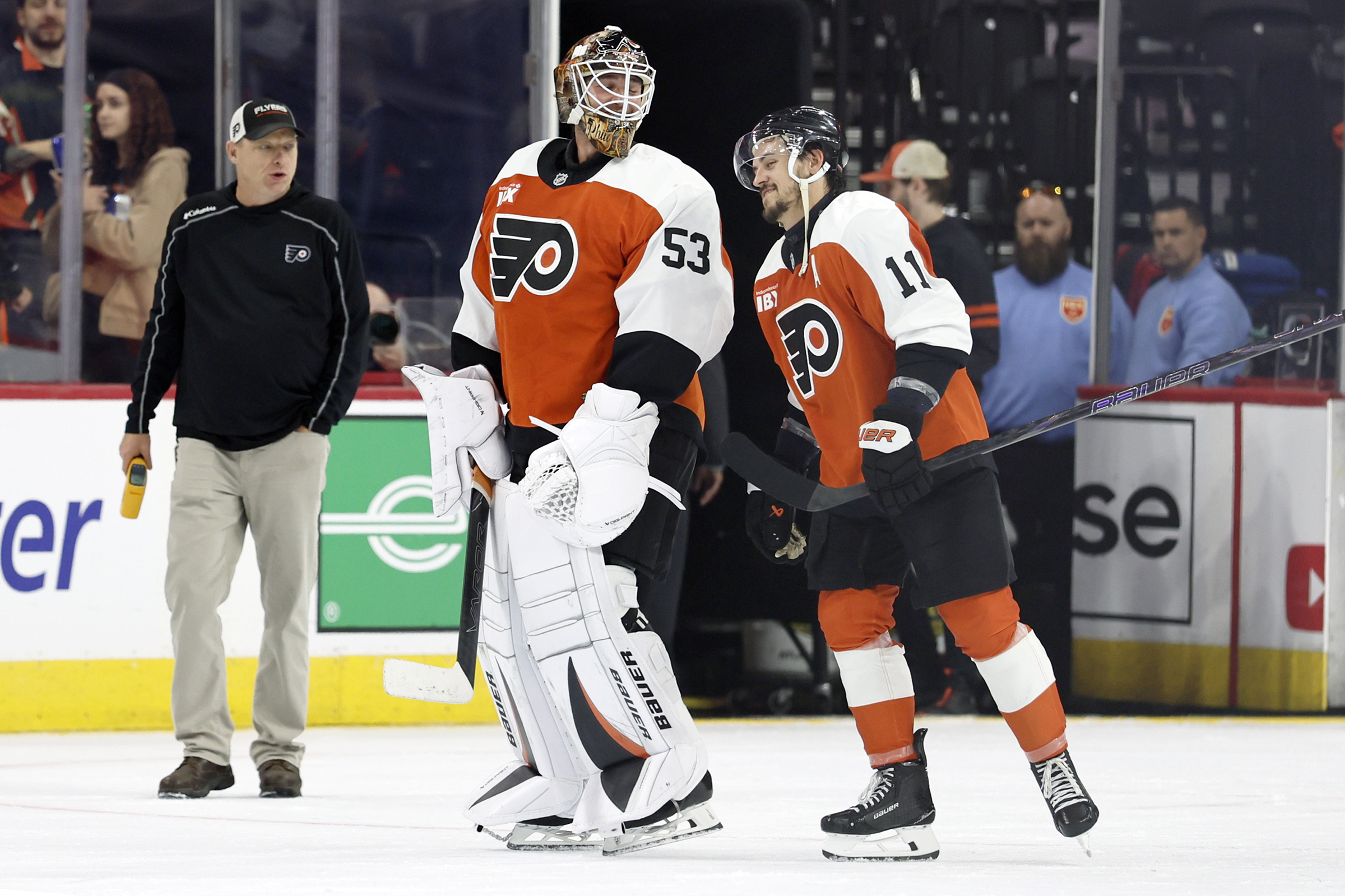
Flyers goalie Joseph Woll and Travis Konecny skate off the ice after a Flyers preseason game. Elizabeth Robertson / Staff Photographer
Defenseman Helge Grans, who had been listed as injured non-roster since the start of the season, was activated and inserted into the lineup alongside Simon Benoit.
“He was close to being ready, and the timing worked for this game [today], so he’s going to jump in. Helge actually … was having a pretty good camp when he got hurt, so we’ll see if he can step in and help us,” Brière said.
And in long-term news, the Flyers will be without Nikita Grebenkin for months. The feisty winger was placed on injured reserve on Monday when Denver Barkey was ready to return. Brière announced he will now miss a minimum of four months after he decided to undergo surgery on his back.
Grebenkin took a hard hit in his preseason debut Sept. 24 against the Boston Bruins. Coach Rick Tocchet confirmed three days later that the Russian winger was “a little banged up after last game, is working on a couple of little things,” but added that the current injury was unrelated to the upper-body injury he suffered in March that caused him to miss the rest of the regular season and the playoffs.
This essay is part of a series called “The Case for Impeachment,” which illuminates how Donald Trump has trampled the rule of law and is a clear and present danger to the republic.
President Donald Trump’s second term has left the Declaration of Independence and Constitution on life support.
He openly and notoriously proclaims that the sole constraint on his power is his moral conscience — not the Constitution, not the law, not the U.S. Supreme Court.
Trump’s impeachable lawlessness has become a way of life at the White House.
What other president has usurped the congressional power of the purse, including serial violations of the Impoundment Control Act of 1974 and the Anti-Deficiency Act, and illegally invoked the International Economic Emergency Powers Act and companion statutes to impose exorbitant tariffs for political, noneconomic reasons to evade congressional oversight?
And this is only the tip of the impeachment iceberg!
Doubting Thomases who dismiss impeachment maintain that Trump has been impeached and acquitted twice already, and the impeachment would be futile unless and until Democrats capture control of the House and Senate in the midterms.
The argument is unconvincing and ignores the many high crimes and misdemeanors Trump has committed since he returned to the White House.
A clear and present danger
Trump’s previous impeachments were for serious — but isolated — abuses of his power: a notorious phone call in which he pressured Ukraine’s president to investigate Joe Biden in return for American arms, and the conspiracy to overturn the 2020 election that culminated in the Jan. 6, 2021, insurrection at the U.S. Capitol.
Both should have resulted in his removal from office. But Trump 2.0 is even worse. He has turned the Constitution into a museum piece and claimed the infinite, unchecked power of a dictator.
Trump remains a clear and present danger. He is working to cancel or manipulate the midterm elections to keep Republicans in control of both chambers to head off investigations into his corrupt acts and avoid a third impeachment.
Trump has flirted with the Insurrection Act and related emergency statutes to justify dispatching the military to seize voting machines or paper ballots and to occupy voting places.
On Jan. 15, he mused, “We shouldn’t even have an election.”
If Trump is not removed from office, then the Constitution’s impeachment power will become a dead letter.
Trump is attempting to accomplish what the Confederate States of America failed to do in firing on Fort Sumter to destroy the Union and the Constitution.
Then, President Abraham Lincoln admonished in his second annual address to Congress, “We shall nobly save, or meanly lose, that last best hope on earth.”
Citizens and Congress in unity must awaken from their slumber and impeach Trump.
Bruce Fein is a former associate deputy attorney general under President Ronald Reagan and the author of “Constitutional Peril: The Life and Death Struggle for Our Constitution and Democracy.” Ralph Nader is an attorney, consumer advocate, and the author of more than two dozen books, starting with his 1965 best-seller, “Unsafe at Any Speed.”
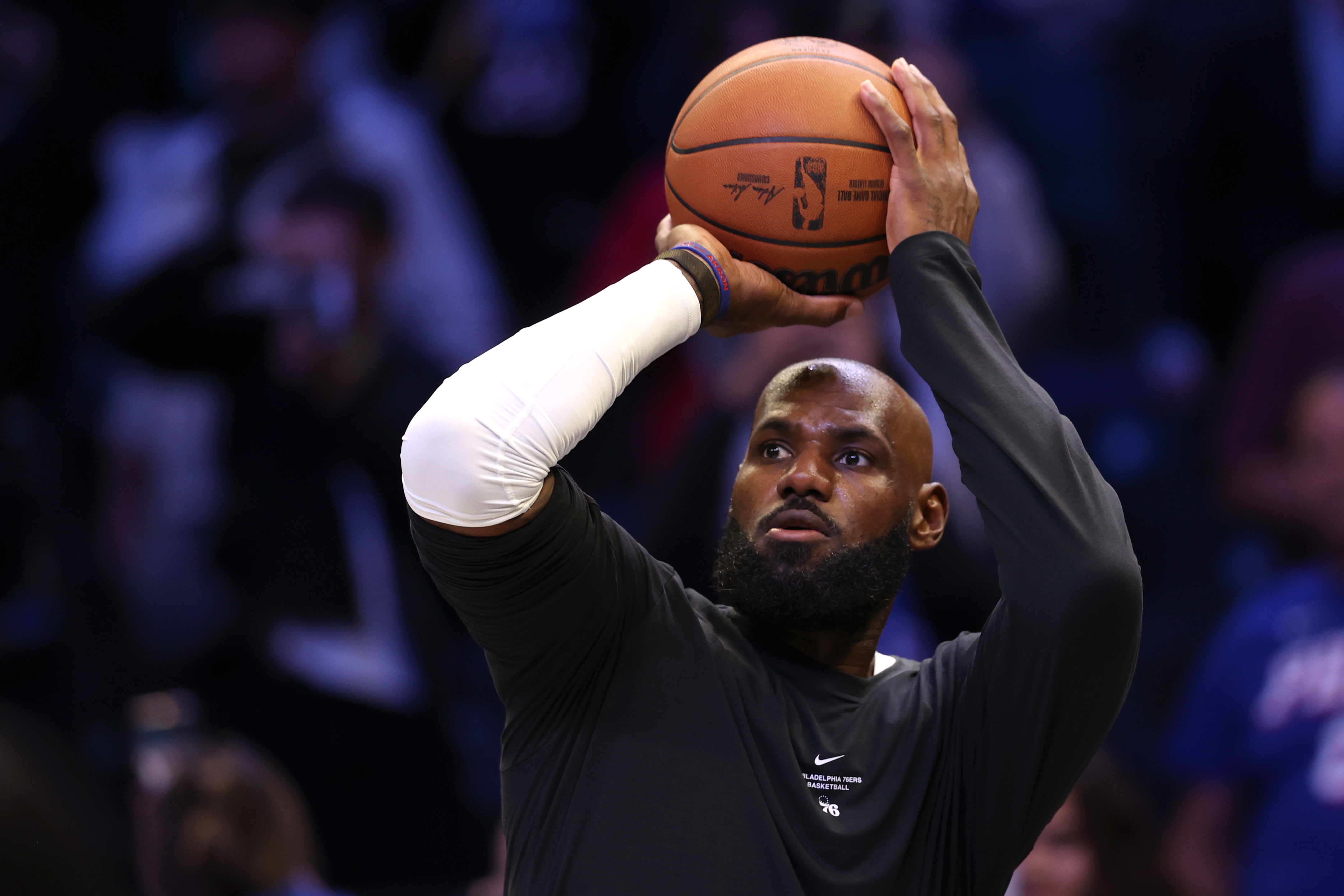
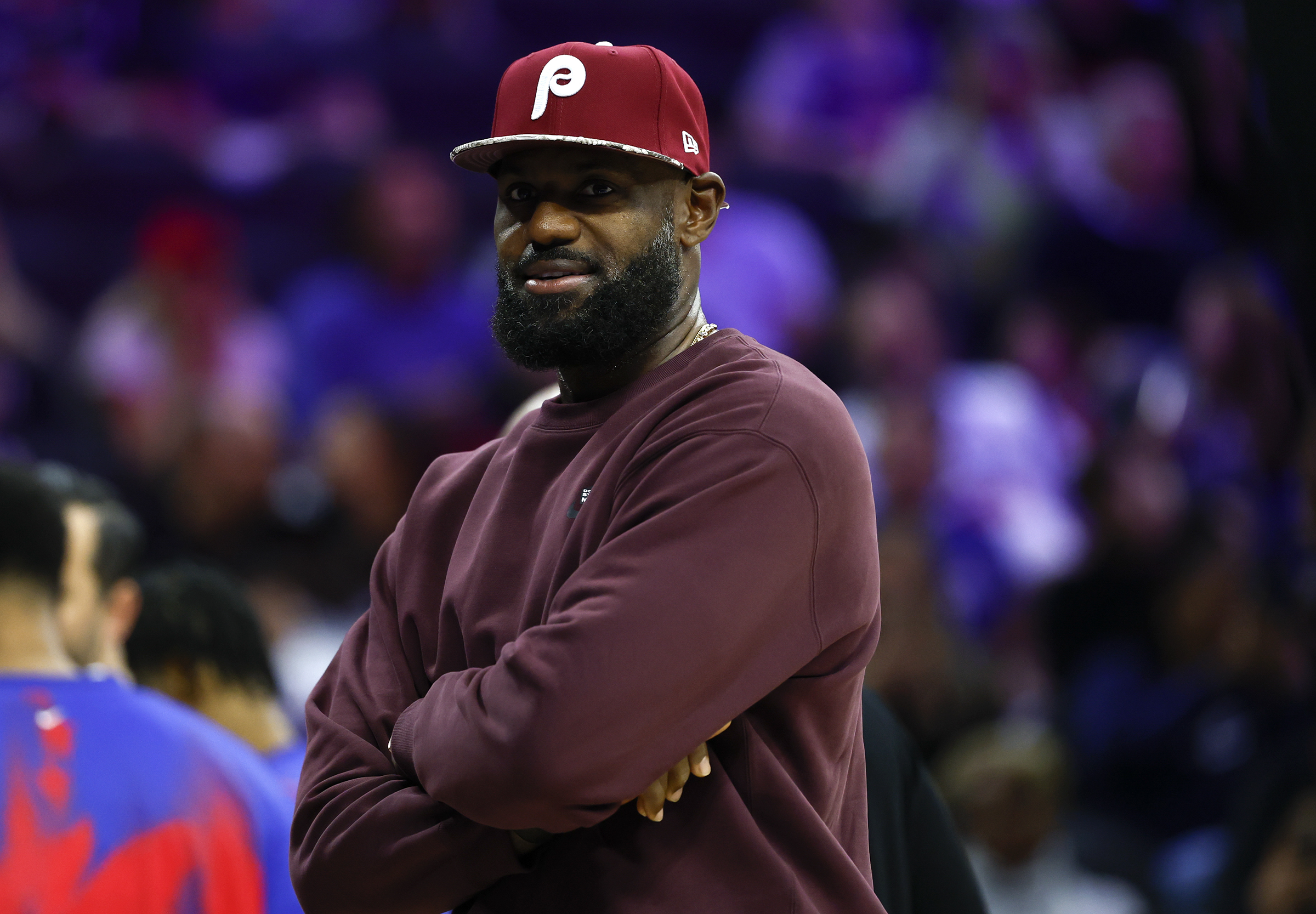
A regular sound in the background following 76ers practices has been the whirring of a helicopter, most likely there for LeBron James as he makes the return home on a commute to New York City.
James has said he will split time between Philadelphia and New York, and he’s not the first athlete to do so. Wilt Chamberlain famously did so as well when he played for the Philadelphia Warriors and the Sixers. So did JJ Redick.
As the season begins, it’s likely this ride won’t be as frequent for James, once the team starts traveling together and playing games every other day or so.
But in the meantime, James’ commute has generated plenty of media attention, from stories on TMZ and other national outlets. The New York Post even published photos of him landing at a heliport on the west side of Manhattan following the Sixers’ Blue x White scrimmage. Here are some details about it.
Where does he land and take off?
There’s a heliport at the Sixers facility in Camden that the team has had for owners Josh Harris, who uses it to travel between his various business ventures, including other sports teams he owns like the Washington Commanders and New Jersey Devils.
Sixers forward LeBron James during a first period break during a preseason game against the New York Knicks on Monday, Oct. 5, 2026 in Philadelphia.Yong Kim / Staff Photographer
In New York, James lands at a heliport on West 30th Street, in the Chelsea Pier area of Manhattan. It’s a place frequently used by celebrities who go in and out of New York, and it costs around $650 each time the helicopter lands at the facility, according to a source.
How long is the commute?
Between 30-45 minutes to fly one way, which is significantly shorter than driving back to New York or taking a train.
Who owns the helicopter?
James is using a chopper owned by the company Fanatics, with whom James has had an endorsement deal since 2024. Fanatics owner Michael Rubin sold his shares of Sixers ownership in 2022. Front Office Sports reported James has access to the company’s aviation services as part of his deal.
“The deal we signed with Fanatics almost three years ago includes access to their corporate aviation,” a spokesperson for James told Front Office Sports. “It’s a feature in many of their deals with their largest athletes and we appreciate their partnership as LeBron splits his time between New York and Philadelphia.”
(function() {
var l2 = function() {
new pym.Parent(‘lebron_flights’,
‘https://media.inquirer.com/storage/inquirer/projects/innovation/arcgis_iframe/lebron_flights.html’);
};
if (typeof(pym) === ‘undefined’) {
var h = document.getElementsByTagName(‘head’)[0],
s = document.createElement(‘script’);
s.type = ‘text/javascript’;
s.src = ‘https://pym.nprapps.org/pym.v1.min.js’;
s.onload = l2;
h.appendChild(s);
} else {
l2();
}
})();
As the statement said, James isn’t the only person who uses Fanatics helicopters. Others also have access to it, so those charting use of the helicopter through publicly available flight tracking may not only be looking at James’ flights.
Everyone’s antennae are up after the Kawhi Leonard-Clippers scandal, and you can see plenty of comments on social media from fans (likely those of other teams or people who might not like James) who want to paint this arrangement in a negative light. But it’s not raising any alarm bells.
The Clippers scandal, in which the team facilitated secretive no-show agreements with team sponsors to circumvent the salary cap to funnel money to Leonard, was a major exception in the NBA, not a case of the league punishing the Clippers for something everyone else is doing.
Rubin no longer has ownership in the team and James’ agreement with Fanatics has been for multiple years, predating his time with the Sixers, and he has promoted and made appearances on behalf of the company, hardly a no-show, secretive agreement.
Office Shane Seiber’s family gathers at home in mourning
At fallen Philadelphia police officer Shane Seiber’s house, down a leafy drive in Bensalem, Bucks County, a township police officer had parked a patrol car out front around 5 p.m. Saturday. The township officer’s badge had a black mourning band around it.
Inside the house, which had a few Halloween decorations and a “Welcome to our Home,” sign on the front porch, the officer’s family members and others had gathered. A few came from the house to greet the Bensalem officer, and exchanged hugs. All declined to speak with a reporter, as did a relative who answered the door.
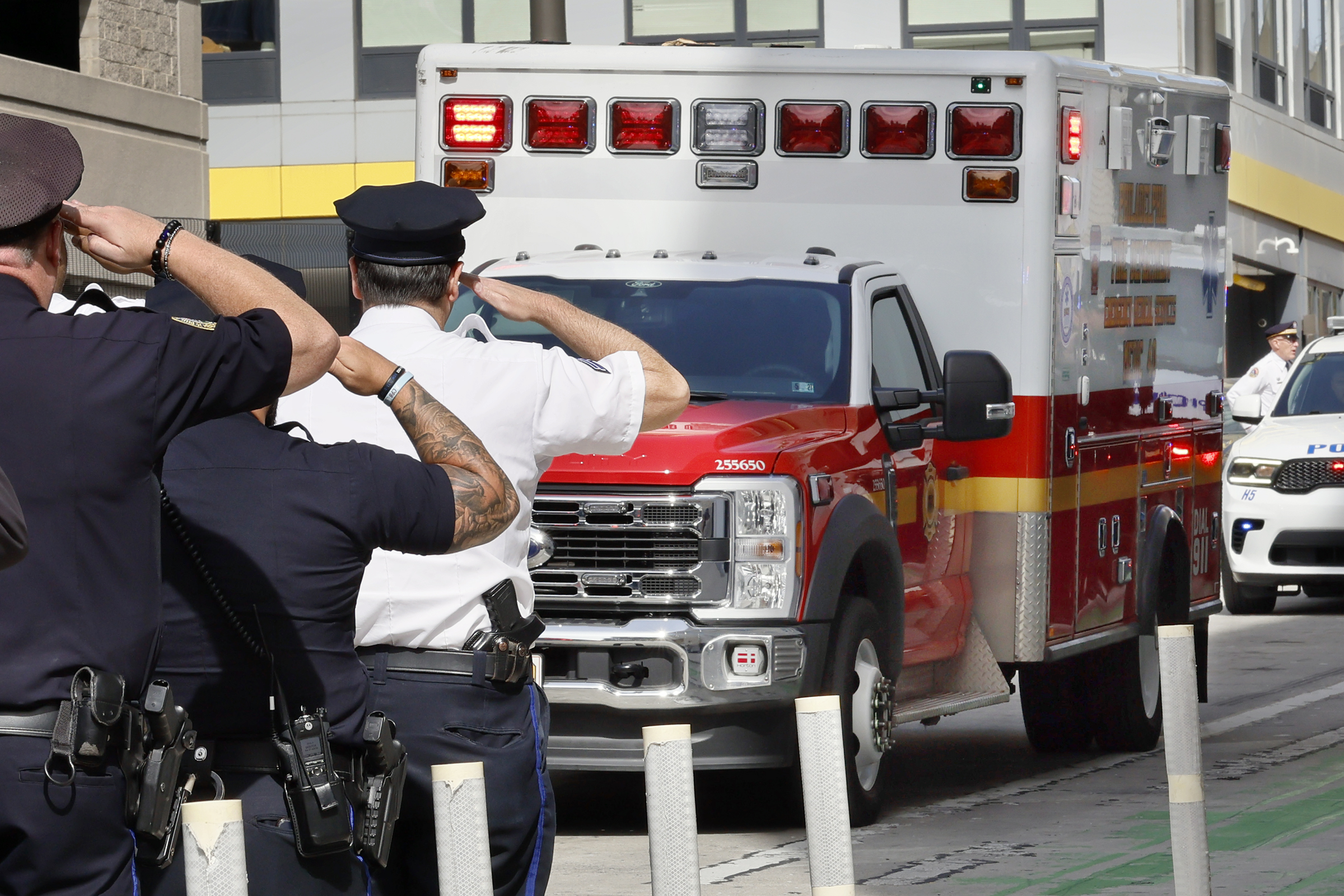
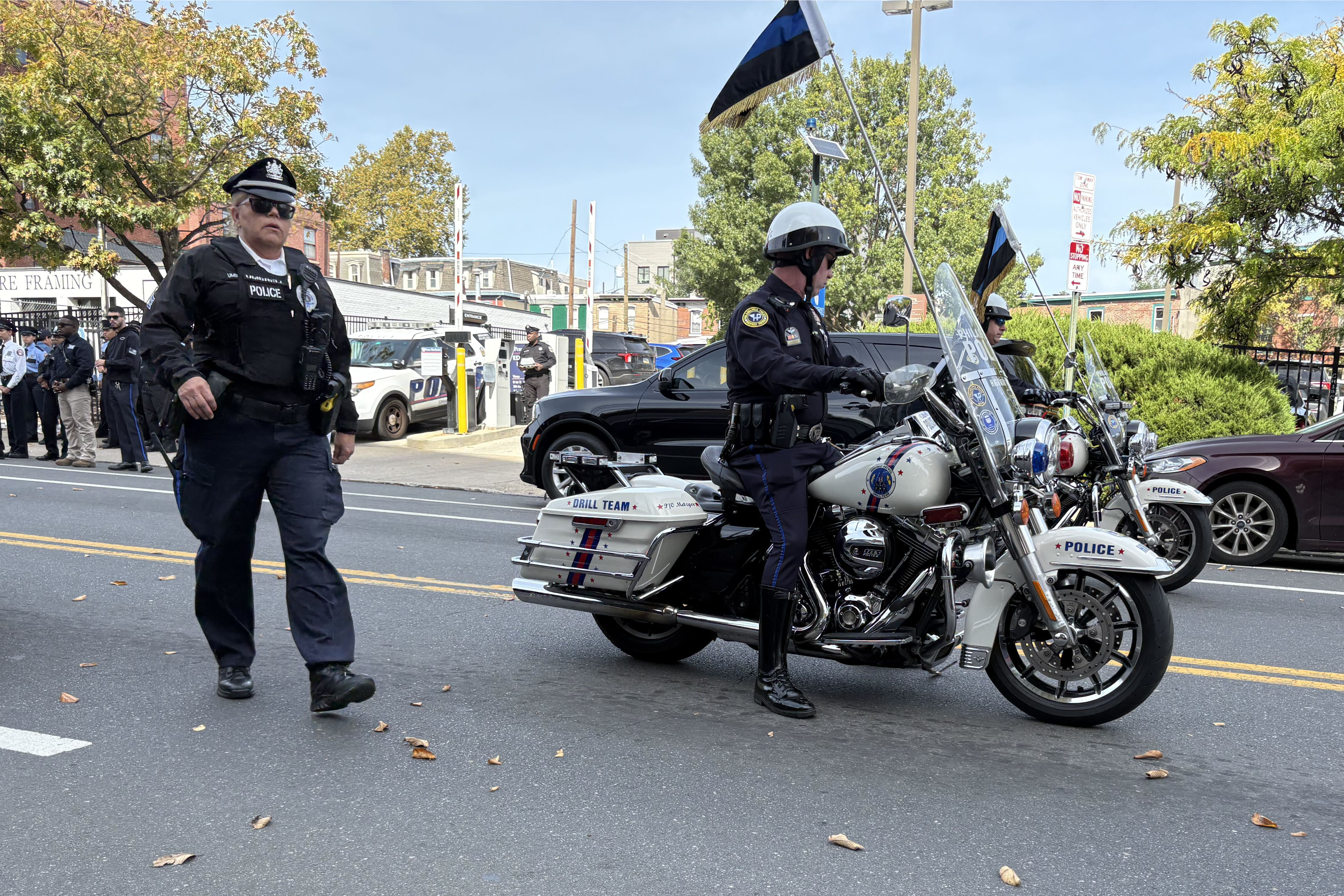
Earlier, Interstate 95 was shut down between Vine Street and Aramingo Avenue. KYW reported that police were transporting Seiber’s body from the Medical Examiner’s Office.
Philly union says it’s cooperating with officials after member named as suspect in killing of police officer
District Council 33 said it is cooperating with authorities after one of its members was identified as the suspect in the shooting death of a Philadelphia police officer.
Eric Lewis, an employee with the Philadelphia Water Department, faces murder, attempted murder, and other charges related to a Saturday morning shooting in West Philadelphia that killed officer Shane Seiber and wounded another officer, who remains hospitalized.
“The circumstances surrounding this tragic incident, involving a member of District Council 33 employed by the Philadelphia Water Department, are heartbreaking and deeply troubling,” District Council 33 said in a statement. “We want to be absolutely clear: District Council 33 does not condone violence in any form, under any circumstances. This act of violence is not reflective of our values, our mission, or the conduct we expect from our members.”
“We mourn alongside the City of Philadelphia and the Philadelphia Police Department as they grieve the loss of Officer Seiber, and we stand firmly with all those committed to justice, accountability, and the safety of every worker and every resident.”
Krasner ID’s shooting suspect, outlines charges after ‘horrific killing’ of Philly cop
District Attorney Larry Krasner speaks to reporters Saturday afternoon.Elizabeth Robertson / Staff Photographer
Philadelphia District Attorney Larry Krasner called the death of Philadelphia police officer Shane Seiber a “brutal, senseless, horrific killing.”
Speaking to reporters Saturday afternoon, Krasner confirmed the suspect was Eric Lewis, an employee with the Philadelphia Water Department who has a criminal record dating back to 2012.
Lewis will be held without bail, Krasner said, and faces a lengthy list of charges, including murder, attempted murder, disarming a law enforcement officer, and numerous other felonies.
Krasner declined to say whether Lewis used one of the officers’ weapons during the assault, but did note he had no qualifying felony convictions that would’ve prevented him from owning a firearm.
“I wish I could tell you everything I know at this time,” Krasner said. “We will be able to say a lot more in the next few days, but I need to make sure I check and the family’s fully informed. They do not deserve to find out on TV.”
In addition to Seiber and a second, yet-to-be identified officer who was wounded, Krasner said nine other officers were fired upon but escaped injury.
Suspected gunman has a criminal history dating back to 2012
Eric Lewis, the suspected gunman who ambushed two police officers overnight, leaving one dead, had a criminal history dating back to at least 2012, publicly-available court records show.
The convictions include a misdemeanor illegal gun possession case in 2013.
In 2012, he was charged with theft and receiving stolen property. He was later convicted at trial and sentenced to two years probation. Common Pleas Court Judge Sean Kennedy also ordered Lewis to undergo substance abuse treatment.
He was arrested again the following year and charged with illegal gun possession and simple assault. He was convicted of the charges in 2015 and was sentenced to five years probation. He was ordered by the judge to receive a drug and alcohol assessment, and a mental health evaluation.
Toward the end of his supervision, in 2018, he was convicted of disorderly conduct for fighting and was again sentenced to a year probation, as well as an additional three years of court supervision in the gun case.
Correction: An earlier version of this post incorrectly described the level of offense of the 2013 gun possession case, and its implication on whether Lewis could legally own firearms.
20 Philadelphia police officers shot in the last three years
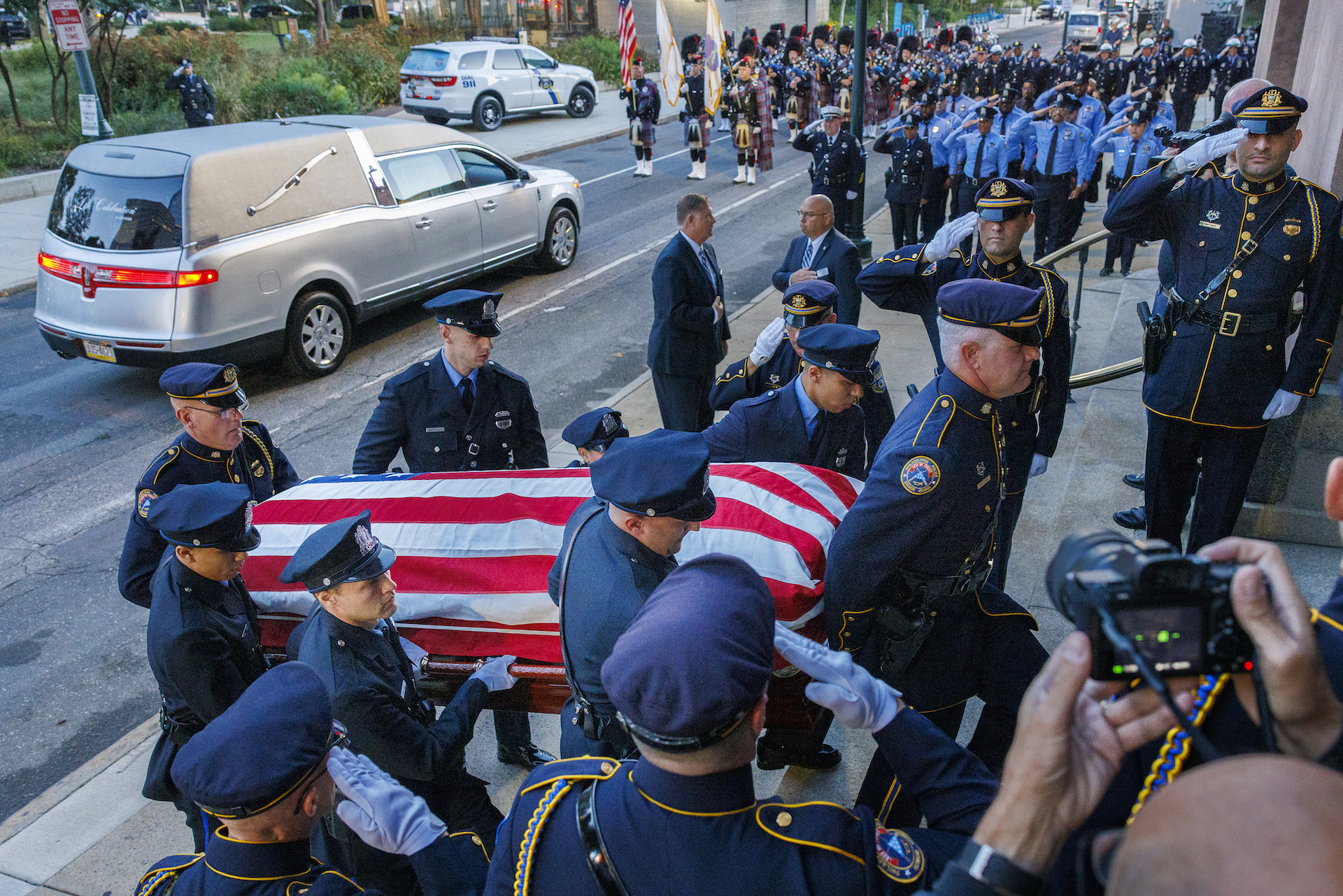
The body of Philadelphia police officer Jaime Roman is carried into the Cathedral Basilica of Saints Peter and Paul in September 2024.Alejandro A. Alvarez
Andy Chan, a Philadelphia Highway Patrol officer who suffered a devastating brain injury in a motorcycle crash while on his way to work in 2019, died in December.
In 2024, Officer Jaime Roman died months after being shot in the neck during a routine car stop.
(function(){function e(){window.addEventListener(`message`,function(e){if(e.data[`datawrapper-height`]!==void 0){var t=document.querySelectorAll(`iframe`);for(var n in e.data[`datawrapper-height`])for(var r=0,i;i=t[r];r++)if(i.contentWindow===e.source){var a=e.data[`datawrapper-height`][n]+`px`;i.style.height=a}}})}e()})();
Brother of former Philadelphia Police officer shot in 1991: ‘Little respect for police’
Former Philadelphia police officer Brian McMullin, who was patrolling with his twin, Donald McMullin, in 1991, when Donald was shot in the head and critically wounded, posted on Facebook, “There seems to be little respect for police who keep our streets safe. Remember they are fathers, mothers, daughters, and sons trying to do their best.”
McMullin, now an emergency room nurse, gave his brother CPR and is credited with saving his life. The twins were partners in the Philadelphia Police Department and were patrolling in West Philadelphia, near 57th and Washington, when the shooting occurred.
Elsewhere, condolences poured in from police departments around the region
“Our thoughts and prayers are with the Seiber family and your entire department during this difficult time,” posted the Evesham Township Police in Burlington County, N.J. “We also hold in our hearts the second officer.”
From the Glassboro Police Department: “Our hearts are heavy with the news of Philadelphia Police Officer Shane Seiber’s passing.”
“Our thoughts and prayers are with the Seiber family, the other involved officer who is currently hospitalized, the Philadelphia Police Department, and the entire city of Philadelphia during this difficult time,” the Bensalem Township Police Department announced.
Shapiro to review Pa.’s involuntary commitment laws
Gov. Josh Shapiro is “prepared” to review Pennsylvania’s involuntary commitment laws, following a call this morning by Mayor Cherelle L. Parker for the state to allow the city to commit people with substance use disorder.
Shapiro administration spokesperson Rosie Lapowsky said in a statement Saturday the governor and mayor spoke Saturday morning and that “the Shapiro Administration is prepared to work with the General Assembly to review Pennsylvania’s involuntary commitment laws.”
Parker called on Shapiro and the state legislature to review the statute while speaking during a news conference after a man fatally shot a Philadelphia police officer and wounded another on Saturday morning in West Philadelphia.
Under state law, the government can have a person hospitalized even without their consent if they have a severe mental illness and are considered to be a danger to themselves or others. Parker said she wants that law to be expanded to include people with substance use disorder.
It is not yet clear whether the suspect, whom police identified as city employee Eric Lewis, has substance use disorder.
A bipartisan group of state senators drafted legislation last year to explicitly classify substance use disorder and alcohol dependence as a mental illness, but the bill stalled and did not pass.
U.S. Sen. John Fetterman said on social media Saturday his family was grieving for the families of the two Philadelphia police officers shot on Saturday morning, one of whom died.
“We are keeping all those impacted in our thoughts today, and we’re hoping for a full and speedy recovery for the other officer,” Fetterman, a Democrat, said in a post on X. “It’s a stark reminder of the dangerous job our law enforcement has in keeping us all safe — and why we should always be grateful for their service.”
Pennsylvania Gov. Josh Shapiro ordered flags across the commonwealth to fly at half staff after Philadelphia police officer Shane Seiber was shot and killed responding to a call early Saturday morning.
“Our law enforcement officers are the very best of us. They put their lives on the line every day, running towards danger to keep their fellow Pennsylvanians safe, not knowing if they will return home,” Shapiro wrote on social media Saturday afternoon. “We owe them our deepest gratitude.”
Philadelphia Mayor Cherelle L. Parker also ordered flags across the city to fly at half staff.
“To Officer Seiber’s family, please know that Philadelphia grieves with you and will stand with you in the days ahead,” Parker wrote in a Facebook post.
Fallen officer remembered as ‘a beautiful soul’ by former classmate
A Philadelphia police officer, who did not want to be named out of respect for the family and fellow officers, mourned the death of Shane Seiber, her former classmate and “a beautiful soul” killed in an early-morning shooting in West Philadelphia Saturday.
“Today, I am not just praying as a fellow police officer. I am praying as a classmate, a mother, a friend, and a human being whose heart is absolutely shattered,” the officer said.
“Life is so incredibly fragile. In the blink of an eye, everything can change. Tomorrow is never promised, and moments like these remind us just how precious every breath and every embrace truly are.”
Philly police officer dead after early-morning shooting
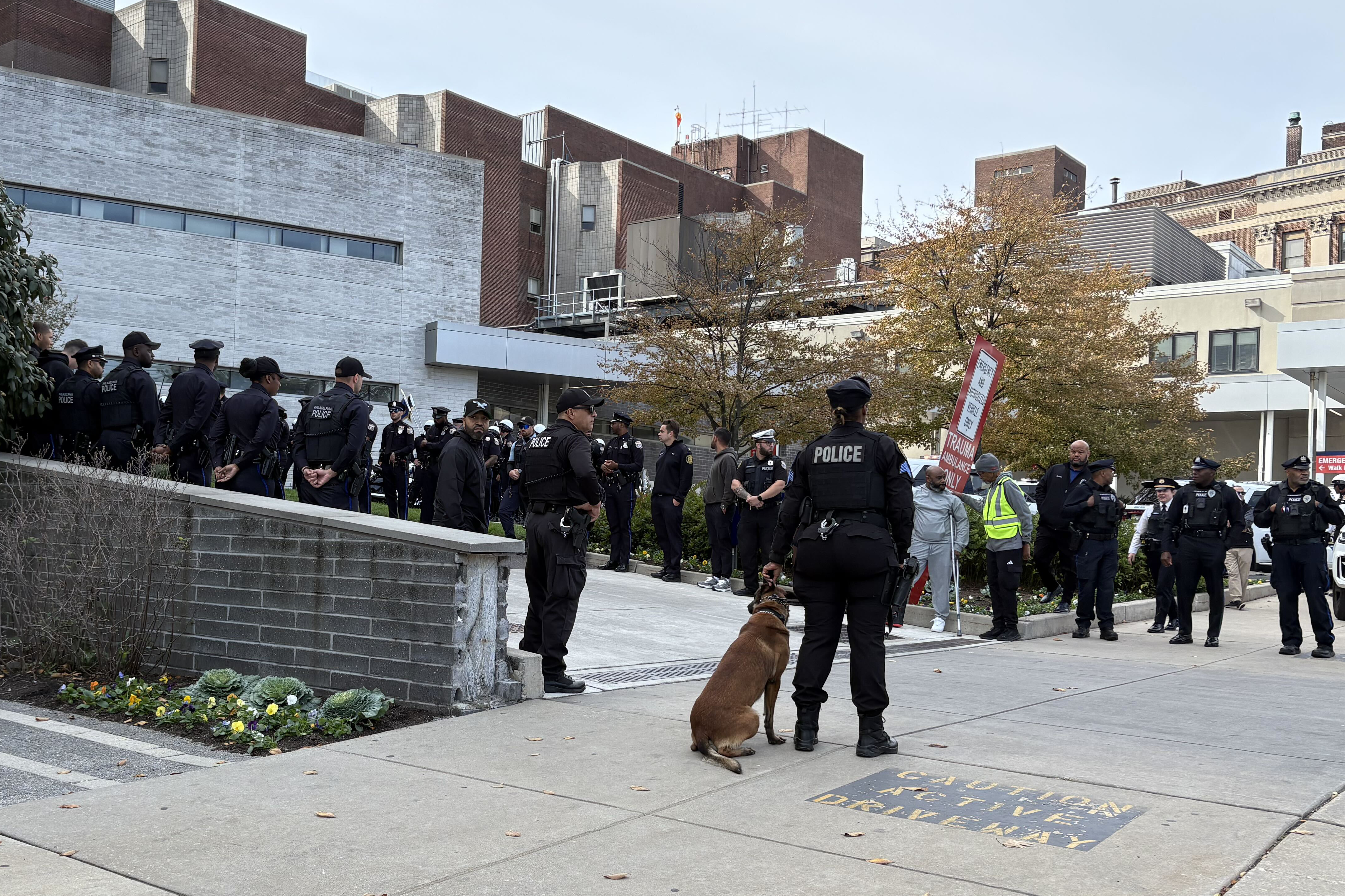
Philadelphia police outside Penn Presbyterian Medical Center, where two wounded officers were being treated Saturday.Brett Sholtis /
One of the Philadelphia police officers ambushed in a shooting in West Philadelphia overnight has died, Police Commissioner Kevin Bethel said.
Officer Shane Seiber, a 10-year veteran of the force, died at Penn Presbyterian Hospital Saturday morning, Bethel said. Seiber was a married father of a 7-year-old son and a 3-year-old daughter.
“He fought valiantly, but he lost his life today,” Bethel said.
“His wife was able to be at his side before he passed, as well as his family,” Bethel said. “I continue to ask the community to keep him and his family in their prayers. This will be a period of mourning for us.”
The second officer, who has yet to be identified, was in stable condition “but not out of the woods yet,” Bethel said.
Two police officers shot multiple times in West Philly
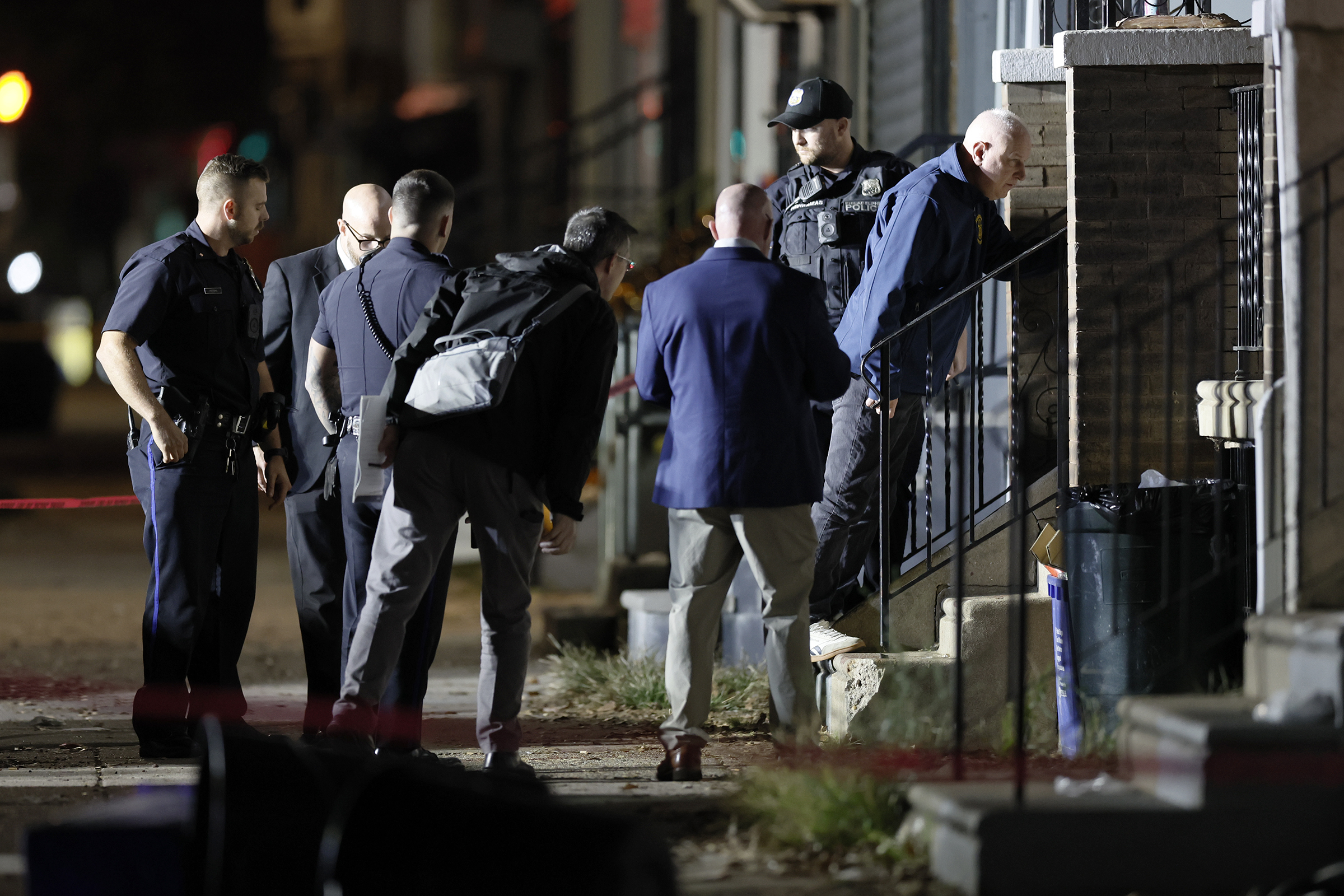
Philadelphia police the scene on North 52nd Street where two officers were shot early Saturday morning.Elizabeth Robertson / Staff Photographer
Two Philadelphia police officers are in critical condition after authorities said a man ambushed them early Saturday with a shotgun outside his West Philadelphia home.
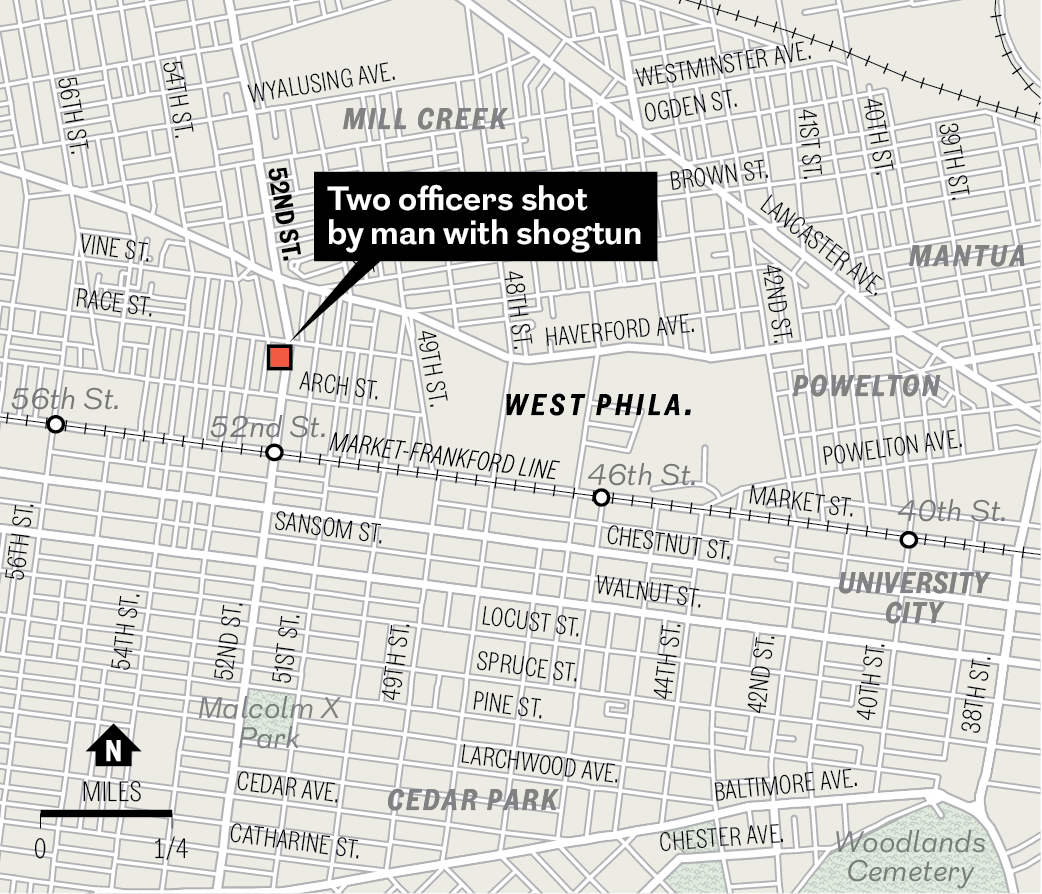
The 19th District police officers were responding about 12:20 a.m. to reports of a man with a gun in the 100 block of North 52nd Street when they received “significant gunfire,” Philadelphia Police Commissioner Kevin J. Bethel said at a news conference.
A 40-year-old officer was shot three times, Bethel said. A 33-year-old officer was shot 12 times. Both were taken to Penn Presbyterian Medical Center, where they were in surgery. Their names have not been made public.
Two more police officers were shot at when they approached the house, Bethel said, and police called in a SWAT team.
Sources ID suspect as Philly water department employee
Philadelphia Police Commissioner Kevin Bethel and Mayor Cherelle L. Parker during an emotional news conference in front of Penn Presbyterian Medical Center.Elizabeth Robertson / Staff Photographer
Law enforcement sources identified the alleged gunman who shot two Philadelphia police officers early Saturday morning as Eric Lewis, an employee with the Philadelphia Water Department.
The sources spoke on the condition of anonymity to discuss an ongoing investigation.
A spokesperson for the city did not immediately respond to a request for comment.
“We were able to locate this individual in a tree, and we were able to take him into custody,” Philadelphia Police Commissioner Kevin J. Bethel said at a news conference. The man was found with a shotgun and two handguns, one of which he’d taken from a police officer.
Blood on a Philadelphia police SUV at Penn Presbyterian Medical Center in Philadelphia Saturday.Elizabeth Robertson / Staff Photographer
During a Saturday morning news conference, Mayor Cherelle L. Parker said the two Philadelphia police officers shot early Saturday morning were “badly wounded.”
“Their families right now are feeling unspeakable pain, but watching this department and those families sticking close together as a village has definitely shown me what the indomitable power of the human spirit is and can mean during times like this,” Parker said.
Councilmember Jamie Gauthier, who represents West Philadelphia, called it a “horrific act of violence,” adding “our city will not accept this as normal.”
“While most of us are asleep, our police officers run toward danger to keep us safe,” Gauthier said in a statement. “They deserve to go home to their families.”
Gov. Josh Shapiro said on X his family was were praying for the officers.
“We are grateful for their courage and service, and we are all hoping for their full and speedy recovery,” Shapiro said.
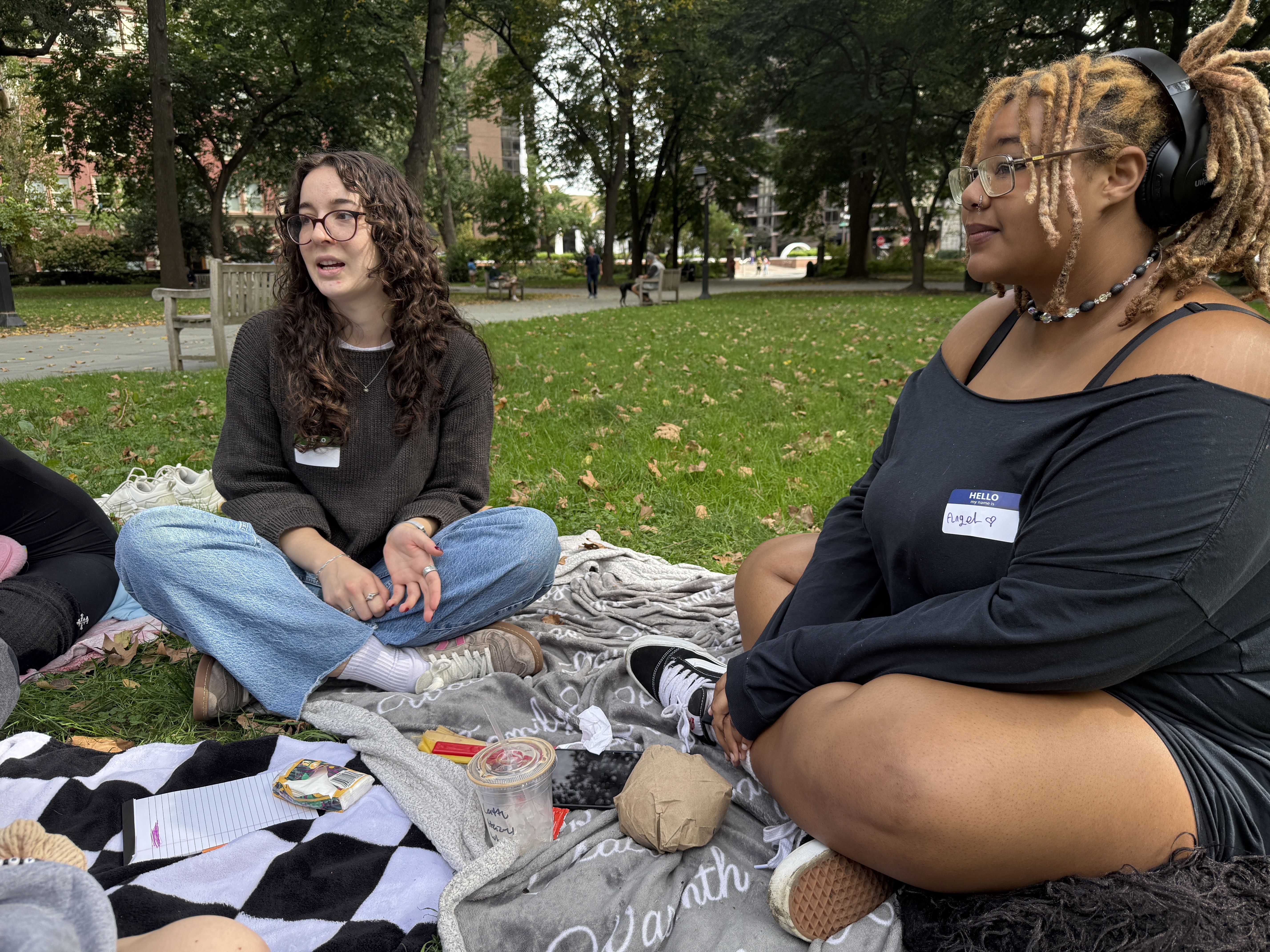
Every moisture-repelling compound in 18-year-old Angel Smith’s waterproof mascara kicked into gear as she sat on a picnic blanket in Washington Square Park and told two strangers about recently losing her uncle.
“He was the person I looked up to the absolute most,” Smith said with glossy eyes. “Life is … it’s not life-ing right now.”
A fresh high school graduate, Smith, who works as a caretaker for her great-grandmother, said she felt lost. Her uncle, like her, wasn’t particularly gifted academically, she said, but he leveraged his artistic skills to build a career for himself as a painter, tattoo artist, and musician.
He would have offered her guidance right now, but his heart stopped a few days after Christmas. He was 34.
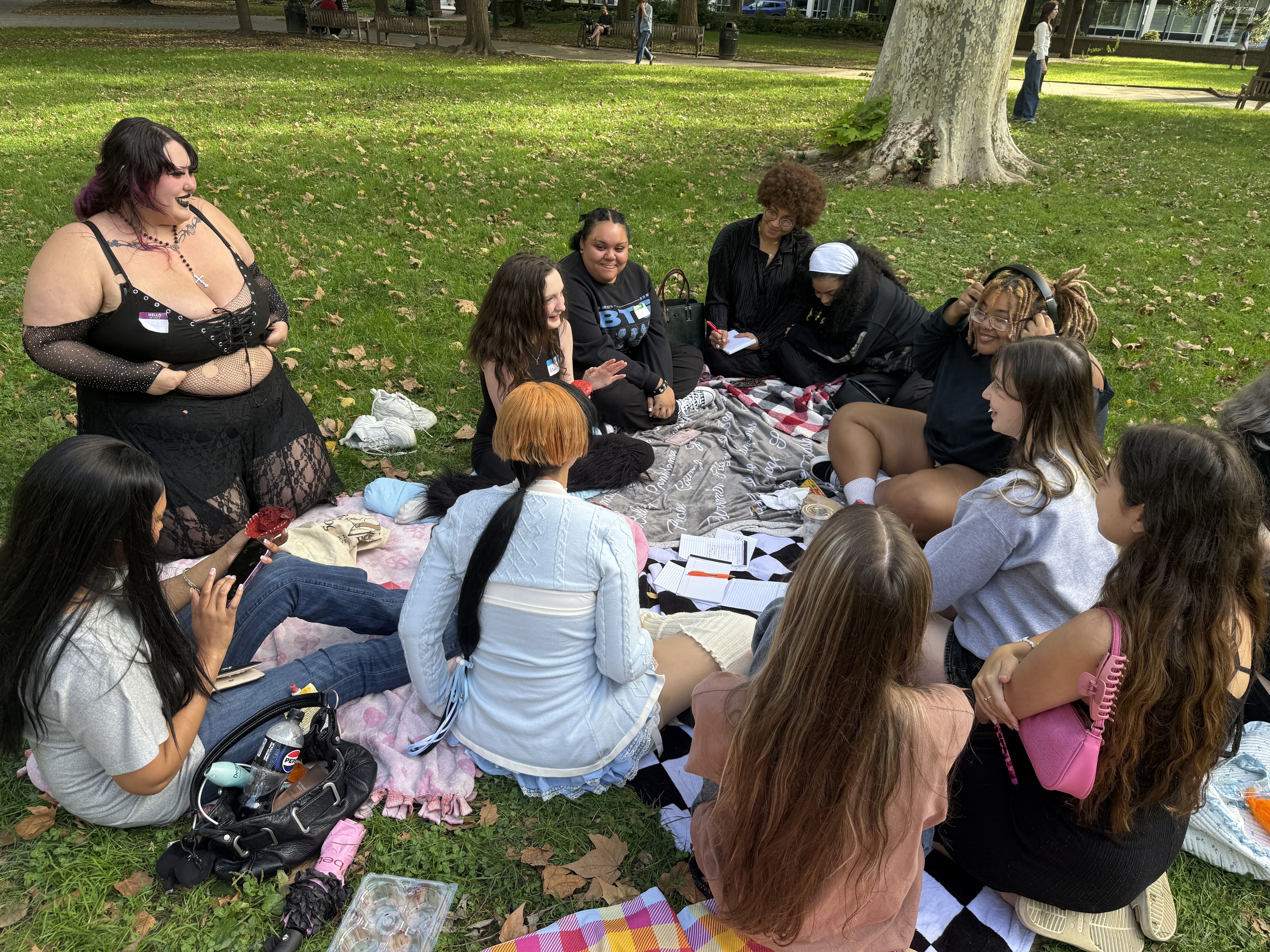
Smith hadn’t opened up about the grief to anyone, she said. But when she saw an event advertised as “Sad Girls Crying in the Park” on TikTok, she felt drawn to go as did about 20 other women ranging from teens to women in their 50s. On a crisp October afternoon, they set up a patchwork of picnic blankets, passed around pink tissues, red velvet cupcakes, and vapes, and shared stories of loss, loneliness, money troubles, and heartbreak.
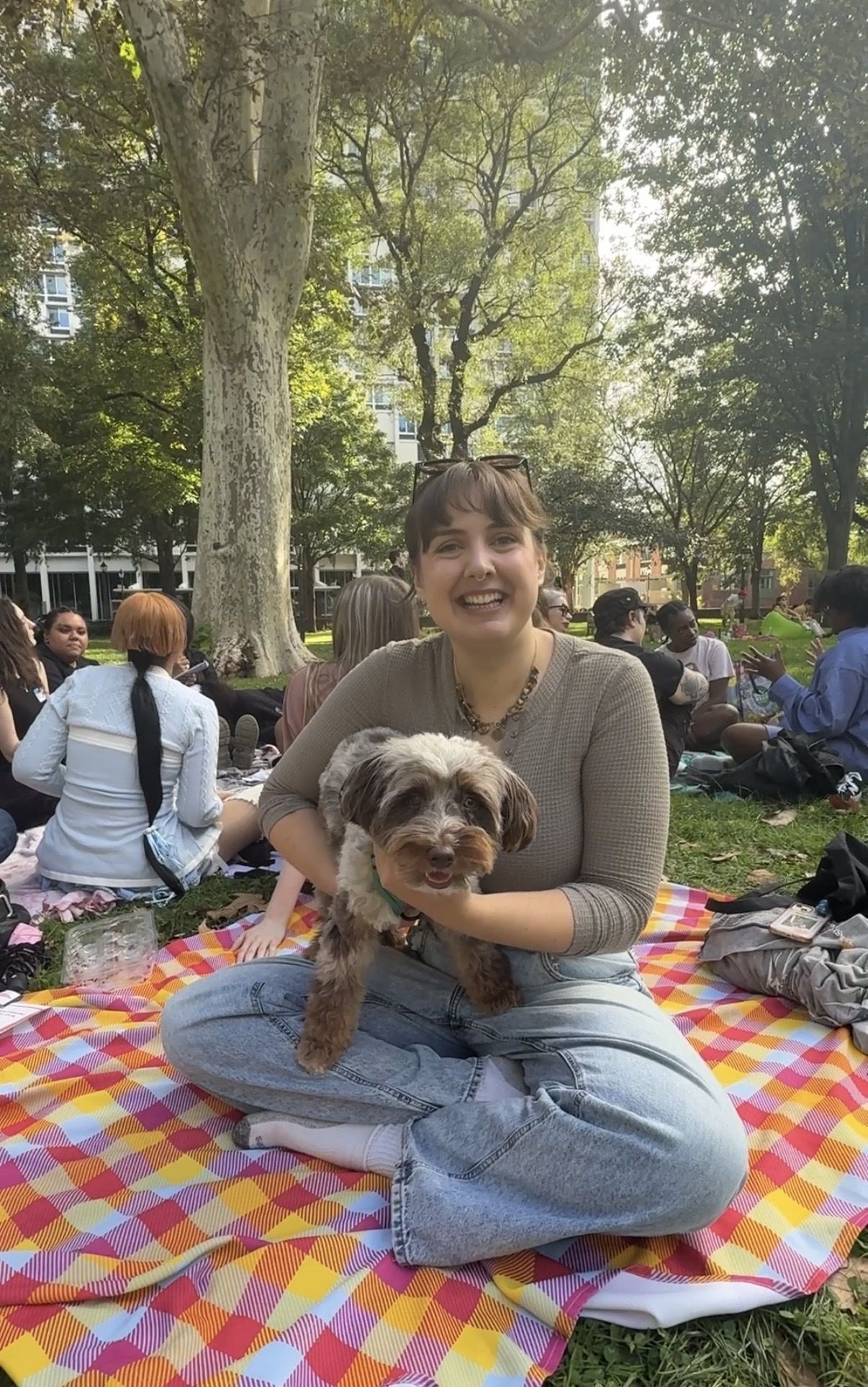
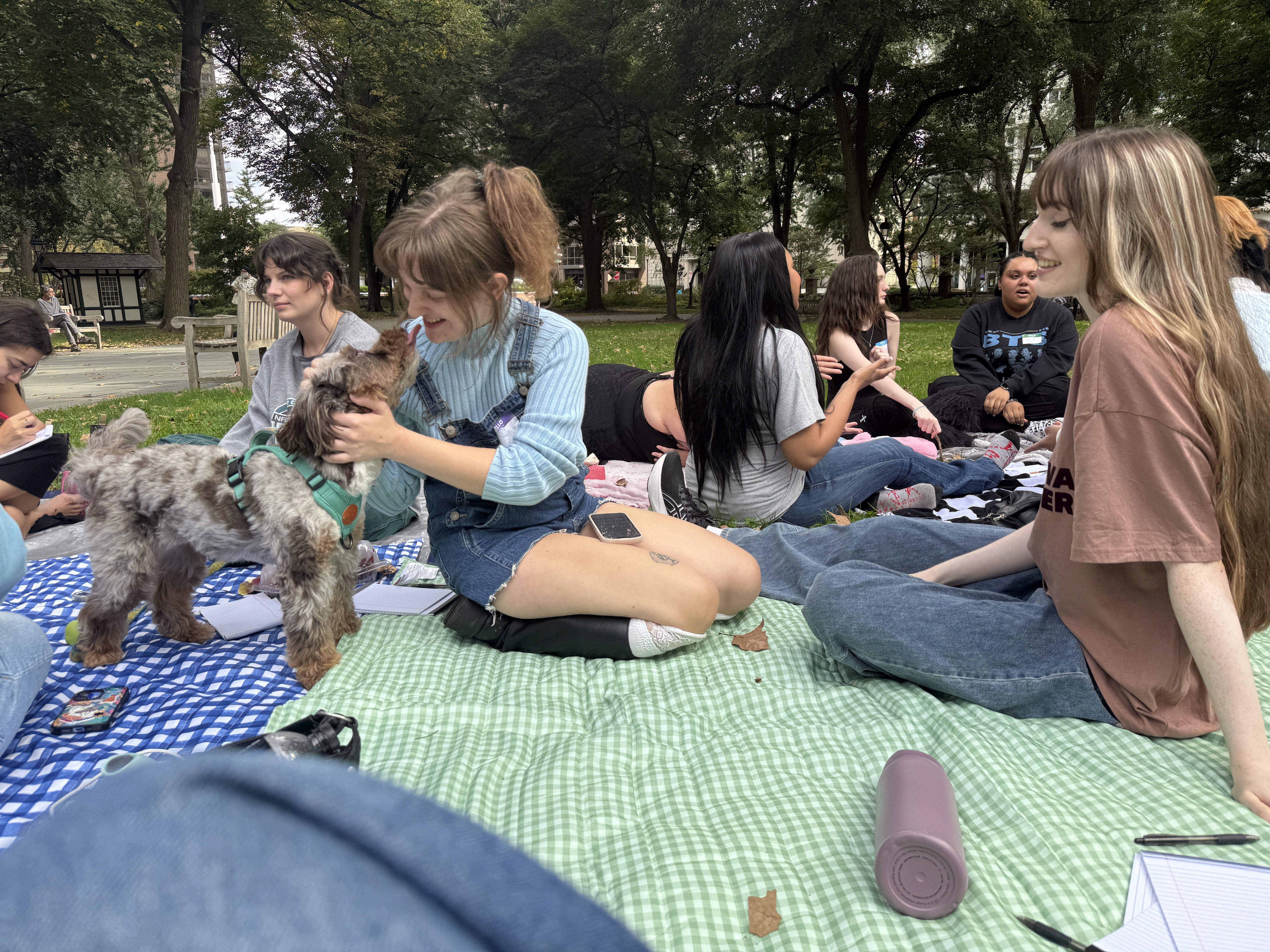
Megan Kwiecien holding her friend’s Aussie doodle, Suki, at “Girls Crying in the Park,” an event she organized on Oct. 3.Dana Munro
The group catharsis was envisioned by 26-year-old Megan Kwiecien. The idea hit her after she lost her cafe manager job and found herself crying alone on Third Street.
“And, like, what else do you do when you’re crying on the street other than record it and post it online?” she said.
So she did just that on Sept. 10. Soon, the comments rolled.
“U dont wanna know how many times i cried on septa,” one read.
“I’ve cried on chestnut st,” read another.
“sobbed next to elfreth’s alley three times this summer😜” someone wrote.
“been there done that,” Historic St. George’s Museum in Old City added.
As a joke, Kwiecien posted about a crying picnic. Commenters insisted she make it real.
“You asked, unfortunately I listened,” Kwiecien wrote in the invitation textbox. “Overshare to a stranger, enable someone’s bad decision, stare into the middle distance, or say ‘no literally I’m fine’ while clearly NOT being fine. Basically: sad girls, outside. See you there.”
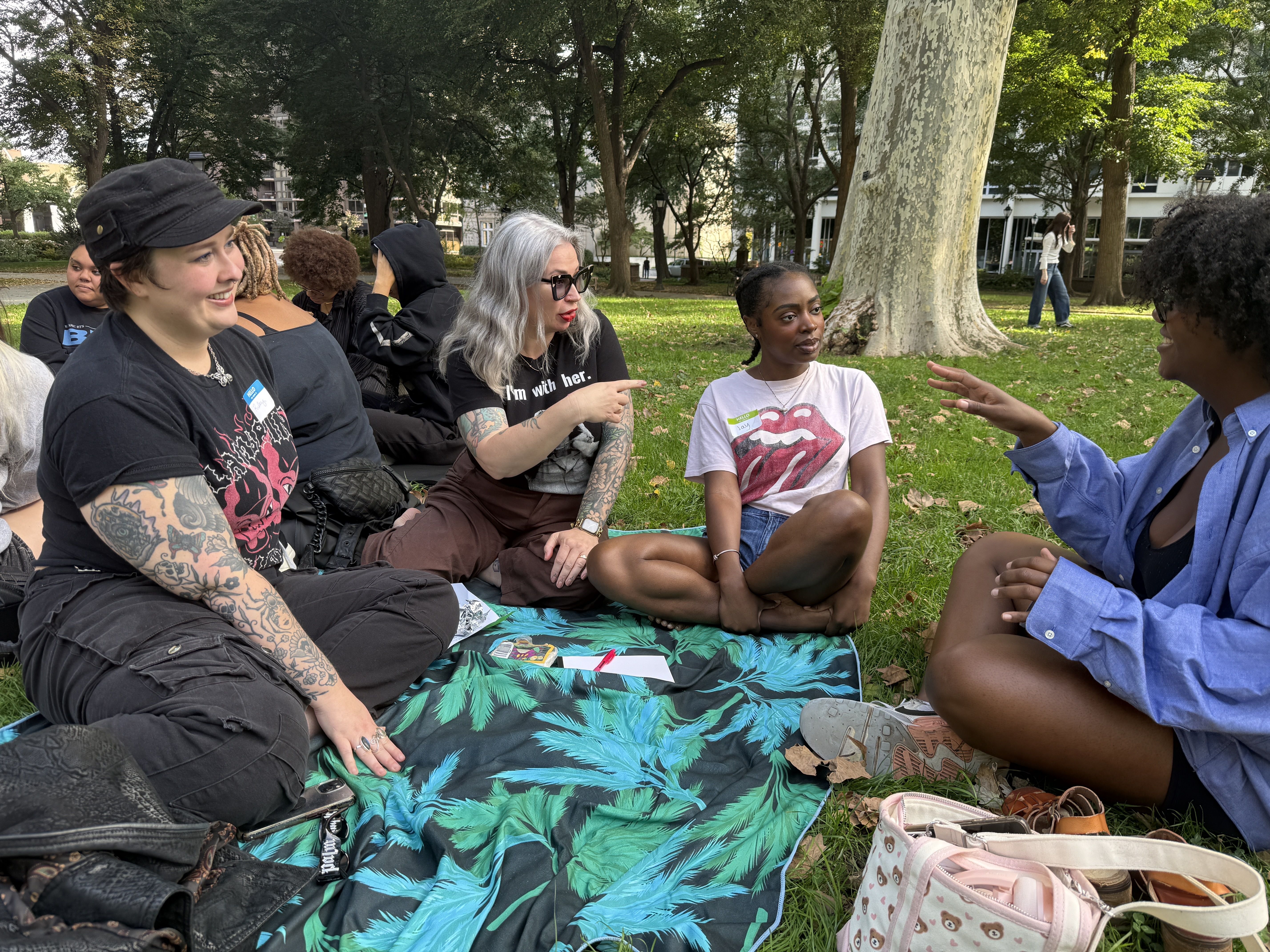
Participants bond at “Sad Girls Crying in the Park” event at Washington Square Park on Oct. 3.Dana Munro
Most of the women came to the event alone, courageous and open-hearted — trusting another woman, a stranger, would catch her if she came undone. And many did. For as many women who came to get support, more came to offer it.
Many participants found commonalities among themselves. Some helped each other nurse fresh heartbreaks of relationships spanning from five years to one week. Others shared frustrations over struggling to make friends in a new city.
Sitting around a black-and white-checked blanket on the leaf-dotted grass,Smith and 23-year-old Maya Mason quickly started tracing similarities between their lives. Mason, who lives in the Gayborhood, lost her mom to breast cancer a year and a half ago and the pain was as raw now as ever. Like Smith, she felt like she’d lost her guiding light.
Maya Mason and Angel Smith bond at “Sad Girl Crying in the Park” event on Oct. 3.Dana Munro
“The rest of my life without my mom … I’m scared,” Mason said. “If I fall apart, I won’t have my mom to put me back together.”
Her friends offer wonderful support, but many are in relationships.
“They all have a person,” Mason said. “And my mom was my person.”
When she’s around her friends, she worries that talking about her grief will dampen the mood, but, surrounded by strangers who she knew were grappling with their own problems seemed safer somehow, she said.
Smith felt similarly.
It’s “sonder,” Smith explained. “The realization that everybody’s life is as complex as yours.”
Participants bond at “Sad Girls Crying in the Park” event at Washington Square Park.Dana Munro
Smith told Mason she copes with her grief by continuing to seek advice from her uncle, even knowing he’s not around anymore.
“I still text his old number,” she said.
Every update, every challenge, every accomplishment — she shares. Maybe it’s into the void, maybe someone whom his number has been reassigned to. Either way, it helps. She thinks about how he’d respond.
She advised Mason to try something similar. The idea perked Mason up.
“I made her smile,” Smith said. “It made me feel good.”
Suki the mini Aussie doodle gives kisses to Madison Curry at the “Sad Girls Crying in the Park” event.Dana Munro
Eric Spiegel, a psychologist who runs a group practice in Philly and co-authored the book Attachment in Group Psychotherapy, explained that group therapy and similar experiences like “Girls Crying in the Park” hold their power in simply making people feel less alone.
Someone expresses something they’ve been struggling with to strangers, expects to be alienated, looks around, and “they see empathy, they see compassion, and they see curiosity,” he said. “Then they start to feel more confident like, ‘Hey, you know, I could be this way with my friends.’”
Kwiecien’s vulnerability in posting the video of herself crying and hosting this event likely emboldened others to show up and be vulnerable, too, he said. Gatherings like this offer the participants perspective, a sense of normalcy and a sense of community, Spiegel said.
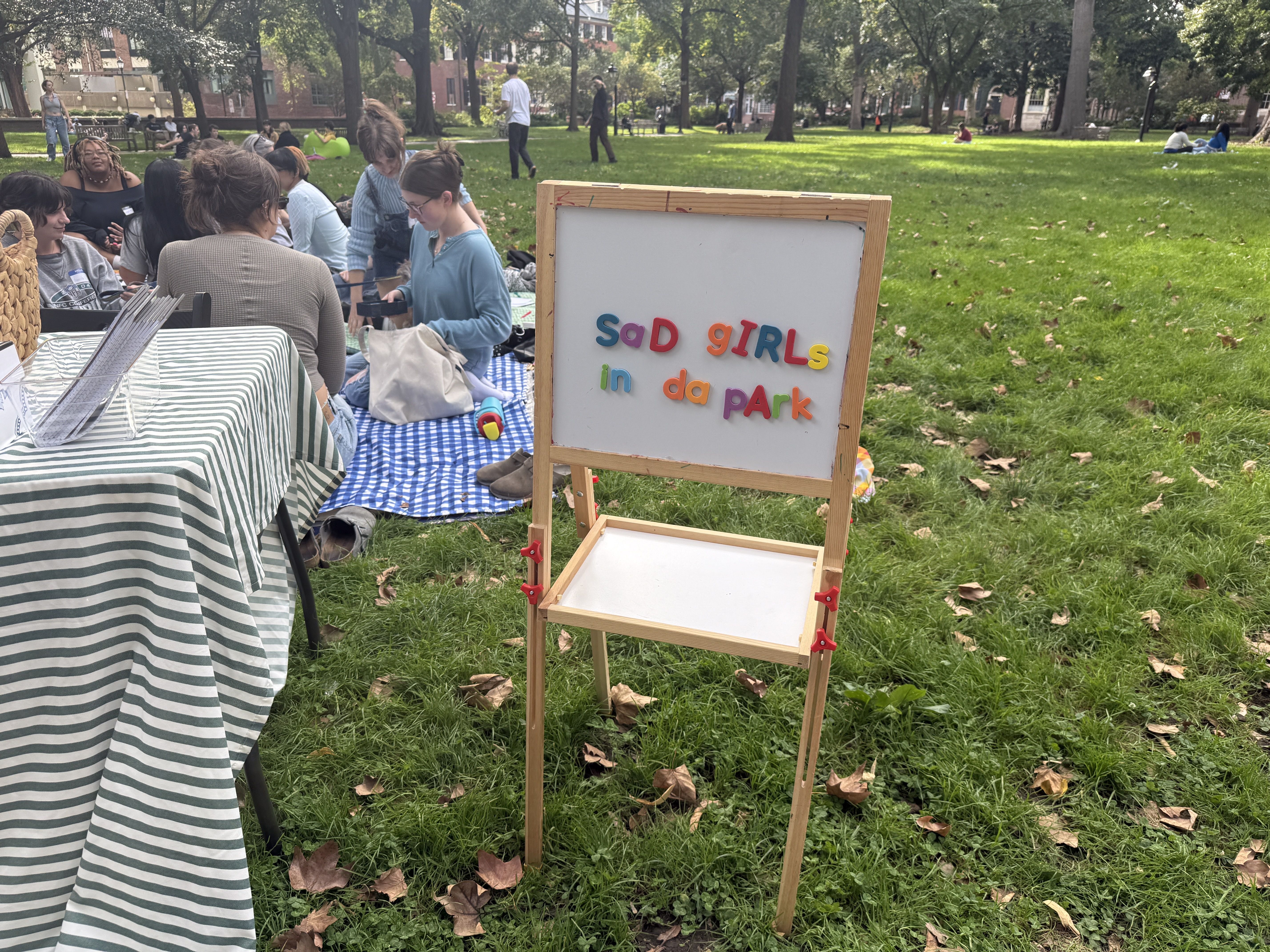
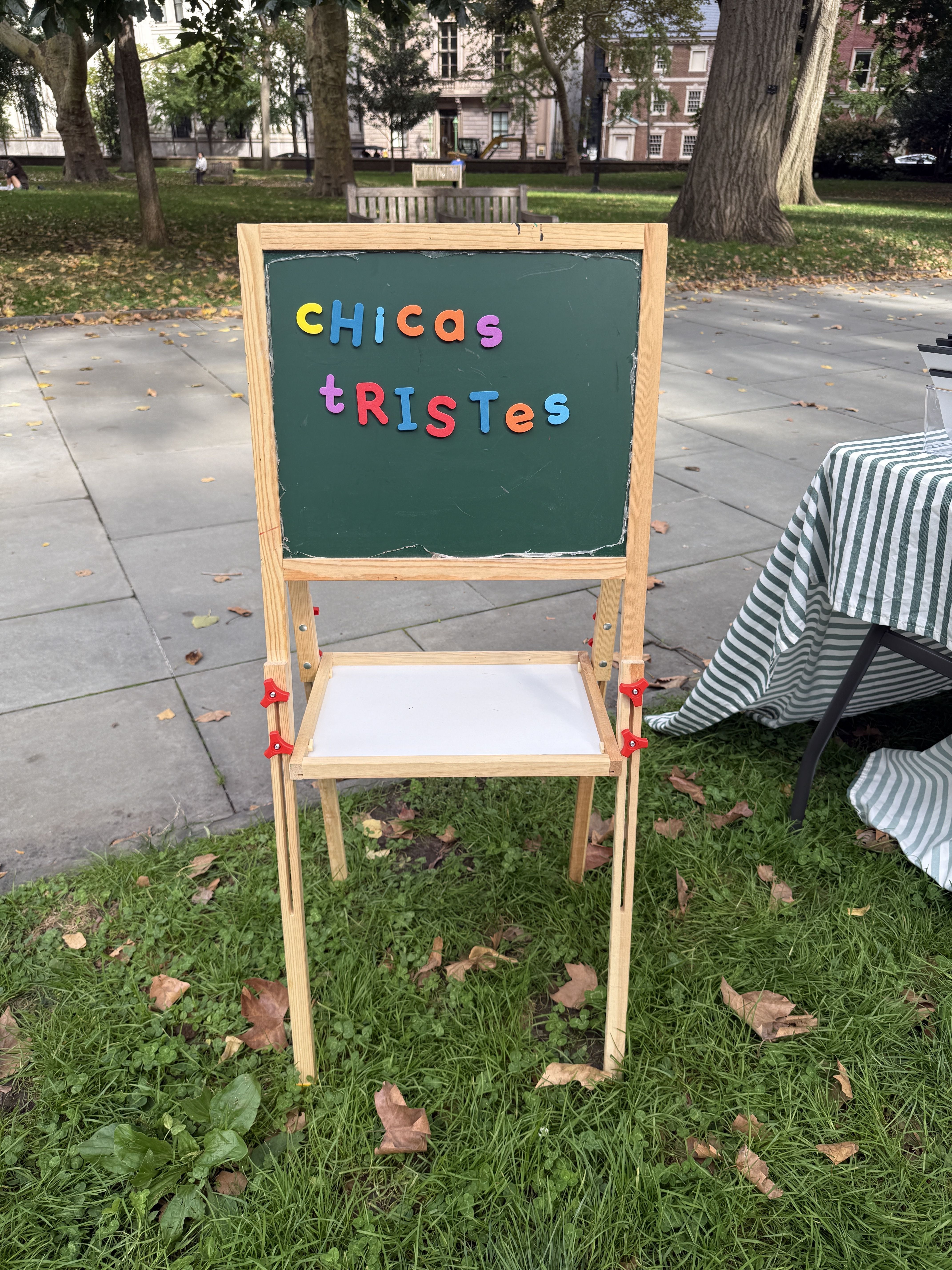
A sign Megan Kwiecien set up for her “Sad Girls Crying in the Park” event.Dana Munro
By the end of the afternoon, the women had made a group chat to keep in touch. Kwiecien smiled with satisfaction, surveying what she’d created, already contemplating a Halloween version for spooky season.
“I was hoping it would turn out like this — making friends, community,” Kwiecien said. “Trauma dumping a little bit.”
She waved brightly to the several remaining women as she left.
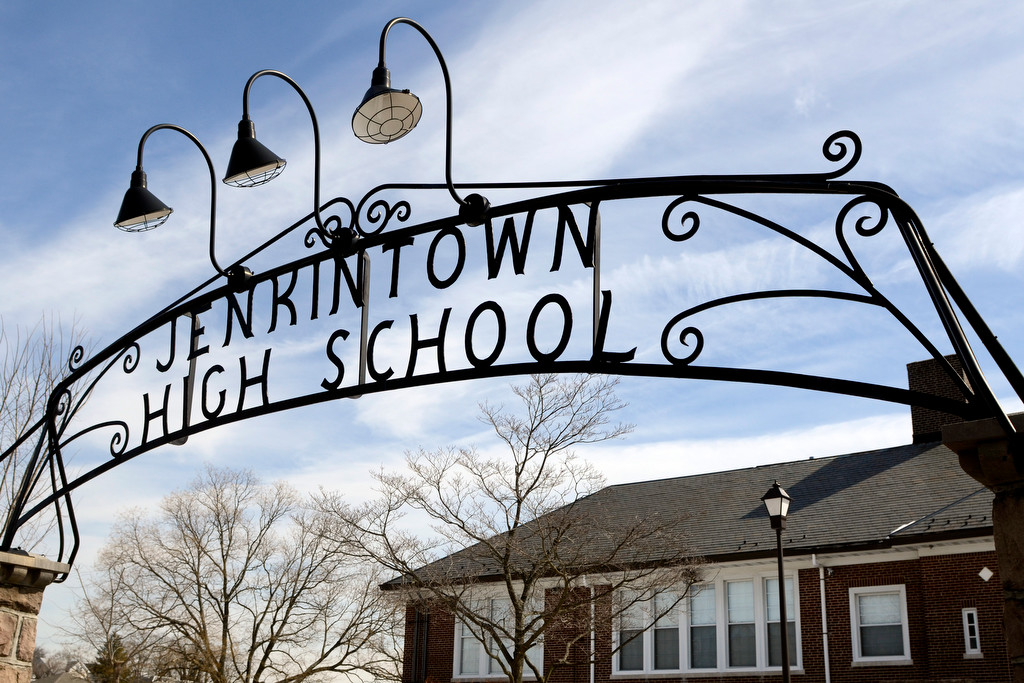
Surrounded by houses, the Jenkintown School District has little space to expand beyond its plot at the center of town, which hosts the administration, sports fields, a playground, and all K-12 classrooms.
One solution officials are discussing, for the third year in a row, involves buying an affordable housing complex next to the baseball and softball field. School leaders will present the idea at a school board meeting on Monday, Superintendent Brea D’Angelo said.
The district authorized a feasibility study in September from architecture firm Schrader Group to create a master plan for Jenkintown’s facilities, which includes assessing the possibility of buying the one-acre Salba Apartments parcel. The final study is expected to be ready by February, according to the architectural firm’s presentation.
Jenkintown talked about expansion last year
The district previously considered buying the apartment property in 2024 under then-Superintendent Jill Takacs.
Salem Baptist Church built the complex in the early 1970s, and the apartments, nearly at full capacity in 2024, were becoming too old to use, Salem Baptist’s pastor, the Rev. Marshall Mitchell, said at the time.
The church offered to sell the property to the school district, which had added nearly 100 students over the previous decade, Takacs said at a December 2024 meeting — a roughly 15% increase in Montgomery County’s smallest district. Though the school had a larger student population at other points in history, a growing special education footprint and preference for smaller classes required more space, she said.
Under the 2024 proposal, the 17 apartments would likely have been demolished, Takacs and Mitchell said at the time. Possibilities for the land included relocating the school’s tennis courts and creating space for a preschool center, a mental health space, and other facilities.
The church planned to build more affordable housing elsewhere for Salba residents, Mitchell said at the 2024 meeting. The district would have allowed Jenkintown students living in the apartments to stay enrolled, even if the new complex were located outside the borough, Takacs said.
In May 2025, Takacs announced that an anonymous donor had offered to contribute “millions” of dollars to the property purchase.
D’Angelo, who took over as superintendent in July,said Friday she would recommend the school board proceed without the donor, although officials “appreciate his continued interest in supporting the district” and will consider future opportunities for his support.
Too early to say if apartment purchase will happen, new superintendent says
But it is unclear whether any of the ideas presented two years ago will carry forward into the new discussion. “We don’t have any plans for the building yet, including demolition or a new school facility,” D’Angelo wrote in an email earlier this month.
“We would want to gather input and explore our options before deciding how the property might fit into our broader campus plan.”
Salem Baptist Church and Salba’s property manager, HumanGood, did not return requests for comment.
The plan will be presented at the Mondayboard meeting, set for 7 p.m. in the high school auditorium.
This suburban content is produced with support from the Leslie Miller and Richard Worley Foundation and The Lenfest Institute for Journalism. Editorial content is created independently of the project donors. Gifts to support The Inquirer’s high-impact journalism can be made at inquirer.com/donate. A list of Lenfest Institute donors can be found at lenfestinstitute.org/supporters.
This essay is part of a series called “The Case for Impeachment,” which illuminates how Donald Trump has trampled the rule of law and is a clear and present danger to the republic.
As we celebrate 250 years of life, liberty, and the pursuit of happiness, one bedrock principle of the founding era is now on shaky ground — the rule of law.
John Adams famously wrote that we are “a government of laws, and not of men.” The rule of law means that we, the people, through our elected representatives, enact laws, and that all of us are equally obligated to follow them.
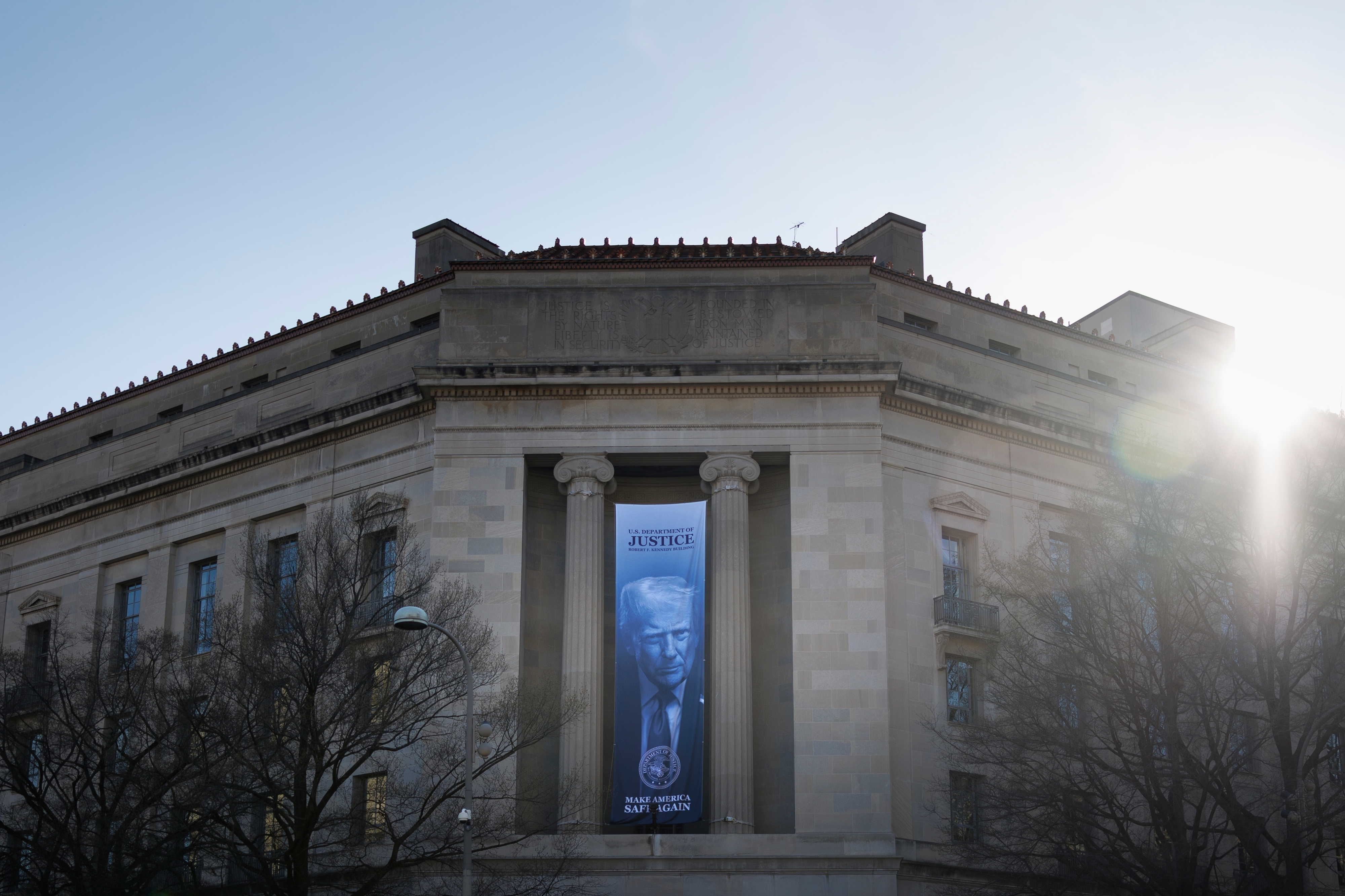
When I served as a U.S. attorney, independence meant not just liberty from the rule of a monarch, but freedom from partisan politics. Now, during our Semiquincentennial, President Donald Trump seems to think otherwise.
Ignoring norms and policies, Trump and his appointees at the Justice Department have injected strongman tactics into the administration of the law. Attorney General Todd Blanche has pointed to language in the Constitution that vests the executive power in a president of the United States to argue that Trump has the authority to direct all executive branch agencies, including the Department of Justice. But Blanche overlooks another provision of Article II, which requires the president to “take care” that the laws be executed “faithfully.”
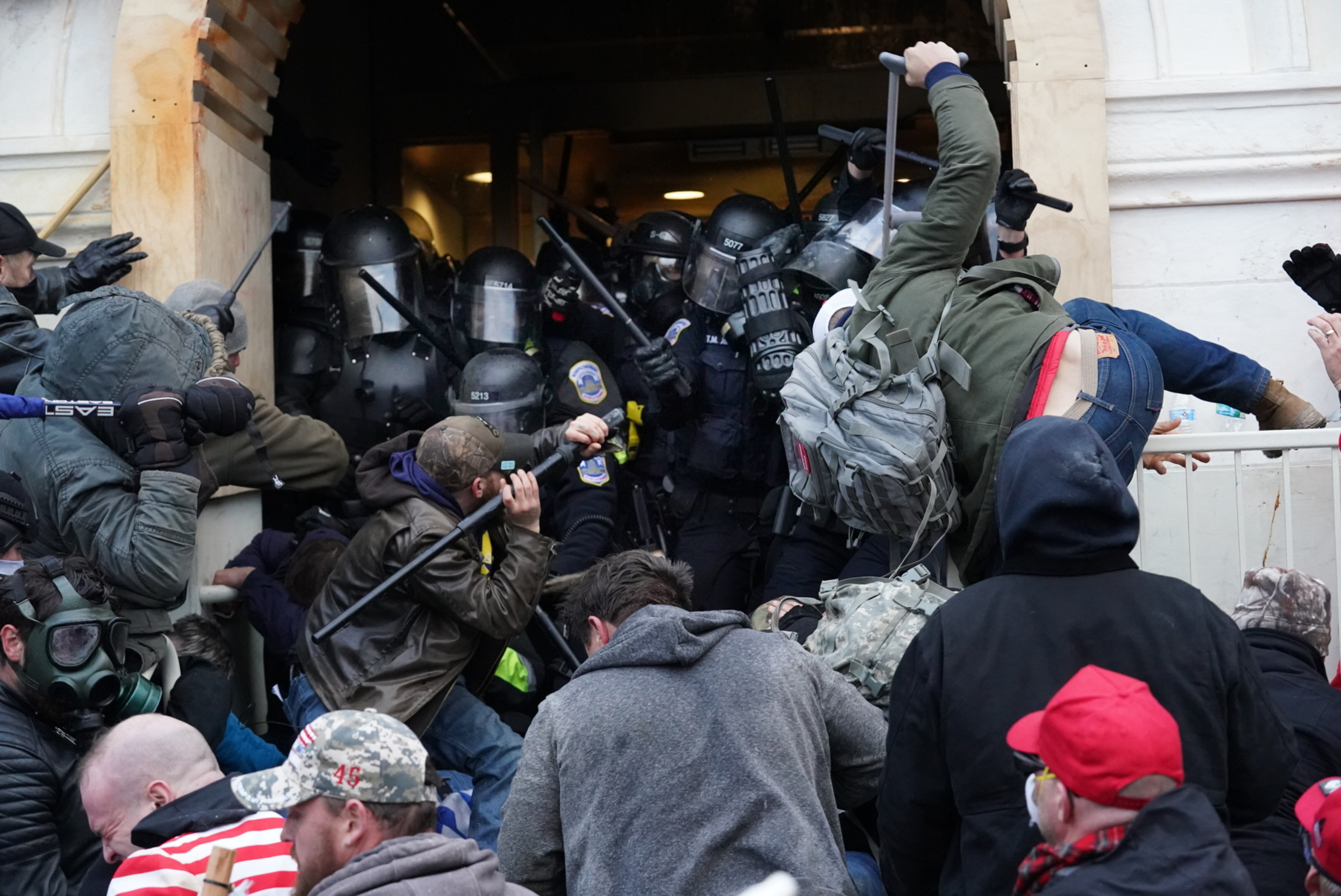
Trump supporters attack police officers as they overrun the U.S. Capitol on Jan. 6, 2021, in Washington, D.C. The president pardoned more than 1,500 convicted rioters on his first day back in office.Jessica Griffin / Staff Photographer
That was followed by the dismissal of bribery charges against then-New York Mayor Eric Adams in exchange for an agreement to support Trump’s immigration enforcement agenda. Calling the deal a “quid pro quo,” Danielle Sassoon, Trump’s own appointee as interim U.S. attorney in Manhattan, resigned, as did eight other Justice Department lawyers.
For those who have crossed the president, the powers of the Justice Department have been used to attack. Baseless charges in the Eastern District of Virginia against New York Attorney General Letitia James, who secured a judgment against Trump’s company in a civil fraud case, and former FBI Director James Comey, who led the agency during its investigation into connections between Trump’s 2016 campaign and Russia, fizzled as courts found that the interim U.S. attorney who brought them was appointed illegally.
A politicized Department of Justice erodes the rule of law when a president uses it as a tool to favor some Americans and a cudgel to punish others. Over time, people tend to grow cynical about the law and lose trust in its stewards, making it more difficult to obtain compliance and hold offenders accountable. Our society becomes less safe and less just, allowing the powerful to prey upon the vulnerable.
As a society, administering the law evenhandedly is essential to the legitimacy of our experiment in democracy. We the people must demand a president who pledges to abide by important restraints that have guided prosecutors for the past five decades, and even to codify them into the Code of Federal Regulations to make them more difficult to brush off.
Criminal prosecution is intended to protect the public and deter criminal conduct, not to exact revenge for a president who sits above the law.
Our Declaration of Independence was a renunciation of a king. As Thomas Paine wrote at the time of the founding, “In America, the law is king.”
Barbara McQuade, a professor of practice at the University of Michigan Law School, served as U.S. attorney in the Eastern District of Michigan from 2010 to 2017 and is the author of “The Fix: Saving America from the Corruption of a Mob-Style Government.”
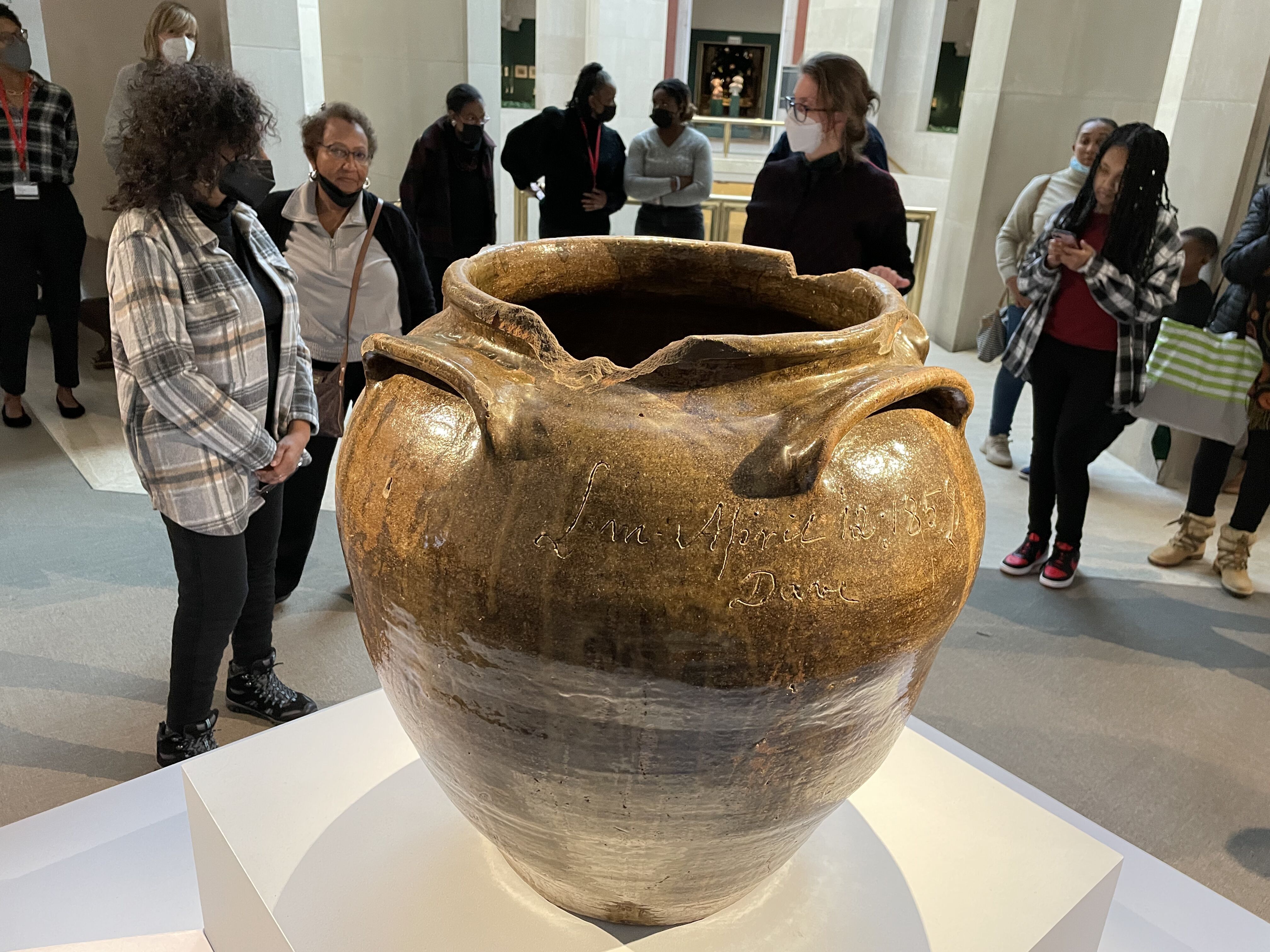
A sandy-hued 83-pound pot with a wide lip, fired by enslaved potter David Drake in the mid-19th century, anchors a gallery in the Philadelphia Museum of Art’s “A Nation of Artists,” its Semiquincentennial salute to illustrious American makers.
The stoneware stands proudly among chestnut étagères, plush upholstery, and vibrant oil paintings in a section called “Prosper, Abundance, and Inequity” staged by Art Museum curators to look like an ornate antebellum living room.
An inscription in the craftsman’s jagged script reads: Good for lard or holding fresh meat,/blest we were when peter saw the folded sheet, suggesting the potter was literate at a time when it was illegal for Black people to learn to read and write, making the earthenware even more valuable.
David Drake (1800 – c. 1870), ‘Storage Jar,’ 1859, Alkaline-glazed stoneware, 26 1/2 x 15 1/2 in., Philadelphia Museum of Art. The artwork will be a part of “A Nation of Artists,” a major collaborative exhibition between the Pennsylvania Academy of the Fine Arts and the Philadelphia Museum of Art.Courtesy of Philadelphia Museum of Art
The Art Museum’s inclusion of the bounded ceramicist’s work is an equitable nod to the artists — potters, basket weavers, tailors, and dressmakers — who made enslavers so rich that their progeny continues to benefit from that wealth today.
That is noteworthy, say Drake’s descendants, who prefer to call their ancestor “Dave the Potter” rather than use his enslaver’s surname.
They say they are grateful institutions like the Art Museum are acknowledging Dave’s work within the canon of great American artists.
But a nod, they say, is not sufficient.
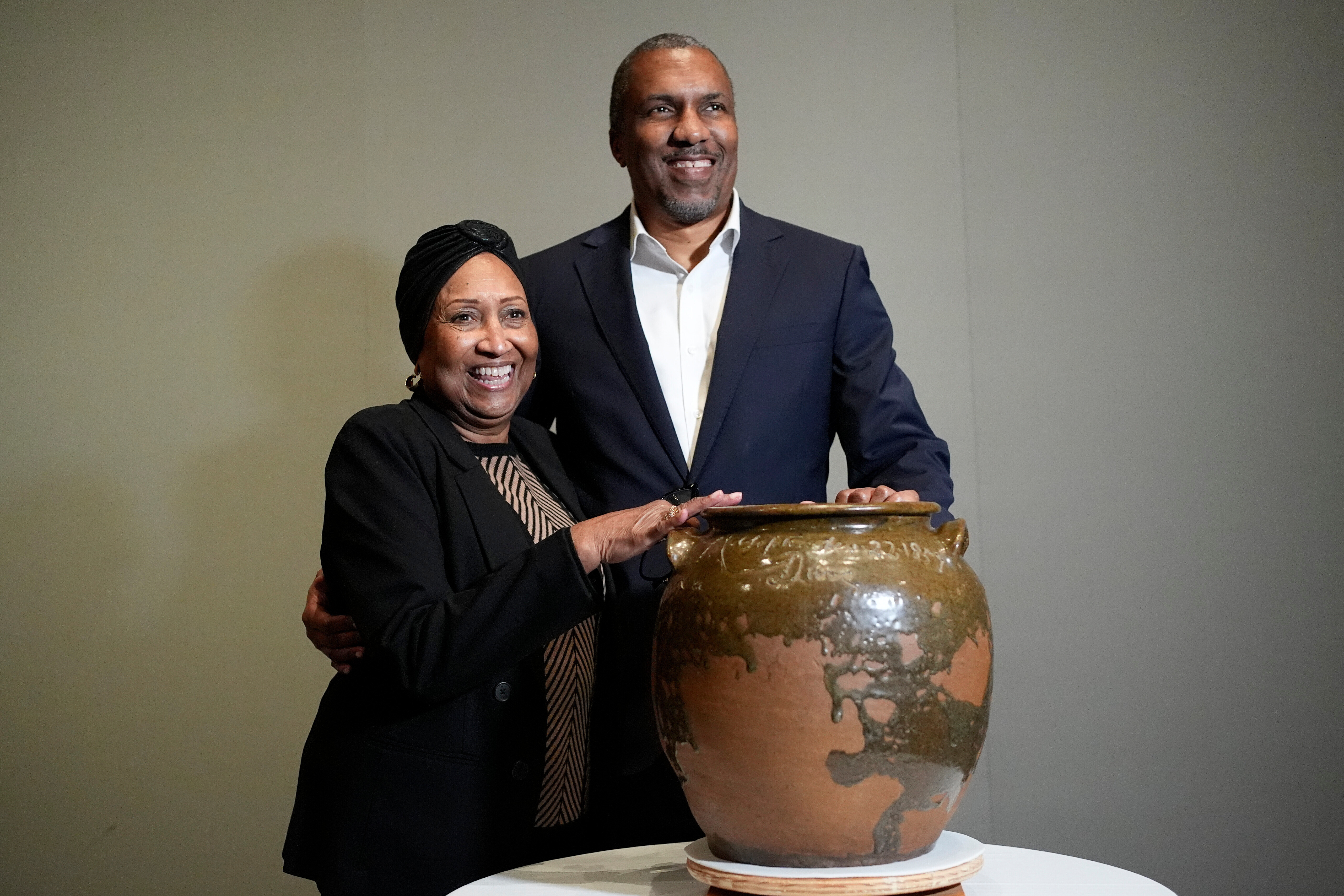
Pauline Baker and her son, Yaba Baker, pose with one of the pots created by their enslaved ancestor, David Drake, at the Museum of Fine Arts, Monday, Nov. 10, 2025, in Boston. (AP Photo/Robert F. Bukaty)Robert F. Bukaty
Dave’s descendants want museums to give the pottery back, including the giant, alkaline-glazed jar on display at the Art Museum.
“We want to own the pieces free and clear,” Yaba Baker, Dave’s fourth great-grandson and executive director of the Dave the Potter Legacy Trust, told The Inquirer. “Our goal is to then loan them back into public spaces so they can be viewed and Dave’s story can be told to the next generation.”
Restitution and repurchase
The seven lines of Dave’s descendants who are alive and living in and around Washington, D.C., and South Carolina have never benefited from their forefather’s labor.
Meanwhile, Dave’s pottery fetches tens of thousands of dollars per piece — and sometimes much more — at estate sales, at auctions, and on eBay.
With the help of Los Angeles-based real estate attorney and social justice advocate George Fatheree III — who helped transfer Bruce’s Beach, a beachfront property in Manhattan Beach, Calif., back to its original Black owners in 2022 — Baker has spent the last two years fighting to have Drake’s work returned to his family.
On Wednesday, several of Dave’s descendants attended a ceremony at Richmond’s Virginia Museum of Fine Arts for the return of a double-handled jug, inscribed with one of Dave’s poems, to the family. VMFA will repurchase the jug for an undisclosed price for its permanent collection.
The Milwaukee Art Museum announced last month it planned to return two of Dave’s jars to his descendants and purchase one of the restituted jars for an undisclosed price.
Both agreements are inspired by a similar deal struck last October between Dave’s descendants and the Museum of Fine Arts, Boston, the first institution to return one of Dave’s jars.
George Fatheree has spent the last two years leading the charge to have Drake’s workjars returned to his family.courtesy of George Fatheree
Of the more than two dozen museums Fatheree is talking to, about half a dozen are “engaged in conversation and moving toward a return.”
The Art Museum, Fatheree, said, is not.
Fatheree reached out to Art Museum director and CEO Daniel H. Weiss in February and was directed to museum attorney Rebecca Wui.
“Since the initial contact, we’ve had a few conversations that I would characterize as cordial in tone, but noncommittal,” Fatheree said, “… and to date, the museum has not indicated whether or not they intend to return the work to the family, and they have not provided any concrete sense of a timeline on the decision.”
The Art Museum acknowledged through a spokesperson the importance of Dave’s legacy and said it is engaged with various stakeholders to determine next steps, adding that at “this time, we are not able to discuss any further details.”
That, Fatheree said, is “disappointing.”
“What they need to understand is the act of delay and failure of urgency is a further act of injury to the family,” Fatheree said.
Art Museum’s history of restitution
During the last several decades, prominent museums across the world have been examining how they have acquired significant pieces of art and scientific specimens.
In 2022, the Smithsonian Institution and the Metropolitan Museum of Art were among dozens of museums that returned bronzes stolen from Benin, the capital of Nigeria, during the 1897 British raid on the city.
As an enslaved man, Fatheree argues, Dave made his pottery under duress. He did not have agency over his body, nor did he have the opportunity to profit from his labors. His work was stolen from him.
The chain of provenance, used to establish that art has moved fairly and ethically from artists to buyers to new owners throughout a piece’s history, was not just broken. It never started.
A poem jar by Dave the Potter in the “Hear Me Now: The Potters of Old Edgefield South Carolina” at the Metropolitan Museum of Art that was on exhibition from September 9, 2022-February 5, 2023.Dave the Potter Trust
“No museum would acquire a piece today where there has been a real break in provenance from an act of violence,” Fatheree said. “That’s what every museum that acquired Dave the Potter’s work did. … That’s a very uncomfortable conversation to have.”
‘An amazing individual’
Dave the Potter was born around 1800 on a plantation in Edgefield, S.C., where he was enslaved by a man named Harvey Drake. Drake and his uncle Abner Landrum owned Pottersville, 12 sprawling pottery factories that enslaved more than 75 Black people.
Landrum was also the publisher of the local newspaper, the Edgefield Hive. Scholars suggest he taught Dave to read. One of Dave’s many jobs was to assemble the newspaper type.
“Dave was such an amazing individual,” Baker said. “His skill set included writing and poetry at a time when our people couldn’t even read. His skills and craftsmanship were just so remarkable.”
Harvey Drake died in 1832, and Dave began making pottery for Harvey’s brother, Reuben. Dave’s oldest knownpiece with writing on it is a jug with earlike handles that dates to 1834, currently housed at the South Carolina State Museum. The piece features a rhyming couplet: Put every bit all between. Surely this jar will hold 14.
In 1740, South Carolina passed a law that made illegal teaching enslaved people how to read. In 1834, the law was updated so that any Black person, free or enslaved, caught reading would be punished by 50 lashes.
That did not stop Dave from signing his work, marking others, or adding signed couplets just under the lip and along the body of his massive storage jars, jugs, pots, and syrup and whiskey jugs.
When they were made, the pieces — which stored fruit, vegetables, and meats to feed the family of enslavers — sold for pennies on the gallon. In the meantime, Dave — who had two wives, both of whom were sold away from him — had no idea where his family was.
Historians believe Dave made from 40,000 to 60,000 pieces. It is unclear how many remain. Dave’s descendants are trying to get about 60 of them returned through their appeals to museums, Fatheree said.
“This man worked every single day doing the same thing, sometimes in 110-degree heat,” said Baker, who pointed out that Dave had just one leg. Although it is contested by historians, Dave’s descendants believe his leg was cut off as punishment, perhaps for knowing how to read.
“He was a valuable potter, and his enslavers wanted him to stay put,” Baker said. “His family was sold from underneath him. He didn’t have any agency over his body. Every day of my life, I’m inspired by him.”
Rightful owners
In 1849, Lewis Miles purchased Dave and brought him to his South Carolina pottery farm, Stony Bluff. Here is where it appears Dave made the bulk of his inscribed pieces. He marked many with LM, after Miles. Dave was signed on some.
Miles’ pottery plantation is where most of Dave’s poem pieces were seemingly made: three in 1857, eight in 1858, and seven in 1859.
The Art Museum’s piece is dated May 3, 1859.
Throughout the late 19th and most of the 20th century, Dave the Potter’s work was not considered high art, but it was recognizable in South Carolina, where it was commonly seen at yard sales and antique shows. And as historians discovered the pots, especially the ones with Dave’s etchings, the glazed ceramics increased in value.
The Art Museum has a history of collecting stoneware crafted by enslaved potters starting in 1904, when it acquired three alkaline-glazed stoneware face vessels made in the Edgefield district of South Carolina. That, the Art Museum said in a recent statement, set “the precedent for art museums to collect the art of this potting tradition.”
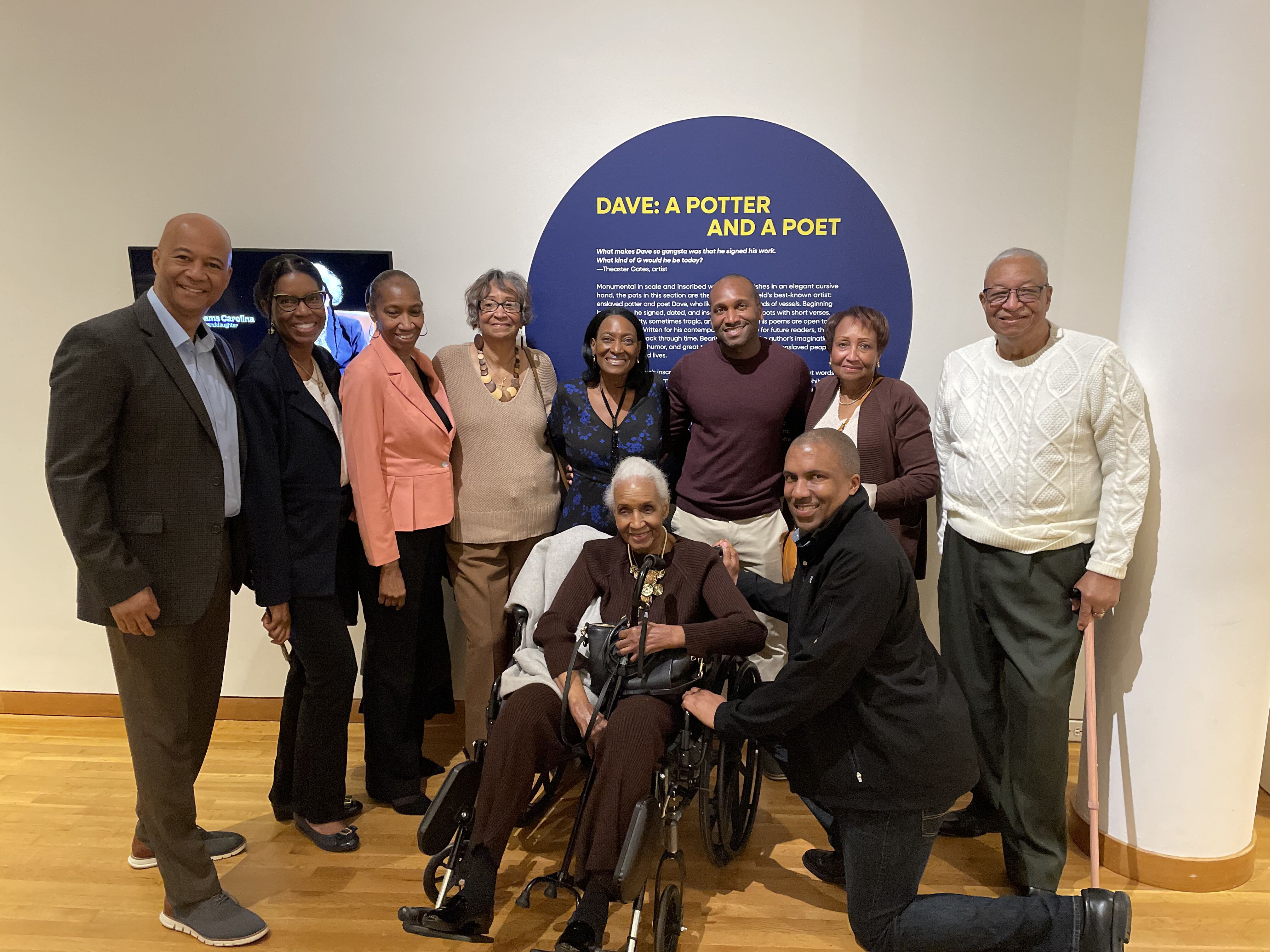
Dave the Potter’s descendants pictured at the Metropolitan Museum of Art’s ‘Hear Me Now’ exhibit in 2022-2023 from left to right: Adrian Williams, Sr. Leticia Carolina, Wanda Holmes, Daisy Whitner, Priscillia Williams, Brandon Williams, Pauline Baker, John Williams, Sr. (in the wheelchair is Priscilla Carolina, Yaba Baker kneeling beside her)Dave the Potter Legacy Trust, LLC
The face vessels are also on view in “A Nation of Artists.”
In 1997, the Art Museum purchased Dave’s pot for an undisclosed price when it was offered for sale by collectors.
A year later, the late historian Jill Beute Koverman curated the exhibition “I Made This Jar … The Life and Works of the Enslaved African American Potter, Dave” at the McKissick Museum at the University of South Carolina, the first solo exhibition of Dave’s work.
That show traveled to the Winterthur Museum in 2000 and featured 30 of Dave’s pots.
Dave the Potter’s eldest living descendants from left to right: John Williams, Sr., Daisy Whitner, Pauline Baker.Dave the Potter Legacy Trust
“These pieces weren’t made to be placed in the parlor of a home,” Koverman told The Inquirer in 2000. “According to the standards of the day, they wouldn’t be considered art at all.”
In 2016, the late historian April Hynes contacted Daisy Whitner, Baker’s aunt, informing her that she and her siblings — John Williams, Pauline Baker (Yaba’s mother), and the late Priscilla Williams Carolina — were descendants of Dave.
“We didn’t have any idea we were connected,” Baker said. “Before then, slavery felt distant to us. Now we have a personal connection.”
But it was not until Baker and his family were invited as guests to the Metropolitan Museum of Art’s 2022 exhibit “Hear Me Now: The Black Potters of Old Edgefield, South Carolina” did he consider himself and his family to be the rightful owners of Dave’s pottery.
“Someone asked me, ‘Do you own any pots?,’ and then I had to say, ‘No.’ I only had a replica,” Baker said.
“In any other situation, the descendants would at least have some of the artwork. And then I realized how my family was really missing out. People start businesses with this equity. They take loans out on these pieces.”
Baker thought of his daughter and his cousins who have children in college with tuition that costs upward of $75,000 a year.
He formed a trust and hired Fatheree in 2024.
‘Left out of the process’
The 2025 settlements between Drake’s descendants and the Museum of Fine Arts, Boston and, last month, with the Milwaukee Art Museum represented the first times a museum applied the principles of ethical restitution to artwork created by enslaved African Americans, Fatheree said.
The arrangements in Boston, Milwaukee, and now Virginia are accompanied with a certificate of ethical ownership that states the museum has “established good faith, lawful, legitimate, and ethical possession of the artwork and has all right, title, and interest to and in the artwork.”
Establishing provenance for artwork made by enslaved people when it was legal to enslave them is important, explained Vedet Coleman-Robinson, president and CEO of the Association of African American Museums. It establishes a precedent of what to do when valuable work made by enslaved African American artists ends up in art spaces today.
“African Americans have systemically been left out of the process,” said Coleman-Robinson, emphasizing that African Americans had no say in their work because they, too, were property.
“What we created during enslavement wasn’t owned by us, and it didn’t have a chance to become a part of our collective generational wealth. That’s why I think what the Drake descendants are doing is phenomenal. They aren’t just asking for money, they are asking for acknowledgment, and that acknowledgment piece is pivotal in telling a complete story.”
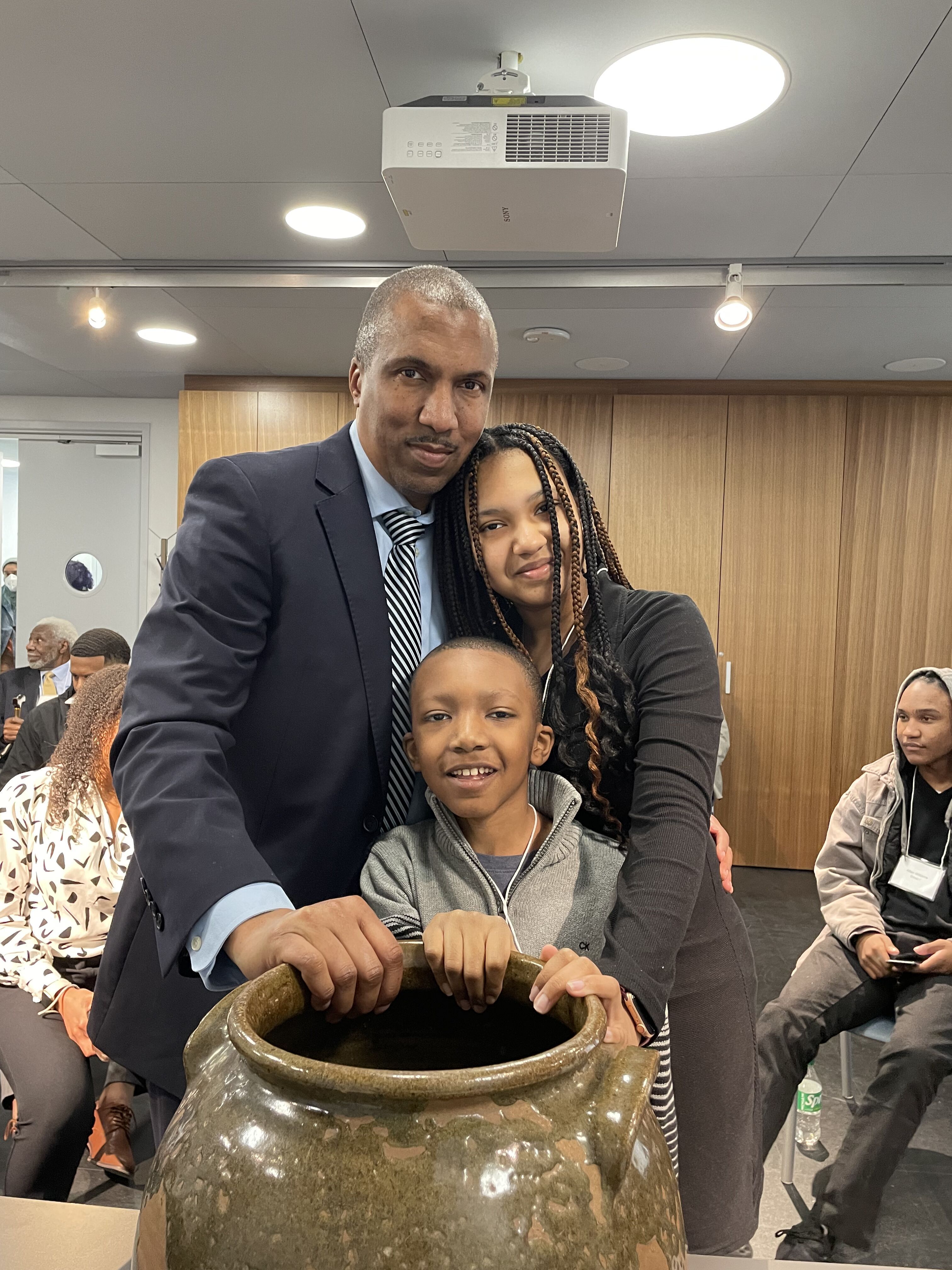
Yaba Baker with his daughter Kindra Baker and son Cameron Baker with a 19th-century pot made by Dave the Potter.The Dave the Potter Family Trust
Baker said his family is only asking the Art Museum for a conversation about what is owed them. That is not reparations, Baker said. It’s justice.
“Don’t treat our family differently,” he said. “If you are giving pieces back that have been taken under duress and stolen, then we deserve our work back. You said those were your ethics. Now we are just holding you to your word.”