Tag: Sean Mannion

  • Eagles grades vs. Commanders: Jalen Hurts delivers when needed; Zack Baun stars on defense in the win

    Eagles grades vs. Commanders: Jalen Hurts delivers when needed; Zack Baun stars on defense in the win

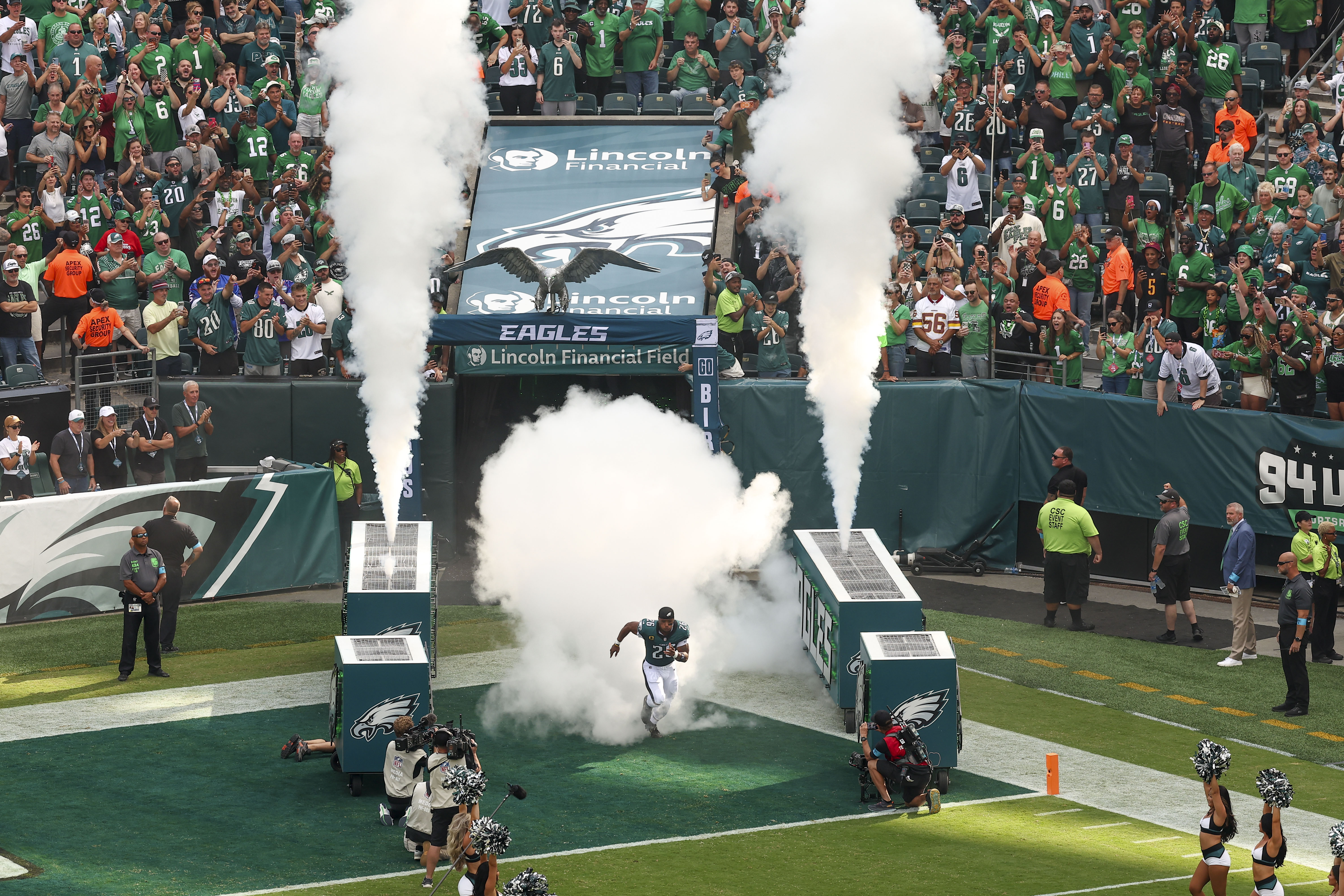
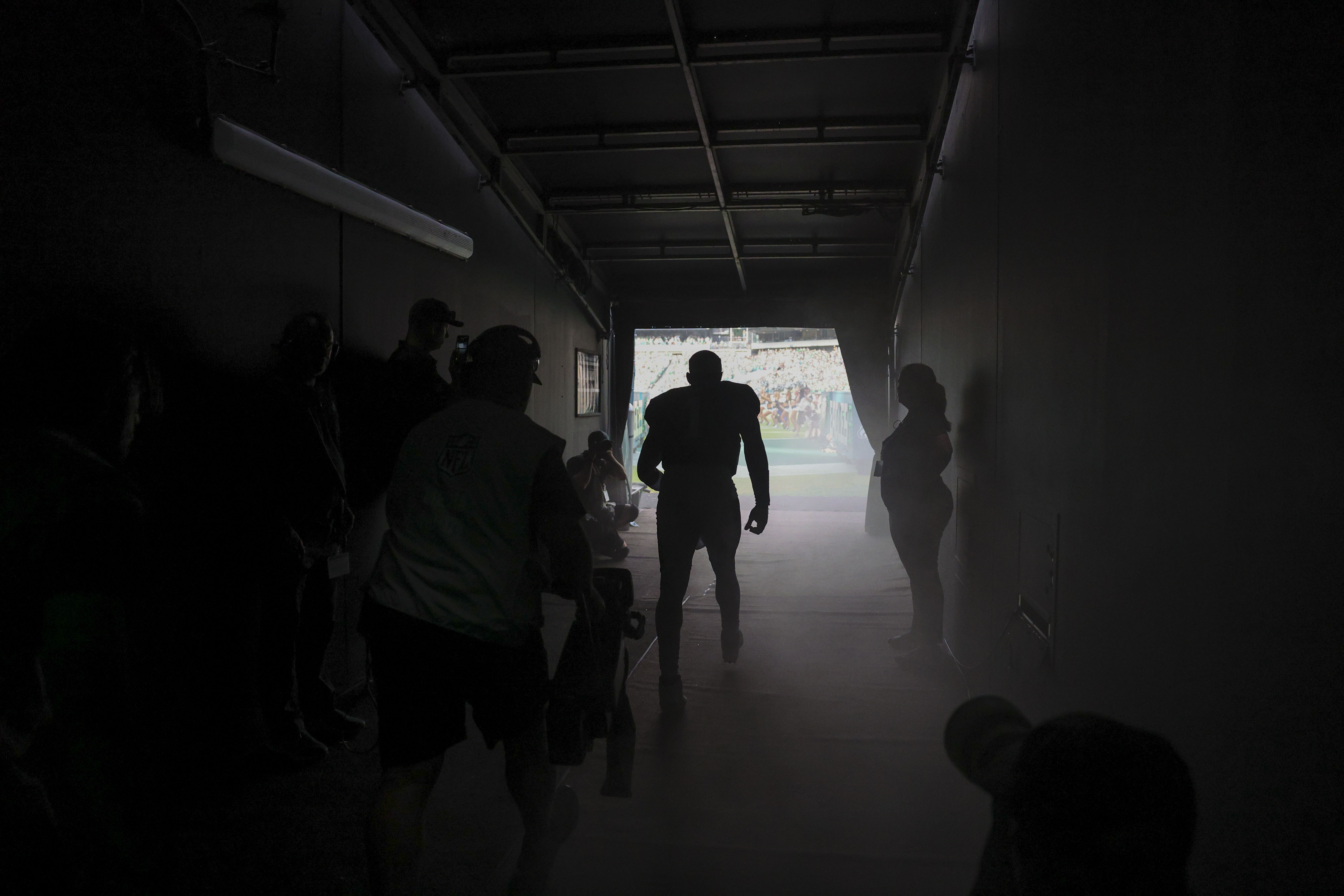
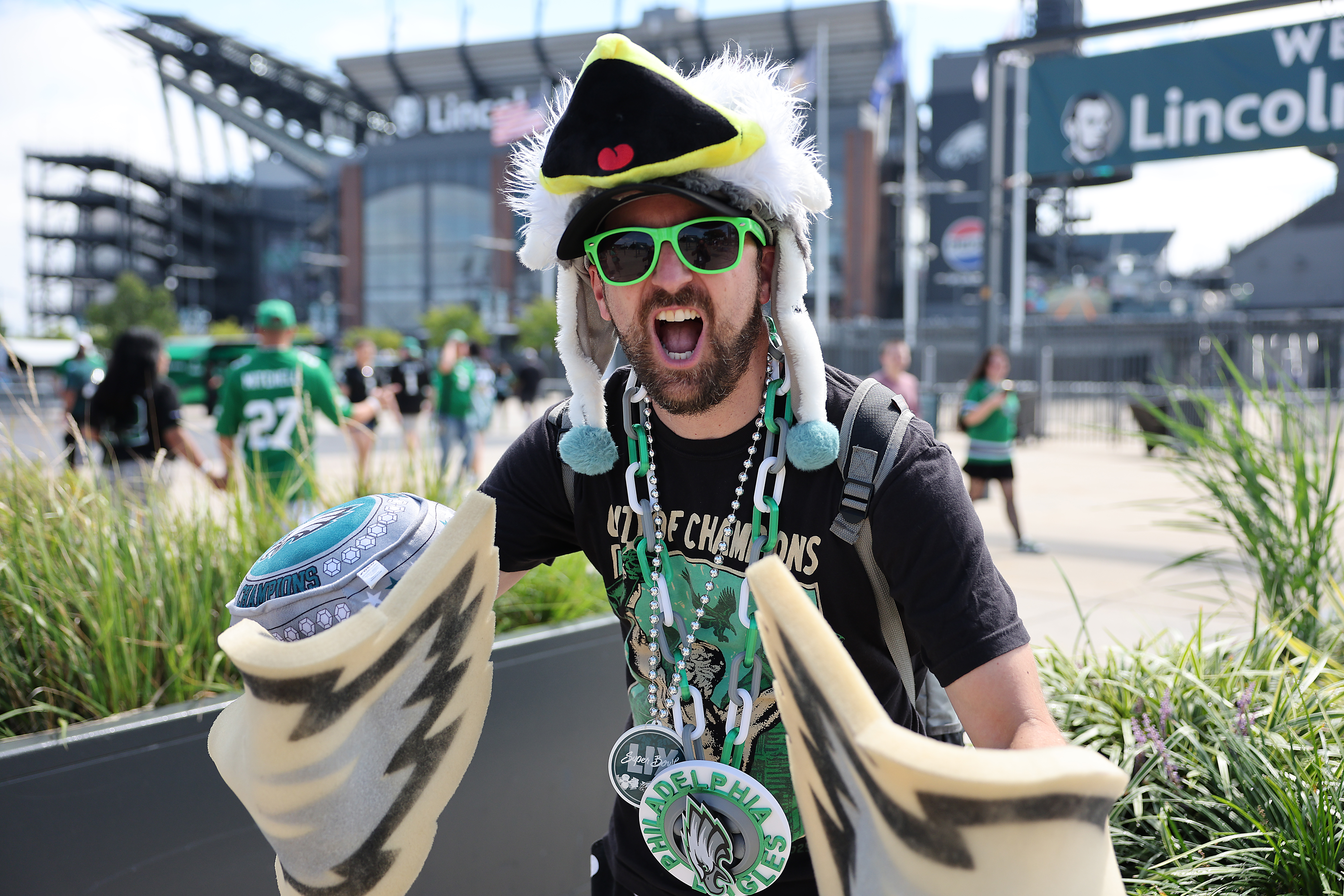
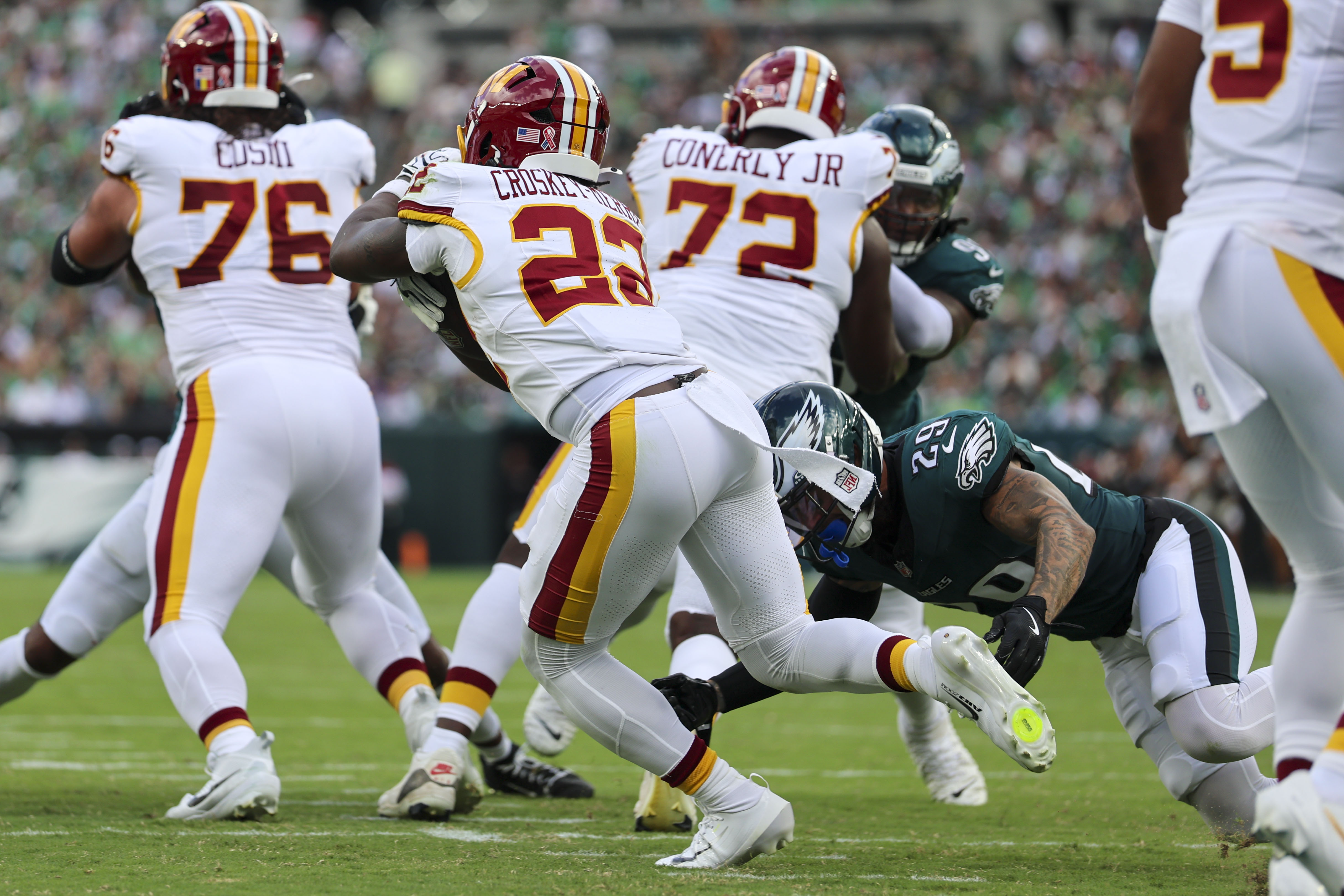
    Instant grades from the Eagles’ 24-22 win over the Commanders.

    Quarterback: B

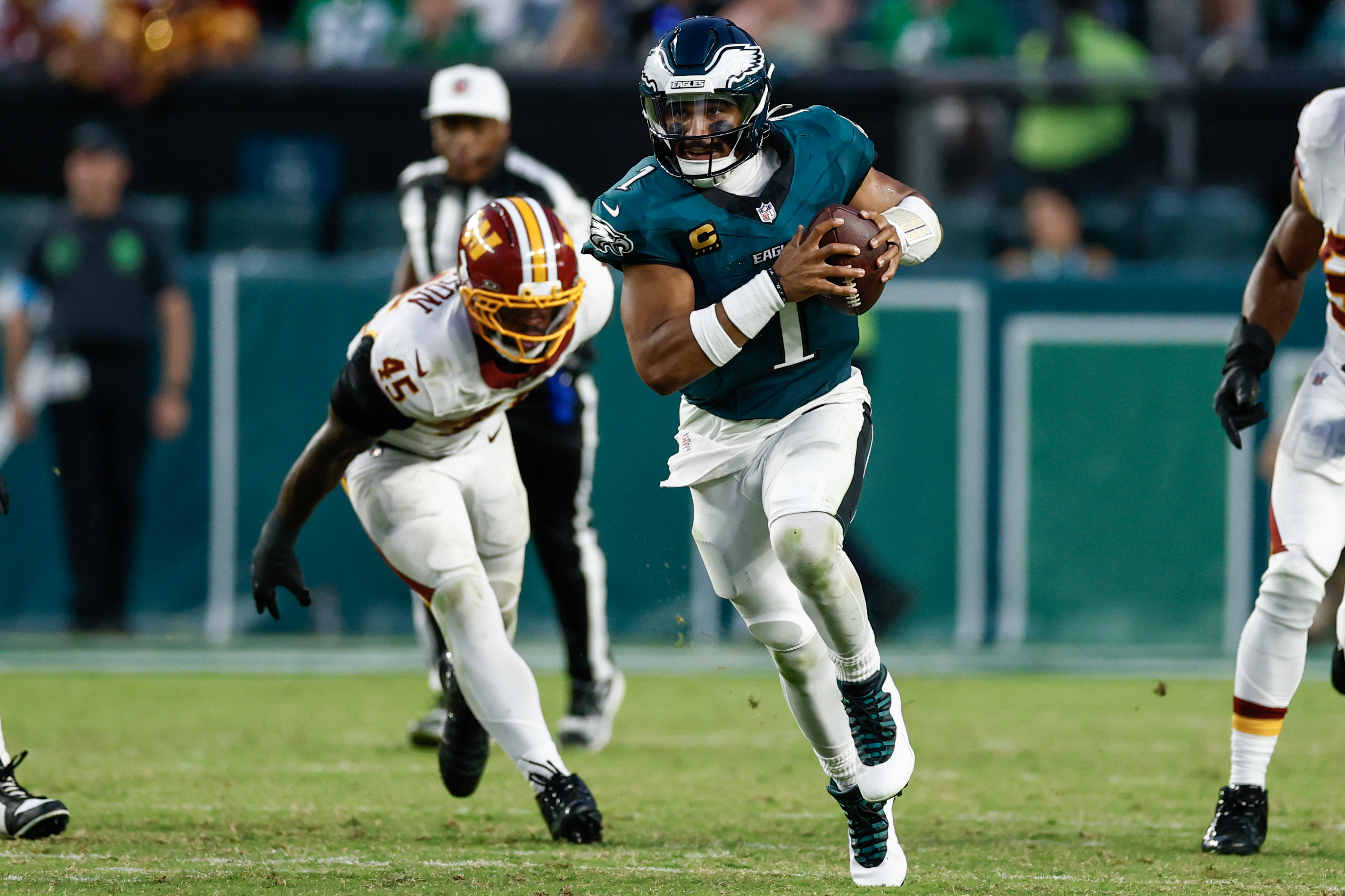
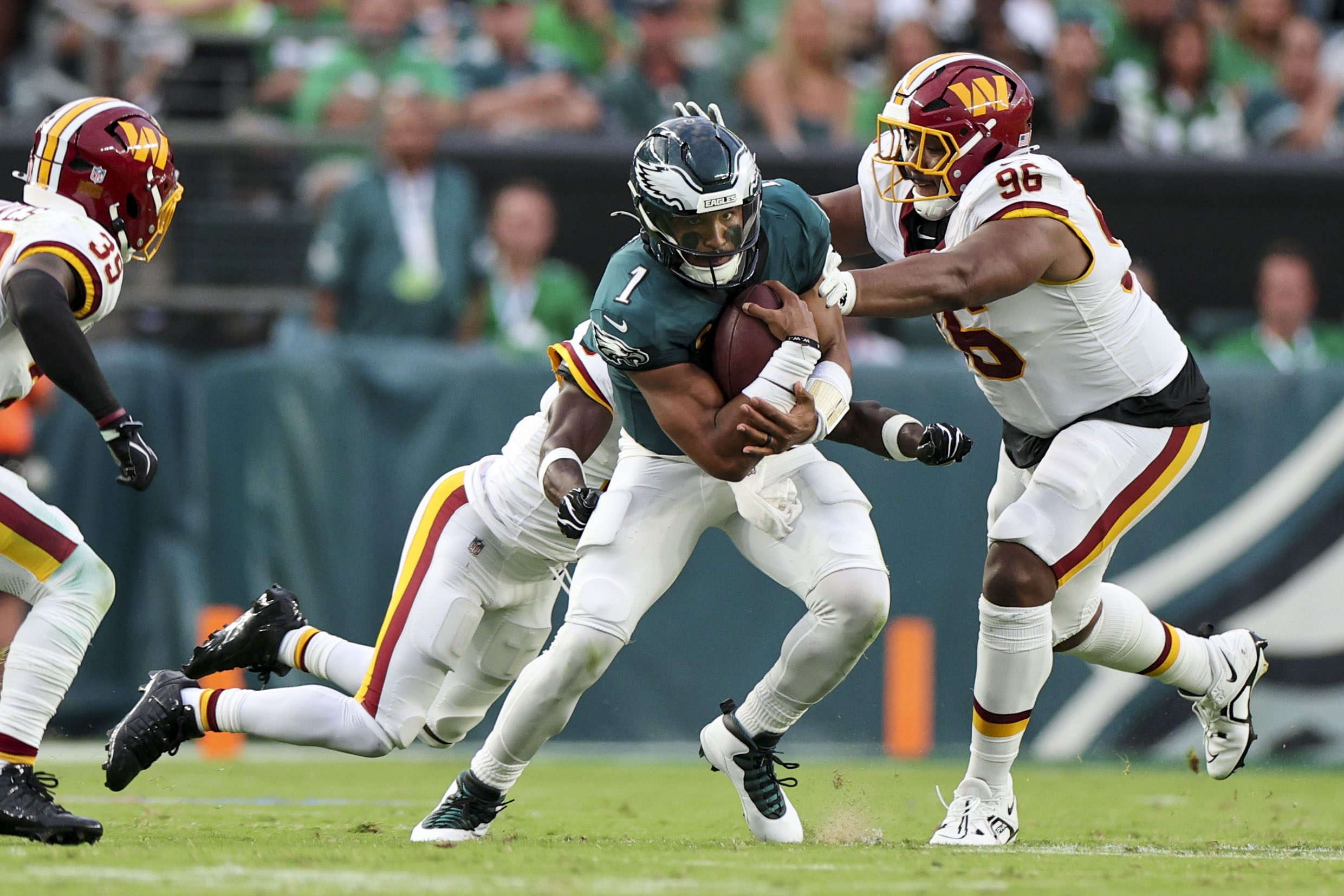
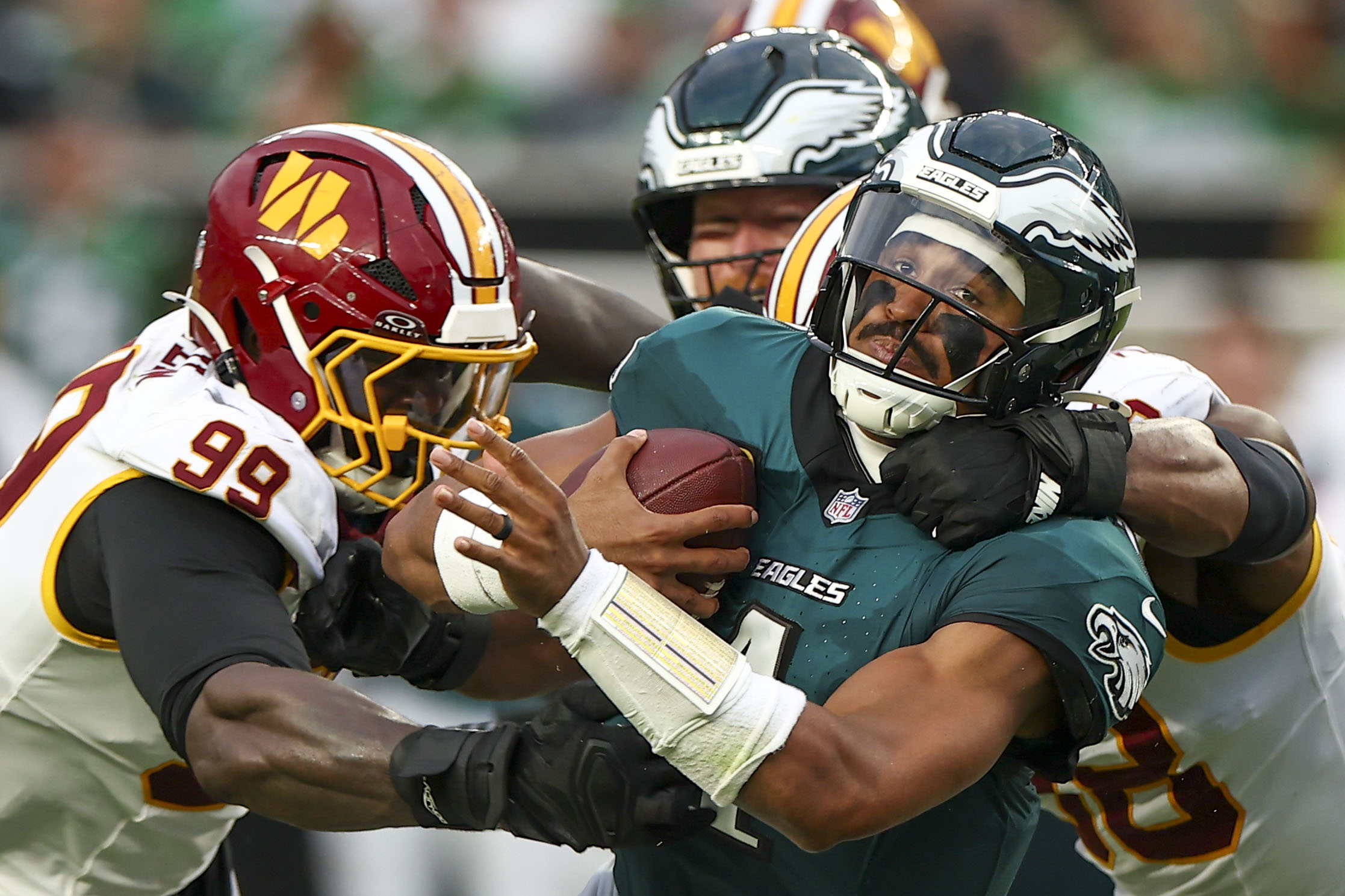
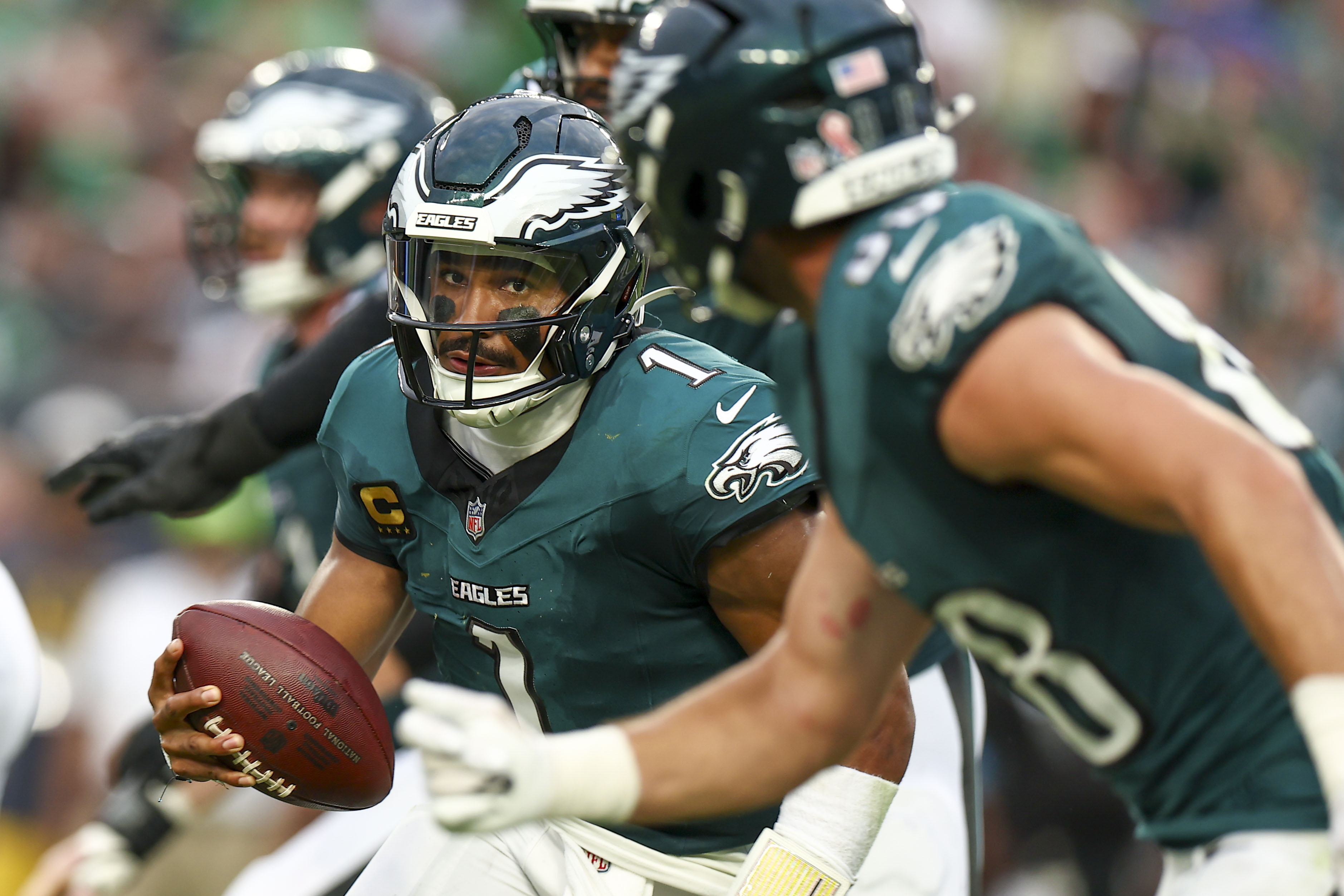
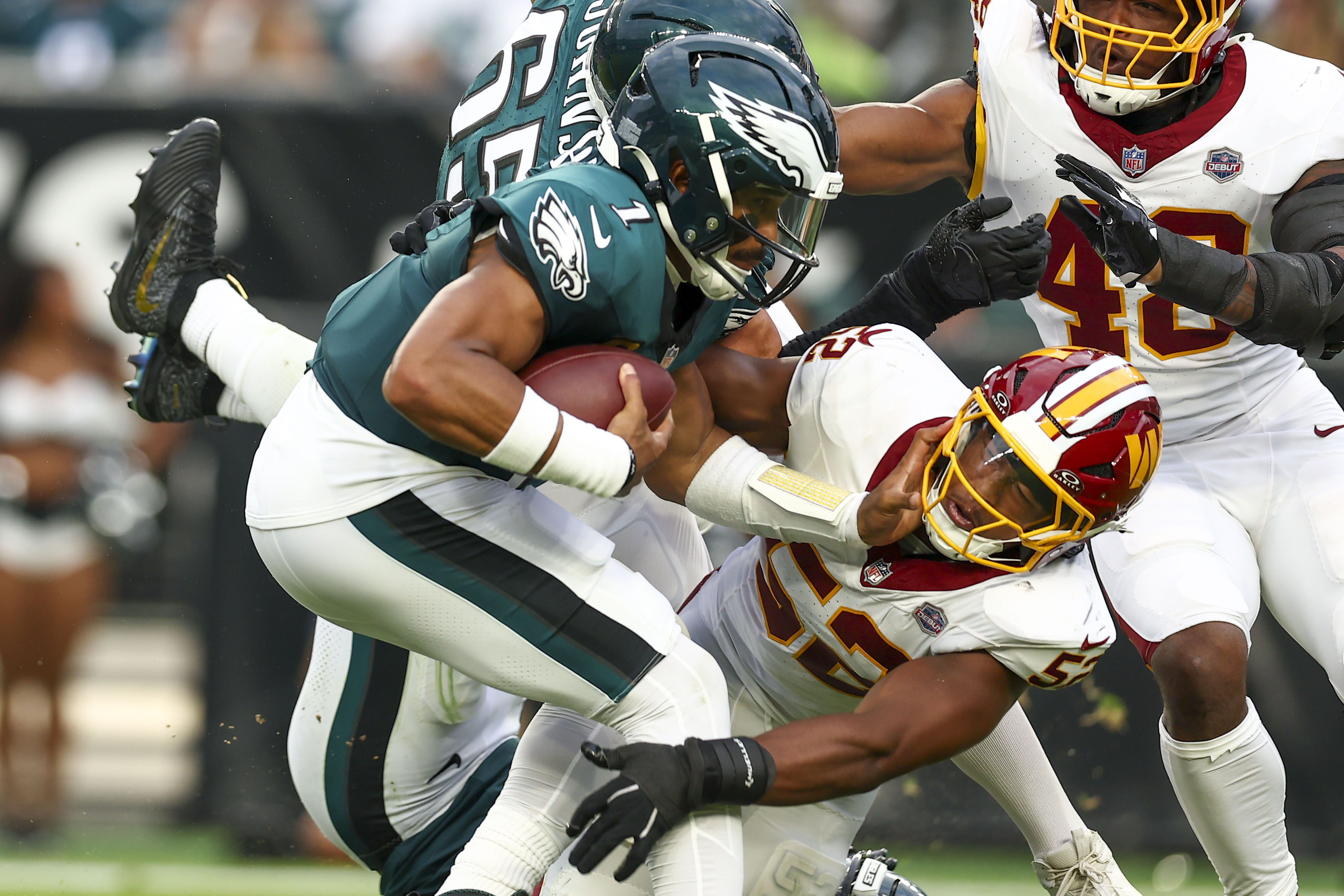
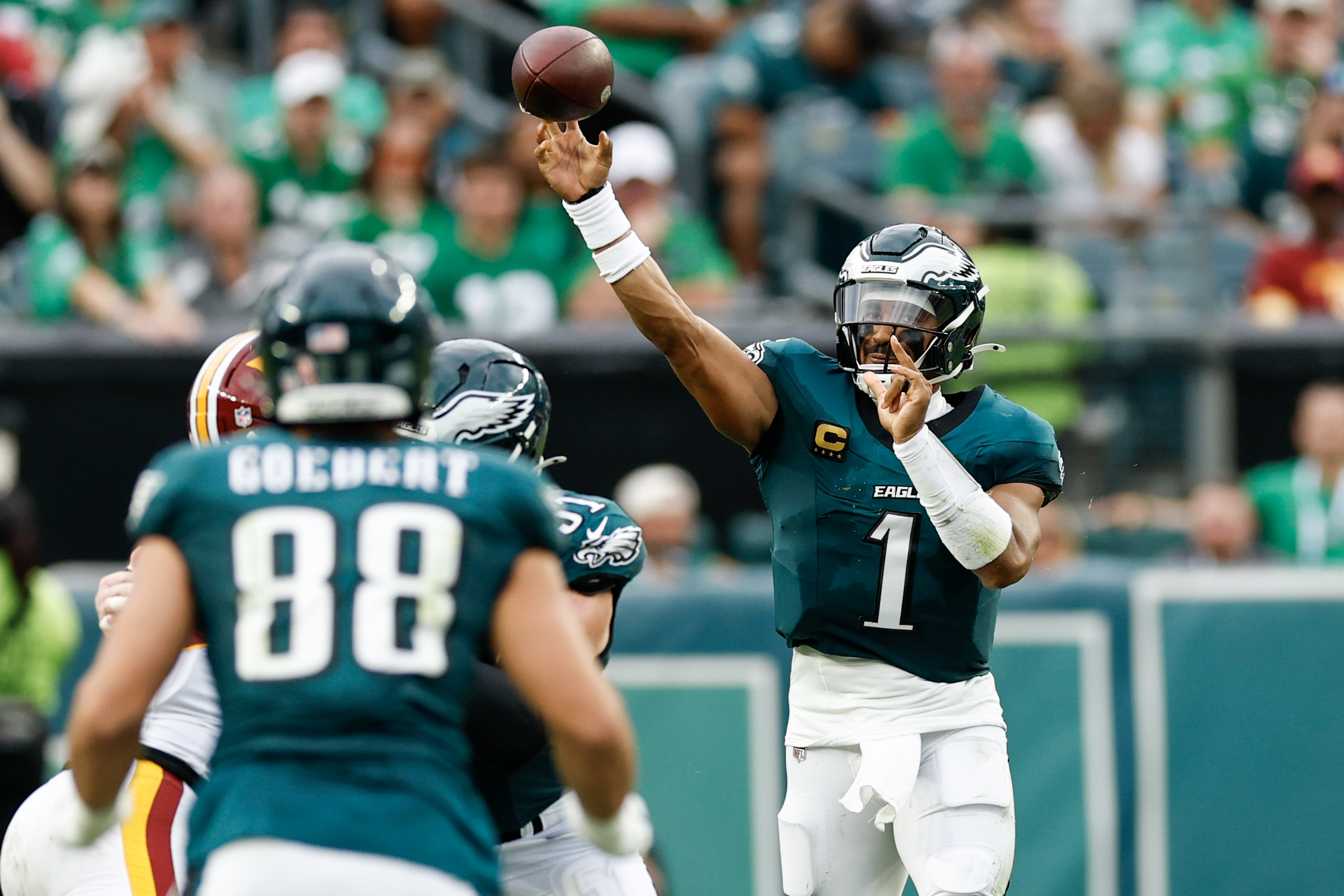
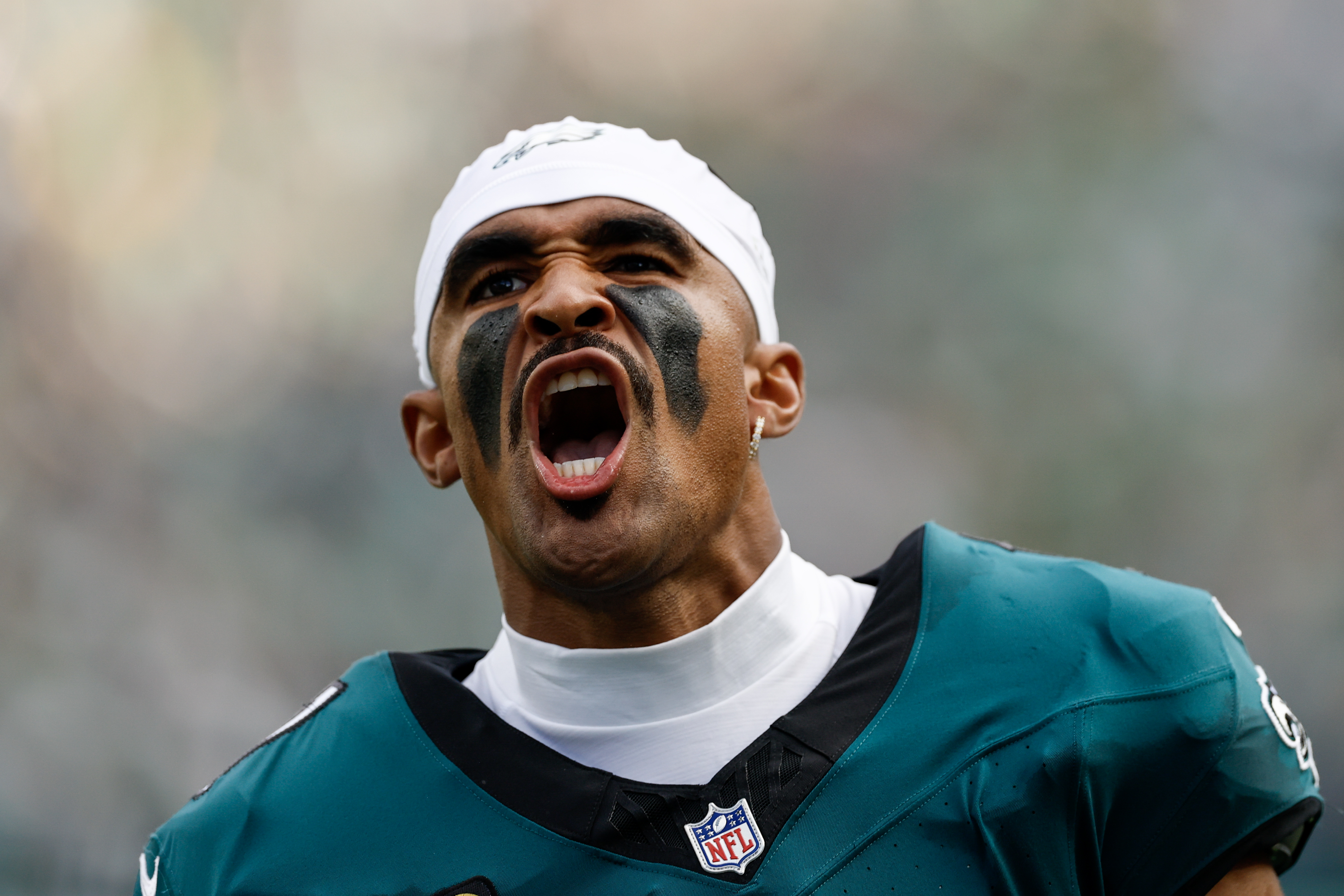
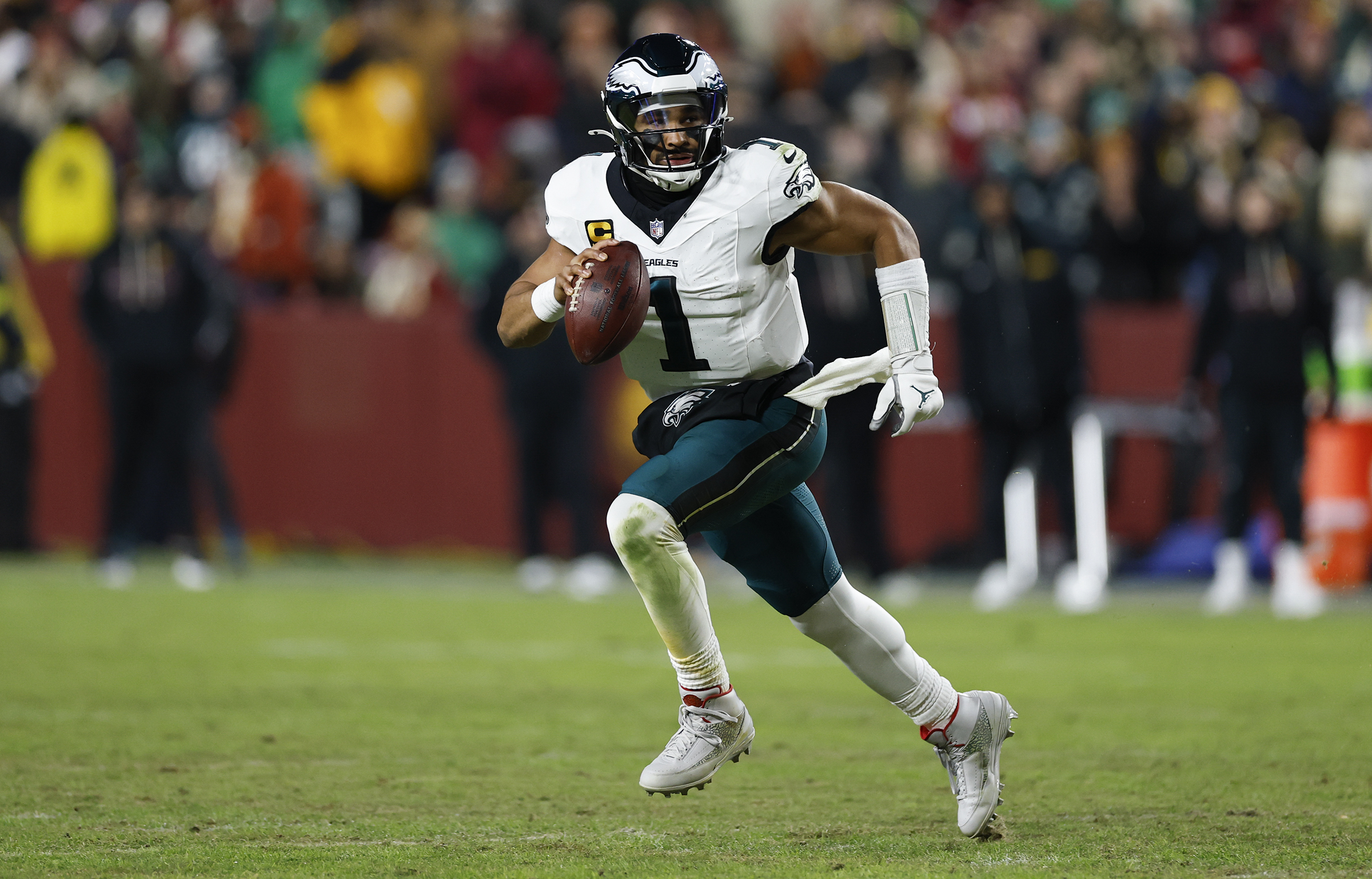
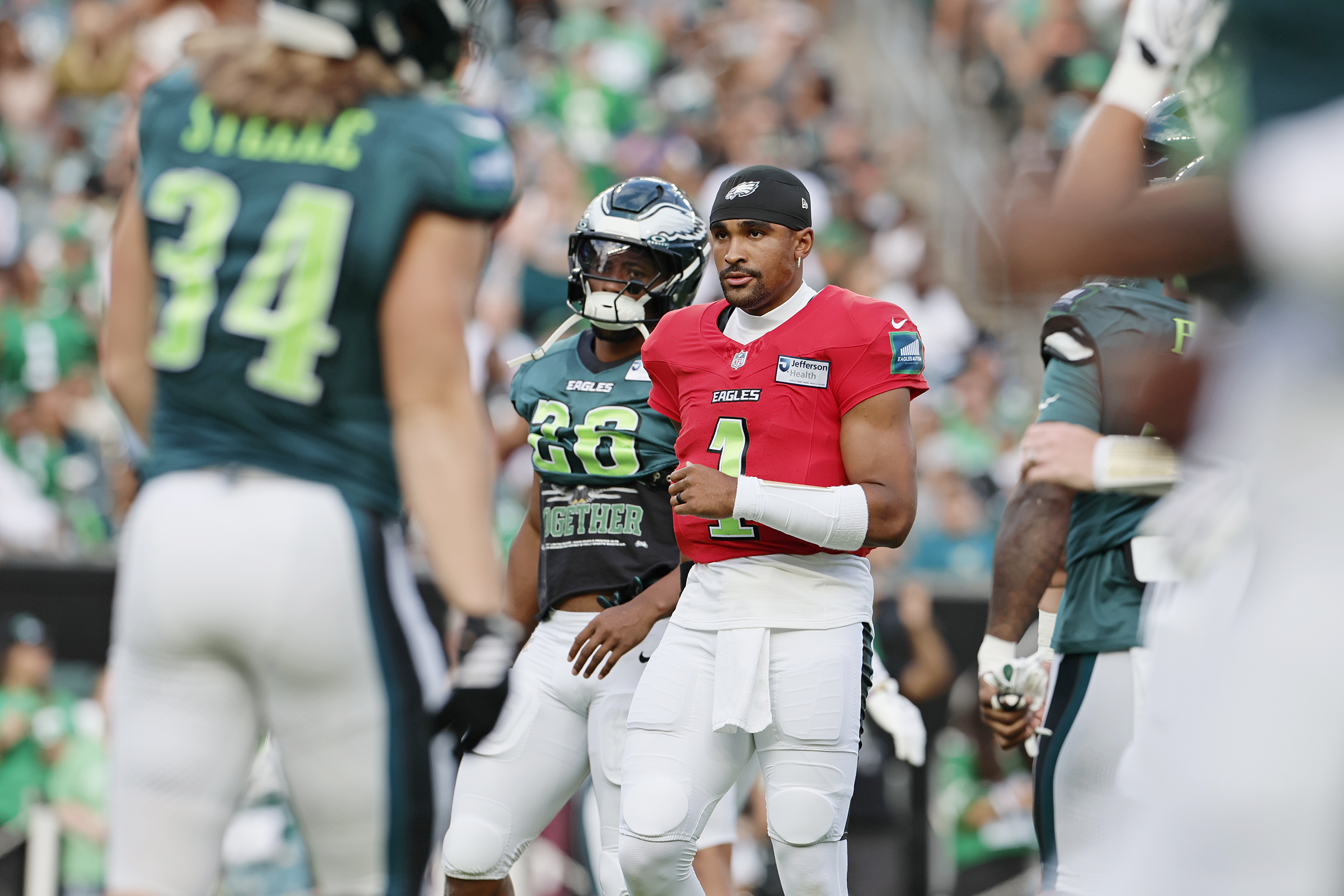
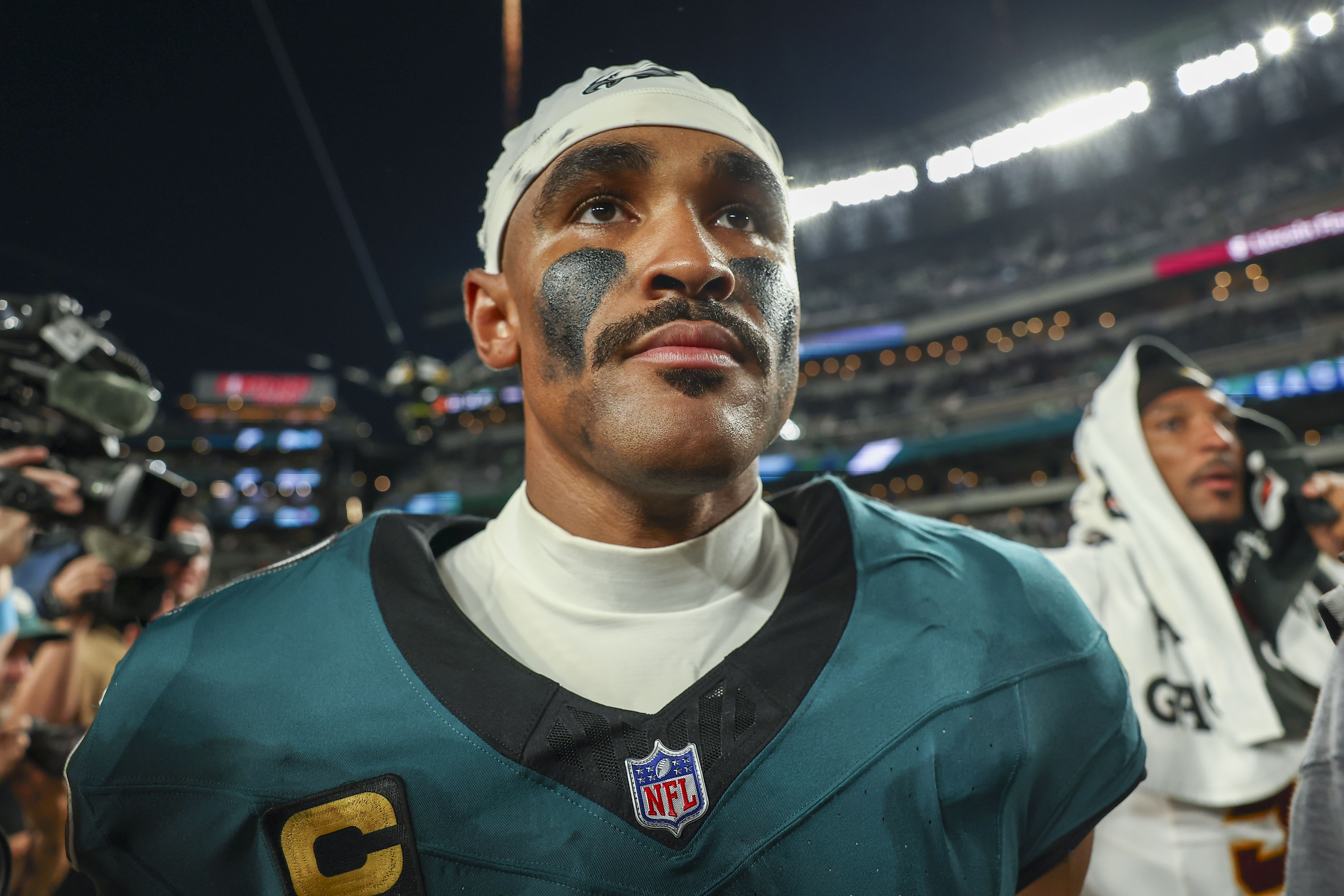
    Jalen Hurts answered some questions about how he’ll adjust to maybe the most significant scheme and play-caller change of his NFL career. It wasn’t always pretty, particularly when Washington pressured him or changed the coverage picture post-snap. But Hurts delivered when needed with his arm and legs.

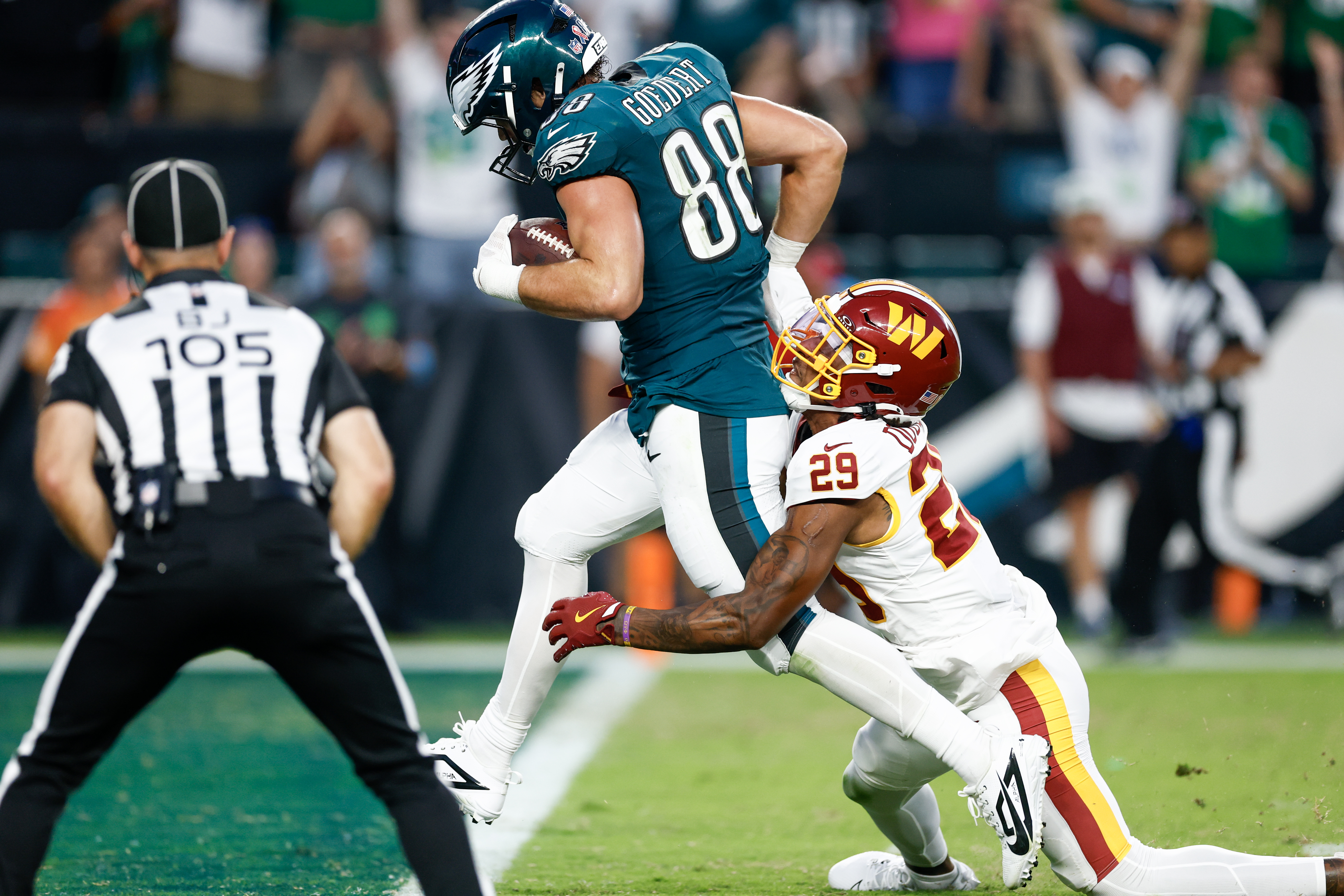
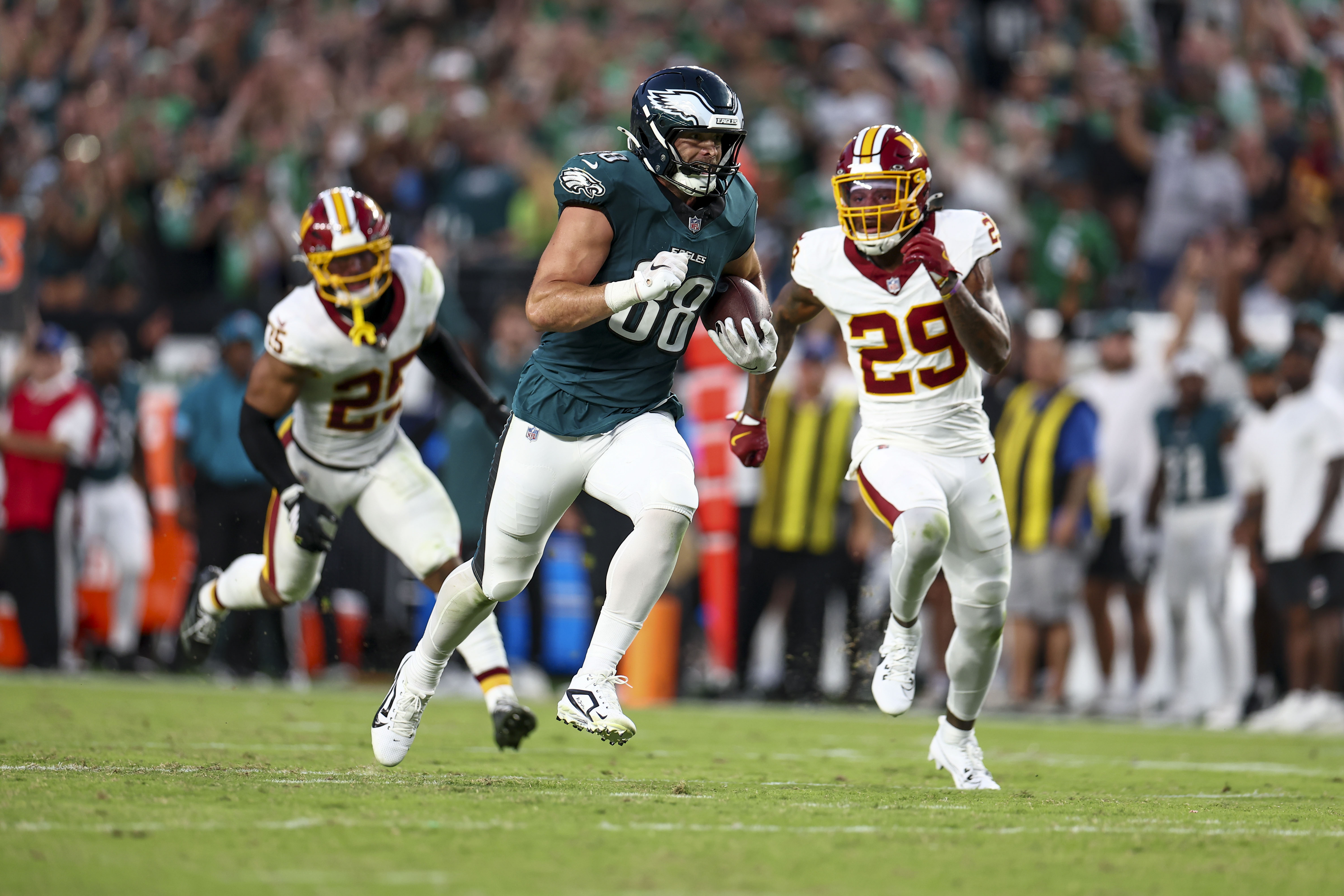
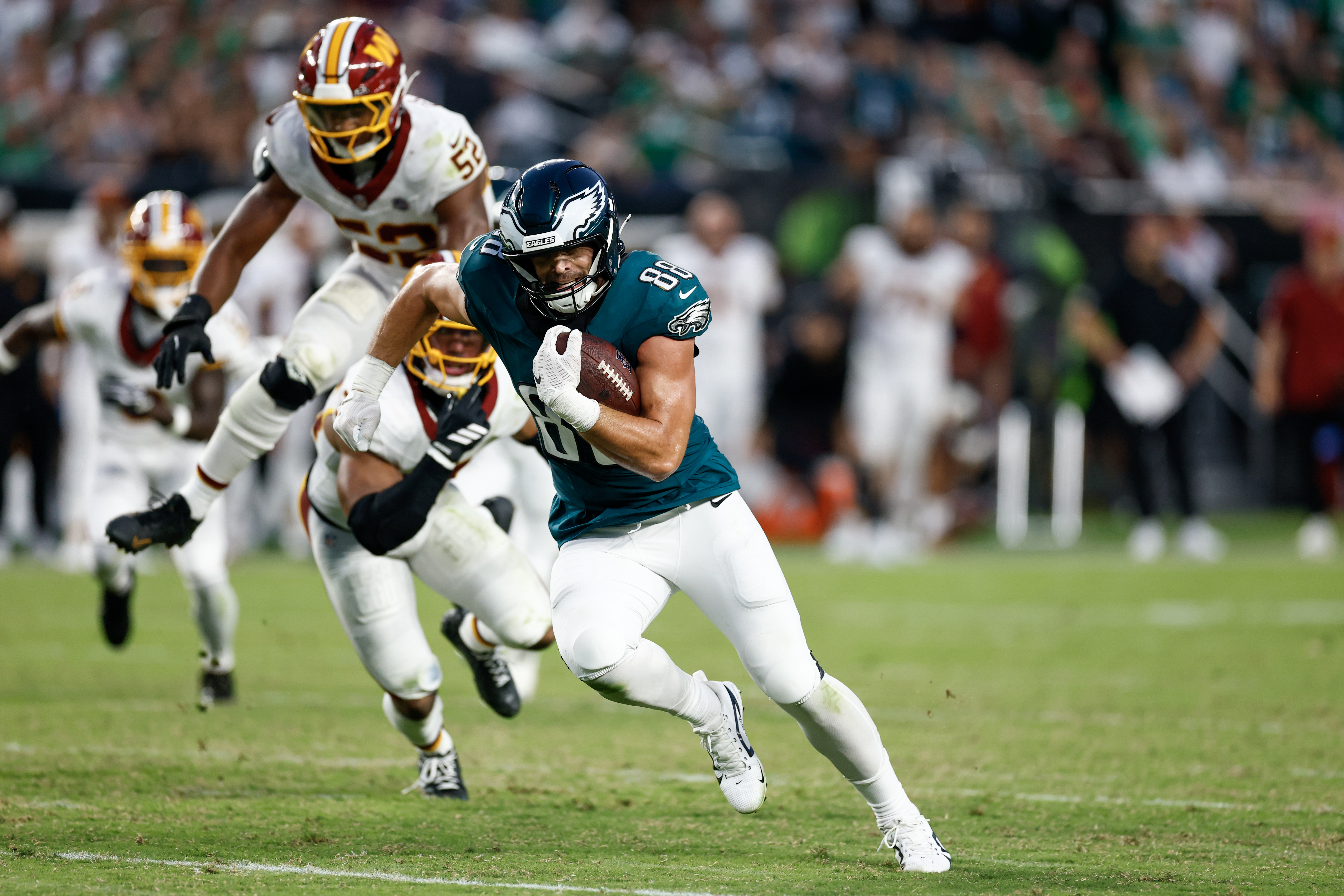
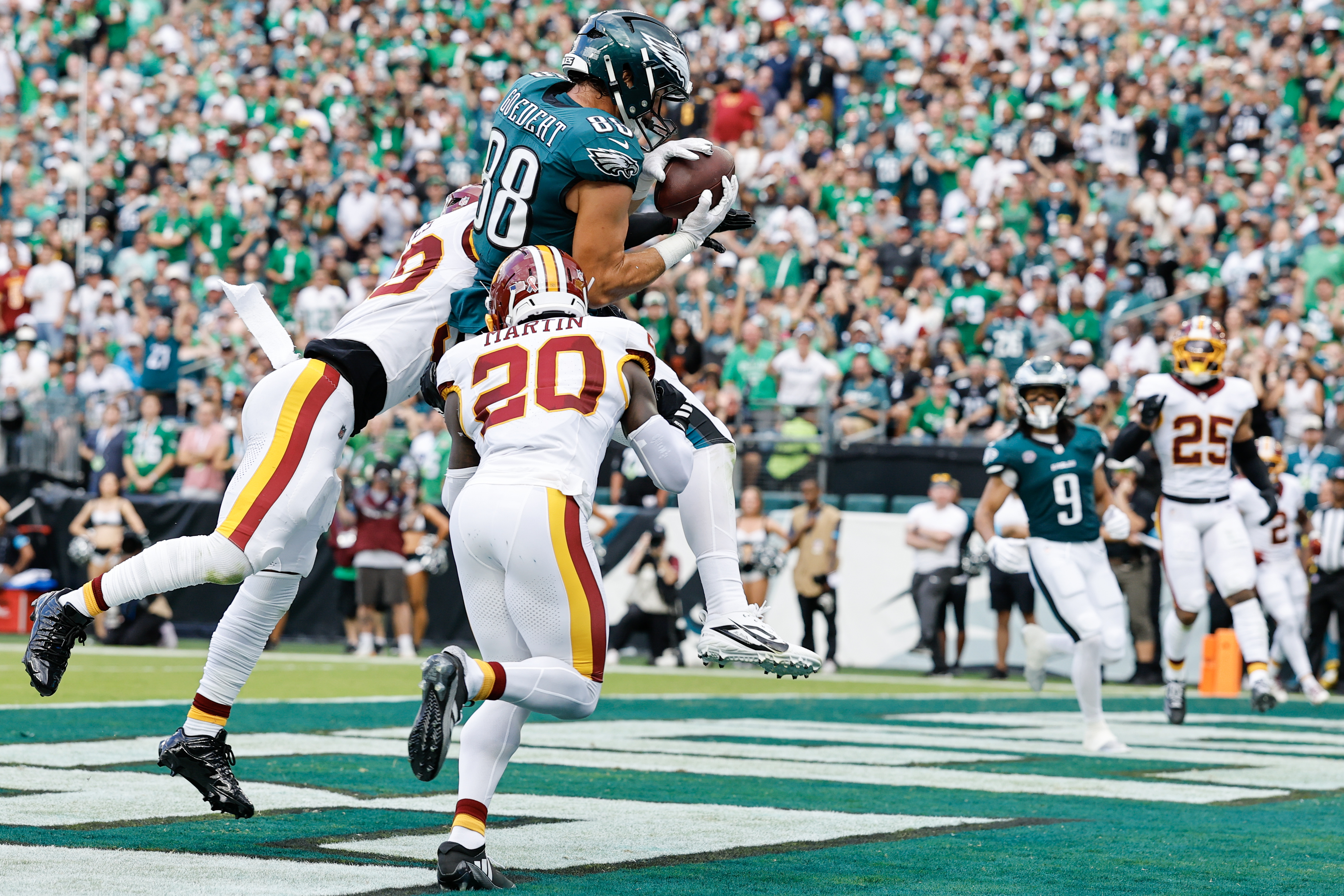
    Overall, he completed 14 of 25 passes for 203 yards and three touchdowns. He scrambled five times for 48 yards before game-ending kneels. In the fourth quarter, he found Dallas Goedert over the middle and the tight end did the rest for a 43-yard touchdown. Earlier on the drive, Hurts had a huge 22-yard scramble on third-and-18. There weren’t any designed quarterback runs, but Hurts looked more mobile than he has in a few years.

    In the third quarter, Hurts tear-dropped a 31-yarder to DeVonta Smith on a third down. Until that moment in the second half, the offense looked ugly. Hurts and his protection struggled vs. Washington’s blitzes and simulated pressures.
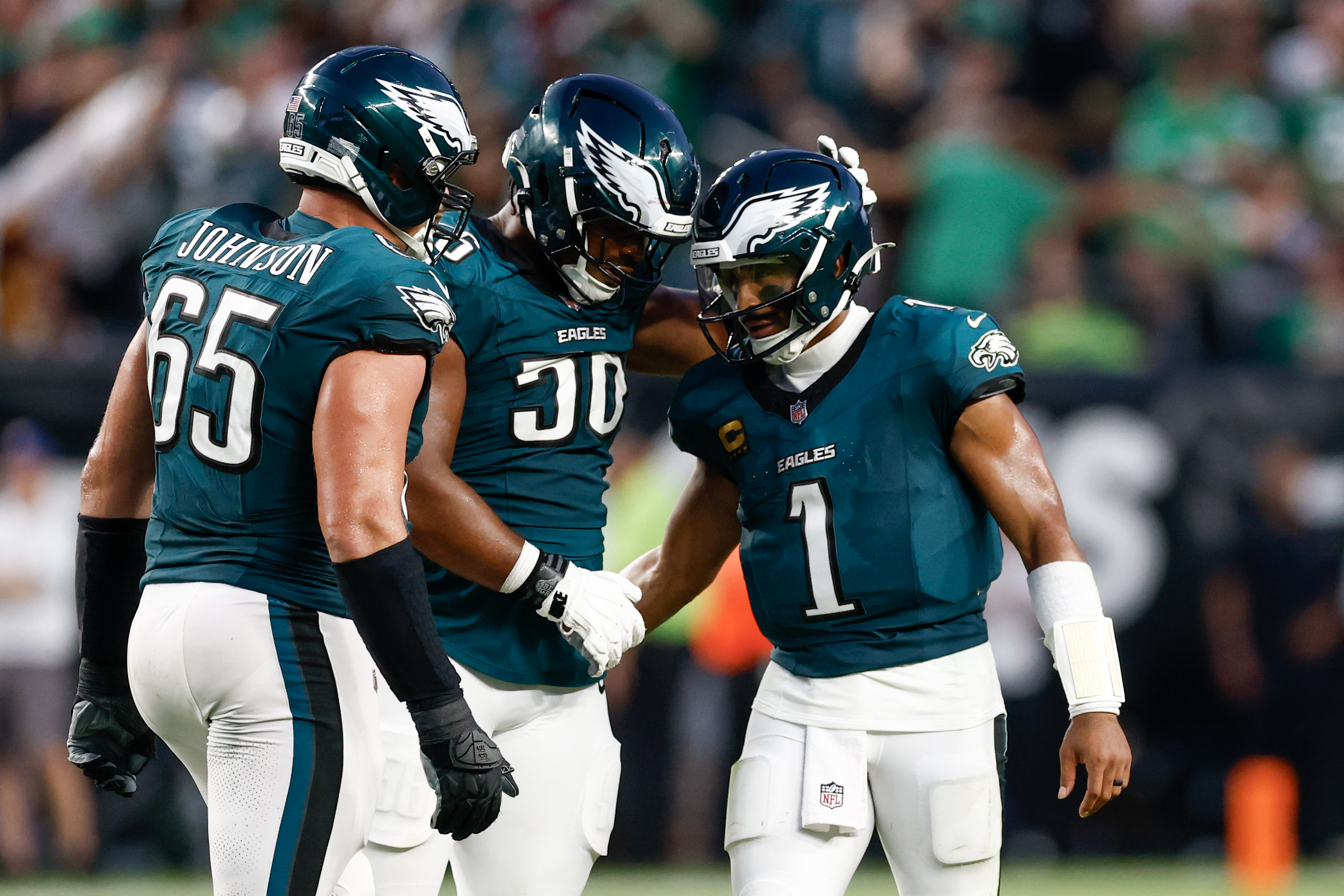
    Jalen Hurts (right) completed 14 of 25 passes for 203 yards and three touchdowns on Sunday.Yong Kim / Staff Photographer

    Hurts was mostly excellent in the first half when he had time to throw. He heaved a deep dime to wide receiver Dontayvion Wicks on a 64-yard corner route. He hit Goedert down the seam for a 17-yard touchdown. And he was on time with Wicks on an out route that resulted in a 9-yard touchdown.

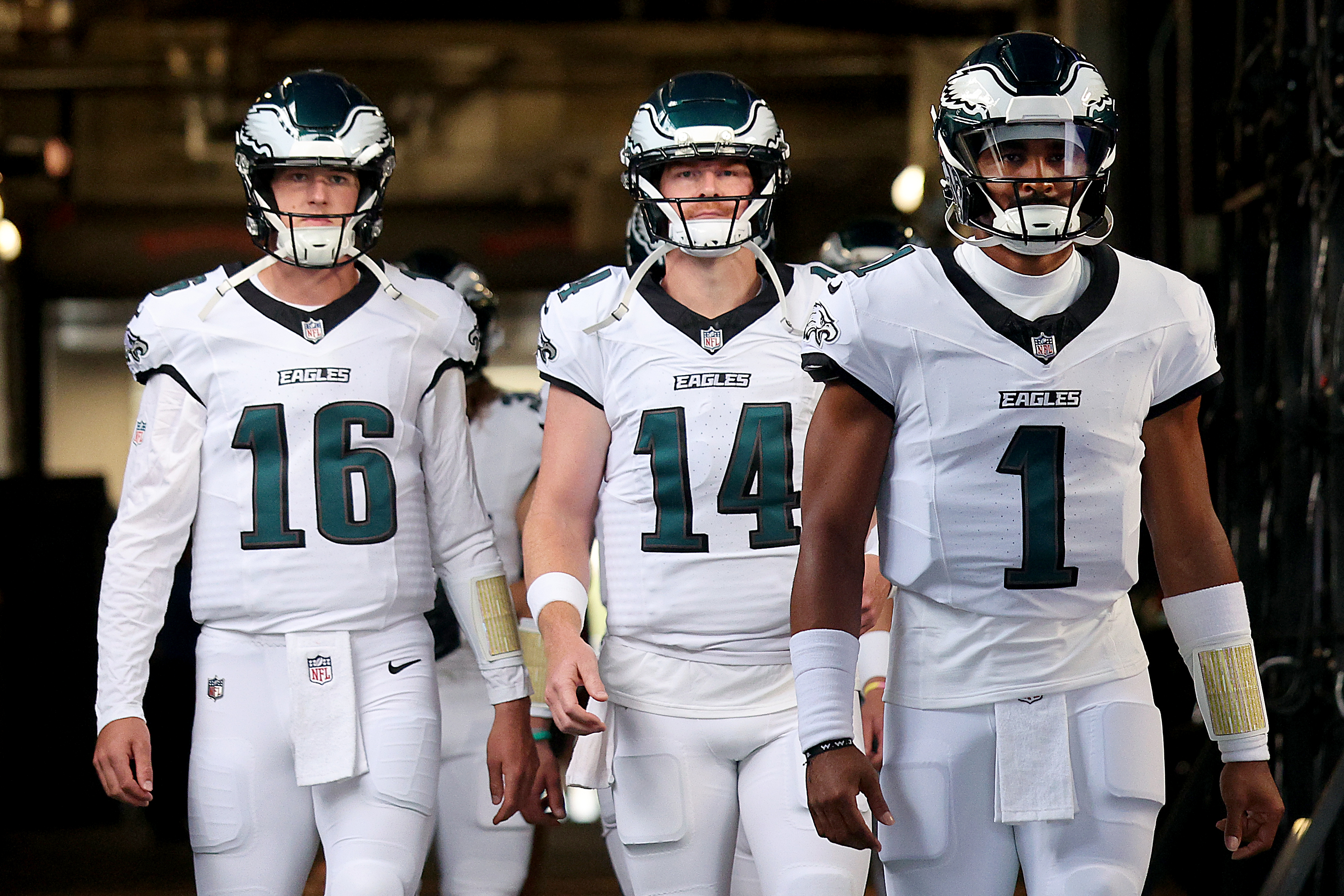
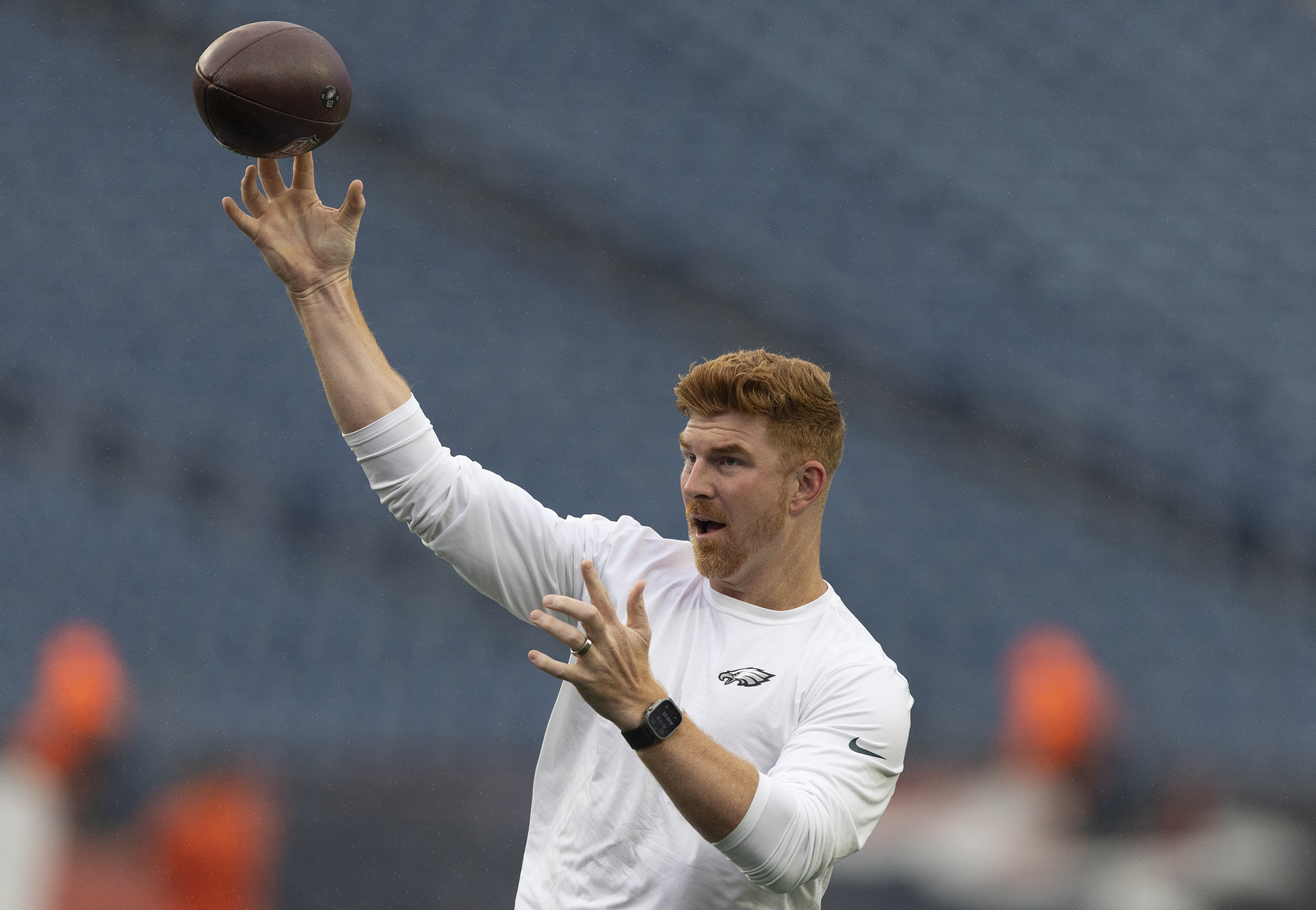
    After the Eagles guarded the identity of their No. 2 quarterback like it was a state secret, Andy Dalton got the nod ahead of Tanner McKee.

    Running back: B

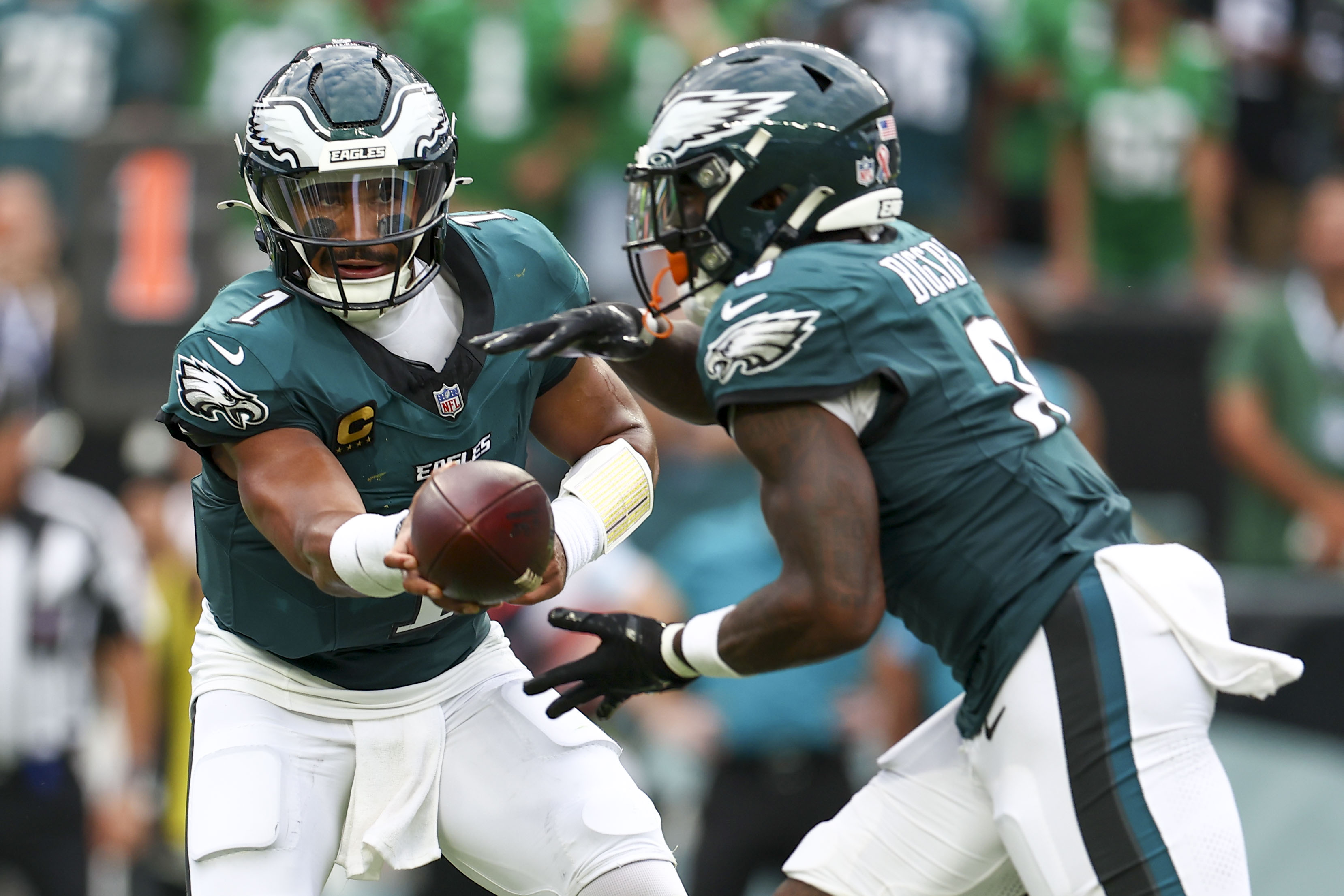
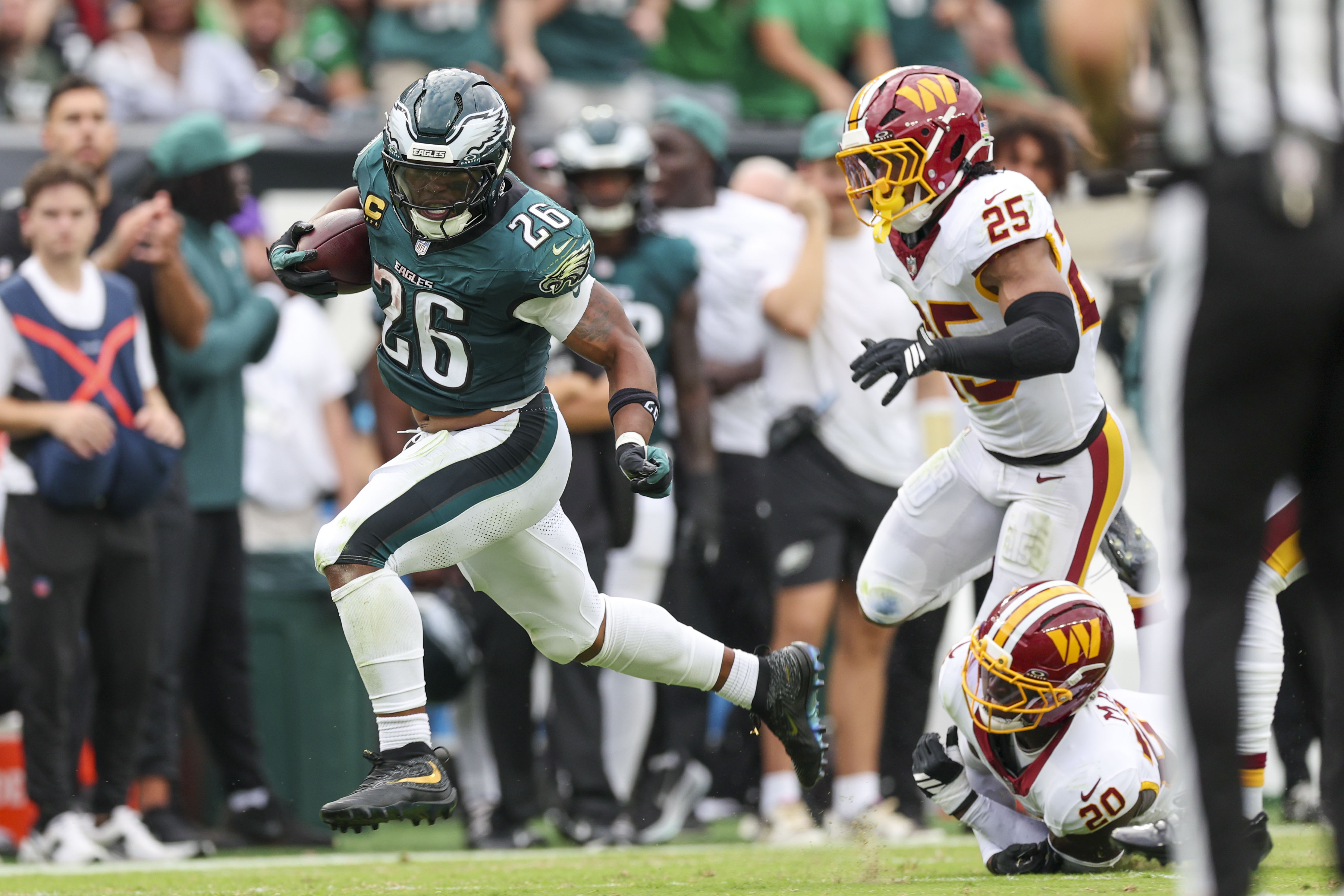
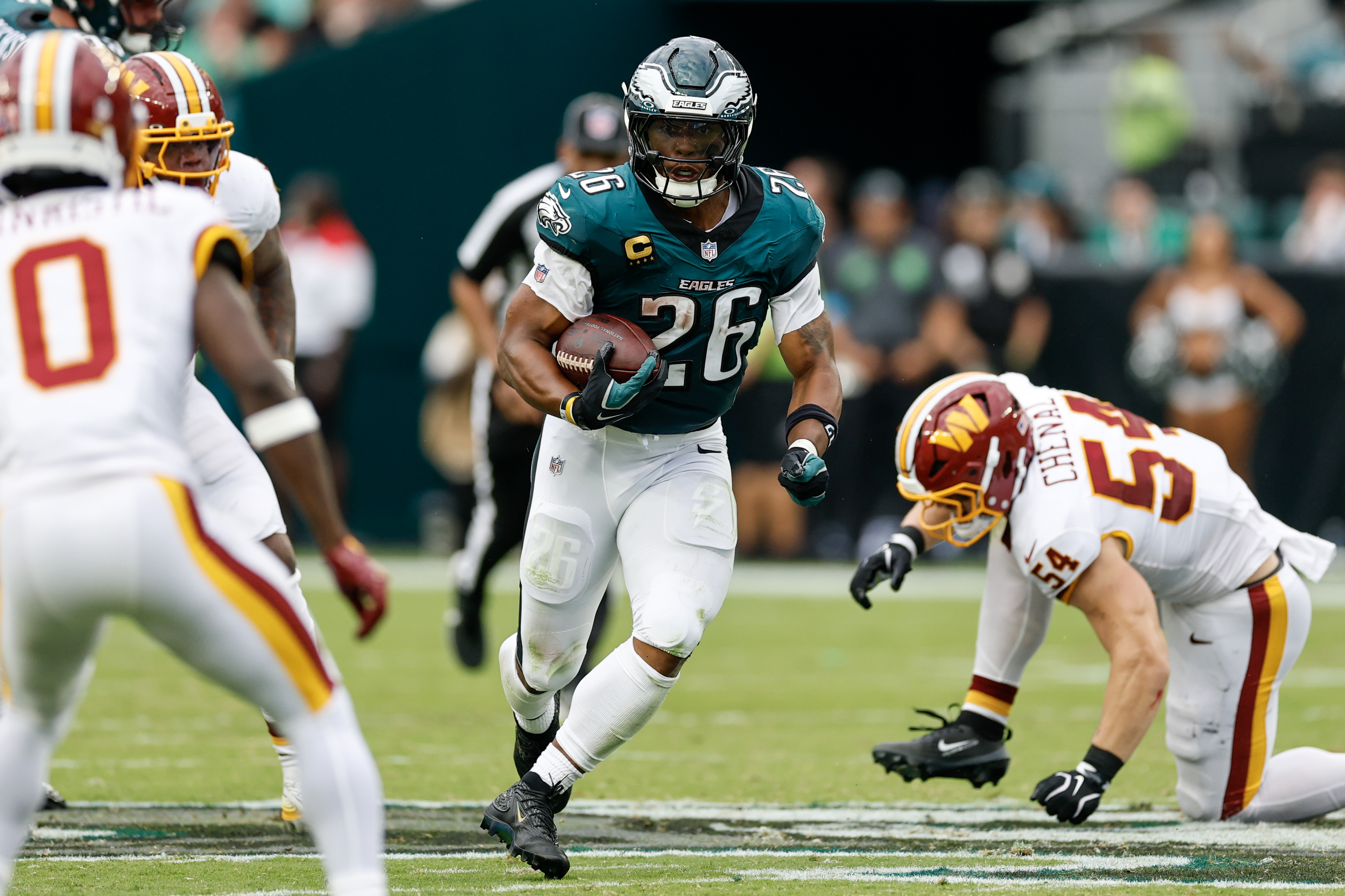
    Saquon Barkley did the best he could. There were several rushes in which Barkley was met in the backfield just after the handoff. It looked like last year’s leaky run game at times as he was dropped for a loss on at least four carries. It could have been worse if not for Barkley’s spins, jukes, and strength.

    He converted third-and 2 in the second quarter when he broke a tackle and chugged 42 yards. Barkley finished with 83 yards rushing on 15 carries. In blitz pickup, he might have missed an edge pressure in which Hurts was decked in the second quarter. He had a few pickups that gave the quarterback time, but got steamrolled by rookie linebacker Sonny Styles, who recorded a third-quarter sack.

    Tank Bigsby and Will Shipley weren’t given much of a workload. Shipley had two carries for 4 yards and caught an 8-yard pass out of the backfield before the half, while Bigsby finished with one carry for 3 yards.
    Eagles wide receiver Dontayvion Wicks (center) finished with 73 yards.Yong Kim / Staff Photographer

    Receiver / Tight end: B-

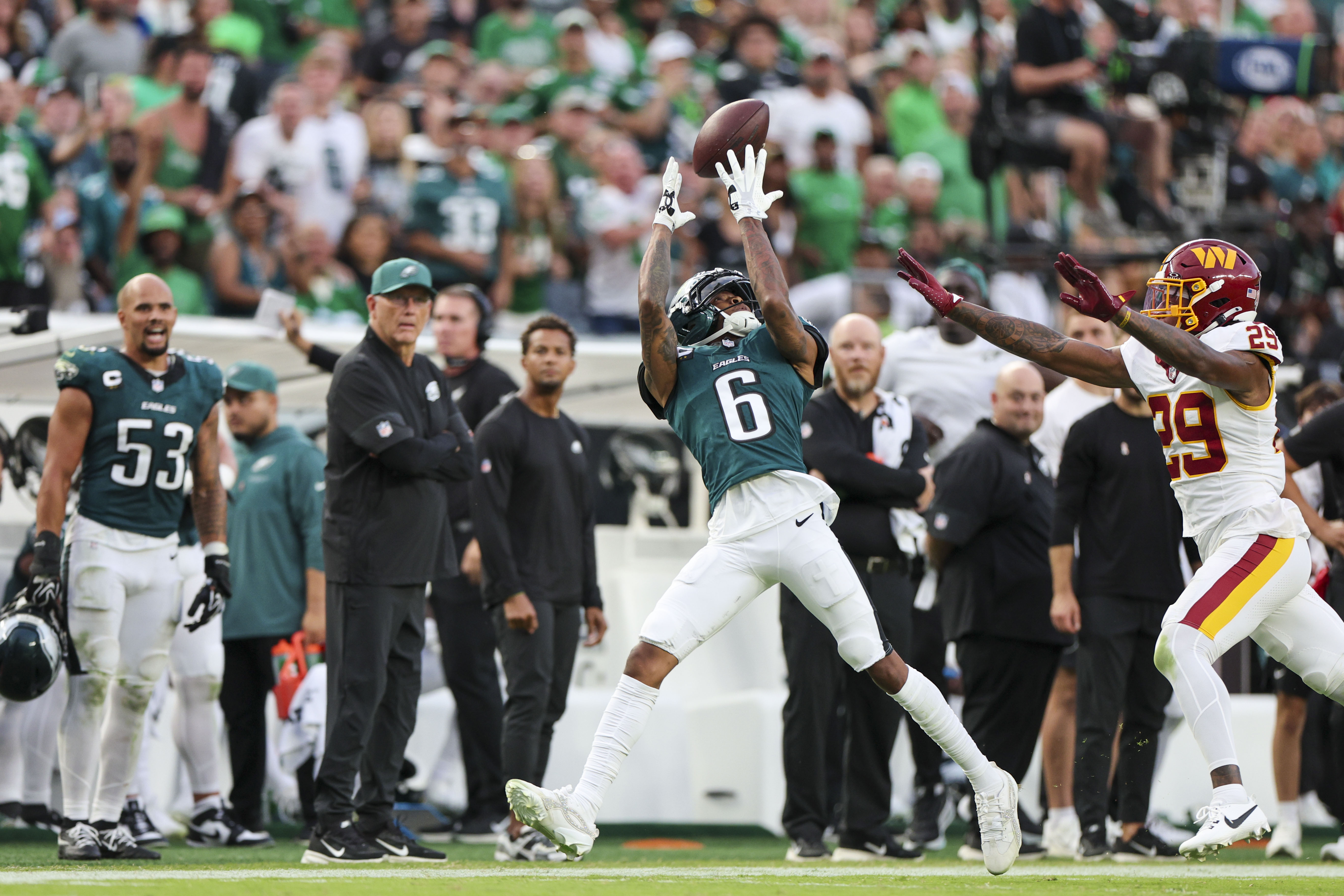
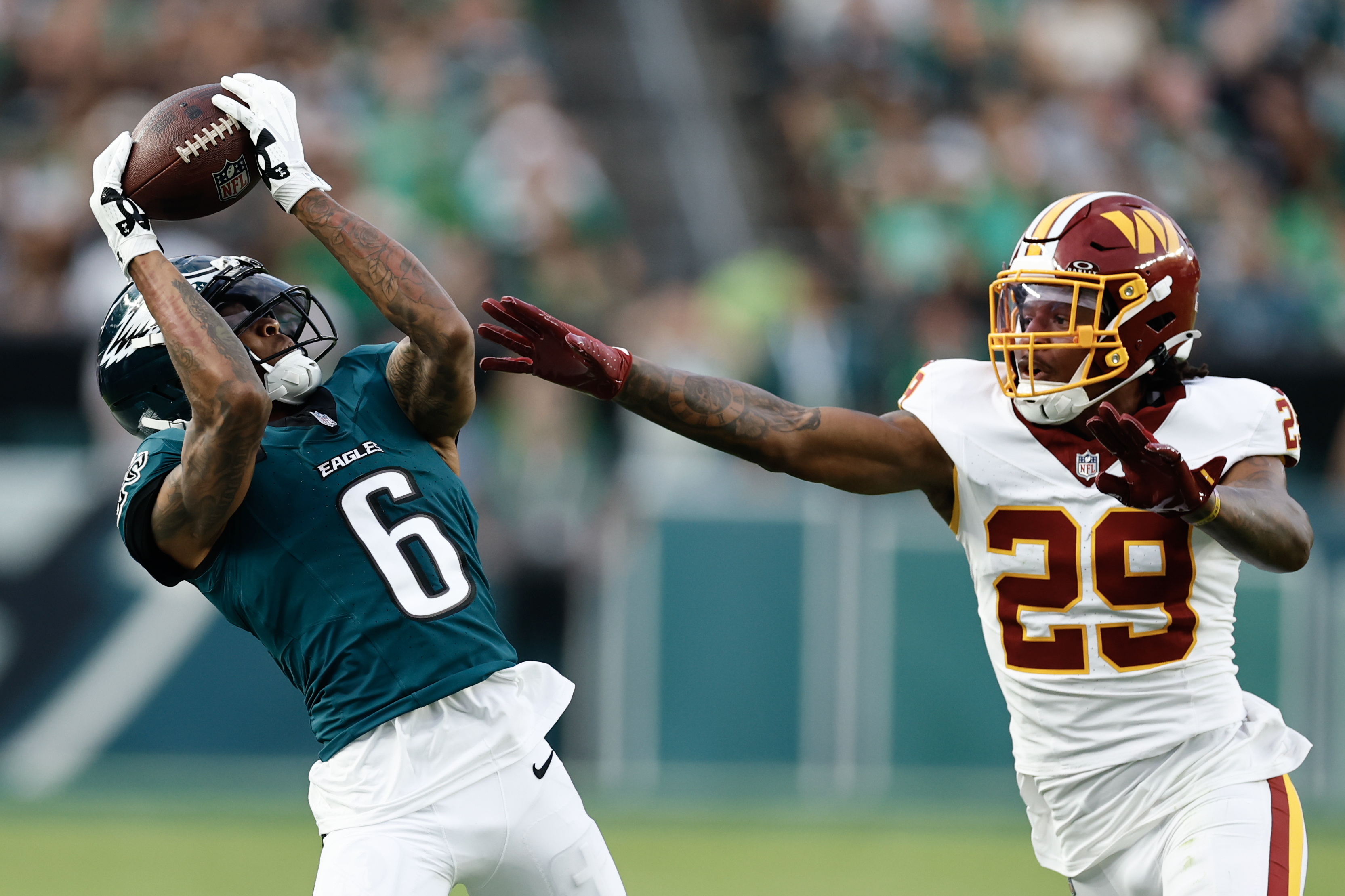
    It was a new world for Smith being the No. 1 receiver that drew cloud coverage. He didn’t see the ball much in the first half. But Smith stayed patient and caught two big passes in the second half, including a 31-yard over-the-shoulder grab in which he got both feet inbounds. He made it look easy.

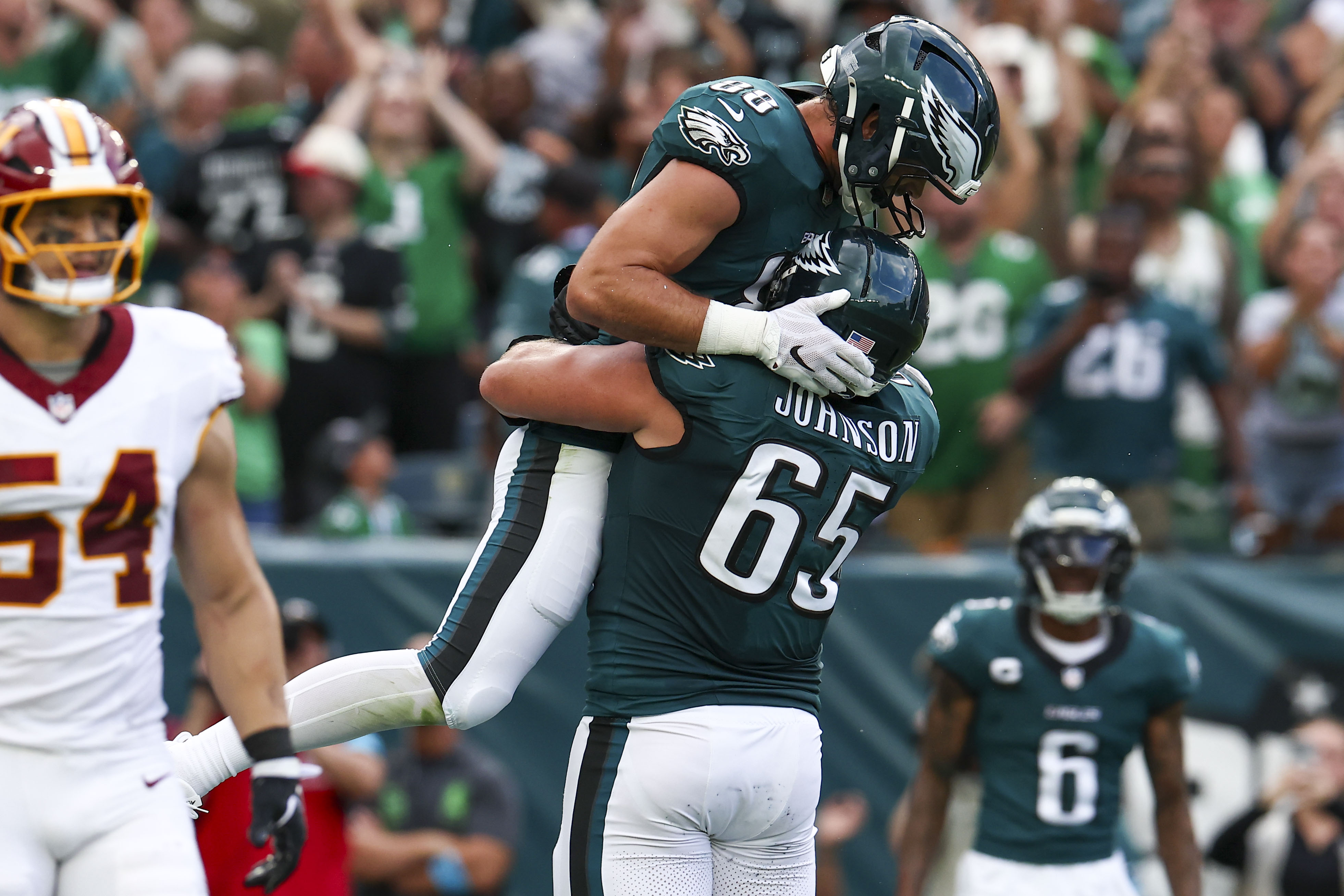
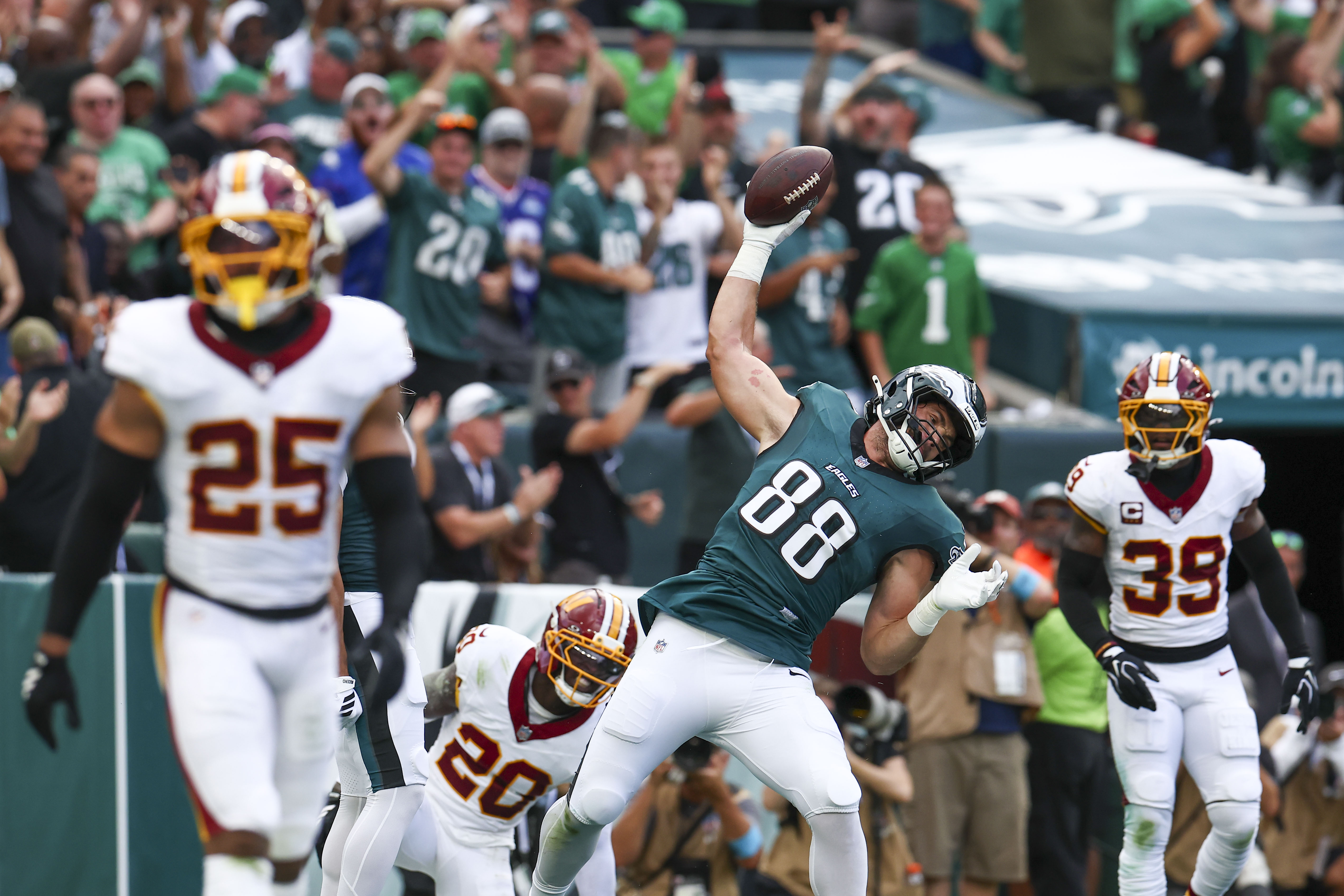
    Goedert picked up where he left off last season, catching two touchdowns a year after he had a team-high 11. His first touchdown came on the 17-yard seam route and then he scored from 43 yards out when he reversed field after an over-the-middle grab that sealed the game. Goedert led the Eagles with four catches for 77 yards.

    Makai Lemon has a ways to go before he’s a steady contributor. The Eagles forced several passes to the rookie receiver on short passing concepts. He finished with three catches for minus-5 yards. The first catch of his career was a 3-yard dump, the second a 5-yard loss on a screen after Wicks missed a block, and third was another bubble in which he was dropped behind the line. Lemon was hardly at fault for the latter two negative plays. The blocking just wasn’t there.
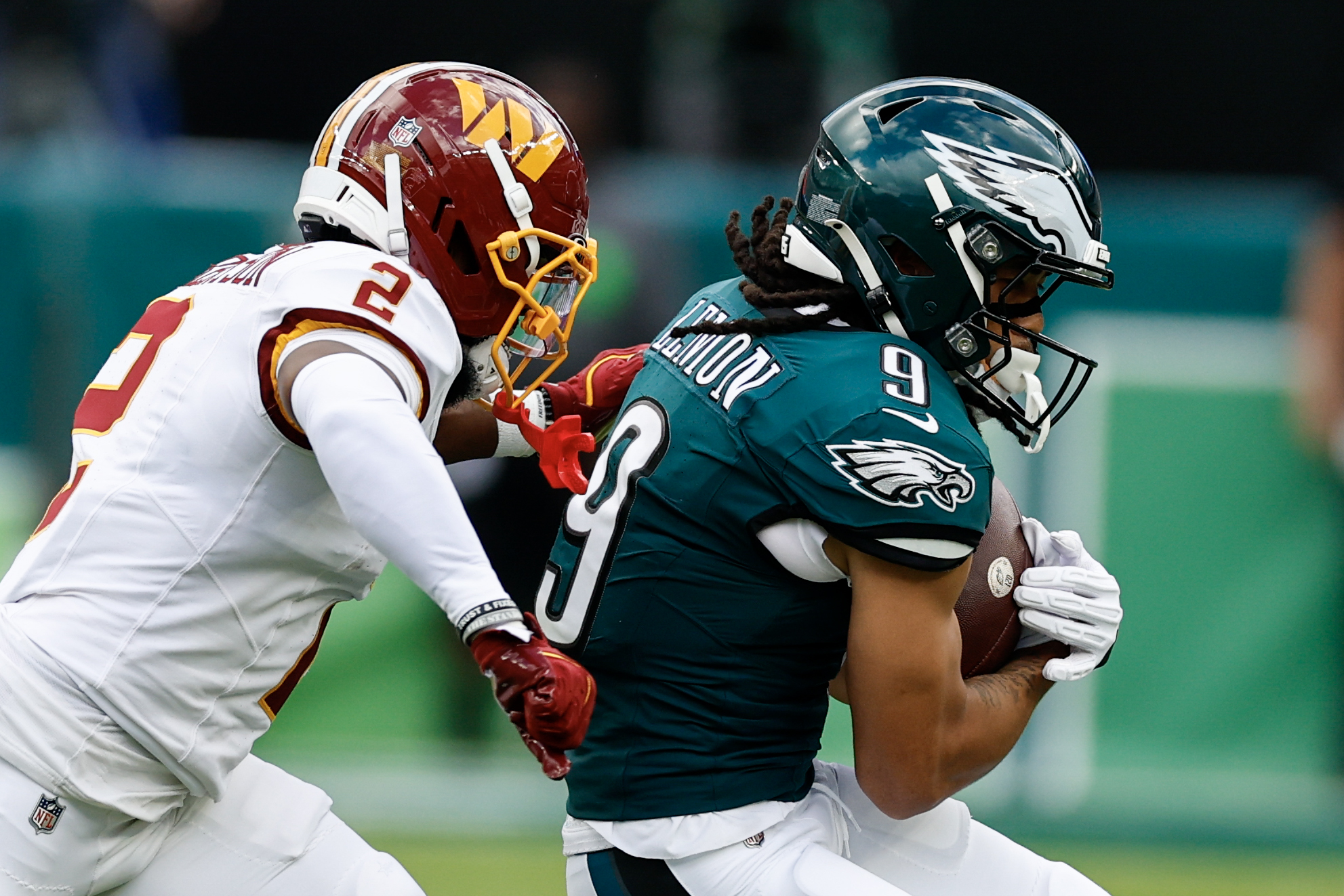
    Makai Lemon had a quiet NFL debut with minus-5 yards on three catches.Yong Kim / Staff Photographer

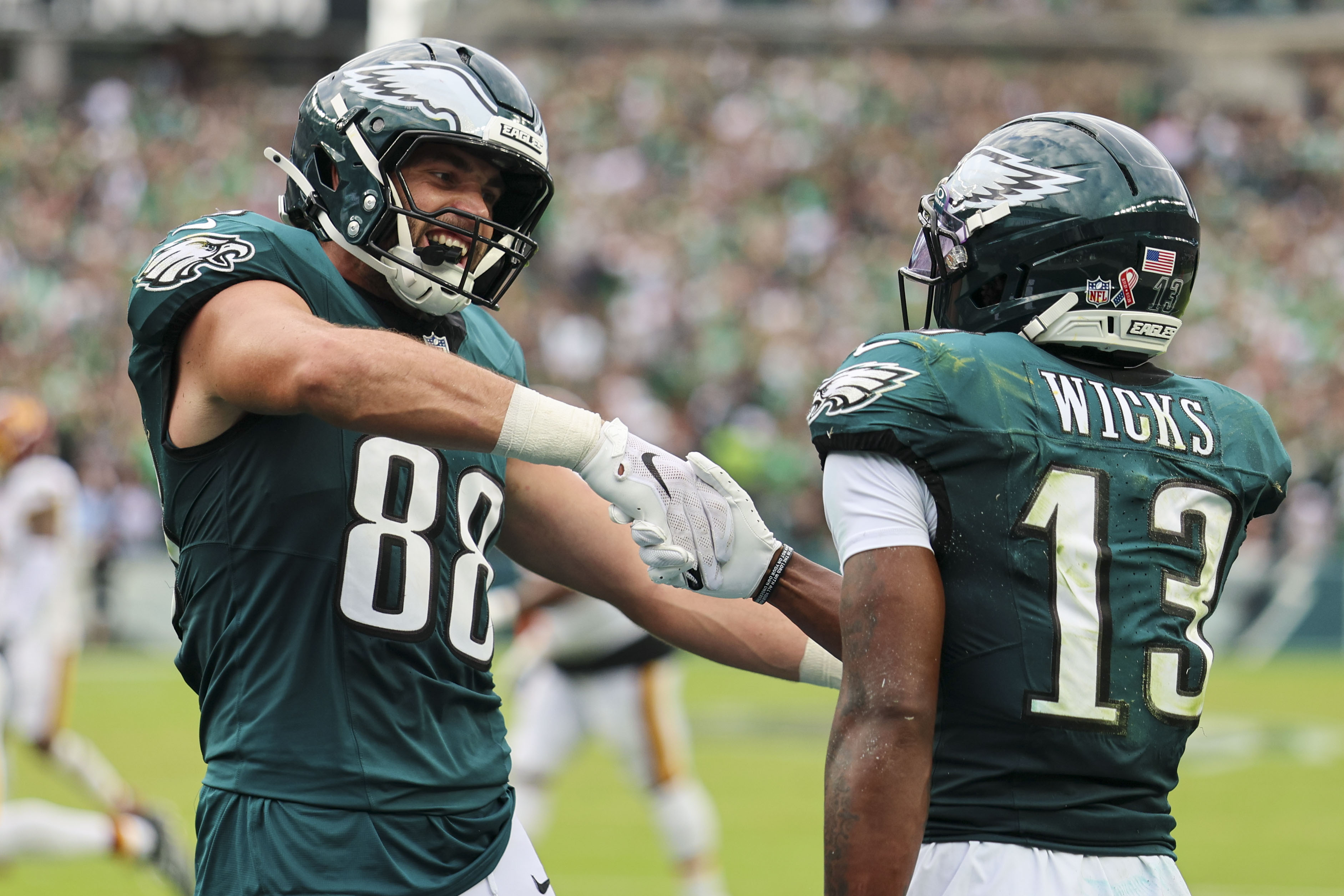
    Wicks had a solid Eagles debut. He broke free over the top on a corner route on his 64-yard reception. Wicks ran a wicked stem route in which he beat cornerback Mike Sainristil on the 9-yard touchdown catch. There was some confusion at times. Smith had to signal to Wicks a few times for him to motion in the second quarter.

    Eli Stowers was placed on injured reserve with hamstring and quadriceps injuries. The rookie tight end was unlikely to play much, if at all. Johnny Mundt had some solid moments as the main point of attack blocker on the run side, but no one had a great day trying to open holes in the ground game.

    Offensive line: C

    The pressure Hurts faced wasn’t all on the quarterback, just as it wasn’t all on the O-line. But there were multiple breakdowns up front, especially vs. left guard Landon Dickerson. He looked like a turnstile at times. Was Dickerson solely at fault? Of course not. But the oft-injured guard who’s as tough as they come appeared slower than even a year ago when he returned too early after knee surgery.

    It was downright ugly in the third quarter when Dickerson got toasted on back-to-back rushes, one of which led to a holding penalty. Earlier, the Commanders’ Javon Kinlaw beat the guard for a run tackle for loss in the first quarter. Dickerson was late to help on a third-down stunt in which Hurts was hurried in the second quarter.

    Center Cam Jurgens struggled, as well, particularly in the first quarter. He had a holding penalty when Barkley was nearly dropped in the backfield and then another when it was all on him after he grabbed defensive tackle Shy Tuttle. Right guard Tyler Steen had a tough time getting to the perimeter on a pull block, but he seemed to hold up much more than the other two interior O-linemen.

    Tackles Lane Johnson and Jordan Mailata were far less at fault in the run blocking. But the O-line unit failed to work as a cohesive unit and everyone was affected. Mailata did turn linebacker Frankie Luvu around on a Barkley 5-yard tote in the first quarter. Johnson and Mailata were much better in pass protection, particularly in one-on-one situations.
    Defensive line: B+

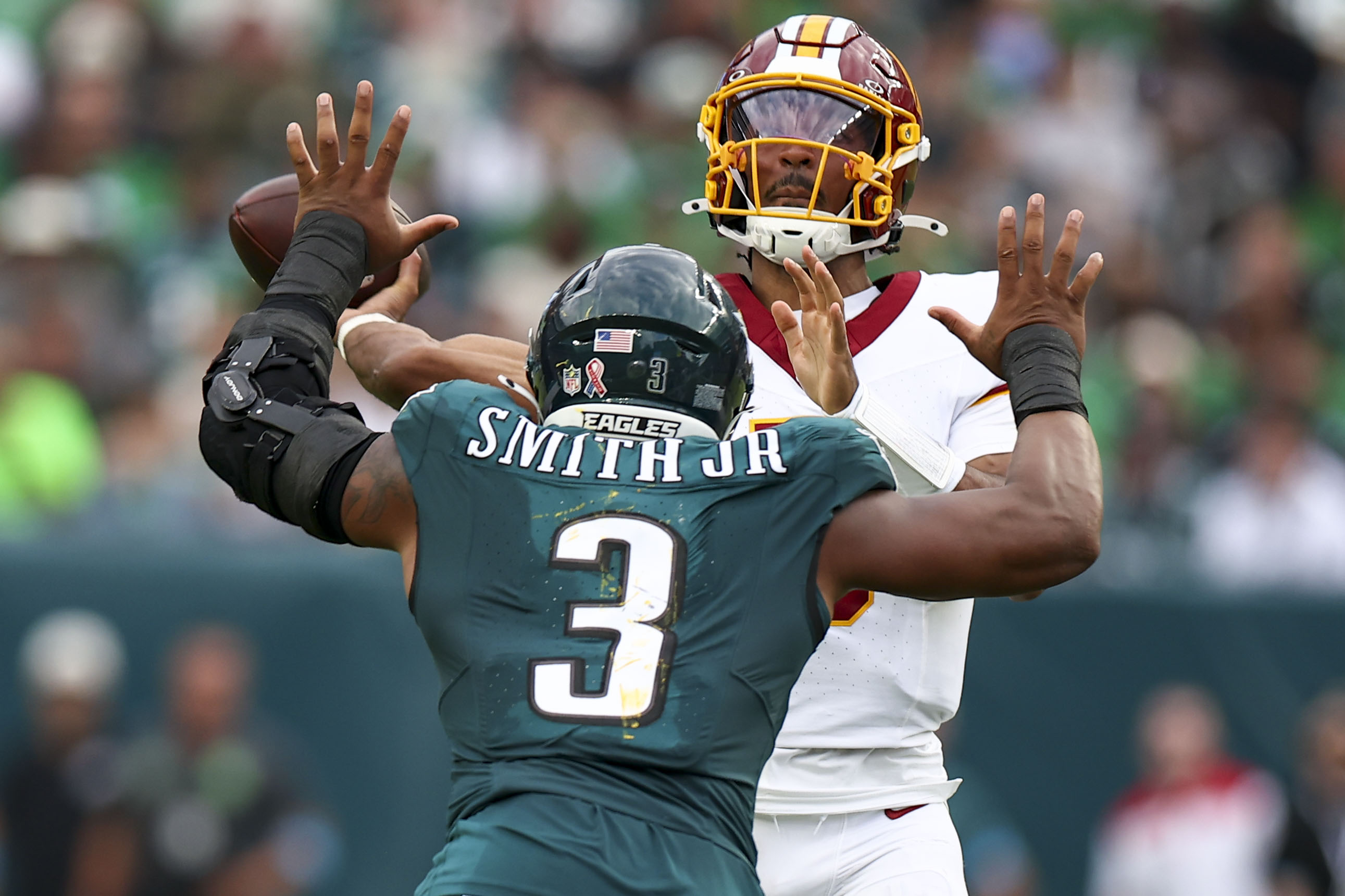
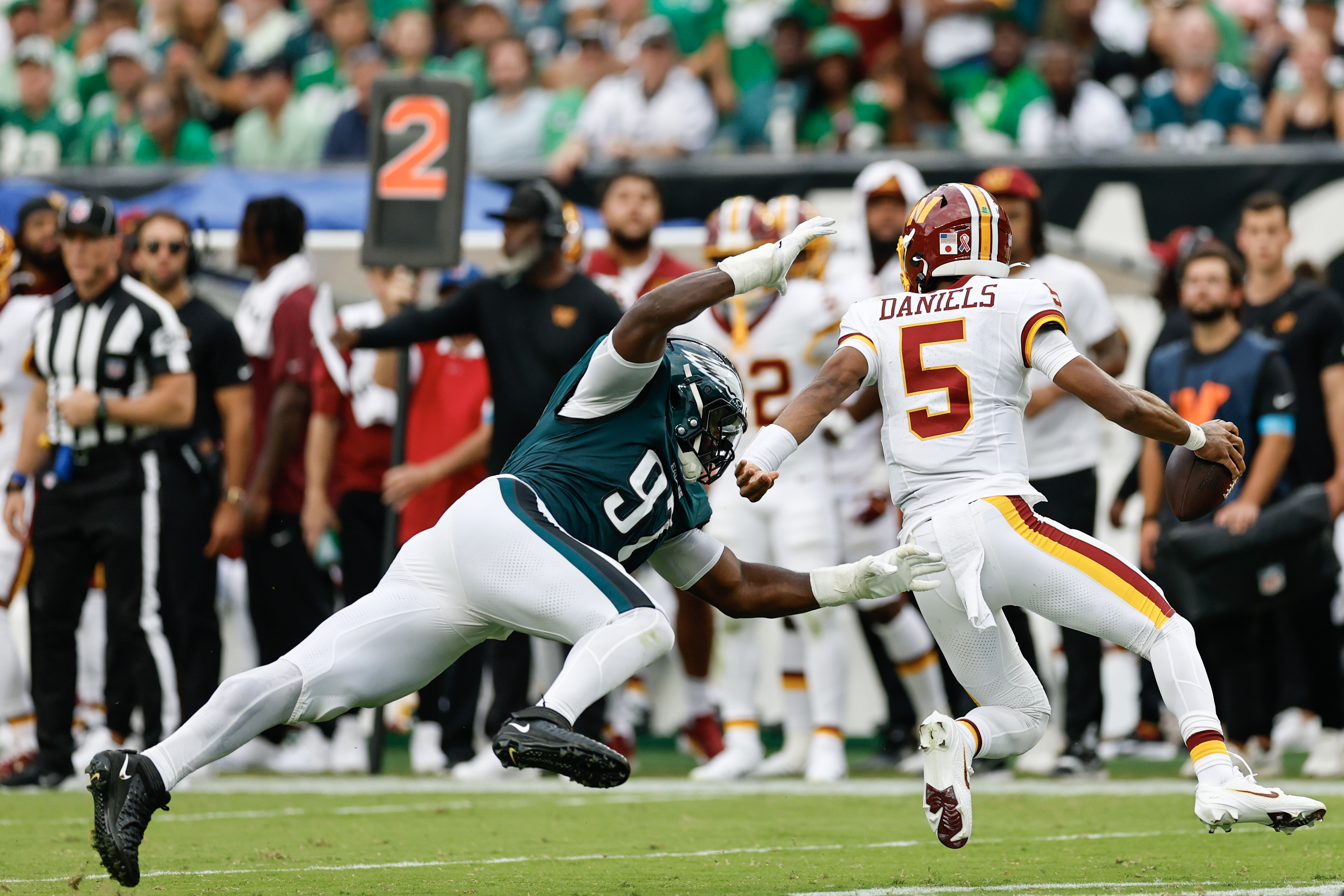
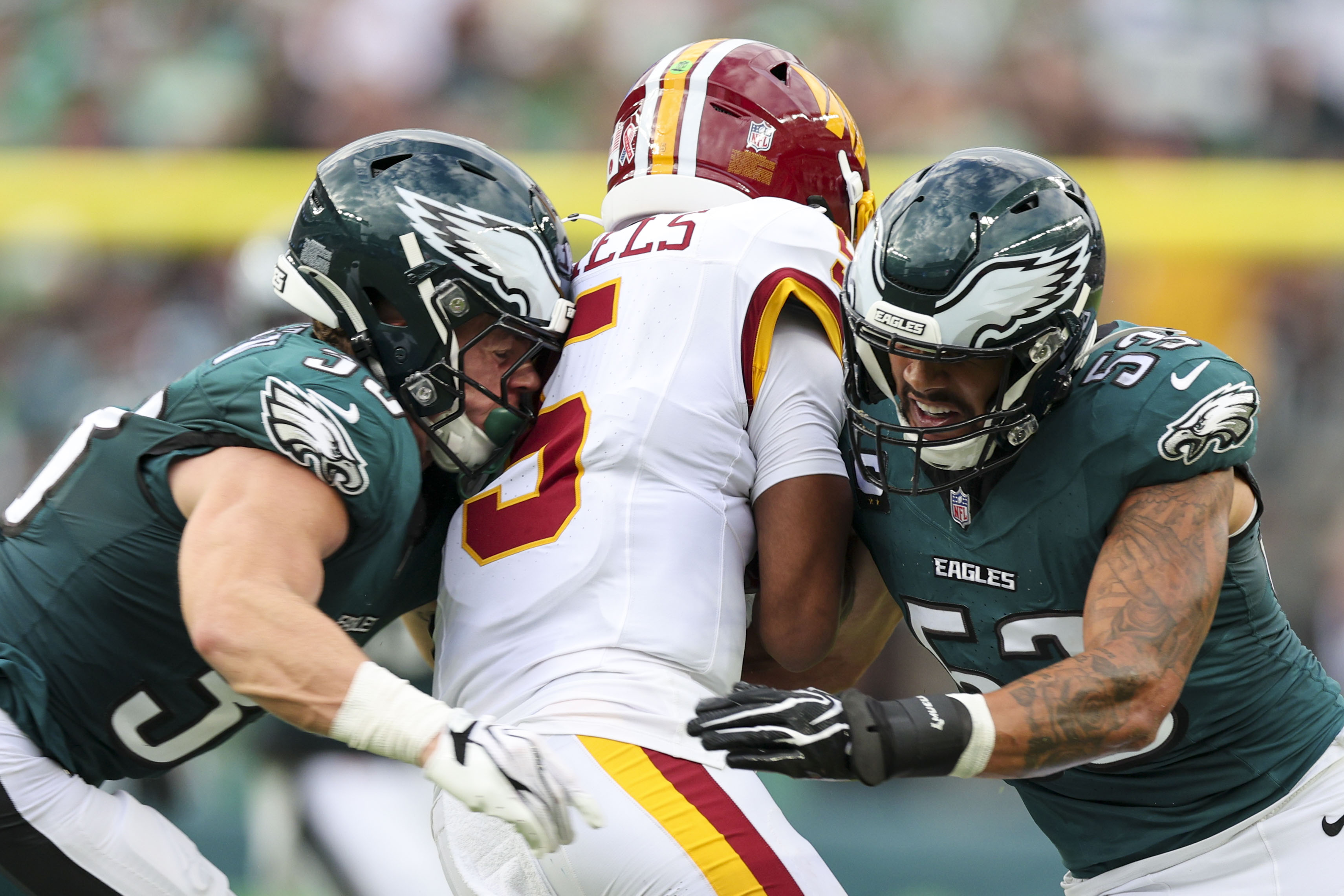
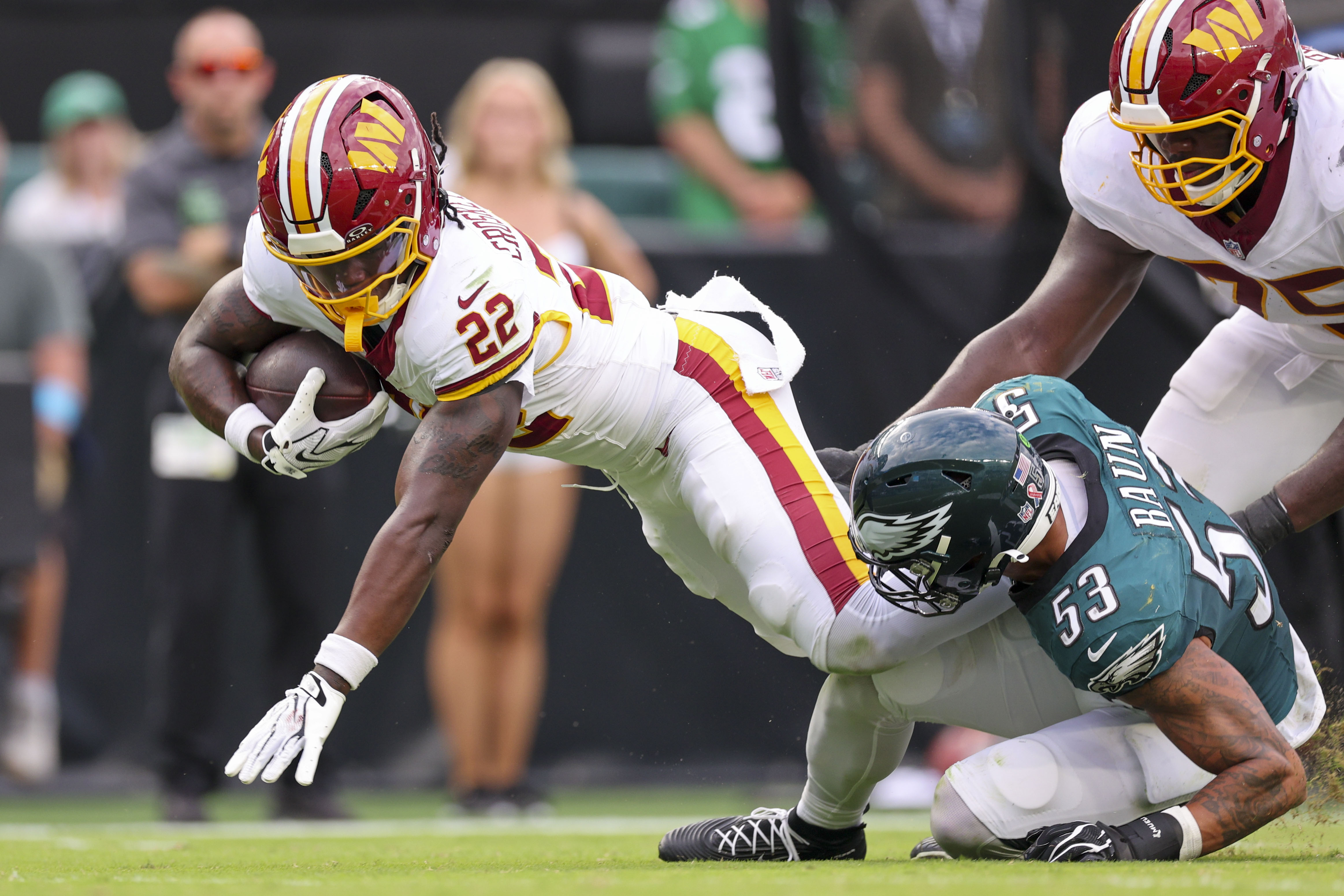
    The sacks weren’t in the stat sheet, but the Eagles’ front pressured Washington quarterback Jayden Daniels throughout the game. They should have against a suspect offensive line. Nevertheless, defensive tackle Jalen Carter pushed the pocket on many occasions. He had a third-down pressure that forced Daniels outside and unable to complete a pass downfield in the second quarter. Carter was too aggressive on a Jacory Croskey-Merritt 9-yard rush up the middle.

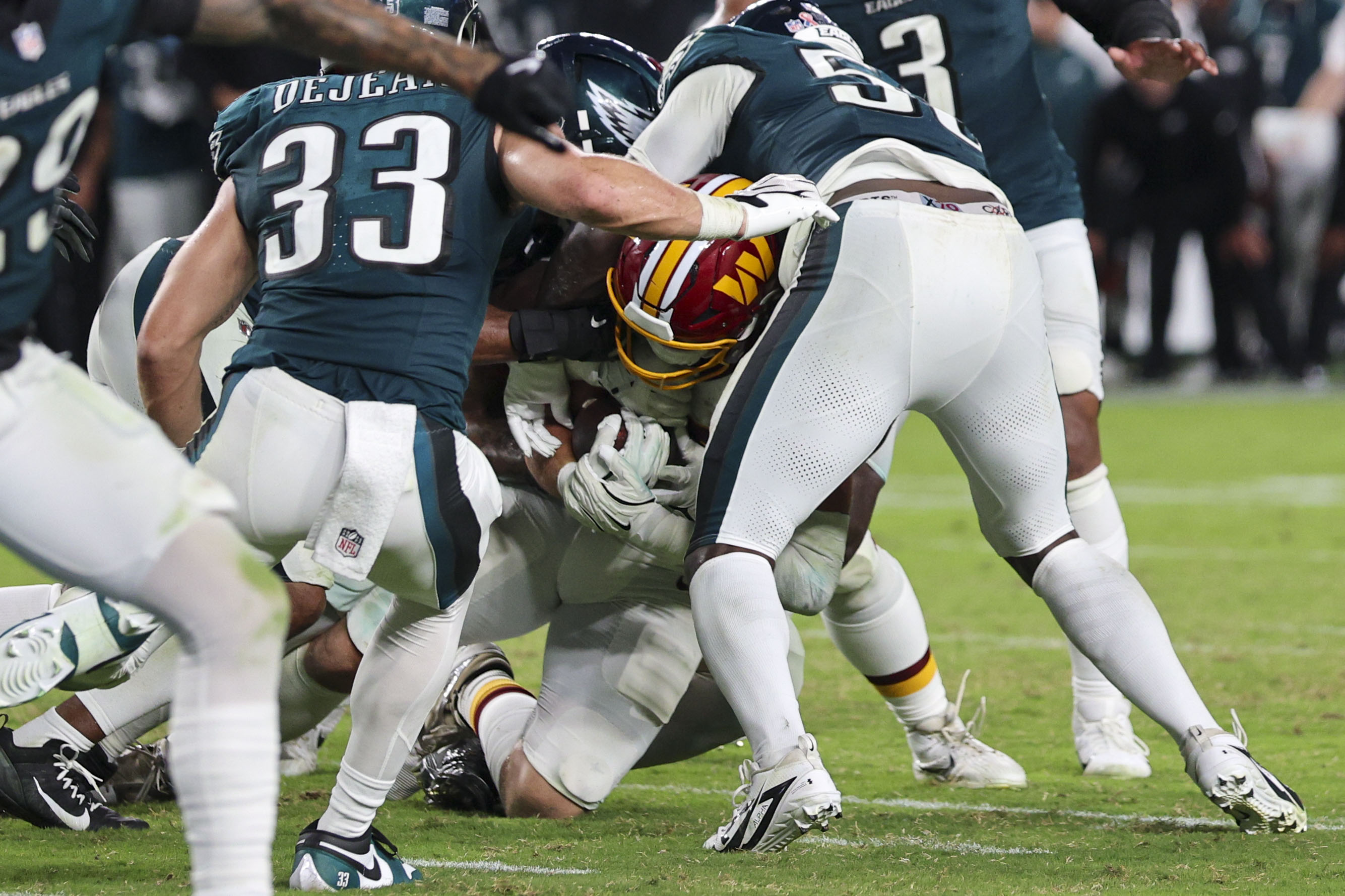
    Jordan Davis was superb as a run defender and finished with eight tackles. Moro Ojomo made the game-sealing play when he wasn’t fooled by Washington’s shovel pass on their two-point try to tie the game.

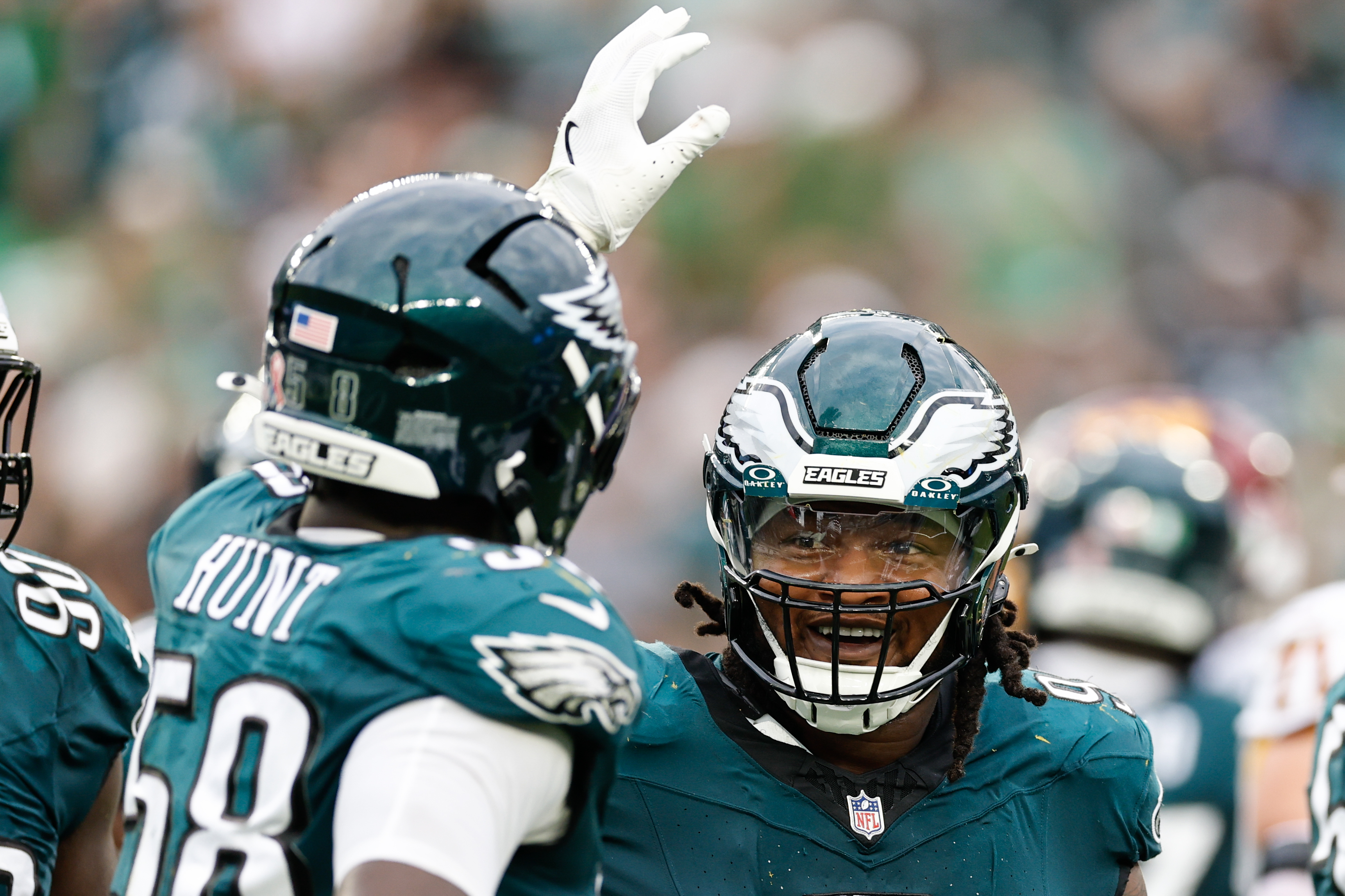
    With Jonathan Greenard (pectoral) still not cleared to return, Jalyx Hunt and Nolan Smith shouldered most of the load on the edges. They didn’t get to Daniels, and lost him at times when he scrambled, but they kept him from escaping when it mattered the most.

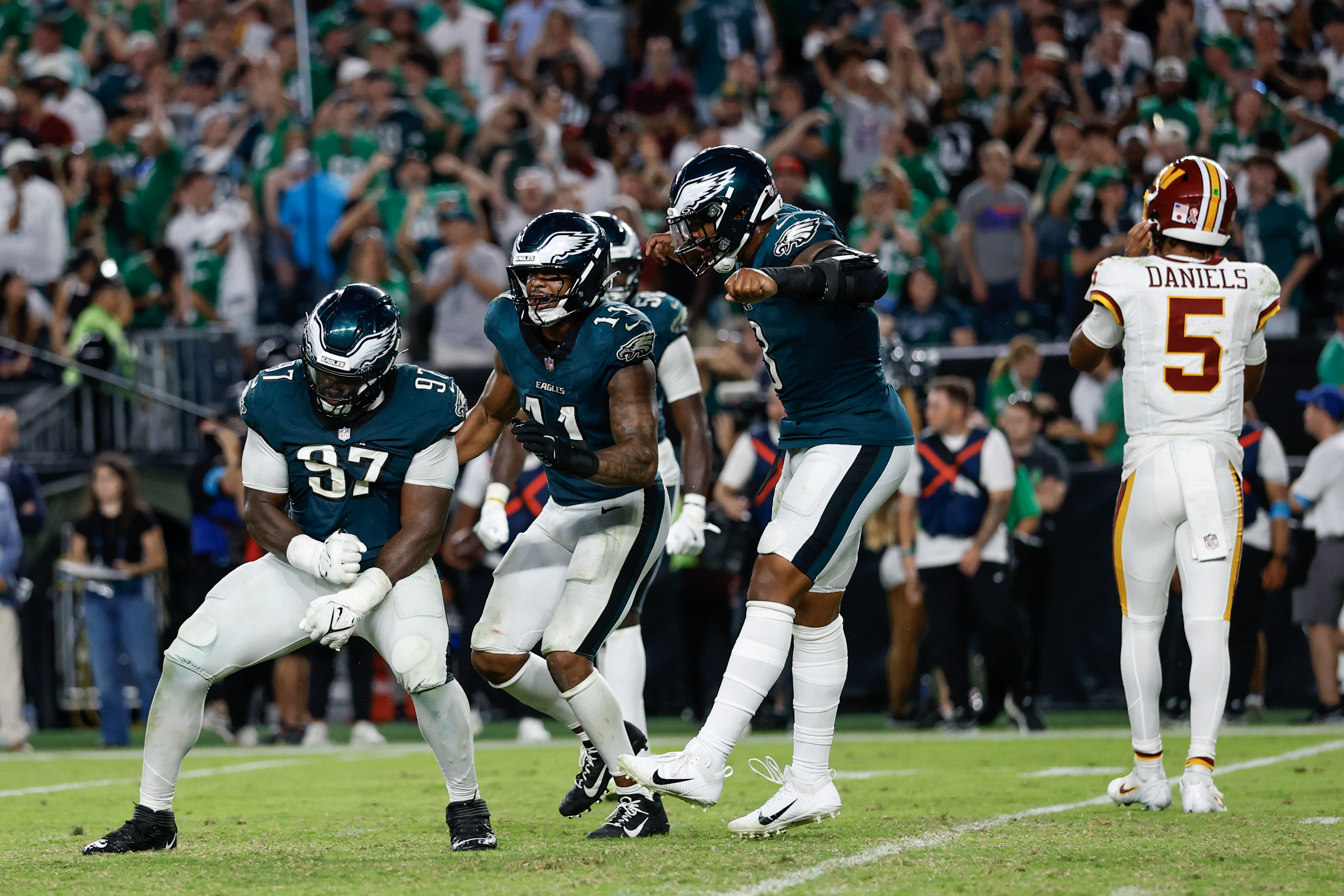
    Zack Baun celebrates after breaking up a pass intended for Commanders wide receiver Stefon Diggs during the second quarter.Yong Kim / Staff Photographer

    Linebacker: A-

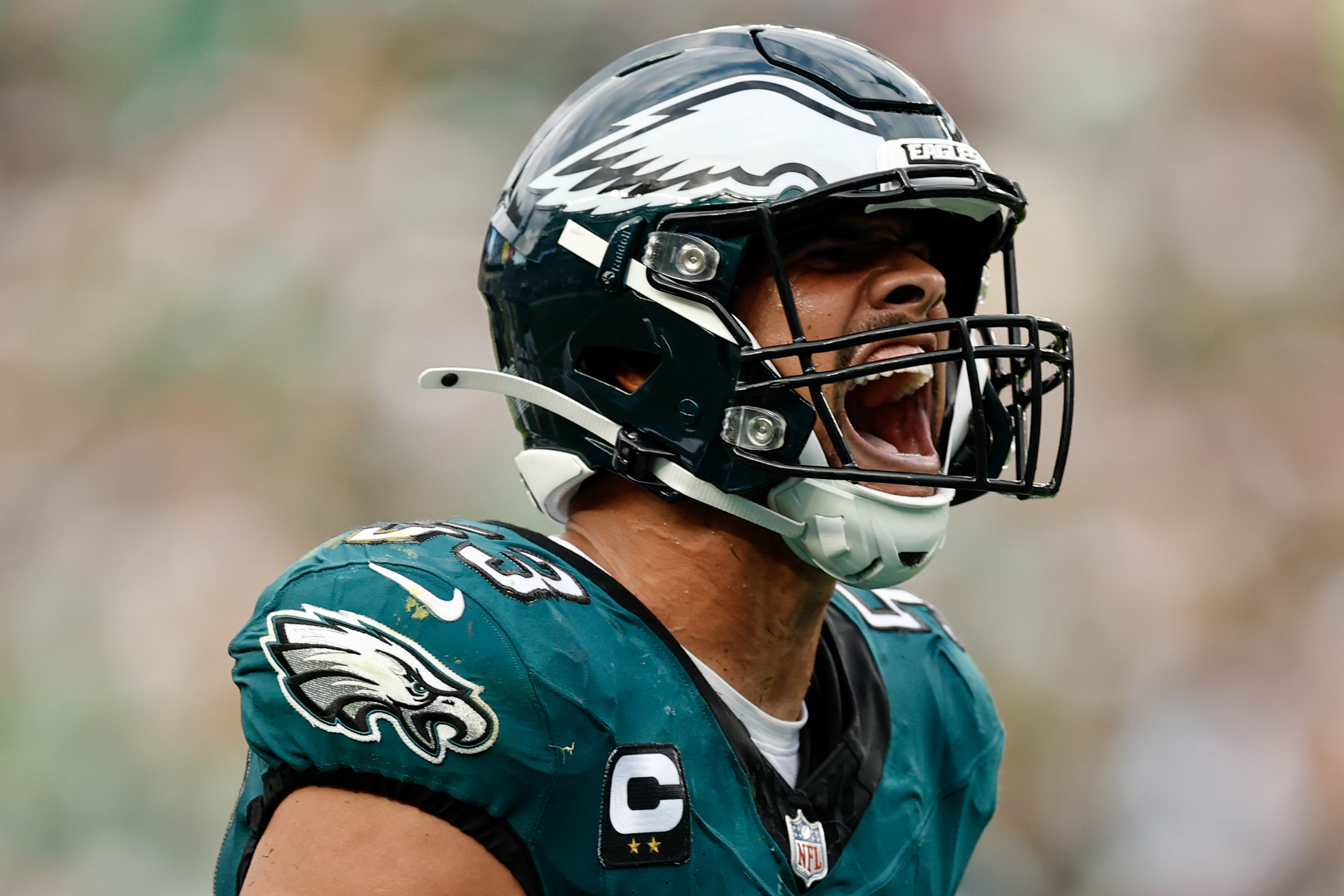
    Zack Baun was the defensive player of the game. He was all over the field. Baun was a beast on back-to-back plays in the second quarter, breaking up a pass over the middle and notching a tackle for loss on a screen pass. Earlier, Baun lowered his head to stuff Rachaad White on third-and-1 in the first quarter. Carter chipped in for the stop. He nearly had a downfield interception before the half, but was out of bounds. He led the Eagles with 12 tackles.

    To open the second half, Baun made an open-field stop on third down. Jihaad Campbell was the first to meet running back White when he was stopped on a third-down run on Washington’s first possession. Croskey-Merritt ran through his arm-tackle attempt on a 9-yard run. He got beat by tight end Chig Okonkwo’s 15-yard catch in the third quarter.

    Cornerback: B

    Cooper DeJean had a rough outing in the slot with outside corners Quinyon Mitchell and Riq Woolen having the boundary sides on relative lockdown.

    DeJean appeared to get dinged late in the first half after he allowed a catch over the middle. He got up and winced, but stayed in. Daniels was wise to go back at the slot corner and connected with rookie receiver Antonio Williams on in-breaking routes to the 1-yard line. Washington scored a touchdown on the next play.

    Earlier, DeJean got turned around on a third-and-10 conversion. He committed an illegal-contact penalty in the third quarter. His blitz in the third quarter forced Daniels into an incompletion. And he made a tackle short of the sticks later in the quarter.

    Mitchell made a stop on a short pass in the second quarter, while Woolen nearly got his hands on multiple balls in the first half.

    Eagles safety Marcus Epps (right) makes a run stop in the first quarter.David Maialetti / Staff Photographer

    Safety: B

    The Eagles had some leaky moments in the middle of the field as Daniels was forced to throw between the numbers. But Andrew Mukuba, Marcus Epps and DeJean more than acquitted themselves. Mukuba might have been a touch late to help Campbell on Okonkwo’s 15-yarder. Epps came up from deep to make a run stop near the line in the first quarter. Epps left briefly with a shoulder injury, but returned in the second quarter.

    There was no deep-middle help on Williams’ 33-yard grab in the fourth quarter.

    Special teams: B+

    Punter Braden Mann was fantastic. He averaged 51.6 yards on seven punts and dropped four inside the Washington 20. Mann pinned Washington deep at the 6-yard line on his first punt. Just before the half, Mann spun a six-iron down at the 2-yard line.

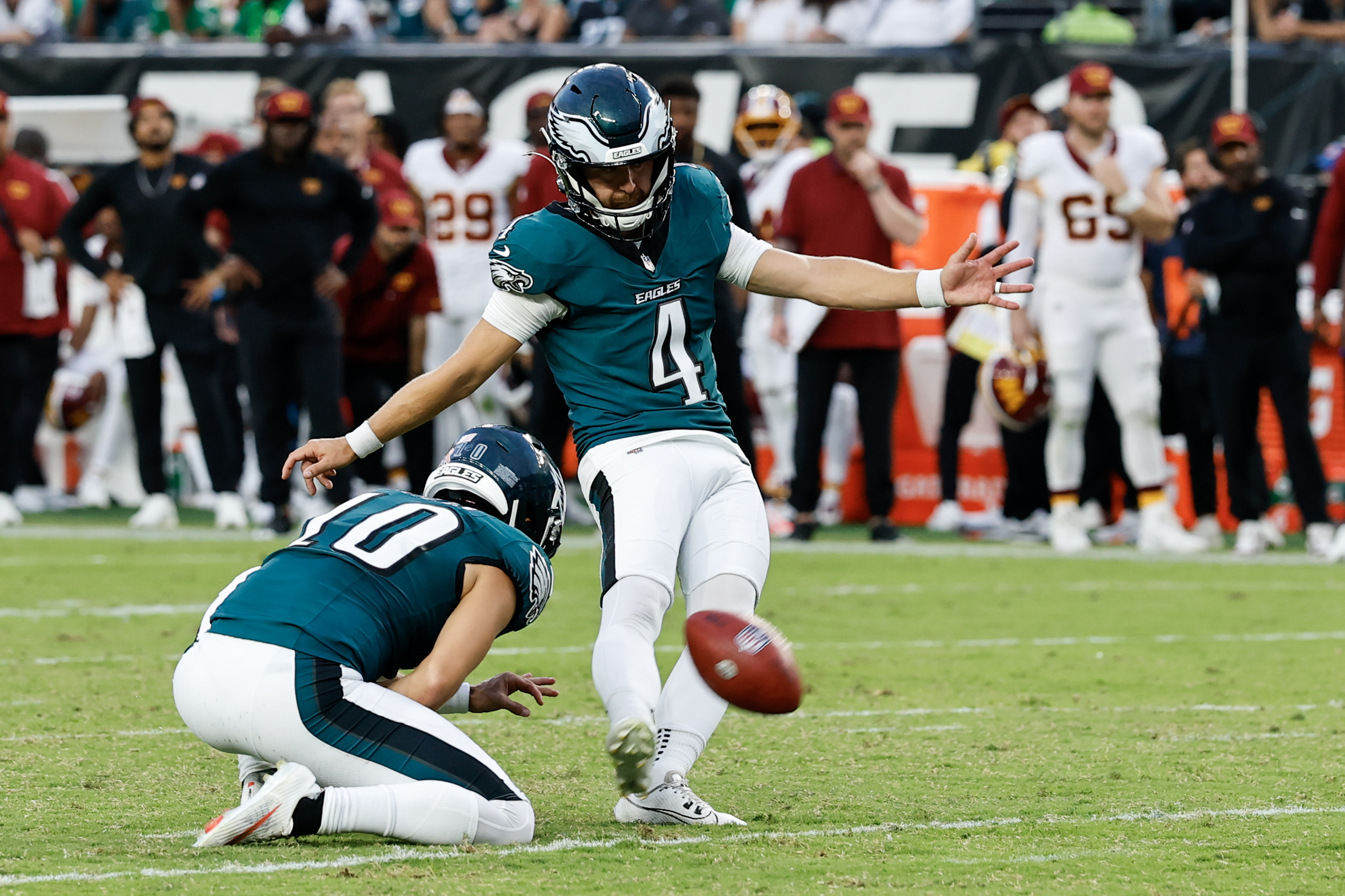
    Kicker Jake Elliott split the upright all three of his kicks — a 35-yard field goal and two extra points.

    Carter blocked the extra point after the Commanders’ first touchdown. Darius Cooper had some impressive moments as a gunner.

    Britain Covey averaged 9.3 yards on four punt returns. Bigsby and Shipley averaged 25 yards on three returns combined.

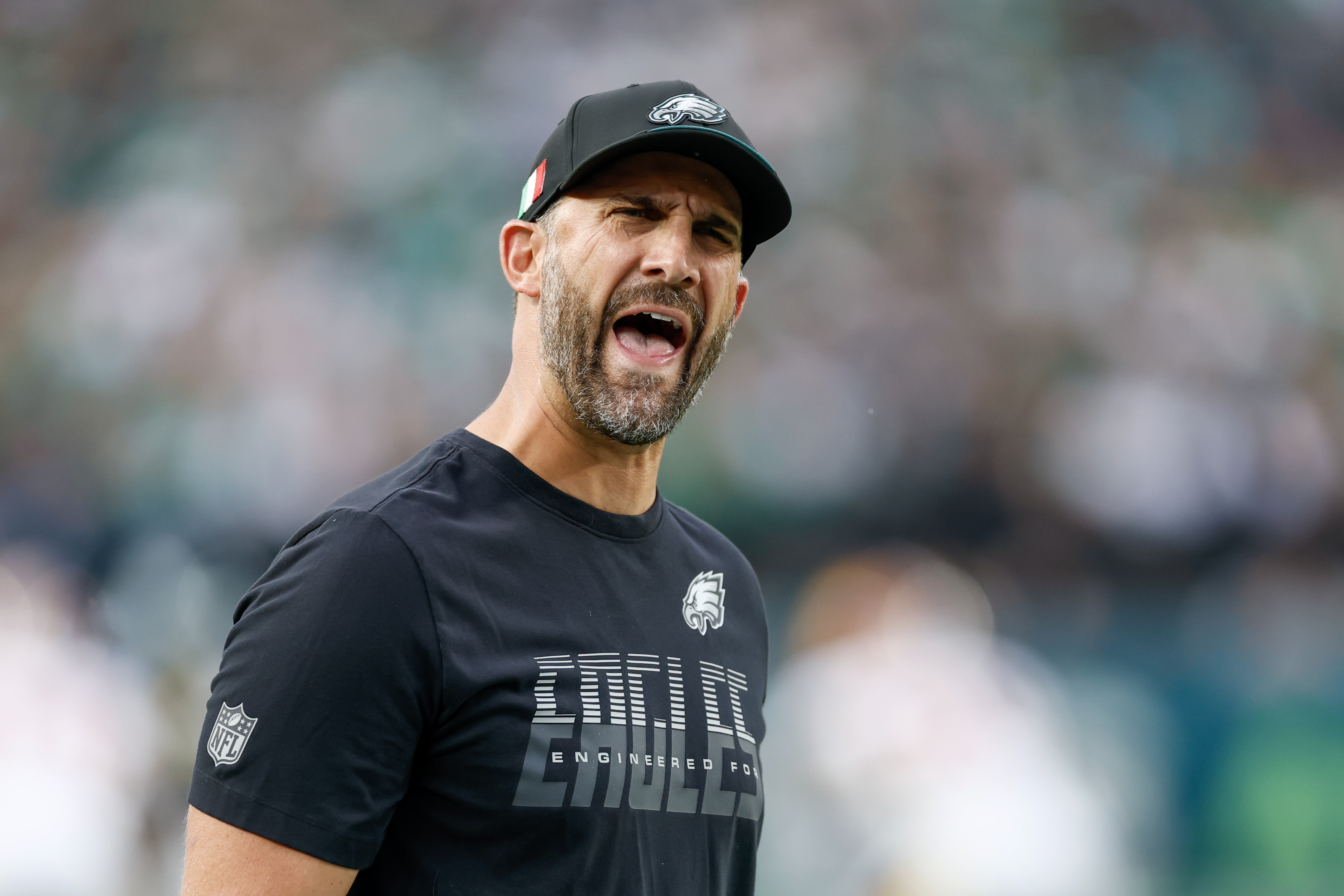
    Nick Sirianni moved to 6-0 in regular season openers with Sunday’s win.David Maialetti / Staff Photographer

    Coaching: B

    Coach Nick Sirianni moved to 6-0 in openers. He found a way to get it done despite some offensive sloppiness and late defensive letdowns. Still, Sirianni just knows how to win.

    New offensive coordinator Sean Mannion will need time as a first-time play-caller. He had some rough calls, particularly in forcing the issue to Lemon. There were too many run calls that resulted in losses. The Eagles also didn’t look quite prepared for Washington’s simulated pressures.

    Mannion had some solid calls in the first half, though, in which multiple receivers were open. He dialed up the Hurts-to-Wicks 64-yard bomb out of “13″ personnel and off play-action. Goedert was also wide-open underneath. Mannion’s four-verticals call that led to Goedert’s 17-yard score was also timely vs. Cover 2. Was he throwing shade as his predecessor with the call? Probably not, but it was ironic justice after last season’s fateful end. Earlier on the drive, tempo helped spring Barkley on the 42-yard inside zone run.

    Defensive coordinator Vic Fangio got his players to mostly dominate. They had some rough turns, but they were also on the field far too much in the third quarter because of the offensive inefficiency. Fangio had a rough call when Campbell got matched up against a receiver downfield and the Commanders converted third-and-14 in the fourth quarter. Ultimately, his guys got the job done.

  • Eagles hang on for 24-22 win over Commanders after two-point stop; Jalen Hurts throws three TDs to open new offensive era

    Eagles hang on for 24-22 win over Commanders after two-point stop; Jalen Hurts throws three TDs to open new offensive era

    During training camp, Vic Fangio asserted that Howie Roseman ought to save some money for 25-year-old defensive tackle Moro Ojomo, who was headed into a contract year.

    In Week 1 against the Washington Commanders, Ojomo reminded the NFL why he is going to command a hefty pay raise when the season concludes.

    His stuff of Commanders tight end John Bates on a short pass over the middle on Washington’s two-point conversion attempt to tie the game sealed the 24-22 win for the Eagles.

    Jalen Hurts was solid in his debut in Sean Mannion’s offense. The Eagles quarterback went 14-for-25 for 203 yards and three touchdowns, good for a 122.2 quarterback rating. He added 46 rushing yards on seven carries.

    Here’s our instant analysis from the Eagles’ season-opening win over the Commanders:

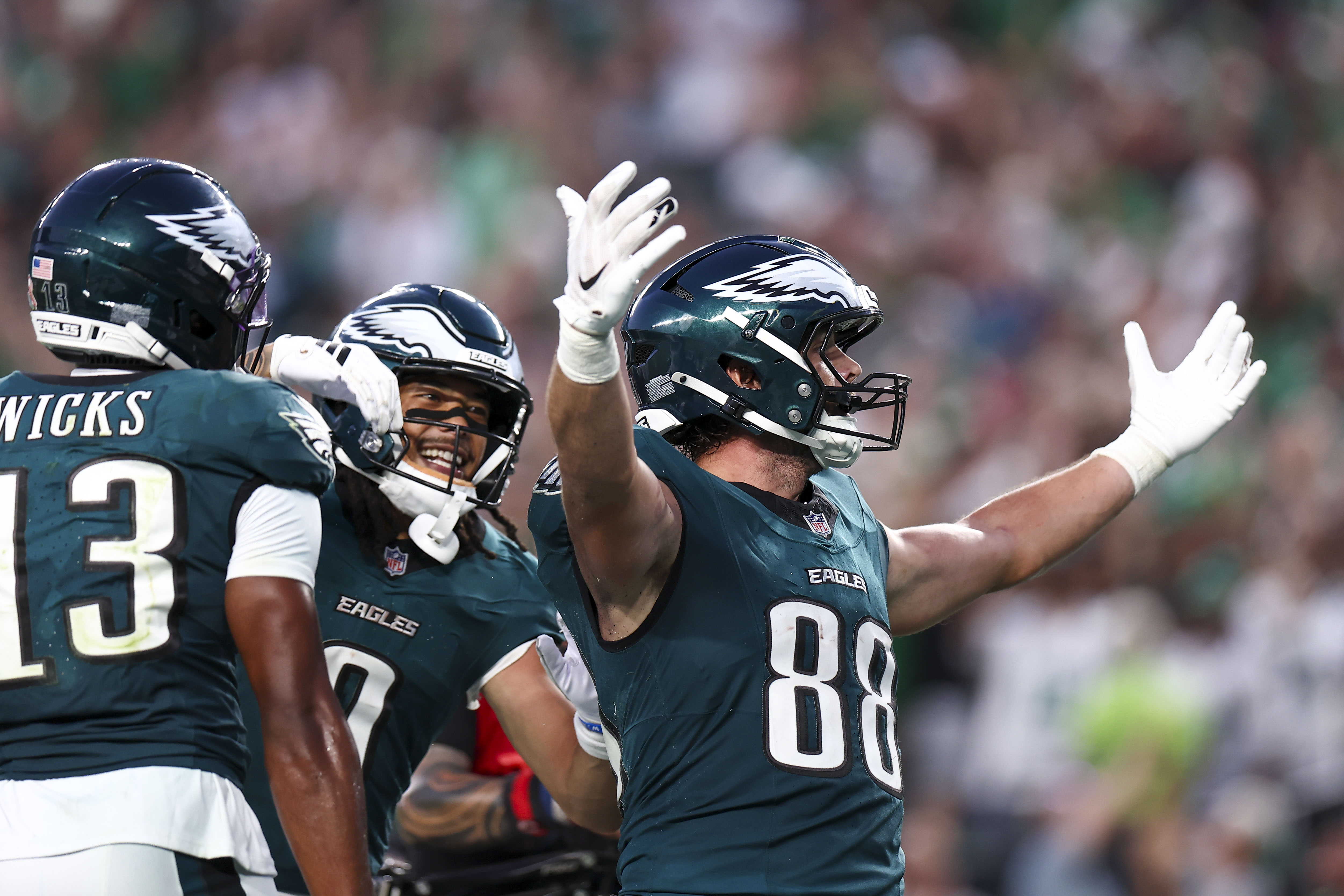
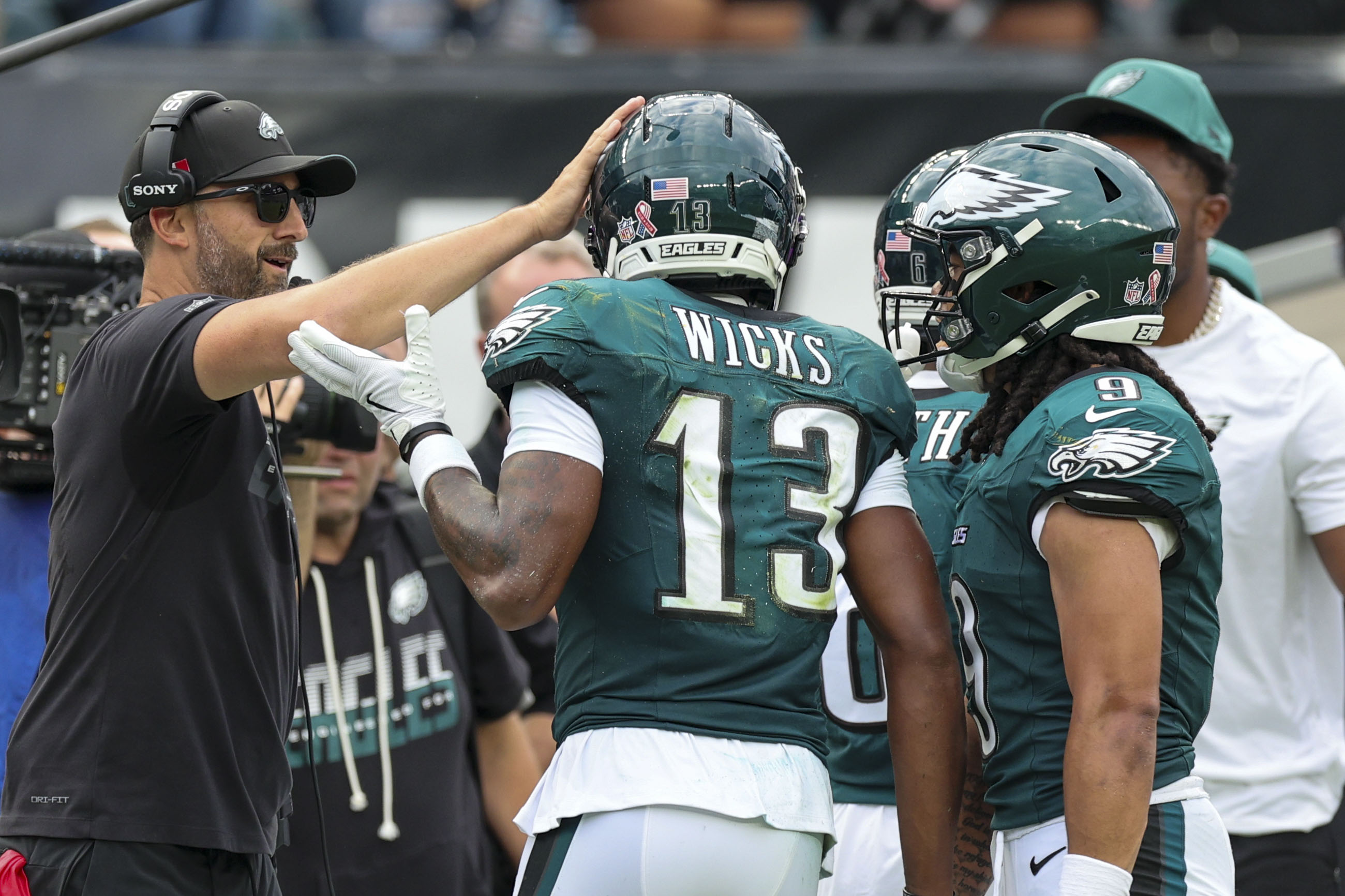
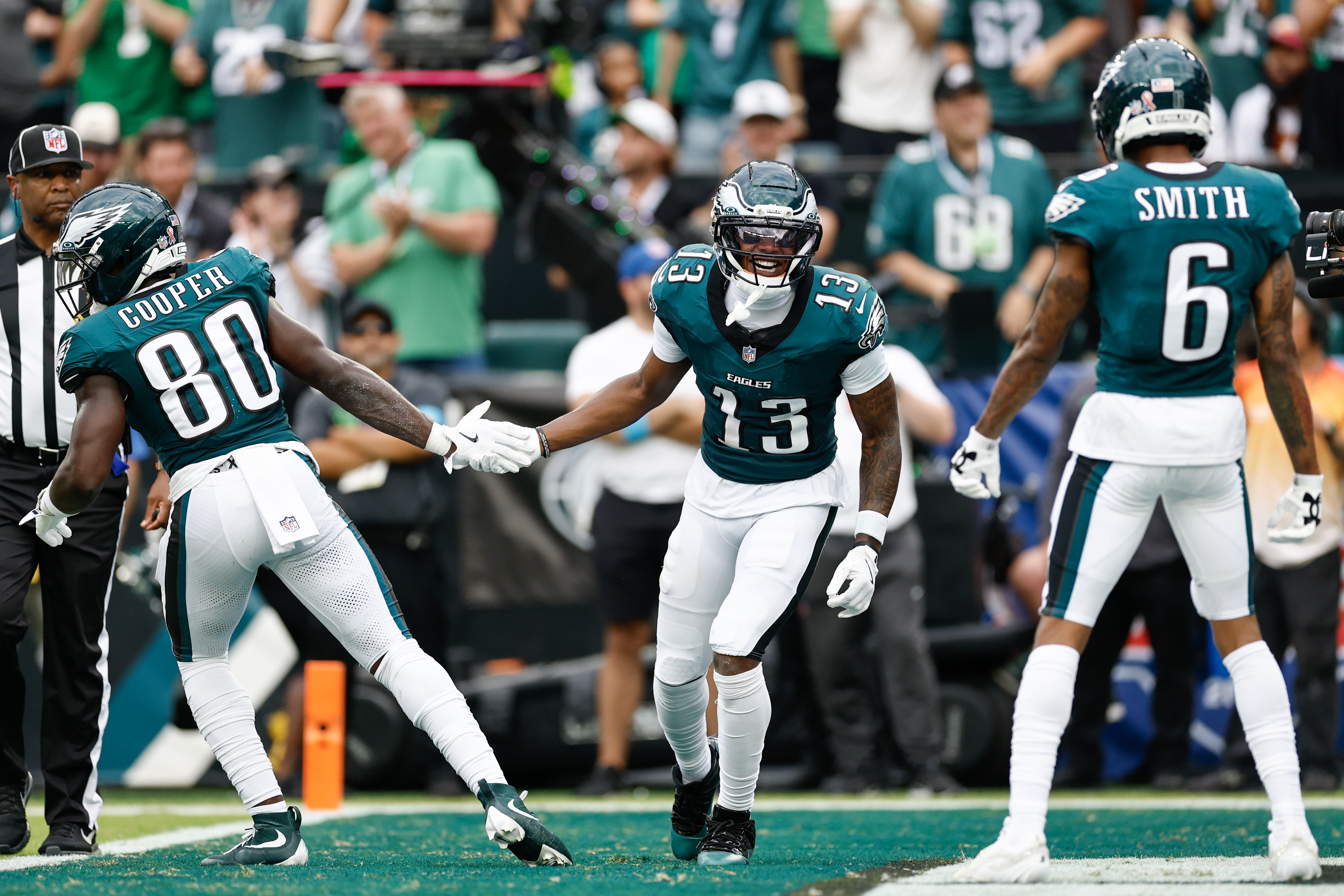
    Eagles wide receiver Dontayvion Wicks celebrates a touchdown with Darius Cooper (left) and DeVonta Smith (right) during the second quarter of the season opener against the Commanders.Yong Kim / Staff Photographer

    Explosives buoy offense

    The new-look Eagles offense started slow, netting just two yards on 10 plays through their first two possessions. Cam Jurgens was called for a holding penalty on the second, his first of two on the day.

    But nearing the second quarter, the Eagles began to contend in the explosive play battle.

    Hurts showed he hasn’t lost his touch on the deep ball. On second-and-4 from the Eagles’ 30-yard line, Hurts lined up under center with the offense in “13″ personnel — three tight ends (Dallas Goedert, Johnny Mundt, and EJ Jenkins) and one running back. Dontayvion Wicks was the lone receiver.

    Wicks ran a vertical route and stuck behind a trio of Commanders defensive backs, hauling in a career-long 64-yard pass from Hurts, bringing the Eagles to Washington’s 6-yard line. After the game, Wicks noted that his route was a “clear-out ‘til it’s not.”

    “With J, if he trusts you, he’ll put it up there,” Wicks said. “So once I broke on the deep one, I seen the ball in the air. Just kept running. And it was put on the money.”

    Another Jurgens holding penalty backed the Eagles up to the 16. But Hurts salvaged the drive, later connecting with red-zone darling Goedert in the slot for a 17-yard touchdown pass to put the Eagles up, 7-3.

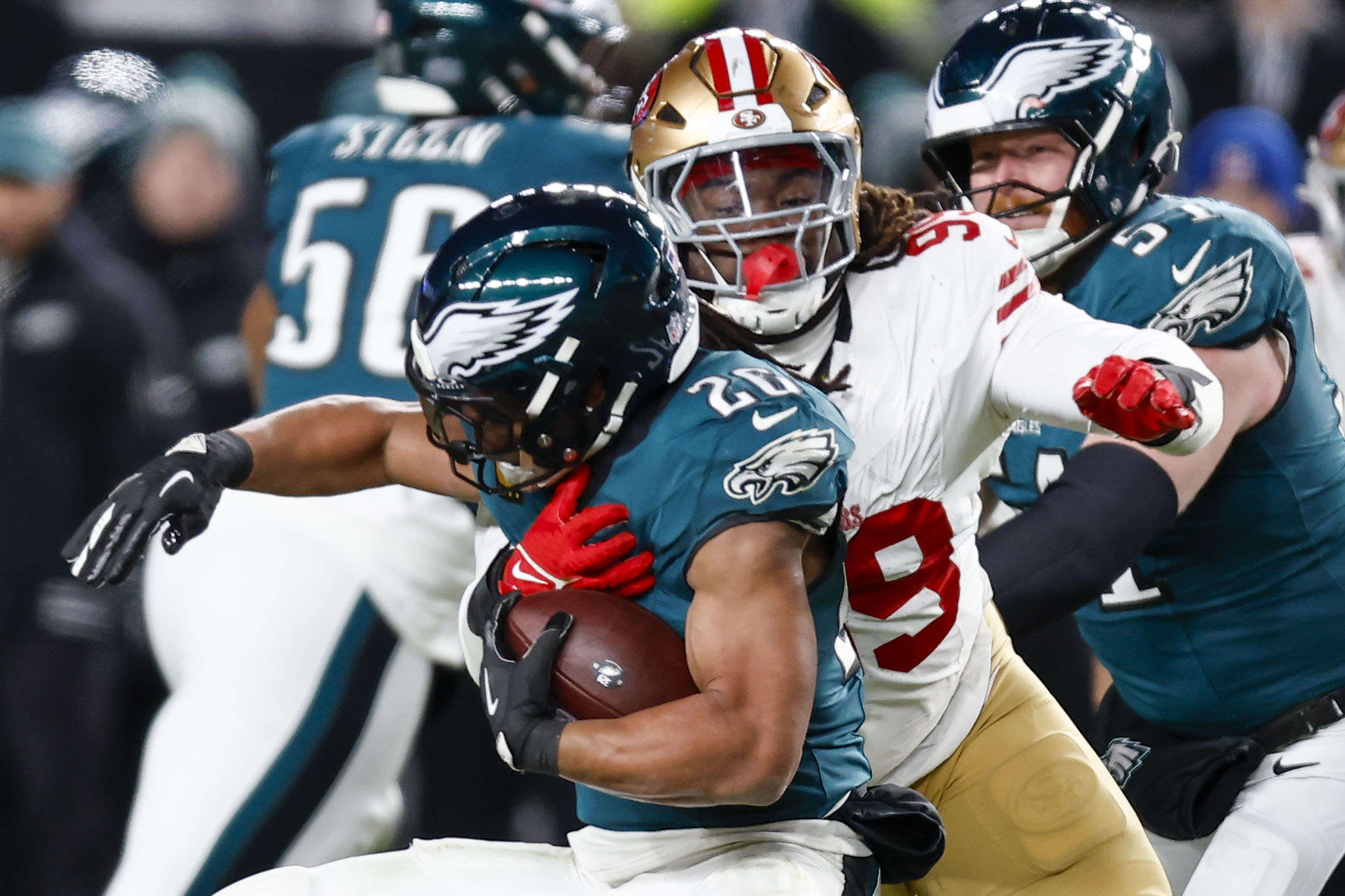
    Saquon Barkley had a big run in the second quarter but largely found running room difficult come by. David Maialetti / Staff Photographer

    Saquon Barkley also got involved with an explosive of his own on the ground. On third-and-2 from the Eagles’ 46, Hurts handed Barkley the ball on a zone read and the 29-year-old running back dashed up the middle for 42 yards, forcing a litany of missed tackles along the way.

    Again, Hurts took advantage of the explosive play and the field position, ending the drive with a 9-yard touchdown pass to Wicks to add to the Eagles’ lead, 14-3.

    The explosives evaporated for the Eagles early in the second half. The offense went three-and-out on three straight possessions. Hurts took two sacks in that span, one by Commanders rookie linebacker Sonny Styles on a blitz and another by outside linebacker Odafe Oweh on a stunt off the left side of the offensive line.

    But Hurts had another explosive in him. His 31-yard pass down the right sideline to DeVonta Smith on third-and-5 from the Eagles’ 45 kept the drive alive. The offense sputtered in the red zone, though, and settled for a Jake Elliott 35-yard field goal to go up, 17-9.

    The Eagles quarterback continued to step up. His 22-yard scramble on third-and-18 later in the fourth quarter kept the drive alive. His play set up a 43-yard catch-and-run touchdown pass to Goedert over the middle to put the Eagles up, 24-16.

    “I think it’s just about meeting the moment when your opportunity comes,” Hurts said of his big plays late in the game. “I think collectively, we’ve got a lot to build on. Obviously, a lot to correct. And I’m excited to get back into the process of becoming the team that we’re supposed to become.”

    Eagles linebacker Zack Baun had multiple big plays but the defense had trouble slowing the Commanders in the second half. Yong Kim / Staff Photographer

    Up-and-down defense

    The Eagles defense in Year 3 under Fangio was as advertised early in the game.

    After conceding a field goal on the Commanders’ opening drive, the Eagles tightened up, limiting their opponent to 13 net yards on four possessions and forcing four straight punts.

    All-Pro inside linebacker Zack Baun was arguably the best Eagles defender on the field. Early in the second quarter, he had back-to-back big plays. First, he had a pass breakup on a pass over the middle intended for Commanders wide receiver Stefon Diggs.

    Baun followed that up with a tackle for loss on a screen to Commanders running back Jacory Croskey-Merritt, bringing up third-and-27 from the Commanders’ 10. Washington waved the white flag with a 9-yard run from Rachaad White and punted.

    The Commanders still got theirs. Cooper DeJean had a shaky outing, getting called twice for illegal contact. The first penalty on the Commanders’ opening drive helped set up kicker Drew Stevens’ 55-yard field goal, putting Washington up, 3-0.

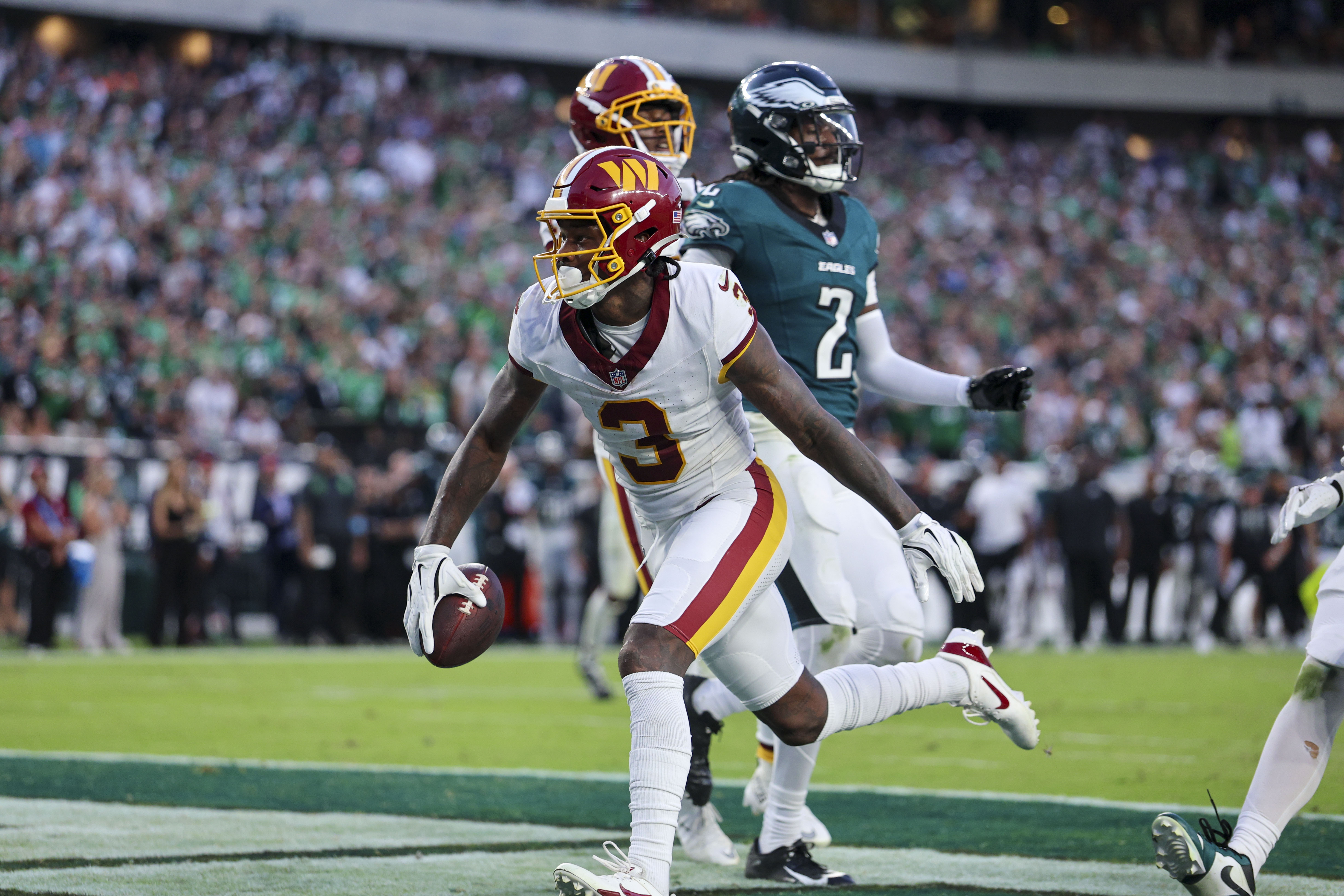
    DeJean also conceded a 16-yard pass to Commanders wide receiver Antonio Williams over the middle in the red zone in the second quarter. Croskey-Merritt capitalized by punching in a 1-yard rushing touchdown, with the Commanders trailing, 14-9.

    “Sometimes my eyes get bad and that gets me in trouble,” DeJean said. “So just got to be better with that. Good thing is, it’s Week 1. So got a lot of games ahead of us and I’ve got to continue to get better for our defense.”

    Cooper DeJean (right) was victimized for some big plays in Sunday’s win. Yong Kim / Staff Photographer

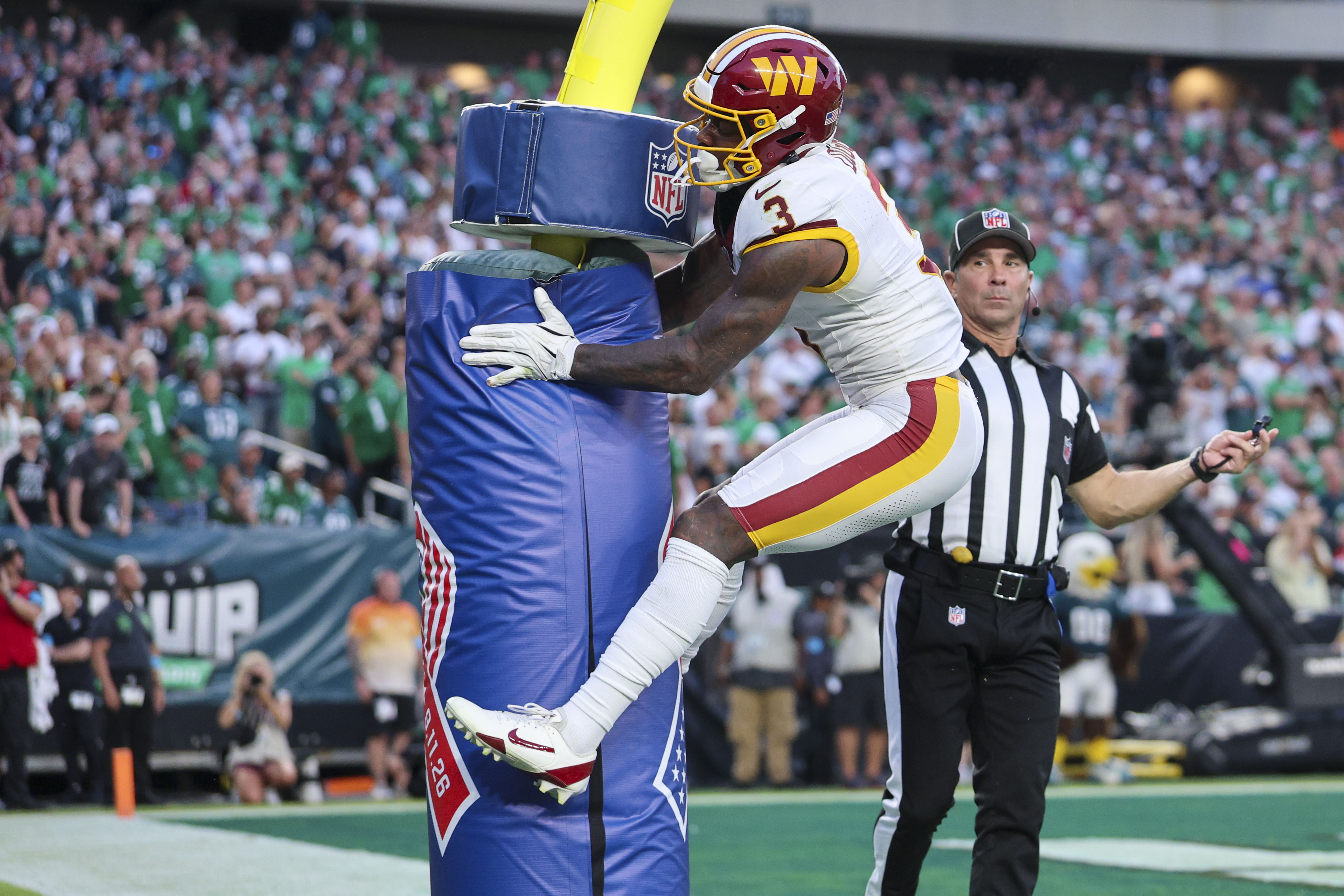
    In the fourth quarter, Jihaad Campbell gave up a 33-yard pass to Williams on third-and-14 to the Eagles’ 14. Jayden Daniels capitalized with a 10-yard touchdown pass over the middle to Diggs, who was called for an unsportsmanlike conduct penalty as he jumped onto the base of the goal post in celebration.

    His touchdown pulled the Commanders within two, but his penalty negated the opportunity to go for two points and forced them to settle for an extra point instead to make it 17-16, Eagles.

    DeJean’s struggles continued late in the fourth quarter when he conceded a 17-yard pass to Diggs to the Eagles’ 29. A 2-yard touchdown pass to Williams pulled the Commanders within two, 24-22, with roughly one minute remaining in the game.

    But Ojomo’s big-time play on the 2-point conversion attempt prevented the Commanders from tying the game.

    “You’ve got to play fast, man,” Ojomo said. “And you can’t play indecisive. I’m pretty sure I got off on the ball, I saw [Commanders right guard Sam] Cosmi pull, spun out of it, saw that the tight end was coming, and made the play.”

    Extra-special teams

    The Eagles’ under-the-radar weapon was Braden Mann, the 28-year-old punter who signed a four-year contract extension this offseason.

    He averaged 51.6 yards per punt, with his longest coming on a 64-yarder. Mann helped pin the Commanders inside their own 10-yard line twice — once at their 6 in the first quarter, and later at their 2 in the second.

    Jalen Carter picked up where he left off last year on the field goal block unit. After Croskey-Merritt’s touchdown run in the second quarter, Carter blocked the extra point attempt. He now has four blocked kicks (two field goals, two extra points) in his career.

    The Commanders’ kicking woes continued halfway through the third quarter, when Stevens missed a 54-yard field goal attempt.

  • Is Sean Mannion ready for his big moment with the Eagles? He’s been preparing for it for years.

    Is Sean Mannion ready for his big moment with the Eagles? He’s been preparing for it for years.

    Mike Riley and Sean Mannion were having one of their catch-up calls when Mannion, who played quarterback at Oregon State under Riley, told his former coach the latest project he was working on during the nascent days of his own coaching career.

    Mannion, the most prolific passer in Oregon State history, told Riley that he was putting together and digitizing all of the passing concepts he could find dating back to the 1960s.

    “This is what he does in his spare time,” Riley explained recently.

    Mannion is just 34 years old and only three years removed from his playing career. He has never called plays in the NFL before and now is tasked with turning around an Eagles offense that was too stagnant in 2025 under another first-year coordinator and first-time play caller Kevin Patullo. Nick Sirianni said in February that he was looking for someone who was detailed and had “conviction in what they believed and why they believed in it, and the vision and conviction of how they went about it.”

    Those traits seem to describe Mannion, whose father, John, called him “a saver” who took and saved detailed notes at every stop along his football path and even has comprehensive notes on concepts that pre-date his own life by some 30 years. Eagles quarterbacks coach Parks Frazier raved recently about Mannion’s attention to detail and his ability to recall and reference something he has learned along the way.

    “He remembers every detail about all of those things and he’s constantly applying it to what he’s doing moving forward,” Frazier said. “He has extreme, detailed, categorized notes and film of everything he’s been through.”

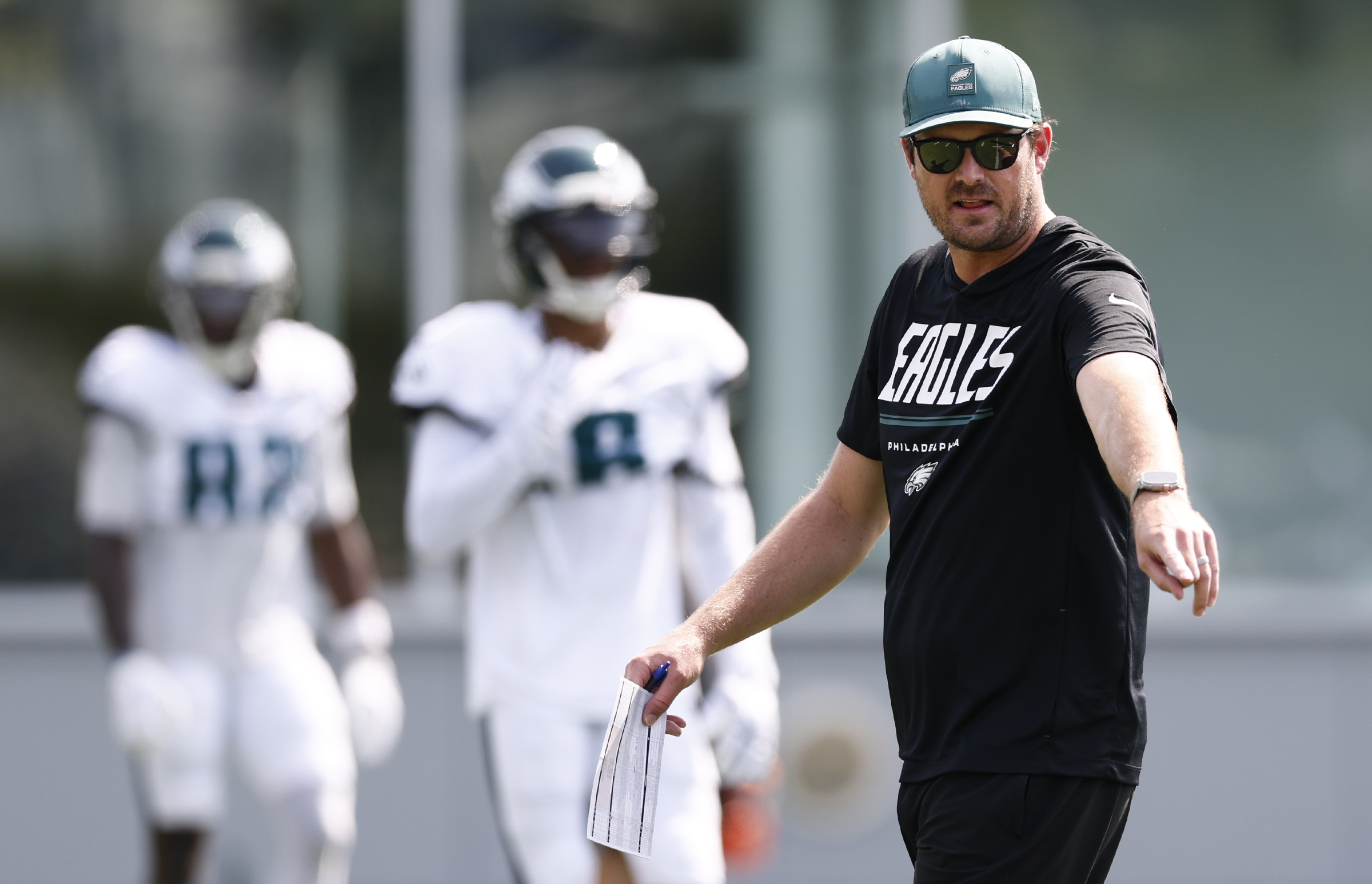
    Eagles offensive coordinator Sean Mannion talks with wide receiver Makai Lemon during team drills last month. Yong Kim / Staff Photographer

    Mannion is installing a new offense for Jalen Hurts and the Eagles, one rooted in the flavors of the trendy Kyle Shanahan-Sean McVay scheme. But Mannion’s history and influences suggest a style that ultimately will pull from every resource imaginable as he guides the Eagles offense into the future.

    Sirianni and Howie Roseman took a calculated risk on a young and fast-rising offensive coach when they landed on Mannion, who spent two years on the staff in Green Bay, most recently as quarterbacks coach, before his big promotion. But a lack of experience doesn’t necessarily mean Mannion is any less equipped to succeed than a more experienced candidate. In many ways, Mannion, the son and grandson of football coaches, has been preparing for this job for most of his life.

    “His thing was, he wanted to play as long as he could,” his father said. “The unsaid part was that when those days were done that he would turn his attention to coaching.”

    Like father, like son

    At its roots, coaching is teaching. In that sense, Sean isn’t just the son of a football coach; he is the son of two teachers, and his earliest influences can be traced to the classroom. He’d mess around in a playpen while his mother, Inga, an elementary school teacher, finished work in her classroom after school.

    He was around his father’s football teams as much as he could be, too. One Saturday, John, who also has been a teacher for 36 years, was going to scout an upcoming opponent with a coaching friend and Sean wanted to tag along. He was around 7 years old and an inquisitive kid at the time, so he brought with him a yellow legal pad. While he watched the game next to the two adults, he doodled and drew notes and observations from the field.

    “He spent a lot of time doing what we were doing,” John said of his son’s early days. “That notepad probably was a byproduct of all that time spent.”

    Sean grew up in Pleasanton, Calif., Alameda County, about 20 miles east of the San Francisco Bay in a household that valued education. He was a good student who also excelled in sports. Football was his main sport, but he also played baseball and basketball.

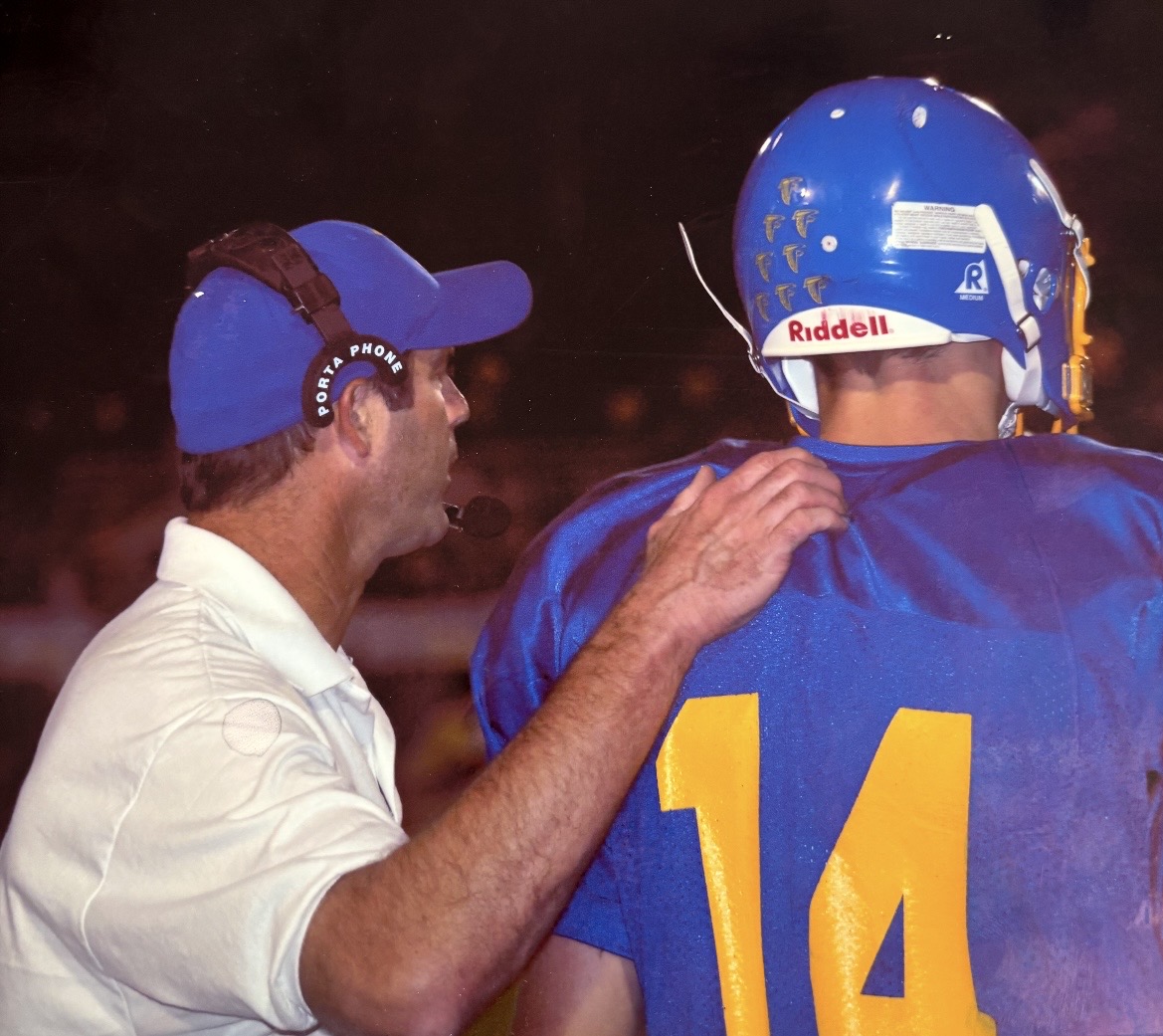
    When Sean was a rising sophomore at Foothill High School, John, a former assistant, was given the job as the school’s head football coach. He was nervous, though, about any appearance of nepotism, so from the outset of that season he had Sean playing on the JV team. Foothill was 12-1 the previous season and had two upperclassmen ahead of Sean on the depth chart. A week before the season, the senior quarterback hurt his ankle and was on crutches. Later that week, after throwing at least four touchdowns in a scrimmage, the junior quarterback showed up on Labor Day, the first practice of the first game week of the season, and complained about a back injury that eventually forced him to miss the season.

    John called home right away. Sean had to get to the field and get to practice.

    Sean’s freshman coach at Foothill was Mike Madden, the son of Hall of Fame coach John Madden. Mike approached John Mannion that first week and asked him if he was nervous for Sean.

    “Gosh, I hadn’t thought about it,” John said. “I’m nervous for myself at this point.”

    John Mannion (left) coached Sean (right) in high school.Photo courtesy of John Mannion

    John’s first game as varsity head coach was also Sean’s first game as varsity starting quarterback. Asked if he remembered it well, John responded the way many coaches would, and the way the father of a detailed note-taker would: “Oh yeah,” he said. “Of course I do, yeah. We lost, 26-21, and Sean did really well. It was a really hot day and there was a lot learned by me.”

    The team they lost to went to the state playoffs, but so did Foothill. Sean “knew the offense from all those years growing up around it” and “really absorbed a lot of things along the way,” John said.

    “We kind of went through it together,” John said. “There was no plan of him ever being on the team that first year, but sure enough there he was. There’s challenges in there but I think it was a great experience for us to be able to do that.”

    Sean finished his high school career as Foothill’s all-time leading passer and, after throwing for 3,521 yards and 27 touchdowns as a senior, was off to Oregon State.

    That yellow legal pad Sean doodled on during that football scouting trip was part of a full-circle moment some 25 years later.

    “When I got my first coaching job with the Packers, as a gift, he framed it for me,” Sean said. “So I still have it in my house. It’s pretty cool. The scheme has evolved since then, I will say, but it was a really cool, special gift that he kept.”

    The Machine

    Riley’s favorite word to describe Sean is “diligent.” How many coaches born in the 1990s are digitizing passing concepts from the 60s?

    Sean was the top quarterback Oregon State pursued in the class of 2010, and Riley and his staff were thrilled when he committed and later signed. The program had produced top quarterbacks like Derek Anderson and Matt Moore, and Riley thought Sean would be the next great one to come through Corvallis.

    The diligence showed up right away. Sean was supposed to redshirt during his first season on campus, but the summer before his first camp with the Beavers, Sean got the keys to the facility from the graduate assistants to go in early and watch film.

    “That was him the whole time,” Riley said. “He could really throw the football and he was a very hard worker physically, and then he was a very hard worker off the field. He wanted to know and learn and he’s one of the most diligent people that I’ve ever been around.”

    That part of Sean made it easier when, during the second half of the first game the following season, Riley put Sean in the game over a junior who started. He was just a redshirt freshman, but he was Oregon State’s starter from that point until graduation.

    “That was one of the first times probably in my career that I actually had the faith in a redshirt freshman to insert him sometime early in the year as a starter,” Riley said. “I think that said a lot about what we felt about his early development and what we thought he could do on the field.”

    Eagles offensive coordinator Sean Mannion has worked diligently on offensive concepts dating back to his career as a player. Elizabeth Robertson / Staff Photographer

    Sean became a captain the following season. He is soft-spoken by nature, those closest to him say, but his leadership showed up in the way he carried himself and how he approached the game. By senior year, he had a nickname: “The Machine.” That year’s offensive coordinator, John Garrett, referred to Sean by that moniker during a film session one day and it stuck, much to Sean’s chagrin. Oregon State’s offensive linemen sometimes walked robotically around Sean.

    “That is a pretty appropriate nickname because he was just like that,” Riley said. “He just went to work and put in the work and everybody knew that about him. I think he’s one of the most probably respected teammates that I saw through all my years of coaching.”

    Sean exited college as Oregon State’s all-time leader in passing yards and ranked in the top 10 in college football history. He’s still 19th.

    The quarterback and coach have stayed in touch over the years. Riley, who left Oregon State for Nebraska after Sean’s senior year, is now retired, though he’s still on the College Football Playoff selection committee. Sean isn’t the most recent Mannion whom Riley had talked to as of a few weeks ago, though. John, who no longer coaches, now writes a newsletter on Substack called “John Mannion’s Coaching Playbook,” and recently interviewed Riley.

    Sean’s most recent catch-up call with his college coach came after OTAs this season and just before camp.

    “He sounded excited and he sounded like he would be because he’s always prepared — he sounded confident,” Riley said. “And I could also tell he was having a lot of fun.”

    ‘A 30,000-foot view’

    Sean has described his father and Riley as his two biggest influences along the way. But his most relevant football influences when it comes to his current job came into his life in 2017, when Sean was backing up Jared Goff with the Los Angeles Rams and the team brought in a new coach, McVay, who hired a new offensive coordinator, Matt LaFleur. Both had been schooled under Shanahan and brought to the Rams a new style of offense that Sean took to.

    “I just felt like I was learning so, so much,” Sean said. “It was such an exciting way to match the run and pass. They had such a way about teaching the game where we could feel ourselves challenging a defense, but it felt simple to us.

    “Those are the things that really stood out to me going through that experience that really resonated with me as a player and certainly resonate with me as a coach. That was a very exciting point in my football life, just the exposure to that type of teaching, that type of scheme. I know Matt, obviously a mentor of mine, getting to play for [McVay]. I learned so much from those people. It’s certainly a big part of molding me into the type of coach I am now.”

    Eagles offensive coordinator Sean Mannion with members of the offensive line during training camp last month. Yong Kim / Staff Photographer

    How the Eagles offense will look come Sunday still remains a sort of mystery. There certainly will be more motion, more snaps from under center, and more play-action. But the Eagles ran a bland offense during the preseason in an effort to hide most of their playbook, and the first-team offense was rarely fully healthy during training camp and also had to go against one of the best defenses in the league.

    The Eagles have a new style of running the ball, which will be a key to unlocking the passing game and play-action. The base of the Shanahan-McVay offense is outside, wide-zone runs that stretch the defense horizontally. The Eagles and longtime offensive line coach Jeff Stoutland parted ways this offseason, and new offensive line coach Chris Kuper has been in charge of implementing the new blocking scheme.

    Kuper was the offensive line coach in Minnesota when Sean spent part of the 2023 season with the Vikings.

    “He sees the game from a 30,000-foot view as well as being on the sideline and being into it with the players,” Kuper said. “I think it speaks volumes, his experience as a quarterback in this league and being able to connect people and become a glue guy has been incredible.”

    There may be a misconception that Sean, a quarterback by trade, just focuses on the quarterbacking. But Kuper described a coach who is involved in every facet of the offense.

    “What I love about Sean is how much he loves the run game,” Kuper said.

    Kuper said part of Sean’s responsibilities in Green Bay when he was an offensive assistant in 2024 was to draw some runs. The Eagles do have a run-game coordinator in tight ends coach Ryan Mahaffey, but Kuper is confident Sean could handle it all.

    “Sean could game plan and call a game all on his own, I think, if he wanted to,” Kuper said.

    First-time play caller

    The Mannions relocated to Oregon when Sean was in college, and one spring after John had taken over as the head coach at Mountainside High, he needed help.

    The 2021 football season came together rather late in the midst of the COVID-19 pandemic, and a shortened spring season was on the table. Sean was home in Oregon doing remote OTAs with the Vikings when John asked him to be the offensive coordinator that season.

    Sean’s younger brother, Brian, was the starting quarterback. It was a family affair.

    On the day of the first practice, John walked out on the field and handed Sean his handwritten practice plan.

    “You know there’s software for this, right?” Sean quipped.

    John was calling plays, but after Mountainside was shut out in the second of their six games, John made a change.

    “I handed the torch to him. It was fun,” John said.

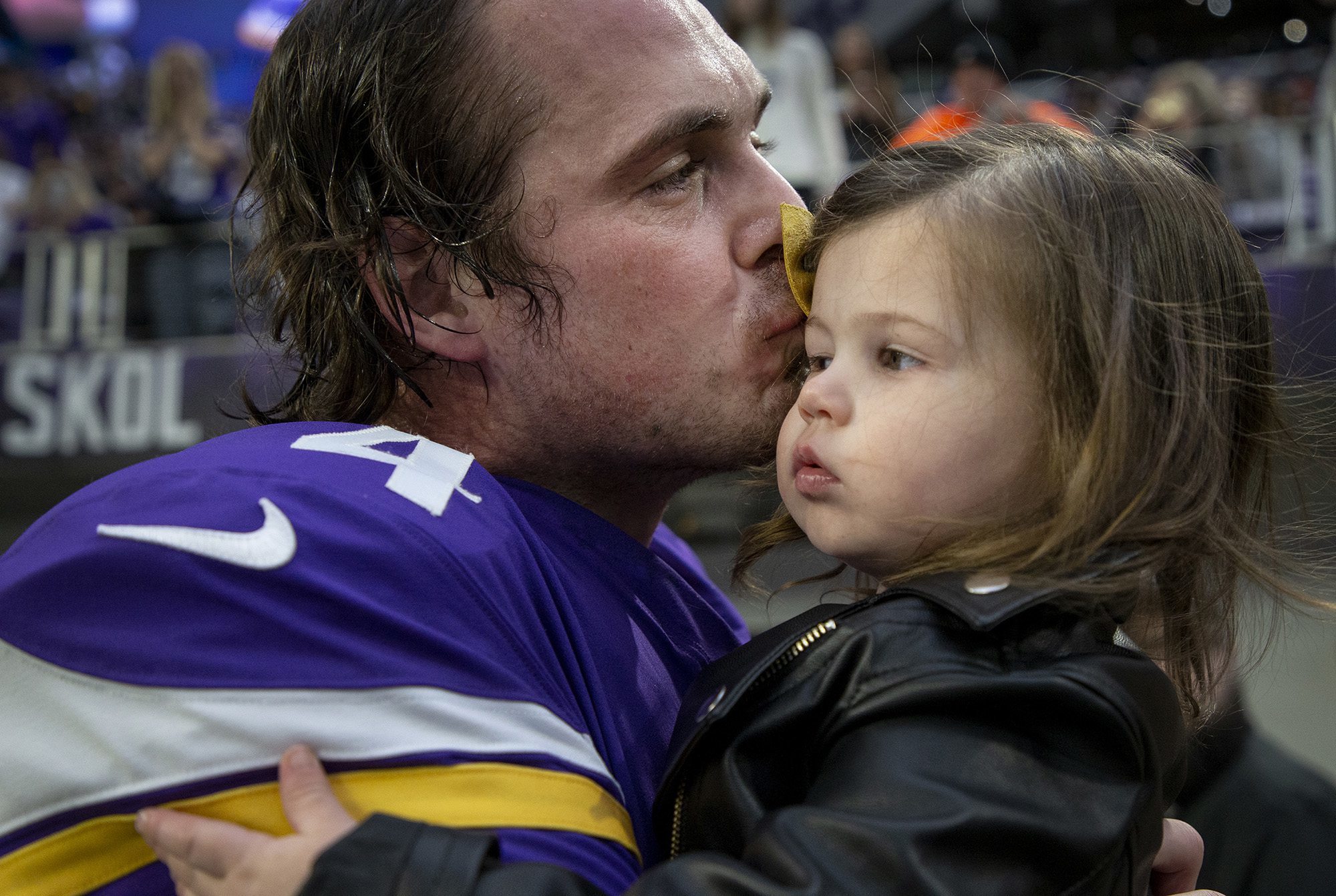
    Minnesota Vikings quarterback Sean Mannion (4) kisses his daughter Sawyer after pregame warmups before a game against the Chicago Bears on Sunday, Dec. 29, 2019.Carlos Gonzalez / MCT

    John has watched the oldest of his four children become a loving husband to his wife, Megan, and the proud father of three children. He always knew Sean could and probably would eventually become a successful coach, but that spring offered his first real chance to witness Sean’s future in person.

    “I could see clearly he had a real knack for it,” John said.

    Sean was still in the process of talking to the Eagles when he was tapped to call plays in January’s East-West Shrine Bowl. He called John during his father’s lunch break.

    “You haven’t called a game since Mountainside vs. Grant High School back in March of 2021,” John joked.

    The two shared a laugh. A few days later, Sean was hired to call plays for the Eagles.

    All roads lead to Delco

    Margaret Mannion was around 20 years old when she moved to California, but John’s mother spent her early days in Delaware County. She lived in Drexel Hill, graduated from Archbishop Prendergast High School, and worked at Villanova before moving west, where she met Jim Mannion, John’s late father.

    Margaret, 84, has dementia now and still lives in California in an elder care facility, but John is pretty confident there will be at least one “proud Philadelphian” and Eagles fan watching the games this year from the elder care facility.

    As for John, he’s a self-described “worrier.” When Sean redshirted at Oregon State, John loved the ease of watching the games with no pressure in the family section. After Sean was inserted as starter the next season, John called the box office. He wanted to sit in the far corner of the stadium in the last row. Tickets in the family section were free and required no work on his end, but every year he’d call the ticket office to secure his seats at the top of the stadium.

    Sean rarely played in the NFL — he threw just 110 passes over nine seasons in the league — so Sunday Ticket usually sufficed. When Sean was hired by the Packers, they were on national television frequently enough, and for the games they weren’t, John would drive to his local Buffalo Wild Wings, where he’d watch quietly and hope the quarterback play was up to snuff.

    Last year, while watching a game at the restaurant, a few Green Bay fans in their 20s complained to John about Packers quarterback Jordan Love. The group had a laugh when John told them, no, he wasn’t from Green Bay, his son coached the quarterbacks.

    “I’m going to call him tonight and tell him there’s some guys in Oregon who say he’s got a lot of work to do,” John joked.

    This year, it’s back to Sunday Ticket. John, who was in town for a few days in August observing the Eagles and Sean during camp, said he’ll build a fire at home, watch the game in peace, and “keep our fingers crossed.”

    His son’s new job comes with a lot of pressure. Patullo was the most criticized person in the building last year and eventually took the fall after the team’s first-round exit, so all eyes will be on Sean as the season gets underway.

    Margaret’s older sister, John’s aunt, still lives in New Jersey and called John after Sean got the job.

    She was excited Sean was in a new, high-profile job back where his family has roots. But her excitement also had a tinge of nervousness: “Hopefully everybody is nice to him,” she said.

  • Sean Mannion’s vision for the Eagles offense is coming into sharper focus: ‘Confident and excited for Week 1′

    Sean Mannion’s vision for the Eagles offense is coming into sharper focus: ‘Confident and excited for Week 1′

    At the outset of the offseason program in April, Sean Mannion began to install the foundation of the Eagles offense, a brand new scheme from a first-time coordinator.

    Those early days, Mannion said Thursday, feel like “ancient history” compared to where the team is now.

    He said it jokingly, but acknowledged what has felt like eons between now — just four days before his first regular-season game as a play-caller — and then is a reflection of the work that Eagles staff and players have put into learning the scheme.

    The group started with the foundation of the offense in the spring, then added one layer after the other, gradually incorporating different wrinkles and adjustments. Mannion said he is satisfied with the progression, leaving him feeling like the team is in a “great position” heading into Week 1 against the Washington Commanders.

    “There’s been so much work, and we’re working relentlessly, and ultimately that builds your confidence, knowing that I’ve spent hours and hours and hours thinking about the plan, preparing the plan, preparing the players,” Mannion said. “I feel confident and excited for Week 1.”

    After installing the broader offense throughout the offseason program and training camp, Mannion will narrow the game plan to a more select menu. The Eagles offensive coordinator’s desire to put the players in the best position to succeed helps inform how to pare down the offense.

    He has spent the last five months evaluating the strengths and weaknesses of his personnel. Mannion has built what he calls a “library” of plays since April, which includes new plays and familiar ones from past Eagles offenses.

    As he game plans, he’s pulling different books from the shelves, so to speak, of the Eagles’ vast play library. Part of his consideration in selecting plays also includes a study of the Eagles’ opponent to determine how to best attack them.

    Sean Mannion’s time with the Vikings crossed over with that of current Commanders defensive coordinator Daronte Jones. Jack Dempsey / AP

    That aspect of the preparation is shrouded in mystery, as the Commanders have a new defensive coordinator in Daronte Jones, who spent the last four years with the Minnesota Vikings as defensive backs coach and pass game coordinator. Mannion is familiar with the Brian Flores-led Vikings defense, as he played in Minnesota briefly in 2023 (Flores’ first season as defensive coordinator) and coached against him twice a year with the Green Bay Packers for the last two seasons.

    Whether or not the Commanders take on more of a Vikings flavor, Mannion said he will be prepared for anything the defense throws at them.

    “We’ve really used this extra practice time, kind of the bonus week, to our advantage,” Mannion said. “We want to be ready for everything. … And like any opponent, whether it’s a new coordinator into Week 1 with new wrinkles, or if it’s a first-time coordinator at a place, you’re always ready to adjust in-game, and we have contingencies laid out for different things we might be anticipating.”

    Mannion will make those hypothetical adjustments from the coaching box. He experienced calling plays from both the box and the sideline during the preseason and the public practice at Lincoln Financial Field during training camp. He ultimately decided it was the “best decision” for the team to call the game upstairs.

    While there are pros and cons to either location, Mannion acknowledged he has more space in the box to operate. Plus, he called the point of view “unique” given the higher vantage point up top.

    He even went through the long list of play-callers he had as a player, or worked with as a coach, and tallied up their in-game location. Mannion said it was almost 50-50.

    “If there was one thing as I was thinking it through, I realized, you know what?” Mannion said. “There’s plenty of great play callers who have done it from either spot.”

    Jalen Hurts said on Wednesday that he hasn’t had a play-caller sit in the box since he was in college. Still, he emphasized that he would support Mannion in his decision, even if his communication with his offensive coordinator between drives might be altered given his location.

    Jalen Hurts said earlier this week that he’s OK with not having Sean Mannion on the sideline during games. David Maialetti / Staff Photographer

    Mannion noted that one of the advantages of calling plays from the box is his ability to talk to each of his staff members at any time, instead of being fixed in one place and speaking to them individually. Then, his staff members can quickly disseminate information to their respective position groups.

    “I think really more than anything, it speaks to [quarterbacks coach] Parks [Frazier], he does a great job with Jalen every day,” Mannion said. “I’m in constant communication with him and all of our position coaches, and then it allows for, I think, everybody to coach their units, and I can kind of survey from up top and distribute information from there, and they take it the rest of the way.”

    Mannion has praised the work of the staff and the players as they have learned a new offense. Come Sunday, the details that defined the last five months — from designing the offense, to planning meetings and practice schedules, to teaching the offense, to executing in practice — will come to fruition on the field.

    Is there an aspect of the job that keeps Mannion up at night? As he reflected on his work over the last five months, he showed he looks at his myriad responsibilities from a perspective of gratitude.

    “Those are the things that you love about coaching,” Mannion said. “There’s so many different elements to it, but football’s a beautiful game because they all come together. I stay awake thinking about that, but I wouldn’t say it keeps me awake. It’s the enjoyable part for me. That’s what I love about it.”

  • Nick Foles on joining Netflix, traveling to Australia, and his one big concern about the Eagles

    Nick Foles on joining Netflix, traveling to Australia, and his one big concern about the Eagles

    The San Francisco 49ers face the Los Angeles Rams Thursday night in the first-ever NFL game in Australia (8:35 p.m., Netflix), and the streamer is bringing an Eagles legend along for the time-bending ride.

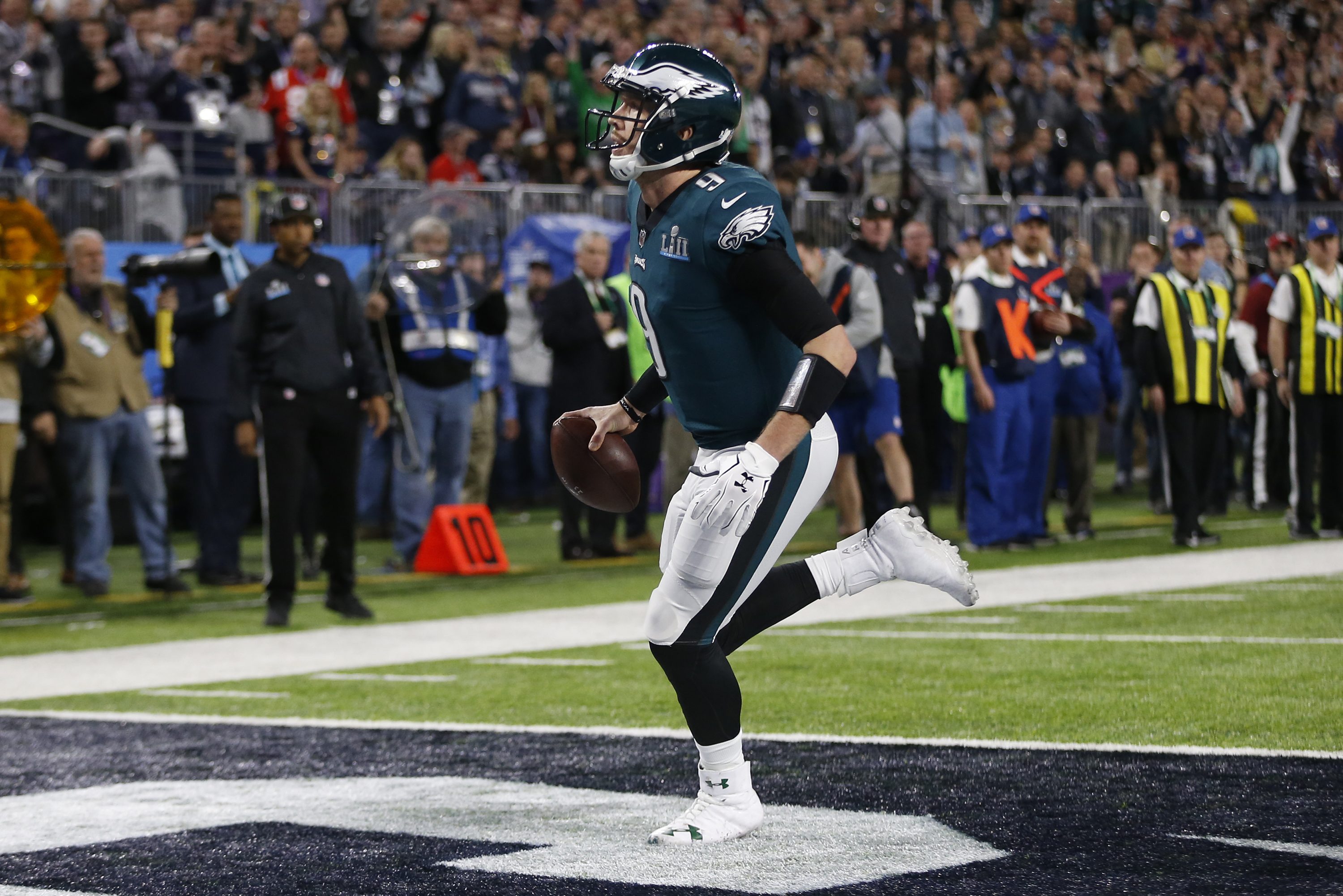
    Nick Foles, the Super Bowl MVP whose statue sits outside Lincoln Financial Field, will be part of Netflix’s NFL studio show this season, which includes Thursday night’s game at the Melbourne Cricket Ground, Thanksgiving eve, two Christmas Day games, and a Week 18 matchup.

    “These are primetime games. These are important games. And Netflix is obviously a huge company,” Foles said. “It’ll challenge me.”

    Alongside Foles for pregame, postgame, and halftime coverage will be host Elle Duncan, Hall of Famer Michael Irvin, and former Green Bay Packers defender Clay Matthews III. Calling the game will be Noah Eagle and Hall of Famer Luke Kuechly, the former Carolina Panthers linebacker who also landed a color analyst role this season with CBS.

    NBC is helping Netflix produce its five-NFL-game slate, and brought Foles and his new colleagues to their studios in Connecticut last month for something akin to a broadcast training camp. That included Foles and Matthews — the two TV newcomers — practicing situations without any preparation, including a mock kickoff.

    “They wanted to see if we could even handle going to transition, having a producer in our ear,” Foles said. “We understand we’re rookies at it, and we’re just hungry to learn. … They want us to be ourselves and have fun.”

    It’s a big jump for the Super Bowl champ, who is in his second season co-hosting The SZN podcast with his brother-in-law, former NFL tight end Evan Moore. But it’s also an ideal gig, allowing Foles to offer analysis to millions of viewers while only committing to a few extra days during the season.

    “It was really just the right time, right situation,” Foles said.

    It also offers him a chance to show off his nerdy side. While the game will kick off 8:35 p.m. Philly time Thursday, it will take place locally in Melbourne at 10:35 a.m. Friday, which could have an impact on the players. There’s also the long flight down, the longest Foles has ever taken.

    “I got my compression tights. … I’m literally geeking out on the science,” Foles said.

    If it feels like you haven’t heard much from Foles since he retired from football in 2024, that’s by design. He spent a year away from football to clear his head, spend time with his family, and coach his three children.

    He began to receive media offers, but opted instead to focus on building the podcast with Moore. That gave him a comfortable spot to find his voice talking about football, which drew the attention of producers at Netflix.

    Thankfully, Foles has plenty of broadcasters to turn to for advice, including Moore and former teammates like Jason Kelce and Brandon Graham. He also attends the same church as longtime Fox Sports college football analyst Joel Klatt, and squeezed some sage advice about the need to be quick.

    “On a podcast, you can be long-winded and get your point our there at the end,” Foles said. “He said ‘No, start with the main point and then have a meaningful explanation …’ That’s simplistic, but it makes a world of difference.”

    Unlike Kelce and Graham, Foles takes a quieter and more analytical approach to breaking down the game, which was on display last season when the Eagles offense struggled. He drew attention for comments he made about former offensive coordinator Kevin Patullo, but rather than just pile on, Foles tried to offer suggestions to help the team.

    “I’m not going to be one of those guys that just crushes someone,” Foles said. “Maybe the Cowboys.”

    Foles has one big concern about the Eagles

    Nick Foles is most interested to see how well new offensive line coach Chris Kuper helps the Eagles. David Maialetti / Staff Photographer

    While the Eagles aren’t slated to appear on Netflix this season, unless they land in their Week 18 game, Foles will spend plenty of time talking about the Birds on his podcast, which will air weekly on NBC Sports Philadelphia.

    Heading into the season, Foles expects Vic Fangio’s defense to be solid and the offense to rebound after last year’s struggles.

    It’s the offensive line he’s worried about. Specifically, how the loss of former offensive line coach Jeff Stoutland and his availability to develop players could impact the team.

    “If you look at the Eagles the last couple of years, when has their season fallen apart? When the offensive line gets banged up,” Foles said.

    While he has concerns, Foles said he’s heard nothing but good things about new offensive line coach Chris Kuper, who played eight seasons with the Denver Broncos and most recently served as offensive line coach with the Minnesota Vikings.

    He’s part of a big overhaul under new offensive coordinator Sean Mannion that includes a different run blocking scheme and a new approach at the line. Kuper told reporters the squad has “come a long way” as the Birds prepare for their season opener against the Washington Commanders Sunday, but only time will tell how the team performs.

    “There’s a lot of pressure on this guy. He played the position well. … [Kelce] said good things about him,” Foles said. “But I’m circling that.”

  • Jalen Hurts will likely have his play-caller in the booth for the first time. Hurts said he just wants Sean Mannion to ‘feel comfortable’

    Jalen Hurts will likely have his play-caller in the booth for the first time. Hurts said he just wants Sean Mannion to ‘feel comfortable’

    Jalen Hurts has attempted to let his walls down this offseason, whether he’s opening up for a GQ profile or spending quality time with his teammates, both in and out of the facility.

    He will have another wall to break through this season, starting with the Week 1 home opener against the Washington Commanders on Sunday. Nick Sirianni revealed Wednesday that first-time offensive coordinator Sean Mannion will “probably” call plays from the booth, with a glass window and several stories separating him from the sixth-year starting quarterback.

    Hurts said he hasn’t had a play caller in the booth since he was in college. Still, he said he will be supportive of Mannion’s decision, regardless of how it impacts their line of communication, particularly between drives.

    “If he feels that’s what gives us the best chance to win, the best chance for him to see the game and find his flow and what he’s doing, that’s the direction we need to go in,” Hurts said Wednesday. “And so I’m going to support whatever makes him feel comfortable in that degree.

    “And for me, I come into the year thinking about breaking down walls of communication and talking and communicating the things that I’m seeing and and whatnot. And there is a wall, being in the box, but still, having open dialog, using the red phone, calling if I see something, hearing him out, and I think in all, it’s a part of the process.”

    Jalen Hurts (right) talked about the importance of communication with Sean Mannion (left) and the new offensive coaching staff. Yong Kim / Staff Photographer

    Building chemistry with Mannion has been one of the focuses of training camp for Hurts. He reiterated on Wednesday his goal of getting “hip-to-hip” with his new offensive coordinator as a means of building chemistry, a task that continues into the regular season.

    Hurts wants to know what Mannion is thinking in any given situation, an environment the team has tried to replicate during the call-it periods of training camp. It all becomes real in Week 1. Hurts will soon have an opportunity to build in-game chemistry with Mannion, even if he isn’t on the sideline.

    “The in-game experiences we have coming soon will be very valuable for us in what we ultimately want to accomplish,” Hurts said.

    With Week 1 preparations underway, the 28-year-old Hurts is still getting used to all of the new. It isn’t just the big aspects, such as the new offensive coordinator, the new offensive scheme, and the horde of new receivers headlined by Dontayvion Wicks, Makai Lemon, and Hollywood Brown.

    It’s the smaller things, too, within Hurts’ weekly preparation. He said he realized on Tuesday that in years past, he would typically meet with Jeff Stoutland on that day to discuss that week’s game plan. Stoutland, who served concurrently as the Eagles offensive line coach for 13 seasons and the run game coordinator for eight, announced his departure from the team in February.

    The process may change with new coaches, but the goal remains the same.

    “A lot of it is new, and there’s a transition,” Hurts said. “It’s a bit of an evolution, but we’ve got great guys here that I can lean on that can that can fill those voids, so we can do what we’re trying to do moving forward.”

    Jalen Hurts has worked hard to learn the nuances of the Sean Mannion offense since the coordinator’s hiring. Jose F. Moreno / Staff Photographer

    Moving forward this week, the Eagles will try to win their first game of the season against an NFC East foe. Hurts and Sirianni have gone 5-0 in Week 1 since the Eagles head coach arrived in Philadelphia and the quarterback stepped into the full-time role as the starter.

    Hurts shared his theory for their Week 1 success — “keeping the main thing the main thing.” Their early results are a reflection of their preparation and their confidence in it.

    A win would start the Eagles off on the right foot, Hurts said. The real challenge is maintaining that “clarity” regarding their intentions as an offense as the season progresses.

    Hurts acknowledged that he doesn’t know exactly what the offense will look like in Week 1, let alone Week 18. It’s Mannion’s job to whittle down the broader offense that he installed in training camp to a more limited menu for game day based on the opponent.

    But Hurts said he is excited to have a “north star,” or a clear vision from his offensive coordinator about what his intentions are in designing the offense and how he wants his players to attack it. Whether that vision includes designed runs for the quarterback, an aspect of the offense that was seldom highlighted last year, remains to be seen.

    Hurts acknowledged it could be a “unique opportunity” to incorporate his rushing ability into the offense, even though mobile quarterbacks haven’t typically been featured in the West Coast offense.

    Ultimately, it’s up to Mannion to make that call. It’s on both Hurts and Mannion to get a sense of which plays the other likes, too, regardless of where the play-caller is located.

    “We’ve got to build that chemistry,” Hurts said. “I’m always willing and open to doing anything and everything to win. And it’s not like you say I’m going to drop back and run it on this play. You’ve got to play the game. So we’ll find that feel and see where it goes.”

  • Three numbers that matter for the Eagles, from the schedule to Jalen Hurts’ running

    Three numbers that matter for the Eagles, from the schedule to Jalen Hurts’ running

    Diving deep into the data to look at three trends that will help determine the Eagles’ fate in 2026 (with an assist from pro-football-reference.com and nflfastR).

    23rd

    That’s the average ranking from last season of the 14 pass defenses the Eagles will face in 2026. It is the softest schedule in the league by a wide, wide margin. The Eagles couldn’t have handpicked a better setup for Jalen Hurts and first-year offensive coordinator Sean Mannion. Right out of the gate, they’ll face a Commanders defense that finished tied for 30th in yards per pass attempt allowed, then a Titans defense that finished dead last. In fact, nine of their 14 opponents finished lower than 20th in yards per attempt.

    A big factor in the Eagles’ good fortune is a division that includes two of the three worst pass defenses from a year ago in Dallas and Washington, plus a Giants team that finished in the bottom half of the league. The Cowboys also finished in the bottom 10 in sack rate while ranking 27th in their rate of passing plays of 20 or more yards, two categories in which the Eagles schedule also ranks among the most favorable.

    The nondivision slate will likely play a little tougher than it looks on paper. The Rams (tied for 11th in YPA) rebuilt their secondary while adding Myles Garrett and Aaron Donald to the pass rush. The Colts could be better in their first full season of cornerbacks Charvarius Ward and midseason trade acquisition Sauce Gardner. That said, no team in the NFL has a more favorable schedule top to bottom. The Eagles’ opponents had an average rank of 22.9 in passing yards per game and 20.2 in yards per attempt allowed last season. Both are the highest in the NFL.

    The sequencing is as beneficial as the actual opponents. The two toughest defenses on their schedule don’t come until Weeks 15 and 16, with just five days separating the Seahawks on Dec. 19 and the Texans on Christmas Eve. Both games are at home.

    The early-season schedule is soft enough to counteract whatever learning curve that will exist for Hurts and the rest of the offense in Mannion’s scheme. The expectations should be high.

    3.98

    That was the average yards per carry of Eagles running backs when they had multiple tight ends on the field last season in neutral game script situations. That ranked in the bottom half of the league and well behind the teams that made it to their conference championships.
    A sampling …

    Running-back yards per carry in multi-tight-end sets (first and second down outside the 10-yard line)

    • Bills: 5.25 (4th in NFL)
    • Rams: 5.23 (5th)
    • Seahawks: 4.56 (9th)
    • Bears: 4.52 (10th)
    • Broncos: 4.44 (11th)
    • Patriots: 4.30 (17th)
    • Eagles: 3.98 (20th)
    Johnny Mundt (center) was brought in to help the Eagles’ blocking in multiple tight end sets.Tyger Williams / Staff Photographer

    Johnny Mundt didn’t get a ton of coverage in training camp. Blocking tight ends rarely do. But the Eagles signed the 31-year-old veteran for a reason. With Cameron Latu lost to waivers and Grant Calcaterra on injured reserve, the Eagles will enter the season without two of their top three tight ends from last year. Add to that the steep learning curve awaiting rookie second-round draft pick Eli Stowers and tight end is one of the bigger question marks on this 2026 roster.

    The question is especially relevant given the leaguewide paradigm shift. Teams like the Rams and Seahawks have spent considerable resources accumulating talent at the tight end position in recent seasons. Seattle drafted AJ Barner and Elijah Arroyo in the fourth and second rounds in back-to-back seasons, while the Rams just added second-round pick Max Klare to a stable of tight ends that already included 2025 second-rounder Terrance Ferguson, high-priced free agent Colby Parkinson, 2023 fifth-rounder Davis Allen and veteran Tyler Higbee.

    It remains to be seen how central a role multi-tight-end sets will have in Mannion’s offense. Last year, his Packers team finished in the top half of the league in both RB yards per carry and pass yards per attempt.

    Zero

    That’s how many quarterbacks rushed for 600-plus yards last season. The last time the NFL had a regular season where no quarterbacks reached 600 yards was 2017. At least two had done it in each of the previous five seasons.

    Hurts’ rushing production has garnered plenty of attention, and deservedly so. The Eagles were a dramatically different offense in 2022 when he averaged 50.7 rushing yards per game compared to the one they’ve been over the last three seasons, when Hurts has averaged just 34.5 yards. It’s certainly reasonable to think that he can and should be well north of the 26.5 yards he averaged last season. But it isn’t all on him.

    The natural trajectory of a dual-threat quarterback is to see a year-to-year decline in rushing production. It has happened to virtually every quarterback who has done the things Hurts did early in his career. The league adjusts quickly. It’s no coincidence that virtually every scrambling quarterback saw a significant decline in his rushing production last season.

    New Eagles OC Sean Mannion could utilize Jalen Hurts’ running ability more in 2026.Yong Kim / Staff Photographer

    Jayden Daniels missed 10 games, but in the seven games he played, he averaged just 39.7 yards, down from 52.4 the year before. Lamar Jackson’s 26.8 yards per game was barely half of the 52.6 he averaged over the two years prior. Bo Nix’s per-game rushing yardage fell by more than 20% (25.3 yards to 20.9). Drake Maye’s was down 18.5%. Josh Allen has averaged 32 yards per game over the last three seasons after averaging 46.2 yards per game in 2021 and 2022.

    “I think [Hurts has] really operated through all facets of the offense comfortably,” Mannion said earlier this summer. “But the piece of him as an athlete in the running game is something unique. Those are elements we can lean into a little bit as well.”

    Mannion should be thinking that way. But quarterbacks who have running ability will almost always see that running ability limited by defensive coordinators’ awareness of said running ability. The league has seen enough of it in recent years that it is getting better at stopping it.

  • New Eagles OC Sean Mannion ‘loves the run game,’ per colleagues. Inside the designs that could fuel a Saquon Barkley renaissance.

    New Eagles OC Sean Mannion ‘loves the run game,’ per colleagues. Inside the designs that could fuel a Saquon Barkley renaissance.

    Just under a month into training camp, Lane Johnson outlined the best-case scenario for the Eagles offense in 2026.

    It was a lofty aspiration — but not unrealistic, given the success of the offense just two years ago. It centered on its star running back, Saquon Barkley, who accumulated over 2,000 rushing yards in the 2024 regular season and broke Terrell Davis’ single-season rushing record (combined regular season and postseason) by Super Bowl LIX.

    “I think all in all, the more productive we are in the run game and stuff feeds all of that, that we’ll see the Saquon of two years ago,” Johnson said on Aug. 19.

    That ideal won’t fall on Barkley alone. To recapture his productivity of two years ago, the Eagles are going back about 30, tapping an offshoot of an offensive scheme that rose to popularity around the time the running back was born.

    Sean Mannion, the Eagles’ first-time, 34-year-old offensive coordinator, spent most of his playing and coaching careers learning from pupils of the Shanahan/McVay tree. These days in the NFL, “Shanahan” refers to Kyle, the head coach of the San Francisco 49ers, but he is preceded by his father Mike, the two-time Super Bowl-winning head coach with the Denver Broncos who helped Davis reach that record in 1998.

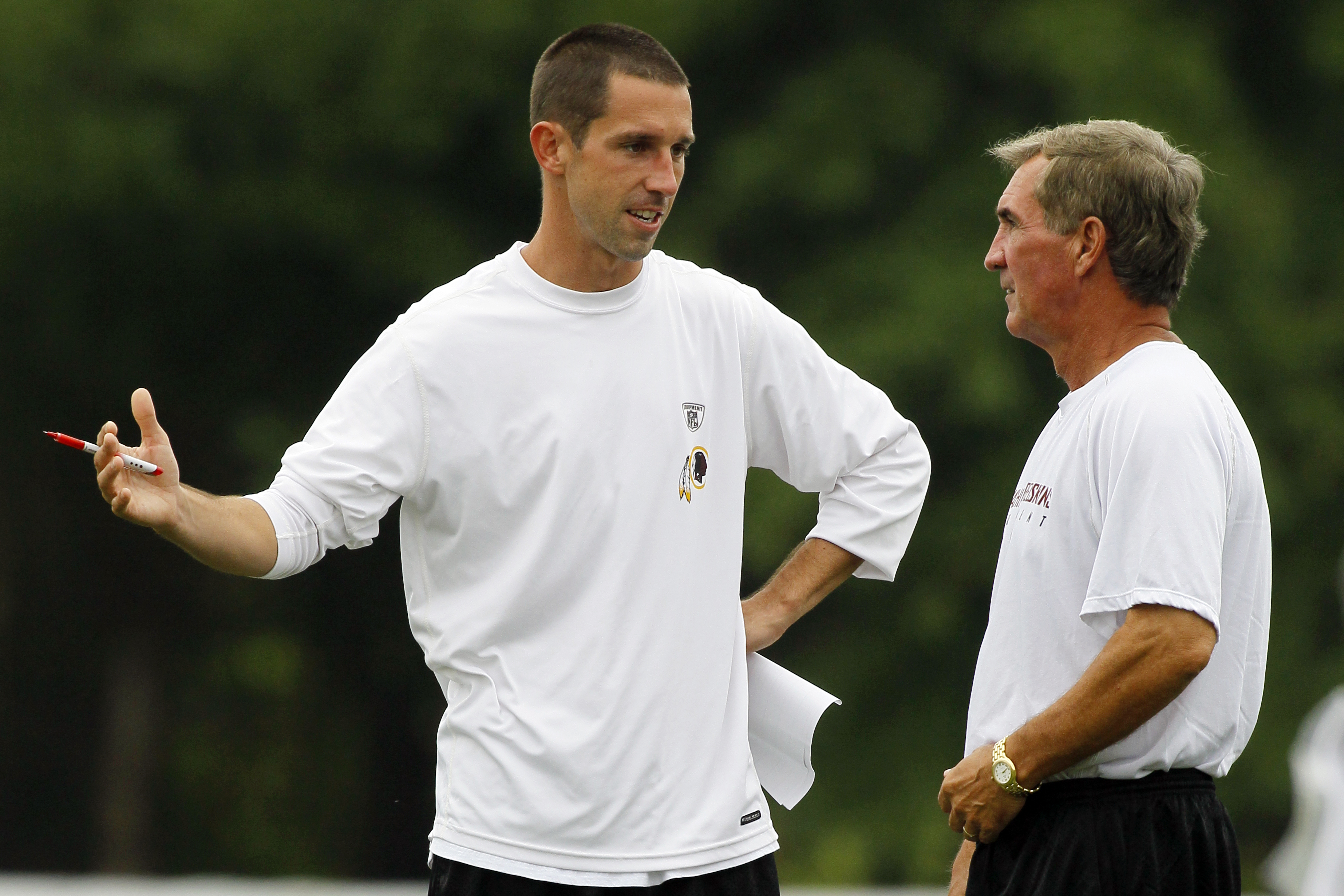
    Kyle Shanahan (left) and father Mike (pictured in 2010 while with Washington) pointed the way to the current run-game concepts in vogue around the NFL. Alex Brandon

    When Mike became Broncos head coach in 1995, he named Alex Gibbs offensive line coach. Gibbs, who died in 2021, was a proponent of the wide-zone blocking scheme in the run game that would go on to serve as the foundation for the modern West Coast offense.

    His influence lives on in offshoots of the scheme around the league. Mannion called his first exposure to the system in 2017 under Los Angeles Rams head coach Sean McVay “a very exciting point in my football life.” Now, Mannion has the opportunity to make it his own, all while helping breathe new life into an Eagles rushing attack that stagnated in 2025.

    “I’ve seen it from afar, but now, actually studying it and working it and trying to put myself in the system, I feel like it’s going to open up some things that I may not have been able to show as much in my career,” Barkley said.

    The man seeking to help Barkley elevate his game is a quarterback by trade. But Mannion’s expertise isn’t limited to the passing game. According to offensive line coach Chris Kuper, who played for Shanahan in Denver, the Eagles offensive coordinator “loves the run game,” too.

    “The run game is a big part of what we’re going to do,” Kuper said, “And [Mannion’s] got passion for it. And that makes me feel good as an O-line coach, because I think we’re going to be really good at running the ball.”

    Todd Gurley thrived with wide-zone concepts while with the Rams. Tony Avelar

    In the (wide) zone

    When Barkley learned that the Eagles offensive scheme in 2026 would have Shanahan/McVay roots, he fired up Todd Gurley’s film.

    Gurley spent five of his six seasons in the NFL with the Rams, including two standout seasons in 2017 and 2018. He led the NFL in rushing touchdowns in both seasons, earning a pair of All-Pro honors and an NFL Offensive Player of the Year nod in 2017.

    Dean Davidson, the author of the Wide Zone Warriors Substack, watched those years in real time. A native of St. Louis whose memories of the Rams commence with the collapse of the “Greatest Show on Turf” era, Davidson was enthralled with the quick work McVay did to turn the team around. At the time, Davidson had just joined the staff of a struggling high school football team and was looking for inspiration.

    “I was trying to figure out how [McVay] took that team from the dumps that they were in my entire life that I could remember to that point to Super Bowl favorites in what seemed like overnight,” said Davidson, who is now the offensive line coach at Obion County Central High School in Troy, Tenn.

    At the core of the scheme that fascinated Davidson was the wide-zone run. Its intent is in its name. The blocking unit aims to stretch the defense on the front side of the run, while simultaneously cutting off defenders on the back side.

    As Gibbs explained at his 2015 offensive line clinic in Cincinnati, the running back’s aiming point is the backside of the tight end — and if there is no tight end to the weak side of the formation, it would be to the imaginary backside of the tight end. After three steps, the running back would know whether he should hit the edge on the front side or make a single cut up the middle of the field. By the fifth step, he would make his cut.

    One of the challenges of defending the wide zone run is the distance that defenders have to cover in order to maintain their gap integrity, Davidson explained.

    “Everybody’s moving so far in one direction that the gap that you’re responsible for as a defensive lineman or a linebacker, maybe even a safety, it might still be between the same two offensive linemen, but those two offensive linemen on a given snap could be like 10 yards laterally somewhere else,” Davidson said. “So forcing them to maintain their gap integrity while moving so far laterally, it’s a very difficult challenge.”

    It’s a challenge the Eagles offensive line enjoyed creating throughout training camp. Cam Jurgens said the scheme “lets you be a little bit more of an athlete” given how quickly the front side blocking unit must fire off the ball laterally toward the sideline.

    The goal, according to Kuper, is for the defense to defend every blade of grass on the field. That task, ideally, would tire out the defense as the game wears on, Lane Johnson said. After Johnson, Jurgens, and Landon Dickerson had a full offseason to recover from the ailments that plagued them last year, they are up to the assignment.

    “We’re getting to really run, stretch the field, cover some yardage,” Johnson said. “So in that way, it tires out defenses. Makes them cover each gap.”

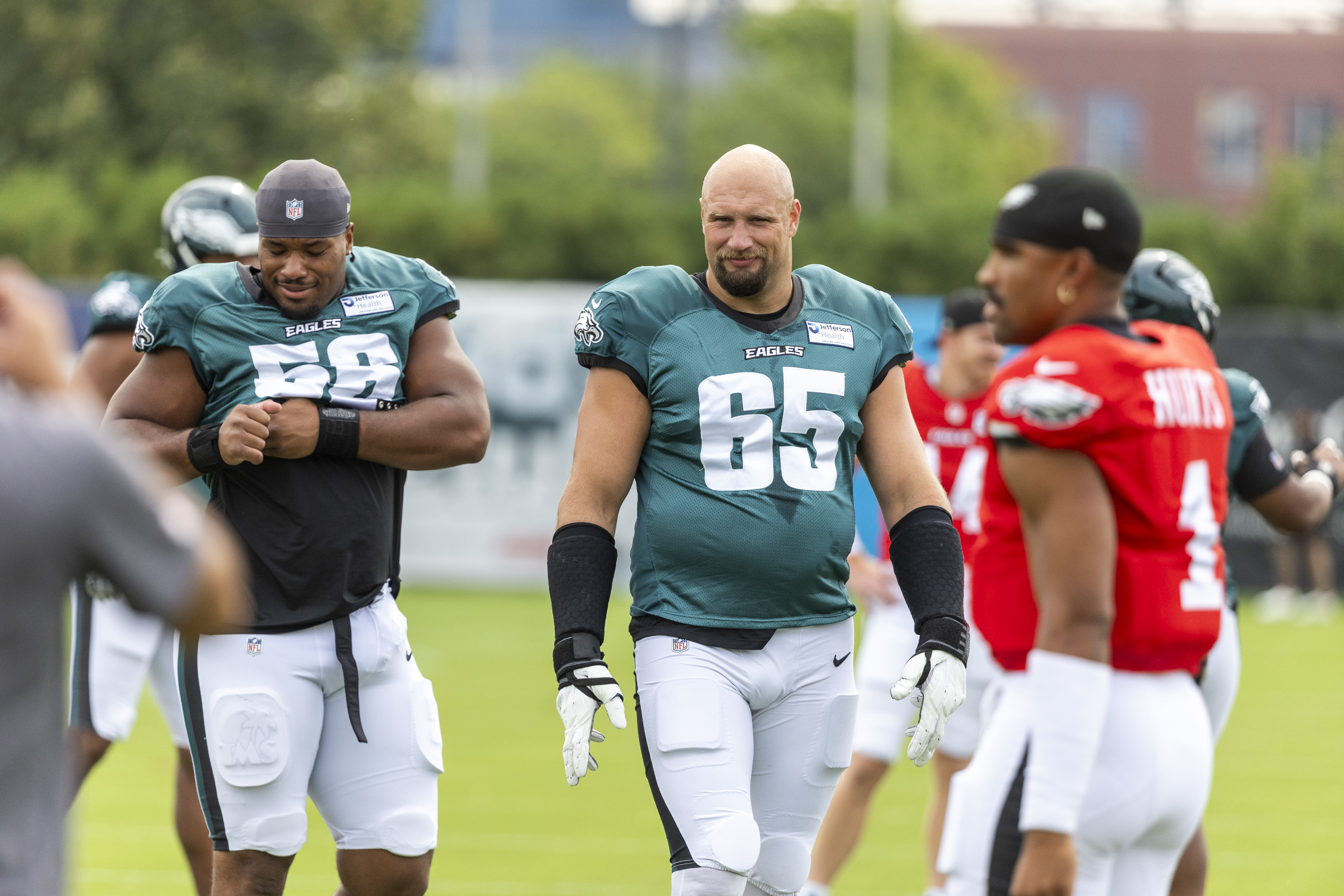
    Lane Johnson (65) and his fellow offensive line cohorts are getting behind the wide-zone scheme Sean Mannion has introduced in Philly.Tyger Williams / Staff Photographer

    The wide zone could be at the foundation of the Eagles’ rushing attack, but in all likelihood, it won’t be the only style of run in their playbook. When Gibbs was designing the Broncos’ run game 30 years ago, he only believed in coaching zone runs — primarily wide zone and some tight zone, in which the running back’s landmark is typically behind the center.

    David Gibbs, his son and the secondary coach at Arizona State, explained that his father didn’t believe teams could excel at executing both zone schemes (blocking a certain area of the field) and gap schemes (blocking a specific defender or gap). But the game has evolved, the younger Gibbs said.

    “You have to be able to do both, because the defensive linemen are so good,” he said. “They’re so big, athletic, strong, and the reality of it is defensive linemen are just more athletic than offensive linemen, in my opinion. And so you can’t give them the same schemes all the time.”

    Brett Kollmann, an NFL Media analyst, called the Rams’ 15-6 loss to Vic Fangio’s Chicago Bears in 2018 “one of the defining games of the last decade” that prompted an evolution of McVay’s scheme. At the time, the Rams’ rushing attack was wide-zone heavy. Fangio’s solution was to stack bodies on the line of scrimmage in a 6-1 “tilt front,” putting a body in every gap and forcing the running back to cut back into a defender.

    Bill Belichick and the New England Patriots would follow the same blueprint to stop the Rams in the Super Bowl that season. To counteract the defense’s penetration at the line of scrimmage, McVay would eventually introduce more “counter” runs, a gap scheme that calls for two pulling blockers to create a pair of gaps on the play side.

    The incorporation of different types of runs gives defenses more to process, according to right guard Tyler Steen, which in turn forces them to slow down.

    “One minute you’re going wide zone and D-tackles and D-ends are running,” Steen said. “The next minute, you’re going ‘duo’ and you’re going downhill. So I think that gives defenders a lot to think about. And so it kind of makes it easier on the O-linemen, because [the defense doesn’t] know what to play.”

    Saquon Barkley often found running room hard to come by for an Eagles offense that grew predictable in 2025. Monica Herndon / Staff Photographer

    Keeping defenses ‘on their toes’

    After the Eagles’ 34-17 loss to the New York Giants in Week 6, Johnson tried to surmise the state of the Eagles offense.

    As he spoke at his stall, he used some form of the word “predictable” three times.

    “I don’t know if we’re predictable, but it seems a lot harder than what it needs to be,” Johnson said. “Maybe moving forward have a little bit more variety, hitting the perimeter some and doing a little bit more of that.”

    Johnson emphasized that he wasn’t trying to point fingers, and at the end of the day, the Eagles needed to execute better. Still, his analysis was a harbinger of things to come for the shotgun-heavy offense that seldom disguised its intentions.
    The Eagles are set to take a different direction under Mannion. Like other offshoots of the Shanahan/McVay tree, Mannion emphasizes the importance of the marriage between the run and the pass — more specifically, the play-action pass.

    When runs look like passes, and vice versa, offenses are less predictable, Johnson said.

    “I think setting up with the play action is just going to be a whole lot tougher to distinguish what we’re doing,” Johnson said during mandatory minicamp. “Whole lot harder to catch on [to] tells with stuff that we’re doing. So I think this stuff, we can disguise it more.”

    The key to pulling that off is keeping the presentation the same. If the Eagles are running wide zone, for example, and building the play-action pass off of it, the blocking unit is executing the same assignment. Johnson stressed the importance of keeping a “low hat” to sell the run, and if the linebackers bite down, the quarterback can target the vacant middle of the field.

    Eagles offensive coordinator Sean Mannion (right) is introducing variety to an offense seeking to keep defenses off-guard. Yong Kim / Staff Photographer

    Marry that with motions, and the defense is confronted with another layer of complexity to decipher. Even the quarterback’s alignment under center can further disguise the intent of the offense on any given play, Jurgens explained.

    “I feel like that’s just another way to keep defenses on their toes,” Jurgens said during mandatory minicamp. “You get a little less predictable. And so I feel like it kind of gives us a little better angles as well. Defenses can’t cheat things, ‘cause they don’t know where we’re going to go. You can set up a lot of your plays a lot better.”

    Kollmann is aware of Jalen Hurts’ historical lack of targeting the middle of the field. Dating back to his rookie season before he became the full-time starter, Hurts has targeted the short middle of the field (a maximum of nine yards from the line of scrimmage) on 8.3% of his pass attempts, according to an Inquirer analysis. The league average is 14.5%. From 10 to 19 yards beyond the line of scrimmage over the middle, Hurts’ attempt rate drops to 4.6% (closer to the 7.4% league average).

    But Kollmann said that conflating “hasn’t” with “can’t” isn’t necessarily fair. He said he believes that the Eagles lack of a wide-zone, play-action game in the past is to blame for not helping free up that area.

    “When they are so shotgun heavy, and therefore when their play action game is really just kind of faking inside zone, that’s the kind of run fake that doesn’t really draw linebackers in, because they can see the ball the entire time,” Kollmann said.

    The fake from under center requires a quarterback to turn his back to the defense, shielding the ball from the view of the linebackers. They can’t see it, so they step up, theoretically giving the offense more room to operate over the middle.

    It’s easier said than done for any quarterback, as they must temporarily take their eyes off of the pass rushers seeking to take them down. But according to Josh Grizzard, the Eagles passing game coordinator, Hurts has been a “natural” with turning his back to the defense and selling the fake.

    “When you have the runs and they look like the keepers and they look like the play passes, then the goal would be for those guys to see the same thing,” Grizzard said. “And then if you can get that second level of the defense to step up, then you have an ability to now push the ball down the field and be able to marry the run and the pass as well as create explosive passes.”

    How many runs are designed for Jalen Hurts in the new offense remains an open question. Yong Kim / Staff Photographer

    The backside threat

    Speaking of keepers, will the quarterback designed run game return to the Eagles offense in 2026?

    By December of last year, Hurts was averaging 1.1 designed runs per game in 2025, according to Pro Football Focus. He averaged 3.6 designed runs per game in his first four seasons as the starter.

    The modern West Coast offense hasn’t necessarily needed a mobile quarterback to thrive, as evidenced by the success of Jared Goff and Matthew Stafford with the Rams. But the 2026 Eagles offense isn’t going to be a carbon copy of other schemes around the league from the same tree, and Mannion is well-aware of Hurts’ rushing ability.

    “Jalen has a unique skill set in that way,” Mannion said. “So that’ll certainly be a part of what we do, but we’re looking again at all areas as an offense to really attack defenses on a weekly basis. He is uniquely skilled in that way. That will be a part of it, but it won’t be the only part of it.”

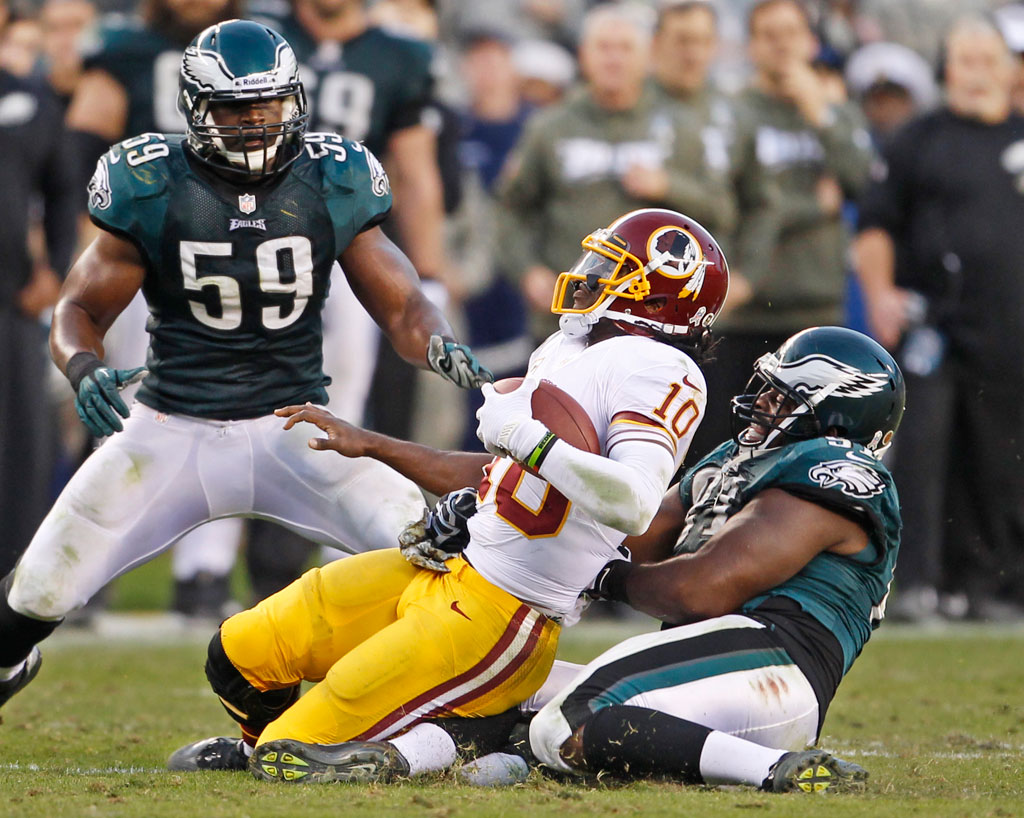
    Zone reads aren’t totally foreign to this coaching tree. In 2012, while Mike Shanahan was Washington’s head coach and Kyle was his offensive coordinator, the team drafted Robert Griffin III with the second overall pick.

    The rookie quarterback would go on to rush for 815 yards and seven touchdowns, all while throwing for 3,200 yards. His production on the ground wouldn’t persist far beyond 2012, though. Washington took a more conservative approach with Griffin III as a rusher, especially as he dealt with injuries that began during a rookie season that was ended by a serious knee injury.

    Robert Griffin III (10) was a rushing threat in the Washington offense before injuries curtailed his effectiveness.

    Still, Davidson said a backside threat is important in the run game, whether it’s a quarterback run or a bootleg. In the case of the bootleg, which the Eagles incorporated throughout training camp and the preseason, the quarterback exploits the unblocked defensive end who flows with the running back, rolling out unabated in the opposite direction and completing a pass on the move.

    “If you’re just under center or even the pistol, and you don’t have anything that keeps the defense on the backside, then it’s a lot easier for them to chase [the ball] down [in wide zone],” Davidson said. “But if they know that they have to defend boot on the other side of the field or defend a quarterback run on the other side of the field, it can really slow the defense down.”

    Time will reveal the contents of Mannion’s playbook. While it may contain odes to his influences, it could also include all of the plays he would’ve liked to run throughout his nine-year career as an NFL backup quarterback and two seasons as an assistant with the Green Bay Packers.

    Whatever the offense becomes will be unique to the Eagles, Kuper said.

    “Those webs of guys kind of break out, and they kind of make it their own, and that’s what our goal is,” Kuper said. “This is going to evolve into Sean Mannion’s offense. This is going to be a derivative, maybe.

    “There’s going to be flavors of what you’ve seen throughout the league, and some of his mentors, but this will be our offense.”

  • Andy Dalton? Tanner McKee? Please. The Eagles lack a real backup quarterback. Unusual. Unsettling.

    Andy Dalton? Tanner McKee? Please. The Eagles lack a real backup quarterback. Unusual. Unsettling.

    The Eagles used to value the backup quarterback position, perhaps more than any other team in the NFL. Looking at their rosters in 2025 and 2026, it’s hard to believe they still do.

    This might not matter at all, except Eagles starter Jalen Hurts gets hurt a lot, and quarterbacks are the most important players in all of team sports.

    Still, it seems like a lot of energy to spend on a guy who won’t play much. Backup quarterback angst: The sort of nattering matter that makes the NFL preseason interminable; the sort of infuriating football geek-talk that fantasy nerds Snapchat about.

    You know. Guys like Lurie and Roseman.

    In 2017, the Eagles committed $11 million to their backup quarterback spot. So important was the position to owner Jeffrey Lurie that he told GM Howie Roseman to sign Nick Foles, whom Andy Reid had just cut from the Chiefs. It meant eating $7 million of the contract of Chase Daniel, whom the Eagles promptly released.

    Despite missing the playoffs in 2016 with rookie Carson Wentz at quarterback, Lurie saw 2017 as a real chance to win the franchise’s first Super Bowl, and he considered Foles, who’d had a strong run as an Eagle, to be a better option than Daniel, who’d never had a strong run anywhere.

    The rest, as they say, is history: Wentz got injured, Foles replaced him, played well down the stretch, and won the MVP award inSuper Bowl LII where he outplayed Patriots legend Tom Brady and outfoxed coach Bill Belichick.

    Nick Foles became an unassailable Eagles legend, but that doesn’t mean all backup quarterbacks are created equal. Michael Bryant / Staff Photographer

    “Our priority, as you’ve seen, is to make sure we have the very best possible other starting quarterback,” Lurie said during Super Bowl week.

    That’s generally been true, and it’s generally made sense for the Birds, since Lurie prefers mobile quarterbacks, who, of course, are more likely to get hurt.

    Lurie signed Michael Vick out of prison in 2009, and Vick supplanted Donovan McNabb the next season and went to the Pro Bowl in his second of four years as an Eagle. Lurie drafted Hurts in the second round in 2020 with plans that Hurts would be the long-term backup to Wentz, but that’s before Ginger Jesus lost his job, and maybe his mind. Lurie sanctioned the recent, sensible acquisitions of Gardner Minshew, Marcus Mariota, and Kenny Pickett.

    But in 2019, Lurie also approved the signing of Josh McCown, a 40-year-old with a 79.7 passer rating with eight other teams. McCown replaced Wentz early in the Eagles’ home wild-card playoff game, played atrociously (predictably), and cost the Birds their postseason.

    Last season, Lurie allowed the Birds to enter the season with third-year sixth-round pick Tanner McKee as the backup of a team defending its second Super Bowl title. It didn’t matter, since Hurts stayed healthy. But McKee got to start game 17 against the Commanders, and he was poor: 21-for-40, 241 yards, one touchdown, one interception, with a forgettable fourth quarter that cost the Eagles their chance to win the game and capture a better seed. It looked OK in the moment, but upon further review, the Eagles (and I) decided that McKee is not the answer.

    The Eagles (not I) determined that Andy Dalton is the answer.

    They were wrong.

    The Eagles’ bet on Andy Dalton does not appear to be going according to plan. Yong Kim / Staff Photographer

    The Birds in March traded a seventh-round pick to the Panthers for Dalton.

    No player at Eagles preseason work or in training camp has been a bigger disappointment than Dalton.

    That isn’t really fair. There should have been minimal expectations of Dalton.

    He’ll be 39 in October. He’s 1-6 in his last seven starts over the past three years, during which time his passer rating is 84.5. Aberration? No. In the five seasons before that, his rating was 85.5 in 57 games. He’s been the backup in Carolina the past three seasons, essentially a big brother for Bryce Young, the underperforming No. 1 overall pick from 2023, and an assistant coach of sorts.

    That’s the role he was expected to serve in Philadelphia, where new offensive coordinator Sean Mannion has installed a new scheme. Dalton can help with the adjustment for Hurts, and you’d think Dalton would have a significant advantage over McKee in executing the offense.

    Tanner McKee again appears to be the best backup option for the Eagles. Yong Kim / Staff Photographer

    But no. Dalton has looked appreciably worse than McKee — so much worse that McKee’s unremarkable performance looks good by comparison.

    Entering the third and final preseason game Friday, the competition, such as it is, for the backup job clearly tilts in McKee’s favor. Which delivers this uncomfortable truth:

    The Eagles, who have made the playoffs five years in a row, don’t really have a viable backup quarterback. That’s the fault of the front office.

    Roseman.

    Lurie.

    What should they have done?

    Maybe they should have signed Mitch Trubisky, who got two years and $10.5 million to back up Cam Ward in Tennessee. Maybe another dance with Minshew, who got $8.25 million to back up Jacoby Brissett in Arizona. Both would have cost a lot more than Dalton’s $1.5 million, but that’s also just about what Tua Tagovailoa got from the Falcons to be the emergency plan if Michael Penix Jr. wasn’t back in time from his knee injury.

    All three of those QBs are in spots where they will have a likelier chance to resurrect their careers. Maybe that’s why the Eagles weren’t able to land one of them, and why they had to trade a pick for Dalton.

    To be fair to Roseman and Lurie, the Birds also drafted a quarterback in April: Cole Payton, in the fifth round, out of North Dakota State, who currently is not close to being an option.

    To be fair to Payton, he might be as good an option as the other two.

  • Eagles practice observations: Riq Woolen intercepts Jalen Hurts twice; Another big day for D; DeVonta Smith still awesome

    Eagles practice observations: Riq Woolen intercepts Jalen Hurts twice; Another big day for D; DeVonta Smith still awesome

    The Eagles held the 16th open practice of their 2026 training camp on Tuesday at Lincoln Financial Field. Here were my observations from Day 16 (and links to Days 1, 2, 3, 4, 5, 6, 7, 8, 9, 10, 11, 12, 13, 14, and 15):

    Stowers update

    Eli Stowers missed a second straight practice with a hamstring injury that he suffered in the second preseason game against the New England Patriots. The rookie tight end is expected to be out for about two weeks, from what I understand. If he’s healthy by the Wednesday before Week 1 of the regular season, he could be available for the season opener.

    The following Eagles were also held out because of injury: Tackle Markel Bell (thumb/leg), cornerback Jonathan Jones (shoulder), tight end Grant Calcaterra (back), cornerback Jakorian Bennett (knee) and safety Cole Wisniewski (concussion). Cornerback Mac McWilliams (shoulder) was limited.

    The Eagles had a number of players make full returns from injury, including center/guard Willie Lampkin (stinger), defensive tackle Byron Young (shoulder), running back Dameon Pierce (hamstring), tackle John Ojukwu (pectoral), wide receiver Quez Watkins (foot), cornerback Ambry Thomas (groin), and receiver Danny Gray (groin).

    Eagles fans were back at the Linc and witnessed a defense-dominated display. Elizabeth Robertson / Staff Photographer

    Oh, O-line

    Guard Landon Dickerson was given a not-injury-related rest day. Whether it’s a coincidence or not, he tore the meniscus in his knee during last year’s open practice at the Linc. The Eagles may have sat him to stay away from potential bad juju. Dickerson rushed back from surgery in time for the opener a year ago, but recently said that he should have waited until he was fully recovered.

    Drew Kendall took all the repetitions at left guard in Dickerson’s place. He had his ups and downs in a scrimmage that favored the Eagles defense, particularly the first unit. Kendall got toasted by defensive tackle Moro Ojomo on an inside rush that resulted in a sack at one point. Right tackle Lane Johnson left early not long after edge Nolan Smith Jr. beat him inside for a hurry. Fred Johnson took his spot with Bell out. Ojukwu got bumped up the depth chart and filled in the few times left tackle Jordan Mailata took a rest.

    DeVonta Smith (right) was an offensive standout and gave Eagles fans something about which to cheer. Elizabeth Robertson / Staff Photographer

    D-lightful

    The makeshift O-line likely had something to do with the struggles of Jalen Hurts and Co. The quarterback was pressured a bunch. But Sean Mannion’s unit was often out of sync except for a couple successful red-zone plays and one good drive after being backed up. Hurts’ two interceptions to cornerback Riq Woolen will make headlines — as they should for both parties — but there were a lot of reasons why the first-unit offense looked sloppy.

    Credit has to be given to Vic Fangio’s group. He’s had all of his starters for most of the summer and that same 11 was in the lineup again. Mannion’s installation has been completed for over a week, so there isn’t much new to throw at the defense. The group knows the plays, the snap count, and often what’s coming before it even happens.
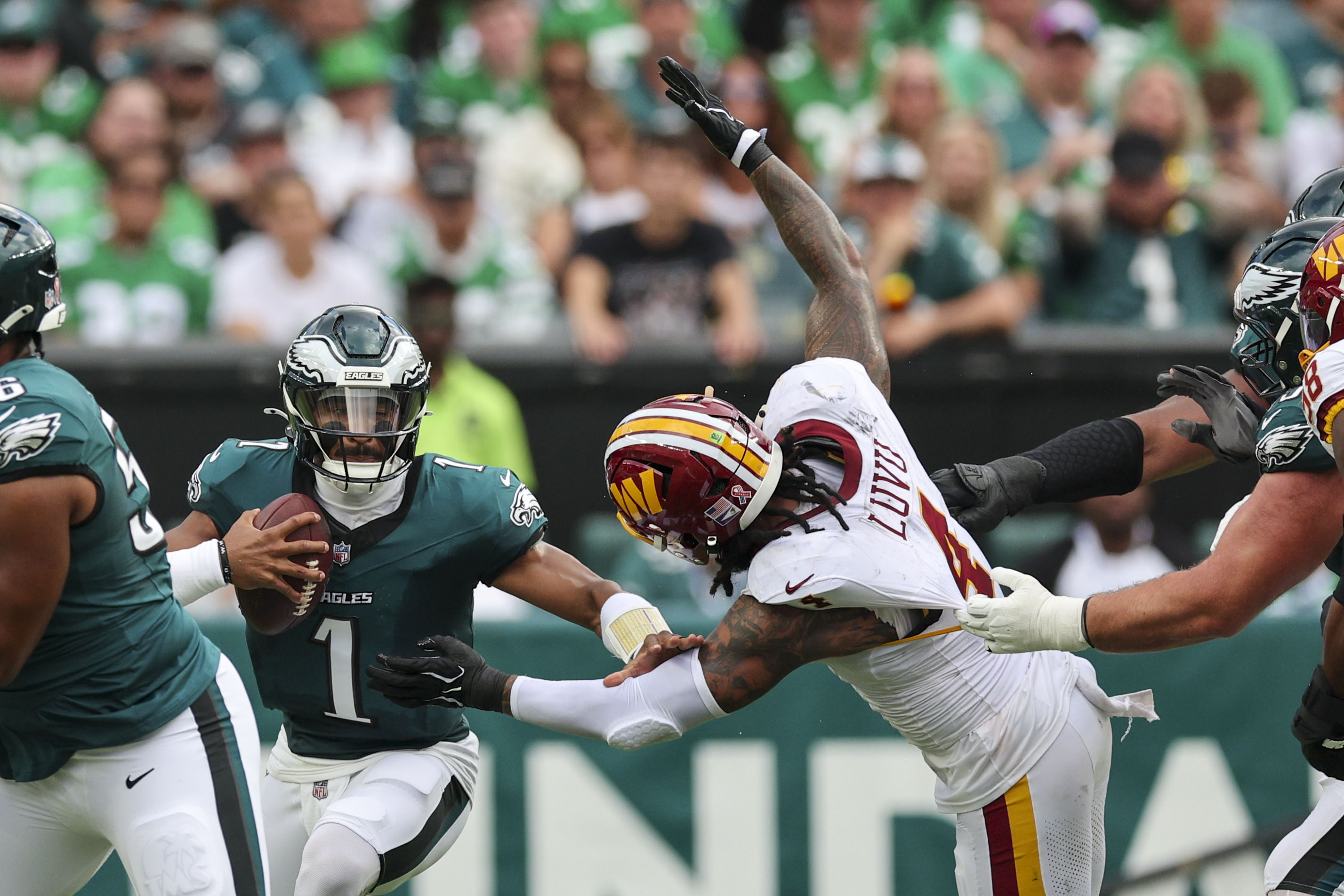
    On the first series, Hurts hit receiver Dontayvion Wicks for a short gain and Saquon Barkley had a solid run to the left, but it was mostly defensive dominance thereafter. Safety Marcus Epps snuffed out a Hurts draw play. Defensive tackle Jalen Carter met Barkley at the line of scrimmage for a stop. Hurts hooked up with receiver DeVonta Smith after getting forced to his right. But his pass to receiver Makai Lemon on an inside route was broken up by cornerback Quinyon Mitchell.

    Jalen Hurts and the offense remains a work in progress. Elizabeth Robertson / Staff Photographer
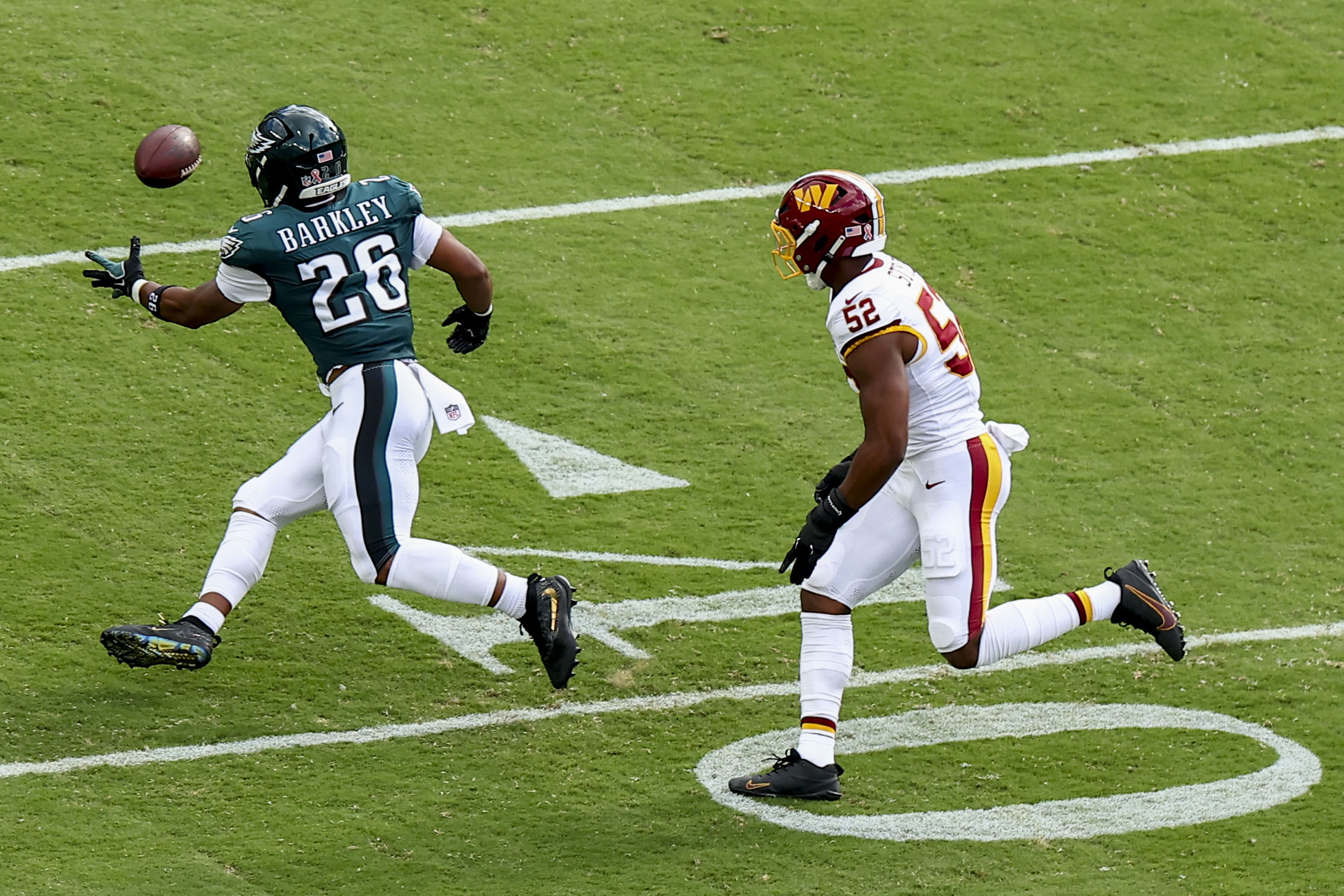
    Hurts so much

    The next set was less productive for the offense or more fruitful for the defense — take your pick. Hurts went to Lemon on a schemed-up pass off play-action, but cornerback Cooper DeJean was in the receiver’s pocket. Smith burned Mitchell on a deep post route, but Hurts’ pass was underthrown and Mitchell recovered to break up the pass. Smith is clearly head and shoulders above the rest of the Eagles’ receivers.
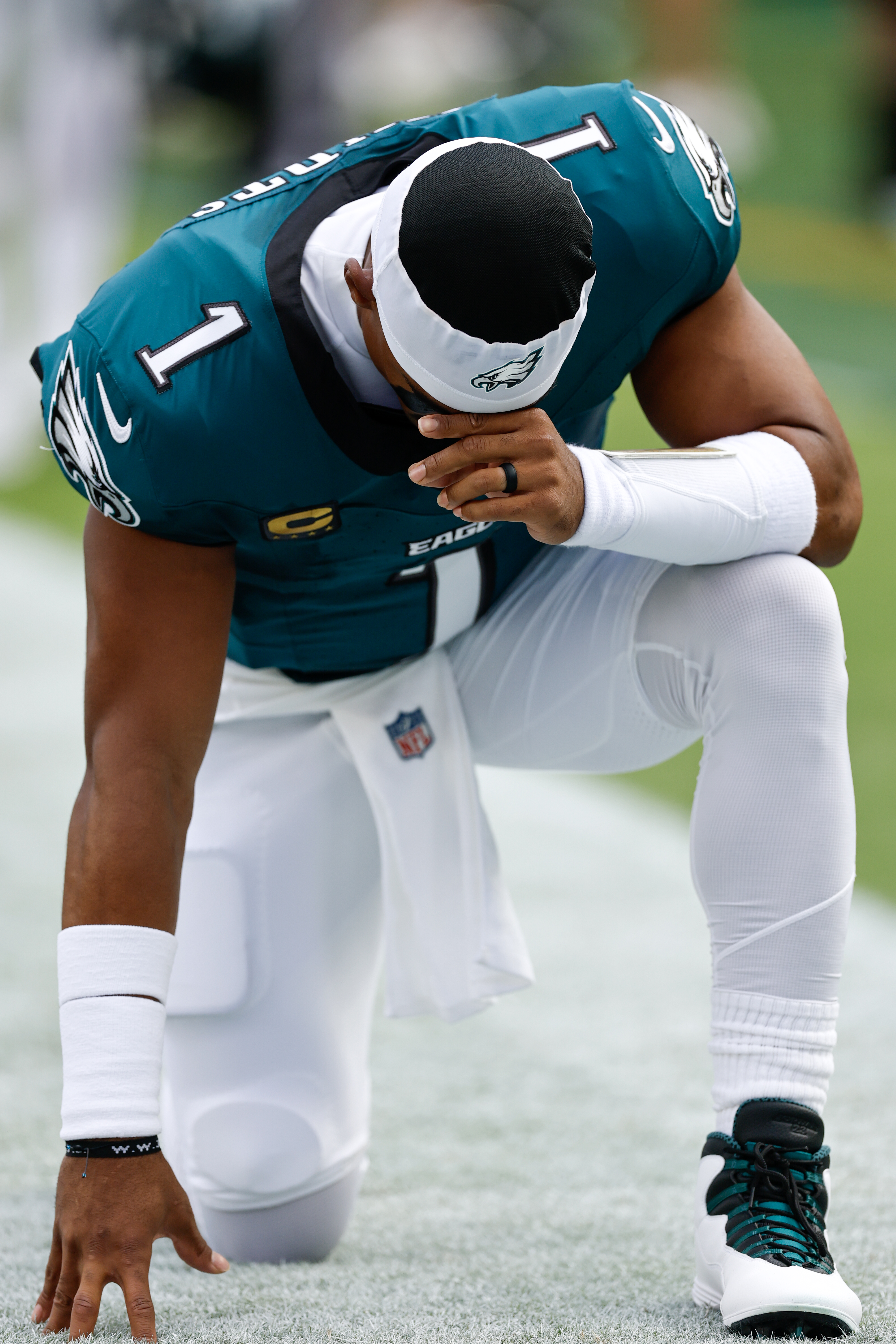
    Jalyx Hunt made Fred Johnson look like a turnstile on the way to a would-be sack. Hurts continued the play and hit Wicks over the middle, but the play was given to the defense. Another short toss to Lemon netted few yards with cornerback Michael Carter II in tight coverage. Jalen Carter touched up Barkley for a stop. And when Hurts did well to roll away from an unblocked blitzer and found Smith as his outlet, the receiver dropped the ball. On the last play of the set, Hurts chucked the ball wide and out of bounds with a covered Smith.

    Jalen Hurts missed some throws behind a patchwork line but was more effective in the red zone. Elizabeth Robertson / Staff Photographer
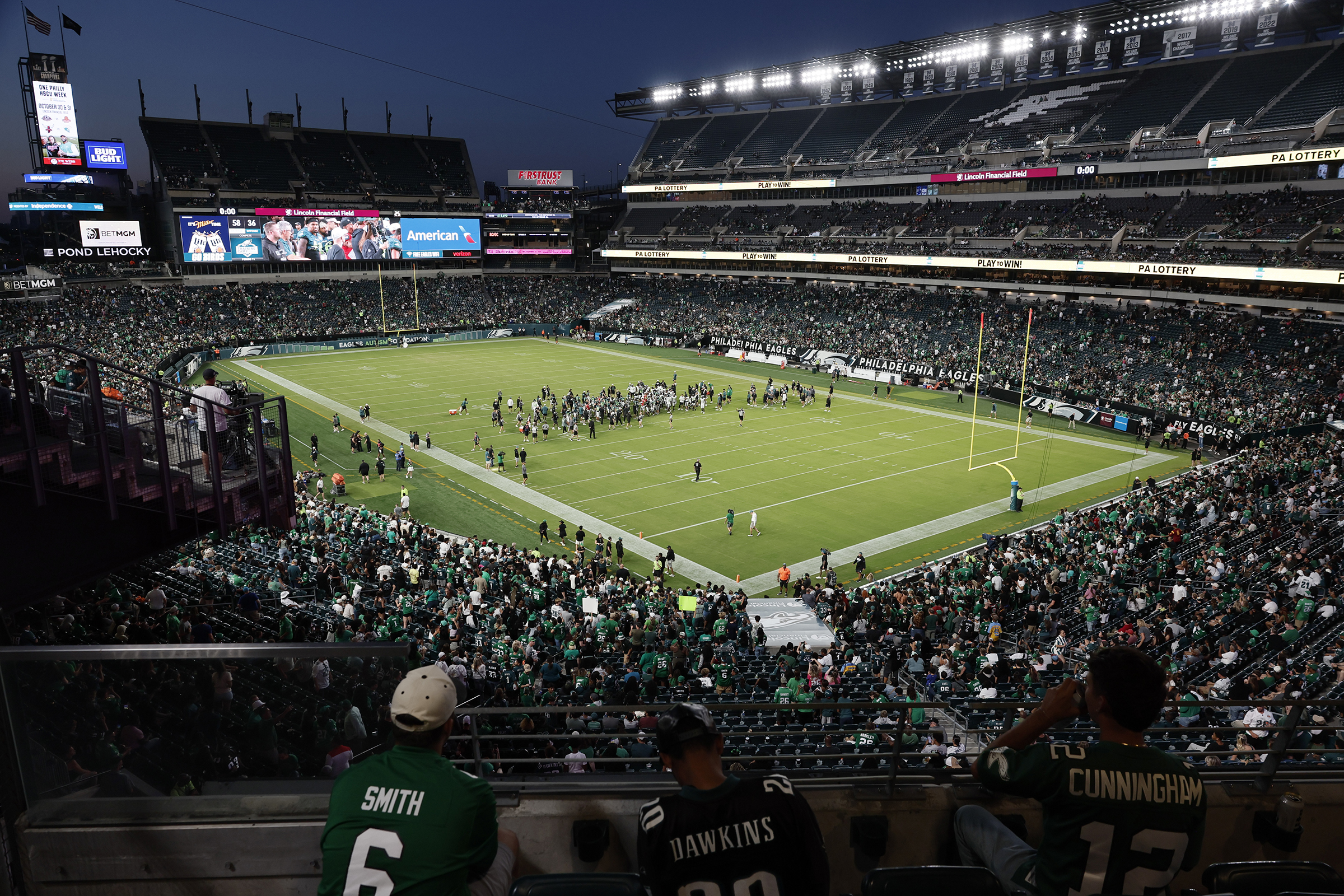
    Lemon aid

    Lemon has been getting a tutorial from DeJean, one of the best slots in the NFL. Mannion called for another quick hitter to the receiver off a naked bootleg, but with Hunt in Hurts’ mug, DeJean was all over Lemon by the time the ball arrived. Jalen Carter gifted the offense five yards when he jumped offside, but a Barkley outside zone run on the next play was blown up in the backfield. Hurts likely needed to check out of that call with so many defenders in the box.

    It just got worse. A Fangio blitz collapsed the pocket, but Hurts still threw to Lemon on a crossing route. It wasn’t the greatest route and Woolen snatched the ball for his first interception of the night. An offensive false start followed. Hurts did hook up with receiver Darius Cooper on a button hook. And running back Tank Bigsby had decent gains up the middle on the ground.

    But Ojomo’s sack and another drop — this time from Cooper — ended the set.

    Fans watched as the Eagles defense defeated the offense by a count of 58-36, based on practice scoring. Elizabeth Robertson / Staff Photographer

    Red zone district

    The offense rebounded in the red zone. On the first play from the 20-yard line, Barkley ran a sort-of corner route and got behind linebacker Zack Baun. Hurts’ throw was perfect and the running back made the catch for a touchdown.
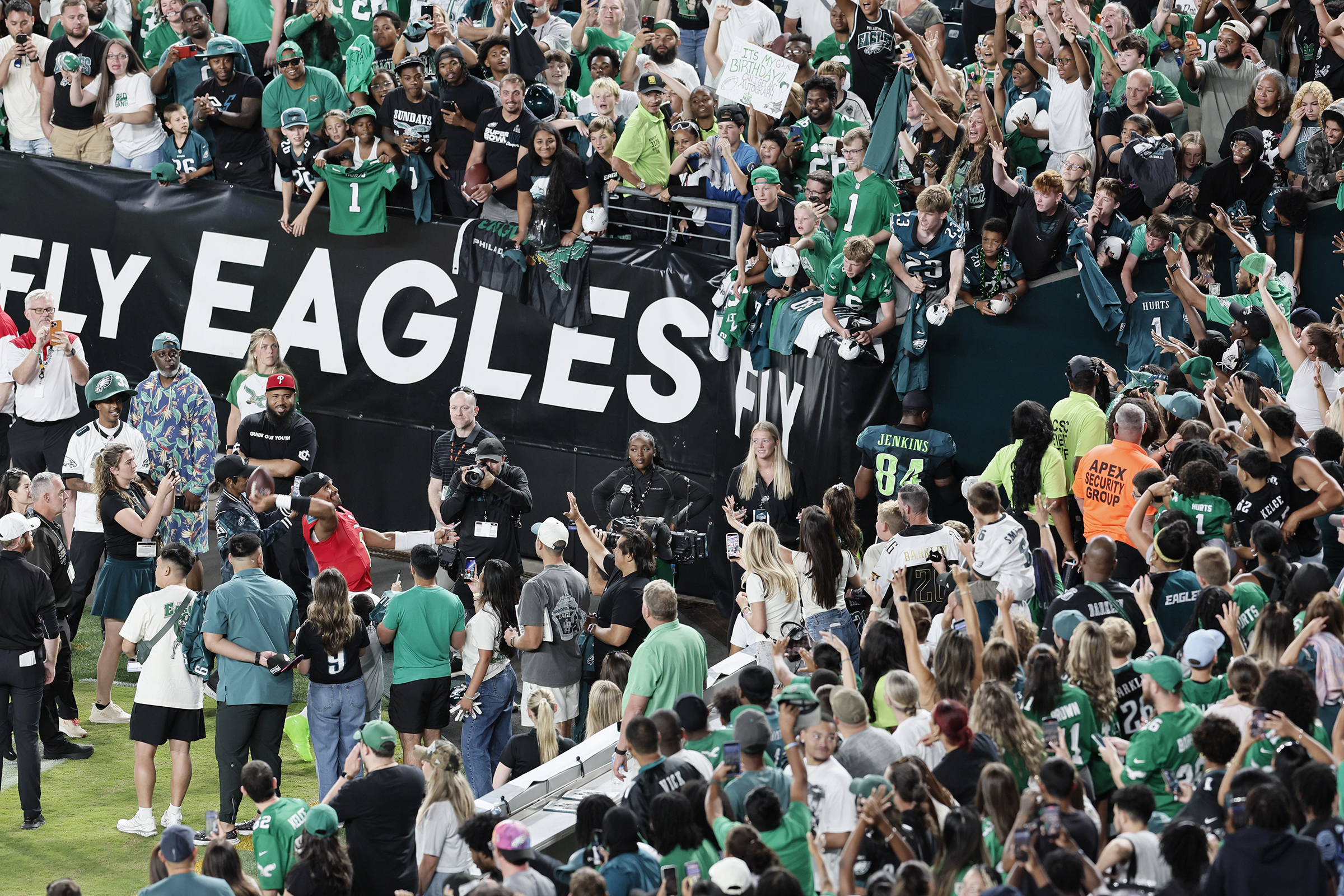
    On the next red-zone possession, Barkley gobbled yards up the middle on first down. But on the next play, Hurts’ downfield throw to Lemon off play-action was broken up by Mitchell. The rookie receiver didn’t appear to get enough depth on his route. The ball went back to Lemon on his next pattern — when he motioned inside and ran a wheel route — and the defense didn’t account for him. He waltzed into the end zone untouched.
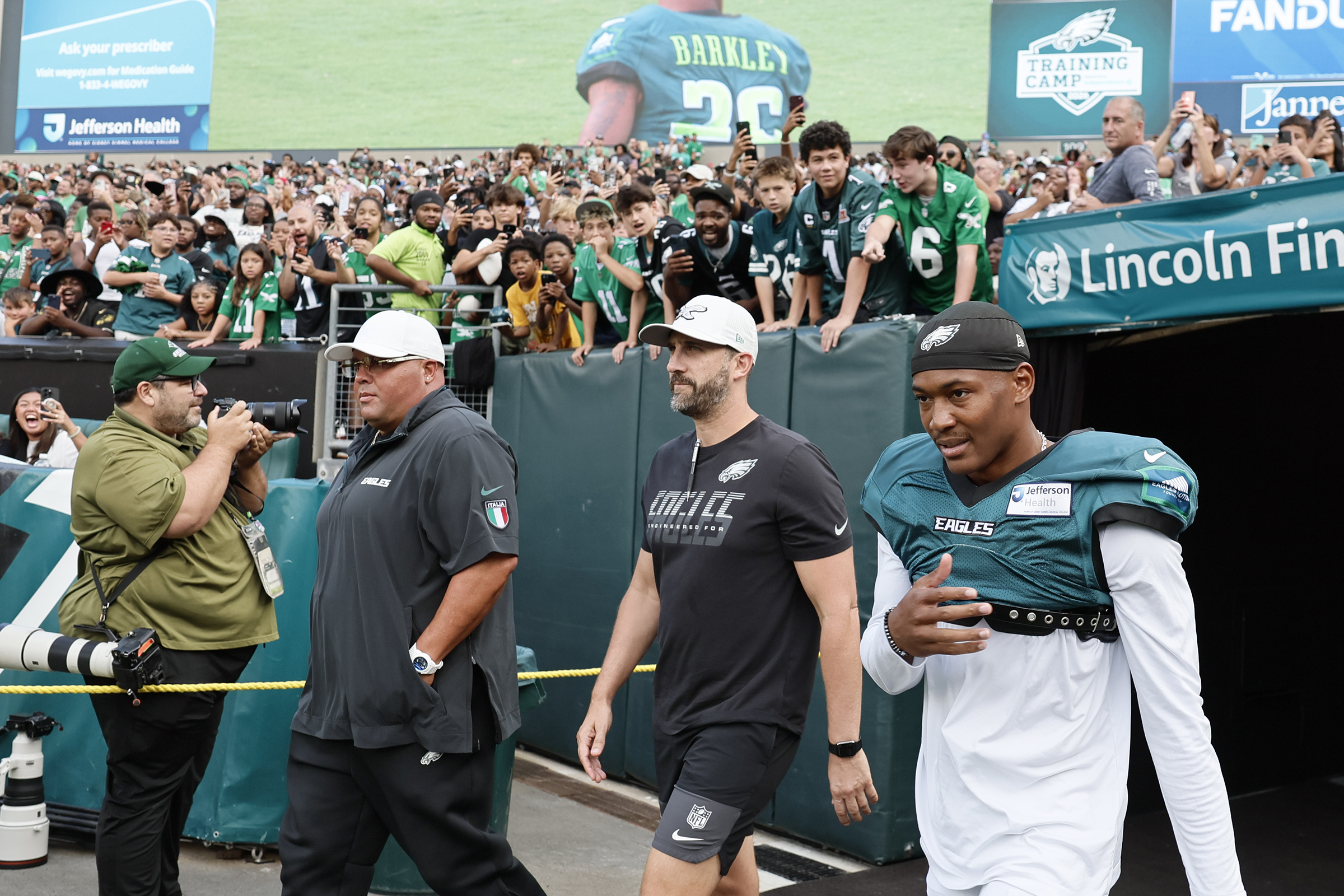
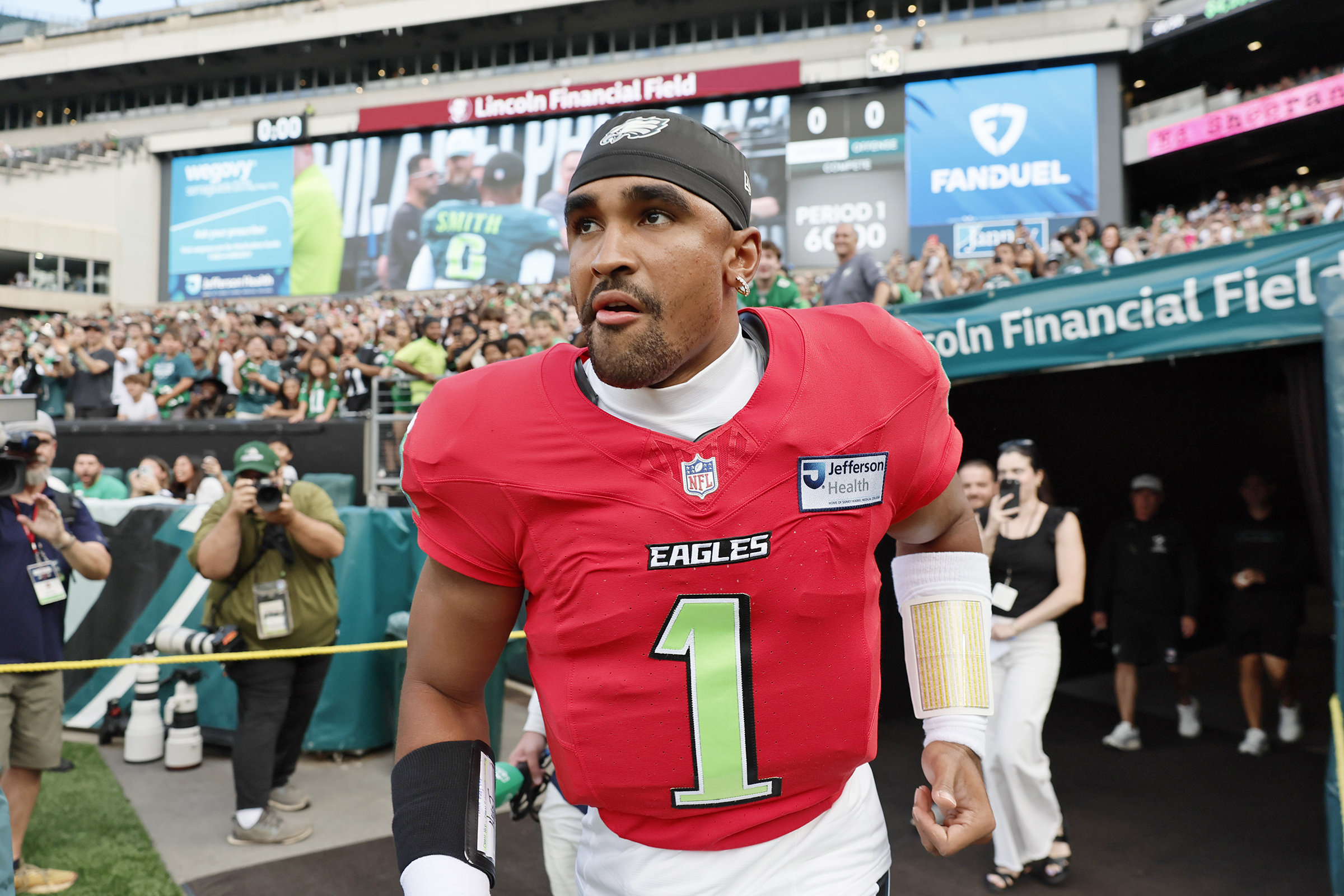
    Back to back

    Hurts built off that modicum of success during the backup portion. A first-down run didn’t net many yards. In fact, it resulted in defensive tackle Jordan Davis hobbling off after he dinged his left arm. (He later returned, outfitted with a brace.) But Bigsby churned ahead on the ground on a couple carries. And Hurts again rolled away from the rush and found tight end Cam Latu for a first down.

    We got a rare glimpse of tight end Johnny Mundt in the backfield. The Bigsby rush was thwarted, but not exclusively because of Mundt’s lead block. A screen pass to Smith on the ensuing play was blown up by DeJean. But Hurts wisely kept feeding his best receiver. He rifled a dart to Smith on a comebacker ahead of Mitchell. And two plays later, tossed a strike to No. 6 just out of Woolen’s reach and Smith jetted upfield for chunk yards.

    A busted play that forced Hurts into a throwaway and DeJean snuffing out a Will Shipley draw forced another third down. But receiver Hollywood Brown got wide-open downfield and raced the last 10 yards untouched into the end zone.

    Saquon Barkley had a frustrating night on the ground in the open practice. Elizabeth Robertson / Staff Photographer

    Two for two

    The first two-minute drill was an odd one as the offense worked on getting the defense to jump offside. Barkley and tight end Dallas Goedert looked back at their coaches upset or confused or something else when a couple of the tailback’s rushes were curtailed. Center Cam Jurgens walked out of the huddle and was replaced by Jake Majors. Jurgens didn’t appear hurt. But Hurts’ hard count finally did get an impatient Ojomo to jump. It wasn’t exactly riveting stuff for the fans.

    Nevertheless, the first units came out for one last hurry-up period. The offense got off to a solid start with a Barkley catch-and-run out of the backfield, a checkdown to Smith and a Hurts seed to Wicks over the middle. But when Hurts was pressured again by Hunt, he tried for Smith near the sideline. Woolen was in lockstep with the receiver, jumped the route and went the other way with the ball for a pick-six.

    Nick Sirianni gave Andy Dalton the first crack at No. 2 reps on Tuesday night. Elizabeth Robertson / Staff Photographer

    Second best

    This was a night almost exclusively for the starters with fans in the house, and the final preseason game reserved for guys fighting to make the roster or the practice squad. There were some periods for the second and third units. Andy Dalton got the nod at quarterback as he and Tanner McKee continued to split snaps in their battle for the No. 2 job.

    Dalton overthrew Cooper on his first drop. But he got into a rhythm with receiver Elijah Moore and scored on their third connection when Moore found space on a crossing route and zigzagged into the end zone.

    McKee had some good moments, too. He went to Brown for a couple quickies vs. zone coverage. He found Moore as his outlet vs. the blitz. And on fourth down, he hit tight end E.J. Jenkins on a short release. Shipley did the rest on the ground and scored when he ran off right tackle. McKee’s two-point conversion try in the back of the end zone went off Brown’s hands.

    McKee shined in the two-minute period. He hooked up with Cooper on a deep crosser and hit Moore on a 15-yard out. His downfield pass to Cooper was on target, but the receiver eased up his route and the ball sailed by. Cooper reacted as if he knew he messed up.

    Extra points

    The final score was Defense 58, Offense 36. … Rookie quarterback Cole Payton got a few reps in the backup period. … Britain Covey was again the first up to field punts, but Lemon took turns as well. If the Eagles believe the rookie can handle punts, it could make Covey expendable on game days … Shipley and Bigsby were paired as the first two kick returners. … The Eagles announced attendance of more than 45,000. Pennsylvania governor and noted Eagles fan Josh Shapiro was among them. … The Eagles will return to the Jefferson Health Training Complex for practice on Wednesday afternoon. They will have a closed walkthrough on Thursday ahead of Friday’s preseason finale at the Linc vs. the Cincinnati Bengals.