Tag: Scams

  • An Oreland man who helped Nigerian scammers launder money released from jail after less than nine months

    An Oreland man who helped Nigerian scammers launder money released from jail after less than nine months

    An Oreland man who once worked for the Department of Defense was ordered released from federal custody Friday after he spent less than nine months behind bars for helping Nigerian scammers launder nearly $3 million they collected during online phishing or extortion attacks.

    Samuel Marcus, 34, pleaded guilty earlier this year to a money laundering charge. And although that offense can sometimes trigger a lengthy prison sentence, prosecutors and Marcus’ attorneys agreed during his sentencing hearing Friday that he had already spent enough time incarcerated, and that his criminal conduct was mitigated in part by his having been born with several intellectual disabilities, including autism.

    U.S. District Judge Joel H. Slomsky agreed that the circumstances were unique and complicated, and that the months Marcus served in detention after being arrested in February represented a sufficient term of incarceration. Still, Slomsky said Marcus would remain on supervised release for three years while continuing to receive mental health treatment.

    “This is a very serious offense,” Slomsky said, calling the amount of money involved “startling.”

    Marcus apologized for his actions, saying he was particularly remorseful toward his victims, saying: “I hope they fully forgive me one day.”

    Prosecutors said Marcus, while working as a civilian logistics specialist for the military, also knowingly served as a “money mule” for fraudsters who used schemes including cyber or tax fraud, romance fraud, or attacks on business email addresses, to illicitly obtain funds.

    His involvement began unwittingly, prosecutors said: In 2022, he was targeted by the same scammers in an online romance scheme. Months later, prosecutors said, the scammers — who used aliases including “Rachel Jude” and “Ned McMurray” — began using Marcus to help launder money they obtained during scams targeting other victims.

    From 2023 through 2025, prosecutors said, Marcus cooperated with their demands, often converting funds into cryptocurrency or transferring them to foreign bank accounts. He sometimes kept a small amount of money for himself.

    His conduct continued even after the FBI approached him in 2025 and warned him that money passing through his various bank accounts had been stolen.

    Marcus’ federal defender said Marcus was born with several intellectual disabilities that made him more susceptible to being victimized by online scammers. Marcus’ interactions with his co-conspirators served as something of an ill-advised social life for him, his lawyer said.

    Prosecutors said Marcus’ crimes were serious, but did not dispute the impact of his cognitive conditions, saying in court documents that they “played a significant role in his readiness to engage in, and his decision to continue on with, people he knew to be foreign criminals.” Phone records from before his arrest suggested his social network “consisted entirely or nearly entirely of the Nigerian-based scammers,” prosecutors said, and he often spent hours a day communicating with them.

    Online scams have become increasingly common over the years. The FBI said such crimes cost Americans more than $20 billion last year, with schemers using sophisticated tactics to target vulnerable peoples’ personal information and, ultimately, money.

  • MyChart Medicare phishing scam raises concern among Philadelphia health systems

    MyChart Medicare phishing scam raises concern among Philadelphia health systems

    Philadelphia-area health systems are warning residents to beware of an online phishing scam that mimics MyChart, the secure online patient portal used by most leading health systems.

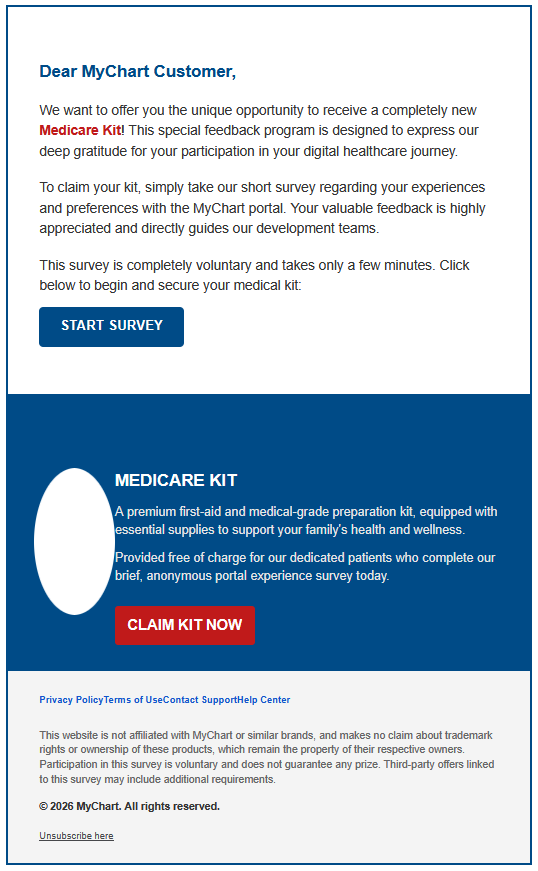
    The scam involves emails and text messages that encourage people to claim a “MyChart Medicare Kit” by clicking on the embedded link to complete a survey. The resource kit is fictional, and clicking the malicious link could give hackers access to their MyChart portal, which stores identification information, including birth dates and addresses, and private health details, such as medications, medical conditions, and doctor conversations.

    Penn Medicine, Jefferson Health, Temple Health, Main Line Health, and Virtua are among the local systems that have posted warnings on their websites and sent notices to patients urging them to not to share passwords or other personal information through email links.

    Attorney General David Sunday has also urged people to “stay on the lookout for this new scam tactic.”

    Phishing emails are becoming more sophisticated, as artificial intelligence does away with misspellings, grammatical errors, and graphics irregularities that were once telltale signs of a scam.

    Phishing attacks have grown more than 40-fold since ChatGPT, an AI program that can draft emails and letters based on a prompt, was introduced in 2022, according to a 2026 trend report from HoxHunt, a cybersecurity risk management and training company.

    Scams that relate to people’s healthcare or insurance can be especially dangerous because of the type of information they may expose and because of the urgency people may feel to respond to the message, said Tom Gordon, chief information officer at Virtua Health.

    “The leverage with healthcare is you’re going to have a certain reaction,” Gordon said. “It drives an emotion, it affects people’s defenses.

    A screenshot of a MyChart Medicare Kit phishing email shows one of the ways scammers attempt to obtain personal information.Sarah Gantz / Philadelphia Inquirer

    Philadelphia hospitals take action

    Philadelphia-area health systems work together to track scams and alert patients, said Lou Dignam, Virtua’s vice president of cybersecurity.

    Virtua is part of Health Information Sharing and Analysis Center, known as Health-ISAC, a nonprofit membership organization for hospitals, insurers, pharmaceutical companies, and other health security professionals across the country to share real-time threats and best practices.

    When Digman and Gordon heard about the MyChart Medicare scam, they turned to their group chat with security officers at Penn, Jefferson, Cooper, Inspira, Main Line Health, and others. They talked about what to do, even coordinating what to write in online notices and emails to patients.

    “People may look at these organizations as competitors, but on this type of thing, it’s very collaborative and unified,” Gordon said.

    Cohesive communication across health systems is especially valuable in the Philadelphia area, where a high concentration of providers means patients may see doctors at multiple systems, he said.

    Their main message: Always be curious and cautious.

    How to avoid phishing scams

    Cybersecurity experts say vigilance is the best protection against phishing scams.

    “Scammers are always looking for new ways to obtain as much of your personal information as possible,” Attorney General Sunday said in a statement.

    Sunday and Gordon offered consumers some tips:

    • Be skeptical of unsolicited free offers and rewards.
    • Hover over email addresses and links, which can be disguised to appear to be from a trusted sender.
    • Avoid clicking links in emails and text messages. Instead, go directly to the website or mobile application.
    • Do not “unsubscribe” from emails that you suspect could be phishing attempts, as the “unsubscribe” link could also be malicious. Instead, delete the email.
    • Report phishing attempts sent to work email to your employer.