Tag: Saquon Barkley

  • Jeff McLane’s keys to Eagles vs. Rams in Week 4 and a game prediction

    Jeff McLane’s keys to Eagles vs. Rams in Week 4 and a game prediction

    The Eagles host the Los Angeles Rams at 1 p.m. Sunday at Lincoln Financial Field. Here’s what you need to know about the matchup:

    When the Eagles have the ball: If success on the ground in the first half of the Chicago Bears game didn’t convince Sean Mannion to lean into the run game against the Rams, DeVonta Smith’s absence should only reinforce to him that his best chance of turning the offense around is to feed Saquon Barkley the ball early and often. Yeah, Mannion is going to need Jalen Hurts to check to passes if Rams defensive coordinator Chris Shula stacks the box. But you’re cutting into your chances of winning if you’re consistently in third-and-long.
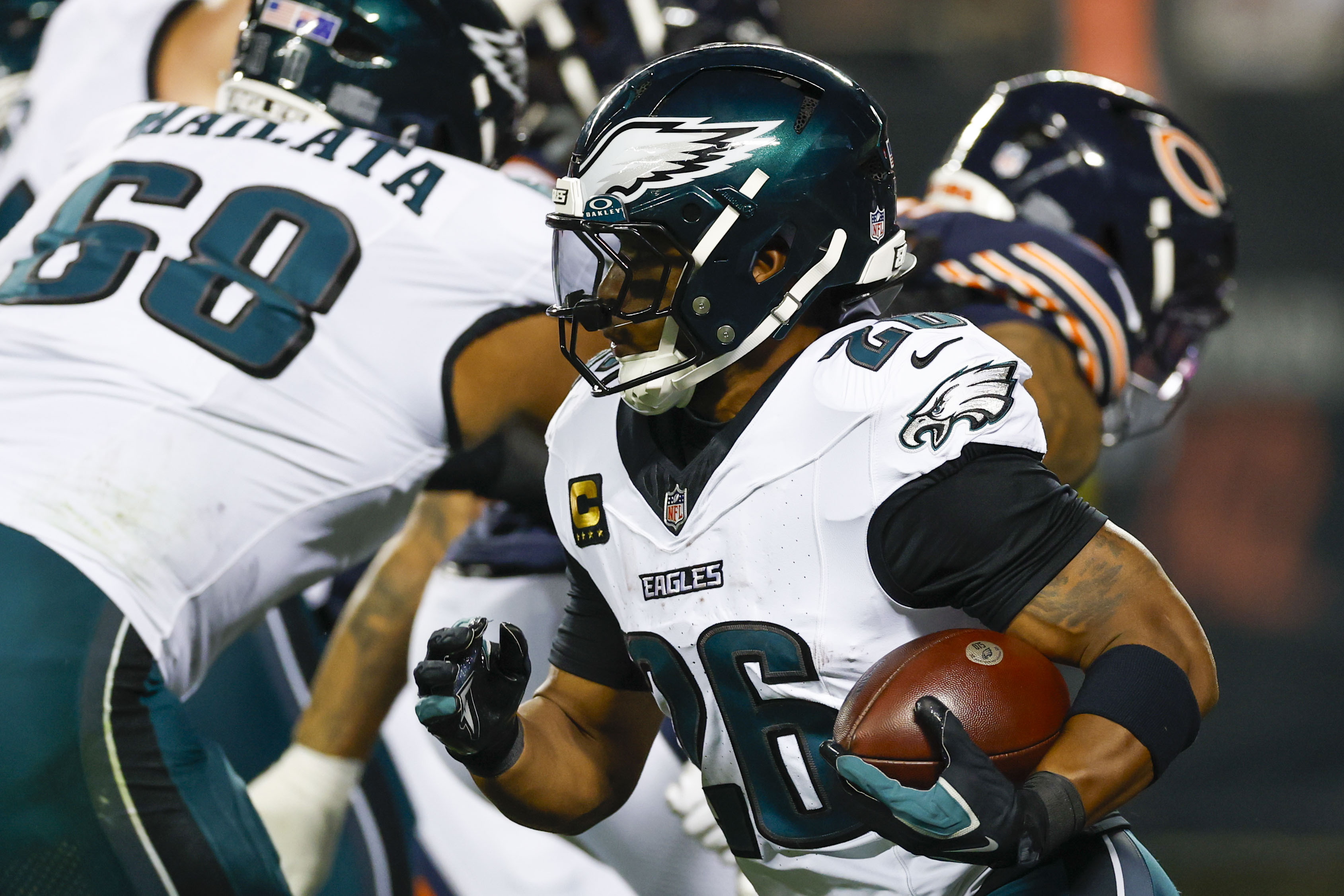
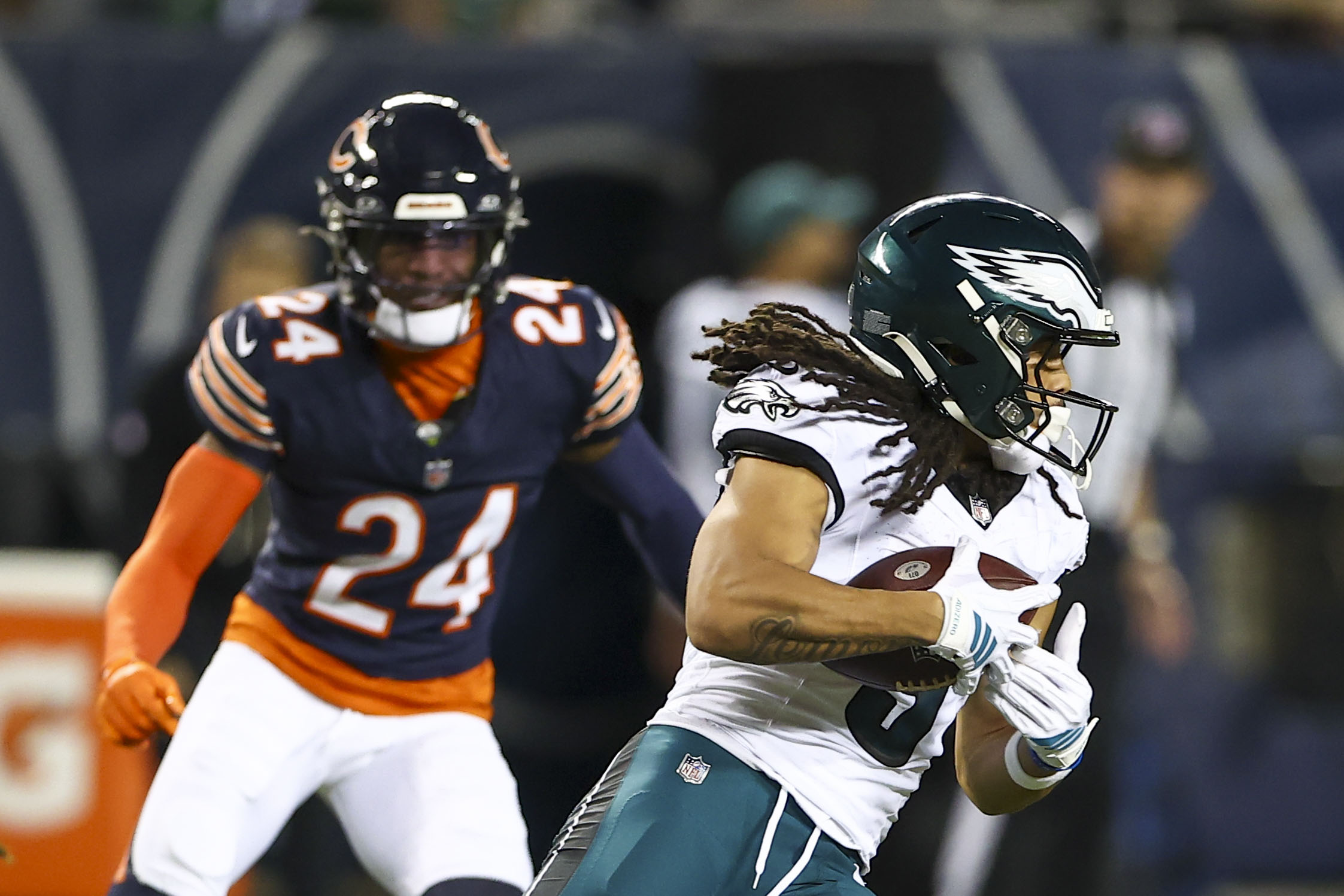
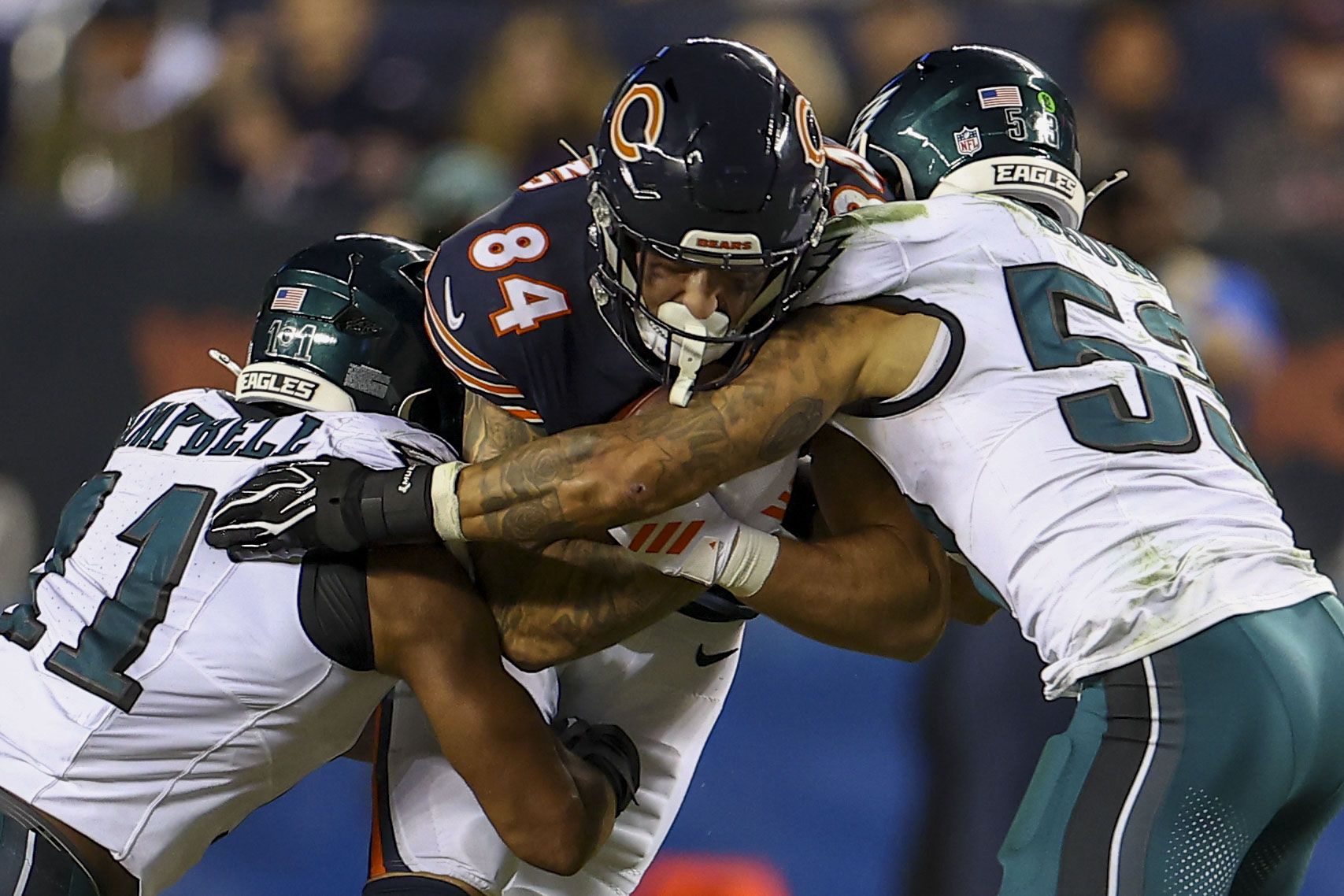
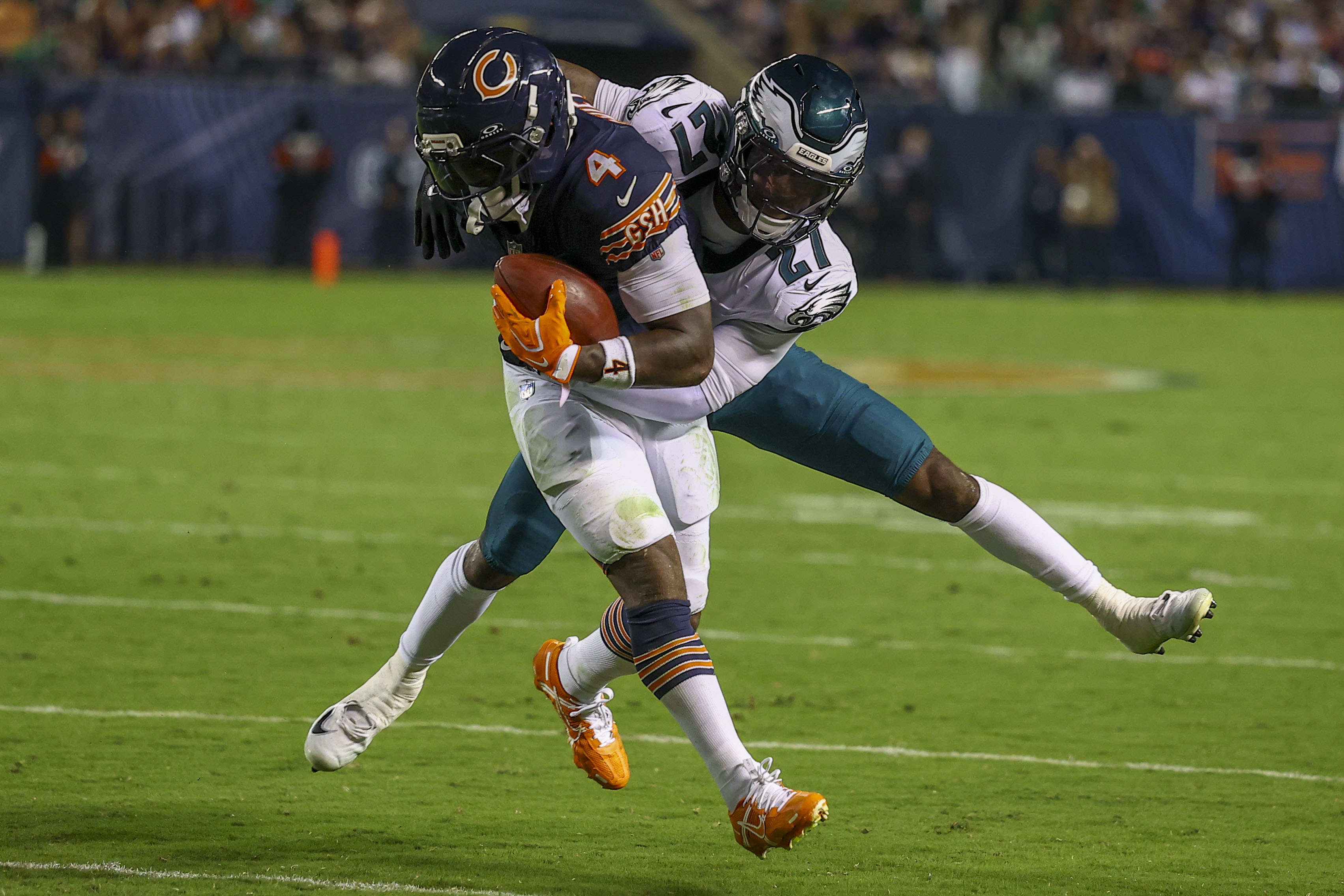
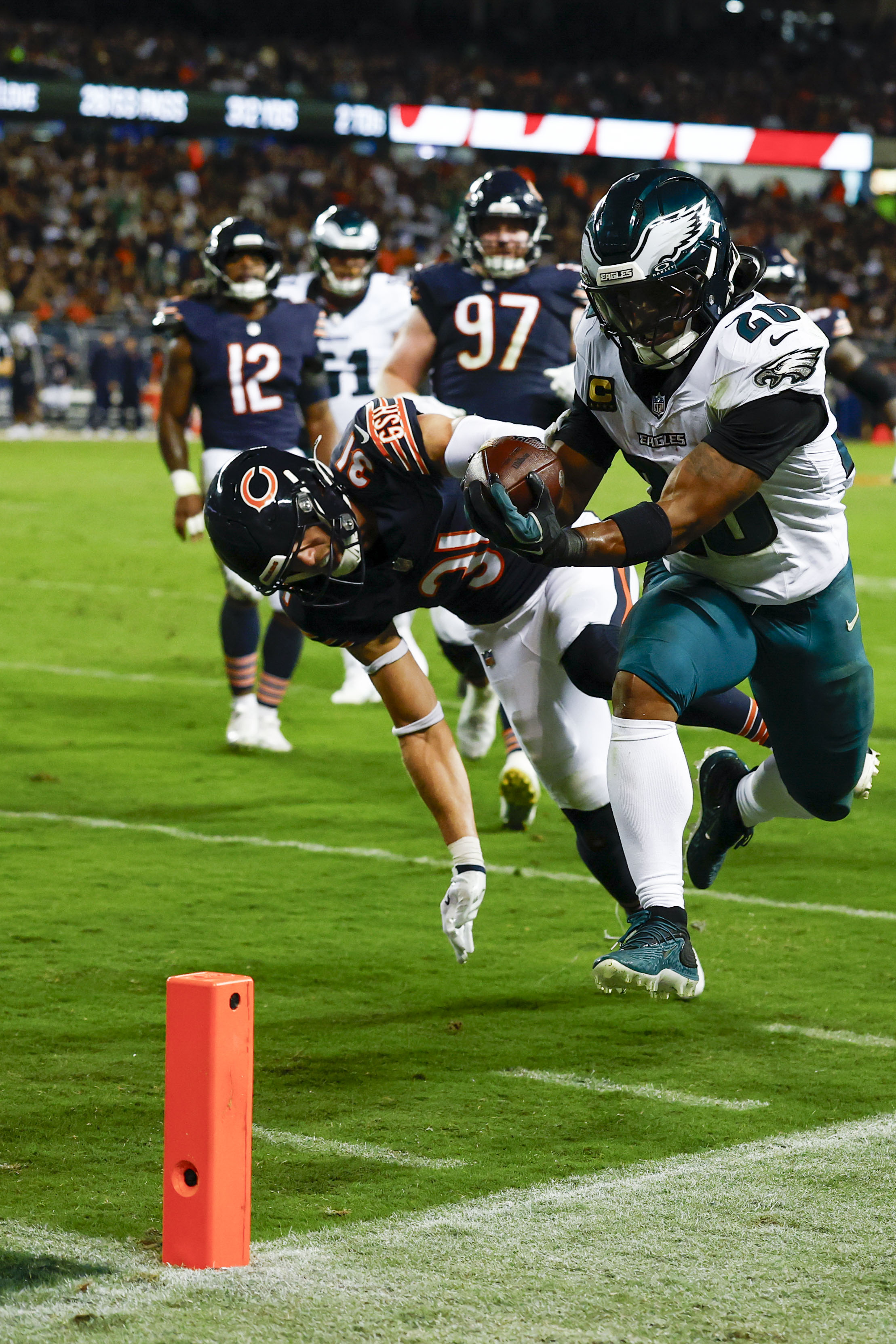
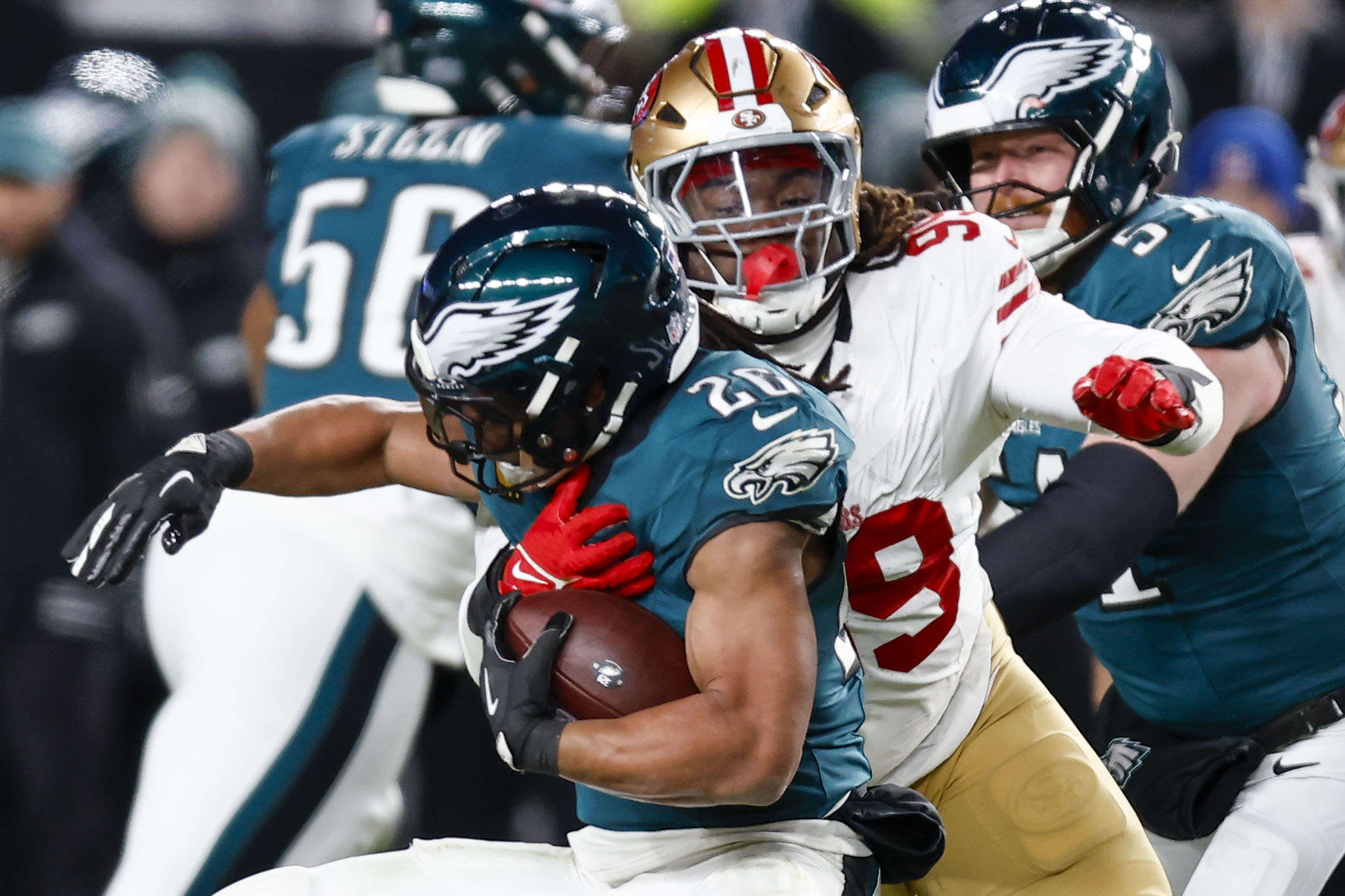
    Saquon Barkley was effective in the first half against the Bears on Monday night. Yong Kim / Staff Photographer

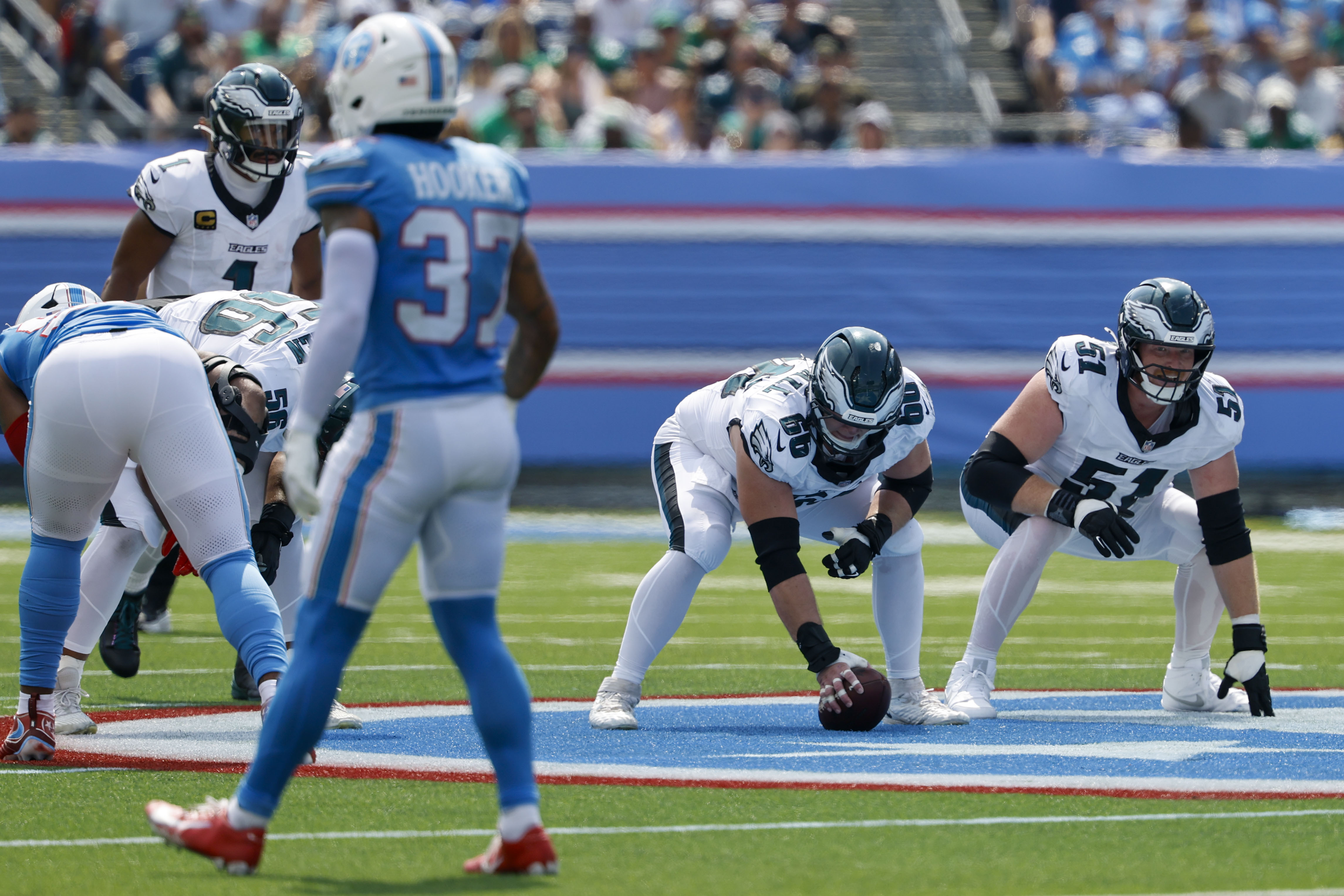
    The Eagles need early down yards. They had some impressive gains on outside-zone runs in Chicago. Left tackle Jordan Mailata was a mauler. Run behind that! Center Drew Kendall and left guard Cam Jurgens were effectively combo blocking and getting to the second level to create lanes for Barkley, too.

    The Rams have a solid run defense, even if they got scorched by the San Francisco 49ers and gave up 174 rushing yards in the opener. They allowed only 2.9 yards a carry in the next two games. Shula has a deep defensive line, but future Hall of Famer Aaron Donald was ruled out Friday and the team will also be without all-world end Myles Garrett for another week.

    It’s an aggressive front that Mannion may be able to exploit with crack blocks and counters. If he can get Barkley to the second level against the likes of linebacker Nate Landman, who is dealing with a shoulder injury, there could be opportunities for explosive runs. The Rams kept Barkley in check last season (18 carries for 46 yards), but he rushed for over 200 yards in each of their meetings in 2024.

    If the Eagles can have even a modicum of success on outside runs, they should be able to incorporate more play-action when Hurts is under center. Mannion and offensive line coach Chris Kuper just need to find a better way to counter blitzes up the “A” gaps in those scenarios. Some of that has to do with blocking assignments and blitz pickup, but we’ve yet to see much of Hurts on naked bootlegs. Get him out of the pocket for layup throws.

    Hurts was great on third down in the first two games, but it was unsustainable and he was crushed under that weight in the second half of the Bears game. This will be the best pass rush the Eagles have yet to face, even without Donald and Garrett. Byron Young is explosive, and defensive tackles Braden Fiske and Kobie Turner can win at the point of attack.

    Smith’s hamstring injury obviously needed to be dealt with now. The Eagles can’t afford for it to get worse and for their No. 1 receiver to miss more than two or three games. They’re hoping it’s just a little short-term pain. Dontayvion Wicks’ emergence as a true No. 2 should lessen the sting. He’s just not of Smith’s caliber. Rookie receiver Makai Lemon, tight end Zach Ertz, and others are going to have to help fill the void.
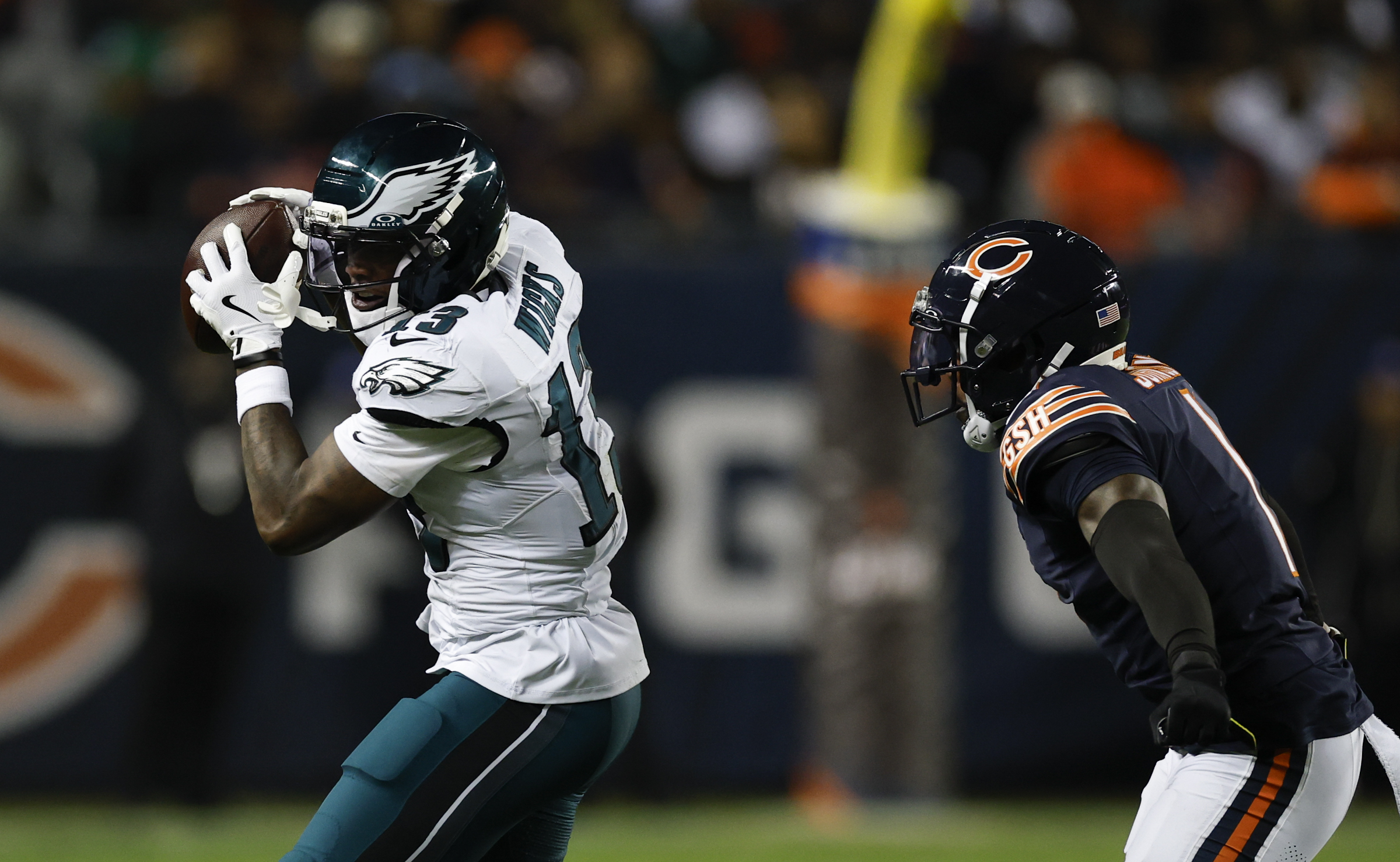
    Dontayvion Wicks ascends to the de facto No. 1 receiver role with DeVonta Smith out on Sunday. Yong Kim / Staff Photographer

    Shula likes to mix up his coverages to keep offenses guessing. Recently acquired cornerback Trent McDuffie will be difficult to throw at, but the Rams are banged up in the secondary. Cornerback Jaylen Watson (shoulder) is out and safety Kam Kinchens (hamstring) and backup slot corner Josh Wallace (shoulder) were also on the injury report this week.

    When the Rams have the ball: Sean McVay is going to want to run the ball early. He’s going to want to stay balanced. And he’s going to want to marry the run with the pass off play action. Kyren Williams is his ace in the backfield, but Blake Corum is a solid No. 2 counterpart. They average 5.6 and 5.3 yards per rush, respectively. McVay still employs a lot of the wide-zone blocking that is central to the Shanahan run scheme. But he’s incorporated more power blocking into his runs in recent seasons. He’s also utilized three-tight end sets more than most play-callers. His run offense is actually more effective running out of “11” and “12” personnel, partly because he has good blocking receivers like Puka Nacua.

    But a collection of versatile tight ends in Colby Parkinson, Tyler Higbee and Davis Allen allows McVay to exploit base defenses through the air despite being in “13” personnel. He will be down at least one tight end though, as Terrance Ferguson (ankle) has been ruled out and Parkinson (knee/shoulder) is also banged up. Will Vic Fangio take the bait and match personnel, which would allow him to keep Cooper DeJean at safety over Michael Carter II? Or will he roll the dice with either nickel safety covering one of the tight ends?
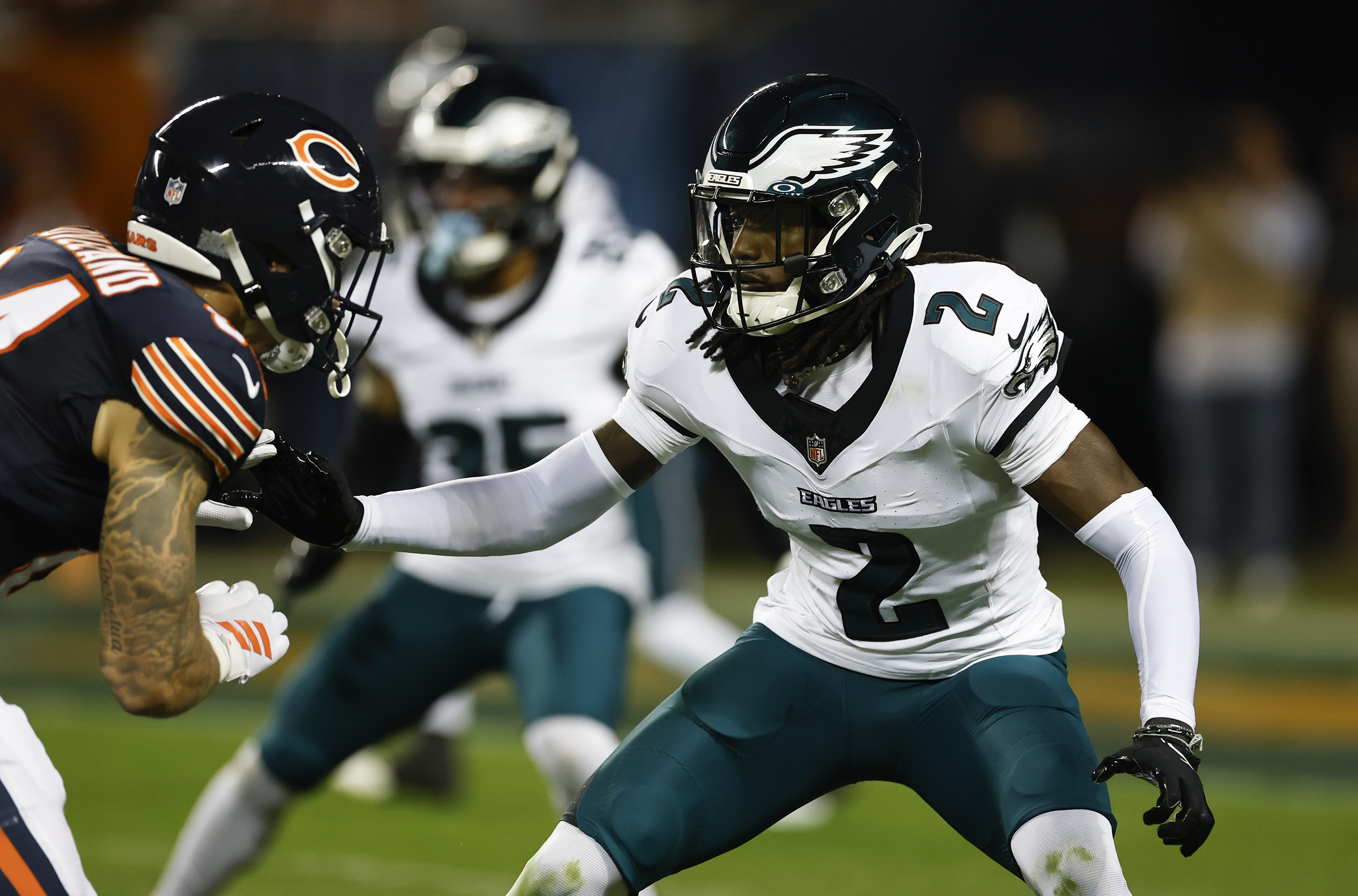
    Riq Woolen (2) is among the players who could use a bounce-back effort on Sunday. Yong Kim / Staff Photographer

    Fangio has plenty to clean up after the Bears mess. His defense struggled vs. pre-snap motion and route concepts that forced switch releases and stressed his match coverage. Cornerback Riq Woolen especially had trouble in that regard. The Eagles’ linebackers and safeties were also often sucked in by play action.

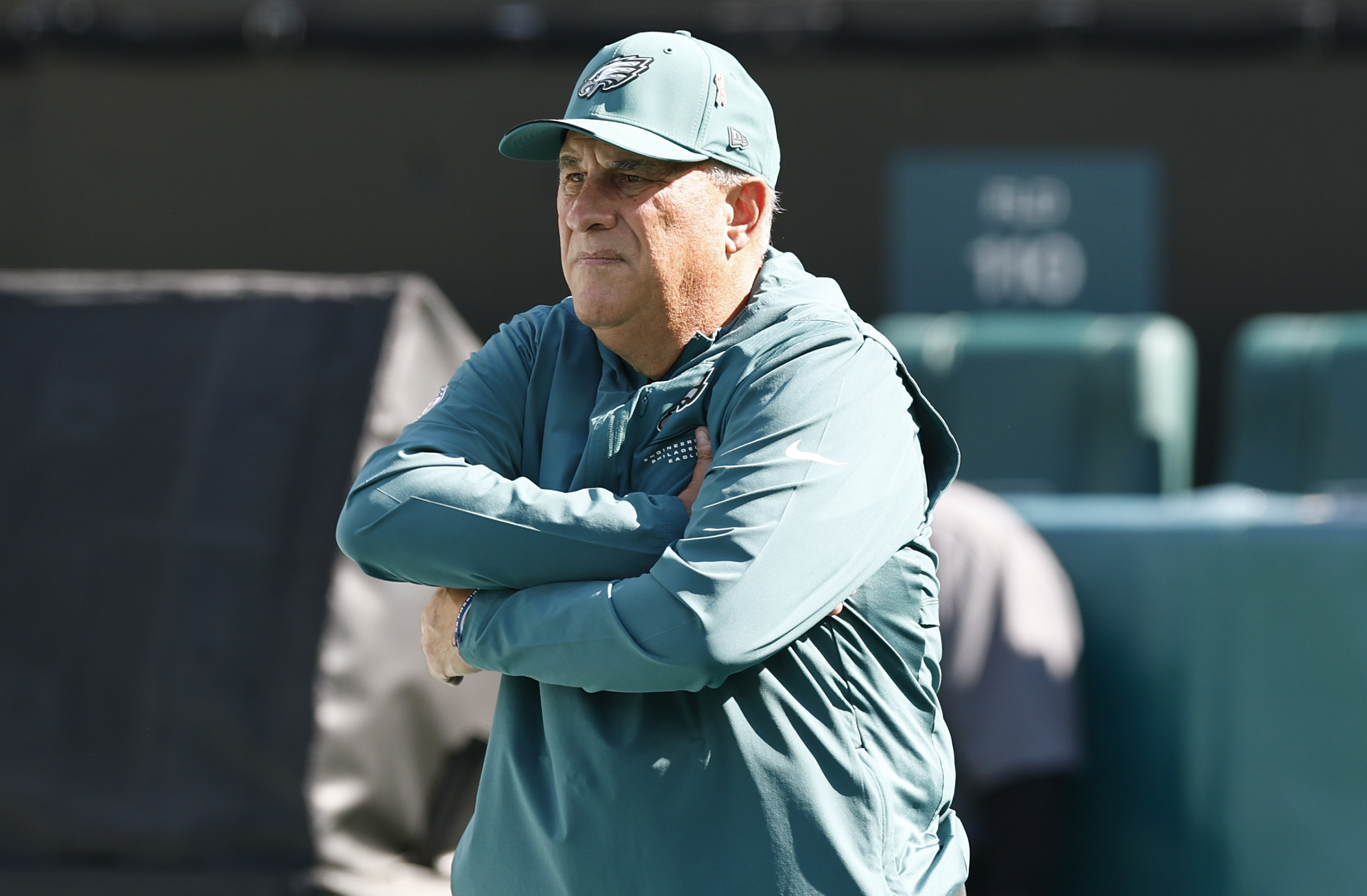
    Improving communication is imperative. It will be tested with linebacker Zack Baun (concussion) out. Jeremiah Trotter Jr. will take Baun’s place alongside Jihaad Campbell. Fangio sold out to stop the run in Chicago and Bears coach Ben Johnson preyed on that emphasis. He should get back to his preferred light boxes and let interior linemen Jordan Davis and Jalen Carter earn their paychecks. Carter has been playing with a hairline fracture in his right wrist. Davis (calf) and Moro Ojomo (calf/elbow) also popped up on the injury list this week.

    Even if the Eagles can bottle up Williams and Corum, they have quarterback Matthew Stafford and two of the better receivers in Davante Adams and Nacua to contend with. Nacua is expected to play despite a hip injury that kept him out of the last two games. He specializes in contested catches, yards after the catch, and giving defensive backs fits. Adams is still dangerous. He has 18 catches for 358 yards and two touchdowns so far this season. He can beat defenses in man or zone and is one of the best ever in the red zone. Stafford, a first-ballot Hall of Famer, according to Fangio, can make every pass from the pocket. He can throw from multiple arm angles and even toss in a no-looker when needed.
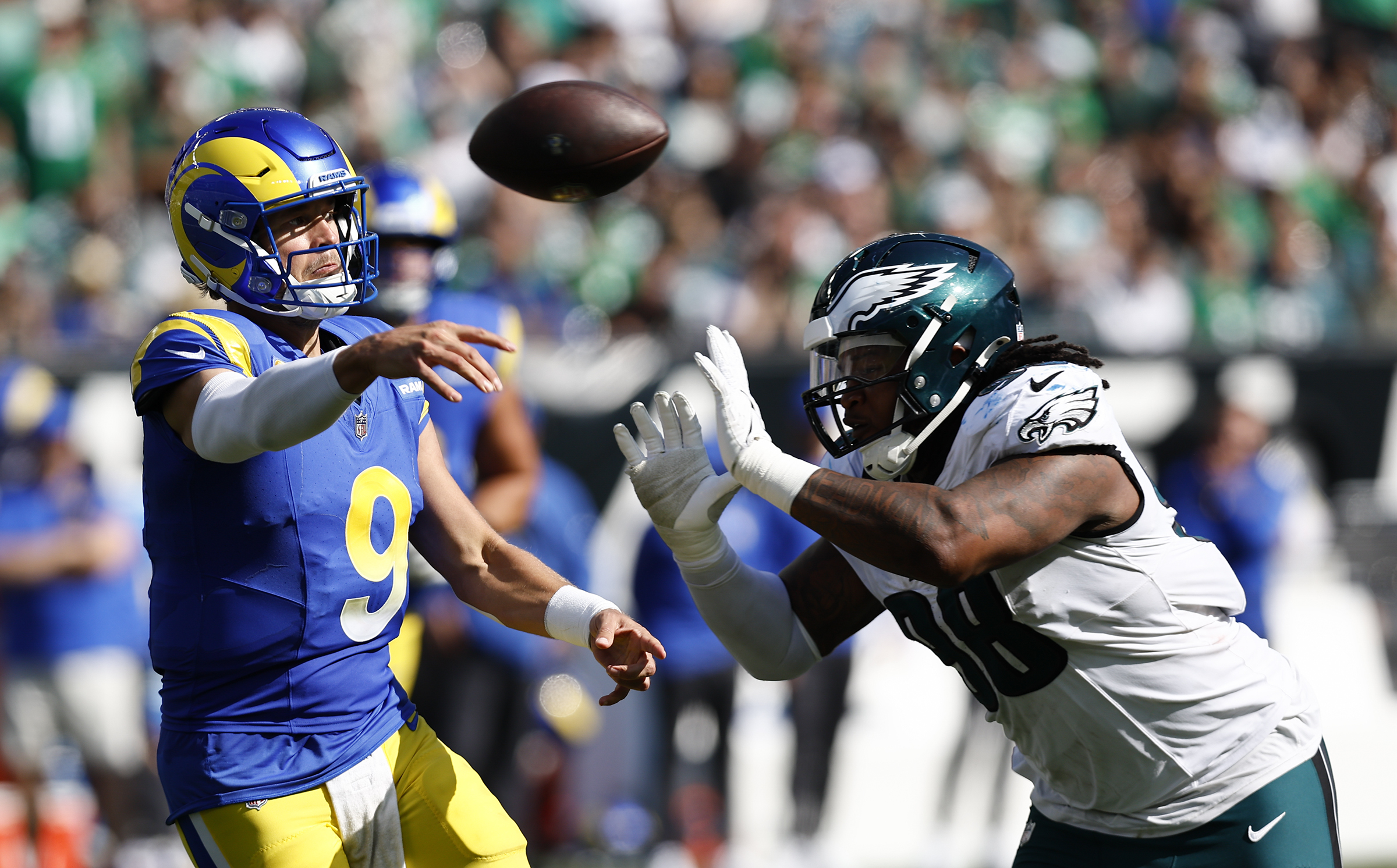
    Jalen Carter (right) will try to get after Rams QB Matthew Stafford on Sunday. Monica Herndon / Staff Photographer

    The Eagles have not tackled well. They missed 23 tackles total vs. the Tennessee Titans and Bears. Form matters, but it’s more a byproduct of players being out of position and the unit just not being as cohesive. Fangio still has top-tier corners in Quinyon Mitchell and DeJean. But with the outside corners playing sides this season, McVay could pick on Woolen by often motioning to the right side.

    The 1-2 Rams aren’t perfect, of course. The offensive line is fine, but not impenetrable. Right guard Kevin Dotson is maybe the weakest pass blocking link. Stafford has shown that when pressured he can make mistakes. He’s not going to escape from many ambushes. If edge Jonathan Greenard can make more hay in his second game with the Eagles, it could be the key to unlocking a pass rush that has only three sacks.

    Extra point: Nick Sirianni is 4-0 vs. McVay. It’s certainly a feather in his cap, although he declined to gloat when asked about the record on Friday. There were a lot factors in the four-game winning streak. It’s not just coach vs. coach. But Sirianni has done better in game management situations. McVay may be one of the best offensive play callers in the game, but he turtles up in fourth down situations. He coughed up a 26-7 lead a year ago by getting too conservative and the Eagles won on Davis’ blocked field goal return for a touchdown.

    The Rams’ special teams units were brutal last season. They may have kept McVay from getting back to another Super Bowl. Perhaps Sunday’s outcome can turn on a kick return here, or a missed field goal there, or a special teams mistake there. The Rams cut punt returner Xavier Smith on Friday. They have candidates to replace him, but no obvious names.

    Either way, I think Sirianni’s Eagles may finally fall to McVay’s Rams. I wouldn’t make a prediction based on the law of averages. Many of the reasons stated above should be ultimately why the Birds fall to 2-2. Can they win? Of course. I just think they still have too many issues to sort out before they can beat a team as talented as the Rams.

    Prediction: Rams, 31-21.
  • What everyone is getting wrong about ‘woke’ | Will Bunch Newsletter

    What everyone is getting wrong about ‘woke’ | Will Bunch Newsletter

    In 1964, I was a) only 5 years old and b) living in the New York suburbs, so while I’ve been hearing all my life about the notorious collapse of the Phillies that September, I didn’t get to experience that feeling of existential dread in real time. But I was almost there last week, as the 2026 Phillies nearly became the first team to blow a four-game playoff lead with five games to play. Almost. Sunday’s 7-3 win over Tampa Bay sent my beloved/cursed midlife baseball team back to the playoffs for the fifth straight year. The chill of the offseason has been delayed for at least two more sure-to-be-heart-attack-inducing games in Atlanta. ‘Woke 1.0′

    If someone forwarded you this email, sign up for free here.

    The only thing wrong with ‘Woke 1.0’ was that it wasn’t implemented

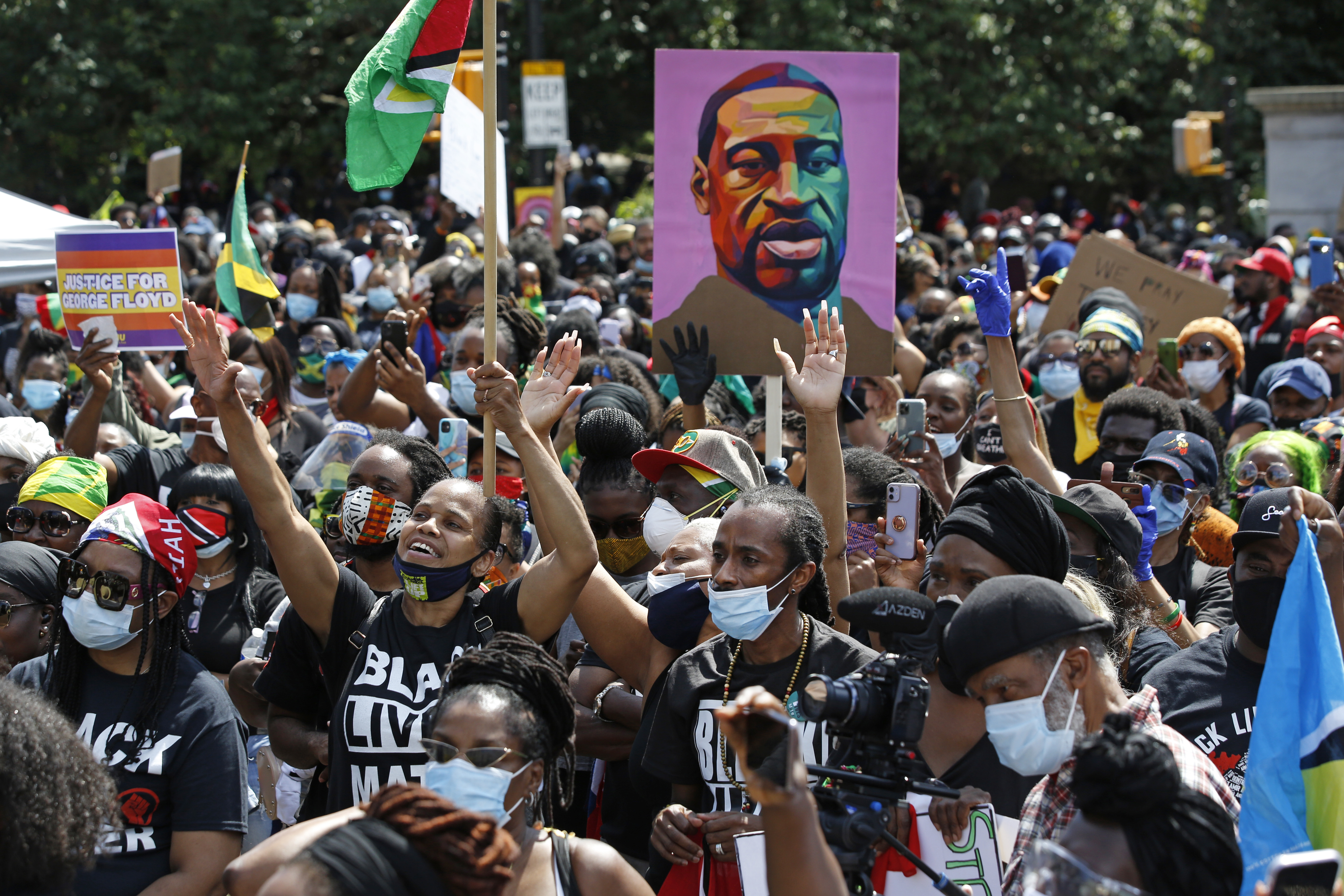
    People participate in a Caribbean-led Black Lives Matter rally in June 2020 at Brooklyn’s Grand Army Plaza in New York. Kathy Willens

    It’s a war almost nobody wanted, and yet it never, ever seems to end. Just this weekend there was yet another spontaneous incident that caused the conflict to flare back up again, as an entire platoon of keyboard commandos mobilized for action.

    Yes, the utterly ridiculous “war on woke” is back on again. The equally senseless fighting in Iran is almost certain to end sooner than this boondoggle.

    The flashpoint was something appropriately trivial enough for this war of distraction: a decision by the Boston Globe to report on the, yes, somewhat silly fight consuming a western Massachusetts lesbian tavern called the Last Ditch Bar and Arts Venue. The hangout continues to require all patrons to wear COVID-era KN95 masks, as a gesture that everyone is welcome at all times, including the immunocompromised.

    The fracas that broke out when the owners of the Last Ditch sought to make just one night a week “mask-optional” in a bid to boost business didn’t just make for a widely read Globe scoop (supposedly it brought in several thousand new subscribers). It also spread great joy among the nattering nabobs who continue to see COVID-19 overreaction as the avatar of a far-left conspiracy to make America ungreat.

    Suzy Weiss, writing for the Free Press founded by her sister and now CBS News honcho, Bari Weiss, emailed with glee that “what happened at Last Ditch shows that Woke 1.0 never ended in some parts of America. It just got crazier.” The Washington Post’s Megan McArdle — who can thank her colleague Kathleen “Donald Trump Will Be a Normal President” Parker for not having the worst columnist batting average of all time — declared that, groan, “The Great Awokening Is Over.”

    This nonsense rekindled a fire that’s been smoldering since the summer among a certain crowd — six-figure-salaried pundits who call Trump “uncouth” and pat themselves on the back for their brave liberalism before picking up their kids at the Dalton School and catching the last train for the Hamptons — who insist America’s downfall didn’t peak with the 2016 election of a demagogue with dictatorial ambition.

    No, the real crisis hit in 2020 when, in their telling, our great Fortune 500 companies were blackmailed into tweeting “Black Lives Matter,” when someone at the far edge of a protest march carried a sign that read “Defund the Police,” and when some tripping-on-idealism sophomore at Oberlin complained that serving bahn mi in the cafeteria was “cultural appropriation.”

    Trump might be uncouth, they argue, but America will never be whole without a Truth and Reconciliation Commission and a public apology for the crimes against humanity of the “woke era.”

    The accelerant, if not the trigger, for this insanity was possibly the most unlikely of sources: U.S. Rep. Alexandria Ocasio-Cortez of New York, heir apparent to the progressive movement, whom many would like to see run for president in 2028. Like her allies on the left, AOC has been undergoing a kind of Spanish Inquisition from journalists demanding an explanation for why — at a time when millions were marching against U.S. cops killing more citizens than anywhere else in the developed world — some folks on the far-left wanted to abolish not just the police but maybe Thanksgiving.

    Ocasio-Cortez laughed off the question by quoting another New York progressive that “Woke 1 was crazy” and arguing that the madness of monthslong COVID lockdowns caused some people to voice extreme ideas they shouldn’t be judged upon six years later.

    To say AOC’s comments were a mistake would be an understatement. She gave the critics an inch, and they’ve taken about 87 miles and counting. It gave a boost to a bevy of “both sides” columnists who’ve been dying to say the left and the right are equally to blame for everything that’s wrong with America.

    “Restitution, if only in the form of honest contrition and perhaps even a public apology, is in order,” demanded conservative New York Times columnist Bret Stephens, who may have been referring to a few other journalists or professors who today blame “Woke 1.0” for their career setbacks, although he also may have been thinking about his own epic fight with the college professor who called him “a bedbug.”

    Look, we all can laugh at the worst foibles of the far-left; that’s why Portlandia was such a popular show, even among liberals. We should cringe when some professor calls people “folx,” and get mad at more serious illiberal crimes against free speech, like stealing student newspapers or shutting down campus speakers over their politics.

    But it’s a massive false equivalence to compare these offenses by low-wattage college students and a few professors to the high crimes and misdemeanors of an American fascist movement that includes the president, big chunks of Congress, and the U.S. Supreme Court. What’s more, the people making these comparisons want to make you forget what the upheavals that peaked in 2020 were actually about, which was upending the status quo of which they are card-carrying members.

    They want you to remember that “Defund the Police” placard so you’ll forget that millions marched in the streets in 2020 because George Floyd was just one of more than 1,000 Americans killed by the police that year — or that at least 1,000 people have died the same way in every year since then.

    They want you to get mad about the “bahn mi kids” at Oberlin, so you won’t get angry at the gross unfairness of an educational system that’s tilted toward the kids of those writers and politicians demanding apologies for “wokeness” — the privilege that gives their pampered offspring SAT prep and legacy admissions while the rabble attends lousy public schools.

    They have ridiculed, mocked, and called for the police suppression of every social movement from Occupy Wall Street to No Kings — maybe because they don’t want a higher marginal tax rate, but definitely because they are terrified that a more equal society for everyone means less status for them. Heck, some plebe might call them a “bedbug” and get away with it this time.

    AOC got it totally wrong. “Woke 1″ wasn’t crazy. Its biggest problem was that the heart and soul of the movement — no more militarized police, better wages and health insurance, billionaires paying their fair share of taxes, and colleges that are accessible and affordable — was never implemented. The bad guys won, and the good guys gave up too easily.

    No one needs to apologize for saying that maybe we should improve society somewhat. But meanwhile, hey, look over there — it’s a crazy lesbian bar!

    Yo, do this!

    • Over the years, as I’ve called on my love of American history to try and explain what went right and then went terribly wrong in the 80-plus years since World War II, there is one place that keeps popping up again and again: the University of California, especially its flagship Berkeley campus. In a time of free tuition and rising postwar optimism, the UC system was the crown jewel of U.S. public higher education, only to become ground zero for 1960s protests and the rise of Ronald Reagan, followed by fights over affirmative action, rising college costs, and much more. My good friend and former Newsday mentor Miriam Pawel has just published a much-needed chronicle of all this — California Dreams: The Making and Remaking of the University of California — that just now was enthusiastically downloaded by me.
    • The crisis of press freedom in the United States has recently become a front-page story, with Donald Trump’s stunning and typically ham-handed efforts to ban news organizations he personally doesn’t like — CNN, MS NOW, and Politico — from the White House. At the same time, I chronicled the growing threats and harassment as well as actual violence against U.S. journalists that is endangering the First Amendment. I am asking you today to make a contribution to The Philadelphia Inquirer High-Impact Journalism Fund. Your gift ensures we have the resources to not only execute deep, investigative reporting that holds the powerful accountable, but to do so while keeping our journalists safe from the escalating legal and physical threats that have become a daily reality in this business.

    Ask me anything

    Question: How can Article I [of the U.S. Constitution] reassert itself when Article III seems intent on creating a unitary executive with vast, uncheckable powers? — Jackie Gardina (@jackiegardina.bsky.social) via Bluesky

    Answer: Jackie, that’s a good question — what you’re basically asking is how can Congress (the subject of Article I) undo the power-grabbing role of the judiciary, and specifically the U.S. Supreme Court, that was created in Article III? No doubt, Donald Trump’s dictatorial ambitions have been fueled by a series of high court rulings that have placed the president above the law and expanded White House powers. But America’s founders clearly gave Congress the tools to reassert control, if only they would use them. Lawmakers have the authority to expand the Supreme Court, impose term limits on justices, mandate a code of ethics, and take other measures to bring this star chamber back to reality. And I believe a majority of voters are more than ready to sign off on such radical changes.

    What you’re saying about …

    There was pretty much unanimity among responders to last week’s question about Donald Trump banning reporters from his least favorite news outlets from the White House — an action that was quickly (and predictably) overturned by a (Trump-appointed) federal judge. Readers thought the entire press corps should walk out in solidarity, with no need to hurry back and record the president’s every utterance. “Not only should the White House press corps walk out in solidarity, but they should also start standing up for their colleagues when the president insults them,” wrote emailer David (full names, please!). “A few white guys saying, ‘Mr. President, that is not acceptable’ might actually register with Trump and his advisors.” Added Stephen R. Rourke, “Moreover, it would deprive Trump of the only thing he cares about: visibility.”

    📮 This week’s question: Major League Baseball has scored TV ratings wins with games in unlikely settings, such as the Iowa cornfield that hosts the Field of Dreams game. Now MLB has approached the good people of the Trump regime with a new idea: a baseball field in a national park, possibly Wyoming’s Grand Teton. Brilliant marketing, or another crime against Mother Nature? Please email me your answer and put the exact phrase “National Park baseball” in the subject line.

    Backstory on the Christian wealth scam with ties to the Eagles

    Brandon Graham, Nick Sirianni, and Saquon Barkley are among the Eagles past and present scheduled to speak at Life Surge on Saturday.Staff Photographs

    It was already a bad look in May 2025 when some of the brightest lights of the then-Super Bowl-titlist Philadelphia Eagles — including head coach Nick Sirianni and star running back Saquon Barkley — pocketed large appearance fees to talk about football and God at an event at the now-named Xfinity Mobile Arena called Champions of Faith. The rally, as reported at the time by The Inquirer and other news outlets, existed to promote a Christian wealth scheme called Life Surge whose founder had left behind a trail of deception and fraud allegations. My colleagues Olivia Reiner and Ryan W. Briggs reported growing allegations that Life Surge “exploits the Christian faith and the allure of the famous speakers as a cover for ‘bait and switch’ sales tactics pitching a series of weekend investing seminars.”

    The Eagles-laden event — which also featured speeches and a chance to meet stalwarts such as Brandon Graham, Cooper DeJean, and retired Hall of Famer Brian Dawkins — went ahead despite the negative coverage, but you could already sense the Life Surge saga was not going to end well. Last week, a scathing exposé led by podcaster Pablo Torre, who was just awarded a Pulitzer Prize for his investigative reporting that led to a massive fine against the NBA’s Los Angeles Clippers, turned Life Surge’s dodgy practices and the deep involvement of Heisman Trophy-winning retired quarterback Tim Tebow into a national scandal.

    The joint project by Torre and Mother Jones investigative reporter Kiera Butler reported that “hundreds of attendees swap stories of high-pressure sales tactics infused with Christian messaging” on a large Facebook group of unhappy Life Surge customers, Reddit threads, and elsewhere. Some said they withdrew retirement funds or went deep into credit card debt to pay for “SurgeU” classes in wealth management that can cost as much as $40,000.

    The story, boosted by Torre’s podcasting clout and the focus on Tebow’s role as a frequent featured speaker who’s earned an estimated $2 million to $4 million from his involvement, garnered immediate results. Tebow has already announced he is pausing any future involvement with Life Surge, noting “the allegations are extremely serious.” It’s doubtful any of the Eagles will face any consequences for their one-day fling with Life Surge, and yet maybe this scandal will finally convince Philly athletes to stop saying anything for another fistful of dollars.

    It was stunning to see that the newest and arguably brightest star in the city’s sports firmament, the new 76er LeBron James, signed a $15 million deal — far more than the reduced salary he accepted to help the Sixers finally win another title — with the online prediction market Polymarket. This despite the fact that New York state (where James is apparently living, by the way) and others have accused Polymarket of running an unlicensed gambling operation, in an era when betting addictions are wrecking far too many lives.

    James’ new ads for Polymarket dropped just weeks after The Inquirer reported that the Phillies’ highest-paid slugger, Bryce Harper, who has a 13-year, $330 million contract, was paid to film a personalized Cameo video that the sports-betting company FanDuel then sent to a gambler who was racking up $1.5 million in debt.

    Harper said FanDuel slapped its logo on the video with neither his knowledge nor permission. Meanwhile, Eagles legend Dawkins, one of last year’s Life Surge speakers, found himself embroiled in controversy this week when Donald Trump’s Department of Homeland Security lifted a hype video of the footballer to promote its mass deportation efforts. The use of the video without Dawkins’ permission was an outrage, but then it’s easy to fool the public when our sporting heroes won’t stop running their mouths to inflate their already bloated bank balance.

    What I wrote on this date in 2020

    Thursday will mark the 56th anniversary of the night that forever defined Philly “attytood”: The Phillies’ final home game at iconic Connie Mack Stadium in 1970, which prompted fans of the team that still has the most losses in major-league history to rip everything — even the toilets — out of the rusted ballpark before rioting on the field. I wrote on the 50th anniversary six years ago that the chaos was “a pivot point in how the nation would see Philadelphia — no longer either the place of history-class field trips or boring Quaker blue laws but now the U.S. capital of blue-collar attytood, with sports fans who were in your face, with a wooden slat if someone was dumb enough to hand them one.”

    Read the rest: “In 1970, the world was coming apart, and Philly took it out on Connie Mack Stadium.”

    Recommended Inquirer reading

    • Only one column this week, as I also toiled on my latest investigative reporting project on what’s really happening with immigration arrests in Pennsylvania. In that column, I looked at Donald Trump’s increasingly erratic and outlandish public statements and argued that — instead of news coverage that soberly looks at every bat-guano crazy outburst or rambling speech — it’s time for the media to start seriously questioning the president’s mental health. The moment for real talk about Trump’s disordered mind — and whatever remedy is possible — is now, before the crisis implodes.
    • Speaking of Donald Trump, one defining feature of his second presidency has been the fearfulness of newspaper editorial boards — including many that had called for Richard Nixon or even Bill Clinton to resign back in the day — to aggressively challenge the current POTUS even as he flagrantly violates both laws and common decency. I’m proud to work with the exception: the award-winning editorial board of The Philadelphia Inquirer. Spearheaded by my friend and colleague Paul Davies, The Inquirer this week has been publishing the latest in a six-part series of major indictments of Trump’s massive wrongdoing called “The Art of the Steal.” The recent broadsides included “It’s all about him,” which digs into Trump’s obsession with wasteful Washington, D.C., vanity projects, and “The family that grifts together,” which aims to chronicle the endless parade of crypto scams, defense contracts, and other financial schemes that have made billions of dollars for the president’s kin. These outstanding works of opinion journalism are just the latest example of how a newsroom funded not by billionaires but by a nonprofit foundation created in the public interest can’t be bought off or cowed by a corrupt government. You can support this important work — and enjoy reading it — when you subscribe to The Inquirer.

    By submitting your written, visual, and/or audio contributions, you agree to The Inquirer’s Terms of Use, including the grant of rights in Section 10.

  • Nick Sirianni has a lot of work to do, and not much time to do it, after Eagles’ weaknesses are exposed in Chicago

    Nick Sirianni has a lot of work to do, and not much time to do it, after Eagles’ weaknesses are exposed in Chicago

    CHICAGO — Nick Sirianni took it on the chin.

    Down 13 points late in the third quarter, the Eagles faced fourth-and-1 on their own 49-yard line. Sirianni had his offense line up as if it would attempt the Tush Push with Jalen Hurts sneaking for the first down.

    But it was a long yard, and the Bears weren’t fooled into jumping offside. The Eagles took a delay-of-game penalty and punted.

    “As I look back at that, I probably should have went for it there,” Sirianni said. “Didn’t like that decision.”

    It was one of many that backfired on the coach and his team in a dreadful 27-7 loss to the Chicago Bears on Monday night. Sirianni’s regrets were isolated to the game — from his fourth-down turtling to his sideline behavior — but it’s unclear how he felt about larger decisions that have affected this season’s Eagles.

    It’s too early to make sweeping generalizations. But the first three games have suggested the following: the defense isn’t as good as many had expected, first-time offensive coordinator Sean Mannion isn’t yet the “mad genius” some had suggested, and general manager Howie Roseman’s roster has more holes than it has had in years.

    And that may be why, in that moment, Sirianni didn’t roll the dice on fourth-and-1. He didn’t believe his offense could convert or his defense could hold if they didn’t. In 2025, it might have been the offense that held him back. In 2023, it was often the defense.

    For the first time since maybe his first season, he may not have either side to lean on. And that’s a scary thought with the Los Angeles Rams coming to town Sunday and a trip to London to face the Jacksonville Jaguars the following week.

    “I think we all have to own that loss right there,” Sirianni said. “I don’t think anybody coached well. I don’t think anyone played well. It was a true team loss, and when it’s a true team loss, I have to look at myself first.”

    The Eagles are through the “easy” early part of their schedule. They eked by the dubious Washington Commanders and Tennessee Titans in the first two weeks, but they still won, and growing pains were always expected with Mannion’s new offense.

    There were unexpected cracks in Vic Fangio’s defensive armor, though, or craters in areas that were thought to be mere crevices. The Bears, despite having to start 38-year-old third-string quarterback Case Keenum, exposed them.

    It was hard not to compare the actual offensive wizardry of Chicago coach Ben Johnson to Mannion. Johnson was one step ahead of Fangio all night, just as he was a year ago. Maybe Johnson is just the veteran defensive coordinator’s kryptonite. And maybe he’s buoyed by one of the best offensive lines in the NFL.

    But it used to be the Eagles that had enough O-line supremacy to win with a backup quarterback.

    Speaking of backups, the offseason debacle at the No. 2 spot finally caught up to the Eagles. Andy Dalton gets a slight pass here. He was tossed into a tough spot having to jump in for Hurts, who left to have his head checked in the second quarter.

    Yeah, Dalton threw a horrible pass on third down that was intercepted in the end zone. But maybe if he wasn’t splitting snaps all of training camp and the preseason with Tanner McKee, he would have had a few more repetitions on the particular play that Mannion called.

    “I’ve had it a couple times,” Dalton said. “Obviously, gotten a lot of different looks, and for me, it’s something that I can learn from, especially on that play. I mean … safety just read my eyes and was in the right spot.”

    Dalton has been in this role before, but he didn’t outright win the job over McKee. Keeping four quarterbacks on the roster never made sense and just seemed to be the Eagles’ unwillingness to admit they made a mistake in trading for the also-38-year-old.

    It’s just one of several roster decisions that have already come back to haunt Roseman. He can’t invest heavily in every position, but he clearly didn’t do enough at safety after Reed Blankenship walked in free agency. Marcus Epps has been a liability and Andrew Mukuba isn’t yet capable enough to cover for his counterpart.

    Linebacker Jihaad Campbell, a second-year starter like Mukuba, is struggling as well. It doesn’t help that the Eagles also let the currently better Nakobe Dean sign elsewhere this offseason.

    And then there’s this year’s top rookies with wide receiver Makai Lemon still green and tight end Eli Stowers still on ice. First-year players should be given a grace period, but the Eagles didn’t do enough at their respective positions and it’s showing.

    Eagles coach Nick Sirianni is 0-2 against Bears coach Ben Johnson.Monica Herndon / Staff Photographer

    Ultimately, these are Roseman problems. Sirianni’s issues extend to how the Eagles execute, and right now they’re uncharacteristically undisciplined. They had three turnovers on offense and failed to take away the ball on defense. Overall, they’re minus-5 in turnover differential, a statistic Sirianni considers of the utmost importance.

    The Eagles had 10 penalties vs. the Bears, with so many either bringing back a long gain or giving the Bears life on third or fourth down. While the Eagles failed to get Chicago to jump on fourth down, defensive tackle Moro Ojomo carelessly committed a neutral zone infraction on fourth-and-2 early in the fourth quarter.

    Mukuba and cornerback Riq Woolen had third-down penalties in the red zone. Guard Tyler Steen’s holding penalty brought back a long Saquon Barkley run. The Eagles must have had double-digit missed tackles a week after whiffing on 12 in Tennessee.

    Sirianni and his coaches weren’t any better than their players. Mannion’s call for a screen pass to receiver DeVonta Smith with 19 seconds left before the half and the Eagles out of timeouts nearly resulted in the clock running out.

    “We had 19 seconds,” Sirianni said. “We had plenty of time to be able to either get it clocked or do what we did in that particular case.”

    They had one second left and if it wasn’t for Hurts’ quick thinking to skip the spike and sneak into the end zone from the 1-yard line, Sirianni would have taken more than just a jab to the jaw.

    Mannion is Sirianni’s hire. He’s a first-time play-caller who needs patience to grow into the job. But his scheme has been unremarkable. He was supposedly hired to bring more under-center play-action to the offense, but the Eagles have not run much of it, or when they do, not effectively.

    Where’s the misdirection? The aggressiveness? The innovation?

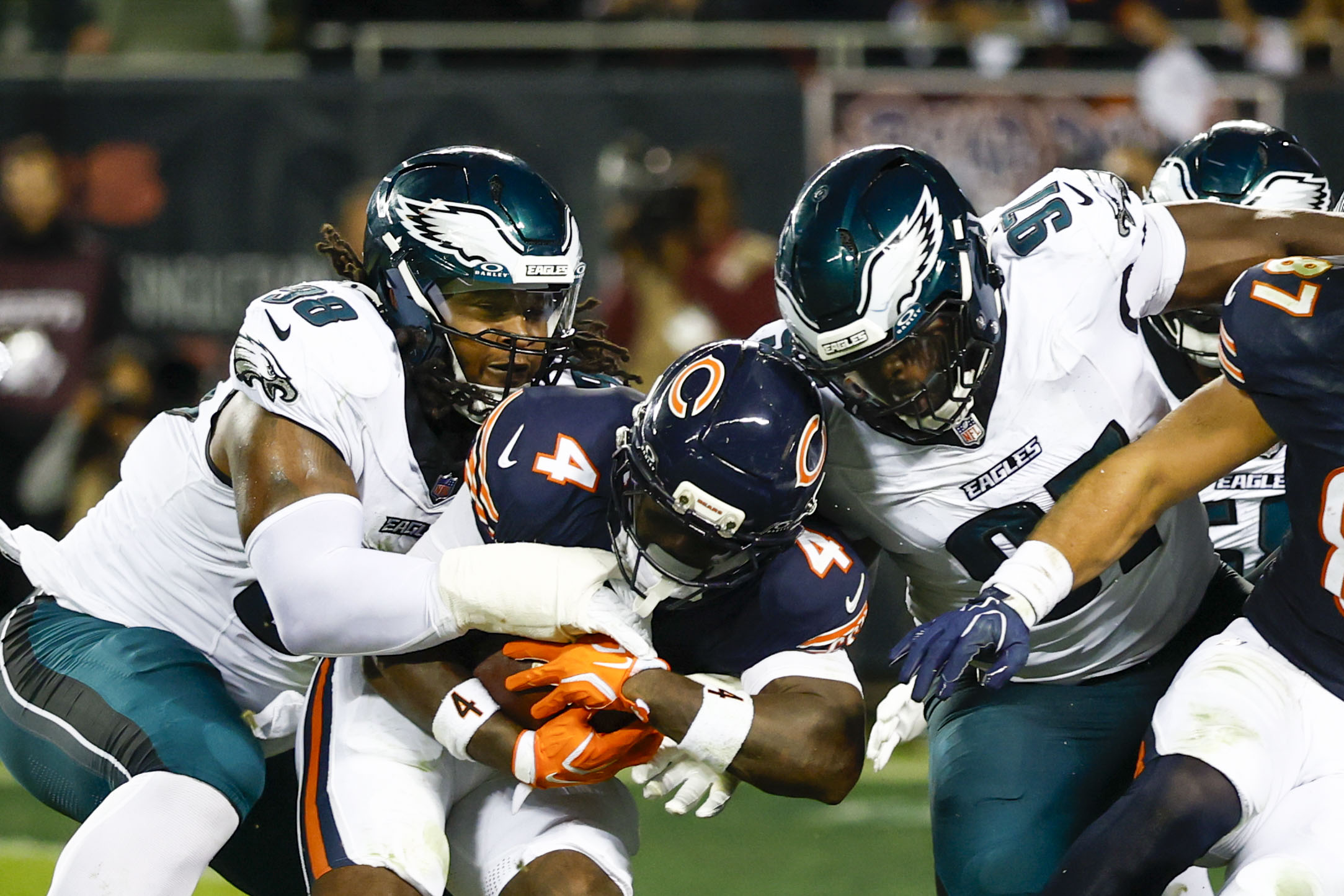
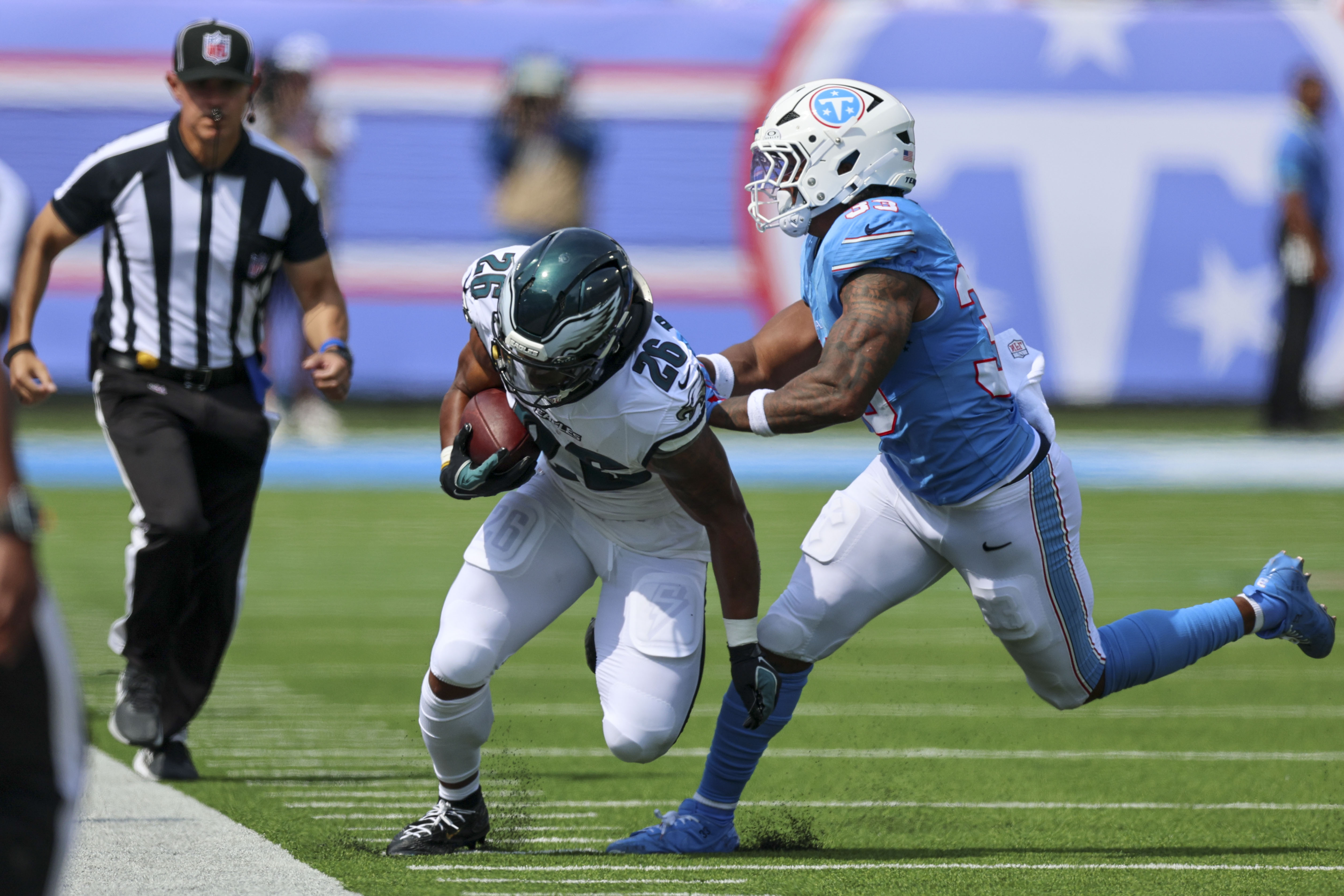
    There were some positives in the run game. Barkley rushed for 73 yards on 11 carries in the first half, but he gained just 9 yards on four carries after the break.

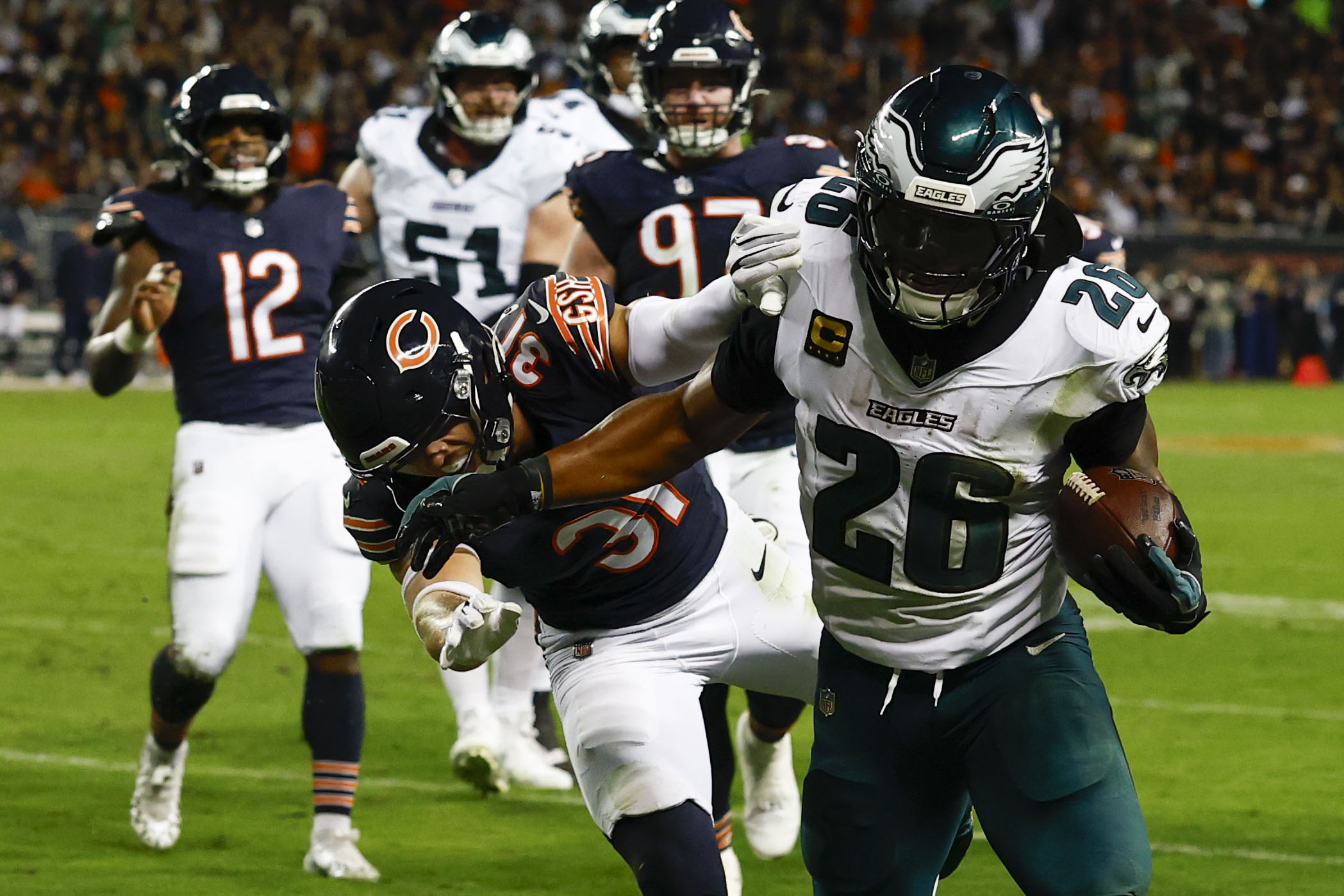
    Saquon Barkley nearly scores in the second quarter as Bears safety Dillon Thieneman pushes him out of bounds.Yong Kim / Staff Photographer

    Hurts didn’t look like the fearless, pocket-savvy passer that he appeared to be in the first two games. He had moments in the first half but also missed short throws, held the ball too long, and threw a ghastly fourth-down interception to T.J. Edwards a few drives after the former Eagle nearly duped the quarterback into another pick.

    Sirianni said he didn’t regret that fourth-and-5 decision that came at the Bears’ 46 just before the end of the third quarter. But it only made the other fourth-down call look that much worse.

    “I think competitively, I’m always going to want to go for it,” Hurts said. “Always trust coach to make the right decision, given these situations.”

    Tackle Lane Johnson suggested there was more at play than trying to draw the Bears offside.

    “I don’t know if we didn’t pay attention to the clock,” he said. “There was a play, but I don’t think we’re all on the same play. I think there’s a lot of miscommunication.”

    Rough day for Jalen Hurts: Here, he tries to throw the ball away as the Bears pass rush gets to him.Yong Kim / Staff Photographer

    Sirianni’s Eagles have bounced back from worse. The season is a marathon. You’ve got to think Fangio corrects some of the defensive miscues. And the positive steps Hurts seemingly took in the first two weeks can’t be forgotten with just one shaky performance.

    Change on offense was necessary, even if Kevin Patullo’s unit last season was never held under 10 points like Mannion’s was in just his third game as coordinator. But Sirianni remains the constant. Most of his teams have taken on his positive traits, if not one of the negatives.

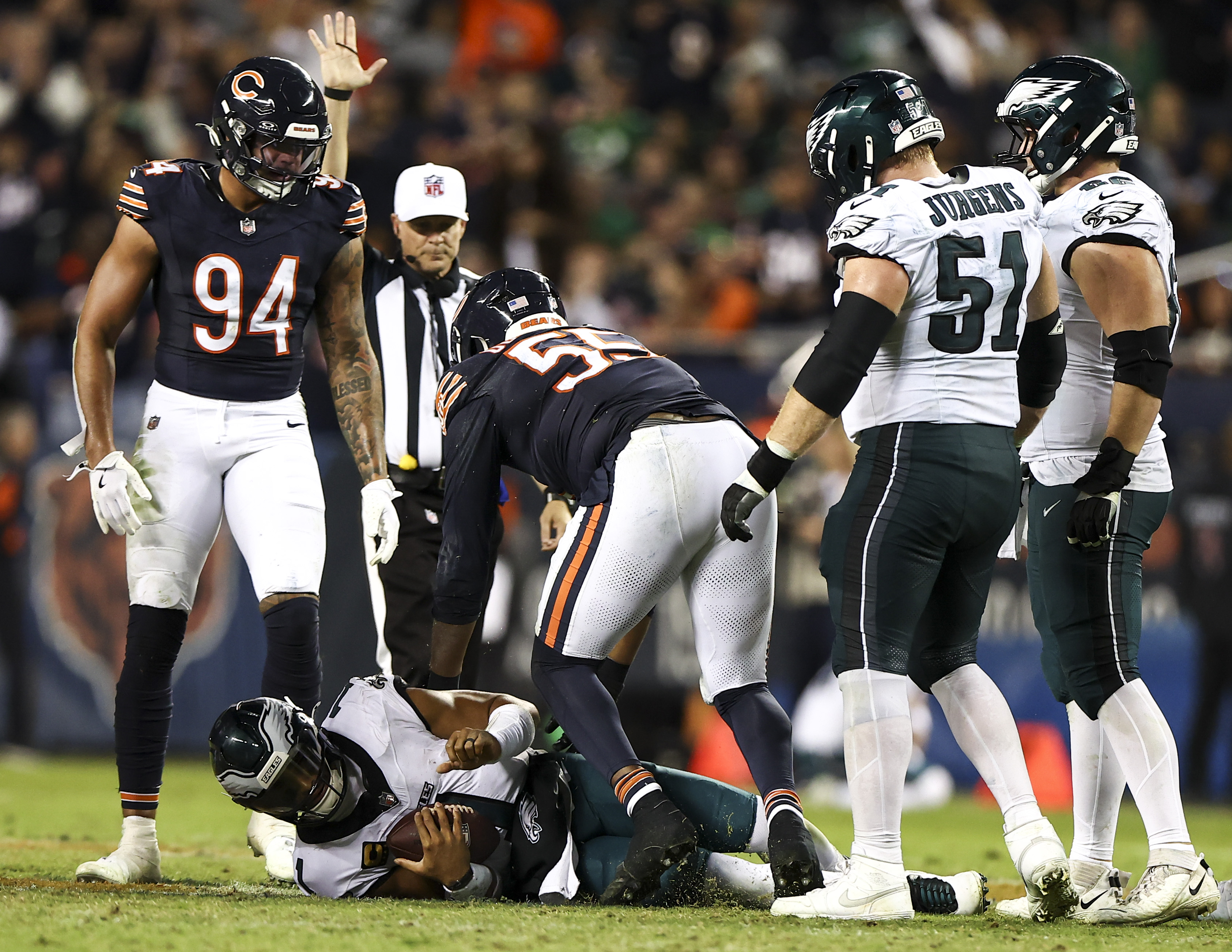
    He lost control of his emotions again after Hurts was decked by Bears linebacker D’Marco Jackson in the second quarter. It ended up being a fateful play, but the coach conceded that he went too far in yelling expletives at Jackson.

    “I always love fighting for our players. I love our guys,” Sirianni said. “And so, the emotion of the game probably got the better of me today. And I have to learn from that in that particular moment. I have to be more steady in that situation.”

    The Eagles, like their coach, got knocked off their axis at Soldier Field. The next few weeks could reveal if they have the resolve to get up after a shaky start.

  • Saquon Barkley says he’s ‘good to go’ for Monday’s game in Chicago after suffering stinger in Week 2

    Saquon Barkley says he’s ‘good to go’ for Monday’s game in Chicago after suffering stinger in Week 2

    Despite dropping out of the Eagles’ Week 2 win against the Tennessee Titans with a stinger, a nerve injury in the neck, Saquon Barkley said he’s “good to go” for Monday night’s game against the Chicago Bears.

    Barkley, the 29-year-old running back, sustained the injury on the first play of the contest and missed the rest of the first half. He returned in the second half, but was not on the field for most of the fourth quarter, including the game-winning drive orchestrated by Jalen Hurts.

    Going into the second half, Barkley said he felt like he had his strength back. He dropped out again because “it didn’t go the way I thought it was going to go,” he said.

    Barkley said he will likely continue wearing the cowboy collar — a neck protection device — that he sported when he returned to the Titans game. But with an extra day to prepare this week before leaving for Chicago, Barkley said the stinger shouldn’t affect him on the field.

    “That’s why I’m rehabbing my [butt] off to get as strong as it needs to be,” Barkley said on Friday. “I feel like I’m in a really good spot. I know they wouldn’t let me go up there if I wasn’t able to do it. So I feel like I’m in a good spot, and I’m just going to let the game come. And I’m going to go out there and play fearless.”

    Barkley underwent an MRI during the week to ensure that his injury wasn’t worse than the initial diagnosis. He acknowledged that he has a history of stingers, but this is the first “bad one” he has had in a long time.

    Saquon Barkley was limited to four carries for nine yards last week after he suffered a stinger on the first offensive play vs. the Titans.David Maialetti / Staff Photographer

    Five days after sustaining the injury, Barkley said his strength is back and he’s calmed down the nerve that he agitated. He was upgraded to a full participant in Friday’s practice after participating in a limited capacity on Thursday.

    In his ninth NFL season, Barkley said he has a “super active” focus on maintaining his lower body and promoting his longevity. But he conceded that he hasn’t put an equal emphasis on his neck stability and strength to this point.

    Barkley said the injury has served as a “wake-up call” in that regard. Now, with the training staff’s help, he’s making his neck a priority in his routine.

    “They put together a great game plan for me, and I’ve just been trying to follow that to the best of my abilities, and I’m excited for another opportunity this week,” Barkley said.

    Barkley and the Eagles’ blocking unit have another opportunity to make strides in the run game amid an average start to the season. Through two games, the Eagles rank in the middle of the pack of the league in expected points added per rush, according to Next Gen Stats.

    The new-look Eagles offense under Sean Mannion places an emphasis on marrying the run with the pass. If the run game can’t get going, and if the Eagles can’t stay on schedule when negative plays and penalties put them behind the sticks, then building the play-action pass game off the threat of the run becomes more difficult.

    But Barkley didn’t express concern about the state of the Eagles’ run game heading into their third game of the year. He said the run game is not a finished product — nor should it be at this point.

    Saquon Barkley’s stinger last Sunday kept him out of the entire first half.Yong Kim / Staff Photographer

    “It’s all relatively new to all of us in the run game,” Barkley said. “As we’re learning and trying to continue to buy into something new, we’re going out there and we’re seeing some funky looks, some weird looks. It’s a sign that the defense [is] still respecting the run game, which has opened up other things. But it’s going to be a beautiful thing when we’re all firing on the same page.

    “And talking to [Jalen Hurts] and the guys about it, and talking to the O-line, it’s not like a sense of any panic. Everybody wants the big numbers, but I’m in a good spot of knowing that the work that’s being put in, and just continue to focus on our process, and the results will come.”

  • What we know (and don’t) about the Eagles entering Week 3 vs. the Bears

    What we know (and don’t) about the Eagles entering Week 3 vs. the Bears

    The Eagles are 2-0, and not for the reasons one might have anticipated going into the season.

    The offense under Sean Mannion is supposed to be rooted in a sound running game. It hasn’t clicked yet, as evidenced by the Eagles’ minus-.09 expected points added per rush, which ranks in the middle of the pack as of Monday afternoon, according to Next Gen Stats.

    The defense under Vic Fangio in his third year as coordinator is supposed to set the floor for the team’s overall success this season. But through two weeks, the Eagles defense ranks below the median in EPA per play allowed at +.01.

    There’s plenty of time for the Eagles to improve in both facets. Still, arguably the biggest reason for the team’s 2-0 record through two weeks rests on the arm of Jalen Hurts and the plays he has pulled off in the passing game.

    Despite tossing two interceptions in the 24-20 win over the Tennessee Titans on Sunday, Hurts orchestrated his eighth fourth-quarter comeback since 2023, which is tied for the second-most in the NFL in that span, according to Next Gen Stats. For the last two weeks, Hurts has showcased his clutch gene and his ability to generate explosive passing and rushing plays, two encouraging traits from the franchise quarterback as the Eagles continue to acclimate to their new offense.

    Here’s what we know (and what we don’t) about the Eagles going into their Week 3 matchup against the 1-1 Chicago Bears:

    Defense loading

    The Eagles entered the season with high expectations on defense, given their talented personnel at every level and their coordinator continuity. But so far, the overall group is off to a relatively quiet start.

    To their credit, they have held their first two opponents, the Titans and the Washington Commanders, to less than 300 yards of offense, a feat only six other teams have accomplished heading into Monday night.

    But Nick Sirianni typically harps on winning the turnover battle. While the offense has given the ball away twice (on Hurts’ pair of interceptions against the Titans), the defense has yet to force a takeaway. Jalen Carter and Jihaad Campbell have forced fumbles, but the opposition ultimately recovered.

    Through two games, Vic Fangio’s much-heralded defense has yet to force a turnover.Yong Kim / Staff Photographer

    Through two weeks, the Eagles are one of three teams that have not generated a takeaway, along with the Commanders and the Houston Texans. Last year, the Eagles finished tied for 10th in takeaways with 21.
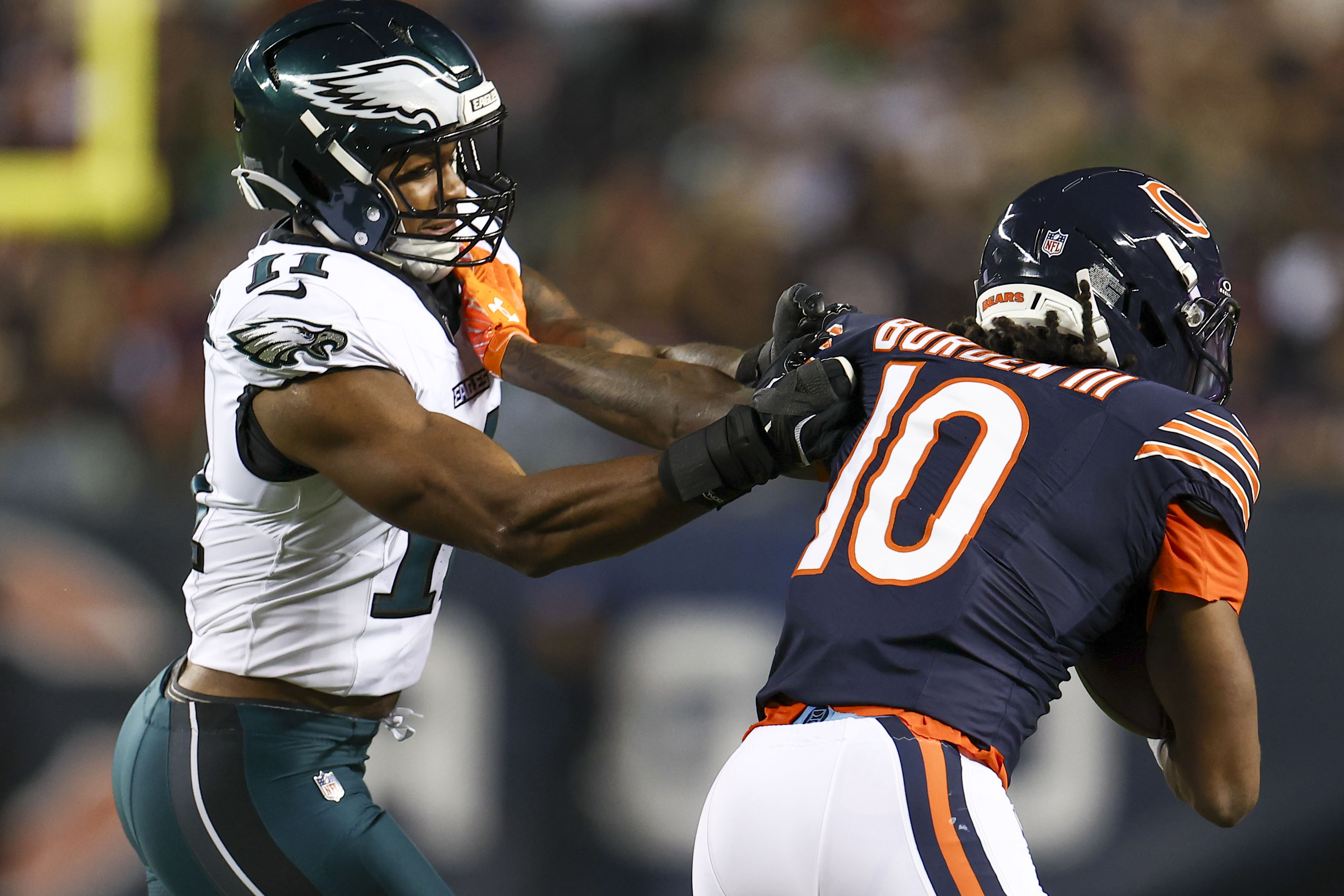
    The Eagles are also coming off of a poor tackling day in their win over the Titans. The team missed 12 tackles, according to Pro Football Focus, led by starting safety tandem Andrew Mukuba and Marcus Epps with three apiece. That issue was on display during the Titans’ go-ahead field-goal drive late in the fourth quarter, especially on running back Tyjae Spears’ 27-yard carry when he forced missed tackles from Moro Ojomo and Epps.
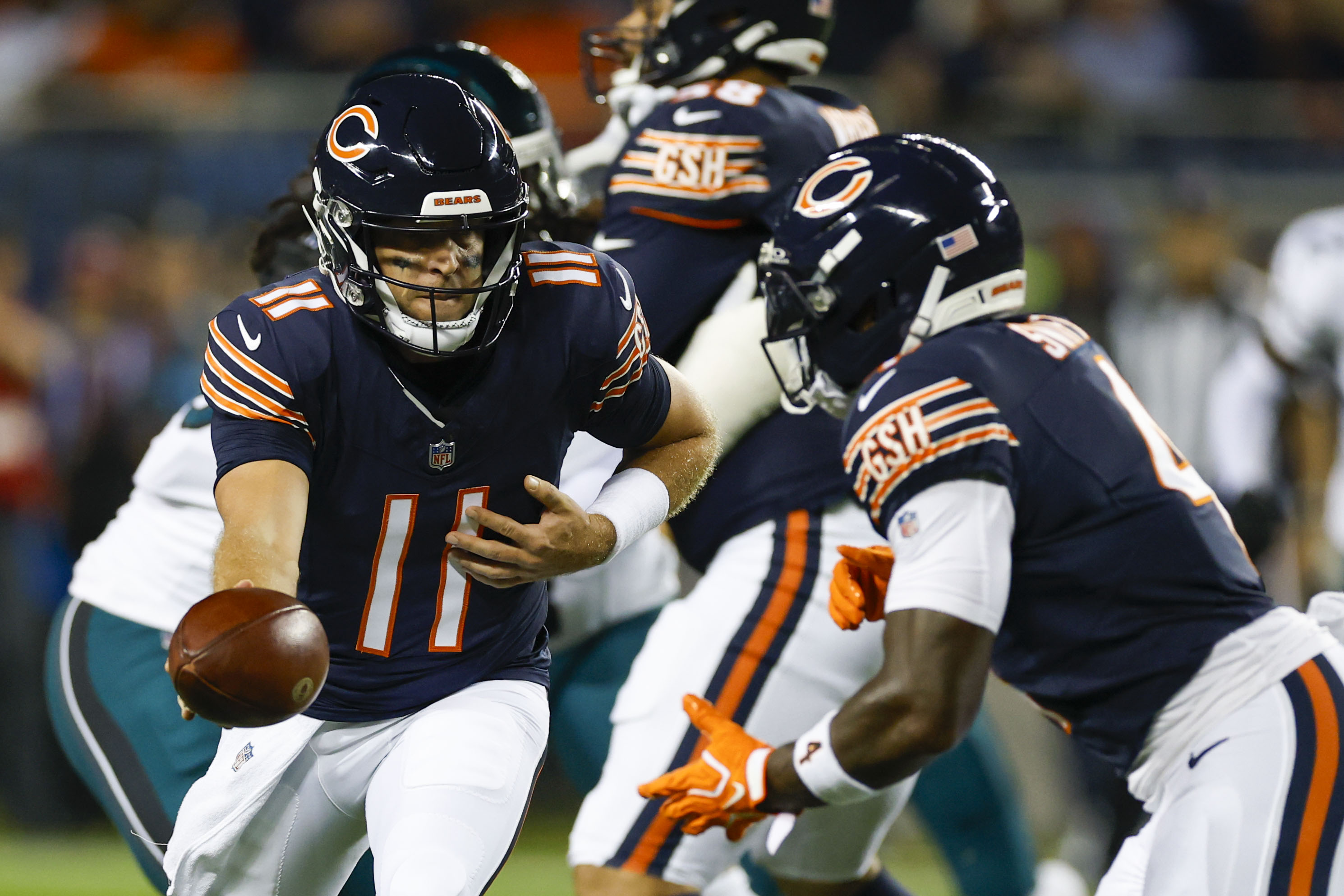
    The pass rush is a work in progress. According to Next Gen Stats, the Eagles are tied with the Titans for the highest average time to pressure (3.12 seconds) in the NFL.

    Two of these three issues — the lack of takeaways and the poor tackling — could be anomalies. The Eagles have fared well in turnover differential over the last couple of seasons, and they have been sound tacklers on the whole under Fangio.

    The lack of a prolific pass rush was an issue last year, too, leading to the acquisition of Jaelan Phillips at the trade deadline. Their output could improve when Jonathan Greenard, who has been ramping up in practice after sitting out of training camp with a pectoral injury, returns to action. Regardless, the Eagles have much to improve defensively going into Week 3.

    Bears down?

    Could the Eagles defense catch a break against the Bears?

    Third-year starting quarterback Caleb Williams went down with a hamstring injury in the fourth quarter of the Bears’ 9-3 loss to the Minnesota Vikings on Sunday. Bears head coach Ben Johnson said Monday on Chicago radio station ESPN1000 that Williams is considered “week to week.”

    Chicago Bears quarterback Caleb Williams looks to be a long shot to play Monday after injuring his hamstring in Week 2.Nam Y. Huh

    Last season, Williams and the Bears handed the Eagles a 24-15 loss, gashing them on the ground thanks to a combined 255 rushing yards from running backs D’Andre Swift and Kyle Monangai. Williams was less than stellar in that game, going 17 of 36 (47.2%) for 154 yards with one touchdown and one interception.

    Still, the windy elements played a role in the passing game that day, and Williams was otherwise solid in his first year under Johnson.

    If Williams can’t go on Monday night, the Bears may not be able to turn to backup Tyson Bagent to start at quarterback. According to ESPN report from Tuesday, the 2023 undrafted free agent out of Division II Shepherd University is in the concussion protocol.

    Bagent entered Sunday’s game down 6-3 against a talented Vikings defense with 7 minutes, 15 seconds left in the game. He had the opportunity to win it with a minute remaining, but he was sacked on the final play at the Vikings’ 12 on fourth down. With his status in question, the Bears could turn to third-stringer Case Keenum, the 38-year-old NFL veteran who last saw game action in 2023 as a member of the Houston Texans.

    Keenum is 0-2 against the Eagles, including his 2017 NFC championship game loss as a member of the Minnesota Vikings and his 2019 regular-season loss with Washington. Both games were in Philadelphia. He has been with the Bears since the start of the 2025 season, coinciding with the beginning of Johnson’s tenure as head coach.

    But if Williams can play against the Eagles, how would his hamstring injury limit him, especially on the ground?

    Williams is adept at extending plays with his legs and scrambling, traits he showcased in the loss to the Vikings, as he picked up 27 scramble yards, according to PFF. He threw an interception, though, while fleeing the pocket prematurely in the first quarter on Sunday.

    Ertz in action

    With Dallas Goedert out of commission for the next few weeks due to a sprained medial collateral ligament (MCL) in his knee sustained against the Titans, the Eagles are signing a familiar face in Zach Ertz to infuse pass-catching prowess into the tight ends room.

    Ertz, who turns 36 in November, is set to join the practice squad. But he could be a candidate to be elevated to the game day roster against the Bears, as he was cleared for football activity in July, seven months after he tore his ACL in Week 14 last season as a member of the Commanders.

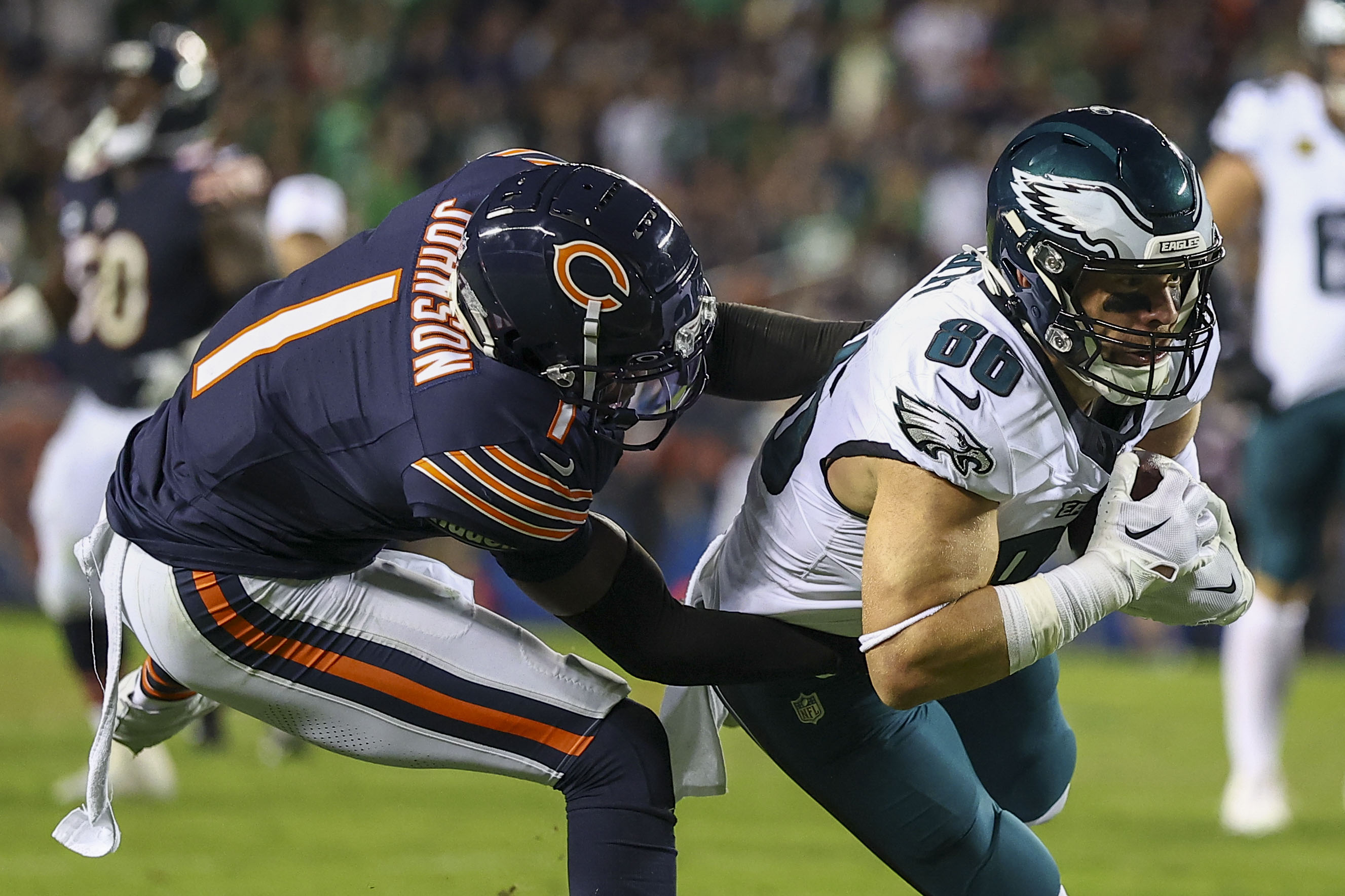
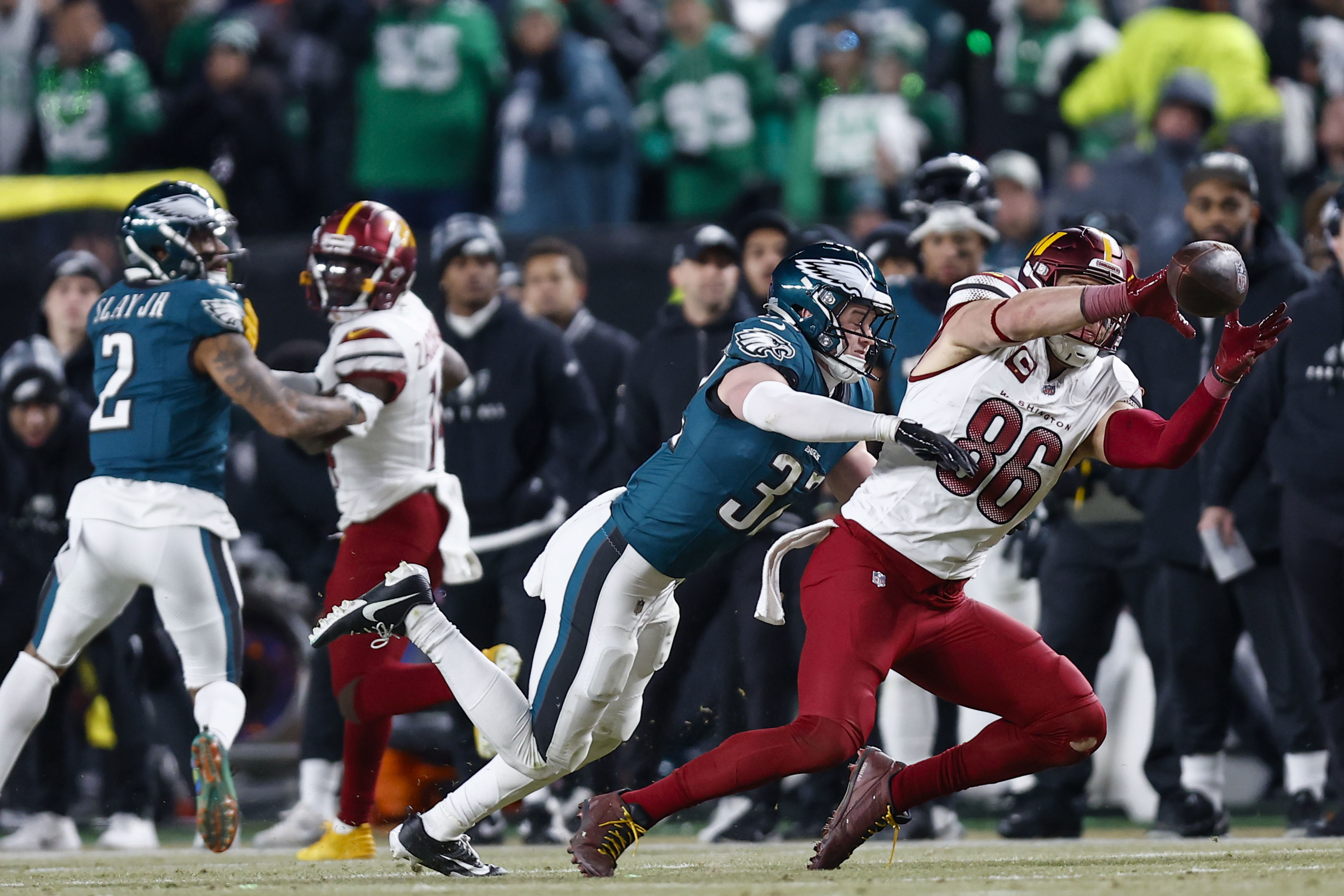
    With tight end Dallas Goedert set to miss time, the Eagles are reuniting with franchise legend Zach Ertz (86). Monica Herndon / Staff Photographer

    The Eagles could use his receiving ability, stat. Aside from the injured Goedert, they currently have two tight ends on the active roster in Johnny Mundt and EJ Jenkins. Mundt, 31, has been heralded for his blocking ability throughout his 10-year NFL career. Jenkins has grown as a blocker, as Howie Roseman acknowledged after training camp, and while he converted from wide receiver to tight end in the NFL, he has just one reception for 7 yards in his pro career.

    With the addition of Ertz, the Eagles could take advantage of a Bears defense that has been challenged to cover tight ends through two games.

    The Bears defense has conceded 115 yards on 10 receptions to tight ends, the 10th-most yardage in the league. The Vikings’ T.J. Hockenson had the most success of any tight end to face the Bears on Sunday, totaling 29 yards on three receptions.

    Hockenson’s best play came on a second-and-10 under-center play-action fake in the fourth quarter in which he blocked at the line of scrimmage to sell the run. He then made the Bears defenders pay for biting on the fake by leaking downfield and hauling in a 19-yard pass from Carson Wentz.

    Ertz might not be known for his blocking ability, but he has made similar plays on play-action passes, including his 20-yard touchdown reception last season against the Green Bay Packers.

    He stands to make the biggest impact in the red zone, as all 16 of his touchdown catches over his last four seasons since he departed Philadelphia in 2021 have come inside the 20.

  • Source: Eagles tight end Dallas Goedert will miss time with a knee injury

    Source: Eagles tight end Dallas Goedert will miss time with a knee injury

    The Eagles will be without Dallas Goedert for the time being.

    A league source confirmed an NFL Network/ESPN report that Goedert suffered a sprained medial collateral ligament (MCL) in his knee during the team’s 24-20 win over the Tennessee Titans on Sunday. Goedert is expected to miss a few weeks with the injury.

    The Eagles’ top tight end appeared to suffer his injury while run blocking in the second quarter. He did not return to the game.

    Goedert’s absence left the Eagles in an interesting situation at the position, and general manager Howie Roseman responded quickly by signing longtime Eagle Zach Ertz.

    The healthy tight ends behind Goedert on the depth chart prior to signing Ertz were blocking specialists in Johnny Mundt and EJ Jenkins. Goedert starred in Week 1 with four catches for 77 yards and two scores. Mundt, meanwhile, has been targeted three times on 69 snaps through two games. The Eagles have been in 12 personnel (one running back, two tight ends) on 22.4% of their offensive plays this season, according to Sumer Sports. Without Goedert on the field, the Eagles don’t have a real pass-catching threat in those sets.

    They aimed to fill their pass-catching depth issue behind Goedert when they drafted Eli Stowers in the second round, but the rookie had a slow start to training camp and is on injured reserve while he recovers from a hamstring injury. Grant Calcaterra (back) also is on injured reserve. The Eagles have one tight end on the practice squad, veteran Josiah Deguara, who has 14 catches over the last three seasons.

    Dallas Goedert was Jalen Hurts’ favorite target in Week 1.Yong Kim / Staff Photographer

    Ertz, 35, needs just 11 more receptions to break Harold Carmichael’s franchise record of 589 to become the Eagles’ all-time receptions leader. He is only nine months removed from a major knee injury, but he gives the Eagles a veteran pass-catching option.

    “I know [Roseman] will do everything he can do if we are without Dallas,” Nick Sirianni said when asked about the position group on Monday. “We’ll see where we are.”

    A few hours later, it all became clearer.

    Goedert wasn’t the only key offensive player getting further testing after Sunday.

    Saquon Barkley left Sunday’s game after suffering a stinger and was set to get an MRI on Monday. He was injured on the Eagles’ first offensive play. He returned in the second half but only briefly before being forced to miss the rest of the game.

    If Barkley misses game action, it would be a big blow to a running game that hasn’t really gotten off the ground through two games.

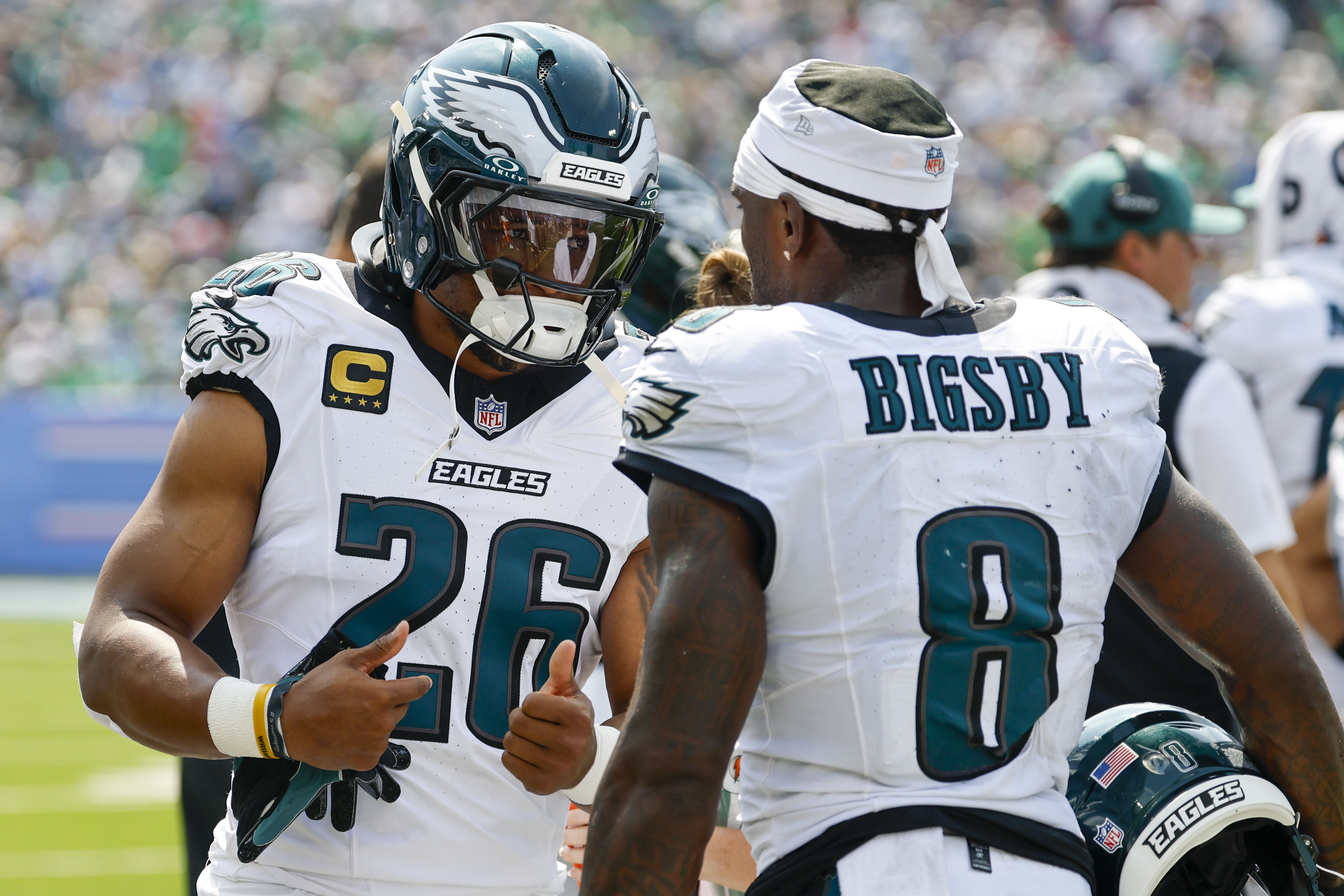
    The Eagles have capable backups behind Barkley in Tank Bigsby and Will Shipley, and an experienced running back on the practice squad in Dameon Pierce — as well as preseason darling Carson Steele.

    Sirianni remains confident in the running game

    With or without Barkley, the Eagles need to start running the ball with more efficiency and consistency.

    It is the key to their offense, considering the new scheme under coordinator Sean Mannion relies on marrying the run and pass games and utilizing under-center play action. Those things aren’t possible when you’re not moving the ball on the ground. Four Eagles — including Barkley, not including Jalen Hurts, and not counting a behind-the-line swing pass to Makai Lemon — combined for 78 yards on 27 carries Sunday. They had better per-carry success in Week 1, but take Barkley’s 42-yard burst out of the equation and the stat line from the running backs was 48 yards on 17 carries.

    Saquon Barkley rushed for just 9 yards on four carries vs. the Titans.Yong Kim / Staff Photographer

    The new-look offense has the Eagles running more wide zone blocking schemes, and so far the execution up front hasn’t been consistent enough.

    Sirianni called it a “full-team effort” that includes coaching better.

    “We have to be better as a whole there, and we’re going to continue to work like crazy to get to that portion,” Sirianni said. “We’ve found ways to win the first two games, but we know we’re capable of being better in the run game. And I think there’s elements of it being close, too.

    “They’re going to junk it up enough that when you get the looks that are really good looks, you got to make them pay when they’re in that, and we’re close. We are close.”

  • Eagles grades vs. Titans: Jalen Hurts steps up, O-line shaky, defense a mixed bag

    Eagles grades vs. Titans: Jalen Hurts steps up, O-line shaky, defense a mixed bag

    NASHVILLE — Instant grades on the Eagles’ performance in their 24-20 win over the Tennessee Titans:

    Quarterback – B+

    Jalen Hurts was excellent. Yeah, he tossed two bad interceptions. But good far outweighed the bad and Hurts ultimately drove the Eagles to victory with his two-minute, touchdown scoring drive. He threw for 264 yards and two touchdowns on 26 of 37 passing. Hurts also had some key moments on the ground. He did all of this despite the schematic and execution issues with the offensive line.

    Aside from the interception, Hurts was nearly flawless in the first half. He kept bailing the offense out on third-and-longs and converted five first-downs of four yards or more. He also did it with his legs once, running for a first down on third-and-4. Hurts has a 7-yard scramble that set up a fourth-and-2 he would subsequently convert with a throw to Wicks.

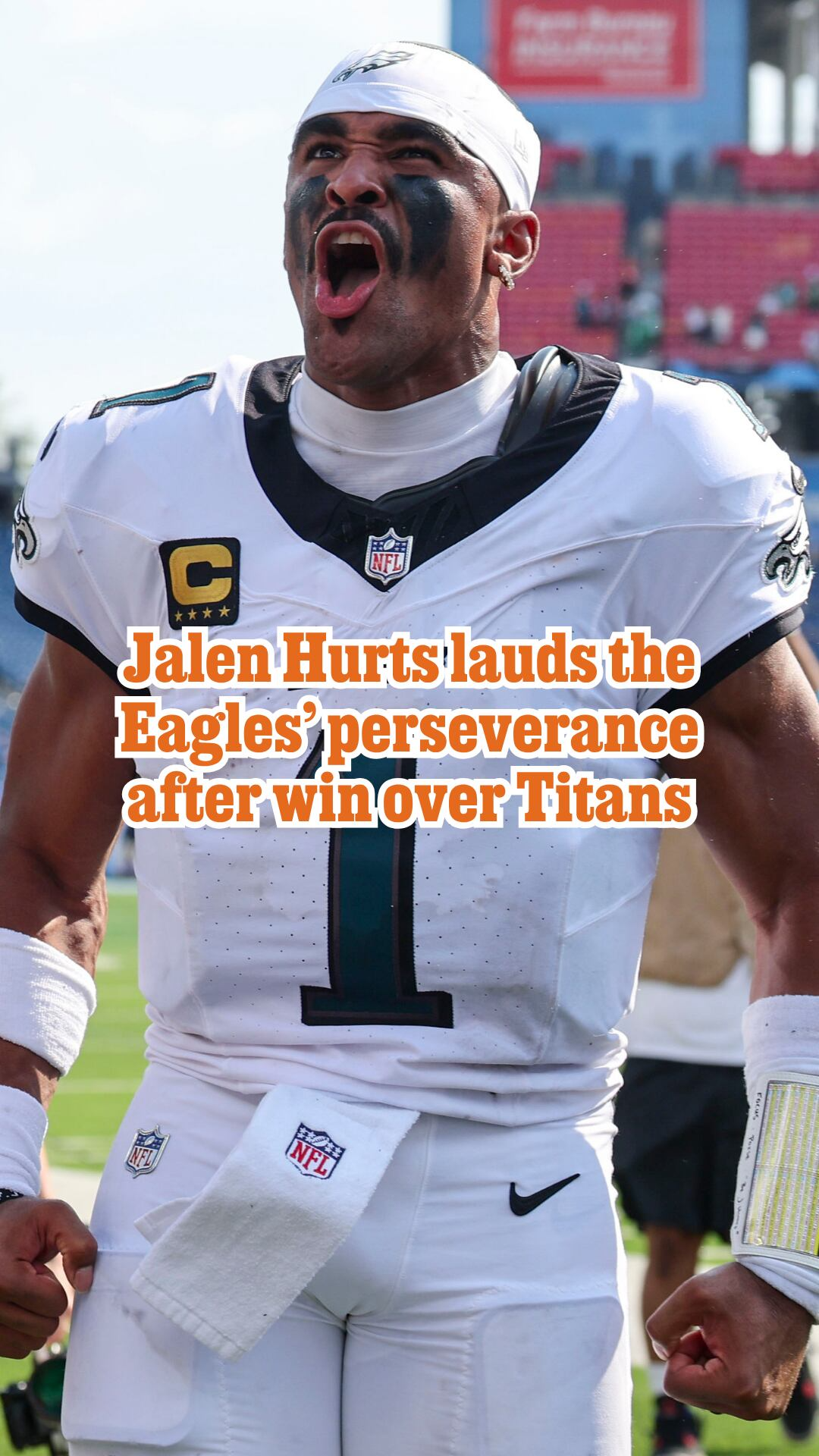
    Jalen Hurts lauds the Eagles' perseverance after win over Titans
    Video: Jalen Hurts lauds the Eagles’ perseverance after win over Titans

    Hurts looked comfortable in the pocket despite some pressure. He hooked up with Wicks for a 27-yard pass over the middle with a rusher in his face, and later got the ball out to Wicks for a 15-yard gain on third-and-12 — just before Simmons hit him. His 22-yard touchdown pass to Smith before the break came on second-and-19.

    There was the costly interception on third-and-goal, of course. The pass to Smith was undercut by safety Amani Hooker, who went 92 yards the other way. The Titans converted the turnover into a touchdown.

    Running back — C+

    Saquon Barkley left on the first play when he suffered a stinger. He returned to the sideline after a brief stay in the locker room, but didn’t play until the second half. Barkley caught an 11-yard swing pass on third-and-5. As a rusher, he finished with just nine yards on four carries.

    With Barkley out for most of the first half, Tank Bigsby and Will Shipley shouldered the load in the backfield. They ran hard and had some nice moments, but the blocking up front was mostly porous. The duo rushed 17 times for a combined 51 yards (3.0 average) before the break.

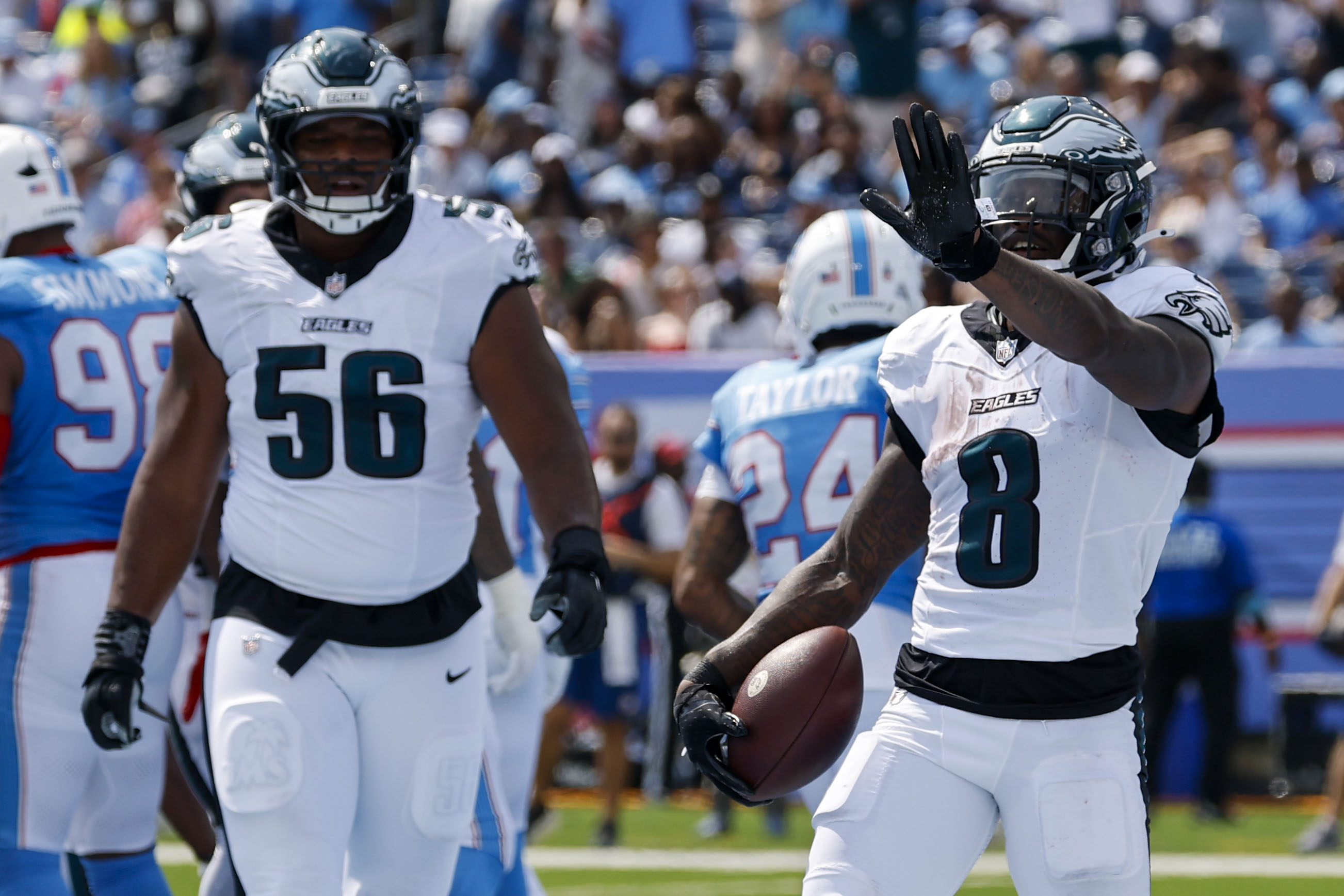
    Tank Bigsby (8) found the end zone in relief of an injured Saquon Barkley. Yong Kim / Staff Photographer

    Bigsby kept churning on a 9-yard carry down to the 2-yard line early in the second quarter, and went into the end zone on the next play for the Eagles’ first touchdown. He slipped and lost two yards on his first carry of the second half.

    Shipley got the nod on the Eagles’ last drive. He helped pick up the blitz on Hurts’ 20-yard throw to Wicks.

    Gameday Central: Initial reaction to the Eagles' comeback win vs. Titans
    Video: Gameday Central: Initial reaction to the Eagles’ comeback win vs. Titans

    Receiver / Tight end — A-

    Receiver DeVonta Smith did all could do. He made one tough catch after another and led the Eagles with 10 catches for 117 yards. He caught a 22-yard touchdown on a corner route in the second quarter. Smith converted an early third down on an 8-yard slant. He also had a key lead block on Hurts’ third-down conversion on the ground in the second quarter. He made a difficult toe-dragging grab near the sideline and then a 19-yard snag down to the 3-yard line on the final drive.

    Dontayvion Wicks was just as reliable when targeted. He caught a 27-yard pass over the middle on third and 12 on the Eagles’ first drive. Wicks converted fourth down with a 5-yard catch in the second quarter. He finished with five receptions for 74 yards, but left late with an injury. Rookie Makai Lemon is still finding his NFL legs. On his first career first down, he pulled in a 14-yard grab on third down late in the first quarter. Another screen pass, though, resulted in Lemon getting dropped for a loss in the second quarter. He had nowhere to go.

    Dontayvion Wicks continued to add value for the Eagles passing game. Yong Kim / Staff Photographer

    Darius Cooper made the game-winning touchdown catch when he went up for Hurts’ lob and kept both feet inbounds. Earlier in the fourth quarter, he got open and picked up 23 yards.

    Tight end Dallas Goedert got upended while run blocking in the second quarter and didn’t return because of the knee injury. Johnny Mundt had more receiving responsibility with Goedert out. He drew an illegal use of the hands penalty in the second quarter. Mundt seemed to miss his assignment on an outside zone run that netted few yards just before the half. He held on a Hollywood Brown end around in the fourth quarter.

    After not playing a snap in the first game, Brown was featured at times on offense. He ran nine yards on a sweep play in the second quarter.

    Offensive line — C-

    To some surprise, the Eagles made changes at two spots when they only needed to replace Landon Dickerson. They moved Cam Jurgens to left guard and started Drew Kendall at center. It was often ugly. But it was another shaky outing from new O-line coach Chris Kuper’s entire group. The run blocking just wasn’t sound. The pass protection was only a little better.

    There was the matter of containing Jeffery Simmons. The All pro defensive tackle owned Kendall on the Eagles’ opening drive and forced Hurts to burn a throw into the ground. Kendall appeared to miss a block. The second-year O-lineman had a tough assignment, but it was a grind.

    Drew Kendall (66) and the Eagles offensive line had its struggles on Sunday. Yong Kim / Staff Photographer

    Jurgens struggled vs. Simmons and others. He got spun around by the defensive tackle on a run play in which Bigsby was stretched out for no gain. Jurgens also got knocked off balance by Titans D-tackle John Franklin-Myers in the second quarter. He was a turnstile on edge Jacob Martin’s third-down sack of Hurts in the third quarter.

    Right guard Tyler Steen didn’t hold up either. He got beat by D-tackle Nazir Stackhouse and later by Simmons on late second quarter runs that resulted in losses. He committed a holding penalty to open the second half. Steen got beat again on a third-down rush in the third quarter in which Hurts had to escape.

    Lane Johnson and Jordan Mailata were decent in pass protection, but they had breakdowns, too. Johnson struggled with his block on the play in which Barkley got hurt. He also lined up illegally early in the second half. Mailata got surprised by an outside twist by Simmons, and landed on his rear on Hurts’ touchdown throw to Smith.

    Defensive line — B-

    The front looked gassed at times, and understandably so. It was hot. There were a lot of D-linemen with hands on their hips at the end of the Titans’ 12-play touchdown drive late in the third quarter. The run defense was leaky at times. There wasn’t enough pressure on the few times quarterback Cam Ward dropped on obvious pass downs. They did stand tall and force a field goal at the end.

    Jalen Carter, playing with a soft cast on his wrist, was relatively quiet for the first three quarters. He did bust through on a run play in the third quarter and sacked Ward late in the fourth. Jordan Davis didn’t dominate in the run game like he normally does. Moro Ojomo had a big tackle for loss in the fourth quarter.

    Nolan Smith Jr. (3) had a sack of Cam Ward on Sunday. Yong Kim / Staff Photographer

    Edge Jonathan Greenard (pectoral) was out for a second straight week. Jalyx Hunt got things started with a tackle for loss on Pollard’s first carry. Hunt later squeezed into the backfield to force running back Tyjae Spears into Davis’ arms. As a pass rusher, he drew a face mask when he penetrated on an inside stunt in the second quarter.

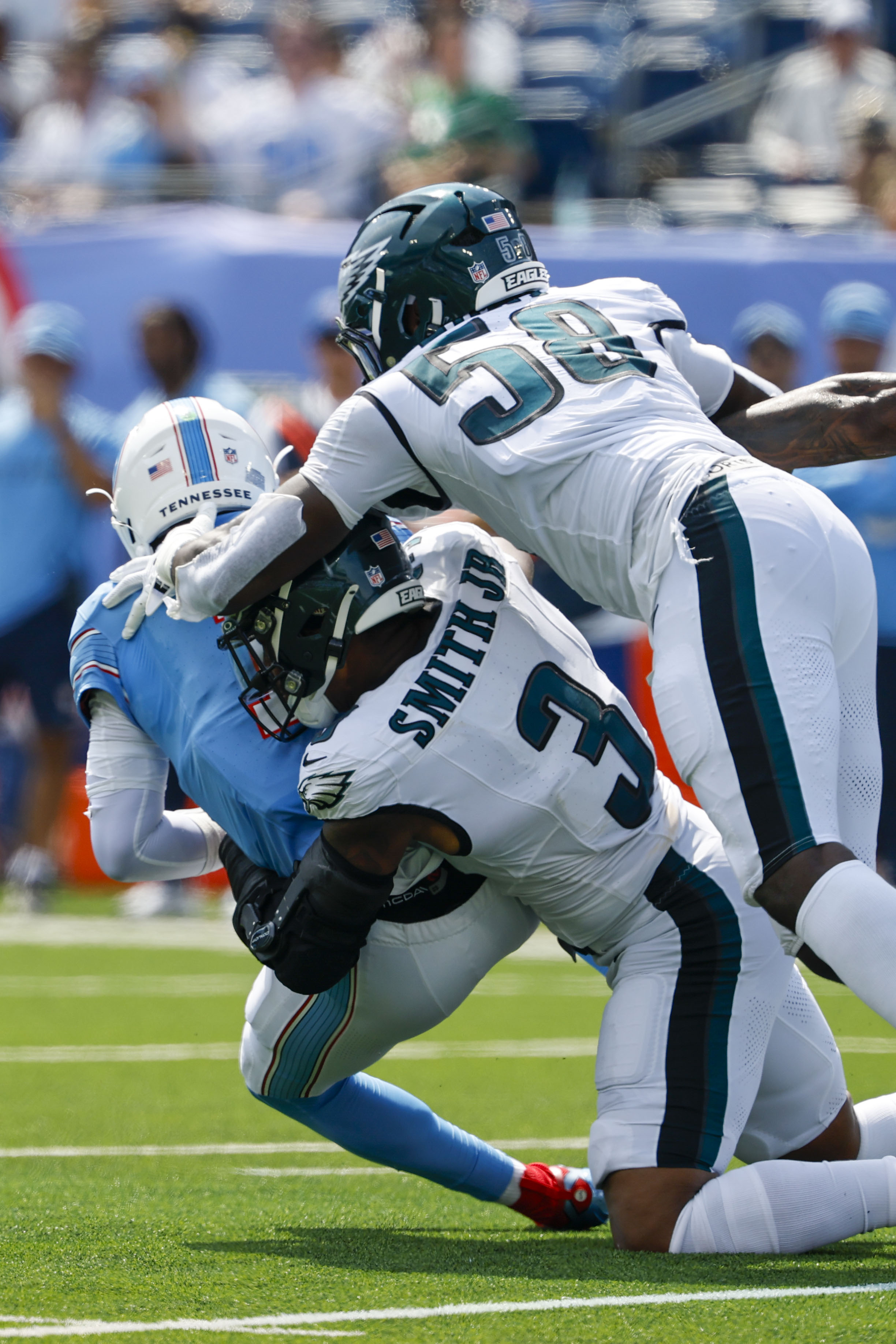
    In the second half, his edge setting contributed to a Pollard run for no gain. Nolan Smith Jr. got home for a sack with an inside rush late in the second quarter. Smith also had a tackle for loss on a run in the fourth quarter.

    Defensive tackles Byron Young and Ty Robinson got some snaps in the heat.

    Linebacker — C+

    There was just too much leakage against a Titans offense that looked near-pathetic in the first week, and the off-ball linebackers were just as responsible. Zack Baun appeared to over-pursue on Pollard’s 13-yard run on third-and-1 in the second quarter. Baun also missed an open field tackle on a dump pass that sprung Spears for 27 yards just before the half. He did stop Titans running back Nick Singleton for a loss in the third quarter.

    Jihaad Campbell did well to shed a block and stop a screen for no gain on the Titans’ first possession. He was targeted through the air several times. Both linebackers bit on a play fake and Ward hit receiver Calvin Ridley for a 25-yard catch in the third quarter.

    Riq Woolen and the Eagles cornerbacks had their share of challenges against a nondescript Titans receiving corps. Yong Kim / Staff Photographer

    Cornerback — B

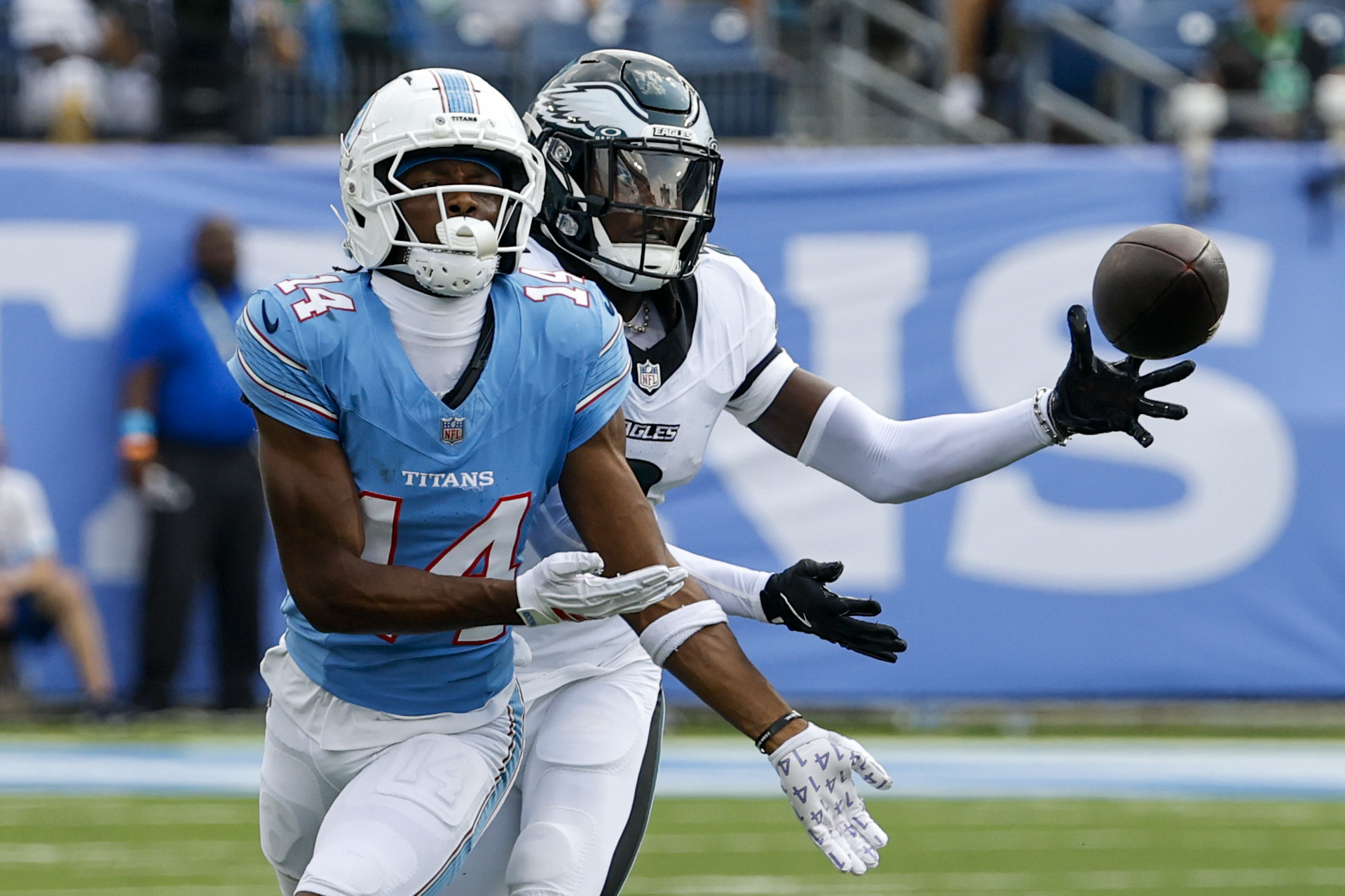
    Ward didn’t drop to throw much downfield, but when he did he was more efficient than he should have been. Quinyon Mitchell and Riq Woolen did keep Titans receivers from winning often on the outside. Receiver Calvin Ridley hauled in a first down on a slant in front of Mitchell. His run defense on Spears’ 27-yard run was not ideal.

    Cooper DeJean rebounded from last week’s rough outing. He tackled rookie receiver Carnell Tate short of the sticks on third down in the third quarter. Mitchell and Cooper were victimized by a soft zone on third and 13 when Ward hit receiver Elic Ayomanor for 28 yards on a slant route.

    Safety — C-

    The tackling at the safety spot just wasn’t good enough. Andrew Mukuba played despite being questionable after suffering a knee injury in practice. He drilled Tate over the middle early on. Mukuba appeared to lose receiver Wan’Dale Robinson on a third-and-5 conversion in the third quarter. It came when DeJean blitzed off the edge.

    Mukuba made a strong run stop at the goal line in the third quarter. But he had a weak tackle tackle on a Pollard 18-yard bolt up the middle in the fourth quarter.

    Marcus Epps was in the vicinity over the top on Ayomanor’s 28-yard catch in the middle of the Eagles’ Bermuda Triangle. Epps got hurdled over in the fourth quarter. Later in the drive, he totally overran the play on Spears’ 27-run on third-and-22.

    Jake Elliott (4) nailed a 58-yarder in the Nashville heat. Yong Kim / Staff Photographer

    Special teams — A

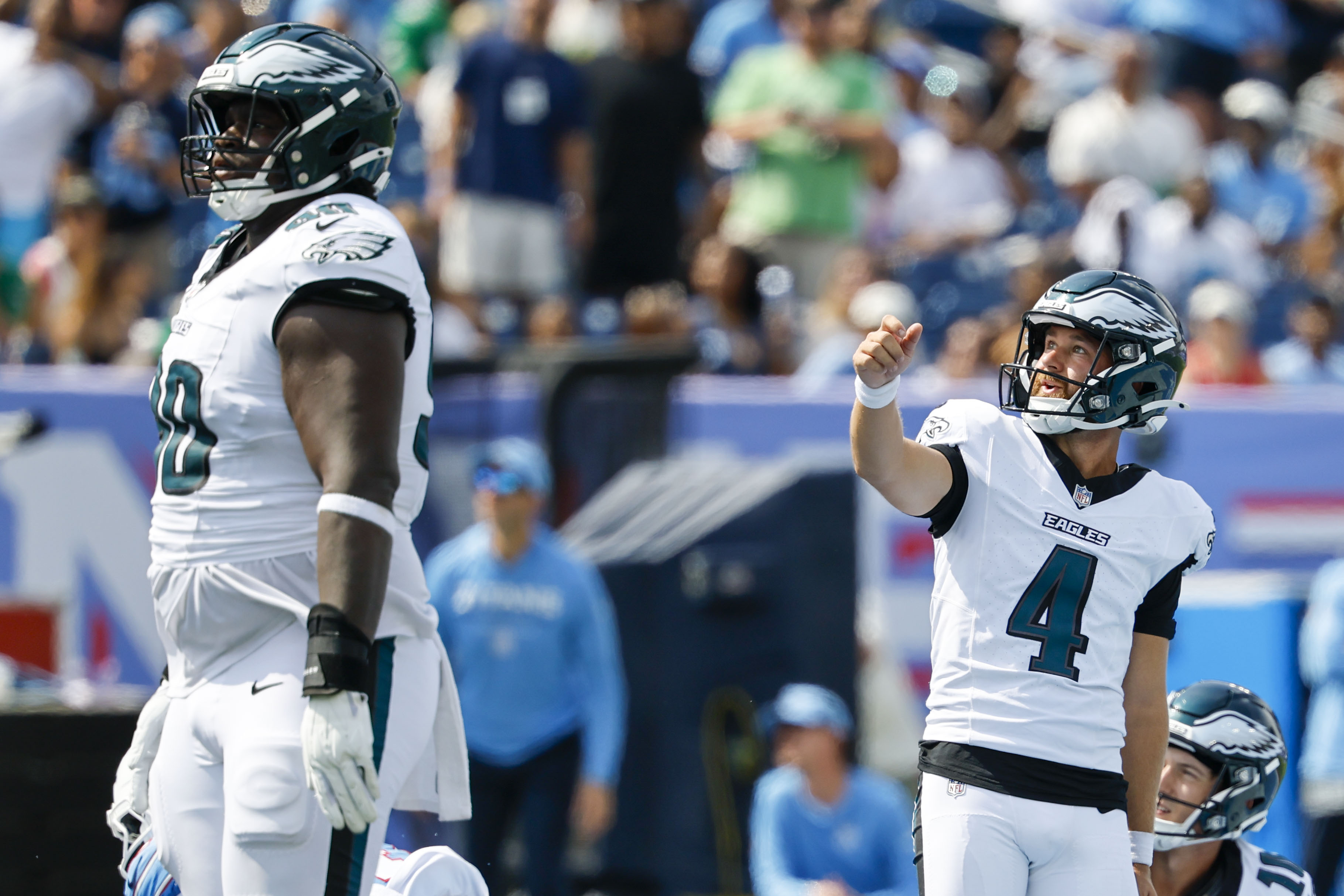
    Kicker Jake Elliott nailed a 58-yard field goal in the third quarter. It tied the fourth-longest kick of his career.

    Braden Mann averaged 50.5 net yards on two punts. His first punt didn’t come until the third quarter when he booted a 57-yarder that was fair caught. Britain Covey averaged 15.5 yards on two punt returns and had a 23-yarder. He was also back on kickoffs, along with Shipley, given Titans kicker Joey Slye’s ability to hit knuckleballs. Alas, Slye never tried one.

    Coaching — B-

    Coach Nick Sirianni ended the Eagles’ streak of forgettable trips to the Music City. It looked like they might exit Tennessee with another nasty loss. But Hurts carried his team to victory and a 2-0 record despite the sloppy game against an inferior opponent. Real tests are forthcoming.

    We saw the return of the Tush Push for the first time this season. It led to a Titans offsides penalty on the first try and Hurts converted on the second.

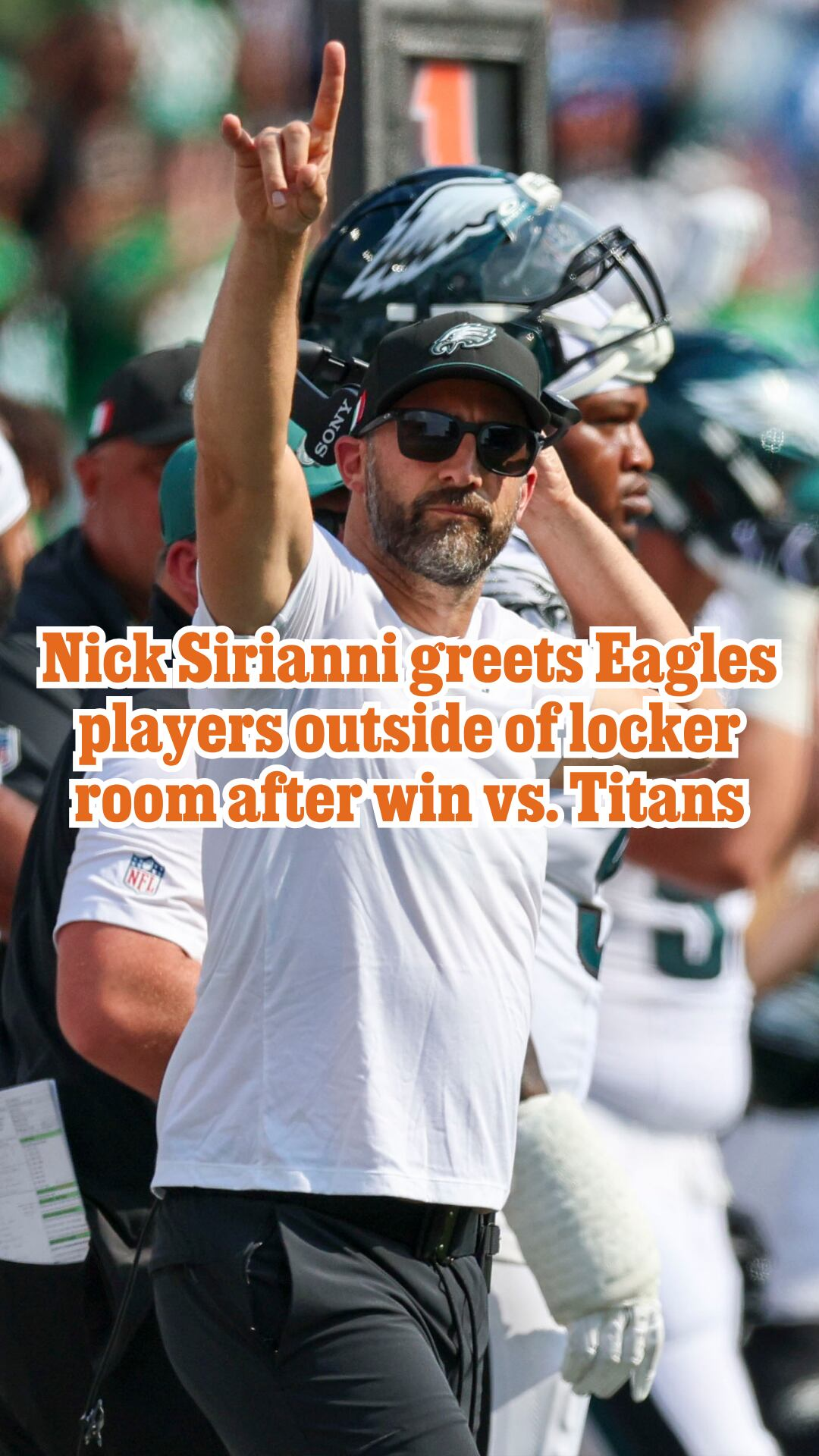
    Nick Sirianni greets Eagles players outside of locker room after win vs. Titans
    Video: Nick Sirianni greets Eagles players outside of locker room after win vs. Titans

    Offensive coordinator Sean Mannion is still feeling his way in the new job. The new stuff he brought from the Kyle Shanahan scheme just hasn’t clicked enough. Hurts had more success when he was in shotgun on third downs. Mannion’s play-calling had more rhythm than it did in the first week, but the issues on early downs continued. There just wasn’t a good plan nor execution on first- and second-down run plays.

    Defensive coordinator Vic Fangio’s unit held the Titans to just 20 points, but it’s not like Ward and Co. were considered a top offense. Fangio had some suspect calls on third down and probably played it too passive on third-and-13 before the half.

  • Eagles win 24-20 thriller in steamy Nashville; Jalen Hurts atones for two INTs with epic two-minute drive vs. Titans

    Eagles win 24-20 thriller in steamy Nashville; Jalen Hurts atones for two INTs with epic two-minute drive vs. Titans

    NASHVILLE, Tenn. — On Sunday afternoon in the Music City, the Tennessee Titans wound up singing the blues.

    After the Titans took a three-point lead on a 32-yard field goal late in the fourth quarter, the Eagles got the ball back with 1 minute, 56 seconds left to play.

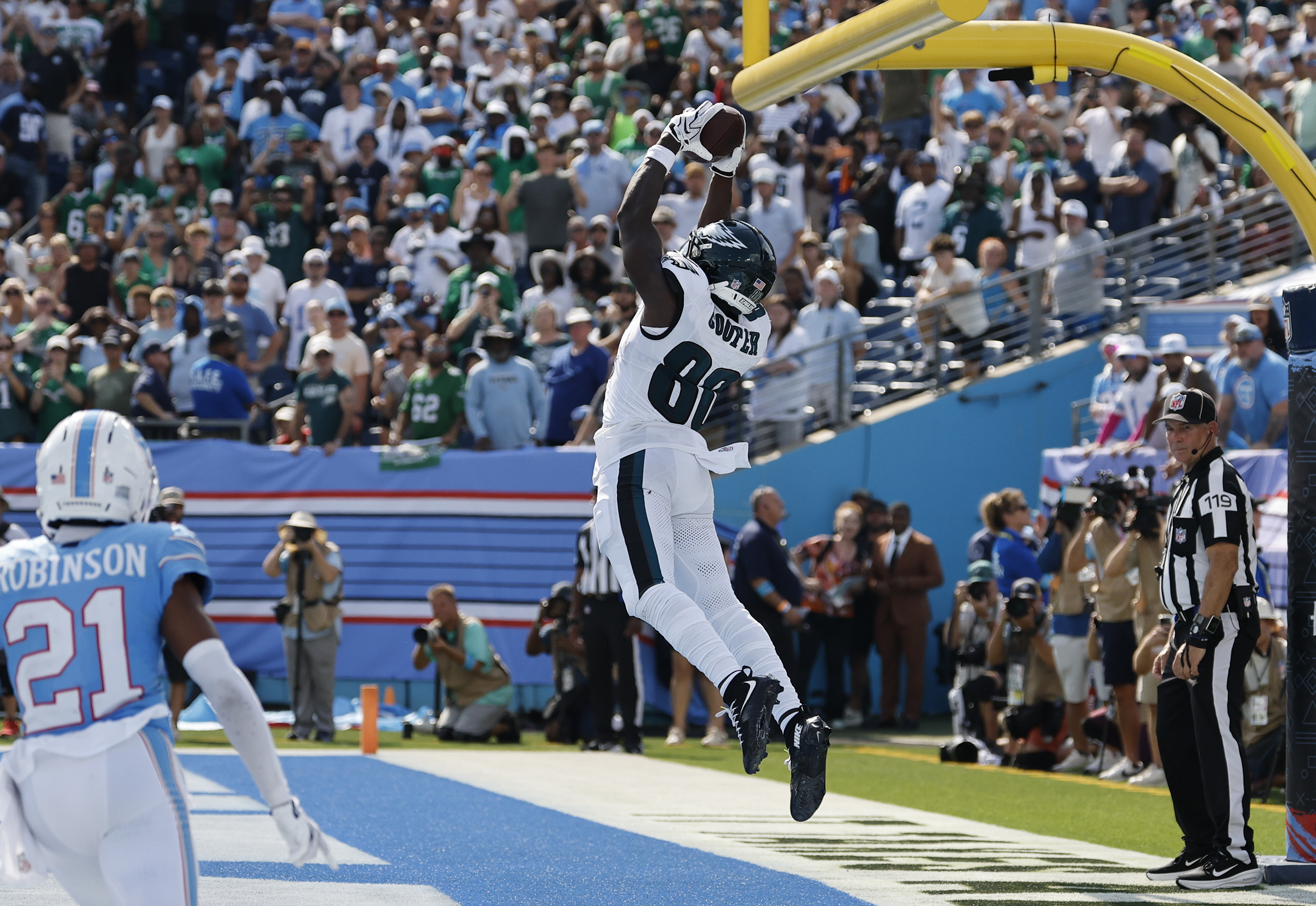
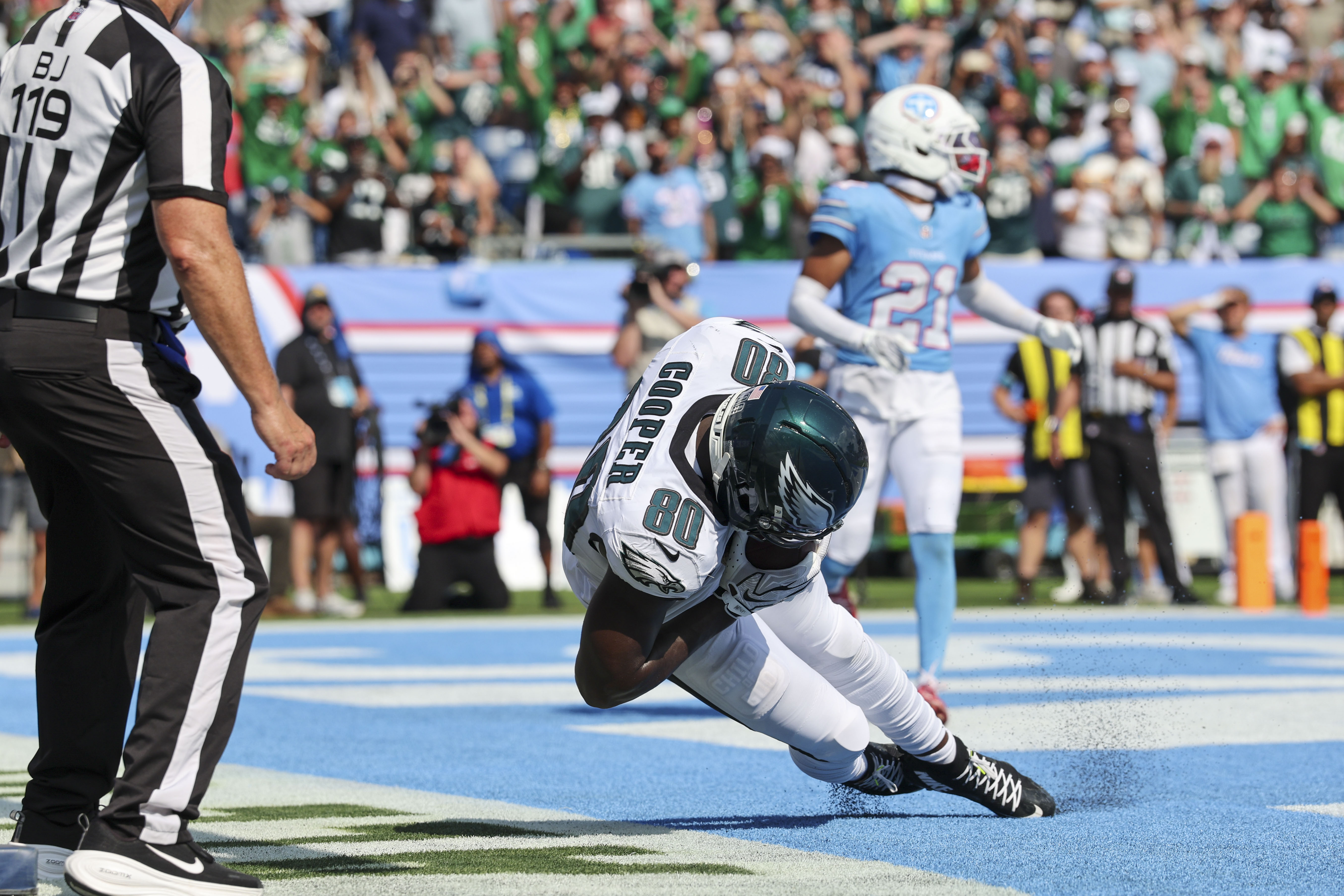
    Jalen Hurts, who threw two interceptions earlier in the game, orchestrated a nine-play, 65-yard scoring drive, capped by a 3-yard Darius Cooper touchdown catch in the back of the end zone to seal the 24-20 Eagles comeback victory.

    Eagles wide receiver Darius Cooper catches a touchdown with 9 seconds left in the fourth quarter on Sunday against the Titans. David Maialetti / Staff Photographer

    DeVonta Smith also came up clutch. His 19-yard reception on an out-breaking route toward the left sideline, in which he managed to tap his toes inbounds, kept the drive alive on third-and-6 from the Titans’ 22.

    Here’s our instant analysis of the Eagles’ narrow victory in Week 2:

    Hurts throws two picks, but rebounds

    Disaster seemed to strike early for the Eagles when Saquon Barkley went down with a stinger on the first play and was absent for the rest of the first half. Then, after leading a 15-play, 59-yard drive down the field, Hurts tossed an interception in the end zone on a pass intended for Smith and picked off by Amani Hooker.

    The Titans safety returned the interception 92 yards, setting up a four-play scoring drive which was capped off by a Cam Ward touchdown on a quarterback sneak. His score put the Titans up, 7-0, late in the first quarter.

    But Hurts and the Eagles offense initially responded well to his early blunder. In the first half, the group amassed 210 yards on 40 plays, going 6-for-9 on third down (67%) and 1-for-1 on fourth.

    The Eagles’ efficiency on third and fourth down was critical. Smith, Dontayvion Wicks, and Makai Lemon all had third-down snags. Lemon made the biggest play of his young career on the final play of the first quarter with his 14-yard catch over the middle of the field on third-and-8.

    Even with Barkley out of commission, the Eagles managed to run the ball. Tank Bigsby shouldered most of the load on the ground in his absence, including a 1-yard rushing touchdown that tied the game, 7-7, early in the second quarter.

    Barkley returned to action in the second half. He continued the Eagles’ positive trend on third down, reeling in an 11-yard pass in the flat on third-and-5 halfway through the third quarter. His play kept the drive alive, but the offense sputtered just beyond midfield, leading to a 58-yard field goal from Jake Elliott that put the Eagles up, 17-10.

    Hurts stepped up on third-and-12 from the Eagles’ 29 halfway through the fourth quarter, delivering a 13-yard strike to Smith just past the marker to keep the drive alive. A Johnny Mundt holding penalty on the next play put the Eagles behind the sticks, but Cooper compensated for it, going 23 yards on a catch-and-run reception over the middle.

    Titans cornerback Marcus Harris intercepts the pass by Eagles quarterback Jalen Hurts on Sunday.David Maialetti / Staff Photographer

    Disaster struck again, though, with six minutes remaining in the fourth quarter. Hurts threw another interception on an underthrown deep pass down the left sideline intended for a wide-open Smith, this time to Titans cornerback Marcus Harris, with the game tied, 17-17.

    While the Eagles lost the turnover battle, Hurts still managed to keep the offense in it thanks to his game-winning touchdown drive. Hurts finished the game going 26-for-37 passing for 264 yards and two touchdowns, plus the two interceptions.

    “I don’t even think words can describe how much you’ve got to manage as a quarterback in this league from a responsibility standpoint,” Hurts said. “The weight that comes with the position. And the responsibility. Ultimately, you’ve got to keep the main thing the main thing throughout that. You’ve got to keep your poise and keep your focus. Today we were able to do that.”

    Breaking down Jalen Hurts' first game in Sean Mannion's offense
    Video: Breaking down Jalen Hurts’ first game in Sean Mannion’s offense

    O-line shuffles

    With Landon Dickerson (knee) on injured reserve, the Eagles reconfigured their offensive line, moving Cam Jurgens from center to left guard and slotting Drew Kendall in at center.

    Kendall, the Eagles’ 2025 fifth-round pick out of Boston College, previously had just one start at center, which came during his rookie year in the Week 18 game against the Washington Commanders in which the starters rested.

    All eyes were on the interior offensive line, with All-Pro Titans defensive tackle Jeffery Simmons lined up on the opposite side.

    Simmons gave the offensive line fits all afternoon. Just before the two-minute warning in the first half, Hurts managed to deliver a big-time 27-yard completion to Wicks on third-and-12 at the Eagles’ 26 with Simmons bearing down on him. Simmons pancaked Jordan Mailata on a stunt and hit Hurts, but the 28-year-old quarterback managed to get the ball out in time.

    The Eagles didn’t do themselves any favors on their first possession of the second half, as Tyler Steen (holding) and Lane Johnson (illegal formation) both incurred penalties. On third-and-12 that same drive, another stunt involving Simmons resulted in a sack for defensive end Jacob Martin, forcing the Eagles to punt.

    Drew Kendall and Cam Jurgens in the second quarter on Sunday.Yong Kim / Staff Photographer

    On third-and-8 late in the third quarter, the pocket collapsed again, forcing Hurts to throw incomplete to Mundt. Braden Mann punted for a second time in the third quarter.

    Simmons was behind Hurts’ second interception. He hit Hurts on a Titans simulated pressure on third-and-12 from the Tennessee 44. But Simmons’ efforts weren’t enough to help the Titans to victory.

    Jurgens said after the game that he learned he would be starting at left guard at the start of the week. He acknowledged that he will learn a lot from his first outing at left guard.

    “Jeffery Simmons is a damn good player,” Jurgens said. That’s a good defensive front. Yeah, it was a challenge. I was excited for it. Nervous, anxious. Everything that goes along with playing a football game and playing a really good player.”

    Titans offense rallies, but falls short

    The Titans capitalized on Hurts’ interception early in the first half. Still, the Eagles were up 14-7 with just under two minutes to play before halftime. They were the dominant team in terms of time of possession.

    But the Titans weren’t dismayed. They broke off a couple of explosive plays inside of the two-minute warning — a 28-yard catch for Titans rookie receiver Elic Ayomanor and a 27-yard catch-and-run for running back Tyjae Spears.

    Their efforts brought the Titans into the red zone, where they would settle for a 37-yard field goal. The Eagles led, 14-10, going into halftime.

    As the Eagles offense struggled to stay on the field in the second half, the Titans offense got into a rhythm. Halfway through the third quarter, Ward led a 12-play, 69-yard scoring drive. Titans wide receiver Calvin Ridley came to life, contributing a 25-yard catch and a 10-yarder.

    Again, Ward capped off the drive with a touchdown run, this time on a 1-yard hurry off a fake handoff, tying the game, 17-17.

    However, the Eagles’ defense held strong at the start of the fourth quarter. A tackle for a loss from Nolan Smith Jr. on a Tony Pollard carry on first-and-10 from the Titans’ 39 led to third-and-9, in which Ward threw an incomplete pass for rookie receiver Carnell Tate on the run with Moro Ojomo in his face.

    Pollard got into a rhythm on the ground following Hurts’ second interception. He rattled off back-to-back 9-yard carries. Then, Ward connected with Ayomanor for 41 yards on an out-breaking route, the rookie tight end hurdling over Marcus Epps on his way to the Eagles’ 24.

    After a pair of Titans penalties, Spears kept the momentum going, ripping off a 29-yard run and forcing a missed tackle from Epps. Jalen Carter sacked Ward, who was attempting to roll out on a bootleg, on first-and-goal from the 9-yard line.

    “It was a little boot action,” Carter said. “I was studying it through the game … it’s a feel out there where you can just feel it. That’s pretty much it. Coach Vic [Fangio] called a good call, where I was able to beat the guy who contains if it was a boot. That was it.”

    Eagles defensive tackles Ty Robinson and Jalen Carter try to block a field goal as time runs out on Sunday.David Maialetti / Staff Photographer

    Moro Ojomo tackled Spears for a loss of 3 yards with just under four minutes remaining in the fourth quarter, a glimmer of hope for the Eagles defense.

    Latham was called for illegal formation on the following play. The Eagles initially declined the penalty, but they pivoted and decided to enforce it, bringing up second-and-28 from the Eagles’ 42. Carnell Tate had a 5-yard reception, then Spears followed it up with an explosive 27-yard carry on third-and-22, forcing a missed tackle by Marcus Epps.

    The Titans went up 20-17 on the 32-yard field goal from Joey Slye. But it wasn’t enough to win, as the Eagles pulled off the late comeback.

    Injury report

    Tight end Dallas Goedert left the game in the second quarter with a knee injury and did not return to action.

    Barkley declined an interview request after the game, but he said that he was “all right” and that the team would know more about his injury later in the week.

  • What we know (and don’t) about the Eagles entering Week 2 vs. the Titans

    What we know (and don’t) about the Eagles entering Week 2 vs. the Titans

    After Sunday’s season-opening win over the Washington Commanders, Fox sideline reporter Erin Andrews used an analogy in her postgame interview with Jalen Hurts to describe the Eagles’ ever-changing offense each year.

    Given the regular turnover at offensive coordinator, Hurts is required to learn how to drive a “different car” every year, she said.

    But Hurts has a different perspective on the situation.

    “Who is the car?” Hurts asked.

    Hurts has been the constant — the car, so to speak — for the last six seasons. It wasn’t Sean Mannion’s new-look offense that put the Eagles over the edge against the Commanders — rather, Hurts’ traits that have been evident throughout his tenure as the starter took center stage. His ability to make something out of nothing with his legs and push the ball downfield came in clutch when the Eagles needed momentum-shifting plays.

    But is a reliance on the quarterback’s ability to take over a game a sustainable way to win every week?

    Here’s what we know (and what we don’t) about the Eagles heading into Week 2 against the Tennessee Titans:

    The Eagles offensive line will be under the microscope in Nashville. David Maialetti / Staff Photographer

    Running on empty

    Since his arrival in Philadelphia, Mannion has preached the importance of the marriage between the run and the pass, much like other disciples of the West Coast offense.

    It takes two to make any relationship work, and on Sunday, the run game struggled to gain ground.

    Saquon Barkley didn’t have much room to operate, an issue that plagued the rushing unit last season, too. According to Next Gen Stats, Barkley was hit at or behind the line of scrimmage on seven of his 15 carries. He rushed for a total of 83 yards, 78 of which came after contact (thus, just 5 before contact). He also forced five missed tackles.

    A running back’s ability to pick up yards before contact isn’t on the offensive line alone, but its struggles in the season opener were well-documented.

    Cam Jurgens was flagged twice for holding on Barkley carries. Landon Dickerson was often deficient both as a run and pass blocker, and he was placed on the injured reserve list Monday. Five of Barkley’s 15 carries went for negative yardage (including one penalty), which in part prevented the Eagles offense from sustaining a rhythm throughout the entire game.

    Immediate takeaways from the Eagles' offense under Sean Mannion
    Video: Immediate takeaways from the Eagles’ offense under Sean Mannion

    There were some highlights. Barkley had an explosive 42-yard run on an inside zone call, highlighted by Jurgens redirecting Commanders linebacker Leo Chenal into cornerback Amik Robertson at the line of scrimmage to spring the running back.

    They got the outside zone game going at times, too. Barkley ran for 6 yards on an outside zone call late in the first quarter, but he appeared to leave meat on the bone. Instead of hitting the edge, he initially attempted to cut upfield inside of DeVonta Smith, who was blocking on the perimeter.

    It seemed like Barkley was trying to avoid Commanders safety Jeremy Reaves, who shed a block from Dontayvion Wicks inside of Smith. But as Barkley bounced outside, he tripped over Smith’s leg.

    The Eagles will need more from the run game going forward, especially if they want to take some of the pressure off Hurts. Was Week 1 a sign of the struggles to come on the ground, or can the group rebound?

    Robert Saleh’s debut in Tennessee was kind of a mess. George Walker IV

    Titan down

    Fortunately for the Eagles, the Titans are up next on their schedule.

    It’s a new era in Tennessee under head coach Robert Saleh, but the Titans — who went 3-14 last season — suffered the same lousy results in their Week 1 outing. The team fell 23-10 to the New York Jets, although it was 23-3 until the final three minutes of the game.

    The Titans defense is headlined by defensive tackle Jeffery Simmons, who was the highest paid at his position for about a month until Jalen Carter signed his extension before the start of training camp.

    Pro Football Focus credited Simmons with a team-high three pressures, but the entire defensive front was essentially neutralized by the Jets offensive line. Jets quarterback Geno Smith was only hit once, and he didn’t take a sack. Smith had 3.04 seconds to throw, according to Next Gen Stats, which ranked seventh most among starting quarterbacks in Week 1 before Monday night’s game.

    The group wasn’t any better in run defense. They conceded 152 yards and two touchdowns on 39 carries, with Jets running back Breece Hall leading the way with 102 yards and a touchdown on 22 attempts.

    The Eagles should expect the Titans to adjust in Week 2. But can they exploit some of their weaknesses, particularly on the ground?

    Cam Ward (1) extended some plays against the Jets, but to little avail. George Walker IV

    Weary for Ward

    For as lackluster as the Titans defense was in their season debut, the offense was even worse.

    Cam Ward, the 2025 No. 1 overall pick out of Miami, was 19-for-32 for 140 yards and a touchdown (80.2 quarterback rating). Take out the garbage-time scoring drive, though, and Ward went 13-for-24 for 85 yards.

    He was under siege often. According to PFF, Ward saw pressure on 16 of his 39 dropbacks (41%), completing just 5 of 10 passing attempts for 33 yards on those plays. Titans rookie right guard Fernando Carmona was particularly susceptible to allowing pressure, conceding two hurries and one hit in his regular-season debut.

    The Eagles generated pressure on Jayden Daniels on Sunday, as he was pressured on 16 of 38 of his dropbacks (42.1%). In those circumstances, he completed just two of his passes on 12 attempts for 17 yards. But just like last season, the Eagles defense struggled to finish, with Jihaad Campbell notching the lone sack of the afternoon.

    Given the Titans’ struggles up front, the Eagles defense could fare better in the sack column in Week 2.

    Additionally, Ward is no Daniels, but he does have an ability to extend plays and scramble. He had 21 scramble yards on four attempts against the Jets. The Eagles gave up 29 scramble yards to Daniels, including a 13-yarder late in the third quarter that helped set up Stefon Diggs’ touchdown in the fourth.

  • New Eagles OC Sean Mannion ‘loves the run game,’ per colleagues. Inside the designs that could fuel a Saquon Barkley renaissance.

    New Eagles OC Sean Mannion ‘loves the run game,’ per colleagues. Inside the designs that could fuel a Saquon Barkley renaissance.

    Just under a month into training camp, Lane Johnson outlined the best-case scenario for the Eagles offense in 2026.

    It was a lofty aspiration — but not unrealistic, given the success of the offense just two years ago. It centered on its star running back, Saquon Barkley, who accumulated over 2,000 rushing yards in the 2024 regular season and broke Terrell Davis’ single-season rushing record (combined regular season and postseason) by Super Bowl LIX.

    “I think all in all, the more productive we are in the run game and stuff feeds all of that, that we’ll see the Saquon of two years ago,” Johnson said on Aug. 19.

    That ideal won’t fall on Barkley alone. To recapture his productivity of two years ago, the Eagles are going back about 30, tapping an offshoot of an offensive scheme that rose to popularity around the time the running back was born.

    Sean Mannion, the Eagles’ first-time, 34-year-old offensive coordinator, spent most of his playing and coaching careers learning from pupils of the Shanahan/McVay tree. These days in the NFL, “Shanahan” refers to Kyle, the head coach of the San Francisco 49ers, but he is preceded by his father Mike, the two-time Super Bowl-winning head coach with the Denver Broncos who helped Davis reach that record in 1998.

    Kyle Shanahan (left) and father Mike (pictured in 2010 while with Washington) pointed the way to the current run-game concepts in vogue around the NFL. Alex Brandon

    When Mike became Broncos head coach in 1995, he named Alex Gibbs offensive line coach. Gibbs, who died in 2021, was a proponent of the wide-zone blocking scheme in the run game that would go on to serve as the foundation for the modern West Coast offense.

    His influence lives on in offshoots of the scheme around the league. Mannion called his first exposure to the system in 2017 under Los Angeles Rams head coach Sean McVay “a very exciting point in my football life.” Now, Mannion has the opportunity to make it his own, all while helping breathe new life into an Eagles rushing attack that stagnated in 2025.

    “I’ve seen it from afar, but now, actually studying it and working it and trying to put myself in the system, I feel like it’s going to open up some things that I may not have been able to show as much in my career,” Barkley said.

    The man seeking to help Barkley elevate his game is a quarterback by trade. But Mannion’s expertise isn’t limited to the passing game. According to offensive line coach Chris Kuper, who played for Shanahan in Denver, the Eagles offensive coordinator “loves the run game,” too.

    “The run game is a big part of what we’re going to do,” Kuper said, “And [Mannion’s] got passion for it. And that makes me feel good as an O-line coach, because I think we’re going to be really good at running the ball.”

    Todd Gurley thrived with wide-zone concepts while with the Rams. Tony Avelar

    In the (wide) zone

    When Barkley learned that the Eagles offensive scheme in 2026 would have Shanahan/McVay roots, he fired up Todd Gurley’s film.

    Gurley spent five of his six seasons in the NFL with the Rams, including two standout seasons in 2017 and 2018. He led the NFL in rushing touchdowns in both seasons, earning a pair of All-Pro honors and an NFL Offensive Player of the Year nod in 2017.

    Dean Davidson, the author of the Wide Zone Warriors Substack, watched those years in real time. A native of St. Louis whose memories of the Rams commence with the collapse of the “Greatest Show on Turf” era, Davidson was enthralled with the quick work McVay did to turn the team around. At the time, Davidson had just joined the staff of a struggling high school football team and was looking for inspiration.

    “I was trying to figure out how [McVay] took that team from the dumps that they were in my entire life that I could remember to that point to Super Bowl favorites in what seemed like overnight,” said Davidson, who is now the offensive line coach at Obion County Central High School in Troy, Tenn.

    At the core of the scheme that fascinated Davidson was the wide-zone run. Its intent is in its name. The blocking unit aims to stretch the defense on the front side of the run, while simultaneously cutting off defenders on the back side.

    As Gibbs explained at his 2015 offensive line clinic in Cincinnati, the running back’s aiming point is the backside of the tight end — and if there is no tight end to the weak side of the formation, it would be to the imaginary backside of the tight end. After three steps, the running back would know whether he should hit the edge on the front side or make a single cut up the middle of the field. By the fifth step, he would make his cut.

    One of the challenges of defending the wide zone run is the distance that defenders have to cover in order to maintain their gap integrity, Davidson explained.

    “Everybody’s moving so far in one direction that the gap that you’re responsible for as a defensive lineman or a linebacker, maybe even a safety, it might still be between the same two offensive linemen, but those two offensive linemen on a given snap could be like 10 yards laterally somewhere else,” Davidson said. “So forcing them to maintain their gap integrity while moving so far laterally, it’s a very difficult challenge.”

    It’s a challenge the Eagles offensive line enjoyed creating throughout training camp. Cam Jurgens said the scheme “lets you be a little bit more of an athlete” given how quickly the front side blocking unit must fire off the ball laterally toward the sideline.

    The goal, according to Kuper, is for the defense to defend every blade of grass on the field. That task, ideally, would tire out the defense as the game wears on, Lane Johnson said. After Johnson, Jurgens, and Landon Dickerson had a full offseason to recover from the ailments that plagued them last year, they are up to the assignment.

    “We’re getting to really run, stretch the field, cover some yardage,” Johnson said. “So in that way, it tires out defenses. Makes them cover each gap.”

    Lane Johnson (65) and his fellow offensive line cohorts are getting behind the wide-zone scheme Sean Mannion has introduced in Philly.Tyger Williams / Staff Photographer

    The wide zone could be at the foundation of the Eagles’ rushing attack, but in all likelihood, it won’t be the only style of run in their playbook. When Gibbs was designing the Broncos’ run game 30 years ago, he only believed in coaching zone runs — primarily wide zone and some tight zone, in which the running back’s landmark is typically behind the center.

    David Gibbs, his son and the secondary coach at Arizona State, explained that his father didn’t believe teams could excel at executing both zone schemes (blocking a certain area of the field) and gap schemes (blocking a specific defender or gap). But the game has evolved, the younger Gibbs said.

    “You have to be able to do both, because the defensive linemen are so good,” he said. “They’re so big, athletic, strong, and the reality of it is defensive linemen are just more athletic than offensive linemen, in my opinion. And so you can’t give them the same schemes all the time.”

    Brett Kollmann, an NFL Media analyst, called the Rams’ 15-6 loss to Vic Fangio’s Chicago Bears in 2018 “one of the defining games of the last decade” that prompted an evolution of McVay’s scheme. At the time, the Rams’ rushing attack was wide-zone heavy. Fangio’s solution was to stack bodies on the line of scrimmage in a 6-1 “tilt front,” putting a body in every gap and forcing the running back to cut back into a defender.

    Bill Belichick and the New England Patriots would follow the same blueprint to stop the Rams in the Super Bowl that season. To counteract the defense’s penetration at the line of scrimmage, McVay would eventually introduce more “counter” runs, a gap scheme that calls for two pulling blockers to create a pair of gaps on the play side.

    The incorporation of different types of runs gives defenses more to process, according to right guard Tyler Steen, which in turn forces them to slow down.

    “One minute you’re going wide zone and D-tackles and D-ends are running,” Steen said. “The next minute, you’re going ‘duo’ and you’re going downhill. So I think that gives defenders a lot to think about. And so it kind of makes it easier on the O-linemen, because [the defense doesn’t] know what to play.”

    Saquon Barkley often found running room hard to come by for an Eagles offense that grew predictable in 2025. Monica Herndon / Staff Photographer

    Keeping defenses ‘on their toes’

    After the Eagles’ 34-17 loss to the New York Giants in Week 6, Johnson tried to surmise the state of the Eagles offense.

    As he spoke at his stall, he used some form of the word “predictable” three times.

    “I don’t know if we’re predictable, but it seems a lot harder than what it needs to be,” Johnson said. “Maybe moving forward have a little bit more variety, hitting the perimeter some and doing a little bit more of that.”

    Johnson emphasized that he wasn’t trying to point fingers, and at the end of the day, the Eagles needed to execute better. Still, his analysis was a harbinger of things to come for the shotgun-heavy offense that seldom disguised its intentions.

    The Eagles are set to take a different direction under Mannion. Like other offshoots of the Shanahan/McVay tree, Mannion emphasizes the importance of the marriage between the run and the pass — more specifically, the play-action pass.

    When runs look like passes, and vice versa, offenses are less predictable, Johnson said.

    “I think setting up with the play action is just going to be a whole lot tougher to distinguish what we’re doing,” Johnson said during mandatory minicamp. “Whole lot harder to catch on [to] tells with stuff that we’re doing. So I think this stuff, we can disguise it more.”

    The key to pulling that off is keeping the presentation the same. If the Eagles are running wide zone, for example, and building the play-action pass off of it, the blocking unit is executing the same assignment. Johnson stressed the importance of keeping a “low hat” to sell the run, and if the linebackers bite down, the quarterback can target the vacant middle of the field.

    Eagles offensive coordinator Sean Mannion (right) is introducing variety to an offense seeking to keep defenses off-guard. Yong Kim / Staff Photographer

    Marry that with motions, and the defense is confronted with another layer of complexity to decipher. Even the quarterback’s alignment under center can further disguise the intent of the offense on any given play, Jurgens explained.

    “I feel like that’s just another way to keep defenses on their toes,” Jurgens said during mandatory minicamp. “You get a little less predictable. And so I feel like it kind of gives us a little better angles as well. Defenses can’t cheat things, ‘cause they don’t know where we’re going to go. You can set up a lot of your plays a lot better.”

    Kollmann is aware of Jalen Hurts’ historical lack of targeting the middle of the field. Dating back to his rookie season before he became the full-time starter, Hurts has targeted the short middle of the field (a maximum of nine yards from the line of scrimmage) on 8.3% of his pass attempts, according to an Inquirer analysis. The league average is 14.5%. From 10 to 19 yards beyond the line of scrimmage over the middle, Hurts’ attempt rate drops to 4.6% (closer to the 7.4% league average).

    But Kollmann said that conflating “hasn’t” with “can’t” isn’t necessarily fair. He said he believes that the Eagles lack of a wide-zone, play-action game in the past is to blame for not helping free up that area.

    “When they are so shotgun heavy, and therefore when their play action game is really just kind of faking inside zone, that’s the kind of run fake that doesn’t really draw linebackers in, because they can see the ball the entire time,” Kollmann said.

    The fake from under center requires a quarterback to turn his back to the defense, shielding the ball from the view of the linebackers. They can’t see it, so they step up, theoretically giving the offense more room to operate over the middle.

    It’s easier said than done for any quarterback, as they must temporarily take their eyes off of the pass rushers seeking to take them down. But according to Josh Grizzard, the Eagles passing game coordinator, Hurts has been a “natural” with turning his back to the defense and selling the fake.

    “When you have the runs and they look like the keepers and they look like the play passes, then the goal would be for those guys to see the same thing,” Grizzard said. “And then if you can get that second level of the defense to step up, then you have an ability to now push the ball down the field and be able to marry the run and the pass as well as create explosive passes.”

    How many runs are designed for Jalen Hurts in the new offense remains an open question. Yong Kim / Staff Photographer

    The backside threat

    Speaking of keepers, will the quarterback designed run game return to the Eagles offense in 2026?

    By December of last year, Hurts was averaging 1.1 designed runs per game in 2025, according to Pro Football Focus. He averaged 3.6 designed runs per game in his first four seasons as the starter.

    The modern West Coast offense hasn’t necessarily needed a mobile quarterback to thrive, as evidenced by the success of Jared Goff and Matthew Stafford with the Rams. But the 2026 Eagles offense isn’t going to be a carbon copy of other schemes around the league from the same tree, and Mannion is well-aware of Hurts’ rushing ability.

    “Jalen has a unique skill set in that way,” Mannion said. “So that’ll certainly be a part of what we do, but we’re looking again at all areas as an offense to really attack defenses on a weekly basis. He is uniquely skilled in that way. That will be a part of it, but it won’t be the only part of it.”

    Zone reads aren’t totally foreign to this coaching tree. In 2012, while Mike Shanahan was Washington’s head coach and Kyle was his offensive coordinator, the team drafted Robert Griffin III with the second overall pick.

    The rookie quarterback would go on to rush for 815 yards and seven touchdowns, all while throwing for 3,200 yards. His production on the ground wouldn’t persist far beyond 2012, though. Washington took a more conservative approach with Griffin III as a rusher, especially as he dealt with injuries that began during a rookie season that was ended by a serious knee injury.

    Robert Griffin III (10) was a rushing threat in the Washington offense before injuries curtailed his effectiveness.

    Still, Davidson said a backside threat is important in the run game, whether it’s a quarterback run or a bootleg. In the case of the bootleg, which the Eagles incorporated throughout training camp and the preseason, the quarterback exploits the unblocked defensive end who flows with the running back, rolling out unabated in the opposite direction and completing a pass on the move.

    “If you’re just under center or even the pistol, and you don’t have anything that keeps the defense on the backside, then it’s a lot easier for them to chase [the ball] down [in wide zone],” Davidson said. “But if they know that they have to defend boot on the other side of the field or defend a quarterback run on the other side of the field, it can really slow the defense down.”

    Time will reveal the contents of Mannion’s playbook. While it may contain odes to his influences, it could also include all of the plays he would’ve liked to run throughout his nine-year career as an NFL backup quarterback and two seasons as an assistant with the Green Bay Packers.

    Whatever the offense becomes will be unique to the Eagles, Kuper said.

    “Those webs of guys kind of break out, and they kind of make it their own, and that’s what our goal is,” Kuper said. “This is going to evolve into Sean Mannion’s offense. This is going to be a derivative, maybe.

    “There’s going to be flavors of what you’ve seen throughout the league, and some of his mentors, but this will be our offense.”