Tag: Rutgers University

  • Poverty in New Jersey is three times higher than the federal measure, experts say

    Poverty in New Jersey is three times higher than the federal measure, experts say

    Dana Brown-Toure, 52, says her life is in a place “somewhere between drowning and surviving.”

    A former health aide living on disability benefits, Brown-Toure contends with diabetes that threatens to blind her, while rising bills continue to overwhelm her. Brown-Toure shares an arduous existence with her two children, ages 8 and 21, in the house they rent in Camden, made harder by her former husband’s recent stroke, which hampers his ability to contribute money.

    Still, despite their troubles, the family takes in enough money to place Brown-Toure just above the official federal poverty level.

    That the U.S. government does not consider her to be living in poverty is hard for Brown-Toure to believe. “Life’s a struggle,” she said Monday. “I would say this feels below the poverty line.”

    So would the Poverty Research Institute (PRI) of Legal Services of New Jersey, a statewide legal aid nonprofit that has released a new report asserting that the actual rate of poverty in the state is about triple what the U.S. government calculates.

    That means, the report says, the official number of residents living in poverty in New Jersey in 2024 — the latest statistics available — was close to 3 million, rather than the federal figure of 859,000. Brown-Toure did not want her exact income to be disclosed, but the federal poverty level for a family of three such as hers in 2024 was just over $25,000.

    A person living below the official poverty level can more readily qualify for various assistance programs, such as SNAP (Supplemental Nutrition Assistance Program), Medicaid, Head Start, and school meals. The problem, experts say, is that even people with incomes that are twice the poverty rate need help, according to the Center on Budget and Policy Priorities.

    The government “severely understates poverty for high-cost states like New Jersey,” PRI director Shivi Prasad said.

    New Jersey’s cost of living ranks third-highest among states, behind California and Hawaii, according to the U.S. Bureau of Economic Analysis in the Department of Commerce. It also has the highest real estate property taxes in the United States, according to the Tax Foundation, a nonprofit that analyzes tax policy. The average annual tax bill in the state exceeds $10,000, compared with a national average of around $3,119, the foundation said.

    As the issue of affordability continues to plague Americans, thrusting many deeper into poverty, it’s becoming clear that the government‘s methods to measure deprivation are inadequate, PRI explains.

    The report, released in June and titled “2024 Poverty Data at a Glance: How the Federal Measurement Falls Short for New Jersey,” says that “the hard reality is that poverty remains deeply entrenched with millions left behind — a paradox for a state considered among the wealthiest in the nation.”

    The PRI measures what it calls True Poverty Level, described as the minimum income working families need to afford basic necessities without any public or private support, without making tradeoffs such as eating less to make rent payments.

    The basic flaw of the official federal poverty level, according to the PRI and other experts, is that it is a simplistic standard based on computations from 1964.

    “It’s a super-inadequate measure, like the federal minimum wage of $7.25 an hour,” said Laura Napolitano, a sociologist at Rutgers University-Camden. “We’re looking at a dated calculation that’s been unchanged for years.”

    Back in the mid-1960s, poverty thresholds were derived by taking the U.S. Department of Agriculture’s calculation for the minimum cost of food, then multiplying it by three to account for other family expenses. The thinking was that food was one-third of a family’s budget. Each year, the poverty level is updated to keep up with inflation, but the equation has remained the same for more than 60 years.

    Importantly, Prasad said in an interview, as the decades have gone by, the federal poverty level has not accounted for the actual costs of housing, childcare, food, transportation, healthcare, and other aspects of everyday life. And the federal poverty level does not allow for geographic differences in cost across the nation. For example, the average monthly rent for a two-bedroom apartment in Manhattan ($5,746) is vastly higher than it is in Omaha ($1,441), according to Apartments.com.

    “We look at all these realistic costs to see how much a family really needs to make it,” Prasad said. “We want to see how much you’d need to survive on your own, without help from the government or from family.”

    To determine how much basic survival costs in New Jersey, Prasad noted that an average monthly rent in the state is around $1,800 for a two-bedroom apartment. That would make a year’s rent more than $21,000.

    Now look at childcare, Prasad said, where the maximum monthly rate that can be charged for a toddler is $1,417, according to the New Jersey Department of Human Services, which comes to around $17,000 a year.

    With rent and childcare adding up to almost $40,000 annually, even if you are making $50,000 — almost twice the federal poverty rate for a family of three — “you really don’t have enough to survive,” Prasad said.

    And that says nothing about skyrocketing food costs, she added. The Food Bank of South Jersey reported that over the last four years in Burlington, Camden, Gloucester, and Salem Counties, the number of meals distributed to compensate for increasing food expenses grew by 34%.

    “More of our neighbors are turning to us amid an affordability crisis that’s hitting a high-cost state like New Jersey harder than poverty measures may show,” Jane Asselta, the food bank’s president and chief executive officer, said in a statement.

    For a more detailed analysis of the area the food bank serves, Prasad focused on South Jersey data for The Inquirer. In Burlington County in 2024, the true poverty rate was 27.2%, Prasad said. Similarly, Camden County’s true poverty rate was 38%, while Gloucester County’s sat at 29%. All rates as calculated by the PRI were more than three times the federal poverty levels for the counties in 2024, figures show.

    Ultimately, Brown-Toure said, no matter how the government classifies poverty, the one constant she endures is that life’s hardships are wearing her down.

    “I’m feeling depressed,” she said. “I miss working and my weekly paycheck. And the dream I once had to own a house is all gone.

    “There’s a lot of struggle right now, a lot trauma. It’s hard. And the hardship never stops.”

  • Stephen Starr settles with the National Labor Relations Board over union busting allegations at D.C. steakhouse

    Stephen Starr settles with the National Labor Relations Board over union busting allegations at D.C. steakhouse

    Philadelphia-based restaurateur Stephen Starr and his company, Starr Restaurants, settled with the National Labor Relations Board in May over union-busting allegations at his D.C. steakhouse St. Anselm, according to a copy of the settlement agreement obtained by the Inquirer.

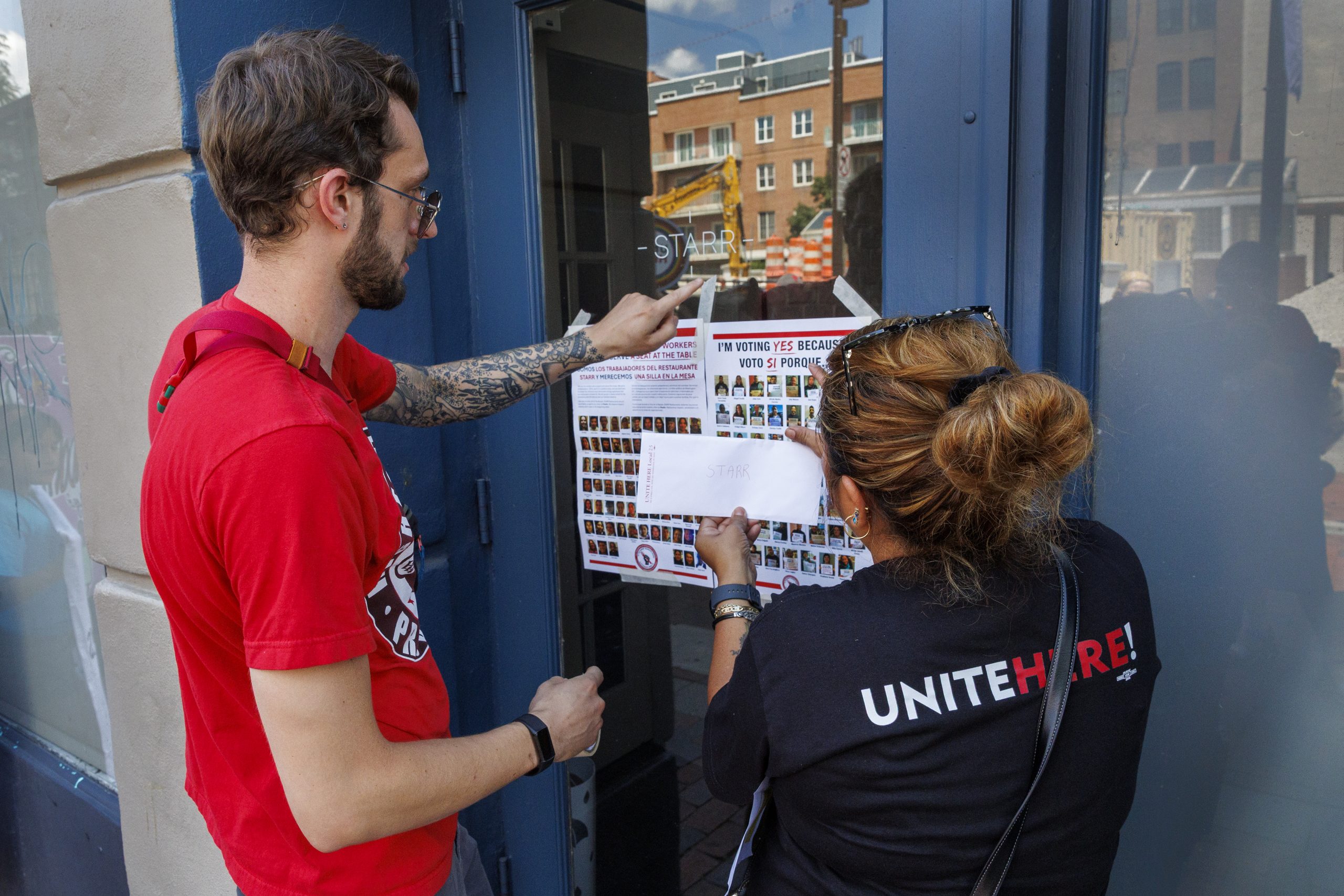
    The move is the latest in a lengthy dispute between Starr Restaurants and D.C. union Unite Here Local 25 at St. Anselm, where staffers voted 51 to 42 in favor of unionizing in February 2025. Now more than 16 months later, Starr restaurants has yet to recognize the union, with more pending litigation leaving St. Anselm workers in limbo.

    Reached on May 25, the settlement resolves a set of unfair labor practice (ULP) allegations that Local 25 filed with the NLRB on behalf of St. Anselm employees in June 2025. They alleged that Starr and a St. Anselm supervisor made promises of improved benefits for workers who voted against the union and directly coerced employees with false information. In one instance, they alleged, Starr interrogated a host about her involvement with Local 25 during a one-on-one conversation.

    Starr “made a lot of promises about sick pay, about vacation pay,” Ana Reyes, a St. Anselm line cook, previously told the Inquirer, recalling a meeting the restaurateur had with staff during the union drive.

    After an investigation, the NLRB’s general counsel found merit in the accusations that Starr Restaurants had violated the National Labor Relations Act, and it pursued charges against the company.

    The settlement is not an admittance of wrongdoing and is similar to the standard penalty Starr Restaurants could have received had the case played out fully, according to James M. Cooney, a Rutgers University labor and employment law professor.

    St. Anselm, Stephen Starr’s D.C. steakhouse.Jennifer Chase

    The agreement requires Starr Restaurants to post a notice in St. Anselm for 60 days stating that the company will not:

    • “Threaten you that it would be futile” to unionize,
    • Solicit complaints and “imply that we will fix them” in order to discourage union support,
    • Give new or better wages and benefits to discourage unionizing,
    • Or “promise to pay you for previously unpaid leave” to dissuade workers from supporting a union.

    The settlement “allows us to move on and get back to the business of delivering amazing hospitality to our guests,” a spokesperson for St. Anselm said in a statement. “We have vigorously denied, and continue to deny, all allegations listed in the original complaint, and are fully complying with the terms of the settlement while making no admission of violation.”

    The agreement is separate from a second case that Starr Restaurants filed with the NLRB last February objecting to the results of St. Anselm’s union election. It alleges Local 25 organizers bullied and intimidated employees into backing the union.

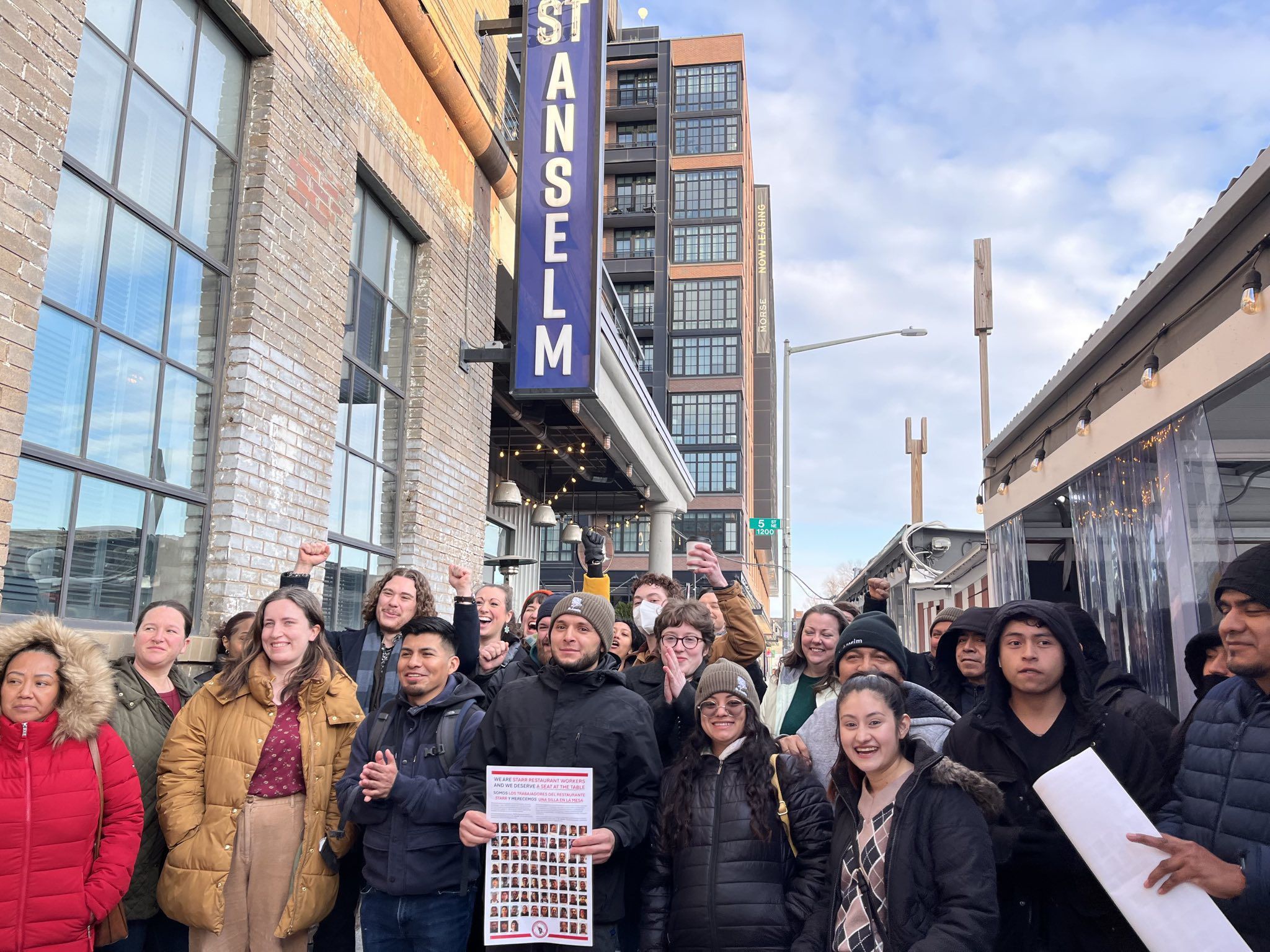
    A delegation of workers pose in front Stephen Starr’s D.C. steakhouse St. Anselm before delivering their union petition in Feb. 2025.UNITE HERE Local 25

    That case remains open, and a hearing was held in mid-June where the NLRB heard testimony from witnesses on both sides. Unite Here Local 25, which represents more than 7,500 hospitality workers, is optimistic that settlement will open up a path to union recognition.

    “We feel vindicated,” said Paul Schwalb, Local 25’s executive secretary-treasurer. “It’s the same board that’s going to oversee [the unionization case], and we are quite confident — because we did actually follow labor law — that at the end of the day this unit will be certified, and all the objections that Stephen Starr and his many lawyers have filed will be thrown out because they are not true.”

    Legalese that ‘meant nothing’

    The battle between Starr Restaurants and Local 25 began last January, when the union began to organize at three of Starr’s seven D.C restaurants: Pastis, a French bistro; the Parc-inspired Le Diplomate; and St. Anselm, an upscale steakhouse.

    The efforts — which coincided with union drives at two other high-profile D.C restaurants — stood to add 500 members to Local 25. St. Anselm was the only one that voted to unionize. (Local 25 lost the union election at Pastis, and Le Diplomate’s has been suspended indefinitely.)

    A picket line outside of Stephen Starr’s D.C. restaurant Le Diplomate, led by Unite Here Local 25 after Starr Restaurants challenged a unionization vote at St. Anselm.UNITE HERE Local 25

    Almost immediately, relations soured between Starr Restaurants and Local 25. The restaurant group hired anti-union consultants to meet with St. Anselm staff, Washingtonian magazine reported, while other employees told food publication Eater that Local 25 organizers were ambushing them at their homes to sign cards indicating they wanted a union vote.

    Local 25 also called for an ongoing boycott of Starr’s D.C. restaurants — including those where no union efforts were taking place. Top Democrats such as Sen. Bernie Sanders, Rep. Alexandria Ocasio-Cortes, and Sen. Chuck Schumer signed on.

    Legally, the settlement doesn’t state that Starr Restaurants broke any laws or affirm any of the union’s allegations. In practice, however, Cooney said that workers and employees might have a different interpretation.

    Posting a notice “doesn’t sound very intimidating on its face, but employers will sometimes fight tooth and nail over the wording” or try to hide them, said Cooney. “Looking at it from the viewpoint of the common worker, if they see that notice … I think they would see it as an indication that a company violated the law.”

    Starr Restaurants posted the notice required by the settlement inside St. Anselm on June 16 and also emailed a copy to staff.

    Greg Varney (left) and Ana Reyes, both with Unite Here Local 25, outside Starr headquarters at 134 Market St. in July 2025.
    Alejandro A. Alvarez / Staff Photographer

    When St. Anselm server Abigail Dunki-Jacobs received the email, it felt like “a bunch of legalese … that meant nothing,” she told The Inquirer. Dunki-Jacobs, who voted against the union, said she hasn’t heard much chatter among her colleagues after it was posted.

    “It just feels like a list of facts to me,” she said. “Nobody even really gives a shit about it.”

    Delays upon delays

    Local 25 organizers and employees who voted for the union also find the settlement meaningless.

    Starr Restaurants “didn’t have to admit to doing anything wrong with the statement they made,” said Ellery Grimm, a member of support staff at St. Anselm who helped organize the union drive. “We’ll be vindicated when we have our contract.”

    St. Anselm’s union election case has sat unresolved with the NLRB for nearly a year and half, which Cooney said was abnormal. The agency tends to prioritize certifying election results over unfair labor practice allegations.

    The NLRB has been beleaguered by delays for more than year, first from the firing of a board member that left the agency unable to issue rulings, and then from a government shutdown that furloughed employees.

    Now, the NLRB faces a staffing and budget shortfall that has made it difficult to catch up on its backlog. In May, the agency transferred roughly 3,500 unassigned cases from regional offices — including Region 5, where St. Anselm’s case is located.

    The delays have caused at least one St. Anselm employee to quit. Bridget Killburn, a baker at the steakhouse, left in April after more than three years at the restaurant. She now works at a bakery in Maryland that she said offered higher pay and more time off — two things she hoped the union would’ve won by now.

    A chef in the kitchen at Le Diplomate, one of Stephen Starr’s three D.C. restaurants that Unite Here Local 25 attempted to unionize.

    “I’m someone who wants a very stable job with good pay, good benefits. At this rate, it felt like I was never going to get those things so I needed to try and find a workplace who would allow me to have them,” Killburn said.

    Schwalb acknowledged that Local 25 hasn’t done any public campaigning at St. Anselm in months, and has abandoned the union drives at Starr’s other restaurants until all litigation is resolved.

    “Rome and the restaurant union — neither one will be built in a day,” he said.

  • Mutant mice resistant to pest control found in Philly, its suburbs, and NYC. Are rats next?

    Mutant mice resistant to pest control found in Philly, its suburbs, and NYC. Are rats next?

    Pest control companies routinely use traps baited with rodenticide to kill rats and mice found in homes, restaurants, and businesses throughout the Philadelphia area, but a recent Rutgers University study suggests those companies face a gnawing problem.

    Researchers discovered that mice in Philadelphia, Trenton, and suburbs like Levittown and New Hope harbor genetic mutations that shield them from standard chemical baits.

    In fact, a majority of house mice sampled from Northeast urban areas, including Manhattan and other New York City boroughs, carried at least one mutation linked to rodenticide resistance — a clear sign that pests are actively evolving to survive common poisons.

    Rats presented a different problem. While they lacked the chemical-resistant mutations found in mice, the study’s author suggests they possess the cognitive sophistication to outsmart and evade traps entirely.

    Lead author Jin-Jia Yu, a postdoctoral researcher in Rutgers’ entomology department, said the findings indicate that pest control companies might need to develop different strategies.

    Yu conducted his research with the supervision of another of the paper’s authors, Changlu Wang, an entomologist in the same department.

    Published in the April issue of Pest Management Science, the peer-reviewed study was launched after frustrated pest control professionals repeatedly approached the Rutgers lab, reporting that rodents routinely survived multiple treatments.

    “For the house mouse, we saw much more mutations rather than Norway rats,” Yu said. Norway rats are the common brown rat often seen in sewers. “Genetic mutation is not that special in these creatures. But we found that the house mouse shows a lot of genetic mutations related to rodenticide resistance.”

    Rodents are a bigger problem in cities

    This study focused on urban rodents. It found that mice in big cities such as Philly and New York had a high frequency of mutations of a certain gene.

    Rodents are a bigger problem in cities than more rural areas. Data cited in the study indicate that an average of 12% of all households experience rodent sightings. But major metropolitan areas reporter higher rates, including Philadelphia (29%), Washington (20%), and Manhattan (15%).

    Yu said that similar studies of mutations in house mice and Norway rats were conducted in Europe and that research in the U.S. has been limited. One study in 2009 did find some rats in England with mutations that made them resistant.

    However, Yu said there had been no such studies in the Northeast.

    It has long been known that rodents developed resistance to the rodenticides developed in the 1950s. So more potent compounds were created in the 1970s and include brodifacoum, bromadiolone, difenacoum, and difethialone.

    The poisons contain anticoagulants that interfere with the activation of vitamin K reductase (VKOR), an enzyme essential for blood to clot. Eating the bait leads to fatal internal bleeding.

    The Rutgers team looked for mutations in the gene known as VKORC1 that makes the enzyme.

    Pest control companies, as well as the Philadelphia Department of Public Health, sent the researchers the tails of caught rodents. Yu said his research was possible only with their help.

    A rare mouse mutation in Philly

    The researchers analyzed DNA from 147 house mice and 143 Norway rats collected in New York, New Jersey, Pennsylvania, and Washington, D.C.

    Among house mice, 84% carried at least one mutation in the VKORC1 gene. Nearly 70% carried mutations known to help mice survive rodenticides.

    Of 24 mice collected in Philadelphia, the majority had a mutation and five had two. One mouse had a rare mutation.

    Of 20 mice collected in Trenton, 10 had two mutations. Lansdale, Levittown, and New Hope had one mouse each with a mutated VKORC1 gene.

    About 35% of the Norway rats also carried mutations. However, scientists do not yet know whether those mutations result in resistance in the rats.

    Mice, Yu said, might be genetically adapting faster than rats because they are curious and more likely to eat unfamiliar food, including rodent bait.

    However, rats will avoid new objects, including live traps, and learn from their encounters.

    In other words, not only are mice mutating to survive, but rats may be learning to avoid entrapment.

    “They’re pretty smart,” Yu said of rats.

  • Robin Cogan, renowned Camden school nurse and national health and safety advocate, has died at 65

    Robin Cogan, renowned Camden school nurse and national health and safety advocate, has died at 65

    The letters that follow Robin Cogan’s name represent some of healthcare’s most impressive achievements. NCSN, nationally certified school nurse. FNASN, fellow of the National Academy of School Nursing. FAAN, fellow of the American Academy of Nursing. Also, RN and MEd.

    Then there are the awards. Two-time President’s Award winner from the National Association of School Nurses. The 2017 Population Health Hero Award from the New Jersey Department of Health. The Johnson & Johnson 2017 School Nurse of the Year. And many more.

    Robin Cogan joined the Camden City School District as a school nurse in 2001 after training earlier as an art therapist and spending 14 years as a psychiatric clinical nurse and corporate health services manager. It was with the school district and its students, families, and staff where she really found her groove.

    For nearly three decades, Robin Cogan championed school safety and population healthcare, and advocated tirelessly for school nurses everywhere. Her website, blog, frequent podcast appearances, and wide-ranging institutional activism gave voice to school nursing stories, and combated gun violence and other pressing problems.

    She started blogging on RelentlessSchoolNurse.com in 2017 and cocreated the No More Empty Desks student art campaign in 2019 to memorialize students killed in gun violence. “Robin’s national reach and advocacy know no bounds,” a Camden colleague said on Facebook. “Robin Cogan is the embodiment of the school nursing profession.”

    On May 10, Robin Cogan blogged: “The profession is better, and so are countless children, because of the relentless, brilliant nurses who choose school nursing year after year.”

    Mrs. Cogan became a school nurse in Camden in 2001.Heather Khalifa / Staff Photographer

    On Thursday, June 11, Robin Cogan died of cancer at Cooper University Hospital in Camden. She was 65.

    “Robin dedicated her life to caring for others,” Pamela K. Clark, president of the Camden Education Association, said in a tribute. “Her work extended far beyond the walls of our schools, leaving a lasting impact on the profession she loved.”

    Born in Philadelphia, Mrs. Cogan graduated from Cherry Hill West High School in 1978 and earned a bachelor’s degree in art therapy and psychology in 1982 at what is now the College of New Jersey in Trenton. She gained her nursing credentials at the Helene Fuld College of Nursing in New York and Rowan University, and earned a master’s degree in clinical, counseling, and applied psychology at Wilmington University in Delaware in 2009.

    As a school nurse in Camden, she oversaw more than 900 students from preschool through eighth grade at Cooper’s Poynt School and, most recently, more than 400 students at three preschools. She took temperatures, counseled worried parents, and personally helped thousands of people weather the COVID-19 pandemic.

    “She influenced policy, championed health equity, elevated the role of school nurses,” a colleague said on Facebook, “and reminded us that one person truly can create ripples that become waves.”

    Mrs. Cogan was the New Jersey director for the National Association of School Nurses and taught in the school nurse certification program at Rutgers University-Camden. She earned grants, sat on boards, lectured around the country, wrote or cowrote dozens of columns, papers, and articles about health issues, and posted advice and information frequently on X, Bluesky, Facebook, and other online platforms.

    The Inquirer published this story and photos about Mrs. Cogan’s art program in 2019.Newspapers.com

    She was featured in The Inquirer and other publications, and appeared on TV and radio programs and podcasts. She focused on “shared values” to connect people, she said often, and posted the motto for her Relentless Nurse website on the homepage: “Be relentless in your practice whatever it is.”

    Robin Michelle Cohen was born June 28, 1960. She met Ed Cogan in college, and they married in 1984, lived in Trenton and Cherry Hill, and had twin daughters Allie and Jill.

    Mrs. Cogan was driven to address gun violence, she said, after her father survived a mass murder in Camden in 1949, and her niece survived the 2018 mass shooting at Marjory Stoneman Douglas High School in Florida. “I hope my legacy is helping solve this crisis,” she told The Inquirer in 2022. “Don’t we owe that to our kids?”

    This photo of Mrs. Cogan (left) and others at the old Temple Emanuel in Cherry Hill appeared in The Inquirer in 1996.Elizabeth Robertson / Staff Photographer

    She was a talented painter and designed a popular pin that she and a friend sold in a home-based spiritual jewelry and art business. She loved nature and 1970s folk music. She enjoyed hosting Thanksgiving dinners and visiting the Jersey Shore. She was one-time president of the old Temple Emanuel Sisterhood in Cherry Hill.

    “She was a helper,” said her daughter Allie. “She was good at relationships and never really turned off her working mind.”

    In addition to her husband and daughters, Mrs. Cogan is survived by a granddaughter, Nora, a nephew, Matthew, sisters Lori and Merri, and other relatives.

    Private services were held earlier. A celebration of her life is to be held later.

    Donations in her name may be made to Brady: United Against Gun Violence, 840 First Street N.E., Suite 400, Washington, D.C. 20002; and Grandparents for Vaccines.