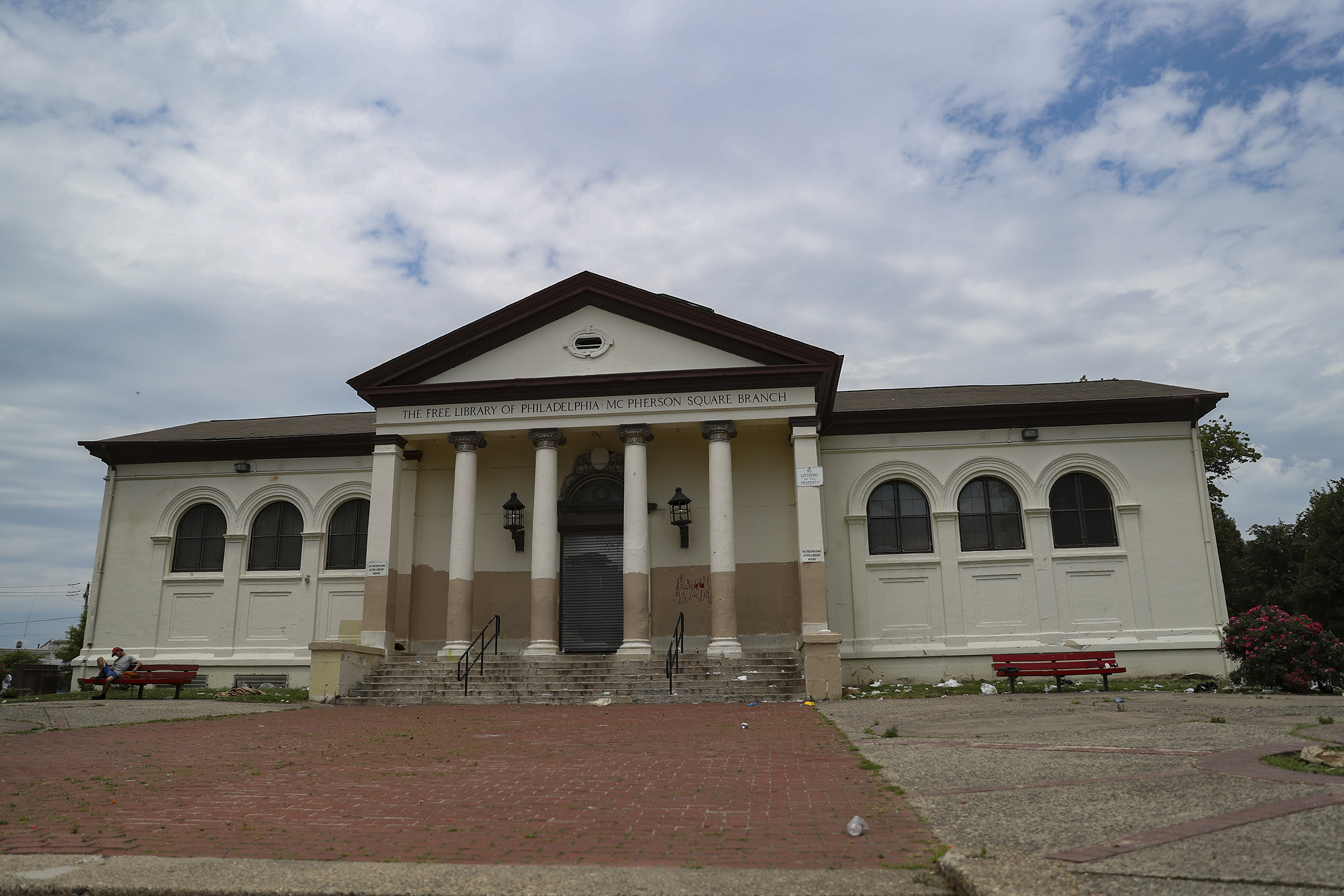
Mayor Cherelle L. Parker marked her 1,000th day in office by breaking ground on a $21.7 million improvement to the McPherson Square library, a symbol of the Kensington opioid crisis, to send the message that her administration’s “commitment to this community is firm.”
“The Kensington that I’m standing in today — this is not the Kensington that I walked in January of 2024. Quality of life is improving here,” Parker said at a news conference on Monday.
Although she did not focus on Kensington while campaigning for mayor in 2023, Parker has, since taking office, embraced the challenge of addressing gun violence and substance abuse in the neighborhood, which has made international headlines, and eradicating what is often referred to as the largest open-air drug market on the East Coast. She rode the El to an event at a Kensington middle school to mark her first 100 days in office.
The McPherson Square park and library became a highly visible marker of the crisis in the mid-2010s. People in addiction were a constant presence in the six-acre park, near Kensington Avenue and Orleans Street. Library staff learned how to administer Narcan, which reverses overdoses.
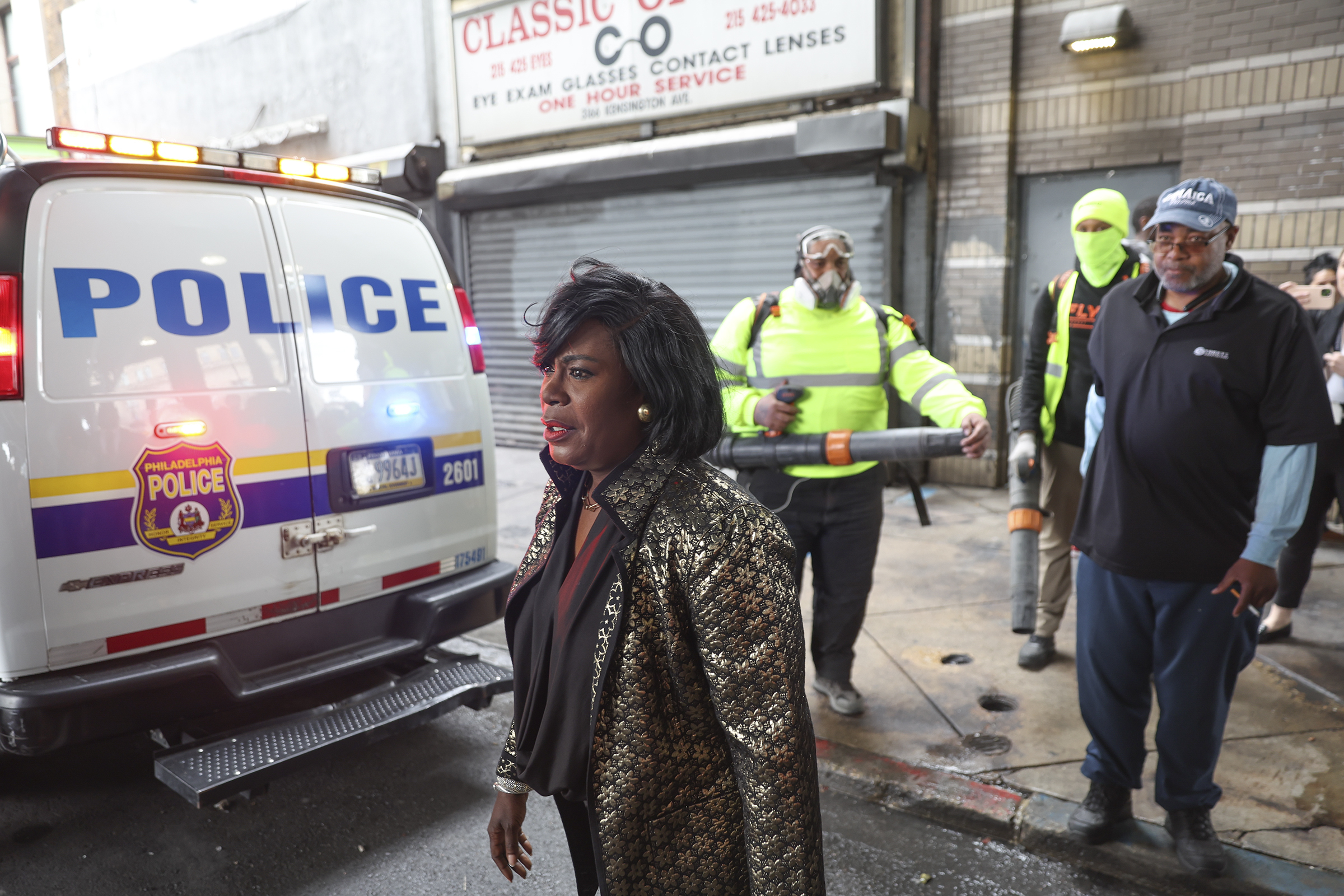
Philadelphia Mayor Cherelle L. Parker exits the Allegheny station before walking along Kensington Avenue on April 11, 2024. Parker took the El to attend an event marking her 100th day in office in the Kensington neighborhood in Philadelphia.Heather Khalifa / Staff Photographer
Parker ran on a tough-on-crime platform, and her approach to Kensington has featured a mix of police-focused tactics and novel strategies aimed at getting people off the streets and into recovery.
She cut city funding for syringe exchange services in her first budget, and her election effectively ended the city’s efforts to open a supervised drug consumption site, a priority of former Mayor Jim Kenney. The police department has doubled the number of officers who patrol the area, First Deputy Police Commissioner John Stanford said Monday.
Parker has also launched a Neighborhood Wellness Court program, which is designed to encourage alleged offenders to choose addiction services and avoid criminal proceedings, and she has launched the Riverview Wellness Village, a 20-acre recovery house in Northeast Philadelphia where more than 200 people live.
“People are beginning to see that we are at least trying to make a difference, and we are not acting as if we don’t see what’s happening,” Parker said. “We’re looking it straight in the eye and trying to figure out a way to make sure that we are solving a problem.”
Since Parker took office, the Kensington-based 24th Police District has seen a 48% decrease in violent crime, a 63% decrease in shootings, and a 47% decrease in homicides, Stanford said Monday.
After peaking in the wake of the onset of the COVID-19 pandemic, rates of violent crime and homicide have fallen across the country. This year, homicides in Philadelphia are on pace for a 60-year low.
People using drugs are still a common sight in Kensington, and crime rates in the neighborhood remain higher than the city as a whole, a reality Parker readily acknowledges. And her approach has drawn criticism from some harm reduction advocates and public health experts, who contend that heavy-handed policing can be counterproductive to saving the lives of people in addiction.
But few doubt Parker’s commitment to cleaning up the neighborhood, and the prospect of a revitalization of the dilapidated library, which was built in 1917 with a copper dome and classical columns, could be a potent symbol.
The renovation of the McPherson Square library is being funded through Rebuild, the parks and recreation center renovation program championed by Kenney and supported by Parker when she was on Council. Rebuild is one of three programs Kenney proposed while pitching the city’s tax on sweetened beverages, which was approved in 2016 and is more commonly known as the soda tax.
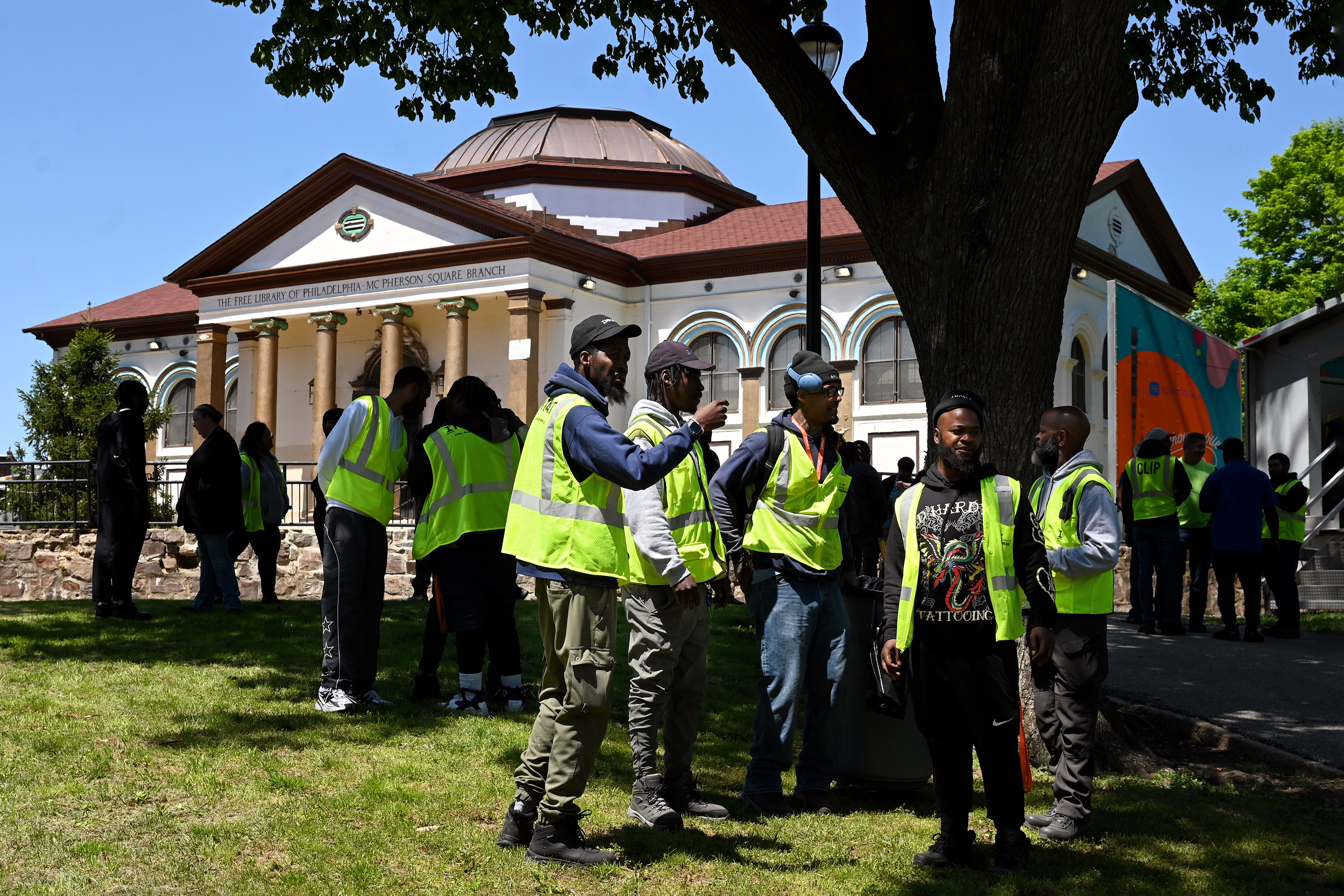
Workers set out to clean after the Office of Clean and Green Initiatives kicked off the summer edition of the One Philly, United City Citywide Cleaning Program in McPherson Park on May 4.Tom Gralish / Staff Photographer
The first phase of the library renovation, which included a new roof and a restored dome, was completed in 2025. Parker on Monday broke ground on the second phase, a “full-gut renovation” with “new HVAC, plumbing, electrical, fire alarm, and security systems” and many other improvements, according to the Philadelphia Capital Program Office.
The project will take two years. In the meantime, the Free Library of Philadelphia will set up a temporary location on Allegheny Avenue, said Kelly Richards, the library’s president and director.
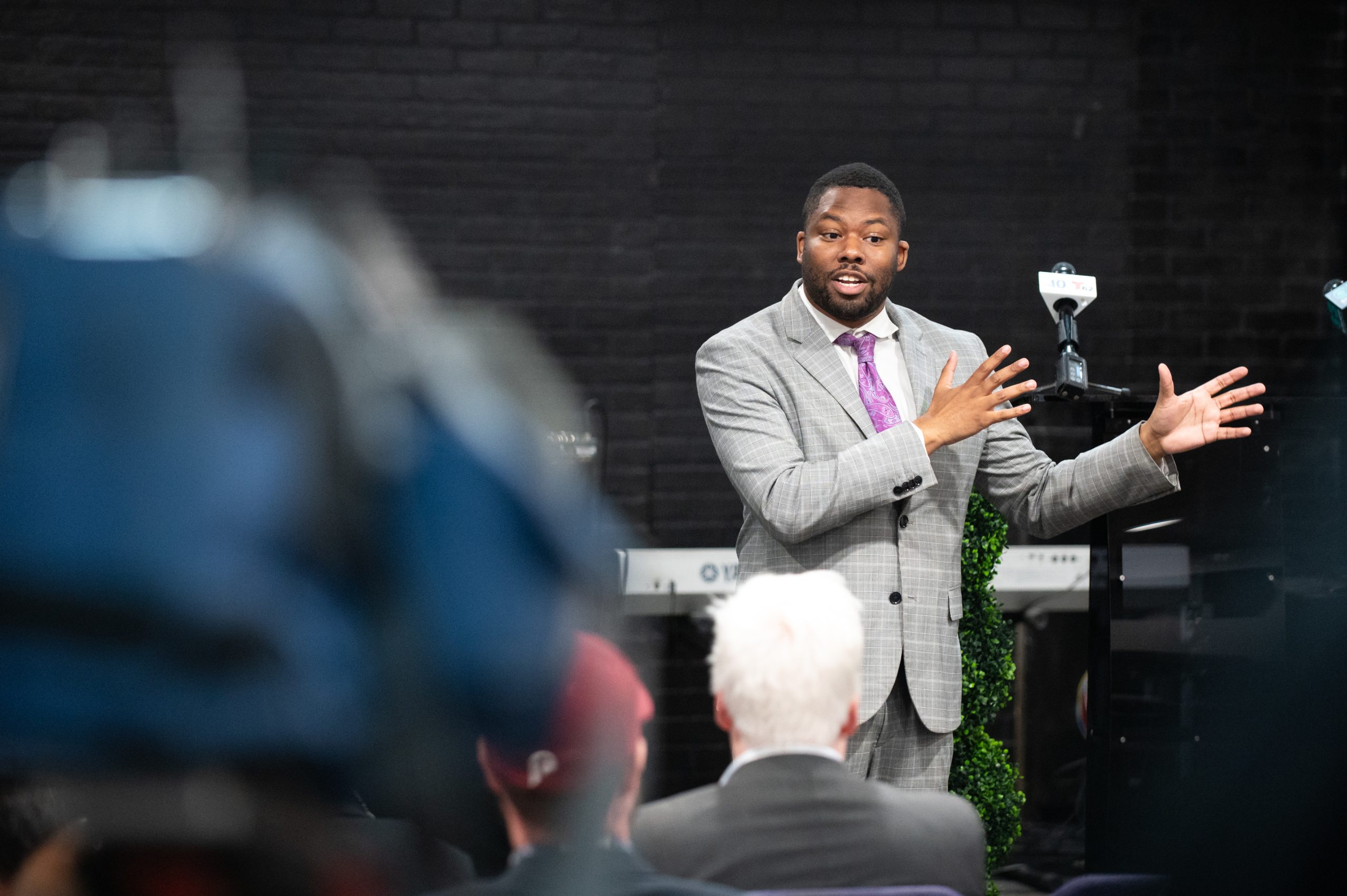
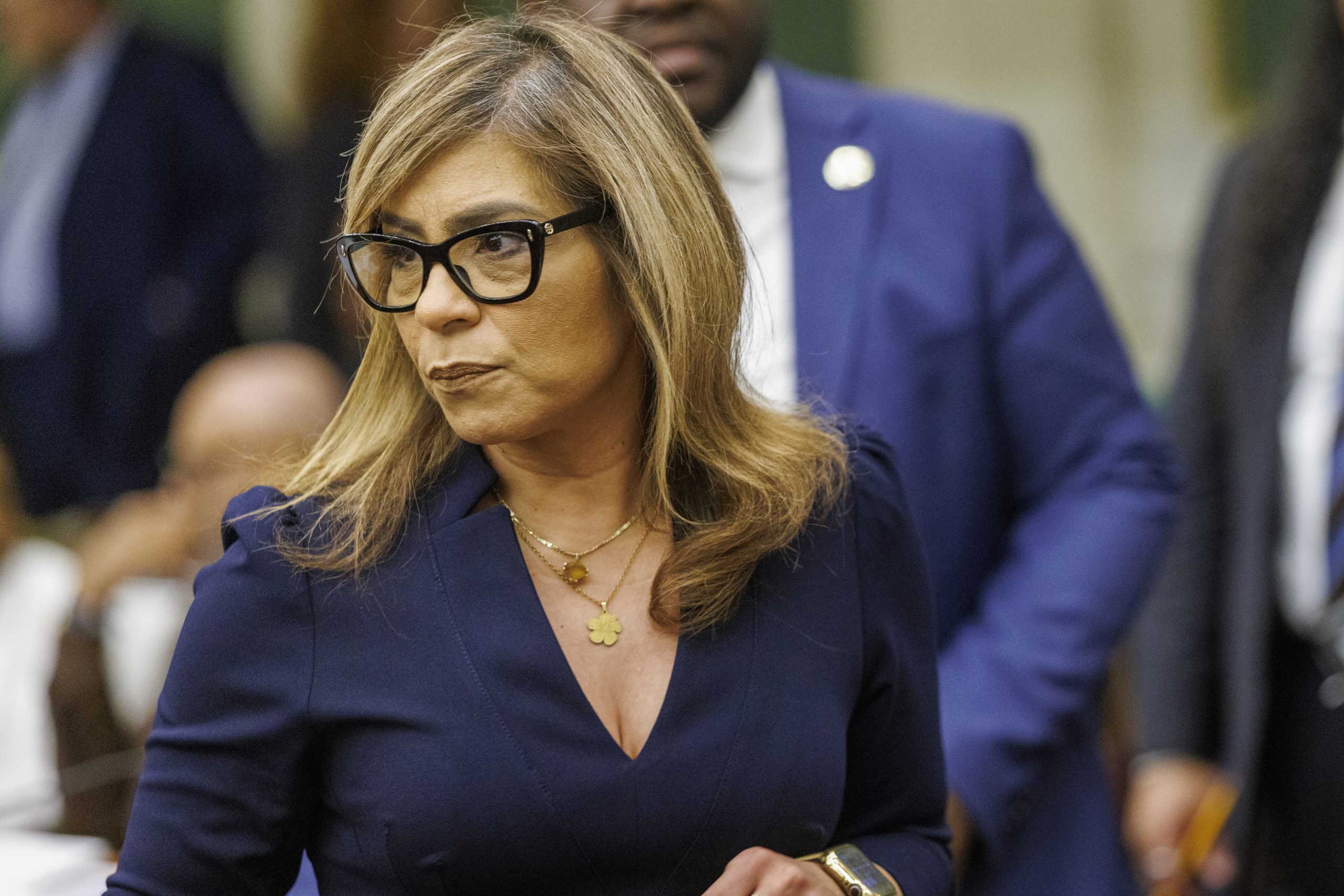
City Councilmember Quetcy Lozada, whose 7th District includes much of Kensington, said she spoke to Parker about addressing the long-neglected neighborhood’s challenges in 2023, and recalled being “skeptical” that Parker would follow through on her promises as mayor.
“She made a commitment on that day that if she were to become the mayor of this city, that she would make Kensington and this community a priority,” Lozada said at the new ground-breaking, “and she has stood by that commitment and that promise.”
Staff writer Anna Orso contributed to this article.
Tuesday is the first day of Hispanic Heritage Month, which runs from Sept. 15 to Oct. 15. I’ve always had a bit of a love/hate relationship with this month, which purports to recognize and celebrate that Latinos have been a formative part of the nation since its early days. While the attention to the extraordinary individuals and myriad cultural heritages that comprise “Latinidad” in the United States is gratifying, it is, by its very nature and time limitation, a glancing and shallow attention.
Even so, I always note the arrival of a mass email from the mayor’s office about the events the city has programmed to mark the month.
This year, I’m still waiting.
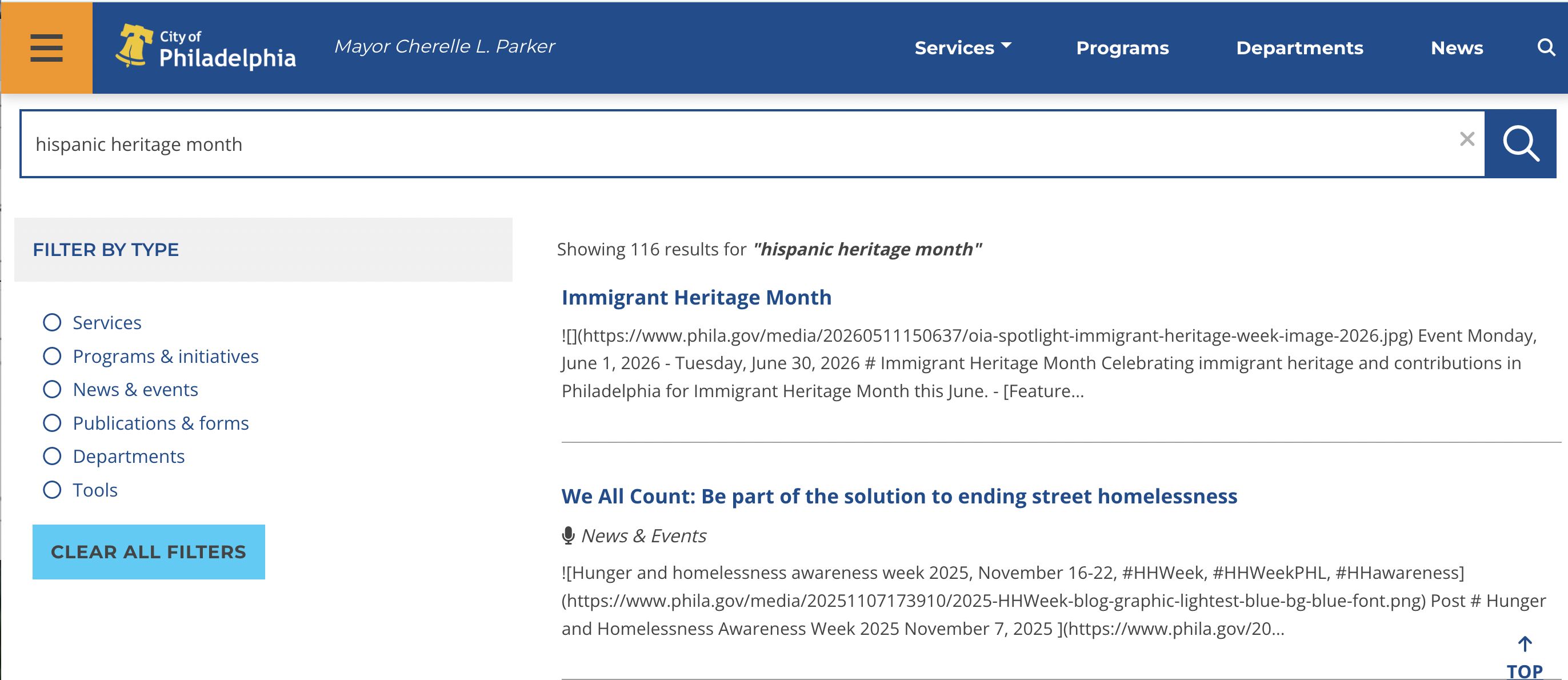
As yet, there’s been no email from the city of Philadelphia announcing any special programming during Hispanic Heritage Month, and nothing when I search for that on phila.gov.
Screen capture of a search for “Hispanic Heritage” month on the phila.gov website on Monday.Screen capture of phila.gov
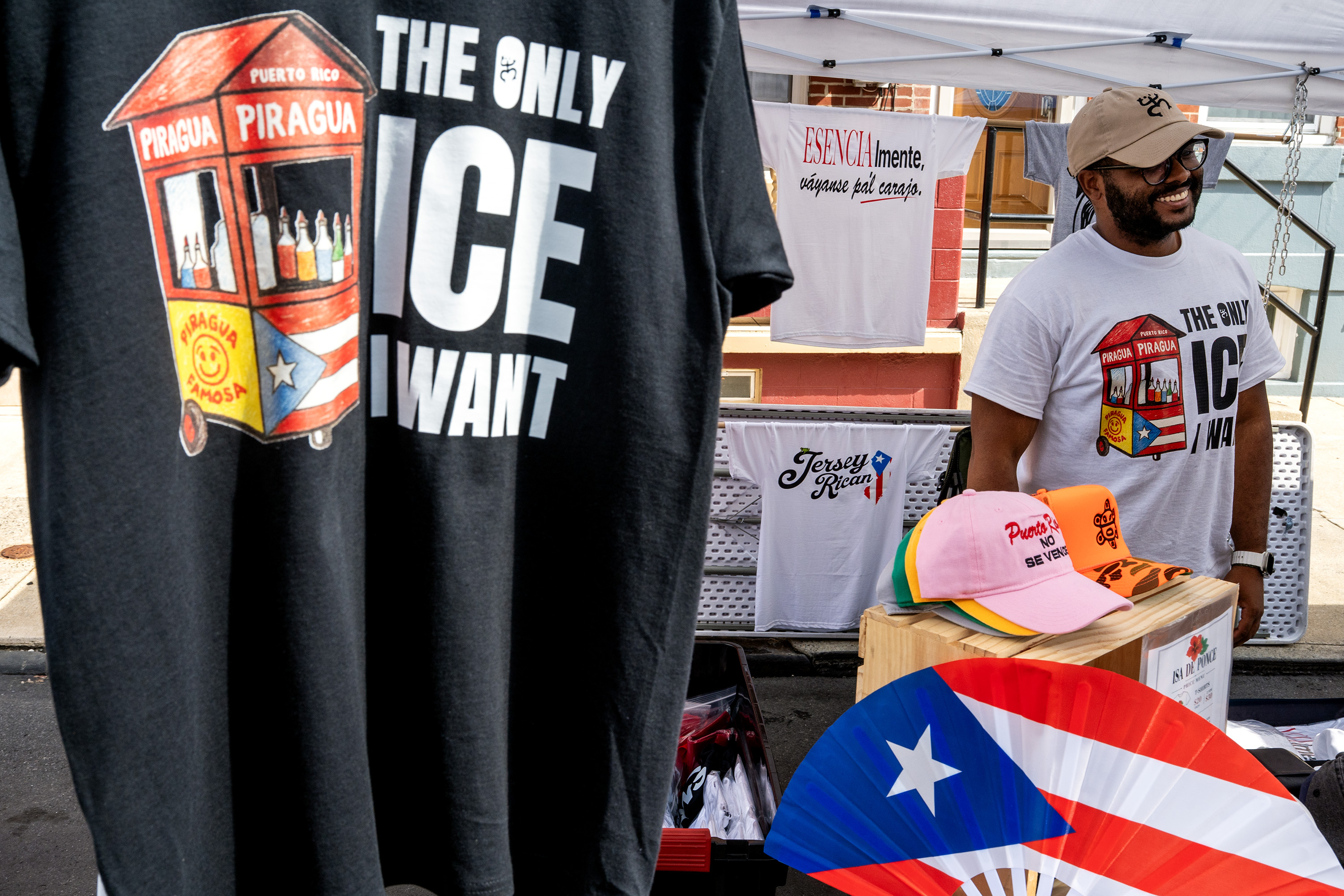
There aren’t even links to information about two signature events that took place this past Sunday: La Feria del Barrio (organized by Taller Puertorriqueño) and the Mexican Independence Day Festival (organized by the Mexican Cultural Center), nor even the unofficial culminating event in Philadelphia — the Puerto Rican Day Parade, which Concilio has been hosting for more than 60 years — on Sept. 27.
While I’d like to say I’m completely surprised by the elision of Hispanic Heritage Month that the city is doing, I’m not.
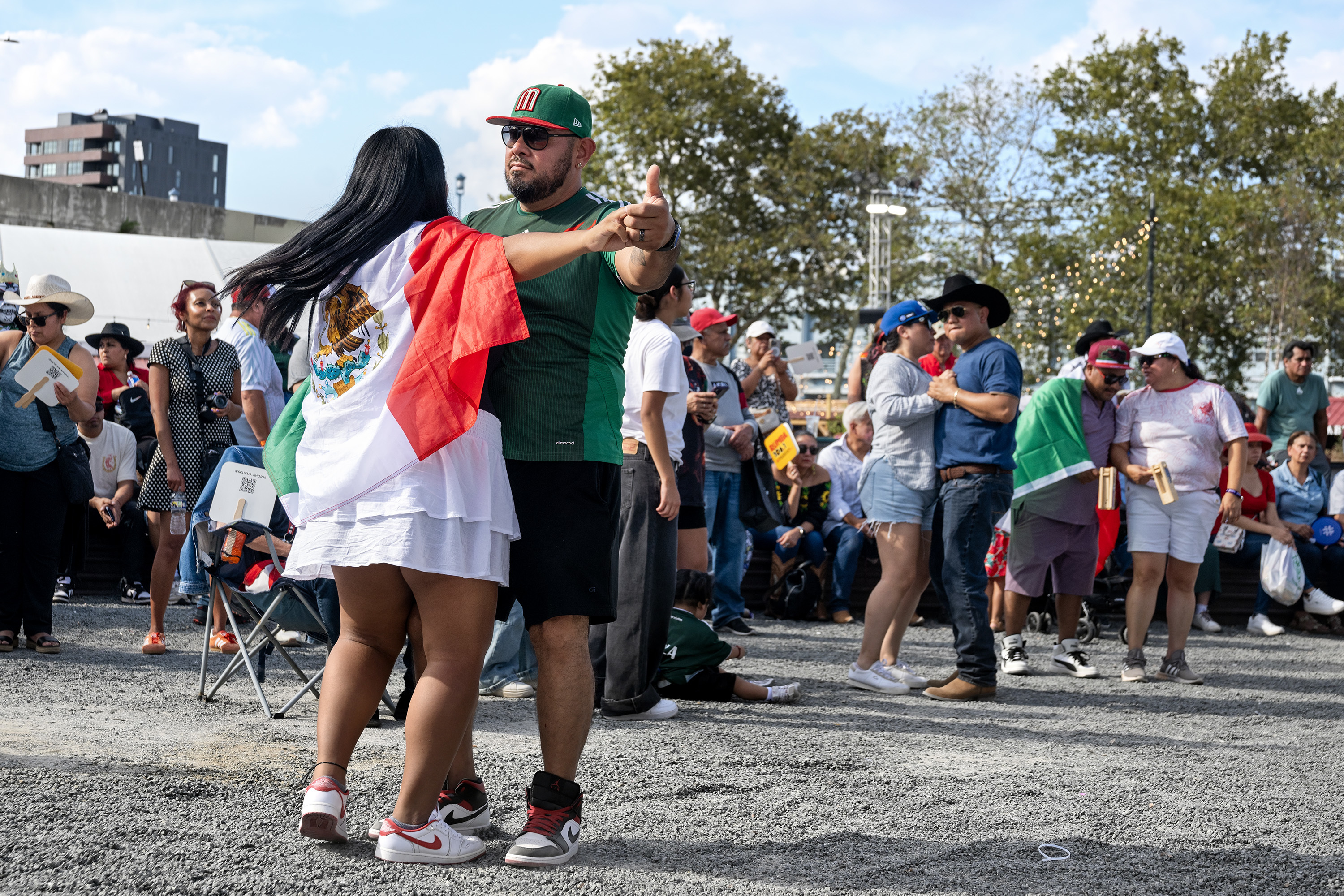
Francisco Gonzales, of Lawrenceville, N.J., dances with his daughter Bianca, 17, near the stage as musicians perform at last year’s Mexican Independence Day Festival at the Independence Blue Cross RiverRink at Penn’s Landing.Tom Gralish / Staff Photographer
Philadelphia’s Latino communities get surprisingly little respect — outside of the high regard for our undeniably wonderful food and dance moves — from our electeds, and have long been slighted by city government in far more significant ways.
For me, nothing epitomizes that more than an example from 2015, when there was a Latino managing director and even so, then-Mayor Michael Nutter convened — at the behest of Attorney General Eric Holder and the U.S. Department of Justice — a Philadelphia roundtable about the imperative of improving police-community relations at which there wasn’t a single person from a Latino-serving organization at the table. In a city where our community was subjected to relatively high stop-and-frisk rates, experienced excessive force incidents (and still does), was historically targeted for extortion by police, and was (and still is) racially profiled by police and U.S. Immigration and Customs Enforcement.
No. Latinos. At. The. Table.
Is it simply that our political capital has been stagnant since the 1980s — or is there something else?
We’ve had three Latino primary contenders for mayor (two in 2015 and one in 2023), but no substantive progress when it comes to the political power necessary to be taken seriously in Philadelphia.
To wit, in 1983 Philadelphia elected its first Latino City Council member, and a year later it elected a Latino state legislator (the second in the city’s history). The census conducted in 1980 put Philadelphia’s Latino population at 3.9% of the city’s total. Fast-forward some four decades, and Latinos are now about 17% of Philadelphia’s total population, but we still have only one Latina City Council member, and just two Latino Philadelphia state legislators.
But departments and offices reflect the administrations they are part of, and Mayor Cherelle L.Parker has sent mixed signals to her Latino constituents.
On the one hand, she has addressed issues in Kensington in concert with District 7 Councilmember Quetcy Lozada — who is a well-liked and respected Boricua leader. On the other hand, she had to be dragged, kicking and screaming, by City Council’s veto-proof “ICE Out” proposals into offering any public comment about ICE actions under President Donald Trump.
Or maybe the offices that are meant to be in conversation with, and about, Philadelphia’s Latino communities aren’t up to the job?
I’m willing to offer the benefit of the doubt: Maybe they are focusing on important work behind the scenes. But in my opinion, they have minimized Latino visibility — to our detriment, and to all of Philadelphia’s detriment.
I was struck recently by the events the Office of Immigrant Affairs is publicizing as part of its Welcoming Week 2026 (from Sept. 10 to 25), for example. The focus this year is on the Caribbean, but in the publicity I’ve received (or dug up) about it, there seems to be nothing scheduled about or from the Spanish-speaking Caribbean. The thing is, this isn’t a zero-sum game — we can (and must) celebrate our significant Haitian and Jamaican communities, for example, and their incredible cultural contributions to Philadelphia, without ghosting our Dominican and Boricua ones.
So, come on, send that Hispanic Heritage Month email, Mayor Parker. List those events and programs on the website. Latinos are here and doing amazing things in service of our city. We should celebrate that together.
Philadelphia real estate developers see the writing on the wall.
As progressives have toppled centrist Democrats in nationally watched races, some local development interests are wary that the same trend could reshape Philadelphia City Council this spring, when every member is up for reelection. They see a growing progressive faction as a threat to business.
Enter the incumbent protection plan.
Nearly a dozen local developers are already pouring hundreds of thousands of dollars into Philly For Growth, a group that in the past two Council election cycles spent millions on advertising campaigns to back business-friendly Democrats, according to a source familiar with the planning.
Philly For Growth is an independent expenditure group, also known as a super PAC. It can raise and spend unlimited amounts of money to influence an election, but there are rules barring super PACs from most forms of coordination with the candidates they support.
In 2023, the group was the biggest special interest group involved in that year’s Council races, and it provided a substantial boost to its chosen candidates by outspending individual campaigns.
Ahead of the May primary election, Philly For Growth plans to spend $1.5 million to support pro-business Democrats, most of whom are sitting Council members, according to the source, who spoke on the condition of anonymity because they were not authorized to discuss the plans. The group will not fund negative advertising about Council’s four incumbent progressives, the source added.
Councilmember Kendra Brooks, of the progressive Working Families Party, speaks during a rally outside of the School District of Philadelphia headquarters in May. At left is Councilmember Rue Landau and at right is Councilmember Jamie Gauthier. All three are members of Council’s progressive faction.Monica Herndon / Staff Photographer
The idea is to keep progressives from growing their power on Council instead of spending money to knock off the leftists who are already there. There are currently four reliably progressive votes out of the total 17 on Council, but some members may be more likely to vote with that faction as Democratic voters nationally revolt against incumbents.
That’s a different strategy than in 2023, when Philly For Growth backed a slate of five candidates — two incumbents and three challengers. Both incumbents won, but all three challengers lost.
Philly For Growth has previously been affiliated with the Building Industry Association of Philadelphia, an advocacy group for development interests. Mo Rushdy, the BIA’s former president who leads the organization’s political activity, declined to comment.
The source said that Philly For Growth will fund advertising to support Council members Mark Squilla, whose 1st District includes parts of South Philly, Center City, and Fishtown; Cindy Bass, whose 8th District is based in North and Northwest Philadelphia; and Quetcy Lozada, whose 7th District includes much of North Philadelphia and Kensington.
All three are seen as more centrist members and have said they intend to run for reelection. No challenger has officially launched a campaign against any of them, but candidates who are aligned with the city’s left-leaning political organizations are expected to emerge as the primary — still eight months away — draws nearer.
The super PAC is making one exception when it comes to supporting incumbent district Council members, the source said. In the 5th District, currently represented by Councilmember Jeffrey Young Jr., the group will support a to-be-decided challenger.
Councilmember Jeffery Young Jr. speaks to other members of Council during a 2025 session.Tom Gralish / Staff Photographer
At least five people have said they are interested in running for the North Philly-based 5th District seat, and Young has drawn opposition from development interests for pushing proposals that would slow or halt some projects in his district.
Young said in a statement that building “sensible, affordable housing” is one of his top priorities and that he has supported city programs like Turn the Key, which provides mortgage support to first-time homebuyers.
“People are free to back those who share their values. These are my values,” Young said. “I am leaving it to the residents of the 5th to determine whose values best reflect them.”
The super PAC will also fund advertising backing four incumbent members who represent the city at-large: Isaiah Thomas, Katherine Gilmore Richardson, Jim Harrity, and Nina Ahmad. That group doesn’t include progressive at-large Councilmember Rue Landau, but Philly For Growth doesn’t plan to oppose her, the source said.
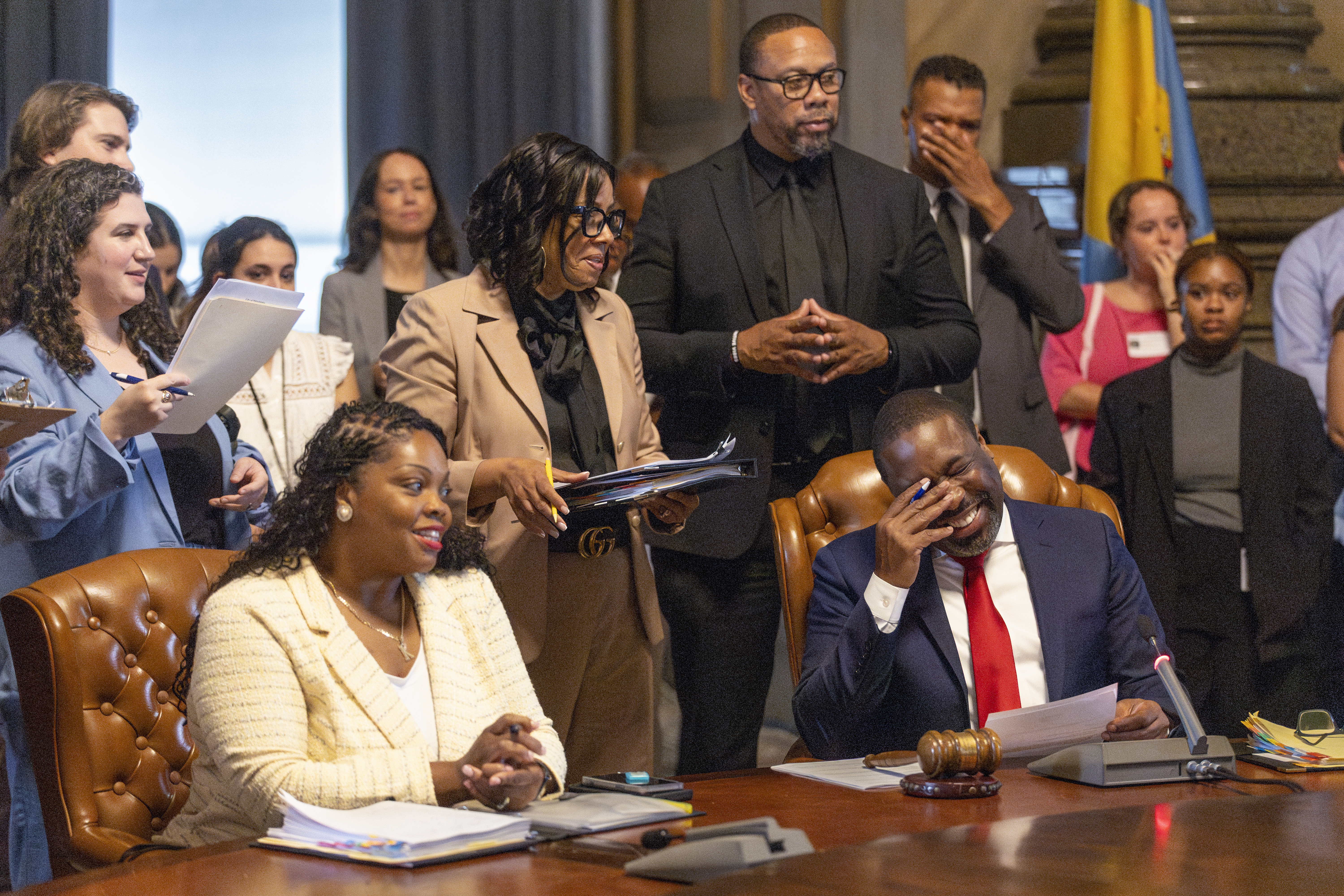
Council President Kenyatta Johnson laughs inside the caucus inside City Hall on June 11.Aidan T. Gallo / Staff Photographer
A spokesperson for Landau’s campaign arm said in a statement that the Council member “stands by her accomplishments for working people, small businesses and vulnerable communities in Philadelphia and looks forward to voters having the opportunity to make up their own minds next year.”
It’s unclear just how competitive the at-large race will be, and candidates have until the spring to decide — nomination paperwork is typically due in March. Seven of Council’s members represent the entire city at-large, and two of those seats are effectively reserved for members of minority parties under the city’s Home Rule Charter.
That has traditionally meant that five seats are held by Democrats, given the party’s massive voter registration advantage in the city. In recent years, Republicans and the progressive Working Families Party have battled for the remaining two seats during the fall general election, and the WFP currently holds both.
Mayor Cherelle L. Parker, who is also up for reelection, and Council President Kenyatta Johnson, who insiders do not expect will see a serious challenger, will likely be on Philly For Growth’s slate, too, the source said.
But for thousands of residents, many of whom live in North Philadelphia, next year’s tax bills are expected to soar.
Nearly 6,000 homeowners in Philadelphia saw their property assessments this year climb by more than 50% compared with two years ago, the last time the city conducted a mass revaluation, according to an Inquirer analysis of city property assessment data released in June.
Of those homeowners, more than 2,200 saw their assessments more than double.
That is likely to result in sticker shock come tax time next year, because property tax bills in the city are calculated based on home values. The revenue is split between the city and the Philadelphia School District.
Homeowners across the city saw a median 3% increase in their property assessments this year compared with the 2025 tax year. Jumps were higher in neighborhoods that border gentrifying areas, such as in parts of Kensington and West Philadelphia.
But this year, two other areas of the city had the densest concentrations of homes where property assessments increased by 50% or more, according to The Inquirer’s analysis.
The steep rises are clustered in the southern end of Strawberry Mansion, the historically Black neighborhood along the Schuylkill, and in the tiny Hartranft neighborhood north of Temple University and east of Broad Street, where residents are predominately Latino.
(function() {
var l2 = function() {
new pym.Parent(‘html_sandwich_2026_property4’,
‘https://media.inquirer.com/storage/inquirer/projects/innovation/arcgis_iframe/html_sandwich_2026_property4.html’);
};
if (typeof(pym) === ‘undefined’) {
var h = document.getElementsByTagName(‘head’)[0],
s = document.createElement(‘script’);
s.type = ‘text/javascript’;
s.src = ‘https://pym.nprapps.org/pym.v1.min.js’;
s.onload = l2;
h.appendChild(s);
} else {
l2();
}
})();
Housing experts and advocates for low-income homeowners have long criticized the city’s assessment system as systemically biased, leaving Black and brown homeowners to pay disproportionately high property taxes. Mayor Cherelle L. Parker convened a task force in 2024 to study the city’s revaluation system, and that group’s recommendations are expected to be released later this year.
Monty Wilson, a senior attorney at Community Legal Services who sits on the task force, said the Philadelphia Office of Property Assessment is the best in the state and has “worked really hard to become more and more accurate.”
But he said bias persists in part because of the unique challenges that assessors face in low-income neighborhoods that can cause volatility in home values, such as higher rates of vacant lots, foreclosures, and other factors.
A 2024 CLS report found that errors were clustered in lower-value neighborhoods where a majority of residents are people of color.
“That means when a property is overassessed,” Wilson said, ”it tends to occur in a Black and brown neighborhood.”
(function(){function e(){window.addEventListener(`message`,function(e){if(e.data[`datawrapper-height`]!==void 0){var t=document.querySelectorAll(`iframe`);for(var n in e.data[`datawrapper-height`])for(var r=0,i;i=t[r];r++)if(i.contentWindow===e.source){var a=e.data[`datawrapper-height`][n]+`px`;i.style.height=a}}})}e()})();
The Parker administration did not respond to requests for comment.
In response to a previous article about this year’s property reassessments, city officials emphasized that some lower-income homeowners pay relatively low tax bills because of the popular homestead exemption tax break. The program, which any homeowners can apply for and obtain if they live in their house as their primary residence, exempts the first $100,000 from a home’s taxable value.
That means that some homeowners in working-class neighborhoods previously paid little to no property taxes. A sudden increase in valuation, like the ones seen this year in pockets of North Philadelphia, could require they pay bills next year that are several hundred dollars more than in the past.
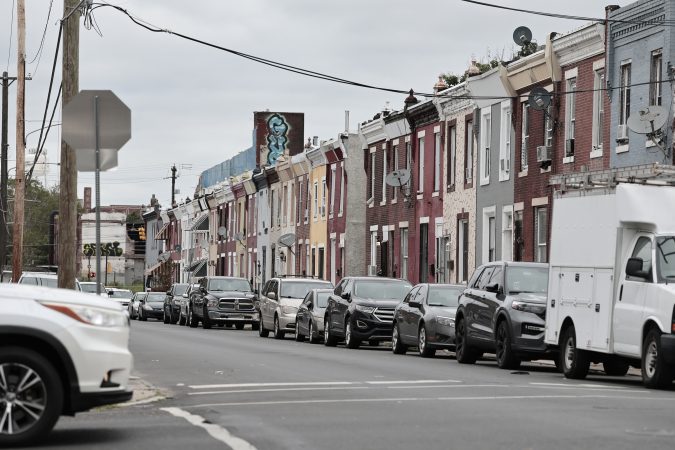
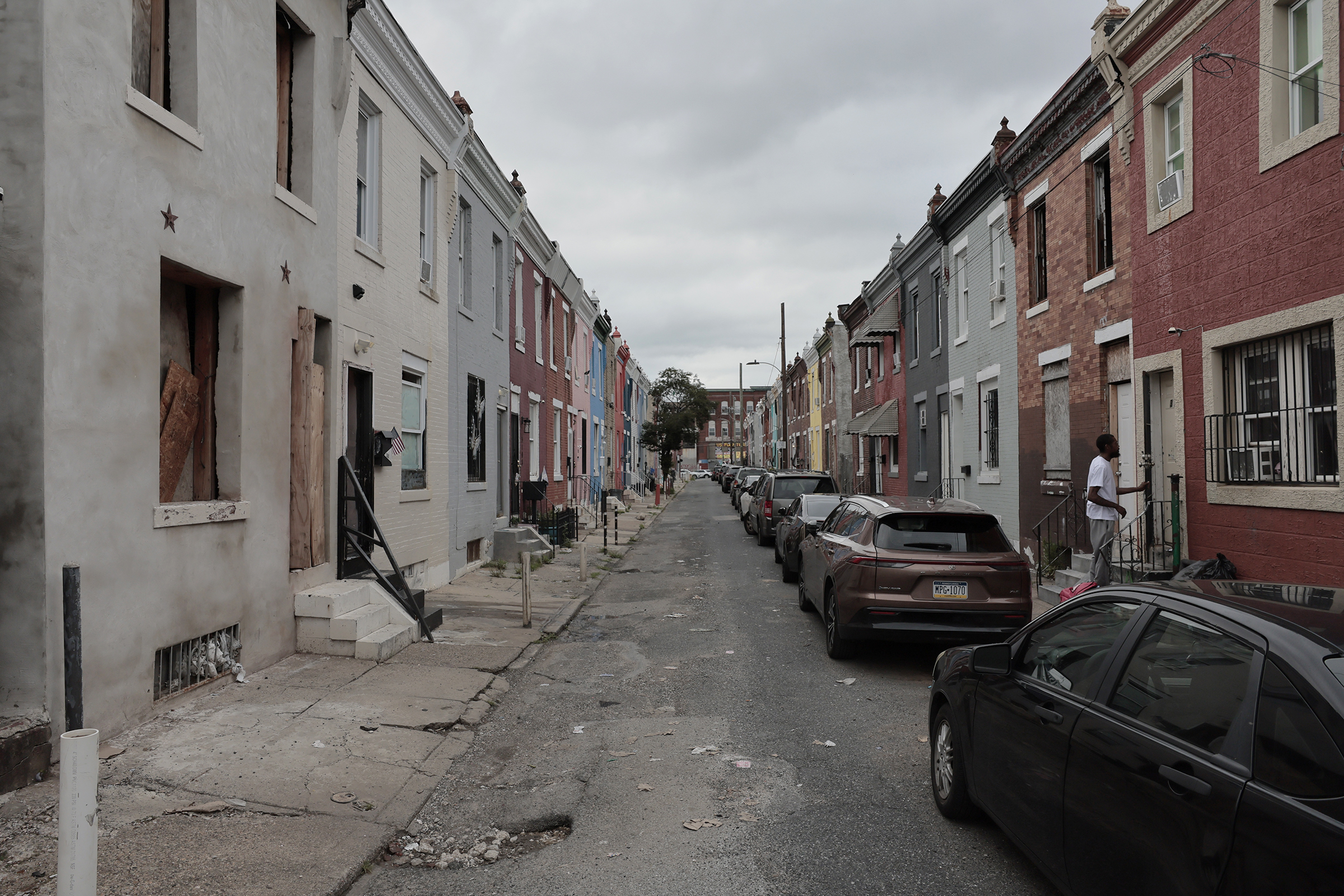
Take the 2500 block of North Marshall Street. The residential North Philly street sits between West Kensington and Broad Street, and nearly every home saw its assessment increase by 60% or more, according to The Inquirer’s analysis.
Most of the homes there had previously been valued at less than $100,000, meaning owners with the homestead exemption owed no property taxes. Now, many of the homes on the block are valued at about $140,000, an amount that would next year yield more than $500 in yearly tax bills for owners with the homestead exemption.
More than 40% of the Hartranft neighborhood’s residents are below the federal poverty level, which is $33,000 a year for a family of four, according to U.S. Census data.
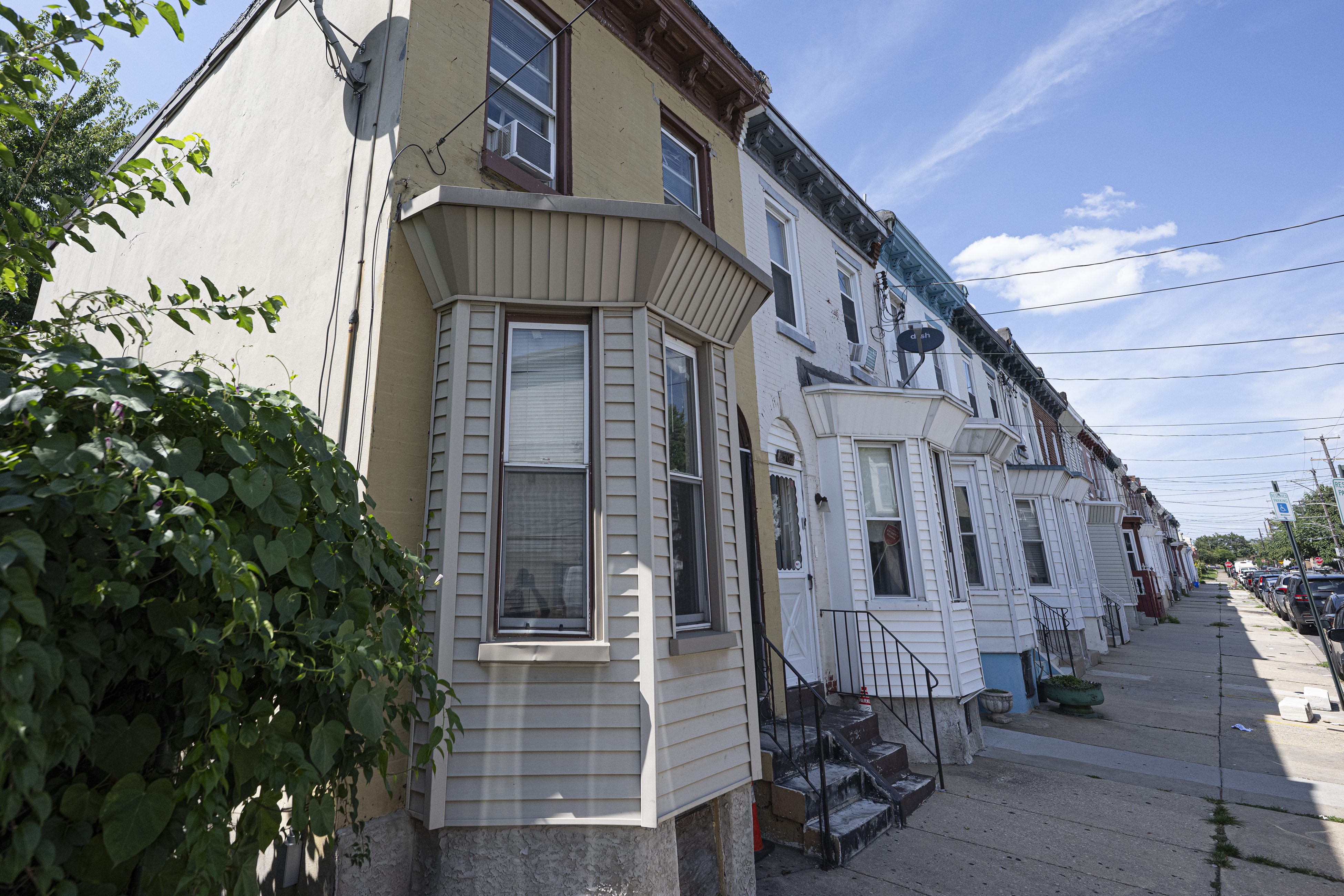
At Left a property on 2500 N. Marshall St., Philadelphia, PA 19133 is shown Wednesday, Aug. 19, 2026, in Philadelphia.Jose F. Moreno / Staff Photographer
City Councilmember Quetcy Lozada, whose district includes parts of Kensington and North Philadelphia, said the Hartranft area is not like sections of Kensington that have seen an influx of development in recent years and where increases in property assessments may be expected.
It is possible, she said, that lower-income residents who have been displaced from parts of Kensington looked to move west of the neighborhood, increasing demand in the Fairhill and Hartranft areas.
Lozada — who has held workshops in the neighborhood to connect residents with property tax relief programs — said she fears her constituents are being asked to pay disproportionately high taxes and not seeing better city services and stronger public schools.
“How is it possible that someone in Fairhill is paying a higher tax for a property that has not had any investment, in a neighborhood that is not as safe, whose school system is not as great, as somebody that lives in Chestnut Hill, for instance?” she said, referring to the upscale Northwest Philadelphia neighborhood with a $109,000 median household income. “There has to be a better way of doing a more accurate evaluation in every neighborhood.”
In Strawberry Mansion, community leaders said that increased assessments are likely a result of market pressure from Brewerytown to its south, a comparatively whiter and higher-income neighborhood.
“The city has to be super transparent about this assessment system so people can better understand it and not feel that sticker stock,” said Tonnetta Graham, president of the Strawberry Mansion Community Development Corp. “If we know how they came to their number, it’s easier to chew.”
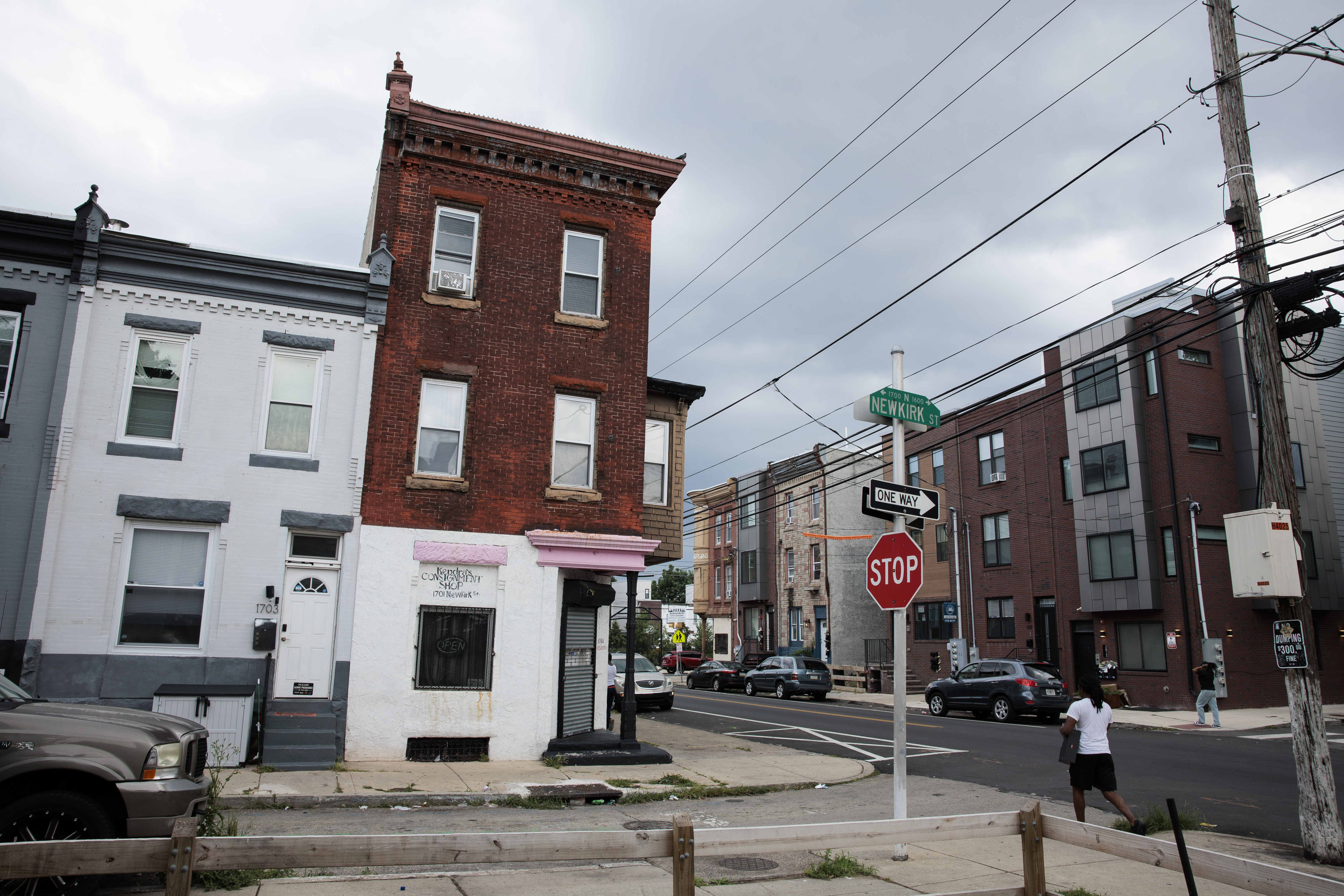
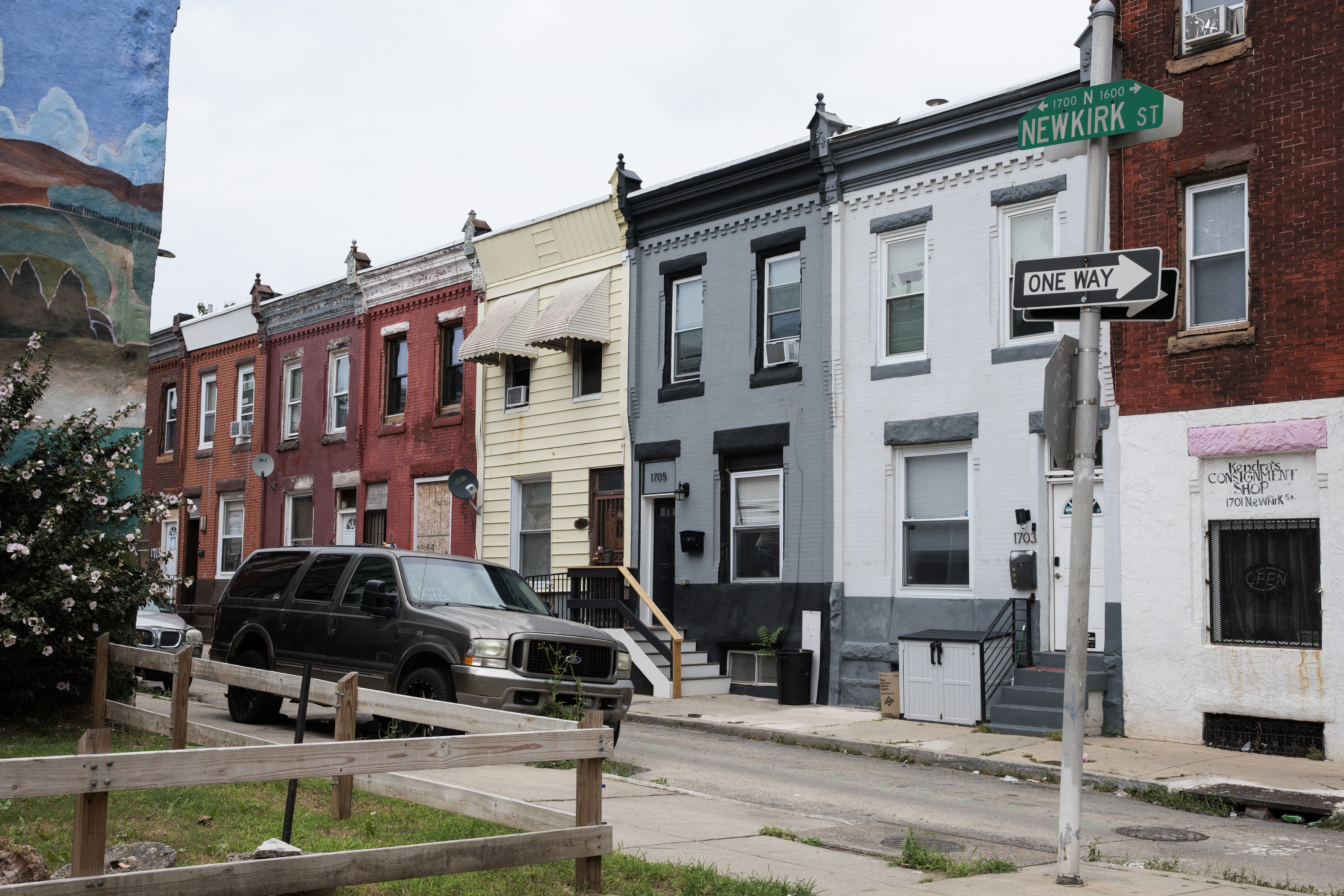
The 1700 block of North Newkirk Street on Thursday, Aug. 20, 2026 in Philadelphia.Monica Herndon / Staff Photographer
Councilmember Jeffery Young Jr., whose district includes both Strawberry Mansion and parts of Hartranft, did not respond to requests for comment.
Jalon Alexander, a Strawberry Mansion native who this month launched a campaign to challenge Young for his Council seat next year, said he was recently at a block party in the neighborhood where he heard repeatedly from older homeowners who were concerned about their increased assessments.
“They feel taken advantage of, and they feel like it’s coming out of nowhere,” Alexander said. “This is an area where there’s high levels of poverty, and there is not a lot of political or government attention in this area. I’ve spoken with many people whose rates have almost doubled. It’s the biggest issue in the neighborhood.”
Staff writer Michaelle Bond contributed to this article.
Philadelphia City Council is already looking to 2027. And with all 17 seats on the ballot next spring, the elections are shaping up to be a pivotal test of whether the city’s established politicians can withstand a rising tide of frustration with the party among Democratic voters.
All of the incumbents have said they intend to run for reelection, and several are likely to face serious challenges from new candidates focused on grassroots organizing and progressive groups — hoping to seize the opportunity presented by a nationwide leftward shift amid President Donald Trump’s second term.
Three districts have emerged as key battlegrounds.
And the city’s progressive organizations, emboldened by a series of wins locally and nationally, are targeting two other districts: the 1st, which stretches from South Philadelphia to Fishtown and is represented by Councilmember Mark Squilla, and the 8th, which includes parts of North and Northwest Philadelphia and is represented by Councilmember Cindy Bass.
“We’re definitely feeling confident,” said Robert Saleem Holbrook, executive director of the progressive advocacy group Straight Ahead. “Anyone who is going to be running under a progressive banner or a progressive movement is going to have to be running against the establishment, not toward it.”
A competitive race also appears to be taking shape for the seven Council seats that represent the city at-large.
Five of those seats are all but certain to be won by Democrats, making the May 2027 primary the key election in deep-blue Philadelphia.
The other two at-large seats — set aside for Council members outside the majority party under the city’s Home Rule Charter — will be decided in the November 2027 general election. Currently, the two minority party seats are held by Councilmembers Kendra Brooks and Nicolas O’Rourke of the left-leaning Working Families Party.
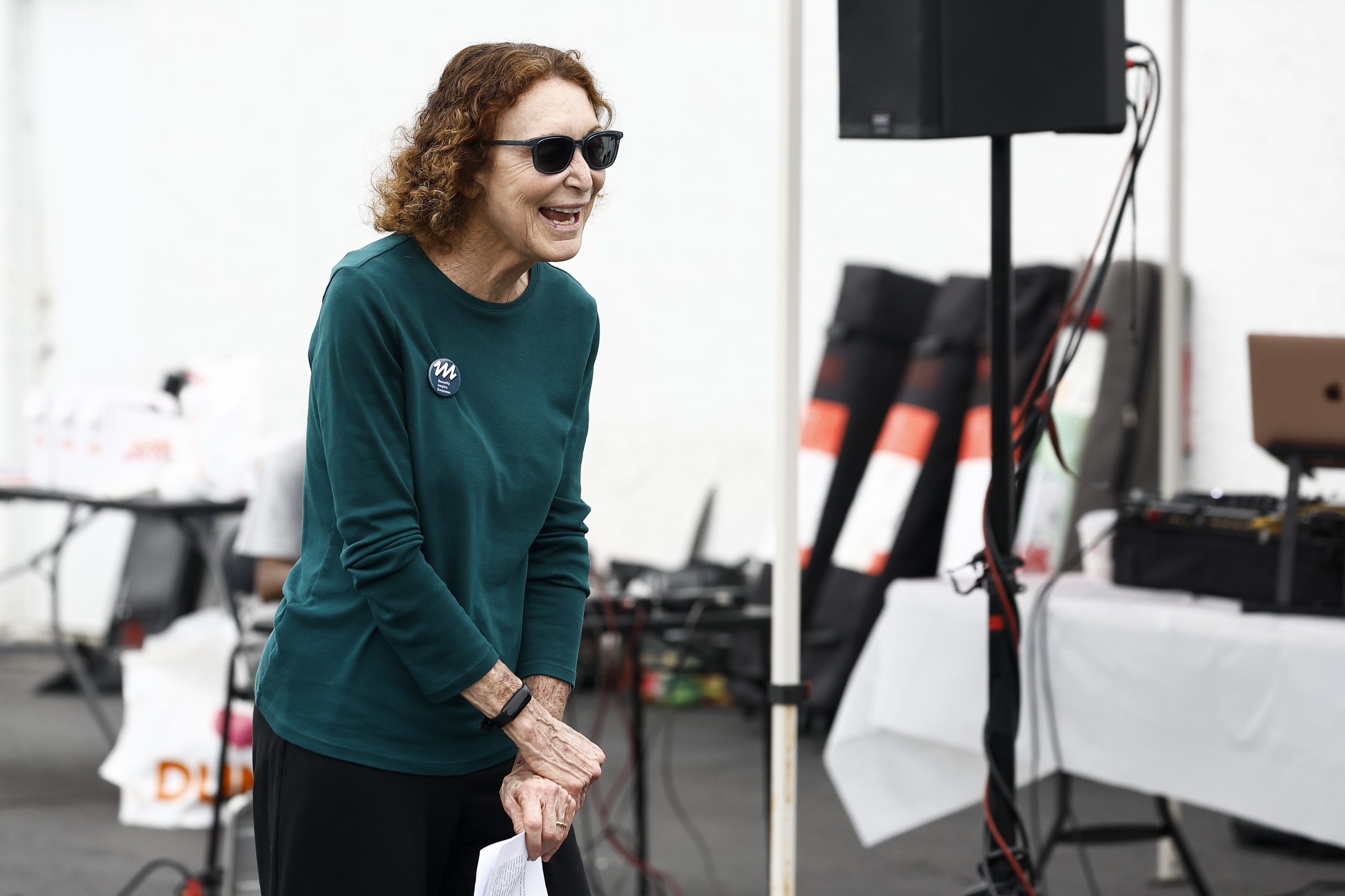
Jane Golden, founder and executive director of Mural Arts Philadelphia, takes the stage during the dedication of the Super Bowl LIX mural at Spike’s Trophies on June 17, 2025 in Philadelphia.Monica Herndon / Staff Photographer
Golden, 73, said last week that she is not currently running for Council, but acknowledged she has thought about it for years.
“It’s always something that is tempting to me, because I just love the city so much,” she said. “I feel honored that people even think of me.”
Progressives eye Bass’ North Philly seat
Philadelphia’s progressive activists this year see two key opportunities to expand the loosely organized left-leaning bloc on Council, which currently consists of four members. Winning additional seats could also grow their influence by enticing more moderate members to vote alongside them if they believe primary voters are moving left.
Leftists have notched high-profile wins in Democratic primaries across the country this year, including in Philadelphia, where democratic socialist State Rep. Chris Rabb (D., Philadelphia) bested more moderate candidates for a seat in Congress representing about half of the city. The district is one of the most Democratic in the nation.
Anderson-Oberman, 55, the executive director of the progressive group Reclaim Philadelphia, said last week that he is “leaning” toward taking another swing.
“We’re in a moment in this country and this city where people have had enough,” he said. “People are looking for new answers. … Cindy represents the old way of doing things.”
Union organizer Seth Anderson-Oberman, running for 8th District City Council, joins in a small rally with community and Happy Hollow Advisory Board members along Wayne Avenue at Happy Hollow Playground in Philadelphia on April 2, 2023.Tyger Williams / Staff Photographer
Another Council run by Anderson-Oberman may test how far progressive momentum can go in Philadelphia. He was a member of the Communist Party USA in his 20s, and has said he is proud of that experience.
Bass, 58, said she is ready for the race no matter who her opponent is.
In June, she survived a contentious fight for another four-year term as Democratic leader of Mount Airy’s 22nd Ward. She was criticized for her handling of the process, and the party ordered a redo of the election.
She and her progressive opponent, Octavius Price, tied, then struck a power-sharing agreement. Through it all, Bass said, longtime residents stuck by her — and she is confident voters will do the same next year.
“My voters are people who are based in this community, committed to this community, intend to stay in the communities that they are in,” she said.
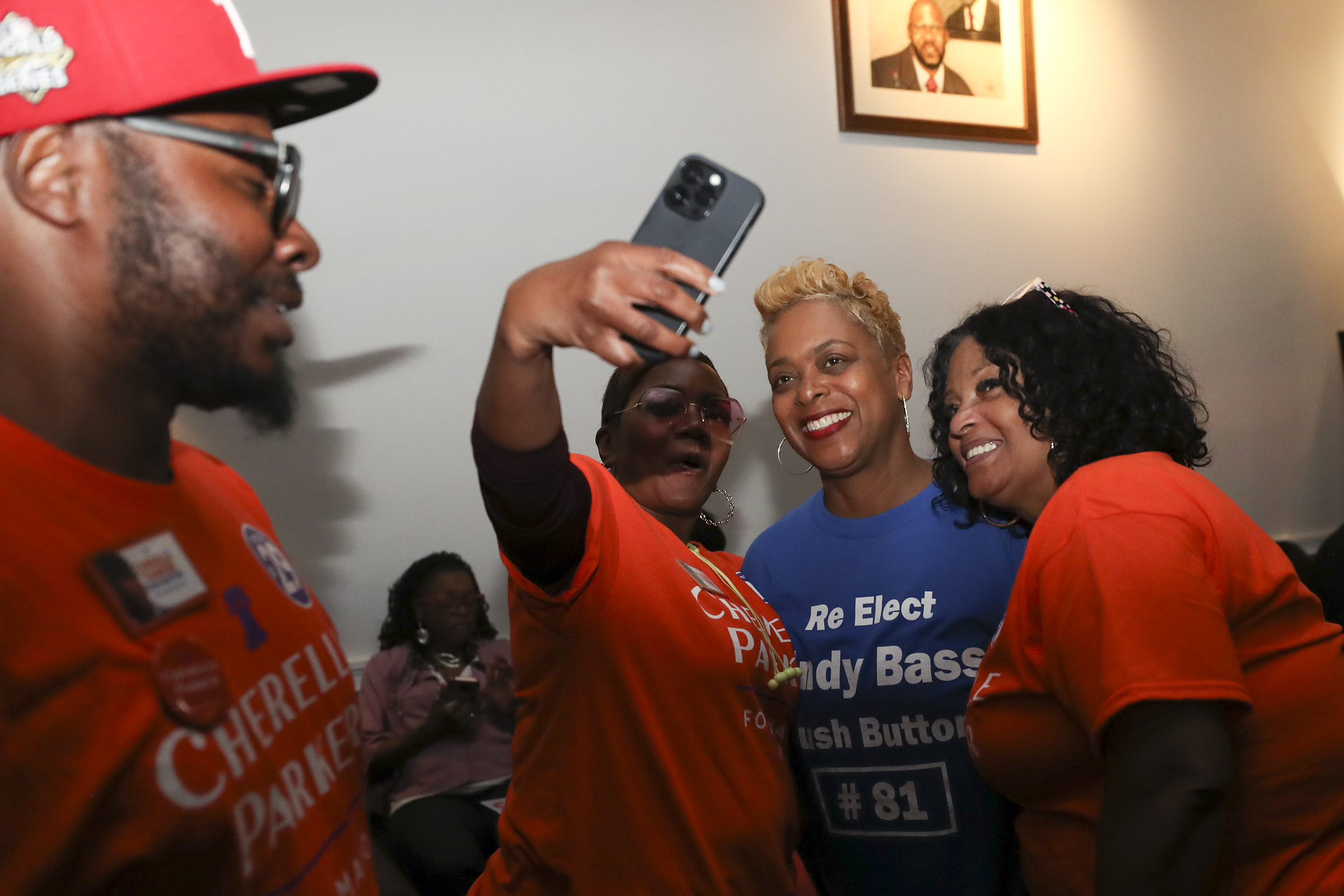
City Councilmember Cindy Bass (center) attends the watch party for Democratic candidate for mayor Cherelle L. Parker at Laborers 332 in Philadelphia on May 16, 2023.Heather Khalifa / Staff Photographer
Jeff Jones, a community leader and social justice advocate from Germantown, has also said he intends to run in the 8th District.
“I want to bring that new vision and a new voice to the 8th District, where residents and children and families can know that their voice matters, their concerns will be heard, and their challenges will be met,” said Jones, 61, a first-time political candidate.
Squilla could see a lefty challenger
Leftists are also eying Squilla’s seat, which represents the area along the Delaware River from Pennsport to Kensington. Since Squilla took office in 2012, the district has transformed from a bastion of working-class white voters to one of the most progressive swaths of the city.
Squilla, 63, who has strong labor ties and is one of the most pro-development district Council members, said being a centrist has likely put a target on his back in the 2027 election.
Another contributing factor may be Squilla’s support for controversial legislation in 2024 to approve the 76ers’ since-abandoned plan to build a new arena in Center City. The project, which would have been in Squilla’s 1st District, was opposed by advocates for Chinatown, which the arena would havebordered.
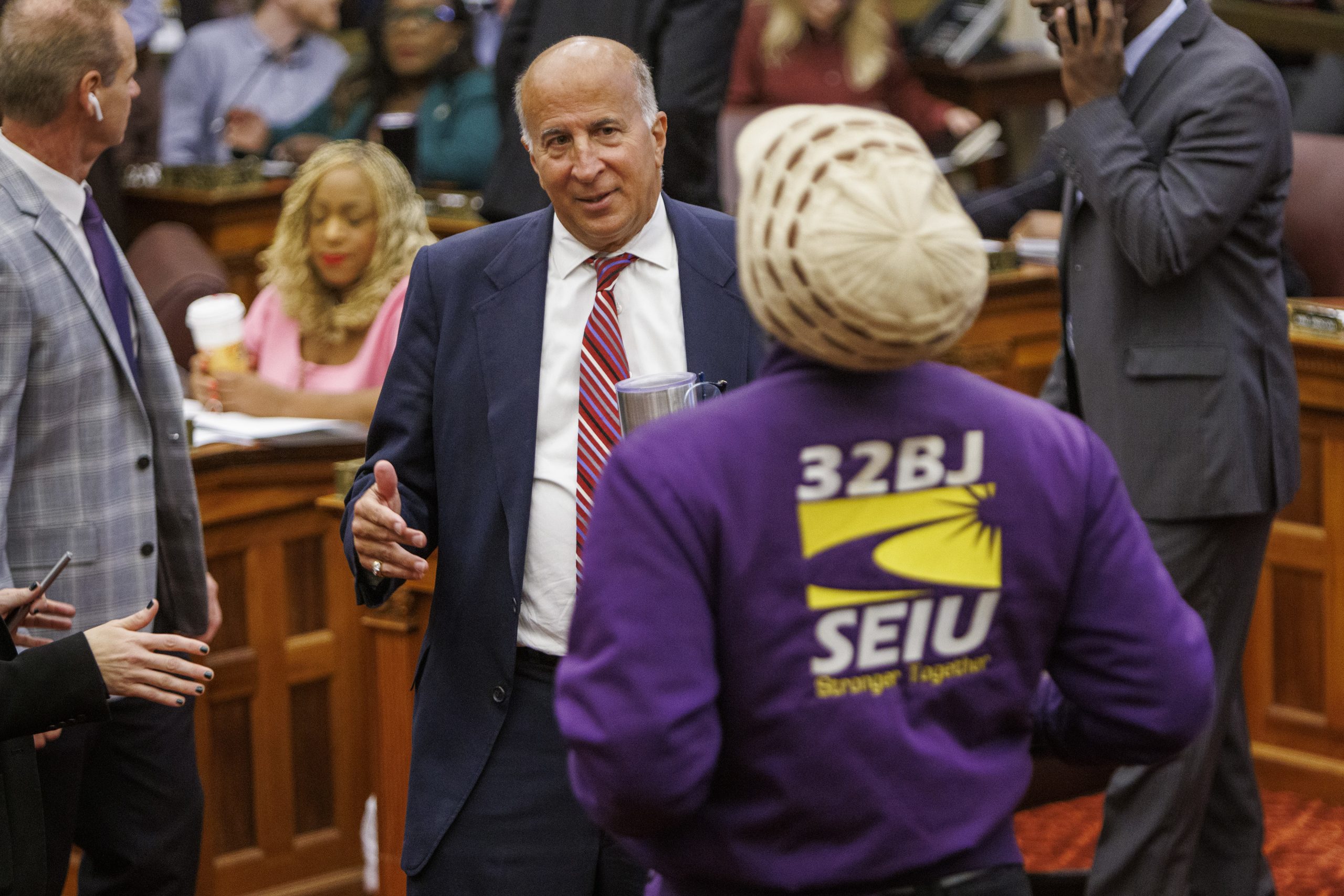
Councilmember Mark Squilla arrives in Council chambers on Nov. 12, 2024, before the start of a public hearing on a proposed Sixers arena.Alejandro A. Alvarez / Staff Photographer
Despite the fierce objections, Council approved the project with Mayor Cherelle L. Parker’s support in December 2024. Weeks later, the basketball team announced it was abandoning its Center City plan and would instead build its next arena in South Philly.
Squilla said he is prepared to defend his actions, noting that he worked to ensure any arena deal would benefit his district and that many of those promises are moving forward despite the 76ers withdrawing their proposal.
“The goal as an elected official, and also as a leader, is not always to make the popular decision,” he said. “The goal is to have a process to make the decision that would be best for the people around it.”
One prominent opponent of the Center City arena plan was Will Gross, the owner of Ox Coffee in Queen Village and a progressive who is the Democratic leader of the 2nd Ward. He is seen by political insiders and progressive organizations as the most likely candidate to take on Squilla.
Gross declined to comment.
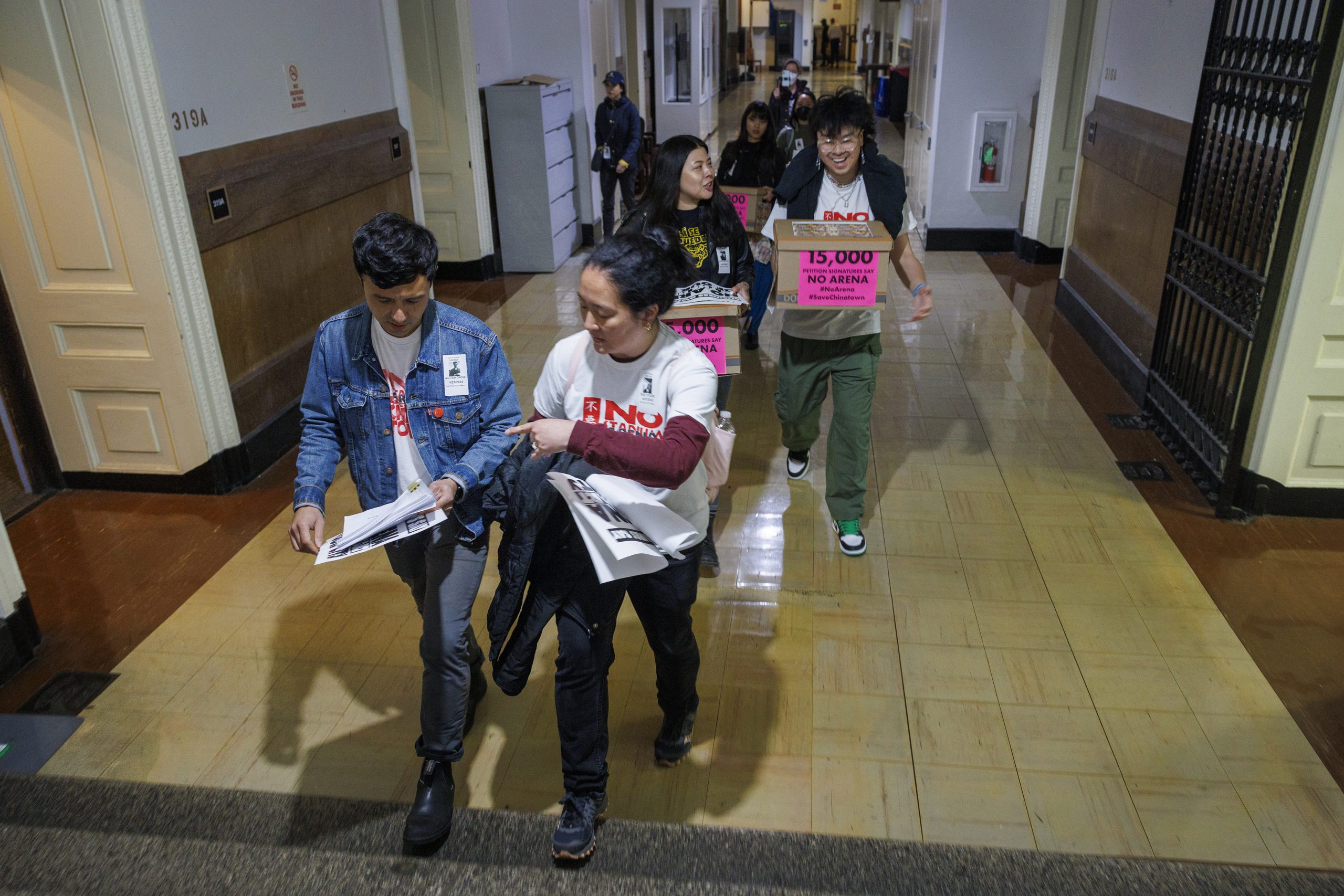
In this 2023 file photo, Will Gross and Kay Yoon, of the No Arena in Chinatown group, deliver petitions to Councilmember Mark Squilla. Alejandro A. Alvarez / Staff Photographer
A progressive challenger may also emerge in the North Philly and Kensington-based 7th District, which is represented by Councilmember Quetcy Lozada.
Some insiders have speculated that Celin may run again. He declined to comment.
Lozada, 55, said she “can’t focus” on potential challengers.
“If I spend my time listening to the buzz about who is running,” she said, “we won’t get any work done.”
A battle takes shape in the 5th District
In the 5th District, a seat that represents parts of North Philadelphia and Center City, a handful of Democratic challengers are lining up to take on Young, 40, who is seen as one of Council’s most vulnerable members.
That is in part because of the unusual way in which he was elected in 2023. He ended up being the only Democrat on the ballot after several others, including party officials’ preferred candidates, were removed amid legal challenges.
Councilmember Jeffery Young Jr. in chambers as City Council meets Dec. 11, 2025.Tom Gralish / Staff Photographer
One of those candidates was Curtis Wilkerson, who was chief of staff to former City Council President Darrell L. Clarke. Two sources, who spoke on condition of anonymity because they were not authorized to discuss the campaign dynamics, said Wilkerson is considering running for the seat again next year.He did not respond to a request for comment.
Also likely to run is Jalon Alexander, an attorney who unsuccessfully ran for an at-large seat on Council in 2023. Alexander, 33, formed an exploratory committee last year and is expected to formally declare his candidacy later this summer.
Two others are also considering running.
Dustin Dove, a lawyer and the president of the Fairmount Civic Association, said neighbors and community leaders have encouraged him to get in the Council race, and he is “taking the possibility of running seriously.”
“I think our city government should work for everyone by keeping our neighborhoods safe and streets walkable, making housing affordable, and ensuring fairness and access in public services,” Dove, 38, said last week.
Jalon Alexander, an attorney and community advocate, speaks to attendees at a meeting about potential SEPTA budget cuts hosted at Garden of Prayer Church in Strawberry Mansion on June 9, 2025.Erin Blewett / For The Inquirer
And Max Tuttleman, 37, a philanthropist who unsuccessfully ran for an at-large seat in 2023, said he “cares deeply about the 5th District and would never close the door to serving Philadelphia.”
He added that “Center City and the neighborhoods around it should be growing faster than they are.”
Young said in an interview last weekthat he intends to run for reelection, but that challengers are not his focus.
“I‘m focused on serving my constituency, serving my community,” he said. “The work that we’ve been doing will hopefully earn the support of the residents of the 5th District.”
A smaller, but competitive, at-large field
Over the last several election cycles, dozens of candidates lined up to run for at-large seats during a time of immense turnover in Council.
But with seven incumbents all looking toward reelection in 2027, there may be fewer challengers who line up to take them on. So far, only Golden and a handful of others have emerged as possible contenders.
David Alexander Jenkins, a cultural strategist known for delivering impassioned speeches during Council’s public comment section, said he is considering a run, encouraged by fellow community members.
“When the community that is around you constantly pushes you to intercede on their behalf, then it’s because they have trusted you to do what it is that you do best,” Jenkins, 39, said. “I think it would be incredibly unwise to ignore that.”
And Jude Husein, 28, a Palestinian-born community activist who was raised in North Philly, has already launched her campaign. If her bid is successful, Husein, a former staffer for State Sen. Art Haywood, would be the first member of Gen Z on Council.
In this 2023 file photo, Jude Husein, of North Philadelphia, speaks at a rally for a Day of Solidarity event at the Art Museum steps.Tyger Williams / Staff Photographer
Leaders of progressive organizations said they are closely watching her candidacy. However, Husein is not exactly running as a leftist. She said that her policy positions are varied and that she will seek endorsements from any institution that is “values-aligned.”
“I’m running because I think government should work for the people who pay for it, and should make neighborhoods affordable and safer,” she said.
Also in the running for Council at-large seats are Billy McCann, 46, a former teacher who lives in Port Richmond, and Isaiah T. Martin, 26, who lives in West Philly and leads a community development nonprofit. The pair, who both said they are progressive, have established something of a slate with Jones, who is challenging Bass in the 8th District.
They said they would prioritize public education, affordability, housing assistance, and government accountability, and they argued that establishment Democrats are failing to connect with voters.
“A new day is coming,” said Martin, another member of Gen Z who would make history on Council if elected. “It’s time we get people who are going to do the actual work and not just sit here and talk about it.”
The biggest jump in Philadelphia’s property assessments this year occurred in Kensington, a measure that means many homeowners in the long-struggling neighborhood are likely to see higher taxes amid a concerted effort by the city to clean up the area.
That is according to an Inquirer analysis of recently released property assessments of single-family homes, which found that, citywide, there was a 3% median change in valuations from the 2025 tax year, the last time there was a mass reassessment.
That increase is far more modest than the widespread jump in valuations that homeowners saw two years ago, which captured multiple years of real estate growth and the volatile post-pandemic market.
What remains the same: who will be most affected.
The Inquirer’s analysis of this year’s property assessment data shows that low-income neighborhoods near gentrifying areas saw the sharpest jumps in valuations compared with the rest of the city.
The four areas that saw the largest percentage increases in median assessments — Kensington, Mantua, Grays Ferry, and Kingsessing — all border more gentrified neighborhoods like Fishtown, University City, and Point Breeze. The results of the analysis are a further sign that market pressures in higher-income areas are pushing into pockets of the city that have long been primarily home to Black and brown working-class residents.
Of the eight neighborhoods that saw the largest increases between the 2025 and 2027 tax years, five have median annual household incomes around $40,000 or less, according to an analysis of U.S. Census data. The federal poverty level is $33,000 for a family of four.
(function(){function e(){window.addEventListener(`message`,function(e){if(e.data[`datawrapper-height`]!==void 0){var t=document.querySelectorAll(`iframe`);for(var n in e.data[`datawrapper-height`])for(var r=0,i;i=t[r];r++)if(i.contentWindow===e.source){var a=e.data[`datawrapper-height`][n]+`px`;i.style.height=a}}})}e()})();
In a statement, officials with Mayor Cherelle L. Parker’s administration noted that many homeowners in those five neighborhoods are benefiting from a popular city tax break. The city said that the median 2027 value in those five neighborhoods is $123,600, so for many homeowners in those areas, the median taxable assessed value is just $23,600.
That is because of the homestead exemption, a tax break for homeowners who live in their house as their primary residence that exempts the first $100,000 in home value from property taxes. Homeowners must sign up to be included in the free program.
At least 60% of homeowners in those neighborhoods have signed up for property tax relief programs, according to the city.
James Aros Jr., the chief assessor of the Philadelphia Office of Property Assessment, and Revenue Commissioner Kathleen McColgan said enrollment rates in property tax relief, including the homestead exemption and multiple tax freeze programs, are “encouraging.”
They said the city will “build on this progress through extensive targeted outreach, community partnerships, and efforts to make enrollment as simple and accessible as possible.”
The current property tax rate is 1.3998% of assessed value, which has not changed for nearly a decade. The revenue is split between the city and the Philadelphia School District.
Rising home values in Kensington
Citywide, the steepest increase in valuations was in Kensington, where the median property value jumped 15.3%, from $115,700 in the 2025 tax year to $133,400 now. That median increase would translate to a roughly $250 annual property tax hike.
That comes after Parker’s administration in 2024 launched a multipronged effort to address the long-entrenched open-air drug market in Kensington, which is the epicenter of the city’s opioid crisis and a site of sprawling homelessness.
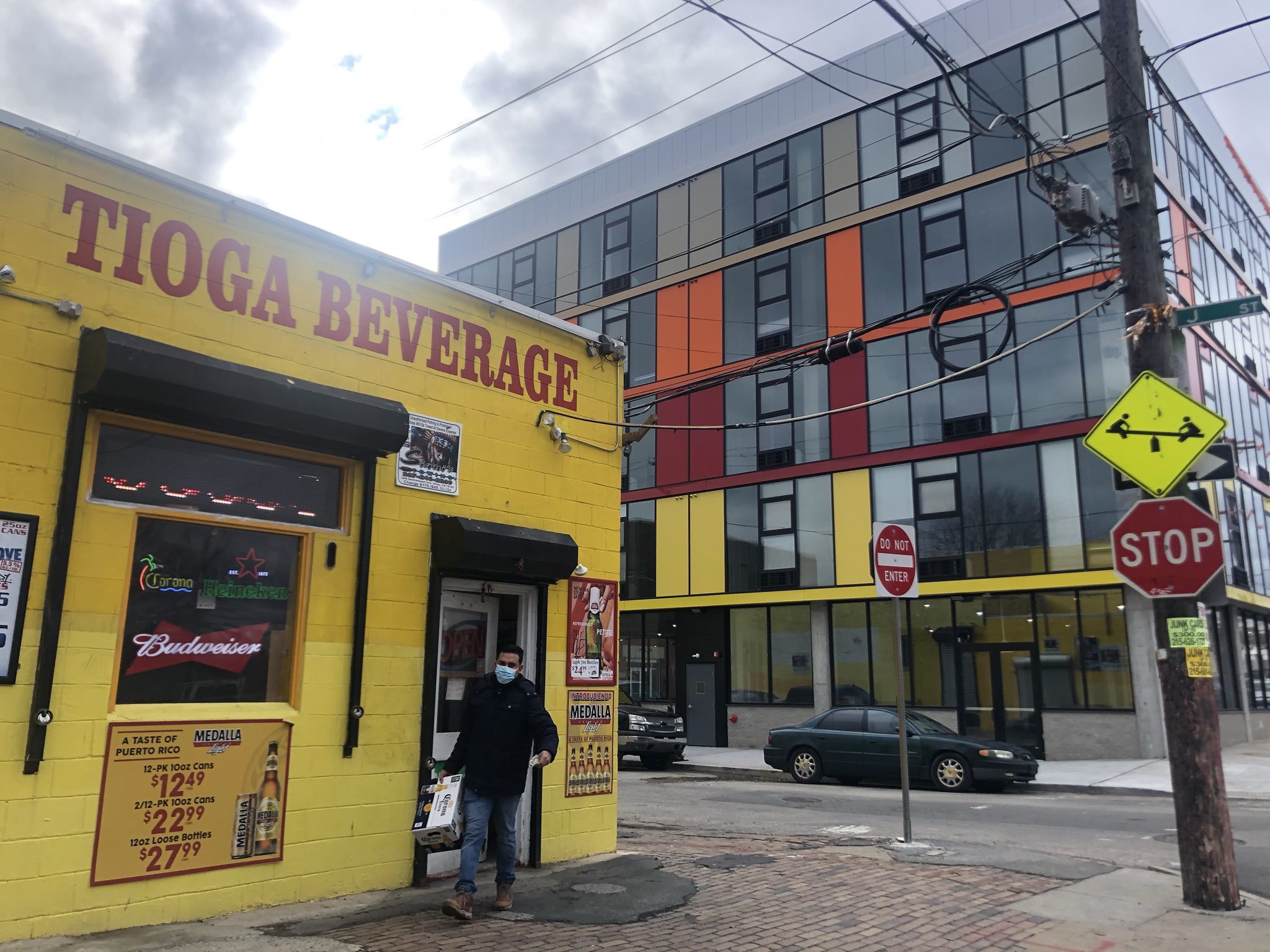
In this 2021 file photo, a glass building at J and Tioga sits near a beer store in Kensington.Inga Saffron
Some neighborhood leaders have watched with anxiety as luxury housing developers and out-of-town investors gobbled up properties in the neighborhood, fearing that poorer residents and middle-class homebuyers may be priced out.
City Councilmember Quetcy Lozada, a Democrat who represents the 7th Council District, which includes parts of Kensington, said she knew speculators from outside the area would want to make it “the next gentrified neighborhood” once the city changed its strategy to more aggressively clean up trash and improve public safety.
But Lozada said there are not enough programs specific to Kensington aimed at preventing displacement as a result of rising property values, especially as the city is investing millions of dollars a year to improve the neighborhood. She said her office is exploring additional tax relief measures.
“I’m going to do whatever I have to do to make sure that residents who have lived in that community can stay there, can raise their families there,” Lozada said. “We have witnessed what has happened on the southern end of the district, where there has been rapid gentrification.”
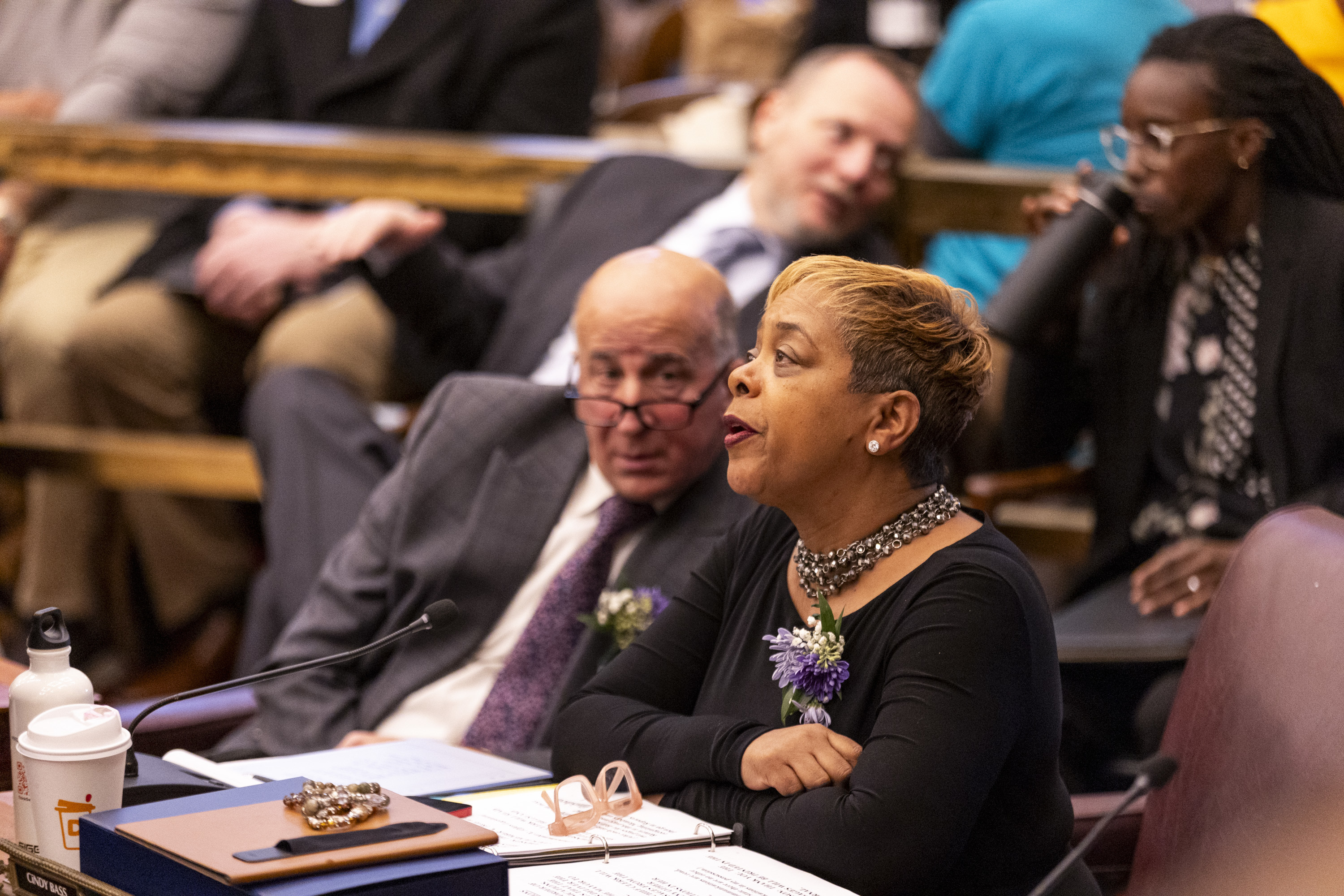
In this March file photo, City Councilmember Quetcy Lozada stands in Council chambers during Mayor Cherelle L. Parker’s budget address.Alejandro A. Alvarez / Staff Photographer
Lozada also said rising property values in Kensington are part of why she has been “so careful with projects presented to me” and has prioritized what she sees as equitable development in the neighborhood — at times to the chagrin of developers who think she has been too restrictive.
“I’m all about people making a return,” she said, “but you can’t continue to do it on the backs of poor people.”
The 3100 block of Arbor Street in Philadelphia on Tuesday, July 7, 2026.Elizabeth Robertson / Staff Photographer
Continuing change in pockets of West Philly
There were also significant property value increases in parts of West Philadelphia.
The median increase in Mantua, the neighborhood north of University City, was the second highest in the city, at 15%, according to The Inquirer’s analysis. The median increase was 12% in Kingsessing, the neighborhood south of University City that in 2025 saw the largest jump of any neighborhood in Philadelphia.
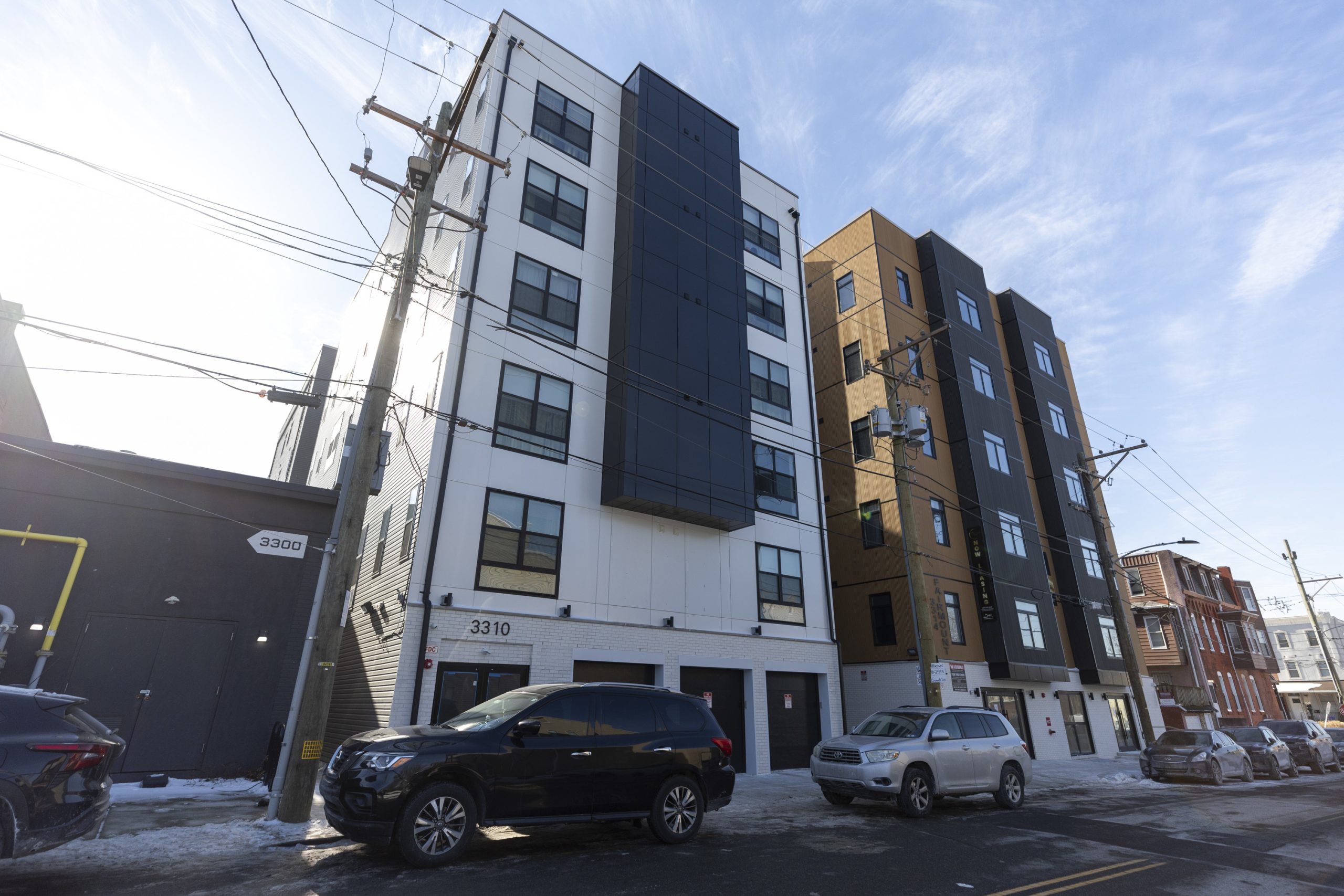
Newly developed buildings along Fairmount Avenue in the neighborhood of Mantua in Philadelphia, Pa., on Thursday, Jan. 23, 2025.Tyger Williams / Staff Photographer
Councilmember Jamie Gauthier, a Democrat who represents West Philadelphia and has made preventing displacement a key initiative, said that there has long been racial bias in the city’s property assessments and that the city must “get serious” about protecting low-income homeowners by revamping its system.
“There has to be a higher level of urgency in making sure that the city doesn’t have a hand in pushing out all of these homeowners that make Philadelphia what it is,” Gauthier said. “It’s unconscionable for us to destabilize our neighborhoods and the longtime homeowners who live there because we didn’t take enough care to make sure that our process was fair and equitable.”
For too long, she said, city officials have said they intended to examine the property assessment practices and identify improvements. In 2024, Parker convened a task force to study the process.
Aros told Council in April that the task force’s report was “being finalized.” He said OPA would look to implement recommendations from the report, including conducting more regular reassessments and improving property-level data such as property condition.
The city is also planning to hire an outside consultant to examine its mass appraisal practices, according to city records. The analyst will be responsible for drafting a report by the end of this year.
Deputy creative director John Duchneskie contributed to this article.