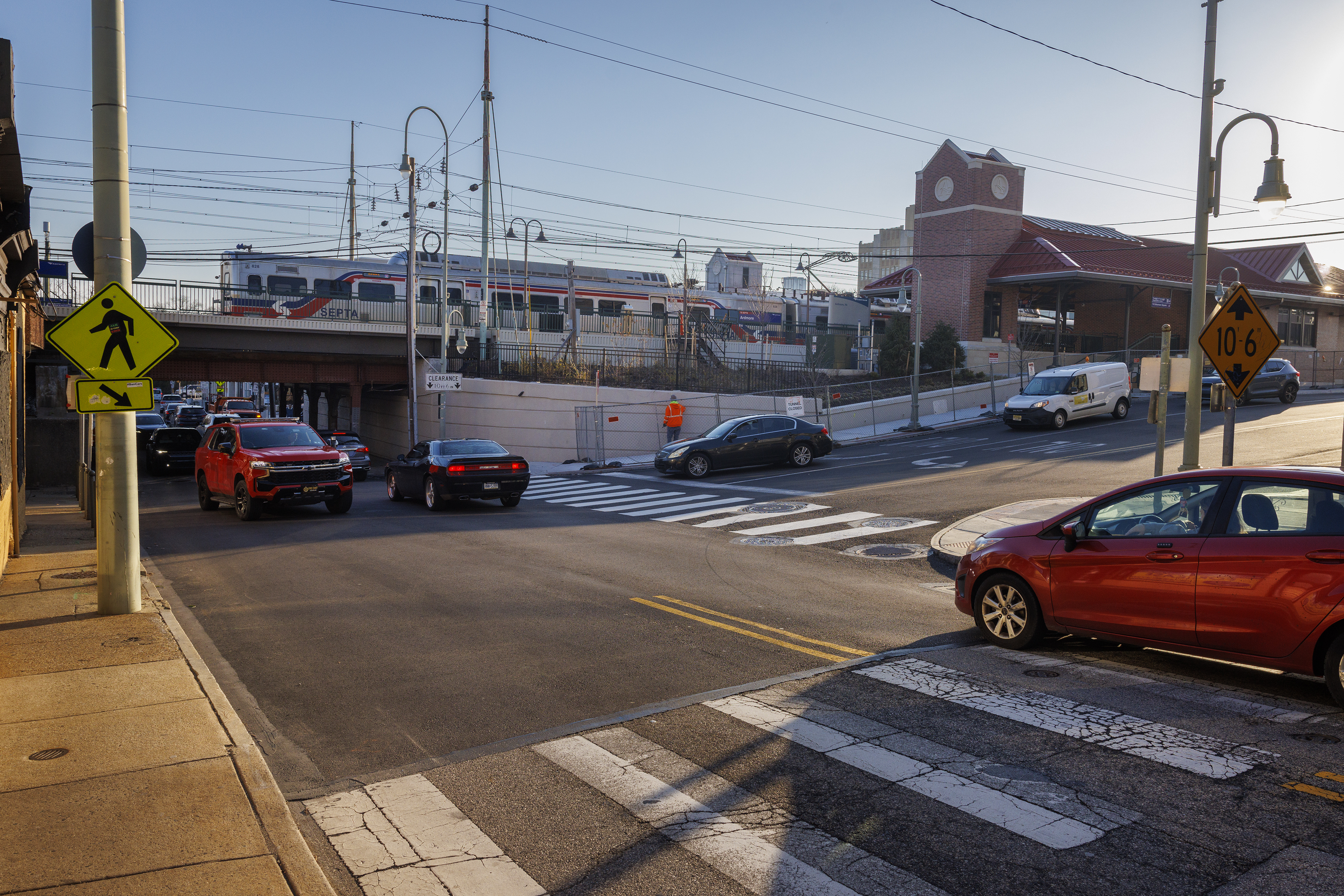
Paoli/Thorndale outbound trains from Center City were suspended this morning right before morning rush hour and again Tuesday evening because of wire problems, a SEPTA spokesperson said.
“We are having significant delays on the Paoli/Thorndale Line due to downed wires near 37th and Mantua. Amtrak is working on it, but we expect the delays will last through the evening,” SEPTA spokesperson Andrew Busch said in a 6:45 p.m. email.
Service also was disrupted Tuesday morning on both the inbound and outbound Cynwyd Line, but that service has since resumed.
Amtrak reported at least one train delay earlier in the day.
Damage to overhead catenary wires at an Amtrak railway junction near the Philadelphia Zoo, which some SEPTA regional rail services like Paoli/Thorndale and Cynwyd share, delayed and suspended some rail service across the region, Busch said earlier on Tuesday.
An Amtrak spokesperson said crews responded and restored service in both directions by approximately 7:25 a.m.
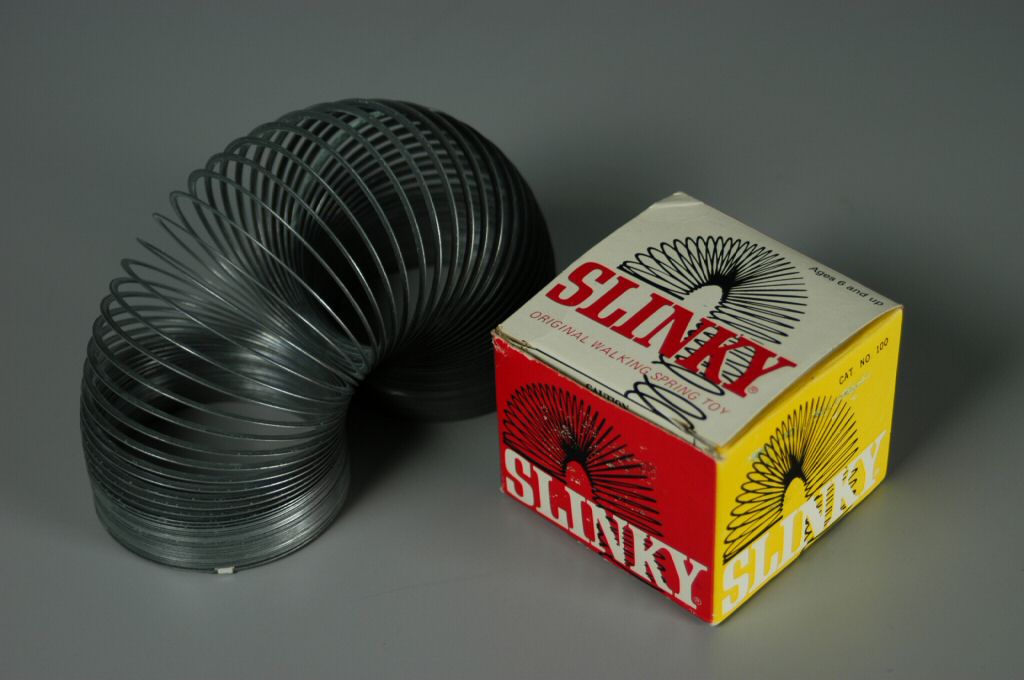
Philadelphia Navy Yard mechanical engineer Richard James was experimenting with a torsion spring in 1943 when the coil tumbled from his desk and landed on a stack of books.
The spring didn’t just sit there. The top coil flipped over onto the next book. Then the back coil flipped over to the next book. Before he knew it, this newfangled thing was taking the hardcovers like stairs.
Fascinated, James went home and showed the new toy to his wife, Betty.
She was enthralled and named the metal thingamajig a Slinky because of its wavy, stealthy movement.
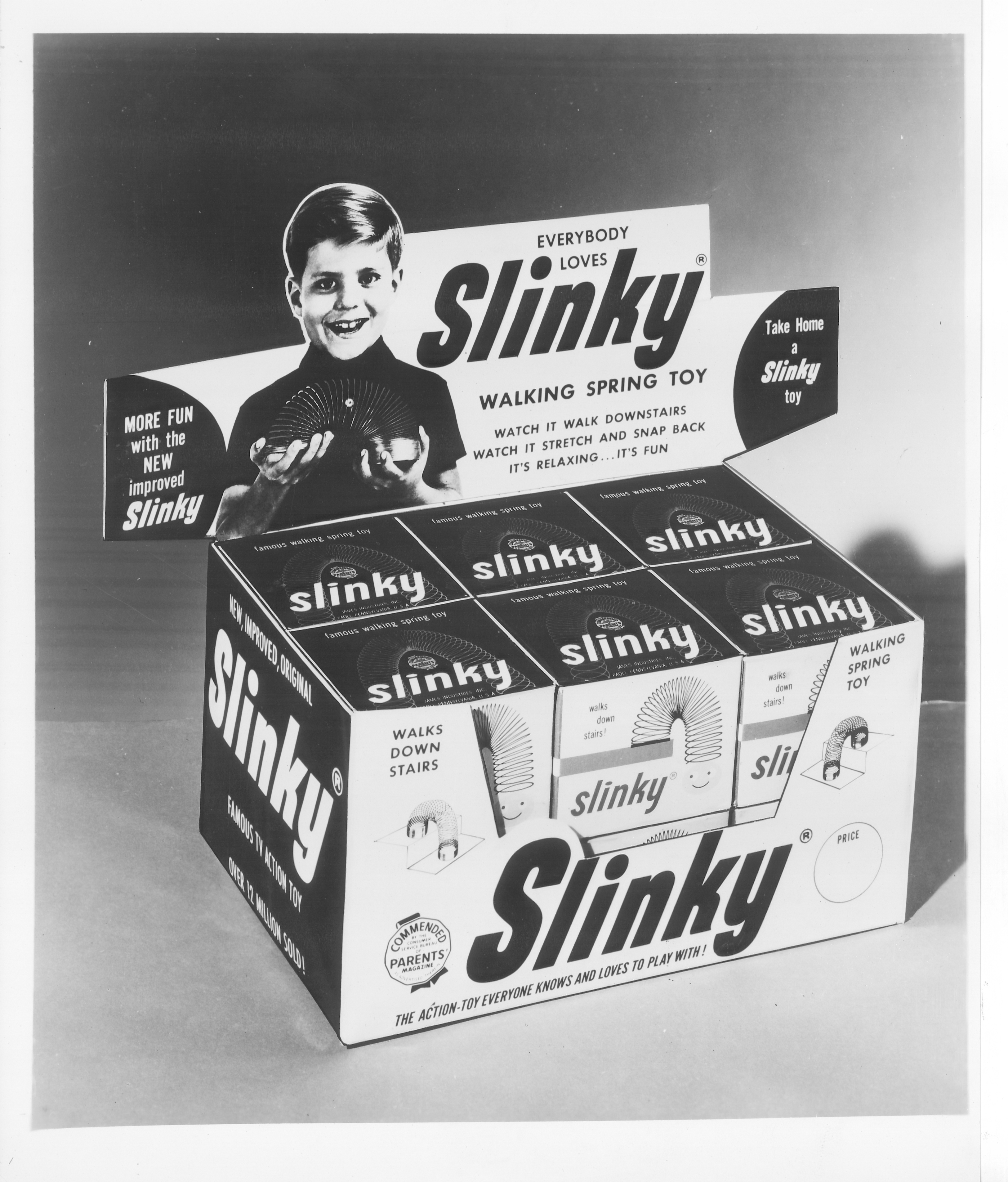
A vintage Slinky display.
James finagled with the metal spring for about two years, perfecting its flip-flop down-the-stack movement. Finally, on Nov. 27, 1945, the Jameses brought 400 Slinkies to Gimbels at Eighth and Market Streets, debuting them to shoppers. The whole lot sold out in 90 minutes for $1 a piece.
A toy craze was born.
This Saturday, the Philadelphia Historic District will host a “Firstival” to fete the Slinky at the American Philosophical Society from 11 a.m. to 1 p.m. The society’s archives house the 1953 study “On Slinky: The Dynamics of a Loose, Heavy Spring” by British mathematician and oceanographer Michael Longuest-Higgens.
Firstivals are weekly day parties celebrating America’s 250th birthday. This week’s Firstival is the 35th.
After the roaring success at Gimbels, Richard James quit his $50-a-week gig at the Navy Yard and founded James Industries, manufacturing Slinkies from a Germantown warehouse. Each Slinky was made from 80 feet of steel on a machine that James invented. It took 10 seconds to make each Slinky.
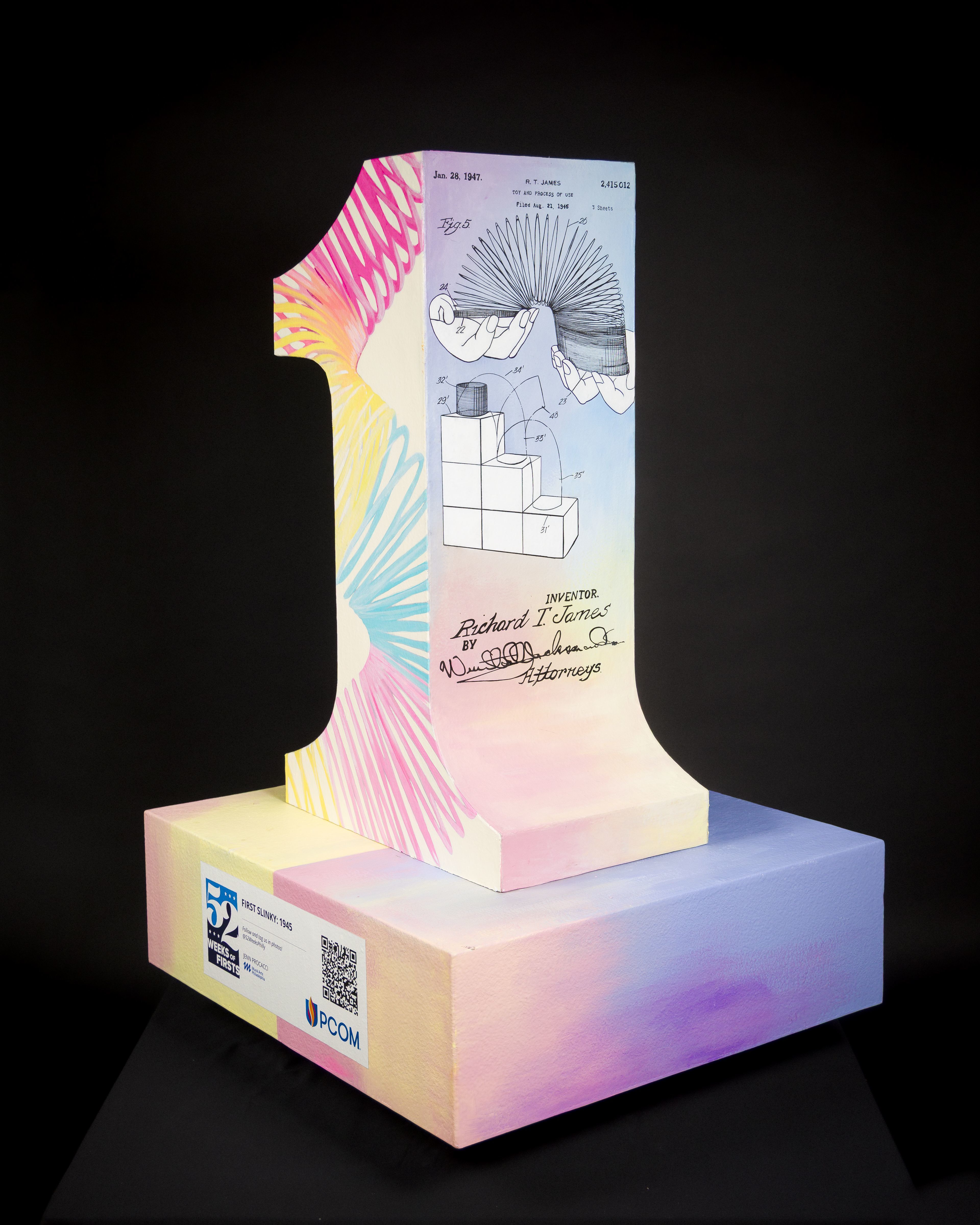
Jen Procacci’s No. 1 features the original blueprints of the Slinky design, commemorating one of America’s most-beloved toys.Jenn Procacci for Colibrà Workshop
Slinkies, considered the first toy craze, predating Cabbage Patch Kids, Tickle Me Elmo, and Beanie Babies, were so popular in the 1940s that Macy’s stopped selling them for a bit because the swarming crowds created a fire hazard.
In the early 1950s, published reports said the Jameses were making more than $1 million a year. James denied those reports in a 1950 Inquirer article but admitted to making “solid profits.” By the end of the decade, the Jameses’ Slinky operation had moved to manufacturing facilities in Clifton Heights and Paoli.
The couple divorced in 1961.
Richard James became a missionary in Bolivia, leaving his wife to manage the business and their six children. Betty James moved her children closer to family in Hollidaysburg, Pa., and commuted to the Philadelphia area for three years before moving the company closer to home in 1964.
In 1962, Betty James launched an aggressive television campaign to build awareness and increase Slinky sales. Songwriters Homer Fesperman and Charles Weagley wrote the unforgettable, now-iconic Slinky jingle.
“It’s Slinky, it’s Slinky. For fun it’s a wonderful toy.
It’s Slinky, it’s Slinky. It’s fun for a girl or a boy.
It’s fun for a girl or boy!”
The Slinky dog became a party trick. People wore Slinky glasses. Plastic Slinkies were introduced to the market.
The Slinky was everywhere.
“During the Vietnam War, soldiers used Slinkies as portable radio antennas,” said Zach Delphais, the public relations manager for Just Play Products, the Bucks County-based brand that owns Slinky today.
Betty James sold Slinky to Michigan-based Poof Industries in 1999.
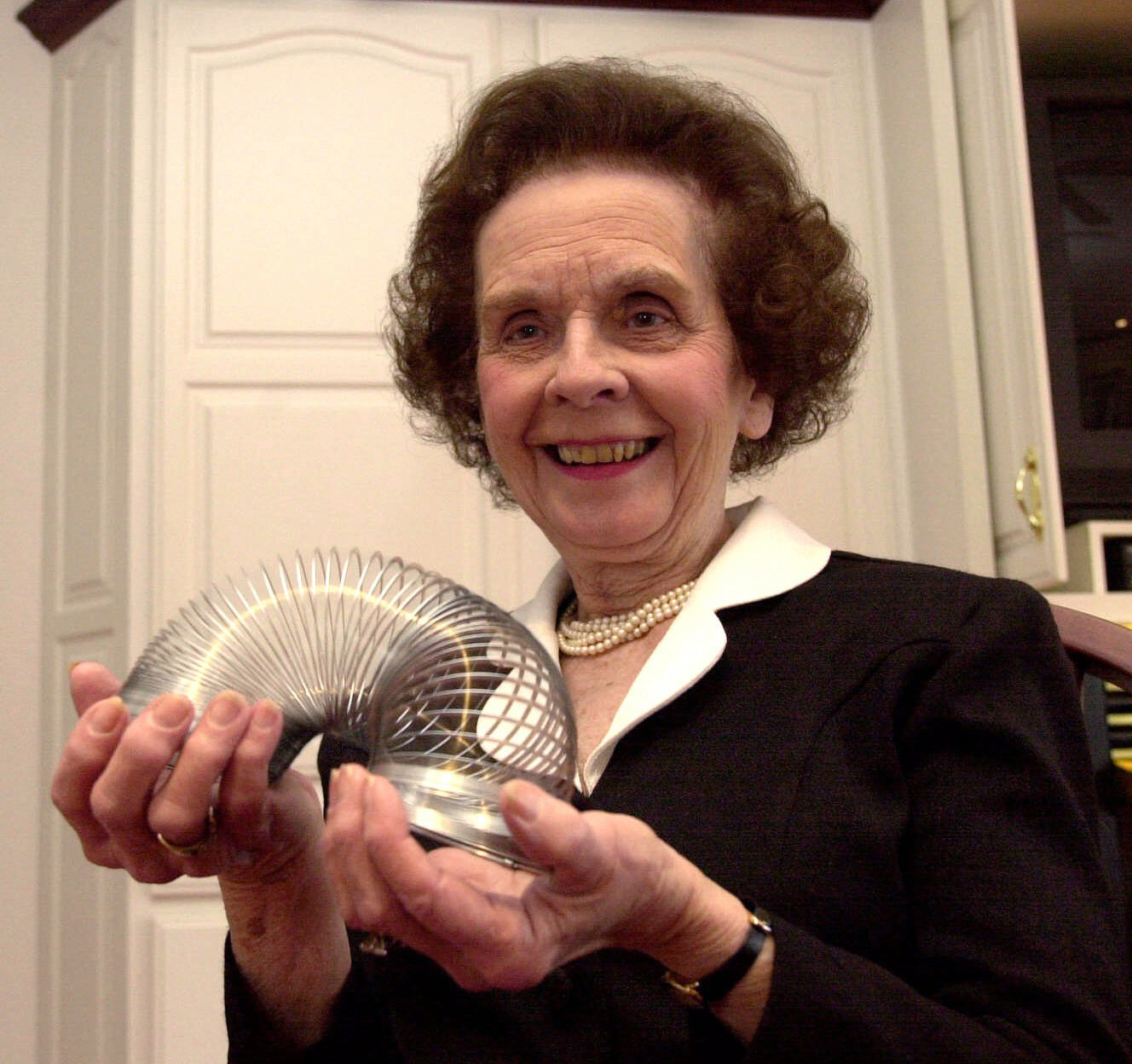
In this Jan. 18, 2001, photo, Betty James, retired president of James Industries, plays with a Slinky. She died in 2008.AP
In 2001, Betty James, then 84, was inducted into the Toy Industry Hall of Fame. At that time, more than 250 million Slinkies had been manufactured from hundreds of thousands of tons of steel.
“Slinky has lasted because it’s simple, it’s iconic, and every generation has connected with it,” Delphais said. “It started right here in Philadelphia. That makes it all the more meaningful.”
This week’s Firstival is Saturday, Aug. 29, from 11 a.m.-1 p.m., at the American Philosophical Society, 104 S. Fifth St.
A shuttered bridal shop in downtown Conshohocken will soon become the home of another family-run business with local roots.
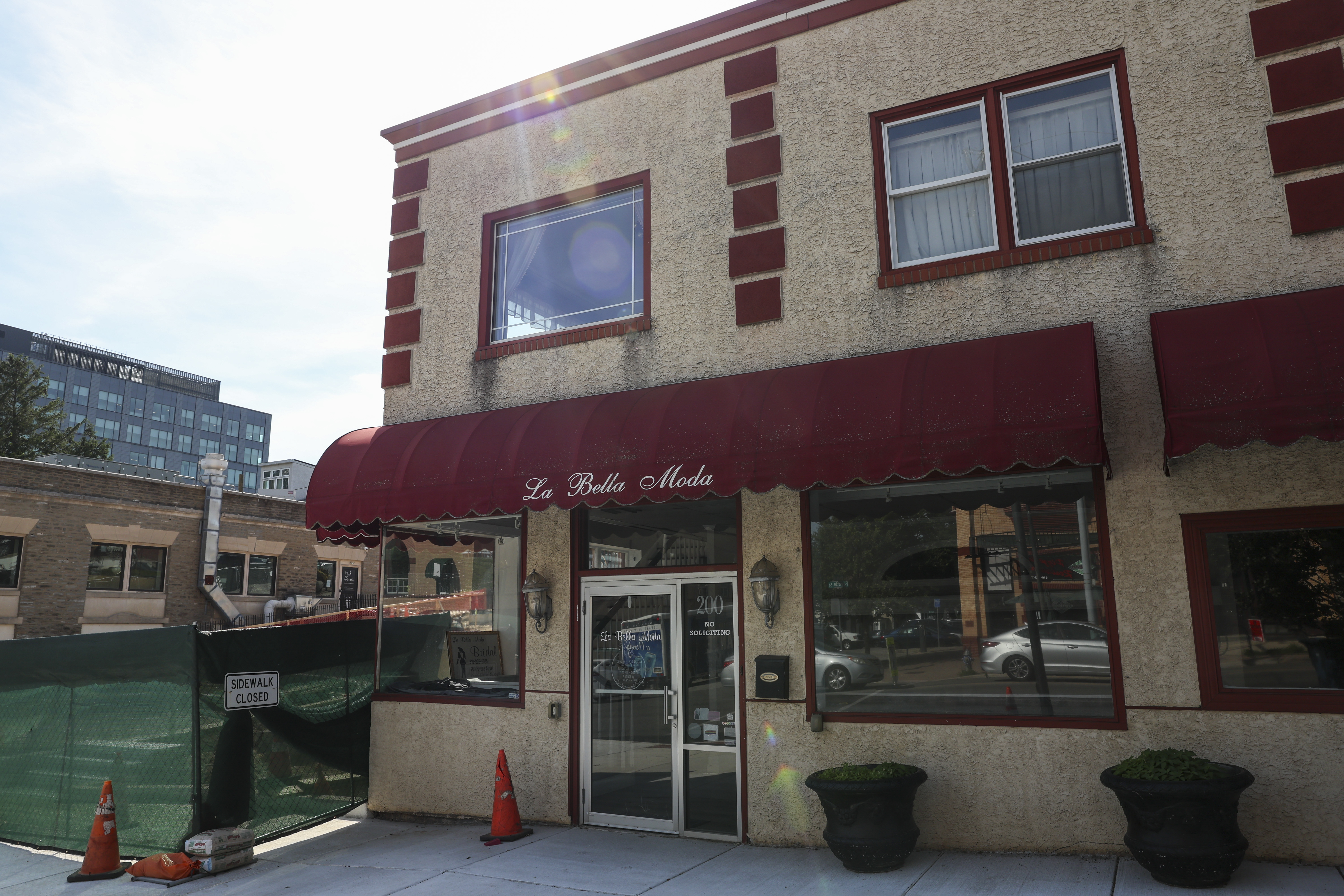
Goodness Bowls, a “healthy-eats cafe” chain run by Montgomery County residents, has signed a lease for the former La Bella Moda bridal shop at 200 Fayette St., with the goal of opening a corporate headquarters there by early 2027. La Bella Moda closed in May after 45 years in business.
“I always looked at La Bella Moda, and I thought, ‘God, that would be the perfect corner,’” said Susan Persichetti, Goodness Bowls’ cofounder and CEO. “ But I never thought they would close their doors.”
In the coming months, the Goodness Bowl team plans to open a 1,500-square-foot restaurant on the first floor, according to company executives, and use 2,000 square feet upstairs for additional seating and its corporate offices. They declined to share the terms of the lease.
The Conshohocken restaurant will be Goodness Bowls’ 10th location and its third corporate outpost. The rest of its cafes are franchised.
The closed La Bella Moda, as seen in June.Monica Herndon / Staff Photographer
The chain’s expansion comes as acai bowls — smoothie bowls loaded with toppings like fruit, granola, and peanut butter — and other more nutritious fast food have surged in popularity.
Shops selling these bowls seem to be popping up everywhere. Over the past decade, Belmar, N.J.-based Playa Bowls has grown to more than 100 locations in 20 states, including more than a dozen spots in the Philly area. And the Juice Pod, founded in Avalon and now headquartered in Bryn Mawr, has expanded to more than two dozen cafes, most of which are in the region.
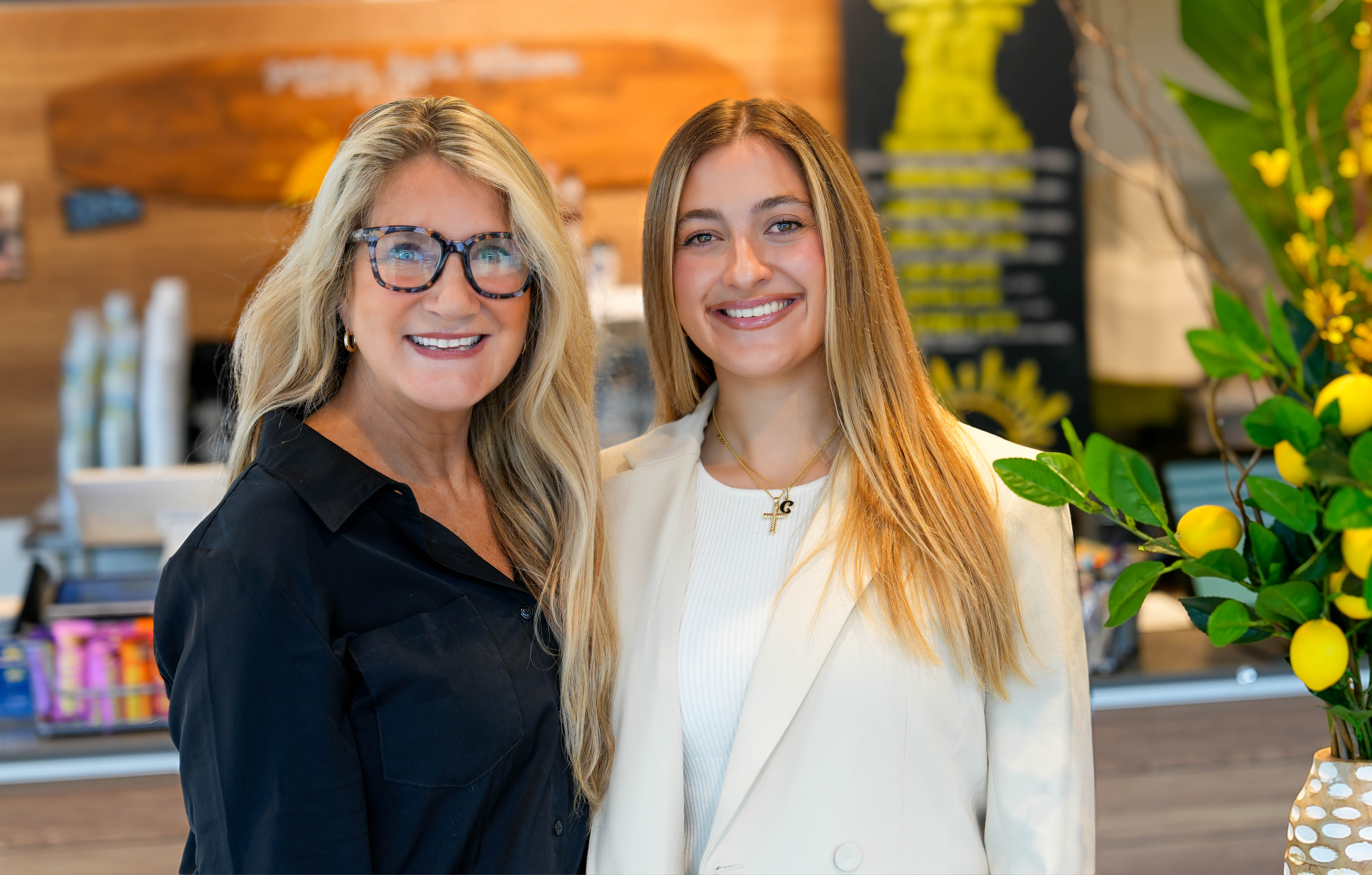
A mother-daughter duo, Susan and Corinne Persichetti, opened the first Goodness Bowls in Avalon in 2019. Susan said her daughter Corinne — a former Division I field hockey player at Fairfield University and a health enthusiast — was the driving force behind the business.
Susan Persichetti, cofounder and CEO of Goodness Bowls, with her daughter Corinne Persichetti, cofounder and chief operating officer.Courtesy Goodness Bowl
Corinne created the cafe’s menu, which includes acai bowls, salads, wraps, and smoothies, and came up with its slogan, “Eat Good. Feel Good. Do Good.” Susan, meanwhile, crafted the shop’s coastal aesthetic and branding.
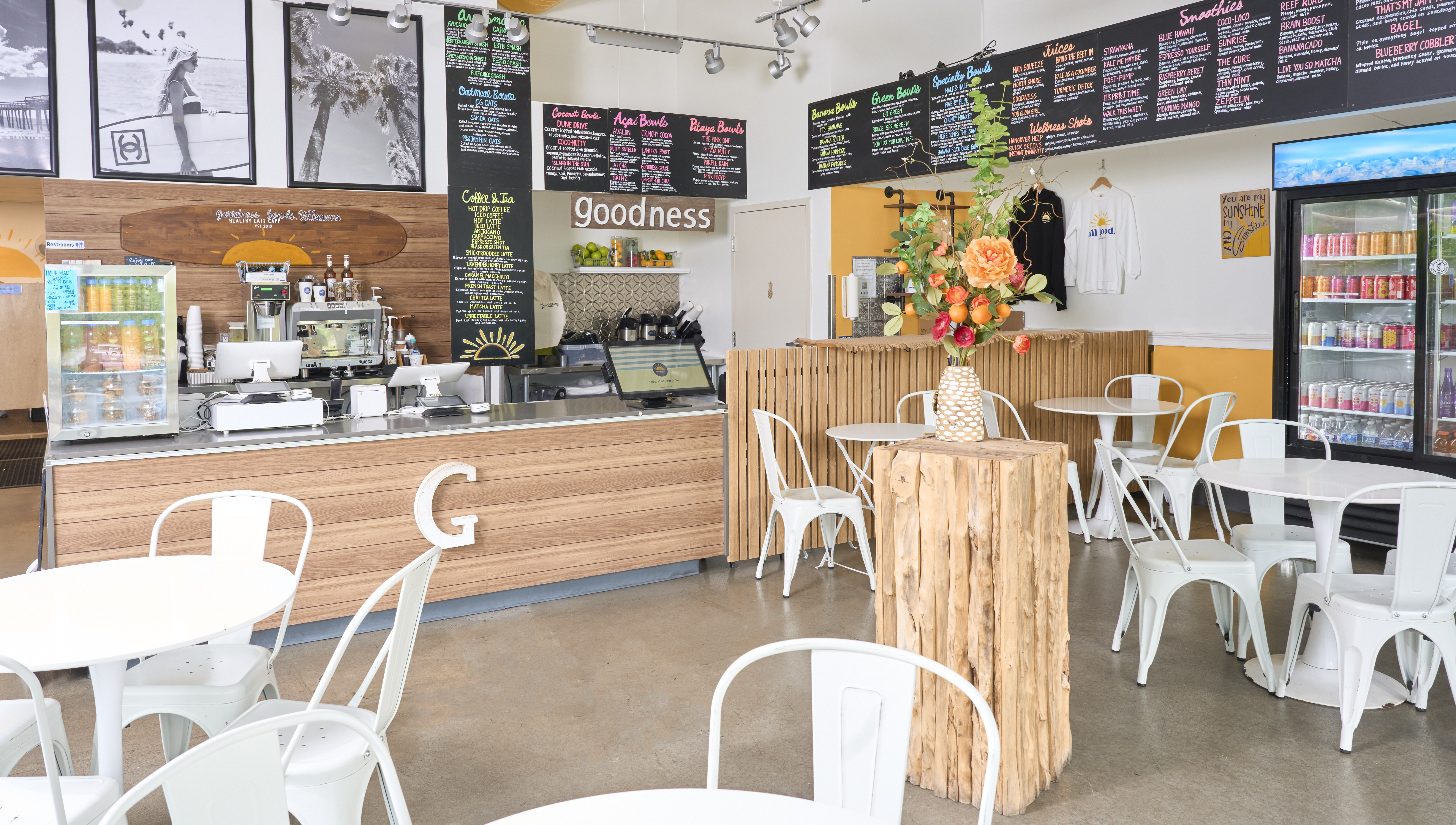
For a couple years, Susan and Corinne ran the Avalon location in the summertime while working corporate jobs. In 2022, they opened a second location in Villanova, where they quickly found success. They realized there was demand for the Shore-inspired business in the Philadelphia suburbs, Susan said, and started franchising.
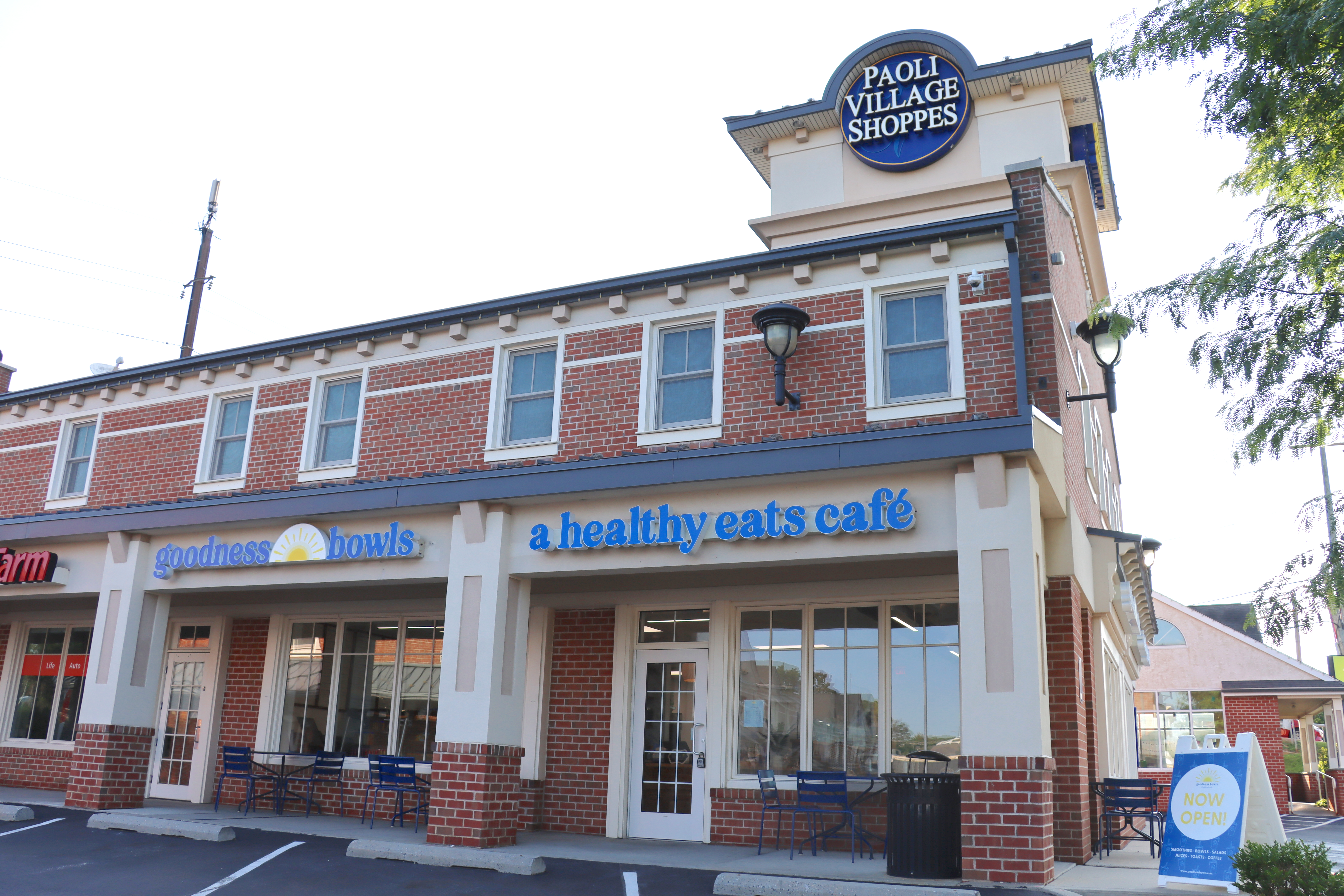
Goodness Bowls currently has franchise locations in Narberth, Paoli, Collegeville, Spring House, Haddon Township, Sea Isle, and Scranton.
The new Paoli location of Goodness Bowls.Courtesy Goodness Bowls
In recent years, Goodness Bowls has also expanded their team, including by hiring a company president, Finn Loftus, who also lives in Montgomery County.
“People really are craving healthy options,” she said. “And they really want food that they’re able to get quickly.”
Customers also say they are drawn to the bright cafes and friendly service, according to Susan.
Goodness Bowls executives look at their move to Conshohocken as a homecoming, and are excited to be back in the borough where Susan raised Corinne and her other children.
“We want to add to the community,” Susan said, by “keeping a small, family-owned business there on a really great corner that’s built such great traditions.”
You say you want a revolution? That’s not quite what SEPTA’s proposing. This weekend, the region’s transit agency will roll out the first phase of its New Bus Network, the bus system’s first significant update since the agency was formed in the 1960s.
Sound familiar? Once dubbed Bus Revolution, the project began in 2021 after transit agencies around the country saw massive declines in ridership. SEPTA’s Bus Revolution was set to launch in 2025 but faced significant community pushback and coincided with the state funding crisis that halted many planned transit initiatives. It was officially shelved in November 2024.
Later phases of the plan, which will roll out in 2027, will impact other neighborhoods. The number of bus routes in SEPTA’s system will drop from the current 124 to 106 when all four phases are complete.
SEPTA says the changes are needed to modernize the system and make it easier to use.
To help you navigate the changes that will impact how you navigate the city, we’re here to breakdown down all 30 impacted routes.
This route remains the same but with reduced service.
Days
Times
Previous
Now
Weekdays
6 a.m. to 9 p.m.
Every 16-25 minutes
Every 30 minutes
Saturdays
8 a.m. to 9 p.m.
Every 22-25 minutes
Every 30 minutes
6
Cheltenham-Ogontz to Olney Transportation Center
On weekdays, route 6 will have increased service during peak hours, but a reduced service otherwise.
Days
Times
Previous
Now
Weekdays
6 a.m. to 9 p.m.
Every 11-13 minutes
Every 10 minutes
Weekdays
9 p.m. to midnight
Every 20 minutes
Every 30 minutes
Weekdays
midnight to 4 a.m.
Every 30-40 minutes
Every 60 minutes
SEPTA also rolled out new signage that identifies certain routes as “frequent red”, indicating a bus is scheduled to arrive within 15 minutes or less on weekdays from 6 a.m. to 9 p.m.
17
Front-Market to 20th-Johnston
Route 17 will be shortened and no longer operate on its old route from 20th Street and Johnston Street down to the stadium complex or the Navy Yard. SEPTA recommends Navy Yard commuters take route 45 instead.
This route will also operate with reduced service overnight.
Days
Times
Previous
Now
Weekdays
midnight to 5 a.m.
Every 30 minutes
Every 60 minutes
SEPTA also rolled out new signage that identifies certain routes as “frequent red”, indicating a bus is scheduled to arrive within 15 minutes or less on weekdays from 6 a.m. to 9 p.m.
25
Frankford Transportation Center to Front-Spring Garden
Route 25 is essentially being cut in half. The old route ran down Delaware Avenue to Columbus Commons. The new route will terminate at the Spring Garden Market-Frankford Line station. The old route from Spring Garden to Columbus Commons will be serviced by the new route 76.
Route 25 will now operate for 24 hours a day, as part of SEPTA’s late-night OWL network.
This route will also have increased service.
Days
Times
Previous
Now
Weekdays
6 a.m. to 9 p.m.
Every 20-30 minutes
Every 15 minutes
Weekends
6 a.m. to 9 p.m.
Every 30 minutes
Every 20 minutes
SEPTA also rolled out new signage that identifies certain routes as “frequent red”, indicating a bus is scheduled to arrive within 15 minutes or less on weekdays from 6 a.m. to 9 p.m.
32
Broad-Carpenter to Ridge-Lyceum
Route 32 will have slightly reduced service with fewer buses overall. All route 32 buses will terminate at Manayunk, as opposed to the previous schedule where half would terminate at 33rd Street and Cecil B. Moore Avenue. There’s also a slight route extension into Roxborough for school service.
35
Manayunk Roxborough Loop
Route 35 will be discontinued on Aug. 23. SEPTA recommends riders take route 61.
According to SEPTA’s operation statistics, route 35 is the seventh most expensive bus based on the average cost per passenger.
39
Richmond-Cumberland to 33rd-Dauphin
Route 39 will remain the same but with reduced service on weekdays and slightly increased service on Saturday evenings..
Days
Times
Previous
Now
Weekdays
6 a.m. to 9 p.m.
Every 20-30 minutes
Every 30 minutes
Saturday
5 p.m. to 9 p.m.
Every 40-60 minutes
Every 30 minutes
44
Front-Market to Ardmore
Route 44 will no longer run along its old route that would sometimes terminate at Gladwyne. Beginning Aug. 23, all 44 buses will run to Ardmore, with select trips stopping at Narberth.
This route will also have reduced service.
Days
Times
Previous
Now
Weekdays
9 a.m. to 3 p.m.
Every 15-30 minutes
Every 60 minutes
Weekends
6 a.m. to midnight
Every 30 minutes
Every 60 minutes
45
Navy Yard/Broad-Oregon to 12th-Noble
Route 45 will be extended to the Navy Yard to cover for the changes to route 17.
After 9 p.m. the route will have reduced service on weekdays.
Days
Times
Previous
Now
Weekdays
9 p.m. to midnight
Every 20 minutes
Every 30 minutes
46
58th-Baltimore to 63rd-Malvern
Route 46 will have increased service on weekdays.
Days
Times
Previous
Now
Saturdays
9 a.m. to 6 p.m.
Every 20 minutes
Every 15 minutes
Sundays
9 a.m. to 7 p.m.
Every 30 minutes
Every 20 minutes
SEPTA also rolled out new signage that identifies certain routes as “frequent red”, indicating a bus is scheduled to arrive within 15 minutes or less on weekdays from 6 a.m. to 9 p.m.
47
Whitman Plaza to 5th-Godfrey
Route 47 will merge with route 47M and have increased service.
Days
Times
Previous
Now
Weekdays
6 a.m. to 9 p.m.
Every 8-9 minutes
Every 7-8 minutes
All days
Midnight. to 5 a.m.
Every 45 minutes
Every 30 minutes
SEPTA also rolled out new signage that identifies certain routes as “frequent red”, indicating a bus is scheduled to arrive within 15 minutes or less on weekdays from 6 a.m. to 9 p.m.
47M
Whitman Plaza to 7th-Spring Garden via 9th
Route 47M has been discontinued and will now be served by a more frequent route 47.
The merger of these two routes includes a realignment so that the northbound 47 runs on Seventh Street, as opposed to Ninth Street. Southbound buses will still run on Eighth Street.
49
33rd-Dauphin to 40th-Baltimore
Route 49 will look very different from its old route. It will no longer serve Gray’s Ferry. SEPTA recommends riders take route 79 instead.
Route 49 will also operate on many different roads. The most notable change is taking 33rd Street instead of 29th Street. in Strawberry Mansion and Brewerytown.
These changes are paired with generally reduced service.
Days
Times
Previous
Now
Weekdays
8 a.m. to 3 p.m.
Every 18-22 minutes
Every 30 minutes
Saturdays
8 a.m. to 9 p.m.
Every 22 minutes
Every 30 minutes
Sundays
9 a.m. to 7 p.m.
Every 22 minutes
Every 30 minutes
52
49th-Woodland to Wissahickon Transportation Center/50th-Parkside
Route 52 will no longer follow its old route to Gladwyne. SEPTA cites low ridership and doesn’t offer an alternative route.
SEPTA also rolled out new signage that identifies certain routes as “frequent red”, indicating a bus is scheduled to arrive within 15 minutes or less on weekdays from 6 a.m. to 9 p.m.
53
Carpenter Station to Richmond-Westmoreland
Buses on route 53 will no longer follow the old route that terminated at Sedgwick Street and Wayne Avenue. Instead, service will end at Carpenter Regional Rail station. There are additionally a bunch of small differences across the route. For example, route 53 will now serve Roosevelt Boulevard. on the western side of Hunting Park.
The 53 will also continue past G Street and extend into Port Richmond.
54
Richmond-Cambria to 33rd-Dauphin
Buses on route 54 will have reduced service during weekdays and increased service during evenings.
Days
Times
Previous
Now
Weekdays
9 a.m. to 3 p.m.
Every 15-18 minutes
Every 20 minutes
All days
9 p.m. to midnight
Every 45 minutes
Every 30 minutes
57
Whitman Plaza to Fern Rock Transportation Center
The old route 57 occasionally would terminate at Packer Marine Terminal, that service will be discontinued.
During weekends the route 57 will run at a reduced service.
Days
Times
Previous
Now
Weekends
All day
Every 10-12 minutes
Every 15 minutes
Service along Crescentville and Cheltenham Avenues will be reduced to every hour.
SEPTA also rolled out new signage that identifies certain routes as “frequent red”, indicating a bus is scheduled to arrive within 15 minutes or less on weekdays from 6 a.m. to 9 p.m.
60
Wissahickon Transportation Center/35th-Allegheny to Richmond-Westmoreland
Most of route 60 will continue to go down Allegheny Avenue, but it will not follow its old route where some buses stopped on Delaware Avenue and Lewis Street.
The 60 will occasionally take an extended route and continue to the Wissahickon Transportation Center. The schedule is roughly split 50:50 whether a bus will continue to this new terminus or stop early at 35th Street and Allegheny Avenue.
Route 60 will also see increased service.
Days
Times
Previous
Now
Weekdays
6 a.m. to 6 p.m.
Every 10-15 minutes
Every 10 minutes
SEPTA also rolled out new signage that identifies certain routes as “frequent red”, indicating a bus is scheduled to arrive within 15 minutes or less on weekdays from 6 a.m. to 9 p.m.
61
9th-Market to Ridge-Summit
Route 61 will be extended to Upper Roxborough. This is primarily to cover for the discontinued route 35.
62
9th-Market to Andorra
Route 62 will be discontinued. SEPTA recommends riders take routes 9, 27, or 61 as an alternative. According to SEPTA, route 62 was the fourth most expensive route to operate, costing an average of $45 per passenger.
64
50th-Parkside to Pier 70
Previously, route 64 would occasionally terminate at 49th Street and Woodland Avenue. Under the new network, all trips will terminate at Parkside Loop. The 64 will also no longer take the old route’s detour into Grays Ferry.
Route 64 will operate at a increased service.
Days
Times
Previous
Now
All days
6 a.m. to 9 a.m.
Every 12-18 minutes
Every 12 minutes
All days
9 a.m. to 9 p.m.
Every 20 minutes
Every 15 minutes
SEPTA also rolled out new signage that identifies certain routes as “frequent red”, indicating a bus is scheduled to arrive within 15 minutes or less on weekdays from 6 a.m. to 9 p.m.
72
Cedarbrook Plaza to Frankford Transportation Center
72 is a brand new route that mostly operates on Cheltenham Avenue and will run every 30 minutes.
73
Frankford Transportation Center to Richmond-Westmoreland
Route 73 will now run at a reduced service from every 20-25 minutes to every 30 minutes.
Additionally the route 73 will no longer be part of the OWL network, ending 24-hour service on the line. SEPTA recommends riders take route 25 for overnight buses.
76
Rising Sun-Olney to Columbus Commons
Route 76 is a brand new route that will mostly run along Delaware and Frankford Avenues every 30 minutes. This route replaces service removed from the newly aligned route 25.
78
Express from Cornwells Heights to Center City
Route 78 will be discontinued due to lower ridership. SEPTA does not recommend an alternative bus.
According to SEPTA figures, the 78 was the most expensive bus to operate in their network. It has an average of 2.4 passengers per hour, costing the agency $394 per rider.
79
Columbus Commons to 29th-Snyder/40th-Market
Route 79 will occasionally be extended into West Philadelphia. Roughly every other bus will continue to 40th and Market Streets, instead of the current terminus of 29th Street and Synder Avenue.
SEPTA also rolled out new signage that identifies certain routes as “frequent red”, indicating a bus is scheduled to arrive within 15 minutes or less on weekdays from 6 a.m. to 9 p.m.
80
Express from Horsham to Olney Transit Center
Route 80 will be discontinued. SEPTA stated that “ridership has declined significantly since 2019 and the same connection can be made with a transfer on local routes 22, 51, and 310.”
According to SEPTA data, route 80 was the third most expensive route to run, costing the agency $50 per passenger.
89
Front-Dauphin to Arrott Transit Center
Route 89 will be discontinued. SEPTA says route 89 is “duplicative of other routes,” and offers “routes 3, 5, 25, 39, 41, 43, 53, 56, 75, 76, and K as alternatives.”
105
Paoli/Rosemont to 69th Street Transit Center
Route 105 will extend to Paoli for roughly every other bus, essentially merging with the now discontinued route 106.
The old route that serviced Suburban Square will no longer operate. There are also minor alignment changes in Overbrook.
Route 105 will operate at a increased service.
Days
Times
Previous
Now
Weekdays
All day
Every 30-60 minutes
Every 30 minutes
Weekends
All day
Every 60 minutes
Every 30 minutes
These changes will take effect on Aug. 24.
106
Paoli to 69th Street Transit Center
Route 106 will be discontinued on Aug. 24.
Do you still have questions about the changes to SEPTA’s bus network? Read our Q&A guide for details on how to contact SEPTA, information about future alterations in 2027, and much more.
Methodology
The animating buses on the diagram are an approximation of the number of buses active at 9 a.m. on a weekday schedule.
Old routes are accurate to SEPTA’s bus network on Aug. 4.
For simplicity, if a route can have different terminuses, we show all possible paths the bus operates on.
story continues after advertisement
Staff Contributors
Design, Development, and Data: Sam Morris
Reporting: Sam Morris and Erica Palan
Editing: Cynthia Henry
Subscribe to The Philadelphia Inquirer
Our reporting is directly supported by reader subscriptions. If you want more journalism like this story, please subscribe today
The first phase of SEPTA’s bus network overhaul begins Aug. 23, and Brandon Miller is mobilizing hundreds of employees for a final push to meet face-to-face with riders in the days leading up to the changes and during the first week after they take effect.
“It’s a blitz,” said Miller, manager of planning programs at SEPTA, describing discussions at “pop-ups” as an effective way to help people navigate the new network.
Unlike some transit agencies, SEPTA has not done a comprehensive redesign of its bus network in its 58-year history. The agency has publicly pushed to do so since 2021, but change was delayed by opposition, political wrangling, and, later, a two-year fiscal crisis.
Originally the “Bus Revolution” was supposed to happen all at once, but SEPTA ultimately decided to phase in changes to routes.
“I think there’s more willingness to accept the fact that … we need to make the bus network a little bit more efficient,” Nemiroff said. “We need to make the system more attractive for people.”
Some routes with low ridership or that duplicate nearby service will be eliminated. Others will be extended or run more frequently, and two new routes will be added.
What routes will change?
New and expanded routes: Route 72, a new crosstown bus running along Cheltenham Avenue, and the new Route 76 bus from Columbus Commons to Rising Sun and Olney. Route 45 will be extended to provide service to the Navy Yard, and Route 79 will be extended from South Philadelphia into University City.
Eliminated routes: 35, 47M, 62, 78, 80, 89, and 106.
Riders can call SEPTA customer service at 215-580-7800 or email specific questions to planning@septa.org.
I want to talk to someone in person.
Beginning Monday, street teams will conduct “pop-up” visits at key transit hubs at various times between 6 a.m. and 8 p.m.
Next week, visits will include South Broad Street and Snyder Avenue, Cedarbrook Plaza, Hunting Park Station for changes to Route 53, Spring Garden Station, and Willow Grove Mall.
Staff are also attending community events.
When will changes happen?
The majority of changes will take effect Sunday, Aug. 23, followed by the Route 105 extension and elimination of Route 106 on Monday, Aug. 24.
Phase 3 changes are planned to begin in June 2027.
Phase 4 changes are planned to begin in Fall 2027. Many details are still being worked out.
Why redesign the bus network?
SEPTA launched its bus redesign efforts in earnest after ridership declined 13% from 2013 to 2019, a drop attributed to slow speeds, reliability problems, and competition from ridesharing companies. And that was before the COVID-19 pandemic.
Bus ridership rebounded faster than it did on other transit services, but SEPTA’s thinking is that simplifying the network will make it easier to use, with more frequent service on fewer or shorter routes.
Will bus stops be changed?
Stops will disappear during the first phase on routes that are eliminated, but there will be no wholesale changes yet.
Having more stops per mile provides access to more people, but closely spaced stops can also slow buses and make them less reliable.
Early plans for Philadelphia’s bus network redesign aimed to “rebalance” stops by spacing them farther apart to improve speed. But the idea has been unpopular.
SEPTA may revisit the issue later.
More questions about the New Bus Network?
Email transportation reporter Thomas Fitzgerald at tfitzgerald@inquirer.com.
In the last 16 months,Main Line Health has gone from employing no gastroenterologists to nine, with two or three more expected to start this summer.
The hiring is part of a push by the nonprofit health system to reduce wait times for patients.
“We are down to three weeks” from months of waiting for a GI appointment, Main Line CEO Ed Jimenez said in a June interview. The organization has also hired six GI physician assistants and nurse practitioners to speed up care.
A similar move in urology is planned as the health system in Philadelphia’s western suburbs partially unwinds itstraditional heavy reliance on outside physicians for specialty care, seeking to regain momentum after financial losses during the COVID era.
In another shift, Main Line is replacing contracted Jefferson Health trauma surgeons with its own hires. Main Line is ending its contract with Jefferson at the end of this year.
Overall, Main Line has hired 100 physicians since Jimenez became CEO in June 2025. About a third replace people who retired, but “two-thirds are brand new, accretive, so we’ve been very successful,” he said.
Some of the hiring is related tothe needs of patients coming to Main Line after last year’s bankruptcy collapse of Crozer Health. That includes eight OB-GYNs and one advanced practice provider hired from Crozer.
Starting a urology department
Christopher Hartman joined Main Line from Northwell Health on Long Island in January as medical director of urology. One of his jobs is to build the employed physician group. How big it gets will depend on its success in drawing patients.
By targeting GI and urology, Main Line is putting itself into competition with private practices — U.S. Digestive Health and MidLantic Urology — it has had close ties with for years.
MidLantic’s market president, Michael Hagg, is Main Line’s system chief for urology. Main Line said he oversees urologists who are not Main Line employees.
“We continue to work and serve the communities of Main Line Health as we have for the past several decades as urologists, collaborators, and leaders across all four Main Line Health campuses, working with past and present CEOs and hospital presidents,” Hagg said in an email.
Both MidLantic and U.S. Digestive Health grew substantially with the help of private-equity backing. U.S. Digestive was sold last year to a subsidiary of UnitedHealth Group, SCA Health, which declined to comment on Main Line’s move into gastroenterology.
Bringing trauma surgery in house
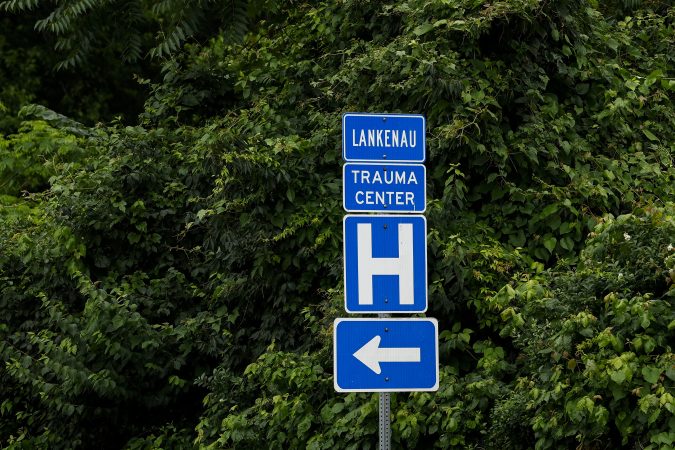
Main Line plans to hire at least a dozen trauma/critical care surgeons to replace the Jefferson Health physicians it has been relying on for those services. Main Line’s emergency departments at Lankenau Medical Center and Paoli Hospital are Level II trauma centers.
“We appreciate the excellent care provided by these trauma surgeons. However, at this point, we believe the time is right to bring the program in house so we can continue to grow and enhance it,” Main Line said in an email.
Main Line declined to say how many surgeons it had already hired. It can’t hire the Jefferson surgeons for contractual reasons, it said.
In a matter of seconds, a highway traffic stop in Tredyffrin Township sent Joel Perez Rodriguez from confusion, to panic, to fear.
When he saw red-and-blue emergency lights in his rearview mirror, he did what any law-abiding citizen would do, Chester County prosecutors said Thursday: He pulled onto the shoulder of the Pennsylvania Turnpike.
But Assistant District Attorney Monica Szyszkiewicz said the men who approached Perez Rodriguez’s vehicle on March 28 were not police officers — they were criminals, in league with his sister’s uncle, hired to rob Perez Rodriguez of $49,000 his sister had given him an hour earlier at her home in Germantown.
The botched robbery ended with Perez Rodriguez shot in the chest, as other bullets narrowly missed his wife and 4-year-old son.
Two of those men, Roberto Morel, 51, and Tuften Green, 31, were held for trial Thursday evening on charges of attempted murder, aggravated assault, attempted theft, and related crimes after an hours-longpreliminary hearing before District Judge Lauren Holt. Holt dismissed kidnapping charges the men faced, arguing there was a lack of evidence to support them.
The third suspect, Terrell Adams, 38, waived his hearing, and will also be held for trial.
Lawyers for Morel and Green told Judge Holt that Szyszkiewicz and Pennsylvania State Police investigators had built their case entirely on circumstantial evidence.
Morel’s attorney, Timothy Tarpey, said his client did not spend time with Perez Rodriguez during the three days he and his family visited his sister, and asserted he had no knowledge of the money being exchanged.
But Szyszkiewicz said investigators, using a litany of surveillance footage and cell phone data, had been able to reconstruct the entire plot, which began with the three men meeting up hours before the shooting at a gas station in Germantown. Video from that location, played in court, showed Morel and Green arriving at the same time, in separate vehicles, and discussing their plan, according to Trooper Adam McLaughlin.
“They conspired to pull the victim over for what other reason than to get the money they had received an hour before,” she said, arguing it was no coincidence that Morel had a clear connection to Perez Rodriguez. “Why else would they do that?”
Green’s attorney, Brian McCarthy, said despite the voluminous text messages prosecutors had pored over between his client and Morel, neither man made specific mention of a robbery, nor was there any attempt during the car stop to take the money from the car’s backseat.
Holt was not swayed.
Another video, taken from a Ring surveillance camera near where Perez Rodriguez’s sisterlives showed the three men began following his car moments after he pulled out of her driveway, en route to his home in North Carolina.
And data pulled from Green’s smartphone showed he was on the phone with Morel throughout the entire chase and subsequent shooting. The call ended, Szyszkiewicz said, when Perez Rodriguez fled the scene.
His sister owns a bodega in Germantown and had given him the $49,000 to invest in his tobacco business back in North Carolina.
As the family was driving westbound on the Pennsylvania Turnpike, they were being tailed by a Chevrolet Suburban being driven by Adams, investigators said Thursday, as well as a Honda CRV driven by Morel.
Text messages revealed Green and Morel had discussed adding emergency lights to the SUV, exchanging pictures of them both before and after they had been attached to the vehicle’s dashboard, according to testimony Thursday.
Once those lights were activated, Perez Rodriguez pulled over. He assumed, he said Thursday, that the occupants of the car behind him were undercover officers.
Green and Adams approached his car. Both were dressed in all black, with Adams wearing a hat with “police” sewn into it.
Right away, Perez Rodriguez said he knew something was wrong with the so-called officers. The way they spoke and carried themselves made him suspicious.
His suspicions were confirmed when Green, seeing Perez Rodriguez’s wife was trying to dial 911, stuck a handgun into her ribs and tried to grab the phone from her.
Perez Rodriguez sped away, and Green, according to prosecutors, fired the handgun five times.
An Army reservist, coincidentally driving by in the aftermath of the shooting, saw Perez Rodriguez had pulled again onto the shoulder, and stopped to help, prosecutors said. She helped stabilize his gunshot wound until medics arrived to take him to Paoli Hospital.
All three defendants will be arraigned in county court in West Chester later this month.
Fairmount residents are accustomed to annual July Fourth fireworks; it comes with the territory of living near Benjamin Franklin Parkway, where the city stages its major celebrations. With the United States’ 250th birthday, this July Fourth is no different — except that the fireworks will start closer to midnight.
“We have the whole family coming to our home, all on their way right now,” said Fairmount resident Margo DelliCarpini. “But 11:30, midnight is just too late for some families with children. I understand that it’s the Fourth of July, but the late start for fireworks is decidedly not a family-friendly decision.”
DelliCarpini will have her children and grandchildren visit to experience the Semiquincentennial in the city where the country began. But with young children in tow, parents along for the trip were hoping to have them in bed by midnight, she said. Instead, the large group is looking to catch one of the fireworks shows at Valley Forge or across Montgomery County, which start around 9 p.m.
Fans react to the music as the Wawa Welcome America Festival concluded July 4, 2023, with a free concert on Benjamin Franklin Parkway.Charles Fox / Staff Photographer
Philadelphia’s July Fourth concert and fireworks show, the One City: Unity Concert for America, is expanding its lineup from two to three acts like in years past, to 10 artists, including Christina Aguilera, Will Smith, Meek Mill, and Seal. The show will also start earlier and end later, spanning into July 5 by the time people head home.
The city did not respond to request for comment.
Other cities, like New York, Boston, and Los Angeles, are keeping their 9-9:30 p.m. start times, while Washington, D.C. is among the cities pushing back its fireworks show to 10:30 p.m. or even 11 p.m. to allow for its expanded America 250 showcase.
Mykola Kosyk, 36, a lifelong Fairmount resident, has been witnessing the Parkway fireworks for years. Usually he’ll catch some of the concert with his wife, head back home, have time to set off some fireworks of his own with family, and then all head back to the Parkway for the city’s grand finale. Kosyk said he’ll still likely watch the midnight fireworks on Saturday, but feels disappointed that younger Philadelphians may not get to experience itas children during 1976’s Bicentennial, Kosyk’s father recalled.
“It is the 250th, so if there is a time to do something big, I’m open to the idea,” Kosyk said of the later show. “But I also feel bad for the youngsters coming out, because 9 p.m. is usually a pretty good time for kids to watch the show. Midnight is pushing it a little for kids.”
For residents like Kosyk and DelliCarpini, the nuisance is less with the noise of fireworks which most Fairmount residents are used to by now, but how late the show will run, limiting access to younger kids and delaying vehicle and pedestrian traffic later into the morning.
The Inquirer reported that this year’s event will cost more to operate after Mayor Cherelle L. Parker decided to change the management of the festival from its previous nonprofit partner to a for-profit production company. Parker defended that decision at a news conference Wednesday: Philadelphia needed to meet the moment and host a celebration that is “fitting to and for our historical significance and prominence.”
Jason Derulo performs during the Wawa Welcome America July 4th Concert on the Parkway in 2022.ELIZABETH ROBERTSON / Staff Photographer
Moving an expected 300,000 attendees and their vehicles
Besides the hurdles for parents with younger children, there’s also the headache of moving an expected 300,000 people from the Parkway back home after the show.
SEPTA has covered most of its bases for getting people home. Regional Rail lines will have extended service on all lines, but the Landsale/Doylestown, Paoli/Thorndale, Manayunk/Norristown, Trenton, and West Trenton lines are the only lines that will run their last train between 1 a.m. and 1:10 a.m. All other Regional Rail lines stop running before 1 a.m., and in some cases before midnight, so people traveling in from the suburbs should plan accordingly.
Subways and trolleys will run overnight for those heading back home within the city, and bus service will run on a Sunday schedule, which usually stops operating around 2 a.m. for some routes.
But vehicle and pedestrian traffic could use some city intervention, said Dustin Dove, president of the Fairmount Civic Association, as there is concern among local civic leaders and some residents about how the city is handling traffic leaving the Parkway.
“It’s usually a bit of a mess near the Parkway after the fireworks and can lead to some reckless driving nearby as people are stuck,” Dove said. “Historically, after the fireworks, there are thousands of pedestrians and cars that come into the neighborhood.”
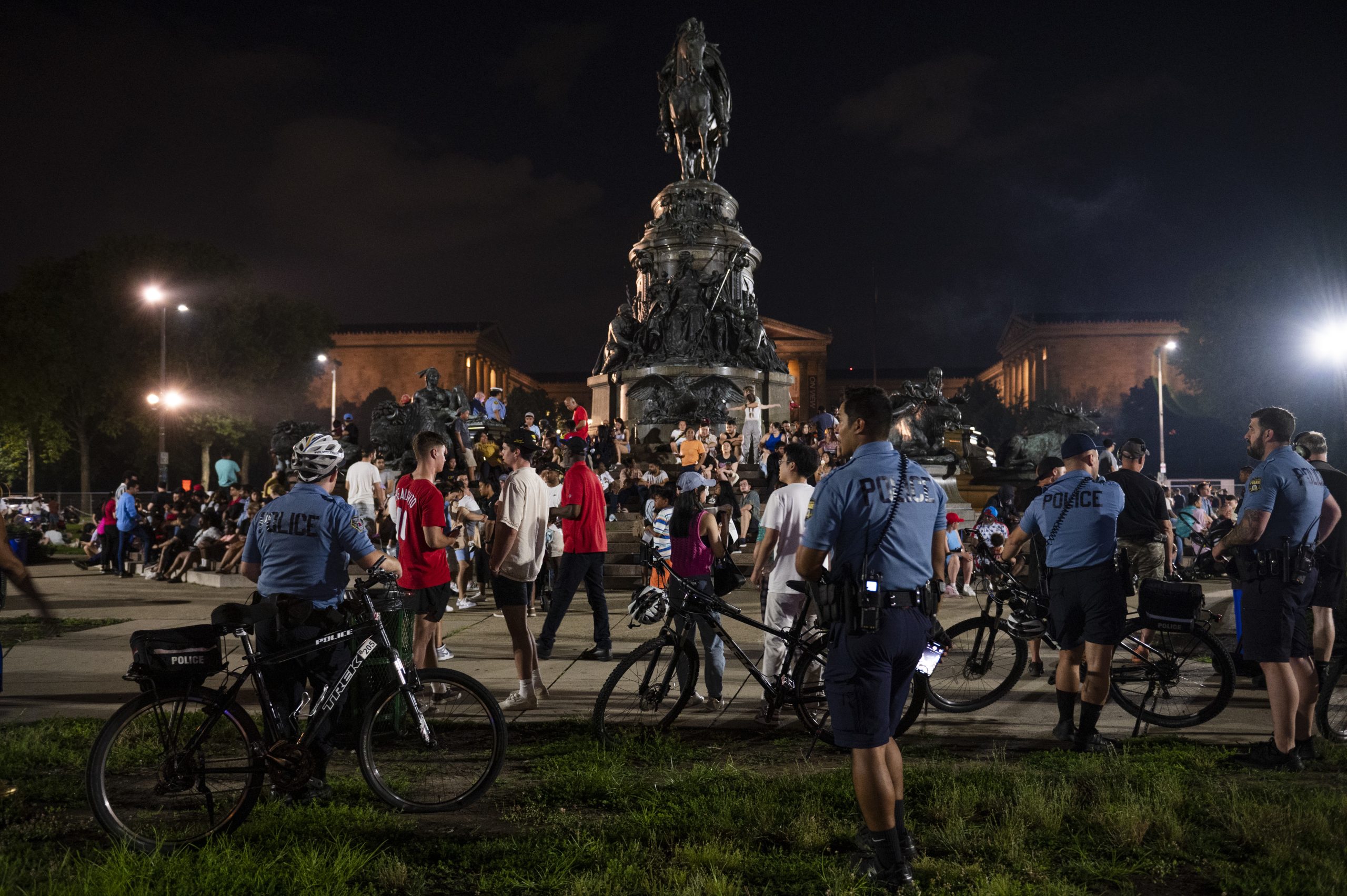
A police presence is seen in Eakin’s Oval as people wait for the fireworks to start at the Wawa Welcome America Festival on Tuesday, July 4, 2023.Allie Ippolito / Staff Photographer
Dove and others are hoping to see an increased police presence and traffic direction, as the event will be much later with more people this year, Dove said.
Additionally, residents hope police manage safety accordingly on Saturday.
“There’s going to be problems when you live in a city; it’s not like it’s the middle of nowhere with no neighbors, but this week … you’re now having people walk back home at midnight, 12:30 a.m.,” DelliCarpini said. “There needs to be a safe environment after the show.”
MAX Surgical Specialty Management, a private-equity backed company consolidating oral and maxillofacial surgery groups in the Northeastern U.S., has acquired two more practices in the Philadelphia area.
The latest deal, announced Friday, gives the Hackensack, N.J., firm 12 surgeons at 12 locations in Pennsylvania. Surgeon Jason M. Auerbach founded MAX in 2022 with private-equity backing and entered Pennsylvania two years later.
The two newly acquired practices have six offices in Bucks and Chester Counties.
Oral and Maxillofacial Surgeons P.C. has three surgeons, and offices in Doylestown, Quakertown, Warminster, and Chalfont. Oral Associates of the Main Line has two surgeons and offices in Exton and Paoli.
MAX did not disclose financial terms of the transactions.
In addition to New Jersey and Pennsylvania, MAX has practices in Connecticut, New York, and Vermont. The company — a management services organization — is majority-owned by its physicians, Auerbach said.
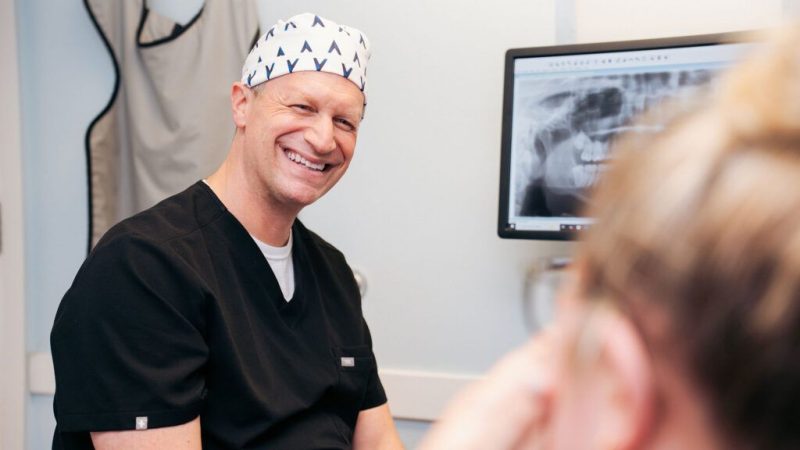
Oral and maxillofacial surgeons work at the crossroads of dentistry and medicine. Most have dental degrees, but some also have medical degrees. They remove wisdom teeth, install dental implants, repair facial traumas, and treat jaw injuries, among other services.
North Jersey origins
Auerbach founded Riverside Oral Surgery in Bergen County in 2007 and grew it to 12 locations before founding MAX with private equity partners. Part of his motivation was to create a home for independent physicians, Auerbach said in a May interview.
The Philadelphia region still has a high concentration of independents, with strong patient demand. “It’s hard nowadays to be an independent oral-maxillofacial surgeon, in terms of the complexities in running a healthcare business,” Auerbach said.
Robert Mogyoros, whose Greater Philadelphia Oral Surgery is in Elkins Park, said he valued his independence above all, but decided to look for a group to joinafter the business side had gotten too challenging.
Physician groups get better prices from vendors, better deals with insurers, and have an upper hand in physician and employee recruitment, said Mogyoros, who became part of MAX last July.
“What attracted me to MAX was that it’s doctor-driven and doctor-run,” he said in a May interview.
Rothman and Kim Oral & Maxillofacial Surgery, with offices in Northeast Philadelphia and Cinnaminson, was MAX’s first acquisition in Southeastern Pennsylvania. That deal also happened last year when MAX announced that it had borrowed $77 million to support growth.
When doctors sell their practices to MAX, they typically invest about 30% of the value into MAX, Auerbach said. MAX’s outside investors are MedEquity Capital near Boston, RF Investment Partners in New York, and Kian Capital in Charlotte, N.C.
Editor’s note: This article was update to correct the year when MAX made its first Pennsylvania acquisition.
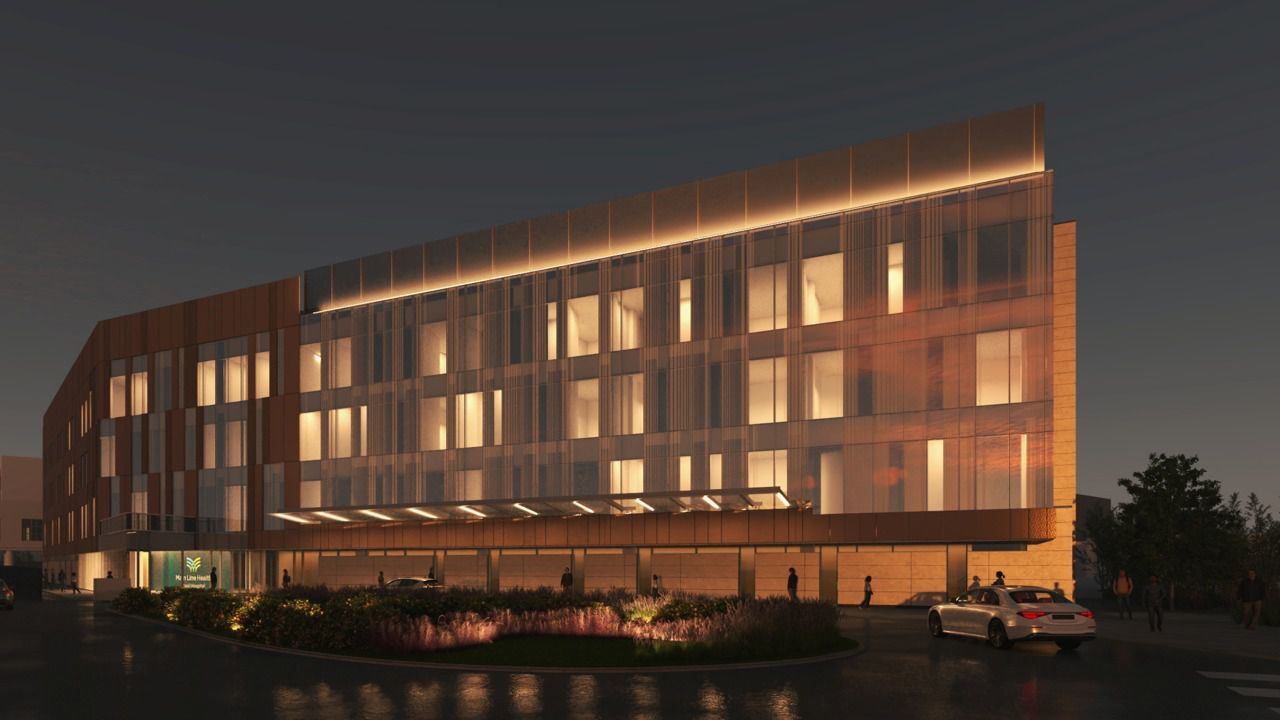
Main Line Health is adding a 108-bed patient pavilion to its Paoli Hospital campus as part of a push to expand its capacity in Chester and Montgomery Counties, the nonprofit health system announced Tuesday.
The building, expected to cost between $220 million and $240 million, is scheduled to open in early 2029. The project will expand Paoli’s capacity by more than 40%.
Patient rooms will occupy three of five floors. They will be convertible from standard hospital rooms into rooms for intensive care. One floor will be used for diagnostics, such as radiology and perinatal testing. The roof will have a landing pad for helicopters.
Beyond Paoli, Main Line is adding to its outpatient capacity in Downingtown, where a large facility that has township approval will include surgical care. The health system also has shared an early-stage proposal for outpatient offices in the Collegeville area, while it considers building there what would be its fifth hospital in Philadelphia’s western suburbs.
“While many communities face declining access to care, Main Line Health is moving forward with optimism, investing in this region’s future and reaffirming our commitment to exceptional care where people live and work,” Main Line CEO Ed Jimenez said in the announcement.
Paoli hospital currently has 261 licensed beds and employs nearly 1,400 people, according to Main Line. The hospital had 53,000 emergency department visits in the year that ended June 30, 2025. Main Line Health completed its last major expansion of Paoli Hospital in 2009, doubling the facility’s size.
Like other Philadelphia-area health systems, Main Line has experienced tough times financially since the pandemic, which led to broadly higher costs in healthcare. In the nine months that ended March 31, Main Line had a $214,000 operating profit on $2.1 billion in revenue.
More Main Line projects
Separately, about 12 miles west of Paoli Hospital, in Downingtown, Main Line plans to open a large outpatient facility next summer. Main Line Health Downingtown, at the intersection of Lloyd and Manor Avenues, willcost $150 million and include a surgery center and substantial imaging capabilities.
Incentral Montgomery County, as well, Main Line recently made a presentation to the Upper Providence Township Board of Supervisors about a major development in an area where the health system has seen substantial growth.
The long term could see Main Line builda 108-bed hospital, but more immediately itneeds to add outpatient office space in the Collegeville area, Main Line said.