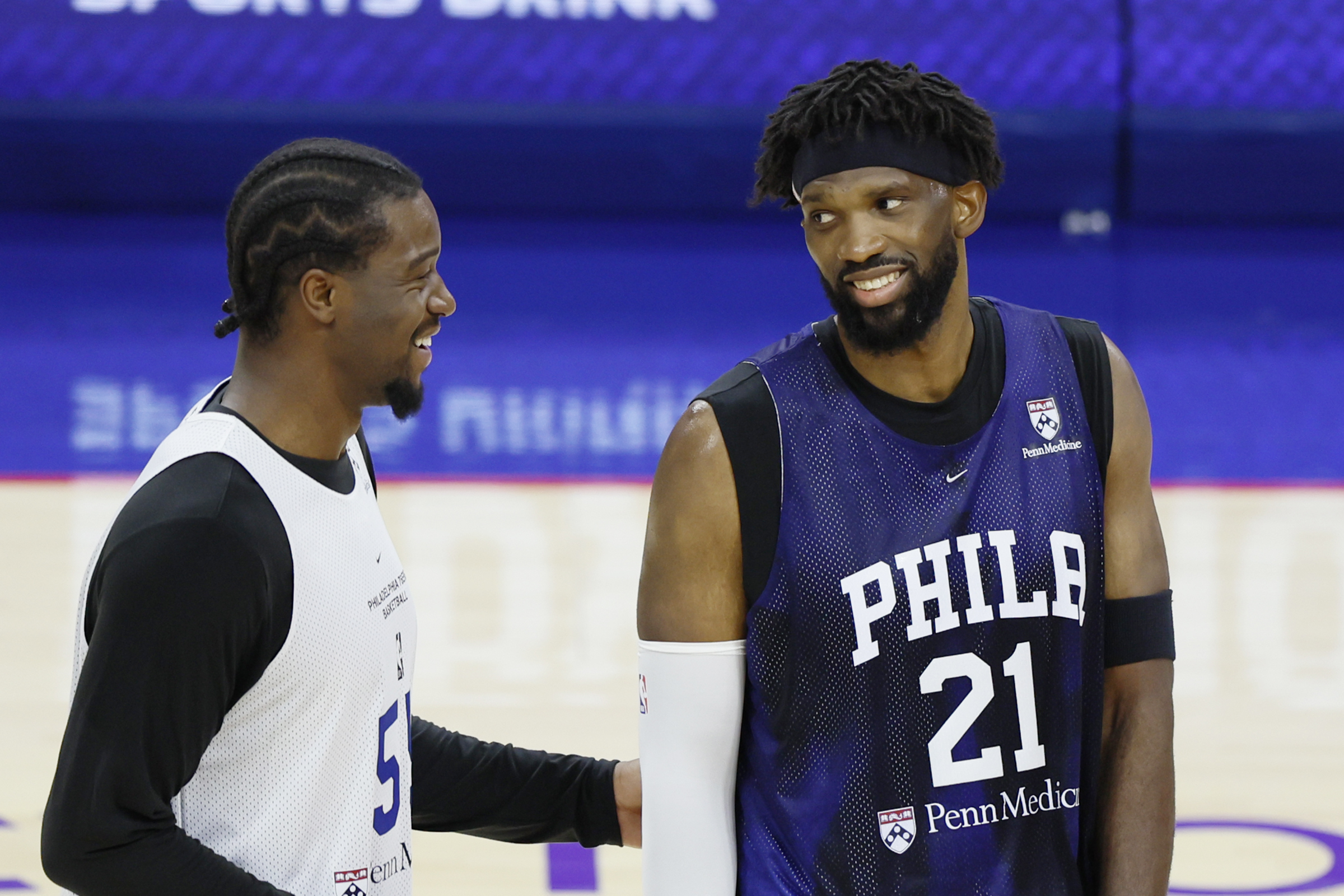
VJ Edgecombe could have had an easy dunk or layup in Saturday’s Blue x White scrimmage before Joel Embiid made up his mind to prevent it.
As Edgecombe was weaving his way down the middle of the lane, Embiid made up the few steps he was trailing Edgecombe and met him at the rim. Embiid blocked the shot, but not without a foul. Embiid fell to the ground when he landed, which can cause at least a little bit of nervousness, given his injury history. But he got back up and started twirling around his finger, asking for a review of the play, as did LeBron James.
“I thought it was all ball,” Embiid said.
That sequence was just one of a few indications of how healthy Embiid has looked since the start of camp, with teammates, coach Nick Nurse, and president Mike Gansey raving about his intensity and participation level.
“He hasn’t missed a practice. He’s been in damn near everything that we’ve done,” James said. “Pretty much, [the team has] had to sit him out at times, even when he wanted to keep going.”
Gansey said the team “got a plan together” for Embiid for this season, something Embiid also referenced during his comments Monday at media day. When asked if the team had a target number of games for Embiid to play this season, Gansey didn’t specify, but said the team would take things “day by day” with how Embiid is feeling.
Embiid played a good portion of the Sixers scrimmage on Saturday, and he looked refreshed and spry on both ends of the floor. He was knocking down threes as a trail man in transition and challenging shots at the rim while dusting off his two-man game with Tyrese Maxey. He even dunked at one point to cap a couple intense possessions battling Ariel Hukporti.
“That’s probably the last dunk of my career,” Embiid said in typically trolling fashion.
He also reignited some chemistry with James from their time playing for Team USA in the 2024 Olympics.
“We played a lot of minutes,” James said. “He started a lot of games for us that summer, but the difference between ‘24 and now, he’s just so much more healthier.”
On one possession, James hit Embiid in stride as he was approaching the three-point line, and Embiid walked into an open three. That was part of an early barrage of plays James was making that delighted the crowd inside Xfinity Mobile Arena.
“Obviously, the Olympics was great. But whether we have played together or not, I don’t think it was going to matter,” Embiid said. “Because at the end of the day, when you put — whether it’s two players, a bunch of players together that have a high basketball IQ — it’s going to be easy to fit with that, and that’s been the case.”
Related to the fit, Embiid touched on one of the buzzwords of this Sixers training camp: sacrifice. James spoke at length about how that word doesn’t have to be a negative. Nurse echoed that, and said he wanted the players to be the best versions of themselves, whatever that may look like within the context of this team. When asked a question about what he has seen from Maxey so far this camp, Embiid took his answer and spoke at length about his view of that word, and what it may mean for him and the rest of the Sixers lineup.
“It’s not about sacrifice. It’s just about being a star in your role and doing what you do best,” Embiid said. “I don’t think anybody should be put in a box. Just go out there, be yourself. Good shot, great shot, bad shot, we’ve all got each other’s backs. We move on. And then we go get a stop.”
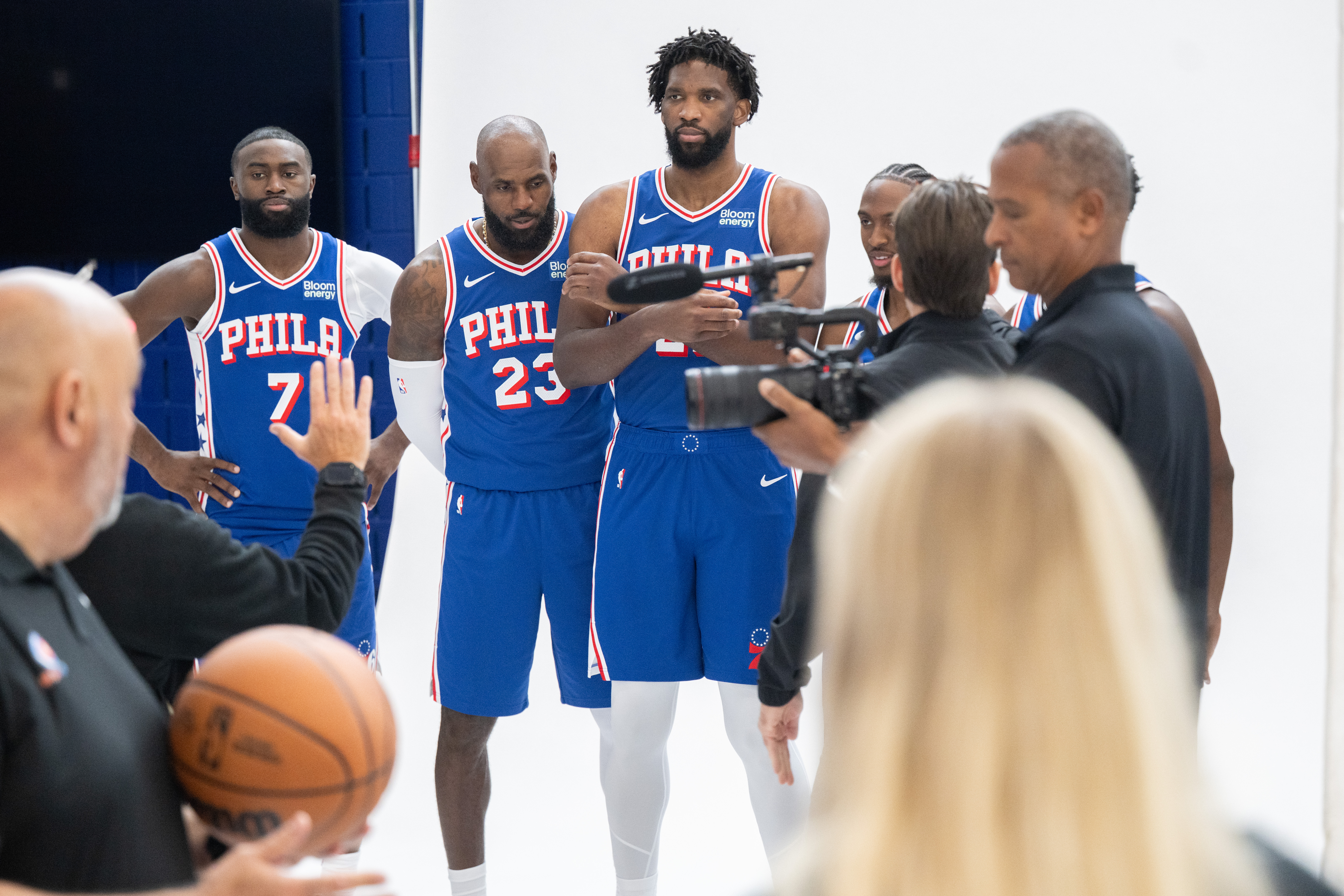
The Sixers have one of the most star-studded rosters in the NBA. Jessica Griffin / Staff Photographer
To Embiid, this roster configuration is a chance for every player on the roster to be more efficient with the touches they get because the attention everyone else will command should keep the floor open regardless of who has the ball.
“You might get less touches, but you might get also more space. So what are you going to do with that space?” Embiid said. “Whether it’s for [Maxey], for me, for everybody, starting lineup, guys coming off the bench, different roles. Roles don’t even matter; it’s just about making the right play for each other over and over and over and try to find a way to be — I think for me — more efficient than I’ve ever been.”
The Delco 10 Miler hits the road for the second time Sunday. This year’s race will have a new course and a new pace, and is open to twice as many runners.
Here are a few of the runners to look out for:
Dad and son run for a personal cause
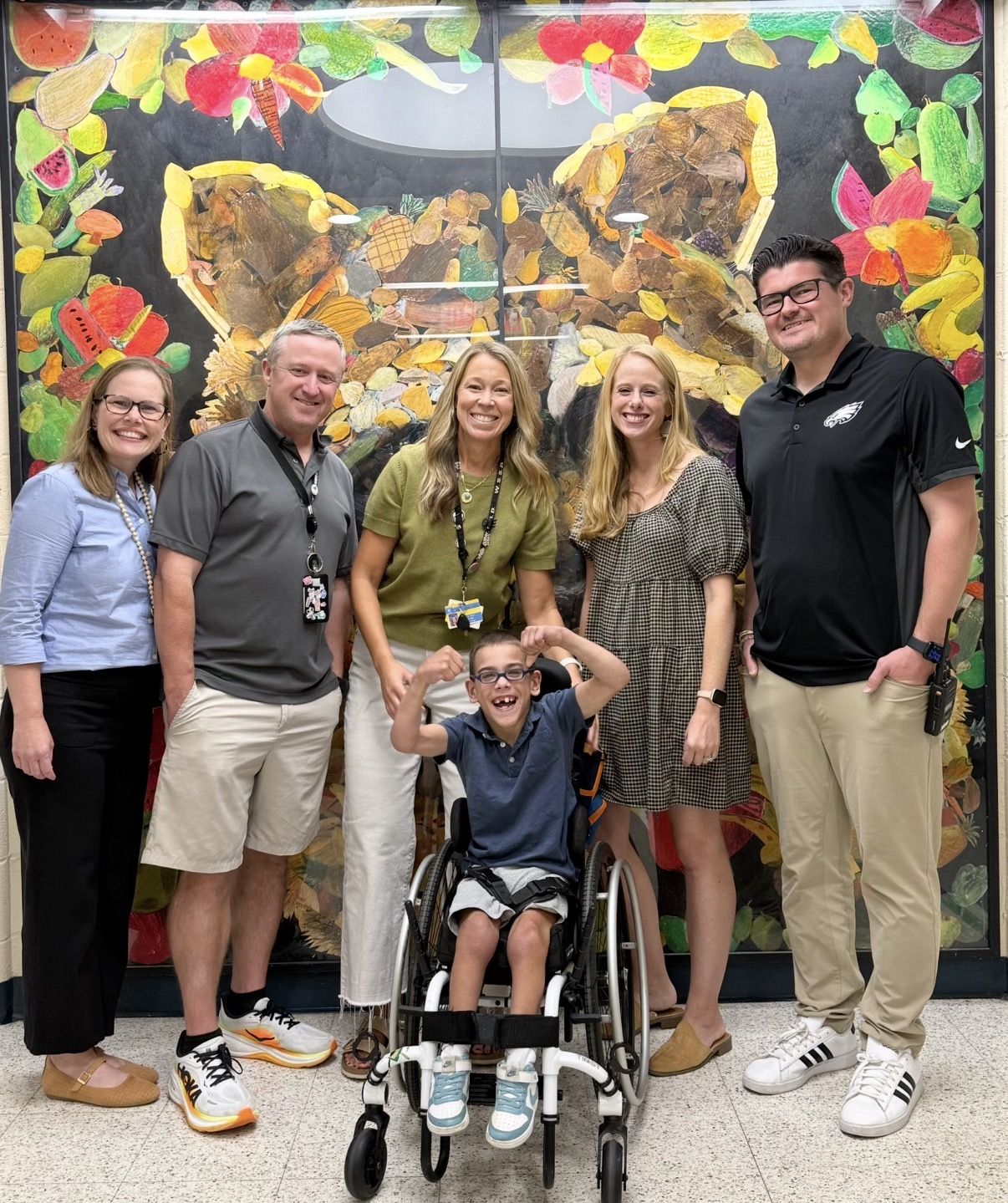
Will Getty, 8, is pumped to run the Delco 10 Miler, said his mom, Jessica, and dad, Mark, who will push him in an adaptive jogging stroller on Sunday. But it’s more than just a fun run for Will, who has cerebral palsy, and his family.
It is also part of an effort to raise money for an accessible playground at Wallingford Elementary School with help from the Kyle Pease Foundation.
Pease,41,who also has cerebral palsy, visited the school in 2025 to meet students and share his foundation’s purpose: creating inclusive opportunities in sports and endurance races for people with disabilities.
After his visit, teachers began brainstorming. What if Will and Pease participated in the Delco 10 Miler together? And could they support fundraising for the playground at the same time?
“It was a perfect opportunity to cheer them both on and to hold an event where we could raise the money and awareness of what we’re trying to do here,” special education teacher Lauren Bannon said.
The school, which is on the race course on Providence Road, will hold a festival with food, games, and a station to create signs for Will from 8 to 10 a.m. on the morning of the race. School officials recommended getting there early before Providence Road closes and using the school’s rear entrance on Kershaw Road.
The Kyle Pease Foundation donated Will’s jogging stroller and is managing fundraising for the playground. Donations can be made at https://givebutter.com/wes-loves-pease.
Will’s dad said a group of Wallingford teachers will take turns pushing Will to the finish line. Training has become a new way to bond for Will and his dad, and a playlist of Will’s favorite band, Coldplay, has been essential listening during practice runs.
“He sees people, waves to them, and if I put the music down for a second, he’s telling me to turn it back up,” Mark Getty said.
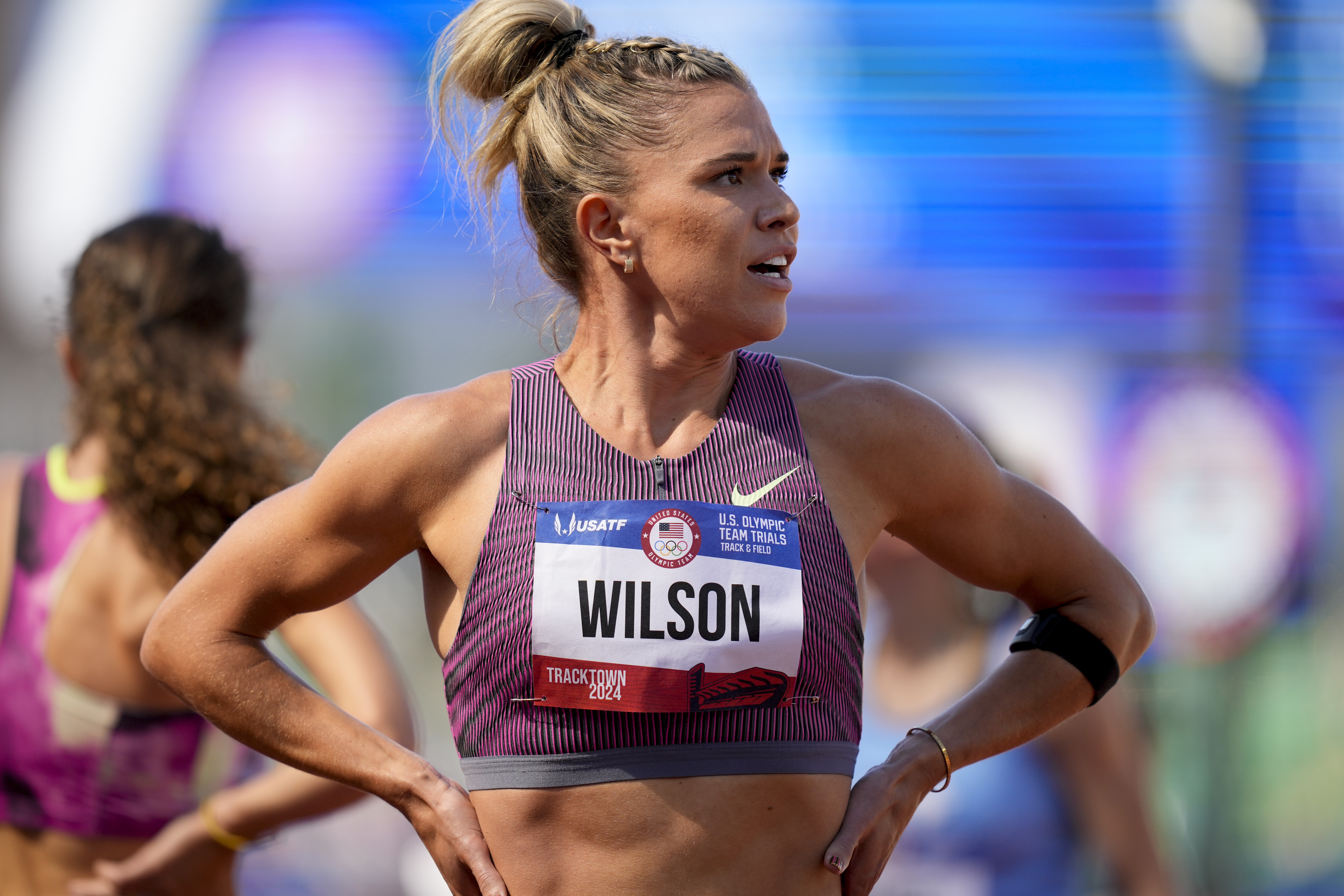
Allie Wilson won a heat in the women’s 800-meter run during the U.S. Track and Field Olympic Team Trials on June 21, 2024, in Eugene, Ore.Charlie Neibergall
Just a normal Sunday for Olympian Allie Wilson
Running 10 miles on a Sunday is part of the normal training routine for Strath Haven grad and Olympian Allie Wilson. This weekend, there will be a little more fanfare to it.
Wilson’s older sister, Val, is running the Delco 10 Miler and asked Allie to join her.
“I might as well have fun and get to be around other people for once, since I’m usually just running by myself,” Allie Wilson said.
Is a gold medal in the bag? It’s a little bit longer than her usual race, Wilson said, by 9½ miles.
“My race is 800 meters,” Wilson said. “It’s less than two minutes long. Like, I’m borderline a sprinter.”
But you don’t get to the Olympics without a competitive edge. Wilson originally planned to stick with Val in the race, but she said her sister told her not to.
“I know I’m going to get excited and I’m going to feel left out if I want to be trying to go with the people up front,” Wilson said. “We decided my competitiveness might come out too much.”
Next up for Wilson after the Delco 10 Miler: She will continue training with her sights set on a return to the Olympics in Los Angeles in 2028.
Zach Miller crossed the finish line first at the Delco 10 Miler on Sept. 28, 2025.PEL Productions for Visit Delco
A run down memory lane for last year’s winner
The Delco 10 Miler charts a course through some of the most important parts of Zach Miller’s life.
The starting line is near Rose Tree Park, where Miller ran cross-country races in high school and later proposed to his wife, Heather. It goes through Media, where he grew up, and passes through Widener University, which is Miller’s alma mater and the place he met Heather.
“It’s these little nuggets that make the race kind of special to me,” said Miller, 43, of West Chester.
One more nugget to make it special: Miller won the inaugural 10 Miler last year.
He has been waking up at 5:15 a.m. on Wednesdays to train with longtime Downingtown West High School cross-country coach Scott Burns and a group of fellow runners.
“I really wouldn’t be training or, you know, competing at the level I am without the support and kind of accountability of that group,” Miller said.
Miller said he is excited for this year’s race but considers Steve Jordan, another member of his group who is also training for the Olympics, to be the front-runner.
This suburban content is produced with support from the Leslie Miller and Richard Worley Foundation and The Lenfest Institute for Journalism. Editorial content is created independently of the project donors. Gifts to support The Inquirer’s high-impact journalism can be made at inquirer.com/donate. A list of Lenfest Institute donors can be found at lenfestinstitute.org/supporters.
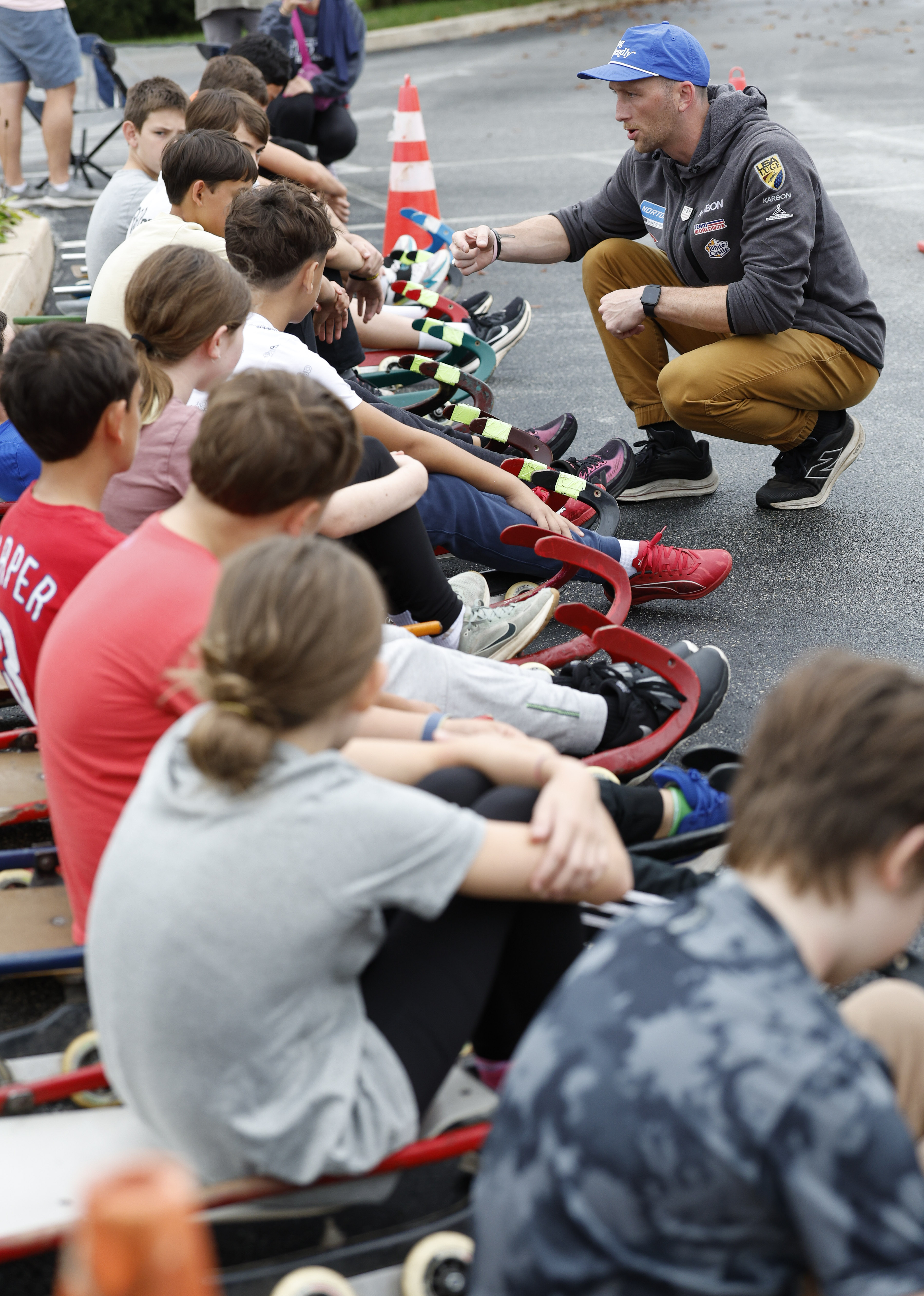
The aspiring lugers maneuvered their way down the midsize slope of a Malvern business park, navigating around, through, or into orange traffic cones. They, timidly or tepidly, let gravity do the work — some with grace, others with a grimace.
“Turn your head!” yelled coach Aidan Kelly. “Shoulders all the way back! Point your toes!”
The squeal of sneakers skidding on asphalt accented his commands.
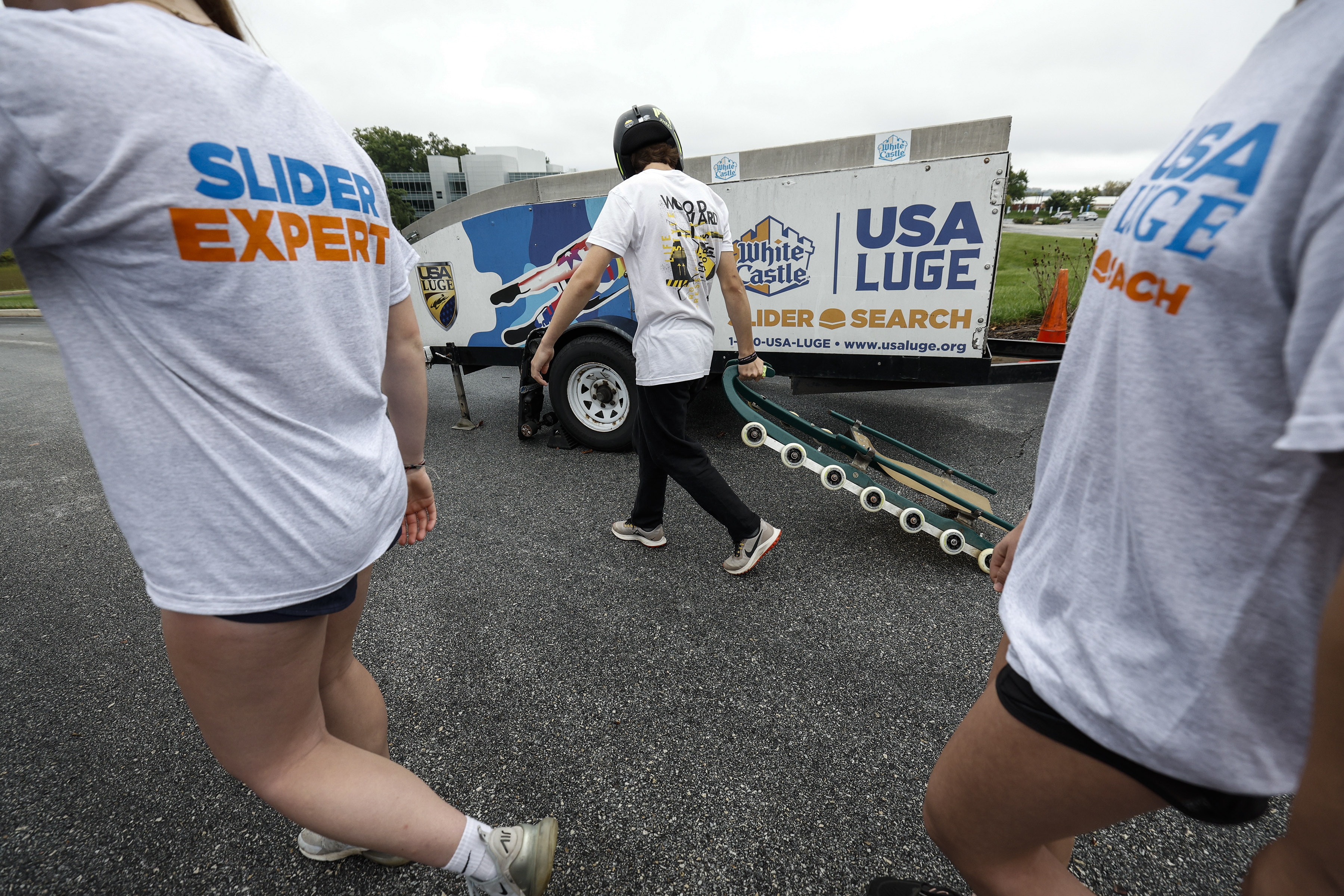
This was the annual Slider Search, USA Luge’s multiday, multicity hunt for the next generation of athletes. On a recent weekend, the lugers gathered here were tweens, most of whom had little-to-no exposure to the niche winter sport. The sleds were summer-ized, equipped with wheels; and the track was an offshoot of the parking lot at Saint-Gobain North America headquarters. The weather was sticky and in the low 80s. The swag was sponsored by White Castle — the other home of sliders.
Clinic coordinator Aidan Kelly talks to the kids during a clinic for luge hopefuls in Malvern on Sept. 13.Steven M. Falk / For The Inquirer
The Slider Search
The Slider Search gives kids ages 10 to 13 a mild taste of the sport, while the American luge federation gets up-and-coming talent. And the program has been an effective recruiting pipeline: At least 60% of every U.S. Olympic luge team since 2002 has gotten its start at a Slider Search, according to a news release.
This year, as many as 650 kids were expected to participate in free Slider Search clinics from Massachusetts to Wisconsin, including 45 across two days in Malvern, organizers said. Of those, about 80 will be invited to screening camps at USA Luge’s headquarters in Lake Placid, N.Y., according to Kelly, who handles recruitment and coaches one of the youth national teams. Kelly, a 2014 Olympian, was also discovered through the Slider Search.
“My mom just said, ‘Hey, do you want to go and try luge?’ and I said, ‘Why not, it seems cool,’” he recalled. “I liked going fast — I think anybody who wants to make their parents a little nervous would love to [try luge].”
Rather, they free-fell, first from halfway up the hill, then higher and higher, eventually graduating to a modest ramp. Fear — or maybe excitement — flashed across their faces as they launched. Some squinted, others bit their lips, as they concentrated on steering. Occasionally, one slider veered into a cone or off the course, using their sneaker treads to stop themselves.
A clinic for luge hopefuls is held in Malvern on Sept. 13.Steven M. Falk / For The Inquirer
“It’s a lot more than just sledding,” Leo Sides, 12, of Wayne, said afterward. “It’s more like your body helping the sled move rather than just going on the walls on moving.”
“You go fast but … you feel really stable on the sled,” Leo added. “I think it’s really fun.”
Sophia Bajak, 10, of Milford, N.J., first tried roller luge in Lake Placid. When asked why she wanted to try it again, she said, “I like speed.”
Kelly wasn’t necessarily scouting out mastery of the physics or athletic prowess. Instead, he was looking for coachability, control, and comfort with adrenaline, and a real interest in the sport.
There are only two Olympic-level luge tracks in the U.S., Lake Placid and Park City, Utah, but the Slider Search casts a wide geographic net, recruiting some kids who live a plane-ride away from the nearest training facility. But, in the luge world, a half-day’s travel radius from one of these sites is considered close, Kelly said.
“To do luge in America is a big commitment,” he said.
Kendall Achen understands that. The 17-year-old from Lancaster County made the Junior National Team’s roster this year, which means more training and travel to Europe for competitions. Kendall is a high school senior, and most of her classes are online, slotting schoolwork between practices and races. Her mom has the drive from Manheim to Lake Placid committed to memory.
Kendall, who was also recruited through the Slider Search, has her eyes on Olympic ice.
“I would like to go to the 2030 Olympics,” she said, “but that might be a stretch.”
Do rich guys have to ruin everything? Apparently so. There came a time about 15 years ago when my soccer obsession got to the point where I felt I needed to pick an English Premier League team to root for, in addition to the U.S. national teams and the Union. Long story, but I went with Liverpool, in a city many consider the Philadelphia of the U.K., and it’s been a good ride, including a couple of trophies. On Monday, it was reported Amazon gazillionaire Jeff Bezos is buying 30% of the team. I’m officially out. Go, Leeds!
When did Trump’s ballroom become a national security fortress? We need answers.
Construction continues on a helipad and the White House ballroom on the South Lawn of the White House on Aug. 5.Tierney L. Cross
Donald Trump’s originally stated 2025 scheme to demolish the East Wing of the White House to make way for an oversized ballroom to hold state dinners and whatnot was bad enough: an unneeded, unwanted, gilded, and presumably tacky callback to Louis XVI, a massive monument to a modern let-them-eat-cake regime.
A year later, the project is better describedasan alleged ballroom — another bait-and-switch scam by America’s first grifter president. The fact that the public really doesn’t know how much this project actually costs — estimates have soared from the initial lowball of $300 million to now at least $600 million, but possibly more — or how much of that will be dumped on U.S. taxpayers is just the beginning of the problem.
Nearly 10 months after the president shocked Washington, D.C., and the rest of America by taking a wrecking ball to the history-packed East Wing, Trump has all but stopped talking about a black-tie party venue and instead rebranded the project as essential to national security.
When the D.C. federal appeals court on Friday ordered the White House, which never got congressional approval for either the demolition or the ballroom addition, to halt aboveground construction, Trump took to Truth Social and described the ruling as akin to treason.
“The Military and Secret Service are viewing this horrendous, politically motivated, and unlawful ruling as a National Security threat to our Nation in that the entire Complex is being built for the protection of our Country and, additionally, all future Presidents,” Trump posted, using language that’s probably never previously in human history been used to describe a “ballroom.”
Trump didn’t say in his post anything about crystal chandeliers, or great acoustics, or things you might expect in a world-class ballroom. Instead, he said the facility will have bomb shelters, a state-of-the-art hospital, top-secret military facilities, protective missile-resistant steel, columns, roofs, and beams, drone-proof ceilings and roofs, military-grade venting, and bullet-, ballistic-, and blast-proof glass.
It sounds like somebody is expecting a last tango in Washington.
Trump’s post was alarming — shocking, really — but in case anyone missed the point, or doesn’t know how to read, he also posted some AI-created renderings, which again did not depict waltzing diplomats, but instead showed a rooftop “DronePort” that was packed to thegills with ominous-looking military drones, manned by troops and also with armored vehicles that somehow drove up there. The vibe was Darth Vader’s Death Star, except with “military-grade venting” this time around.
There are two very different ways to look at all of this, and let’s start with the more benign one. Ever since the beginning of his second crack at the presidency, Trump — when he’s not pursuing his main projects of making billions of dollars, punishing his enemies, and staying out of prison — has been obsessed with placing his personalist stamp on Washington. Maybe that’s for his legacy, or maybe he just wants a Mar-a-Lago-by-the-Potomac to comfort his octogenarian mind.
Trump might not be able to crash weddings as he does at his Palm Beach, Fla., estate, but his ballroom idea would be close enough. Although he’s also sought and received donations for the project from the usual suspects of friendly billionaires and favor-seeking corporations, Trump also wants both additional dollars and — more importantly, in light of the appeals court ruling — a stamp of approval from Congress. That’s been a thwarted agenda item for GOP leaders on Capitol Hill for months.
But if Trump can’t sway Congress, he hopes to win over a U.S. Supreme Court where he has appointed three of the nine members. The White House knows that both Congress and the high court tend to fall in line whenever national security is invoked, while there is no constitutional right to foxtrot. So maybe all the military bluster is just political posturing for Trump’s latest real estate development.
But as the project enters its second year, it seems to have morphed into something a lot more disturbing than that. The pictures, descriptions, and accounts of Trump’s game here are sounding a lot more like the impregnable mountain lair of a Bond villain.
This is a man who fomented an attempted coup the first time he was asked to leave 1600 Pennsylvania Avenue, and who saw how South Korea’s corrupt right-wing president was ousted after a massive throng of protesters overwhelmed key government buildings. Wasn’t it Chekhov who said you don’t put drones up on the roof unless you intend to deploy them by the third act? The two most likely scenarios for actually using Trump’s bunker — Civil War II, or World War III — are less than optimal.
This national security bunker isn’t the only thing that’s worrisome as Trump looks to the second half of what’s supposed to be his final term. As noted in this space recently, Trump has also extended the presence of National Guard troops in Washington through Jan. 20, 2029, which coincidentally is the scheduled last day of his term.
Since their arrival last year, the Guard troops — many from units in pro-Trump red states, and costing U.S. taxpayers at least $1.4 billion and possibly more — have often been spotted hanging around, or picking up trash as a kind of busywork. But residents and some advocates like Scott Michelman, legal director of the American Civil Liberties Union of the District of Columbia, are already complaining Trump is “treating [D.C.] like a police state.”
It raises the same questions as the alleged “ballroom.” The president is entitled to state-of-the-art security, and while the public doesn’t need to know all of the operational details, American taxpayers also can’t be expected to fork over hundreds of millions of dollars for these projects without truly knowing what they are for.
Democrats on Capitol Hill need to start demanding answers. On Monday, there was an encouraging report by the New Republic’s Greg Sargent that the opposition party is working to demand communications from the Justice and Interior Departments to explain why several people were wrongly criminally charged with vandalism at the Lincoln Memorial Reflecting Pool when the actual damage was a botched repainting contract.
Congress can, and should, also flex its muscles over this ballroom fiasco — first by denying any public money for the project, and then by launching a similar investigation into the hasty demolition, the political fundraising, and the sketchy purposes for the project. Someone owes America the truth, and it’s not going to come from the current regime without a fight.
Whatever happens, the woman or man who hopefully succeeds Trump and sends those guard troops back to their own private Idaho in January 2029 is also going to have a giant mess in their backyard. But it’s better to have the ruins from a botched, halted construction project than from the Battle of Armageddon.
Yo, do this!
The California journalist Gil Durán has been paying attention to the political craziness coming out of Silicon Valley years before anyone else was, and now comes the big payoff in the form of a book that is not only incredibly timely but has the best title of the year: The Nerd Reich: Silicon Valley Fascism and the War on Democracy. Durán explores the strange beliefs of Elon Musk, Peter Thiel, Marc Andreessen, and their friends, their obsession with building their own private “networked cities,” and their unlikely alliance with Donald Trump. I’ve been waiting on this one for a while.
August is always a great month for books. While Durán drills down on the high-tech enemies of liberty, the great writer Dave Zirin has a new tome about one of democracy’s heroes, the late historian Howard Zinn, his former mentor. Public intellectuals are still arguing about the merits of Zinn’s 1980 masterwork, A People’s History of the United States, but nobody disputes his influence on the national conversation. Zinn rejected American exceptionalism, but also spotlighted everyday heroes like labor leaders or civil rights activists who expanded our freedoms over two centuries. I’m looking forward to reading The People’s Historian: The Outsized Life of Howard Zinn.
Ask me anything
Question: Data centers are the flashpoint but the root problem is the unregulated AI that is sweeping up every keystroke and every written document then repackaging it as if original thought. How do we get a federal government mired in 2020 to begin legislating on AI? — Suzi (@wanderponder.bsky.social) via Bluesky
Answer: Great question, Suzi, and I think we all know the main reason why the body politic — and I’m talking about both Democrats and Republicans — have been so painfully slow to respond to voters’ widespread anxiety not only about noisy, polluting, resource-wasting data centers, but also to artificial intelligence itself. The reason is money. Silicon Valley AI developers have raised an unbelievable $220 million to spend on November’s election, and — while there are some disagreements within Big Tech about policy — most of the cash will go to the politicians least likely to regulatean industry badly in need of it. Cognitive computing is not only stealing our intellectual property, as you noted, but also our jobs, as well as our children’s ability to learn.The good news is that public backlash against AI is so strong that even a quarter-billion dollars may not be able to stop the movement. But it’s way past time to get money out of politics.
What you’re saying about …
I should have guessed that newsletter readers don’t have much more of a clue than Donald Trump about what to do about the giant mess in the Persian Gulf. I did get one thoughtful response from an emailer with a “cbluff” handle (Reminder: Please sign your real name to these responses) who said the Trump regime needs to send skilled negotiators — and be realistic. “I believe the U.S. will have to cede the Strait of Hormuz, allow Iran and Oman to collect protection money, remove sanctions and pay them so we can declare victory and leave,” they wrote. It’s hard to disagree. Once again, the United States has lost a war.
📮 This week’s question: Since the Democratic Senate primary win by Michigan’s Abdul El-Sayed last week, the mainstream media has been obsessed with the question of whether this year’s progressive surge, including candidates (although not El-Sayed) tied to the Democratic Socialists of America, is hurting the Democrats. What do you think? Are leftists bringing needed energy to a moribund party, or are they too out there to defeat the GOP in November? Please email me your answer and put the exact phrase “Democrats and the left” in the subject line.
Backstory on the day Trump left his press corps for dead
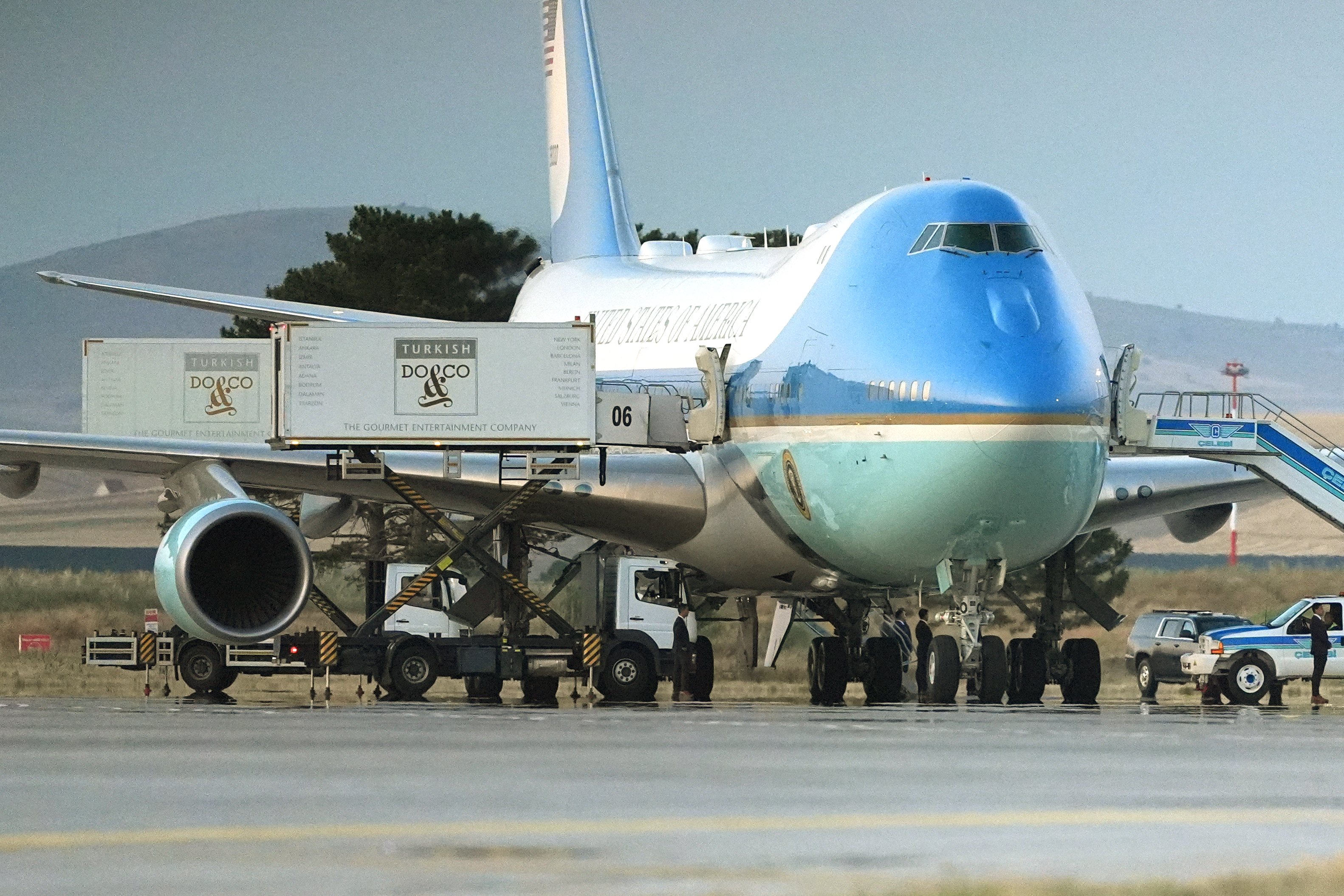
Catering trucks are parked at Air Force One on the tarmac as the motorcade carrying President Donald Trump arrives to depart following the NATO summit, at Ankara International Airport in Ankara, Turkey, on July 8.Alex Brandon
It was appalling enough back in late July when we watched a room full of some of America’s highest-profile journalists break bread with Donald Trump at the rescheduled White House Correspondents’ Association dinner in Washington, where the president got up and hurled crude insults at several of the media members. Many of us were disgusted that some of the nation’s most respected journalists would platform a man who has repeatedly called a free press “the enemies of the people.” But the White House press corps was in the dark about an even more disturbing plot twist.
Just 16 days earlier, Trump had left some of those journalists for dead — at least potentially — as human decoys who might be blown from the skies in a feared Iranian plot.
The stunning story came out late Monday night as I was writing this newsletter, with a scoop by the Washington Post, matched shortly, with some additional details, by the New York Times. The articles revealed a modern-day Air Force One kind of thriller that essentially involved a shell game with three different aircraft. It was triggered by what officials deemed was a credible Iranian assassination threat against the president when he traveled to a NATO summit in Ankara, Turkey — just over 700 miles from the border with the U.S. enemy.
This launched a series of events, beginning with a plan to abandon Trump’s new, $400 million gift-from-Qatar iteration of Air Force One for an older version that actually has more advanced defensive capacities. Trump was filmed boarding the replacement Air Force One, followed by the White House press corps and some traveling aides for the departure from Ankara to a U.S. air base in Great Britain. What those passengers could not have imagined was that Trump had somehow been spirited out “via a catering container that had been lifted to the opposite side of the plane,” and switched to a C-32A military plane for the flight to the U.K.
Then they kept the unwitting journalists and aides on the ground for a couple of hours before it was revealed POTUS was safely in Britain and the Iranians had been thwarted and … haha, of course that’s not what really happened. No, the press corps took off as human decoys — the latest sitting ducks in an idiotic war that never should have been launched in the first place. Thankfully, no one was hurt … this time. Journalists wondered why they’d been ordered to keep the airplane’s window blinds closed, which inspired this now ironic exchange between Trump and some journalists when they reunited for the flight from Britain back to the U.S.
Trump lied that he didn’t know of any specific plot against Air Force One, and then added: “I’m No. 1on their list, before you. But if I go, you go. Right?”
Apparently not.
Even as I write this in the middle of the night just hours after the Post and Times scoops, the internet is already flooded with memes depicting Trump crammed into one of those airport serving carts, or pigging out on the adjacent airline food. It’s funny to see that your president isn’t Harrison Ford punching out the terrorists, but, in reality, slinking away in a food truck, leaving other Americans in the line of fire, right?
No, it’s not funny at all. This whole episode is a grand metaphor for a careless president who smashes up things before retreating into his money or whatever keeps him going — not thinking twice about the fate of human beings in a squalid ICE detention camp or an Iranian girls’ school. Or bantering with the gaggle of journalists whom he abandoned after drawing a big target on their backs. The first media question at the next Oval Office event ought to be, “Why did you treat me like cannon fodder?” But I wouldn’t bet on that happening.
What I wrote on this date in 2016
It’s almost funny now, in a dark-comedy kind of way, to look back on the fateful summer of 2016 and remember what it felt like to be stubbornly convinced that something, anything, was bound to happen to stop the obvious insanity of a Donald Trump presidency. It seems so incredibly naive now to read what I believed exactly one decade ago, when I actually thought the success of a diverse and incredibly talented U.S. Olympics team in Brazil would expose the Big Lie of Trump’s racism. I wrote, “The exclamation point is the remarkable women’s gymnastics team led by individual gold medalist Simone Biles — so dominant you will easily forget they also celebrate the kind of diversity that is America’s best feature, not the bug that’s described by the bitter and the disaffected back home.”
The fight for America’s future is waged on many fronts, and I’m trying to keep up. Last week, I wrote about a fascinating political development that’s been largely flying under the radar screen: a movement out west to knock off GOP incumbents by creating one-on-one contests with feisty, populist independents. That means long-shot Democrats need to drop out — which has happened in Nebraska, Idaho, and South Dakota, but not in Montana. It’s both a bold plan to end the Republican majority on Capitol Hill and a sad commentary on the failed Democratic Party brand in the American heartland. This weekend, I wrote about the Trump regime’s latest assault on higher education — denying loans for students who major in fields linked to lower-income jobs — and the increasingly bleak future of a liberal arts education. I wondered why Democrats won’t fight harder to end runaway careerism and preserve college campuses as bastions of critical thinking.
This August feels like the calm before the storm in Philadelphia sports. Some of that is the excitement over the Eagles finally beingback in training camp and looking to regain that Super Bowl mojo as 76ers fans try to process, if that’s the right term, a once-in-a-lifetime offseason rebuilding project. But much of it is angst over the Phillies, who are clinging by their fingernails to a playoff spot despite adding the National League’s batting champ to a lineup that already includes home run king Kyle Schwarber, future Hall of Famer Bryce Harper, and one of baseball’s best pitching rotations. None of that matters when the Phillies don’t have a relief pitcher who can carry a lead past the 7th or 8th inning. The Inquirer’s ace sports columnists like David Murphy and Marcus Hayes have all asked the same question: Can this team be saved? The answers are just over the paywall, and you can leap over it just like Saquon Barkley at the first-down marker; all you need to do is subscribe to The Inquirer.
By submitting your written, visual, and/or audio contributions, you agree to The Inquirer’s Terms of Use, including the grant of rights in Section 10.
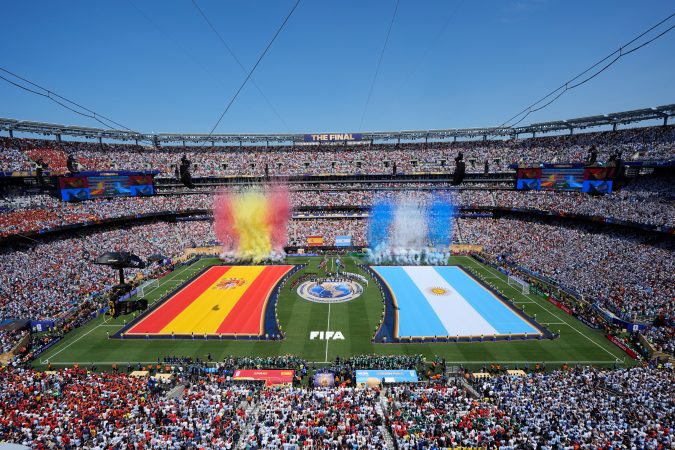
When the largest World Cup in history ended at MetLife Stadium, it marked the culmination of a summer in which millions of visitors moved through American host cities under the eyes of computerized systems most of them never noticed.
The federal government directed more than $1 billion to World Cup security, funding facial recognition cameras in and around stadiums, police drones over crowds, and AI-driven monitoring of transit hubs. More than 120 civil society organizations issued a travel advisory warning visitors about the screening they would face.
The tournament turned host cities into laboratories for urban artificial intelligence, and the experiments ran on tourists.
The two of us have conducted research on the use of electronic monitoring in urban areas, and we do not write to argue that cities should abandon these tools. Tourism contributed $10.9 trillion to the global economy in 2024, roughly 10% of global GDP, and safety increasingly decides where that money goes. Thirty-two percent of travelers now call safety the primary factor in choosing a destination, up from 23% in 2021.
AI can genuinely help cities deliver that safety. London’s transit authority uses smart video to spot trouble on crowded platforms. Singapore’s police fly drones that map crowd density at large events in real time. Used well, these systems find lost children, reroute crowds before crushes form, and speed emergency response.
A video surveillance camera hangs from the ceiling above a New York City subway platform in October 2020. Mark Lennihan
The problem is the gap between deployment and governance.
Cities are running the experiment first and writing the protocol later.
That order of operations should worry anyone who remembers that surveillance systems, once installed, rarely come down. Mega-events have long served as the justification for permanent expansions of monitoring capacity.
The gap matters because safety is not only physical. Our research frames tourist safety in three dimensions: physical safety from crime and disaster, digital safety from data breaches and fraud, and psychological safety, the felt sense of trust that makes a visitor relax in an unfamiliar place. An algorithm that marginally improves the first while quietly eroding the other two is a bad trade.
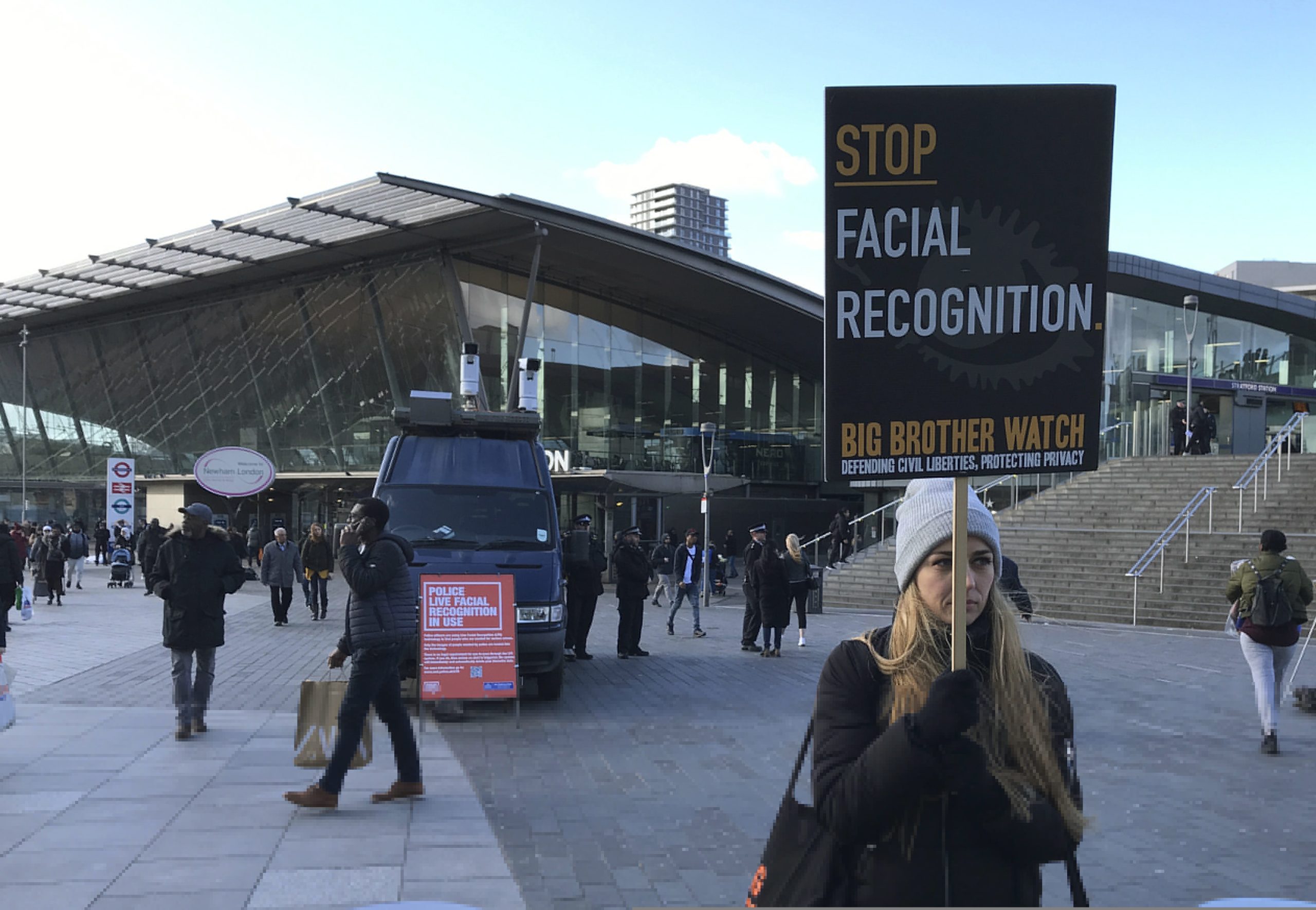
Rights campaigner Silkie Carlo demonstrates in front of a mobile police facial recognition facility outside a shopping center in London in February 2020.Kelvin Chan
The public senses this. Two-thirds of respondents in surveys we reviewed insist that people should be informed when AI is used to prevent, detect, or investigate crime. London learned the hard way that deploying facial recognition vans in high-footfall areas without that transparency generates backlash that outlasts the deployment.
Some cities show what the alternative looks like.
Barcelona created an external advisory council of independent experts that evaluates high-stakes algorithms before deployment; that panel rejected fully automated decision-making outright. Helsinki maintains a public AI register that lists every municipal algorithmic system — what it does, what data it uses, and what safeguards constrain it — so any resident or visitor can look up exactly what is watching them. Neither city sacrificed safety for principle. They built the trust that makes safety technology legitimate.
This convenience store in Tacoma, Wash., tested facial recognition technology to prevent theft in 2019. Melissa Hellmann / MCT
American cities do not need to invent this from scratch. The road map we propose starts with three steps any city council can take this year:
adopt an AI governance framework tailored to tourism and public safety;
extend legal protection to residents’ and visitors’ data whenever private vendors handle it;
publish a public register of every AI system the city operates.
None of these steps requires new technology. All of them require political will.
That means the great wave of municipal AI adoption is still ahead of us, and so is the chance to shape it.
Los Angeles hosts the Olympics in 2028. The cities that spent this summer as laboratories should spend the next two years writing the rules — in public — before the next surge of visitors arrives. Tourists chose these cities for a sense of welcome and security. Cities owe them systems worthy of that trust.
Eugènie L. Birch is the Nussdorf professor of urban research at the Weitzman School of Design, and co-director, Penn Institute for Urban Research at the University of Pennsylvania. Mauricio Rodas is the former mayor of Quito, Ecuador, and professor of practice at the Weitzman School of Design. Luke Campo, a graduate of the University of Pennsylvania, supported this research.
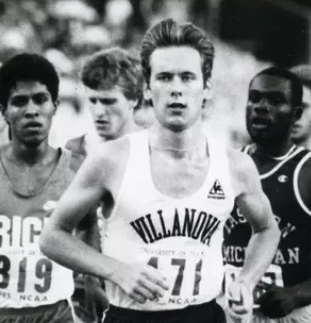
Gerry O’Reilly, 61, of Chester Springs, Hall of Fame middle distance track star at Villanova University, 1988 Irish Olympian in the 1,500-meter run, longtime executive at the Vanguard Group Inc., mentor, and role model, died Thursday, June 11, at Phoenixville Hospital after an earlier sudden cardiac event.
Born and reared in Dunboyne, County Meath, Ireland, Mr. O’Reilly earned a track scholarship to Villanova in 1983 and joined a dozen other Irish athletes in what became known as the school’s Irish Pipeline to the Main Line. He went on to run cross-country and indoor and outdoor track, win seven Big East Conference championships, and hold the Big East outdoor record in the 1,500 for 37 years.
He ran the 1,500- and 3,000-meter runs, the mile, and the distance medley relay at Villanova, and was named All-America four times. He won six national collegiate championships, was named outstanding performer at the 1986 Big East Indoor Championships, and was inducted into the Penn Relays Wall of Fame in 2007 and the Villanova Varsity Club Hall of Fame in 2009.
“Without exaggeration, those were four of the best years of my life,” Mr. O’Reilly told Dave Thomas on the Belmont Plateau Hall of Fame podcast. Villanova “kind of set me up both athletically and academically for the rest of my life.”
Marcus O’Sullivan, former Villanova teammate and countryman, now director of track and field and cross-country at Villanova, said Mr. O’Reilly “had a steadfast moral compass that guided him in his life, and in doing so it had an intoxicating influence on others. … We all need a person like Gerry O’Reilly in our lives.”
After college, Mr. O’Reilly competed in the international Millrose Games in New York, the 1987 World Championships, the 1989 World Indoor Championships, and for Ireland in what is now the World Athletics Championships. At the 1988 Summer Olympics in Seoul, South Korea, he made it to the semifinals of the 1,500.
Irish Olympic team officials called him “an exceptional athlete” and praised his “genuine commitment to helping the next generation.” They said: “Once an Olympian, always an Olympian.”
Irish marathon Olympian John Treacy told the Irish Times: “Gerry was a smashing runner and just the nicest guy, great for staying in contact and communicating with other Irish runners over the years.”
Mr. O’Reilly ran miles at night after school in the rural Irish fields and lanes, and joined the Dunboyne Athletic Club when he was 9. Villanova University
Mr. O’Reilly was also inducted into the Belmont Plateau Hall of Fame in 2025 and recently honored by his hometown Dunboyne Athletic Club.
He earned a bachelor’s degree in economics in 1987, joined Vanguard in 1992 and the trading desk in 1994, and worked as an investment leader and portfolio manager. He was a mentor, colleagues said in a tribute, “who made immeasurable contributions to several of Vanguard’s flagship index funds.”
He served on corporate panels and lectured at leadership development events. Colleagues called him “riveting and influential” and “a giant in every sense except ego.” One said: “You could tell he truly cared about the markets and about doing things right.”
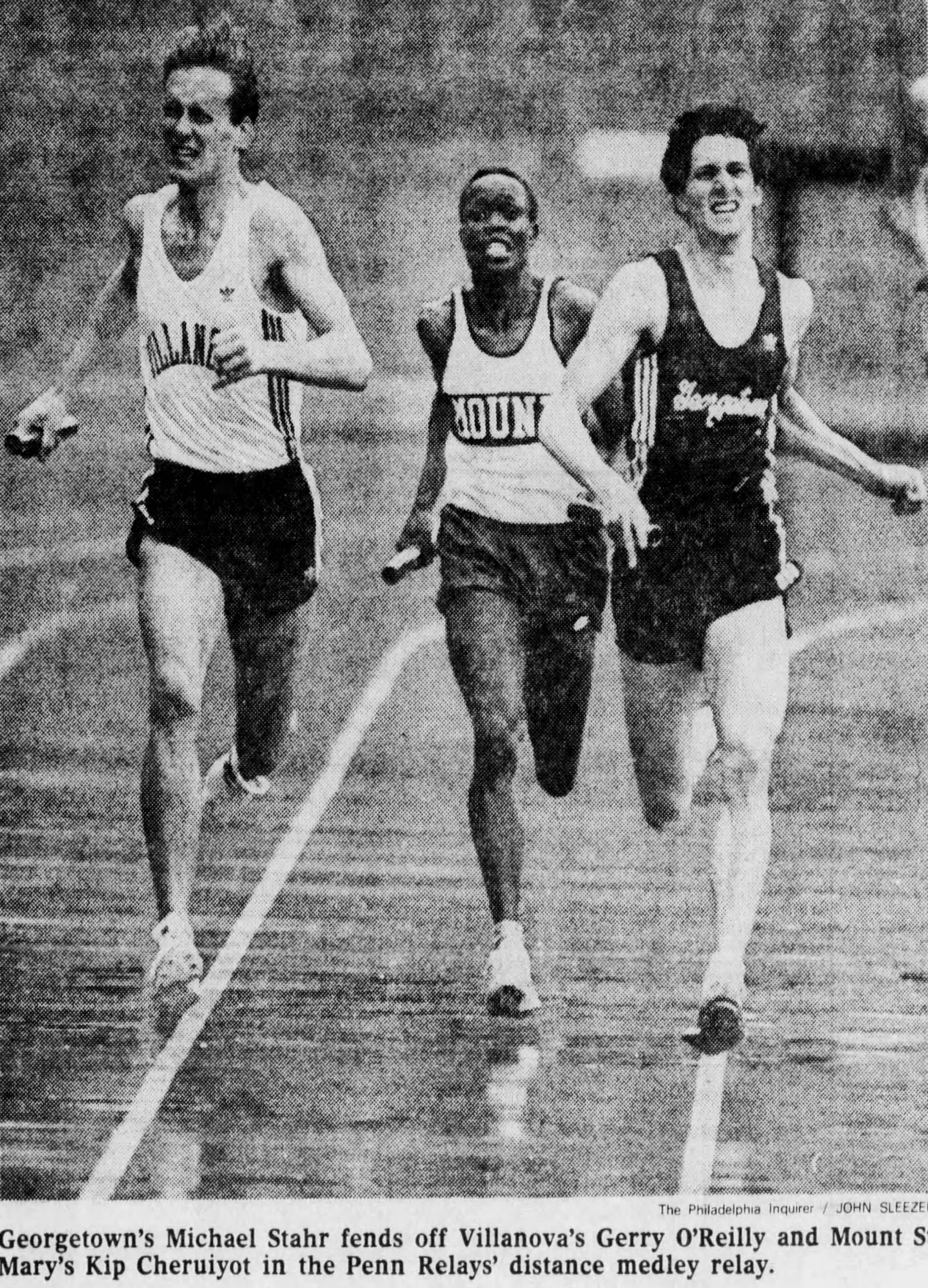
This photo and a story about Mr. O’Reilly (left) appeared in The Inquirer in 1987.Newspapers.com
Gerard Christopher O’Reilly was born July 1, 1964. He was the oldest of six children and excelled at cross-country, track, soccer, and other sports.
He ran miles at night after school in the rural Irish fields and lanes, joined the Dunboyne Athletic Club when he was 9, and was inspired, he said later, by Irishman Eamonn Coghlan’s fourth-place finish in the 1,500 at the 1976 Summer Olympics. Mr. O’Reilly went on to win the 1983 Irish Junior 1,500 championship.
He met fellow track star Melody Sye, and they married in 1992 and had a daughter, Meghan, and sons Keelan, Jack, and Conor. They divorced later.
“Despite all his trophies and merits,” Mr. O’Reilly’s family said in a tribute, “he always remained humble and would say being a dad to his four kids was his proudest accomplishment.”
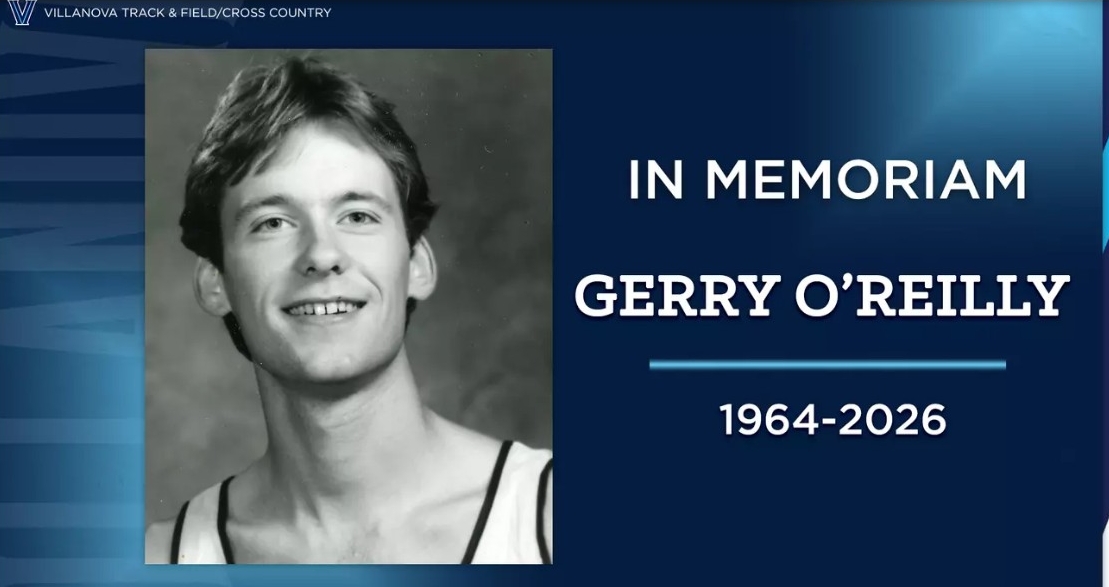
Villanova honored Mr. O’Reilly online.Villanova University
Mr. O’Reilly was an avid bicyclist, and he spent many weekends on long rides and at Eagles games on Sundays. He liked poker, hikes with his dog, Bear, and watching sports with his family.
“Most of all,” his family said, “he simply enjoyed cracking jokes, sharing stories, and spending time with his friends and family.”
In addition to his children and former wife, Mr. O’Reilly is survived by three sisters, two brothers, and other relatives. “His final gift,” his family said, “was saving multiple lives through organ donation.”
The World Cup is finally here, and for the next 39 days, billions of soccer fans worldwide will hang on the fate of the 48 national teams vying to be named the global best for the next four years.
There is nothing else quite like it.
If you haven’t followed it closely, try to imagine it as a kind of March Madness wherein the bracket’s unexpected turns and Cinderella runs can upend every expectation: add into it the international scope and quadrennial timing of the Summer Olympics; then top it off with the fervor of beloved religious observance — and you’ll be getting close.
My familial WhatsApp group started really buzzing two days ago, after New York City Mayor Zohran Mamdani posited the possibility of Morocco winning it all, and won’t stop buzzing until the confetti rains down on the overjoyed winners. In between will be everything from play-by-play game commentary, to status reports on Panini collections or taste tests of World Cup branded snacks, to shared photos of candles lit for the success of a favored team.
Because, when you are all in you are all in, am I right?
Thursday the opening match took place between Mexico (which, along with the United States and Canada, is co-hosting this World Cup) and South Africa.
On Sunday, our own Linc-turned-Philadelphia-Stadium will host Cote d’Ivoire vs. Ecuador. Philadelphia Inquirer columnist Will Bunch has written about the Cote d’Ivoire team — which he will see in person — and whose fans came to watch them in Chester even before the World Cup started.
The Vourvouliad (the collective we’ve coined for my extended family) long toyed with the idea of attending one of the Philadelphia matches as a group — but FIFA’s dynamic pricing put the kibosh on that by making every seat cost a small fortune.
But we’ll make do — as we have every mundial before this one — watching from afar.
Truth is, many of us are also approaching this World Cup with more than a little bit of trepidation. We will watch the World Cup matches taking place on U.S. soil with bated breath, given President Donald Trump’s xenophobia and his administration’s targeted deployment of Immigration and Customs Enforcement and other Department of Homeland Security agents to Black and brown cities, communities and gathering spaces.
But we longtime fans have too many great memories born of our experiences of soccer to boycott the World Cup altogether — even though some have called for that.
In fact, most of the fans that I’ve spoken with lately are consumed by the exact opposite: trying to find a way to get into a World Cup stadium.
Ecuador’s Moisés Caicedo carries the ball during a World Cup 2026 qualifying soccer match against Argentina at Banco Pichincha Stadium in Guayaquil, Ecuador in September.A
Felipe, who — perhaps channeling Pelé, Neymar and countless other soccer icons — only wanted to go by one name, will be at the Philadelphia opener Sunday, rooting for his home country of Ecuador.
“I will be going to the stadium with my family. We will also be tailgating with some other friends from Ecuador before the game outside the stadium,” he told me. “I think it will be a great opportunity to meet other soccer fans there.”
“I am really excited for the World Cup, not only because Ecuador’s national team is in great shape but also because it is a once in a lifetime [opportunity] to have your home country’s national team playing a World Cup in the city you are living in,” Felipe added. “I wish the organization would take into account the fans’ enjoyment before the profit, but I guess this is the business model we sadly see in many other sports as well.”
France’s Kylian Mbappé, left, scores his side’s third goal during a World Cup 2026 group D qualifying soccer match between France and Ukraine in Paris in November.Christophe Ena
Ben Rush-Goebel, who moved to Philadelphia from France more than a decade ago, probably won’t be at France’s match on June 22.
“The tickets are really too expensive,” he told me, “so unless I find a magical way to get to the Philly game, I will be watching it with my friends. I can’t wait to go to the FanFest to watch this game and others. Might also go to a bar. Fado has always been our spot. In 2018, when France went to the finals to beat Croatia, we were in the rain on South Street watching from the screen set up by Brauhaus Schmitz. This was the most amazing time as we rushed after the victory to buy cheap champagne to celebrate.”
Brazil’s Vinícius Júnior celebrates after scoring his side’s second goal against Colombia during a FIFA World Cup 2026 qualifying soccer match at Mané Garrincha stadium in Brasilia, Brazil, in March 2025.Eraldo Peres
Rob Levin, raised in Brazil and rooting both for their Seleção and Argentina’s Albicelestes, will be watching Brazil play in Philadelphia June 19 from home, or with others at a watch party.
“Chevere to have the World Cup here,” he said. “It’s a shame that the ticket costs are so high and travel to and fro is so fraught — I hope all the fans behave and all players are treated well and with respect — no place for politics in these games. May everything go as smoothly as possible, as it should.”
The Union’s Danley Jean Jacques, right, is the first active player from the Philadelpha club to play in a World Cup, on the Haitian national team.Jessica Tobias
Numa St. Louis, whose team, Haiti, is participating in the World Cup for the first time in more than 50 years, hasn’t given up on seeing the team play against Brazil on June 19.
“I’m still hoping to score a ticket for the Haiti-Brazil game,” he told me, “but if not, I’ll be enjoying the tournament the Haitian way — at community watch parties, breaking bread with friends and family, dancing, and vibing to Haitian music and rhythms while cheering on our team.”
“The entire Haitian community is energized by the opportunity to support our national team and celebrate this historic moment together …Win, lose, or draw, this team has already made us proud,” he added.
Like Levin, St. Louis worries about the welcome players and international fans might feel in the U.S. venues. “I have some concerns about how the United States is being perceived by many international fans,” he said. “Reports regarding the treatment of an African referee, Senegalese players, and issues involving Iranian supporters have raised questions about whether the spirit of the tournament is being fully embraced. The World Cup should be a celebration of cultures, people, and the beautiful game. It should feel welcoming, joyful, and inclusive for everyone.”
And it should resonate, even years later.
“My best soccer memory goes back to 1996, the first time Ecuador beat Argentina in Quito,” Felipe told me. “I was 12 years old and went to watch the game at the stadium with my grandfather who was a huge fan of soccer.”
Rush-Goebel points to that 2018 moment on South Street after France’s win as his favorite soccer memory: “A whole lot of French people, many of whom were my friends, my wife, [all of us] stressing together, in the rain, to an amazing victory!”
For myself, I have fond memories of seeing Mexican immigrants in Philly dressing their Jesus figures in El Tri’s national jerseys before Mexico played in the 2014 mundial — but you have to go all the way back to the 1970 World Cup in Mexico for my best memory.
Sure, I recall snippets of the televised semi-final “game of the century” between Italy and West Germany, and maybe even Pelé’s magnificent header that opened the final between Brazil and Italy…
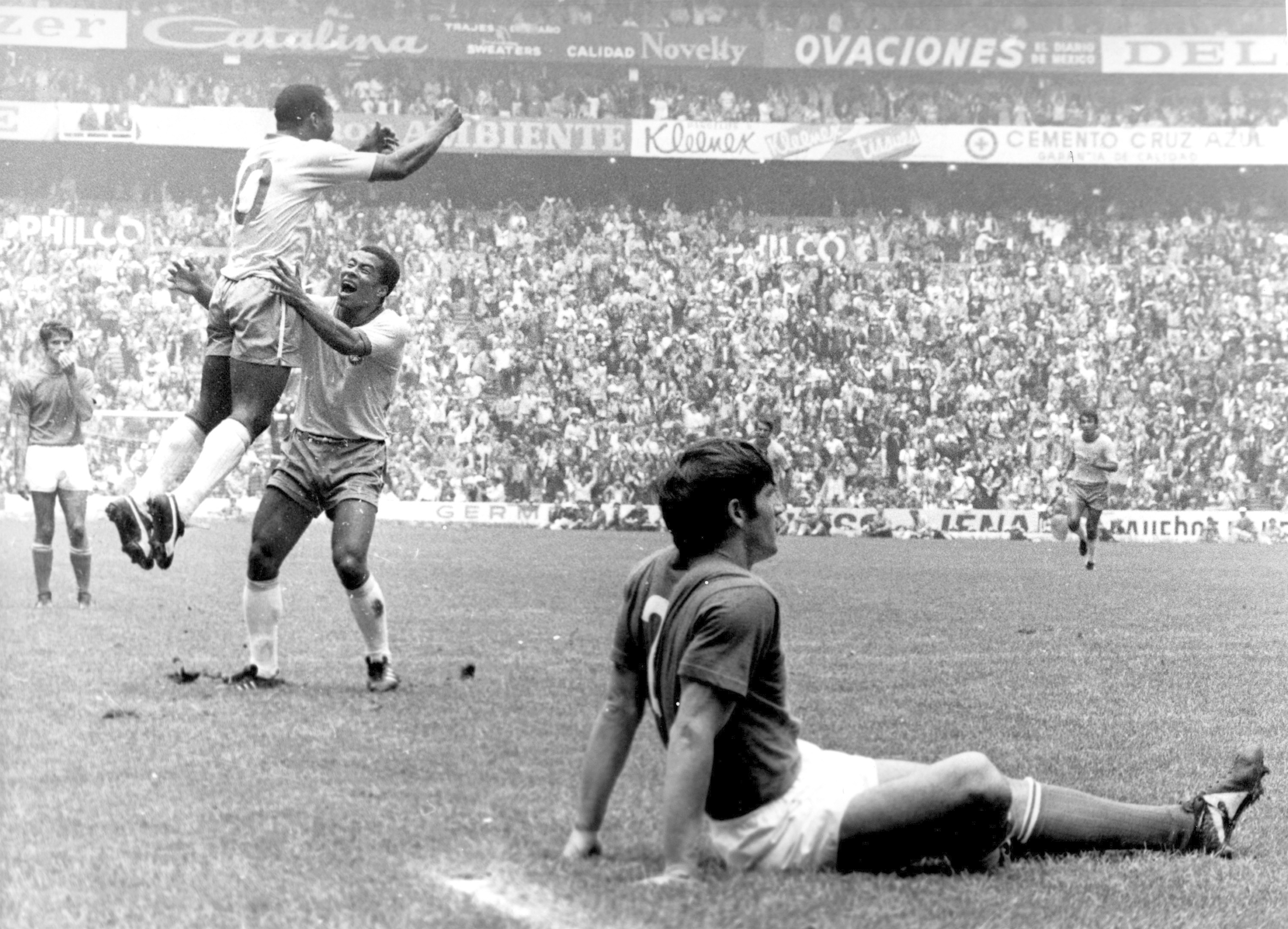
In this June 21, 1970 file photo, Brazil’s Pelé jumps for joy after scoring his team’s first goal against Italy in the first half of a World Cup final at Azteca Stadium in Mexico City, before winning 4 – 1. Kurt Strumpf
But what lives most vividly in my memory played out during the long lent leading up to those games.
I’m a kid, standing under the eucalyptus tree in my grandmother’s house in Guatemala with my brothers, trading Panini we purchased for centavos at the corner store in Zone 7 so that we could fill every team roster with stamps in our albums. We talked fútbol nonstop — me, who can’t stand sports, and my brothers, who love soccer and baseball with equal passion — and cheerfully bickered about who would go the distance.
For me soccer will always be about those two people I love, who I want to keep talking fútbol with until the day I die. The beautiful game is beautiful precisely because of the profound connections it invites and honors — be it with family members, friends or strangers across continents and time zones.
Or with a city, hosting its first ever World Cup matches with characteristic style and grit. May you hold our deep and indelible memories forever, Philadelphia.