Tag: Nether Providence

  • The second Delco 10 Miler is bigger than last year and will close some county roads. Here’s what to know.

    The second Delco 10 Miler is bigger than last year and will close some county roads. Here’s what to know.

    The Delco 10 Miler will take off again Sunday, cutting a partially different path across the county that organizers hope is safer, more driver-friendly, and more fun for participants.

    In addition to a new course, the race will host up to 2,500 runners, up from 1,200 last year, and benefit some new groups in the community.

    Here’s what to know about the second Delco 10 Miler.

    The Delco 10 Miler’s new course

    Last year’s race followed a mostly straight line down Providence Road from Rose Tree Park before taking a few turns on Widener University’s campus, crossing I-95, and then carrying on through Chester toward Subaru Park.

    The start and end are the same this year, but organizers made a few improvements. Runners will turn off Providence Road at West Rose Valley Road and take a few turns through neighborhoods in Nether Providence. There, the route will meet up with its original course on Widener’s campus.

    This change will free up more of Providence Road to drivers and will make it easier for parishioners to attend church services along the route. It is also more runner-friendly, said Diana Shacklock, director of special projects at Visit Delco, the race’s organizer.

    Last year’s course brought runners to a spot where they could see the finish line, but made them run several blocks past it before looping back, Shacklock said. Some runners commented on it after the race, so the loop was eliminated.

    “It is no longer an ugly finish,” race director Kevin Nolan said.

    (function() {
    var l2 = function() {
    new pym.Parent(‘delco_10_miler_2026’,
    ‘https://media.inquirer.com/storage/inquirer/projects/innovation/arcgis_iframe/delco_10_miler_2026.html’);
    };
    if (typeof(pym) === ‘undefined’) {
    var h = document.getElementsByTagName(‘head’)[0],
    s = document.createElement(‘script’);
    s.type = ‘text/javascript’;
    s.src = ‘https://pym.nprapps.org/pym.v1.min.js’;
    s.onload = l2;
    h.appendChild(s);
    } else {
    l2();
    }
    })();

    Road closures for the race

    Roads along the route will be closed between 7:30 and 10 a.m. Police will have rolling openings and closings, meaning some roads will be open before runners reach that part of the course and after they pass.

    The ramps from the Route 1 Media Bypass to Providence Road/Route 252 will be closed at 7:30 a.m.

    Organizers asked for patience and recommended planning ahead if you need to travel along the route.

    What runners need to know

    Organizers recommend parking at Subaru Park lot G before the race and taking the shuttle from Subaru Park to the starting line. Shuttles run between 5:30 and 6:30 a.m. Runners can also be dropped off at Springton Lake Middle School near the starting line, but any cars left there will be ticketed and towed, Shacklock said.

    Runners can stow their items in mobile lockers, which will be delivered to the finish line. Unwanted clothing can be donated.

    The first group of runners will take off at 8 a.m. and the rest will be staggered over three- to five-minute intervals. Runners pushing wheelchairs will be able to leave a few minutes before the first corral.

    Runners will be treated to refreshments from Delco Steaks and 2SP Brewing at the finish line.

    What groups are partnering with the Delco 10 Miler this year?

    The race will benefit the HEADstrong Foundation, the Riddle HealthCare Foundation, Mercy Fitzgerald Hospital, the Greenhouse Project, and Delco Volunteers.

    Delco Volunteers was created as an effort to give back during America’s 250th, and funding from the race is intended to help the group continue beyond 2026, organizers said.

    There will be a simultaneous festival at Wallingford Elementary School, with food, games, and a station where attendees can make signs for runners, who will pass directly in front of the school. The school is working with the Kyle Pease Foundation and accepting donations at givebutter.com/wes-loves-pease. Proceeds will go toward making the school’s playground inclusive for children with disabilities.

    This suburban content is produced with support from the Leslie Miller and Richard Worley Foundation and The Lenfest Institute for Journalism. Editorial content is created independently of the project donors. Gifts to support The Inquirer’s high-impact journalism can be made at inquirer.com/donate. A list of Lenfest Institute donors can be found at lenfestinstitute.org/supporters.
  • Delaware County communities approve ordinance creating EMS authority without Media

    Delaware County communities approve ordinance creating EMS authority without Media

    Five Delaware County communities voted Wednesday to establish a new authority to provide emergency medical services funded by annual fees paid by residents, businesses, and other entities in their municipalities.

    The Municipal Emergency Medical Services Authority of Delaware County will provide advanced life support, or ALS, to Nether Providence, Rose Valley, Rutledge, Swarthmore, and Upper Providence.

    Media was originally part of the working group developing the authority proposal, but announced last week it would not be joining for financial reasons.

    Each community approved an ordinance to join the authority Wednesday night at Strath Haven Middle School and appointed a representative to the authority board.

    Nether Providence, Rose Valley, Rutledge, and Swarthmore voted unanimously to approve the ordinance. Upper Providence voted 3-1 in favor.

    The appointed board members include Nether Providence Township commissioner Max Cooper, former Rose Valley council member David Firn, Rutledge fire marshal Thomas Moleski, former Swarthmore council member Kristen Seymore, and former Upper Providence council member Christen Rexing.

    Creating an EMS authority is essential to provide reliable ALS service by stabilizing funding and staff, Swarthmore Mayor Conlen Booth said. Booth was a member of the authority working group.

    “The authority model, sharing fees across all potential users of the system, is in my opinion the most equitable way to ensure that a reliable EMS service is available to everyone who may need it,” he said.

    Talks kicked off last year shortly after Prospect Medical Holdings closed Crozer-Chester Medical Center and Taylor Hospital, leaving a gap in ALS support throughout the region.

    The authority’s name was originally going to be the Delaware County Emergency Services Authority, but was changed to avoid being confused with other county organizations and make clear that it was only providing medical service and not a police or fire response, Cooper said.

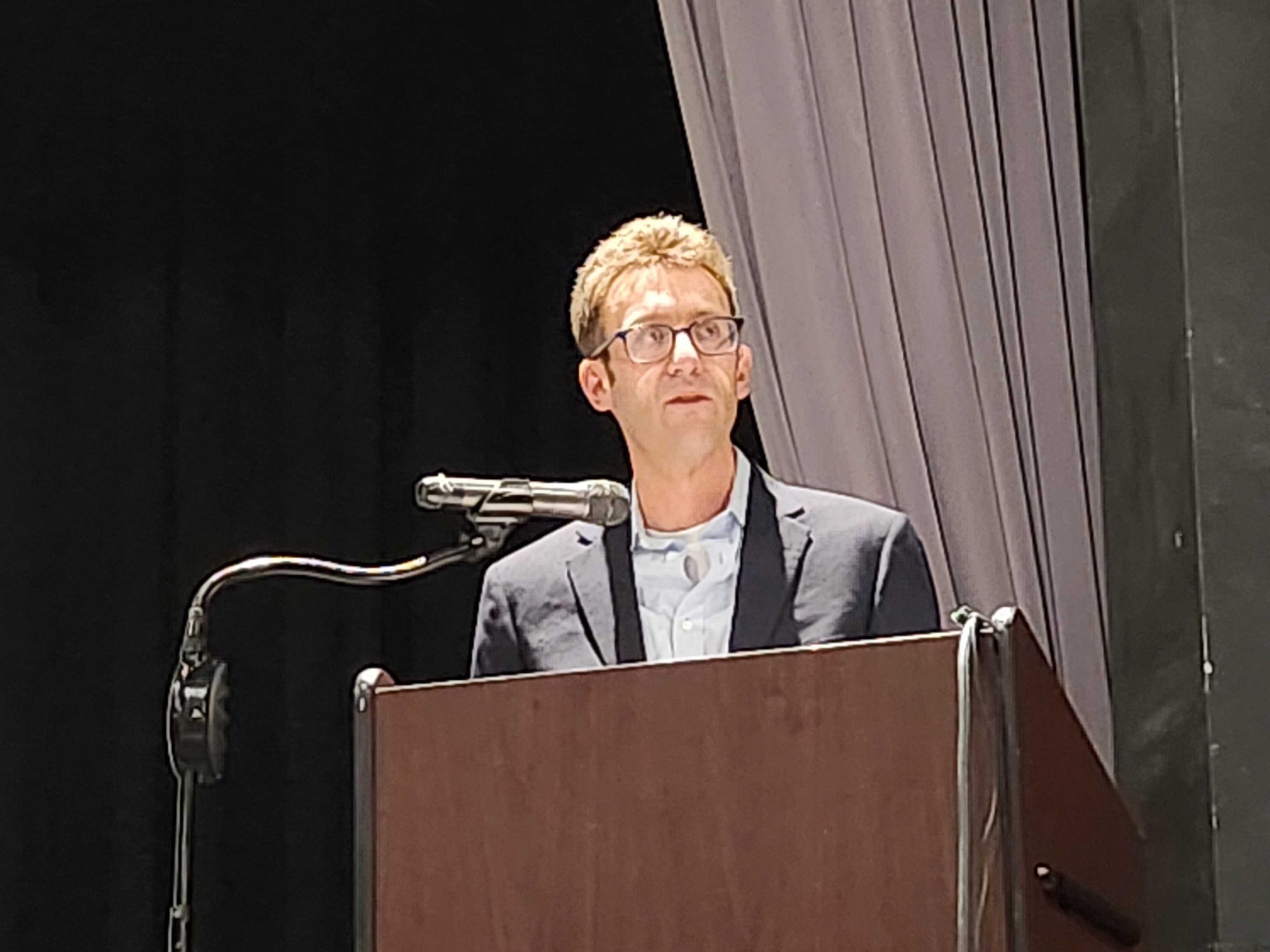
    Nether Providence Township Commissioner Max Cooper speaks after five Delaware County communities approved the creation of a regional EMS authority Wednesday at Strath Haven Middle School in Nether Providence.Torin Sweeney / Staff

    The next steps for the authority

    While the vote established the authority, it won’t immediately go into service. The new board members will be charged with building the authority based on the foundations laid by the working group.

    The recommended fee for residents will be $95 a year, although that is strictly a starting point for discussions, working group members said, and will be subject to future public hearings.

    “Ninety-five dollars is similar to the yearly voluntary subscription models that many of our local firehouses use, and is similar to other recently formed EMS authorities in the state,” Cooper said. “This works out to less than $8 a month and our working group views it as a reasonable cost to ensure stable funding for such a critically important service.”

    Businesses, nonprofit entities, and the municipalities themselves will have to contribute yearly fees as well. Using an authority and fee-based model was important for making sure nonprofits contribute to the costs of an EMS service, Cooper said. Nonprofits would not have to contribute if the system were tax based.

    “We anticipate this will decrease the amount of taxes which will need to be dedicated to this system, and relieve some municipal pressure to raise taxes on residents every year,” Cooper said.

    The board will have to decide the level of staffing and equipment needed. A potential partnership with Main Line Health is being discussed to provide some level of service.

    “The authority could contract just their staff, but the authority could choose to own the ambulances and equipment,” Booth said. “It could also be that the authority contracts them to provide all the services in their entirety and then the board manages the contract. There’s a lot of potential.”

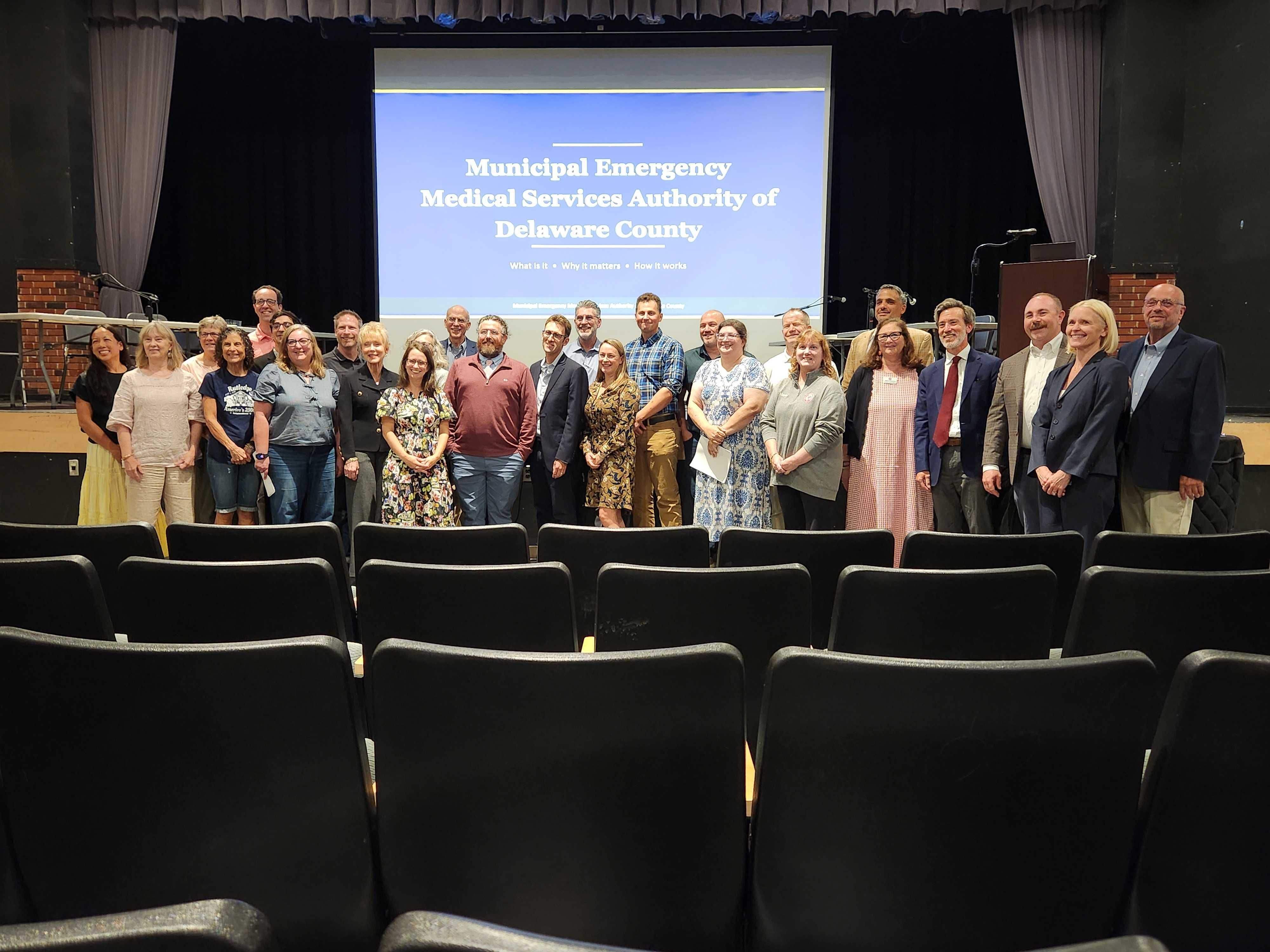
    Representatives from Nether Providence, Rose Valley, Rutledge, Swarthmore, and Upper Providence pose for a picture after approving an ordinance to create a regional EMS authority Wednesday at Strath Haven Middle School in Nether Providence.Torin Sweeney / Staff

    The working group hosted a presentation about the EMS authority and took public comments before each town approved the ordinance. Several attendees who identified themselves as Upper Providence residents spoke against the authority, questioning the logistics and cost.

    “This is a tax increase, like it or not,” Upper Providence resident Justin Perry said to scattered applause.

    Another Upper Providence resident, former longtime Marple Township Ambulance Corps member Vince Delvacchio, spoke in support.

    “I don’t know where you think you’re going to get an ambulance if we don’t do this,” Delvacchio said, to more applause.

    Why Media opted out of the authority proposal

    Media had been part of the working group for the proposed authority, but borough council decided not to proceed for financial reasons, Borough Manager Brittany Forman said.

    The borough has an existing contract with Main Line Health to provide ALS service and had been in discussions with them about projected 2027 costs. The council tasked Forman with comparing how those costs would affect taxpayers vs. the authority’s proposed fees for residents and businesses.

    Ultimately the borough determined it would be less expensive to stay with Main Line Health, Forman said.

    “Our council is interested to see this get implemented and really does want to keep the dialogue open,” Forman said. “Even though we’re not joining this year, I think this is still just a great step for the region.”

  • Wallingford-Swarthmore may lay off teachers and increase class sizes amid tight budget outlook

    Wallingford-Swarthmore may lay off teachers and increase class sizes amid tight budget outlook

    The Wallingford-Swarthmore School District is planning to reevaluate class sizes next school year, and layoffs are a possibility if the district cannot trim its budget in other ways, its superintendent said at a meeting Tuesday.

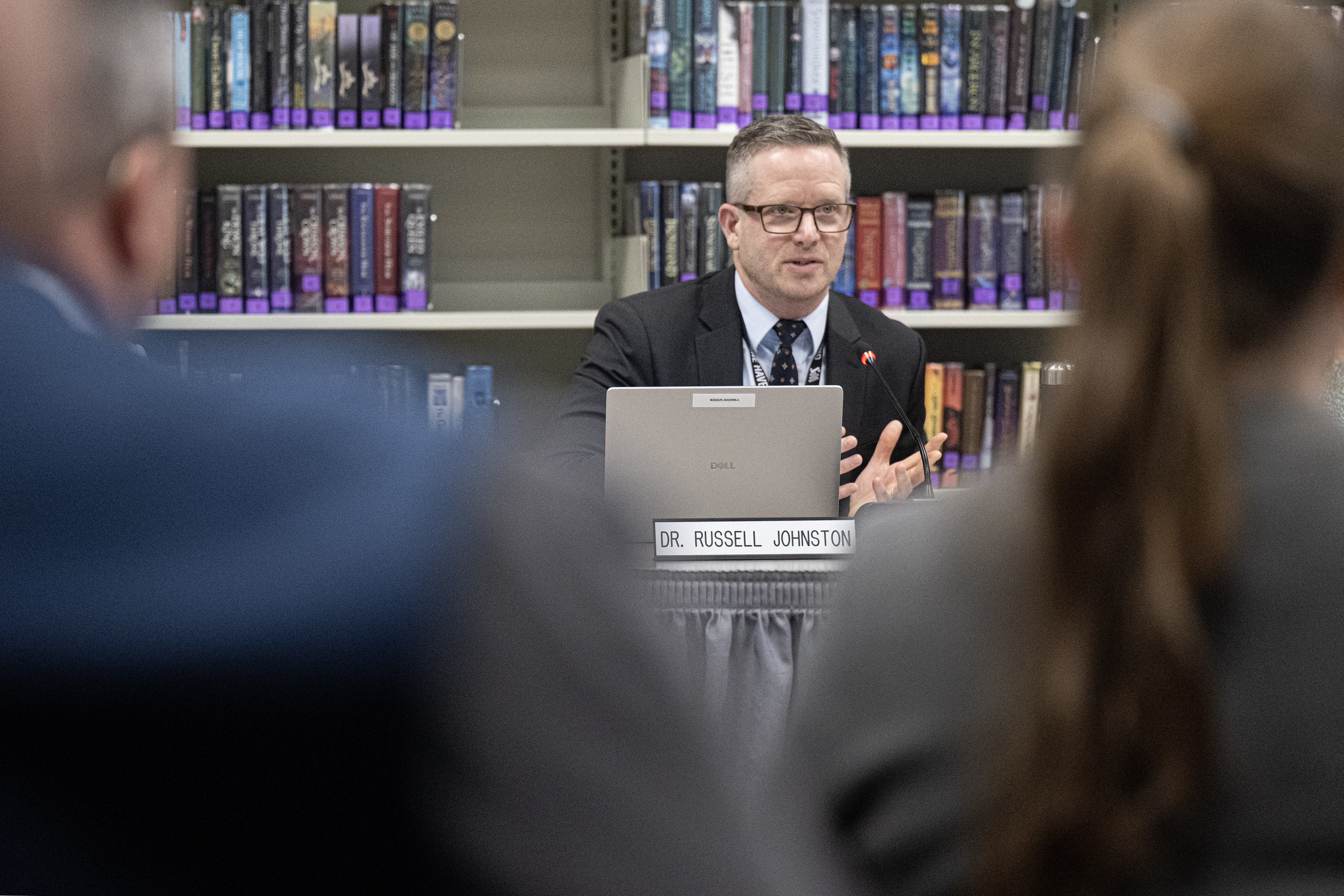
    At a school board finance committee meeting, Russell Johnston said that with the district’s expenses projected to rise next year at double the rate of revenues, the district will have to continue to reduce staffing, even after implementing a reorganization plan this year that eliminated about 20 positions and losing four more through attrition.

    The district will also look at which classes have the smallest enrollments, Johnston said, and might “scale back” on certain offerings.

    Johnston said cuts would be necessary. Otherwise, Wallingford-Swarthmore would be on pace to use more than 30% of its reserves to balance the budget, he said.

    Here is what the superintendent said about possible cuts coming to the affluent district:

    Retirement incentives, attrition and layoffs

    District leaders have said Wallingford-Swarthmore cannot sustain its current staffing levels, which grew significantly in recent years.

    Of the projected $6 million growth in the district’s $106 million budget next year, nearly $4 million is coming from salaries and benefits for the district’s 541 employees, officials said.

    Laying out options for cutting those costs, Johnston — who became superintendent last year — said the district could offer staff an incentive to retire early, though he was not sure whether that would generate enough savings.

    The district will also evaluate whether it needs to fill positions that become vacant as someone retires or resigns, Johnston said.

    “If we do have to invoke layoffs,” Johnston said, the savings likely will not be as great as by reducing staff through attrition, because more junior and less costly employees will be laid off due to union seniority protections.

    Board members voiced concern about rising benefits costs in particular: Prescription costs for district employees are projected to grow by 50% next year, a $1.8 million increase.

    Johnston, who noted that benefits are part of a collective bargaining agreement that does not expire until 2028, said the district was in “ongoing dialogue” with its teachers union.

    Bigger class sizes, fewer offerings

    Johnston said the district would be looking “hard at class size and enrollment” as it tries to find areas to cut.

    While the district has an “amazing array” of offerings for students, it could ”perhaps scale back where we don’t have enrollment to justify that,” Johnston said.

    He did not offer specifics but said the district would perform a class size analysis at the start of the coming school year.

    Reduced capital projects

    District officials indicated Tuesday they intend to move forward with a reduced scope for the planned Strath Haven High School renovation — down from $99 million to less than $70 million — with a focus on fixes to keep the building “safe, warm, and dry,” and fewer interior renovations.

    The district will also look to cut back other aspects of its capital plan, which board members said would reduce a $1.5 million increase in debt service projected for next year.

    Parental concerns

    Some parents have started to raise concerns about the budget cuts.

    Lindsay Doyle, whose children attend Nether Providence Elementary, said she was dismayed to learn that class sizes at her children’s school would be increasing in fourth and fifth grades due to the district not filling two teaching positions.

    Doyle, who said class sizes would grow from about 20 students to 26 or 27, is worried that core instruction will suffer.

    “It’s no longer about administrative inefficiencies and discretionary spending,” Doyle said. “When I see we’re now cutting back on teachers, that’s when I’m like, red flag.”

  • The Delco 10 Miler is back with a new course and twice as many runners

    The Delco 10 Miler is back with a new course and twice as many runners

    The Delco 10 Miler race is back for what organizers hope will be a bigger and better second lap. Changes for 2026 include a revised course, more than twice the number of runners, and a faster pace requirement.

    The race will take place on Oct. 4. Registration is open. This year’s race will be capped at 2,500 runners, up from 1,200 last year. About 700 runners registered in the first 24 hours, race director Kevin Nolan said.

    While the inaugural race was largely seen as a success by race organizers and runners, Nolan said, there were still some issues to address, particularly along the route.

    Some residents and drivers passing through the area were unhappy with road closures, which cut a long swath across the county. The course‘s adjustments should mean fewer closures along main roads.

    “Logistically with all this traffic, it’s a tough race to manage,” Nolan said. “It’s tougher than the Philadelphia ones … because I’ve talked to all the race directors and they don’t have the issues that we have to deal with, with all this traffic.”

    Course changes

    The race will again start at Rose Tree Park in Upper Providence and end at Subaru Park in Chester. Last year, the race shut down parts of Route 252 and Route 320, as well as portions of Third, Fourth, and Fifth Streets in Chester, including a loop that took runners past Subaru Park before returning.

    (function() {
    var l2 = function() {
    new pym.Parent(‘delco_10_miler_2026’,
    ‘https://media.inquirer.com/storage/inquirer/projects/innovation/arcgis_iframe/delco_10_miler_2026.html’);
    };
    if (typeof(pym) === ‘undefined’) {
    var h = document.getElementsByTagName(‘head’)[0],
    s = document.createElement(‘script’);
    s.type = ‘text/javascript’;
    s.src = ‘https://pym.nprapps.org/pym.v1.min.js’;
    s.onload = l2;
    h.appendChild(s);
    } else {
    l2();
    }
    })();

    This year, runners will turn west on Rose Valley Road in Nether Providence and travel through residential streets before crossing Route 320 and heading into Chester and Widener University’s campus. The course crosses I-95 on the Melrose Avenue bridge again before heading south toward Subaru Park. The loop at the end has been eliminated.

    The new course:

    • Starts at Rose Tree Park South on Providence Road/Route 252 
    • Right on West Rose Valley Road 
    • Left on Bickmore Drive 
    • Left on Sheffield Drive 
    • Left on Georgetown Road (becomes Media Parkway) 
    • Left on Chestnut Parkway (becomes Chestnut Street) 
    • Right on East 18th Street 
    • Left on Walnut Street 
    • Left on East 14th Street 
    • Right on Melrose Avenue 
    • Right on Morton Avenue 
    • Right on East Fifth Street 
    • Left on Penn Street 
    • Right on West Third Street 
    • Right on Tillman Street 
    • Left on West Fourth Street 
    • Left on Rainey Street 
    • Ends at Union Yards at Subaru Park 

    Getting the word out

    Some residents complained to race organizers that they weren’t told ahead of time that their streets were being closed.

    “As much as you try to get the word out, there are people that don’t know,” Nolan said. “So you have to do more.”

    This year, volunteers will walk some sections of the route ahead of time to let residents know about the race and road closures, Nolan said.

    St. John Chrysostom Catholic Church in Nether Providence told the Delco Times last year that the parish was not consulted about the race, which took place on a Sunday and impacted their Mass schedule. This year’s route avoids St. John’s, as well as St. Katharine Drexel Catholic Church in Chester and some fire departments.

    Faster pace

    In another change this year, the race will have a faster pace requirement. Runners will have to maintain a minimum pace of 13 minutes, 30 seconds per mile. Last year’s minimum pace was 15 minutes per mile.

    “Police are after us to open the course up. They were pretty aggravated last year with all the walkers,” Nolan said. “You hate to kick someone off the course.”

    A few more quality-of-life improvements include more bathrooms at the start and at water stops. There will also be four staggered starts based on runner speeds.

    The race will benefit The HEADstrong Foundation, Elwyn, The Riddle HealthCare Foundation, and Delco Volunteers.

    This suburban content is produced with support from the Leslie Miller and Richard Worley Foundation and The Lenfest Institute for Journalism. Editorial content is created independently of the project donors. Gifts to support The Inquirer’s high-impact journalism can be made at inquirer.com/donate. A list of Lenfest Institute donors can be found at lenfestinstitute.org/supporters.