Katherine “Kitty” Semisch, 67, of Doylestown, beloved English teacher, community organizer, writer, chef, and educator of thousands, died Monday, Nov. 2, of injuries sustained after she was struck by a bus.
Mrs. Semisch’s presence reverberates through the countless lives she touched over 26 years of teaching at Central Bucks West High School. She was known to draw a squiggly star on every paper she graded; no star was the same, and she never sought perfection — just as she saw her students.
Mrs. Semisch was struck and killed in the parking lot of the Bucks County Library in Doylestown. She was crossing the circle in front of the library when she was hit by the bus, police said.
Mrs. Semisch was an educator who diligently reminded her students of their humanity, refusing to use the word utilize because, she would tell students, it was just use in a robot costume.
When freshly graduated teachers landed jobs at CB West, she did not just offer advice in the break room. Instead, Mrs. Semisch invited them to her house to bond over home-cooked meals. After students graduated, and long into their careers, who was the person still checking on them decades later? Kitty Semisch.
Katherine “Kitty” Semisch, left, and her husband, Mark Semisch, pose for a photo during a hike. The two met when Kitty was a freshman at the College of William & Mary, and married at 19 years old. Over their half-century of marriage, Kitty and Mark still held hands wherever they walked.(Courtesy of the Semisch family)
She proudly defended the rights of LGBTQ+ students and their ability to see themselves in the books they read, including starting CB West’s first Gay-Straight Alliance clubin 2002. She strived to ensure as many people as possible experienced kindness in an often-unforgiving world.
In the op-ed pages of The Inquirer, she wrote about school districts censoring books, and she was prominently featured in the recent PBS docuseriesBucks County, USA as someone bridging the gap between communities torn apart by the COVID-19 pandemic and partisan politics.
Mrs. Semisch had a saying, “Whole teacher, whole student, whole world,” meaning that when teachers bring their whole self and see their students as whole selves, only then can they change the “whole world.”
Mrs. Semisch wrote numerous unpublished bookswith plans to write many more on a range of topics, including a Buddhist-influenced eco-tale for children called Owli and Kit, a book on becoming an adult, and another that reframes teachers as “Sherpas, not disciplinarians,” her daughter Lucy MacNichol said.
Born Katherine Good in Rochester, N.Y., on Sept. 1, 1959, Mrs. Semisch was the youngest of five to Romer Good, a decorated U.S. Navy veteran of the Pacific theater, and Elaine Good (nee Gentle), a survivor of the London blitz. “She inherited a can-do spirit, a love for gardening and literature, and an exemplary model of how to raise a loving family,” the Semisch family said in a statement.
As a young girl, Mrs. Semisch followed the events of the Civil Rights Movement, which left an indelible impact on her as she grew into an advocate for the rights of women and people of color. She was vehemently against apartheid and oppression, particularly the act of banning books, which she viewed as a “bellwether of totalitarianism and oppression,” MacNichol said.
She went on to attend the College of William and Mary, where she met the love of her life, Mark Semisch, as a freshman. They were married at 19 years old two years later, and over their half-century of marriage, they still held hands wherever they walked.
Mrs. Semisch was endlessly curious, and never one to simply ponder an idea but act on it. She learned to play the guitar, improvised her own recipes, embroidered for her grandchildren, cooked with the vegetables she grew, and sewed her own clothes.
One of the many ways she shared her love was through food. From simple meals with friends to learning how to perfectly cook octopus with her grandson, she amassed a notebook filled with handwritten recipes.
Katherine “Kitty” Semisch, center, and her two granddaughters pose for a photo. Semisch was known for her expansive recipe book that she used to delight family and friends, as well as her penchant for embroidering for her granddaughters.(Courtesy of the Semisch family)
Former students and colleagues told of the moments her kindness broke through, and in many ways changed the course of their lives.
“Kitty really showed me so many things about being an adult,” said Andrea Vidal, a lifelong friend and work mentee of Mrs. Semisch’s, who was a new teacher when they met. Mrs. Semisch would go on to share her own recipes and guide her younger colleague through not only work, but also life, later helping her choose her wedding dress and being present at her child’s birth. “Big and small, she was my person,” Vidal said.
Mrs. Semisch often said of guiding others that “the point of being a Sherpa is not to get to the top of the mountain, but to learn everything that the mountain has to teach us, as we climb together,” said one of her former students-turned-educators, Talya Zemach-Bersin. Now the senior capstone coordinator and lecturer for education studies at Yale University, Zemach-Bersin carries much of Mrs. Semisch’s teachings with her, including adorning students’ papers with a distinct star.
“I know who I am because I knew that she loved me. That was the kind of love she gave to thousands of us. That is the power of one little lady who had a lot of love to give,” she said.
Kitty Semisch is survived by her husband, Mark; children Christopher Semisch, Maggie Semisch, and Lucy MacNichol; and three grandchildren.
An open-house memorial service is scheduled for Saturday, Dec. 12, from 3 to 6 p.m. at the Doylestown Country Club, 20 Country Club Lane, Doylestown. A gathering of former students is planned for the same day, before the memorial service, at the Central Bucks West library from 1 to 2:30 p.m.
The family encourages memorial donations to one of the many causes she championed, such as Planned Parenthood, the Center for Reproductive Rights, Heifer International, Amnesty International, or Rainbow Room.
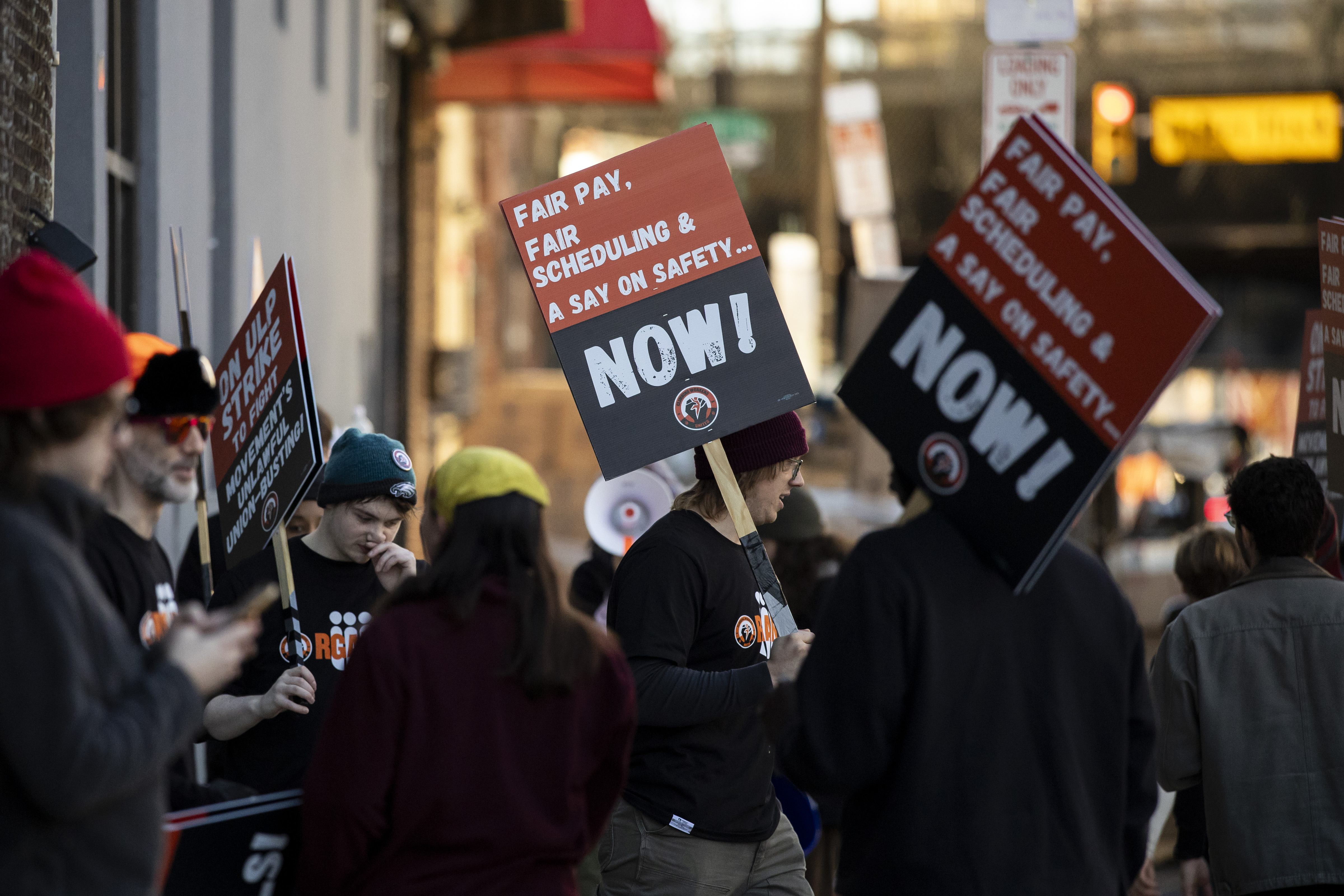
Employees of Movement Callowhill climbing gym went out on strike on Tuesday morning, their union announced.
The planned single-day strike comes as workers have been seeking a first union contract with higher wages, better staffing, and more consistent work schedules. The gym has 54 total workers, 48 of which are union members, including coaches and climbing instructors.
Employees of the Callowhill gym unionized in 2023 and have been negotiating for a first contract as far back as June 2024, according to Ben Bennett, deputy organizing director at Workers United, which represents the workers. He says the company is not bargaining in good faith.
“The company has refused to budge at all from the status quo on wages, hours, and benefits,” said Bennett. “They have repeatedly come to us and said that they’re not going to improve anything from the current status quo.”
A representative for Movement Gyms did not respond to a request for comment Tuesday.
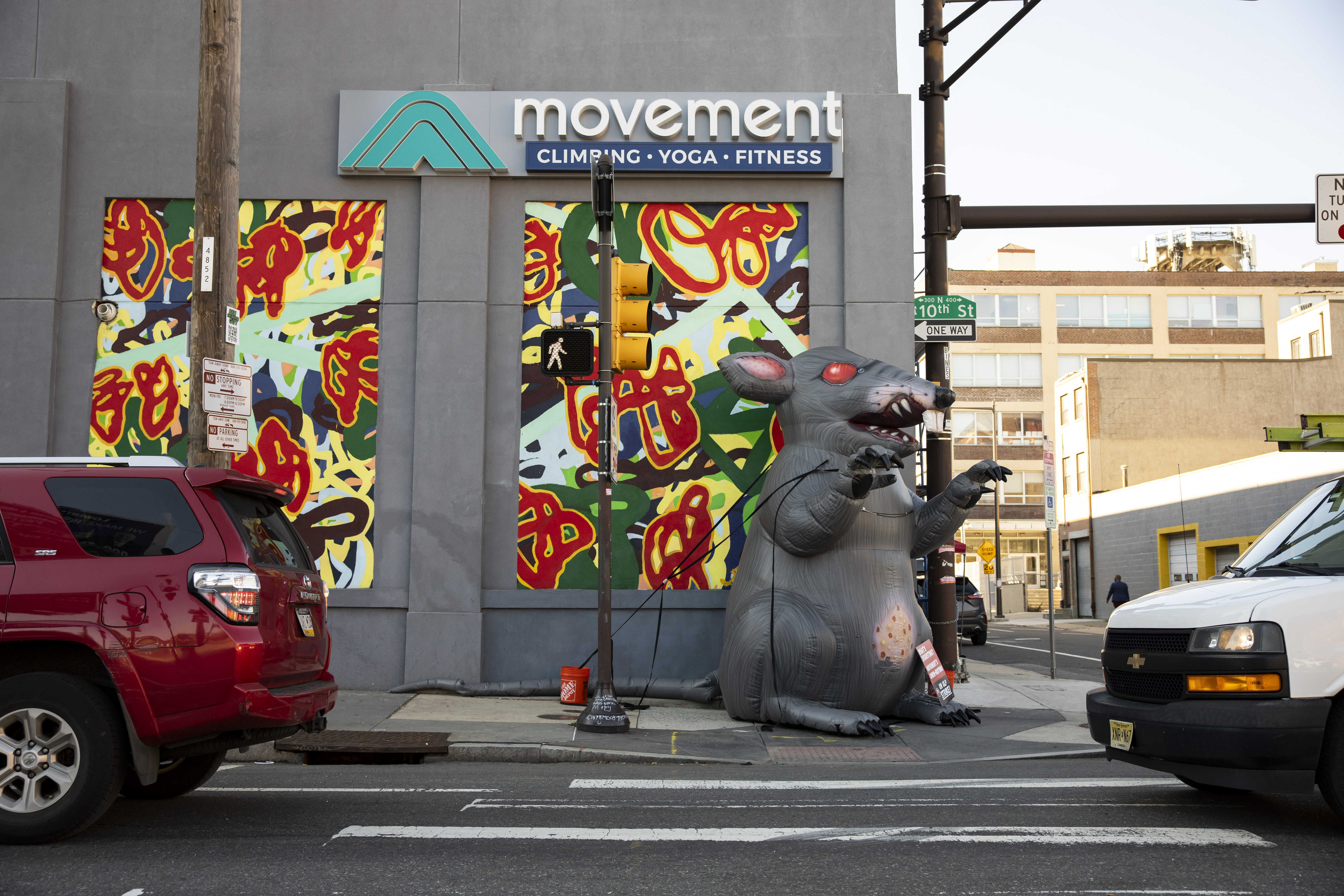
Scabby the Rat appears outside of Movement Callowhill on Tuesday as workers walked out for a one-day strike.Monica Herndon / Staff Photographer
Workers have been organizing for years at Movement locations across the country, beginning with the Arlington, Va., location in 2021. Today over 500 Movement employees across 10 locations are represented by Workers United, which also represents Starbucks baristas. None of the climbing gym locations have reached a first union contract.
“Workers have really reasonable bargaining demands,” said Bennett. “They want to reach an agreement that makes the gyms better for everyone involved. We just have not seen that the company is ready to come to the table and negotiate in good faith [with] workers to reach an agreement, and it’s unfortunate.”
What are Movement workers asking for?
The union would prefer to bargain for a single agreement across unionized locations, Bennett said, but the company has insisted on keeping negotiations separate for each location.
Still, workers across the unionized gyms have developed common bargaining proposals, he said.
Across locations, the union said earlier this year that workers report “inadequate staffing, inconsistent training, excessive heat and ventilation issues, and maintenance problems that impact both worker safety and the experience of climbers.”
The minimum wage for workers at the Callowhill gym is currently $15.50, and workers would like to see that rise to $20 an hour.
Adam Clary, 27, a front desk worker at the Callowhill gym, described workers going out on strike as a “last resort.”
“We’re the people who make the money for your gym,” he said. “We’re not disposable. We’re not just going to get kicked around.”
Clary currently makes $15.50 an hour and works there roughly 20 hours a week while in grad school and doing hospital work related to his schooling.
If he were to make $20 an hour at Movement, he said “groceries and rent wouldn’t be near as much of a struggle.”
“I’d like to be able to make enough money that I could support myself,” said Clary, who is on Medicaid and receives SNAP benefits. “But right now, I’m relying more on some government support to pick up some of the slack.”
With higher wages, he’d have more time to see friends, he said, and “I’d be able to save a little bit more instead of kind of living [by the] skin of the teeth.”
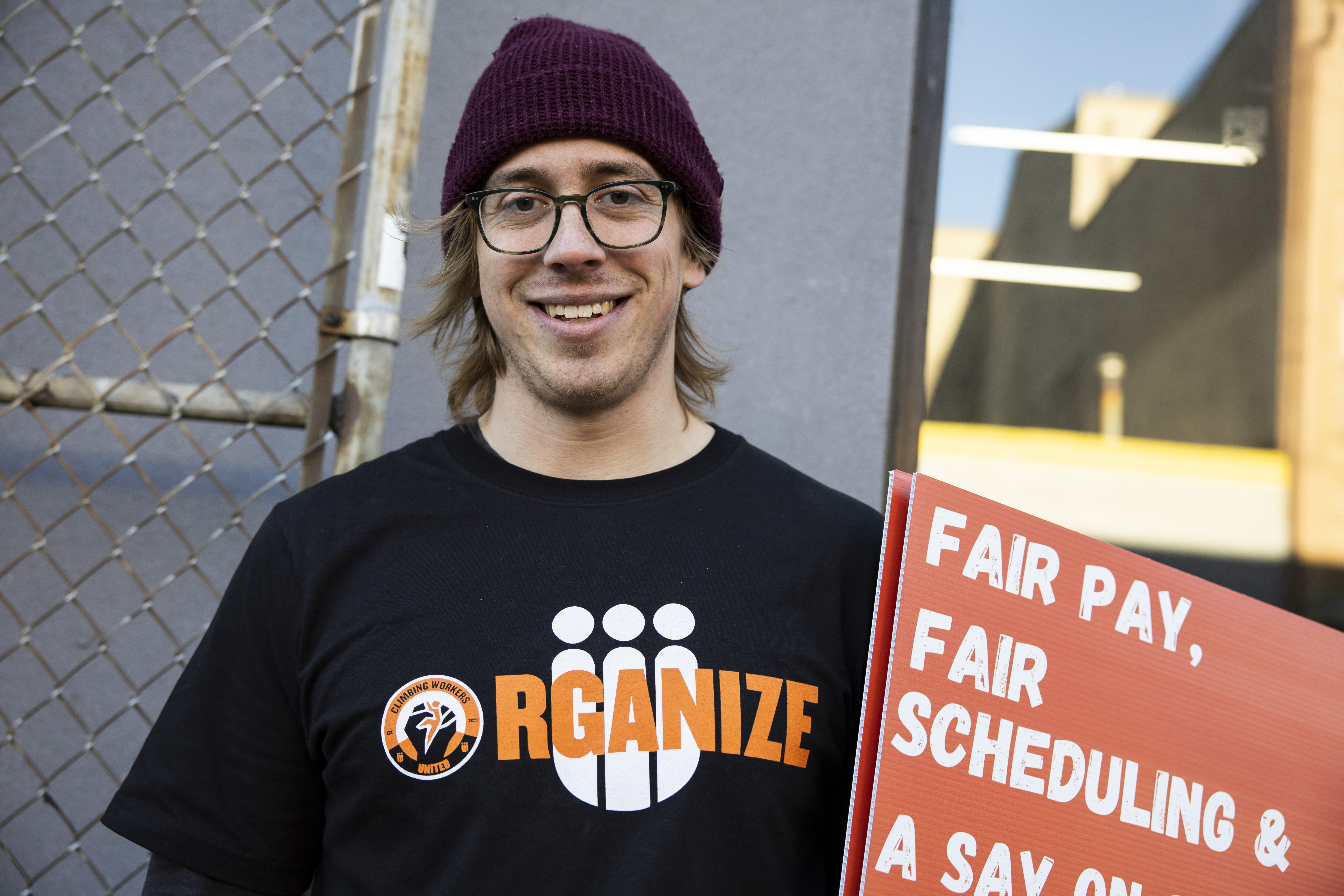
Adam Clary, 27, a front desk worker at Movement Gym, says that with higher wages, “groceries and rent wouldn’t be near as much of a struggle.”Monica Herndon / Staff Photographer
Workers also want a contract to include minimum staffing levels, as well as guidelines to make scheduling more consistent.
Employees also want more of them to be able to work enough hours to be considered full time and qualify for health insurance through their employer — which “relatively few” workers currently have, said Bennett. He said the gym generally doesn’t schedule people for 30 hours a week, which would make them full time.
Movement workers have been asking gym members to commit to putting their memberships on pause if the union calls for it. In recent months, more than 2,000 members have pledged to do so, according to the union. A recurring monthly membership to the Callowhill gym costs $109 and a day pass is $28.
The gym in Philadelphia, which formerly went by The Cliffs at Callowhill, was acquired by Movement in 2023. Today, Movement has over 30 locations including sites in New York, Maryland, Illinois, Texas, and California. Beyond climbing, the gym also offers yoga and fitness classes.
The most recent bargaining session between the union and the employer at Callowhill was in July. Before then, the company and the union hadn’t met for nearly a year, said Bennett, adding that the company canceled several sessions. The next negotiation is scheduled for Thursday, he said.
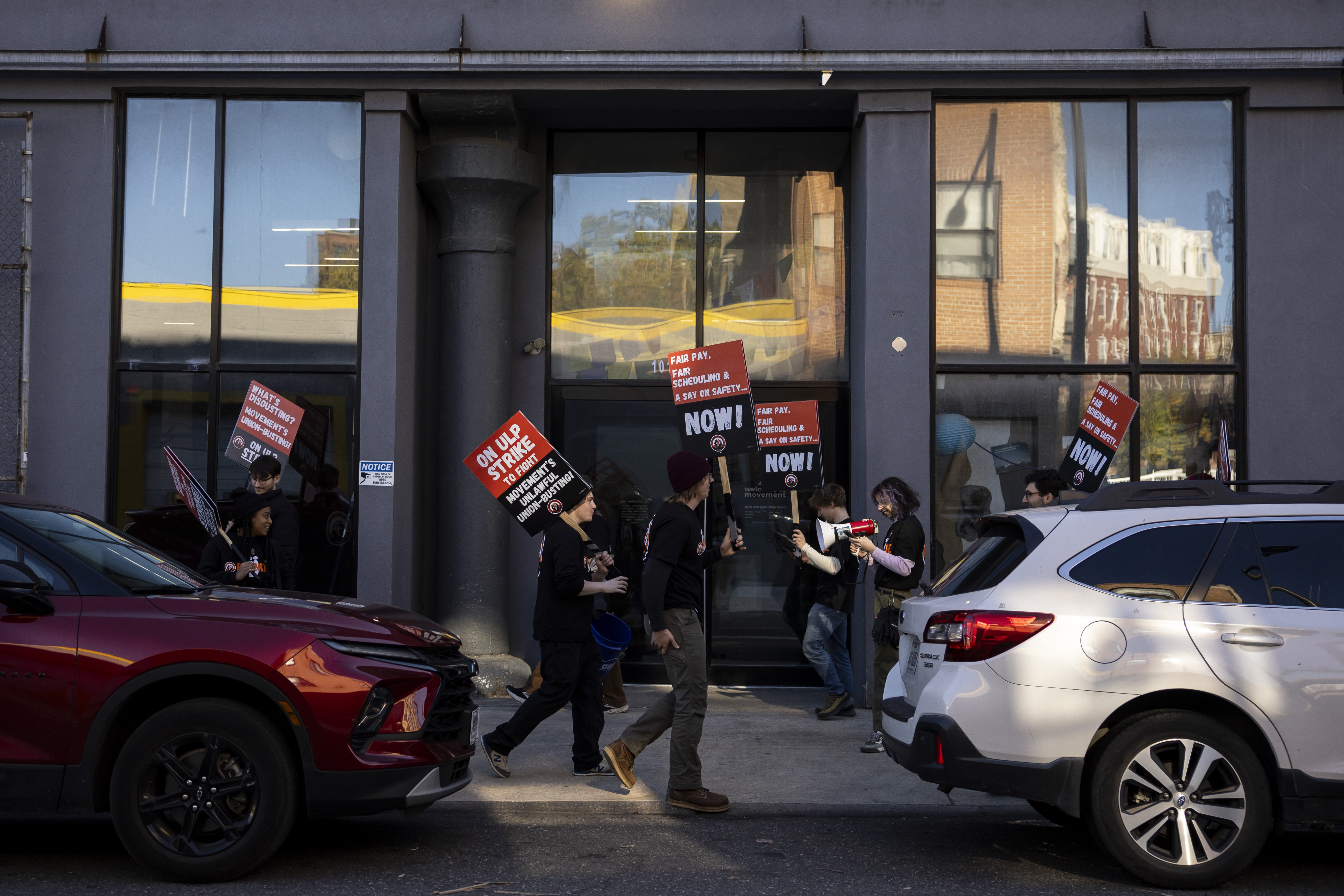
Movement Callowhill’s unionized employees have been seeking a first union contract with higher wages, better staffing, and more consistent work schedules. Their union called a one-day strike on Tuesday. Monica Herndon / Staff Photographer
On Wednesday morning, Bucks County’s new representative-elect waded through congratulatory text messages (four hours later he still hadn’t made a dent), fielded a phone call from an excited Gov. Josh Shapiro and Lt. Gov. Austin Davis, and attended a meeting with colleagues on the county commissioners board.
“I don’t know if it’s really sunk in,” Harvie said in an interview Wednesday afternoon.
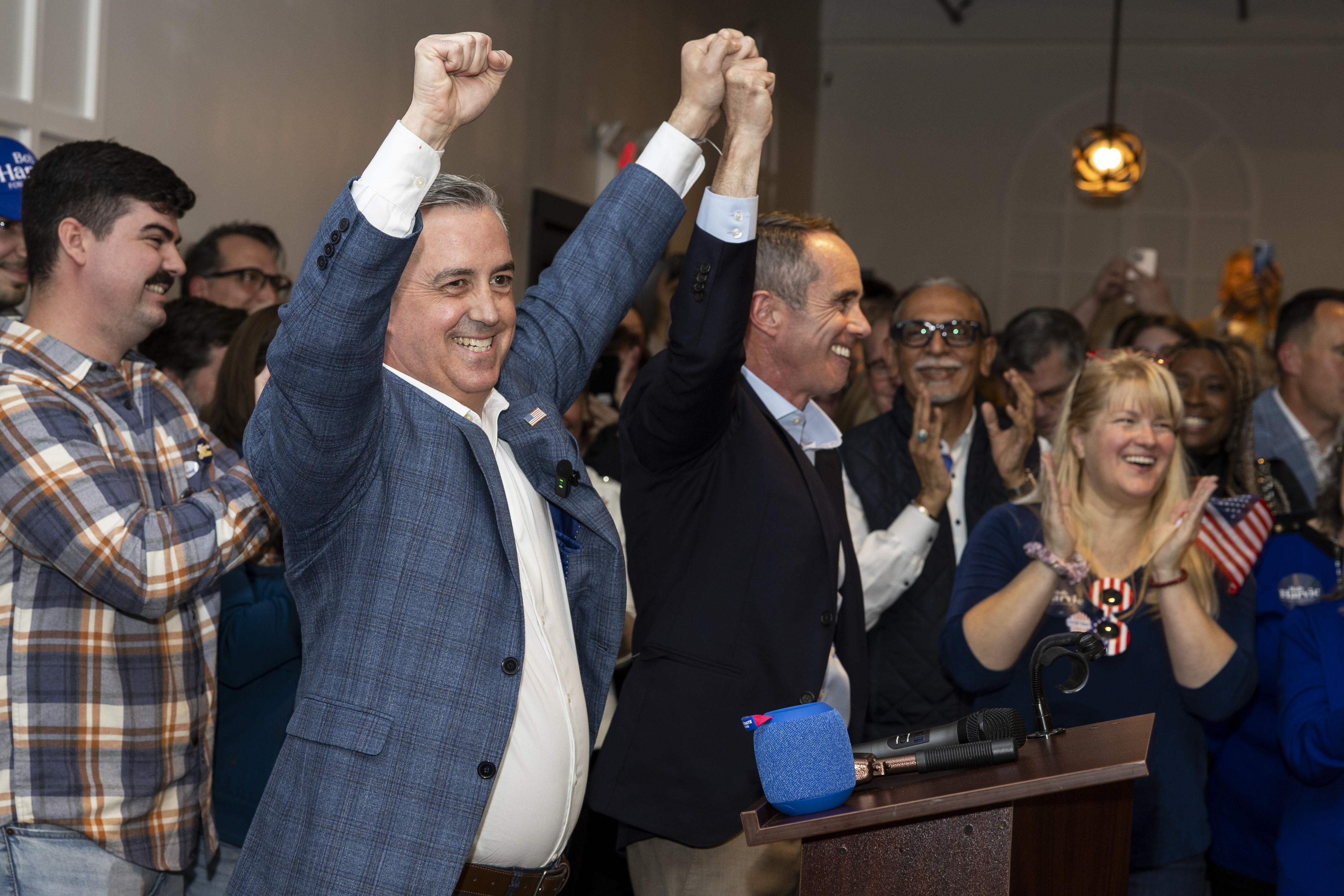
Shortly after midnight, Harvie became the first Democrat to win Bucks County’s congressional seat since 2008 — a historic outcome, toppling one of the most entrenched Republican dynasties in the country. He had just delivered a victory speech at a Newtown event hall to a crowd with adrenaline and pizza coursing through their veins.
At first, successfully challenging U.S. Rep. Brian Fitzpatrick, a five-term incumbent whose brother previously held the seat, seemed like an uphill battle.
But the momentum kept shifting in Harvie’s favor, he said, as voters in the1st Congressional District sought to put a check onPresident Donald Trump’s agenda. He ultimately achieved what no other Democrat has done before — defeating Fitzpatrick.
All precincts in the 1st District, which also includes a portion of Montgomery County, shifted toward Harvie on Tuesday, an Inquirer analysis of voting data found.
(function(){function e(){window.addEventListener(`message`,function(e){if(e.data[`datawrapper-height`]!==void 0){var t=document.querySelectorAll(`iframe`);for(var n in e.data[`datawrapper-height`])for(var r=0,i;i=t[r];r++)if(i.contentWindow===e.source){var a=e.data[`datawrapper-height`][n]+`px`;i.style.height=a}}})}e()})();
The Democrat won most of Lower and Central Bucks as well as Montgomery County.
Democrats in Bucks County appeared to have played the long game to get to this almost politically surreal moment, and it was enhanced this year by Trump’s toxic political brand, Shapiro’s lights-out win, and a message focused on affordability.
For the last decade, the party had tried and failed to unseat Fitzpatrick, who in years past had managed to gain support from voters across the political spectrum and win almost regularly by double digits, but each of those candidacies helped chip away at the Republican’s tenure, resulting in this year’s seismic seat flip.
When Harvie, a county commissioner, launched his candidacy, he felt he could win the race, he said, but because of previous election results in the district, he acknowledged he was “swimming a little upstream.”
Though something changed this year.
“I was a different kind of candidate than he was used to facing,” Harvie said.
U.S. Rep.-elect Bob Harvie greets his mom (left) at his election night party at Rafters on Tuesday, Nov. 3, 2026 in Newtown, Pa.Monica Herndon / Staff Photographer
‘I’m a different candidate, it’s a different time’
Harvie was the first challenger of Fitzpatrick’s to have previouslywon countywide office. His deep roots in Bucks gave him a level of familiarity among voters.
When donors or outside supporters initially had “fatigue” about backing yet another Democrat in the 1st District, the connections he had made in running for county commissioner were crucial, Harvie said.
On top of that, the mood of the country — including voters’ deep disapproval of Trump — combined with Harvie’s affordability-focused message as residents grappled with the cost of living proved successful for his campaign.
(function(){function e(){window.addEventListener(`message`,function(e){if(e.data[`datawrapper-height`]!==void 0){var t=document.querySelectorAll(`iframe`);for(var n in e.data[`datawrapper-height`])for(var r=0,i;i=t[r];r++)if(i.contentWindow===e.source){var a=e.data[`datawrapper-height`][n]+`px`;i.style.height=a}}})}e()})();
“The argument I made from the beginning was that this is a different race, I’m a different candidate, it’s a different time, and focusing literally from the start of the campaign, focusing on issues — even before affordability was something people were focusing on, it was what we were focusing on,” Harvie said.
But Harvie had to overcome some hurdles, too, before he reached a surge of momentum in the final weeks of his campaign.
“The flippable four was the big three for a time, and the national environment combined with the really strong candidacy of Bob Harvie made it into the flippable four,” Bucks CountySheriff Danny Ceisler, a Democrat and top surrogate for the Harvie campaign, said in an interview.
(Ceisler’s own win against a Trump-aligned Republican in 2025, along with the Democratic sweep of other local row offices, was seen as an early building block to Harvie’s win this year.)
“I was screaming to anybody who would listen that Bob Harvie had a real shot in this race, and in really the last six to eight weeks, we saw the national party begin to take interest,”Ceisler said.
Eli Cousin, a spokesperson for the DCCC, said that the organization has been behind Harvie since day one, including adding him early on to its “Red to Blue” list.
The down-the-stretch spending was planned, strategic timing in an expensive Philadelphia media market against a well-financed opponent who was flooding the zone with ads, and Cousin noted that the DCCC ended up spending more on broadcast in the 1st District than on the other Pennsylvania swing seats. DCCC chair Suzan DelBene also visited Bucks County and held an event with Harvie the day before Election Day.
“It would have been very easy for the DCCC to just say we’re gonna go and pick a different race and put money in somewhere else,” Cousin said. “We stayed the course. We were very intentional about when and where we were spending and what message we were carrying. And wave or not, our spending absolutely moved the needle and brought Democrats home for Bob Harvie.”
State Sen. Steve Santarsiero, chair of the Bucks County Democratic Committee, said Wednesday that with the victory secured, it’s up to Democrats to deliver for voters.
“I am confident that Bob Harvie is never going to forget that lesson. … He will serve for years to come because I believe that people will see just how dedicated he is to their interests and moving us forward,” Santarsiero said.
Democrat Bob Harvie (left) joins U.S. Rep. Suzan DelBene, chair of the Democratic Congressional Campaign Committee (DCCC), and former Chicago Mayor Rahm Emanuel (right) as they campaign for him at his Bucks County headquarters Monday, Nov. 2, 2026.Tom Gralish / Staff Photographer
Josh Shapiro’s impact
Was Tuesday’s contest anti-Trump or pro-Shapiro?
It wasa“pro-good government election,” Harvie said.
Support for the Democrat was driven simultaneously by disdain for the president and admiration for the governor.
Harvie and the three other Democrats in the four key U.S. House contests “got rid of four of Trump’s enablers,” Shapiro declared at a news conference Wednesday.
Shapiro spent almost every weekend in October in Bucks County, pulling more focus to the race. Harvie said Wednesday that Shapiro had gone to bat for him in Washington and told party leaders that “this race was real, that I was a real candidate, and that this was going to be different this year.”
Harvie also pointed to Davis and individuals he knew within the DCCC as being early supporters of his campaign, in addition to Democratic U.S. Reps. Chris Deluzio, Madeleine Dean, and Mary Gay Scanlon, who also vouched for the candidate.
“The top line is this was clearly a repudiation of the president,” said Samuel Chen, a GOP strategist, noting that “I think every policy played a small piece of it.”
Despite Fitzpatrick constantly working to separate himself from Trump andhis status as theonly House Republican in Pennsylvania without the president’s endorsement, Trump still contributed to the lawmaker’s downfall.
Bob Harvie speaks to voters during a town hall at Ben Franklin Middle School in Levittown, P.a. on Saturday, Oct. 24, 2026.Allie Ippolito / For The Inquirer
Harvie’s campaign — though it centered on issues beyond this — made a point of painting Fitzpatrick as someone who was no longer independent, as the Republican had argued to be, and as an enabler of Trump’s agenda. Fitzpatrick this congressional term voted with the president and his party roughly 70% of the time, the least often of any House Republican.
Harvie told reporters Tuesday night that he felt the race shifted in his favor back in the spring, before it started picking up more widespread momentum in August, partly because “this administration was not suddenly going to get competent or less cruel.”
“That they were just going to keep getting worse, and it was just going to be pushing people closer toward a change, quite frankly, what’s happening nationwide when it comes to government,” Harvie said.
US Rep Brian Fitzpatrick speaks during the Garden of Reflection remembrance ceremonies Friday, September 11, 2026 at Garden of Reflection in Yardley, Pennsylvania. The Garden of Reflection is Pennsylvania’s official state memorial honoring all 2,973 victims of the September 11 terrorist attacks, with a special tribute to 18 local residents from Bucks County, Pennsylvania.William Thomas Cain / For The Inquirer
Fitzpatrick’s brand ‘is a lot harder for people to square’
Despite Fitzpatrick’s survival of earlier blue waves with the help of split-ticket voters, this year’s dynamics were more difficult for the Republican to overcome.
“When the president has approval ratings that low, there’s only so much you can do downballot to mitigate,” Anthony Campisi, a Democratic strategist, said. “The amount of loyalty that Trump demands means the idea that Fitzpatrick is truly independent is a lot harder for people to square.”
GOP strategists contend that Fitzpatrick’s loss was a product of the wave and not anything that the Republican, who has been able to appeal to both sides of the aisle, particularly did wrong.
“Voters sometimes have cognitive dissonance,” said Christopher Nicholas, a GOP political consultant. “They kept telling us they wanted independent bipartisanship, and then they voted out the most bipartisan person in the House.”
The allegations were a hallmark of a tense campaign with jabs from both candidates.
While Fitzpatrick’s campaign and other groups bombarded the airwaves with anti-Harvie ads and posted billboards throughout the county spreading attacks, the Republican opted for considerably fewer public events on the campaign trail.
Harvie barnstormed with Shapiro and other prominent Democrats, but he also held four town halls in October across the district, where he fielded questions from voters on their fears and frustrations, a markedly on-the-ground style in contrast to Fitzpatrick’s more private approach in recent years.
Harvie said he plans to continue town halls when he is in office.
The Democrat said Wednesday that he had missed a call from Fitzpatrick that morning. When asked if he planned to give him a call back, he said, “I’m sure we’ll connect at some point.”
Harvie said, ultimately, that he is proud his campaign “didn’t buckle” in the face of negative rhetoric, and that continuing to have roots in the district will keep him grounded and available even when he heads to Washington.
“This is where I shop. This is my supermarket. This is where I go. I’m not going to change that,” Harvie said.
Staff writers Joe Yerardi, Anna Orso, and Alfred Lubrano contributed to this article.
As President Donald Trump’s approval ratings have sunk, his corruption and policy disasters have proliferated, and his party has deployed a particularly subpar crop of candidates, the midterm campaign has been accompanied by increasingly confident predictions of a Democratic takeover of Congress. At the same time, Trump and his allies have been more inventive than ever in their schemes to skew, suppress, and subvert a well-earned rebuke from the electorate.
But neither the polling nor the plotting should affect the calculus for voters who prize their right to vote. We’ve seen more than enough flawed public opinion assessments over the past decade to know we shouldn’t count on them. And we’ve seen more than enough of Trump’s failed efforts to undermine and ignore elections to know we can defeat them.
Casting your ballot is the most important answer to those who would deny your power to do so.
Polling has only seemed to grow in prominence even as the decline of the landline and rise of institutional distrust have made it more difficult. Polling aggregators and betting markets have made political prognostication an even bigger business, as have the high stakes of elections that put the rule of law and democracy itself on the line.
This year’s polls certainly are auspicious for the opposition. Midterm elections tend to function as referendums on the incumbent party and president, and voters remain nearly as disgruntled as ever with Trump. Democrats are heavily favored to win a majority in the House despite extraordinary gerrymandering, and they’re narrowly ahead in the Senate despite a map forcing them to compete in red states such as Texas, Kansas, and Alaska.
That said, polls over the past decade have famously underestimated support for Trump as well as, somewhat less famously, his opponents. The public opinion trade has also been shaken by isolated but troubling recent revelations of fake polling. And, of course, even the best polls have margins of error that indicate high uncertainty about races that will be decided by a few percentage points or less. This year’s closely contested House races in Bucks County and Central and Northeastern Pennsylvania all fit that description, and fundamentally unpredictable margins in several states could make the difference in the Senate.
President Donald Trump arrives at a campaign rally ahead of the midterm elections in Wasilla, Alaska, on Oct. 13.DOUG MILLS
Meanwhile, rather than address the policies that put his congressional majorities in jeopardy, chief among them his inflationary trade and actual warfare, the president has looked to cheat his way out of the widely expected midterm shellacking.
His allies’ unprecedented gerrymandering of Texas and other states, partly offset by Democratic retaliation, didn’t appear to yield enough gains to withstand a blue wave. So Trump tried to use his power over the U.S. Postal Service to interfere with voting by mail, only to be (narrowly and provisionally) blocked by the U.S. Supreme Court. His latest gambit is to use trumped-up charges of noncitizen voting to arrest and intimidate those who might cast ballots for Democrats.
The frustration of these desperate measures isn’t likely to prevent Trump and Co. from further attacks on the voting process and results. Administration officials have alluded to the possibility of misusing federal personnel to intimidate voters on Election Day and retain power afterward. They have already threatened to prosecute Alaska’s Democratic Senate candidate, Mary Peltola, and opened a dubious investigation of Rep. Ilhan Omar (D., Minn.), pointing toward a reprise of the postelection assaults on democracy that Trump undertook after his 2020 loss.
Fortunately, voters here and abroad have successfully resisted authoritarian tactics and elected pro-democracy leaders. As recent elections in Brazil and Serbia demonstrated, the more decisively the will of the people is expressed, the more difficult it is to thwart.
On Tuesday, let’s vote as if it’s the last time to ensure it won’t be.
Seven Philadelphia men were charged in connection with a multistate theft ring that stole nearly $3 million in high-value merchandise from Home Depot, Lowe’s, and other retailers, authorities announced Tuesday.
Starting in August 2025, the alleged ring was responsible for committing hundreds of thefts from major retailers. The investigation began with thefts that occurred at Home Depot and Lowe’s stores in Montgomery County and around the region, Montgomery County District Attorney Kevin Steele and Philadelphia Police Commissioner Kevin Bethel said in a joint release.
Detectives found that the theft ring was involved in cases spanning at least 18 states beyond Pennsylvania, Steele and Bethel said.
More than 30 people participated in the ring with specialized roles that included the actual thefts, transportation, storage, and resale of stolen high-value merchandise such as electrical wire, Lifeproof flooring, and power tools.
The ring members bought the merchandise using stolen credit card accounts, Steele and Bethel said.
Ring members also used fraudulent identification and insurance documents to rent vans and box trucks used to travel between stores and transport stolen goods across state lines, Steele and Bethel said.
Search warrants were executed in February at residences in Philadelphia and Norristown and a storage facility in West Norriton Township, and stolen goods were recovered from all three locations, Steele and Bethel said. The value of the merchandise at the Philadelphia residence totaled $38,449.84 and more than $523,000 at the storage facility in West Norriton, they said.
Three stolen vehicles also were recovered at the Philadelphia residence, Steele and Bethel said.
Wilber Antonio Morales-Sanchez, 25, of Philadelphia, was arrested Sept. 5. He was being held at the Montgomery County Correctional Facility in lieu of $1 million cash bail.
The law office representing Morales-Sanchez declined to comment.
Six other men from Philadelphia and one from Maryland were arrested Sept. 11 and had bails set from $50,000 to $500,000 cash. An arrest warrant has been issued for a New York man.
The investigation included assistance from Cheltenham police, Upper Providence police, Plymouth Township police, and police in Montgomery County, Md.
All 435 House congressional seats are up for election in November. Because of gerrymandering, most of the races will not be close, including many in the Philadelphia region.
That is good news for three strong Democratic women who have served the region with distinction. U.S. Reps. Madeleine Dean in the 4th District, Mary Gay Scanlon in the 5th District, and Chrissy Houlahan in the 6th District have stood firm against Donald Trump’s costly and cruel policies. They have also been fearless in calling out Democratic and Republican colleagues as well as the Trump administration for its various failures.
However, all political roads lead through Pennsylvania. As such, several contested races in the region could determine which party controls the House.
The GOP currently holds a slim majority in the House and Senate, but both chambers have consistently failed to uphold their constitutional oath to serve as a check on Trump’s failed war in Iran, and abuses of the rule of law and corruption that are harming every American.
The result has been higher costs for many families, daily chaos in Washington, and a diminishment of America’s standing around the world — along with many other disgraceful acts by Trump and his enablers.
The polls — which are not always reliable — favor many Democratic candidates. But truly, stopping Trump — who made $2.2 billion in his first year back in office while sticking Americans with higher gas, food, and housing costs — requires voting.
Here are some key congressional races that could change the direction of the country.
Bob Harvie, a Bucks County commissioner, is running against Republican U.S. Rep. Brian Fitzpatrick in the 1st Congressional District. Polls show the two are tied in this swing district.
The Inquirer Editorial Board previously endorsed Harvie. Fitzpatrick tries to appear bipartisan, but on major issues is mostly a Trump toady.
The board also endorses Bob Brooks in Pennsylvania’s 7th District. Brooks is running against U.S. Rep. Ryan Mackenzie, a first-term Republican who has supported all of Trump’s policies, which have combined to make life unaffordable for many Americans, including costly tariffs, war in Iran, and the Big Beautiful Bill.
In the 8th Congressional District, which covers the Scranton/Wilkes-Barre area, two-term GOP incumbent Rob Bresnahan, who is worth $37 million, faces challenger Paige Cognetti, a political outsider who became the first woman elected mayor of Scranton by challenging the corrupt political establishment.
The country could certainly benefit from fewer multimillionaire members of Congress who are out of touch with the financial struggles facing their constituents. Not to mention, fewer GOP members who have failed their constitutional oath to hold a corrupt president accountable.
By contrast, Cognetti has a solid track record of improving the quality of life in Scranton by boosting the city’s financial health, bolstering public safety, fostering good governance, investing in parks, attracting jobs, and working with others.
The same cannot be said of GOP incumbent U.S. Rep. Scott Perry, who is running for reelection in Pennsylvania’s 10th Congressional District, which includes Harrisburg and York.
Perry is a constitutional embarrassment. He was a ringleader in Trump’s plot to overturn the 2020 election. He also supported the Jan. 6, 2021, march on Washington that led to a deadly insurrection at the U.S. Capitol.
The FBI seized Perry’s cell phone in 2022, but he was not charged with any wrongdoing.
Beyond supporting Trump’s coup attempt and his costly policies, Perry has been a do-nothing congressman. His “big initiative” was sponsoring a bill to repeal regulations designed to prevent drunk driving.
In Perry’s view, how dare the government try to keep drunk drivers off the road? For everyone’s health and safety, friends should not let friends vote for Perry.
Fortunately, there is an excellent alternative in Janelle Stelson, a former TV news anchor who lost to Perry two years ago by about 5,000 votes.
The Inquirer endorsed Stelson in 2024. She remains the best choice to help end the costly chaos, corruption, and incompetence in Washington.
Election Day wins by Harvie, Brooks, Cognetti, and Stelson — along with a Democratic majority — could help address the affordability issues plaguing voters while restoring some common sense, decency, and oversight in the House.
Over the past decade, Boeing and Leonardoinvested many millions and put thousands to work with the expectation they had Army or Air Force jobs for years to come. But their leaders may haveto write off losses and cut production.
Both Boeing’s 3,000-worker Delaware County plant, the region’s single largest industrial employer, and Leonardo’s nearly 1,000-worker Northeast Philadelphia plant have been frustrated by a lack of funding in the federal budget.
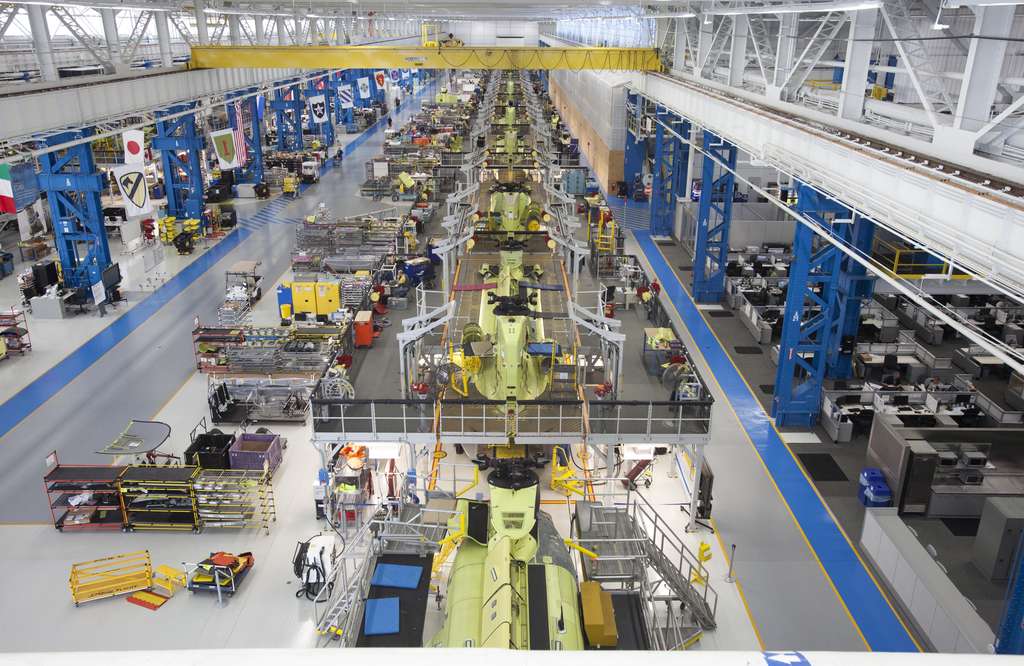
Boeing builds and updates Chinook heavy-lift helicopters at the Ridley Township facility and has for 60 years. Leonardo’s products include the Grey Wolf medium-lift helicopter.
Boeing says it invested $400 million, starting in 2016, on upgrades in its factory buildings between the Delaware River and I-95. That was partly based on the Army’s promise it would rely on Chinooks, developed during the Vietnam War, through at least the mid-21st century.
Starting in 2018, Leonardo invested $125 million in expanding its Northeast Philadelphia assembly plant and training facility for a military version of its best-selling two-engine helicopter to defend nuclear missile bases in the Dakotas and ferry VIPs around Washington. But the Air Force budget has only funded half the contracted aircraft.
Leonardo builds other products but had counted on the Air Force orders to fund its continued growth.
Boeing’s tough choices
The Army has repeatedly failed to lock in billions in federal funding for Boeing’s Ridley-built Chinook CH-47 upgrade or maintenance. Thatleaves three expensive options, U.S. Sen. David McCormick (R., Pa.), a former Army paratrooper, wrote in a recent letter to Army Secretary Daniel P. Driscoll.
The first is “to let the Boeing Philadelphia site close due to lack [of] contracts,” idling the last 840 union workers on the production line, plus more than 2,000 engineers and managers, and supply plants in Pennsylvania and at least five other states.
Boeing’s facility in Ridley Township is shown in this 2020 photo.Jose F. Moreno / Staff Photographer
The Army could use its own personnel for repairs and finding new parts sources, a far more expensive approach, according to the Army’s own estimates.
Or Congress could, with Army support, add enough to the budget to boost Ridley’s Chinook production to 18 a year, which is “the minimal sustaining rate.”
Congressional aides noted the 2027 budget funds five Chinook upgrades for the next fiscal year. Congress could authorize another seven if it votes during the lame-duck session between Election Day and the end of the year.
That’s still short of 18. Boeingwants to be able to guarantee that level for at least four years so it can keep materials and supplies flowing.
Orders from Germany and other allies could fill in that shortfall, but as of now, there are no additional Chinook orders beyond 2031. Boeing plans to review next year’s budget and decide whether to close the plant.
The Ridley workers are “well-trained, hungry, and [have] the capacity to do the job best,” U.S. Rep. Donald Norcross of South Jersey, a senior Democrat on the House Armed Services Committee that oversees military spending, said in a statement.
He said he’s pressing Boeing leaders to keep the plant working and its suppliers in place. Manufacturers in Pennsylvania, New Jersey, and other states depend on Boeing orders.
U.S. Rep. Mary Gay Scanlon, a Democrat whose district includes the plant, said closing it could threaten both national security and the Philadelphia-area economy. The uncertainty of the “meager” budget requests is “not a sustainable path,” she said in a statement.
Why not fighter planes?
The headcount of UAW Local 1069 members, who build the helicopters in Boeing’s vast, air-conditioned assembly halls, was about 1,300 in 2022 and has dropped to around 840, said Jim Rugh, the local’s president.
Boeing lost a 2022 competition to replace Black Hawk helicopters that might have given the Ridleyplant new life.
The plant made another product, the tilt-rotor Osprey, which takes off like a helicopter and flies like a plane. But the last new Osprey rolled off the assembly line last year, and the line is scheduled to close next year.
During the first Trump administration, when Chinook funding was threatened, Boeing managers said Ridley might remain open as an engineering center.
But union leader Rugh said that’s now less likely. Boeing has been reassigning engineers to the plants where their work gets done. “I’m not sure they would keep open” if the assembly lines shut.
Rugh said his local has been urging Boeing to give the members other work, like helping fulfill a recently awarded Navy fighter contract.
“We have autoclaves, we can [heat-cure metal or plastic] parts, drill holes, do any kind of electrical-technician work, paint-shop work, inspections,” he said.
Leonardo, which is based in Italy, expanded its Northeast Philadelphia factory to nearly 1,000 workers after the Air Force in 2019 ordered 85 Grey Wolf helicopters. Grey Wolf also meant more work for Boeing, which would arm the helicopters.
Grey Wolf MH 139 helicopter over Philadelphia. Based on a Leonardo airframe assembled in Northeast Philadelphia, the two-engine machines are supplied to the U.S. military under a contract with Boeing, which arms them. Boeing operates its own larger helicopter factory in Ridley Township.Fred Troilo
After Leonardo geared up, the Air Force cut its order to 45 aircraft — such changes arealmost unheard of with military orders approved by Congress, Leonardo lobbyists protested — and decided to upgrade older helicopters instead.Leonardo said the government’s own review showed this would be more expensive. The Air Force hasn’t justified the switch with cost estimates, according to Leonardo advocates.
People familiar with Leonardo’s lobbying efforts say the company still hopes for a late budget reprieve.
The crowd noise inside Xfinity Mobile Arena swelled as public address announcer Matt Cord’s booming voice said, “At 6-9, from St. Vincent-St. Mary … ” before introducing LeBron James. It erupted again the first time the all-time great touched the ball, then when James dished a pass to Joel Embiid for a three-pointer, then when James buried his own shot from beyond the arc.
James’ first public appearance in a 76ers (practice) jersey Saturday afternoon came with far more hubbub than a typical preseason scrimmage. His impact was apparent all over the floor as a facilitator, pace-pusher and scorer for the revamped Sixers roster now expected to contend in a deep Eastern Conference.
For James, the annual Blue x White scrimmage was an “extension of training camp” and in his personal onboarding process in his first official days with his new team.
“As far as in the building, it’s been very smooth, in the simple fact that everybody’s been super welcoming,” James said following the scrimmage. “I’ve been able to implement some things in my voice, and as far as my command in how I play the game, and my experience of playing the game.
“I’m still getting more and more comfortable off the floor, as far as with the travel and without my family and things of that nature. So that’s going to be a little bit of a challenge. But everything’s been good so far. It’s been a great first week.”
The Sixers’ signing of the legendary James — plus trading for All-NBA wing Jaylen Brown as part of a shocking offseason — prompted the move of their annual public scrimmage from their G League affiliate Delaware Blue Coats’ facility in Wilmington to South Philly in order to accommodate more fans. With skyrocketing ticket prices for the regular season, this might be the only time some of those in attendance Saturday will get to see this star-studded roster in person. Admission was a $10 donation to the Sixers Youth Foundation, with 5,000 tickets provided to families that receive grants from the organization’s nonprofit affiliate along with youth organizations and community partners.
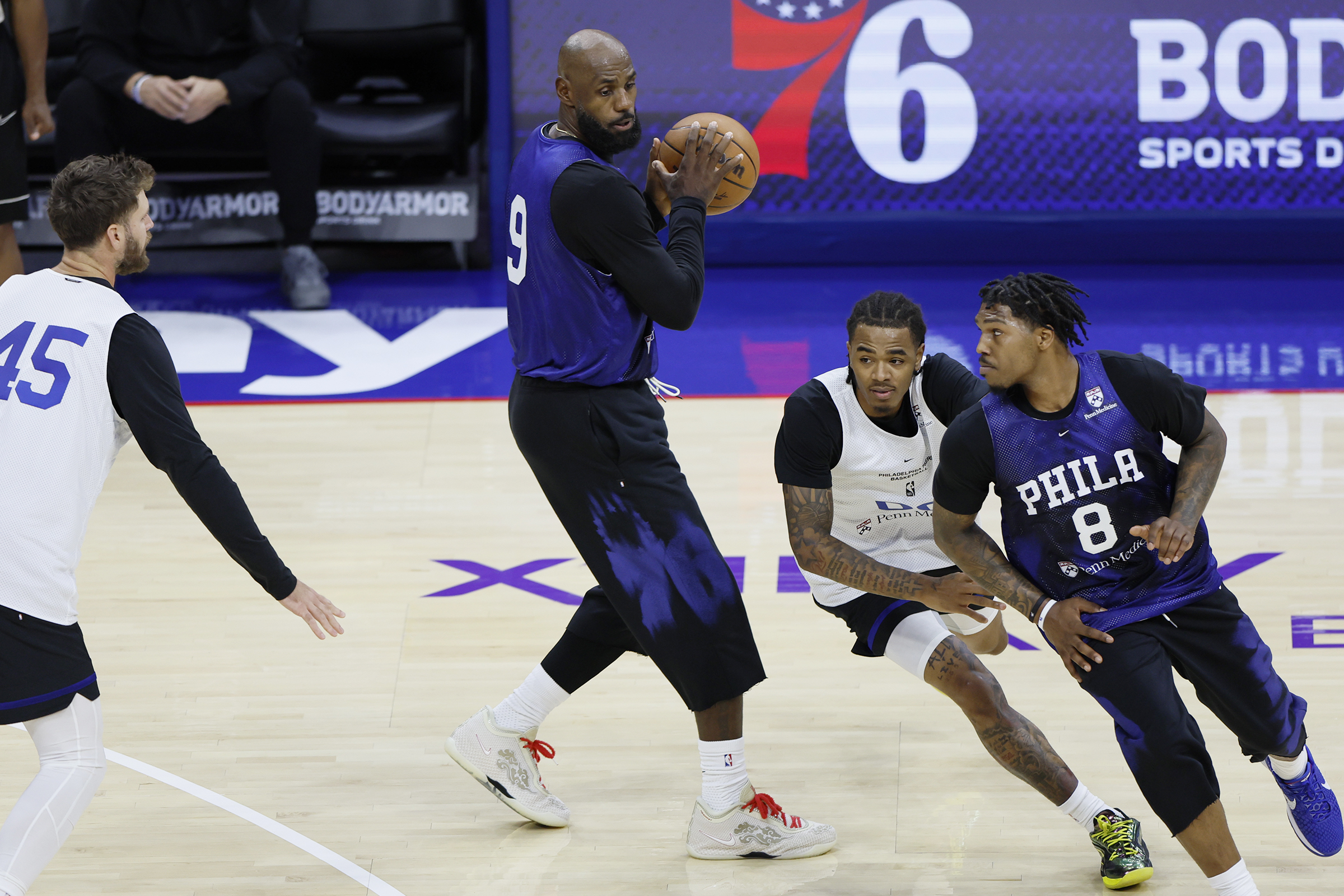
LeBron James handles the ball as Dean Wade, left, defends in the Sixers’ public scrimmage. Elizabeth Robertson / Staff Photographer
It was the start of a new relationship between Sixers fans and James, who said at media day that he appreciated the mutual respect and hate he received during his previous trips to Philly as an opponent.
Those in the stands Saturday got to watch James, wearing No. 9 instead of his iconic 23, deliver a behind-the-back pass to VJ Edgecombe in the corner. And throw down an alley-oop from Tyrese Maxey. And hit another step-back three-pointer.
After averaging 20.0 points, 6.1 rebounds, and 7.1 assists last season with the Los Angeles Lakers, James maintained Saturday that he is willing “to pick up whatever a team may need” as the Sixers aim to best maximize their top-end talent.
Video: LeBron James and Jaylen Brown introduced as Sixers for the first time
“I’m just trying to fast-track everything, offensively and defensively,” James said. “The commands. The calls. The reads, and everything they’ve had in place over the few years. I’m stepping into a new system and I’m stepping into a whole new environment.”
The bulk of James’ initial work, however, has been in the privacy of the Sixers’ practice facility. Coach Nick Nurse and president of basketball operations Mike Gansey recently commended James’ consistent early arrival for his meticulous personal routine ahead of practice. Though his strong rapport with Maxey is already well-documented, James on Saturday reminded that he also has brief history with Embiid as part of the 2024 U.S. Olympic team.
Gansey also called James a tone-setter; that, at age 41, he is still diving on the floor for loose balls during practice.
“I mean, the guy is the biggest professional I’ve ever seen,” said Gansey, who also was in the Cleveland Cavaliers’ front office during James’ championship-winning stint with that team.
Once the Sixers begin preseason play Monday against the New York Knicks, James said he hopes to continue gaining rhythm with new teammates but “not overdo it” physically leading up to a high-profile Oct. 20 opening night at Madison Square Garden. The Sixers’ home opener is two nights later, against James’ familiar Cavaliers.
Yet Saturday afternoon will always mark the first time James got Cord’s booming introduction inside Xfinity Mobile Arena. Fans hung around the building long after the scrimmage concluded, at one point abruptly swarming to a fence overlooking the parking lot where players come and go.
They wanted a glimpse of James leaving his new home arena.
“Obviously, it was fun to be able to play in front of some of our Philly faithful for the first time,” James said. “ … It was a great first step in the direction we’re trying to go. And, like I said, it was great to hear some cheers.”
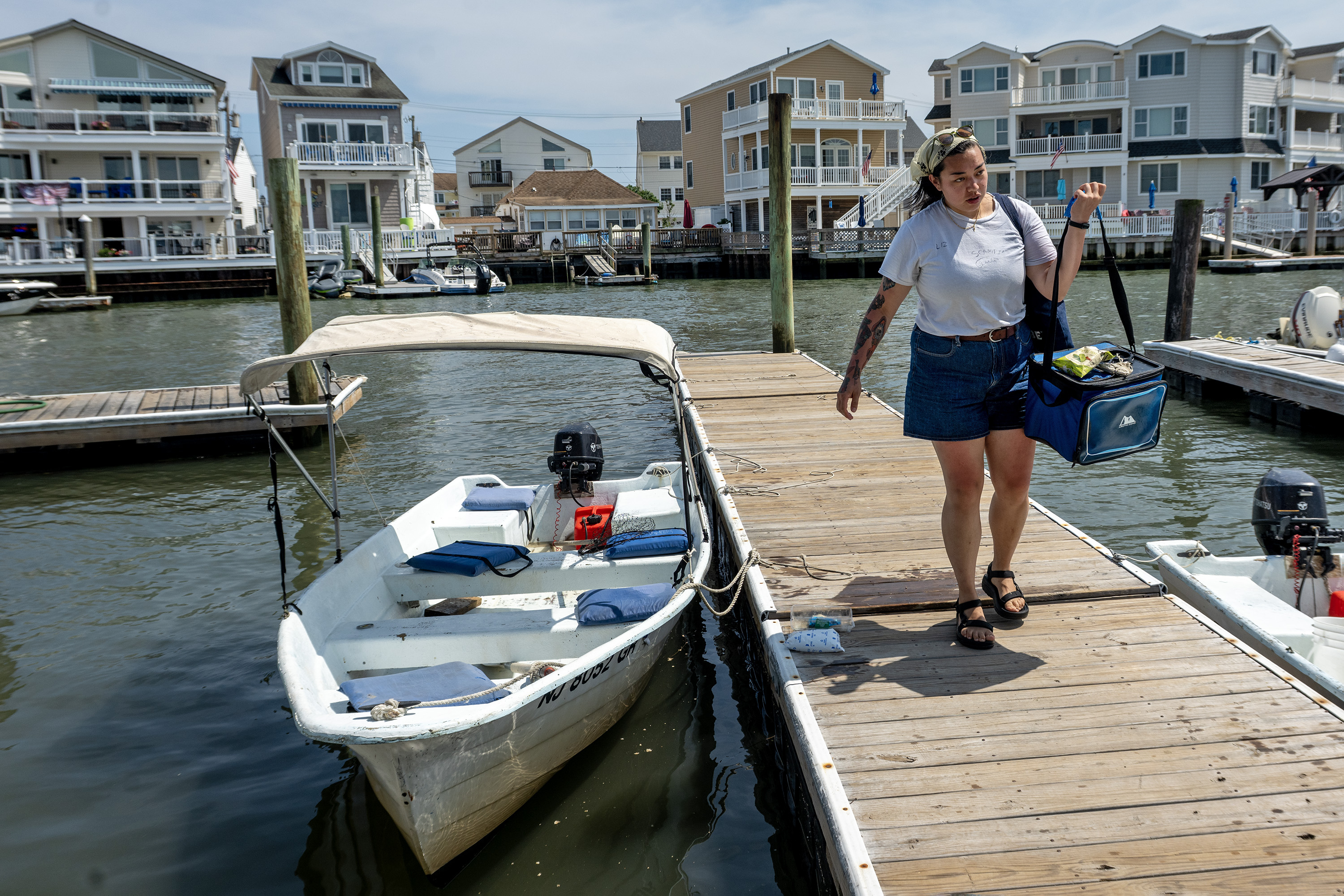
Sitting on a skiff on the bay in Sea Isle City, chef Liz Grothe slowly pulled up a submerged string from the lapping waters while holding onto a half-eaten Wawa hoagie.
On the string, a blue crab emerged, clinging to the severed fish head at the end of the bait holder, called a handline. The crustacean was too small for New Jersey’s recreational size minimum (3 inches long), Grothe and her companions determined. With a sigh, she dropped the crab back into the water.
It was an hour into Grothe’s Sunday crabbing expedition, and her crew had already caught a handful of crabs.
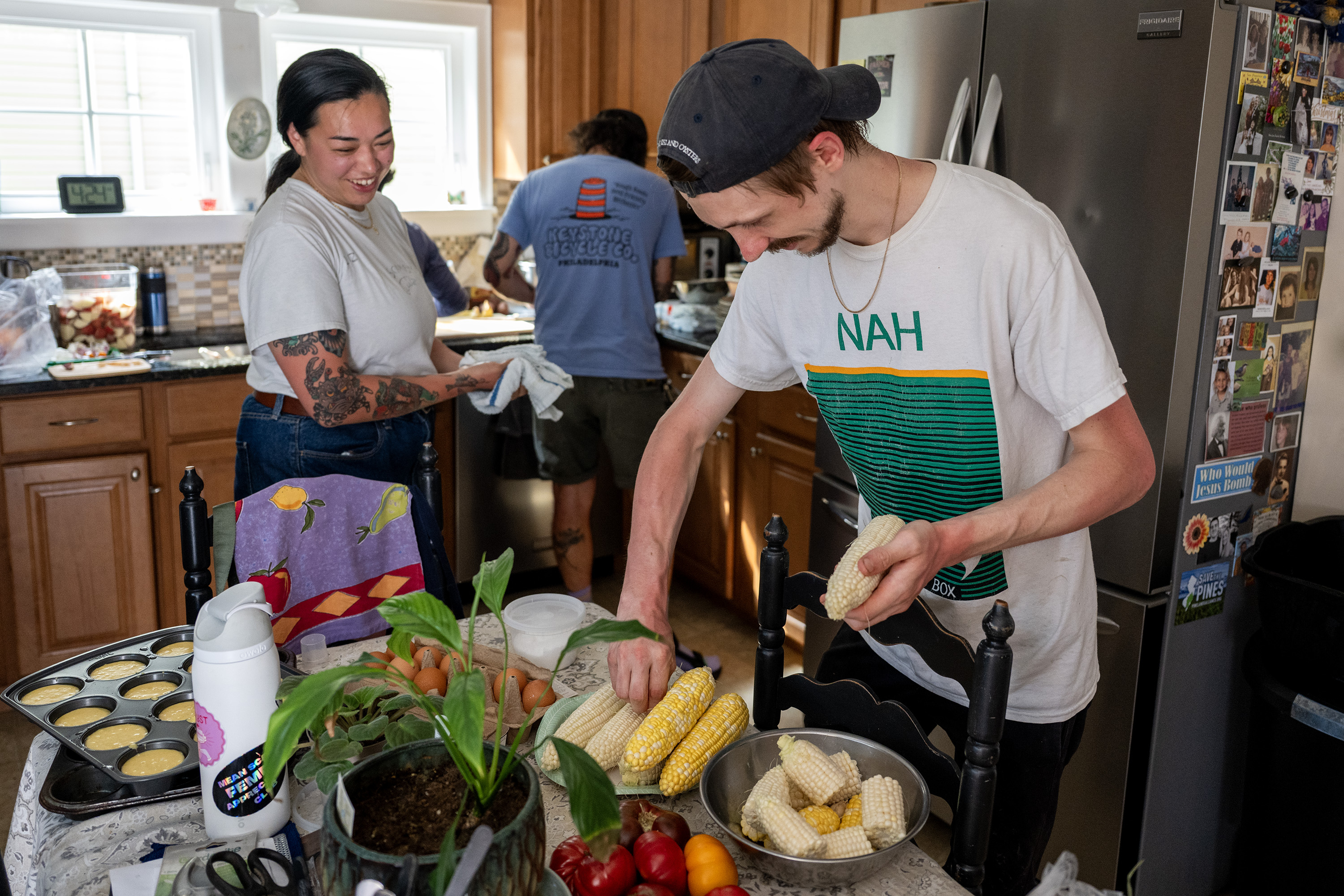
Chef Liz Grothe washing the day’s catch of grabs in the laundry-room sink of her partner’s family home in West Cape May, Sunday, Aug. 2, 2026. Grothe spent the afternoon crabbing out of Sea Isle City and was making dinner for the family Tom Gralish / Staff Photographer
With bright skies and calm waters that day, she rented two skiffs from Bay Breeze Marina with her partner, Jacob Lance, and Lance’s family to embark on her favorite Shore hobby: crabbing on the bay — and later, cooking up her catch in Cape May.
“We get all our ‘beach’ time down the Shore at the bay,” Grothe, who owns the Italian-ish Queen Village restaurant Scampi, said. “[The bay] is more like Oklahoma-style waters, where it’s just a shallow lake rather than like the rough seas of the ocean. So this is more my speed.”
Grothe grew up catching catfish in the creeks of Oklahoma. But it wasn’t until six or seven years ago that an ex-boyfriend introduced her to Sea Isle City’s bay and its crustaceous inhabitants. “He took me on his boys’ excursion, which was crabbing,” she said. “We broke up later — being the kind of girl I am, I stole it. I go to the same place they rented their boats; we do it in the same way I learned.”
Grothe named her restaurant after a seafood dish, so it’s no surprise she has strong feelings about crabs, the scavengers of the sea. Don’t expect these to show up on her menu, though — they are for personal eating only. The once-a-summer hobby lets her “touch grass, so to speak, and have something to do that’s not the harrowing day-to-day that we deal with in the kitchen,” she said.
Being close to water was always a priority for her family — Grothe’s mom is originally from the Philippines. Her interest in seafood, however, comes from the love of catching and cooking it. “Eating is just the secondary part of the fun,” she said.
“I’m in it for the love of the game, not the catch,” she said, while tossing the handline back into the water.
Bay Breeze Marina rents a boat for $109 for four hours, including gas, cushions, anchor, paddle, cutting board, and a net. The rental also offers a map of the best areas to catch the crabs. It was a no-brainer for Grothe and crew.
Around 10:30 a.m., she and Lance took one boat, and Lance’s brother and sister-in-law hopped into their own. (Grothe and Lance’s boat didn’t have a bucket, so they improvised, throwing their crabs into a cooler.)
For four hours, the crew tossed their baited handlines in various areas of the bay — deep waters, shallow areas, just off the coast — to catch as many crabs as they could. They found that chunky pieces of bait — like the trout head — were the best lures.
Chef Liz Grothe (left) as her partner Jacob Lance preps the corn at his mother’s home in West Cape May, Sunday, Aug. 2, 2026. They spent the afternoon crabbing out of Sea Isle City and were making dinner for the family Tom Gralish / Staff Photographer
“What kind of music do crabs like?” Lance asked the group. “They don’t seem to be digging country.”
“Crabs are chaos; try house music,” Grothe said. “I could see them vibing to it.”
But Daft Punk and Prince were the “certified crab bangers,” as Grothe put it.
By the end of the excursion, the crew caught more than a dozen crabs of varying sizes. After docking their skiffs, Grothe assessed which crabs were too small to keep and dropped those back in the water.
Left with 14 crabs,the crew decided to supplement their haul with other catch for a big boil. They stopped by the fish market at the Lobster House in Cape May to pick up mussels, shrimp, and clams before heading to Lance’s mom’s house in West Cape May, where the live crabs were washed and tossed into the boiling water.
The key to cooking a crab boil, according to Grothe: a lot of Tony Chachere’s Creole Seasoning. “Maryland and up, people use Old Bay. But if you go south, those who know reach for Tony Chachere’s,” said Grothe, shaking a big container of it into a pot inside the Lances’ kitchen. “Tony is a saltier, spicier, better Old Bay,” Lance added.
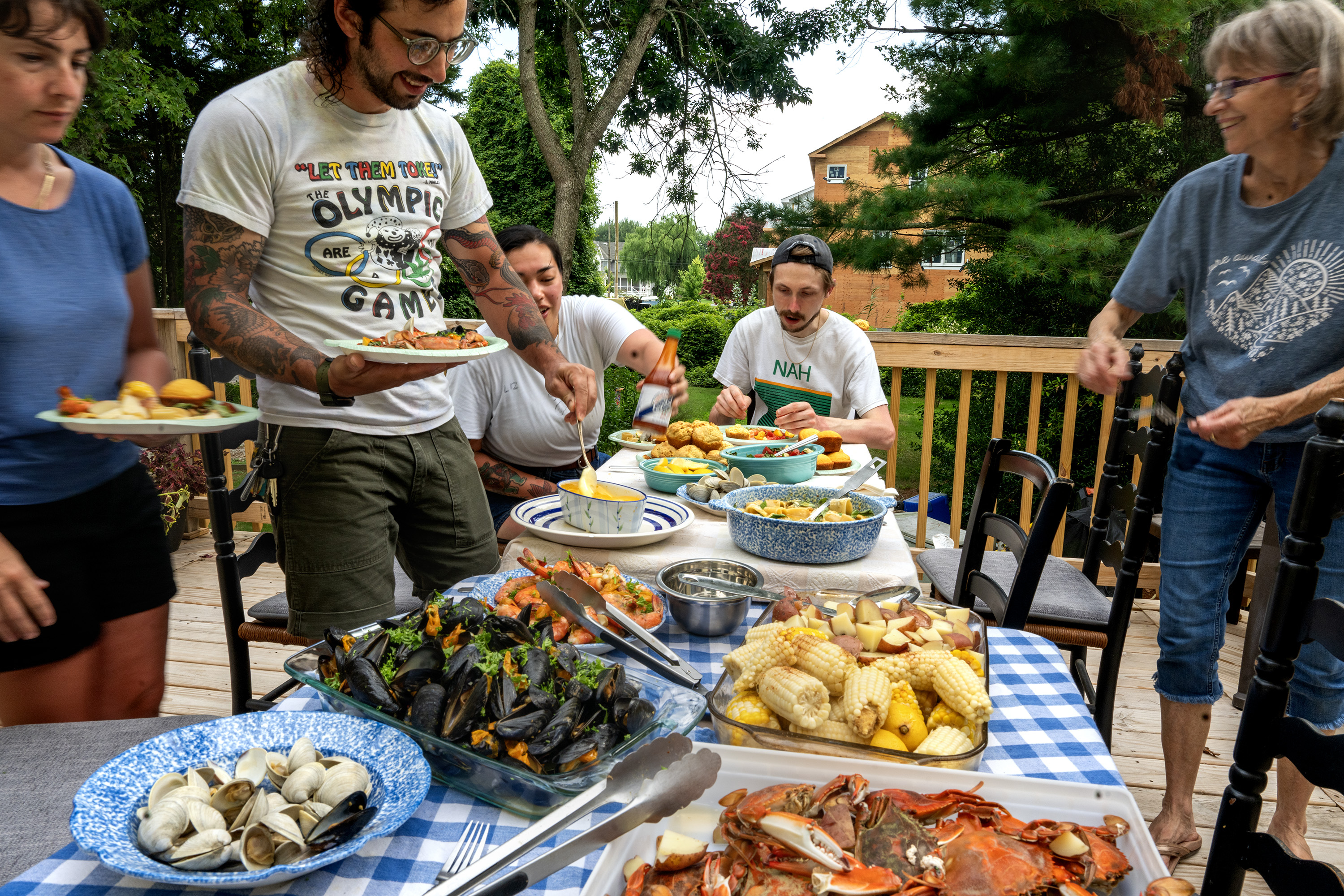
Family members fill their plates at dinner by Liz Grothe, of Scampi, at her partner’s family home in West Cape May, Sunday, Aug. 2, 2026, after an afternoon crabbing out of Sea Isle City.Tom Gralish / Staff Photographer
By 5:30 p.m., the table was set with plates of steamed mussels, poached and steamed shrimp with a sungold tomato broth, calamarata pasta, boiled crabs and clams, gluten-free and regular cornbread, and tomato salad. The menu was prepared with leftover ingredients, including sungold tomatoes, basil, and butter from Scampi — “things that were going to go bad and that we had excess of, just a little something to share with the crew.”
After an almost seven-hour expedition, Grothe and the Lances settled down on the backyard patio, cracking crabs and enjoying the fruits of their labor.
“If you’re gonna go crabbing, that’s gonna be your activity for the day — you catch them, and then you gotta deal with them,” Grothe said.
“Doing something that is very labor-intensive, sharing a part of me with other people that’s fun and interesting — even if it’s not the most industrious or profitable thing — is what I love about cooking,” Grothe added. “Just bringing the family together and showing them that I care via doing this stuff makes me feel good.”
Chef Liz Grothe of Scampi (rear, center) and her partner Jacob Lance eat dinner at his mother’s house in West Cape May, Sunday, Aug. 2, 2026. At left are Lance’s brother and sister-in-law Shmem Rose and Zachary Rachelle, and on the right is his mother, Christina Johnson.Tom Gralish / Staff Photographer
After decades of opening and running restaurants for other people, chef Nic Macri and operations executive Suzanne O’Brien are becoming owners themselves.
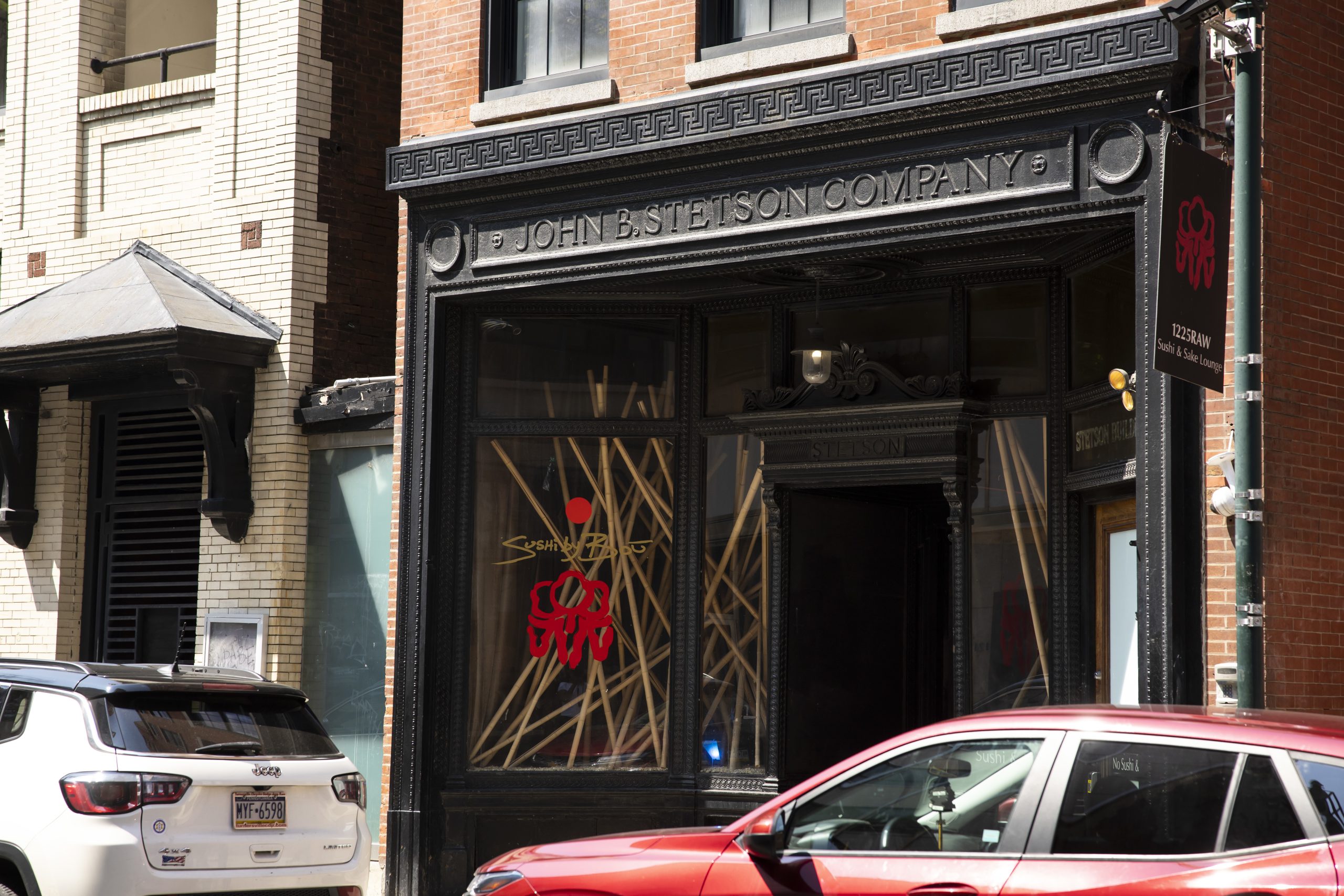
The Royal Restaurant Group colleagues are joining cofounder Stephen Simons as partners in a still-unnamed Italian-inspired tavern planned for the former 1225 Raw space at 1225 Sansom St. in Washington Square West. It’s just steps off the 13th Street bar-restaurant cluster that includes El Vez, Prunella, Pearl & Mary, Double Knot, Vintage, Time, Barbuzzo, Darling Jack’s, and Little Gay Pub.
The restaurant space at 1225 Sansom St. was last 1225 Raw and Sushi by Bou.Monica Herndon / Staff Photographer
The project remains in the design stage, with demolition expected to begin shortly. Simons said a late April 2027 opening would be the best-case scenario, though it could take about a year.
For Macri, 41, the restaurant will be the big leap in a career that has taken him from his native Ontario to some of Philadelphia’s best-known kitchens and butcher shops. O’Brien, 58, has spent more than three decades opening and operating restaurants, including Dock Street Brewery, Cantina Los Caballitos, Royal Boucherie, and dancerobot, but has never before held an ownership stake.
Macri, the son of Calabrian immigrants who settled in the Toronto suburbs, came to Philadelphia on a Drexel University soccer scholarship. After cooking at Osteria and Southwark, he founded La Divisa Meats, the acclaimed Reading Terminal Market butcher shop that established him as one of the city’s premier charcutiers. He joined Royal Tavern as executive chef at its 2023 reopening from the pandemic shutdown.
The new restaurant will draw partly on Macri’s Sunday Sauce dinners at Royal, though he described the idea more broadly as “Philadelphia cooking with an Italian accent.”
“It won’t be rooted in one particular style or region,” he said. “It’s more about the Italian diaspora than one specific place.”
The menu will include fresh and dried pastas, house-made bread and salumi, preserved vegetables, and shareable large plates. Vegan dishes will be built around vegetables rather than meat substitutes.
One likely signature is a house-made mortadella sandwich on ciabatta, which Macri hopes can become the restaurant’s counterpart to Royal Tavern’s burger. His charcuterie program will focus on one featured item at a time rather than a large assortment.
“Especially if we’re making it ourselves, I want to highlight one thing and give people a chance to really enjoy it,” he said.
The beverage program is expected to include wines by the glass, a larger selection of Italian bottles, frozen cocktails, nonalcoholic drinks, and a small beer list. Desserts will likely include tiramisu and seasonal fruit tarts or crostatas.
Macri said the partnership offered a chance to take on more responsibility without moving away from the daily work of running a restaurant.
“I wanted to do something slightly larger and have more involvement than I do at Royal Tavern,” he said. “This seemed like the best opportunity for me to grow.”
He jokingly proposed calling it “Another Italian Restaurant,” an idea that did not survive.
“I don’t think they thought it was as funny as I did,” he said.
O’Brien brings deep operations background to the partnership. In 1991, she began waiting tables at the then-hotspot Metropolis — now the Fine Wine & Good Spirits store at 1515 Locust St. — and moved into management at the Palm and Cuba Libre before helping Simons and Frank build Royal Restaurant Group, whose holdings include Royal Sushi & Izakaya and Triangle Tavern. She is now the company’s CEO and said she would remain so.
“I’ve opened many restaurants, but this is the first one that’s actually mine,” she said. “It’s kind of funny.”
Macri was the deciding factor.
“I trust Nic,” O’Brien said. “He just likes really good food. It doesn’t have to be fancy, and he doesn’t try to make things into something they’re not. We’re very aligned on that.”
The restaurant will occupy the former 1225 Raw space and the adjoining former Sushi by Bou space, vacant since the city Revenue Department shut it down in early 2025 over tax and liquor-licensing issues surrounding the former operator, Glu Hospitality. The property extends a block to Chestnut Street, and will have about 100 indoor seats, a private dining room, and a courtyard and terrace that could accommodate about 40 more.
O’Brien, who oversees landscaping at several Royal properties, including the seasonal PHS pop-ups, said the outdoor space and the building’s historic character would help shape the design. Ambit Architecture, which worked with Royal on dancerobot, is handling the project.
The partners envision a restaurant priced between Royal Tavern and Royal Boucherie, with enough flexibility for a casual weeknight dinner, a date, or a family meal.
“It’s going to be fun,” O’Brien said. “It’s the kind of place where you might come a couple of times a week, bring your mom to dinner one night, or go on a date another night.”