A new vinyl listening room and bar concept is coming to Kennett Square and Fishtown this fall, seeking to help people connect in person around music and over cocktails.
Top Dog Cocktails, a ready-to-drink 12.5% ABV cocktail brand with a distillery based in Kennett Square, will open its first two brick-and-mortar locations in the coming months, embracing the Japanese jazz kissa model — a music cafe or bar that’s focused on listening to vinyl records.
“It’s all to drive this analog feel in a digital world,” said founder Ken Smukler, a longtime political strategist who dipped his toe into the alcohol space roughly a decade ago. “It’s all about the community, listening and respecting music, and enjoying the cocktails at the same time.”
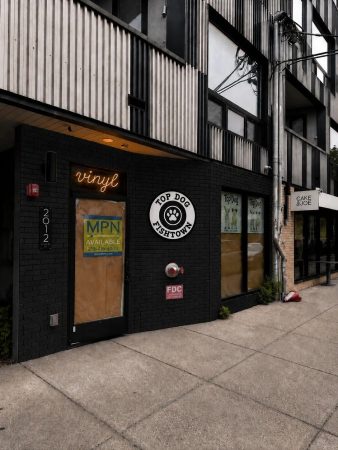
With his distillery location in Kennett Square already tied to music, and a teeny space in Fishtown in a former ATM calling for some creative reimagining, Smukler saw opportunity.
The locations will look a little different from each other, but the heart of both will be similar. There will be a small retail component, a bar that will double as recipe development for the brand, and, of course, an expansive catalog of music on rotation.
Top Dog Cocktails is “designed for a more sophisticated consumer” who “recognizes what a craft cocktail is in a can,” he said.
That vibe applies to these locations; Smukler envisions their demographic as cocktail appreciators, who want to unplug from their phones or TVs.
“This is a quieter, safer, more sophisticated space to consume alcohol and listen to really good music,” he said.
Smukler, a former political operative for then-U.S. Rep. Bob Brady, was first drawn to ready-to-drink cocktails in 2015, and began raising capital to launch his own brand. That early effort dissolved in 2019, when he went to federal prison for campaign finance law infractions.
But while in prison during the COVID-19 pandemic, quarantined without much to do other than chat, he learned his cellmate’s brother worked in the alcohol industry. On his way out of prison, Smukler called his friends and family — and his former cellmate’s brother.
“There’s literally a straight line from there into launching Top Dog,” he said.
He reconstituted the investor group, and the brand launched in 2022. They’ve sold nearly 1.5 million cans, Smukler said, with distribution in Pennsylvania, New Jersey, and Florida.
Options include a few variations of the margarita, an espresso martini, a vodka and grapefruit Greyhound, and a whiskey lemonade.
The brand’s distillery operation is in Kennett Square, near Kennett Flash, a live entertainment venue. He first picked the spot, at 110 E. State St., because he felt there could be “synergy” between Top Dog’s tasting room and live music. The roughly 750-square-foot space will be the bigger of the two listening rooms.
Smukler plans to work with the Kennett Flash in a joint venture; the nonprofit will be able to use the venue as a green room for performers, a space for music classes, or however they see fit. They’ll also get a cut from the retail sales.
He’s looking to do something similar with the Fishtown location, but is still seeking a partner, he said. The location, at 2012 Frankford Ave., may be the smallest bar in Fishtown, at 350 square feet. It’ll have a 15-seat bar, a two-turntable DJ station, and a retail component.
Fishtown feels like “ground zero” for the demographic they’re trying to reach, Smukler said. As for Kennett Square, he just happens to love it.
“I just think it’s a gem, and I think if we can do something with the Kennett Flash … and for the community, that’ll pay back in spades for us,” he said.
They’ll be able to test new drinks through the outposts, Smukler said. They’ve never had a gin or a rum product, for instance, and this will give them a chance for some R&D.
As for music, they’ve amassed more than 500 albums ready to spin. Smukler’s creative director is planning themed nights to let them shine. Though the Japanese kissa model is usually jazz-forward, there will be a cross section of what gets played, he said.
Moving the business into physical locations has been a creative challenge, but an exciting one, he added.
“If you ask me, what is the most fun part of my job? It’s not trying to figure out how to sell more cases in Florida. I guarantee you, it is designing a kissa concept in Fishtown or working with a nonprofit in Kennett,” he said. “That’s the fun part.”
This suburban content is produced with support from the Leslie Miller and Richard Worley Foundation and The Lenfest Institute for Journalism. Editorial content is created independently of the project donors. Gifts to support The Inquirer’s high-impact journalism can be made at inquirer.com/donate. A list of Lenfest Institute donors can be found at lenfestinstitute.org/supporters.
“This ruling supports the long-term health of our industry” in Pennsylvania, said CJ Ciarrochi, CEO and fourth-generation owner of Modern Mushroom Farms in Toughkenamon, Chester County, part of the Fresh Mushrooms Fair Trade Coalition supporting the case against the Canadians.
But one of the largest area growers called the decision a protectionist move that would enable aging U.S. farms to avoid upgrades and leave consumers with fewer choices.
“We sell our Canadian-grown mushrooms in the U.S. at a higher price than our U.S.-produced mushrooms — the polar opposite” of dumping, said Lewis Macleod, Kennett Square-based CEO of South Mill Champs mushrooms, which also has operations in Canada and Mexico.
(function(){function e(){window.addEventListener(`message`,function(e){if(e.data[`datawrapper-height`]!==void 0){var t=document.querySelectorAll(`iframe`);for(var n in e.data[`datawrapper-height`])for(var r=0,i;i=t[r];r++)if(i.contentWindow===e.source){var a=e.data[`datawrapper-height`][n]+`px`;i.style.height=a}}})}e()})();
Final decisions in September could impose penalties that boost U.S. grocery stores’ cost to buy Canadian mushrooms. The Commerce Department’s calculations suggest anti-dumping and countervailing-duties penalties, if adopted, could add 10 to 15 cents per $1 to the price of Canadian mushrooms exported by Champs, owned by Eos Partners of New York; Highline Mushrooms, owned by Japan-based Sumitomo Corp.; and Windmill Mushrooms, owned by Toronto-based Instar Asset Management.
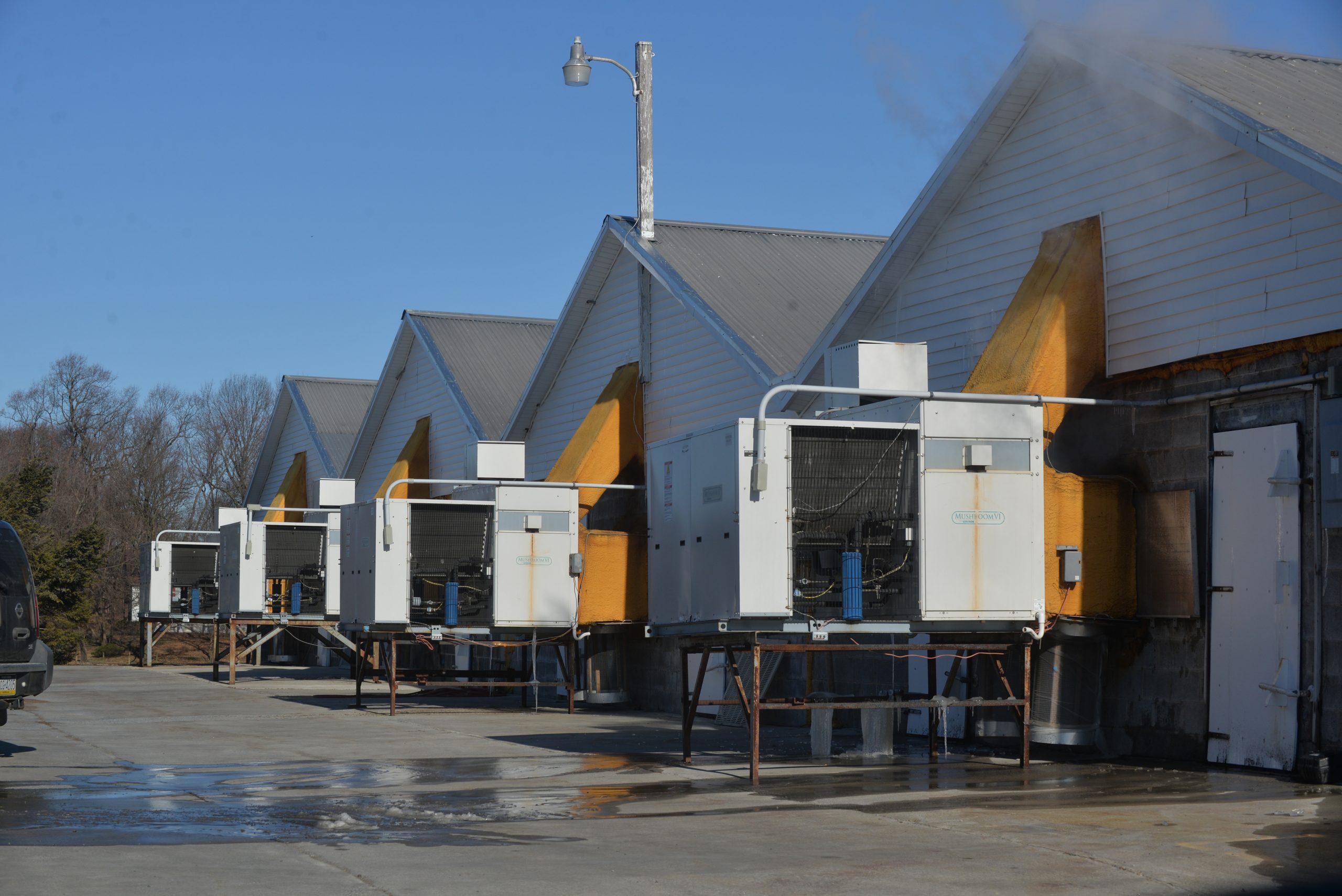
That would ease import competition for Pennsylvania growers, who produce more than two-thirds of the U.S. mushroom crop, mostlyin clusters of climate-controlled sheds in northern Berks County and southern Chester County.
At Modern Mushroom Farms, on Newark Road, Toughkenamon, Chester County, in 2020.Bob Williams For The inquirer
The Department of Commerce’s finding “is a win for fairness, competition and the future of American mushroom farming” and for “everyone to play by the same rules,” said Mark Currie, CEO of 99-year-old Giorgio Cos.’ food division, the largest of the coalition members.
Giorgio employs over 2,300 in Berks and Chester Counties and also buys from other growers such as Modern. Its corporate parent, Giorgi Global Holdings, is an international bottle and can maker with $5 billion in yearly sales.
While Champs’ Macleod predicted the Commerce Department’s final probes would find no dumping, Currie said he expects the review of sales records would find more evidence.
“We know the private-equity playbook: ‘Let’s drive the mom-and-pops out, jack prices, and then flip our companies” to outside investors and global companies, Currie said. “We called them on it. Enough’s enough.”
Sales to U.S. buyers peaked at around 1 billion pounds in 2019 but have since declined, according to the Mushroom Council,a national organization that promotes the crop. Canadian farms are gaining larger sales in a smaller U.S. market.
U.S. production peaked in 2015 at 811 million pounds and has fallen each year since, to 631 million pounds in 2025.
Fresh mushroom imports, mostly from Canada, have grown steadily since 2012, more than doubling to 208 million pounds in 2025.
The trade coalition says at least 10 U.S. mushroom farms have closed since 2022, including five in ChesterCounty and one in Berks County.
In its investigation, the Commerce Department compared the prices of premium-grade U.S. mushrooms to lesser-grade Canadian mushrooms and discounted low-priced U.S. mushrooms, Macleod said.
Canadian exports are winning U.S. customers not because Canadians are selling unfairly cheap but because Canadian farmstend to be new and efficient and grow an attractive product, he said.
Commerce began the investigation of alleged dumping and subsidies in January. The department’s latest finding follows its May “preliminary affirmative determination” that some Canadian mushroom farms were operating with an effective Canadian government subsidy of up to 5%.
South Mill Champs built an additional plant in 2023 in Chester County’s Elk Township, near the Maryland border, and now directly employs around 400 in the county, according to Macleod.
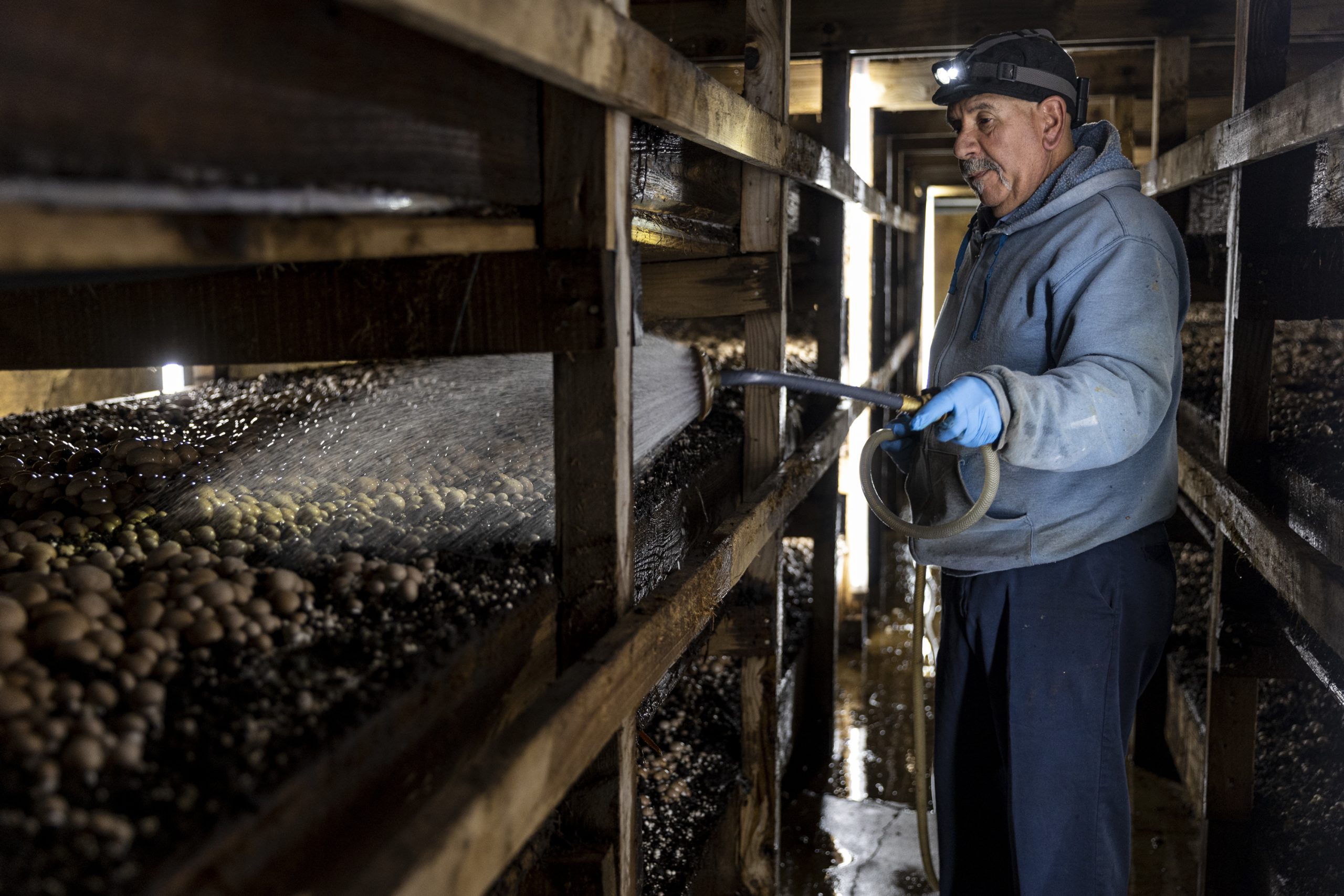
A worker is watering Crimini Mushrooms being grown at The Woodlands at Phillips Mushroom Farm in Kennett Square in 2022.Tyger Williams / Staff Photographer
The company also has added mushroom production near Winnipeg, Manitoba, and is building in Mexico’s Guanajuato state. It has a processing plant in Cambridge, Md., and has diversified into mushroom-based snacks and fruit storage and distribution.
Rival Giorgio has a joint-venture plant in Saltillo, northern Mexico, which has been selling to Mexican and U.S. buyers since the 1990s.
Many of Chester County’s Mexican mushroom workers are from Guanajuato. Thousands gained legal resident status and a path to citizenship in President Ronald Reagan’s 1980s amnesty program. Many have raised families and started businesses in the county. Nearly half Kennett Square’s population is Latino, according to the U.S. Census’ 2025 estimates.
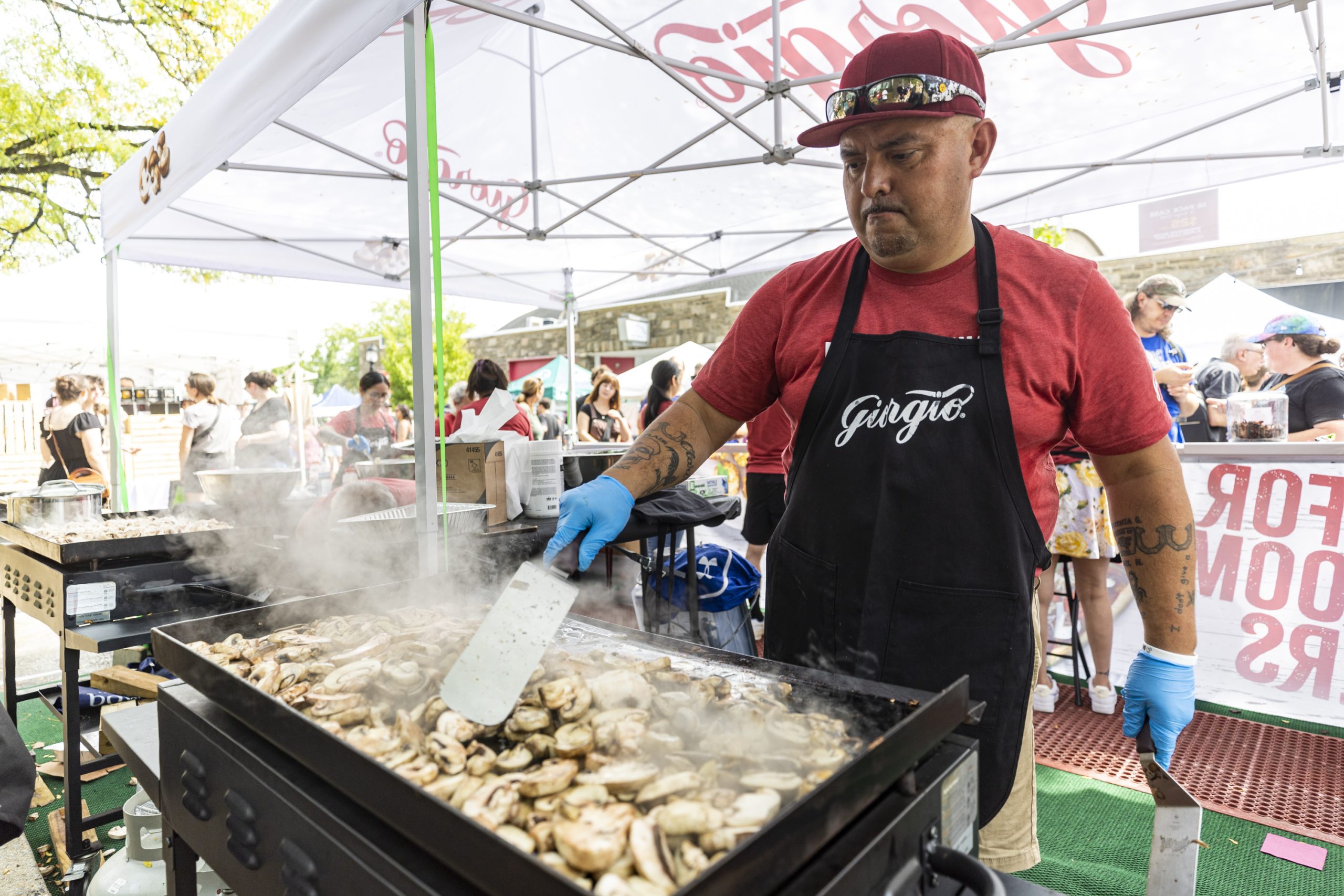
Mario Gomez, of West Grove, cooks white mushrooms in butter, garlic, and salt to give out as free samples during the annual Mushroom Festival in Kennett Square in 2023.Tyger Williams / Staff Photographer
In recent years, growers have had more difficulty obtaining U.S. work permits for workers from other countries.
Miguel Morales, a Guatemalan labor contractor who served as employer of record for nearby Chester County mushroom growers from his base at an Oxford convenience store, was convicted in federal court in Philadelphia last year of hiring unauthorized workers and failing to collect and pay taxes for some of them. He was sentenced to a year in prison, plus $8 million in restitution to the IRS. The growers were not charged.
South Mill Champs’ Macleod said he and his neighbors, though they differ on trade and sanctions, all support efforts by the American Mushroom Institute to expand legal status for immigrant farm laborers.
But with government restrictions on labor growing instead of easing, he said, “we have had to limit our expansion in the U.S., owing to challenges with labor availability.”
Macleod says the key to the U.S. mushroom industry’s survival and growth is automation.
The “distraction” of the trade dispute has delayed South Mill Champs’ proposed investment in a new, fully automated mushroom farm at its Oxford facility, where there’s room to triple the size of the current facility, he said.
A Chester County man who forced two teenage girls, one of them a relative, to work long hours on a Kennett Square mushroom farm for no pay pleaded guilty Thursday to human trafficking, involuntary servitude, and related crimes.
Ramiro Caal Jolomna, 37, threatened to have the girls deported back to their homes in Guatemala if they did not comply with his demands, Senior Deputy Attorney General Zachary Mills Wynkoop said.
Pennsylvania Attorney General Dave Sunday, whose office investigated the case through its human trafficking division, called crimes like Jolomna’s “cruel and dehumanizing behavior that forces victims into a routine of helplessness and silence.“
The victims, who were 14 and 17 when interviewed by state investigators in 2024, said Jolomna helped transport them to Chester County with a promise of giving them better lives and the opportunity to earn money to send back to their families.
Instead, prosecutors said, Jolomna, of New Garden Township, took their salaries from the mushroom farm for himself.
The younger victim told investigators that she had been working on the mushroom farm since she was 12 years old, and that Jolomna had been signing her paychecks over to himself and his wife.
After working predawn shifts at the farm, the girl was forced to act as the couple’s housekeeper, and was not even given new clothing to wear, Wynkoop said.
The other victim told investigators Jolomna charged her rent to live in his home alongside nine other people and forced her to reimburse him for the cost of her flight to America. These debts prevented her from sending money home to her father, who was sick and unable to work, the prosecutor said.
At one point, Jolomna’s parents contacted the older victim’s parents and asked them for more money, according to the affidavit of probable cause for his arrest. The girl said she “did not know what would have happened if her parents said no,” the document said.
In an interview with prosecutors, Jolomna admitted to having debts from “smuggling” the girls into the country and to taking the girls’ paychecks to use for food and other items, according to the affidavit.
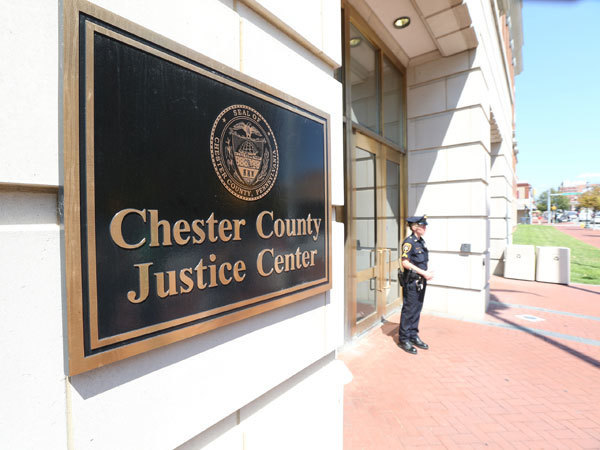
Jolomna will be sentenced in the coming months by Chester County Court Judge Debra Ryan.
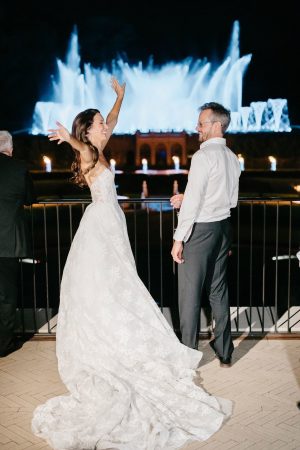
Streams of water shot up and danced at Longwood Gardens during the gender reveal for Danielle Alura’s baby.
The water flashed blue and pink to the tune of Linkin Park’s “What I’ve Done.” On a downbeat, all of the fountains turned one color and fire burst out.
“Next thing you know, I’m witnessing blue on my favorite fountains in the entire world,” Alura said.
It’s a boy.
The water flashed blue and pink before landing on blue.Courtesy of Danielle Alura
Alura and her husband, Curt Clemens, had planned the gender reveal as a surprise finale to their wedding reception on June 18. Longwood Gardens ordinarily hosts nighttime illuminated fountain performances at the five-acre Main Fountain Garden in Kennett Square. However, this show was custom-made for the reveal.
The couple, from Kennett Square,found out they were expecting a baby via surrogacy during their engagement, roughly six months before their wedding. Alura said they were anxious to start a family due to their ages, with Alura being 37 and Clemens 44.
They had both hoped for a boy.
“We’re just so, so over the moon about it,” she said.
In a video posted Saturday that captured the moment the gender was revealed, cheers roared from the crowd as Alura jumped up and down.
The gender wasn’t a surprise to the couple, though it was for many of their wedding guests.
Griffin, the baby boy being celebrated, had arrived just two weeks before on May 31. He was three months early — born premature, just as Alura and her husband had been.
Alura is a singer who was crowned Miss Global USA 2023, while Clemens is a woodworker.
“We were prepared to have a preemie, and we have extra confidence because we’re walking examples ourselves,” she said.
Danielle Alura is a singer and her husband, Curt Clemens, is a woodworker.Courtesy of Danielle Alura
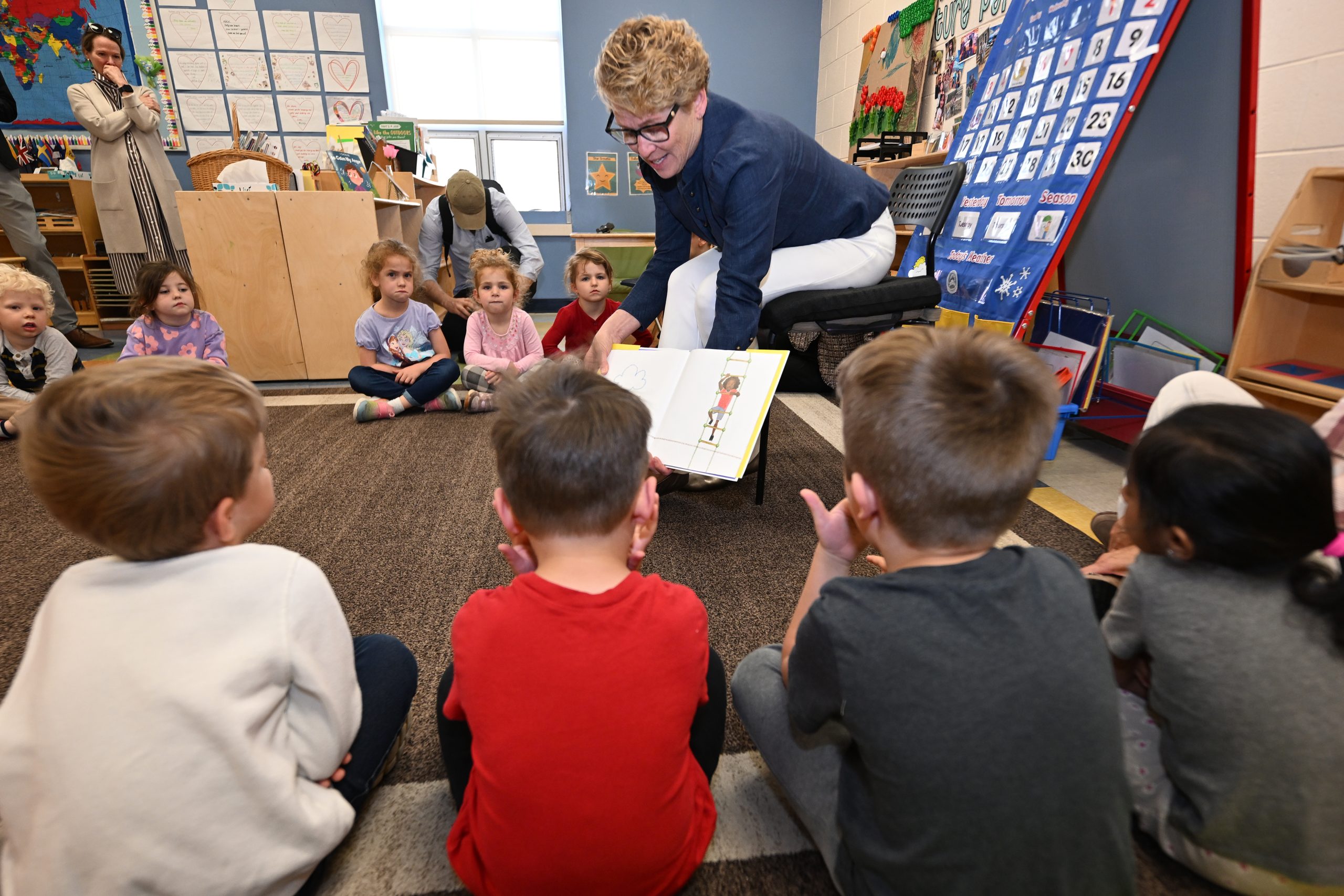
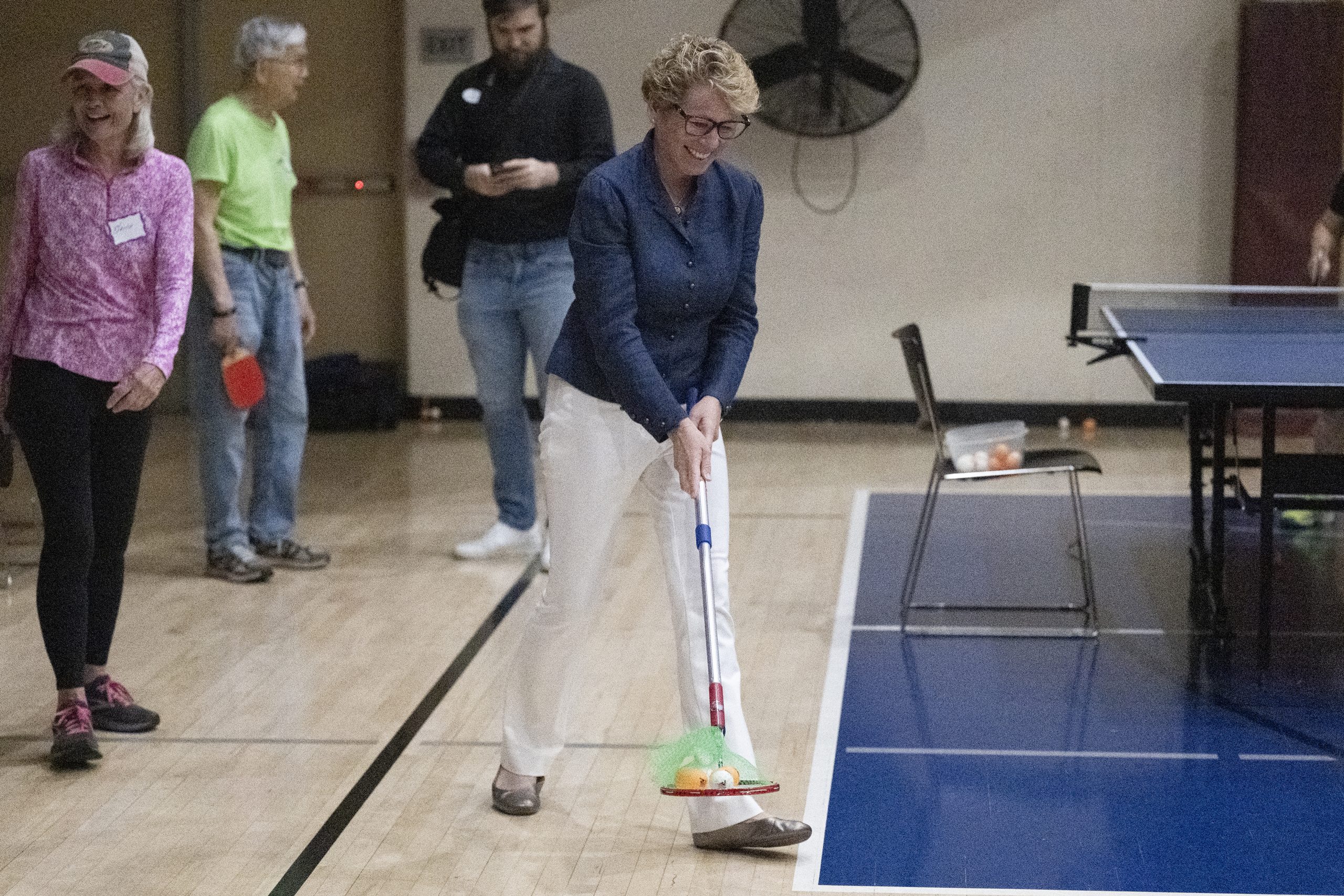
In the back of a classroom where she had just read to 20 attentive preschool kids, U.S. Rep. Chrissy Houlahan was concerned about what the staff of the West Chester YMCA was telling her.
Nearly a third of the families who rely on the facility’s childcare programs — in the richest county in Pennsylvania, and one of the wealthiest in the country — receive financial assistance to cover the $1,900 monthly cost, the staffers said.
Houlahan, a Democrat who is soft-spoken when she is not grilling President Donald Trump’s cabinet secretaries or House Speaker Mike Johnson (R., La.) on Capitol Hill, asked about the income qualifications for financial aid. At a certain point, the YMCA staff told her, some parents have a disincentive to earn more, lest they become disqualified and then stuck with a higher bill.
“It’s terrible, no matter how you do the math,” Houlahan said a few hours later at a Malvern restaurant, relaying the story to her daughter, Molly Rosa Houlahan, and daughter-in-law, Kristen Rosa Houlahan.
The YMCA’s fee was about the same amount the couple were paying for their 18-month-old, Lucy. With another child due in September, it is also an amount they still are unsure how to afford twice over.
“We’re very fortunate in our jobs, and we’re both trying to get promotions in order to be able to afford a second daycare,” said Molly Rosa Houlahan, 33, a local theater director and producer. “But we are not in that position yet. I don’t totally know what will happen when this second child arrives.”
From childcare to healthcare, groceries to gas prices, affordability concerns have remained top of mind for Americans this year — dominating discussions on Capitol Hill ahead of the high-stakes midterm elections.
Republicans, who control Congress and the White House, say they have made real progress in raising wages and lowering costs. They marked the first anniversary of Trump’s One Big Beautiful Bill Act — since rebranded by Republicans as the Working Families Tax Cut Act — this month by celebrating the law’s more generous tax refunds and other benefits, like new investment savings accounts for children under 18.
Democrats have pointed to the bill’s simultaneous cuts to Medicaid spending and food assistance for low-income families. They say Trump signaled he has no interest in lowering costs when he refused to sign a bipartisan housing bill and said he doesn’t “think about Americans’ financial situation” when handling the war in Iran.
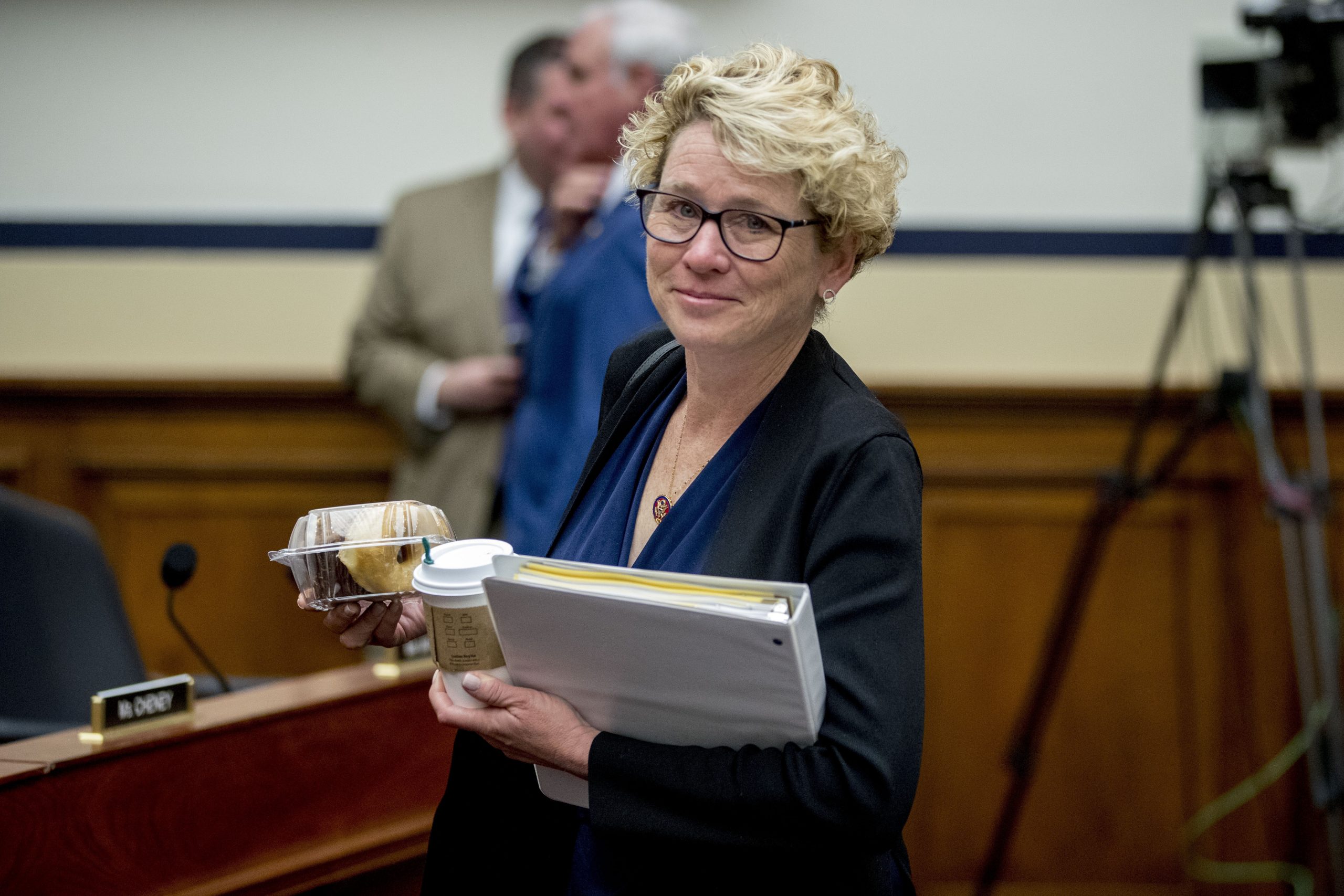
In this 2019 file photo, U.S. Rep. Chrissy Houlahan (D., Pa.) arrives for a House Armed Services Committee budget hearing for the Departments of the Army and Air Force on Capitol Hill in Washington.Andrew Harnik
Houlahan, who has represented most of Chester and Berks Counties since 2019, routinely highlights the broader scope of cost-of-living issues alongside her colleagues. She has taken a leading role among centrist House Democrats to help craft a detailed “affordability agenda.”
Whether her party can advance any of those policies in Washington, even if it wins control of one or both chambers of Congress in November, remains an open question as Trump remains in office and the International Monetary Fund warns of a worsening global economy.
But as the fight drags out, it has also become increasingly personal for Houlahan and her family.
In addition to occasionally helping fill the gaps in their granddaughter’s care, Houlahan and her husband’s own home in Devon, Chester County, has transformed into a version of a so-called sandwich generation household within the last year. The couple’s other adult daughter, her husband, and both of Houlahan’s parents, who are 80 and 84, have all moved in.
The underlying circumstances for the multigenerational home, as they would be for any family, are various and personal. And Houlahan emphasized across multiple interviews that she is fortunate to have the means to welcome her family under her roof. (Houlahan is an Air Force veteran and a former executive at the athletic apparel company AND1. Her husband, Bart, is a partner at an investment research firm.)
But the larger realities — like skyrocketing costs for childcare and senior living — have also now played a role in her own life.Her mother has a Parkinson’s diagnosis, and her parents were unable to find a one-floor living space that was affordable and fit their other needs as they looked to move closer to their family.
“We’re having these conversations, and you know people all over our community are having these conversations,” she said. “It’s an acute issue for families in our area: How do you balance all of this?”
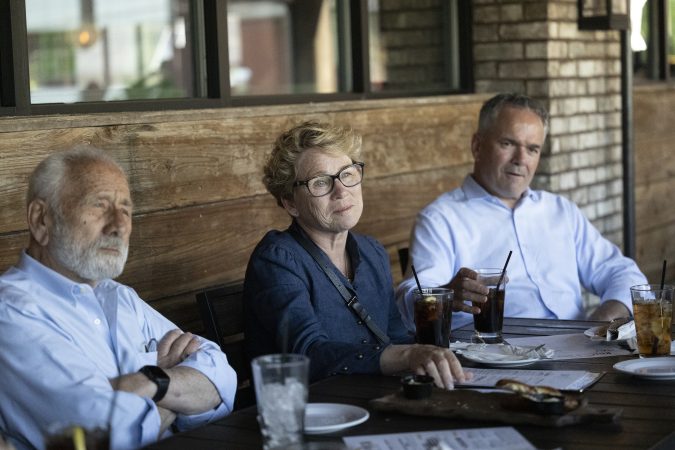
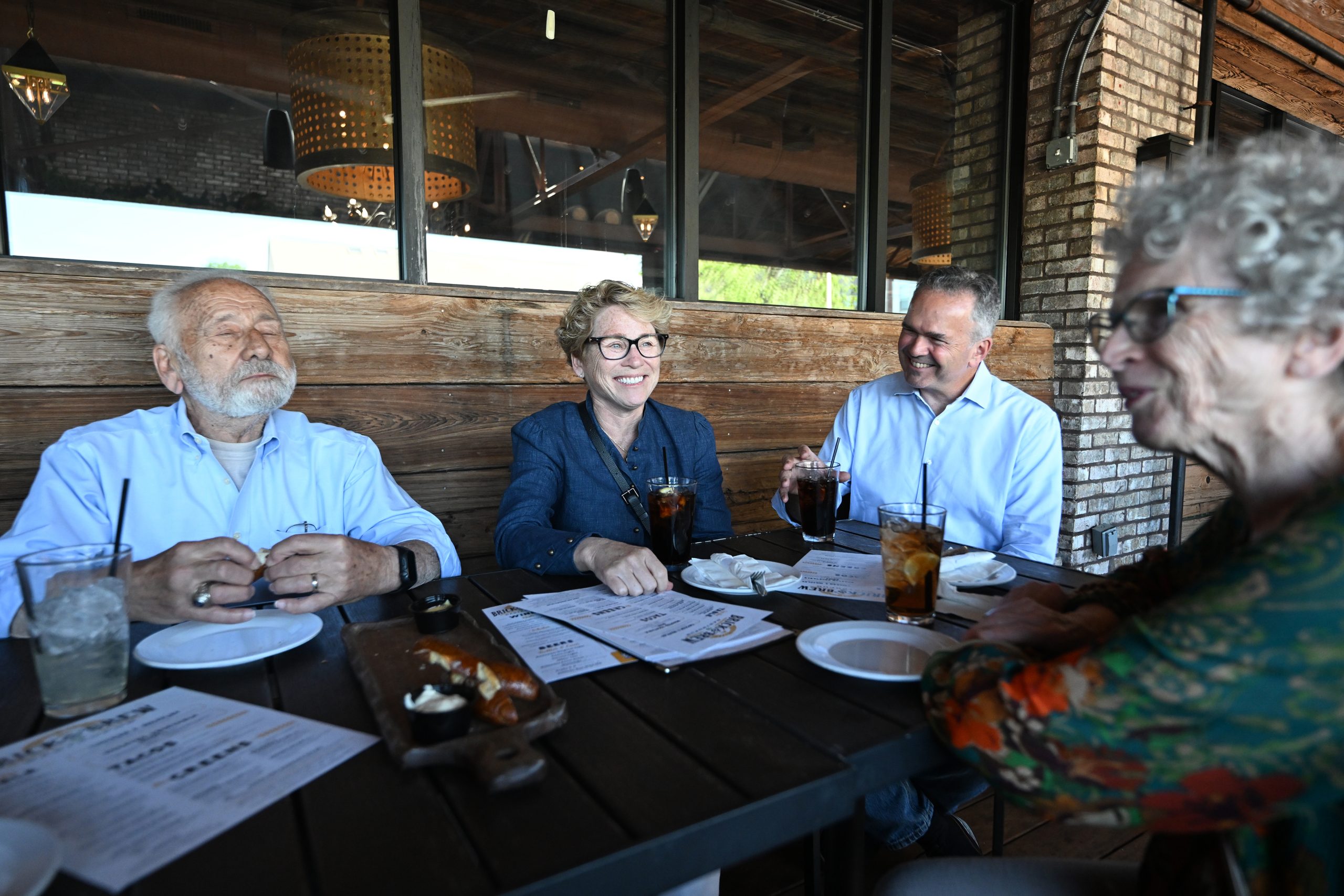
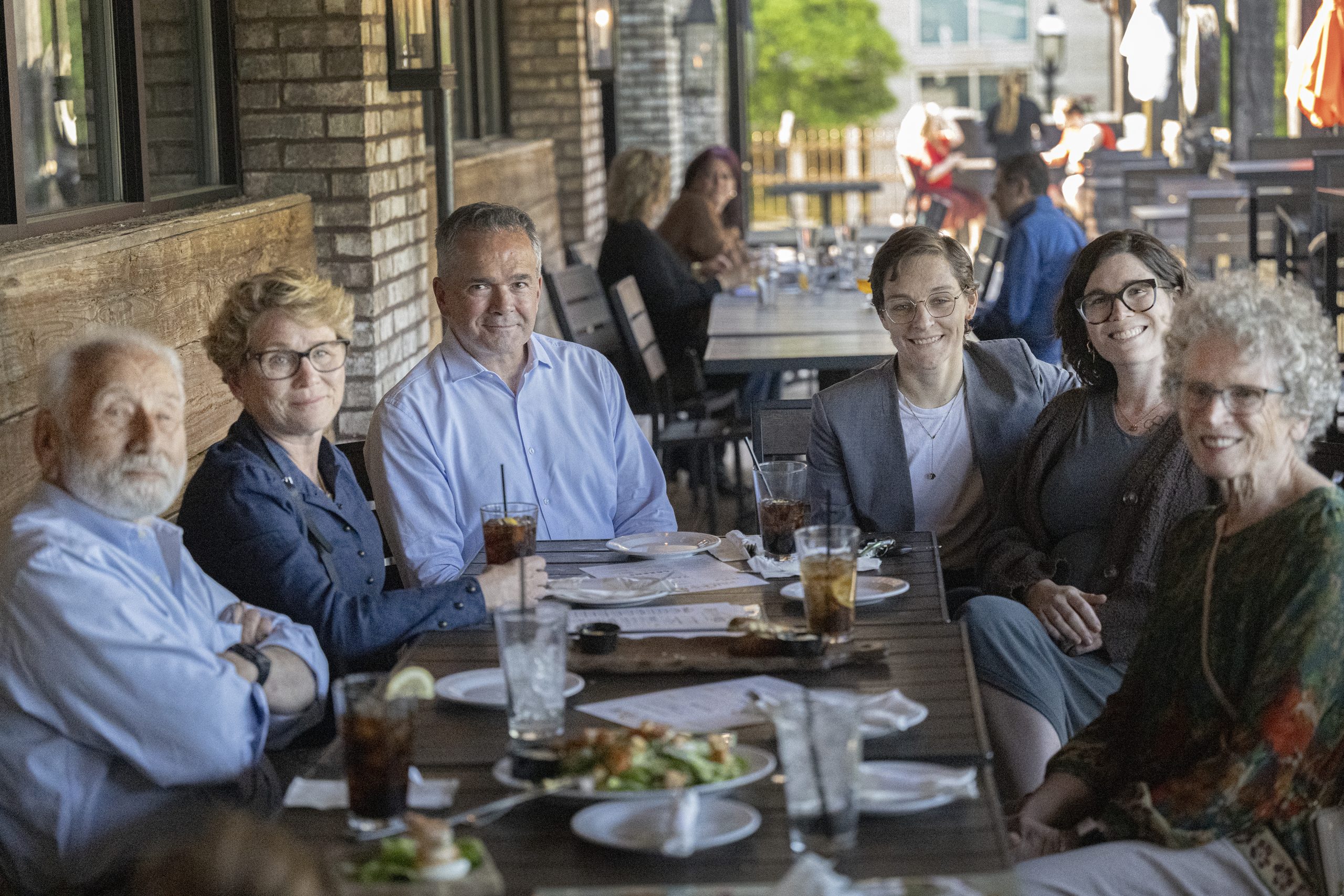
U.S. Rep. Chrissy Houlahan (center) has dinner with her family at Brick & Brew in Malvern, including her father, Andy Jampoler (left), her husband, Bart Houlahan, and her mother, Suzy Jampoler.Jose F. Moreno / Staff Photographer
‘A big balancing act’
Houlahan has shared parts of her family’s story as she has traveled her district this year — prioritizing events and meetings that aim for a deeper understanding of an affordability crisis that has not spared her home county, where the median household income is about $131,000, or 40% more than the statewide average.
On back-to-back days this spring, that meant a focus on the kinds of childcare and senior-care issues she has become familiar with.
“We call it ‘from zero to Edna,’” Laura Schoefield-Pierson, executive director of the YMCA of Greater Brandywine, said of the facility’s programs aimed at all ages, from infants to seniors.
Walking Houlahan through the pre-K classes and a gym with a dozen seniors playing table tennis, Schoefield-Pierson spoke about the organization’s exercise programs aimed at offsetting symptoms of Alzheimer’s or Parkinson’s, and about the complexities of providing assistance for families with young children.
In addition to the “many children” whose care is subsidized through the state’s Child Care Works program — set for families earning 200% or less of the federal poverty level, or $66,000 for a family of four — others receive aid through the YMCA, Schoefield-Pierson said. The facility’s fundraising goal this year is $237,000, she said. On the day of Houlahan’s visit, Schoefield-Pierson said “the kiddos” were writing thank-you notes to donors.
U.S. Rep. Chrissy Houlahan (D., Pa.) interacts with teachers and children at a childcare center at the YMCA in West Chester.Jose F. Moreno / Staff Photographer
Though the U.S. Department of Health and Human Services recommends childcare should not exceed 7% of household income, Houlahan said she was surprised to learn a family would have to earn $327,000 to meet that benchmark at the YMCA for one child.
Nationally, the average annual cost of childcare in 2024 was $13,128, an increase of 29% over the previous five years and far exceeding the national recommendation for the average household’s budget.
“It’s crazy how much healthcare and childcare plays into your family planning,” said Helena Cordoba, a 35-year-old mother of two who said at a roundtable hosted by Houlahan that she had been hoping to grow her family.
A Colombian immigrant who owns Café Com Leite in Phoenixville, Cordoba said she thought she had been living the American dream. But a recent miscarriage and the rising costs of both childcare and healthcare, which she does not currently have, have made her rethink her family’s plans.
“I never thought I was going to say, ‘Maybe the miscarriage is a blessing.’ That thought on its own is very saddening,” Cordoba said. “I don’t know if we were going to be able to afford another baby. Our life would have been completely turned upside down.”
Others voiced similar struggles while Houlahan sympathized and shared her daughter’s own experience with a $2,000 monthly daycare bill.
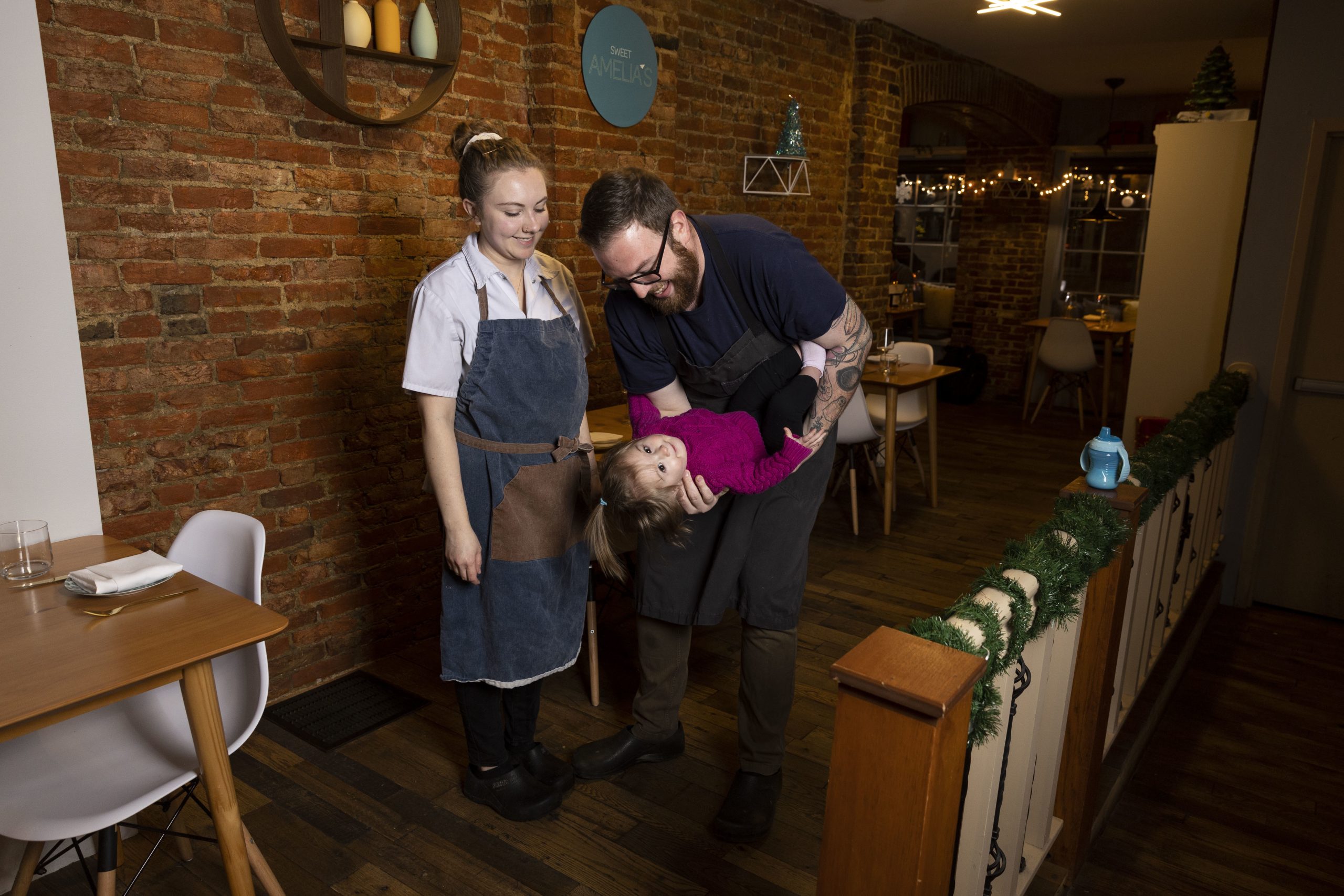
Karessa, Amelia, and Zack Hathaway, pictured here in 2023, at Sweet Amelia’s in Kennett Square.Monica Herndon / Staff Photographer
Zack Hathaway, who owns the restaurant Sweet Amelia’s in Kennett Square with his wife, Karessa, said their business “makes just enough” to cover the $700 to $800 weekly cost for their babysitter amid a demanding restaurant schedule. Thomas Smith, who works at the Cleveland-Cliffs steel plate production facility in Coatesville, said he makes too much to qualify for subsidies for his grandchildren but still struggles to cover the cost.
“It’s like a big balancing act to be able to put your kids in a place that you want to feel comfortable with them being and with being able to afford it,” said Amarte Grove, another Cleveland-Cliffs employee and a father of five daughters.
In another tour focused on the other end of the agespectrum, Houlahan peppered staffers at Brandywine Valley Active Aging in Downingtown about their work to offer free meals, housing services, and activities to about 120 seniors daily.
According to the organization, Chester County’s homeless population has decreased in recent years — from 916 in 2023 to 747 in 2025. But the percentage of that population that is over 60 has increased from 9% in 2023 to 14% in 2026. About 45 older adults in the county were homeless as of early May, according to the organization, which works alongside other independent and government groups to connect seniors with stable housing.
“It is really difficult to live in Chester County,” said Jen Manthey, BVAA’s director of information and assistance. “It takes a long time for them to get out of homelessness, partly because it takes a long time for us to build the trust with them and get that rapport — that they trust what we’re saying, and there aren’t $400 room rentals out there that we’re just hiding from you.”
U.S. Rep. Chrissy Houlahan (D. Pa.) visits with senior citizens at the YMCA in West Chester. She shares the burden of the “sandwich generation” caring for her elderly parents, opening her home to her adult daughter and son-in-law, and helping to care for her other daughter’s toddler.Jose F. Moreno / Staff Photographer
Nick Popov, BVAA’s chief operating officer, said demand remains high for the 5,000 free lunches the organization provides every month to individuals age 60 and older. The cost for those meals is reimbursed through the Pennsylvania Department of Aging, though the organization raises most of its funding in total, he said.
“The services are out there. We’re doing everything we can to provide them,” Popov said. “But it’s always a struggle to kind of balance the bottom line between our goals and what we can actually affordably accomplish.”
Houlahan’s parents said they had never expected to move in with their daughter. Even as they looked to move closer to their family and could not find a spot that fit their financial and physical needs, it took some convincing, mostly from their son-in-law, Bart Houlahan.
“It was an inspiration that permits us to enter old age — serious old age, not just the kid stuff right now — with greater confidence that our health will be sustained,” said Andy Jampoler,Houlahan’s father, a Holocaust survivor born in German-occupied Poland in 1942.
U.S. Rep. Chrissy Houlahan poses at a family during dinner at Brick & Brew in Malvern, including her father, Andy Jampoler (left), her husband, Bart Houlahan, daughter Molly Rosa Houlahan, daughter-in-law Kristen Rosa Houlahan, and Houlahan’s mother, Suzy Jampoler.Jose F. Moreno / Staff Photographer
Turning experience into policy
In May, Houlahan introduced legislation that would require the federal government to collect data on the sandwich generation, a step she said is critical to creating better policies for an “undervalued role in the nation’s economy.”
It would require at least one federal survey to ask whether individuals provide unpaid care to both children and older adults. U.S. Sen. Andy Kim (D., N.J.), who has two young sons and cares for his father with Alzheimer’s, sponsored a companion bill in the Senate.
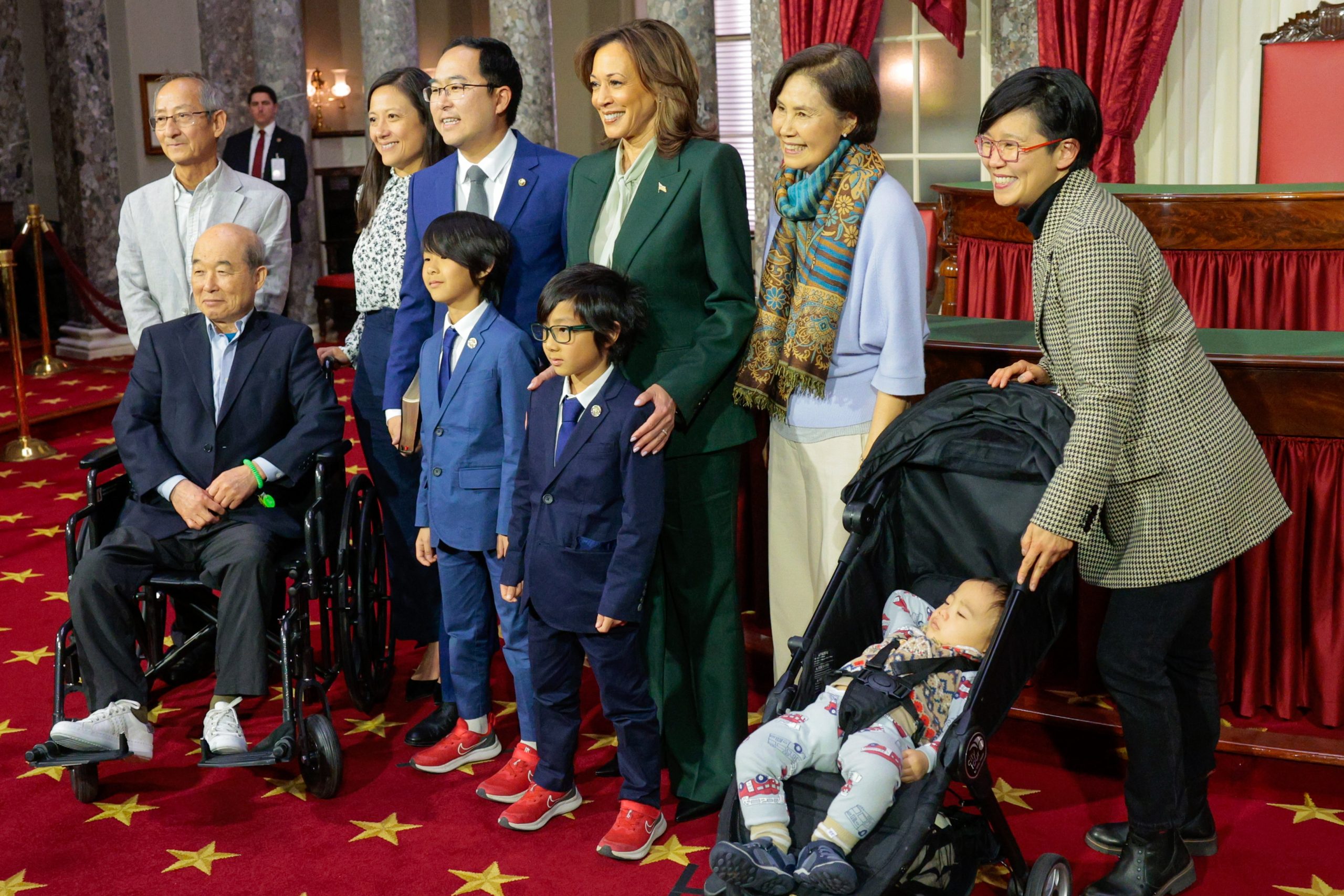
Sen. Andy Kim (D., N.J.) poses with his family and Vice President Kamala Harris after taking the ceremonial oath of office in the old Senate chamber on Jan. 3, 2025, in Washington.Steven M. Falk / Staff Photographer
Houlahan is also the chair of an “economic growth and cost of living” working group within the New Democrat Coalition, a group of self-described centrist Democrats that includes about half of the entire caucus. The group rolled out an “affordability agenda” earlier this year that is considered a framework for how Democrats would tackle housing, healthcare, energy, paid family leave, and much more if they win control of the House.
U.S. Rep. Brad Schneider (D., Ill.), chair of the New Democrat Coalition, credited Houlahan for her leadership with the agenda, describing her as having a “quiet wisdom that focuses on the core of a problem” while bringing her own life experience to the work.
“Everyone’s experience is unique, but her experience shares many of the aspects of what people across the country are facing,” Schneider said. “The sandwich generation, taking care of kids and parents, for whatever circumstance, while at the same time seeing the cost of just everyday living … is putting a burden on families.”
The legislation aims to incentivize housing construction, restrict large investors from buying single-family homes, help families with home repairs, and more. The president reiterated Friday that he would not sign it, allowing the bill to become law without his signature.
In her Capitol Hill office about an hour after Trump canceled that bill signing late last month, Houlahan described the president as “so obtuse that he can’t see in front of him that this is something that the people want.” After spending much of the last year calling out Johnson, the House speaker, for not standing up to Trump, she said there should be “counterinsurgents” and an “uprising” in the Republican Party.
At the same time, she expressed some hope. The housing bill may have been a rare moment of bipartisanship, but it was also a sign that Congress can still act on affordability even before the end of the year, she said.
“We don’t have time, for all of this stuff, to wait until somebody else is in charge,” Houlahan said. “We can do this ourselves.”
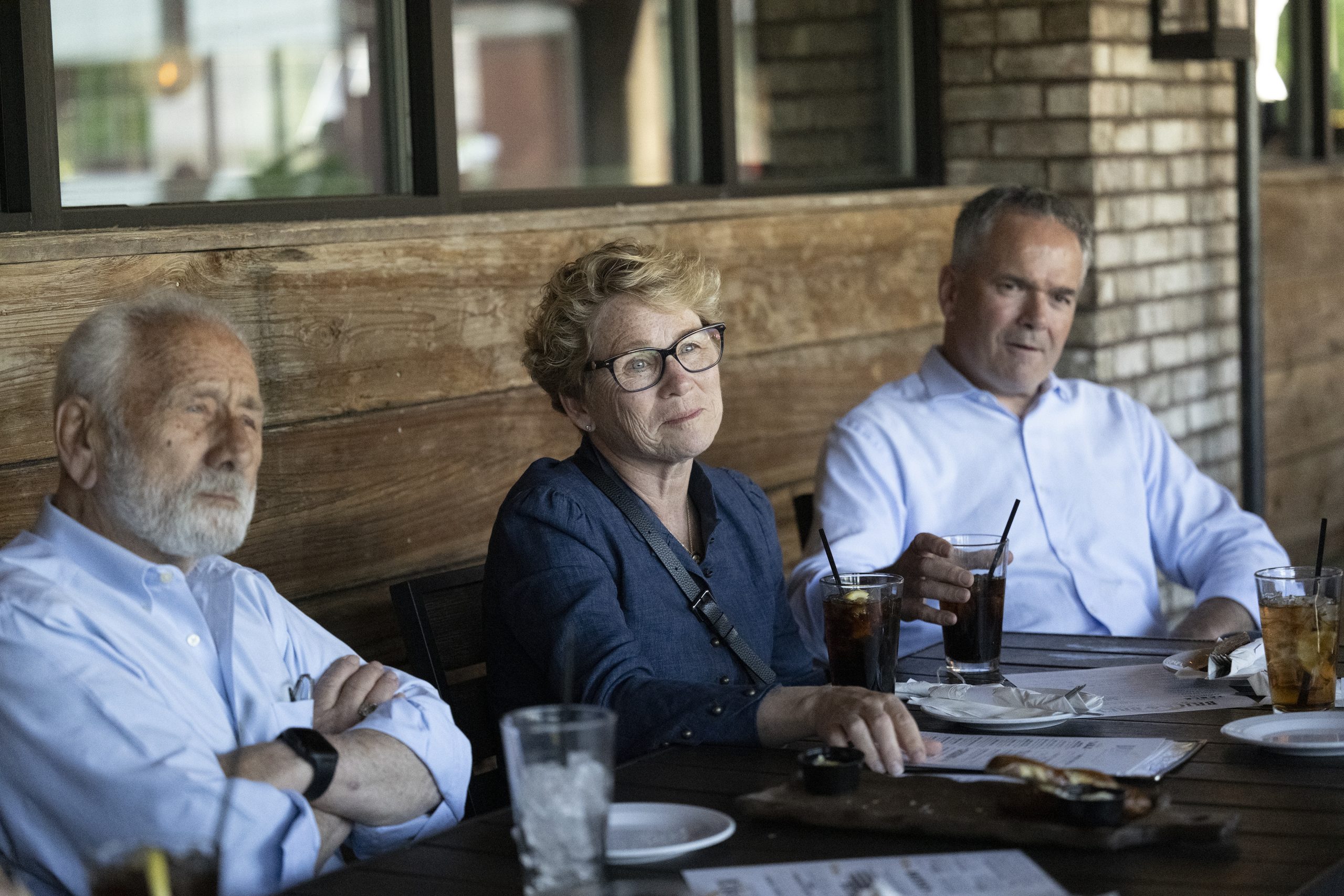
U.S. Rep. Chrissy Houlahan (D., Pa.) sits between her father, Andy Jampoler, and her husband, Bart Houlahan, at Brick & Brew in Malvern. Houlahan’s parents recently moved in with her. Jose F. Moreno / Staff Photographer
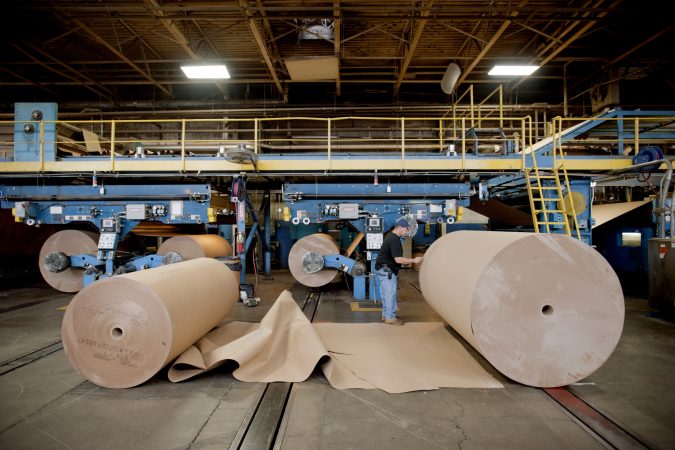
A Tennessee-based packaging company is closing its plant in Barrington, Camden County, laying off 126 employees amid the business’ larger restructuring plan.
Workers at International Paper’s Barrington facility, whoconvert containerboard into boxes, are expected to be laid off on Sept. 24. The site is expected to close at the end of August, company spokesperson Jessica Seidner said.
The closure follows “a strategic assessment” of the Barrington facility, and International Paper’s larger regional footprint, according to a layoff notice filed with the New Jersey Department of Labor and Workforce Development.
“Based on the results of that assessment, and in order to operate our packaging business effectively to support our customer needs now, and in the future, we made the difficult decision to cease operations at our Barrington location,” the notice reads.
International Paper, headquartered in Memphis, was incorporated in 1941. As of December, the company had 62,602 employees — nearly half of which are based in the United States — and roughly 190 packaging mills, as well as converting and packaging plants, and recycling facilities across the country.
The company has several locations in Pennsylvania and New Jersey, including in Kennett Square, Lancaster, Reading, Bellmawr, Thorofare, and Vineland, according to a recent U.S. Securities and Exchange Commission filing.
As part of its restructuring, the company announced this month the closure of four facilities, including the Barrington site, to “focus investments on the highest-value opportunities.” The company announced several more facility closures last year.
“These are difficult but necessary decisions that strengthen our network, focus investments where they create the greatest value and position International Paper to better serve customers and compete for the long term,” Tom Hamic, president for packaging solutions in North America, said in a statement.
In an April earnings call company leaders said the business had recently been facing financial pressure frominflation, the conflict in the Middle-East, and weather disruptions. The business brought in $23.63 billion in net sales last year.
International Paper announced in 2025 that it had acquired DS Smith, a U.K. packaging business, in a deal that was valued at $7.1 billion. Earlier this year, the company announced it would split into two separate businesses: one dedicated to the North American market and another for Europe, Africa, and the Middle East. The process is expected to be complete by the end of 2026 or early 2027, according to a U.S. Securities and Exchange Commission filing.
This Fourth of July will be unlike any in recent memory. As the nation marks its 250th anniversary, Philadelphia and the surrounding region are packed with celebrations — and fireworks displays. From the city and suburbs to South Jersey and the Shore, there are dozens of opportunities to catch a show.
Whether you’re staying in Philadelphia, heading to the suburbs, or spending the holiday down the Shore, here’s where to find Fourth of July fireworks across the region.
Wawa Welcome America: 🕙 July 4, 5 p.m. 📍Christina Aguilera and Philadelphia native Jill Scott headline a concert followed by fireworks, 2600 Benjamin Franklin Parkway, Philadelphia, Pa., 19130, 🌐 july4thphilly.com
Conshohocken Fireworks Display: 🕙 July 3, 9:15 p.m., 📍The fireworks will take place at Sutcliffe Park, but the borough is closing the park and surrounding areas to the public due to the size of the display. (They advise you to watch the show from another vantage point in town.), 🌐 conshohockenpa.gov