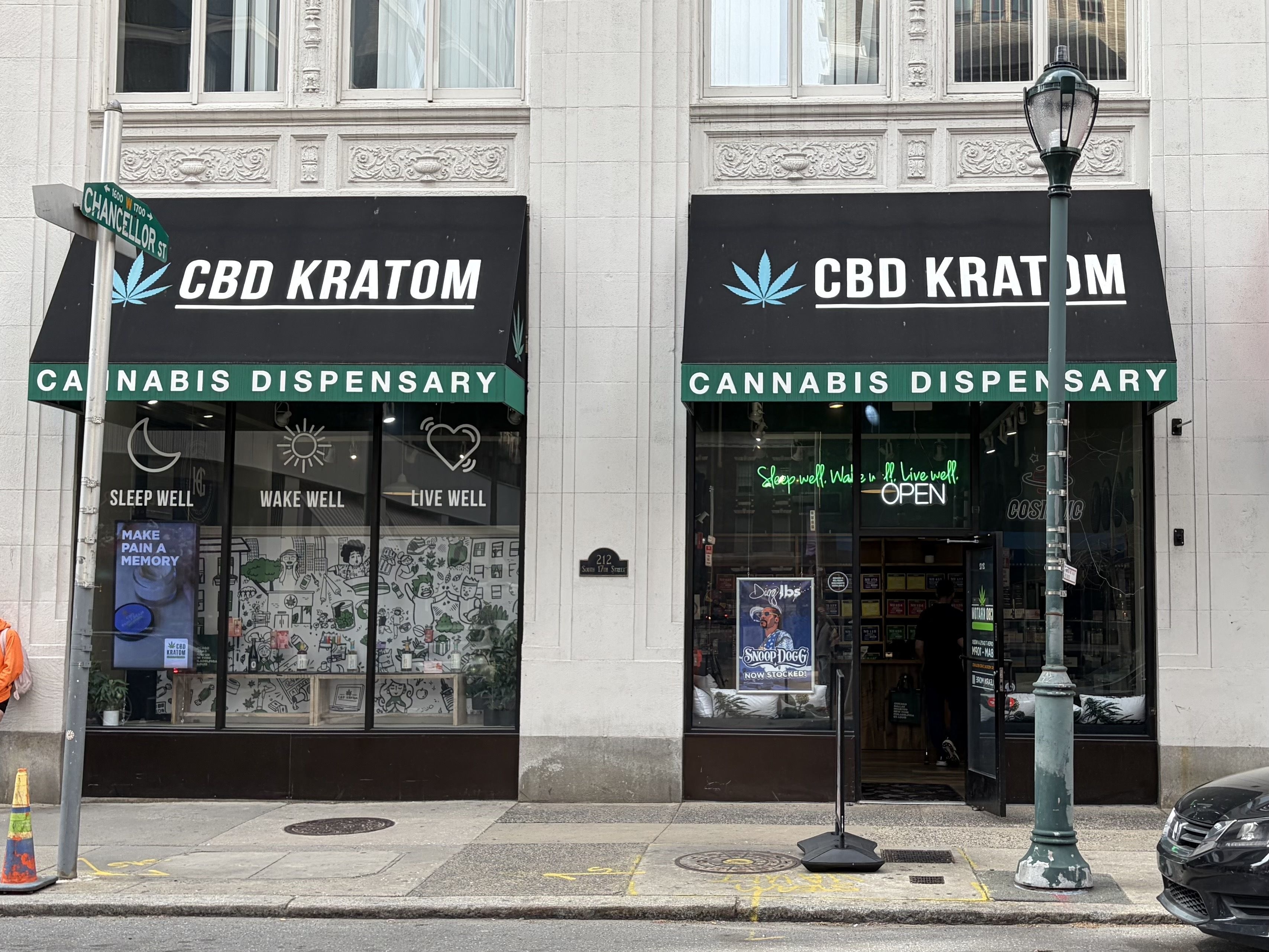
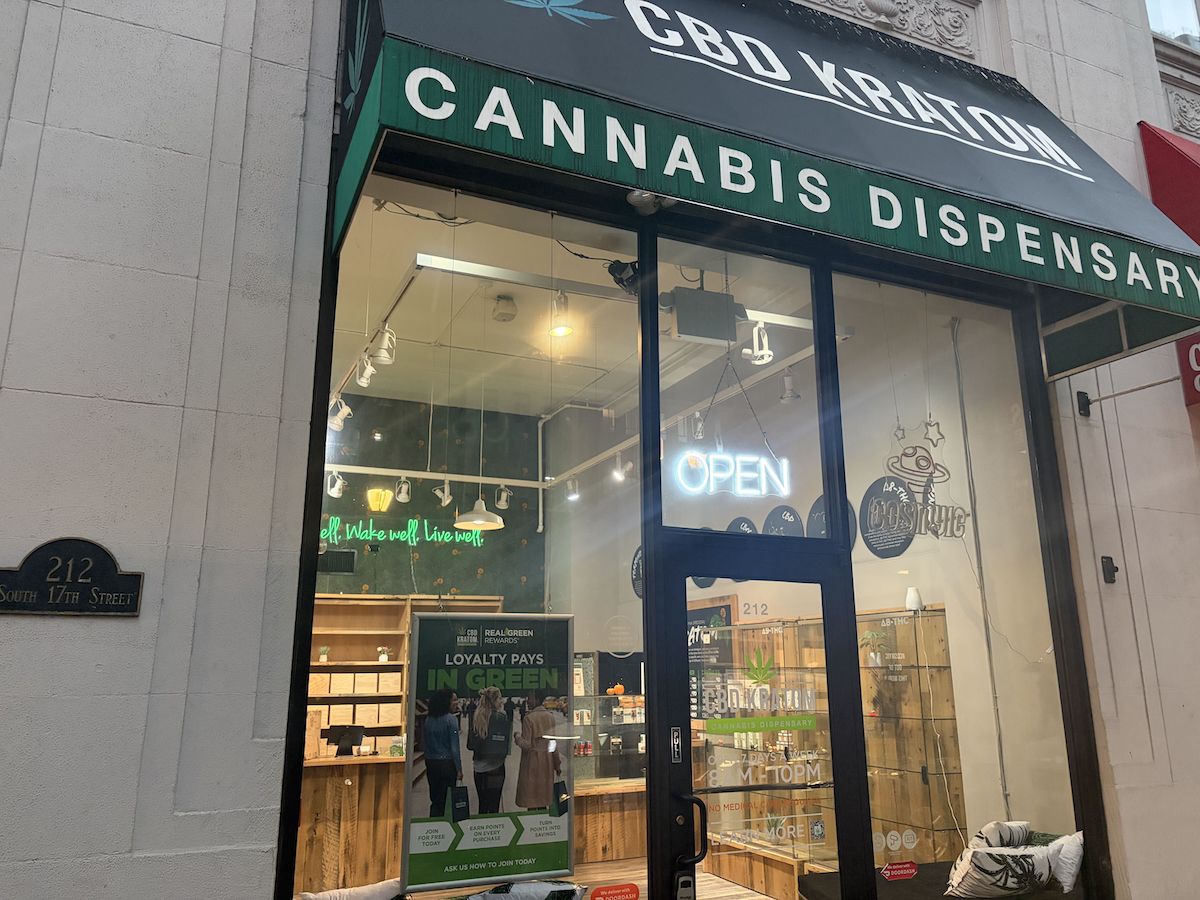
A new Philadelphia ban on kratom and intoxicating hemp products was forced into limbo the day it was slated to go into effect.
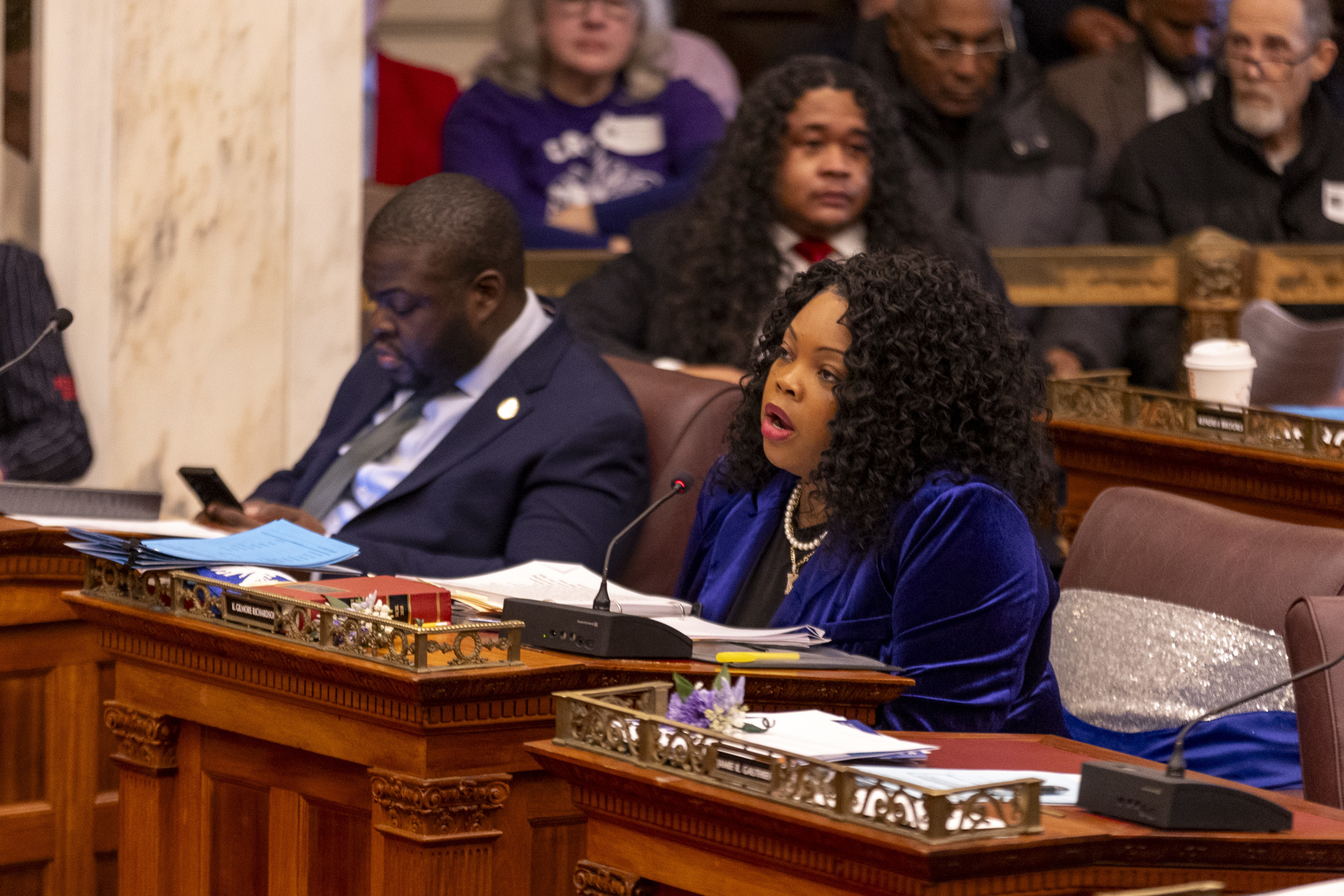
Kratom and other hemp products, commonly sold as gummies, drinks, and smokable flower, are reclassified as “intoxicating products,” with their sale prohibited, under a new law that was introduced by City Councilmember Katherine Gilmore Richardson, was passed by Council earlier this year, and officially kicked in Thursday.
Intoxicating hemp products photographed at the Philadelphia Inquirer, November 21, 2025. Under a 2026 city law, these hemp-THC drinks, kratom, and other intoxicating products will be banned from sale within Philadelphia.Jessica Griffin / Staff Photographer
The lawrequires store owners to get licenses, which do not currently exist, to sell these products. However, since the U.S. Food and Drug Administration has not approved kratom and intoxicating hemp for consumption, the Philadelphia Department of Public Health will not create the license, so “there are no products allowable for sale,” a spokesperson for Gilmore Richardson’s office said.
This would effectively end the market in Philadelphia entirely.
But a kratom seller and an industrygroupfiled a lawsuit Tuesday asking a Philadelphia Common Pleas Court judge to pause the enforcement of the ordinance, saying it would force businesses to close and kill jobs.
The ordinance fails to distinguish between “conscientious, law-abiding retailers” and “the bad actors who sell dangerous products to anyone willing to pay,” the suit says. And instead of regulating kratom sellers to prevent harm, the complaint says, Philadelphia passed a ban that “destroys a lawful industry.”
Pennsylvania Healthy Alternatives Association, a nonprofit organization advocating for hemp and kratom sellers, and CBD Kratom, a St. Louis-based retailer with three stores in Philadelphia, filed the lawsuit against Mayor Cherelle L. Parker and thePhiladelphia Department of Licenses and Inspections’ co-commissioners.
Judge Brian R. Kisielewski had scheduled a hearing to consider the injunction request for Thursday afternoon. But the city moved the lawsuit to federal court 40 minutes before the hearing was set to begin.
The case is better suited for federal court because the kratom sellers claim the city’s ordinance violates the U.S. Constitution, city attorneys said in a court filing.
Removal of cases to federal court is common, but the eleventh-hour change seemed to irk Kisielewski, who said he had spent his Wednesday preparing for the hearing.
“I wish they provided you or myself notice,” he told the retailers’ lawyers before sending them home.
Stores are now in limbo, Craig Katz, president of the Pennsylvania Health Alternatives Association and a member of CBD Kratom’s management, said after the quick adjournment.
“We have several stores now that we are hoping to get some kind of answer as to whether they can stay in business and sell products after today,” Katz said. “And now we don’t have an answer to that.”
The lawsuit does not change the status of law and the ban remains in effect, said Gilmore Richardson.
The city did not immediately respond to a request for comment.
Nearly all of the shelves of Center City’s CBD Kratom store sat empty on Thursday, Nov. 12, 2026, the first day of enforcement of the city’s new kratom and intoxicating hemp ban.Abraham Gutman / Staff
The federal hemp ban, originally set to take effect Thursday but delayed to Dec. 11, will only allow the sale of hemp-based products, like CBD, with up to 0.4 milligrams of THC in a single container.
Philly’s ban on intoxicating hemp and kratom products without FDA approval was slated to start Thursday. Whether the health department started enforcement was unclear.
Aside from Epidiolex, a prescribed form of CBD for treating seizures, the FDA has not approved any hemp or kratom products for human consumption.
Stores caught selling these products can face a $2,000-per-day fine from the Philadelphia Department of Public Health.
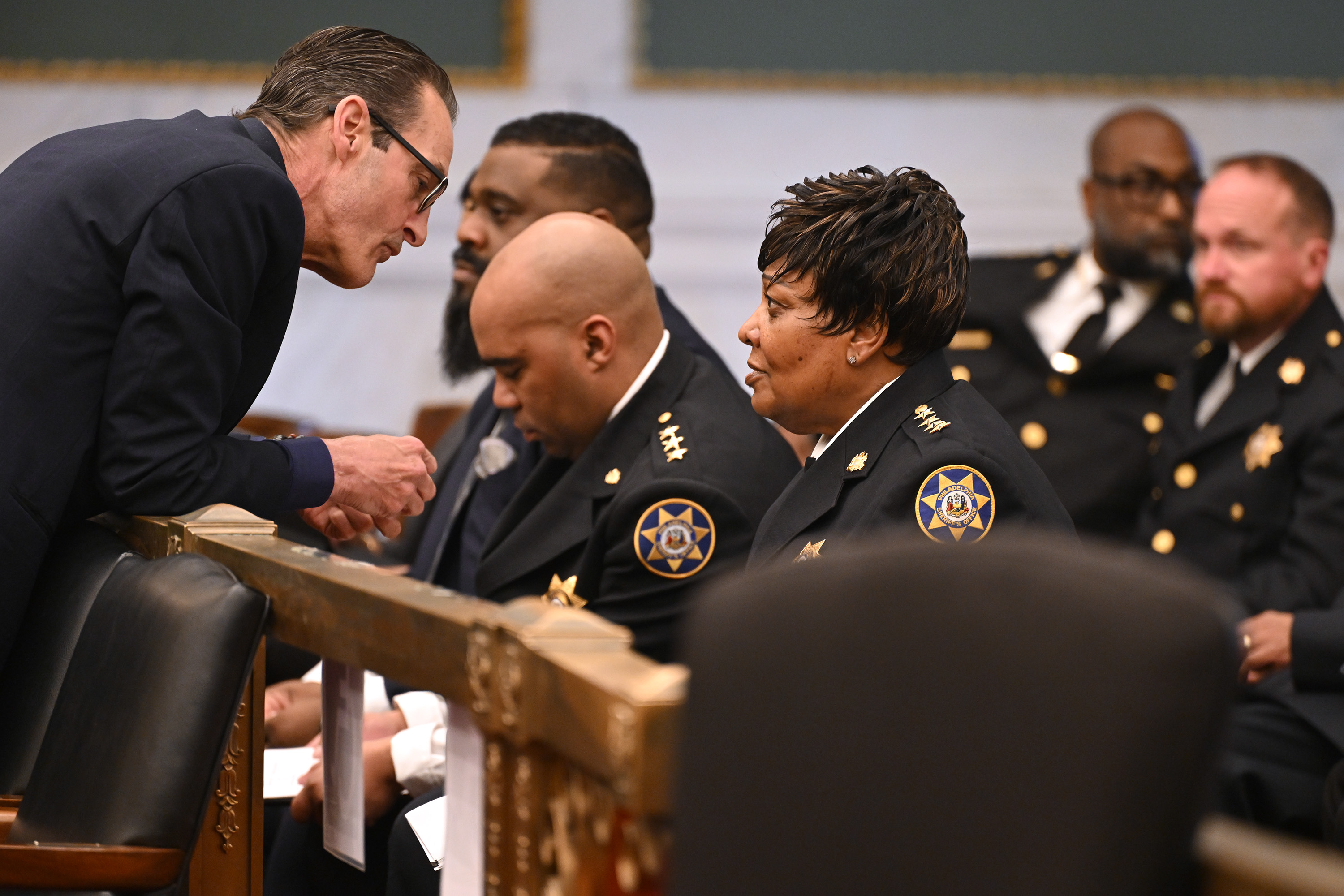
Philadelphia City Council announced Thursday that it would hold hearings to examine recurring problems in the sheriff’s office, which under Rochelle Bilal has failed to properly auction off real estate, mismanaged millions of dollars in sales proceeds, and caused delays in criminal trials due to insufficient courthouse security.
The resolution to authorize the hearings was introduced by Council Majority Leader Katherine Gilmore Richardson on behalf of Council President Kenyatta Johnson.
It calls for hearings to “examine the operations and policies of the Philadelphia Sheriff’s Office and restore public confidence in the office by providing recommendations to improve transparency, accountability, efficiency, and public safety.”
Johnson said Bilal would be required to testify in person at the hearings. Court officials and other stakeholders are also expected to appear.
The proposed hearing is the latest instance of Bilal’s stewardship being called into question. Last month, Common Pleas Court Judge Paula Patrick threatened to hold the sheriff’s office in contempt following three court hearings examining how the office auctions off foreclosed and tax-delinquent properties. Her ruling is pending.
Under Bilal, who took office in 2020, some bidders at sheriff sales have waited a year or longer to receive deeds following the auctions, and a Bilal aide told Patrick in September that an internal audit had recently found $20 million in sales proceeds that had not been disbursed, including delinquent taxes and utility revenue that should have gone back to taxpayers.
But in a statement Thursday, Johnson said: “The people of Philadelphia deserve to know that taxpayer dollars are properly accounted for, that real estate transactions are handled in a timely and transparent manner, and that our courtrooms are safe. When questions arise about missing or delayed payments, unfulfilled agreements, staffing shortages, and the overall operations of a public office, City Council has a responsibility to examine what is happening and determine what needs to change.”
Bilal’s spokesperson, Teresa Lundy, said in a statement that the sheriff’s office would cooperate in the hearings.
“We remain committed to transparency and accountability and look forward to presenting our progress, the challenges we face, and the resources needed to fulfill our duties,” Lundy said. “Protecting our courts, staff, and the public remains our priority.”
The resolution does not mention the sheriff sales specifically, but calls for a “comprehensive analysis of current operations.”
It also notes that, according to Philadelphia judges, the sheriff’s office has “failed to provide for a safe environment in the courts and caused delays and postponements of criminal proceedings during critical moments in trials.”
Bilal was hit with two court orders in 2024 and 2025 following Inquirer reports on a threefold increase in courthouse security incidents on her watch. Judges at the time described the situation as an “emergency” and a “disaster waiting to happen.”
At the time, the sheriff’s campaign committee, Friends of Rochelle Bilal, responded with a fundraising email that blamed the judges for the problems and cited a 2020 report into nepotism and a racist work culture in city courthouses.
“The very people demanding more security protection are the ones creating the hostile environment in the first place,” the email stated.
As in many law enforcement agencies, deputy staffing dropped in the aftermath of the pandemic, dipping to a low of 264 in 2024 from 338 in 2019.
Bilal has consistently sought double-digit budget increases from City Council to plug these gaps but has more than one hundred budgeted positions that have not been filled. She has pointed to barriers posed by civil service hiring rules, lengthy training timelines for sworn officers, and a distant sheriff’s academy.
Council has refused the requests for multimillion-dollar funding increases. Despite this, hiring increased starting in late 2024, and the office now employs nearly as many deputies as before Bilal took office, payroll records show.
Even so, Thursday’s resolution notes that the sheriff’s office “claims it lacks the personnel to properly staff courtrooms and common areas inside city court facilities, yet it has many positions budgeted for but unfulfilled each year, including 62 vacancies as of June 2026.”
Meanwhile, Bilal doubled the number of employees who are not bound by civil service hiring rules, hiring dozens of “sheriff sale service representatives” to address deed processing that had slowed to a glacial pace.
During the public comment portion of Thursday’s meeting, Andrew McGinley, a vice president of the Philadelphia good-government group Committee of Seventy, thanked Johnson for calling for hearings and offered his group’s assistance.
“As I think all of you know, we have done extensive research on this topic, detailing 40 years of mismanagement in that office,” McGinley said.
Wanda Walker, a community advocate, defended Bilal, saying “if you didn’t find the money in her mattress, in her house, or in her bank account, she’s not stealing money.”
Walker also credited Bilal for “helping us save generational wealth, slowing down the gentrification, teaching people how to stay in their homes, and helping us fight.”
In an interview after the vote, Johnson said he is “good friends” with Bilal.
“At the end of the day, this was about me still doing my job,” Johnson said, “around making sure we’re being responsible for the taxpayer dollars and making sure we work with a level of transparency and accountability, but also the overall efficiency of how the office operates.”
Staff writer Jillian Kramer contributed to this article.
Entire walls of retail shelves in Philadelphia vape shops, once marketing colorful, fruit-flavored nicotine products, sat empty the first week of Pennsylvania’s new vape ban.
Pointing to the swaths of bare countertops — many of which were the central marketing displays at stores — shop owners and managers on South Street, many of whomwere not authorized to speak on behalf of the store or feared scrutiny from inspectors,said they are facing the possibility of closure.
One manager of a South Street convenience store that used to sell a wide variety of vapes said nicotine products make up 30% of their business. For stores that can’t fall back on convenience and grocery items to sell, many will likely close, he said.
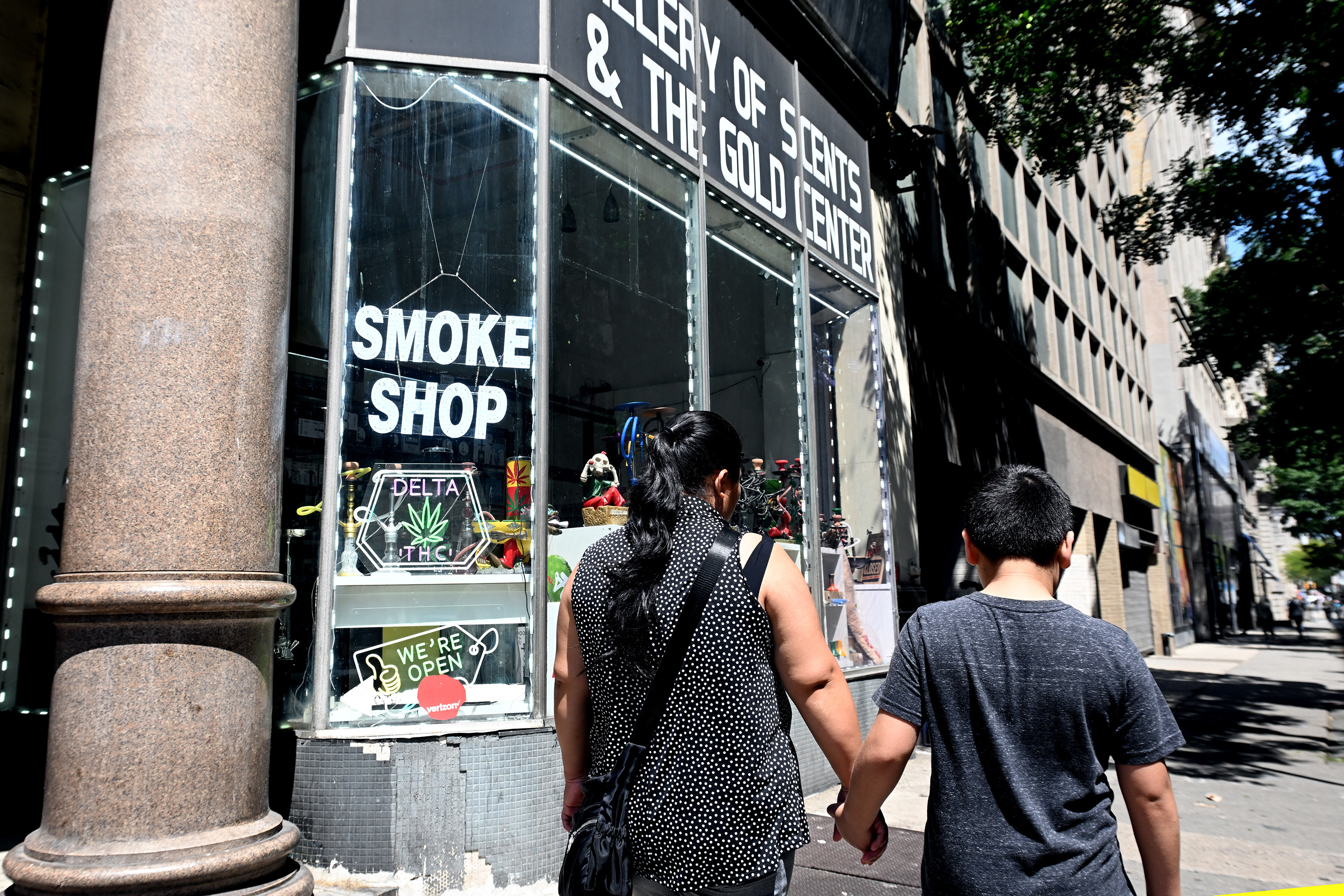
The South Street Smoke Shop is shown on Thursday, Oct. 22, 2026, in Philadelphia. Electronic disposable vaporizers are largely banned in Pennsylvania, with a few exceptions, prompting vape shop owners to warn that the restrictions could devastate their businesses or force them to close.Jose F. Moreno / Staff Photographer
The manager at South Street Smoke Shop on Eighth Street said that he spent half his shift the day before Oct. 19 — when vape ban enforcement began — removing thousands of dollars worth of product from retail shelves. Another store manager said disposable vapes and their associated products are “the majority of our business,” she said. “This is unprecedented.”
Under a new law, signed by Gov. Josh Shapiro last year, six companies are approved to manufacture, distribute, and sell electronic nicotine products in Pennsylvania. Any product not approved in the electronic nicotine delivery system directory is now banned from sale, including popular brands like Cali, Geek Bar, and Puff Bar.
Philadelphia has also taken steps to heavily restrict where vape stores can open. City Councilmember Katherine Gilmore Richardson introduced legislation earlier this month that would adjust the city’s zoning code to prohibit any businesses selling tobacco and nicotine products from opening within 750 feet of a school, daycare, park, or an existing store that sells nicotine products. Richardson said this would effectively ban new stores from opening in most of Philadelphia.
The vape store boom
The vape industry and retail vape stores have seen exponential growth in the last decade, expanding from a $3.5 billion industry in 2015 to a more than $40 billion a decade later. Market analysts have projected the industry to grow by double digitsinto the 2030s.
This growing market also serves a customer base in which 60% to 80% of consumers prefer to buy products in stores.
The low entry barrier and higher-margin appeal of opening a vape store in a bustling retail district moves some entrepreneurs to make the jump, said Steven Gartner, executive vice president of CBRE’s global retail platform.
“Most of these stores are start-up businesses. The ability to get merchandise is relatively easy, and you don’t need to be part of a brand conglomerate. They’re small; someone can open one with 1,000 feet of retail space,” Gartner said.
Another factor at play is that storefront landlords aren’t always discerning about the mix of businesses in a retail district in the way business leaders might. “Landlords may own one or two buildings on a block, and they don’t really care about the mix of businesses — they care about renting their vacant store and getting rent,” Gartner said.
Especially so during the COVID-19 pandemic and in its wake, as property owners looked for tenants to fill vacant storefronts. This is often why in places like South Street, there can be a vape store each block for several streets in a row.
Retail strips with an abundance of vape stores such as South Street are open to new businesses, said Eleanor Ingersoll, executive director of South Street Headhouse District, the nonprofit that manages the neighborhood business district.
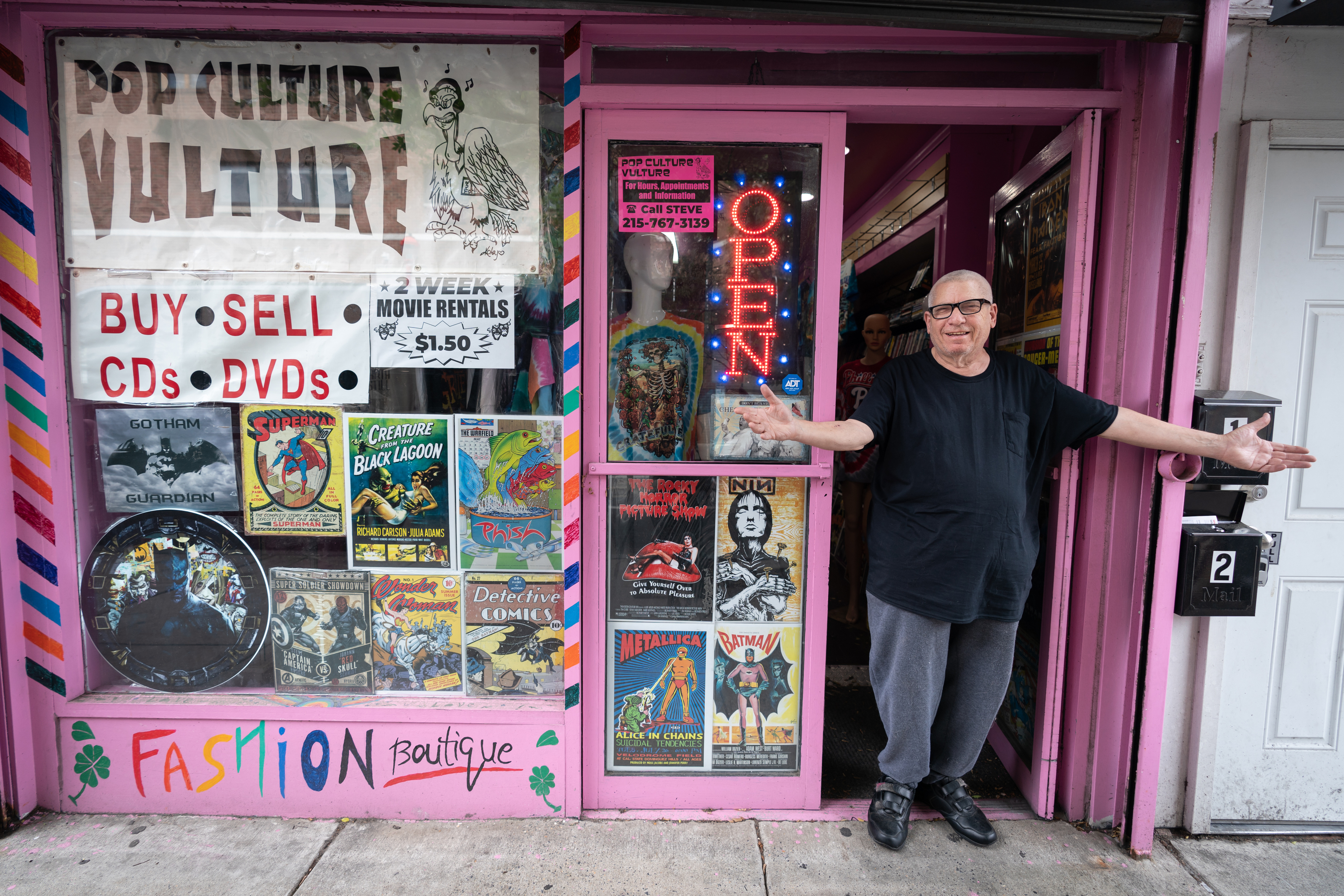
Steve Brasovankin, owner of Pop Culture Vulture, at his then newly opened store on the 200 block of South Street in Philadelphia, June 6, 2024. As vape and smoke shops navigate financial turmoil amid a new 2026 vape ban, business improvement districts hope to see bars, restaurants, and niche retail experiences take their place.Jessica Griffin / Staff Photographer
“The only thing constant about South Street is change. The role that smoke shops and vape stores play in the district is a matter of great proliferation in a very short amount of time,” Ingersoll said. “There is the argument that they occupy space that could go to more diverse business concepts. We would love to see more bars, restaurants, art galleries, and niche experience entrepreneurship.”
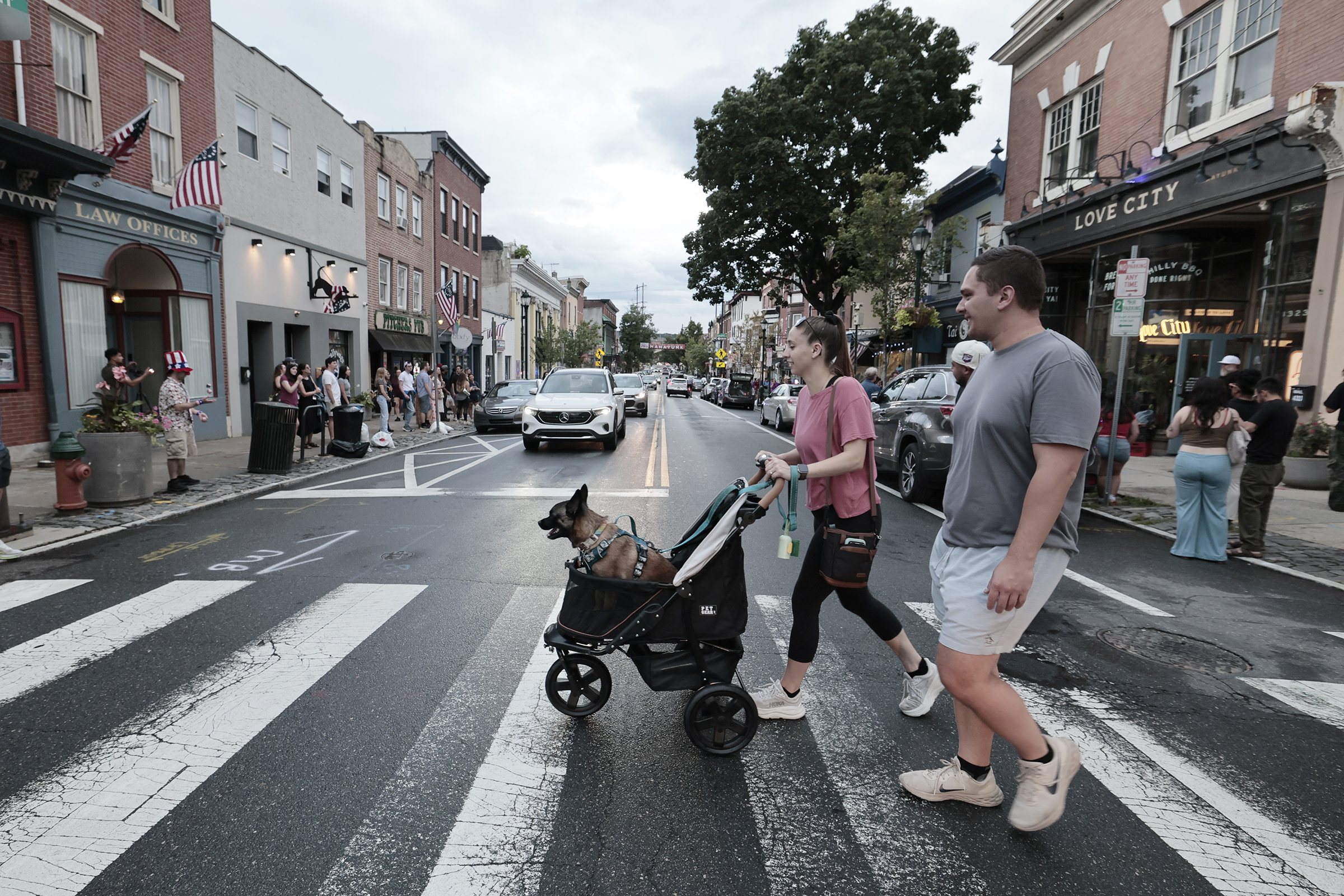
Kim Albanowski pushes her dog “Koda” across Main street in “his chariot” as Jason Pepin looks on, during the Stroll After Hours event in Manayunk in July.Elizabeth Robertson / Staff Photographer
Gwen McCauley, director of Manayunk’s business improvement district, which includes at least three vape stores along Main Street, echoed South Street’s desire to see “neighborhood-serving businesses that contribute to the vibrancy” of a neighborhood.
“Over the last 10 years, Manayunk is seeing a growing number of young families moving here,” McCauley said. “We want our businesses to reflect and support that demographic.”
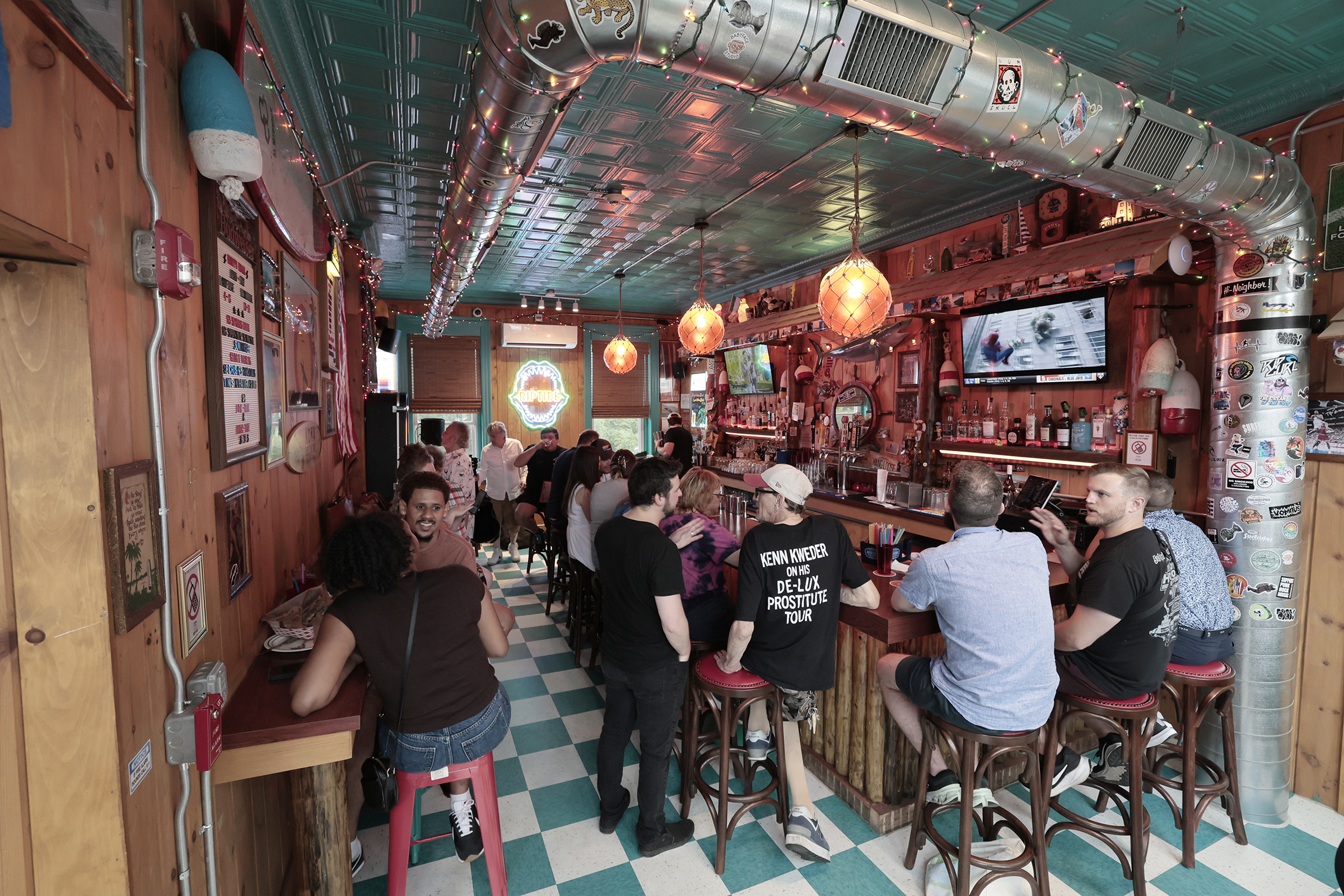
A crowd gathers at Riptide Tavern in Manayunk back in July.Elizabeth Robertson / Staff Photographer
City smoke shop on the 1000 block of Chestnut Street in July 2025. All 10 samples of “legal” weed The Inquirer purchased from stores in the city and suburbs tested over the federal limit for the ingredient that gets users high. Tom Gralish / Staff Photographer
But vape stores likely won’t be an extinction-level event.
In other states that passed similar restrictions, like Massachusetts in 2019, vape stores didn’t close en masse. Instead, dramatically fewer vape stores entered the market after the state banned flavored tobacco products, with a 50% drop in the number of licenses issued for new tobacco stores, according to a 2023 UC San Diego study.
More telling is a study published in September that looks into the effect e-cigarette directory laws, like Pennsylvania’s, have on the sales of nicotine products. Researchers found that across three states, Alabama, Oklahoma, and Louisiana, there were no lasting declines in sales of vape products. In Louisiana, where sales initially declined, they rebounded within eight months.
Like other states, Pennsylvania will likely not see an exodus of vape stores, but these small businesses will navigate a monthslong transition to stay afloat — and new entrepreneurs will certainly be wary of entering the retail space.
Gartner believes this is where the market will decide whether customers flock to other states, online stores, or continue to patronize local retail.
“There could be an inevitable shakeout, or there is enough business to sustain them all,” Gartner said.
But the same lawmakers who batted down that plan are now poised to consider another $1-per-ride tax. This time, it would be only for rides in cars without human drivers.
Councilmember Jim Harrity, a Democrat who represents the city at-large and opposed the rideshare tax in the spring, on Thursday introduced legislation in Council to tax services performed by autonomous vehicles, such as driverless rideshare cars and sidewalk delivery robots.
Harrity, an ally of organized labor, said that the measure is aimed at protecting jobs, and that he hopes it will deter Philadelphians from relying on autonomous vehicles entirely.
“Now my neighbors are going to lose their second jobs to robots,” Harrity said Thursday. “It’s not fair.”
Also on Thursday, Council members expressed public skepticism about one of Parker’s signature initiatives. Lawmakers approved legislation authorizing the body to investigate whether the administration has delayed spending money that Council authorized to fund the mayor’s massive Housing Opportunities Made Easy, or H.O.M.E., program.
What was today’s highlight?
Tax the robots?: Harrity framed his proposal as something of an opening salvo in what he hopes becomes a broader fight against the proliferation of autonomous vehicles in the city.
He said that he is open to other solutions to preserve jobs as members consider his legislation, and that he could not estimate how much revenue his tax proposal would generate.
“In a perfect world,” he said, “no one will pay the tax because they’ll just ban the robots.”
Councilmember Jim Harrity questions a Parker administration official about the city budget in October 2025.Tom Gralish / Staff Photographer
Harrity’s legislation would levy a $1-per-ride fee — or 5% of the cost of the trip, whichever sum is greater — on companies that operate driverless taxi services. The most prominent is Waymo, which is currently testing driverless cars in Philadelphia.
The bill would also impose a fee of either 50 cents per delivery or 5% of the total cost on deliveries done by sidewalk robots, as well as a 3% tax on driverless freight vehicles that drive on city streets.
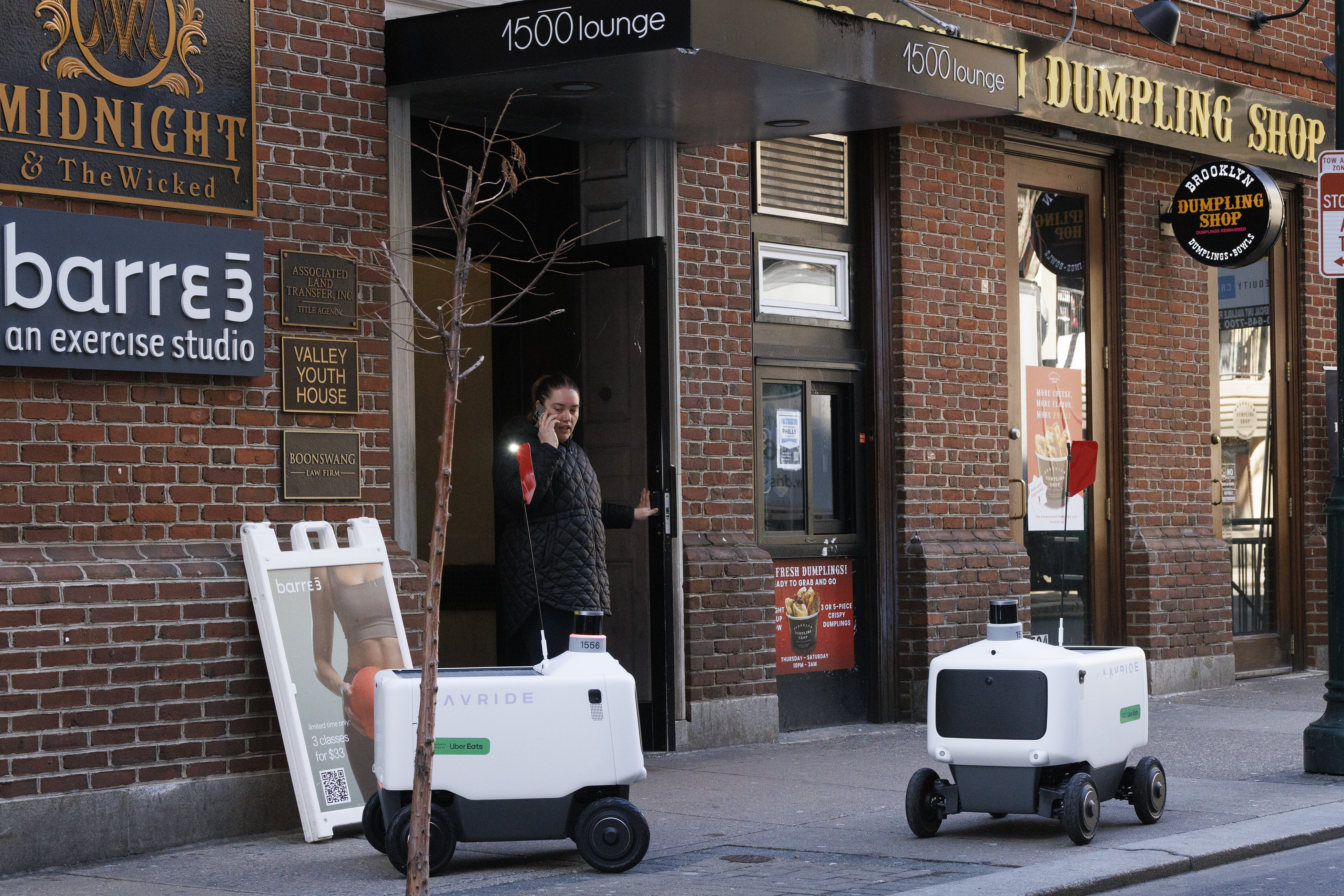
The tax would also apply to orders of food and other goods that are delivered by robots. Customers who order deliveries through platforms such as Uber Eats may have at times received their food from a sidewalk robot; however, those machines are operated by the third-party company Avride, not Uber itself.
Uber Eats robot food delivery pods on sidewalk along 1500 Sansom Street on Tuesday morning March 17, 2026. One robot was present (right) when a second arrived.Alejandro A. Alvarez / Staff Photographer
Under the proposed legislation, which would take effect in January 2028, companies that operate autonomous vehicles in Philadelphia would be required to register with the city and file quarterly reports on services performed.
The tax would not apply to businesses that use automation for internal purposes.
Waymo did not respond to a request for comment. An Uber representative declined to comment.
What else happened this week?
Investigating H.O.M.E. finances: City Councilmember Kendra Brooks, a member of the progressive Working Families Party who has not been quiet about her policy differences with Parker, introduced the legislation Thursday to probe the mayor’s massive housing plan.
But she did so with the support of several more establishment-aligned members. And the hearing will be held in Council’s powerful Finance Committee, which is led by Democratic Majority Leader Katherine Gilmore Richardson.
That suggests that Council’s leadership is aligned with Brooks. She said Thursday that she was dismayed by a report released this week by the city’s fiscal watchdog, which said that the Parker administration had spent only $38 million of the $278 million it was budgeted for the first phase of the H.O.M.E. initiative.
Brooks’ resolution cites “delays in spending [that] impact Philadelphians who would benefit from housing programs and support, as well as erode the value of money authorized by City Council.”
“We’re talking about getting the program right that will spend nearly a billion dollars, and that all of the Council was told was urgent to approve,” Brooks said in remarks during Thursday’s meeting.
City Councilmember Kendra Brooks in City Council chambers on Thursday, Sept. 17, 2026.Tom Gralish / Staff Photographer
A Parker administration official said Monday that the H.O.M.E. programs are on pace to use their full budgets.
A hearing has not yet been scheduled.
Putting a stop to automatic renewals: Council will consider legislation that would make it illegal for any company doing business in Philadelphia from automatically renewing subscription services and memberships without the customer’s explicit OK.
The bill, introduced Thursday by Councilmember Rue Landau, is part of the Democratic at-large member’s broader agenda to crack down on so-called junk fees and implement new consumer protection measures. This effort would aim to prevent businesses from charging customers for services they don’t want simply because they did not take action to cancel.
City Council member Rue Landau, speaks at a rally outside the Academy of Natural Sciences of Drexel University on Tuesday, Sept. 8, 2026, in Philadelphia, Pa.Tyger Williams / Staff Photographer
Under the ordinance, known as the “Click-to-Cancel” legislation, businesses would be required to remind customers who are enrolled in services that automatically renew, and they would have to give notice if a free trial converts to a paid plan.
“At a time when so many Philadelphia families are watching every dollar, we should be protecting people’s hard-earned money,” Landau said, “not allowing bad actors to take advantage of them.”
Quote of the week
Councilmember Nicolas O’Rourke, speaks during a City Council hearing on Wednesday, Oct. 28, 2026.Jose F. Moreno / Staff Photographer
That was Councilmember Nicolas O’Rourke, who delivered remarks in support of Harrity’s legislation to tax services that rely on autonomous vehicles.
Next on Council’s agenda: subsidizing the milkman?
Philadelphia City Council wants to dramatically restrict where new stores that sell tobacco or vaping products can be located in the city, the latest attempt by the legislative body to rein in smoke shops.
Democratic Majority Leader Katherine Gilmore Richardson on Thursday introduced legislation that would adjust the city’s zoning code to prohibit any businesses selling tobacco from opening in much of the city. It would ban them from locating within 750 feet of a school, a daycare, a park, or an existing store that sells nicotine products.
Asked whether that would effectively ban new stores from opening in most of Philadelphia, Gilmore Richardson said: “Bingo.”
The new zoning definition would apply to any store that sells tobacco or vaping products, meaning it could also encompass new gas stations, groceries, and corner stores. Existing stores that sell nicotine products would not be affected by the legislation.
“We are hopeful that this piece of legislation will be the one that will make the difference for our communities,” Gilmore Richardson saidWednesday during a news conference.
Gilmore Richardson said she has not heard from a single Council member who opposes her legislation, and wants members to pass the measure before the end of the year. The bill is her 10th piece of legislation aimed at regulating smoke shops in the city.
The effort comes as the state is already significantly limiting vape sales in the state. Starting next week, Pennsylvania stores may sell only electronic nicotine products that are manufactured by six companies.
Also this week: Council passed a long-delayed bill to establish a bike lane around City Hall, and members honored Officer Shane Seiber, who was fatally shot in the line of duty on Saturday.
What was this week’s highlight?
Smoking ’em out: Currently, smoke shops that open in the city are classified as retail businesses under the zoning code, allowing them to locate in most areas that are zoned to allow commercial sales.
But under Gilmore Richardson’s legislation, such shops would fall under a new use definition specifically for stores that sell tobacco, nicotine, or vaping products.
“With its own new definition,” she said, “new smoke shops would no longer be treated like any other retail business.”
Shops that sell nicotine products will be able to open only in areas covered by the most flexible zoning rules — predominantly focused in Center City and University City — or in areas zoned for auto-oriented commercial uses like shopping centers.
City Councilmember Katherine Gilmore Richardson in Council Chambers Thursday Oct. 8, 2026.Tom Gralish / Staff Photographer
On commercial corridors, stores selling nicotine products will be slightly less restricted and will only have to get a “special exception,” which requires a trip to the Philadelphia Zoning Board of Adjustment (ZBA), where they are almost always approved.
To open such a store in the rest of the city would require a variance, which is subject to greater scrutiny by the zoning board.
However, the wait times at the ZBA are so long that small businesses subjected to either requirement often struggle to afford the delays.
Gilmore Richardson’s latest legislation is squarely focused on tobacco and vape sales. It comes as part of a yearslong effort by Council to crack down on nuisance businesses and smoke shops, some of which hawk unregulated drugs with little oversight.
The Council member has cited Inquirer reporting in introducing pieces of legislation that have added layers of permitting and oversight for smoke shops, including implementing new age restrictions and penalizing landlords who rent space to illegal stores.
District members have also instituted business curfews in their jurisdictions, partly in an effort to crack down on smoke shops.
Councilmember Curtis Jones Jr., who represents parts of West Philadelphia, introduced such a restriction on Thursday, covering North 54th Street between Arlington Street and Montgomery Avenue, and instituting a curfew from 11 p.m. to 6 a.m.
What else happened this week?
Honoring Officer Seiber: Council President Kenyatta Johnson kicked off Thursday’s session by holding a moment of silence for Seiber, the Philadelphia police officer fatally shot in West Philadelphia on Saturday.
“We extend our deepest condolences to Officer Seiber’s wife, children, family, friends, and fellow officers during this heartbreaking time,” Johnson said. “May his memory live on, and may his family find strength and comfort in our city’s support.”
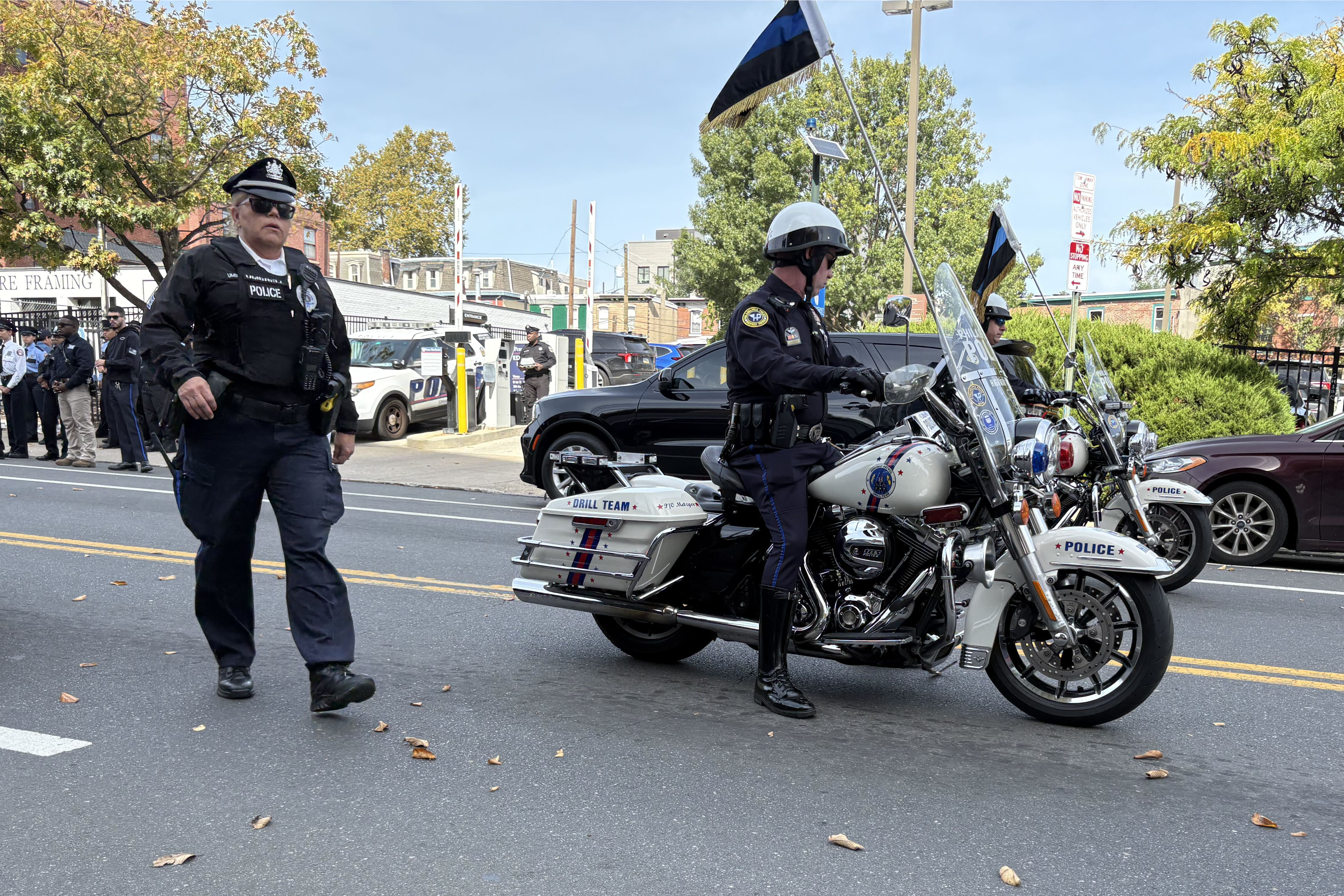
Motor police lining up for a procession for officer Shane Seiber, killed in an overnight shooting in West Philadelphia on Saturday, Oct. 10, 2026.Brett Sholtis / Sta
Prayers up: POWER Interfaith, a progressive coalition of religious leaders, this week called on Council to adopt a three-pronged “We Make Philly” agenda to contain costs for working families and raise revenue.
“Every food giveaway line in this city is long right now,” the Rev. Cean R. James, senior pastor of Salt and Light Church in West Philadelphia, said at a rally Tuesday. “There is not a clergy person with me today who is not weekly receiving requests from members for assistance.”
First, POWER wants Council to raise the real estate tax homestead exemption, which currently reduces the assessed value of owner-occupied properties by $100,000 and saves taxpayers up to $1,399 per year.
Second, the group renewed calls for a city “wealth tax,” which would be a 0.4% levy on the value of certain investment holdings like stocks and bonds. Councilmember Kendra Brooks proposed a similar measure in 2022, but the bill lacked support and never got a committee hearing.
Third, the group called for a five-year freeze on gas bills. Council cannot control gas bills, which are set by the Philadelphia Gas Works, but POWER asked lawmakers to pressure the utility, which is owned by the city, to enact a freeze.
Johnson said that idea could be a way to address the “affordability crisis around utilities.”
“But obviously,” he said, “we have to sit down with chair of the PGW board and the members and see what can actually be done when it comes to helping individuals who are having a hard time.”
A City Hall bike lane, at long last: The bike lane around Philadelphia City Hall is just a mayoral signature away from becoming permanent.
Councilman Jeffery Young Jr. during a community meeting hosted by his office at the MLK Recreation Center in Philadelphia on Tuesday, September 15, 2026.Elizabeth Robertson / Staff Photographer
New crime lab gets final green light: Council on Thursday also approved legislation authorizing the city to issue $40 million in bonds to finance the police department’s new forensics lab in University City, a project that has been in the works for more than five years.
The lab at 4101 Market St., which will cost about $90 million in total, is already under construction and could open as early as next year, according to Mayor Cherelle L. Parker’s administration.
Police have said a new, state-of-the-art crime lab to replace the force’s outdated space in North Philadelphia will allow investigators to solve more crimes and more quickly process evidence like guns, drugs, and DNA.
Quote of the week
Mario Zucca wins the first Parallel Parking Championship at Headhouse Square on Saturday.Bastiaan Slabbers/ For the Inquirer
That was Mario Zucca, aka “One-Shot Mar,” who won Philadelphia’s first parallel parking championship earlier this month and was honored with a resolution Thursday. While greeting Council members, Zucca clutched his trophy, which is topped, fittingly, with a chunk of concrete curb.
Staff writer Ryan Briggs contributed to this article.
But for City Council, which has the power to initiate such a change, eliminating the antiquated sheriff’s office is not on the agenda.
The Inquirer attempted to contact all 17 Council members last week, and five said they opposed or were skeptical of proposals to eliminate the sheriff’s office — a long-troubled holdover from before Philadelphia’s city and county governments merged in 1854. Themodern iteration of theoffice has limited law enforcement powers but controls the flow of vast sums of city money.
Six Council members acknowledged they may be open to a conversation about abolishing the office at some point — and some said that the missing money was a sign the office’s internal changes are not working. Six declined to comment or did not respond to inquiries.
And though all the Council members who responded to The Inquirer expressed dismay over the recently located $20 million, as the city’s schools and other agencies are in desperate need of funds, none clearly stated they were in favor of eliminating the sheriff’s office.
Most important, Council President Kenyatta Johnson — a staunch supporter of Bilal and who controls the flow of city legislation — objected to the notion that the sheriff’s office should be abolished with its tasks folded into other branches of government, as has been proposed by the good-government group Committee of Seventy and a state oversight board, the Pennsylvania Intergovernmental Cooperation Authority.
“It’s an independent body, and so right off the top, I know I don’t support abolishing it,” Johnson told reporters last week. “But it probably is due for some reforms to make sure that particular office operates in a more efficient and transparent manner.”
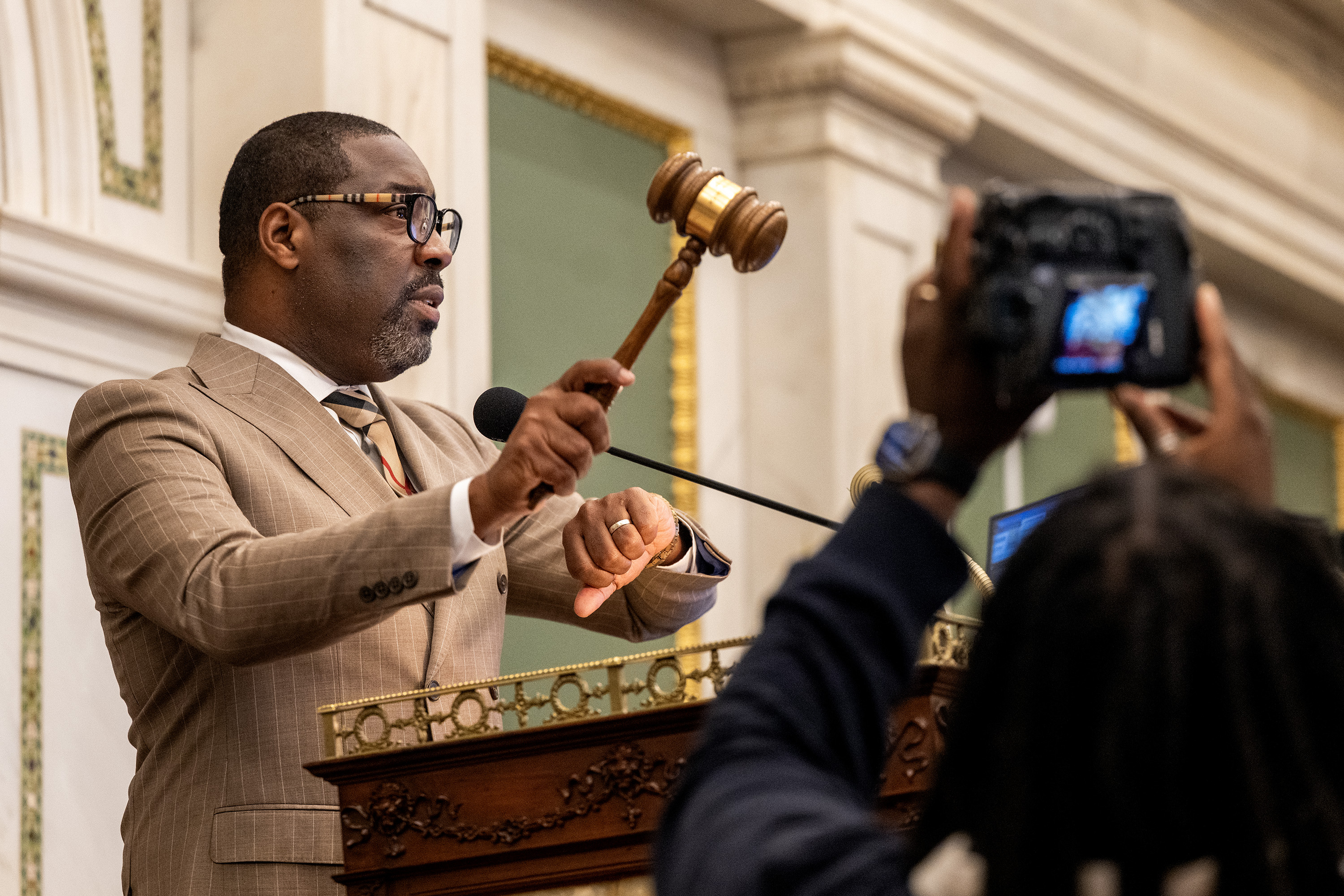
President Kenyatta Johnson checks his watch and gavels City Council into session Thursday, Sept. 17, 2026.Tom Gralish / Staff Photographer
Anti-corruption advocates have for generations called for the elimination of independently elected “row offices” like the sheriff and register of wills. Led by officials elected in races often determined by party politics, the offices tend to operate with less oversight over hiring and awarding contracts than regular city agencies. The city’s previous five sheriffs have seen corruption or sexual harassment scandals unfold during their tenures.
“We should get rid of it, and turn [the office’s tasks] over to a highly competent technocrat working with the mayor and Council,” State Rep. Jared Solomon (D., Philadelphia) said in an interview. “The office has been plagued with corruption and incompetence and mismanagement for all of modern history.”
The discovery that the sheriff’s office had failed to transfer $20 million — mostly proceeds from delinquent property auctions owed to the city to cover unpaid taxes and other costs — should be a wake-up call, he said.
“At a moment in time when my constituents can’t afford their prescription drugs or figure out how to put food on the table or pay their gas bill, she lost $20 million,” said Solomon, who represents parts of Northeast Philadelphia.
Johnson said Council would examine what happened with the missing money, which came to light as the result of judicial hearings into the office’s operations.
“We will be taking a close look at that $20 million and why it wasn’t distributed to Philadelphia,” Johnson said, “and so our team would take a deeper dive to get answers regarding that particular issue, and then go from there.”
But he declined to commit to holding a public hearing on it, a common mechanism for Council members to demand accountability.
Council has squabbled with the mayor’s administration over much smaller sums. Lawmakers have recently bemoaned a $1.4 million cut to the Mural Arts Philadelphia program, and they are currently locked in a tense behind-the-scenes battle with Parker over $2 million in funding for the Philadelphia Activities Fund, which Council members dole out to community groups.
For Lauren Cristella, president of watchdog group Committee of Seventy, Council’s response to the multimillion-dollar discovery in the sheriff’s office falls short.
“Council is the only group that can provide a long-term solution for these issues, and we welcome their efforts to solve this problem for the people of Philadelphia,” she said. “This office has been in dire need of reform for over 40 years. From failing to perform the most basic duties to misplacing millions of dollars, self-dealing, and secret slush funds, the same problems repeat regardless of who is elected.”
Bilal and her spokesperson, Teresa Lundy, did not respond to questions about the missing money and Council’s response.
Shortly after she won the Democratic primary in 2019, Bilal told The Inquirer she was open to the possibility of eventually abolishing her own office. But Lundy, Bilal’s campaign manager at the time, interrupted the interview to say that was not on the table.
“No, right now,” Bilal said then, “but if there’s a situation where we need to evaluate that in order to save the city money … then we will have that conversation.”
‘Every decision is political’
The sheriff’s office is responsible for serving warrants, transporting prisoners, providing courthouse security, and auctioning off tax-delinquent or foreclosed real estate. Critics assert most of these functions could be handled by the city’s police force or court administrators, without an elected leader.
To eliminate the sheriff’s office, Council would have to approve an amendment to the Philadelphia Home Rule Charter that would go before voters in a ballot question.
The Inquirer’s survey of Council members revealed that is not likely to happen any time soon.
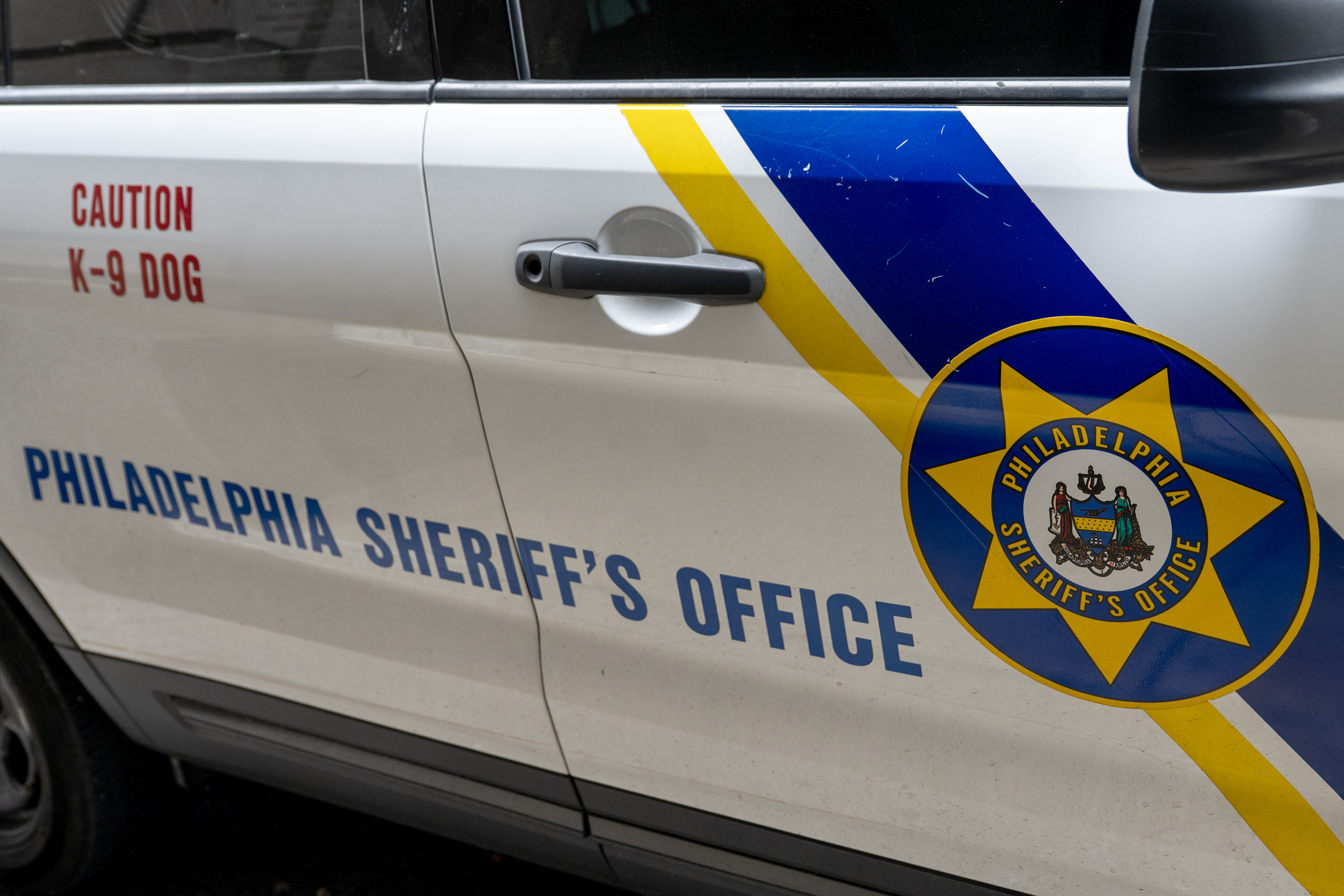
Vehicle of the Office of the Sheriff for the City and County of Philadelphia April 28, 2026.Tom Gralish / Staff Photographer
Four members — Johnson, Mark Squilla, Cindy Bass, and Jim Harrity — clearly stated they opposed doing away with the office.
A fifth, progressive Councilmember Kendra Brooks, said that without “clear answers” on how the city could carry out the office’s functions, she is “not sure the calls for abolition are the right move.”
“Philadelphians should make decisions about the office and will get to weigh in next year,” when Bilal is up for reelection, she said. (Bilal will face a challenge from corporate security consultant Jennifer Vrana in the Democratic primary in May. Other candidates may join the race.)
Four Council members — Nicolas O’Rourke, Jamie Gauthier, Nina Ahmad, and Isaiah Thomas — said they were open to discussing the possibility of eliminating the office. Thomas said the discussion would have to be about eliminating all the city’s row offices, not just the sheriff. Ahmad said: “Everything’s on the table.”
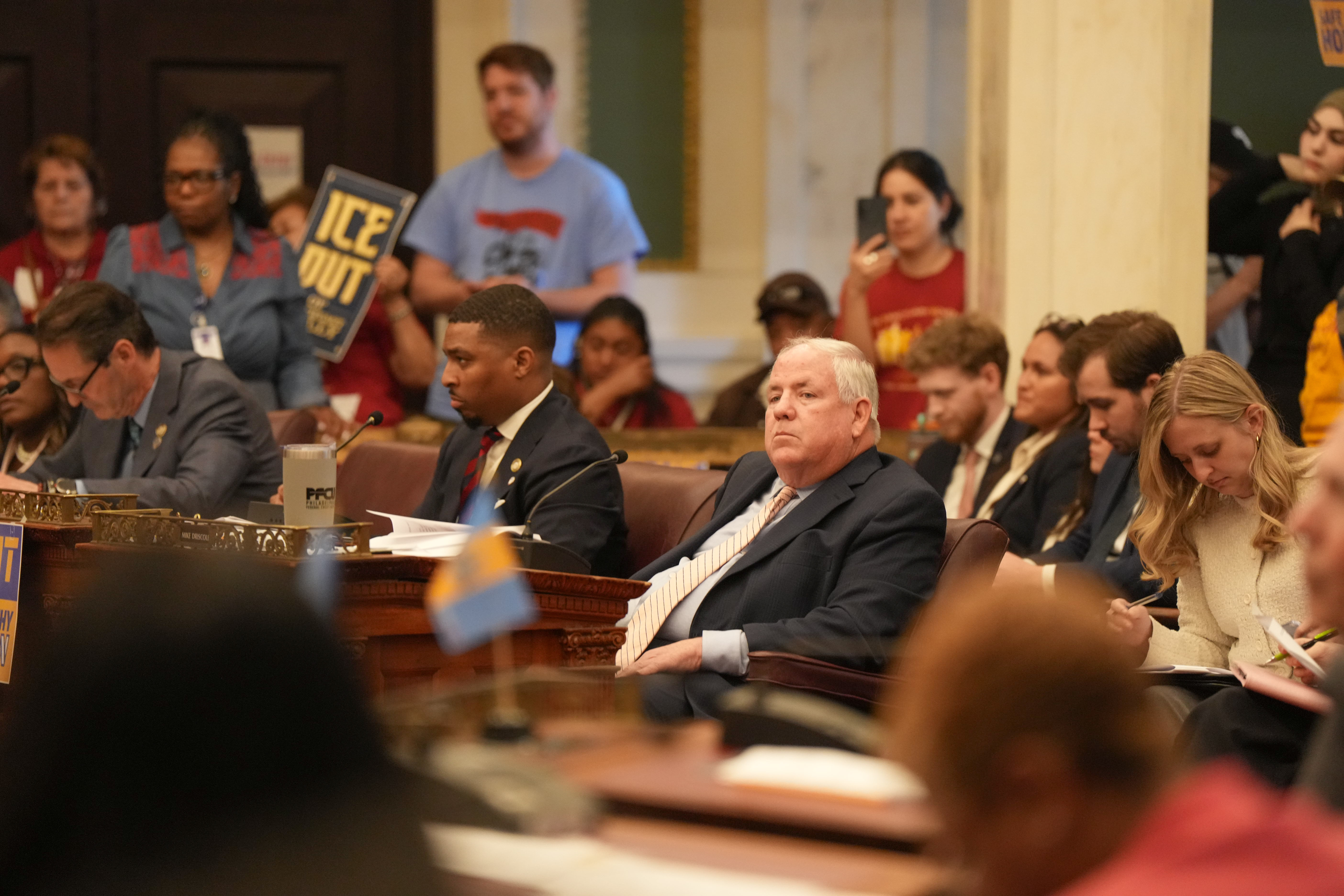
Two other members — Rue Landau and Mike Driscoll — did not rule out the possibility, but said they need more information. Landau wants Council to examine the office’s structure and functions in the next city budget cycle, if not sooner, a staffer said. And Driscoll said he first wants to see what happens in the court case, which stems from a lawsuit over the office’s alleged failure to transfer deeds following sheriff’s sales.
“Depending on how that plays out, perhaps City Council needs to get involved,” he said.
The other six members gave noncommittal answers or did not comment.
Councilmember Quetcy Lozada said she was not prepared to discuss the possibility of abolishing the office. Majority Leader Katherine Gilmore Richardson said she hopes intervention by the courts would result in a “better management process.” (Bilal this summer agreed to independent oversight of her real estate division, but is now seeking to block any outside supervision.)
Councilmember Anthony Phillips declined to comment. Councilmembers Brian O’Neill and Curtis Jones Jr. did not respond to requests for comment. An attempt to reach Councilmember Jeffery Young Jr. was unsuccessful.
The Philadelphia Council members inside the caucus inside City Hall in Philadelphia, Pa. on Thursday, June 11, 2026.Aidan T. Gallo / Staff Photographer
Former Councilmember William J. Green IV said he is not surprised the current Council remains uninterested in eliminating the office.
When he introduced a bill in 2010 to eliminate the sheriff’s office, Green said, he was inundated with calls from Democratic ward leaders who told him the issue was a nonstarter due to an unwritten agreement in local politics.
Green said he learned a similar logic applied to row offices, explaining why some politicians are protective of the current arrangement. Black officials, he says he was told, controlled the sheriff’s office, while white officials ruled the register of wills office, another relic of the city’s now-defunct county government that lives on as a pool of patronage jobs.
“There was definite racial politics involved in each office and who was expected to be the nominee,” Green, who is white, said in an interview. “The bill went absolutely nowhere.”
Green said he is not surprised little has changed since.
“I think you can find among most elected leaders in Philadelphia a lack of core convictions or guiding principles, and so every decision is political,” Green said.
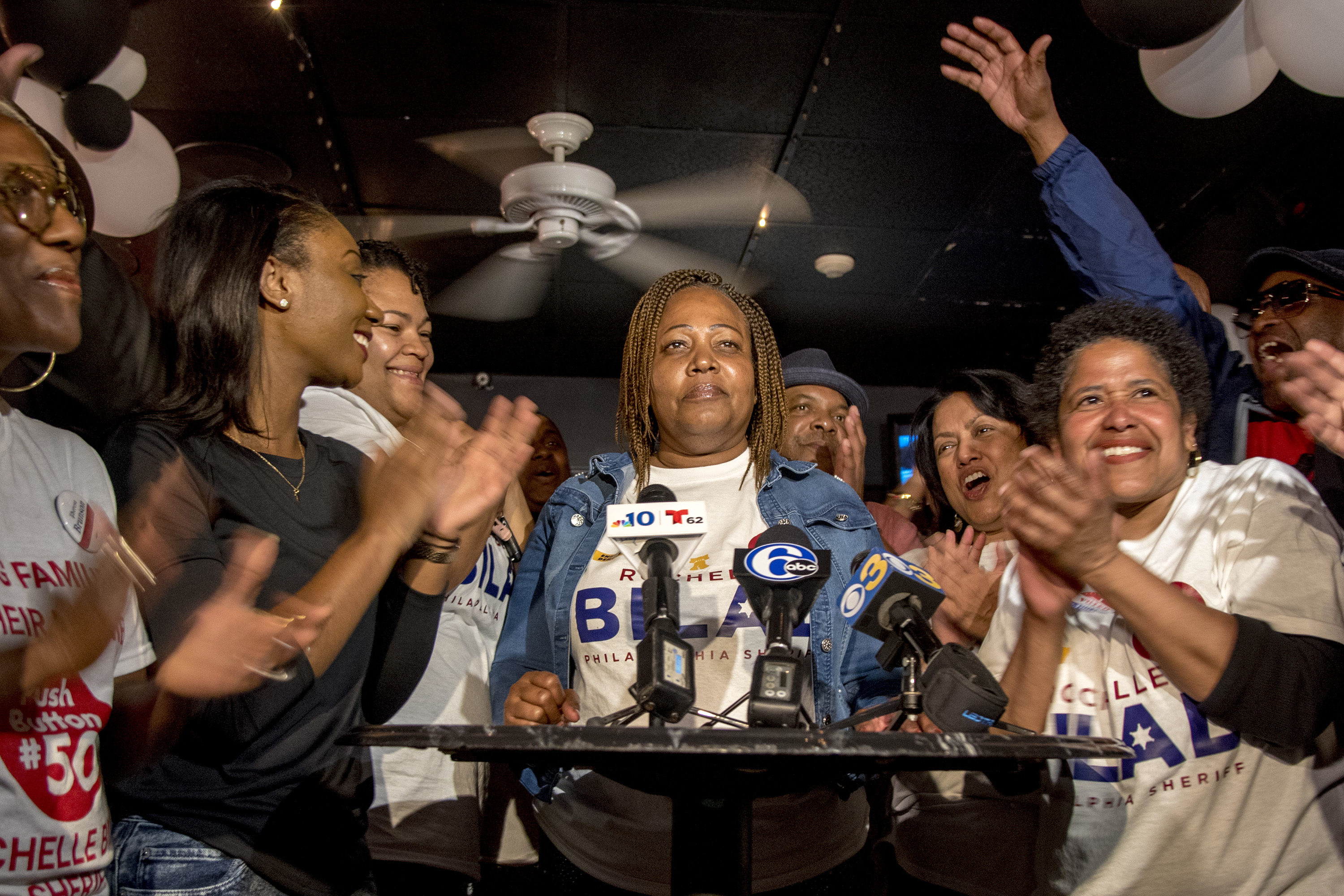
Rochelle Bilal is surrounded by supporters as she wins the Democratic primary for sheriff May 21, 2019.TOM GRALISH / Staff Photographer
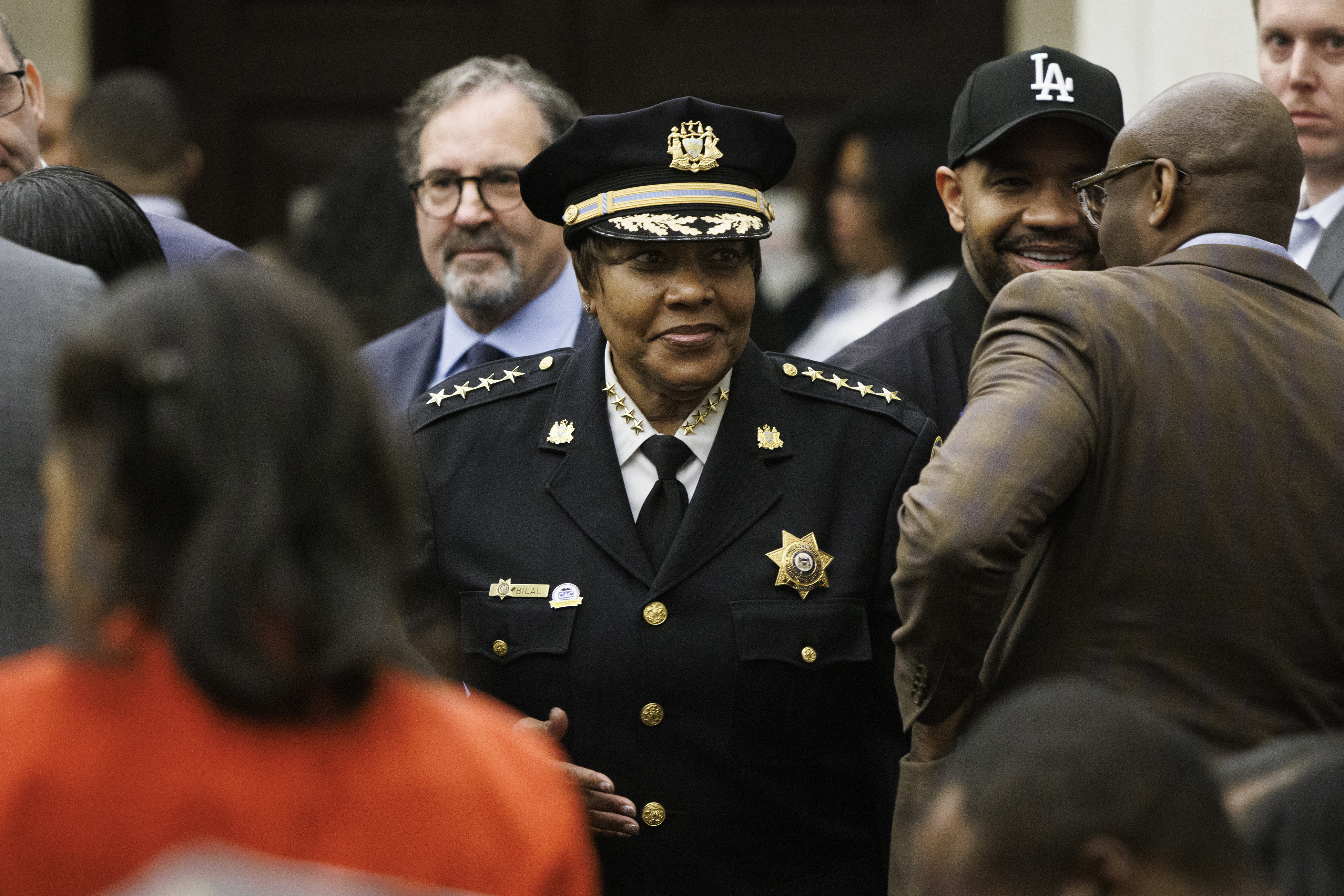
Bilal, the city’s first Black female sheriff, burst onto the political scene in 2019, when she shockingly dethroned Sheriff Jewell Williams, whom multiple women had accused of sexual harassment, and two other candidates in a crowded Democratic primary.
She ran that year without the Democratic City Committee’s blessing and with endorsements from anti-establishment progressives, including the activist group Reclaim Philadelphia and District Attorney Larry Krasner.
Most ward leaders stood by Williams in the 2019 election, party chair Bob Brady said at the time. But in 2023, when Bilal was already facing accusations of mismanagement, the party endorsed Bilal for reelection.
Before running for office, Bilal was a 27-year veteran of the Philadelphia Police Department and a former leader of the Guardian Civic League, an organization for Black officers.
Nearly two centuries of reform
The dispute over the sheriff and Philadelphia’s other elected row offices stems from a 172-year-old effort to fully combine the city and county of Philadelphia.
Prior to 1854, the City of Philadelphia, which then was composed only of modern-day Center City, was one of dozens of local governments with separate jurisdictions across the county. The fragmented townships and boroughs lacked a unified police force, driving public safety concerns after a series of riots erupted targeting Black people and Catholic immigrants.
That year, Harrisburg approved the Act of Consolidation for Philadelphia, merging the city, county, and other local governments into a single entity. But the sheriff and a string of other county row officers were carved out of the merger.
The debate over Philly’s parallel governments raged for decades, with the focus shifting to corruption. Party-backed candidates for these obscure offices typically cruised to victory, often doling out jobs in return for political endorsements.
The enactment of Philadelphia’s 1952 Home Rule Charter and state legislation in the 1950s and ’60s brought a new wave of reform, legally placing most elected row offices under city control, and transforming several more — including the coroner and prothonotary — into appointed positions.The city now had the power to abolish most of the remaining row offices via referendum and fold their duties and staff into other departments.
But Council has never voted to initiate such a referendum for the sheriff and register of wills.
In 2008, Mayor Michael A. Nutter proposed eliminating the sheriff’s office, the register of wills, and the clerk of quarter sessions, another row office relic that auditors found had lost track of millions in mishandled bail, fines, and court fees.
(Mayors can propose legislation and use their bully pulpit to encourage Council to adopt it. Ultimately, Council has the power to approve a Home Rule Charter amendment eliminating the sheriff’s office and send it to the voters. Mayor Cherelle L. Parker has not proposed eliminating any row offices.)
Nutter succeeded in doing away with only the clerk of quarter sessions.
There are procedural differences between the two. Under state law, Philadelphia cannot unilaterally dissolve the register of wills office without state authorizing legislation, while the city has final say over the sheriff’s office.
‘We’re looking into it’
The revelations about missing money and records have spilled out of Common Pleas Court hearings over the last six weeks.
Real estate investors who bought foreclosed or tax-delinquent properties at sheriff sale — but never received a deed — filed suit, leading Judge Paula Patrick to issue a May order demanding Bilal explain the chronic delays.
After a tense first hearing in August, Bilal agreed to allow independent oversight of her real estate division, but reneged on the deal weeks later.
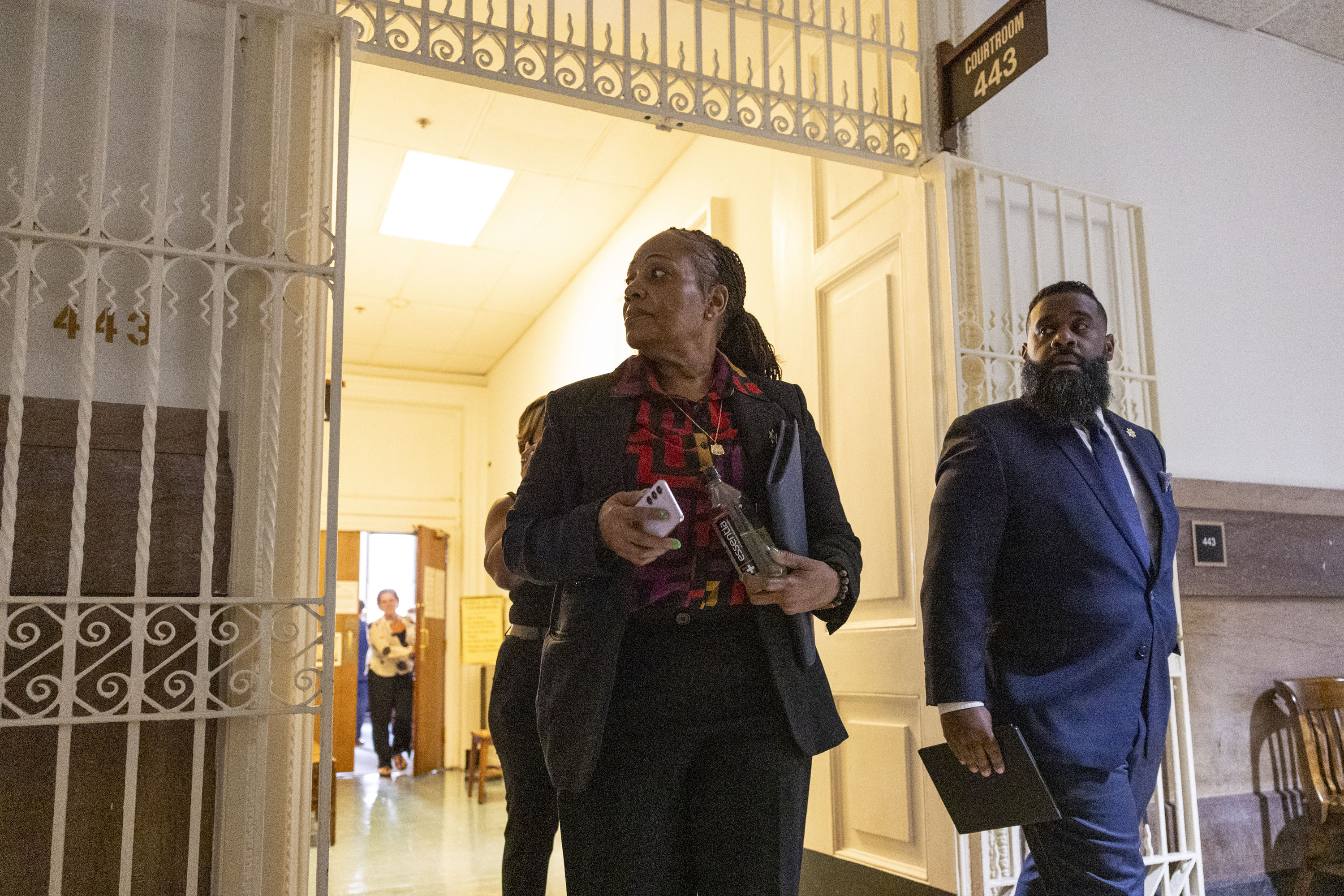
Sheriff Rochelle Bilal is seen exiting the courtroom at City Hall during a break on Wednesday, Aug. 26, 2026, in Philadelphia.Tyger Williams / Staff Photographer
In September, a deputy undersheriff testified that the backlog had been cleared and that Bilal’s office was auditing revenues linked to the stalled sales for any lingering discrepancies. Under questioning from the judge, the deputy revealed that the audit had already uncovered $20 million from sales in just the last year that should have gone to the city.
Instead, the money had been stuck in limbo in several sheriff’s office bank accounts. The deputy said that it was disbursed to the city after this discovery, and that the office was reviewing earlier years for other unclaimed funds.
Parker told NBC10 that week that she had not been briefed on the millions owed to the city. Asked last week about the money, the mayor’s spokesperson, Joe Grace, said: “We’re looking into it.” He declined to answer questions or make anyone available in the treasurer’s office for an interview.
Some Council members have questioned Bilal’s management in the past, including her office’s handling of millions more in fee revenue that the city controller in 2022 said was meant to flow into city coffers. The Inquirer reported Bilal had instead diverted the money into an off-budget bank account ex-staffers called a “slush fund” that paid for mascot costumes, DJs, and a $600,000 ad campaign, among other discretionary expenses. Bilal has also drawn two prior court orders linked to chronic understaffing and security lapses in the court facilities her office patrols.
Additionally, Bilal’s office delayed the collection of an estimated $35 million in tax revenue because it failed to auction off tax-delinquent properties between 2021 and 2024 as a result of a contract dispute involving an online auction company.
Parker, during her first budget address in March 2024, described that money as “dollars that could have been invested in classrooms and in rec centers or on building affordable homes.”
This year, Bilal returned to Council, seeking to increase her office’s budget by more than 50%. (Ultimately, Council approved only a fraction of that, a $146,000 funding increase, bringing her office’s budget to $35.8 million.) She was greeted with enthusiasm by several lawmakers, who thanked her for her work.
Sheriff Rochelle Bilal during the mayor’s budget address, Philadelphia City Hall, March 12, 2026.Alejandro A. Alvarez / Staff Photographer
‘We’ve seen all the criticism’
The sheriff enjoys close political relationships with many of the Democrats on Council, and some have fiercely defended her.
In March, during Women’s History Month, Council members heralded Bilal for her leadership, and she accepted an honorary resolution on behalf of the women in her office.
“We’ve seen all the criticism,” Bass, a longtime ally of Bilal’s, said as she presented the citation. “And let’s be clear, accountability is essential, but the challenges facing the sheriff’s office did not begin with Sheriff Bilal.”
But the $20 million revelation seems to have altered the conversation. Over the last two weeks, a handful of members pointed to the news as a sign that the sheriff’s internal reforms had not taken hold.
“That’s money that was supposed to go to the city, and we’re in a financial bind right now,” Harrity said. “They need to get their act together.”
Brooks said it is clear that the office’s revenue collection and distribution issues are “systemic,” and she encouraged Bilal to work with the courts to establish independent oversight — a move that Bilal now publicly opposes.
And Gauthier said that she was particularly “surprised” by the finding given that Bilal has repeatedly asked Council to increase her office’s yearly budget.
“We need to understand why that happened, how that happened, and we need to understand that before we’re in another conversation about millions of dollars being needed,” Gauthier said.
But it is largely up to Johnson whether that understanding happens in public or behind closed doors.
Gilmore Richardson — the Democratic majority leader who has in the past sharply criticized city departments that have misspent or lost track of taxpayer dollars — said that she called Johnson shortly after learning of the undisbursed money. She said she trusts that “he’ll be working to ensure that we can adequately address this.”
Solomon, who has been a rare vocal supporter of abolishing the office, said that despite the reform’s lack of popularity on Council, he is heartened that some members said they are open to the conversation.
“You seem to be seeing a growing number of folks — and maybe it’s after the $20 million marker — who seem to be saying, ‘Let’s figure out a path forward,’” Solomon said. “Other municipalities do this. They function with efficiency, and the sheriff is effective, and they’re not losing $20 million.”
City Council President Kenyatta Johnson wants to explore opening a city-supported grocery store in Philadelphia.
Johnson on Thursday proposed a “Philly Food Affordability Act” package of legislation that calls for the creation of a new Philadelphia Office of Food and Nutrition Safety, as well as Council hearings probing grocery pricing practices and examining the possibility of one run or supported by the city.
“We have leadership in Washington, D.C., that has taken thousands of individuals off these SNAP benefits rolls, which means you have thousands of families here in the city of Philadelphia who will be food-insecure,” Johnson told reporters Thursday, referring to President Donald Trump’s changes to the Supplemental Nutrition Assistance Program taking effect Oct. 1. “So we’re working to make sure that no children go to bed hungry, no children go to school hungry, and, at the end of the day, come up with an overall long-term comprehensive strategy to address the issue of food insecurity.”
Johnson’s proposed legislation comes after New York City Mayor Zohran Mamdani this year made national headlines for his push to open five municipally backed grocery stores that would offer prices 30% below market rate. The proposal is facing a lawsuit from the Multicultural Business Coalition, a coalition of small-business owners.
Johnson said his inspiration for exploring the issue was Newark Mayor Ras Baraka, who has opened five “community-partnered grocery stores” offering 25% to 30% discounts.
None of Johnson’s proposals involve immediate action on addressing food insecurity, but they instead lay the groundwork for potential future legislation by Council or actions by the mayor’s administration.
Johnson’s proposal so far includes no details on what a city-backed grocery store could look like in Philly. Rather, it calls for an informational public hearing exploring possibilities, such as a public-private partnership.
Johnson’s proposed Philadelphia Office of Food and Nutrition Safety would be led by a mayor-appointed director charged with developing citywide policies for food security, collecting and reporting data on food insecurity, and improving access to healthy, affordable food, among other things, according to Johnson’s office. The office would be guided by a Food and Nutrition Security Advisory Commission made up of five mayoral appointees.
The proposal, which was introduced by Majority Leader Katherine Gilmore Richardson on Johnson’s behalf, would amend the Home Rule Charter, meaning it would have to be approved first by Council and then by a majority of voters, who could see a ballot question about the issue in the May 2027 primary election.
Johnson turned to two of Council’s more progressive members to handle the issue-based public hearings he proposed.
Councilmember Nicolas O’Rourke, in Philadelphia City Hall on March 12, 2026.Alejandro A. Alvarez / Staff Photographer
Councilmember Nicolas O’Rourke, who chairs Council’s Cost of Living Task Force, introduced Johnson’s resolution to hold a hearing on the possibility of a “City of Philadelphia-Supported Grocery Store.” The hearing will consider various models for how such a store could be structured, as well as similar initiatives in other cities.
Councilmember Rue Landau, who has championed other consumer protection issues, introduced Johnson’s resolution to hold a hearing on emerging technologies in the grocery industry including “surveillance, algorithmic, and dynamic pricing systems … to examine opportunities to support transparency, affordability, and consumer confidence.”
Council on Thursday approved resolutions green-lighting both hearings. Legislation related to Johnson’s proposed charter amendment will be referred to committee.
It has been almost a year since a bill aimed at providing relief to Philadelphia small businesses affected by the recent elimination of a popular tax break first came before City Council.
A majority of Council supports the proposal, which was introduced by Councilmember Mike Driscoll.
And yet, for months, the bill has languished in Council’s Finance Committee. The holdup, according to Driscoll, is Council President Kenyatta Johnson.
“The Council president wasn’t interested in moving any bills that could risk revenue generation, and he’s concentrating on working with the revenue department on ways to increase revenue,” Driscoll said in an interview Wednesday, when he was hoping the measure would be called up in committee.
Driscoll’s bill would exempt sole proprietors and single-member limited liability corporations from paying the city’s business income and receipts tax, or BIRT.
He introduced the measure in November 2025 in response to Mayor Cherelle L. Parker earlier that year persuading Council to get rid of a tax break that excluded firms’ first $100,000 in revenue from taxation under the BIRT, effectively eliminating the tax for firms that make less than that, including many gig economy workers and mom-and-pop businesses.
Parker said she supported the intention of the tax break, but moved to end it after Zoll Medical Corp., a Massachusetts-based company that did business in Philly, sued the city, claiming the policy was illegal under the Pennsylvania Constitution. Parker said she was acting on advice from the law department, which determined the city would likely lose a court battle over the issue, and Council members grudgingly eliminated it in June 2025.
Driscoll’s bill aims to provide a legal workaround that would help many of the firms affected by the elimination of the tax break while passing constitutional muster.
In a statement, Johnson declined to explain why the bill was not brought up in committee and said he supports small businesses.
“All of us on City Council understand the challenges they are facing,” Johnson said. “Council is reviewing all tax relief proposals as part of a larger conversation regarding the Fiscal Year 2028 operating budget, revenues, and fiscal priorities.”
The mayor’s office declined to comment.
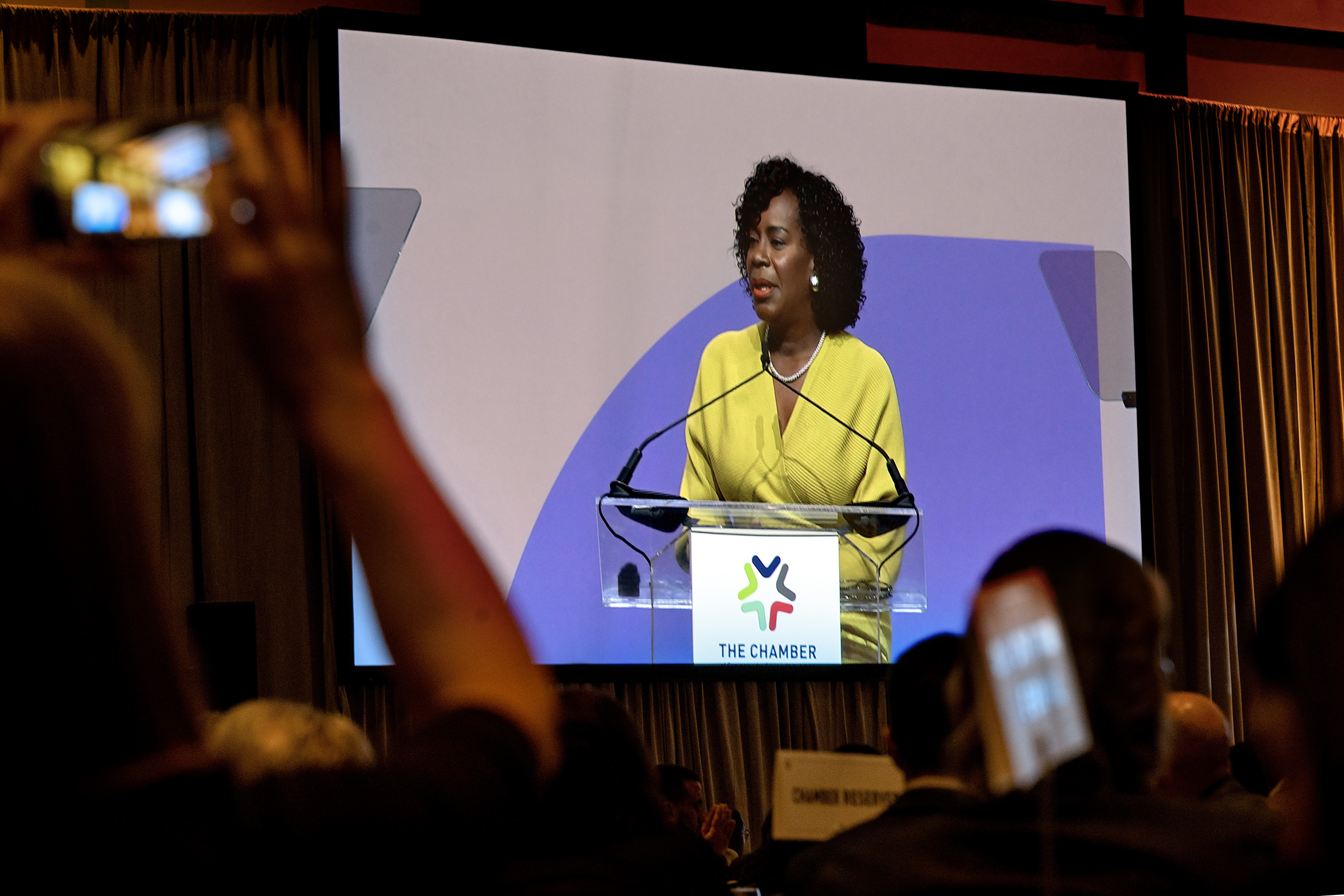
Attendees record Mayor Cherelle L. Parker on big screen as she delivers her keynote address at the Chamber of Commerce for Greater Philadelphia’s Annual Mayoral Luncheon Wednesday, Feb. 11, 2026.Tom Gralish / Staff Photographer
When she moved to eliminate the $100,000 BIRT exclusion, Parker also proposed a bill that would gradually reduce BIRT rates over 13 years, and Council approved the tax cuts in June 2025. While the tax cut measure will eventually lead to a dramatic reduction in BIRT bills for all firms in the city, small businesses are being hit hard by the end of the tax break in the meantime.
“Sending a message to small business that we’re not here to help right now, I think, is the wrong message,” said Driscoll, who represents parts of Northeast Philadelphia.
The bill is currently pending in the Committee on Finance, which is chaired by Majority Leader Katherine Gilmore Richardson.
Gilmore Richardson, who has previously said she supports the proposal, declined to comment.
The BIRT, which is Philly’s third-largest local tax and brought in about $779 million last fiscal year, consists of two tax rates. Firms must pay 5.71% of their net income, or profits, made in Philadelphia, as well as 0.141% of their gross receipts, or total income, according to the city’s website.
The elimination of the $100,000 exemption has subjected tens of thousands of small businesses to the BIRT for the first time in years. It was projected to generate about $30 million in increased revenue for the city per year, and Parker and Council in 2025 allocated $38.5 million for programs aimed at helping small firms navigate the burden of getting in compliance with the tax.
Driscoll’s bill, which the administration has said would cost the city about $29.5 million per year, is aimed at finding a legal way to exempt many of the small businesses most affected by the elimination of the tax break. His measure aims to sidestep uniformity concerns by shielding entire classes of firms that include many of the small businesses that previously benefited from the $100,000 exemption from having to pay the tax at all.
But the legislation also risks incentivizing more well-off business taxpayers, such as real estate investors, to dodge the tax by restructuring into the types of companies it would exempt from the BIRT. The bill, for instance, could allow investors to organize their companies as single-member LLCs while still requiring small stores with multiple owners to pay the tax.
“The Department of Revenue anticipates businesses may change their business structure specifically to take advantage of the exemption, which will increase potential revenue losses,” the administration wrote in a fiscal analysis of the bill.
Johnson has previously supported efforts to lower the business tax, and his opposition to Driscoll’s bill came as a surprise — not least to Jigar Mehta, a Bucks County-based management consultant whochampioned the idea for Driscoll’s legislation.
Mehta said Wednesday that Johnson’s staff had helped draft the legislation.
“They literally helped us put this bill together, his office,” said Mehta, who added that he was told at the time that Johnson supported it. “If you’re for exempting this group, why now all of a sudden are you saying we need this revenue? That’s what’s shocking.”
The Philadelphia Police Department’s new state-of-the-art forensics lab could be operational as early as next year, the culmination of a yearslong planning effort aimed at modernizing how the force solves crimes.
City Treasurer Jacqueline Dunn told a City Council committee on Wednesday that construction began at the University City site in December 2025 and will extend through April.
Dunn explained that timeline during a meeting of Council’s Finance Committee, which unanimously approved a request by Mayor Cherelle L. Parker’s administration to authorize the city to issue $40 million in bonds to finance the project. That measure will fund the build-out, construction, and equipment at the lab site, and it is expected to be approved by the full Council as soon as this week.
City officials, police brass, and members of Council have for years described the existing police crime lab in North Philadelphia — where the force processes guns, drugs, DNA, and other evidence — as undersized and outdated.
“This is something the public has been asking us for to really modernize the police operation,” said Councilmember Katherine Gilmore Richardson, the Democratic majority leader and the chair of the Finance Committee. “We’re glad that this day is finally here, and that we were able to to work out all the details to make it to this moment.”
Council member at-large Katherine Gilmore Richardson speaking at the City Council’s first session of the year in Philadelphia, Pa., on Thursday, Jan. 22, 2026.Tyger Williams / Staff Photographer
The proposed $40 million bond issuance would come in addition to $50 million that had already been secured and set aside in previous annual budgets to pay for the project. A Parker administration spokesperson confirmed that construction of the lab is expected to cost about $90 million total.
City financial records show the Parker administration anticipates to pay about $11.4 million a year in rent once the lab is operational.
The final phase of the construction of the site at 4101 Market St. follows a five-year process that began under former Mayor Jim Kenney.
During an unprecedented spike in gun violence in 2021, Kenney, police officials, and District Attorney Larry Krasner all advocated for the city to spend millions on a new crime lab, saying it would allow police to process evidence at faster rates and solve more crimes. Krasner long argued that his office could secure more convictions if police were able to build stronger cases based on physical evidence.
But getting to the point of construction on a new lab was a process beset by delays. Kenney’s administration had not selected a location by the time he left office in early 2024. After Parker was sworn in, her administration spent months evaluating potential sites amid lobbying efforts by other local and state elected officials who wanted the lab in their districts.
Ultimately, Parker’s administration chose the 4100 block of Market Street, a burgeoning life sciences district where lab space already existed.
In 2025, Parker hailed the selection as “a giant step forward in forensics technology and crime-solving ability for our police department.”
On Wednesday, Councilmember Curtis Jones Jr., who chairs Council’s Committee on Public Safety and has been among the body’s chief advocates for the new lab, acknowledged it has been a long process.
He said the small size of the existing lab meant “some of the processing of ballistics and other essential tools for justice are delayed.”
“This has been a long, winding, but an essential part of the criminal justice process,” he said.
One evening last week, City Council President Kenyatta Johnson stood on South Broad Street and greeted his fellow lawmakers as they arrived at Steak 48.
Johnson had invited them to the swanky Center City steakhouse to “reconnect, share conversation, and enjoy each other’s company outside of City Hall,” according to an invitation for the Sept. 9 “members only” event obtained by The Inquirer.
Council resumes for its fall session Thursday — and after the way things ended in the spring, the city’s legislators may have needed the opportunity to break bread together.
When lawmakers last met in June, they approved a $7.1 billion city budget that left all sides feeling dejected. Council turned away a series of tax proposals from Mayor Cherelle L. Parker, including a $1-per-ride levy on rideshare companies like Uber and Lyft, and ended up passing a budget that omitted a number of members’ own priorities and left unanswered how the city will help the Philadelphia School District navigate its funding crisis in the long run.
In addition to representing a new low in Parker’s relationship with the legislative body of which she was once a member, some Council members also questioned their own negotiating team’s handling of the ordeal.
Councilmember Mike Driscoll noted last week that while he was not “pointing fingers,” Council could have added more money in the budget for line items requested by lawmakers, such as funding for community groups.
“I’m disappointed and pissed off at the way it played out,” Driscoll, who represents parts of Northeast Philadelphia, said in an interview. “Our priorities weren’t analyzed in a more thoughtful [way]. … We do the amendments. [Parker] doesn’t. We could have put money in.”
Councilmember Michael Driscoll in Philadelphia on April 23, 2026.Jessica Griffin / Staff Photographer
An Inquirer reporter saw at least 11 of Council’s 17 members at the Steak 48 event, meaning a majority, or quorum, of Council was present. The Pennsylvania Open Meetings Act, or Sunshine Act, requires legislative bodies to notify the public if a quorum is present for a meeting at which official business is discussed.
But Johnson said at the beginning of the dinner that would not be happening.
“Tonight we do no official business,” Johnson said in an interview. “Just social. Welcome back to City Council. Eat and drink and be merry. No policy on the table. No legislation on the table. Just having a good time.”
Johnson’s invite directed members to RSVP to a Council staffer’s city email address. Johnson said his campaign picked up the tab.
“Everyone facing reelection next spring knows they have to be able to point to real accomplishments on the important issues voters care about,” City Hall lobbyist John C. Hawkins said. “And this fall is their last opportunity for them to address the most pressing issues that were not fully resolved in the spring budget process.”
Budget fight hangover
When Council and the mayor in the spring failed to reach a deal over new tax revenue to plug a $48 million hole in the school district’s budget, Johnson said Council had helped identify one-time savings in the city budget to fill the gap for a year while vowing to explore new recurring revenue streams for the district.
Johnson has not yet scheduled a hearing on schools funding, and Council’s dissatisfaction with the district appears to have been mounting.
Mayor Cherelle L. Parker, Council President Kenyatta Johnson, and Superintendent Tony B. Watlington Sr. arrive for an announcement at the School District of Philadelphia Headquarters on Wednesday, June 10, 2026 in Philadelphia.
He said in a statement this week that Council will honor its commitment, but also alluded to finding that money in the district’s own budget, despite school officials saying they are navigating a $300 million structural deficit.
Johnson said Council is awaiting the results of a performance audit of the school district that is being conducted by City Controller Christy Brady. He said that report “will help Council identify any available funds to support recurring funding.”
New arena, who dis?
In the fall of 2024, Council wasconsumed by the debate over the 76ers’ proposal to build an arena in Center City.
Lawmakers spent much of the session debating the economic benefit of the project, while opponents cried out that it would displace businesses and residents in nearby Chinatown.
Despite Council approving it, that project was scuttled by the Sixers, who instead teamed up with Comcast, which owns the Flyers, to plot a different project: a joint venture that would bring a new arena to the South Philly sports complex. Earlier this month, they released the first renderings of what the Spectrum-inspired arena could look like.
There will likely be spirited discussions about it all in Council — at some point. But don’t expect a redux this fall of the all-out brawl that was 2024.
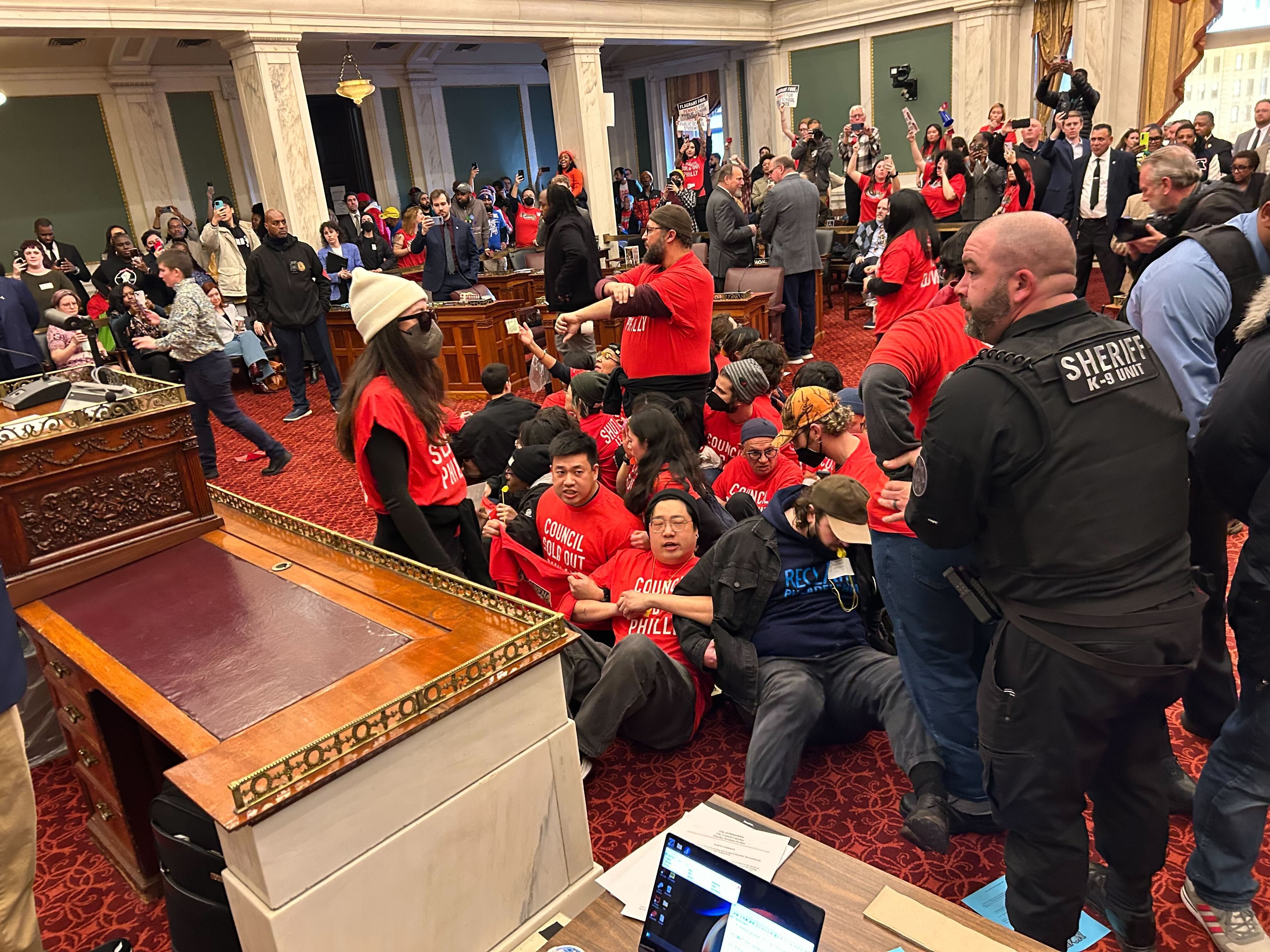
Protesters link arms as sheriff’s deputies attempt to remove them from Philadelphia City Council chambers as the council is scheduled to vote on final approval for the Sixers’ proposed Center City arena on Thursday, Dec. 19, 2024.Sean Collins Walsh / Staff
The stadium district falls in Johnson’s 2nd District, meaning it will be on him to introduce legislation that would green-light the project. And he has not been in a hurry to accommodate the Sixers’ timeline, which would be to approve the project as soon as possible so the venue can open by 2030.
Johnson said in a statement that “no zoning legislation is scheduled for introduction,” and that he is working to find consensus with the Parker administration and other Council members before introducing any legislation.
“I am focused on ensuring that any future legislation concerning the new arena addresses the interests and concerns of the community around the Stadium District and in Philadelphia,” he said.
When that legislation is brought forth, it is unlikely to be anywhere near as controversial as the 76ers’ Center City proposal, which drew opposition due to its proximity to Chinatown, so long as the teams uphold their promise to not seek public subsidies.
The Asian Pacific Islander Political Alliance, which led opposition to the Center City arena, released a statement earlier this month that signaled openness to the South Philly project.
“The people of South Philly should have a meaningful voice in whether and how this project moves forward,” said Will Gross, an API PA member who is rumored to be considering a run for Council. “And if it does, it should mean good union jobs, a strong community benefits agreement, and real benefits for the people who live and work in the neighborhood.”
Trash issue continues to burn
Councilmember Jamie Gauthier has spent the better part of the last year trying to whip up support for a bill that would ban the city from shipping off its trash to be burned at an incinerator in Chester, a longtime practice she and others say is poisoning residents of the city to Philadelphia’s south.
The Parker administration opposed the measure, saying it would limit the government’s ability to carry out its normal competitive bidding process and select the best-value contractor. Gauthier failed to get a majority of Council on her side, and she never called up the Stop Trashing Our Air Act for a vote.
This fall, she will try a new tactic.
Gauthier and her allies are attempting to kill the Parker administration’s effort to approve a new contract with Reworld, which operates the Chester waste-to-energy facility where the city sends about a third of its garbage. (The remainder is hauled off to landfills.)
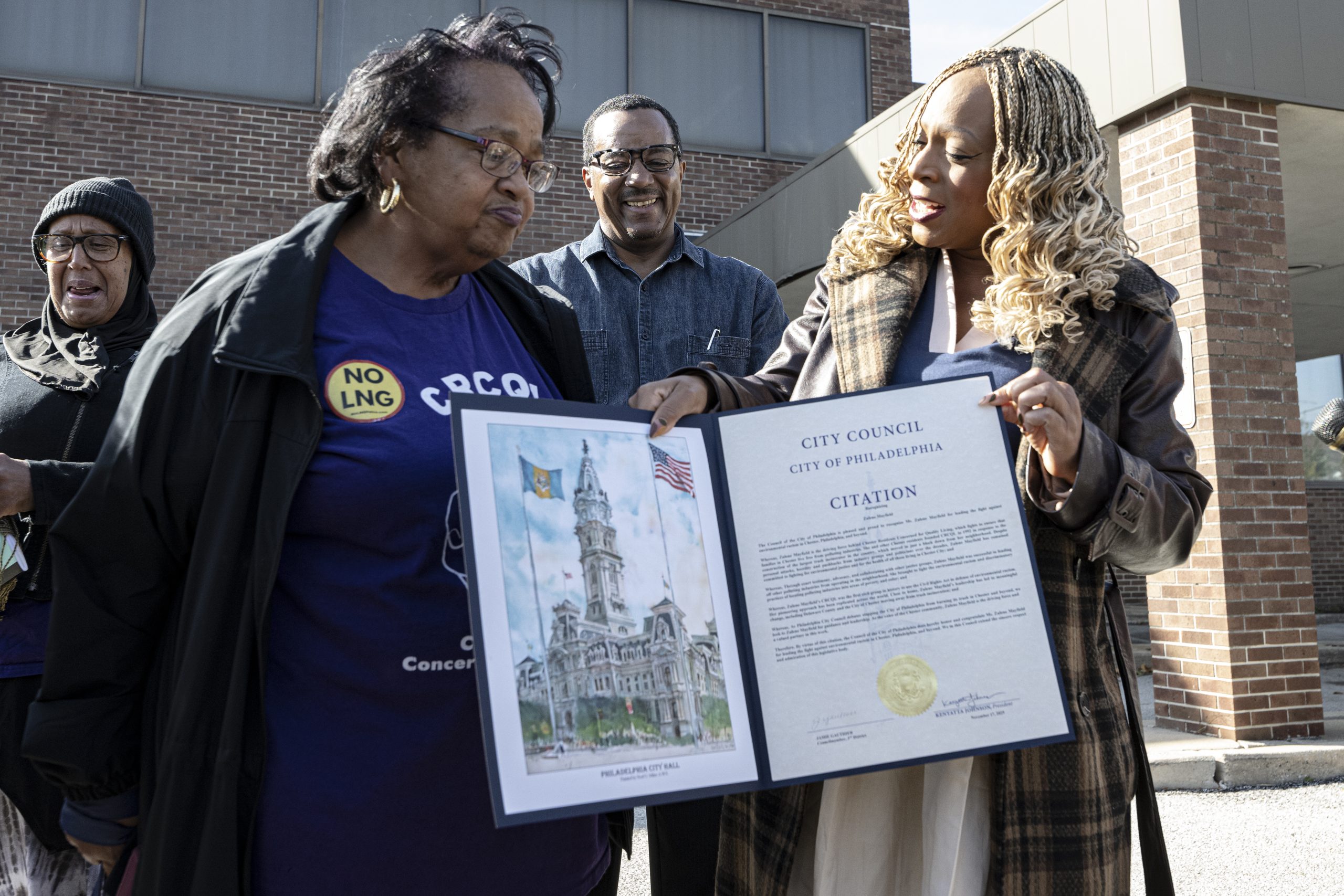
Chester resident Zulene Mayfield, left, Philadelphia Councilmember Jamie Gauthier, right, and Chester Mayor Stefan Roots meet to discuss Gauthier’s “Stop Trashing Our Air Act,” which would ban the city from incinerating waste, during a visit with lawmakers and staff in Chester, Pa., on Friday, Nov. 7, 2025.Jose F. Moreno / Staff Photographer
In July, the Parker administration announced that it intends to enter into a new four-year contract for waste processing and disposal with Reworld, as well as two landfill operators, Republic Services and Waste Management. The terms of those contracts have not yet been made public.
Council must approve multiyear contracts, and Gauthier, who represents parts of West and Southwest Philadelphia, said she is planning a full-court press to get her colleagues to “block Mayor Parker’s dirty deal with trash incinerators.”
The question is whether she can get eight other members on her side to reach a majority of Council. She is likely to find support from three fellow progressives, and she is expected to be joined by Councilmember Isaiah Thomas, the Democratic majority whip, at a Thursday news conference calling on the city to end its contract.
Councilmember Mark Squilla takes his seat in chambers Wednesday, Dec. 11, 2024, before a scheduled committee vote on Sixers arena related legislation was postponed,Tom Gralish / Staff Photographer
Meanwhile, Councilmember Mark Squilla said he has been working with the administration on a plan to build out a “circular waste” system that would replace incineration and landfilling over time with composting and waste “digestion.”
“The incinerator bill …. doesn’t solve a problem we have: to reduce our waste,” Squilla, whose district includes parts of Center City, South Philadelphia, and the river wards, said in an interview. “If we can reduce our waste by going to composting and digestion and other forms, we then eliminate all of our trash. Therefore end up with the result of what the goal should be, [which] is to get as close as possible to zero waste.”
Squilla’s proposal, which would involve “a long-term contract to attract providers to be able to build out a possible digester to decrease the amount of food waste,” could make it easier for Council members sympathetic to Gauthier’s goals but skeptical of her incinerator bill to approve the administration’s contract with Reworld while committing to a long-term solution.
The business tax, revisited
Separate from the school district revenue, some Council members are hoping to advance measures that would provide tax relief to businesses.
Council two years ago approved a 13-year schedule of rate cuts that would dramatically reduce the business income and receipts tax. But at the same time, Parker moved to eliminate a tax break that primarily helped small businesses after its legality under the Pennsylvania Constitution was challenged in court.
The elimination of the tax break — which excluded from taxation companies’ first $100,000 in revenue — has forced thousands of small firms and sole proprietors that make less than that threshold to begin paying a tax from which they had been effectively exempted.
Driscoll worked with tax experts to find a workaround that could pass legal muster — exempting certain types of businesses, such as sole proprietors, from the tax entirely — and he is planning to call up for a vote his bill this fall.
Thomas, meanwhile, said he will introduce a resolution Thursday to hold hearings this fall on the feasibility of reducing the net income portion of the business tax “much sooner” and more “aggressively,” meaning an acceleration of the tax cuts already scheduled.
The measures are likely to spark opposition from more progressive members of Council and could be tricky to navigate for Parker, who wants to make Philly more business-friendly but may not want to forgo additional revenue.
Members eye priorities as election looms
With next year’s election looming — and all 17 members indicating they intend to seek new four-year terms — the fall session is also likely to see movement on a myriad of issues championed by individual legislators.
Majority Leader Katherine Gilmore Richardson said she will propose bills to “protect communities from harmful nuisance businesses and improve processes around code violations,” continuing her efforts to crack down on businesses that neighbors say attract crime.
Councilmember Rue Landau, who represents the city at-large, said she is “tackling the impact of emerging technologies, making Philadelphia more affordable for working people, and ensuring equity remains at the center of how we serve our LGBTQ+ communities.”
Landau said she also plans to introduce a resolution calling on the state to ban automated license plate readers like Flock cameras.
The Philadelphia Council members inside the caucus inside City Hall in Philadelphia, Pa on Thursday, June 11, 2026.
And Councilmember Kendra Brooks will propose new protections for temporary workers and tenants facing eviction, according to her spokesperson, Kathleen Melville.
Brooks, a progressive who represents the city at-large, will also fight for additional funding for reproductive healthcare providers, a priority of hers that was left out of the budget following Council’s impasse with Parker, Melville said.
“That was her biggest focus going into the budget,” Melville said. “She had the same experience as every other Council member in that none of her budget priorities made it into the budget.”
Several members have also said that they want to bolster the city’s property tax relief offerings after the administration this summer released its citywide assessments that will mean higher taxes for thousands of homeowners.
The most likely move would be for Council to amend the city’s tax code to increase the popular homestead exemption, which currently exempts the first $100,000 from a home’s taxable value if the owner lives in the dwelling as their primary residence.
Johnson said Council “will review all tax-relief options” this fall.