A meat processing facility in Souderton that was slated for closure this week will remain open, downsizing its staff from about 1,700 to 400.
Global meat producer JBS announced in June that it would shut down the facility as part of a larger strategy focused on “growth, modernization, and long-term competitiveness in the United States.” This week, the company said it changed plans and will keep the plant open, transitioning the site to a new use.
“This outcome allows us to preserve 400 good-paying jobs, strengthen our case-ready business, and continue serving customers in a key consumer market,” said Wesley Batista Filho, CEO of JBS USA.
The plant has been one of Montgomery County’s top 25 employers, recently employing roughly 1,700 people. The majority of them are represented by the United Food and Commercial Workers International Union (UFCW) Local 1776.
JBS plans to keep roughly 400 workers at the facility as it moves away from beef processing to become part of the business’ “value-added operation” arm. According to the company website, that side of the business is dedicated to “further-processed beef and pork products, and retail packaged meats.”
The plan includes investing over $30 million over the next 10 years to “modernize and enhance” the Souderton facility, the company said.
“This announcement provides stability for hundreds of workers and their families while creating a path for long-term success at the Souderton facility,” said Wendell Young IV, president of UFCW Local 1776.
JBS is the company behind food brands such as Pilgrim’s, and Just Bare. Most recently, the majority of the Souderton plant employees were in the fabrication department, which processes animal parts that move along a conveyor belt, according to the union.
The change in plans comes after discussions between the union, JBS, county officials, and Gov. Josh Shapiro, among other stakeholders.
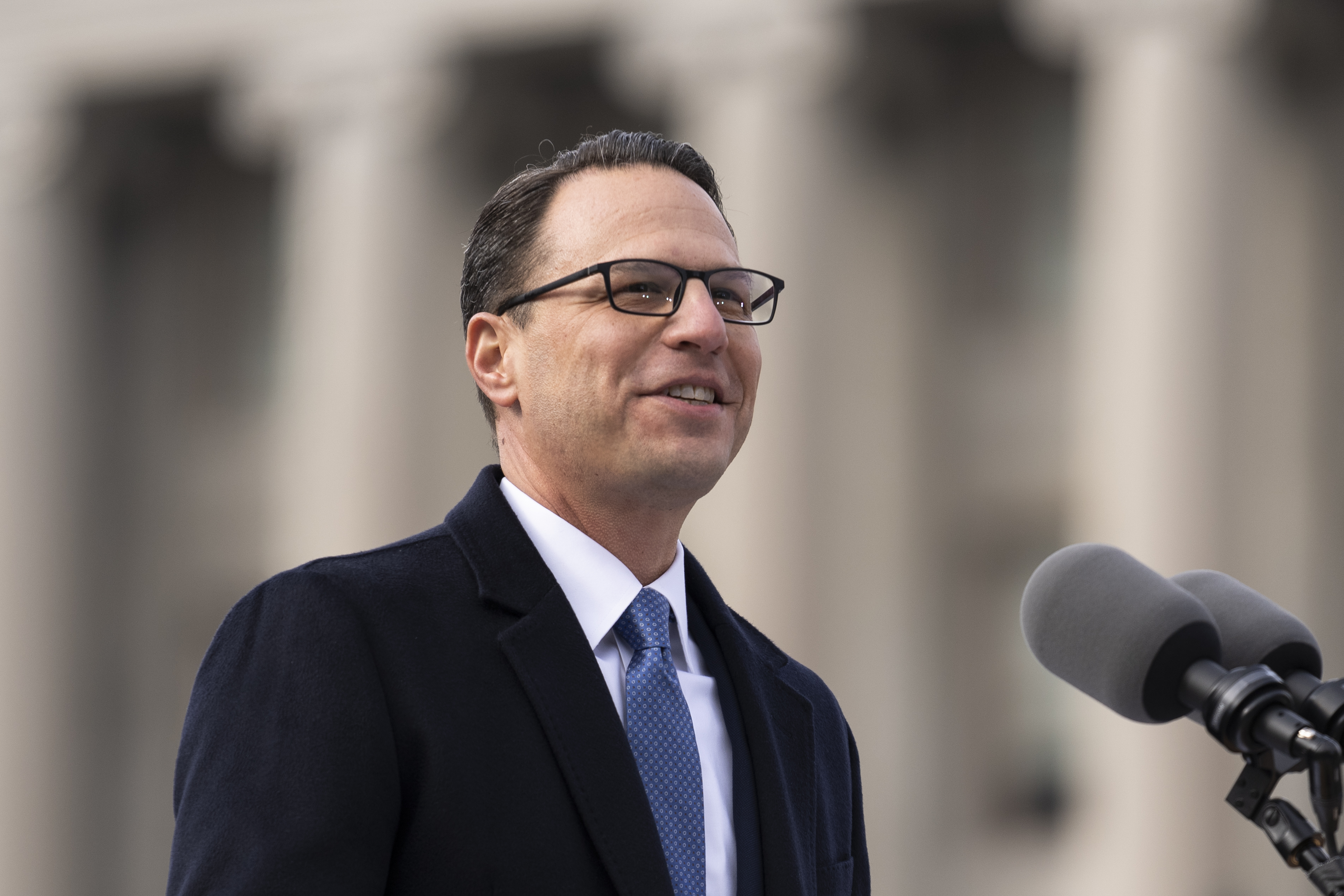
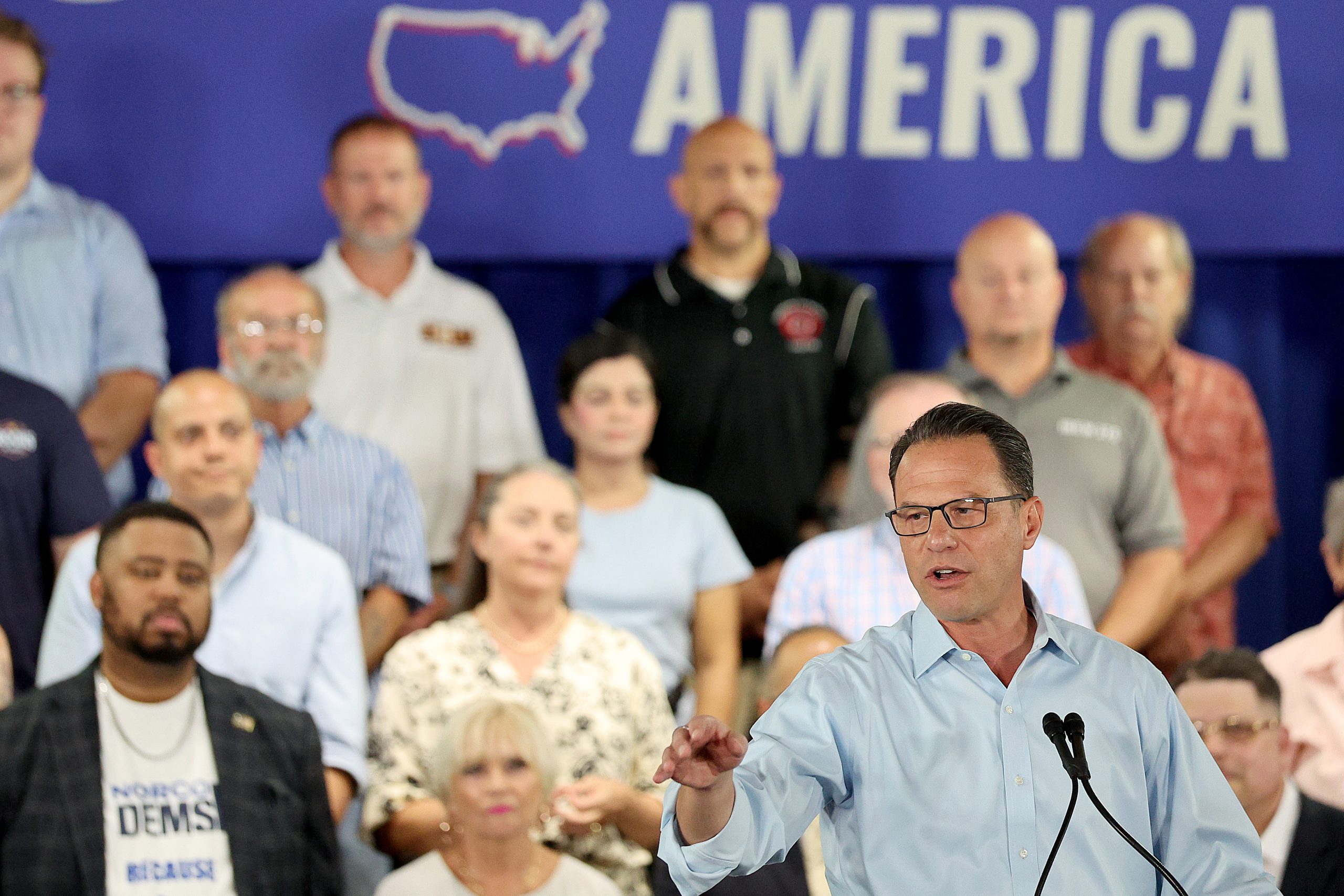
“Pennsylvania’s agriculture and manufacturing industries have powered our economy for generations, and we’re making sure they continue to drive our future,” Shapiro said in a statement. “This facility will remain an important economic driver for Montgomery County.”
JBS has operated the Souderton facility since 2008, and had planned to distribute the work being done there among its other facilities.
Workers at the Souderton facility are among some 26,000 JBS employees who secured a new union contract last year with better wages and benefits including a more inclusive bereavement leave policy and the ability to accrue sick days.
The contract also established a pension plan for workers. That’s a rarity in the industry in recent decades, according to the union, which called the agreement “a new standard” in the meatpacking industry.
State Sen. Maria Collett, who represents Franconia Township,said in a social media post that the change in plans for the plant “came from the real collaboration of Governor Shapiro and his administration, the state Department of Agriculture, UFCW Local 1776, and countless Montgomery County officials.”
“No amount of job loss is something to celebrate, and harvesting operations at the plant will still wind down this week,” said Collett. “Some of our neighbors are facing a hard road.”
This could be a win-win situation for both the students and the Keystone State.
Everyone who knows me recognizes how much I love Howard, which is my alma mater. To call the four years I spent on the campus in Washington, D.C., life-changing would be an understatement. It was the former leader of HU’s journalism department, Lawrence Kaggwa, who set me on my career path, informing me that I was going to work in the newspaper industry.
The first-time college students — some in tears — responded by posting videos on social media about their plight. They were hard to watch. Some went viral and even made the national news.
School officials defended what happened, saying payment notices had been going out since March about deadlines and enrollment requirements. Some students said they didn’t get them, or else received a notification on the same day their bill was due.
Nikiyah Clark told ABC News, “I was so scared because Howard University is my dream school, like, my grandma went there.” She hopped on a bus from Fairport Harbor, Ohio, to D.C. to advocate for herself in person. It paid off, because she has been reinstated into Howard’s first-year class.
But now Clark faces perhaps an even bigger hurdle: paying for tuition. Tuition plus room and board is $66,000, according to Howard’s website.
HU’s interim president, Wayne A.I. Frederick, called for an internal investigation into what went wrong, but it’s going to take a lot more than that to heal the damage to the school’s reputation.
“If another school in the city said that things had to be paid at a certain point, I think people would do that,” he told the Washington Post. “Nobody would make a fuss about the fact that somebody was suggesting a bill be paid on time.”
Howard University interim president Wayne A. I. Frederick sits for an interview July 29.Allison Robbert
And the fact is, HU needs the money. Trump administration officials ended a series of annual payments meant to support the construction of the university’s new hospital. That move resulted in a cut to the historically Black college or university’s (HBCU) annual federal appropriation for the current fiscal year of about $64 million, or more than 20%. The Chronicle of Higher Education reported on Thursday that HU has offered buyouts to 600 employees.
Still, that’s no excuse for how the first-time college students were treated. We expect more of institutions like Howard, which was founded in 1867 to educate newly emancipated Black Americans.
“HBCUs are known for being nurturing and family environments,” said Marybeth Gasman, who runs the Rutgers Center for Minority Serving Institutions. “That’s why this comes off as being kind of shocking to parents and students and some alumni, and some people in the HBCU community and beyond.”
As I pointed out earlier, expediting admissions here could be a real win-win both for the students unenrolled from Howard and Pennsylvania’s state colleges and universities. Incoming freshmen could further their educations, and state institutions — which have struggled with diversifying their student bodies and declining enrollments — can take a step toward changing those narratives.
No matter what President Donald Trump would have you believe, diversity matters.
“In higher education, we do a better job as teachers and as researchers when we work in a diverse environment,” David Oppenheimer, a leading scholar on issues of discrimination and equality, told InsideHigherEd.com earlier this year.
Oppenheimer, who is the author of The Diversity Principle, added: “Students learn more. In a science lab, scientists make more significant discoveries when the scientists working in the lab are diverse. It’s a real thing. It’s not just a psychological argument.”
Following all of the public outcry, Howard has readmitted more than 200 of the freshmen who had been dropped, but it’s unclear what all of the other students will do.
Shapiro should recognize that there’s a real opportunity here — and that Pennsylvania should take advantage of it.
HARRISBURG — When Pennsylvania announced plans in 2024 for a first-of-its-kind generative artificial intelligence pilot program with the tech giant OpenAI, Steve Catanese believed he was seeing a familiar pattern: the introduction of a new technology that could jeopardize the jobs of his union members.
As president of the labor union SEIU Local 668, which represents 10,000 state workers, Catanese approached Pennsylvania officials about entering into an agreement to provide its members with job protections as the state continued to introduce AI tools.
The state agreed to talk. And, to the pleasant surprise of Catanese, a series of back-and-forth discussions throughout that winter led to a deal. Gov. Josh Shapiro published a public letter outlining commitments to state employees amid the rising popularity of AI use, and the union reached a separate agreement with the state, establishing protections for its members.
Across Pennsylvania’s government, more than 3,000 state employees are now using AI tools, up from the 175 who first piloted the technology. And 6,000 more are currently enrolled in training programs as a prerequisite for accessing the software. In June, Code for America — a civic tech nonprofit — recognized Pennsylvania as one of the top states for AI readiness.
The state, which has established a Generative AI Governing Board and a series of policies regulating its AI use, has stressed that using AI tools has improved government efficiency without eliminating jobs.
Bry Pardoe, the state’s chief information officer, said in a statement that the Shapiro administration is “focused on the safe and responsible adoption of generative AI and other AI technologies.”
Gov. Josh Shapiro speaks at the state Capitol in Harrisburg, Pa., Jan. 17, 2023. Pennsylvania state government would prepare to use artificial intelligence in its operations, Shapiro said Wednesday, Sept. 20, 2023, as states were increasingly trying to gauge the impact of AI and how to regulate it. Matt Rourke
Today, Pennsylvania state employees use AI for a range of functions but focus on relatively basic tasks: deciphering handwritten clemency applications, scanning documents, and triaging customer service requests.
Most employees access generative AI tools through no additional cost according to the Office of Administration. For the 721 employees who have access to ChatGPT Enterprise, the cost is $25 dollars per month for each user, bringing the annual cost — based on current usage — to $216,000 a year.
Mark Fagan, a lecturer at Harvard University’s Kennedy School of Government and author of a book on how governments can use these tools, said that generative AI can serve as an important resource to deliver public services to constituents.
“There are endless opportunities for using AI to improve the way we either provide higher quality, more efficiency, or more equity in our public services,” he said.
But to do this best, he said, governments should first find friction points and inefficiencies in their operations and then determine if the technology can help.
“AI is often a solution to pain, but that’s not enough,” Fagan said. “If you’re going to use AI, it should be the best solution to the problem.”
A first-of-its-kind pilot
In January 2024, the Shapiro administration launched a pilot program in partnership with OpenAI, the company behind the generative AI chatbot ChatGPT, to test the rollout of tools among a select group of executive agency employees.
The program made Pennsylvania the first state in the nation to enter into an agreement with OpenAI, and also marked the first time employees within the state were permitted to use generative AI tools.
“The pilot was designed to explore using AI tools from the perspective of Commonwealth employees; to understand when, where, and how tools could be of useful to them, where using these tools may introduce opportunities for risk, and areas where employees might need additional training or resources to be successful,” Dan Egan, a spokesperson for the Office of Administration, which has overseen the state’s AI rollout said.
Sam Altman, OpenAI’s chief executive officer, said at the time of the rollout that the pilot “showcases Pennsylvania’s commitment to innovation” and would “provide valuable insights into how AI tools can responsibly enhance state services.”
Open AI Chief Executive Officer Sam Altman, center, speaks at the Advancing Sustainable Development through Safe, Secure, and Trustworthy AI Event on Sept. 23, 2024, in New York. (Bryan R. Smith/Pool Photo via AP, File)Bryan R. Smith
(OpenAI has since introduced a new model tailored specifically for government use and entered into partnerships with other states across the country. In February, Massachusetts officials announced they would make ChatGPT available to their entire 40,000 person executive branch.)
In Pennsylvania, the pilot involved 175 employees from 14 state agencies.
Participants, including Office of Administration employees, lawyers, and construction project managers, were equipped with access to ChatGPT Enterprise, OpenAI’s model for businesses which contains additional privacy features. Information submitted to the chatbot isn’t used to train additional models.
Employees most commonly used ChatGPT during the pilot to assist with drafting emails or other writing.
With access to ChatGPT, participants reported saving an average 95 minutes per day and 85% of employees said their experience was “somewhat” or “very positive.”
During a news conference last March, Shapiro said state employees from lawyers to construction managers used the tools and found them beneficial. The pilot, the first-term Democratic governor added, allowed his administration to reduce the time needed to onboard a new employee by 30 days and to help to consolidate the number of state technology policies by 60%.
“There are too many public officials who think they can stick their head in the sand and ignore this,” Shapiro said. “I believe we need to embrace them and we need to use it for the betterment of society and the betterment of the people we serve.”
Protections for employees
Shapiro, in his letter to state employees, wrote that his administration would implement AI tools with a goal of boosting productivity “not with the agenda of substituting Commonwealth employees with AI.”
In its agreement with SEIU, the state made a commitment that AI tools will follow a “human in the loop” process in which “human workers oversee, review, and guide generative AI tool outputs to ensure accuracy, fairness, and compliance with workplace standards.”
The agreement also affirmed the definition of a public employee as a person, something Catanese said was particularly important to his union.
“I think right now, whether you work for the government or big business, or whatever type of entity, you want to work for an employer that actually sees in the long term there is a role for humans,” Catanese added.
But, he is cognizant that the technology is advancing rapidly, and the union will need to remain vigilant in ensuring those human-in-the-loop protections remain in place to protect workers.
Chinmayi Sharma, a professor of law at Fordham Law School whose research focuses on artificial intelligence, said a dissonance can exist between the draw of using AI tools and the diligence required to check their work.
Organizations may turn to AI tools to make jobs more efficient or more accurate. But ensuring there is a human involved to check the work of those tools requires an additional level of vigilance and care, she said.
“Are these humans in the loop being trained about AI to the point where they can identify subtle or nonobvious errors?” Sharma, whose research is generally cautionary about the use of AI, said.
As far as he knows, Pennsylvania is the only state government at this point that has given a union collectively bargained protections around the use of AI, Catanese said.
Within the union’s membership, perspectives on the rapidly changing technology are varied.
“Most of our members do have some serious concerns about what it means for their future in the long term,” Catanese added.
Other members, Catanese said, believe the tools could help lessen their workload. He said current use cases and restrictions on the types of data that can be entered into the tools means that some of those benefits aren’t yet clear.
“Is it fully guaranteed forever? No,” Catanese said of the protections agreed to by the state. “Is it some level of protection that almost every public servant in the country doesn’t have other than our members at the state? Yes.”
‘A solution’
The state’s use of AI is governed by a set of policies that are reviewed annually.
Human involvement is required in work produced by generative AI and any use of AI tools must be disclosed if a customer is directly interfacing with them. Personally identifying, confidential and nonpublic information also can’t be submitted into AI interfaces.
Throughout the AI rollout, the state has consulted researchers through ongoing partnerships with Carnegie Mellon University and the University of Pennsylvania. Subject matter experts from both institutions have answered questions for the state on an as-needed basis as the administration decides to implement new tools and policies.
As the state considers future use cases, Pardoe said she wants “people to have confidence in the services they get from state government.”
That means, she said, “being thoughtful and deliberate about where and how we choose to implement AI as a solution.”
As AI becomes more complex, Sharma predicted that the same logic that makes AI tools attractive nowwill continue to apply as the technology becomes more advanced. If a government is under-resourced, temptations could exist to redirect resources away from paying human employees and toward something else.
And, she noted that officials may be motivated to continue to adopt more tools.
“I don’t know of a politician that’s going to enjoy coming out and saying, ‘We just put a lot of time and effort into this AI pilot, turns out we were wrong, it’s not a great thing for us to do and we are rolling it back,’” she added. “That’s a tough sell.”
Fagan, the Harvard lecturer, believes that states with successful pilot programs, like Pennsylvania, will likely adopt the technology at a faster rate in the future.
The important question, he said, won’t be whether more places are using these tools, or whether existing states expand the number of employees using them.
“The question is whether it creates value or not,” he said of government AI usage. “The real value is in finding problems, finding where there is pain, and solving it.”
Ethan Young is an intern with the Pennsylvania Legislative Correspondents’ Association. He can be reached at ethanmyoung@gmail.com.
WASHINGTON — A new federal proposal to enact protections for communities opposed to the proliferation of data centers has drawn inspiration from both the Philadelphia suburbs and Western Pennsylvania fracking country.
The Data Center Bill of Rights is one of several national efforts to address a growing dissatisfaction with data centers, which have so far faced few restrictions at either the federal or state level in Pennsylvania.
U.S. Rep. Ro Khanna, a California Democrat and Bucks County native considering running for president in 2028, said his home state should be doing more.
He introduced thefederal legislation after a recent tour across Pennsylvania that he said was designed to hear from communities that have lost manufacturing jobs and other economic opportunities.
Data center concerns came up more than any other issue, he said — leading him to incorporate new ideas into the bill healready had in the works, and to call for a pause on data center development in Pennsylvania until further protections and local controls are enacted.
A statewide pause would be more than what Gov. Josh Shapiro — another potential 2028 Democratic contender — has proposed as he seeks to enact data center guidelines. It would also be less than other Democrats, both in Pennsylvania and nationally, who have called for more robust moratoriums. Shapiro’s Republican challenger this year, Treasurer Stacy Garrity, has also called for a pause but not for an extended moratorium.
“I was surprised by the anger about it in Pennsylvania,” Khanna said in an interview after his 15-county tour. “In other states, people are sometimes opposed in local communities, local pockets. But not this widespread anger.”
Khanna, a Council Rock High School graduate who has represented Silicon Valley in Congress since 2017, spoke about the Data Center Bill of Rights during his tour but said afterward that it was “partly inspired” by the concerns he heard in the communities similar to the ones where he grew up.
“As a kid, I used to go to Conshohocken and the King of Prussia Mall. I’m familiar with that area,” Khanna said. “You can’t ride roughshod over what Delaware County wants or when Montgomery County wants.”
The legislation would declare that communities have the right to reject data centers through a “transparent community process” or allow them with specific protections. That includes demanding that data centers don’t lead to higher electricity rates, that they use renewable energy sources and disclose their water consumption, and “pay their fair share of state and local taxes.”
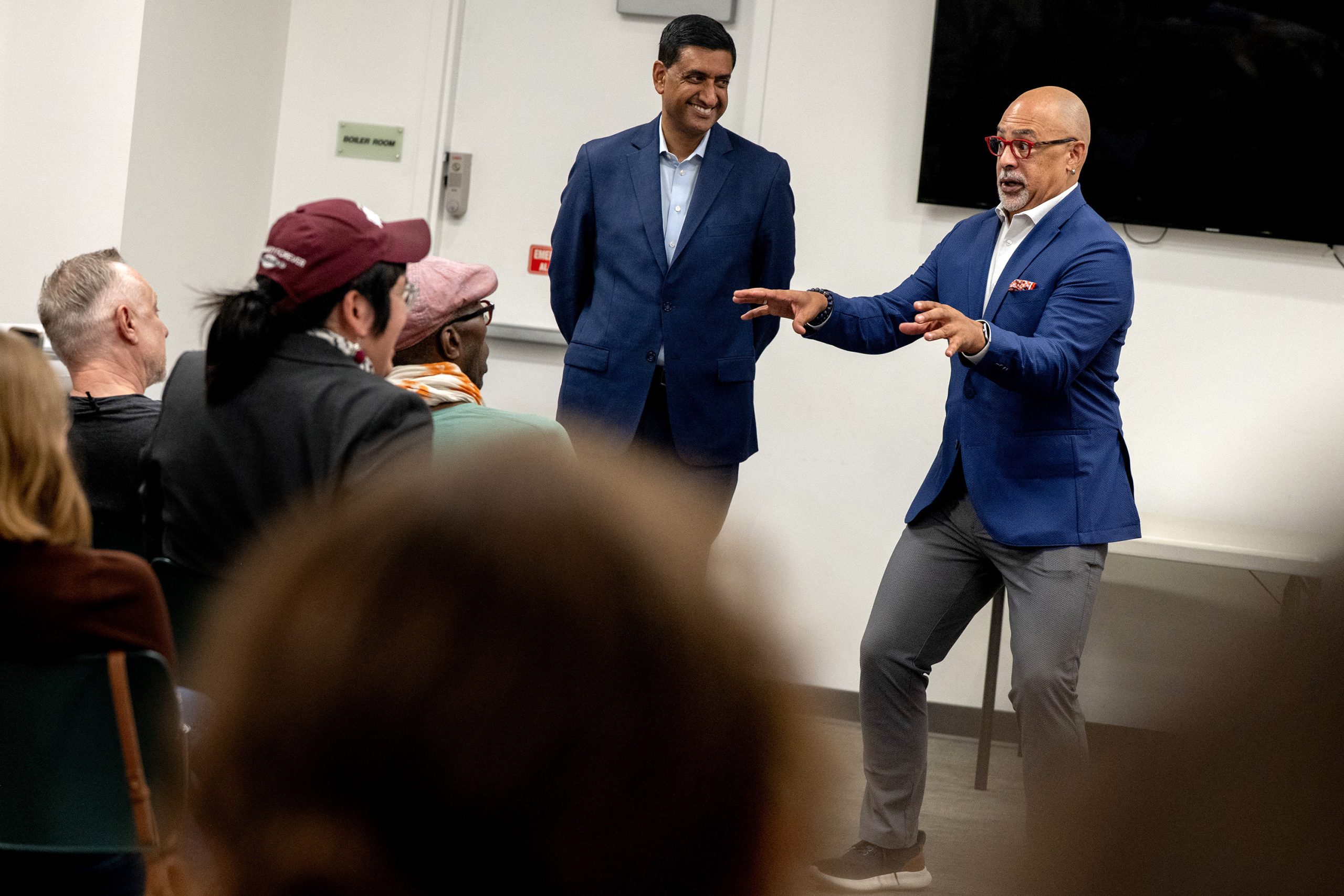
State Rep. Chris Rabb (right) joins U.S. Rep. Ro Khanna (left) Tuesday, July 28, 2026, as he stops on his “Made in PA: New Economic Patriotism Tour” at the City Institute Library on Rittenhouse Square.Tom Gralish / Staff Photographer
One specific provision, Khanna said, was informed by his visit in Washington County with individuals who are paid to host natural gas wells on their properties. It was there that he said he learned of community demands for oil and gas well sites to be at least 2,500 feet from residences. That buffer was a recommendation from a 2020 grand jury report released by Shapiro when he was serving as attorney general and that outlined health and safety issues caused by fracking in the Marcellus Shale region.
The recommendation was not followed, and advocates are continuing to push for extending the buffer from the current distance of 500 feet, according to Inside Climate News.
Khanna’s bill of rights would call for data centers to be built no closer than 2,500 feet from residences, schools, childcare facilities, hospitals or nursing homes. He said the environmental and health hazards for data centers aren’t the same as fracking but they should be kept at a distance from communities that don’t want to live directly next to them.
“At least they were offering royalty checks in the cases of fracking,” Khanna said. “[Data center developers are] not even giving the communities checks. It’s just kind of like, ‘OK, we’re going to build.’ What does the community get out of it? I literally don’t understand it.”
Data center advocates have argued their development is critical in winning an artificial intelligence war with China, and that they will bring construction and some skilled jobs to communities that need them.
Even the staunchest advocates, though, have acknowledged the public blowback.
“I do think that data centers in Pennsylvania have raised legitimate concerns,” U.S. Sen. Dave McCormick (R., Pa.) said during a recent telephone town hall as he continued to promote them in the competition with China and their creation of “thousands of jobs.”
When developers are making their pitch, McCormick said they should come with commitments to protect energy costs and overuse of water, use local labor, invest in the community and pay taxes.
“That should be part of the deal up front,” McCormick said during the telephone town hall in late July. “With all those facts, then the local community can decide whether they want the data center or not. And if they choose not to, that’s their choice.”
Khanna said he’s hoping for bipartisan support as he introduces the bill of rights idea. He’ll also be competing with other proposals — like one from fellow progressives U.S. Rep. Alexandria Ocasio-Cortez (D., N.Y.) and U.S. Sen. Bernie Sanders (I., Vt.) called the AI Data Center Moratorium Act. The bill would enact an immediate federal moratorium on data center construction until other safeguards are passed into law, including some of the ideas Khanna and McCormick have proposed, like around utility costs.
Several Pennsylvania state-level laws have been proposed, though the legislature did not address them during its busy budget season earlier this spring and summer. Lawmakers also left Harrisburg without ending tax breaks aimed at incentivizing data center construction even though the idea had garnered widespread support.
“They shouldn’t be getting these tax breaks to build,” Khanna said. “That’s absurd when you’ve got hyperscalers that are making trillions of dollars.”
The fact that many of those ultra-wealthy corporations are based in his district made the issue a politically dicey situation for him, but also one that the possible presidential hopeful said he was willing to take on.
“We’ve got to pause it in states like Pennsylvania,” Khanna said. “Some of my own constituents aren’t going to like that.”
Meek Mill’s newest single “Nightmares to Dreams” has a surprising cameo star: Pennsylvania Gov. Josh Shapiro.
The North Philly rapper calls it a “full circle Philly moment.”
Shapiro appears a little more than a minute into the music video, hugging and conversing with the rapper, with whom he’s built a friendship over the past decade.
The clip of Shapiro and Meek Mill is from a brief meeting the two had before Meek took the stage July 4 at the One Philly: Unity Concert for America, according to state officials.
The song is a spirited sequel to Meek’s 2012 anthem and title track of his debut studio album, Dreams and Nightmares.
The update features a similar melody as the original but with a more frenetic, more menacing instrumental on the song’s back half. Shapiro’s appearance in the song’s music video marks a convergence of some key themes in Meek’s life and music career.
“‘Nightmares to Dreams’ is about coming from North Philly, surviving everything that came with that, chasing a dream, and then using what I built to create opportunities and make change for other people,” Meek, also a criminal justice reform advocate, said in a written statement to The Inquirer.
With “Dreams and Nightmares,” the career of the rapper born Robert Rihmeek Williams began to take off. But he remained on probation with a decade of legal woes stemming from a 2008 drug and gun charge. Court-imposed restrictions disrupted his ability to travel and work, he said, and years of supervision limited his freedom and his musical ascension.
“I was selling out shows, taking care of my family, and representing my city, yet the system still controlled my life,” Meek said in the statement. “That probation nightmare followed me for years and sent me back to prison because of technical violations.”
Meek Mill closes day 2 of the Roots Picnic 2025 while performing on the Fairmount Park Stage at the Mann Center on Sunday, June 1, 2025.Yong Kim / Staff Photographer
In November 2017, the rapper was sentenced to two to four years in state prison following a string of nonviolent technical probation violations.
It was this court decision by former Common Pleas Court Judge Genece E. Brinkley that brought the incident to then state attorney general Shapiro’s attention.
“Meek got a real raw deal,” Shapiro said in an appearance on the Higher Learning podcast in March.
After Meek’s sentencing, Michael Rubin, founder and CEO of the sports platform Fanatics and a mutual friend of Meek’s and Shapiro’s, urged Shapiro to look closely into Meek’s legal battle.
The #FreeMeek campaign was launched soon after Meek’s sentencing and Shapiro urged Rubin to broaden the mission of the movement, he said on the podcast. The campaign became a national push for criminal justice reform for those who fell victim to systemic corruption.
Meek Mill in Amazon’s Free MeekAmazon
The Pennsylvania Supreme Court ordered Meek to be released from prison on bail in April 2018. In January 2019, he cofounded the nonprofit Reform Alliance, with Rubin, Robert Kraft, and Jay-Z. The aim was to mount a five-year campaign to overhaul Pennsylvania’s probation system.
“What happened to me wasn’t just my story,” Meek said. “It was happening to millions of people across this country. That’s why we created Reform Alliance. We wanted to turn one person’s experience into a movement that changes the system for everyone.
“Gov. Shapiro understood this issue was bigger than me” said Meek, “He told us to put a bill on his desk, and when we did, he kept his word.”
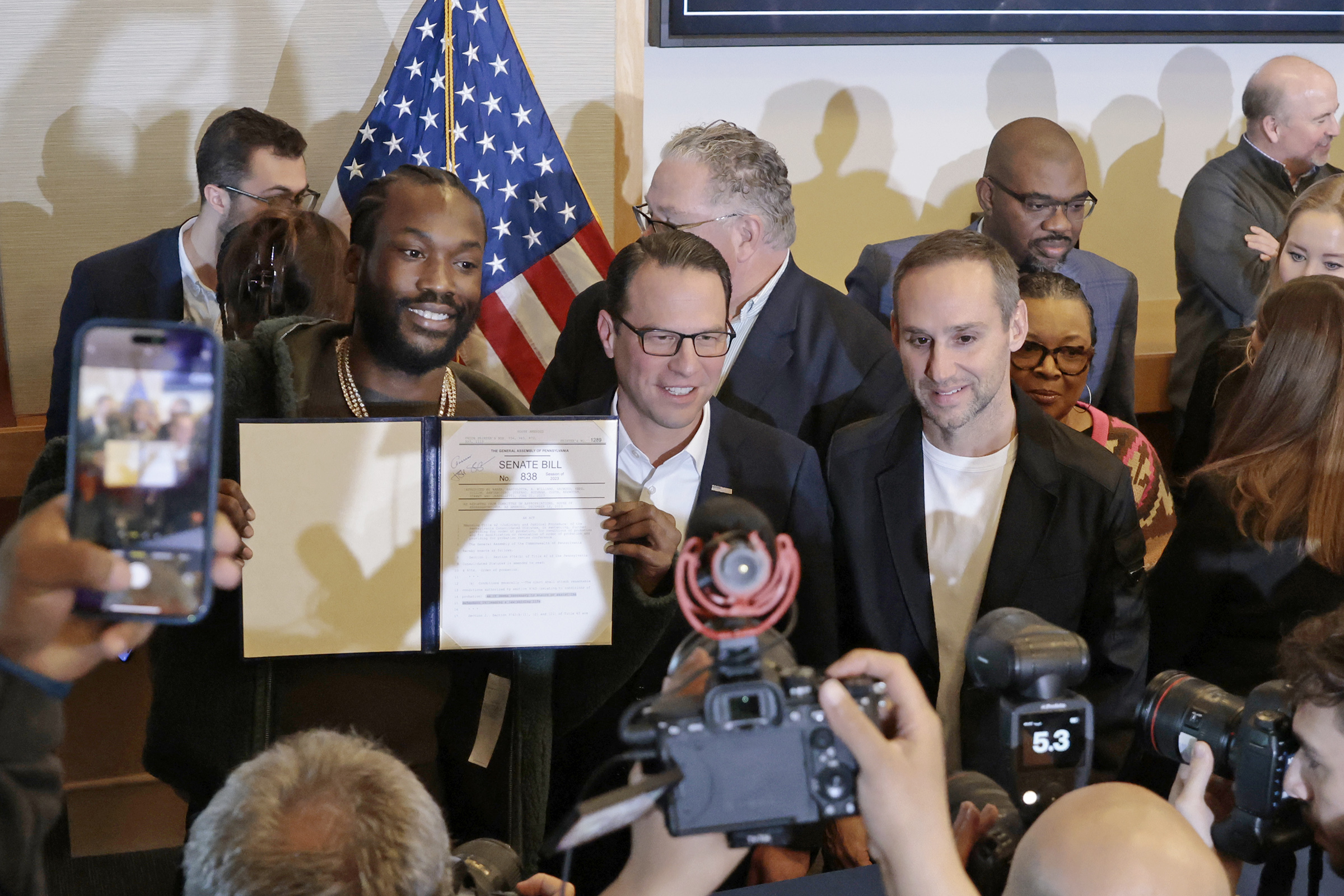
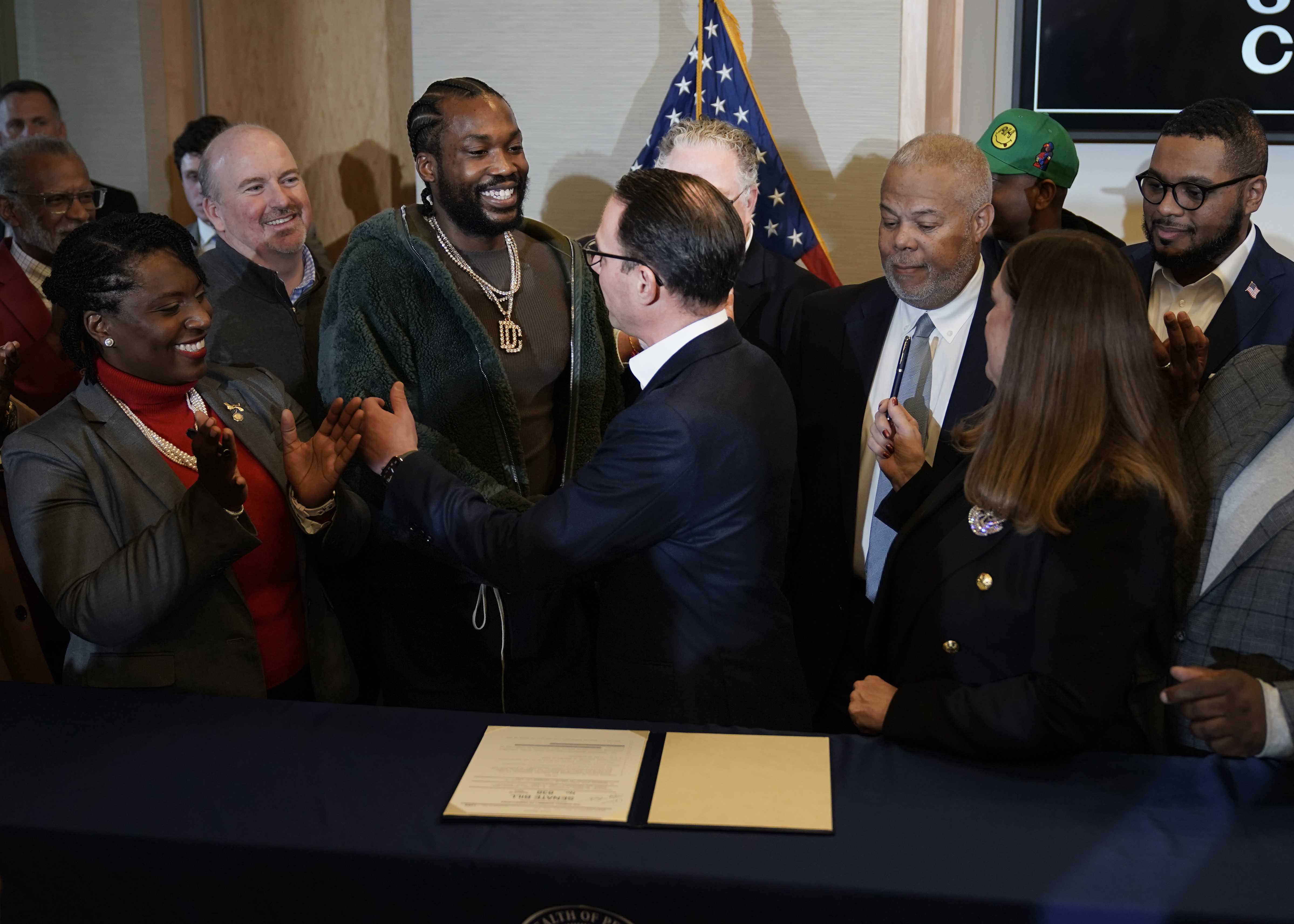
Shapiro signed Act 44 into law in December 2023. It creates new pathways for eligible Pennsylvanians to receive early termination hearings, finish probation after demonstrating sustained progress, and limits incarceration for technical violations of probation.
The act “created a more proportionate approach to technical violations, the same kind of noncriminal missteps that repeatedly sent Meek back to prison and derailed the progress of too many others,” Reform Alliance CEO Jessica Jackson said in a statement.
Rapper Meek Mill (center left) and Pennsylvania Gov. Josh Shapiro move to embrace during a ceremonial bill signing in Philadelphia, Friday, Dec. 15, 2023. More criminal records in Pennsylvania can be sealed from public view and fewer people might be kept on probation or in county jails, under legislation signed by Shapiro. (AP Photo/Matt Rourke)Matt Rourke
Shapiro commends Meek for opening his eyes to the failures of the Pennsylvania criminal justice system and for working to ensure others didn’t face the same barriers as him.
“I’m a more compassionate person and understanding person for what he’s taught me over the years. And I appreciate him,” Shapiro said to Higher Learning podcast hosts Van Lathan and Rachel Lindsay. “There are a whole lot of people who are no longer incarcerated, who shouldn’t have been incarcerated in the first place, because of policies I’ve changed in Pennsylvania, decisions I’ve made on pardons and clemencies because of lessons Meek has taught me.”
Meek has even informed his musical tastes, the governor said.
When they first sat down for a dinner at Rubin’s house, Shapiro admitted he wasn’t a fan of the rapper’s music. “I really find a lot of your music quite offensive,” Shapiro recounted telling Meek.
Pa. Gov. Josh Shapiro addresses the audience during a rally for Congressional candidate Bob Brooks at the United Steelworkers Union Hall in Bethlehem, Pa., on Sunday, July 26, 2026.David Maialetti / Staff Photographer
But after Meek played his songs and explained the meaning behind the lyrics, “it opened up my eyes a lot more into understanding his music, the way he thinks, the way he approaches things,” Shapiro said.
Years later, Meek said his music and circumstances have changed vastly.
That is what is reflected in the video to “Nightmares to Dreams,” which includes Philly landmarks and other high-profile cameos from the likes of Philadelphia Mayor Cherelle L. Parker and Million Dollaz Worth of Game hosts Wallo267 and Gillie da King.
It illuminates his North Philly roots, the distance he has traveled, and the change his advocacy has inspired.
What was once a nightmare is shaping up to be a dream, with a friendship with the governor to boot.
Since his victory in Philadelphia’s highly contested Democratic congressional primary in May, the state lawmaker and presumptive successor to retiring U.S. Rep. Dwight Evans has campaigned across the country — going nine for 10 in races where he’s supported progressives against more establishment-backed, moderate Democrats.
That wave of momentum — for a left-leaning faction hoping to transform the next generation of the Democratic Party — culminated this week in Michigan, where Dr. Abdul El-Sayed won a consequential U.S. Senate primary in the key swing state.
Though not a self-described democratic socialist like Rabb, El-Sayed ran on a similar anti-corporation, anti-Israel platform that focused on enacting policies like Medicare for All and dismantling U.S. Immigration and Customs Enforcement.
Rabb, who was on the ground in Detroit for the final push of the campaign and at El-Sayed’s victory party on Tuesday, said the Michigander prevailed “against extraordinary odds.”
U.S. Rep. Haley Stevens, with establishment support and about $62 million in outside spending on her behalf, had a roughly 9-to-1 spending advantage over El-Sayed, according to The New York Times. Her loss amid that kind of massive spending “is a testament to the power of economic populism and the growing frustration with incrementalism,” Rabb said.
“His primary win proves that economic populism and bold progressivism has growing support across the ideological spectrum among Democrats whether they’re voting in Michigan or Pennsylvania,” Rabb said.
The five-term state representative from East Mount Airy has thrown his energy into other campaigns as his own is pretty much complete. In one of the bluest in the country, he defeated a pair of more moderate Democrats — State Sen. Sharif Street and physician Ala Stanford — and will not face a Republican opponent in the November election. The district covers about half of the city, from South Philadelphia through the Northwest.
In New Jersey’s Trenton-based congressional district, he campaigned for Dr. Adam Hamawy, a former combat surgeon who has also provided medical care to Gazans during the war with Israel. In New York, he threw his weight behind Darializa Avila Chevalier and Claire Valdez, two of the democratic socialists also backed by New York Mayor Zohran Mamdani.
He turned to other candidates in California, Colorado and Michigan as he door-knocked, called voters and appeared in virtual events.
“Ever since May 19, which was the night I won, I’ve been paying it forward with so many amazing candidates,” Rabb said during a recent virtual fundraiser for El-Sayed in which Rabb said he was signing and giving away the pink “Philadelphia” baseball hat he was wearing to a lucky donor.
Rabb hasn’t weighed in on every battle between progressives and moderates. He did not endorse Cori Bush, the former member of Congress and democratic socialist who failed in her attempt at a comeback in Missouri this week. He also has not endorsed every congressional candidate promoted by two key national coalitions that supported him — Justice Democrats, which has been a force behind the election of U.S. Rep. Alexandria Ocasio-Cortez and others, and the Democratic Socialists of America.
The one candidate he endorsed who did not win was Saikat Chakrabarti, a former campaign manager and chief of staff to Ocasio-Cortez who tried to beat former House Speaker Nancy Pelosi’s hand-picked successor in San Francisco.
And not all of Rabb’s endorsees are guaranteed to join him in Congress next year. Justin Pearson, a Tennessee state lawmaker who won a U.S. House primary on Thursday, will be the nominee in a state where Republicans redistricted this year in an attempt to root out Democratic incumbents. Pearson’s district is considered “solid Republican” by the Cook Political Report, a nonpartisan group that rates competitive districts.
While some Democrats have questioned whether progressives can win competitive general election races, Rabb said he was “confident that strategically supporting anti-establishment populist candidates who bring with them new, more active and enthusiastic voters will significantly increase turnout in November.”
“Ignoring the unique strengths of such candidates and campaigns will be at the Democratic Party’s great peril,” he added.
That sentiment echoed other comments he’s made in recent months as more centrist leaders in his party questioned the progressive momentum. In June, he responded to an interview in which Gov. Josh Shapiro called the democratic socialists who won in New York an example of “performative politics.” Those candidates would now need to govern effectively, he said, adding that they were not indicative of the types of Democrats winning in Pennsylvania.
“You’re seeing very different-looking congressional races, and certainly very different Democratic candidates here in Pennsylvania,” Shapiro told CNN, prompting Rabb to respond on social media with, “Ummm…”
Shapiro, a popular figure as he seeks reelection this fall, has been lending his support to Democrats in four competitive congressional seats in Pennsylvania that are held by Republicans, including a swing district in suburban Bucks County. Flipping those seats in a way that could help Democrats capture the U.S. House majority has been a top priority and has further fueled speculation that Shapiro is eyeing a run for the White House in 2028.
At the same time, Shapiro has not appeared with or supported Rabb during his campaign, though his team has said the governor looks forward to working with whoever replaces Evans.
As Rabb has crisscrossed the country, he’s also drawn more ire from the state’s other most nationally prominent Democrat — U.S. Sen. John Fetterman, who Rabb dismissively refers to as “the F word.”
“Rabb, he won, and he ran on being a very, very anti-Israel guy,” Fetterman said in early June at an American Jewish Committee conference in Washington. “It’s actually a virtue (in the modern Democratic Party)… It’s heartbreaking for me.”
After El-Sayed’s win this week against a candidate who received more money from the American Israel Public Affairs Committee than possibly any other candidate on record, Rabb and the coalition behind him have shown no signs of slowing down.
“Ground Zero was Chris Rabb in Pennsylvania, winning a key congressional primary,” Adam Green, co-founder of the Progressive Change Campaign Committee said on the livestreamed fundraiser with Rabb this week.
The “ripple effects of winning a battleground Senate contest,” like in Michigan, Green said, will be significant.
“The message will be undebatable that we won, that we’re on the rise, and that we can win anywhere,” he said.
Clad in a royal blue, two-piece suit, Pennsylvania Treasurer Stacy Garrity stood next to a seated President Donald Trump in the Oval Office on Tuesday, in a video message posted to his social media platform, Truth Social.
“Pennsylvania is very lucky because you have somebody running for governor who’s going to do a fantastic job,” Trump said to the camera, while shaking Garrity’s hand. “She really is a spectacular person. And I just want to wish you luck. I think you’re going to win.”
The White House appearance signaled a closer public alliance between Trump and Garrity, and the latest chapter in her campaign challenging Gov. Josh Shapiro as she seeks to draw Trump’s loyal fan base to the polls in November.
Trump, who endorsed Garrity in January, followed the video message by posting a photo with Garrity, writing: “Stacy is running to be the next Governor of the GREAT Commonwealth of Pennsylvania. She has my Complete and Total Endorsement. She will do a fantastic job!”
Garrity’s campaign said in a statement that she was visiting the White House alongside the Penn State wrestling team, which was being honored for its 2026 national championship.
The Oval Office meeting represented a repair of sorts between Garrity and Trump after he has displayed little enthusiasm toward her campaign in recent months.
It was my Great Honor to welcome Highly Respected and very popular Pennsylvania State Treasurer, Stacy Garrity, into the Oval Office. Stacy is running to be the next Governor of the GREAT Commonwealth of Pennsylvania. She has my Complete and Total Endorsement. She will do a… pic.twitter.com/1vROsLLTlM
— Commentary Donald J. Trump Truth Social Posts On X (@TrumpTruthOnX) August 4, 2026
Garrity entered the race against Shapiro, the Democratic incumbent, last summer as Republicans — disappointed with their 2022 performance — sought to consolidate support early around one strong candidate. When Trump endorsed Garrity, he called a “true America First Patriot” who “WILL NOT LET YOU DOWN!”
In March, Garrity hosted a fundraising dinner at Trump’s Mar-a-Lago Club in Florida, where, beneath a wrought-iron doorway at his private golf club, the president said “she should win.”
But when Trump visited Pennsylvania in June and Garrity introduced him onstage, he seemed to forget her altogether.
During a speech meant to focus on manufacturing in Macungie, Trump spent over an hour talking about weight-loss drugs, immigration, firearms, the role of transgender athletes in women’s sports, and the UFC fight recently held on the White House lawn. But Garrity never received a mention, and Trump instead celebrated U.S. Rep. Dan Meuser, a Pennsylvania Republican who considered a run for governor before ultimately opting against it. Trump even name-checked Shapiro.
Three months out from Election Day, Garrity has struggled to gain traction among voters. A Quinnipiac University survey of 895 registered Pennsylvania voters in July found 53% would vote for Shapiro, while 40% said they would vote for Garrity.
At right is Pennsylvania Governor Josh Shapiro listening to Stacy Garrity, 78th State Treasurer, Forum Auditorium in Harrisburg, Pa., Tuesday, Jan. 21, 2025.Alejandro A. Alvarez / Staff Photographer
Trump’s latest show of support for Garrity comes as Shapiro — who is rumored to be eyeing a run for the White House in 2028 — has set his sights beyond the governor’s office, lending his time and spending his money to support Democrats up and down the ballot, in an attempt to flip the Pennsylvania state Senate and four swing districts in Congress.
Last month, in another stop in Pennsylvania, Trump attempted to lend more support to Garrity during Republican U.S. Sen. Dave McCormick’s Defense and Innovation Summit.
“I hear things about Stacy, and I’m hearing some poll numbers that are very good,” he said.
Regarding her opponent, however, Trump had stronger words.
“This guy Shapiro is totally overrated. … He doesn’t have what it takes,” Trump said.
President Donald Trump visits Mack Trucks in Macungie in the Lehigh Valley Tuesday, June 23, 2026.Tom Gralish / Staff Photographer
In Pennsylvania, Trump remains deeply underwater in popularity. The Quinnipiac survey found only 39% of Pennsylvania voters would give him a positive job approval. Elsewhere in the country, Trump has remained Republicans’ most effective energizer to the polls — though some are concerned about GOP successwithout his name on the ballot in November.
Pennsylvania Democrats on Tuesday seized on Garrity’s appearance with the president.
“Stacy Garrity always sprints to any chance she gets to pledge her 100% loyalty to Donald Trump and his disastrous agenda,” Ava Pitruzzello, a spokesperson for the Pennsylvania Democratic Party, said in a statement.
Last week, Shapiro’s campaign launched a new ad calling Garrity “100% MAGA.” Garrity’s campaign, in a statement, called the ad “a dishonest, lying attack.”
WASHINGTON — In a Pennsylvania election where a few thousand votes could make all the difference, the last-minute entrance of a Green Party candidate with a background in Republican politics has sparked the second allegation of election meddling in three months and complicated one of the nation’s most competitive U.S. House races this fall.
But the emergence of a third-party candidate has alarmed both Democrats — who have long claimed that Green Party candidates pull votes from their nominees — and the Green Party of Pennsylvania, which said it does not know the person now representing its platform in one of the state’s highest-profile races.
“It sounds a lot like somebody’s just fooling around and trying to use the Green Party name, which is a well-known thing that happens in many states,” said Tim Runkle, cochair of the state party.
Andrew Tupone, 37, of Northampton County, filed his nomination papers with the state last week ahead of a Monday deadline for third-party candidates. He was the only candidate to file to represent the Green Party in a Pennsylvania race for Congress.
Unlike the Green Party’s endorsed candidate for governor — Tony Dastra of Lancaster County — Tupone does not have a long association with the party or its left-leaning policies. In 2021, he was the Republican nominee for a Northampton County magisterial court seat. Voter registration records show he changed his party affiliation from Republican to Democrat in February, and then from Democrat to Green in April.
In an interview, Tupone rejected accusations that he remained affiliated with the Republican Party or that he was asked to run in a way that would draw votes away from the Democratic nominee. He described a leftward shift in his political views after voting for President Donald Trump in 2020, though he said he could not recall whom he voted for in the 2024 presidential race between Trump and Democratic Vice President Kamala Harris.
“A lot of people are disillusioned with both parties,” Tupone said. “They’re sick of all the stuff that’s going on.”
Tupone also said he did not pay anyone to help gather signatures for his nominating papers, which he turned in with upward of 9,000 signatures — more than twice as many as required. Runkle said Green Party members encountered paid canvassers for Tupone who declined to say who was funding the effort.
According to a copy of the nominating papers obtained by The Inquirer, only one of the 22 individuals who gathered signatures is from Pennsylvania. The rest are from all over the country. Multiple have worked for Republican campaigns, according to public records.
Colin McEvers, who gathered signatures for Tupone in Lehigh County, is a Republican candidate for the Maryland General Assembly who is also listed as the contact for the Maryland White Republican Council. Others — including individuals from Illinois and Michigan — have been paid to canvas for GOP campaigns, according to Federal Election Commission records.
Tupone said he had no knowledge of anyone paying his canvassers.
“I went around and I gave a lot of my nominating papers to friends to give to other people, and I sent it to them as well,” Tupone said. “And as I went around, I recruited people and asked them.”
While the signatures appear to be based in the district — which stretches from the cities of Allentown, Bethlehem, and Easton into the more Republican-leaning Poconos — the other candidates have until Aug. 10 to challenge their legitimacy.
Such challenges are common, and the Brooks campaign is reviewing its options to decide whether to bring a challenge, according to a source familiar with the campaign’s thinking.
‘No one’s paying me to run’
Jenna Kauffman, Brooks’ campaign manager, in a statement described the situation as a GOP-initiated and “desperate scheme to meddle in this race.”
She connected it to a last-minute $1.7 million advertising campaign against Brooks in the May primary that appeared to be run by Democrats but was actually funded by a Republican political organization.
The spending, by a political action committee called Lead Left, was aimed at boosting another Democrat who observers considered to have a worse shot at beating Mackenzie in the November election. But the effort was anonymous, and records that became public only after Brooks won show that it was funded by the Conservative Americans PAC.
The effort to prevent Brooks from emerging from the Democratic primary came as he coalesced support from across the ideological spectrum with high-profile endorsements ranging from moderate Democratic Gov. Josh Shapiro to U.S. Sen. Bernie Sanders (Ind., Vt.), a democratic socialist.
“Voters deserve to know who is paying for this effort and whether Ryan Mackenzie and his Republican backers are involved,” Kauffman said, painting Tupone’s candidacy as a continuation of the move in the primary.
Mackenzie’s campaign did not address that comment when asked about it Monday.
Tupone said that the inference was “just false,” and that he instead likes the values of the Green Party, which he said included supporting the environment, social justice, and “stopping the corruption and also the genocide in Gaza.”
“No one’s paying me to run. No one’s asked me to run for this office. I’m running on my own, hopefully with a lot of hope from everyone who wants to volunteer,” Tupone said. “I’m not associated with the Republican Party anymore. I’m not a candidate for them.”
For years, Democrats have voiced concerns about the Green Party and other third-party candidates “spoiling” elections, from Jill Stein in the 2016 presidential race that first put Trump in power to the 2024 U.S. Senate race in Pennsylvania, when Democratic U.S. Sen. Bob Casey lost to Republican Dave McCormick by about 15,000 votes. In that 2024 election, a Green Party candidate won about 66,000 votes, a Libertarian candidate won almost 90,000, and a Constitution Party candidate won more than 23,000.
In the 7th District in 2024, Mackenzie defeated incumbent Democrat Susan Wild by 4,062 votes out of more than 403,000 cast. That was the narrowest margin out of any of the state’s 17 districts, making it a key tossup district this year.
That margin is also significantly different from the one Shapiro potentially faces during his reelection campaign this year as he maintains a sizable lead over Republican Stacy Garrity, and as a Green candidate officially filed to run on Monday. Shapiro defeated Republican Doug Mastriano in 2022 by almost 793,000 votes; the Green Party candidate won just over 24,000 votes.
Runkle said that nobody solicited the Green Party’s endorsement in a Pennsylvania congressional race this year, and that a conversation he had with Tupone left “a lot of questions.”
He said the party is concerned about its reputation and about being targeted in ways that do not lift up its platform, which focuses on environmental protections and liberal positions on healthcare. But he also pushed back on concerns that the party should be considered a spoiler.
“I do solidly believe that the Green Party policies and the values we represent has a solid bloc of voters,” Runkle said. “If people think that’s spoiling the race, then they should try harder to speak to the issues that we speak to.”
HARRISBURG —More than one million Pennsylvania households spend over 30% of their income on housing. And over the next decade, the state’s housing crunch is slated to intensify, with estimates that Pennsylvania will have nearly 185,000 fewer new homes than it needs to keep up with projected demand.
State legislators have pushed to address the need, introducing bills that would increase the housing supply through accelerated approval processes and lifting restrictions on new developments — and urged leaders to include those initiatives in this year’s budget negotiations.
But none of the proposed policies were included in the final budget deal, passed last month. Instead, the budget included the creation of a housing database — a move some lawmakers and advocates say falls short of addressing Pennsylvania’s burgeoning housing crisis.
“I think the budget generally left a lot of questions unaddressed. And housing, one of the top three issues in terms of the cost-of-living crisis, was one of them,” said Sen. Nikil Saval (D., Philadelphia).
Saval was one of six senators who voted against the budget. He has since said that was because it left many key policy issues, including housing, unaddressed. Sen. Katie Muth (D., Montgomery), the only other Democratic senator to vote against the budget, has also said she believes the budget left issues like housing, rising energy costs, and affordability unanswered.
Shapiro’s office did not respond to a request for comment.
(function() {
var l2 = function() {
new pym.Parent(‘pa_housing’,
‘https://media.inquirer.com/storage/inquirer/projects/innovation/arcgis_iframe/pa_housing.html’);
};
if (typeof(pym) === ‘undefined’) {
var h = document.getElementsByTagName(‘head’)[0],
s = document.createElement(‘script’);
s.type = ‘text/javascript’;
s.src = ‘https://pym.nprapps.org/pym.v1.min.js’;
s.onload = l2;
h.appendChild(s);
} else {
l2();
}
})();
The new housing database — incorporated through a bill sponsored by Saval and authored by fellow Philadelphia Democratic Sen. Vincent Hughes — will be overseen by the Pennsylvania Housing Finance Agency. Saval said it will ensure more robust data collection to provide transparency on how much affordable housing is available across the state.
Under the new legislation, the agency will be required to create an online searchable database of all publicly financed housing that is subjected to public assistance programs. It will include anticipated termination dates on properties’ affordability restrictions and will note if the property has been granted an extension on those restrictions.
Saval said the publicly available database will ensure lawmakers have a better idea of the state’s affordable housing stock. Much of the affordable housing in the state was created with the help of low-income tax credits that are subject to expiration dates. As termination dates on these housing units loom, with many set to expire within the next five years, Saval said, the database will keep lawmakers aware of when housing is no longer affordable and allow them to see if restrictions can be extended.
The database will be updated annually by the PHFA, with local housing agencies submitting data every year.
Chris Anderson, communications officer for the PHFA, wrote in an email that the database is still in the early stages of being built, but that it will not pose any significant costs to the agency and existing resources will be used to create it.
There are no penalties if the PHFA does not update the database, and the new law does not make it mandatory for local agencies to report information to the agency. The intended audience is primarily housing advocates and organizations, as well as policymakers, Anderson said.
Saval said the database will help lawmakers know how much affordable housing there actually is in the state.
But he said the state budget — where legislators often pass policies in addition to the yearly spending plan — was still a missed opportunity to address Pennsylvania’s housing concerns.
“Anytime there’s a set of budget negotiations where there’s the potential to allocate funding, or create policy that would increase the supply of housing, or address the concerns faced by renters, and anytime that opportunity is missed as it was in this budget, I think it’s a step back,” he said.
‘Missed opportunity’
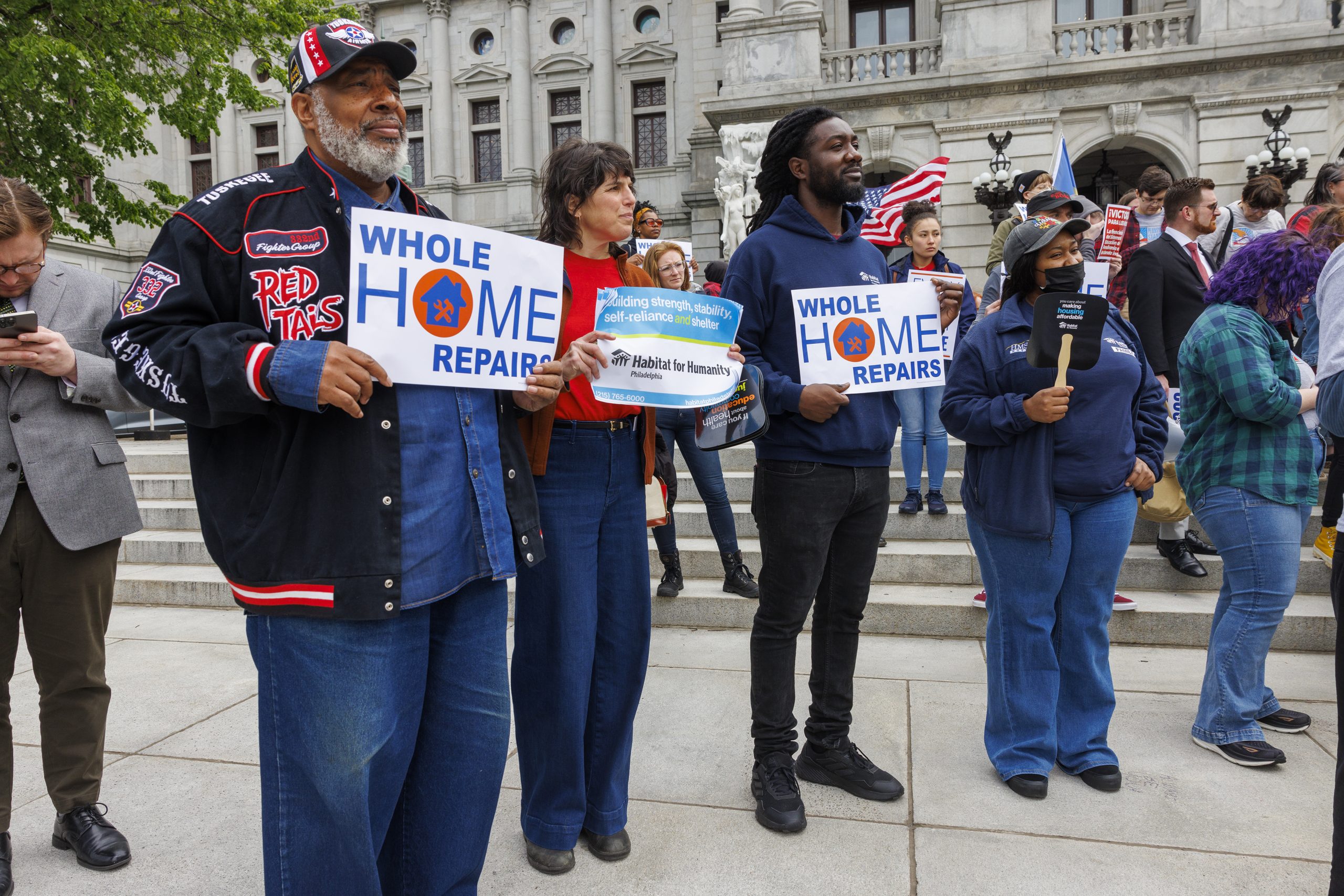
Carrie Rathmann, vice president of strategic partnerships for Habitat for Humanity Philadelphia, said one initiative notably absent from the final budget deal was the PA Home Preservation Program, a grant administered by the Pennsylvania Department of Community and Economic Development to provide funding for construction cost gaps and keep homeowners in their houses through repairing outdated buildings. The initiative was last funded when it was signed into the budget in 2022, but has not received funding since.
Previously known as the Whole-Home Repairs Program, the state allocated $125 million toward the program using American Rescue Plan dollars, repairing more than 2,600 affordable homes across the state.
Douglas Paige (from left), Carrie Rathmann with Habitat for Humanity, Tyron Cheeseboro, and Danielle Paige on the steps of Pennsylvania Capitol during a 2023 rally for the Whole-Home Repairs Program.
Housing advocates have pushed for the state to renew the funding, with the Housing Alliance of Pennsylvania calling it one of the organization’s biggest priorities.
In an email, spokespeople from the housing alliance noted that the state funding in 2022 was not enough to support the number of people that applied for it, meaning there are still people waiting to have their homes repaired.
“The program received far more applications from qualified homeowners than available funding could support, highlighting both the scale of unmet need and the importance of preserving existing housing,” the spokespeople wrote.
The program has not returned in a line item in the state budget since 2022. Companion bills in both chambers supporting the program have received bipartisan support — the House bill passed 122-80 — but are sitting in the Senate Urban Affairs and Housing Committee.
“That felt like it represented a huge missed opportunity to help thousands of Pennsylvanians stay housed and to keep homeowners safe and healthy in the homes that they already own, because without that dedicated investment, this crisis will only grow,” Rathmann said.
Habitat for Humanity is a nonprofit that does not rely on state dollars, but Rathmann said state money goes to counties and housing providers like the Philadelphia Housing Development Corp. The money helps an “ecosystem” of housing organizations in the Philadelphia area, and Habitat uses it for a portion of the organization’s work. That included the Built to Last program, an initiative spearheaded by the Philadelphia Energy Authority that inspired the statewide initiative of Whole-Home Repairs in 2022.
Rathmann said state initiatives that increase efficiency on building houses are key to developing homes faster and cheaper, which in turn increases the housing supply and can keep people in high-quality houses. This includes incentives like building lower density “by right,” meaning property owners can build low-density housing without special approval.
“We see every day at Habitat that that impact is real, it’s tangible, it crosses different sectors like kids can get to school and do better,” Rathmann said. “Seniors are healthier. People are healthier. People feel less stressed. They have more money in their pocket for medication and food.”
‘Risk aversion on all sides’
Lawmakers on both sides of the aisle in Pennsylvania’s divided state legislature have pushed for their own housing initiatives. Bills have passed through the Democratic-controlled House or Republican Senate, but have yet to move forward in the opposing chamber.
Democratic-backedHouse bills sitting in Senate committeesinclude proposals to remove barriers to building accessory dwelling units, lift restrictions on how many unrelated people can live in one home, and seal eviction records to help tenants.
Beth Rementer, spokesperson for House Democrats, wrote in an email that the House has sent 22 bills to the Senate Housing Committee, while the Senate sent two in June.
The state’s lack of housing action marks a difference from the Republican-controlled federal government. In early July, Congress sent the ROAD to Housing Act to President Donald Trump’s desk — a bill that reduces barriers to home construction and modernizes housing programs alongside other initiatives, including a pilot of Whole-Home Repairs.
Saval attributed the Pennsylvania legislature’s inaction to a desire to pass the state budget quickly without debate on hot-button policy issues ahead of the November election, when half the Senate and all members of the House are on the ballot.
“Essentially, there was risk aversion on all sides,” Saval said. “And, understandably, an unwillingness to get into a budget discussion that would prolong the budget negotiation process.”
Kate Flessner, spokesperson for the Senate Republicans, said in an email that the Senate supports a number of housing initiatives, but that underlying issues lie in how the state will pay for them in light of the roughly $5 billion structural deficit.
“As we continue working to address the state budget’s serious structural deficit, we will be primarily focused on ways we can improve housing access that do not require vast sums of taxpayer money — and there are many of them,” Flessner said.
Natalie Javitt is an intern with the Pennsylvania Legislative Correspondents’ Association. She can be reached at natalie.javitt@gmail.com.
HARRISBURG — Hidden deep in more than 600 pages of state budget documents, Pennsylvania lawmakers last month quietly repealed an unenforced 1929 law that allowed traditional midwives, the main group of midwives delivering home births, to practice.
Now, traditional midwives — who differ from midwives usually found in hospitals, are not medically trained, and often serve religious minorities like the Amish — are worried they have no legal standing to work in Pennsylvania and are challenging the repeal and a new lawin state court.
The 1929 law had been on the books for nearly a century, asking traditional midwives to submit a paper application and a $10 fee to get a state certificate. But it had not been enforced for decades, and Pennsylvania, which has one of the highest rates of home births in the nation, was counted as one of 13 states that did not regulate the practice at all.
Meanwhile, other forms of midwifery — such as nurse midwives and certified midwives, who are medically trained and are formally affiliated with a doctor or health system — are highly regulated by the state and its medical board. But these affiliations often prevent nurse midwives and certified midwives from offering home births, as the health systems see them as possible risks for medical malpractice lawsuits.
The practice of traditional midwifery dates back to the Old Testament and has lived on through centuries of community knowledge and traditions. It can include Amish and Mennonite midwives, who are limited in the amount of education they are allowed to receive, as well as other unlicensed midwives who say they take only low-risk pregnancies.
Some Pennsylvania traditional midwives say their practice is more necessary than ever, citing the United States’ maternal mortality and morbidity rate and cesarean section rates that outpace most of the rest of the Western world. They see their work as more holistic and personal than the American medical system, offering more personalizedcare to the new parent and baby for weeks after birth, as well as an answer to maternity care deserts as more hospitals and birth centers close.
Medically trained midwives and physicians, who receive licenses from the state,argue the practice of traditional midwifery is potentially unsafe for mothers and babies, and requires little to no oversight in comparison to their medical training and licensure.
A new law, and legal uncertainty
There is no state law regulating home births — which are chosen by a variety of families for different reasons, from Amish who have religious beliefs about delivering at home to Black and brown women who have felt underserved or discriminated against by the modern healthcare system. But if traditional midwives — the primary group delivering babies in home births — cannot practice, some argue, home births will become inaccessible.
The legal fight over midwifery began earlier this year, when the General Assembly approved changes to a separate law to include another class of midwife: certified midwives, who have all the same education training as nurse midwives except the nursing degree.To receive a certification from the Pennsylvania Board of Medicine, nurse midwives and certifiedmidwives must provide proof of education and a collaborative agreement with a physician or medical institution.
The law, the Midwife Modernization Act, was written to protect traditional midwives’ ability to practice, its author, Sen. Rosemary Brown (R., Monroe), said in a statement.
Kate McHugh, a nurse midwife who has worked for a decade with lawmakers on updates to midwife regulations, said stakeholders approached traditional midwives during earlier iterations of the bill to see how they would like to be regulated. The different groups of traditional midwives could not agree, so the nurse midwives and certified midwives moved forward on their own.
But the changes to Pennsylvania’s laws created a legal gray area, some midwives argued in a lawsuit filed last month.
An anonymous group of two traditional midwives, a nurse midwife, and an Amish man whose family utilizes traditional midwifery filed a lawsuit in a state appellate court, challenging Brown’s law as unclear about their ability to practice, and asking the state to enforce the 1929 law already on the books.
After the lawsuit was filed, legislators repealed the 1929 law as part of an overall state budget deal, creating more uncertainty for traditional midwives, according to their amended filing. Some lawmakers said they did not know they had voted to repeal the law, as the state budget is drafted in closed-door meetings among top leaders and fast-tracked through the legislative process with little time for rank-and-file members to review what they are voting on.
The law was repealed as part of a request by Democratic Gov. Josh Shapiro’s administration, according to a source briefed on budget conversations. The administration works closely on legal matters with Republican Attorney General Dave Sunday’s office, which is defending the state in the case. Shapiro’s office declined to comment.
“It’s not fair the way [the budget] is done,” said Rep. Dave Zimmerman (R., Lancaster), who said he unknowingly voted in support of the bill that repealed the 1929 law in an omnibus bill.“It concerns me a little bit that we repeal something in the fiscal code rather than right up front where it’s transparent.”
“You have people in the Amish and Mennonite community that this is what they do. We have midwives that have been doing this for 30 and 40 years, They’re probably as good as anyone else doing it, certified or not,” Zimmerman added.
The lawsuit
The group oftraditional midwivesfiled the lawsuit anonymously out of fear of retribution from the state for continuing to practice, said the group’s attorney, Jonathan Goldman, of the Goldman Law Team, based in Fort Washington. The midwives spoke with The Inquirer on the condition of anonymity for the same reason.
One of the midwives, who serves south-central Pennsylvania with a largely Amish and Mennonite clientele, said she has delivered 1,600 home births over 38 years. She had practiced traditional midwifery in other states, before similar certifications were required there. At one point, she said, she was arrested and charged with a misdemeanor for continuing to practice home births in New York.
Unlike medically trained nurse midwives and certified midwives, traditional midwives are prohibited from practicing medicine, which could mean dispensing medication or conducting medical procedures as simple as stitches. They have historically been investigated by state boards of medicine if this is called into question, making the group even more distrustful of state oversight.
One of the anonymous traditional midwives, who has delivered an estimated 600 births around eastern parts of Pennsylvania, said her clients are often religious and want traditional models of care, such as no lab work and one ultrasound — a very hands-off approach compared to the highly surveilled pregnancies in modern medicine.
The midwife, who delivered four of her 10 children in the hospital before finding an interest in home births, said her faith as a born-again Christiandrew her to the “completely different model of care” that does not rely on pharmaceuticals, with a comfortable home setting and few restrictions like in a hospital.
“In the hospital, it’s a fractured system. There are several midwives and physicians, you never know who you’re going to get, who is going to be on call,” said the midwife, who works with Amish and Mennonite populations in south-central Pennsylvania. “We are the community midwives. We know the secrets, we know the stories, we know what kind of care works. We know the family intimately. And it improves outcomes because knowing them intimately and emotionally allows us to provide that kind of specialized care.”
Sunday’s office, defending the state in the suit, said in a July 24 filing that the midwives’ claims are a “misreading and misunderstanding of the current law,” and that traditional midwives “can continue to practice as lay midwives without certificates.” Sunday’s office did not respond to a request for comment.
The case is scheduled for a preliminary injunctionhearing to block the law from going into effect on Wednesday, where Brown and other lawmakers may be called to testify and a judge is expected to rule whether current laws prevent traditional midwives from practicing.
Outside the medical system’s framework
Obstetricians in hospitals and birth centers routinely work with certified midwives, who have an advanced degree in midwifery, and nurse midwives, who have a nursing degree in addition to specialized midwifery training.
“As an OB-GYN physician, I absolutely respect somebody’s right to make a medically informed decision about how they take care of themselves in their pregnancy, and who they request assistance from in birth, and where they give birth to their babies,” said Holly Cummings, an OB-GYN in Philadelphia and chair of the Pennsylvania section of the American College of Obstetrics and Gynecology, a leading physician organization. “But I do also believe a hospital or an accredited birth center is the safest place to give birth. I don’t think in the U.S. in 2026 we can currently safely, uniformly support home birth.”
ACOG does not support traditional midwives, who can also be known as lay midwives.
But traditional midwives maintain they should be able to continue their work outside the medical system’s framework, citing it as a religious tradition and safe practice, and hope the judge rules in their favor.
“Pennsylvania has a rich history of midwifery,” said the midwife listed in the lawsuit who serves parts of eastern Pennsylvania. “We have some of the highest home-birth numbers in the country. … It would be sad to see Pennsylvania not acknowledge the heritage in midwifery that we have here.”
Staff writer Sarah Gantz contributed to this article.