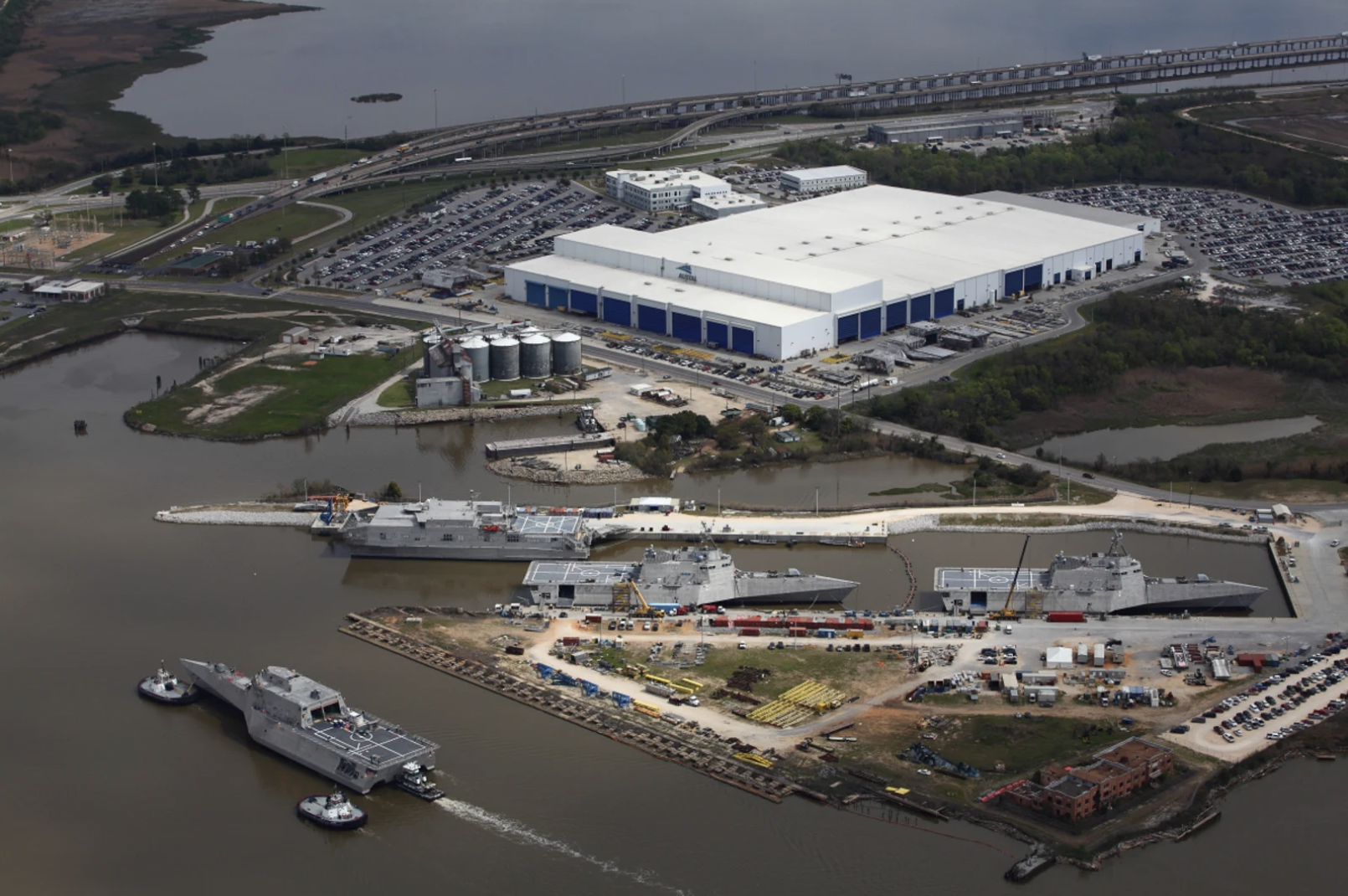
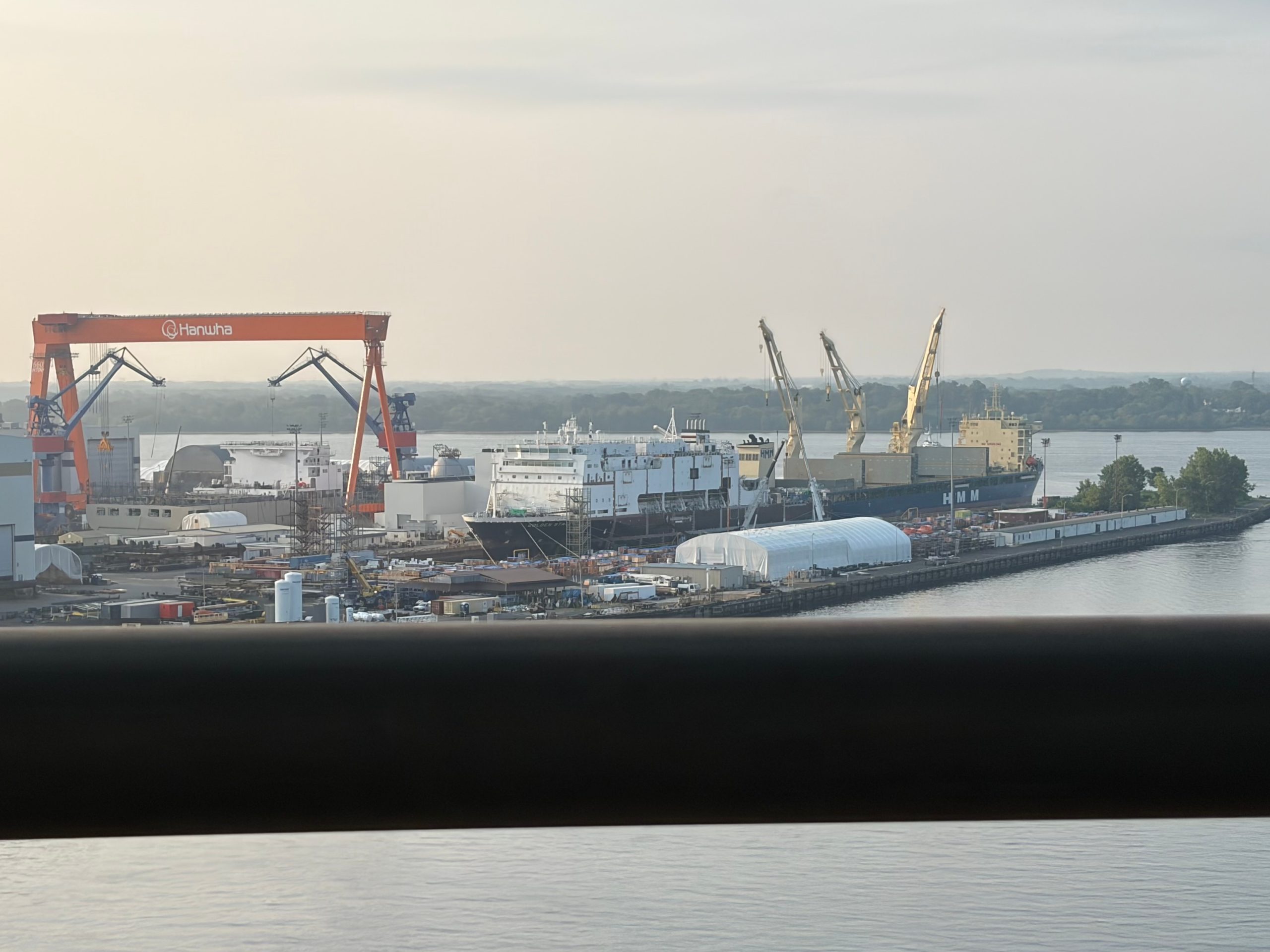
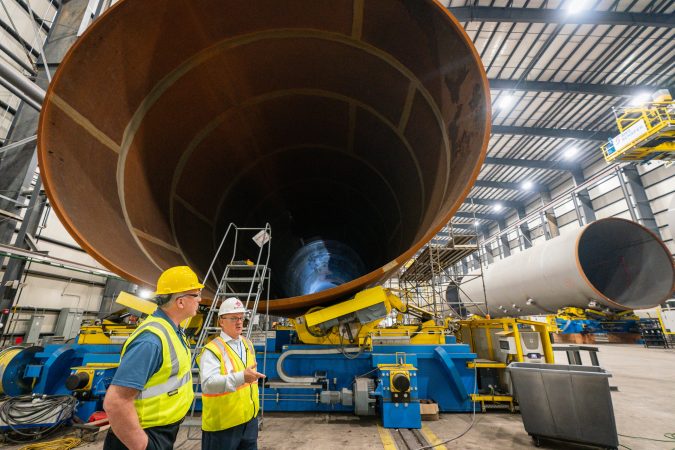
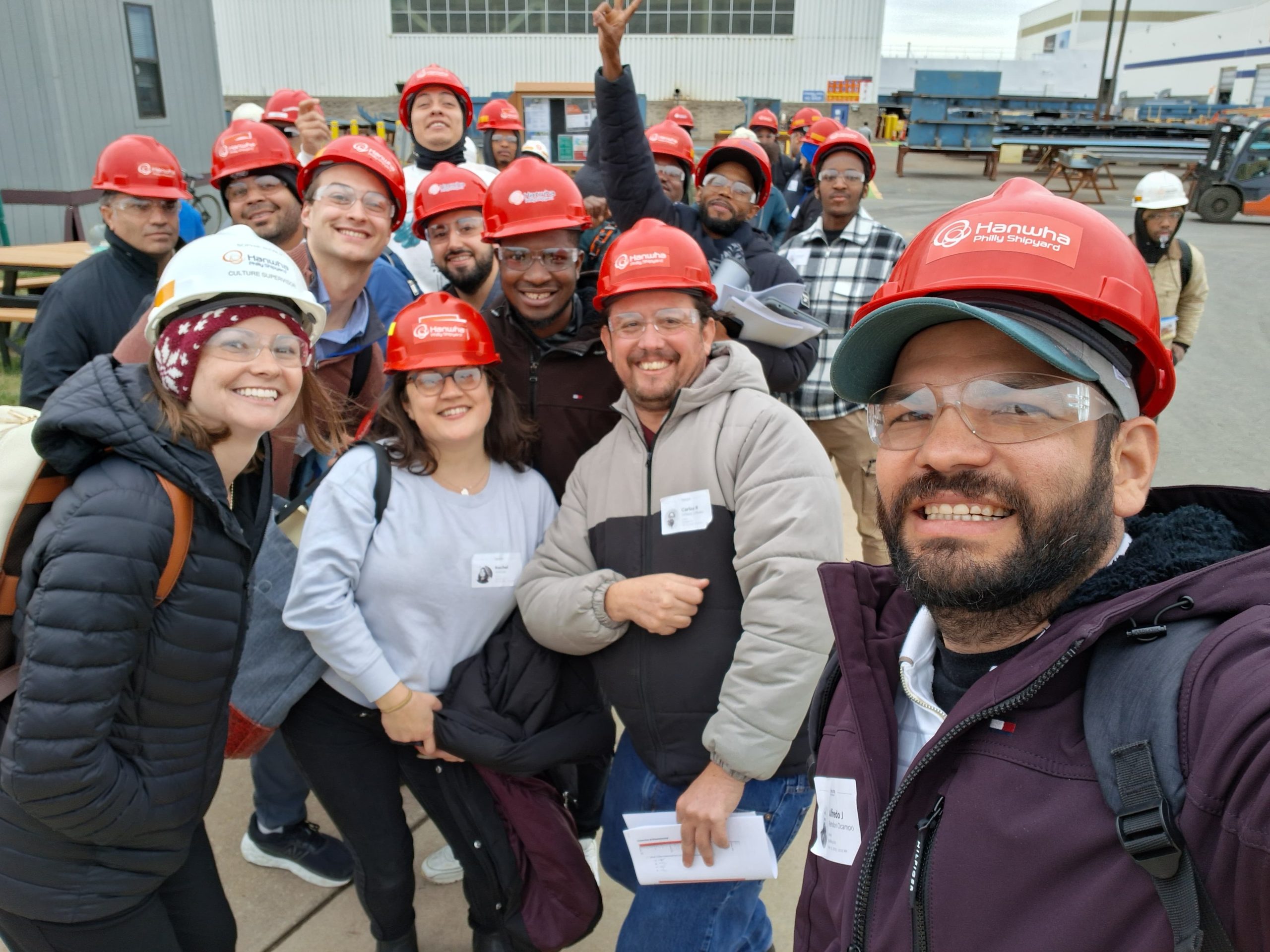
A unit of the Hanwha Group, which paid $100 million for Hanwha Philly Shipyard in 2024, has offered to pay more than $1 billion for an Australian company’s shipyard in Mobile, Ala., the company’s nearby nuclear submarine fabrication sites, and a San Diego ship repair facility.
Hanwha has four weeks to review the facilities and meet with the U.S. Navy and other government agencies before closing a deal, according to a statement from shipbuilder Austal USA.
The South Korean-owned Hanwha Group last year promised to pump $5 billion into the facilities it owns at the heart of the former Philadelphia Naval Shipyard to add a second giant Goliath crane, a second 1,000-foot dry dock, larger fabrication structures, and other portside facilities. The company also said it wouldhire thousands more workers, as part of a larger $150 billion investment by several South Korean companies to revive U.S. shipbuilding.
Hanwha Philly Shipyard has not added those major facilities. Company officials have since said their group is looking at other U.S. sites to build enough ships to turn a profit.
Hanwha “is exploring a range of options to expand our footprint in the United States,” said James Hewitt, Hanwha Defense USA spokesperson. The company declined to say more about its search.
South Korean President Lee Jae Myung waves as he arrives at the Hanwha Philly Shipyard for a christening ceremony in 2025. Jose F. Moreno / Staff Photographer
The proposal fits with Hanwha’s ambition to be a leading global defense contractor, competing with General Dynamics and other big shipbuilders, said Gary Kim, a U.S. Naval Reserve engineer and Wharton graduate student who writes extensively on shipbuilding. The Philadelphia yard “would focus on surface auxiliary vessels, where Austal would focus on smaller warships and submarine modules.”
In Philadelphia last month, JPMorgan CEO Jamie Dimon said his bank looks forward to helping fund Hanwha’s expansion.
Hanwha last year had agreed to purchase portside facilities in Paulsboro, Gloucester County, four miles up the Delaware River from its South Philly yard. It pulled out of the agreement after failing to reach a deal with the port operator, Holt Logistics.
Hanwha has not ruled out developing another Philadelphia-area location but has been visiting southern facilities that are ready to run, such as the Austral yards. Austal USA employs around 3,500, compared to around 2,000 employees and outside contractors at Hanwha Philly Shipyard.
The former Philadelphia Navy Base covered a much larger area before it closed in 1994. Philadelphia Industrial Development Corp., a partnership between city government and the Chamber of Commercethat screens tenants for vacant land, has since committed much of the property tocorporate offices,apartments, and other nonindustrial uses, though some waterside industrial property is still available.
Hanwha Philly Shipyard in July. Joseph N. DiStefano
Hanwha’s specialty at its main yard on South Korea’s Geoje Island is mass-producing cargo ships. Hanwha Defense said in a statement last month that building ships for the U.S. government is more profitable for the Philadelphia yard than commercial ships.
Hanwha is finishing work on the final two of five ships it is building for the U.S. Maritime Administration to use as state merchant marine trading academies. Secretary of Transportation Sean Duffy said last month that the Philly yard had built those ships “on time and on budget,” in part by hiring Tote Services of Jacksonville, Fla., to manage construction. Hanwha says it has lost money on the $1.7 billion program, which began in 2021.
The government said last month that Hanwha Philly Shipyard will also build two “tracking ships” replacing missile-defense ships from the 1960s.
Hanwha Philly Shipyard is also building three ships for a total of around $1 billion for the Matson container line to operate between U.S. ports under the Jones Act requiring U.S.-built ships between U.S. ports. The cost of those ships is more than double what Chinese yards are charging for similar ships.
In a securities filing Tuesday, Austal USA’s owner, Austal Ltd., disclosedthat its shipbuilding arm has lost $175 million in its recently concluded fiscal year, after the U.S. Navy last week refused to pay more for ships Austal has been building.
Austal has been building noncombat salvage, dry dock, and equipment-landing ships for the U.S. Navy. The company based its case for larger payments on changes in Navy orders and “deficiencies in design specifications.” Austal said it would “strongly pursue the claims” even after the War Department’s recent refusal.
At an Alabama facility near its shipyard that would be part of the deal with Hanwha, Austal USA constructs submarine modules for General Dynamics, which builds Navy nuclear submarines in Connecticut and Rhode Island. Austal says that business is profitable.
Rhoads Industries, Hanwha’s neighbor at the former Philadelphia Naval Shipyard, also fabricates nuclear submarine modules used by General Dynamics and plans to double employment to 1,400, as it builds new facilities for that business over the next few years.
Hanwha has said it wants to enter the submarine supply business as well. An Austal USA purchase would add that capability.
Hours before Mohamed Coulibaly was found dead in his Gloucester County home, one of his alleged victims said, the 23-year-old entrepreneur had been desperately seeking a $75,000 loan.
A recent Barron’s investigation alleged Coulibaly defrauded three former NFL players out of $1 million in an e-commerce scheme involving fake Shopify stores. Now others who invested in the venture or lent Coulibaly money were blowing up his phone. They wanted to know if Jalen Carter and several former members of the Eagles, including Nakobe Dean and Terrell Edmunds, were even real clients, a claim Coulibaly made on promotional materials.
Above all, these people wanted their money back.
The morning of his death, July 31, Coulibaly solicited money from a New York man, who agreed to speak with The Inquirer on the condition of anonymity to protect his family’s privacy. He is one of at least 10 people, including the three former NFL players, alleging Coulibaly scammed them out of more than $5 million through phony investments over the last year.
Coulibaly, who lived in Mullica Hill, a section of Harrison Township, promised to send a Lamborghini, two gold Rolexes, and a signed Lionel Messi cleat as collateral for what was to be a weeklong loan.
Coulibaly still owed the man $1 million for a bridge loan due in March. Yet he insisted the additional loan somehow would make it possible to return the initial money owed. His alleged victim said he figured he could only gain from the arrangement — if the collateral proved to be real.
But a driver — not in a Lamborghini — arrived at his doorstep with two fake watches, an unauthenticated signed cleat, along with an insurance card and a bill of sale for the promised luxe car, according to the man.
The man called off the loan.
“[Coulibaly] then started to cry hysterical on the phone,” the victim said. “He said, ‘I’ve lost it all, please help me here, please help me here.’”
Coulibaly was found dead later that day.
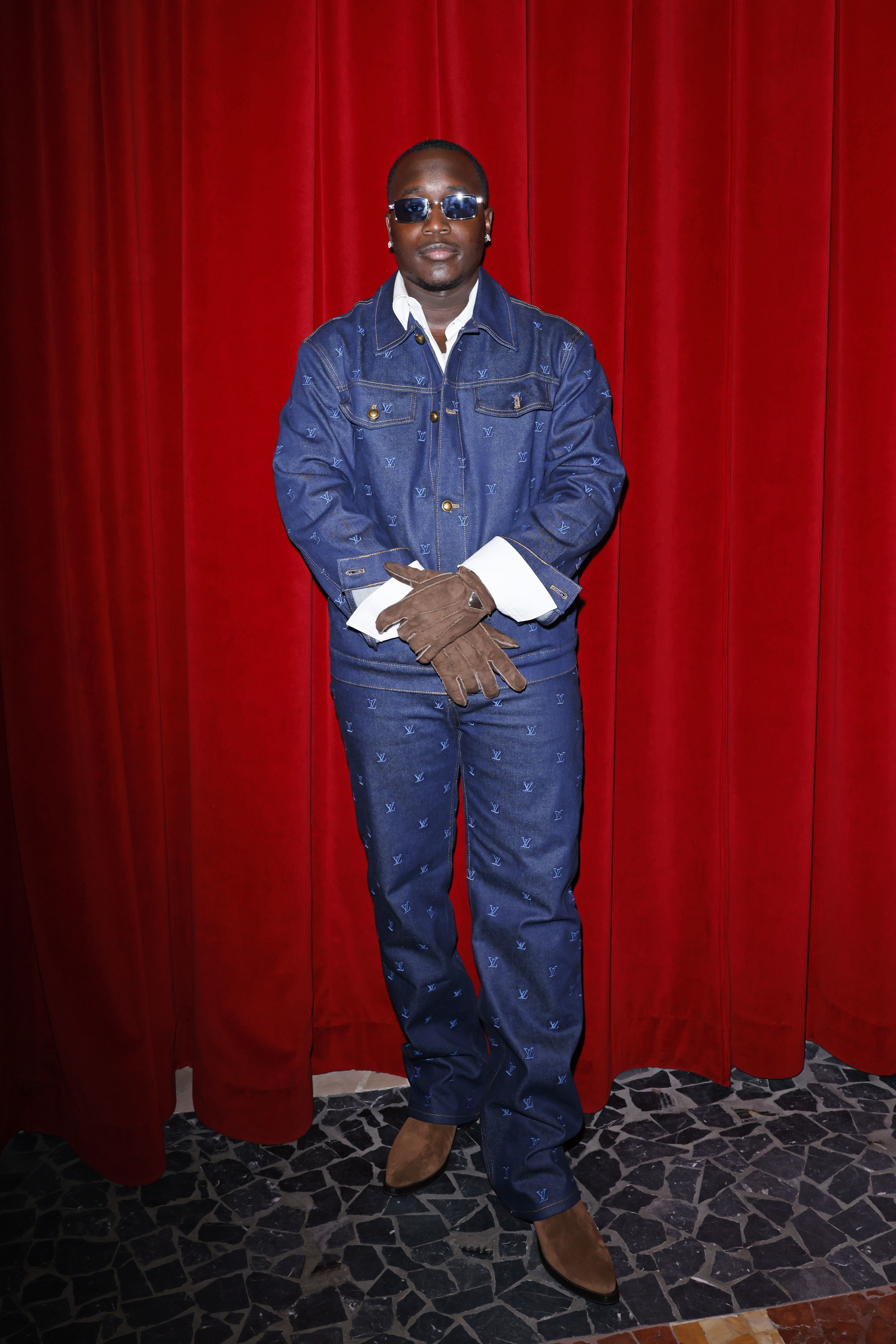
Mohamed Coulibaly attends Milan Fashion Week on Jan. 19 in Milan, Italy.Dave Benett/Getty Images
The Gloucester County Prosecutor’s Office is leading the investigation into Coulibaly’s death and declined to comment. No charges have been filed in connection to the alleged scams Coulibaly is accused of spearheading.
Coulibaly’s death has only added a layer of uncertainty for his allegedly defrauded clients, who now believe they were unwitting participants in a Ponzi scheme. New so-called investments went toward paying off other clients. But the chain could not be sustained.
“In terms of his death, it sounds rather brash or harsh, but the only reason I’m upset for his passing is that he’s not able to go to jail and suffer,” the bridge loan investor said.
The Inquirer spoke with four victims, all but one of whom asked to remain anonymous citing lingering shame, privacy concerns, and, in one case, safety considerations. They provided alleged contracts Coulibaly gave them, text messages, screenshots of their purported Shopify store sales, and a whistleblower report sent to federal and Pennsylvania financial regulators.
In hindsight, the business always seemed too good to be true. The young entrepreneur convinced them they could rake in millions each month selling vacuums, printers, desktop humidifiers, and silicone trays on Shopify, an e-commerce platform similar to Amazon.
At first, investors said they had no reason to question Vent Motion LLC, also known as Motion Venture. Shopify alerted the victims to a steady stream of sales through their phone apps.
But at least two Shopify stores victims bought into were fake, full of transactions a Barron’s analysis suggests are also a sham. Shopify did not respond to requests for comment.
The alleged victims say Coulibaly lured them in by highlighting purported investor relationships with wealthy and connected people. His pitch deck listed several former members of the Eagles and the NBA as clients. Representatives for the current and former Eagles declined to comment or could not be reached.
“A selling point [Coulibaly] gave me was, ‘Hey, we only have about 90 to 100 people in this,’ insinuating you can make it behind the velvet rope because everybody involved is celebrities or athletes, and this is just a venture they do,” said another of the defrauded investors, requesting anonymity because family and friends do not know about the scam.
Yet as more victims have found one another in the wake of Coulibaly’s death, it has become clearer the scheme was not limited to targeting NFL players.
It involved everyday investors from Arizona, Pennsylvania, and New York who now want to know if any of it was real.
A ‘magnetic’ man with the digital footprint of a business phenom
Coulibaly knew how to sell the image of a successful entrepreneur.
His story always hit the same beats: Coulibaly was a professional soccer player. He made $4 million reselling rare sneakers before he turned 21. His success was largely attributed to “building connections” with athletes and influencers. Grinding was the key to success.
But much of that was embellished.
A database for American high school sports coverage noted Coulibaly played soccer for Roxborough High School.
Coulibaly said he began his professional career with the New York Red Bulls soccer team, but a spokesperson said Coulibaly never had a contract.
A friend from Coulibaly’s days at Temple University said the sneaker venture Heatkickcity was also a scam that swindled students out of thousands. He asked not to be named out of safety concerns, saying Coulibaly often touted relationships with gang-affiliated people.
While Coulibaly told publications he was born in Mali, West Africa, and immigrated to the United States at a young age, while in college, he often intimated that he was a trust fund child and that his parents worked for the French government, the Temple friend said.
He added that may have helped induce so many of their peers to pay a $1,200 membership for monthly access to rare sneakers that ultimately never came.
“He’d be like, ‘It’s stuck in shipping,’ or ‘my assistant forgot to order them,’ or ‘my assistant’s slacking,’ and then he would just keep on extending it, extending it,” said the friend. “If you questioned him in any way, shape, or form about the product that you paid for, then he would switch to angry mode.”
The friend eventually got his money back after pressuring him for weeks but said Coulibaly continued his self-proclaimed pursuit of becoming a billionaire.
“He scammed his best friends,” the friend said. “Nobody was off-limits.”
Coulibaly’s next venture was fashion line Motion Apparelz. It was profiled in Forbes last year, where the author describes Coulibaly’s energy as “magnetic.” In the piece, Coulibaly name-drops artist friends, including rapper YG, who was later listed as an investor in Motion Venture promotional materials.
Rapper YG performs at the Coachella Music & Arts Festival in 2019.Amy Harris
YG’s agent could not be reached for comment.
Outside of the glowing profiles, a now-defunct Instagram account also detailed a lavish lifestyle full of run-ins with celebrities, boat jaunts on luxury yachts with city skylines in the background, and snapshots of Coulibaly in or in front of private planes. Often, Coulibaly could be seen wearing gold watches, what appear to be Van Cleef & Arpels bracelets, and diamond-studded chains.
Coulibaly’s digital footprint set the stage for an even bigger business pitch.
A business promising exorbitant returns
When it came to Vent Motion LLC, Coulibaly told clients he operated “factories in China and India with a combined team of 125 full-time employees,” according to a pitch deck he showed investors that was obtained by The Inquirer.
This allowed stores to operate without keeping any inventory and reducing overhead — a model known as drop-shipping.
The savings from eliminating the middlemen, he said, could then be reinvested into artificial intelligence-driven ads and “influencer amplification” to drum up more customers. Coulibaly’s company would set up and manage the Shopify stores on behalf of investors, pushing out additional advertising or swapping out products if sales slowed.
Clients would be charged a 20% to 25% service fee for that work, and even so, Coulibaly dangled extraordinary returns for those who joined the venture.
One Shopify store that began with a $550,000 investment in January 2024 had allegedly generated $2 million in revenue in April and a whopping $23 million in July of that year. By August, this particular store had generated a total of $84 million in revenue, according to the company’s unsubstantiated pitch deck.
Further sweetening the deal was an initial investment “protection” guarantee if their store did not generate profit within six months.
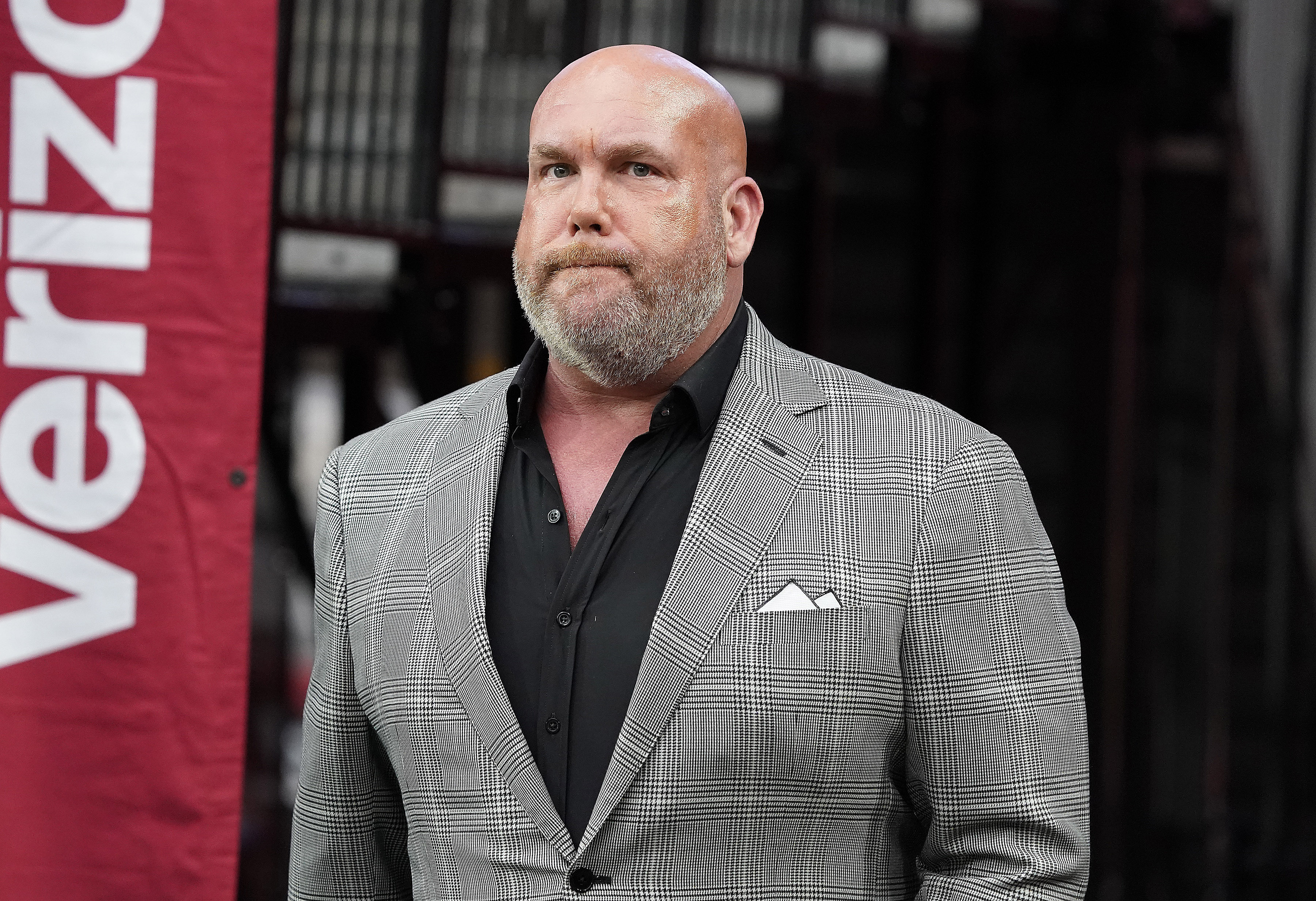
Former Arizona Cardinals General Manager Steve Keim says he was just as much of victim of Mohammed Coulibaly’s alleged scam.Darryl Webb
It’s what got Steve Keim, former general manager of the Arizona Cardinals, into the business.
Keim said he met Coulibaly through mutual Eagles acquaintances and by August 2025 he had bought his first Shopify store, which was recording sales at a pace that had him on track totriple his investment over six months. Keim bought into six more stores the following month, he said. His son and ex-wife would also buy into the business for at least a $1 million investment between all three.
Keim said he was soon offered the role of chief operating officer/chief growth officer, which he now sees as a way for Coulibaly to “legitimize his business.”
“I introduced him to people to sell stores to and that sort of thing,” said Keim, who describes fulfilling a figurehead role with no decision-making power. “He called me the COO but he also made promises to give me health insurance and to have some kind of bonus structure.”
The health insurance, bonuses, and exorbitant returns never materialized. Keim said he never had access to bank records and was never made aware of how many people gave money to Motion Venture. But by the start of the year, Keim claims, a flood of disgruntled investors were asking him for help getting their money back. Around this time, Keim said, he asked Coulibaly to stop using his name in promotional materials and told him he no longer wanted to be COO.
Keim contended he was as much of a victim as anyone else, holding onto hope that he could recover his money until Coulibaly’s death.
“This went downhill fast,” he said. “Not only did I get my name drug through the mud, I lost a lot of money since I was an investor.”
A Dubai deal
As more investors were demanding access to their Shopify funds in the fall, Coulibaly was telling them that the Dubai firm Middle East Venture Partners was interested in buying the operation for $215 million.
All they had to do was reach 175 online stores and meet other benchmarks by Aug. 1.
To back his claim Coulibaly produced a letter of intent dated Aug. 14, 2024.
Troubling for investors: The letter was dated more than a month before the company was registered in Pennsylvania.
The discrepancy was the biggest red flag for Barry Minkow, a convicted fraudster who now investigates scams on behalf of fraud victims. He started poking around the company at the start of the year for an investor who had put up $150,000.
“So here you are looking at a private equity company saying they’re going to buy up this company that doesn’t even exist for $200 million?” Minkow said in disbelief.
Middle East Venture Partners did not respond to an email to asking if a relationship existed with Coulibaly’s Vent Motion LLC.
With the permission of three of the alleged victims, Minkow submitted a 23-page whistleblower report to the U.S. Securities and Exchange Commission, FBI, and Pennsylvania Department of Banking and Securities. The report laid out victim accounts and flagged glaring issues with Motion Venture’s business model.
Minkow warned regulators in February thatintervention was essential to “halt ongoing solicitations, trace misallocated funds,” and stressed the importance of doing so “before the scheme inflicts further, irreparable harm.”
Minkow would prove to be right. Motion Venture was still actively recruiting new investors that month.
Picking up the pieces
Coulibaly’s college friend thinks he might have been one of the first victims of the Shopify sometime about three years ago. It involved less paperwork back then, more of a handshake deal. The friend put in $5,000 in a store with an investment protection promise in place, he said. Unlike that time in college, however, the friend only got half his money back.
The friendship with Coulibaly cooled after that.
“People just keep on saying he scammed NFL players,” said Coulibaly’s college friend. “No, anybody with money could be scammed, no matter how small.”
Coulibaly would insist money issues were the Dubai firm’s fault until his death, according to his alleged victims who shared screenshots and voice memos of conversations.
He ricocheted from distraught, lamenting the financial ruin that awaited him if he did not acquire more investors, to defiant, celebrating the Philadelphia 76ers’ LeBron James trade on X as he dodged investors.
When Keim and another investor flew into Philadelphia to meet with Coulibaly in late July, they spent a day and a half trying to figure out how much money was left, to no avail.
It was around that time that Coulibaly was soliciting the New York man for the $75,000 loan.
Coulibaly’s last post on X was a reshare a day before his death. “Trying to be everyone’s friend is a foolish behavior,” it read.
Whether any investor money remains is unclear. A now-defunct GoFundMe page put together by a man claiming to be Coulibaly’s brother raised more than $12,000 for the body’s “international transportation arrangements.”
Investors are also trying to figure out what legal recourse they might have, if any.
Coulibaly’s death has shattered any last remaining hope some victims had that a Dubai firm was to blame for cash-flow issues, and they are now seeking legal help.
It also left them feeling cheated one last time.
Staff writer Ryan W. Briggs contributed to this article.
Traffic is squeezed into one lane in each direction from 7 p.m. to 5 a.m., and residual morning delays have been reported. Crews sometimes also have to close lanes or temporarily stop all traffic during daytime to move equipment and materials.
It is a major undertaking for the Delaware River Port Authority, the bistate agency that owns and runs the Commodore Barry, as well as the Walt Whitman, Ben Franklin, and Betsy Ross Bridges.
As they move along the 13,912 feet of the bridge, industrial painting crews first sandblast layers of old paint and protective coatings that have built up over the years.
They work from suspended platforms in enclosed spaces of canvas, with containment systems that capture the gritty material used to clean the steel, lead-based paint, and other grime.
Although that up-in-the-air work is most visible to motorists, massive repairs are going on underneath, on the deck, and in the support structures below that, including the piers in the river.
Crews are removing crumbling concrete and replacing it, repairing the drainage system, and installing 14,000 feet of new electrical conduits and wire, DRPA officials say.
The rehab began in spring 2025, with replacement of the movable “zipper” barrier that separates lanes of bridge traffic. It was finished last summer.
The bridge opened in 1974 after five years of construction.
Earlier, people relied on ferries to cross from one state to another.
In 1930, the Chester-Bridgeport Ferry began running, with a capacity of 60 cars per trip. Six years later, the ferry’s boats were added to the federal highway system, as moveable parts of U.S. Route 332.
Monroe Township officials requested in late July to dismiss a $300 million lawsuit by Princeton-based real estate developer Hexa Builders challenging the municipality’s data center ban.
The Gloucester County case continues as other South Jersey municipalities consider and pass data center bans, including Cherry Hill, Millville, Medford, and, as of this week, Collingswood.
The request for dismissal came less than a month after Monroe pushed Hexa Builders’ complaint from state to federal court under the claim that some of Hexa’s allegations fell under the U.S. Constitution and should be addressed federally.
Some of the 20 counts alleged by Hexa include violations of the equal protection clause of the 14th Amendment and freedom of speech under the First Amendment.
On July 28, Todd Gelfand, the attorney representing Monroe’s mayor and council, filed a four-page letter listing reasons that he said Hexa’s lawsuit against the data center ban is not valid.
Gelfand rejected Hexa’s constitutional arguments, cited a lack of a physical contract promising data centers to Hexa, and argued Monroe had a right to amend a zoning ordinance based on public objections.
“[The data center ban] does not regulate the content of speech, a speaker, a message, or Plaintiffs’ ability to engage in expressive activity. The fact that data centers support electronic communications does not transform a land-use regulation into a speech restriction,” Gelfand wrote.
In response, Jim Maley, the attorney representing Hexa Builders, requested on Monday to push the majority of Hexa’s complaint — the parts that are not based on the Constitution — back to New Jersey state court. The next day, he asked the federal judge currently overseeing the case to reject Monroe’s request for dismissal.
Maley said state courts have more expertise to consider the local land-use laws that affect Hexa Builders most, and Hexa’s federal claims should be considered second.
“To further the federal claims, the constitutional claims, there has to first be determination of whether there was a violation of the land-use laws,” Maley said. “If land use wasn’t violated, that will hurt [our] federal claims.”
U.S. District Judge Edward Kiel has not yet made official moves in reaction to the letters, which Maley said could take a while.
Sandra Graise, Monroe Township’s solicitor, declined to comment and said the township does not speak about pending litigation.
Hexa filed the original lawsuit on June 5 in New Jersey Superior Court shortly after Monroe officials denied its application to build a 1 million-square-foot data center and a warehouse at 3043 Black Horse Pike, a property the company has sought to develop since 2022.
The denial followed months of public outcry at local government meetings after residents discovered that a change to Hexa’s redevelopment plan in early 2025 allowed the developer to propose a data center.
Collingswood considers ordinance on data centers
As the parties go back and forth, nearby municipalities have taken initiative to ban data centers before a proposal ever arrives.
At a Monday night meeting in Collingswood, the Camden County borough’s three commissioners considered an ordinance amending Collingswood’s code to ban data centers and “computing nodes,” which the borough defines as modular units installed at residential or small commercial properties that supply computing capacity to third parties in exchange for payment or credits to the property owner.
Maley, who represents Hexa in Monroe, is also a member of Collingswood’s board of commissioners.
Two residents who attended the borough meeting brought up Maley’s connection to the Hexa case and asked whether Maley would recuse himself from the vote based on his employment as a private attorney supporting a potential data center nearby.
In response, Collingswood solicitor Caitlin Harney Norcia said she could not find evidence that would disqualify Maley from voting under New Jersey’s Local Government Ethics Law, since Maley’s job as an attorney does not directly affect his work in Collingswood.
While Maley decided to abstain from the vote, he said the borough should have a six-month waiting period to allow the borough planner time to consider standards for data centers, called the move “a ban of reaction,” and said the borough does not have room for a data center anyway.
“We don’t prohibit airports. OK, that’s a permitted use. We don’t do that because there’s no place you can put an airport. There’s no place in this town you can put a data center,” Maley said in a live recording of the meeting on Facebook. “But the nodes are another issue.”
When reached for comment Wednesday, Maley said he did not have to abstain from the vote, but he still chose to for nonlegal reasons.
“Folks in the crowd, they’re working really hard to beat me up on a lot of different things. It’s a group that’s been against me for years. … Whatever my vote would have been, they would have been yelling and screaming about it and impacting my work,” Maley said.
Collingswood’s two other commissioners voted to approve the data center and computing node ban on its second reading. The ordinance took effect immediately.
Lindsay Ward grows more nervous with each passing year, knowing her ultra-rare genetic disease could emerge at any time.
The 37-year-old schoolteacher from West Deptford, New Jersey, inherited the genetic mutation that causes RVCL — retinal vasculopathy with cerebral leukoencephalopathy — which damages small blood vessels throughout the body and typically shows up between the ages of 35 and 50. It causes premature death as brain, retinal, liver, and kidney damage accumulate.
Many patients die within five to 10 years of symptom onset.
“It’s relentless,” said Jonathan Miner, who directs the RVCL Research Center at Penn. “They go from being completely healthy to becoming blind, unable to walk or talk, with kidney failure and other problems.”
The disease currently has no cure. However, Miner recently received a $10 million gift from the Illinois-based nonprofit Clayco Foundation to develop a potential treatment.
The idea behind his small-molecule drug is to eliminate the faulty protein driving the disease before it can cause damage. The drug will still need to be tested in animals to evaluate safety before possibly moving into clinical trials.
Most exploratory scientific efforts do not advance to the point where they are found safe and effective in humans. Even if the results are promising, it could take years before a potential new drug becomes widely available.
Ward has already seen the disease ripple through her family.
Her uncle died from RVCL last year. Her mother, Barbara Small, was diagnosed in 2018 after almost four years of symptoms.
She hopes for a treatment that can help her avoid their fates.
“I do as many active things as humanly possible because I’m so worried about becoming frail,” Ward said. “I see the weakness that my mom has and I don’t want that.”
Lindsay Ward, who inherited the mutation that causes RVCL from her mother, lives an active lifestyle.CHARLES FOX / Staff Photographer
What is RVCL?
Fewer than 50 families worldwide are known to have RVCL.
The rare disease is often misdiagnosed as various autoimmune diseases, including multiple sclerosis and lupus. Only through a genetic test can patients verify an RVCL diagnosis — characterized by a mutation in a gene called TREX1.
The gene encodes a protein of the same name, TREX1, which, when mutated, becomes misplaced in a cell and damages DNA.
Over time, this causes small blood vessels to break down and disappear. The loss of blood flow leads to organ damage, including blindness, glaucoma, chronic kidney disease, strokes, and neurological effects.
When asked how he felt about the donation, Miner reflected on seeing many patients die from the disease and kids lose their parents young.
“I believe that everybody deserves a chance to live,” he said.
A potential drug
Jonathan Miner directs the RVCL Research Center at Penn.Credit to StoryTrack Studio
Miner’s drug candidate belongs to a new class of medicines called a degrader.
The drug eliminates the mutated TREX1 protein by pairing it with another protein called “E3.” E3’s role is to label other proteins for destruction, much like putting a shipping label on a package to direct it to the right address.
By labeling TREX1, “it basically tells the cell’s own machinery to eliminate this faulty protein,” Miner said.
If the drug proves effective, patients would ideally take it before they get sick, to prevent injury to blood vessels and organs.
When tested in mice with the disease, the drug protected cells from DNA damage and prevented premature death.
“We haven’t seen side effects in the mice, but we need to do much more extensive studies to prove that there are no side effects in animals before we can move forward,” Miner said.
The first and only FDA-approved degrader was developed for advanced breast cancer and approved in May. Miner’s TREX1 degrader is one of many variations on the novel technology that have emerged.
The $10 million donation will fund preclinical safety studies. The goal is to complete this testing over the next year, and, if it proves to be safe, move on to humans.
If the drug advances to a clinical trial, it would still take years to test the safety and efficacy. Most treatments evaluated in clinical trials do not become standard practice.
“Nothing has moved the needle yet in terms of delaying death and disability,” Miner said. “This, we think, gives us a real chance.”
Waiting
Barbara Small, her husband Dave, and grandchild Declan.Courtesy of Lindsay Ward
Ward’s 67-year-old mother, Barbara Small, who lives in Cape May Courthouse,started to show symptoms in her 50s.
What began as blurry vision and a damaged optic nerve progressed to a stroke. Roughly four years later, in 2018, she was diagnosed with RVCL.
Today, she is “pretty much blind” in one eye, Ward said, and has had a few strokes. She will frequently have aphasia, a communication disorder that can cause trouble speaking, and memory issues. Small is physically weak overall, and cannot walk very far without having to sit down.
“It is very challenging to see what your future will be,” said Ward, who helps take care of her mother.
Ward gets an MRI and diagnostic eye testing every six months to check for symptoms.
She and her husband, Matt, have three kids, with the youngest being a year and a half old. They don’t know whether their children inherited the mutation (testing is not recommended in children due to the late onset of the disease).
Lindsay Ward, 37, has three children with her husband, Matt.Courtesy of Lindsay Ward
However, if a preventive treatment were to come out, she would test them sooner.
Ward recently attended the International RVCL Symposium at Penn, where Miner presented on his research and potential clinical trial.
For patients like her mother, the treatment would likely just stabilize her condition and not reverse existing damage, she said. However, Ward is hopeful that the drug, if proven to be safe and effective, could help prevent her and her kids (should they test positive for the mutation) from becoming symptomatic.
“I would like to live a long, healthy life,” she said. “That would be my goal.”
The Korean-owned yard’s leaders thought they had found just the place, four miles by barge down the Delaware River at the New Jersey-funded Paulsboro facility, vacated by the offshore wind industry when President Donald Trump killed that program. In December, Hanwha agreed to take over the lease.
Philadelphia Shipyard as seen from southbound I-95 in 2024.Alejandro A. Alvarez / Staff Photographer
This despite the fact Hanwha’s proposal enjoyed support from federal, state, and local officials and even made it into the U.S. military budget for fiscal year 2026, which called for $110 million “to support shipbuilding industrial capacity” and steel fabrication in a manufacturing facility “formerly used for offshore wind manufacturing.”
Paulsboro Mayor John Giovannitti estimates that on a given day, there are fewer than 50 workers at the port.
Leo Holt, whose century-old company runs ports in Gloucester City and South Philadelphia, said he’s not completely averse to manufacturing around the Paulsboro terminal after his family’s plans to beef up container and bulk shipping there accelerate.
Hanwha declined to comment, confirming only that the shipyard is still looking for space “in the U.S.”
A rendering of a 600-acre shipyard that the Port of Tampa Bay has offered to build for Hanwha. Port Tampa Bay
What went wrong?
Since the early 2010s, New Jersey borrowed and spent more than $500 million building a Paulsboro wharf, highway ramps, and other facilities to attract big employers to the port. It replaced lost oil industry jobs and also compensated for nearby Camden’s loss of piers due to Holtec Inc.’s redevelopment in that city’s aging port district.
In borrowing documents and news releases, the public spending was justified by predictions that the port would draw hundreds, even thousands, of port and industrial jobs, which in more than a decade have yet to arrive.
Paulsboro sublets the facility to Holt as the port operator. Holt paid $1.6 million to use the property last year.
At the urging of then-Gov. Phil Murphy, then-State Senate President and iron workers union leader Steve Sweeney, then-Paulsboro Mayor John Burzichelli, and other officials, Holt in 2020 agreed to let EEW, a global pipemaker based in Germany, build supports up to 400 feet long and 40 feet across for the federally subsidized offshore wind-electric generation facilities that its Danish partner Orsted planned to locate off the New Jersey coast.
Orsted canceled in 2023, citing rising costs. Trying to cut his company’s losses, EEW executive vice president Esben Strandgaard began looking for new tenants, attracting more than 200 inquiries and initiating talks with Hanwha.
Hanwha needed the landlord’s permission to take over the lease. Hanwha Defense USA president Tom Anderson, a retired Navy rear admiral, and the Holts met last fall to discuss the proposal.
Instead of approving, the Holts sued, challenging EEW’s authority to pick a replacement and demanding control of the facility.
Hanwha, aided by its political supporters, tried to make a deal, but Holt stood firm. In March, Hanwha canceled the agreement.
What the Holts want
“The north star for redevelopment at Paulsboro has been marine terminal operations,” said Leo Holt, president of the Gloucester City-based company. “We stretched to assist the state in any way we could,” but “Hanwha was never a part of the plan, nor was shipbuilding.”
Holt spoke of the failed industrial proposals — wind, shipbuilding, and others to build power plant equipment on site — as an obstacle, not a goal.
“The detour imposed on New Jersey is over, and the road is clear to the Paulsboro Marine Terminal,” he said. “We were glad to see that the page was turned on the detour.”
Holt Logistics, which has been expanding containerized cargo facilities on both sides of the river, has shipped containers to Paulsboro and hopes to augment Paulsboro’s current port tenants, Holt said.
Those include Novolipetsk Steel (NLMK), owned by Russian billionaire Vladimir Lisin, which due to Ukraine war sanctions stopped importing Russian steel through the port for its plant in Farrell, Pa., and has switched to steel from Latin America, East Asia, and other countries, according to Holt.
The port also ships containers to the U.S. Navy base in Rota, Spain, and to ports in Cyprus, Israel, and other Mediterranean countries.
More than a container port
New Jersey has spent more than half a billion dollars improving the Paulsboro site with a wharf, highway connections to I-295, and other public works, the mayor said.
“I’m not aware of Paulsboro people, Gloucester County people, working there right now,” said Burzichelli, now a state senator and a supporter of both the wind and the Hanwha projects.
New Jersey invested in the BP site to make it more than a container port, Burzichelli says.
“That [state-built] wharf was designed to handle any industry, and the public investment was designed to create the maximum amount of high-paying jobs that can be created,” he said.
The port section “was always intended to be a bulk port,” requiring plenty of longshoremen’s labor, and “certainly not a container port,” which “take up a lot of space but don’t generate big jobs,” Burzichelli said.
“They don’t pay taxes the way an [industrial] building will pay,” he added.
The Holts’ “choices and the interest of the state of New Jersey, the interests of Gloucester County, and the interests of the borough of Paulsboro, are not aligned, at this point,” Burzichelli said. “I hope we can get them aligned.”
Mayor Giovannitti said, “We thought we had a deal last year with Hanwha” but are left with “a $750,000 hole in our budget” — the annual payment, in lieu of taxes, that EEW and its partners paid the borough while it was operating. The town’s annual budget is $13 million.
Instructors and graduates of the union-backed preapprenticeship program Global Skills Union Pathways Project at Philly Hanwha Shipyard in February.GSUPP
What Paulsboro could offer
Strandgaard says he’s not surprised Hanwha decided not to “waste any more of their time” on Paulsboro: “They could not see themselves working with a hostile landlord.”
It’s an ideal site for shipbuilding or any other industry that needs a deep water port, he said. But “Holt Logistics really controls what comes in and out. This was very upsetting, for us and Hanwha, that Hanwha with the support of the Navy did not have enough leverage.”
Other East Coast sites would take a year or more to prepare. “The beauty of Paulsboro is they could start the day after” concluding a deal, Strandgaard said.
He said he was surprised the new administration of New Jersey Gov. Mikie Sherrill didn’t make landing Hanwha a priority.
Sherrill was “disappointed that EEW could not reach an agreement with Hanwha or other parties despite the state’s efforts to facilitate discussions and bring stakeholders together,” spokesperson Maggie Garbarino said in a statement.
Holt’s goal: A modern marine terminal
On any given day, between 500 and 900 Holt employees are moving cargo at the company’s South Jersey operations, Holt said. He declined to estimate how many of those were in Paulsboro.
According to tax records, the port handled about 250,000 tons of cargo last year. That’s less than one-tenth of all South Jersey Port Corp. cargoes.
Holt called the state “vital partners in the renovation of the facility. We are working to have both marine operations and manufacturing operations. But we cannot be deterred from taking it where we promised: to be an active modern marine terminal.”
He said he expects the Sherrill administration will prove to be more congenial to the Holts’ vision for the property — “manufacturing, distribution, or anything” that makes sense to his family.
South Jersey officials say they haven’t given up. “The people of Paulsboro were told this was about jobs, jobs, jobs, and those would be manufacturing jobs. Not stacking containers four high with automated forklifts,” Giovannitti said.
Burzichelli still hopes Hanwha and Holt can be brought to the same page. “Many of us still don’t think we are done with manufacturing,” he said.
Public health officials are advising South Jersey residents to be alert and avoid wild animals after a report of a rabid raccoon that bit a man in Gloucester County last weekend.
The Glassboro resident told 6abc Wednesday that the wild animal charged him outside of his home and bit the front of his leg before being captured and testing positive for rabies.
Gloucester County posted an alert on social media Wednesday reminding residents to make sure their pets are up to date on their rabies vaccinations and to avoid contact with wildlife. County officials did not respond to questions about the alleged attack Thursday.
“Rabies is a serious disease, but it is preventable,” the county wrote. “If you see a wild animal acting unusual; such as appearing aggressive, unafraid of people, drooling, or unsteady; keep your distance and report it to your local health department or animal control.”
Anyone bitten or scratched by a wild animal should wash the area with soap and water, seek medical attention, and contact local animal control or health officials, the county advised.
6abc reported that authorities said the infected animal involved in the attack was seen fighting with another raccoon before it was captured, and that the county is now working to locate the potentially rabid animal.
With over a half-foot of rain measured already, what has been Philadelphia’s wettest month since March 2024 is very likely to become significantly wetter.
The National Weather Service has posted a flash flood watch effective from 8 a.m. Tuesday until 2 p.m. Wednesday for rain totals up to 3 inches, with downpours of 1 to 2 inches an hour possible.
The national Storm Prediction Center on Tuesday morning listed a 15% chance of severe storms, those with wind gusts approaching 60 mph, for the entire region, with an outside shot of tornadoes. The Weather Prediction Center has a 40% chance of flooding downpours.
Some appetizers — localized downpours — popped up Monday afternoon, prompting flood warnings for Philly and neighboring sections of Montgomery County, and parts of Gloucester and Atlantic Counties in New Jersey.
Floodwaters swamped downtown Hammonton, Atlantic County, with “numerous” cars stranded on the roads, the weather service reported. The Pennypack Creek in Northeast Philly crested above “minor” flood stage.
Moth-ball-size hail pelted Chestnut Hill, and hail twice that size was sighted in Williamstown, Gloucester County, and in the vicinity of Washington Crossing State Park on the Jersey side of the Delaware River.
Storm coverage on Tuesday is expected to be far more extensive, and potentially more disruptive, with a “few tornadoes” possible, the weather service warned.
Storm activity is likely to linger into Wednesday, said Mike Lee, meteorologist in the weather service’s Mount Holly office, with more showers in the forecasts for Thursday.
What time the storms will arrive in Philly
Late July still is very much the lottery-ball season for damaging downpours, and that again likely will be very much in evidence this week. Rainfall totals in the last 30 days have ranged from 137% of normal in Gloucester County to 79% of normal in Montgomery County, according to the Middle Atlantic River Forecast Center.
Thunderstorms are possible as early as midmorning, but expect “repeated rounds” during the afternoon, said Matt Benz, senior meteorologist with AccuWeather Inc.
The highest probability for severe storms, those with wind gusts near 60 mph, would be in South Jersey and Delaware, although they could nose into Philly, said the weather service’s Lee.
The storms could continue well into the night, and additional rains are expected Wednesday afternoon.
The rain totals again are likely to vary widely; however, a general 1 to 2 inches is expected across the region.
Whatever happened to the drought?
It hasn’t gone anywhere — yet.
All of New Jersey and Chester County remain under state-declared drought warnings. In the latest interagency U.S. Drought Monitor update, conditions in the entire region remain from “abnormally dry” to severe drought.
All that may change by week’s end.
Through Sunday, officially 6.37 inches of rain habr been measured at Philadelphia International Airport this month. That is the highest monthly precipitation total since March 2024.
July’s rains have ended a run of 16 straight months of below-normal precipitation in Philly.
Said Benz: “It’s an old saying that all droughts end on a flood. That’s kind of what we’re seeing right now.”
Philadelphia is expected to see its most significant winter storm in years this weekend, with nearly a foot of snow and ice expected from a formidable low-pressure system sweeping across the eastern United States.
Official National Weather Service forecasts say six to 18 inches of snow is possible across most of New Jersey and Pennsylvania, including Philadelphia as the storm pushes through the region Saturday night to early Monday morning. More than 21 states are expected to experience at least moderate impacts from the storm, the weather service said.
Forecasters said that mixing with sleet and freezing rain could hold down overall snow totals across Philadelphia and South Jersey, but the storm is likely to hinder if not halt most travel on Sunday, regardless.
The National Weather Service puts out forecasts for every few square miles of land in the United States four times a day through a system called the National Digital Forecast Database.
The maps below display that data. Use it to find how much snow is expected anywhere in the eastern United States. It will show the most recent forecast for the next three days.
A considerable amount of freezing rain and sleet may also fall during the storm, leading to icing concerns. The map below displays the forecast for ice accumulation, or accretion, over the next three days.