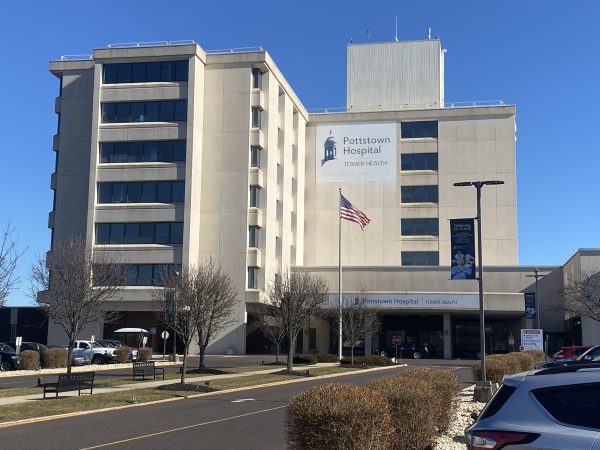
Tower Health is eliminating 160 jobs at Pottstown Hospital as part of an effort to bring staffing at the Montgomery County facility in line with lower patient volumes, the Berks County nonprofit announced Tuesday. The cuts amount to 22% of the workforce at Pottstown.
In addition to the job reductions — which are more than the 131 positions cut last year at Pottstown — Tower also plans “a multimillion-dollar investment” to expand the emergency department, enhance inpatient and outpatient behavioral health services, and update portions of the hospital, Tower said.
“These changes are designed to strengthen the hospital’s ability to serve local residents for generations to come by preserving access to the services patients need most, investing in the areas of greatest community need, and ensuring Pottstown Hospital remains a strong, sustainable community hospital for the future,” Tower said in a statement.
To expand behavioral health, Tower will convert some underused general-purpose hospital beds to inpatient behavioral health beds. The behavioral health total will rise to 52 from 28, an 86% increase. Pottstown has 213 licensed beds.
Tower did not provide a timeline for the changes but said it plans to hire 38 people to staff the expanded emergency department and behavioral health unit, which will have a separate entrance for the sake of patients’ privacy when they seek mental health services.
Another change at Pottstown involves the lease of an unspecified amount of space to Community Health & Dental Care, a federal health clinic that was formed in 2008 with funding from Pottstown Area Health and Wellness Foundation.
Unlike the restructuring Tower announced last fall at Pottstown, which included the closures of the combined intensive care/critical care unit, the Pottstown location of the McGlinn Cancer Institute, and the hospital’s endoscopy center, this round is not eliminating any services, Tower said.
In the nine months that ended March 31, Pottstown has 5,104 inpatients, down 9.7% from the same period the year before. Most of that decline came in the first three months of this year, after Tower’s service cuts, according to data shared with bondholders.
After last year’s layoffs, which included about 60 registered nurses represented by Pennsylvania Association of Staff Nurses & Allied Professionals, Pottstown employed about 700 people. Overall, Tower employs more than 10,000.
The union said it still has 200 Pottstown nurses in its ranks. “We have been in touch with hospital management to better understand the context for and impact of the proposed layoffs and to push hard for solutions that protect both patient care and the dedicated nurses who serve the Pottstown community,” a union spokesperson said.
Tower’s anchor is Reading Hospital in West Reading, Pa. In additional to Pottstown, it owns Phoenixville Hospital, plus St. Christopher’s Hospital for Children in North Philadelphia in a 50-50 joint venture with Drexel University. Tower previously owned Brandywine, Jennersville, and Chestnut Hill Hospitals.
Tower recently announced that Jefferson Health, Nemours Children’s Health, and Temple University Health System are working on forming an alliance to support St. Chris clinically. Last week, Tower said that it had formed a clinical affiliation to expand advanced care in its markets.
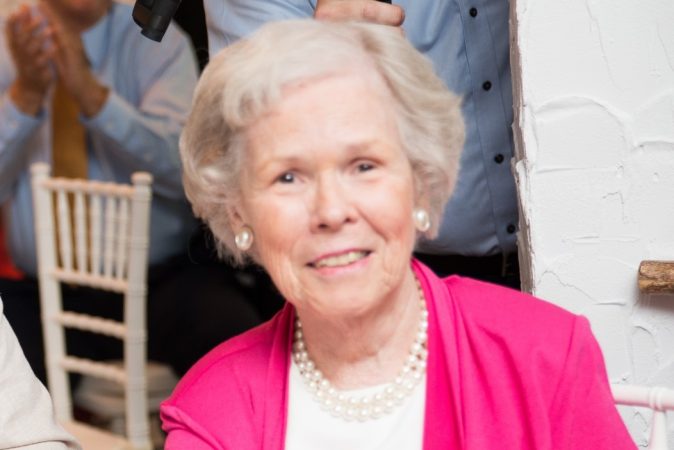
Kathy M. Winter, 91, formerly of Philadelphia, lifelong artist, art and grade school teacher, author, and former council president at Our Mother of Consolation Parish in Chestnut Hill, died Tuesday, June 9, of complications from pneumonia at Forbes Hospital in Monroeville, Pa.
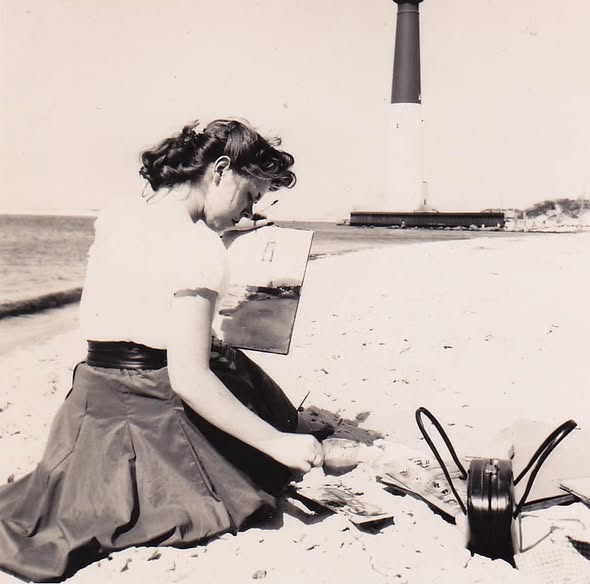
Born in Philadelphia, Mrs. Winter studied art at the Pennsylvania Academy of the Fine Arts and earned a bachelor’s degree in fine arts at the University of Pennsylvania. She specialized in portraits, still life, and landscapes, and worked mostly in watercolors, pastels, oils, and acrylics.
She painted portraits of celebrated naval chaplain John F. Laboon and Chinatown icon T.T. Chang, and contributed to a collection called “Lost Dreams on Canvas” that featured portraits of innocent victims of violent crime in Philadelphia. “You get into a portrait like that,” Mrs. Winter told the Chestnut Hill Local in 2012, “and you’re into the person.”
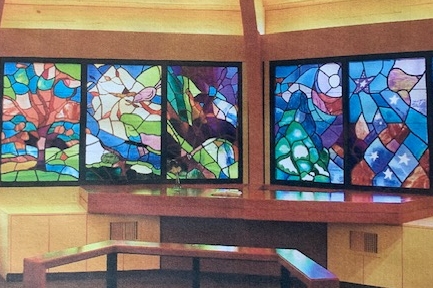
She painted the statue of St. Gianna Beretta Molla for the Shrine of the Nativity of Our Lord in Warminster, and her painting of a restored statue of St. Gabriel for a church in New Orleans was featured in The Inquirer in 2007. She also designed stained glass windows for St. Bede the Venerable Church in Holland, Bucks County, and the chapel at Shore Memorial Hospital in Somers Point, N.J.
“The best thing,” Mrs. Winter told the Chestnut Hill Local in 2012, “is that you don’t have to retire from making art.” Courtesy of the family
Mrs. Winter studied Chinese brush painting with artist Phoebe Shih in Flourtown and showed her work at the Woodmere Art Gallery, the Conshohocken Art League, Daylesford Abbey, the Lutheran Theological Seminary, the Knickerbocker Exhibition in New York, and elsewhere. She also taught art classes at the Abington and Main Line Art Centers, the Conshohocken Art League, Our Mother of Consolation School, and elsewhere.
“The best thing,” she told the Local in 2012, “is that you don’t have to retire from making art.”
She met her husband, sculptor Joseph Winter, at the Pennsylvania Academy of the Fine Arts in 1953, and they opened Winter Art Studio in their Chestnut Hill home in 1983. For several commissions, he created the sculpture, and she painted it.
“Since Joe was a sculptor and I’m a painter, we complemented each other very well,” Mrs. Winter told the Chestnut Hill Local in 2021. “If we had both been painters or both been sculptors, it would not have worked out so well. There would have been too much competition.”
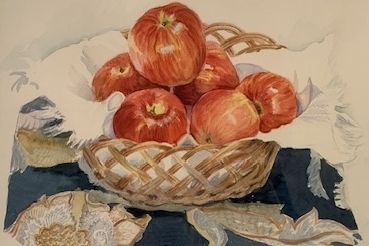
Mrs. Winter painted fruit and flowers.Courtesy of the family
In 2021, she self-published a 48-page children’s book called How the Bears Got to the Park.It features illustrations by her husband, and the plot she wrote is based on his award-winning 1966 sculpture Family of Bears that is displayed at Three Bears Park at Third and Delancey Streets in Society Hill.
Mrs. Winter was a longtime member and onetime council president at Our Mother of Consolation Parish. She and her husband moved to Chestnut Hill from Southwest Philadelphia in 1962 so their children could attend the parish school, and she taught all subjects to third and fourth graders for a few years.
Parish members scheduled Mass intentions to honor her on June 28, July 5, and July 10. “She was very determined,” her daughter Genienne Navarro said. “She never let anything stand in her way and would move mountains to get something done.”
Kathleen Marie McKenna was born April 21, 1935. Her family moved to Virginia when she was young and returned to Philadelphia a few years later, and she graduated from West Philadelphia Catholic High School for Girls.
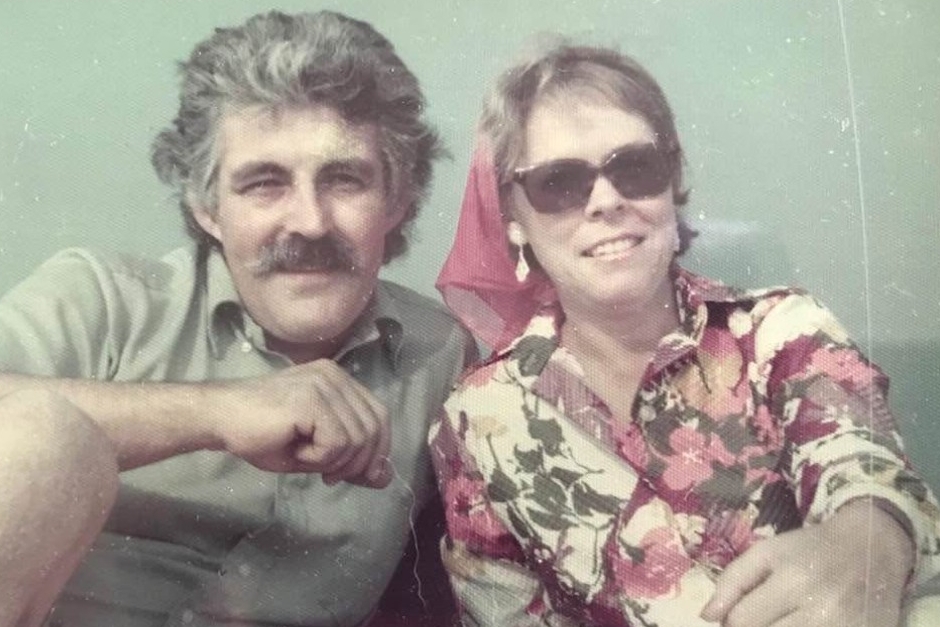
Mrs. Winter and her husband, Joe, married in 1956. Courtesy of the family
A perceptive nun recognized her artistic skills in high school and arranged for an admission interview with officials at the Pennsylvania Academy of the Fine Arts. She received a full scholarship, met her husband there, and they married in 1956 and had daughters Kathy and Genienne and a son, Joseph.
Her husband died in 2020, and she moved to the Pittsburgh area a few years ago to be close to family. Mrs. Winter kept in touch with former classmates at the Pennsylvania Academy of the Fine Arts for years and took additional art classes later at Temple University and Chestnut Hill College.
She played piano, doted on her family, and survived cancer in the 1970s. A longtime friend called her a “true, loving, nourishing, protective, guiding, steadfast Blessed Mother to me.”
Her family said in a tribute: “She will be remembered for her friendship, spiritual support, listening ear, humor, deep caring, generosity, and undaunted optimism.”
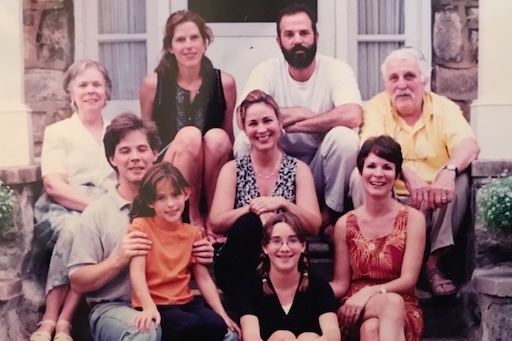
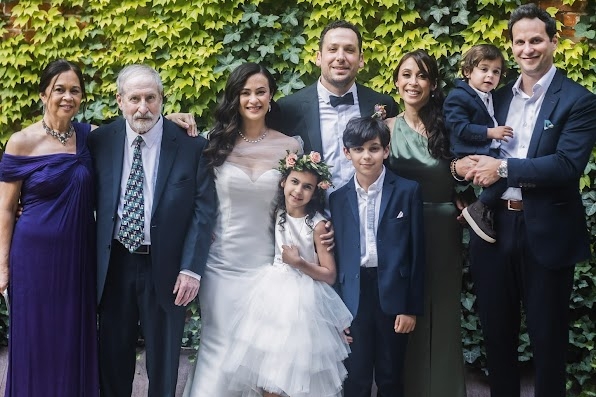
Mrs. Winter (rear left) enjoyed time with her family.Courtesy of the family
Her daughter Genienne said: “Her favorite saying was, ‘Nothing is impossible with God.’”
In addition to her children, Mrs. Winter is survived by six grandchildren, three great-grandchildren, and other relatives. A sister died earlier.
A memorial service is to be at 11 a.m. Saturday, Sept. 19, at Our Mother of Consolation Church, 9 E. Chestnut Hill Ave., Philadelphia, Pa. 19118.
Donations in her name may be made to Our Mother of Consolation Church and School, 9 E. Chestnut Hill Ave., Philadelphia, Pa. 19118.
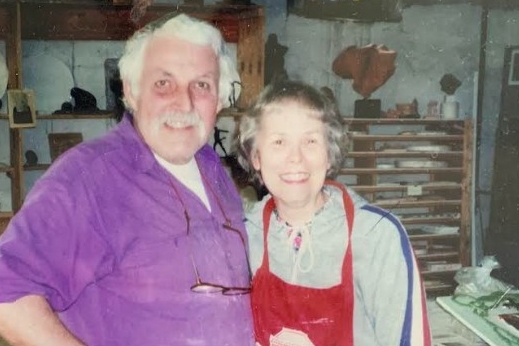
Mrs. Winter and her husband, Joe, pose in their Chestnut Hill home studio. Courtesy of the familyMrs. Winter was an expert in designing stained glass. Courtesy of the family
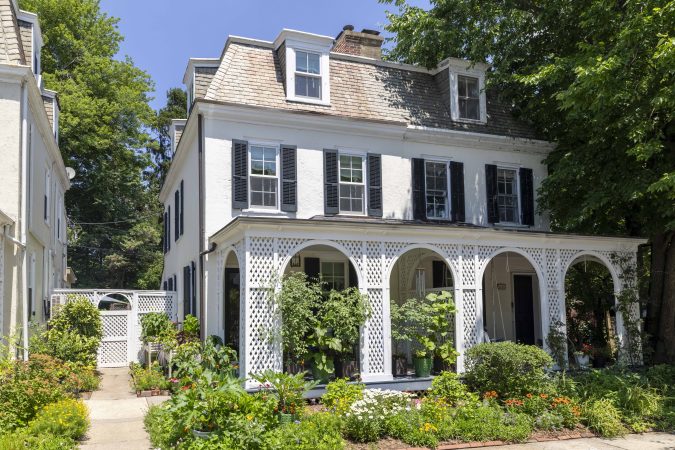
When Gretchen Ellis saw photos of the four-bedroom, two-bathroom twin on a cul-de-sac in Chestnut Hill, she said, “I knew it was ‘the house.’ I felt a deep sense of calm.”
With her two sons in college, she moved from Maple Glen in 2017. Now, her sons are in Pittsburgh and Ellis is joining them.
“I wish I could pick up my house and my neighbors and move them there,” Ellis joked.
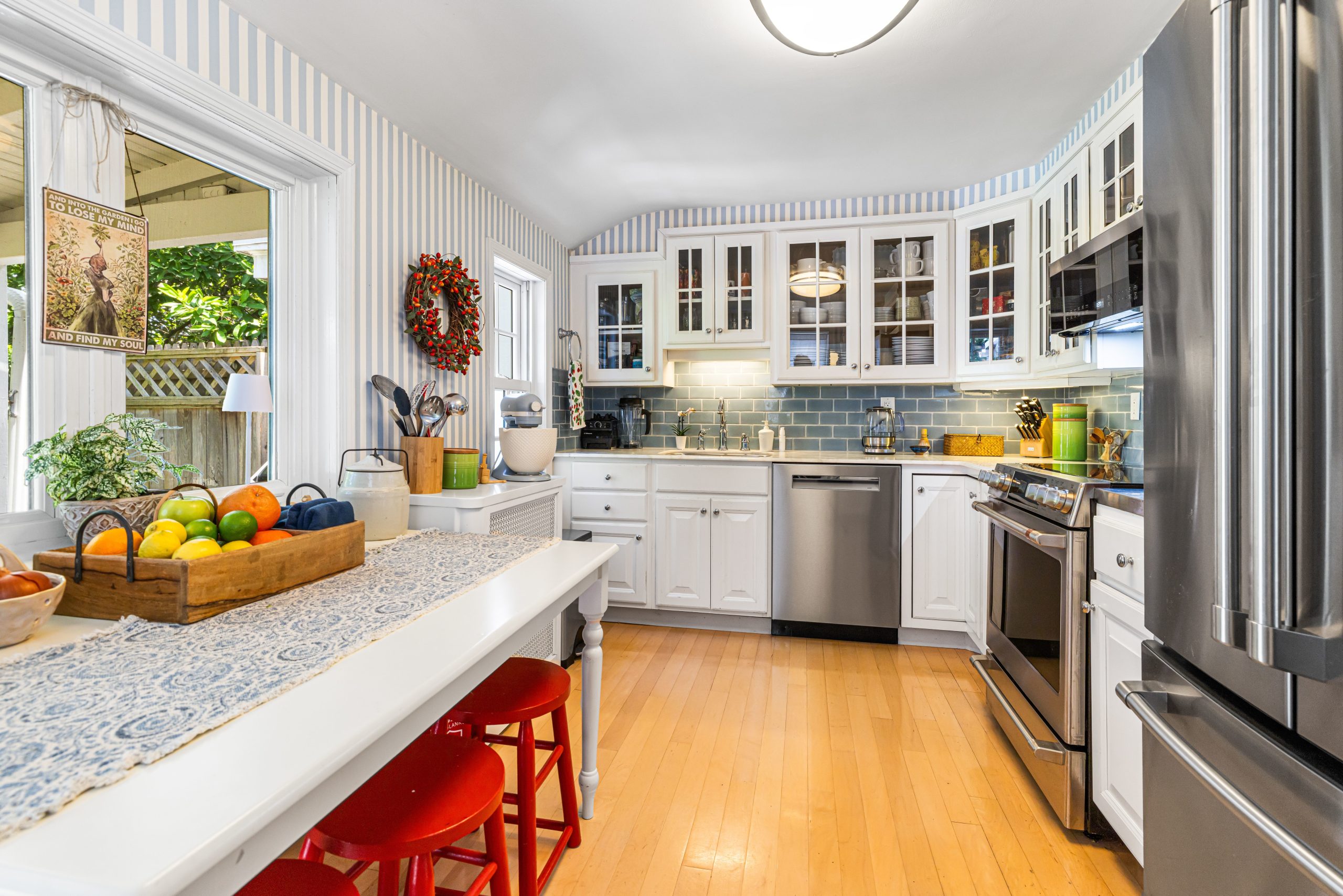
The kitchen has marble countertops, stainless steel appliances, and a breakfast bar. Gary Schempp
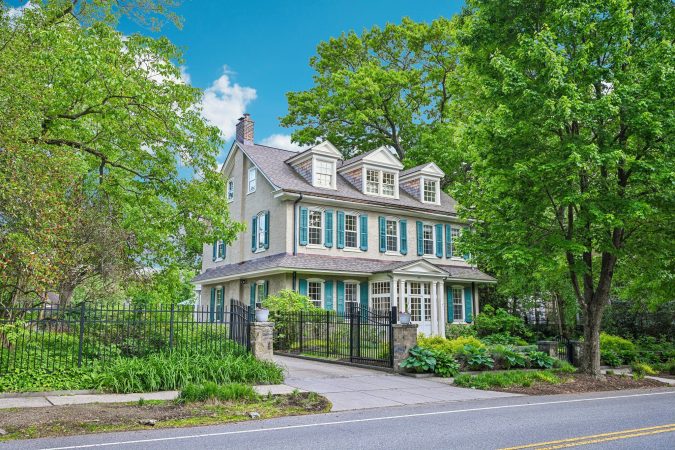
The 1,520-square-foot home was built in 1887, designed by architect Robert R. McGoodwin.
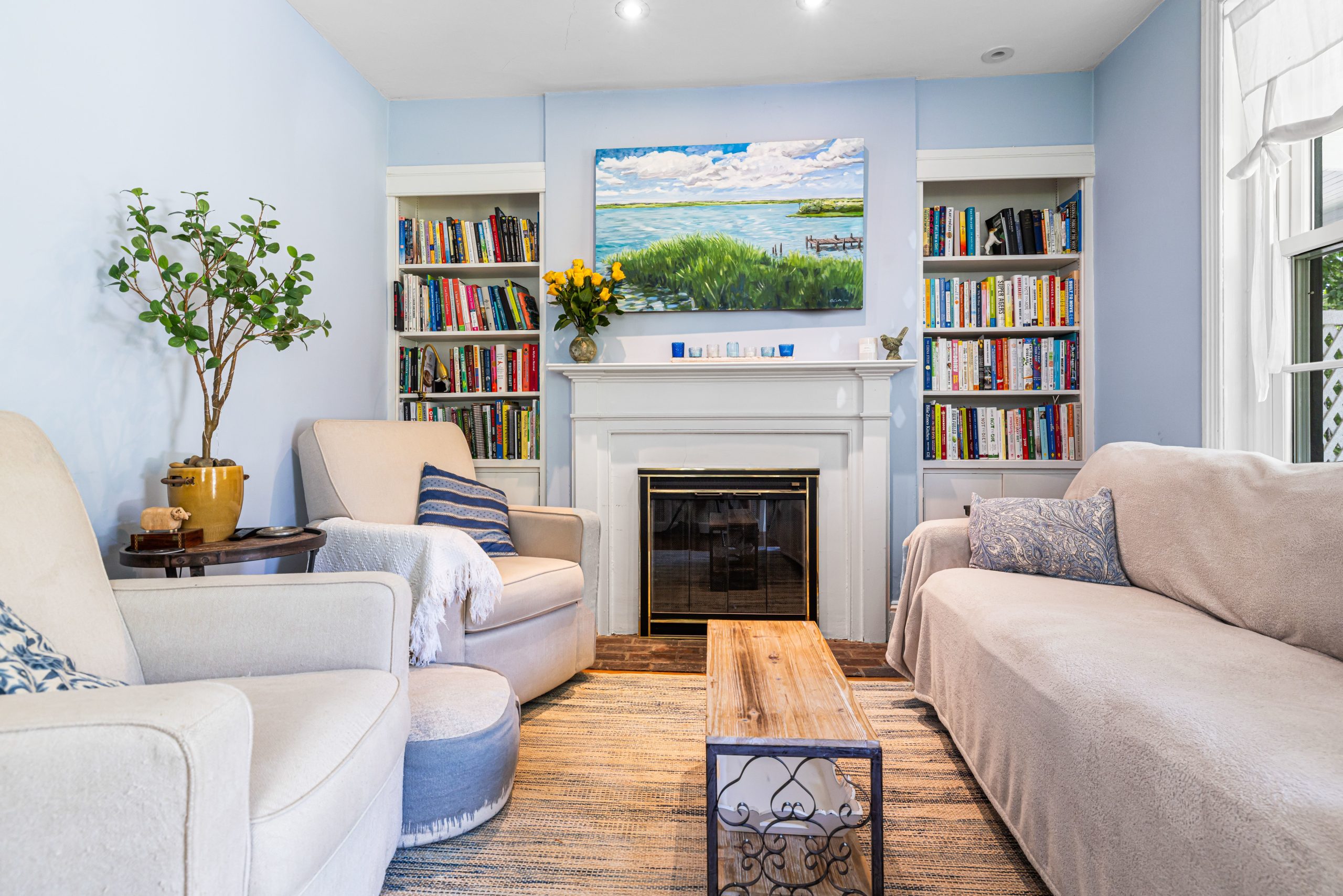
Hardwood flooring covers most of the home; the living room has a gas fireplace; and the kitchen has marble countertops, stainless steel appliances, and a breakfast bar with scenic views of the grounds.
The living room has a gas fireplace.Gary Schempp
The second floor has two bedrooms, including the primary, which has a built-in closet system, and share a full bathroom. The second bedroom can also serve as a home office.
The two bedrooms on the third floor share a full bathroom with a claw-foot tub.
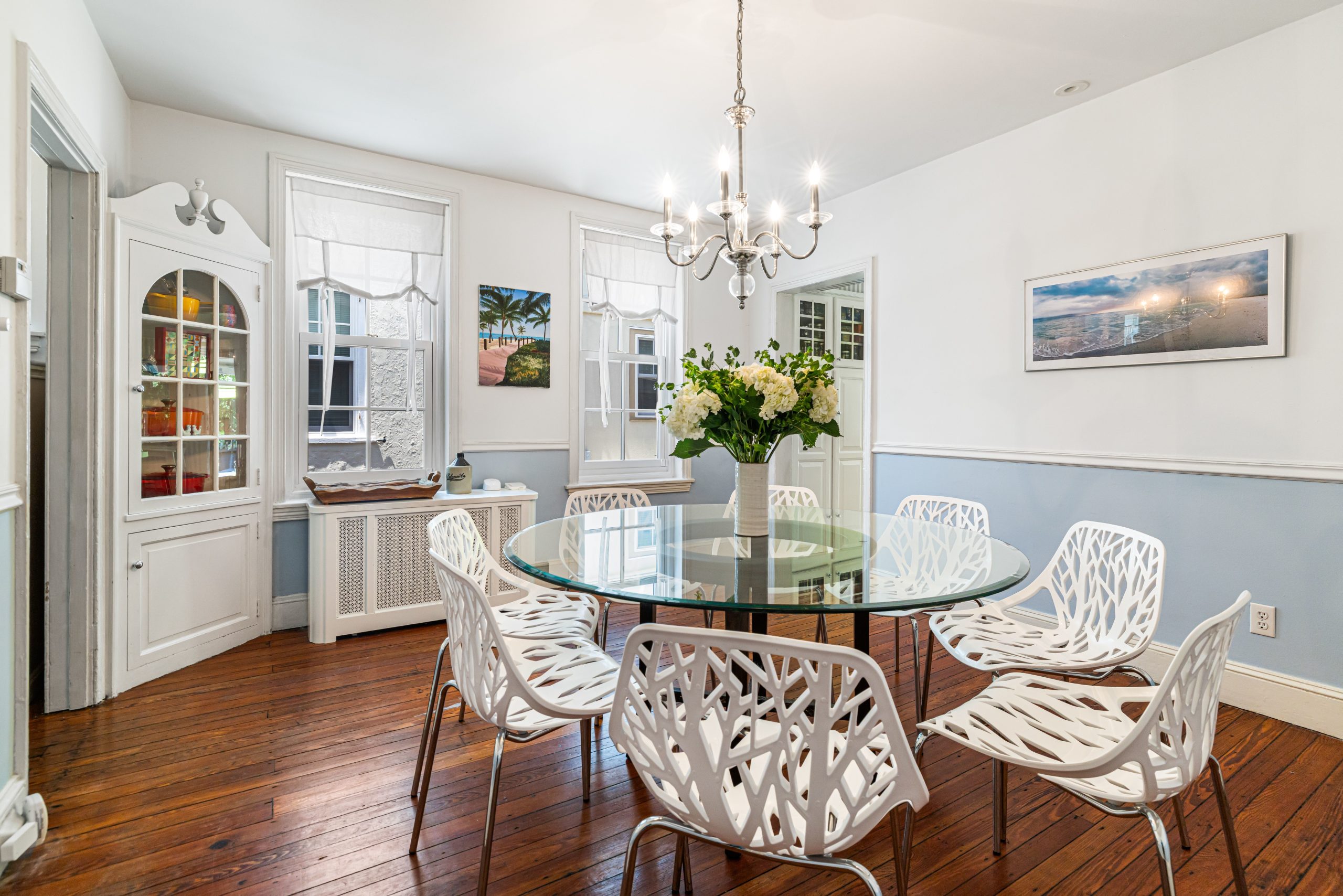
The dining room.Gary Schempp
Recent improvements include roof flashing reinforcement, metal roof coating, replacement of a cedar shed, and a new sump pump.
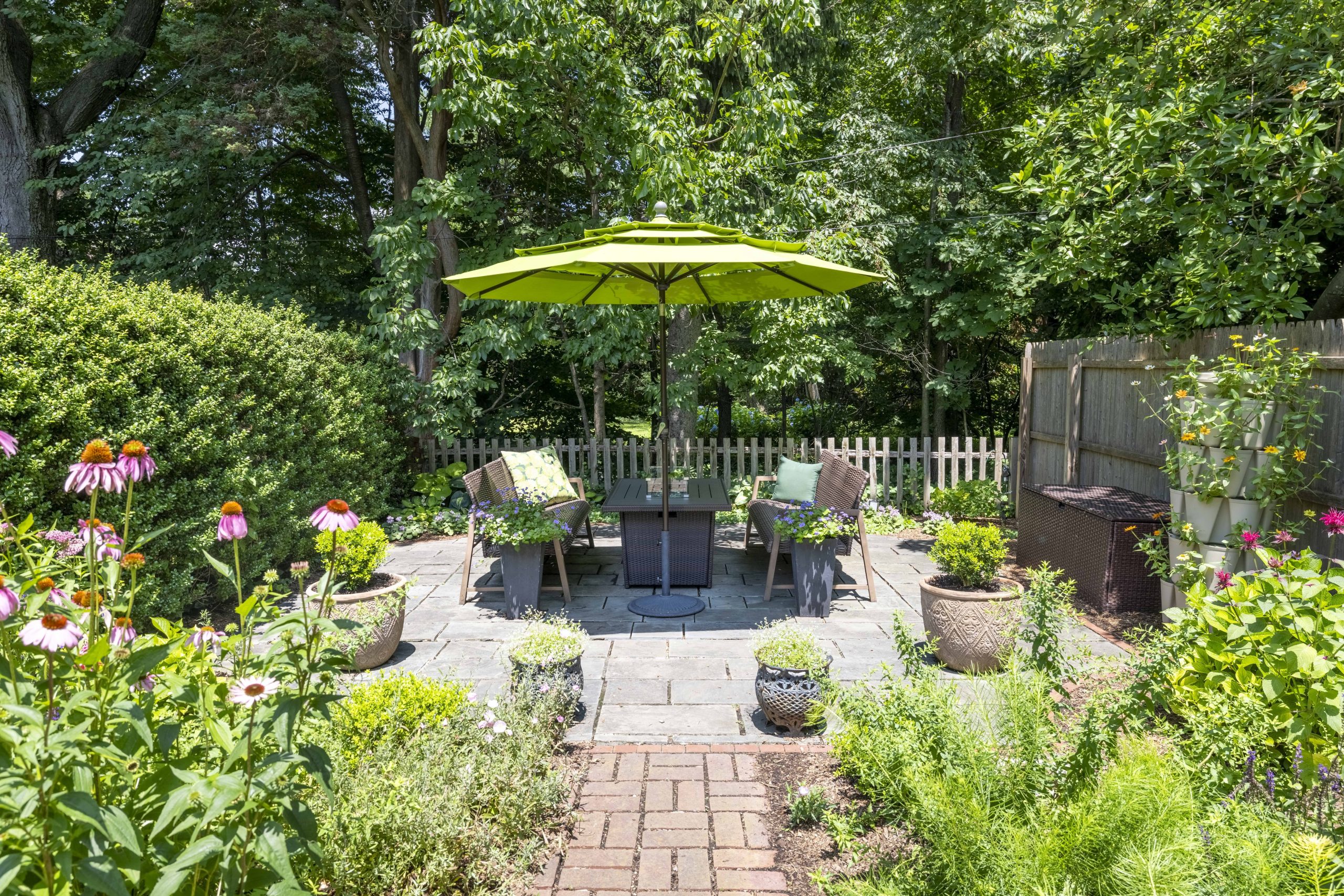
There is a full basement with a French drain system, laundry facilities, and an exterior exit with a full set of stairs and a brick patio.
The back patio.Gary Schempp
The house is a short walk from SEPTA’s Chestnut Hill East and Chestnut Hill West Regional Rail lines, and the shopping corridor of Germantown Avenue.
It is listed by Diane Reddington of Coldwell Banker Realty for $699,900.
Brenda Beiser knows firsthand how difficult buying a home in the Philadelphia area can be. She’s not only a Redfin real estate agent, but she’s also an empty nester who wanted to downsize.
Her six-bedroom house in Mount Airy sold right away when she put it on the market in May. But she decided not to buy a replacement.
“I went for a rental because I didn’t really want to compete with everyone who’s trying to get into a smaller house,” Beiser said. “A lot of people who are in their 60s and would have traditionally downsized into a smaller house just aren’t doing it. They can’t find a place to go.”
Brenda Beiser, a Redfin real estate agent in the Philadelphia area, decided not to buy another home when she sold her Mount Airy house, because she didn’t want to enter the region’s competitive housing market.Courtesy of Brenda Beiser
The Philadelphia region has a housing supply problem, just like large swaths of the country, and that’s impeding both repeat and first-time buyers. Inventory is particularly low across the Northeastern United States, where construction has not kept up with demand. In the beginning of this year, Zillow predicted that the Philadelphia metropolitan area would be one of the country’s 10 most-competitive housing markets of 2026.
Home supply, however, has also ticked up a bit in the region compared with last year, and homes are staying on the market a bit longer before they sell. For the four weeks ending June 21, the region was in the top five markets with the highest annual increase in new home listings, according to a Redfin analysis of the 50 most-populous metropolitan areas.
“The market’s encouraging,” said Jake Markovitz, president of the board of directors for the Greater Philadelphia Association of Realtors. “It’s certainly more balanced than it has been the last four, five years.”
Erin Thompson, CEO of the Montgomeryville office with Keller Williams and leader of the Erin Thompson Team, agrees. She said buying and selling is “ebbing and flowing but trending toward a more stabilized market.”
“Although I feel like I’ve said that twice in the recent past, and then it’s gone bonkers,” she said.
The region’s market is a mixed bag.
Some homes are sitting for a while, and some owners are at risk of selling properties for less than they bought them for a few years ago. Other homes have inspired five or more buyers to compete against each other, hiking up prices, said Markovitz, an associate broker with the Karrie Gavin Group at Elfant Wissahickon Realtors.
This Graduate Hospital home went under contract last month a few weeks after it was listed for sale.Courtesy of Jake Markovitz
“As an example, I’m seeing more inventory in Chestnut Hill than I have in a long time, which is giving buyers a little bit of power,” he said. But if the right property hits the market, it will go fast.
He’s seen the same happen in neighborhoods such as Graduate Hospital and Fishtown.
Because of strong demand for homes in the region, “I just don’t think we’ll see any major shift in prices coming down,” he said.
‘Weird’
Markovitz and Thompson both used the same word to describe the recent real estate market: weird.
They said housing activity isn’t always following time-tested rules.
Philadelphia homes that sat on the market for months last fall, typically a busy season, suddenly went under contract in the winter, typically a slow one.
A house that sits on the market for 30 days that a buyer thinks can be theirs at a lower price can suddenly attract two other buyers at the same time. And now they all need to be ready to pay more.
Housing markets have always been hyperlocal, with buyer demand varying from neighborhood to neighborhood and block to block. But now, “it’s almost like a property-by-property basis,” even for comparable homes, Thompson said.
Owners bound by ‘golden handcuffs’
Even with recent upticks in home listings, the region’s housing supply is nowhere near enough to meet demand.
“Most people are anticipating this year will continue to be a little tough,” Thompson said, “and then next year we’ll start to see some more inventory.”
Markovitz said homeowners who bought properties five years ago with 3% or 4% mortgage interest rates are still experiencing “some sticker shock” from current rates, which lately have been averaging about 6.5% for a 30-year, fixed-rate mortgage.
“Those people, even if they’re ready to leave, are kind of bound by their golden handcuffs,” not wanting to sell and then have to buy a home at a higher interest rate, he said.
But for many homeowners, “the reality of the market has set in a little bit,” he said. “Where people were sort of hoping, wishing that rates would come back down, they’re not.” And life events such as births, deaths, and job moves mean that people need to sell their homes.
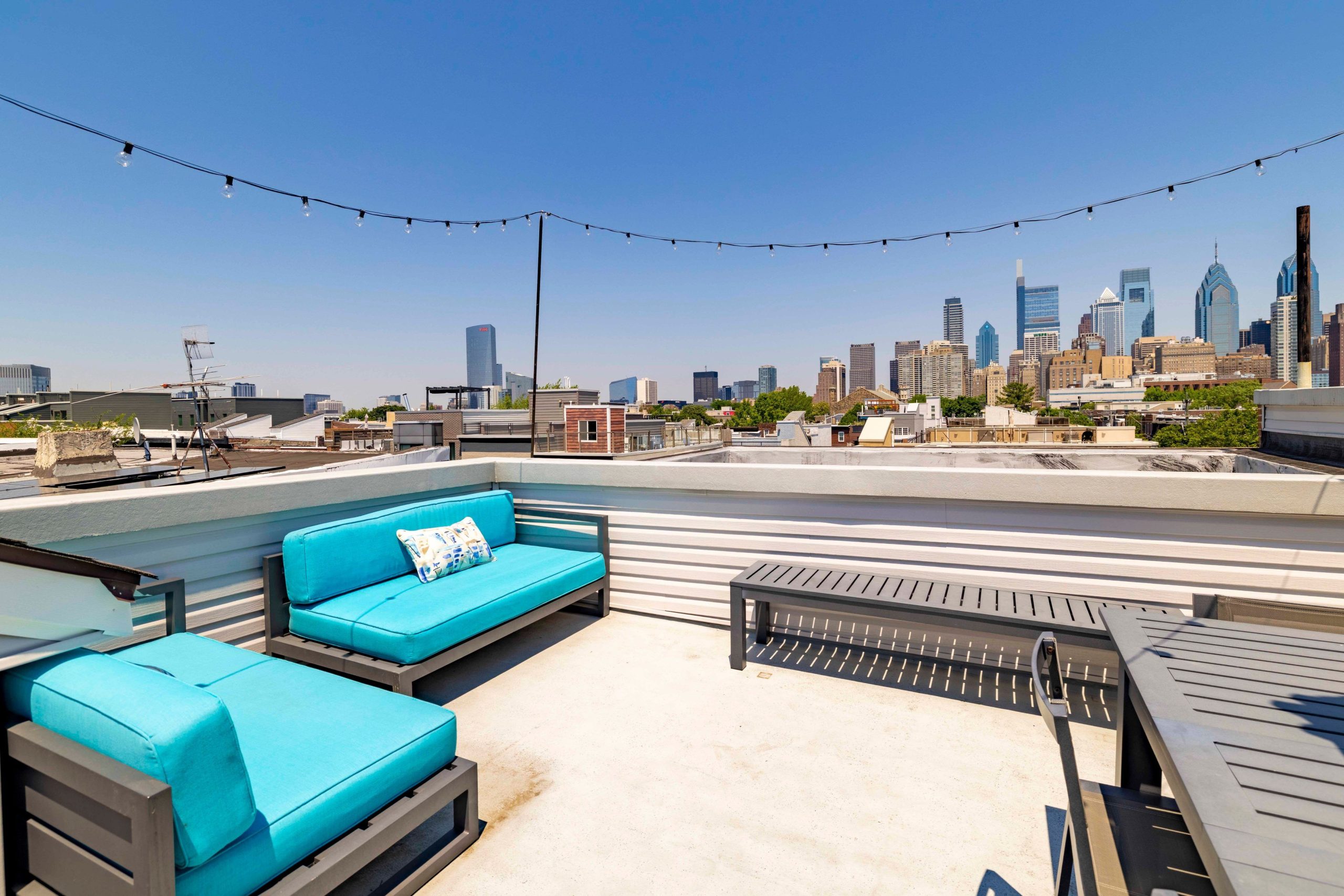
This recently sold Graduate Hospital home has skyline views from the roof deck.Courtesy of Jake Markovitz
And buyers show up to purchase them.
Thompson said she was nervous when she listed a Phoenixville home for sale during Memorial Day weekend,when many homebuyers might be traveling. But a lot of people came to see it, and the seller ended up with seven offers and a final price that was well over what they expected.
Buyers, however, aren’t accepting just anything. They are more selective and less likely than in past years to skip home inspections. If sellers want to get the highest price, they have to prepare their properties for sale, agents said.
Homes, and especially kitchens and bathrooms, need to be up-to-date, and central air-conditioning is a plus, said Annette Collier, owner and real estate broker at Able Real Estate, based in West Philadelphia.
“That’s what buyers are looking for, and I don’t think they’re willing to settle,” said Collier, who works in the city and surrounding areas. “I find that less buyers want to do any renovations. Most buyers want a move-in-ready situation.”
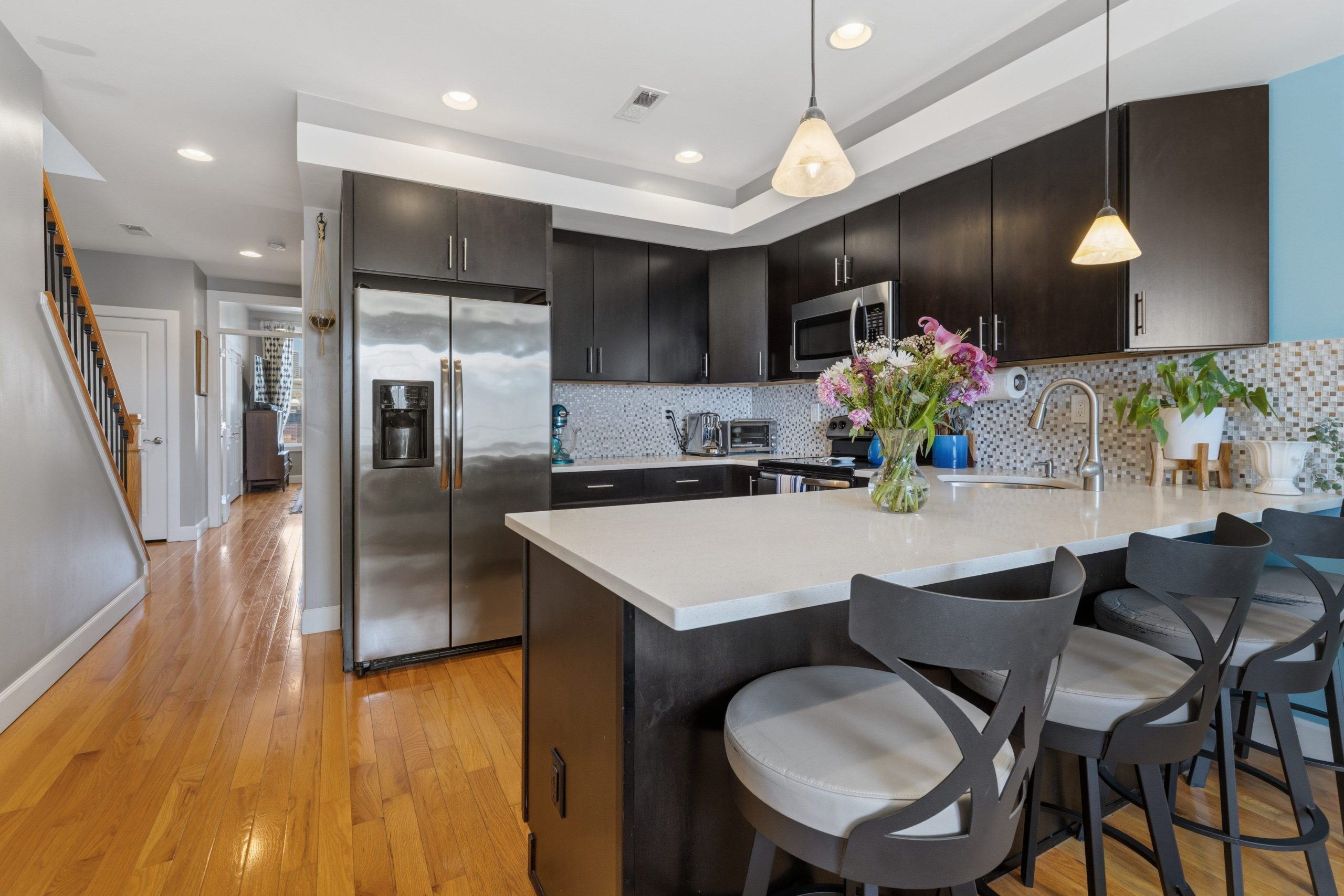
Homebuyers want updated kitchens, like this one in a Graduate Hospital home that recently sold.Courtesy of Jake Markovitz
And sellers need to be realistic about how much they can get for their home.
“If you overprice by even just a little bit,” Thompson said, “you’ll end up sitting.”
Buyers ‘ready to pounce’
Generally speaking, buyers now have more time to make decisions than they did last year, since homes are staying on the market longer.
But, in some submarkets, especially in Philadelphia’s collar counties, “there’s so much demand that certain houses are just going to fly off the shelves,” said Beiser, who works in Philadelphia and surrounding areas.
“I have some buyers in the suburbs, and they‘ve kind of stopped looking because it’s too challenging,” she said.
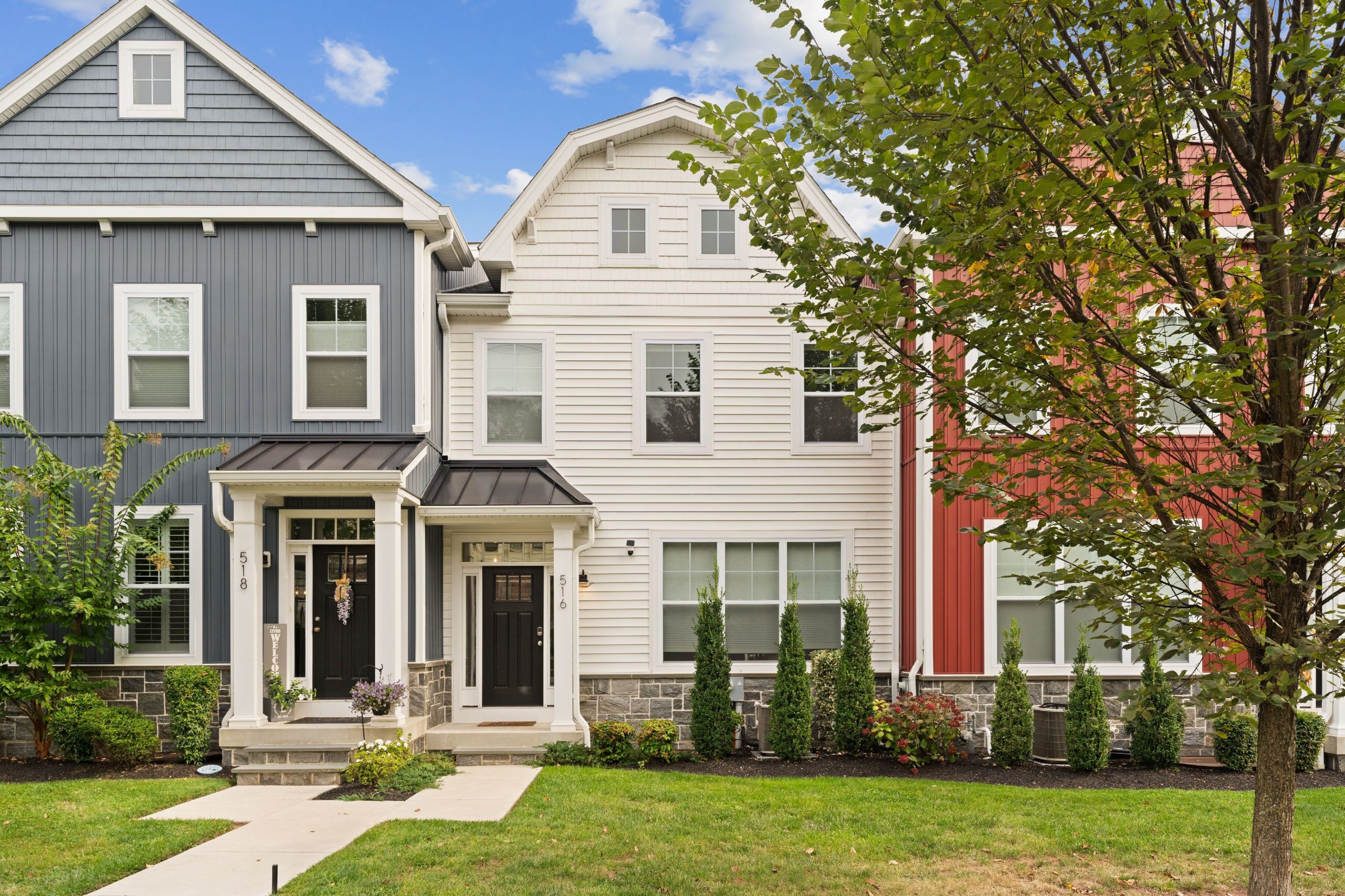
This home in Upper Merion Township is listed for sale for $699,900 by agent Erin Thompson.Jacob Schroeder, Left Bank Real Estate Photo Services
Beiser has been working with a couple with children who live in Philadelphia but want to move to the suburbs. Each spring for the last three years, her clients make a plan to try to find their next home. But every year, they decide that continuing to live in the city is more convenient than facing competitive markets in which they’re expected to skip home inspections to win a property, Beiser said.
Thompson has seen a growing trend of frustrated buyers putting in offers above the asking price even when they’re not facing direct competition. One client recently went under contract on a Fishtown home they had immediately put an offer on.
“They came in aggressive, because they’d just lost out on a house, and they’d been looking for a while,” she said. “You have these buyers who are scarred and tired, so they’re coming in more aggressive.”
Thompson tells buyers to make sure they’re as prepared as possible before starting their home search.
“You have to be ready to pounce the second [a home] comes to the market,” she said.
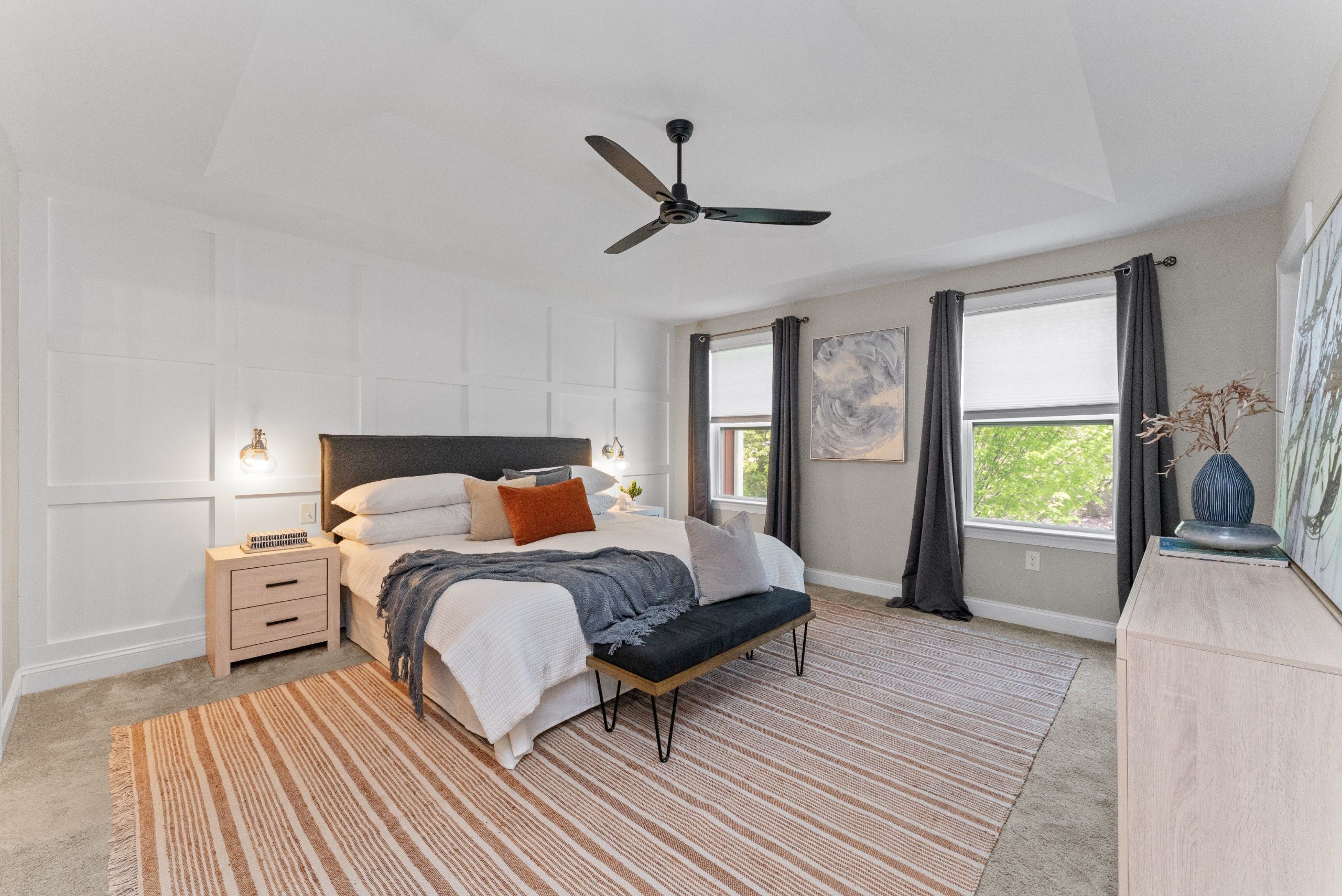
This home on the market in Upper Merion Township spans more than 2,800 square feet and has three bedrooms.Jacob Schroeder, Left Bank Real Estate Photo Services
Chestnut Hill Hospital was not cited by the Pennsylvania Department of Health for any safety violations between April 2025 and March of this year.
The Philadelphia-based hospital is majority-owned by Temple Health, which holds an 80% share in a partnership with Philadelphia College of Osteopathic Medicine.
Here’s a look at the publicly available details:
May 21, 2025: Inspectors came to investigate a complaint but found the hospital was in compliance. Complaint details are not made public when inspectors determine it was unfounded.
July 7: Inspectors came to investigate a complaint but found the hospital was in compliance.
Aug. 15: The Joint Commission, a nonprofit hospital accreditation agency, renewed the hospital’s accreditation, effective June 2025, for 36 months.
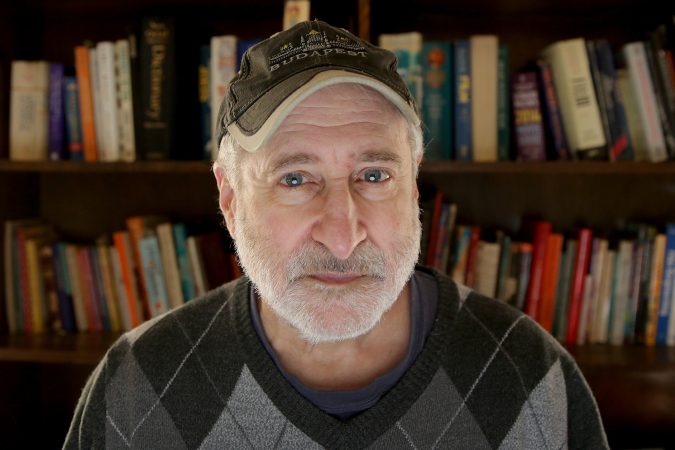
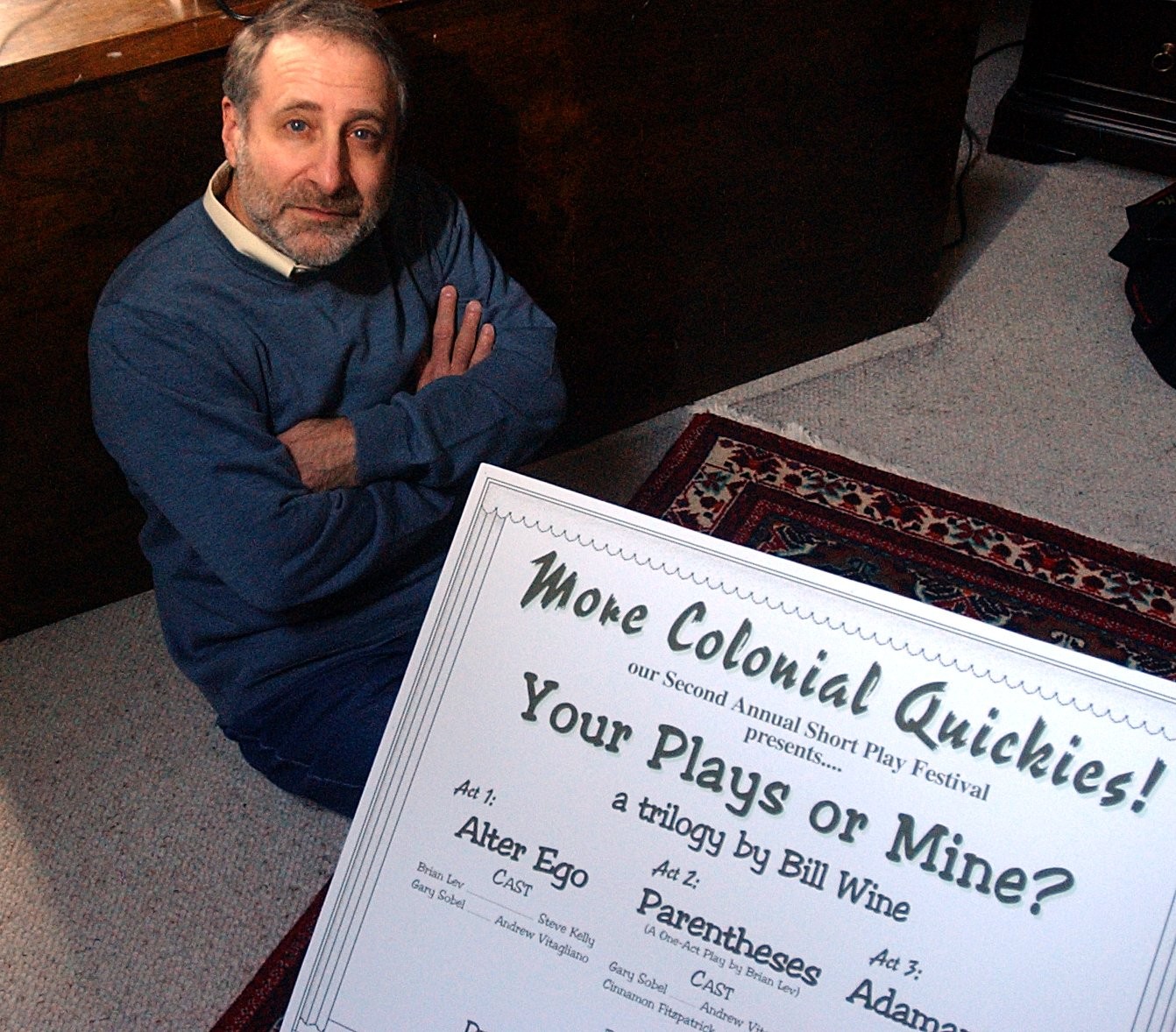
Bill Wine, 81, of Philadelphia, three-time Mid-Atlantic Emmy Award-winning film and TV critic, retired tenured associate professor of TV and film at La Salle University, onetime freelance TV critic for the Daily News, freelance writer, playwright, and popular lecturer, died Sunday, June 14, of complications from Parkinson’s disease at his home in Chestnut Hill.
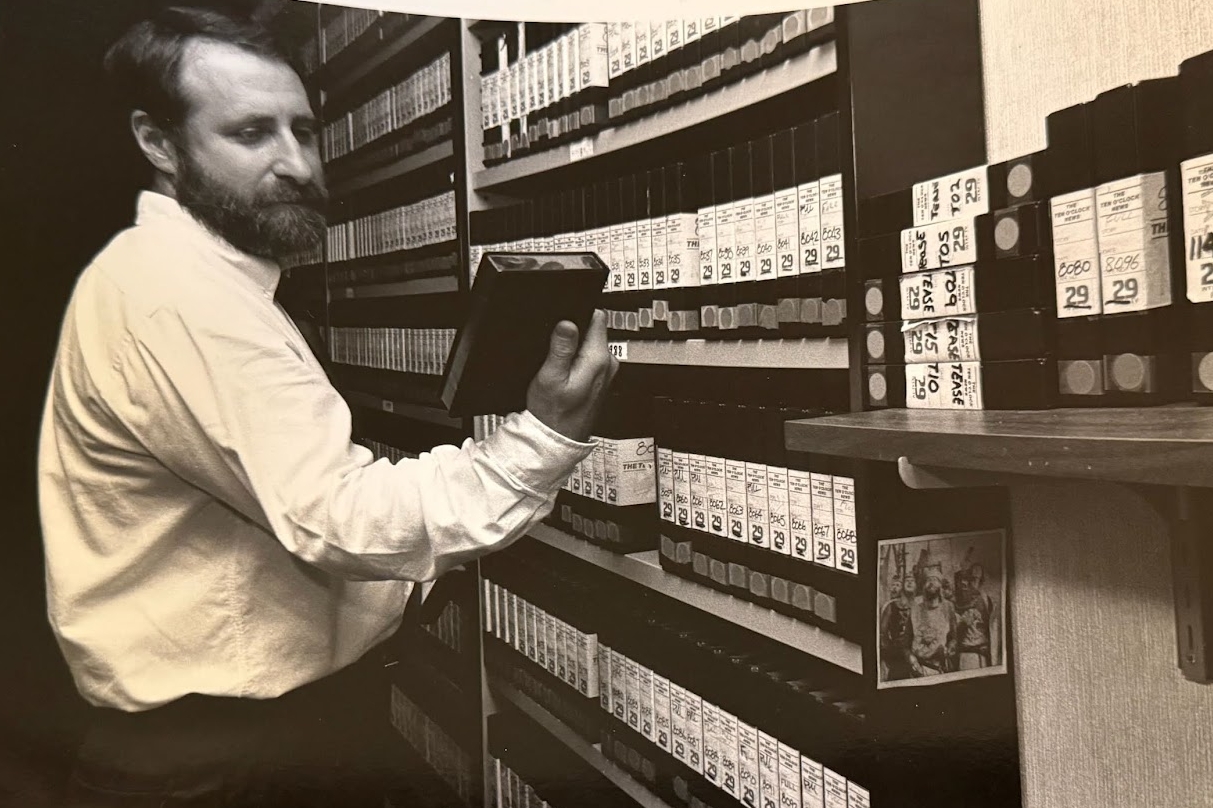
The son of two part-time amateur actors and a lifelong devotee of theater, film, TV, writing, and teaching, Mr. Wine was a film critic for WTXF-TV, Channel 29, for 12 years and KYW radio for 17 years. Known for his pithy, witty, and often acerbic reviews, and a breezy conversational style of writing, he worked at Channel 29 from 1990 to 2002 and KYW from 2001 to 2018.
“Bill Wine was a character out of a Neil Simon comedy, more Oscar than Felix,” said Carrie Rickey, former Inquirer movie critic. “You didn’t have to wait long for the punchline.”
Mr. Wine’s film reviews on Channel 29 were often funny and entertaining. Channel 29
At Channel 29, Mr. Wine was nominated for eight regional Emmy Awards for commentary and writing, and won three. He appeared regularly on the station’s Ten O’Clock News, in primetime movie preview and review programs, and later on Mondays, Wednesdays, and Fridays on Good Day Philadelphia.
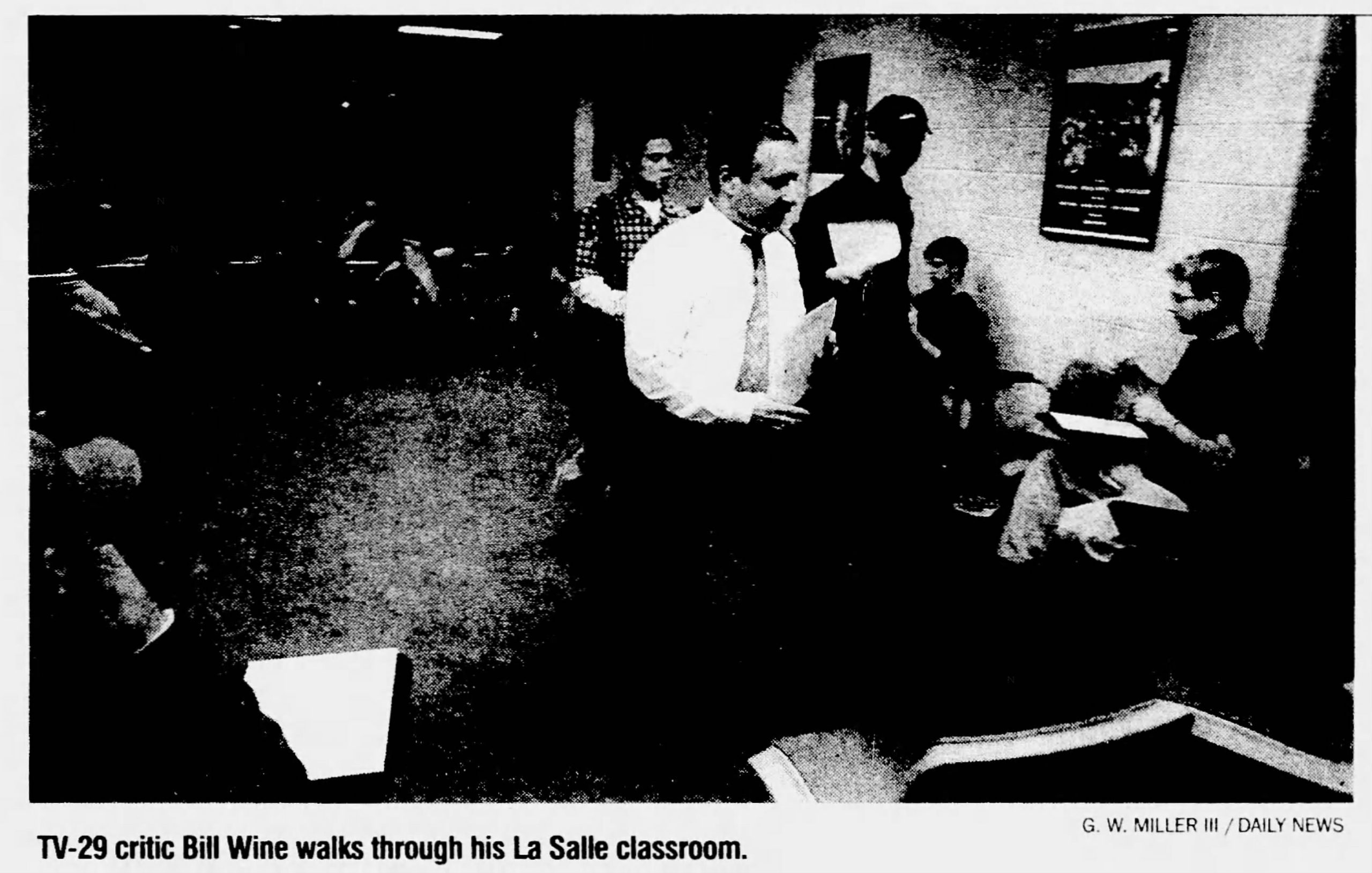
By 1990, he had already written hundreds of freelance film reviews for the Daily News and Courier-Post, done radio reviews for WPEN, and taught a variety of classes about film and writing for a decade at La Salle. So, despite no previous TV experience, he was hired at Channel 29 over 60 other film critic applicants.
“I had never been on TV, but I wasn’t nervous,” he told the Daily News in 2001, “because I had been standing in front of 100 students for 10 years.”
Mr. Wine worked at at WTXF-TV, Channel 29, for 12 years.Courtesy of the family
He started at KYW radio in 2001 and usually aired reviews and reports on Thursdays, Fridays, and Saturdays. Sometimes, he watched three movies in one day. He left Channel 29 in 2002 and KYW in 2018 only after both companies eliminated their local film critic position.
“When I started [writing film reviews], it was before the internet,” he told The Inquirer in 2018. “A lot of people [now] feel like, ‘Who the heck is a movie critic to come on in a minute and to dismiss something that took hundreds of people and millions of dollars to create?’”
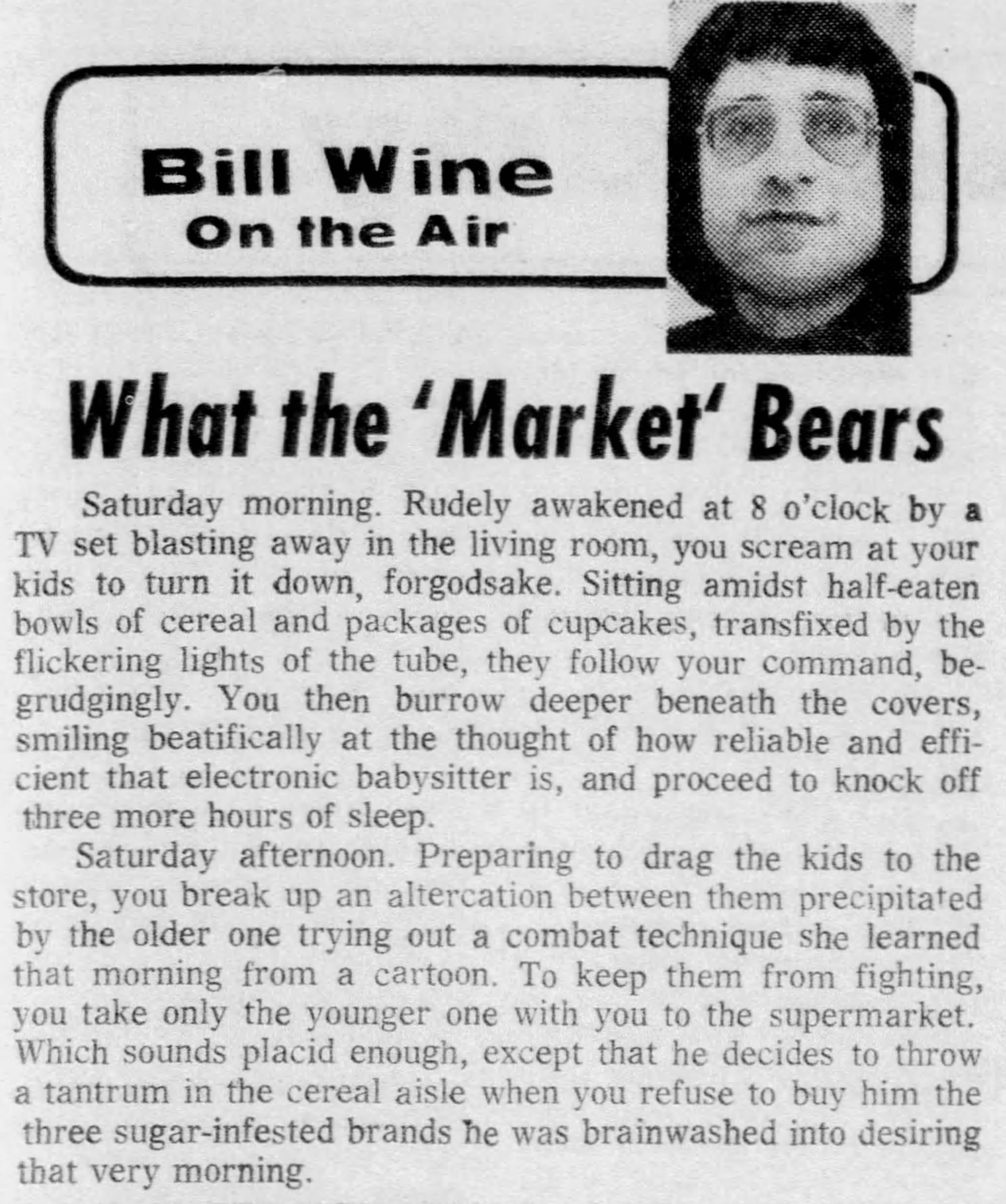
In the 1970s and ‘80s, he wrote articles and reviewed films, TV shows, books, and plays for WPEN, The Inquirer, Courier-Post, Philadelphia Magazine, and other outlets. In 1975, he wrote dozens of freelance TV columns called “On the Air” for the Daily News.
Mr. Wine wrote dozens of columns as a freelance TV critic for the Daily News in 1975.Newspapers.com
He spent three years in California in the 1970s working on plays and film and TV scripts. He hobnobbed with famous writers, producers, and actors in Los Angeles, staged one of his own plays, and was a winning contestant on a new TV game show.
He wrote 11 plays over the years, and several made it to the stage. “Now the people who disagree with my reviews can come and find out if I’m as dumb as they think I am,” he told The Inquirer in 2002.
He aired reviews on WIP radio and lectured often at libraries, schools, community centers, theaters, and other venues about his favorite films, adapting books to film, and other topics.“He could be wickedly funny, especially when delivering a pan of a movie,” his family said in a tribute. “One of his favorite quotes was: ‘I had a bad seat. It was facing the screen.’”
Mr. Wine was a prolific playwright who enjoyed table readings with family and friends. La Shina Clark / Staff Photographer
Mr. Wine earned a bachelor’s degree in math at Drexel University and a master’s degree in communications at Temple University. He helped design La Salle’s nascent Communication Department in the 1980s, and school officials called him one of their “Founding Fathers.” He also taught briefly at Drexel, and came close to earning a doctorate at Temple.
In 2001, he was featured in a Daily News story about “celebrity professors” and said: “You have to remind yourself that this is television, not the classroom. You mention, say, ‘film noir’ on TV, and you get a memo.”
William David Wine was born June 21, 1944, in Germantown. He grew up in West Oak Lane and Cherry Hill, attended Central High School, and graduated from the old Cherry Hill High School.
A story and this photo of Mr. Wine about his time as a professor at La Salle appeared in the Daily News in 2001.Newspapers.com
As a boy, he devoured newspaper movie reviews and fell in love with film after seeing Alfred Hitchcock’s 1954 thriller Rear Window. He got positive reviews of his own freelance movie review when he was at Temple, and he knew then, he said later, that writing about movies was his creative niche.
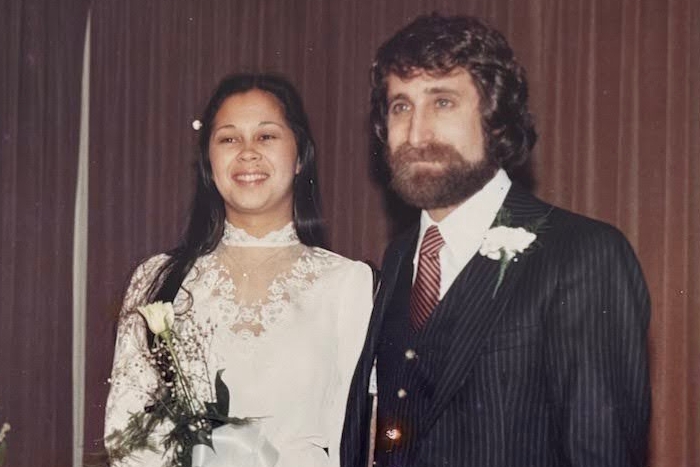
He married Dina Lichtman, and they divorced later. He married Suzanne Monsalud in 1981, and they had daughters Simone and Paulina, and lived in Germantown, Wyncote, and Chestnut Hill.
Mr. Wine and his wife, Suzanne, married in 1981.Courtesy of the family
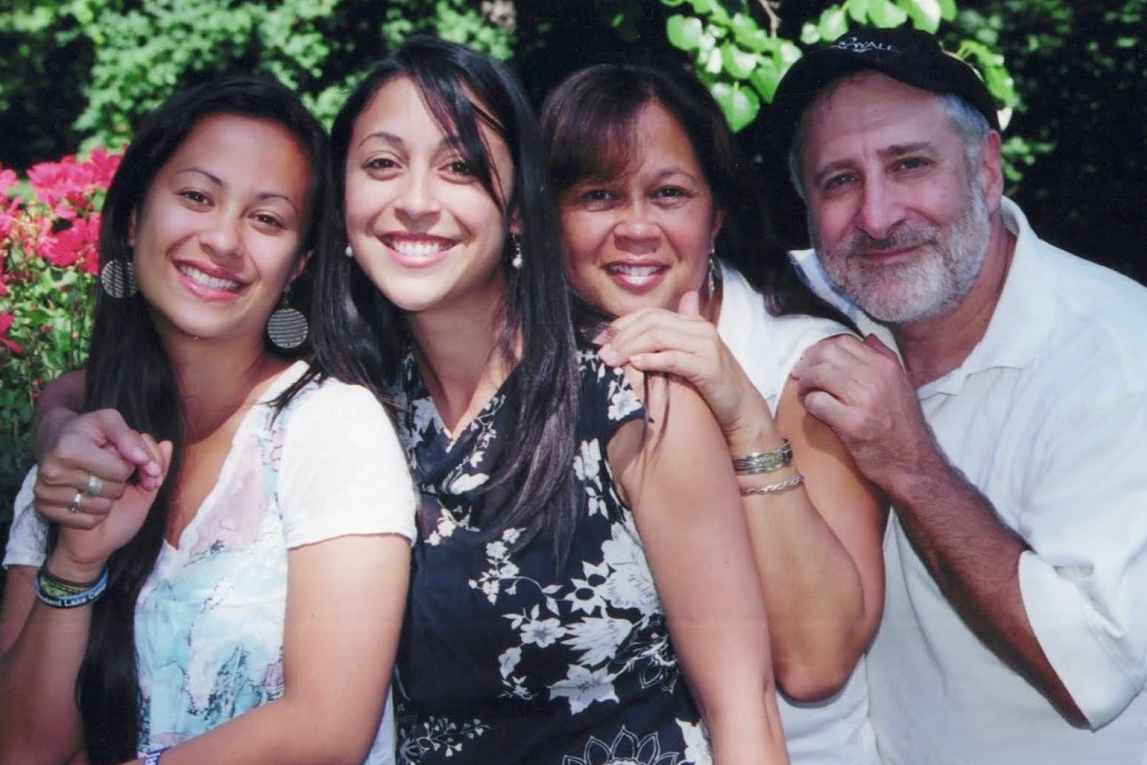
Together, Mr. Wine and his family traveled to Paris and London, and he and his wife honeymooned in Rio de Janeiro, Brazil. He doted on his daughters and sometimes took them to his La Salle classroom, the Channel 29 TV set, and movie screenings.
Friends, former colleagues, and former students called him “a force of nature,” “smart and gifted,” and “a rare combination of kindness, professionalism, and humor.” His daughter Simone said: “His humor, warmth, and presence made life brighter.”
Mr. Wine played tennis, third base on adult softball teams, and pickup basketball into his 70s. He followed the Phillies, 76ers, and Eagles closely, and hit tennis balls with Hall of Famer Rod Laver at a publicity event in Los Angeles.
Mr. Wine and his family made memorable trips to Paris, London, and elsewhere. Courtesy of the family
“He was a wonderful father and a dedicated teacher,” his wife said. “He was a real Philadelphian, and we complemented each other.”
His daughter Paulina said: “Dad, I think you cracked the code. We’ll see you at the movies.”
Over more than 25 years, Jean Miller and Craig Heim have transformed their East Mount Airy home, a 1907 Dutch Colonial, through countless renovation projects.
“But no matter what state the house was in, whatever was torn apart or upended as we did a project, it’s always been an amazing house to come home to,” Heim said. “We are always happy to come in the front door.”
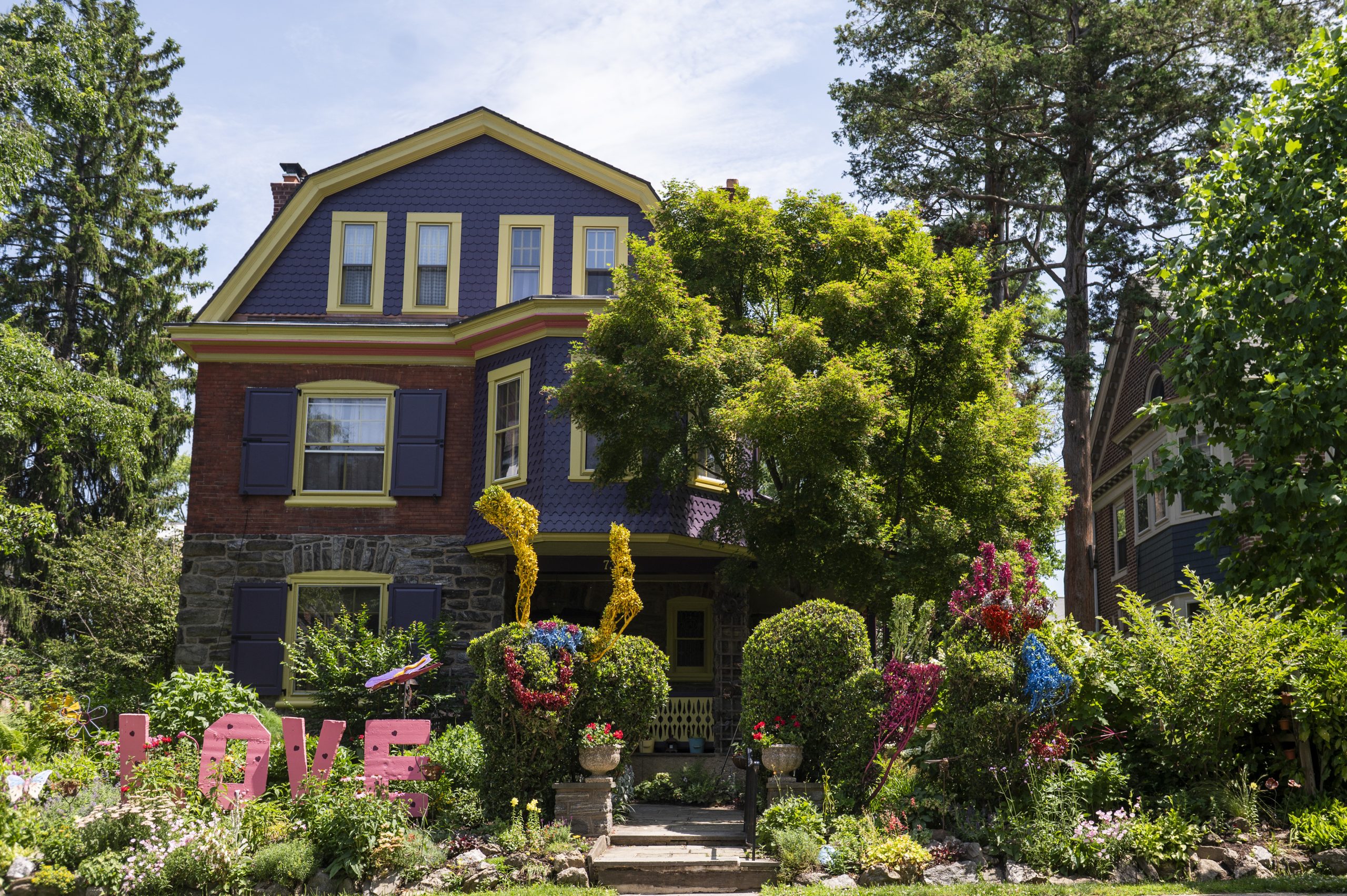
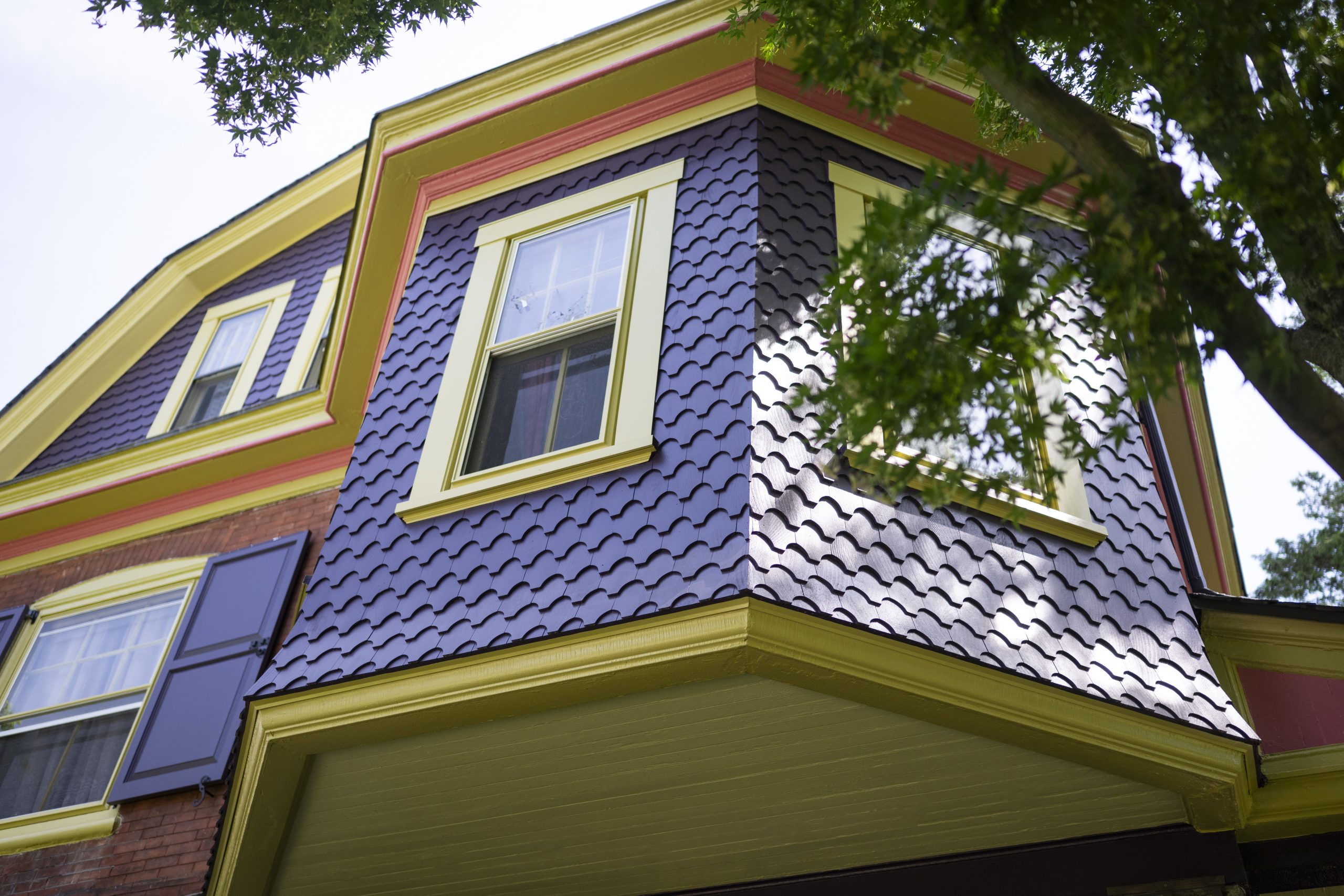
The facade surrounding that front door was the most recent project. They painted it a bold purple and updated the porch, shutters, and shingles.
Miller said she had always wanted a purple house. “It makes the house pop.”
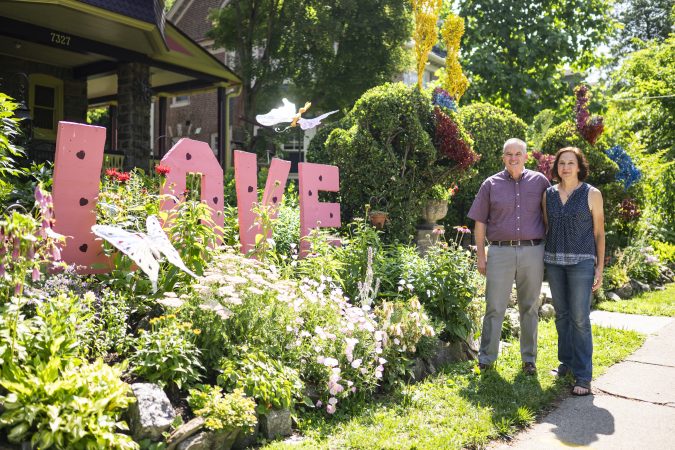
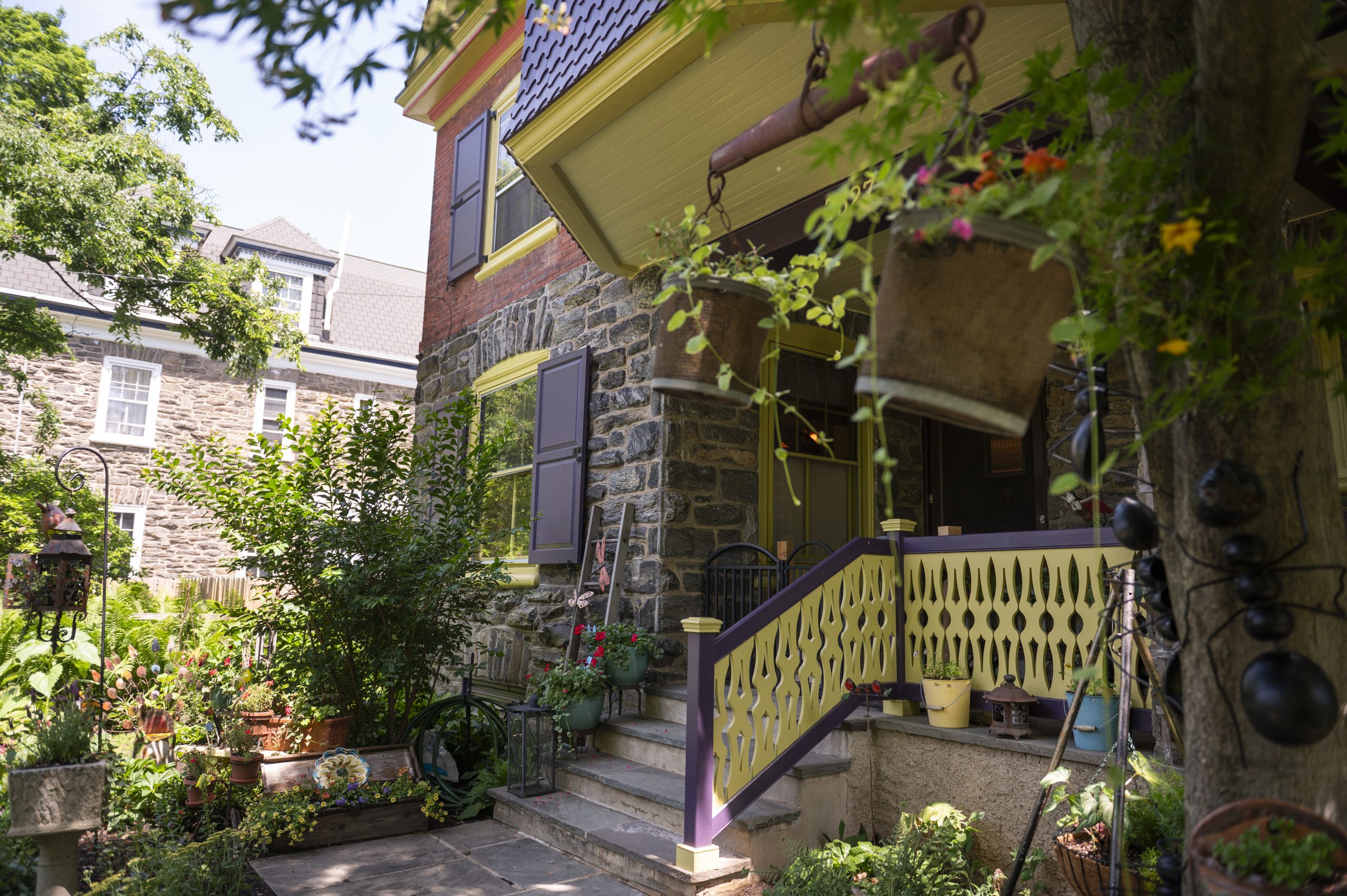
The exterior of Miller and Heim’s home and their front garden are bursting with color.Allie Ippolito / For The InquirerThe porch railing and soffit are painted purple and yellow.Allie Ippolito / For The InquirerThe home was covered in asbestos shingles when Miller and Heim bought it, and they uncovered the original cedar shakes.Allie Ippolito / For The Inquirer
The couple bought the seven-bedroom, 2½-bath home in March 2000, and moved in that spring after some initial work. At the time, they were renting near the Italian Market in South Philly and planned to buy there.
“On a whim, we looked in Mount Airy after friends mentioned a huge house for sale nearby. Once we saw the neighborhood and how much space we could afford — including a yard — we shifted our search to Mount Airy,” recalled Miller, a physician at the Hospital of the University of Pennsylvania. Heim works for human services nonprofit Face to Face in Germantown.
Over the past two decades, they updated nearly every part of the 3,200-square-foot house and its garden, as they raised their two children. Sara, 22, is a Penn graduate who now lives in South Philly, and Pete, 20, is a sophomore at Michigan State.
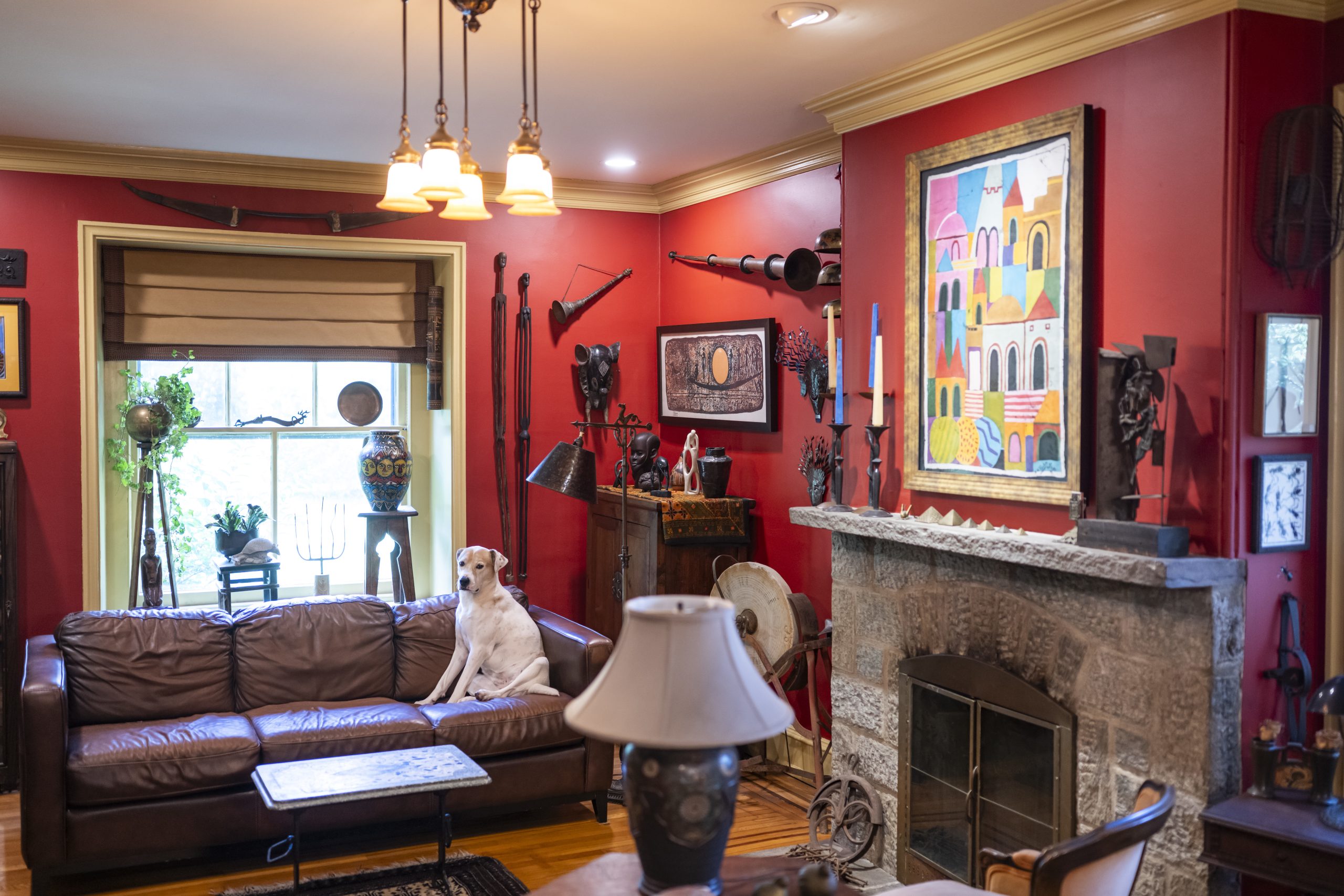
Miller said the living room and dining room are favorites. The spaces are made cozy by a wood-burning fireplace, also a backdrop for entertaining.
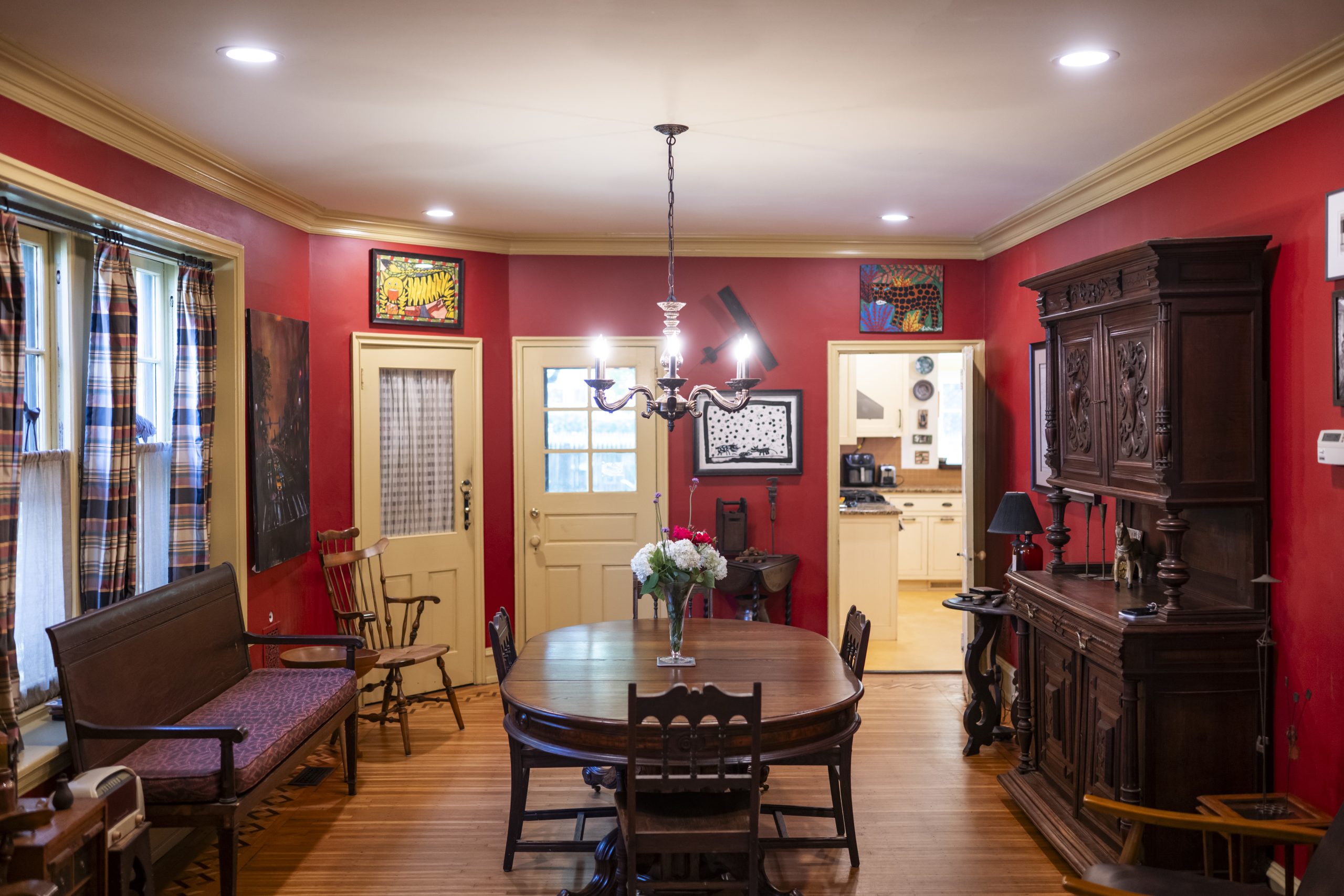
Art and instruments line the walls of the living room, as Maddie the dog enjoys the couch.Allie Ippolito / For The InquirerThe dining room has red walls and crown molding.Allie Ippolito / For The Inquirer
When they moved in, Miller recounted, the home’s living and dining rooms had already been altered, losing their original woodwork. A wall with pocket doors had likely been removed and replaced with folding screen doors. The rooms were painted red with white trim.
“We designed a wooden arch, installed larger crown molding, and removed a non-original built-in cabinet in the dining room,” said Miller. “Fortunately, the contractor removed it in sections and discovered it had been supporting the house’s main beam after studs had been taken out.”
They decided to keep the red walls and, after testing many samples, chose a trim color in greenish gold that gave the rooms a completely different look.
The home boasts an eclectic mix of furniture that they acquired from family, vintage shops, and what Miller described as “trash picking.”
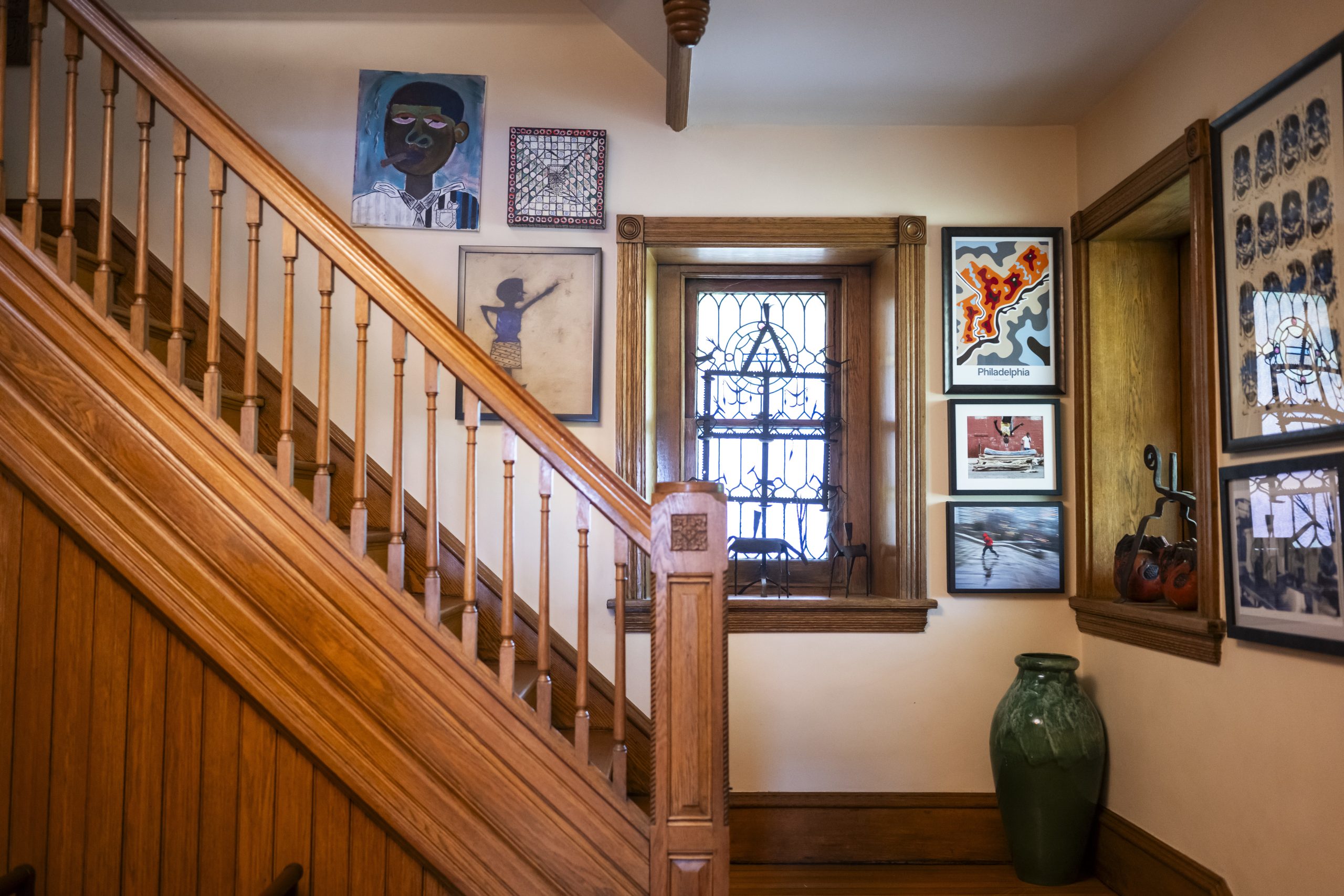
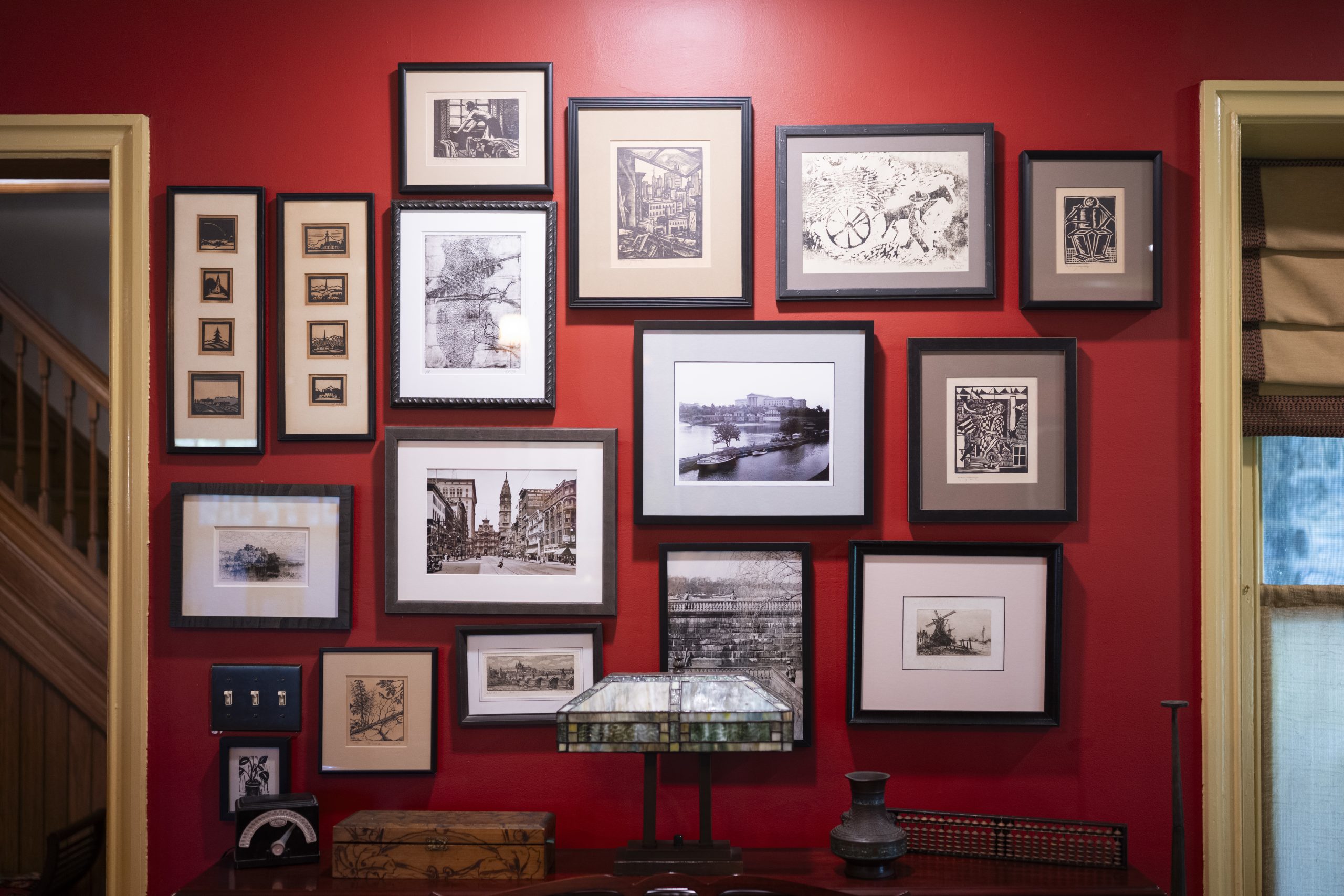
Paintings and photographs by local artists line the walls along the staircase.Allie Ippolito / For The InquirerArt fills nearly every inch of this wall in the living room.Allie Ippolito / For The Inquirer
An abundance of art hangs on the walls, loosely grouped into collections. Miller has dedicated one whole wall to “works from family and local artists.”
“We use every space to display art and objects.”
Back when Miller and Heim bought the house, the kitchen appeared to have been last renovated in the 1960s. The sheet-vinyl floor was torn and the subfloor so soft, it crumbled to dust when they pulled it up, recalled Miller.
As a temporary fix, they installed veneered plywood, adding lines and nail marks to mimic wide-plank hardwood, and sealed it with polyurethane. They also painted the cabinets and walls. Those quick fixes held them over until a full kitchen renovation. A neighbor who is an architect designed the new kitchen, transforming it to include a bright breakfast room filled with natural light.
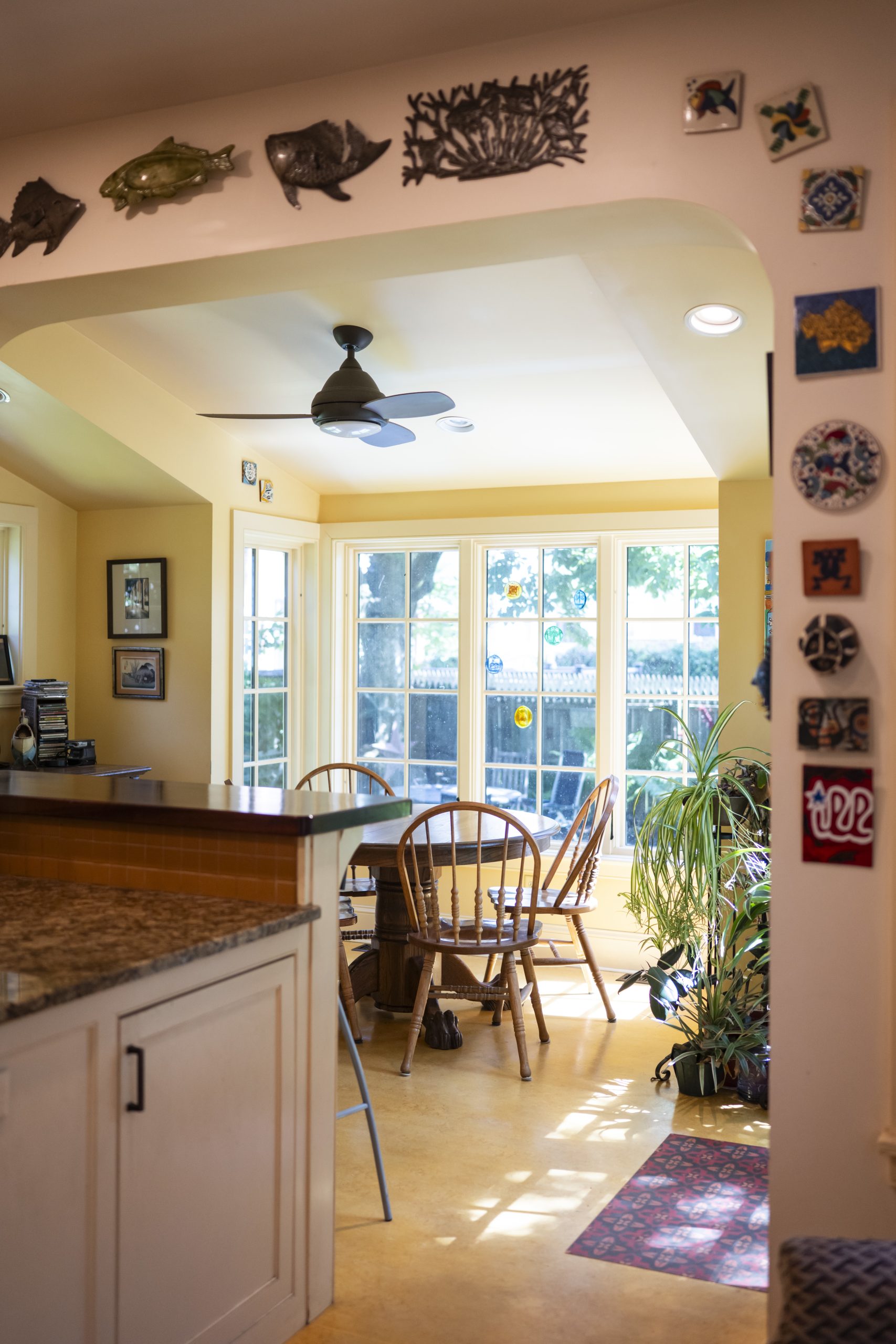
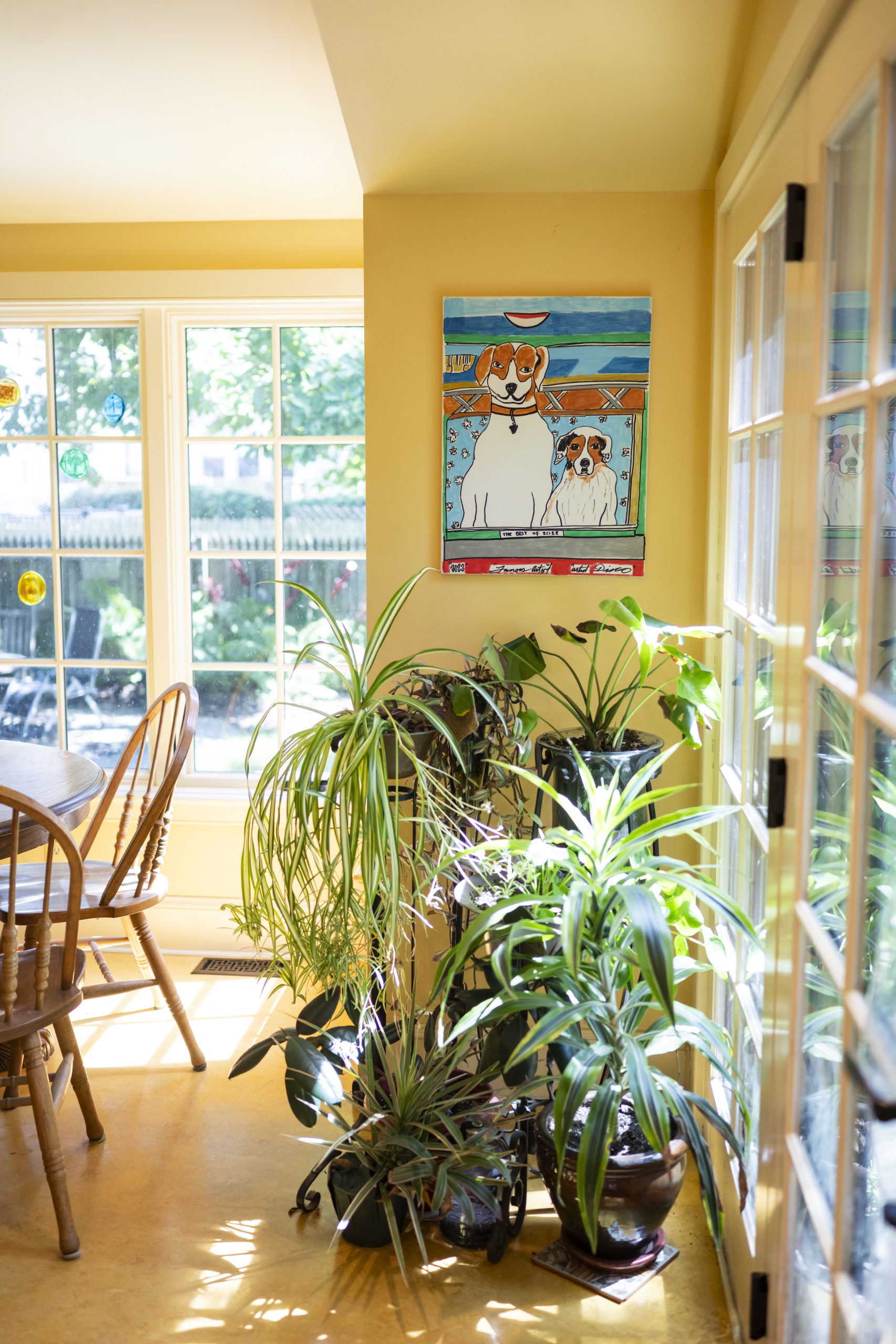
Tiles and wall sculptures line an arch into the kitchen’s breakfast nook.Allie Ippolito / For The InquirerA portrait of Jean Miller and Craig Heim’s dogs, Maddie and Mabel, is on display in the sun-filled breakfast area.Allie Ippolito / For The Inquirer
“The kitchen was definitely a game changer, and it still feels new to me after 17 years. I love walking into it and feeling the brightness and natural light,” said Heim. “It’s the hub for so much of what happens every day and for special occasions, a very natural gathering place.”
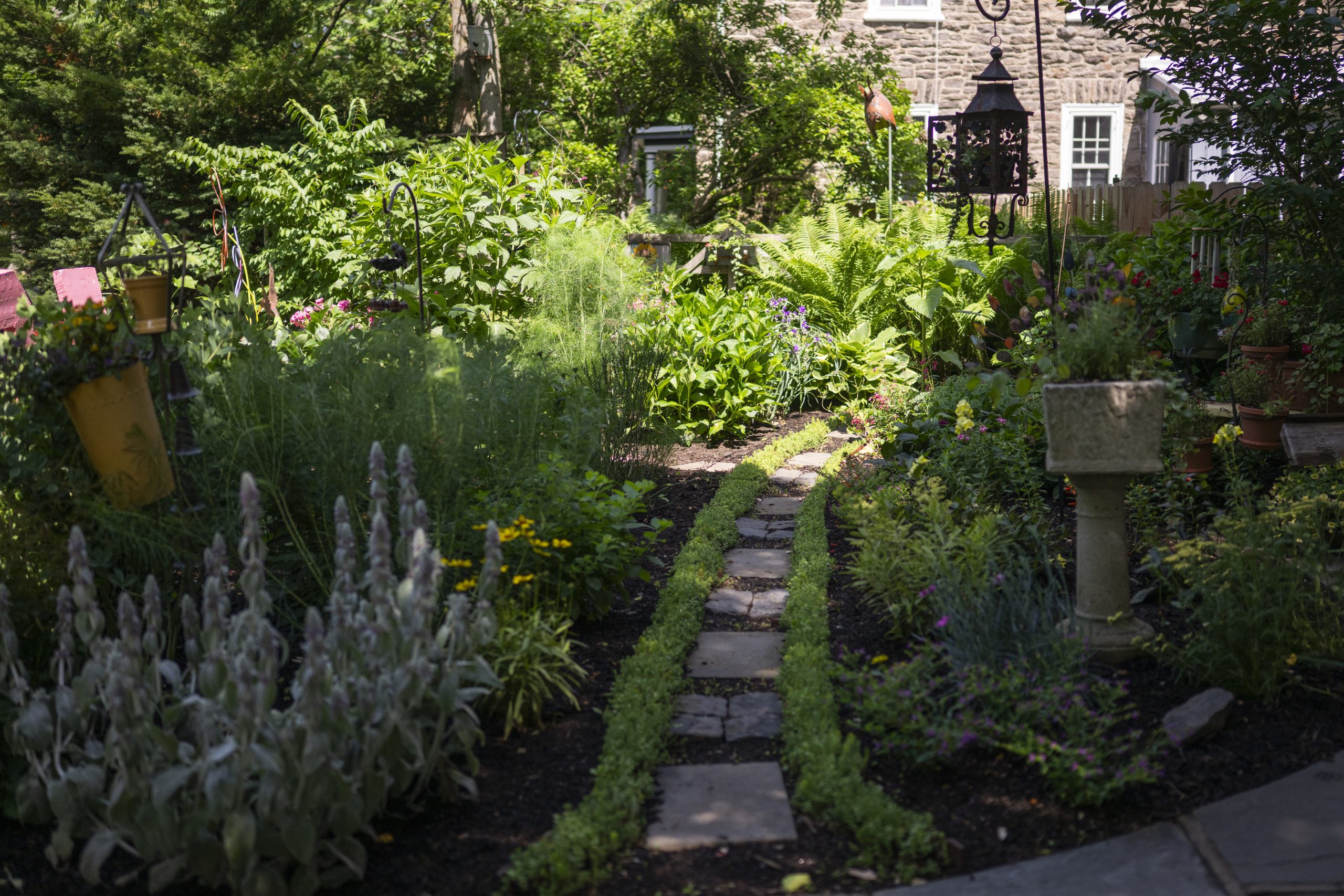
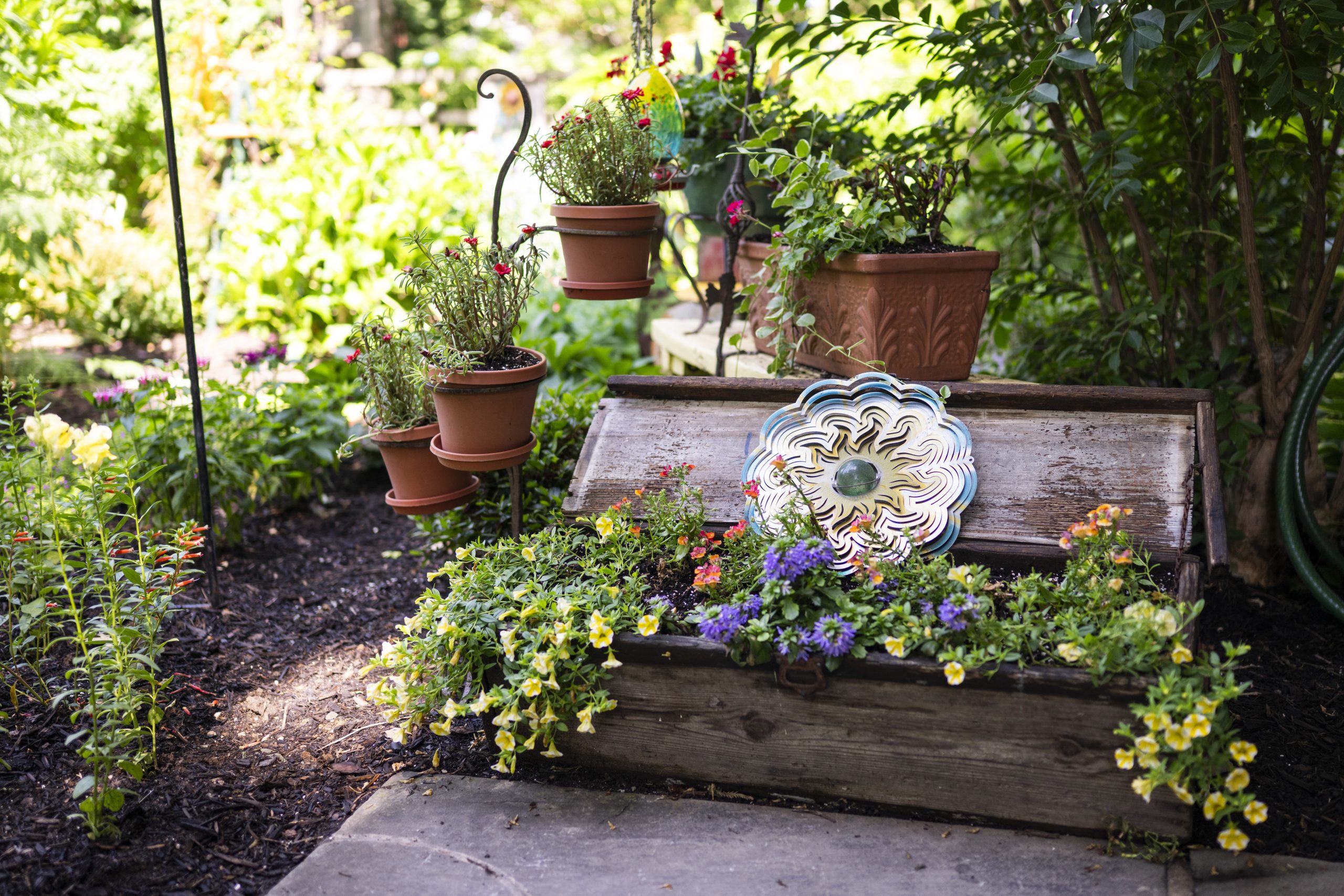
Outdoors, the garden is a treasure trove of found objects combined with topiary and plantings to create an eye-catching mix. The large porch leads to the front garden.
“It connects us to our neighborhood and neighbors,” Miller said. “Our garden is a destination for many on their walks and allows us to connect with people. It feels like an outdoor room.”
A path of stones runs through the garden.Allie Ippolito / For The InquirerA planter the family trash-picked is filled with and surrounded by potted flowers.Allie Ippolito / For The Inquirer
The creativity inspiring the garden also shines through in the house’s bold facade.
“When the house recently needed to be repainted, we wanted to do something with a bit more pop,” Heim said. “So, we added the golds and pink to give things a little more zip.”
For holidays, they decorate the yard with inflatables, lights, and ornaments.
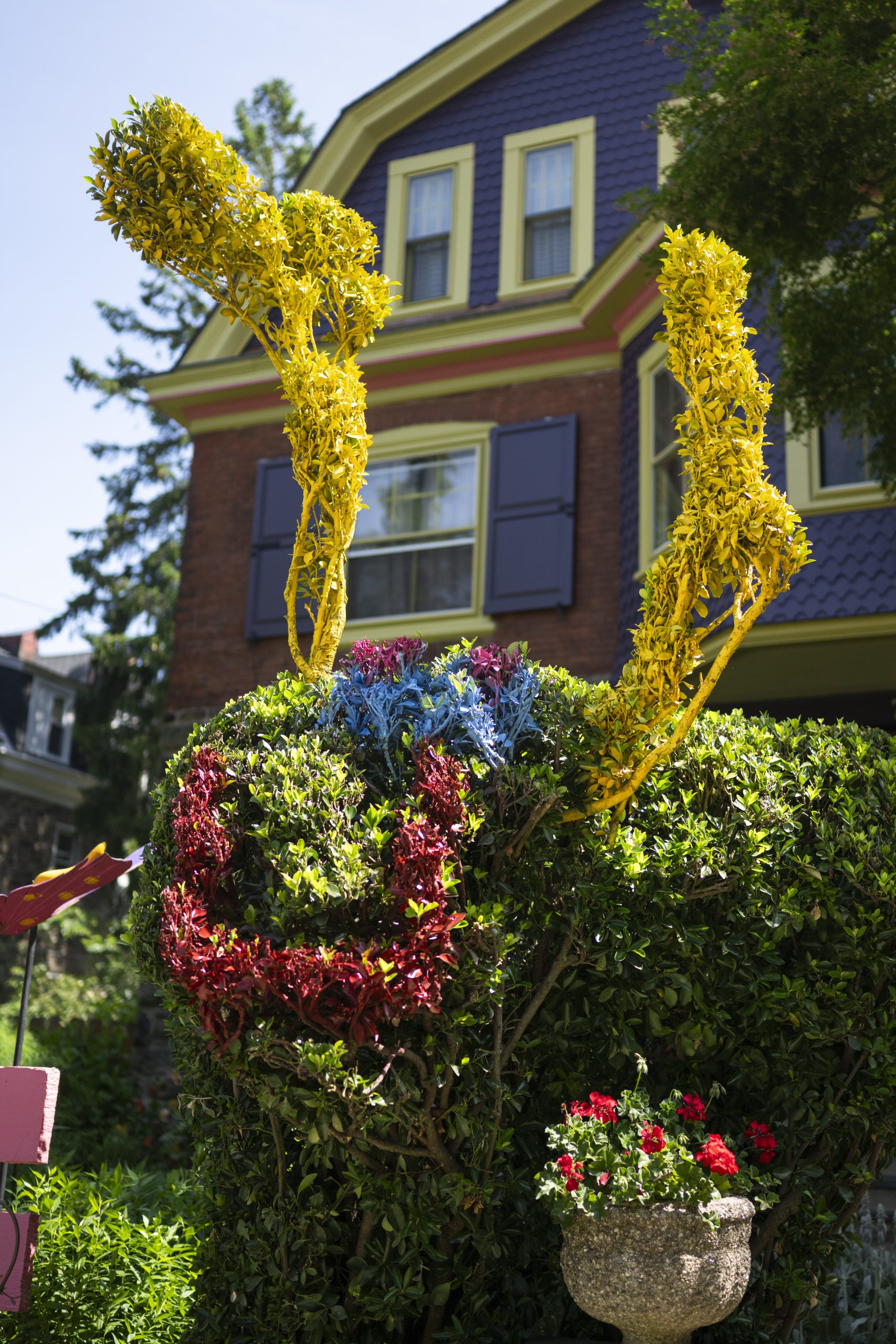
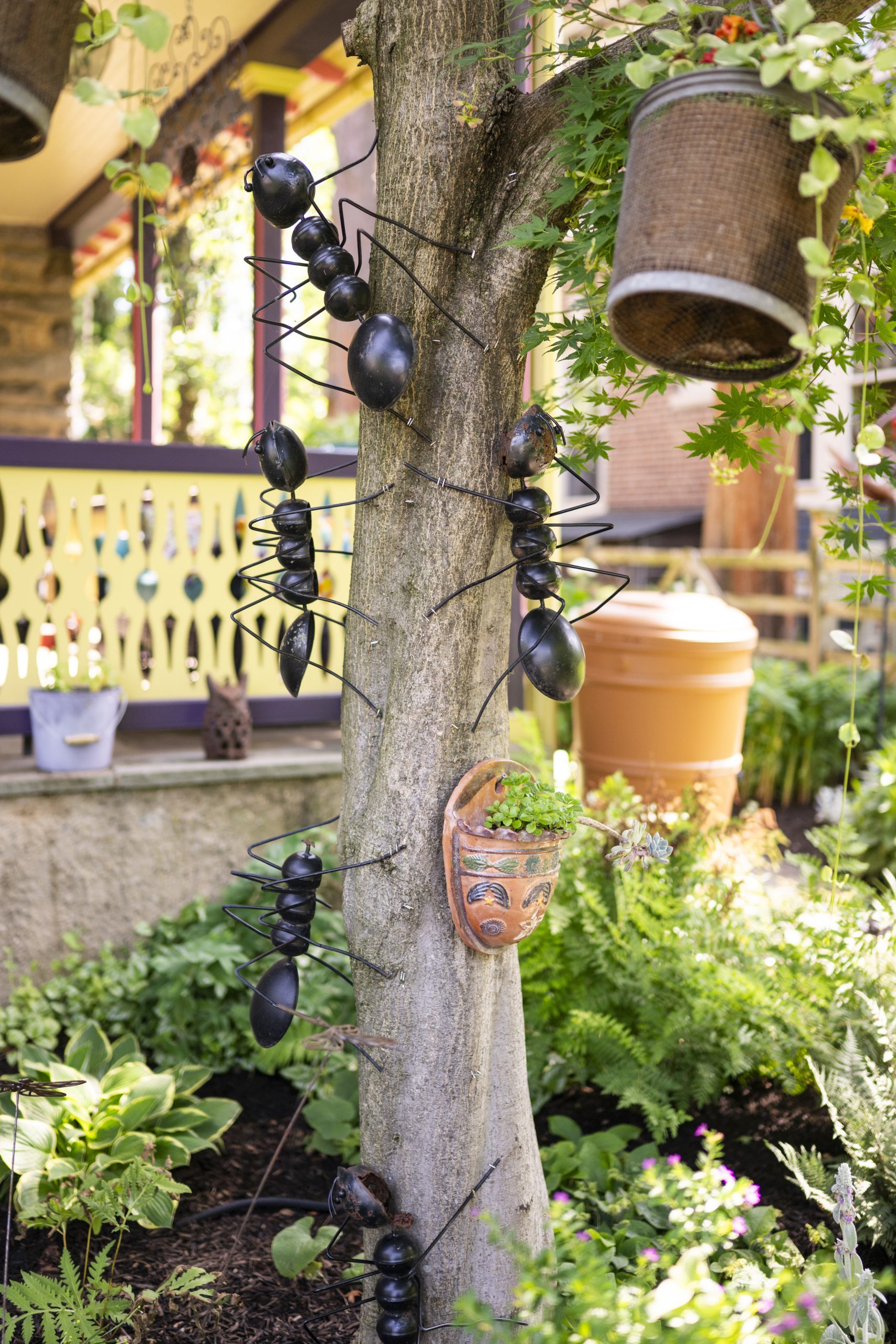
A hedge painted and shaped into a “happy bull” grows in front of the home. Heim often spray paints and cuts the hedges into shapes or characters.Allie Ippolito / For The InquirerDecorative oversized ants are arranged as though climbing up a tree in the front garden.Allie Ippolito / For The Inquirer
Mount Airy now holds a special place in both of their hearts. They enjoy an easy walk to the train, Germantown Avenue’s commercial strip, the Wissahickon, and Chestnut Hill.
“We have a tight-knit group of neighbors, many long-term residents from our era and even earlier, and a whole new generation of younger people with kids,” said Miller. “It’s a wonderful community.”
Is your house a Haven? Nominate your home by email (and send some digital photographs) at properties@inquirer.com.
Angel Okeke, a junior at the Academy at Palumbo in Philadelphia, wanted to make sense of the loss of her best friend’s brother to a tragedy spurred by gang violence.
Isadora Pendygraft, an eighth grader at Welsh Valley Middle School in Narberth, felt pulled to explore how restorative justice could reshape the criminal court system.
Avigail Wus, a junior at Pennsbury High in Fairless Hills, hoped to examine how the public, the media, and courts interact with survivors of sexual assault.
They are among a group of students who spent nearly a year thinking, researching, and writing about changes they want to see in Philadelphia. This month, their work culminated in professional performances of their original plays.
“It’s freaking amazing,” Okeke said.
The possibility of performance
The student work is part of What Now: 2026, a new arts festival marking the country’s Semiquincentennial. When the festival was in the planning stages, Madeline Charne, director of education and programs for Philadelphia Young Playwrights, said sheknew youth voices ought to have a place.
That is how PYP’s Civic Theater Project was born.
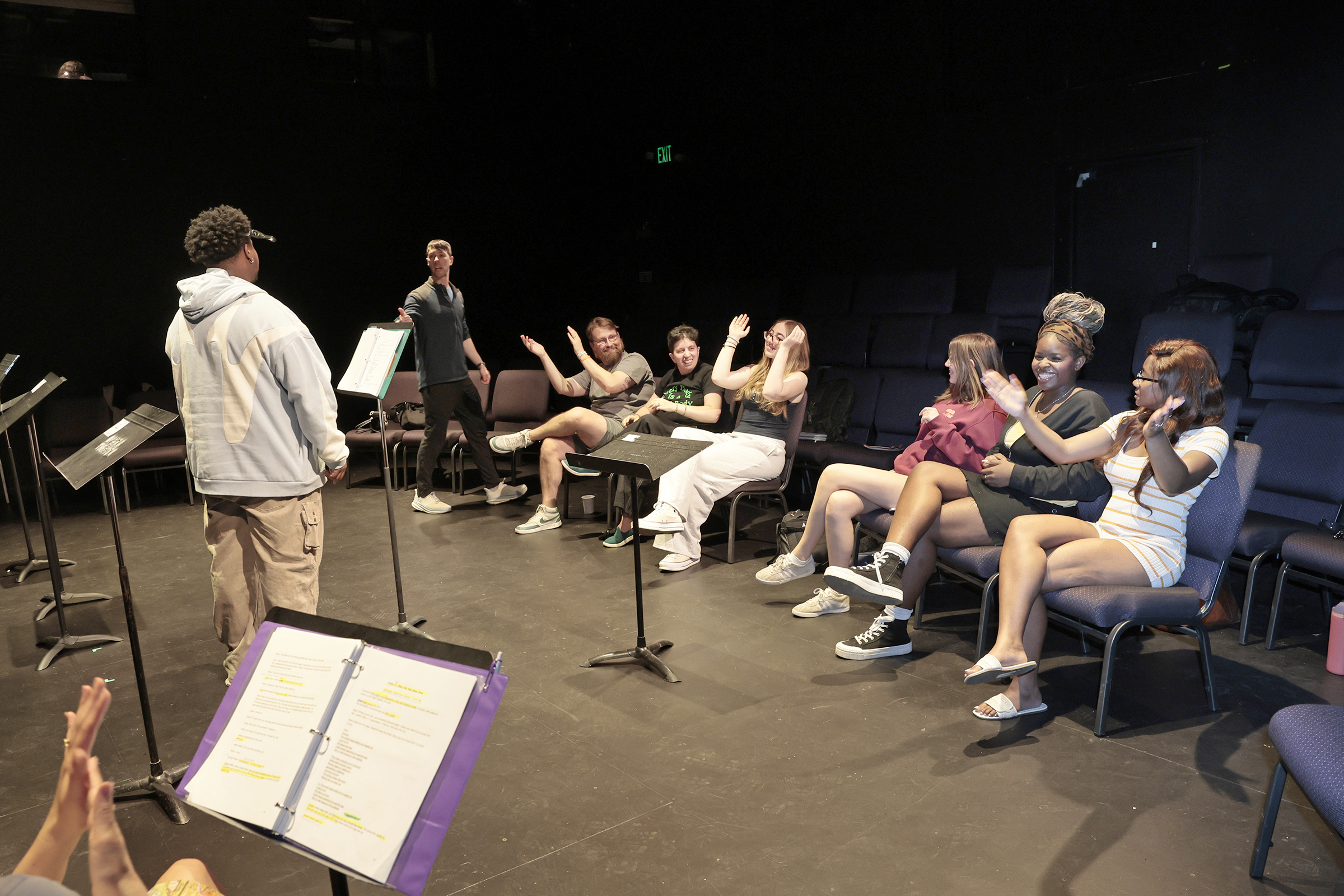
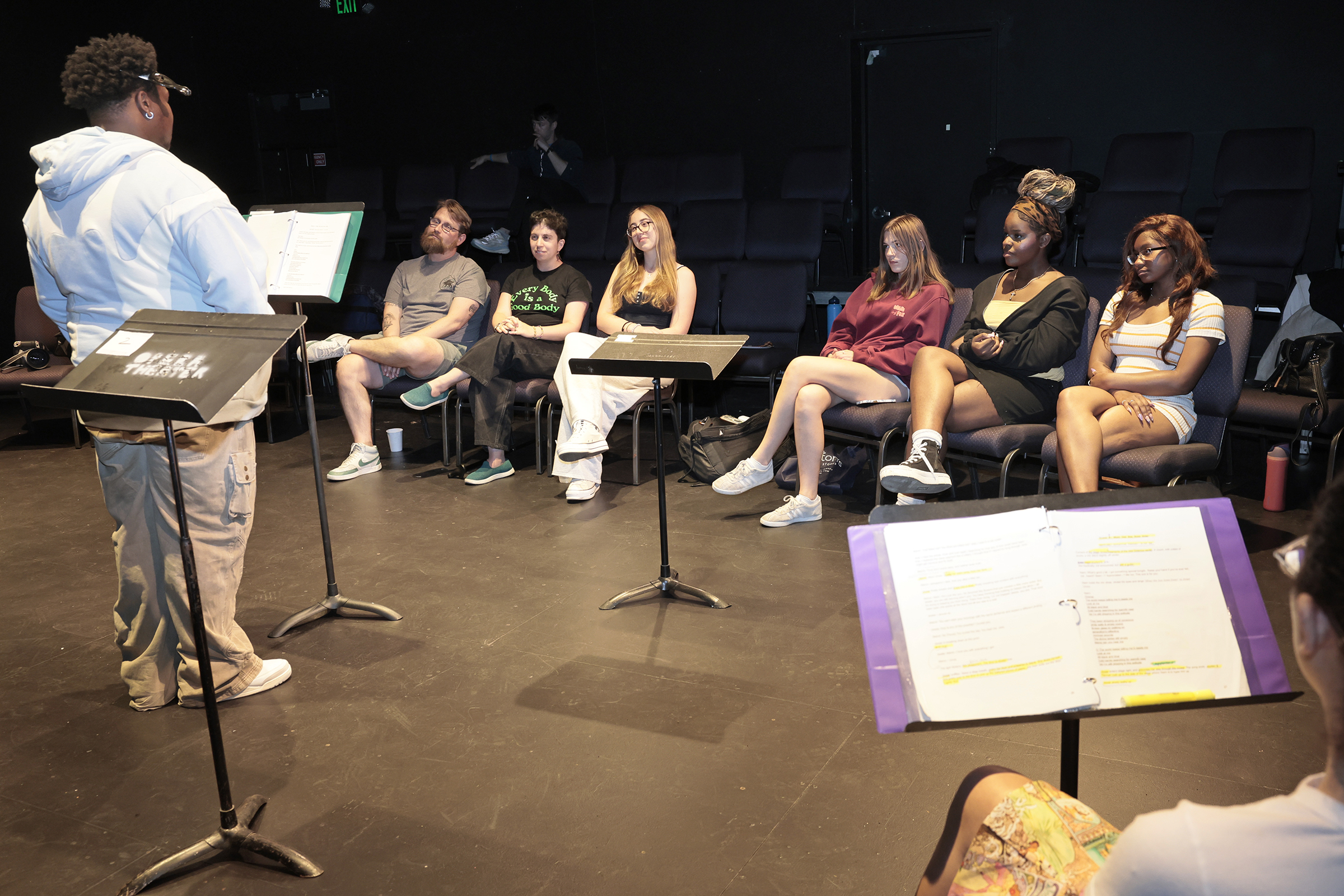
(L-R) Actor Raymond Ingram rehearses as (seated) Palumbo civics teacher Charlie McGeehan, Philly Young Playrights director of education and programs Madeline Charne, students Abigail Wus, Isadora Pendygraft, Angel Okeke, and Harmonee Summers look on during rehearsal at the Drake Theater in Philadelphia earlier this month.Elizabeth Robertson / Staff Photographer
Charne said she wanted students “thinking about how theater itself can create social change, not just be about social change.” She prompted students to imagine Philadelphia 25 years in the future, to dream about what should be changed, and to see their work as the beginning of that shift.
“Creativity and art and performance — that’s what has the possibility to make people actually listen,” said Charlie McGeehan, a Philadelphia School District civics teacher who worked as a PYP teaching artist.
Kids thought so, too. For every spot PYP had in the process, it received roughly five applicants. Eventually, five young people signed on: Okeke; Wus; Pendygraft; Harmonee’ Summers, who attends Springside Chestnut Hill Academy; and Maroua Benfadhla, a student at Science Leadership Academy.
The young playwrights had to commit one day a week to their work — researching and refining ideas, interviewing change makers around the city, committing to their eventual topic, writing, editing, critiquing one another’s work, andeven casting their plays.
The works the five eventually produced were a revelation, McGeehan said — powerful, smart, and character driven. They were presented in staged readings at the Louis Bluver Theatre in Center City.
The right rooms, the right resources
On a sweltering Wednesday this month just before the students’ work debuted, they gathered at the theater for a final run-through.
The playwrights sat in chairs, eyes fixed on the actors in front of them. The actors performed the plays without sets or costumes, just reading scripts on music stands and allowing the audience to take inthe power of the young people’s words.
The moment Summers first heard professional actors reading words she had written, it stopped her cold.
“It is so cliche to say it’s magical, but it feels different when your words are literally jumping off the page‚” said Summers, whose play is called The Double K Show. It chronicles two young women’s rise to stardom and the effect substance use has on their lives, and was shaped by events Summers observed growing up in North Philadelphia and attending an elite private school.
Part of the students’ process was finding resources that might help with the issues they tackled — from recovery and housing assistance organizations to groups that support survivors of sexual assault.
(L-R) Actor Raymond Ingram rehearses as Palumbo civics teacher Charlie McGeehan, Philly Young Playrights director of education and programs Madeline Charne, students Abigail Wus, Isadora Pendygraft, Angel Okeke and Harmonee’ Summers look on during rehearsal at the Drake Theater in Philadelphia earlier this month.Elizabeth Robertson / Staff Photographer
Pendygraft, whose mother, Letitia Stein, is an editor at The Inquirer, is a PYP veteran and the only middle schooler in the group. The playbill lists Pendygraft’s author name as Rut, a nickname. She said she was inspired by The 57 Bus, a book she had read about the ripple effects of a crime committed by one teenager against another.
“The criminal court has a long history of being complicated and a little corrupt and biased,” Pendygraft said, but restorative justice — the theme of her play — would go a long way toward repairing harm.
Wus said she used the motif of the Salem witch trials as “a critique about the way stories of sexual assault have been commodified into entertainment.” It wasa powerful exercise in using her voice, she said, made stronger by the magic of real performers.
“These actors, they’re the people you see on TV — they are so talented,” Wus said. “Hearing my words out loud has allowed me to make revisions to make my script feel more real. It’s probably one of the best writing experiences I’ve ever had.”
Okeke, who wrote Echoes Beyond Shut Doors about the loss of Naim Castleberry, her best friend’s brother, said she struggled for a time with the idea that her ideas would go nowhere.
“It felt very daunting to tackle such big issues. Often, I feel like I feel small as a young person in Philly. I have this doubt, ‘how much of an impact can I really make?’” Okeke said. But she powered through, with words — and the experience was transformative.
“Us youth really have good things to say if we’re put in the right rooms with the right resources,” she said.
“Johnny Cash singing Nine Inch Nails.” That was Fred Mogul’s shorthand for the restaurant he had long wanted to build: familiar but surprising, rooted in tradition, yet willing to scramble expectations.
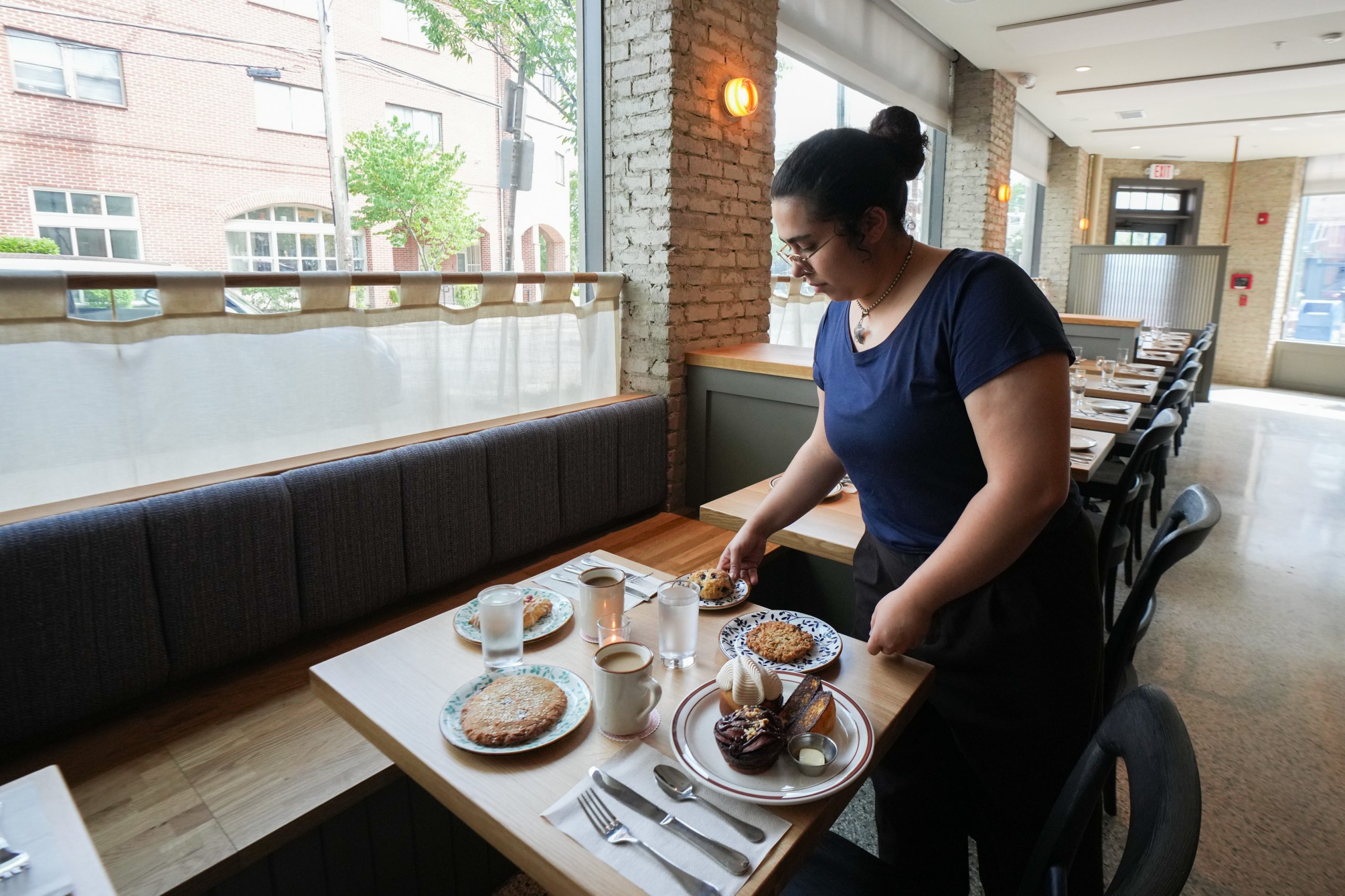
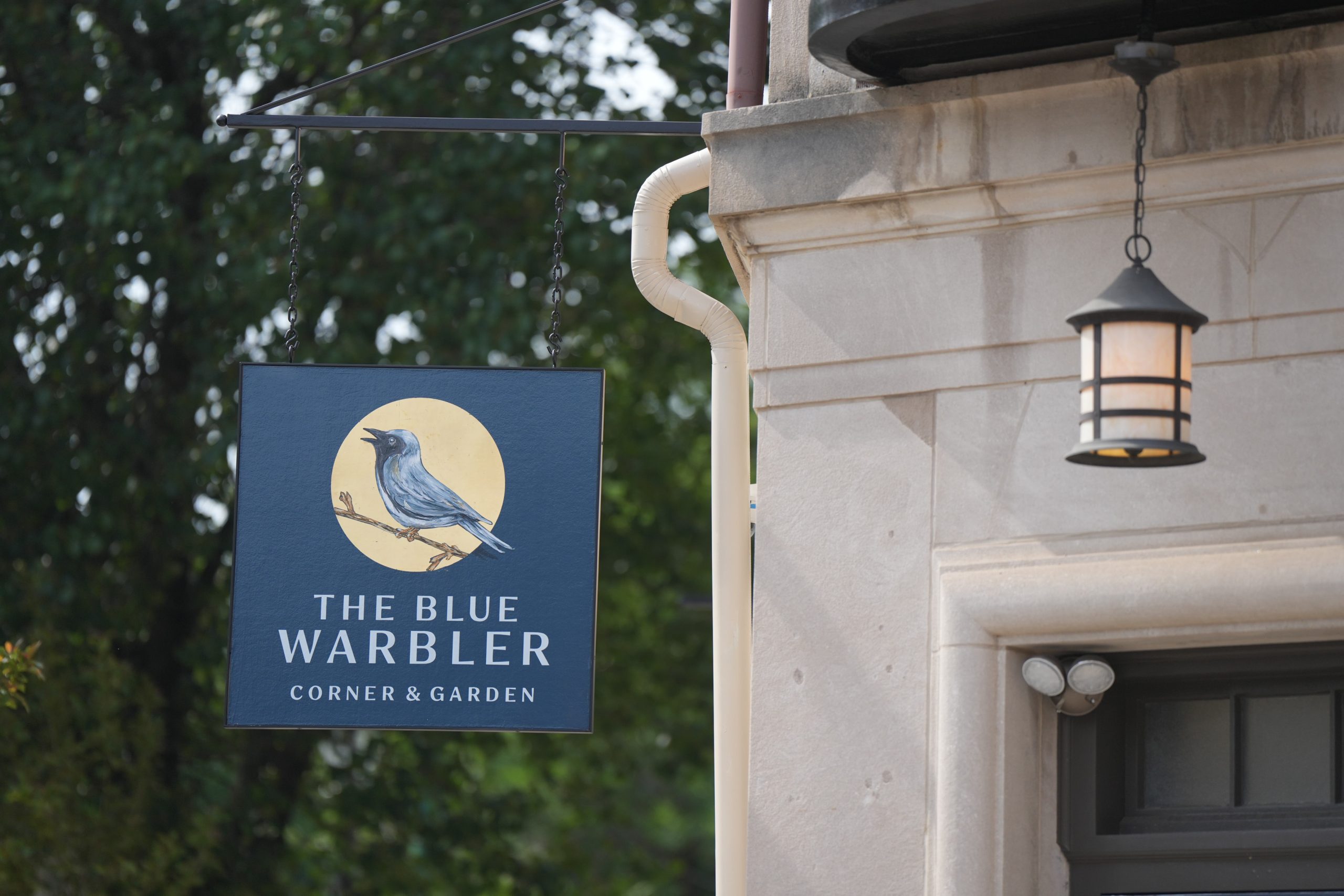
On Monday, that vision arrived at one of Chestnut Hill’s most prominent corners with the opening of the Blue Warbler at Germantown and Willow Grove Avenues. The all-day operation combines a bakery, café, bar, and restaurant, drawing from Mediterranean, Jewish, Persian, Balkan, and American influences.
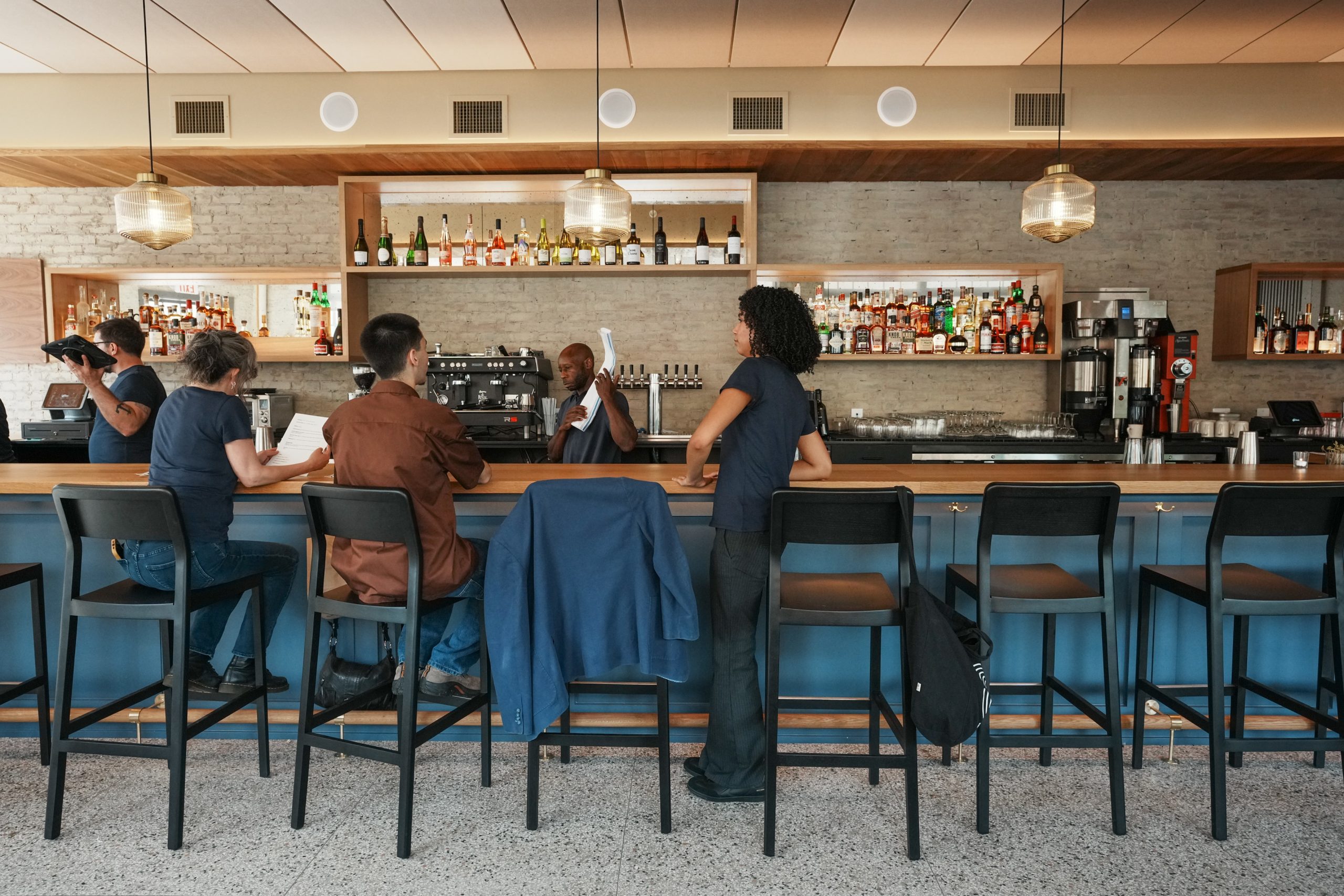
The bar at the Blue Warbler during staff training on June 11.Jessica Griffin / Staff Photographer
Although the menu is entirely vegetarian, vegan, and pescatarian, Mogul does not want the restaurant defined by what it lacks. “I don’t want to be ‘that vegetarian place,’” he said. “There’s so much you can do without meat.”
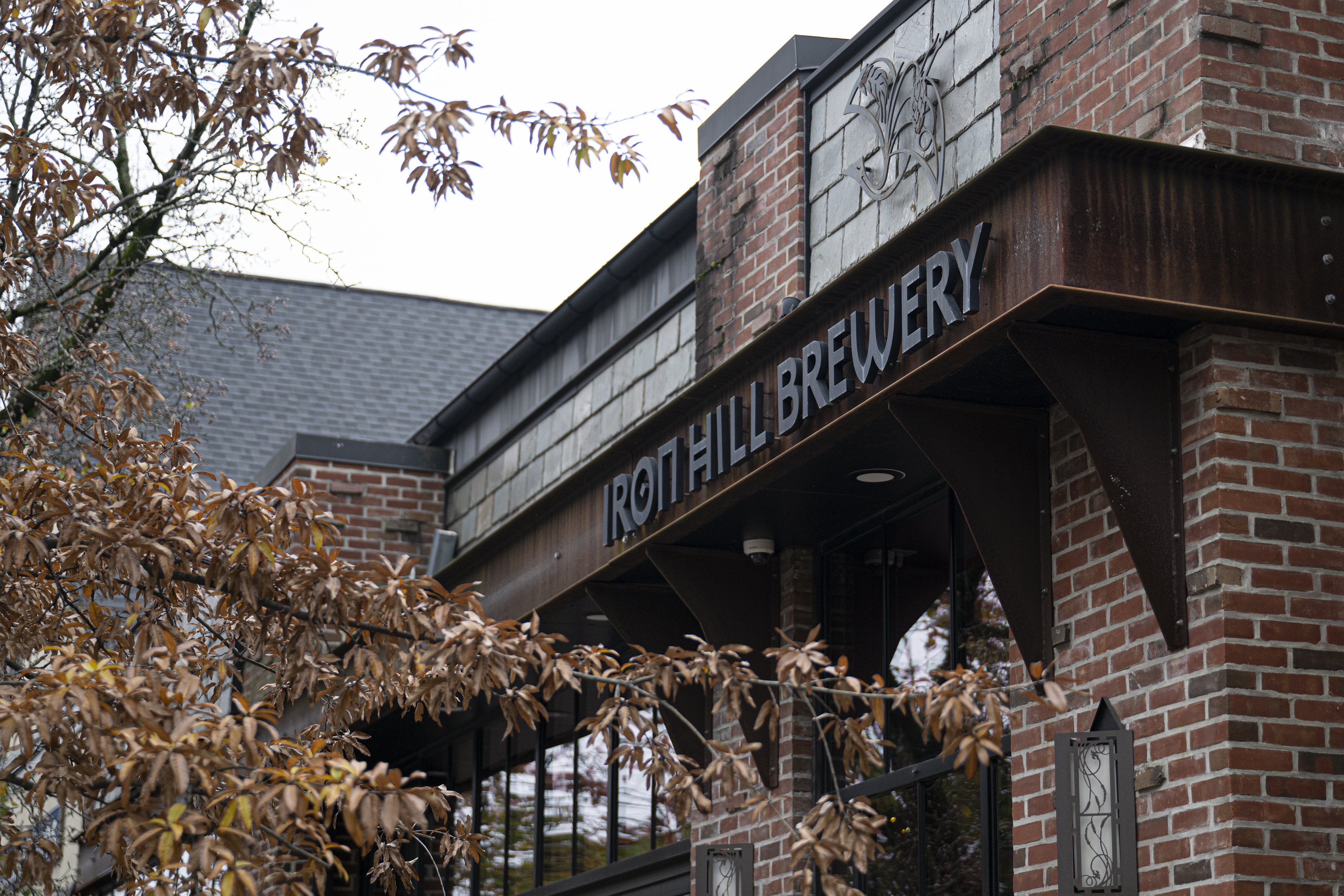
The Blue Warbler arrives as Chestnut Hill’s dining scene shows fresh signs of life, despite last year’s closing of Iron Hill Brewery. Earlier this year, Lovat Square opened as a wine shop and gathering place on Germantown Avenue; it is a few weeks from starting its full dinner menu and opening its patio. New restaurants are planned for the former Campbell’s Place and Petit Matines spaces, while former employees of Fiesta Pizza III are planning to reopen the neighborhood institution that closed in 2024.
Owner Fred Mogul at the Blue Warbler.Jessica Griffin / Staff Photographer
Against that backdrop, the Blue Warbler is arguably the neighborhood’s most ambitious restaurant project in years.
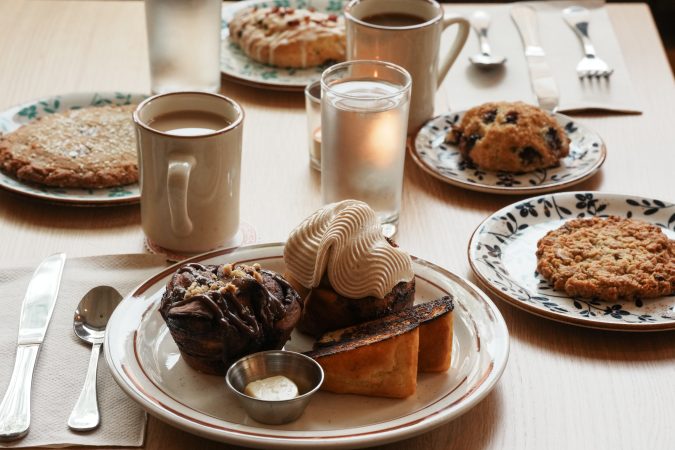
Its day begins at 7 a.m. with house-baked pastries and coffee before expanding into breakfast, lunch, brunch, and dinner. Dishes include a shakshuka-inspired “shakshukaccia” with labneh and house focaccia, a Turkish breakfast plate, and the Full Emilio — named for the building’s developer, Emilio Lorenzon — featuring eggs, a latke, mushroom bacon or Santorini sausage, salad, and bread.
Dinner offerings include bacalao with green yogurt and lemon relish, halloumi-stuffed dates with hazelnuts, grilled branzino, pan-fried lemon tofu, and smoked eggplant schnitzel over a tomato-Thai basil salad.
Mogul envisioned the Blue Warbler as a place where different influences could coexist comfortably through unexpected combinations that somehow feel natural. Playlists jump between genres and decades, as you can see from its Spotify (Jimmy Cliff, the Roots, the Cranberries, Aretha Franklin). Artwork, poetry, and design elements pull from a range of traditions and references.
“The idea is to constantly surprise people,” he said, “and bring together things that are a little removed from what they’re familiar with.”
Ara Nasari at the Blue Warbler.Jessica Griffin / Staff Photographer
That vision required a top-to-bottom renovation of a space that had never before housed a restaurant. Industry veterans repeatedly advised Mogul to take an easier path and retrofit an existing dining room for his first restaurant. His reply: “We fell in love with it,” he said.
The restaurant occupies the century-old Lorenzon Building, which was Foster’s Drugstore for decades. (The gray-beige terrazzo floor is a tipoff.) More recently, it housed the photography gallery of Wendy Concannon. Mogul said landlord Richard Snowden shared his belief that the space could become a neighborhood gathering place.
An out-of-the-way seating area at the Blue Warbler.Michael Klein / Staff
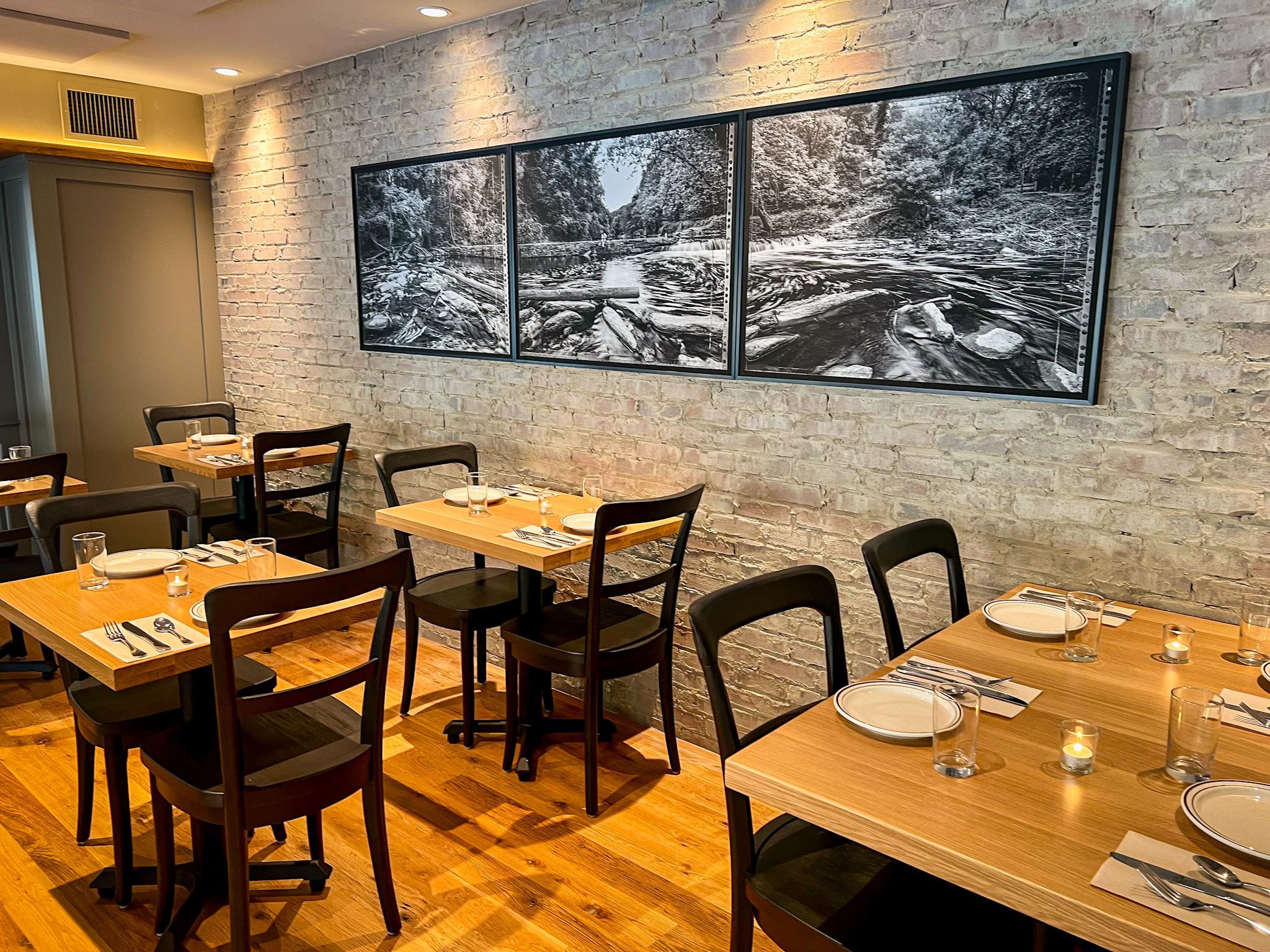
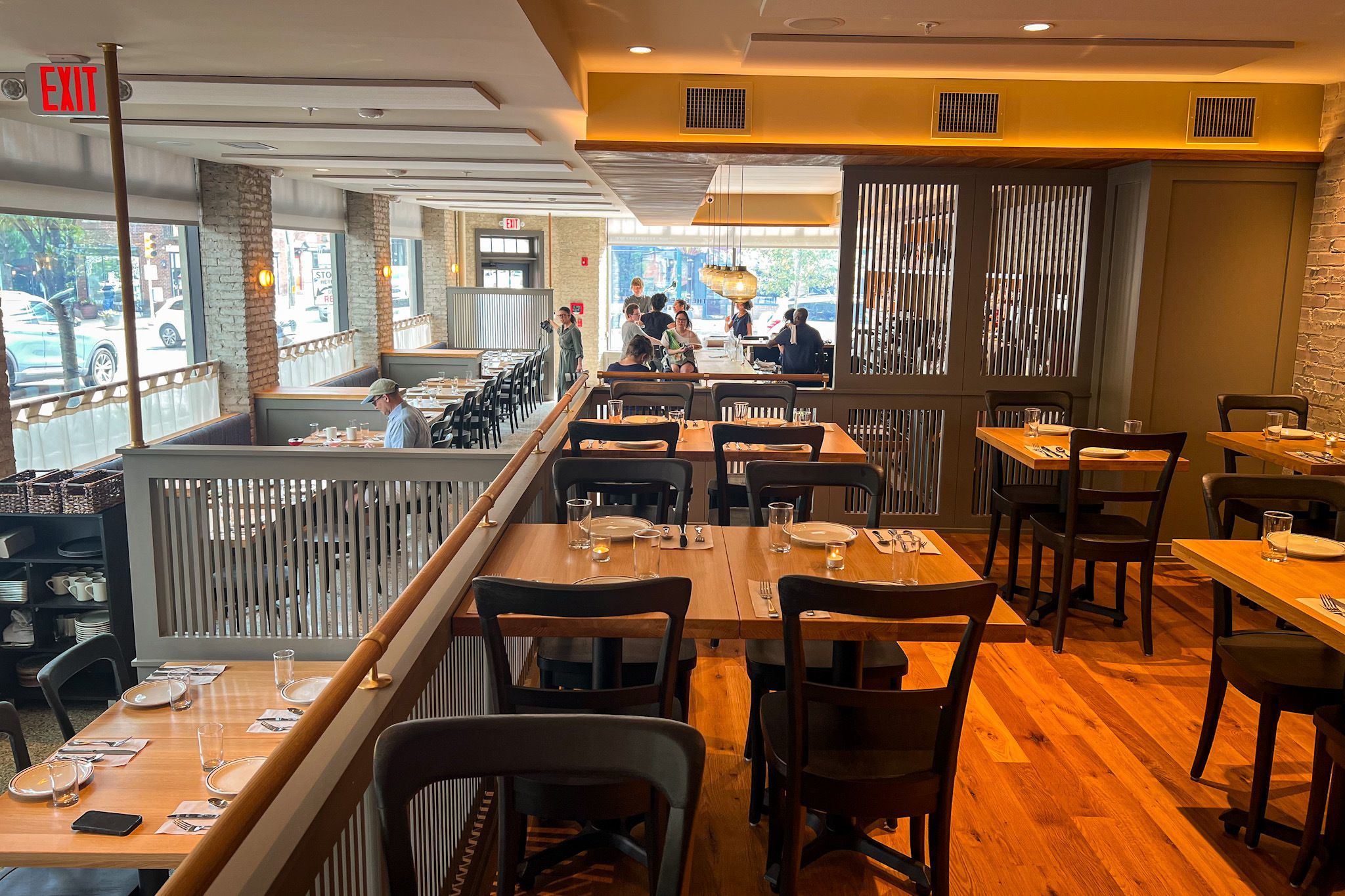
Inside, Ambit Architecture and In House Studio transformed what Mogul described as a stone- and glass-heavy interior into a warmer environment defined by reclaimed oak floors, quarter-sawn oak tabletops, walnut accents, custom millwork, and locally selected artwork. The restaurant seats 71 guests, including 15 at the bar, and includes a patio and a private-event room known as the Perch.
For Mogul, the opening marks an unlikely second act.
A longtime journalist, he worked at newspapers in Kansas and Nebraska before moving to Philadelphia in 1999. He freelanced for WHYY radio and television, contributed to NPR, worked as a stringer for The New York Times and Time magazine, and produced historical documentaries before later joining WNYC in New York, where he covered public health, politics, education, and government.
His 18-year tenure there ended in 2021, after the newsroom’s new manager accused him of using Associated Press copy without attribution, sparking a station-wide uproar and petition drive. Mogul sued the station for defamation and received a settlement whose terms he would not disclose, except to say that the Warbler rose from the ashes of tumult at WNYC.
The idea of opening a restaurant, however, had been percolating for years.
A view from the elevated dining room seating to the bar at the Blue Warbler.Michael Klein / Staff
“I like being a reporter because I like telling people’s stories, schmoozing, having a deadline, and producing something tangible,” Mogul said. “Restaurants felt like another version of that — feeding people, creating a place, making something every day.”
After considering locations in other cities, he settled on Philadelphia. “Opening a restaurant in Brooklyn felt like starting a podcast,” he said. “There are so many, and how do you get heard above the fray?”
Mogul assembled a team of restaurant veterans for the project, which was originally known as AM/FM, a nod to his radio career. After he and his family settled in Chestnut Hill, they were workshopping names of birds to connect with the nearby Wissahickon: “There were two weeks where it was ‘the Purple Finch.’ Then someone said, ‘There’s Spice Finch [restaurant near Rittenhouse Square]. I said, ‘Oh, I think there’s only room for one finch.’” They settled on Blue Warbler. One day, Mogul said, he hopes to see one in the wild.
Executive chef Daniel Berret most recently worked at the Study at University City and previously helped develop the menu at Chestnut Hill Brewing Co. Chef de cuisine Renee Rowlett’s résumé includes Picnic, Society Hill Hotel, and Eva in Kensington. General manager Andy Boyask has worked at Tria, Parc, Johnny Brenda’s, PYT, and Zahav, while restaurant consultant Arthur Cavaliere, a Starr Restaurants alumnus who operated In Riva in East Falls for more than a decade, helped shape the project.
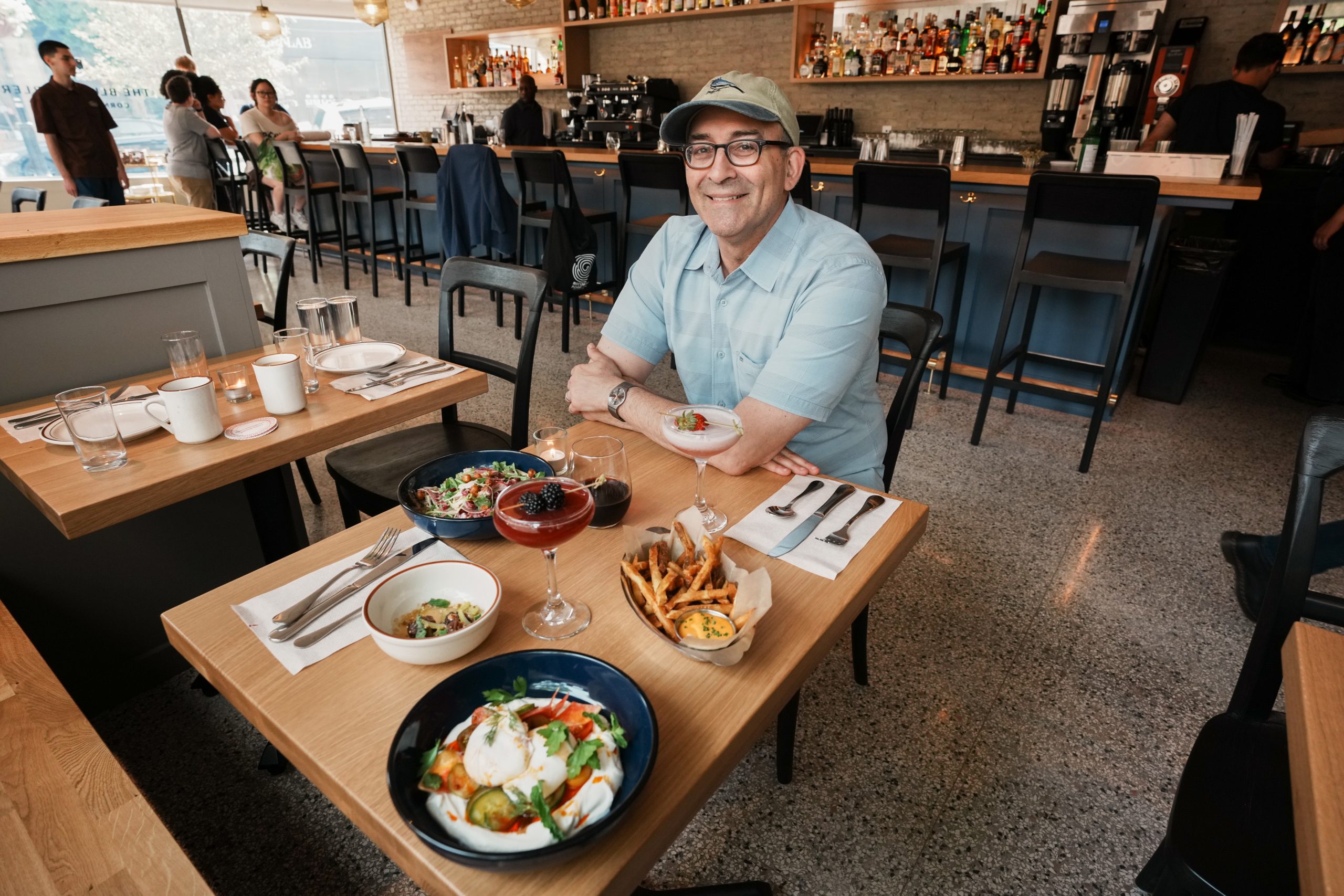
The Blue Warbler, in Philadelphia, June 11, 2026.Jessica Griffin / Staff Photographer
Weekdays begin with walk-up breakfast and lunch service, while dinner is initially offered Wednesday through Sunday. Additional nights will be added. Weekend brunch shifts to full table service. Among the dishes Berret is most excited about are smoked Arctic char served over sourdough bagels, salt-cod fritters, house-made pastries, and a mushroom-focused dinner dish.
The bar program includes a balanced draft and canned-beer list with an emphasis on local breweries, including a dedicated line for nearby Attic Brewing. The wine list was built around the restaurant’s vegetable- and seafood-focused menu, leaning toward acid-forward bottles, lighter reds, island wines, rosés, orange wines, and whites. Cocktails are intended to be approachable rather than fussy, with riffs on classics such as a Mai Tai made with fresh orgeat and a frothy Clover Club. The restaurant also plans to build out its nonalcoholic offerings.
The Blue Warbler, 8001 Germantown Ave. Opening hours: 7 a.m. to 3 p.m. Monday and Tuesday, 7 a.m. to 9 p.m. Wednesday and Thursday, 7 a.m. to 10 p.m. Friday, 9 a.m. to 10 p.m. Saturday, and 9 a.m. to 9 p.m. Sunday.
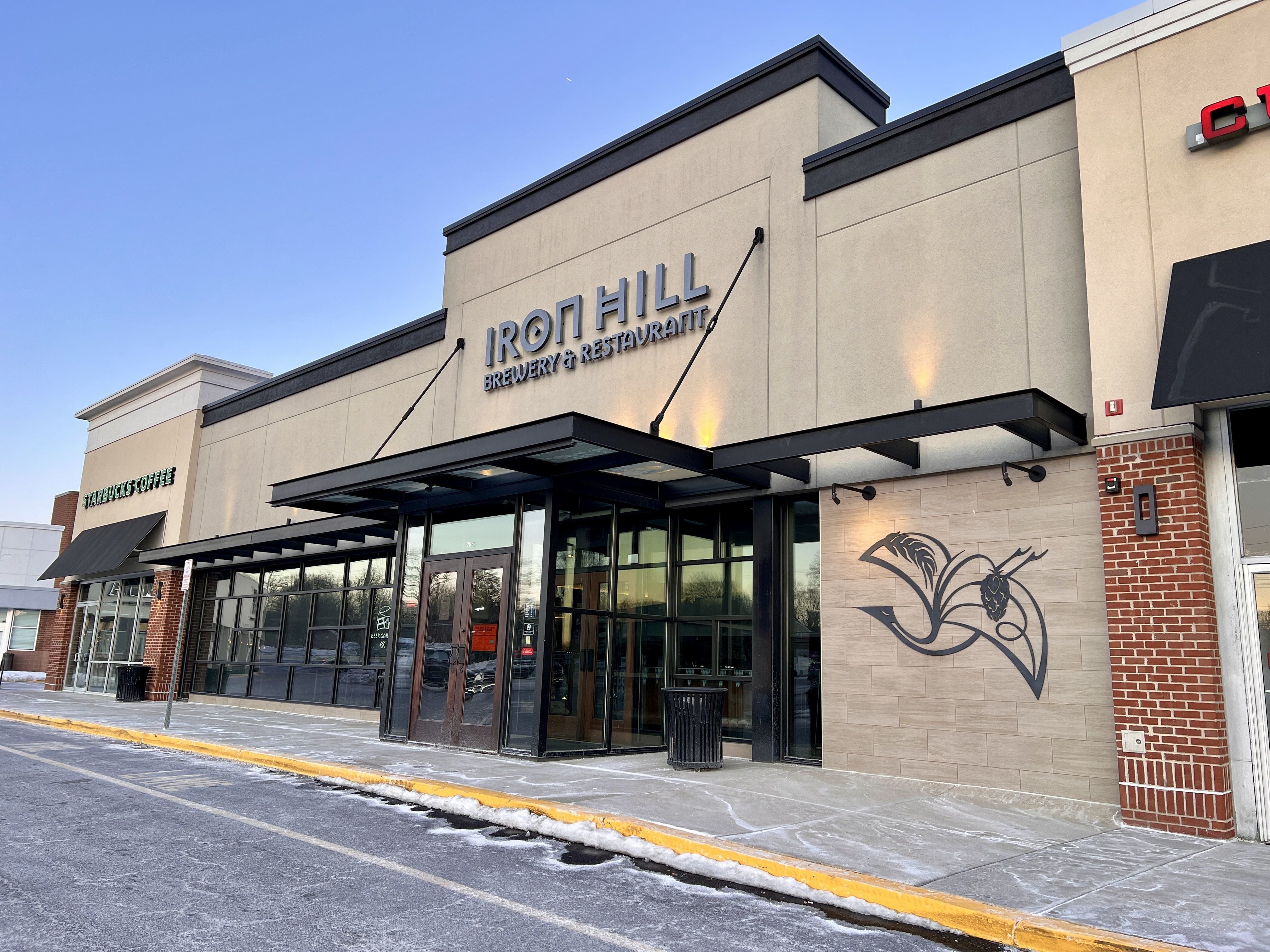
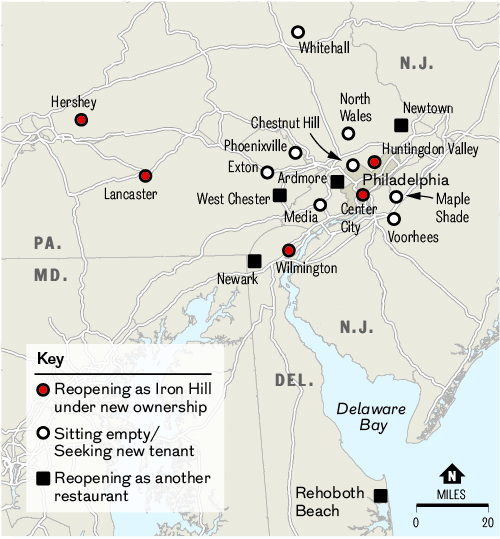
Another Iron Hill Brewery is set to reopen next week.
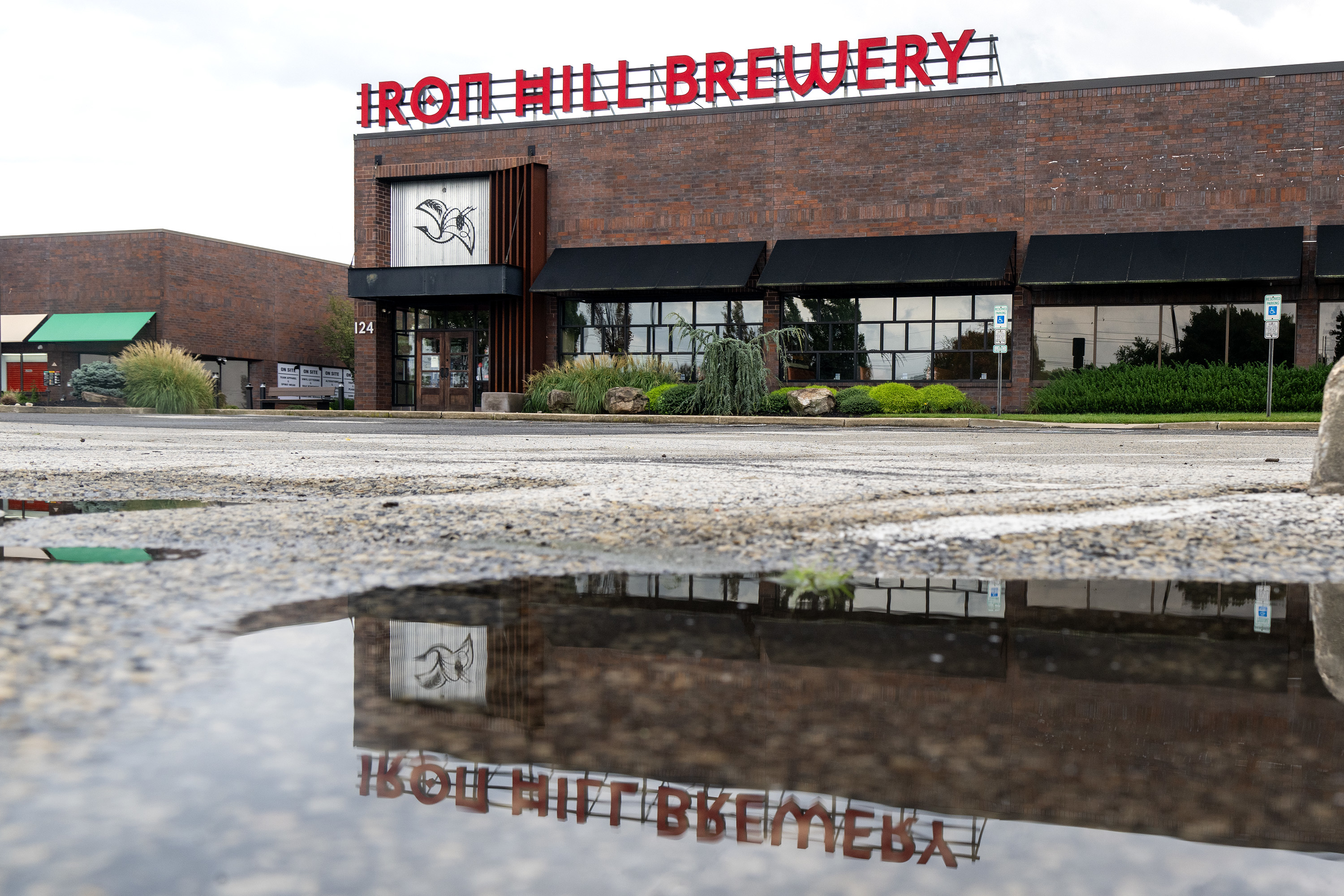
The Huntingdon Valley restaurant will be back in business Monday, June 22, according to the restaurant’s new ownership group. It will mark Iron Hill’s fourth post-bankruptcy revival and the only one in the Philadelphia suburbs.
Amid the reopenings, the new owners have launched a fresh loyalty program and special offers, including a free beer and free appetizer for customers with prebankruptcy gift cards that are no longer usable.
While Iron Hill had a suburban-Philly focus before bankruptcy, the Huntingdon Valley Shopping Center location is the only one set to be resurrected in the collar counties or South Jersey.
Bartenders there will be pouring a new IPA, Hop Chase, brewed exclusively for Huntingdon Valley, according to the new owners. They said patrons can sit inside or outside at the restaurant’s beer garden, which was the chain’s first when it opened in 2016.
“We’re creating a true neighborhood place for the guests we call family, somewhere the community can come together over laughter, great food and award-winning beer,” Naomi Yared, general manager of the Huntingdon Valley Iron Hill, said in a statement.
The former Iron Hill Brewery in Chestnut Hill sat empty in November. Property owners are still marketing the space for lease.Jose F. Moreno / Staff Photographer
Here’s what we know about these local Iron Hill Breweries as of publication time June 15:
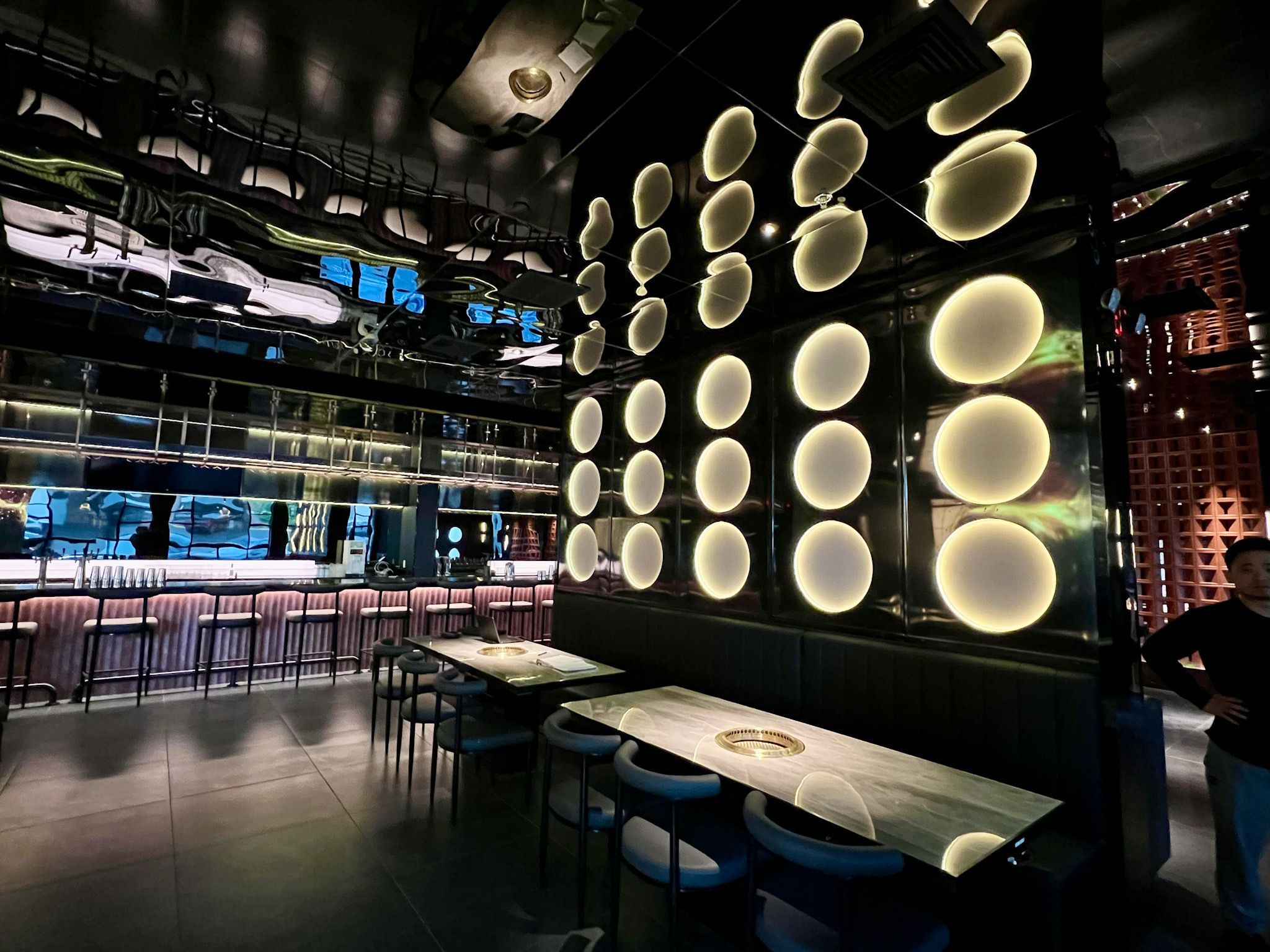
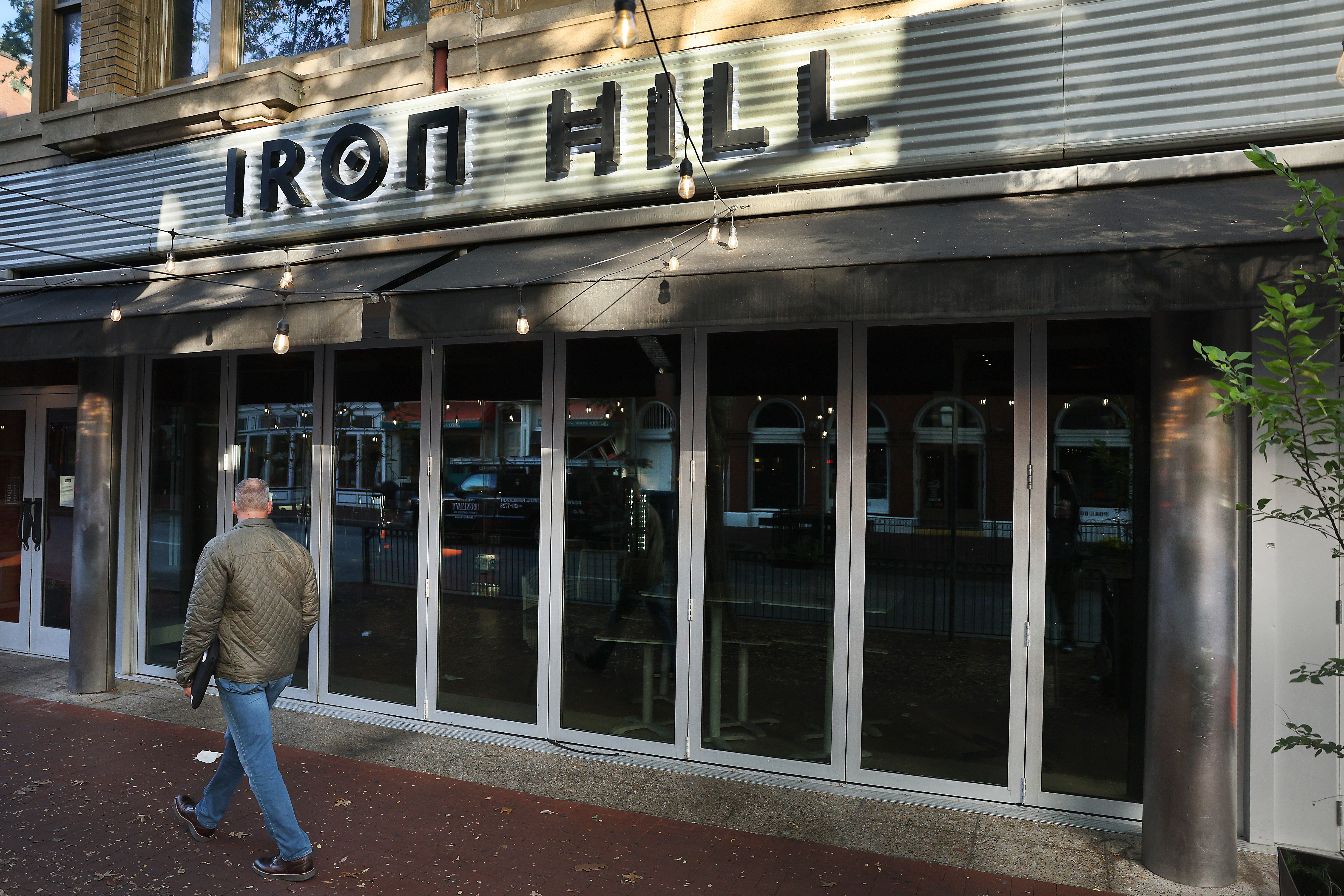
A pedestrian walked by the closed Iron Hill Brewery in West Chester in October. Magerk’s Pub & Grill is now taking over the space.David Maialetti / Staff Photographer