New Jersey’s two senators in Washington echoed Gov. Mikie Sherrill’s call for Lt. Gov. Dale Caldwell to resign just hours after she released a report that said he sexually harassed a woman and made advances to others even after he was warned to stop.
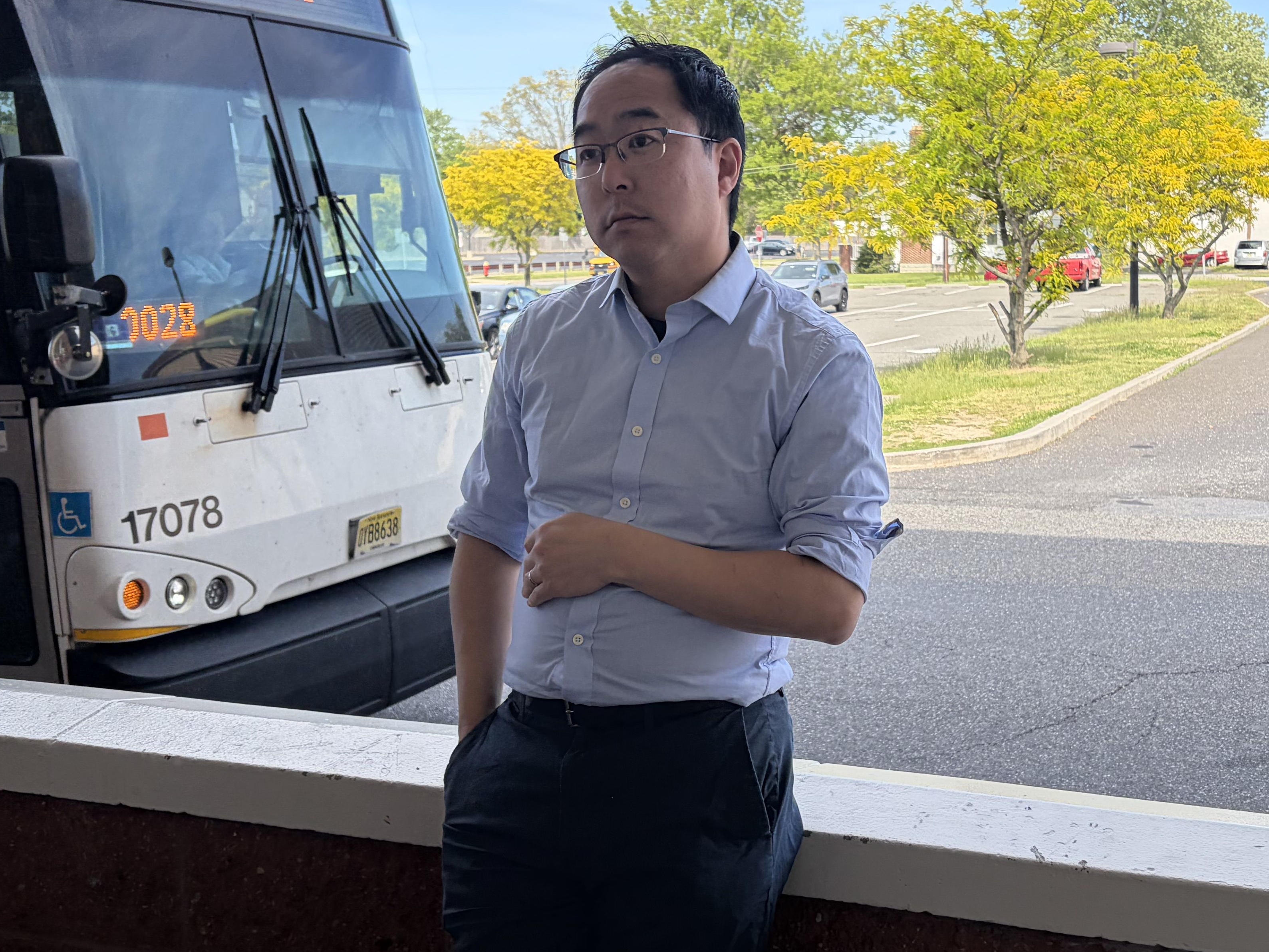
Sen. Andy Kim, a Burlington County Democrat, said in a statement on social media that the lieutenant’s governor was “unacceptable” based on the findings in the 61-page report based on a months-long investigation by an outside law firm.
“New Jerseyans deserve to have public servants who work to earn and keep their trust, not undermine it,” Kim said.
“The Lt. Governor should resign immediately,” he added.
Sherrill’s office released the documents Thursday evening in her first acknowledgement of the investigation into Caldwell, who has denied the findings of the report.
Sherrill said Caldwell “engaged in serious, repeated violations of state policy and failed to uphold the responsibilities of his office.”
The governor called on Caldwell to step down from his post as her No. 2 by Friday, but statements from his attorneys show no indication he plans to adhere to that request. He’ll likely face increasing pressure over the course of the day.
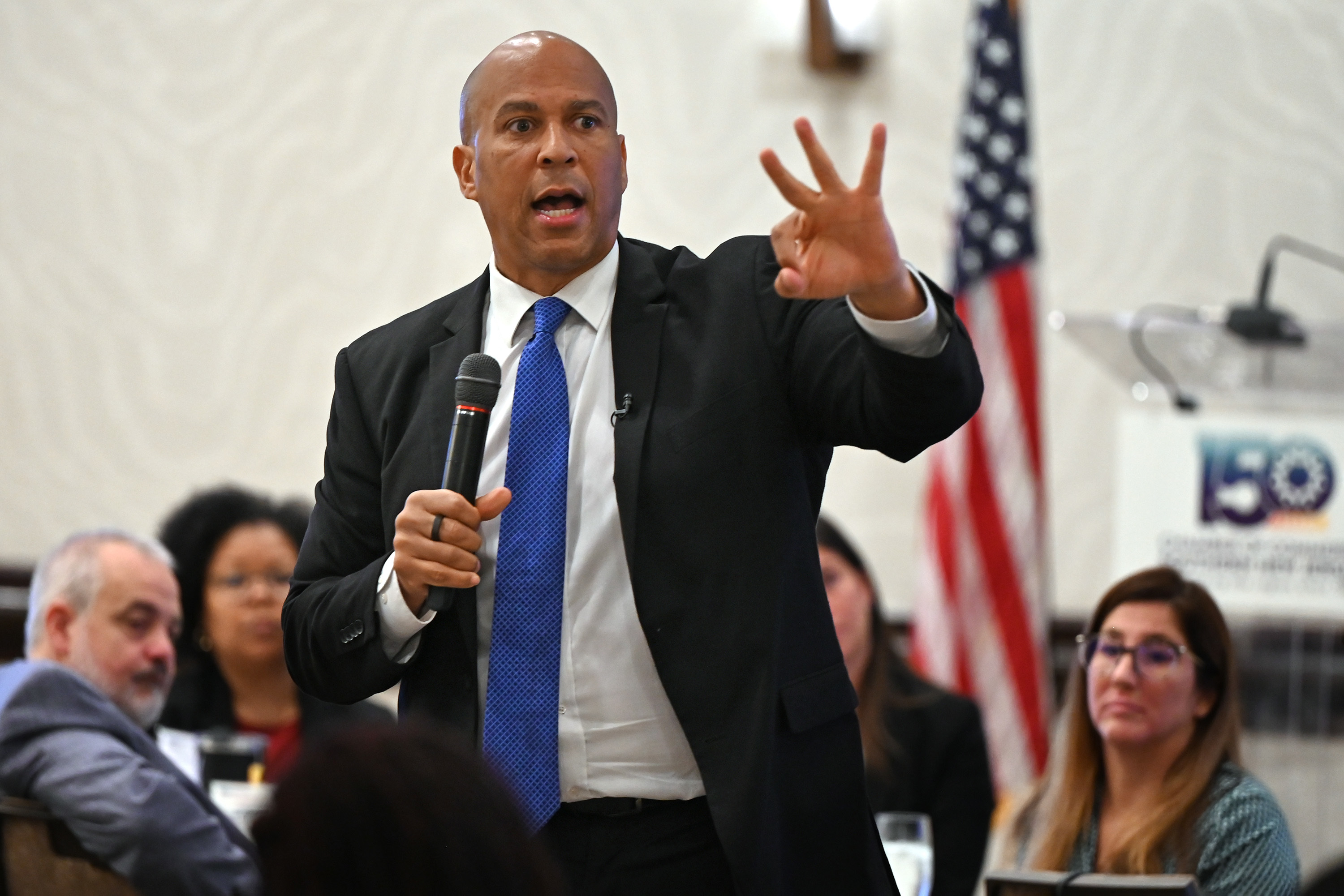
USE AS DESIRED: U.S. Sen. Cory Booker addresses members of the Chamber of Commerce of Southern New Jersey in Mt.Laurel Aug. 29, 2023.Tom Gralish / Staff Photographer
Sen. Cory Booker, a Newark Democrat, said Caldwell should resign “for the sake of our state” in a statement on social media.
“Governor Sherrill is absolutely right the conduct described in the investigative report is totally unacceptable,” he said.
A 41-year-old man from El Salvador who was detained at the Delaney Hall ICE facility has died, the U.S. Immigrations and Customs Enforcement confirmed Monday evening hours after his family and a member of Congress spoke out about the incident.
Delaney Hall, a privately operated detention center under contract with ICE, has been the site of turmoil during President Donald Trump’s immigration crackdown. It’s been the target of complaints almost since it reopened in 2025. Elected officials have clashed with the federal government over accessing the facility, and altercations between law enforcement and protesters outside the facility went viral earlier this summer.
On Monday, immigrant rights group Cosecha New Jersey shared a video identifying the person who died as Edwin Jeovanny López Cornejo.
María Cornejo, who identified herself as his mother, said in Spanish in the videothat the hospital called her to inform her of her son’s death, and that his heart was not beating when he arrived.
“There is this pain that has struck me now — it’s not just me who’s been struck by it, yet there are many people in this country who are growing tired of this pain,” his mother said in Spanish.
“If they don’t ensure that justice is served, well, they’re going to keep doing this forever, and we don’t know how many more people we’ll have to lose in this country,” she added. “Hardworking people. People who aren’t involved in other things, but who devote themselves to their work.”
Shortly after that video streamed on Facebook, U.S. Rep. Rob Menendez, a North Jersey Democrat, said in a video on X that he was showing up for an unannounced oversight visit to Delaney Hall. A few hours later, he said ICE confirmed López Cornejo’s death.
“We asked certain medical questions which ICE couldn’t give us answers to,” he said. “We have to request it or his family has to request it, which we will.”
Later on Monday, ICE said in a statement that López Cornejo experienced a medical emergency while in custody and was pronounced dead at University Hospital in Newark after medical staff “responded immediately” and called emergency services.
The agency said the cause of his death is pending further medical review on Monday evening, but Sen. Andy Kim attributed it to a heart attack and cardiac arrest in a video he posted on X later that night.
Kim, whose office said it was notified of the death Monday morning, noted that López Cornejo already had a habeus corpus case open arguing for his release due to his medical issues.
“I’m not going to jump to conclusions, but we have to get answers to what happened to Edwin to understand all of what transpired,” the South Jersey Democrat said.
Cornejo said her son took medicine for blood pressure, diabetes, and seizures. She said that while she does not know for sure whether he had access to his medicine, she believes ICE neglected to provide it to him, leading to his death.
She said she last spoke on the phone with her son on Friday — the day before his death — when he said that he felt ill and part of his face and hand had fallen asleep. He told her he was taken to the doctor that day and they were going to run some labs, but he didn’t say when.
ICE said López Cornejo “received proper medical care and was seen by medical professionals.”
Menendez said he learned that López Cornejo “complained of difficulties that he was having” on Saturday and collapsed at Delaney Hall, where CPR was performed before he was taken to the hospital.
Cornejo said her son had been in the U.S. for 20 years and was a hard worker. She said he hada 12-year-old daughter who had not been able to see him since he entered the facility six weeks ago. He previously told her on the phone that his hands turned purple from the handcuffs he was arrested in.
Danilo López, who identified himself as López Cornejo’s brother, said in the video he doesn’t know why his sibling was detained because he had a valid work permit.
“I wouldn’t wish the pain we’re going through right now on anyone, and I don’t want this to keep happening,” he said. “Because it hurts so much — it leaves a void, it leaves a daughter orphaned, and above all, it leaves an irreparable void in the family. And that’s why I’m asking for justice for my brother.”
According to ICE, López Cornejo was arrested by U.S. Border Patrol “for illegally entering the United States without inspection” in August 2006 and he was sent back to El Salvador that October.
He later returned to the United States at an “unknown date” before he was arrested in Plainfield in Union County in June, according to ICE.
Sebastiana Cornejo, who identified herself as López Cornejo’s aunt, said in the videothat he was arrested on his way to work.
She blamed her nephew’s death on ICE detaining him and called for the Trump administration to stop its mass deportations, and “that they stop separating families, leaving children orphaned with no one to care for them.”
“Why are they detaining so many working people?” she said. “We immigrants don’t harm anyone; we come to work, not to harm anyone.”
Democratic Gov. Mikie Sherrill said her administration is working with the state’s congressional delegation “to gather all the facts surrounding his death,” but noted that the state health department continues to struggle to access the whole facility for an inspection, which is at the heart of one of New Jersey’s court battles with Trump.
“Every effort to block oversight raises serious questions about what is happening inside Delaney Hall and what those operating the facility are trying to hide,” she said. “This tragedy is another painful reminder of why Delaney Hall should be closed.”
Sen. Andy Kim (D., N.J.) stands between federal agents and demonstrators in an attempt to prevent a clash outside the Delaney Hall migrant detention center in Newark, N.J., on May 25.DAKOTA SANTIAGO
Turmoil at Delaney Hall
Detentions have surged across the nation, from about 38,000 when Trump took office to more than 70,000 in January and standing at about 66,000 as of July. Delaney Hall, a gray, two-story building in an industrial area of Newark, has been a key part of that infrastructure.
It has also been the site of protests, complaints, and political fights between the Trump administration and New Jersey Democrats since its doors opened in May 2025.
Last year, Newark Mayor Ras Baraka was arrested outside the facility before his charges were dropped. U.S. Rep. LaMonica McIver, a North Jersey Democrat, still faces federal charges over an altercation outside the facility on the same day.
Federal officials insisted there was no hunger strike and said detainees there and elsewhere in the system were being held in safe and humane conditions.
At least 22 people have died in ICE custody so far this year, according to DHS data, provoking outrage from immigrant allies who blame poor medical care, unhealthy conditions, and lack of agency training.
Human Rights Watch, a nonprofit watchdog group, calculated that more than 50 people died in ICE custody in the first 500 days of Trump’s term — the highest rate in more than a decade. It’s more than two and a half times as high as during the first Trump administration, and stands nearly four times that of the Biden administration, Human Rights Watch said.
ICE says the health of detainees ranks among its highest priorities, and national detention standards require it to provide comprehensive medical, dental, and mental health care from the moment someone arrives at a facility.
The federal agency says some people who are detained may not have received prior, reliable care for existing conditions. And some people may never before have had comprehensive medical care at all.
In December, a 41-year-old Haitian national named Jean Wilson Brutus died one day after entering Delaney Hall, succumbing to what ICE said was suspected natural causes following a medical emergency. ICE said agents tried to revive him and EMS performed life-saving measures but he died in the hospital.
Menendez said on Monday that another individual who had been in custody at Delaney Hall died just weeks ago at University Hospital after a possible seizure.
Amol Sinha, executive director at the ACLU of New Jersey, said in a statement Monday that López Cornejo’s death is “another devastating result of the rampant inhumane conditions” at detention centers across the country.
“The Trump administration’s detention and deportation machine continues to terrorize and traumatize communities at an unprecedented level, yet numbers cannot encapsulate the grief and devastation that these abuses cause,” he said.
Every Democrat in the New Jersey congressional delegation signed a letter to President Donald Trump asking him to reverse his rejection of disaster aid for a deadly blizzard earlier this year.
The lawmakers sent the letter, which was first obtained by The Inquirer, to the White House on Friday in support of Gov. Mikie Sherrill’s appeal of the president’s rejection. Their plea comes after Trump denied an $84 million request to the Federal Emergency Management Agency (FEMA) for relief for a late February blizzard earlier this month.
“Severe blizzard conditions led to widespread damage—overwhelming State and local capacity,” the lawmakers wrote.“Tragically, this fatal event resulted in 12 confirmed weather-related fatalities across nine counties, the most out of any impacted state.”
The letter was led by U.S. Sens. Cory Booker and Andy Kim, both Democrats. All members of the New Jersey delegation were invited to join, Booker’s office said, but all three of the state’s Republican members opted out. Even U.S. Rep. Jeff Van Drew, a South Jersey Republican, sat out of the effort despite initially backing the request in April.
Van Drew joined Booker, Kim, and six Democratic House members in an April letter of support for the request in which they said the public assistance and hazard mitigation funds “are crucial to the recovery of the communities” impacted by the storm.
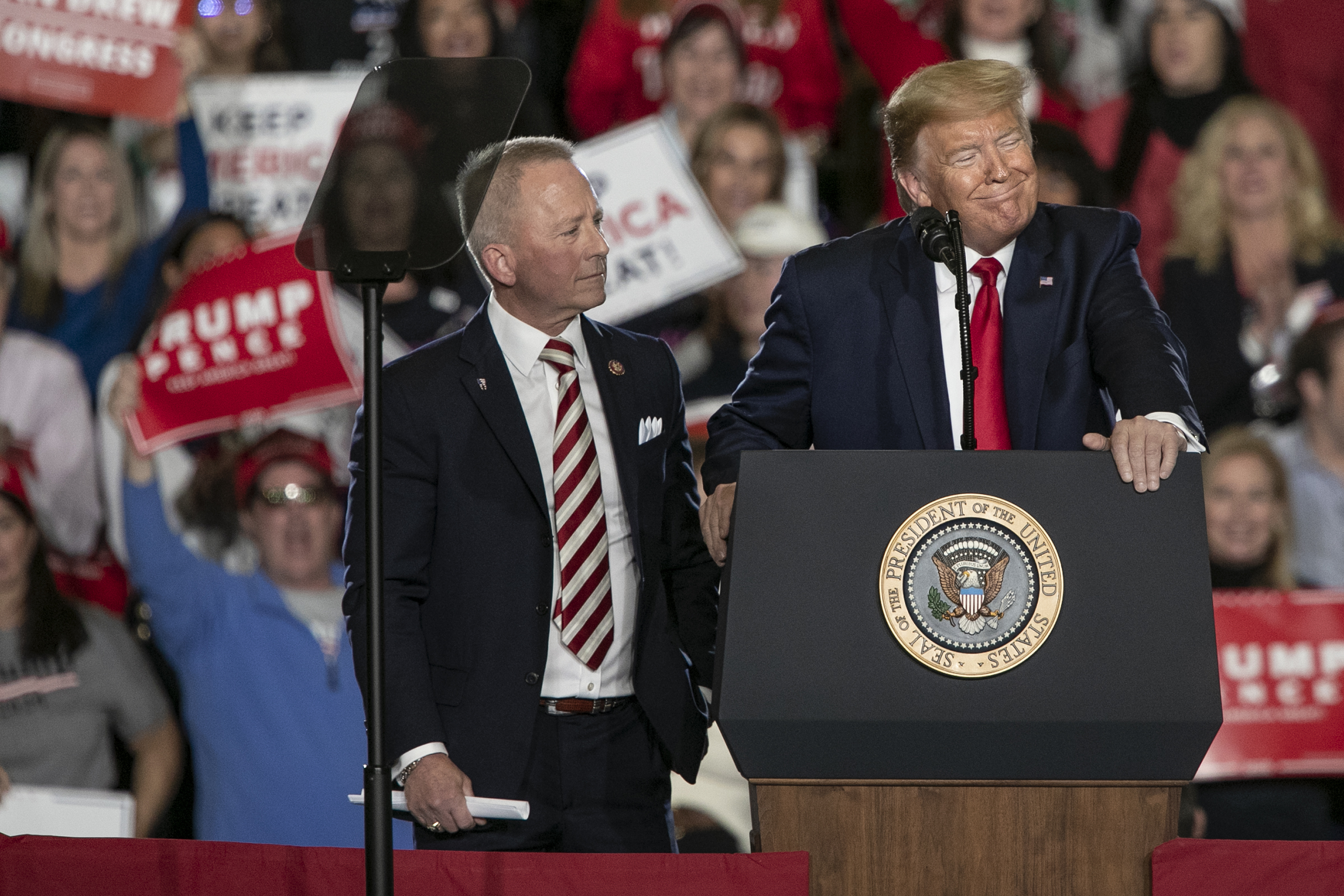
President Donald Trump smiles while Rep. Jeff Van Drew (R-NJ) stands next to him at a Keep America Great campaign rally in Wildwood, NJ on Tuesday, Jan. 28, 2020.HEATHER KHALIFA / Staff Photographer
The request sought money for every county in Van Drew’s district for costs related to the snowstorm, including damage from moderate coastal flooding in Atlantic County and his home county of Cape May.Van Drew, a Trump ally and former Democrat, faces a challenge from Cape May Mayor Zack Mullock for his reelection in November.
Van Drew did not respond to a request for comment.
The request included assistance for the vast majority of the state’s counties – including all of South Jersey – as well as hazard mitigation funding statewide, according to the Friday letter. Preliminary damage assessments across those 19 counties documented “extensive emergency work” such as snow and debris removal and “damage to critical infrastructure and public facilities.”
The New Jersey Office of Emergency Management estimates that disaster costs will exceed $100 million, which is more than five times more than the state’s threshold of about $18 million to qualify for federal disaster assistance.
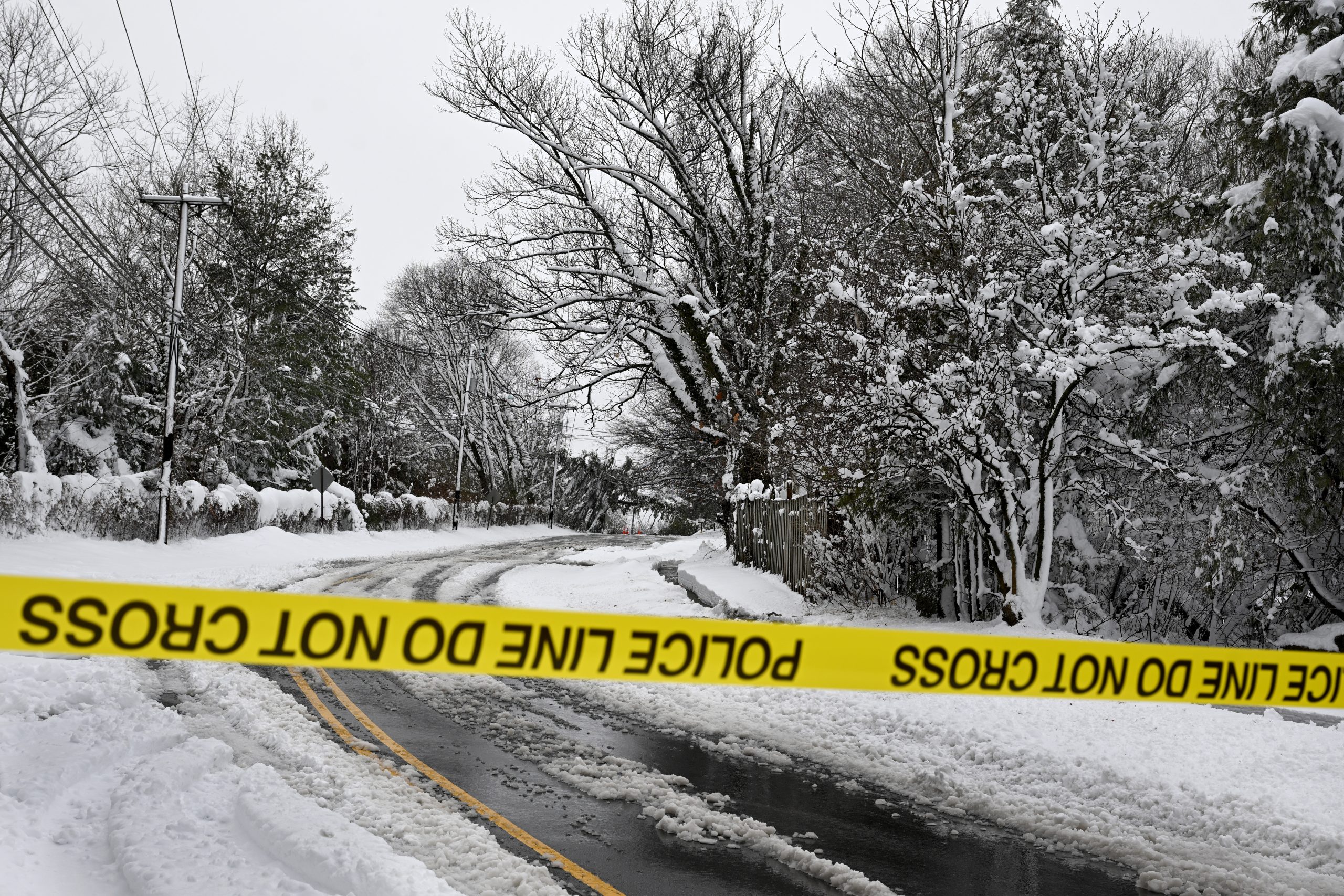
Covered Bridge Road in Cherry Hill is Monday Feb. 23, 2026 after a power line was knocked down by the Sunday night snorwstorm.Tom Gralish / Staff Photographer
“The extent of the damage, the operational burden throughout the State, and the cumulative impacts of recent and related extreme weather all provide overwhelming evidence that New Jersey’s request must be granted,” they wrote. “While we commend the actions of the State and local governments to respond thus far, full recovery will require your approval of federal resources.”
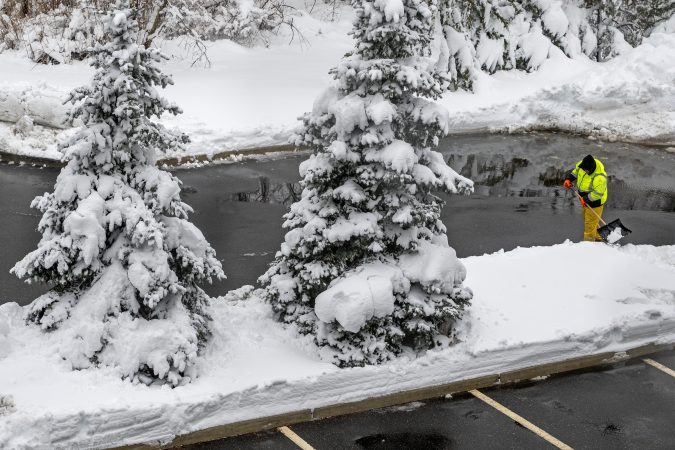
The lawmakers cite National Oceanic Atmospheric Administration data that found approximately 24 inches of snow fell in less than 24 hours across central and eastern parts of the state, and eight of the state’s 21 counties recorded record or near-record snowfalls.
Power outages during the storm impacted more than 127,000 customers in the state and there were 544 motor vehicle accidents and 1,518 motor vehicle-related assists, according to the letter.
They also argued that Trump should consider that the state already had a “strained capacity to respond” because of another severe snow and ice storm weeks earlier, as well as six open federal disaster declarations — in reference to prior disasters for which the state is still working on recovery projects.
“We look forward to working with you to ensure all Americans receive protection and support from the federal government in the aftermath of a serious disaster,” they wrote.
On Thursday, Sherrill spokesperson Sean Higgins noted in a statement that the costs of the February snowstorm “didn’t care about political boundaries” and that the governor will fight for funding “regardless of political party,” in a nod to the accusations Trump is putting his thumb on the scale based on partisan favoritism.
White House spokesperson Abigail Jackson said in a statement Thursday, before receiving the letter, that the president “provides a more thorough review of disaster declaration requests than any Administration has before him” and that he responds to FEMA requests “with great care and consideration, ensuring American tax dollars are used appropriately and efficiently by the states to supplement—not substitute, their obligation to respond to and recover from disasters.”
She also said the Trump administration is committed “to empowering and working with State and local governments to invest in their own resilience before disaster strikes, making response less urgent and recovery less prolonged.” The Trump administration previously tried to cut disaster prevention funding because it was too “focused on ‘climate change” before a group of states including New Jersey sued.
Kim,the ranking Democrat on the committee that oversees FEMA, said in an interview Thursday that he is concerned that politics were involved in the latest rejection but couldn’t say for sure.
Sen. Andy Kim wants to get to the bottom of why President Donald Trump rejected New Jersey’s request for FEMA aid over a record-breaking snowstorm earlier this year.
Winter Storm Hernando, a massive blizzard, hit New Jersey and other Northeastern states hard in February. New Jersey submitted an $84 million disaster request after tallying the damage in the weeks that followed.
The Federal Emergency Management Agency (FEMA) this month rejected New Jersey’s request as partof $227 million in disaster aid requests from four Democratic-led states that were denied, Politico reported Wednesday.
The decision came from Trump after regional FEMA offices and the National Oceanic and Atmospheric Administration (NOAA) determined that the states met the required thresholds to receive aid, according to the report, which cited a former FEMA official calling the move to override the agencies unconventional.
Kim said in an interview Thursday that Americans need “absolute assurance” that FEMA decisions won’t be based on “the whims of the president.”
”I think we should all just declaratively be able to say that partisan politics does not belong in disaster response … I would hope that every single public servant, from the White House to FEMA to the Capitol, believes that,” he said.
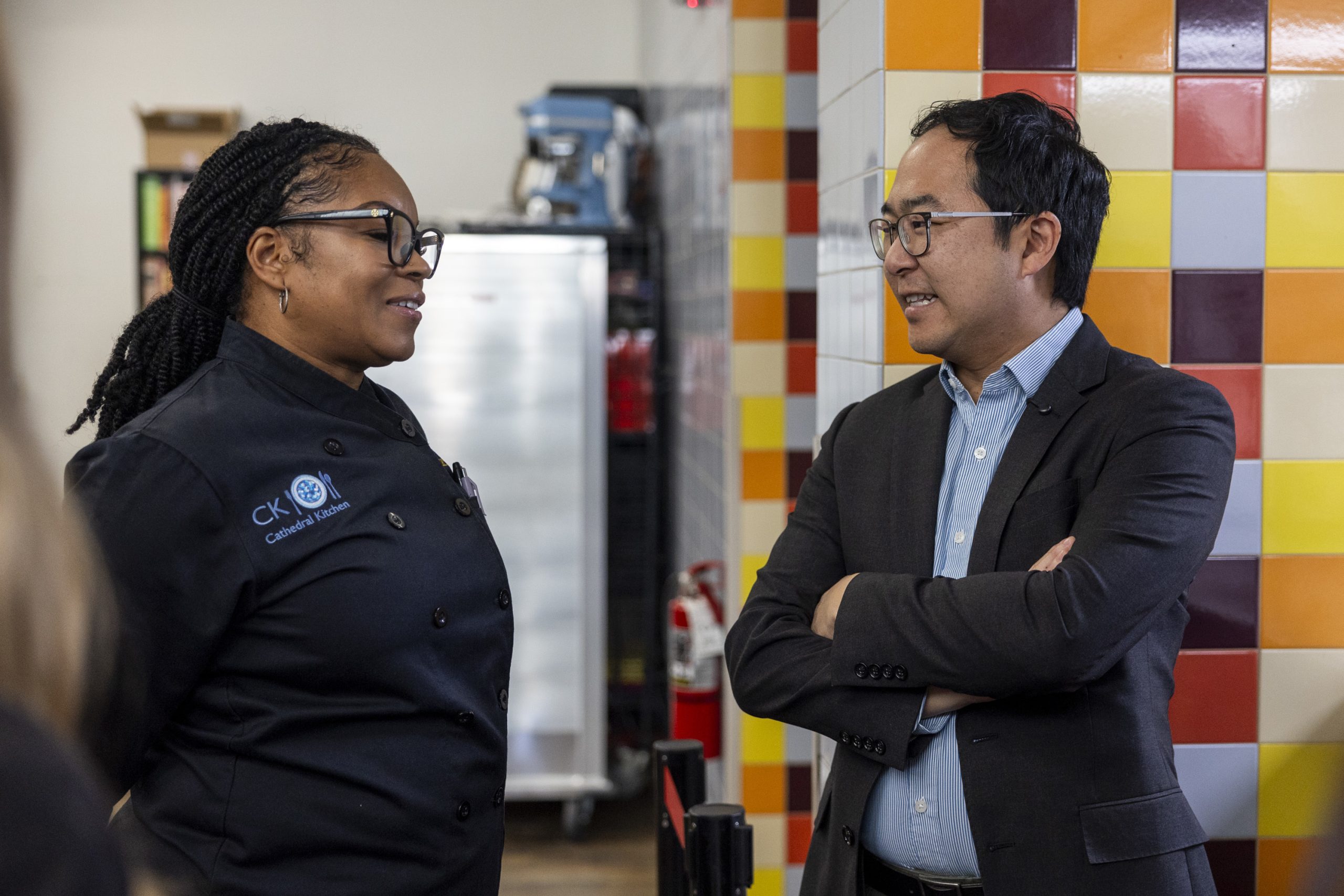
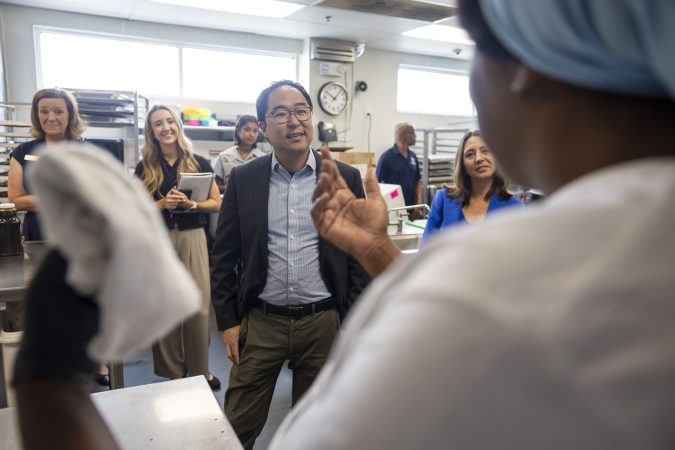
Sen. Andy Kim speaks with Naimah Rutling, executive chef at Cathedral Kitchen in Camden, N.J., during a visit this month. Tyger Williams / Staff Photographer
The South Jersey Democrat is the ranking member on the subcommittee that oversees FEMA, the federal agency responsible for doling out aid to communities hit by disaster.
The president must declare a disaster in order for states to access FEMA aid — and the same goes for individual assistance. Democrats have in recent weeks raised concerns that Trump has penalized blue states in these decisions.
A 16-page NOAA report indicated snowfall records in seven counties in the state, and a 12-page spreadsheet developed by FEMA and New Jersey documented the $84.4 million in costs, which were primarily for snow removal, Politico reported.
The National Weather Service reported blizzards in several counties, including in Southeast Burlington County and other parts of South Jersey. The blizzard caused disruptions to the region such as thousands going without power, school closures, and transit disruptions.
Sean Higgins, a spokesperson for New Jersey Gov. Mikie Sherrill, said the state’s request included costs incurred by the state’s municipalities and counties. He said Sherrill’s administration will appeal the denial.
“Without that aid, our local governments will be stuck with the costs of an unprecedented snowstorm that didn’t care about political boundaries … Governor Sherrill will continue to fight for every dime that New Jerseyans are owed, regardless of political party,” Higgins said in a statement.
FEMA’s cost threshold for public assistance for New Jersey is about $18 million, according to the New Jersey Office of Emergency Management, far below the assessed damage from the storm.
FEMAdid not respond to an inquiry about the rejection on Thursday, but Kim said the agencysaid it disagreed that New Jersey met the threshold.
White House spokesperson Abigail Jackson has told news outlets that Trump is ensuring FEMA aid is used “to supplement — not substitute” states’ “obligation to respond to and recover from disasters.”
The South Jersey senator said he has “concerns” that the rejection was political but he can’t say for sure.
“I understand that you know, the federal government’s not supposed to cover everything for everything, but … this was a situation of record snowfall in wide swaths of New Jersey and, frankly, across the country,” Kim said.
If the state’sappeal isn’t successful, Kim said he has “more tools in my toolbox to try to get my state the funding they deserve” but declined to share what those would be, saying it’s part of a “broader negotiation.”
President Donald Trump speaks in the Oval Office of the White House Wednesday, July 29, 2026, in Washington. (AP Photo/Julia Demaree Nikhinson)Julia Demaree Nikhinson
The White House has maintained that Trump’s rejections have not been political. But Kim and other Democrats have cited a March Politico report that found Trump’s second administration rejected disaster aid for Democratic-run states at the highest rate in the 47 years that FEMA has existed.
The rejections underscore bigger questions of the future of FEMA. Trump previously called for the dismantling of FEMA before changing course, but his advisers have recommended an overhaul of the agency that would put more responsibility on states, NPR reported.
Trump has also caused concern among Democrats for withholding FEMA’s Homeland Security grants from states that do not comply with his administration’s requests for unredacted voter data, including New Jersey and Pennsylvania.
Joseph Walsh, a spokesperson for the New Jersey Office of Emergency Management, said New Jersey is still in the process of “collecting and validating” the assessed flood damage. Once that’s complete, the state will decide on whether to submit a request.
“Every single state is prone to some type of disaster, and so I just don’t want a situation where we’re pitting the states against each other … I hope we can all agree that we want to be there for each other in their time of need,” he said.
The day after President Donald Trump delivered a prime-time speech contending, among other claims, that 250,000 noncitizens were registered to vote in just four states, Pennsylvania Gov. Josh Shapiro derided it as“a whole bunch of conspiracy theories that are just simply not connected to reality.”
A week later,when New Jersey revealed that 6,600 noncitizens were improperly registered to vote in the state and nearly 400 cast a ballot due to a glitch, Shapiro’s message was nearly identical — that Trump ispushing “baseless conspiracy theories” as he seeks more power over state-run elections.
Pennsylvania and New Jersey were both on the list of Democratic-led states that Trump claimed had thousands of noncitizens on their voter rolls. The methodology of how the Trump administration arrived at that figure remained unclear, but his administration has sought to leverage the New Jersey disclosure as evidence of a larger problem.
But Shapiro and other national Democrats have not shifted their messaging on the issue ahead of the high-stakes midterm elections.They are refusing to cede to the GOP any suggestion that New Jersey’s voter rolls are evidence of widespread voter fraud and arewarning that the changes Republicans seek would make it tougher for many Americans to vote.
“Withholding this funding will make our communities less safe and would be dangerous under any circumstance, but doing this in an attempt to undermine states’ authority over elections is reckless and unconstitutional,” Shapiro said.
Kentucky Gov. Andy Beshear, another potential 2028 candidate, also joined the suit. (Both Shapiro and Beshear lead states with Republican attorneys general.)
The day after Trump’s speech, Shapiro challenged the administration to present “real evidence” of noncitizen voting, which Pennsylvania election officials say is extremely rare.
In addition to Pennsylvania and New Jersey, the White House also targeted Nevada and California for additional scrutiny over their voter rolls, according to a document posted to the White House website last week shortly after Trump’s speech.
California Gov. Gavin Newsom, one of Trump’s most vocal critics in the Democrats’ potential 2028 field, said the president’s speech was fueled by debunked lies.
“It was unhinged. Unfounded allegations of election fraud — it’s madness. But he’s setting it up. He’s setting you all up. You know what he’s doing. He’s doing it in plain sight. He’s socializing all of this to normalize all of this,” Newsom said last week, during a newsconference that took place the same day as New Jersey’s announcement.
Trump has repeatedly promoted conspiracy theories about California elections in recent weeks — including in two Pennsylvania speeches — despite no evidence that fraud occurred.
For U.S. Sen. Cory Booker (D., N.J.), pushing back against Trump presents a tougher challenge.
Booker, also a likely 2028 aspirant, must balance the governing changes he sees as needed in New Jersey with the larger politics of the moment. He said the failure of the software was “not acceptable” but rejected Trump’s efforts to portray the entire election system as faulty.
“There are those who will choose to weaponize this issue to undermine confidence in our elections,” Booker said in a statement. “We cannot allow that.”
ButRepublicans have pointed toNew Jersey as proof that a sweeping overhaul is neededfor November’s results to be trusted.
Trump’s allies are pushing the SAVE America Act, which would require voters to provide proof of citizenship when registering to vote and to show photo ID at the polls. The effort has stalled in Congress amid concern, even among Republicans, that the bill’s restrictions on mail voting could make it harder to cast a ballot and that many citizens could wrongly be blocked from voting if they do not have access to required paperwork.
Vice President JD Vance, widely viewed as a 2028 Republican candidate and a potential political heir to Trump, seized on New Jersey’s revelations as a renewed opportunity for the legislation’s relevance.
“If only there was a way to stop this type of ‘software error’ that allowed non citizens to vote in our elections,” he wrote in a post on X that targeted Booker and Sen. Andy Kim (D., N.J.), both of whom are unlikely to support the Republican-led bill.
But theregistration glitch happened despite these individuals answering “no” when asked on a keypad whether they were U.S. citizens. They were added to the system “through no fault of their own,” New Jersey Gov. Mikie Sherrill said last week, so it is not clear that showing additional documentation would have prevented the error.
Sherrill ordered her chief counsel to investigate the issue, which occurred under her predecessor, former Democratic Gov.PhilMurphy, and promised to hold those responsible for the error accountable.
Talking about this issue can pose an obstacle for both parties now that New Jersey’s glitch has been identified, said Sam Chen, a Pennsylvania strategist who has worked for former Gov. Tom Corbett and other Republicans.
Republicans have overplayed their hand and are not seen as an authoritative voice on voter fraud, but Democrats have spent the same amount of time dismissing all of Republicans’ concerns, including some that are legitimate, Chen said.
“When you’ve got an entire party saying, ‘No, this is never happening,’ and now you see what you see in New Jersey, it is going to leave a serious credibility issue for them,” Chen said.
Democrats, like Shapiro, could build more credibility if they acknowledged the positive parts of the SAVE Act, he contended.
“Grab what’s good, vehemently oppose what’s bad, and states can blaze their own path,” he said.
But J.J. Balaban, a Philly-based Democratic ad maker, said it does not make sense for Democrats to go along with the SAVE Act because the charges are being made in bad faith.
While many Democrats would support efforts to make election systems more secure, Balaban said, that is not what the Trump administration is trying to do — and New Jersey does not change that.
“Voter fraud was shockingly rare a month ago. It remains shockingly rare today,” he said.
WASHINGTON — U.S. Sen. Andy Kim (D., N.J.) is introducing a plan to provide free healthcare to every child in the country, an idea he thinks could become a strategic step toward universal healthcare while addressing the urgent needs of an estimated — and likely undercounted — 4.6 million uninsured children.
Enrollment in MediKids, as he calls it, would be automatic at birth and extend until age 26. It aims to provide comprehensive benefits to uninsured children and young adults while also tackling the larger affordability crisis and the healthcare cuts under President Donald Trump that are expected to lead to further disenrollment in the coming years.
Strategically, Kim said, he also hopes the idea will be a politically popular jumping-off point as his party prepares to regain some level of control in Washington during the midterm elections this year and then fight for the White House in 2028.
“It really kind of brings that debate about healthcare to its core essence,” Kim said. “Who is going to stand in the way? Who could possibly say that we shouldn’t provide healthcare to every child in this country?”
Kim, speaking to reporters in his office on Capitol Hill last week, said he was in the early stages of figuring out and advocating for the program. He also said he was clear-eyed about the “political realities” that will make it difficult to pass.
Even if Democrats win control of the House and Senate this year, finding a bipartisan agreement with Trump during the remaining two years of his term would be an uphill battle.
Beyond that, Democrats have had their own internal debates on the issue — symbolized by Joe Biden’s opposition to Medicare for All during his 2020 campaign as progressives like U.S. Sen. Bernie Sanders (Ind., Vt.) championed the idea.
Kim said he sees MediKids as a steppingstone toward universal government-backed healthcare, which he expects to be part of his party’s debates again heading into the 2028 presidential election. He said he introduced it now because of the “urgency” of the affordability crisis and a “hunger for ideas” that he hears from voters in New Jersey and elsewhere.
Critically, he said, it is also a personal issue for him and his family. Trump’s attempt to roll back the ACA during his first term coincided with the birth of Kim’s son, who had immediate medical needs.
“I would not be here in Congress had it not been for that experience,” Kim said. “No parent should have to experience what I had to, and what many parents right now have to, which is worry about whether or not they’re going to be able to get healthcare for their kid if they lose a job, or change jobs, or any number of other issues.”
MediKids as introduced would operate as an extension of Medicaid, which currently covers about 35.5 million kids, including through the Children’s Health Insurance Program. It would provide access to comprehensive screening and early treatment benefits that experts say improve overall health outcomes for children.
Kim said he did not have even a rough estimate of what it would cost to extend the benefits to every child and young adult through age 26. Though the price tag is likely to be significant — and play a role in the program’s ability to gain political support in Washington — he said the long-term investment in healthier kids will have “real savings over time.” Identifying a funding source would come later as Democrats figure out how to pay for a long list of priorities if they win control of Congress and the presidency, he said.
“When you think of our healthcare system, writ large, children are very inexpensive,” said Joan Alker, a research professor and executive director of the Center for Children and Families at the Georgetown McCourt School of Public Policy.
Alker said research has shown that providing healthcare for kids creates a“great return on investment, both from the perspective of taxpayer dollars and, more importantly, from the perspective of having children who are going to grow and thrive.”
MediKids, she said, would be an effective and in some ways novel way of tackling an “extraordinarily worrying” trend.
After steady declines in the number of uninsured children both before and after the passage of the Affordable Care Act in 2010, the figures have fluctuated in the last decade. The 4.6 million children without insurance in 2024 represented about 6% of all children, an increase from about 5.1% in 2022. That period coincided with changes in Medicaid after the pandemic, a period known as the unwinding.
But child enrollment in Medicaid and CHIP has also decreased dramatically since Trump took office again in January 2025 — declining by more than 2 million through May of this year, according to the center at Georgetown.
Enrollment has decreased in Pennsylvania by about 130,000, or 4.1%, and in New Jersey by about 28,000, or 1.5%. Indiana has seen the worst fallout, with about 360,500, or about 20%, fewer children enrolled.
Alker said most children remain eligible. The drop-offs are due to a variety of reasons, including families with mixed immigration statuses being less willing to participate in federal government programs under Trump, less outreach by the federal government to connect individuals with healthcare options, and more administrative red tape for Medicaid, she said.
“I think this is a harbinger of what’s to come next year,” Alker said, referring to the changes to Medicaid eligibility that were passed in the One Big Beautiful Bill Act and will begin to be implemented after the midterm elections.
“There’s a lot of conversation about children being protected,” she said. “But when you start cutting off parents and other adults, when you start adding red tape, then children are going to be impacted.”
According to the Kaiser Family Foundation, a nonprofit healthcare-focused think tank, about 26.7 million people — adults and children — were uninsured in 2024. That is about the same amount as in 2016, which marked a high-water mark after the Affordable Care Act passed.
Kim said he set the upper eligibility limit for MediKids at age 26 because of the popular piece of the ACA that allows young adults to stay on their parents’ insurance until that age. He said he is still working through all aspects of the program, though, and his priority remains on the growing number of children who are uninsured.
“That should be unacceptable for everybody,” Kim said. “I honestly did not realize the number was that high when I first set out to do this. But it’s shocking in the richest, most powerful country in the world that we have that level of problem that is out there right now.”
Touring Cathedral Kitchen, the largest emergency meal supplier in South Jersey, Democratic Sen. Andy Kim praised the 50-year-old Camden institution Friday for the food it has served and the people it has saved.
“The Kitchen is building community, right here in New Jersey,” said Kim, who noted that the nonprofit distributes 28,000 meals a month while training low-income people to be chefs and restaurant workers. Cathedral Kitchen also works to help people obtain IDs, apply for jobs and benefits, and find housing.
Its work is needed more than ever, the New Jersey lawmaker said, with hunger on the rise because of high food prices and President Donald Trump’s One Big Beautiful Bill Act, which reduced federal food assistance such as SNAP (the Supplemental Nutrition Assistance Program) beginning July 4 of last year.
Cutting SNAP benefits and changing eligibility requirements, Kim said, is a “devastating and cruel thing to do” at a time when cost of living has been climbing.
“Why are we taking away necessary support at this time?” Kim asked. “I mean, we’re talking about food, the basics of being a human. Why is this happening now, at a time when people are struggling with affordability?”
New Jersey Sen. Andy Kim visits Cathedral Kitchen in Camden, speaking to the workers who provide food for their community and those in need.Tyger Williams / Staff Photographer
The food assistance cuts are coinciding with the economic fallout from tariffs and the Iran war, Kim noted.
Nationwide, between January 2025 and January 2026, SNAP rolls decreased by more than 4 million people — from 42 million to 38 million — according to USDA figures.
In New Jersey, SNAP participation has fallen by more than 50,000 individuals between March 2025 and March of this year, New Jersey Department of Human Services figures show.
And in Pennsylvania, nearly 90,000 people lost SNAP benefits between July 2025 and Aprildue to new eligibility requirements, according to an analysis by the Pennsylvania Department of Human Services (DHS).
At the same time, food prices have risen more than 3% in the last year.
As a result, in Camden, Burlington, Gloucester, and Salem Counties, the number of meals distributed to help those in need grew by 34% over the last four years, according to the Food Bank of South Jersey
“I know the Camden area,” said Kim, who grew up in nearby Marlton and Cherry Hill. “I’ve seen the struggles that have been here and still persist.”
The Trump administration has said the cuts it’s made to SNAP, Medicaid, and other programs were necessary to staunch “waste, fraud, and abuse.” It maintains that it’s instituted strict work requirements for SNAP to move more people into the workforce and reduce dependency on government support.
Kim said many Americans don’t understand that a large number of people who live in poverty also work. “Millions with jobs are still poor, and this country needs a mindset shift to understand that,” Kim said.
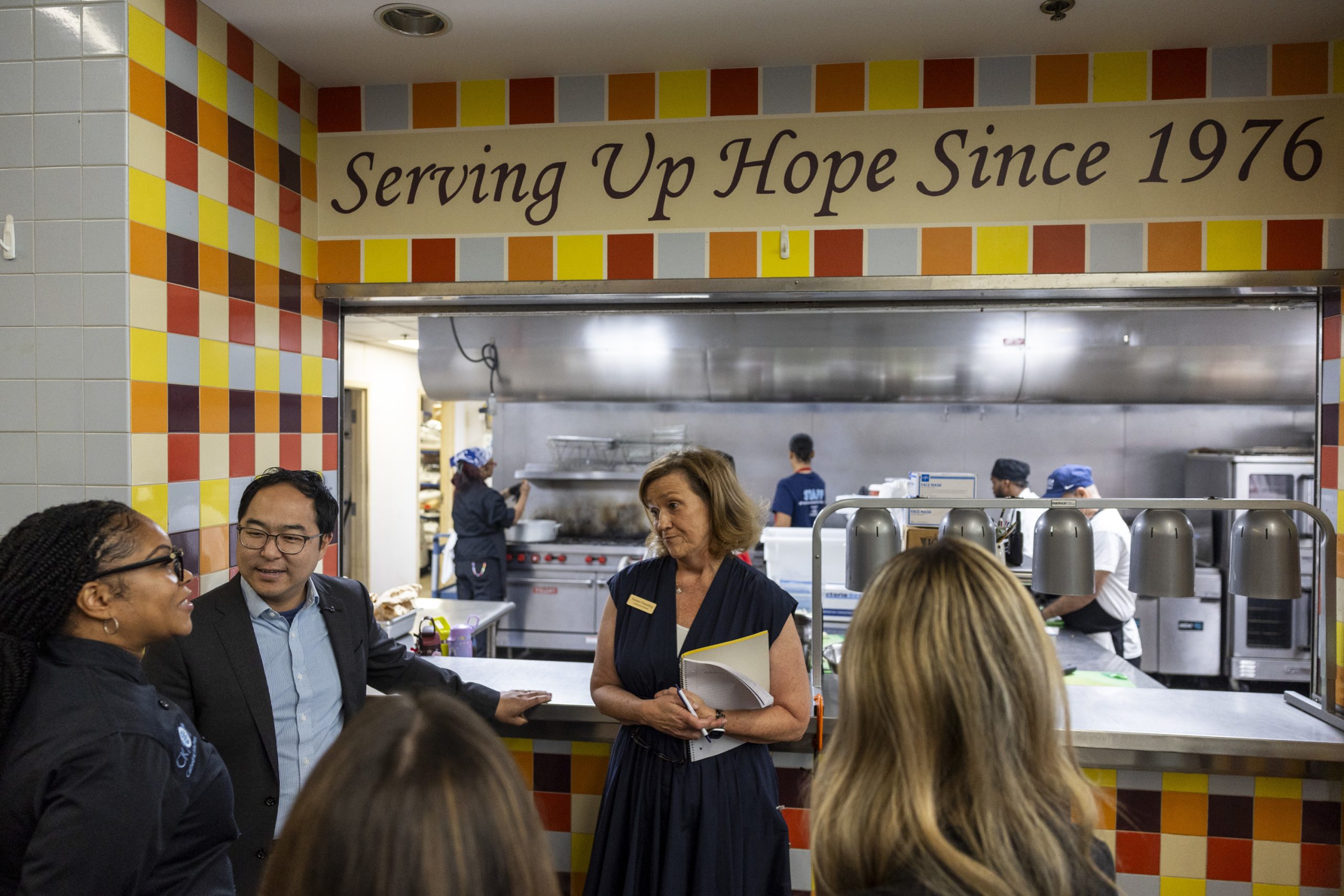
Sen. Andy Kim (D., N.J.) speaks with Naimah Rutling, executive chef at Cathedral Kitchen in Camden, N.J., on Friday.Tyger Williams / Staff Photographer
As he continued his Tour of Cathedral Kitchen, Kim invariably found himself in the organization’s actual kitchen, bustling with food workers slicing carrots and onions, preparing for meals ahead.
Clearly enjoying the moment, Kim said that at home, he makes his own bread, including pizza dough.
Kim asked executive chef Naimah Rutling what her favorite food is. “Grilled cheese,” she said without hesitating. Kim laughed and said, “I have a 9-year-old and a 10-year-old. About 90% of what we eat is grilled cheese.”
Before leaving, Kim praised workers in the kitchen for their diligence and dedication in preparing food for those who need it.
“It gives meaning and purpose to their lives,” he said. “I love the passion I see.”
In the back of a classroom where she had just read to 20 attentive preschool kids, U.S. Rep. Chrissy Houlahan was concerned about what the staff of the West Chester YMCA was telling her.
Nearly a third of the families who rely on the facility’s childcare programs — in the richest county in Pennsylvania, and one of the wealthiest in the country — receive financial assistance to cover the $1,900 monthly cost, the staffers said.
Houlahan, a Democrat who is soft-spoken when she is not grilling President Donald Trump’s cabinet secretaries or House Speaker Mike Johnson (R., La.) on Capitol Hill, asked about the income qualifications for financial aid. At a certain point, the YMCA staff told her, some parents have a disincentive to earn more, lest they become disqualified and then stuck with a higher bill.
“It’s terrible, no matter how you do the math,” Houlahan said a few hours later at a Malvern restaurant, relaying the story to her daughter, Molly Rosa Houlahan, and daughter-in-law, Kristen Rosa Houlahan.
The YMCA’s fee was about the same amount the couple were paying for their 18-month-old, Lucy. With another child due in September, it is also an amount they still are unsure how to afford twice over.
“We’re very fortunate in our jobs, and we’re both trying to get promotions in order to be able to afford a second daycare,” said Molly Rosa Houlahan, 33, a local theater director and producer. “But we are not in that position yet. I don’t totally know what will happen when this second child arrives.”
From childcare to healthcare, groceries to gas prices, affordability concerns have remained top of mind for Americans this year — dominating discussions on Capitol Hill ahead of the high-stakes midterm elections.
Republicans, who control Congress and the White House, say they have made real progress in raising wages and lowering costs. They marked the first anniversary of Trump’s One Big Beautiful Bill Act — since rebranded by Republicans as the Working Families Tax Cut Act — this month by celebrating the law’s more generous tax refunds and other benefits, like new investment savings accounts for children under 18.
Democrats have pointed to the bill’s simultaneous cuts to Medicaid spending and food assistance for low-income families. They say Trump signaled he has no interest in lowering costs when he refused to sign a bipartisan housing bill and said he doesn’t “think about Americans’ financial situation” when handling the war in Iran.
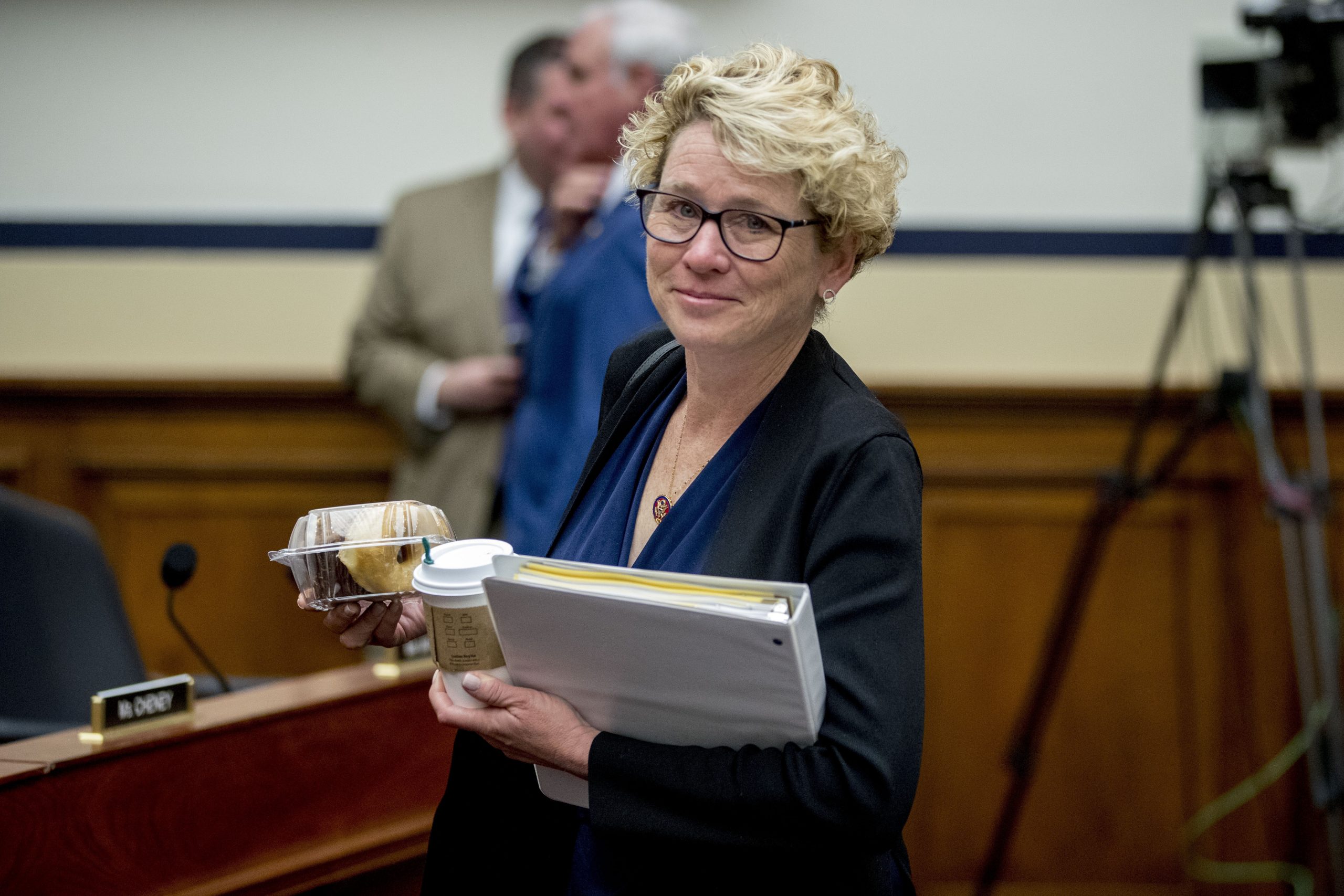
In this 2019 file photo, U.S. Rep. Chrissy Houlahan (D., Pa.) arrives for a House Armed Services Committee budget hearing for the Departments of the Army and Air Force on Capitol Hill in Washington.Andrew Harnik
Houlahan, who has represented most of Chester and Berks Counties since 2019, routinely highlights the broader scope of cost-of-living issues alongside her colleagues. She has taken a leading role among centrist House Democrats to help craft a detailed “affordability agenda.”
Whether her party can advance any of those policies in Washington, even if it wins control of one or both chambers of Congress in November, remains an open question as Trump remains in office and the International Monetary Fund warns of a worsening global economy.
But as the fight drags out, it has also become increasingly personal for Houlahan and her family.
In addition to occasionally helping fill the gaps in their granddaughter’s care, Houlahan and her husband’s own home in Devon, Chester County, has transformed into a version of a so-called sandwich generation household within the last year. The couple’s other adult daughter, her husband, and both of Houlahan’s parents, who are 80 and 84, have all moved in.
The underlying circumstances for the multigenerational home, as they would be for any family, are various and personal. And Houlahan emphasized across multiple interviews that she is fortunate to have the means to welcome her family under her roof. (Houlahan is an Air Force veteran and a former executive at the athletic apparel company AND1. Her husband, Bart, is a partner at an investment research firm.)
But the larger realities — like skyrocketing costs for childcare and senior living — have also now played a role in her own life.Her mother has a Parkinson’s diagnosis, and her parents were unable to find a one-floor living space that was affordable and fit their other needs as they looked to move closer to their family.
“We’re having these conversations, and you know people all over our community are having these conversations,” she said. “It’s an acute issue for families in our area: How do you balance all of this?”
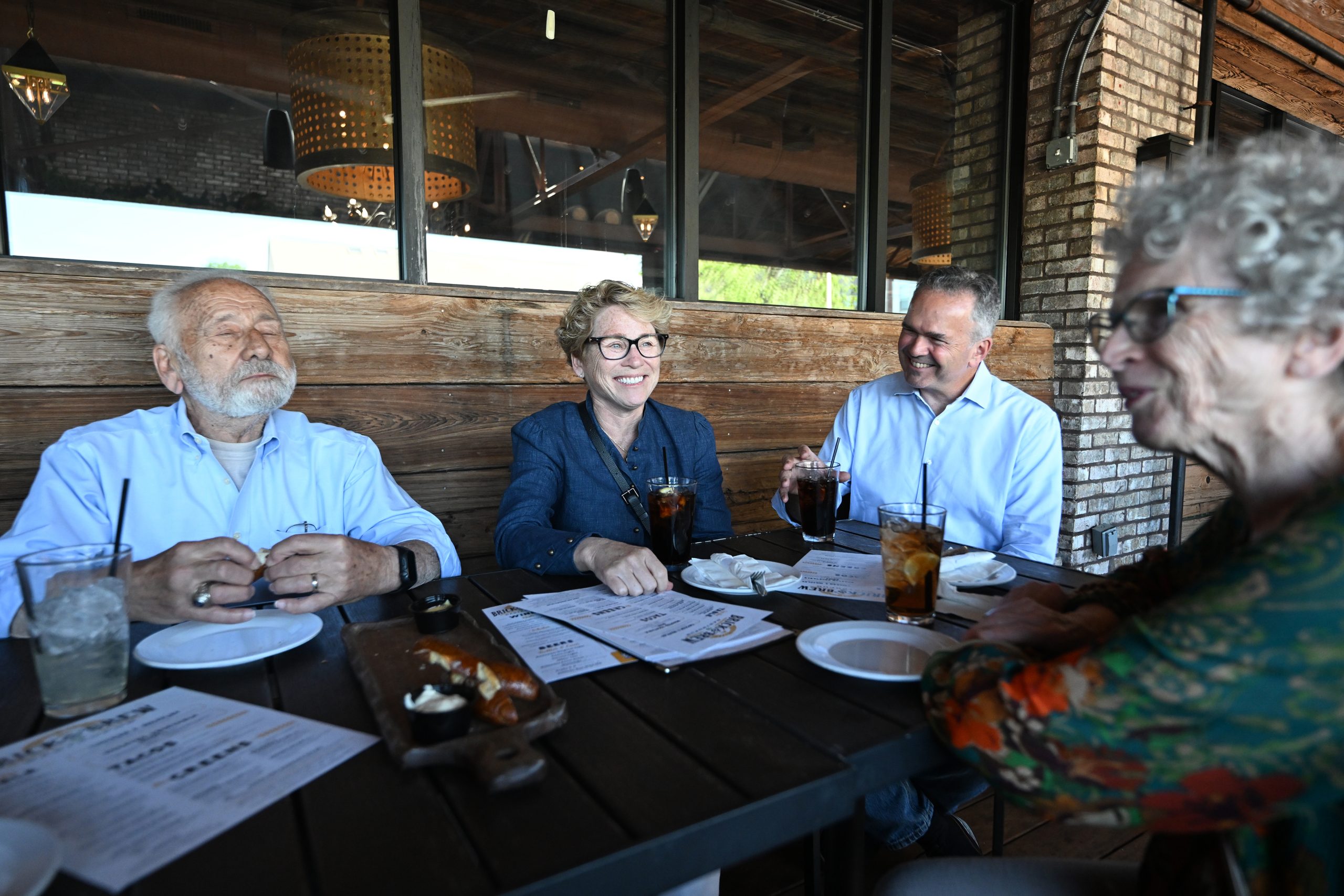
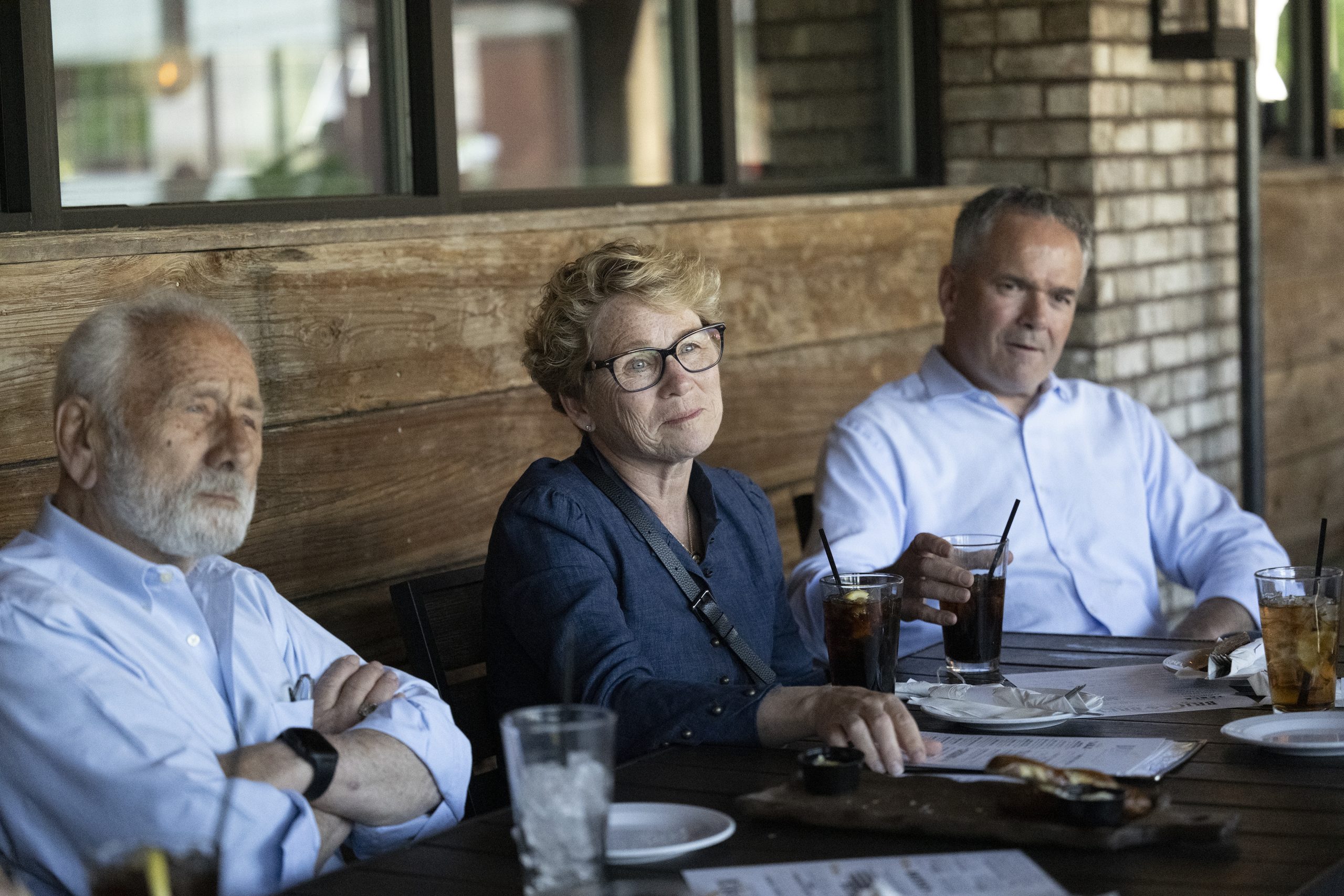
U.S. Rep. Chrissy Houlahan (center) has dinner with her family at Brick & Brew in Malvern, including her father, Andy Jampoler (left), her husband, Bart Houlahan, and her mother, Suzy Jampoler.Jose F. Moreno / Staff Photographer
‘A big balancing act’
Houlahan has shared parts of her family’s story as she has traveled her district this year — prioritizing events and meetings that aim for a deeper understanding of an affordability crisis that has not spared her home county, where the median household income is about $131,000, or 40% more than the statewide average.
On back-to-back days this spring, that meant a focus on the kinds of childcare and senior-care issues she has become familiar with.
“We call it ‘from zero to Edna,’” Laura Schoefield-Pierson, executive director of the YMCA of Greater Brandywine, said of the facility’s programs aimed at all ages, from infants to seniors.
Walking Houlahan through the pre-K classes and a gym with a dozen seniors playing table tennis, Schoefield-Pierson spoke about the organization’s exercise programs aimed at offsetting symptoms of Alzheimer’s or Parkinson’s, and about the complexities of providing assistance for families with young children.
In addition to the “many children” whose care is subsidized through the state’s Child Care Works program — set for families earning 200% or less of the federal poverty level, or $66,000 for a family of four — others receive aid through the YMCA, Schoefield-Pierson said. The facility’s fundraising goal this year is $237,000, she said. On the day of Houlahan’s visit, Schoefield-Pierson said “the kiddos” were writing thank-you notes to donors.
U.S. Rep. Chrissy Houlahan (D., Pa.) interacts with teachers and children at a childcare center at the YMCA in West Chester.Jose F. Moreno / Staff Photographer
Though the U.S. Department of Health and Human Services recommends childcare should not exceed 7% of household income, Houlahan said she was surprised to learn a family would have to earn $327,000 to meet that benchmark at the YMCA for one child.
Nationally, the average annual cost of childcare in 2024 was $13,128, an increase of 29% over the previous five years and far exceeding the national recommendation for the average household’s budget.
“It’s crazy how much healthcare and childcare plays into your family planning,” said Helena Cordoba, a 35-year-old mother of two who said at a roundtable hosted by Houlahan that she had been hoping to grow her family.
A Colombian immigrant who owns Café Com Leite in Phoenixville, Cordoba said she thought she had been living the American dream. But a recent miscarriage and the rising costs of both childcare and healthcare, which she does not currently have, have made her rethink her family’s plans.
“I never thought I was going to say, ‘Maybe the miscarriage is a blessing.’ That thought on its own is very saddening,” Cordoba said. “I don’t know if we were going to be able to afford another baby. Our life would have been completely turned upside down.”
Others voiced similar struggles while Houlahan sympathized and shared her daughter’s own experience with a $2,000 monthly daycare bill.
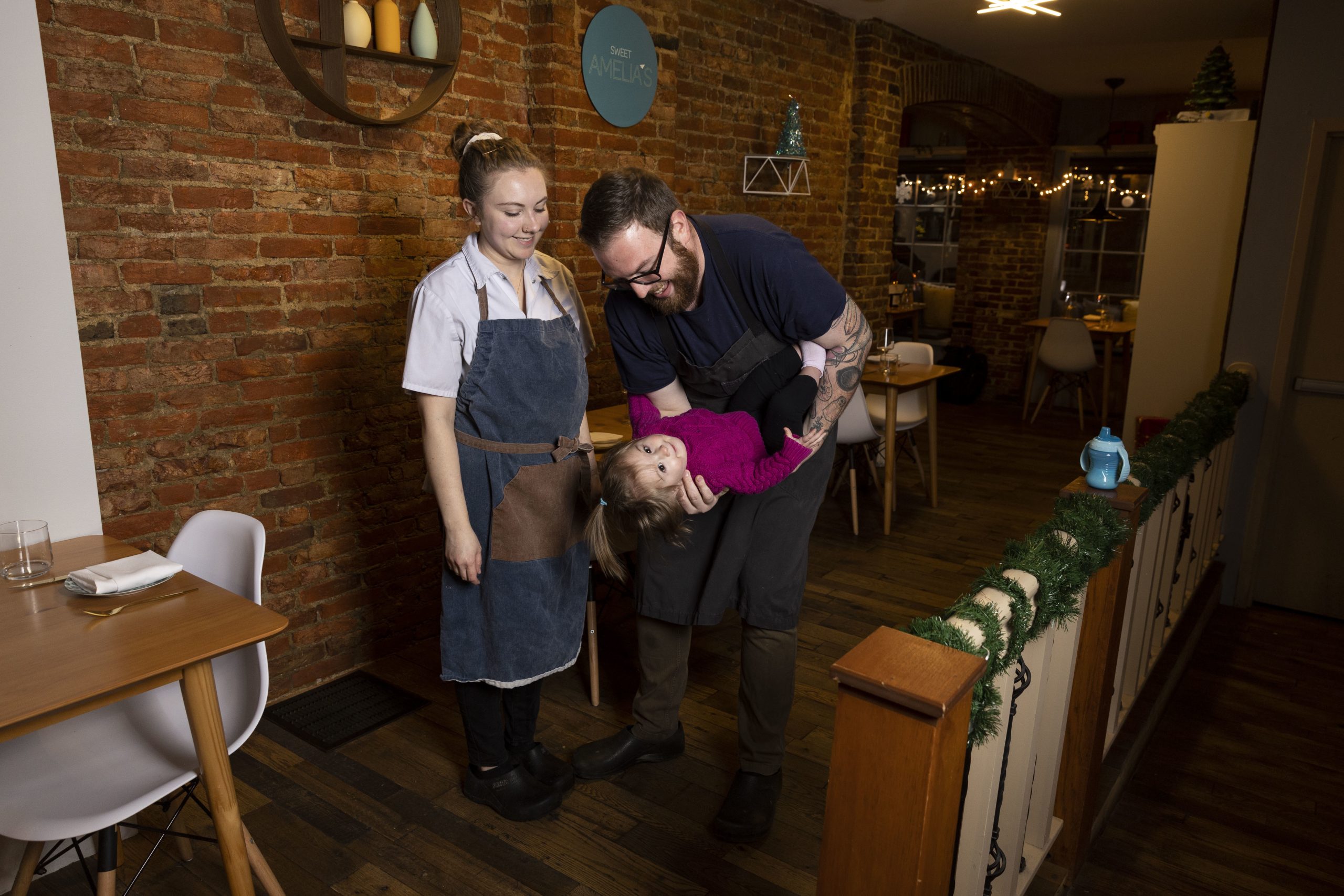
Karessa, Amelia, and Zack Hathaway, pictured here in 2023, at Sweet Amelia’s in Kennett Square.Monica Herndon / Staff Photographer
Zack Hathaway, who owns the restaurant Sweet Amelia’s in Kennett Square with his wife, Karessa, said their business “makes just enough” to cover the $700 to $800 weekly cost for their babysitter amid a demanding restaurant schedule. Thomas Smith, who works at the Cleveland-Cliffs steel plate production facility in Coatesville, said he makes too much to qualify for subsidies for his grandchildren but still struggles to cover the cost.
“It’s like a big balancing act to be able to put your kids in a place that you want to feel comfortable with them being and with being able to afford it,” said Amarte Grove, another Cleveland-Cliffs employee and a father of five daughters.
In another tour focused on the other end of the agespectrum, Houlahan peppered staffers at Brandywine Valley Active Aging in Downingtown about their work to offer free meals, housing services, and activities to about 120 seniors daily.
According to the organization, Chester County’s homeless population has decreased in recent years — from 916 in 2023 to 747 in 2025. But the percentage of that population that is over 60 has increased from 9% in 2023 to 14% in 2026. About 45 older adults in the county were homeless as of early May, according to the organization, which works alongside other independent and government groups to connect seniors with stable housing.
“It is really difficult to live in Chester County,” said Jen Manthey, BVAA’s director of information and assistance. “It takes a long time for them to get out of homelessness, partly because it takes a long time for us to build the trust with them and get that rapport — that they trust what we’re saying, and there aren’t $400 room rentals out there that we’re just hiding from you.”
U.S. Rep. Chrissy Houlahan (D. Pa.) visits with senior citizens at the YMCA in West Chester. She shares the burden of the “sandwich generation” caring for her elderly parents, opening her home to her adult daughter and son-in-law, and helping to care for her other daughter’s toddler.Jose F. Moreno / Staff Photographer
Nick Popov, BVAA’s chief operating officer, said demand remains high for the 5,000 free lunches the organization provides every month to individuals age 60 and older. The cost for those meals is reimbursed through the Pennsylvania Department of Aging, though the organization raises most of its funding in total, he said.
“The services are out there. We’re doing everything we can to provide them,” Popov said. “But it’s always a struggle to kind of balance the bottom line between our goals and what we can actually affordably accomplish.”
Houlahan’s parents said they had never expected to move in with their daughter. Even as they looked to move closer to their family and could not find a spot that fit their financial and physical needs, it took some convincing, mostly from their son-in-law, Bart Houlahan.
“It was an inspiration that permits us to enter old age — serious old age, not just the kid stuff right now — with greater confidence that our health will be sustained,” said Andy Jampoler,Houlahan’s father, a Holocaust survivor born in German-occupied Poland in 1942.
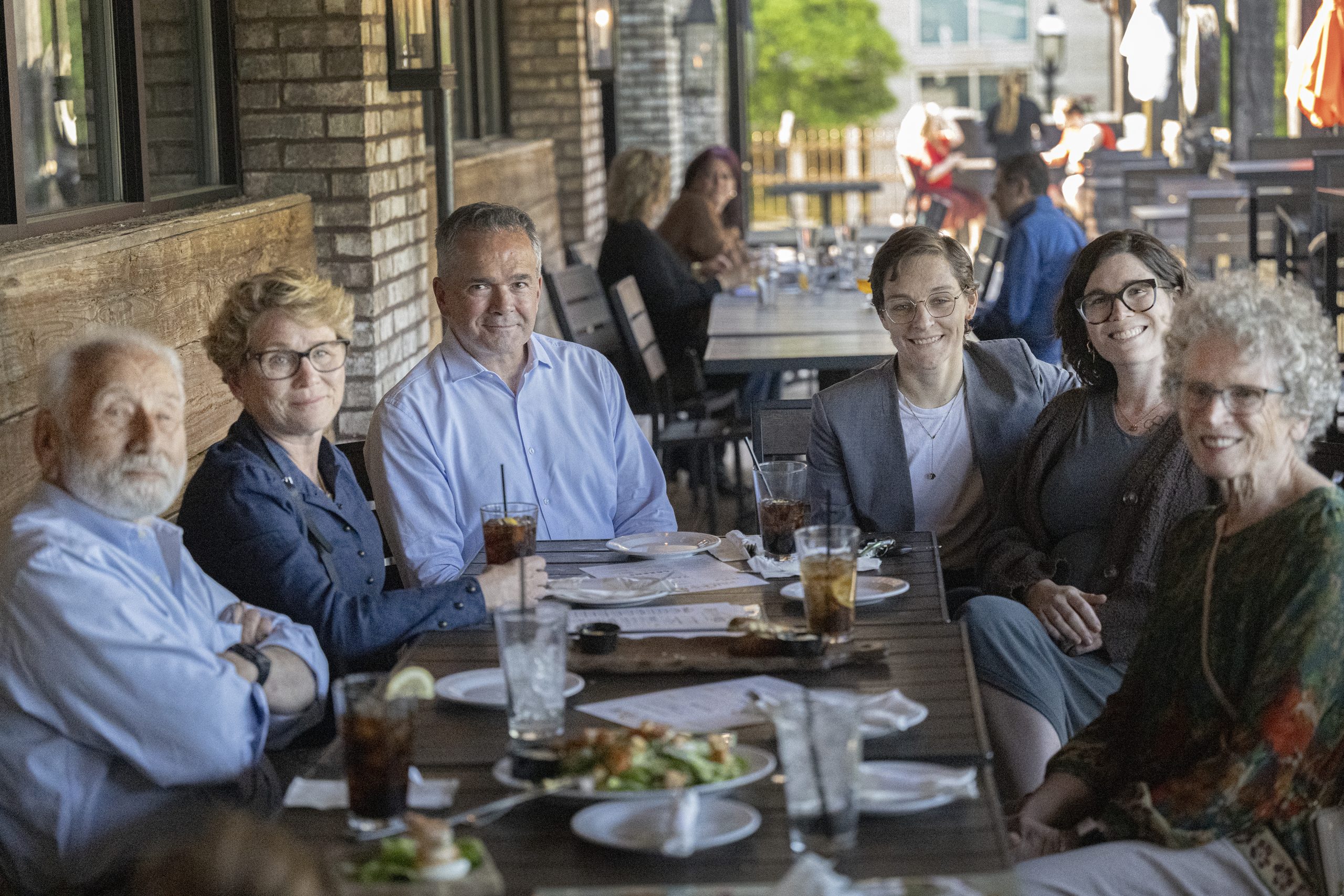
U.S. Rep. Chrissy Houlahan poses at a family during dinner at Brick & Brew in Malvern, including her father, Andy Jampoler (left), her husband, Bart Houlahan, daughter Molly Rosa Houlahan, daughter-in-law Kristen Rosa Houlahan, and Houlahan’s mother, Suzy Jampoler.Jose F. Moreno / Staff Photographer
Turning experience into policy
In May, Houlahan introduced legislation that would require the federal government to collect data on the sandwich generation, a step she said is critical to creating better policies for an “undervalued role in the nation’s economy.”
It would require at least one federal survey to ask whether individuals provide unpaid care to both children and older adults. U.S. Sen. Andy Kim (D., N.J.), who has two young sons and cares for his father with Alzheimer’s, sponsored a companion bill in the Senate.
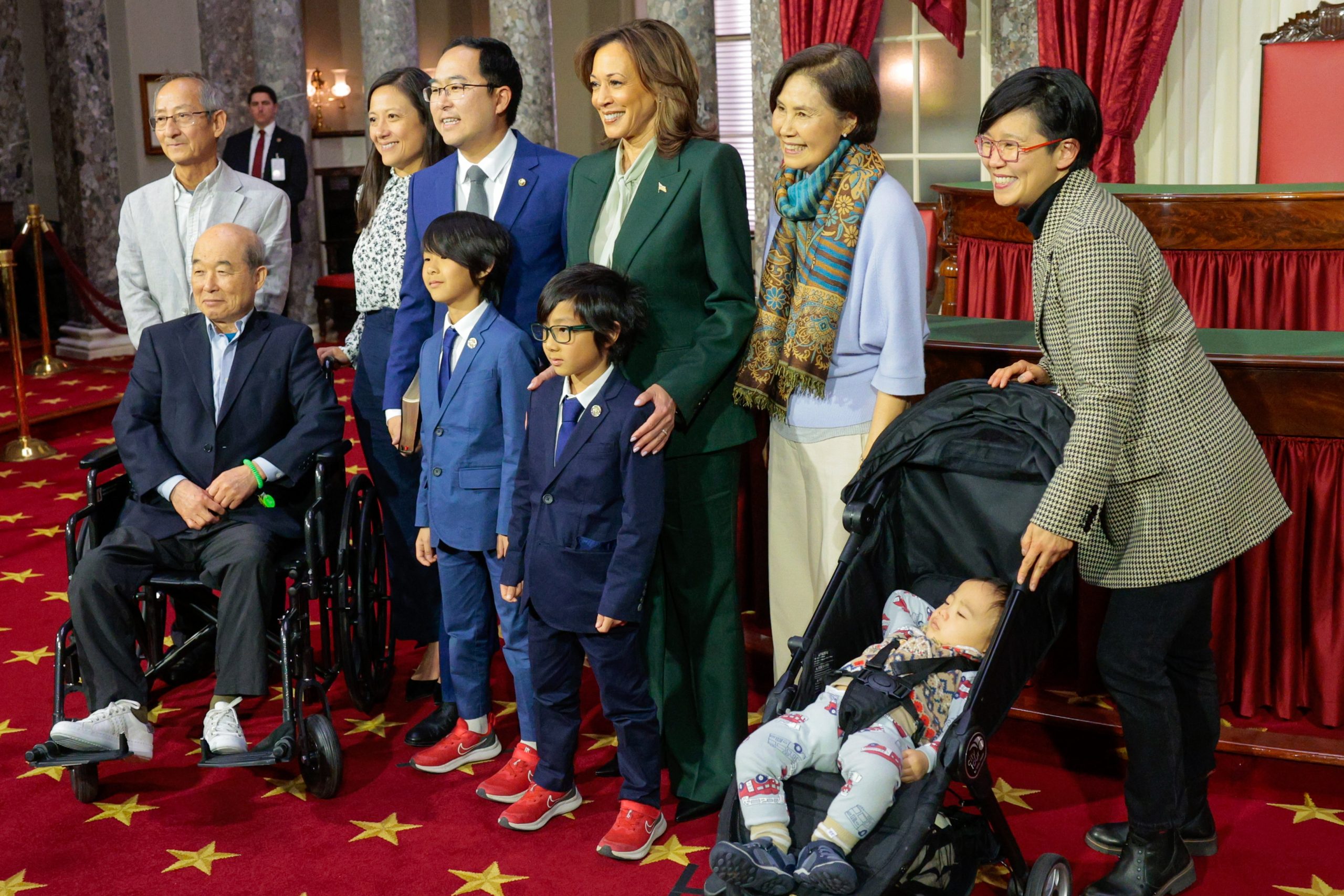
Sen. Andy Kim (D., N.J.) poses with his family and Vice President Kamala Harris after taking the ceremonial oath of office in the old Senate chamber on Jan. 3, 2025, in Washington.Steven M. Falk / Staff Photographer
Houlahan is also the chair of an “economic growth and cost of living” working group within the New Democrat Coalition, a group of self-described centrist Democrats that includes about half of the entire caucus. The group rolled out an “affordability agenda” earlier this year that is considered a framework for how Democrats would tackle housing, healthcare, energy, paid family leave, and much more if they win control of the House.
U.S. Rep. Brad Schneider (D., Ill.), chair of the New Democrat Coalition, credited Houlahan for her leadership with the agenda, describing her as having a “quiet wisdom that focuses on the core of a problem” while bringing her own life experience to the work.
“Everyone’s experience is unique, but her experience shares many of the aspects of what people across the country are facing,” Schneider said. “The sandwich generation, taking care of kids and parents, for whatever circumstance, while at the same time seeing the cost of just everyday living … is putting a burden on families.”
The legislation aims to incentivize housing construction, restrict large investors from buying single-family homes, help families with home repairs, and more. The president reiterated Friday that he would not sign it, allowing the bill to become law without his signature.
In her Capitol Hill office about an hour after Trump canceled that bill signing late last month, Houlahan described the president as “so obtuse that he can’t see in front of him that this is something that the people want.” After spending much of the last year calling out Johnson, the House speaker, for not standing up to Trump, she said there should be “counterinsurgents” and an “uprising” in the Republican Party.
At the same time, she expressed some hope. The housing bill may have been a rare moment of bipartisanship, but it was also a sign that Congress can still act on affordability even before the end of the year, she said.
“We don’t have time, for all of this stuff, to wait until somebody else is in charge,” Houlahan said. “We can do this ourselves.”
U.S. Rep. Chrissy Houlahan (D., Pa.) sits between her father, Andy Jampoler, and her husband, Bart Houlahan, at Brick & Brew in Malvern. Houlahan’s parents recently moved in with her. Jose F. Moreno / Staff Photographer
WASHINGTON — A Pennsylvania program that assists homeowners and small landlords by financing repairs was on track Wednesday to expand nationwide, after Congress this week passed a bill that both Republicans and Democrats are celebrating as the first major federal housing law in decades.
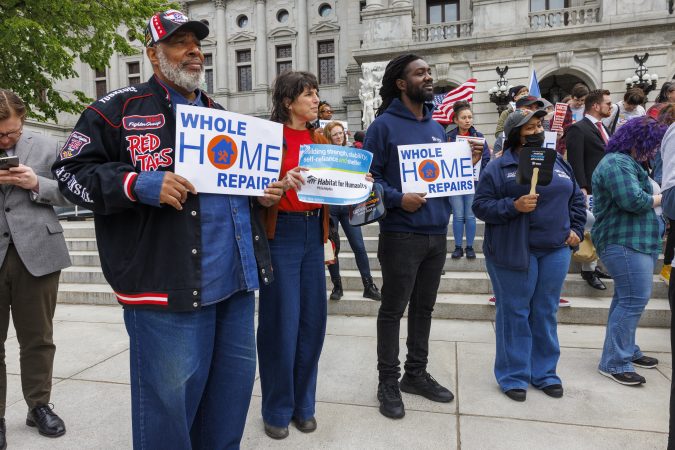
Tucked into the 374-page omnibus legislation is a pilot version of a federally backed Whole-Home Repairs program — an idea that was originally sponsored by State Sen. Nikil Saval (D., Philadelphia) and passed in Pennsylvania in 2022.
The program offers grants or loans to address safety, habitability, and efficiency concerns.
But despite wide bipartisan support for the program and dozens of other housing reforms in the larger bill, final approval was derailed on Wednesday when President Donald Trump canceled the bill-signing ceremony in an attempt to force Congress to first pass more restrictive voter-ID laws.
Democrats and some Republicans quickly rebuked the president, who still made a rare appearance on Capitol Hill to meet with Senate Republicans. The intraparty meeting turned contentious, according to multiple reports, while Democrats noted they had enough votes to overturn Trump’s veto if he holds out long enough.
“It’s a mess,” said U.S. Sen. Andy Kim (D., N.J.). “Finally, we’re doing something that the American people want. We got bipartisanship. We worked on it forever. … Then he just parachutes in and just blows it all up here at the end.”
The 21st Century ROAD to Housing Act aims to incentivize housing construction, restrict large institutional investors from buying single-family homes, improve financial literacy, and more.
More than a year in the making, it includes a separate stand-alone Whole-Home Repairs Act that U.S. Sen. John Fetterman (D., Pa.) had introduced in each of the last two sessions of Congress. Fetterman’s bill merged last year into the larger bill while keeping many of the same provisions as the Pennsylvania-level program.
Households that earn less than 80% of the area median income are eligible for grants, while small landlords with affordable units can access loans, including forgivable loans.
Saval said he expects the national version to also reflect that level of “immense demand” — particularly as the program starts small and as homeowners across the country face higher costs to maintain their residences.
“This is a huge issue. There are some 200,000 homes in Pennsylvania alone that have moderate to severe deficiencies,” Saval said. “Everyone is dealing with rising energy costs. Everyone’s dealing with the cost of materials and labor and the inability to pay for all that.”
Addressing those kinds of affordability concerns, which have become a top-of-mind political issue during this year’s high-stakes midterm elections, is a rare bipartisan effort to emerge from the U.S. Capitol.
Philadelphia-area lawmakers on both sides of the aisle had spent months advocating for the bill.
U.S. Sens. Dave McCormick (R., Pa.) and Lisa Blunt Rochester (D., Del.) — members of the Senate committee that advanced the legislation — both celebrated the final passage by talking about its impacts on affordability and “cutting red tape.” Kim called it a “historic” move to bring costs down.
“This package comes at a critical moment,” Blunt Rochester said in a statement, noting a nationwide housing shortage of as many as 7 million units. Five bills she separately sponsored — to accelerate building, increase investment in community development projects, develop zoning and land-use policies, and more — were featured in the final law.
The Whole-Home Repairs provision of the legislation was not a guarantee as negotiations developed over the last year. House Republicans were generally skeptical of creating a new government program, and specifically critical of the policy’s tenant protections, according to a source familiar with the negotiations. But their counterparts in the Senate, and Democrats in both chambers, helped keep it in the larger bill.
Fetterman said in a statement that Whole-Home Repairs “ensures families can stay in their homes” and that passing it had been a priority since he entered the Senate in 2023.
“I’ve consistently maintained that our housing crisis needs real solutions that help address the problems at the center,” Fetterman said.
Saval, who said he made multiple trips to Capitol Hill to work with sponsors and lobby for Whole-Home Repairs, said he was “thrilled” by the inclusion of a program that he and the coalition of advocates who helped push the idea had always envisioned as a model that could be replicated.
He said he expects the pilot program to prove successful in “a few states” where it is able to launch. Unlike previous version of the federal bill that would have allocated $30 million to the pilot, there is no specific funding number for Whole-Home Repairs in the 21st Century ROAD to Housing Act.
The legislation calls for the secretary of the U.S. Department of Housing and Urban Development to identify between two and 10 “implementing organizations” every year during the pilot, which is set to run through October 2031. The organizations will be local or state governments that administer the programs.
Saval said that no matter how much funding is allocated, it “will undoubtedly fall short of the need,” but that its effectiveness will spur further investment.
“It repays itself,” Saval said. “It repays itself in stabilized communities. It repays itself in stabilized property values, in people remaining in their homes rather than in unsafe or unhealthy homes, or rather than abandoning them.”
Staff writer Jake Blumgart contributed to this article.
WASHINGTON — As lawmakers on Capitol Hill grapple with President Donald Trump’s deal toend the war in Iran, the New Jersey Democrat who spent years weighing national security issues in the Middle East described the agreement as a “mind-boggling” move that will have damaging reverberations across the globe.
“It’s like setting your own house on fire, a good chunk of it burning. You put it out. And then you start clapping, celebrating yourself. That’s what Trump is like right now,” U.S. Sen. Andy Kim, the only career diplomat in the Senate, said of the memorandum Trump signed Wednesday night.
Democrats representing the Philadelphia region on Thursday blasted the terms outlining the end of a conflict that many of them repeatedly described as a strategic failure from the start.
Some prominent Republicans echoed those concerns — criticizing Trump’s removal of U.S. sanctions on Iran and his promise to help pull together a $300 billion fund to rebuild the country’s infrastructure after months of bombings — while Pennsylvania lawmakers who supported the war, like U.S. Sens. Dave McCormick (R., Pa.) and John Fetterman (D., Pa.), remained silent or defended Trump.
“Reagan is rolling over in his grave,” U.S. Sen. Bill Cassidy, a Louisiana Republican, wrote on social media.
Kim, who worked at the National Security Council under President Barack Obama and spent time as a civilian adviser in Afghanistan, said it was difficult to imagine what will happen next.
He said the Trump administration had lost all forms of leverage by agreeing to end hostilities, reopen the Strait of Hormuz, and provide financial benefits to Iran without securing any new or firm commitments around the country’s nuclear program. Though the countries vowed to continue negotiating over the next 60 days, Kim said, Iran will already be in a “position of strength” with the financial relief and thus have little incentive to follow through on its pledge not to pursue a nuclear weapon, which was the primary justification for the war by Trump and his allies.
“I have no confidence in any aspect of this,” Kim said in an interview.
Kim said he feared not just prolonged issues between the U.S. and Iran — issues that look almost the same as before the war began — but “reverberations everywhere” as the administration signals how it would handle other foreign conflicts, like Russian President Vladimir Putin’s aggressions in Ukraine or Chinese President Xi Jinping’s moves toward Taiwan.
“We’re just at such a weak point now. We’re still strong enough that we can muscle other countries, but they see through it now,” Kim said.
Trump has continued to project strength, including with threats to resume attacks if Iran does not comply with the peace deal.
“It’s a memorandum of understanding, and if I don’t like it, we’ll go back to shooting at them, dropping bombs on their head,” Trump said Wednesday.
McCormick, who served in the Army during the Gulf War and has described the war in Iran as one of the most effective military campaigns in history, did not agree to an interview with The Inquirer on Thursday as other Republican senators like Cassidy and U.S. Sen. Ted Cruz of Texas raised concerns. In multiple television interviews, McCormick said he had “a number of questions” about the memorandum.
“If it has the two things the president’s talked about, I think we’re in good shape,” McCormick said on Newsmax. “One thing is that there can be no path to a nuclear weapon or not giving up the enriched uranium. … That has to happen for this to be successful. And the second thing was the president’s words that you have to pay for performance. You can’t lift the sanctions or give them real economic relief on the sanctions until they take tangible steps toward eliminating that nuclear capability.”
A spokesperson for U.S. Rep. Brian Fitzpatrick, a Bucks County Republican who has voted for more congressional oversight of the war but has not criticized its mission, referred to a statement from before the terms were announced this week. Fetterman, the only Senate Democrat who has fervently supported the war, did not respond to a request for comment.
Democrats representing the Philadelphia area, meanwhile, were quick to call the deal a symbol of a conflict that was entirely a failure.
“Now, after billions of taxpayer dollars spent and 13 American service members’ lives lost, we are no better off in Iran than we were before the war began,” said U.S. Rep. Chrissy Houlahan of Chester County, an Air Force veteran.
U.S. Rep. Mary Gay Scanlon of Delaware County said she was hopeful that the agreement was a step toward peace while calling the conflict damaging to the U.S. economy and embarrassing on the global stage.
“The war did not accomplish any of the administration’s alleged goals, and has instead only strengthened Iran’s strategic ambitions,” she said.
In a post on social media, U.S. Rep. Brendan Boyle of Philadelphia called it “total humiliation.”
Public surveys showed the war was never popular with the majority of Americans, and at least one new poll released this week showed Pennsylvania voters were continuing to sour on Trump’s handling of foreign policy.
“This was just really a lose-lose everywhere,” said Kim, who helped lead a roundtable on Capitol Hill this week to highlightthe economic impact of the war, like increasing fuel and fertilizer costs due to the shipping decline. “We need to move on. But this is going to have such a negative impact on America for so long, and in so many different ways.”
Staff writer Michelle Baruchman contributed to this article.