Blog

  • How ChatGPT helped persuade one couple to move to Ardmore from Mexico

    How ChatGPT helped persuade one couple to move to Ardmore from Mexico

    From her home in Mexico, JoAnne Kim started searching for a Philadelphia-area apartment by opening ChatGPT.

    Kim, a regular user of the generative artificial-intelligence tool, told OpenAI’s chatbot what she and her husband wanted: a quiet place in Pennsylvania that was walkable and dog friendly with good transit access, a strong sense of community, cafes and restaurants, and a lot of things to do.

    ChatGPT suggested Ardmore, Bryn Mawr, and Chestnut Hill. The couple chose Ardmore, and Kim asked the chatbot for a list of apartment communities that fit their criteria and included outdoor space.

    ChatGPT “helped me become a better apartment hunter, because I was able to use all the data to help me make a decision,” said Kim, a 64-year-old career mentor for university students.

    This month, the Kims moved into Montgomery Plaza near Suburban Square.

    Generative AI tools are becoming increasingly popular as more people use them to write emails, summarize documents, and recreate pictures of pets. And, like Kim, renters are also using AI chatbots to find apartments.

    In Philadelphia and beyond, the growth of AI is changing the way people search for homes — and it’s prompting some in the industry to change how they do business.

    JoAnne Kim used ChatGPT to find the apartment she moved into this month.Tyger Williams / Staff Photographer

    In April, Philadelphia became one of 15 cities where RentCafe, a national apartment search website, rolled out its AI assistant, Ren. The platform is preparing to make the tool available nationwide. Apartments.com launched its latest AI tool — Apartments.com Ai — in June and started an advertising campaign in August to get more renters to use it.

    Property managers, too, are trying to find ways to reach people who use AI.

    Charlie Marshall, a leasing associate at the Ardmore-based property management company Harrison Richards, which manages Montgomery Plaza, has been tweaking the company’s website to try to get its seven properties more prominent placement in generative AI search results.

    Marshall said the handful of people who said they found a building using AI tools seemed more informed and committed than other prospective tenants.

    “It was immediately clear they had a good idea of the places they wanted to lease at,” he said. “It was not like some people you see that are touring seven or eight properties. They had narrowed it down to like three.”

    Stuart Richens, vice president of product at Apartments.com, said because the company’s AI tool “is immersive and kind of keeps guiding you and helping you, renters are getting much deeper into the search more quickly.”

    “And that’s helping them get to that short list more quickly,” he said.

    Kim and her husband, a senior data analyst who uses AI, worked with ChatGPT to focus their search. But to find a place that felt like home, Kim also watched local real estate agents’ YouTube videos, read reviews, watched local news coverage, and talked to property managers.

    Kim said that because she started with virtual conversations on ChatGPT, “I spent more time thinking about the kind of life we wanted to have. It wasn’t just about finding the apartment. It was the neighborhood, the vibe.”

    JoAnne Kim shows the ChatGPT online tool she used to find her apartment.Tyger Williams / Staff Photographer

    ‘A more advanced Google search’

    AI tools can only do so much.

    Vee Gordon, a rental agent with Philly Home Girls, said she worked this year with a New York City couple in their 20s who wanted a two-bedroom home in Philadelphia. They insisted on seeing places that were hundreds of dollars over their $6,000 monthly budget. During a meeting with Gordon, they pulled up ChatGPT.

    “They were asking it how to negotiate a rental price down,” she said. “I feel I have more insight on that than what ChatGPT was saying.”

    Gordon has worked exclusively with renters — many in their 20s and 30s — for four years in the city and its suburbs. She estimates she has helped sign almost 500 leases.

    “This is my expertise,” she said.

    The couple didn’t end up finding a place through her.

    Jack Olmanson, 27, doesn’t regularly use generative AI tools. But this year, when he and his girlfriend needed to move from Washington, D.C., to the Philadelphia area for her work in the equestrian industry, he turned to Anthropic’s Claude for help.

    The couple used it “as a more advanced Google search,” said Olmanson, who works in business management.

    “You can be very customized in your asks,” he said. Claude “was good at giving us everything that’s out there that meets our initial criteria.”

    The couple wanted a two-bedroom apartment in a walkable area and a building that welcomed Mya, their yellow Labrador retriever.

    Olmanson and his girlfriend are originally from Minnesota and didn’t know the Philadelphia area, so they asked Claude to compare suburban towns here to those they knew in the Minneapolis area. They also asked it to make a map of locations with reasonable commute times.

    Once they got suggestions from Claude, they did their own research, exploring websites, looking at photos, reading reviews, and taking tours. And they still reviewed Zillow listings they got through email alerts.

    They moved into an Ardmore apartment building managed by Harrison Richards in May.

    Olmanson recommends renters verify everything an AI chatbot tells them to make sure it’s not making things up. And remember, he said, it’s just a tool.

    “You’re still in charge of making sure [a home] is the right fit for you,” he said.

    How AI has changed apartment listing websites

    When Philadelphia renters begin searching RentCafe’s website of home listings, a button prompts them to “Ask Ren.” Apartments.com encourages them to “Meet your Ai rental adviser.”

    Renters using AI tools tend to start broadly with a location and budget and refine searches through a virtual back-and-forth to get to a smaller number of the most relevant listings. Renters can type or talk. Apartments.com’s chatbot supports about 50 languages.

    RentCafe found that people who use its tool are twice as likely to click into a listing and 50% more likely to contact property managers than people who use traditional search tools. Users of Apartments.com’s chatbot request 144% more tours.

    “Conversational search, we’ve seen, has been very helpful for renters,” said Samantha Skrobot, renter advocate at RentCafe.

    This image provided by RentCafe, a national apartment search website, demonstrates how a renter could use its AI assistant, Ren.RentCafe

    Renters can use it to figure out realistic budgets and determine locations accessible by public transit. They can search for requirements that aren’t included in traditional filters on apartment search websites, such as proximity to a laundromat or library. Users can ask AI tools to compare properties’ amenities and tell them about nearby schools.

    Through the chatbots, renters can prioritize certain property characteristics (say, gets a lot of natural light) and indicate where they’re flexible, which they can’t do with traditional search filters. AI chatbots can suggest locations a renter may not have considered that meet their requirements.

    On newer 3D tours on Apartments.com, renters can tell the AI chatbot to remove furniture from a room and give dimensions of a space.

    Apartments.com’s homepage encourages renters to use its generative AI chatbot, Apartments.com Ai.Screenshot

    Adjusting for AI

    Because of the growth of generative AI tools, Richens at Apartments.com said that for property managers, “having a very complete listing with every piece of data about the property … is very important because that’s what renters are asking for.”

    “And if you don’t have it, how is the AI going to answer?” he said.

    Apartments.com is working with property managers to beef up listings.

    At Harrison Richards, Marshall has worked to improve how the company’s properties show up in generative AI searches. He asked questions that a renter would ask and noted when the company’s properties did and did not appear.

    A Redditor posted a couple years ago looking for Ardmore-area apartments, and someone said they’d lived at the company’s Montgomery Plaza property and liked it.

    “That was apparently gold for ChatGPT,” Marshall said.

    The property management company has changed heading sizes and where information shows up on its website, so AI tools can more easily pull out answers for renters. Marshall has noticed a difference.

    After the changes, he said, the AI tools “would draw out the things we think are important and the things people might have questions about.”


    Harrison Richards, an Ardmore-based property management company, has adjusted its website to better position its properties, such as Montgomery Plaza, in generative AI search results.Tyger Williams / Staff Photographer
  • Andy Dalton? Tanner McKee? Please. The Eagles lack a real backup quarterback. Unusual. Unsettling.

    Andy Dalton? Tanner McKee? Please. The Eagles lack a real backup quarterback. Unusual. Unsettling.

    The Eagles used to value the backup quarterback position, perhaps more than any other team in the NFL. Looking at their rosters in 2025 and 2026, it’s hard to believe they still do.

    This might not matter at all, except Eagles starter Jalen Hurts gets hurt a lot, and quarterbacks are the most important players in all of team sports.

    Still, it seems like a lot of energy to spend on a guy who won’t play much. Backup quarterback angst: The sort of nattering matter that makes the NFL preseason interminable; the sort of infuriating football geek-talk that fantasy nerds Snapchat about.

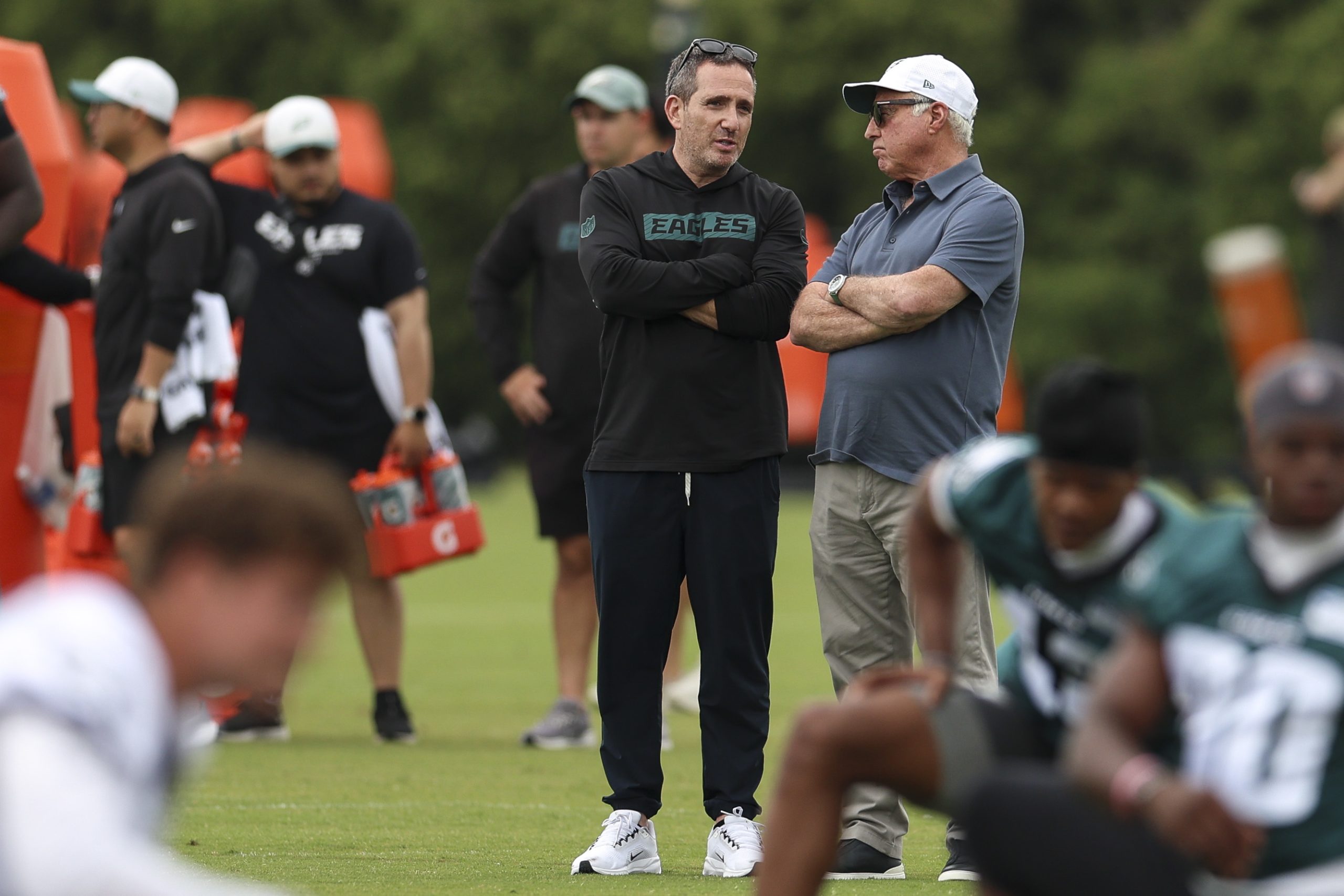
    You know. Guys like Lurie and Roseman.

    In 2017, the Eagles committed $11 million to their backup quarterback spot. So important was the position to owner Jeffrey Lurie that he told GM Howie Roseman to sign Nick Foles, whom Andy Reid had just cut from the Chiefs. It meant eating $7 million of the contract of Chase Daniel, whom the Eagles promptly released.

    Despite missing the playoffs in 2016 with rookie Carson Wentz at quarterback, Lurie saw 2017 as a real chance to win the franchise’s first Super Bowl, and he considered Foles, who’d had a strong run as an Eagle, to be a better option than Daniel, who’d never had a strong run anywhere.

    The rest, as they say, is history: Wentz got injured, Foles replaced him, played well down the stretch, and won the MVP award inSuper Bowl LII where he outplayed Patriots legend Tom Brady and outfoxed coach Bill Belichick.

    Nick Foles became an unassailable Eagles legend, but that doesn’t mean all backup quarterbacks are created equal. Michael Bryant / Staff Photographer

    “Our priority, as you’ve seen, is to make sure we have the very best possible other starting quarterback,” Lurie said during Super Bowl week.

    That’s generally been true, and it’s generally made sense for the Birds, since Lurie prefers mobile quarterbacks, who, of course, are more likely to get hurt.

    Lurie signed Michael Vick out of prison in 2009, and Vick supplanted Donovan McNabb the next season and went to the Pro Bowl in his second of four years as an Eagle. Lurie drafted Hurts in the second round in 2020 with plans that Hurts would be the long-term backup to Wentz, but that’s before Ginger Jesus lost his job, and maybe his mind. Lurie sanctioned the recent, sensible acquisitions of Gardner Minshew, Marcus Mariota, and Kenny Pickett.

    But in 2019, Lurie also approved the signing of Josh McCown, a 40-year-old with a 79.7 passer rating with eight other teams. McCown replaced Wentz early in the Eagles’ home wild-card playoff game, played atrociously (predictably), and cost the Birds their postseason.

    Last season, Lurie allowed the Birds to enter the season with third-year sixth-round pick Tanner McKee as the backup of a team defending its second Super Bowl title. It didn’t matter, since Hurts stayed healthy. But McKee got to start game 17 against the Commanders, and he was poor: 21-for-40, 241 yards, one touchdown, one interception, with a forgettable fourth quarter that cost the Eagles their chance to win the game and capture a better seed. It looked OK in the moment, but upon further review, the Eagles (and I) decided that McKee is not the answer.

    The Eagles (not I) determined that Andy Dalton is the answer.

    They were wrong.

    The Eagles’ bet on Andy Dalton does not appear to be going according to plan. Yong Kim / Staff Photographer

    The Birds in March traded a seventh-round pick to the Panthers for Dalton.

    No player at Eagles preseason work or in training camp has been a bigger disappointment than Dalton.

    That isn’t really fair. There should have been minimal expectations of Dalton.

    He’ll be 39 in October. He’s 1-6 in his last seven starts over the past three years, during which time his passer rating is 84.5. Aberration? No. In the five seasons before that, his rating was 85.5 in 57 games. He’s been the backup in Carolina the past three seasons, essentially a big brother for Bryce Young, the underperforming No. 1 overall pick from 2023, and an assistant coach of sorts.

    That’s the role he was expected to serve in Philadelphia, where new offensive coordinator Sean Mannion has installed a new scheme. Dalton can help with the adjustment for Hurts, and you’d think Dalton would have a significant advantage over McKee in executing the offense.

    Tanner McKee again appears to be the best backup option for the Eagles. Yong Kim / Staff Photographer

    But no. Dalton has looked appreciably worse than McKee — so much worse that McKee’s unremarkable performance looks good by comparison.

    Entering the third and final preseason game Friday, the competition, such as it is, for the backup job clearly tilts in McKee’s favor. Which delivers this uncomfortable truth:

    The Eagles, who have made the playoffs five years in a row, don’t really have a viable backup quarterback. That’s the fault of the front office.

    Roseman.

    Lurie.

    What should they have done?

    Maybe they should have signed Mitch Trubisky, who got two years and $10.5 million to back up Cam Ward in Tennessee. Maybe another dance with Minshew, who got $8.25 million to back up Jacoby Brissett in Arizona. Both would have cost a lot more than Dalton’s $1.5 million, but that’s also just about what Tua Tagovailoa got from the Falcons to be the emergency plan if Michael Penix Jr. wasn’t back in time from his knee injury.

    All three of those QBs are in spots where they will have a likelier chance to resurrect their careers. Maybe that’s why the Eagles weren’t able to land one of them, and why they had to trade a pick for Dalton.

    To be fair to Roseman and Lurie, the Birds also drafted a quarterback in April: Cole Payton, in the fifth round, out of North Dakota State, who currently is not close to being an option.

    To be fair to Payton, he might be as good an option as the other two.

  • 🚴 Riding up that hill | Sports Daily Newsletter

    🚴 Riding up that hill | Sports Daily Newsletter

    It’s been a decade, but this weekend the Philly Cycling Classic returns, thanks to the efforts of an Old City salon owner, a former mayor, and an entrepreneur who used to live in Manayunk, which is home to the race’s most famous (infamous?) stretch — and the most recognizable climb in American cycling — The Wall.

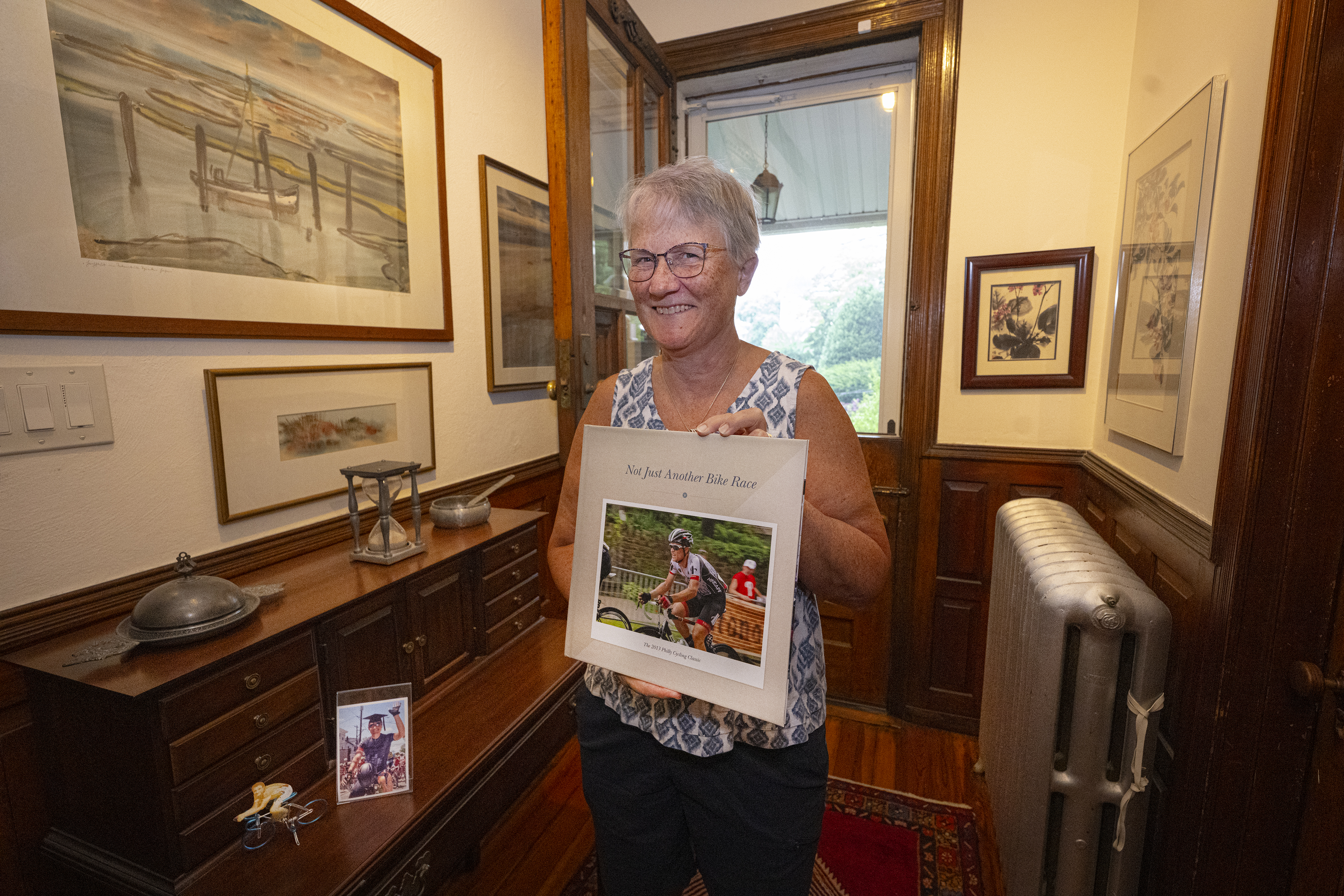
    The race’s revival was years in the making, and riders will be coming from all over the globe to compete. But one competitor merely needs to walk a few blocks from his parents’ house, just off Levering St., to join the peloton: Robin Carpenter, who first summited The Wall as an 11-year-old, and attended the race each year as a kid. He even sold lemonade to spectators, who often suggested he could make more money if he added liquor, as that steep stretch also served as the race’s unofficial party headquarters.

    On Sunday, however, Carpenter will be without the man responsible for his racing career, former Masterman teacher Kevin Saint Clair. He encouraged Carpenter to give the sport a try, and offered the then-teenager a spot on his cycling team, but Saint Clair died in 2023 when he was hit by a car while riding his bike.

    “He forever lives on in my memory as the guy who pushed me forward into the sport,” the 34-year-old Carpenter said.

    Carpenter won’t be alone, however, as his parents, John and Julia, will be out along the rail, rooting for their son and ringing some cowbells from their massive collection to help spur him on. If you’re also planning on attending the race, which is free, and cheering on the only Philly native in the men’s field, then we’ve got you covered with a spectators’ guide to the race, featuring everything from the best vantage points to etiquette tips for first timers.

    — Matt Mullin, @phillysport, sports.daily@inquirer.com.

    If someone forwarded you this email, sign up for free here.

    ❓What other former Philly events would you like to see return? Email us back for a chance to be featured in the newsletter.

    All the small things

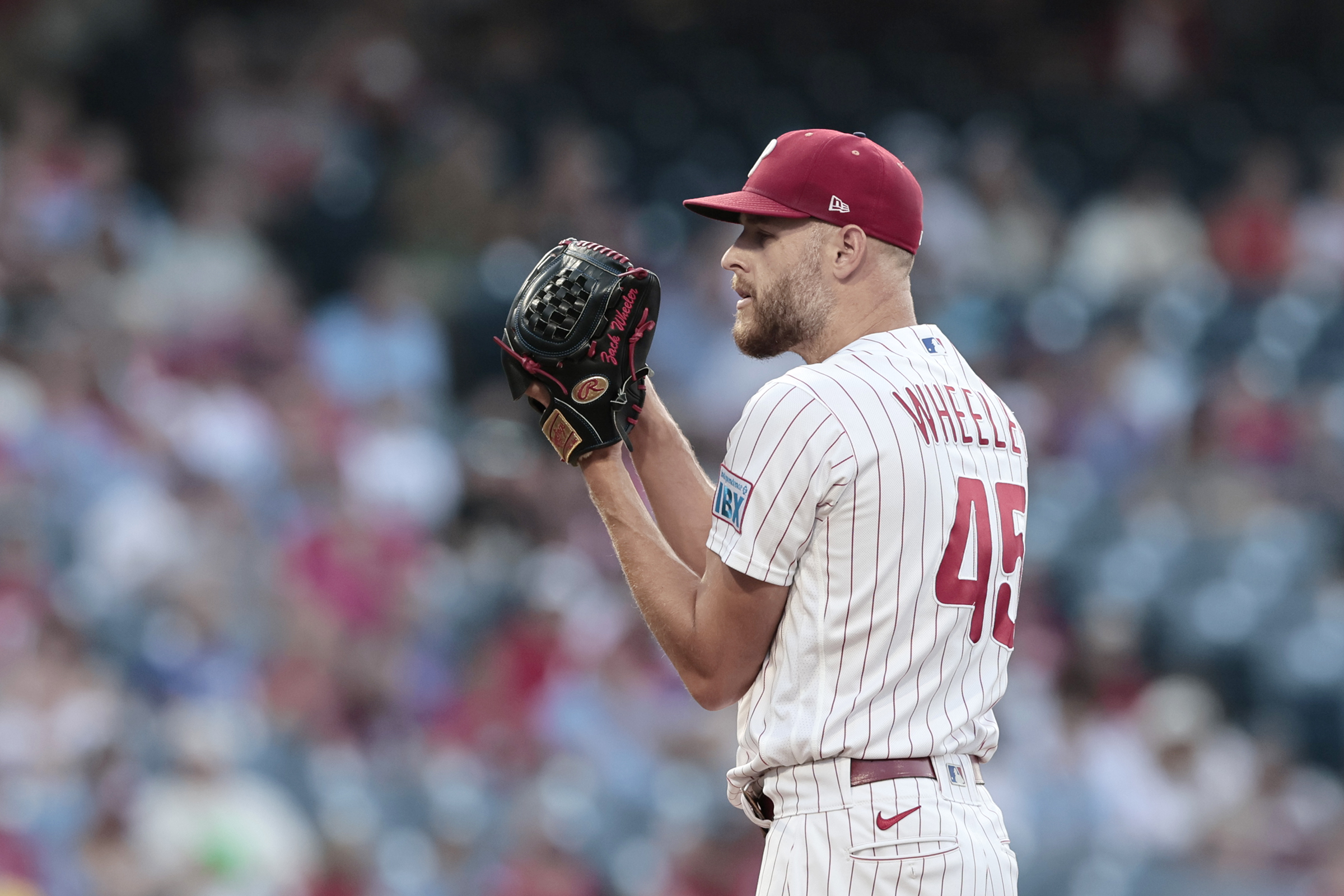
    Phillies starter Zack Wheeler has not looked like his usual self over the last month.Elizabeth Robertson / Staff Photographer

    Zack Wheeler’s recent struggles on the mound — he allowed a season-high eight runs Monday night and his ERA is 8.51 over his last six starts — might feel like a big thing for a Phillies team that is currently in a playoff race and has designs on returning to the World Series for the first time since 2022. But the fix, according to pitching coach Caleb Cotham, involves correcting the “small things.”

    That includes Wheeler’s arm slot, which they noticed after comparing recent video to footage of the starter over the last five seasons. Cotham said Wheeler, whose next scheduled start is Sunday, is just “a click off.”

    On the other end of the spectrum is Bryce Harper, who has been red-hot this month and kept the Phillies from being swept in Seattle — with a little help from Kyle Schwarber’s MLB-leading 40th home run.

    Next: Following an off day on Thursday, the Phillies head to Arizona for a three-game series against the Diamondbacks. First up is Andrew Painter (3-8, 6.04 ERA) vs. lefty Reid Detmers (4-8, 3.62) on Friday night (9:38 p.m., NBCSP).

    What we’re …

    That’s a wrap

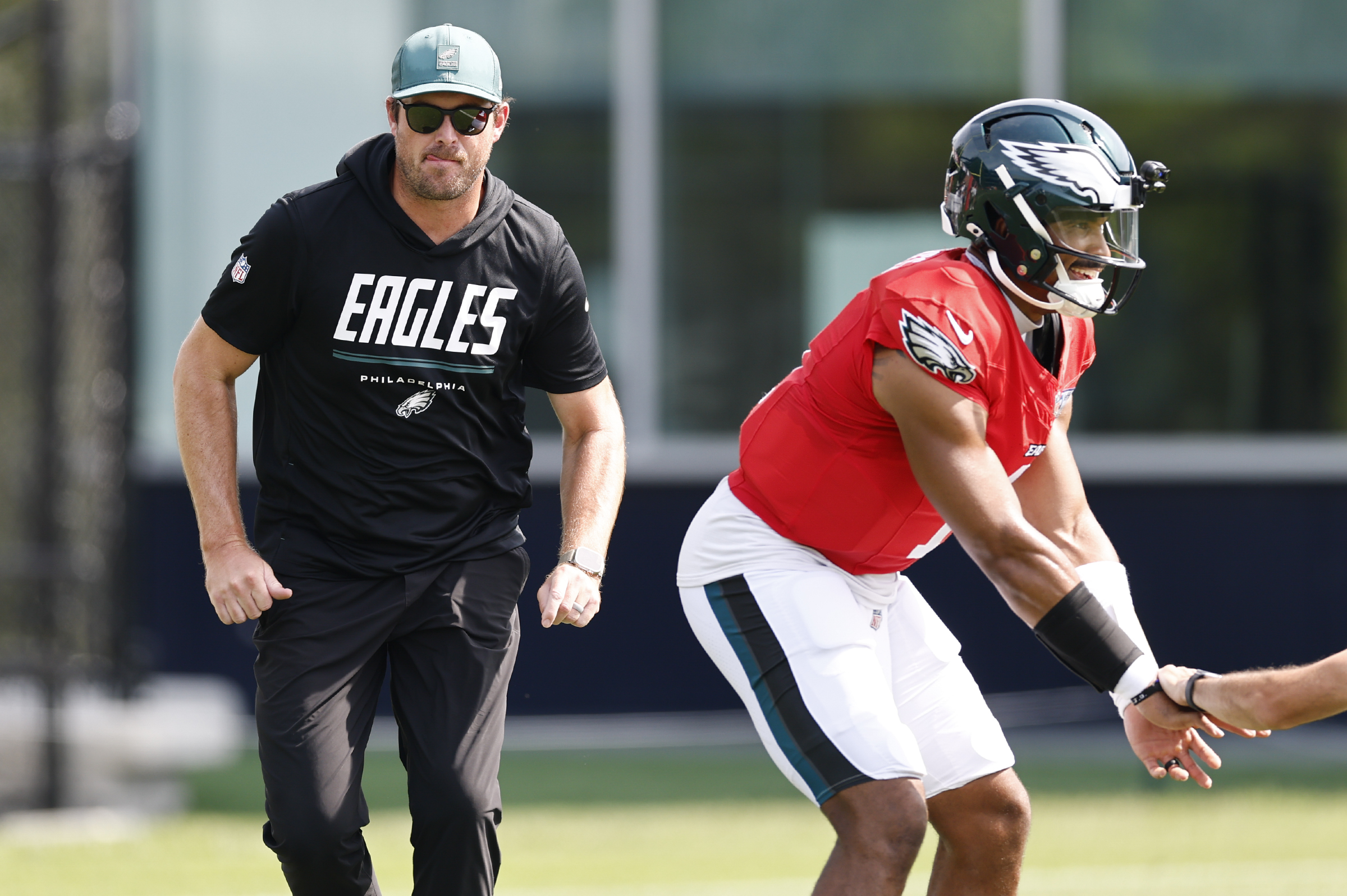
    Eagles offensive coordinator Sean Mannion is in his first year. He is Jalen Hurts’ fifth OC in the last five years.Yong Kim / Staff Photographer

    Believe it or not, Wednesday was technically the Eagles’ final training camp session of 2026. They’ll have a walkthrough on Thursday before playing their final preseason game against the Bengals on Friday night at the Linc (8 p.m., CBS3). Oh, and the deadline for trimming the roster to 53 players is Sunday evening.

    So where is Jalen Hurts, who has not played this preseason, with his command of the new-look offense under first-year coordinator Sean Mannion? In a “good spot,” the quarterback said, a month after saying things the offense was still “calibrating.” Hurts wouldn’t label the offense, but believes that will come from Mannion as they continue to prepare for the Sept. 13 opener against the Commanders.

    “As you see who you have on your team and you begin to progress forward, you hone things down and you say, ‘This is who we are. This is how I want to lead it,’” Hurts said. “So I think that’s where Sean is. And a lot of that is, it’s up for him to mold and put together so in the end, we can go out there and be in the best position to win.”

    Self improvement

    The Flyers need more from winger Matvei Michkov, who struggled to regain his rookie form last season.Yong Kim / Staff Photographer

    While the Sixers rightfully stole most of the offseason headlines with the splashy additions of LeBron James and Jaylen Brown, the Flyers almost made a cannonball-sized of their own. OK, maybe not LeBron-level, but after a surprise playoff run last season, the team tendered a $90 million offer sheet to Ducks star Leo Carlsson. Unfortunately for Flyers fans, Anaheim matched the offer and kept Carlsson on the West Coast, leaving Danny Brière’s offseason haul looking much more mediocre.

    The Flyers, who still landed 19 national TV games this season, added some depth, sure. But the Carlsson offer showed that the organization believes it’s ready to contend again. And their additions don’t necessarily match those ambitions. Instead, Brière and Co. are banking on internal improvements from their own young players (and they have plenty). Here are five they definitely need to take a step forward this season if they hope to recapture the magic from the spring.

    Like father, like son

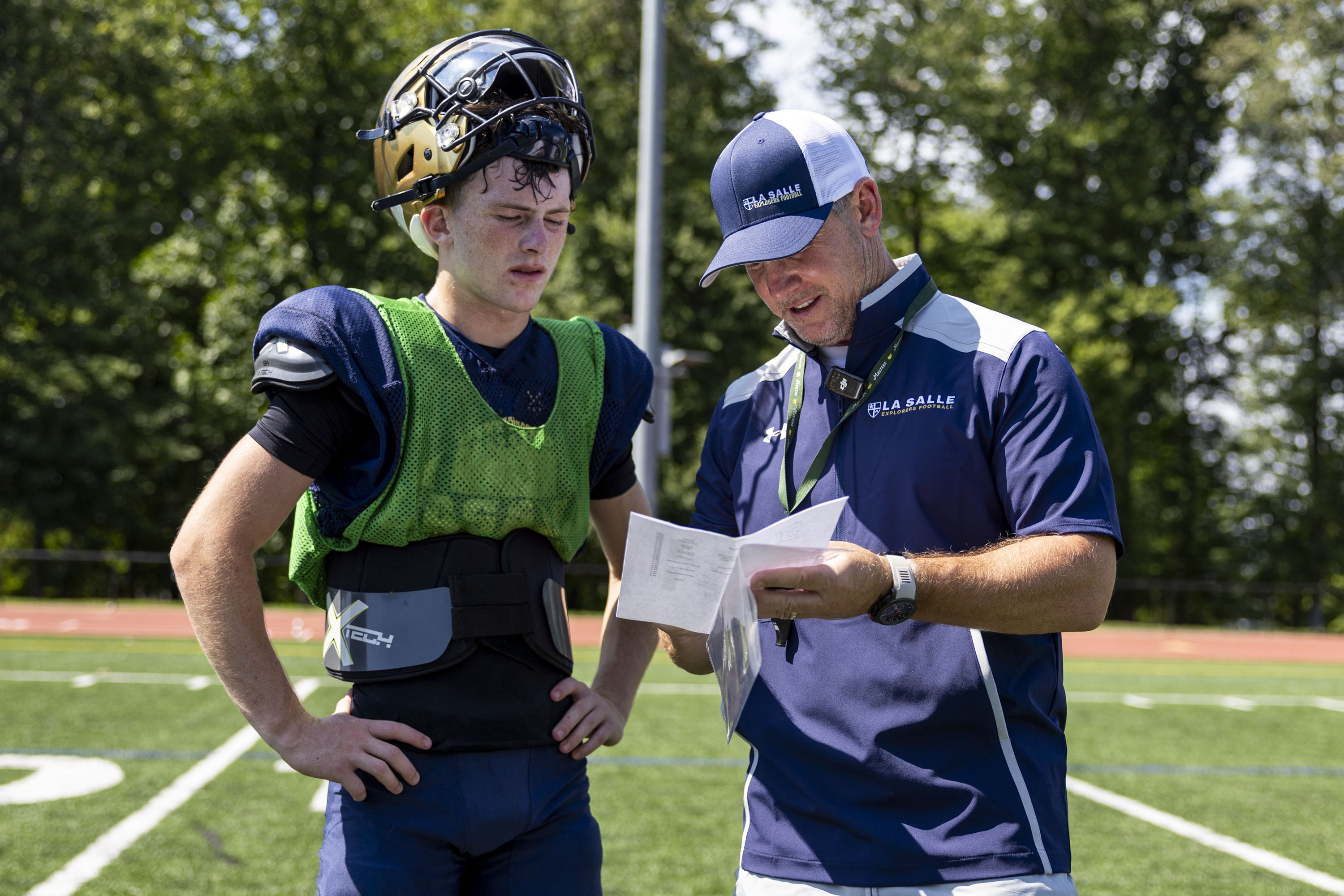
    La Salle College High School football coach Brett Gordon (left) chats with his son, Luke, the team’s starting quarterback.Tyger Williams / Staff Photographer

    Head football coach Brett Gordon is following in his father’s footsteps with the La Salle Explorers, where he took over after the 2023 death of famed coach Drew Gordon. As a teen, Brett played for Drew, then was the offensive coordinator at La Salle.

    Now, a third Gordon is lining up under center for the Explorers: Luke, a junior, and yes, he’s Brett’s son. And the expectations are high — not just because of his last name. The team is coming off a state championship last season, but the majority of their starters graduated, and a tough schedule lies ahead. But the bond between father and son endures.

    Luke’s hope is “to be maybe as good as [his dad] one day. I would love to have an opportunity to go play at some of the schools I could play at,” he said. “His legacy to me is something that I really cherish, and I want to keep carrying the name.”

    Marcus Hayes’ take

    Howie Roseman (left) and Jeffrey Lurie have spent a lot of money on backup quarterbacks in the past, but not this season.Monica Herndon / Staff Photographer

    There’s a battle raging for the No. 2 quarterback position on the Eagles, but Andy Dalton vs. Tanner McKee isn’t inspiring much confidence for columnist Marcus Hayes, who is a bit concerned about the state of the Eagles QB factory.

    “The Eagles used to value the backup quarterback position, perhaps more than any other team in the NFL. Looking at their roster in 2025 and 2026, it’s hard to believe they still do,” Hayes wrote in his latest column.

    “This might not matter at all, except Eagles starter Jalen Hurts gets hurt a lot, and quarterbacks are the most important players in all of team sports.”

    That the team doesn’t have a “viable” backup when there were such options available to them, adds Hayes, is the fault of Jeffrey Lurie and Howie Roseman.

    On this date

    Bobby Abreu hit an walk-off, inside-the-park home run 26 years ago today.Jerry Lodriguss / Staff file

    Bobby Abreu won a Home Run Derby in his career and hit 288 homers in his career, but on Aug. 27, 2000, the former Phillies outfielder did something quite rare: He hit a walk-off, inside-the-park home run, lifting Philly to a 2-1 win over the San Francisco Giants in 10 innings at Veterans Stadium. It was the first of its kind in Major League Baseball since Derek Jeter in 1996. Making the feat even more impressive was that Abreu also scored the Phillies’ only other run — on a solo home run in the sixth inning.

    What you’re saying about your favorite jerseys

    We asked: What’s your favorite jersey that you’ve ever owned?

    “[My] favorite is a green St. Patrick’s Day version of Steve Carlton’s jersey.” — Uri M.

    “The only jersey I have ever owned is a vintage orange Flyers jersey from 1973. My mom surprised me with the jersey, absent the logo. We later found one and my grandmother stitched it on, initially upside down.” — Bob C.

    “My favorite jersey is my kelly green No. 17 Harold Carmichael retro jersey.” — Don R.

    “Brian Dawkins without a doubt, but I have plenty of stuff related to Kelce.” — Bill M.

    We compiled today’s newsletter using reporting from Matt Breen, Jasen Lo, Gabriela Carroll, Ariane Datil, Scott Lauber, Jonathan Tannenwald, Devin Jackson, Jeff Neiburg, Mike Livingston, Olivia Reiner, Jeff McLane, Gustav Elvin, Isabella DiAmore, and Marcus Hayes.

    By submitting your written, visual, and/or audio contributions, you agree to The Inquirer’s Terms of Use, including the grant of rights in Section 10.

    Thanks for reading. Kerith will be back for Friday’s newsletter. — Matt

  • Temple’s linebackers built a tight-knit bond off the field. They’re hoping it helps them on the field too.

    Temple’s linebackers built a tight-knit bond off the field. They’re hoping it helps them on the field too.

    Coming from the roof of Temple linebacker Jordan Montgomery’s North Philadelphia home, sounds of music and general jeering fill the streets. The Owls linebacker room has gotten together for another function.

    It’s become somewhat of a tradition. Every few weeks, the Owls linebackers, headed by captain Eric Stuart, come together to eat, laugh and strengthen the bonds that have extended beyond the football field. And it’s a tradition that reflects the broader culture shift in the program, brought on by coach K.C. Keeler, and one the Owls hope sparks a resurgence on the field.

    “I think the first time we did it was last year for the Super Bowl, at my old crib,” said Stuart, a fifth-year senior. “We just cooked some food and had everybody come over and come eat and just hang out together. That’s how it all started.”

    Said senior Curly Ordonez: “For us, it is just like showing up for your brother, right? You don’t have to come for the whole time. I was one of those, especially last year. I was laid back, pretty quiet, and kept to myself. And it was about bringing people out of their shells. We have a lot of guys that are far away from home, and we can get them some home-cooked meals, which is something we like to do.”

    Continuity is key for the Owls linebackers with 10 returners from last season. Stuart, one of Temple’s most experienced defensive players, anchors a group that also returns 2025’s leading tackler, Ordonez, Tyree Alualu, Jayvant Brown, Wesley Brown, Montgomery, and others. They are joined by newcomers such as Jaylon Joseph and JaMair Diaz.

    “I think it’s just really important for us to be able to coach each other up,” Stuart said. “On the football field, stuff happens; emotions are high. … Every message might not come off in a regular tone, especially to the newer guys. But I feel like especially the guys in our room, we all understand that nobody is coming at you as a person.

    “We’re trying to be better out here, so knowing each other just helps with communication. You don’t get that bickering and fighting, and that is probably the biggest thing we’ve gotten from being so close.”

    Junior Tyree Alualu is one of Temple’s returning linebackers.Isaiah Vazquez / For The Inquirer

    And the cohesion among the Owls linebackers has been noticed from across the field.

    “I’ve never seen a room so close like the linebackers,” said quarterback Ajani Sheppard. “They are always hanging out with each other, always talking to each other. I think it’s such a great thing.”

    The relationships among the linebackers started just over a year ago with the hiring of Keeler and a new staff. Keeler inherited a program coming off four consecutive 3-9 seasons under Stan Drayton and Rod Carey but quickly made a culture shift a priority. Keeler said he met with every player on the roster individually following his hiring. Many players were encouraged to stay, and the coaching staff emphasized that continuity.

    “I would say, just having new coaches,” Ordonez said of the difference. “We had a lot of guys who were new to the team, and last year was one of those years that took us where it went, and I feel like this year, we understood the type of team we had and the guys we have coming and who we are. We obviously got better, and we’ve seen that throughout the spring. So understanding that by getting together we could really be something as a defense. But to be one of the best groups you got to get to know each other, got to hang out, you’ve got to do stuff outside of the city, gain that trust and gain that love.”

    Stuart said, unlike previous years, he wants to be in the facility every day.

    “I would say it’s more of a whole team energy that kick-started it for [the linebackers],” said Stuart. “Me personally, in 2024, [I] just honestly hated being in the facility every day. I didn’t want to be here. I didn’t want to hang out after or spend time with anybody. Then Coach Keeler and the new staff got here, and the energy changed. Like, I feel like everyone wants to be here, everyone comes in, and nobody is getting their stuff just to run out of the locker room and go home. We sit, and we hang out in the locker room. There’s no one in a rush to get out of here. I would say I thought that’s probably the biggest change.”

    The real test of their chemistry awaits on Sept. 5 with their season opener against Rhode Island.

  • The price of diesel, the ‘workhorse’ of fuels, nears a record high

    The price of diesel, the ‘workhorse’ of fuels, nears a record high

    When Randy Madden saw the way diesel prices were rising, he decided to delay purchasing the fuel that powers his 3,000-acre farm in Iowa.

    Except prices are at around the same level as when he made that decision in May.

    Now, going into harvest season, he expects to spend more than $40,000 on fuel — roughly double what he typically pays from late summer through the end of the year.

    “The volatility and the price is coming at a very bad time,” he said.

    The average price of diesel in the United States was $5.62 a gallon Wednesday, 53% higher than a year earlier, according to the AAA motor club. Because fuel supplies were disrupted after the United States and Israel went to war with Iran, diesel prices are now hovering close to a record high and could drive up prices of many other goods and services.

    Diesel powers a vast chunk of America’s economy. It fuels equipment on farms like Madden’s, as well as trains, trucks, and other heavy machinery. As prices climb, businesses often have to pass on that higher cost to their customers.

    “Gasoline is mostly a consumer fuel, used for driving, whereas I would characterize diesel as the workhorse fuel used mostly by the corporate sector and small businesses,” said Daan Struyven, a Goldman Sachs commodities analyst.

    The last time U.S. diesel prices rocketed up was in 2022 after Russia invaded Ukraine, hitting a peak of $5.82 a gallon.

    This is a global crunch

    To understand why diesel prices are rising, it’s important to understand the big picture. There is simply not enough diesel available to meet the world’s needs.

    Refineries produce diesel, gasoline, jet fuel and other fuels by “cracking,” or heating, crude oil. The United States and China have most of the world’s refining capacity, followed by countries such as Russia and India.

    But Russia’s ability to make diesel has been severely hamstrung because Ukraine has damaged many of its refineries. In July, Bank of America analysts said Russian refineries were processing around 3.9 million barrels per day, down from 5.3 million barrels a year ago. That has forced Russia to suspend diesel exports.

    “We estimate that now 40% of Russian refining capacity has been impacted by drone strikes,” said Debnil Chowdhury, who tracks the refining business for S&P Global. “And the reason that that’s important is it’s a global market.”

    The effective closure of the Strait of Hormuz, the narrow waterway through which about a fifth of the world’s crude oil is shipped, has also limited the flow of crude oil, diesel, and other petroleum products. As a result, the global oil price has climbed around 20%, to about $86 a barrel.

    The volume of crude oil refined in the Middle East has dropped to about 8 million barrels a day in 2026, down 1.6 million barrels a day from 2025 levels, S&P Global analysts said in an Aug. 1 report.

    U.S. refineries have made up for some of that shortfall by operating at around 97% of their capacity, according to the Energy Information Administration. Exports of diesel and related fuels are up by around 28% compared with last year, and U.S. inventories of those fuels have fallen sharply.

    Higher prices benefit refineries but hurt buyers

    There’s one clear winner from higher diesel prices: refineries that are still able to sell fuel.

    When oil is trading at a modest $70 a barrel, refineries typically earn $20 to $30 a barrel on the diesel they sell, Struyven said. Now, U.S. refineries are earning close to $90 for every barrel of diesel.

    In earnings reports for the second quarter, firms including Valero Energy and Marathon Petroleum said their profit margins on turning a barrel of crude into fuels have roughly doubled from a year earlier.

    But users like farmers and truckers are hurting.

    Farmers need operating loans every year to cover the cost of equipment repairs, seed, fertilizer, and fuel.

    John Boyd, a founder of the National Black Farmers Association, said many farmers did not budget for bigger expenses when taking out their loans. Higher costs for fuel and other items have strained budgets and driven some farmers he knows to the brink of losing their properties.

    “These are generational farmers going under,” said Boyd, who lives in Boydton, Va.

    The trucking industry has also been affected. Large logistics companies are typically able to pass on all or most of their higher fuel costs to customers, but smaller operators or drivers who operate independently may not be able to do so.

    “It really just eats into your operations because you basically break it out into what is my cost per mile traveled,” said Zach Miller, vice president of government affairs at the Trucking Association of New York. “What’s left over is your profit margin.”

    Producing more diesel won’t be easy

    The last U.S. refinery was built in 1977, in Louisiana, according to the Energy Information Administration. Since then, the industry has mostly invested in existing refineries rather than building new ones.

    Building these hulking industrial facilities takes years and costs billions of dollars. Because refineries are built to operate for many decades, investors want to know that demand for fossil fuels will remain strong for a long time. But nobody can predict demand over the next couple of decades with any certainty given the rise of electric vehicles, including trucks.

    Even if no new refineries are built, the supply of diesel could increase if China decided to export more fuel, Struyven said. But Chinese policymakers have placed restrictions on its refineries since the war began to make sure the country has enough fuel to meet domestic demand.

    While refining capacity growth has slowed in most countries, most of the new growth is now coming from developing countries like India where a new refinery started in July, Struyven said.

    In Nigeria, a major oil producer, the Dangote Petroleum Refinery has recently increased its crude processing capacity by 25% and plans to double its refinery’s total capacity by 2028. It has helped push seaborne petroleum shipments from the country to 350,000 barrels a day in the second quarter of 2026, a jump from an annual average of 46,000 barrels a day in 2023, according to the Energy Information Administration.

    This article originally appeared in the New York Times.

  • Don’t panic over Eagles rookie tight end Eli Stowers. Here’s where he can improve and who he might become

    Don’t panic over Eagles rookie tight end Eli Stowers. Here’s where he can improve and who he might become

    Optimism is generally high this time of year, especially for an Eagles offense that struggled throughout the 2025 season with consistency and continuity. New offensive coordinator Sean Mannion’s offense has shown flashes of encouraging play along with concerning stretches during training camp, but most fans are excited to watch the offense in full when the season kicks off in a few weeks.

    For second-round rookie tight end Eli Stowers, the confidence in his potential role this season seems to be far less positive. He hasn’t been a standout player much this preseason, which has caused some angst among fans.

    As history has shown with mid-round tight end prospects, the range of outcomes is wide, and most have the same thing in common: They required patience and time to adjust to the NFL game. Very rarely over the last five drafts has a tight end taken after the first round made an immediate impact. Those who have, like the Lions’ Sam LaPorta, Cardinals’ Trey McBride, and Packers’ Tucker Kraft, quickly ascended to become major receiving weapons with in-line blocking ability.

    To provide some perspective on what Stowers can ultimately become, here are three buckets the Eagles tight end could fall under at a position that typically requires patience to see the player’s finished product.

    Improved in a key area

    Dawson Knox, Buffalo Bills

    Though Knox and Stowers are different styles of players — Knox was a more rugged run blocker and not quite as explosive of an athlete — they share a similar background. Both were high school quarterbacks who had to learn a new position in college.

    Knox walked on at Ole Miss after missing most of his senior high school season, and didn’t get true tight end reps until his junior season. Stowers switched to tight end just three years ago and is still relatively new to the position.

    What helped Knox see the field early on in Buffalo was the blocking ability he displayed in college, but his key area of improvement has been his reliability in a passing game where he’s averaged 50 targets across his seven-year career.

    Knox’s two highest receiving success rates have come in the last two years, even though his numbers aren’t eye-popping. In Knox, Stowers can see a player that has adapted to the NFL game, and by the Buffalo tight end’s third year — his best statistical season — he became a much more prevalent receiving threat.

    Sam LaPorta, Detroit Lions

    We added LaPorta here because since his rookie season, when he exploded for 889 yards on 86 catches and 10 touchdowns, he has continued to add more to his game — including becoming a more reliable in-line blocker, which was a weakness in college. It even showed up early on in his NFL career, especially with one-on-one blocks against defensive ends.

    LaPorta was limited to nine games last season because of injury — he missed the last eight games with a herniated disk in his back — but showed some progression as a blocker for the Lions.

    Though Brock Wright handled more of the blocking duties, LaPorta, when healthy, has been a dynamic field stretcher and creator after the catch. What Stowers can learn from LaPorta — who also entered the league at sub-250 pounds — is that blocking can be improved, even in the NFL. Stowers likely will not reach the same level of involvement in the Eagles offense as LaPorta had in Detroit as a rookie, though.

    Struggled to block, contributed as part of a rotation

    Mike Gesicki, Cincinnati Bengals

    Among current players, there may not be a closer comparable to Stowers than Gesicki. Both were dynamic receiving tight ends who did their damage in college when split out wide, in the slot, or as off-the-ball tight ends.

    They share another commonality too: struggling to block in one-on-one scenarios against defensive linemen and generating displacement at the line of scrimmage. Gesicki’s best years of production — from 2019-21 — are likely behind him. Since leaving the Miami Dolphins in 2022, Gesicki has averaged about 45% of snaps across his time with the New England Patriots and Cincinnati Bengals.

    The former 2018 second-rounder has been relatively healthy throughout his career, but never improved even marginally as a blocker, which limits how much he can be on the field in the modern NFL.

    Jonnu Smith

    The Philadelphia native, currently a free agent, was best known for his ability to create explosive plays with the ball in his hands, though he has surpassed 600 receiving yards in a season just once. His usage in Arthur Smith’s offenses, first in Tennessee and then in Atlanta, made him a threat to turn a routine play into a big gain after the catch.

    But across his five NFL stops, the one inconsistency of his game has been his blocking. He showed much more promise than Gesicki as a blocker, but Smith has never consistently been able to block as an in-line player, and it’s a big reason he likely has not drawn a ton of interest entering Year 10.

    His last stop, in Pittsburgh last season, produced career-worst numbers in a loaded tight end room: 38 catches, 222 yards for a 5.8 yards per catch average.

    Smith, a former third-round pick, never assumed the top tight end role at any of his stops but has played nearly a decade in the league. He has carved out a niche role as an undersized tight end that is a run-after-catch threat , but he isn’t a fit for every offense as he ages.

    Receiving skills kept them on the field regardless of blocking struggles

    Jared Cook

    When you look up Stowers on Mockdraftable, which draws comparisons to previous players at a position, Cook’s name is his third-highest match at 73.9%, and for good reason. Cook was a nonfactor as a blocker and just not valuable when asked to handle defensive ends and linebackers in those blocking situations.

    When you look back at the receiving numbers, though, he was a matchup problem for linebackers, safeties, and even some cornerbacks. But his success took a while as he struggled early with the Tennessee Titans, but by his third year, he was consistently contributing as a receiver. In the last 10 years of his 13-season NFL career, Cook averaged just over 600 receiving yards and four touchdowns, including a career-best 896 receiving yards in Year 10 with Oakland.

    If Stowers never truly develops as a reliable blocker, a career similar to Cook’s, who was a second-round pick in 2009, would be an ideal outcome.

    Isaiah Likely, New York Giants

    Like Stowers, former fourth-rounder Likely walked into a veteran-laden tight end room as a rookie, and though there was excitement around the Baltimore Ravens tight end early on, his development took time, as did the production. Likely didn’t truly get going until the back half of his rookie season, with 26 of his 36 total catches and 279 of his 373 total receiving yards coming from Week 8 through the rest of the season.

    Blocking in space was a strength for Likely at Coastal Carolina, but translating it to the NFL game as a full-time in-line player has never materialized. It didn’t in Baltimore, with Mark Andrews and later Charlie Kolar taking more of those responsibilities.

    Likely, who signed with the New York Giants in the offseason (three years, $40 million), is best known for his receiving ability, specifically stretching the field vertically. Despite a down season last year, Likely’s greatest abilities are finding soft spots in zone coverage and winning his one-on-one matchups downfield.

    If Stowers can be serviceable as a blocker, similar to how Likely was in Baltimore, that can help the Eagles rookie earn more snaps early in his career.

    Patience, patience, patience

    It’s too early to write off Stowers, even if he isn’t productive in Year 1 in Philly. As we wrote on the night the Vanderbilt tight end was drafted, his true impact could come three or four years down the line. And leaning on previous examples, those breakouts for non-first-round tight ends often happened in Year 3 or 4.

    With Dallas Goedert and Johnny Mundt likely filling the top two roles for the Eagles tight end room, there should be no rush to force Stowers onto the field. The season is long, and should he make an impact in 2026, it’ll likely come deep into the season.

  • A strip club scene was cut from ‘National Treasure’ and other insights from Philly’s celebration of the film

    A strip club scene was cut from ‘National Treasure’ and other insights from Philly’s celebration of the film

    I’ve watched National Treasure more times than I can count and if I could count how many times I’ve seen it, I wouldn’t admit it to you.

    It’s a confluence of things that keep me coming back — the scenes filmed in Philly, Nic Cage taking an absurd plot line very seriously, and the fact that this movie always seems to be on TV. Plus, there’s a quick cameo of my favorite stand in Reading Terminal Market, which closed in 2016, that always makes me nostalgic (RIP Salumeria).

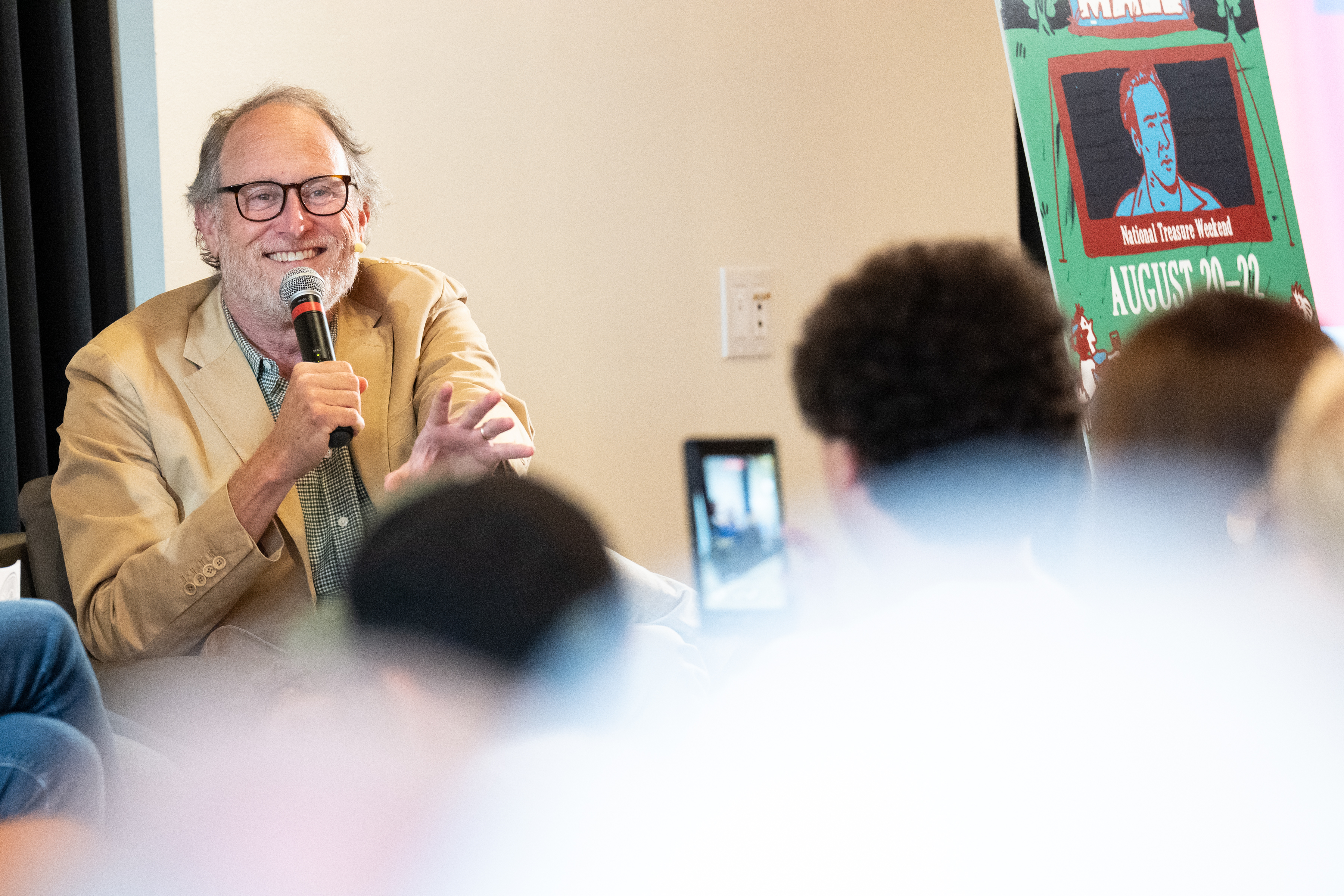
    On Friday, I got to geek out with other fans of the film and its sequel, National Treasure: Book of Secrets, during a ticketed talk with the director of the franchise, Jon Turteltaub, at the Independence Visitor Center. Turteltaub’s other films include Cool Runnings, While You Were Sleeping, and The Meg, which tracks.

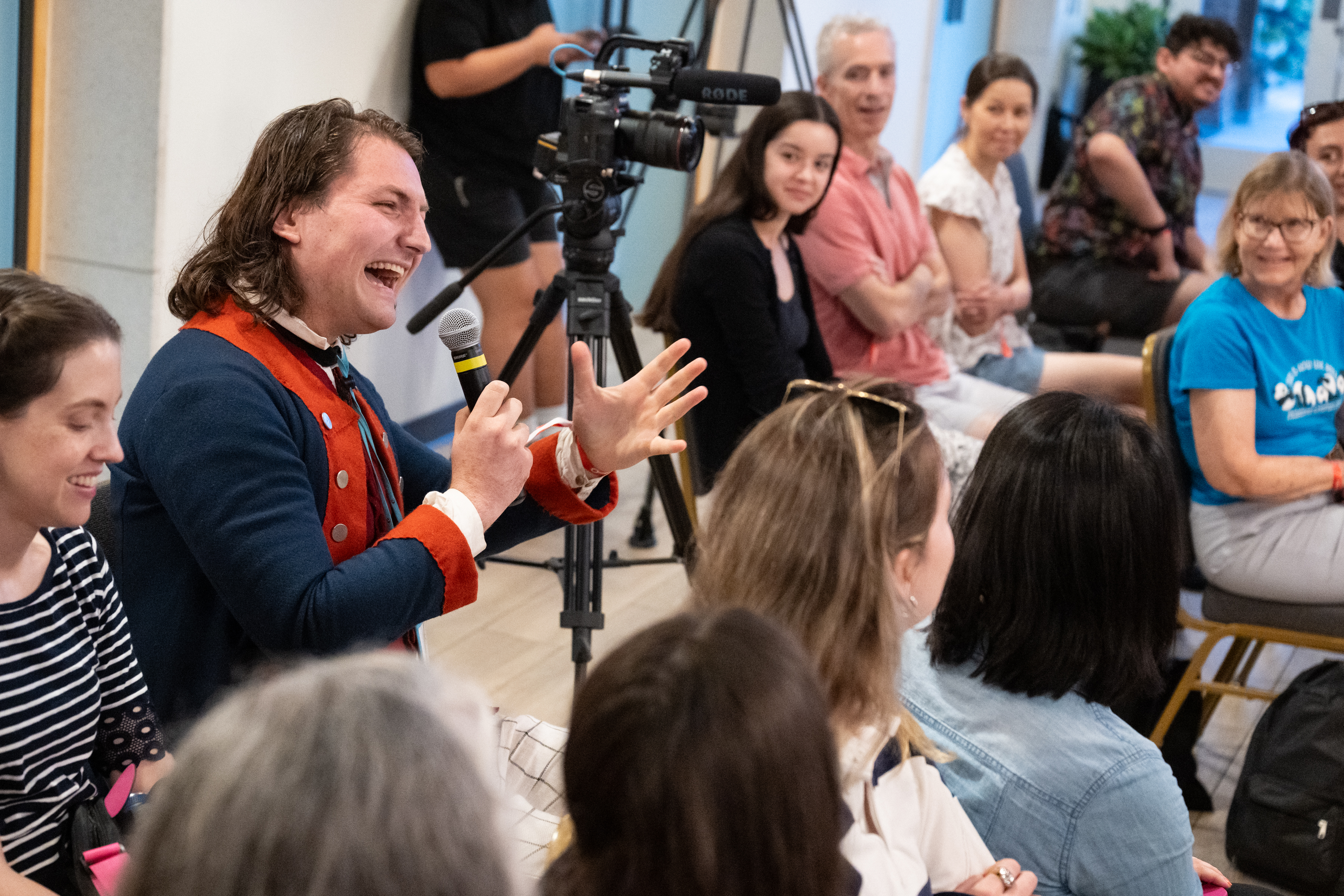
    In the audience were a self-proclaimed “real-life treasure hunter,” several Freemasons, and Philly tour guide Stephen Pierce of Havertown. Pierce came dressed in his finest colonial garb and told me the movie, which came out when he was 9, was “definitely a huge inspiration for me growing up.”

    Stephen Pierce, a local tour guide with America’s Rising Son Tours, asks a question while wearing colonial-era clothing during a live recording of the “National Treasure Hunt” podcast at the Independence Visitor Center in Philadelphia on Friday, Aug. 21, 2026.Erin Blewett / For The Inquirer

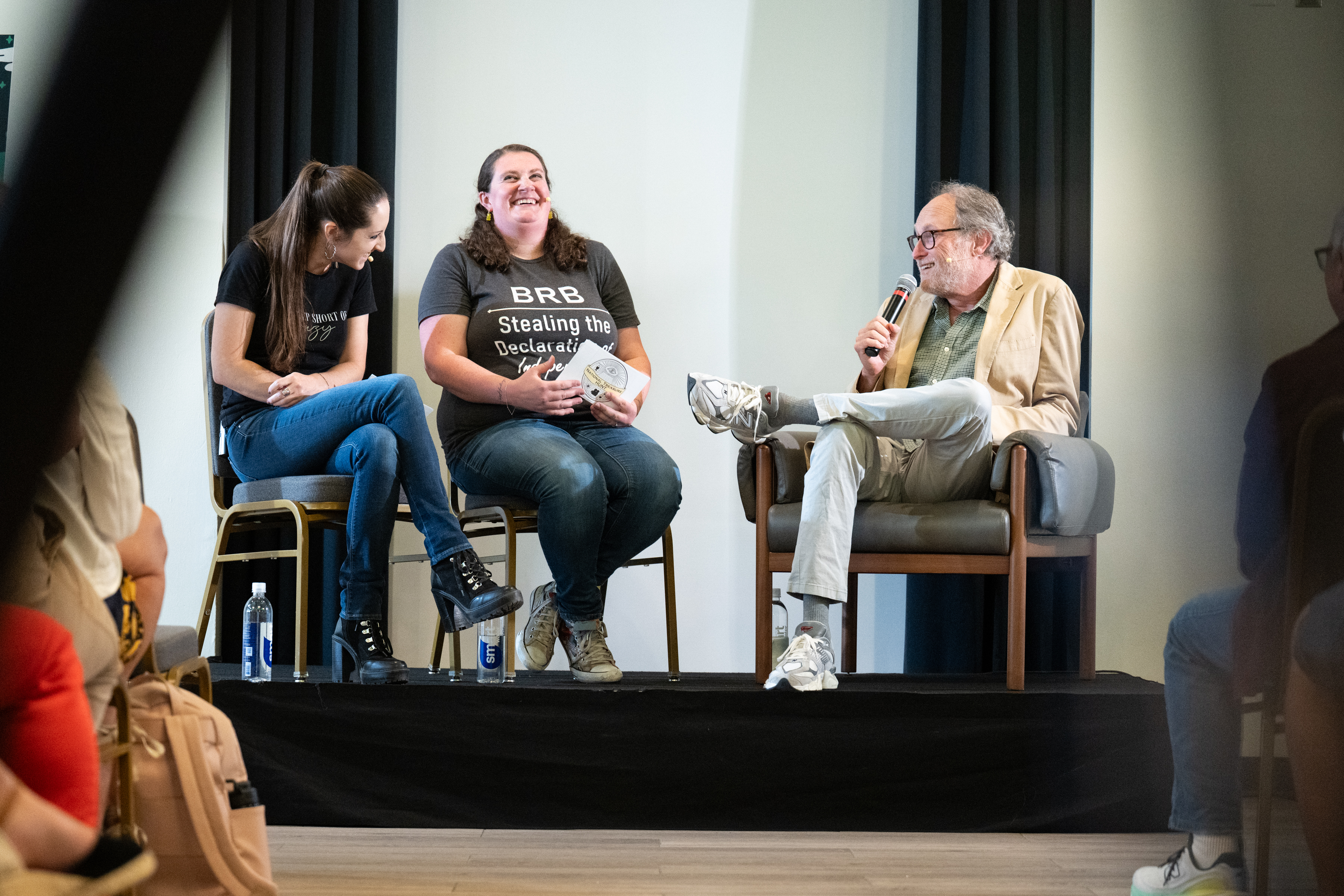
    But there were no bigger fans in attendance than the cohosts and moderators for the evening, Aubrey Paris and Emily Black, creators of the National Treasure Hunt podcast, who helped curate Philly’s first National Treasure Weekend of events in conjunction with the Philadelphia Visitor Center.

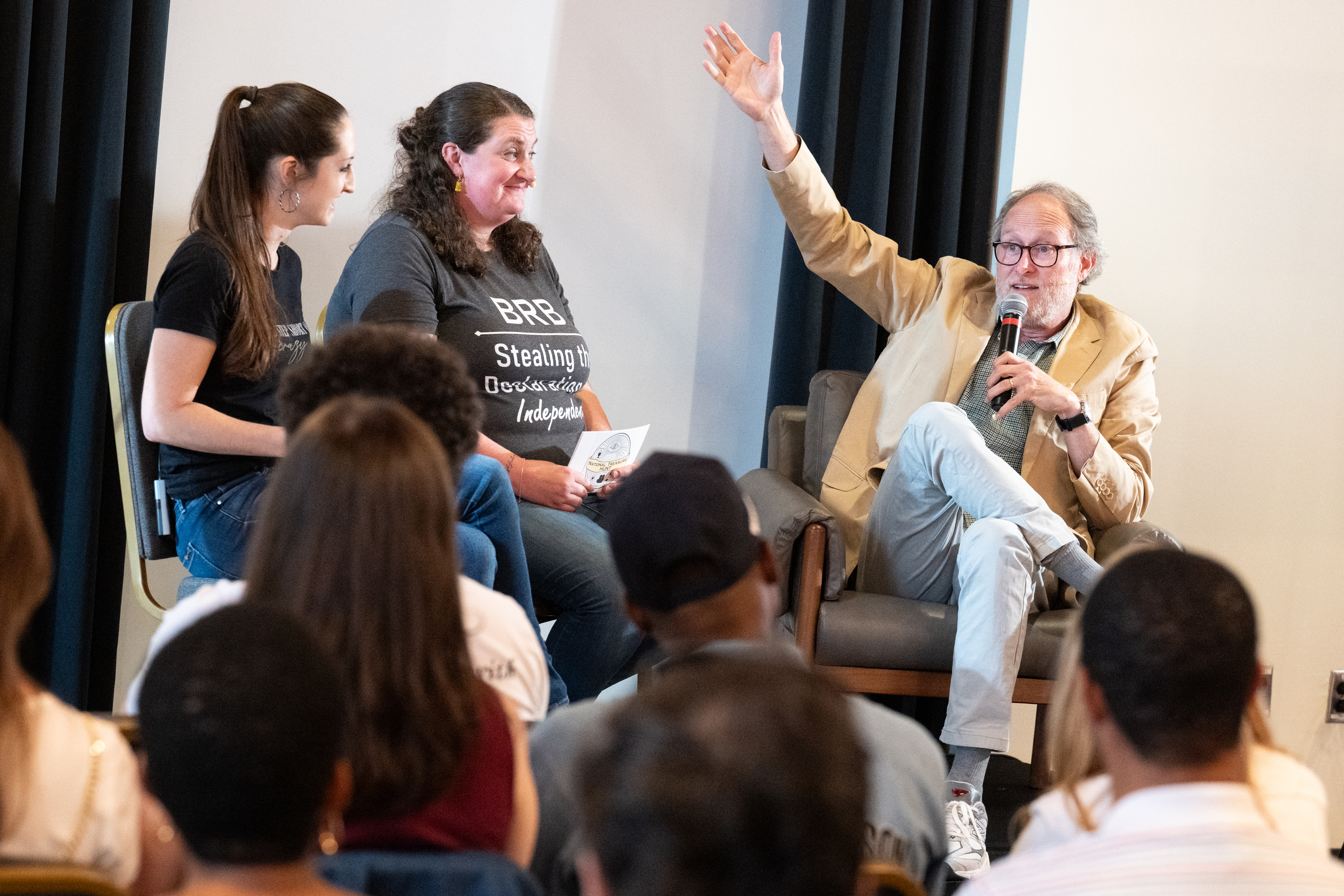
    Aubrey Paris (left) and Emily Black (center), creators and hosts of the “National Treasure Hunt” podcast, speak with “National Treasure” director Jon Turteltaub during a live recording at the Independence Visitor Center in Philadelphia on Friday, Aug. 21, 2026.Erin Blewett / For The Inquirer

    Their palpable joy while interviewing Turteltaub for their podcast was only exceeded by the shock and excitement that washed over their faces when the director gave them the scoop that National Treasure 3 is “finally real.”

    That wasn’t the only gem Turteltaub dropped during their talk, though. Here are five other nuggets and behind-the-scenes stories the director shared about one of the best and most ridiculous films ever partially filmed in Philly.

    All up in Independence Hall

    Turteltaub said he was surprised that the National Park Service let the cast and crew climb up Independence Hall’s bell tower to film.

    “That was special. Being next to the Centennial Bell — amazing. More interesting was being behind the clock, coming up those stairs and seeing how that works was like ‘Wow, this is why I want to be in the movie business,’” he said. “It’s not art. You just get treated better than other people.”

    Visitors stand in a long line on Oct. 12, 2025, in front of Independence Hall waiting to view the nearby Liberty Bell.

    But the NPS didn’t allow filming at the doors or inside the building because it would have impeded visitors’ experience, Turteltaub said. And it was at this point in the conversation I learned there’s a replica of Independence Hall at Knott’s Berry Farm in Buena Park, Calif., which is where the interior scenes of the film were shot.

    So I either need to make a movie or go to California to live out my dream of climbing the bell tower. Duly noted.

    A meaty role

    During the chase scene that winds through Reading Terminal Market, Abigail (played by Diane Kruger) ducks into a butcher stand while clutching the Declaration of Independence. The woman running the counter initially says in the most unenthusiastic, Philly way possible: “If you’re not a steak, you don’t belong here.”

    But when Abigail tells the woman she’s running from her “ex-husband” (who’s actually a bad guy), the woman says: “Honey, stay as long as you like.”

    Pedestrians fill the sidewalk outside Reading Terminal Market in Center City on June 3, 2025.Alejandro A. Alvarez / Staff Photographer

    Paris said that the butcher has become “a favorite non-named character.” Some have even called her “the real national treasure.”

    “It’s a huge cult thing,” Paris said.

    Mark another win for Philly’s notoriously kind-but-not-nice attitude.

    Stripped down

    Turteltaub revealed that the first version of the original film was four hours long, so many scenes had to be left on the cutting room floor, including the original ending.

    “The original ending scene, they were back at the National Archives looking at the Declaration back where it belonged. We thought the world needed to know that,” Turteltaub said. “Everyone’s feeling good and then they get started talking about a different treasure and they go off like, ‘Oh no, I’m not doing that!’ It’s like the end of a Gilligan’s Island episode.”

    Jon Turteltaub, director of the 2004 film “National Treasure,” speaks during a live recording of the “National Treasure Hunt” podcast at the Independence Visitor Center in Philadelphia on Friday, Aug. 21, 2026.Erin Blewett / For The Inquirer

    Another scene that was stripped from the film took place when Abigail and Riley (played by Justin Bartha) are chased through Center City.

    “As Riley’s being chased, he cuts into a strip club and he runs through the strip club to get away,” Turteltaub said. “So my idea was he runs in and no one’s in there and it’s just some guy vacuuming and [Riley] says, ‘Well, that was disappointing,’ and keeps going.”

    I’m disappointed the cleanest scene ever filmed in a strip club didn’t make the cut.

    High school reunion

    Turteltaub and Cage attended Beverly Hills High School together and the director said the two were friends.

    “He’s kind of a great, nonconforming, march-to-his-own drum guy, which in high school is not easy,” Turteltaub said. “I was desperate to fit in and be liked by every single person ever. He didn’t care.”

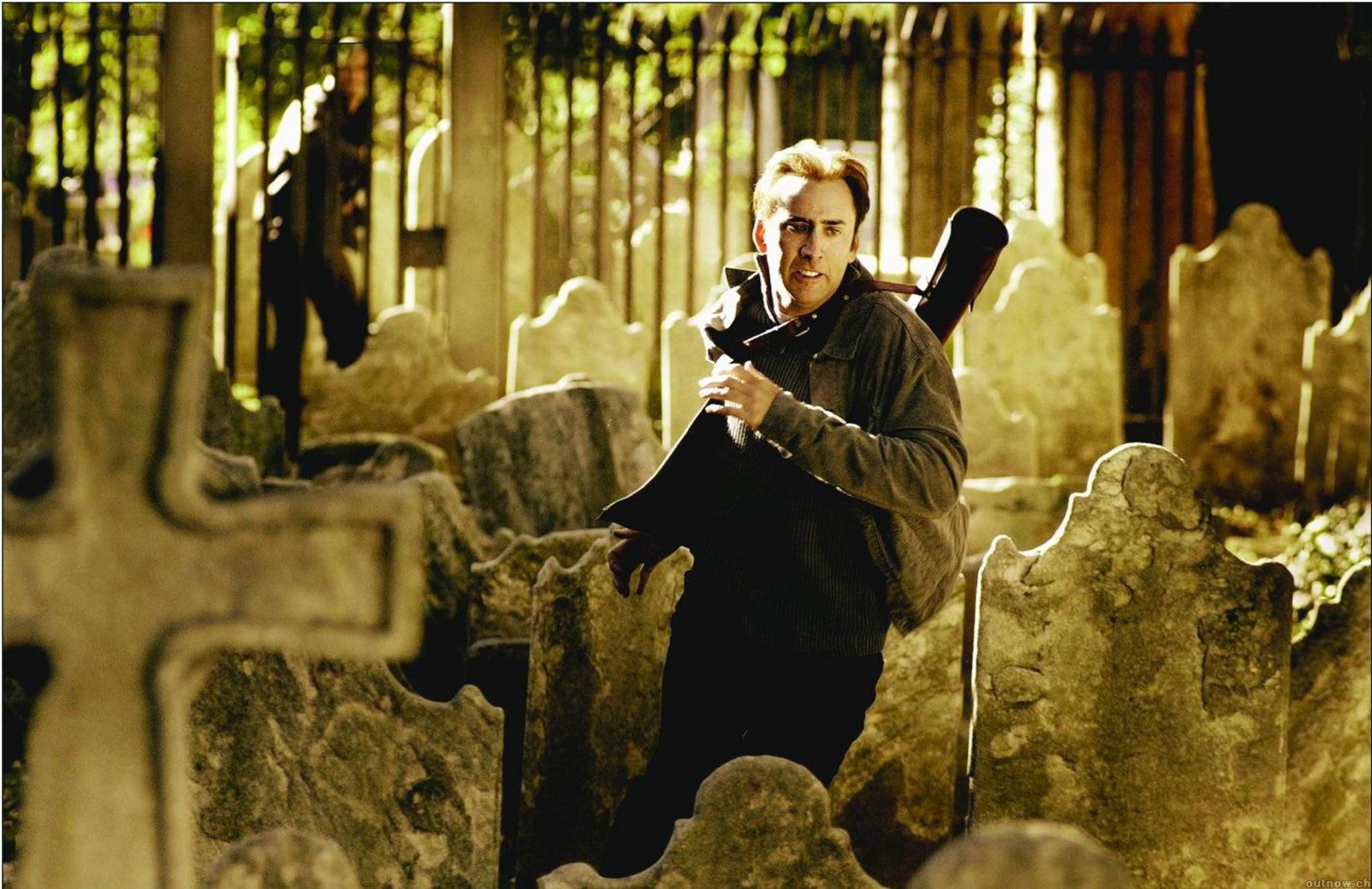
    Nicolas Cage runs through the Old Pine Street Presbyterian Church cemetery in a scene from “National Treasure.”Alamy Stock Photo

    The director said he sold the actor on taking the part of Benjamin Franklin Gates in National Treasure when he described the character to Cage with one word: audacity.

    “Nic is audacious and that was that connection. Nic never has a superficial connection to a character. He goes and finds the person,” Turteltaub said. “Sometimes that’s insane stuff and craziness and awesomeness and unpredictability and sometimes it just makes somebody very, very real.”

    Page turner

    During audience questions at the end of the talk, a child of no more than 6 asked Turteltaub: “What’s on page 47?” to thunderous applause from the crowd.

    The question referred to the end of the sequel film, when the President of the United States asks Gates what he thinks of what’s on page 47 of the book of secrets handed down from president to president. Gates calls what’s contained on the page “life-altering,” but its contents are never revealed to the audience.

    It may not be a secret for much longer, though.

    “The worst thing, to make it interesting, was we added the line at the last second — ‘life-changing, life-altering’ so now we have to come up with something that’s ‘life-altering,’” Turteltaub said. “If I said ‘I don’t know,’ everyone will hate me. If I said ‘I do know,’ you’ll hate me for not telling you, but I don’t think we can make the third movie without at least helping people out.”
    Aubrey Paris (left) and Emily Black (center), creators and hosts of the “National Treasure Hunt” podcast, speak with “National Treasure” director Jon Turteltaub during a live recording at the Independence Visitor Center in Philadelphia on Friday, Aug. 21, 2026. The event was part of Philadelphia’s first National Treasure Weekend.Erin Blewett / For The Inquirer
  • Olivia Li is one of the Curtis Institute’s most promising new students. She’s 7 years old.

    Olivia Li is one of the Curtis Institute’s most promising new students. She’s 7 years old.

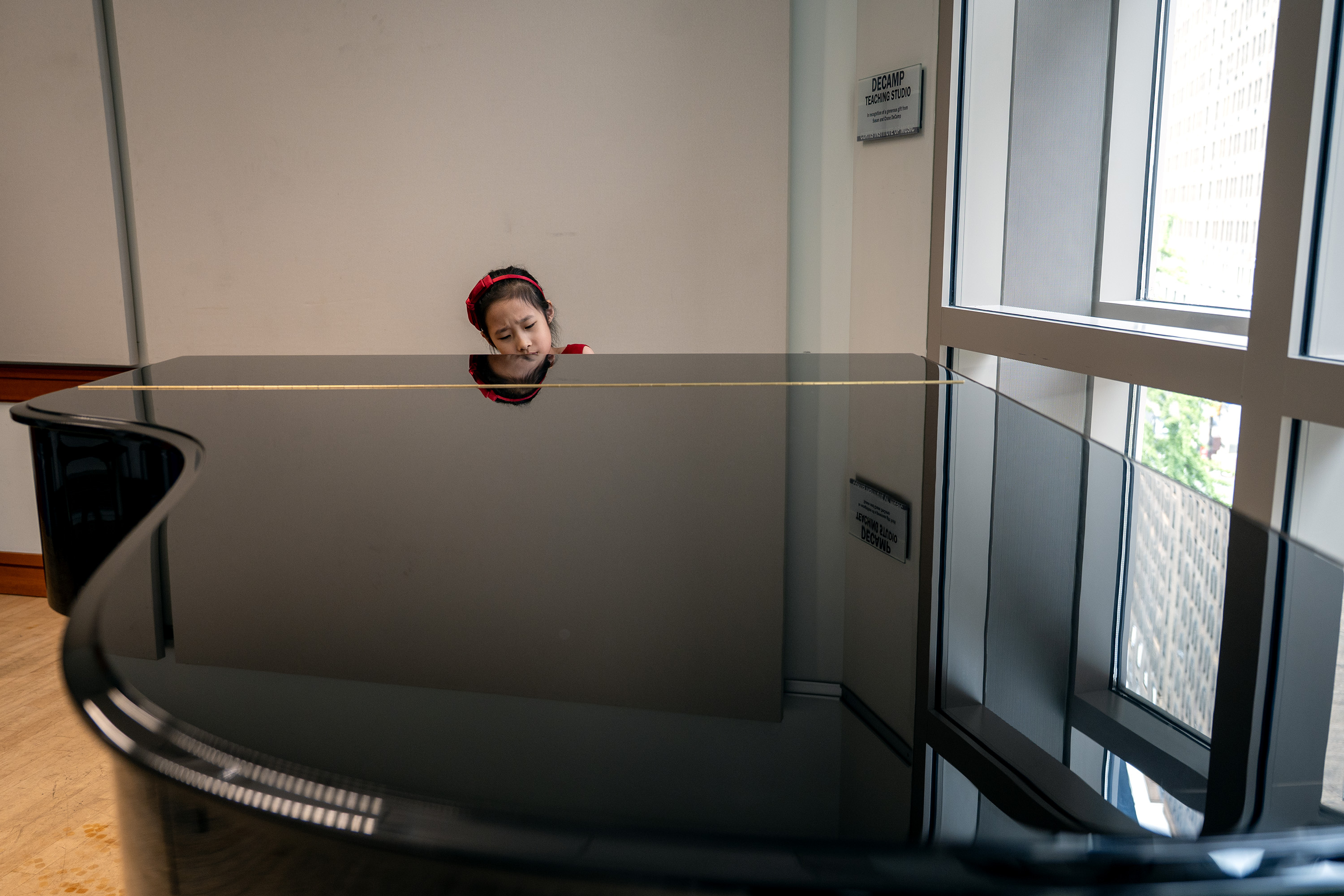
    In the lobby of the Curtis Institute of Music’s Lenfest Hall, Olivia Li, in a frilly-sparkly red dress, is running back and forth through a turnstile. A few minutes later, she is at the piano transformed — playing Chopin eyes closed, a countenance most serious, and seemingly a decade more mature.

    If her legs aren’t long enough for her feet to reach the piano’s pedals without an extender, give her time. She is 7 years old.

    Olivia is one of nearly four dozen new students now arriving at Curtis for the fall term. The school on Rittenhouse Square, one of the world’s top music conservatories, has always had its share of young talent. This year it will have 13 musicians entering school under the age of 18.

    But even at a place known for prodigies, Olivia is unusual. She is believed to be the youngest student to study at Curtis since 1950, when 6-year-old violinist Diana Halprin matriculated.

    Olivia Li, 7, plays the piano in a rehearsal room at Lenfest Hall at the Curtis Institute of Music.Tom Gralish / Staff Photographer

    “I was actually preparing for Juilliard,” Olivia said, “but my teacher said I could try for Curtis, and I just did. I didn’t expect I would get in.”

    She got in. Juilliard, too.

    Asked why she chose Curtis, she said, simply, “I just like Curtis better than Juilliard.”

    Michelle Cann, one of two professors with whom Olivia will study at Curtis (the other is Ignat Solzhenitsyn), says that the young pianist has “phenomenal fingers.” Then again, so did others who tried out for the school and did not get in.

    (function(){function e(){window.addEventListener(`message`,function(e){if(e.data[`datawrapper-height`]!==void 0){var t=document.querySelectorAll(`iframe`);for(var n in e.data[`datawrapper-height`])for(var r=0,i;i=t[r];r++)if(i.contentWindow===e.source){var a=e.data[`datawrapper-height`][n]+`px`;i.style.height=a}}})}e()})();

    For the current school year, Curtis received 154 applications to the piano department, a spokesperson said. Sixty-three of those auditioned live in the first round and 15 advanced to the finals. Four were eventually accepted.

    What set Olivia apart in her audition, Cann said, was “how musical she was and how much personality and character about the music-making she had that you don’t expect to see in a 7-year-old. It just stood out so much.”

    Seven-year-old pianist Olivia Li rushes down the stairs of Lenfest Hall at the Curtis Institute of Music on Monday, Aug. 17, 2026. She began studying the piano at age 4 and will receive a full-tuition scholarship to the prestigious institution.Tom Gralish / Staff Photographer

    The sole criterion for admission at Curtis is artistic promise, said provost and dean Nick DiBerardino. “It’s rare for someone as young as Olivia to have won a place at Curtis,” he said, “but it does happen, and when it does, it’s because there was something really special happening at the piano.”

    Curtis has had students younger than Olivia. The school is still in the process of reviewing its records, but to the best of its knowledge the youngest was pianist Ruth Slenczynska, who was 5 years and 2 months old when she arrived in April 1930. She stayed just a few weeks.

    The youngest to come and stay was Sol Kaplan, who was 5 years, 7 months when he began studies in 1924, the year Curtis was founded; he went on to compose music for episodes of the original Star Trek TV series and a slew of movie scores.

    Olivia Li is one of the youngest students to study at the Curtis Institute of Music.Tom Gralish / Staff Photographer

    Olivia is in exceedingly rare company. More than 4,000 composers, conductors, vocalists, pianists, and other instrumentalists have graduated from Curtis in its century-plus existence. Only 13 other students were under the age of 10.

    She comes to Curtis from East Williston, Long Island, N.Y. No one in her family is particularly musically inclined, said her mother, Yanan Zhang, who did study piano as a child and continued to play a bit on a digital piano the family had at home.

    “She just naturally started,” said Zhang of Olivia’s attraction to piano. “She saw me playing, and we hired a teacher to come to home once a week to teach her. So initially it was just for fun.”

    Olivia started studying with a teacher — a Yale and Juilliard graduate — who gave her “very systematic training. So from that time, we took the learning seriously,” Zhang said.

    The teacher told Zhang that Olivia learned fast and had strong fingers.

    Seven-year-old pianist Olivia Li in the lobby of the historic 1726 Locust St. mansion at the Curtis Institute of Music on Monday, Aug. 17, 2026. She began studying the piano at age 4 and will receive a full-tuition scholarship to the prestigious institution.Tom Gralish / Staff Photographer

    “I think he told me several times that she is outstanding, but I didn’t really take it seriously. I thought it’s just encouragement from teachers — that’s how they encourage kids, encourage parents.”

    Olivia was 4 when she started piano, and despite her quick progress, it did not occur to Zhang for a while that there was anything unusual about her daughter.

    “I just thought maybe that’s how all kids do.”

    Olivia, of course, is not like other children, and she won’t be like her fellow students at Curtis, either.

    While students are taking coursework during the day covering music theory and history, Olivia will be attending third grade at Germantown Friends School. After her normal elementary school day, she will go to Curtis for two hours of piano lessons per week and receive individualized instruction in other areas like ear-training, music history, and repertoire studies.

    Olivia Li walks toward the entrance to 1726 Locust St., the one-time mansion that is home to the Curtis Institute of Music.Tom Gralish / Staff Photographer

    Curtis requires students under the age of 18 to live with a parent or guardian, and so Zhang, who works remotely for a bank in risk management, has moved to Philadelphia and set up house locally. Olivia has a younger brother, who loves music but has not yet taken up an instrument.

    How does a 7-year-old integrate socially at a school where some students will be three times her age?

    “We haven’t had a 7-year-old [recently],” DiBerardino said, “but our undergraduate students are very accustomed to playing music with younger people and making a deliberate effort to make them feel welcome.”

    Olivia LiTom Gralish / Staff Photographer

    Some socializing will happen organically, DiBerardino said, but “we do have some structures in place to try to help with that process. We have a dedicated work study program for our undergraduate students who are trained by our student services team to be mentors or big brothers or big sisters. And we regularly check in on students like Olivia. So Olivia definitely would have that support.”

    Outside of practicing, Olivia likes drawing, writing, math, and swimming.

    “When she’s not practicing, she reads a lot,” Zhang said. “She holds a book when she is brushing her teeth.”
    “I like to read fiction,” Olivia said.

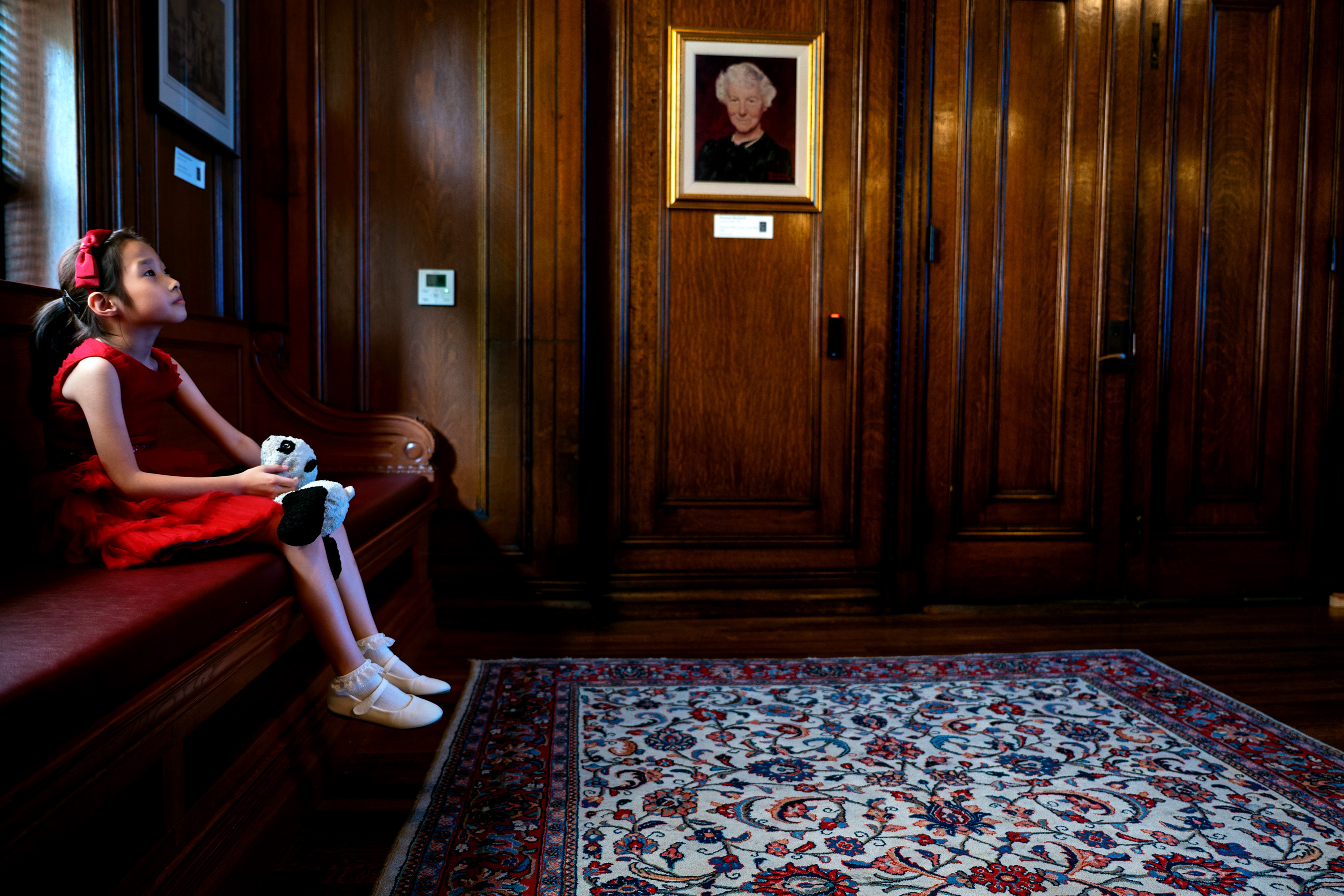
    With a Norman Rockwell portrait of Curtis founder Mary Louise Curtis Bok Zimbalist nearby, 7-year-old pianist Olivia Li sits with her stuffed panda.Tom Gralish / Staff Photographer

    Curtis does not have a separate precollege program the way some other music conservatoires do. Olivia won’t be enrolled in a bachelor’s program, but, rather, a diploma program.

    Several forks in the road lie ahead. She could end up continuing at Curtis post-high school, enrolling in the bachelor’s degree program. That means she could end up being at Curtis well over a decade, a prospect that has some Curtis professors joking that they will be retired by the time she graduates.

    Olivia could also decide at some point that she has gotten what she needed from Curtis and move on to another conservatory or music school.

    Asked whether she would like to be a professional pianist, Olivia said she doesn’t know yet. She is also interested in conducting, “because you get to, like, conduct a whole orchestra.”

    Olivia could also decide that music isn’t where she wants to end up. “We don’t know if at some point she’ll say, ‘I don’t want to do this with my life.’ Who is supposed to know that at 7?” Cann said.

    Zhang said she doesn’t have any thoughts on the matter.

    For now, the artist herself seems content to let the endgame play out. She has plenty to do in the meantime. Of what she wants from a Curtis education, she said:

    “I hope that I can play piano really good and learn a lot of pieces and share my music with the world.”

  • The Flyers are banking on internal improvements being enough in 2026-27. Here are five players they need to step up

    The Flyers are banking on internal improvements being enough in 2026-27. Here are five players they need to step up

    The Flyers’ offseason was highlighted by the massive acquisition they almost made rather than any of the moves team completed.

    After catching lightning in a bottle last spring and riding that wave all the way to the second round of the playoffs, the Flyers went for broke this offseason — almost literally — by tendering a $90 million offer sheet to budding star Leo Carlsson. While the bold act firmly announced the Flyers’ ambitions and eagerness to become a contender again, it ultimately fell flat as the Anaheim Ducks matched the offer and retained their prized youngster.

    Not landing Carlsson means the Flyers’ offseason, at least to this point, has amounted to upgrading the backup goalie spot with Joseph Woll, adding a bottom-pair bruiser in Simon Benoit, and bolstering the fourth line with 34-year-old Noel Acciari. Nice depth adds, sure, but hardly the needle-movers you’d expect for an up-and-coming team looking to build on the momentum from its first non-COVID playoff run in eight years.

    Instead, general manager Danny Brière and the Flyers are banking on internal improvements from young players being enough for the Flyers to repeat — or better — last year’s success in what should be an improved Metropolitan Division that already includes the Stanley Cup-winning Carolina Hurricanes. Will that gamble pay off? Here are five players the Flyers will need more from if they are to avoid taking a step back.

    1. Matvei Michkov, RW

    No surprise here. Michkov will be looking to rebound from a sophomore season that saw him start slow, face public criticism for his conditioning, and clash with coach Rick Tocchet. Michkov’s play was markedly better post-Olympic break — 22 points in 26 games — but he struggled mightily in the playoffs, culminating with him being benched for the Flyers’ playoff finale.

    Michkov expressed in May that he wasn’t happy with his season overall and acknowledged that he needed to work harder this summer. To his credit, it appears he’s followed through. He was spotted on the ice in Voorhees the day after exit interviews and participated in a renowned summer training group in Russia with NHL players like Artemi Panarin. He looks considerably leaner based on pictures that have surfaced on social media in recent months.

    When you consider the 21-year-old finished with 20 goals and 51 points in a down year, with a better offseason of training and added motivation, the sky really seems to be the limit for the Russian winger. Brière, Tocchet, and Co. are expecting a “vengeance tour” from Michkov in 2026-27 as they seek a second consecutive playoff berth.

    2. Jamie Drysdale, RHD

    After a couple of underwhelming years split between Anaheim and Philadelphia, Drysdale took a major step forward last season and flashed glimpses of the skill set that made him the No. 6 overall pick in the 2020 draft. But is there even more meat on the bone?

    Drysdale’s biggest progression last season came defensively, as he cleaned up some of his poor habits and became a more reliable defender. He improved his plus-minus from minus-32 to minus-3 and set career highs in average ice time (21:33) and goals (eight), while also equaling his career best of 32 points.

    With a sturdier defensive foundation and a new four-year, $26 million contract to boot, the Flyers will hope a more confident Drysdale can take another step offensively and channel his effortless skating and puck-moving ability into increased production. While many expected the Flyers to add a proven power-play quarterback this summer to address the last-ranked unit, the team did not, meaning Drysdale likely will get the first crack at the point. The Flyers will need to click at a much higher rate than 15.7% with the man-advantage if they are to remain a playoff contender, and Drysdale grabbing the PP1 job with both hands would go a long way toward that aim.

    3. Porter Martone, RW

    After a banner collegiate season at Michigan State, the 2025 first-round pick didn’t miss a beat once he signed with the Flyers on March 29. Martone racked up six goals and 15 points in 19 games (including playoffs) down the stretch and, at 19 years old, was consistently among the Flyers’ most noticeable skaters during the postseason.

    While the burgeoning power forward is still just scratching the surface of his immense potential, he showcased the skill set and moxie of a player who looks destined for stardom. The question now will be how quickly Martone can make that leap to become a top-of-the-lineup player and whether that can be as soon as this season.

    Rookie Porter Martone, 19, has bona fide star potential and doesn’t seem like someone who gets daunted by the moment.Yong Kim / Staff Photographer

    The Flyers will be wary of heaping too much pressure too soon on the teenager, but Martone looks to have the broad shoulders and mental makeup to handle it. Given Martone’s pedigree as one of the top prospects in all of hockey — The Athletic ranked him No. 3 — the Flyers see having him for a full 84 games as one of their most obvious avenues toward improvement.

    4. Tyson Foerster, LW

    Amid Dan Vladař’s breakout season, Trevor Zegras’ resurgence, all the drama surrounding Michkov, and the late-season Martone hype train, it was easy to forget that the Flyers played most of last season without one of their top players in Foerster. To make matters worse, the 24-year-old’s arm injury came right as he looked to be breaking out.

    Flyers winger Tyson Foerster missed 39 games last year after injuring his arm on a one-timer in early November.Yong Kim / Staff Photographer

    With 11 goals in 21 games before his injury, on the heels of nine in nine to conclude 2024-25, Foerster was quietly playing at a 40-goal pace for the first quarter of the 2025-26 season. The Flyers rewarded him handsomely this summer with an eight-year, $56.8 million extension that will keep him in Philly until 2035. Now Foerster, who is also one of the top defensive wingers in the league, will need to prove he can live up to his contract and stay healthy, the latter being something he has struggled with to this point of his career.

    Foerster has the shooting release to become a consistent 30-goal scorer in this league and should provide a major boost for an offense that ranked 21st in goals last season. If all breaks right, could he even become the Flyers’ first 40-goal scorer since Jeff Carter in 2009?

    5. David Jiříček, RHD

    The Flyers are going to need a young blueliner to take a major step forward in 2026-27, and the likeliest candidates are Jiříček and Oliver Bonk. Jiříček, who turns 23 in November, will probably get the first chance, given he is almost two years older and, more importantly, no longer waiver-exempt.

    Acquired from Minnesota at last year’s trade deadline for Bobby Brink, the 2022 sixth-overall pick is on his third team and is looking to revive his once-promising career. Blessed with great size at 6-foot-4, puck-handling ability, and a booming shot, Jiříček is a worthy gamble for a Flyers team that lacks a true high-end offensive defenseman in its pipeline. The team can also point to its strong recent track record with reclamation projects like Zegras, Drysdale, and Vladař as a reason for optimism.

    The Flyers were patient with Jiříček last season as they sent him to the minors to have him rebuild his defensive game and learn the team’s style of play. Now, he will get a chance in training camp to show he’s made the necessary improvements and is finally ready for a full-time NHL role. Jiříček projected as a power-play quarterback when he entered the league, and given the Flyers’ persistent struggles in that area, he should be another option there given his big shot from the point.

    “The potential is high … 21-, 22-year-old, 6-foot-4 defensemen of his caliber are tough to find,” Brière said after acquiring Jiříček in March. “We know we have to work with him. … But that’s why I go back to the Jamie Drysdale learning curve. That gives us hope that he can get on the same track and eventually become a difference-maker for us.”

    Long fans of David Jiříček going back to his draft year, the Flyers believe they can get the best out of the toolsy defenseman.
  • The Slinky became a toy craze in 1945 and has sold millions of pieces. It all started in Philadelphia.

    The Slinky became a toy craze in 1945 and has sold millions of pieces. It all started in Philadelphia.

    Philadelphia Navy Yard mechanical engineer Richard James was experimenting with a torsion spring in 1943 when the coil tumbled from his desk and landed on a stack of books.

    The spring didn’t just sit there. The top coil flipped over onto the next book. Then the back coil flipped over to the next book. Before he knew it, this newfangled thing was taking the hardcovers like stairs.

    Fascinated, James went home and showed the new toy to his wife, Betty.

    She was enthralled and named the metal thingamajig a Slinky because of its wavy, stealthy movement.

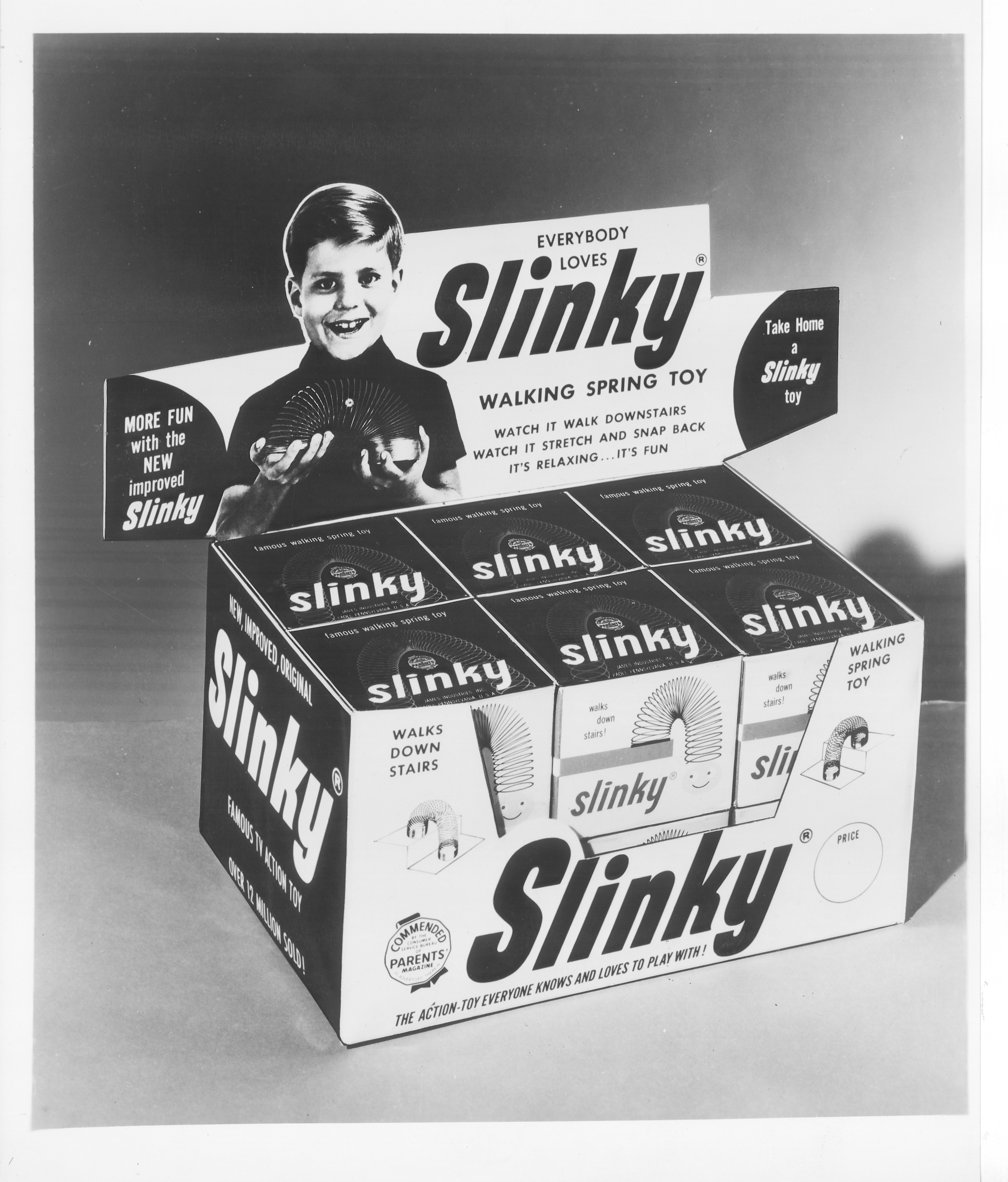
    A vintage Slinky display.

    James finagled with the metal spring for about two years, perfecting its flip-flop down-the-stack movement. Finally, on Nov. 27, 1945, the Jameses brought 400 Slinkies to Gimbels at Eighth and Market Streets, debuting them to shoppers. The whole lot sold out in 90 minutes for $1 a piece.

    A toy craze was born.

    This Saturday, the Philadelphia Historic District will host a “Firstival” to fete the Slinky at the American Philosophical Society from 11 a.m. to 1 p.m. The society’s archives house the 1953 study “On Slinky: The Dynamics of a Loose, Heavy Spring” by British mathematician and oceanographer Michael Longuest-Higgens.

    Firstivals are weekly day parties celebrating America’s 250th birthday. This week’s Firstival is the 35th.

    After the roaring success at Gimbels, Richard James quit his $50-a-week gig at the Navy Yard and founded James Industries, manufacturing Slinkies from a Germantown warehouse. Each Slinky was made from 80 feet of steel on a machine that James invented. It took 10 seconds to make each Slinky.

    Jen Procacci’s No. 1 features the original blueprints of the Slinky design, commemorating one of America’s most-beloved toys.Jenn Procacci for Colibrí Workshop

    Slinkies, considered the first toy craze, predating Cabbage Patch Kids, Tickle Me Elmo, and Beanie Babies, were so popular in the 1940s that Macy’s stopped selling them for a bit because the swarming crowds created a fire hazard.

    In the early 1950s, published reports said the Jameses were making more than $1 million a year. James denied those reports in a 1950 Inquirer article but admitted to making “solid profits.” By the end of the decade, the Jameses’ Slinky operation had moved to manufacturing facilities in Clifton Heights and Paoli.

    The couple divorced in 1961.

    Richard James became a missionary in Bolivia, leaving his wife to manage the business and their six children. Betty James moved her children closer to family in Hollidaysburg, Pa., and commuted to the Philadelphia area for three years before moving the company closer to home in 1964.

    In 1962, Betty James launched an aggressive television campaign to build awareness and increase Slinky sales. Songwriters Homer Fesperman and Charles Weagley wrote the unforgettable, now-iconic Slinky jingle.

    “It’s Slinky, it’s Slinky. For fun it’s a wonderful toy.

    It’s Slinky, it’s Slinky. It’s fun for a girl or a boy.

    It’s fun for a girl or boy!”

    The Slinky dog became a party trick. People wore Slinky glasses. Plastic Slinkies were introduced to the market.

    The Slinky was everywhere.

    “During the Vietnam War, soldiers used Slinkies as portable radio antennas,” said Zach Delphais, the public relations manager for Just Play Products, the Bucks County-based brand that owns Slinky today.

    Betty James sold Slinky to Michigan-based Poof Industries in 1999.

    In this Jan. 18, 2001, photo, Betty James, retired president of James Industries, plays with a Slinky. She died in 2008.AP

    In 2001, Betty James, then 84, was inducted into the Toy Industry Hall of Fame. At that time, more than 250 million Slinkies had been manufactured from hundreds of thousands of tons of steel.

    Betty James died in 2008 at age 90.

    In 2020, Just Play acquired Slinky at auction.

    Today, Just Play makes about 3 million metal Slinkies a year. They sell between $3 and $4 a piece.

    “Slinky has lasted because it’s simple, it’s iconic, and every generation has connected with it,” Delphais said. “It started right here in Philadelphia. That makes it all the more meaningful.”

    This week’s Firstival is Saturday, Aug. 29, from 11 a.m.-1 p.m., at the American Philosophical Society, 104 S. Fifth St.

    Each week, The Inquirer is highlighting a “first” from the Philadelphia Historic District’s 52 Weeks of Firsts. A “52 Weeks of Firsts” podcast, produced by All That’s Good Productions, drops every Tuesday.