U.S. intelligence officials were skeptical of an Iranian assassination threat against President Donald Trump that was relayed by Israel and prompted an extraordinary clandestine maneuver that saw him secretly fly out of Turkey in an alternate military aircraft, current and former U.S. officials familiar with the intelligence said.
The assassination threat was relayed by the Israeli government to the CIA, where analysts did not view the intelligence as compelling and conveyed that skepticism to Trump administration officials, one of the officials said.
Another official called the reports of threats against Trump’s life “Israeli-derived, not U.S.-generated, and viewed as low confidence.”
The doubts in some quarters about an imminent threat to the president add a new element to the White House’s decision last month, first reported by the Washington Post, to shield Trump’s whereabouts as he departed a NATO summit in Ankara, Turkey, on July 8.
As the Post first reported this week, after concerns arose about whether the new 747-8 plane gifted by Qatar had sufficient security measures to transport the president out of a potentially hostile environment, Trump boarded a legacy Air Force One in Ankara. But he secretly left that aircraft and was shuttled in an airport catering truck to a third plane, an Air Force C-32A, that flew him and a few key aides to Britain.
The White House on Wednesday did not directly answer questions about the intelligence the United States received or how it was perceived by U.S. officials.
“As the President has said, he has faced numerous threats on his life, including ones from Iran, and every measure is taken to ensure his safety,” a U.S. official said in a statement, speaking, like others in this report, on the condition of anonymity because of the sensitivity of the issue. “The United States Secret Service’s core mission is protecting the President, which they achieved.”
The CIA declined to comment. The Israeli Embassy in Washington did not immediately respond to a request for details.
Ultimately, the White House and the Secret Service appear to have decided they could take no chances.
The Iranian threat to kill Trump and other senior U.S. officials has been a major concern since the 2020 U.S. assassination of Qasem Soleimani, the head of Iran’s Quds Force. Those worries have only grown since the killing of Iran’s supreme leader in February along with scores of other top officials at the start of the Iran war.
Trump has survived three known assassination plots dating back to his 2024 presidential campaign, although there is no known link between any of the suspects in those instances and Iran.
Despite questions about the Israeli intelligence, the elaborate plan enacted by the Secret Service in Ankara was done out of an abundance of caution, the first U.S. official said. “The Secret Service has had three near misses with this president, so they’re not taking any chances,” the official said. “They did what they had to do.”
The Wall Street Journal first reported last month that Israel had shared intelligence with the U.S. government on the Iranian threat.
The aircraft that ferried Trump from Ankara to Britain’s Mildenhall air base was escorted by F-16 fighter jets, according to two U.S. officials and other material reviewed by the Post.
Trump, in his first public comments on the clandestine operation, said Tuesday night that the decision for him to take an alternate airplane was made by the Secret Service.
“It’s really just up to Secret Service. I just follow what they like to do,” Trump told reporters. “They wanted me to go on a different flight, a different plane, equal safety. … I do what they say.”
Some U.S. intelligence officials saw Israel’s sharing of the warning about threats to Trump’s life as designed less to inform than to influence the president’s decision-making and U.S. policy in the region, a current and a former U.S. official said.
Israel views Iran as by far its most urgent near-term threat. But it views Turkey as a medium- to long-term threat and is anxious about warming ties between Washington and Ankara, bolstered by the personal rapport between Trump and Turkish President Recep Tayyip Erdogan, the current official said.
It “fit a broader pattern of Israeli intelligence reporting that some officials see as designed as much to shape presidential decision-making as to inform it,” the former official familiar with the matter said.
This person said he understood that Secretary of State Marco Rubio was briefed on the Israeli threat intelligence, as well as the subterfuge planned by the Secret Service, and nonetheless opted to board the legacy Air Force One, which presumably would have been a target for Iran.
Another U.S. official familiar with the security discussions also questioned the seriousness of the threat, noting that tens of thousands of Turkish security personnel were incorporated into the NATO summit.
Democrats have pushed the administration to provide more clarity on the extraordinary deception operation.
“I am very curious about the extent to which the Israeli-provided intelligence was not only credible but independently verifiable,” Sen. Chris Van Hollen (D., Md.) told the Post. “I have no doubt that Iran would like to see the president gone, but this all seems a little fantastical.”
WASHINGTON — White House press secretary Karoline Leavitt, the youngest person to hold the role, will leave at month’s end, President Donald Trump announced Wednesday.
Leavitt, 28, just recently returned to the White House after taking a brief leave for the birth of her second child in May.
Leavitt has been one of the most visible advocates of Trump’s “Make America Great Again” movement. The Republican president described her as one of his “most trusted aides” in a social media post announcing her departure.
He said Leavitt “will be departing her role at the end of the month so she can spend more time with her beautiful young children and family, a decision I totally understand and respect! Karoline will now be one of my top outside advisors, and an influential voice within the Republican Party, as we work to defy History, and conclusively win the Midterm Elections.”
Leavitt recently returned to work after taking leave following the birth of her second child, a daughter, in May. She also has a 2-year-old son.
“The truth is since returning to the White House after the birth of my daughter, I have felt in my heart that I cannot be the best mom my two young children deserve while devoting the constant time, energy, and attention required of the White House Press Secretary — and that is why I have ultimately made the bittersweet decision to depart the White House and embark on a new chapter in my life,” Leavitt said in a social media post.
Trump did not outline plans for who might replace her in the high-profile role.
She worked as a spokesperson for MAGA Inc., a super PAC supporting Trump, before joining his 2024 campaign. In 2022, she ran for Congress in New Hampshire, winning a 10-way Republican primary before losing to incumbent Democratic Rep. Chris Pappas.
During Trump’s first term in office, Leavitt worked as a press aide in the White House press office. She then became communications director for New York Republican Rep. Elise Stefanik.
Leavitt briefed from the White House press room less frequently than some of her recent predecessors. Trump, who regularly engages with reporters during White House events and during his travels, primarily deployed Leavitt to Fox News and other conservative news outlets to trumpet his agenda and take shots at Democrats and the mainstream media.
Trump’s first-term press secretaries were Sean Spicer and Sarah Huckabee Sanders, who were known for quarreling with reporters. Another, Stephanie Grisham, never held a briefing. Her successor, Kayleigh McEnany, often lectured the news media during her appearances in the press briefing room.
A former top official at the Southern Poverty Law Center, a storied civil rights organization at the center of a Justice Department prosecution, was indicted Wednesday in an escalation of the case against the nonprofit, officials said.
Federal prosecutors in Alabama accused Heidi Beirich, the nonprofit’s ex-chief financial officer, of overseeing payments to informants working with a variety of hate groups, Attorney General Todd Blanche told reporters.
A lawyer for Beirich denounced the allegations as an attempt by the Justice Department to “silence political opponents” and vowed she would fight the charges.
“Violent extremists have not stopped or intimidated Dr. Beirich from her vital work during her time at the SPLC or in the six and a half years after she left the SPLC,” defense lawyer Michael Proctor said in a statement. “Dr. Beirich won’t be silenced or intimidated by the government’s false and politicized allegations now. She welcomes the opportunity to present the truth in court.”
In April, Blanche unveiled an 11-count indictment against the SPLC charging it with bank fraud, wire fraud, conspiracy, and money laundering, saying it misled donors by using their money to secretly fund informants in extremist groups.
The organization’s leadership denounced the case as an effort to weaponize the Justice Department against groups unfriendly to President Donald Trump. The SPLC’s donors intended their money to be used to combat extremist groups, they said, and that’s exactly what the informant program did.
The indictment alleged the SPLC had defrauded its donors by paying more than $3 million between 2014 and 2023 to at least eight individuals working inside groups such as the Ku Klux Klan and the National Socialist Movement. In some cases, prosecutors said, the source of the money was disguised through accounts associated with fictitious businesses.
Beirich, in her role as chief financial officer, oversaw some of those payments, Blanche said.
“She was part of the effort to open bank accounts in completely fictitious companies’ names and make payments to individuals for reasons that were not accurate or described,” the attorney general said Wednesday.
Attorneys for the organization have said the SPLC began paying informants to help infiltrate those organizations as a means to protect its staff and gather intelligence on hate groups that posed a threat. Often the information they learned was shared with federal and local law enforcement to advance their investigations, they said.
A spokesperson for the SPLC said earlier this year that the informant program has been discontinued.
The nonprofit has rejected the claim that payments to informants amounted to fraud, saying that donors were well aware of the organization’s work and that the payments to informants furthered that mission.
The SPLC was founded in Montgomery, Ala., in 1971 with the goal of ensuring that civil rights laws passed by Congress and enshrined by the courts would become a reality on the ground. It is known for its efforts to monitor and take legal action against white supremacist groups.
In recent years, the SPLC has become a frequent target of Republican-led congressional inquiries, with conservative critics accusing it of coordinating with the Biden administration to unfairly malign Christians and conservatives exercising their First Amendment rights.
That criticism reached its peak following the killing of conservative activist Charlie Kirk last year. The SPLC had described the organization he led, Turning Point USA, as emblematic of the “hard right” in a 2024 report on hate and extremist groups. FBI Director Kash Patel announced in October that the bureau was severing ties with the organization, which had long worked with federal agents to identify and provide tips on domestic extremist groups.
Under Trump, the Justice Department has launched criminal investigations of several people and organizations viewed as politically opposed to the president. That includes groups such as ActBlue, Democrats’ main fundraising platform, as well as outspoken critics from Trump’s first administration and law firms that have represented Trump’s political adversaries.
Proctor, Beirich’s attorney, described her Wednesday as a “renowned authority on white supremacist and far-right extremist movements in the United States and abroad” who has testified before Congress and served as an expert witness in prominent court cases.
“Heidi Beirich has dedicated her life to fighting hate groups and extremist movements like the KKK, neo-Nazis, and other white supremacists,” Proctor said in a statement, adding, “Her decades-long record of success dismantling hate groups — and the resulting threats to her life — speak volumes.”
WASHINGTON — Democrats remain mixed over what ideological direction the party should take. But across a series of closely watched primaries, they are sending a clearer message about the party’s path forward: They want change.
In marquee Senate primaries in Michigan and Minnesota, progressive candidates defeated two members of Congress with significant backing from party leaders. Wisconsin voters narrowly rejected a democratic socialist but still chose a 40-year-old county executive who is seeking to become the state’s first Black governor. And in Connecticut, voters ousted one of the longest-serving Democrats in Congress for a challenger who campaigned on generational change.
The results so far this month deliver no clear ideological mandate. Instead, they add to mounting evidence from this year’s primaries of a Democratic appetite for turnover that is cutting across the party’s traditional divisions.
“The through line between these races isn’t ideology. It’s impatience with this political system that feels disconnected from the urgency voters feel,” said Lis Smith, a national Democratic strategist. “The demand for change is much broader than the demand for socialism.”
The immediate challenge for Democrats is whether they can harness the frustration fueling revolts against their own party and turn it against Republicans in November. Beyond that looms the 2028 presidential race, when a new generation of leaders will compete to shape a changing Democratic Party.
“If leaders in our party don’t recognize that we need to make changes, then the changes are going to come from the ground up,” Luke Bronin, a former mayor who defeated 14-term Connecticut Rep. John Larson in Tuesday’s primary, said in his victory speech. “That’s a message our party needs to hear.”
Progressives are ascendant, but Wisconsin shows their limits
Progressive leaders touted Tuesday’s results as further proof that their message is working after victories in Minnesota and Michigan.
“What we are seeing is that people are sick and tired of establishment politics and establishment policies,” Sen. Bernie Sanders told the Associated Press on Wednesday, pointing to a string of progressive victories around the country.
In Wisconsin, Democratic socialist Francesca Hong had hoped to also ride the wave of recent progressive victories to the Democratic nomination for governor. Instead, she narrowly lost to Milwaukee County Executive David Crowley, a more moderate Democrat who had the backing of outgoing Gov. Tony Evers.
Hong’s defeat also came after a number of her past comments resurfaced, including support for defunding the police and a call to cancel Thanksgiving, which she said was a joke. Unlike El-Sayed, Hong didn’t receive the backing of some of the nation’s most prominent progressive leaders, including Sanders and Rep. Alexandria Ocasio-Cortez.
Sanders said Wednesday that he didn’t endorse Hong because his team lacks the resources to “get involved in every single race. Period. And that’s about it.” He nevertheless praised her “very strong grassroots campaign” for getting “a whole lot of people excited.”
The result illustrates a tension for the party’s ascendant left flank. Candidates running on populist economic messages have found growing success with Democratic voters. But some positions associated with the progressive movement’s recent past remain vulnerabilities — particularly among voters worried about electability in November.
“A lot of Democrats are traditionalists on things like culture issues. This is not about culture, it’s about economics. It’s about corruption,” said David Axelrod, who was an adviser to President Barack Obama. “The closer that candidates hew to those issues, the larger the base they’re going to be able to accumulate.”
That tension was evident Tuesday for Sarah Atkins Hoggatt, 61, who said she agreed with Hong on some issues but worried that Hong’s deeply progressive politics and the democratic socialist label would make it harder for her to defeat Republican Tom Tiffany. She voted for Crowley.
“I didn’t vote my heart,” Atkins Hoggatt said.
Progressives scored a much clearer victory in Minnesota, where Lt. Gov. Peggy Flanagan resoundingly defeated centrist Rep. Angie Craig. Craig had the backing of House Democratic Leader Hakeem Jeffries and other prominent Democrats, while Flanagan was supported by Sanders and Sen. Elizabeth Warren.
Flanagan, similar to El-Sayed in Michigan, highlighted her opponent’s support from wealthy donors while also attacking her vote for a Trump-backed immigration bill that became a liability after immigration agents shot and killed Renee Good and Alex Pretti in Minneapolis.
As in Michigan, the winning progressive candidate was significantly outspent.
“Super PACs spent over $80 million trying to defeat El-Sayed and Peggy Flanagan,” Sanders said. ”They lost both elections. I think what people are saying is, we’re sick and tired of billionaires and their super PACs buying elections.”
Democrats are hungry for change
Flanagan is 46 years old. Crowley is 40. And El-Sayed is 41. But nowhere was the demand for generational change more explicit Tuesday than in Connecticut.
Bronin, 47, defeated the 78-year-old Larson — who was first elected to Congress in 1998. A central theme of Bronin’s campaign was the need for a new generation of leadership in Washington.
Larson became the seventh Democratic House incumbent to lose a primary this year, many of them to younger challengers. The defeated incumbents and the Democrats replacing them span ideological lines, making the wave of losses difficult to explain simply as a shift to the left.
The push for generational turnover has taken on greater urgency since Democrats’ defeats in 2024, when concerns about President Joe Biden’s age ultimately ended his reelection campaign and forced the party into an uncomfortable reckoning over a generation of leaders who had remained in power for decades.
Bronin himself has connected his challenge to that experience. Earlier this year, he argued that Democrats needed “new members of Congress, new Democratic leaders who have the energy and courage and clarity of mission that this moment demands.”
That sentiment was evident among voters in Larson’s district. Dan Schnaidt, a 73-year-old Democrat, said he appreciated Larson’s service but believed it was time to move on.
“It’s time for new blood, for new ideas,” Schnaidt said.
The generational divide extends to the electorate
While Hong fell just short in Wisconsin, the strength of her insurgent campaign highlighted another force reshaping Democratic politics: younger voters.
Cody Chandler, a 35-year-old software engineer, voted for Hong and called her “probably the most exciting candidate I’ve seen.” Unlike in elections past, Chandler said, he voted for the candidate he most wanted to win rather than the one he considered most electable.
Jesse Heer, a 32-year-old Madison business owner, also backed Hong, citing her focus on affordability.
That support showed up geographically. Hong won Madison, home to the University of Wisconsin’s flagship campus, by nearly 7 percentage points, though it wasn’t a big enough of a margin to help her win the nomination.
A similar pattern helped propel El-Sayed to victory a week earlier in Michigan.
El-Sayed won Washtenaw County, home to the University of Michigan, by nearly 25 percentage points and Ingham County, home to Michigan State University, by 23 points. He also won Grand Rapids, with its large population of younger, college-educated voters, by nearly 26 points.
Jordan Snyder, a 20-year-old Michigan voter who supported El-Sayed, said she backed him because of his progressive positions and because she viewed him as someone she could trust, rather than “someone who I feel could be bought and sold.”
“People are feeling like a lot of the people that they’ve trusted that have been in government haven’t really been living up to expectations,” Snyder said.
The ongoing Ebola outbreak in Congo is on track to surpass the deadliest one in history, which erupted over a decade ago and killed over 11,000 people, the head of the World Health Organization said Wednesday.
“At its current pace, it’s on track to eclipse the West African Ebola outbreak of 2014 to 2016,” Tedros Adhanom Ghebreyesus told reporters. That outbreak horrified the world and jolted efforts to develop a vaccine.
The outbreak in eastern Congo, considered the fastest-growing one yet, has killed over 2,000 people out of more than 4,300 cases. The outbreak was declared on May 15, but health authorities now say sequencing showed it began months earlier, in February.
It is unlike recent Ebola outbreaks because the rare Bundibugyo virus responsible for it has no approved vaccines or treatments, though efforts to address that are underway.
WHO says this outbreak ‘had a big head start’
Experts say this outbreak is moving faster than efforts to track and manage it in a remote part of eastern Congo facing ongoing conflict, near the borders with South Sudan, Uganda and Rwanda.
Most new cases and deaths are being reported in communities outside the reach of health workers in a region of poor infrastructure and ill-equipped health centers. Some workers have gone on strike over lack of pay. Misinformation about the virus circulates in communities where some are wary of outsiders, keeping some people from clinics.
“The outbreak had a big head start, still way ahead of us, and we’re playing catch-up,” Tedros said.
Abdirahman Mahamud, WHO’s director for health emergency alert and response operations, said the agency expects the peak of the outbreak to be reached in six months.
“But … that’s the moderate scenario,” Mahamud said. “There is a one-case scenario where this outbreak may last nine months to 12 months.”
This Ebola outbreak has killed more people at a faster rate than any other, including the 2014-2016 outbreak that had at least 28,000 cases. That one took about eight months to reach 1,000 deaths.
Two vaccines for this type are being tested
Ebola is rare but highly contagious and can be contracted from bodily fluids such as vomit, blood or semen, and from contaminated surfaces and materials such as bedding and clothing. The disease it causes is severe and often fatal.
Clinical trials of two possible treatments for this type of Ebola began last month in Ituri, the most affected of the five provinces in Congo where cases have been reported.
Two vaccines developed specifically for the Bundibugyo virus are now being tested in people for the first time, Tedros said Wednesday.
WHO also plans to test whether an existing Ebola vaccine could protect people against the virus after studies in animals showed promising results.
The origins of the outbreak are becoming increasingly clear.
A study published in Nature Medicine on Monday added evidence that the outbreak began when the virus jumped from an infected animal to a person, rather than stemming from earlier outbreaks. Researchers found the virus is genetically different from versions seen in Bundibugyo Ebola outbreaks in 2007 and 2012.
CENTERVILLE, Texas — Nikki Meador grew up here in East Texas. She’s a lifelong conservative and a three-time Trump voter unaccustomed to activism. That’s mostly because there’s never been much to protest in rural Leon County.
That changed when the nurse practitioner heard data centers were coming.
“We are the people who built this community, and we intend to pass it down to our children. We deserve protection, not to be sacrificed for outside investment. Industrialization is irreversible,” said Meador, 43.
Meador, wearing a camo green T-shirt bearing the state’s unofficial motto, “Come and take it,” was among several dozen attending the county commissioners’ regular meeting on a recent Monday.
“We’re asking you to consider the long-term cost to taxpayers, the environmental and safety risks, the permanent loss of what makes this place home,” she said.
Ann McCoslin (from left), her cousin Daniel McCoslin, and Nikki Meador walk on Meador’s Leon County property, which is next to the proposed site of a power plant expected to fuel a proposed data center. Antranik Tavitian
Texas conservatives love free markets, the energy industry, development, and small government. But in scores of deep-red Texas communities such as Leon County, longtime Republican voters are setting aside those principles to battle an onslaught of data center projects that pro-business GOP leaders initially welcomed.
Opposition to data centers has been notably bipartisan in communities across the country. But the fierce pushback from conservatives in Texas has required no help from liberal groups, and it has been felt everywhere from the state GOP’s new party platform to the campaigns of Lt. Gov. Dan Patrick and Gov. Greg Abbott, Republicans who now support varying degrees of increased data center regulation.
At the GOP convention in June, the platform included a new plank that would require data centers to disclose and finance infrastructure needs without shifting costs to residents; prioritize the use of reclaimed water; and protect aquifers and the state’s electrical grid.
Patrick, a staunch Trump ally, has made AI regulation a priority for the next legislative session in January.
On the campaign trail, Abbott and other elected officials speak openly about restraining data centers. On Aug. 3, Abbott announced he is requiring audits of every data center seeking power from the Texas grid before they can connect. On Aug. 6 and 7, he announced that several data center companies had agreed to state audits.
“I established clear guardrails to ensure data centers protect our electric grid, conserve our water, respect our neighborhoods and pay their own way,” Abbott said in a Monday post on X, noting OpenAI had agreed to comply with the new Texas standards. “They must not pass costs on to Texas families or interfere with their quality of life.”
Still, Meador said Abbott has not done enough to stop data centers.
“He’s just trying to scramble because he realizes he’s basically making rural Texas mad, and that’s where a lot of his votes come from,” she said, dismissing the governor’s audits as “very vague.”
Meador said she won’t vote for Abbott and instead might vote for a Democrat for the first time — Gina Hinojosa, a state representative from Austin and South Texas — because “she’s against data centers in rural areas.”
Donna Hull stakes an anti-data-center sign on her property, which is next to a proposed data center, in Leon County. Antranik Tavitian
In Leon County, population 17,000, where 88% of voters like Meador chose Donald Trump last election, residents have been frustrated to learn how little their local GOP elected officials can do to stop the projects being proposed. Until now, the largest industries Leon County had were oil and gas, a steel plant, and chicken farms, which drew much less opposition.
Last month, commissioners refused an application from Crusoe Technologies for tax breaks for its proposed 800-acre, $34 billion data center, citing an incomplete submission. But Crusoe can reapply or build without the tax breaks, and commissioners said they’ll be helpless to block the project because the county — unlike many cities — has only narrow zoning authority to regulate places like landfills, liquor stores, and adult video stores.
Commissioners attempted to reassure residents that they, too, were troubled by the Crusoe project, which is expected to break ground within a year and cost the county $4 million to $5 million in added services.
Commissioner Thomas Jefferson “T.J.” Foley noted that he is responsible for the volunteer fire department, lives within 600 feet of one of the proposed power plants expected to fuel the data center, and worries about how the county will cope with their increased demand for resources and services, especially if there’s a disaster at the massive sites.
“Leon County and no rural county is prepared to handle this,” he said. “Until there is a catastrophe and one of these things blows up, there’s probably nothing we can say.”
“That’s not very comforting,” a man shouted from the audience.
Residents listen during a town hall meeting about data centers at the Jewett Civic Center in Leon County last month.Antranik Tavitian
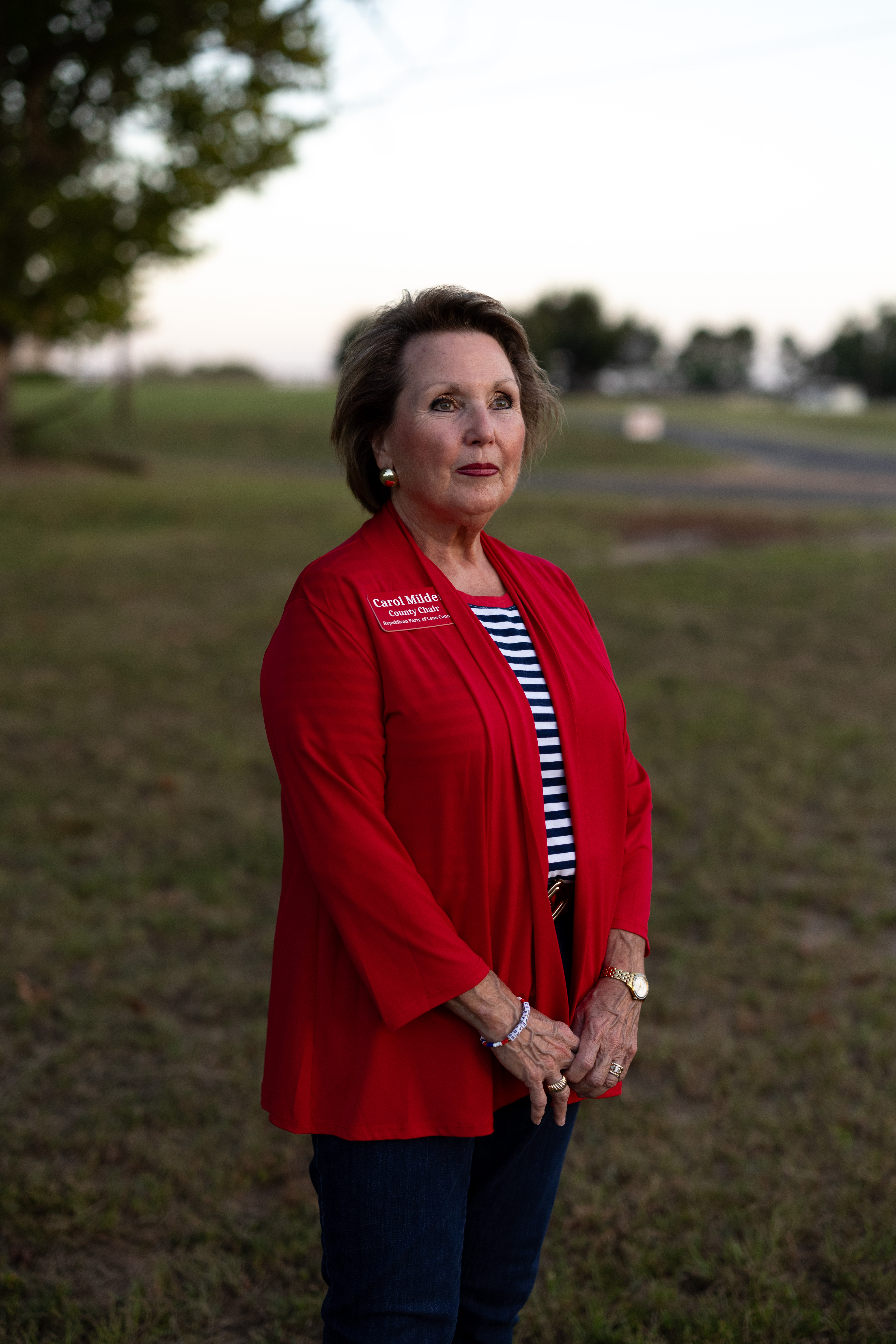
Leon County GOP Chair Carol Milder is emblematic of the shift among conservatives when it comes to opposition to data centers.
The retired real estate appraiser’s father worked on an oil rig. Growing up in Houston, she saw the oil and gas industry build the middle class. But attending a panel on data centers at the state GOP convention in June in Houston awakened her to the differences between the industries.
Panel experts, including her neighbor Michael Rice, 46, who used to work at an Austin data center, explained that unlike oil rigs and refineries, data centers bring few jobs — 40 proposed so far in Leon County — and even those are often staffed by workers from elsewhere. Milder and others at the commissioners’ meeting said they resented paying taxes only to see data centers initially get tax exemptions, effectively subsidized by residents the way manufacturing and solar industries have been.
She told the commissioners: “We’re being held hostage for the money for them to build.”
“We’re trying to be as prepared as we can,” said Commissioner Kyle Workman, a construction consultant. He said that unlike in Texas cities, the unincorporated community’s limited government — which many in the audience historically favored — left commissioners with few tools to block the data centers. “Leon County has kept government down over the years,” Workman said. “There’s limits to what we can do.”
Michael Rice points out proposed data center sites during the town hall meeting at the Jewett Civic Center last month.Antranik Tavitian
Residents said they thought that was precisely why data center companies were targeting rural areas. Of the nearly 248 data center projects proposed statewide, nearly half are in unincorporated rural areas where zoning and other restrictions cannot be used to block them.
And residents worried that any state legislation that might help defend against the projects would not pass until late next year — too late to block the data center proposed by Crusoe and others expected to follow. Belltown Power has proposed building a 900-acre data center in Leon County, and Black Mountain — another North Texas-based company — bought property and announced plans to build a massive power plant there.
Milder said she alerted an adviser to the governor this year about growing local opposition in counties such as Leon. She reminded him that a majority of the state’s 254 counties are rural and that they are a key part of Abbott and the GOP’s conservative base.
“Texas is red because of rural Texans, and we need to be listened to,” Milder told him. “You need to be concerned with what concerns us. And we’re being raped and pillaged.”
Leon County GOP Chair Carol Milder. Antranik Tavitian
Texas is poised to overtake Virginia as the nation’s top data center hub by 2030. A recent poll found 56% of Texans oppose data centers being built in their communities.
“They love our farmland because it’s flat, it’s clear, there’s water and electricity there, and they can just come in and start building,” GOP Agriculture Commissioner Sid Miller said at an anti-data-center protest outside the state Capitol in Austin recently. The small crowd chanted, “Special session now!”
After hailing Texas as “the epicenter of AI development” last fall, Abbott recently reversed course as he campaigns for reelection to a record fourth term, urging state lawmakers to repeal the centers’ sales tax exemptions and regulate where they can be built. Last month, he ordered the state Public Utility Commission and council managing the electrical grid that covers most of the state to enforce restrictions on data centers, including requiring them to “fully fund the costs of electric infrastructure.”
“We must prohibit them from building AI data centers in rural Texas neighborhoods,” Abbott said at a campaign stop about 90 miles north of Centerville on June 30.
By the end of July, the governor announced that the state had “begun sweeping changes to how data centers pay for the infrastructure needed to serve them, ensuring data centers do not shift those costs onto everyday Texans or place unnecessary strain on our state’s resources.”
But Miller and Leon County conservatives said those stepped-up regulations are not enough. They want Abbott to call a special legislative session — as he has in recent years for conservative priorities such as school vouchers, congressional redistricting and property tax cuts — to pause data center development and increase regulations and oversight.
A spokesman for the governor declined to comment about whether Abbott will call for a special session on data centers.
“Governor Abbott has been clear that data centers cannot come before Texas families,” spokesman Andrew Mahaleris said in a statement, noting that the state regulators’ new requirements “protect Texans from higher costs and negative impacts on their communities.”
Andrew Schmitt, a spokesman for Crusoe, said: “Crusoe is committed to protecting the natural resources and character of every community where we operate, while ensuring local families benefit from our economic investment for generations to come. We are working closely with local leaders as we evaluate development in Leon County to address community needs and deliver jobs for local workers along with significant new tax revenue for schools, public safety, and infrastructure.”
Daniel McCoslin stands next to family photos dating back to when his ancestors settled Texas. Antranik Tavitian
Daniel McCoslin, 48, is a retired railroad engineer who fought with the Marines in Iraq. He ranches land that’s been in his family since the 1800s and that abuts the proposed Belltown data center site. A relative’s ranch borders the Crusoe site. That’s why McCoslin — a libertarian who voted for Trump three times — organized a local anti-data-center group to educate neighbors.
McCoslin dismissed Abbott’s recent data center regulations as “pandering.” In November he plans to vote for a Democrat for the first time in his life. Clayton Tucker, a rancher running for agriculture commissioner as the anti-data-center candidate, has called for a data center moratorium.
When data center companies started offering neighbors up to $50,000 an acre — “life-changing money” — McCoslin recalls talk at the feed store turning to whether folks would take the millions. McCoslin was adamant he would not.
“Family means a lot more than money,” he said.
The evening after the commissioners’ meeting, McCoslin helped organize a town hall to update neighbors. The crowd that settled into folding chairs at a local community center included plenty of retirees, at least one of them in a MAGA hat. There were also workers, some in volunteer firefighter T-shirts, others in straw cowboy hats and boots with spurs.
Mandy Williams holds onto her daughter Violet as she gets out of a hay harvester in Centerville. Antranik Tavitian
Organizers used a projector to display maps of the proposed data centers and power plant, and fielded questions about potential environmental and economic effects: How many jobs will they bring, and for whom? Will they pollute the ground and water? Are they expected to decrease property values? Can they be stopped?
Organizers displayed phone numbers and emails for Abbott and other state and local GOP lawmakers. They urged residents to contact the officials with data center concerns.
“We’ll be calling,” said Mandy Williams, 46, as she left the meeting with her husband and towheaded 4-year-old daughter, Violet, in a “Cowgirl forever” T-shirt.
The couple live on the eastern side of the county on a cattle ranch of more than 200 acres. Stephen Williams’s ancestors settled the land when Texas gained independence from Mexico in 1836, nine years before it became a state. Like many other Texans, owning land is part of his identity, a birthright he feels a duty to steward.
“Hopefully we get enough pressure on him,” Stephen Williams, 46, said of the governor.
When commissioners met Monday, they did not take action on the tax breaks and told residents that Crusoe had yet to reapply, Milder said.
Back at his modest ranch house, McCoslin pointed to turn-of-the-century black-and-white portraits of his ancestors taken under the oaks just steps away.
“At night, you can hear how quiet it is and see so many stars,” he said, describing his evening routine of settling outside to smoke a cigar and sip bourbon, his only soundtrack the crickets, frogs and occasional coyote. “We don’t want 24-hour industrial hum and lights destroying the sky. If I wanted that, I’d live in Houston.”
The U.S. Treasury Department permanently repealed a rule Tuesday that required businesses formed in the United States to report who owns them to federal financial-crimes investigators.
Foreign companies and pooled investment vehicles (such as mutual funds or hedge funds) must still report information about foreign owners. But they will no longer have to identify Americans who help them register to do business in the United States, according to a Treasury Department advisory. And Treasury will delete any information it has already collected about U.S. business owners, the advisory said.
In a statement, Treasury Secretary Scott Bessent said the new rule eliminates “a burdensome reporting requirement for millions of law-abiding business owners without compromising our national security.”
Senate Banking Committee Republicans quickly thanked Treasury for “standing up for job creators.” But Democrats and some national security experts criticized the move, which they said would make it easier for drug cartels, human traffickers and money launderers to use anonymous shell companies to avoid detection.
Richard Nephew, who led anti-corruption efforts at the State Department during the Biden administration, called the move “a terrible decision that opens up the U.S. to financial crime, money laundering and corruption.”
The reporting requirements were implemented in January 2024 during the Biden administration as part of an effort to curb illicit finance. It stemmed from the Corporate Transparency Act, which was included in the National Defense Authorization Act and enacted into law in 2021 after Congress overrode President Donald Trump’s veto. It required U.S. and foreign companies doing business in the country to report information about “beneficial owners” — people who have “substantial control” over the company or own at least 25% of it — to Treasury’s Financial Crimes Enforcement Network (FinCEN).
The CTA was supported by law enforcement officials, the American Bankers Association, and human rights advocates, who said it would combat the corrupt use of anonymous companies, known as shell companies. But it immediately drew fire from the National Small Business Association, which pushed Congress to repeal the act and sued the Treasury Department, arguing that the reporting requirements disproportionately affected small-business owners.
In March 2025, the Trump administration announced that it would temporarily suspend reporting requirements for U.S. businesses and American owners of foreign companies. On Tuesday, Treasury made that decision permanent. In a FAQ on the new rule, Treasury said FinCEN and federal law enforcement agencies have multiple alternative sources of information to prevent domestic companies from engaging in money laundering or financing terrorism that it does not have for foreign companies.
Small Business Administration Administrator Kelly Loeffler praised the decision, writing on social media that it will save American businesses $6.7 billion in compliance costs over the next decade.
Sen. Elizabeth Warren (Massachusetts), the top Democrat on the Senate Banking Committee, called the decision “a gift to cartels, criminals, and U.S. adversaries that exploit shell companies to move millions through our financial system.”
Editor’s note: This article has been updated to correct the background of the implementation of the Corporate Transparency Act.
BEIJING — Former Chinese Premier Zhu Rongji, the impatient, sharp-tongued reformer who helped ignite China’s explosive economic boom by forcing wrenching change on state industry in the 1990s and leading the country into the World Trade Organization, has died of illness, state media reported Wednesday. He was 97.
Mr. Zhu died in Beijing at around 11 a.m. on Wednesday, the official news agency Xinhua reported.
Once sent into rural exile to do manual labor for praising reforms in other communist countries, Mr. Zhu pushed through a dizzying array of changes as premier, China’s top economic post, from 1998 to 2003 under former President Jiang Zemin.
Mr. Zhu clashed with Communist Party conservatives and state industry bosses as he pushed state-owned companies to become efficient and profitable. That cost millions of layoffs, but helped propel China to overtake Japan as the second-largest economy behind the United States in 2010.
Building on former leader Deng Xiaoping’s 1979 reforms, Mr. Zhu is credited with supplying the resourcefulness and tenacity to push through history-making changes such as China’s WTO membership, which helped to transform China into the world’s biggest exporter.
Those changes helped to keep economic growth above 8% a year from 2000 to 2010, peaking at 14.2% in 2007.
A spiky personality who fought corruption and conservatives
Named premier in 1998 at age 69, Mr. Zhu became a popular figure by criticizing official bungling and graft and accepting blame when the government fell short. His demanding style earned him the nicknames Boss and Zhu Fengzi, or Madman Zhu.
“I have prepared 100 coffins here — 99 for corrupt officials and one for myself,” Mr. Zhu said in 1998, according to the party newspaper People’s Daily.
Mr. Zhu ranked No. 3 in the party hierarchy behind Jiang and Li Peng, chairman of the ceremonial legislature, the National People’s Congress. But he was a technician without his own power base. Mr. Zhu complained that allowed officials to ignore his orders.
Mr. Zhu made his name as a deputy premier in the 1990s by crushing inflation. He enforced price controls and cut off loans to money-losing state companies, rebuffing resistance by local leaders — a pattern Mr. Zhu would repeat as he fought conservatives over the pace of reform.
Mr. Zhu led efforts to secure WTO membership following marathon negotiations that began in the 1980s. That status would enshrine free trade as a national commitment, giving Mr. Zhu a tool to force local officials to stop protecting favored companies.
Mr. Zhu’s campaign was nearly derailed when he went to Washington in 1999 with market-opening concessions to win U.S. endorsement of the WTO bid. The Clinton administration rejected the offer as inadequate, while his political enemies at home accused him of offering too much, but Zhu survived and China went on to join the body in December 2001.
Mr. Zhu launched China’s home ownership boom in 1998 with an initiative to sell apartments owned by state companies. Families rushed to buy, and within a decade the majority of urban housing was privately owned.
Still, Mr. Zhu was less an advocate of free enterprise than a skilled bureaucrat who carried out party orders to whip state industry into shape.
Mr. Zhu showed no interest in privatizing the economy. He played a key role in drafting plans in the 1990s to turn banks, airlines, oil companies, and other enterprises into profit-oriented corporations but to retain government ownership.
Zhu stood out for admitting official failings
Born Oct. 23, 1928, in Mao Zedong’s home province of Hunan, Mr. Zhu paid an early price for his willingness to take risks and speak out.
After a start as an economic planner, his career went into a 22-year eclipse when he was labeled a “rightist” in 1957 for praising reforms in Hungary and Yugoslavia. He was banished to the countryside during the 1966-76 Cultural Revolution to do manual labor.
Rehabilitated in 1979, Mr. Zhu rose swiftly, becoming deputy Shanghai party secretary in 1987 and mayor the next year.
As mayor in 1989, Mr. Zhu gained a reputation for moderation when he placated protesters and pledged not to call in the military.
“He managed to defuse, with considerable subtlety, a tense political situation that could have developed into localized violence or worse if the military had felt it necessary to intervene,” wrote Australian diplomat Shelley Warner in the 1991 book The Pro-Democracy Protests in China: Reports from the Provinces.
Mr. Zhu’s boss, Jiang, would soon be called to Beijing by Deng and made party leader. Mr. Zhu was named deputy premier in 1991 and joined the party’s ruling Standing Committee in 1993.
Mr. Zhu broke with the leadership’s stance of infallibility by admitting and taking blame for official failings.
In 1998, after summer floods killed 4,150 people and officials were accused of embezzling money meant for anti-flood dikes, Mr. Zhu complained some barriers were no stronger than bean curd.
Three years later, he apologized on national television for his cabinet’s failure to protect the public after an explosion in a schoolhouse in southern China killed at least 42 people, most of them children.
Mr. Zhu enlivened the party’s bland image by cracking jokes in public, sometimes at his own expense. Laughter erupted at a 1999 news conference when he said a recent photo “made me look like a dead man.”
One of Mr. Zhu’s proudest triumphs as deputy premier was to craft a tax system that required local officials to hand more revenue to Beijing. He said in 1996 that he deserved a Nobel Prize in economics for that.
Mr. Zhu rarely appeared in public after leaving office as premier.
Mr. Zhu was married to Lao An, a fellow Hunan native. Their son, Yunlai, also known as Levin Zhu, is a former CEO of China International Capital Corp., a government-owned investment bank.
Their daughter, Yanlai, led a charity organization supporting schoolchildren that was backed by Zhu Rongji.
Immigration and Customs Enforcement officers may soon be outfitted with gloves that can deliver painful electric shocks intended to gain compliance from combative individuals.
ICE plans to spend up to $20 million to purchase thousands of “conductive distraction and de-escalation devices” for officers and agents by March, according to a notice published Monday by the Department of Homeland Security.
The devices are known as the G.L.O.V.E., which stands for Generated Low Output Voltage Emitter, and are manufactured by Compliant Technologies LLC of Lexington, Ky. They have been used in recent years by some jails and police departments.
DHS said Tuesday that it was working on a response to an Associated Press inquiry and offered no immediate comment. Jeff Niklaus, the founder and CEO of Compliant Technologies, wrote in an email, “Unfortunately, we are unable to speak on this subject.”
The notice said the solicitation for a no-bid contract could be published as early as Friday.
Compliant Technologies says the devices function as a normal pair of patrol gloves until officers press a switch to activate their electrical mode. The gloves must be applied directly to someone’s skin to deliver a pain stimulus that typically helps an officer gain compliance within seconds, according to the company.
“It’s immediate and sharp, and it will distract you. I call it like a bee sting,” said John Peters, president of the Institute for the Prevention of In-Custody Deaths, who is studying how the device has been used. “If the officer is getting any type of resistance from the person, this is certainly an effective tool.”
Peters said he believed ICE’s planned purchase would likely be the largest from the company to date. He said he could envision ICE officers using the gloves to help remove uncooperative subjects from cars and houses and in and out of detention facilities.
“For smaller officers or weaker officers or older officers, I think it has a great advantage” because it can produce faster takedowns and shorten confrontations, he said.
The manufacturer warns the device should not be used as punishment, against people merely exhibiting “verbal defiance or belligerence” or on high-risk populations such as children, pregnant women, or elderly or disabled people.
Jenn Rolnick Borchetta, deputy project director on policing at the American Civil Liberties Union, said the public should have no confidence that ICE officers will use the devices appropriately. She questioned why the devices would be necessary for civil immigration enforcement and noted those getting shocked might have no advance warning.
“ICE spent the last year showing this country they are too quick to use force. Now they will be able to deploy electric shocks with the slight push of a button that maybe nobody else can see them do,” she said. “Introducing gloves that can so easily be used to deliver terrible pain in encounters is a recipe for harm to the public.”
Supporters say the devices are generally used in specific jail and transport situations, rather than broadly to patrol on the streets. They have been used to subdue violent suspects who are refusing to get into squad cars and inmates who are harming themselves and threatening officers, according to Compliant Technologies.
Peters said he expected the devices to be misused by a small number of employees, as with other policing technologies, but he said they are unlikely to cause injuries. He said it would be important for ICE to have robust policies and training in place.
To use the device, officers must complete a course and be recertified every two years, the manufacturer says.
NAQOURA, Lebanon — As the cars advanced down the coastal road here at the southwestern tip of Lebanon, the flags came into view. The yellow and green banner of Hezbollah. The red, white, and green tricolor of Iran. Finally, a few miles from the border, the blue and white standard of Israel.
“Turn back,” an Israeli soldier warned, in English, through a megaphone. “You don’t have authorization.”
The convoy of church officials and humanitarian workers, approved by United Nations peacekeepers to visit three towns inside Israeli-occupied Lebanon, retreated to seek new authorization.
For the few inhabitants who have remained in southern Lebanon since Hezbollah and Israel renewed fighting in March, such incidents have become common. Israeli officials say they need to occupy the 75-mile-long, 6-mile-wide buffer zone to dismantle Hezbollah’s infrastructure and prevent the group from launching drone and missile attacks into northern Israel.
The announcement by Secretary of State Marco Rubio in June of a preliminary deal in which Lebanon would disarm Hezbollah and the Israel Defense Forces would gradually withdraw from the country has had little impact on daily life here. Instead, Israeli officials have indicated they are unlikely to end the occupation soon, and residents are seeing parallels to the Israeli security protocols that vex Palestinians in the occupied West Bank.
“We are trapped in a prison,” said Ayoub Khreish, mayor of Ain Ebel, a predominantly Christian town an hour east of Naqoura. Even ambulances need permission to enter and leave, he said. “We drive and we pray.”
President Donald Trump is attempting to keep the peace here in part to advance talks with Iran. Tehran has repeatedly tied a ceasefire with the United States and Israel to an Israeli withdrawal from Lebanon. Israeli strikes on Beirut in June almost derailed a deal, and Iran signaled over the weekend that it would not reopen the Strait of Hormuz unless attacks in Lebanon stopped.
A damaged and abandoned Lebanese military checkpoint just north of the Israeli buffer zone in Naqoura, Lebanon.Guy Peterson
Trump, hosting Lebanese President Joseph Aoun in the Oval Office last month, pledged support for the war-torn country, including an easing of flight restrictions. When asked about the withdrawal of Israeli troops from Lebanon, he said, they were “in the process of redeployment.”
Under a U.S.-brokered deal, Israel has carried out a small, phased withdrawal in “pilot zones” and ceded control to the Lebanese Army. But there have been no indications of a more substantial redeployment on the horizon.
In a visit to occupied south Lebanon on Wednesday, Israeli Defense Minister Israel Katz vowed to maintain the buffer zone. He asked troops to prepare for a “long-term presence on the ground.”
The IDF has increased strikes elsewhere in southern Lebanon in response to what it says are ceasefire violations by Hezbollah.
Israeli Prime Minister Benjamin Netanyahu told Fox News last month that some Lebanese Christian towns had “asked to be annexed to Israel” for protection against Hezbollah militants. He did not name the towns or provide evidence. Last week, a map published by the Israeli Foreign Ministry appeared to incorporate southern Lebanon into Israeli territory. (It was later deleted.)
Officials in several Christian towns quickly refuted Netanyahu’s claim. “We do not want to be part of Israel,” Sandy Diab, a native of Ain Ebel, told the Washington Post. “We are very proud to be Lebanese.”
The aid convoy was organized by L’Oeuvre d’Orient, a Catholic nonprofit based in Paris, which coordinated with U.N. peacemakers and the U.S.-led mechanism monitoring the ceasefire between Hezbollah and Israel.
A convoy of aid vehicles drives just north of the Israeli buffer zone in Naqoura, Lebanon, last month. Guy Peterson
Most of the 15 convoys the group has sent here since the fighting resumed in March have reached their destination uninterrupted, its director said, but conditions on the ground are fluid. The Christians who have remained in southern Lebanon, the Rev. Hugues de Woillemont said, ”are showing remarkable courage and determination.”
Like many in southern Lebanon, Christians have been caught in a war they did not choose. The conflict has cut them off from the rest of the country; at its height in March and April, fuel and internet interruptions left many dependent on outside aid.
The continuing scarcity of basic goods in Ain Ebel is driving up prices, Khreish said. “Everything here is 25 percent more expensive than Beirut.”
Farmers leaving their homes to tend to their crops in the countryside need prior approval, the mayor said, and ongoing airstrikes by both sides have scared away the honeybees that produced honey.
The aid convoys have been escorted by U.N. peacekeepers. Their term expires at the end of the year; who will take over their role is unclear.
“What [the people here are] saying, and you don’t need a diploma to understand, is that they want to live, live in peace” said Col. Maxime Laudet, an officer with the French contingent to the decades-old U.N. Interim Force in Lebanon.
The Rev. Hugues de Woillemont meets with the French captain of the United Nations Interim Force in Lebanon. Guy Peterson
Laudet’s troops worked with L’Oeuvre d’Orient to help renovate a sports facility here to give local youth more recreational opportunities and to prevent a further decline in the population. “They’re a bit upset because ties with the north are complicated.”
Only a few towns in the buffer zone remain inhabited. Katz has said the IDF had destroyed 24 Lebanese villages and currently occupies 270 square miles of Lebanese territory.
The majority Shia population, which Hezbollah claims to represent, has mostly fled.
The people who remain, De Woillemont said, are “exhausted and anxious.”
“Their request is very simple,” he said. “To be able to live safely and with dignity on their own land, without being forced to leave.”