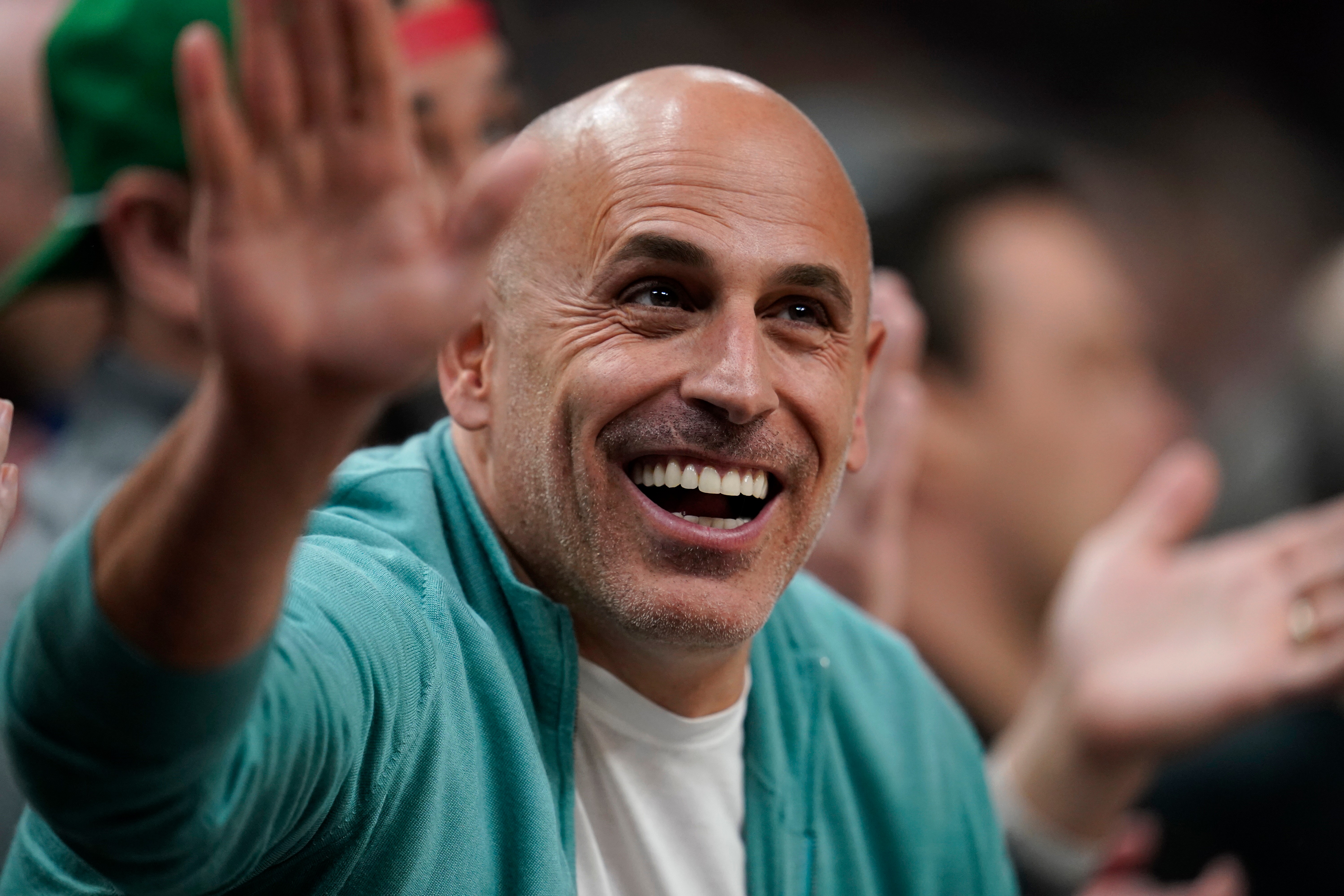
MINNEAPOLIS — Minnesota Timberwolves and Lynx co-owner Marc Lore has agreed to sell his controlling stake in the franchises to limited partner Marc Shad at a $4.5 billion value barely a year after his purchase was finalized, according to a person with knowledge of the deal.
The person spoke Friday to The Associated Press on condition of anonymity because details of the agreement were not being publicized.
Lore, a New York e-commerce entrepreneur, and partner Alex Rodriguez, the former Major League Baseball star, bought the NBA and WNBA clubs from Minnesota businessman Glen Taylor. That complicated and contentious process lasted more than four years until the $1.5 billion sale got league approval in June 2025.
Lore and Shad are essentially swapping roles, the person said. Rodriguez will remain as a co-owner.
Lore, Rodriguez and Shad issued a joint statement Friday expressing their commitment to the current leadership in the organization including chief executive officer Matt Caldwell, Timberwolves president of basketball operations Tim Connelly, Timberwolves head coach Chris Finch, and Lynx president of basketball operations and head coach Cheryl Reeve.
Tesla Inc. and at least eight other carmakers are recalling millions of cars in China over safety concerns with their door handles, a major step to address flaws that have led to vehicle entrapment and multiple fatalities.
More than 4 million vehicles are affected as part of the broad crackdown, one of the most sweeping recalls ever in the world’s biggest auto market. Tesla accounts for the largest share, with just under 3 million vehicles included in the action announced Friday.
The Tesla vehicles have electrically controlled handles that can stop working in some crashes, which “could hinder occupants from quickly opening the doors to escape and impede rescue efforts by those outside the vehicle, posing a safety hazard,” according to a statement from China’s State Administration for Market Regulation. As part of the recall, the carmaker will update software to automatically lower the windows after an accident and will affix warning labels showing where the emergency door releases are located.
Vehicles designed with flush, electric handles have been involved in a series of incidents in which occupants have been trapped inside their cars after the vehicles lost power, including after a crash. In several instances, occupants of Tesla vehicles survived the initial impact of a high-speed crash only to die or sustain serious injury from subsequent fires after being unable to exit.
Bloomberg News has reported extensively on the modern door systems, uncovering at least 15 deaths in a dozen incidents in which occupants or rescuers were unable to open the doors of a Tesla that had crashed and caught fire. Bloomberg also reported late last year that chief executive officer Elon Musk insisted on electric doors even after potential safety concerns were raised internally.
China has taken a particular interest in the topic following fiery crashes involving Xiaomi Corp. vehicles, becoming the first country in the world to outlaw the design when it banned concealed door handles on electric vehicles earlier this year. The country has also been introducing regulations for driver-assistance technology, batteries, and other standards to try to improve the safety of cars at a time when Chinese automakers have been developing cars in roughly half of the time as legacy carmakers.
This marks one of the largest vehicle recalls for the same kind of quality issue in China, according to Li Yanwei, an adviser to the China Automobile Dealers Association.
After Tesla, Xiaomi accounted for the next highest number of vehicles recalled in Friday’s action, with 390,435 of its SU7 electric sedans. Zhejiang Leapmotor Technology Co. Ltd. is recalling 371,200 vehicles, according to statements from the market regulator. The total number of EVs being recalled for door handle related safety risks from the nine carmakers reached about 4.27 million affected.
Tesla on Friday also recalled about 2.7 million vehicles to shore up its means for monitoring drivers using its driver-assistance technology and ensuring they pay attention to traffic and avoid collisions.
In the U.S., auto safety regulators said last month that they would begin the process to impose a new federal rule addressing concerns over unsafe door handles. The National Highway Traffic Safety Administration is also probing certain Tesla Model Y vehicles over complaints of door-related entrapment, and a U.S. lawmaker has introduced legislation to require manual door releases in new cars and means for first responders to gain access to vehicles when power is lost.
It’s back-to-school shopping season, which means parents are spending money on new crayons and notebooks. Parents are calculating just how much they can afford to spend on school supplies, what children can reuse from the year before, and what on teachers’ lists will have to be abandoned.
The cost of school supplies has risen nearly 8% since last year, according to a report from the left-leaning groups the Century Foundation and Groundwork Collaborative, which pointed out that the makers of such school staples as Elmer’s glue and Sharpies and Expo markers, Mead and Five Star notebooks, and Logitech headphones have all spoken publicly about raising their prices because of the Trump administration’s tariffs on imported goods.
The days of students making an annual trip to the office supply store with their back-to-school shopping lists in hand have gotten an internet-age makeover. Today, more than a million classroom teachers have posted the items they want their students to buy to the website TeacherLists.com. The average total spending to buy the whole list? $91.55, for an average of 15 items, for those who shop at Target and Walmart, the website’s vice president, Elizabeth Lamport, said. With one click, parents can add all the items on the list to their online shopping carts at stores such as Amazon, Staples, or Office Depot, and buy the whole kit with another click.
Princess Heard, a single mom of two in Roswell, Ga., starts putting away money for fall back-to-school supplies as soon as her kids come home from their last day of school each spring. Heard, who works for a health insurance company, budgeted that she would need $200 this year to outfit her kids with new backpacks and the items from their teachers’ lists. She took online surveys for cash to make the money.
When she took her kids to Target the day before school started, she kept a calculator open on her phone, tallying as they put what they needed into the cart. She hit her $200 maximum before they finished their lists. “The deals weren’t as good as they normally were, in previous years,” she said. “We didn’t get as many supplies as I normally do. … Usually I’m able to get everything.”
Heard ended up deciding not to buy any of the classroom supplies the teachers requested, like wipes and tissues. She’ll bring some in later in the school year, she said.
In a Good Morning America-Ipsos poll conducted late July, two-thirds of parents said back-to-school shopping is more expensive this year, and nearly nobody said it’s cheaper. They said they’d spend an average of $118 per child on school supplies, and a total of more than $800 on sports gear, clothes, books, technology, and other back-to-school shopping.
Some of the items most commonly on teachers’ lists are relatively cheap. Target, which said in a news release that 95% of its school supplies are at or below last year’s retail prices, is selling 24-packs of Crayola crayons, double packs of Elmer’s glue, two big pink erasers, or pocket folders with prongs for 50 cents each right now.
Annie Redlin, a nurse in Rochester, Minn., who shares parenting ideas on her website, asked her three sons to gather up all their leftover supplies and dump them out on the floor ahead of their first day of school next week. She called out each item on their teachers’ shopping lists, asking if they already had it in the pile.
“We do not need all new markers. … Some of those notebooks have two pages used; we rip out the pages,” Redlin said. “Seventy-five percent of the things I’m sending back to school this year are reused, which is really helpful for the budget. … They’ve never once said, ‘Mom, I don’t have new crayons like my friends.’”
Her husband, a physical education teacher at the boys’ school, took them shopping for what was left on their list: crayons for the first-grader, new binders and folders, a pencil holder for the sixth-grader. He walked out having spent about $35 for the three kids.
“Truthfully, I feel a little bit of a sense of relief,” Redlin said. “Life feels really expensive right now, with groceries and clothes for three growing kids. It was really nice to not feel stressed about how much money I spent on school supplies.”
In Alexandria, Va., 14 public elementary schools have posted their supply lists on TeacherLists.com. The average second-grader is asked to bring 13 items at an average cost of $61.87 at Target.
But many families end up spending more. Several of the Alexandria schools’ lists, for example, include the same clear plastic pencil case, selling for $4. If your kid wants the one with a Minion or Pokémon or a Star Wars figure on it, it’s $7. Upgrade from clear to pink or blue, and it’s $10. Add a wavy fidget design, it’s $14.
Zoie Hoffman, a math tutor in Las Vegas, had to buy school supplies for her first-grade twins for the first time this year. It cost about $200 to buy everything on the school list: scissors, crayons, markers, colored paper, cardstock, paper towels, baby wipes.
She tries to save money, including by looking for high-quality backpacks and water bottles that she won’t need to replace for years. But she also bears in mind that most of her children’s education is free.
“My mindset is, we’re going to public school, and you know, this is just part of it.”
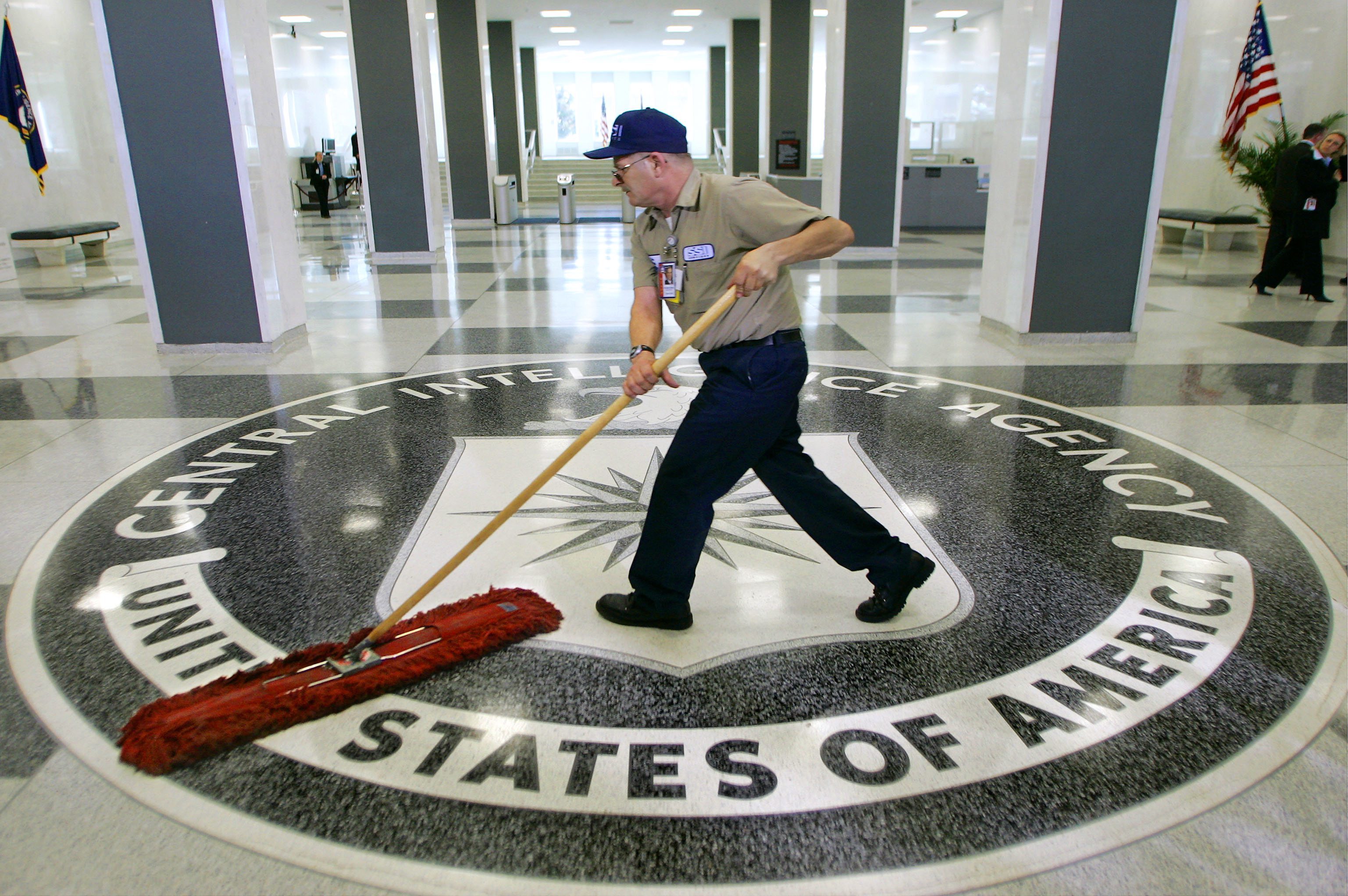
A historic wave of departures at the CIA and deep cutbacks at the Office of Personnel Management are swamping the spy agency’s retirement system, leaving former spies with monthslong waits to get their first pension check, according to former intelligence officials and internal agency messages.
While precise numbers are classified, current and former officials say the pace of retirements and resignations from the CIA outstrips anything in recent memory. They are being fueled in part by President Donald Trump’s push to shrink the federal government, including deferred resignations offered to workers last year.
The CIA, in a recent note to alumni, acknowledged the problem and pleaded for patience.
“The Retirement Branch is currently processing an unprecedented number of retirement cases, and is working diligently around the clock to expedite these cases,” the note said. “We appreciate your understanding and patience as we navigate this challenging period. Rest assured that our team is committed to processing your annuity payments as efficiently as possible.”
It gave retirees two toll-free numbers to call if more than six months had passed since they’d received their final paycheck.
One former official said she recently spoke to a colleague who retired in March and had just received their first, partial retirement check.
“The question is how do you pay for your mortgage, and how do you pay for your kids’ college,” the former official said.
As CIA workers prepare to retire, they are eligible to take a one-week, in-house seminar called “Horizons” that is meant to help them navigate life outside the spy agency’s cloistered halls — like how to prepare a job-hunting resumé that doesn’t disclose classified information.
Lately, those in the seminar are being told they may not see their first full retirement check for up to nine months, or longer, after they depart the CIA’s headquarters in Langley, Va.
The retirement crush mirrors trends across the federal government, where, data show, there are unprecedented numbers of people leaving, creating lengthy delays in retirees receiving their benefits. Last year, there were more than 330,000 departures, most of which were voluntary.
The situation is particularly poignant at the CIA, where officers often serve in danger zones, rarely receive public recognition and share a culture of not complaining publicly outside the spy agency’s walls.
CIA officers who until recently recruited agents, prepared classified reports on world crises or developed high-tech espionage tools are feeling the squeeze, said the former officials, who spoke on the condition of anonymity to discuss internal CIA dynamics.
“If military retirees were told they had to wait a year or more for earned pension benefits, Washington would be apoplectic. Intelligence officers serve in the shadows, and their discretion should not become a shield for institutional failure,” said a former senior U.S. intelligence official familiar with the issue.
“If agency and congressional leaders were not aware of this problem before, they are now,” he said.
In response to the crunch, the CIA has surged personnel to the Retirement Branch, including people with experience with that work.
“CIA is committed to ensuring that retired officers who dedicated their careers to our mission receive their hard-earned benefits as quickly as possible,” a CIA spokesperson said in response to questions from the Post.
“Under Director [John] Ratcliffe, CIA is focused on returning the Agency to its mission of recruiting spies, and recently hired our largest class of operations officers in two decades,” the spokesperson said in a statement.
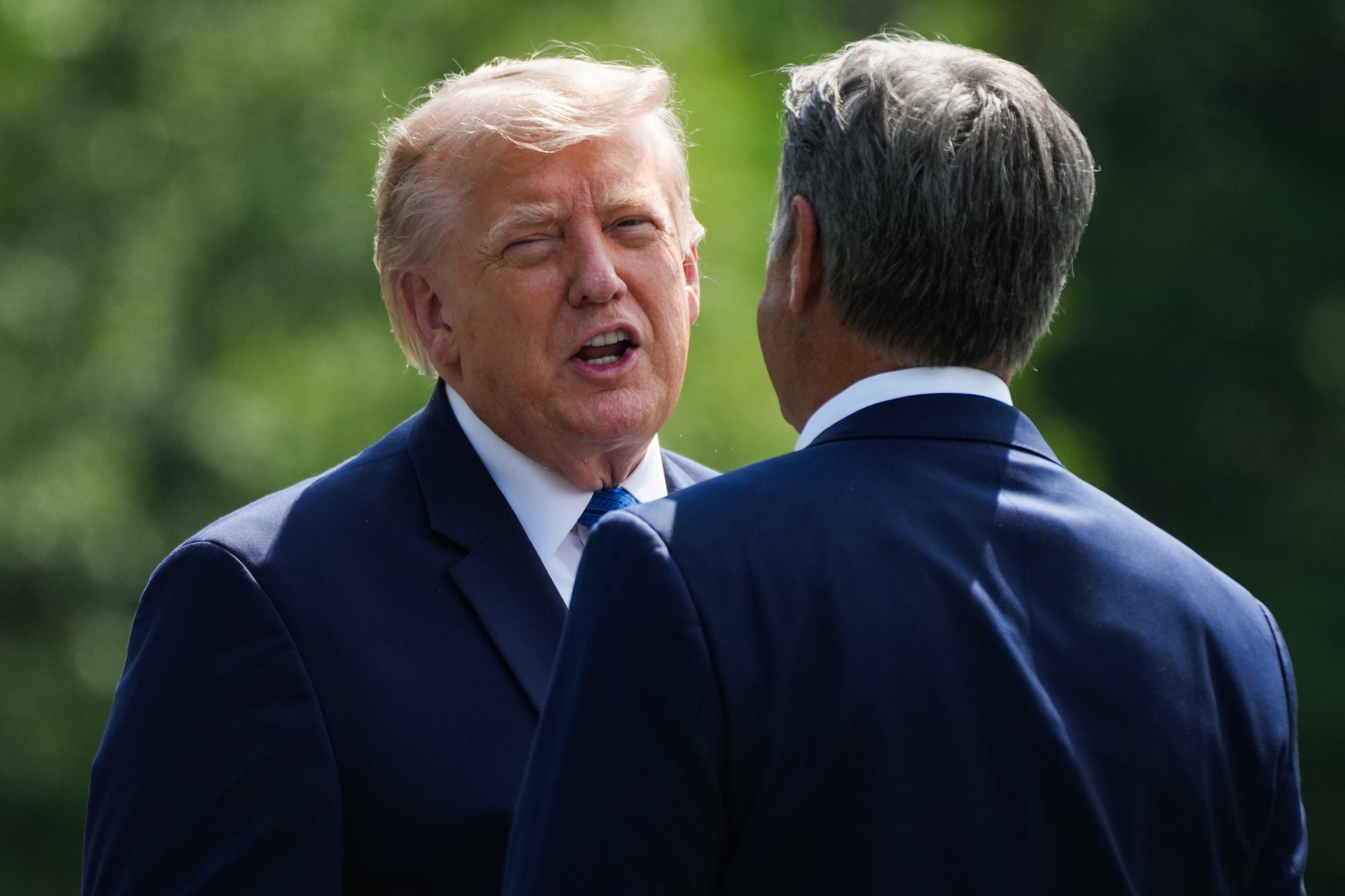
President Donald Trump and CIA Director John Ratcliffe at Camp David last month.Nathan Howard
The size of the CIA’s workforce and the number of employees who have left since the start of Trump’s second term are classified. Overall, the CIA workforce was believed to be about 22,000 in early 2025, U.S. officials said. Many hundreds of people — perhaps more than 1,000 — have since left, one of the former officials estimated.
Some former officials describe the agency’s downsizing as the largest since the CIA was significantly cut back in the early 1990s, following the collapse of the Soviet Union and the end of the Cold War.
In May 2025, the Trump administration told Congress it planned to reduce the CIA workforce by 1,200 over several years, mostly through attrition and reduced hiring. Agency workers were among the tens of thousands of federal employees who took a deferred resignation package the Trump administration offered to shrink the government’s ranks. Others simply decided it was time to leave.
Administrators responsible for processing retirement requests are among those who have left, worsening the crunch, said two former intelligence officials.
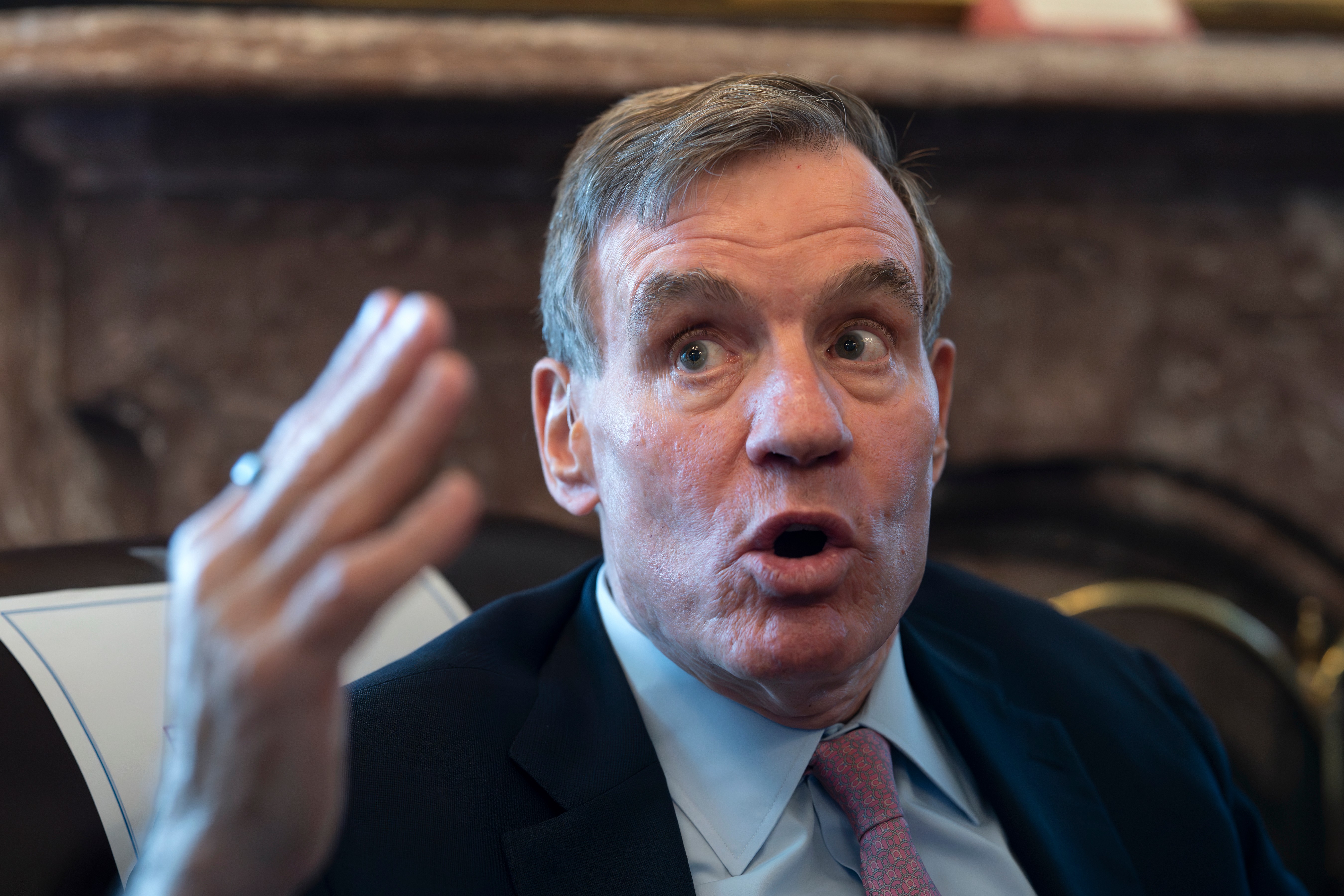
Sen. Mark Warner (D., Va.), the vice chair of the Senate Intelligence Committee, speaks to reporters on June 11.J. Scott Applewhite
“The men and women of the CIA protect our country and make Americans safer every day, often without any acknowledgment or recognition,” said Sen. Mark Warner of Virginia, the top Democrat on the Senate Intelligence Committee. “The least our government can do is ensure they receive the benefits they deserve when they decide to leave.”
“Again and again, this administration has mistreated our public servants, including those in the CIA. And whether it’s incompetence or disrespect that is creating the delay, the administration needs to figure out how to fix it,” Warner said.
Some CIA officers have pulled back their retirement requests because they can’t afford to go long periods without being paid, one of the former officials said. Others are falling back on savings or taking out second mortgages to cover the gap.
“Start looking now, hoard cash, plan for a longer period of time” before receiving retirement pay, said a retired CIA official who left last fall. “More thoughtfully and aggressively pursue jobs before you leave.”
The official said it took four to five months before he was paid for unused annual leave — a sum that can be substantial for some retirees — and another month after that before he saw his first retirement check.
The CIA has a tradition of treating its retirees well, former officials said. Among the reasons: Angry ex-employees with heads full of secrets are a target for adversary intelligence services. “We are creating a massive [counterintelligence] risk,” said the official who left last fall.
Like other federal officials, former CIA officers are banned from taking certain jobs for a set period after retirement, such as lobbying on issues they handled while in government or working for foreign governments.
CIA retirement packages are initially handled within the agency, which can take several months. Retirees are given an estimate of what their benefits will be.
Many factors can complicate the process. Departing officials may have served undercover, using a different identity; spent time in the U.S. military or at another intelligence agency; or have a spouse who also worked at the CIA.
Once completed, the packages are transmitted to the Office of Personnel Management, the government’s human resources agency. Before the cases are finalized, OPM issues interim payments to retirees that are typically 60 to 80% of their eventual checks. The government eventually makes up the difference.
John Hatton, staff vice president of policy and programs at the National Active and Retired Federal Employees Association, said there is no legal recourse for retirees who want to get their benefits sooner, and the government will not owe interest for delayed payments.
“It’s a tough situation,” he said.
The OPM’s workforce declined by a third, from just over 3,000 in fiscal year 2024 to 1,980 in fiscal 2026, according to the agency’s data. Though the OPM expanded the main office responsible for retirement services to handle the wave of departures, the team still shrank by 16%, according to the U.S. Government Accountability Office.
OPM data show it is taking longer on average for the agency to process retirement claims, from 79 days in October 2025 to 109 days in July.
Anthropic PBC expects to match or beat the size of SpaceX’s record-setting initial public offering, according to people familiar with the matter, as preparations for the artificial-intelligence firm’s debut pick up speed.
The Claude developer is running the numbers as it prepares to file publicly for its potential mega-IPO as soon as the end of this month, the people said. Recent investor briefings led by chief financial officer Krishna Rao skirted the question of valuation, they said.
Elon Musk’s rocket and satellite firm raised $75 billion at the outset, making it the biggest first-time share sale ever, data compiled by Bloomberg show. The final figure increased to $86.2 billion with the so-called overallotment option, which is typically exercised if shares rise in early trading.
Discussions are ongoing and details of Anthropic’s IPO including the size could change, the people said, asking not to be identified as the information isn’t public. A representative for Anthropic couldn’t immediately respond to requests for comment.
Anthropic’s target reflects how the AI industry’s leaders are transforming the tech investment landscape. The five-year-old company raised $65 billion in May at a $965 billion valuation, surpassing rival OpenAI’s valuation of $852 billion in March when the ChatGPT maker raised $122 billion.
Though Anthropic saw positive adjusted operating income for the second quarter, it had a net loss of almost $42 billion in 2025, a roughly fivefold increase from about $8.3 billion the year before, according to documents seen by Bloomberg News.
Demand for AI has been growing at speed, as a sharp increase in Anthropic’s revenue shows. The company saw preliminary second quarter revenue of more than $11.5 billion, compared to $787 million in the corresponding period in 2025, and its run rate, a metric that projects full-year revenue from a shorter period, hit $65 billion by the end of July, Bloomberg News reported.
Very High Cost
Anthropic and its rivals are grappling with the very high cost of building more advanced AI systems, some of the people said. Training so-called frontier models requires huge amounts of computing power — in just one of its agreements with data center owners, Anthropic agreed to a deal with SpaceX for computing resources that could be worth tens of billions of dollars over the next three years.
Anthropic is on track to make its public debut ahead of OpenAI, which is now looking at a listing in 2027, Bloomberg News reported. Both companies have filed confidentially for their respective listings.
Ahead of its public filing, Anthropic is set to finalize a revolving credit facility that will raise more than its roughly $10 billion target, people familiar with the matter have said.
Anthropic is working with Morgan Stanley, Goldman Sachs Group Inc., and JPMorgan Chase & Co. on the IPO, and other banks could be added, Bloomberg News has reported.
Anthropic is considering adopting so-called super-voting shares that would give chief executive officer Dario Amodei, who owns about a 2% stake, and his fellow cofounders greater control over the company, a person familiar with the matter said. The Information was first to report the super-voting stock.
A first-time share sale topping SpaceX would easily power 2026 to become the best year on record for U.S. IPO volume, data compiled by Bloomberg show. Newly listed companies have already raised $160.6 billion through Aug. 19, trailing 2021’s high watermark of $195.2 billion, the data show.
Anthropic’s debut would add to a year that’s already delivered two of the largest-ever listings, with South Korean chipmaker SK Hynix Inc. raising $26.5 billion in its first-time sale of American depositary receipts.
CHICAGO — It started as a limited promotion for a specialty theme night. Then the Chicago White Sox heard from their fans.
Everyone wanted a pope-themed hat.
“When things go bananas … that’s when it gets really fun,” said Brooks Boyer, the White Sox’s chief revenue and marketing officer.
Fun is the overarching theme when it comes to stadium giveaways, and business has been good at major league ballparks this year.
An array of creative promotions — everything from the New York Mets handing out fake glasses and mustaches for a Bobby Valentine Disguise Night to the Texas Rangers giving away a Nolan Ryan bloody lip jersey — has played at least a small role in an MLB-wide average attendance of 29,618 through Aug. 11, the highest such number for a full season since 2017.
Bobbleheads remain popular — like the Brandon Nimmo Bull Riding bobblehead in Texas, or the butter-churning Nick Kurtz “Big Amish” bobblehead with the Athletics — but it’s not just those iconic figurines that are drawing big crowds. The Brewers handed out 25,000 bar dice sets to fans 21 and over on Saturday, and they had a crowd of 40,625 at American Family Field.
The pitch clock and other innovative rules introduced by MLB in 2023 are often credited for spurring fan interest. But it’s clear from the long lines — and occasionally astronomical resale prices on eBay — what a clever giveaway can do for ticket sales, too.
“I definitely think across the league, there’s been an increase in demand and desire, and even necessity, to do things that are outside of the box,” said Meagan Hermosillo, the director of marketing and promotions for the Arizona Diamondbacks. ”For us, we can’t really do a standard bobblehead or a standard anything. It has to have some kind of unique factor if we want it to move the needle.”
Chicago’s pope hats took creative — and careful — planning
The White Sox ended up giving the pope hats — shaped like the Pope’s miter, with the team’s sock logo in the middle — to everyone in the crowd of 38,113 for the Aug. 11 5-4 loss to the Cincinnati Reds. The tribute to Pope Leo XIV, a Chicago native and longtime White Sox fan, helped push the club’s season-long attendance to 1,460,383, surpassing its total of 1,445,738 for all of 2025.
The team leaned into the theme. There were signs posted in the ballpark that read “LEO KNOWS MUNE” and “LEO KNOWS KONERKO,” referring to current White Sox first baseman Munetaka Murakami and former slugger Paul Konerko.
“I thought it was a great idea, knowing that the Pope is from Chicago and he’s a Sox fan, which is great,” said Edward Lopez, 58, a truck driver from the south side of the city.
Lopez was supposed to go to the game with his girlfriend, but she wasn’t able to make it. So he went through two different gates to make sure he secured two pope hats.
“It was worth it,” he said.
Promotions for the White Sox go through a committee led by senior director of marketing and promotions Mike Downey. They throw out ideas and concepts, and they also look at samples from different vendors.
The team also is handing out wooden domino sets to 10,000 fans on Aug. 22 and magic wands to 20,000 fans on Sept. 4, a nod to the viral wand-waving dugout displays of injured reliever Mike Vasil.
“We’ve always looked to have our giveaways be something that we know people would wear or use or value because it adds value to the ticket,” Boyer said. “So it starts with that.”
While planning the pope hat night, religious sensitivities were part of the conversation for the promotions committee.
“We haven’t done items that would be Pope Leo’s likeness,” Boyer said. “We wouldn’t do that without the permission of the Vatican. … We’ve been very careful. There is a little bit of nuance and finesse that needs to be done. And items, you know a lot of items may not be for everybody.”
Teams are eagerly jumping on larger cultural moments for eye-catching promotions
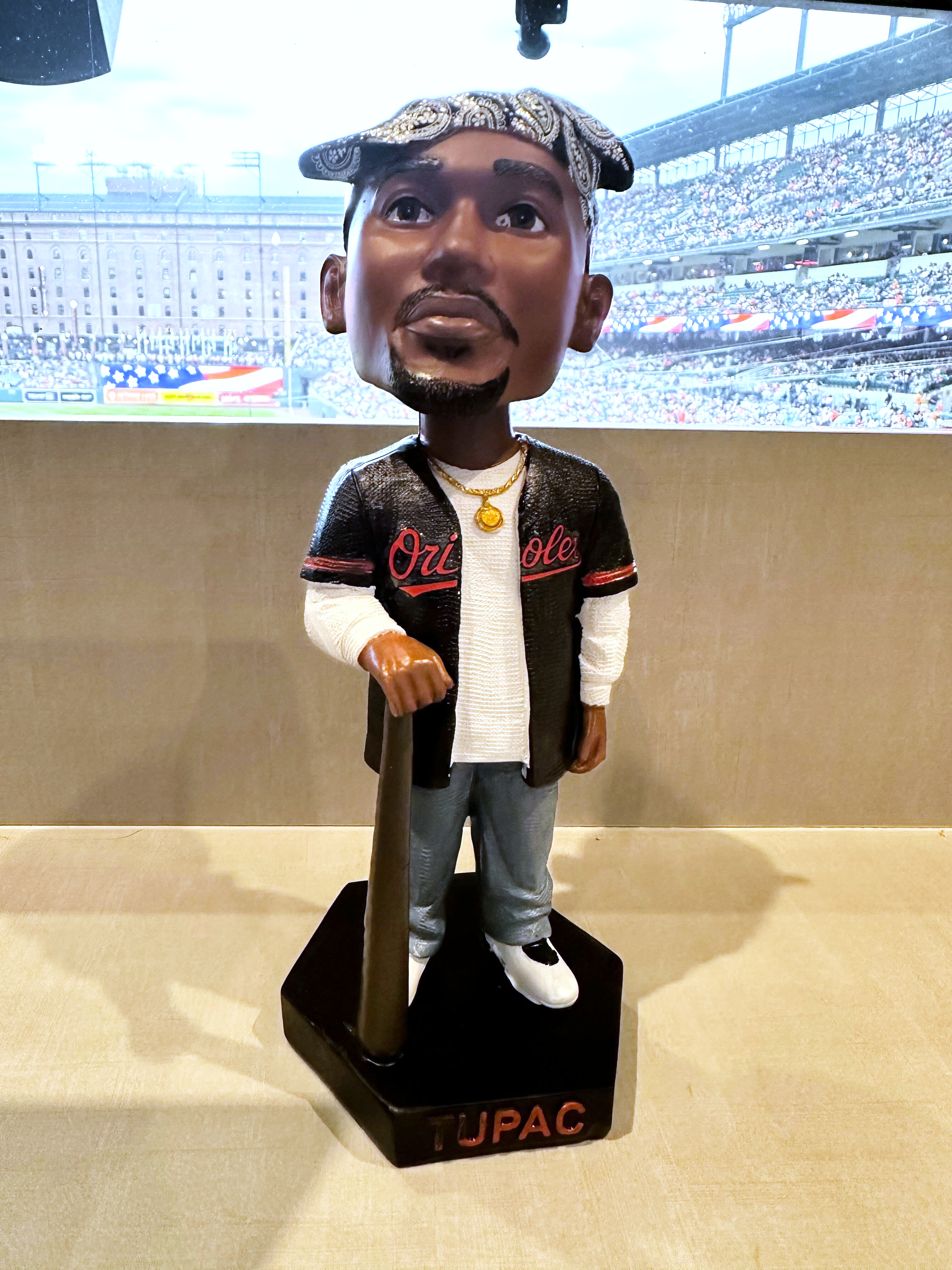
The Baltimore Orioles handed out a Tupac Shakur bobblehead in May. The New York Yankees gave out a KPop Demon Hunters bobblehead on Aug. 11, and they have a George Costanza calzone bobblehead — paying tribute to a 1996 Seinfeld episode — coming up on Aug. 27. Every MLB team except Toronto had a Star Wars Night this season.
A Tupac Shakur bobblehead is displayed for the Baltimore Orioles’ giveaway at a baseball game against the Athletics on May 8, 2026, in Baltimore. Noah Trister
Following in the footsteps of the minor leagues in many cases, it’s not enough anymore to just feature a popular player for a giveaway.
“You can see that teams are doing a much better job with their understanding [of] who they’re trying to target,” said Jim Strode, an associate dean and professor at Ohio University’s College of Business. “When I think of the Seinfeld one, I’m thinking, you know, they’re targeting Gen X, they are targeting some, you know, younger baby boomers to try to get out to the ballpark.”
There is also what Lauren Anderson, the director of the Warsaw Sports Business Center at the University of Oregon, described as the “collector chase game.” There were multiple fans looking to buy additional pope hats at Tuesday night’s game, and there were several listings for the giveaway and the KPop Demon Hunters bobblehead on eBay the next day.
“You want something that’s unique and cool and something that you can, you know, I’m one of 5,000 people to get these, I’m one of 10,000,” Anderson said. “I mean, there is also a bit of the game of people want something that’s limited so they can flip it and sell it, like on an eBay.”
BUNIA, Congo — Congo will receive 70,000 doses of the Ervebo vaccine, which has been effective in past Ebola outbreaks, the World Health Organization and partners said Thursday, announcing a step seen as a major boost to efforts to contain what officials have described as the fastest Ebola outbreak in history.
The Ervebo vaccine is licensed for use against Ebola virus, one of the viruses that cause Ebola disease, but not for Bundibugyo virus, which is responsible for the current outbreak which has so far killed 2,476 people out of the 5,208 confirmed cases
WHO said in a statement that while it’s not known whether Ervebo may protect against the Bundibugyo virus, “early laboratory and animal data suggest it may provide some protection.”
The allocation includes 20,000 doses for a Phase 3 clinical trial to understand the impact of the vaccine on the Bundibugyo virus, the agency said. The remaining 50,000 doses will be used for front-line and health workers as recommended by WHO experts.
The outbreak raging in six provinces in eastern Congo has infected and killed more people at a greater speed than any other Ebola outbreak in history, and is spreading about three times faster compared to the 2014-2016 outbreak across West Africa — the deadliest Ebola outbreak on record with more than 11,000 deaths.
The International Coordinating Group on Vaccine Provision, which includes WHO and other partners, said the doses will be released immediately following a request from Congo’s government.
WHO Director-General Tedros Adhanom Ghebreyesus called the approval “an important example of global solidarity in action.” He said the agency and its partners remain committed to supporting strengthened surveillance, rapid detection, quality care, community engagement and vaccination efforts to bring the outbreak under control.
The lack of approved vaccines or treatments for the rare Bundibugyo virus has been a major issue for responders. Most new cases have been reported outside of the people being monitored, showing the virus continues to spread faster than efforts to track it. That has been a key contributor to the recorded deaths.
The case fatality rate so far is 47.5% although it is far worse in some places where response efforts are more challenging, such as in North Kivu province where the fatality rate is up to 70%.
Experts believe the virus began spreading from the mining town of Mongbwalu as early as February, months before authorities declared the outbreak on May 15.
KYIV, Ukraine — Russia pounded the Ukrainian capital of Kyiv and the surrounding region with scores of missiles and drones in a nighttime aerial attack that lasted for hours and killed at least 16 people, officials said Thursday.
Large-scale Russian missile strikes have become a regular occurrence this summer. Just over two weeks ago, a Russian attack on Kyiv and its surrounding region killed 17 people, and nine were killed in the city two days before that. The United Nations said last week that Kyiv was one of the hardest hit cities in July, with at least 54 civilians killed and 202 injured.
At the same time, Ukraine has shifted the war onto Russian soil through long-range drone strikes on oil facilities that have caused fuel shortages across the country. It has also unsettled the Russian public by striking warehouses of Wildberries, the country’s biggest online retailer.
Zelensky repeats his appeals for more air defense
President Volodymyr Zelensky has pleaded for countries to send more Patriot interceptors for defense, but international stockpiles are low amid the Iran war and Kyiv’s more than four-year fight against Russia’s all-out invasion.
Russia’s overnight barrage also included cruise missiles and jet-powered drones that further strain air defenses, Ukraine’s air force said.
Explosions boomed across Kyiv in the dark, but the air force said hits were recorded at 28 locations across the country. Emergency services said 15 people were killed in the capital, with another death in the wider Kyiv region. About 40 people were wounded, Zelensky said, as air raid warnings lasted until after dawn.
More than 38,000 people, including over 2,000 children, sheltered in Kyiv’s subway stations overnight, the system’s operator said.
“It was a massive attack,” Zelensky said on social media, adding that Russia “had been preparing [it] for a long time, combining different types of ballistic missiles, cruise missiles and drones, aiming to cause as much damage as possible to civilian infrastructure.”
The Russian Defense Ministry said it struck a Kyiv industrial site manufacturing components for Flamingo cruise missiles. Sites involved in the production and storage of drones, an ammunition depot and a logistics center were also hit, it said.
Russia is able to produce more than 200 cruise and ballistic missiles per month, Ukraine’s intelligence agency told news outlet Ukrainska Pravda in comments published Thursday. It has stockpiled more than 1,100 cruise missiles and about 130 Iskander-M ballistic missiles, as well as hundreds of missiles of other types, the agency was quoted as saying.
It was not possible to independently verify the report, and Russian officials do not routinely answer questions about the country’s arsenal.
Ukraine says it struck more Russian oil facilities
Russia and Ukraine have battered each other with drones and missiles as their armies struggle to gain the upper hand on the 780-mile front line.
Ukraine’s General Staff said its forces struck an oil refinery in Nizhnekamsk, in Russia’s Tatarstan region, starting a fire, and the Tamanneftegaz oil terminal in Volna, in Russia’s Krasnodar region, where there was also a blaze. Ukraine has hit both facilities in recent months as part of its campaign to disrupt Russia’s vital oil industry.
Tatarstan leader Rustam Minnikhanov confirmed there had been a “massive attack” in the region, state news agency Tass reported, citing his press service. Many of the drones targeted Nizhnekamsk’s Zakamsk economic area, disrupting production at industrial sites and damaging residential buildings, Tass quoted him as saying.
The Russian Defense Ministry said air defenses shot down 726 drones overnight over a number of Russian regions, annexed Crimea and the Black and Azov seas, in one of Ukraine’s biggest aerial attacks of the war.
Ukraine’s neighbors are on alert
Russia’s relentless onslaught has spooked other European countries, especially those bordering Ukraine, which fear spreading attacks from Moscow.
Amid the attack on Kyiv, the Polish Armed Forces Operational Command activated its military aviation operations, ground-based air defense systems and radar reconnaissance. Polish and other NATO military aircraft were deployed to monitor its airspace, Polish news agency PAP reported.
Romania’s Defense Ministry said an unidentified drone crashed and burned in an uninhabited area near the Ukrainian border. Two Spanish F-18 jets, deployed on a policing mission in Romania, were scrambled overnight to monitor a group of “air targets” near the border, the ministry said.
In addition, two Romanian F-16 fighter jets were deployed to destroy a naval drone seen near a major Black Sea gas project, Romania’s acting Defense Minister Radu Miruta said.
Moldova’s Defense Ministry also said its airspace was breached by at least one drone.
Russia “is increasingly testing the resolve of NATO and its partners, violating the sovereignty of neighboring states and deliberately expanding the risks posed by its war far beyond Ukraine,” Ukrainian Foreign Minister Andrii Sybiha said on social media.
European Commission President Ursula von der Leyen saw a broad threat to the European Union. “An escalating campaign of threats is underway, unsettling our citizens and seeking to divide our Union,” she said on X.
Explosions shatter windows and screams fill the air
Russia’s overnight strikes hit 12 locations across Kyiv’s Darnytskyi, Sviatoshynskyi and Solomianskyi districts, damaging 30 apartment blocks, a school, a children’s hospital and a kindergarten, Zelensky said.
Larysa Bondaruk, 60, sat on the ground, holding her cat, Chanel, which had been rescued by firefighters. With tears in her eyes, she said her neighbor’s grandson had been trapped by the rubble and died. Her apartment was badly damaged.
“A rocket hit the roof. It was incredibly loud. Immediately, debris and doors were blown out. There were columns of smoke, columns of fire, screams, crying and despair,” she said. “Two people were killed in our building, but the rescuers responded quickly and professionally. I am grateful to them for that.”
In Solomianskyi district, the top two floors of a nine-story residential building were destroyed and fires broke out on other floors. People were also trapped in two residential buildings and a school shelter.
TOKYO — Christopher Bodeen, a tenacious, old-school wire service reporter who brought a keen analytical eye and a wry sense of humor to decades of work in China, Taiwan, and in war zones and natural disasters across the globe for the Associated Press, has died. He was 55.
Mr. Bodeen died Monday after a struggle with cancer and complications from a stroke, his daughter, Ingrid, said Thursday by telephone from Taiwan.
Mr. Bodeen, who spoke fluent Mandarin with a proud Taiwan accent, spent much of his career detailing China’s rise to an economic, political, and military superpower — and the accompanying friction from what critics have long called Beijing’s heavy-handed efforts to establish dominance in Asia and beyond.
“Chris was a reporter who would go anywhere and do anything for the story,” said Charles Hutzler, AP’s former bureau chief in Beijing. After a huge quake flattened a swath of Sichuan Province in 2008, Mr. Bodeen composed his account from one devastated town sentence by sentence over text messages because of damaged telecommunications networks. “It was one of the first eyewitness reports the AP and the world received about one of the worst earthquakes in decades,” Hutzler recalled.
He was an expert on politics and Chinese military issues
From AP bureaus in Shanghai, Beijing and Taipei, Mr. Bodeen was for years the news agency’s go-to person on Chinese politics and military issues, able to quickly determine the newsworthiness of the government’s often abstruse statements.
“A chat with Chris would inevitably turn into a remarkable history lesson,” said Emily Wang Fujiyama, former Greater China news director. “He had astounding knowledge of the region and would be writing about China’s military presence in the South China Sea, pivot to Taiwan’s intricate politics, and just as deftly write about the political sensitivities of Tibet, Mongolia, and China.”
Mr. Bodeen was born in Missouri on Sept. 9, 1970, but he spent parts of his childhood in the Middle East, Europe, Africa, and Asia. His father was a foreign service officer and his mother a former diplomat, his daughter, Ingrid, said. Friends and colleagues remembered his love of the Boston Red Sox, esoteric punk rock — and his contagious enthusiasm for the job of journalism.
“He was the blondest, palest person you’ll ever meet” yet also spoke pitch-perfect Chinese, said Ted Anthony, AP’s former China news editor and news director for Asia. “So when the earthquake in Sichuan happened in 2008, he went out there, put on one of his ever-present ball caps to cover his hair, and slouched down. He passed as Chinese, started interviewing people and sailed under the scrutiny of the authorities.”
He was ‘always ready for adventure’
Mr. Bodeen joined the AP in 1996, in Taiwan, the self-governing democratic island China claims as its own, before working as an editor on the agency’s international desk in New York and then joining the AP bureau in Beijing as a correspondent, in 2000. He majored in history and Asian studies at Tufts University, graduating in 1993.
“Chris Bodeen was always ready for adventure. Hiding in the hills of Hainan Island, China, to try to report on the return of an American Air Force plane forced down in 2001, he was the best colleague to be with,” said Raf Wober, a video journalist in the AP’s Hong Kong bureau.
In a 2017 story on efforts to burnish the image of Chinese leader Xi Jinping, Mr. Bodeen described state broadcaster China Central Television leading its evening national news bulletin “with more than four minutes of uninterrupted clapping for Xi as he met with adoring citizens,” and a Russian translator who “was so engrossed with reading a recent speech by Xi, Xinhua [the official news agency] said, that he skipped lunch and dinner just to finish studying it.”
While much of this might have seemed amusing to outsiders, Mr. Bodeen was careful to note that “the domination of [Xi’s] image in official propaganda evokes, for some, the painful memories of the upheaval of the 1960s and ’70s, when Mao [Zedong] was accorded the status of a near deity.”
Julie Pace, AP’s executive editor, remembered Mr. Bodeen as not only an effective China correspondent but as a fellow journalist whose knowledge elevated those around him.
“Chris cared deeply about his work and the value of on-the-ground reporting in such an important region of the world,” she said. ”His expertise informed AP’s audiences for so many years, but also helped lift up so many colleagues.”
Passion for family and work was his hallmark
Mr. Bodeen was deeply proud of his two daughters and loved showing off their artwork and achievements — and creative Halloween costumes — to colleagues. “Every parent thinks their kids are the best, but, hand to God, these girls are both adorable and seriously tough cookies,” he wrote of his children.
“He truly, passionately loved what he did, as much as he loved being a dad,” Ingrid Bodeen said. She recalled that when her father spent long stints reporting from Afghanistan during her childhood, “he would always have my mom fax over my spelling lists and homework so we could work on them together. He never missed a spelling test week.”
Mr. Bodeen was also beloved by colleagues for his sharp sense of humor, his knowledge of good local food, and an encyclopedic knowledge of movie and TV comedies from the ’70s and ’80s.
Kanis Leung, an AP reporter in Hong Kong, said that Mr. Bodeen once told her about an old correspondent’s description of news reporting as “the art of shoving 50 pounds of oatmeal into a 10-pound sack.”
“Except,” Mr. Bodeen told Leung, “he didn’t say oatmeal.”
Mr. Bodeen is survived by his wife, Yen Ling, daughters Ingrid, 26, and Naomi, 22, his parents and a sister.
HOUSTON — For years, travelers passing through Texas’ two biggest airports have had access to small washing stations for a ritual called wudu, in which Muslims clean their hands, arms, head and feet before the five daily prayers.
Such facilities have become more common in states with the largest Muslim populations, including Texas, where on Wednesday travelers and others popped in and out of washing stations at Houston’s George Bush Intercontinental Airport. The tiled wudu room sits along an airport hall just past a vending machine, with a small sign showing a draped person kneeling.
Public wudu stations are also open at places including the University of Minnesota, the University of Michigan, LaGuardia Airport in New York, and O’Hare International Airport in Chicago.
Now, amid rising attacks on Muslims by Republican elected officials, Texas Gov. Greg Abbott is making the stations a target. He sent a letter Friday to the heads of the Houston airport and Dallas-Fort Worth International Airport that said facilities aimed at serving one religious group are discriminatory against everyone else.
Abbott said he has asked the U.S. Department of Transportation to investigate both airports and warned that his office is “reviewing all grants to any local governmental entities involved in these schemes.”
Later that day, DFW announced it had scrapped plans to add additional washing stations in men’s and women’s restrooms that are available to passersby outside the security perimeter.
Airport spokesman Heath Montgomery wrote in an email that officials “determined the originally anticipated benefit may not be achieved” if the stations were built.
Asked if the decision was a response to Abbott’s letter, Montgomery said it was made before the letter was issued, but that airport officials “were aware of his and other public officials’ emerging concerns.”
Muslim leaders and experts in religious liberties rejected Abbott’s claim that the facilities would discriminate against non-Muslims. Several said opposition to the washing stations is the latest example of GOP leaders, perhaps most visibly in Texas, railing against Islam.
“If there is one thing all religious liberty scholars and advocates across the ideological spectrum have agreed on, it is that the Free Exercise Clause forbids government discrimination because of religion,” Steven T. Collis, a University of Texas at Austin law professor, said in an email. “Although Gov. Abbott’s letter characterized what the airports were providing as discriminating in favor of Muslims, this newest saga is actually part of a much broader pattern of state officials targeting Muslims and trying to make Texas an inhospitable place for them.”
Asma Uddin, a constitutional law scholar who writes about Islam in America, said the Supreme Court has long ruled that neutrality “does not mean that every religion gets treated exactly equally; it means the government cannot coerce, endorse, or exclude based on religious identity.”
The experts noted a range of public services targeted to specific groups, from kosher food served at airports to special low-sensory hours at museums or parks for autistic people. The public-private Texas waterpark chain Hawaiian Falls has hosted events for Christians including “Modesty Matters” and mass baptisms. President Donald Trump this summer hosted a massive evangelical Christian worship event on the National Mall in D.C.
“We can choose to be coy about it and pretend like there are actually sophisticated ideas or sincere concerns here about discrimination, religious encroachment, public safety or spending,” said Imam Omar Suleiman, who leads the think tank Yaqeen Institute outside Dallas. “Or we can embrace the fact that bigotry toward Muslims is alive and well and being fanned, funded and fueled to increase, in Texas and across the country. And people like Governor Abbott are at the center of that phenomenon.”
Abbott’s office declined to comment Wednesday, referring The Washington Post to social media posts in which he repeated his claim that the washing stations were religious discrimination.
The office also noted a Sunday interview on Fox News in which Abbott was asked why he opposes the stations but supports a new state law mandating the posting of a Protestant version of the Ten Commandments in every classroom.
Abbott called the two things “apples and oranges.” The biblical commandments, he said, were part of Texas history all the way up until “who we are today,” while “other faiths” don’t have “the same applications over the course of history of the state of Texas and hence don’t need to be recognized.”
Suleiman, who uses airport wudu stations when he’s traveling, called the washing facilities an important part of making Muslims comfortable and described Abbott’s letter as part of a movement looking to curtail that group’s religious freedoms.
“Putting one’s foot in the nasty sink of a public restroom — often trying to carefully ensure that no part of the body touches some yucky bathroom surface while balancing on one leg — isn’t really something Muslims are thrilled to be doing,” he said.
There are about 4.6 million Muslims in the United States and about 313,000 in Texas, according to the World Population Review. Muslims have become more visible in American public life in recent years, with milestones including the election of Mayor Zohran Mamdani (D) in New York and the Michigan Democratic primary win of Abdul El-Sayed, who would become the nation’s first Muslim U.S. senator if he defeats his Republican opponent this fall.
At the same time, anti-Muslim sentiment has become more public and more pointed.
“The blatant and mainstreaming of Islamophobia is worse than after [the Sept. 11, 2001, attacks],” said Haris Tarin, vice president of the Muslim Public Affairs Council, an advocacy group that focuses on policies of interest to U.S. Muslims.
Trump, who has declined to condemn anti-Islam comments from members of his party, last week described Democratic candidates in the midterm elections as “jihadists.” Earlier this month, Rep. Nancy Mace (R, South Carolina) said “every single Muslim holding public office in America is a Trojan horse.”
The growth of Muslim communities in Texas is impossible to miss.
The Houston area is now home to Texas’s largest Muslim community, with more than 200 mosques and Islamic centers. The Muslim population in the Dallas-Fort Worth area doubled in a decade, and Muslim state lawmakers represent suburban districts in both the Dallas and Houston metro areas.
Houston Mayor John Whitmire released a statement in response to Abbott’s letter saying 22 percent of all international travelers departing from Terminal D — where the wudu station is — are flying on airlines based in Muslim-majority countries. “IAH is a global gateway,” Whitmire wrote. “The ablution room was created in response to passenger requests and serves a practical need.”
Abbott, who is running for reelection, and Attorney General Ken Paxton — a Trump ally who is waging a competitive race for the Senate — have both embraced Islamophobic rhetoric on the campaign trail.
Last year, Abbott designated the Council on American-Islamic Relations, a Muslim civil rights and advocacy organization, as a foreign terrorist group. He and Paxton fought to revoke the group’s nonprofit status, a move that CAIR has challenged in court.
Abbott has also led GOP efforts to block a residential development planned around a large mosque complex in the Dallas area.
Texas officials denied Islamic schools access to the state voucher program until a judge ordered them not to. At the Texas GOP convention in Houston in June, Republicans added to their platform a provision banning “sharia,” or Islamic law, even though sharia law does not apply under U.S. civil law.
At the airport in Houston on Wednesday, people came in and out of the wudu rooms ahead of Dhuhr, the midday prayers. A man and woman wearing airport employee tags — she also wore a blue head scarf — slipped into their respective rooms shortly before 1:30 p.m. A mother and her teenage son, traveling home to Toronto after visiting family, said ablution stations are common in Canada.
Ubaid Mian, who manages several airport restaurants, said he uses the prayer and wudu rooms multiple times each day.
“The airport is a place where everybody travels. Diversity should be appreciated,” he said, shaking his head at the controversy. Texas “has so many people here who have so many different beliefs. There’s no harm in it. It should be respected.”
Mian said he would be back at the wudu room to prepare for evening prayer before heading home.