Category: Wires

  • Retrofitted Qatari jet takes flight as Air Force One for Trump’s trip to North Dakota

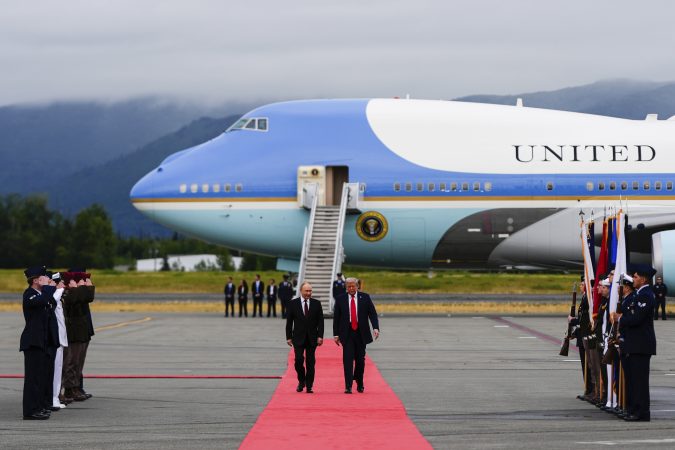
    WASHINGTON — President Donald Trump on Wednesday took his maiden voyage on a new Air Force One — a retrofitted Boeing 747 worth $400 million gifted by Qatar that embeds his personality more deeply into the institution of the American presidency.

    Gone is the trademark light blue hull that helped Air Force One blend into the sky. The refurbished jet is painted to Trump’s preferred color scheme of a navy blue belly and red and gold stripes.

    It has the luxury features that the president believes a commander-in-chief’s entourage should have — plush carpets, lie-flat seats, wood paneling, and a presidential seal on the seat belts, according to reported tours of the plane.

    Trump told reporters that he was proud of the luxurious plane. “You can do two things: You can low-key it, or you can show it,” he said.

    Reporters are generally not permitted to take photographs on the plane unless Trump is present. But on Wednesday, Trump administration staffers posted images of the plane’s interior on social media.

    White House communications director Steven Cheung posted a photo of aides gathered around a circular table that had off-white place mats and leather captain’s chairs. Monica Crowley, the chief of U.S. protocol, posted a picture of herself perched on a leather couch between a pair of Air Force One throw pillows. Mounted on the wall behind her was a framed photo of the Thomas Jefferson Memorial.

    The jet carried Trump to North Dakota to see the Theodore Roosevelt Presidential Library, the first official visitor ahead of its opening on the nation’s 250th anniversary.

    The jet, a gift from the Middle Eastern power, raised ethical concerns, but Trump saw the plane as a necessary replacement to the 35-year-old planes that had previously ferried him as president.

    “This is a gift from a country that has treated us very well,” Trump said.

    The new jet will only temporarily be in the nation’s service only temporarily, as Boeing is expected to deliver in 2028 long-delayed planes that will permanently serve as Air Force One. Trump, a Republican, has said in the past that the Qatar plane would end up in a presidential library.

    The Air Force has said that it did little to change the cabin layout of the plane and that it spent less than $400 million on security upgrades.

  • U.S. and Iran meet with mediators in Qatar

    U.S. and Iranian negotiators were in Qatar on Tuesday as both sides were set to hold talks with mediators, after a surge of attacks in recent days over the Strait of Hormuz threatened to derail efforts to agree on a lasting peace deal.

    Steve Witkoff and Jared Kushner, two of President Donald Trump’s closest advisers, were to meet with the prime minister of the Persian Gulf state, Sheikh Mohammed bin Abdulrahman Al Thani, a U.S. official said. The official added that the U.S. and Iranian delegations would hold separate talks with Qatari and Pakistani mediators today.

    Iran and Qatar said no direct, high-level meetings between the U.S. and Iranian officials were planned and that the discussions would instead be conducted via Qatari intermediaries. The negotiations would focus on implementing the preliminary ceasefire deal reached two weeks ago, the spokespeople for both countries’ foreign ministries said separately.

    The absence of face-to-face talks underscores the depth of the distrust between the United States and Iran, after negotiators met in Switzerland in June. The meetings follow a dayslong flare-up of hostilities over the strait, a key transit route for oil and gas shipments that Iran effectively blockaded during the war.

    The preliminary ceasefire largely deferred discussion of the toughest topics, including Iran’s nuclear program and U.S. sanctions on Iran, and allotted 60 days for the countries to reach a comprehensive, long-term deal. But the two sides have been unable to agree even on the meaning of the ceasefire agreement.

    U.S. officials also hoped that the pact would lead to the full reopening of the strait to its prewar status, when ships transited for free. Iran, however, has insisted that the agreement gives it substantial authority over the waterway and has threatened ships that do not travel on Iranian-mandated routes.

    Iran and Oman, a U.S. ally, are advancing a plan to collect payments for ships moving through the strait, despite U.S. objections, according to an Iranian official and four diplomats with knowledge of the matter.

    The latest round of hostilities began Thursday when the U.S. military said Iran had attacked a cargo ship hours after Iran warned that vessels could only travel through its waters in the strait. The ship was transiting through an alternative route near the Omani coast.

    U.S. officials also blamed Iran for another attack Saturday. The U.S. retaliated by striking what it said were Iranian military sites, and Iran responded by carrying out drone and missile strikes against U.S. targets in Bahrain and a Kuwait.

    The clashes ended Sunday, but neither side has publicly acceded to the other’s demands on the strait.

  • Serena Williams loses in opening round at Wimbledon in first singles match in nearly four years

    LONDON — Serena Williams showed plenty of what made her a 23-time Grand Slam tennis champion in her first professional singles match in nearly four years on Tuesday.

    But Williams, 44, couldn’t quite dominate like she used to and was beaten, 6-3, 6-7 (6), 6-3, by an opponent less than half her age, 20-year-old Maya Joint of Australia, in the opening round of Wimbledon.

    “It was really great to be back at Wimbledon. I never expected to be here,” Williams, who did not meet with media after the match, said in a statement released by Wimbledon organizers. “The atmosphere was amazing. Walking out was amazing. I definitely relished it and missed it and enjoyed the moment more than anything.”

    Williams displayed the same powerful serve and heavy groundstrokes that led her to seven Wimbledon singles titles, but the 87th-ranked Joint handled her pace and won more of the big points by hitting beyond Williams’ reach on Centre Court.

    “I don’t know what just happened, to be honest,” Joint said. “I didn’t get much sleep last night. I was up until like 2 a.m. just thinking about it.

    “She has such an aura, she’s just a legend, and this court has so many huge names that have played on it. I’ve been dreaming about this moment since I was a little kid, so this is pretty crazy.”

    While Williams played two doubles matches just before Wimbledon to announce her comeback to the sport she once dominated, she hadn’t played a singles match since the 2022 U.S. Open.

    Williams has 98 career victories in singles on the hallowed grass of the All England Club. By contrast, it was Joint’s first Wimbledon victory in just her second appearance at the All England Club after losing in the opening round last year.

    But Joint won a Wimbledon warmup in nearby Eastbourne last year and knows how to play on grass.

    Doubles match still to come

    Williams, who has no singles ranking after being out for so long, was given wild card invitations by Wimbledon organizers to play singles and doubles with her older sister, Venus. Her doubles match is later this week.

    Williams has said that having her two daughters off from school inspired her comeback, and it marked the first time that her younger daughter, Adira, who is almost 3, saw her play singles. Adira sat next to her 8-year-old sister, Olympia, in the front row of Serena’s players’ box.

    Standing ovation

    Williams was given a standing ovation as she walked on court before the match started under a closed roof and several supporters held up signs with messages like “Welcome Back” and one wore a T-shirt with the text “Unstoppable Queen.”

    Williams executed a delicate topspin lob winner early on and then cranked out a 121 mph ace to hold for 3-3 in the first set. But Williams also had a costly double fault that led to the only break of the first set.

    In the second set, Williams came back from 0-40 and saved four break points to hold for 6-5. Then Williams saved a match point in the tiebreaker with a big serve down the T followed by a forehand approach winner. Another big serve — clocking in at 122 mph — set up Serena’s first set point, which she converted when Joint missed a forehand long.

    After winning the set, Williams pumped her fist calmly.

    But Joint took control early in the third and a forehand from Williams sailed long on Joint’s third match point to conclude the encounter after 2 hours, 22 minutes.

    Williams then smiled as she walked off the court to loud applause.

    Williams and Joint both had 37 unforced errors, while Joint led, 40-26, in winners.

    Zverev, Świątek advance

    After opening day featured wins for No. 1s Jannik Sinner and Aryna Sabalenka, along with Novak Djokovic, French Open champion Alexander Zverev and defending Wimbledon champion Iga Świątek made it into the second round on Tuesday.

    In a match between hard servers, the second-seeded Zverev beat Alexander Blockx, 6-4, 6-7 (8), 7-6 (5), 7-6 (0).

    Świątek, who had her father and sister looking on from the Royal Box, struggled with her serve and committed nine double-faults before overcoming Taylor Townsend, 6-1, 2-6, 6-3.

    No. 2 Elena Rybakina also advanced, beating Lois Boisson, 6-4, 1-6, 6-3.

    Fourth-seeded Ben Shelton, a quarterfinalist here last year, lost to 140th-ranked Finnish qualifier Otto Virtanen in five sets, 6-4, 3-6, 6-7 (8), 6-2, 7-6 (9).

    Matteo Berrettini, a finalist in 2021, beat Stan Wawrinka, 6-7 (7), 7-6 (16), 7-6 (7), 7-6 (5). It was the final Wimbledon match for Wawrinka, who plans to retire at the end of the year.

  • Three words in the Declaration of Independence paint a cruel picture of Natives

    Three words in the Declaration of Independence paint a cruel picture of Natives

    McKaylin Peters, a 24-year-old Native American graduate student at Johns Hopkins University, still recalls when she first heard the words “merciless Indian savages.”

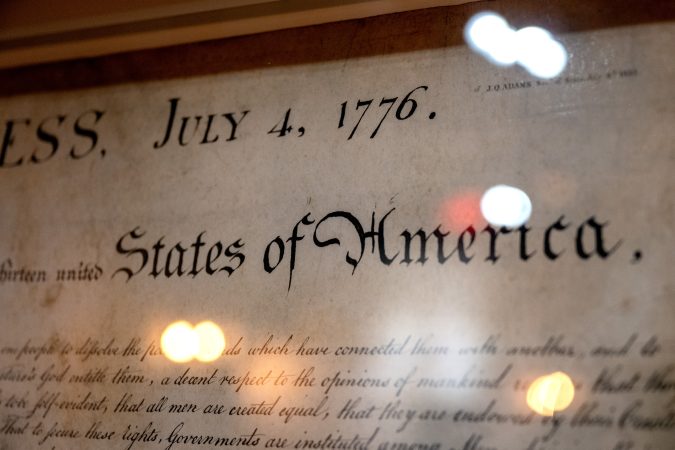
    Sitting in social studies class at her predominantly White middle school near Green Bay, Wisc. — a school that once used an image of an Indian as its mascot — she cringed when the teacher read a passage deep in the Declaration of Independence: “He has excited domestic insurrections amongst us, and has endeavoured to bring on the inhabitants of our frontiers, the merciless Indian Savages, whose known rule of warfare, is an undistinguished destruction of all ages, sexes and conditions.”

    Peters said she and the six other Native students in the class looked quietly at one another.

    “I was upset. It just rolled off her tongue very easily,” recalled Peters, a citizen of the Menominee Nation who is getting her master’s in organizational leadership. “It seemed like no one else was shocked except for us, the Indigenous students in the classroom. We were like, ‘Did she really just say that?’”

    As the United States marks the 250th anniversary of the Declaration — a document fundamental to the nation’s founding and still revered — Peters and other Native American scholars and tribal leaders are reflecting on the Founding Fathers’ use of the derogatory description for Indigenous people in 1776. Many note that while the Declaration promises that “all men are created equal,” its ideals were not extended to everyone.

    The document’s portrayal of Indigenous people helped establish a moral and legal framework that justified decades of devastating U.S. policies toward Native communities, according to historians. Celebrations of the 250th anniversary of the Declaration’s signing come amid a striking contrast: Native tribes are working to reclaim ancestral lands, revive lost languages, and preserve cultural traditions, while the Trump administration has sought to remove or downplay references to slavery, Native dispossession, and other dark chapters of U.S. history in parks and museums and on government websites.

    “It’s not just a line in an old document,” Peters said. “It’s a reminder that this country was built by declaring us less than human. When the Declaration of Independence calls us that, it’s a message that Native youth sadly still hear today in classrooms, policy debates, and in how society talks about us.”

    Many historians and Indigenous historians say the term “savages” did more than reflect 18th-century attitudes. It helped perpetuate stereotypes of Native Americans and contributed to their marginalization; centuries later, it adds to feelings, especially for Native youths, of being excluded from America’s national story. A 2022 study by Texas A&M University researchers found that the Declaration’s pejorative reference to Native Americans helped normalize a view of them as threats rather than as sovereign nations and peoples with rights.

    For many Native people, the meaning — and impact — of the phrase is emotional and complicated.

    Some discover the wording as adults and are appalled. Others see it as a reminder of racist attitudes and centuries of broken treaties, land theft, and forced assimilation. Some young people have reclaimed the epithet, debating it on social media and displaying it on T-shirts and tattoos as a symbol of resilience and empowerment. An Indigenous-led heavy metal band intentionally used the phrase as its name.

    “It’s become sort of an ironic touchstone,” said Kevin Gover, the Smithsonian Institution’s undersecretary for museums and culture. A citizen of the Pawnee Tribe of Oklahoma, Gover said he did not encounter the term until middle age. After his initial outrage, Gover said, he responded as many Native people do: by mocking it.

    “Even we, on the side of the descendants of those who were victimized, have to take a nuanced view,” said Gover, who is also the former director of the National Museum of the American Indian in D.C. “In many respects, it’s a badge of pride that our ancestors had the wherewithal to survive and allow us to be alive in this time.

    “We can acknowledge the wrong,” he said, “and be grateful for our ancestors’ fortitude.”

    Hartman Deetz, an enrolled member of the Mashpee Wampanoag — the Massachusetts tribe that famously helped the Pilgrims survive their first Thanksgiving in 1621 — said the wording reflects the opposite of how Indigenous people treated white settlers.

    “They were fed when they were starving, given hospitality by us, but they treated us in a way that was savage and merciless in the dispossession of our homelands,” said Deetz, who served as a consultant for an exhibition at the Museum of the American Revolution in Philadelphia about the Declaration and the history behind it. “It was framed in a way that justified the treatment they brought upon us, and it continues to this day in attempts to sell our sacred sites for copper mines and to drill for oil and mining on our lands.

    “The colonial enterprise hasn’t stopped,” he said. “There’s such a disregard for Natives to exist or have rights of where we do exist. That’s the legacy of these words.”

    The words originated in an early draft of the Virginia Constitution written by Thomas Jefferson, who later included it in the Declaration of Independence, which Congress adopted.

    Ironically, some historians say, the characterization of Native people contradicts Jefferson’s own views. In Notes on the State of Virginia, a book Jefferson wrote that laid out many of his views on race, government, and religious freedoms, he was “very sympathetic to Native people,” said Kevin Butterfield, a historian at the Library of Congress. Jefferson described Indigenous people as just, honorable and noble — a sharp contrast to the widespread European belief that Indigenous people were inferior.

    But Jefferson understood the Declaration was political rhetoric — a kind of “public relations piece,” said Butterfield, who is the acting chief of the Manuscript Division at the Library of Congress. He placed it near the end to bolster the case for independence.

    “He’s trying to paint the worst possible picture of how the king is approaching his interactions with the American colonists,” Butterfield said. “So he’s laying out horrible wartime atrocities from the Revolutionary War.”

    The description reflected colonial attitudes and the realities of frontier warfare, scholars say. Colonists were hostile toward Native Americans, who were powerful political and military figures and, just like other nations, protecting their sovereignty. Some Native nations had allied with the British — a move that many settlers resented — and many colonists also opposed King George III’s Proclamation of 1763, which barred settlement west of the Appalachian Mountains.

    Repeated violence between Indigenous people and settlers also helped shape the ideology behind the description, including the French and Indian War and Dunmore’s War in 1774, when Virginia colonists fought the Shawnee and Mingo to expand into the Ohio Valley, according to historians. In the summer of 1776, as the Declaration was drafted and adopted, a lesser-known conflict unfolded when Cherokee warriors attacked frontier settlements across parts of Virginia, North Carolina, South Carolina, and Georgia. Colonists responded by burning more than 50 Cherokee towns and driving Native people from their homes.

    By 1776, the Founding Fathers “understood their need to accuse the king of what they considered the ultimate crime — partnering with Indigenous peoples and arming them,” said Ned Blackhawk, a Native American author and Yale University historian. “So they created this vilification in the Declaration that, in many ways, was at odds with their experience of living alongside Natives for generations.”

    The rhetoric was part of a broader racial ideology taking shape during the Revolutionary era, said Blackhawk, an enrolled member of the Te-Moak Tribe of Western Shoshone Indians of Nevada.

    “They were deeply committed to Enlightenment principles, but those were restricted to people similar to themselves,” he said. “Native Americans became a foil in simplified and racialized ways.”

    Tracy L. Canard Goodluck, executive director of the Center for Native American Youth at the Aspen Institute, said she is disappointed the term is either glossed over or not taught in many school curriculums, its impact not discussed.

    It wasn’t until she was a student at Dartmouth College, she said, that she fully understood the context of the description. She was angry, but the new knowledge also awakened in her a passion for educating others about Indigenous history and mistreatment. Goodluck, a member of the Oneida Nation who is also Mvskoke Creek, said in her previous work as a teacher in Seattle and Albuquerque she taught about Indigenous people and the harsh characterization in the Declaration.

    “It shouldn’t just be about white history,” she said. “It should be about all history — the good, the bad, and the ugly.”

    She said it’s also important to educate the public, so every Fourth of July, she wears a T-shirt emblazoned with the phrase from the Declaration.

    “Those words served the purpose back then as a way to dehumanize Native people in this country,” said Goodluck. “We need to change that narrative. We’re still here. We’re doctors, lawyers, teachers and political leaders.

    “I am that merciless Indian savage who my ancestors prayed for to do great things.”

  • As war stalls, Putin concedes he never cut a deal with Trump in Alaska

    As war stalls, Putin concedes he never cut a deal with Trump in Alaska

    Russia’s war in Ukraine is stalling — on the battlefield and in the corridors of diplomacy.

    For months, high-ranking Russian officials insisted that a path to ending the war in Ukraine — largely on Moscow’s maximalist terms — had been decided at a meeting between President Vladimir Putin and President Donald Trump last August in Anchorage. Only Ukraine’s intransigence stood as an obstacle.

    But that narrative has unraveled — perhaps because the only way to get the United States to help broker a new deal is admitting there never was a previous one.

    In recent days, three top Russian officials accused the White House of not honoring the Alaska agreement. Foreign Minister Sergei Lavrov even speculated that the summit was a U.S. “ploy to buy time to rearm the Kyiv regime.”

    Secretary of State Marco Rubio, however, pushed back. “If there had been an agreement, we would have had an end of the war,” Rubio told reporters.

    “Russia wants the entirety of Donetsk to be turned over to them, among some other things,” he said, explaining Russia’s demand for more Ukrainian territory.

    After days of back-and-forth, Putin conceded the point, saying on Sunday that “there were indeed no agreements reached in Anchorage.”

    “The spirit of Anchorage — although it wasn’t expressed in any formal documents, and no one put any signatures down — in Anchorage we discussed certain possibilities for ending the crisis in Ukraine,” Putin told a state television reporter Sunday. “And the compromises discussed were precisely the proposals the American side made to us.”

    The contradictions started in Alaska immediately after the summit. Putin said an agreement that will “pave the path toward peace in Ukraine” was reached, while Trump said that while the meeting was “extremely productive … there’s no deal until there’s a deal.” Trump also told Fox News afterward that it was “up to Zelensky” now to get a deal done, referring to Ukrainian President Volodymyr Zelensky.

    The Russian leader’s decision now effectively to bury the Alaska summit, which the Kremlin and its propagandists had mythologized as a turning point, comes as Russian forces are largely stalled on the battlefield in Ukraine — a sharp change from the previous four summers when they made gains.

    Instead, the skies over Russia and the Ukrainian territory it occupies are increasingly crowded with advanced Ukrainian drones, signaling a new phase in which Russia is playing technological catch-up and regular Russian citizens are feeling the war intrude on their lives with gasoline shortages and disruptions to summer travel, including to occupied Crimea.

    Russian political analysts have interpreted the indirect spat between Rubio and Lavrov over the alleged deal as a sign that Ukraine has convinced Trump it can keep fighting — and that it can pose a serious threat to Crimea, which Russia illegally annexed in 2014, rather than surrendering the Donbas region, as Russia has demanded.

    Trump probably arrived in Anchorage believing that Ukraine’s defeat was inevitable and that the sooner it accepted terms, the better for everyone, Fyodor Lukyanov, a prominent foreign policy analyst who advises the Kremlin, wrote in an op-ed in a Russian publication.

    “The goal of Kyiv and the collective Brussels was to convince Trump that the belief in Ukraine’s inevitable defeat was mistaken,” Lukyanov wrote. “Ten months after the Anchorage summit, they succeeded in persuading him.”

    Since Alaska, no major breakthrough has materialized in Russia’s favor, Europe so far has managed to sustain its military and economic aid to Ukraine, and Trump has become distracted by Iran.

    “Diplomacy in the midst of hostilities is shaped by their outcome,” Lukyanov wrote. “If the balance of power — or the perception thereof — shifts, the understandings reached at an earlier stage lose their validity.”

    Ukraine’s push to impose a “logistical lockdown” on Crimea and Kyiv’s growing capability to strike deep inside Russia seem to be part of a 40-day blitz declared by Zelensky to “influence” Moscow to end the war.

    Continuing that pressure, Ukraine overnight launched dozens of drones at the Moscow region and struck Russia’s Dubna satellite communications center north of the capital. Zelensky said ​Russia uses the Dubna site for reconnaissance and coordination of its military activities in Ukraine.

    Andrei Vorobyov, governor of the Moscow region, confirmed the attack had occurred but said that an “administrative building was damaged by drone debris.”

    Amid chaotic scenes in Crimea, the Russia-installed authorities imposed a state of emergency in response to strikes on highways and bridges. There have also been blackouts that have prompted many summer visitors to return home.

    “He’s holding his own at least,” Trump said of Zelensky last week, speaking to reporters at the White House. “A lot of people dying on both sides, but I think he’s doing pretty well. You have to say he’s courageous, he’s got great equipment, he’s got great men, he’s got fighters.”

    Ukraine seems to have scaled drone production to a level that can sustain strikes on Russian cities hundreds of miles from the border, and that keeps the frontline kill zone stable. This means that ground action is drying up.

    “The war has markedly changed this year,” said Ruslan Leviev, an analyst with the Conflict Intelligence Team, a group that uses open-source data to track the Russian military.

    “It’s hard to say the battle initiative is on the Ukrainian side,” Leviev said, “but time is on Ukraine’s side — more problems keep arising for Russia, economically, politically, and militarily, and it’s all adding up.”

    Russian budget data indicates that its military recruited 71,216 men during the first quarter of 2026, compared with 89,601 over the same period last year, according to Janis Kluge, a Russia expert at the Berlin-based German Institute for International and Security Affairs.

    Recruitment stabilized somewhat in the second quarter, returning to around 30,000 contracts per month. But local media reports suggest the overall stream of recruits has slowed compared with previous years as the pool of men drawn by the enormous pay packages that eclipse regional Russian salaries appears to be shrinking.

    Rumors have circulated that Russia may declare a fresh mobilization after key parliamentary elections in the fall — the first since the war began — but politically that move could prove extremely costly for the Kremlin. The “partial mobilization” in 2022 drove tens of thousands of men to flee Russia. After four years of war, and mounting economic strain, the mood has soured considerably.

    Leviev and other analysts said that they doubt Moscow would call for full mobilization, since this would require significant financial resources to set up new formations, and train and equip them, and that such a move fundamentally wouldn’t unfreeze the line of contact. “At this pace, the war on the ground looks to us as a dead end,” Leviev said.

    This poses several challenges for Russia.

    Russia still holds an advantage in manpower, conventional arms, and ballistic missiles, which it continues to use against Ukrainian cities and infrastructure. But Ukraine’s relentless drone campaign, especially its use of medium-range drones, has chipped away at this advantage, complicating frontline logistics and driving up the costs for Moscow of supplying the front.

    Russia’s flagship air defense systems were designed for high-altitude targets like jets and ballistic missiles, not slow, low-flying drones. Interceptor missiles also cost many times more than the drones they shoot down, draining stocks at a rate Western officials have said may be unsustainable.

    In his remarks Sunday, Putin commented on the deteriorating situation in Crimea and the wider fuel shortage in Russia after weeks of silence.

    Addressing Ukraine’s drone campaign, Putin said that Russia needed to “significantly ramp up production of air defense systems.” He also pledged to ensure the supply of fuel to Crimea by land and sea but did not say how this would be accomplished.

    Putin also asserted that Kyiv had put forward what he called “new proposals” to curtail hostilities in four regions of eastern Ukraine — Kherson, Zaporizhzhia, Donetsk, and Luhansk — and agree to mutually halt long-range strikes.

    Putin, however, cast the offer as a distraction that would allow Ukraine to redeploy units from other regions to these four areas, relieving pressure along the nearly 800-mile frontline. He reiterated that Moscow aims to fight on.

    “We have some certainty regarding the challenges facing Putin, but what we can expect from him in response to these challenges remains unclear,” said Vladimir Pastukhov, a Russian political scientist and honorary senior research fellow at University College London.

    According to Pastukhov, Putin has several options to escalate the war, all fraught with risk. These include an attack on a NATO nation in the Baltics, the detonation of a tactical nuclear weapon in Ukraine, or a mass mobilization of Russian soldiers. Moscow could also adopt a hybrid strategy, potentially striking European military facilities supporting Ukraine.

    That would effectively be a limited, undeclared war on Europe, testing Trump’s loyalty to NATO allies.

    Putin could also pressure its ally Belarus to allow Russian forces to attack Ukraine from its territory, opening a new northern front.

    Putin on Sunday said Russia was expecting a resumption of U.S.-led peace talks and a visit to Moscow by U.S. envoys Steve Witkoff and Jared Kushner — once the “hot ​phase” of the Iran war is resolved.

    Lukyanov, the analyst, said Russia believes that Trump’s position on the war in Ukraine will shift again — as it has many times. “But first,” he wrote, “the White House must be brought to the understanding that a military victory for Russia’s adversaries is impossible.”
  • House GOP defections block move to attach Trump-backed elections measure to defense bill

    The latest attempt by House Speaker Mike Johnson (R., La.) to fulfill President Donald Trump’s demand to advance an elections overhaul bill failed Tuesday and delayed consideration of an annual defense policy bill.

    Due to GOP defections, a procedural vote failed 224-198 on the House floor. The vote would have merged the Save America Act and the National Defense Authorization Act upon passage of the latter and sent both bills together to Senate.

    Thirteen Republicans joined with Democrats to defeat a measure that would set rules for debate. GOP hard-liners, led by Rep. Anna Paulina Luna (Fla.), rebelled against the tactic, arguing it would make it too easy for the Senate to remove provisions of the Save America Act. Senate leaders have said repeatedly that they lack the votes to pass the Save America Act as a stand-alone measure.

    House Majority Leader Steve Scalise (R., La.) voted “no” on the rule Tuesday alongside the 13 GOP lawmakers, a move that preserves a chance for the House to reconsider the vote later.

    Johnson said Republicans will spend the next day and a half working on getting everyone in the party to a yes.

    He said the Republicans who voted against the rule are making “irrational decisions.”

    “It makes no sense to punish the House and stop the great progress of the House because of what Senate Democrats are doing or not doing,” he told reporters. “We’ve got to move forward.”

    When asked if Trump should talk to the House GOP holdouts, Johnson said he believes the president is “going to be very frustrated” with them.

    House Republicans have scrambled to find a way to get another vote on the Save America Act that would impose new voting restrictions, including a requirement to provide documented proof of citizenship and a photo ID at the time of voting, as Trump has demanded.

    After Tuesday’s failed vote, Luna said she will vote for the rule if House leaders let her add an amendment to the NDAA that would call for voter ID plus proof of citizenship to be placed into the text of the NDAA — two crucial portions of the Save Act.

    Another option House Republicans are considering would use a fast-track process to bypass the filibuster and pass Trump’s sought-after voting restrictions.

    Johnson said Monday that Republicans are moving forward with a plan to establish a grant program that would incentivize states to adopt stricter election rules outlined in the Save America Act.

    The move would use the reconciliation process, designed to overcome the filibuster, because it can be passed with a simple majority in both chambers, bypassing Democrats.

    “If you put it into a grant program or something similar, then it does make it part of reconciling the budget,” Johnson told reporters Monday, after meeting with Trump at the White House. “It does ultimately work that way.”

    “The only way to get that to the president’s desk, we’ve been shown many times, is to put it on reconciliation,” Johnson said.

    However it’s not clear whether Trump would be on board with voting restrictions administered through a grant program. And many Senate Republicans have expressed doubt about passing more legislation through the fast-track process this year.

    On Tuesday, Scalise said Trump is “really excited” about House Republicans’ plans to put components of the Save America Act into a reconciliation bill, but Scalise did not indicate whether the president supports the idea of getting the act done through a grants program.

    “He wants to get Save America signed into law, so do I. So you’ve seen us pass it multiple times in different ways, and we’re going to keep trying,” Scalise said. “The Senate is going to have to figure out a way to get it to the president’s desk.”

    Trump has been trying to pressure Republicans to pass the act, including refusing to sign a bipartisan bill aimed at helping Americans with housing, which was sent to his desk Monday.

    Speaking at the White House on Monday, Trump said it is “even more important” that Congress passes the Save America Act.

    Senate Republican leaders have repeatedly told Trump that the votes are not there to pass his election bill, which would require proof of citizenship to vote in federal elections and restrict mail-in voting, among other provisions. The House passed a version of the bill earlier this year that did not include all the provisions Trump has demanded.

    Johnson said he believes that establishing a grant program that incentivizes states to implement the new election restrictions — rather than establishing them outright — should comply with Senate rules and allow them to pass the legislation with Republican votes only.

    However, Senate rules would likely prevent much of the Save America Act as written from being included as provisions passed through the process must be budgetary.

    At least four Republicans in the Senate have expressed opposition to the Save America Act and previously voted against adding the language to another must-pass measure. It is unclear whether these senators would support the new grant provision.

  • Pope promotes Italian nun to top migrant role in his first major appointment of a woman to Holy See

    ROME — Pope Leo XIV on Tuesday made his first major appointment of a woman to the Holy See hierarchy, promoting Italian Sister Alessandra Smerilli to head the Vatican office responsible for migrants, the environment, and development.

    Smerilli, an economist, is currently the No. 2 in the Dicastery for Promoting Integral Human Development. As prefect, she replaces the retiring Canadian Cardinal Michael Czerny, who turns 80 this month.

    With the appointment of Smerilli, Leo appears to be following suit of his predecessor, Pope Francis, who made a point of promoting women to top-level management positions within the Holy See as part of his response to calls by women for greater decision-making roles in the church.

    But Leo too is following Francis’ lead by simultaneously naming Cardinal Fabio Baggio as a “pro-prefect” of the office, where he is currently undersecretary.

    The dual nominations recognize that sometimes the role of a Vatican department head requires being an ordained priest and cardinal.

    Baggio was also given the mandate to head up the Vatican’s Borgo Laudato Si environmental educational center, at Castel Gandolfo, near Rome.

    The Catholic Church reserves the priesthood for men, and women have long complained of a second-class status despite carrying out the lion’s share of the church’s work running schools and hospitals and passing the faith on to younger generations.

  • Congo bans gatherings in areas far from Ebola outbreak. Some say it limits dissent

    Congo bans gatherings in areas far from Ebola outbreak. Some say it limits dissent

    KINSHASA, Congo — Opposition and civil society groups are protesting Congo’s new ban on public demonstrations and mass gatherings in the capital and other areas far from the country’s deadly Ebola outbreak, alleging that the decision aims to limit freedom of speech.

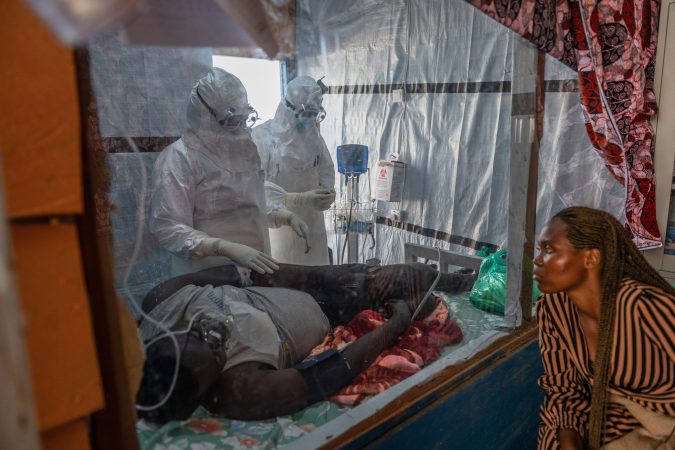
    The decision announced over the weekend came as the outbreak of a type of Ebola with no approved treatment or vaccine continues to grow, with 1,307 people infected and 377 dead across three provinces in eastern Congo. It could be the worst Ebola outbreak yet.

    Congo’s ministry of interior on Saturday said gatherings and demonstrations were forbidden in the provinces of Kinshasa, Tshopo, Haut-Uele, and Bas-Uele as fears grow about the outbreak spilling into new areas. None of the provinces have any confirmed cases.

    Separately, the mayor of ​Goma, eastern Congo’s largest city and now under the control of the Rwanda-backed M23 rebel group, also banned public gatherings and demonstrations, including celebrations linked to sports events, on Monday. Congo is in its first World Cup in over half a century.

    Congo’s political opposition has denounced the ban as unconstitutional. Prince Epenge, the spokesperson for the Lamuka coalition, has said the ban aims to prevent a planned demonstration in the capital, Kinshasa, early next month. The protest is against proposed constitutional changes that would allow Congo’s President Felix Tshisekedi to run for a third term.

    Civil society organizations also condemned the ban in a statement on Monday, citing freedom of speech and freedom of assembly.

    In a televised address on Monday evening, Tshisekedi announced a $319 million response plan to the Ebola outbreak, and called on people to respect health guidelines, report suspected cases, and not give in to misinformation. He did not directly address the bans.

    “Ebola is neither a rumor nor a source of shame,” Tshisekedi said. “It is a health emergency that demands responsibility, solidarity, and truth.”

    Health workers have reported some skepticism and attacks over Ebola from residents in the affected areas of Ituri, North Kivu, and South Kivu provinces.

    Cases also have been confirmed in neighboring Uganda, as well as one in France in a doctor who returned from Congo.

    The United Nations ​warned in a report on Tuesday that if the virus spreads into other neighboring countries, including Rwanda and Angola, it could cost Africa up to $3.6 billion and result in 328,000 job losses.

    More than a month into the outbreak, officials believe it continues to outpace response efforts and no one knows its true scale. They are yet to identify patient zero and struggle to trace contact cases.

    The World Health Organization has warned that violence from rebels in eastern Congo is complicating the response to the outbreak. In Ituri, attacks by the Islamic State group-backed Allied Democratic Force have cut off access to many villages and forced people to flee their homes, adding to already overcrowded camps of people displaced by years of conflict.

  • Judge orders Trump to end efforts to kill Hudson Tunnel funding

    Judge orders Trump to end efforts to kill Hudson Tunnel funding

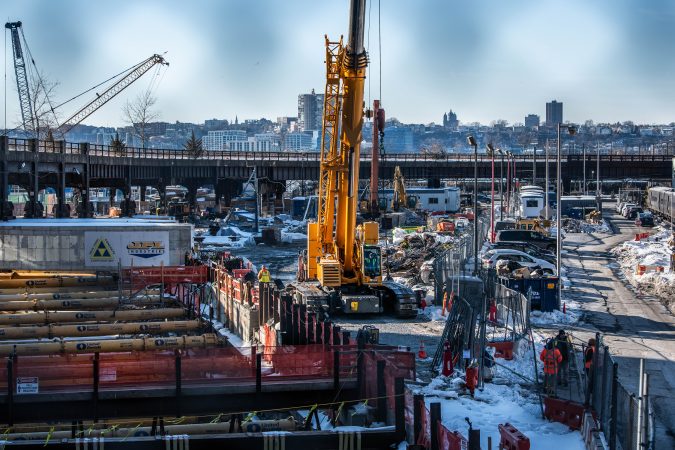
    A federal judge on Monday ordered the Trump administration to permanently abandon its efforts to suspend funding for a $16 billion rail tunnel under the Hudson River, describing those attempts as “flagrantly” illegal.

    Judge Jeannette A. Vargas of the Southern District of New York said that the administration violated federal guidelines when it stopped reimbursing the tunnel’s builders for their expenses in September. The suspension forced a shutdown of the construction project and led to a brief layoff of about 1,000 workers in New York City and New Jersey in February.

    Federal officials said that the payments were stopped while the project’s hiring practices were reviewed. But Vargas noted that President Donald Trump had indicated in interviews that there were political reasons for stopping the tunnel project, which was a favorite of Sen. Chuck Schumer, the Democratic minority leader from New York.

    “We’re cutting a $20 billion project that Schumer fought for 15 years to get, and I’m cutting the project,” the judge quoted Trump as saying in October. “The project is gonna be dead. It’s just pretty much dead right now.”

    The project, known as Gateway, would supplement two 116-year-old single-track tunnels under the Hudson between Manhattan and New Jersey. Schumer had called it the most critical infrastructure project in the United States.

    The project ran out of money about five months after the federal government stopped making payments. The states of New York and New Jersey jointly sued the Trump administration in federal court in Manhattan, seeking an emergency order to end the suspension.

    On Feb. 6, the day that work on the tunnel stopped, Vargas granted a temporary restraining order. The Trump administration opposed that order and continued to press its case but never disputed that the suspension “flagrantly violates federal law,” the judge said.

    In declaring the suspension of funding illegal, Vargas also said that the federal government could not attempt to suspend payment of the federal grants again.

    Catherine Rinaldi, executive vice president of the Gateway Development Commission, which oversees the project, said that before federal funding was frozen, the tunnel project “was on schedule and on budget, and we have made significant progress since federal funding for the project resumed in February.”

    In response to the judge’s decision, Gov. Kathy Hochul of New York and Gov. Mikie Sherrill of New Jersey, both Democrats, released a joint statement with Letitia James, the attorney general of New York, and Jennifer Davenport, the attorney general of New Jersey.

    “We are grateful that a federal court has once again agreed that the Trump administration’s decision to freeze billions of dollars in grants for the Gateway Tunnel Project is flagrantly unlawful,” their statement said. “This victory sends a clear message: The Trump administration’s attempt to halt Gateway funding will not stand.”

    The federal Department of Transportation said that it remained “committed to ensuring hard-working taxpayer dollars are being spent responsibly and do not fund unconstitutional, discriminatory contracting practices.”

    The decision Monday did not complete litigation over the suspension. The development commission is still suing the Transportation Department for monetary damages resulting from the forced shutdown of the project.

    This article originally appeared in the New York Times.

  • Why the true death toll of Venezuela’s quakes is so hard to know

    Why the true death toll of Venezuela’s quakes is so hard to know

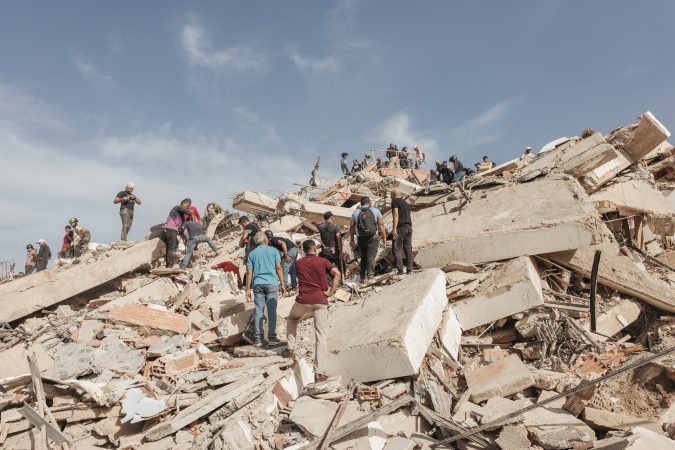
    It has been six days since devastating twin earthquakes flattened entire residential neighborhoods in Venezuela, and dozens of newly found bodies are still being hauled out of the rubble.

    On Monday, rescuers piled up coffins inside an improvised morgue at the sun-scorched port in the town of La Guaira, one of the hardest-hit areas. Small trucks arrived with more bodies, leaving them arranged in a long row by a concrete dock.

    “Every day the number of victims keeps going up,” said Jennifer Moreno Canizales, a spokesperson for the United Nations Office for the Coordination of Humanitarian Affairs in Caracas. “And we expect it to keep rising.”

    The official death toll after Venezuela’s earthquakes rose Monday to 1,719 people, an increase of nearly 300 since Sunday. It is based on the number of bodies recovered during the search operations, Moreno Canizales said.

    But sobering as it is, that figure could be a substantial undercount. Many more Venezuelans remain missing, with chances of finding them alive shrinking every day.

    The uncertainty of the number is not just a matter for the journalistic or historic record. For many Venezuelans, it signifies their anguished limbo as they search for friends with bleeding hands, trapped between uncertainty and a desperate refusal to accept the worst.

    There is no official or reliable toll for the missing. And with so much debris from tall residential buildings pressed tightly together, and a shortage of heavy machinery to remove the rubble, estimates of how many people might still be trapped inside vary widely.

    Two forensic doctors at the main morgue in the capital, Caracas, estimated a death toll of about 4,000, basing that on the number of bodies that had been arriving at a morgue in La Guaira every day.

    In anticipation of the toll increasing, the United Nations has been procuring 10,000 body bags in coordination with Venezuela’s government, said Gianluca Rampolla del Tindaro, the organization’s resident coordinator for Venezuela. “That is the applying assumption; it’s very sad,” he said.

    According to an unofficial website where Venezuelans can report the missing, more than 46,000 people were still unaccounted for. The New York Times could not independently verify the figure, which can include people who survived but became separated from relatives.

    To veteran rescue workers, the high number of reported missing may be ominous.

    “Contact is difficult, but not that difficult that you wouldn’t have gotten in contact,” said Linda Hornisberger, the president of REDOG, a nonprofit Swiss search-and-rescue association that has deployed eight dogs and 88 emergency responders to Venezuela since Friday. “We must assume most to be dead.”

    Hornisberger said that despite working eight- to 12-hour shifts for days, “we have not been able to rescue anybody.”

    Disaster response experts say that it often takes several weeks for a full picture to emerge after disasters of this magnitude.

    When Hurricane Maria hit Puerto Rico in 2017, the official government death toll was 64 people. Nearly a year later, they updated it to 2,975, nearly 50 times as high. After the Indian Ocean tsunami of 2004, when entire coastal villages were completely erased, it took the authorities more than a year to settle on the final estimate of 230,000 victims.

    Several signs out of Venezuela indicate that there might also be a delay before a final death toll is reached.

    The area of the quakes

    The day the earthquake struck was a holiday in Venezuela, when it was more likely that families would have been home, or had traveled to the seaside area of La Guaira. Many buildings there were built during an economic boom in the 1970s and 1980s, when developers erected tall towers, many 10 stories or more. A mountain range limited building space, which led developers to choose to build vertically, said Josué Araque, a Venezuelan geographer.

    Now, many of those buildings have been pancaked into a dense tangle of debris.

    “They are mountains of rubble from buildings of many, many levels, made of concrete, which basically turns them into tombs,” Araque said. It is difficult to search the lowest floors of the buildings, he said, “because there are 10 floors that fell on top of them.”

    Araque said he believed that there were probably many more missing people whom “they probably will not be able to recover.”

    There is 1.2 million tons of debris in the hardest-hit areas of La Guaira, the U.N. Development Program said Monday.

    Moreno Canizales, from the U.N., said 700 buildings had collapsed. Despite the rescue teams’ best efforts, she said, “it is hard to reach them all in time” to rescue those who might still be trapped alive.

    Del Tindaro, the U.N. humanitarian coordinator in Venezuela, also said in an interview that the high number of collapsed buildings indicated that the official toll was an undercount.

    Ilan Kelman, a professor of disasters and health at University College London, said a full accounting of the number of deaths might never be known. But a preliminary projection that the final toll could exceed 10,000 — shared by the U.S. Geological Survey based on factors including the magnitude of the earthquake, the population density, and local infrastructure — remains grimly feasible, he said.

    A difficult search

    The work of recovering bodies is painstakingly slow, and it’s not a priority for most response teams that are trying to save those who may be still alive. On Sunday, 49 rescue teams coordinated by the U.N. rescued seven survivors, Moreno Canizales said. Sometimes, she said, the teams are responding to families telling them that they can hear a relative crying from the rubble.

    When the disaster response shifts, more bodies are likely to be found, experts said.

    “The focus of the search-and-rescue teams is to look for those who might be alive” based on reports of sound and motion, said Phil Gelman, a Latin America coordinator with GOAL, an international humanitarian response agency. “When the search-and-rescue phase is ended, and heavy machinery is moved in to move rubble, the casualty count will rise.”

    Even in well-organized response efforts, many survivors end up being rescued by untrained friends, family, and neighbors, said Emily So, a professor of architectural engineering at the University of Cambridge.

    One Caracas resident, Rosmaria Herrera, 30, said she had lost at least three relatives. Family members and other civilians pulled the bodies of her father, her cousin, and her grandmother out of the rubble. But they couldn’t find her uncle.

    “It’s strange, because there is practically nothing left of the building,” she said.

    Witnesses and aid workers described a shortage of heavy machinery as one of the biggest obstacles to rescue efforts, saying volunteers often lacked the equipment needed to move concrete slabs and reach survivors trapped beneath collapsed buildings.

    In videos widely shared on social media, residents pleaded for excavators and other heavy equipment. In one, a man says neighbors pooled their own money to hire machinery after waiting days for government assistance to arrive.

    “If we keep waiting for our wonderful authorities, another week will go by with our relatives still buried there,” he says. “We had to start doing this ourselves.”

    Some victims will likely die from their injuries, in part because of Venezuela’s already overstretched health system, Kelman said.

    So said the final toll would likely be determined by the number of people reported missing, the extent of visible damage to buildings, and impeded access to the worst hit areas, which has stymied some responses.

    “Tragically, until they recover the bodies from underneath the rubble,” So said. “The count will be low.”

    This article originally appeared in the New York Times.