Category: Associated Press

  • As Juneteenth is celebrated across the U.S., Obama’s presidential center opens in Chicago

    As people gathered across the U.S. to celebrate Juneteenth on Friday, former President Barack Obama and former first lady Michelle Obama welcomed the first visitors to his presidential center.

    The Obamas, joined by former Reading Rainbow host LeVar Burton, also read Where the Wild Things Are to 25 school children at the Chicago Public Library branch inside the center. When the former president read Maurice Sendak’s line about being “king of all the wild things,” Michelle Obama interjected with, “Although there were no kings,” to applause.

    Later, awed guests shook hands with the Obamas against the backdrop of a colorful, 38-foot-tall painting depicting a map of Chicago stretching to the ceiling, inspired by Carl Sandburg’s 1914 poem about the city: “stormy, husky, brawling, City of the Big Shoulders.”

    As the last of the first group of guests passed through, the Obamas quickly exited, and the museum opened its doors to the rest of the visitors.

    Located on a sprawling campus on Chicago’s South Side, the center honoring the nation’s first Black president has been designed to inspire people to make the change they want to see in their own communities. It’s the kind of contemplation that also comes as Americans gathered for Juneteenth, which celebrates the end of slavery in the U.S.

    The holiday marks June 19, 1865, when Union troops arrived in Galveston, Texas, at the end of the Civil War with an order declaring the state’s enslaved people to be free with “absolute equality.” By then, 2½ years had passed since the Emancipation Proclamation declared the freedom of enslaved people in the South.

    “Juneteenth represents not just a commemoration of the end of slavery but it’s also part of the ongoing struggle for absolute equality and that ideal in American life,” said W. Caleb McDaniel, a Rice University professor and author of the Pulitzer Prize-winning book Sweet Taste of Liberty.

    The center’s public opening arrives as a symbolic convergence of legacy and liberation. The nation is deeply divided politically and grappling with renewed questions about the arc of racial progress as the Supreme Court hollowed out the Voting Rights Act, endangering Black political representation in Congress.

    The history of Juneteenth

    This is the fifth year since Juneteenth was designated as a federal holiday by former President Joe Biden, who served as Obama’s vice president. But the celebrations, which began in Texas and then spread across the country, have a rich and long history in Black America, with the day often spent gathering for picnics and cookouts.

    The holiday — a combination of “June” and “nineteenth” — marks the day when U.S. Maj. Gen. Gordon Granger and his troops arrived in the Texas port city with the declaration of freedom in General Order No. 3.

    As the third year of the Civil War neared, President Abraham Lincoln had issued the Emancipation Proclamation declaring the freedom of “all persons held as slaves” in the still rebellious states of the Confederacy. For many, it did not mean immediate freedom but a promise of liberation, to be secured with a Union victory.

    “It really required the force of arms and the success of U.S. armies to enforce the Emancipation Proclamation,” McDaniel said.

    About six months after Granger’s arrival in Galveston, the 13th Amendment abolishing slavery nationwide was ratified.

    Celebrations across the nation this year

    Juneteenth’s birthplace celebrated with a daylong gathering at a Galveston park with music and fireworks, a parade, and a worship service in a historic Black church. Nearby Houston lined up musical artists and a domino tournament at Emancipation Park, established in 1872 by a group of formerly enslaved men.

    Hundreds of other cities across the U.S. announced events over the long weekend, including a parade in Atlanta, a bike ride in Los Angeles, and a festival on Martha’s Vineyard.

    Several cities across the U.S. hosted walks named for Opal Lee, the Texas woman who pushed for years to make Juneteenth a federal holiday. Participants walk 2½ miles to symbolize the 2½ years it took for the Emancipation Proclamation to be enforced in Texas. Lee, known as the “grandmother of Juneteenth,” turns 100 this year.

    Reflecting on a continuing struggle

    Black Texans embraced the date of Granger’s arrival as one to celebrate, even as the Ku Klux Klan was established in Texas by 1868. By the 1880s, “it was difficult to find a significant community in Texas where it wasn’t being marked by African Americans,” McDaniel said.

    “They made it a community celebration, they made it a celebration of not only freedom but also a demonstration of community empowerment and institution-building,” he added.

    Corey D.B. Walker, dean of Wake Forest University’s divinity school, said the holiday offers a way to recognize the nation’s “complex history” and what it means to be a U.S. citizen, especially amid efforts by President Donald Trump’s administration to undermine the retelling of Black history.

    “I think it really reminds people the importance of understanding a fuller, more robust portrait of our nation’s history and the many contributions of many individuals who have contributed to America’s experiment with democracy,” Walker said.
  • FDA panel backs first-of-its-kind flu vaccine using mRNA technology

    WASHINGTON — A new kind of flu vaccine moved a step closer to the U.S. market Thursday as federal health advisers recommended approval of the first made with the same mRNA technology that was key to ending the COVID-19 pandemic.

    The Food and Drug Administration is evaluating Moderna’s new shot, dubbed mFlusiva, for older Americans ahead of the winter flu season. Moderna is seeking full approval for the vaccine’s use in people ages 50 to 64 — along with authorization for use in those 65 and older while it conducts additional testing.

    The FDA’s independent advisory committee evaluated Moderna’s studies of the vaccine and voted unanimously that its benefits appear to outweigh any risks for both age groups. The FDA will consider that recommendation in making a final decision by early August.

    Tens of thousands of Americans die from influenza every year, and older adults are among the most vulnerable. There are various types of flu vaccines already available in the U.S., including three specifically recommended for people 65 and older. But vaccines made with the Nobel Prize-winning mRNA technology are faster to manufacture than other types — something experts say might help if the shape-shifting flu virus mutates in a way that requires suddenly brewing new doses to match.

    “Having this technology available puts us in a better position to be prepared for emerging strains in the future,” said Flor Munoz-Rivas of Texas Children’s Hospital, one of FDA’s advisers.

    In a study of 40,000 people age 50 and older, Moderna’s mRNA vaccine reduced flu cases by about 27% compared with those given another routinely used vaccine brand. In a smaller study of people 65 and older, Moderna’s shot also generated a strong protective immune response compared with a high-dose flu vaccine already recommended for that age group.

    Data showing strong immune reactions “were very compelling,” said FDA adviser Anna Durbin of Johns Hopkins University, adding that “the vaccine looks very promising.”

    Moderna’s Rituparna Das told panelists that the company’s ability to quickly manufacture mRNA vaccines that closely match the latest flu strains could prevent thousands of hospitalizations in older Americans.

    Severe flu cases in the U.S. generally rise in years when the flu shot doesn’t closely match the circulating virus. Moderna officials noted that flu strains for each fall’s vaccines now are chosen several months earlier than the yearly recipe update for COVID-19 shots that mostly are mRNA-based — and there can be a mismatch if the flu virus mutates after the recipe is made.

    At the meeting, FDA vaccine reviewer Timothy Brennan suggested the agency was open to approving the vaccine for older adults ahead of the coming flu season, despite the need for more information about its use in frail seniors or people with weak immune systems.

    If it’s approved, Moderna is planning its required next-step study to include 400,000 people 65 and older, half given the mRNA vaccine and the rest given one of today’s special-for-seniors shots. It’s supposed to repeat that study for two flu seasons.

    Moderna’s data showed no major safety issues, although the shot did cause some temporary reactions including injection-site pain, fever, headache, tiredness, and aches. The latter reactions are common in a variety of vaccines, but occurred somewhat more often than with today’s flu shots. The FDA said that’s typical of mRNA vaccines.

    Those temporary reactions can be a signal that “your immune system is responding,” said Hayley Gans, a Stanford Medicine pediatrician and FDA adviser who stressed it will be important to explain that to vaccine recipients.

    Earlier this year, Moderna’s data was at the center of a highly unusual public dispute as a then-top FDA official blocked the company’s application for its first-of-its-kind shot.

    The embattled vaccine chief at the time, Vinay Prasad, said the company should have compared its shot to a high-dose flu vaccine recommended for seniors rather than a standard-dose brand. It was a sign of FDA’s heightened vaccine scrutiny under Health Secretary Robert F. Kennedy Jr.

    Moderna challenged that decision, noting that FDA staff had approved that main study’s design and citing a separate, smaller study comparing the mRNA shot with a high-dose vaccine for seniors. Days after the spat, the FDA accepted Moderna’s application.

    Moderna also is studying the vaccine in younger adults and plans a separate study in 9- to 17-year-olds this fall.

  • Meloni slams Trump’s claim she ‘begged’ for a photo with him as Italy’s top diplomat cancels U.S. trip

    ROME — The Italian government closed ranks on Friday to slam U.S. President Donald Trump over his claim that Premier Giorgia Meloni had “begged” for a photo with him during the recent G7 summit, a pushback that suggested America’s longtime European ally had had enough of Trump’s boasting and criticism.

    Italian Foreign Minister Antonio Tajani abruptly canceled a planned trip to the United States this weekend, calling Trump’s claims “serious and offensive” toward Meloni and all of Italy.

    Meloni for her part posted a video calling Trump’s claims “completely fabricated” and expressing astonishment that he would invent such things about an ally.

    “Italy and I do not beg,” she said pointedly.

    Trump had made the comments in an interview broadcast Friday on the La7 network. The La7 correspondent had asked Trump about Ukraine, but Trump raised Meloni and the conversation turned to their meeting during the just-concluded G7 meeting in Evian-les-Bains, France. Meloni and Trump were filmed speaking at several moments, including alone on a small sofa.

    According to La7, Trump said Meloni had “begged” him for a photo-op. Trump said he wasn’t obliged to do it but that he felt sorry for her and agreed, La7 said. The broadcaster put a dubbed version of the conversation online, not the original English audio.

    Meloni is astonished and defiant

    Trump’s posturing underscored how his alliance with Meloni — long seen as one of his closest friends in Europe — has frayed over his war in Iran, his tariffs against Europe, and his complaints when anyone disagrees with him.

    He turned on Meloni in April after she refused to support his war in Iran and stood up for Pope Leo XIV when Trump lashed out at the pontiff.

    But Meloni’s strong response on Friday suggested she no longer fears Trump’s verbal attacks — attacks that could actually play in her favor in a country where public opinion of the American president has chilled, said Lorenzo Castellani, a political scientist at Rome’s Luiss Guido Carli University.

    “In some ways this was a favor to Giorgia Meloni, in the sense that she was accused until a few months ago of being a sort of Trump’s vassal in Europe,” he said.

    In her video, Meloni said she was responding to Trump’s claims because “certain things deserve an immediate response.”

    “Donald Trump’s statements are completely fabricated. I am frankly stunned,” she said. “I don’t know why the president of the United States behaves this way toward his own allies. After all, this isn’t the first time this has happened.”

    It was an apparent reference to an interview Trump gave to Italian daily Corriere della Sera in April in which he criticized Meloni’s refusal to back the U.S.-Israel war in Iran. Meloni didn’t respond publicly at the time. By Friday, it appeared she had had enough of his boasts and broadsides.

    “I can only say that it’s a shame he doesn’t show the same resolve toward the enemies of the West, toward the enemies of the United States — toward leaders with whom he, on the other hand, is much more accommodating,” Meloni said Friday. “But there’s one thing he must remember: Italy and I do not beg.”

    The White House did not return an immediate request for comment on Meloni’s remarks.

    Meloni had initially sought to build on longstanding strong U.S.-Italian ties when Trump began his second term, and had positioned herself as a “bridge” between Washington and the European Union. She was the lone EU head of state to attend his inauguration.

    But relations have frayed over the U.S. war in Iran, which Meloni has said was illegal, and Trump’s position on Ukraine, which Italy strongly supports. Trump’s tariffs and strong U.S. support of Israel over its war in Gaza have been other points of contention.

    Italian officials close ranks around Meloni

    By Friday afternoon, solidarity for Meloni had poured in from across the government and political spectrum, and included a call from President Sergio Mattarella, Italy’s respected head of state.

    “Whoever attacks @GiorgiaMeloni attacks all of us,” posted Transport Minister Matteo Salvini.

    Justice Minister Carlo Nordio referenced the sacrifice of American troops in World War II in underlining the harm to U.S.-Italy relations caused by Trump.

    “The thousands of crosses marking the graves of American soldiers who died to free us from Nazi-Fascist dictatorship did not deserve such a painful blow to our fraternal ties,” Nordio said on X.

    Defense Minister Guido Crosetto said he didn’t believe Meloni would ever beg someone for a photo, “not even under threat.”

    Tajani had been due to travel to the U.S. on Sunday to take part in an Italy-U.S. business forum in Miami during which he was to have meet with U.S. Secretary of State Marco Rubio, according to a U.S. State Department announcement of the meeting.

    A ‘fantastic’ friendship frays

    Meloni and Trump had gotten off to a strong start, and the two leaders are ideologically aligned on many issues. As the head of a far-right party, Meloni backs curbing migration and promoting traditional values.

    Weeks before Trump’s 2025 inauguration, Meloni met Trump at his Mar-a-Lago retreat, a visit that she said went “beyond expectations.” It was, she said at the time, “an opportunity to confirm a relationship that promises to be very solid.’’

    In the months after, Trump had praised her repeatedly, as “fantastic,” “incredible,” beautiful, and a friend.

    But stark differences emerged over Ukraine. More recently, Meloni sharply warned against U.S. threats to take Greenland by force, saying she didn’t believe Washington would go so far and that regardless Italy would never support such a move.

    Meloni also received support from an unlikely ally in Europe: Spain’s Socialist Prime Minister Pedro Sánchez, who was on Friday asked about the back and forth on the sidelines of a European Council meeting.

    “About Meloni, first and foremost, all my solidarity,” he told reporters. “Secondly, I not only say this publicly in a response to your question, but also in private during the European Council meeting I offered her all my solidarity against this attack that is not political or personal … I really don´t know how to qualify it.”

  • U.S. push to get Iran talks started hits an early bump due to intense fighting in Lebanon

    ZURICH — The American push to quickly begin high-stakes talks with Iran hit a snag Friday, just days after the signing of an agreement that opens a two-month window for negotiations on Tehran’s nuclear program and returning oil traffic through the Strait of Hormuz to prewar levels.

    Iranian officials did not travel as planned to Switzerland, insisting that Israeli strikes on Iranian-backed Hezbollah militants in Lebanon must stop before the talks can take place, according to three regional officials and a person familiar with the matter. They were not authorized to publicly discuss the ongoing mediation to try to get the talks rescheduled and spoke on condition of anonymity.

    The situation was fluid as Israel and Hezbollah agreed on Friday to renew their ceasefire, according to a U.S. official and regional officials. It remains to be seen whether that could help put the U.S.-Iran talks back on track.

    In Washington, President Donald Trump lashed out once again in the midst of the intensified fighting in Lebanon and the stalled nuclear talks.

    “We didn’t meet out of desperation, Iran did,” Trump wrote in a social media post Friday. “They are FINISHED! We’ll play out the 60 days. They get no money, not ten cents!”

    Vance was ready for Swiss talks

    Trump’s vice president, JD Vance, had been prepared to make an overnight flight to meet with his Iranian counterparts at a mountainside resort in the tiny Swiss village of Obbürgen and begin the technical talks.

    Vance’s staff and a small group of journalists had gathered at Joint Base Andrews outside Washington in anticipation of the trip. Dozens of White House officials, advance staffers, and more media were already in Switzerland.

    Then the trip was called off — abruptly and for the time being.

    A White House statement said Vance, tapped by Trump to lead the negotiations, decided to postpone his travel. It made no mention of the escalating violence in Lebanon.

    “The logistics of these negotiations have never been simple or predictable,” the statement said.

    But, according to officials, the Iranians made clear to the White House that they had balked at starting the talks with Vance because of the Israeli action in Lebanon.

    While Iranian officials and Vance did not make it to Switzerland Friday, a mediator from the Gulf country of Qatar found his way to the resort near Lucerne, Switzerland, where the U.S.-Iran talks are to be held. Qatar’s prime minister and foreign minister, Sheikh Mohammed bin Abdulrahman Al Thani, met with the Swiss foreign minister, Ignazio Cassis.

    Fighting in southern Lebanon intensifies

    The fighting had intensified with at least 18 killed by Israeli airstrikes, while four Israeli soldiers were killed in southern Lebanon, officials said.

    Israeli Prime Minister Benjamin Netanyahu said Thursday that Israel’s military would stay in a “security zone” of southern Lebanon as long as “Israel’s security needs require it.”

    Israel and Hezbollah are not parties to the U.S.-Iran agreement.

    Iran insists Israel must withdraw from the large swath of southern Lebanon it is occupying, but the wording of the interim deal does not explicitly require that and only ensures Lebanon’s “territorial integrity.”

    Hours before postponing his trip, Vance gave some indication of the state of flux when he told reporters at a White House briefing that he was uncertain if the talks were going to happen this weekend.

    “We think these technical negotiations start sometime this weekend,” Vance said. ”That’s still the plan. But that could change.”

    Soon after Vance spoke to reporters, Iran’s supreme leader, Ayatollah Mojtaba Khamenei, endorsed direct negotiations with the United States. His terse statement, read by state media, appeared to signal to the Islamic Republic’s leadership that it could move forward with a first round of talks.

    “It is obvious that the face-to-face negotiations that will be held in the future will not mean accepting the enemy’s opinion,” Khamenei said.

    The messaging seemed to give Khamenei, who was badly wounded in the U.S. strike on Feb. 28 that killed his father, some maneuverability. Hard-liners in the Iranian government, including Khamenei’s father, long opposed direct talks with the White House, especially after Trump, during his first term, pulled out of the 2015 nuclear deal negotiated by Democratic President Barack Obama’s administration.

    Meeting was initially supposed to be a signing ceremony

    Vance was initially expected to go to Switzerland to sign the agreement at a formal ceremony. Instead, Trump signed the document Wednesday during a glitzy dinner at the Palace of Versailles with French President Emmanuel Macron. Iran’s president, Masoud Pezeshkian, separately signed the agreement.

    It says Iran’s stockpile of highly enriched uranium, which is believed to be buried under rubble left by U.S. military strikes last year targeting Tehran’s key nuclear sites, must at minimum be diluted under international supervision.

    It also says Iran shall not procure or develop nuclear weapons — a commitment Tehran has made previously. Other commitments remain to be worked out.

    Iran believes it’s in a strong negotiating position

    Iranians would be going into the talks with a measure of confidence after effectively shutting down the strait, causing global economic reverberations, said Rosemary Kelanic, director of the Middle East Program at Defense Priorities in Washington.

    She said the U.S. is now “essentially trying to negotiate our way back to the prewar status quo.”

    Neil Quilliam, an associate fellow with the Middle East and North Africa Program at Chatham House think tank, said the “buoyant” Iranian leadership feels it has the upper hand. The endorsement of the talks by the Iranian supreme leader “sends a very strong signal domestically: ’We’re now on an equal footing with the U.S.’”

    ”‘Trump has gone from calling for regime change on Feb. 28 to this: Now they’re going to sit down with us directly and talk about these big issues,’” Quilliam said of the Iranians’ thinking. “So it’s intended more for the domestic audience, and telling them: ‘We are firmly in control of this. There can be no protests, no revolution: We are a new regime and we’re staying put.’”

    Vance has to negotiate through political division

    For Vance, a likely 2028 presidential contender, how the negotiations play out could have enormous ramifications for his political fortunes.

    Vance’s skepticism of foreign wars was a core part of his political identity during his political rise, which included election as a U.S. senator. Now he finds himself the chief defender of negotiating an endgame to Trump’s conflict that Democrats have largely derided as a foolish gambit. Some hawkish Republicans are aghast that Trump is getting behind a settlement that could put billions of dollars into Iran’s coffers.

    U.S. Sen. Roger Wicker, chairperson of the Senate Armed Services Committee, said aspects of the deal are “completely out of step” with Trump’s goals.

    Trump fiercely criticized Obama for the 2015 nuclear agreement, which Trump argued failed to stop Tehran from advancing toward a weapon and funneled billions of dollars to the Islamic Republic. The Republican president exited the U.S. from the deal in 2018.

    Trump has pushed back against comparisons to that earlier agreement, saying he had “negotiated from strength” after a major military campaign while asserting that Obama was paying the Iranians off and not receiving acquiescence.

    Wicker (R., Miss.) was particularly concerned about the $300 billion fund for the reconstruction and economic development of Iran mentioned in the 14-point agreement. Trump and Vance have said no U.S. taxpayer money would go to such a fund and it would not come without concessions and reforms by Tehran.

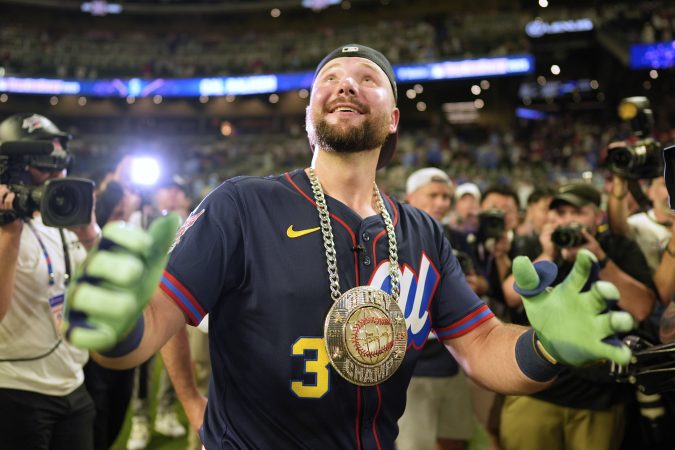
  • MLB eliminating clock for All-Star Home Run Derby as event switches to Netflix

    MLB eliminating clock for All-Star Home Run Derby as event switches to Netflix

    NEW YORK — Baseball’s Home Run Derby is eliminating the clock.

    Each hitter will have 20 swings in the first round of this year’s contest at Philadelphia’s Citizens Bank Park on July 13, Major League Baseball said Thursday. The change coincides with a switch in broadcaster to Netflix from ESPN, which had televised the event since 1994.

    A player who homers on swing 20 will keep on swinging until he doesn’t connect for a long ball. The top four hitters advance, with distance of the longest homer used as a tiebreaker.

    Hitters will be seeded for the second round, where No. 1 faces 4 and 2 meets 3.

    Each player takes 15 swings in the second round, with batters again homering on their final swing continuing until not homering. A best-of-three swingoff would break ties.

    The format for the second round will be used for the final.

    No bonus rounds will be used.

  • US Open starts on soft Shinnecock with strong wind. Sam Stevens takes the early lead

    SOUTHAMPTON, N.Y. — Shinnecock Hills has never looked like this for a U.S. Open, not with such receptive greens and putting surfaces slow enough to keep shots from rolling off the edges and down the slopes.

    About the only familiarity Thursday was the scoring, kept in check by a strong wind that finally shooed away the fog and gave Scottie Scheffler, Rory McIlroy and the rest all they could handle.

    Sam Stevens overcame a double bogey to start his round — a hole that took him over two hours to play because of the fog — and strung together six birdies that carried him to a 2-under 68, making him one of only six players from the early starters to beat par.

    McIlroy saved par on a wild ride along the fourth hole, hit a pitching wedge into 12 feet on the downwind par-5 fifth hole for eagle, closed with two bogeys and was more than happy with a 69, particularly considering it was 11 shots better than the start he had at Shinnecock in 2018.

    Also at 69 were Ludvig Aberg and 2023 British Open champion Brian Harman, Max Greyserman and Ben James, the college star in his second week as a pro.

    Scheffler, needing a U.S. Open title for the career Grand Slam, had to rely heavily on his short game to salvage a 72.

    “The greens haven’t been too firm, the fairways haven’t been too firm, so I’ve really felt like it’s pretty scorable,” said Stevens, who had only his second sub-70 round in his fourth U.S. Open. “Obviously, it’s difficult, but overall it’s an awesome place. I think the setup is great right now.”

    For one day — half of the opening round — the USGA might have been leader in the clubhouse.

    Coming off two Opens at Shinnecock when the course got out of control, the USGA planned to slow the greens to 10 1/2 on the Stimpmeter — rare for any major, much less the U.S. Open — and keep plenty of water on the putting surfaces.

    It was all due to the wind, which did not disappoint. The sustained wind approached 25 mph, and gusts were even stronger. And if that wasn’t enough, it shifted directions in the middle of the day.

    “It was tough around here without wind, and then it was blowing pretty hard — really hard,” Keegan Bradley said after a 70. “The USGA did a great job setting the course up because if the greens were any faster or firmer, we might not be playing right now.”

    McIlroy hit wedge to 3 feet on No. 3, his 12th of the day, not the play he envisioned. He was trying to land it four paces short of the pin. It went four paces long and spun back to set up an easy birdie.

    “The greens obviously are very receptive with them expecting this wind,” he said.

    For all the concern about wind and the course drying out, it turned out to be another weather that got in the way — fog. Thirty minutes after the U.S. Open began, play was stopped and led to a two-hour delay. It was particularly tough on Stevens.

    He laid back off the tee at No. 10 and was preparing for his approach when the horn sounded. When he returned, his 6-iron came up short and back down the hill, he chunked his wedge and his U.S. Open began with a double bogey.

    “Didn’t get to hit my second shot for 2 1/2 hours, or whatever it was,” Stevens said. “Got off to kind of a weird start, but made a birdie on the very next hole. It felt like I settled in after that … The greens were a bit softer. I felt like you could hit good shots close to the hole, and then made a few nice putts, so overall good.”

    McIlroy, whose lone U.S. Open title was 15 years ago on rain-softened Congressional, did some of his best work on the fourth hole. He pulled his tee shot into the knee-high, wispy hay on the left, and his next shot bounced off a cart path some 50 yards away. He hit wedge over where the gallery had been standing and holed an 18-foot putt. He followed that with his eagle — his first at the U.S. Open since 2017 at Erin Hills — until getting tripped up at the end.

    “The greens are pretty slow and quite receptive. I think they need to be at this point. It’s a challenging golf course already, and you put 30-mile-an-hour winds on top of it, it tests the best players in the world pretty well,” McIlroy said. “I think they were prudent with the course setup.”

    Scheffler fell to 3 over when he missed the fairway in high grass to the right on No. 8, did well to punch out into a bunker, blasted out to 18 feet and three-putted for double bogey. Then, his blind shot to the ninth green came back off the front of the green. He holed a 6-foot putt to save par, and that proved key as he limited the damage with a 34 on the back.

    “If you told me when I was staring at my par putt on 9 that I would post 2 over today, I would definitely have taken it at the time,” Scheffler said. “Overall, it was a good battle.”

  • U.S. lifts blockade of Iran and Iranian supreme leader endorses direct talks with American officials

    WASHINGTON — The U.S. on Thursday lifted its blockade of Iran, and oil tankers began freely moving through the Strait of Hormuz after months of being unable to use the critical channel, as the tentative agreement to end the war took effect.

    Meanwhile, Vice President JD Vance announced that he may postpone a trip to Switzerland that had been planned for Friday and included a ceremonial signing of the deal. The visit might have helped start talks on the next, potentially even more critical, round of negotiations between the two sides.

    Hours later, Iranian Supreme Leader Ayatollah Mojtaba Khamenei endorsed direct negotiations with the U.S. in a statement read by state media.

    “It is obvious that the face-to-face negotiations that will be held in the future will not mean accepting the enemy’s opinion,” he said.

    It was Khamenei’s first reaction to the agreement, and it indicated a shift in Iran’s approach. Hard-liners, especially Khamenei’s father, the previous supreme leader, have long opposed direct talks, especially after the U.S. pulled out of the 2015 nuclear deal between Iran and world powers.

    The supreme leader has not been seen in public since he was wounded in a strike at the start of the war.

    Trump envoy tells lawmakers Iran will invite U.N. inspectors to nuclear sites

    In other developments, Trump envoy Steve Witkoff told U.S. lawmakers Thursday in a private briefing that Iran will invite the U.N.’s nuclear watchdog agency to inspect its nuclear sites and begin work on identifying and uncovering the locations of Tehran’s enriched material.

    The briefing was described by two people familiar with the conversation who spoke to the Associated Press on condition of anonymity to share the closed-door details.

    Witkoff told congressional leadership and members of national security-related committees that the agreement that the U.S. struck with Iran did not include any side deals, but a side letter was drafted between Tehran and the International Atomic Energy Agency extending the invitation.

    Witkoff disclosed the existence of the letter and invitation in the briefing, according to the people.

    Witkoff said the letter to IAEA Director-General Rafael Mariano Grossi would enable him to bring U.S. nuclear inspectors to Tehran.

    Uncertain timeline could make it more difficult to promote deal

    Pakistani Prime Minister Shehbaz Sharif also postponed a planned visit to Switzerland, where Islamabad officials were to host the ceremony, because the agreement had already been signed, said two senior officials who spoke on condition of anonymity because of the sensitivity of the matter.

    The now uncertain timeline could raise new questions and make it even more difficult for the Trump administration to promote a deal that many in the U.S. — including some congressional Republicans — have criticized as too favorable to Tehran.

    “Our plan is to go to Switzerland. I don’t know exactly when,” Vance said during a briefing with reporters at the White House when asked about not flying, as planned, to the signing ceremony.

    “I suspect this weekend, but I’m not sure,” he added.

    That injected new doubt into an agreement that President Donald Trump said he signed to avoid “economic catastrophe” in the U.S.

    Vance’s announcement came a day after Trump signed the pact with Iran while dining with French President Emmanuel Macron at the Palace of Versailles. The deal is slated to take immediate effect and extends a ceasefire while giving each side 60 days to hammer out broader agreements on larger issues.

    Trump said the deal would avoid continued stress on the U.S. economy after the war caused oil prices to skyrocket, made financial markets skittish, and fueled inflation. He repeatedly said he did not want to be compared to Herbert Hoover, whose policies helped exacerbate the Great Depression of the 1930s.

    Vance defends U.S.-Iran deal

    The vice president, who was initially personally skeptical of the U.S. going to war with Iran, has increasingly become the administration’s face of the conflict and has been outspoken in defending the deal. Asked about concerns it concedes too much, the vice president said repeatedly that the accord would force Iran to “change their behavior.”

    Vance defended the agreement and shrugged off accusations that its rollout has been piecemeal and sometimes contradictory, saying, “I don’t think our public messaging has been chaotic.”

    He also offered a surprisingly blunt warning to Israel, which has pushed the U.S. to take a harder stance against Iran and launched attacks on the Iranian-backed Hezbollah militia in Lebanon throughout the war, including just before the deal extending the ceasefire was reached. Those attacks complicated the peace efforts with Iran.

    Trump “is the only head of state in the entire world who is sympathetic to the nation of Israel at this moment in time,” Vance said. “And he happens to be the head of state of the world’s superpower.”

    The vice president said more than 12.5 million barrels of oil went through the Strait of Hormuz on Wednesday night. That could further soothe oil prices that spiked during the war but have been falling since the U.S. and Iran announced a tentative deal to end the conflict.

    He said the U.S. easing its blockade of Iran means “honoring our end of the early part of the agreement on the military side.”

    U.S. Central Command said American warships “will remain in the general area to make sure that all aspects of the agreement are adhered to, obeyed, and in full force and effect.”

    Shipping starts to pick up

    At least two oil tankers left Iran and crossed the U.S. military blockade without being stopped. A merchant shipping tracking website said the ships were carrying a combined total of 3.8 million barrels of Iranian crude oil.

    Iranian state media said shipping had “normalized” at Iran’s southern ports but added that the strait remains supervised and under the control of the Iranian military, and transiting through the vital waterway still requires coordination.

    Major shipowners began moving vessels through the strait after the agreement was signed, according to maritime data company Lloyd’s List Intelligence, though Lloyd’s did not give data on how many ships have passed through the strait as of Thursday.

    In a media briefing, Richard Meade, editor-in-chief of Lloyd’s List, said for the first time in 110 days, ships owned by major companies are transiting the strait after effectively being marooned there since February.

    Tankers controlled by major ship owners Grimaldi Group, Cosco, Knutsen, and NYK have passed through the strait. And two Iranian-flagged, sanctioned crude oil tankers owned by the National Iranian Tanker Company have entered the strait, according to Lloyd’s List.

    Phillip Belcher, marine director of Intertanko, a trade group for global independent tanker owners, said the main central route of the strait is still closed and has an estimated 80 mines that need to be cleared.

    But ships have been passing through the smaller northern route, which goes through Iranian waters, and the southern route, which goes through Omani waters.

    Lloyd’s List estimated that 550 merchant ships will need to exit the Persian Gulf. It could take weeks or months to fully reopen the strait, and the two alternative routes do not have as much capacity as the strait’s central passage.

    Agreement calls for a lasting end to hostilities

    The U.S.-Iran deal calls for a permanent end to hostilities and starts a 60-day negotiating clock to reach a final deal on the future of Iran’s nuclear program, though Trump has left the door open to resume attacks. The agreement appears to offer Iran several benefits up front while extracting little in return.

    It states that Iran’s stockpile of highly enriched uranium, which is believed to be buried under rubble, must at minimum be diluted under international supervision. It also says that Iran shall not procure or develop nuclear weapons — a commitment it has made previously. But beyond stating that the U.S. and Iran will negotiate over Iran’s nuclear program, other commitments still need to be worked out.

    The deal also waives U.S.-backed sanctions on the country, immediately allowing Iran to sell its oil freely in a major concession from Washington.

    Still, Kaja Kallas, the European Union’s foreign policy chief, said Thursday that the 27-nation bloc would leave its sanctions on Iran in place for now. The bloc had slapped a series of separate sanctions on Iran over its nuclear program, human rights violations and the closing of the strait.

  • Hegseth attacks NATO allies and announces a review of U.S. forces in Europe

    BRUSSELS — U.S. Defense Secretary Pete Hegseth lashed out at NATO allies on Thursday as he announced a six-month Pentagon review of American forces in Europe whose outcome will depend on how fast the Europeans take responsibility for their own security.

    The review was yet another surprise for European allies and Canada as they learn to deal with an increasingly unpredictable ally. U.S. officials and senior military officers had promised to coordinate closely with the Europeans as America draws down.

    In recent months, U.S. President Donald Trump and the Pentagon have sent conflicting signals about whether America is reducing or increasing its military footprint in Europe, as well as threatening to annex Greenland, a semiautonomous island that is part of ally Denmark. Just weeks ago, the Trump administration said that it would no longer provide as much military support should any NATO member come under attack.

    “This will be a real review. It will be designed to ensure that NATO is moving fast and irreversibly toward Europe leading, stepping up to take primary responsibility for the defense of Europe,” Hegseth told his NATO counterparts. “It’s a review that some countries will fail and others will pass with flying colors.”

    German Chancellor Friedrich Merz later said the allies have long been aware of U.S. plans to pull troops from Europe at some point and that they must take care of their own security.

    “We know that we must do more and we are doing it,” Merz said.

    Public dressing down over bases, gender, and migration

    In a fiery speech at NATO headquarters in Brussels, Hegseth lambasted European allies for failing to provide U.S. forces access to bases in Europe to launch attacks on Iran, calling it “shameful.”

    “These allies, they put America’s sons and daughters, our sons and daughters, at risk by denying them the predictable access, basing, and overflight that never should have been in question at all,” he said. The review would also assess whether the U.S. has full access and overflight “when we need it.”

    While defense ministers and military officers sat in silence, Hegseth railed against migration and gender equality policies in Europe, in remarks reminiscent to those of Vice President JD Vance in February last year that angered many Europeans.

    “Instead of tanks and fighters and air defenses, the focus has been on gender equity and climate change and defense austerity. Europe’s borders flew wide open, welfare states expanded, defense budgets cratered, along with Europe’s belief in itself and its civilization,” Hegseth said.

    Hegseth’s comments largely mischaracterized European policies today. On defense, European allies and Canada have launched an unprecedented effort to boost defense spending and expand their armed forces. NATO Secretary-General Mark Rutte noted on Thursday that they spent $90 billion more on defense last year, a 20% increase over 2024. And while Europe accepted large numbers of migrants and asylum seekers more than a decade ago, most countries have tightened their borders since.

    It does not augur well for a summit of NATO leaders in Turkey on July 7-8.

    A rare and short visit to NATO

    It was a rare visit to NATO by Hegseth, his first this year after skipping a meeting in February. The Pentagon chief did not stay long, leaving well before the gathering was over and hours before Ukraine’s President Volodymyr Zelensky was due to press allies for more weapons for his country.

    Speaking to reporters at Brussels airport before flying home, Hegseth said, “It was great to hear country after country say, ‘We’re going to meet our target. We’re going to meet our target.’ There are still a few outliers, and we will be clear with them as we do this review.”

    NATO’s supreme allied commander, an American, is working on backup plans to defend Europe after the U.S. signaled on June 3 that it would no longer supply an aircraft carrier and support ships, aerial refueling planes, and dozens of fighter jets, among other military assets, in a crisis.

    The Trump administration insists that it needs to be able to plan for two simultaneous conflicts and wants more military resources at hand should it clash with China in the Indo-Pacific region.

    Under NATO’s collective security guarantee — Article 5 of its founding treaty — the 32 allies pledge that an attack on one of them will be considered an attack on all. It does not oblige them to provide military support, although many likely would.

    In essence, the United States is scaling back how it might help should an ally trigger Article 5.

    U.S. nuclear weapons will stay

    The U.S. has by far NATO’s biggest armed forces. It does not intend to withdraw its nuclear weapons in Europe, which are key to NATO’s deterrence. To underscore that point, NATO’s Nuclear Planning Group issued its first statement in 19 years after Thursday’s meeting.

    In the statement, it “recalled that the strategic nuclear forces of the Alliance remain the supreme guarantee of Allied security and underpin NATO’s extended deterrence architecture.”

    The ministers “agreed to continue enhancing NATO’s nuclear deterrence mission by modernizing NATO’s nuclear capabilities, strengthening its nuclear planning capacity, and adapting to achieve its security interests.”

    Rutte played down the impact of the U.S. decision, saying that the NATO Force Model — the system for organizing what forces member countries will provide commanders in times of peace, crisis, or conflict — is just “a planning tool,” and not a reflection of what would actually happen.

    “If war breaks out, we will all max out what we need to do to make sure we can fight the war,” Rutte told reporters. “In the planning phase, it is important to know what we can count on. What is in theory there.”

  • Federal regulators back Trump’s plan to speed power to energy-hungry AI data centers

    WASHINGTON — Federal regulators on Thursday agreed to let large energy users connect more quickly to the nation’s inefficient and aging electric transmission system to accommodate surging demand from power-hungry artificial intelligence data centers.

    Energy Secretary Chris Wright had urged the Federal Energy Regulatory Commission to act in an effort to help the United States better compete with China for superiority in the fast-growing AI sector.

    Tech companies and data center developers have welcomed the chances for faster connections to the country’s power supply.

    But utilities, states, and regional grid operators worried that the Trump administration’s plan would remove their authority to manage the process. Clean energy advocates want the agency to advance, rather than undermine, state-level efforts to require the use of renewable energies.

    The commission’s actions come as a backlash grows against data centers over fears about rising electricity prices and concerns about the massive amounts of energy and water they use, polluting communities across the country, and straining water resources and the electric grid.

    The five FERC members voted unanimously to direct six regional grid operators to ensure that AI data centers and other large power users are “able to connect to the transmission system in a timely and orderly manner.”

    Laura Swett, an appointee of President Donald Trump who chairs the commission, called the vote historic and said it would push the country’s electricity market into the future while also protecting ratepayers from shouldering the costs of connecting big power users to the grid.

    “I know that Americans across the country are concerned about affordability, and so are we,” Swett said.

    Data centers would pay the full cost of any grid upgrades needed for their connection, under the commission order. But that order can do little to address the tightening energy supplies that are driving up electricity bills in some areas and raising warnings of blackouts as the construction of data centers outpaces the speed of new power plants coming online to serve them.

    The six regional grid operators under the order serve 200 million Americans, or two-thirds of FERC’s jurisdiction. FERC also invited utilities that handle their regional transmission systems to also participate.

    More than 4,000 data centers now operate in the U.S., according to one estimate, with an additional 3,000 planned or under construction, including some that consume more energy than a small city. Such facilities have ballooned in size to accommodate the demands of AI.

    Trump has tried to deflect public concerns about AI, seeing the fast-evolving technology as crucial for the U.S. to attract foreign investment and maintain its economic and military prowess. Trump signed an executive order this month that establishes a framework for the federal government to vet the national security risks of the most advanced AI systems for up to a month before their public release.

    In December, FERC took an earlier step to help data center operators get electricity quickly, voting to allow tech companies to effectively plug a data center directly into a power plant.

    Companies such as xAI, Google, Microsoft, Meta, Oracle, OpenAI, and Amazon have signed Trump’s Ratepayer Protection Pledge, in which they agreed to build or buy new sources of power generation for their data centers and cover the expense of infrastructure upgrades.

    They also committed to making backup generation available to prevent blackouts in times of emergency and to hire locally for their data center build out.

    Rob Gramlich, a Washington-based energy consultant, said the order leaves states in control of retail electric rates, terms, and conditions. But, he said, they should quickly develop rules to accommodate large power users and prevent cost shifts to residential and business customers.

    FERC could assert broader jurisdiction over interconnection of large power users if states do not act quickly, Gramlich said.

    Data from the Electric Power Research Institute shows that data centers now account for about 5% of U.S. electricity demand, but could triple by 2035. In Virginia, data centers account more than 25% of overall demand and could rise to more than 40% by 2030.

  • Ebola cases increase almost 40% in a week as death toll passes 200

    DAKAR, Senegal — The Ebola outbreak in Congo and Uganda has claimed more than 200 lives in its first month and is the worst known outbreak at this stage, with up to 35,000 suspected potential contacts, Africa’s Centres for Disease Control and Prevention said on Thursday.

    With 894 confirmed cases so far, the current outbreak is three times worse than a previous outbreak in Uganda in 2000, which had 281 cases at the same point, said Wessam Mankoula, a medical epidemiologist at Africa CDC.

    The latest number of cases is believed to be higher because the outbreak was confirmed on May 15, weeks after it was suspected to have begun. The number of cases has increased 38% since last week and is now in 32 health zones across eastern Congo, said Mankoula.

    The outbreak is caused by the rare Bundibugyo virus, which has no approved vaccines or treatments and was not tested for in the early days. The more common Zaire virus, for which there is a vaccine, was responsible for most of Congo’s past 16 outbreaks of the disease.

    So far 74 patients have recovered from the disease across eastern Congo and Uganda. Experimental treatments like monoclonal antibodies are being developed for Bundibugyo.

    The outbreak is concentrated in Congo’s eastern province of Ituri, which accounts for more than 90% of the cases. Cases have also been recorded in the North Kivu and South Kivu provinces and have spread across the border to Uganda, where 19 confirmed cases have been reported and two people have died.

    Contact tracing remains an issue due to the area’s remoteness and ongoing insecurity in Ituri province, Mankoula said.

    “For those 800 confirmed cases, we should have between 17,000 to 35,000 contacts that should be in our contact list,” said Mankoula. Currently only around 4,000 contacts have been tracked and are being evaluated, less than 15%.

    “We are still far from controlling the situation of this outbreak,” said Mankoula.

    Nearly a million people have been displaced by years of conflict in Ituri, according to the U.N. humanitarian office, making contact tracing difficult as people flee attacks or move frequently in the vast province with dense forests, poor roads, and remote villages that can take days to reach.

    Tracing is also difficult among the thousands of miners who regularly move among remote sites in the mineral-rich region.

    Of the over $900 million pledged to fight the outbreak, only $90 million has been released, further complicating the ongoing crisis, according to Mankoula.

    Africa CDC estimates it needs 540 personnel to fight the outbreak and so far they only have 84.

    “We’re keeping our fingers crossed those new pledges will be fast tracked, and we’ll be following up with different member states and different partners about their commitment to turn those pledges into actual money released to their affected countries or partners,” said Mankoula.