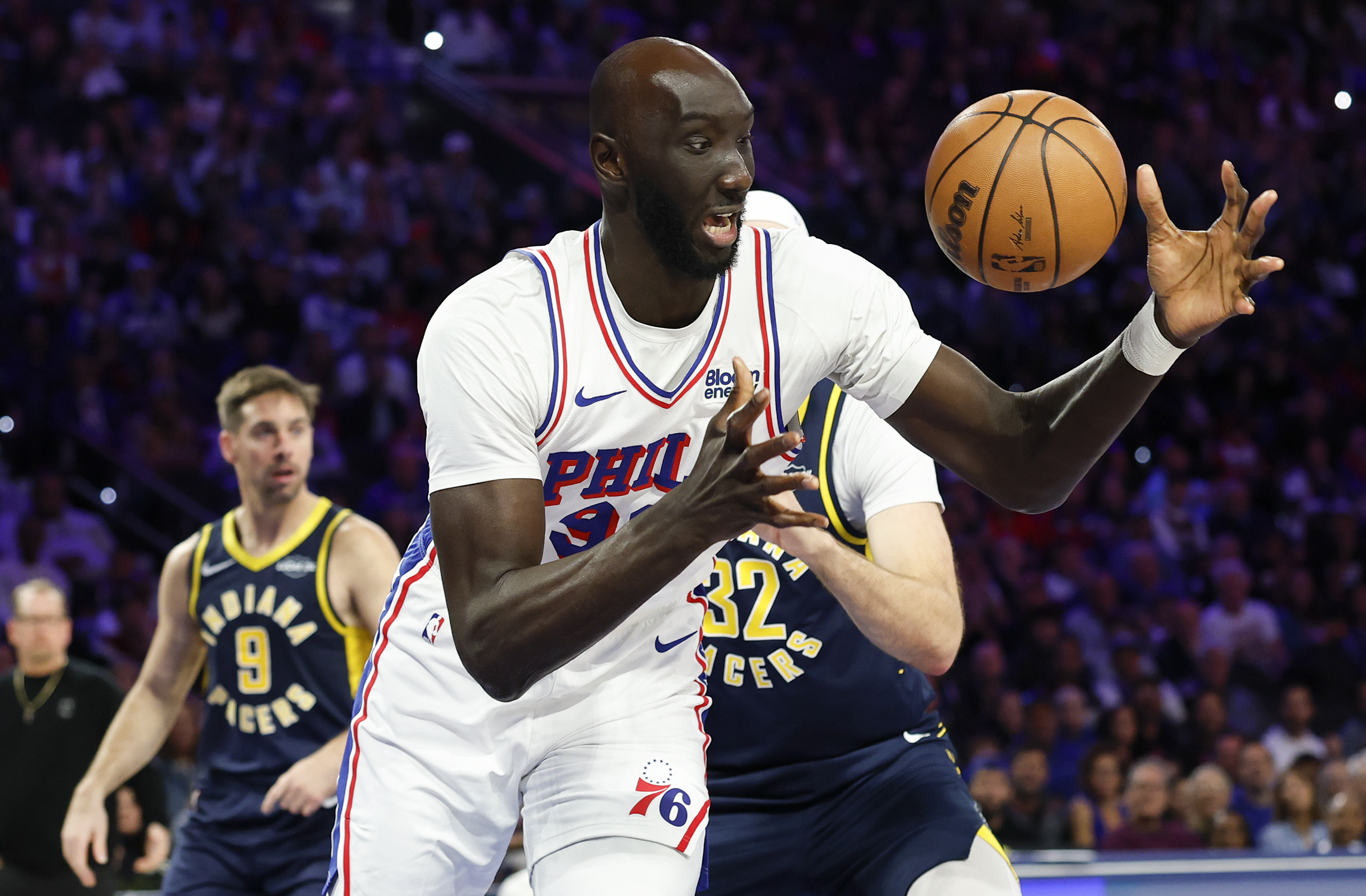
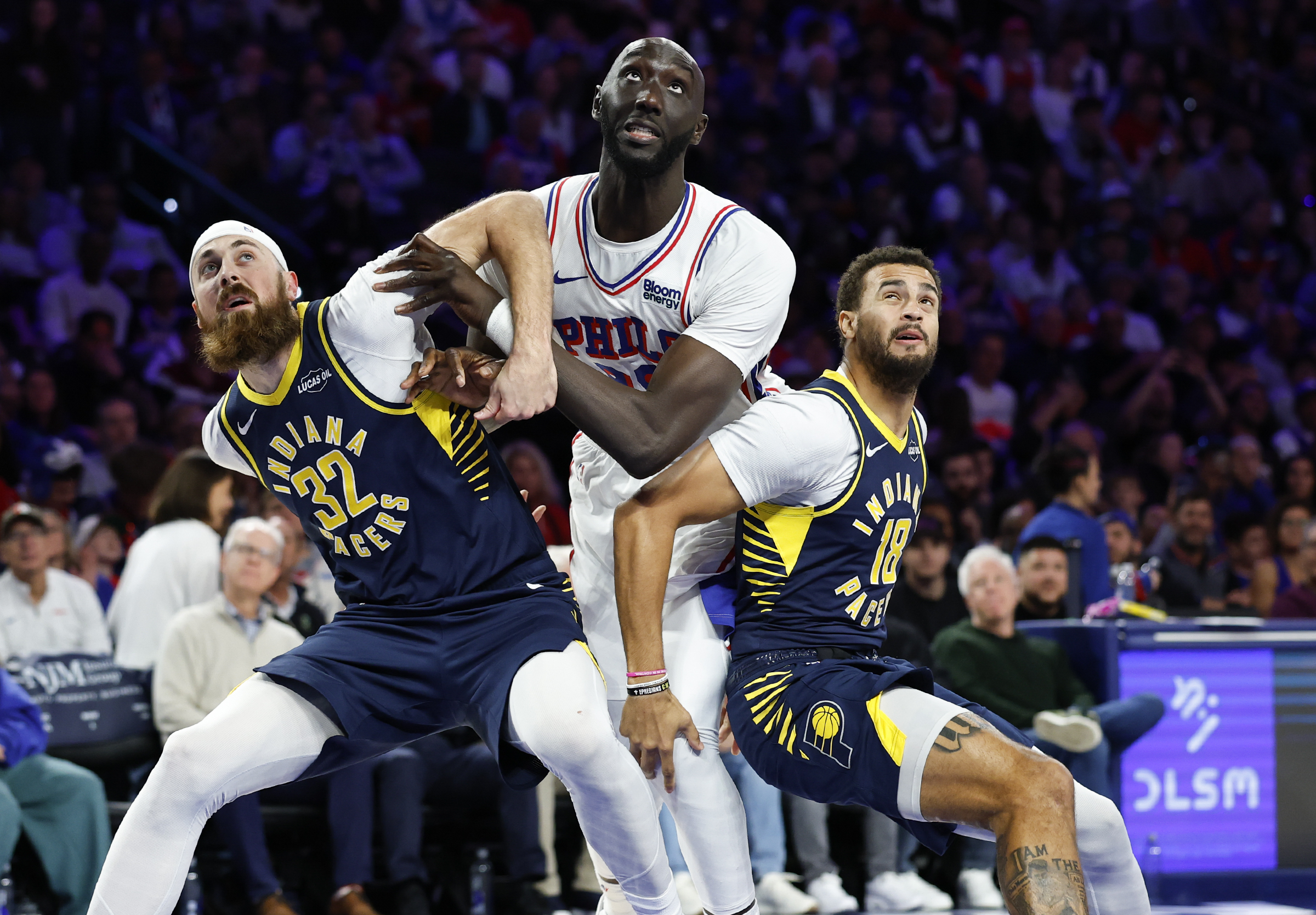
Midway through the third quarter, Xfinity Mobile Arena swelled with the sound of several thousand people nudging their seat mate with an elbow. Soon, the sound became a roar. It seemed spontaneous at first. The action on the court had paused as the Sixers walked toward the free throw line. You may have needed to look around a bit to see what the fuss was about. But, then, Tacko Fall is a guy who is hard to miss.
“It was pretty loud,” said Fall, the 7-foot-6 backup center who at 31 years old is attempting to complete his long-in-progress transition from curiosity to reality. “It was hard not to notice.”
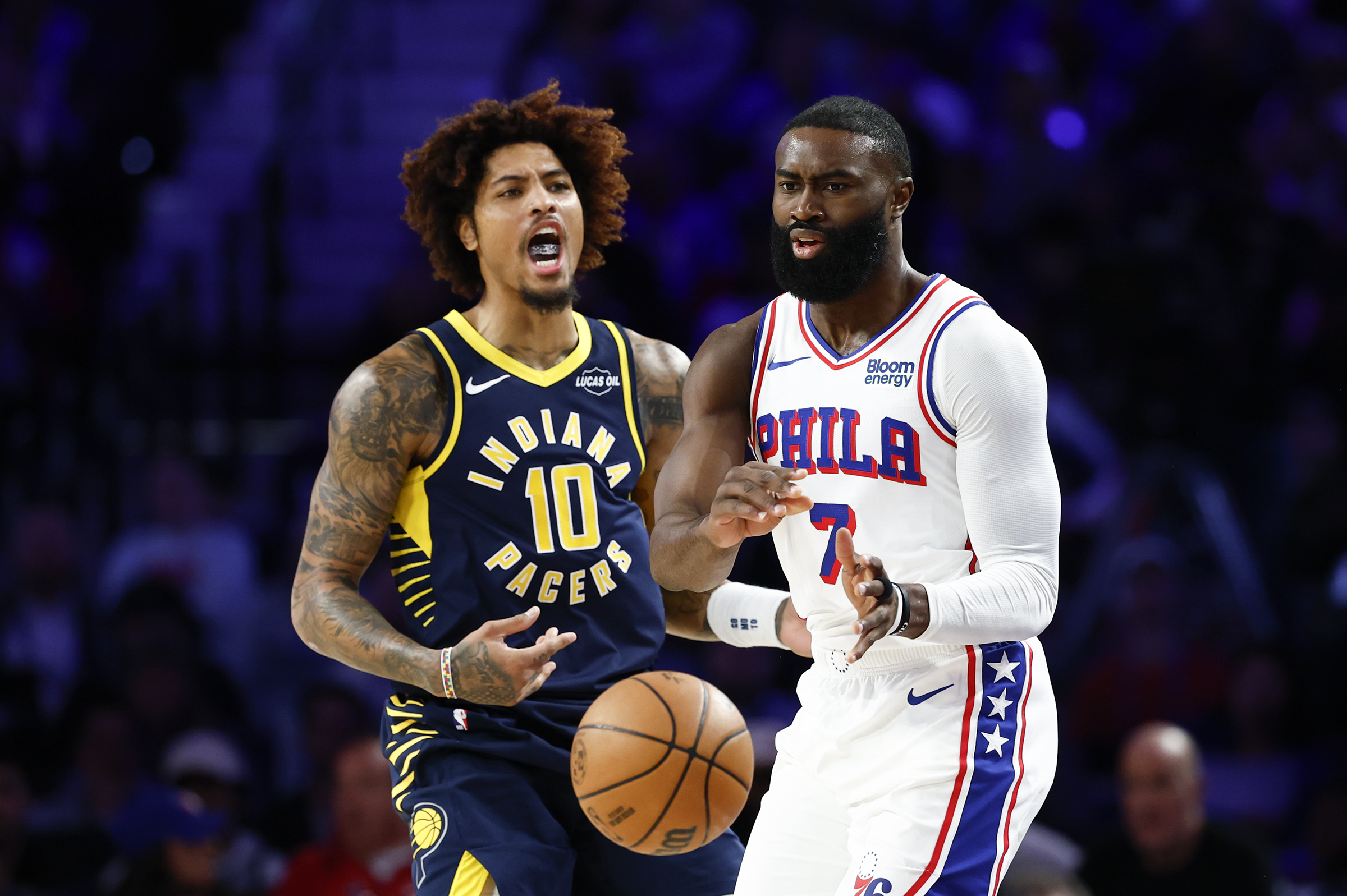
It would be overselling things to say that the Sixers have figured out life without Joel Embiid. Even more so to pinpoint Fall’s five minutes of action in a 131-124 win over the Pacers on Sunday. The Sixers survived Embiid’s (scheduled) absence on the interior mostly because they scored enough points that his absence didn’t matter. For that, thank Dr. Thunder (Jaylen Brown) and Mr. Lightning (Tyrese Maxey), as well as some expert-level quarterbacking from the old GOAT (LeBron James).
Say this, though: Fall’s minutes mattered. He spent only five of them on the court. But the Sixers were up 74-71 when those minutes began, and they were up 87-83 when they ended. Fall didn’t exactly fill up the box score, departing the game with zero points and three rebounds. But his length caused some disruption on the defensive end, both around the rim and when contesting shots on the perimeter.
“I think it was excellent from the standpoint of we just needed him to buy us some time there,” Sixers coach Nick Nurse said after the game. “Just get those guys a little more rest and get their minutes a little more manageable. We did put [in] a little zone when he’s on the floor a while ago, and we were able to get to it for the first or second time this year. I think that helped us as well. Just changed the rhythm of the game a little bit. I think he gave us some great minutes and a nice lift.”
Fall’s minutes mattered first and foremost on a personal level. It had been six years since he’d played this much in any NBA game. The intervening years had seen him bounce between professional leagues in China and New Zealand. Both countries were as far away from his native Senegal as the United States had been. The basketball was even further.
Undrafted out of Central Florida, Fall spent two seasons with the Celtics from 2019-21. The noteworthy nature of being one of the tallest living humans was far greater than his playing record. He logged just 139 minutes in 26 games with the Celtics. Then, after a brief stint with the Cavaliers in 2021-22, he signed to play in China.
And that was that.
Or so it seemed.
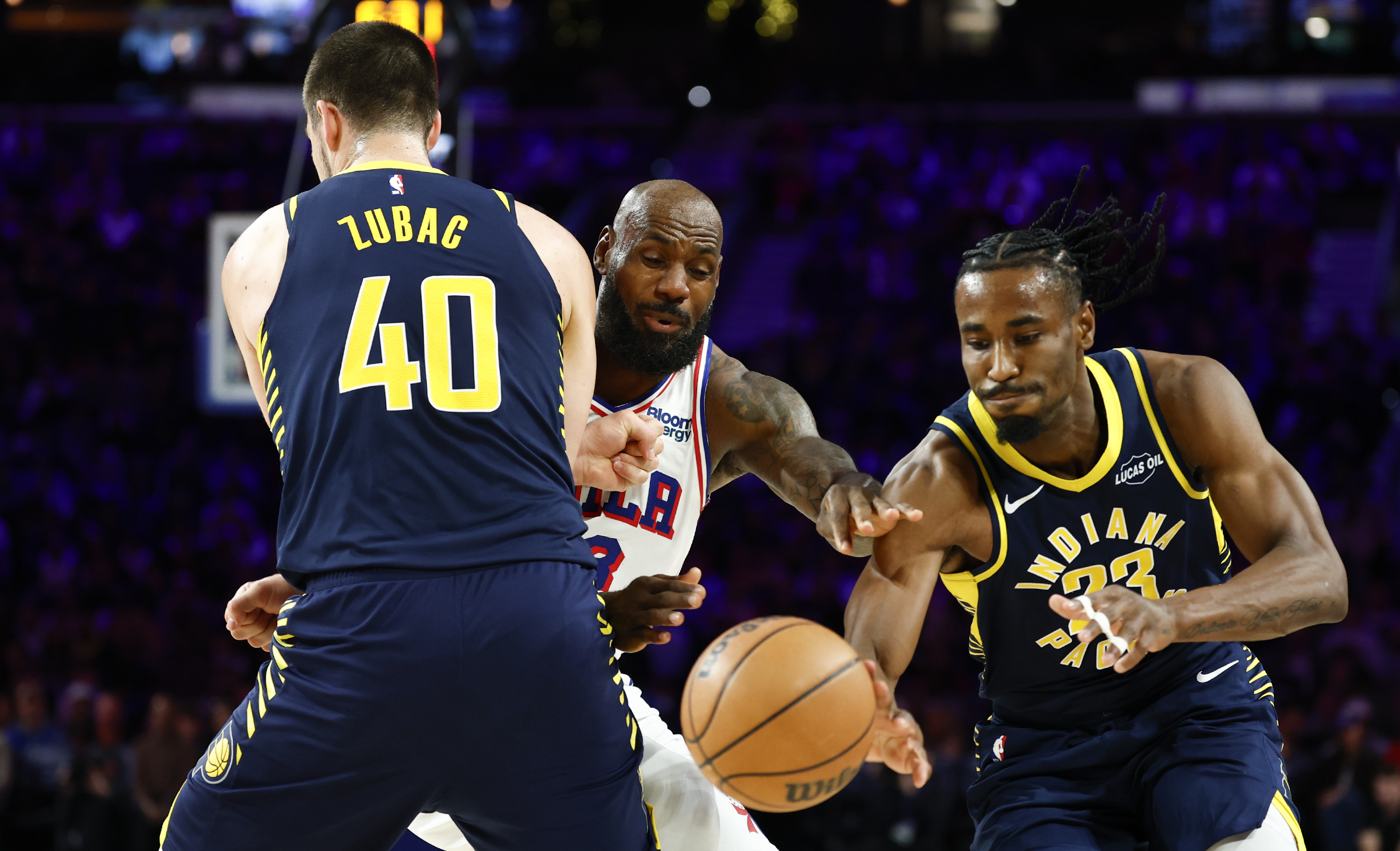
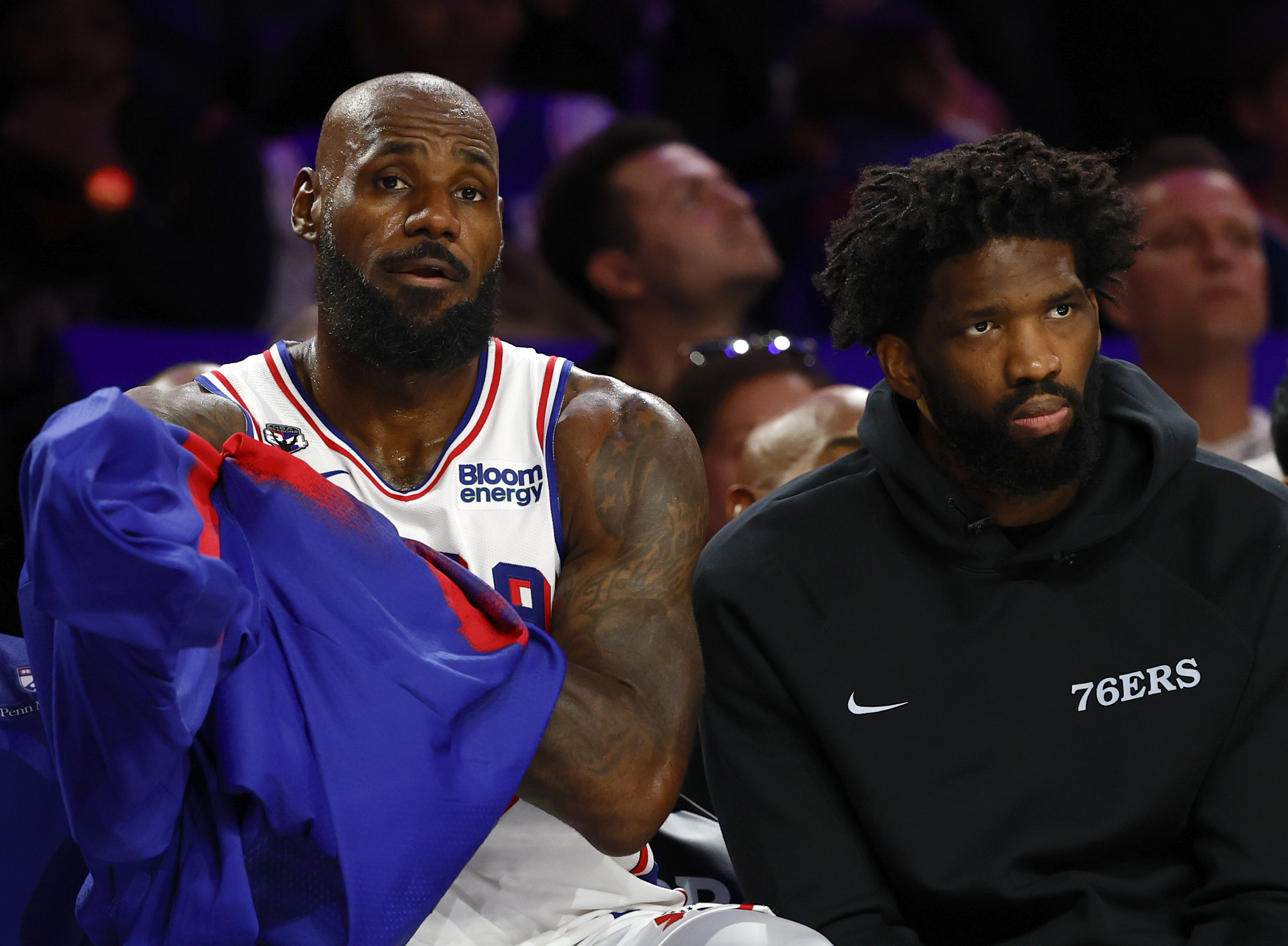
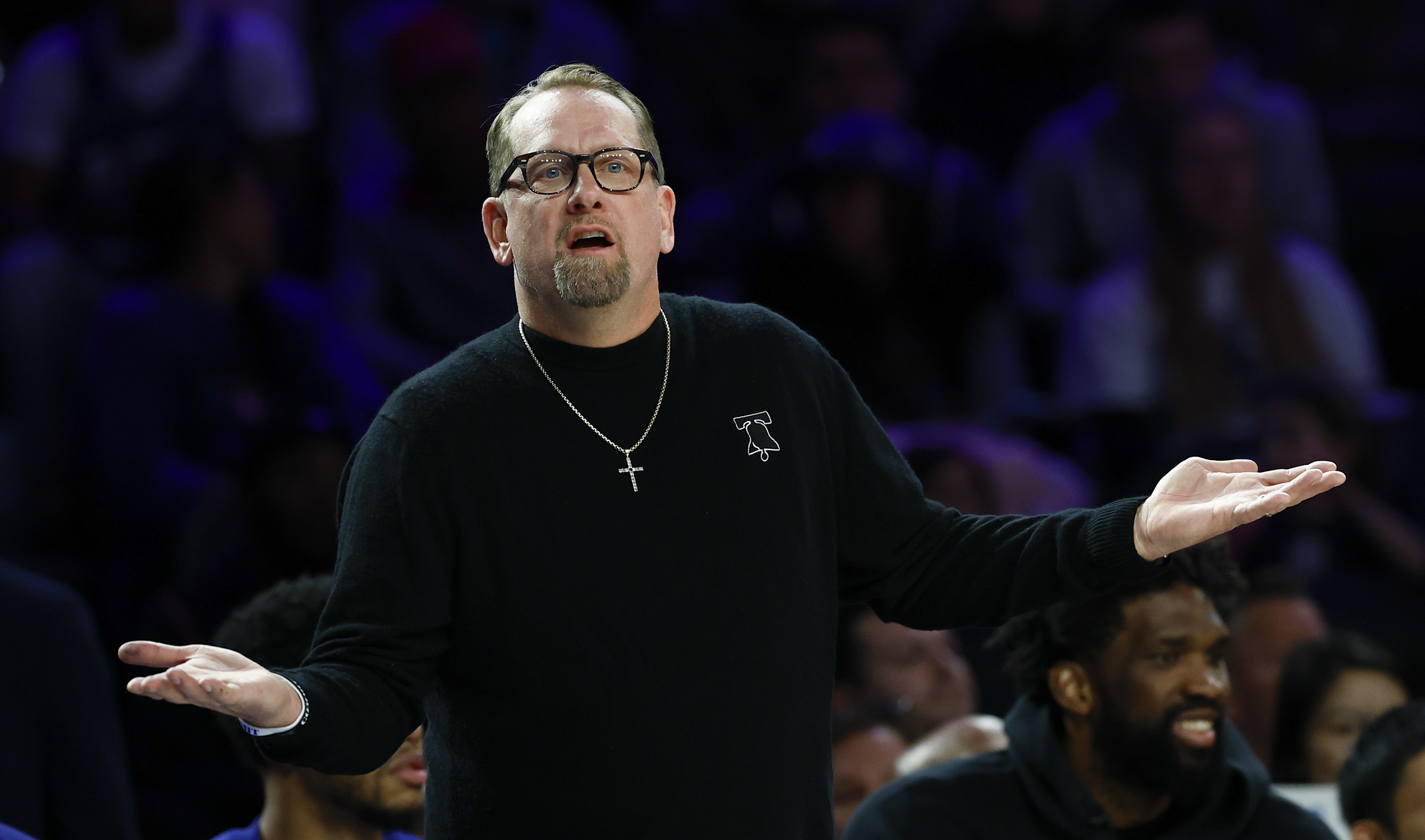
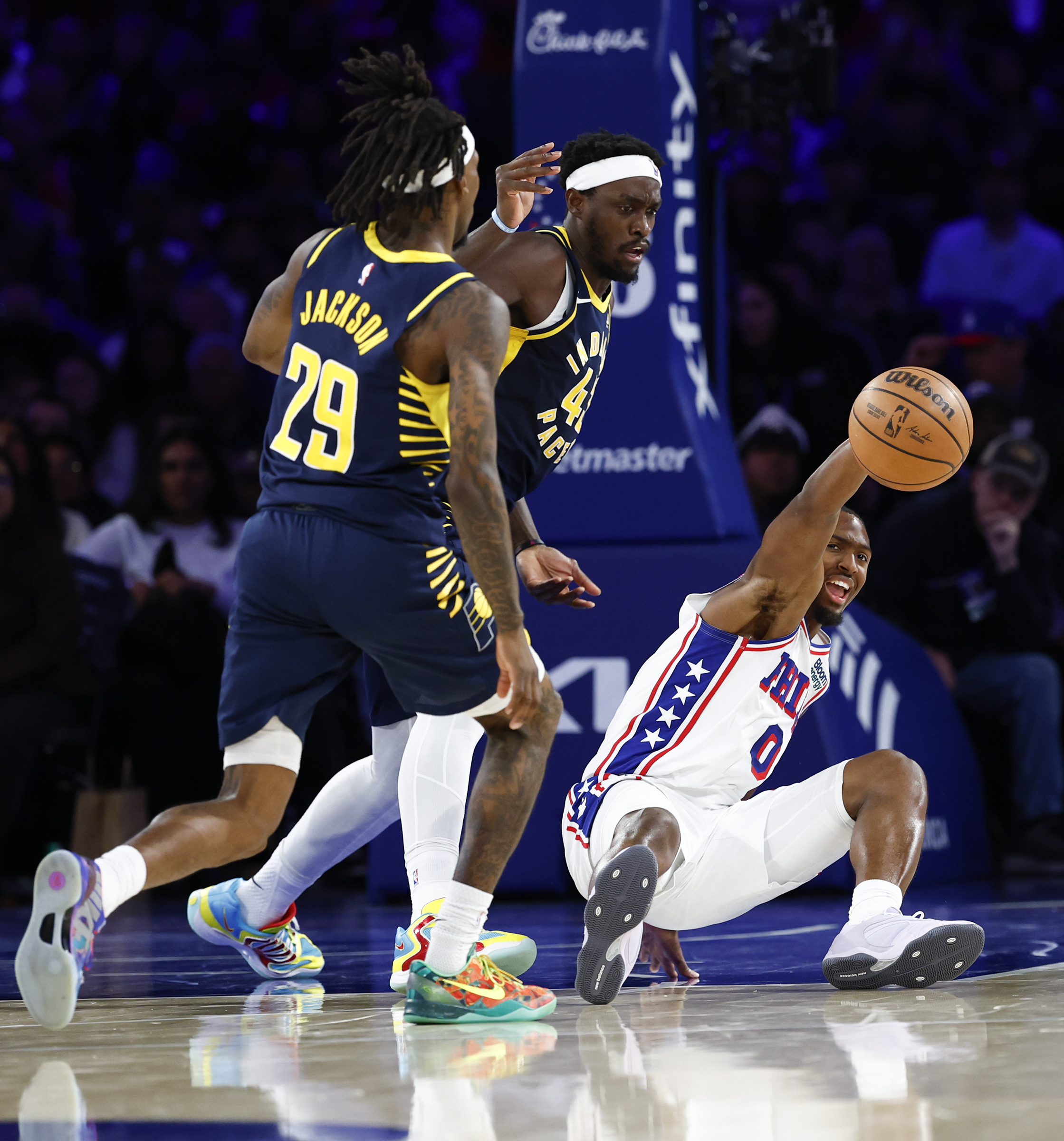
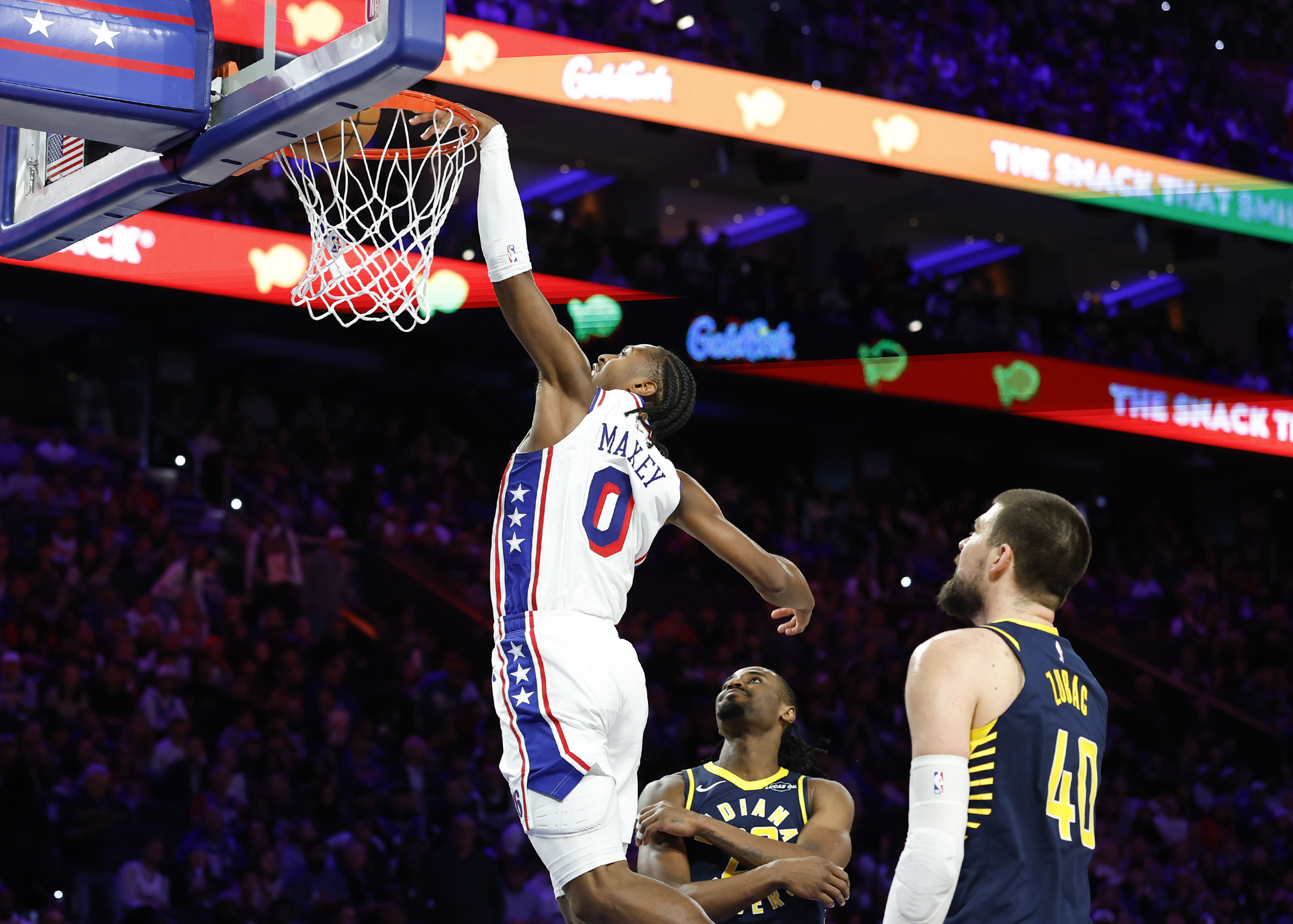
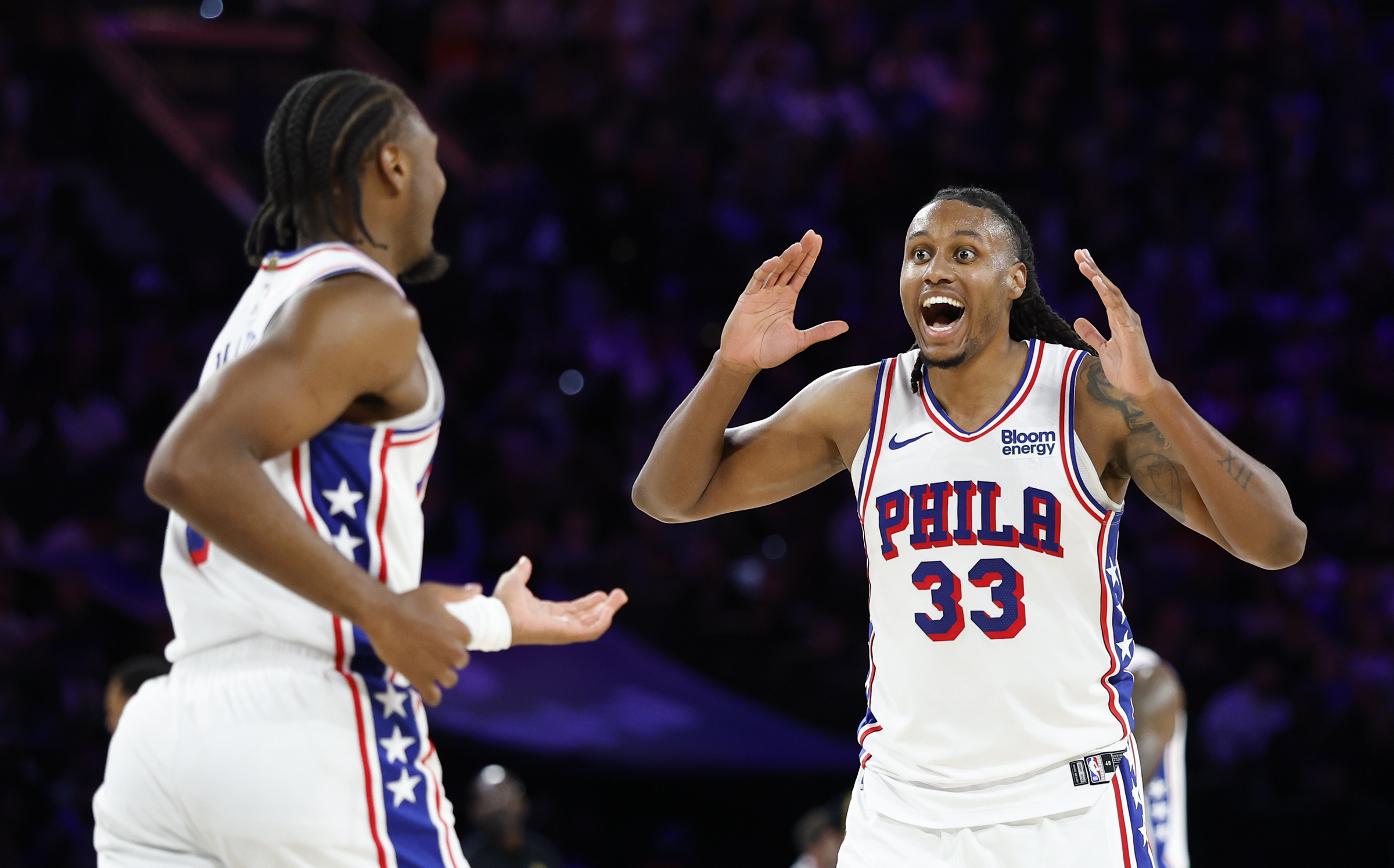
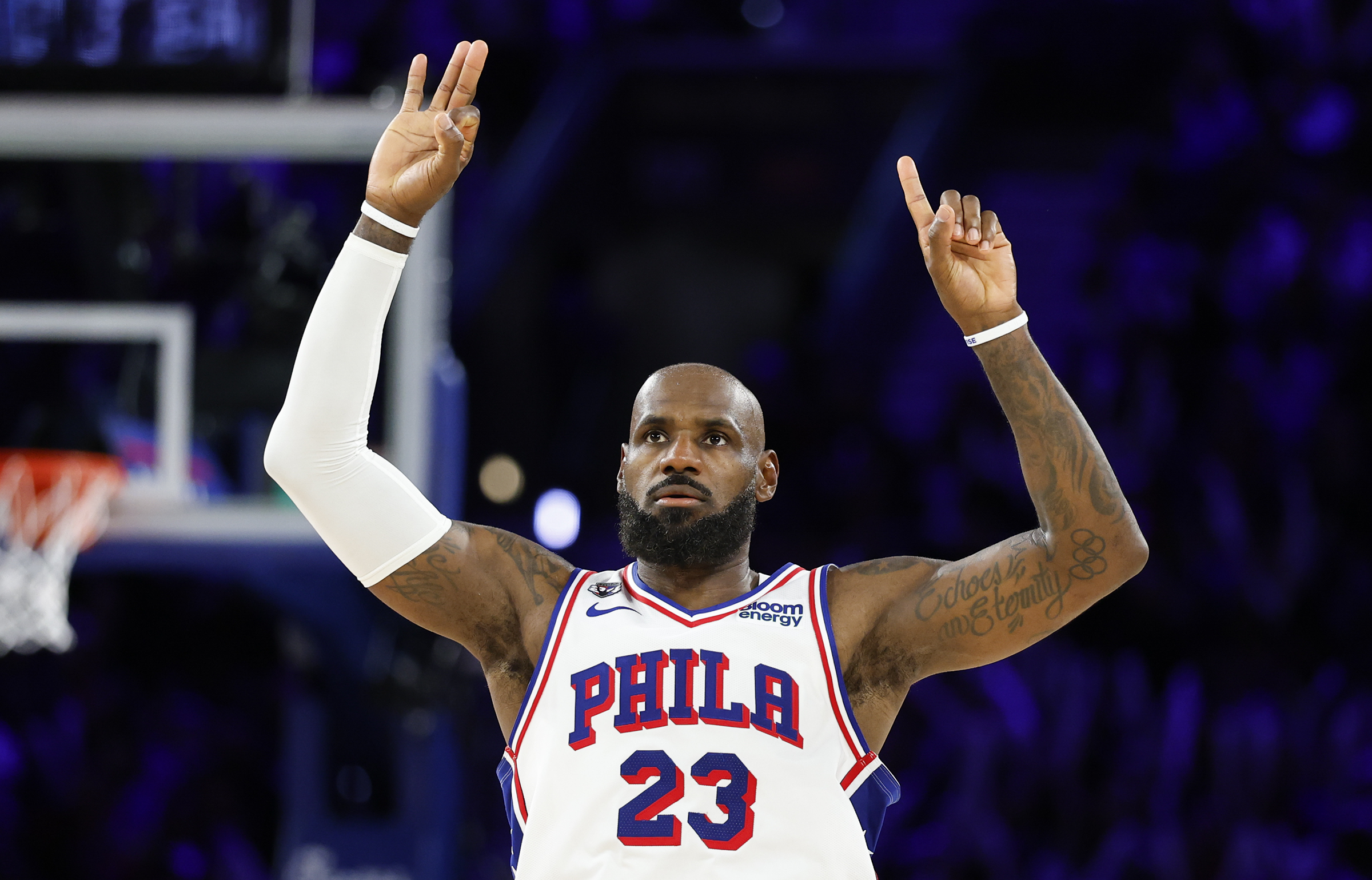
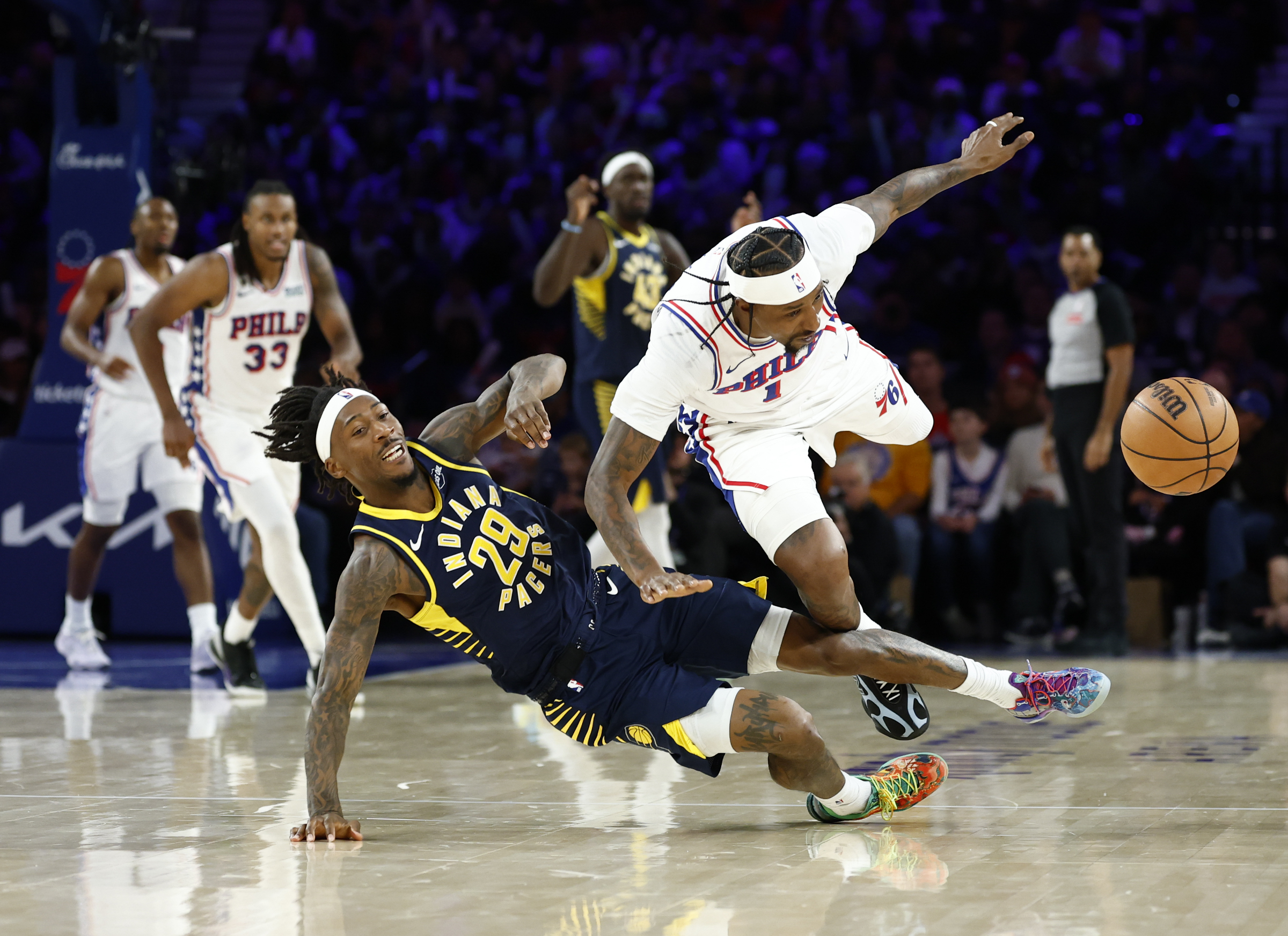
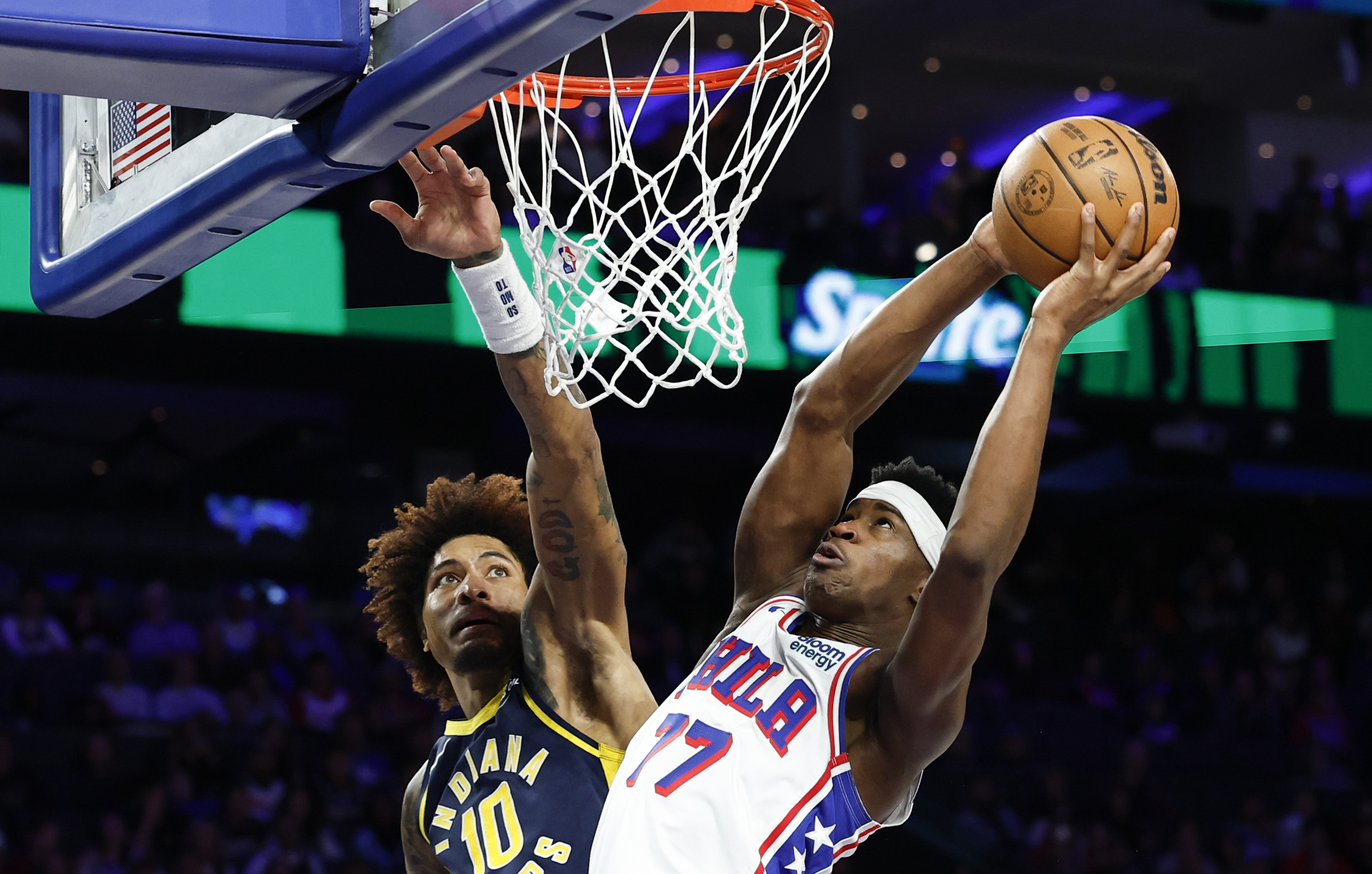
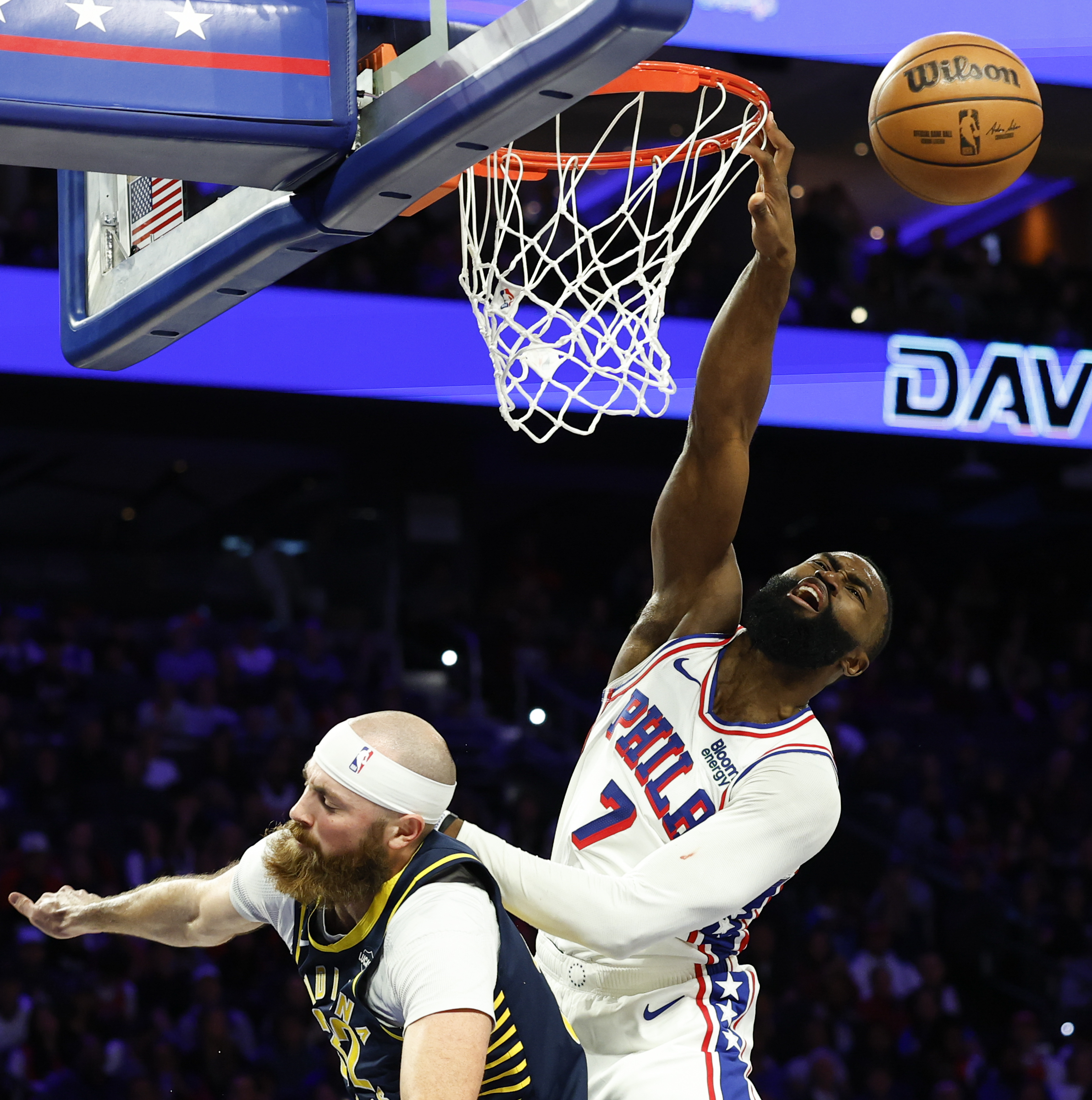
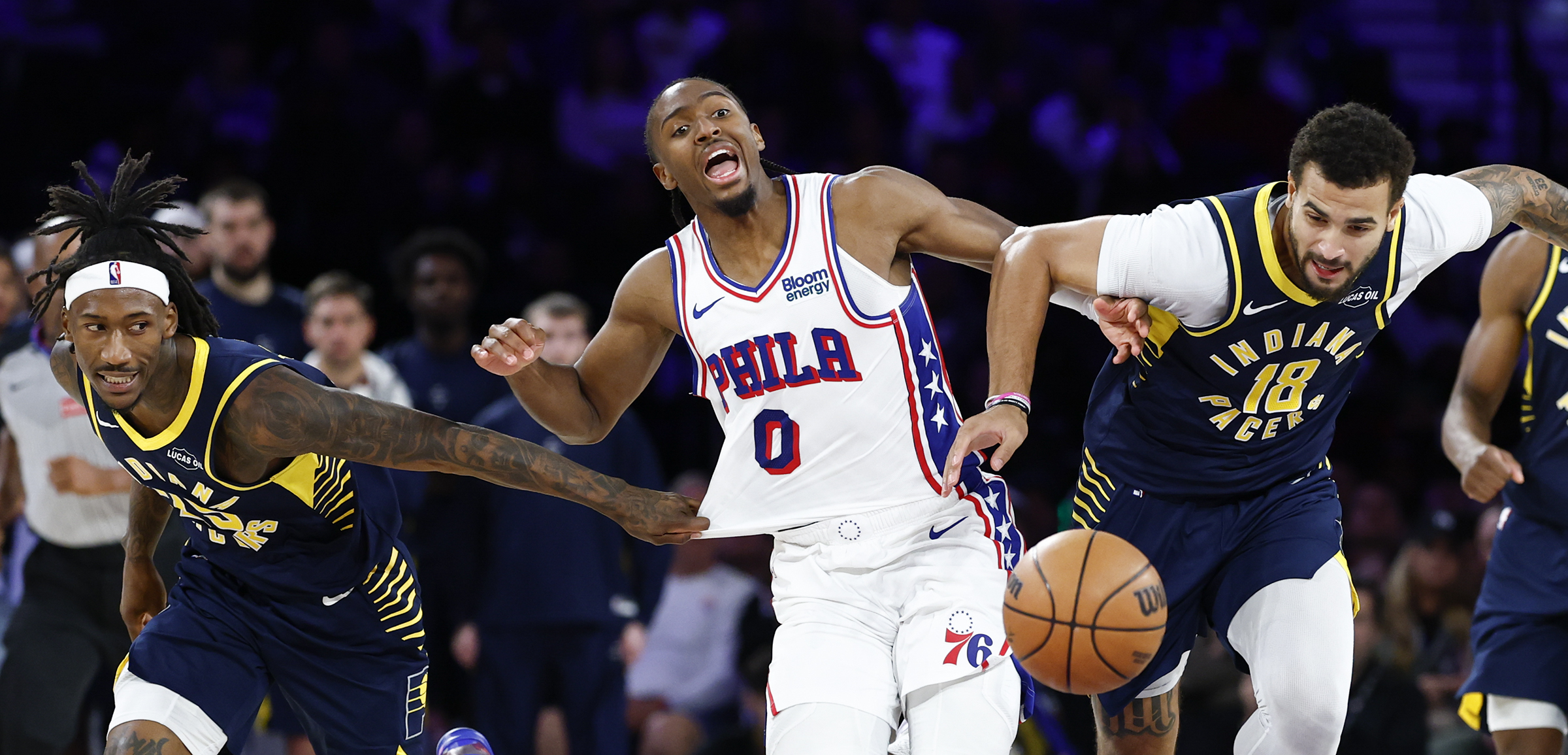
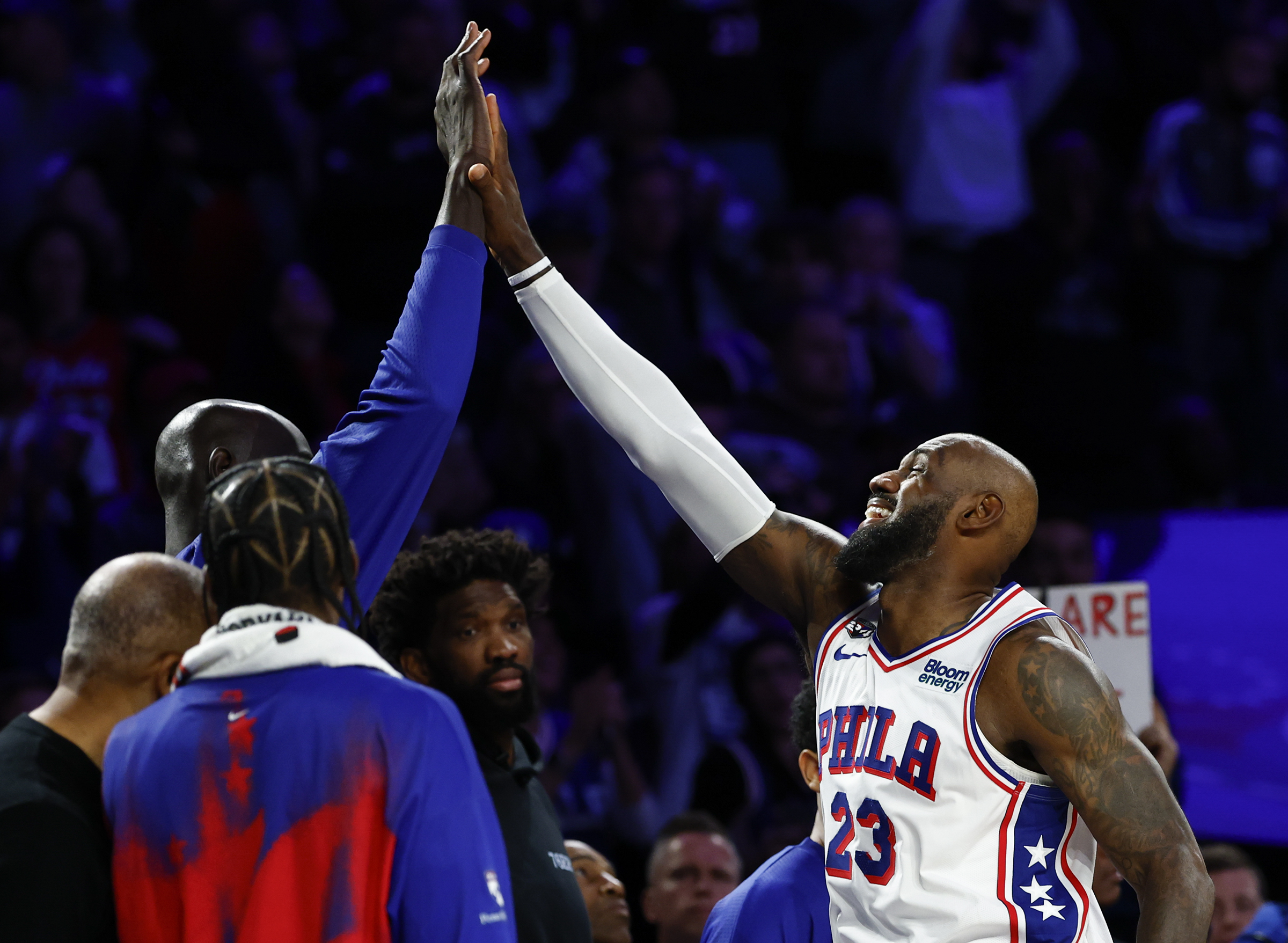
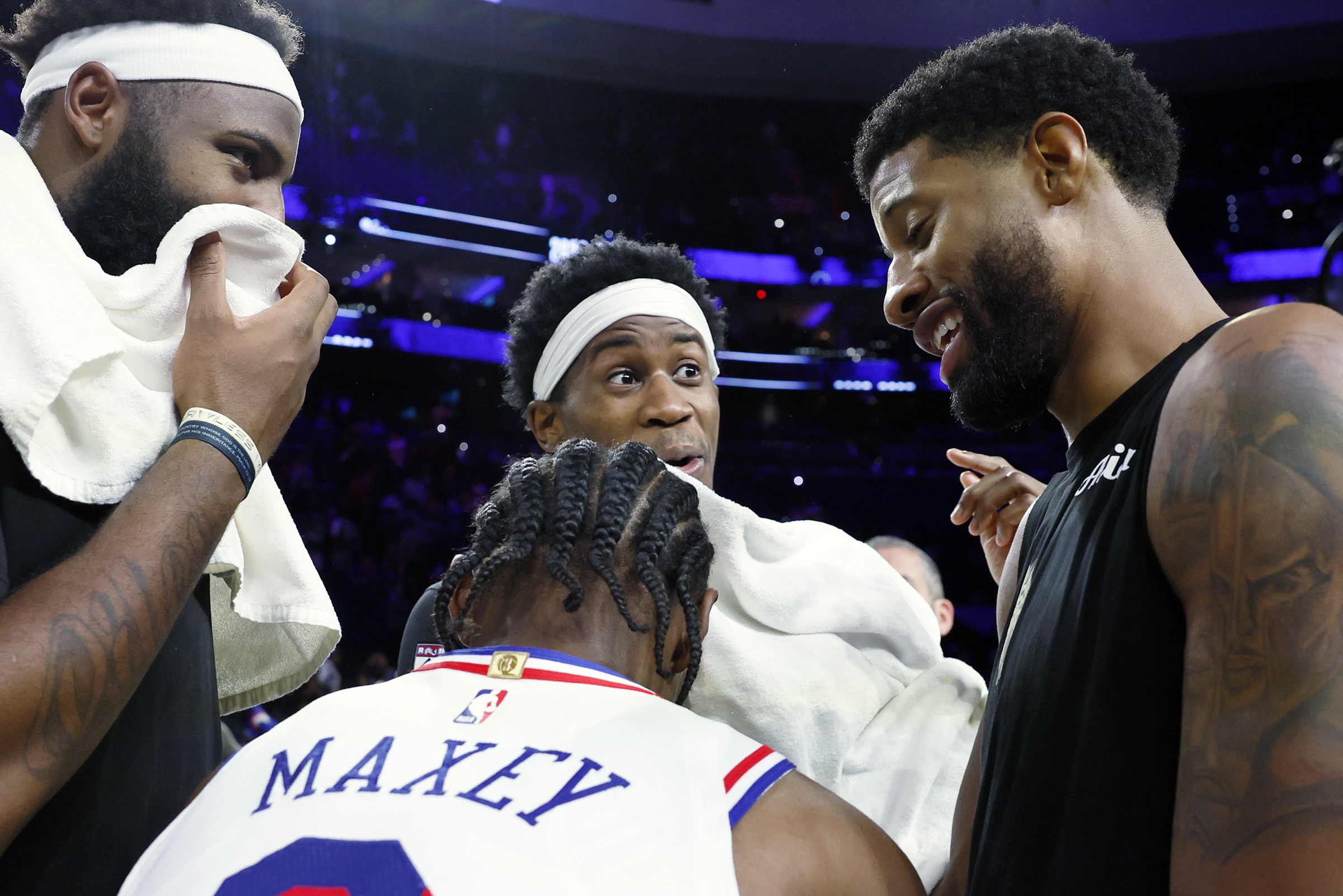
Sixers guard Jaylen Brown attempts to catch the basketball against Pacers guard Kelly Oubre Jr.,during the first quarter.Yong Kim / Staff PhotographerSixers forward LeBron James reaches after the basketball against Pacers center Ivica Zubac and guard Aaron Nesmith in the first quarter.Yong Kim / Staff PhotographerSixers forward LeBron James sits with center Joel Embiid during the second quarter.Yong Kim / Staff PhotographerSixers head coach Nick Nurse questions a foul call on his team during the second quarter.Yong Kim / Staff PhotographerSixers guard Tyrese Maxey loses the basketball against Pacers forward Pascal Siakam and guard Quenton Jackson during the second quarter.Yong Kim / Staff PhotographerSixers center Tacko Fall battles for rebounding position against Pacers center Jay Huff and forward Jalen Slawson in the third quarter.Yong Kim / Staff PhotographerSixers guard Tyrese Maxey dunks the basketball past Pacers guard Aaron Nesmith and center Ivica Zubac in the third quarter.Yong Kim / Staff PhotographerSixers forward Jabari Walker reacts after teammate guard Tyrese Maxey dunked the basketball during the third quarter.Yong Kim / Staff PhotographerSixers forward LeBron James raises his arms during the third quarter.Yong Kim / Staff PhotographerSixers guard Kentavious Caldwell-Pope gets tripped going after the basketball against Pacers guard Quenton Jackson in the third quarter.Yong Kim / Staff PhotographerSixers guard VJ Edgecombe drives to the basket against Pacers guard Kelly Oubre Jr., during the fourth quarter.Yong Kim / Staff PhotographerSixers guard Jaylen Brown gets fouled driving to the basket against Pacers center Jay Huff during the fourth quarter.Yong Kim / Staff PhotographerSixers guard Tyrese Maxey gets fouled late in the fourth quarter against Pacers guard Quenton Jackson and forward Jalen Slawson.Yong Kim / Staff PhotographerSixers forward LeBron James high-fives his teammates after leaving the game late in the fourth quarter.Yong Kim / Staff Photographer
When the Sixers signed Fall to a two-way contract this summer, the news was greeted mostly with a sense of nostalgia. He was still 7-6, and he still had a Hollywood name. But he was 31 years old, and had played a mere 37 regular-season games in the NBA, the most recent coming in December 2021.
Any buzz from Fall’s reemergence quickly subsided as a training camp hip strain sidelined him for the start of the season. The season began, and the Sixers once again had an obvious hole behind Embiid. Their first loss came on the back end of a back-to-back, which was also Embiid’s first load management day. As shaky as the Sixers superstar was on the offensive end, his defense had no replacement. Through 13 games, they were nearly 10 points worse per 100 possessions on the defensive end. Until Sunday, Fall had been limited to a handful of garbage time minutes in two blowouts.
“There’s just not much of a body of work,” Nurse said before the game.
That’s not as true now as it was when Nurse spoke those words. You can say that, at the very least.
There were a lot of different story lines competing for attention in the win over the Pacers on Sunday. Sentiment belonged to James, as it usually does. The old GOAT passed Jason Kidd on the NBA’s all-time assists list. He did so in vintage fashion.
Even more material than James’ brilliant halfcourt passing were the performances of Brown and Maxey. The duo combined to score 58 points on 21-of-37 shooting. They are quickly becoming the basketball version of those thunder-and-lightning NFL backfields we often hear about. Together, the Sixers are a bulldozer that can also go 0-to-60 in 3.5 seconds whenever it chooses to.
We also shouldn’t overlook Dean Wade’s performance, a man in the midst of his semi-renaissance. He is logging uncharacteristic minutes, 35 of them against the Pacers. Wade drilled three three-pointers and finished plus-10. His presence is even more critical when the Sixers are without Embiid. Same goes for Jabari Walker, the undersized big who grabbed seven rebounds and hit 3-of-6 three-pointers in 25 minutes.
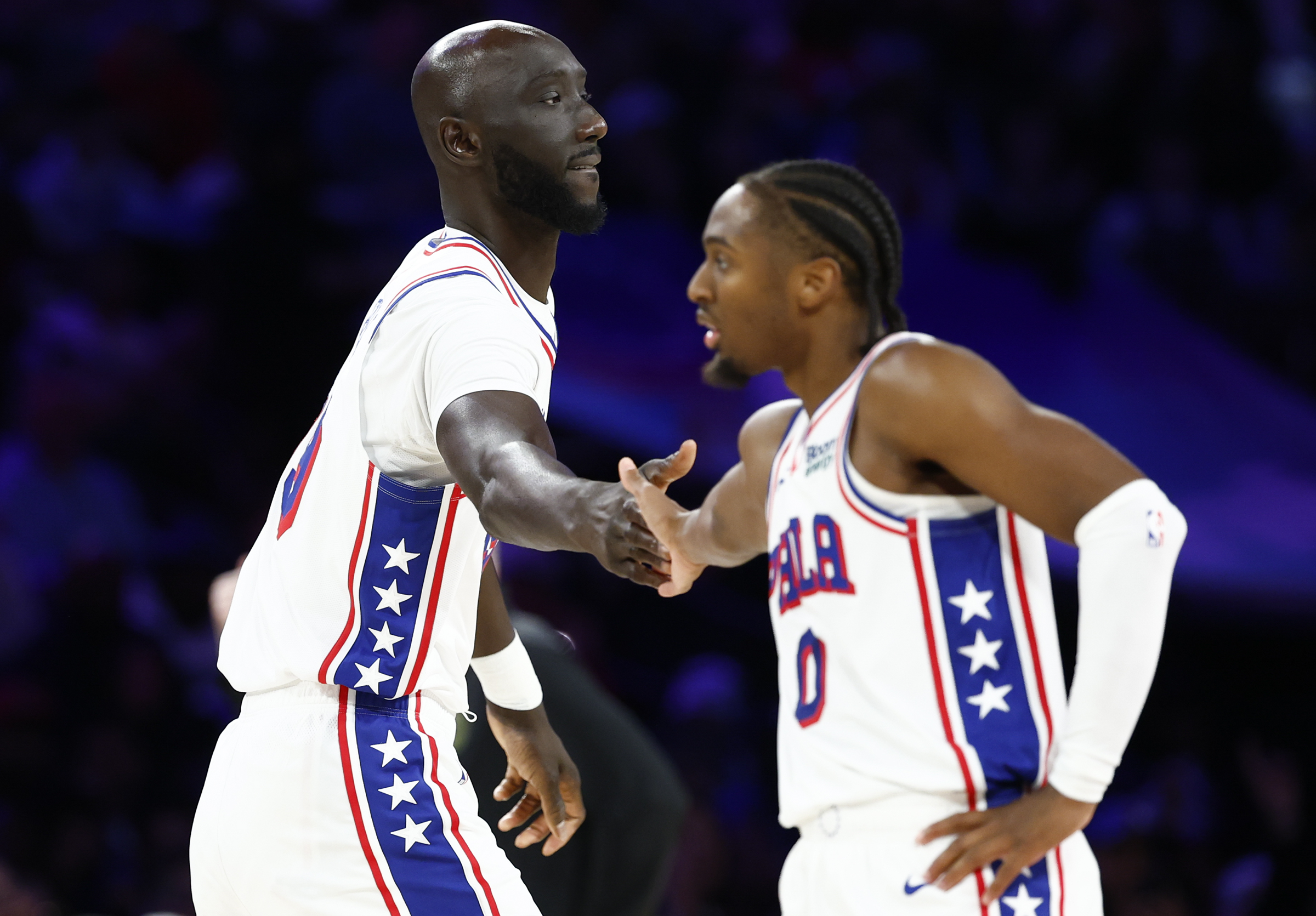
Tacko Fall and Tyrese Maxey slap hands during Sunday’s game against the Pacers.Yong Kim / Staff Photographer
Absent a dependable presence behind Embiid, the key for the Sixers will be scoring in bunches and piecing things together from there.
For at least one game, Fall was a sliver of a piece.
“Nobody knows what tomorrow brings,” Fall said. “I’m just focused on today, whenever my name is called. Like you said, I’ve worked very hard. God has brought me back here, and I’m thankful, and I’m ready.”
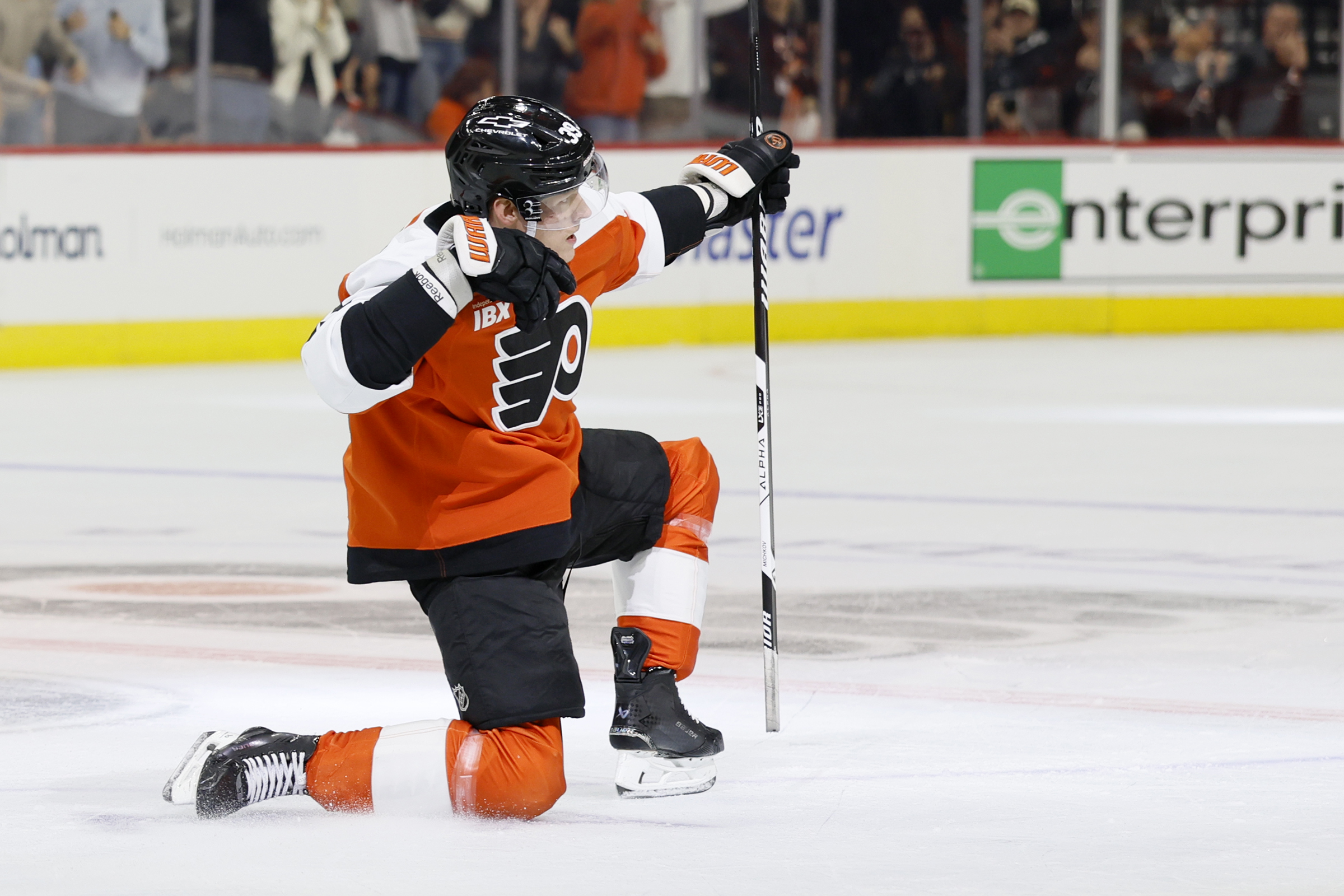
Repeated in-game incidents between Michkov, the Flyers’ rising young superstar, and veteran Flyers have revealed a significant rift in a locker room of a disappointing, losing team.
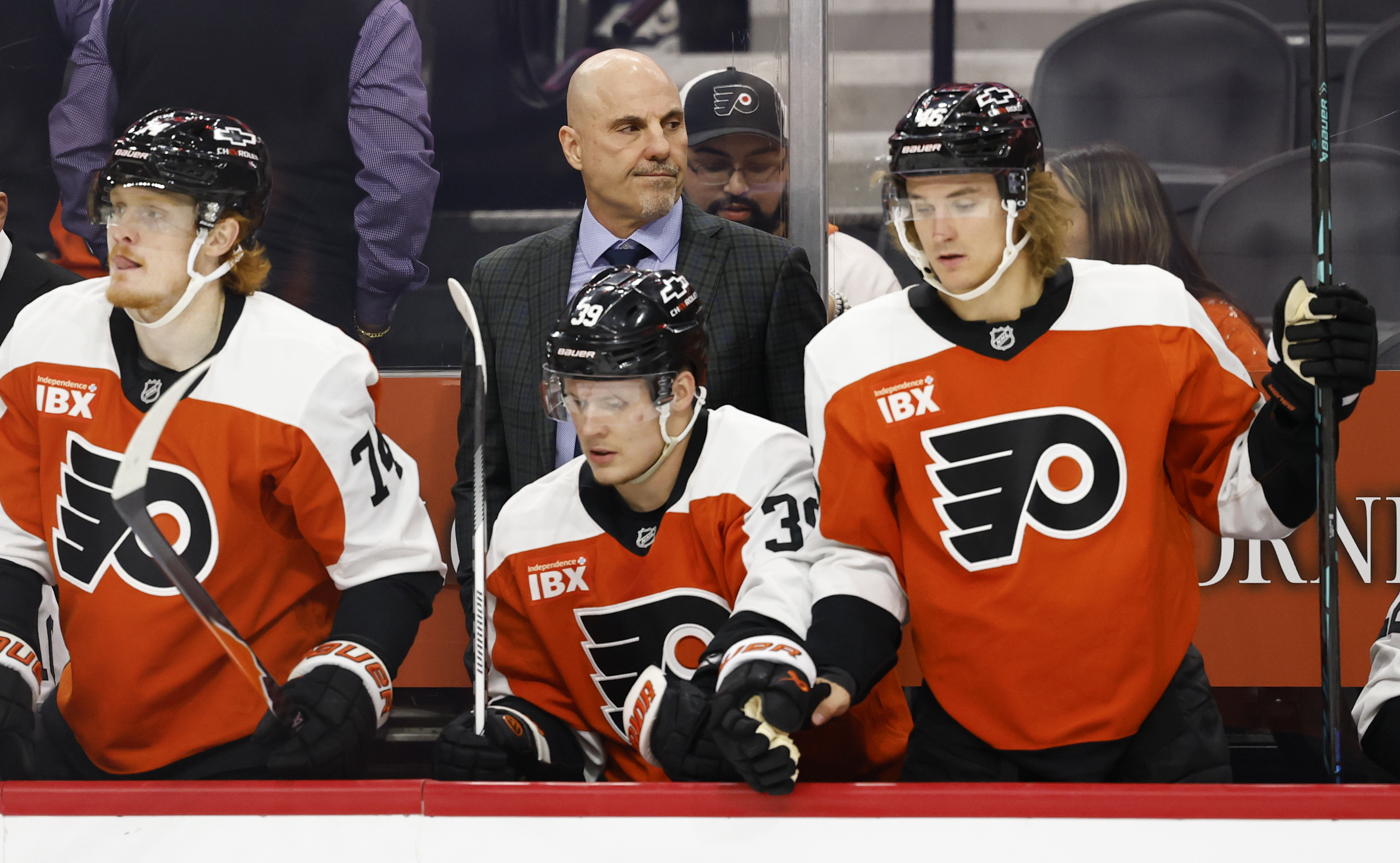
Tocchet was hired prior to last season to oversee the second phase of a franchise-wide rebuild. The most challenging needle to thread as Flyers head coach always was meshing a room of low-money, grizzled veterans like defenseman Nick Seeler, who is 33; big-money, accomplished, downside veterans like Sean Couturier, 33, and Travis Konecny, 29; and talented young players like forward Trevor Zegras, 25, Porter Martone, 20, and, of course, Michkov, a 21-year-old Russian savant.
Tocchet struggled to mesh those elements for much of last season. However, through earnest effort, real connection, and team-wide buy-in, “Tocc” figured out a winning formula by the end of last season. The Flyers streaked into the playoffs and upset the Penguins before getting swept out by the eventual Stanley Cup winners from Carolina.
This season, Tocchet again has struggled to mesh those elements, and conditions have changed.
Last year, he inherited a club populated by vets with meager security and youths eager to show their worth.
This year, Tocchet walked into a room full of young players whose trip to the postseason convinced them that they’d arrived in the NHL, they had figured out how to win, and it seemed pretty easy. He also had a group of vets exhaling after the springtime playoff successes.
Then, they got punched in the mouth nine times in a row, the longest losing streak to start a season in team history. They didn’t play with the same tenacity and vivacity that pushed them into the playoffs and past the Penguins.
Tocchet’s honeymoon is over. The dressing room is fractured. The team stinks.
Just 21 games into the season, Tocc’s job is on the line.
Both Couturier and Seeler recently criticized the team’s effort and selflessness. After separate, animated incidents during breaks involving Michkov and Konecny against the visiting Wild on Nov. 3, then between Seeler and Michkov in Vancouver on Monday, Michkov reportedly told people in his circle that he wants to be traded.
That would be catastrophic. Michkov has become fitter, less selfish, and even learned enough English that he generally declines help from his interpreter. He has become more professional, yet he clearly feels victimized.
This was a 5-alarm fire.
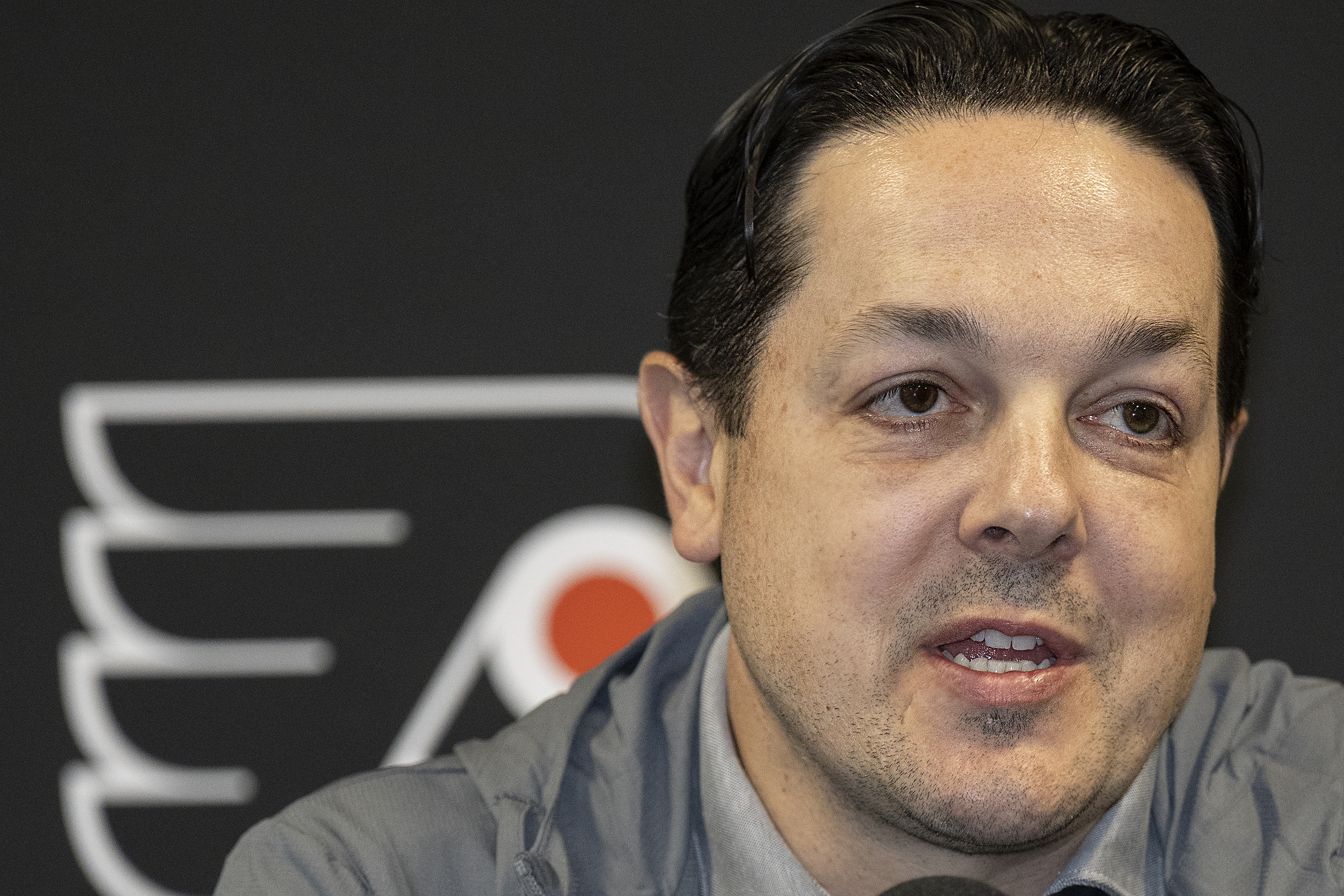
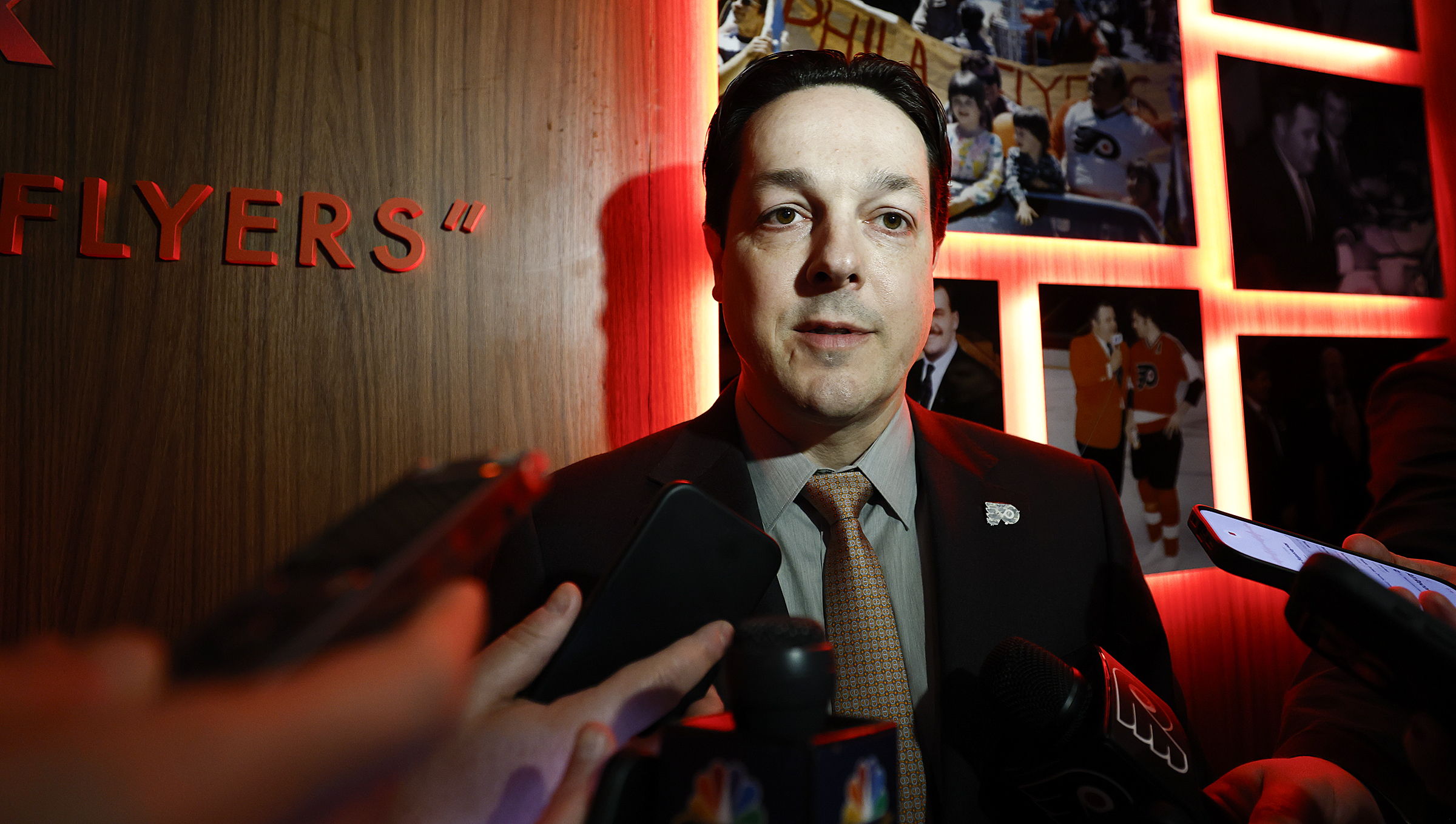
General manager Danny Brière and governor Dan Hilferty immediately hopped on flights to address the situation.
Brière held a video news conference Wednesday and said Michkov and his agent denied the veracity of the report and said the Flyers have no plans to trade Michkov, who will be a restricted free agent after the season and whose immediate future the Flyers control. Michkov later also denied the report and said he wants to remain a Flyer.
But then, in the middle of a season, what are they going to say?
The report came from ESPN’s Kevin Weekes, a former NHL goalie who has broken many such stories. Weekes has not retracted a word of his report.
**Breaking News** 🚨 📰
From multiple league sources, with the Flyers unimpressive start and internal turmoil, Michkov would likely want a new start elsewhere. He's in the last year of his contract & is a prime trade candidate moving forward. #HockeyXpic.twitter.com/4mYzKiN42G
In fact, on a Russian TV hockey show Thursday, Sergei Fedotov, Michkov’s agent for two years while Michkov was still in Russia, said, “He’s pushing for a trade. I guarantee that.”
The most compelling information to come out of the week’s soap opera didn’t pertain to Michkov.
It pertained to Tocchet.
It came from Brière.
It was intentional.
In answering an unrelated question about Michkov and Tocchet, Brière suddenly veered off course and delivered a big-picture ultimatum:
“As far as the work Rick’s put in: He’s the one last year that came back in the second half and was able to tweak our system,” Brière said. “He was a big part of the reason why we were able to get into the postseason. Win in the postseason. And I expect him to do the same thing here. I expect him to find solutions and turn this thing around.”
If that sounded like a shot across the bow, it was.
If that sounded like an “… or else…” statement, it was.
If that sounded like Tocchet could be fired after the season if the team regresses enough, or even be fired during this season if things continue to crater, well, you read it right.
League sources say that Brière, Hilferty, and president Keith Jones wholeheartedly believe that, given the current roster, Tocchet should have more than 16 points in 21 games, tied for fifth-worst entering Saturday’s game at Columbus.
Columbus has just 14 points.
Brière traveled with the team from Edmonton to Columbus.
What might happen if the Flyers tank in Ohio?
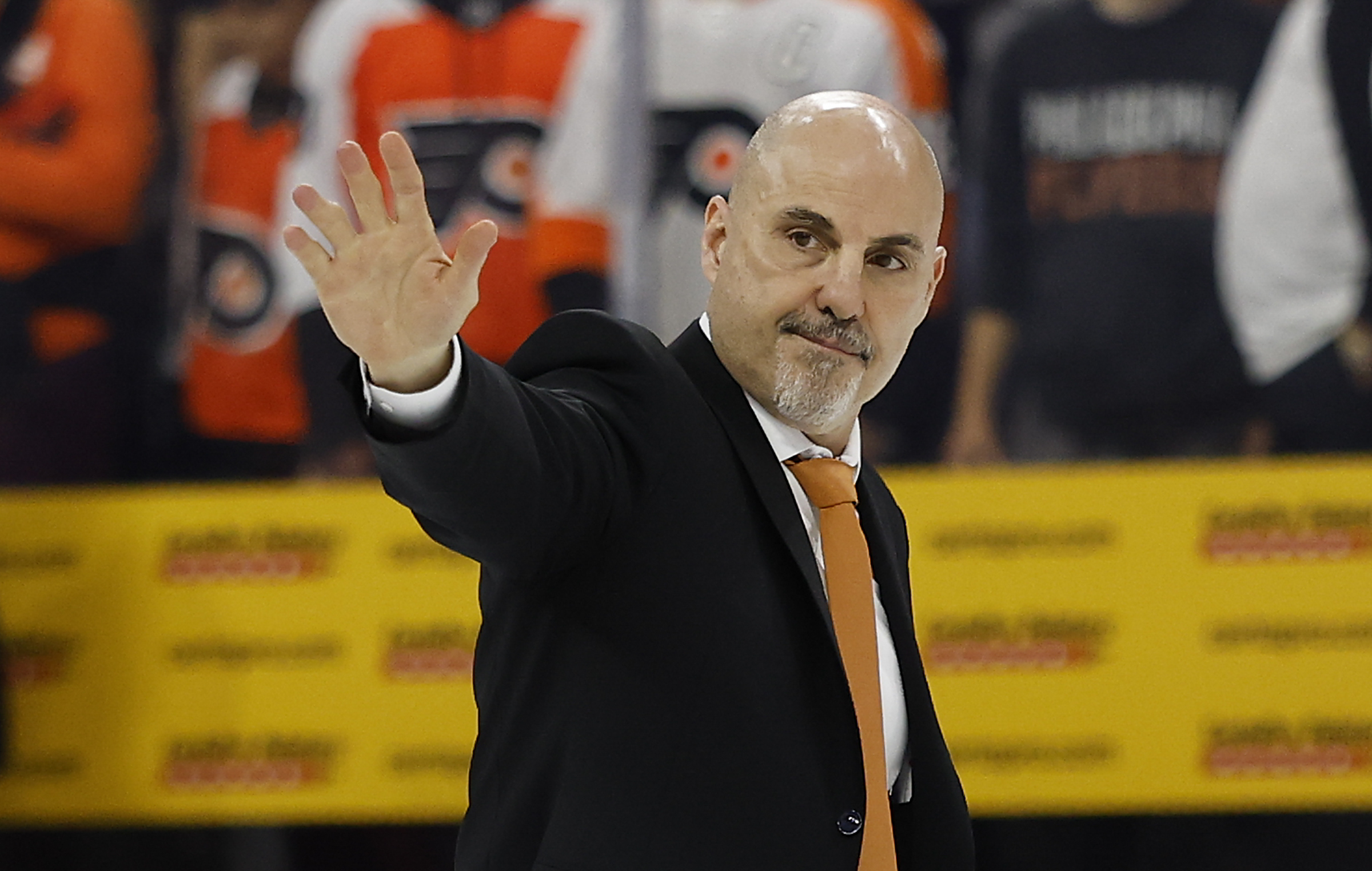
If it comes down to Rick Tocchet or Matvei Michkov, the Flyers are siding with their rising young star.Elizabeth Robertson / Staff Photographer
What might happen if Michkov has another argument with a teammate during the game?
Stay tuned.
If this seems unfair to Tocchet, understand that no sport is more unfair to its head coaches than is hockey, and Tocchet stepped into a snake pit.
Tocchet inherited a dressing room reeling after three wasted seasons under unpredictable, incendiary coach John Tortorella, a confrontational head-game enthusiast who always was a bad fit for what first was a mismatched roster, then a rebuilding roster.
Brière has said that the chaos of the Flyers’ roster was part of the allure of Tocchet as a candidate, repeatedly citing Tocchet’s success with an overachieving team in Arizona (now in Utah).
Yes, the Flyers have an imperfect roster. They have no real first-line centerman, and it could be argued they don’t have a real second-liner, either. Their goalies, Dan Vladař and Joseph Woll, have spent most of their careers as part-timers or backups. Couturier, their captain, is making $7.75 million as a fourth-line center averaging just 16 minutes, 17 seconds of ice time, his lowest since the 2012-13 season. Konecy, their leading scorer last season, just missed 10 games with an injury. Rasmus Ristolainen, their $5.1 million veteran defenseman, just missed 16 of 17 games before returning in Edmonton.
Injury does not excuse the perceived toxic atmosphere that currently engulfs the Flyers. Not everybody has to be happy all the time, but it is part of every head coach’s job to install leadership and culture that keeps the dressing room productive. Brière and Jones, who combined for 26 NHL seasons and who both played with Tocchet, know this.
They also know that if Tocchet is unable to overcome these obstacles — obstacles that predated his arrival, obstacles he has handled elsewhere in the past — then he has fallen short of part of the reason for his hiring.
The salient question: How much longer will Tocchet get?
If the team continues to play the way it played at Edmonton on Wednesday, Tocchet will last at least to the end of the season, if not beyond. After being addressed by Brière before the game, and clearly galvanized by the controversy, the Flyers escaped Alberta with a point after playing an inspired brand of hockey for all 60 minutes and overtime.
Notably, after averaging 16:08 of ice time in the previous six games, Michkov played 20:44 on Wednesday, his second-most ice time not only of this season but the second-most in any game under Tocchet.
Flyers general manager Danny Brière put Rick Tocchet on notice with his comments Wednesday.Jose F. Moreno / Staff Photographer
Tocchet said Friday that he was not directed by management to play Michkov more, and that Michkov had earned more time because Michkov had recently been playing better.
However, if the team plays as it did in Vancouver, where it sleepwalked to a win over a last-place team built to lose, Tocchet might not last until Christmas.
That might not be fair.
But that’s life in the NHL.
A coach cannot control the roster, but they are paid to extract maximum return from the assets available to them.
Brière warned fans and media that, in the 2026-27 season, “There’s a chance, a good chance, that we take a little bit of a step back this year.”
He did not, however, envision the Flyers falling into the abyss of irrelevance.
And, fairly or not, he now has laid this season’s drama, regression, and failures at the feet of his head coach.
Or, it could be the Chargers. Or the Falcons. Or the Dolphins or the Jets or the Cardinals or the Titans. Maybe the Colts, although that would require some degree of organizational direction.
Whoever it is, it won’t be any of their faults. The rules are what they are. The competitive cycle is what it is. Eagles fans are fortunate their team is astute enough to recognize the facts. Abstract concepts like competitive integrity and the spirit of the law are secondary to stakeholder value. The NFL’s problem is that a critical mass of teams may finally be thinking like the Eagles.
Most of the eight teams mentioned above have made their charted course abundantly clear. The Eagles did it by trading away a player they signed to a hefty extension in March. The Titans did it by trading away two defensive starters, one of whom ranks among the most disruptive in the game. The Falcons did it by trading away the best player on their defense. The Chargers did it by screaming bloody murder after their trade of a veteran for two late-round picks was denied.
The Colts had less to gain than any of these teams, and they ended up gaining the least. They owe their first-round pick to the Jets, who could easily end up with two picks in the top five. At the same time, the Colts are very much the team that set the whole thing in motion by gift-wrapping two impact veterans and sending them to NFC contenders. With games remaining against the Dolphins, Eagles, and Titans, Indianapolis will play a big role in determining the final order of the worst of the worst.
Let’s not open a can of worms by suggesting that any of these teams aren’t playing to win. That semantic game is easily contested. Tanking in the NFL isn’t much of a thing because too many people have too much to lose if they don’t perform in the here and now. Nick Sirianni, Shane Steichen, Aaron Glenn — all three are coaches who could easily be fired after this season. Each of them surely knows that. None has any incentive to do anything less than try to win the next game. Same goes for the players: the Markell Bells, the Tyler Steens, the Drew Kendalls, most definitely whoever starts at quarterback. In their regard, the incentives align. The higher the Eagles draft, the more likely it is they draft a player capable of taking one of their jobs.
Yet, the fact remains: it would greatly behoove the Eagles to draft as high as possible. To draft No. 1 overall could rewrite their destiny in the medium-to-long-term. The difference between a short-order return to the Super Bowl and five years of mediocrity could easily be the difference between drafting No. 1 and No. 5, or even between drafting No. 2 and No. 4.
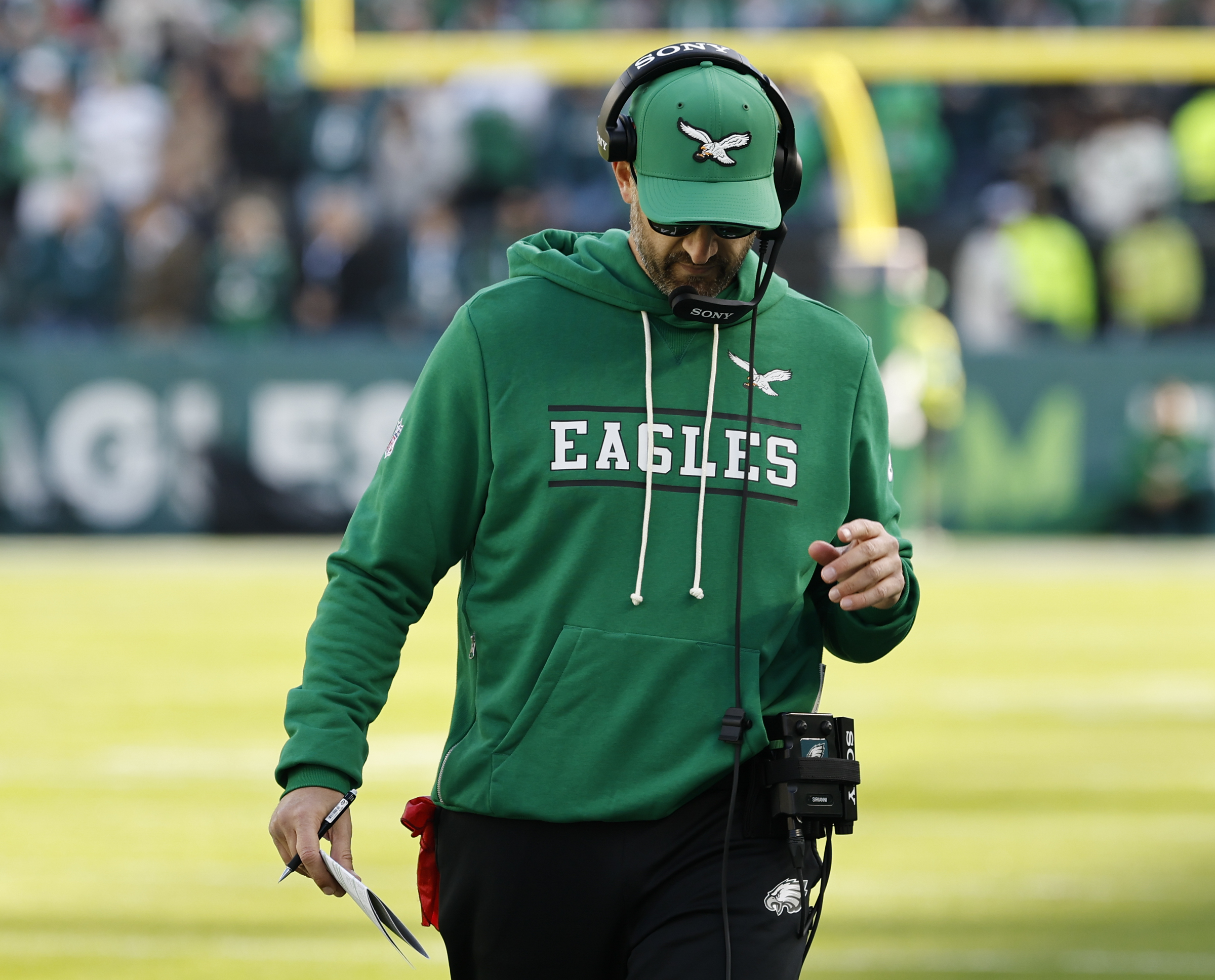
Eagles head coach Nick Sirianni must continue to try to win amid the team’s myriad roster issues. Yong Kim / Staff Photographer
This is not an exaggeration. It is not a straw man. It is reality. Howie Roseman knows it. Bet your last dollar on that.
Remember the uproar in January 2021 when the Eagles pulled Jalen Hurts in the fourth quarter of their season finale against the Commanders? Remember the questions about the play-calling? The Eagles incentive on that particular day was the prospect of moving from No. 9 to No. 6. Those three spots of draft position gained them an extra first-round pick. They traded down from No. 6 to No. 12, picking up a 2022 first-rounder from the Dolphins. That 2022 first-round pick became Jordan Davis, who helped the Eagles to a pair of Super Bowls and now has landed them 2027 first- and 2029 second-round picks from the Jaguars.
In hindsight, the Eagles would have been committing organizational malpractice had they not done everything within the letter of the law to maximize their chances of drafting at No. 6 in 2021. This year, the potential reward is even greater.
The No. 1 pick is a longshot. But it isn’t nearly long enough to not factor it in to every decision that gets made between now and the end of the season. Look at the schedules and the performances and you’d say that some order of the Titans, Dolphins and Chargers are the favorites to finish with the three worst records in the NFL. The No. 1 overall pick is theirs to (literally) lose. But there is a lot of football left, and a lot of it will be played among the teams who are much better off losing.
The Dolphins entered the season in full-fledged tank mode, trading away wide receiver Jaylen Waddle and signing Malik Willis as their starting quarterback. They have outperformed expectations by winning a game, which leaves them only one shy of the Eagles. Miami plays the two-win Colts this week. They have games remaining against the two-win Jets and Chargers. Winning one of those three games is well within the range of potential — even likely — outcomes.
The Chargers have a game remaining against the Jets, in addition to the Dolphins. The Titans have the Commanders, in addition to the Colts.
Put simply, it is quite possible that the Eagles’ games against the Cardinals and Colts in Weeks 13 and 14 will decide whether they pick at least in the top 3.
That is an awful proposition for the NFL to foist upon teams. Right now, the Eagles’ competitive advantage is Roseman’s understanding of how valuable these draft picks are. But he isn’t alone, judging by the trade deadline. The NFL is about to find out what happens when a stoppable force meets a moveable object with draft position on the line.
Video: How much are Howie Roseman and Jeffrey Lurie to blame for current state of Eagles? | unCovering the Birds
There is an easy solution. Not a panacea, but at least a salve. Games between teams who would both benefit by losing should not count in the reverse-order standings. It’s not complicated. Just calculate win percentage without those games. Pretend they never existed.
You can argue about where to set the thresholds. You can argue that some limited form of a lottery system would be better. It’s pretty clear that either one can be written into law in a way that avoids any dramatic unintended consequences. The current system is practically begging for a game that makes a laughingstock of both teams and the league at large.
A certain number of teams are clearly prioritizing the future over the present. A team’s draft position can make or break that future. What good does it do to force teams to lose in a plausibly deniable way?
OK, the Founding Fathers might have faced more dire decisions in Philadelphia than the Flyers’ brass, butyou can be sure that those whose offices reside in the Voorhees practice facility feel as embattled as George Washington this morning.
The Flyers have the third-lowest points percentage in the NHL, they have a fan base that despises the coach, they have a dichotomous dressing room comprised of grizzled vets and callow youths, and they have a rising young star apparently upset with all of it.
First, understand that ESPN’s Kevin Weekes is a credible hockey insider. His X/Twitter report Tuesday that Matvei Michkov “would likely want a new start elsewhere” should be accepted at face value.
Somebody told Weekes that Michkov, a Russian wiz of a wing, wants to be traded because the Flyers stink, the coach is mean, and his teammates hold him accountable. Apparently, several somebodies.
The report landed a day after Michkov reacted angrily during a discussion with veteran defenseman Nick Seeler on the bench in Vancouver during a stoppage in play.
The clash appeared to concern Michkov ignoring an open Seeler and shooting on an earlier possession.
👀Michkov and Seeler have a heated discussion, but what caused it?!
Here is one play that MIGHT have helped the situation boil over…… in the 2nd period in Vancouver. Im a former video coach in the NHL, and here's what i saw.
After a loss on Oct. 28, Seeler also offered a sweeping critique that painted unnamed Flyers as selfish:
“You play for the guy next to you. That’s what Flyers hockey is all about.”
Many observers believe that Michkov was among the Flyers at whom that statement was aimed. Monday’s very public argument only fueled those suspicions. Combined with captain Sean Couturier’s characterization of the team’s play as “soft,” there appears to be a rift between the old guard and the new.
Second, understand that, according to a team source, the Flyers have absolutely no more intention of trading Michkov than they have of playing Wednesday night’s game in Edmonton on rollerblades. The team also believes that Michkov and his camp do not, in fact, want a trade.
Michkov on Wednesday said he wants to stay with the Flyers, which is believable. He also said he was unaware of the report, which, of course, is not believable.
Stay tuned.
Flyers head coach Rick Tocchet and Matvei Michkov (middle) have rarely seen eye to eye during their two seasons together.Yong Kim / Staff Photographer
Third, understand that how the Flyers handle the situation will define the futures of the Holy Trinity of the Orange and Black: Rick Tocchet, the alumnus coach with whom Michkov clashed last season; general manager Danny Brière, the alumnus general manager who warned us all that the Flyers might fall short of last season’s run to the playoffs and the first-round upset win; and Keith Jones, the alumnus president who oversaw the refusal of 2022 first-round pick Cutter Gauthier to play for the Flyers.
There were a number of reasons Gauthier balked at playing in Philadelphia, among them the team’s desire for him to return to college when he wanted to turn pro; that he didn’t want to deal with then-coach John Tortorella and an unproven front office; or maybe he just didn’t like Philly.
Gauthier, 22, forced a trade, landed in Anaheim, and, after nicely wetting his feet in the 2023-24 season, he has more than lived up to his No. 5 overall pedigree, with 56 goals since the beginning of the 2024-25 season, the fifth-most in the league.
Michkov, with 30 in that span, is tied for 79th.
No other Flyer has more.
Gauthier, when he was dealt, was a burning ball of potential (fulfilled) with a bright but uncertain future who might have foundered on a bad pro club.
Michkov, today, is the best young player on an NHL team in the middle of a promising rebuild.
Brière, Jones, and the team’s governor (ownership representative), Dan Hilferty, all are new, first-timers in their roles. The Flyers have been accused of blind nepotism for most of their existence. They stood strong with Tortorella in the Gauthier debacle, if that mattered. If they somehow fumble away another first-round star, they probably wouldn’t survive the humiliation.
The franchise would be cast as toxic.
What free agent would want to play in Philly?
What credible coach would want to coach here?
The root of Michkov’s discontent is obvious and, frankly, understandable.
He has improved.
He has changed.
He is 21.
It’s been a lot.
After chafing under Tortorella for a season, then chafing under Tocchet for months last season, Michkov used the Olympic break in February to turbocharge his poor conditioning — poor conditioning that Tocchet repeatedly mentioned in the media. Michkov doubled down on his conditioning last summer. He back-checks better. He turns the puck over less. He shoots more.
The Flyers can’t afford to squander another talent like they did with Cutter Gauthier. Gauthier, who has hat tricks in three of his last five games, is third in the league in goals.Gregory Bull
He also worked on his English and now usually conducts interviews without an interpreter.
So, maybe he isn’t as unselfish or as orthodox as the old-heads want him to be. His 10 goals are more than the next three players combined.
His perspective: What more does this sorry team want from me?
Assuming Michkov truly is discontented …
Will the Flyers trade him? If they do so, what message does that send to other young Flyers, such as enticing rookie winger Porter Martone?
Will the Flyers make moves to mollify Michkov? Would they get rid of Seeler? Would they go so far as firing Tocchet? If they do either of those things, what message does that send?
Will the Flyers ignore the situation and hope it goes away? Michkov is reaching the end of a three-year contract and will be a restricted free agent, and, as such, will remain under the Flyers’ control, since they can match any offer sheet he signs.
Expect No. 3 to be the option everybody chooses.
The report probably reflected Michkov venting, to friends and confidants, his frustration and embarrassment with the losing, the incident with Seeler, and three seasons of continual criticism. He will cool off. The team will rally. Life will go on.
It is the sort of situation that can resolve itself … if properly handled by the handlers.
The thing is, two of the handlers — Brière and Jones — haven’t had to handle this sort of thing with a proven star before. The third, the coach, is part of the perceived problem.
With the Continental Army about to cross the icy Delaware River on Christmas night in 1776, Thomas Paine certainly didn’t have this sort of minor crisis in mind.
Of course, in the minds of the men running the Flyers, this crisis is anything but minor.
Are the 76ers a team shooting poorly or a poor-shooting team?
It is a question that mostly lingered in the background during their 9-2 start. That’s no longer the case after a 123-101 loss to the Celtics on Tuesday night. The story wasn’t Jaylen Brown’s lamb chop play-along against Jayson Tatum and his former team. It wasn’t even Paul George, who dropped 36 points in the least-heralded return to Philly since the Season 4 finale of The Fresh Prince of Bel-Air. No, the story on Tuesday night wasn’t personality-driven. It was fundamental. The Sixers couldn’t shoot.
Somehow, the numbers were both ugly and not nearly ugly enough. The Sixers shot just 11 of 37 from three-point range, and that’s only thanks to a 2-for-6 showing from the bench mob in closing minutes of the fourth quarter. Until then, the Sixers were on track to finish shooting under 30% from three for the fifth time in 12 games. Especially notable is the fact that nearly all of their positive production came from two players, one of whom basically needs to be guilt-tripped into taking shots. Tyrese Maxey and Dean Wade combined to hit five of their eight three-point attempts. The rest of the team went 6-for-29 (.206), with two of those makes coming from Anfernee Simons in the last minute of play.
“I really think that, especially in the first half, we were generating really good shots out of their swarming defense,” Sixers coach Nick Nurse said. “We were zinging it out to wide, wide-open guys and we just didn’t hit enough to keep pace.”
It was a problem. As we all know, shooting is a rather important component of basketball. Fast breaks are fun. Defense is key, as are energy and passing and stamina and a bunch of other things the Sixers have excelled at over the first three weeks of the season. That said, the sport is called basketball for a reason. The winning team is often the one that does the best job of making the ball go through the basket. The Sixers were not that team on Tuesday.
The bigger issue is that they’ve rarely been that team this season. The divide was especially pronounced against the Celtics, who hit 22-of-49 threes and shot 51% from the field overall. Four different Boston players hit at least three threes, with George, Tatum, Sam Hauser and Payton Pritchard combining to go 17-for-32. Meanwhile, four of the five Sixers starters combined to go 3-for-17:
LeBron James: 1-for-6
VJ Edgecombe: 0-for-4
Jaylen Brown: 1-for-4
Joel Embiid: 1-for-3
“They got it going,” said Brown who got into early foul trouble and finished with just 13 points and a minus-27 against his former team. “I don’t know how many threes they hit, but I’ve seen it. I’ve been a part of it for a long time. So I know what it looks like, what it feels like and tonight was one of those nights where they had it going from all angles.”
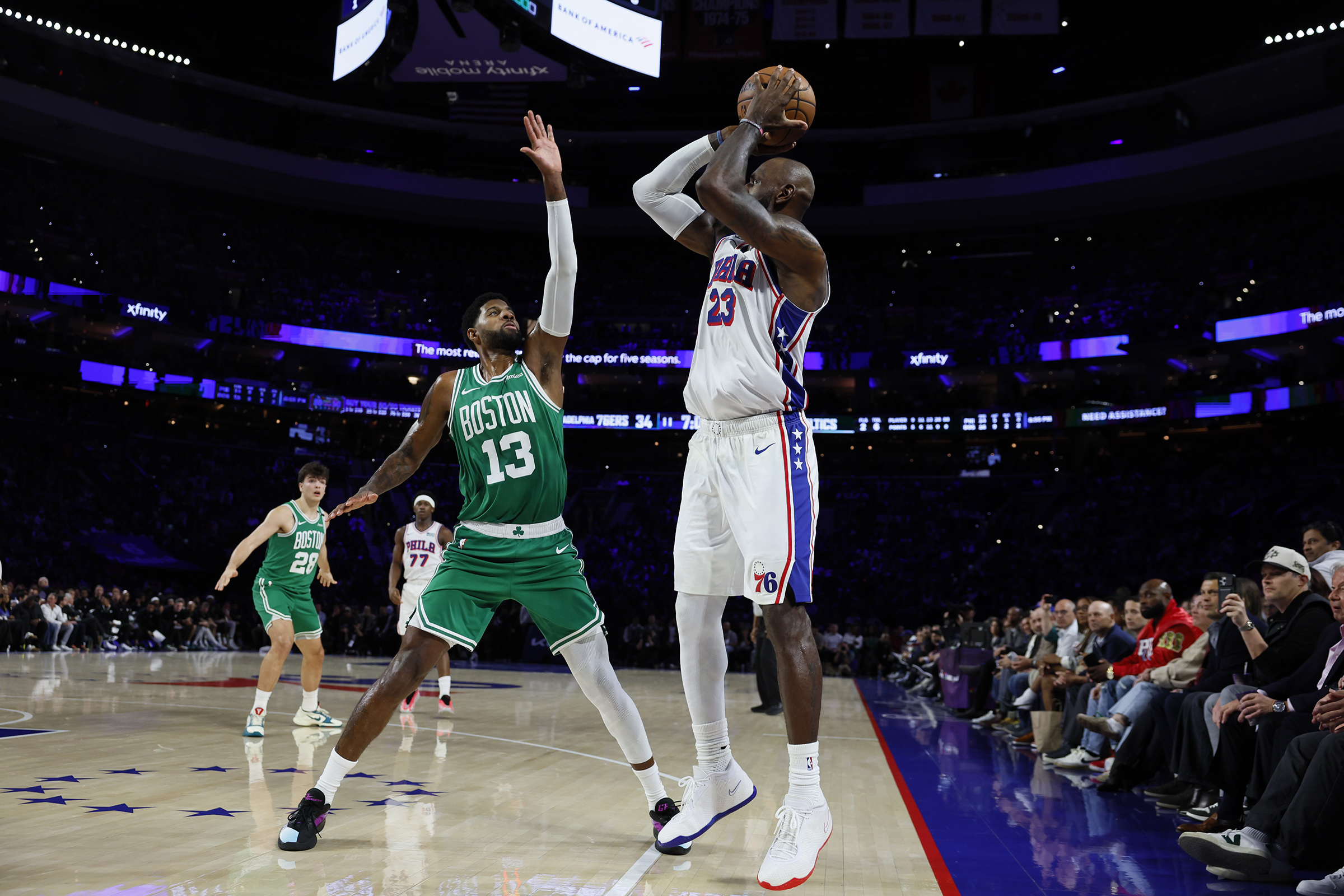
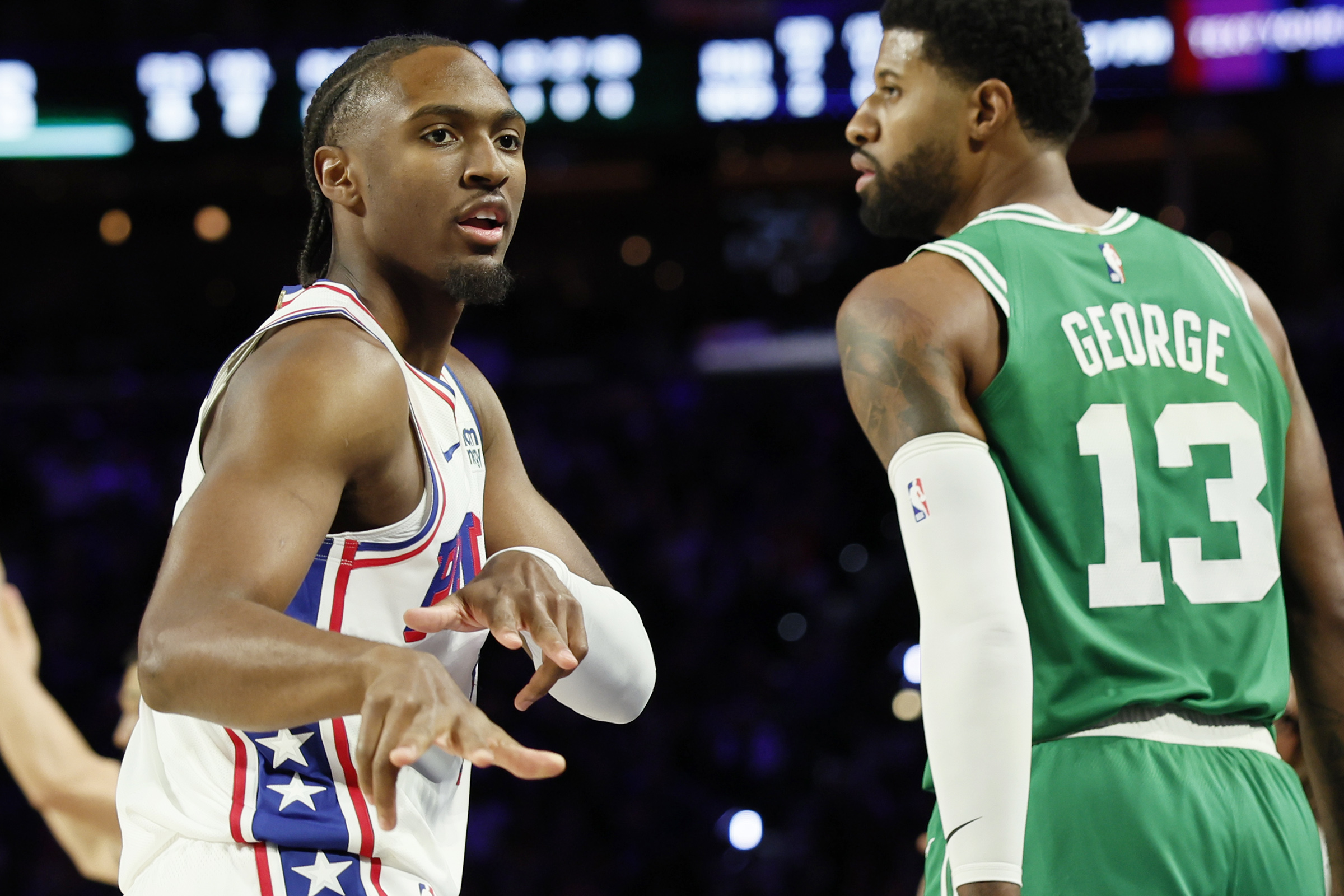
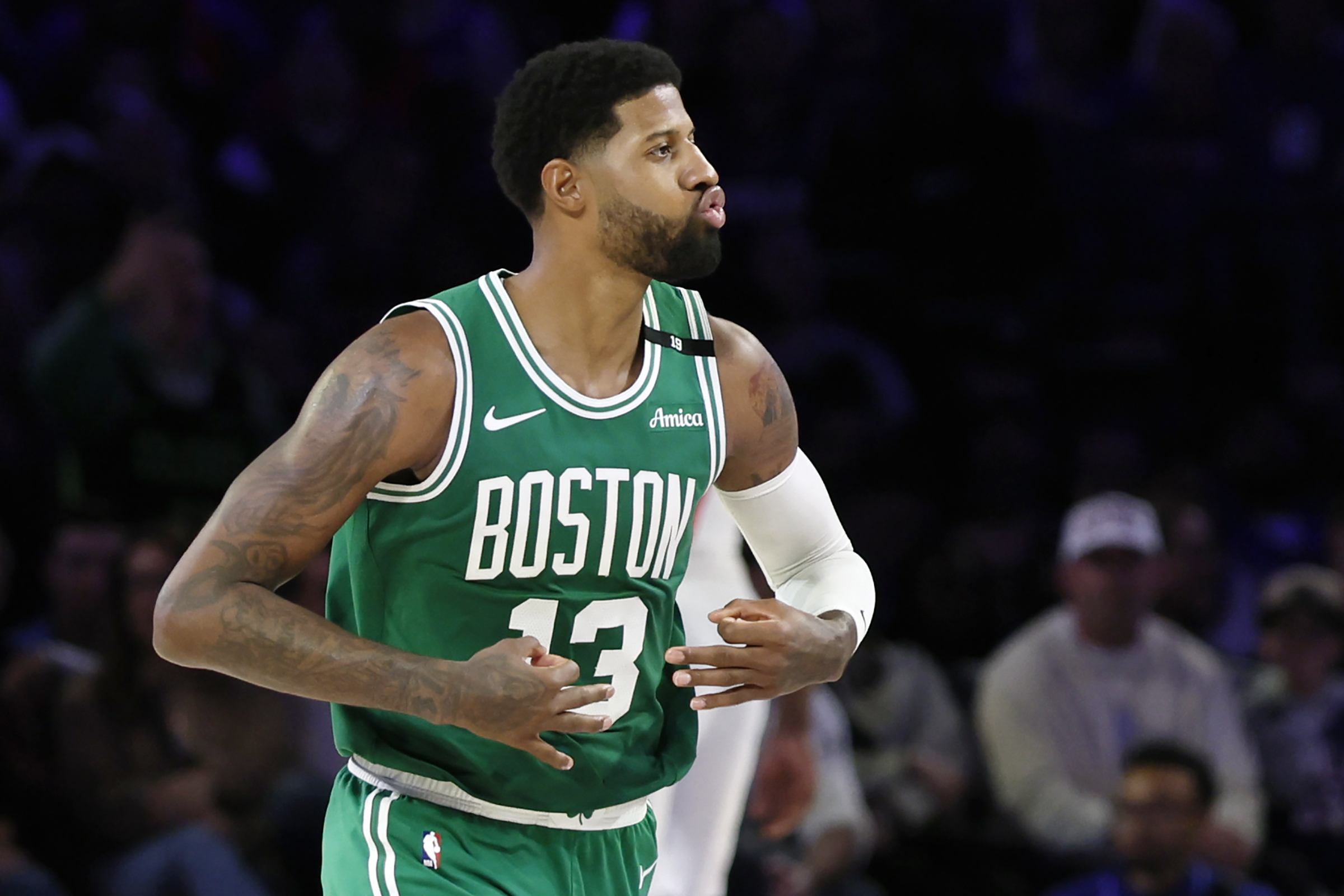
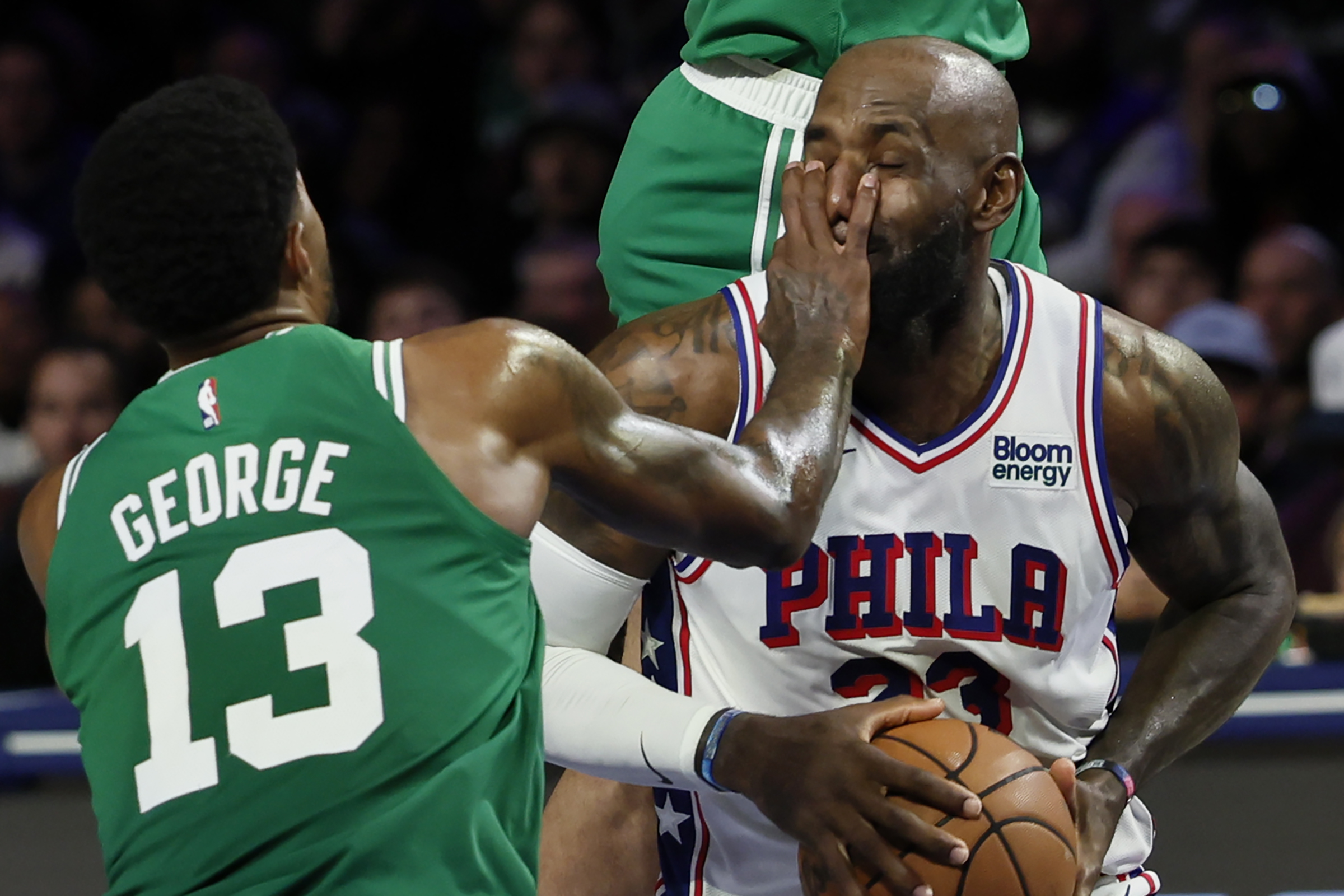
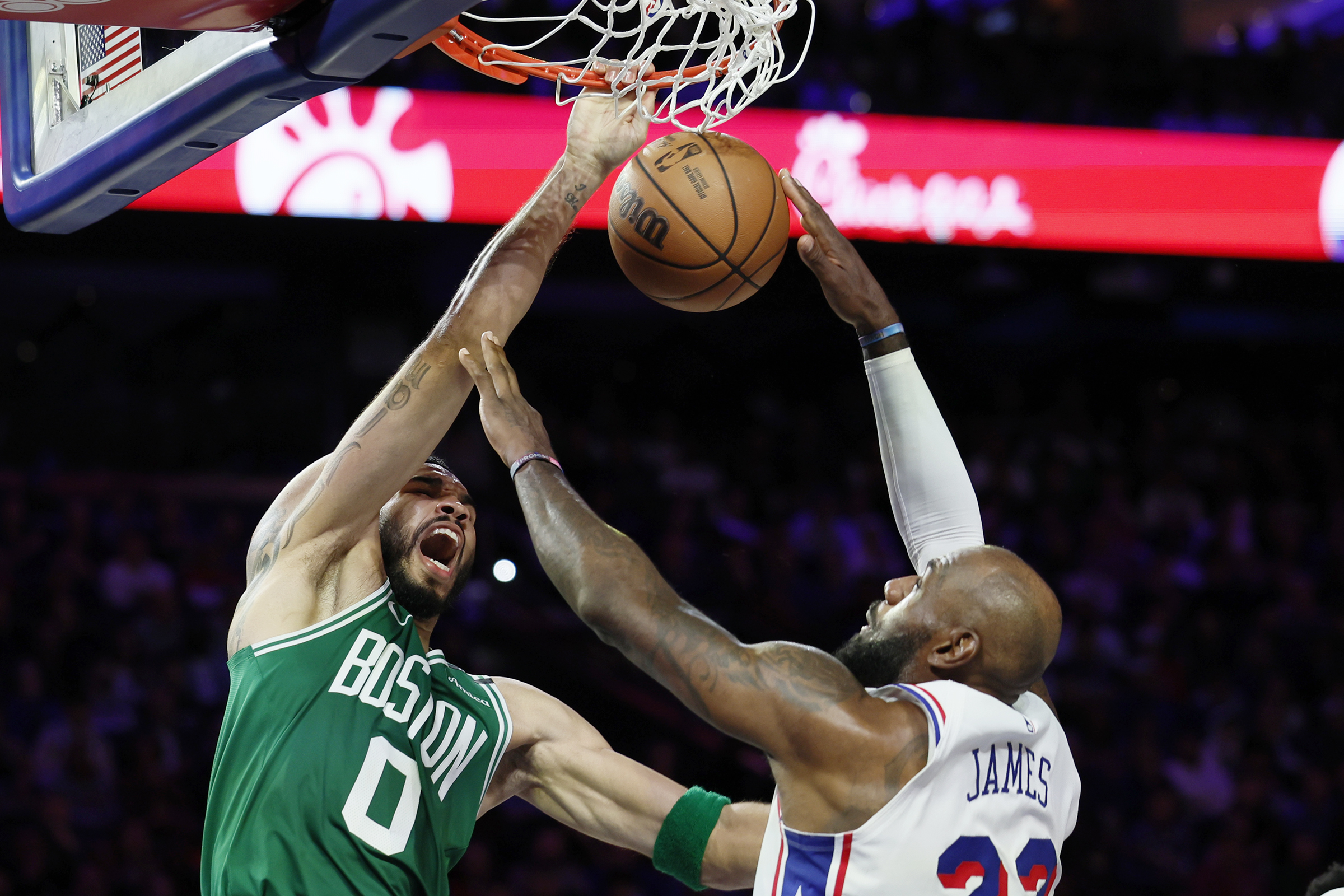
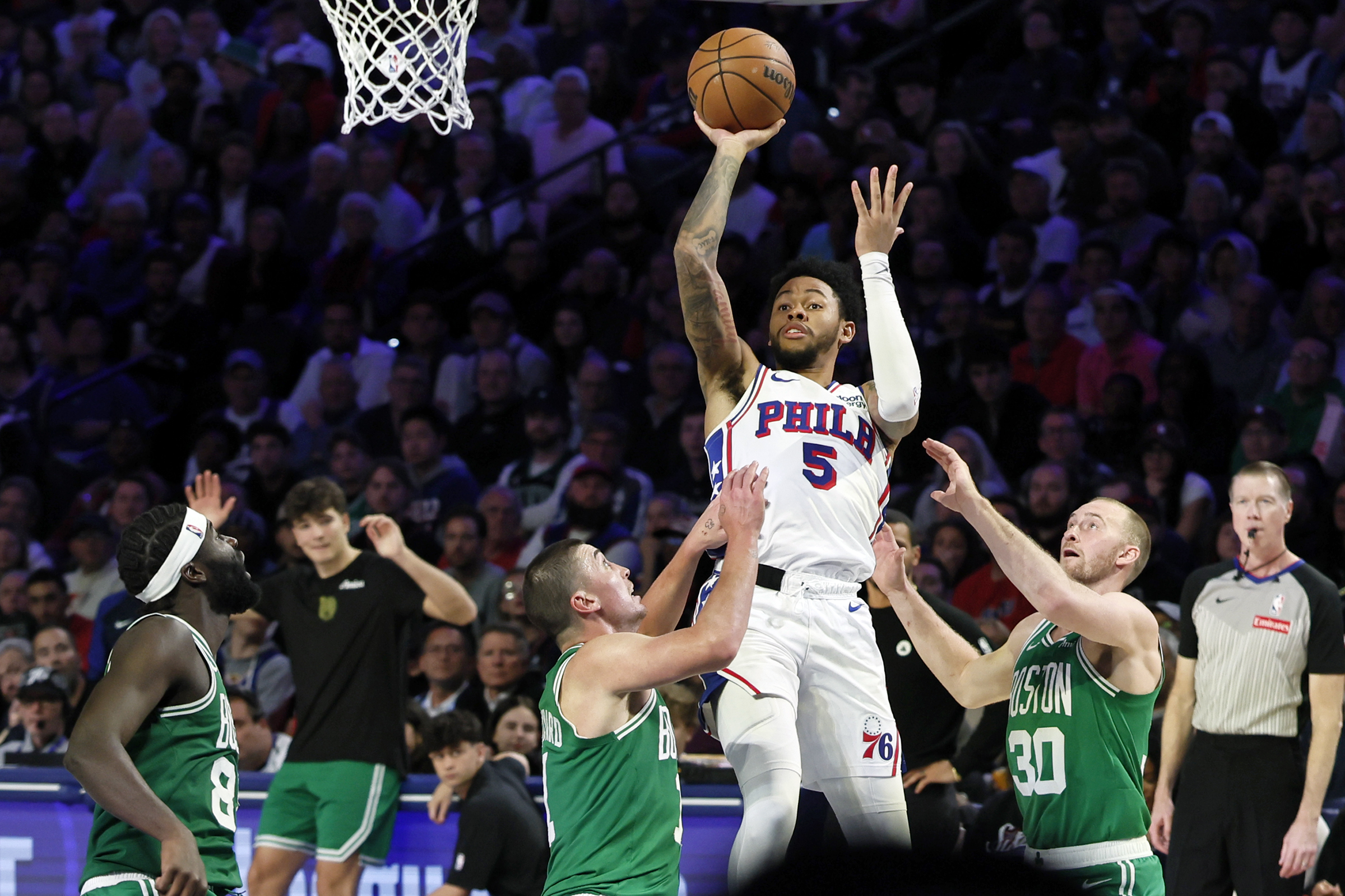
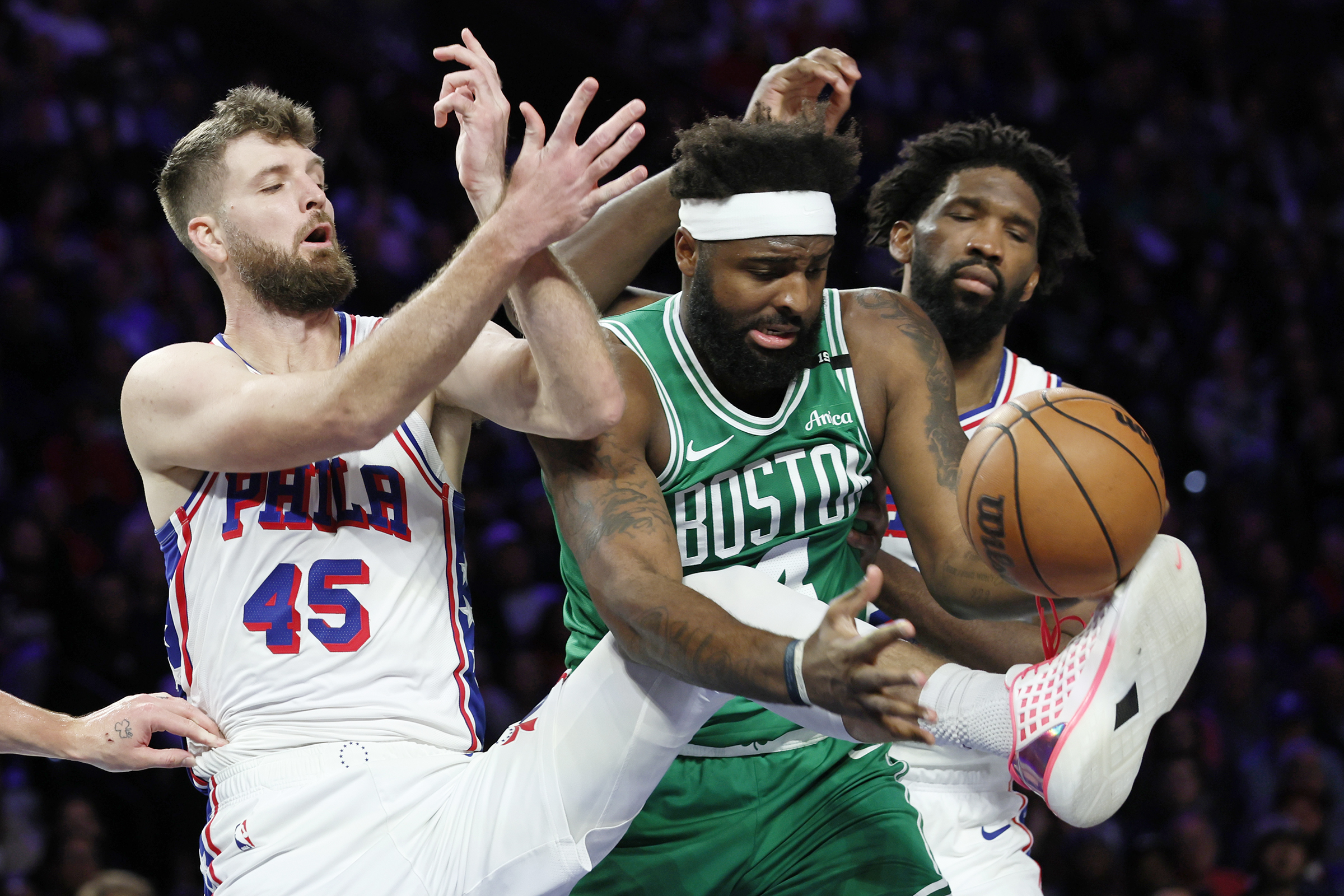
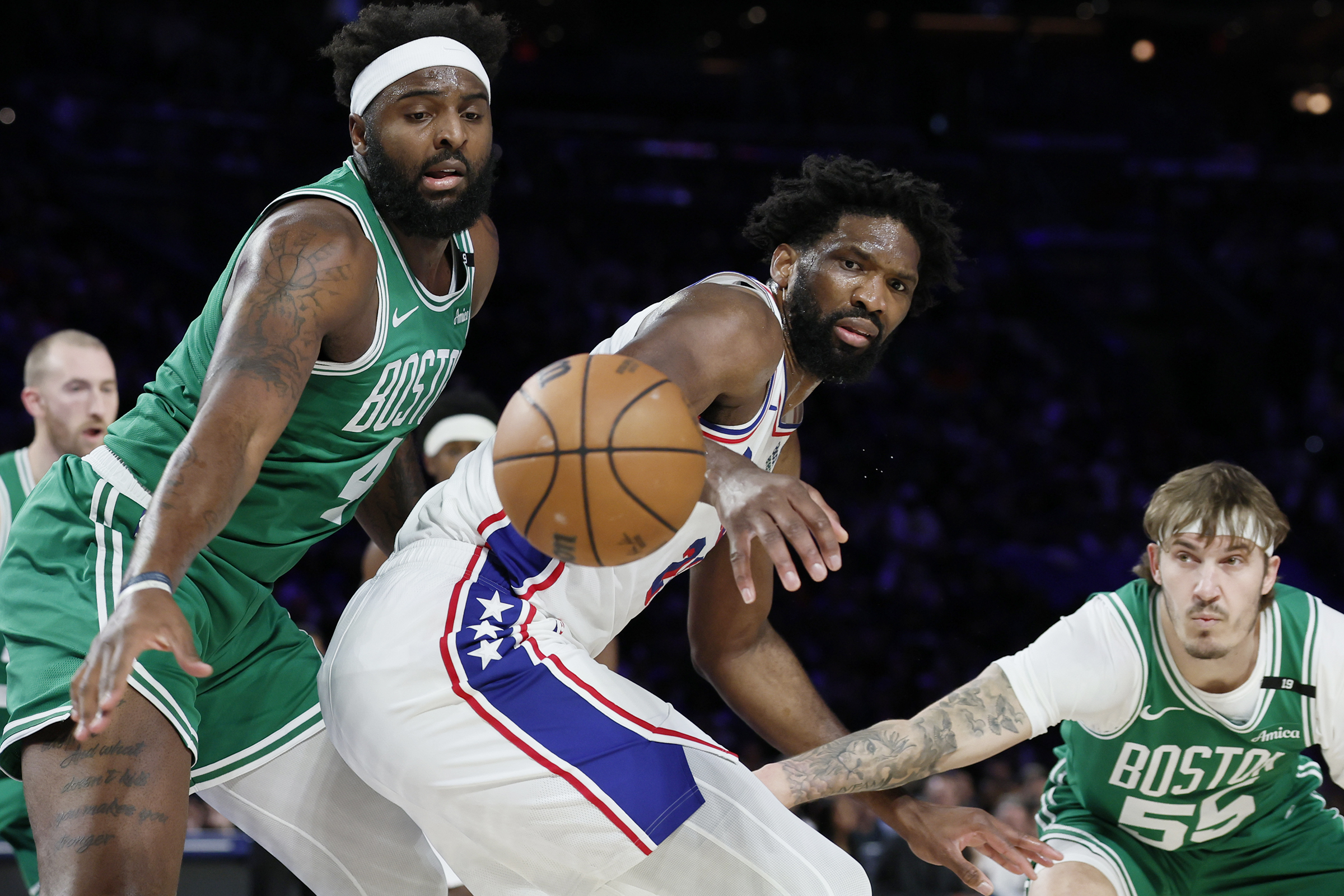
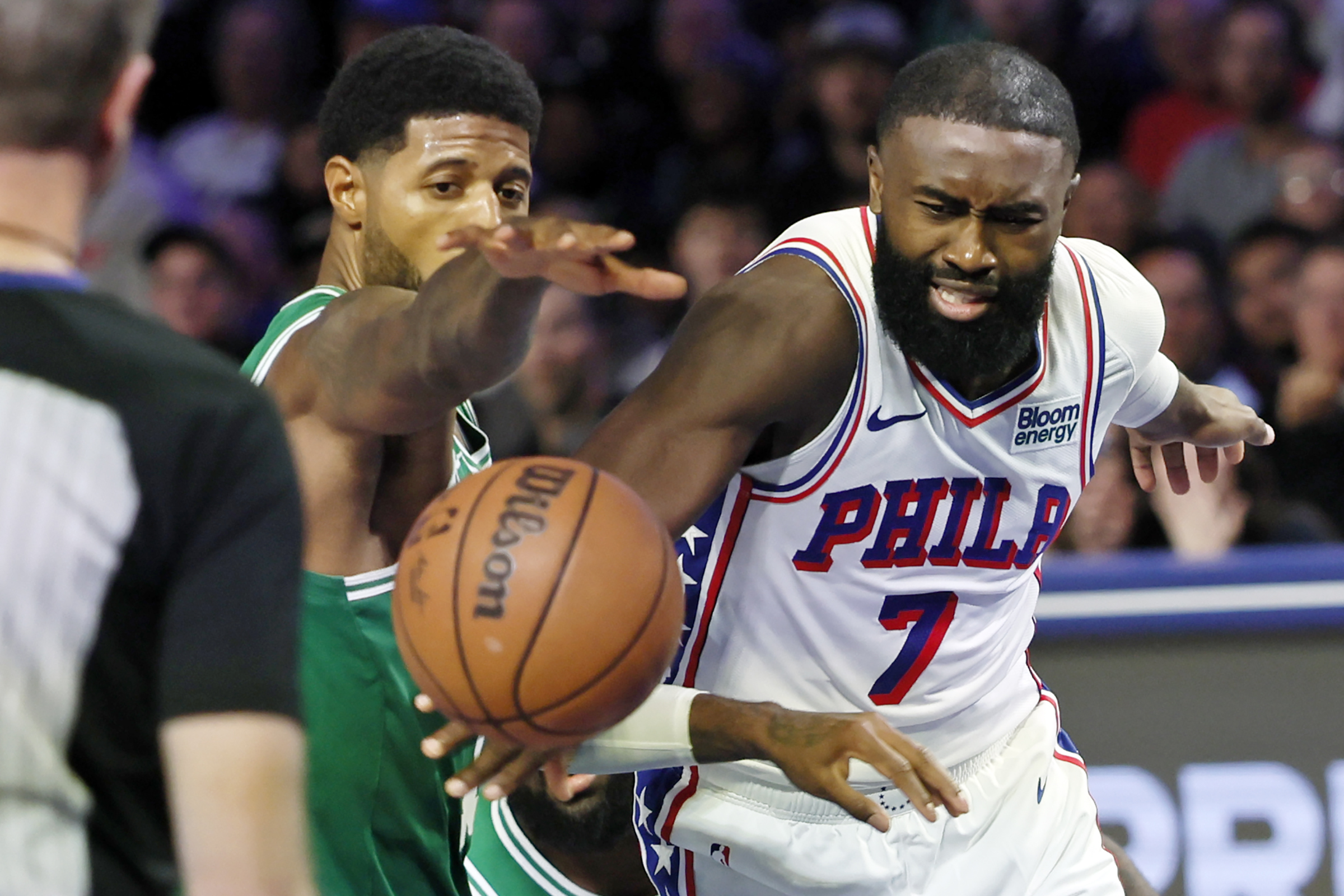
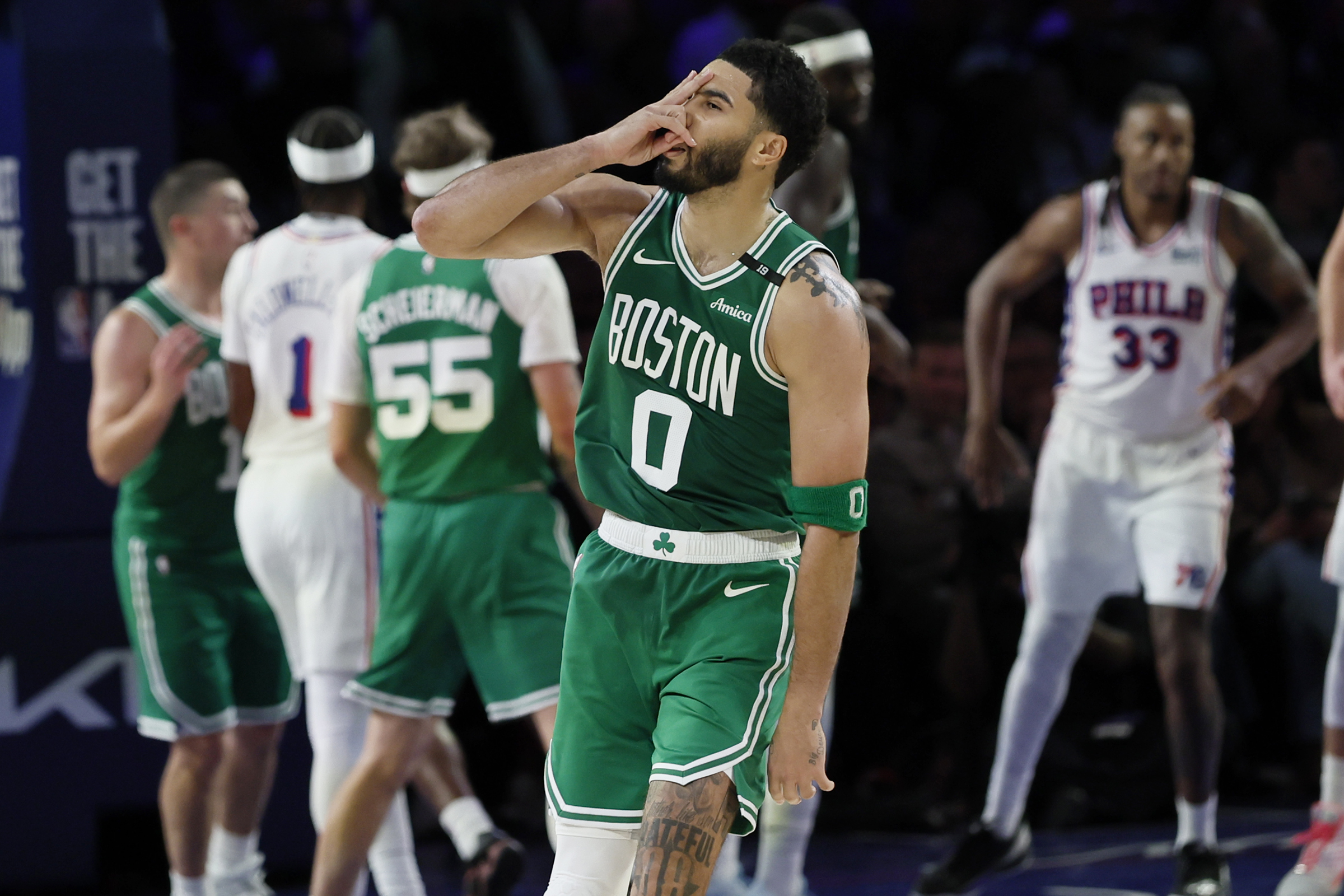
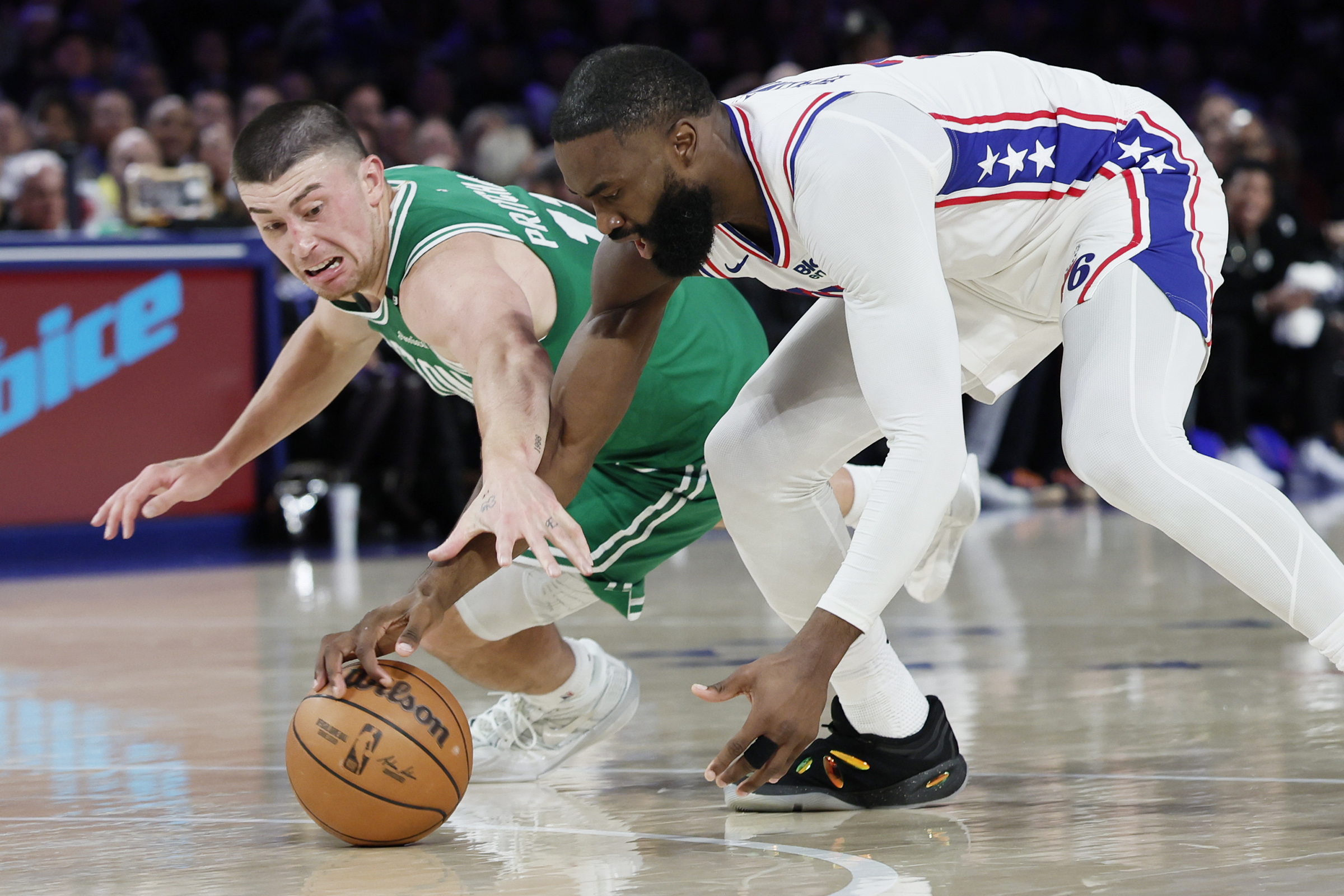
Sixers Tyrese Maxey makes a three point shot despite being covered by Celtics Paul George in the first half of the Boston Celtics vs. Philadelphia 76ers (Sixers) NBA game at Xfinity Mobile Arena in Philadelphia on Tuesday, November 10, 2026.Elizabeth Robertson / Staff PhotographerCeltics # 13 Paul George signals his three point basket in the second half of the Boston Celtics vs. Philadelphia 76ers (Sixers) NBA game at Xfinity Mobile Arena in Philadelphia on Tuesday, November 10, 2026.Elizabeth Robertson / Staff PhotographerCeltics Paul George pokes Sixers LeBron James in the eyes in the fourth quarter of the Boston Celtics vs. Philadelphia 76ers (Sixers) NBA game at Xfinity Mobile Arena in Philadelphia on Tuesday, November 10, 2026.Elizabeth Robertson / Staff PhotographerCeltics # 0 Jayson Tatum dunks the ball despite defense by Sixers LeBron James during the Boston Celtics vs. Philadelphia 76ers (Sixers) NBA game at Xfinity Mobile Arena in Philadelphia on Tuesday, November 10, 2026.Elizabeth Robertson / Staff PhotographerSixers # 5 Anfernee Simons shoots during the Boston Celtics vs. Philadelphia 76ers (Sixers) NBA game at Xfinity Mobile Arena in Philadelphia on Tuesday, November 10, 2026.Elizabeth Robertson / Staff PhotographerBoston’s # 4 Mitchell Robinson fights for the ball while stuck between Sixers # 45 Dean Wade and # 21 Joel Embiid during the Boston Celtics vs. Philadelphia 76ers (Sixers) NBA game at Xfinity Mobile Arena in Philadelphia on Tuesday, November 10, 2026.Elizabeth Robertson / Staff PhotographerCeltics # 4 Mitchell Robinson and Sixers # 21 Joel Embiid watch the loose ball while Celtics # 55 Baylor Scheierman looks on during the Boston Celtics vs. Philadelphia 76ers (Sixers) NBA game at Xfinity Mobile Arena in Philadelphia on Tuesday, November 10, 2026.Elizabeth Robertson / Staff PhotographerCeltics Paul George (left) and Sixers Jaylen Brown fight for a rebound in the second half of the Boston Celtics vs. Philadelphia 76ers (Sixers) NBA game at Xfinity Mobile Arena in Philadelphia on Tuesday, November 10, 2026.Elizabeth Robertson / Staff PhotographerBoston’s Jayson Tatum after hitting a three point shot in the second half of the Boston Celtics vs. Philadelphia 76ers (Sixers) NBA game at Xfinity Mobile Arena in Philadelphia on Tuesday, November 10, 2026.Elizabeth Robertson / Staff PhotographerCeltic’s # 11 Payton Pritchard and Sixers Jaylen Brown go for a loose ball during the Boston Celtics vs. Philadelphia 76ers (Sixers) NBA game at Xfinity Mobile Arena in Philadelphia on Tuesday, November 10, 2026.Elizabeth Robertson / Staff PhotographerCeltics # 13 Paul George defends against Sixers LeBron James during the first half of the Boston Celtics vs. Philadelphia 76ers (Sixers) NBA game at Xfinity Mobile Arena in Philadelphia on Tuesday, November 10, 2026.Elizabeth Robertson / Staff PhotographerSixers Tyrese Maxey and VJ Edgecombe talk with Celtics Paul George (right) as Celtics # 4 Mitchell Robinson looks on after the Boston Celtics vs. Philadelphia 76ers (Sixers) NBA game at Xfinity Mobile Arena in Philadelphia on Tuesday, November 10, 2026.Elizabeth Robertson / Staff Photographer
As good as the Celtics were, and as bad as the Sixers were, the divide was hardly an aberration. This was the seventh time in 12 games that an opponent finished a game with a higher effective field goal percentage than the Sixers. They’ve done an admirable job of making up for it, including in hard-fought victories over the Cavaliers and the Pistons. But it’s an awfully tough way to make a living over the long haul.
It’s an issue that’s more than worth discussing. Before Tuesday, you could have been accused of picking nits for calling attention to the Sixers’ failure to capitalize on the wealth of shooting opportunities that naturally flowed from Maxey’s MVP-caliber play. At 9-2, with a couple of wins over the Knicks amid a fairly tough early-season schedule, the Sixers had somehow managed to surpass expectations with their defensive effort and preternatural chemistry. But their shooting troubles were a major reason to avoid crowning them the Eastern Conference front-runner, at least until they’d played the Celtics.
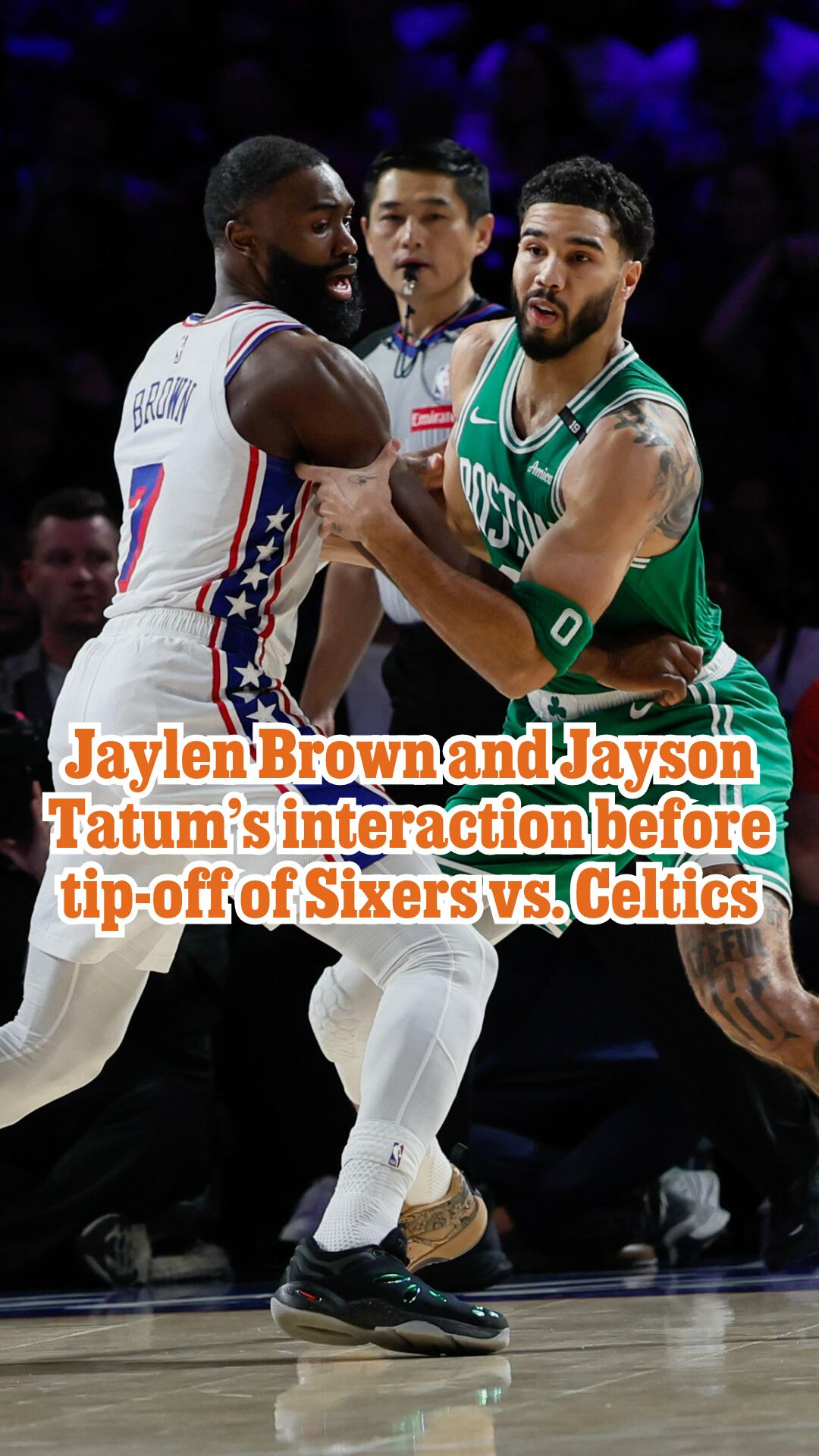
Heading into the game, most of the attention was paid to the cold war between Tatum and Brown, the latter of whom had earlier disputed the characterization of their frosty relationship as a “beef” while also acknowledging it was at least “lamb chops and gravy.” The more meaningful drama was the Sixers’ opportunity to show that they really were NBA Finals frontrunners. They did not seize it.
Video: Jaylen Brown and Jayson Tatum’s interaction before tip-off of Sixers vs. Celtics
Which brings us back to our initial question. How much shooting improvement can we expect to see?
“I think that we’ve got some guys that are shooting lower than their last season or career average,” Nurse said. “Like, almost a handful of guys. And I don’t think it’s because they are shooting fall-away contested ones. They’re shooting shots we want them to take. So I think we’ll continue to take them and I’m pretty sure those will even out into their career averages.”
The most obvious for instance is Embiid, who entered the game having missed a remarkable 21 three-pointers in a row. James is another. A career 34.8% three-point shooter, LeBron is now 9-of-38 on the season.
At the same time, Embiid and James are both in roles where their distance shooting is mostly a bonus. The offensive ceiling of this team lies more in a guy like Edgecombe, who is going to need to take a big step in his catch-and-shoot game given the number of opportunities he sees while sharing the court with the other four starters. Edgecombe entered the night with a solid .388 shooting percentage from three-point range. But he spent much of Tuesday night deferring after misses. Given the nature of the other four starters, Edgecombe’s spot ideally produces a couple of catch-and-shoot threes most nights and multiples of that some nights. He isn’t that player yet. The hope is that he can get there by the end of the season.
Then again, maybe the answer is a guy who’d much rather not shoot. Wade was a lot of what the Sixers needed him to be against the Celtics, connecting on 2 of 4 three-point attempts in addition to his usual standout defense. The Sixers would love to see even more.
“I think he’s getting there,” Nurse said. “We certainly feel like there’s shots that he turned down in the first half a dozen games for sure. But again, I don’t think he’s quite in the mindset to take them. … We need his spacing. That’s obviously why we signed him. He’s a spacing big and we need that for sure.”
Wade’s reluctance is partially a symptom of his positive attributes. He is a hard-wired connector who wants to keep the ball moving and get a better shot for his teammates. But there is a very real and potentially game-changing dynamic that can be unlocked in his pure, frictionless mechanics.
“I’ve always been kind of that guy to pass up a good shot for me to get a better shot for my teammate,” Wade said.
His tone suggested he has long been aware of the downside of such a mentality. His performance on Tuesday suggests he is becoming aware that a good shot for him might actually be better than a better shot for a teammate.
The Sixers clearly need someone besides Maxey to pump up the volume.
Eagles general manager Howie Roseman sent three messages Monday afternoon when he traded Jordan Davis.
No. 1: He realizes this season is over.
No. 2: No one is sacred, not even a popular, productive team captain.
No. 3: I still got it, baby.
Since winning Super Bowl LIX, Roseman delivered two poor drafts and a handful of unwise signings and extensions.
However, even as the Eagles’ offense founders, the cap-crippling trade of malcontent receiver A.J. Brown (one of the extension mistakes) looks better every day, considering Brown has played in three games, has nine catches, no touchdowns, and a bad knee.
And now, he has sent Davis to Jacksonville for a first-round pick in 2027 and a second-rounder in 2029. At 6-2, they have a three-game lead in the AFC South, they have a favorable schedule remaining, and their top-10 defense became a much more formidable defense. Also on Monday they acquired safety Jessie Bates, 29, from the Falcons, and run-stopping defensive tackle Davon Godchaux, 31, from the Saints.
Both Bates and Godchaux are free agents next season. Davis, 26, is under contract through 2029. He just signed a three-year, $78 million extension in March.
Was that a Roseman mistake? Well, after nine games Davis has just 1½ sacks, compared with the 4½ he had last season, and his snap-count percentage has dropped from 61% to 52%, but he wasn’t terrible.
Jordan Davis (right) was well-liked but it’s hard to deny the return Howie Roseman got for him. David Maialetti / Staff Photographer
He certainly wasn’t worth two draft picks that could both land between Nos. 30 and 55 — or much better. Roseman recently drafted All-Pro corner Cooper DeJean (40), team sack co-leader Nolan Smith Jr. (30), Pro Bowl guard Landon Dickerson (37), and Pro Bowl center Cam Jurgens (51) between Nos. 30 and 55.
Oh yes: And Jalen Hurts (53).
The trade of Davis implies that the Eagles are committed to extending the contract of defensive tackle Moro Ojomo, who is a free agent after this season. But it only implies it. Ojomo, 25, might be playing more than Davis, but is he playing much better? Ojomo, a seventh-round success story from the 2023 draft, had six sacks in 2025. He has none this season.
Whether Ojomo stays or goes, Roseman has crushed it again.
This wasn’t just a home run.
This was a Kyle Schwarber home run. A Dick Allen home run.
A Howie Roseman home run.
Credit to Roseman, and, of course, owner Jeffrey Lurie, whose approval is mandatory for transactions of this magnitude. They have acknowledged that any team quarterbacked by practice-squad refugee Joe Milton has no real chance to reach the playoffs. Hurts has blood clots, Tanner McKee flopped, Andy Dalton was another Roseman mistake, and rookie Cole Payton isn’t ready.
Owner Jeffrey Lurie is allowing Howie Roseman (right) to make the deals necessary for a team that has cratered in 2026. Monica Herndon / Staff Photographer
Only one team has ever made the NFL postseason after a 2-7 start. The Eagles would have to win seven of their last eight games to finish above .500.
With games remaining against the Steelers (6-2), Cowboys (who blew them out in Philly), Seahawks (defending Super Bowl champs), 49ers (7-1), and Giants (who just beat them Sunday), the playoffs are as much a statistical impossibility as they are an empirical impossibility.
Credit to the brass for also realizing that the locker-room culture that endured the unprofessionalism of the likes of Brown, Jalen Carter, and C.J. Gardner-Johnson has, in the absence of retirees like Fletcher Cox, Jason Kelce, Brandon Graham, and Lane Johnson, decayed to a degree that even high-character sorts such as Davis cannot stop the rot.
A full 24 hours remained before the Tuesday 4 p.m. deadline when Davis was traded.
If he can go, why not linebacker Zack Baun? Why not running back Saquon Barkley? Why not Ojomo?
After fleecing the Patriots with Brown and nailing the Jags with Davis, Roseman’s got to be feeling good at the plate.
Saquon Barkley met with the media in his uniform undershirt and black shorts, eye black still smeared under a single socket like late Philly chanteuse Lisa “Left Eye” Lopes.
Barkley spoke early, as soon as reporters were allowed into the locker room. Two years after his historic rushing season led them to a Super Bowl win, the Eagles had just lost a seventh straight game. It was the first seven-game slide since 2012. He testified to his belief in his coaches and their hard work, his disappointment that he and his teammates weren’t producing for their bosses, and his faith that the 2-7 Eagles would turn things around after the bye.
Then things happened that made you wonder if he really will be here after the bye.
The trade deadline is Tuesday. About 24 hours after Barkley spoke and about 24 hours before the deadline, the Eagles traded defensive tackle Jordan Davis, one of the team captains and the spokesman for the defense, to Jacksonville for a first-round pick in the 2027 draft and a second-rounder in 2029.
Defensive tackle Moro Ojomo also seems a no-brainer to trade, considering he can be a free agent at the end of the season, though the Eagles have sent rumblings that they might extend his deal. You’d have to believe, with Davis gone, they have an extension agreed upon, or else Roseman has surrendered a lot of negotiation leverage to Ojomo.
The Eagles also could be willing to let Ojomo walk, accept draft-pick compensation, and simply move on.
Two weeks makes a lot of difference.
Yes, Roseman had assured Barkley that he won’t be traded, but that was before losses last week at Washington and Sunday to the visiting Giants seemed to change everything. A team hoping to compete this season certainly doesn’t trade its top run-stopper, and a team hoping to win next year probably doesn’t make this trade, either.
Anything can still happen. It should.
About 30 minutes after he spoke to the press Sunday, Barkley emerged from the double-doored alcove and the office where Nick Sirianni, Jeffrey Lurie, and Howie Roseman confer after games. Sunday was the last feasible time for Eagles leadership and Barkley to meet in person, since players can be absent for four days during their bye week.
Barkley returned to his locker, finished dressing, spoke briefly with an athletic trainer, then left the locker room.
A few minutes later, Sirianni addressed the press. He usually is very late for these sessions, but Sunday he was even 30 minutes later than usual. He was asked why. He thanked the press for waiting, then said, “A couple other guys stop in the office and just through it. … You know, that’s not unusual.”
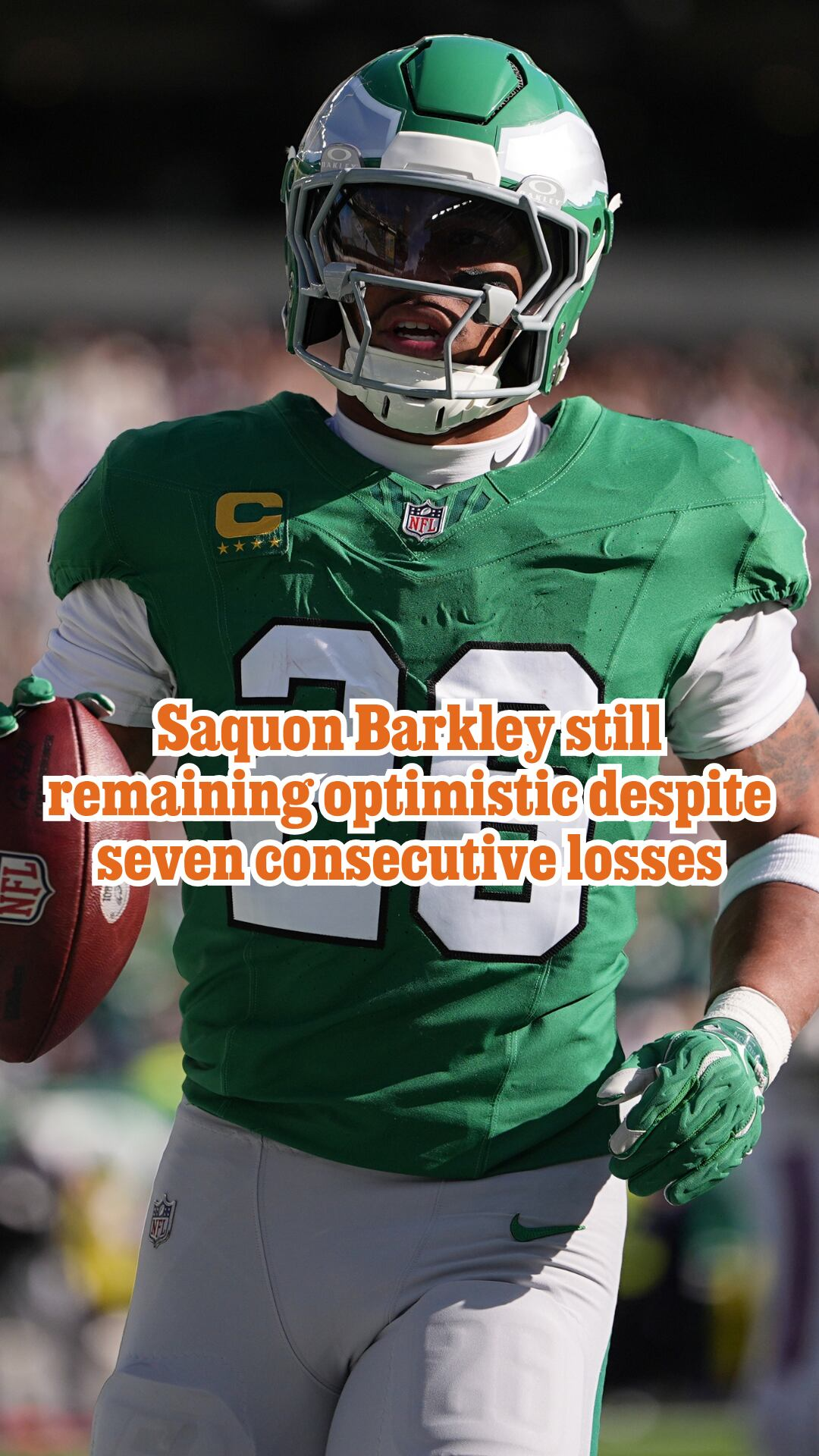
Video: Eagles running back Saquon Barkley still remaining optimistic despite seven consecutive losses
Actually, it is very unusual. Especially when the trade deadline was 48 hours away.
Does that mean, despite the messaging the Eagles sent other teams and what they told Barkley, that they wanted to discuss a possible move with Barkley? Sirianni refused to reveal the subject of the meeting.
At any rate, it should. Barkley, now healthy, would bring at least a second-round pick and a later-round pick. He has been an elite Eagle, a warrior in every sense, a high-character leader and a consummate professional.
He deserves to have another chance at winning. That won’t happen in Philadelphia.
The Eagles have a lot of long-term needs. This is a rebuild.
The offensive line is a shambles. The offensive coaching is delusional. Their top two receivers have been injured for weeks. This season is lost. If Roseman really thinks the offense will be much better next season, then he’s delusional, too.
Still, Roseman told Barkley not to worry.
Then again, that was when the Eagles were 2-5, and eight teams had made the playoffs after a 2-5 start, including the 2021 Eagles. Only one team has ever made the playoffs after a 2-7 start: The 2020 Commanders won the NFC East at 7-9.
Saquon Barkley said he was told by the organization that he would not be traded.
Barkley: "I didn't really read too much (trade rumors). You see the tweets and whatever, but I guess it means a lot. I have nothing but respect for this organization, top to bottom. I really do… pic.twitter.com/KbNYSl7lPV
Maybe the Birds’ brain trust was reaffirming to Barkley that he would stay.
Which seems pointless.
Barkley would be the biggest Eagles name likely to move, while tight end Dallas Goedert is probably the most likely. Goedert said Sunday that he, like Barkley, had spoken to Roseman before the Eagles’ two latest losses, but, unlike Barkley, Roseman did not ensure that he would stay.
Pro Bowl linebacker Zack Baun, whose contract expires after 2027, got no promises either. He had two sacks Sunday before leaving with a back injury, which, he said after the game, was not an issue. Notably, Baun returned to the field but did not play again, possibly signifying to trade partners that, yes, he was healthy, but no, the Eagles weren’t going to risk a more significant injury.
Given the progress of Jeremiah Trotter Jr., whom the Eagles control through 2027, it might make more sense to let him play the rest of this meaningless season, earn an extension, and trade Baun. He has been the mirror image of Barkley on defense: an outstanding person, a magnificently productive player, and a winner. As such, he should be allowed to play for one.
As for the others, veteran cornerback Riq Woolen’s departure seems a fait accompli, even to him. If healthy, it makes sense to move guard Landon Dickerson, a continually injured talent whose play hasn’t matched his money this year and seems unlikely to match it the remaining two years on his deal.
Notably, both Dickerson and Ojomo declined to talk after Sunday’s game.
Barkley’s usage also has been … notable.
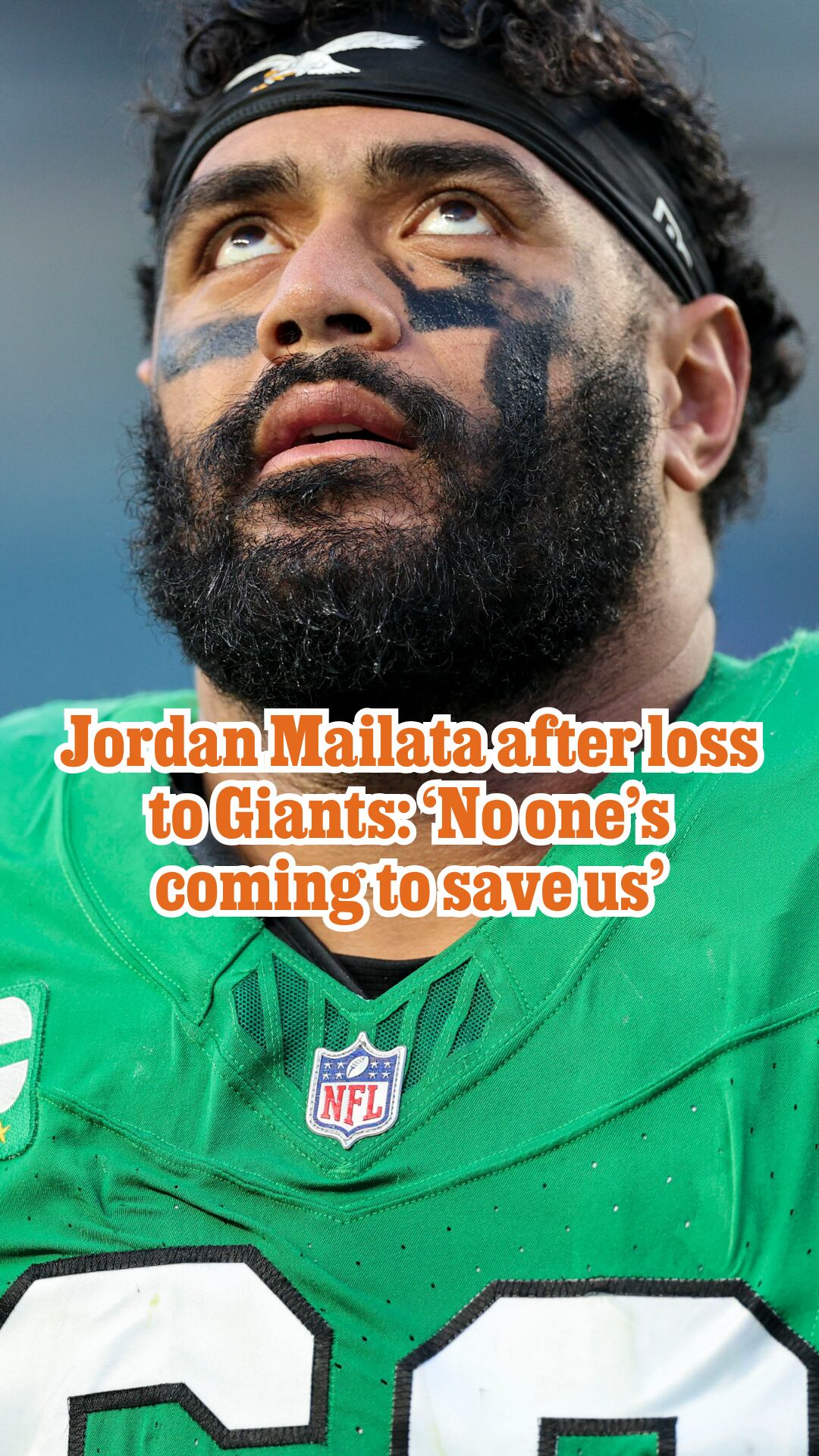
Video: Jordan Mailata after Eagles’ loss to Giants: ‘No one’s coming to save us’
Barkley missed two games with a hamstring injury but returned three games ago against Dallas. He played 10 snaps and carried the ball six times, but he still looked gimpy. Last week, Barkley played 22 snaps, carried the ball 13 times, and looked fine. Sirianni afterward admitted Barkley had been on a “pitch count” since his return.
However, on Sunday, while he played 41 snaps, close to a normal workload, Barkley again had just 13 carries, and just three in the second half despite the game never being too far out of reach. The score shouldn’t matter, since Barkley’s ability to explode for long runs negates any argument that, like most running backs, his presence limits the chance for big plays.
Unless, of course, the Eagles wanted to make sure he didn’t hurt himself on any big plays.
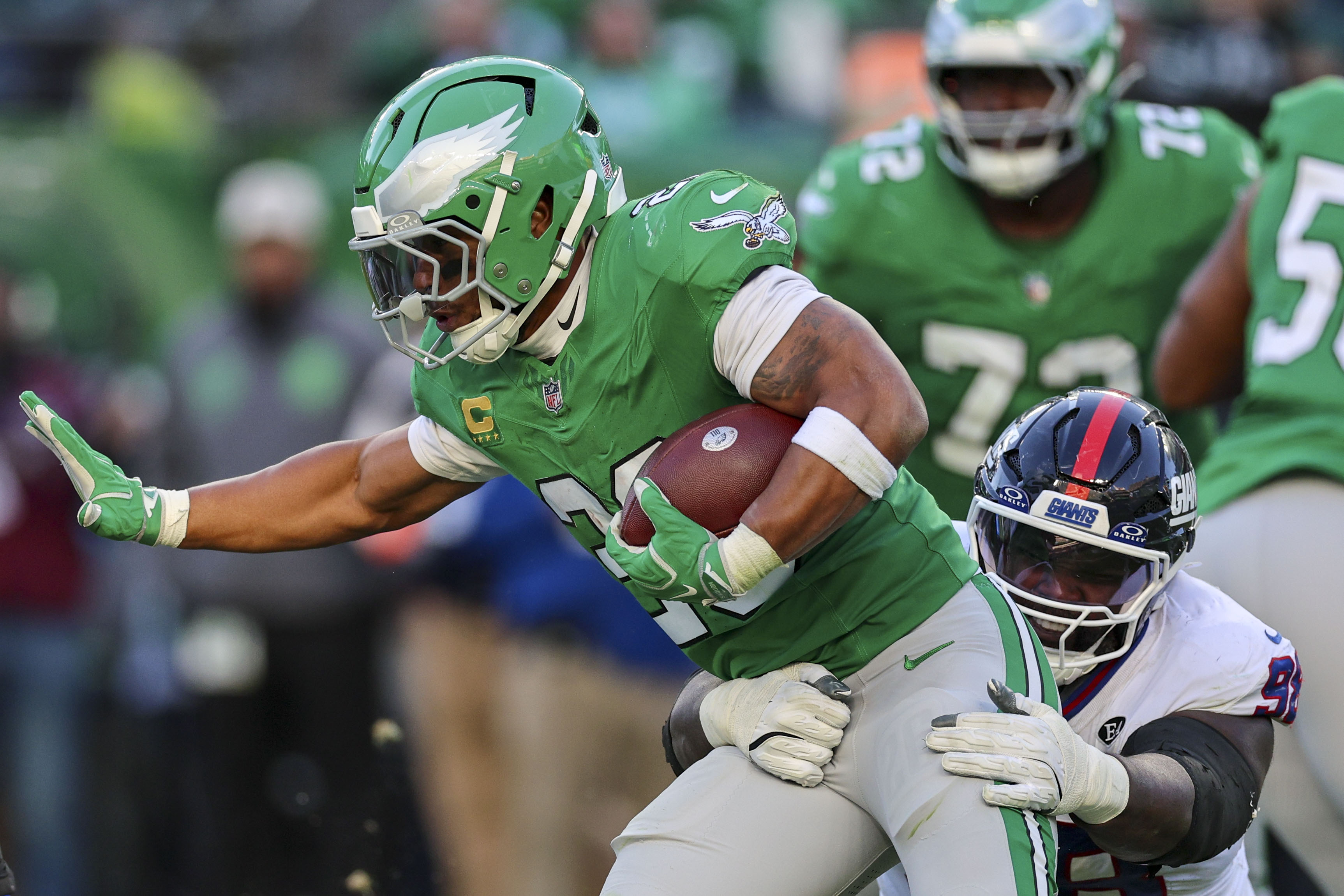
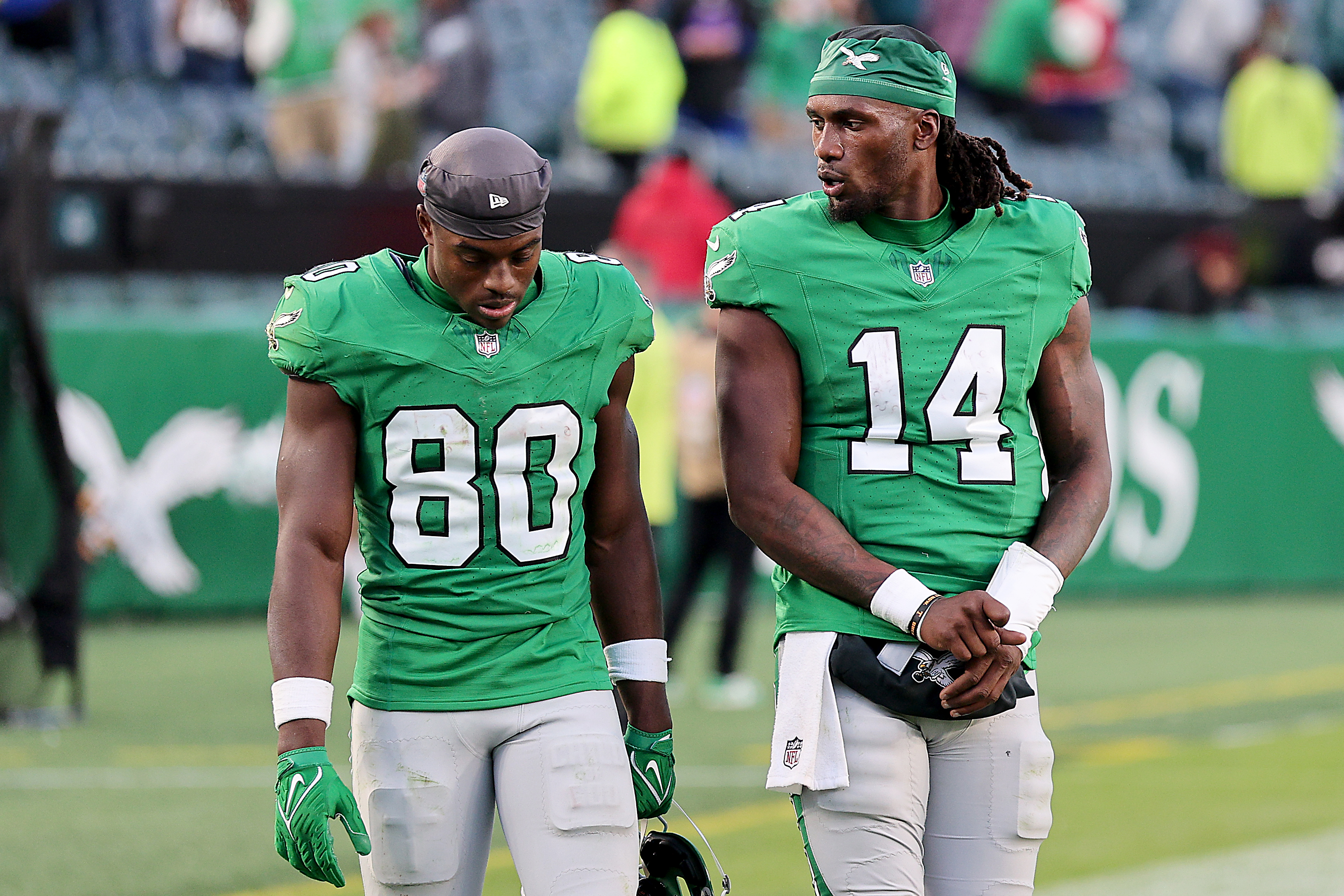
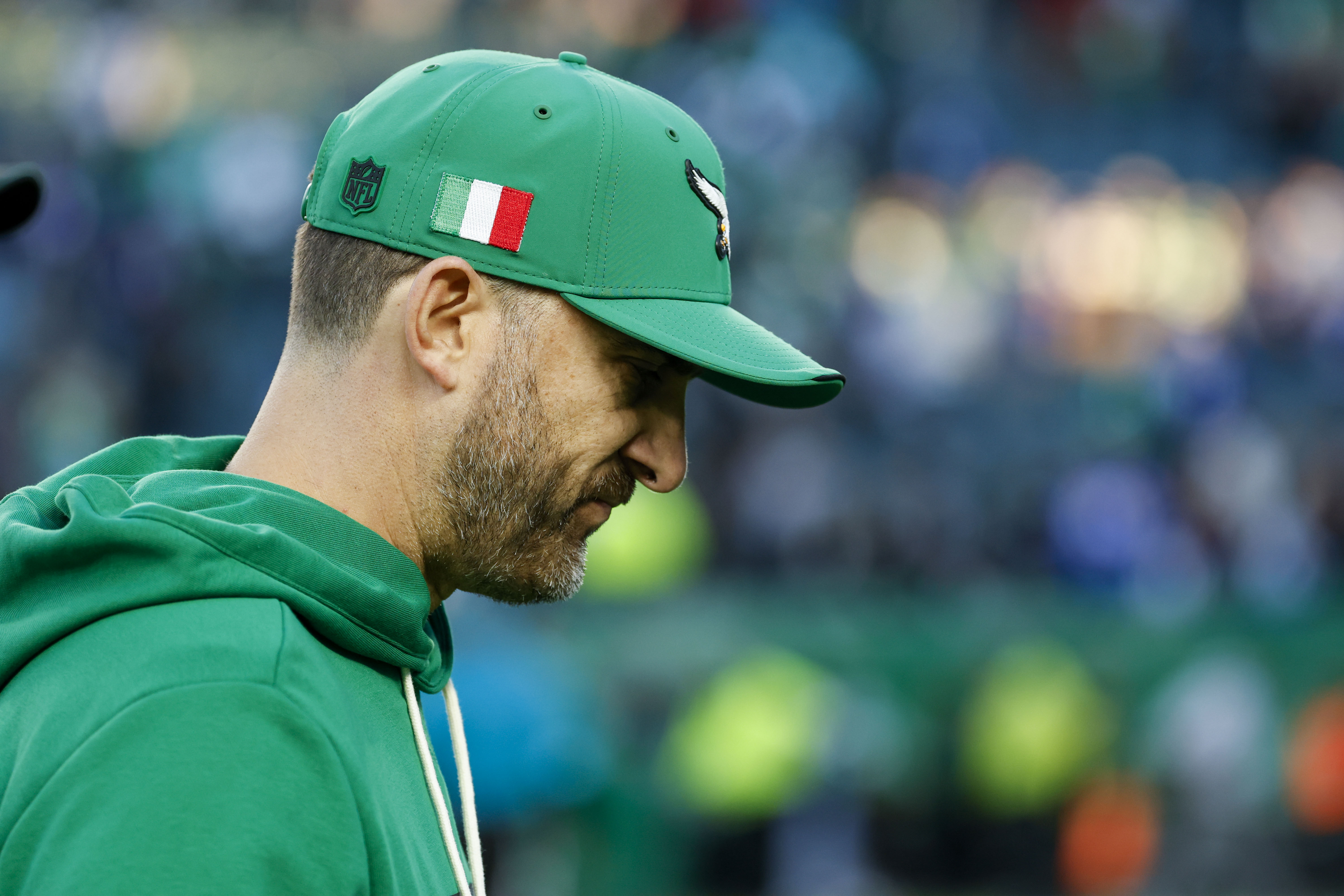
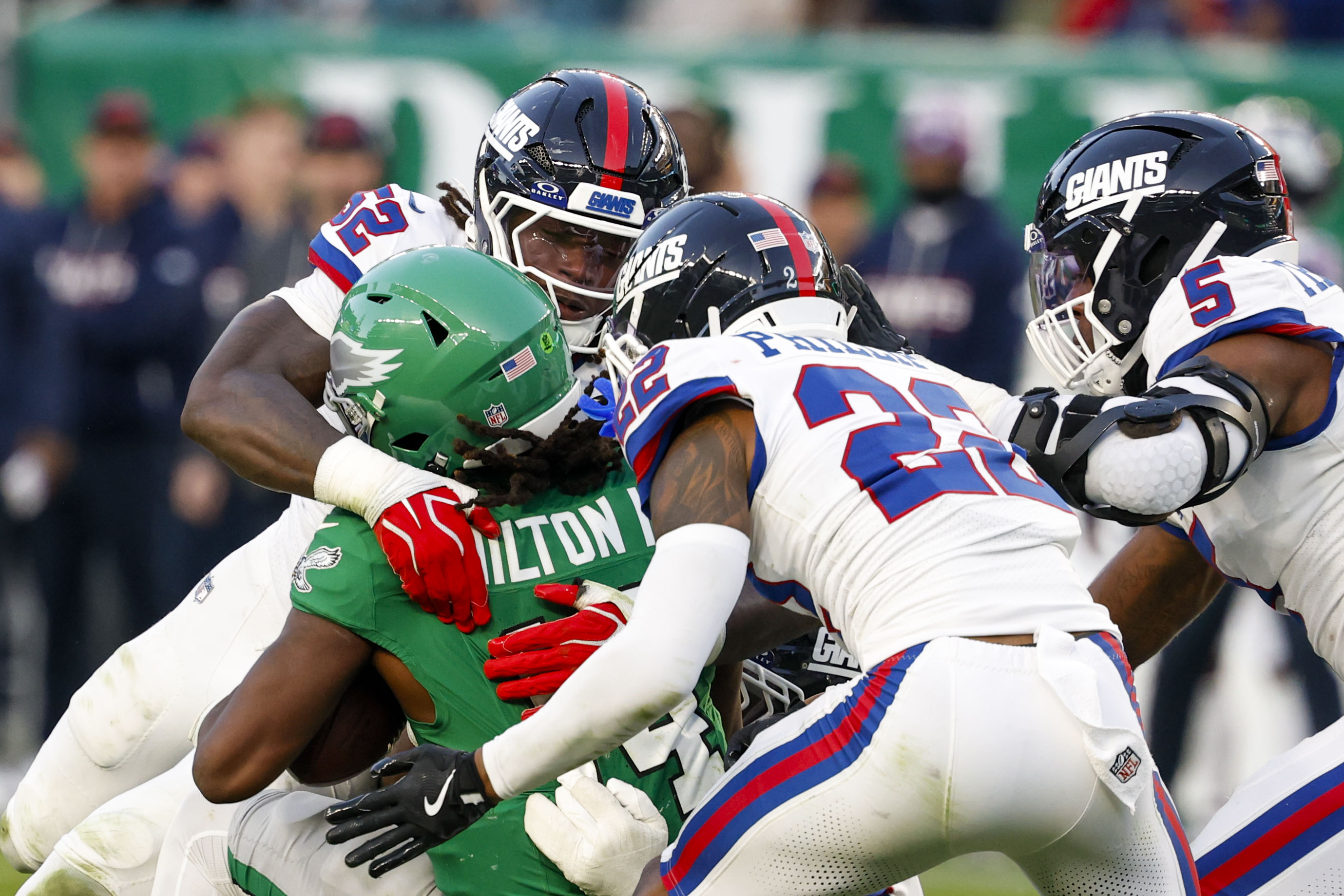
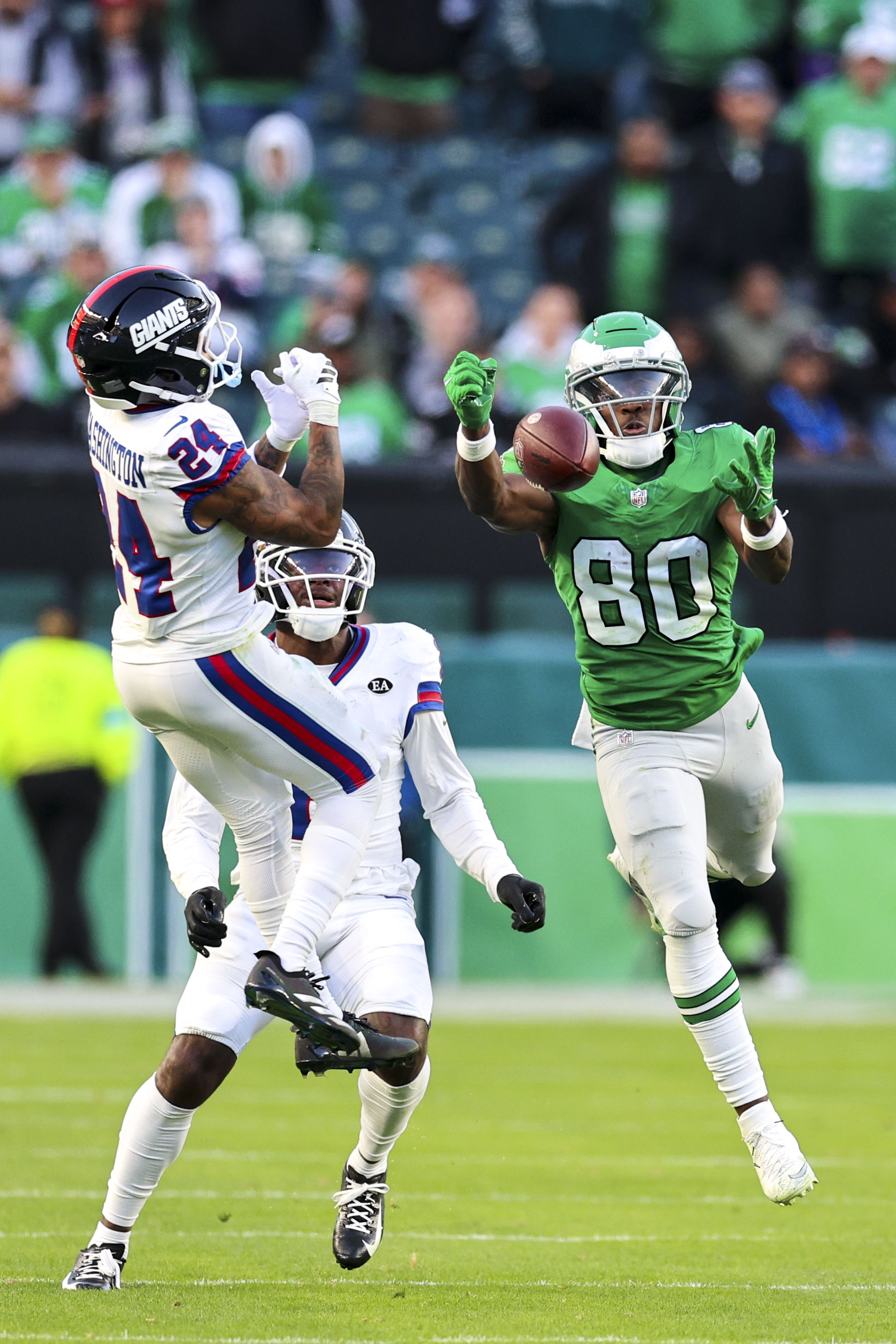
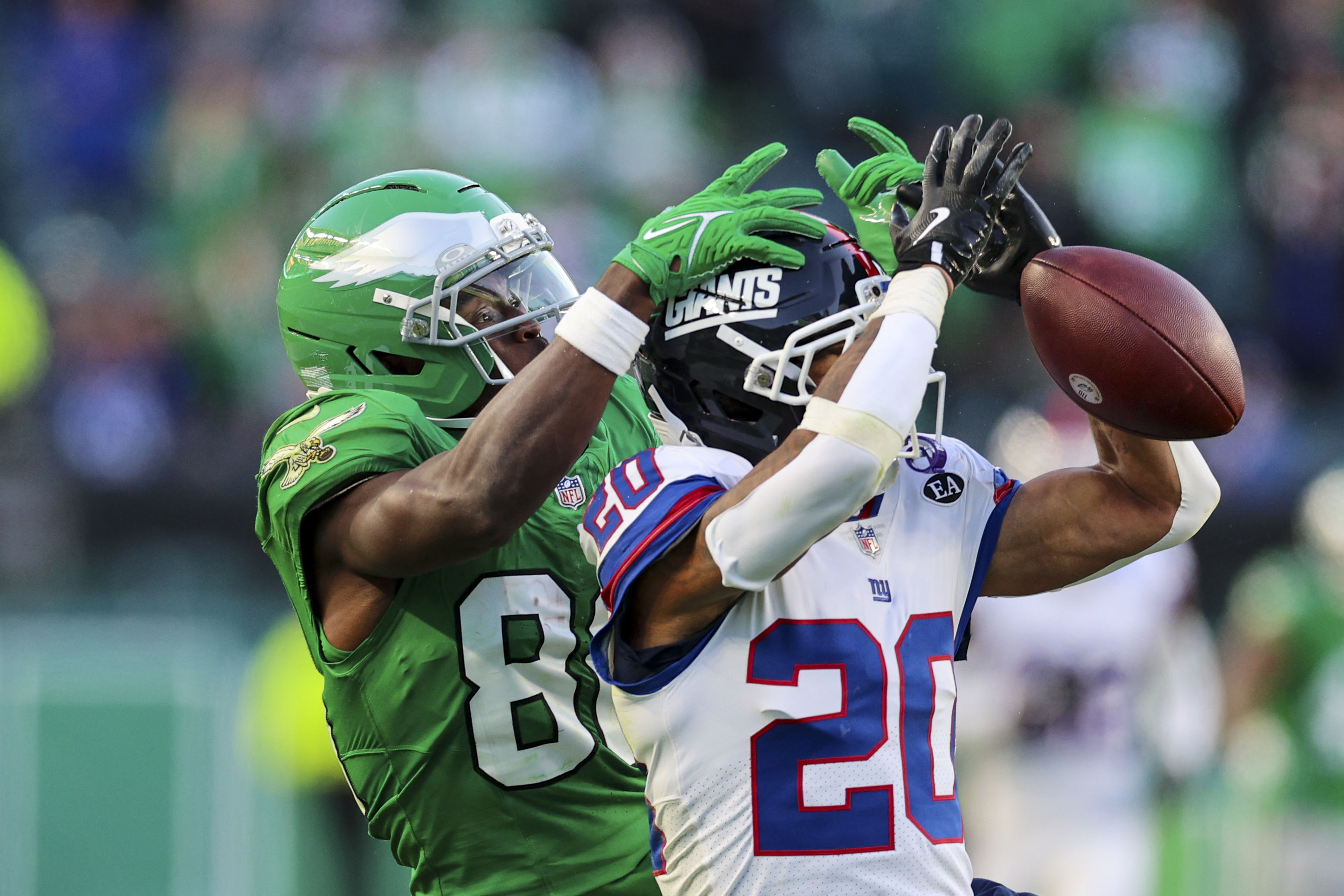
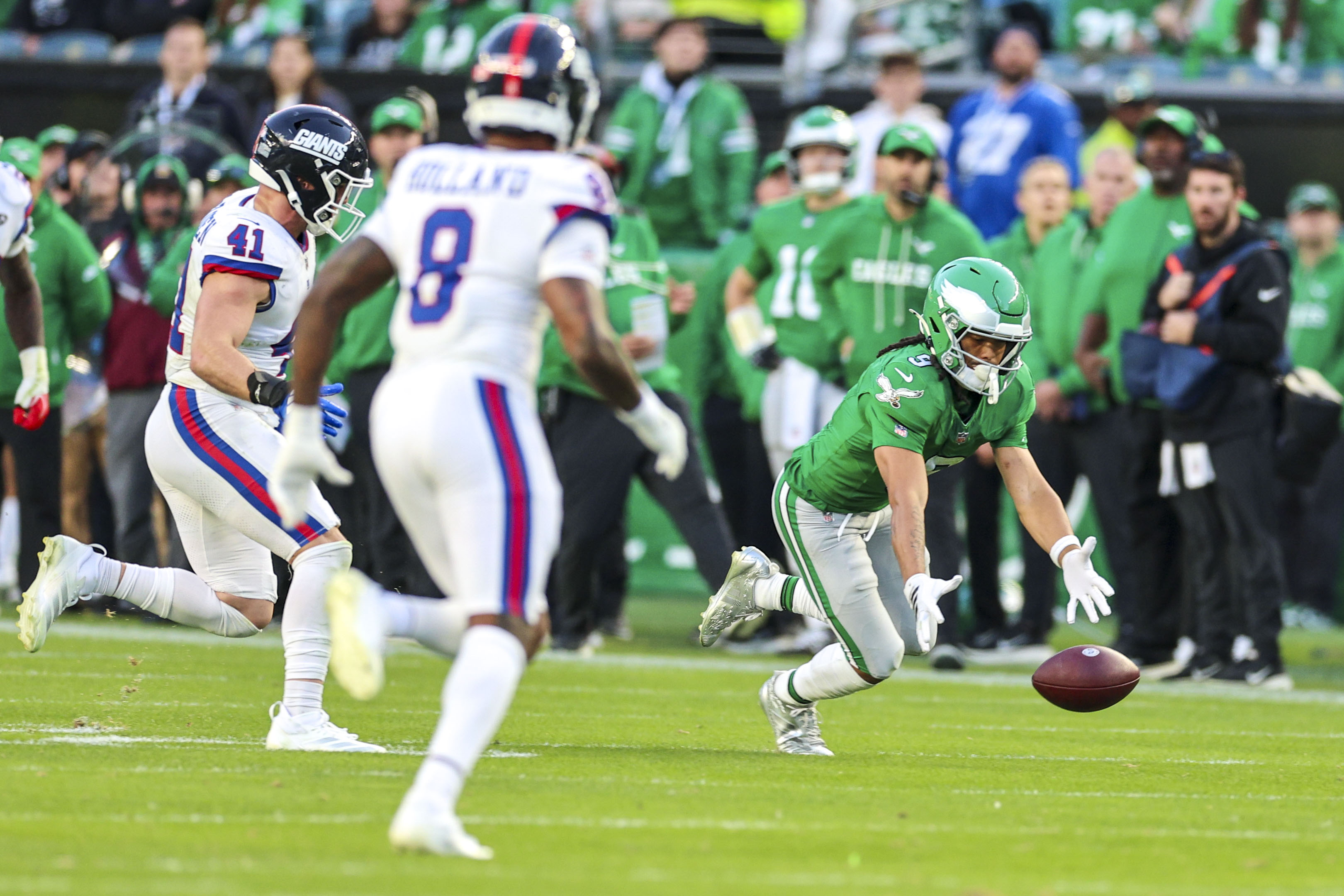
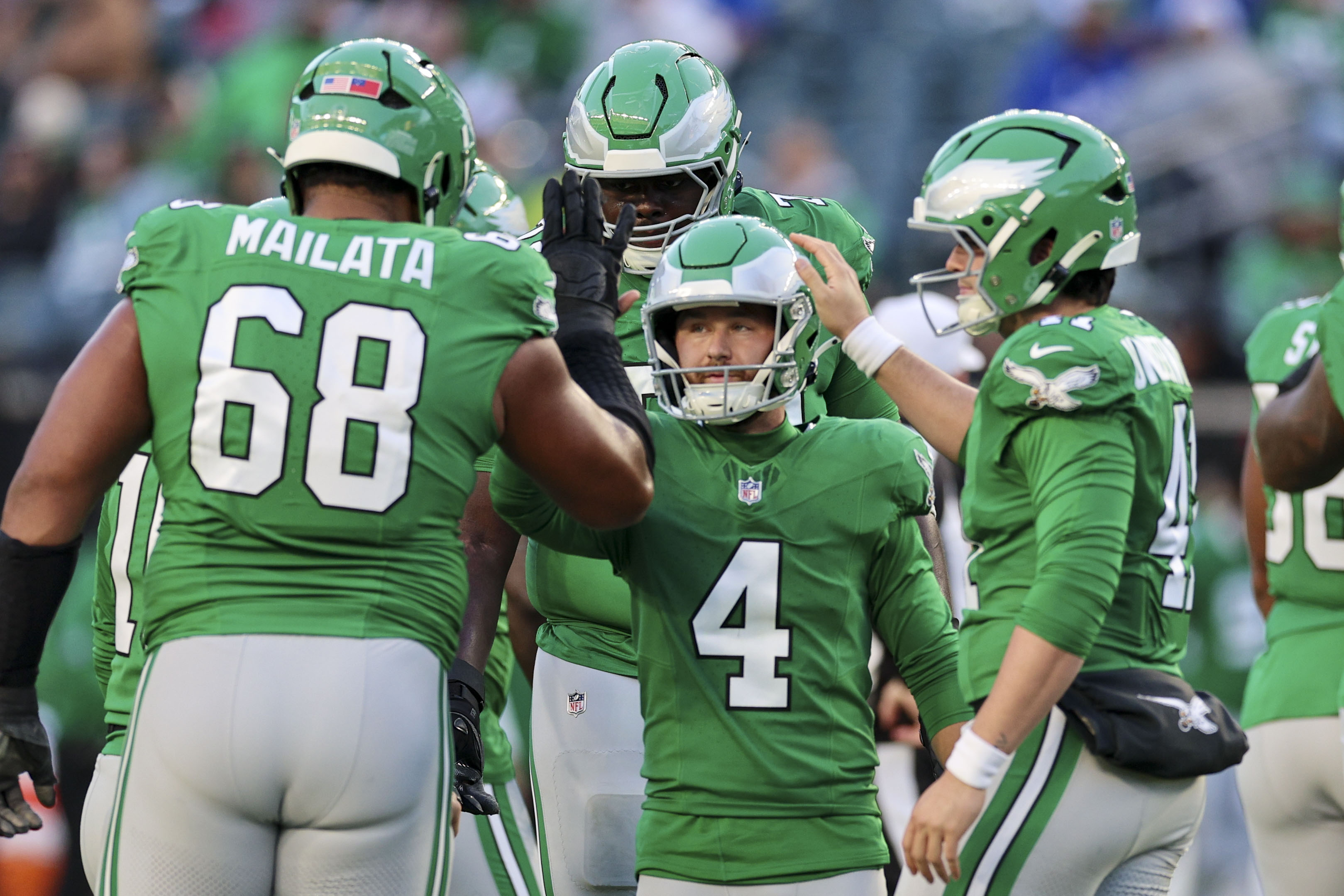
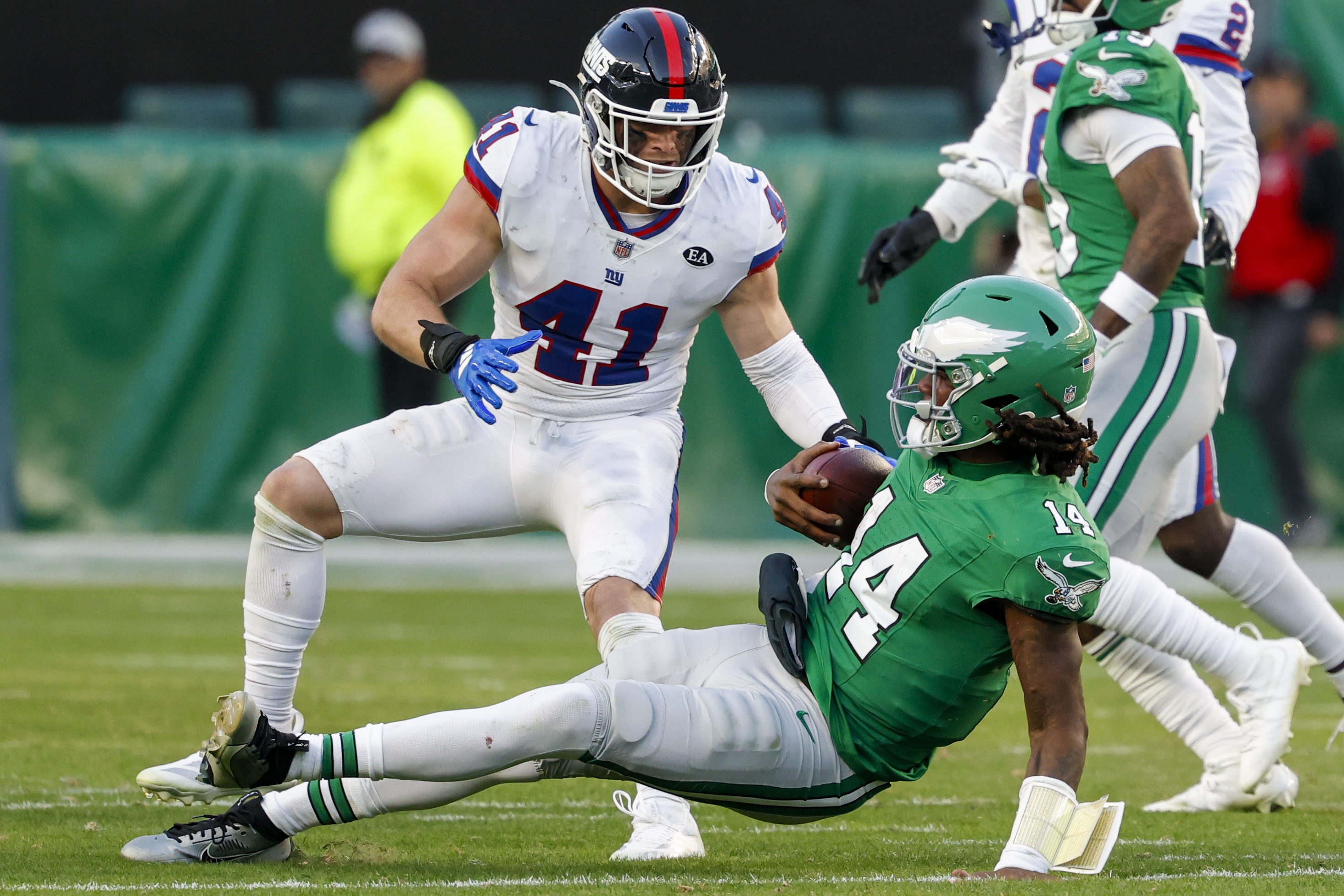
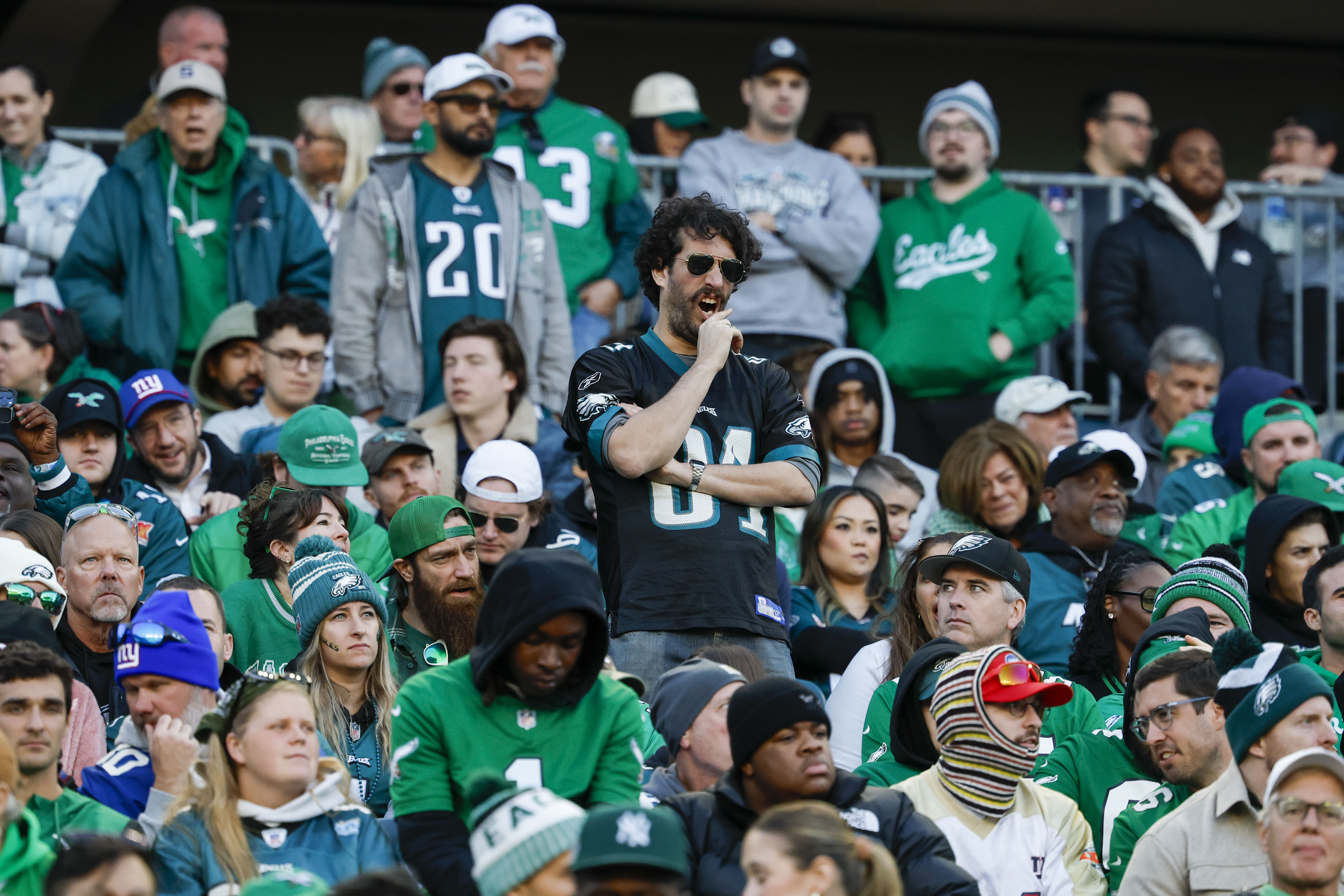
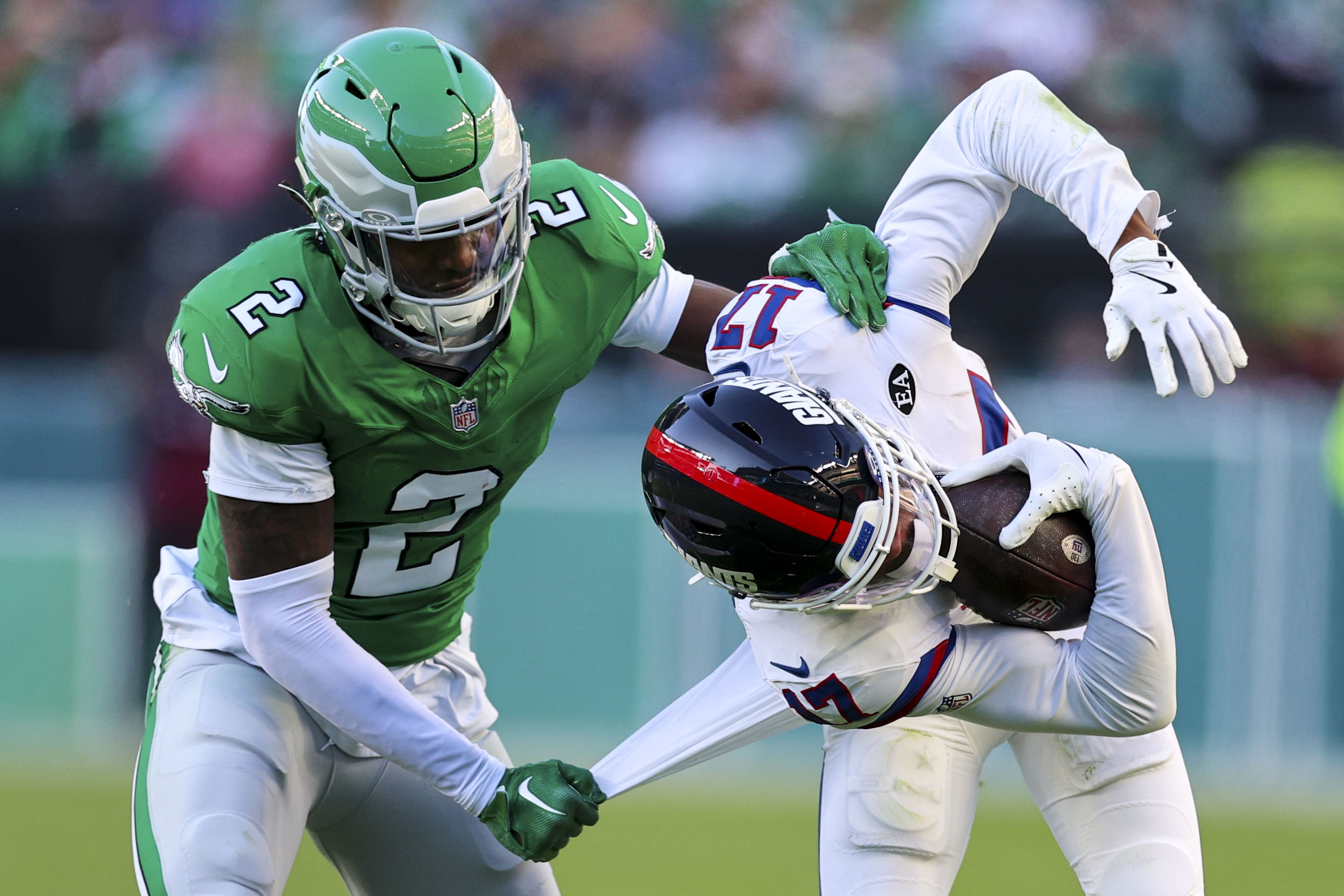
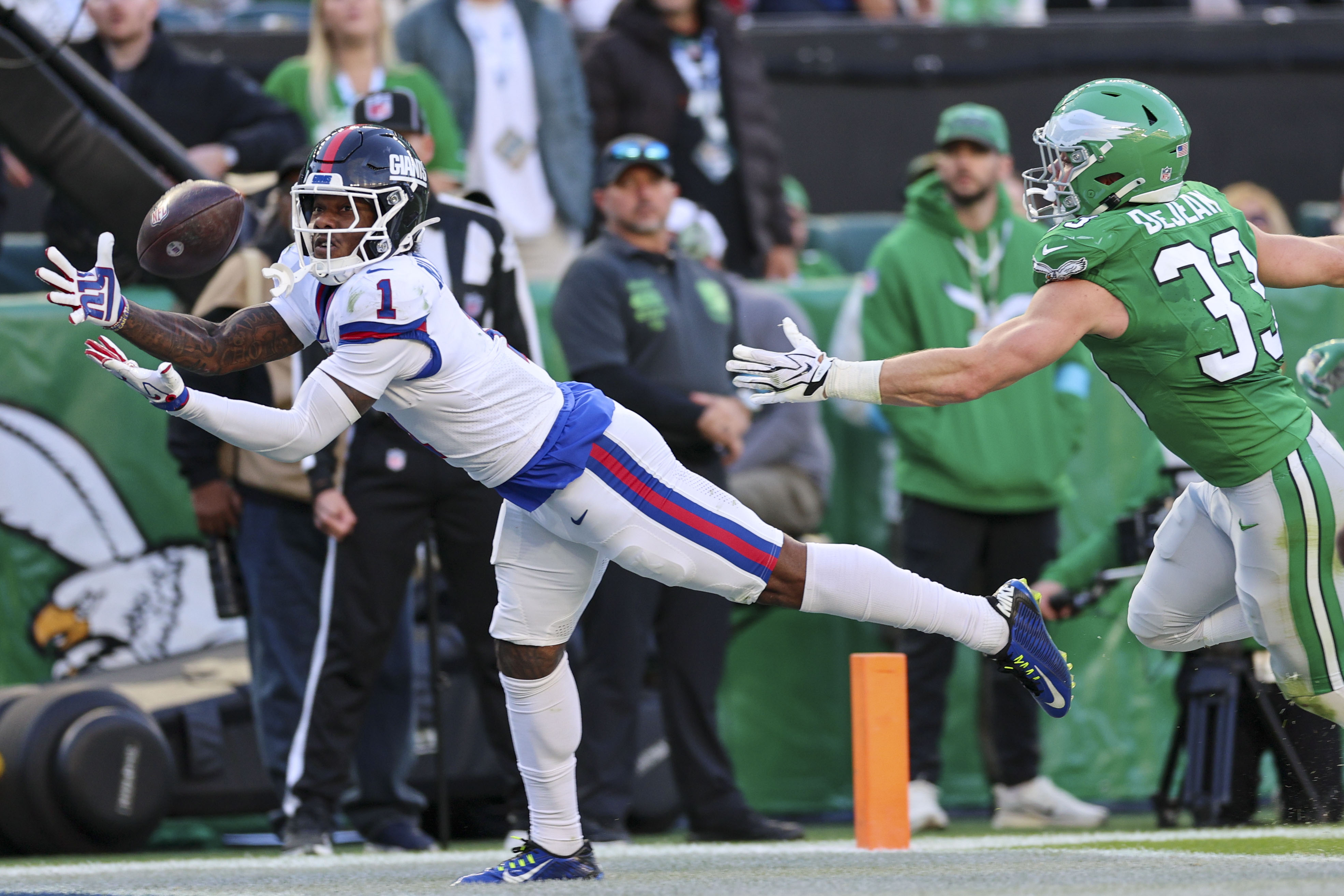
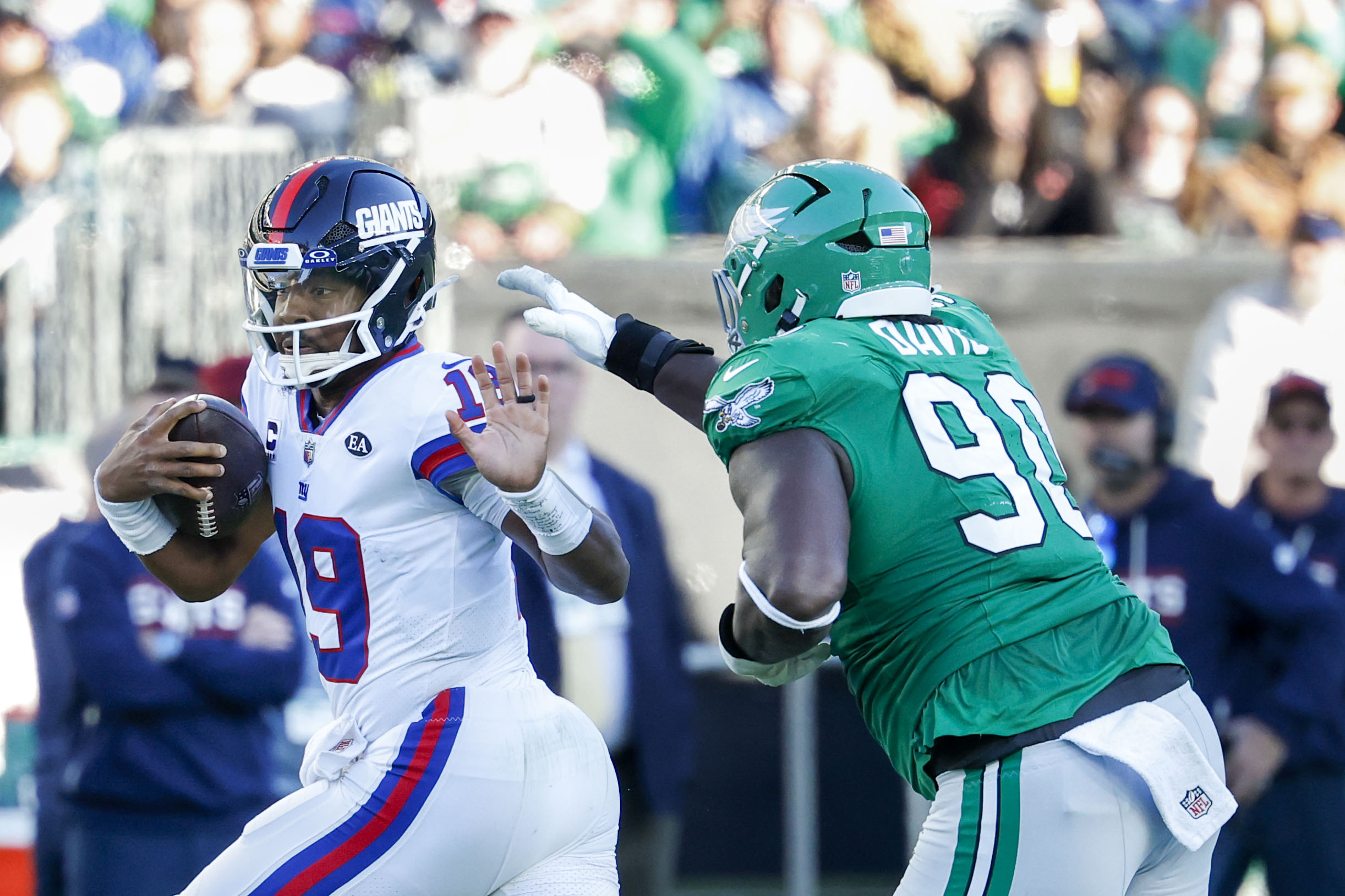
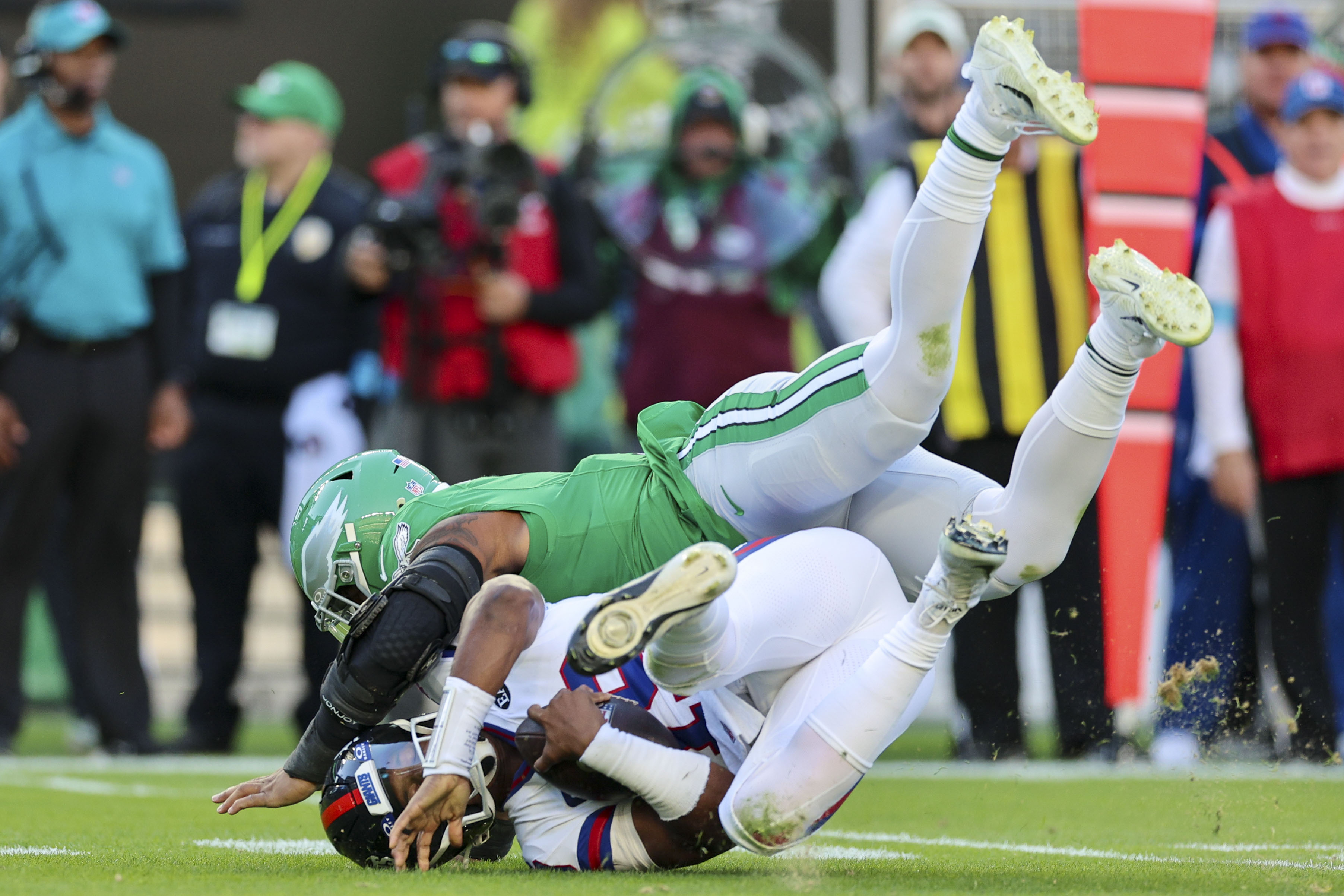
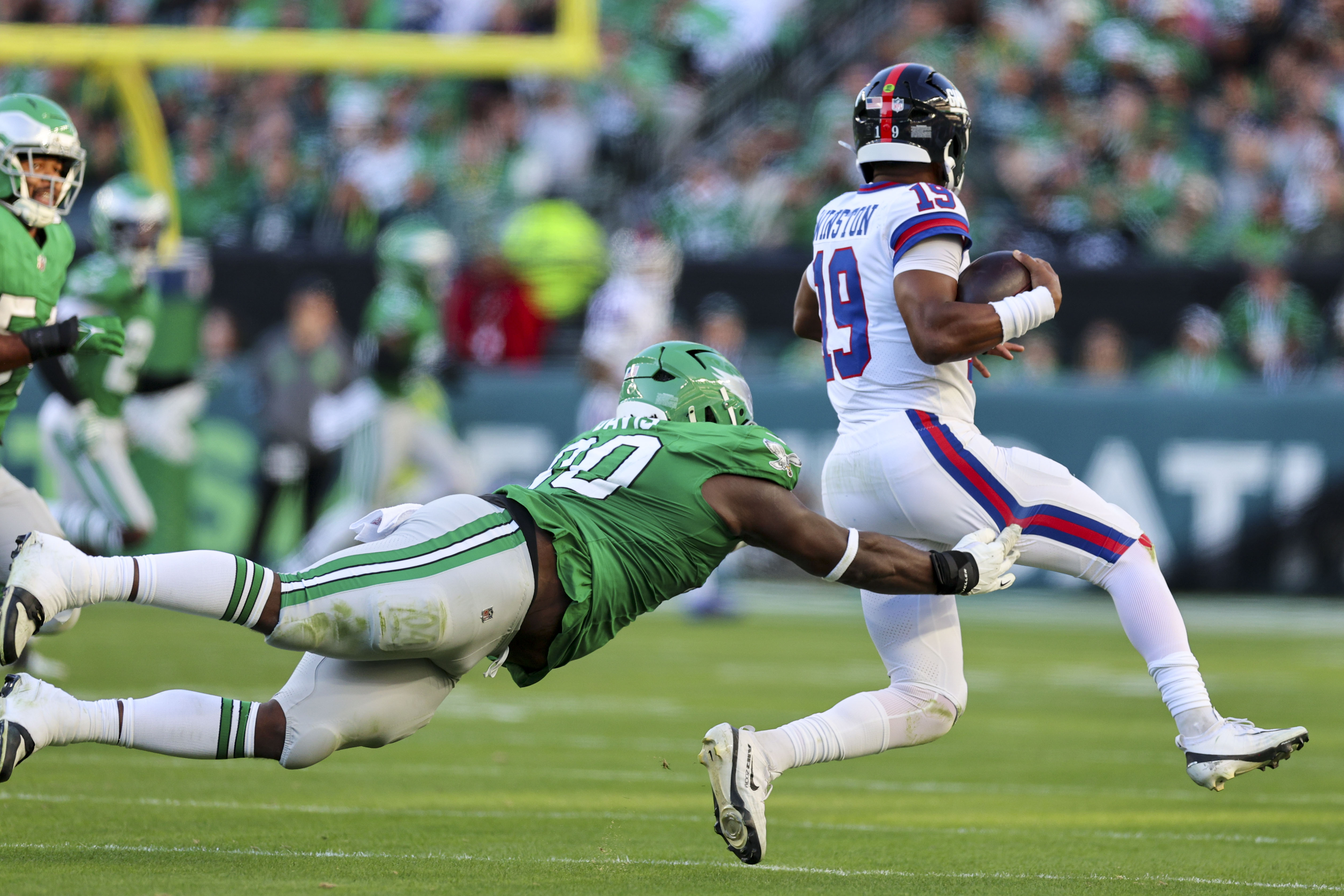
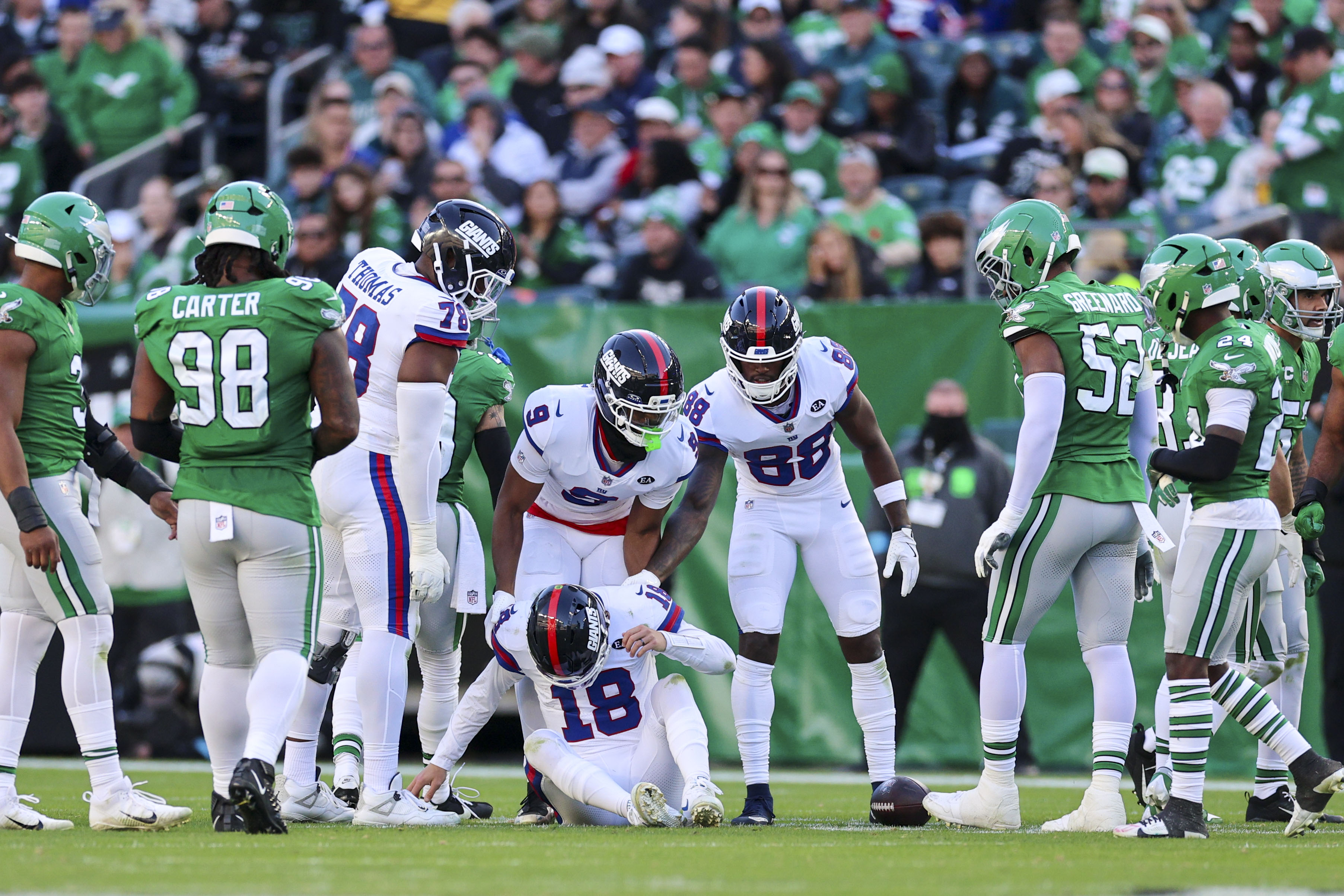
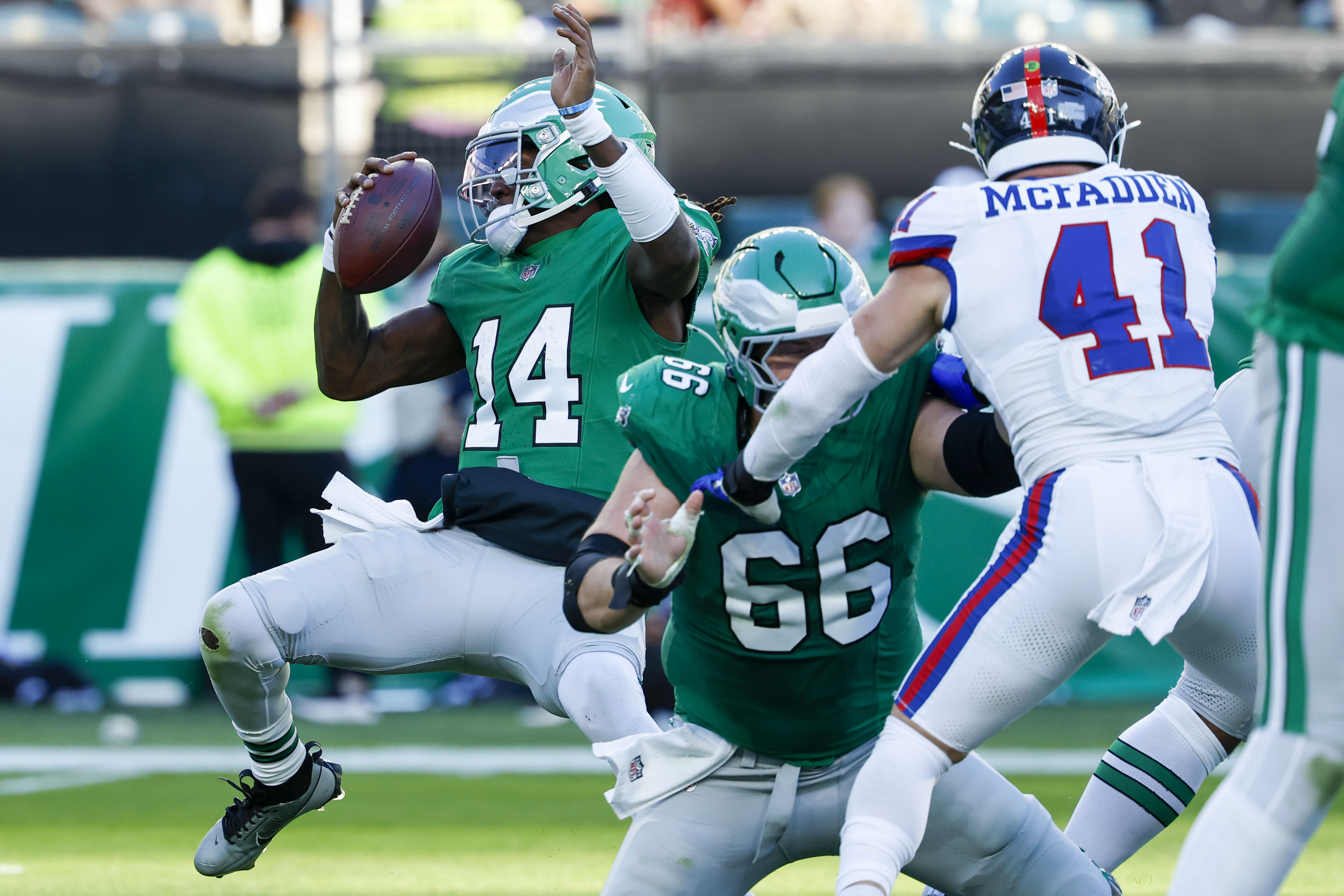
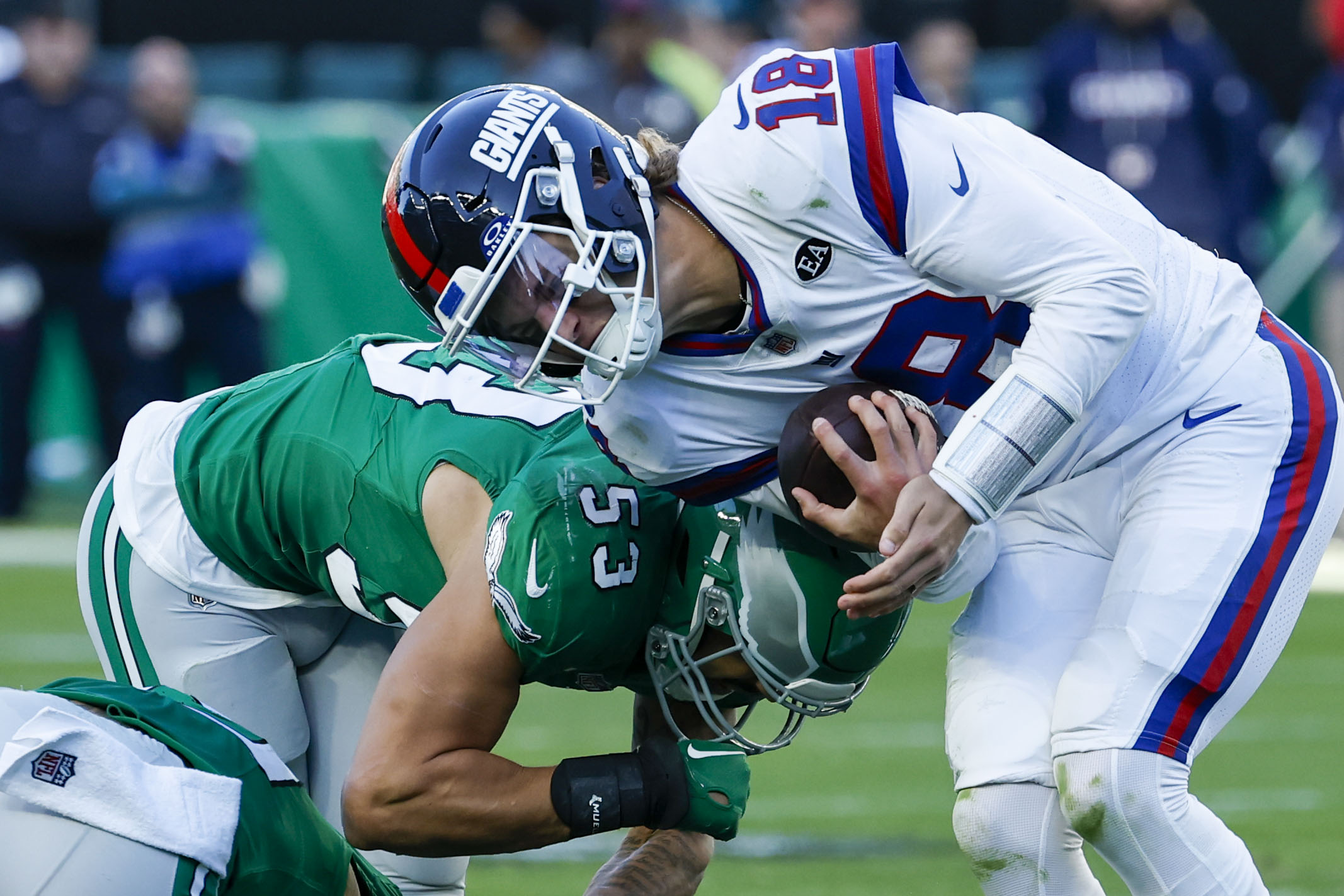
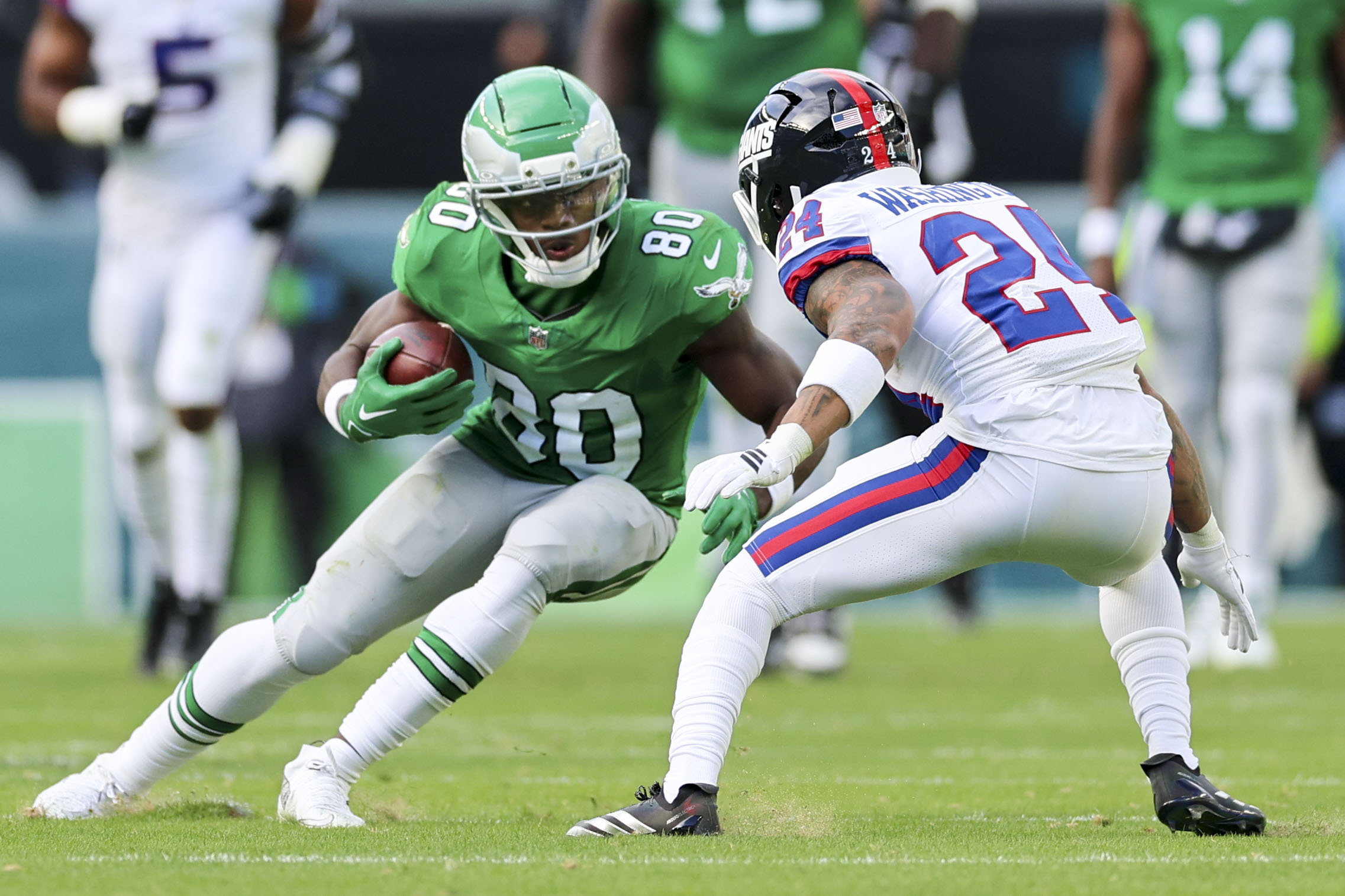
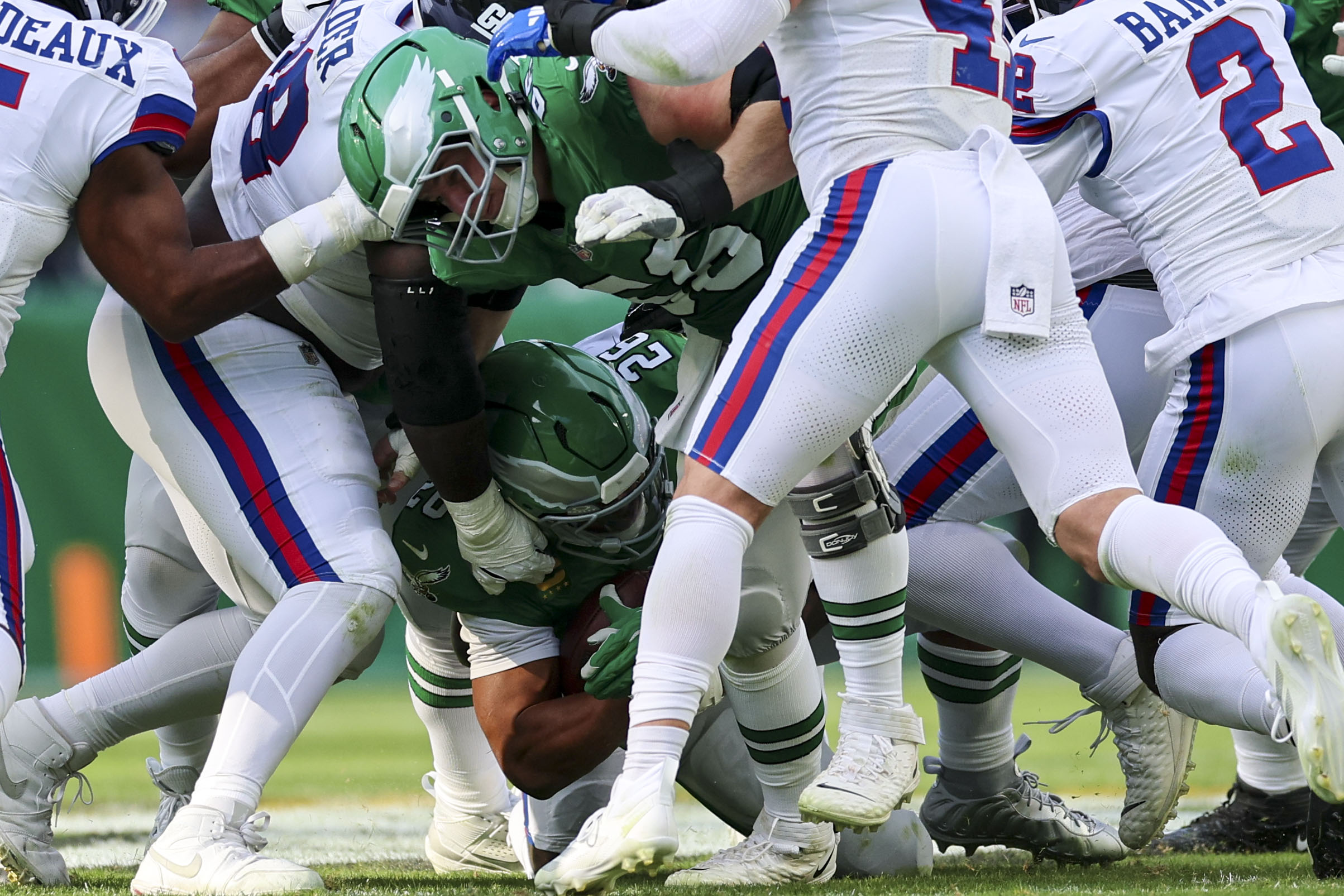
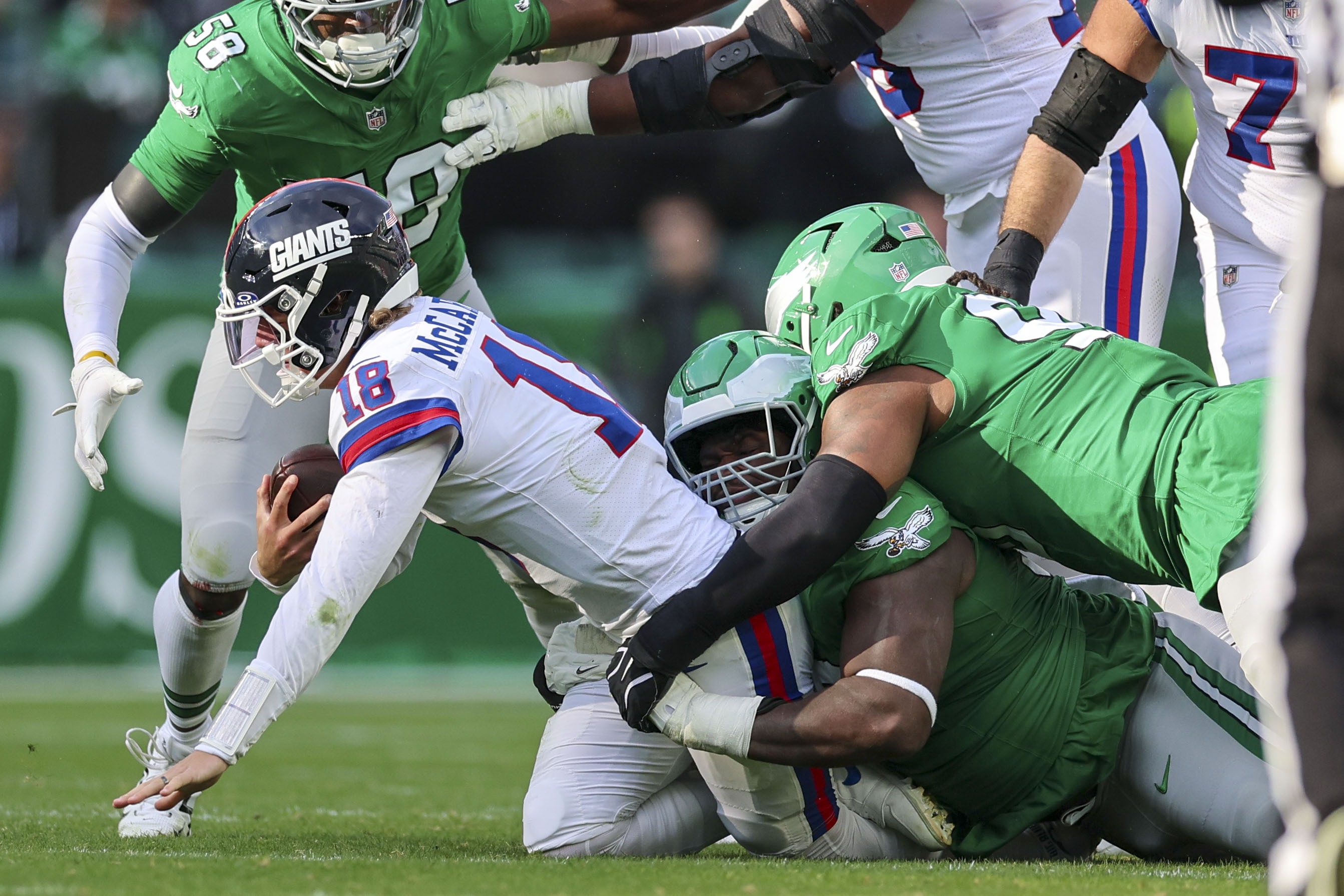
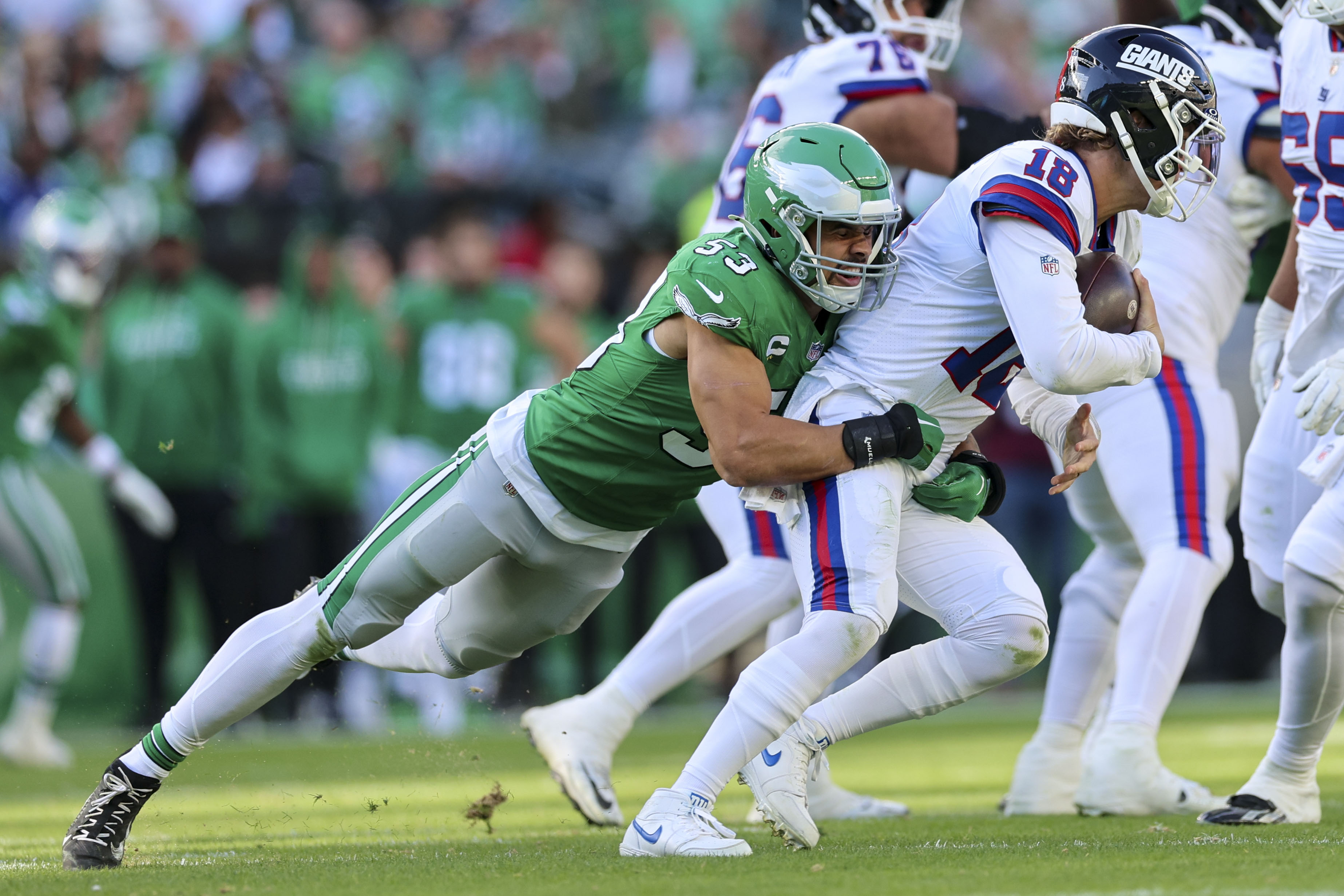
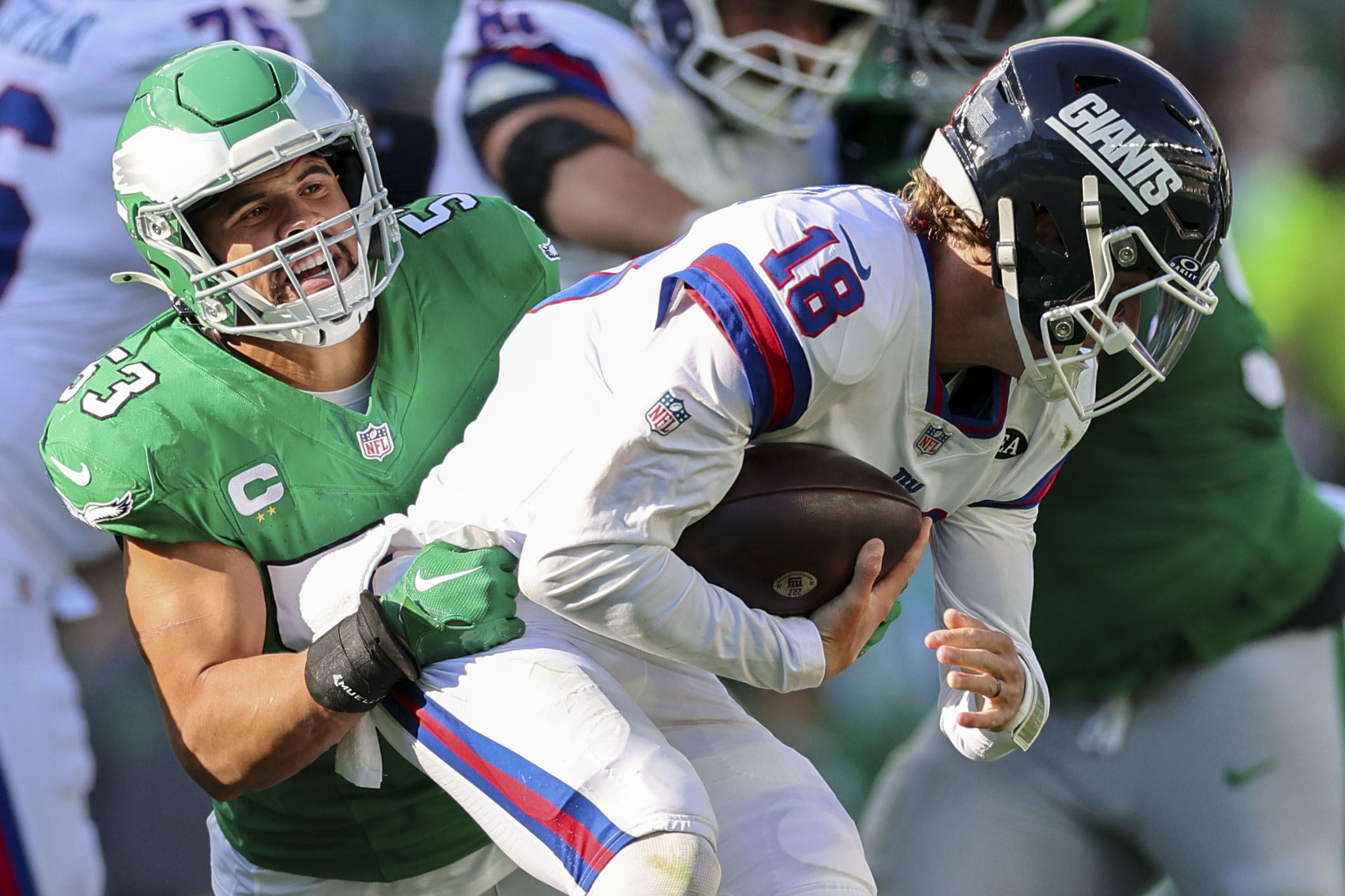
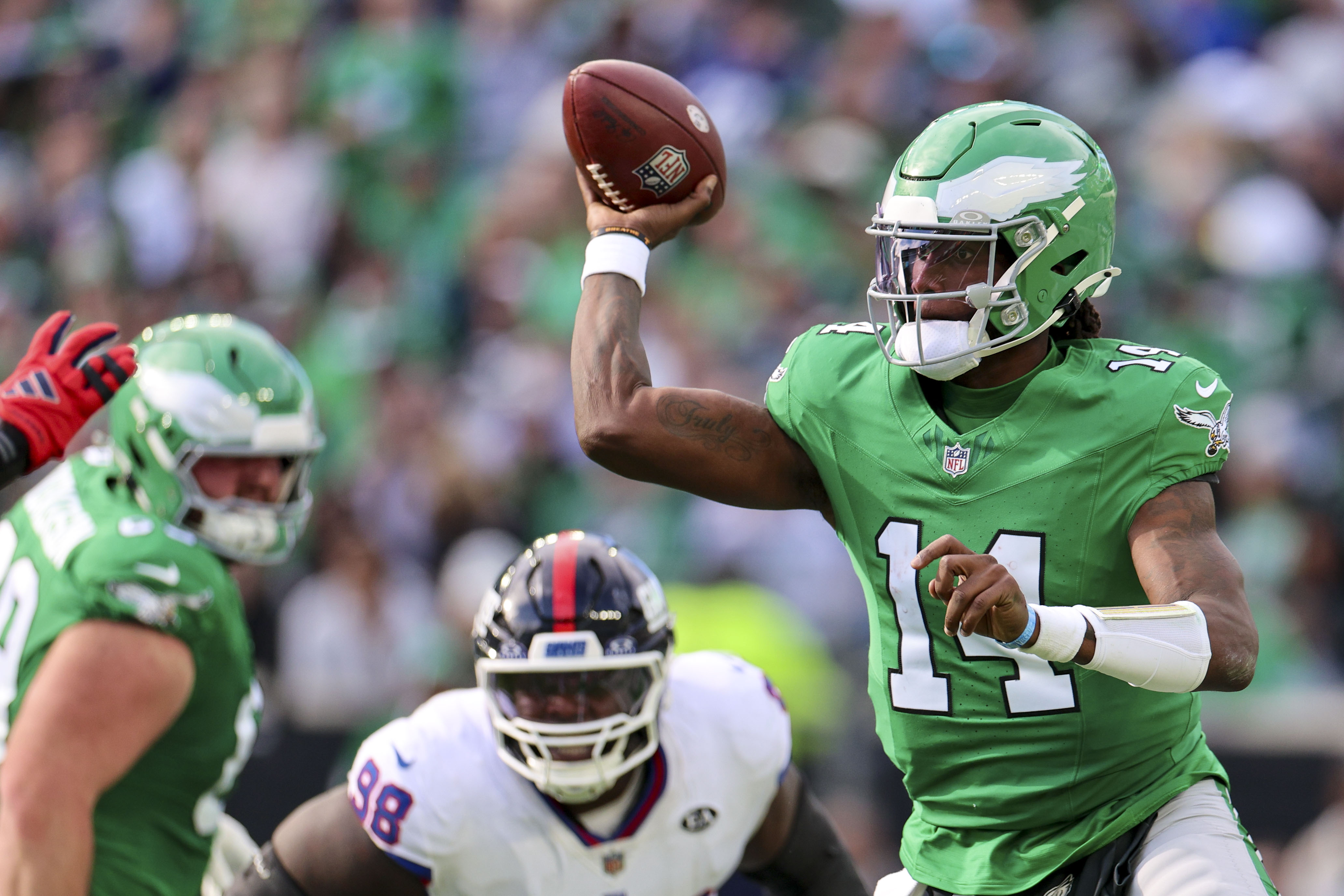
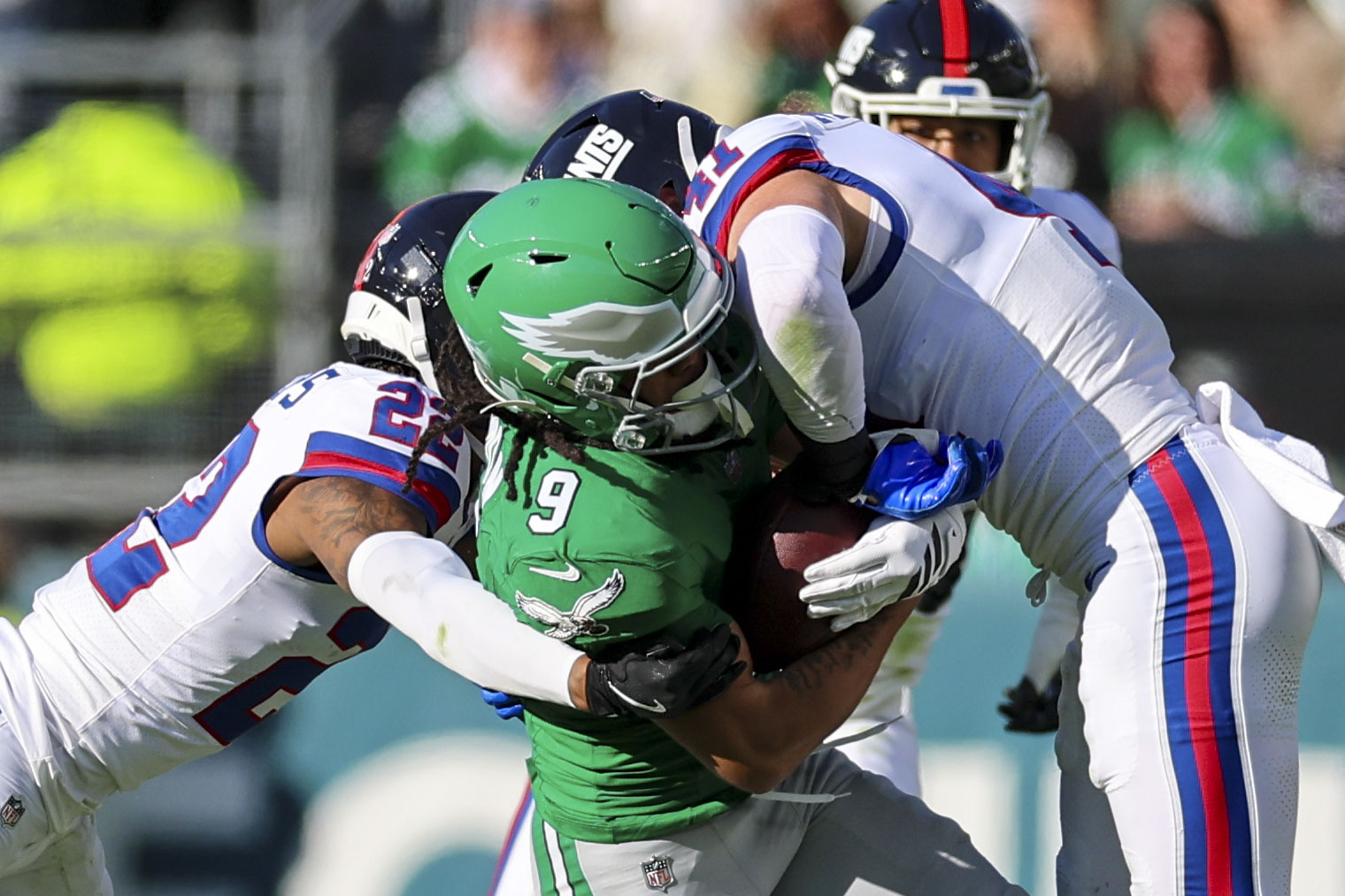
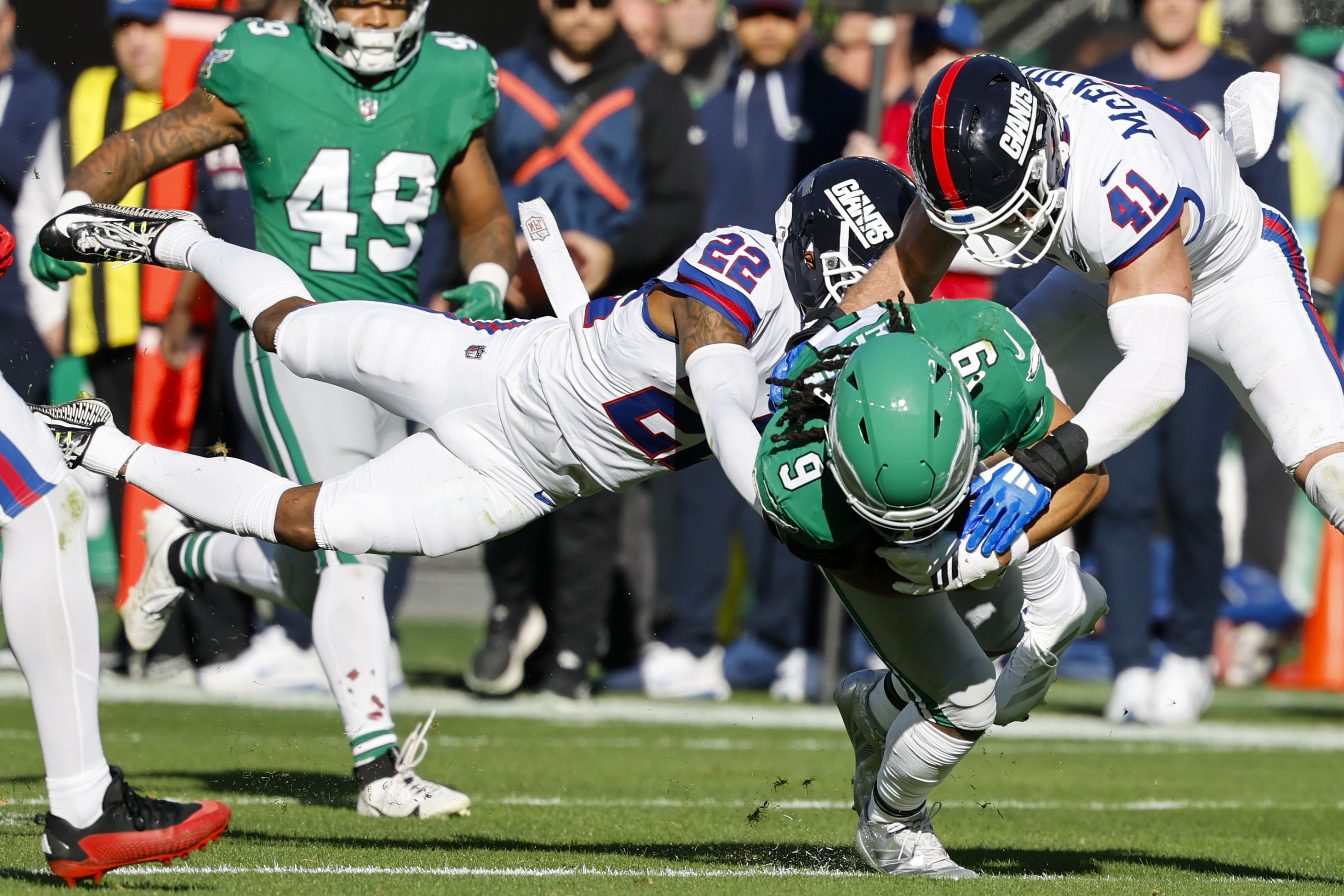
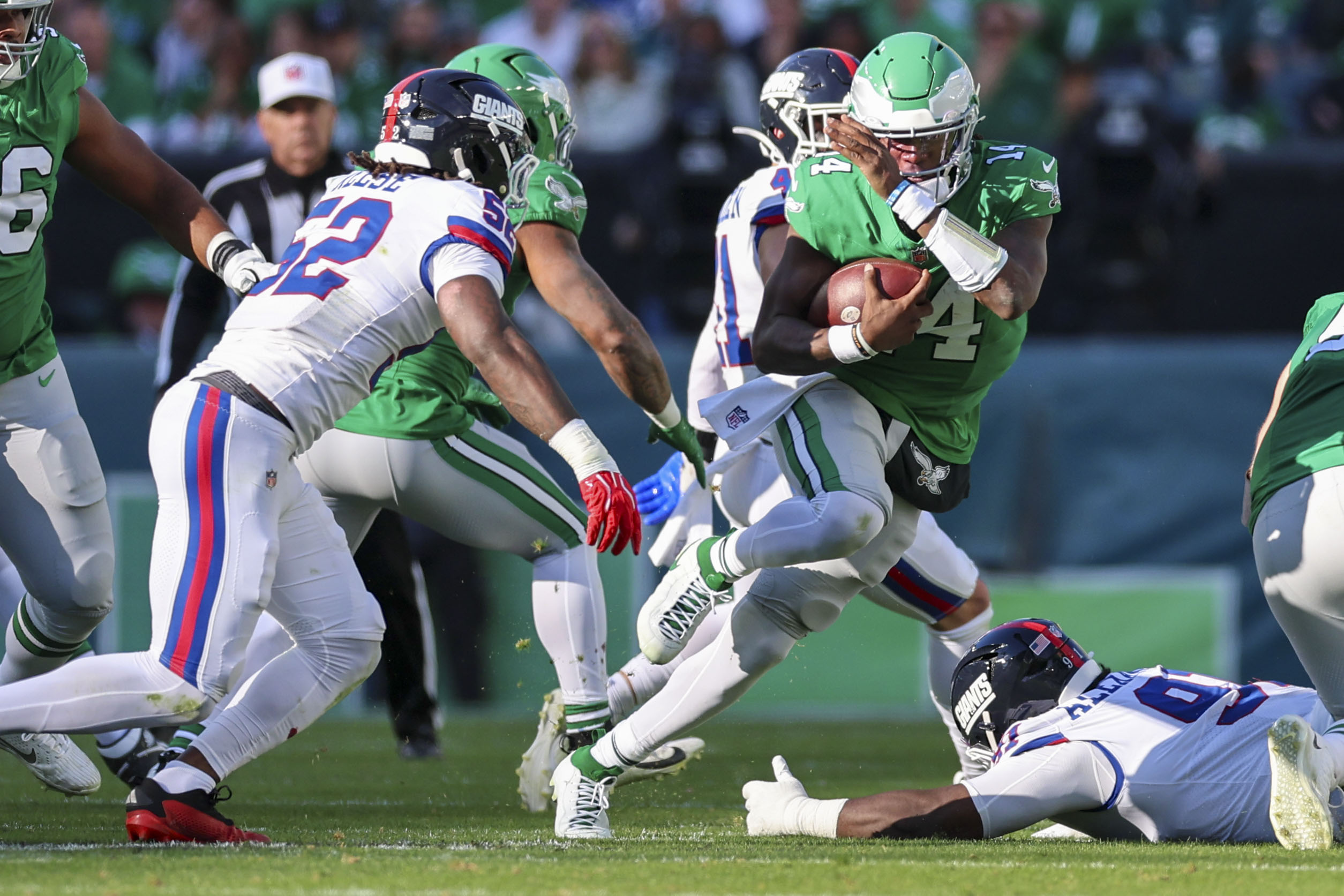
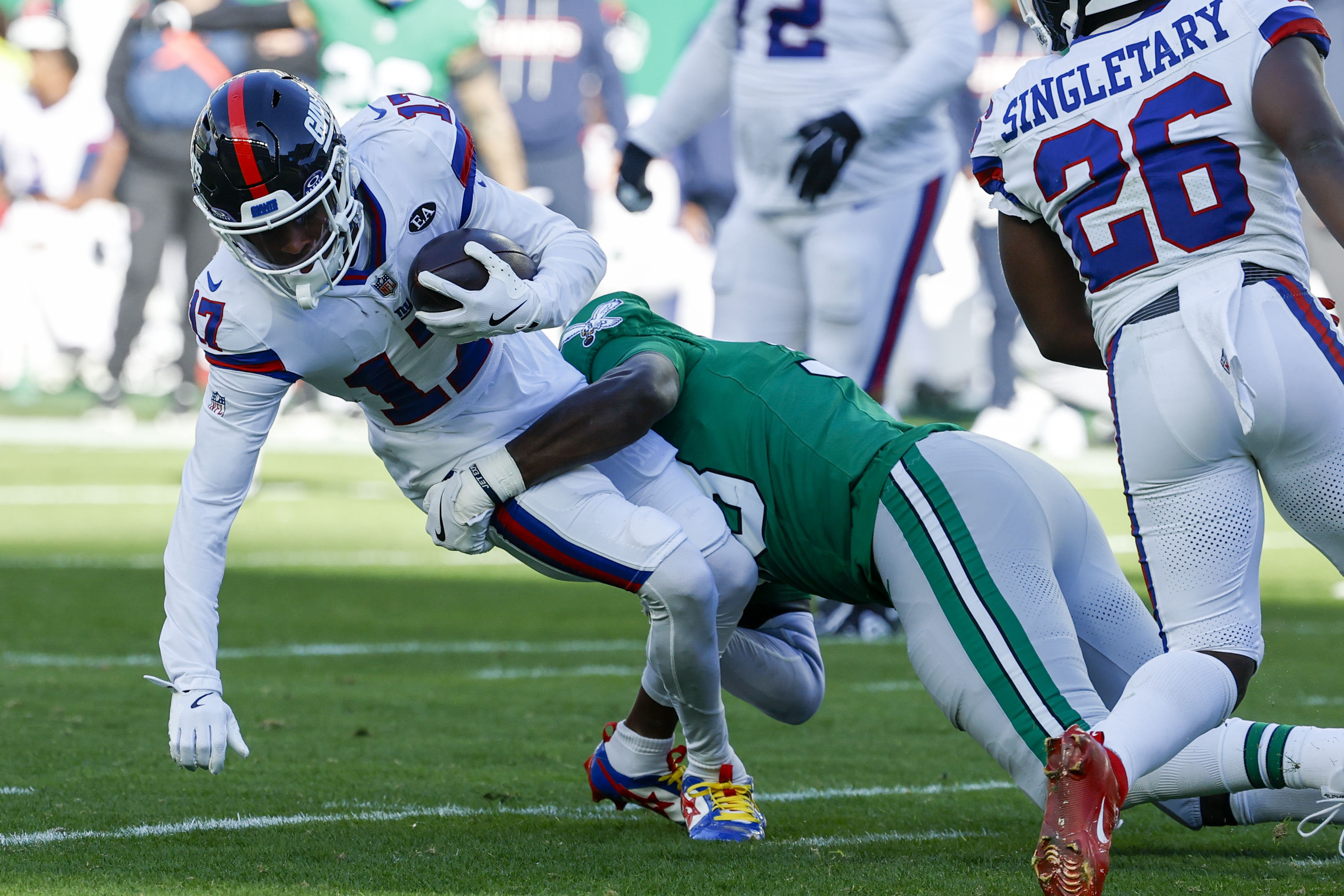
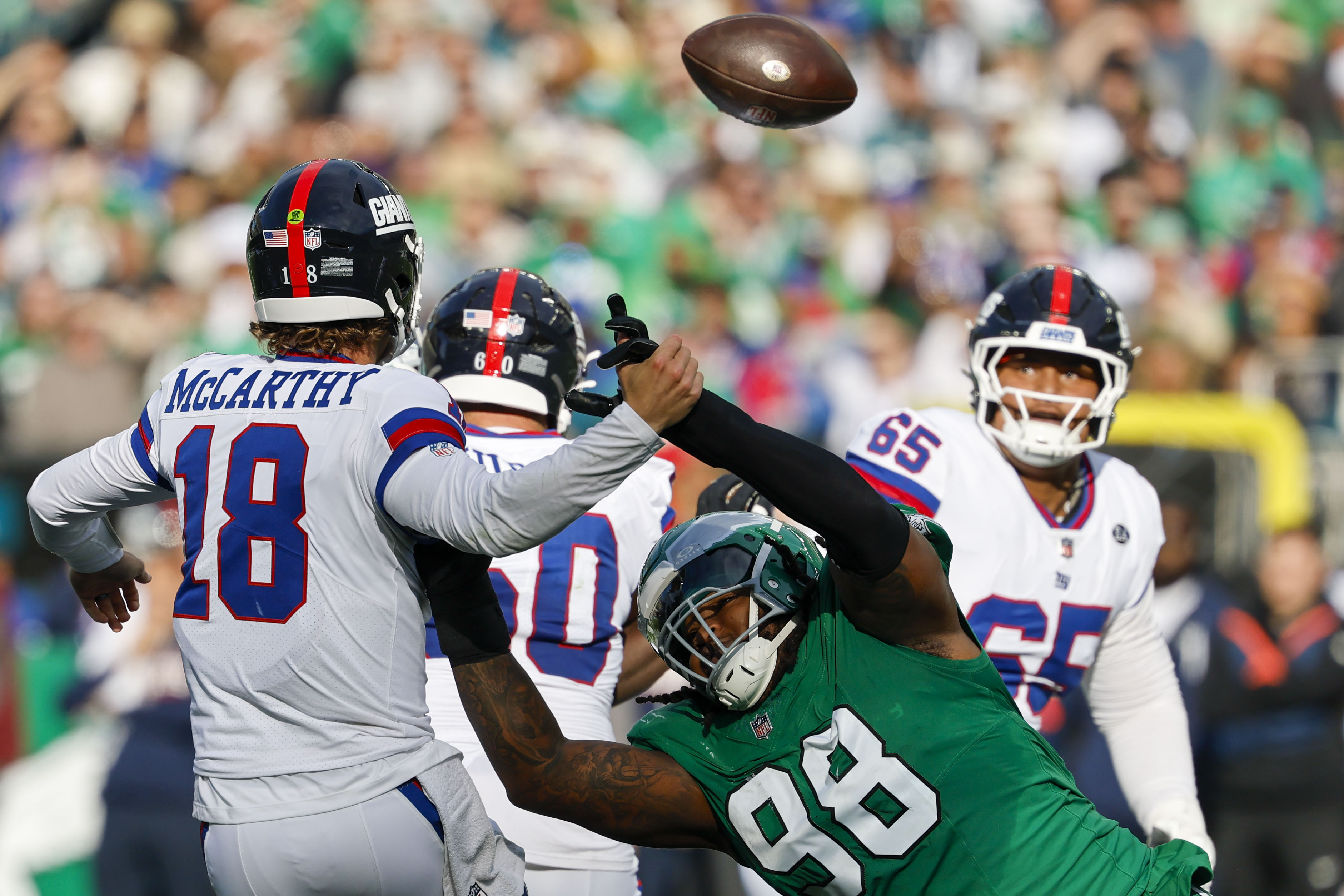
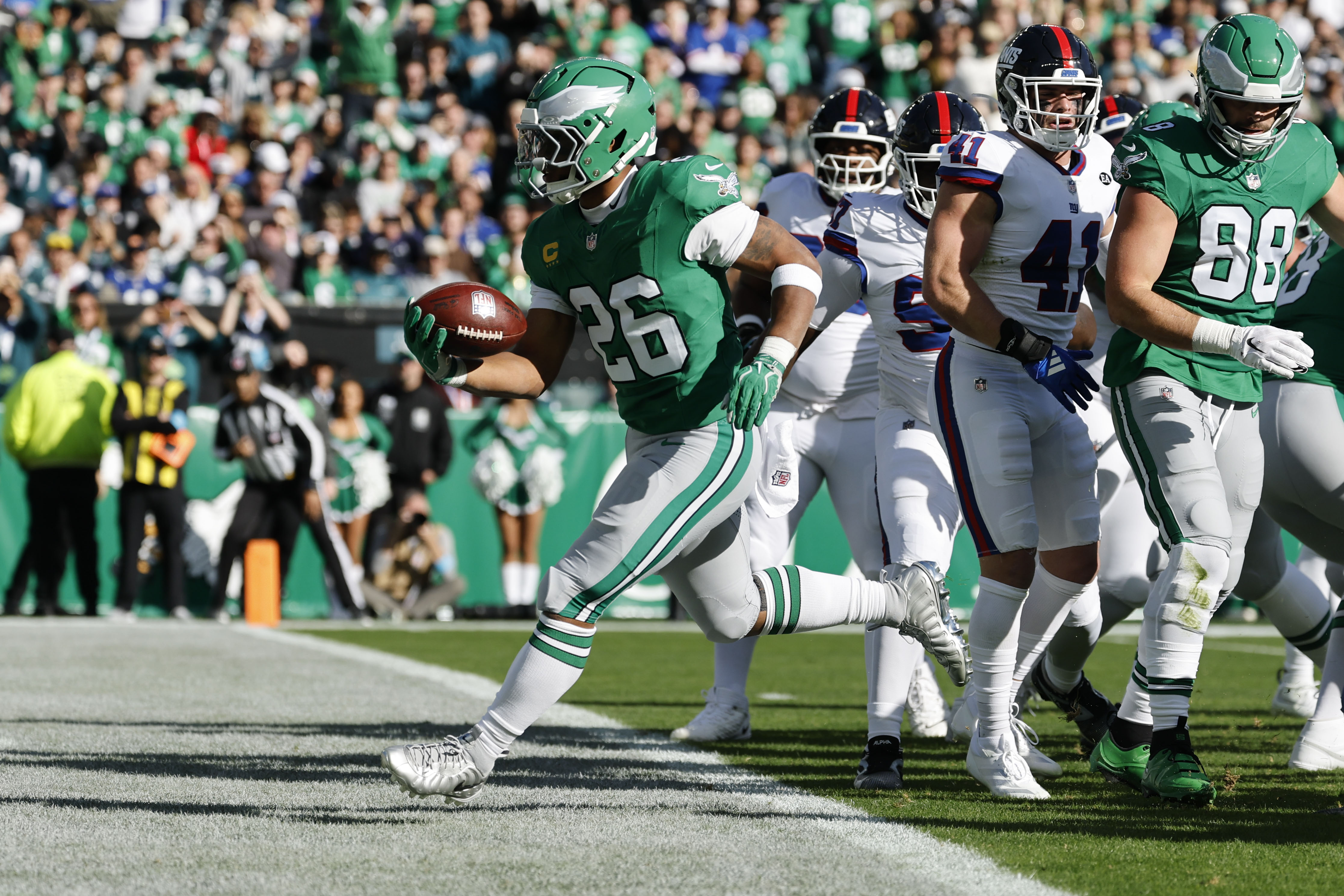
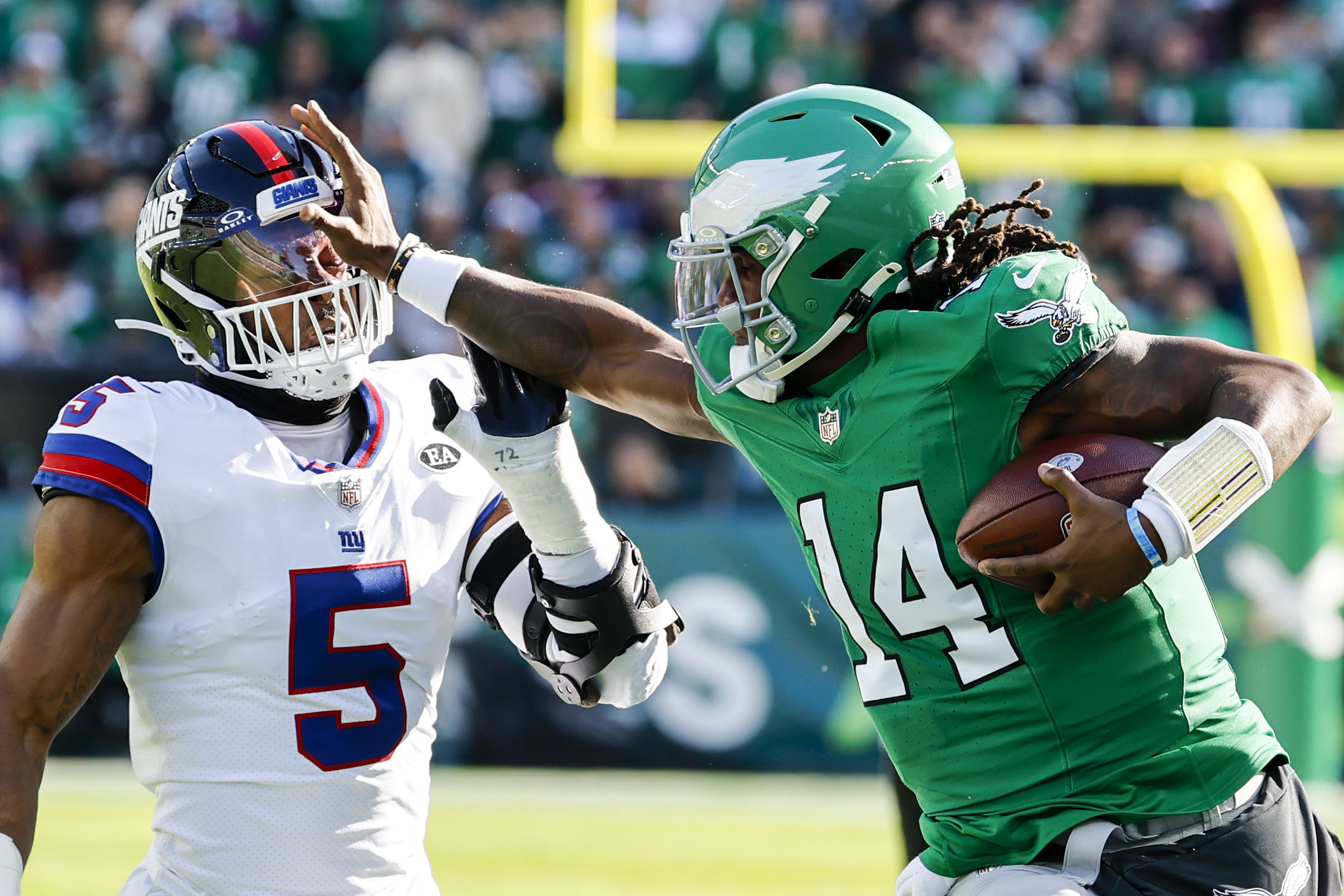
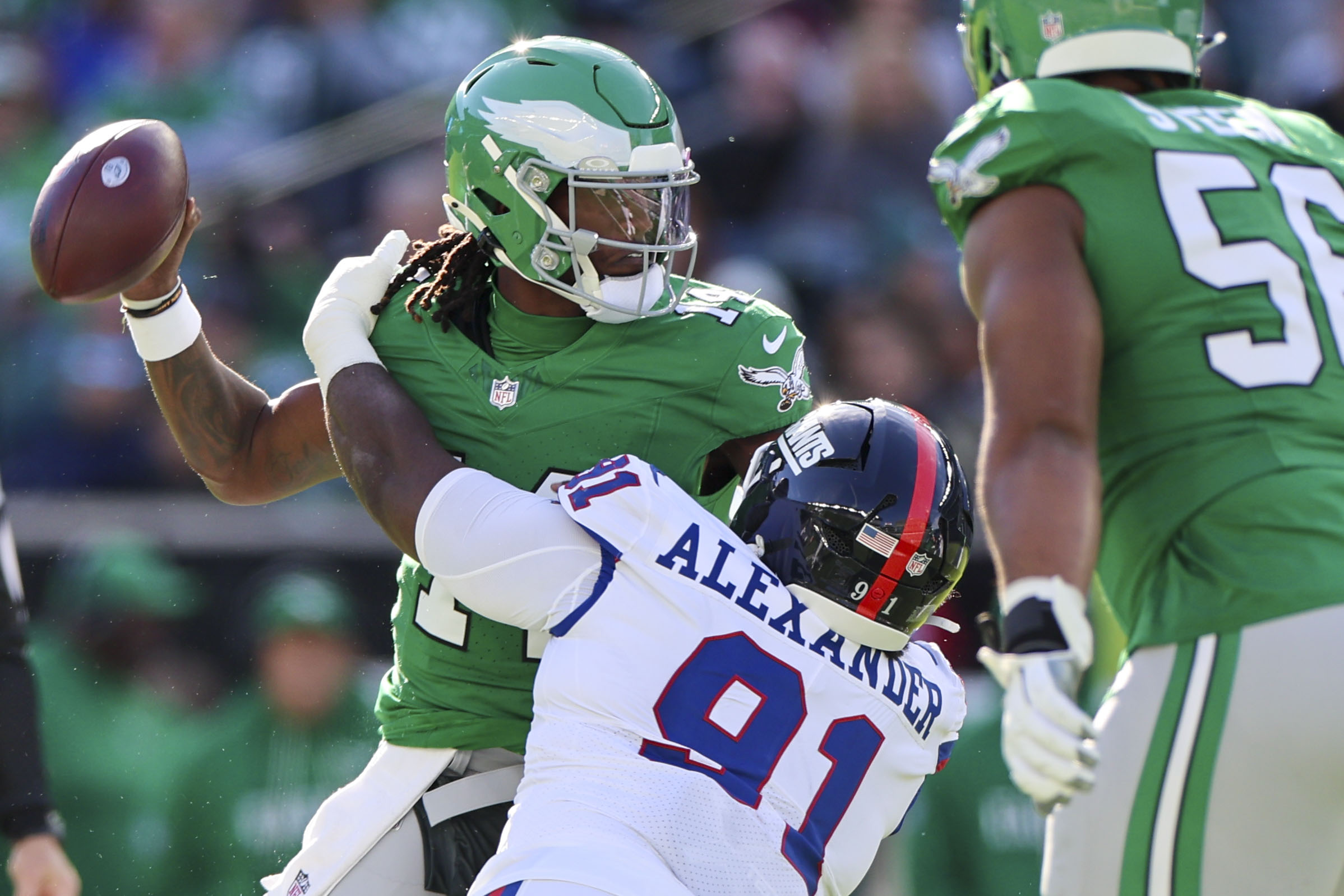
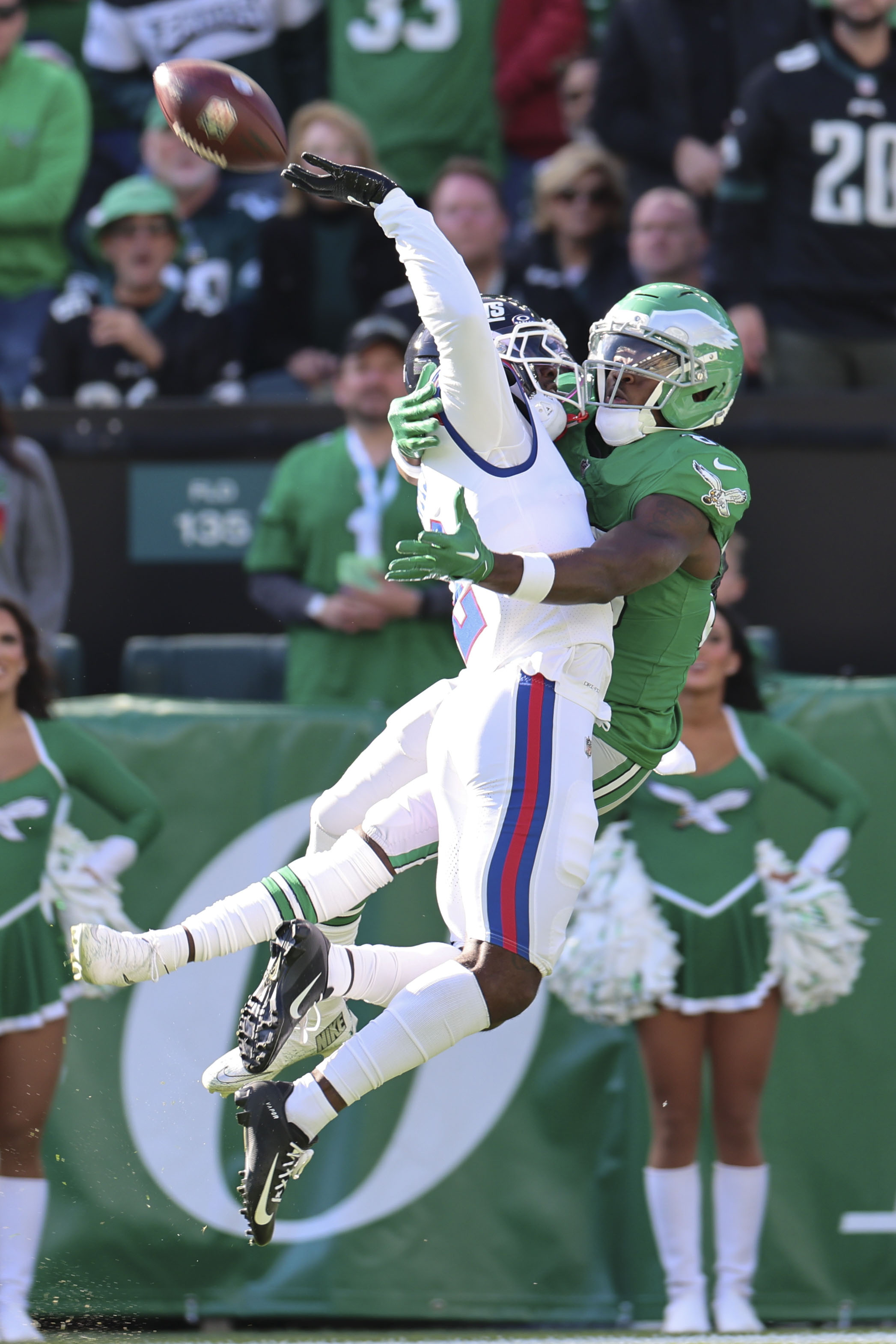
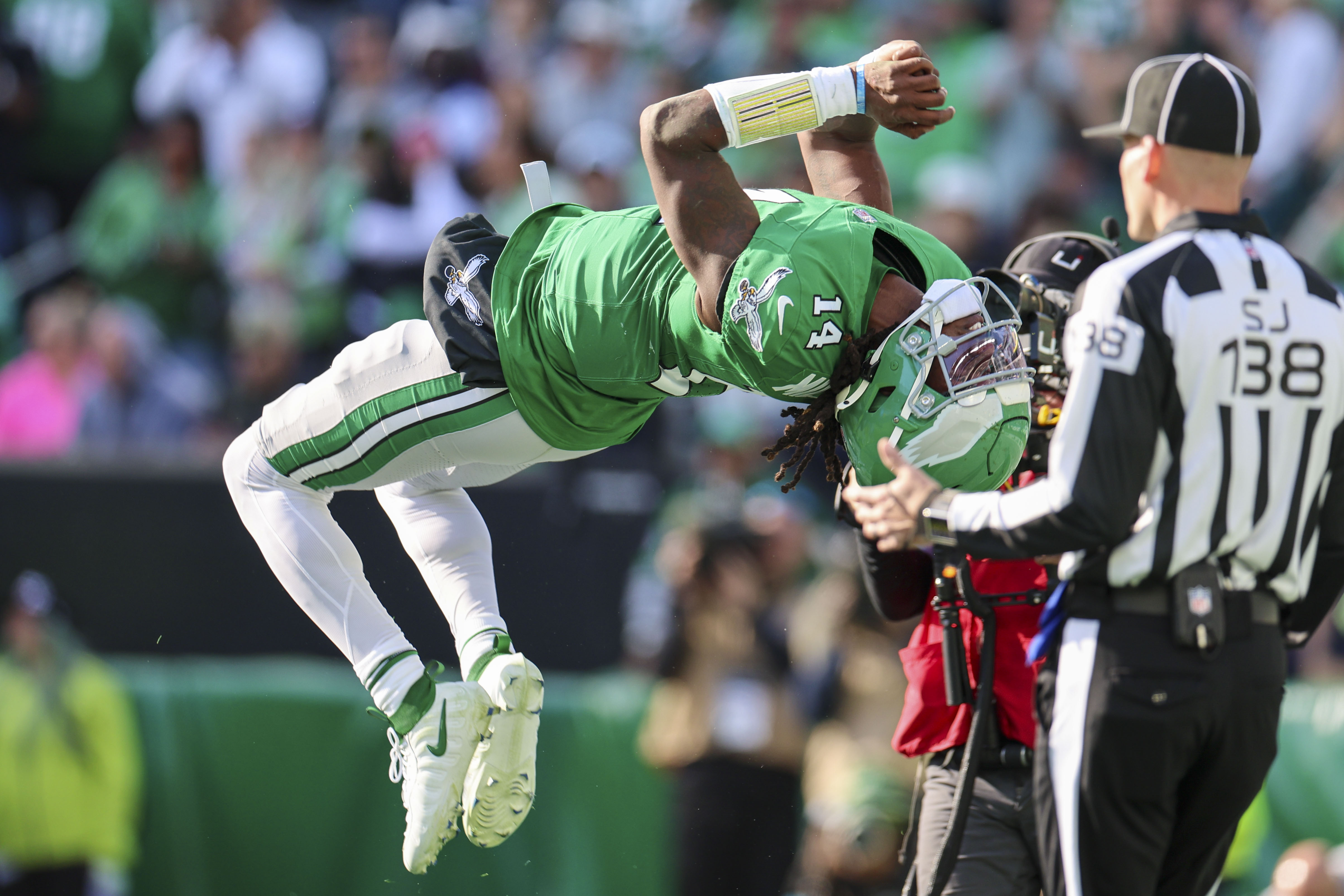
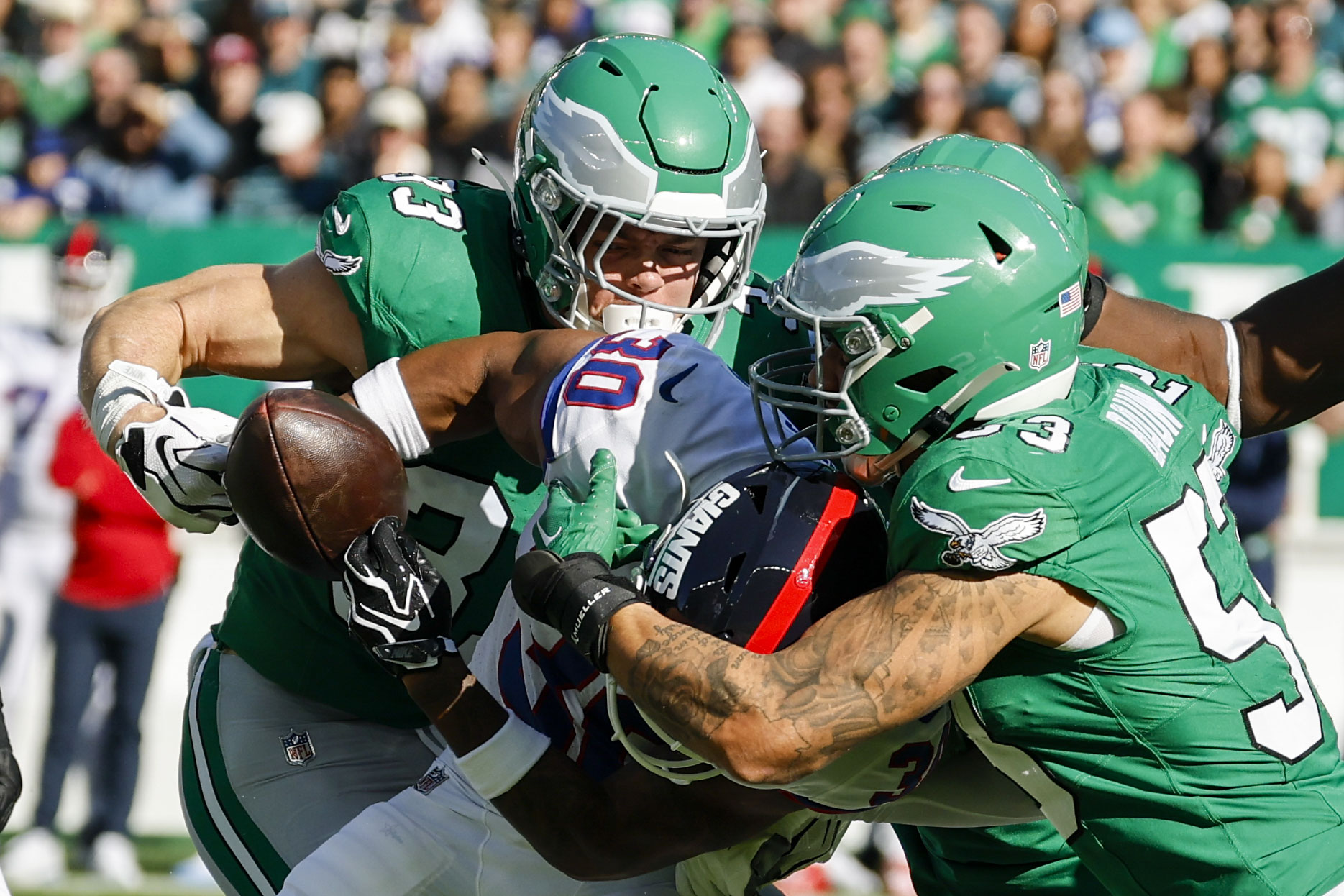
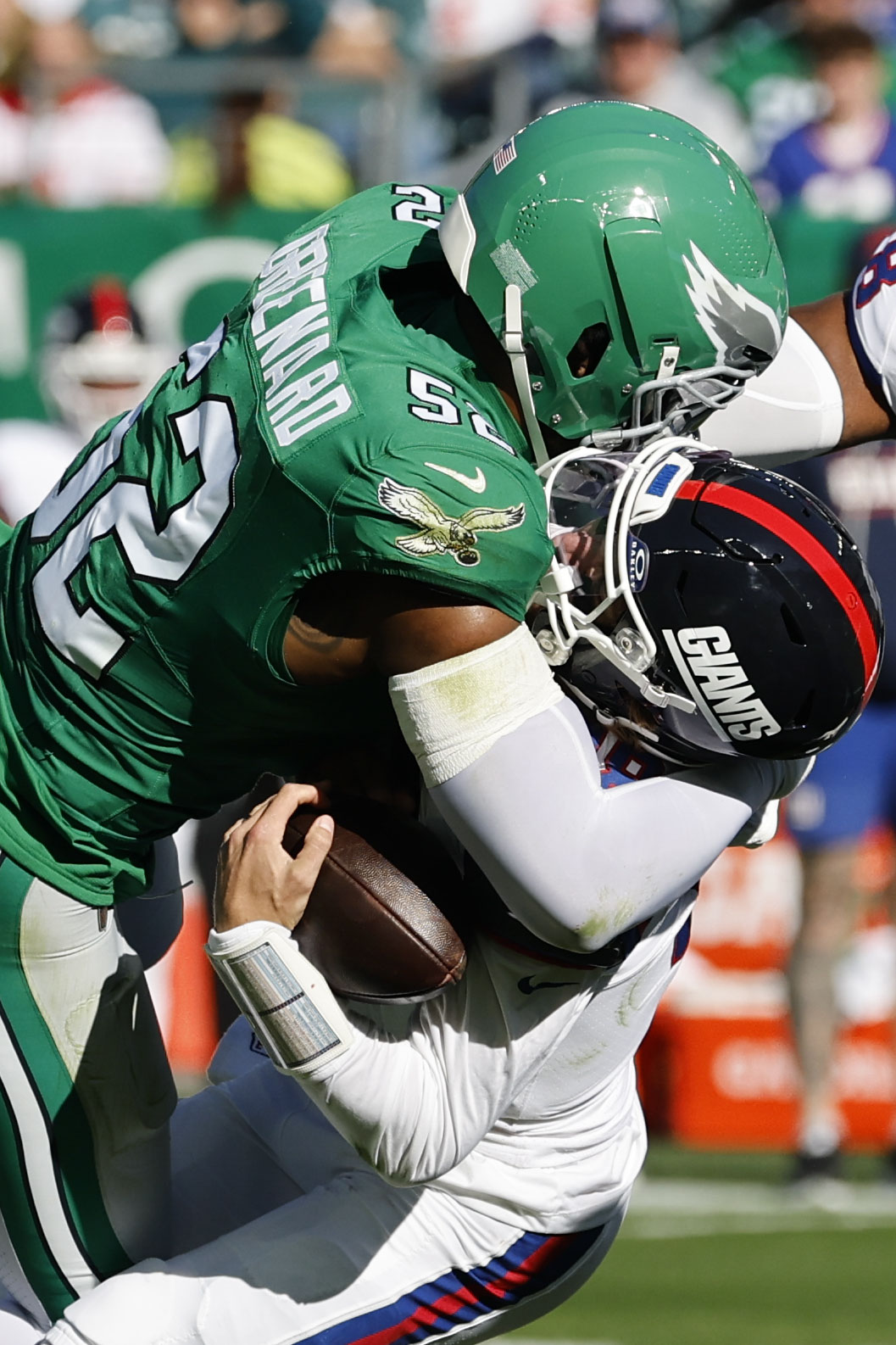
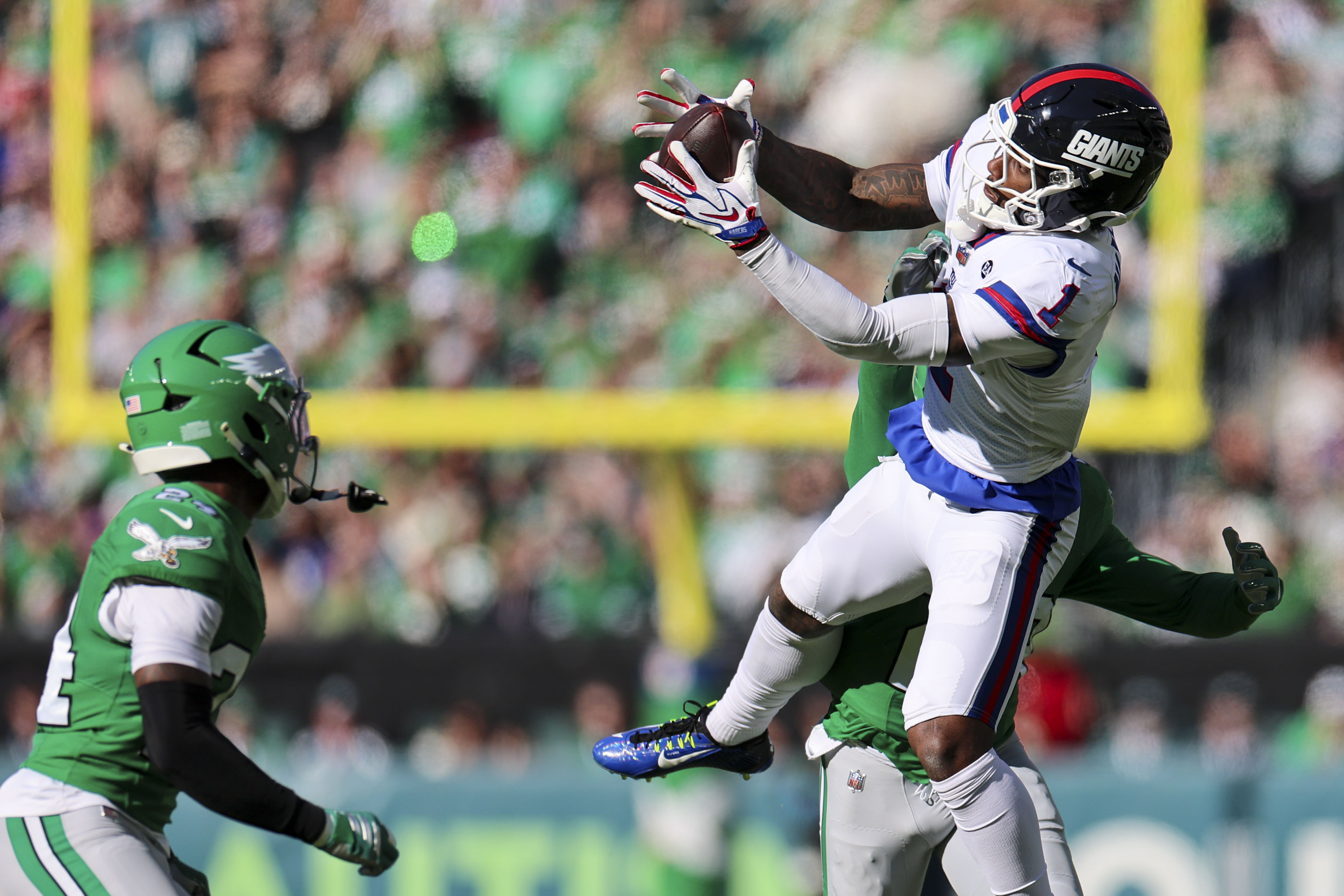
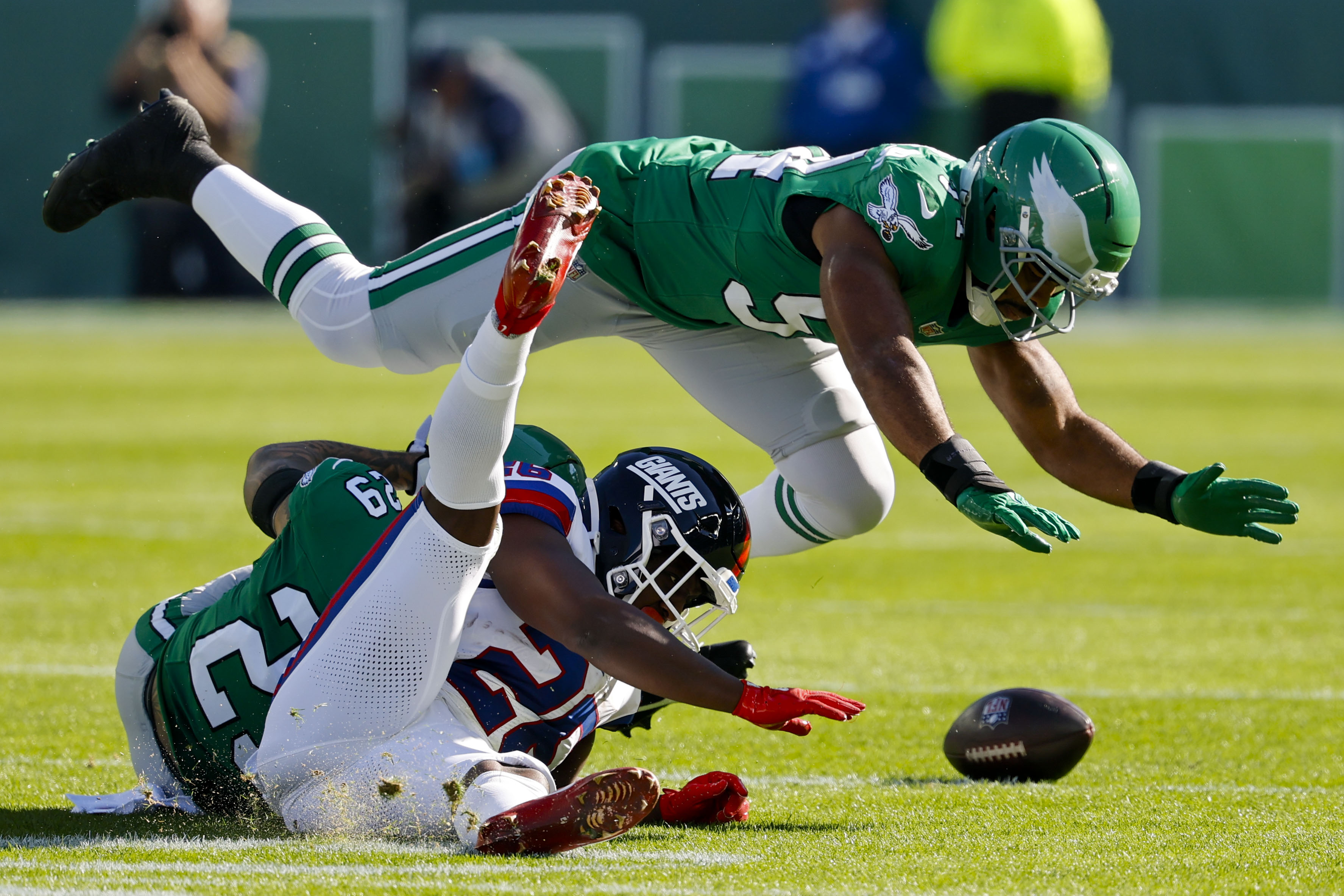
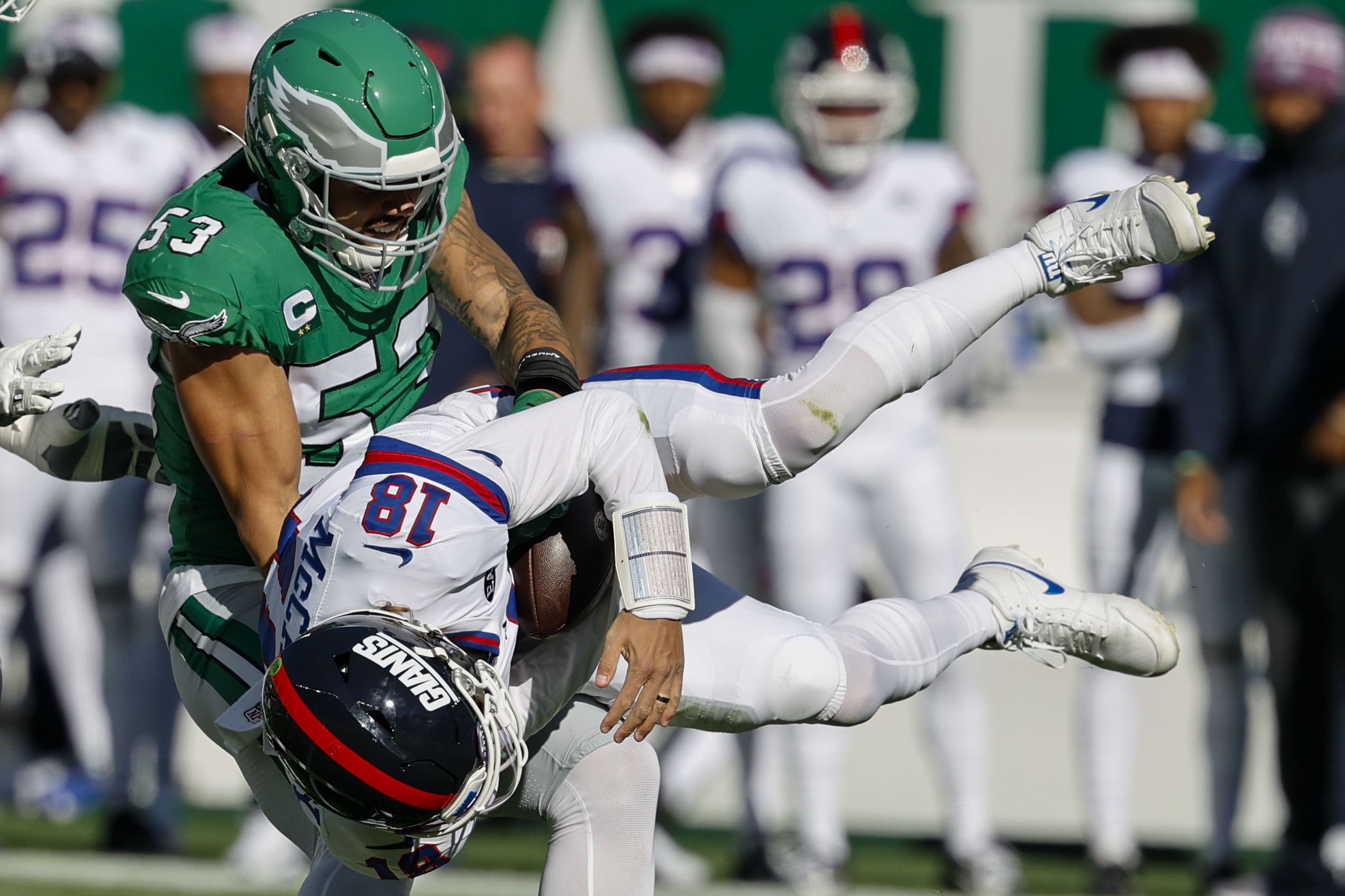
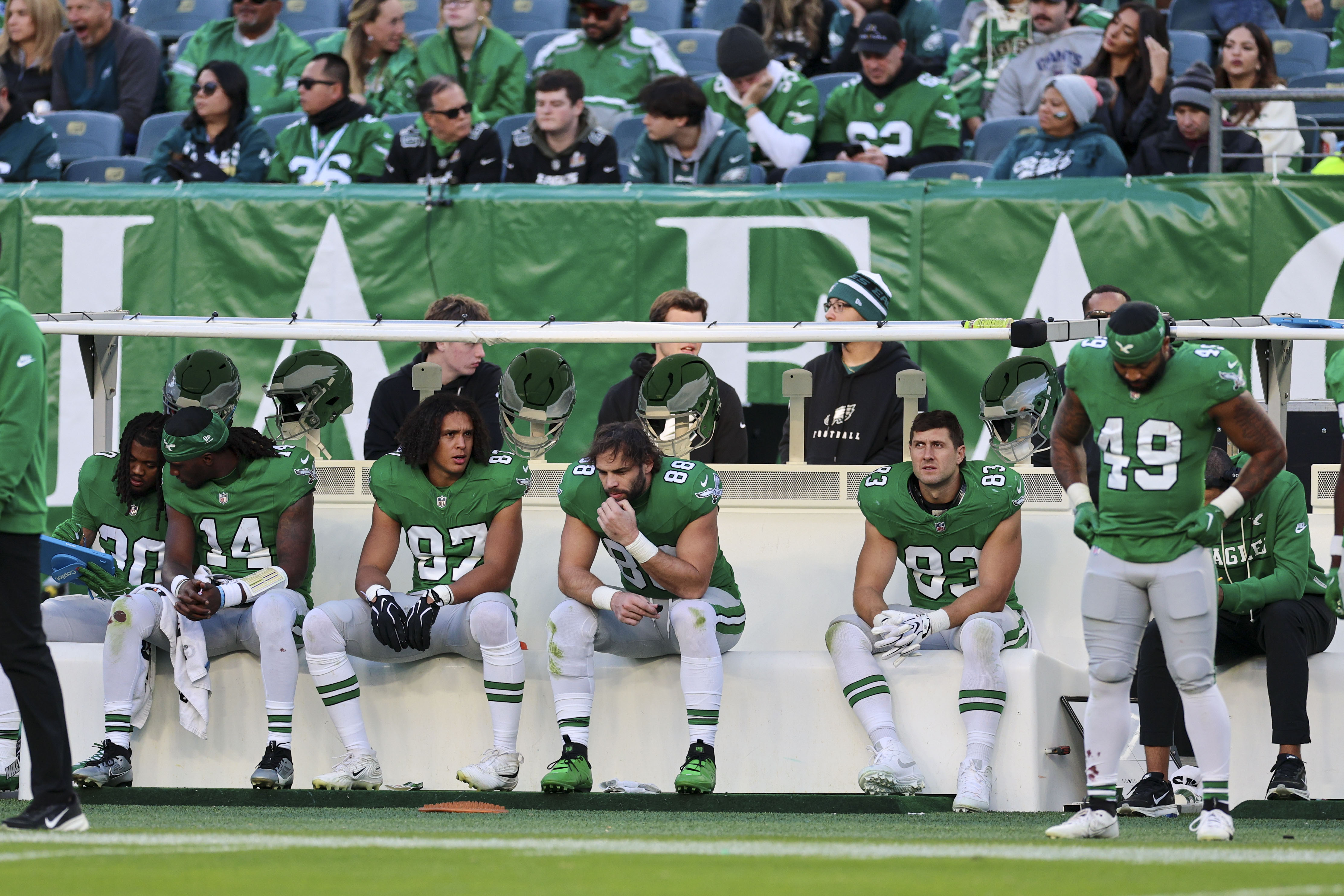
Philadelphia Eagles wide receiver Darius Cooper (left) and quarterback Joe Milton (right) walk off the field after their loss to the New York Giants at Lincoln Financial Field in Philadelphia on Sunday, Nov. 8, 2026. Eagles lose 19-11.David Maialetti / Staff PhotographerPhiladelphia Eagles head coach Nick Sirianni after losing to the New York Giants.Yong Kim / Staff PhotographerPhiladelphia Eagles quarterback Joe Milton III gets sacked on the last play of the game against the New York Giants at Lincoln Financial Field.Yong Kim / Staff PhotographerPass intended for Philadelphia Eagles wide receiver Darius Cooper, defended by New York Giants safety Ar’darius Washington, in the fourth quarter, second to last play of the game.David Maialetti / Staff PhotographerPass intended for Philadelphia Eagles wide receiver Darius Cooper bounces off New York Giants cornerback Greg Newsome II in the fourth quarter.David Maialetti / Staff PhotographerPhiladelphia Eagles wide receiver Makai Lemon can’t hang onto a pass with 26 seconds left in the game against the New York Giants.David Maialetti / Staff PhotographerPhiladelphia Eagles wide receiver DeVonta Smith (center – in sweats) watches the game injured, during the fourth quarter at Lincoln Financial Field.David Maialetti / Staff PhotographerPhiladelphia Eagles kicker Jake Elliott celebrates his field goal with Philadelphia Eagles offensive tackle Jordan Mailata during the fourth quarter.David Maialetti / Staff PhotographerPhiladelphia Eagles quarterback Joe Milton III slides in front of New York Giants linebacker Micah McFadden.Yong Kim / Staff PhotographerPhiladelphia Eagles fan yawns in the middle of the fourth quarter as the Philadelphia Eagles play the New York Giants at Lincoln Financial Field.Yong Kim / Staff PhotographerPhiladelphia Eagles cornerback Riq Woolen pulls down New York Giants wide receiver Darnell Mooney after he picks up the first down at Lincoln Financial Field.David Maialetti / Staff PhotographerNew York Giants wide receiver Malik Nabers can’t hang onto the ball in the end zone, being chased by Philadelphia Eagles cornerback Cooper DeJean at Lincoln Financial Field.David Maialetti / Staff PhotographerNew York Giants defensive tackle DJ Reader stops Philadelphia Eagles running back Saquon Barkley for a loss of five yards on the play.David Maialetti / Staff PhotographerPhiladelphia Eagles defensive tackle Jordan Davis tries to bring down New York Giants quarterback Jameis Winston in the third quarter.Yong Kim / Staff PhotographerPhiladelphia Eagles linebacker Nolan Smith sacks New York Giants quarterback Jameis Winston in the third quarter.David Maialetti / Staff PhotographerPhiladelphia Eagles defensive tackle Jordan Davis tries to bring down New York Giants quarterback Jameis Winston in the third quarter.David Maialetti / Staff PhotographerNew York Giants quarterback J.J. McCarthy is slow to get up after he tried to run the ball himself in the third quarter.David Maialetti / Staff PhotographerPhiladelphia Eagles quarterback Joe Milton III falls back, resulting in a sack in the third quarter.Yong Kim / Staff PhotographerNew York Giants quarterback J.J. McCarthy takes a hit from Philadelphia Eagles linebacker Zack Baun in the third quarter.Yong Kim / Staff PhotographerPhiladelphia Eagles wide receiver Darius Cooper tries to get by New York Giants safety Ar’darius Washington after making a reception in the second quarter.David Maialetti / Staff PhotographerPhiladelphia Eagles running back Saquon Barkley falls short of the first down on 4th and 1 yard with less than two minutes left.David Maialetti / Staff PhotographerPhiladelphia Eagles defensive tackle Jordan Davis and Philadelphia Eagles defensive tackle Jalen Carter sack New York Giants quarterback J.J. McCarthy in the second quarter.David Maialetti / Staff PhotographerPhiladelphia Eagles linebacker Zack Baun stops New York Giants quarterback J.J. McCarthy in the second quarter at Lincoln Financial Field on Sunday, Nov. 8, 2026, in Philadelphia, PA.David Maialetti / Staff PhotographerPhiladelphia Eagles linebacker Zack Baun stops New York Giants quarterback J.J. McCarthy in the second quarter.David Maialetti / Staff PhotographerPhiladelphia Eagles quarterback Joe Milton III tries to throw a pass on 3rd and 2 but pass is incomplete at Lincoln Financial Field on Sunday, Nov. 8, 2026, in Philadelphia, PA.David Maialetti / Staff PhotographerNew York Giants defensive back Andru Phillips and New York Giants linebacker Micah McFadden bring down Philadelphia Eagles wide receiver Makai Lemon during the second quarter.David Maialetti / Staff PhotographerPhiladelphia Eagles wide receiver Makai Lemon first down catch against New York Giants defensive back Andru Phillips and New York Giants linebacker Micah McFadden in the second quarter.Yong Kim / Staff PhotographerPhiladelphia Eagles quarterback Joe Milton III tries to use his legs to pick up a first down but is short during the second quarter.David Maialetti / Staff PhotographerPhiladelphia Eagles linebacker Jalyx Hunt stops New York Giants wide receiver Darnell Mooney on a trick play by the Giants that did not work.Yong Kim / Staff PhotographerPhiladelphia Eagles defensive tackle Jalen Carter deflects the football against New York Giants quarterback J.J. McCarthy in the second quarter.Yong Kim / Staff PhotographerPhiladelphia Eagles running back Saquon Barkley with a first-quarter touchdown run against the New York Giants.Yong Kim / Staff PhotographerPhiladelphia Eagles quarterback Joe Milton III runs the football against New York Giants linebacker Kayvon Thibodeaux in the first quarter against the New York Giants at Lincoln Financial Field.Yong Kim / Staff PhotographerPhiladelphia Eagles quarterback Joe Milton III is pressured by New York Giants defensive tackle Darius Alexander in the first quarter.David Maialetti / Staff PhotographerNew York Giants cornerback Deonte Banks is called for pass interference on Philadelphia Eagles wide receiver Darius Cooper in the first quarter.David Maialetti / Staff PhotographerPhiladelphia Eagles quarterback Joe Milton III does a backflip after punching in a two-point conversion against the New York Giants.David Maialetti / Staff PhotographerPhiladelphia Eagles linebacker Zack Baun stops Giants’ Greg Desrosiers Jr. at Lincoln Financial Field.Yong Kim / Staff PhotographerPhiladelphia Eagles linebacker Jonathan Greenard sacks Giants quarterback J.J. McCarthy during the first quarter.Yong Kim / Staff PhotographerNew York Giants wide receiver Malik Nabers catches a pass during the first quarter, Eagles ‘Kenny Moore II (right) and Philadelphia Eagles safety Andrew Mukuba (left) defend.David Maialetti / Staff PhotographerPhiladelphia Eagles linebacker Jeremiah Trotter Jr. and Philadelphia Eagles safety Marcus Epps against New York Giants running back Devin Singletary, incomplete pass.Yong Kim / Staff PhotographerPhiladelphia Eagles linebacker Zack Baun sacks the New York Giants quarterback J.J. McCarthy at Lincoln Financial Field.Yong Kim / Staff Photographer
Duuuu-val, Indeed
With the scent of its first chance at reaching its first Super Bowl since Blake Bortles was quarterback in 2017, Jacksonville is going for broke. As they should.
The Jags are in first place of the abysmal AFC South by three games. The AFC stinks, unless you think the Bengals are more than Joe Burrow and his receivers and the Buffalo Bills are more than Josh Allen, whose playoff performances are far more Dak Prescott than Joe Montana.
The Jags already had the No. 2 scoring defense, the No. 5 run defense, and the No. 10 overall yardage defense. Then, on Monday, they traded for Davis and Davon Godchaux of the Saints, both run-stopping defensive tackles, as well as veteran Falcons safety Jessie Bates. The Jags lost safety Eric Murray and nose guard DaVon (yes, sam-ish name as Godchaux) Hamilton last week to injuries. The contracts of Godchaux, Bates, and Hamilton expire after this season, but Davis has an affordable three more years. Murray has one more.
To review: They traded a first-round pick, two second-round picks, a fifth-round pick, and a sixth-round pick on Monday in the hopes that, 14 Mondays later, they would own their first Lombardi Trophy.
Five combined DPOYs
It might be trade season, but the biggest trade of the year happened June 1, when two-time Defensive Player of the Year Myles Garrett went from the Browns to the Rams. Garrett’s arrival coaxed three-time DPOY Aaron Donald out of a two-year retirement, but Donald wasn’t ready for Game 1 (he also missed Game 4 in Philly, but the Rams won anyway). Garrett, meanwhile, did not play for seven weeks after Game 1. When they finally got together on Sunday at Washington, Garrett had three sacks, one of them a strip-sack, in a 20-13 win. Donald remains sack-less.
Extra points
As they stand at 5-2-1 atop the putrid NFC East, the Giants are looking to bolster their running game and could sweeten a deal for Colts back Jonathan Taylor in which they reportedly offered second- and fifth-round picks. … In Indianapolis, the Cowboys gained 508 total yards but still needed a 46-yard bomb from Dak Prescott to set up a game-winning plunge with 63 seconds to play for a 27-23 win. The Cowboys are 4-5 and hold second place in the NFC East. … Patrick Mahomes hurt his elbow but continued to play as the Chiefs blew out the Jets, while Justin Herbert hurt his finger and left the game as the Chargers got blown out by the Texans and C.J. Stroud’s five touchdown passes, two of which went exactly 63 yards. … Bears quarterback Caleb Williams went full Jekyll-and-Hyde on Sunday Night Football, ripping two TD passes in a masterful first 20 minutes before throwing three interceptions in his next nine snaps, including back-to-back picks. He added a fourth interception in the third quarter, a career-high, but two plays later the Bucs’ Baker Mayfield fired a pick-six, his second interception of the game. Anyway, the Bears won on a last-second field goal. The six picks were the most combined interceptions in any game this season. … Deshaun Watson, the controversial Browns starter, might just be controversial after Shedeur Sanders started Sunday and played well in a 23-22 overtime loss to the Saints. Watson, who has been winning ugly, cleared concussion protocol in time to play but Sanders got the start anyway. Browns coach Todd Monken would not say if Sanders or Watson would be his starter in the second half of the season. The Browns are 5-4 in a crowded AFC North.
By the time they’d lost their seventh straight game Sunday evening, the average number of points winning NFL teams had scored this season was just over 27.
During their losing streak, the Eagles have allowed more than 27 points just once.
The Eagles’ defense hasn’t been dominant like it was when it won them the Super Bowl two seasons ago, and it hasn’t been elite like it was last season, but it’s been good enough to win most games. In fact, it won them the two games they’ve won as they enter the bye week at 2-7.
If 2026 is remembered for nothing else, it will be remembered as a year of wasted defensive efficiency. There have been injury issues (the edge rushers) and effort issues (Jalen Carter) and adjustment issues (Cooper DeJean), but, midway through the season, Vic Fangio and his boys are, for the most part, holding up their end of the bargain.
Head coach Nick Sirianni? Offensive coordinator Sean Mannion? Not so much.
“We’ve got to figure out an offense,” Sirianni said Sunday. “I mean, I think our defense is playing solid. Like, I think they’re doing some really good things.”
It’s true.
Five different Eagles sacked Giants quarterbacks J.J. McCarthy and Jamies Winston six times. Linebacker Zack Baun got McCarthy twice, and Baun left the game early with a back injury. The Giants converted six of 17 third downs, which is respectable for a defense, and gained 243 yards, which is very good for a defense.
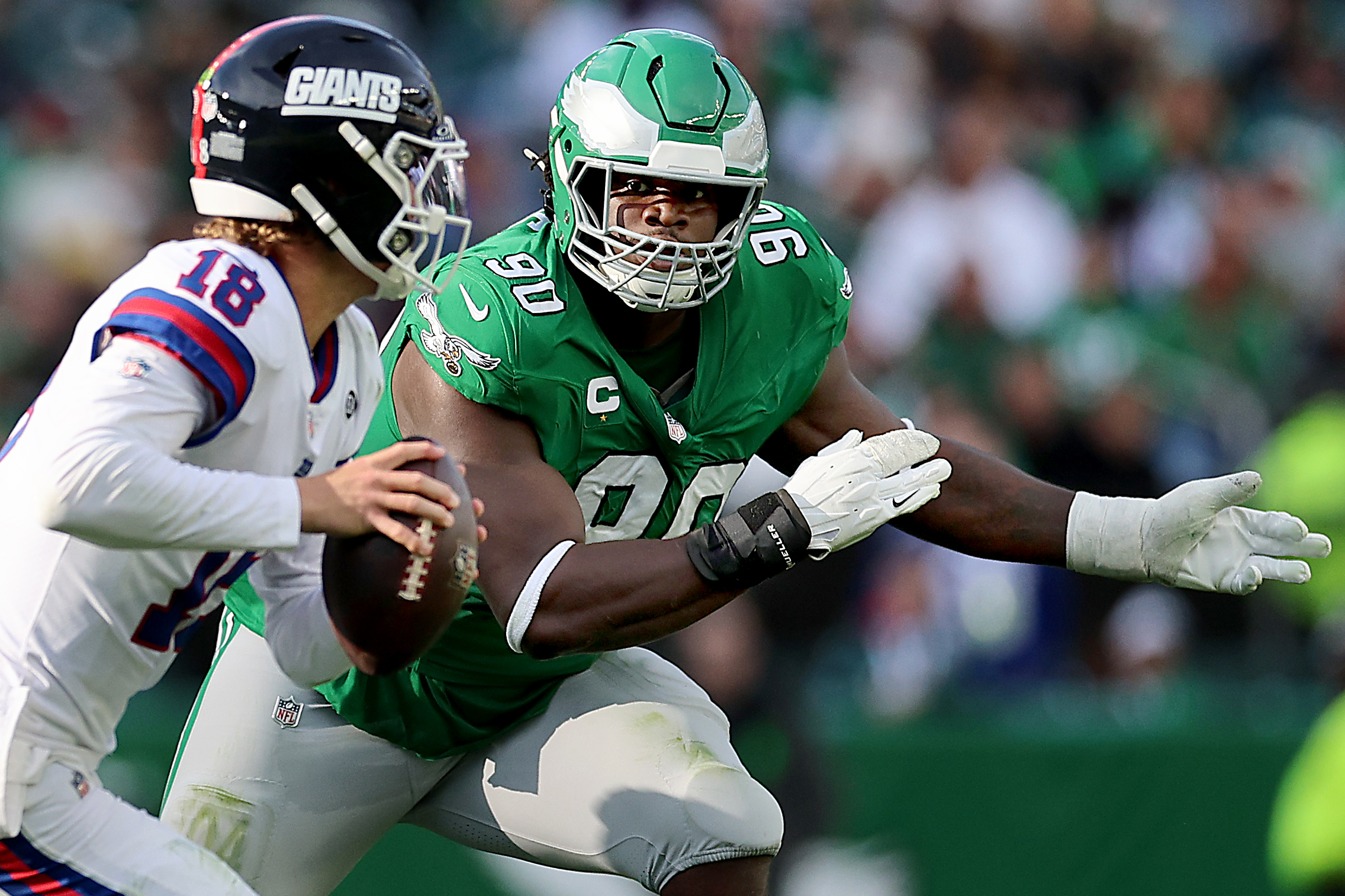
Philadelphia Eagles wide receiver Darius Cooper (left) and quarterback Joe Milton (right) walk off the field after their loss to the New York Giants at Lincoln Financial Field in Philadelphia on Sunday, Nov. 8, 2026. Eagles lose 19-11.David Maialetti / Staff PhotographerPhiladelphia Eagles head coach Nick Sirianni after losing to the New York Giants.Yong Kim / Staff PhotographerPhiladelphia Eagles quarterback Joe Milton III gets sacked on the last play of the game against the New York Giants at Lincoln Financial Field.Yong Kim / Staff PhotographerPass intended for Philadelphia Eagles wide receiver Darius Cooper, defended by New York Giants safety Ar’darius Washington, in the fourth quarter, second to last play of the game.David Maialetti / Staff PhotographerPass intended for Philadelphia Eagles wide receiver Darius Cooper bounces off New York Giants cornerback Greg Newsome II in the fourth quarter.David Maialetti / Staff PhotographerPhiladelphia Eagles wide receiver Makai Lemon can’t hang onto a pass with 26 seconds left in the game against the New York Giants.David Maialetti / Staff PhotographerPhiladelphia Eagles wide receiver DeVonta Smith (center – in sweats) watches the game injured, during the fourth quarter at Lincoln Financial Field.David Maialetti / Staff PhotographerPhiladelphia Eagles kicker Jake Elliott celebrates his field goal with Philadelphia Eagles offensive tackle Jordan Mailata during the fourth quarter.David Maialetti / Staff PhotographerPhiladelphia Eagles quarterback Joe Milton III slides in front of New York Giants linebacker Micah McFadden.Yong Kim / Staff PhotographerPhiladelphia Eagles fan yawns in the middle of the fourth quarter as the Philadelphia Eagles play the New York Giants at Lincoln Financial Field.Yong Kim / Staff PhotographerPhiladelphia Eagles cornerback Riq Woolen pulls down New York Giants wide receiver Darnell Mooney after he picks up the first down at Lincoln Financial Field.David Maialetti / Staff PhotographerNew York Giants wide receiver Malik Nabers can’t hang onto the ball in the end zone, being chased by Philadelphia Eagles cornerback Cooper DeJean at Lincoln Financial Field.David Maialetti / Staff PhotographerNew York Giants defensive tackle DJ Reader stops Philadelphia Eagles running back Saquon Barkley for a loss of five yards on the play.David Maialetti / Staff PhotographerPhiladelphia Eagles defensive tackle Jordan Davis tries to bring down New York Giants quarterback Jameis Winston in the third quarter.Yong Kim / Staff PhotographerPhiladelphia Eagles linebacker Nolan Smith sacks New York Giants quarterback Jameis Winston in the third quarter.David Maialetti / Staff PhotographerPhiladelphia Eagles defensive tackle Jordan Davis tries to bring down New York Giants quarterback Jameis Winston in the third quarter.David Maialetti / Staff PhotographerNew York Giants quarterback J.J. McCarthy is slow to get up after he tried to run the ball himself in the third quarter.David Maialetti / Staff PhotographerPhiladelphia Eagles quarterback Joe Milton III falls back, resulting in a sack in the third quarter.Yong Kim / Staff PhotographerNew York Giants quarterback J.J. McCarthy takes a hit from Philadelphia Eagles linebacker Zack Baun in the third quarter.Yong Kim / Staff PhotographerPhiladelphia Eagles wide receiver Darius Cooper tries to get by New York Giants safety Ar’darius Washington after making a reception in the second quarter.David Maialetti / Staff PhotographerPhiladelphia Eagles running back Saquon Barkley falls short of the first down on 4th and 1 yard with less than two minutes left.David Maialetti / Staff PhotographerPhiladelphia Eagles defensive tackle Jordan Davis and Philadelphia Eagles defensive tackle Jalen Carter sack New York Giants quarterback J.J. McCarthy in the second quarter.David Maialetti / Staff PhotographerPhiladelphia Eagles linebacker Zack Baun stops New York Giants quarterback J.J. McCarthy in the second quarter at Lincoln Financial Field on Sunday, Nov. 8, 2026, in Philadelphia, PA.David Maialetti / Staff PhotographerPhiladelphia Eagles linebacker Zack Baun stops New York Giants quarterback J.J. McCarthy in the second quarter.David Maialetti / Staff PhotographerPhiladelphia Eagles quarterback Joe Milton III tries to throw a pass on 3rd and 2 but pass is incomplete at Lincoln Financial Field on Sunday, Nov. 8, 2026, in Philadelphia, PA.David Maialetti / Staff PhotographerNew York Giants defensive back Andru Phillips and New York Giants linebacker Micah McFadden bring down Philadelphia Eagles wide receiver Makai Lemon during the second quarter.David Maialetti / Staff PhotographerPhiladelphia Eagles wide receiver Makai Lemon first down catch against New York Giants defensive back Andru Phillips and New York Giants linebacker Micah McFadden in the second quarter.Yong Kim / Staff PhotographerPhiladelphia Eagles quarterback Joe Milton III tries to use his legs to pick up a first down but is short during the second quarter.David Maialetti / Staff PhotographerPhiladelphia Eagles linebacker Jalyx Hunt stops New York Giants wide receiver Darnell Mooney on a trick play by the Giants that did not work.Yong Kim / Staff PhotographerPhiladelphia Eagles defensive tackle Jalen Carter deflects the football against New York Giants quarterback J.J. McCarthy in the second quarter.Yong Kim / Staff PhotographerPhiladelphia Eagles running back Saquon Barkley with a first-quarter touchdown run against the New York Giants.Yong Kim / Staff PhotographerPhiladelphia Eagles quarterback Joe Milton III runs the football against New York Giants linebacker Kayvon Thibodeaux in the first quarter against the New York Giants at Lincoln Financial Field.Yong Kim / Staff PhotographerPhiladelphia Eagles quarterback Joe Milton III is pressured by New York Giants defensive tackle Darius Alexander in the first quarter.David Maialetti / Staff PhotographerNew York Giants cornerback Deonte Banks is called for pass interference on Philadelphia Eagles wide receiver Darius Cooper in the first quarter.David Maialetti / Staff PhotographerPhiladelphia Eagles quarterback Joe Milton III does a backflip after punching in a two-point conversion against the New York Giants.David Maialetti / Staff PhotographerPhiladelphia Eagles linebacker Zack Baun stops Giants’ Greg Desrosiers Jr. at Lincoln Financial Field.Yong Kim / Staff PhotographerPhiladelphia Eagles linebacker Jonathan Greenard sacks Giants quarterback J.J. McCarthy during the first quarter.Yong Kim / Staff PhotographerNew York Giants wide receiver Malik Nabers catches a pass during the first quarter, Eagles ‘Kenny Moore II (right) and Philadelphia Eagles safety Andrew Mukuba (left) defend.David Maialetti / Staff PhotographerPhiladelphia Eagles linebacker Jeremiah Trotter Jr. and Philadelphia Eagles safety Marcus Epps against New York Giants running back Devin Singletary, incomplete pass.Yong Kim / Staff PhotographerPhiladelphia Eagles linebacker Zack Baun sacks the New York Giants quarterback J.J. McCarthy at Lincoln Financial Field.Yong Kim / Staff Photographer
Yes, the defense could have won the Eagles another game Sunday, but general manager Howie Roseman failed to roster a viable backup quarterback. The live but wild arm of Joe Milton was not nearly enough to handle the Giants’ formidable defense. Don’t blame “Bazooka” Joe. He essentially is a fifth-string option. Jalen Hurts has blood clots, Andy Dalton stunk, Tanner McKee was winless in the last three games, and the Eagles won’t touch fifth-round rookie Cole Payton.
Milton went 18-for-34 for 169 yards, got sacked seven times, several of them of his own doing. He made some thrilling throws and led the team with 64 rushing yards on nine carries, and the Eagles led, weirdly, 8-6, at halftime, but they netted zero yards in the third quarter and they lost, 19-11.
It’s the second time this season the defense has held an opponent to fewer than 20 points. Both teams, the Giants and the Jaguars, have top-11 offenses. Astonishingly, the Eagles lost both times.
Sirianni was asked, “Nick, why do you think, halfway through the season, the offense has been so difficult to kind of figure out?”
Sirianni deflected for a bit, and he was far from honest, but he knows the truth as well as we do.
Video: Eagles running back Saquon Barkley still remaining optimistic despite seven consecutive losses
First, right tackle Lane Johnson abruptly retired after Game 3. Second, franchise back Saquon Barkley and franchise receiver DeVonta Smith have battled hamstring injuries. Third, Mannion, a first-time coordinator who has been coaching for just three years, is installing a new system and is in way over his head, and Sirianni can’t help him because Sirianni hasn’t mastered the scheme, either. Fourth, 60% of the offensive line is a long-term project.
All of which puts an undue burden on the defense, which, granted, has been far from perfect.
It has allowed 31 “explosive plays,” or plays of 20 yards or more, which is second-worst in the league and far below the Eagles’ standard: They were 18th-worst last season and No. 1 in 2024. They’re in the bottom-10 against the pass and the run and their three interceptions are tied for third-fewest.
Still, they generally give the Birds a chance to win. And, generally, they’re playing better.
Since he was shamed for his effort against the Cowboys three weeks ago, Carter has played to the level of his $152 million contract extension. His sack Sunday gave him five for the season and retained a share of the team lead, and his pancake of right tackle Jermaine Eluemunor left the Giant stunned on the turf.
DeJean, the best nickel corner in the game the previous two seasons, had difficulty adjusting to double duty: He plays safety against two-receiver sets. He’s been much better lately, with four big solo tackles Sunday.
Jonathan Greenard, who landed via trade and signed a $98 million extension this spring, has been hurt, but he logged his first sack Sunday. Nolan Smith Jr. collected No. 5, which is tied with Carter for the team lead.
Eagles defensive tackles Jordan Davis and Jalen Carter sack Giants quarterback J.J. McCarthy in the second quarter on Sunday. David Maialetti / Staff Photographer
Baun has been brilliant for a month. Jeremiah Trotter Jr., sometimes Baun’s wingman and sometimes his understudy, had 10 tackles Sunday, his second start of the season, and 15 a month ago against the Rams in his first start of the season.
Yeah, maybe Trot should start.
The defense has been inconsistent, and even when it’s been good it’s been inconsistent — it allowed three explosive plays Sunday — but lately it has played much closer to expectations.
“I feel like this is something we can build off,” said defensive tackle Jordan Davis, who signed a $78 million extension in March and collected his first full sack Sunday. “We’ve got to make sure we continue that.”
The Eagles honored Merrill Reese at halftime Sunday for his half-century of broadcasting their games, which was appropriate because it felt like their 19-11 loss to the Giants took that long.
Reese has long maintained that he has no desire to retire as the team’s play-by-play voice, of course. But it seems safe to say that, if you had told him in 1996 he’d have had to call this monstrosity 30 years later, he would have stepped away from the job and started practicing to be the golf pro at Blue Bell Country Club while he still had a chance.
The point is, no one, especially the loyal and kelly green-blooded Reese, should have to suffer through what this Eagles season has become. They’re 2-7 and have lost seven straight games, and there were just two mildly reassuring things to remember coming out of their haplessness on Sunday.
One, they have their bye this week, so everyone can engage in more enjoyable autumn activities, like picking apples, going on a hayride, or pouring a cup of hot cocoa down your pants. Two, if the Giants, who are now 5-2-1, really are the best team in the 2026 NFC East, then the 2026 NFC East is the worst division in NFL history, and maybe it won’t take much rebuilding for the Eagles to return to contention sometime soon.
The Giants are nothing special: They committed nine penalties and struggled to move the ball most of the day themselves. But then, the Eagles are nothing even ordinary. At the moment, just playing somewhat competent football appears beyond their capability. They did not gain a first down in the second half until the fourth quarter was more than halfway finished. They started a quarterback, Joe Milton, whom they signed just three weeks ago; it took him until the game’s final two minutes to surpass 100 net passing yards. On his first play, he false started. He also was sacked seven times — a figure in line with the general confusion that has been the defining feature of the Eagles’ offensive line all season — including once by Giants linebacker Arvell Reese on a hit so clean and brutal that it called to mind Lawrence Taylor freight-training Ron Jaworski in the mid-1980s.
“We just want to be on the same page,” center Drew Kendall said. “I don’t think any of us were.”
Braden Mann, who earlier had provided the Eagles’ best moment Sunday when he uncorked an 86-yard punt, dropped a snap and commenced with the game’s most comical sequence: picking up the ball, scurrying to his left, and, while on the run, booting it out of bounds.
Sean Mannion went a long way to answering the question, Is the big problem with the Eagles’ offense the players or the coordinator? On an important fourth-and-1 call, he had Milton line up in the shotgun and hand the ball to Saquon Barkley on a slow-developing run-pass option play. It lost yardage.
When Jameis Winston, who stepped in at quarterback when J.J. McCarthy left briefly with an injury, found tight end Isaiah Likely alone in the end zone for a 5-yard touchdown, three Eagles defenders clustered in the center of the field, the trio appearing puzzled over who was supposed to have covered Likely. Linebacker Jeremiah Trotter Jr. seemed to take the blame, so at least that mystery was solved. On the last play of the game, in a situation where every team at every level of football plays it safe, the Giants blitzed. They blitzed. And they sacked Milton, because of course they did, because the Eagles never offered a reason all day to think the Giants wouldn’t sack Milton there.
GIANTS WIN! For the first time in 13 years they win in Philadelphia!! 7 sacks on the day for the defense! pic.twitter.com/UDP3eQ4iyH
“Hard to be positive,” tackle Jordan Mailata said, “when you play like that.”
Too true, Jordan. This is bad, as bad as everything around and about the Eagles has been in years. Mark Twain is supposed to have said that comedy is just tragedy plus time. Sorry, in light of Sunday, there was no sense waiting. All the possible lamentations for this Eagles season have been used up. Jalen Hurts’ blood clots, the void left by Jeff Stoutland’s departure, Nick Sirianni’s future, the injuries, Howie Roseman’s subpar decisions during the offseason, the excruciating end of that Jacksonville game last month: Those sad and serious topics have all been covered.
Sirianni tried to avoid or downplay the necessary questions about whether he’ll make any changes to his coaching staff during the bye. “I don’t think you change just to change,” said a head coach who has had three quarterbacks start and four take snaps for him in nine games. Reese capped his broadcast by wondering aloud what the Eagles might do at Tuesday’s trade deadline. There’s nothing else left to wonder. Might as well get jokey. We’re gonna need some laughs to get through the next two months.
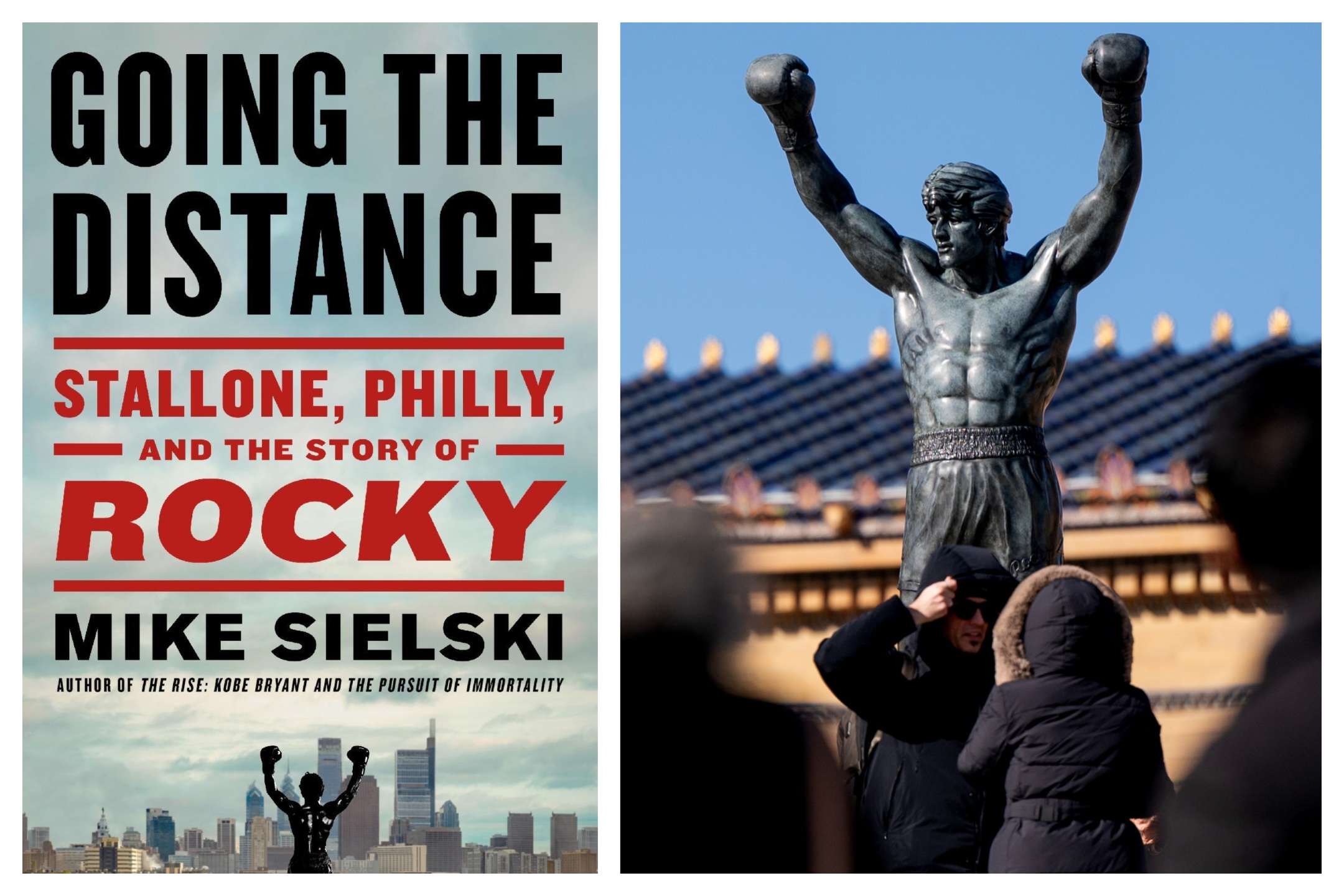
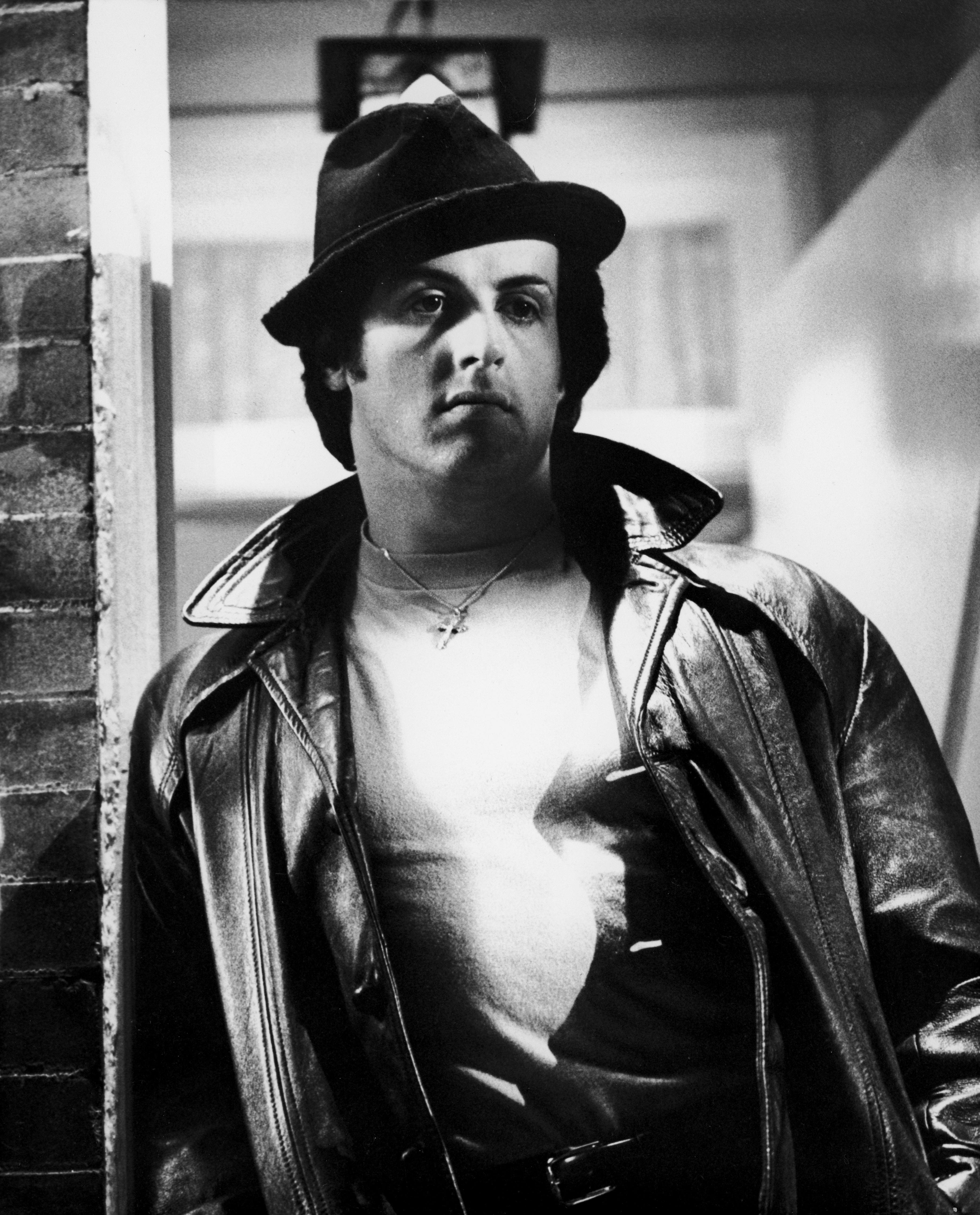
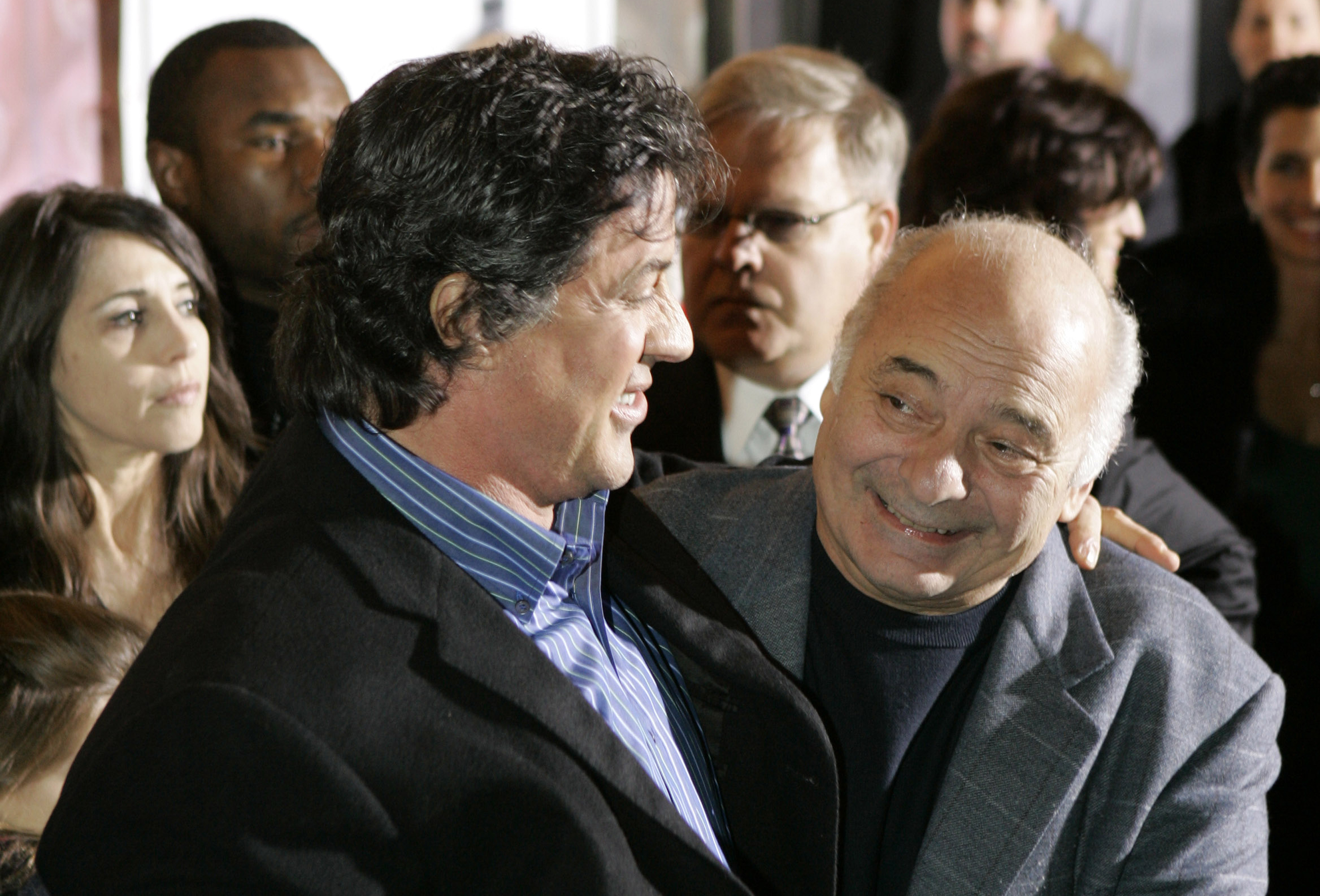
In this excerpt from his new book, “Going the Distance: Stallone, Philly, and the Story of ROCKY,” Inquirer sports columnist Mike Sielski describes the stakes and risks that Sylvester Stallone faced as he, the cast, and the crew began filming the movie. “Going the Distance” will be available Tuesday, Nov. 10, wherever books are sold.
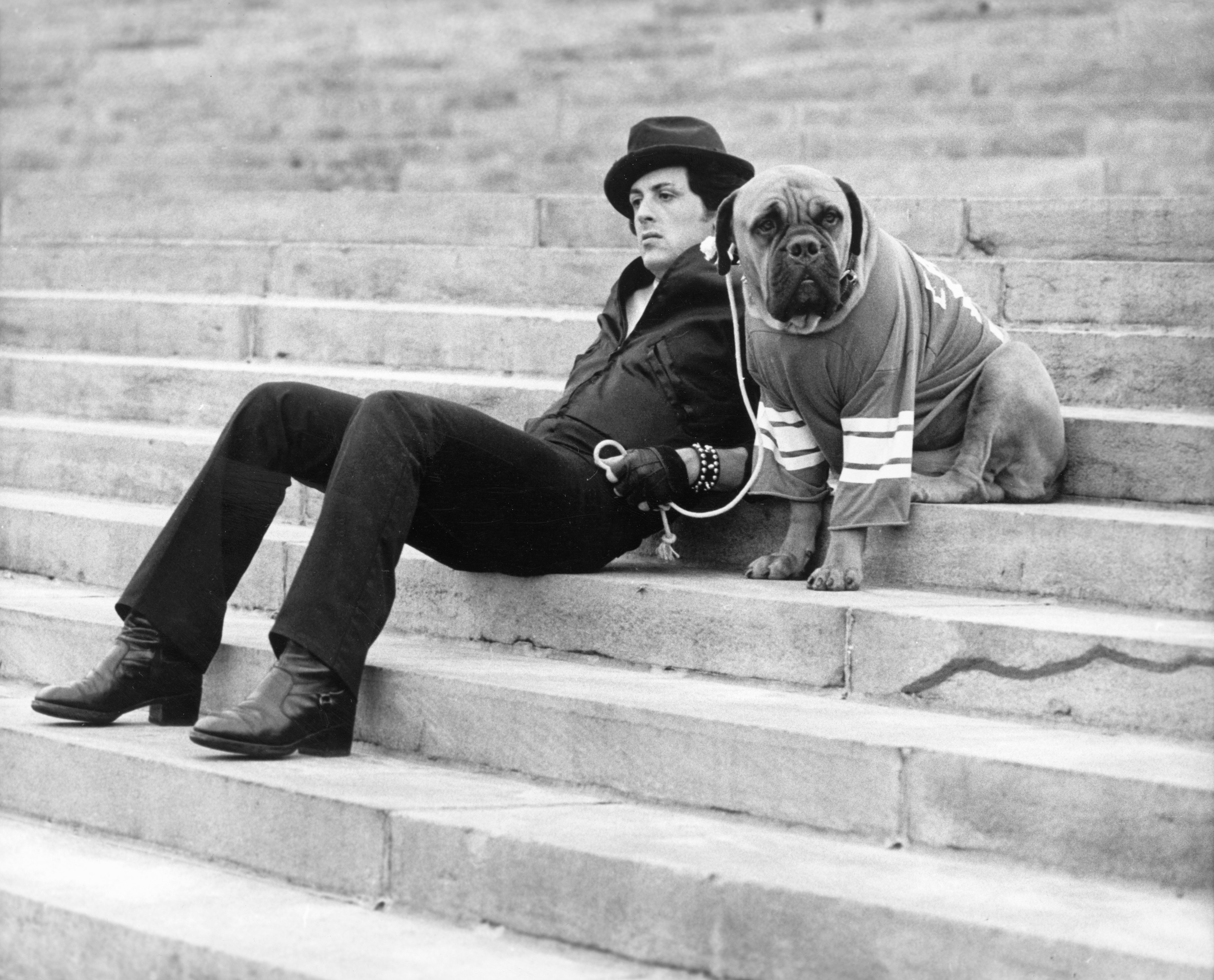
Sometime before he climbed aboard a train for the cross-country trip from Los Angeles to Philadelphia in December 1975, crowding into a tiny car with his pregnant wife and his rambunctious bull mastiff, Sylvester Stallone had decided to stop eating bread.
He had written a screenplay that, by a combination of serendipity and his sheer will, was about to be made into a movie, Rocky, the filming of which would begin in just a matter of days — a matter of hours, really — once the train pulled into 30th Street Station. Stallone had more at stake in the project than anyone else involved in it, including the producers who were on the hook for some of the film’s funding. They stood to lose money. He stood to lose his entire career, to destroy his reputation, to make himself into a fool, to cast himself as a cautionary tale to all the young Hollywood aspirants in his wake, to have his name become synonymous with failure. You don’t want to be another Stallone, do you? All that risk, so much riding on a chance he might never have again, all because he had remained resolute that he and he alone — not James Caan, not Burt Reynolds, not Ryan O’Neal, not any actor who, unlike Stallone, was at all familiar to America’s mainstream moviegoing public in the mid-1970s — would play the title character: Rocky Balboa, a lovable, lunkhead boxer who gets an improbable shot at the heavyweight title, falls in love, and earns some self-respect.
His insistence on playing Rocky, his intractable belief that only he could, had compelled him to turn down several lucrative and potentially life-changing offers for the rights to the script. Just step out of the way, Sly, and you’ll be a quarter million dollars richer. No. It had to be him; he would accept less money and greater risk for the freedom to do justice (as he saw it) to the film and its protagonist, to oversee the process of creating Rocky and Rocky, to ensure they would turn out as he and no one else envisioned them. It was the only way, he believed, that the movie would succeed … and the only way that he could live with himself afterward. His efforts on the project had to be all-encompassing.
American actor Sylvester Stallone leans against a doorway in a hat and a leather jacket in a still from the film, ‘Rocky,’ directed by John G. Avildsen, 1976.Getty Images
To prepare for the role, for instance, he had put himself on a strict diet: all shrimp and other shellfish, no carbohydrates. Carbs, Stallone had read, stimulated brain activity. So he reasoned that, by depriving himself of them, he would lower his intelligence level — that he would literally make himself dumber — and make it easier not merely to play Rocky, but to become him.
Already he was walking and talking like Rocky, spontaneously breaking into fits of shadowboxing like Rocky, sniffing like Rocky, as if his nose was always running. Now he would think like Rocky, too … or, more accurately, not think. And even if all his theorizing was bunk, even if his seafood-based attempt at method acting was nonsense, it would at least help him to get into the proper frame of mind for the part. Stallone was confident, though, that his unorthodox diet was working, that he was actually transforming himself into a different person. His evidence? He had, out of nowhere, developed a strange and sudden fondness for country music.
Going the Distance: Stallone, Philly and the Story of Rocky is available Nov. 10 wherever books are sold.Courtesy: St. Martin's Press
Stallone was 29, and he had been virtually anonymous in the film industry for years. Five talent agencies in New York had signed him. All five had dumped him. The others in town hadn’t bothered with him in the first place. A unique case. That was the term he’d hear describing him upon each moment of rejection, upon each decision that the decision-makers made once they heard him deliver his lines and slur his words so badly that they assumed he had a speech impediment, which he did. He was accustomed to bouncing from one audition to another, to having a door shut behind him after four minutes and knowing it would never open for him again. He took whatever acting work he could get, and there wasn’t much of it … if he was lucky to be cast at all. They were bit parts and nothing more: the mugger on the subway, the sidekick who doesn’t say much, the guy in the background. He’d even done a porno film.
Within a year, he would tell a journalist at The New York Times that he and his wife, Sasha, had just $106 in their bank account when they were on that train. It made sense that he would tell someone at The New York Times this, because The New York Times had the readership and reach and credibility to spread the legend of Rocky’s making far and wide. The information in Judy Klemesrud’s profile would be lifted by other writers and media members, repackaged in smaller newspapers and on television stations, and carried from coast to coast on the wire services and even on the wind. The notion that the man behind this beloved movie had just $106 in his bank account when he made the beloved movie was a juicy and dramatic detail, so specific, so telling.
And yet … maybe … in the end, the actual dollar figure was irrelevant, because no matter how much money Sylvester and Sasha Stallone had in their back account as they rode that train, this much was undeniable: Sylvester Stallone was the worst thing to be in Hollywood or in Manhattan or anywhere in the creative arts or anywhere else. He was a man without power.
Philadelphia was an essential character in Sylvester Stallone’s, and Rocky’s, story. Jose F. Moreno / Staff Photographer
Rocky’s world
His selection of Philadelphia as Rocky’s home was no accident. Throughout the 1960s and into the early 1970s, the city embodied the windswept emptiness and gritty industrial decay of a post-modern wasteland: construction machinery idling near high mounds of tan dirt, factory buildings and warehouses once essential and vibrant now abandoned into nothing more than giant stone cubes, skeletal metal bridges bisecting neighborhoods. This was Rocky’s world. This was a world Stallone, who had lived in the city as a youth, knew well. This was a world and a man Stallone could study and place at the center of a compelling story.
Back when he was thirteen, fourteen years old, living in Northeast Philadelphia, Stallone had admired Rocky Marciano — “I had written this with Rocky Marciano in mind, 100%,” he said in an email — and had hung around with a kid named Johnny Robert. Johnny Robert had a hair-trigger temper, got into his share of scuffles. These experiences were formative for the greatest product of Stallone’s imagination. The character’s official name, as would be revealed in the film’s first sequel, was “Robert Balboa.” His nickname was a throw-in, a byproduct of his intrinsic traits, an indication of his toughness. As far as Stallone was concerned, there was no such thing, could be no such thing, as a smooth, gifted fighter named Rocky.
This was a character, Stallone thought from the beginning, who could be used for social commentary — put him in particular situations, see how he acts and reacts, see how viewers react to the reaction, how they might see themselves in the character, how they might see who they are and, more importantly, who they want to be. This was a character who could fall in love — and that’s how Stallone saw Rocky, not as a boxing movie, not as a sports movie at all, but as a love story between Rocky and Adrian — and who, more importantly, would have the people in the studio rooting for him to fall in love. A character who connected with that audience, with any audience, with every audience, because every audience wanted to believe in miracles, wanted to be inspired or moved or transported to a setting that felt raw and real.
“If there was ever a predesigned miracle to take place in this country,” Stallone once theorized, “I think the city it would choose would undoubtedly be Philadelphia. It has that aura of sitting there, waiting patiently for some great cataclysmic event that’s going to rock the nation.”
A character who was out of sync with the era in which he appeared, “a twentieth-century gladiator in a pair of sneakers and a hat,” as Stallone called him. A character who represented a city whose residents believed that few people outside that city, few people anywhere in the country, gave a damn about them. A character who could be the centerpiece of not just this script, not just this film, but a second film, a third, a fourth, more. A character with a backstory that Stallone could flesh out, add to, mold. He could reveal aspects of that backstory to the audience, and he could keep aspects to himself; he once told a friend that he had “a bible in his head about Rocky, from the day he’s born until the day he dies.” This was a character who would endure.
“Rocky isn’t based on me,” he told The New York Times in November 1976, a week after the film had opened. “But we both went the distance.”
The bet Sylvester Stallone made on himself in respect to the Rocky film would pay lifelong dividends. Getty Images
A moment of truth and transformation
Stallone rose before dawn on December 5 in South Philadelphia to temperatures that were below freezing. The first day of shooting promised unseasonably warm weather, sunny, in the fifties, but not at 4 a.m., when Mike Westmore, the film’s makeup artist, knocked on Stallone’s door at the Hilton Inn to do him up for the first scene: Rocky’s first true training session, the run from City Hall to the steps of the Art Museum that would leave him exhausted and aching.
Soon, the trailer, the cast and crew’s only trailer, was slowing to a stop at a curb near the shoot site. Inside, Stallone asked everyone to go outside and give him a few minutes alone. He stared at himself in a mirror hanging near the door — a stocking cap on his head, a dirty sweatshirt covering his chest, the makeup blending so fully into his face that it appeared his eye really did have a scar jutting across it, that he no longer knew where he ended and the underdog hero he had made began.
All right. This is it, Sylvester. You’ve bluffed and bullied and badgered your way here. Are you going to do it? Or are you going to sit here and become a bum for the rest of your life?
One of the assistant directors knocked on the trailer’s door. OK, Sly, we’re ready.
Stallone turned away from the mirror. You got the wrong guy. Sly’s in California. Rocky. Call me Rocky.
Actor Burt Young (right), pictured with Sylvester Stallone in 2006, was considered a vital piece of the film’s casting. Matt Rourke
Outside the trailer, John Avildsen, the film’s director, lay in a nearby gutter, the wind picking up trash and specks of dust in its swirl, and peered through a viewfinder to line up the shot. Burt Young, who was playing Paulie — Rocky’s friend and Adrian’s brother — watched Stallone step out of the trailer and take a fragile sigh. Young had been the one cast member, above any of the others, whom Stallone, Avildsen, and the producers had to have in the movie, a respected character actor so perfect as Paulie that Rocky would have been a dud with anyone else in the role. Young admired Stallone, thought the script he had written was a piece of urban poetry, eloquent and blunt. The two of them shared a silent glance. “He remembers it as I remember it,” Young said later. “‘Let’s cut out the talk. Now it has to happen.’ Then he went on like a soldier.”
One of the most remarkable stories in American film history was about to enter its next chapter. Nothing was secure. Everything might yet be lost. Sylvester Stallone strode toward the set. The clock atop City Hall shone like a sun amid the last remnants of night.