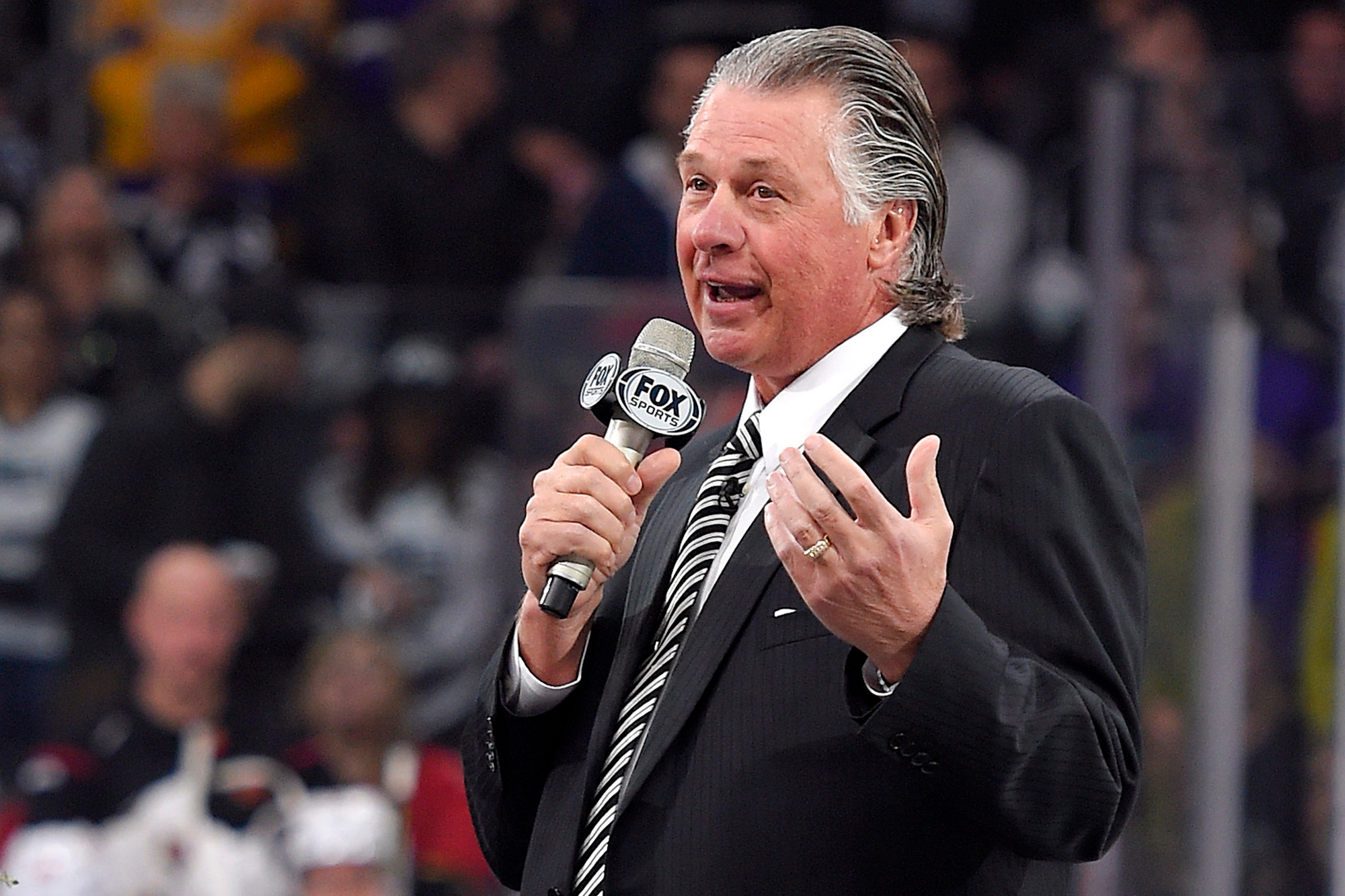
Barry Melrose, a hockey player-turned-coach who led the Los Angeles Kings to the 1993 Stanley Cup Final before going on to a long career in broadcasting the sport, has died. He was 70.
ESPN announced Melrose’s death Wednesday after his wife informed the network.
“From the flowing locks of his distinctive mullet to the flared lapels of his trademark long suit coats, Barry Melrose cut an unmistakable figure whenever you were fortunate enough to run into him at a rink or catch him on your television screen,” NHL Commissioner Gary Bettman said. “You were even more fortunate if you engaged him in conversation or listened to his analysis because he never failed to boost your love of the game of hockey.”
Melrose stepped away from his analyst role in 2023 after being diagnosed with Parkinson’s disease. Wayne Gretzky at the time said Melrose was “bigger than any team.”
Melrose had a relatable everyman’s broadcasting style, bringing a sense of humor to his insights, and was easily recognized by his goatee and slicked-backed hair.
“For decades, Barry Melrose was one of the most distinctive and trusted voices in hockey,” ESPN said in a statement. “His knowledge of the game was deep, his candor was refreshing and his passion was unmistakable.”
From rural Kelvington, Saskatchewan, Melrose broke into pro hockey with the Cincinnati Stingers of the now-defunct World Hockey Association in 1976. He played three seasons in Cincinnati — the last teaming with a young Mark Messier — and, following the WHA’s demise, made the transition to the NHL with Winnipeg in 1979.
Melrose went on to play for Toronto and Detroit, where he closed his career following the 1985-86 season.
He finished with 10 goals and 33 points and 728 penalty minutes in 300 career NHL regular-season games, and he skated in seven more in the playoffs. His WHA totals were five goals and 32 points and 343 penalty minutes in 178 games with Cincinnati.
Melrose turned to coaching and led the Adirondack Red Wings to win the American Hockey League Calder Cup championship in 1992.
The following year, Melrose was hired by the Kings, where he brought a sense of colorful flare and instant success to Los Angeles. In his rookie season, he coached a Kings team that featured Gretzky to make a memorable playoff run. They reached the final before losing to Montreal in five games.
Melrose finished with a record of 79-101 and 29 ties over two-plus seasons in L.A. before being fired midway through the 1994-95 season.
He was hired by ESPN in 1996 and left broadcasting for what became a brief stint coaching the Tampa Bay Lightning in Steven Stamkos’ rookie season in 2008-09. Melrose was fired 16 games into the season following a 5-7-4 start and returned to broadcasting.
Melrose also was known for his long-ball hitting prowess in fast-pitch softball, joining fellow Kelvington-area NHL players Wendel Clark, Joey Kocur, Kelly Chase and Kevin Kaminski and others in the offseason in Saskatchewan to form what some call the “the toughest team there ever was.”
After a second-round appearance in the 2026 Stanley Cup playoffs, the Flyers will aim to continue their upward trajectory, fielding a similar roster to last season.
Still one of the youngest squads in the NHL, the second year of the Rick Tocchet era will begin with high expectations as youngsters Porter Martone, Alex Bump, Denver Barkey, and David Jiříček look to make their mark, while Matvei Michkov has his sights set on a bounce-back season in the last year of his entry-level contract.
Here’s everything you need to know about the Flyers’ 2026-27 training camp and preseason.
The Flyers will hit the ice for the first time bright and early next Thursday at their training center in Voorhees.
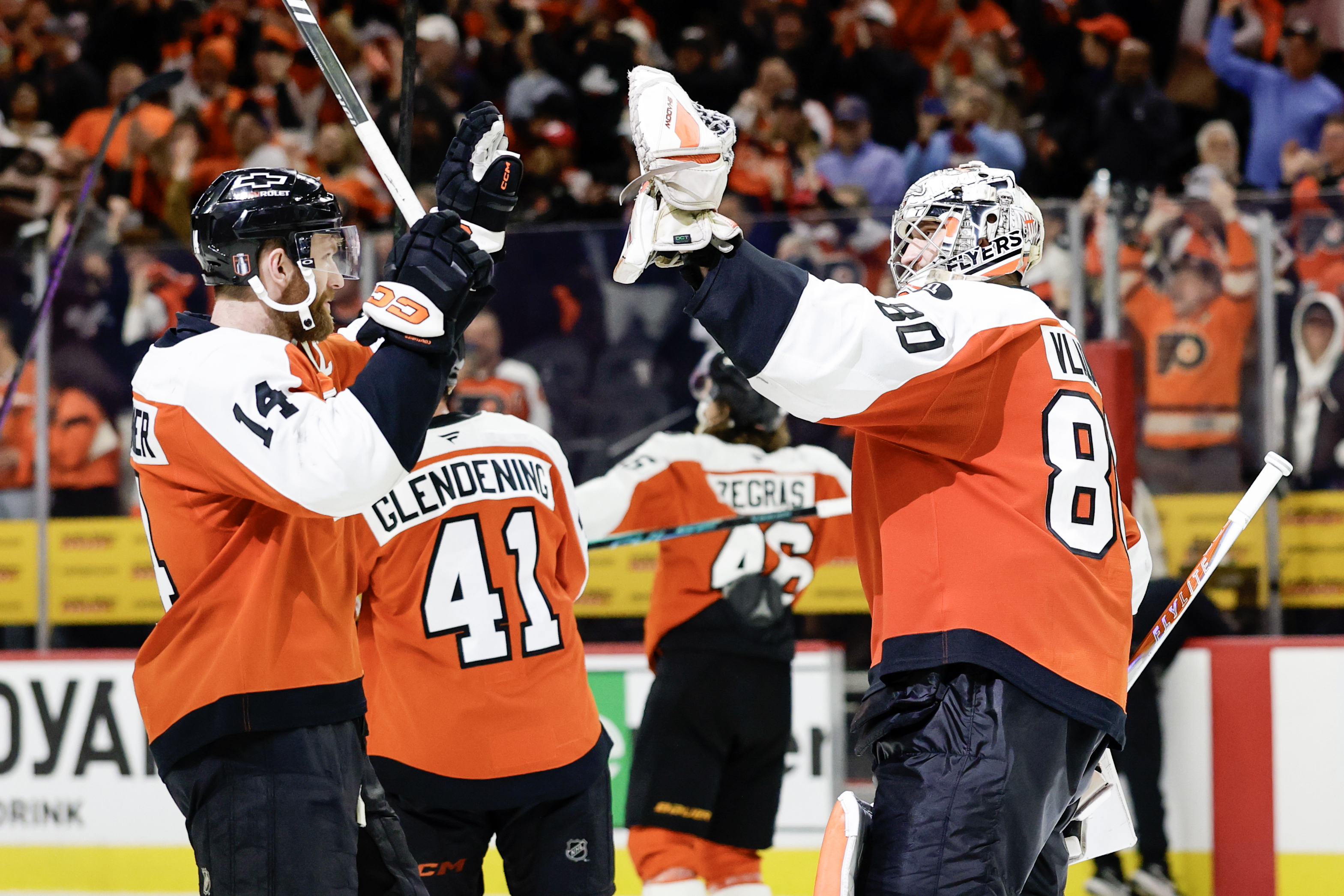
It is a new era with the preseason shortened and the NHL kick-starting things on Sept. 29. Training camp will run through the final preseason game on Sept. 26, when the Flyers host the Washington Capitals at Xfinity Mobile Arena. They lift the lid on the season on Sept. 30 at home, hosting the Pittsburgh Penguins (7:30 p.m., TNT, truTV, HBO Max) in a rematch of their first-round series, which the Flyers won in six games.
What is the training camp schedule in Voorhees?
The Flyers will be broken into three groups: Groups A, B, and C to start camp, with groupings expected to be disclosed next week. They will not skate on Sept. 20, 25, or 28, and the timing for practice on Sept. 27 will be announced at a later date. No morning skate is scheduled for Sept. 26, with the game at 5 p.m., and there is not a nongame group listed, which suggests that the last preseason game will feature most of the final roster.
All on-ice sessions are free and open to the public.
^Groups A and B will skate on opposite rinks at 10:20 a.m. and then scrimmage on the Flyers rink at 10:40 a.m.
Which Flyers will be at training camp?
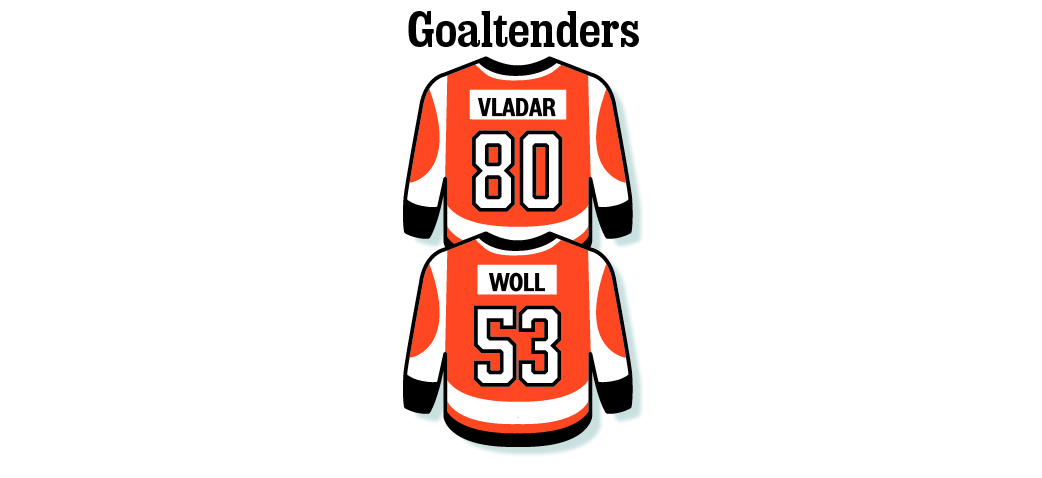
With a shortened camp, the number of invitees has been trimmed. Last season, 33 forwards, 18 defensemen and seven goalies were in camp. This year it will be 26 forwards, 16 defensemen, and four goalies, with Dan Vladař and Joseph Woll expected to suit up for the Flyers and Aleksei Kolosov and Carson Bjarnason slated to be the tandem for Lehigh Valley of the American Hockey League.
Usually, the main camp sees some junior players stick around; however, as of Wednesday, everyone but Maksim Sokolovskii, the Flyers’ first-rounder from June, will be sent back after rookie camp. Because the 6-foot-7 defenseman, who has looked impressive in preseason games for London of the Ontario Hockey League, is an unsigned Canadian Hockey League player selected in the first three rounds, he can remain with the Flyers until the start of their season. It will not impact his NCAA eligibility with the University of Maine for the 2027-28 season.
Forwards (26): Noel Acciari, Zach Aston-Reese, Denver Barkey, Alex Bump, Noah Cates, Sean Couturier, Christian Dvorak, Tyson Foerster, Nolan Foote, Jacob Gaucher, Nikita Grebenkin, Carl Grundström, Devin Kaplan,Danila Klimovich, Cole Knuble, Travis Konecny,Jett Luchanko, Porter Martone, Matvei Michkov, Noah Powell, Jack Studnicka, Riley Thompson, Owen Tippett, Garrett Wilson*,Zayde Wisdom*, Trevor Zegras
Let's play some hockey. 👊
The 2026 Training Camp roster and schedule are here!
A shortened preseason also brings fewer games. The Flyers will play four preseason games, including a game against Washington at the home of the Capitals’ American Hockey League affiliate, the Hershey Bears, on Sept. 21.
According to assistant general manager Brent Flahr, Brek Liske, the Flyers’ first of two second-round picks in the 2026 NHL draft, has some “swagger.”
Maybe that swagger rubbed off on Luke Vlooswyk because, as the defenseman spoke to The Inquirer in late June at development camp, he made a bit of a guarantee.
“I think we’ll be the best D pair in the league next year,” the Flyers’ 2025 fifth-rounder confidently told The Inquirer at development camp.
Acquired by Everett of the Western Hockey League from Red Deer last January, Vlooswyk, 19, linked up with Liske until the first round of the WHL playoffs when Liske was bumped up to the top pair. Liske, 18, impressed there while slotted alongside projected 2027 No. 1 pick Landon Dupont as the Silvertips made a run to the Memorial Cup final.
With Dupont now teammates with Flyers center prospect Jack Nesbitt at the University of Michigan, Vlooswyk and Liske, who both will participate in Flyers rookie camp this week, are expected to be Everett’s top defensive duo.
“Really well,” Everett coach Steve Hamilton said when asked how they played together after Vlooswyk was traded to the Washington State-based team.
“We’re very fast [in] the way we play, in the way we pressure, the way we transition, defend,” he added. “We expect our guys to close quickly, and just try to apply the pressure to get the puck back right away, and both of those guys just have an aggressive mindset, and they move pucks well. … We want to transition right away, and anytime we get a change of possession, we want our defensemen to be involved, and both of those guys appreciate that style of play.”
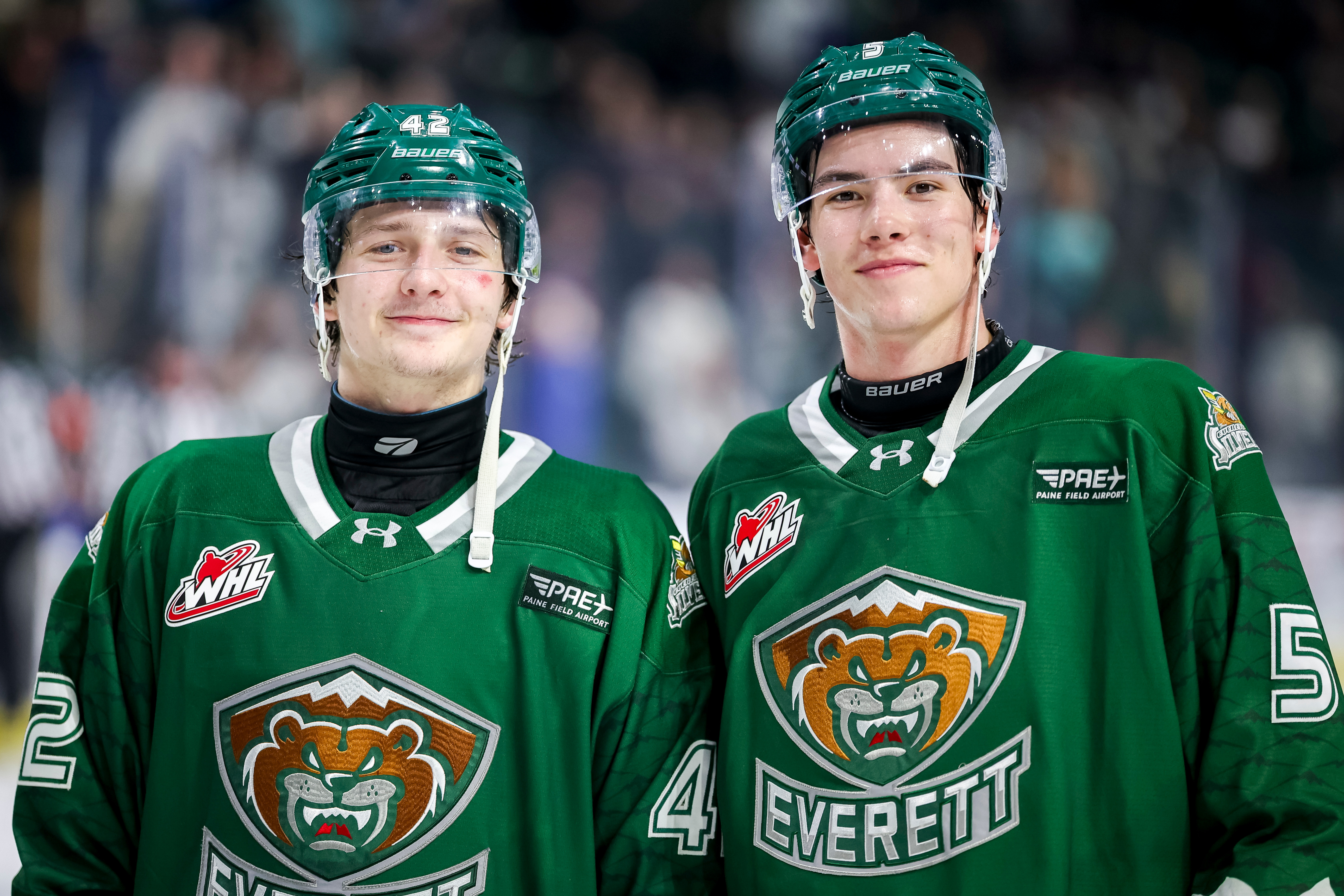
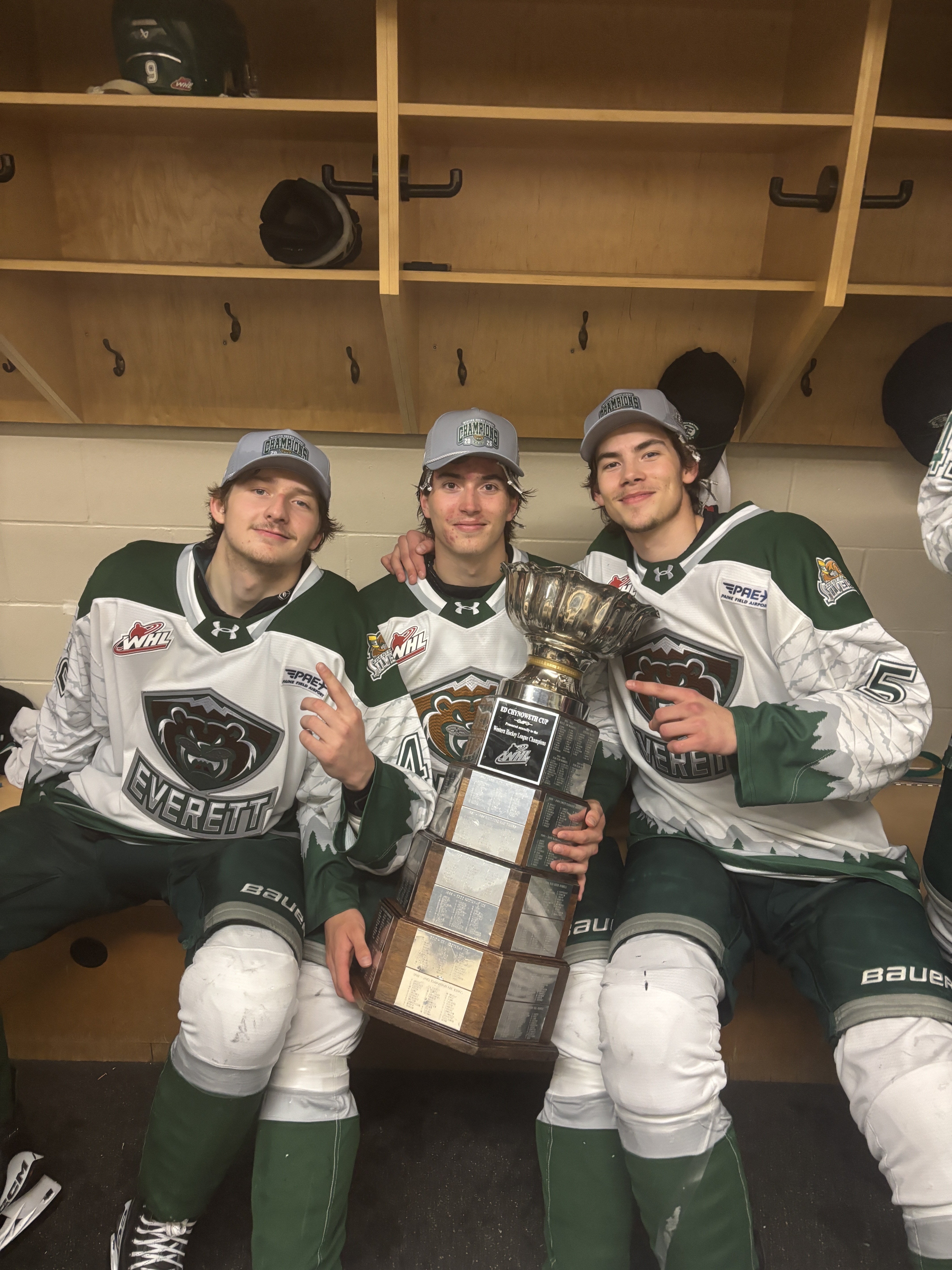
Brek Liske (left) and Luke Vlooswyk (right) celebrate after winning the Western Hockey League championship last season.Courtesy Luke Vlooswyk
The pairing is prototypical. At 6-foot-5, Vlooswyk is the big, stay-at-home, shutdown defenseman with a long reach. The smaller Liske, at 6-1, likes to have the puck on his stick and has a little more offensive pop in his game — he had seven goals and 24 points in 52 games last season.
But the pairing is also unorthodox. It is not a righty-lefty combination, which is what Flyers coach Rick Tocchet typically likes.
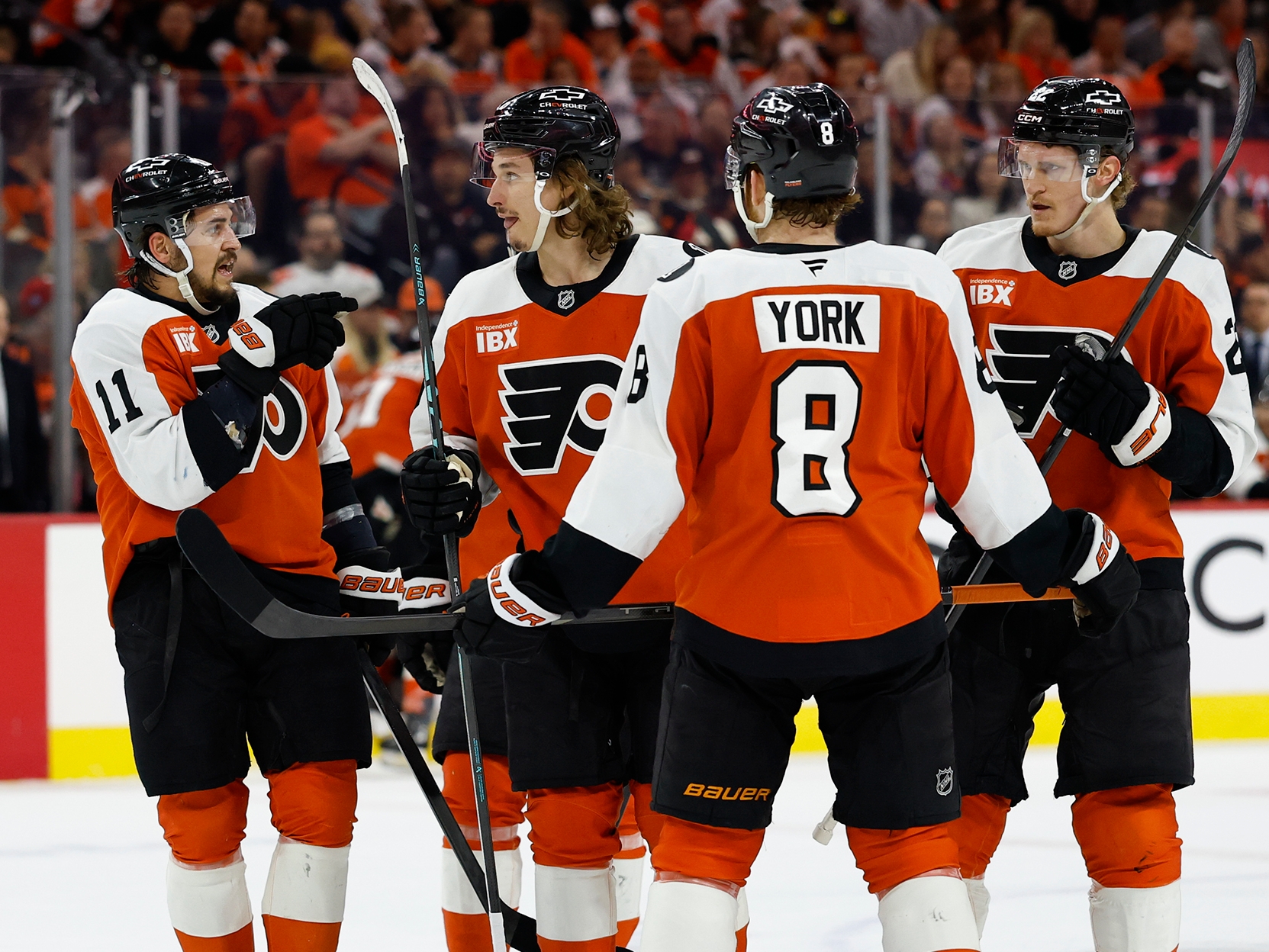
Liske and Vlooswyk are akin to Travis Sanheim and Cam York, two lefties who played together under ex-coach John Tortorella, except Liske and Vlooswyk are both righties. Liske is the one playing the off-side, increasing his versatility à la Sanheim.
“Yeah, it is a big difference, right?” he said at development camp. “A lot of stuff on the backhand. The biggest thing was I just had to learn how to place the puck better, if that makes sense, have it at my hip more. You’re ready to open up instead of being able to just snap it. It’s a little harder, but probably took a couple of games of adjustment and [I] figured it out.”
“I think his defensive identity is helpful,” noted Hamilton about Liske during a phone interview in late June. “He’s very subtle. He’s physical in his own way, but very effective, great stick. And I think ultimately, going forward as an NHL player, that’s probably more going to be his strength. … But, I think he’s got a really good understanding that he can bring things in all areas.
“So, honestly, self-assessment is a skill in itself these days, and he’s got a very good handle on who he is. In terms of growth, as a young player … he’s going to need to continue to work on his skating, and the NHL is the best of the best. I feel like he really moves well at our level, and I know with time and training, and continuing to get stronger, that his skating will be NHL caliber.”
Hamilton sees Liske as a middle-pair blueliner in the NHL, and the kid from Manitoba has a lot of motivation to reach that level — especially with the Flyers. His father, Lonnie, is a massive fan of the Orange and Black, and when the 18-year-old spoke to the media via Zoom after hearing his name called, he was already donning a Flyers jersey.
Flyers second-round pick Brek Liske grew up a Flyers fan due to his dad’s love for the Broad Street Bullies.Jackie Spiegel
“First time I ever met his dad, Lonnie, he said to me, ‘Oh my gosh, I can’t believe my son is D partners with a future Philadelphia Flyer. Like, this is unbelievable,’” Vlooswyk recalled. “And for him to be drafted here now, I can’t even imagine what emotions are running through that family. It’s pretty cool.”
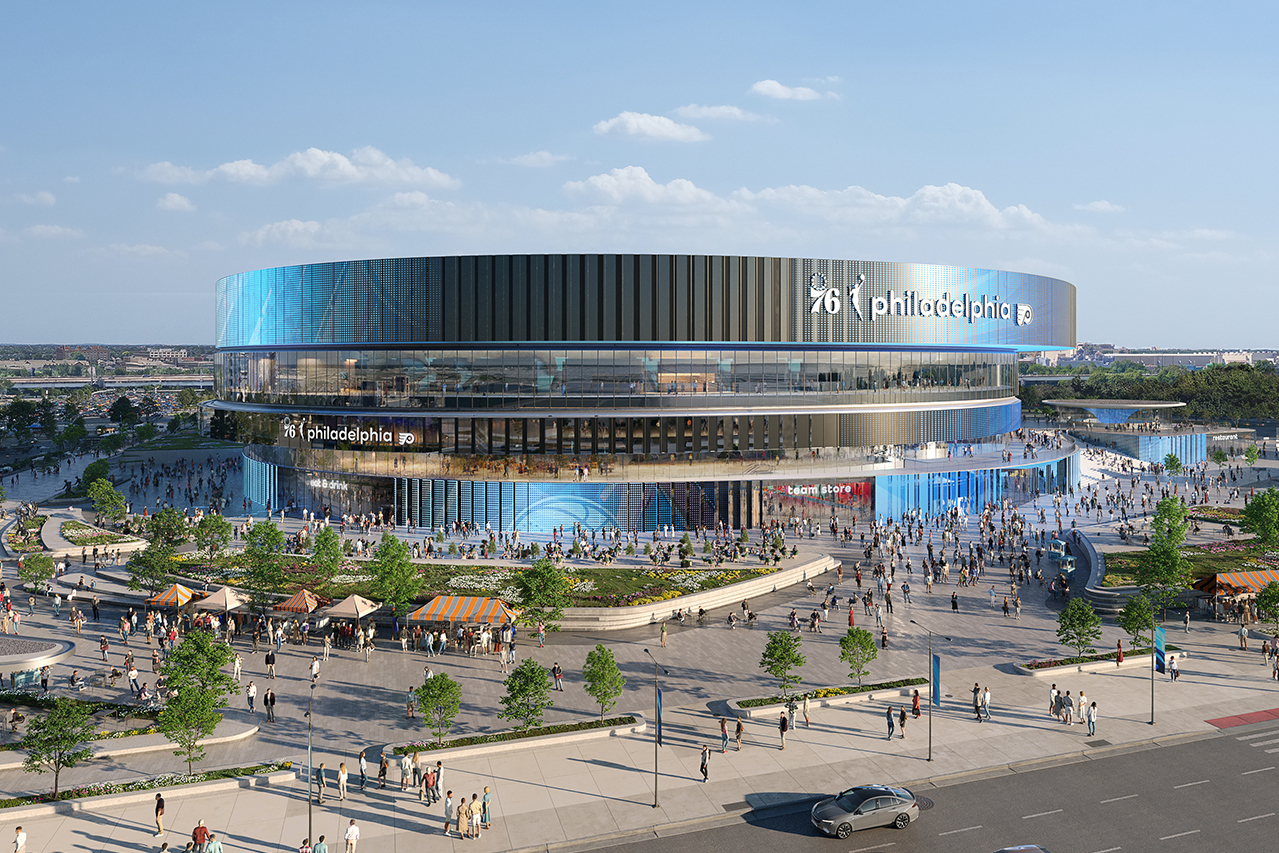
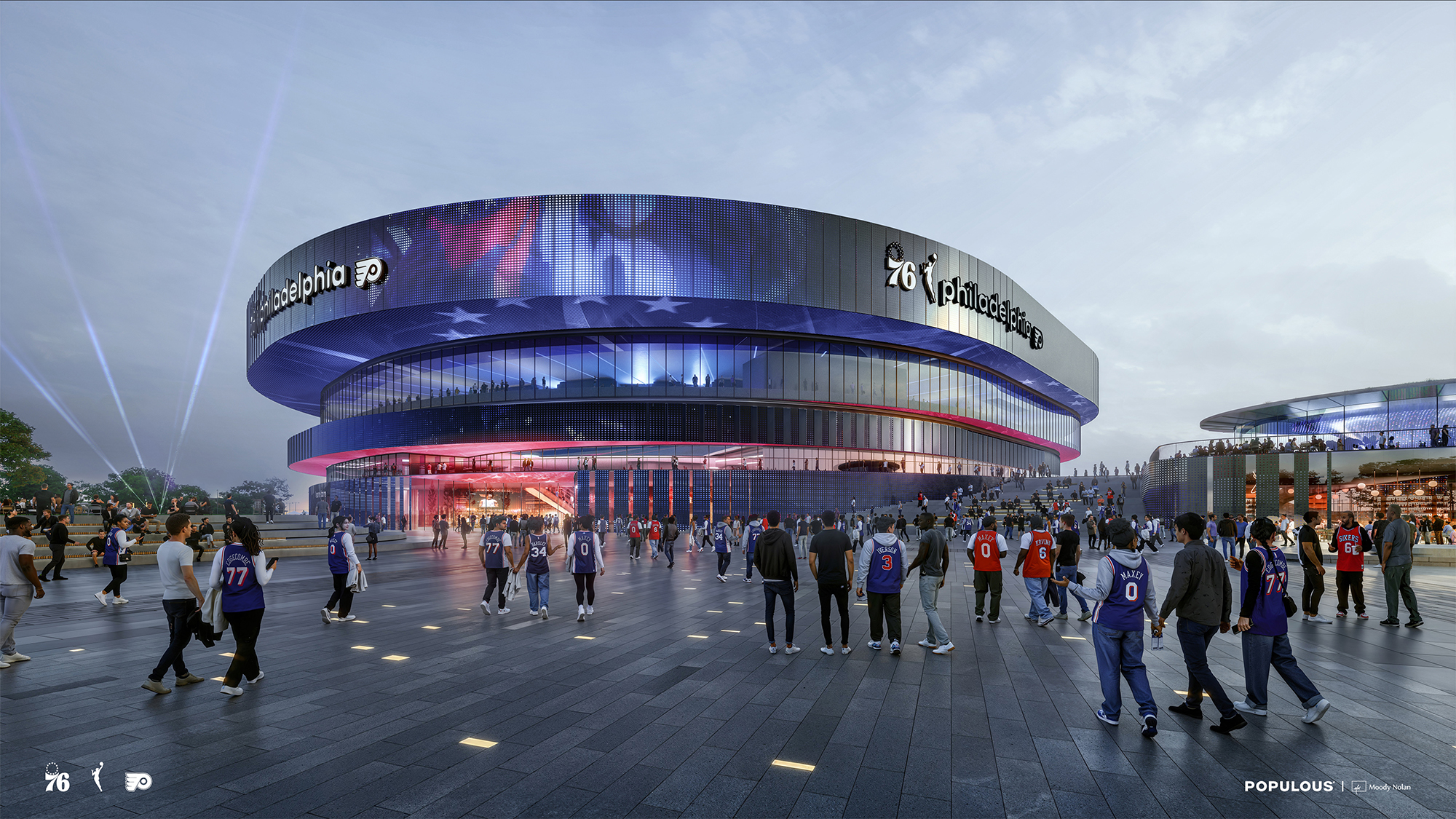
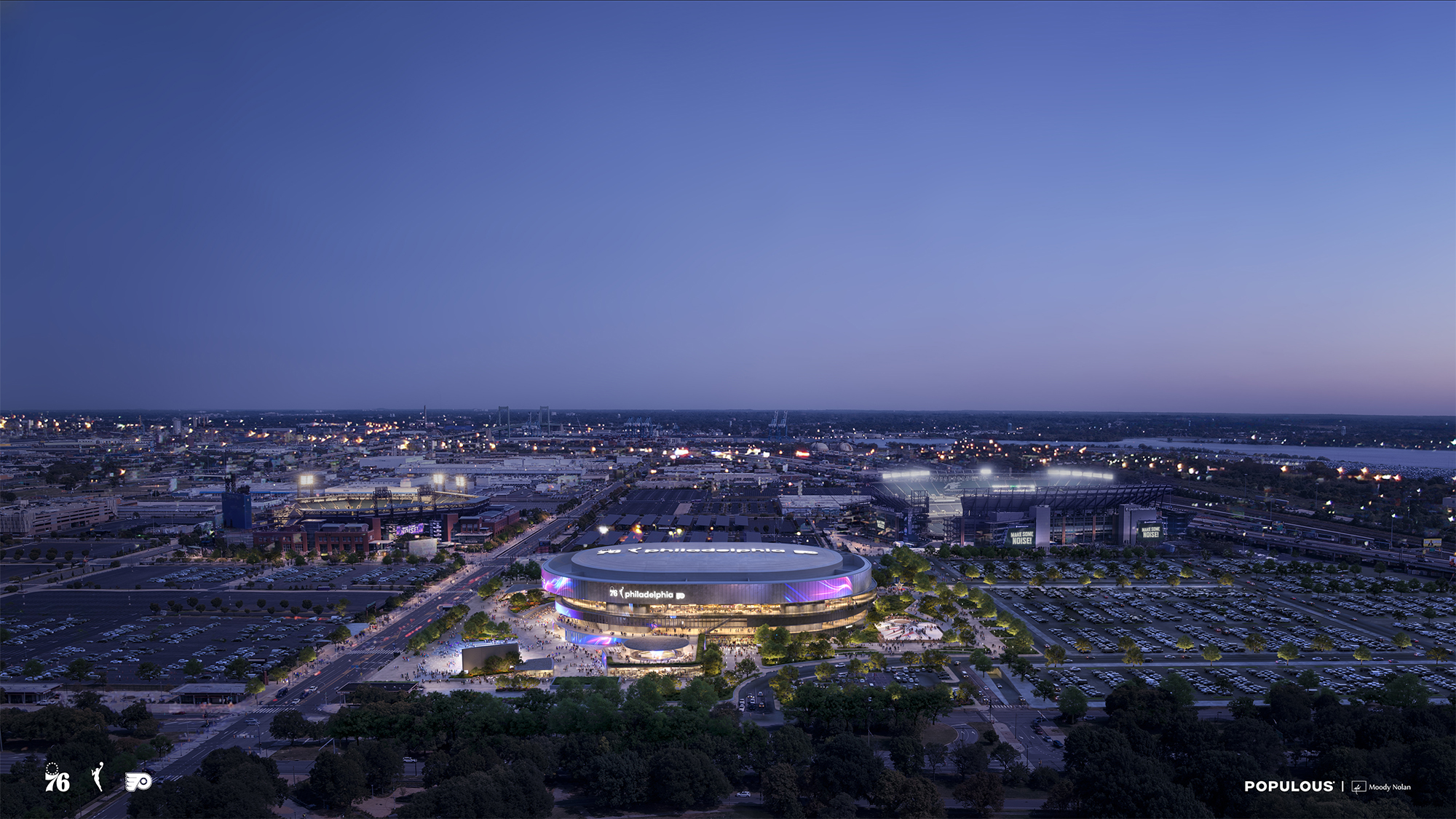
A new home for the 76ers and Flyers is scheduled to open in 2030, and now we have our first glimpse of what the new arena might look like.
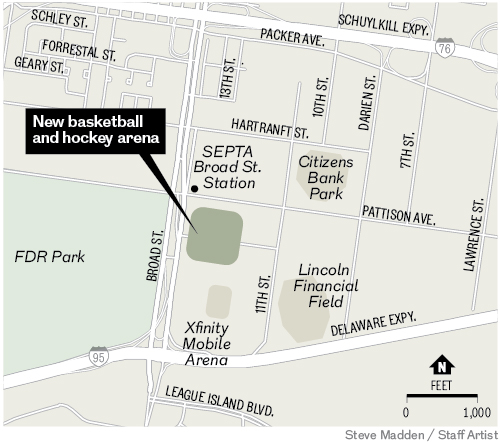
The teams released the first renderings of the privately funded arena Tuesday that will be built at the former site of the Spectrum, next to where Xfinity Mobile Arena sits.
The new design features inspiration from the Spectrum, the former home of both teams from 1967 to 1996. The renderings show the facade will be composed of three stacked and cantilevered “bands,” a nod to the Spectrum’s exterior.
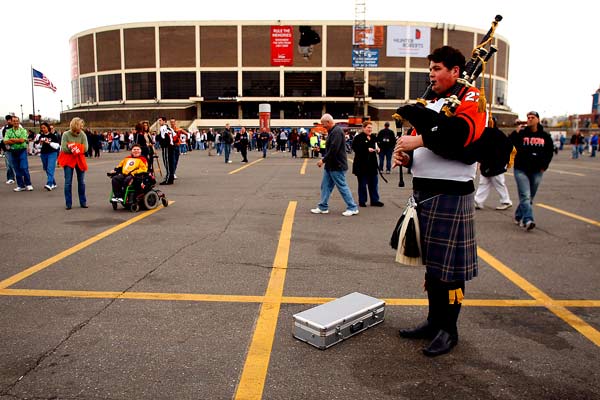
The Spectrum was home of the Sixers and Flyers until 1996. It was demolished in 2010.
“To build our future where Ed Snider and the Spectrum made history makes this project truly special,” Comcast chairman Brian Roberts said in a statement.
A plaza outside the arena will feature over a half-acre of outdoor space. The renderings show an expansive footprint that includes food and beverage pavilions, along with a giant screen outside the stadium.
“The first-look renderings reflect fan feedback and stakeholder input on the arena experience, public spaces and amenities,” the teams said in a statement. “Fan surveys, focus groups, community engagement, and public review will continue throughout the design and approval process.”
Stateside Live!, previously known as Xfinity! Live, sits near the new stadium site on 11th Street and just underwent a $15 million expansion. It is expected to remain open.
The location of the yet-to-be-named new arena. Steve Madden
In addition to the Sixers and Flyers, the arena will also be home to the yet-to-be named WNBA team slated to begin playing in Philly in 2030.
The stadium will be co-owned by Comcast and Harris Blitzer Sports & Entertainment, which owns the Sixers. Comcast owns the naming rights of the new arena but hasn’t announced a name. It’s unclear how much the new arena will cost, but it will be the largest fully privately funded project in the city’s history, according to a Comcast spokesperson.
“Philly fans deserve the best arena in the world, and we are excited to partner with Comcast to deliver just that,” 76ers managing partner Josh Harris said in a statement.
The new arena is scheduled to open in 2030. Courtesy of the Philadelphia 76ers and FlyersHow the new arena might look for Flyers fans arriving for a game. Courtesy of the Philadelphia 76ers and Flyers
The Sixers’ original plan was to build a new $1.3 billion stadium on Market Street in Center City, a contentious idea backed by Mayor Cherelle L. Parker that secured legislative approval in 2024.
Weeks later, the project was canceled after the Sixers struck a deal with Comcast to build a new arena in South Philly.
The new arena still needs regulatory and legislative approval before the start of construction, which is scheduled to begin in the first half of 2027.
Parker’s office did not respond to a request for comment, but the city shared the renderings on social media along with the comment, “Get excited Philly fans!”
Ryan Boyer, the head of the Philadelphia Building and Construction Trades Council praised the project’s job creations. “Beyond the construction jobs themselves, this is the kind of investment that opens doors for new contractors, suppliers, and small businesses throughout the city of Philadelphia.”
That announcement came before the Sixers abandoned their Center City stadium idea and decided to remain in South Philly. For now, the focus is on the new arena.
“We see [this location] as a unique opportunity to connect the retail affiliated with the arena, to the retail that we have in Stateside Live! and the expansion of that effort,” Comcast Spectacor chairman and CEO Dan Hilferty told The Inquirer in April.
Beyond the new retail, restaurant, and outdoor activation space included in the new arena’s plan, there is an opportunity for the four teams (five once the WNBA comes to town) to work together to further develop the sports complex, according to Phillies CEO and managing partner John Middleton.
“Having four major professional sports teams together in one destination creates an energy and sense of community that is unmatched anywhere in the country,” Middleton said, adding the new arena “represents an exciting next chapter for South Philadelphia and creates important opportunities” to realize the potential of the sports comlex space.
The arena is expected to feature an outdoor plaza with food pavillions. Courtesy of the Philadelphia 76ers and FlyersThe new arena will sit in the South Philly sports complex at the former site of The Spectrum. Courtesy of the Philadelphia 76ers and FlyersA renderings also show a giant screen outside the arena. Courtesy of the Philadelphia 76ers and Flyers
Over the summer, Comcast and Harris Blitzer Sports & Entertainment upgraded and donated storefronts for use as pop-up retail stores and other temporary activations to take advantage of the city’s busy calendar.
Last month, the companies extended the leases of four pop-up retail stores along Market Street, and both continue to work with the mayor’s Market East Advisory Committee on a master plan for the corridor, according to a Comcast spokesperson.
The Flyers and goaltenders go together like oil and water. But it hasn’t always been that way.
Original Flyer and franchise icon Bernie Parent backstopped the team to back-to-back Stanley Cups in 1974 and ‘75 with arguably the best two-year run by a goalie in NHL history. But fast forward 51 years, and the Flyers are still waiting to hoist Lord Stanley again, and still searching for a franchise goaltender who can hold a candle to the man that Philadelphians joked saved almost as much as the Lord.
There have been aspirants along the way: Pelle Lindbergh tragically died just as he was entering his prime. Ron Hextall never quite reached the hype of his Conn Smythe-winning rookie season. Future Hall of Famer Sergei Bobrovsky was shipped out in favor of Ilya Bryzgalov, and most recently Carter Hart’s promising start here ended in disgrace.
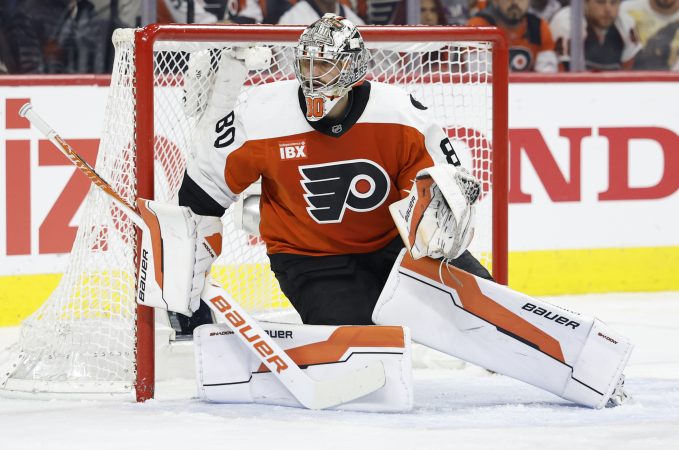
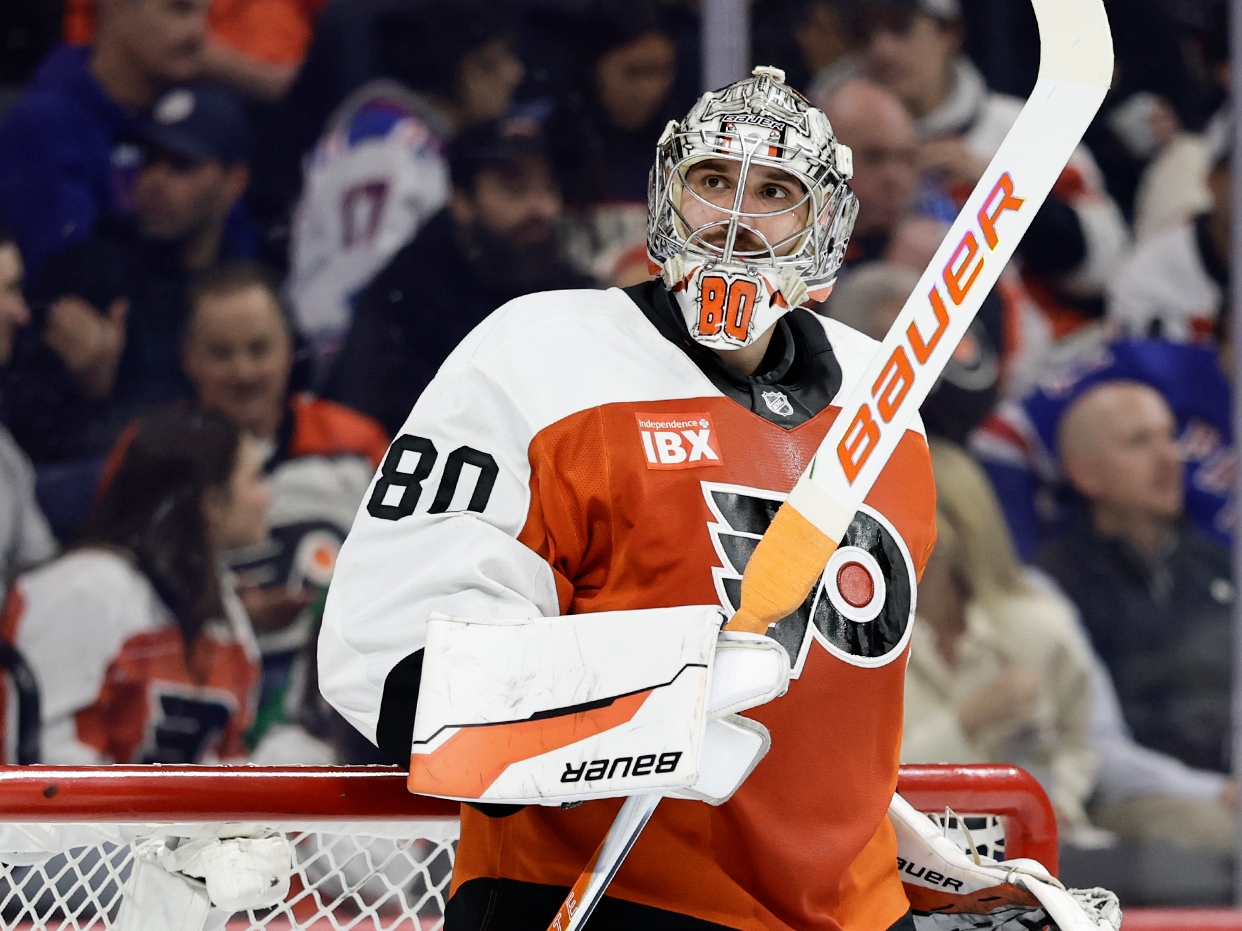
That brings us to the next great hope to solve the Flyers’ longstanding conundrum in the crease: Dan Vladař.
Signed to a two-year, $6.7 million contract before last season, the 29-year-old career backup was a revelation for the Flyers, finishing sixth in Vezina Trophy voting and leading the team to an improbable run to the second round of the playoffs. For his efforts, the Flyers rewarded Vladař this summer with a five-year, $27.5 million extension, one that will pay the Czech netminder through his age-34 season.
Given Vladař’s exploits and the Flyers’ perpetual void between the pipes, you’d have expected his extension to be greeted warmly. Instead, due to his age and short track record, it has become a point of contention among the faithful. Here’s a closer look at Vladař’s new deal and why it was a no-brainer from a Flyers perspective.
Vladař’s the team’s most important player
Why were the Flyers so eager to extend Vladař even with a year remaining on his contract? Well, to start, he was really bleeping good.
Among goalies who started 40 games last season, Vladař ranked third in goals-against average (2.42), tied for eighth in save percentage (.906), was ninth in goals saved above expected (13.8), second in quality start percentage (72.5%), and third in even-strength save percentage (.923). He was even better in the postseason, leading all qualified goalies in save percentage (.922) and ranking second in goals-against average (2.18) and goals saved above expected per 60 (.805), according to Money Puck.
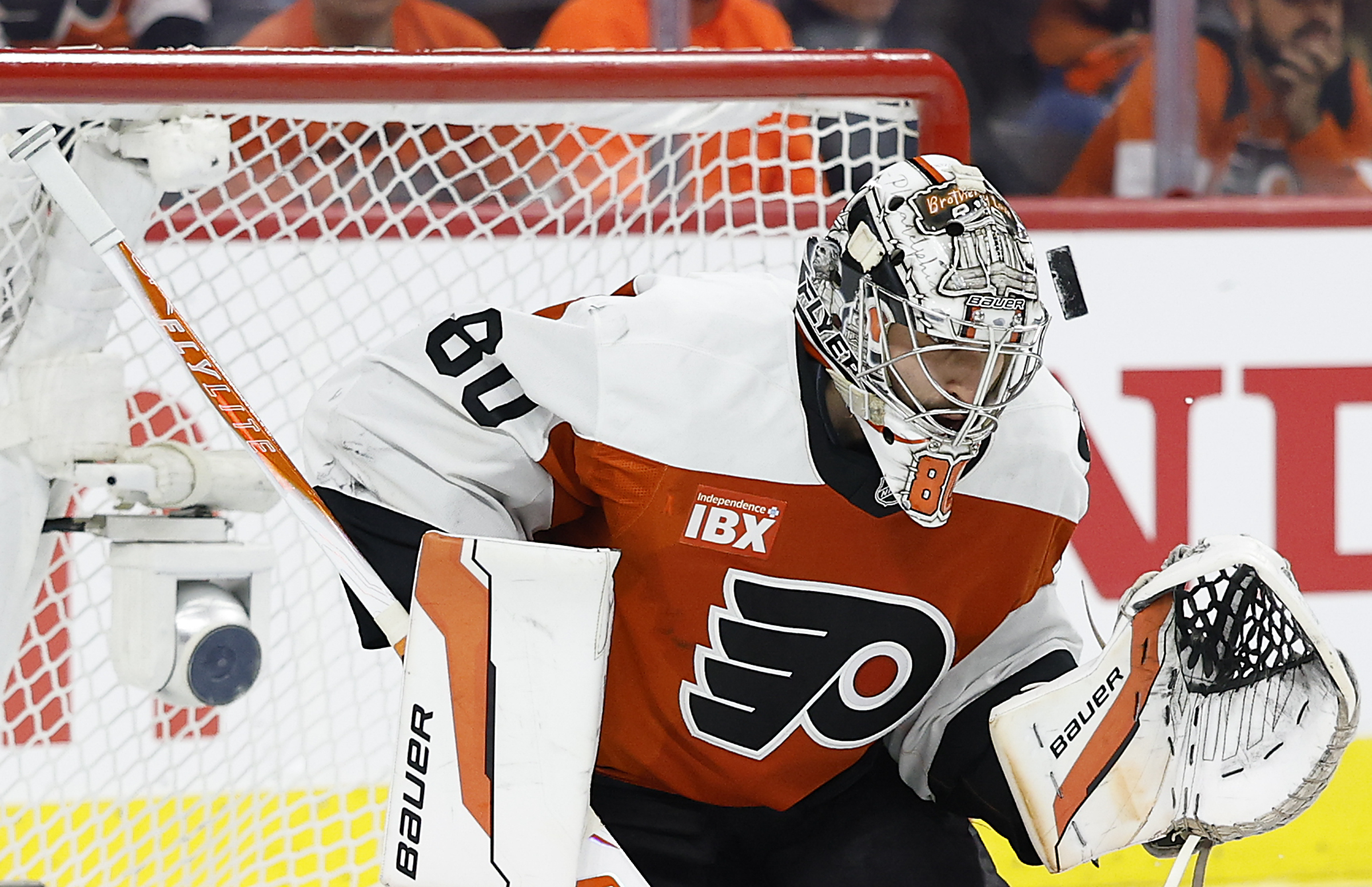
Dan Vladař came to Philly to prove he can be a No. 1 goalie. He passed that test with flying colors in Year 1.Yong Kim / Staff Photographer
For a Flyers franchise that has recycled goalies like soda cans over the years, and that was just one year removed from posting a historically bad .879 team save percentage among Sam Ersson, Ivan Fedotov, and Aleksei Kolosov, Vladař stabilized the problem position beyond imagination and showed he was capable of handling the workload of a No. 1. He also demonstrated the calm demeanor and bounceback ability needed to play the much-scrutinized position in a city like Philadelphia.
But what if he is a one-year wonder?
While never a full-time starter, the 6-foot-5 Vladař showed promising signs before last season and was well regarded in the goalie analytics community. He posted a .906 save percentage in 23 games in 2022-23, and in his final year with the Flames, he ranked 18th in the NHL in even-strength save percentage (.913), only to be done in by the league’s 25th-ranked penalty kill. That’s not to say anyone expected a top-10 Vezina glow up, just that he’s long been a solid NHL netminder.
Vladař’s value to the Flyers goes beyond his play in the crease as well, as, rather atypically for a goalie, he was a team leader and a prominent voice in the dressing room. Rick Tocchet and several of his teammates praised his positivity in tough moments, while Owen Tippett said he’d “never played with a goalie that’s been that vocal, both on the ice [and] off.”
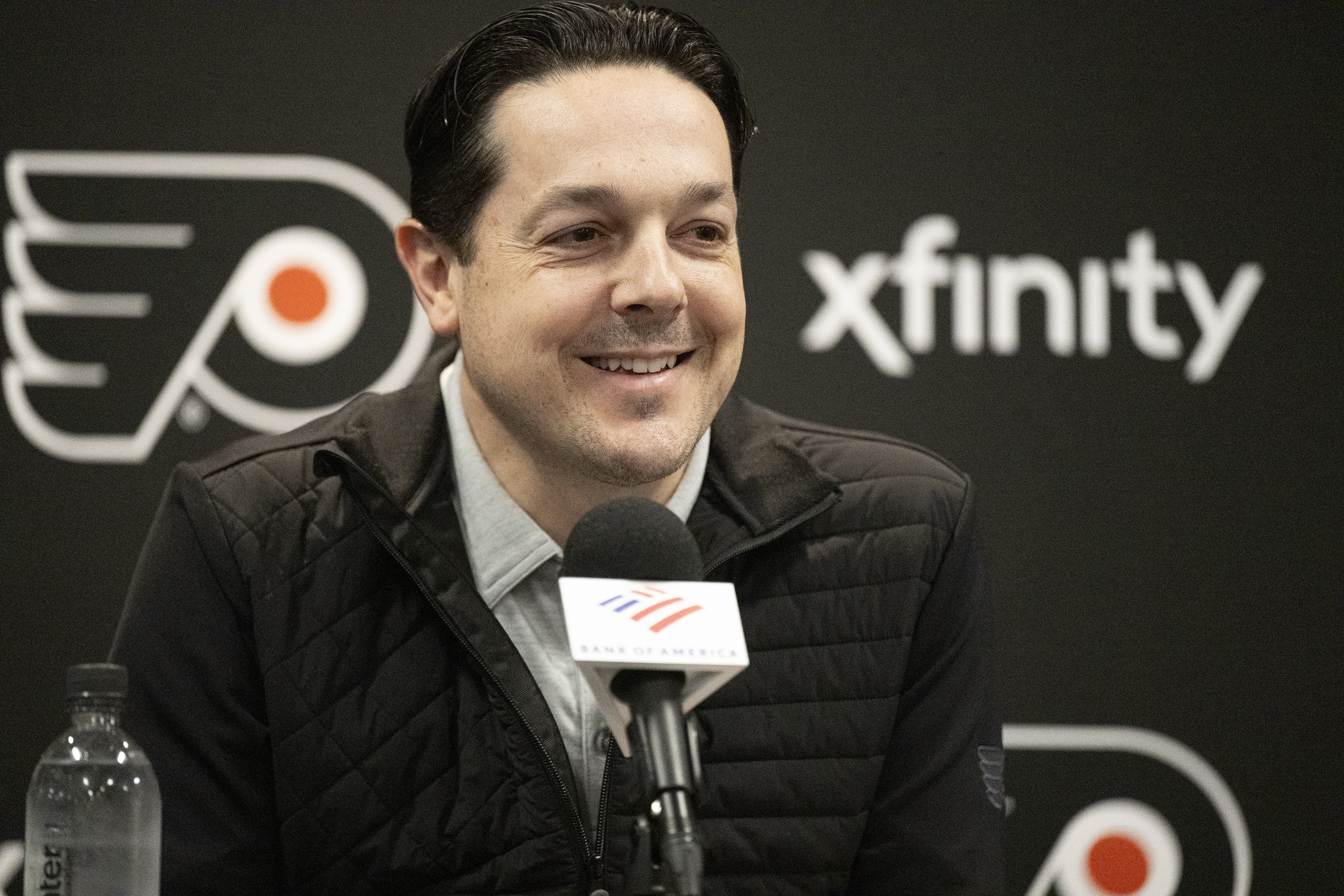
“Dan Vladař wanted to be a Flyer,” general manager Danny Brière said on July 1. “He was adamant … when you have your MVP from the previous year who says,’ I want to be here, this is my team, I want to lead this team,’ it made it really easy for us to [sign him] — especially at the number that we got [him at].”
The force (environment) is strong in Philly
As good as Vladař was, and anyone who watched him last season will vouch that he was excellent, he was also helped by the way the Flyers played.
The Flyers were one of the league’s best shot suppression teams, surrendering just 25.5 per game, the fourth-best mark in the NHL. That correlated to high-danger shots as well, as the Flyers allowed the fourth-fewest high-danger chances at five-on-five and had the fourth-fewest expected goals allowed mark, according to Natural Stat Trick.
Flyers general manager Danny Brière is confident Dan Vladař can live up to his new contract extension.Jose F. Moreno / Staff Photographer
This was no fluke either, as Tocchet is a defense-first coach who has a track record of keeping opposing teams’ shots to the outside and insulating his goaltenders. Thatcher Demko came second in Vezina voting during Tocchet’s time in Vancouver, while the Arizona Coyotes ranked in the top five in team save percentage in two of Tocchet’s four years in the desert.
The Flyers upgrading the backup position with a starting-caliber goaltender in Joseph Woll should also only help Vladař. Last season, the gap in quality between Vladař and Ersson was so vast that the Flyers were forced to overplay Vladař, especially as they pushed for the playoffs late in the year. Woll, 28, comes with durability concerns, but if he’s healthy, he’s a .906 goalie for his career and someone who should allow the Flyers to divide the 84 games up more evenly and keep Vladař fresh.
While many are harping that Vladař is over the hill, he only turned 29 in August and should still have a lot of good hockey in front of him.
Being 29 as a goalie is not nearly the same as being 29 as a skater, as many goalies’ primes run into their early-to-mid-30s. In fact, five of the last six Vezina winners have been 29 or older, while each of the top four goalies in save percentage last season was at least 29.
Like with a starting pitcher, Vladař should also age more gracefully than most given he’s been relatively healthy throughout his career and has an extremely low number of games under his belt for someone his age. Theoretically, the lower number of miles on Vladař’s speedometer should mean his body is fresher and less taxed than the typical 29-year-old netminder.
For context, Vladař has started 156 games (including playoffs) entering his age-29 season. That number pales in comparison to contemporaries like Andrei Vasilevskiy (535), Connor Hellebuyck (407), Igor Shesterkin (252), and Ilya Sorokin (202) at that age — the latter two also had 117 and 244 Kontinental Hockey League games played, respectively, before coming to North America. How little has Vladař played comparatively? Jake Oettinger, who is entering his 28-year-old season, has already started 365 games, and Jeremy Swayman (27) has 261 under his belt.
Flyers goaltender Dan Vladař established himself as a leader on and off the ice in his first season in Philadelphia.Yong Kim / Staff Photographer
Those numbers all bode well for a goalie who started 51 games last year in the regular season and all 10 in the playoffs after previously never starting more than 29 in a season. Vladař did so without showing any signs of fatigue or his play dropping off, case in point being his stellar play in Round 2 vs. Carolina.
All these factors make a five-year contract, at a below-market average annual value of $5.5 million per year, a good bet for the goalie-starved Flyers. When his contract kicks in after next season, Vladař will only rank 21st in terms of goaltender AAV. If he continues to play anywhere like he did last year, when he finished sixth in the Vezina and even received MVP votes, for even half this deal, that would represent one heck of a bargain and maybe, just maybe, another parade down Broad Street some day.
While the majority of the Flyers still have a little time to enjoy the fleeting moments of summer before reporting to training camp on Sept. 17, the countdown for others is down to just over a week.
On Thursday, the Flyers released the roster and schedule for the team’s rookie camp, which will commence on Sept. 11. This year, the team’s rookie camp will begin at the PPL Center in Allentown, where the Flyers will play games on Sept. 12 (7:05 p.m.) and Sept. 13 (5:05 p.m.) against the New York Rangers. The camp then shifts back to the Flyers Training Center in Voorhees for three practices beginning on Sept. 14.
The 27-man roster is highlighted by several players who are expected to be key contributors for the big club, led by forwards Porter Martone, Alex Bump, and Denver Barkey. The 19-year-old Martone, who tallied four goals and 10 points in nine games to help the Flyers make the playoffs, will be participating in his first rookie camp. He was heading off to college at this time last year and thus was not eligible to attend.
Former first-round picks Oliver Bonk (2023), Jett Luchanko (2024), and Maksim Sokolovskii (2026) will also be present, with Bonk expected to push hard in main camp for a spot on the Flyers’ blue line after getting into a couple of games late last year. The 6-foot-7 Sokolovskii will head back to juniors with London in September, so this will represent the final chance to see the defenseman up close this season.
Speaking of Luchanko, he figures to be desperate to build some positive momentum for training camp on the heels of an underwhelming season in the OHL. The speedy center is likely ticketed to start the season with Lehigh Valley, as are a couple of organizational favorites in defensemen Ty Murchison and Spencer Gill, and center Cole Knuble. The three listed goalies for the camp are 2023 second-rounder Carson Bjarnason and 2026 draft picks Martin Psohlavec and Marek Sklenička.
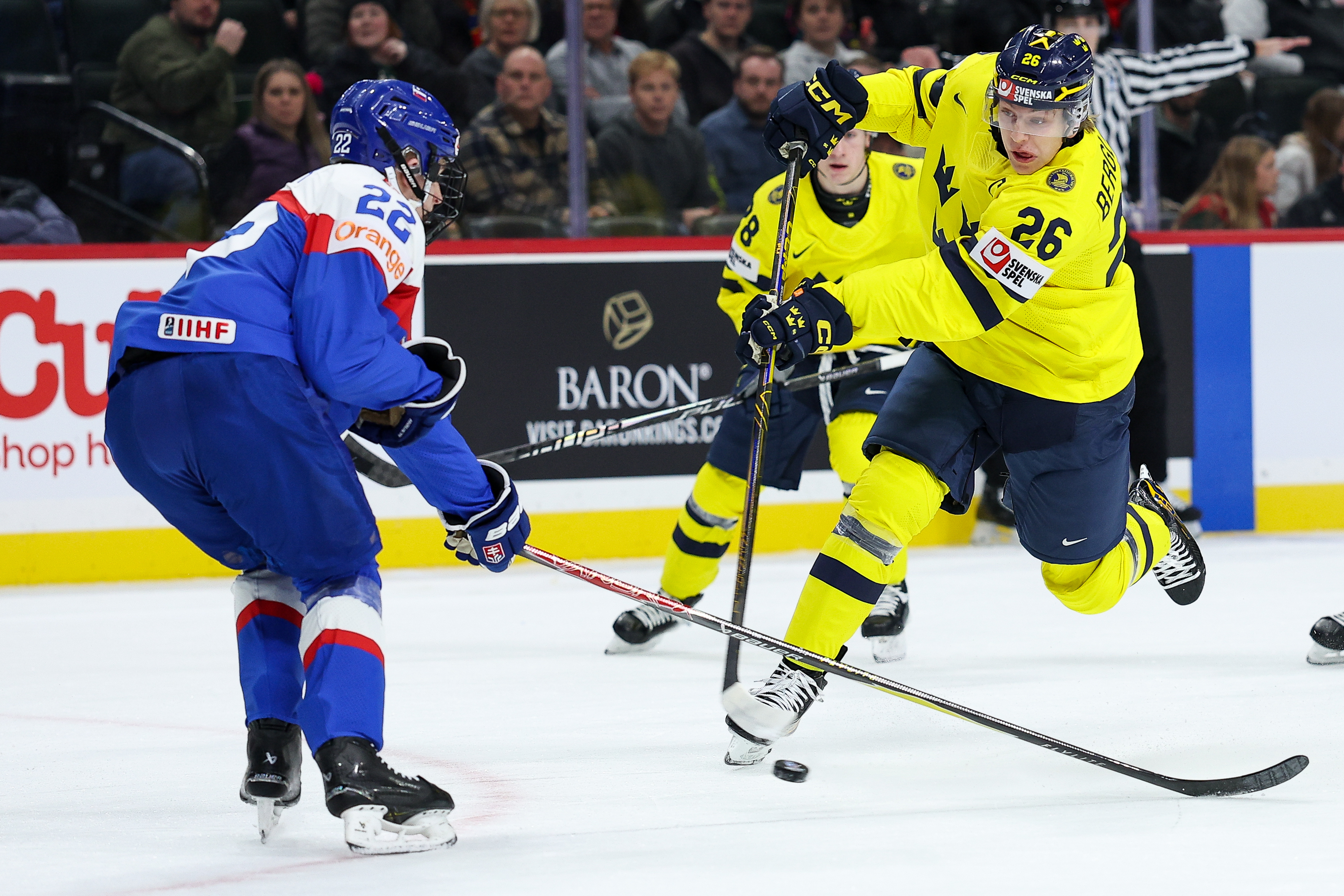
Forwards Jack Nesbitt, Jack Berglund, NUShane Vansaghi, and Jack Murtagh, defenseman Carter Amico, and goaltender Egor Zavragin are among the most high-profile absences. Nesbitt is off to the University of Michigan for his freshman season, while Amico and Murtagh are heading back to Boston University. Vansaghi will be a junior at Michigan State this fall. The Flyers revealed last month that Berglund would play this season on loan at his hometown club Färjestad BK, while Zavragin remains under contract in Russia and was recently traded to Metallurg Magnitogorsk.
Flyers prospect Jack Berglund, seen here playing for Sweden, will not be at rookie camp as he prepares for his pro season in Sweden.Matt Krohn
One Russian player who will be present is Ilya Pautov. The winger, who was a sixth-round pick in 2024, signed with the Flyers in June and is making the move to North America this season. Phoenixville’s Owen McLaughlin, a seventh-round pick in 2021, will also participate after wrapping up his collegiate career last season at BU. Forward Sawyer Dingman, the son of former NHLer Chris Dingman, is one of two camp invites alongside defenseman Riley Steen.
The Rookie Camp on-ice sessions in Voorhees are free and open to the public. Fans interested in attending the Rookie Series games can purchase tickets at PPLCenter.com.
No, we’re not just talking about the start of the NFL season. Flyers hockey also returns this month, with the Orange and Black opening up training camp on Sept. 17 before officially dropping the puck on the season on the 30th against the Penguins at Xfinity Mobile Arena.
So on theheels of the team’ssurprising run to the second round of the playoffs and the increased expectations that come with it, how willRick Tocchet line up his upstart team for opening night? Here’s our suggestion for what lineup we’d like to see — not necessarily what we expect to see — to start the season.
Forward lines
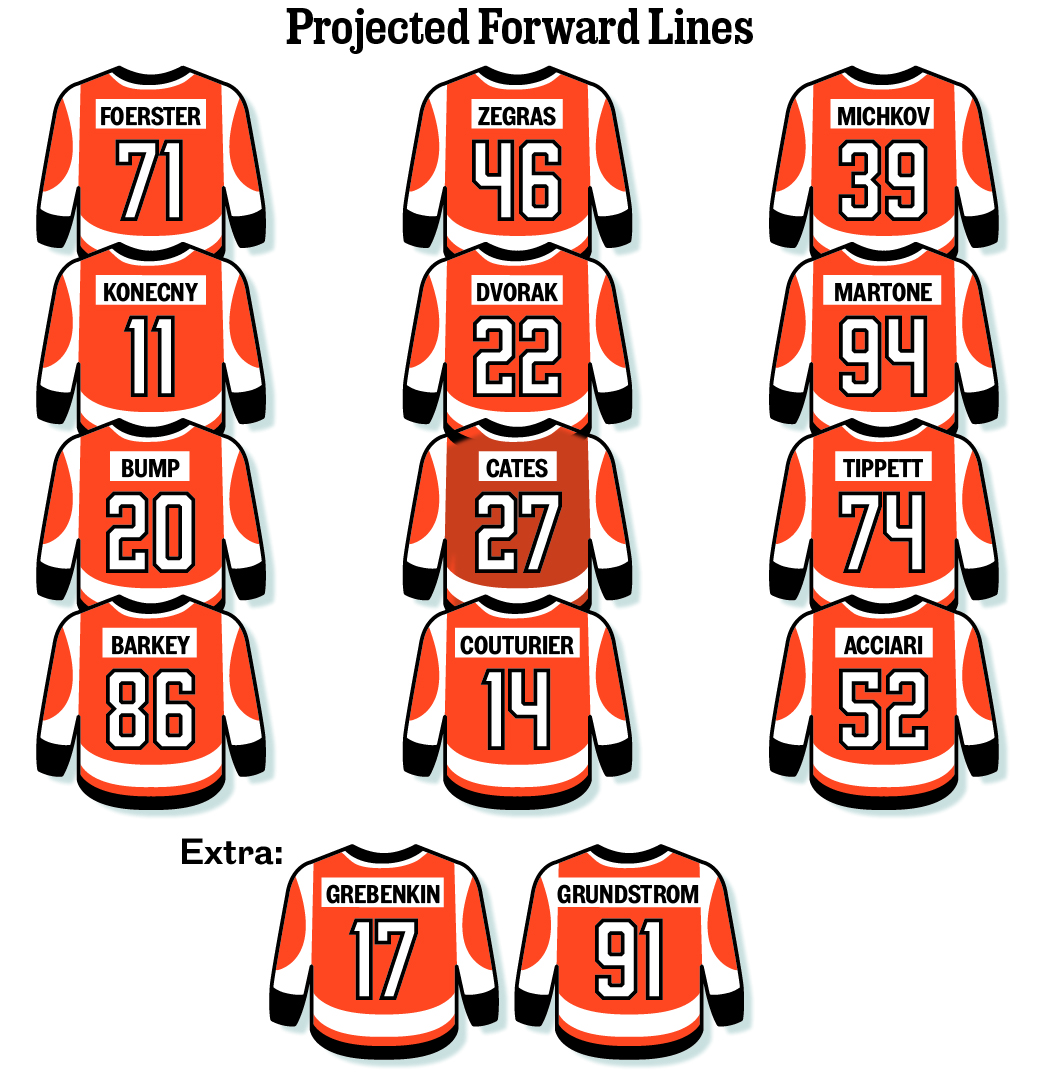
Here’s how The Inquirer would like to see the Flyers line up on opening night against the rival Penguins.Steve Madden
The Flyers enter the season, at least on paper, with their strongest roster in quite some time. There is serious competition for spots at forward and on defense, and not a ton separating the two wingers who will play on the first line from the four that will comprise the second and third lines.
Trevor Zegras remains entrenched as the team’s No. 1 center, although who his wingers will be remains up for debate. We like the idea of pairing Zegras with the team’s other creative mastermind, Matvei Michkov, especially with the Flyers hell-bent on getting the latter back on track after an up-and-down sophomore season.
Michkov and Zegras also showed instant chemistry during the preseason and had some success in sporadic minutes over the course of the year. According to Natural Stat Trick, in 169 minutes together at five-on-five, the pair earned basically an even share of the shot attempts, outscored opponents 7-6, and created 38 high-danger chances compared to 30 against. The Athletic recently reported that the Flyers are intrigued to see if the two can develop chemistry.
Rounding out our top line is a volume shooter in Tyson Foerster, who would relish a first extended chance to be set up by playmakers of the ilk of Zegras and Michkov. Foerster’s defensive responsibility would also offset some of the risk/concerns with Michkov’s game away from the puck.
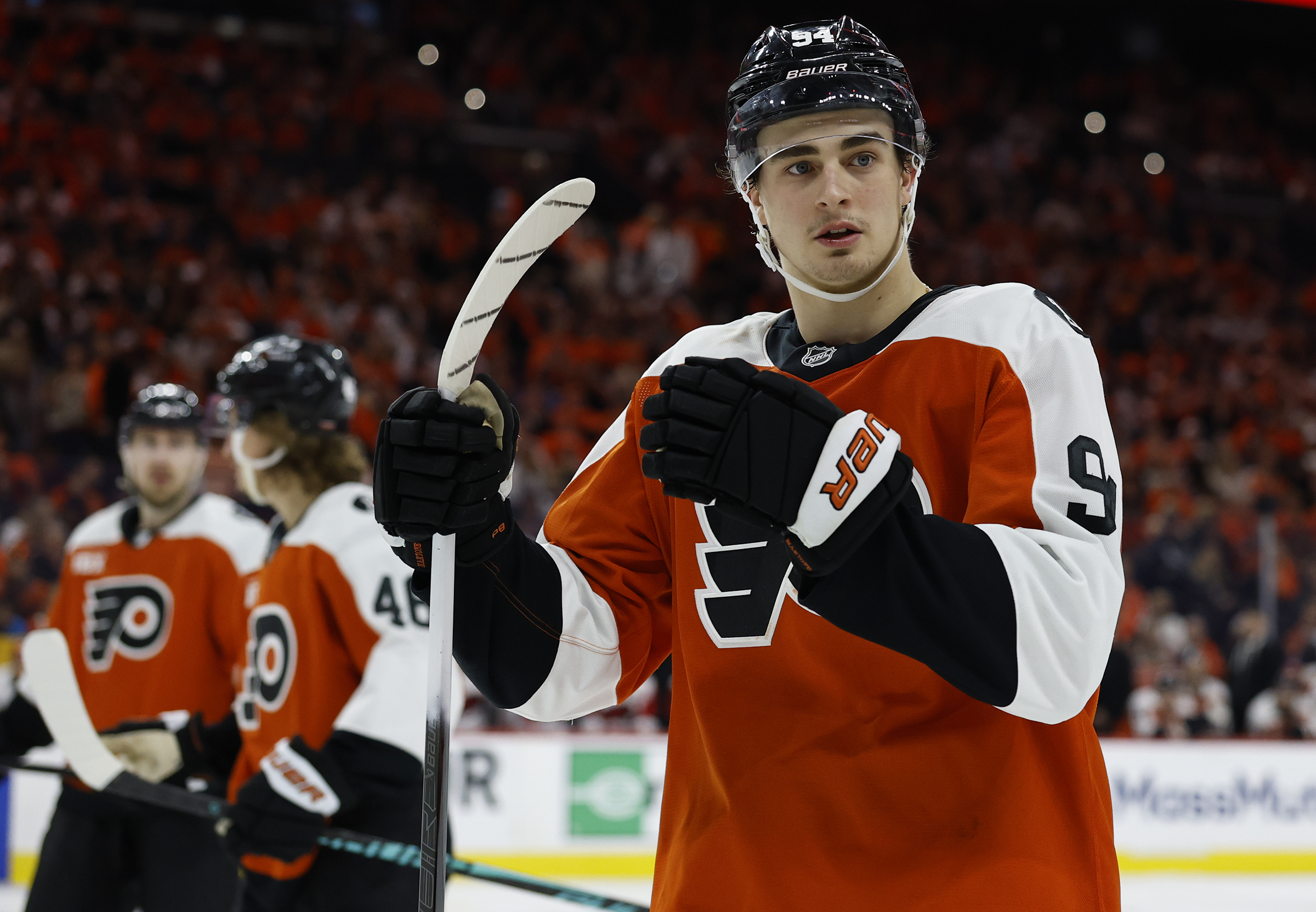
Travis Konecny, Christian Dvorak and Porter Martone stay together on our second line after a quietly impressive run in April. The trio logged a Corsi percentage of 50.93% and won the scoreboard battle 5-1 in 80 minutes together last season at five-on-five. This line wouldn’t be a ton of fun to play against either, as Konecny and Martone both play in-your-face hockey and thrive at getting under opponents’ skin. This could just as easily be considered the top line depending on how you look at it, too.
After Porter Martone’s impressive late-season cameo, the Flyers have high hopes for the 19-year-old as he enters his first full NHL season.Yong Kim / Staff Photographer
Our third line is centered by Noah Cates, who continues to develop into one of the league’s better defensive forwards. On one flank he’d have speedy power forward Owen Tippett, who raised his game a level last year and could finally be poised to crack the 30-goal plateau.
The other wing will likely come down to a battle between goal scorer Alex Bump and diminutive playmaker Denver Barkey. While Barkey is ahead of Bump in the pecking order, if the Flyers want to squeeze their 12 best forwards into one lineup, Barkey’s feistiness and versatility to play up and down a lineup make him a more natural fit on the fourth line than Bump. Bump could also play out of his element on the fourth line or be the odd man out altogether if the Flyers believe Barkey, who they are extremely high on, needs to play in the top nine and Nikita Grebenkin is healthy enough to start the year.
Sean Couturier, who thrived in a bottom-six role in the postseason, is poised to slot in as the team’s fourth-line center. Veteran free agent acquisition Noel Acciari represents an upgrade on Garnet Hathaway and should provide some beef and nastiness at right wing, as well as the versatility to take some draws at center when needed. That leaves Barkey, Grebenkin, and the speedy Carl Grundström competing for the final spot in what could be a rotation at least out of the gate. Grebenkin’s health remains a question mark, but he is reportedly ahead of schedule in his rehab from an upper-body injury.
Defensive pairs
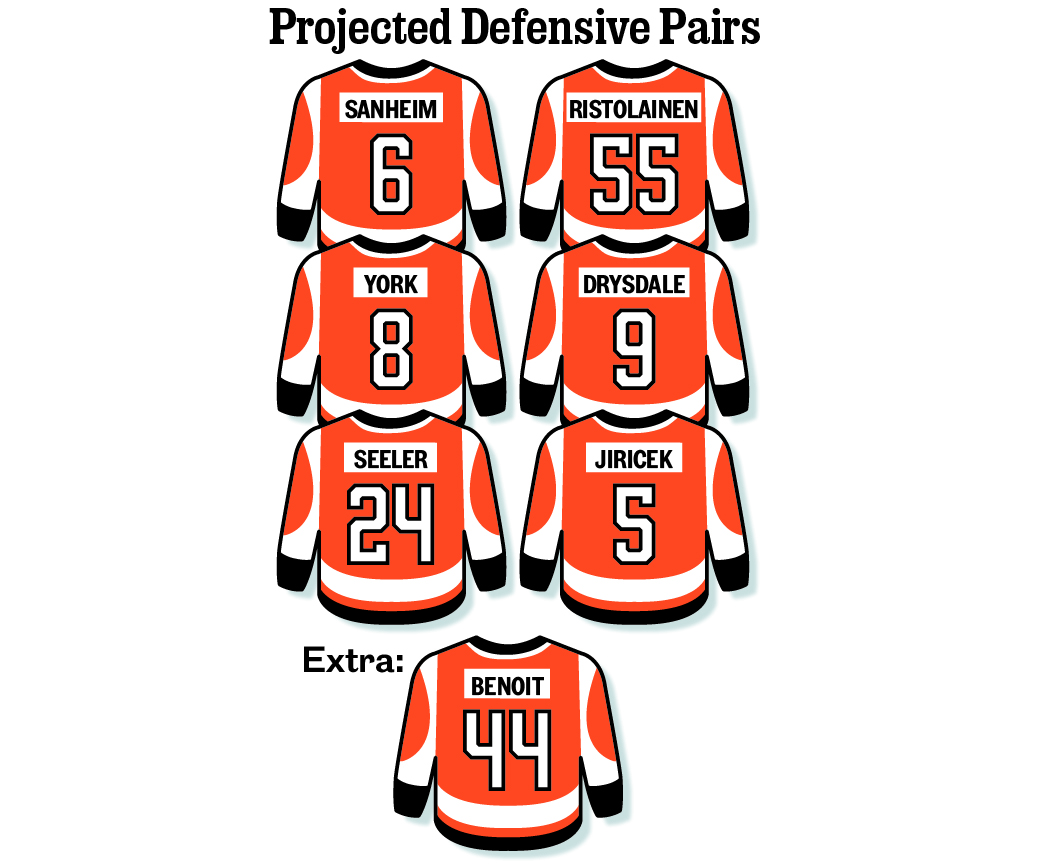
The Flyers’ defensive pairs will look quite similar to last year, if Rasmus Ristolainen sticks around that is.Steve Madden
Any discussion about the Flyers blue line starts with Travis Sanheim, who has elevated himself into a bona fide top-pair defenseman and is playing the best hockey of his career at age 30. Sanheim played the 10th-most minutes in the NHL last season and posted career highs in goals (11) and plus-minus rating (plus-12), all while shutting down opposing teams’ top lines.
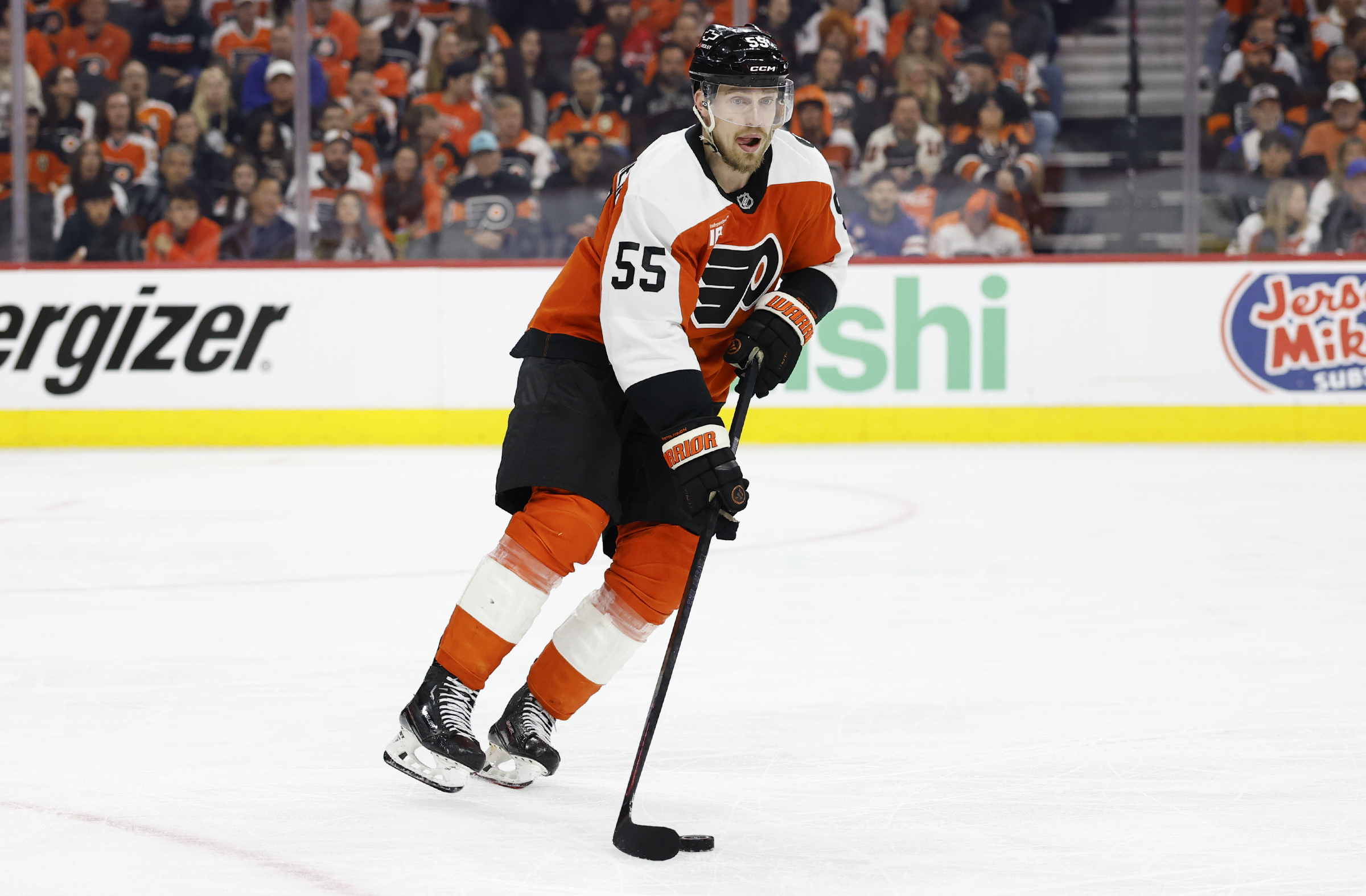
His partner to start the year is projected to be Rasmus Ristolainen, who is still around despite the latest cycle of trade rumors swirling around his name. The rugged and defensively solid Finn complements Sanheim well and allows his partner the increased freedom to jump into the rush. Ristolainen, who is a free agent at season’s end, might not be here come March, but for now he remains a big part of the Flyers’ blue line.
Rasmus Ristolainen remains a Philadelphia Flyer for now despite widespread speculation that he would be traded during the summer.Yong Kim / Staff Photographer
Jamie Drysdale and Cam York have long been close off the ice, so it came as no surprise that they thoroughly enjoyed their time playing together on the second pair last season. In almost 500 regular-season minutes, the results were mixed, while in the playoffs the two got caved in at points, particularly against Carolina (31.76 Corsi %). This pairing probably isn’t ideal long-term given their size and lack of physicality, but they’ll get another shot to prove they can play together in 2026-27. The Flyers are counting on both, particularly Drysdale, to take another step forward this season.
As long as Ristolainen remains in Philadelphia, the third pair figures to feature some sort of rotation. The selfless Nick Seeler is the most veteran option on the left, while former Toronto Maple Leaf Simon Benoit, beyond being Ristolainen insurance, could push for playing time due to his combination of size, skating, and snarl. The Flyers also like Ty Murchison, who impressed before suffering a season-ending injury last season, quite a bit on the left as well.
Former top-10 pick David Jiříček, 22, will try to revive his career with his third NHL team after being acquired from Minnesota last March for Bobby Brink. The towering Czech, who can handle the puck and possesses a booming shot, was tasked with working on his defensive game in the American Hockey League last year and figures to get the first shot on the right given he’s no longer waiver-exempt. He also should get a look on one of the power-play units given the team’s longstanding ineptitude in that area. Righty Oliver Bonk, 21, will push hard for a roster spot as well, but he’ll have to blow the Flyers’ doors off to usurp Jiříček given the team has the option to send him to Lehigh Valley without waivers.
Goaltenders
Projected Flyers goaliesSteve Madden
Long the biggest sore spot in the organization, goaltending improbably became the team’s biggest strength last season thanks to the revelation that was Dan Vladař. The 29-year-old career backup enjoyed a breakout season, starting a career-high 51 games and posting a .906 save percentage (eighth among goalies with 40 starts) and saving 13.8 goals above expected (10th-best), according to Money Puck. Now, after signing a five-year, $27.5 million contract in the summer, the question becomes: Can Vladař do it again?
All signs point to yes based on his mental makeup, play in the postseason, and the way this team is set up to defend under Tocchet. Vladař also may not have to, as the Flyers significantly upgraded the backup position by swapping Sam Ersson for Joseph Woll.
Woll, 28, has a .906 career save percentage and, when healthy, has shown the capability of being a No. 1 goalie in this league. Woll’s presence should not only ease the physical burden on Vladař but also allow the Flyers to feel much more confident about their chances on days the Czech netminder gets a rest.
In his first year with the Flyers, goaltender Dan Vladař came out of nowhere to finish sixth last season in the Vezina Trophy voting.Yong Kim / Staff Photographer
The Flyers report to Voorhees for training camp in just over two weeks, and there will be plenty of new faces around the rink.
On Wednesday, the Flyers announced a series of changes to their hockey operations staff both with the NHL club and the team’s American Hockey League affiliate in Lehigh Valley.
The most notable change is Alex Ambrose being promoted to head athletic trainer, a post held by Tommy Alva since 2022-23. A league source told The Inquirer that Alva was let go from the position. Ambrose, who has 10 years of experience, has served as the Flyers’ assistant athletic trainer for the past three seasons.
The Flyers also announced they have hired Zach Casinelli as an assistant athletic trainer. Casinelli most recently served as the head athletic trainer for the Florida Panthers’ American Hockey League affiliate in Charlotte.
Some of the other hires include Abe Edson, who was previously an assistant strength and conditioning coach with the Minnesota Wild for the past two seasons, as head of athlete performance; Jake Rogers, who will replace John Peters as an new equipment manager; and former NHLer Dave Morrison (amateur scout).
The full list of hires is below:
Alex Ambrose: Head athletic trainer
Zach Casinelli: Assistant athletic trainer
Melissa Rucker: Head massage therapist
Abe Edson: Head of athlete performance
Chris Gratton: Performance coach
Lorne Goldenberg: Performance development coach
Ryan Adkins: Director of athlete rehabilitation
Jake Rogers: Equipment manager
Dave Morrison: Amateur scout
Kevin Braeunle: Manager of team services
Joe Hurley: Head athletic trainer, Lehigh Valley Phantoms
Evan Hanberry: Head strength and conditioning coach, Phantoms
The Flyers’ offseason was highlighted by the massive acquisition they almost made rather than any of the moves team completed.
After catching lightning in a bottle last spring and riding that wave all the way to the second round of the playoffs, the Flyers went for broke this offseason — almost literally — by tendering a $90 million offer sheet to budding star Leo Carlsson. While the bold act firmly announced the Flyers’ ambitions and eagerness to become a contender again, it ultimately fell flat as the Anaheim Ducks matched the offer and retained their prized youngster.
Not landing Carlsson means the Flyers’ offseason, at least to this point, has amounted to upgrading the backup goalie spot with Joseph Woll, adding a bottom-pair bruiser in Simon Benoit, and bolstering the fourth line with 34-year-old Noel Acciari. Nice depth adds, sure, but hardly the needle-movers you’d expect for an up-and-coming team looking to build on the momentum from its first non-COVID playoff run in eight years.
Instead, general manager Danny Brière and the Flyers are banking on internal improvements from young players being enough for the Flyers to repeat — or better — last year’s success in what should be an improved Metropolitan Division that already includes the Stanley Cup-winning Carolina Hurricanes. Will that gamble pay off? Here are five players the Flyers will need more from if they are to avoid taking a step back.
1. Matvei Michkov, RW
No surprise here. Michkov will be looking to rebound from a sophomore season that saw him start slow, face public criticism for his conditioning, and clash with coach Rick Tocchet. Michkov’s play was markedly better post-Olympic break — 22 points in 26 games — but he struggled mightily in the playoffs, culminating with him being benched for the Flyers’ playoff finale.
Michkov expressed in May that he wasn’t happy with his season overall and acknowledged that he needed to work harder this summer. To his credit, it appears he’s followed through. He was spotted on the ice in Voorhees the day after exit interviews and participated in a renowned summer training group in Russia with NHL players like Artemi Panarin. He looks considerably leaner based on pictures that have surfaced on social media in recent months.
Panarin, Sergachev, Michkov, Lyubushkin, Kuzmenko, Podkolzin, Khusnutdinov. NHL players are training together under the guidance of Dmitry Yashankin pic.twitter.com/BctASqMF2L
When you consider the 21-year-old finished with 20 goals and 51 points in a down year, with a better offseason of training and added motivation, the sky really seems to be the limit for the Russian winger. Brière, Tocchet, and Co. are expecting a “vengeance tour” from Michkov in 2026-27 as they seek a second consecutive playoff berth.
2. Jamie Drysdale, RHD
After a couple of underwhelming years split between Anaheim and Philadelphia, Drysdale took a major step forward last season and flashed glimpses of the skill set that made him the No. 6 overall pick in the 2020 draft. But is there even more meat on the bone?
Drysdale’s biggest progression last season came defensively, as he cleaned up some of his poor habits and became a more reliable defender. He improved his plus-minus from minus-32 to minus-3 and set career highs in average ice time (21:33) and goals (eight), while also equaling his career best of 32 points.
With a sturdier defensive foundation and a new four-year, $26 million contract to boot, the Flyers will hope a more confident Drysdale can take another step offensively and channel his effortless skating and puck-moving ability into increased production. While many expected the Flyers to add a proven power-play quarterback this summer to address the last-ranked unit, the team did not, meaning Drysdale likely will get the first crack at the point. The Flyers will need to click at a much higher rate than 15.7% with the man-advantage if they are to remain a playoff contender, and Drysdale grabbing the PP1 job with both hands would go a long way toward that aim.
3. Porter Martone, RW
After a banner collegiate season at Michigan State, the 2025 first-round pick didn’t miss a beat once he signed with the Flyers on March 29. Martone racked up six goals and 15 points in 19 games (including playoffs) down the stretch and, at 19 years old, was consistently among the Flyers’ most noticeable skaters during the postseason.
While the burgeoning power forward is still just scratching the surface of his immense potential, he showcased the skill set and moxie of a player who looks destined for stardom. The question now will be how quickly Martone can make that leap to become a top-of-the-lineup player and whether that can be as soon as this season.
Rookie Porter Martone, 19, has bona fide star potential and doesn’t seem like someone who gets daunted by the moment.Yong Kim / Staff Photographer
The Flyers will be wary of heaping too much pressure too soon on the teenager, but Martone looks to have the broad shoulders and mental makeup to handle it. Given Martone’s pedigree as one of the top prospects in all of hockey — The Athletic ranked him No. 3 — the Flyers see having him for a full 84 games as one of their most obvious avenues toward improvement.
4. Tyson Foerster, LW
Amid Dan Vladař’s breakout season, Trevor Zegras’ resurgence, all the drama surrounding Michkov, and the late-season Martone hype train, it was easy to forget that the Flyers played most of last season without one of their top players in Foerster. To make matters worse, the 24-year-old’s arm injury came right as he looked to be breaking out.
Flyers winger Tyson Foerster missed 39 games last year after injuring his arm on a one-timer in early November.Yong Kim / Staff Photographer
With 11 goals in 21 games before his injury, on the heels of nine in nine to conclude 2024-25, Foerster was quietly playing at a 40-goal pace for the first quarter of the 2025-26 season. The Flyers rewarded him handsomely this summer with an eight-year, $56.8 million extension that will keep him in Philly until 2035. Now Foerster, who is also one of the top defensive wingers in the league, will need to prove he can live up to his contract and stay healthy, the latter being something he has struggled with to this point of his career.
Foerster has the shooting release to become a consistent 30-goal scorer in this league and should provide a major boost for an offense that ranked 21st in goals last season. If all breaks right, could he even become the Flyers’ first 40-goal scorer since Jeff Carter in 2009?
5. David Jiříček, RHD
The Flyers are going to need a young blueliner to take a major step forward in 2026-27, and the likeliest candidates are Jiříček and Oliver Bonk. Jiříček, who turns 23 in November, will probably get the first chance, given he is almost two years older and, more importantly, no longer waiver-exempt.
Acquired from Minnesota at last year’s trade deadline for Bobby Brink, the 2022 sixth-overall pick is on his third team and is looking to revive his once-promising career. Blessed with great size at 6-foot-4, puck-handling ability, and a booming shot, Jiříček is a worthy gamble for a Flyers team that lacks a true high-end offensive defenseman in its pipeline. The team can also point to its strong recent track record with reclamation projects like Zegras, Drysdale, and Vladař as a reason for optimism.
The Flyers were patient with Jiříček last season as they sent him to the minors to have him rebuild his defensive game and learn the team’s style of play. Now, he will get a chance in training camp to show he’s made the necessary improvements and is finally ready for a full-time NHL role. Jiříček projected as a power-play quarterback when he entered the league, and given the Flyers’ persistent struggles in that area, he should be another option there given his big shot from the point.
“The potential is high … 21-, 22-year-old, 6-foot-4 defensemen of his caliber are tough to find,” Brière said after acquiring Jiříček in March. “We know we have to work with him. … But that’s why I go back to the Jamie Drysdale learning curve. That gives us hope that he can get on the same track and eventually become a difference-maker for us.”
Long fans of David Jiříček going back to his draft year, the Flyers believe they can get the best out of the toolsy defenseman.Elizabeth Robertson / Staff Photographer
When Danny Brière and Keith Jones took over the Flyers on a full-time basis back in May of 2023, they vowed to “lead this team back to the winning tradition that everyone knows it can, and should be.”
Slowly but surely.
Fresh off a first playoff appearance in six years, the Flyers are relevant again, with the latest sign coming Wednesday via the NHL’s national television schedule release. The Flyers will be part of 19 national broadcasts this season, a considerable uptick from the 14 they appeared on in 2025-26. This includes being part of TNT’s season-opening broadcast lineup on Sept. 30 when they will take on the rival Pittsburgh Penguins at Xfinity Mobile Arena (7:30 p.m.). Only the Boston Bruins (20) and Penguins are pegged for more national broadcasts this season.
US National TV Games for 2026/27 NHL season, by team:
🏒 72 exclusive games on TNT networks 🏒 100 exclusive games on ESPN networks – 15 on ABC – 38 on ESPN – 47 on ESPN+ / Disney+ / Hulu
On-ice improvement naturally leads to more national attention, and the presence of budding stars Porter Martone and Matvei Michkov surely adds further intrigue to the rebuild in South Philly. The rekindling of the rivalry with the Penguins after last year’s playoff series doesn’t hurt either.
In all, the Flyers will be featured exclusively on ABC or ESPN six times, including weekend bouts with the Penguins on Jan. 31 (noon) and April 3 (8 p.m.). The Flyers will also have four games on ESPN+/Disney+/Hulu, the first coming on Oct. 1 against Metropolitan Division rival New Jersey (7 p.m.). As part of ESPN’s fourth annual “Frozen Frenzy” whiparound show featuring all 32 teams on Oct. 13, the Flyers will play the Seattle Kraken at 7 p.m.
The Orange and Black will be televised nine times on TNT, including a pair of contests against the Washington Capitals — Oct. 28 at 7:30 p.m. and April 1 at 7:30 p.m. — in what figures to be all-time leading goal scorer and Flyers nemesis Alexander Ovechkin’s final NHL season. The Flyers’ final game of their 84-game season on April 10 at Xfinity Mobile Arena, which will likely double as Ovechkin’s regular-season swan song, will also be nationally televised on ABC (12:30 p.m.)
Full Flyers national broadcast schedule
Flyers games with updated start times
Thurs., Oct. 15 @ Detroit 7:30 p.m. ET (Little Caesars Arena)
Thurs., Dec. 3 vs. NY Islanders 7:30 p.m. ET (Xfinity Mobile Arena)
Thurs., Jan. 28 vs. Los Angeles 7:30 p.m. (Xfinity Mobile Arena)