LAS VEGAS — Carolina spent the first part of the Stanley Cup Final surviving, finding ways to overcome deficits and play a high-scoring game that didn’t fit the Hurricanes’ typical style.
But when it came down to doing what it takes to win the Cup, the Hurricanes’ defense put its stamp on this series, shutting down the Vegas Golden Knights and not letting up.
The Hurricanes held Vegas to five total goals in Games 4 and 5 and used a suffocating defense in a 3-0 shutout Sunday night in Game 6 to win their first championship in 20 years.
“That’s a lot of years,” said Carolina center Jordan Staal, who received the Conn Smythe Trophy as playoff MVP. “It’s amazing. This is something I’ve been going after ever since we got the first one. You want to win it again and again and again. ”
Brandon Bussi, whose entrance late in Game 3 helped turn around the series, had his first career playoff shutout in stopping 22 shots. Jackson Blake had a goal and assist, and Taylor Hall scored just 3:47 into the game to set the tone. Nikolaj Ehlers added an empty-netter.
“Your mind wanders the last couple of days and wonder what it may be like out here (on ice after winning) and it’s better than I could have expected,” Hall said.
The Golden Knights struggled badly to muster any kind of offense in Game 6 and went 18:37 between shots on goal in the second and third periods. Playing in their third Cup final, this is the first time they have been shut out.
This final game was what many observers expected the series to be like between the defensive-minded teams, but each side watched leads of two-plus goals disappear in the first three games.
“It’s just as awesome,” Brind’Amour said. “But as a player, it was a little different. I worked and dreamt of winning the Cup my whole life, so that was like a piano came off my back. This time around, I wanted it for the group.”
This was the first game of the series that Vegas goalie Carter Hart didn’t allow four goals in a game. He finished with 20 saves.
The Hurricanes began to assume control of the series after falling behind by the score of 4-0 in Game 3. They came back force overtime, and though the Canes lost, they outplayed the Golden Knights from there on out.
Reflecting the do-or-die situation for the Golden Knights, they made several lineup changes, with Brett Howden replacing the injured William Karlsson at second-line center. Mitch Marner could have moved there, but remained at right wing.
Original Golden Knight Reilly Smith made his Cup final debut at third-line right wing, and Braeden Bowman made his playoff debut at fourth-line right wing. Kaedan Korczak replaced Dylan Coghlan on the third defensive pairing.
“This is tough to be on this side of it,” Golden Knights defenseman Brayden McNabb said. “But on the other side, these chances don’t come around very often. So it stings.”
This title is a testament to Carolina’s resilience as a franchise that kept coming close to winning the Eastern Conference, but couldn’t quite get through until now.
Brind’Amour made sure the Hurricanes kept getting back up after losing in the conference final twice in the past three years and three times in their current eight-year playoff run. The talent was clearly there, but there was always a stumbling block.
Not anymore.
After dispatching Montreal in five games to make the final, the Hurricanes then faced perennial power Vegas and took care of business there, too. Now, Brind’Amour will get his name on the Cup for the second time.
So will 37-year-old Staal, who also won the title in 2009 with Pittsburgh. He planted himself in front of Hart and dared the Golden Knights to knock him out of the way. Staal scored in each of the first five Cup final games, the first time that has happened.
The Hurricanes got off to a fast start with a goal just 25 seconds into Game 1, only to lose 5-4 on a late goal from Tomas Hertl. And the Golden Knights were on the verge of taking complete control as minutes ticked down in Game 2 while holding a 2-0 lead and appearing as if they would take a two-game advantage back home.
Then, it all changed. Carolina showed a fight that not only brought the Hurricanes back into the series by rallying to win 4-3 in overtime on Seth Jarvis’ one-timer, but would serve as their signature throughout the series.
That was especially true the following game when the Golden Knights took a 4-0 lead into the third period and the Canes seemed to have no answers. Brind’Amour even appeared to wave the white flag by removing goalie Frederik Andersen and replacing him with Bussi.
But the Hurricanes weren’t simply trying to get to Game 4. They sent a message, going on a remarkable rally to force overtime. Though Carolina lost, it was inflection point, with Bussi backstopping a team that was only growing stronger. Carolina then went on to win the next two games and moved within a victory of the championship.
The Hurricanes got it done against the Golden Knights team that was on a heater after former Flyers coach John Tortorella replaced Bruce Cassidy with eight games left in the regular season. Vegas then went from third in the Pacific Division to first, knocked off Utah and Anaheim in six games apiece in the playoffs and shockingly swept Presidents’ Trophy-winning Colorado to win the West.
“I am very proud to be a part of this organization, very proud to lead this team, very proud to play with every single guy that steps into our locker room,” Vegas captain Mark Stone said. “This feeling sucks. I never want to have it again.”
BUFFALO, N.Y. — The 2026 NHL draft is quickly approaching, and things look a little different for the Flyers this year.
After making it to the second round of the Stanley Cup playoffs for the first time since 2020, the Orange and Black are picking at No. 21 in the first round and only have five picks across all seven rounds.
In Part 1 of The Inquirer’s two-part interview with Brent Flahr, who runs the team’s draft, the assistant general manager chats about the team’s approach heading into the draft, which will be held on June 26-27 back in Western New York.
This interview has been edited and condensed for clarity and was conducted on June 3.
Q: Several young players entered the lineup for the Flyers this season and impacted the game. Does how they performed change how you look at things for the draft?
A: A little bit. But where we’re picking, we know we can’t be that selective, especially early, we’re going to go with the best player. But we know where maybe our holes and our depth charts are going forward, or where we need to add more depth. At the same time, sometimes the draft doesn’t fall that way; you can’t go way off. The way we do our draft is we have layers and, obviously, we’ll target the best player, and if it’s all equal, then we’ll go by position. It’s kind of the way it always works.
Q: What do you consider missing in the depth chart then?
A: Well, we do have a number of centers coming now, which was kind of our [issue in] depth before, and we have some younger D on the team. But besides Spencer Gill and Ty Murchison and Hunter McDonald, Oliver Bonk, the next layer of younger defenseman we would probably use. We didn’t draft a goalie — we drafted two a couple of years ago, which takes the heat off — but probably go with adding a goalie, maybe. And then up front, we can always add depth.
Q: Does it change your approach when there’s only five draft picks?
A: Certainly doesn’t change it early. We’ll look at options, whether you’re trying to trade up or trade back, maybe adding a pick or changing things to get another higher pick, but just the way the draft was, we were aware. I think it’s a good draft at the top end; it’s not quite as deep as maybe some of the drafts previously. So when we were talking about giving away picks, we kind of targeted this year as the year that we’re going to be short a pick or two. But we still feel like, as the year has gone on, we have some guys targeted to the later rounds, which our guys [will] be happy with and excited about.
Q: When you see the success of players like Ty Murchison, Hunter McDonald, Alex Bump, who were late-round picks, does it give you confidence you can find someone there?
A: For sure, and that’s the challenge of the draft. Not everybody plays — we’re well aware of that — but you’re trying to draft players with multiple assets to give them a chance down the road. Some guys you think are slam-dunk players maybe don’t come through, for whatever reason. … And there’s some guys who are overachievers that really push themselves, like a Murchison, and Alex Bump from where we drafted him to now; a lot of that’s because of how hard he’s worked to get himself in that position. It’s a competitive business, and it’s not only getting there but staying there, too. But obviously the key for organizational success is hitting on some of those late-rounders, too.
Q: Do you look for that specific internal drive or confidence then?
A: You can watch them play, but, yeah, when you meet with them — and we’re not talking about 24-year-old kids, either — we interview kids here. You’ve got to understand some kids are in high school, so they’re less polished than the kid that’s already been in college for a year, or a kid that’s [played for] Hockey Canada and been in front of microphones and rooms full of people before. So, you got to take that into account, but you can tell players who have a presence, people that are leaders, just by sitting there, the presence they have. And some kids can grow into it, but some people just have that.
Selected by the Flyers in the second round at the 2025 draft, 6-foot-5 center Matthew Gard was one of six players over 6 feet the team selected.Alejandro A. Alvarez / Staff Photographer
Q: In past drafts, the Flyers seem to prioritize size, 200-foot play, and high compete. With who you have in the system, does it change your outlook?
A: A little bit. The one draft [in 2025] where we had a really big draft randomly, some of it was, obviously, a focus [that] we wanted to try to get bigger, but at the same time we had all those guys that were that big, and that was just kind of circumstance, too. So, there’s good small players in the game, and there’s certain things you have to have when you are a smaller player. For instance, our forward group, we have some top-end smaller players, and we also need some size to build around that. We’ve added a lot of size to the organization with the younger players, and you want to be as big and strong and fast as you can [but] there are some good players, and we’ll be cognizant of that.
Q: There are several smaller players in this draft, specifically defensemen under 6-feet like Tommy Bleyl and Xavier Villeneuve, who are puck-movers and high-offense players. With the power-play struggles, does it impact your thought process?
A: Yeah, obviously the power play is a problem. Realistically, the guys in this year’s draft, especially the guys you mentioned, are going to need quite a while to get there. So, hopefully, we have our power play addressed before these players arrive. But, no, for being a small player, a small defenseman, it’s getting harder and harder to play. I think you need an offensive dimension, or you’ve got to be special. … You watch the playoffs, size does matter, and it’s harder to get to the net. But it’s something we take into consideration, and this D class, especially at the top end, is pretty good — really good — especially top 10.
Q: So, you’re not necessarily looking for size still?
A: No, but I think in certain positions I think it’s certainly important. But if you’re undersized, you have to be dynamic.
Q: Picking at 21 is very different than where you’ve been in the last couple of years. Does it change things and make it harder to build your draft board with such uncertainty?
A: Yeah, still a little early, because we usually have a pretty good idea of the projection of where guys are going. There are always a few surprises, outliers, but yeah, we’ll build our list the same way. This year it’s obviously a little bit different, the number of players going ahead, but you’ve got to make sure your list is tight, and you can’t just assume players are gone because we will go off our list in the first round. And then maybe later in the draft you’ll go [for] guys you maybe have a stronger feel for or position or whatever, if it’s close. But, yeah, it’ll be interesting. Got a lot of work to do yet. We’ve had our meetings already, and obviously the combine kind of fills up some gray areas, testing and seeing the body type, personalities of these kids a little bit more. Yeah, we’ll tighten it up, certainly through the first couple rounds and beyond, and we’ll be ready to go at the end of the month.
Q: Is there usually a big shift after the NHL scouting combine in your list?
A: Well, we have some red-flag players. Or, maybe, players who, whether it’s body type, or our strength guys think they can get there, or we also have some maybe character flaws or something. So you just address it here, and sometimes you take players off, sometimes you move them up or down, and if there’s no issues, or whatever, you can move them up. But yeah, we still have some things to tighten up for sure.
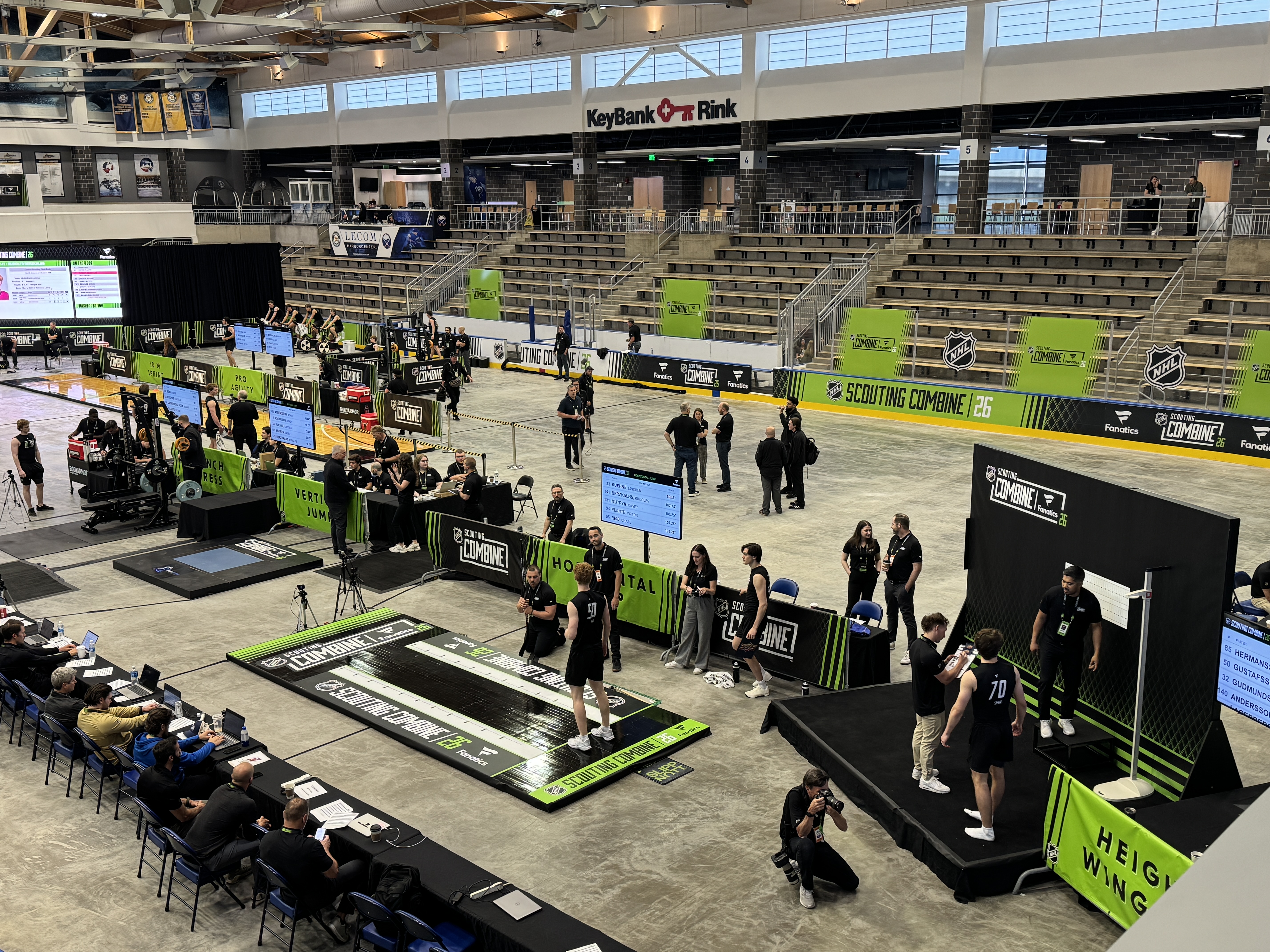
The NHL held its annual scouting combine in Buffalo, N.Y., the week of June 1, where teams were able to interview 90 draft prospects. The Flyers interviewed approximately 50.Staff/
Q: How would you compare the value of having a 21st pick versus last year at sixth overall?
A: Well, it’s a big difference, but at the same time, happy where our team got to this year. We’ll do the best we can to find players who can have impacts down the road, but obviously you’re dealing with a different level of player. … So, it’s a little more challenging, a little more projection probably because some of these kids, where we’re looking at, aren’t as maybe as close to playing or a little more work or a couple more years away. But, same time, we’ll have the same concepts, and what we like in players.
Q: Is there any thought of moving up and seeing what you can get higher up in the draft?
A: For sure. We’ll be talking about those scenarios here going forward, whether it’s trading up at a certain level if players are gone, maybe trade back and add a pick, or move up the pick and give them a later pick. Whatever you got to do. But I know Danny [Brière’s] talking to teams here already about certain scenarios, and then once you get to the draft and see what players are available, you react. But usually before then, we talk to the teams, and you have an idea what it’s going to take to move up and whether it’s worthwhile, and vice versa, to move back and have things in place. It’s a little more challenging now [because] you’re not right on the draft floor anymore; you’ve got to do it by phone and just keep in contact with teams. So you create the relationships now and put a bug in the ear that maybe we’ll move, and calls take place after that.
Q: The Flyers have a history of taking players who played well at U18 Men’s World Championship or the Hlinka Gretzky Cup, like Jett Luchanko. How much do you actually factor that in?
A: I think what happens is the media says that’s part of the case. … There’s kids that we see all year — our scouts see them all the time — and there’s certain players that the media have no idea about as far as the quality, and sometimes they don’t get to see them live, and then when they see them at the U18s, they see these guys climbing the list. So it doesn’t matter to the teams; lists are the same. But, no, in certain cases, you see these players against their peers, so I think any time a player has a lot of success at the end of the year in a big tournament and wins a championship, or whatever, puts up a big number and performs well, it’s the last thing on our minds. And vice versa, a kid has a tough tournament, or doesn’t produce, or whatever, doesn’t mean they’re not a good player. You’ve got to be a little careful with that kind of stuff. It’s a recency [bias] effect, but at the same time, it is real. We’re all there to watch, and you want to see guys perform on a big stage, too. That’s a big part of playing in the NHL.
Q: Russia was not allowed to play internationally this year. How does that impact looking at those players?
A: Well, me personally, and a number of our staff, we have to do everything by video. [Gold Star agent] Dan Millstein has a camp down in Florida [before the draft], which we’ll attend and get to know players personally, but for some of the other players, we have to rely on Kenny [Hoodikoff], our Russian scout, and [director of European pro scouting] Reid Simpson is able to travel, so he sees a number of these guys live. But other than that, it’s video and interactions with Kenny and the player interviews, and doing the background that way. But it is a challenge, and there’s some risk there, too.
Q: What kind of involvement does Rick Tocchet have in the draft? Does he give you any directions?
A: Not much. His coaches come by and talk to our scouts … just what type of players they like. But no, he doesn’t get involved.
Q: It’s hard to gauge when a player will be NHL ready, and he may not be the coach when that time comes. Do you still look for players that would fit his structure or systems?
A: Hockey sense is a big factor for players that we try to get. But there are types of players that his staff [and Tocchet] are confident they can develop. He’s had a lot of different players play for him that have had success over time. So, the biggest thing for our coaches, they want competitive people; they’re competitive, and they’re smart, and they can adapt and adjust to the league. So they’re pretty easy to deal with. Obviously, we’ve had a lot of guys jump in the lineup here this year, and they’ve been great.
The Golden Knights lost 4-2 to the Carolina Hurricanes in Thursday’s Game 5, moving the Hurricanes within a victory of claiming the Stanley Cup. The series shifts to Las Vegas for Sunday’s Game 6 (8 p.m., 6abc), with the Golden Knights aiming to force a Game 7 back here Wednesday.
“They’ve been through it all,” Tortorella said in a Zoom news conference Friday morning. ”They know what’s at stake here. We need to win one game. They’ll be ready to play.”
Vegas — featuring numerous holdovers from the team that raised the Cup in 2023 — had only gained momentum since the abrupt firing of coach Bruce Cassidy in late March to hire Tortorella, who coached the Flyers for nearly three seasons.
The Golden Knights won seven of eight to close the regular season. They faced 2-2 playoff series in Round 1 against Utah and Round 2 against Anaheim, and won Games 5 and 6 to close out each. They swept the Presidents’ Trophy-winning Colorado Avalanche. And they held a 2-1 lead on Carolina after a double-overtime victory in Game 3.
Since trailing 4-0 entering the third period of Game 3, the Hurricanes have doubled up the Golden Knights (13-6) while finding a spark with Brandon Bussi taking over in net. In Game 5, the Hurricanes got two more power-play goals from a unit that had sputtered through the Eastern Conference playoffs while also reversing Vegas’ second-period dominance.
Vegas had compounding mistakes like getting a kill only for Brayden McNabb to immediately go to the box for cross-checking Jackson Blake in the second period. Or there was Mark Stone’s high stick on Jalen Chatfield in the third, leaving Chatfield bleeding from a cut above his right eye for a double-minor penalty.
Carolina’s Andrei Svechnikov scored after both, coming amid a postseason of questions as to when he and fellow topliner Sebastian Aho would get rolling.
“Anytime you give the other team’s best players the opportunity to be on the ice on the power play and feel good about themselves … you stack that up and it definitely can be challenging and tire guys out,” center Nic Dowd said afterward.
Svechnikov’s scores pushed the Hurricanes to 6 of 16 (37.5%) on the power play this series, coming after they were at 12.5% (7 of 56) in a 12-1 push through the Eastern Conference playoffs.
“One of the areas that we’ve lost a little bit is special teams, a couple of power-play goals last night,” Tortorella said Friday. “Like I said after the game, I thought at times we were killing, we had some good times as far as moving, being aggressive with our penalty kill, and are doing the job. Other times, not so good.”
Then there’s Karlsson, who missed nearly six months with a lower-body injury before returning for his playoff debut to start the Anaheim series. He had three goals and six assists through 14 playoff games to elevate the Golden Knights, including goals in Games 1 and 4 against Carolina.
But Karlsson appeared to injure his left arm or shoulder after getting knocked into the boards by Hurricanes defenseman Sean Walker midway through the second. He got medical attention on the bench briefly, skated off, and never returned.
Tortorella said Thursday that Karlsson was “not going to be with us, probably” and Vegas needed a collective effort to replace him. He offered no additional details Friday morning.
Still, he has defiantly promised the series would “be back here” for a Game 7.
“We know what we have to do to beat this team,” McNabb said Thursday night. ”It’s a matter of going home and winning one game. That’s all it is, and hopefully we’re back here for Game 7.”
Now that the scouting combine has come and gone, it’s a perfect time to take another swing at who the Flyers could take in the first two rounds of the NHL draft on June 26 and 27. Plus, we’re adding Round 3 this time.
Of course, everything depends on how the teams in front of the Flyers draft, with the Orange and Black selecting deep in the pecking order.
There is a possibility they try to move up, which general manager Danny Brière has tried to do in previous years. The Flyers could also move down a spot to gain more picks, like Brière did in drafting Jett Luchanko in 2024.
With everything we heard in Western New York, here’s The Inquirer’s second mock draft.
First round: Alexander Command, C, Örebro HK U20 (Sweden)
In the first mock draft, defenseman Tommy Bleyl, who called his meeting with the Flyers in Buffalo “excellent,” was in this spot. The future Michigan State Spartan — he is returning to Moncton of the Quebec Maritimes Junior Hockey League for one more season — is still an option if the Flyers opt for a defenseman, which assistant general manager Brent Flahr hinted as a position where they need more depth.
Maksim Sokolovskii, a 6-foot-7 1/4, 240-pound blueliner who plays for London of the Ontario Hockey League — Denver Barkey and Oliver Bonk won a Memorial Cup with the same team last year — was also someone the Flyers showed interest in at the combine.
But the Flyers love drafting centers. Eight of the nine players Flahr has drafted during Brière’s tenure played down the middle. As the GM told The Inquirer, “You can never have enough centers.” So, if Alexander Command is available, it wouldn’t be surprising that they take him with their pick.
“He’s a natural center, he’s strong over pucks, he’s competitive, he’s got good contact skills, he can make a play. He’s well-rounded,” The Athletic’s draft analyst Scott Wheeler told The Inquirer.
“He just looks like he’s going to be a middle-six center in the league, and middle-six centers are extremely valuable, and almost never linger on draft day. He’s a player that virtually everybody likes, too.”
That’s the crux: Will he be there at No. 21 overall?
But Command, like Shane Vansaghi, who was taken in the second round last year, oozes that Flyers mentality of highly competitive and hard-working. When asked what he knew about Philly, he told The Inquirer: “They do right by themselves, take no [stuff], kind of like me.”
His game is also reminiscent of Scott Laughton’s intensity and relentlessness on the ice, with Command calling himself a “glue guy,” much like how the former alternate captain was described.
“Yeah, in practice, I mean, he can get angry, we can get angry at each other. I kind of like that. You push each other, and battle 100% every time,” teammate and fellow draft prospect Niklas Aaram-Olsen said when asked about Command’s intensity.
A left-shot pivot, Command turns 18 on June 16 and measured in at just under 6-1, 187 at the combine. He can win faceoffs and has a swagger to him, and he helped Sweden win gold at the Under-18 Men’s World Championship by notching seven points in seven games — the same numbers for another gold medalist, Luchanko, in his draft year — while centering the top line.
That came after he put up 44 points and 61 penalty minutes in 30 regular-season games and another 13 points in 14 playoff games for Örebro’s top junior team. He also earned a six-game promotion to the SHL squad in Sweden’s top league.
As of June 11, the Flyers and assistant general manager Brent Flahr have five picks in the seven-round NHL draft. Jose F. Moreno / Staff Photographer
Second round: Ben Macbeath, D, Calgary (WHL)
If the Flyers snag a center in the first round, it could mean they look to the back end in Round 2 because, as mentioned above, they need depth on defense. But at No. 53, who will be there?
A few names pop, with that uncertainty. Juho Piiparinen, who says he grew up a Flyers fan in Finland, is probably going in the first round, as is the rising Sokolovskii. Overage prospect Timmy Runtso would be an interesting pick, as he brings some offensive punch and attention to detail the Flyers like, and so would Vladimír Dravecký, an under-6-foot all-around defenseman.
It’s always a guess here, but let’s go with Ben Macbeath, a 6-2 1/4, 196-pound defenseman who plays for Calgary of the Western Hockey League. Sound familiar? That was Travis Sanheim’s team when the Flyers drafted him in 2017.
Macbeath met with 28 teams, including the Flyers, in Buffalo, and it’s fair to note that the scouting staff does like WHL players. The Flyers have drafted four since Flahr took over for the 2019 draft, including Luke Vlooswyk and Matthew Gard out of Red Deer last season.
This past season, Macbeath notched 51 points (seven goals, 44 assists) in 67 regular-season games and added another two assists in seven playoff games. The WHL rookie killed penalties and got power-play time, but only had one power-play goal. He said at the combine his shot from the point “needs work.” He failed to mention he had 23 power-play assists.
According to Elite Prospects, he also needs to work on his reads and killing plays quicker, but the hope is he can build his aggressiveness and urgency when he heads to the University of Denver in the fall.
“I’d say I’m a two-way defenseman. I think I got good feet, which allow me to impact both sides of the game. I think I can be that fourth wave in the rush,” said Macbeath, a Devon Toews comparable who played for Canada at U-18s, at the NHL scouting combine.
“I can also create shooting lanes with my feet at the blue line, and I can also use it on the defensive side to close gaps and be hard on guys. So, I think that’s probably my biggest strength, for sure.”
Flahr acknowledged to The Inquirer that they’ll probably end up selecting a goalie in this year’s draft since the team has not done so in the past two years.
Several good netminders could be available, but since it’s the third round, you never know. For this one, let’s go with Filip Růžička, a 6-8 behemoth in net who spent this season playing for WHL’s Brandon, the same team the Flyers snagged Carson Bjarnason from in 2023.
“Obviously he’s massive, and takes up a lot of net,” Wheat Kings coach and former Flyer Marty Murray said in a text with The Inquirer.
“He made tremendous strides throughout the season. I think he was really raw when he arrived, and worked hard on his game with our goalie coach, Tyler Plante. I think there is still room to grow, but I believe his ceiling is very high.
“He had an outstanding season for us, and was exceptional in the playoffs.”
A native of Třinec, Czechia, which sits on the border with Poland, Růžička went 26-14-1 across 42 games in the regular season. He posted a 3.19 goals-against average and tied for the seventh-best save percentage in the WHL (.906).
In the playoffs, he started all four games, upping his save percentage to .936 while dropping his GAA to 2.47. The Wheat Kings were swept by Calgary in four games, with Růžička losing twice in overtime. In the series lid-lifter, he allowed the only goal in the game in triple overtime, stopping 64 of 65 shots; his opponent, Eric Tu, stopped all 49 shots he saw.
The goalie was not at the scouting combine and, according to Elite Prospects, may be heading back to Mountfield HK in his native Czechia next season.
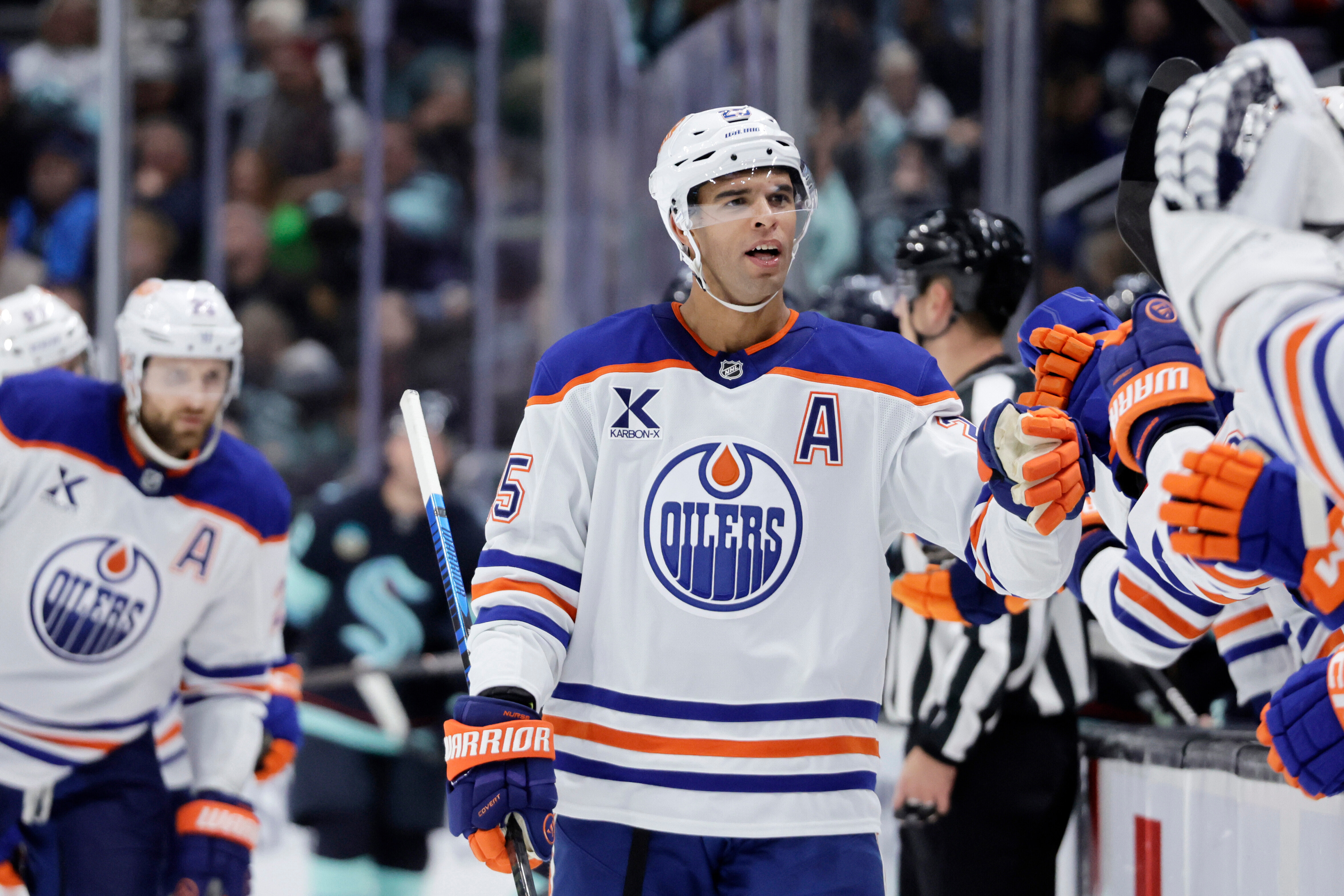
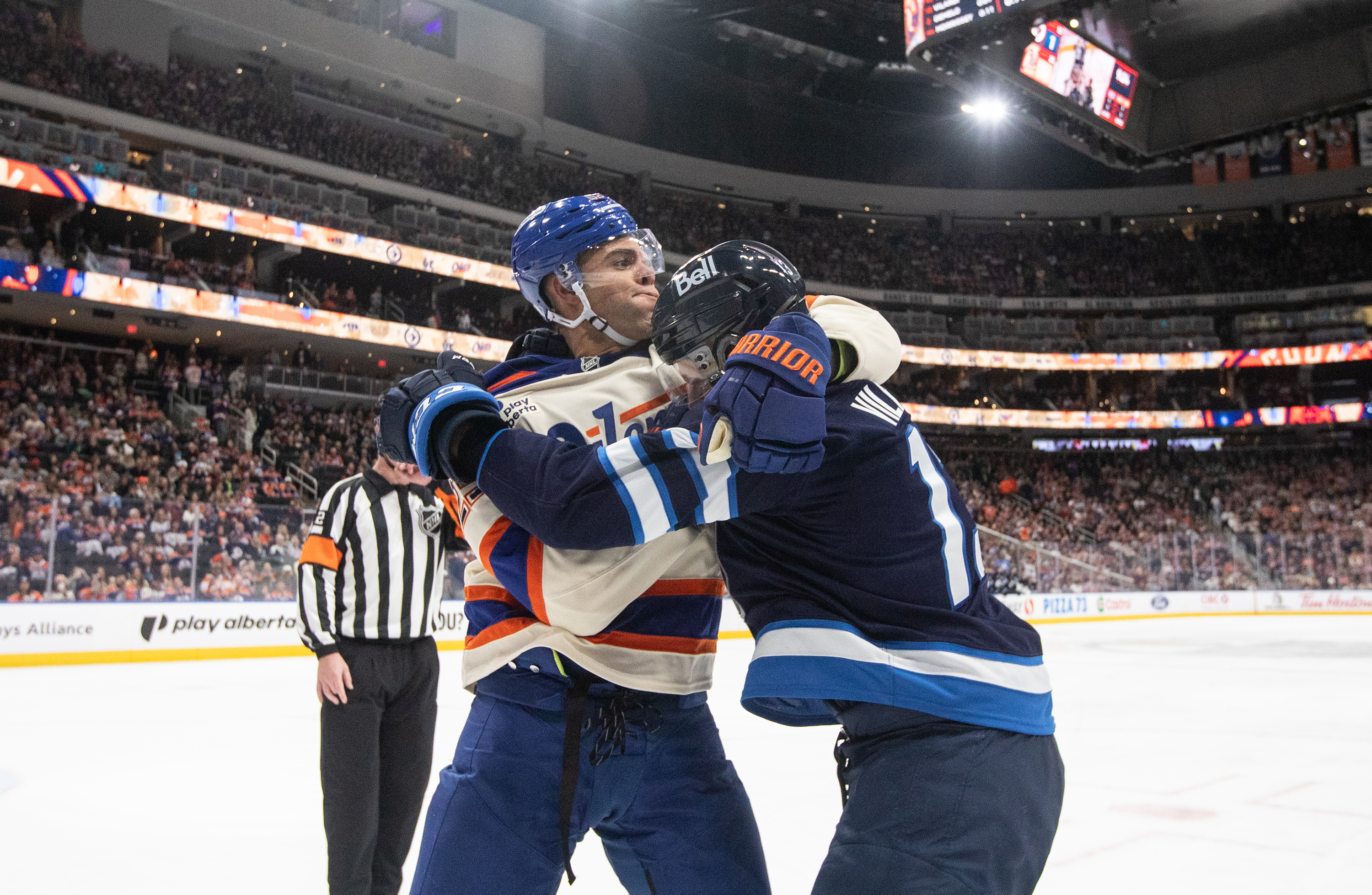
A few hours before Sportsnet reported that Larkin wanted out, the outlet reported on June 4 that all signs pointed to defenseman Darnell Nurse and the Edmonton Oilers heading for a breakup. The report stated that Oilers general manager Stan Bowman was expected to speak with Nurse in the coming days “about his wishes” and that the team would like to trade Nurse.
Unlike Larkin’s impending divorce, this one sounds a bit more amicable, with Sportsnet adding Thursday that Nurse has officially requested a trade. League sources have told The Inquirer there is not only mutual interest, but the Flyers are on a short list Nurse sent the Oilers.
But does it make sense for the Flyers to acquire the blueliner, who is a nephew of ex-Eagles quarterback Donovan McNabb? Let’s dissect.
Darnell Nurse (left) will bring 100 games worth of NHL playoff experience to his next destination. JASON FRANSON
The request by Nurse comes as he enters Year 5 of an eight-year deal with a no-movement clause for one more season, meaning he cannot be traded, sent to the minors, or waived without approval. The contract shifts to a modified no-trade clause — he can submit a list of 10 teams to which he can be traded — on July 1, 2027.
That’s not the biggest concern, as he’s already said he wants to move out of Alberta. The issue is that the contract has a hefty cap hit of $9.25 million despite Nurse being on the middle pair. However, the contract was heavily front-loaded so he’s only owed $29.6 million the rest of the way. Either way, the consensus is that Edmonton would have to eat some of the money to facilitate a trade.
And it’s a large contract for someone who doesn’t play top minutes. This past season, Nurse had seven goals, 24 points, and blocked the ninth-most shots in the NHL (167) in 82 games. He had his worst plus-minus (minus-12) since 2015-16 and the most penalty minutes in his career (104) while averaging his fewest minutes since his third season in the NHL at just under 21 minutes.
His 164 shots on goal during the regular season tied for 20th among NHL defensemen, and, among all skaters, would have been the fourth-most on the Flyers. Could that be intriguing to the Flyers, who averaged 24.6 shots across 10 playoff games and finished the regular season at No. 28 (25.5)? Coach Rick Tocchet often brought up the need for more shots on goal from his defensemen, coupled with guys getting to the front to set screens or tip shots.
There are pluses to Nurse’s game, including the fact that he has played in the Stanley Cup Final multiple times, which no one on the roster has done. Having a veteran presence, of someone who has gone that far, could provide a boost when they are pushing in the postseason. Still, the veteran of 798 NHL games does have some warts, like miscues and misreads.
An intriguing thing is that general manager Danny Brière told The Inquirer at the NHL scouting combine that the Flyers probably are past signing a veteran to mentor the defensive corps.
“If there’s a high-end defenseman that can help us, we’ll have to look at that, he said. ”It might be time now to give our young guys the chance to see if they can step into those roles, from David Jiříček, Emil Andrae, [Oliver] Bonk, Ty Murchison, Hunter McDonald. I think those guys have probably earned the right to get a look, and hopefully we can fill that all with our younger guys from within.”
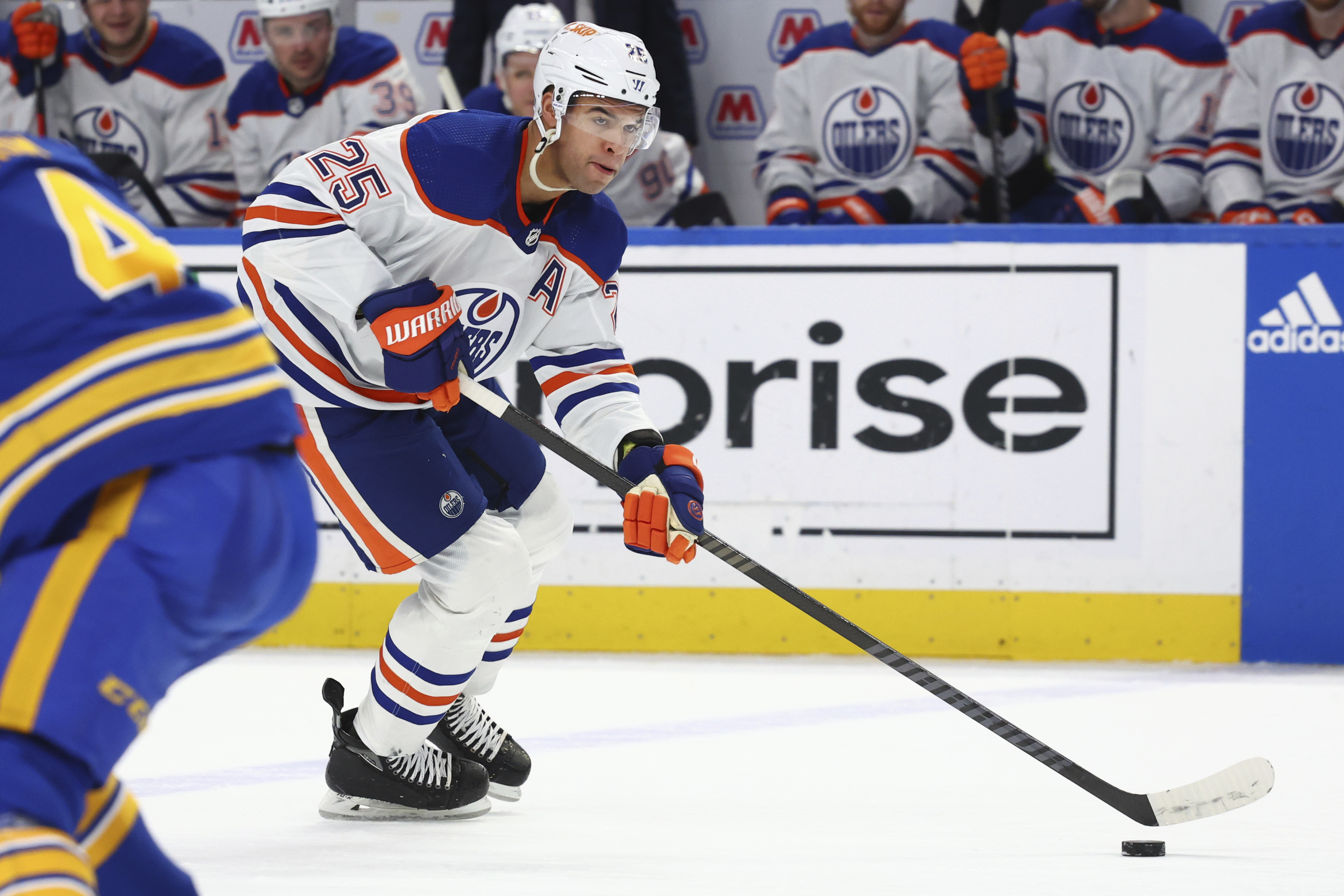
Could a Darnell Nurse (25) acquisition help mitigate the potential departure of Rasmus Ristolainen?Jeffrey T. Barnes
Does acquiring Nurse, or at least talking of acquiring Nurse, hint that there is another move pending? The Flyers need to make room for Jiříček, who will no longer be waiver-exempt in 2026-27. Brière also mentioned that “a high-end power-play quarterback on defense” is a need. Additionally, the team must make room to stay under the cap.
Could Rasmus Ristolainen, who has been the subject of trade rumors for years, finally be on the move?
“Yeah, I mean, we’re going to look into it. I think we have to,” Brière said in Buffalo when asked if the Finn would be part of trade chatter again. “That’s our duty as the organization, to explore what’s out there and see if there’s something that makes sense or not. But he was so good down the stretch for us, played on the top pairing with Travis Sanheim, how good he was at the Olympics, how good he was in the playoffs. So he’s a big asset.
“As we talk about expectations, you trade a guy like Rasmus, and it weakens the team. So if we do it, it’s going to have to make sense for the future. It certainly wouldn’t be ideal for taking a step forward next season if we do trade him, but we have to explore everything that’s out there.”
With Brière’s words in mind, if the team traded Ristolainen and brought in Nurse — maybe to play with Jamie Drysdale and reunite Travis Sanheim and Cam York — might the Flyers view it as a pretty clean swap?
Word began to spread quickly around the NHL scouting combine on June 4. It started as whispers and then grew to a roar as everyone heard about Sportsnet insider Elliotte Friedman’s report that Detroit Red Wings captain Dylan Larkin wanted a trade.
A week on from that report, here’s what we know.
What is the latest on the Dylan Larkin trade request?
Larkin is set to begin Year 4 of an eight-year contract he signed in March 2023, with a cap hit of $8.7 million. The contract makes his trade request sticky, as according to Puckpedia he has a full no-trade clause until July 1, 2028. At that time, it becomes a modified no-trade clause with a 10-team trade list.
On Tuesday, the Detroit Free Press reported that Larkin submitted three teams to general manager Steve Yzerman for which he was willing to waive his no-trade clause. The three teams — the Minnesota Wild, Florida Panthers, and Vegas Golden Knights — are all Stanley Cup contenders, with Vegas currently in the Final against the Carolina Hurricanes, and each team has some of his closest buddies on the roster.
Friedman added on his “32 Thoughts: The Podcast” on Wednesday that there are two more teams possibly in the running — the Tampa Bay Lightning and Dallas Stars — that are also considered 2026-27 Cup contenders.
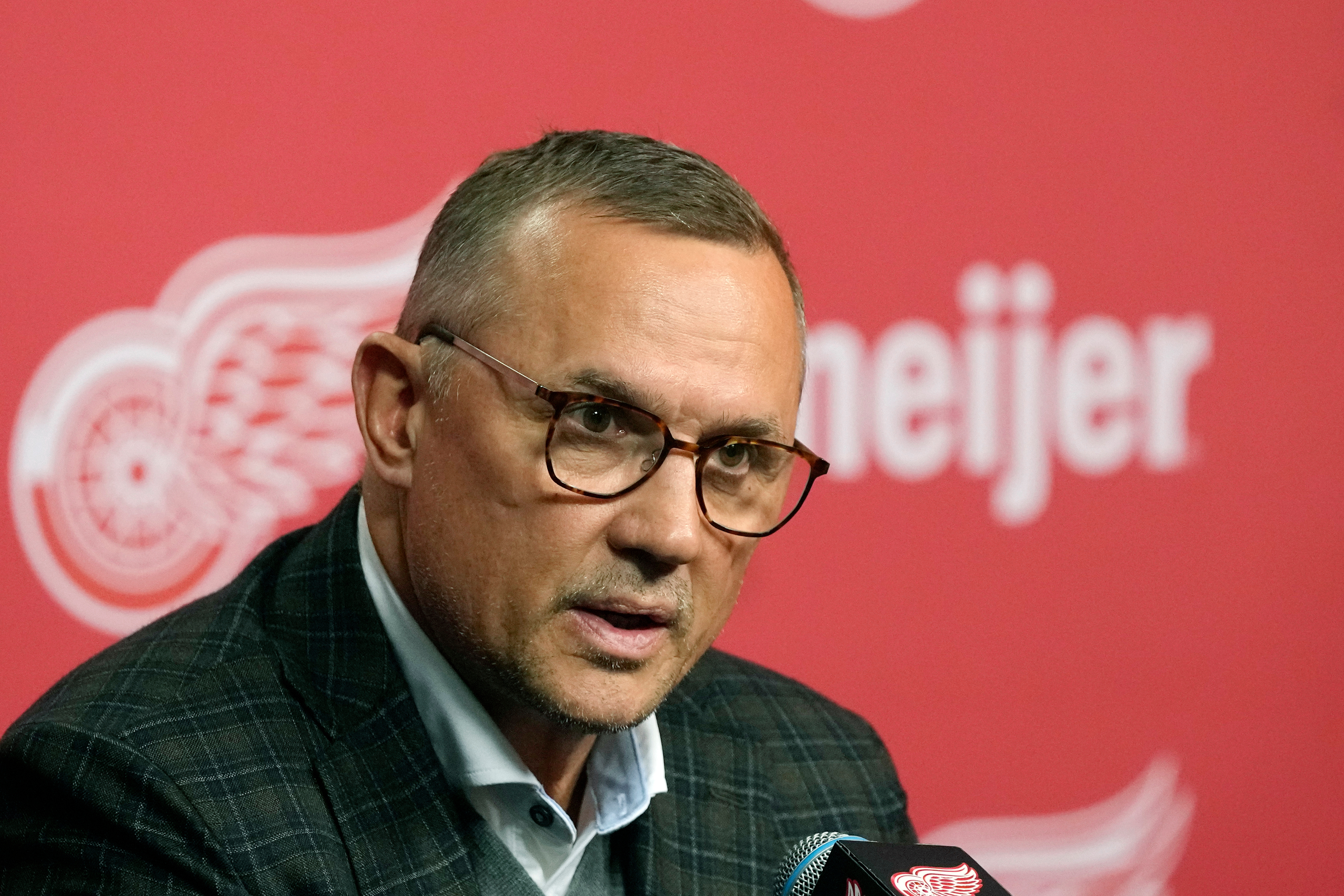
Red Wings GM Steve Yzerman is believed to have a tense relationship with Dylan Larkin. Carlos Osorio
How and why is Larkin suddenly available?
Larkin grew up in the Detroit suburb of Waterford, Mich., played for the U.S. National Development Team in nearby Plymouth, and was drafted 15th overall in 2014 by his hometown team before heading to the University of Michigan for a season. Larkin has never played hockey outside of his home state, skating in 808 games and ranking 10th all-time in points (643) on a list littered with Hockey Hall of Famers like Gordie Howe, his general manager Yzerman, and Sergei Fedorov, for the winged-wheel club.
For the captain of the Red Wings, who will turn 30 at the end of July, maybe it’s time to leave the comforts of home? Or maybe it’s a breakup that has been brewing for some time.
Last year, Larkin hinted that he wasn’t too thrilled with how the trade deadline came and went without much action as the Red Wings were in the hunt for a playoff spot for the second straight year. “We didn’t gain any momentum from the trade deadline, and guys were kinda down about it,” Larkin told reporters last April. “It’d be nice to add something and bring a little bit of a spark on the ice and maybe a morale boost as well.”
That came a little more than a year after his friend Tyler Bertuzzi was traded — Larkin had inked his extension the day before — and Larkin was visibly emotional when addressing the media. Frustration had to be mounting for Larkin, who enters next season with just one playoff appearance — as a rookie — in Detroit. But the GM put the onus on the players, stating at his end-of-season availability, “I’m counting on our best players, our leaders, to give us a bit of a morale boost. That’s what they’re paid for, and that’s the expectations for them.”
“They don’t speak unless they’ve had to, they haven’t for a while,” he quoted the agent. “That’s kind of become common knowledge about the situation in Detroit. Steve and Larkin coexisted, but they didn’t get along at all, and that’s kind of been known by others for a bit now.”
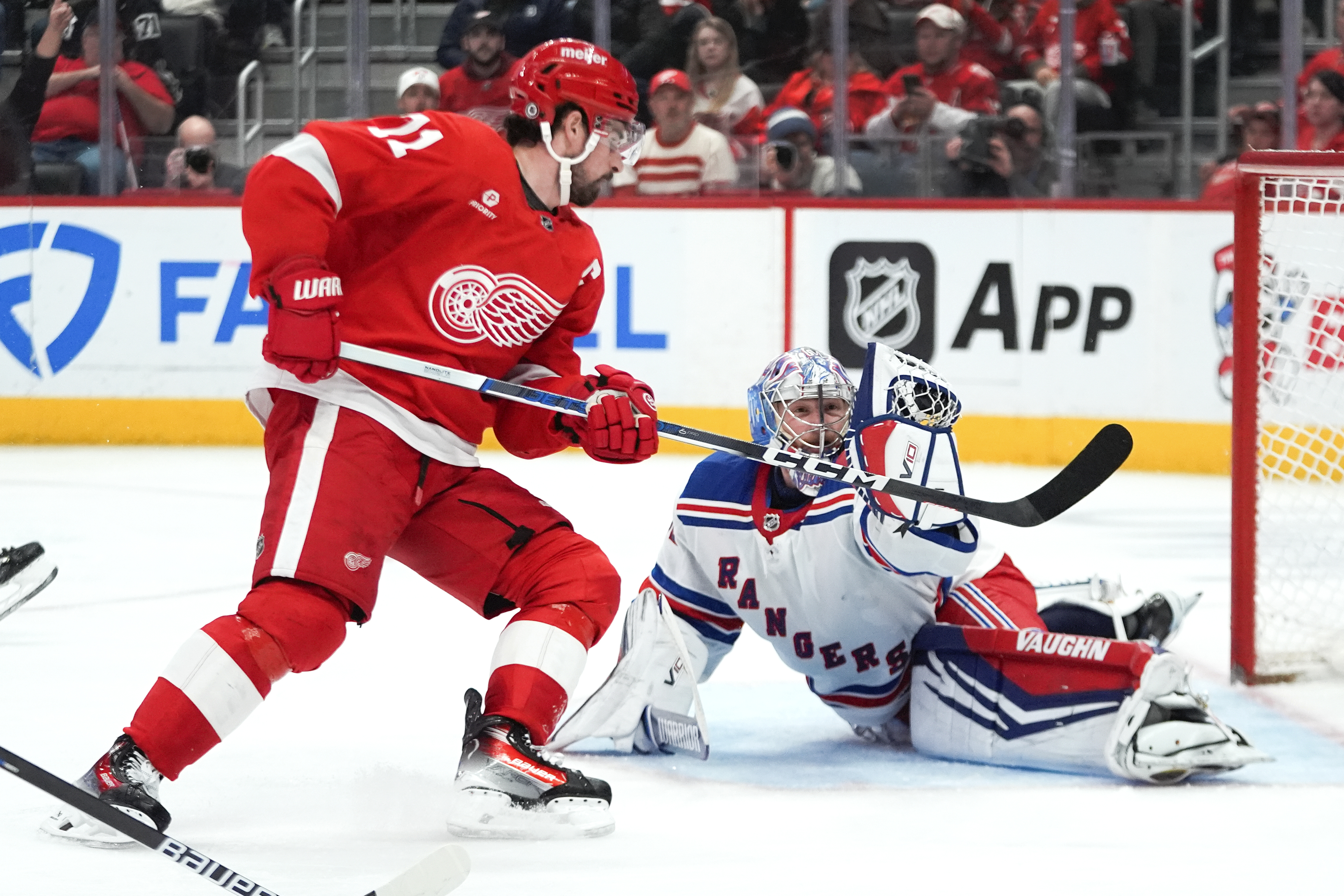
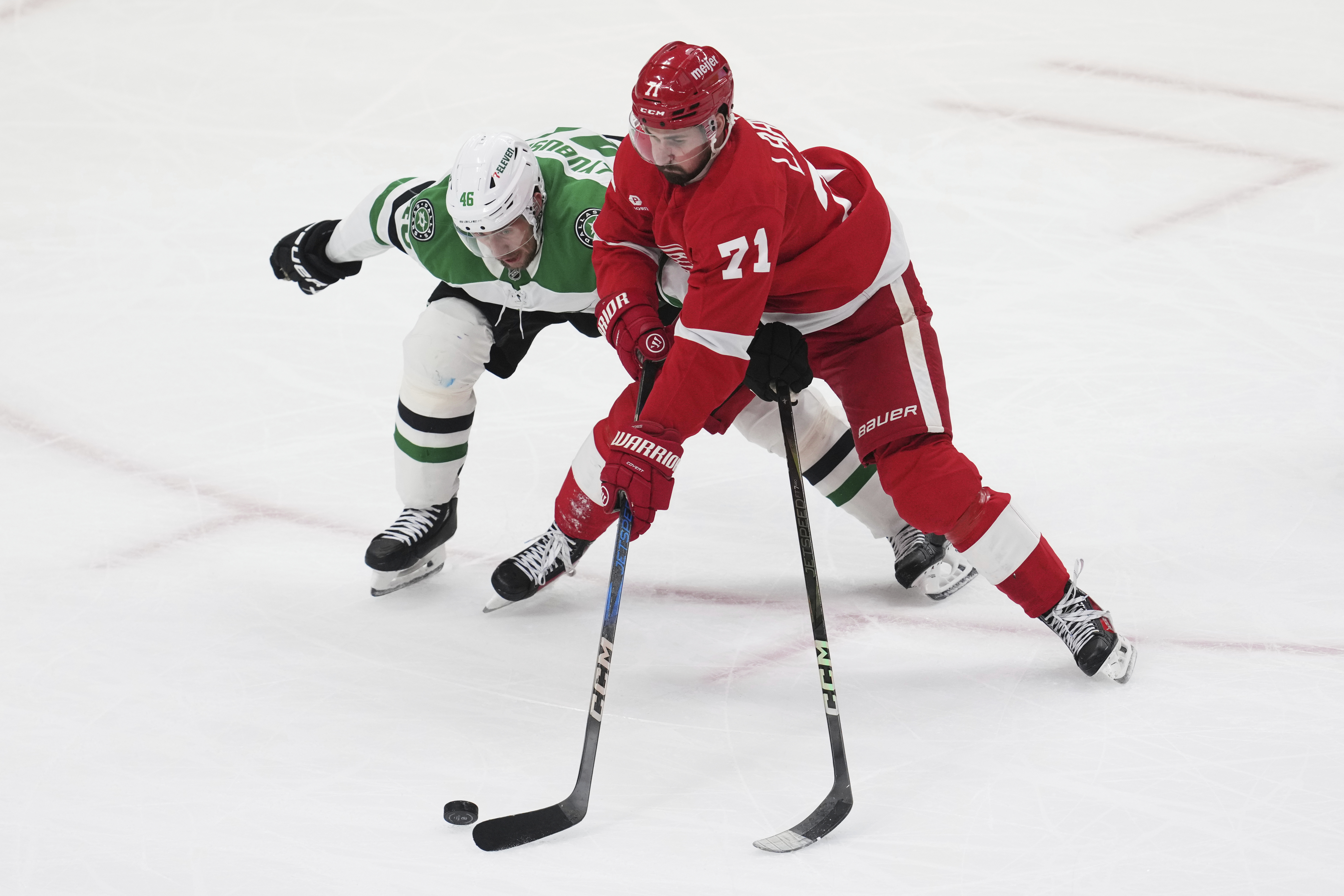
Dylan Larkin (71) is a prolific goal scorer with much-coveted power-play skills.Paul Sancya
What kind of player is Larkin, and what has he accomplished?
Larkin is a perennial 30-goal scorer, having hit the mark for the past five seasons and in six of his 11 NHL seasons. His 34 goals this season would have landed atop the Flyers leaderboard, along with his 14 power-play goals — something the Flyers desperately need help with — and nine game-winners. His 67 points would have finished tied with Trevor Zegras for second, behind the 68 points Travis Konecny dropped.
And the best part? He’s a center — a No. 1 center.
“I think the thing about Dylan is that he is a bona fide, top-six center. He can be the number one center who — the rare thing about him is that he really embraces the head-to-head shutdown role part of it,” Shapiro told The Inquirer at the NHL scouting combine.
“ … When Colorado comes to town, he wants the Nathan MacKinnon matchup, he wants the Connor McDavid matchup. And he’s one of the few players that has the foot speed to actually go into those battles and limit those guys. I think the reason he’s an $8.7 million player, and those guys are $12 million players, is because [while] he could be that offensive guy, he puts so much energy into kind of that defensive end.
“And I think that’s what makes him a little bit rare, is he’s someone who has that ability to be that offensive guy, but has kind of embraced more of that defensive role.”
Danny Danny Brière has explicitly cited an emphasis on the center position within the team’s offseason checklist. Jose F. Moreno / Staff Photographer
Would the Flyers be interested, and at what cost?
Multiple sources have confirmed to The Inquirer that the Flyers are interested in the center. And why wouldn’t they be? He brings the speed, can attack down the middle of the ice, and has that scoring touch — and he could be put into that 1C spot — that the organization has desperately needed for years.
“I think the greatest need is a top-six center,” he said. “And we have guys that have really stepped up; Trevor [Zegras] has played center at times, and he has the skill to play in that role.
“We’ve asked a lot out of Noah Cates, Christian Dvorak, and Sean Couturier to play some heavy minutes, and we’ve asked them to play in that role for a big part of the season. But looking at our team, that would probably be the one area that we could improve on.”
Larkin checks that box, whether as a 1C or, as Shapiro said, in a 1A/1B tandem where you run Larkin in a strength-on-strength system where he plays against the other team’s top lines. But the Flyers also need a game-changer. Is he that guy too?
“I think he can be,” Shapiro said in Buffalo. “I think we’ve seen it in stints in Detroit, and I thought last year at 4 Nations was a good example of — I know the U.S. lost at 4 Nations — but he kind of was someone who raised his game in that big element, and then he was really good at the Olympics. He’s done it in those moments.
“I’ve always been curious about Dylan Larkin, just because we’ve only seen him play five playoff games in his career. He feels like he has kind of that ability that can break games in the playoffs, where you have those tight-checking chess-match games, and it’s a bit muddy, and everything like that, but he has that [ability] where he can break things open there.”
But there is also the timeline part. The Flyers are not a true Cup contender just yet and, as noted by the teams Larkin is picking, that’s a high priority for the center. He’s also set to be 30 and the Flyers youngsters, like rookies Porter Martone, Denver Barkey, and Oliver Bonk, are still raising their games. Would he be willing to wait?
“It’s funny because he is 29, but he’s never played a playoff game [since his rookie season]. His season has ended April 18 every single year for the last nine years,” Shapiro said. “I’m not going to pretend to know the physical limitations of age [but] I do think, for what is left on his current contract … I think his game is still going to age well, because it’s not like he’s someone who’s played an extra 20 games in the playoffs.
“If you’re looking for a guy who’s a little bit older, who’s going to come in and set a bit of the tone of being willing to turn defense into offense, which is kind of my understanding of the way the Flyers want to do a lot of things, [then] yeah, Dylan is very open; that’s something that he’s all about. I think the fit is there stylistically. … [And] I think for him the next fit is going to be somewhere where he doesn’t have to lead the marquee. … If there’s talk about Philly, and you talk about a bunch of the guys they’re already trying to build around, and if he can be the third or fourth guy you mentioned, and you’re kind of building around this core, it’s probably the ideal spot for him.”
It doesn’t sound like Larkin agrees, but if the Flyers come with the right package, maybe he could be swayed? Shapiro thinks the package needs to include a combination of prospects — especially center depth — an NHL player, and draft picks.
Could that mean a Jett Luchanko or a Jack Nesbitt, who is off to play college hockey at Michigan in September? The Red Wings were reportedly interested in landing Rasmus Ristolainen at the trade deadline. And Detroit does not have a first-round pick this June after trading it to St. Louis for Justin Falk, so could the team take the Flyers’ top pick this year or that first-rounder they have from the Toronto Maple Leafs in either 2027 or 2028?
Could Teddy Blueger (left) be a Plan B at center for the Flyers? ETHAN CAIRNS
If not Larkin, what other centers could the Flyers target?
The free agent market is thinner than thin this year, especially when it comes to top-six centers, which is why acquiring someone via trade makes the most sense.
Yes, Claude Giroux and Scott Laughton are unrestricted free agents, but neither fit the top-six and would be short-term stopgaps, not the long-term projection the Flyers need. Giroux has also been playing wing in Ottawa.
But if they want to add depth, someone like Teddy Blueger, whom Flyers coach Rick Tocchet had in Vancouver, could be an option.
The other option is the good old offer sheet. Brière told The Inquirer an offer sheet is something the Flyers would consider, but “I would say it’s probably not likely with the cap going up; a lot of teams have extra dollars to spend.” If they do go that route, it needs to be done smartly, but options include centers Leo Carlsson, Adam Fantilli and his teammate Cole Sillinger, Cole Perfetti, Mavrik Bourque, and Kirby Dach.
If they go the trade route, Robert Thomas of the St. Louis Blues is the most obvious name out there, although recent reports suggest they are not planning on trading the centerman. Matty Beniers of the Kraken has also been mentioned, as has his teammate Shane Wright; however, The Inquirer has learned that Wright may not be considered a fit by the Flyers, and, per a league source, there is no indication that Beniers is available.
Mathew Barzal’s name has popped up, but sources say that is premature. The Athletic’s Pierre LeBrun has reported Auston Matthews is fine sticking around Toronto, and centers like Vincent Trocheck, Blake Coleman, and Nazem Kadri are all over 30 and do not fit the timeline.
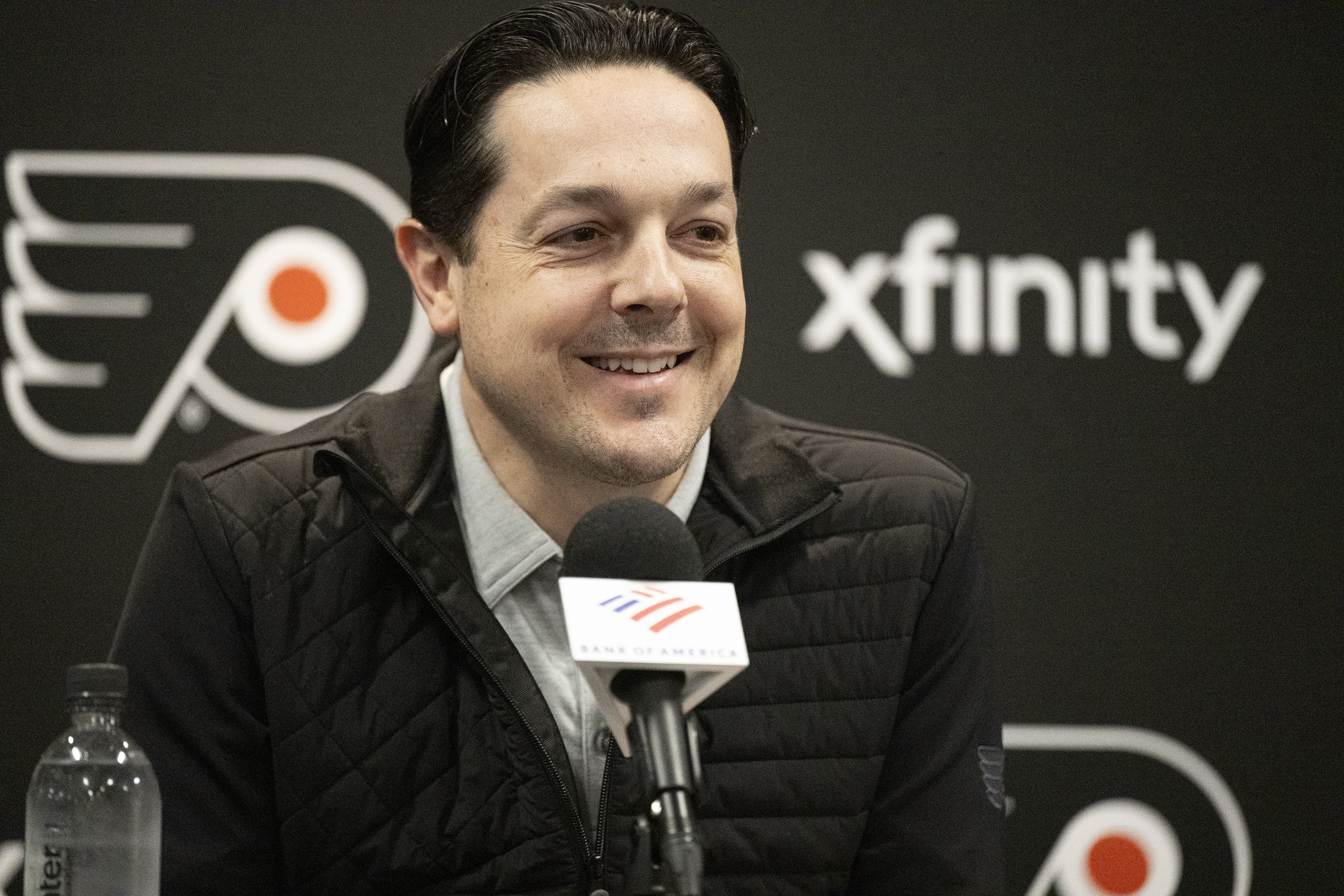
BUFFALO — In the second installment of our interview with Danny Brière at the NHL’s scouting combine, we talked with the Flyers general manager about the upcoming draft, his fourth with the team, and who has impressed him in the organization the most.
This interview has been edited and condensed for clarity.It was conducted on June 3, before it was revealed that Dylan Larkin wanted a trade out of Detroit.
Q: Does how the year went, especially because of the postseason, change your strategy or impact your outlook at the draft?
A: It does not, no. It’s a different animal. We know that what happened was great — the stretch, and then the playoffs were awesome. Expectations are going to grow; we’re aware of that, but we want to try to be careful with the expectations, too. A lot of time it’s not a straight line up. We see it individually with the players, and we see it with teams as well. There’s going to be ups and downs along the way. So we’re trying to be careful with managing the expectations going forward. It’s not going to change our approach. We still feel that we’re in a growth stage of our rebuild, and we don’t want to deviate from that too much, unless it really makes too much sense.
Q: It is a slightly different setup for you this year compared to your previous drafts. By picking at No. 21, does that change your mindset?
It doesn’t change the mindset, as far as the approach, where we’re still looking to pick the best player, especially at the higher-end level. You want to make sure that you have someone who can be a difference-maker, not just a filler, hopefully; never have a guarantee, but that’s the goal. But, yeah, obviously we have to dig in a little bit more on more players, because the range or the amount of players changes a little bit. When you’re picking [at] six, usually you know who’s going one and two, and even when we were at 13, it’s a small group of players who are going to be there. At 21, it can start to go sideways usually after pick 10 or 11; it can go in many different directions, so we have to be prepared that way and try to know more players this year.
Matthew Gard is one of several center prospects in the Flyers system. He is heading back to the Western Hockey League next season.Alejandro A. Alvarez / Staff Photographer
Q: Since assistant general manager Brent Flahr was hired, the Flyers have drafted nine centers — eight of those since you became GM. Is there still a need to draft a center?
A: Absolutely. You can never have enough centers, and it’s a lot easier to move a center to the wing than the other way around. When I talk to other GMs, nine out of 10 GMs are looking for centers. It’s a position that is tough to fill, and part of it is because when a player is usually not able to make it down the middle or doesn’t fulfill what they’re looking for down the middle, they move them to the wing. So wingers are a lot easier to find. Every team is looking for centers, so that’s not a problem to have a surplus of centers. We have one in Cole Knuble who played a lot of the center position, and then last year played mostly on the wing. Well, we know that he can play both, and he played both in Lehigh Valley. So it’s a nice luxury to have too many centers.
Before I arrived, there were some centers who didn’t hit, like Nolan Patrick, German Rubtsov, and Jay O’Brien. So there have been a few that they just didn’t pan out. I think the organization was trying to draft centers, the players didn’t pan out or didn’t develop the way the organization expected, and that’s why all of a sudden we came up and we didn’t have very many centers.
So hopefully now the players that are in place will keep developing. We believe in Jett Luchanko. We believe in Jack Nesbitt, the way he’s developed. Jack Berglund has really stepped up. We think Heikki Ruohonen is trending in the right direction, and hopefully the guys we signed, Riley Thompson and Knuble, at the end of the year could really help us there. Matthew Gard is also in there. So it’s a nice luxury to have, and if we have the chance to jump on a center, we won’t hesitate to get.
Q: It feels like it’s either defensemen or centers in this draft.
A: It seems to be a lot, but you look at last year, there were all these centers. There was one winger in the top 10, I think; who drafted the winger? We did — which we don’t regret, by the way. Porter Martone has been amazing. But we went with what we felt was the best player on the board, not considering the position at that time. So it’s going to be the same approach. But, yeah, there seem to be a lot of defensemen and centers in this draft.
Q: Is there any update on the first-round pick from Toronto, acquired in the Scott Laughton trade, in regards to which year?
A: No, I haven’t heard from the NHL on that yet.
Q: Hunter McDonald is a restricted free agent. Where do things stand in his contract negotiations? Where do you see him projecting long-term, and is he ready for the NHL?
A: Hunter took a big step last year in his development, and that’s why he played that game late in the season. I think our coaching staff was really impressed on how he took a step forward this year. He put in the work and really elevated his game, earned that NHL game at the end, and he was around the team when we played in the playoffs as well.
Really exciting to see him have growth to his development. It’s a big summer for him, but we’re excited about him. A big, physical defenseman like that is not easy to find, and we hope he’s going to be one of those guys, eventually. But he’s going to have to beat someone at some point to earn those minutes.
Flyers defenseman Hunter McDonald is one of several players expected to push for an NHL job come September.Yong Kim / Staff Photographer
Q: Do you foresee Emil Andrae, also an RFA, having long-term success in Philadelphia?
A: What we love about Emil is his compete level. I was really impressed with him after training camp when we sent him down to go work on his game — he wasn’t happy about it — but he went down and didn’t pout and decided to show everybody that he didn’t belong in the American [Hockey] League anymore. So that part is what you love about him. He’s going to compete; he’s going to give you everything he has. But, again, now you’ve got to beat someone in the top six to play on a regular basis. That’s not easy to do. We do have some good defensemen, and that’s going to be the same challenge for him moving forward.
When you’re at that stature, and I lived it myself, you almost have to be perfect, and that’s the tough part. We’re asking a lot out of him for him to be able to be in the lineup, and I think he’s getting better at it. Making fewer big mistakes, he has gotten better, but that’s the reality that he’s dealing with, and he knows that, and he’s good with it, and he’s really working hard on his game to become a very, very efficient and effective defender.
Q: Do you like that there might be all this internal competition now?
A: Absolutely. I think it’s great. I think it’s great that we have an internal rivalry to beat each other out for minutes. That’s the great part too, with our veterans. They understand, they respect it, because they did it at one point, they beat someone out. So I think our guys realize, and that’s great, that it also pushes our veterans to stay on top of their game and keep getting better.
Q: Is there anyone in the system who impressed you?
A: Ty Murchison had a great [year], and that’s why he got some games early, before his injury; that was an impressive year. I think Oliver Bonk, after dealing with some injuries early in the season, built up his game and got better as the season went on. David Jiříček will be a very interesting one because he had a really good, strong finish to the season in Lehigh Valley. So that’s just been in the [AHL]. Up front, you saw Porter Martone, Alex Bump, and Denver Barkey; they earned it. Nothing was given for free; they earned their minutes, they earned playing more and more because they were competitive, they were ready to go. So that’s really exciting.
Q: Who is the player who needs to take the biggest step next year?
A: I can’t really pinpoint one. I think we expect that from every player. There are expectations. It’s not just hoping if you want to make it. And that’s a little bit of the tough part with our guys — we do have a lot of players and a lot of good, young players, so you have to earn your way. You have to push yourself, and you have to be willing to commit to a regimen to get ready for next season that is probably out of your comfort zone. That’s just the reality. You want to be an NHL player, you’re going to have to do that.
Flyers forward Jett Luchanko skated in four regular-season games and one playoff game this season.Yong Kim / Staff Photographer
Q: Jett Luchanko had a little bit of an up-and-down year. Where do you see him fitting in as his career progresses? And what do you need to see from him next season?
A: We’re excited to see him turn [fully] pro. I think that’s great. For Jett, it’s been tough, and he’s been on so many teams. Just last year alone, from Flyers to Guelph [of the Ontario Hockey League] to Brantford to World Juniors, back to Brantford, to the Flyers. There’s been bouncing around, and that’s two years in a row that he’s kind of done that. Stability will probably be a good thing for him.
We expect a big summer out of him, and he’s got to get ready. The big thing with Jett is, he has an elite skill in skating that is almost unmatched from anyone in the organization, other than maybe Owen Tippett. So that’s always going to have a lot of value for anybody to have a player like that. Now it’s our job to try to help him and round out his game to make it in the NHL. But what I would expect, I would say, is probably for him to play a year in Lehigh Valley.
BUFFALO — Three seasons are complete for Flyers general manager Danny Brière, and he is on the precipice of one of the biggest offseasons of his tenure.
The Inquirer sat down with Brière at the NHL’s scouting combine in western New York to discuss what the future landscape looks like for the Flyers. In the first of two parts, he discusses the current squad and where things stand with free agency.
This interview has been edited and condensed for clarity.It was conducted on June 3, before it was revealed that Dylan Larkin wanted a trade out of Detroit.
Q: You and president Keith Jones have spoken for a long time about wanting to take a step forward. How important do you think it is to add now to the roster?
A: Well, we want to add smartly. You’re not going to see us try to go after a big-time free agent who doesn’t make sense in what we’re trying to do. The goal is still to improve the team, but not mortgage the future. I think that’s probably the best way that we can explain it. It’s got to make sense for years to come before we’re going to trade away some young assets.
Q: With the free agency landscape changing, does it make you look harder at an offer sheet?
A: I think every team will consider that. But people have to understand, an offer sheet also comes with some consequences that you have to consider before going down that road. But we have to consider it. I would say it’s probably not likely with the cap going up; a lot of teams have extra dollars to spend. But we’re definitely going to look into it, like everything.
Q: What would you consider to be this team’s greatest need in terms of position or skill set?
A: I think the greatest need is a top-six center. We have guys that have really stepped up. Trevor Zegras has played center at times, and he has a skill to play in that role. We’ve asked a lot out of Noah Cates, Christian Dvorak, and Sean Couturier to play some heavy minutes, and we’ve asked them to play in that role for a big part of the season. … The other place would be a high-end power-play quarterback on defense, if we could find one.
Q: There’s obviously a lot of interesting over-30-year-old defensemen who are good on the power play available, like John Carlson and Darren Raddysh. I know you cannot comment about them specifically, but would you consider someone over 30 as a stopgap solution?
A: I’m not saying it will happen, but we have to consider it. We have to look to see if it makes sense. Obviously, term and money will play a big role to see if it fits into what we’re doing. It’s an area that we need to improve on, and we’ve been trying to improve on. The exciting part is we’re starting to bring in some guys that have been good on the power play at different levels, when you talk about the [Porter] Martones, the [Denver] Barkeys, [Alex] Bump, even Oliver Bonk and David Jiříček. So we do have some different flavors that are starting to integrate the team. Hopefully that pushes some of our veterans that have had the chance to play on the power play the last few years, but it just hasn’t been good enough.
Q: In the past you have brought in a veteran blueliner, like Erik Johnson, Marc Staal, and Noah Juulsen to be the seventh defenseman. Has this defense reached the point where you don’t need that player?
A: I think we’re probably past the mentor part. If there’s a high-end defenseman that can help us, we’ll have to look at that. It might be time now to give our young guys the chance to see if they can step into those roles, from David Jiříček, Emil Andrae, Bonk, Ty Murchison, Hunter McDonald. I think those guys have probably earned the right to get a look, and hopefully we can fill that all with our younger guys from within. Maybe even guys like Adam Ginning or Helge Grans can step up their game. They could be in the mix as well.
Is this the summer the Flyers part ways with defenseman Rasmus Ristolainen?Jose F. Moreno / Staff Photographer
Q: Rasmus Ristolainen has always been mentioned in trade rumors. He was obviously a valuable player down the stretch and in the playoffs, but the reality is he’ll be 32 in October, in the last year of a good deal, and stayed healthy. Do you envision him here come September? Do you anticipate him being in conversations again?
A: Yeah, I mean, we’re going to look into it. I think we have to. That’s our duty as the organization, to explore what’s out there and see if there’s something that makes sense or not. But he was so good down the stretch for us, played on the top pairing with Travis Sanheim, how good he was at the Olympics, how good he was in the playoffs. So he’s a big asset. As we talk about expectations, you trade a guy like Rasmus, and it weakens the team. So if we do it, it’s going to have to make sense for the future. It certainly wouldn’t be ideal for taking a step forward next season if we do trade him, but we have to explore everything that’s out there.
Q: Does having players like Bonk, Jiříček, and maybe McDonald and Murchison, who showed the ability to play at the NHL level, impact things?
A: Well, it’s good to know that we do have some players that have the capabilities to eventually step in. When is that? That’s what we don’t know. Every player kind of graduated at a different pace, but, yeah, we believe that some of those guys will be able to take some of his responsibilities. We just don’t know yet when that will happen. We knew they weren’t quite ready for that down the stretch and into the playoffs, and that was one of the reasons why we kept Risto when we weren’t able to get what we were looking for.
Q: Dan Vladař extension talks have surfaced. How comfortable are you with going long-term considering he’ll be 29 in August?
A: Vladař was our MVP last year. He was our best player. He was a leader also in the locker room. He’s a guy that wants to be here, and he’s someone we want to be here. So we will definitely consider doing something with him, if he’s open to it. He’s earned it. He believed in us. He wanted to be here, and we don’t feel that we have any prospects that are quite ready to play those minutes and those games. He’s in a great tandem with Sam Ersson. It’s definitely a position that we would like to keep strong, and Dan has earned it.
Q: But it was only one year where he carried the heavy workload and at that high of a level. How do you balance that?
A: That was part of the reason to sign him to a short-term deal. We didn’t know the personality; we didn’t know the person off the ice. You get to know the person, you get to have a test run, basically. Knowing what I know now, I would have signed him to a four-year deal last summer. … Is he going to play that high of a level again next year? There’s no guarantee of that, and we know that. But I think he’s shown us enough to believe that he could be the guy for the future for us.
Will the Flyers keep their goalie tandem together for another season?Yong Kim / Staff Photographer
Q: You mentioned Ersson, who will be a restricted free agent on July 1. Where do things stand with him, and did his play late in the season change your viewpoint?
A: Sam is a gamer, and Sam doesn’t quit. He fits the personality of the Flyers. There’s no quitting with him; even when he has a bad game, he fights back, and he comes back strong. We all know it wasn’t the ideal first half, but we have to give him a lot of credit in the way he could have thrown that season out the window and just give up. But he did not, and he got us some big wins. … We know Sam. He is well-liked in the room, great teammate, great human being, character person, so that plays a lot into it as well, and that’s why we have to strongly consider bringing him back. We haven’t made a decision yet, and we haven’t discussed an extension with him yet, but we’re looking at all options. But he did a lot of good last season and earned [the opportunity to] be considered.
Q: Zegras is also a restricted free agent. How are his contract talks going, and where do you see his ideal position at this point?
A: I think it’s a great option to have him be able to play either [wing or center]. Part of the season, I thought he was more of a winger than a center, but then coming down the stretch, what he did was very good too, in the middle of the ice. I think it’s nice to have that option, to have a guy like him who’s so creative that can play a different position and help us in the middle if we need to or on the wing. Again, where it stands, I’m not worried about the contract with him and Jamie Drysdale. They’re players that we want back, and I feel they want to be part of the future for the Flyers, so my expectation is they will be there in September when camp opens.
Q: What has it been like for you watching Drysdale’s progression as a top defender?
A: Yeah, it’s been pretty cool to see [him] being able to adjust to the league, to see him work on his game, a student of the game, trying to find ways to improve and get better. We have to give him a lot of credit for the season that he had after — it’s admitted — a little bit of a rough start in Philadelphia. But, defensemen, you have to be patient with them. They take a long time, and it was definitely a good sign to see Jamie take a step forward.
Q: You have a bit of a logjam on wing. Do you think there is a spot for everyone, or do you need to clear some space?
A: It depends on if Trevor is going to play wing or center. It depends if we ever end up finding another centerman. I think it’s pretty fair to say that we’re not looking to bring in more wingers in our top nine. I think our group is still pretty young and already able to have an impact, so we’re not going to look to bring in outside help on the wing in our top nine.
Q: Like Ristolainen, Owen Tippett is mentioned in trade rumors often. Did it show how much you missed having him in the lineup against Carolina, and did that give you pause to keep him around?
A: First of all, I’m not going around shopping Owen Tippett. But a lot of teams are calling about him because they like the package, the speed, and everything. It’s my job — and I’ve been very honest with Owen; I tell him that too — I have to listen. It’s been going on now for, I think, two years, so I think that shows you how much we value Owen and how much we love him. I’m not foreseeing anything going on there. Owen brings us a lot of speed, and the way he played down the stretch is a big reason why we made the playoffs, and we’re very happy with Owen Tippett.
Q: Is there an update on his health?
A: He did have surgery for a sports hernia. A few days after the year-end meeting, he saw the specialist, and all agreed it was better to do it. So it was taken care of right away. It won’t hamper his offseason training, and he’ll be ready to start the season.
Q: How confident are you that Matvei Michkov will bounce back and learn from this year?
A: I am very confident that Matvei will step up to where he was the previous year, and more. I think it was a tough season. It was a trying season. I believe he’s learned a lot. At the end of the day, he still finished with 20 goals and over 50 points in a trying season. We’ve said it before: Other than Connor McDavid, Sidney Crosby and Macklin Celebrini, there aren’t too many guys that don’t have downs in their career, and I’m sure even those guys have had them at some point.
Development is not an easy, straight arrow going up the whole time; you see that happen to a lot of players in their second year. You have maybe a little bit of a letdown because you think, “I survived, it went pretty well the first year, and you think it’s going to be easy.” Most of the time, the guys bounce back from that, and I expect the same thing from Matvei. He’s so talented, can beat you many different ways, and I expect him to come back with a vengeance and to want to show everybody. Just knowing how competitive he is, I expect him to want to show everybody who he can be.
BUFFALO, N.Y. — Blake Zielinski walked into his interview with the Flyers on Thursday at the NHL scouting combine and said the first thing general manager Danny Brière asked him was whether it felt like home.
Zielinski said the question helped ease his nerves. A native of Berlin, N.J., he grew up a diehard Flyers fan, learning how to play at rinks like Pennsauken Skate Zone and skating for the Philadelphia Jr. Flyers. He is now preparing for his first NHL development camp by training at Holleydell Ice Arena in Sewell.
At one point, the 18-year-old, who is heading to Providence College in the fall, wanted to be ex-captain Claude Giroux. These days, he’s keeping an eye on Travis Konecny’s game and told The Inquirer he thinks he was at every Flyers home game against the Pittsburgh Penguins in the first round of the Stanley Cup playoffs.
“I made it known I was a Philly kid, and kind of understood what it took to play for them, and hopefully they got that message,” he said Saturday after completing the last day of testing, including the dreaded Wingate test, which calculates a player’s anaerobic fitness. Zielinski finished 10th.
Now, while one would expect a kid from South Jersey to be a Flyers fan, how about a teenager from Finland? For the record, these days Juho Piiparinen is a Dallas Stars fan because his idol, Miro Heiskanen, plays there, but he grew up liking the Orange and Black.
“They are pretty legendary,” said Piiparinen, who did meet with the team. “They’re from Philadelphia, and that was my dad’s favorite team, and I have their hat, too.”
So, how did this all happen? His dad, Jarkko Piiparinen, liked watching in the ’90s “the legendary goalie” Ron Hextall, and Eric Lindros, “a big center.” And the 6-foot-3, 203-pound, right-shot defenseman who is strong defensively but is working on developing his offensive game, especially with getting time on the second power-play unit, is someone the team could snag at No. 21 in the first round of the NHL draft.
A teammate of Flyers prospects Max Westergård and Heikki Ruohonen at the 2026 World Juniors, he’s also keeping an eye on the Flyers.
“This season, they were in the playoffs, but they couldn’t get so far,” he said. “And there’s this big, big Finnish defender, [Rasmus] Ristolainen, and I really like his style, how he plays.
“But I think it’s an amazing logo, too.”
Defensive prospect Juho Piipparinen finished tied for third in the 10-meter sprint and force plate no arm jump, tied for fourth in VO2 max, and seventh in the bench press during the fitness testing at the NHL scouting combine.Staff/Jackie Spiegel
Taking a Flyer
Zielinski and Piiparinen were two of the approximately 50 players the Flyers, with only five picks across seven rounds, met with last week.
The Inquirer can confirm the following prospects spoke with the Flyers. Players said the meeting was typically straightforward — no off-the-wall questions like Montreal is known for — with one player saying they seemed to want to know he was a good kid.
The players are divided by the position where the fitness testing schedule listed them, but keep in mind some wingers can play center, and some centers can play wing. Also note, The Inquirer did not speak to every player who was at the scouting combine. Center Viggo Björck thinks he met with the Flyers but could not remember exactly.
Centers: Rūdolfs Bērzkalns,Ryder Cali, Alexander Command, Maddox Dagenais, Beckett Hamilton, Jack Hextall, Ilia Morozov, Brooks Rogowski, Markus Ruck, Oliver Suvanto, Blake Zielinski
Left wings: Niklas Aaram-Olsen, Ethan Belchetz, Wyatt Cullen, Chase Harrington, JP Hurlbert, Adam Novotný, and Victor Plante
Right wings: Jaxon Cover, Elton Hermansson, Simas Ignatavicius, Kayden Lemire, Casey Mutryn, and Liam Ruck
Defense: Tommy Bleyl, Vladimír Dravecký, Malte Gustafsson, William Håkansson, Jayden Kurtz, Ryan Lin, Ben Macbeath, Piiparinen, Timmy Runtso, Maksim Sokolovskii, and Xavier Villeneuve
Goalie: Michal Oršulák and Tobias Trejbal
Center Jack Hextall’s uncle played in the New Jersey Devils organization. He is a distant cousin of Ron Hextall, the former Flyers goalie and general manager, and, Jack told The Inquirer, the two have never met.Staff/Jackie Spiegel
Family ties
Some players fell in love with the game because their dads played hockey. Plante’s dad, Derek, skated in 450 games, including 12 with the Flyers in 2000-01; he also spent time with the Phantoms in the American Hockey League that season.
“We were always talking about hockey. We love hockey, and everything we do, we compete,” said Plante, who will join his brothers Max and Zam at the University of Minnesota-Duluth — Max just won the Hobey Baker as men’s college hockey’s best player.
“Whether it’s raking leaves or shooting pucks or we’re in the backyard playing Wiffle ball or something, we’re always doing something competitive. At the dinner table, definitely a lot of arguments about hockey and stuff, but we’re always having good, clean fun.”
Dravecký’s dad, also named Vladimír, is still playing pro hockey in Czechia, and Dagenais’ father, Pierre, played across five NHL seasons, seven AHL seasons, and a handful more in Europe. Cali’s mom, Fiona McLeod, played professionally in Switzerland for several seasons, where she met his dad.
Jaxon Cover and Ryder Cali (not pictured) spent part of their childhood in the Cayman Islands and played roller hockey together.Staff/Jackie Spiegel
Cullen’s father, Matt, played more than 1,500 NHL games, winning a Stanley Cup with the Carolina Hurricanes in 2006 and two with Flyers coach Rick Tocchet in Pittsburgh. He told The Inquirer that Sidney Crosby would come over to the house and play mini-sticks — and, yes, Crosby even won at that.
But then there are the players whose parents excelled in other sports.
Tyus Sparks, who did not meet with the Flyers, first skated on a frozen basketball court in Minnesota during a Christmas trip back to his mom’s home state at 2 or 3 years old. He returned to Boise, Idaho, and started playing hockey. How did the family land in Boise? His dad, Nate, was a quarterback at Boise State before suiting up briefly in the Canadian Football League for the BC Lions.
Rogowski was on the path to play baseball, but he is now a 6-7, 236-pound center who will play at Michigan State next September. Baseball runs in the family — his father, Casey, was drafted by the Chicago White Sox and reached triple A, and the Los Angeles Dodgers selected his uncle Ryan. “They’re super supportive, but they’re a bit bummed” that the youngest Rogowski, a first baseman, didn’t follow in their path.
Ignatavicius was born in Memphis and grew up in Lithuania. His dad, Mantas, played college basketball at High Point University and then professional basketball overseas. And according to Mutryn, who Bērzkalns called the tough guy he faced in this draft class, his dad, Scott, is more than happy his son didn’t keep the family sport going.
“My dad always made sure we knew how to throw a football, and we played other sports, but he never really wanted us playing football when we were younger,” he said of his dad, who was a QB at Boston College and spent time with the New England Patriots.
“He’s like, there’s no point in third grade playing tackle football, when the helmet weighs half as much as you do. So he’s like, just wait till fifth grade, and it was too late by that point.”
Flyers general manager Danny Briere was busy talking with other league personnel at the NHL draft combine.Jose F. Moreno / Staff Photographer
Flyers news and notes
While the draft prospects meet with front office staff and go through the gauntlet of fitness testing, the week in Western New York is also a chance for general managers to chat with each other and agents.
Here’s what we’ve heard about the Flyers:
Obviously, Dylan Larkin requesting a trade out of Detroit was the hottest topic after it broke Thursday. Multiple sources have confirmed to The Inquirer that the Flyers are interested in the top-tier center, and they do think they have the assets — speculation is that the Red Wings will want a young center and a combination of NHL players, picks and prospects in return — but does he want to come to Philly? The Detroit Free Press reported Monday that he submitted a three-team list of where he’d like to go; the Flyers were not one of them. And, at almost 30, does he fit the Flyers’ timeline?
John Carlson is a name that has been tossed around as a perfect fit for the Flyers, specifically to help the power play. The Anaheim Ducks are currently on the clock to try to re-sign the defenseman whom they acquired at the trade deadline. He would prefer to come back east if that does not happen. However, at 36, he also wants to win another Cup before his career is done, and the Flyers are not in a position to do so next season. Could there still be a match?
The chatter that a contract extension has already been all but inked may have been a little premature for goalie Dan Vladař. Both sides want to get it done, but it doesn’t sound like anything is set in stone. They met this past week to get the ball rolling and, as a reminder, Vladař cannot sign until July 1.
Brière was also spotted chatting with Seattle Kraken general manager Jason Botterill. Shane Wright has been a hot topic these days as a possible solution to the Flyers’ need at center, as has Matty Beniers. But multiple reports have indicated that the ask for Wright, a 22-year-old center, is high and there is no indication that Beniers is available.
Alexander Command could be available when the Flyers select at No. 21 in the first round.Jackie Spiegel
Breakaways
Hermansson’s older brother, Simon, a former hockey player, was the leading man for “The Bachelor” in Sweden in 2019 (check out his picture on Elite Prospects for proof). The younger Hermansson did not watch and, if given the option, he would not go on the show today. … The Montreal Canadiens upped their game of weird questions by making prospects decide how far back they wanted to throw a puck into a garbage can. Don’t recall a single player saying they got it in the basket. Like last year, they asked players what animal are they on the ice? Lemire had the best answer: “I’m a grizzly bear on the ice. I like to be that horse, that big body, and yeah, can’t really stop a grizzly bear going top speed.” Montreal also asked questions like, what type of boot would you be, would you kill someone you’re in the desert with if they had the only water bottle, and if you were the captain of a destroyer during World War II and had to sink a submarine but it meant killing 10 of your crew members who fell overboard, what would you do? “Oh, I killed them,” revealed Gustafsson. … Asked Suvanto what he knows about Philadelphia, “Obviously, Rocky is from that city. … Big rivalry with the Penguins. … they got Trevor Zegras, good talented player, a lot of young great players so I think they’ve got good future ahead of them.” He’ll also listen to Linkin Park’s “Bleed It Out” before games. … How did Oršulák become a goalie? “I hated skating.” … Asked Macbeath if he sees some comparisons between himself and Travis Sanheim, who also played for the Calgary Hitmen of the Western Hockey League: “Yeah, I can see it. Elite skater, too.” He’s off to Denver in September. … Villeneuve played competitive soccer as a midfielder growing up and thinks it has helped with his footwork and how he sees the game. … Sam Reinhart’s ears must have been ringing Saturday as several players said he was either a comparable, like Hurlbert and Liam Ruck, or, when asked what is one skill they would want to take from an NHL player, like Hermansson saying he wanted his shot. Of course, several players would steal Connor McDavid’s speed. Aaram-Olsen said he’d steal Tom Wilson’s fighting.
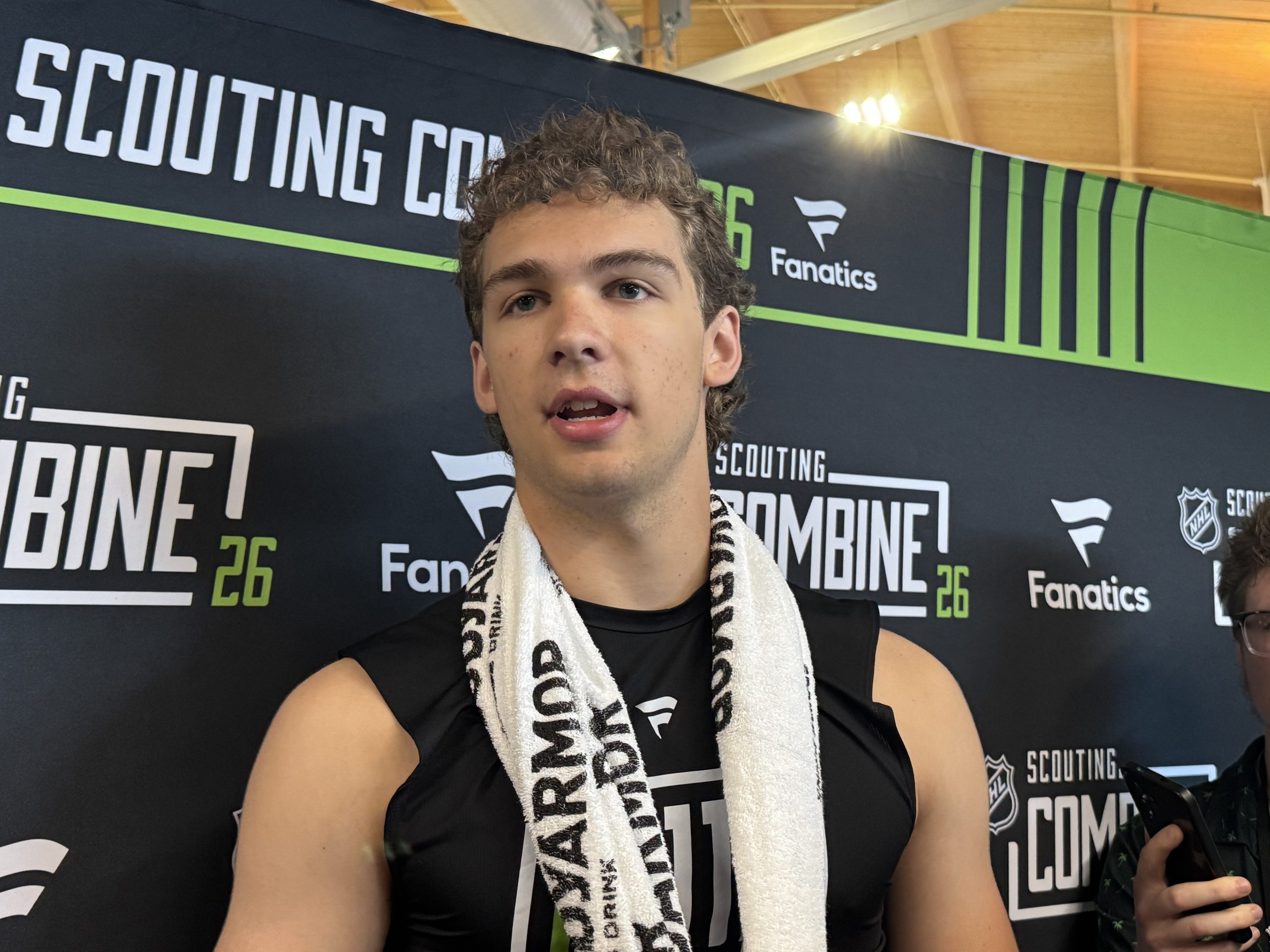
BUFFALO — Alexander Command sat down in front of the media after finishing his twirl through the fitness testing on Saturday at LECOM HarborCenter.
The Swedish center looked relaxed and rosy cheeked for someone who said he had just vomited.
It’s not an unheard-of result for the Wingate test, in which players at the NHL scouting combine ride the bike for 30 seconds as hard as they can with no clock in view to see when the end is coming and trainers shouting to keep going.
“I’d say the Wingate was better than I thought, and pretty fun,” Command said with a smile before revealing how it really went.
Command, who could be available when the Flyers select at No. 21 overall in the NHL draft on June 26-27, and has met with the team, finished tied for 11th in the peak power output test that concluded the combine for each player. He also finished tied for 17th in VO2 max, a test completed Friday in which a player rides a bike with the resistance increasing and keeps riding until they cannot keep up the required revolutions per minute.
The consensus was that the Wingate test, which also provides a fatigue index result, was the hardest but, oddly, the most fun. Ryder Cali, a center with whom the Flyers met, said the VO2 drained him and he couldn’t move for 25 minutes after, but he felt the Wingate was his best test as it showed his power. He also said the screaming the trainers do as the players pedal actually made him angry, which, in turn, made him go harder.
Said Jaxon Cover, a right winger who met with the Flyers and will head to Penn State in the fall of 2027: “I wish that I could see the time while I was doing it because I couldn’t believe that I had more time to go while I was on it, but it was a lot of fun, and it’s a great experience overall.”
Layne Gallacher, a center who went to Guelph of the Ontario Hockey League in the trade that sent Flyers prospect Jett Luchanko to Brantford, finished atop the Wingate test’s peak power output while consensus No. 1 pick Gavin McKenna was the best in VO2, joking long shifts helped him in his career. The Penn State winger finished in the top 25 for several tests, including third in the new isokinetic squat strength test, which was “performed on a motorized resistance device [1080 Cable] to assess lower extremity strength,” according to the NHL.
McKenna gave his team and NCAA hockey’s weekend-heavy schedule some of the credit for his strong performance, as it helped him spend a considerable amount of time in the gym at the beginning of each week. He also was training in Kelowna, British Columbia, with Markus and Liam Ruck — Markus tweaked his back on the vertical jump and could not continue — and Mathis Preston since the end of his season.
“Obviously, you want to do your best at everything, so I wanted to prepare hard for this,” said McKenna, who measured 5-foot-11¼ and 170 pounds.
“I think sometimes my frame’s not the biggest, so [I] just wanted to show that I can compete out there and I can work hard off the ice,” he said. “I think that’s a big key to carry through the next level.”
Gavin McKenna is the consensus top overall pick in this summer’s NHL draft.Jackie Spiegel
Among the 90 prospects at the combine, many just wrapped up their first year in college, are heading there in the fall, or are going in two years.
In addition to McKenna, Beckham Edwards and Cole Zurawski, who will be teammates at Notre Dame in September, dominated the tests. The pair tied Norwegian Niklas Aaram-Olsen for No. 1 in the pro agility test to the left. The test is a 5-10-5 yard shuttle that evaluates multidirectional speed, agility, and whole-body reaction plus control. Aaram-Olsen and Edwards tied for the lead to the right, and Edwards was No. 1 in force plate no jump.
Gavin McKenna officially finished the NHL Draft Combine as the NUMBER ONE ATHLETE in testing 👀
McKenna finished in the top 8 in 4 different categories, including:
🔹 VO₂ Max Aerobic Fitness (1st) 🔹 Isokinetic Squat (4th) 🔹 Pull-Ups (T-6th) 🔹 Force Plate No-Arm Jump (8th)… pic.twitter.com/jMumXO6qsc
Zurawski finished atop the leaderboard for the new 10-meter sprint test, which showed how off-ice linear sprint performance is a good predictor of on-ice speed. And Aaram-Olsen led the way in the horizontal jump, landing 118.0 inches, almost two inches more than second place.
“I like the explosive,” said Aaram-Olsen, a winger who is a teammate of Command with Örebro HK U20 in Sweden’s top junior league.
Pierce Mbuyi is off to Penn State in 2027, but first he topped the isokinetic squat test, came in second on the bench press power test — behind UMass’ Landon Nycz — and finished tied with several players for sixth in pullups (14). Mbuyi, a winger and captain of Owen Sound of the OHL is listed at 5-foot-9 and 177 pounds. Fellow under-6-foot winger Victor Plante, the son of former Flyer Derek Plante who is heading to the University of Minnesota-Duluth, was atop the fatigue index.
Two centers had the best grip strength. Cali, who recently flipped his commitment to Providence, tied for first in right-hand grip strength, and Ilia Morozov, 17, who was the youngest player in college hockey this past season at Miami (Ohio), had the best left-hand grip strength. Both met with the Flyers and could be right in their wheelhouse on draft night.
Pierce Mbuyi is heading off to Penn State in 2027.Jackie Spiegel
Breakaways
Winger Adam Novotný said he had a good meeting with the Flyers. He mentioned that his head was still spinning when he spoke with the media after riding the bike. The Czech winger, who played for Peterborough of the OHL, did the most pullups (18). … Goalie Michal Oršulák slipped doing the shuttle. He was OK but said “I think not too much good,” afterward about his overall performance. His Prince Albert squad finished its season on May 16, losing to Flyers prospect Luke Vlooswyk and Everett in the Western Hockey League final. He said he did not have much time to prepare for the testing. … Two top prospects, Ivar Stenberg and Carson Carels did not do physical testing at the combine.