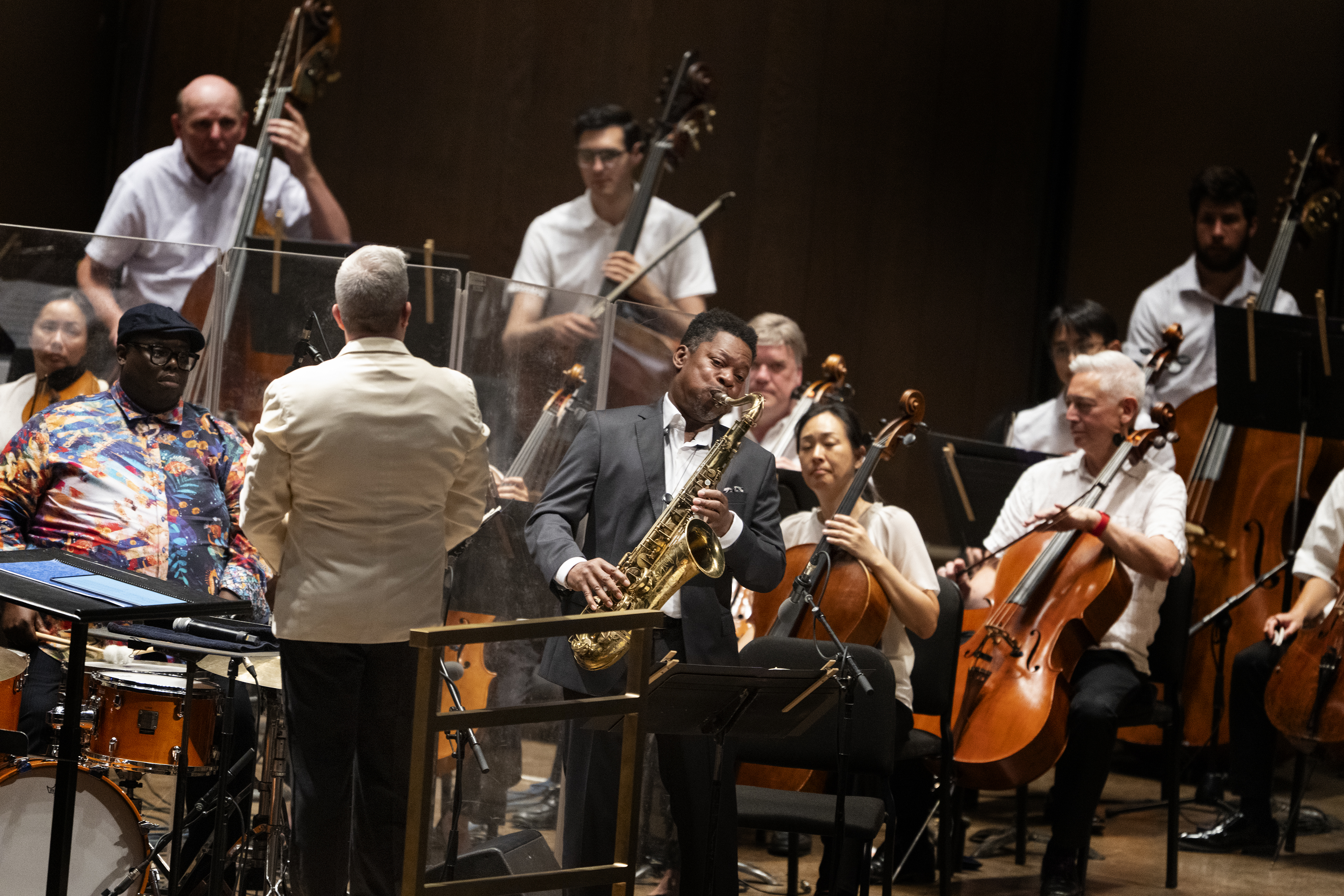
Five and a half weeks before its opening concert of the fall season — months later than usual — the National Symphony Orchestra (NSO) announced that it will perform at six venues in and around Washington, D.C. while the Kennedy Center is closed for a planned two-year refurbishment.
While President Donald Trump’s role in the Kennedy Center renovations has sparked political debate and division, from the standpoint of the NSO, the issue is less about the president’s involvement and more about the risks of not having a permanent home. Concert halls have long been instruments of cultural power — places that determine who will be heard, who will be seen and which musicians or institutions will be able to claim prestige.
This issue has a history that stretches from the 19th century to the 21st, which was when Philadelphians confronted these risks, witnessing the Philadelphia Orchestra battle bankruptcy, and later, the Philadelphia Pops lose its home at the Kimmel Center, with serious ramifications for its survival.
The lesson of this history is that artistic prestige and institutional security are not the same thing. Even a great orchestra depends on physical, financial and social infrastructure to survive.
Long before purpose-built concert halls became symbols of civic prestige, musical life in 19th-century Europe revolved around drawing rooms, salons and subscription concerts. They brought together professionals and accomplished amateurs in spaces where conversation, performance and social interaction were deliberately interwoven.
The career of the Polish pianist and composer Maria Szymanowska illustrated how this culture functioned. Szymanowska performed before audiences across Europe before settling in St. Petersburg, where she became part of a musical scene in which domestic social life and professional activity were closely intertwined.
Szymanowska was one of three salon pianists, alongside Maria Kalergis-Mukhanov and Marcelina Czartoryska, who dominated a network that stretched from Warsaw and St. Petersburg to Vienna, Paris and London. All three gave public concerts, but their salons also provided access to international artistic and social circles that were beyond the reach of many musicians. Szymanowska’s acquaintances included some of the most distinguished cultural figures of her generation, including pianist and composer John Field, poet Adam Mickiewicz and author and playwright Johann Wolfgang von Goethe.
Such connections were not merely a sign of social prestige. They could lead to recommendations, invitations and access to wider cultural networks. In a profession where reputation and patronage were closely intertwined, gaining entry into these circles could open up opportunities that were unattainable through musical talent alone.
However, this system also had an obvious drawback for musicians. The opportunities offered by the salon depended on access to the host, their home and their social network. Unlike a permanent musical institution, this infrastructure could disappear if the host withdrew from the scene, moved away or died.
In other words, cultural prestige did not always guarantee the institutional stability necessary to thrive musically.
As public concert culture expanded during the 19th century, some musical authority shifted from private hosts to permanent organizations and concert halls that served as stable venues around which audiences could organize their musical lives. The concert hall became not merely a place where music was performed, but also part of an orchestra’s institutional identity. The development of American symphony orchestras made this transformation particularly visible.
When financier Henry Lee Higginson founded the Boston Symphony Orchestra in 1881, he aimed to establish a permanent ensemble. For nearly two decades, it performed at the Boston Music Hall before moving to the purpose-built Symphony Hall in 1900, making a permanent home part of the institution. Today, the Boston Symphony describes this hall as a public “temple of music.”
The shift to concert halls transformed the scale of musical life but did not alter its dependence on infrastructure and wealthy patrons. Orchestras now required administrators, sponsors and long-term planning. Stability became part of the promise an organization made — but fulfilling that promise required an increasingly complex infrastructure.
The management challenges faced by Philadelphia’s orchestras in the 21st century have illustrated the opportunities and risks associated with this structure.

Founded in 1900, the Philadelphia Orchestra became one of the country’s most renowned ensembles, and in 2001, it moved to the newly opened Kimmel Center. However, its prestigious reputation and state-of-the-art venue did not guarantee financial stability. Even in the first few years after the move, the orchestra was operating at a loss. An initial increase in ticket sale revenue was insufficient to offset rising costs and longer-term financial pressures.
In 2005, the Philadelphia Orchestra Association and Encore Series Inc., the nonprofit organization behind the Philly Pops merged many of their administrative and operational functions. This arrangement was designed to improve efficiency, particularly in ticket sales and fundraising, while enabling the Pops ensemble to draw on the administrative resources of the larger orchestra.
Both organizations retained their artistic independence, with separate boards of directors and subscription seasons. However, this agreement nevertheless linked the Pops more closely to the institutional infrastructure of the Philadelphia Orchestra.
The merger, however, could not prevent continued declines in attendance and revenue. In 2011, the Philadelphia Orchestra filed for Chapter 11 bankruptcy. The crisis laid bare a contradiction that seemingly permanent institutions are meant to overcome: the orchestra could enjoy exceptional cultural prestige without possessing institutional stability.
Among the organizations caught up in the crisis was the Philly Pops. When the Philadelphia Orchestra Association filed for bankruptcy, Encore Series Inc. followed suit. By that point, the relationship between the two musical ensembles had deteriorated. Ultimately, the organizations went their separate ways, and the Pops received $1.25 million in compensation.
The Orchestra emerged from bankruptcy in 2012 following restructuring, a new collective bargaining agreement, lease concessions and a fundraising campaign that raised nearly $36 million from 1, 500 donors.
These changes helped to restore the orchestra’s financial and institutional stability, but the Pops was not so fortunate. In January 2023, the group lost access to the Kimmel Center due to a dispute over unpaid fees. Concerts were suspended, and by March, the Pops was left without a permanent venue and had postponed further performances.
The dispute subsequently moved to federal court, where the Pops filed an antitrust lawsuit against the Philadelphia Orchestra and the Kimmel Center, alleging that they had attempted to drive it out of the market. The defendants contested the Pops’ version of events and later moved to have the case dismissed.
The original Pops organization eventually ceased performing, but many of its musicians came together to form the “No Name Pops” ensemble, which in 2025 adopted the historic “Philly Pops” name and resumed performing at a variety of venues.
This history helps explain the implications of the NSO’s current relocation. While the orchestra will have a 2026—2027 season, the six venues hosting concerts all have smaller capacities than the Kennedy Center Concert Hall. Music Director Gianandrea Noseda has described this year as a period during which the NSO will effectively function as a “regional touring orchestra.”
The experiences of 19th-century salon musicians and 21st century Philadelphia orchestras were vastly different. Yet, they reveal the same underlying vulnerability, which now confronts the NSO.
Salon musicians were able to build prestigious careers thanks to networks centered on specific hosts and their homes. However, these opportunities remained dependent on constant access to those spaces. Modern orchestras have replaced the salon with a far more complex institutional infrastructure. But the principle remains remarkably similar: artistic success depends not only on the musicians themselves, but also on the concert halls, patrons, administrators and audiences that support them.
The Philadelphia Orchestra’s 2011 bankruptcy did not mean that it suddenly lost its artistic excellence or international reputation. What became unstable was the institutional structure upon which its artistic reputation rested.
The Philadelphia Orchestra demonstrated that an orchestra can survive such institutional problems. Yet, the experience of the Philly Pops shows just how serious the consequences of losing an institutional foundation can be.
This history illuminates why the NSO’s loss of its home is significant — even if it is supposed to be temporary.
Cultural significance and institutional stability are not the same. Even the most renowned orchestras depend on funding, infrastructure, audiences and collective bargaining agreements. When they lose elements of this institutional backbone, it can imperil even the strongest orchestra.
Stacy Olive Jarvis is a musicologist and researcher at the University of Birmingham, specializing in 19th-century musical culture, musical networks and the social history of classical music.
Made by History takes readers beyond the headlines with articles written and edited by professional historians. Opinions expressed do not necessarily reflect the views of The Inquirer.