Honda is recalling more than 810,000 vehicles because their airbag inflators may rupture.
The National Highway Traffic Safety Administration said that the recall includes 810,592 Honda Civic vehicles with model years 2012 to 2013, Honda CR-V vehicles with model years 2012 to 2013, Honda Accord 2013 models and Acura ILX and RDX vehicles with model year 2013.
The NHTSA said that the vehicles have certain Takata front and passenger air bag inflators. The inflators may rupture due to propellant degradation occurring after long-term exposure to high absolute humidity and high temperature variation.
If an inflator ruptures, it could result in sharp metal fragments hitting a driver or other vehicle occupant and result in serious injury or death.
Dealers will replace the front driver or passenger air bag inflator for free. Interim letters notifying owners of the safety risk are expected to be mailed Dec. 18. Additional letters will be sent once the final remedy is available.
Owners may contact Honda’s customer service at 1-888-234-2138 for more information. Individuals may also contact the NHTSA vehicle safety hotline at 1-888-327-4236 or visit the agency’s website at www.nhtsa.gov.
2027 Hyundai Venue SEL vs. 2027 Kia Seltos X-Line SX AWD: Bargain battle?
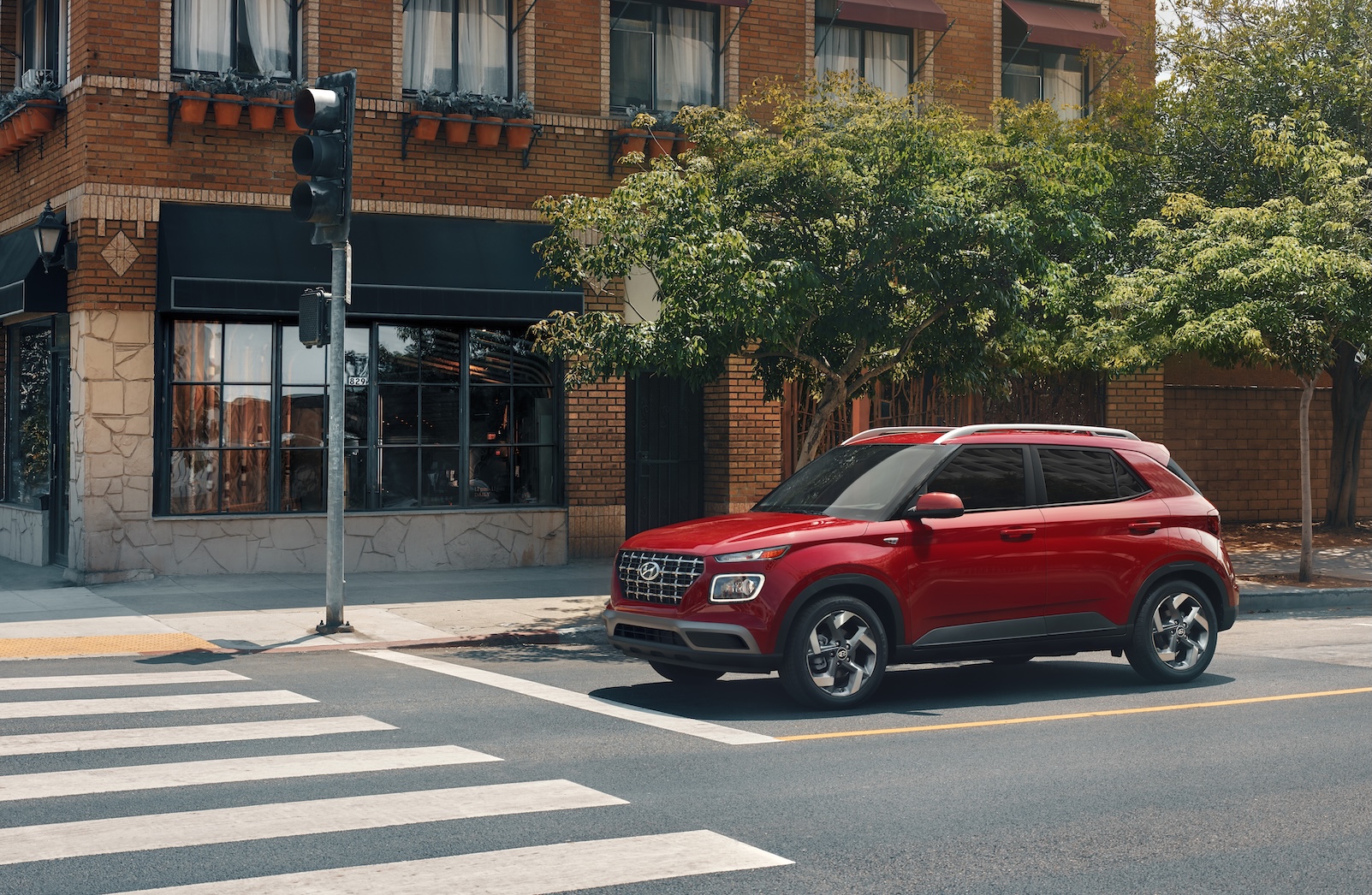
This week: Hyundai Venue SEL
Price: $24,440 as tested. We were dinged just $240 for floor mats.
It starts at $20,500. That must be one bare-bones vehicle.
What others are saying: “Highs: Ultra-affordable pricing, urban-friendly size, roomier inside than its exterior suggests. Lows: Fuel economy isn’t as good as you might expect, strained and noisy under acceleration, all-wheel drive is not available,” says Car and Driver.
What Hyundai is saying: “Our small SUV for your big adventures. From America’s best SUV brand.”
Reality: Small but mighty.
What’s new: In my mind, the Hyundai Venue and the Kia Seltos have resided in similar worlds. But the Seltos is quite a bit larger than the Hyundai model; and the price variations in the two will reflect that.
Both small hatchback-SUVs gave Mr. Driver’s Seat big surprises, for vastly different reasons. And how could the Seltos not be the winner, because bigger (and pricier) must be better, right?
The very small Venue “SUV” has received scant updates since its 2020 debut.
It’s been five years since I last rode in the Hyundai Venue. This one even wore the same clothes as the 2021, denim blue with a white roof. But much has changed.
Up to speed: The first few times I pulled out from a stop with the Venue made me think something was wrong with it, or with me. There was just so much lethargy. But sometime during the first day I found my groove with the 1.6-liter four-cylinder engine.
Car and Driver reports the Venue’s 121 horses get the vehicle to 60 mph in 8.7 seconds. Somehow this acceleration did not bother me, even at just a tenth of a second faster than the 2021. I never did have more than the Lovely Mrs. Passenger Seat with me, though; a couple more people would have dragged this right down, I’m sure.
Shiftless: The Venue keeps the continuously variable transmission it had five years ago, with the steps and the handle shifter that can control them for you.
On the road: The little Venue zipped around curves and turns with great ease, and felt nice doing it. First, though, shut off the lanekeeping; it really seems to interfere with Hyundai vehicles the most.
Mr. Driver’s Seat found himself driving more sedately in the Venue, and enjoying it. It’s fun enough with that lighter touch even on country roads.
Sport mode picks up the pace a bit and the ride gets a little more enticing. One evening an SUV was on my tail pushing me through the countryside. I kept testing the limits through curve after curve just to keep the headlights out of my mirror — and enjoyed the heck out of it. Whee!
There’s no all-wheel drive available in the Venue, but I actually thought there finally was. Instead of the usual front-wheel-drive oversteer going more sharply into turns than I expected, the vehicle seemed to mildly slide as one unit on some hard corners.
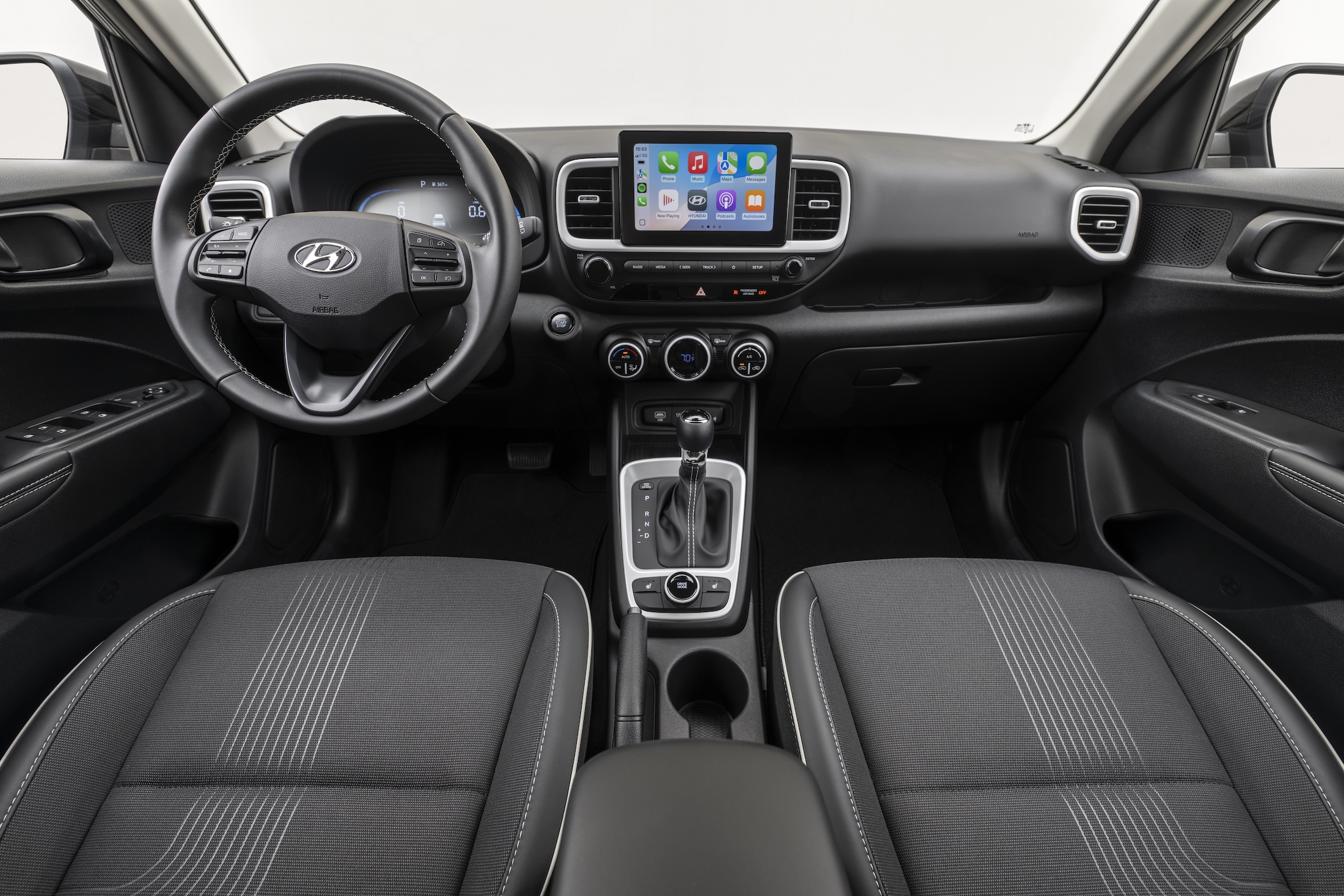
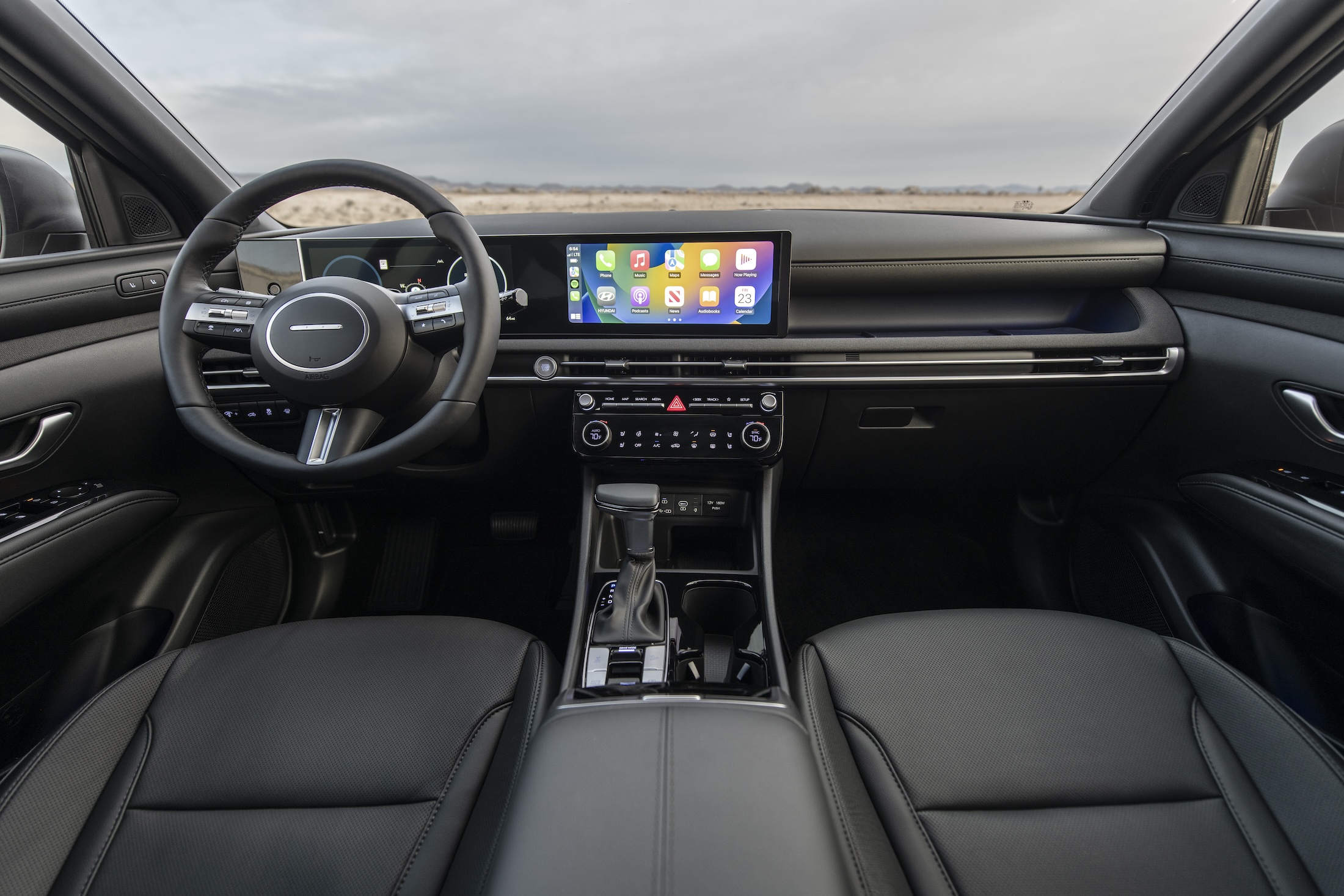
The interior of the 2027 Hyundai Venue has kept up with the times, with a digital dashboard. The seats are old-style springy, though.DREW PHILLIPS
Driver’s Seat: Forget my usual “comfortable and supportive” line; this cloth-covered seat is springy, and a little hard. Still, it did all right for keeping me in place in the turns.
The Venue is not as much the wayback machine as I expected, with a digital speedometer and quite a number of safety features.
Friends and stuff: The rear seat is right at the edge where snug becomes useless. (For the other side of that line, see the Volkswagen Karmann Ghia.) My legs just fit in there and only an abundance of foot room made the rest of the experience even worth considering. But there’s no room for movement. Tall people might not love this car quite as much.
Cargo space is 18.7 cubic feet in back and 31.9 with the seat folded.
In and out: The Venue is a great height, neither too low nor too high.
Play some tunes: The 8-inch display screen offered with the multimedia system is laughably small by today’s standards. Volume and tuning knobs get an assist from vintage buttons underneath the screen. The screen doesn’t need much attention, so no whining about my eyes having to leave the road.
Sound from the unnamed six-speaker system was better than I expected, about an A-.
Keeping warm and cool: A dial controls the temperature and another the fan speed. The readout that looks like a third dial — the same one that puzzled me in 2021 — remains, and continues to lure me into thinking it changes something; it’s just there looking nice and blending in. A little too well.
Fuel economy: The Venue averaged almost 34 mpg during nearly 500 miles of driving by other drivers. I knocked that down closer to 33, and I feel bad about that. But last time, I pushed it below 30, so I’m getting better with age. Or the Venue is. (Lovely Mrs.: “It’s the Venue.”)
Where it’s built: Ulsan, South Korea. Its parts are 90% Korean and 1% Canadian or American.
In the end: There are so many other better cars in this category, but sometimes price wins out. And if that’s the case, there are plenty worse venues than the Hyundai Venue. Almost all the other choices start out about $4,000 more.
Next week: How does the larger Kia Seltos compare?
2027 Infiniti QX65 Sport vs. 2026 Volkswagen Atlas Cross Sport SEL Premium R-Line AWD: Battle of the chopped-down SUVs
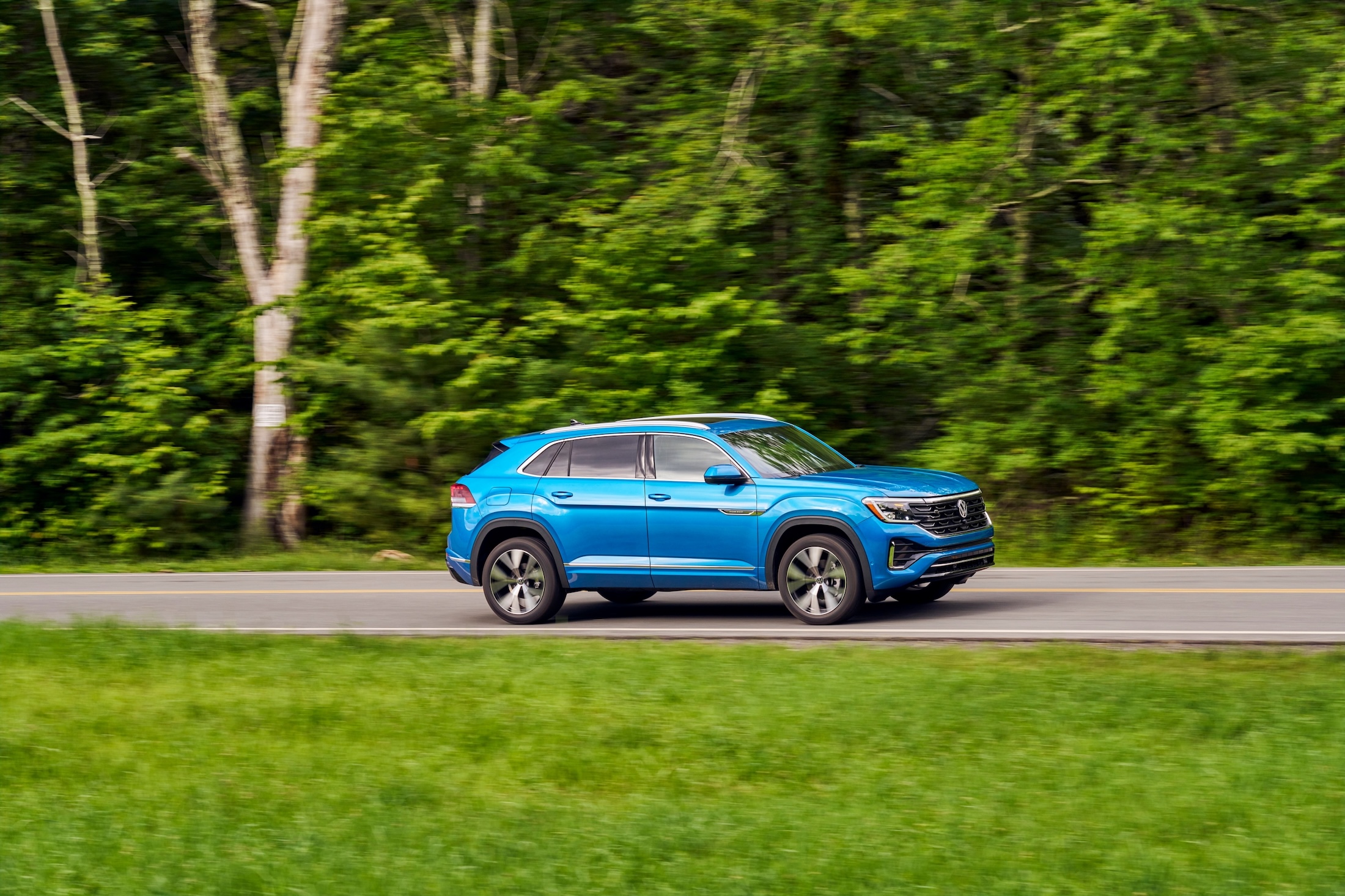
This week: 2026 Volkswagen Atlas Cross Sport
Price: $55,095 as tested. It’s a tippy-top-of-the-line sample, so no options on the test vehicle; even the panoramic sunroof, heated rear seats, and premium sound system were included.
What others are saying: “Highs: Fashionable profile, roomy interior, even base SE comes well-equipped. Lows: Infotainment interface still on VW’s to-do list, dynamically blasé, value argument erodes with top trims,” says Car and Driver.
What Volkswagen is saying: “That turbo engine means business — and fun.”
Reality: Last week’s Infiniti confidence has met its match.
What’s new: Not that much. The Atlas Cross Sport got its start in 2022. It’s based on the large three-row Atlas SUV; with a lowered rear roofline and removed third row and some tuning tweaks, you have a “sport crossover.” A refresh came for 2024. Its big moment will arrive in the 2027 model year with a redesign. So, maybe, here’s your chance to get a discount on a leftover, especially with Volkswagen crying poorthese last few months.
Competition: Volkswagen reaches for the stars with this model. Other writers may disagree, but the competition I see is in the upscale brands. In addition to the QX65, other competitors include Audi Q4, BMW X6, Lincoln Nautilus, Mercedes GLC-Class Coupe, and Porsche Cayenne.
Up to speed: Car and Driver complains Volkswagen never got around to the multimedia center, yet C&D never got around to testing a Cross Sport from this latest generation. They cite a 2025 Atlas SUV for 0-60 numbers, noting a 7.3-second time in that larger SUV. Let’s assume this swoopier, seat-reduced version gets there in 7 seconds; even the 7.3 number is still a full second faster than the QX65.
The 2.0-liter turbocharged four-cylinder engine creates 269 horses, precisely one more than the QX65. Its best trick is highway passing; stop paying attention in a radar zone, and expect flashing lights in your rearview as a reward. Just tell the nice patrol officer how cool the engine sounded doing it; maybe that will help. Advantage, Atlas Cross Sport.
Shifty: The Cross Sport gets the Audi-esque shift switch, which is a big toggle for R-N-D. Park is a button. Shutting down the Cross Sport is a “I’m Mr. Cool” moment. The start-stop switch sits in a row with the transmission choices, and a small electronic emergency brake brings up the back end. Park button, stop button, pull brake, boop, boop, yank. Pretty slick.
There was shiftability as well, but I never tried it.
On the road: The Atlas Cross Sport is by no means a perfect vehicle, but, man, did I look forward to driving it. The handling was direct, and Sport mode really brought out the best characteristics of the SUV. As I was putting the finishing touches on this comparison, I noticed I’d written that I did not look forward to driving the Infiniti, so the clear advantage again goes to the Atlas Cross Sport.
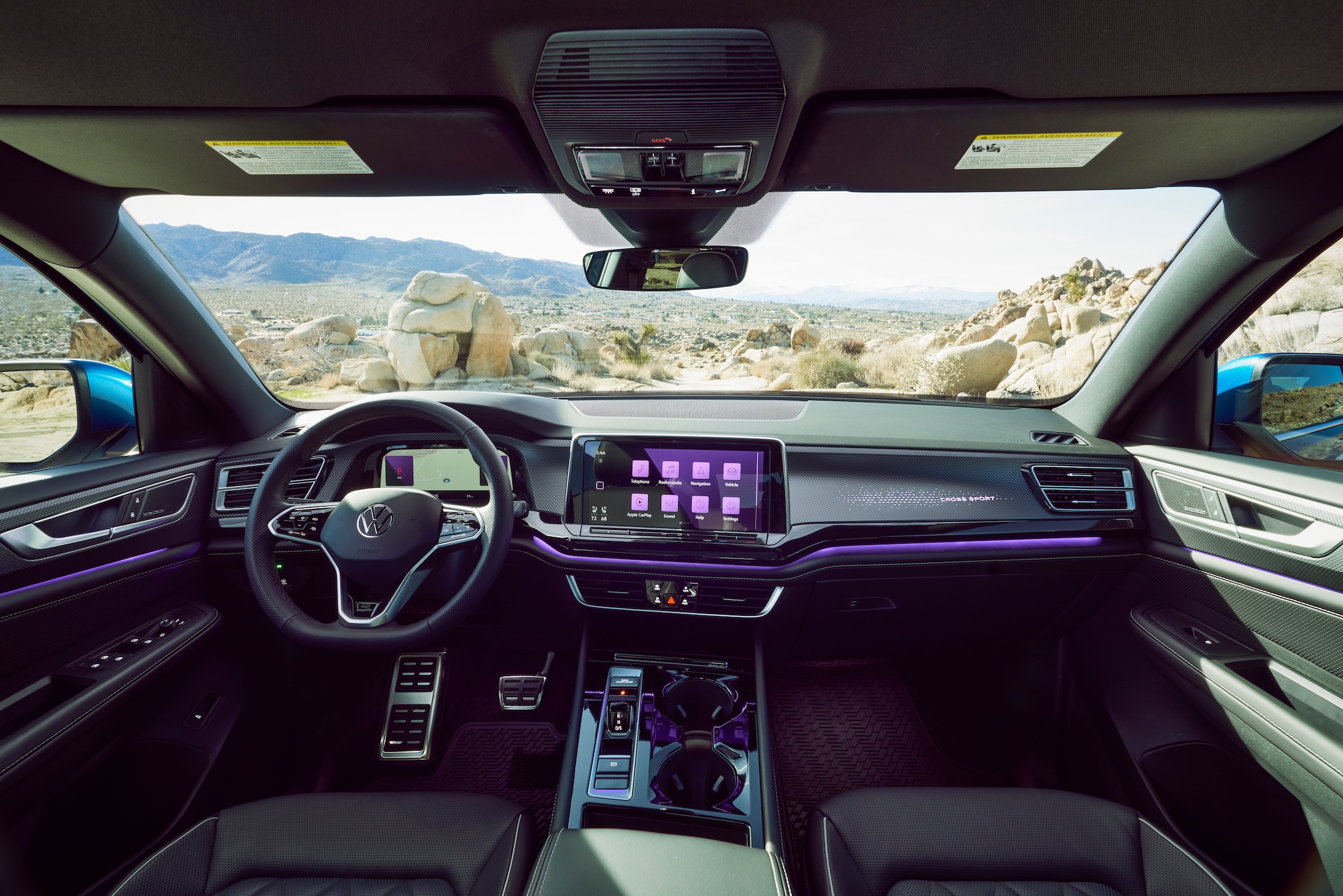
The interior of the 2026 Volkswagen Atlas Cross Sport offers comfort, convenience, and some roominess.Volkswagen
Driver’s Seat: The comfortable Driver’s Seat remained heavy on firmness like Volkswagens and Audis can be. The no-cost chalk and titan black leather interior rivals the upscalery of the competitors; so does difficulty seeing around the vehicle. Sloped windshields, high driving positions, and “sporty” designs make the close-ups hard to spot.
The dashboard operates as easily as most VWs. Still, the QX65 gets this category.
Friends and stuff: The rear seat is not as bad as some: The fabric matches the front; there’s some grip from the seat outlines; and the seat back does have two adjustments. But with seats that move forward and recline with more options, the QX65 wins this event.
Cargo space is 40.3 or 77.6 cubic feet.
In and out: It’s a bit of a leg hoist but not a lot.
Play some tunes: I really thought the infotainment troubles I keep experiencing with Volkswagens have been my fault, but I’m glad to see Car and Driver says they’re “still on Volkswagen’s to-do list.” I can link up CarPlay in theory but can’t ever get the screen to show.
At least the 12-inch screen works. I can find the settings without too much trouble. (It sounds small these days, but I thought it was a nice size.)
Sound from the Harman Kardon system is about an A- or A. Even with the missing tech functions, the Atlas Cross Sport is ahead of the QX65.
Keeping warm and cool: The HVAC controls have moved into the touchscreen, annoying at best. A button opens up the screen, and then look again for the choices. Cold mornings made balky controls balkier. This is a toss-up.
Fuel economy: Over 800 miles with multiple drivers, the Atlas Cross Sport averaged around 22 mpg. That’s no great achievement, but it’s more than 10% better than the QX65.
Where it’s built: Chattanooga, Tenn.
How it’s built:Consumer Reports rates the Atlas Cross Sport reliability as 3 out of 5.
In the end: CR pits this against more run-of-the-mill SUVs like the Subaru Outback and the Jeep Grand Cherokee, and you can certainly get a version of this for a more reasonable price.
But at this level, the Atlas Cross Sport does a pretty good job of showing the far more expensive Mercedes and BMW products — as well as the competitively priced Infiniti — just how sporty crossovers can be.
2027 Infiniti QX65 Sport vs. Volkswagen Atlas Cross Sport: Battle of the chopped down SUVs
This week: Infiniti QX65
Price: $60,470 as tested
What others are saying: “Pros: Elegant cabin, handsome exterior styling, roomy. Cons: Uneven power delivery, brakes are muted, steering feels numb,” says Motor Trend.
What Infiniti is saying: “Blaze a bold path in a sporty 2-row luxury crossover designed to turn heads and move you in more ways than one. The INFINITI QX65 is pure confidence in motion.”
Reality: Definitely a head turner. But what Nissan calls “pure confidence” can be a double-edged sword; people who are the most wrong seem to be the most confident.
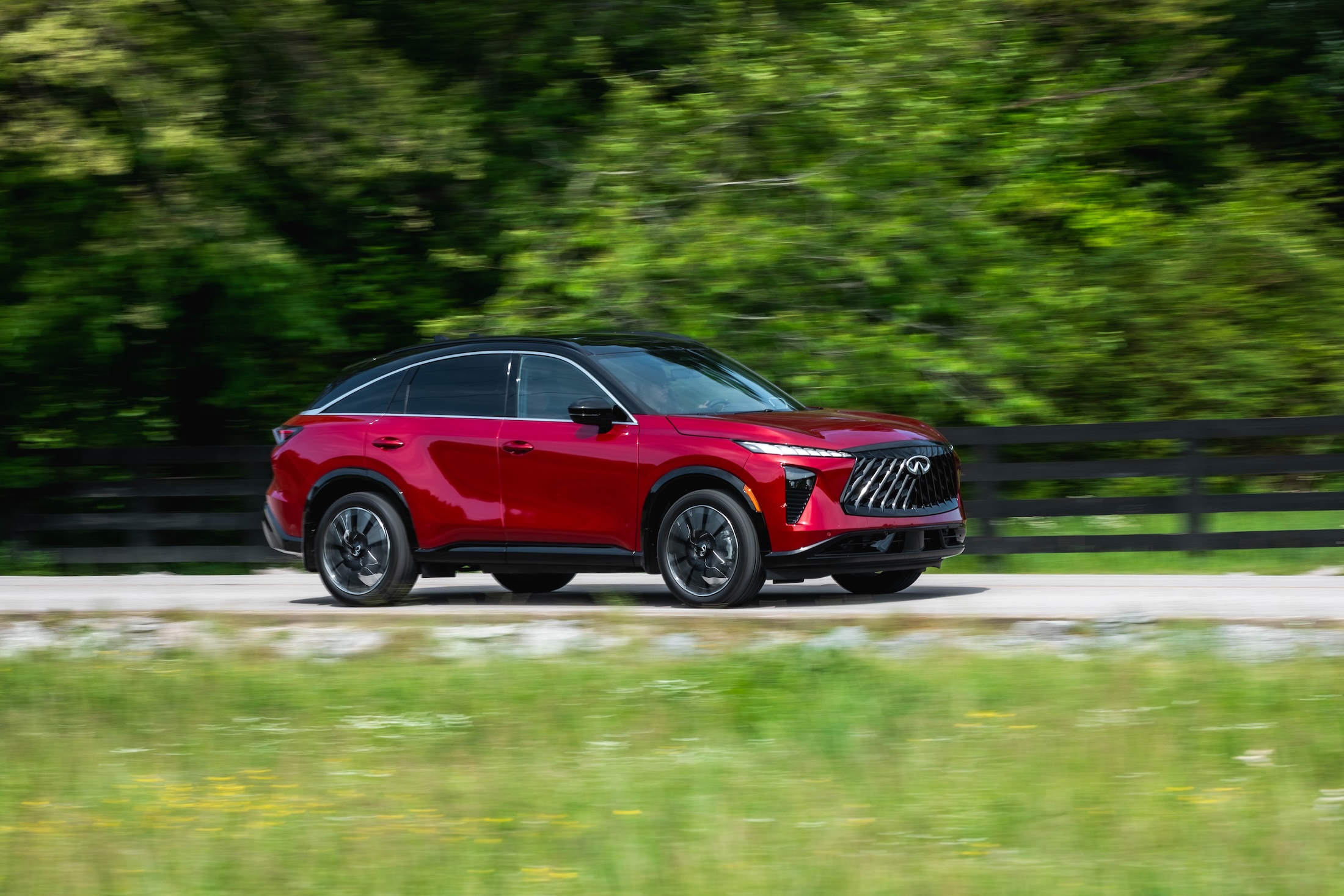
What’s new: The whole thing. Infiniti finally gets into the “sporty SUV” game with this model that takes the QX60 and slices a piece off the back end.
Of course there’s more to it than that.
Competition: It might seem like an odd pairing, pitting the Volkswagen Cross Sport against the premium Infiniti SUV. But the vehicles are really of the same ilk, and the Volkswagen is only $5,000 less.
Up to speed: The 2.0-liter turbocharged four-cylinder engine plays a pretty nice game. It sounds awesome, especially when put in Sport mode, and there’s decent power when you pull out. Sometimes too much of it, especially when it’s cold, as there could be a sudden surge or a quick conk-out. Adding to the Infiniti mystery, you just never knew which one you’d get. (You probably dated people like that. And I bet they were confident.)
Anyway, that engine creates 268 horsepower, and Nissan media materials describe “confident acceleration,” but it takes 8.1 glacial seconds for the SUV to hit 60 mph, according to Motor Trend. Needless to say the competition buries it.
Shifty: The nine-speed shiftable automatic is controlled by a rectangular shift mechanism à la 2015 Lexus. The transmission takes care of itself just fine; there’s a manual mode and paddle shifters, but I didn’t bother.
On the road: Lane keeping sounds like a very excellent thing. A car that will help you not drift of your lane. What could go wrong, right?
Plenty, if it’s the QX65 doing the keeping.
Part of the reason I wasn’t inspired to bother with shifting was the lackluster handling. When I first received the vehicle, it just danced all around and was so wavy even The Lovely Mrs. Passenger Seat commented on the road feel. That’s something she’s loath to do, lest I get pouty and sad and she has to buy me ice cream to cheer me up. Plus, in the QX65, there would be a danger of ice cream hurl.
I realized that the lane keeping must have been turned on; it interferes with the handling on many vehicles, and the QX65 is certainly one of them. We found the switch — not too deeply into the lists in the options screens — we exited the sensors, and life was vastly improved.
But not so vastly improved that I started to enjoy the QX65. I really didn’t look forward to trips in this vehicle, although the highway handling at least became tolerable without the lane keeping.
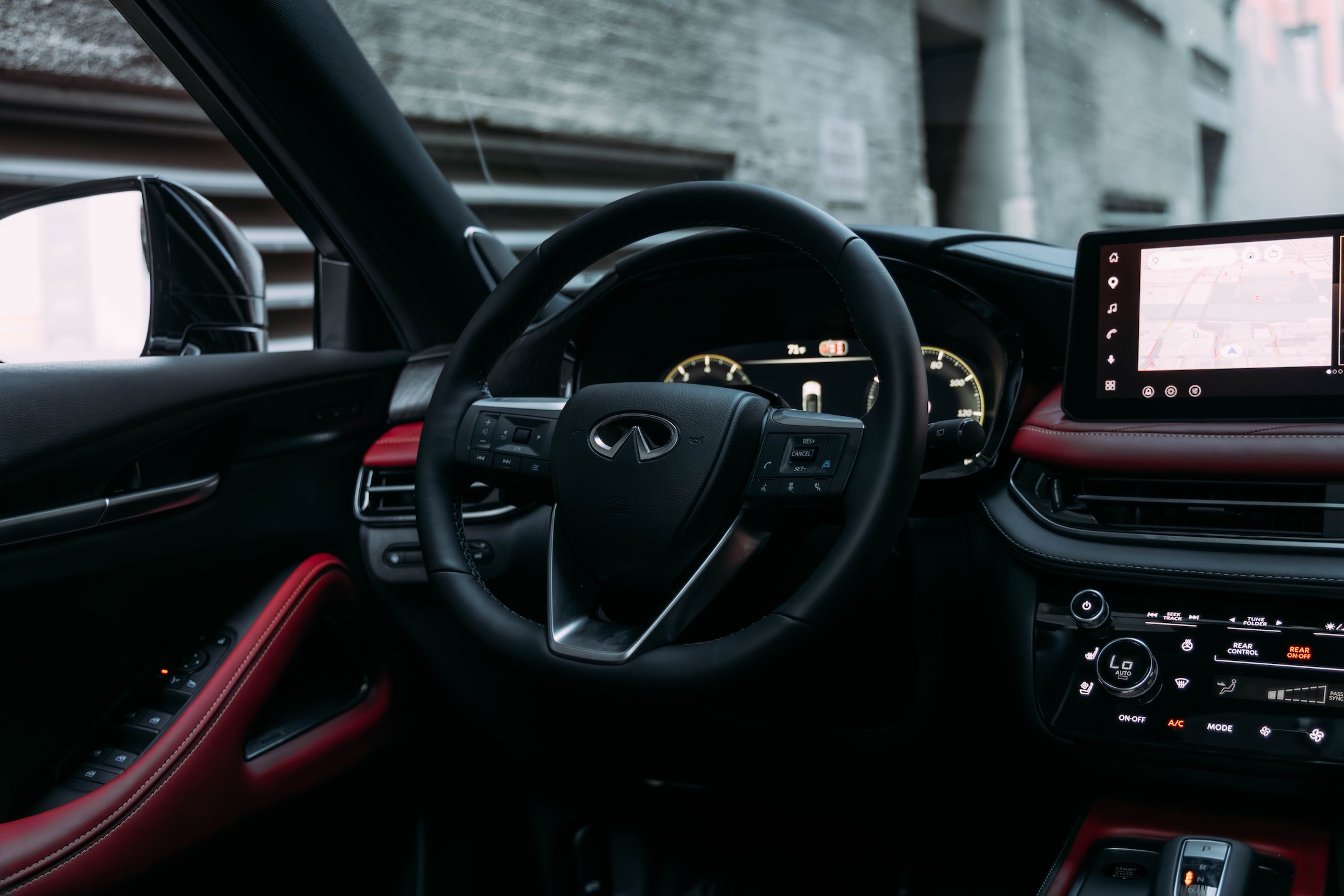
The interior of the 2027 Infiniti QX65 employs the same two-tone look that made the outside attractive, and these pictures don’t really capture the best of it.Infiniti
Driver’s Seat: The seat and cockpit all offered nice touches. The TailorFit appointed seat felt luxurious and supple, and the dashboard was a beautiful sight, two shades separated by a graphene band.
On the downside, though, the shape of the vehicle and design of the windows makes it quite hard to see where you are on the road. Whatever, just look at the pretty interior.
Friends and stuff: The rear seats offered the same luxury as the front, with plenty of space all around. Legroom was especially generous, with no need to slide your feet under the seats, and headroom was nice. The rear seat adjusts front to back and reclines as well.
Cargo space is a healthy 35.8 cubic feet behind the second row and 67.7 cubic feet behind the first.
In and out: The QX65 requires a leg up to get in, so it may not be suitable for all hips and knees.
Play some tunes: Sound from the Klipsch 16-speaker audio system is quite good, an A- leaning to an A.
The controls were just a volume dial, a couple functions down near the HVAC controls (we’ll complain more about those below), and then it was all smallish 12.3-inch touchscreen.
Keeping warm and cool: Dials controlled the temperature, but the other HVAC controllers were a metaphor for the whole QX65: It looks great but the performance is really lacking.
The ebony touch pad was handsome, but it required pretty forceful button pushing to get things working. I tried telling myself it was like an Audi control, but even with the extra force, the two are not in the same league. It was all so unpredictable. And so it went for the media controls as well.
Fuel economy: The QX65 averaged around 19 mpg since forever (well, 800 miles).
Where it’s built: Smyrna, Tenn. The U.S. and Canada supply 45% of the content; another 15% comes from Mexico.
How it’s built: Consumer Reports hasn’t yet offered a reliability prediction for the QX65. The close relative 2025 QX60, also made in Tennessee, received a four out of five.
Next week: I could say I’m confident the Volkswagen will be better, but we now know confidence isn’t all it’s cracked up to be.
2026 Subaru Trailseeker Touring: Two heads are better than one?
Price: $48,400 as tested. Just $395 for the pretty blue paint. The panoramic roof is free for the Touring trim level.
What others are saying: “Highs: Way quick, roomy, relaxed ride. Lows: Driving range is mid-pack, bland road manners, base model lacks camera-based off-road assistance feature,” says Car and Driver.
What Subaru is saying: “Our most adventurous EV, the Trailseeker features 375 horsepower and 8.5 inches of ground clearance.”
Reality: Subaru (and Toyota) have put together a speedy, gasoline-free version of the Outback. What could be better?
What’s new: The new EV from Subaru is really the product of a joint venture between the maker of all-wheel-drive vehicles and another little Japanese automaker you might have also heard of, Toyota.
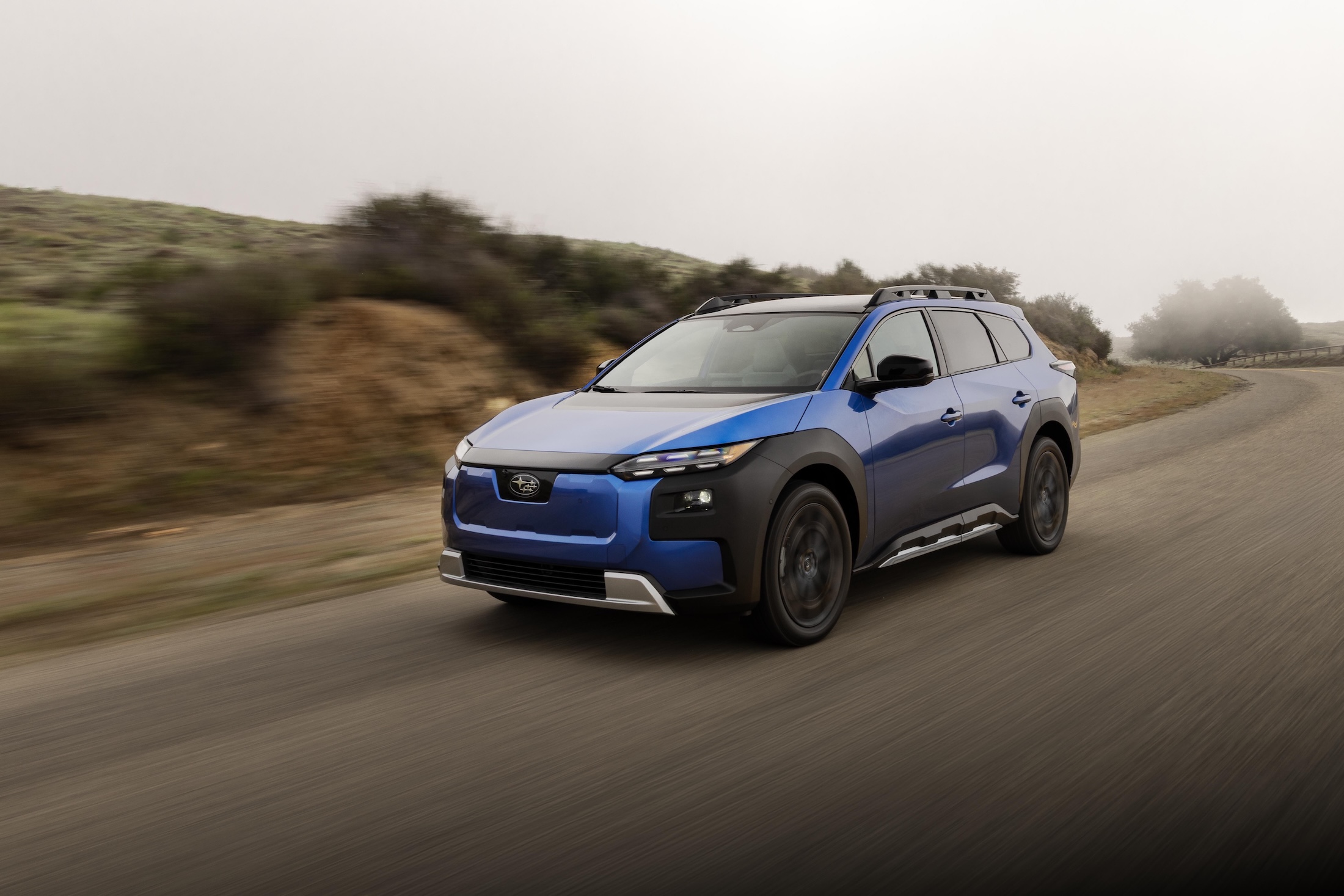
It’s one of four models the companies are producing as matched sets; the Trailseeker is a twin of the Toyota bZ Woodland. The front end looks quite like a Toyota while everything from the windshield on back resembles an Outback.
Competition: Despite reports of their demise, there are still a lot of EVs out there for sale. Competitors include Chevrolet Equinox EV, Ford Mustang Mach-E, Mini Countryman EV, Nissan Ariya, Tesla Model Y, Toyota BZ Woodland, and Volkswagen ID.4.
The Trailseeker has made a splash, though not quite a tidal wave. The model is 1.2% of EV sales for the third quarter, landing just outside the top 10, according to Cox Automotive. Tesla’s Model Y (37.2%) and Model 3 (15.1%) are tops in the segment, with the smaller Hyundai Ioniq 5 at 3.9% and three-row Kia EV9 at 2%.
Up to speed: The first thing you may notice about this outback clone is that it’s an absolute rocket. Mr. Driver’s Seat once thought the turbocharged versions of the Outback were fun, but let’s look at the numbers.
The 375 horsepower brought to you by the dual electric motors rockets the small SUV to 60 mph in 3.9 seconds, according to Car and Driver. That compares to the 6.2 seconds for the gasoline-powered Outback turbo.
There is a button to offer Power or Eco modes, but both of these seemed superfluous.
Shiftless: Twist the console knob counterclockwise for Reverse and clockwise for Drive; press a button for Park, and pull up the little parking brake lever right nearby.
On the road: The Trailseeker wears the crown of the Outback nicely, moving smoothly through curves and narrow roads without any surprises or wandering. It’s not quite fun but it’s nice enough.
Highway manners are also delightful, and bumps don’t upset the Trailseeker’s composure. I confess we did not go seeking any trails; I figured the vehicle would be doing that for me, as advertised, but alas I was left pavement-bound. Still, a vehicle that stays on course well shows promise for any off-roading you may attempt.
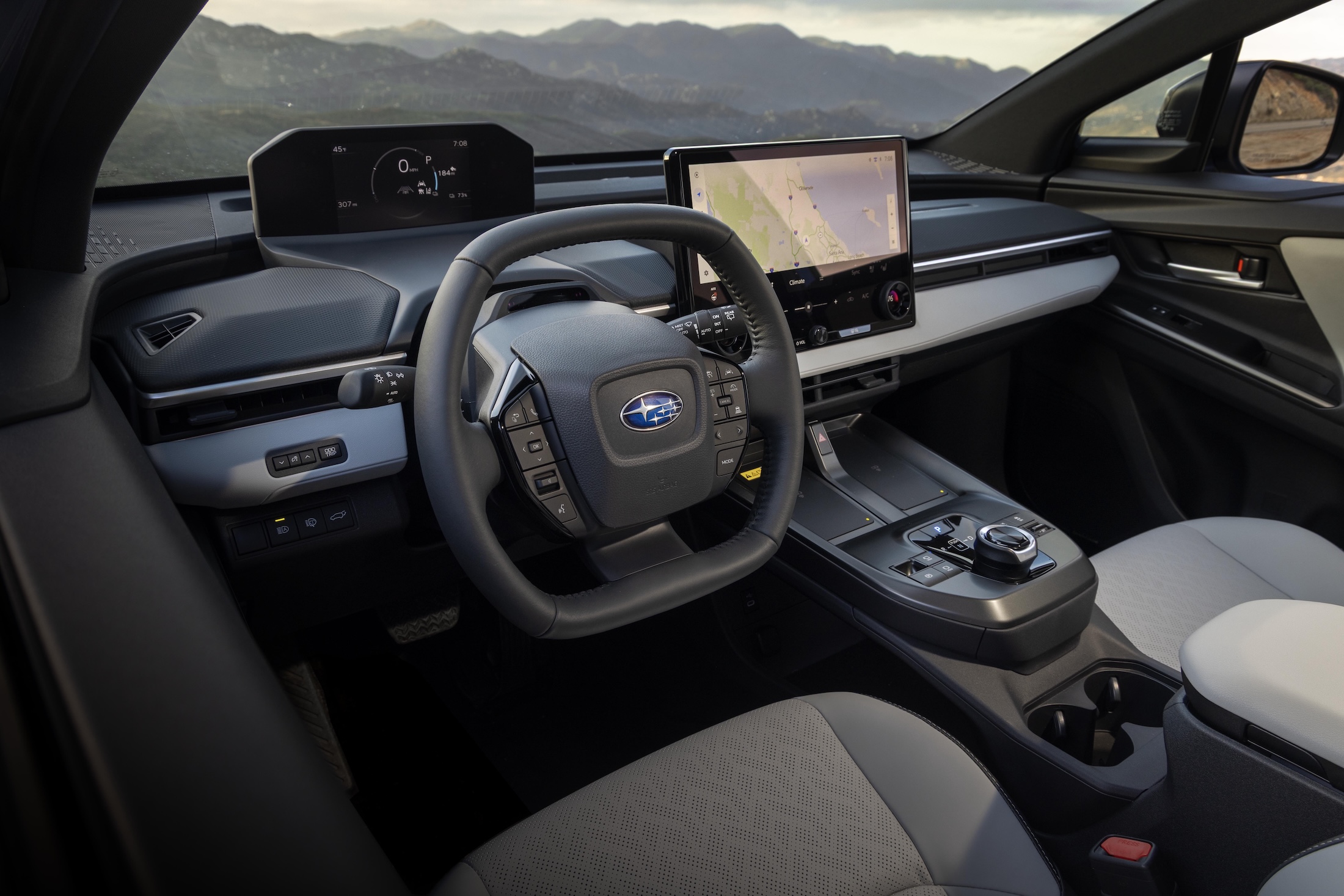
The interior of the 2026 Subaru Trailseeker is neither fish nor fowl, neither Subaru nor Toyota. The gauges plopped onto the steering column are a mark of the brands’ EVs.Subaru
Driver’s Seat: The leather upholstery courtesy of the Touring trim looked and felt quite nice. The seats kept occupants in place while offering nice comfort as well, plus heating and ventilation.
The gauges are the Toyo-baru standard for EVs, with a faraway gauge pod letting you know what’s going on much like the smaller Subaru Solterra and cousin Toyota bZ. It reads clearly. I’ve gotten over missing the more upright windshield of older Subarus and their close-up gauges.
Friends and stuff: The rear seat offers nice legroom, headroom, and foot room. The center seat sits up kinda high off the corner cushions, and occupants will have the console and floor hump to deal with. Corners are heated in back as well, so those kids get EVERYthing.
The rear seat felt surprisingly slippery to the touch. I realized the front seats do as well, but the contours hide it well. This may not be the right vehicle for squabbling children.
Cargo space is 74 cubic feet with the rear seat folded. Towing capacity is 3,500 pounds.
In and out: The Trailseeker sits at a nice height so entry and exit are easy for almost anyone.
Play some tunes: The 14-inch Subaru Multimedia System provides a clear picture of your map and other functions as well. Dialing in the sound settings could be a little fussy, with sliders and arrows in the screen.
Sound from the system was pretty good, about an A-.
Keeping warm and cool: The sales sheet advertises radiant leg heaters for the front row, but tests in humid August didn’t allow for sampling. These are likely a range-saving idea.
The HVAC blowers are pushed quite low by the large touchscreen, a problem that’s becoming more common among vehicles, but maybe the defrost setting will help out here.
The controls are inside the touchscreen but along the bottom, with inconvenient pixel-based arrows for the blower speed and icons for the blower location. Temperature dials are a little shallow and can cause Mr. Driver’s Seat-sized fingers to interfere with the multimedia system if you’re not careful.
Fuel economy: The listed range on the spec sheet was 274 miles, but the most I ever saw was 250 miles. It did seem to stretch the first few miles on most trips, but I don’t think it added up to 24 extra.
The Tesla-compatible NACS plug can recharge the vehicle from 10% to 80% in as fast as 28 minutes.
Where it’s built: Gunma, Japan
How it’s built: Consumer Reports hasn’t rated this Subaru yet. The Solterra gets a 3 out of 5.
In the end: As consumers tired of the volatility of oil prices, the Seat family is finally shopping for an EV. After a short test drive, the Lovely Mrs. Passenger Seat has zeroed in on this one for herself.
And to answer my question in the intro, what could be better? A little more range, and a little less screen time.
2026 Nissan Frontier Crew Cab Pro-X V-6 vs. 2026 Hyundai Santa Cruz XRT AWD vs. 2026 Chevrolet Colorado Trail Boss Stars and Steel: Smallish truck smackdown.
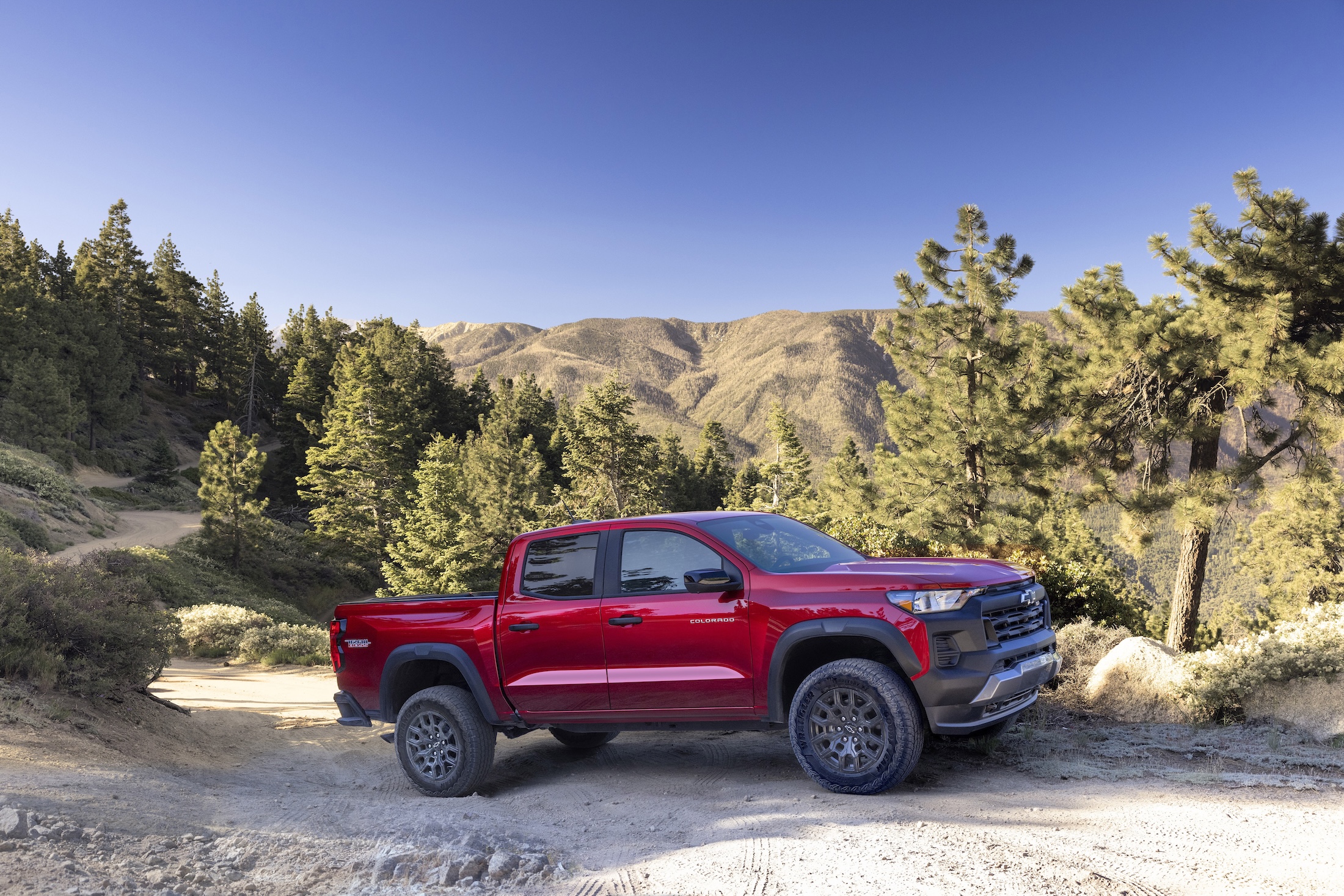
This week: 2026 Chevrolet Colorado Trail Boss Crew Cab
Price: $57,240 as tested. Almost $10,000 more than the Frontier, and almost $15,000 more than the Santa Cruz.
What others are saying: “Pros: Powerful turbo I-4 engine, great off-road capability, light bar useful on trails. Cons: Somewhat sluggish transmission, slowish steering response, minor wheel hop during hard braking,” notes Motor Trend.
What Chevrolet is saying: “Take the American landscape by storm.”
Reality: Yes, a very bouncy storm.
What’s new: The model has very little updates since the 2023 redesign. This year adds the Stars and Steel Edition tested, which presents $13,555 worth of options. Granted, that includes heated seats and steering wheel, adaptive cruise, technology package, and power adjustable seat, but that still seems like about $7,000 for cool graphics and stuff.
Up to speed: The Colorado as tested is powered by a 2.7-liter Turbomax four-cylinder engine. It creates 310 horsepower and gets to 60 mph in 7 seconds, according to Motor Trend. Despite all those horses it’s still the middle of the pack among our three test vehicles. The Santa Cruz wins this segment.
Shifty: The eight-speed automatic transmission is controlled by a vintage shift lever with just PRNDL options.
On the road: The Colorado Trail Boss followed the usual template of small off-roady trucks — hard to get used to and then suddenly quite fun. Once I found my position on the road, I was able to roll around country lanes with a lot of momentum, probably worrying passing motorists along the way.
The large balloony tires transmit a good bit of bounce, though, and the Trail Boss really loses its cool over rutted roads. I think Motor Trend was a little too subtle in its comment about “minor wheel hop” on hard braking; it’s a lot. The Santa Cruz wins here, too. Although the Frontier and the Colorado were quite fun, I noted the Frontier’s bouncy ride and the Colorado’s hoppiness make both also-rans.
In and out: The Colorado featured rocker protectors, and these resemble running boards sitting there teasing me. I thought they’d lower to ease my climb into this very tall truck, but they were not interested. Gonna have to stretch those IT bands. Obviously the Santa Cruz is the easiest here.
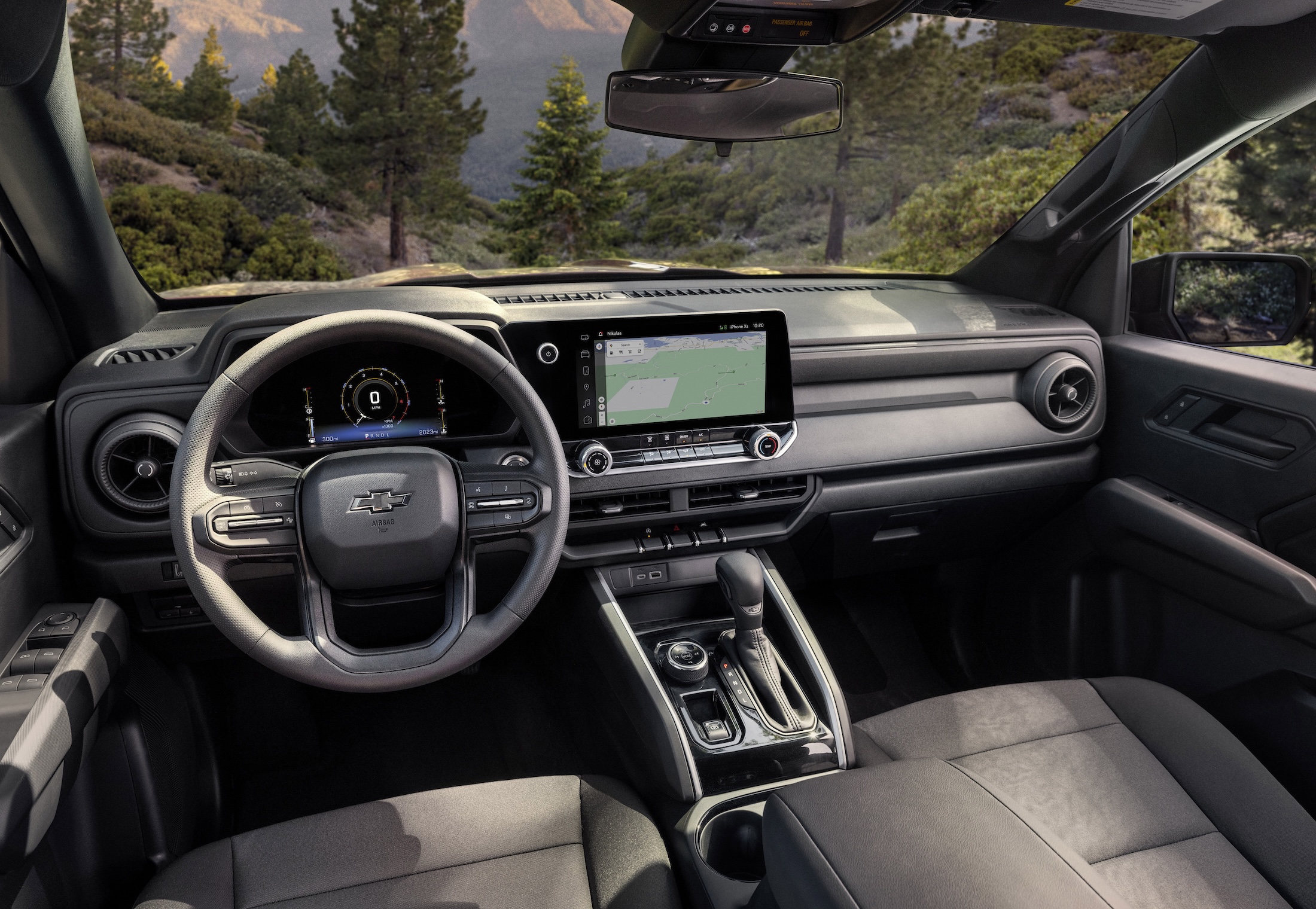
The interior of the 2026 Chevrolet Colorado Trail Boss is spare and attractive, and missing one important “frill.”Chevrolet
Driver’s Seat: After you pass that little entry test, the seats have nice ergonomics, and the fabric is nicer than trucks have a right to. I set dirty gloves down on them and the dust did not just brush off.
The steering wheel does not telescope, at least not in the test version. (The internet contends some trim levels have it. I’m not going to argue with the internet, but I’m also going to scrunch one eyebrow a bit.) But does Chevrolet really gain by two setups for the steering wheel? Can it be worth the extra manufacturing needs? It’s just another in a long line of cheapskate moves.
I’m surprised that I wasn’t more annoyed, especially since “annoyed” is my default setting, but I seemed to match up with the steering wheel nicely. Still, I cannot see myself ever dropping close to $60k on a truck missing such a basic feature as a telescopic wheel. I like the Nissan for its no-frills approach but still including that “frill.” Finally, the Frontier is king.
Friends and stuff: The rear seat offers scant room for feet and tight quarters for legs. Only headroom is roomy. It sits upright squeezed in between the first row and the bed, with no adjustments at all.
The seat bottom folds up for cargo space but a tool box under the seat remains and makes the cargo space less than ideal.
The Trail Boss pulls up to 7,700 pounds, the highest among the contenders, but passengers win in the Frontier.
A word of caution — if you get the fun Trail Boss roll bar coupled with the roll-up bed cover, watch your head when rolling up the cover. That left a mark.
Play some tunes: After some adjustment — some very deeply nested, multiscreen trips to the equalizer — the sound from the nameless audio system was just about phenomenal, an A leaning to an A+.
The 11.3-inch touchscreen does most of the work, but dials for volume and tuning are there to help out. Finally, a category for the Chevrolet.
Keeping warm and cool: Buttons underneath the infotainment system and dials for temperature make adjustments fairly simple.
The infotainment system pushes the middle vents way down, so having a fan blow right on your sweaty, overworked face from both sides is not really an option, and also kind of a deal-breaker. Another one for Nissan.
Fuel economy: The Trail Boss averaged just under 18 mpg, so it beat the Nissan but fell short of the Santa Cruz. None of them really sips fuel, although I guess each is different by about 10 percentage points, and that will add up.
Where it’s built: Wentzville, Mo., with 44% of parts from the U.S. and Canada and 28% from Mexico.
In the end: If you can make the Santa Cruz work for you, it’s the cheapest, easiest to drive, and most efficient, and it won the most categories (five). If that’s not going to work, I’d send you to the Frontier (four categories).
2026 Nissan Frontier Crew Cab Pro-X V-6 vs. 2026 Hyundai Santa Cruz XRT AWD vs. 2026 Chevrolet Colorado Trail Boss Stars and Steel: Smallish truck smackdown.
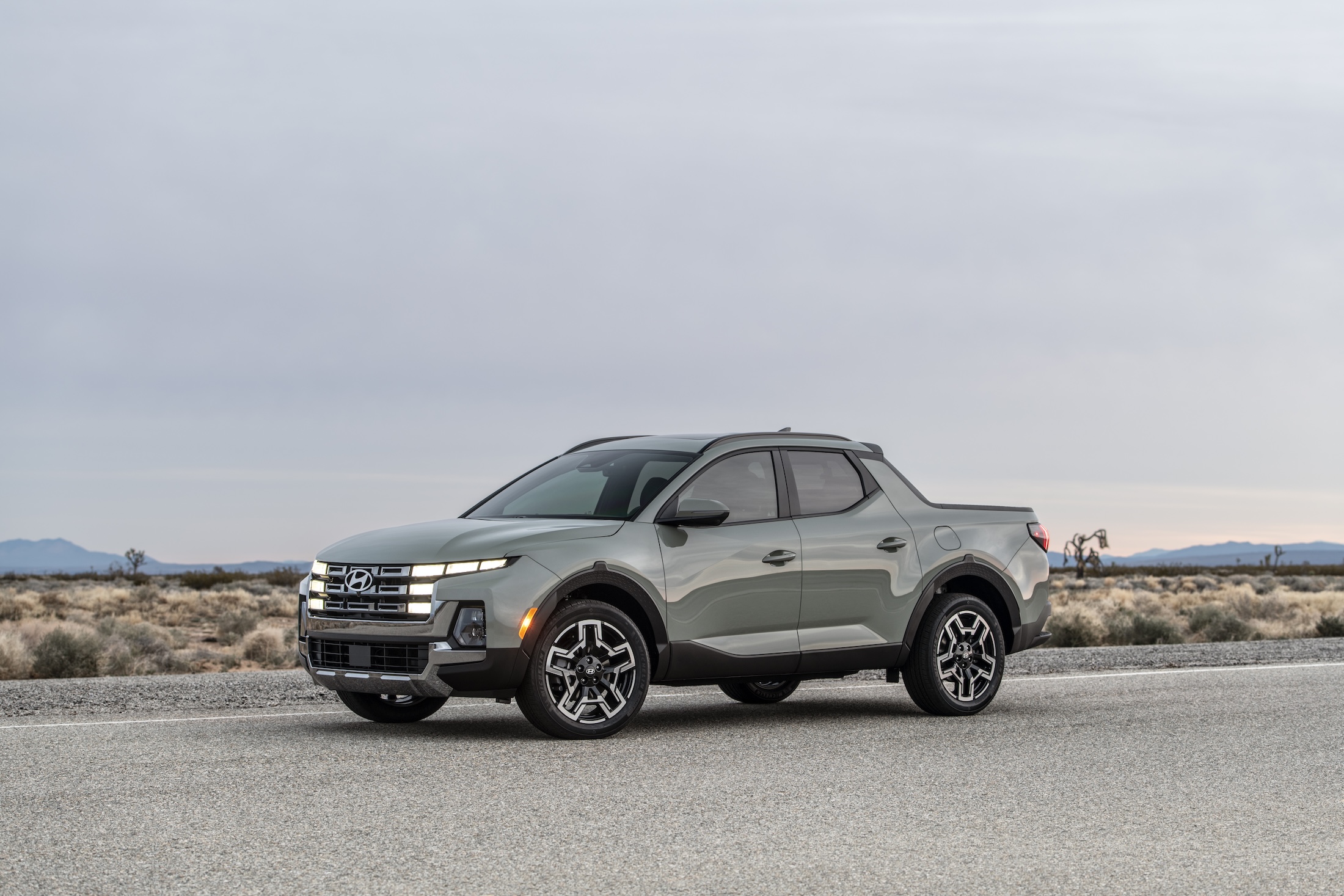
This week: 2026 Hyundai Santa Cruz
Price: $43,335 as tested, saving you $5,000 off last week’s Frontier.
What others are saying: “Highs: Carlike ride and handling, user-friendly infotainment, upscale interior design. Lows: Four-foot cargo bed has its limits, big upcharge for the turbo engine, limited off-road capability,” says Car and Driver.
What Hyundai is saying: “Our one-of-a-kind Sport Adventure Vehicle.”
Reality: The smallest of the three trucks tested, the Santa Cruz performs like it.
It’s been unclear since early 2026 whether the Santa Cruz is still being sold in the U.S., but Hyundai confirms the model is on for 2027.
With such a cloudy future, it’s no surprise the Santa Cruz is a carryover from 2025, though it gets a new transmission on the 2026 XRT and Limited models.
Competition: Real comparisons with last week’s Frontier and next week’s Colorado are limited to the box in the back; the other two are bigger and truckier than the Santa Cruz. Still, you may find it useful to compare these, as well as the Ford Maverick and Honda Ridgeline, which are set up more like the Santa Cruz. Also, consider Ford Ranger, GMC Canyon, Jeep Gladiator, and Toyota Tacoma.
Up to speed: When I first got the Santa Cruz rolling, I was struck by how much it seemed like an Elantra. And not a fun, new Elantra; a boring old one from 2013 or so. Its acceleration was dull, its handling was dull, even its sound made me feel a man in his mid-50s. I mean, I am a man in his mid-50s (well, late-50s now, I guess), but you don’t have to make me feel like one. My self-destructing body has that handled.
So let’s try this in Sport mode, hahaha, I thought to myself.
Lo and behold, the acceleration from the 2.5-liter turbocharged four-cylinder engine pepped right up. That’s where Motor Trend must have been when it got a 6.5 second 0-60 time. It’s not super fast, but the 281 horses aren’t exactly asleep either. In any case, it beats last week’s Frontier by almost a second.
Shifty: A new 8-speed automatic transmission replaces the dual-clutch unit for 2026. This new unit handled smoothly and without much interference, something dual-clutch models here in the cheap seats don’t usually offer. Only in Sport mode did the gears stay low a little longer than I’d like.
Shiftability comes from the paddles or the shifter. Feel in the console shifter is pretty slushy, a sad Hyundai tradition.
On the road: The Sport mode also takes the handling from the 2013 Elantra level to a sporty feel. Like most small pickups, the Santa Cruz is a nice ride, smooth where it needs to be with a bit of fun added on the curves. Advantage, Santa Cruz.
The interior of the 2026 Hyundai Santa Cruz is mostly intuitive for drivers to figure out.DREW PHILLIPS
Driver’s Seat: A comfortable and roomy perch awaits those getting to the Santa Cruz. It’s not the best at grip but it felt pretty nice overall.
The gauges are standard Hyundai, clear and easy to set up with the information you’re looking for. I’d give the Frontier the higher marks in this segment, though.
Friends and stuff: The rear seat is a snug fit, with my legs cramped like in a coach airplane seat. Foot room is good and so is head room. The seat back sits up fairly straight, though. Still, surprisingly, it’s better than the Frontier.
Cargo space is nice as a trunk — ours came with a locking cover — but pitiful as a pickup. I loaded some branches from an overgrown butterfly bush and the four-foot bed was overflowing in no time at all. The prize to the Frontier.
Towing: The Santa Cruz XRT can tow up to 5,000 pounds, and pales in comparison to last week’s Frontier, which pulls nearly 7,000. Other Frontiers pull even more.
In and out: The Santa Cruz sits at a nice height for an all-wheel-drive pickup, easy to get in and out, making it the winner in the hearts and hips of grandparents (yes, there are a Granddaughter 1.0 and Grandson 1.0).
Play some tunes: The stereo in the test model offered some fairly nice playback, certainly an A- and maybe an A.
Operation is simple, with knobs for volume and tuning, buttons for some selections, and the touchscreen handles the rest.
Keeping warm and cool: An ebony touchpad controls every move except temperature, which involves two big knobs. Of course the knobs are simple and the touchpad is not quite so. There’s not a lot of feedback as you make your selection. Go, Nissan!
Fuel economy: I averaged around 20 mpg, which is far better than most full- or even midsize pickups, including the Frontier.
Where it’s built: Montgomery, Ala., with 54% of parts from the U.S. and Canada and 31% from Korea.
How it’s built:Consumer Reports predicts the Santa Cruz reliability matches the Frontier’s, at 4 out of 5.
Next week: We take a ride in the Chevrolet Colorado Trail Boss.
2026 Nissan Frontier Crew Cab Pro-X V-6 vs. 2026 Hyundai Santa Cruz XRT AWD vs. 2026 Chevrolet Colorado Trail Boss Stars and Steel: Smallish truck smackdown.
This week: Nissan Frontier
Price: $48,735 as tested.
What others are saying: “Highs: Solid overall value, offers more bed and cab configurability than rivals, old-school knobs and buttons are easy to use. Lows: Interior not as polished as competitors, only adequate towing capabilities, crew cab is a bit cramped,” says Car and Driver.
What Nissan is saying: “The only midsize truck with a standard 310-HP V-6 engine, recognized by Wards as the most awarded V-6 engine over the last 30 years.”
Reality: If by “Frontier” the Nissan folks mean like days of old, then the name fits.
What’s new: The Frontier received a refresh in 2025 — slightly new look, bigger infotainment system — after a redo in 2022.
But a pickup revamp is never that intensive. It’s a cab with a box on the back; how much could change? Fortunately, that carries over to the interior. If you’re frustrated with sliders and screens, has Nissan got something for you.
Up to speed: The 3.8-liter V-6 creates 310 horsepower. It gets to 60 mph in 7.3 seconds, according to Car and Driver, kind of doggish.
Shifty: The 9-speed automatic operates via a real shift lever. Leave it in automatic mode and it works quietly on its own. Slide the lever to the left to shift your own gears and it feels old school but nice.
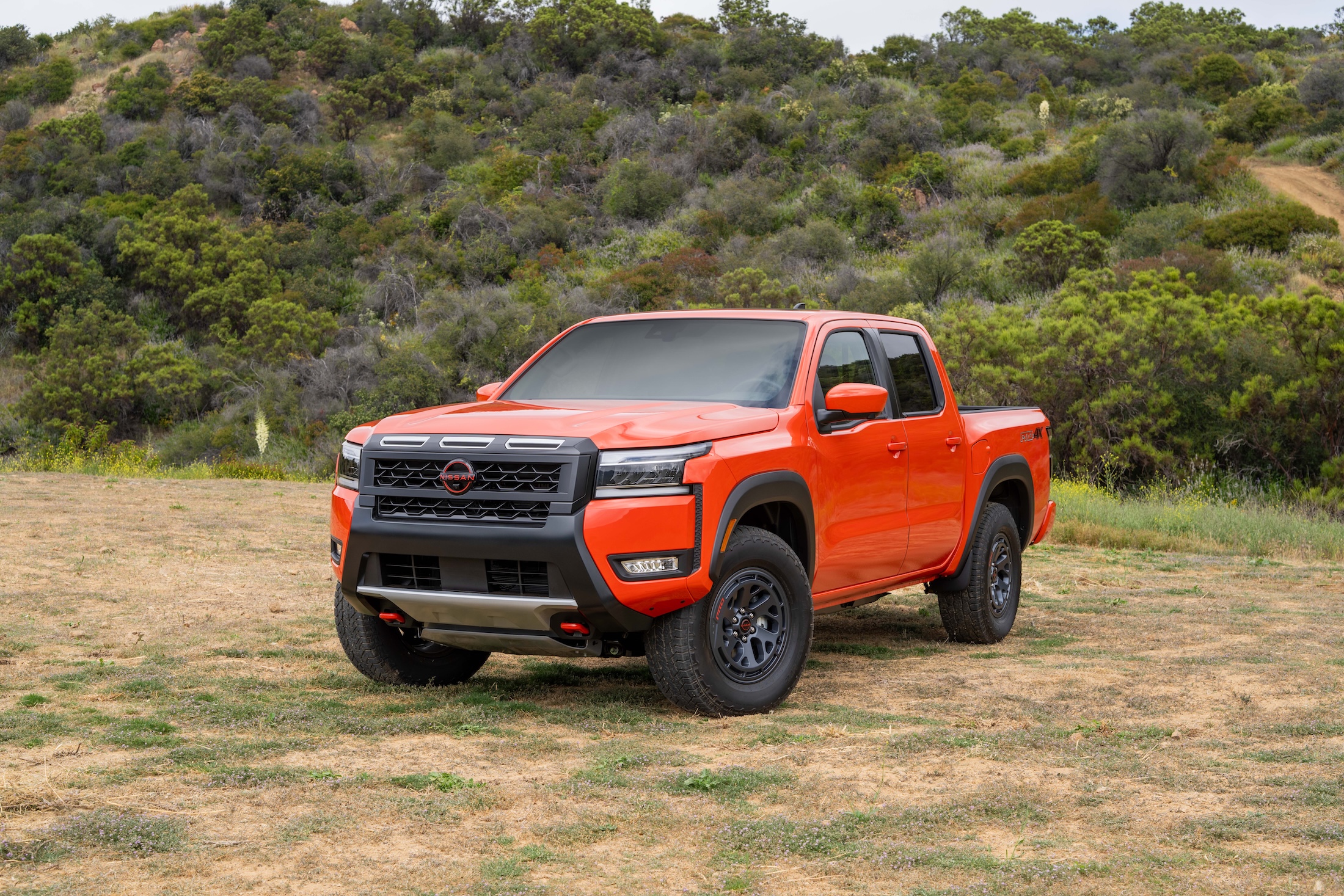
On the road: Even more than most small pickups, the Nissan Frontier Pro-4X would do well as bump finders for road crews aiming to smooth things out. (They do that, right? Maybe in other states?) Some quirk in Route 202 South in Tredyffrin is a great testing ground for this, and the Frontier failed.
At first, keeping the Frontier on the road became challenge enough. I took a roundabout near my home a little too energetically on Day 1 and worried I was going to be sideways.
Over time, I became accustomed to the quirks and the vague accuracy on narrow lanes. Small pickups have a way of making up for the shortcomings by just being a blast as you roll along, and the Frontier was no exception. Sort of Jeep Wrangler-y.
Off the road: The hardest part about small pickups, especially the Frontier, is guiding them into a parking space head first. The turning diameter (42.6 feet) is huge, so plan ahead.
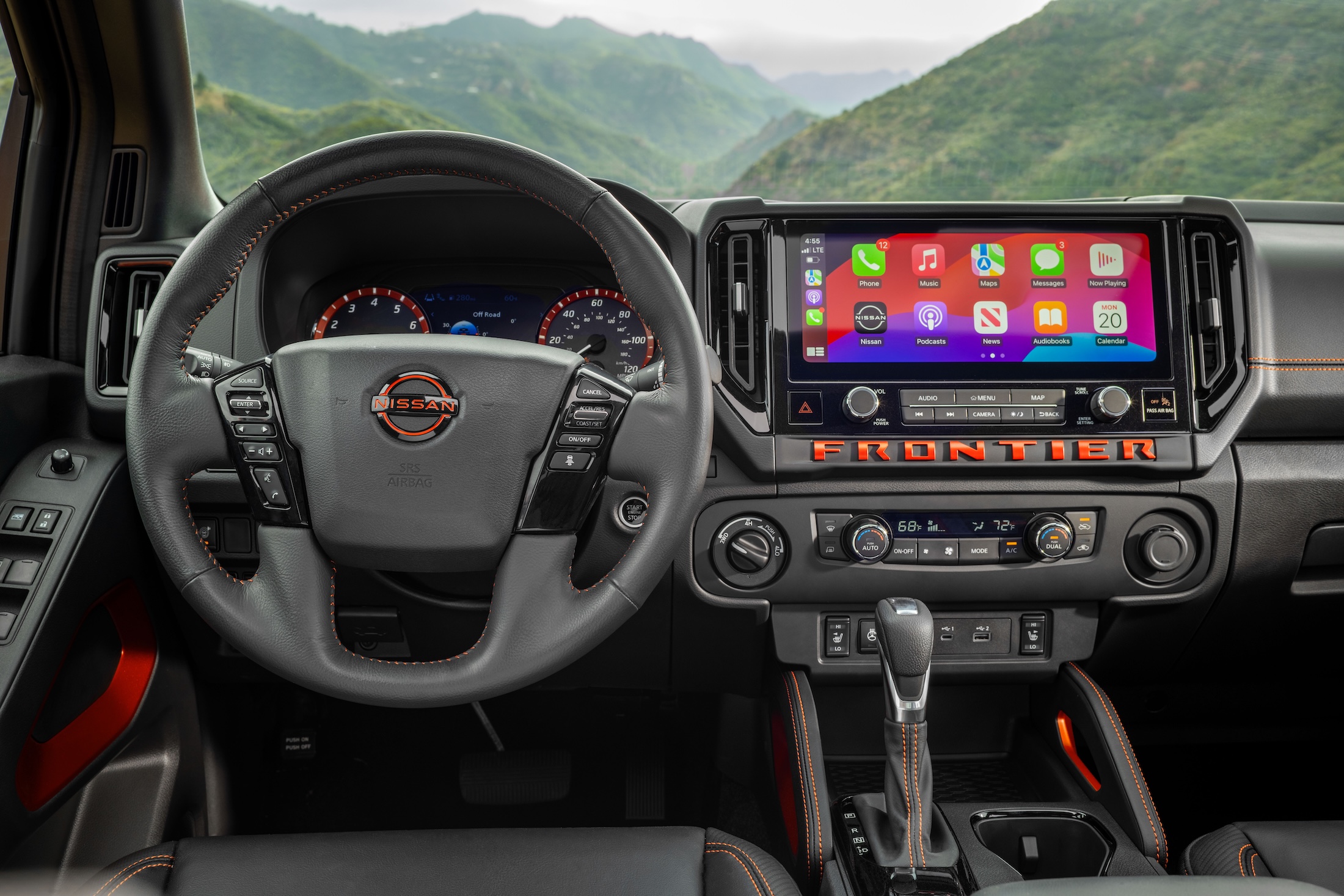
The interior of the 2026 Nissan Frontier will put a smile on the faces of people tired of using screens for everything.Nissan
Driver’s Seat: The leather seats that come with the Pro Premium Package ($3,080) are comfortable and roomy.
Gauges and controls have a fairly old-fashioned look, so getting around seemed easy enough. Of note, the seat heaters are real switches, the kind that stay switched on and at the ready when you return to restart your cold vehicle, making a fan out of the Chilly Mrs. Passenger Seat.
Friends and stuff: The rear seat feels a lot like the third row of an SUV: The seat is small, legroom is snug, and foot room is nearly nonexistent. Here it also means the seat back sits fairly vertical, and there’s no room for reclining, nor does the seat move forward or back.
The 59.5-inch bed in the test model is most common across various trims. A 73.7-inch version comes on the long bed models. The Frontier as tested tows 6,880 pounds. Other versions tow more.
Finally, the rear seat folds down rather than up. I never tried living with one, but I feel like the fold-up seats offer more storage options.
In and out: It was a high step up into the Frontier Pro-4X as tested.
Play some tunes: Dials adjust volume and tuning and the rest of it happens inside the (new for 2025) 12.3-inch touchscreen. Sound from the 10-speaker Fender Premium Audio system (part of the Pro Premium Package) was pretty good, about an A-.
Keeping warm and cool: Dials easily control the temperature and buttons control the rest, without the eyes-off-the-road time of screen controls.
Fuel economy: The vehicle averaged a sad 16.9 mph over 400-plus miles, which included Mr. Driver’s Seat and other drivers.
Where it’s built: Canton, Miss. The bulk of the parts (40%) hail from the U.S. and Canada, while 20% come from Japan.
How it’s built: The Nissan Frontier gets a 4 out of 5 predicted reliability score from Consumer Reports.
2026 Genesis GV80 3.5T Prestige AWD vs. 2026 Lincoln Nautilus Hybrid AWD Reserve III: Battle of the big screens.
This week: Lincoln Nautilus
Price: $76,380 as tested.
What others are saying: “Highs: Nicest interior in Lincoln’s lineup, cool extra-wide dashboard display, hands-free driving feature is standard. Lows: Acceleration and road manners are mid, real-world highway fuel economy isn’t better than the nonhybrid model, best features reserved for Black Label trim,” says Car and Driver.
What Lincoln is saying: “Experience the SUV named best luxury hybrid of 2026.” (A U.S. News and World Report award.)
Reality: I’m not sure I’ve ever cited U.S. News here, and there’s a reason for that.
What’s new: The Nautilus was last redesigned for the 2024 model year. It gets a new look for 2027 as well. Time to shop for a deal.
Up to speed: The Nautilus tested uses a 2.0-liter engine and hybrid motor and battery that together make 280 horsepower. The vehicle gets to 60 mph in 6.6 seconds, according to Car and Driver, which is not bad for a hybrid SUV. There’s also a non-hybridized version which creates just 250 horses.
Shiftless: Lincoln uses five buttons where the center of the dashboard meets the console for PRNDL, in a nod to the original 1958 Edsel, which pioneered a push-button transmission in the center of the steering wheel. That one was ridiculous because what an odd location; this one is ridiculous because it wastes so much valuable real estate.
On the road: The Nautilus rides quite nicely, even among luxury midsize SUV competitors. Super smooth and quiet, but not as detached as the Mercedes. It’s not much fun on the curves but definitely easy to get around in, and highways are a delight.
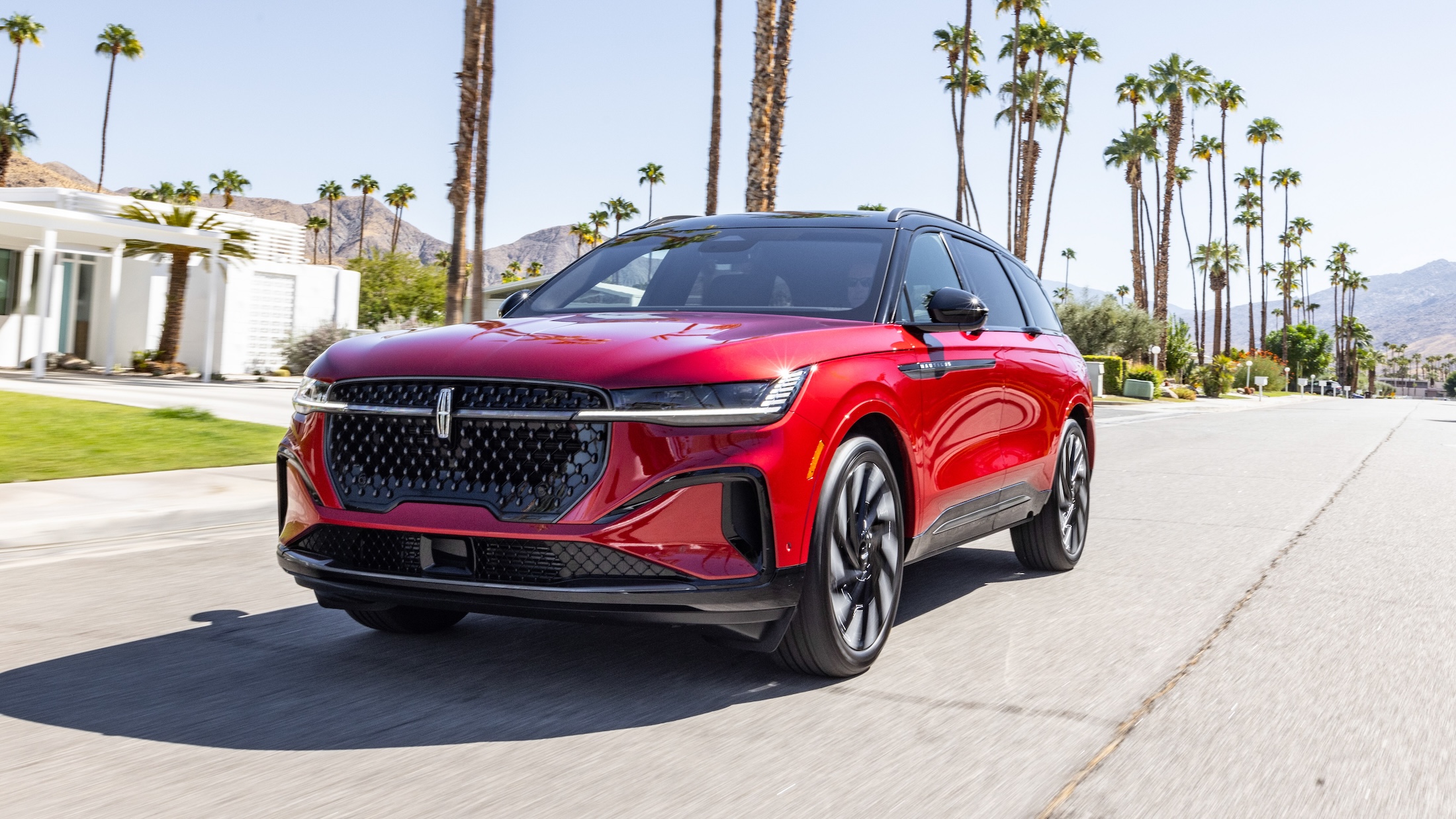
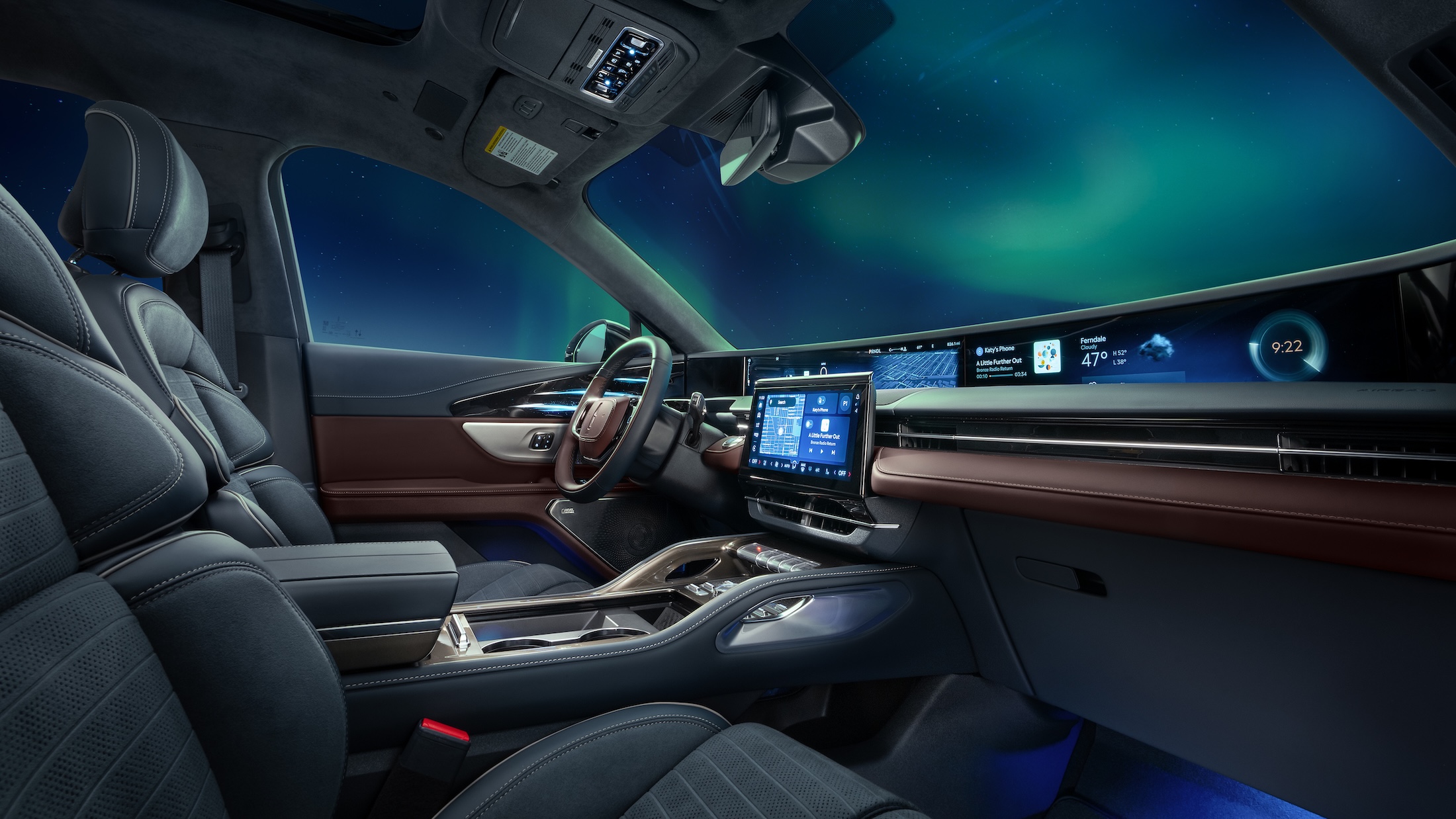
Unlike the subtle outside, the interior of the 2026 Lincoln Nautilus gets the full Vegas treatment.Lincoln
Driver’s Seat: First, the screen. I’ve heard raves about the screen, and I’ve seen pictures of the screen. But it is not until you sit in front of the 48-inch screen that you realize the IMAX 3D nature of the screen. The weather. The date, as big as a calendar. The time in huge numbers, turning from the minute before to the current minute and the minute after, flipping like a graphic representation of the old mechanical flip digital clocks. The map. The gauges. All swept across the top of the dashboard in an arc. Mr. Driver’s Seat’s aging eyes approve.
But in the end it’s kind of a letdown. There are only three changeable screens from a total of six choices. Woo hoo. You still have a separate 11.1-inch touchscreen near you for the things you can change, and that touchscreen faces awkwardly out of your gaze where you might reach for a cup, and it looks smaller than it is.
The seat itself is super comfy and beautifully proportioned, rife with snuggles, from the shape of the seat and the side bolsters.
Finally, let’s talk about getting into and out of the Driver’s Seat. Lincoln has long since dispensed with the fake tire on the trunk but the designers made an unexpected nod to tradition with the door handles.
There’s an exterior trim piece riding the beltline under the windows, and it is there you’ll see the bump-out handles with the opener mechanisms underneath. It took me a minute to find them. This looks to be a nod to the 1960 Mercury Montclair, a vehicle I recall seeing once as a small child, and this design touch completely fascinated me — even almost 50 years later. But it does seem like something for children, honestly. Still, I guess this is better than the pop-out handles that may not, in fact, pop out — or worse.
The exit ramp from the Nautilus is almost as clever/silly. The door armrest has a large toggle sticking up in the front of the part that you grab to close the door.
Sturgis Kid 4.0 had to move the vehicle in the driveway and commented on how hard it was to find different features. When I first sat down in it later, I messaged him, “Tried to release the emergency brake. Opened the gas tank.”
Friends and stuff: The rear seat feels like a letdown compared to the front. It’s flat and kinda blah feeling, not hard nor soft, and yet not just right. Legroom, foot room, and headroom are all awesome, though the middle passenger will dispute that.
Cargo space maxes out at 71.3 cubic feet.
In and out: The Nautilus sits at a nice height, so everyone should find it easy to enter and exit.
Play some tunes: The stereo is mostly controlled by the touchscreen save for an enormous volume dial in the console, something that cars from the 2010s made me think would be the PRNDL. Add this and the transmission controls together, and factor in the six pretty toggles with the fairly illegible-for-a-man-of-a-certain-age labels, and one just wants to shout “WHY?!?!” into the sea.
Sound from the 28 Revel Ultimate 3D speakers is just fair, about a B+. It had flashes of being better but it was not overall.
Keeping warm and cool: Most of the controls can be found along the bottom of the touchscreen, and those are fairly easy to sort as long as the vehicle is not in motion.
The vents look like they stretch across the front of the cabin but they really don’t. I didn’t find any way to redirect the air flow.
Fuel economy: The vehicle averaged around 26 mpg over about 2,500 miles of travel in various journalist and delivery-driver hands. Advantage, Lincoln.
In the end: The fuel economy and the bargain price over the Genesis makes this Lincoln worth a second look, and honestly the cool stuff is kinda cool after all.
2026 Genesis GV80 3.5T Prestige AWD vs. 2026 Lincoln Nautilus Hybrid AWD Reserve III: Battle of the big screens.
This week: Genesis GV80
Price: $84,475 as tested. Just an added $650 charge for green paint.
What others are saying: “Highs: Sumptuous interior, loaded with luxury features and amenities, pricing undercuts the high-image brands. Lows: Handling not as agile as sportiest rivals, cramped third row,” says Car and Driver.
What Genesis is saying: “Refinement you can feel.”
Reality: So refined there’s a Mood Curator.
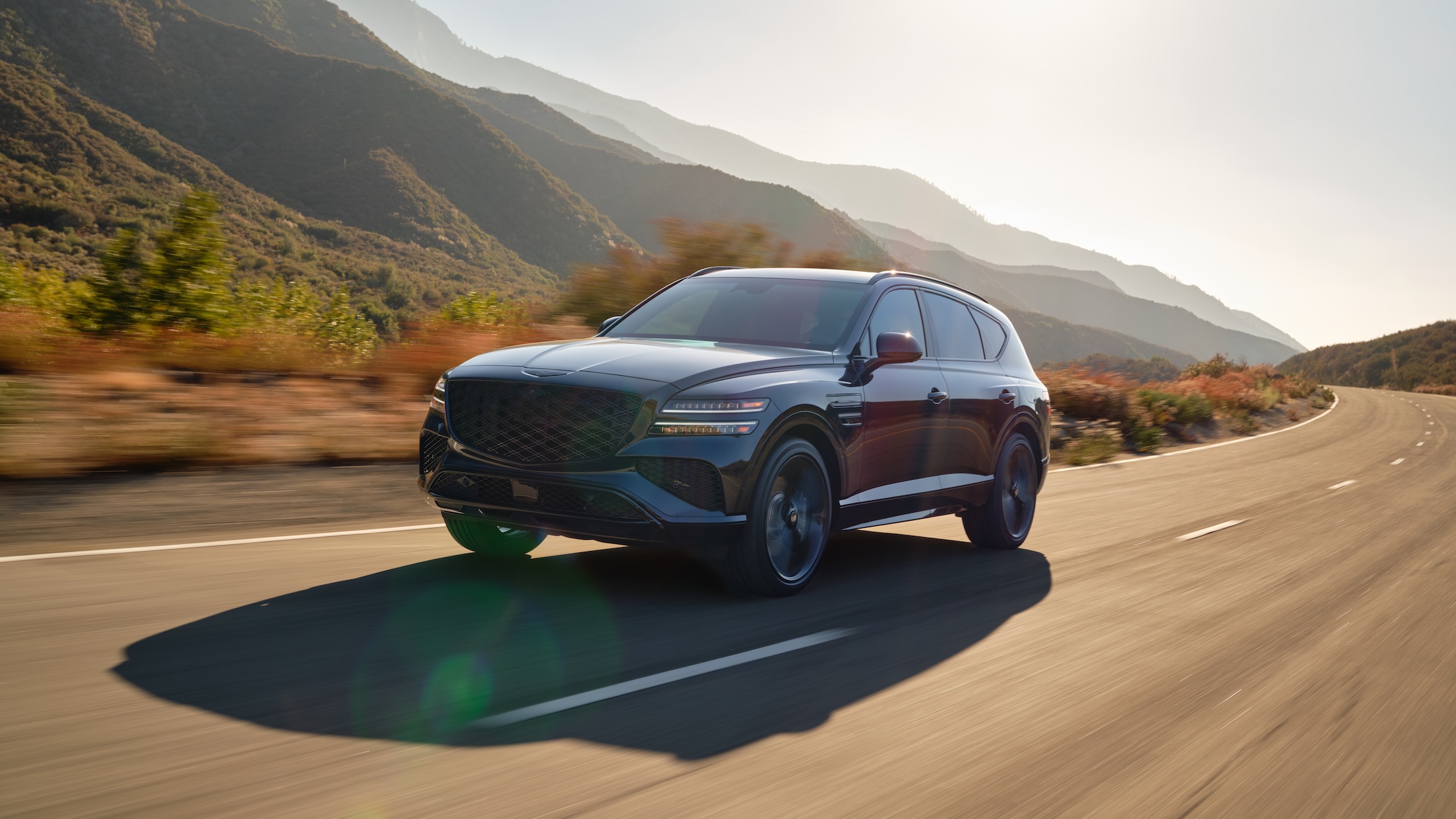
What’s new: The GV80 came just in time to ferry us on a trip across Pennsylvania. So, over 500-plus miles, Mr. Driver’s Seat got a fairly strong impression of the three-row luxury SUV. It carries over from its 2025 redesign, with a few features added or rearranged.
Up to speed: The 3.5-liter twin-turbo V-6 engine powering the GV80 as tested had plenty of pickup, especially for a large SUV. It gets to 60 mph in 5.7 seconds, thanks to its 375 horses, according to Car and Driver, not the fastest in the class but still swift.
Shifty: The 8-speed automatic’s gear selector is a twist dial, though it matched the infotainment dial for size. Slightly confusing but I seem to be adjusting with more Genesis tests under my belt. Still, Reverse and Drive are opposite directions, for easier dialing.
On the road: The all-wheel-drive GV80 was right at home on the Pennsylvania Turnpike, taking some of the 60-mph curves at full speed without much tilt.
Country-road handling was easy, and I could arrange the vehicle in a tight lane without having to steady myself too much.
In either case, Sport mode is really the only choice. Normal seemed to have some wander, and hesitation as well.
A new terrain mode is available for 2026, guiding one through snow, mud, and sand.
The basest of base GV80 trims comes in rear-wheel drive, if that appeals to you.
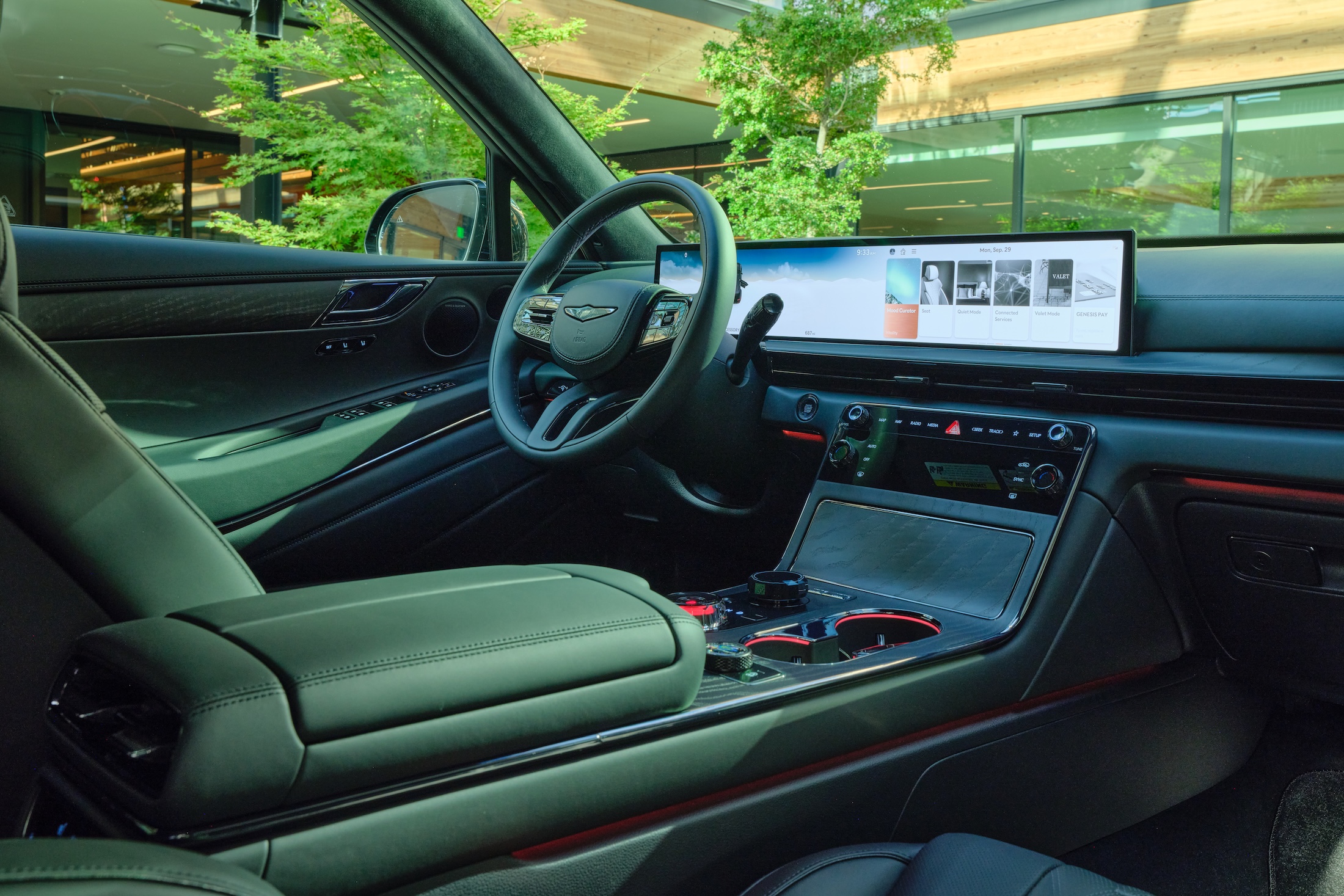
The interior of the 2026 Genesis GV80 starts with a huge screen, continues through some Nappa leather seats (for a price), then winds up in the tiny rear row.Kelly Serfoss
Driver’s Seat: Something called a Mood Curator — handling ambient lighting, massage, music, and fragrance — has moved from all trims for 2026 to just the Prestige trims in 2027. I overlooked this nonsense — er, feature — but enjoyed playing with it in the G90.
Still, the interior is a plush experience, providing drivers with generous accommodations. Even massage seats were on offer, although the 20-minute cutoff time seems stingy. What if I hurt my back switching it back on? Won’t you feel bad, Genesis?
The Prestige trim levels get Nappa leather, while others get just leather, and cheapos get leatherette. In addition to olive ash trim, most GV80s also get something called Newspaper Wood trim, and Mr. Driver’s Seat approves.
The 27-inch screen covering the gauges and infotainment certainly is attention-getting. Set the screen to map and you can see half the state, as it bleeds across to the gauge area as well. Ooo ahh. It’s clearer than clear, but the steering wheel blocked some important bits of info.
Friends and stuff: It was just the Lovely Mrs. Passenger Seat and myself for the trip, so I tested out the other rows but not as extensively as others might have.
The middle row is comfortable and matches the luxury of the front. Legs, feet, and heads get plenty of space to enjoy, plus the ability to slide forward and back and recline pretty deeply as well.
The rear row is for kids. The first clue is that the middle-row seat doesn’t really get out of the way. You better have good balance to make the trip, because it’s a scramble over the seat with little stepping area offered.
And also, once there, be flexible. Like, literally, not in the sense that your boss or your spouse or mom says. Headroom is limited, as Mr. Driver’s Seat’s head needed to be canted to one side. Legroom is tight and foot room fairly nonexistent, at least under the middle-row seat. And your knees will become your new closest friends. Adults back there will not feel the mood curation.
The GV80 features fold-down seats similar to those that were part of a stop-sale in a Hyundai Palisade — no holding of the button is required to keep them moving. While these reversed when I put my backpack in the way, the backpack got pancaked pretty good. After some consideration, I did not offer up my own leg for testing.
Cargo space is 11.6, 36.5, or 71.7 cubic feet, depending. Towing is 6,000 pounds for any GV80.
Play some tunes: Buttons underneath the unit meant many of the adjustments could be made without a touchscreen. Here’s the bright spot of keeping things like they were in 2021.
Sound from the Bang & Olufsen Premium Audio was about an A-. Everything was clear but no new ground was broken.
Keeping warm and cool: The ebony touch pad that controlled the HVAC seemed to have a great feel; these can sometimes require too much push or be far too touchy.
Still, controls required my full attention, except for the dials that adjusted the temperature.
Fuel economy: The GV80 averaged 19.5 mpg in a lot of highway driving, which might sour your mood.
Where it’s built: Ulsan, South Korea
How it’s built: Consumer Reports gives the GV80 a predicted reliability at 2 out of 5, also not offering the mood curation you were hoping for.