Category: Health & Pharma

  • Main Line cannabis payments operator charged with $9 million fraud

    Main Line cannabis payments operator charged with $9 million fraud

    A Lower Merion businessman who raised $9 million from more than 50 Main Line, pro sports, and Hollywood investors for Kind Financial, his marijuana payment-processing business, was charged by federal prosecutors Tuesday with five counts of fraud.

    The businessman, David Dinenberg, “fraudulently induced dozens of people into buying shares of Kind” by supplying false sales and business information, and “misleading the investors into believing that their entire investments were being used” for the company, not “diverted” for his personal use, according to charges filed in Philadelphia federal court. Dinenberg did not return calls seeking comment.

    The U.S. Attorney also called on Dinenberg to forfeit $9 million prosecutors contend he had raised from investors by fraud.

    Kind worked his networks of friends and business contacts to raise money from singer John Legend; former tennis star Andy Roddick and his actress-model wife, Brooklyn Decker; former Sixers manager Billy King; former Eagles star Brian Westbrook; investor Lindy Snider, whose family once owned the Flyers; and dozens more, according to investor lists.

    Investors had spoken to federal investigators.

    But Snider and others who invested in Kind, then tried to keep the company going after the board confronted Dinenberg about his spending and he left in 2023, said Wednesday that they had no advance notice of the criminal charges.

    David Dinenberg, who headed Kind Financial, hoped to serve cannabis growers at a time when few banks would do business with the industry. He has been charged with fraud and accused of embezzling.Kind Financial

    Instead of using all the money to build his marijuana business, Dinenberg allegedly “embezzled” more than $750,000 to pay for “unauthorized personal expenditures,” including family members’ school tuition, a luxury California rental home, and country club memberships. Prosecutors say he lied to investors by exaggerating sales and prospects for Kind.

    Dinenberg is also accused of stealing $175,000 from Rhode Island, which had hired Kind to collect cannabis fees from growers.

    Prosecutors say Dinenberg was supposed to forward that money to the state, less a small transaction payment, but began keeping the fees, and reported money that should have gone to the state as company revenue.

    Dinenberg started Kind in 2012 to process cannabis transactions that were legal in some states but prohibited under federal law. The legal complexity discouraged national banks from working with cannabis businesses, but also created what Dinenberg persuaded investors was an opportunity for his company to focus on serving legal-cannabis pioneers.

    The prosecutors depict Dinenberg as a successful fundraiser who founded a series of related companies, hiring two friends and a “family connection” to run the business in 2014, and tapping each of the three employees to help fund Kind.

    Kind in 2015 acquired cannabis-farm payments software from Colorado-based Agrisoft Development Group, which had clients in Colorado and a few other states, and used that relationship to land a software development partnership with Microsoft that won national media coverage.

    After the Microsoft deal, Kind won the Rhode Island contract. But Kind’s cash flow from the Rhode Island work was so meager that Dinenberg stopped paying his lawyers and stopped paying Kind employees — while keeping the tax and Social Security deductions he had withheld for them, prosecutors said.

    Dinenberg issued glossy investor documents that projected sales of under $500,000 in 2016 would zoom to over $10 million in 2017 and $40 million in 2018 — with “no factual basis” for the unaudited financial reports, their “false” revenue data, and baseless projections, prosecutors allege.

    In 2019, Dinenberg closed a business deal with pioneering cannabis investor Hartstreet Holdings and Colorado-based Herring Bank to develop a KindPay app to pay cannabis transactions through the Mastercard payment network, according to the prosecutor’s charges.

    At first, it worked: “In 2020 and 2021, KindPay was working and some dispensaries even had KindPay kiosks” to enable sales, according to prosecutors.

    But in 2021, Mastercard figured out that KindPay was used for marijuana sales, and cut the service off, according to prosecutors.

    By 2023, Dinenberg had taken more than $750,000 from Kind bank accounts to cover personal expenses. Confronted by an employee, Dinenberg admitted he’d stolen money but claimed the total was $80,000, according to prosecutors. He resigned May 4 of that year.

    Snider and other investors looked at ways to keep the company going, but its websites have since gone dark.

    “The company has been defunct for some time, and it’s truly a shame what has happened,” said Snider in an email after learning of the charges. She declined further comment.

  • Reed E. Pyeritz, pioneering medical geneticist and Penn professor emeritus, has died at 78

    Reed E. Pyeritz, pioneering medical geneticist and Penn professor emeritus, has died at 78

    Reed E. Pyeritz, 78, of Radnor, pioneering medical geneticist, cofounder of the Marfan Foundation and the American College of Medical Genetics and Genomics, professor emeritus of medicine and genetics at the University of Pennsylvania, author, mentor, veteran, and nationally ranked masters triathlete, died Monday, Aug. 10, of interstitial lung disease at Bryn Mawr Hospital.

    Dr. Pyeritz was a trailblazing expert on the diagnosis and treatment of Marfan syndrome and other inherited cardiovascular disorders. His 44 years of research and clinical work, from 1978 to 2022, advanced the understanding and management of the diseases, and extended the life expectancy of Marfan patients by 30 years.

    “So many of us in the community owe Reed so much,” Bert Medina, board chair of the Marfan Foundation, said in a tribute. “His legacy lives on in all of us, thanks to his dedication.”

    In an online tribute, a relative of former patients said: “Without this amazing doctor, I wouldn’t have my sister or dad. He changed the world for Marfan patients and their families.”

    Dr. Pyeritz joined the faculty at Penn in 2001 and spent more than 20 years treating patients, teaching students, doing landmark studies on the value and social implications of genetic testing, and championing patient-centered care. He was codirector of Penn’s research center on hereditary hemorrhagic telangiectasia, onetime chair of the faculty senate, and a fellow at the College of Physicians of Philadelphia and other medical associations.

    His “vision and scholarship fundamentally transformed the care of patients,” Nimesh D. Desai, director of the Penn Aorta Center, said on X.

    Before Penn, Dr. Pyeritz spent nine years in Pittsburgh with what is now the Allegheny Health Network and 17 years at the Johns Hopkins University School of Medicine in Baltimore. In 1991, his team at Hopkins discovered that mutations in the FBN1 gene cause Marfan syndrome and followed up with new regimens to treat it.

    He cofounded the Marfan Foundation in 1981 and the American College of Medical Genetics and Genomics in 1991. “It became clear that folks with Marfan syndrome could benefit by an organization that allowed them to communicate [and] to stimulate other physicians to become involved,” he said in a 2018 video interview.

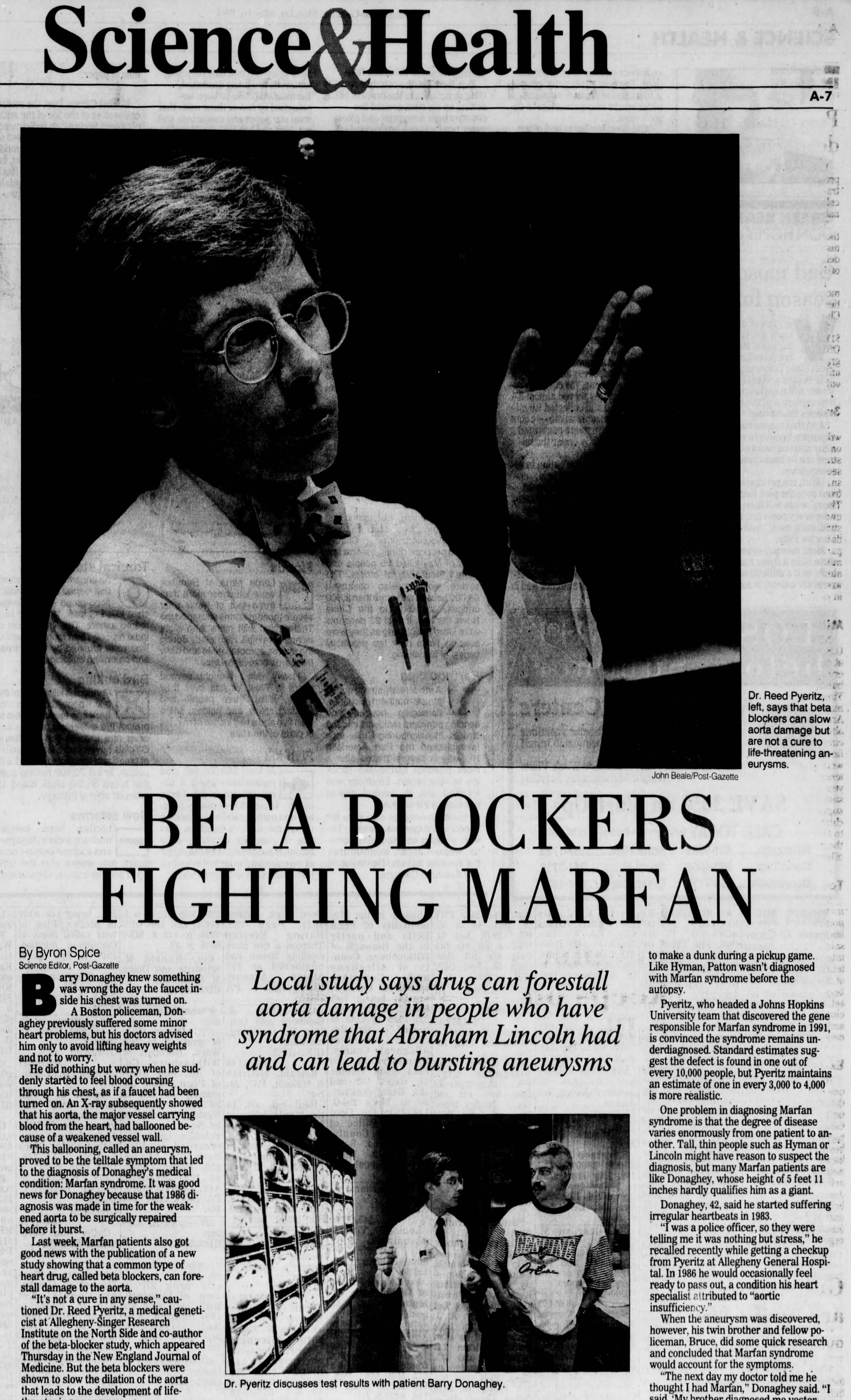
    This story and photos about Dr. Pyeritz appeared in the Pittsburgh Post-Gazette in 1994.Newspapers.com

    Colleagues, friends, and former patients called him “a phenomenal physician,” “a guiding light,” and “an extraordinarily reassuring presence” in online tributes. In 2018, he said: “The most gratifying thing is the fact that folks [with Marfan syndrome] are living their normal life expectancy.”

    Dianna Milewicz, chair of the John Ritter Foundation advisory board, noted his “excellence in clinical care, teaching, and research” on Facebook. Michael L. Weamer, president and CEO of the Marfan Foundation, called him “a true hero” and said his “impact on our community is immeasurable.”

    Dr. Pyeritz edited medical reference books and wrote The Marfan Syndrome and Uncertain Precision: Managing Health Care with Personalized Technologies. More than 700 of his research studies, reviews, and book chapters were published.

    He served 13 years in the Army Reserve Medical Corps and earned lifetime achievement awards from the Marfan Foundation, the American College of Medical Genetics and Genomics, and other groups.

    Dr. Pyeritz and his wife, Jane Tumpson, married in 1972.Courtesy of the family

    On weekends, he did marathons and triathlons, and was part of a world record 100-man, 100-mile relay. His family said in a tribute: “He measured a successful life less by titles or awards than by what one gives, what one learns, whom one loves, and what one leaves behind in others.”

    Reed Edwin Pyeritz was born Nov. 2, 1947, in Pittsburgh. He was fascinated by science and space as a boy, and he built rockets in his backyard and performed scientific experiments in his bedroom.

    He earned a bachelor’s degree in chemistry at the University of Delaware in 1968, a master’s degree and doctorate in biological chemistry at Harvard University in 1972, and his medical degree at Harvard in 1975.

    He met Jane Tumpson in first grade, and they graduated together from Mount Lebanon High School near Pittsburgh in 1965. They reconnected on the tennis court a few years later, married in 1972, and had daughters Allyson and Abigail.

    Dr. Pyeritz, left in the top photo and right in the bottom photo, enjoyed time with his family.Courtesy of the family

    Dr. Pyeritz and his wife honeymooned on Mount Kilimanjaro in Africa and traveled the world together for years. In April, the whole family went to Spain.

    He liked to wear bow ties, build stone walls, watch the news, and spend time outside with his dogs. He followed the Pittsburgh pro sports teams closely and enjoyed Manhattans and chocolate milkshakes.

    “I will miss it all,” he told colleagues at Cure HHT when he retired a few years ago. “But I am certainly looking forward to spending time with my two granddaughters, Tallulah and Penelope.”

    His daughters said: “Ever an adventurer, he instilled in us the importance of making the most of every day, watching the sunrise or sunset, and cherishing the time you have.”

    His wife said: “He loved without exception and reservation.”

    In addition to his wife, daughters, and granddaughters, Dr. Pyeritz is survived by son-in-law Keith Hopkins and other relatives. A brother died earlier.

    A celebration of his life is to be held later.

    Donations in his name may be made to the Marfan Foundation, 22 Manhasset Ave., Port Washington, N.Y. 11050.

    Dr. Pyeritz “loved without exception and reservation,” his wife said.Courtesy of the family
  • High-protein soft pretzels and soups are on the menu as Philly’s iconic food brands compete for GLP-1 consumers

    High-protein soft pretzels and soups are on the menu as Philly’s iconic food brands compete for GLP-1 consumers

    A soft pretzel from Philly Pretzel Factory currently has about 12 grams of protein.

    But sometime soon, you will be able to buy one with much more.

    The company says it is in the early stages of developing a high-protein pretzel, one of several new products it hopes will attract consumers concerned about weight loss.

    “Obviously, the trend is protein,” said company president Marty Ferrill. “Even people who are on GLP-1s, they’re looking for more protein-rich foods.”

    Philly Pretzel Factory is just one of the area companies changing their products to accommodate consumers who are eating less and “protein-maxxing.” The viral nutrition trend refers to an increasing obsession with eating more protein based on the idea that it builds muscle.

    A recent Gallup survey reported approximately one in eight U.S. adults are taking appetite-suppressing GLP-1 medications.

    GLP-1 drugs such as Ozempic and Wegovy were initially created to treat individuals with type 2 diabetes by regulating blood sugar levels, but their hunger-suppressing effects have spurred wider adoption for weight loss. A JPMorgan report estimates that by 2030, up to 30 million Americans may be using GLP-1 medications, especially as pill formats become available.

    As the medications rise in popularity and appetites shrink, the food industry could face headwinds. A recent study found that within six months of starting a GLP-1 medication, households with at least one GLP-user reduce their annual grocery spending by $390 on average.

    But this isn’t the industry’s first rodeo.

    The low-fat craze of the 1980s and the carb-phobic diets of the 2000s also forced food brands to rethink their products.

    “Until there’s a magic pill where you just don’t have to eat, period, the food industry will respond,” said Ernest Baskin, chair of St. Joseph’s University’s Food, Pharma, and Healthcare Department. “They’re going to change their product to appeal to the next generation of consumers.”

    Making every bite count

    Philly Pretzel Factory’s protein-enriched pretzels are an example of functional foods, which are foods that have been formulated to contain added nutrients and health-enhancing substances.

    Functional foods can be especially important for GLP-1 users, who eat smaller portions but still require their necessary vitamins and minerals.

    “In a world where you’re not eating as much, you want everything to count,” said Baskin.

    Campbell’s, the Camden-based food and snack giant, has ventured into the functional foods market with a recent launch of five protein soups that offer 20 grams of protein per can.

    The Campbell’s Company launched five new protein soups with 20 grams of protein per can.The Campbell's Company

    The company also released a new protein-fortified snack option with Snyder’s of Hanover’s harvest wheat pretzel sticks, which offer 6 grams of protein per serving. (As opposed to 3 grams for a standard pretzel stick serving.)

    The options “give consumers choices that fit their nutritional goals and lifestyles while helping get more out of every bite,” says Dave Chalk, Campbell’s vice president of enterprise insights and analytics.

    The recipes of popular Philly foods are changing too, as consumers prioritize better-for-you ingredients. In addition to the protein pretzel at Philly Pretzel Factory, their regular pretzels are undergoing a “clean label” reformulation.

    Ferrill said the company is ensuring consistent taste while changing some components: using unbleached flour instead of bleached, removing the additive potassium bromate, and replacing whey protein with a plant-based substitute. That means the franchise’s iconic pretzels will become vegan this year.

    “The urgency is [greater] now than it was three years ago,” said Ferrill, noting that the company has been developing the clean-label pretzel for years.

    Greater control over meals and portions

    At Honeygrow, a fast-casual chain that offers salads and stir-fries, customization is another option for GLP-1 users, said Todd Miller, senior vice president of marketing.

    More Honeygrow customers are choosing whole-wheat noodles — which offer 17 grams of fiber and 13 grams of protein — for their stir-fries, or crafting more vegetable-forward meals, said Miller.

    A chicken parm stir-fry at Honeygrow is at the 11th Street location in Philadelphia in 2024.Jessica Griffin / Staff Photographer

    “What is becoming increasingly important is the ability to personalize a meal around the nutrients and portions that matter to each customer,” Miller said.

    Campbell’s is banking on similar personalization preferences. Some research shows GLP-1 users are dining out less to control portion sizes and ingredients. With brands like Pacific Foods, Swanson, and Rao’s under the Campbell’s umbrella, the company’s cooking essentials business is benefiting.

    “The biggest opportunity within Campbell’s portfolio is the confidence consumers have gained with cooking at home,” Chalk said.

    People still want good food

    Despite moving toward healthier choices, many food companies are serious about not compromising flavor.

    For Honeygrow, that means continually introducing limited-time offers and keeping up to date with new ingredients to attract customers. Currently, Honeygrow’s seasonal summer menu includes a ginger scallion stir-fry and a pomegranate acai salad.

    “Even though you’re on a GLP-1, that doesn’t mean that you don’t want delicious food,” said Miller.

    Taste matters. When choosing what to eat, people are looking for enjoyment, comfort, and connection, said Ami Lawson, managing director of food and beverage marketing agency Quench.

    “The brands that will win aren’t the ones chasing the GLP-1 trend, they’re the ones delivering foods that people genuinely feel are worth eating,” said Lawson.

    Nostalgia and memory also play a significant role in food choice. Take soft pretzels, a Philly food staple.

    “If you grew up eating pretzels, you’re probably going to give up other things before you give up your pretzels,” Ferrill, of Philly Pretzel Factory, said.