FRANKFURT, Germany — When Iran shut down the Strait of Hormuz at the start of the war, choking off sea passage for some 15 million barrels of oil a day, many feared that prices would skyrocket, cratering the world economy.
That’s because Saudi Arabia and other Gulf producers quickly found alternative routes and reached for unused pipeline capacity. When Iran and its militant allies targeted those, the oil exporters and the U.S. military found still other ways — workarounds for the workarounds — in an often clandestine game of whack-a-mole.
With oil now at around $100 a barrel — higher than before the war but not as bad as feared — Iran has diminished leverage, while a U.S. naval blockade and tightened sanctions smother its own economy.
But the workarounds are expensive and may not be sustainable. The drawing down of existing commercial oil stocks — especially by China — has also helped keep prices in check, but cannot continue indefinitely. And Iran could yet gain an edge with continued attacks on key oil facilities.
Pipeline backups were ready
Iran began attacking ships in the Strait of Hormuz in response to the U.S.-Israeli bombardment that started the war. In response, the Saudis turned to their East-West pipeline that carries oil to their Red Sea port of Yanbu.
From there, tankers headed out through the Bab el-Mandeb Strait toward Asia. Likewise, the United Arab Emirates used its pipeline cutting across neighboring Oman to Fujairah — a route that skirts the strait.
Both pipelines had spare capacity, and the UAE’s state oil company ADNOC and Saudi Aramco used it to keep exports from collapsing completely during the first weeks of the war.
Meanwhile, some oil leaked out of the Strait of Hormuz. In May, ship operators willing to risk Iranian attack started taking advantage of a U.S.-supervised route near Oman, defying Iran’s demands to use its own vetted route. They shuttled back and forth at night with location systems and mobile phones turned off, and offloaded to tankers waiting outside the strait. Flows from Kuwait, Iraq, and the UAE started to rise again.
But Iranian-backed Houthi rebels in Yemen disrupted the Yanbu workaround in July by declaring a blockade of Saudi oil shipments, threatening the Bab el-Mandeb — a repeat of the Hormuz disruption.
In response, the Saudis redirected Asia shipments northwest to the Mediterranean, either through the Suez Canal or — for tankers too big to use it — a pipeline across Egypt to another tanker. The oil then made a huge detour as it was shipped around Africa and back to Asia.
Then the East-West pipeline was attacked earlier this month and forced to shut down, potentially for weeks.
The Saudis shift to the US-protected dark shuttle through Hormuz
With oil loading halted at Yanbu from Sept. 11, the Saudis shifted again, joining other Gulf producers sending oil through the U.S.-guided corridor in the Strait of Hormuz. On Monday, six supertankers loaded 12 million barrels at Saudi terminals on the Persian Gulf, according to shipping data company Kpler.
U.S. officials have touted the role of the southern corridor in keeping energy flowing while their blockade increases pressure on Iran. Adm. Brad Cooper, head of U.S. Central Command, said in a video on social media Saturday that U.S. forces had assisted 2,000 commercial ship transits and the transport of more than 1 billion barrels of oil from Gulf partner nations over “the past couple of months.”
Analysts estimate some 6 million barrels of oil per day or more have been passing through the Strait of Hormuz on the dark shuttle route on average — some 40% or more of prewar flows.
The workarounds keep the economy supplied, for now
Rahul Choudhary, vice president of upstream research at energy data firm Rystad Energy, did the math as follows: With 6 million or 7 million barrels per day now flowing through the southern route, plus 2 million barrels through the pipeline to Fujairah, fully 8 million or so of the blocked 15 million barrels per day from before the war have been restored.
That still leaves roughly 7 million barrels per day missing from prewar flows.
But wait: About 3.5 million barrels per day are being drawn down from the globe’s abundant oil inventories. Meanwhile, demand has fallen by perhaps another 5 million barrels per day, due to the higher price and sluggish economic growth in key markets. Add in 500,000 to 700,000 barrels per day from other suppliers such as the U.S., and that pretty much evens out the global oil market.
“Our take is that the market is very tightly balanced,” Choudhary said. “That is why you are not seeing exceptionally high prices for crude; they are still in the $100 range, and they have not touched $140-$150 per barrel — which could have been the case if there was a deficit of 5-6 million barrels.”
In fact, Rystad foresees oil at $85-$90 per barrel in the last three months of the year, and falling to $80-$82 next year if Hormuz is reopened.
But the workarounds are costly — and not a permanent fix
The workarounds are time-consuming and expensive.
Sending oil to Asia through the Suez Canal instead of the Red Sea can add as much as a month to the voyage. Meanwhile, the Hormuz shuttle trade involves expensive tankers waiting at least a day and a half in the Gulf of Oman for the ship-to-ship transfer.
The demand for supertankers has sent charter rates — normally $30,000 to $50,000 per day — through the roof. Spot charter rates for Hormuz transits reached $1 million per day on Sept. 11, according to maritime data company Windward, equivalent to roughly $26 per barrel. That means shipping is a quarter of the cost, instead of the usual 1% to 3%.
And markets are braced for further disruption. The attack on the East-West pipeline has shown pipelines can be vulnerable. Iran could try to disrupt the U.S. route through the Strait of Hormuz or target areas near the Omani coast where the ship-to-ship transfers are taking place.
If that happens, the workaround would be to do the transfers farther away — taking more time and running up even bigger bills.
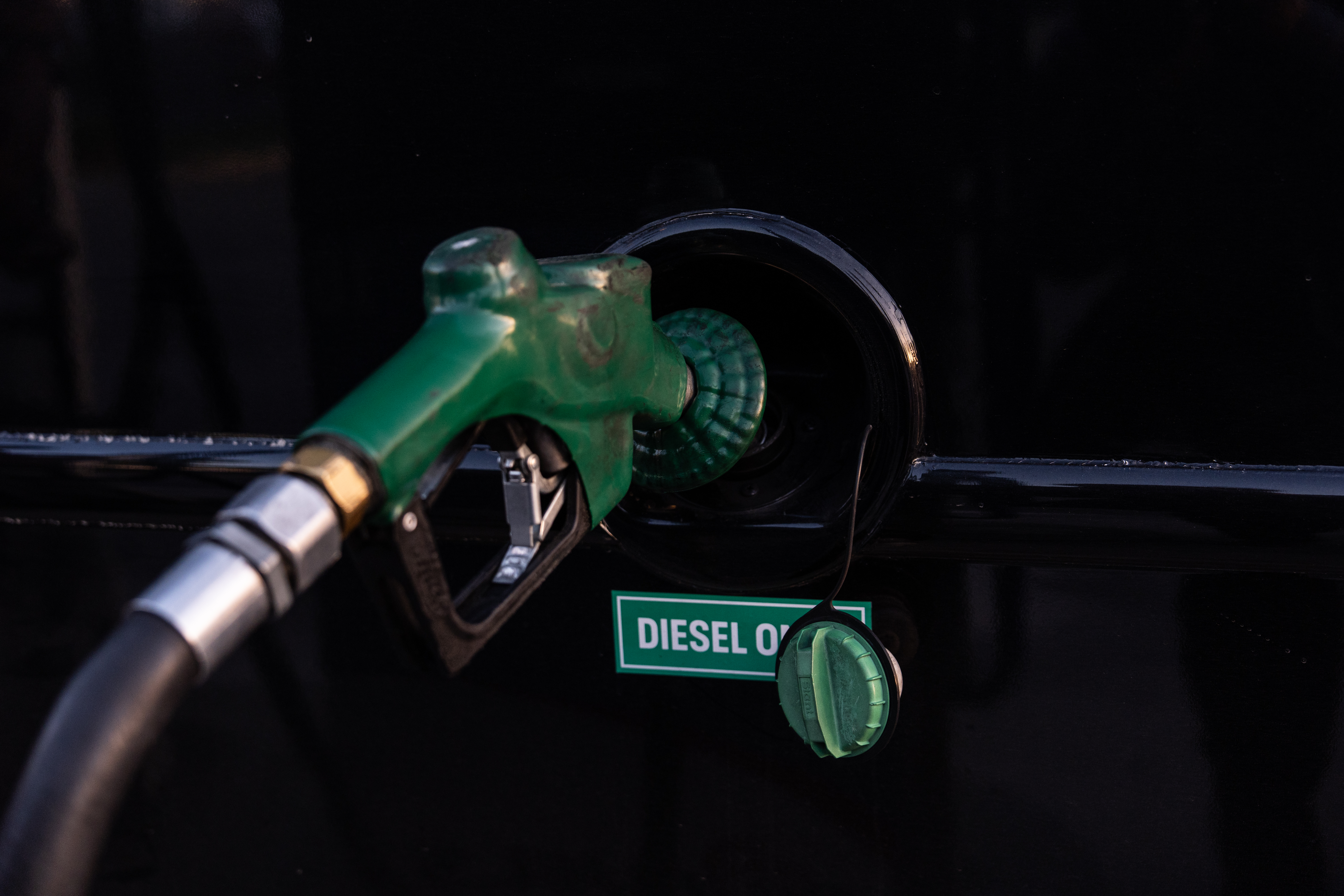
CHICAGO — Diesel hit a record price in the U.S. on Friday, soaring to an average of $5.85 a gallon for the first time as the six-month war with Iran disrupts the world’s flow of fuel.
Because diesel is used for many freight and delivery networks, higher diesel prices mean higher transportation costs for a long list of everyday goods.
This could add to Republicans’ political challenges ahead of November’s midterm elections, with voters already sour on President Donald Trump’s management of the economy. AP-NORC polling this summer showed 2 out of 3 U.S. adults disapproved of how Trump is handling the economy.
More expensive fuel is increasing bills for businesses across sectors — some of which have already passed on costs to consumers in the form of added fees on online orders and packages in the mail. And shoppers may see more and more sticker shock trickle down to store shelves.
One of the most immediate strains is being felt in the grocery aisle, particularly with produce, meat, and other perishable foods that need to be hauled in and restocked frequently — or even harvested using diesel-powered farm equipment. It can take time for all of those costs to trickle down.
Still, experts warn that price hikes could mount the longer diesel remains expensive. A range of other products are also transported by diesel trucks, trains, and boats, including clothing, cosmetics, furniture, and more.
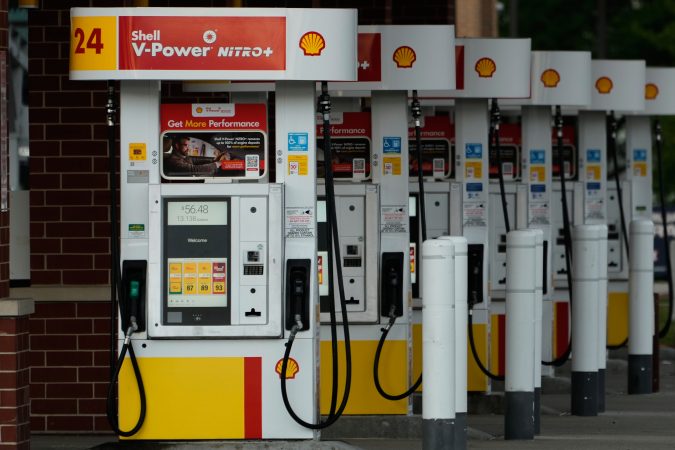
The price for regular gasoline has also been going up, although not as fast as the price of diesel. The average price was $4.15 a gallon, compared with $3.20 at this time last year, according to AAA, which says gas has never been above $4 a gallon on Labor Day.
What’s driving the latest jump for diesel
Before the U.S. and Israel launched their war against Iran in late February, the national average for a gallon of diesel was about $3.76 in the U.S., per AAA. Prices quickly climbed as the cost of crude oil — the main ingredient in diesel, as well as gasoline — soared amid supply chain disruptions and production cuts across the Middle East, notably with most tanker traffic bottlenecked in the key Strait of Hormuz.
Despite prices cooling some during hopes for peace earlier in the summer, oil has now renewed its climb as fighting once more escalates between the U.S. and Iran. Brent crude, the international standard, rose to $96.28 a barrel Friday, up from roughly $70 before the war. Prices at the pump always follow closely behind.
The last time U.S. businesses and drivers saw sky-high fuel prices was in June 2022, when diesel reached as high as nearly $5.82 a gallon on average, months after the Ukraine war began and world leaders imposed sanctions against Russia, a leading oil producer.
When adjusted for inflation, however, prices have been higher in the past. Ahead of the 2008 financial crisis, for example, diesel peaked at about $4.74 a gallon — equivalent to $7.20 in 2026, according to the government’s latest data. And 2022’s record of nearly $5.82 would be about $6.56 this year when accounting for inflation.
That doesn’t take the pain away from today’s steep prices, which are already bringing ripple effects for the economy and wider costs of living. Drivers are feeling the pain each time they fill up gasoline, too.
The average $4.15 for a gallon of regular unleaded is up from $2.98 before the Iran war, although still well below the 2022 peak of nearly $5.02 a gallon nationwide.
Diesel has been more expensive than gasoline for decades, and its price has risen at a faster pace during recent energy crises. Some reasons include tighter supply, less flexibility in demand, and diesel’s position in global commerce overall. Individual households may find ways to drive less when gas prices are high, for example, but there’s fewer immediate substitutes for networks that rely on diesel to help produce and haul goods worldwide.
All eyes on food
Diesel is integral to every part of the food supply chain. It powers farm equipment and fishing boats as well as the trains and trucks that get food to grocery stores.
Fuel accounts for roughly 15% to 30% of the total cost of food, according to the Independent Grocers Alliance, a grouping of 7,500 global supermarkets. Because of this, higher diesel costs often result in more expensive food, although it can take a while for energy shocks to wind their way through the supply chain.
Items that need to stay refrigerated while they’re transported are often the first to see prices rise, according to David Ortega, a professor of food economics and policy at Michigan State University. In July, for example, overall U.S. grocery prices were up 2.7% compared with last July, but seafood prices were up 7% and fresh fruit prices were up 4.9%.
Ortega cautioned that there can be other factors at play when food prices go up or down. Lettuce also faced higher transportation costs in July, but a drop in demand due to the cyclospora outbreak caused prices to fall.
Still, consumers could feel more of a squeeze the longer diesel prices remain high.
“Early on, much of the cost increase gets absorbed along the supply chain through existing freight contracts and retailer margins,” Ortega said. “But as contracts reprice and fuel surcharges take hold, more of that cost makes its way to the grocery store.”
Ajesh Kapoor, CEO and founder of trucking technology company SemiCab, said trucking and transportation can adapt to rising diesel prices — but at some point there is a limit.
“Diesel price has a very, very direct impact on everything that moves on pretty much any mode,” Kapoor said.
The ramifications extend beyond the movement of consumer goods. Some public transit buses and trains also run on diesel — and diesel generators are often used for backup or emergency power, if not central electricity sources in some remote parts of the world.
Experts warn that the consequences could continue to deepen — particularly in countries in Africa and Asia, which rely more heavily on imports from the Middle East and have already been hit the hardest by energy shocks over the course of the war.
Neil Atkinson, energy analyst and senior fellow at the National Center for Energy Analytics, said refined oil products like diesel are becoming more expensive as supplies get stretched.
“This is gradually becoming a major crisis because A) the prices themselves are very high — but the physical stocks of these products are dwindling,” he said in a weekly briefing with maritime data firm Lloyd’s List Intelligence, pointing to the strain on the global refining system. “This cannot go on forever.”
If you give a computer a task, it’s going to need electricity to perform it. The more difficult the problem, the more resources it requires. This is at the heart of the fight against the data centers behind AI – often an incredibly complex and power-hungry process.
You might think that tech giants that build and use data centers would cover 100% of the costs. However, the knock-on repercussions of this heavy power drain could impact the amount you owe on your Peco bill. Let us explain.
1946
The first “data center”
If you needed help with a calculation 80 years ago, you could use the ENIAC, the first general-purpose computer, built at the University of Pennsylvania.
It was 1,440 times faster than a hand calculator but at a cost: high energy demands. The ENIAC had its own dedicated power lines and consumed 150 kWh of electricity.
2000
Powering search engines
By the mid-2000s, we could solve the same problem at a fraction of the ENIAC’s speed thanks to search engines like Google.
Data centers don’t just power search engines; they also sustain streaming services, social media, and much more. However, workflows are increasingly shifting to use artificial intelligence.
story continues after advertisement
2022
AI in everything, everywhere, all at once
Today, unless you actively opt out, your Google search will likely be augmented by AI. “Historically, you would just get hyperlinks, and then you would have to click through and read the webpages yourself,” said Benjamin Lee, professor of computer science at the University of Pennsylvania and visiting scientist at Google. “In some sense, generative AI is doing the reading for you and trying to anticipate the actual answer you were looking for.”
The average Google Gemini prompt uses about 10 times the energy of a pre-AI Google search. This is partly because AI technology involves complex algorithms that require more computing power, but it’s also because between the 1960s and 2010s the basic building blocks of computer chips were increasingly getting smaller and more power-efficient. Within that timeframe, our computational ability multiplied by sixfold with only a 6% increase in power usage, according to Lee.
But those efficiency gains eventually stalled.
“When AI came along in late 2022, we realized we needed hundreds – or thousands – times more [computational power], and the transistors weren’t keeping up,” Lee said. “The hardware side slowed down, even as the computational demands went up by a lot.”
To put it in perspective, in a single hour, a hyperscale 1,000,000-kW data center running at peak capacity can consume more electricity than every household in Philadelphia combined.
Hyperscale data centers can consume a city’s worth of electricity in an hour
ENIAC
150 Philly households' energy usage
Conventional
Hyperscale
The typical Peco customer uses about 0.94 kW per hour in July.
If all 679,428 households in Philadelphia consumed that amount of electricity …
… it would still be less than a hyperscale 1 million kW facility’s electricity use – the equivalent of over 1 million Philly households.
A report by Wood Mackenzie, an energy research firm, found that utility customers might already be shouldering some of the cost of servicing heavy users of electricity, including data centers. These hyperscale facilities and their projected demand for power could impact all three categories on your bill: generation, transmission, and distribution.
Let’s walk through each one.
Generation
Generation refers to how power stations produce electricity from primary energy sources like fossil fuels, solar, or wind. Pennsylvania generates about 60% of the state’s electricity with natural gas, according to the American Gas Association.
“There's only so much gas in the market and, with data centers coming online, there's increased competition for it,” said Elizabeth Marx, executive director of the Pennsylvania Utility Law Project, a statewide legal aid program representing low-income consumers and protecting their access to affordable energy and water.
story continues after advertisement
Pennsylvania Gov. Josh Shapiro recently proposed that hyperscale data centers supply their own power to reduce the burden on residential customers to pay for infrastructure costs. However, not everyone agrees that it will work.
“Unless they are building clean generation that doesn't rely on and constrain our gas supply, [data centers are] having an impact on the price of gas,” Marx said, “and [that cost] flows into your electricity bills.”
PJM has a capacity market, where utilities – like Peco – pay power plants to guarantee enough power to meet future energy needs. This ensures that enough electricity will be available at high usage and to avoid blackouts.
“The biggest impact that we're seeing already from data centers is on capacity market prices,” Marx said. In 2024, AI companies started shopping around for power purchasing agreements directly with power suppliers.
The increased demand for capacity without greater supply increased the cost of electricity. The capacity price during the 2024/2025 auction was about $46 per MW/day, according to Monitoring Analytics, an independent market monitor for PJM. The following year, it surged to $297 per MW/day.
In a recent quarterly report, Monitoring Analytics said that “large data center loads have already had a significant and irreversible impact on PJM customers.” Between 2016 and 2025, Peco customers saw a $20.46 increase in the supply portion of their bill, which includes generation and transmission.
Peco’s Price to Compare has increased steadily since 2022
6
8
10
12
14 cents
Jun 2022
Jun 2026
JuneJune
Source: Peco’s Price to Compare is what customers pay if they do not shop around for an alternative electricity supplier
Pa. law requires that Peco is not allowed to profit off generation and transmission; you are just paying the rate set at PJM wholesale auctions. “Supply costs are set by the competitive market, are not controlled by Peco, and do not generate a profit for the company,” said Candice Womer, communications manager at Peco.
Distribution
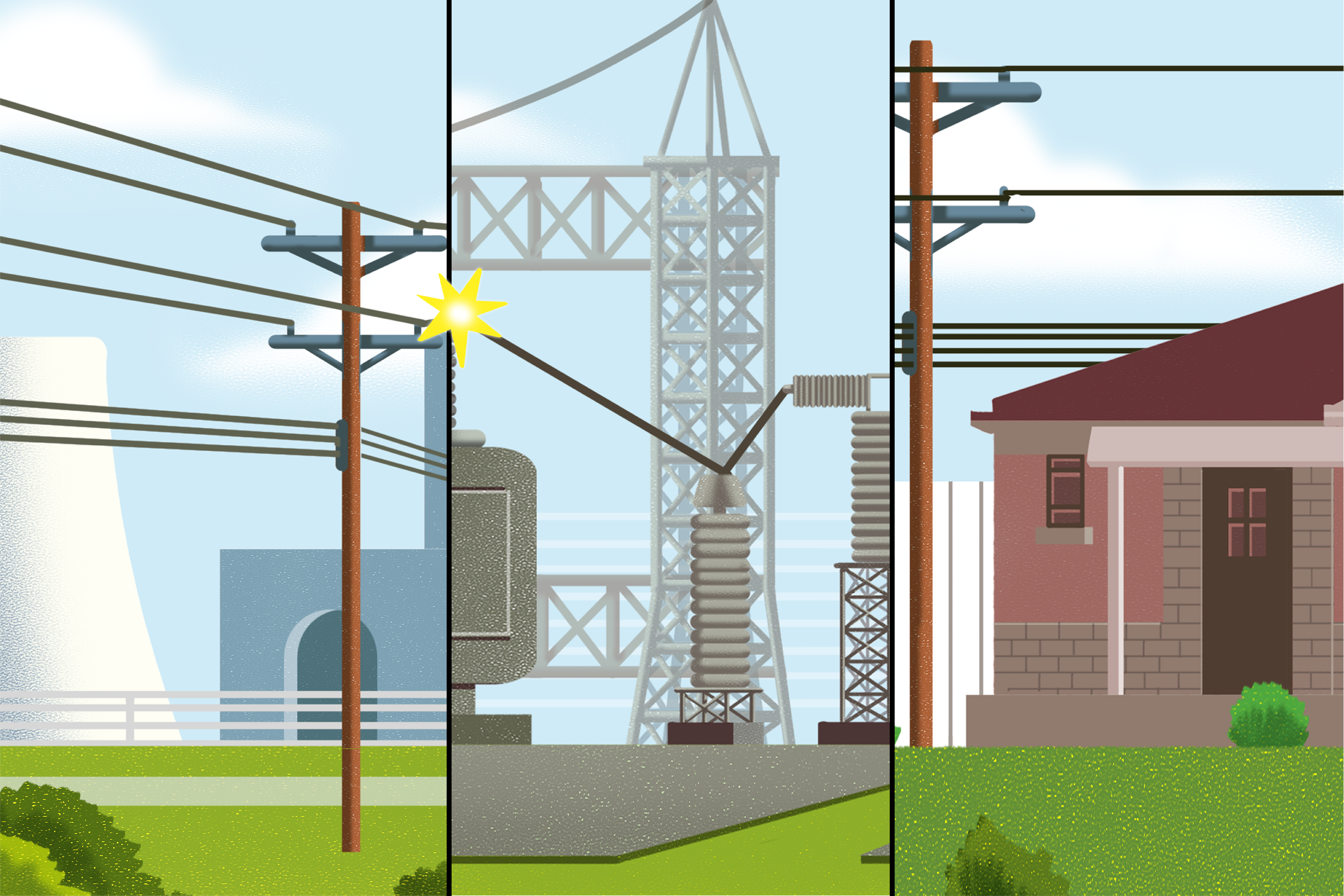
Distribution is the final phase, where electricity moves from a transmission station to your home. It makes up 50% of your electric bill and, unlike the supply side of the electricity equation, can generate a profit for utility companies.
Almost two-thirds of Americans believe that a major reason behind their rising home energy costs is utility companies’ bottom line, according to a recent Pew Research Center survey.
In its second quarterly report of 2025, Peco reported $136 million in adjusted earnings, compared with $93 million in the same period in 2024. The company said in its earnings report that it used the profits to improve distribution infrastructure.
When utility companies invest in the electric grid to ensure it is ready for peak demand or storms, those investments are often baked into distribution costs. “Peco must balance its obligation to serve new customers with the risk of overbuilding infrastructure,” Womer said. “When distribution upgrades are needed, those costs are paid up front by the data center customer through a Contribution in Aid of Construction, ensuring there is no impact to other customers.”
One of the fees baked into distribution charges on your monthly bill is the Universal Service Fund. This helps fund programs like Peco’s Customer Assistance Program that help low-income households afford their utilities. In her testimony before the Pennsylvania House Energy and Consumer Protection, Technology, and Utilities Commission earlier this year, Marx said that in Pennsylvania, “universal service costs are only allocated to residential customers.”
Despite their direct impact on rising costs, data centers pay nothing to support these programs, she said.
“It’s very hard to reduce the electricity you use in a significant way,” said Vik Patel, managing attorney of the energy and utilities unit of Community Legal Services. “If it's cold outside, you need to have the heater on. Otherwise it can be unsafe. [It’s the] same thing in the summer; you have to have access to cooling.”
story continues after advertisement
Even if electricity feels unaffordable, it can be difficult for customers to lower their use and, therefore, their bill. But if customers can’t pay their bill, they risk losing power completely.
Last year, about 25,000 households in Philadelphia had their electricity terminated and could not afford to have it restored, according to Patel. “There are a lot of collateral effects when someone's electricity is terminated,” he said. “They can get evicted. [They can] lose custody of their kids.”
What happens next
Data centers and their projected demands on the grid are not the only reason electric bills are increasing, but that has not lessened some residents’ concern about their expansion.
There are already dozens of conventional data centers in Philadelphia, according to Data Center Map, a private company that tracks such facilities nationwide. Two hyperscale campuses are being built in nearby Bucks County and Cumberland County, N.J.
At least four more data centers have been proposed in Chester and Montgomery Counties. These local proposals face a groundswell of opposition from residents who worry about the environmental and financial ramifications of having these hyperscale facilities in their backyard.
Note: Amazon’s 600,000-kW data center is currently under construction in Falls Township, as is the 300,000-kW hyperscale data center in Vineland.
“I don't deny we need to upgrade our grid,” Marx said. “And, quite frankly, more frequent storms are absolutely going to cause more infrastructure costs. But I think there's a lack of transparency in what's necessary and what is nice to have. Who’s it for? Who pays for it and at what expense?”
Staff Contributors
Reporting: Charmaine Runes
Design and development: Charmaine Runes, Sam Morris
Graphics: John Duchneskie
Illustration: Glenn Harvey
Editing: Sam Morris, Cynthia Henry
Copy Editing: Addam Schwartz
Subscribe to The Philadelphia Inquirer
Our reporting is directly supported by reader subscriptions. If you want more journalism like this story, please subscribe today
A new study shows it is possible to tap the earth formore efficient heating and cooling for two Philadelphia School District buildings at once, providing a potential path to cleaner energy.
If such a system is ever installed, it could serve as a template for other clean energy efforts.
Philadelphia Gas Works set out last year out to examine whether it was technically possible to build a geothermal HVAC system that would serve both the John F. McCloskey Elementary School and the Dorothy Emanuel Recreation Center in East Mount Airy.
Findings were released on Wednesday.
The study estimated that a closed-loop geothermal system for these facilitieswould cost about $19 million. But that could drop to $11 million with federal tax credits.
With the tax credits, a geothermal system would be less expensive to install than a traditional HVAC system for the two properties.
Kensington High School for the Creative and Performing Arts, built in 2010, has geothermal heating and cooling. Although PGW supplies gas to the school, it was not involved with the geothermal system.
At McCloskey,PGW paid for the study and worked in collaboration with the schooldistrict and Philadelphia Parks and Recreation. PGW, which is owned by the city, is the largest municipally owned gas utility in the country.
“PGW is committed to helping the City of Philadelphia lead to a clean energy future,” said Elliot Gold, vice president of corporate planning at PGW.
The McCloskey school, which was built in the early 1950s, and Emanuel rec centerare next to each other on the same roughly six-acre property with a combined 77,000 square feet of interior space. Though Philadelphia Parks and Recreation operates the rec center, it is on district property.
A closed-loop geothermal system is essentiallya big heat pump that uses the constant underground temperature through buried pipes. A mixture of water and environmentally safe antifreeze ispumped through the loop, creating a large heat exchanger that can be used to heat and cool a building. The heat exchanger is set to either absorb or eject heat.
A new study shows that it is feasible to install a new geothermal HVAC system to serve the John F. McCloskey Elementary School and the Dorothy Emanuel Recreation Center in East Mount Airy. Frank Kummer
An ‘ideal partnership’
Victoria Flemming, executive director of the school district’s office of environmental management and services, said the study is a positive step that aligns with the district’s GreenFutures Plan.
The McCloskey school currently has an aging oil-based heating system and no central air-conditioning, she said.
“It is using heating oil, which has low energy efficiency and has a high impact to air quality,” Flemming said. “So I think those were the two things that made this kind of an ideal partnership.”
During periods of extreme heat, the school is forced to pivot to virtual learning and cancel student activities, she said.
The shared property between the school and rec center would give a geothermal project an even higher impact, she noted.
Seen at the John F. McCloskey Elementary school are (from left) Teresa Fleming, COO of the School District of Philadelphia; Victoria Flemming, executive director of the office of environmental management and services for the district; Neal Babcock of Alderson Engineering; and, Elliott Gold vice president of corporate planning for PGW.Frank Kummer
Less expensive than a traditional system
Bucks County-based Alderson Engineering conducted the study.
To install a geothermal system, conditions underground needthe right combination of thermal conductivity and geology. Neal Babcock, a principal with Alderson Engineering, said the site meets those conditions.
Geothermal systems might be more expensive up front, he said, but in the long run are less expensive to operate and maintain.
Currently, geothermal systems are eligible for the federal Investment Tax Credit. The One Big Beautiful Bill Act of 2025 terminated credits for solar and wind projects but preserved credits for geothermal systems.
“Geothermal systems reduce the total energy consumption to heat and cool the building,” Babcock said. “Instead of burning fossil fuels like natural gas, they use the cool temperature of the ground to be less extreme than the air temperatures or needing to burn fossil fuels.”
Compressors for the geothermal system studied would be powered by electricity, not natural gas.
Environmental and advocacy groups have been critical of PGW’s reliance on natural gas, saying the utility needs to diversify its energy portfolio and reduce greenhouse gases that help heat the earth.
PGW said the study is part of its efforts to do that.
Neal Babcock of Alderson Engineering discusses the feasibility of installing a new geothermal HVAC system to serve the John F. McCloskey Elementary School and the Dorothy Emanuel Recreation Center in East Mount Airy.Frank Kummer
Will it ever get built?
The study was just a first step. There is no time frame to install such a system, nor is funding in place.
And it is unclear who would own the system. That is important because the tax credits would apply only to a single-owner system.
Gold, the PGW vice president, said that although some of the challenges might seem steep, the utility is serious about clean energy projects.
“We’ve completed the feasibility study, which is good news,” Gold said. “It tells us that this is favorable and that there are no definite technical showstoppers.”
He said the next steps include addressing who would own the system, the cost, and a timeline.
That timeline would likely include the tax credits for geothermal units, which are set to phase out in 2034 and 2035.
(function(){function e(){window.addEventListener(`message`,function(e){if(e.data[`datawrapper-height`]!==void 0){var t=document.querySelectorAll(`iframe`);for(var n in e.data[`datawrapper-height`])for(var r=0,i;i=t[r];r++)if(i.contentWindow===e.source){var a=e.data[`datawrapper-height`][n]+`px`;i.style.height=a}}})}e()})();
Who would pay for it?
The school district typically finances such projects through its capital spending plan for its 300 buildings.
If it owned the geothermal system and had to pay for it, that could mean balancing it against the needs of making fixes at other schools.
The district has said it wants to spend $3 billion on upgrading facilities but can pay for only $1 billion now.
For instance, conditions at Southwark Elementary in South Philly are so dire that kids are begging City Council and the district for fixes, such as working bathrooms and pest control. They are supposed to get them in 2032.
Teresa Fleming, the district’s chief operating officer, said the district is still evaluating the study and must considerthe long term.
She said a program like geothermal has the potential to “yield energy savings and greater efficiencies throughout the district.”
Editor’s note: This story has been updated to change the date the findings were released.
Oil companies have delighted Wall Street this week by reporting multibillion-dollar windfalls in their earnings statements, with ExxonMobil and Chevron on Friday reporting a combined $26.5 billion in profits during the second quarter of the year.
But the immense profit stemming in large part from the war in Iran, and coming at the expense of motorists struggling to pay for a tank of gas, is fast making the companies a ripe political target.
The oil majors are largely sitting on those unanticipated billions, according to an industry analysis by the research firm Wood MacKenzie.
They are reluctant to reinvest the profits in expanded drilling that could eventually increase the world’s fuel supply, the firm found, as an abrupt end to the war could push prices for crude down considerably before the firms are able to recoup the cost of new rigs.
With gas prices averaging more than $4 per gallon nationwide, and midterms in the not-too-distant future, lawmakers eager to assign blame for voter frustrations are taking aim.
Exxon and Chevron early Friday posted their blockbuster earnings for the quarter that ended last month.
Chevron disclosed $12 billion in earnings, reflecting a $9.6-billion jump over the same quarter last year and the firm’s biggest profit since 2020. Chevron CEO Mike Wirth attributed it in a statement to “disciplined investment and strong execution that drove record U.S. upstream production, record crude throughput in our U.S. refineries, and exceptional reliability across key assets.”
ExxonMobil said Friday its earnings were $14.5 billion, more than double what the company reported for the same quarter last year. CEO Darren Woods said the quarter “was shaped by disruption, but defined by execution,” for the company.
The disclosures followed Shell’s earnings report Thursday showing the company doubled its quarterly profits between this year and last.
The staggering earnings are part of a bigger $425 billion annual windfall that Wood MacKenzie estimates is coming to the broader industry if prices for a barrel of crude average $90 for the year, which many analysts project they will.
That was roughly the cost of oil on Friday morning. It has soared as high as $120 since the U.S. and Israel attacked Iran in late February, leading to the closure of the Strait of Hormuz, through which one-fifth of the world’s oil and natural gas is shipped.
“Oil companies know they are going to be in for political criticism,” said Bob McNally, founder of the research firm Rapidan Energy Group. “This is like one of those classic movies from the 1960s that keeps coming back around. We all know there is going to be a lot of theater when oil prices are going up.”
The companies declined to answer questions about their profits at a time of high gas prices.
Asked about the windfalls oil companies are reporting this week, White House spokesperson Taylor Rogers shifted attention from the firms to Iran. She said, “Oil and gas prices will plummet back to preconflict levels” as the U.S. military neutralizes Iran’s ability to disrupt the flow of crude.
President Donald Trump had previously put the companies on notice that the Justice Department would be investigating potential price gouging. The threat has populist appeal but could prove challenging to carry out. Industry officials said privately they have seen no evidence an actual investigation is happening.
Dustin Meyer, senior vice president of policy, economics, and regulatory affairs at the American Petroleum Institute, said government scrutiny would not be a matter of concern.
“These markets are transparent,” Meyer said. “It is not the first time government has looked at them. Every single time they do, they find the same thing. Not only is there no gouging, but gouging is impossible for an oil market this size with this many participants.”
Democrats in Congress, though, have seized on high prices at the pump in the run-up to a hotly contested midterm election that will determine which party controls both the House and Senate.
As the likelihood of windfall profits came into focus last month, Sen. Sheldon Whitehouse (D., R.I.) and Sen. Elizabeth Warren (D., Mass.) wrote a letter to oil executives demanding details of how they may have profited from the war or lobbied the White House to execute it in ways that benefit them.
Woods told CNBC Friday that Exxon tries “to make sure not just the U.S. administration but frankly administrations all around the world … understand our perspective of what we see and how things are playing out, so they have the best information to make policy decisions.”
“We very much stick in our lane with respect to here is what we see, here is how we think it could potentially play out, and make sure policymakers have our best thinking when they are putting together their decisions and the approach they want to take,” Woods said.
Rep. Brad Sherman, a California Democrat, is among those pushing for more government intervention.
He said motorists “need to fill their gas tank today, and they either need to be paying a lower price, or second best, they need to be getting a rebate check from the government.” He has proposed legislation that would impose a windfall tax on U.S. oil companies until the war with Iran is over, the strait is reopened, and U.S. benchmark crude oil prices drop below $75 per barrel.
In the past, the industry has tended to argue that such levies would take away cash it needs to invest in expanded drilling that could effectively help lower prices. But the companies are not making those investments right now, amid concerns the war will have ended and oil prices will have dropped too low to make the rigs profitable by the time they are finally operating months — or even years — from now.
And even if the firms were investing, Sherman said, drivers would still be suffering.
“When we’re paying these outrageous prices at the pump, nobody’s saying, ‘Oh, that’s great! The oil companies are going to invest this in additional oil production,’” he said.
For the moment, at least, his proposal is more a political tool than a viable policy plan in this Congress, which is controlled by Republicans staunchly opposed to a windfall profit tax.
But if prices remain high, analysts say, sentiments could shift, and the government may be more inclined to step in to try to bring relief to consumers, including by limiting exports of U.S. oil.
Regulators and lawmakers have already mostly exhausted their options for bringing down prices without dramatic market interventions. Government petroleum reserves have been depleted and sanctions on countries like Venezuela and Russia have been lifted to bring more fuel into the market.
“There are not many tools left in the tool kit to bring down prices,” said Denton Cinquegrana, chief oil analyst at Dow Jones Energy. “But the general public who has to buy gasoline certainly does not want to hear that, especially amid an affordability crisis that has taken over this country.”
Windfall profit taxes have a fraught track record in the U.S., according to Tyler Priest, an associate professor of history at the University of Iowa.
The last one enacted in 1980 after the oil shocks of the 1970s generated far less revenue than lawmakers projected and was ultimately repealed after economists concluded it discouraged some domestic production while adding significant complexity to the tax code.
Democrats have structured their latest proposals differently, focusing the tax only on profits above a historical benchmark and steering the revenue generated toward consumers. But experts are conflicted on its potential effectiveness. Priest noted that the plans are narrowly targeted at large oil companies, but more than 70% of U.S. oil comes from smaller producers.
Shon Hiatt, an energy scholar at the University of Southern California Marshall School of Business, said a windfall profit tax imposed in Britain in 2022 was followed by a sharp decline in production there.
“The incentives to take risk and invest in production are drastically reduced,” he said, which can ultimately lead to “lower production, and in some cases, scarcity.”
Others argue the decline predated the tax and was caused by a number of factors, including aging oil fields and a shift toward renewables.
Even if such policy proposals stall in the U.S., lawmaker attacks are only likely to intensify in the coming months. Analysts are already projecting the companies will post a fresh round of windfall profits in the next reporting period.
Before the war in Iran, roughly 15 million barrels of Persian Gulf oil were shipped each day through the Strait of Hormuz. Within a few years, much of that oil could bypass the strait.
As Iran’s chokehold over the strait drags on and oil prices surge, countries across the Gulf are planning to spend billions of dollars to build pipelines enabling them to redirect more supplies to ports along the Red Sea and the Gulf of Oman.
At least seven major pipeline projects are under construction, in the planning stage or being discussed as possibilities, according to government officials, oil companies and analysts. The war has been a wake-up call for Gulf oil producers, who are determined to become less dependent on a transit point that hugs Iran’s coast.
But alternatives to Hormuz are also vulnerable to disruption. Yemen’s Iran-backed Houthi rebels said early Thursday they had attacked two Saudi oil tankers in the Red Sea, a key alternative route to the strait for Saudi oil exports.
Some alternative routes will take the oil on longer and more expensive paths to market. Regardless, producers have realized that relying so heavily on the Strait of Hormuz “is no longer a prudent long-term strategy,” said Victoria Grabenwöger, senior research analyst at data firm Kpler.
The Red Sea and Gulf of Oman have become vital alternatives to Hormuz
The effective shutdown of the Strait of Hormuz would have been an even greater shock to the world economy were it not for a pipeline Saudi Arabia built in the 1980s amid fears that Tehran would disrupt shipping through the strait during the Iran-Iraq war.
The Saudis’ East-West pipeline carries oil across the desert nation from a processing facility in Abqaiq to the city of Yanbu on the Red Sea coast. Once there, it is loaded onto tankers that head either south to the Arabian Sea or north to the Suez Canal.
The United Arab Emirates has been sending more oil to the port of Fujairah, which abuts the Gulf of Oman, about 145 kilometers (90 miles) south of Hormuz.
Combined, the two pipelines had spare capacity of about 3.5 million to 5.5 million barrels per day before the war began, according to the U.S. Energy Information Administration. The two pipelines are now running near full capacity.
More oil could begin flowing through a UAE port by next year
The state-owned oil company of Abu Dhabi, one of the UAE’s seven emirates, is accelerating construction of a $3 billion, 300-kilometer (200-mile) pipeline to Fujairah. That pipeline, which will run parallel to an existing one, aims to increase oil supplied to Fujairah by more than 1.2 million barrels a day.
The project, which started before the war, is now reportedly about halfway completed, according to Kpler. The pipeline is intended to be completed by early 2027, but Kpler says mid-2027 is more likely given the need to expand the port at Fujairah.
The ambitious timeline “has only become feasible against the backdrop of the Strait of Hormuz blockade,” Kpler’s Grabenwöger said.
Plans to pipe more oil to Turkey and Syria will take longer
In Iraq, officials are ramping up plans to develop alternative export routes for southern oil fields around Basra. Iraq is so dependent on the Strait of Hormuz that it has had to scale back production.
The Iraqi government, which gets some 90% of its revenues from oil sales, has been pursuing pipeline projects with U.S. companies. One would take supplies from an oil terminal in Basra — through which more than 3 million barrels were exported daily before the war — to the port of Ceyhan in Turkey, along the Mediterranean Sea.
That pipeline would also have a branch extending to the Mediterranean port of Baniyas in Syria. Some 2 million barrels a day of oil could ultimately flow through the pipeline to Baniyas, which the U.S. State Department has called “a critical energy corridor.”
Iraqi officials have also held discussions with Jordan on advancing long-discussed plans for a pipeline that would carry oil from Basra to Aqaba. From there it would be exported via the Red Sea or the Suez Canal to Asia and beyond.
The new pipelines will add time and costs — and are also vulnerable to attacks
Taken together, the new projects to bypass Hormuz could carry an added 3.8 million barrels of oil a day by the end of next year, and 7.3 million barrels per day by the end of 2028, according to analysts at the investment bank Goldman Sachs. The projects would mean some 60% of the Gulf’s total prewar exports of 23 million barrels a day could bypass Hormuz if needed, the analysts said.
Pipelines from the Persian Gulf to the Mediterranean Sea send oil in the wrong direction to help Asian countries that relied on exports through Hormuz, requiring a much longer trip around the southern tip of Africa.
Any additional supplies piped from Saudi Arabia to the Red Sea will also be vulnerable to attacks by Houthi rebels in Yemen, as Thursday’s attacks show; the rebels have successfully disrupted shipping before at the Bab el-Mandeb Strait, which connects the Red Sea to the Gulf of Aden.
That oil could also be sent to the Suez Canal instead to reach the Mediterranean. But the canal cannot accommodate the industry’s largest tankers, which hold up to 2 million barrels per vessel and are often the most cost-efficient way to transport oil long distances.
And pipelines themselves are not immune to attack. The Saudi East-West pipeline was shut down by a Houthi drone strike in May 2019.
Meanwhile oil pipelines don’t help with the disruption to supplies of liquefied natural gas, or LNG, carried by ship. About one-fifth of the world’s LNG — much of it from Qatar and headed for Asian customers — transited the strait before the war.
NEW YORK — U.S. gas prices jumped to an average of $4 a gallon again Monday as the U.S. and Iran launched more attacks.
According to motor club federation AAA, the national average for a gallon of regular gasoline is now back to $4. The average price a year ago was $3.14 a gallon.
The price is a national average, meaning drivers in some states have been paying well over $4 a gallon for a while now, while others pay less. Prices vary between states due to factors ranging from nearby supply to differing tax rates.
People around the world are also dealing with high gas prices as a result of the war.
Gas prices first went over $4 a gallon on average at the end of March. They dipped below that in mid-June and continued to fall as crude oil prices eased when the U.S. and Iran reached an interim deal. Even then, President Donald Trump expressed frustration that gas prices weren’t falling as quickly as oil prices.
Affordability is likely to be a key issue for voters in the U.S. midterm elections, and higher gas and oil prices can help push up prices for groceries and other goods.
PJM, the nation’s largest electrical grid operator, on Tuesday released results of an electricity auction that would add $6.3 billion in costs to the bills of millions of households and businesses within the next three years, an increase driven by the power demands of data centers.
During the annual auction, power companies supplied prices that they were willing to accept to supply electricity to PJM at times of peak demand. Those prices are then factored into the electricity rates that are eventually charged to the grid’s customers in 13 Eastern states and the District of Columbia.
In a statement, PJM said data centers were increasing electricity demand throughout the region.
“These auction results show that demand for electricity continues to grow faster than electricity supply,” David Mills, president and chief executive at PJM, said in an announcement of the auction results. “We are working with government and industry leaders on multiple fronts to restore that balance by bringing on new generation as fast as possible and managing the growth of new load on the grid.”
Over the last few years, individuals and politicians have grown frustrated with PJM’s operations as electricity prices have steadily increased. At the same time, anger over data centers has spread nationwide. New York on Tuesday announced the nation’s first statewide moratorium on construction of the giant facilities, a one-year pause to assess their impact on the environment and energy use.
The PJM grid supplies electricity to 67 million people from Virginia Beach, Virginia, to Chicago. The network of power systems includes the world’s largest cluster of data centers, in northern Virginia.
“Demand growth is not going away,” said Patrick Cicero, a former state-appointed consumer advocate for Pennsylvania who is now counsel for the Pennsylvania Utility Law Project, which assists low-income consumers. “The bottom line is high prices are going to remain in place.”
In its role as a regional grid manager, PJM effectively sets a significant portion of retail electricity rates, but governors and their appointed regulators have little sway over it. PJM is regulated by the Federal Energy Regulatory Commission, not state lawmakers.
PJM’s annual auctions help determine the electricity costs for the two years after the auction. Since 2024, the auctions have added in total about $29 billion in costs to all utility customers in the PJM region because of data centers, according to Monitoring Analytics, PJM’s independent market monitor. The market monitor also produced the estimate of $6.3 billion in additional costs from the latest auction, which was held on June 30.
The high costs have so angered Pennsylvania Gov. Josh Shapiro, a Democrat, that he sued PJM in December 2024. Shapiro and PJM reached a settlement that capped the price set by the auction, saving consumers billions of dollars.
The PJM grid has often had only a thin buffer of excess power during extreme weather such as the recent heat dome that sent temperatures soaring across the East.
Shapiro and other governors have complained that PJM has been too slow to connect more power plants, solar and wind farms, batteries and other resources that would have helped lower prices and eased strain on the grid.
PJM’s grid serves all or part of New Jersey, Pennsylvania, Delaware, Maryland, Virginia, West Virginia, North Carolina, Tennessee, Kentucky, Ohio, Indiana, Illinois and Michigan, as well as the District of Columbia.
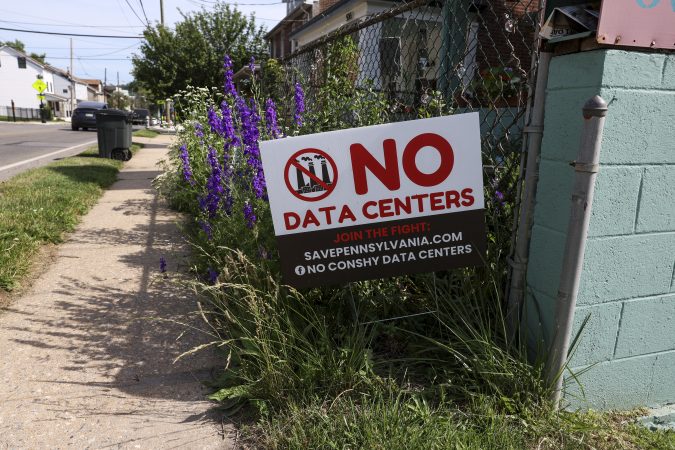
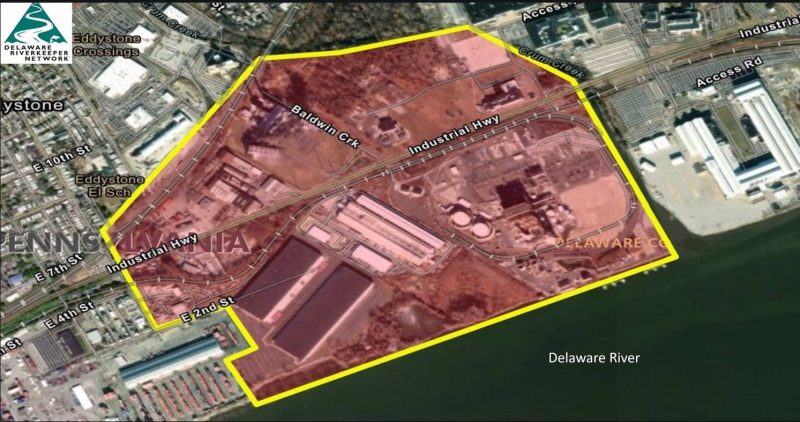
Two environmental activist groups say they plan to organize resistance against a plan to build a liquefied natural gas (LNG) export facility in Eddystone, a small borough in Delaware County.
They say the facility would threaten not only the environment, but also public safety.
The Delaware Riverkeeper Network and Chester Residents Concerned for Quality Living (CRQL) said during an online meeting Wednesday that documents show negotiations have beenhappening behind closed doors for more than a year.
They cited a newly released tranche of documents that show the plan has progressed with nondisclosure agreements (NDAs) with state officials.
More than a year ago, U.S. Sen. David McCormick (R., Pa.) wrote an opinion piecein the Washington Times publicly announcing the $7 billion project by Penn America Energy to build the terminal along the Delaware River in Eddystone.
Tracy Carluccio, deputy director of the nonprofit Delaware Riverkeeper Network, said the documents show that the administration of Pennsylvania Gov. Josh Shapiro and Eddystone officials have been talking to, or in negotiations with, a developer for at least a year.
(function(){function e(){window.addEventListener(`message`,function(e){if(e.data[`datawrapper-height`]!==void 0){var t=document.querySelectorAll(`iframe`);for(var n in e.data[`datawrapper-height`])for(var r=0,i;i=t[r];r++)if(i.contentWindow===e.source){var a=e.data[`datawrapper-height`][n]+`px`;i.style.height=a}}})}e()})();
The environmental groups say Eddystone Borough officials initially denied open records requests about those negotiations, prompting a yearlong legal mediation.
The planned facility aims to produce 7.2 million tons of LNG per year from Pennsylvania’s rich Marcellus Shale deposits, Carluccio said, based on a presentation by Penn America to Eddystone Borough on March 7 that was obtained through a records request.
“There have been no public meetings or public disclosure about the proposed project,“ she said, adding that “the public knows nothing about this, and Eddystone Borough knows all about it.”
Carluccio said nondisclosure agreements (NDAs) and confidential meetings involving high-level state and local officials have helped shield the project from public scrutiny.
The Pennsylvania Department of Environmental protection said it had not had any pre-application meetings regarding a proposed LNG export facility and no permits for such a facility are under review.
In a statement from Eddystone Borough, officials said they are aware of the “public discussion” regarding a potential LNG facility. The statement said that members of Borough Council met with representatives of the project last year “for informational” purposes.
“Those meetings did not constitute approval or endorsement of any future development,” the statement said. “No approval action is currently before Borough Council.”
If an application is submitted, the statement said, the borough would conduct a “thorough review” and that the process would be open to the public.
Pa.’s drive toward LNG
State, public utility, and elected officials, as well as unions, have been working toward locating an LNG facility inSoutheastern Pennsylvania, although no site has been formally proposed.
The Philadelphia LNG Task Force was created from legislation introduced in 2022 by State Rep. Martina White (R., Philadelphia) to explore the possibility of the first liquefied natural gas export facility along the Delaware River. Former Gov. Tom Wolf, a Democrat, signed the legislation to form the task force.
Although McCormick noted Eddystone as a location, no official planning documents have beensubmitted to Eddystone or the Federal Energy Regulatory Commission (FERC).
According to records obtained through Pennsylvania’s Right to Know Act, the Pennsylvania Department of Community and Economic Development (DCED) entered into a formalized nondisclosure agreement with Eddystone Energy LLC in October 2025.
The DCED issued a statement to The Inquirer saying that it “routinely discusses potential projects with companies seeking to do business in the Commonwealth.”
The agency said the discussions are confidential because they involve proprietary information from companies.
“Maintaining confidentiality in such discussions is common practice in the business development industry across the country,” the statement said.
A draft NDA was additionally distributed between Eddystone Borough Council and Penn America Energy Holdings, though it appears it was never officially finalized, Carlucci said.
Advocates say that Franc James, CEO of the now-dissolved Penn America Holdings LLC, has been the primary figure driving the LNG project forward, alongside an array of state politicians.
On Wednesday,Carluccio asserted James isbehind Eddystone Energy LLC, a Delaware corporation formed in May 2025.
Internal records reveal that meetings have involved representatives from the offices of Shapiro, State Sen. John Kane, McCormick, and State Rep. Dave Delloso, as well as Eddystone Borough officials.
For example, a document from Shapiro’s office shows there was an hourlong meeting in February with Eddystone Mayor Ronald Hughes, Borough President William Stewart, Kane, James, multiple union representatives, and Technip Energies, an international energy infrastructure developer with a specialty in LNG.
And James wrote an email dated July 11 to Samuel Robinson, Shapiro’s deputy chief of staff, stating that the “LNG Eddystone team” would attend the Pennsylvania Energy and Innovation Summit that same month in Pittsburgh. The summit was organized by McCormick.
Community reaction
An LNG facility along the Delaware River waterfront in Southeastern Pennsylvania has been discussed for years with James’ Penn America Energy Holdings, also referred to as Penn LNG.
Though no location had been firmly named, it was initially believed Chester would be the host. However, that location received massive pushback from residents led by Zulene Mayfield, founder of the CRQL advocacy group, and resulted in a political turnover in the city. No project was ever formally proposed for Chester.
The environmental advocates say the plan for Eddystone is well underway despite the lack of public input. Mayfield said she plans to organize Eddystone residents to oppose it.
“This project is already rolling, that’s what we’re telling you,“ Mayfield said Wednesday in the webinarshehosted withCarluccio. ”The attempt is already being made to put it right in Eddystone.”
Mayfield and Carluccio said the borough is too small to host a large LNG export facility, which typically span 1,000 acres. The borough is one-square mile.
They also fear that an explosion or fire could not only reach neighboring towns but also stretch across the river to New Jersey.
NEW YORK — U.S. gas prices fell below $4 a gallon on average Thursday, but just barely.
It is the first time since March that the average cost for a regular gallon has been that low. Prices fell overnight after President Donald Trump signed an agreement with Iran that calls for Tehran to dilute its stockpile of highly enriched uranium and waives U.S.-backed sanctions on the country.
Gas prices are at $3.999 on average in the U.S., according to motor club AAA. The drop below $4 follows a 15% decline in the price of U.S. crude this month.
But fluctuations in gas prices remain across the country. In California, gas prices are averaging $5.64 per gallon, while in South Carolina it’s $3.58 per gallon.
The agreement between the U.S. and Iran calls for a permanent end to hostilities and starts a 60-day negotiating clock to reach a final deal on the future of Iran’s nuclear program, though Trump left the door open to resume attacks. It appears to offer Iran several benefits up front while extracting little in return.
Oil prices fell Monday to about $80 for a barrel of U.S. benchmark crude. That compares to $67 per barrel before the war and the price of over $120 a barrel reached earlier in the conflict.
Even as gas prices start to decline, it is anticipated to take weeks or months for oil to start flowing through the Strait of Hormuz again.
Before the war, the strait carried a fifth of the world’s crude oil. Now, it will take time for hundreds of ships trapped in the Persian Gulf to exit through the narrow strait. And Gulf oil producers that throttled back production will need time to get the oil moving again. Analysts also say ship captains may take their time to decide if passage is safe and that the threat of attack from Iran has truly receded.
In addition, refineries typically pay for crude oil a month or more in advance, so even after oil prices drop, they won’t immediately be processing cheaper products.
Fighting over the Strait of Hormuz disrupted not only supplies of crude and refined fuel but also the supply chains for fertilizer, food and even footwear. Businesses expect higher costs to linger, which means their customers might need to prepare for that too.