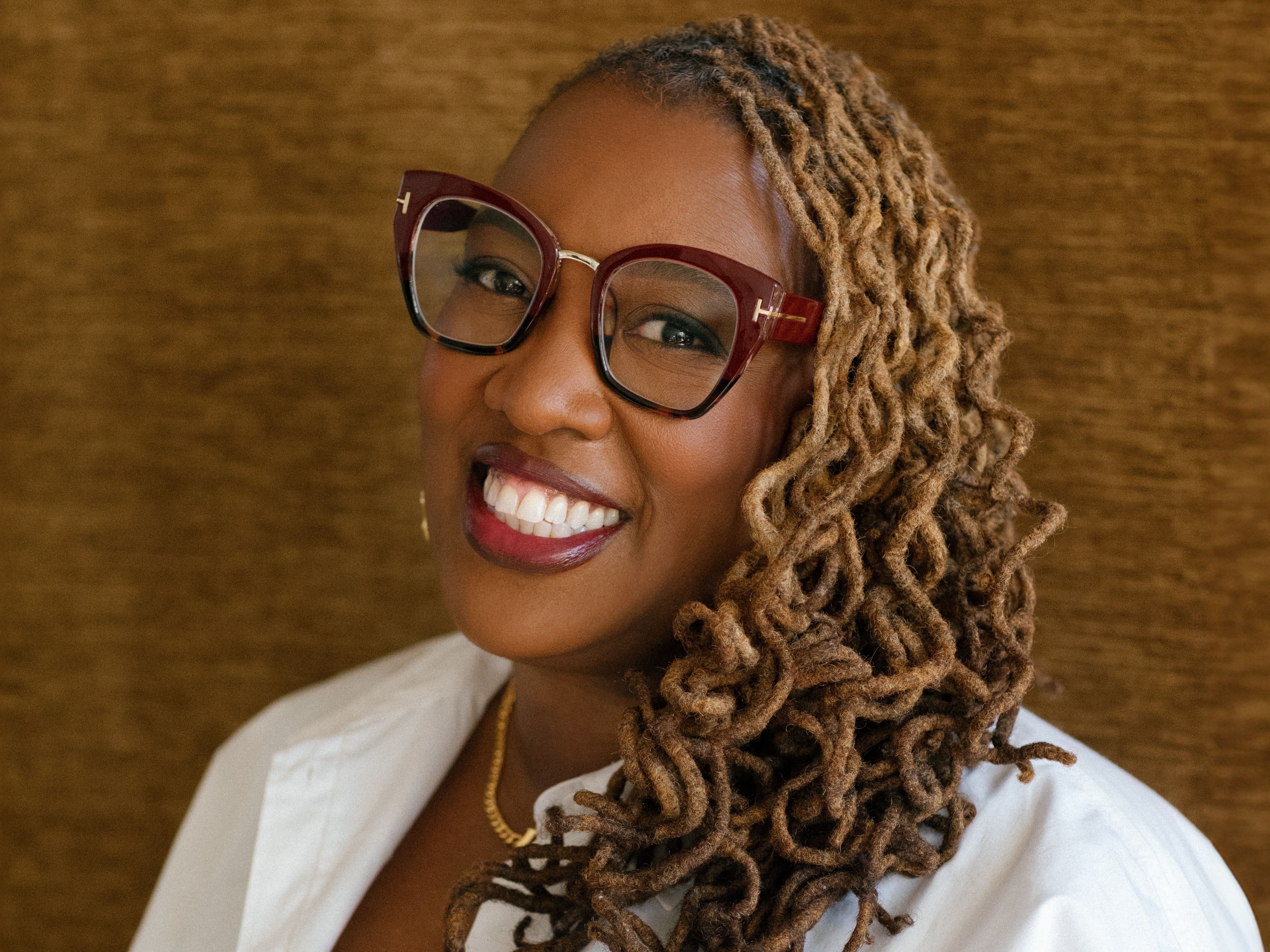
Despite her Philly sounding surname, award winning author Deesha Philyaw is not a Philadelphian — yet.
Philyaw, whose first book The Secret Life of Church Ladies(West Virginia University Press) won the 2021 PEN/Faulkner Award for fiction and was a finalist in 2020 for the National Book Award for Fiction, is planning to move to the City of Brotherly Love next spring.
Over the years she’s spent a fair share of weekends in the city visiting restaurants, shopping haunts, and art museums. Philly friends keep her up on the latest happenings. She already has plans to connect with the women and nonbinary literary group The Claw when she moves to town. And she’s on the BlackStar Film Festival’s host committee for its forthcoming gala.
And Philadelphia, she noted, is extra special to her because it is home to the preeminent Black church, Mother Bethel AME.
There is a lot of history here.
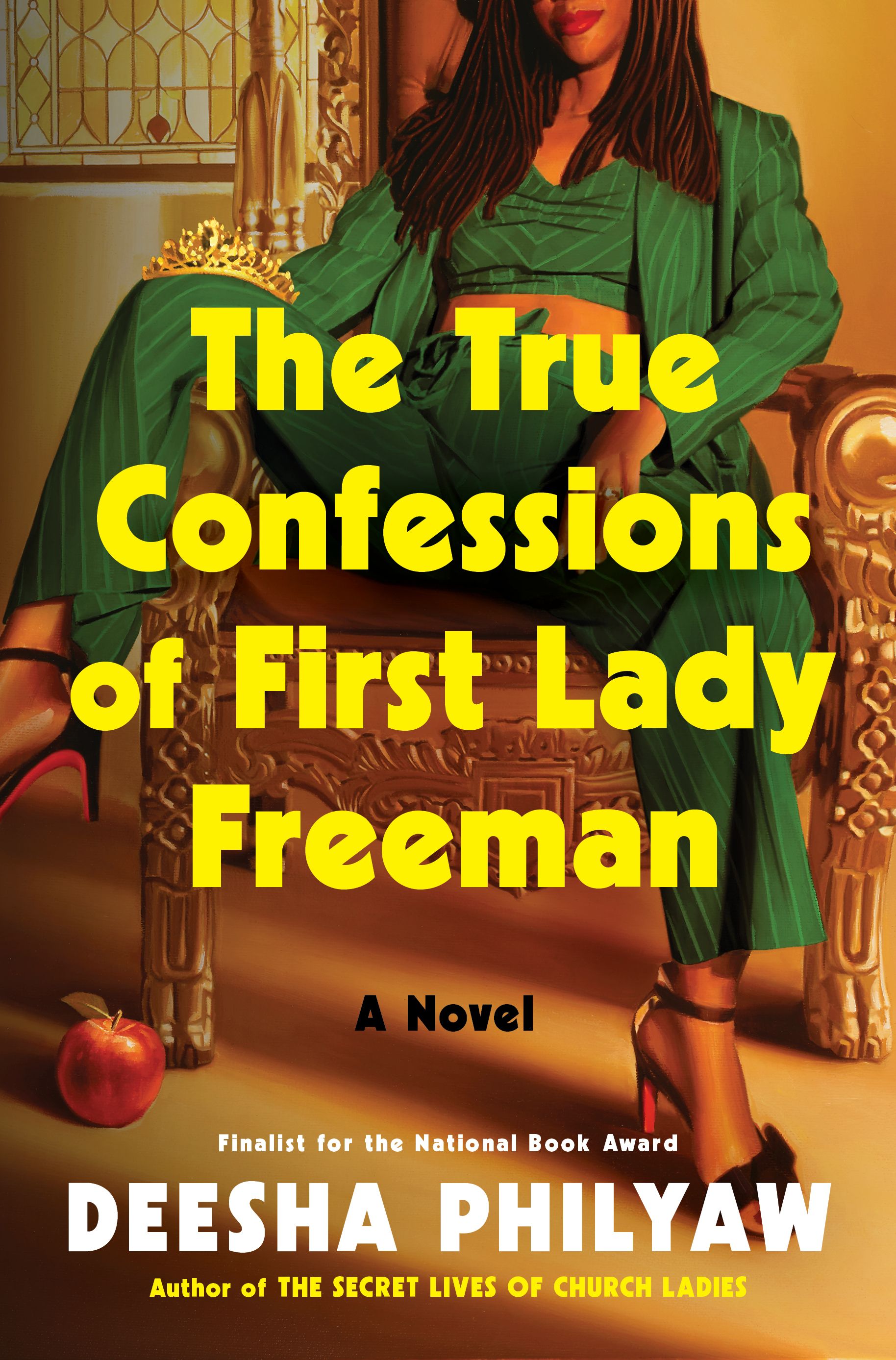
The highly anticipated debut novel ‘The True Confessions of First Lady Freeman” by Deesha Philyaw was released Sept. 29. Philyaw appear at a book signing on Oct. 5 at 6 p.m. at the Center City Barnes & Nobles.HarperCollins/Mariner Books
Philyaw grew up in the Black church and respects its storied past. Still, she says she doesn’t see eye-to-eye with the dogma, patriarchy, and misogynoir.
That was as apparent in The Secret Life of Church Ladies as it is in her latest novel The True Confessions of First Lady Freeman(HarperCollins, Mariner Books). True Confessions centers on the extravagant life of Atlanta first ladyScharisse Freeman as she tries to fit in with other first ladies in the mega church world. Just as she’s starting to fit in with the catty group, a sex scandal erupts. Scharrise is treated like a pariah and readers are left wondering how such cruelty can be perpetuated in His name.
“The stories in Church Ladies and True Confessions are not a middle finger to the church or its true believers,” Philyaw said. “They do, however, point out where the institutions have failed and hurt Black people, particularly Black women and queer folks. I don’t feel like I need to protect the church. That has been the problem. In doing so, we look the other way, remain silent, and down play these things.”
Philyaw, a mom of two who is queer, lived in Pittsburgh for 25 years before moving to Oxford, Miss. where she served as the 2022-2023 John and Renée Grisham Writer-in-Residence at the University of Mississippi before settling in Miami. She’ll be in town on Monday for a talk at Barnes & Nobles and in between book signing and book pedaling, she’ll be taking in the scene of her next homebase.
This is her idea of a perfect Philly Day.
One of Akwaaba Bed & Breakfast’s six overnight suites, The Blue Note, named after The Sound of Philadelphia’s most iconic group’s Harold Melvin and The Blue Notes.Akwaaba Bed & Breakfast
6:30 a.m.
I’m a woman of a certain age so I’m both an early bird and a night owl. On a wonderful morning, I’d wake up at Akwaaba, the West Philly bed-and-breakfast owned by Monique Greenwood. It’s so beautiful. I’d enjoy a lazy morning that would include having a breakfast of oatmeal without fruit. (Something about fruit and oatmeal irks me.) I’d also have some herbal tea and honey. I’m not a coffee girl.
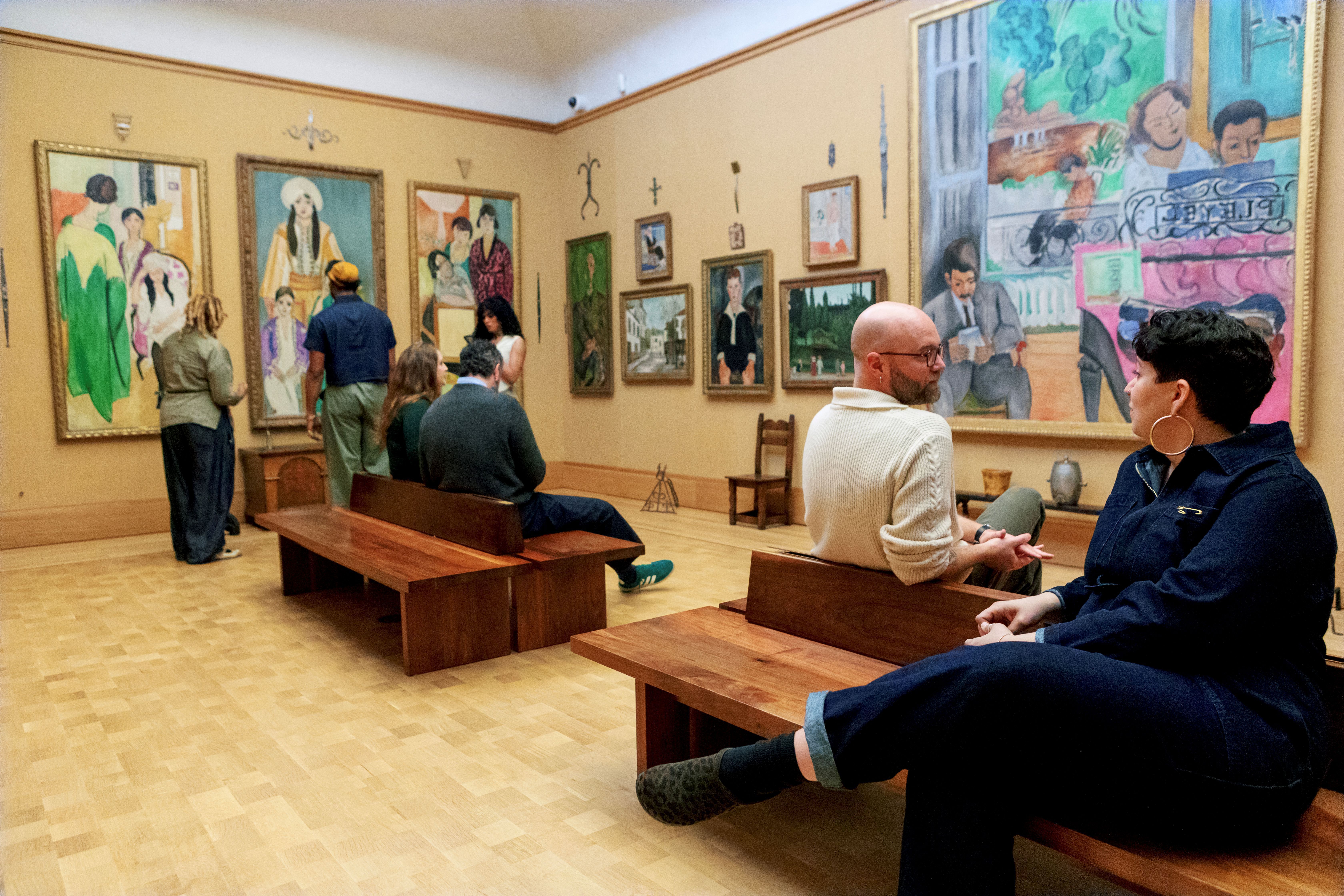
Inside of the Barnes Foundation’s galleries. The Barnes Foundation
10 a.m.
I would check out one of the private collection tours at the Barnes. I really enjoy the art. They always have such great curated exhibitions like [Maori Karmael Holmes and James Claiborne’s] “Freedom Dreams.” On a perfect Philly day, that exhibit would still be open.
The oxtail cheesesteak from the Taste Cheesesteak Bar in Center City on Friday, June 14, 2024.Yong Kim / Staff Photographer
Noon
I’d have lunch at Logan Square’s Taste CheesesteakBar for the oxtail cheesesteak. Then maybe I’d visit the BlackStar film offices in the Bok Building, and definitely catch a movie if the festival was going on.
Interior of Uncle Bobbie’s Coffee and Books.ALEJANDRO A. ALVAREZ / Staff Photographer
I still mask indoors so Sally in Rittenhouse Square is one of the few places where I can eat outdoors year round. My friend Tre Johnson took me there a few years ago when I was in town for the AWP Conference (the Association of Writers and Writing Programs). It was in March and they had heated seats. I’d start with the Japanese eggplant, move on to the fennel sausage pizza and I’d have to get that sangarita
The Philadelphia Parkway Central Library on Logan Square.
7:30 p.m.
I’d end the night at a talk and book signing at the Free Library of Philadelphia. These are great events for writers and readers. There is so much to pick from.
This interview was edited for length and clarity.
Deesha Philyaw will appear Monday, Oct. 5 for a reading, book signing and live recording of Barnes & Nobles Poured Over podcast hosted by Miwa Messer. The event starts at 6 p.m. Barnes & Nobles Philadelphia, 1708 Chestnut Street, at 6 p.m. Tickets include the cost of the book are $34.56. Ticket information here.
So when Colin Kaepernick’s memoirThe Perilous Fight(Hachette, $32.50) hit bookstores this week, of course the former NFL player would make a local appearance courtesy of Uncle Bobbie’s, right?
Kaepernick’s memoir is a coming-of-age story about a Black child who was adopted into a white family and found his identity through sports.
This cover image released by Legacy Lit shows “The Perilous Fight” by Colin Kaepernick. (Legacy Lit via AP)Uncredited
Football didn’t just become Kaepernick’s refuge, it helped him find his voice, ultimately informing his decision to take a knee in 2016 while the national anthem played at the beginning of a game between San Francisco 49ers and the San Diego Chargers. It was an act of protest against the country’s racial inequities.
The truth is, Kaepernick was scheduled to come through Uncle Bobbie’s on his book tour. Hachette asked the Germantown bookstore to reserve a date. And the bookstore did find a venue big enough to hold Kaepernick’s fans at what would likely have been a sold-out event.
But because of an industry kerfuffle, the Philadelphia stop was canceled as were several of Kaepernick’s other tour stops.
The fault, says Justin Moore, Uncle Bobbie’s general manager, lies squarely in the hands of former NBA player and former Sacramento mayor Kevin Johnson’s nonprofit the National Association of Black Bookstores.
Once Kaepernick signed on with NAB2 — which is also working with actress Tisha Campbell on this week’s release of her memoirThe A Word: A Mother’s Journey Through Autism and Love (HarperCollins, $29.99) — to manage the book tour, the previous agreement with Uncle Bobbie’s and other bookstores was seemingly null and void.
So, the beef isn’t with Kaepernick, it’s with NAB2.
“Although NAB2 was fully aware of the previous arrangements, they nonetheless chose to undermine our collective efforts, forcing us to cancel previously scheduled dates,” Moore wrote in an Instagram post this week. “As a result, multiple bookstores (including Black-owned stores) lost considerable revenue, and wasted valuable resources planning those events.”
Moore didn’t stop there.
“While these circumstances would be disturbing under any circumstances, it is particularly concerning it was created by Mr. Johnson and NAB2, an organization whose expressed mission is to support and uplift Black-owned bookstores.”
Moore learned of the cancellation months ago but made the post earlier this week after customers began asking him if and when Kaepernick was coming to Philly.
NAB2 did not respond to requests for an interview.
The West Coast nonprofit said in a social media post that it “is deeply saddened by Uncle Bobbie’s assertions that the organization engaged in ‘harmful business practices’ that undermine Black-owned bookstores.”
“NAB2 is honored to be partnering with 17 Black owned book stores on Kaepernick’s tour,” the post said.
“True to our mission, it includes many smaller bookstores that have historically been overlooked and excluded from similar events. Further, NAB2 did not ask or advocate that Uncle Bobbie’s, or any other Black-owned bookstore be excluded from Colin Kaepernick’s book tour or prevented from benefiting from it.”
In the meantime, Kaepernick’s signed memoir is available for sale at Uncle Bobbie’s. Whether the book tour will make a stop in the city is still unknown.
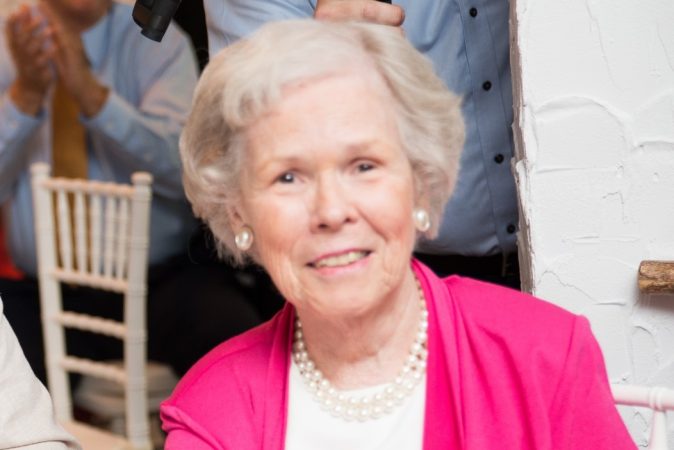
Rachel Blau DuPlessis, 84, of Philadelphia, experimental poet and essayist, literary scholar and critic, Temple University professor of English and creative writing emerita, mentor, artist, and world traveler, died Wednesday, Sept. 2, of respiratory failure at Penn Presbyterian Medical Center.
Professor DuPlessis was an eclectic experimental poet who grew up in New York, lived in Swarthmore and Philadelphia for more than 50 years, and taught a variety of writing and women’s studies classes at Temple from 1974 to her retirement in 2011. She wrote hundreds of poems — she called many of them “drafts” — about feminism, modernism, connectivity, imagery, and consciousness.
She was an expert on cultural poetics and told The Inquirer in 2002 that her poems generally reflect her “awe at the universe, grief at the barbarity of modernism, and sense of how it was to be in the world.” She enjoyed poetic wordplay, reviewers said, and tinkered freely with conventional syntax, sound, tone, and form.
“Reading her is an adventure,” reviewer Robert Long said in The Inquirer in 1997, “and poets this adventurous must be cherished.”
Her poems were published in more than 30 books and in several languages, and also appeared in The Inquirer, other newspapers, magazines, journals, and anthologies. In tributes, fellow poets praised her “unique combination of erudition and exuberance” and her “generosity, brilliance, expansive thinking, and attention to so many possibilities of writing and art.”
“From what I can tell, DuPlessis doesn’t write poems so much as build them,” reviewer Andrew Ervin said in The Inquirer in 2005. “The manner in which she does that is what makes the Temple professor one of the most exciting and inventive writers of our time.”
She told the Oxonian Review in 2015 that “being a poet is not only writing poems. It is an address to the whole apparatus of and the traditions of poetic practice.”
A book publisher said: “She brought such intelligence, generosity, and curiosity to everything she did.” Penn professor Al Filreis told Professor DuPlessis’husband, Robert: “It’s hard to imagine the Philly poetry world without Rachel in it.”
Professor DuPlessis read her poems to people around the world. Courtesy of the family
At Temple, Professor DuPlessis helped establish women’s studies classes and the school’s graduate program in creative writing. She mentored students and other professors, and the English department’s DuPlessis Lecture in Poetry and Poetics is named in her honor.
“She loved being a mentor to people, to encourage them,” her husband said. “She loved being a poet and an academic. She prepared incredibly for her classes and was connected and attentive to her students.”
Earlier, she taught briefly at what is now the College of New Jersey and Rutgers and Columbia Universities. She spent several of her research and study leaves from Temple working with students and colleagues at universities in the Netherlands, France, Belgium, and elsewhere.
She was named a resident poet and distinguished visitor in Italy and New Zealand. She and her husband, a professor emeritus at Swarthmore College, visited every continent except Antarctica, and she spoke French and Italian as well as English.
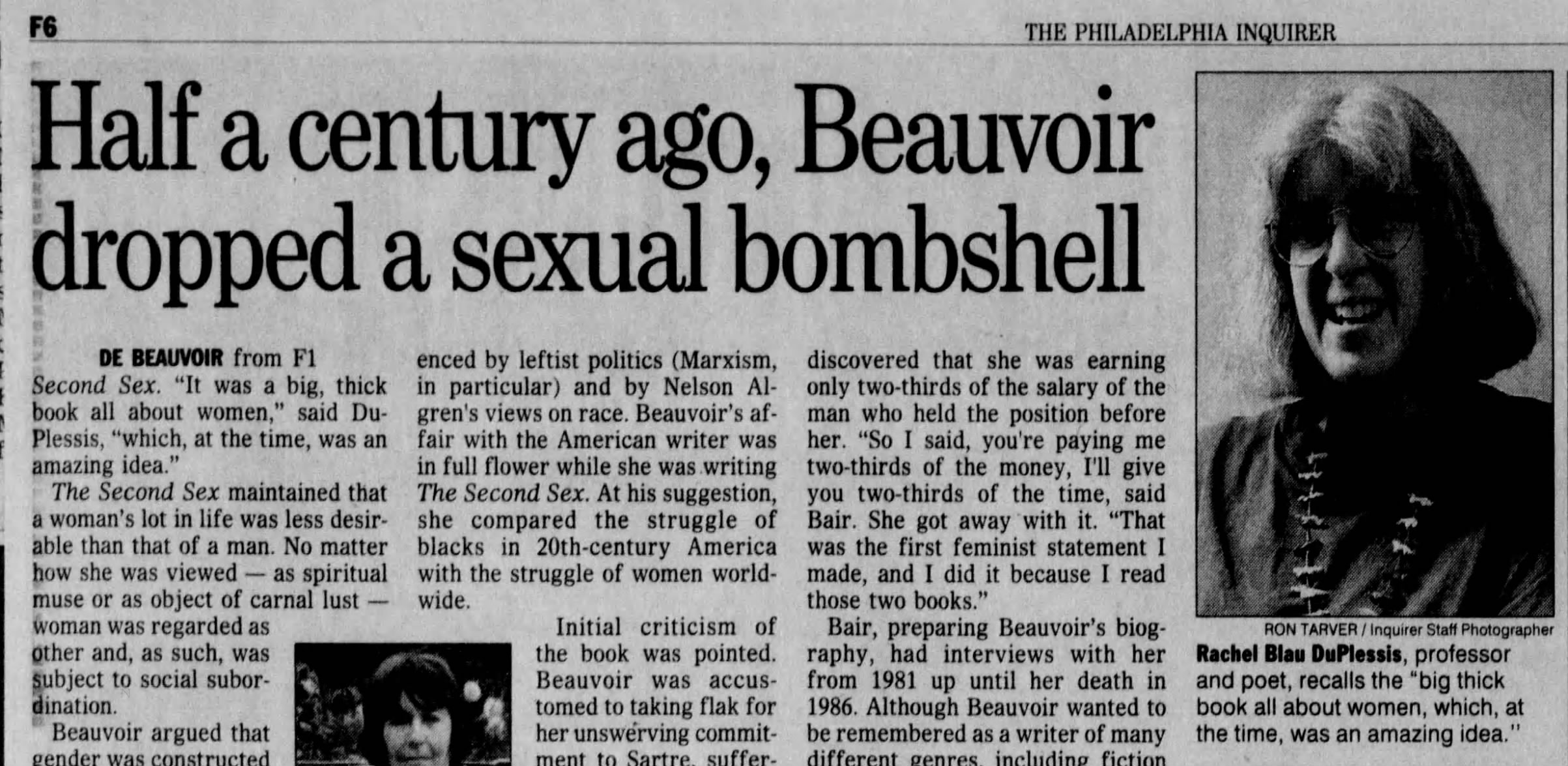
This article featured Professor DuPlessis and appeared in The Inquirer in 1999.Newspapers.com
She earned fellowships from the Pew Center, the Pennsylvania Council on the Arts, the National Humanities Center in North Carolina, and other groups. “She was constantly creating things,” her husband said. “She never stopped.”
Professor DuPlessis also wrote and edited books and articles about writing and poetry, and she reviewed books for The Inquirer and other publications. She read her poems in public, was interviewed often, and earned achievement awards from Temple, the University of California in San Diego, the old Fund for Poetry, and other admirers.
She created a comprehensive website, rachelblauduplessis.com, and made collage art that she augmented with poems. Thomas Devaney, a Philadelphia writer, called her “an important figure of American experimental poetry.”
She told the Oxonian Review: “Poetry is an ethical practice as well as an aesthetic one. Just even thinking about what this means and how it is instantiated is a useful task.”
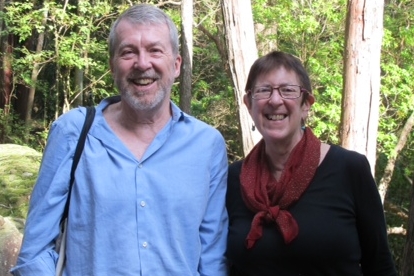
Professor DuPlessis enjoyed time with her husband, Robert, and daughter, Kore.Courtesy of the family
Rachel Maia Blau was born Dec. 14, 1941, in Brooklyn. She grew up in Queens and the Bronx, and earned a bachelor’s degree in English at Barnard College in New York in 1963 and a master’s degree and doctorate in English and comparative literature at Columbia in 1970.
Her father was a professor, her mother a librarian. She met fellow Fulbright scholar Robert DuPlessis on a boat to France in 1966, and they married in 1968 and had a daughter, Kore.
Professor DuPlessis enjoyed yoga, museums, art history, and long walks with her husband. They went to see and hear the orchestra, the opera, the ballet, and the theater.
She doted on her daughter and grandchildren. “She always read me stories and sang me songs at night before bed,” her daughter said. “I would hold on to her leg because I didn’t want her to leave.”
Professor DuPlessis started writing poems when she was 12, she said in an interview. “She was determined, hardworking, witty, and a lot of fun,” her husband said. “She was definitely intense.”
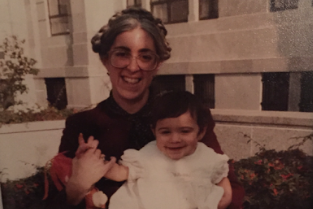
Professor DuPlessis said she started writing poems when she was 12.Courtesy of the family
In addition to her husband and daughter, Professor DuPlessis is survived by two grandchildren and other relatives. A sister died earlier.
A memorial service is to be held from 1:30 to 3:30 p.m. Saturday, Oct. 17, at Temple University’s Charles Library, 1900 N. 13th St., First Floor, Philadelphia, Pa. 19122.
Donations in her name may be made to Planned Parenthood, Online Services, Box 96771, Washington, D.C. 20090; Philabundance, 3616 S. Galloway St., Philadelphia, Pa. 19148; and the American Civil Liberties Union, 125 Broad St., 18th Floor, New York, N.Y. 10004.
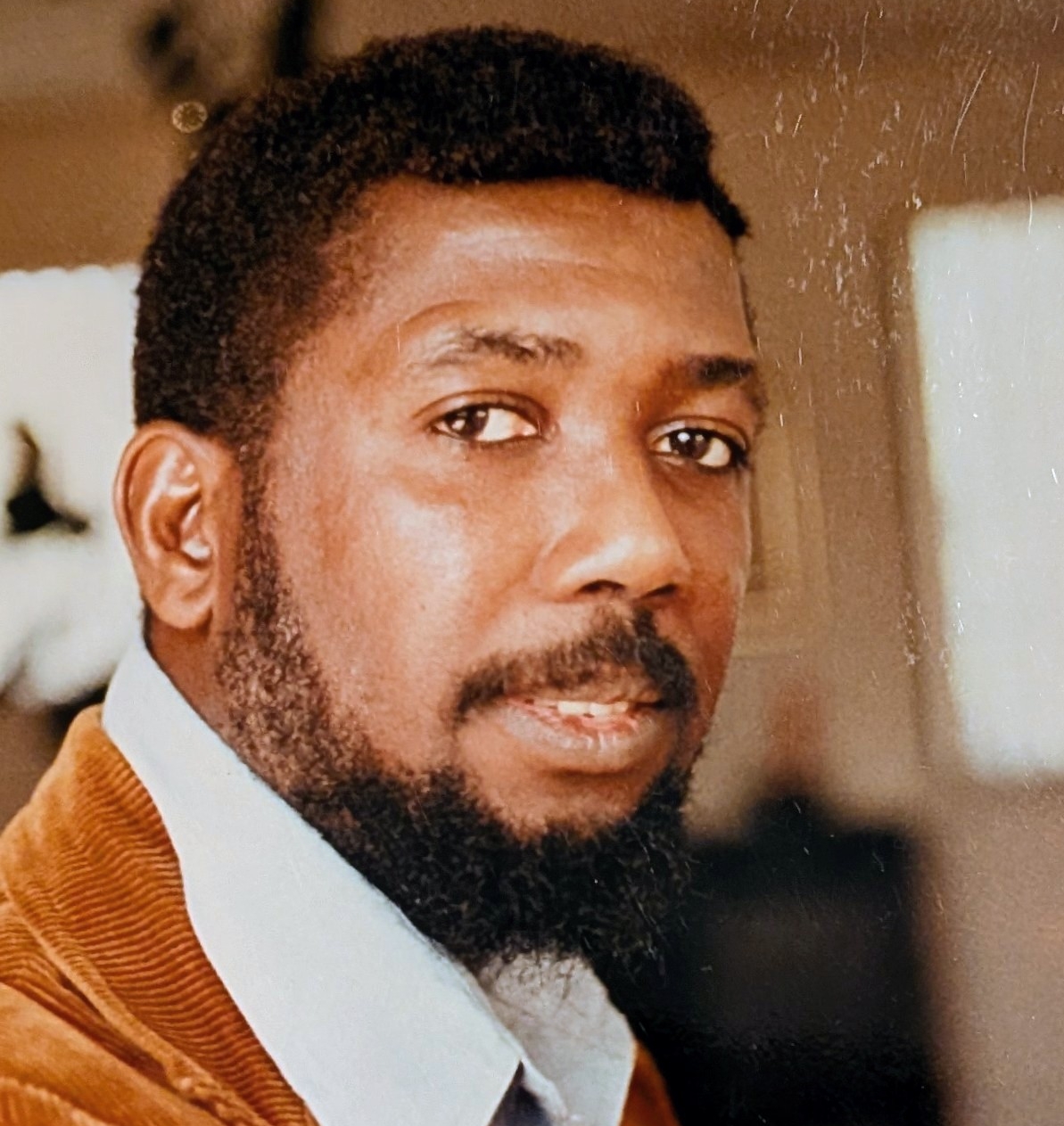
Ron Avery, 85, of Philadelphia, retired eclectic reporter and columnist for the Daily News, Philadelphia historian, volunteer city tour guide, author, high school history teacher, veteran, and canoe enthusiast, died Sunday, Aug. 2, of complications from amyotrophic lateral sclerosis at his home in East Falls.
Reared in Fairmount, Mr. Avery graduated from Thomas Edison High School and earned a bachelor’s degree in history at Pennsylvania State University. He was assigned to the ship newspaper in the Navy after college, found a creative niche in journalism, and went on to work for more than 30 years at the Associated Press, the Bucks County Courier Times, the Courier-Post in South Jersey, and the Daily News.
He wrote for the Daily News as a correspondent in 1981, joined the staff in 1982, and, until his retirement in 2000, wrote thousands of stories about crime, casinos, war orphans, historic houses, the MOVE bombing, local notables, and other subjects. His columns, “Poor Ronald’s Almanac” and “One of Us,” hammered away at local issues and featured everyday people doing exceptional things.
“He covered every nook and cranny of the city,” said his son Serge. “That burning curiosity sustained him till his last days.”
He wrote three books about Philadelphia, including A Concise History of Philadelphia in 1999. He produced a series of video guides he called the Urban Explorer for local TV in 2004 and posted blogs about the city from 2017 to 2019 on a website called Philadelphia Cracks Me Up.
“Like all cities,” he said in a 1995 Daily News column, “Philadelphia is honeycombed with hidden spaces and forgotten places.” In a 1997 review of his book, City of Brotherly Mayhem: Philadelphia Crimes and Criminals, The Inquirer’s Thomas Brady said: “The book … is decidedly a fun read.”
Alex Strang, his director on the Urban Explorer videos, called Mr. Avery an “unforgettable legend” and “a walking encyclopedia of the city’s history and eccentricities” in a Facebook tribute. Other former colleagues said he was “a clever journalist” and “a true Philadelphian.”
Longtime Daily News colleague Robin Palley said on Facebook: “He had an amazing knack of finding quirky people with fascinating skills or habits and making them come to life on our pages.”
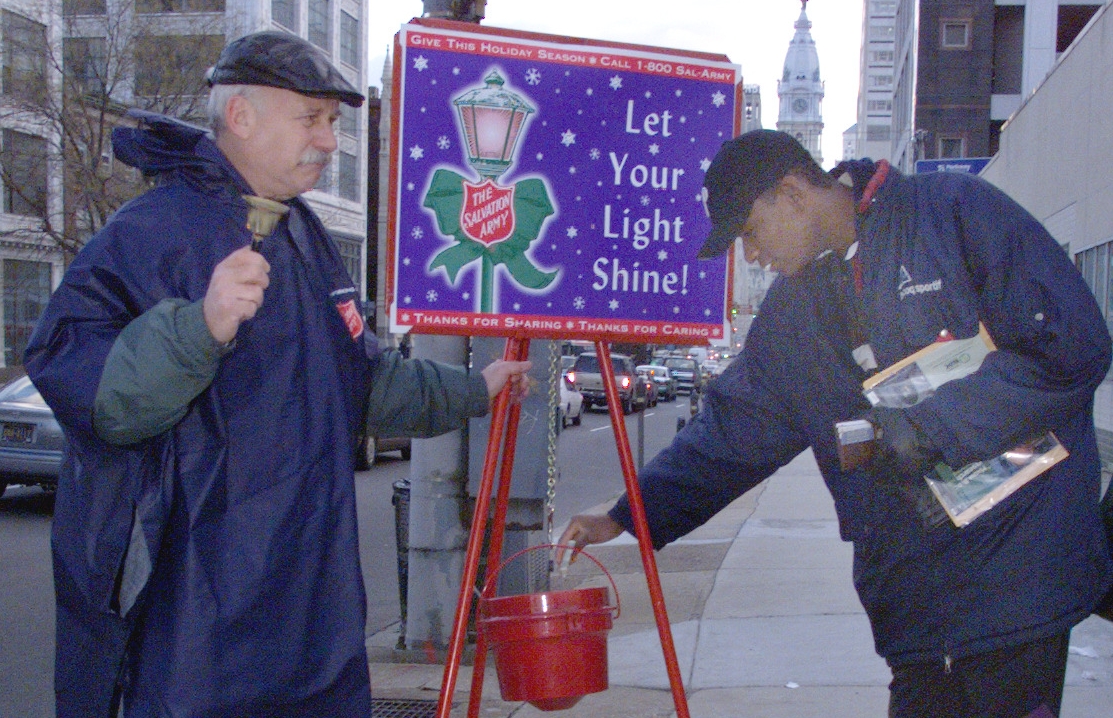
Mr. Avery (left) mans a Salvation Army donation kettle in 1999.Steven M. Falk / Staff Photographer
Before the Daily News, Mr. Avery wrote news and feature stories for the Courier-Post in the 1970s, and the Courier Times and the AP in the 1960s. He moved to Israel for six months in 1972 but returned to work for the Courier-Post in 1973.
He also wrote freelance pieces for the Hidden City Daily, PhillyHistory.org, UShistory.org, and op-eds later for The Inquirer and Daily News. He served in the Navy from 1964 to 1966, joined the Philadelphia Canoe Club later, and led water trips in the New Jersey Pine Barrens and elsewhere.
Knowledgeable, energetic, and naturally affable, he was a tireless promoter and volunteer guide in Philadelphia. He led walking tours throughout the city for students, civic groups, and other organizations, and his explanatory video tours featured cobblestone alleys, urban gardens, museums, statues, and other features of city life.
He was a stickler for details and historical accuracy, and he helped spur City Council to pass an ordinance in 2008 to educate and certify paid Center City tour guides. “They score high as Philadelphia ambassadors of good will,” he said in a 1995 column about uneducated guides, “but as historians they often flunk out.”
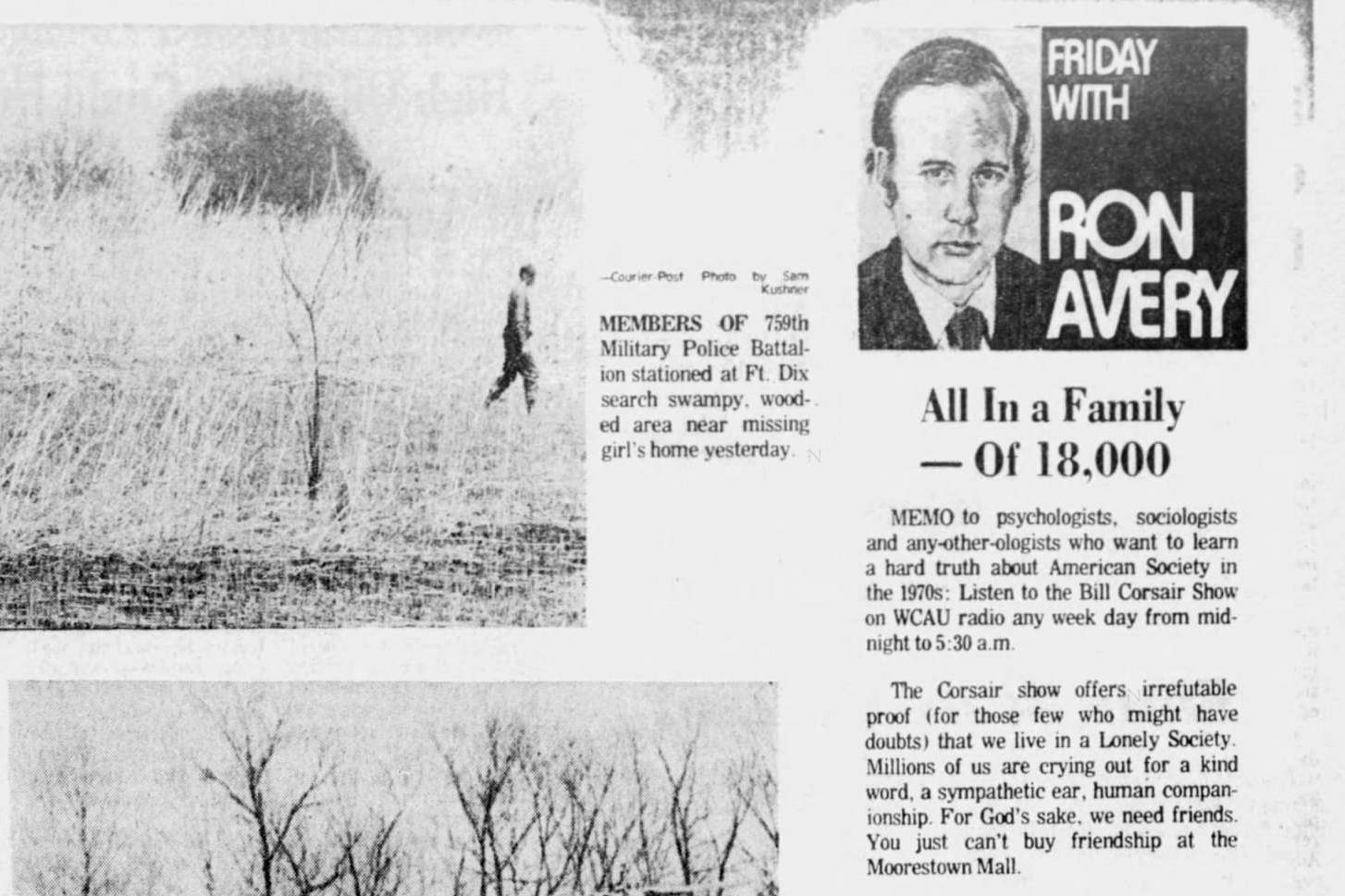
Mr. Avery wrote a column for the Courier-Post in 1974.Newspapers.com
Ronald Avery was born June 10, 1941, in Strawberry Mansion. He joined the Boy Scouts, earned his bachelor’s degree at Penn State in 1963, and taught history at Bensalem High School for a year.
He was a boxer in college and, mesmerized by the sport, later worked as a referee for amateur matches.
He met Suzet Habif in Israel in 1967, and they married in 1968. They had sons Serge and Ben, and lived for years in a rowhouse in Oxford Circle.
Mr. Avery cared for his wife during her long illness in the 1980s and ’90s. She died in 1993.
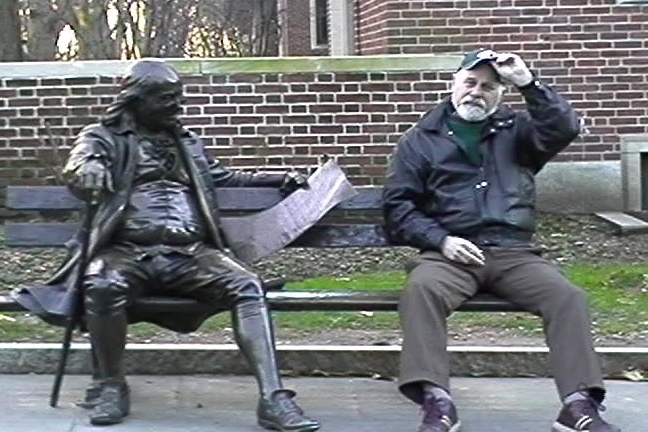
Mr. Avery liked to hang out with Benjamin Franklin and other historic figures. Alex Strang
He lived later in Pennsport and East Falls, was diagnosed with ALS in 2015, and proudly outlived its average life expectancy of 18 months by nearly a decade. “He defied that diagnosis and did not let it define him,” his son Serge said. “He always said he had a lot to live for.”
Mr. Avery was an avid reader and street photographer. He liked poetry, wrote limericks on birthday cards, and posted hundreds of his photos on flickr.com. One of his photos won a contest and was displayed at the airport.
He enjoyed jazz and jokes, led the prayers at family gatherings, and gave Yiddish quizzes to his two grandsons. He shared favorite recipes with Daily News colleagues and whipped up memorable homemade soups, especially white bean.
“I’ll greatly miss his endless anecdotes about all things Philadelphia,” said his daughter-in-law, Rebecca Houlding, “the stories about the local criminals, and his love of his family and friends.”
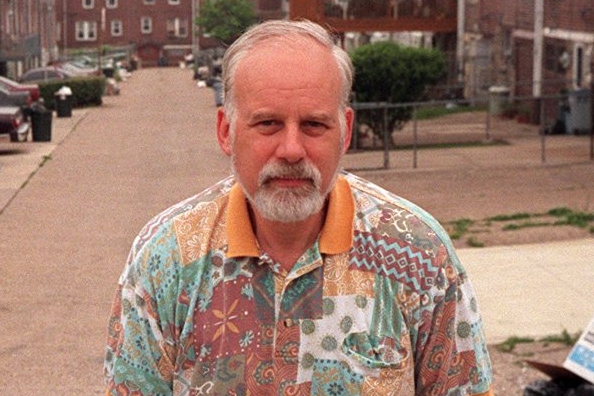
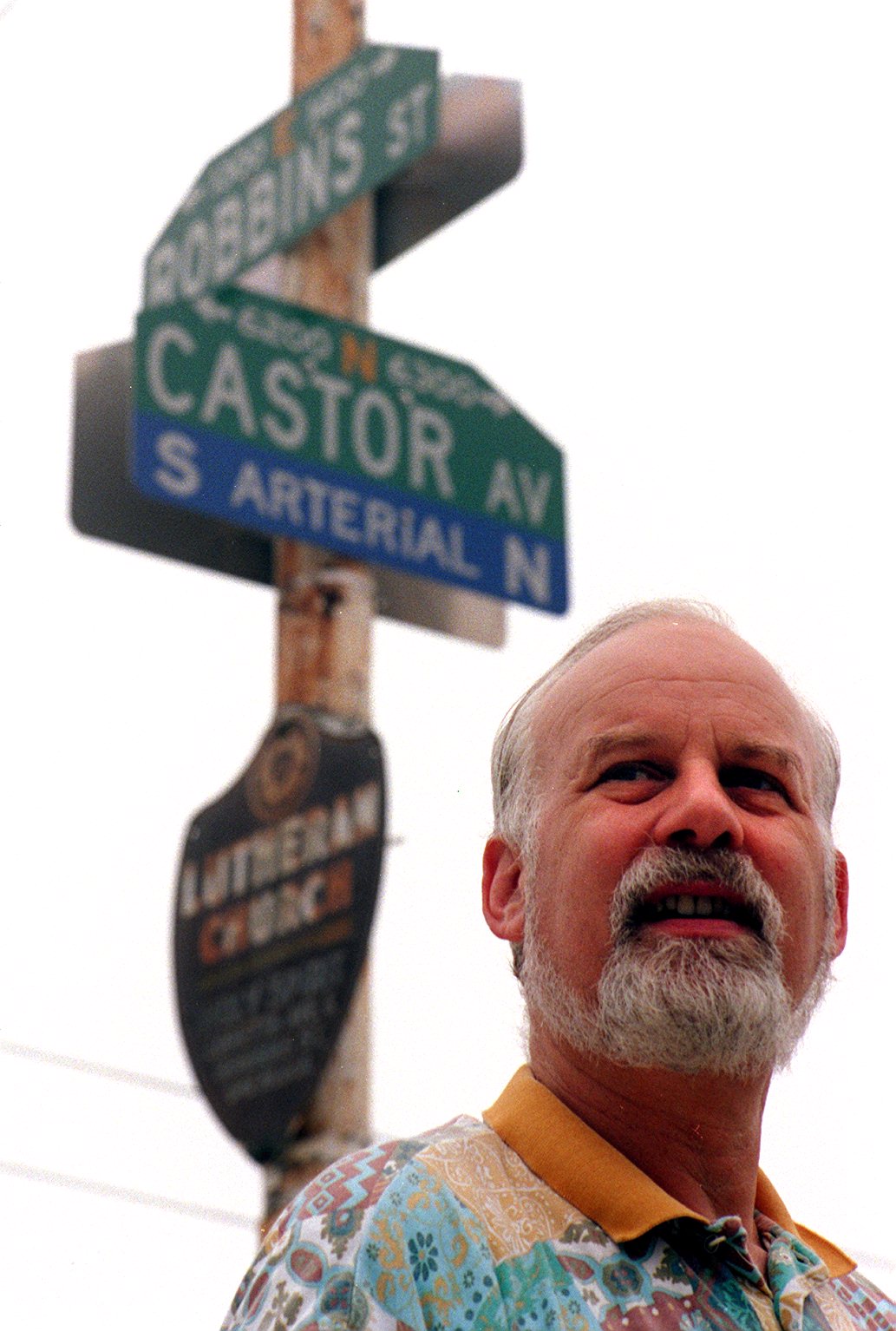
Mr. Avery wrote about his life in Northeast Philadelphia for the Daily News in 1997.Alejandro A. Alvarez / Staff Photographer
His son Serge said: “He loved chasing the stories from the back alleys and driveways, highlighting the working people of our town.”
In addition to his sons, daughter-in-law, and grandsons, Mr. Avery is survived by other relatives. A sister died earlier.
That’s what Samantha Paige Rosen’s father told her when she was 29.
Rosen was living alone in Bethesda, Md., and struggling with what she called unrealistic deadlines at her copywriting job.
She liked being in the D.C. area and was reluctant to move back to her parents’ house in Bala Cynwyd. Plus, this wasn’t what adults were supposed to do, she thought. Ultimately, she decided to listen to her dad.
“My job was making me sick,” she said, referring to her deteriorating mental health.
The morning after she moved back into her childhood room, she already felt a difference. “The depression lifted. A lightness. A steady, quiet heartbeat,” she wrote in a 2022 essay, “Unlearning the Shame of Living with My Parents as an Adult,” for the literary publication Catapult.
That decision shaped the trajectory of her life.
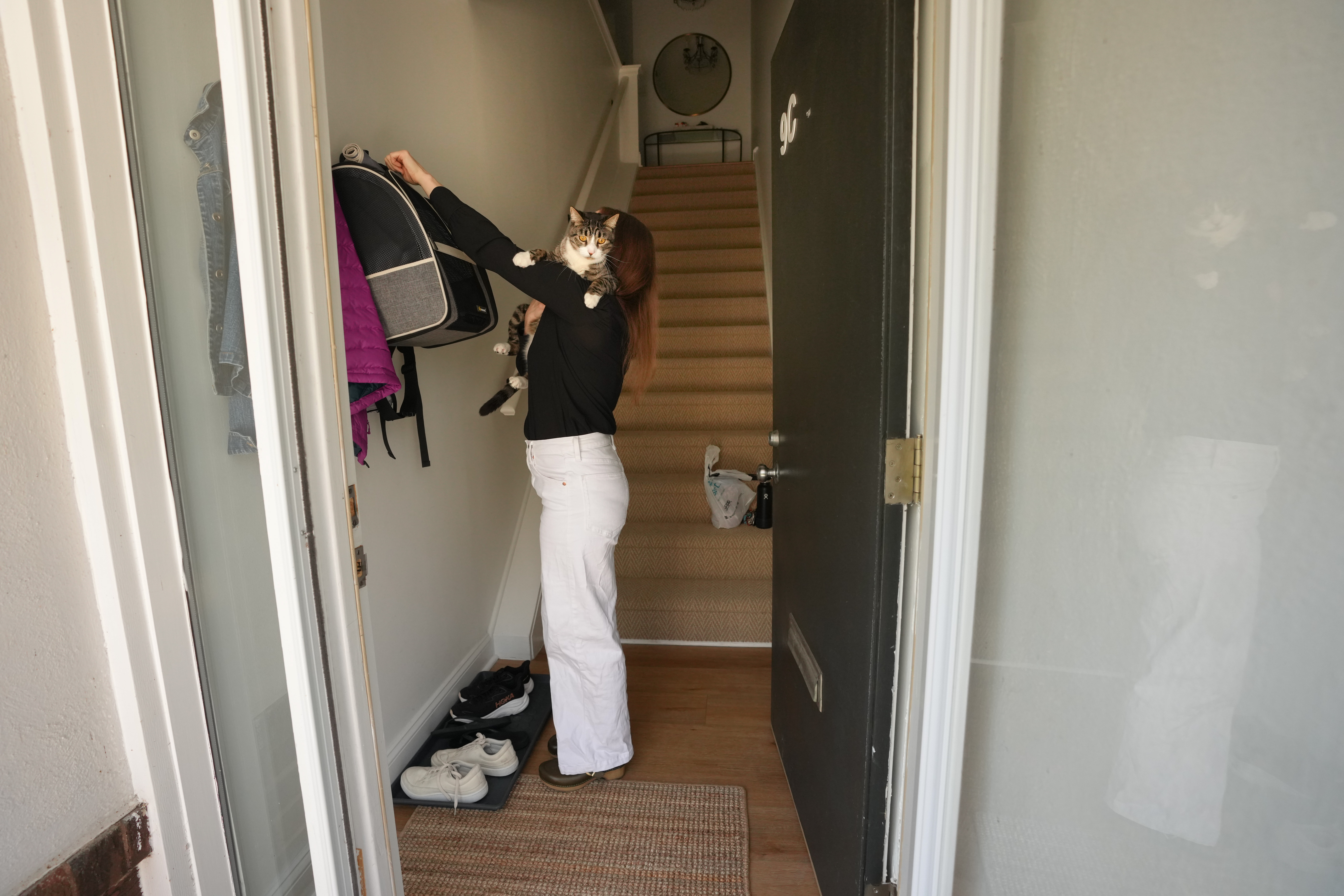
Samantha Paige Rosen, author of the anthology “Living, Together,” prepares to take her cat to her parents’ home for a visit last month. She lives in Penn Valley, a short walk from her parents’ home.Jessica Griffin / Staff Photographer
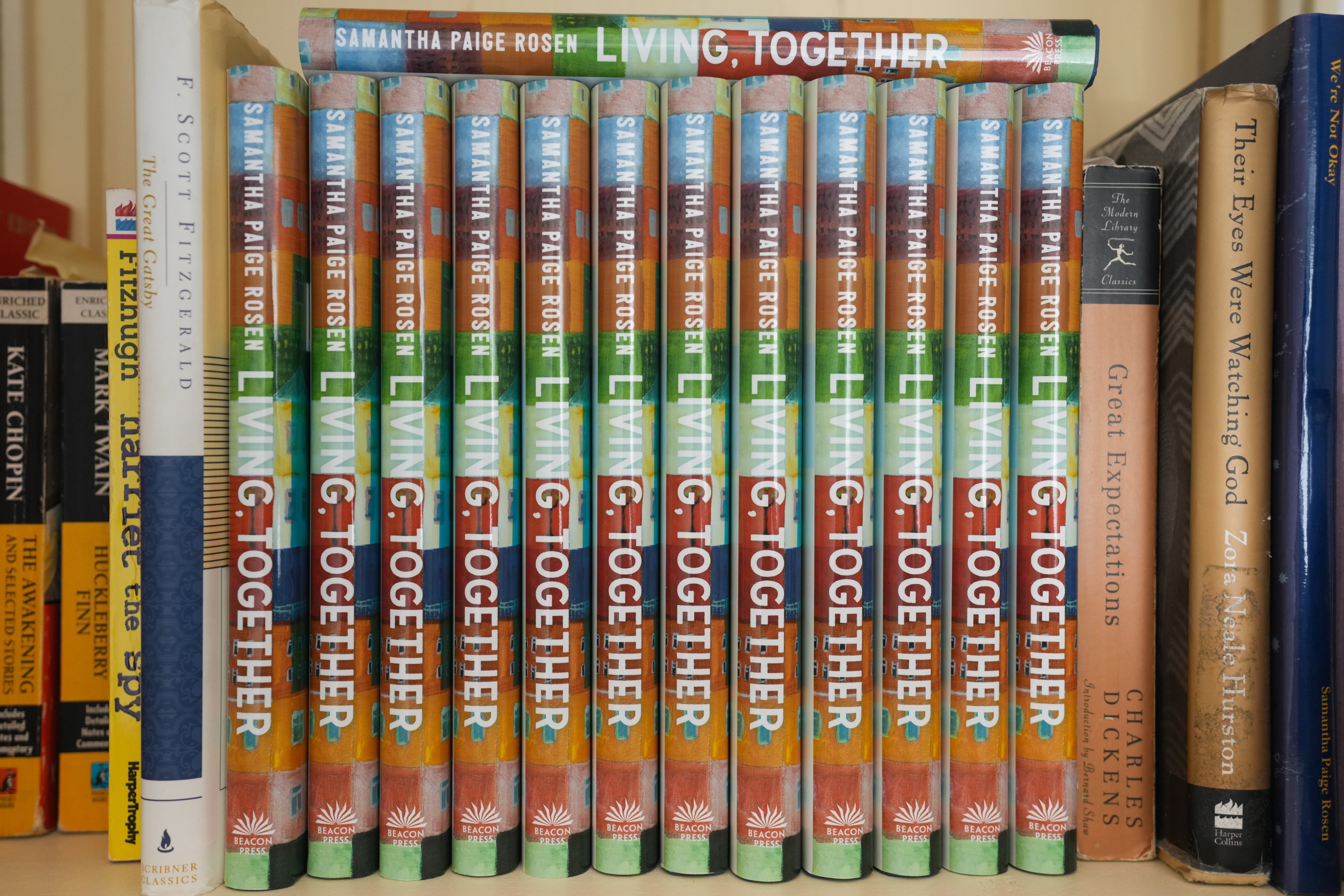
Thanks to the care provided by her parents, she was able to get well and build a tutoring business. And her experience inspired her to pitch, sell, and edit an anthology called Living, Together: Reimagining Community in the Age of Disconnection, out last month from Beacon Press and now an indie press bestseller.
The anthology, a mix of personal essays and conversations featuring 22 writers who live in the U.S., offers a window into the experience of living outside of a nuclear family arrangement. For some, that means living in a multigenerational household, a cohousing community, or three polyamorous parents and children. The book also goes beyond just housing, to focus on building community and chosen family.
Copies of the anthology “Living, Together” by writer Samantha Paige Rosen.Jessica Griffin / Staff Photographer
Novelist Sarah Thankam Mathews writes about her experience sustaining Bed Stuy Strong, the mutual aid organization she helped found during the pandemic. Author Rhaina Cohen explores her and her husband’s decision to live with their friends. Novelist Jonathan Escoffery talks about how his sense of community was shaped by his Jamaican immigrant parents and fellow writers of color.
When she was living with her parents, Rosen, now 36, said she didn’t know anyone who was living in a nontraditional setting and couldn’t find much writing about it. In a lot of ways, the book, she said, “was for me.” She wanted to hear about all the ways people were building homes and community.
It’s difficult to quantify the trend of alternative living arrangements because it’s such a vast term. But what is clear is that what Americans tend to think is middle-class “normal” — living with a spouse and children — is on the decline.
Writer Samantha Paige Rosen, author of an anthology called “Living, Together”, in her home, located a short walk from her parents house, July 20, 2026, in Penn Valley, PA.Jessica Griffin / Staff Photographer
Multigenerational and otherwise non-nuclear family living is common in several global cultures, but Rosen wanted to highlight American writers as a way to combat the thinking that more communal ways of living are suited for other countries but not here.
Living, Together fits into a growing canon of literature focused on envisioning alternative family and relationship structures. From Cohen’s best-selling 2024 The Other Significant Others: Reimagining Life with Friendship at the Center to Mathews’ 2022 novel All This Could Be Different, from Sophie Lewis’ 2022 Abolish the Family: A Manifesto for Care and Liberation to Lola Milholland’s 2024 memoir Group Living and Other Recipes, there’s a growing tide of voices calling for collectivism over individualism.
“There’s a real hunger for interdependence and people don’t know how to get it,” Rosen said. She hopes the book will open people’s eyes to what’s possible. And not just what’s great about communal living, but what’s difficult about it, too.
When Rosen lived with her parents, sometimes she’d visit friends’ places and wonder if she was doing what she should be doing “as an adult woman.” Her mom, Patty Rosen, also remembers fielding some judgment from others about her daughter’s living situation.
“When’s Sam gonna move out?” they asked.
But the Rosens said they loved living together, even with things like negotiating sound while Samantha was tutoring and dealing with her cat crying at the front door. Or being parented a little too much.
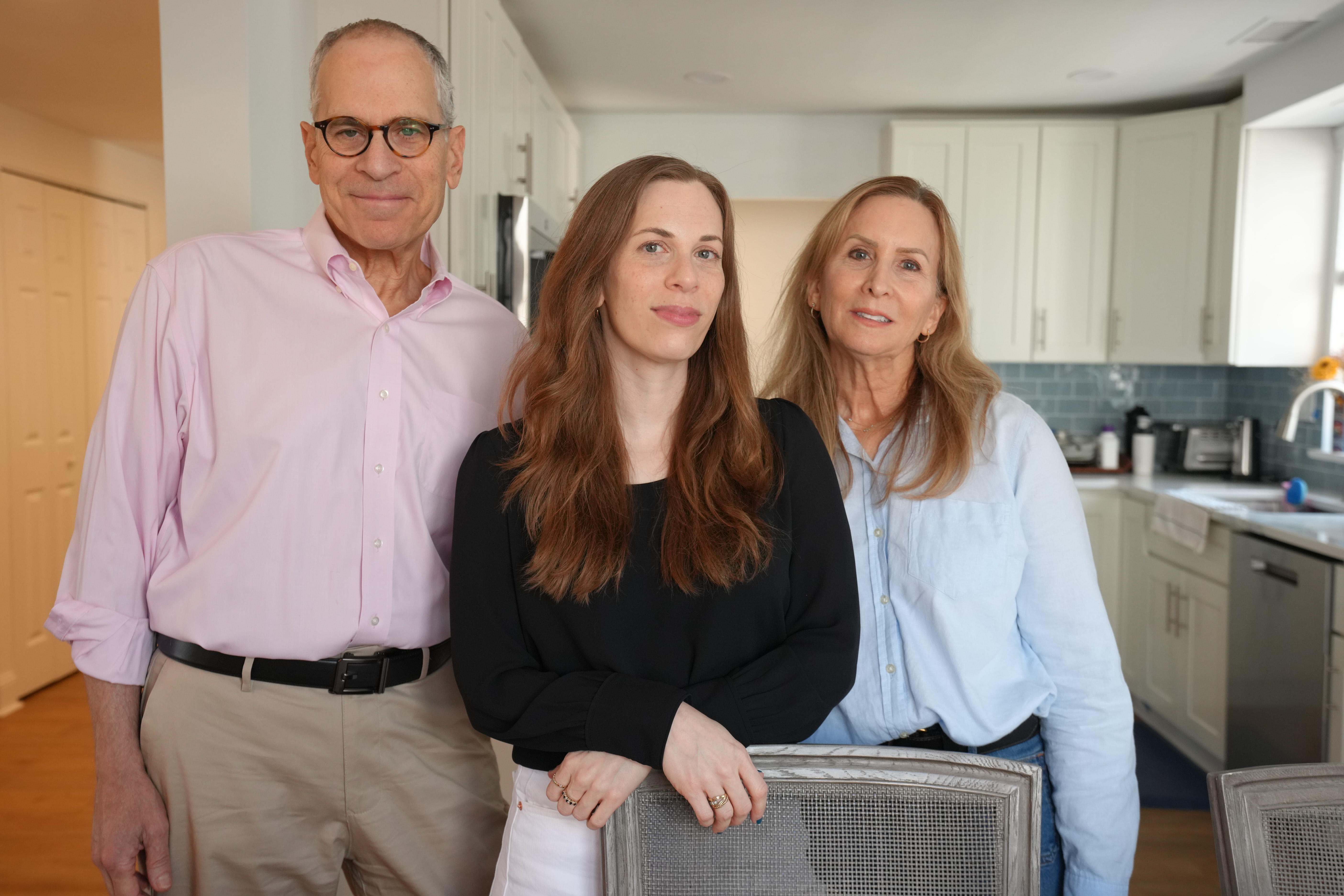
Writer Samantha Paige Rosen, author of the anthology “Living, Together,” poses with her parents in their home in July. Rosen lives a short walk from her parents’ home in Penn Valley and visits with them daily.Jessica Griffin / Staff Photographer
And going on dates? “She didn’t like to be asked about it,” Patty said.
They’d ask about the date’s name and profession, Rosen explained. “Then,” her father, Stuart Rosen, said, pretending to whisper behind his hand, “I would Google.”
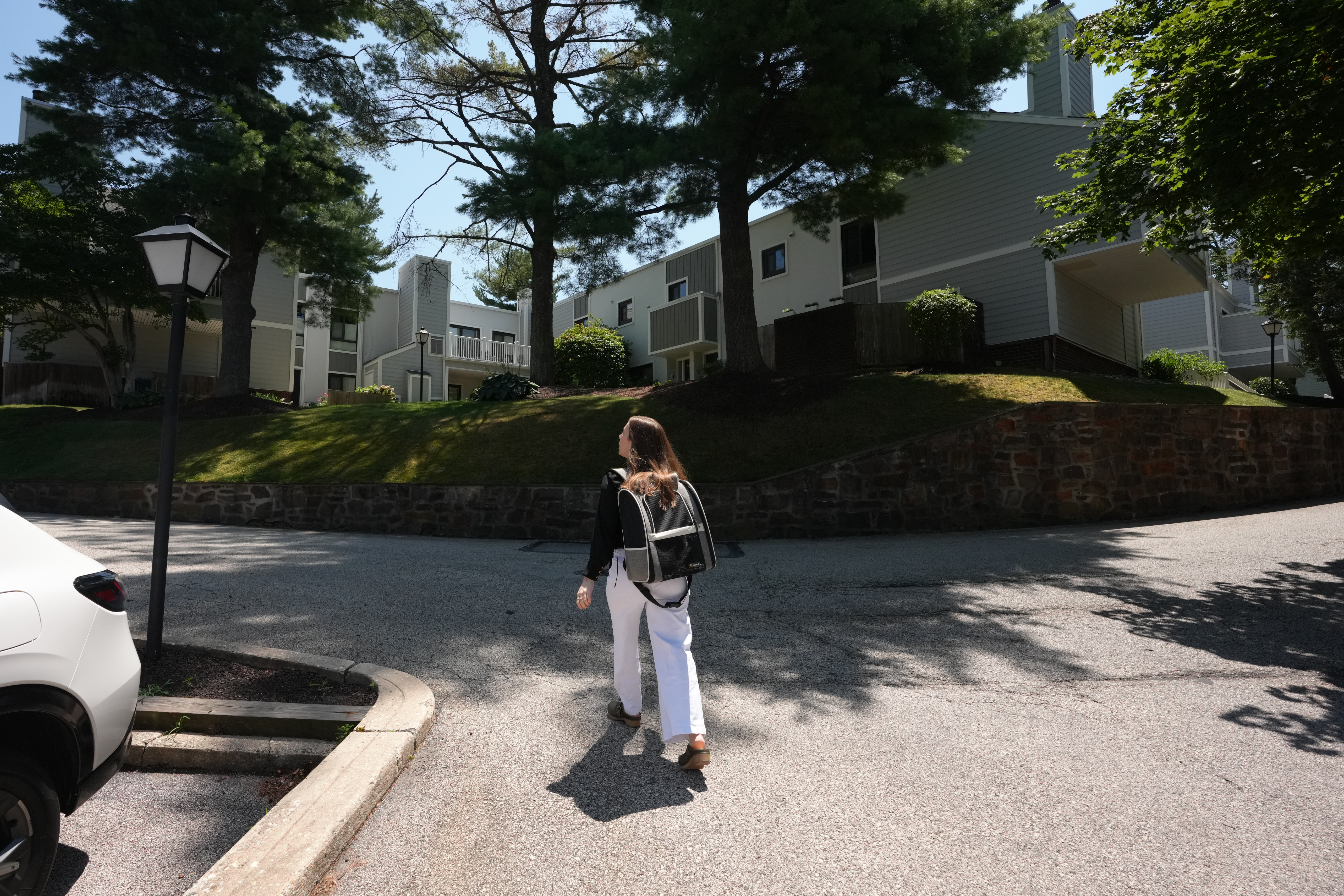
In 2025, Stuart and Patty downsized and moved into a house in Penn Valley. Rosen moved into the house across the parking lot — a house she could only afford because of the years she lived with her parents.
The shift in their family’s living situation echoes something Rosen learned while working on the book.
“Those who’ve taken communal living from an idea to reality have reframed their thinking around it again and again, or gotten rid of the frame entirely,” Rosen wrote in an email. “It can last forever or for a season of life.”
In this season of life, Rosen brings Fergal, her cat, in a backpack to her parents’ house everyday to play with their cats. Every Tuesday, she and her dad have dinner and watch a movie. Some evenings, her mom comes over after she finishes work to watch a movie in bed.
Writer Samantha Paige Rosen, author of the anthology “Living, Together,” lives across a parking lot from her parents’ home in Penn Valley.Jessica Griffin / Staff Photographer
The latest iteration of their living situation — and the potential for all the other ways she might live in the future — calls to mind something Rosen wrote in her essay.
She said she wasn’t sure what she’d choose if she had complete freedom to live the way she wanted.
“But I know I’m interested in figuring out how to live beyond the boundaries society has established for me. I didn’t always believe I was capable of that, but I am. We all are.”
Samantha Paige Rosen will be speaking about her book at the Head & the Hand, 2230 Frankford Ave., Philadelphia, as part of “Hot Debut Summer” on Saturday, Aug. 22, 7 p.m.-9 p.m.
“Living, Together: Reimagining Community in the Age of Disconnection” is available in digital and physical bookstores.
In the winter of 1777-78, after the Second Continental Congress hightailed it from Philadelphia following the British army’s attack on the city, the Revolutionary Army of the freshly minted United States hunkered down in Valley Forge.
Soldiers dropped dead from disease and malnourishment, as they huddled for warmth in little wood huts. Lice ran wild.
By the summer of ’78, American troops, under the leadership of General George Washington, emerged, battered but not beaten, reengaged the British, and turned the tide of the Revolutionary War.
In that short time, Valley Forge became synonymous with American perseverance and resilience.
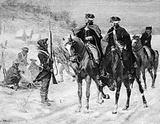
The Marquis de Lafayette and Gen. George Washington, with whom he had a father-son relationship, at Valley Forge. From John Ward Dunsmore painting, 1909.From John Ward Dunsmore painting, 1909
This push-and-pull between myth and reality — between what the United States aspires to, and what it actually is — is embodied in the legendary status of Valley Forge in the American psyche.
It’s a tension that, a new book argues, undergirds a current crisis in American masculinity.
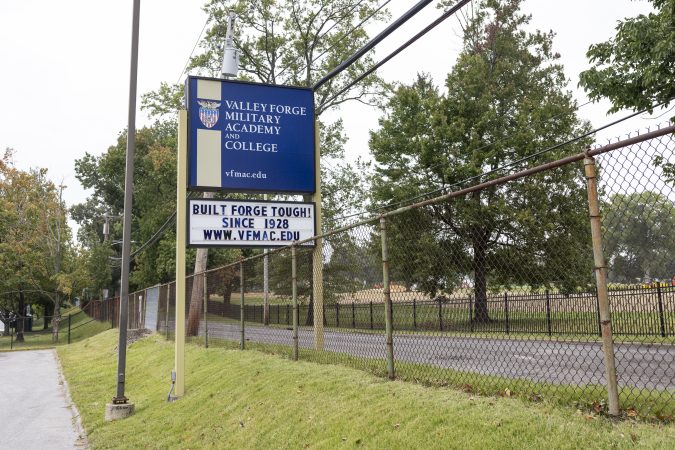
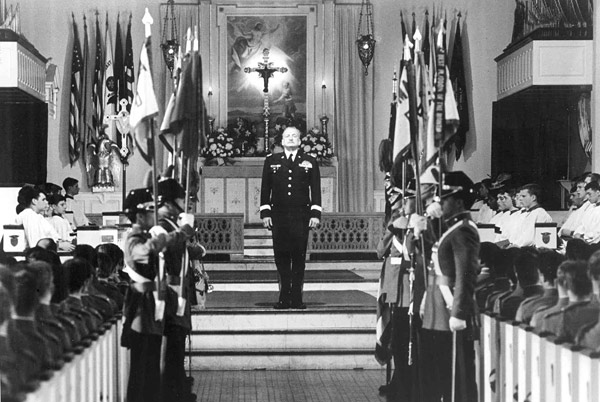
Established in 1928 by a U.S. Armed Forces lieutenant general named Milton G. Baker, Valley Forge Military Academy (VFMA) in Wayne, Pa., promised parents: “Send us your boy and we will return to you a man.”Jasper Craven
The George Washington school of American masculinity
Journalist and author Jasper Craven argues that the figure of the American male, for better and worse, owes a lot to Washington. Or, at least, to the idea of him championing his country’s freedoms against all odds.
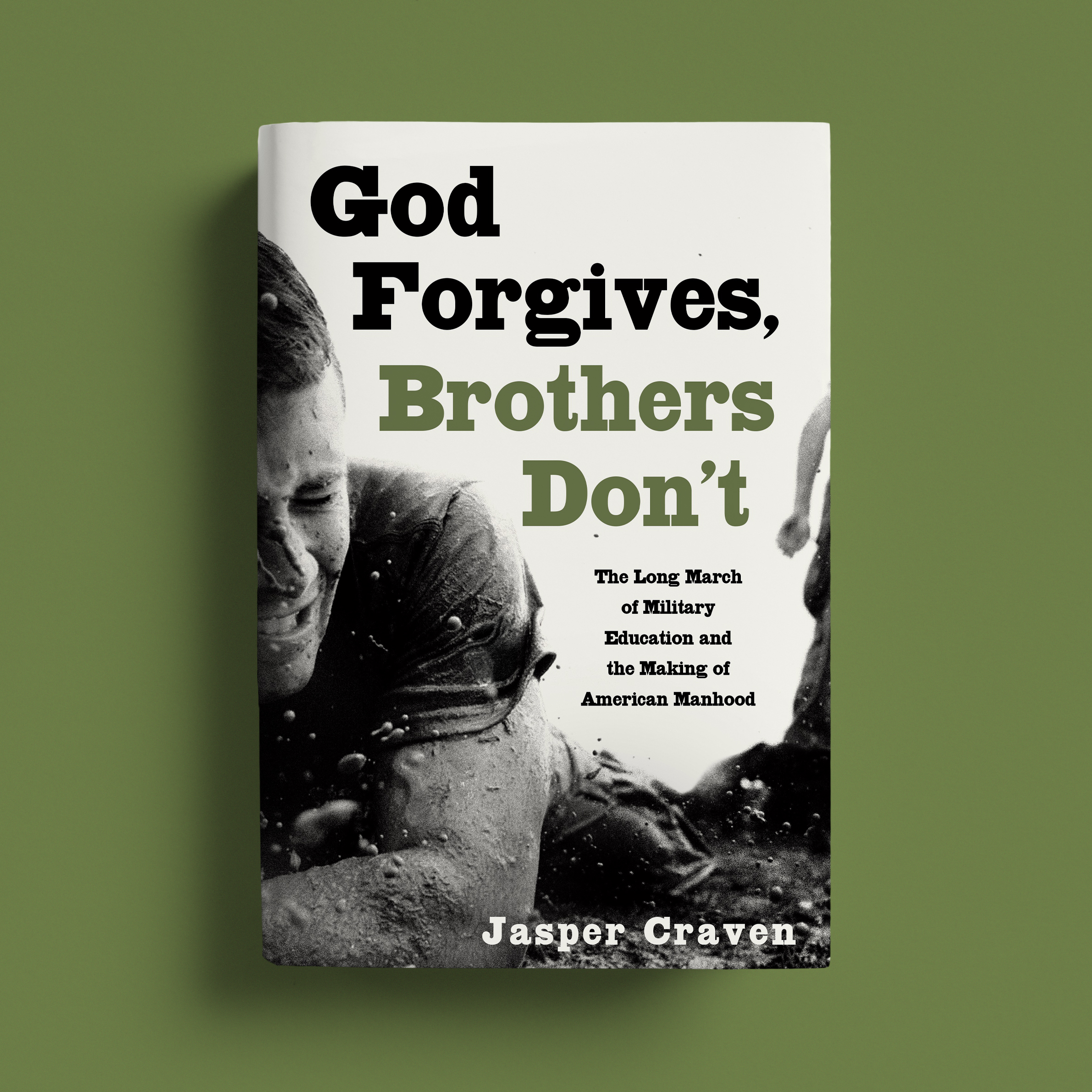
In his new book-length history of American militarized machismo, God Forgives, Brothers Don’t, Craven locates a tension in Washington that proves foundational.
“Washington made efforts to establish himself as a man who was stronger, mightier, braver than he actually was,” Craven said. “[He] captured the American imagination, and was an early, influential archetype on young boys.”
So it followed that generations of boys would attempt to embody a Washingtonian archetype — resilient, brave, dignified — near the site of that mythic winter encampment at the Valley Forge Military Academy (VFMA) in Wayne. Established in 1928 by a U.S. Armed Forces lieutenant general named Milton G. Baker, Valley Forge promised parents: “Send us your boy and we will return to you a man.”
Author Jasper Craven’s new book-length history of American militarized machismo, “God Forgives, Brothers Don’t” is a look into the fraught history and ominous future of military education in the USA, per its summaryCourtesy of Atria/One Signal Publishers
Craven’s book argues that it was at schools like Valley Forge that the modern idea of the American male was made.
“These military schools represent an extended, expanded, more pedagogical version of boot camp,” he says. “You arrive a young boy, a little bit reckless. Maybe you’re a bully. But very quickly, everyone is stripped of their identities, given matching uniforms, see their heads shaved, and are put into a very grueling hierarchy.”
On paper, this pedagogical vision mirrors America’s notion of meritocracy: Everyone starts at zero, and scrambles for rank, and prestige, among the militarized hierarchy. Ribbons and bows are awarded to the most industrious scramblers.
But, as Craven’s book reveals, that ostensibly fair model of achievement can be riven with dehumanization, corruption, and systemic emotional, physical, and sexual abuse. Even the nickname “The Forge” has a double resonance — suggesting both hammering something out in fire, and total fakery.
Established in 1928 by a U.S. Armed Forces lieutenant general named Milton G. Baker, Valley Forge Military Academy in Wayne, Pa., promised parents: “Send us your boy and we will return to you a man.”Jasper Craven
A history of abuse
As Craven notes in his book: “Between 2015 and 2020, the Forge logged more than 30 incidents of alleged sexual misconduct, from stalking and fondling to rape, as well as fistfights, assault with a knife, even arson.” Cadets as young as 13 were driven to suicidal behavior.
Craven played a key role in exposing these incidents.
God Forgives, Brothers Don’t grew out of his 2022 reporting for Mother Jonesmagazine, which cast a piercing light on the school’s hallowed halls. His reporting captured not only the violence visited upon “plebes” (military slang for first year cadets) by upperclassmen, but the equally endemic corruption of the school’s administrators, who pocketed hefty tuition fees while essentially operating what one graduate called, “a sleepaway camp for troubled kids with very little supervision … more Lord of the Flies than The Catcher in the Rye.”
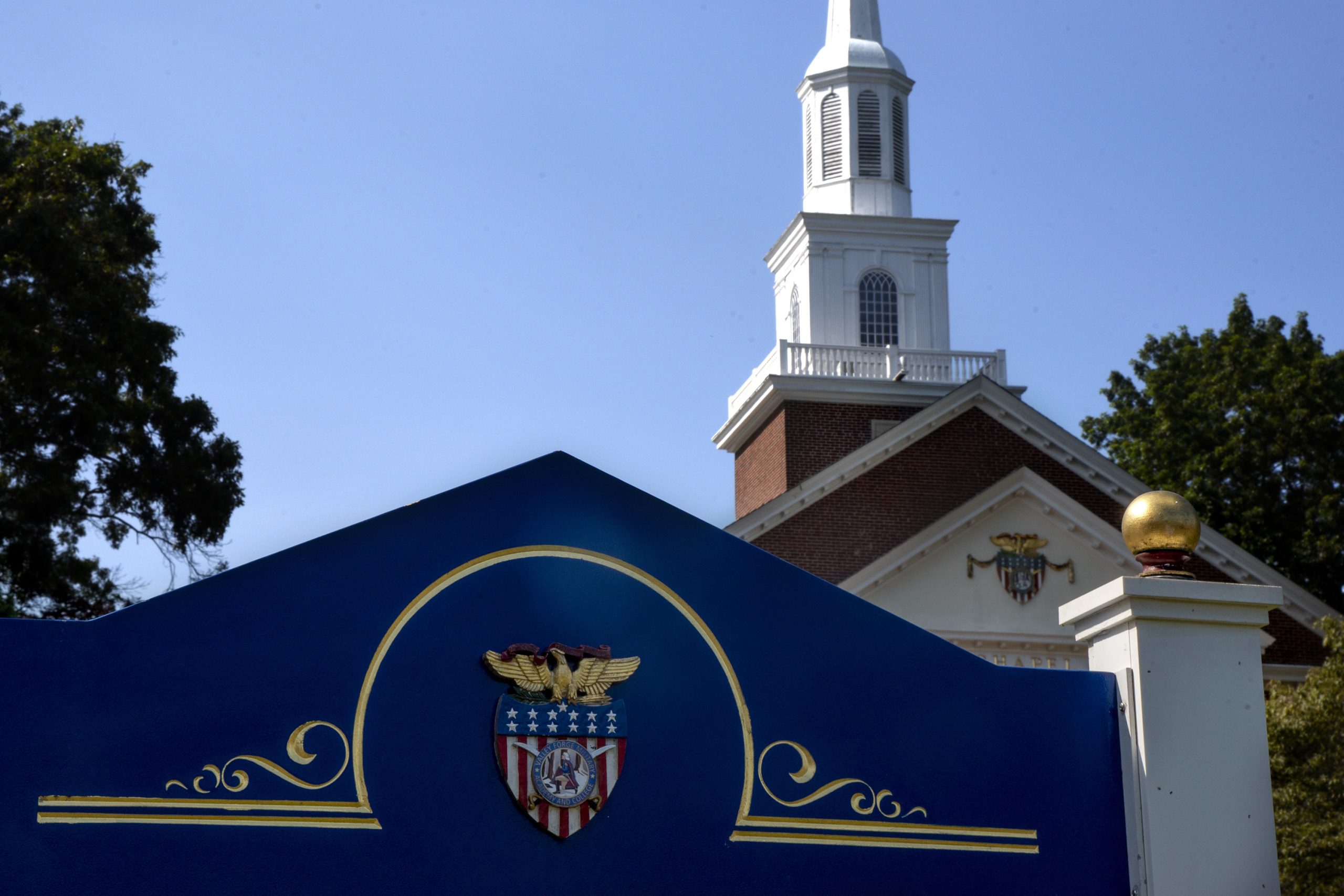
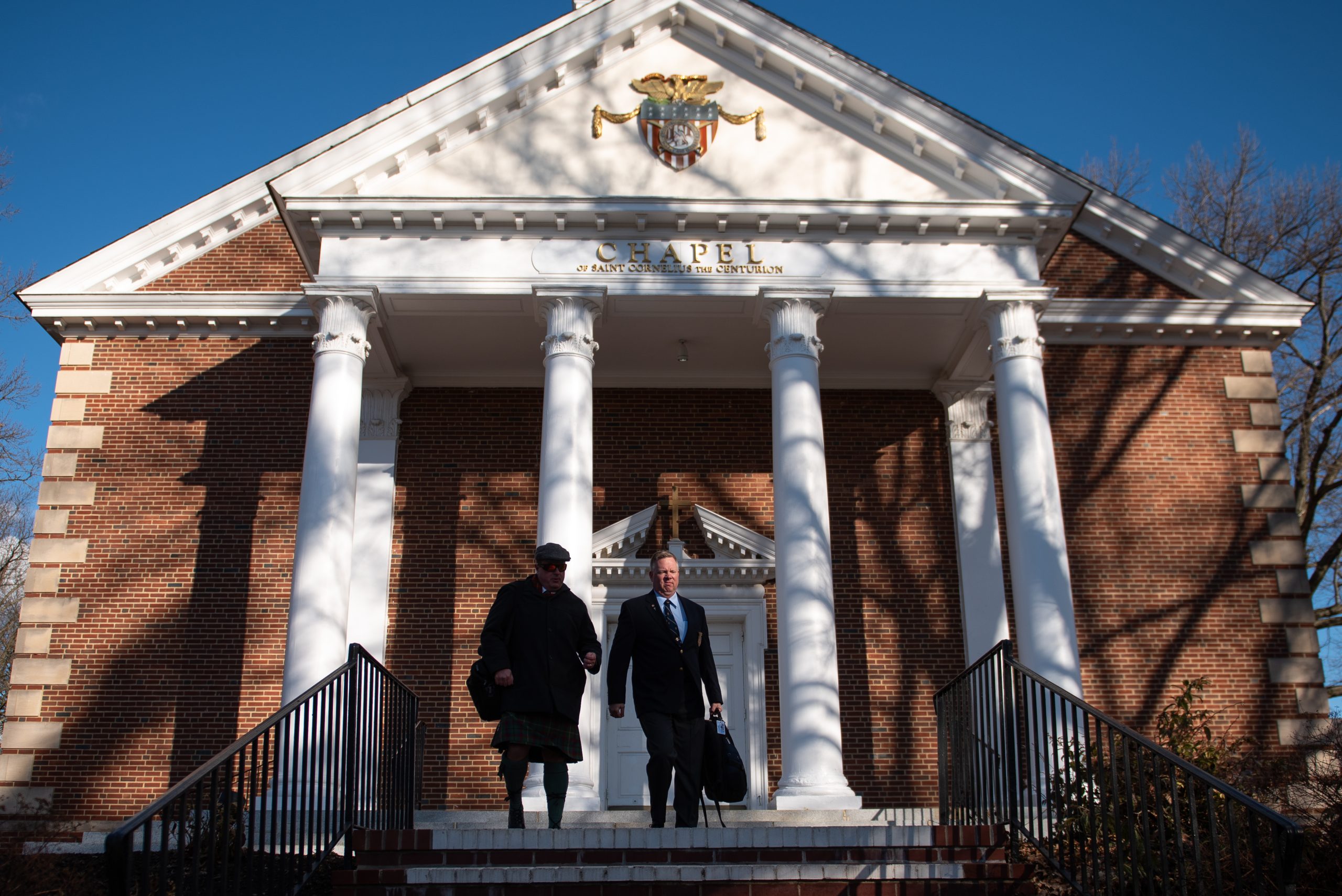
The Chapel of St. Cornelius the Centurion at Valley Forge Military Academy & College in Wayne is photographed July 21, 2020.TOM GRALISH / Staff Photographer
(Speaking of Catcher in the Rye: Author J.D. Salinger is among the Forge’s more notable graduates, and Craven traces the author’s conflicted relationship with the school, and its disciplinary culture, as a major influence on his fiction.)
In 2025, the VFMA announced its closure; the May 2026 graduating class was its last. The neighboring Valley Forge Military College, a private military junior college, remains operational, having separated from the larger Academy in 2023, amid ongoing scandal.
More than a deeply researched and utterly harrowing inquest into how the American military turns boys into men, Craven’s book doubles as a critique of American masculinity itself: its valorization of violence, its codes of silence, its curated pathologies of aggression and shame.
“While we have not read the book and therefore cannot comment on its specific arguments, we generally disagree with the author’s perspective on military schools,” the Valley Forge Military Academy Foundation said in a statement. “We believe military schools can have a profoundly positive and transformative impact on students by providing structure, discipline, leadership development, and a strong sense of purpose.”
George C. Scott faces rebellious cadets in “Taps,” much of which was shot at Valley Forge Military Academy in 1981. After previewing the film, the academy repudiated it and nixed plans to host a premiere.
It’s a dismal vision of chauvinist mock-virility that endures, culturally, Craven said, in everything from the prevalence of Punisher skull T-shirts and bumper stickers, to the vacant bellicosity of President Donald Trump (himself a military school alum who eventually avoided the Vietnam War draft), and the self-styled posturing of Pete Hegseth as “Secretary of War.”
A workable alternative
“Military schools across the country, including ours, have long lists of distinguished alumni who have gone on to achieve great success, many of whom credit their time at these institutions with helping shape their character, leadership, and future direction,” reads the VMAF statement.
But in the course of his reporting, Craven was disillusioned of any idea that militarized men embody any sort of ideal.
“The best evidence of my book’s thesis,” he said, “is that all these dudes who claim they’re the most macho and militaristic people around are all so jumpy, so self-conscious, and so uncomfortable with themselves.”
“They are so clearly not happy with this identity they’ve constructed,” he said, “and yet are desperate to reinforce all the time.”
Asked if there are any workable alternatives for this conception of the American man, Craven (who is a civilian) draws from a nonmythical figure in his own life: his father, the American activist and filmmaker Jay Craven.
Valley Forge Military Academy alums pass in front of the school’s chapel on their way to a board of trustees meeting held at the Wayne, Pa. campus on Saturday, March 16, 2019. Kriston Jae Bethel / For The InquirerKRISTON JAE BETHEL / For the Inquirer
“My dad grew up in Pottstown, Pa., and almost went to Valley Forge, before finding a Quaker school and becoming involved in the anti-war movement,” he said. “There was a moment in America where the peacenik was the prevailing masculine pinnacle. He has his own ‘war stories.’ He was followed by the feds. He was imprisoned. He was beat up. He’s got some scars, which is cool. He even dated Jane Fonda for a bit.”
In tribute — and, perhaps, in aspiration for the future of the American male — God Forgives, Brothers Don’t is dedicated, “To my dad, who taught me how to wage peace.”
When Ariel and Simon Censor opened their tiny used bookshop — Little Yenta Books — in the back of a South Philly children’s dressmaking shop in February, they knew it was an unconventional setup.
What the couple — in life and now books — could not know is just how fast they would outgrow the space.
And although they’re relinquishing the unofficial appellation as Philadelphia’s tiniest used book shop, the pair has moved their impressive literary thicket from their 150-square-foot loft space into a full-sized rented storefront on Passyunk Avenue.
The problem was a great one: Business is booming.
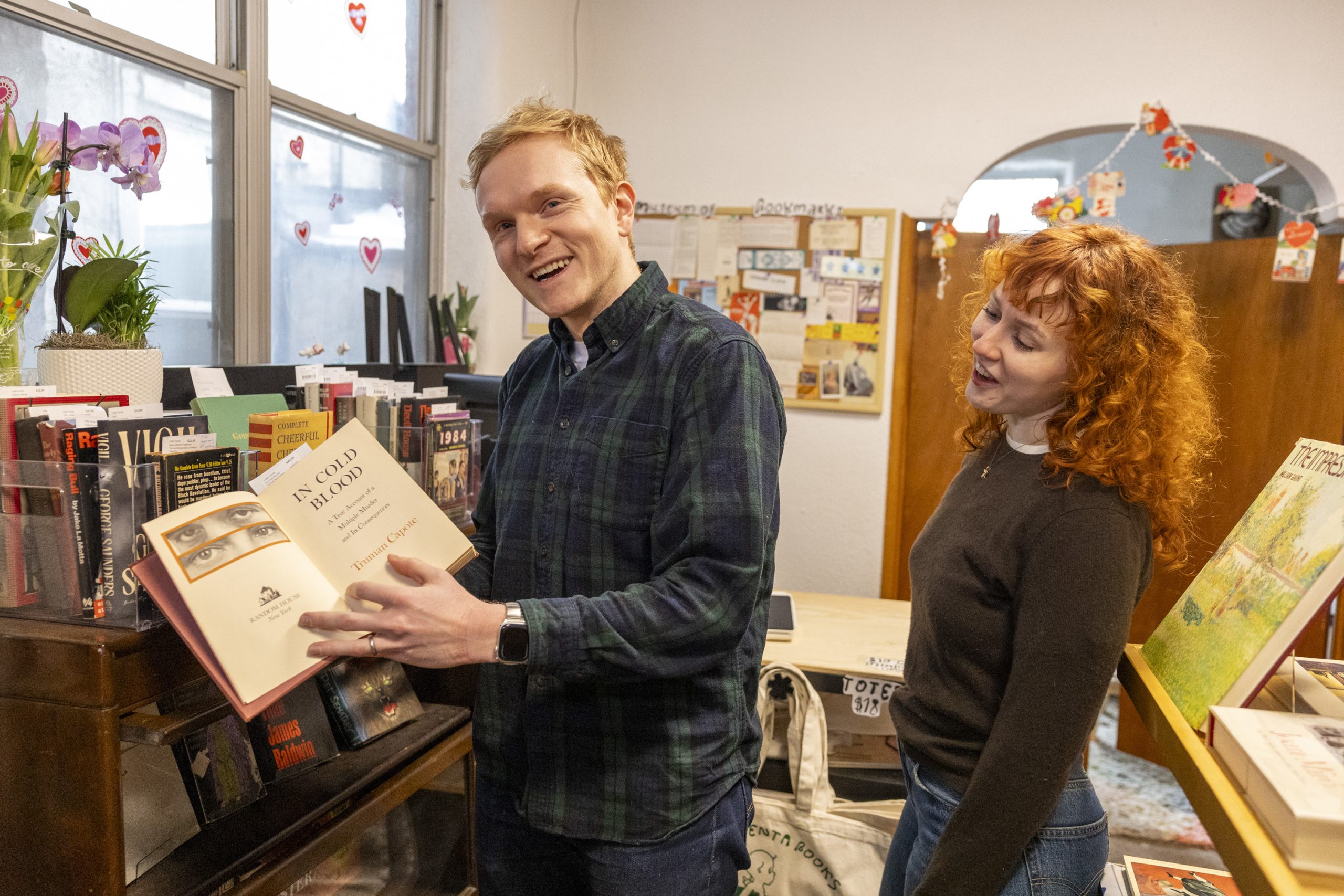
“People were telling us that they would walk by because it was way too crowded and they couldn’t fit,” said Ariel Censor, sitting behind the counter of the new shop, located at 1912 E. Passyunk Ave., home of the former Civil Stock General Store, which closed earlier this year. “We also just ran out of shelf space. We had way more books than we could fit.”
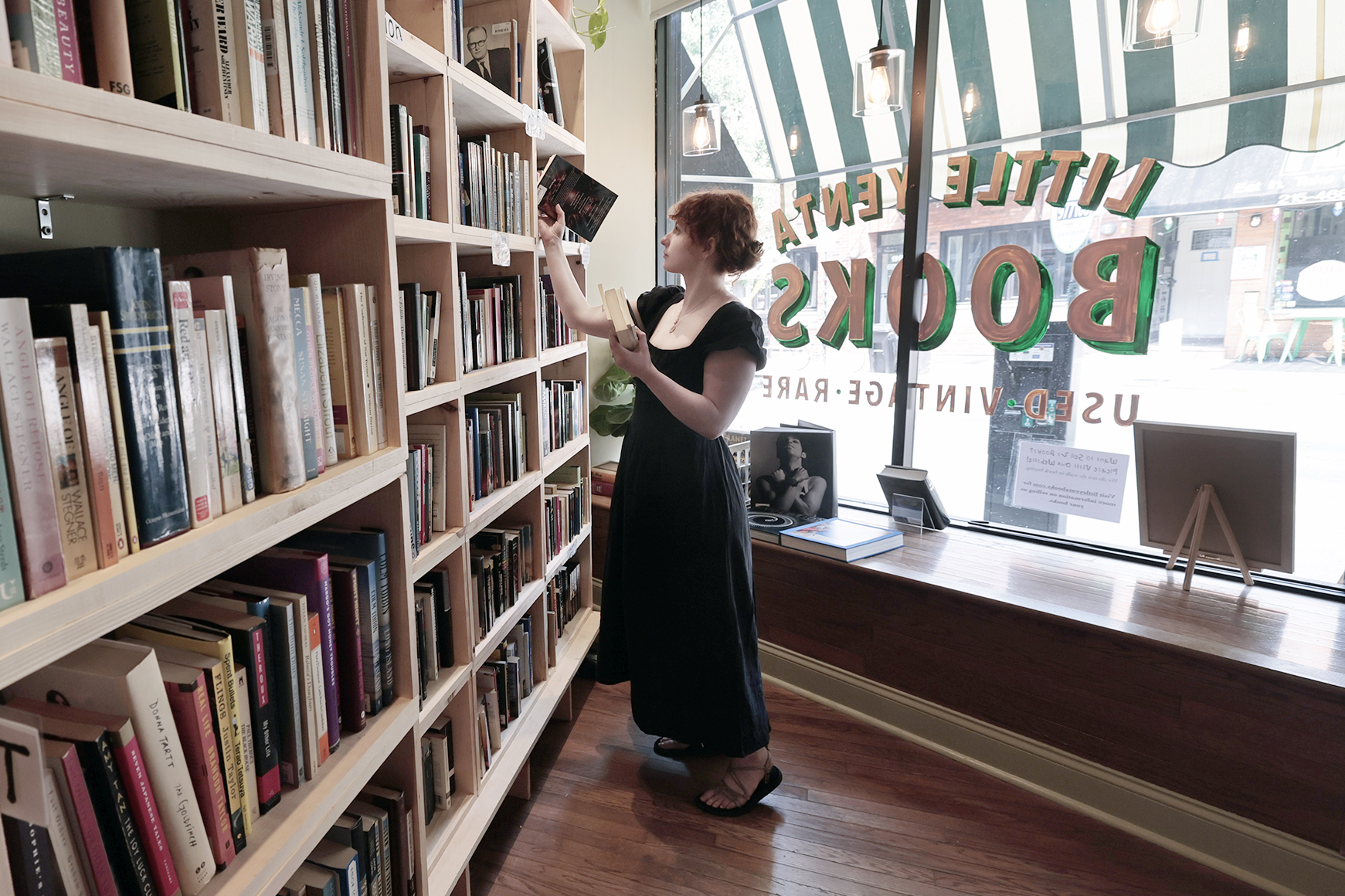
Little Yenta Books co-owner Ariel Censor stocks the shelves with books at the new shop on East Passyunk Avenue in Philadelphia on Friday, July 17, 2026.Elizabeth Robertson / Staff Photographer
The popular used bookstore — the only one along Passyunk — has nearly tripled its titles in the new storefront, which they opened last month. That means a whole lot more of the popular and literary fiction, classics, vintage sci-fi, poetry, and rare books customers have been buying up.
“People really complimented our curation,” Censor, 27, said of the shop’s success. “People thought our taste was good, and our prices were good, and that they are really happy to have us.”
The couple — Haverford College grads who live in the neighborhood — opened their initial tiny shop as a passion project, after holding used book pop-ups in South Philly bars.
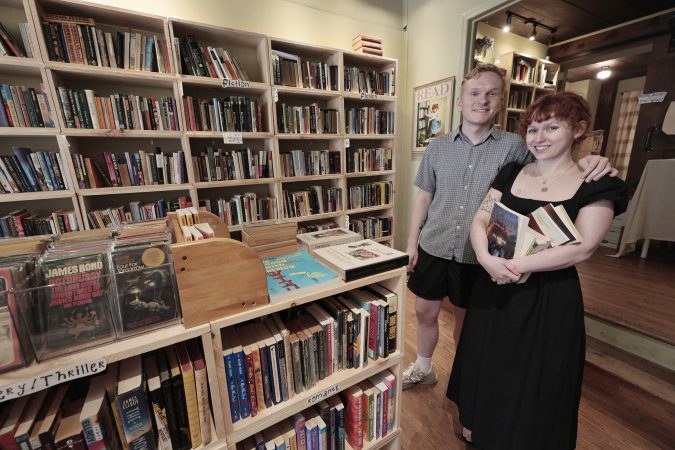
Simon Censor, of Providence R.I., and Ariel Censor, of New York City, opened Little Yenta Books, in East Passyunk in February. They have now moved into a larger space nearby.Tyger Williams / Staff Photographer
Situated speakeasy-style, in a postage-stamp-sized loft above the Painted Lady children’s boutique, the shop burst with over 1,500 titles.
Now, with its green-and-white striped awning, stained-glass light fixture, and charming decor, the new shop has a spacious, homey feel.
“One thing we got with the little shop is that people really liked that it wasn’t overwhelming,” said Censor. “They could look at every book. We have tripled the amount of books but wanted to make it feel manageable and still have a real eye to curation. I’m really excited about the mix of modern and classics that we have.”
The expanded shop comes with expanded hours, with Little Yenta Books now open every day except Tuesday and Wednesday.
On a recent afternoon, Aine McCauley, 24, dropped in at the new shop on her way home from work. She perused the shelves before landing on a copy of André Aciman’s 2008 coming-of-age novel, Call Me by Your Name.
“It’s so awesome,” she told Censor about the shop. “You have every good book in here.”
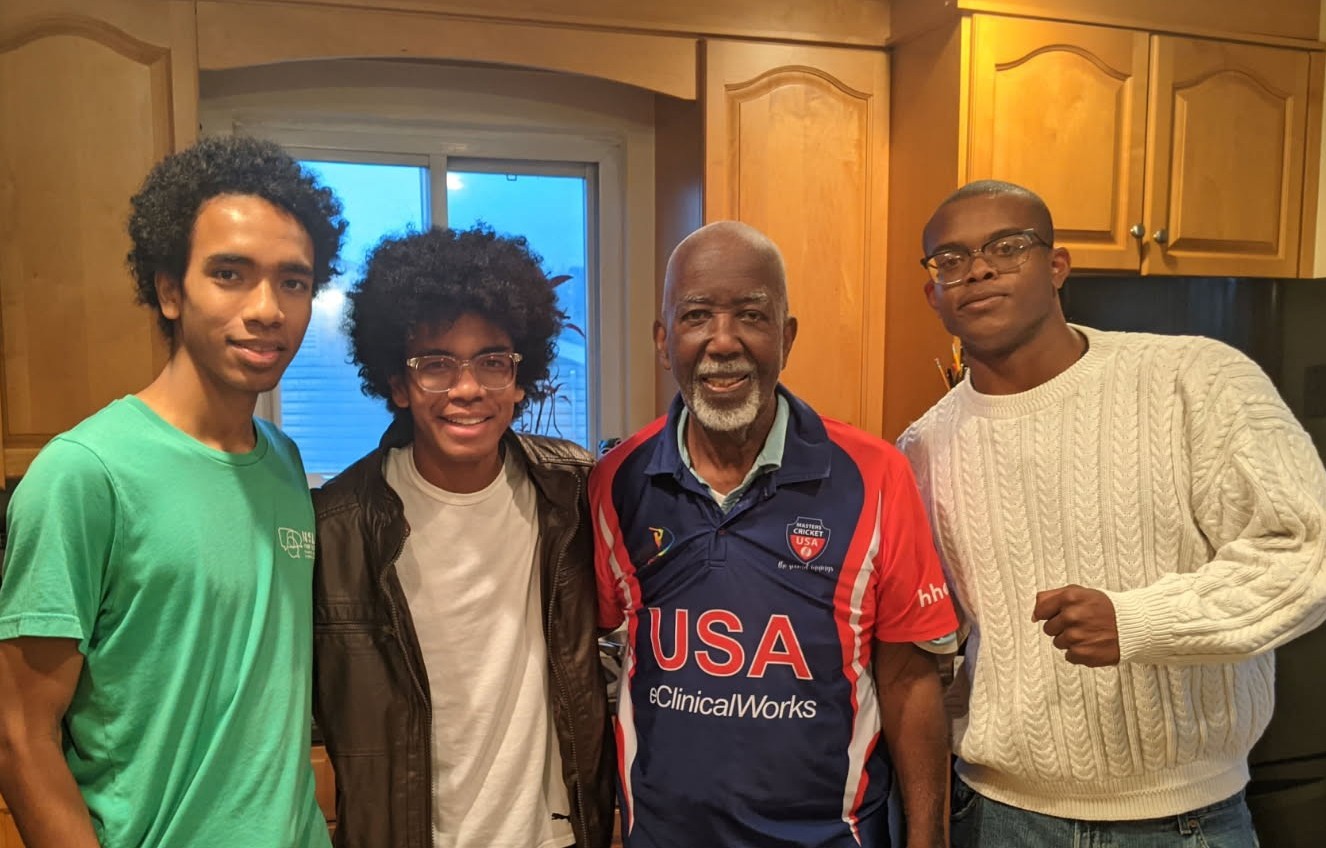
Ewart Rouse, 85, of Lawnside, retired award-winning reporter and editor for The Inquirer, author, journalism adjunct professor, mentor, immigrant advocate, and indomitable cricketer, died Thursday, July 2, of age-associated decline at the Samaritan Center at Voorhees.
Born in Trinidad, West Indies, Mr. Rouse immigrated to New York in 1969 and joined The Inquirer in 1974. For nearly 30 years, until he retired in 2002, Mr. Rouse was an award-winning business and news reporter, suburban editor, and mentor to hundreds of young journalists.
He won a 1980 Keystone Award for a news series on city taxi service and was recognized for another series on street gang homicides involving Black youth. Later, he wrote business columns and covered South Jersey news.
He opened a 1975 story about former President Gerald Ford’s first visit to Philadelphia with: “The old man sat alone and dejectedly with his flags against the wall of the Philadelphia National Bank building at 5th and Market Streets. ‘Not one,’ he muttered. ‘I haven’t sold not one flag today.’”
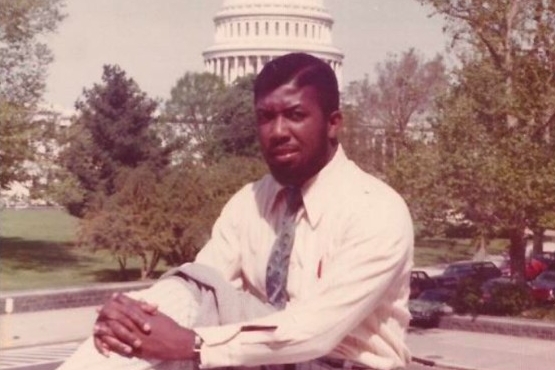
Mr. Rouse worked for the Associated Press in Washington DC.Courtesy of the family
Before The Inquirer, Mr. Rouse was a news and political reporter for the Associated Press in Newark, N.J., Atlantic City, and Washington, D.C. “He was a popular colleague who contributed importantly to the paper’s growth,” Gene Foreman, retired managing editor at The Inquirer, said on Facebook.
Other former Inquirer colleagues called Mr. Rouse “professional and gracious,” “careful and respectful,” and “kind and generous.” Retired Inquirer editor Lil Swanson said on Facebook: “Ewart was filled with wisdom and grace. When he was an editor, young writers flocked to him because he always made their stories better and helped them grow.”
He covered courts and politics for the Trinidad Guardian in Port-of-Spain before leaving for New York, and interviewed Trinidad Nobel laureate V.S. Naipaul for the 1997 book Conversations with V.S. Naipaul. In Philadelphia and South Jersey, he taught news writing, business writing, and investigative journalism at Temple, Rutgers, and Arcadia Universities.
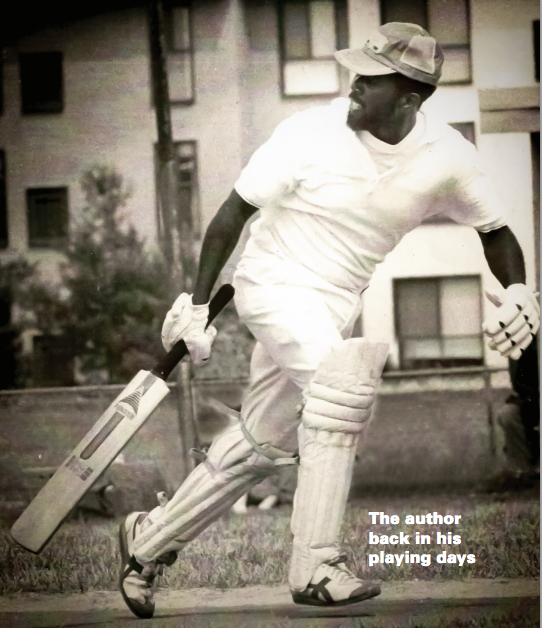
Mr. Rouse loved to play, watch, and write about cricket.Ewart Rouse
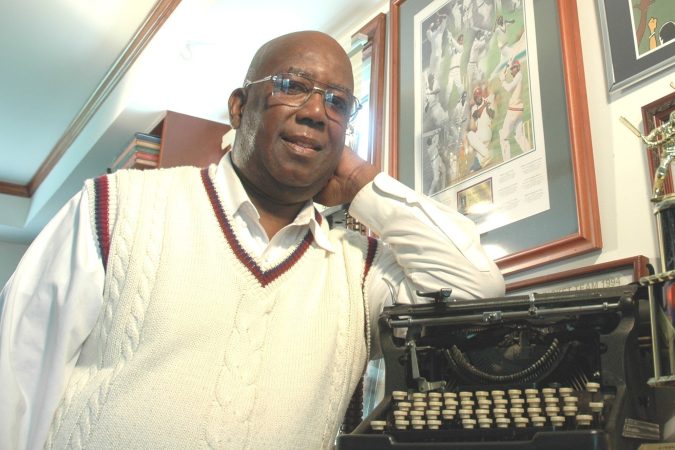
Readers called his books “highly entertaining” and “a wonderful addition to cricket literature” in reviews. His daughter Karen said: “The clackety-clack (zing!) of his typewriter was a constant in our home.”
Mr. Rouse played cricket in Trinidad and later in South Jersey, and he cofounded the Philadelphia Cricket League, the New Jersey Cricket Association, and the Echelon Cricket Club. He played the game, managed teams, and became one of the region’s greatest advocates for cricket and its immigrant players.
In 2013, he earned a lifetime achievement award from the South Jersey Caribbean Cultural and Development Organization, and recognition from then-Camden Mayor Dana Redd for his contributions to the community as a journalist, teacher, and cricket activist. “It truly was an honor to be recognized by my own community,” he said on his website, ewartrouse.com.
In a 2016 online interview, Mr. Rouse was asked to advise young writers. “Read anything you get your hands on,” he said, “From books and newspapers … to labels on paint. Each contains nuggets of information that the mind will retrieve for just the right spot in your next project.”
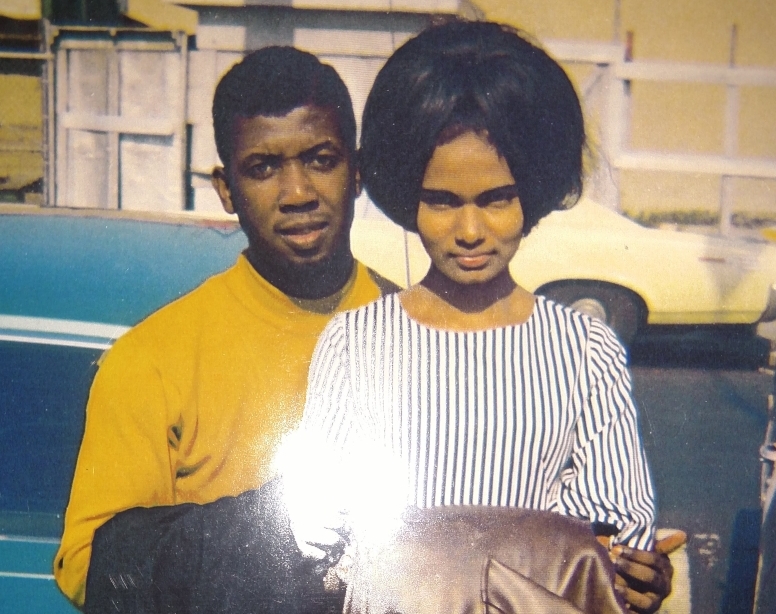
Mr. Rouse and his wife, Vanda, met in Trinidad.Courtesy of the family
Ewart Rigsby Rouse was born Sept. 16, 1940, in Tunapuna, Trinidad. He was an avid reader and creative writer as a boy, and noticed one day that several of his favorite writers — Charles Dickens, John Steinbeck, and Ernest Hemingway — started out as newspaper reporters.
“And now I wanted to be a journalist like them,” he said in a short self-published autobiography.
He met his wife, Vanda, in Trinidad, and they married and had daughters Joann, Karen, and Kristin. They lived in New York, Pleasantville, N.J., and Washington, and settled in Lawnside in the 1970s.
Mr. Rouse was active with the C.C. Morris Cricket Library Association, the South Jersey Writers’ Group, and the Rainy Tuesday Writers Group. He was an avid gardener and routinely gave away bags of home-grown tomatoes to friends and neighbors.
Mr. Rouse enjoyed time with his grandsons. Courtesy of the family
He collected records, listened to Nat King Cole and Frank Sinatra, followed the 76ers, and grilled outdoors as often as possible. He took his family on memorable trips to Trinidad that “opened up a world to us that was accessible, one that we could dare to explore,” said his daughter Karen.
In 2016, Mr. Rouse told aspiring writers: “Who knows, maybe you end up with a bestseller. Some might call you a dreamer. But, hey, as the saying goes, you can’t have a dream come [true] if you don’t have a dream.”
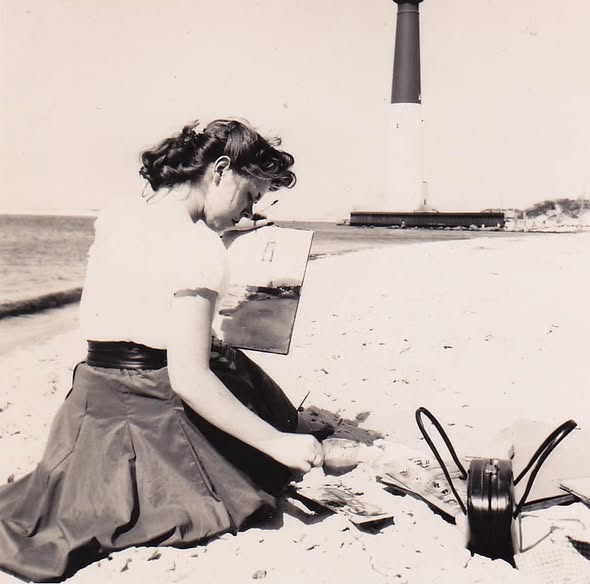
Kathy M. Winter, 91, formerly of Philadelphia, lifelong artist, art and grade school teacher, author, and former council president at Our Mother of Consolation Parish in Chestnut Hill, died Tuesday, June 9, of complications from pneumonia at Forbes Hospital in Monroeville, Pa.
Born in Philadelphia, Mrs. Winter studied art at the Pennsylvania Academy of the Fine Arts and earned a bachelor’s degree in fine arts at the University of Pennsylvania. She specialized in portraits, still life, and landscapes, and worked mostly in watercolors, pastels, oils, and acrylics.
She painted portraits of celebrated naval chaplain John F. Laboon and Chinatown icon T.T. Chang, and contributed to a collection called “Lost Dreams on Canvas” that featured portraits of innocent victims of violent crime in Philadelphia. “You get into a portrait like that,” Mrs. Winter told the Chestnut Hill Local in 2012, “and you’re into the person.”
She painted the statue of St. Gianna Beretta Molla for the Shrine of the Nativity of Our Lord in Warminster, and her painting of a restored statue of St. Gabriel for a church in New Orleans was featured in The Inquirer in 2007. She also designed stained glass windows for St. Bede the Venerable Church in Holland, Bucks County, and the chapel at Shore Memorial Hospital in Somers Point, N.J.
“The best thing,” Mrs. Winter told the Chestnut Hill Local in 2012, “is that you don’t have to retire from making art.” Courtesy of the family
Mrs. Winter studied Chinese brush painting with artist Phoebe Shih in Flourtown and showed her work at the Woodmere Art Gallery, the Conshohocken Art League, Daylesford Abbey, the Lutheran Theological Seminary, the Knickerbocker Exhibition in New York, and elsewhere. She also taught art classes at the Abington and Main Line Art Centers, the Conshohocken Art League, Our Mother of Consolation School, and elsewhere.
“The best thing,” she told the Local in 2012, “is that you don’t have to retire from making art.”
She met her husband, sculptor Joseph Winter, at the Pennsylvania Academy of the Fine Arts in 1953, and they opened Winter Art Studio in their Chestnut Hill home in 1983. For several commissions, he created the sculpture, and she painted it.
“Since Joe was a sculptor and I’m a painter, we complemented each other very well,” Mrs. Winter told the Chestnut Hill Local in 2021. “If we had both been painters or both been sculptors, it would not have worked out so well. There would have been too much competition.”
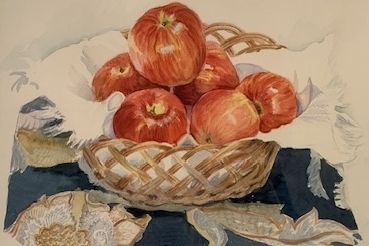
Mrs. Winter painted fruit and flowers.Courtesy of the family
In 2021, she self-published a 48-page children’s book called How the Bears Got to the Park.It features illustrations by her husband, and the plot she wrote is based on his award-winning 1966 sculpture Family of Bears that is displayed at Three Bears Park at Third and Delancey Streets in Society Hill.
Mrs. Winter was a longtime member and onetime council president at Our Mother of Consolation Parish. She and her husband moved to Chestnut Hill from Southwest Philadelphia in 1962 so their children could attend the parish school, and she taught all subjects to third and fourth graders for a few years.
Parish members scheduled Mass intentions to honor her on June 28, July 5, and July 10. “She was very determined,” her daughter Genienne Navarro said. “She never let anything stand in her way and would move mountains to get something done.”
Kathleen Marie McKenna was born April 21, 1935. Her family moved to Virginia when she was young and returned to Philadelphia a few years later, and she graduated from West Philadelphia Catholic High School for Girls.
Mrs. Winter and her husband, Joe, married in 1956. Courtesy of the family
A perceptive nun recognized her artistic skills in high school and arranged for an admission interview with officials at the Pennsylvania Academy of the Fine Arts. She received a full scholarship, met her husband there, and they married in 1956 and had daughters Kathy and Genienne and a son, Joseph.
Her husband died in 2020, and she moved to the Pittsburgh area a few years ago to be close to family. Mrs. Winter kept in touch with former classmates at the Pennsylvania Academy of the Fine Arts for years and took additional art classes later at Temple University and Chestnut Hill College.
She played piano, doted on her family, and survived cancer in the 1970s. A longtime friend called her a “true, loving, nourishing, protective, guiding, steadfast Blessed Mother to me.”
Her family said in a tribute: “She will be remembered for her friendship, spiritual support, listening ear, humor, deep caring, generosity, and undaunted optimism.”
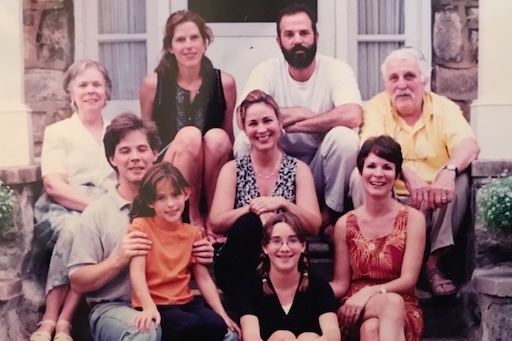
Mrs. Winter (rear left) enjoyed time with her family.Courtesy of the family
Her daughter Genienne said: “Her favorite saying was, ‘Nothing is impossible with God.’”
In addition to her children, Mrs. Winter is survived by six grandchildren, three great-grandchildren, and other relatives. A sister died earlier.
A memorial service is to be at 11 a.m. Saturday, Sept. 19, at Our Mother of Consolation Church, 9 E. Chestnut Hill Ave., Philadelphia, Pa. 19118.
Donations in her name may be made to Our Mother of Consolation Church and School, 9 E. Chestnut Hill Ave., Philadelphia, Pa. 19118.
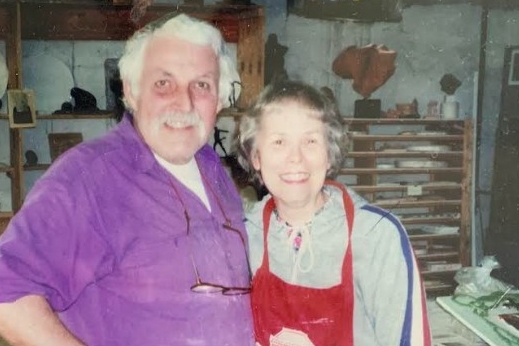
Mrs. Winter and her husband, Joe, pose in their Chestnut Hill home studio. Courtesy of the familyMrs. Winter was an expert in designing stained glass. Courtesy of the family
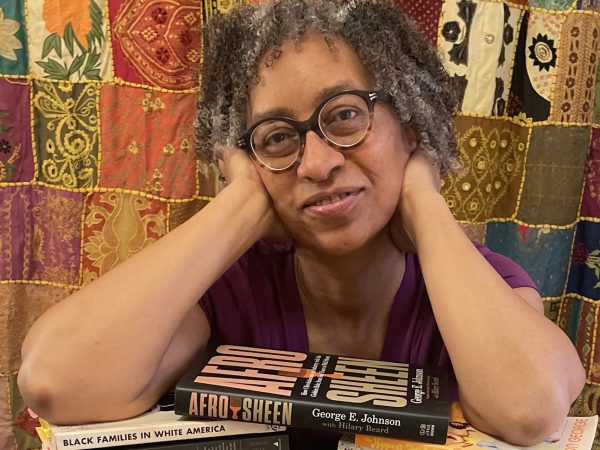
Like many Black children growing up in the ‘70s and ‘80s, Mount Airy author Hilary Beard had fond memories of Afros and Soul Train dancers.
“I was a little Black girl with braids who sat between my mother’s knees every day as she combed my hair and oiled my scalp with Ultra Sheen,” Beard recalled in a recent video chat. “When I was in the seventh grade and cut my hair into an Afro, I used Afro Sheen. I grew up watching Soul Train. I lived in a world created by this man.”
It wasn’t until 40 years later that she realized these hallmarks of Black culture had a common author, George E. Johnson, the father of modern Black hair care.
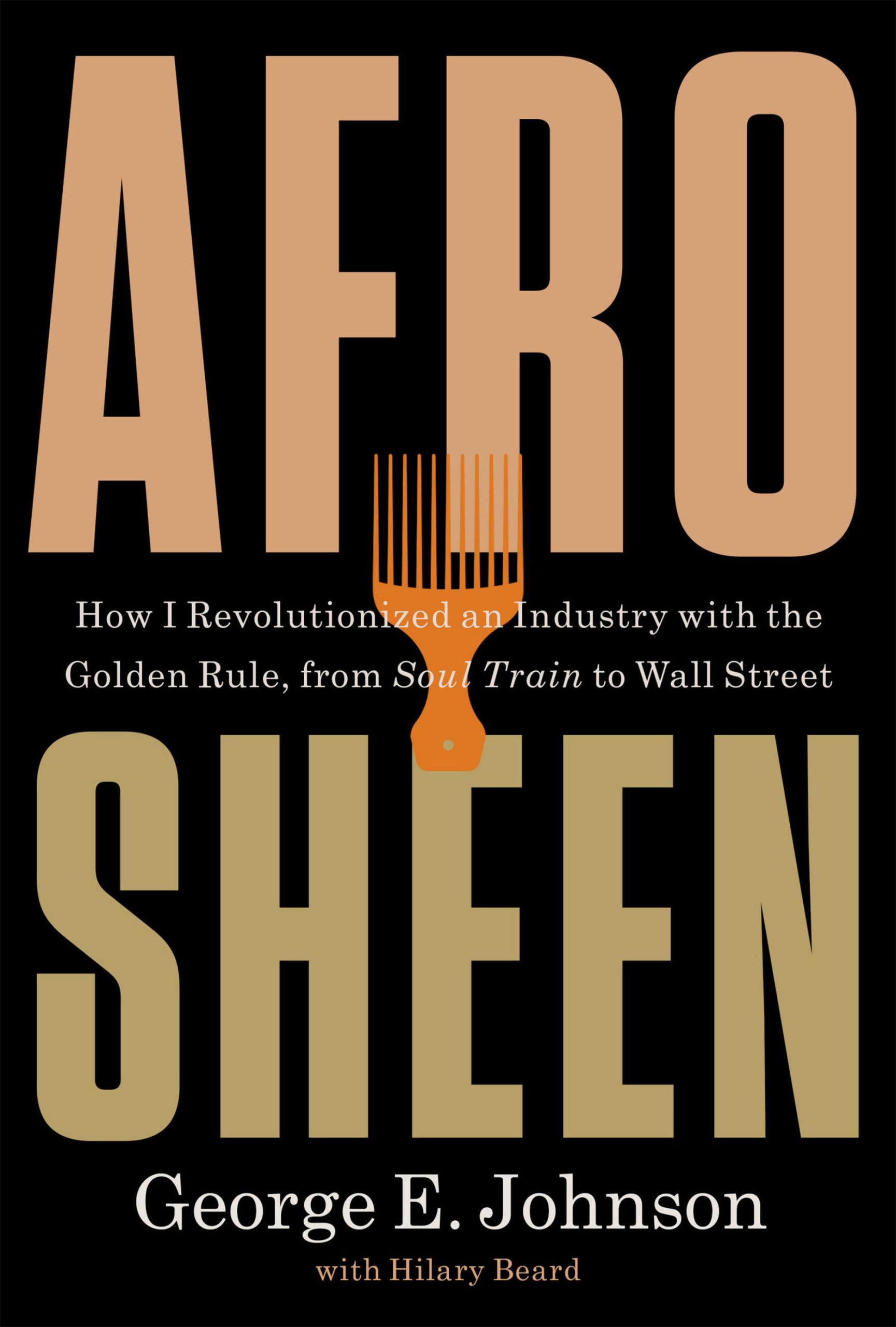
Three years ago, Beard teamed up with a then 94-year-old Johnson to cowrite his memoir. She combined her warm memories of plaits, kinky blowouts, Black power picks, and the Soul Train Line with more than 2,000 pages of interviews to write Afro Sheen: How I Revolutionized an Industry with the Golden Rule, from Soul Train to Wall Street,a 320-page story of entrepreneurship, civil rights, and Black culture, spanning nearly a century.
“Mr. Johnson’s story sweeps through the Cotton South, the Great Migration, the Jim Crow North, the Jim Crow South, World War II, and the civil rights of the 1950s and 1960s,” Beard said. “And it’s told through the perspective of an African American man. We know many of these stories have not been told, they have also been actively suppressed.”
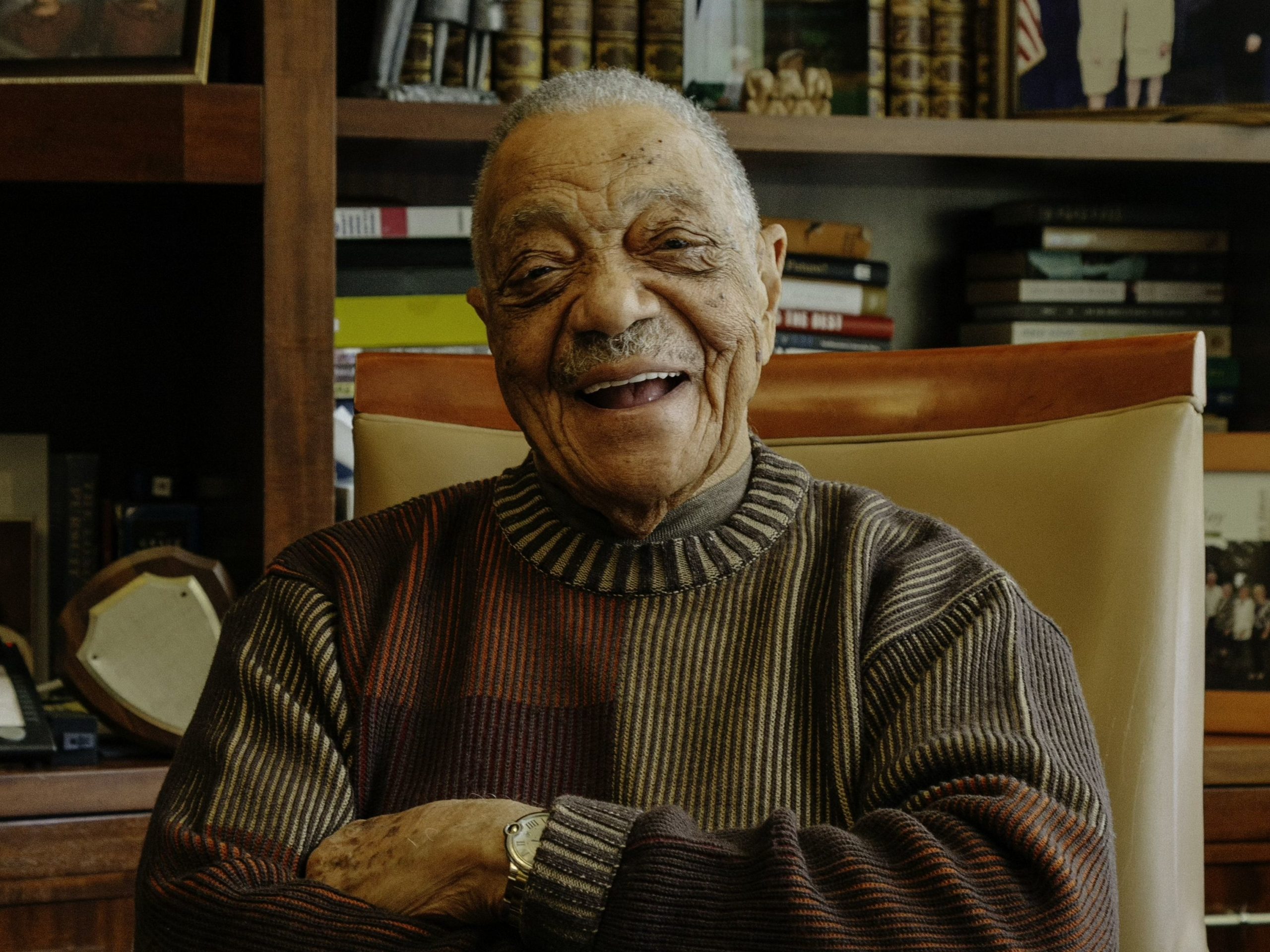
George Johnson, founder of Afro Sheen, in his Chicago study. Johnson is the founder of the first Black company to go public. He also funded the early episodes of Soul Train, for which the Sound of Philadelphia, Gamble & Huff, wrote the soundtrack.George Johnson
Johnson’s story begins in 1927 Richton, Miss., on a small sharecropping farm. His mother, Priscilla, left his father in 1929, and moved Johnson and his two brothers to Chicago’s South Side. In his early 20s, he worked as a production chemist at the Black-owned cosmetics company Fuller Products, owned by S.B. Fuller, the richest Black man in America at the time.
In the early to mid-20th century, many Black people’s grooming habits included straightening their hair to assimilate, often affording them better jobs in mainstream America. The hair straightening concoctions — a mix of potatoes, lye, and eggs — separated, were messy to apply, and burned.
While working at Fuller Products, Johnson developed Ultra Wave Hair Culture, a creamy emulsified product barbers applied to clients’ hair, giving them the slicked back look popularized in the 1940s by Little Richard, Nat King Cole, and Sammy Davis Jr.
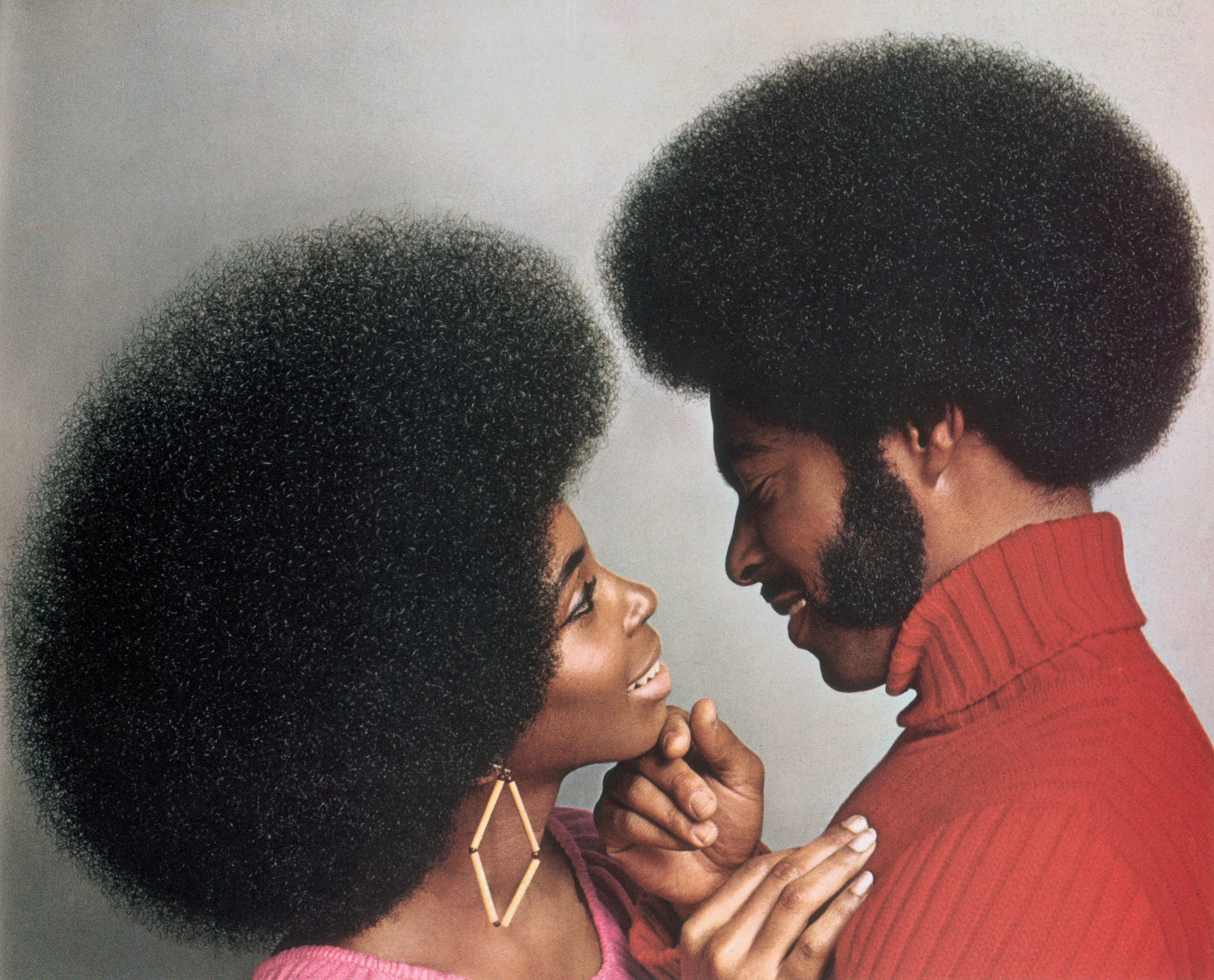
Ultra Wave Hair Culture marked Johnson Products Co.’s debut. In the next decade, JPC introduced Ultra Sheen Cream Satin Press, which hairdressers applied to Black women’s hair before pressing it straight with a hot comb; and Ultra Sheen Relaxer, a lye-based hair straightener for Black women. The “Black is Beautiful” movement birthed Afro Sheen, a spray that left Afros voluminous and glossy.
“A Natural Explosion! Afro Sheen® Blowout Creme Relaxer 1973/2007” from the series “Unbranded: Reflections in Black by Corporate America” by Hank Willis Thomas. MUST CREDIT: Rubell Museum
“The thing that moved my products forward was innovation,” said Johnson, who, at 97, still sounds like a salesman talking to potential customers. “We created something like a new mousetrap, it had never been done before.”
In 1971 — with sales of $12.1 million, or $94 million in today’s dollars — JPC became the first Black-owned company to be publicly traded on the American Stock Exchange, now known as the New York Stock Exchange. Although at the time it was a major achievement, Johnson said that with hindsight, he realized it was a big misstep as he was forced to answer to a board that didn’t understand the Black community.
Creating his lane
Johnson — not to be confused with John H. Johnson, founder of Ebony and Jet magazines — built his empire when banks did not loan money to Black startups, and groceries and drugstores did not stock Black hair care products, let alone place them on endcaps. Johnson remembers struggling to build his business when there were no federal laws to protect him from discrimination. He built his own manufacturing facility and created networks to distribute and advertise his products, and was among the first to sell Black hair care products in mainstream retail outlets.
To see companies like Target and Walmart — which up until recently had a stellar reputation of stocking Black hair care by Black-owned companies — cower under the Trump administration and roll back DEI initiatives is not only disheartening, but it also signals going back to a time when disenfranchisement of minority- and women-owned businesses was standard operating procedure. This reality, Beard says, makes Johnson’s story particularly timely, serving as a road map with young entrepreneurs of color.
“There is a widespread movement to make programs, books, and context that remind us of the bigotry in our nation’s history illegal,” Beard said. “Mr. Johnson is a witness to the overt racism many Americans would like to sweep under the rug. The irony is the very history they don’t want us to know is the reality they are attempting to create.”
JPC was among the first companies to advertise products to Black consumers using images of Black professionals — like doctors, lawyers, and teachers — instead of subservient characters like Aunt Jemima and Uncle Ben.
Johnson created Soul Train with Don Cornelius in 1971 so his advertising dollars could reach Black consumers directly. Soul Train — the hippest trip in America — was modeled after Dick Clark’s American Bandstand, and featured R&B acts, creating the community that bought Afro and Ultra Sheen products. In 1974, Kenny Gamble and Leon Huff wrote Soul Train’s iconic theme song, “T.S.O.P. — The Sound of Philadelphia,” performed by Philadelphia International Records’ The Three Degrees. Soul Train laid the cultural groundwork for MTV and Black Entertainment Television, and “T.S.O.P.” was the first TV theme song to reach No. 1 on the Billboard Hot 100. JPC’s profits nearly tripled to $37 million a year by 1975.
“That was tremendous growth,” Johnson said. “And in 1980, I gave Don my share with the stipulation he keep one minute of advertising time a show to JPC.”
Living history
Johnson never planned to write a book.
“I certainly wouldn’t have waited until I was 94 to do this,” he said. “But I had an epiphany, a real experience and I clearly heard five words, ‘You must tell your story.‘”
Afro Sheen: How I Revolutionized an Industry with the Golden Rule, from Soul Train to Wall Street by George E. Johnson, written with Mount Airy-based author, Hilary Beard.
Beard read 16 books about Black hair care culture and Chicago history. The two-year-long writing process became emotional, especially when Johnson recalled his infidelity and losing his first manufacturing facility to fire.
“When Mr. Johnson contacted me, I thought of the African proverb: when an elder dies, a library burns down,” Beard said. “So, I dropped everything to capture this piece of living history on the page.”