Category: Archive

  • Court halts execution of Christa Gail Pike for a Tennessee murder she committed at age 18

    Court halts execution of Christa Gail Pike for a Tennessee murder she committed at age 18

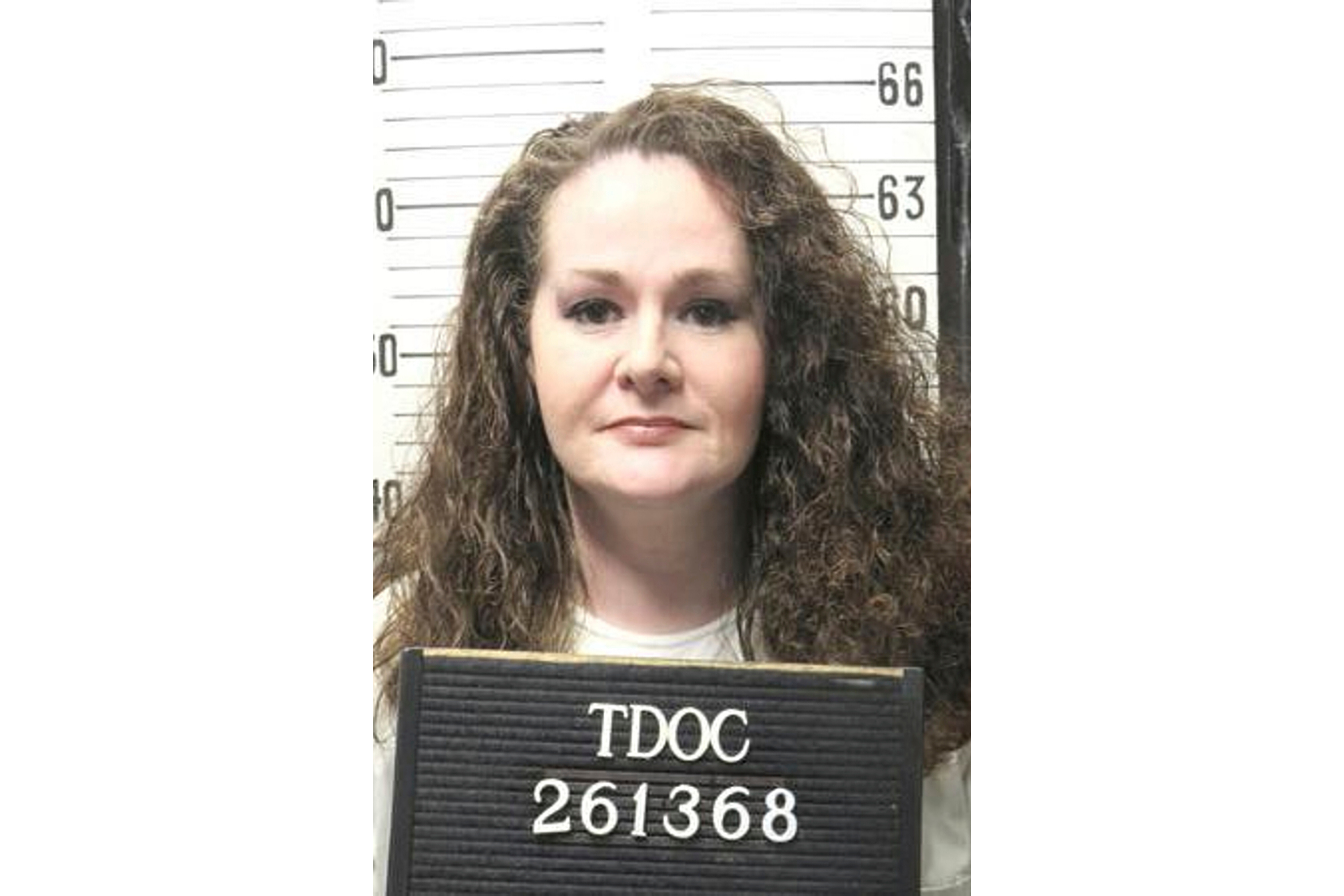
    NASHVILLE — The U.S. Supreme Court is allowing the execution of Christa Gail Pike to go forward in Tennessee, overturning a last-minute stay that was issued by an appeals court hours earlier Wednesday.

    Pike, 50, was scheduled to die by lethal injection in the morning, and witnesses had already gathered at the Riverbend Maximum Security Institution in Nashville when the 6th Circuit U.S. Court of Appeals voted 2-1 to issue a stay. That court said a delay was needed to consider whether Pike’s allegations of childhood sexual abuse were fully considered at her sentencing.

    The Supreme Court’s three liberal justices, Sonia Sotomayor, Elena Kagan, and Ketanji Brown Jackson, dissented from the ruling. Sotomayor called the court’s decision stunning, as it clears the way for the execution to happen “before her still-pending legal challenges to her conviction can be properly considered.”

    Pike, who was 18 at the time, and her boyfriend were convicted of the 1995 stabbing and beating of 19-year-old Colleen Slemmer, their classmate at a job training facility in Knoxville.

    The case garnered widespread attention back then in part because a pentagram that was carved on Slemmer’s body and other elements of the crime stoked fears of Satan worship during the “satanic panic” of the 1980s and 1990s.

    Decision stopping execution was swiftly appealed

    After the stay was issued, Tennessee’s attorney general immediately appealed to the Supreme Court. Witnesses and media remained at the prison while the high court considered the case.

    Despite the Supreme Court’s ruling, it was not immediately clear if the execution would happen Wednesday. The state’s execution order expires at midnight, according to Kelley Henry, a Nashville-based attorney experienced with Tennessee death penalty law. If time runs out, the state Supreme Court would need to set a new date.

    In its appeal to the U.S. Supreme Court, the attorney general’s office wrote that halting the execution at the last moment traumatized Slemmer’s family and rewarded “abusive delay tactics” by Pike’s attorneys.

    Pike does not deny committing the killing, but her supporters argue the state should consider her age at the time, her mental illness and her allegations of severe sexual abuse that included being raped from the time she was a toddler.

    “It is inconceivable that in the 21st century, the criminal justice system is poised to execute a survivor of rape and child sexual abuse whose jury never had the opportunity to consider those facts in weighing the defendant’s moral culpability,” her attorneys wrote in a filing.

    Pike’s case renewed debate on the death penalty for teens

    As the execution date drew near, Pike’s case renewed debate over the death penalty for young offenders.

    Assistant Federal Defender Stephen Ferrell said Pike’s death sentence is an outlier because other 18-year-olds in Tennessee have had such sentences vacated.

    After the killing, Pike was diagnosed with bipolar disorder and post-traumatic stress disorder. In her clemency petition, she said she only wanted to fight Slemmer but killed her in a frenzied attack when she couldn’t “put the brakes on.”

    “I was a mentally ill 18-year-old kid. It took me numerous years to even realize the gravity of what I’d done. Even more to accept how many lives I affected. I took the life of someone’s child, sister, friend. It sickens me now to think I had the ability to commit such a crime,” Pike said in a statement.

    Victim’s mother says she is waiting for death sentence

    Slemmer’s mother wants the lethal injection to go forward, saying she has waited decades to see Pike’s sentence carried out.

    “Every time I think about it, I think about Colleen feeling that pain and trying to get up and run,” May Martinez told The Associated Press in a telephone interview on Saturday.

    Martinez said a group helped raise money so she and her husband could travel from Florida to witness the execution. She didn’t respond to a message Wednesday after the execution was halted.

    Martinez said her daughter’s age also should matter in deciding Pike’s fate.

    “Not a day goes by, or a minute goes by that I do not think about Colleen. Holidays are the worst,” she said, noting that her daughter would have turned 51 earlier in September.

    The killing rocked the city of Knoxville. Prosecutors said Pike, fearing Slemmer was trying to steal her boyfriend, lured her to a wooded area on Jan. 12, 1995. Pike cut Slemmer with a box cutter and beat her with a large chunk of asphalt. Shipp, Pike’s boyfriend, has admitted that he was the one who carved a pentagram, a star-shaped symbol associated with Satan, into her body.

    Shipp was 17 when the crime happened and received a sentence of life in prison with the possibility of parole. Pike was the only one sentenced to death.

    Executions of women are rare in the U.S.

    Tennessee has not executed a woman for at least 200 years, according to Robin M. Maher, executive director of the Death Penalty Information Center. Older records can be spotty, though, so it is difficult to know precise details about the last woman who was put to death there.

    Since the Supreme Court reinstated the death penalty in 1976, 18 women have been put to death, representing about 1% of all executions, according to the center.

    Most recently, in 2023, Missouri executed Amber McLaughlin for a 2003 killing, in what is believed to be the first execution of a transgender woman in the U.S. In 2021 the federal government executed Lisa Montgomery, marking the first time in nearly seven decades that it put a female inmate to death.

    Pike would be the 30th person executed in the U.S. this year after Florida carried out an execution on Tuesday.


  • DA Larry Krasner faces an uncertain political future as Democrats weigh what could come next

    DA Larry Krasner faces an uncertain political future as Democrats weigh what could come next

    After a federal judge said last week that Philadelphia District Attorney Larry Krasner may have committed federal crimes, questions quickly emerged about the prosecutor’s political future.

    Krasner, an outspoken Democrat and one of the nation’s most well-known progressive prosecutors, has recently entertained entreaties to run for higher office, including a possible bid for Philadelphia mayor next year.

    But in the week since U.S. District Judge Paul S. Diamond said he had referred Krasner and a top supervisor to the Department of Justice for investigation, Krasner has largely stayed quiet, and few elected Democrats have publicly come to his defense.

    Behind the scenes, many insiders asked: Could this episode damage Krasner too much for him to mount a campaign for another office?

    In a statement Tuesday, Krasner said he had already told another progressive considering a bid for mayor that he would defer to her.

    “I’m a big believer in Councilmember Kendra Brooks,” Krasner said, referring to the City Council member who The Inquirer reported is considering a run for mayor. “Prior to these accusations, I told her that if she runs for mayor, I will not consider running.”

    And he framed the legal conclusions by Diamond — a federal jurist appointed by former Republican President George W. Bush — as merely “accusations,” citing others who have been targeted for investigation by the Department of Justice under President Donald Trump.

    He referenced the New York attorney general, a former FBI director, and a DOJ employee who was charged after throwing a sandwich at a federal agent and has since become a symbol of resistance to Trump’s administration.

    “Ask Letitia James, James Comey, the ‘sandwich man’ or the guy who took peeling paint from the reflecting pool what they have to say about accusations,” Krasner said. “Or ask dozens of innocent people whose exonerations this DA’s office supported what they say about accusations.”

    Krasner’s statement Tuesday was one of the first public comments he has made regarding the case since Diamond’s criminal referral, aside from a brief statement last week saying that he disagrees with Diamond’s conclusions and could not comment further because the matter is pending in court.

    The uncertainty around Krasner also has some city Democrats contemplating a dramatic outcome: Could criminal charges or judicial discipline sweep Krasner from office before the end of his term in 2030?

    And if that happened, who would replace him as the city’s chief law enforcement officer?

    District Attorney Larry Krasner standing with District Council 33, for the 39th Annual Tri-State Labor Day Parade on Sept. 7.Tyger Williams / Staff Photographer

    At least two elected Democrats have spoken to ward leaders about filling the district attorney’s role if Krasner were to be forced from office, according to sources familiar with the conversations who were not authorized to speak about them publicly.

    But some of Krasner’s allies say this is all much ado about nothing. They maintain that Diamond’s legal conclusions and the referral of the matter to the Department of Justice were politically motivated and that Krasner will weather it, as he has past tribulations.

    “They’re trying to do something that they’ve been trying to do for years, which is go after Krasner’s head,” said Sergio Cea, political director of the progressive group Reclaim Philadelphia, which has supported Krasner since his first run for office in 2017. “What they’re trying to do is roll back the gains that Philly voters pushed forward.”

    Silence from elected officials

    Krasner has always been something of a political outsider. He has never been endorsed by the city’s Democratic Party and has been critical of its leadership.

    Despite that, he maintained support among progressives and a significant contingent of Black elected officials last year when he prevailed over former Municipal Court Judge Patrick Dugan and skated to a third term in office.

    City Councilmember Nicolas O’Rourke, a member of the progressive Working Families Party and a longtime supporter of the district attorney, said in a statement Tuesday that he has confidence in Krasner’s ability to lead his office.

    “There’s no question,” he said. “DA Krasner can and should be doing the work that Philadelphians have tasked him with through their votes.”

    Aside from O’Rourke, most of the city’s top officials have declined requests for comment about Krasner’s recent legal jeopardy, including some of his ardent supporters.

    Some say that Krasner has not asked them to weigh in, and that they are hesitant to take a position on a complex legal issue. Others say they do not want to distract from a midterm election that is just six weeks away.

    Jack Inacker, a Democratic strategist based in Philadelphia, said he was not surprised that few elected Democrats have spoken on Krasner’s behalf.

    In recent months, Krasner called on former U.S. Rep. Bob Brady, the chair of the Democratic City Committee, to resign, and publicly confronted Ryan Boyer, the head of the politically powerful Philadelphia Building and Construction Trades Council, over campaign contributions.

    “You’ve got these major dustups all the time, it seems now,” Inacker said. “Krasner being so antagonistic to everyone doesn’t get him allies.”

    Inacker also said the courtroom allegations are “esoteric in nature,” making it challenging for elected officials to stake a position.

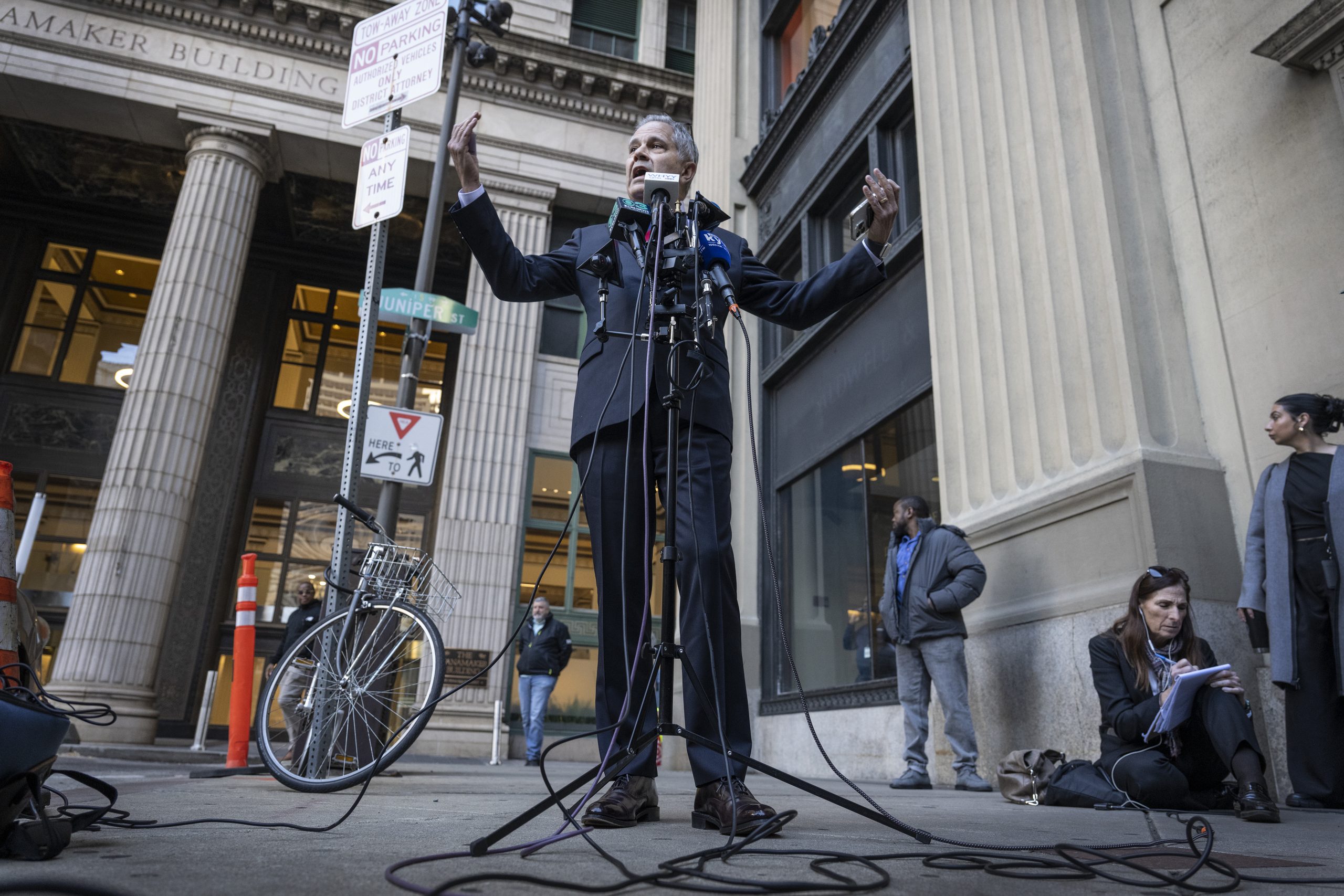
    Newly reelected District Attorney Larry Krasner speaks to reporters during a news conference outside the District Attorney’s Office on Nov. 5, 2025.Jose F. Moreno / Staff Photographer

    The case before the federal judge centers on Dennis Johnson, who has sought for more than a decade to have his 2009 murder conviction overturned. In 2022, a former assistant district attorney working for Krasner filed paperwork to support Johnson’s bid.

    But four supervisors in Krasner’s office later testified that they found errors in that 2022 brief, and that Krasner was involved in conversations about attempting to mislead the court to cast the former prosecutor as rogue.

    Krasner has denied wrongdoing.

    Brian Hart, a Democrat who has been critical of Krasner and served as a media adviser to Dugan’s campaign, said this episode is more fraught for Krasner than his 2022 impeachment.

    “The allegations aren’t coming from just Republicans,” said Hart, a public relations strategist. “They’re coming from testimony within his own office.”

    The mayor’s race question

    Some activists on the left wing of the city’s Democratic Party have said they feel emboldened to mount a serious challenge against Parker, who will be up for reelection next year. They cite recent wins by progressives both in the city and nationally.

    And eight months out from the May primary election, several prospective candidates, including Brooks, are mulling whether to launch a campaign.

    After earlier this year casting doubt on speculation that he could run for mayor, Krasner seemed open to the possibility in June.

    When asked then whether he might consider a future campaign for mayor — or even U.S. Senate — Krasner responded: “Do I have a plan to run for these offices today? No. But … it would be foolish for me to completely rule out those possibilities.”

    Philadelphia District Attorney Larry Krasner, seen here with Mayor Cherelle Parker at a news conference at Dilworth Park on Dec. 16, 2024.Alejandro A. Alvarez / Staff Photographer

    Larry Ceisler, a public affairs executive based in Philadelphia, said a federal criminal investigation of Krasner could pose a logistical problem if it was conducted while he was running for mayor.

    But politically speaking, Ceisler said, it might not be an impediment. An investigation by the Department of Justice under Trump — an entity many Democrats distrust — could rally progressive support.

    “I think he would probably run with it as a badge of honor,” he said.

    Ceisler pointed to former Mayor John F. Street, who in 2003 was locked in a tight race for reelection when police found an FBI bug in his office. Street blamed Republican President George W. Bush’s administration, and he went on to win the election a few weeks later.

    “When these things happen, everybody puts on their respective jerseys, so the Krasner people are going to say, ‘It’s political,’” Ceisler said. “I think to the Krasner constituency, especially if he wants to run for mayor, or do something else, I don’t think this fazes them.”

    Weighing a post-Krasner future

    It is unclear where any potential criminal investigation or disciplinary probe of Krasner and his office might lead, and legal experts have said that a hypothetical investigation would likely take months.

    But some Philadelphia Democrats are already contemplating what would happen if Krasner cannot finish the term that he began this year and that ends in 2030, with some quietly discussing contingency plans to fill the office.

    Under state law, in the event of a vacancy, the city’s Common Pleas Court judges vote by secret ballot to appoint a new district attorney. The appointed interim district attorney would serve until the next general election. Those elections take place in even-numbered years.

    The last time the process played out was in 2017, when the Board of Judges selected former city prosecutor Kelley Hodge to lead the office as interim district attorney. She replaced former District Attorney Seth Williams, who resigned shortly before pleading guilty to federal corruption charges in a case also overseen by Diamond.

    During the three-week gap between when Williams resigned and Hodge was appointed, the district attorney’s office was led by Williams’ first assistant district attorney, Kathleen Martin.

    Krasner does not have a first assistant district attorney. Robert Listenbee, who formerly held the role, retired in January, and the legally required position remains unfilled.

    Staff writers Chris Palmer and Ellie Rushing contributed to this article.

  • British leader exchanged texts with someone posing as Trump’s chief of staff

    British leader exchanged texts with someone posing as Trump’s chief of staff

    LONDON — British Prime Minister Andy Burnham exchanged brief text messages with a person he thought was President Donald Trump’s chief of staff, Susie Wiles, a government official said Monday.

    Burnham quickly grew suspicious and reported the interaction to security authorities, the official added.

    It was unclear when the exchanges took place. A spokesperson for Burnham declined to comment publicly, citing a long-standing policy not to comment about national security issues.

    But the government official, who declined to be identified because of the security policy, said the prime minister had exchanged a few messages of no significance with someone claiming to be Wiles, Trump’s top White House aide.

    The official declined to provide details about the text messages, which were first reported by Politico, or to say which security agency Burnham had reported them to.

    Wiles is one of Trump’s closest advisers. She comanaged his 2024 presidential campaign and has been running his White House staff since he returned to office in 2025.

    Last year, the Wall Street Journal reported that senators, governors, and some business leaders had received phone calls or text messages from someone claiming to be Wiles, and that Wiles had said contacts on a personal cell phone of hers had been hacked. The Journal said at the time that federal officials were investigating.

    In 2024, David Cameron, then the British foreign secretary, had a video call and exchanged several text messages with someone pretending to be Petro Poroshenko, a former president of Ukraine.

    As foreign secretary in 2018, Boris Johnson had an 18-minute phone call with someone claiming to be the prime minister of Armenia. According to audio that was later released, the pair talked about President Vladimir Putin of Russia and about the poisoning of Sergei Skripal, a Russian double agent, in Salisbury, England.

    This article originally appeared in the New York Times.

  • Mark Rydell, the Oscar-nominated director of ‘On Golden Pond,’ dies at 97

    Mark Rydell, the Oscar-nominated director of ‘On Golden Pond,’ dies at 97

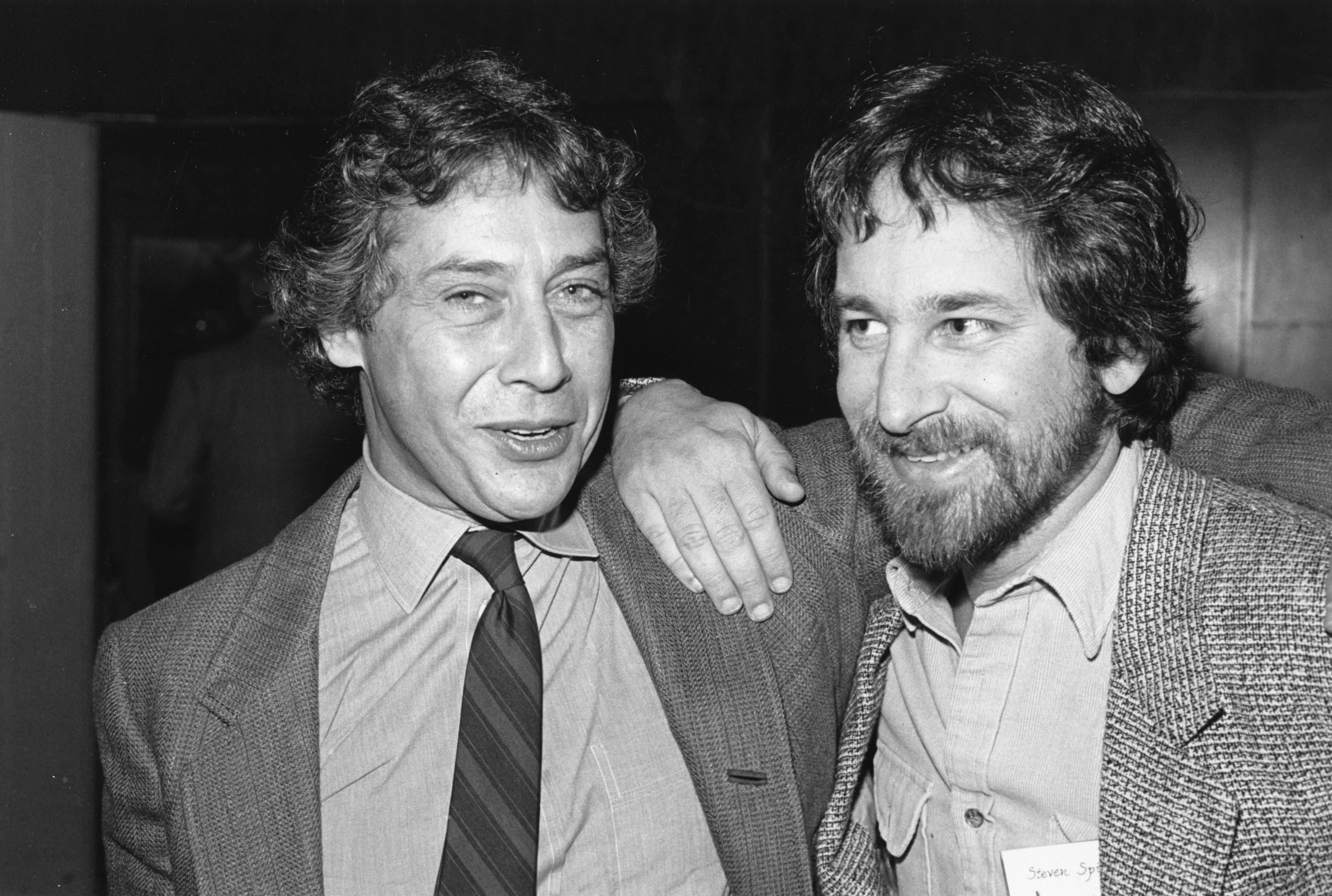
    LOS ANGELES — Mark Rydell, the Oscar-nominated director of the sentimental blockbuster On Golden Pond who worked with such Hollywood heavyweights as Henry Fonda, Katharine Hepburn, Steve McQueen, and John Wayne, has died. He was 97.

    His daughter, Amy Rydell, told the Hollywood Reporter that her father died Thursday of natural causes at a retirement community for the entertainment industry in the Woodland Hills section of Los Angeles.

    “Hard to put into words how much I loved my dad,” she posted Friday on her Instagram account. “He was truly one of a kind. Funniest and most talented person I’ve ever known.”

    ‘On Golden Pond’ earned 10 Oscar nominations

    On Golden Pond, which teamed Fonda with Hepburn and his daughter, Jane Fonda, was nominated for 10 Oscars. Henry Fonda and Hepburn won leading acting honors and the film won for screenplay, which Ernest Thompson adapted from his play of the same name. Mr. Rydell was nominated for directing but lost to Warren Beatty for Reds.

    It earned over $119 million at the box office, making it the second-highest grossing film of 1981 behind Raiders of the Lost Ark.

    On Golden Pond was Henry Fonda’s final movie role. He starred as Norman Thayer, an emotionally brittle and distant father who becomes more accessible at the end of his life after his teenage grandson spends the summer with him and his wife, Ethel (played by Hepburn), at their cottage in New England. The film’s story resembled Fonda’s real-life relationship with daughter Jane, who said working on the movie together helped resolve some of their issues. The elder Fonda died at age 77 months after winning his only Oscar.

    Mr. Rydell’s other Oscar-nominated films were The Fox in 1967, The Reivers with McQueen in 1969, Cinderella Liberty with James Caan and Marsha Mason in 1973, The Rose with Bette Midler in 1979, and The River with Mel Gibson and Sissy Spacek in 1984.

    Born Mortimer Harold Rydell on March 23, 1929, in New York City, he studied with jazz pianist Teddy Wilson at the Julliard School of Music. During a stint in the Army, he spent two years in Japan developing entertainment for military personnel. He majored in English and philosophy at New York University.

    Early acting career opposite Steiger, Cassavetes, Mineo

    He turned to acting when he won a scholarship to the Neighborhood Playhouse in New York. Among his early jobs were roles on the CBS soap operas The Edge of Night and As the World Turns.

    Mr. Rydell made his Broadway debut in Seagulls Over Sorrento with Rod Steiger. In 1956, he made his movie acting debut opposite John Cassavetes and Sal Mineo in Don Siegel’s Crime in the Streets.

    Among his film acting credits were Robert Altman’s The Long Goodbye in 1973 and Woody Allen’s Hollywood Ending in 2002.

    Mr. Rydell moved into directing television, helming episodes of Mr. Novak, Ben Casey, I Spy, The Wild Wild West, The Long, Hot Summer, The Fugitive and Gunsmoke.

    He made his feature-film directorial debut with 1967’s The Fox starring Sandy Dennis, and it was a hit.

    Two years later, Mr. Rydell directed McQueen in the comedy-drama The Reivers.

    Teaming with Sydney Pollack

    Mr. Rydell and Sydney Pollack, who became friends during their acting days, formed Sanford Productions in 1971. Among their efforts were the films Jeremiah Johnson starring Robert Redford and Scarecrow with Al Pacino and Gene Hackman, which won the Cannes Film Festival’s top honor, the Palme d’Or.

    Mr. Rydell directed Wayne in 1972’s The Cowboys. He reunited with Caan for the 1976 flop Harry and Walter Go to New York.

    He scored a major hit with 1979’s The Rose, with Midler in her Oscar-nominated role as a self-destructive rock star loosely based on Janis Joplin.

    Mr. Rydell re-teamed with Caan and Midler in For the Boys in 1991, but it wasn’t successful.

    “He was an actor of note before he became a director, and I was so lucky to have met him when I did; he taught me so much on The Rose and later on For The Boys,” Midler posted on Instagram. “Two Oscars nominations both because of him. He was the actor’s whisperer; just a few words was all it took to understand what was needed. Devoted to Meisner. So many happy memories.”

    TV movies and series among his credits

    Mr. Rydell directed the pilot of the hit ABC drama Family in 1976.

    Among his TV movie directing credits were McBride and Groom, Crime of the Century with Isabella Rossellini and Stephen Rea, and James Dean, which earned actor James Franco a Golden Globe award. Mr. Rydell also appeared in the movie as Warner Bros. chief Jack Warner.

    He directed the movies Intersection in 1994 and Even Money in 2006.

    In 2009, Mr. Rydell, Oscar-winning actor Martin Landau, and screenwriter Lyle Kessler taught a film workshop at UCLA. Mr. Rydell and Landau were co-artistic directors of the Actors Studio West, teaching and coaching actors, writers, and directors.

    “All great art rests on telling the truth,” Mr. Rydell told UCLA’s student newspaper the Daily Bruin. “The real pursuit of an artist is to tell the truth.”

    Besides his daughter, he is survived by son Christopher. The siblings, who went into acting, were from his first marriage to actor Joanne Linville. He had another son, Alexander, from his second marriage to producer Esther Rydell.

  • The historic Conkling-Armstrong House in North Philly is poised for affordable redevelopment

    The historic Conkling-Armstrong House in North Philly is poised for affordable redevelopment

    They don’t make them like the Conkling-Armstrong House anymore. They never really did — except this once.

    Located at 2224-26 W. Tioga St., each of the two roughly 5,000-square-foot houses in this twin mansion are encrusted with terra-cotta flourishes that set them apart from their neighbors and from pretty much any other building in the city.

    That’s because this almost 130-year-old mansion in North Philadelphia was built as a towering advertisement for what the Conkling-Armstrong Terra Cotta Co. could offer late-19th-century developers and architects.

    They studded it with beautiful decorations and elaborate details to demonstrate what their products could look like on future buildings.

    When this one-of-a-kind house was built in 1898, the company’s factory stood mere blocks away. Now it is gone, demolished in 2011, and the house itself hasn’t been occupied in even longer.

    That period of vacancy will end soon, if local affordable housing developer Brian Wise gets his way. He’s already invested almost $1 million in bringing the Conkling-Armstrong house back from the brink of demolition.

    “When we first had the property, we could not even walk through it,” said Wise, managing partner of Wise Holding Group LLC. “There was so much deterioration from the roof all the way down to the basement.”

    Wise plans to build 12 apartments in the twin buildings and another 12 in two additions behind the twins, each over 4,000 square feet. They will extend into the vacant lot behind the Conkling-Armstrong house, fronting on Estaugh Street.

    The plan is to lease most of the units to tenants who use rent vouchers from the Philadelphia Housing Authority.

    “It’s a pretty ambitious job to do and something that will be a challenge, but sometimes we like challenges,” Wise said. “We’ll do everything we can to keep the building stabilized and bring it back to its original form, especially the exterior.”

    Earlier this month, the city’s Zoning Board of Adjustment gave Wise the go-ahead to begin the project.

    “This is one of these projects that you’ll remember over the course of your career,” Wise’s attorney, Alan Nochumson, said in his pitch to board members to preserve the building.

    Wise needed permission to build beyond the allowable density on the site, arguing that the rents from additional units were the only way to make the project economically feasible.

    The Conkling-Armstrong house on the 2200 block of West Tioga Street in 2018. MATTHEW HALL / Staff Photographer

    His case was supported by two local community groups, the Allegheny West Civic Association and the Swampoodle Neighborhood Parcels Association.

    Wise anticipates an 18-month to two-year timeline, given the final Historical Commission approvals he needs.

    Wise originally came to this block of West Tioga Street to try to buy one of the other venerable, if less ornamented, stone twin houses on the block.

    He decided against that purchase, but while he was in the neighborhood, he noticed the intricate design and decoration of the Conkling-Armstrong House, as well as its dilapidated state.

    After acquiring the building, Wise considered demolishing it. But the Conkling-Armstrong House is on the Philadelphia Register of Historic Places, which makes razing it a challenge. Instead, the developer decided to embark on his first adaptive reuse proposal. He needs a final Historical Commission approval to begin construction.

    “My first impression, obviously, was that the architectural nature of the property was unique,” Wise said. “It was something that we weren’t used to seeing … so instead of knocking it down, we said let’s try to bring this building back to life.”

    At the zoning board, Wise faced questions from commissioners who wanted him to add a porch to the new addition facing Estaugh Street, which he promised to do.

    The new buildings behind the Conkling-Armstrong house will be more modest, with a design that echoes other houses in the neighborhood.

    “We decided that trying to match all of these ornate features of the front building is not a tenable solution,” said Matt Masterpasqua of the Mass Architecture Studio, which is designing the project.

    “So we tried to take context from the rear street, as well as some of the more modest neighboring buildings to inspire our new design,” Masterpasqua said. “It’s a little more feasible for us to construct.”

    He anticipates the redevelopment of the Conkling-Armstrong Terra Cotta Co.’s house-and-showroom will cost at least $3 million, but he could be aided by federal Historic Preservation Tax Credits.

    The Witherspoon building, ornamented by the Conkling-Armstrong Terra Cotta Co. Neff

    The company’s historical legacy in Philadelphia includes ornamenting such structures as the Witherspoon building and the former Curtis publishing house. Like many historically protected gems, those buildings are in Center City, not residential North Philadelphia.

    “It was a showcase for the capabilities of their company, but it’s also just really an incredible building,” Masterpasqua said. “It’s really great to be part of something that’s going to be able to salvage the neighborhood and this piece of architecture.”

  • S. Broad Street gets a new landscaped median — and it’s just the start of what’s planned

    S. Broad Street gets a new landscaped median — and it’s just the start of what’s planned

    A new landscaped median under construction for months in front of the Kimmel Center has reached completion — the down payment on a promised major redo of the Avenue of the Arts streetscape.

    The leafy ribbon down the middle of Broad Street from Spruce to Pine Streets was officially unveiled Wednesday morning with speeches and a ceremonial sprinkling from blue watering cans onto the new plantings.

    “We aimed high and we met our lofty expectations, and we’re off and running,” said Carl Dranoff, chair of Avenue of the Arts Inc., which is spearheading the project.

    There is a practical, traffic-calming intention behind the raised median: It leaves less space for drivers to make U-turns on the block occupied by the arts center and residences, and creates a barrier to thwart pedestrians jaywalking across Broad Street.

    Attendees watering the new redesign of the South Broad Street median outside the Kimmel Center in Philadelphia, Pa., on Wednesday, June 24, 2026.Tyger Williams / Staff Photographer

    But the slender, shapely strip of trees, shrubs, and ground cover atop a granite base with metal skirt signals a larger transformation to come.

    In spring of 2027, work is expected to begin on an ambitious beautification of the heavily trafficked block. Sidewalks will be landscaped, sculptures installed, and pop-up performance space carved out, creating what planners say will be a markedly different vibe.

    That will give the project’s leaders something tangible to point to when raising money for the entire streetscape project, which is envisioned as eventually stretching from City Hall south to Washington Avenue.

    “The idea of a beta block was to get everybody on board and excited about what can be accomplished — the doability and to create buzz,” said Dranoff, who said the median was the first step in turning South Broad Street into “one of the great streets of the world.”

    Oliver Schaper, Ubran Designer for the Project with the New York office of Architecture/Design Firm Gensler, waters the plants in the redesign of the South Broad Street median outside the Kimmel Center in Philadelphia, Pa., on Wednesday, June 24, 2026.Tyger Williams / Staff Photographer

    That larger, 10-block effort is expected to cost about $150 million and take years to design and complete, with funds anticipated from both government sources and philanthropy.

    The design of each segment will vary, said Oliver Schaper, an urban designer for the project with the New York office of architecture/design firm Gensler.

    “The requirements of adjacent buildings are different on every block, the left-turn lanes are different, even the length of the median is different from block to block,” Schaper said. “We wanted to make sure that all the design elements can act as a kit of parts and adjust, so each design of a block will be an application of that kit of parts so they feel like cousins, but specific.”

    Some design professionals have criticized the median as intrusive to sight lines, but the design and landscaping were chosen to preserve sight lines, Dranoff said.

    Carl Dranoff, Chair of Avenue of the Arts Inc., speaks about the redesign of the South Broad Street median outside the Kimmel Center in Philadelphia, Pa., on Wednesday, June 24, 2026.Tyger Williams / Staff Photographer

    “All of the trees were specifically selected to have long trunks and very narrow canopies, all the vegetation.” The designs adhere to standards for safety, he said, “so we are very confident that we will not block views.”

    The flora — about three dozen kinds of native and adaptive plants — were chosen by OJB Landscape Architecture to withstand “the abuse that they will be subject to in terms of the winters and the salt and all that,” Schaper said.

    Looking ahead, the blocks farther north from Spruce Street are anticipated as having fewer trees, to preserve the view of City Hall.

    “We even designed, as you get closer to City Hall, standing areas for brides and photo ops, so that we’re not taking anything away from people,” Dranoff said. “We have parade areas so that Mummers and other parades have performance areas between the medians.”

    City Hall seen in the back near the new redesign of the South Broad Street median outside the Kimmel Center in Philadelphia, Pa., on Wednesday, June 24, 2026.Tyger Williams / Staff Photographer

    But more immediate is the work from Pine to Spruce, where Dranoff’s 47-story Arthaus residential condo tower sits. The $5 million needed to pay for the median and work on the infrastructure beneath the street “is accounted for and that was utilized,” Dranoff said, “and of the $10 million for the sidewalks, we have several million lined up and more to go, and we’ll have it all by the end of the year.”

    Construction on the sidewalk portions is expected to begin in 2027 and be completed by the end of the year “or thereabouts,” he said.

    Schaper said part of the goal is to rebalance the dynamic between pedestrians and other factors.

    “I think as designers at some point we take a position, and our position was, ‘Let’s design for pedestrians.’ There are, of course, very specific requirements that we need to adhere to — for example, it’s reflected in conversations that we had with the Kimmel Center about their bus queuing, and we made adjustments to continue to allow that to happen.”

    The new redesign of the South Broad Street median outside the Kimmel Center in Philadelphia, Pa., on Wednesday, June 24, 2026.Tyger Williams / Staff Photographer

    But, he said, the plan sets out to be “an advocate of the pedestrian experience, and not think that private car access is the model of the future for cities.”

    Dranoff said construction of this first median phase, running much of the block from Spruce to Pine, was delayed by the unusually harsh conditions of this past winter, but workers made up for lost time.

    “Philadelphia’s going to be a hotbed this summer, and the whole point of this was to show what we can do and be more beautiful and more attractive and more compelling to Philadelphians and to suburbanites and to the world.”

  • Lower Merion is advancing a policy to eliminate iPads and laptops for K-2 students

    The Lower Merion school board plans to stop assigning personal laptops and iPads to kindergartners, first graders, and second graders after facing intense pushback from parents who say kids are getting too much screen time in school.

    Members of the school board’s policy committee announced the plan during a meeting Monday, along with other proposed limits on technology use. Under policy changes going before the full school board for review next week, third and fourth graders would use electronic devices stored on carts in classrooms, while fifth and sixth graders would be permitted, but not required, to bring devices home.

    “This is a huge movement forward,” said the board’s president, Kerry Sautner, describing revisions made to the proposed technology policy in response to community feedback.

    But parents who have accused the district of overusing educational technology said the proposed changes did not go far enough — leaving too much room for interpretation around when technology should be used, and failing to adequately restrict kids’ access to inappropriate websites.

    Some parents also expressed anger that the board is moving forward with repealing the current technology policy, which contains language accommodating families who opt out of district-issued devices.

    “You are removing the escape hatch,” said David Smyth, a parent from Merion Station, who said the district had produced no data supporting its use of technology. “You know that ed tech is failing, it’s suboptimal, and you don’t want to be embarrassed.”

    Here is what to know about the tech debate in Lower Merion, the board’s latest policy proposal, and what happens next:

    Lower Merion at the center of ed tech backlash

    As backlash to technology in schools has spread across the region and nationally, Lower Merion has become an epicenter of parental opposition.

    At meetings this spring, dozens of parents have voiced concerns about weakened attention spans and classroom distractions, and expressed fear that the quality of their kids’ education is declining as a result.

    More than 800 parents have signed a petition asking for the right to opt out of one-to-one devices, according to parent organizers in Pencils Over Pixels. The group, which started a GoFundMe campaign, has distributed lawn signs and enlisted a public relations firm as part of its advocacy efforts.

    But district officials have repeatedly said that the technology policy’s language is dated, stemming from when Lower Merion first introduced one-to-one devices, and that it is not possible for families to opt out.

    Instead, the board has been reworking the technology policy to address when and how devices should be used in classrooms.

    A revised policy after meetings with parents

    The latest policy proposal outlines guidelines for technology use at different grade levels, rolling back one-to-one devices for Lower Merion’s youngest students.

    “Technology shall not be used for routine classroom instruction in these grades,” the policy says. “Any use shall be minimal, highly structured, and limited to specific educational purposes such as diagnostic testing or for teacher-directed, whole-class demonstration, visual display, or state testing preparation.” (Pennsylvania’s standardized tests, which start in grade 3, are required to be administered on computers.)

    In grades 3-4, the policy says, students “shall have supervised, teacher-directed access to technology resources” that stay in classrooms, while in grades 5-6, students will be permitted to bring their devices home, but not allowed to use them between classes or at lunch.

    The policy describes students in grades 7-8 and 9-12 as having increased responsibility for independent technology use, but says devices should be used only for school-related work.

    The policy changes are “meaningful responses” to community feedback, said Anna Shurak, the chair of the board’s policy committee, who said board members had met with concerned families.

    But some parents said the policy — which says teachers should use technology “only when doing so serves a clear educational purpose” — would not adequately limit an overreliance on screens in classrooms.

    “The verbiage of this policy is very carefully crafted to say nothing,” said Eleanor Stanford, a parent and a writing professor at Bryn Mawr College, who also questioned why the district was still “dragging its feet” on imposing a bell-to-bell ban on cell phones in its high schools, even as legislation advances in Harrisburg to do so. (Shurak said the district would fully ban cell phones in 2027-28.)

    Parent Matthew Posey quoted the policy’s language that technology belongs in the classroom when it “genuinely amplifies human curiosity.”

    “Did Albert Einstein need Kahoot or iReady?” Posey said, referring to two educational technology programs. “Is this a public policy document, or a corporate marketing brochure?”

    Some parents also questioned proposed administrative regulations that include suggested time ranges for technology use by grade level. In grades K-4, the guidelines are less than 30 minutes a day; by high school, they increase to less than 120 minutes a day.

    Calculating the high school upper limit as about 40% of daily instructional time, “to me, that’s way, way too high,” said Sam Handlin, a parent and a professor at Swarthmore College. He said the only way teachers would approach that time limit was either by using technology “as a babysitting device” or letting students take notes on computers, “which is just a recipe for distraction.”

    Shurak did not comment on the time frames specifically but told Handlin the administrative regulations still need to be revised.

    When will changes take effect?

    The committee endorsed sending the revised technology policy to the full board for review next week, along with a recommendation to repeal the current technology policy.

    While the board may repeal the current policy at next week’s meeting, the new policy would need to be considered a second time to before it could go into effect.

    The goal is to have the new policy in place in August, Shurak said. She said the board would be directing administrators to implement changes in time for the coming school year.

    Board member Jason Herman, a member of the policy committee, said some of the new policy’s language should be revised to limit “ambiguity and subjectiveness.” He also questioned why the district could not move to a content filtering model where only certain websites were permitted for students to access, rather than restricting sites after problems are reported.

    Officials did not address questions around content filtering Monday, or calls from the Pencils Over Pixels group for the release of district contracts with educational technology companies and a technology advisory board that would include parents.

    Sautner said the board had more work to do, including around technology questions related to the district’s curriculum.

    But “we cannot micromanage” administrators through policy language, she said.

    Some expressed concern that the board could overreact in response to anti-tech opposition.

    “Banning technology isn’t going to be the way to ensure that our kids critically think,” said Emma Benn, who urged the board to “take a step back” before passing a new policy. “This world is a technology-driven world, and we need to make sure our children can function within it.”