Author: Sabrina Vourvoulias

  • In a disgraceful emergency ruling, SCOTUS lets Trump resume violating human rights

    In a disgraceful emergency ruling, SCOTUS lets Trump resume violating human rights

    Just when you are tempted to assign sole blame for our growing reputation as human rights abusers to President Donald Trump and his misbegotten administration, up steps the Supreme Court of the United States.

    In an emergency ruling Monday, the Supreme Court cleared the way for the Trump administration to resume uncontested deportation of immigrants to countries that are not their nations of origin, where they may be subjected to further human rights abuses and persecution.

    The ruling, which was not signed by the justices, does not make a determination on the legality of the process itself — the court will begin hearing arguments on that question in December. Nevertheless, it was, according to the New York Times, being celebrated as a victory by the Trump administration, which has deported more than 25,000 migrants to 29 “third countries.”

    Yet, for those of us who look to our judicial system as a means to ensure this White House doesn’t get away with every human and civil rights violation it can think of, the court’s decision is deeply troubling.

    Sarah H. Paoletti, the director of the Transnational Legal Clinic at the University of Pennsylvania Carey Law School, says the order is “yet one more example of the Supreme Court majority ceding exceptional deference to the Executive.”

    “In granting the stay, the court has cleared the way for [the U.S. Department of Homeland Security] to disappear individuals overnight and transport them to countries without notice, and without the opportunity to be heard on their fear-based claims as to those countries, with callous disregard to the grievous rights violations they are likely to face,” Paoletti said via email.

    Paoletti noted that the court’s ruling came on the same day 20 independent human rights experts appointed as U.N. Special Rapporteurs and a Special Rapporteur of the African Commission on Human and Peoples’ Rights condemned the practice of third-country removals.

    Malka Older — writer, sociologist, aid worker, and executive director of Global Voices, the international newsroom made up of writers and human rights activists — sees the harms as part of a pattern of unethical national choices.

    “The Supreme Court allowing the government to continue removing immigrants to third countries — countries where they know no one, have no safety net, no connections, no assistance, and may be under active threat for their identity or convictions — is allowing irreparable harm to continue being done to those people,” Older told me via Facebook. “This kind of deportation rips apart people’s lives, leaving them stranded, and it demonstrates the moral vacuity of U.S. policy, pushing people off somewhere else as though that absolves us of all responsibility.”

    “It is the same dynamic that sees the U.S. export plastic waste, dangerous industrial byproducts, unappealing jobs, and increasingly data centers, hoping that if people can’t see the harm they’ll pretend it isn’t happening but in this case, the harm is happening very directly to human beings, to our neighbors.”

    The administration releases no real information about who it has sent to third countries, and it has reportedly started vanishing thousands of detainees held for deportation from DHS’s online detainee locator system. According to the most reliable tracking data, however, more than 70% of current detainees have no criminal convictions (and, lest we forget, even people who have been criminally convicted have rights).

    But anecdotally, and through the work of journalists here at The Inquirer and at other media organizations, we know that most of those being detained for deportation — even to third countries — are mostly just ordinary human beings.

    “There are people who have lived in this country for upwards of 30 years who are being deported because they lack residency,” Guatemalan-born and Brooklyn-based author and translator David Unger said via Facebook.
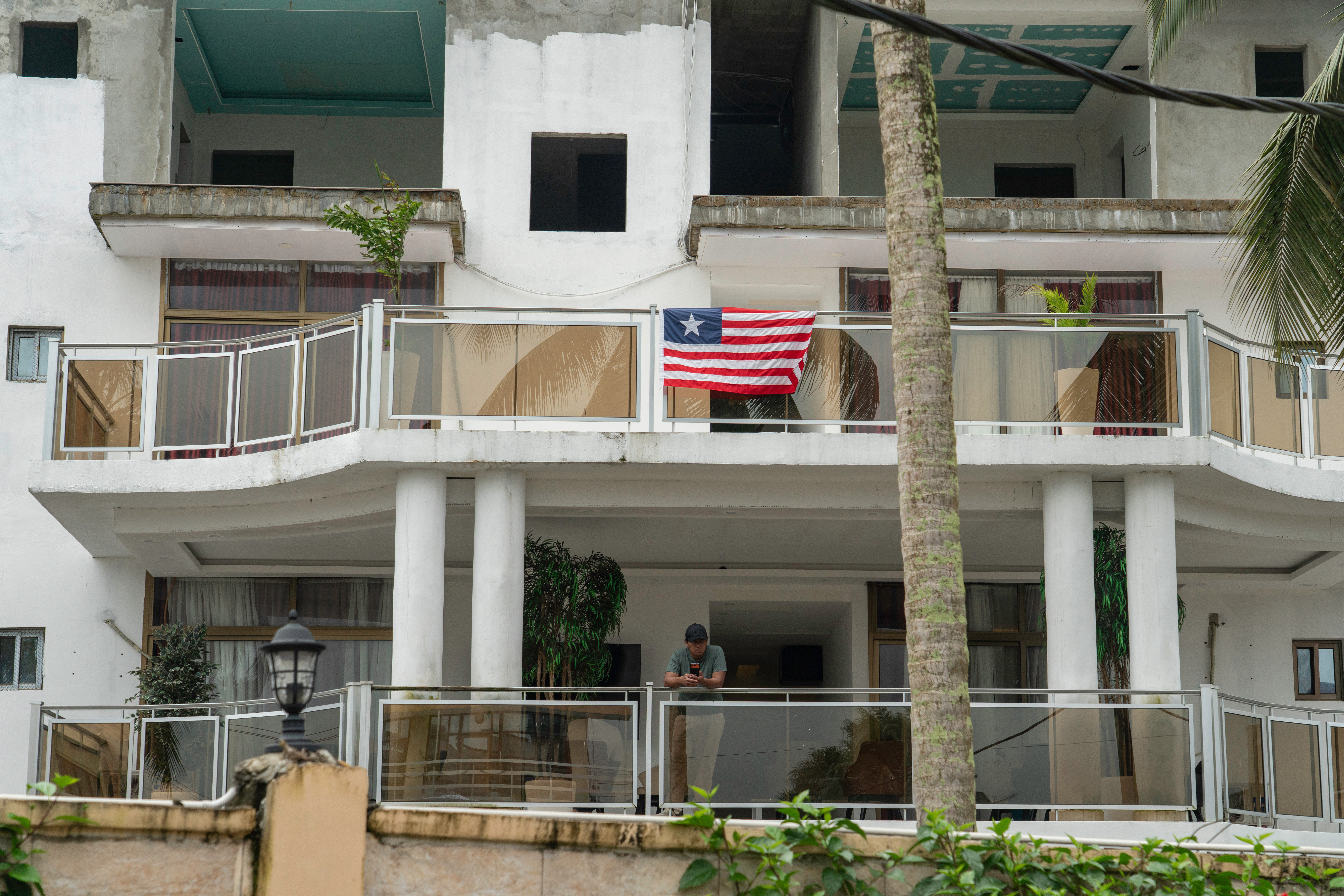
    A deportee from the United States who was sent to Liberia stands on the balcony of a hotel in Marshall, Liberia, in August.CARIELLE DOE

    “My daughter, an immigration lawyer, had a Jamaican client who was deported to Eswatini in Africa and held incommunicado for three months before finally being sent to Jamaica, where he has no living relatives,” he added. “Guatemala has accepted 2,000 deportees originally from Mexico. Who knows what danger they may be in when they finally reach their birth land. This is simply cruel and, possibly, lethal to them.”

    Trump is fond of repeating that our nation is the hottest country in the world right now, but what I see is that we’re radioactive. Our ranking in the Human Rights Measurement Initiative rights tracker, which compares us with our peer high-income countries and fellow members of the Organization for Economic Co-operation and Development (OECD), is pretty terrible: 3.7 out of 10. And a number of the categories in which we are dead-last — “freedom from torture and ill-treatment,” “freedom from arbitrary arrest,” and “freedom from forced disappearance” — are tied directly to the administration’s mass deportation plan.

    You know what to do. Thirty-three days from now, get yourself to a polling place and elect people willing to limit the executive branch’s morally disgraceful inclinations. And come December, pray the Supreme Court is willing to limit it, too.
  • Philly still hasn’t announced its Hispanic Heritage Month events. Where’s the list, Mayor Parker?

    Philly still hasn’t announced its Hispanic Heritage Month events. Where’s the list, Mayor Parker?

    Tuesday is the first day of Hispanic Heritage Month, which runs from Sept. 15 to Oct. 15. I’ve always had a bit of a love/hate relationship with this month, which purports to recognize and celebrate that Latinos have been a formative part of the nation since its early days. While the attention to the extraordinary individuals and myriad cultural heritages that comprise “Latinidad” in the United States is gratifying, it is, by its very nature and time limitation, a glancing and shallow attention.

    Even so, I always note the arrival of a mass email from the mayor’s office about the events the city has programmed to mark the month.

    This year, I’m still waiting.

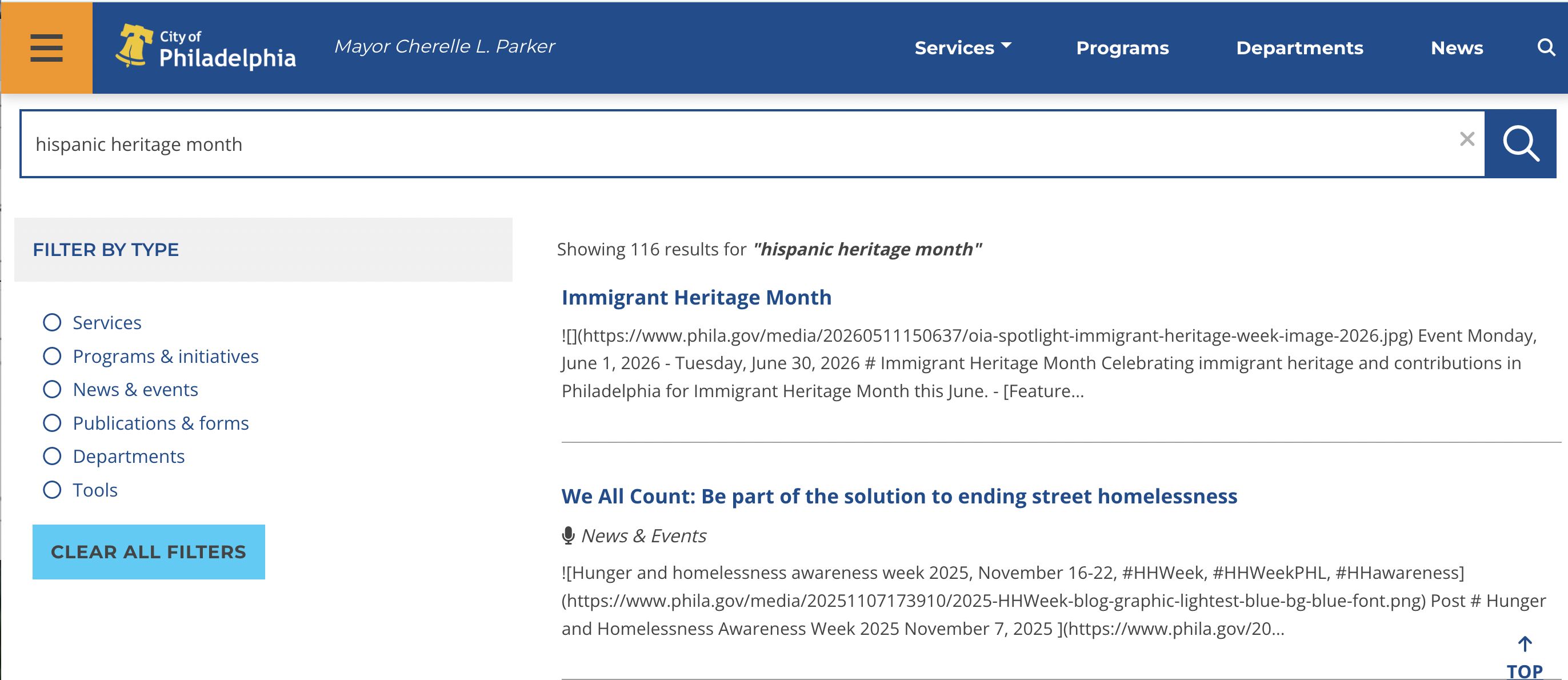
    As yet, there’s been no email from the city of Philadelphia announcing any special programming during Hispanic Heritage Month, and nothing when I search for that on phila.gov.

    Screen capture of a search for “Hispanic Heritage” month on the phila.gov website on Monday.Screen capture of phila.gov

    There aren’t even links to information about two signature events that took place this past Sunday: La Feria del Barrio (organized by Taller Puertorriqueño) and the Mexican Independence Day Festival (organized by the Mexican Cultural Center), nor even the unofficial culminating event in Philadelphia — the Puerto Rican Day Parade, which Concilio has been hosting for more than 60 years — on Sept. 27.

    While I’d like to say I’m completely surprised by the elision of Hispanic Heritage Month that the city is doing, I’m not.

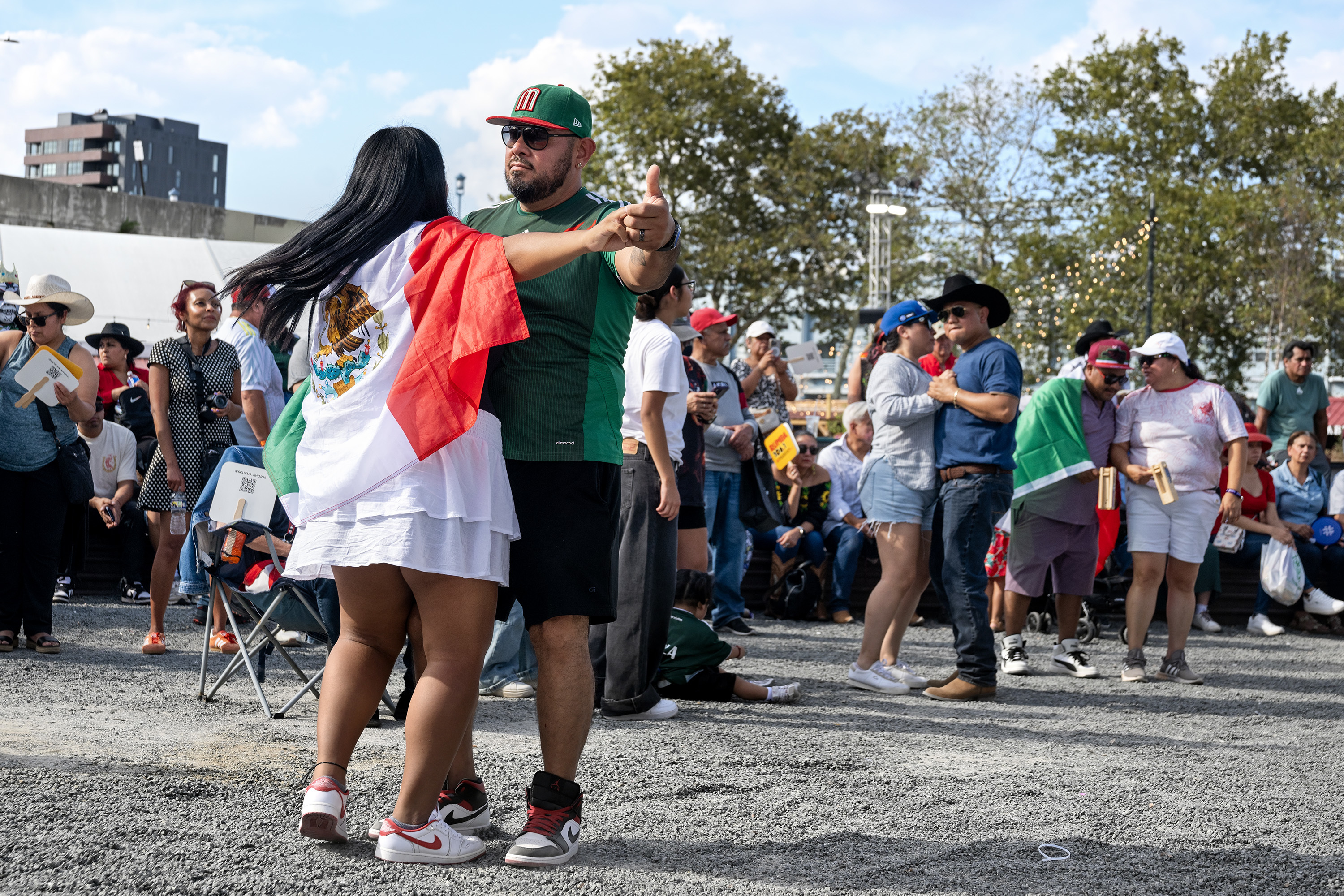
    Francisco Gonzales, of Lawrenceville, N.J., dances with his daughter Bianca, 17, near the stage as musicians perform at last year’s Mexican Independence Day Festival at the Independence Blue Cross RiverRink at Penn’s Landing.Tom Gralish / Staff Photographer

    Philadelphia’s Latino communities get surprisingly little respect — outside of the high regard for our undeniably wonderful food and dance moves — from our electeds, and have long been slighted by city government in far more significant ways.

    For me, nothing epitomizes that more than an example from 2015, when there was a Latino managing director and even so, then-Mayor Michael Nutter convened — at the behest of Attorney General Eric Holder and the U.S. Department of Justice — a Philadelphia roundtable about the imperative of improving police-community relations at which there wasn’t a single person from a Latino-serving organization at the table. In a city where our community was subjected to relatively high stop-and-frisk rates, experienced excessive force incidents (and still does), was historically targeted for extortion by police, and was (and still is) racially profiled by police and U.S. Immigration and Customs Enforcement.

    No. Latinos. At. The. Table.

    Is it simply that our political capital has been stagnant since the 1980s — or is there something else?

    We’ve had three Latino primary contenders for mayor (two in 2015 and one in 2023), but no substantive progress when it comes to the political power necessary to be taken seriously in Philadelphia.

    To wit, in 1983 Philadelphia elected its first Latino City Council member, and a year later it elected a Latino state legislator (the second in the city’s history). The census conducted in 1980 put Philadelphia’s Latino population at 3.9% of the city’s total. Fast-forward some four decades, and Latinos are now about 17% of Philadelphia’s total population, but we still have only one Latina City Council member, and just two Latino Philadelphia state legislators.

    The city has mostly relied on department-level appointments — back in the ’80s, it was the Office of Hispanic Community Affairs; now it’s the Office of Immigrant Affairs and the Office of Latino Engagement — to see to the concerns of its Latino residents, and to tout the communities’ contributions to Philadelphia.

    But departments and offices reflect the administrations they are part of, and Mayor Cherelle L.Parker has sent mixed signals to her Latino constituents.

    On the one hand, she has addressed issues in Kensington in concert with District 7 Councilmember Quetcy Lozada — who is a well-liked and respected Boricua leader. On the other hand, she had to be dragged, kicking and screaming, by City Council’s veto-proof “ICE Out” proposals into offering any public comment about ICE actions under President Donald Trump.

    Or maybe the offices that are meant to be in conversation with, and about, Philadelphia’s Latino communities aren’t up to the job?

    I’m willing to offer the benefit of the doubt: Maybe they are focusing on important work behind the scenes. But in my opinion, they have minimized Latino visibility — to our detriment, and to all of Philadelphia’s detriment.

    I was struck recently by the events the Office of Immigrant Affairs is publicizing as part of its Welcoming Week 2026 (from Sept. 10 to 25), for example. The focus this year is on the Caribbean, but in the publicity I’ve received (or dug up) about it, there seems to be nothing scheduled about or from the Spanish-speaking Caribbean. The thing is, this isn’t a zero-sum game — we can (and must) celebrate our significant Haitian and Jamaican communities, for example, and their incredible cultural contributions to Philadelphia, without ghosting our Dominican and Boricua ones.

    So, come on, send that Hispanic Heritage Month email, Mayor Parker. List those events and programs on the website. Latinos are here and doing amazing things in service of our city. We should celebrate that together.

  • A drone is haunting our neighborhood. I’m not amused.

    A drone is haunting our neighborhood. I’m not amused.

    I didn’t have Peeping Tom drones on my bingo card for 2026.

    But then, on July 14, the West Brandywine Police Department let residents of Wallace Township in Chester County know, via Facebook, that for a month or so, they’d been investigating (and had witnessed) a drone flying over homes along several roads in my neighborhood at night, between 8 and 11 p.m.

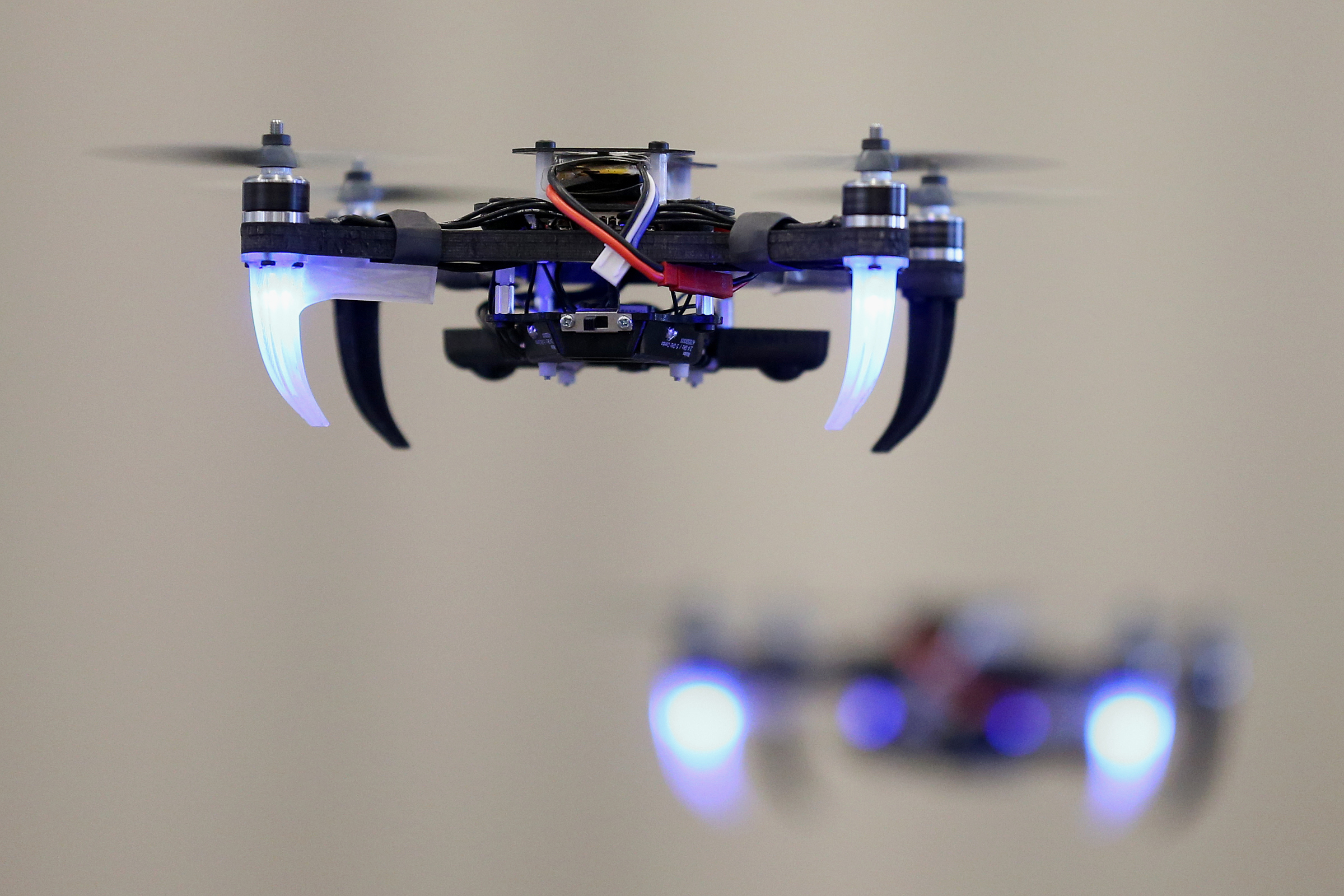
    “It has been reported that this drone may be photographing properties, including inside the homes,” stated the police department’s Facebook page. “Those residents that live in that area are being urged to be mindful of this aircraft, and to be diligent, especially if you have skylights on the roof. These drones can be equipped with high resolution cameras and have extreme zoom capabilities.”

    Huh. Creepy.

    Since we don’t have young children whose images, captured without our consent, might find their way onto the more sinister reaches of the web, and since our house isn’t full of luxury goods to be cased, I didn’t worry much.

    Maybe if the drone operator chanced to peep through our windows, he’d take pity seeing the proliferation of dust bunnies and proactively book us a deep-cleaning service appointment?

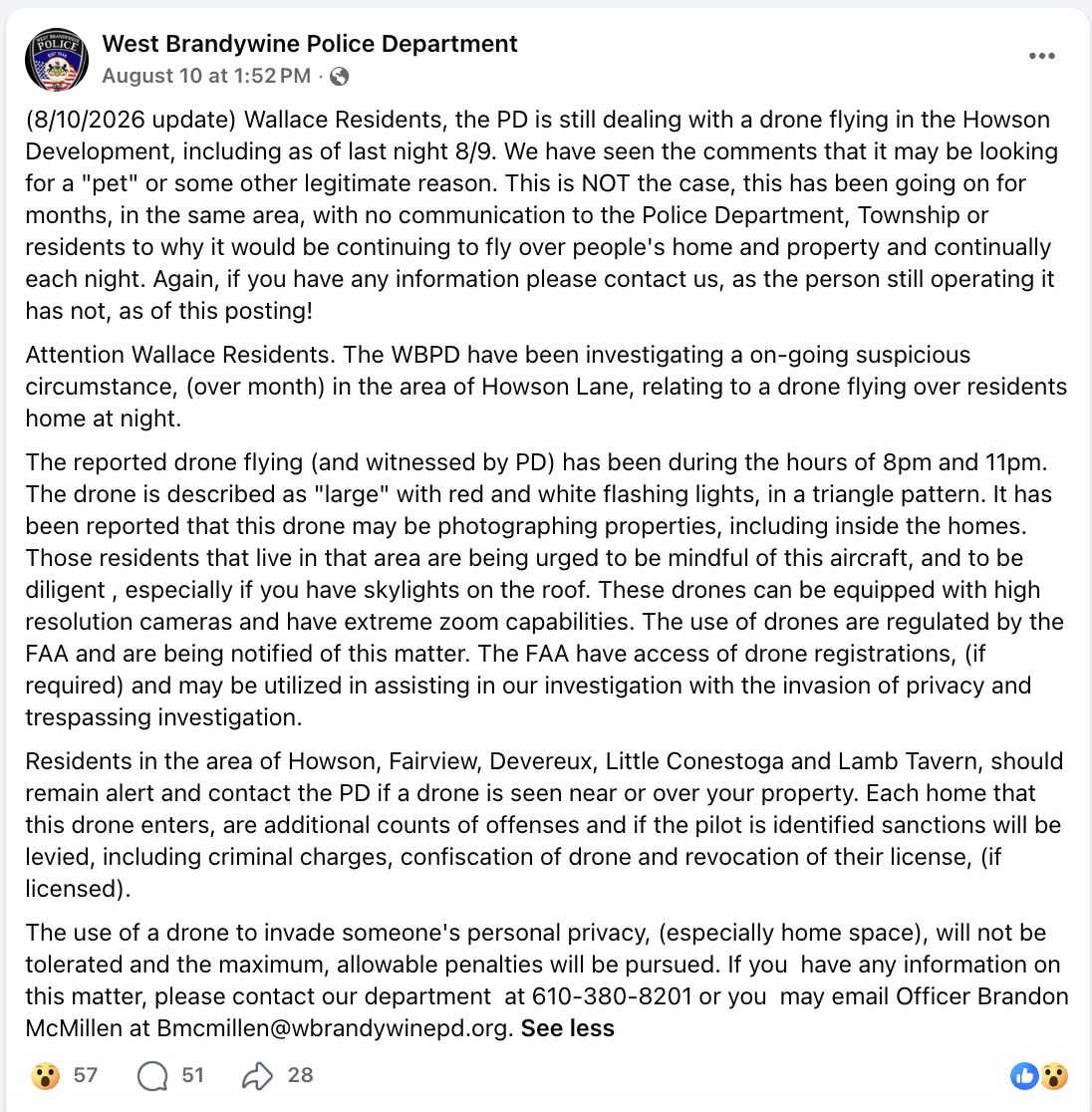
    But the West Brandywine Police Department’s Aug. 10 update upped the ante: “We have seen the comments that [the drone] may be looking for a ‘pet’ or some other legitimate reason. This is NOT the case.”

    Screen capture of the West Brandywine Police Department’s Facebook post on Aug. 10 updating residents of Wallace Township on the continued drone sightings.Screen capture

    It is particularly disconcerting because Pennsylvania regulations stipulate that for nighttime flying the drones “need to remain within line-of-sight of the remote pilot on the ground.” Even if you aren’t unnerved at the idea of someone deploying a little electromechanical spy to look into your windows at night (when the lights inside make people and things clearly visible in a way they wouldn’t be during the day), the idea that the person doing so is on your property — or close enough to keep the drone in sight — should be.

    I can easily imagine folks who already feel vulnerable — the elderly, women living alone, or people who have experienced domestic partner abuse or who have filed for protection orders — being terrified by that prospect.

    The thing is — despite the West Brandywine Police Department’s gratifyingly proactive approach to residents’ privacy concerns — it is the Federal Aviation Administration that’s in charge. The state reports that some 11,000 people have an FAA remote pilot rating, and if this peeping drone is flown by a registered pilot, there may be little anyone can do.

    Pennsylvania Act No. 78 of 2018 prohibits local regulation of unmanned aircraft. It also codifies uses to be considered unlawful, stipulating, for example, that conducting “surveillance of another person in a private place” is a summary offense and subject to a fine up to $300. But the legislation tees up the drone operator’s defense argument for them with this exception: “the person did not knowingly or intentionally conduct surveillance of another person in a private place.”

    Responses to West Brandywine PD’s Facebook posts about this have been predictably mixed in this libertarian-leaning corner of the county. Outrage and worry about surveillance and invasion of privacy, of course, but also lots of drone-flying enthusiasts who chafe at any talk of curtailing their ability to pilot their unmanned craft wherever and whenever — property owners be damned.

    Also, since there are a lot of hunters in this neck of the woods, there are a good number of comments about shooting the drone down if it is sighted. I hasten to add that — as tempting as it might be to shoot the flying snoop right between its blinking red lights — drones are considered aircraft, and it is a federal felony to damage or disable them — punishable with a fine of $250,000 and up to 20 years imprisonment.

    If you think none of this should matter to you because, hey, you don’t live in Wallace Township and no drone has been haunting your nights, think again. Aerial surveillance by drones is widespread, and largely unregulated. According to the Electronic Privacy Information Center, there are “no clear rules protecting individual privacy against drone surveillance. Despite the fact that drone surveillance implicates significant First Amendment and Fourth Amendment interests and common law privacy rights, the law around conducting aerial surveillance very much remains in a gray area.”

    Regardless of what happens at the federal level, I hope that what has been unfolding in Wallace Township prompts Pennsylvania legislators to reconsider Act 78’s limits on local regulation of unmanned aircraft in order to better protect residents from unwarranted and nuisance drone surveillance.

    Meantime, the West Brandywine Police Department wants residents to contact them if they see the drone on their property.

    “Each home that this drone enters, are additional counts of offenses and if the pilot is identified sanctions will be levied, including criminal charges, confiscation of drone and revocation of their license, (if licensed),” the police department wrote in its latest Facebook post. “The use of a drone to invade someone’s personal privacy, (especially home space), will not be tolerated and the maximum, allowable penalties will be pursued.”

    And maybe, just maybe, the fines accrued cumulatively will be enough to make drone operators think twice before unleashing their propeller-driven ghouls to hang around our windows in the middle of the night.

  • With or without World Cup tickets, these Philly fans are ready for Sunday — and beyond

    With or without World Cup tickets, these Philly fans are ready for Sunday — and beyond

    The World Cup is finally here, and for the next 39 days, billions of soccer fans worldwide will hang on the fate of the 48 national teams vying to be named the global best for the next four years.

    There is nothing else quite like it.

    If you haven’t followed it closely, try to imagine it as a kind of March Madness wherein the bracket’s unexpected turns and Cinderella runs can upend every expectation: add into it the international scope and quadrennial timing of the Summer Olympics; then top it off with the fervor of beloved religious observance — and you’ll be getting close.

    My familial WhatsApp group started really buzzing two days ago, after New York City Mayor Zohran Mamdani posited the possibility of Morocco winning it all, and won’t stop buzzing until the confetti rains down on the overjoyed winners. In between will be everything from play-by-play game commentary, to status reports on Panini collections or taste tests of World Cup branded snacks, to shared photos of candles lit for the success of a favored team.

    Because, when you are all in you are all in, am I right?

    Thursday the opening match took place between Mexico (which, along with the United States and Canada, is co-hosting this World Cup) and South Africa.

    On Sunday, our own Linc-turned-Philadelphia-Stadium will host Cote d’Ivoire vs. Ecuador. Philadelphia Inquirer columnist Will Bunch has written about the Cote d’Ivoire team — which he will see in person — and whose fans came to watch them in Chester even before the World Cup started.

    The Vourvouliad (the collective we’ve coined for my extended family) long toyed with the idea of attending one of the Philadelphia matches as a group — but FIFA’s dynamic pricing put the kibosh on that by making every seat cost a small fortune.

    But we’ll make do — as we have every mundial before this one — watching from afar.

    Truth is, many of us are also approaching this World Cup with more than a little bit of trepidation. We will watch the World Cup matches taking place on U.S. soil with bated breath, given President Donald Trump’s xenophobia and his administration’s targeted deployment of Immigration and Customs Enforcement and other Department of Homeland Security agents to Black and brown cities, communities and gathering spaces.

    But we longtime fans have too many great memories born of our experiences of soccer to boycott the World Cup altogether — even though some have called for that.

    In fact, most of the fans that I’ve spoken with lately are consumed by the exact opposite: trying to find a way to get into a World Cup stadium.

    Ecuador’s Moisés Caicedo carries the ball during a World Cup 2026 qualifying soccer match against Argentina at Banco Pichincha Stadium in Guayaquil, Ecuador in September.A

    Felipe, who — perhaps channeling Pelé, Neymar and countless other soccer icons — only wanted to go by one name, will be at the Philadelphia opener Sunday, rooting for his home country of Ecuador.

    “I will be going to the stadium with my family. We will also be tailgating with some other friends from Ecuador before the game outside the stadium,” he told me. “I think it will be a great opportunity to meet other soccer fans there.”

    “I am really excited for the World Cup, not only because Ecuador’s national team is in great shape but also because it is a once in a lifetime [opportunity] to have your home country’s national team playing a World Cup in the city you are living in,” Felipe added. “I wish the organization would take into account the fans’ enjoyment before the profit, but I guess this is the business model we sadly see in many other sports as well.”

    France’s Kylian Mbappé, left, scores his side’s third goal during a World Cup 2026 group D qualifying soccer match between France and Ukraine in Paris in November.Christophe Ena

    Ben Rush-Goebel, who moved to Philadelphia from France more than a decade ago, probably won’t be at France’s match on June 22.

    “The tickets are really too expensive,” he told me, “so unless I find a magical way to get to the Philly game, I will be watching it with my friends. I can’t wait to go to the FanFest to watch this game and others. Might also go to a bar. Fado has always been our spot. In 2018, when France went to the finals to beat Croatia, we were in the rain on South Street watching from the screen set up by Brauhaus Schmitz. This was the most amazing time as we rushed after the victory to buy cheap champagne to celebrate.”

    Brazil’s Vinícius Júnior celebrates after scoring his side’s second goal against Colombia during a FIFA World Cup 2026 qualifying soccer match at Mané Garrincha stadium in Brasilia, Brazil, in March 2025.Eraldo Peres

    Rob Levin, raised in Brazil and rooting both for their Seleção and Argentina’s Albicelestes, will be watching Brazil play in Philadelphia June 19 from home, or with others at a watch party.

    “Chevere to have the World Cup here,” he said. “It’s a shame that the ticket costs are so high and travel to and fro is so fraught — I hope all the fans behave and all players are treated well and with respect — no place for politics in these games. May everything go as smoothly as possible, as it should.”

    The Union’s Danley Jean Jacques, right, is the first active player from the Philadelpha club to play in a World Cup, on the Haitian national team.Jessica Tobias

    Numa St. Louis, whose team, Haiti, is participating in the World Cup for the first time in more than 50 years, hasn’t given up on seeing the team play against Brazil on June 19.

    “I’m still hoping to score a ticket for the Haiti-Brazil game,” he told me, “but if not, I’ll be enjoying the tournament the Haitian way — at community watch parties, breaking bread with friends and family, dancing, and vibing to Haitian music and rhythms while cheering on our team.”

    “The entire Haitian community is energized by the opportunity to support our national team and celebrate this historic moment together …Win, lose, or draw, this team has already made us proud,” he added.

    Like Levin, St. Louis worries about the welcome players and international fans might feel in the U.S. venues. “I have some concerns about how the United States is being perceived by many international fans,” he said. “Reports regarding the treatment of an African referee, Senegalese players, and issues involving Iranian supporters have raised questions about whether the spirit of the tournament is being fully embraced. The World Cup should be a celebration of cultures, people, and the beautiful game. It should feel welcoming, joyful, and inclusive for everyone.”

    And it should resonate, even years later.

    “My best soccer memory goes back to 1996, the first time Ecuador beat Argentina in Quito,” Felipe told me. “I was 12 years old and went to watch the game at the stadium with my grandfather who was a huge fan of soccer.”

    Rush-Goebel points to that 2018 moment on South Street after France’s win as his favorite soccer memory: “A whole lot of French people, many of whom were my friends, my wife, [all of us] stressing together, in the rain, to an amazing victory!”

    For myself, I have fond memories of seeing Mexican immigrants in Philly dressing their Jesus figures in El Tri’s national jerseys before Mexico played in the 2014 mundial — but you have to go all the way back to the 1970 World Cup in Mexico for my best memory.

    Sure, I recall snippets of the televised semi-final “game of the century” between Italy and West Germany, and maybe even Pelé’s magnificent header that opened the final between Brazil and Italy…

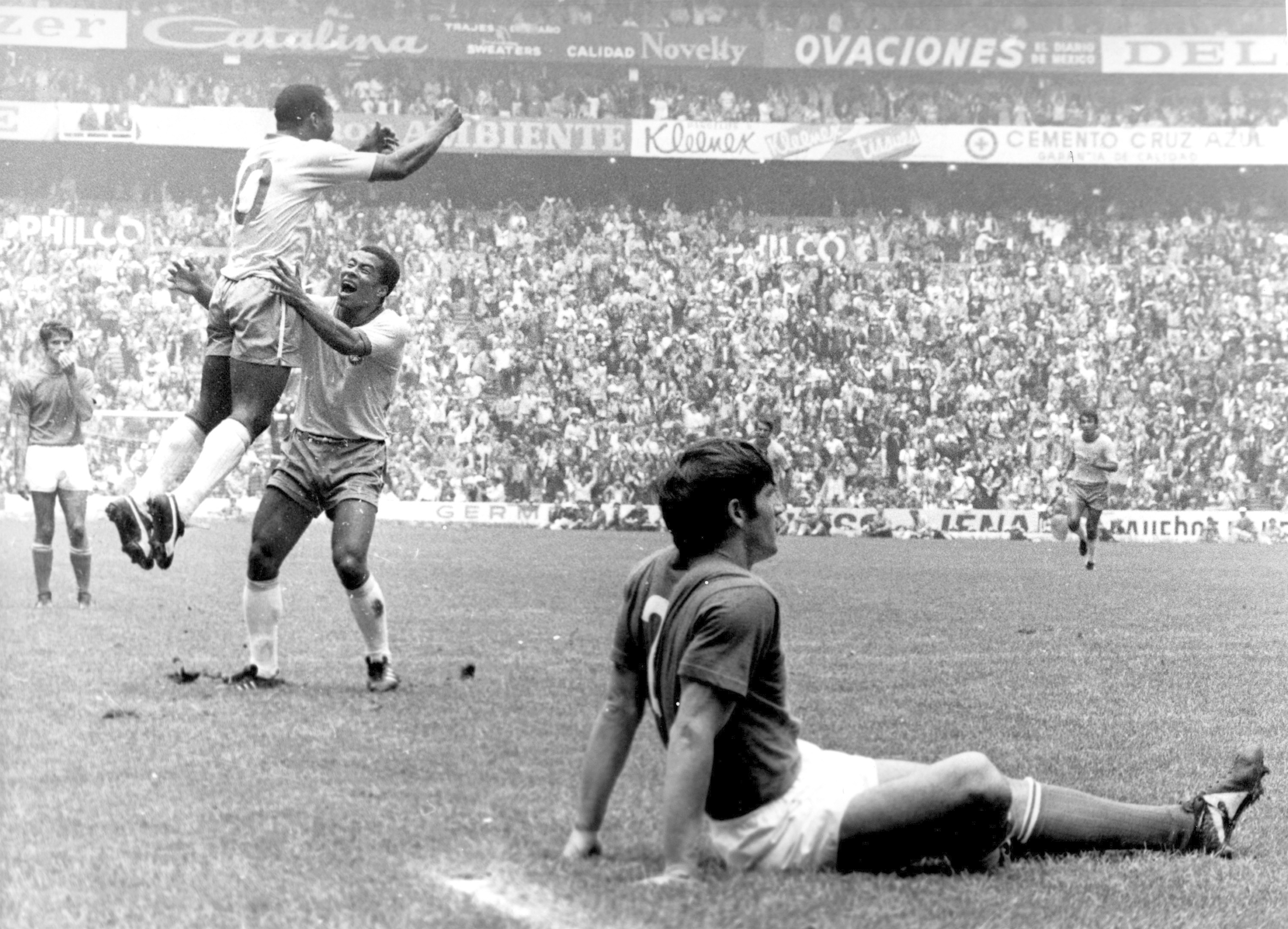
    In this June 21, 1970 file photo, Brazil’s Pelé jumps for joy after scoring his team’s first goal against Italy in the first half of a World Cup final at Azteca Stadium in Mexico City, before winning 4 – 1. Kurt Strumpf

    But what lives most vividly in my memory played out during the long lent leading up to those games.

    I’m a kid, standing under the eucalyptus tree in my grandmother’s house in Guatemala with my brothers, trading Panini we purchased for centavos at the corner store in Zone 7 so that we could fill every team roster with stamps in our albums. We talked fútbol nonstop — me, who can’t stand sports, and my brothers, who love soccer and baseball with equal passion — and cheerfully bickered about who would go the distance.

    For me soccer will always be about those two people I love, who I want to keep talking fútbol with until the day I die. The beautiful game is beautiful precisely because of the profound connections it invites and honors — be it with family members, friends or strangers across continents and time zones.

    Or with a city, hosting its first ever World Cup matches with characteristic style and grit. May you hold our deep and indelible memories forever, Philadelphia.