Author: Jeff Neiburg

  • Weather during the World Cup in Philadelphia could be useful data for a future Eagles stadium

    Weather during the World Cup in Philadelphia could be useful data for a future Eagles stadium

    Three-quarters of the seats inside Lincoln Financial Field — er, Philadelphia Stadium — felt the blast of a late-afternoon sun before France and Paraguay kicked off their round of 16 showdown Saturday, the sixth and final World Cup game in the city.

    Those weren’t rally towels swinging; they were the giveaway fans, and even those seated on the shaded west side of the stadium used them to try to cool off. Some in the sun left them unraveled and used them as a shade.

    Philadelphia set a record Saturday, reaching 101 degrees or higher for the third consecutive day, according to the National Weather Service. The real-feel temperature on the field at kickoff was hotter than the 98 degrees FOX displayed on its television broadcast.
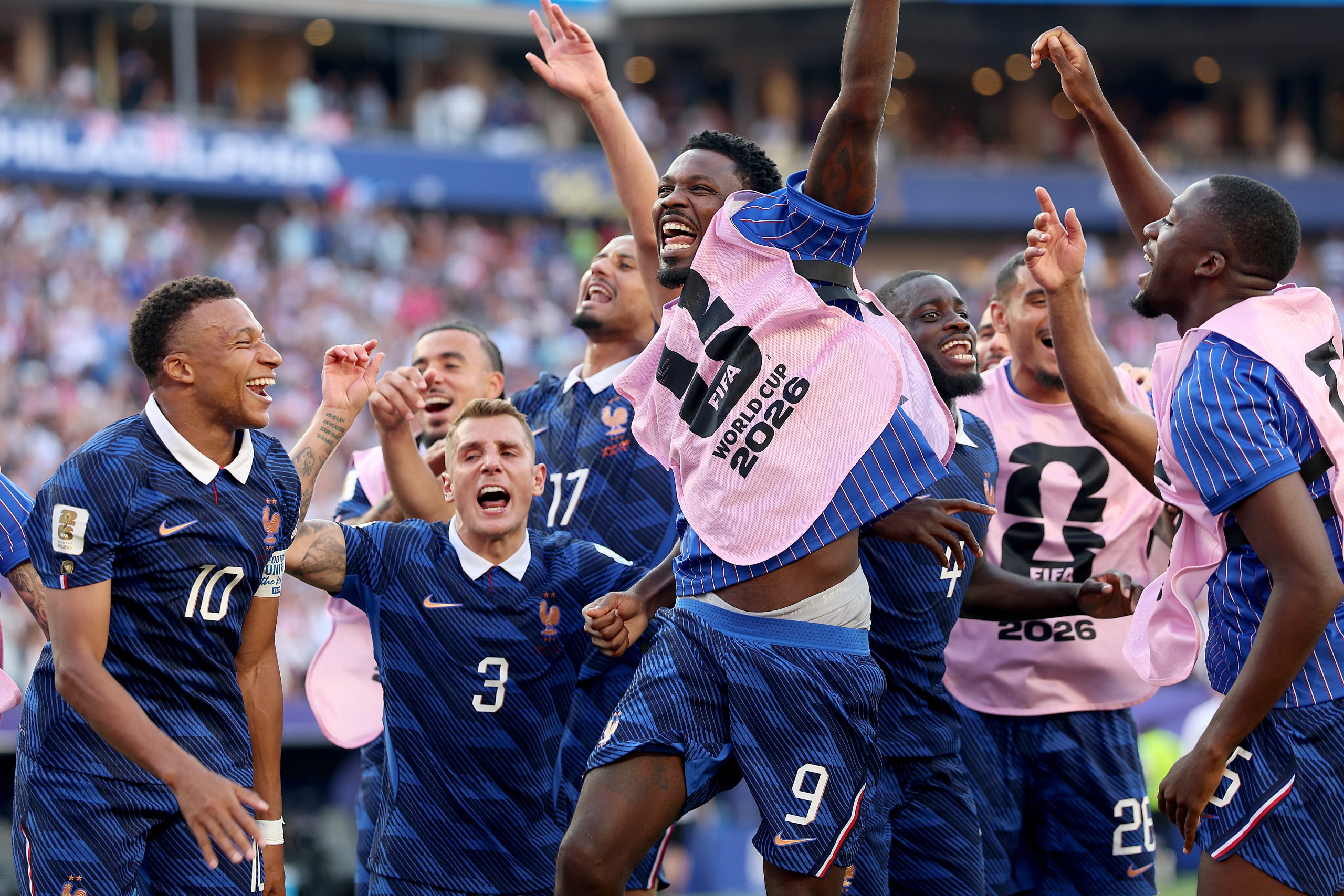
    France celebrates after its defeat of Paraguay on a sweltering final day of FIFA World Cup action at Philadelphia Stadium. David Maialetti / Staff Photographer

    The city shone during its three weeks in the world spotlight. Fans have packed the fan festival. The stadium has been full. But the games didn’t come and go without the weather being part of the story.

    France’s first trip to Philadelphia, a June 22 group stage game vs. Iraq, featured a lengthy delay at halftime due to lightning from a storm that produced heavy downpours. The scheduled 15-minute break lasted more than two hours. Saturday’s game was played during a record-setting heat wave and kicked off with the threat of severe thunderstorms looming later Saturday night.

    The World Cup won’t return to the U.S. until at least 2038. If Philadelphia is among the host cities, will the next version of Philadelphia Stadium have a roof?
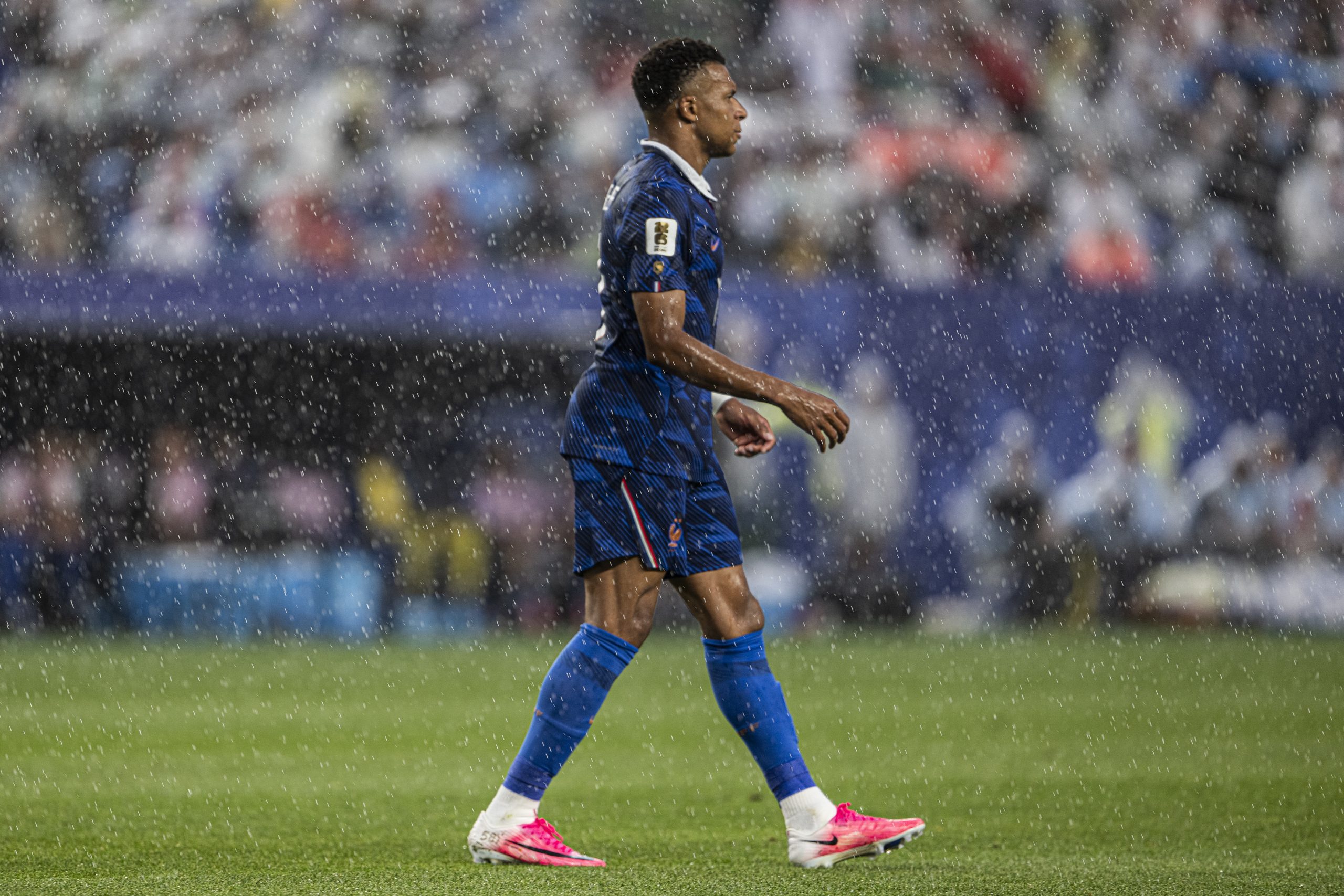
    France forward Kylian Mbappé walks off the field at the start of a two-plus hour rain delay at Philadelphia Stadium on June 22 for their game against Iraq. Jose F. Moreno / Staff Photographer

    ‘I was a purist, but…’

    Mount Laurel’s Graig Weidinger, who was tailgating with a group of friends outside the stadium Saturday, knows it’s probably inevitable that the home of the Eagles one day will have the ability to shield the playing field from weather. The team’s lease expires in 2032, and Jeffrey Lurie said earlier this year that the organization is going through “exploratory research” on the idea of a new or renovated stadium.

    Many new stadiums and renovation projects in the NFL have included retractable roofs or domes. There are currently 10 NFL stadiums with roofs, and four more are on the way. The Eagles still are at least a year away from coming close to finalizing plans for their future, but data points like the weather during this World Cup could factor into decisions.

    Weidinger said he previously was against the idea of the Eagles playing under a roof. He lamented a future where LeSean McCoy doesn’t dash through the snow for 217 yards in a snowy game vs. Detroit in 2013. Or a future where Saquon Barkley isn’t running through a snow globe-like scene pushing the Eagles to the NFC championship game two seasons ago.

    “It gives you the memories,” Weidinger said. “You’re not going to have that.”

    It is not just the cold that has recently impacted Eagles games. The 2025 season opener was delayed for more than an hour in the third quarter due to a thunderstorm.

    “At first I was a purist, but now I’m giving in to the idea,” Weidinger said. “Now that the weather is so extreme each season.”
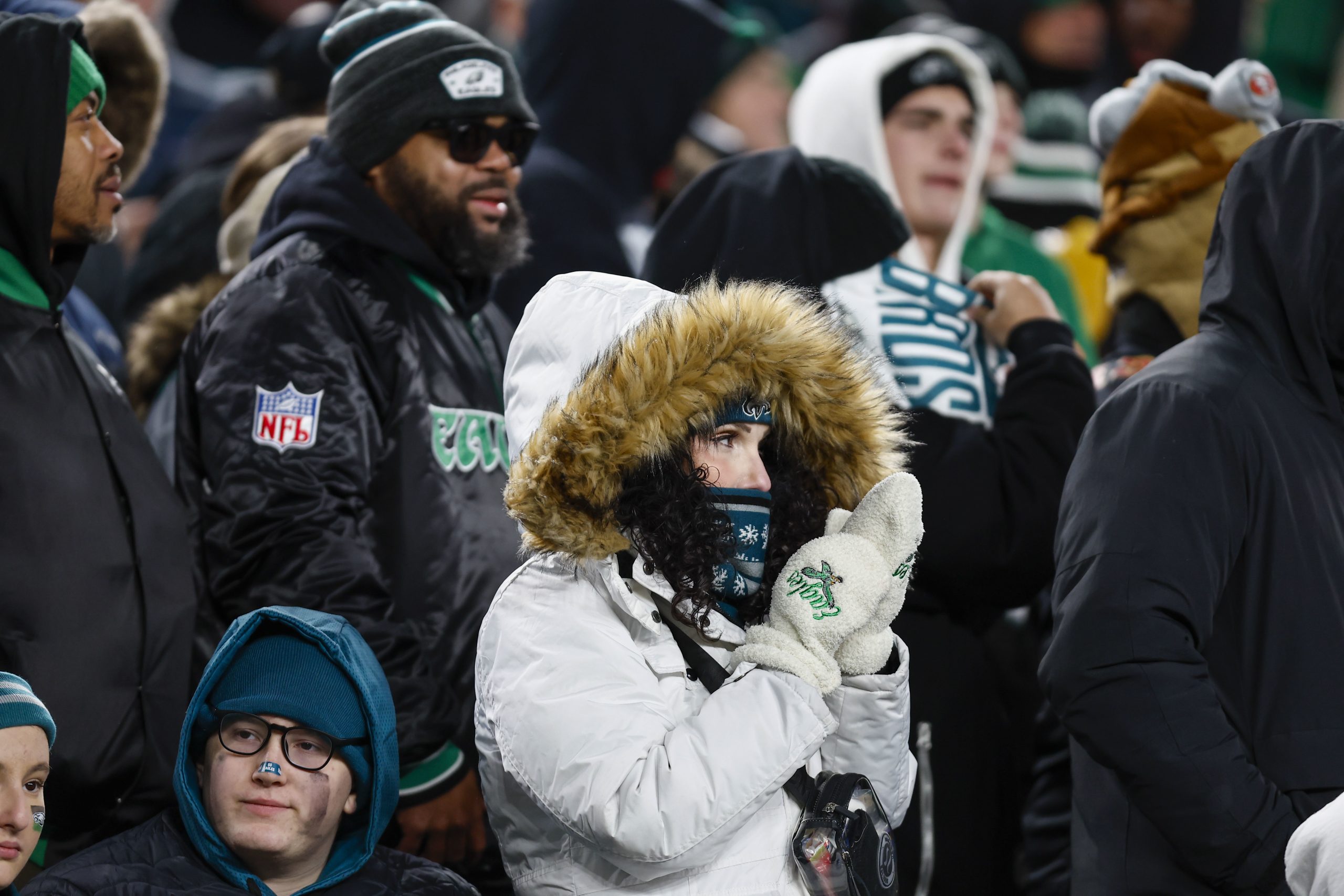
    Eagles fans have long had to resist extreme elements; the question now is whether the rise of extreme heat and cold places more pressure to consider a roofed stadium in Philly.Monica Herndon / Staff Photographer

    There will be a faction of fans who strongly resist a roof. Football, they will say, is meant to be played outside. But the current stadium isn’t just a football stadium, and Lurie may have aspirations to make the future one capable of hosting more marquee events.

    “For the city, with what they can do, you see the college playoffs going places, the Super Bowl,” Weidinger said. “If you’ve got a roof you can do it all.”

    ‘The best of both worlds’

    By halftime, most of the field and more than half the seats inside the stadium were protected from the sun with shade. The real feel in the city was still 100 degrees when Kylian Mbappé scored his seventh goal of the tournament — and third in Philadelphia — on a 70th-minute penalty kick that gave France its eventual 1-0 win and a ticket to the quarterfinals.

    This is the World Cup, and the announced sellout crowd of 68,324 paid a lot of money for tickets, so most of the seats in the sunny east side of the stadium were full. But there were empty seats visible on that side of the field, their owners likely watching from a shadier, cooler spot.

    The fan experience, Lurie said in March at the annual league meeting, will be a priority for any future stadium or renovation.

    “We’re so focused on fan amenities,” Lurie said. “To me, that’s the No. 1 thing. Just as a boy growing up, you want to have as best a fan experience. The rest is architecture, design, and where it ends up.”

    The fan experience was on the minds of Kurt and Trish Neff as they drove to the stadium Saturday from Boothwyn.

    Did they find themselves wishing they were driving to a stadium that was air-conditioned?

    “Today, right now? Absolutely, yes,” Kurt said.

    In that vein, Kurt said he “would be more likely to come to a game sitting in some warmth during the winter for a football game. Sometimes you’re thinking about selling your tickets in January or the end of December.”

    Trish, a soccer coach, wanted to play devil’s advocate.

    “The weather is part of a coach’s strategy for the game,” she said. “Whether it’s cold or hot, you might change your game plan depending on it. But for the fans, temperature control would be better.”

    Perhaps stadium discussions can be like a healthy marriage. There’s always a chance for compromise.

    How about a retractable roof?

    “It’s the best of both worlds,” Kurt said.
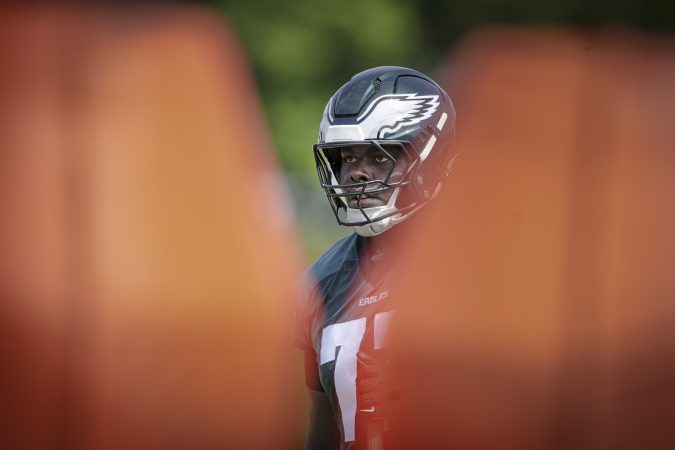
  • Eagles newcomers ’26: How soon might Markel Bell contribute along the offensive line?

    Eagles newcomers ’26: How soon might Markel Bell contribute along the offensive line?

    With Eagles training camp drawing nearer, The Inquirer is taking a closer look at the more than three dozen new faces who are expected to report along with the rest of the team on July 28.

    Player: Markel Bell

    Position: OT

    Age: 22 (when camp starts)

    Previous experience: Bell’s lone season as a full-time starter was this past one, when the 6-foot-9, 346-pound offensive tackle helped Miami reach the national title game. Bell is sort of a late bloomer. He started playing football in seventh grade. In part because he grew up in a small town in Mississippi, he was a zero-star high school recruit who went to junior college before blossoming into one of the most sought-after offensive line prospects two years later.

    Bell was a rotational tackle in 2024 before earning the left tackle gig at Miami last year. He dominated. He did not surrender a sack while playing more than 1,000 snaps. He also was named second-team Academic All-America last season.

    Path to a roster spot: Bell’s spot on the 53 is not in doubt. Surprisingly, it was Bell taking first-team reps during OTAs (with Lane Johnson absent) and not Fred Johnson, the swing tackle the Eagles brought back for another season. Sure, OTA reps are relatively meaningless, but it’s a sign the Eagles think Bell possibly could step in right away to that swing tackle role. We’ll see where things stand come training camp, but given recent injuries over the last few years to Jordan Mailata and Lane Johnson, Bell could see meaningful snaps as soon as 2026.

    Fun fact: Bell grew from 5-foot-9 to 6-foot-4 during a summer growth spurt between eighth and ninth grades, according to The Athletic.

    Quotable: “Typically when you get guys out of high school and they come in the door, they’re not as driven or as focused,” Les George, Bell’s offensive line coach at Holmes Community College, told The Inquirer in April. “They kind of have an idea of what they want to accomplish just based off of what they see on social media or see other people accomplish and they’ll kind of be all-in with it, but Markel was different than any other guy I’ve coached. Extremely focused, very humble. He was a guy that didn’t want to settle for mediocrity.

    “I don’t know how to explain it. He’ll make you a better coach.”

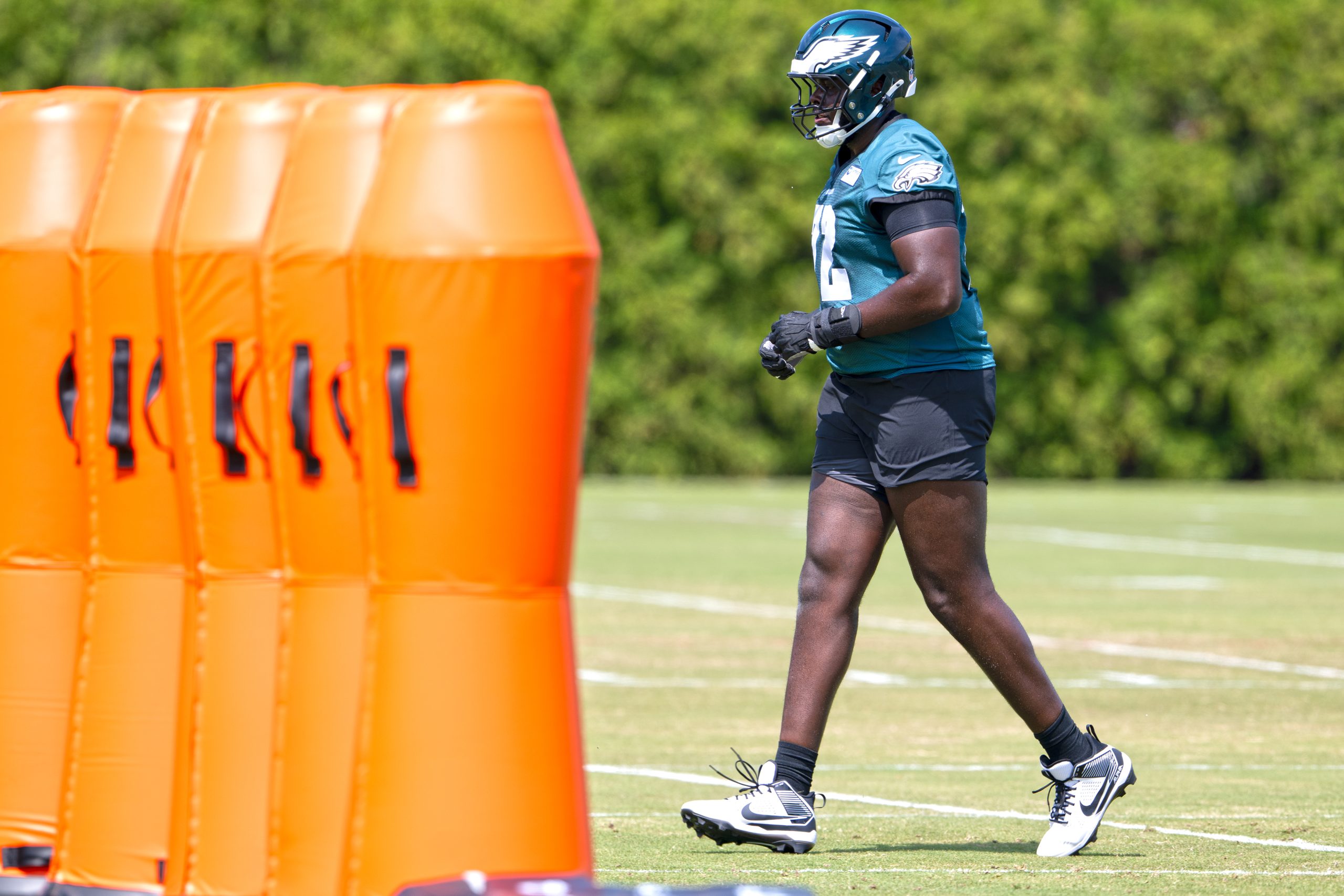
    Markel Bell practices during rookie camp on May 1. Jose F. Moreno / Staff Photographer

    Player: Joshua Weru

    Position: Edge rusher

    Age: 22

    Previous experience: Football experience? None. Rugby experience? Plenty. Jordan Mailata proved that path is possible. The Eagles signed Weru after he went undrafted. He is one of two players on the training camp roster who come with International Pathway Player designations, the other being seventh-round pick Uar Bernard.

    Weru, a native of Kenya, attended Arizona State University last year. He showed off his athleticism at the International Player Pathway program pro day, where he ran a 4.45 40-yard dash (with 1.59 10-yard split) and had a 41.5-inch vertical and 11-2 broad jump. The Eagles are hoping those traits translate into an edge rusher capable of playing NFL snaps.

    Path to a roster spot: Nothing is impossible, but Weru’s chances of making the 53-man are long. The Eagles are a bit crowded on the edge, with four shoo-ins and a few players with real football experience pushing for the bottom of the depth chart. Weru, however, will have a chance to make a good first impression on the Eagles and show them why he’s worth carrying on the practice squad while they continue to mold him into a football player.

    NFL teams can carry 16 players on the practice squad and have a 17th spot available for players with IPP designations. Bernard seems more likely than Weru to make the 53-man roster, but there’s a world where both of them end up on the practice squad after passing through waivers. One would count toward the normal 16-player practice squad roster, and the other would be the IPP designation.

    Fun fact: Weru joined a professional rugby club at age 14 and has represented the Kenyan national team on the international stage.

    Quotable: “I’d say my playing style is fast and aggressive,” Weru told a Kenyan radio station. “One of the reasons I enjoy this game is that it’s 100% all the time. I was used to rugby, where the game was longer and it would be too tiring to go 100% every single phase. But in football, especially in the few times we’ve gone full contact, it’s nothing like that.

    “The way I think about it is that you’re like a sprinter and a boxer at the same time, you’re going full speed and trying to hit people as hard as possible. I enjoy that, and that’s how I’d describe my playing style: fast and aggressive.”

  • Eagles owner Jeffrey Lurie to be honored at ESPYs with Stuart Scott Award for commitment to autism awareness

    Eagles owner Jeffrey Lurie to be honored at ESPYs with Stuart Scott Award for commitment to autism awareness

    Eight years ago, at the inaugural Eagles Autism Challenge, team owner Jeffrey Lurie called the family-friendly bike ride that raised money for autism research and programs “a call to action” and “one giant step.”

    The event had more than 3,000 participants and raised more than $2.5 million. Eight years later, the combined efforts of the Lurie Autism Institute — launched last year with a $50 million donation from the Lurie family — and the Eagles Autism Foundation have collectively contributed to more than $100 million toward research and clinical care programs around the world.

    This year’s Eagles Autism Challenge raised more than $16 million through nearly 40,000 donations and more than 6,500 participants, according to the team.

    Lurie, 74, bought the Eagles in 1994. He has lifted the Lombardi Trophy twice after two Super Bowl victories, but his efforts to support autism research and care may be the larger lasting legacy of his tenure.

    On Tuesday, ESPN announced that Lurie will be honored with the Stuart Scott ENSPIRE Award as part of this year’s Sports Humanitarian Awards during ESPYs award week. The award, named after the late SportsCenter anchor, is given to someone that uses the power of sports to help disadvantaged groups or people.

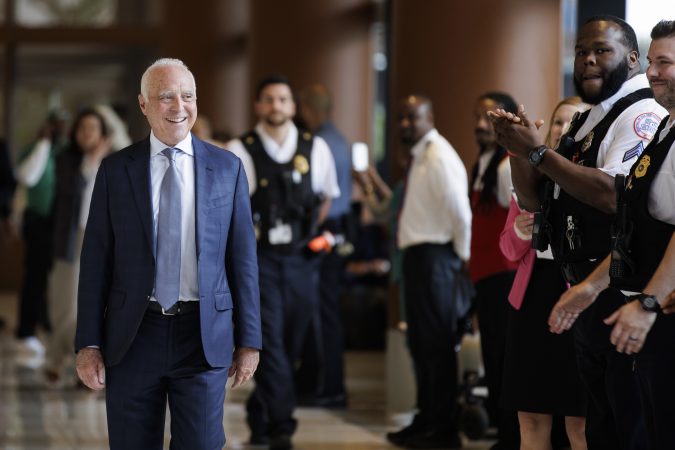
    Eagles owner Jeffrey Lurie is one of the world’s leading fundraisers for autism research. Elizabeth Robertson / Staff Photographer

    “This honor exemplifies the transformative power of sport and the life-changing impact it can have on people,” Lurie said in a press release. “Stuart was a trailblazer whose legacy was built on integrity, professionalism, and bravery. His authentic character and fearlessness in the face of adversity will live on forever through this distinguished award.

    “I have always envisioned that the impact of owning a professional sports franchise could extend beyond the field and into the global health community. The Eagles Autism Foundation and Lurie Autism Institute have been created to support individuals with autism and their families by funding innovative and potentially groundbreaking research rooted in science and data, in addition to providing programming and services to those in need. Autism is a global condition that is not only underfunded and under-researched, but just in the United States alone affects one in 31 children.”

    The Sports Humanitarian Awards will take place on Tuesday, July 14 in New York. The show will be featured during ESPN programming and during the ESPYS, which air July 15 at 8 p.m. on ABC.

    Lurie is the lone representative of Philadelphia’s sports teams this year in both the humanitarian awards and the main ESPYs program. The full list of humanitarian award winners can be found here. Nominees for the ESPYs can be found here. South Jersey’s Hannah Hidalgo, a guard at Notre Dame, is nominated for best single-game performance for her record-breaking 16-steal game against Akron.

  • Kevin Willard accomplished most of his goals in Villanova’s roster rebuild. Then came Luigi Suigo.

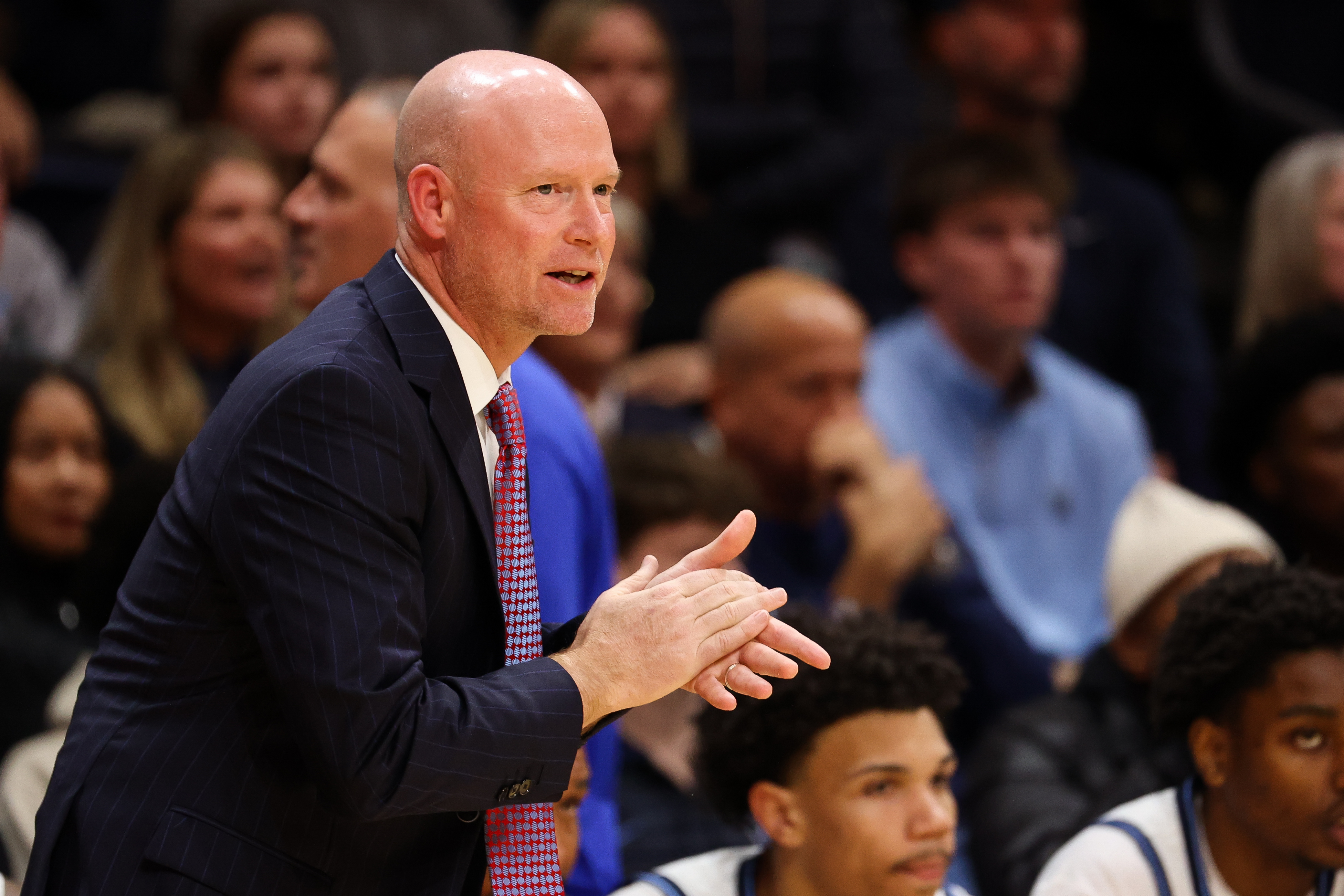
    Kevin Willard accomplished most of his goals in Villanova’s roster rebuild. Then came Luigi Suigo.

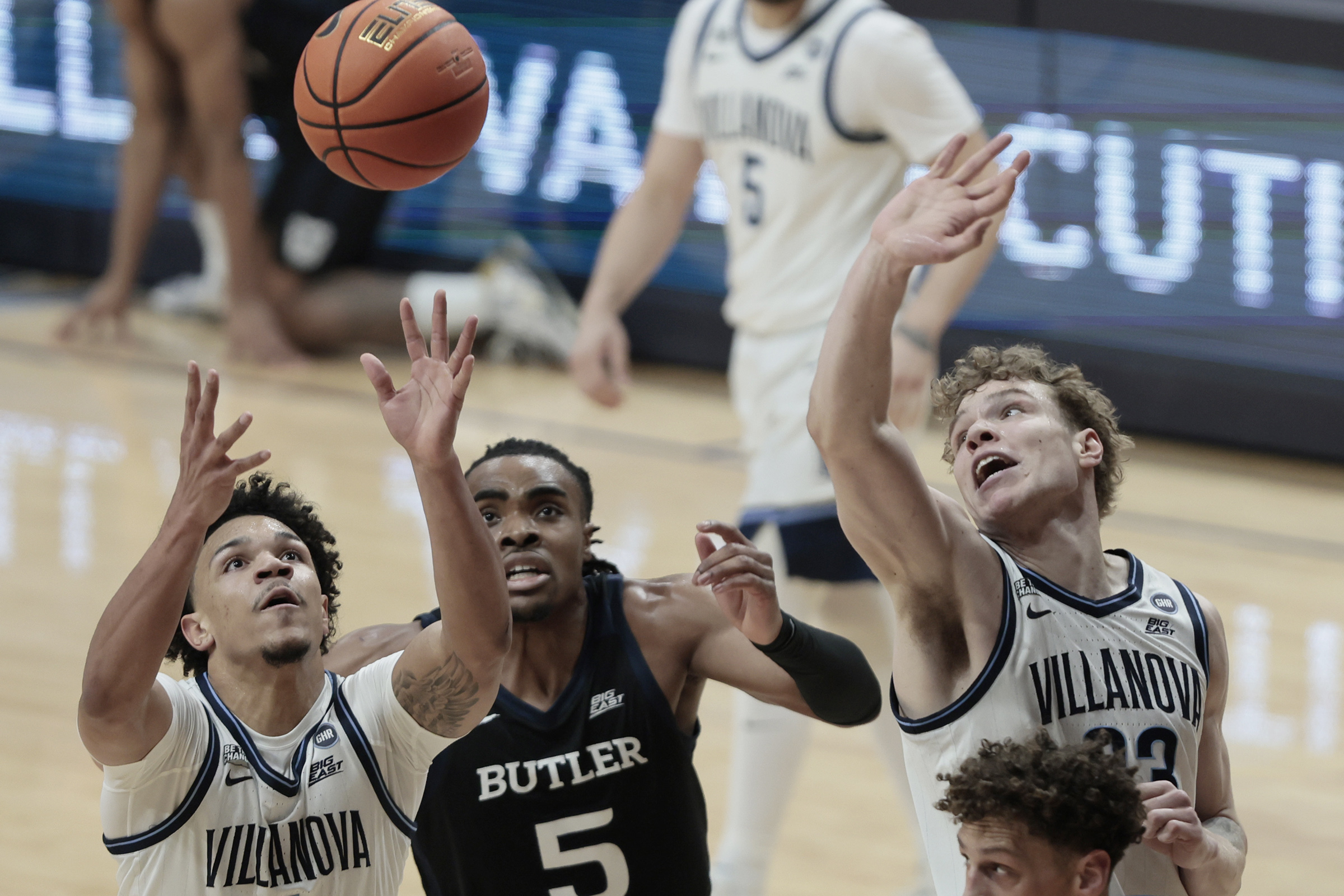
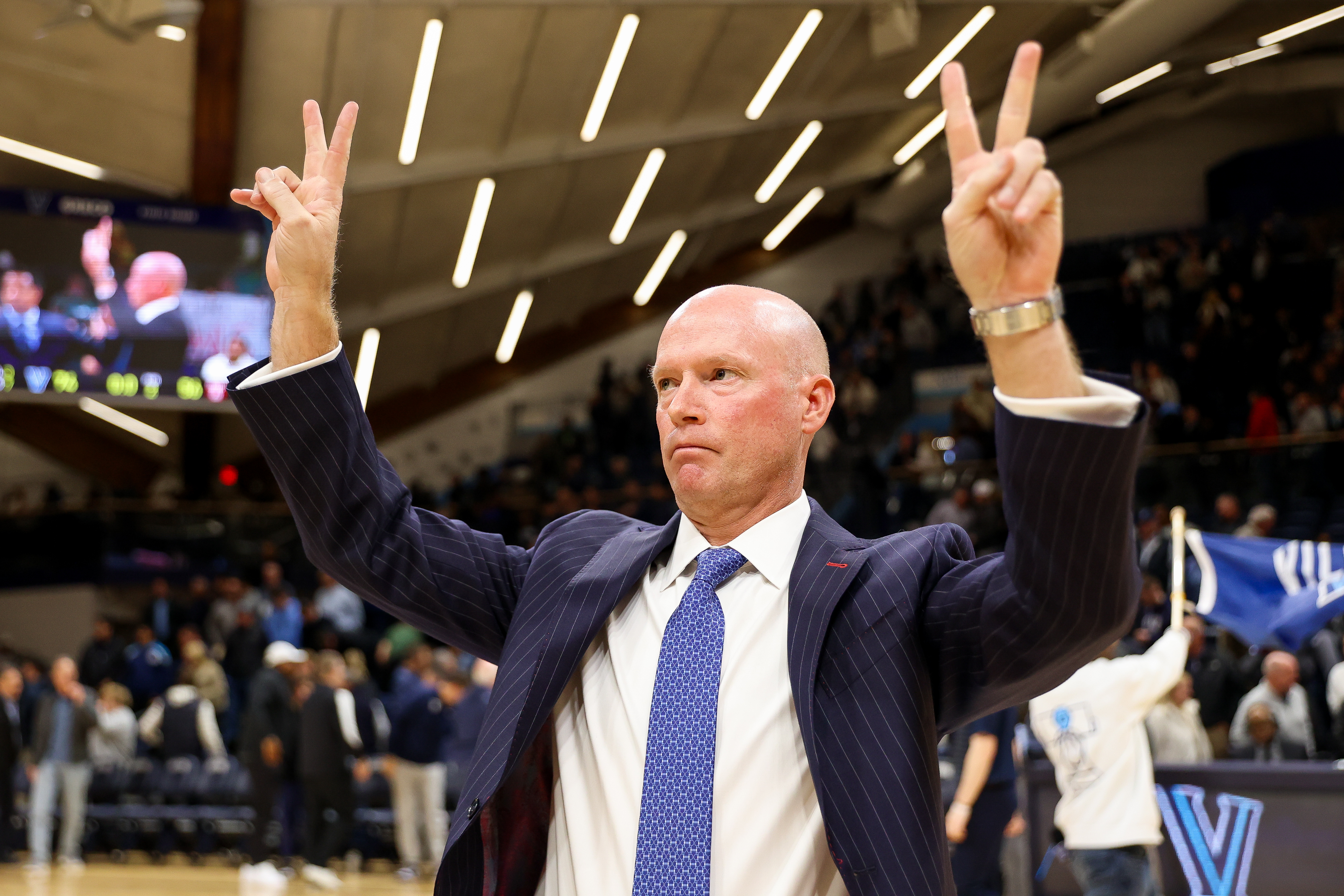
    Rumors of Villanova’s interest in 7-foot-3 Italian center Luigi Suigo already were swirling when assistant coach Ricky Harris posted a photo last month on his Instagram page from Milan, not far from Suigo’s hometown of Tradate. Villanova was trying to keep its pursuit of Suigo under the radar, but Harris’s post only fueled the speculation.

    Villanova is visiting Suigo in Milan! The staff is all-in on adding the future NBA center! Kevin Willard really wants the cherry on top for this roster rebuild!

    Let’s play a little game of Two Truths and a Lie.

    No, Villanova didn’t send Harris to Milan to visit its next center. The other things are true, though. And the lie is only a partial one. It wasn’t Harris visiting Suigo, it was Willard. Harris was just in Italy enjoying an offseason vacation, with the bulk of the roster overhaul already done. But it wasn’t Milan where Willard went, it was Belgrade, Serbia, where Suigo played this past season with Mega Basket of the Adriatic League.

    “Belgrade was beautiful,” Willard said Monday, nine days after Suigo announced he was leaving the NBA draft and signing with Villanova. “Food was great, people were awesome.”

    It was a short business trip, less than 48 hours. Willard had spent the past month reassembling the Wildcats’ roster. Only two players who dressed in a game from last season’s team, Tyler Perkins and Matt Hodge, returned. The staff surrounded them with plenty of talent, but still needed a true center to round out the roster. Any starting-caliber center would have been fine. The offseason had largely been a success even after losing a few top players like Acaden Lewis and Bryce Lindsay to the transfer portal.

    “We could have gone in a couple directions,” Willard said of the center spot. “For us, it was like, all right, how are we trying to win a championship here?”

    On film, Suigo looked the part of a player who could take the roster to the next level. The size component is obvious. But Suigo is a “really skilled center that can shoot it, that can pass at a high level,” Willard said. “I think one of his best attributes is that he’s extremely unselfish. He’s a great passer.”

    Willard wanted more than film studying, though, so he got on a plane and flew halfway across the world to watch Suigo practice in person, to meet with his coaches, to sit down with him for dinner.

    “Sometimes you can watch clips and you can get fooled,” Willard said. “When I went over there and talked to him in person, met him in person, and saw him play, it was like, yeah, this kid is the real deal.

    “He’s very professional. He knows what he wants. He knows how he wants to play. He knows where he needs to get better at.”

    In 26 games with Mega Basket, Suigo, 19, posted averages of 7.9 points, 5.1 rebounds, and 1 block in 18.8 minutes. He shot 64.9% on his 111 two-point shots, 27.1% on 48 three-point attempts, and 64.7% on 34 free throws.

    Draft evaluators had Suigo projected near the end of the first round or early in the second round. Luring a player out of that range surely was costly for Villanova. Willard declined to discuss financials with The Inquirer. But the region’s rich Italian-American culture and the timing of watching the Knicks on their championship run with Jalen Brunson, Mikal Bridges, and Josh Hart were added bonuses.

    Plus, Suigo was open about wanting to be a top-20 pick throughout the draft process.

    “I think he maybe would have gotten drafted late in the first round, but he doesn’t want that,” Willard said. “He wants to make sure when he gets drafted he’s going to play. The big thing is I think he needs to get Americanized a little bit, to American basketball. I think that’s why college will be really good for him. Get in shape a little bit, just kind of get used to American basketball. I think once he does, the sky is the limit for him.”

    Sky’s the limit for the team, too?

    The offseason had a clear objective.

    “We wanted to make sure that we just didn’t get manhandled the way we got manhandled last year against the top teams,” Willard said.

    He was talking about national champion Michigan and the two top Big East teams, Connecticut and St. John’s. Willard’s first season at Villanova was a success. A streak of three consecutive missed NCAA Tournaments was stopped, though Villanova lost as a No. 8 seed in the first round because it lacked experience and physicality against a veteran Utah State team.

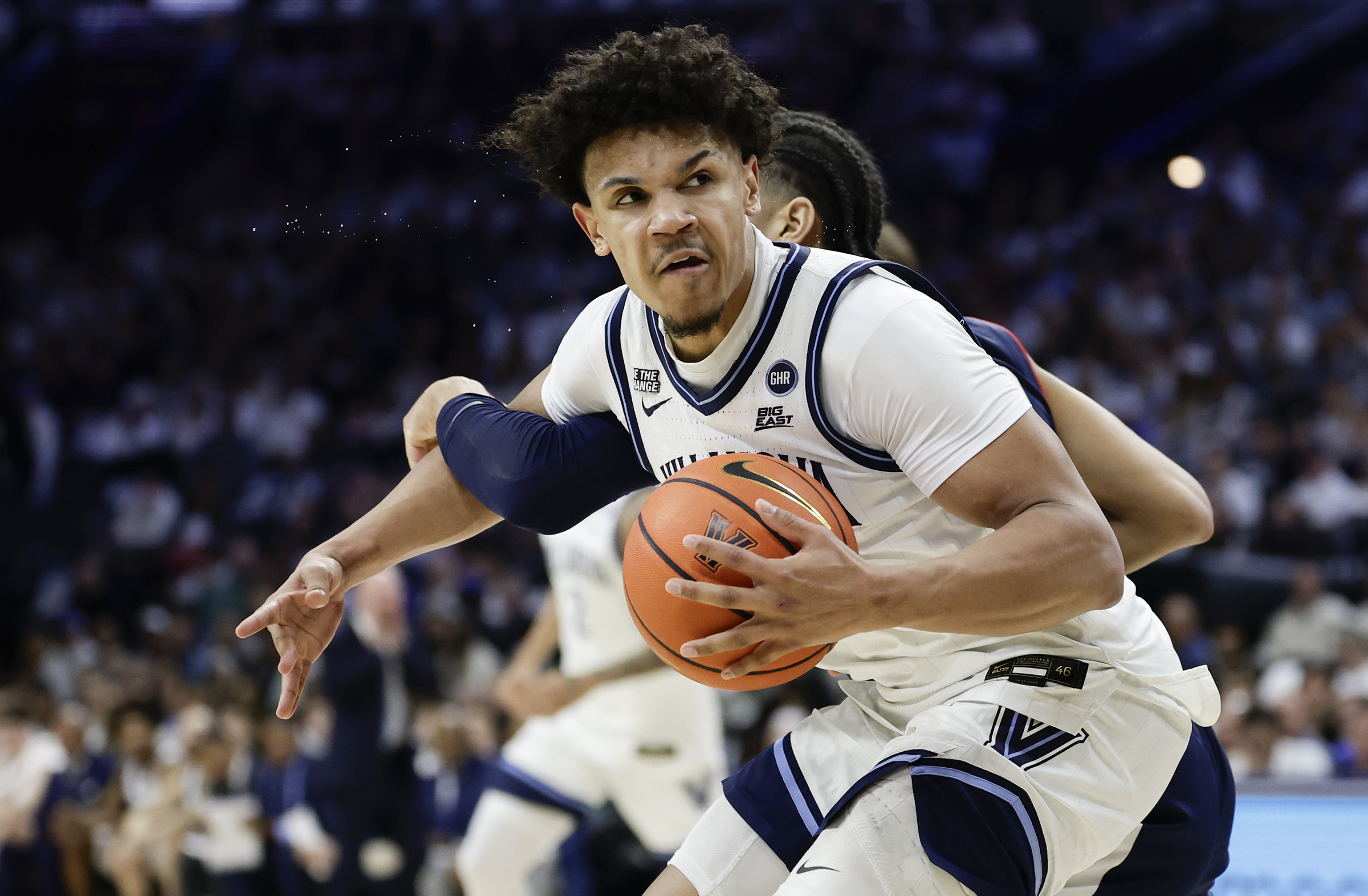
    Tyler Perkins (left) and Matt Hodge (right) will be key contributors again for the Wildcats in 2026-27.Elizabeth Robertson / Staff Photographer

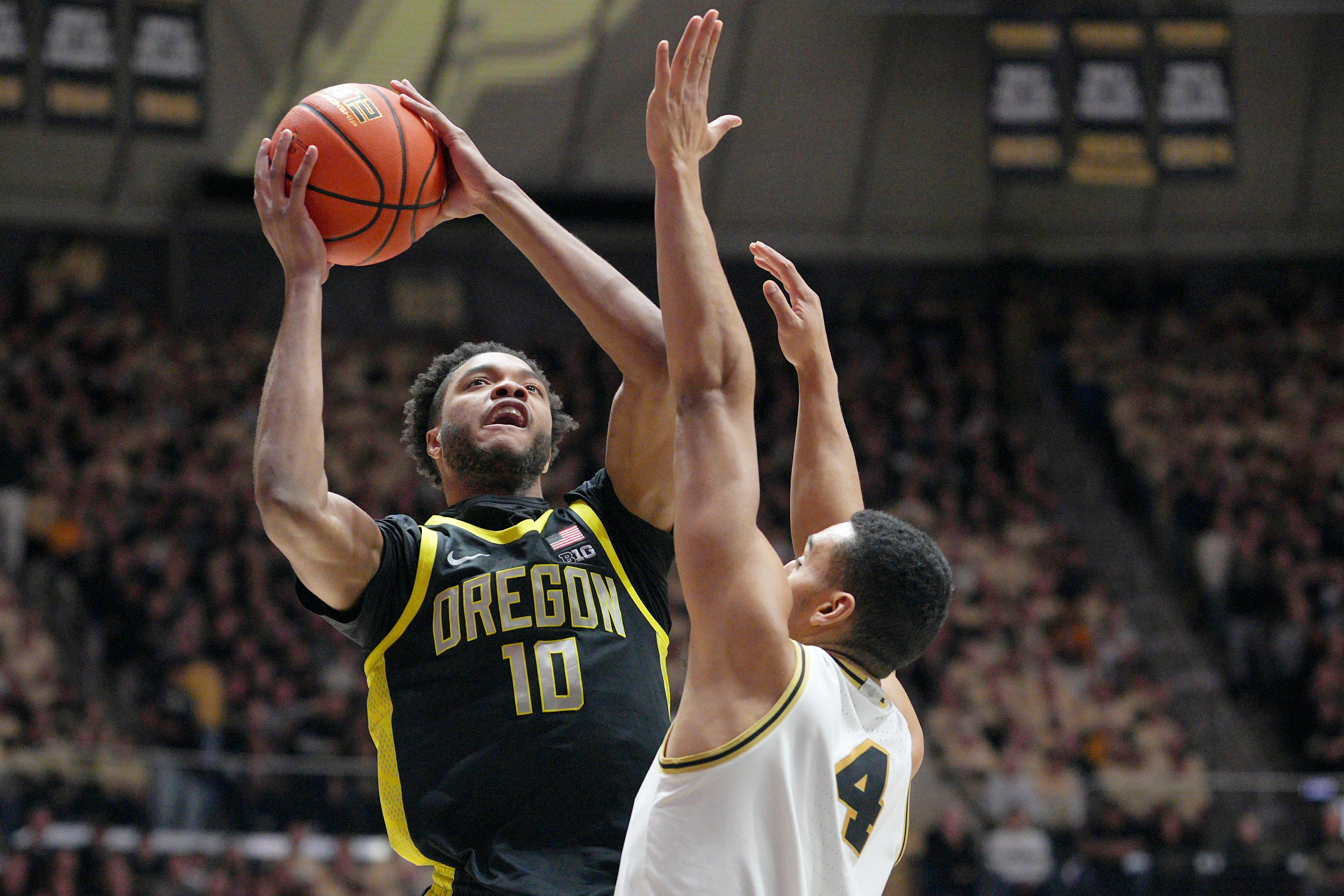
    The first additions of the offseason aimed to address that. Villanova signed Oregon’s Kwame Evans Jr. and Ohio State’s Devin Royal. Both players are incoming seniors who averaged more than 13 points in the Big Ten last season. Evans is 6-10 and Royal is 6-6 but is a physical player who averaged seven rebounds in 2024-25 and nearly six last season.

    With those two and Perkins and Hodge in the fold, the attention turned to the backcourt, specifically to the point guard spot. Willard said he watched more film to fill this spot than any other position during the offseason. Perhaps, then, he could ace a quiz on Illinois-Chicago hoops. Elijah Crawford scored 14 points and dished out five assists in 26 minutes per game last season. More importantly, his decision-making out of pick-and-roll stood out, as did his 75.3% rate from the free-throw line.

    Crawford is the likely starting point guard next to Perkins, with Royal, Evans, and Suigo rounding out the starting five.

    Backcourt depth was a problem at times last season. On paper, it won’t be in 2026-27. The Wildcats added Cornell shooting guard Jake Fiegen, who Willard said “analytically, was probably one of the highest-rated guys.” Fiegen shot 41.4% from three-point range on 5.5 attempts per game. He thrived in catch-and-shoot situations, of which he will have plenty with this Villanova roster.

    Then there’s St. Bonaventure transfer Buddy Simmons. Willard said the staff was actually watching another Atlantic 10 player when they became enamored with Simmons, a 5-11 guard who scored 16.4 points per game and shot 42.5% from deep. While Fiegen is more of a standstill shooter, Simmons produces off the dribble.

    Incoming freshman guard Adam Oumiddoch also is expected to contribute right away. He’ll add to a versatile bench that also includes Hodge, who Willard said is tracking toward being ready for the beginning of the season after undergoing surgery to repair a torn ACL in March.

    Evans could play some minutes at center, as could returning redshirt freshman Nico Onyekwere.

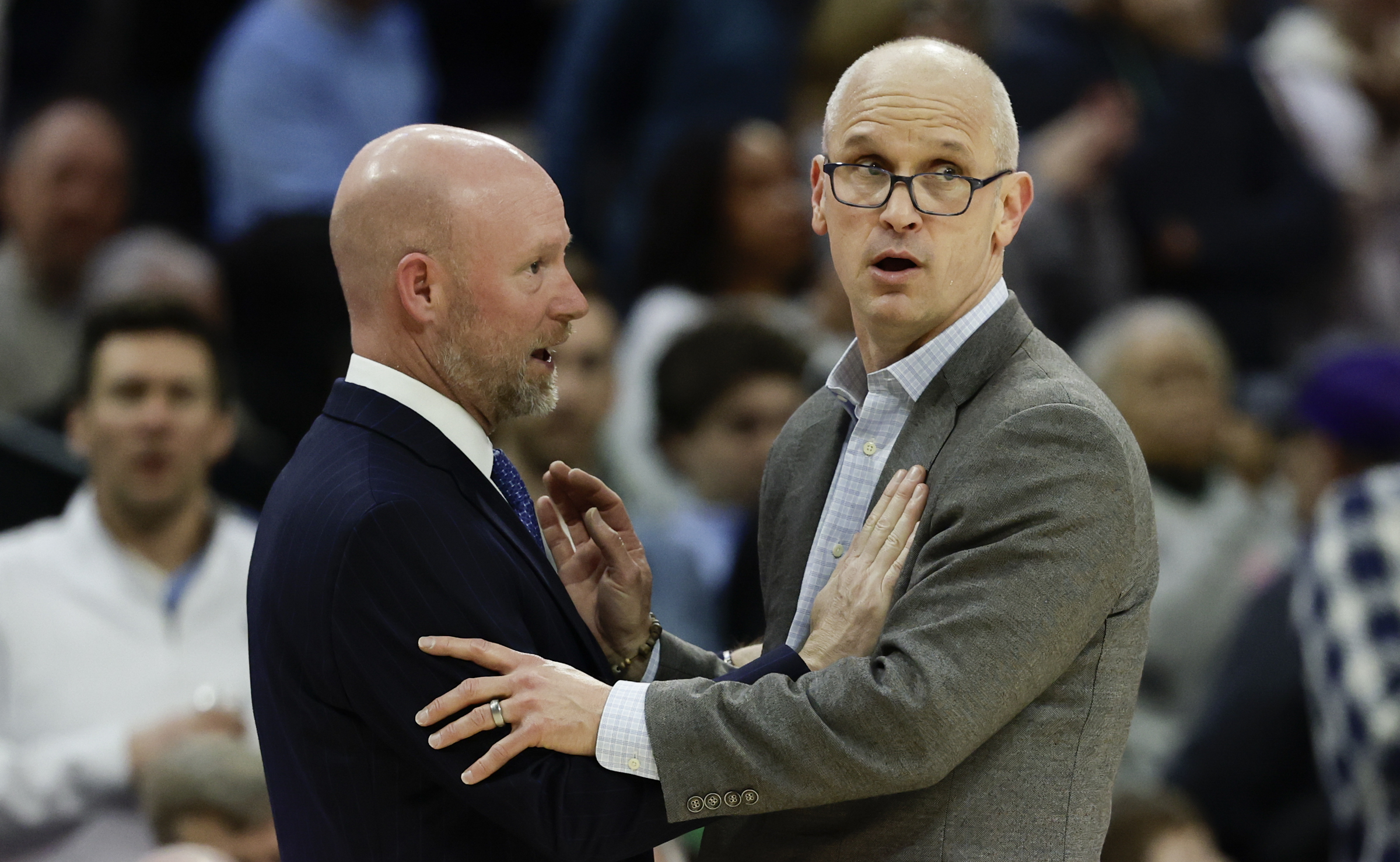
    Villanova hit the offseason trying to build a roster to compete with Dan Hurley’s UConn program.Yong Kim / Staff Photographer

    “We can play small or we can play really big,” Willard said. “That was my goal. Last year we were kind of hampered in how we could play. This year I think we have so much more flexibility.”

    Signing a 7-3 center helps.

    But Suigo’s signing should have done more than raise the expectations for the 2026-27 season. Sure, the Wildcats may get some preseason top 25 love. But they also showed they can compete financially with other programs.

    “From Father Peter to the board to our alumni and our donors, everyone understands how important Villanova basketball is,” Willard said. “We will never be the highest spender. That’s not in our DNA and it’s not what it is. But I will say that the university understands and financially has been extremely supportive of this program and the women’s program.”

    About those expectations …

    “I’m the head coach at Villanova,” Willard said. “The expectations are huge every year. I knew that when I took this job. I knew that when I took the Maryland job. It’s just part of the job. It’s what makes this job so great. You want those expectations.”

    It’s what you fly to Serbia for.

  • A way-too-early Eagles 53-man roster prediction: How might the personnel picture change before training camp begins?

    A way-too-early Eagles 53-man roster prediction: How might the personnel picture change before training camp begins?

    It goes without saying, but we’ll say it anyway. The Eagles still are more than two months away from cutting their roster down to 53 players by the Aug. 30 deadline for the 2026 NFL season.

    A lot can change between now and then.

    It’s almost a guarantee that there will be some player movement on and off the 90-man roster between now and then, and probably even before the Eagles take the field for the first time at training camp at the end of July.

    OK. The necessary caveats are out of the way.

    Who’s going to be on that initial 53-man roster? We’re going to make predictions throughout training camp, and since the Eagles just finished their offseason program and have some downtime before camp begins, it’s worth taking a shot at predicting the roster now. Future iterations of this list will be more informed (not that this one isn’t!).

    Without further ado, here is our initial 53-man roster prediction for the 2026 Eagles — and a first guess some players who will stick around on the practice squad, too.

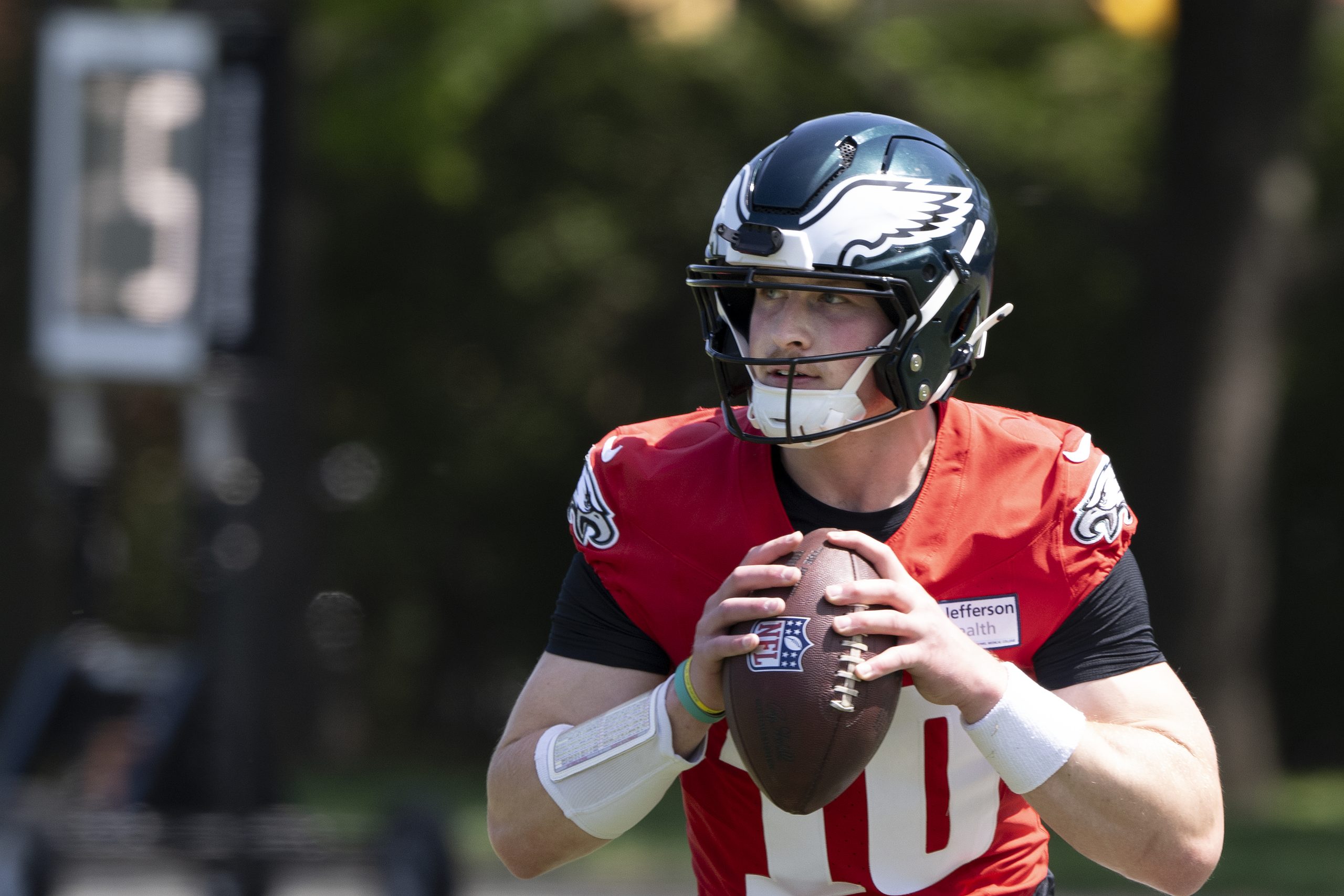
    How much would Cole Payton’s presence on the roster factor into what the Eagles do ahead of him at QB2? Jose F. Moreno / Staff Photographer

    Quarterbacks (3): Jalen Hurts, Andy Dalton, Cole Payton

    Traded: Tanner McKee

    Practice squad: TBD

    Something’s got to give, right? The Eagles aren’t going to use four roster spots at the quarterback position. They also may be reluctant to expose a fifth-round pick (Payton) to waivers unless his camp is that uninspiring. But Kyle McCord was a sixth-round pick last year and the Eagles were able to pass him through waivers. Still, the Eagles have been rotating Dalton and McKee with the second-team offense throughout the offseason program, which means McKee’s grip on the No. 2 spot has loosened. The Eagles probably are hopeful McKee plays well at camp and in preseason games so they can deal their 2023 sixth-round pick for a draft asset.

    As for that TBD spot in the practice squad, if McKee is dealt, count on the Eagles bringing in another body late in camp with the goal of keeping that player on the practice squad.

    Running backs (4): Saquon Barkley, Tank Bigsby, Will Shipley, Cameron Latu (fullback)

    Cut: Dameon Pierce, Elijah Mitchell, Carson Steele

    Practice squad: Mitchell

    Count Barkley and Bigsby as locks, but behind them is a real competition for roster spots. Shipley gets the nod here, but we’ll see what happens when camp starts rolling. Pierce and Mitchell bring some experience. Steele, meanwhile, is a fullback. Latu is listed as a tight end by the Eagles, but he transitioned to fullback last year and his best path to the roster is at that position. Whether the Eagles keep a fullback or not remains to be seen, but Latu is a pretty solid blocker and has made an impact on special teams.

    Darius Cooper (left) and Dontayvion Wicks are part of a crowded receiving corps. Monica Herndon / Staff Photographer

    Wide receivers (6): DeVonta Smith, Makai Lemon, Dontayvion Wicks, Hollywood Brown, Darius Cooper, Elijah Moore

    Cut: Johnny Wilson, Britain Covey, Danny Gray, Quez Watkins, Erik Ezukanma, Samori Toure

    Practice squad: Covey, Wilson

    The Eagles have begun life after A.J. Brown. There’s a pretty clear pecking order as things stand right now. The top four receivers seem pretty etched in stone, but there will be healthy competition for the back end of the depth chart. They could end up keeping five instead of six, too. Cooper and Moore slot in on this first pass and get the nod over Wilson, who should be easy to get through waivers since he’s coming off injury.

    The Eagles liked what they saw out of Cooper, an undrafted free agent, last season and Nick Sirianni raves about the “dirty work” Cooper and Wilson bring to the table. Having them both may be a little redundant. Moore may be considered a relative long shot to make the team, but he has had his moments in the NFL and could push for a spot for a team that might need some more playmaking at wide receiver with A.J. Brown gone. Covey, meanwhile, could slot in on the practice squad and be called upon in the punt return game.

    Can Grant Calcaterra stick on a team with bolstered depth at the tight end position? Monica Herndon / Staff Photographer

    Tight ends (3): Dallas Goedert, Eli Stowers, Johnny Mundt

    Cut: Grant Calcaterra, Stone Smartt, E.J. Jenkins, Dae’Quan Wright

    Practice squad: Wright

    If all goes as planned for the Eagles, this position might be the most boring one in camp when it comes to figuring out who to keep and who to cut. Mundt was brought in to provide a big boost in the blocking department, and the Eagles drafted Stowers in the second round. There’s a world where they keep four, but Calcaterra, who has been a mainstay on the team over the last four seasons, seems like a long shot to make the roster given his deficiencies as a blocker and his slot work being superfluous with Stowers in the mix.

    Offensive linemen (11): Jordan Mailata, Landon Dickerson, Cam Jurgens, Tyler Steen, Lane Johnson, Markel Bell, Fred Johnson, Drew Kendall, Michael Jordan, Micah Morris, Cameron Williams

    Cut: Myles Hinton, Willie Lampkin, Jake Majors, Jaedan Roberts, Hollin Pierce, John Ojukwu

    Practice squad: Hinton, Lampkin, Majors, Pierce

    The five starters are pretty set unless someone wows in camp and pushes Steen for a spot. Behind the starting unit is more talent than there was at season’s end. The Eagles made a concerted effort to add some depth to the offensive line. They brought back Fred Johnson and drafted Bell. The third-round pick might have first dibs on the swing tackle job. They also added some more experience on the interior in Jordan, who started 20 games over the last two seasons. Having Jordan makes it so that Kendall and Morris aren’t the primary backups on the interior. The Eagles likely will have a decision to make on the two tackles they drafted last season: Hinton and Williams. It seems unlikely both make the team.

    Can Uar Bernard progress quickly from major project to a spot on the active roster?Monica Herndon / Staff Photographer

    Defensive tackles (5): Jalen Carter, Jordan Davis, Moro Ojomo, Byron Young, Uar Bernard

    Cut: Ty Robinson, Gabe Hall, Zion Wilson, Ta’Quan Graham

    Practice squad: Robinson, Wilson

    This is a tricky one. How likely is Bernard to be claimed by another team if the Eagles waive him? Remember, the claiming team needs to put the claimed player on the 53-man roster. The first-time football player has some elite athleticism, but he doesn’t know how to play football. It’s hard to justify keeping a player on the 53 that is unlikely to dress for a single game. But Bernard is unique. Robinson is the roster casualty here, but last year’s fourth-round pick gets through waivers in this prediction and gets onto the practice squad, where he can be elevated for game days. Wilson is an intriguing prospect the Eagles probably would like to keep around.

    Edge rushers (5): Jonathan Greenard, Jalyx Hunt, Nolan Smith, Arnold Ebiketie, A.J. Epenesa

    Cut: Keyshawn James-Newby, Jose Ramirez, Joshua Weru

    Practice squad: James-Newby, Weru (IPP)

    The first four spots offer little intrigue. There’s an obvious trio at the top in Greenard, Hunt, and Smith, and Ebiketie, who signed a one-year deal worth more than $7 million, slots in as a rotational rusher. The last spot likely will come down to James-Newby, a seventh-round pick in this year’s draft, and Epenesa, who signed with the Eagles on the day minicamp ended after his free-agent deal with Cleveland fell through following a physical. We’ll give the nod to the experienced Epenesa and put the rookie on the practice squad for now, where he’ll join Weru, who won’t count against the 17-player limit on the practice squad due to his International Pathway Player (IPP) designation.

    Jeremiah Trotter Jr. should see a lot of action at LB during the preseason. David Maialetti / Staff Photographer

    Linebackers (4): Zack Baun, Jihaad Campbell, Jeremiah Trotter Jr., Smael Mondon Jr.

    Cuts: Chance Campbell, Deontae Lawson

    Practice squad: Chance Campbell

    With Jihaad Campbell recovering from shoulder surgery, Trotter got a chance to shine during the offseason program. The Eagles have two clear starters and a very capable backup in Trotter. Mondon had some moments on special teams last season. Could Chance Campbell push for a roster spot? Special teams would get him there. But the Eagles went heavy at offensive line in this projection and don’t have the space to keep five off-ball linebackers. Chance Campbell should get through waivers cleanly and onto the practice squad.

    Cornerbacks (6): Quinyon Mitchell, Cooper DeJean, Riq Woolen, Jonathan Jones, Kelee Ringo, Mac McWilliams

    Cuts: Jakorian Bennett, Ambry Thomas, Shaun Wade, Tariq Castro-Fields

    Practice squad: Thomas

    The Eagles should have one of the best defensive backfields in the league in 2026. Mitchell and Woolen will man the outside and DeJean, an All-Pro in 2025 like Mitchell, slots into the nickel spot, though he’ll play safety in base. Jones was brought in to provide some more depth on the outside. Ringo has had his chances and seems like a change-of-scenery candidate, but he’s been great on special teams and should earn his spot that way.

    Will Marcus Epps (right) break camp manning a de facto starting role at safety?Monica Herndon / Staff Photographer

    Safety (3): Drew Mukuba, Marcus Epps, Michael Carter II

    Cuts: Cole Wisniewski, Andre’ Sam, Kapena Gushiken, J.T. Gray, Max Pulley, Tucker Large

    Practice squad: Wisniewski, Sam, Gushiken

    We’re going light here for now since DeJean will play some safety. When the Eagles aren’t in base, which is the majority of the time, Epps is, as it stands, the guy who will play next to Mukuba. Carter II is a converted nickel corner who the Eagles will slot in a backup safety spot. Wisniewski was a seventh-round pick who could have some upside. If the Eagles keep 10 offensive linemen, or five receivers, Wisniewski likely makes the team if four safeties are kept. Keeping four is the more orthodox route. But it’s June, and we’ll start our first roster prediction with a little twist.

    Special teams (3): Jake Elliott (kicker), Braden Mann (punter), Rocco Underwood (long snapper)

    No cuts, no practice squad. These are the only three specialists on the roster.

  • Who’s QB2? How should we feel about the rookies? Any more new faces? Biggest Eagles questions after offseason workouts

    Who’s QB2? How should we feel about the rookies? Any more new faces? Biggest Eagles questions after offseason workouts

    The offseason program is over, and the next time the Eagles get together at the Jefferson Health Training Complex, it will be for training camp — the official start to the 2026 NFL season.

    The longest stretch of downtime around the league is right now, so it’s a good time to take stock of what we just saw during organized team activities and mandatory minicamp.

    The workouts allowed for a first look at new offensive coordinator Sean Mannion’s offense and a few new key players for the Eagles, but they also left some lingering questions about the team during the break.

    Here are some of the things we’re still thinking about:

    How long should the probationary period be for the new-look offense?

    The short answer: Longer than will probably be allowed.

    Eagles fans read and watched analysis here and probably elsewhere that told them Mannion’s offense was little match for Vic Fangio’s defense during the recent practice sessions open to reporters.

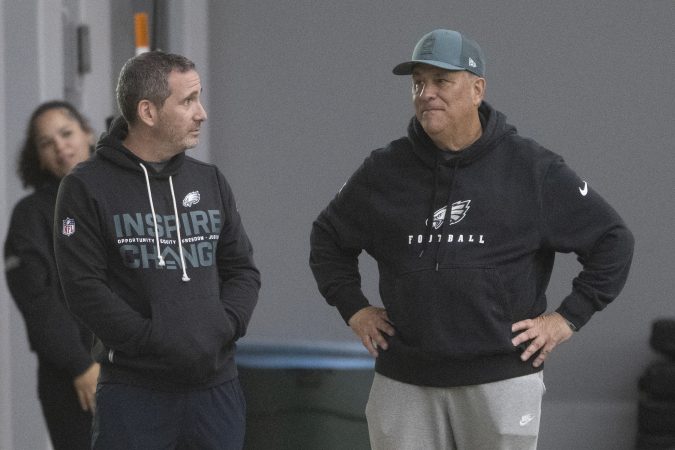
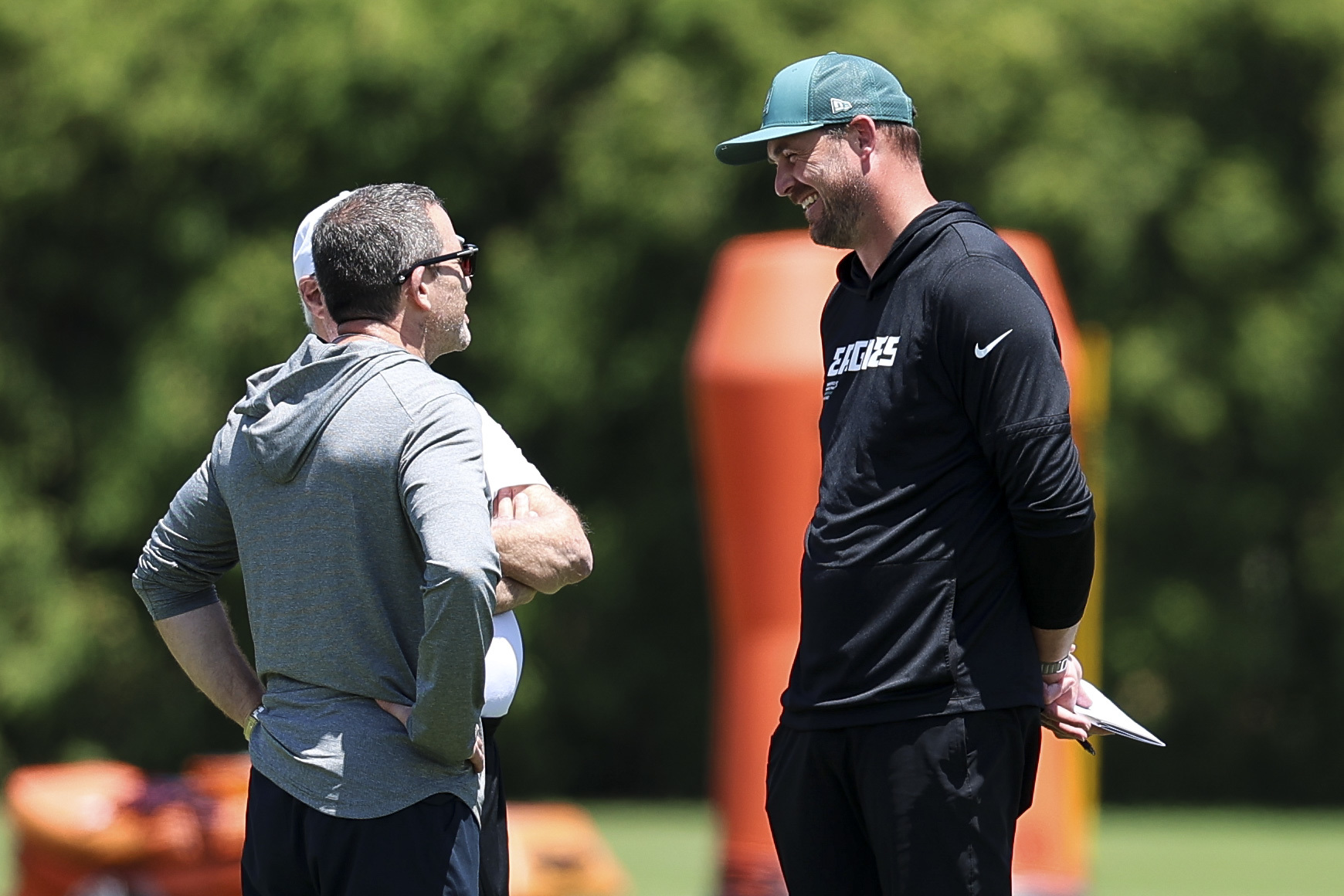
    Jeffrey Lurie and Howie Roseman speak with Sean Mannion (right) during mandatory minicamp.Monica Herndon / Staff Photographer

    What’s the reaction going to be if the offense looks sloppy a few practices into camp? It’ll be an outsized one, for certain. But it shouldn’t be.

    There are a few reasons why:

    • Fangio’s defense might be among the best in the NFL this season.
    • The Eagles are installing a new offense with new blocking schemes.
    • Jalen Hurts is taking more snaps from under center.
    • The Eagles are using more play action and more motion.

    Football is football, and some players will say as much, but there are going to be some growing pains before the offense is firing on all cylinders.

    Plus, while the focus of many will be on the play-calling and what the playbook looks like, it may all just come down to the health and force of the offensive line anyway.

    That’s not what the question asked, though. How long should the probationary period be? The view here is that drawing major conclusions about Mannion’s offense won’t have enough context until at least three games into the regular season. Patience levels are personal, right?

    What’s going on at QB2?

    Is it possible that the A.J. Brown trade was such a foregone conclusion that the biggest roster storyline in an otherwise pretty standard offseason program was the backup quarterback position?

    Andy Dalton and Tanner McKee are splitting reps behind Hurts, Nick Sirianni says, but the coach wouldn’t commit to saying McKee is the backup quarterback, the spot on the depth chart he held last season. He doesn’t have to commit to anything in June or even July or August.

    But the fact that Dalton took so many reps with the second-team offense was interesting.

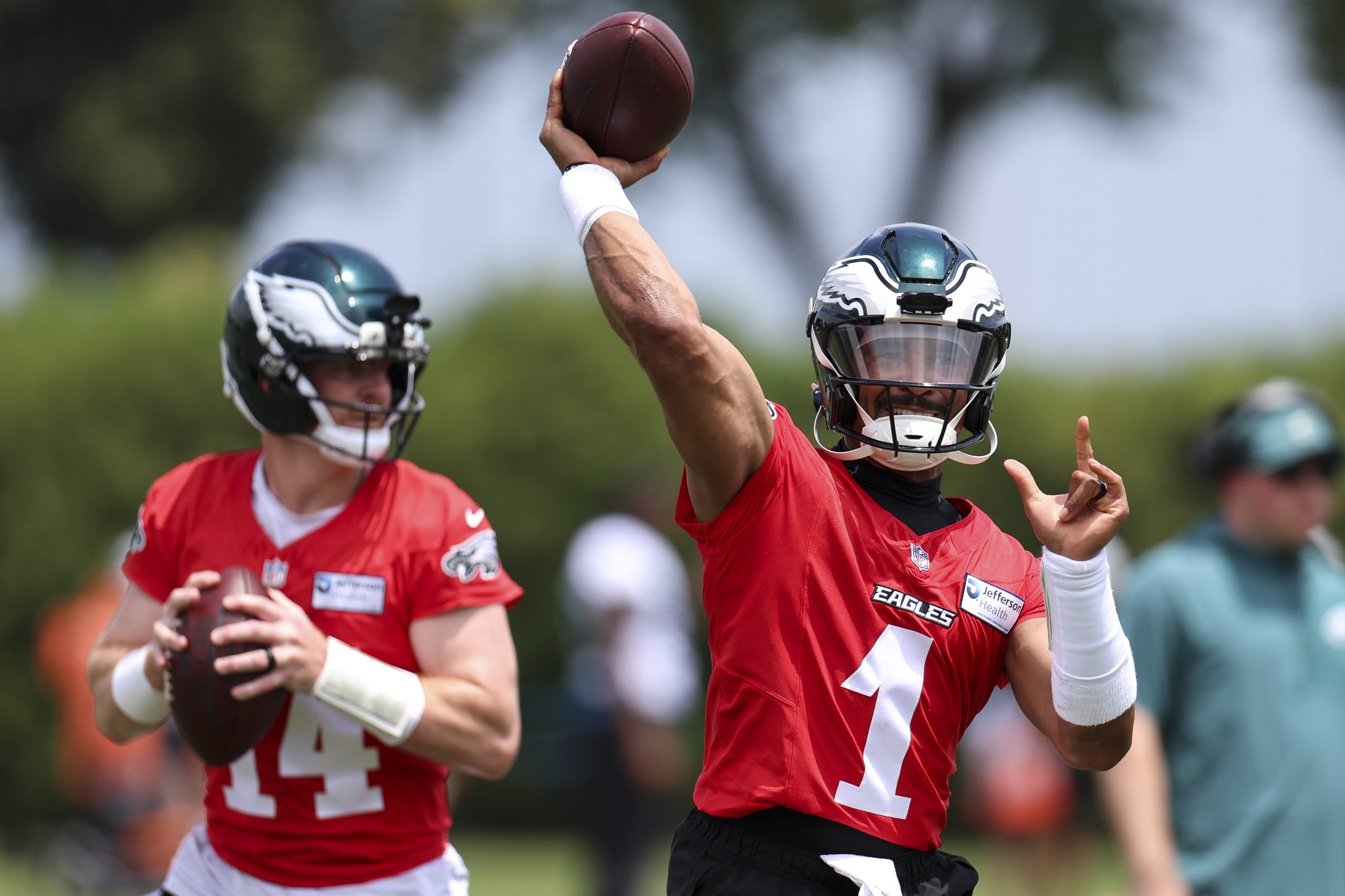
    Quarterbacks Andy Dalton (left) and Jalen Hurts work out during mandatory minicamp.Monica Herndon / Staff Photographer

    It’s fair to wonder if McKee will be on the roster by the time camp breaks, and the Eagles are crunching numbers to get to their initial 53-man roster. The Eagles used a fifth-round pick on quarterback Cole Payton after sending a seventh-round pick to Carolina for Dalton.

    It’s hard to imagine they will keep four quarterbacks on the roster, and it’s hard to imagine them wanting to expose a fifth-round pick to waivers unless Payton has the type of uninspiring training camp sixth-round pick Kyle McCord had last year.

    The guess here is that Howie Roseman is hopeful McKee puts some good play on tape in the preseason, and the Eagles get some draft value back in a trade for their 2023 sixth-round pick, who is entering the last year of his contract.

    Is a quiet spring from top Eagles rookies concerning?

    It shouldn’t be.

    But their first three picks were hampered by injuries.

    First-round pick Makai Lemon, who will be asked to contribute in a big way right away with Brown out of town, missed some time with a hamstring injury but is expected to be ready for camp. Sure, he didn’t get a ton of on-field reps, but it wasn’t like he was on an island somewhere while the Eagles were installing stuff in the meeting rooms.

    Makai Lemon was bothered by a hamstring injury during minicamp. Tyger Williams / Staff Photographer

    Eli Stowers, the second-round pick out of Vanderbilt, did not stand out in early workouts despite the Eagles raving about his athletic traits after selecting the tight end at No. 54. He then wore a sleeve on his right leg during the final workout of minicamp and sat out some drills.

    Markel Bell, the big tackle the Eagles took in the third round, also missed the last practice of minicamp.

    As for Stowers, Sirianni continued to have a lot of good things to say about him on the last day of the spring session. The former college quarterback is still only a few seasons into playing tight end, and while the Eagles are high on him — “He has an unusual skill set at the tight end position with the matchups that he is going to be getting,” Sirianni said — they also know he has a lot of work to do.

    It’s way too early to be alarmed about the rookie class.

    Will there be any roster additions before training camp?

    Roseman kind of answered that question just hours after the final on-field workout finished when he signed former Bills edge rusher A.J. Epenesa. That move made some more sense on Tuesday, when the Eagles placed free-agent signing Joe Tryon-Shoyinka on the reserve/retired list.

    Epenesa, who was drafted one spot after Hurts in 2020, originally signed with the Browns, but that deal did not finalize after Epenesa’s physical. Edge rusher was one spot, however, where the Eagles needed some more talent for some bottom-of-the-depth-chart competition. There’s a clear trio at the top in Jonathan Greenard, Jalyx Hunt, and Nolan Smith, and then there’s Arnold Ebiketie. Epenesa, who had six-plus sacks in three consecutive seasons from 2022 to 2024, figures to be in the mix for a roster spot.

    A.J. Epenesa, seen here as a member of the Bills, is a recent addition to the pass rushing depth chart. Gary McCullough

    Where else could the Eagles upgrade?

    Safety might be the only position on the team that still has some question marks. The Eagles plan to use Cooper DeJean at safety in their base defense with Quinyon Mitchell and Riq Woolen manning the outside corner spots. But that leaves around 75% of the reps next to Drew Mukuba for someone not named DeJean. Right now, it’s Marcus Epps’ spot to lose. But Epps is 30 and was available as a practice-squad addition last August.

    Behind Epps is Michael Carter II, who has played mostly nickel, and J.T. Gray, another 30-year-old with mostly special teams experience. Then there’s a mix of young and unproven players.

    Fangio has expressed confidence in Epps, and thinks Carter has the chops to play safety, but don’t be surprised if Roseman adds some more talent to the group before camp.

  • A ‘proud’ Jay Wright revels in the success of his former Villanova pupils with the ’Nova Knicks

    A ‘proud’ Jay Wright revels in the success of his former Villanova pupils with the ’Nova Knicks

    Jay and Patty Wright attended a wedding Saturday night in Red Bank, N.J., and Game 5 of the NBA Finals was at halftime when it was time for them to head home.

    Watching Jalen Brunson, Mikal Bridges, and Josh Hart is like watching his own children, Wright said, and he wasn’t going to miss this. Patty took the wheel, Jay put the game on his phone in the passenger seat. The game was nearing its end when it was time to exit the Blue Route.

    They weren’t going to make it home in time, so the Wrights pulled off the main road and onto a side street. They watched the ‘Nova Knicks win their first NBA title and end a 53-year New York Knicks championship drought in a Radnor cul-de-sac.

    Wright intentionally stayed out of the spotlight during the playoff run. He did a spot on ESPN’s Inside the NBA because the guy who asked him to come on was his old producer at Turner Sports and Wright wanted to do him a solid. He reluctantly attended Game 4 because Rick Brunson, Jalen’s father and a Knicks assistant, asked him to. He sat near the court with Patty on one side and Billy Lange — the former St. Joe’s head coach, and former Villanova assistant who is now in the Knicks’ front office — on the other. The epic comeback was followed by singing Frank Sinatra and Jay-Z, hugs with his former players and celebrities like Stephon Marbury and Spike Lee. It was, Wright said, “one of my favorite sports moments of all time.”

    But it was maybe fitting that he watched the series end in the car with Patty, just the two of them, proud “parents” watching the guys who played a huge part in delivering the family and the school two NCAA national championships.

    “What I enjoy about coaching is just sitting back and watching them all grow and then being a small part of their lives when they make a change or are accomplishing something and they call me or text me to ask me advice or share something with me,” Wright said Monday. “That’s what you love. It just happens to be that these three are doing it on the world stage and you’re watching them handle it with such maturity.

    “It’s really heartwarming, like if you watch your own kids do it.”

    Wright, 64, is a sort of basketball dad to Brunson, Bridges, and Hart. You don’t need to squint to see the style of play Wright and his coaching staff instilled in the trio during their time at Villanova. The staff would tell them that they would teach the “Villanova way” during their time playing college basketball, and it was up to them to take that to the next level and put their own spin on it.

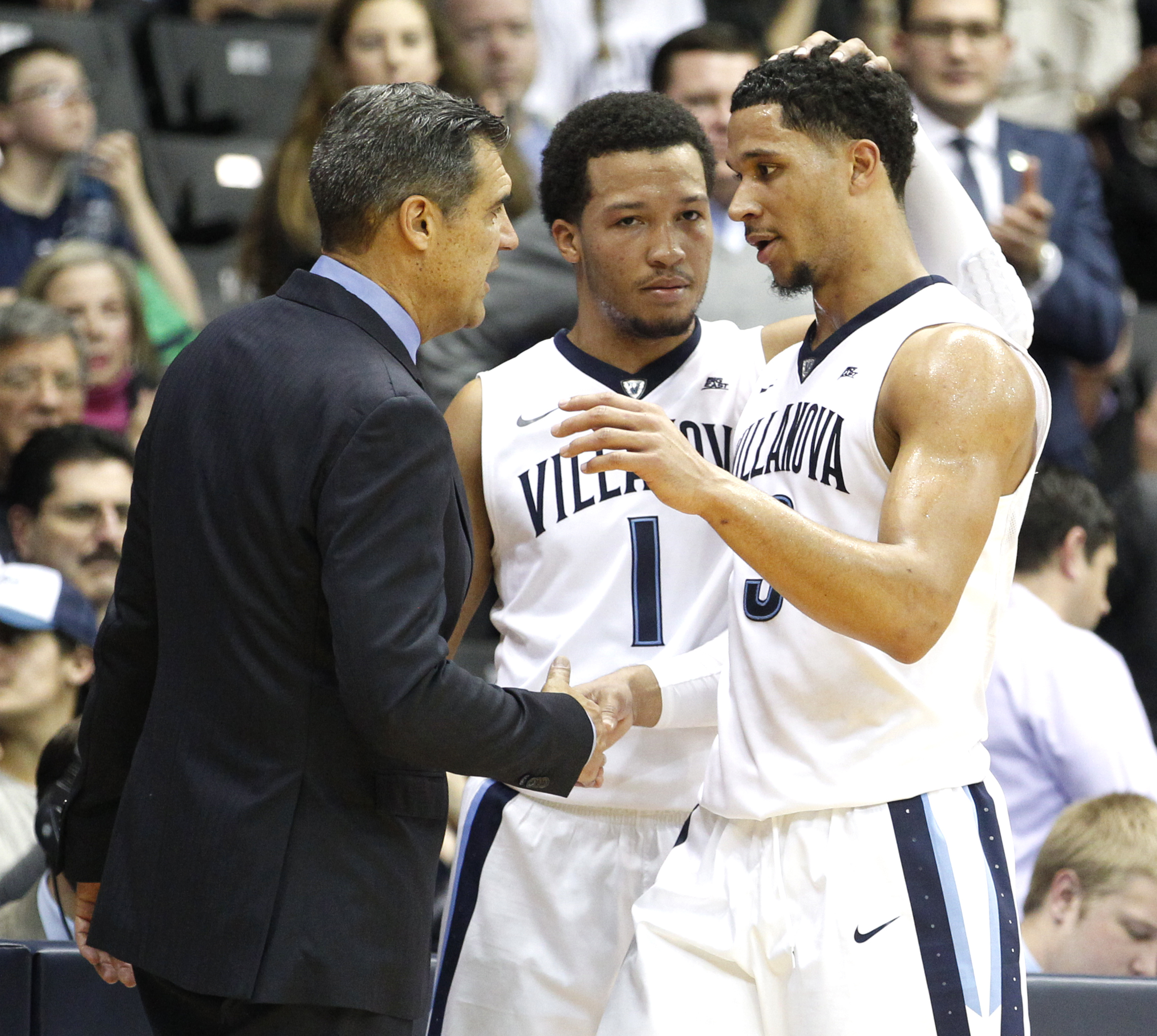
    Jay Wright, Jalen Brunson, and Josh Hart during a 2016 Villanova win over Temple.Charles Fox / Staff Photographer

    “You see things that they specifically took from our program,” Wright said. “You see the mentality that they took from our program. You also see what they added themselves to that, their own individualism, their own level of maturity, their own level of knowledge of the NBA game that I don’t have. It was fascinating for me to watch that.”

    There was no doubt this trio would end up contributing in the NBA in some capacity. Hart, who graduated from Villanova in 2017, was a first-team All-American. Bridges and Brunson left a year later after another title. Brunson was the player of the year.

    Wright talked to scouts both years. Hart, he told them, would be one of the greatest competitors a team could find. They didn’t need to worry about what position to play him at. Bridges, he said, would be the type of player who was capable of being a leading scorer but had the IQ to understand winning was more important than anything.

    He was right about those two evaluations. But Brunson? Wright thought he could be a point guard on a championship team. And that would be fine if he left the evaluation there. He’s right about that. But Wright thought he would need a leading scorer next to him. Dallas, where Brunson played before New York, was the perfect setup, Wright thought. Brunson could be the lead guard, but Luka Dončić was there to provide the bulk of the scoring.

    “I didn’t think he would be the guy that would score 45,” Wright said.

    Brunson, the Finals MVP, joined Michael Jordan as the only players in NBA history to score 45 in a road clincher. He averaged 11.2 points in the fourth quarters of the five Finals games. He is now in a new stratosphere of fame and is on a Hall of Fame type of path.

    All of this has been a unifying moment for the university and for the former teammates of the trio. It was alumni weekend and the school held a watch party on campus Saturday night. Later that night, after the Wrights pulled away from that cul-de-sac and returned to their home, Wright got a text message with a picture. On the court with Bridges was Phil Booth, a former teammate who now works with the Minnesota Timberwolves, and former Villanova walk-ons Matt Kennedy and Tom Leibig.

    “Personally, it has been a thrill for me,” Wright said. “I’m proud of all of them.”

  • Why signing Luigi Suigo is significant for Villanova, not just for 2026-27, but beyond

    Why signing Luigi Suigo is significant for Villanova, not just for 2026-27, but beyond

    Late Saturday night, Villanova basketball stars of yesteryear took center stage when the New York Knicks won the NBA championship behind the MVP performance of Jalen Brunson and the significant contributions of Mikal Bridges and Josh Hart. Champions at Villanova turned New York basketball heroes.

    The trio of Wildcats won in college at a different time, both in the sport and at their school. Villanova is on its second coach in the post-Jay Wright era, and while Kevin Willard’s first season was a step in the right direction after three consecutive NCAA Tournament misses, losing in the first round as a No. 8 seed was not cause to cue a cacophony of alarm bells to let the world know Villanova was back.

    But earlier in the day, hours before Brunson joined Michael Jordan as the only player in NBA history to score 45 points in a road clincher, a significant signing may have slightly altered the outlook for both the 2026-27 Wildcats and where the program stands in the New World of college basketball.

    Luigi Suigo, a 7-foot-3 Italian center, withdrew his name from the NBA draft process and signed to play at Villanova, joining a roster rebuild that already had the Wildcats rated among the best transfer portal classes in college hoops.

    There is at least some hyperbole happening here. It is June, after all. And if Suigo was truly the “Italian Wemby,” there would not have been any question about whether he would be taken in the first round of the draft. Suigo, 19, played professionally in Serbia this past season and entered the draft looking to go in the first round. There was no guarantee that would happen, though some experts and evaluators had Suigo going off the board in the mid-to-late-20s at next week’s draft.

    Consider what signing Suigo means. There is the short-term outlook: Villanova is a near lock to be considered among the top 25 teams in the sport heading into next season. Then there is the long-term meaning: Suigo surely wasn’t cheap. Players going off the board at the end of the first round still make $3 million-plus per season. The Wildcats had already committed quite a few dollars to signing top-end transfers like Kwame Evans Jr. (Oregon) and Devin Royal (Ohio State). They likely had to buck up to give leading scorer Tyler Perkins his market value. Other players on the roster came at a cost.

    That there was still plenty of money left in the bag to lure Suigo to the Main Line is a sign that Villanova plans to spend — and has access to — the financial resources required to compete with the top programs in the sport. It’s hard to view the signing in any other way.

    Roster retool

    Suigo’s signing completes a roster rebuild that was pretty drastic. The Wildcats finished their 2025-26 season with a first-round NCAA Tournament loss to Utah State. Eight players touched the floor. Only one of them, Perkins, will be back on next year’s roster (Matt Hodge, who is returning, missed that game after undergoing surgery to repair a torn ACL).

    Two of the other seven — Duke Brennan and Devin Askew — are out of eligibility. The other five entered the portal.

    Willard hit the portal cycle needing, well, everything.

    How did he do? It’s hard to argue that the 2026-27 team isn’t better on paper than the roster assembled at this time last year. Suigo’s addition is a major factor in that.

    Start with the categories where Villanova was most deficient last season. It was against bigger, physical, more experienced teams that the Wildcats struggled. They played Hodge at the power forward spot when he’s probably better served as a shooter on the wing. After Tafara Gapare left the program in December, the team lacked the requisite size and athleticism inside to rebound. Duke Brennan was a machine on the glass, but at times he struggled defensively. Not that UConn’s Tarris Reed Jr., or St. John’s big man Zuby Ejiofor are easy covers.

    Oregon transfer Kwame Evans Jr. will have a big center standing next to him in Luigi Suigo.AJ Mast

    The first two portal additions aimed to fill frontcourt needs. Hodge may not be at 100% when the season starts, and his long-term future is probably at the small forward spot. So Villanova signed Evans, a 6-foot-10 forward, and Royal, who is a physical player with a bulky 6-foot-6 frame. Both of them will be seniors.

    Villanova couldn’t come to an agreement with point guard Acaden Lewis, so the Wildcats found a cheaper version of him. Elijah Crawford isn’t as flashy as Lewis, and isn’t anywhere close to him on the various lists of transfer portal players, but the Illinois-Chicago transfer, a rising junior who played sparingly as a freshman at BYU, thrives in ball screens and has similar analytical metrics as Lewis in terms of his assist and steal rates. Neither is a proficient three-point shooter. Lewis, who commanded a high salary in the portal and eventually landed at Miami, also struggled at times in Villanova’s biggest games.

    Bryce Lindsay scored 25 points and made six three-pointers in Villanova’s NCAA Tournament loss, but he spent the majority of the Big East campaign mired in a shooting slump. He seemed possibly destined for a bench role if he came back. Instead of Lindsay providing shooting off the bench, Villanova will have Cornell’s Jake Fiegen, a 6-foot-4 shooting guard who scored 17.7 points per game and shot 41.4% from deep, and St. Bonaventure’s Buddy Simmons, a 5-foot-11 scoring guard who averaged 16.4 points and shot 42.4% from deep. Both of them will be seniors. They also have Adam Oumiddoch, a 6-foot-5 guard who is expected to contribute right away as a freshman.

    The projected rotation as it stands is Crawford, Perkins, Royal, Evans, and Suigo starting with a bench consisting of — in no order — Hodge, Fiegen, Simmons, and Oumiddoch. That’s three seniors, a junior, and a freshman center with first-round size and talent starting, and a four-man bench unit with two seniors, a soon-to-be-22-year-old redshirt-sophomore (Hodge), and a freshman. There are also deeper reserves in senior Abdou Samb, a Towson transfer, returning redshirt-freshman Nico Onyekwere, and incoming freshman guard Carter Fisk.

    Villanova guard Tyler Perkins is back with the Wildcats for 2026-27.Yong Kim / Staff Photographer

    For context, Villanova started a freshman, a redshirt freshman, a redshirt sophomore, a junior, and a senior last year. The 2026-27 team is bigger, older, and seemingly more versatile. Consider the team that cut down the nets in March. Michigan had 7-foot-3 center Aday Mara and a frontcourt that included big bodies in Yaxel Lendeborg and Morez Johnson Jr. Suigo, Evans, and Royal might not be that trio, but from a physical presence, it’s not far off.

    Suigo is still developing, but he’s a 7-foot-3 defensive anchor with some three-point shooting touch who should provide a big body for Willard to utilize in an offense that runs a high volume of ball screens.

    The makeup of this rotation gives Willard plenty of options to deploy “small-ball” lineups with Evans at center. He had limited choices down the stretch last season due to injuries and program departures.

    What the experts are saying

    All of this is a relatively rose-colored-glasses analysis of where the roster stands, but the high turnover rate in the sport makes so much of the roster analysis this time of year speculative.

    It’s meaningless rankings season. Portal players, portal classes, and so on. Last year’s portal class wasn’t ranked very high, yet Villanova won 24 games and earned a No. 8 seed.

    Kevin Willard’s Wildcats should be in the top 25 to start the 2026-27 season.Monica Herndon / Staff Photographer

    This year’s portal class is among the best. Analytics expert Evan Miya had the Wildcats at No. 8. Other outlets like ESPN, 247Sports, and On3 rate Villanova’s portal class among the top 25 in the sport. Suigo doesn’t factor into those ratings. He is technically an incoming freshman.

    What does all of this mean in June? Nothing. No one gets a prize for winning the offseason. But it’s a start.

  • Villanova men’s basketball to sign 7-foot-3 Italian center Luigi Suigo

    Villanova men’s basketball to sign 7-foot-3 Italian center Luigi Suigo

    In search of its next center, Villanova went to northern Italy.

    The Wildcats will sign 7-foot-3 Italian professional Luigi Suigo, the school announced Saturday afternoon.

    Suigo, a 19-year-old from Tradate, in the Lombardy region, went through the NBA draft process and attended the combine but decided to withdraw his name from the pool and will play college basketball instead. Suigo faced a Saturday deadline to withdraw and maintain NCAA eligibility for the 2026-27 season.

    The draft projections for Suigo, who played professionally this past season with Serbia’s Mega Basket, were at the back end of the first round and into the second round. One mock draft at The Ringer recently had Suigo going 27th to the Boston Celtics. Another mock draft at ESPN had Suigo going off the board at No. 39.

    The Ringer’s scouting report called Suigo a “huge piece of clay just scratching the surface of his two-way impact.” His strengths include his major paint presence on the defensive end, where his 7-foot-6 wingspan is disruptive. That size also is useful in the pick-and-roll game. The scouting report notes that Suigo has soft hands and that his shooting form is better than his shooting percentages.

    In 26 games with Mega Basket this season, Suigo posted averages of 7.9 points, 5.1 rebounds, and 1 block in 18.8 minutes. He shot 64.9% on his 111 two-point shots, 27.1% on 48 three-point attempts, and 64.7% on 34 free throws.

    Suigo, who reportedly considered signing with BYU, also has experience representing Italy in international competitions.

    Suigo is part of a growing trend of European pros coming to the U.S. to play college basketball in the modern world, where Division I hoops effectively is professional basketball. The Final Four in April featured multiple former European professionals, most notably on Illinois’ roster.

    The NCAA, according to a report from Sports Illustrated, recently distributed “eligibility requirement guidance” that could affect the eligibility of international professionals. It’s unclear how the guidance will be enforced, and when, or if players from the ABA League, in which Suigo played, will face difficulties with eligibility.

    For now, Suigo is the latest international player to choose college basketball in an era when the higher levels of the sport offer paydays that oftentimes exceed a player’s earning potential in the pros. The 30th and final pick in the first round of the NBA draft makes just over $3 million in his rookie season. Wooing Suigo to put off the draft to play in college may have a price tag higher than that, though it’s unclear what Suigo will earn at Villanova during the 2026-27 season. Financial agreements between players and schools are not made public.

    Villanova was among multiple high-profile programs in pursuit of Suigo. In addition to BYU, others included Illinois, Indiana, and Purdue.

    Perhaps the Wildcats used their season-opening game in Rome in part of their pitch. Surely money talked, too.

    Suigo will slot in as the starting center, which was the missing piece of Villanova’s roster overhaul this offseason. He’ll have 6-foot-10 power forward Kwame Evans Jr., an Oregon transfer, next to him, and 6-foot-6 Ohio State forward Devin Royal rounding out the frontcourt. Elijah Crawford (Illinois-Chicago) likely is the starting point guard with returning leading scorer Tyler Perkins the other starter in the backcourt.

    Suigo’s addition brings Villanova’s roster to 12. Villanova added another portal player Friday night in Towson forward Abdou Samb. Samb figures to fill out a deep reserve role for the Wildcats, who will have a solid bench rotation. That bench includes returning forward Matt Hodge, who is recovering from ACL surgery, transfer guards Jake Fiegen and Buddy Simmons, incoming freshman guards Adam Oumiddoch and Carter Fisk, returning reserve center Nico Onyekwere, and Samb.

    Coach Kevin Willard wanted to get bigger and more experienced after his younger Wildcats struggled at times against the top teams on their schedule last season. The roster rebuild accomplished that. Suigo may not check a box in the experience category, but there won’t be many bigger players in college basketball next season.

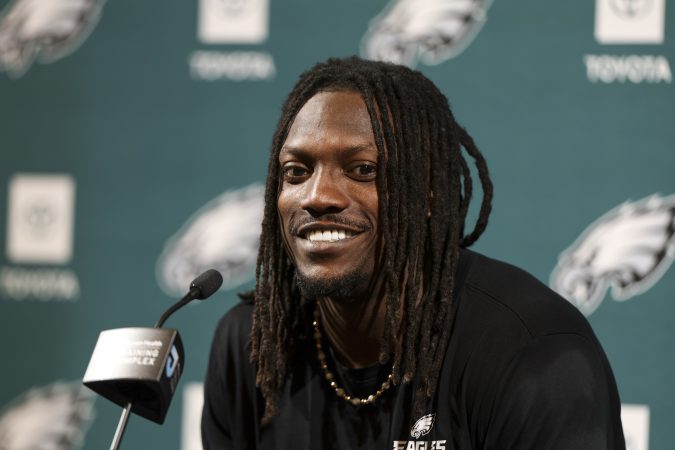
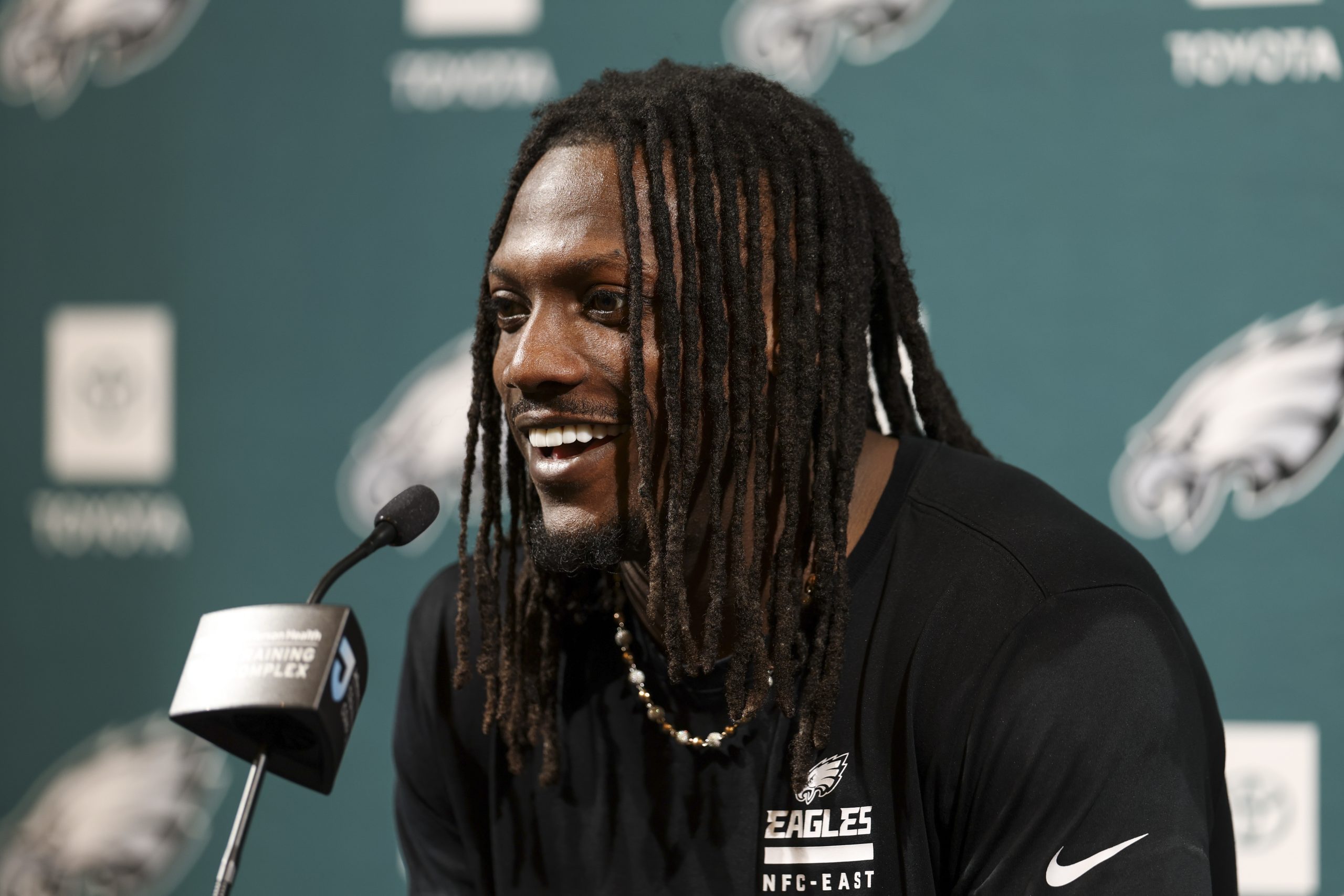
  • Riq Woolen was a standout during OTAs and minicamp. Can he help the Eagles have the ‘best secondary?’

    Riq Woolen was a standout during OTAs and minicamp. Can he help the Eagles have the ‘best secondary?’

    Riq Woolen needed just two plays to turn the tide of Wednesday’s practice.

    It was the last day of mandatory minicamp for the Eagles, and the new-look, first-team offense scored a rare win against Vic Fangio’s defense during the first period of plays. But then Woolen, the Eagles’ new outside corner opposite Quinyon Mitchell, continued his standout spring.

    First, Woolen was sent on a blitz and got into the backfield for a “sack” on Jalen Hurts. Quotation marks are necessary because there is no tackling. There was no ambiguity on the next play, though. Blame it on the install of Sean Mannion’s new offense. Blame it on a miscommunication between Hurts and tight end Dallas Goedert. Either way, Hurts made a terrible throw into the waiting hands of Woolen on a route to the right sideline.

    The highlight plays capped off a strong few weeks for Woolen. Reporters were permitted to watch only two of the Eagles’ six organized team activities sessions, and then both mandatory minicamp workouts this week, but Woolen has been among a handful of Eagles who have stood out, and not just because he is a rare bird as a 6-foot-4 cornerback.

    “I feel like I’ve been doing pretty well,” Woolen said Tuesday. “I’m still picking up on new things. I still got to get more into the playbook, certain plays, just got to learn and buy in even more. But I feel like I’ve been doing well. I feel like my teammates trust me a little bit.”

    The Eagles invested $12 million in guaranteed money for Woolen, who played last season with the Super Bowl champion Seattle Seahawks. Fangio was surprised Woolen didn’t command more money and better terms, he said last month. Woolen was, too.

    “When you’ve got confidence in yourself and you put in a great body of work, you feel like you deserve some type of fruit for your labor,” he said. “Sometimes things don’t go your way, but there’s always a better plan. God’s plan was to put me here with a great team and give me another chance to win a Super Bowl and be successful here.”

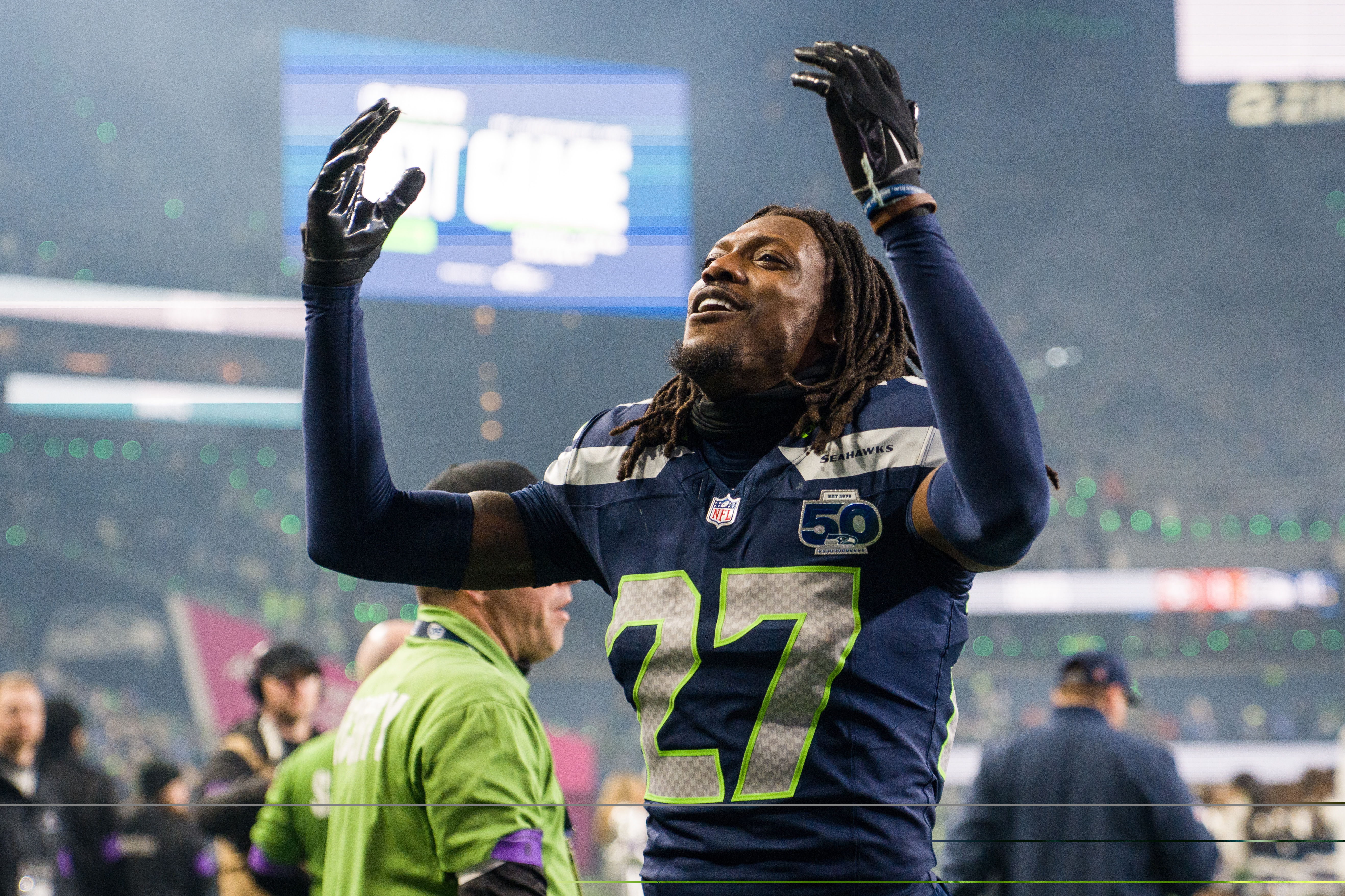
    Riq Woolen celebrates after the Seahawks’ win over the 49ers in last year’s playoffs. Stephen Brashear / AP

    The Eagles did some scouting work on Woolen last season when it became clear that he potentially could be made available before the trade deadline. Woolen was having one of the best seasons in recent years in man coverage — according to Next Gen Stats, his 27.6% completion percentage allowed in man coverage was the lowest by any defender to face 20-plus targets in man since at least 2018 — but the Seahawks, according to Sharp Analytics, deployed man coverages on 15.2% of their defensive snaps, sixth-fewest in the NFL.

    The emergence of former Eagle Josh Jobe made Woolen expendable. Fangio was a bit detached from the process during the deadline last season, but “watched him thoroughly” during the free agency process.

    “I was thrilled to get him,” Fangio said. “He’s a rare guy in that you don’t see many corners in the league that are 6-4. You don’t see many that are 6-2 or even 6-1 and there’s a reason for that. It’s hard to find guys at those heights that can move and mirror receivers that are hard to cover. He can do that for a guy his height. He can get in and out of breaks. He obviously has good downfield speed and his length is more of an asset than a detriment in his case.”

    Woolen’s size and cover skills were on display earlier during OTAs when he blanketed DeVonta Smith on multiple plays and ran in stride with Hollywood Brown on a go ball. Woolen wagged his finger after that rep.

    A finger wag won’t likely result in a flag, but Woolen got in his own way a few times last season with Seattle with his taunting. He said Tuesday that the lessons learned were to focus on celebrating with his own teammates.

    Riq Woolen is looking to make the most of a one-year deal with the Eagles, with an eye toward a possible bigger payday next offseason. Monica Herndon / Staff Photographer

    Given the makeup of the Eagles’ defensive backfield, there could be plenty of celebrating to do. As it stands, Cooper DeJean will play safety in base, but the Eagles spend most of their time in nickel. In those sets, the Eagles will have one All-Pro on the outside in Mitchell, and All-Pro at nickel in DeJean, and then Woolen. The back line will be manned by second-year safety Drew Mukuba and, as of now, Marcus Epps.

    “I feel like we can be one of the best secondary groups in the league and we all are confident about that,” Woolen said.

    Time will tell how the secondary stacks up. Woolen has had some issues in zone coverage. The Eagles ran more man — 24.5% vs. 15.2% — than Seattle did last season, and maybe Fangio uses it a little more this season to play to his players’ strengths.

    “Being in [Fangio’s] defense you’re going to grow a lot,” Woolen said. “Especially working off-technique is one of the things in my game — I know I’m a press corner, but I got to play off-technique sometimes, too.”

    The second outside corner spot opposite Mitchell was a major talking point at this time last year, through training camp, and even into the early portion of the regular season. Adoree’ Jackson eventually claimed the job, and while Jackson played well at times, the Eagles also struggled to cover No. 2 receivers in certain games. According to NFL analytics writer Dan Pizzuta, the Eagles were 24th in DVOA (Defense-adjusted Value Over Average) vs. No. 2 receivers and ranked second in DVOA vs. No. 1 receivers.

    Investing in Woolen on a one-year deal was an effort to rectify that. Early returns have been positive; just ask Hurts. But, as is the caveat for most analysis this time of year, it’s June, and more than 90 days separate the Eagles from a game that matters.