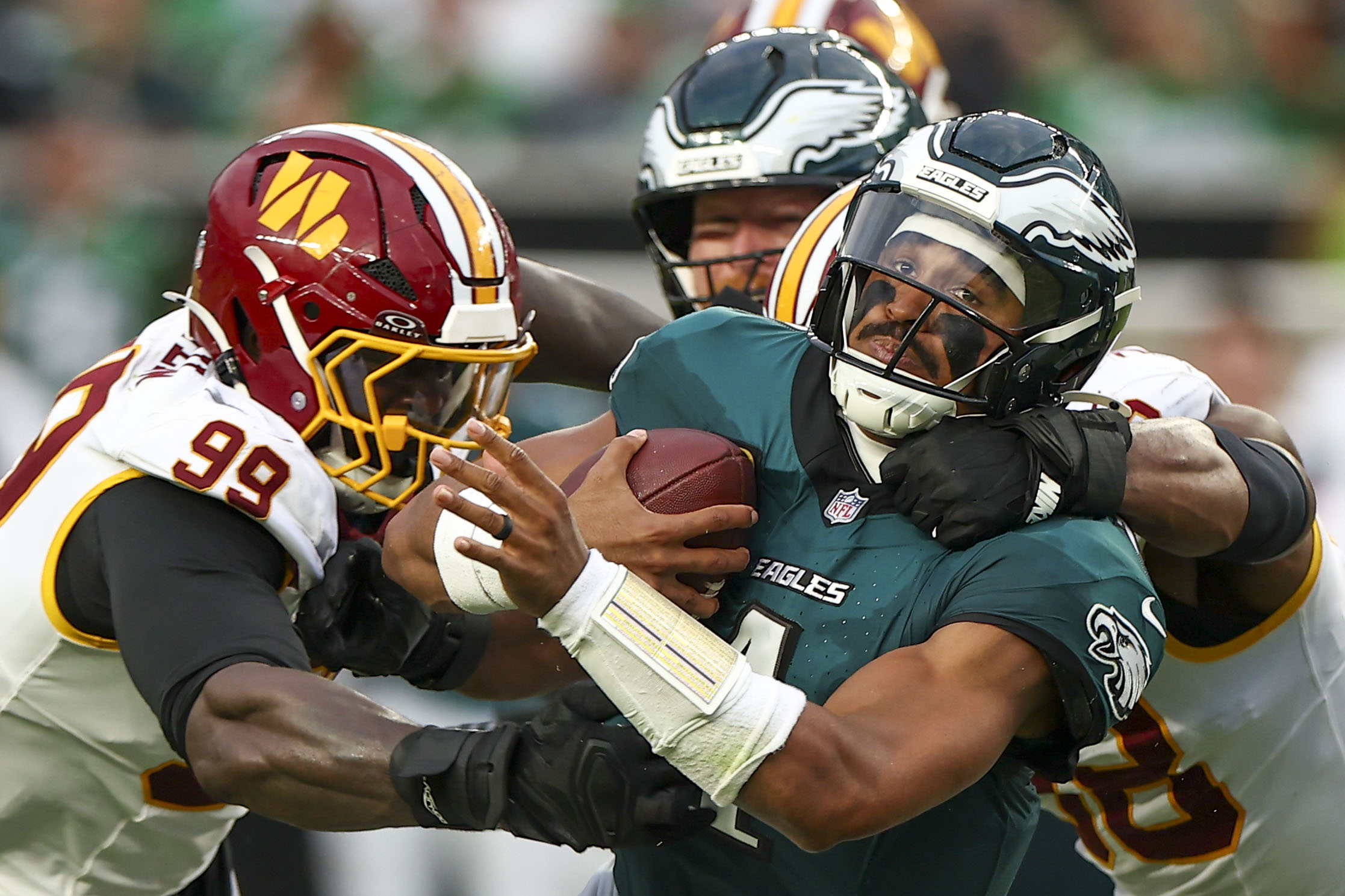
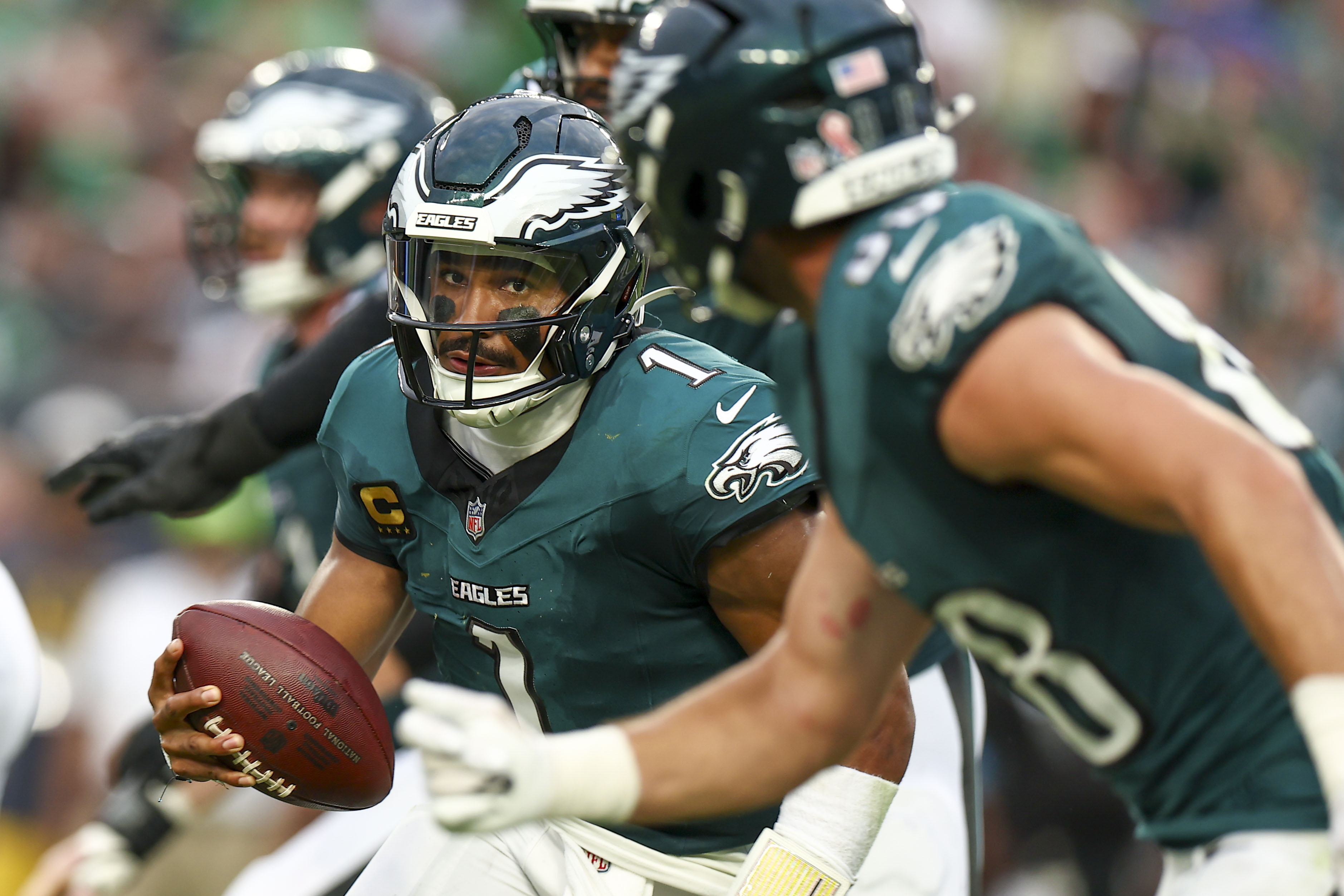
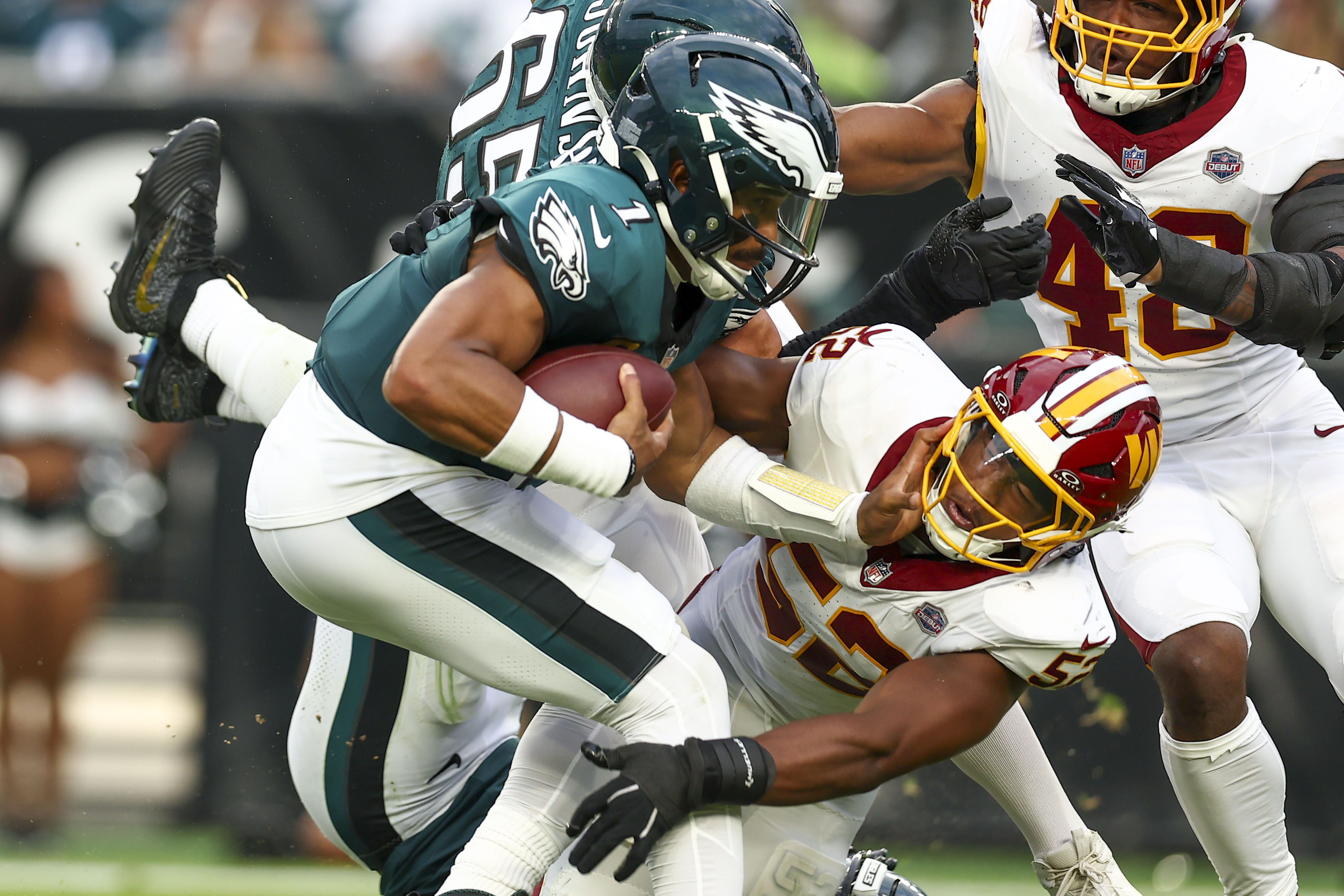
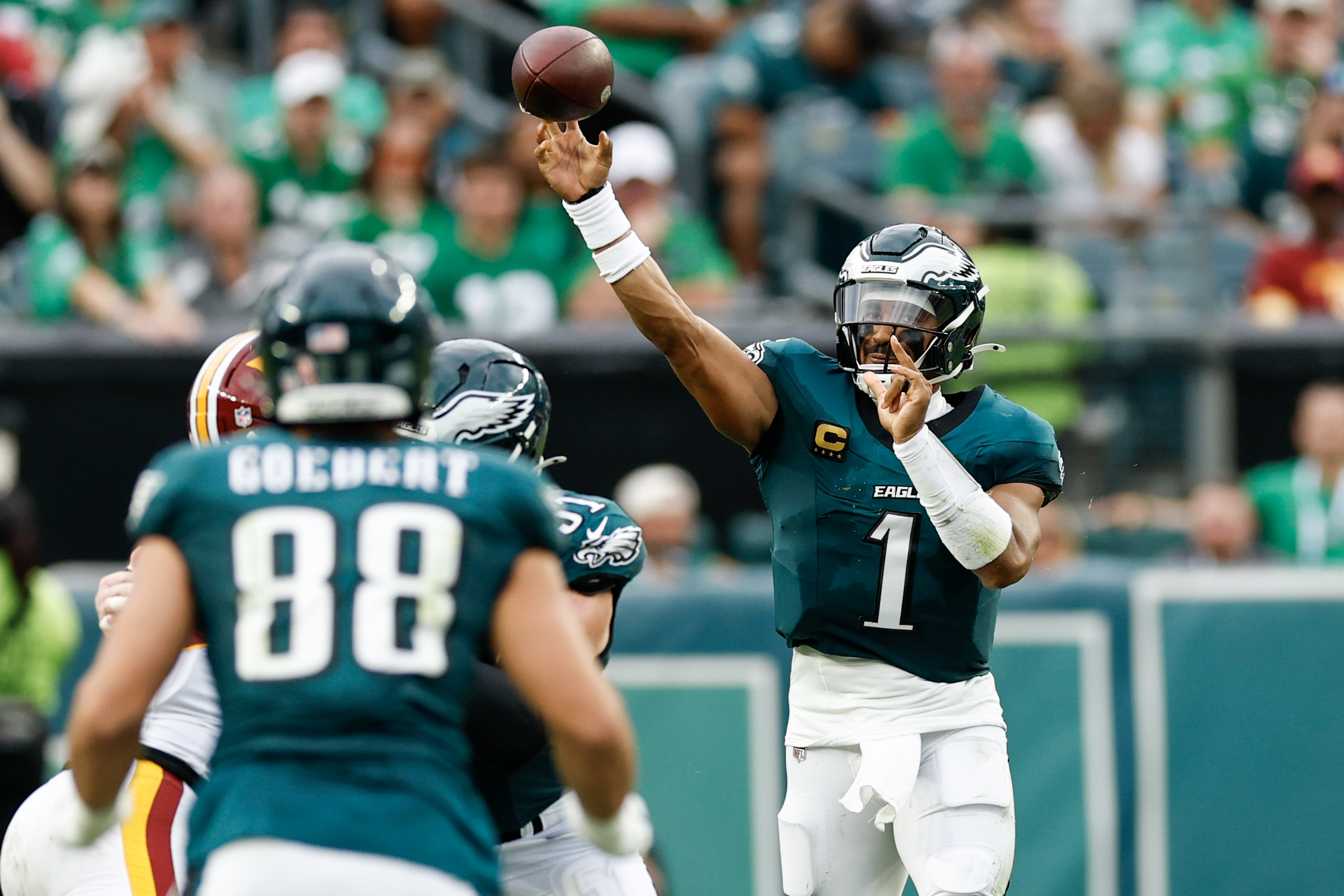
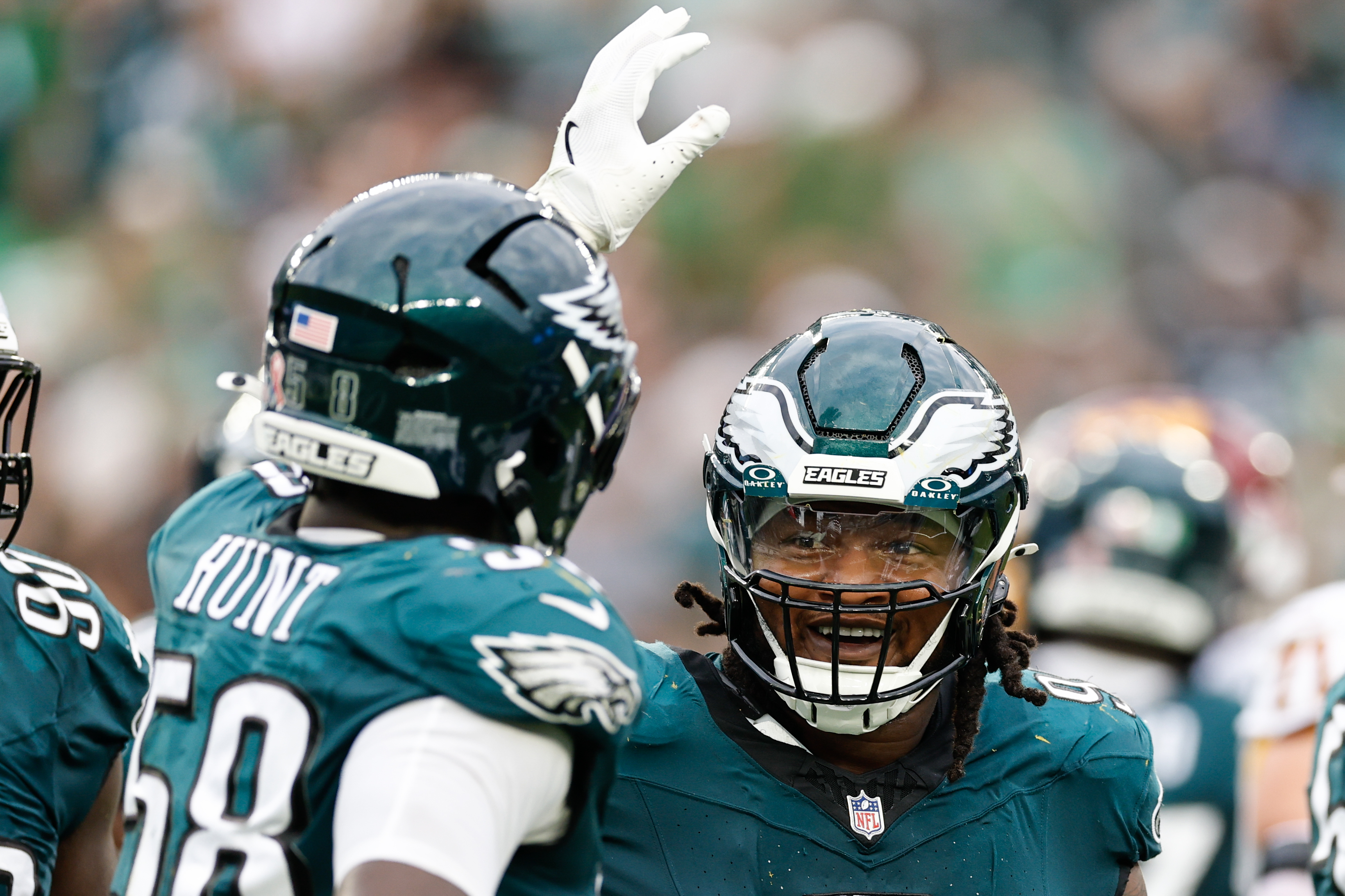
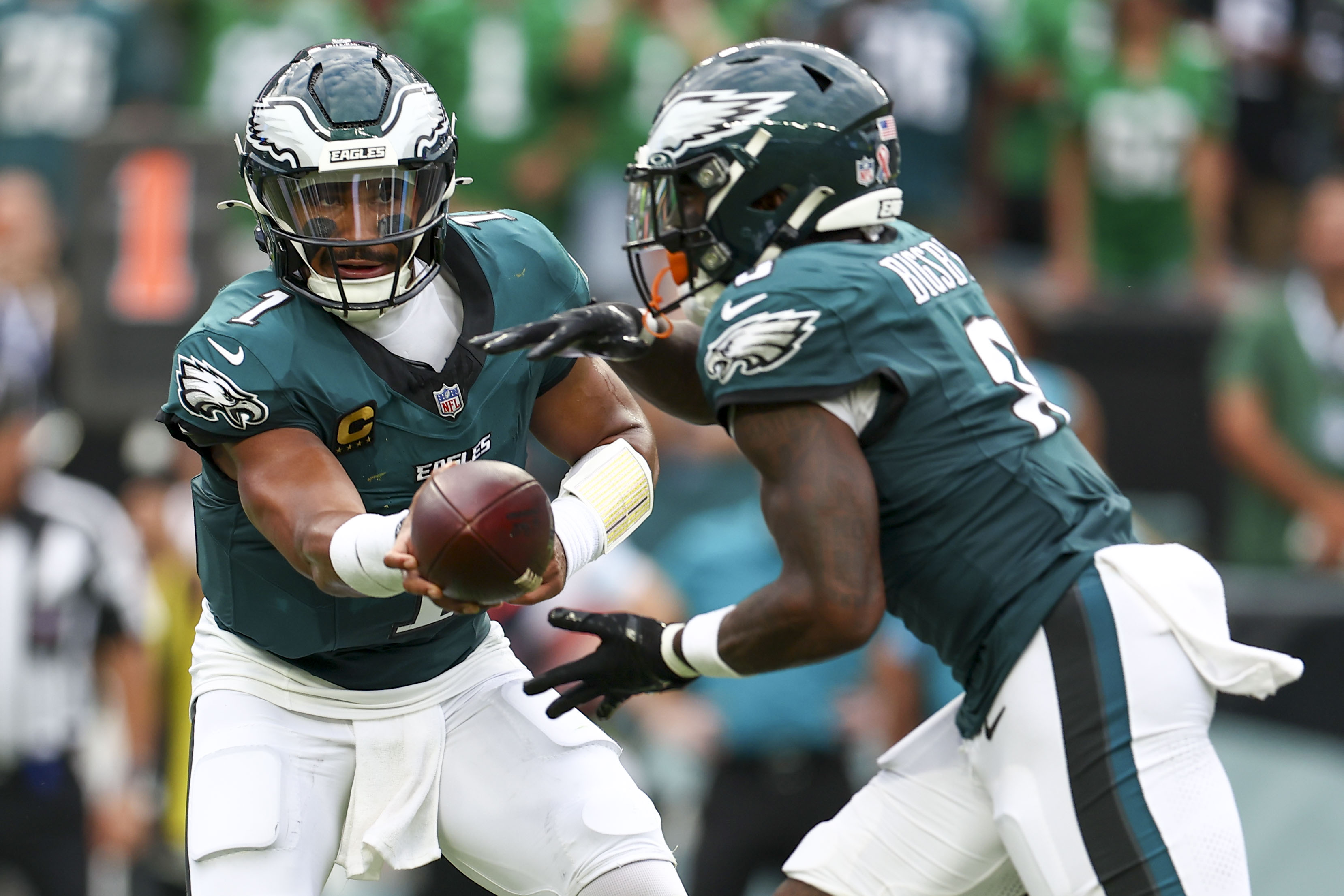
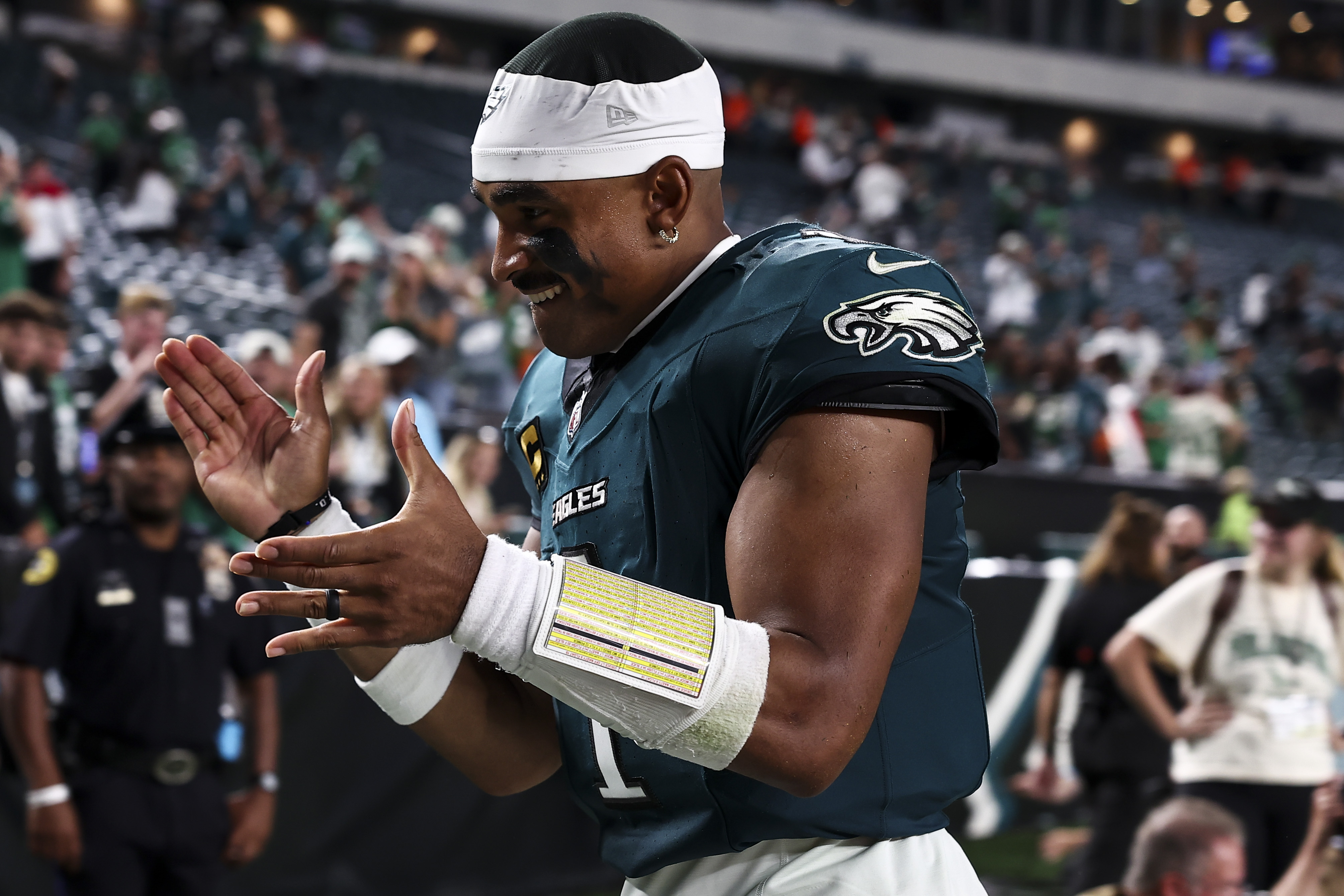
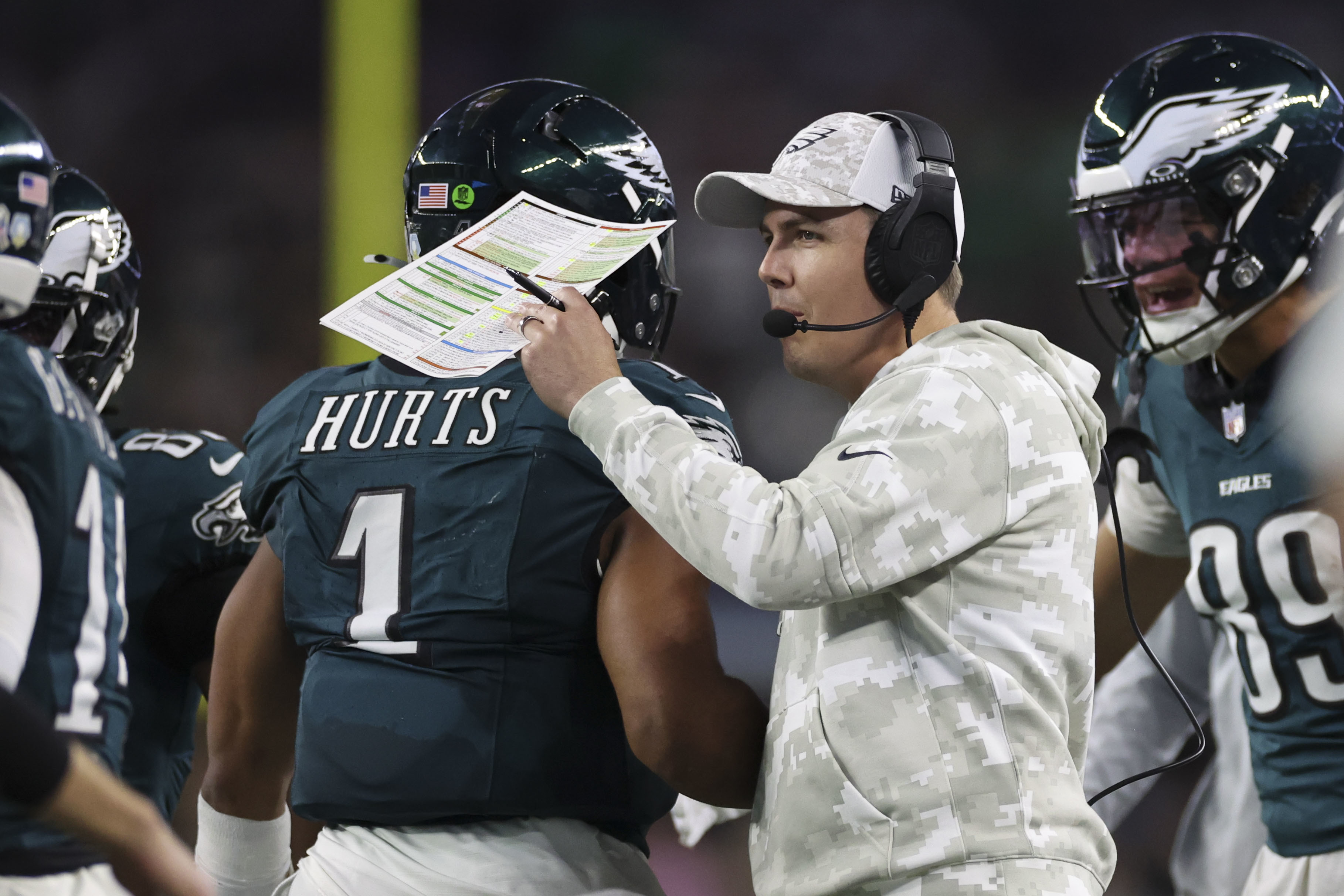
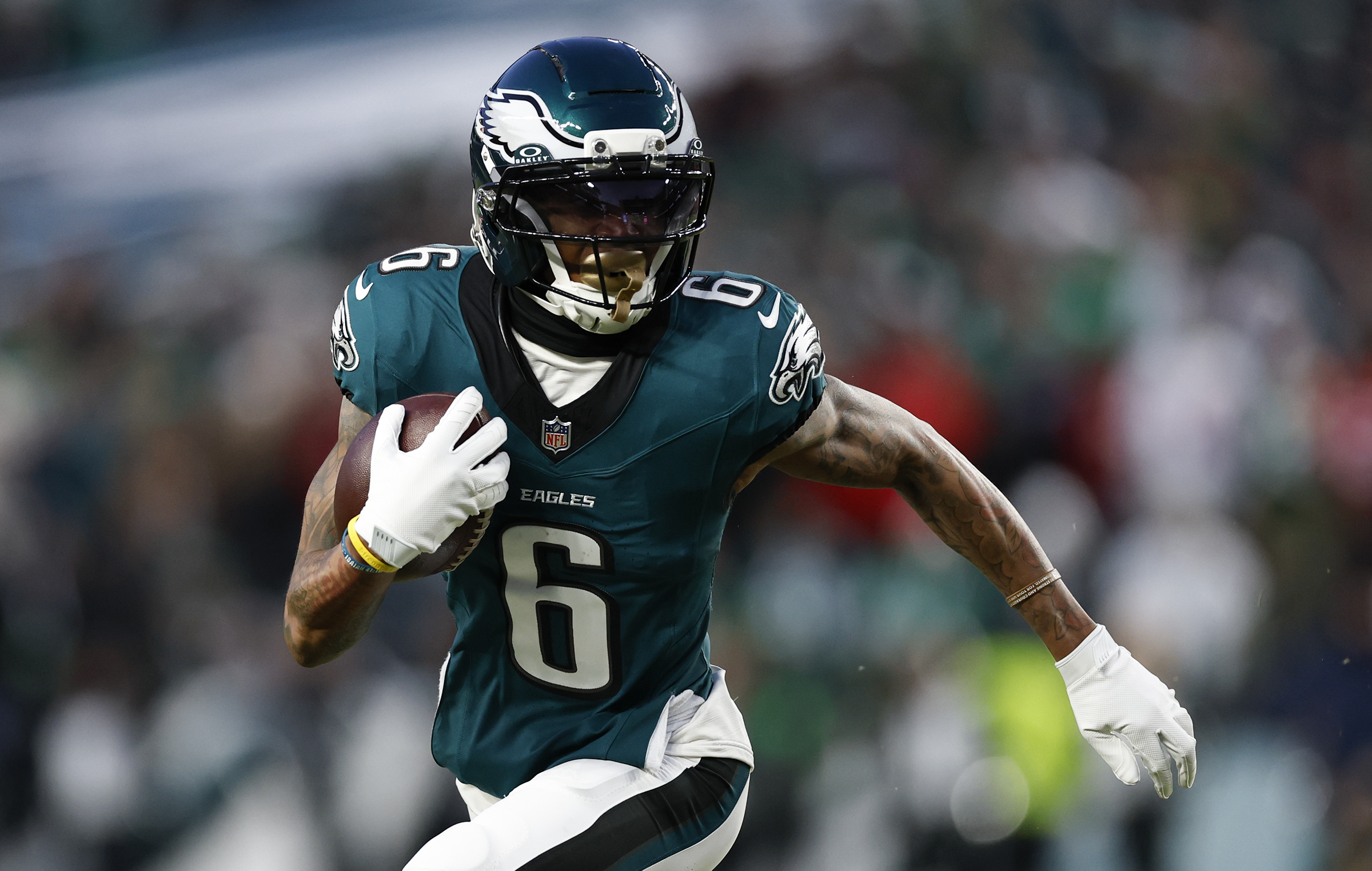
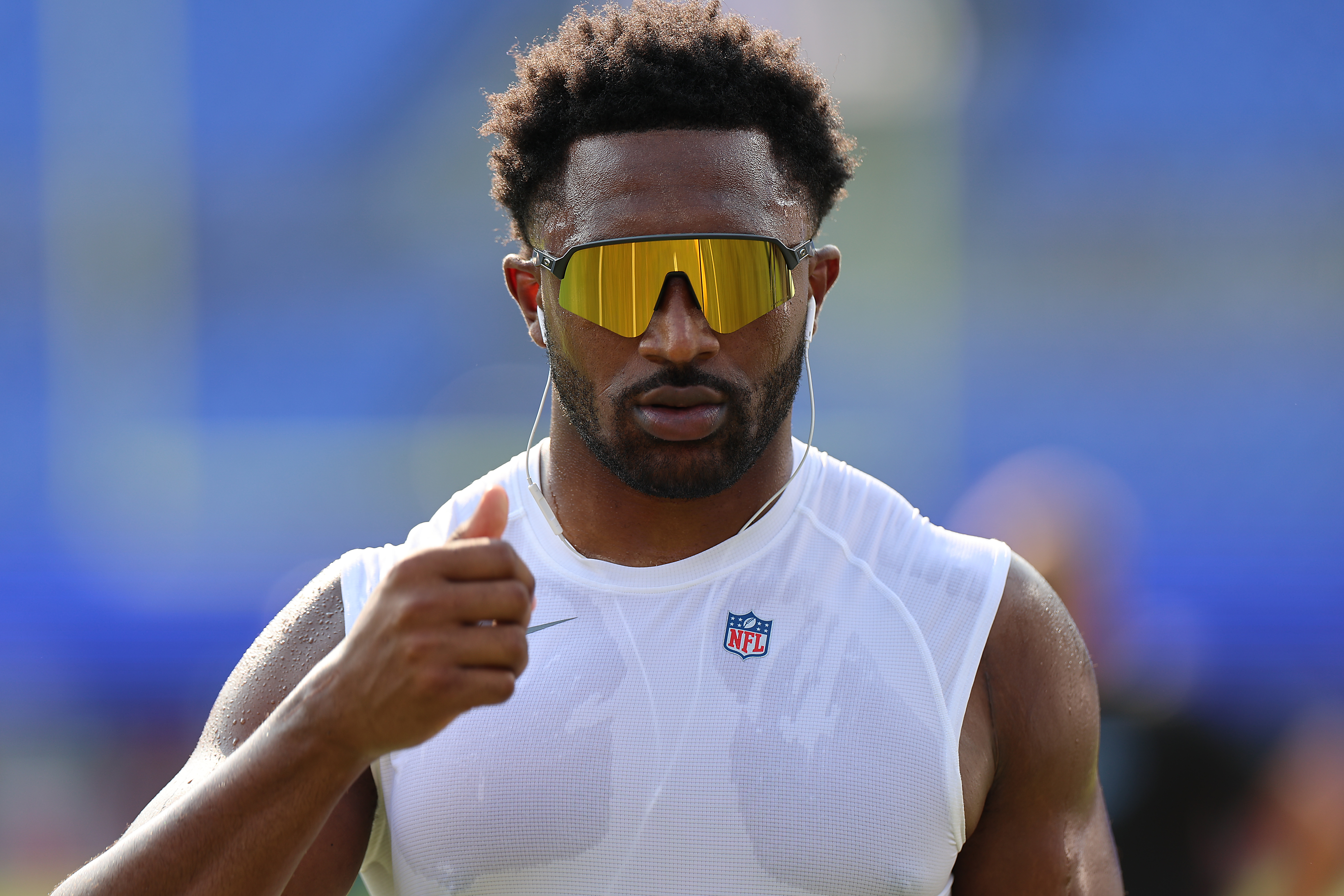
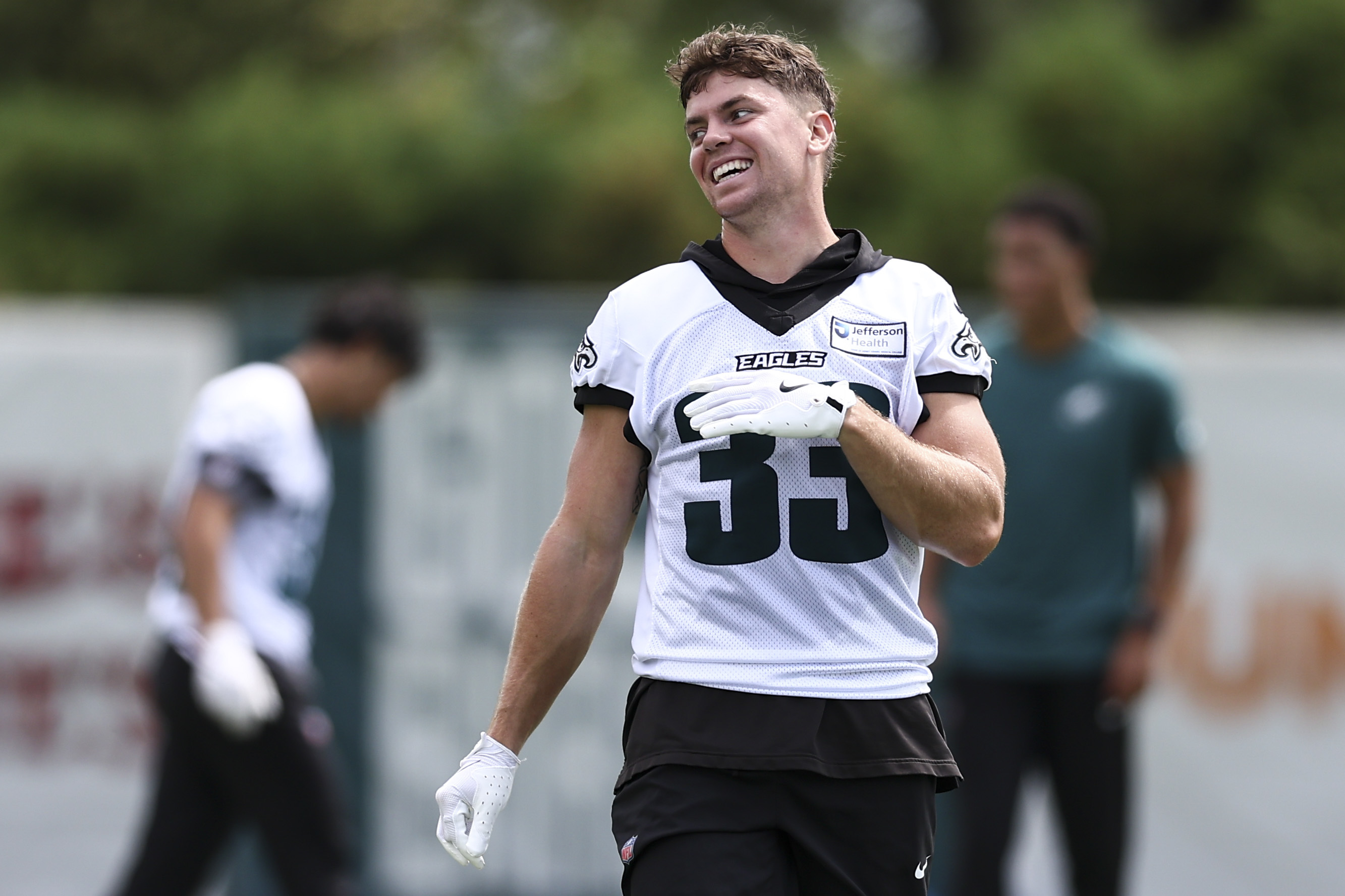
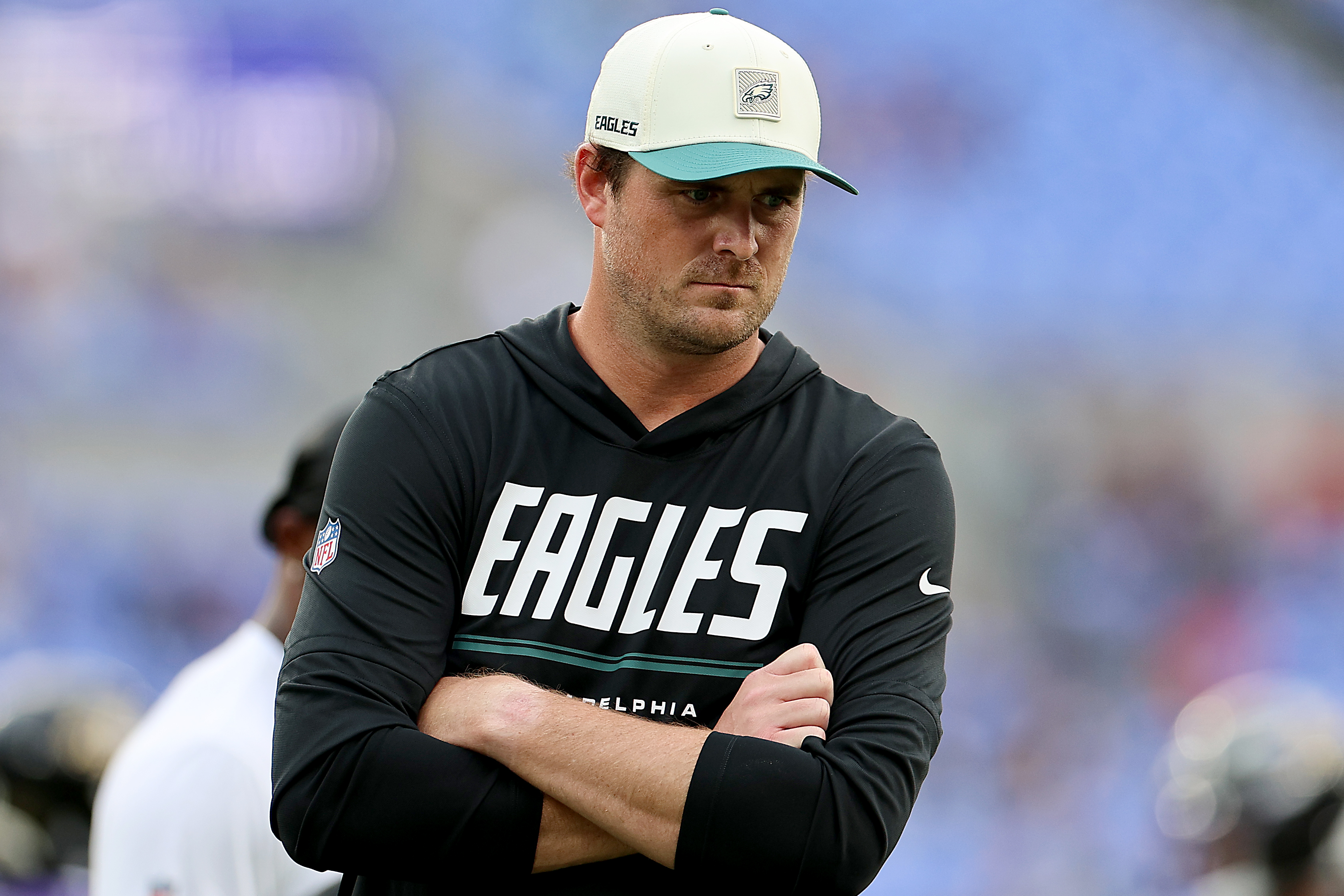
If you assume Jalen Hurts’ next contract will pay him around $65 million per year, or $1 million more than Patrick Mahomes; and if you assume the Eagles will pay Hurts sooner than later, as they always do with their best players; and if you assume that Hurts, after a poor 2025 season, needs to show the Eagles that he’s worth the investment, then he made a strong opening statement Sunday afternoon.
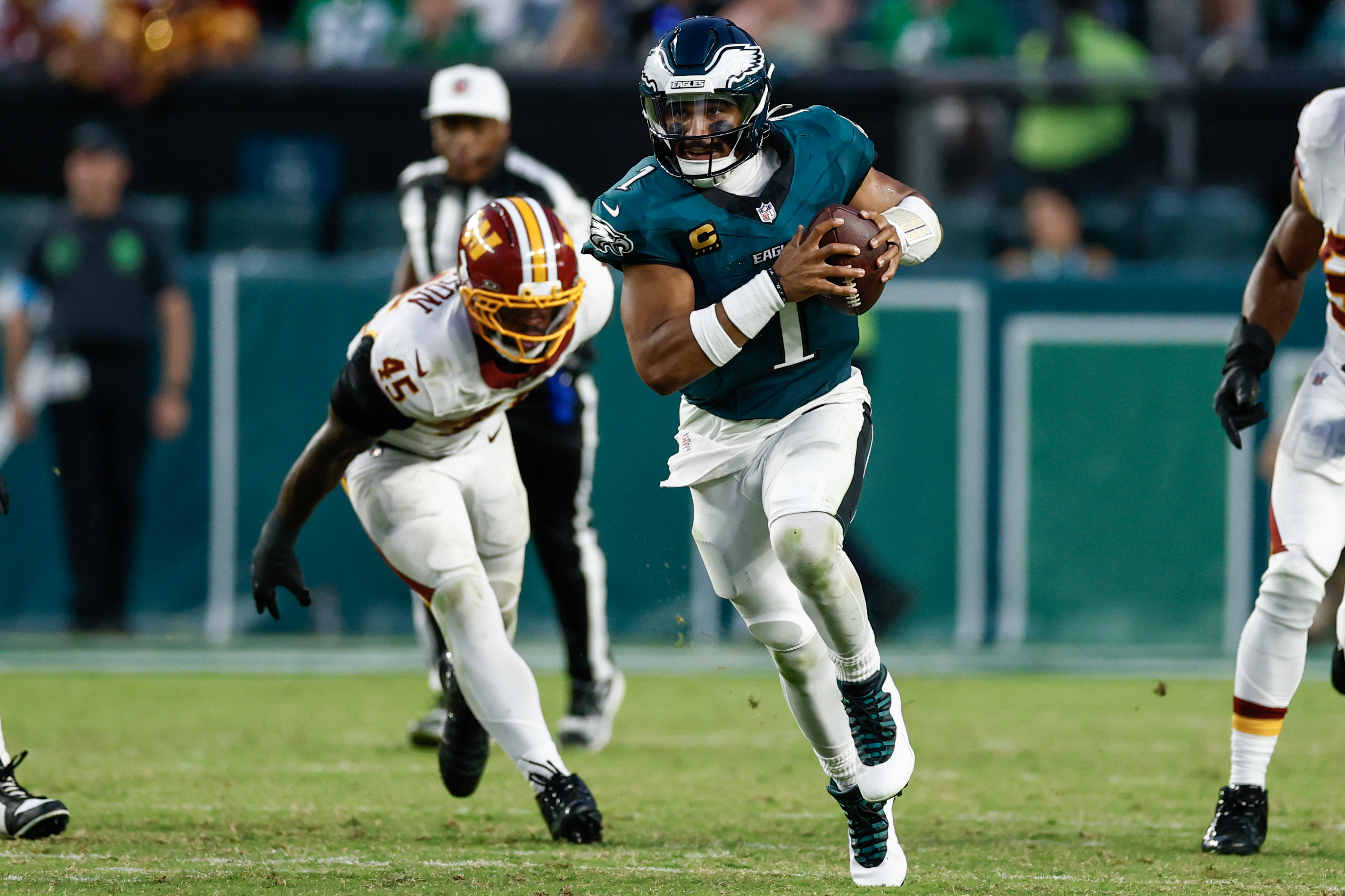
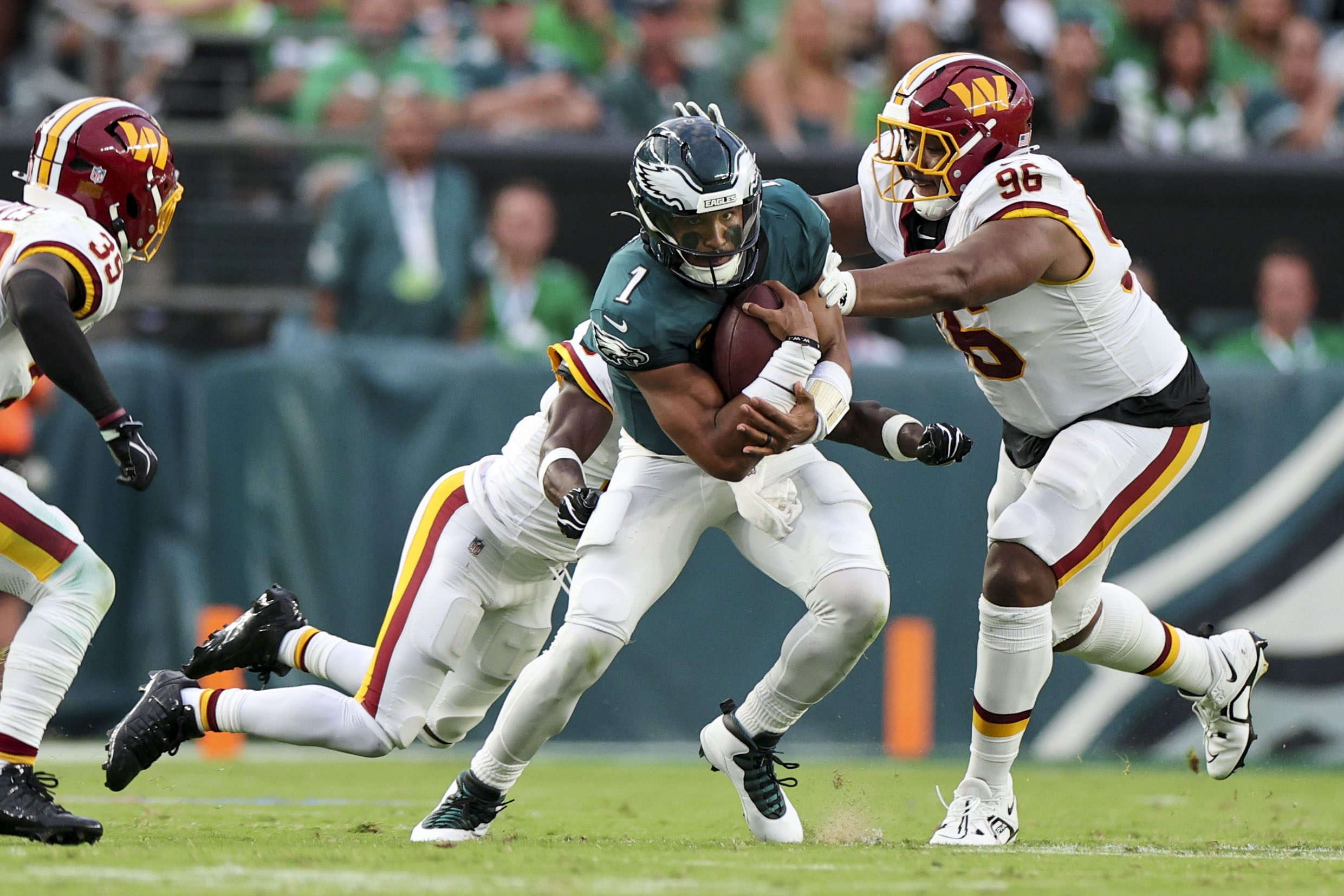
Hurts threw three touchdown passes, connecting on 14 of 25 attempts. He ran for 46 yards, including a key 22-yard, third-and-18 conversion in the fourth quarter. He threw no interceptions and had no fumbles. He did virtually everything he could to win the Eagles’ opener against the Commanders and, more importantly, he did virtually nothing to lose it. The Eagles won, 24-22.
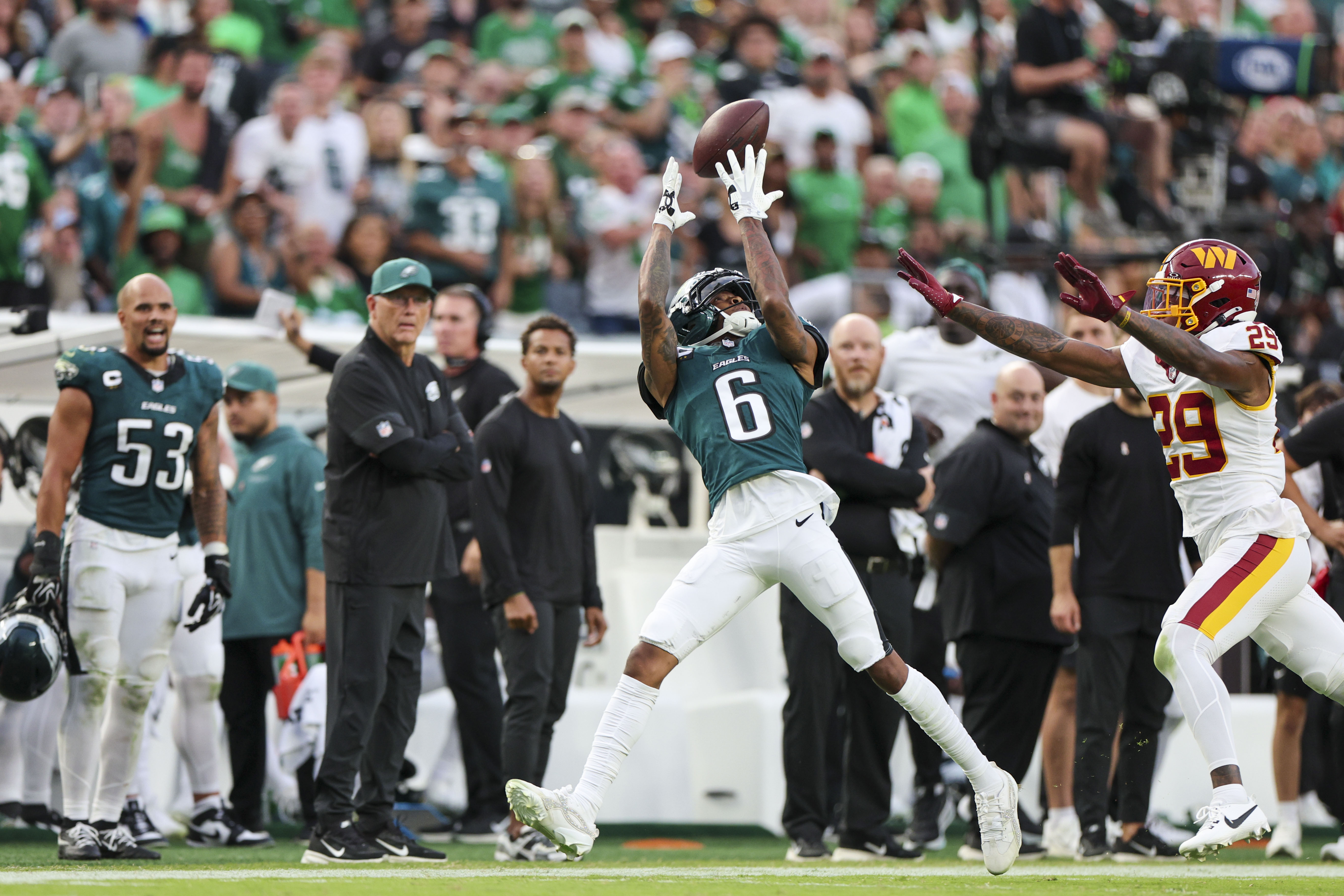
Jalen Hurts goes DEEP to Dontayvion Wicks for 64 yards!
Hurts threw for only 203 yards, but his passer rating of 122.2 was the 15th-best of his 94 regular-season starts.
He did all of this playing in a new system implemented by first-time offensive coordinator Sean Mannion, who has only been a coach — at any level — for two years.
If you ever considered Hurts a long-term, star-quality, franchise quarterback, this sort of game is why. Eagles owner Jeffrey Lurie considers Hurts just this.
There is a narrative that asserts that, if Hurts does not shine in this scheme, then the Eagles could trade him after this season and absorb the salary-cap burden associated with his current $255 million deal.
However, if Hurts strings together a dozen or so games like this in Mannion’s system this year, expect the 28-year-old to sign an extension to be the Eagles’ quarterback for the next seven or eight seasons.
A.J.’s nightmare
In his first game without A.J. Brown since 2022, Hurts threw for 1.5 more yards than he averaged last season, threw for twice as many touchdowns as he averaged last season, and had a passer rating about 24 points higher than he had last season. Maybe he won’t miss A.J. as much as we thought.
Brown spent the last two seasons complaining about Hurts’ performance. His antics forced a trade to the Patriots on June 1. Be careful what you wish for.
In his New England debut Wednesday, Brown caught just three passes for 26 yards. His new quarterback, Drake Maye, threw three interceptions. The Pats lost, 13-10, in Seattle. Maye also underthrew Brown on a sure touchdown route.
Brown then suffered a high ankle sprain in the third quarter, left the game, and did not return. The Patriots placed him on injured reserve Friday, which will sideline him for at least four weeks, but reports Sunday said Brown, 29, will miss at least six weeks.
Nightmare.
From @NFLGameDay Morning: Injury updates from this week, as #Seaahawks QB Sam Darnold actually has a glute injury, #Patriots WR AJ Brown is out about six weeks, and #49ers WR De'Zhaun Stribling (deltoid ligament) is out at least a month. pic.twitter.com/0VlHlIzgw7
The Rams traded a raft of assets to Cleveland for Garrett, the 2025 Defensive Player of the Year, but he looked lousy Thursday night in Australia in a loss to the 49ers. He’d battled a left knee issue all preseason. He now is scheduled to have arthroscopic surgery and spend at least the next four weeks on IR.
The Rams are expected to have defensive tackle Aaron Donald available when they visit Philly. Donald, who, after two years off, unretired late in the preseason in order to pair with Garrett, was deemed unfit to play in Australia and did not make the trip. The prospect of facing Donald is daunting, but the prospect of facing the two best defensive linemen of the past decade in the same game was positively chilling. Now, the Eagles won’t have to do that unless the teams meet in the playoffs.
Carson Wentz embraced his Ginger Jesus nickname when he was drafted in 2016 to save the Eagles franchise. Now a journeyman backup, Wentz relieved concussed Kyler Murray in the first quarter Sunday and led the Vikings to 29 straight points in a comeback win over the rival Packers. We might be witnessing a resurrection.
Wentz threw three touchdown passes with no interceptions or fumbles, completed 12 of 19 passes for 133 yards, including a gorgeous, 39-yard TD dime to Justin Jefferson.
JUSTIN FREAKING JEFFERSON‼️
What a pass by Carson Wentz and what an AMAZING catch by JJ as the Vikings get the TD!pic.twitter.com/ITahechqYe
Wentz finished with a 123.5 passer rating, the eighth-best rating in his 104 regular-season games.
Wentz played the first 68 of those games for the Eagles, who drafted him No. 2 overall in 2016 and immediately named him the starter. Wentz’s turbulent tenure ended after 2020, when his displeasure with the drafting of Jalen Hurts in the second round and his anger at being replaced by Hurts late in the season led him to force a trade to Indianapolis. He then played for five teams in the next five years. This is his second season with the Vikings, though he had to win the No. 2 job in a preseason battle with Vikings first-round bust J.J. McCarthy.
Was this Wentz’s best performance since he led the Colts to a win over the Jets on Nov. 4, 2021?
Dallas ranked last in points allowed in 2025, at 30.1 per game. The Cowboys are on their way back to the bottom: They lost, 28-20, on Sunday Night Football in John Harbaugh’s head coaching debut with the Giants. … The Eagles might have a walkover win Sunday in Tennessee; the Titans lost, 23-10, to the woeful, visiting Jets. … On the other end of the spectrum, the Bears won their opener, 59-37, over the visiting Panthers on Sunday. Bears coach Ben Johnson told The Athletic in August, “I want to have the highest-scoring offense ever. … I want shutouts. I want blowouts.” The Eagles travel to Chicago in two weeks. Yikes. … Maybe it was all the extra cash he’s carrying: Baker Mayfield lost three fumbles in Tampa Bay’s 33-27 loss in Cincinnati just five days after he signed a three-year, $165 million contract extension. … Derrick Henry, 32, ran for 144 yards and three touchdowns as the Ravens won, 41-23, in Indianapolis. He has 56 100-yard games, which ranks eighth, and 125 rushing TDs, which ranks third.
The late, great Denny Green said it first and said it best:
They are who we thought they were.
The Eagles were pretty good, the Commanders were pretty dumb, and the Birds won, 24-22.
They both are what we thought they were.
Green said it in 2006, after his Cardinals blew a Monday Night Football lead, and he said it in frustration, but Eagles fans should be anything but frustrated after this one.
The difference began with Jalen Carter, who blocked a point-after-touchdown kick in the second quarter.
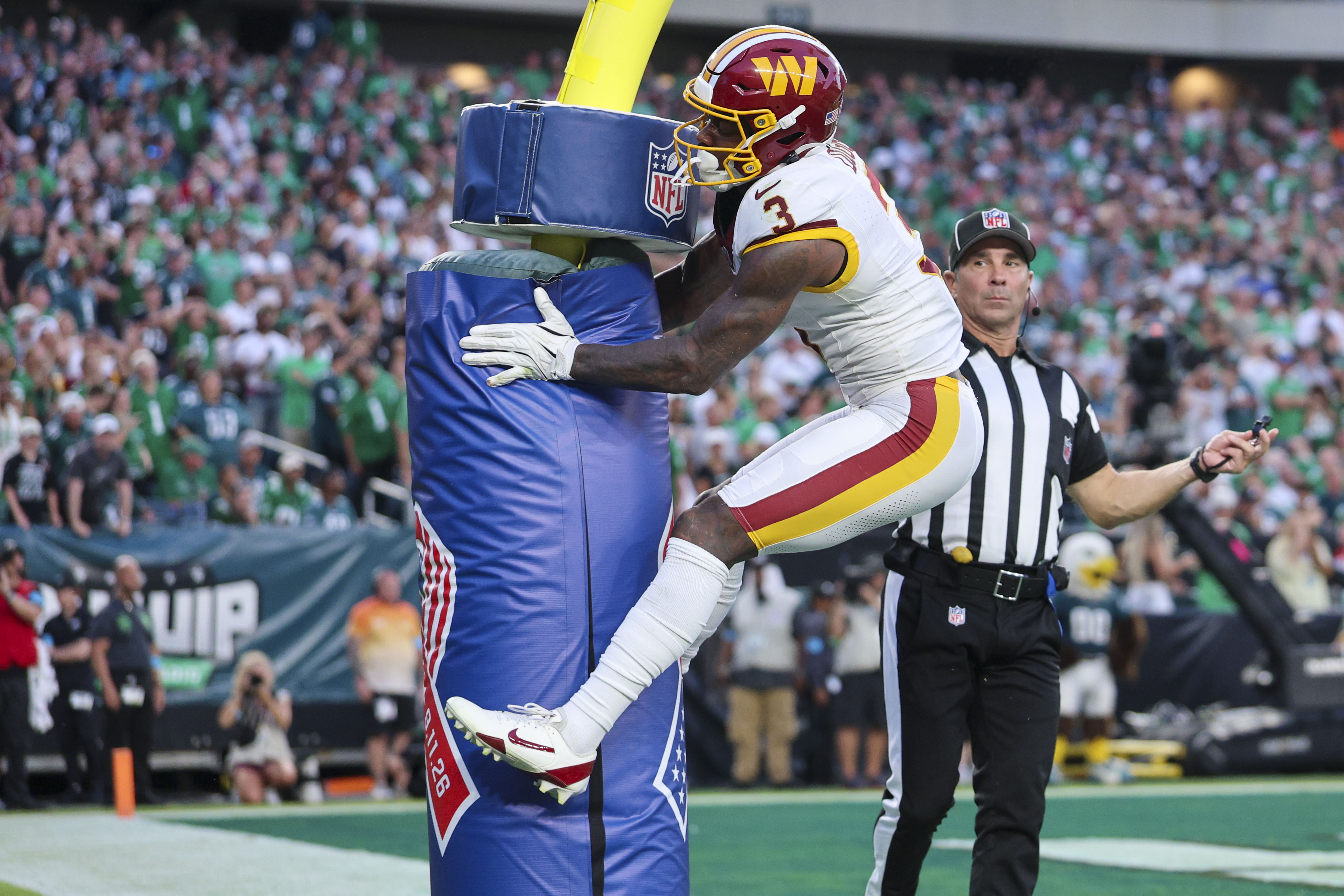
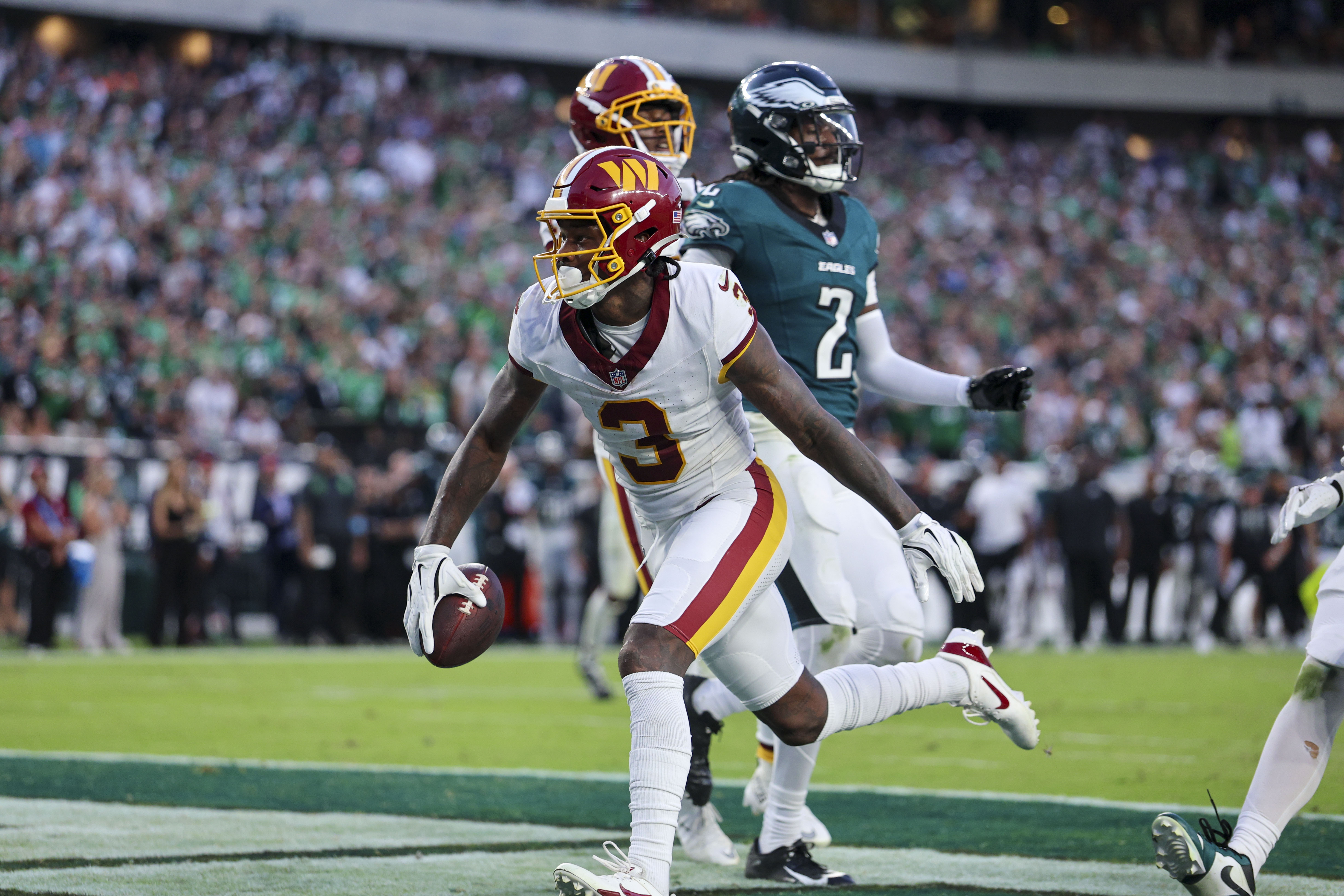
Stefon Diggs caught a touchdown pass with 9 minutes, 59 seconds to play, but then hopped onto the goal post and gave it a brief, full-body hug. That behavior is illegal. The Commanders trailed by two points and had the Eagles on their heels after a nearly six-minute drive, so, they go for two, right? Well, the 15-yard penalty would have pushed a two-point conversion try from the 2-yard line to the 17-yard line, so they kicked the PAT and cut the lead to 17-16.
The Eagles scored, but then so did the Commanders, with 1:01 to play. Forced to go for two, they failed, and that was that.
“I got a little overzealous, I got a little excited, you know,” Diggs said afterward, smiling sheepishly. “Finally, when we clicked, after not clicking for a little while, it got to me a little bit. So just being smart[er].”
Diggs recalls when such actions were legal.
“As soon as I wrapped my arms around it, I’m like, ‘Oh!’ I forgot,” he said. “It’s not back in the day. You know, I’ve been playing for a long time. You used to could do that.”
Actually, he could never do that. The NFL outlawed goalpost celebrations in 2014 after Saints tight end Jimmy Graham bent a goal post in 2013. But Diggs certainly had seen it done.
It made a big difference Sunday evening against an Eagles team that was just good enough to win.
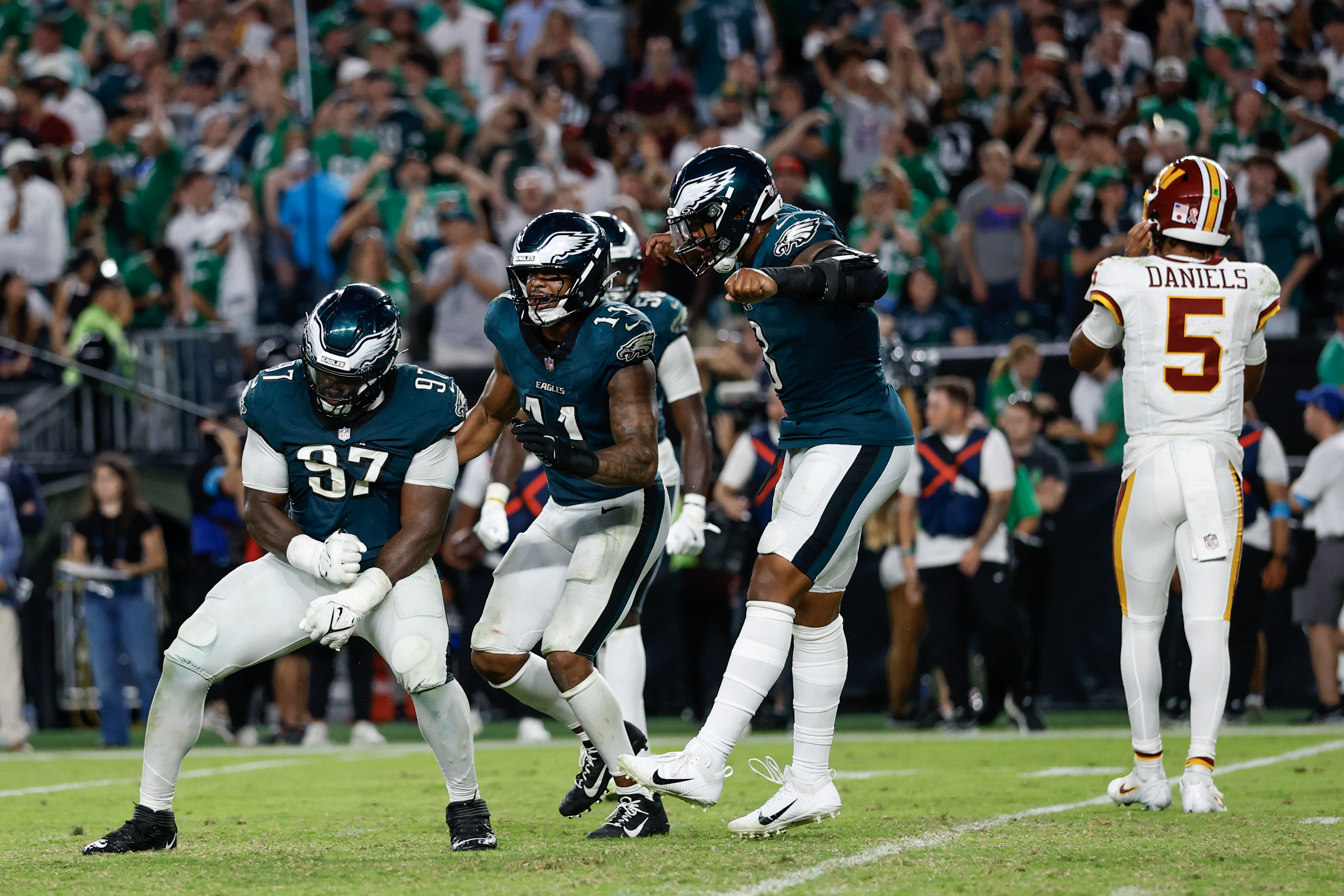
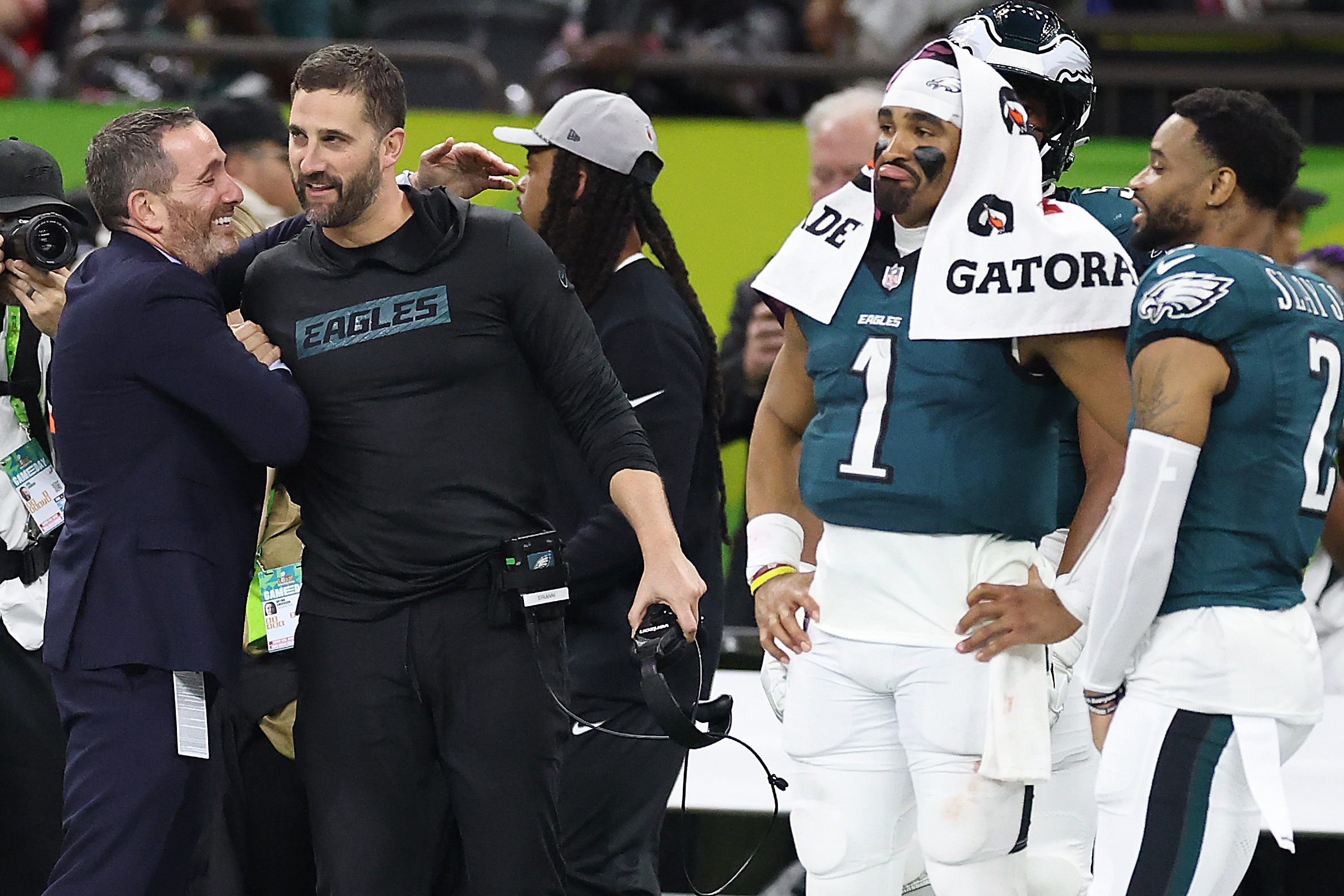
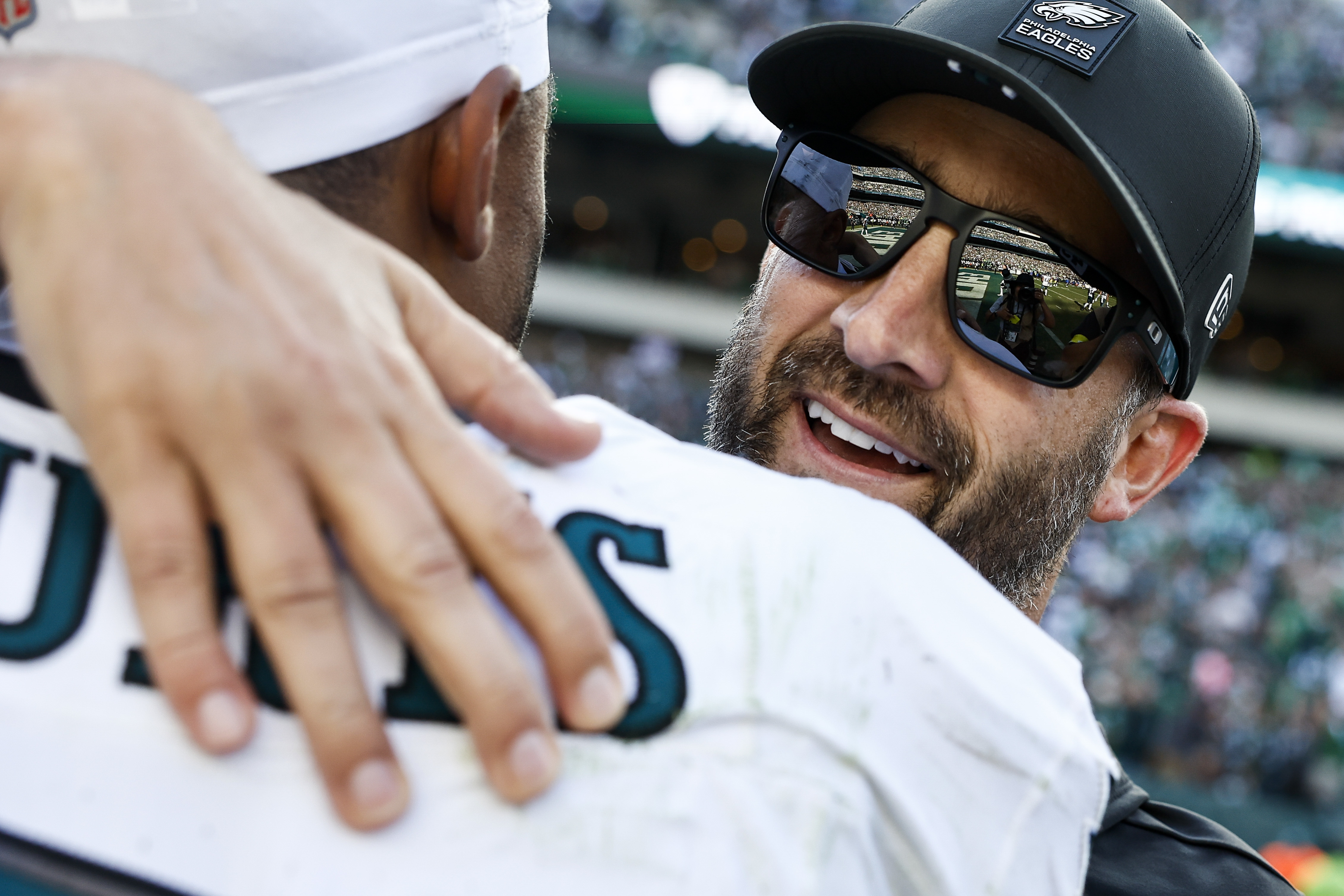
The Eagles, with new offensive coordinator Sean Mannion and old defensive coordinator Vic Fangio, looked like a quality team with quality players that should contend for a Super Bowl berth. They beat a quality team in the Commanders, with a superior quarterback in Jayden Daniels. The Eagles’ head coach, Nick Sirianni, moved to 6-0 in season openers, as did his franchise quarterback, Super Bowl LIX MVP Jalen Hurts. The defense limited the visitors all day, and squashed a two-point conversion when Moro Ojomo sniffed out a shovel pass and tackled John Bates.
Simply, events followed script.
“We played a gritty game,” All-Pro cornerback Quinyon Mitchell said. “Obviously got some things that we got to clean up, but the fight was there, and the resilience was there.”
So was the talent.
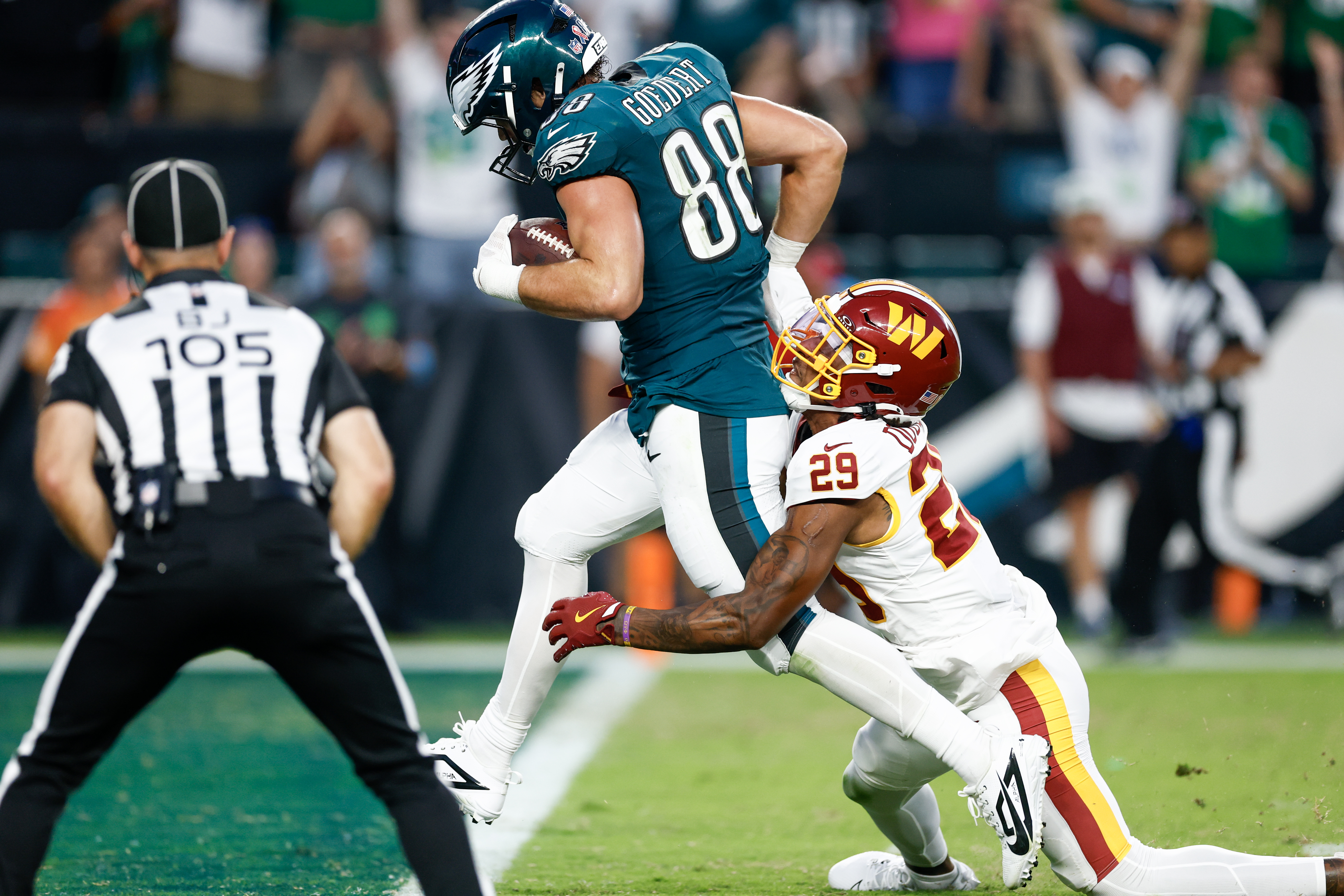
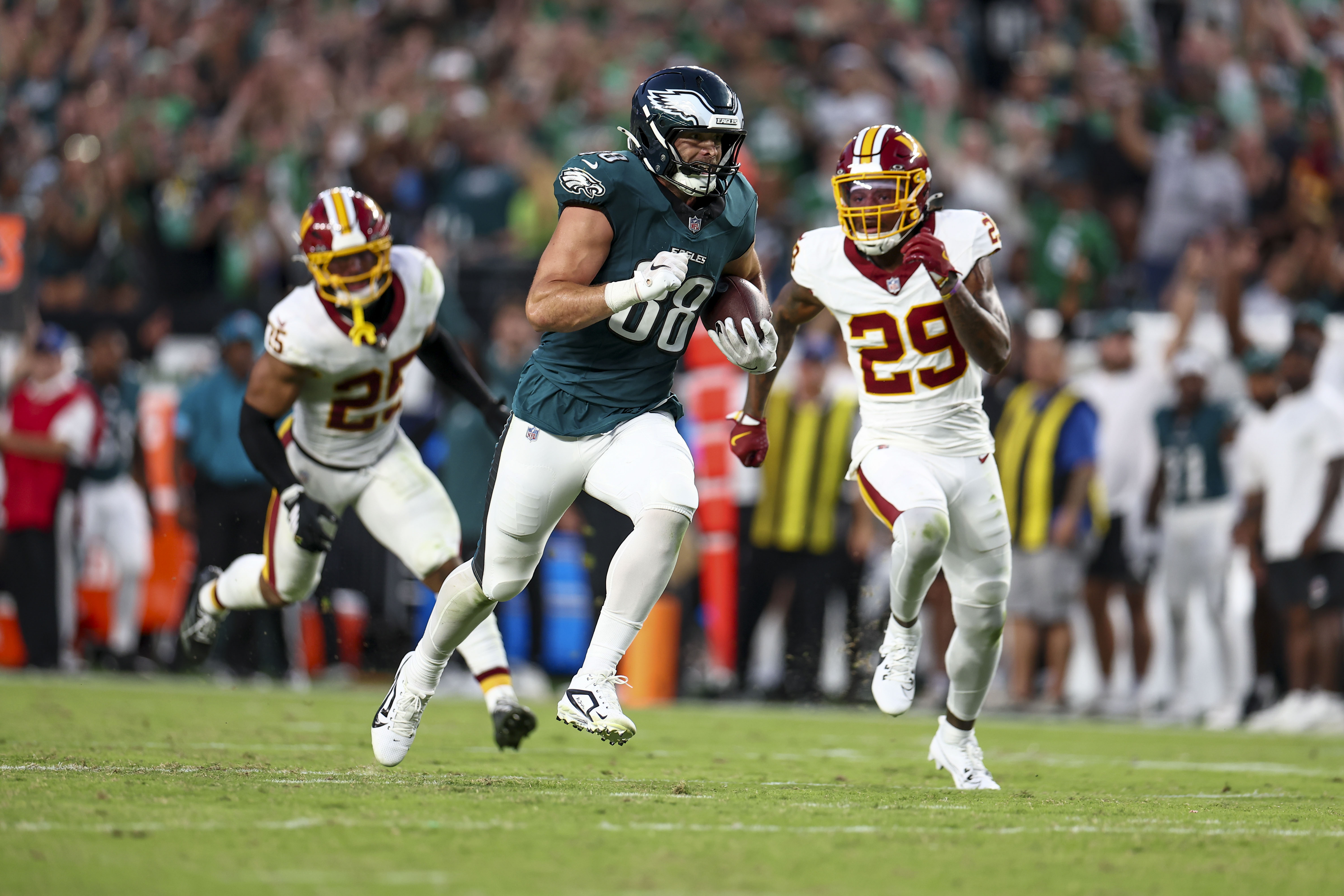
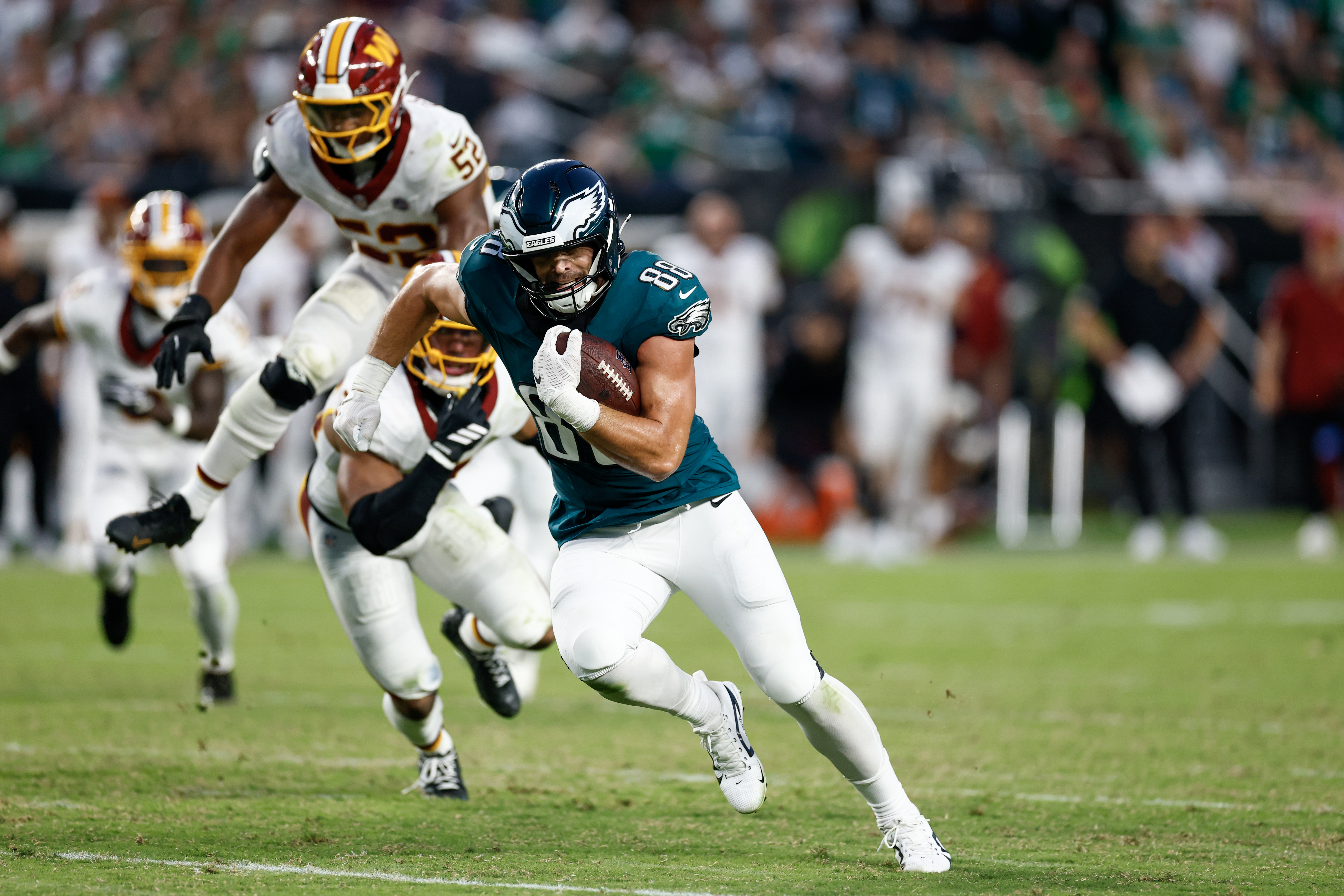
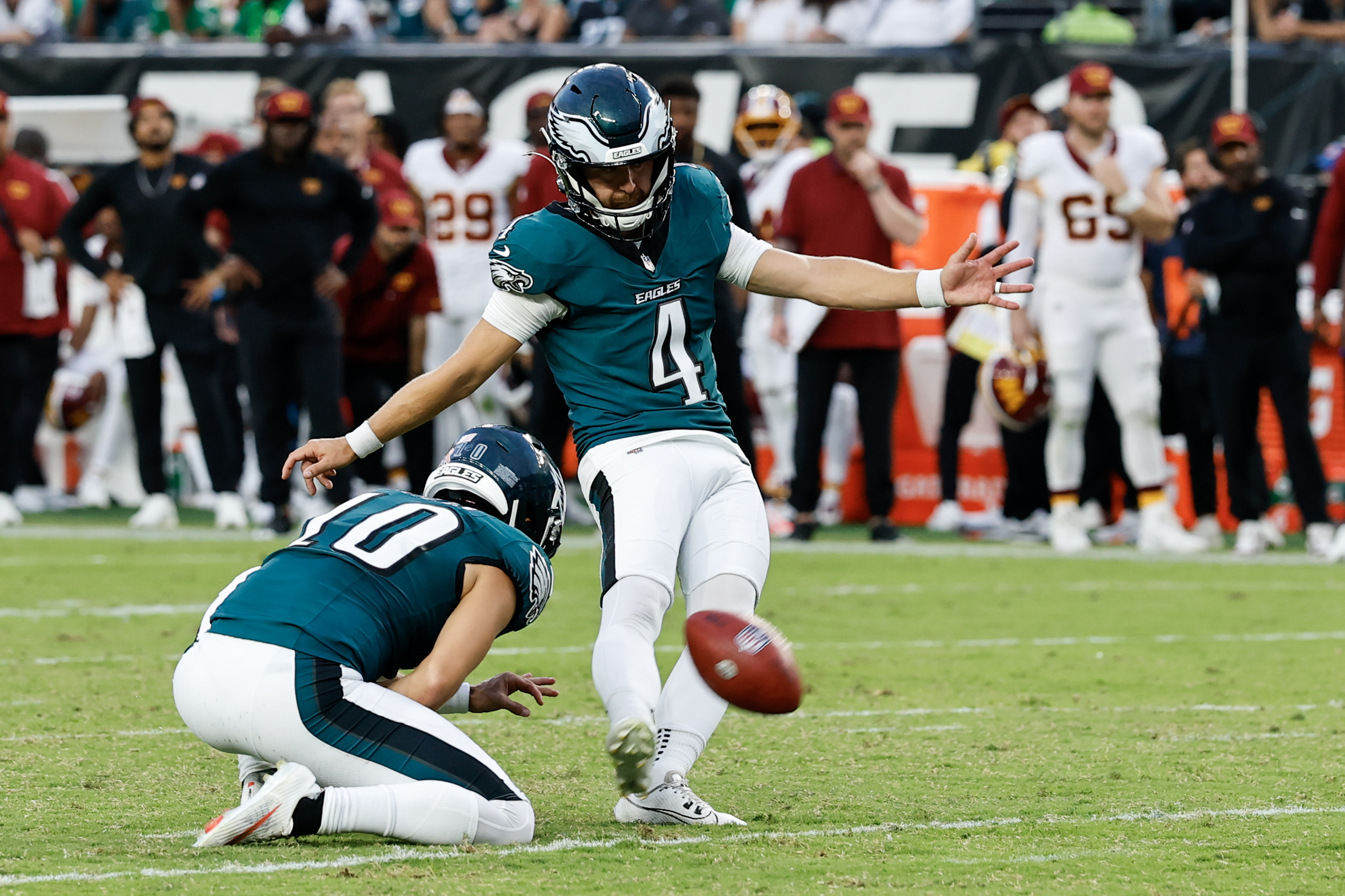
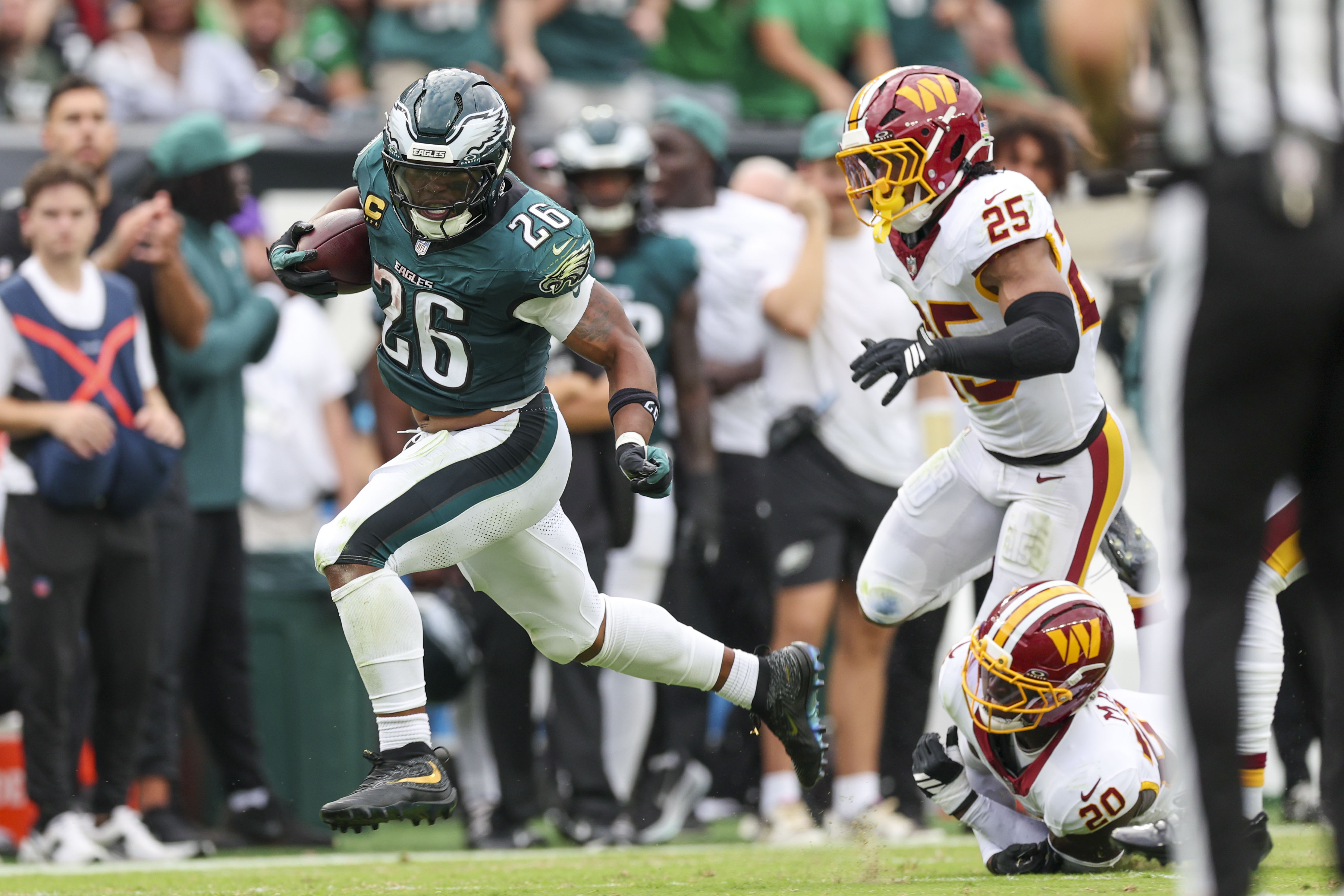
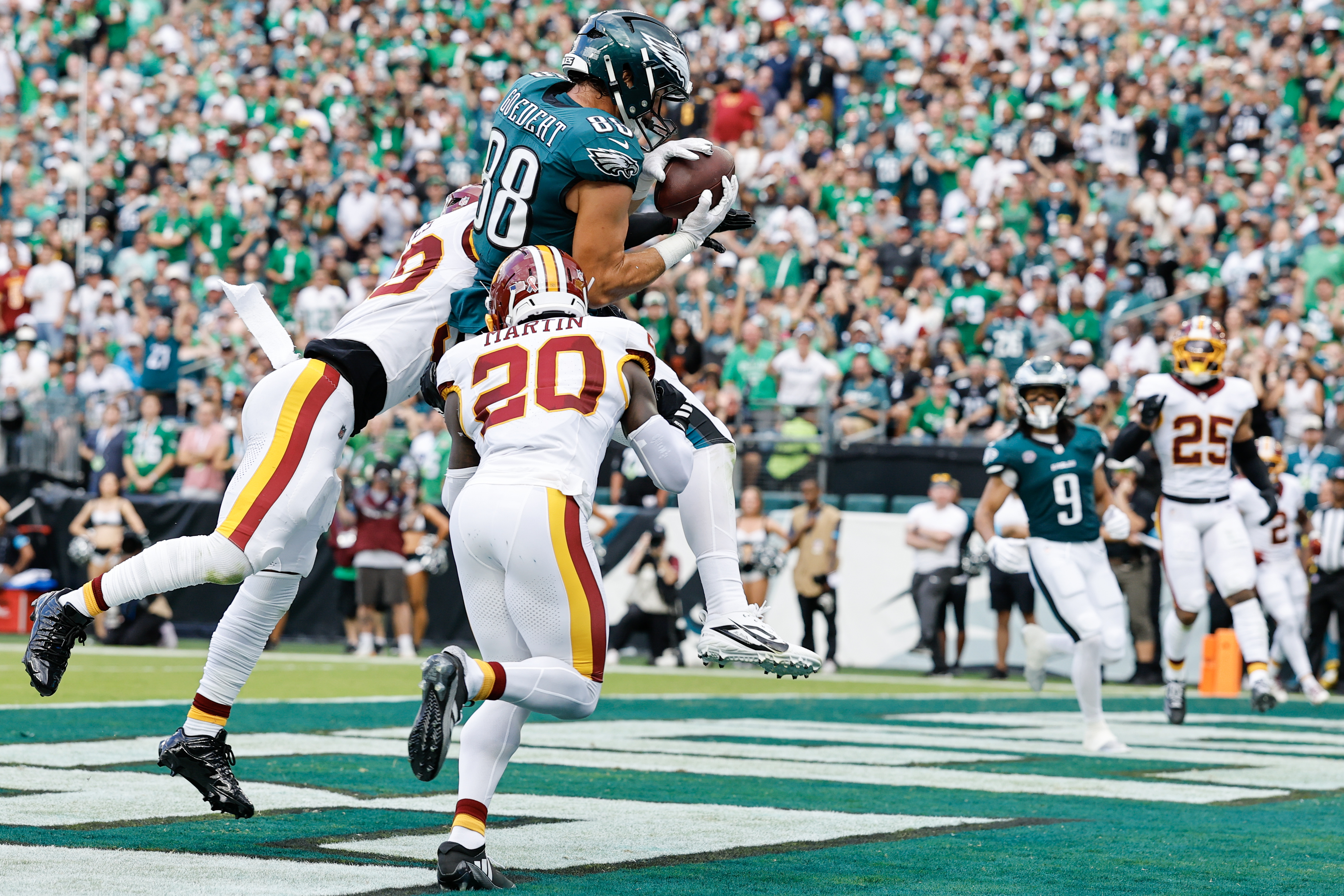
A healthier offensive line gave Hurts enough time to throw three touchdown passes, two to tight end Dallas Goedert, who is a touchdown-catching machine. The line helped Saquon Barkley gain 83 rushing yards. Hurts had 203 passing yards, 46 rushing yards, and no interceptions.
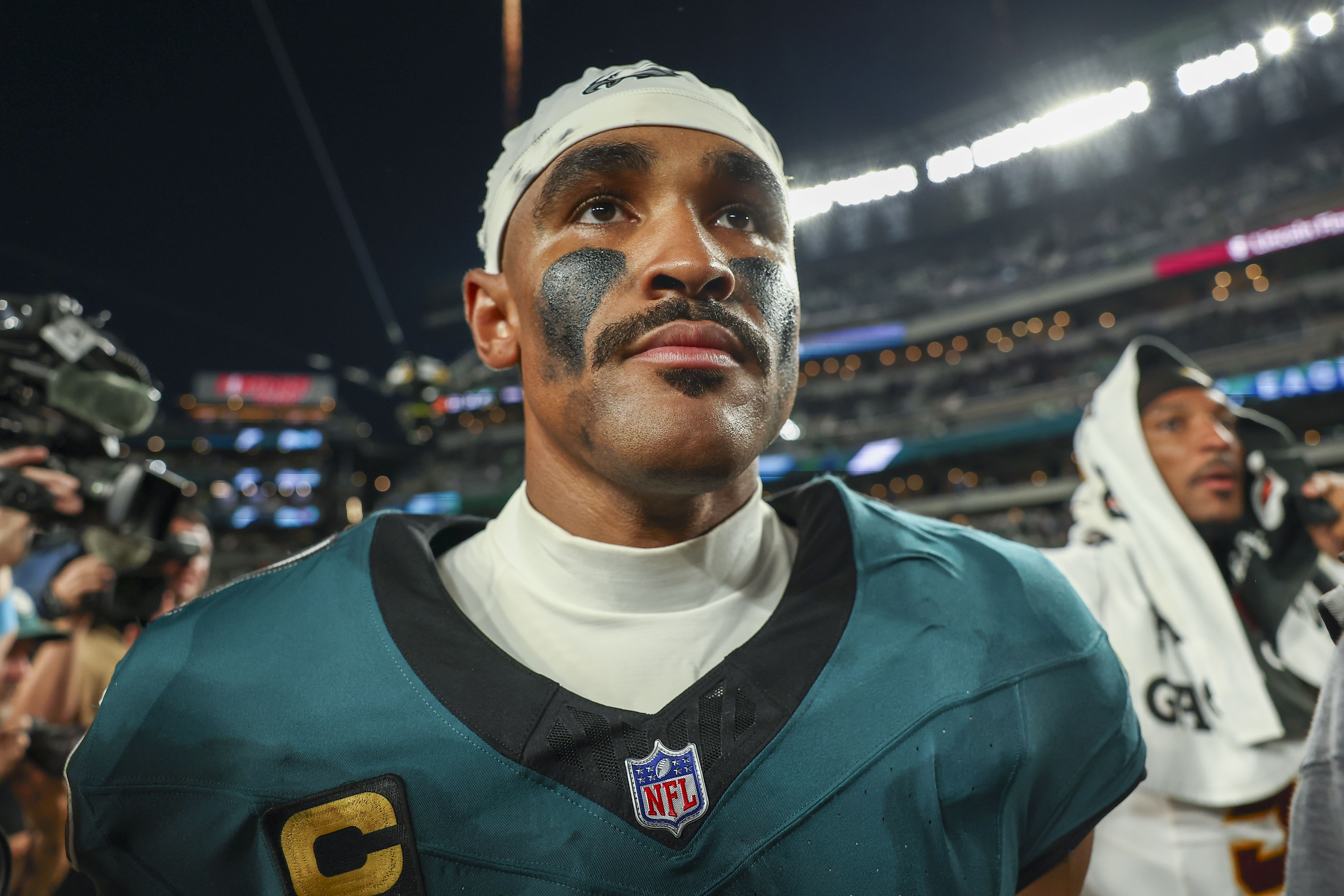
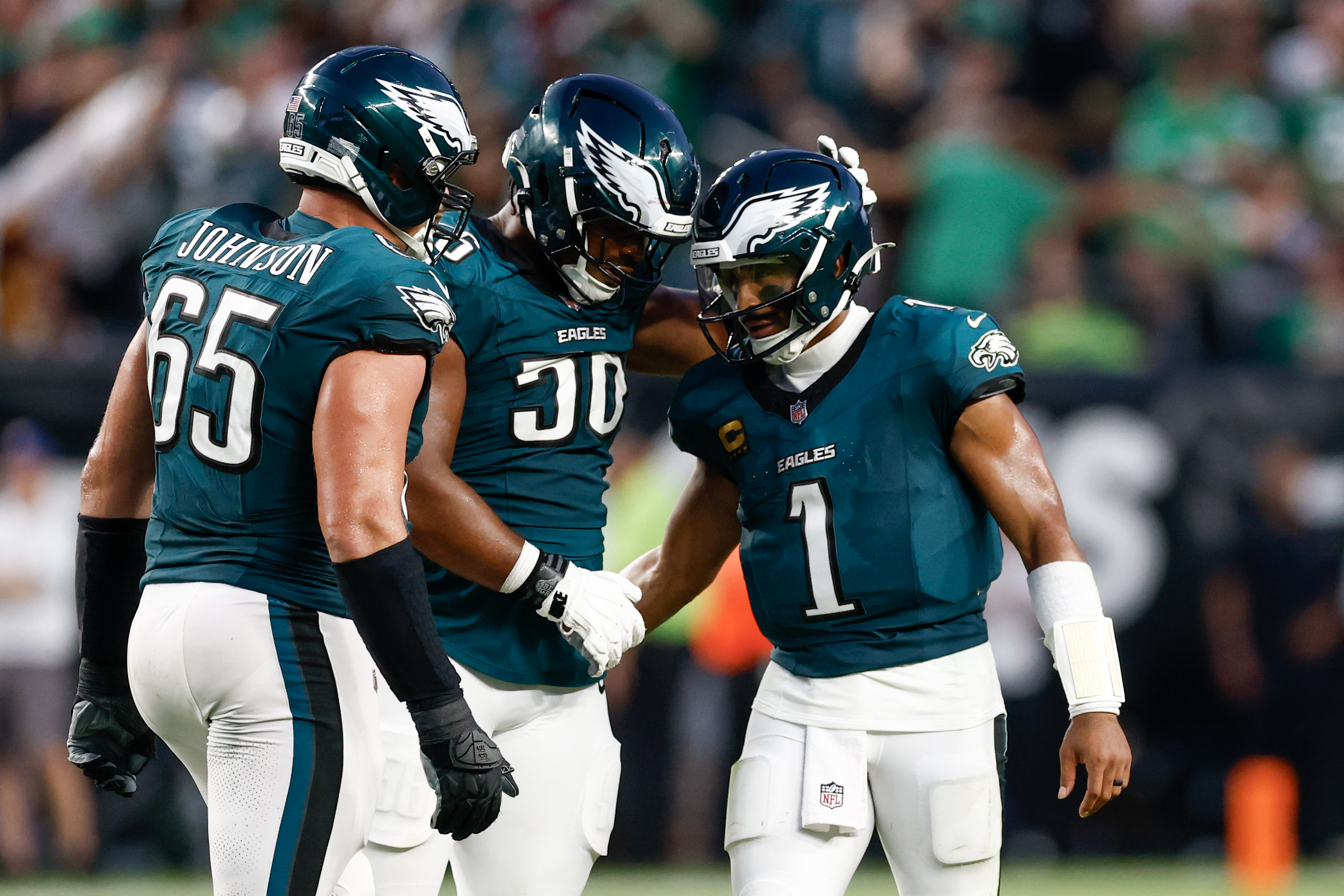
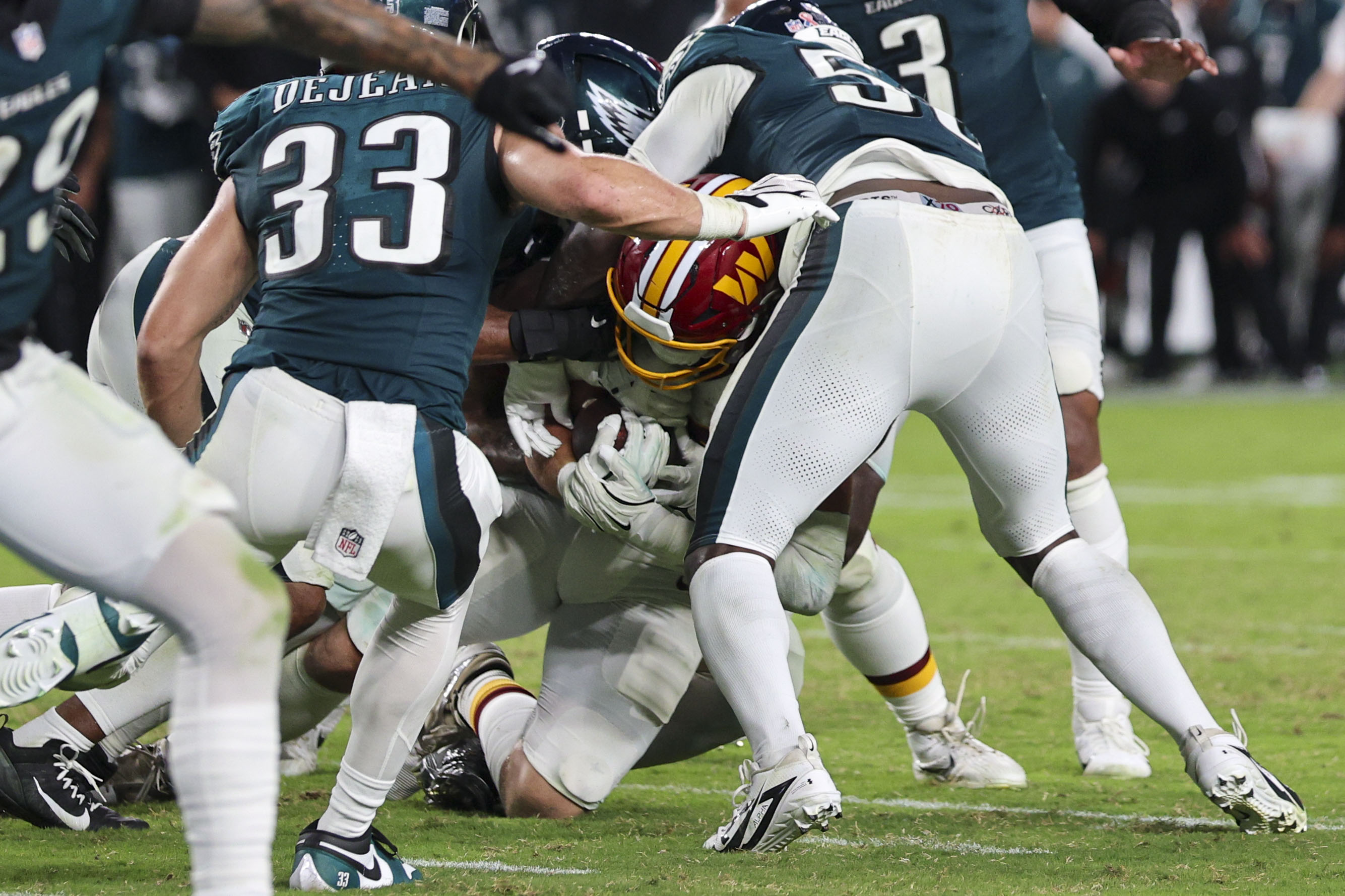
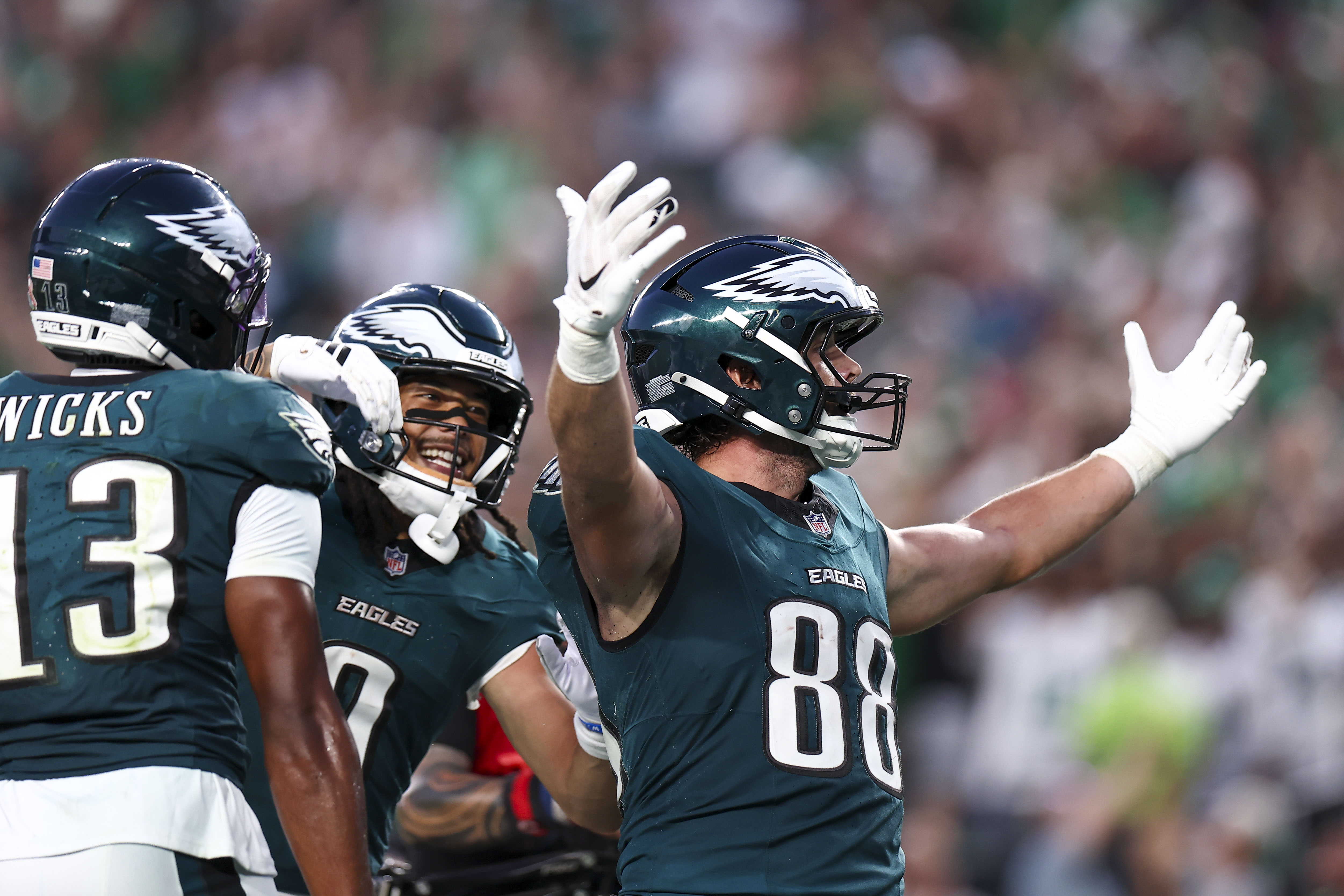
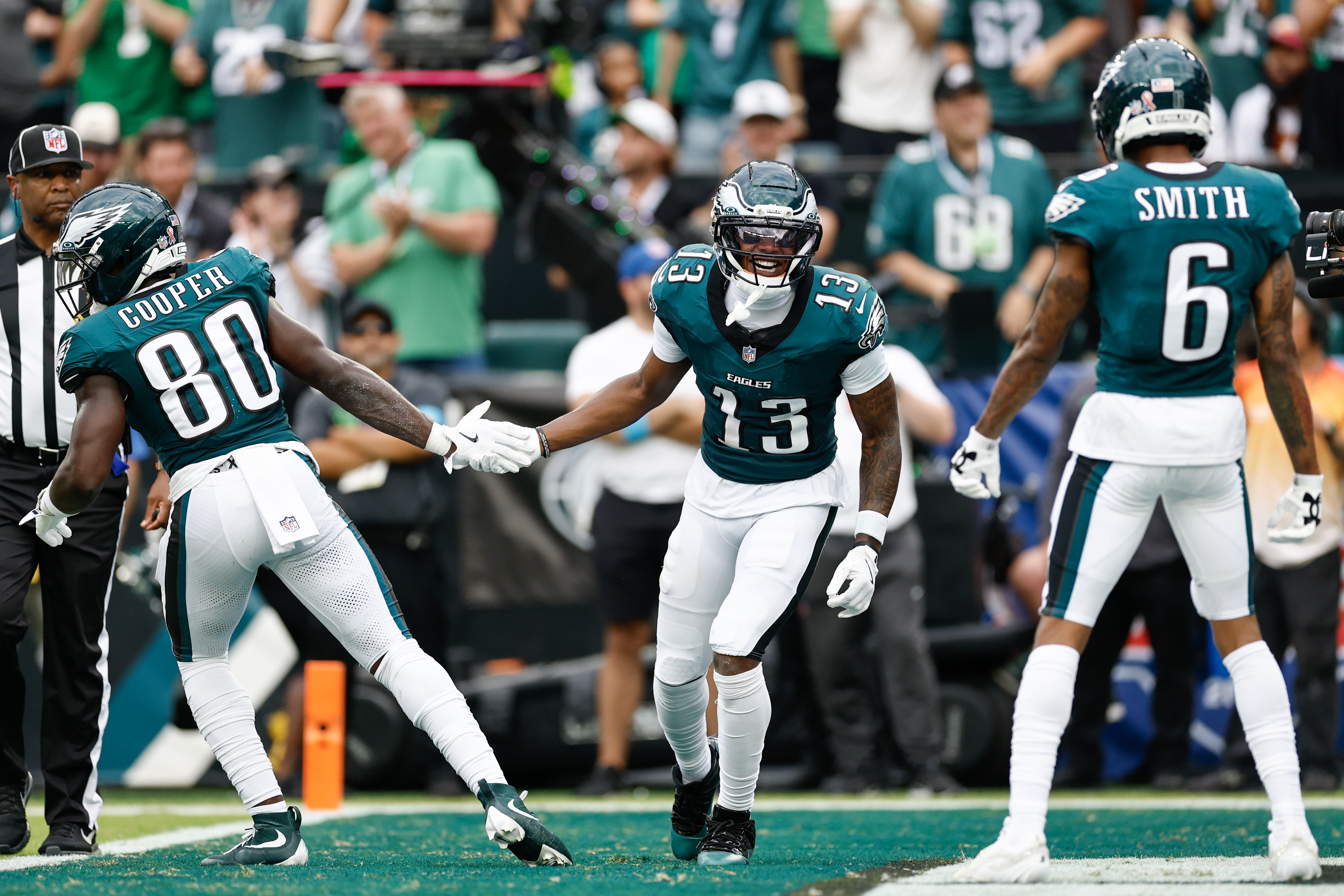
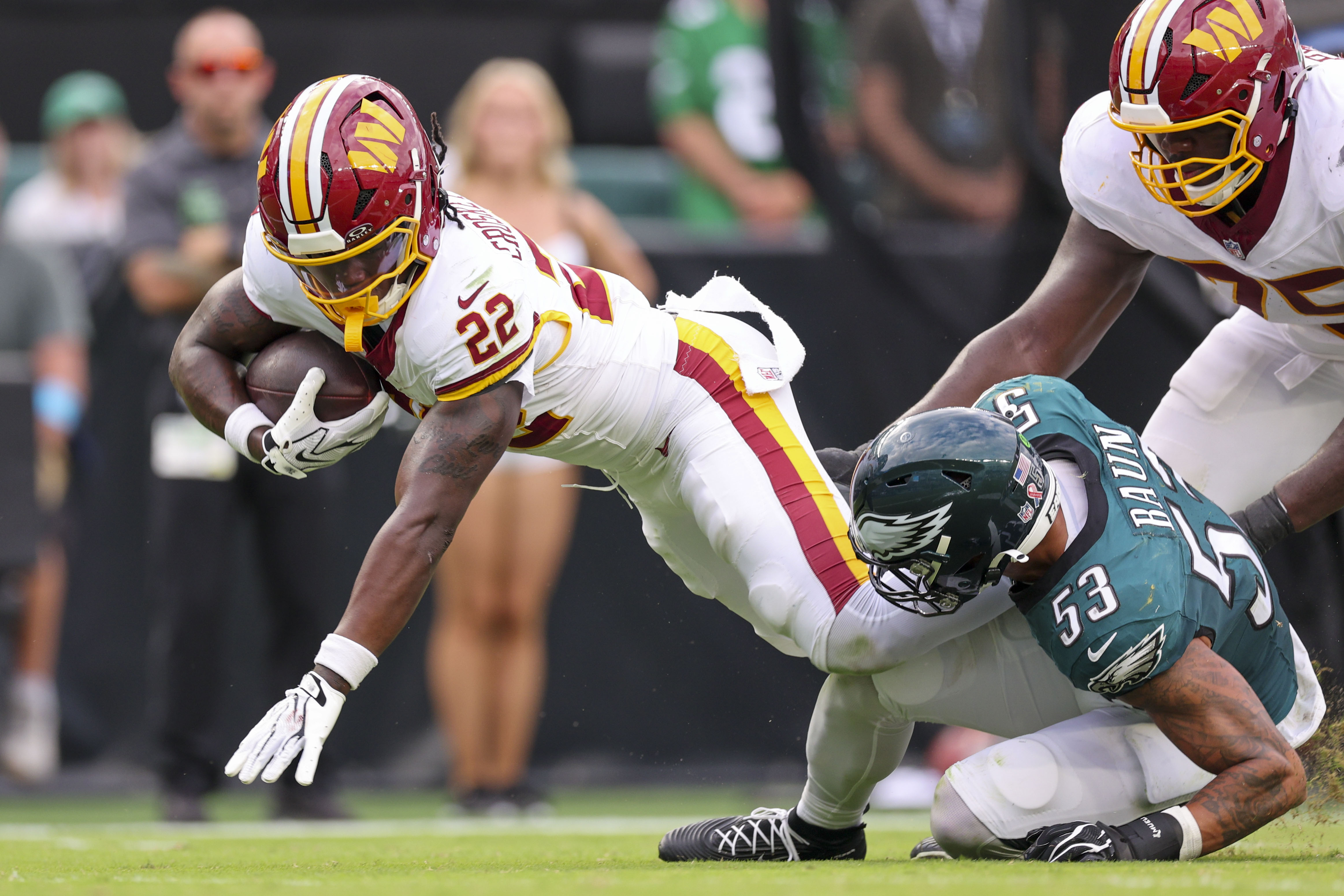
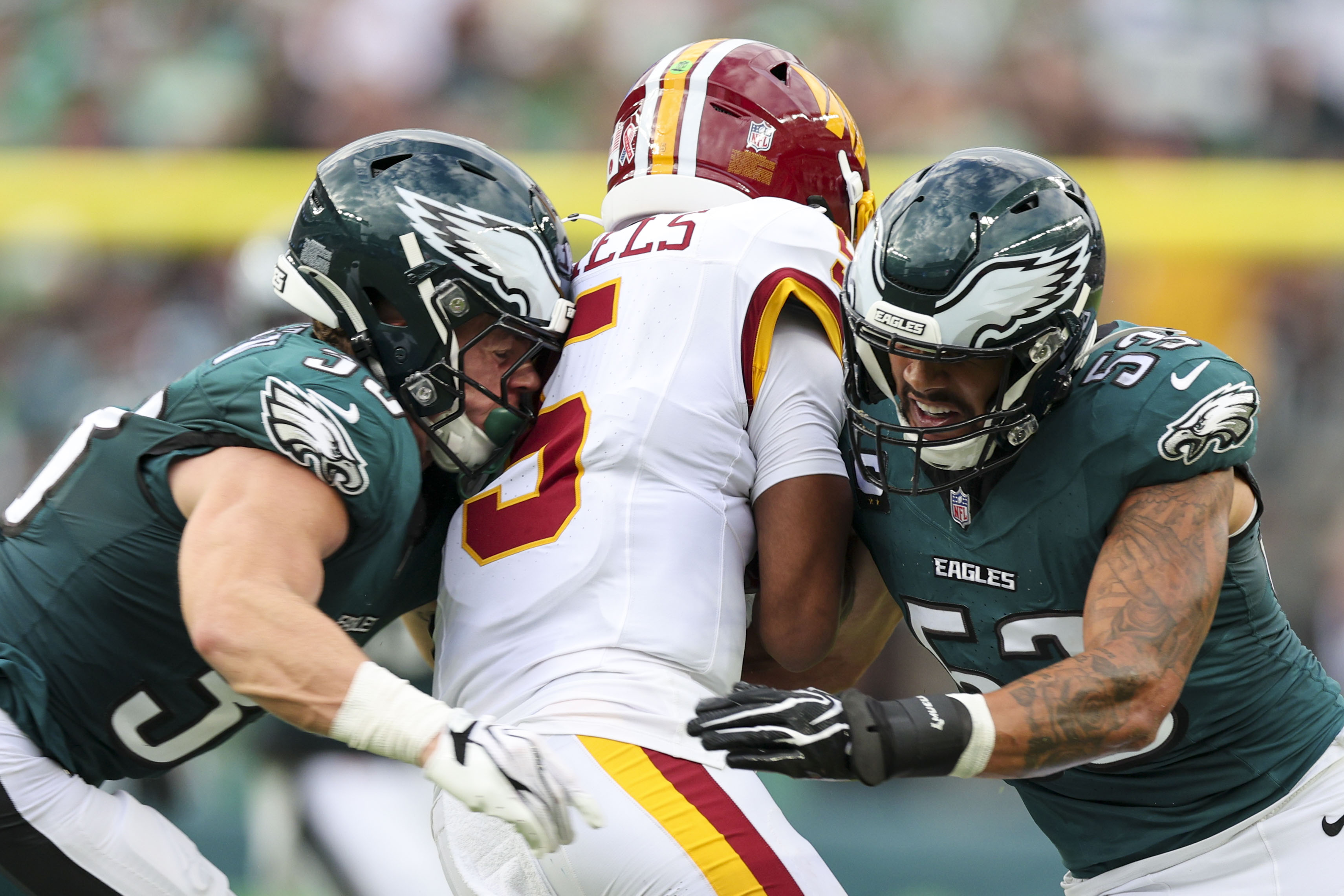
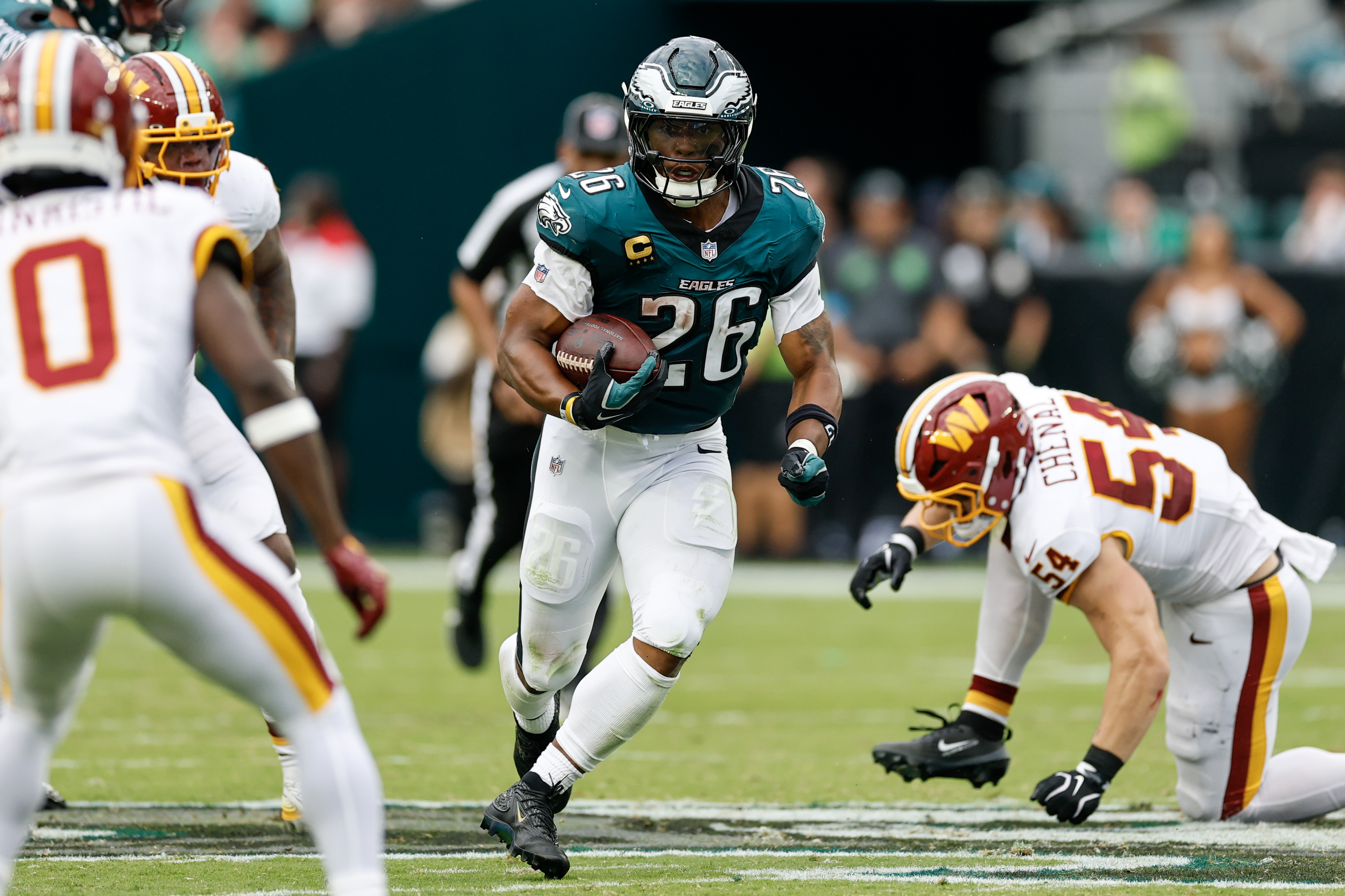
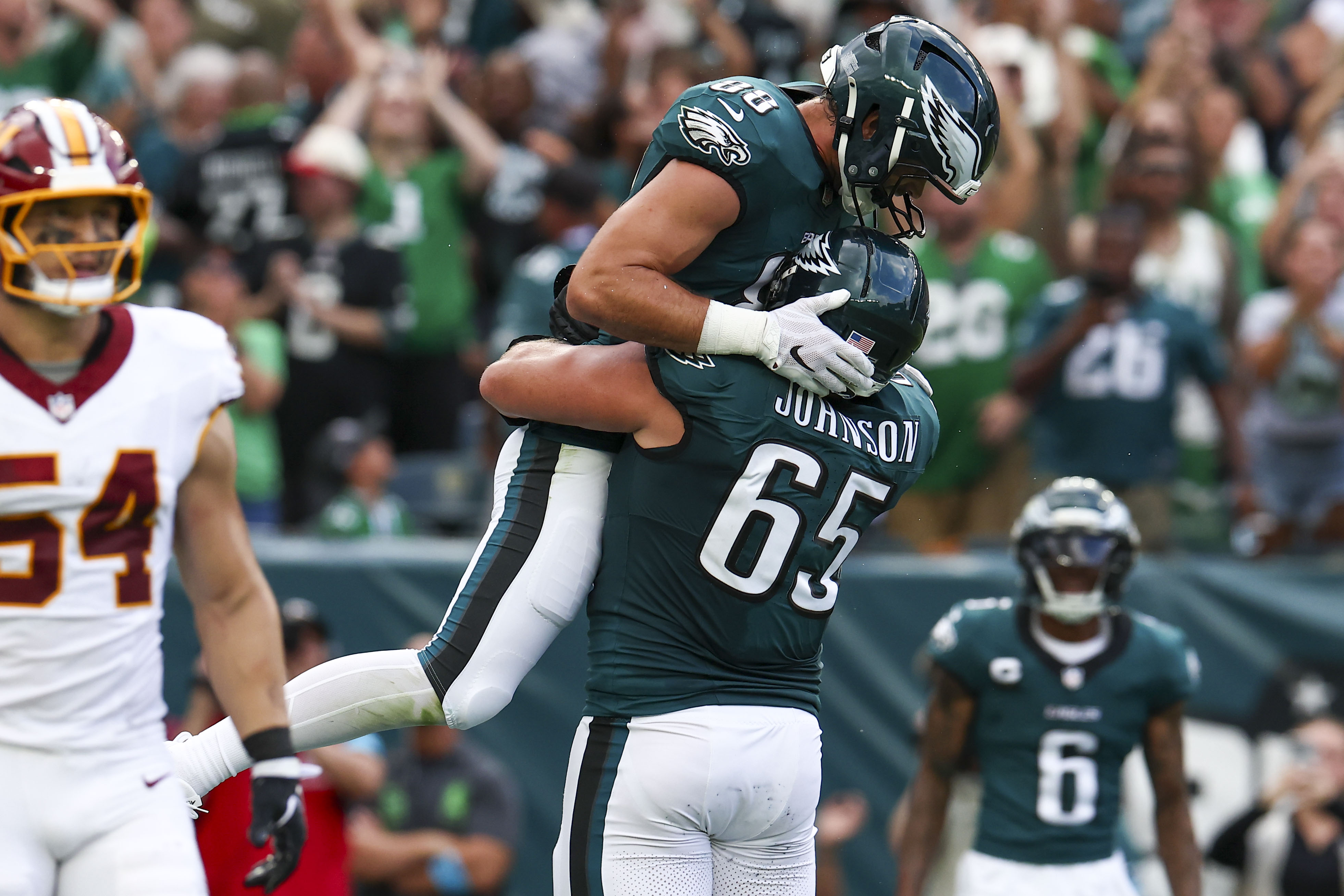
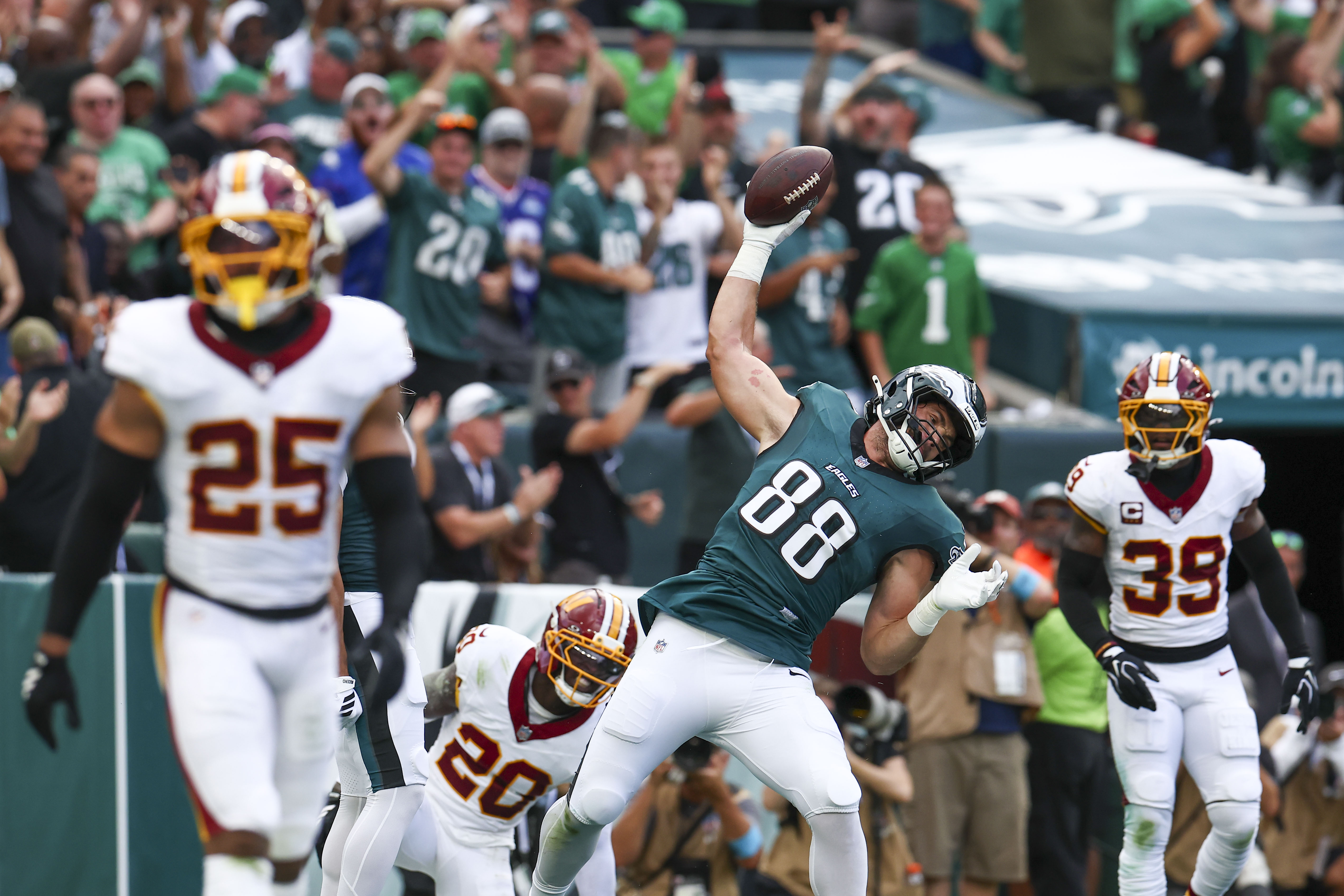
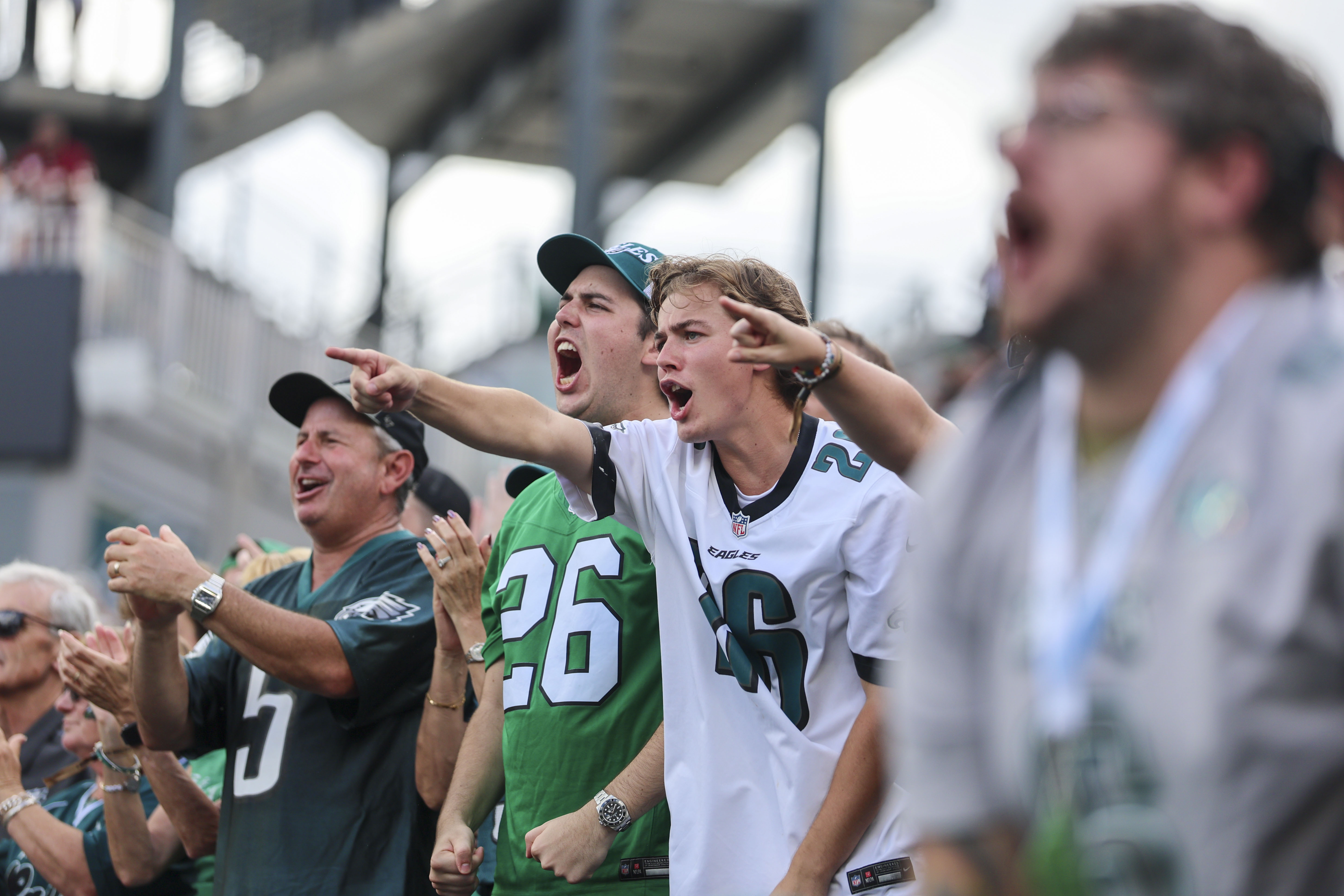
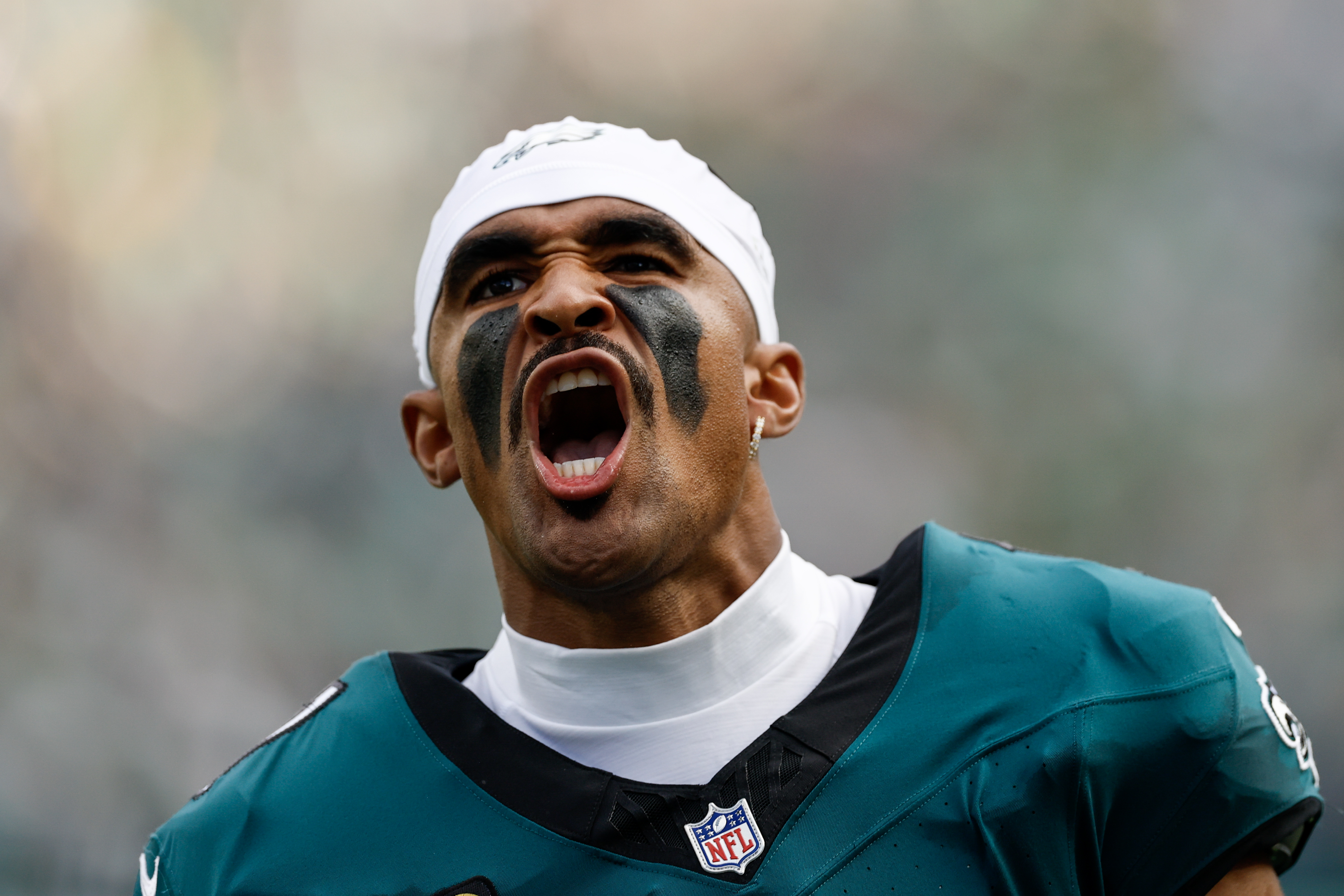
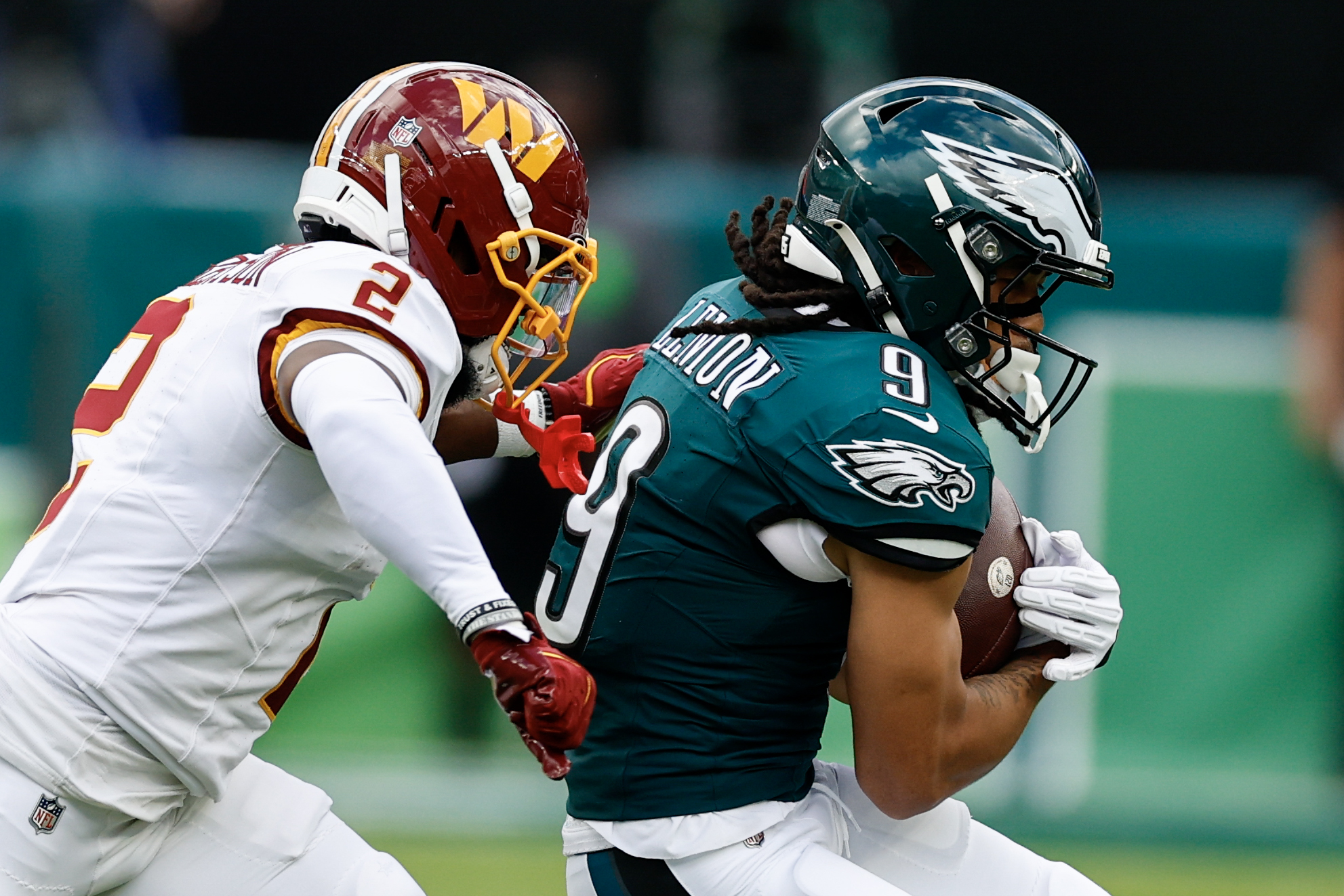
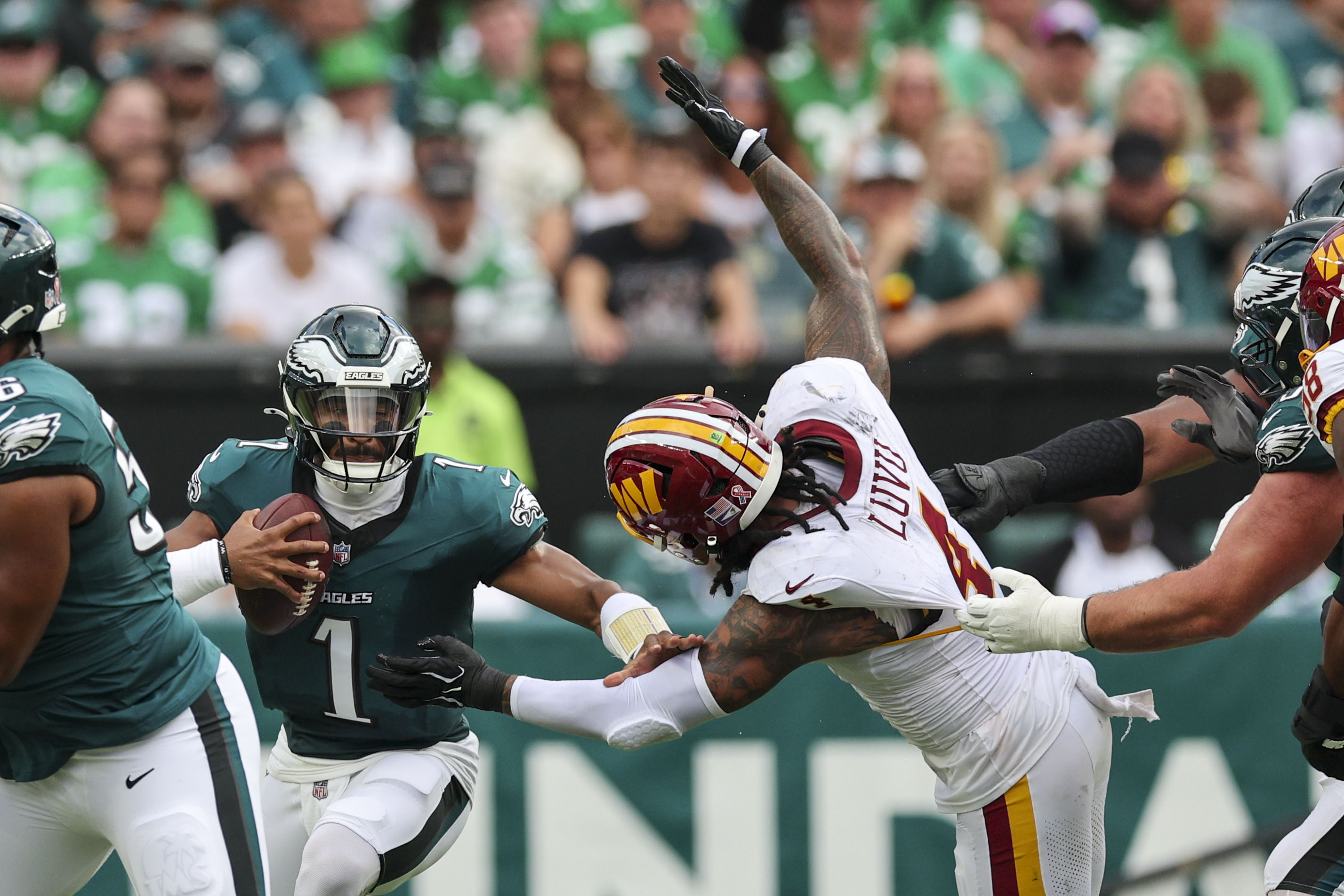
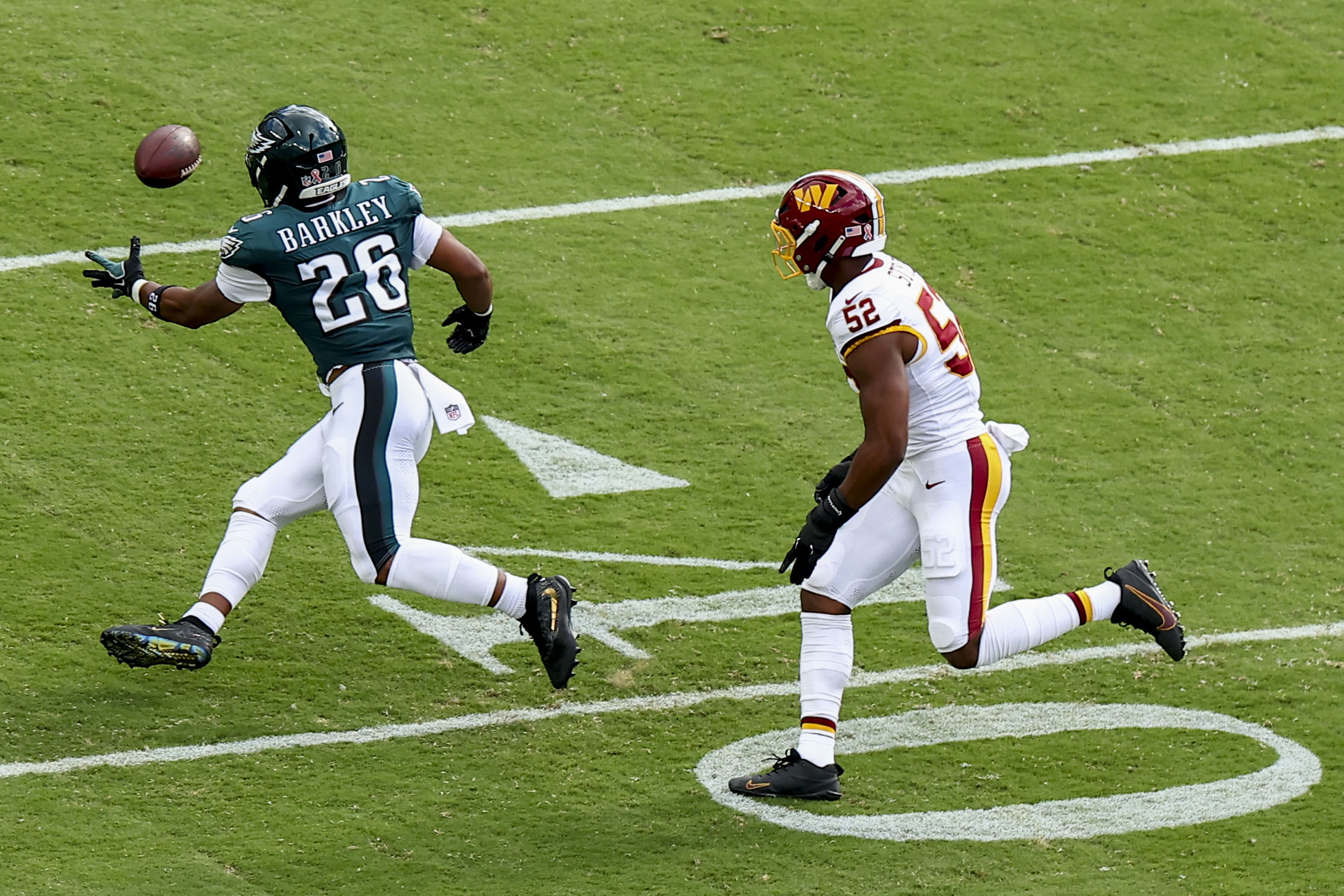
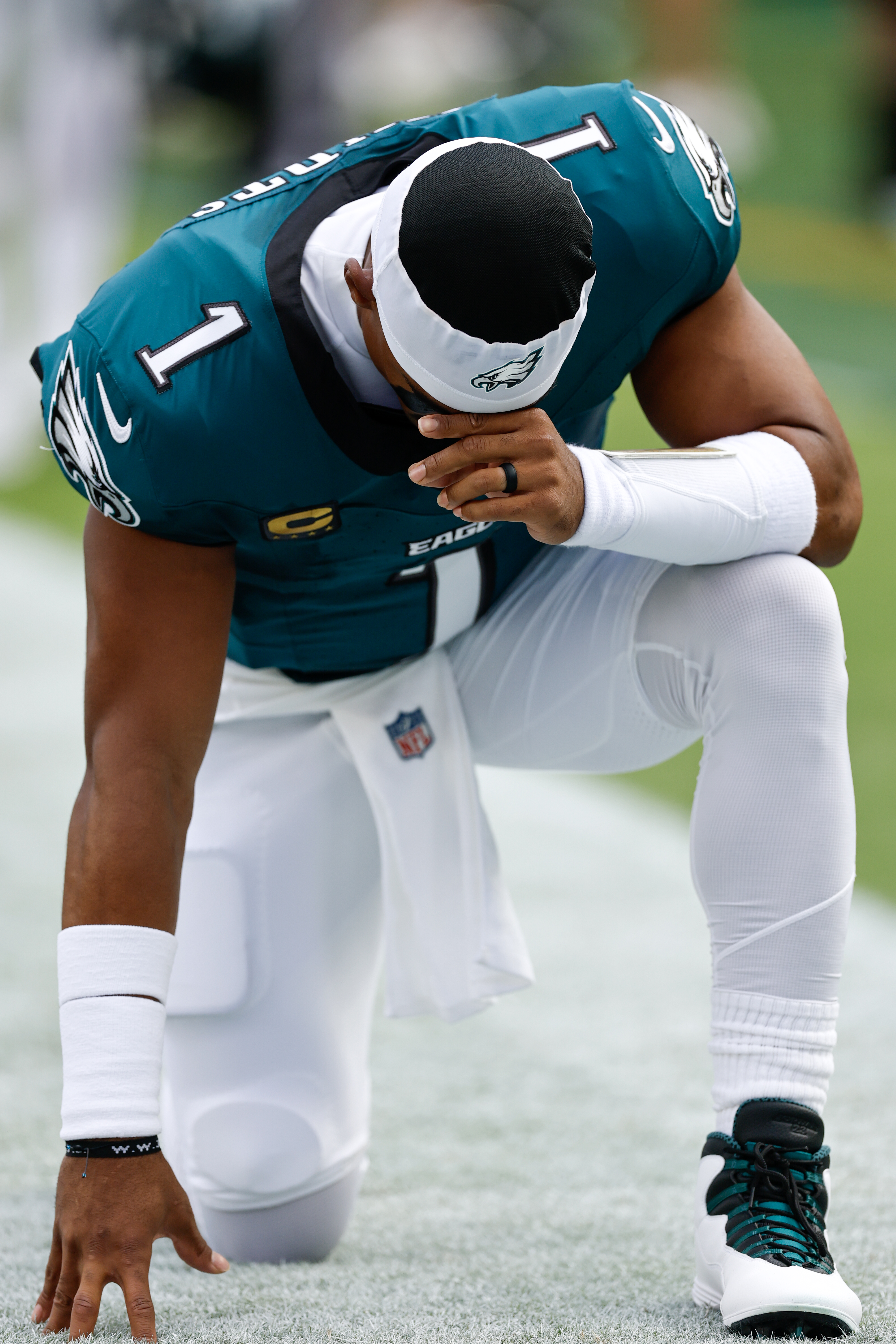
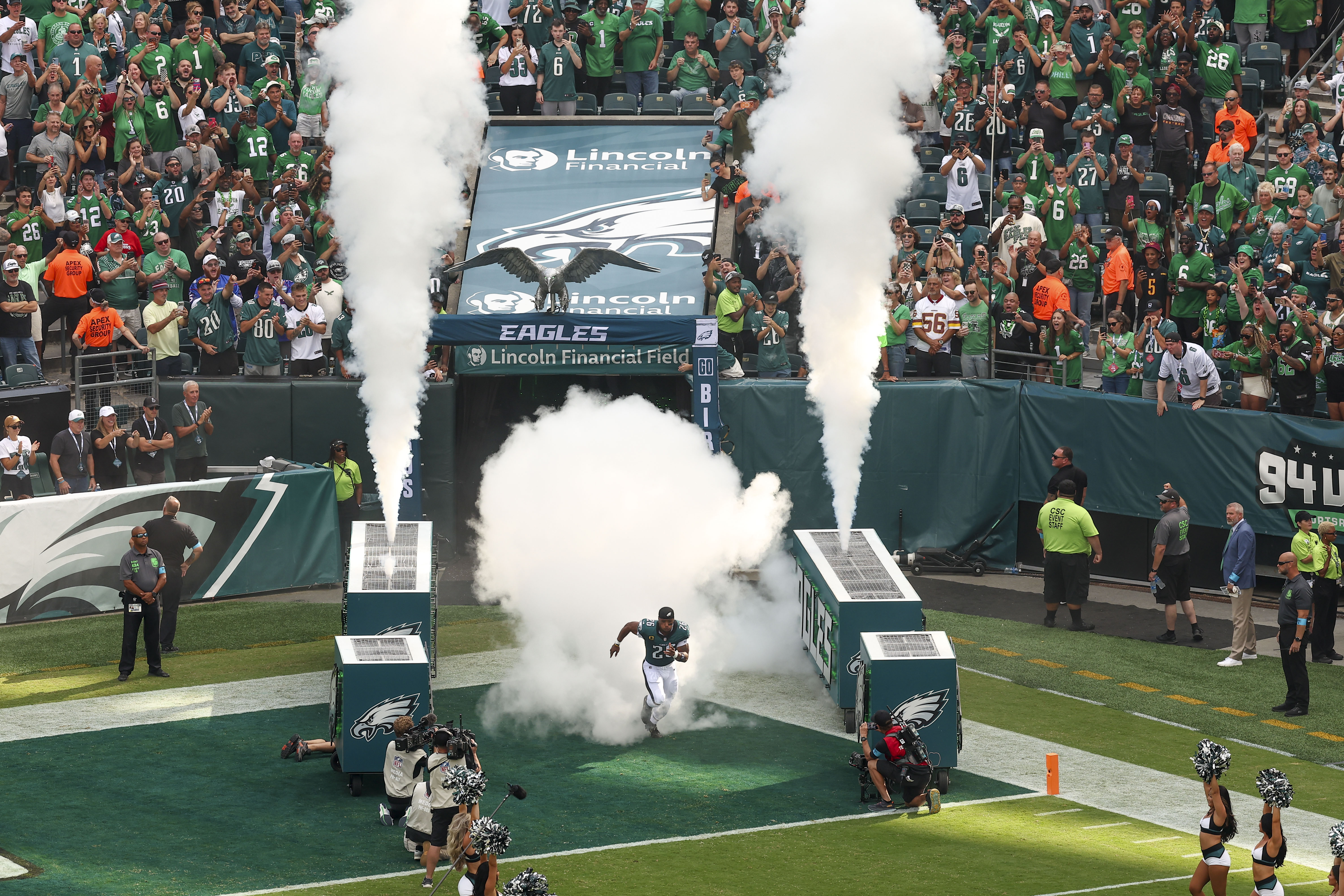
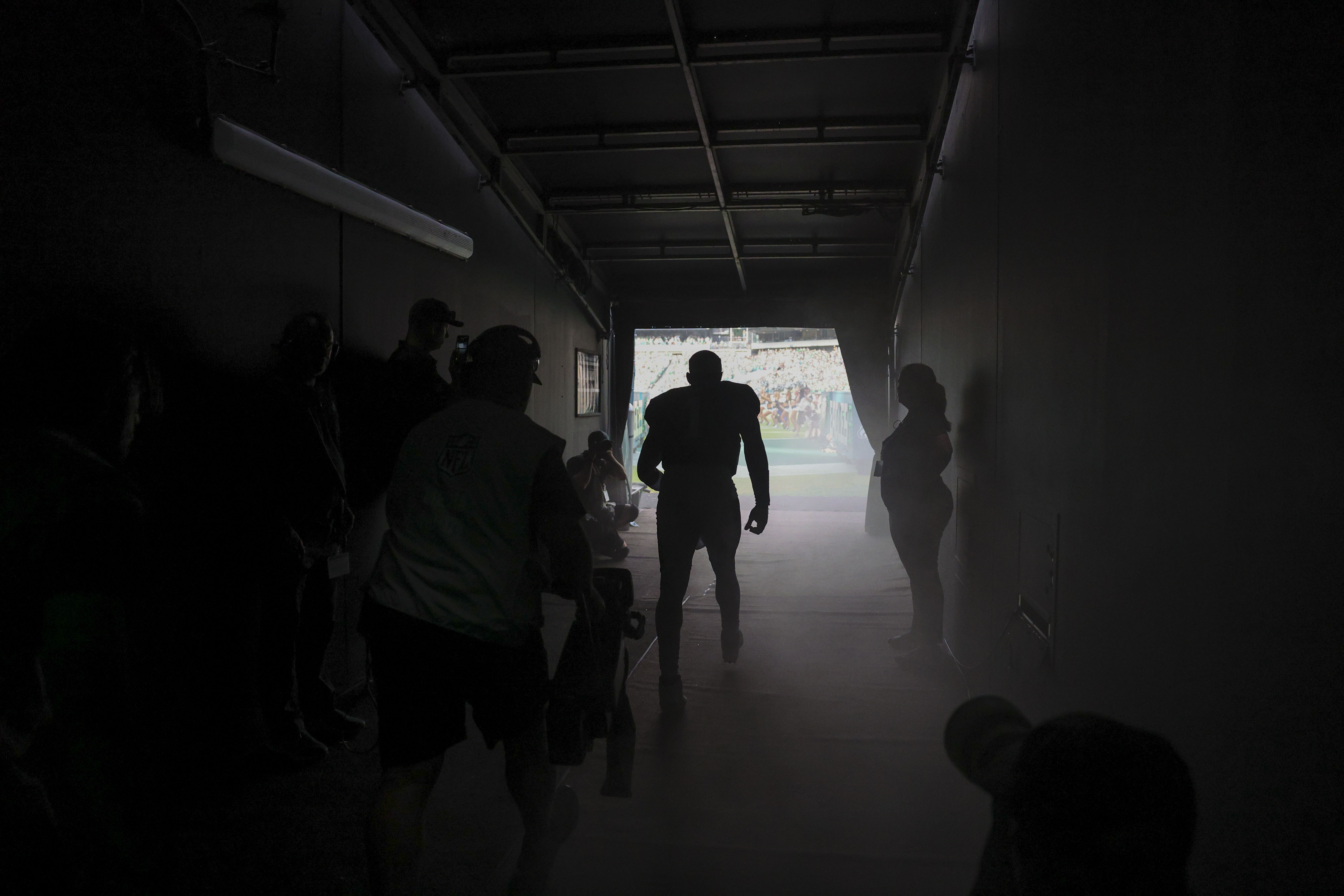
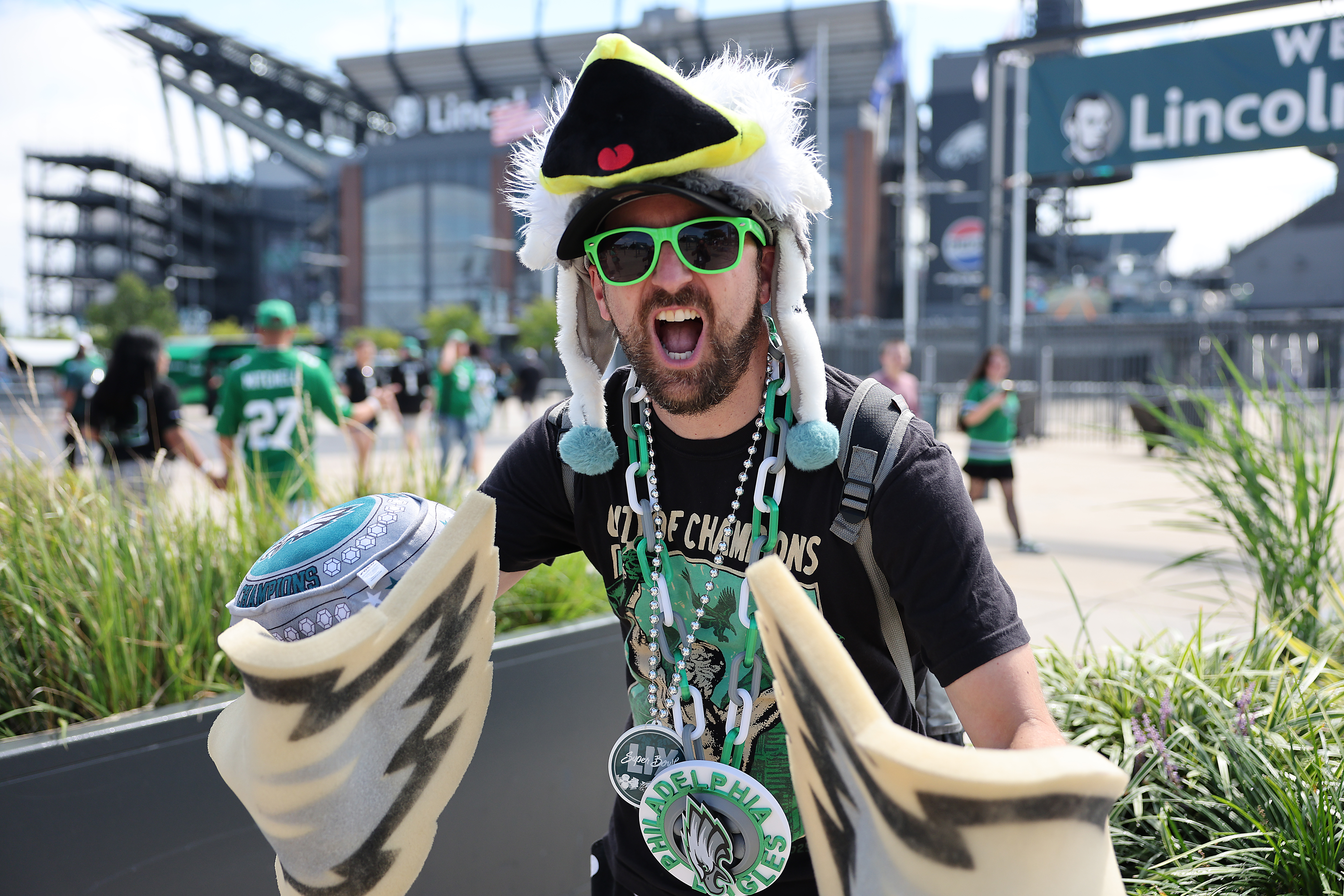
Philadelphia Eagles quarterback Jalen Hurts after winning the season opening game against the Washington Commanders at Lincoln Financial Field on Sunday, Sept. 13, 2026, in Philadelphia.Monica Herndon / Staff PhotographerEagles quarterback Jalen Hurts celebrates a touchdown with Keyshawn James-Newby (center) and offensive tackle Lane Johnson during the fourth quarter of the season opener against the Commanders Sunday, Sept. 13, 2026, in Philadelphia.Yong Kim / Staff PhotographerEagles defensive tackle Moro Ojomo celebrates a two-point conversion stop late during the fourth quarter of the season opener against the Commanders Sunday, Sept. 13, 2026, in Philadelphia.Yong Kim / Staff PhotographerPhiladelphia Eagles stop the two point conversion attempt during the fourth quarter at Lincoln Financial Field on Sunday, Sept. 13, 2026, in Philadelphia.David Maialetti / Staff PhotographerPhiladelphia Eagles tight end Dallas Goedert celebrates his fourth quarter touchdown at Lincoln Financial Field on Sunday, Sept. 13, 2026, in Philadelphia.Monica Herndon / Staff PhotographerEagles tight end Dallas Goedert scores a fourth quarter touchdown past Commanders cornerback Darius Rush during the season opener against the Commanders Sunday, Sept. 13, 2026, in Philadelphia.Yong Kim / Staff PhotographerPhiladelphia Eagles tight end Dallas Goedert runs for a touchdown in the fourth quarter at Lincoln Financial Field on Sunday, Sept. 13, 2026, in Philadelphia.Monica Herndon / Staff PhotographerEagles tight end Dallas Goedert catches the football for a touchdown during the fourth quarter of the season opener against the Commanders Sunday, Sept. 13, 2026, in Philadelphia.Yong Kim / Staff PhotographerEagles quarterback Jalen Hurts first down run during the fourth quarter of the season opener against the Commanders Sunday, Sept. 13, 2026, in Philadelphia.Yong Kim / Staff PhotographerWashington Commanders wide receiver Stefon Diggs hugs the goalpost after scoring a touchdown in the fourth quarter Lincoln Financial Field on Sunday, Sept. 13, 2026, in Philadelphia. Unsportsmanlike penalty was called pushing the Commanders back.David Maialetti / Staff PhotographerWashington Commanders wide receiver Stefon Diggs scores in the fourth quarter at Lincoln Financial Field on Sunday, Sept. 13, 2026, in Philadelphia.David Maialetti / Staff PhotographerPhiladelphia Eagles wide receiver DeVonta Smith catches the ball for a big first down during the third quarter at Lincoln Financial Field on Sunday, Sept. 13, 2026, in Philadelphia.David Maialetti / Staff PhotographerPhiladelphia Eagles quarterback Jalen Hurts gains fourteen yards on a run in the third quarter at Lincoln Financial Field on Sunday, Sept. 13, 2026, in Philadelphia.David Maialetti / Staff PhotographerEagles place kicker Jake Elliott kicks a third quarter field goad during the season opener against the Commanders Sunday, Sept. 13, 2026, in Philadelphia.Yong Kim / Staff PhotographerEagles cornerback Cooper DeJean stops Commanders wide receiver Jaylin Lane during the third quarter of the season opener against the Commanders Sunday, Sept. 13, 2026, in Philadelphia.Yong Kim / Staff PhotographerEagles wide receiver DeVonta Smith catches the ball against Commanders cornerback Darius Rush during the third quarter of the season opener against the Commanders Sunday, Sept. 13, 2026, in Philadelphia.Yong Kim / Staff PhotographerPhiladelphia Eagles quarterback Jalen Hurts sacked in the third quarter by Washington Commanders linebacker Odafe Oweh at Lincoln Financial Field on Sunday, Sept. 13, 2026, in Philadelphia.Monica Herndon / Staff PhotographerPhiladelphia Eagles quarterback Jalen Hurts scrambles on a third down during the third quarter at Lincoln Financial Field on Sunday, Sept. 13, 2026, in Philadelphia.Monica Herndon / Staff PhotographerEagles head coach Nick Sirianni racts during the third quarter of the season opener against the Commanders Sunday, Sept. 13, 2026, in Philadelphia.Yong Kim / Staff PhotographerPhiladelphia Eagles quarterback Jalen Hurts is sacked by Washington Commanders linebacker Sonny Styles in the third quarter at Lincoln Financial Field on Sunday, Sept. 13, 2026, in Philadelphia.Monica Herndon / Staff PhotographerEagles quarterback Jalen Hurts passes to tight end Dallas Goedert late during the second quarter of the season opener against the Commanders Sunday, Sept. 13, 2026, in Philadelphia.Yong Kim / Staff PhotographerEagles defensive tackle Jalen Carter celebrates a blocked extra point late during the second quarter of the season opener against the Commanders Sunday, Sept. 13, 2026, in Philadelphia.Yong Kim / Staff PhotographerPhiladelphia Eagles quarterback Jalen Hurts hands off to Philadelphia Eagles running back Tank Bigsby in the second quarter at Lincoln Financial Field on Sunday, Sept. 13, 2026, in Philadelphia.Monica Herndon / Staff PhotographerPhiladelphia Eagles tight end Dallas Goedert congratulates Philadelphia Eagles wide receiver Dontayvion Wicks after a second quarter touchdown at Lincoln Financial Field on Sunday, Sept. 13, 2026, in Philadelphia.David Maialetti / Staff PhotographerPhiladelphia Eagles head coach Nick Sirianni congratulates Philadelphia Eagles wide receiver Dontayvion Wicks after his second quarter touchdown at Lincoln Financial Field on Sunday, Sept. 13, 2026, in Philadelphia.David Maialetti / Staff PhotographerPhiladelphia Eagles linebacker Nolan Smith tries to block Washington Commanders quarterback Jayden Daniels in the second quarter at Lincoln Financial Field on Sunday, Sept. 13, 2026, in Philadelphia.Monica Herndon / Staff PhotographerEagles defensive tackle Moro Ojomo goes after Commanders quarterback Jayden Daniels during the second quarter of the season opener against the Commanders Sunday, Sept. 13, 2026, in Philadelphia.Yong Kim / Staff PhotographerEagles wide receiver Dontayvion Wicks celebrates a touchdown with Darius Cooper (left) and DeVonta Smith (right) during the second quarter of the season opener against the Commanders Sunday, Sept. 13, 2026, in Philadelphia.Yong Kim / Staff PhotographerEagles linebacker Zack Baun celebrates after breaking up a pass intended for Commanders wide receiver Stefon Diggs during the second quarter of the season opener against the Commanders Sunday, Sept. 13, 2026, in Philadelphia.Yong Kim / Staff PhotographerPhiladelphia Eagles linebacker Zack Baun stops Washington Commanders running back Jacory Croskey-Merritt for a loss, Washington punts on the drive, at Lincoln Financial Field on Sunday, Sept. 13, 2026, in Philadelphia.David Maialetti / Staff PhotographerPhiladelphia Eagles running back Saquon Barkley with a big run in the second quarter at Lincoln Financial Field on Sunday, Sept. 13, 2026, in Philadelphia.David Maialetti / Staff PhotographerPhiladelphia Eagles cornerback Cooper DeJean and Philadelphia Eagles linebacker Zack Baun sandwich Washington Commanders quarterback Jayden Daniels during the second quarter at Lincoln Financial Field on Sunday, Sept. 13, 2026, in Philadelphia.David Maialetti / Staff PhotographerEagles running back Saquon Barkley gains 42 yards during the second quarter of the season opener against the Commanders Sunday, Sept. 13, 2026, in Philadelphia.Yong Kim / Staff PhotographerPhiladelphia Eagles tight end Dallas Goedert celebrates second quarter touchdown with Philadelphia Eagles offensive tackle Lane Johnson at Lincoln Financial Field on Sunday, Sept. 13, 2026, in Philadelphia.Monica Herndon / Staff PhotographerPhiladelphia Eagles tight end Dallas Goedert spikes the ball after a touchdown in the second quarter at Lincoln Financial Field on Sunday, Sept. 13, 2026, in Philadelphia.Monica Herndon / Staff PhotographerEagles tight end Dallas Goedert catches a touchdown against Commanders safety Quan Martin during the second quarter of the season opener against the Commanders Sunday, Sept. 13, 2026, in Philadelphia.nYong Kim / Staff PhotographerPhiladelphia Eagles fans cheer in the first quarter of the season opener against the Washington Commanders at Lincoln Financial Field on Sunday, Sept. 13, 2026, in Philadelphia.David Maialetti / Staff PhotographerEagles quarterback Jalen Hurts reacts during the first quarter of the season opener against the Commanders Sunday, Sept. 13, 2026, in Philadelphia.Yong Kim / Staff PhotographerEagles wide receiver Makai Lemon catches the ball against Commanders cornerback Amik Robertson during the first quarter of the season opener against the Commanders Sunday, Sept. 13, 2026, in Philadelphia.Yong Kim / Staff PhotographerPhiladelphia Eagles quarterback Jalen Hurts is sacked by Washington Commanders linebacker Frankie Luvu in the first quarter at Lincoln Financial Field on Sunday, Sept. 13, 2026, in Philadelphia.David Maialetti / Staff PhotographerPhiladelphia Eagles running back Saquon Barkley misses a pass in the first quarter, defended by Washington Commanders linebacker Sonny Styles, at Lincoln Financial Field on Sunday, Sept. 13, 2026, in Philadelphia.Monica Herndon / Staff PhotographerEagles quarterback Jalen Hurts during a moment of silence before the start of the season opener against the Commanders Sunday, Sept. 13, 2026, in Philadelphia.Yong Kim / Staff PhotographerPhiladelphia Eagles running back Saquon Barkley runs out of the tunnel at the season opener against the Washington Commanders in Lincoln Financial Field on Sunday, Sept. 13, 2026, in Philadelphia.Monica Herndon / Staff PhotographerPhiladelphia Eagles quarterback Jalen Hurts runs out of the tunnel during player introductions before the season opening game against the Washington Commanders in Lincoln Financial Field on Sunday, Sept. 13, 2026, in Philadelphia.David Maialetti / Staff PhotographerGreg Gorski, of Elkins Park, poses for a portrait while tailgating before the Eagles play the Commanders in Philadelphia on Sunday, Sept. 13, 2026.David Maialetti / Staff Photographer
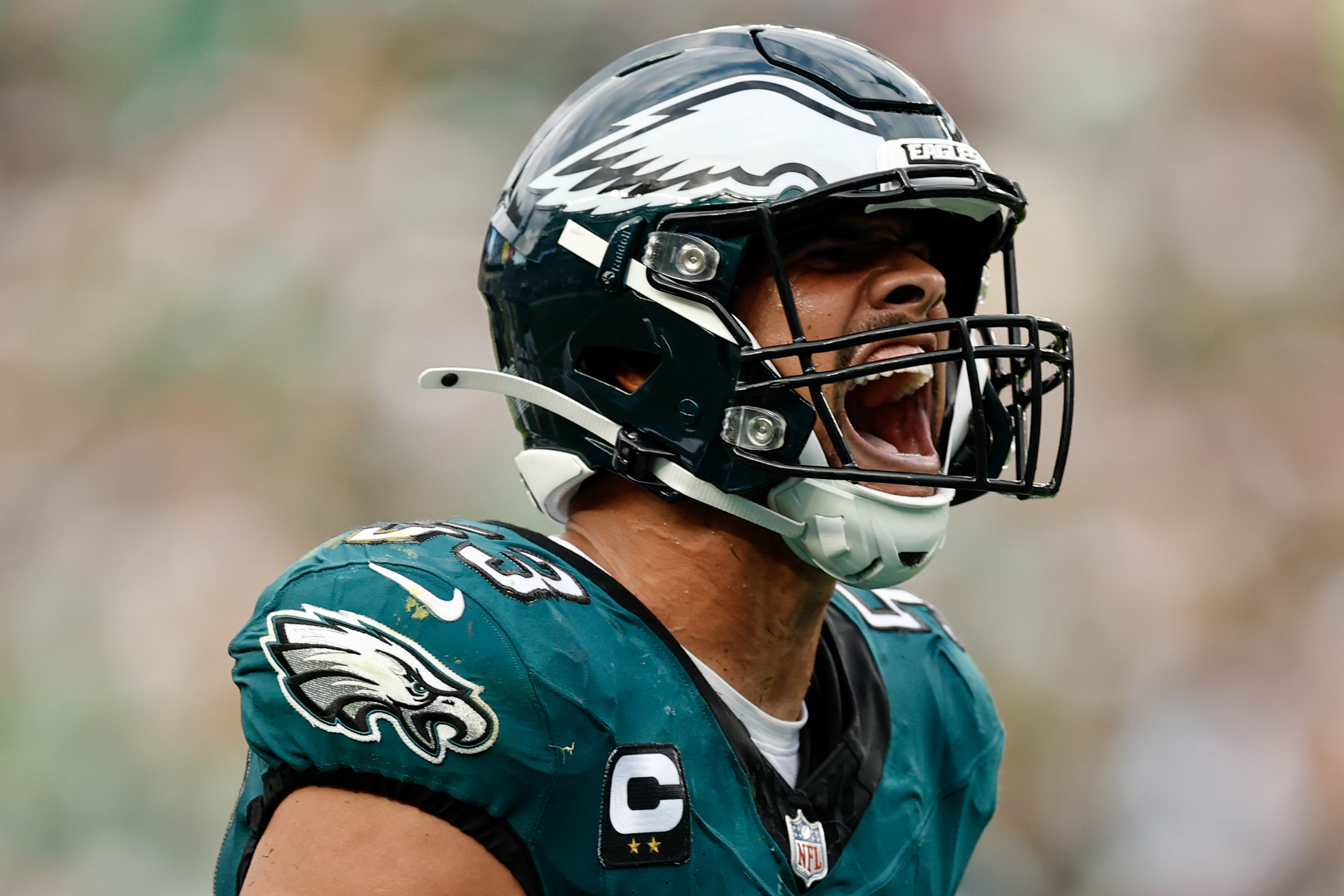
Middle linebacker Zack Baun remained the team’s most consistent player, as he has been the past two seasons. He finished with 12 tackles, wrecked a third-quarter possession by himself, forced a false start on a fourth-quarter blitz, and deflected a touchdown pass late in the fourth, one of his two passes defensed.
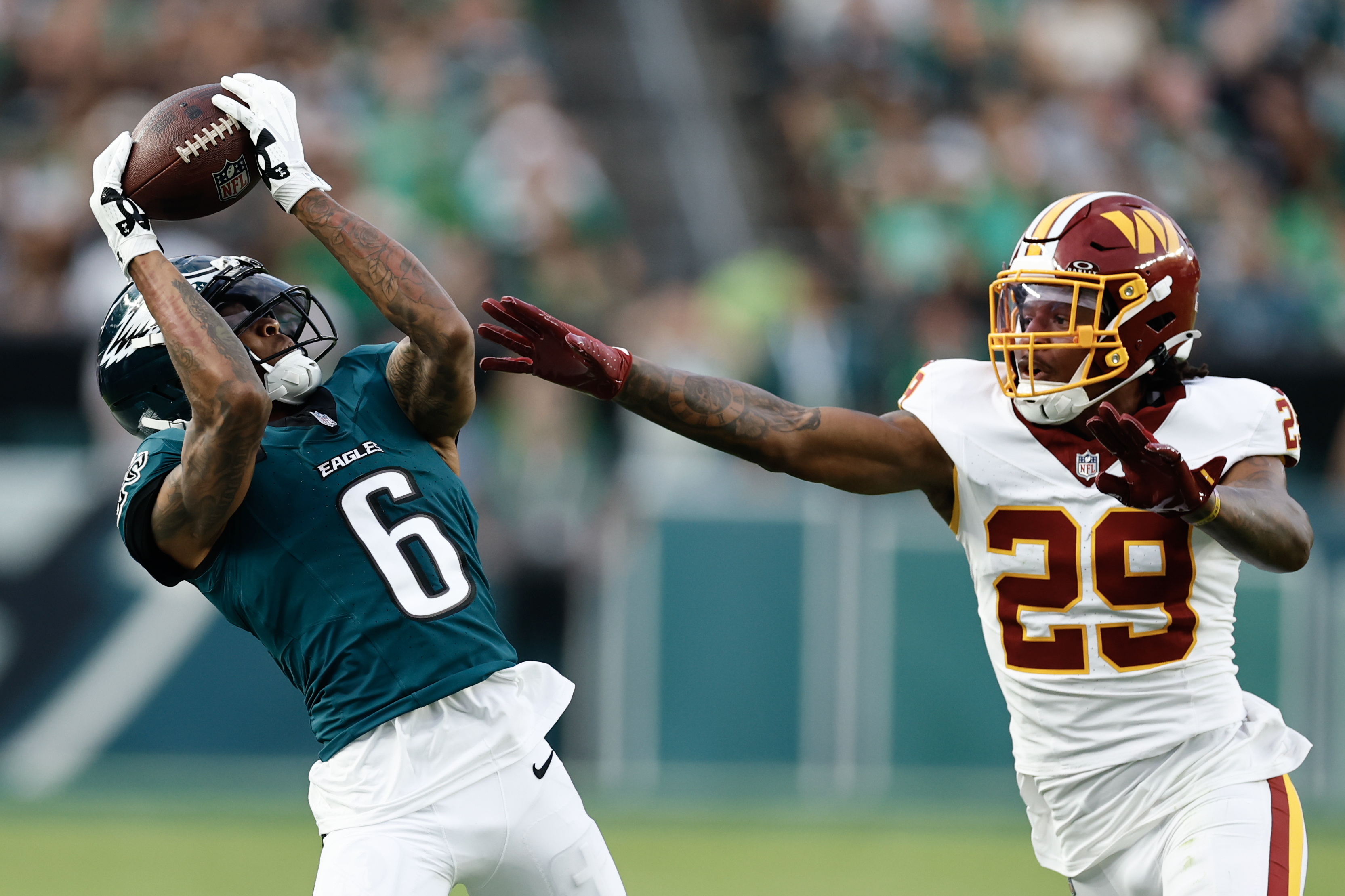
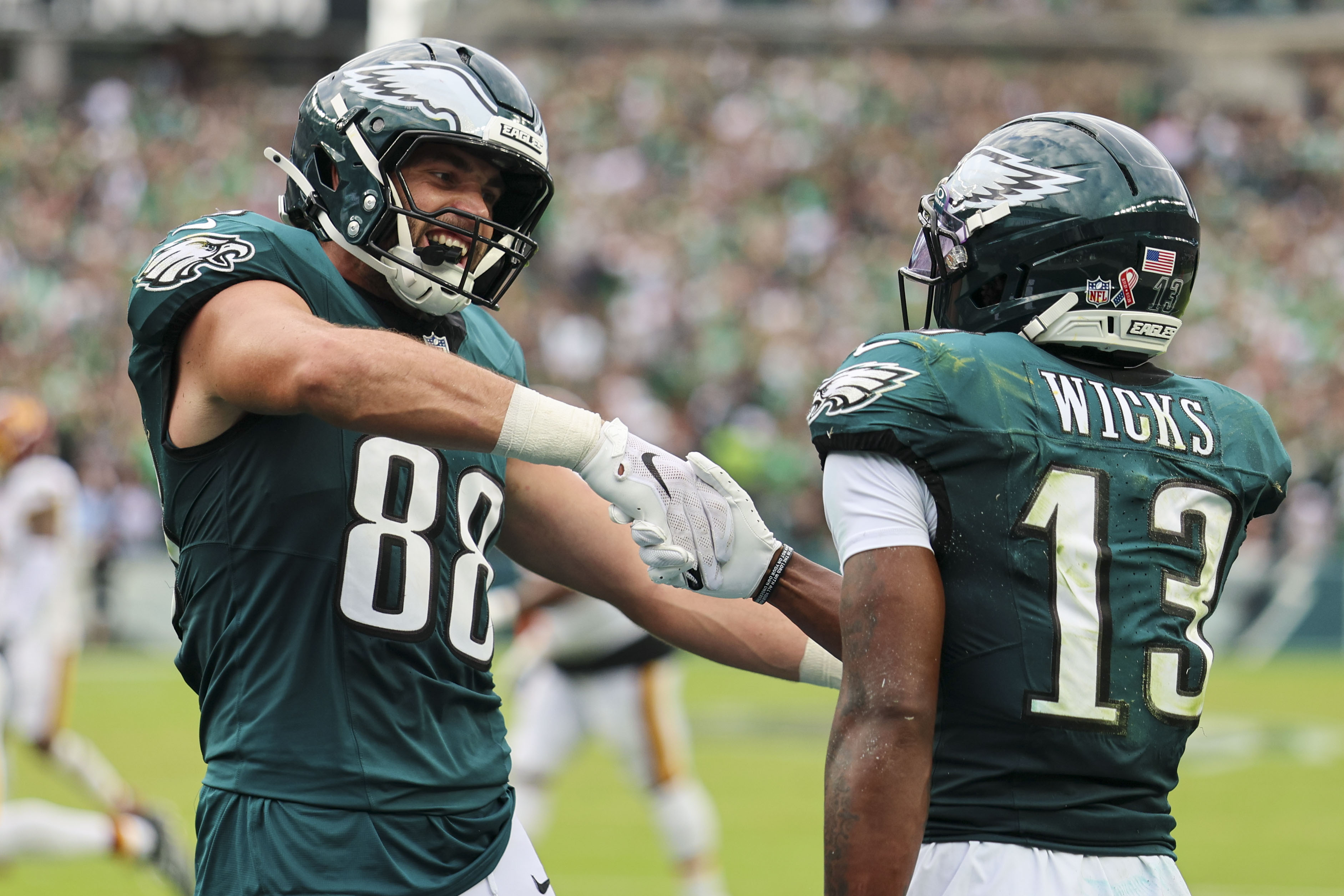
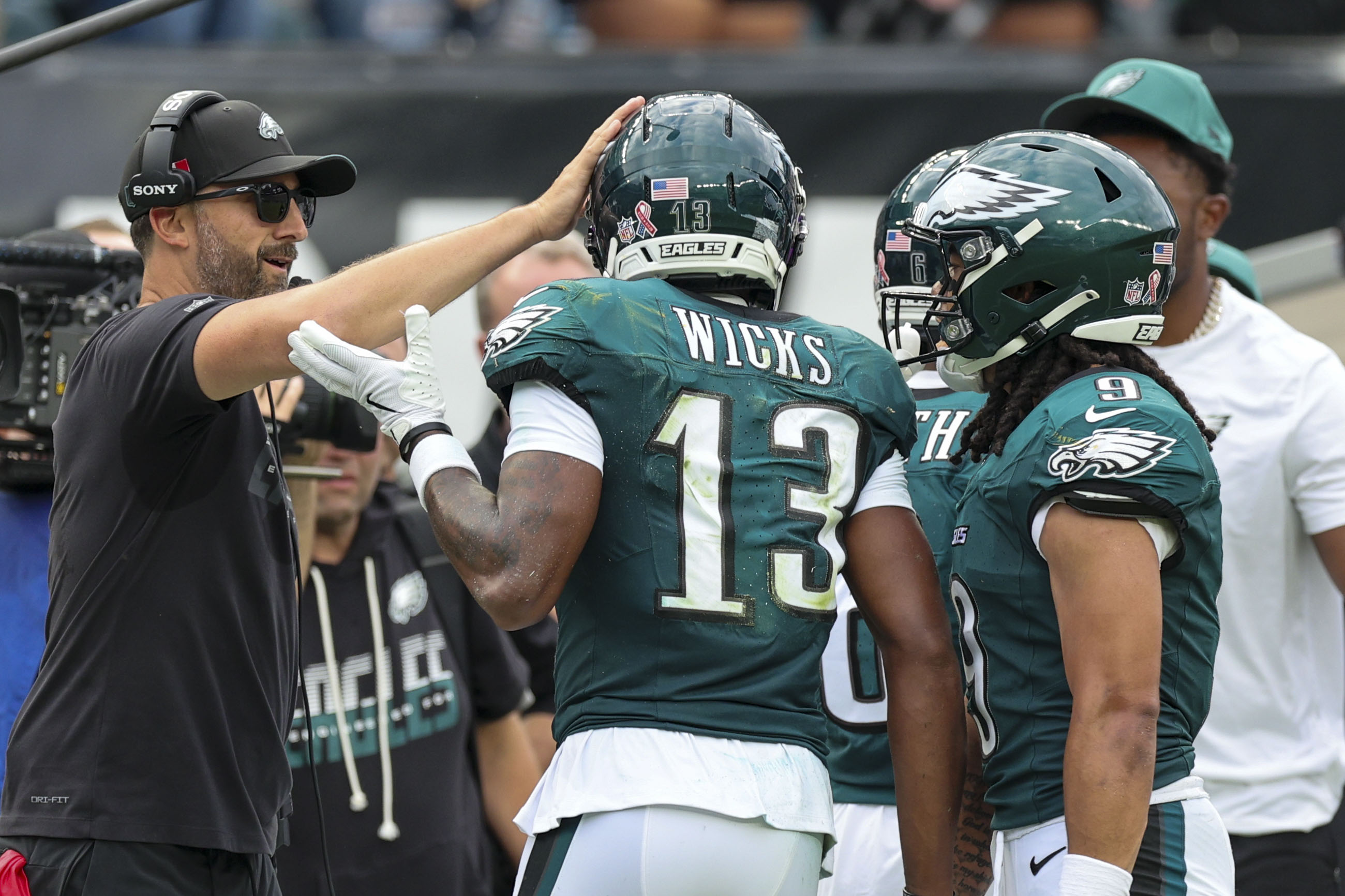
The Commanders keyed on Barkley, who gained 41 yards on the 14 carries that didn’t include his 42-yarder that set up Hurts’ second touchdown pass. The Commanders cheated coverage toward DeVonta Smith, who caught three passes for 53 yards, but whose presence helped free Dontayvion Wicks for a 64-yard bomb and a 9-yard TD catch.
It was not all rosy, but then, since Sirianni hides his starters in the preseason and since Mannion — a first-time coordinator who installed a mostly new offense — this essentially was a preseason game. Not bad for a dress rehearsal.
Mistakes happened.
Hurts misdiagnosed defenses, as Fox analyst Tom Brady repeatedly noted.
The offensive line, healthy again, was pretty good, with the exception of Landon Dickerson. The sixth-year right guard seemed a bit slow off the ball and did not resemble the dominant player of 2023 and 2024; he committed a holding penalty in the third quarter. Dickerson, who exited college with a litany of surgeries, this offseason underwent stem-cell procedures on both knees and both ankles.
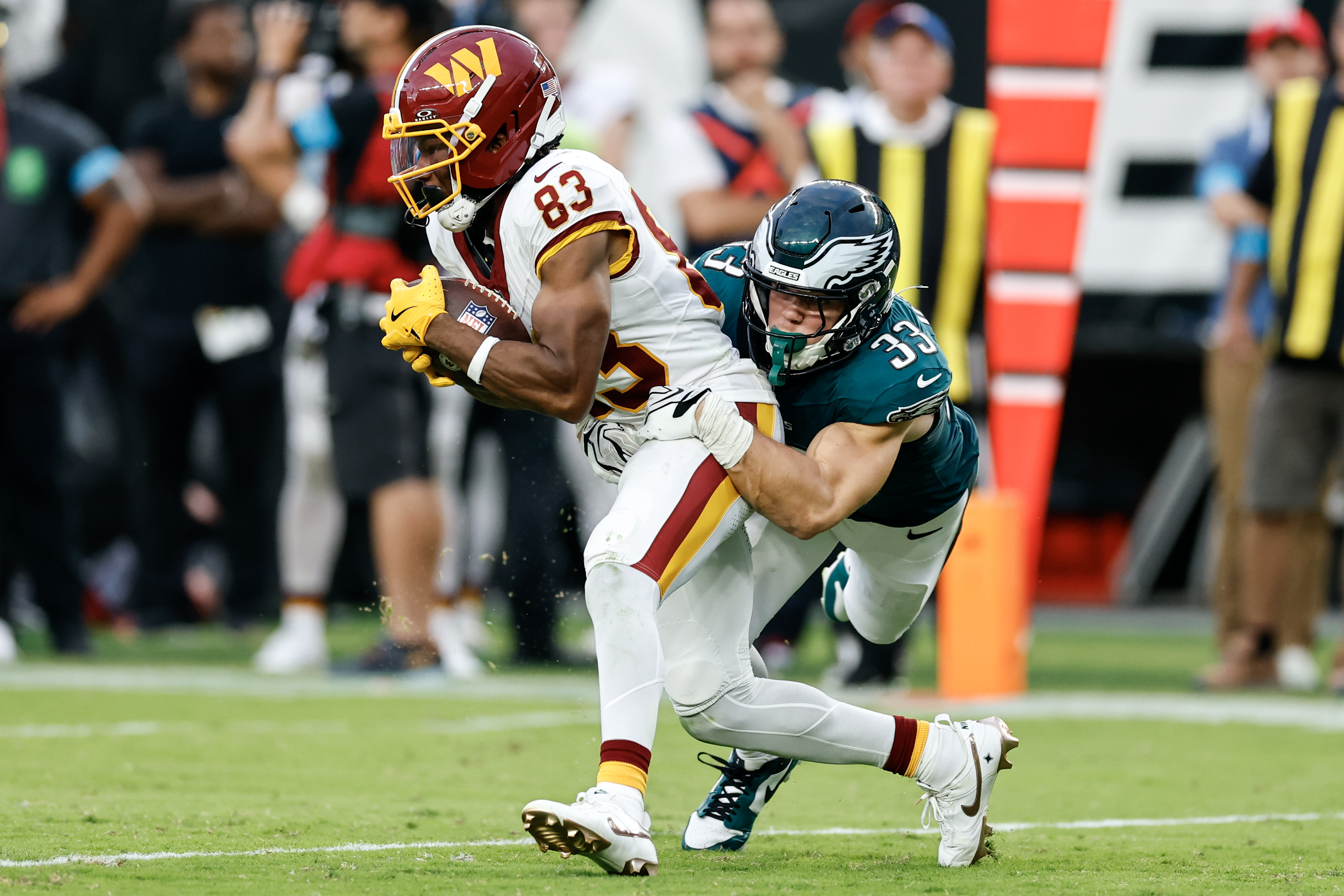
Former full-time nickel corner Cooper DeJean, playing safety against two-receiver sets and nickel against trips, seemed lost. He committed two illegal contact penalties and gave up the fourth-quarter touchdown that cut the lead to 17-16.
But the defense was good, the offensive line was competent, Hurts didn’t turn the ball over, completed 14 of 25 passes, and led the team to a win.
Which is all they need to do. It’s seldom elegant, and almost never pretty, but a win is a win is a win.
Jalen Hurts completed 14 of 25 passes in the Eagles’ season opener.Monica Herndon / Staff Photographer
It’s astounding, in a matter of months, how bad a quarterback Jalen Hurts became, how ineffective a coach Nick Sirianni was revealed to be, how overwhelmed DeVonta Smith was sure to become without A.J. Brown, how formerly brilliant defensive coordinator Vic Fangio had devolved into mediocrity, how irrelevant an elite defense was projected to be, and how uselessly a suddenly healthier offensive line was projected to perform.
Because all of these things need to happen for the Eagles to not win the NFC East and surge to a third Super Bowl in five years.
A year ago, most prognosticators chose the Eagles to at least reach the NFC championship game if not to repeat as Super Bowl champions. So why are expectations so low for 2026?
Currently, the forecasters rate as highly or higher than the Eagles: The Rams, whom the Eagles own; the Seahawks, the flukiest Super Bowl winner since the 2011 Giants; the Packers, after five straight years of postseason flops; and the Lions, who, well, are the Lions.
This is madness.
If the Eagles’ offensive line had been healthy in 2025 they would have won a second straight Lombardi Trophy. It’s healthy today. They should be everyone’s favorite. They should roll through 2026.
What games worry you? At Dallas on Thanksgiving? OK. Seattle on Dec. 19? OK, but it’s a wintertime home game. At San Francisco on Jan. 3? The Silicon Valley Power electrical substation might have winnowed the 49ers to nothing by then.
There’s no way this team should lose more than three games, four at the most. They’ve got a Pro Bowl quarterback, a superstar running back, a franchise receiver, and a genius running a defense with more talent than any defense in team history that didn’t include Reggie White.
Yes, they lost in the first round of the playoffs last year, and, yes, they’re installing a new offense with a new coordinator, and all of that is scary.
Kellen Moore (right) was new to the Eagles, just as Sean Mannion is, and helped engineer a Super Bowl win. David Maialetti / Staff Photographer
You know what happened the last time they installed a new offense with a new coordinator?
They won Super Bowl LIX.
They begin their run to Super Bowl LXI at 4:25 p.m. Sunday, hosting the Commanders, who lost All-Pro left tackle Laremy Tunsil to injury in training camp. The Eagles should win by about 20 points.
Maybe then the fog will lift from the minds of the deluded.
No A.J.? OK
It’s tempting and understandable to dwell on the departure of Brown, and it’s important to not diminish it. No Eagles receiver ever connected four seasons of at least 1,000 receiving yards, and Brown did so as Hurts’ No. 1 target. Hurts is a running quarterback whose passing offense did not average even 200 yards per game the past two seasons. A.J. in Philly was special.
It’s tempting, but unwise. Teams occasionally lose top receivers but succeed nevertheless. The Chiefs lost Tyreek Hill after the 2021 season but still went to the next three Super Bowls and won the next two.
DeVonta Smith is primed to take a major step forward this season. Yong Kim / Staff Photographer
DeVonta’s moment
Smith has 13 100-yard games in his five-year career (plus two more in the playoffs), and he played four of those years with Brown and two with Saquon Barkley, both high-volume offensive weapons. He’d have 25 games with 100 yards if he’d been option No. 1. Expect him to have five or six this season.
Because he’s a Heisman Trophy winner who has never been asked to be the best player on a great team, though he’s shown every capacity for the job. He’s a route-runner on par with Justin Jefferson. He finds the soft spots in zones with uncanny instinct. He’s mature, he’s a leader, and, at 27, he’s in the middle of his prime.
Brown set the Eagles’ record for receiving yards with 1,496 in 2022. Zach Ertz set the record for catches with 116 in 2018. Terrell Owens set the record for TD catches with 14 in 2004.
Smith could challenge each of these … or all of them.
Run it up
New coordinator Sean Mannion wasn’t hired to implement a new offense that would turn the Eagles into Air Coryell. He was hired to implement an offense that would emulate the general run-game efficiency of 49ers coach Kyle Shanahan and Rams coach Sean McVay. Expect that to happen.
Jonathan Greenard won’t play in Week 1 but should be an upgrade off the edge once he does. David Maialetti / Staff Photographer
Upgrade at end
The Eagles signed Jonathan Greenard to a four-year, $98 million deal to improve the pass rush. His injured pectoral muscle is a concern, and maybe he won’t play for a while, but he’s going to be more effective than trade-deadline addition Jaelan Philips, who left via free agency to wails of consternation.
Really, what did you lose … a guy with two sacks in eight regular-season games and zero tackles in a playoff loss?
Coop = Dawk
An undrafted free agent four years ago, safety Reed Blankenship’s superpower lay in his ability to understand the job and know where he was supposed to be. His Achilles’ heel, bless his heart, was his inability to get there rapidly and make plays once he arrived.
There never was a doubt when the Eagles traded up 10 picks in the second round of the 2024 draft, that Cooper DeJean would become a safety. He played nickel corner his first two seasons, but he’s where he belongs now. He often will slide to nickel against certain teams. Cool. You know who else did that?
Second-round safety Brian Dawkins, who’s now in the Pro Football Hall of Fame.
Cooper DeJean will play safety in the Eagles’ base package this season. Monica Herndon / Staff Photographer
O-line OK
They played maybe three games with a fully functional offensive line. Even if Jalen Hurts doesn’t improve, and even if the offense doesn’t explode, there will be better efficiency, a better running game, more time for Hurts to find Smith and Dallas Goedert and Barkley.
There’s a thought: Use the best player on the team more, and throw him the ball.
Barkley, Part I
Barkley was targeted 68 times per season his last two years with the Giants, when offensive maestro Brian Daboll was the head coach. He was targeted less than 48 times per season in his first two seasons with the Eagles, when Kellen Moore and Kevin Patullo called plays.
There’s a reason Daboll is considered an offensive maestro, unlike Moore and Patullo.
No Stout? No problem
Normally, the subtraction of an elite coach like Jeff Stoutland would be crippling, but every offensive line starter has been coached by Stout for at least three years, and every one of them has never had another line coach. No matter how much the scheme changes, Stout’s replacement, Chris Kuper, isn’t going to fracture the foundation.
Just because Sean Mannion hasn’t called plays doesn’t preclude him from being great in the role. David Maialetti / Staff Photographer
On-the-job training
There never was an indication that Patullo would be a competent offensive coordinator or play-caller. There remains no indication that Mannion will be competent, either … but, to be fair to both, there never was much indication that Shane Steichen would be competent, either. He’d done it for one full season in Philly before 2022, and his offense that season powered the Eagles to Super Bowl LVII.
Barkley, Part II
Barkley’s workload plummeted. In 2024, at the age of 27, he touched the ball 482 total times between the regular season and playoffs. In 2025, at 28, that number fell to 346, a difference of 136 touches, a decrease of roughly 28%. It was like getting four games of rest.
Nick wins games
Like him or loathe him, Sirianni wins games. Maybe that’s been because of Fangio’s genius, Howie Roseman‘s personnel management, or Jeffrey Lurie’s deep pockets. In any case, even if Sirianni isn’t a main reason they’re winning, he’s certainly not impeding their path to wins. And to argue that they’re winning in spite of him is as foolhardy as it is disingenuous.
As he commuted from South Jersey into Philadelphia on the afternoon of Sept. 11, 2001, Hugh Douglas kept glancing at the skies.
“I remember driving across the Ben Franklin Bridge, I was looking in the air for those planes. You know, the next planes,” Douglas said. “Because that bridge is the biggest way into Philly, and I thought they would attack that next.”
Douglas, then a star defensive end for the Eagles, was driving to the practice facility, summoned for a team meeting to address an emergency. By then, of course, the skies were empty. The FAA had closed U.S. airspace at 9:42 that morning, and by 12:15, only birds flew over America.
Terrorists had hijacked four commercial flights that brilliant Tuesday morning and turned them into missiles.
At 8:46 a.m., American Airlines Flight 11 crashed into the 92nd floor of the World Trade Center’s north tower. At 9:03 a.m., United Airlines Flight 175 crashed into the south tower. At 9:37 a.m., American Airlines Flight 77 crashed into the Pentagon. At 10:02 a.m., after a struggle between heroic passengers and hijackers, United Airlines Flight 93 crashed into an empty field in Shanksville, Pa., 200 miles west of Philadelphia.
Nearly 3,000 people died as a result of the attacks, still the largest death toll of any terrorist attack on U.S. soil. It stunned the world, and it left the nation shocked and terrorized, and it left the sporting world in turmoil.
Douglas had just turned 30. In his lifetime America had seemed invincible. Impenetrable. It was, by far, the most traumatic event he’d known.
“I thought it was the end of days,” Douglas said.
He was not alone.
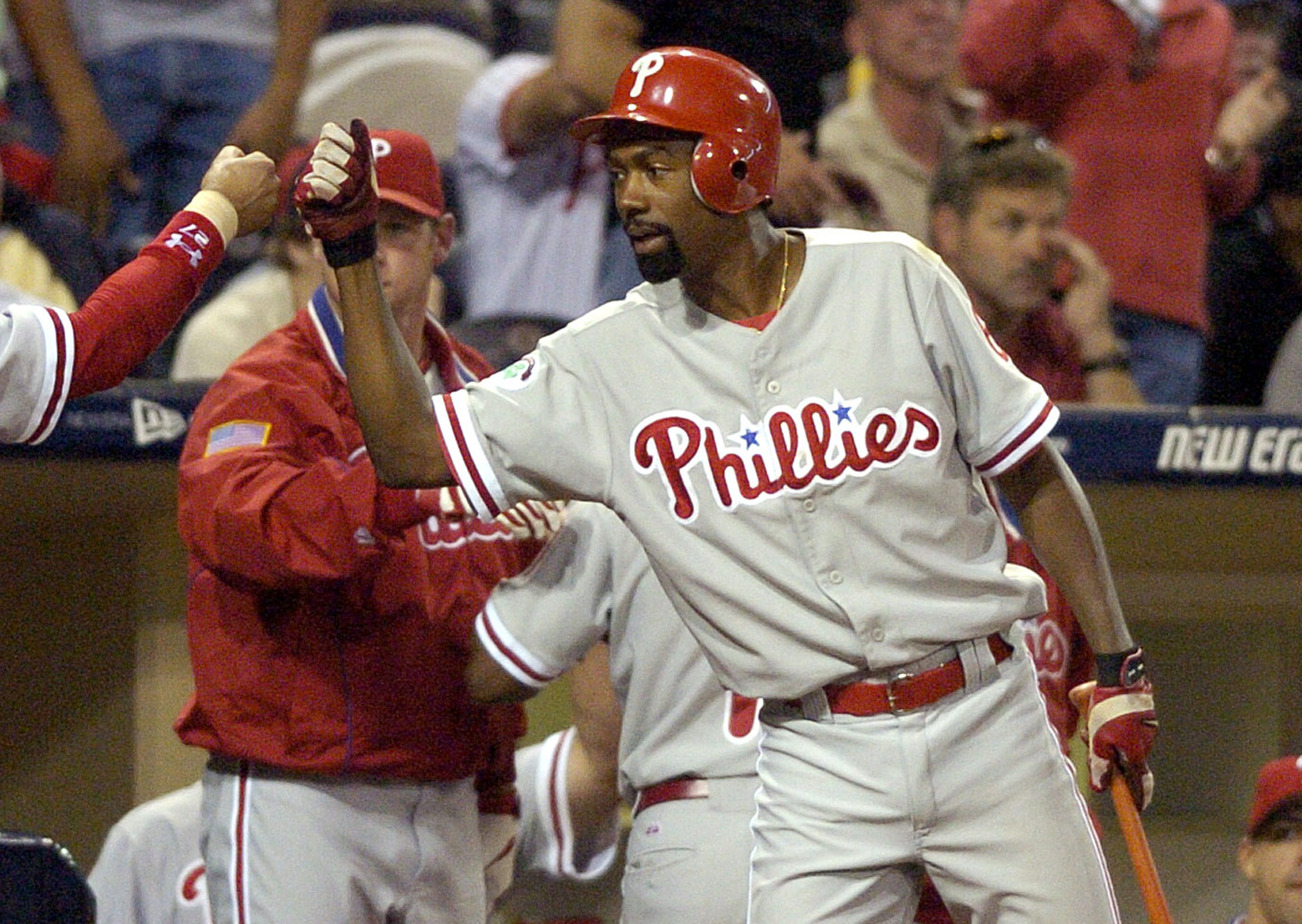
Phillies center fielder Doug Glanville is a year older than Douglas. He grew up in Teaneck, N.J., less than 20 miles from what became to be known as Ground Zero, where the towers collapsed. He’d visited the towers frequently as a boy.
On 9/11, Glanville was with the Phillies in Atlanta, preparing for an important series against the Braves. When he heard that the terrorists targeted sites beyond New York, he worried about what might come next, and whether ballparks and stadiums were vulnerable.
Doug Glanville, here in a 2004 game in San Diego, played six seasons with the Phillies.DENIS POROY
“We didn’t know what imminent threats were still there. We heard that they might attack Atlanta,” Glanville said.
That worry persisted even when games resumed six days later, and beyond.
“You felt like, if you were in a stadium, you were a target.”
‘I thought it was a movie’
Douglas learned of the attacks from the movers helping him settle him and his wife at the time, Simona, into their town house in Marlton, N.J.
“They blew up the tower,” one mover told Douglas. He wasn’t quite sure what the guy meant. The cable company hadn’t arrived yet, so the mover began to jerry-rig an antenna onto a television. Before he finished, another mover, still listening, announced, “They hit the other tower.”
Finally, a fuzzy image appeared on the screen, the towers burning. A few minutes later, at 10:28, the north tower collapsed.
Glanville had much better reception.
Baseball players are a nocturnal breed, but Glanville is one of the few who relishes a hearty breakfast. Also, he’s a reader — he has an engineering degree from the University of Pennsylvania — so he rarely turns on his hotel TV.
“There aren’t a lot of players who get up that early, except Kevin Jordan. So I go out of my room, get in the elevator, and Nina Jordan’s there, Kevin Jordan’s wife,” Glanville said. “I’m, like, ‘Good morning,’ with a smile. She’s like, ‘They hit the towers.’ ”
Glanville flashed back to Feb. 26, 1993, when terrorists attempted to take down the north tower with a car bomb. They failed. Seven people died. Glanville assumed this was similar.
“The first thing I thought is, ‘Oh, again?’ ”
Not exactly.
“We were in CNN country, so I came out of the elevator, I saw banks and banks of TVs,” Glanville said. “And then, of course, we were just, like, locked in.”
Phillies manager Larry Bowa wasn’t watching TV in his room, either, but, with a teenage daughter, he always kept his phone close. When it buzzed that morning and he saw her number he was concerned, of course, but not as concerned as he soon would be.
“She said, ‘Did you see the TV?’ And I said, ‘No.’ She says, ‘Turn it on,’ ” Bowa said. “And when I turned it on, I thought it was a movie.”
‘We took a vote’
What happened in the next couple of days is a blur for most of us who lived through 9/11, and most of us weren’t star entertainers and their bosses walking the thin line of propriety.
Would baseball be played Tuesday night? Would baseball or football, either college or pro, be played on the weekend?
Flights resumed sporadically just two days after the attacks, but it was about a week before air travel resumed full throat. The Eagles and the rest of the NFL hunkered down.
“We knew pretty quick we weren’t going to Tampa that weekend,” Douglas said. “So we just practiced. And it was weird, right? You get planes flying over South Philly all the time, because the airport is so close. There were, like, no planes that week.”
It was as if everyone held their breath, just as they’d done after President John F. Kennedy was assassinated in November 1963, which paused most of college football and briefly paused the NBA and NHL.
“Nobody knew what was the right time,” Bowa said. “Some people were saying they might cancel the whole season.”
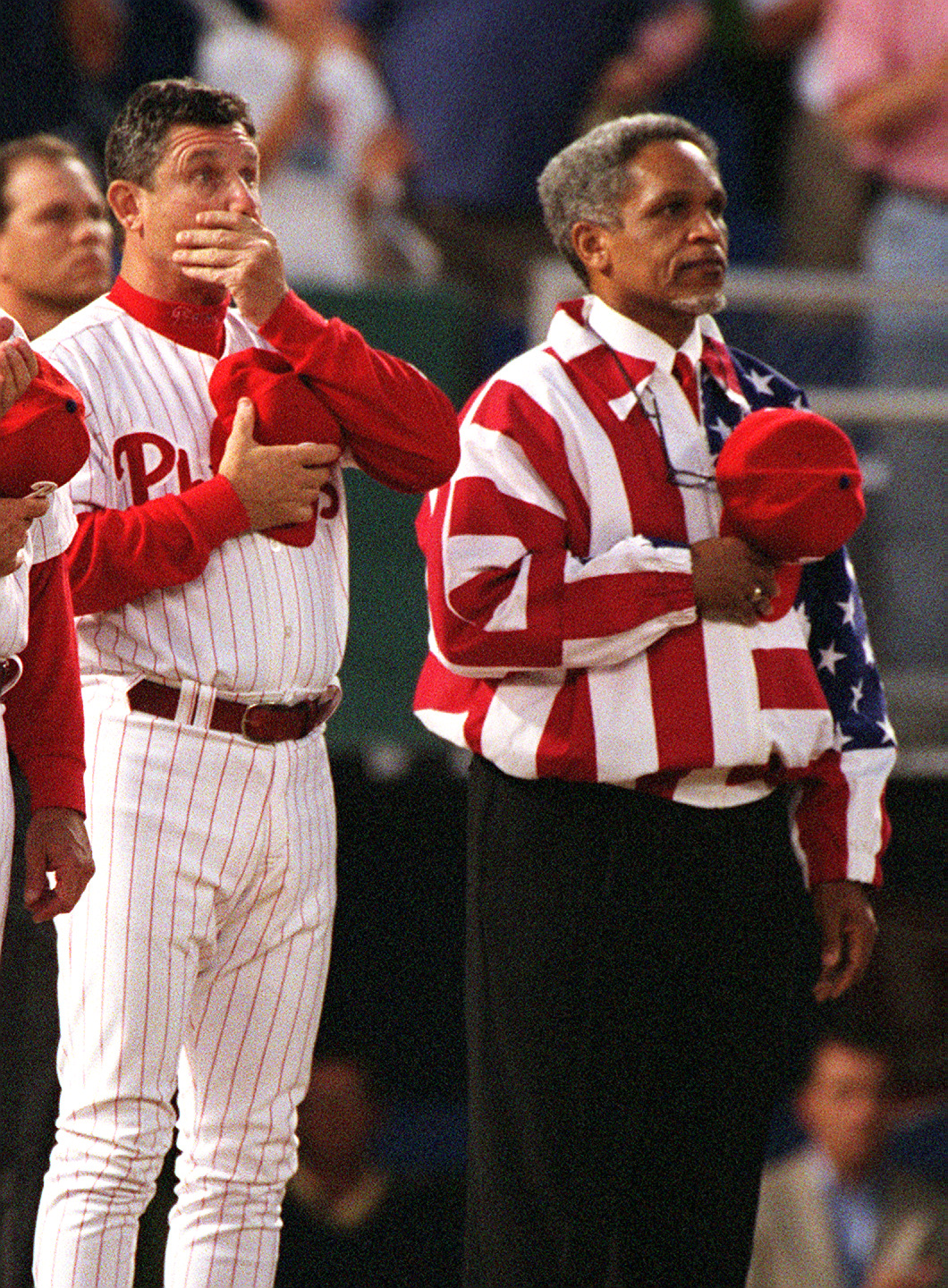
Phillies manager Larry Bowa wipes his face standing next to Philadelphia Mayor John Street during a moment of silence before the Phillies-Braves game on Sept. 17, 2001 at the Vet.D
As it turned out, baseball games resumed Sept. 17. The Expos hosted the Marlins with the first pitch thrown at 7:10 p.m., so baseball officially resumed first in Canada. But the Braves visited the Phillies and the Mets visited the Pirates, and both games went off at 7:19 p.m., so Pennsylvania co-hosted the return of America’s game in America.
‘We took a vote’
Getting from 9/11 to 9/17 was quite a journey for the Phillies.
Games were suspended immediately, but MLB dithered regarding when they would resume. The Phillies spent three days in Atlanta, then decided to bus to Cincinnati, where they were scheduled to play over the weekend. They were outside of Knoxville, Tenn., when they heard that those games might not happen, either.
What now?
They pulled the two buses into a rest stop. Players disembarked to try and get cellphone reception, which was poor on the buses, and check in with their families. At that point, mild chaos ensued.
Should they reroute to Philadelphia? Should they return to Atlanta, where flights would be easier to arrange? Should they just continue to Cincinnati and maybe ride out the weekend?
They couldn’t take the buses to Philadelphia because the bus driver had logged too many hours.
“We took a vote,” Glanville said. “It was everybody, 40 or whatever, to 2. And the two were Bowa and (reliever) Dennis Cook, and Cook lived in Atlanta.”
So, on to Cincinnati, where they discovered those games were, in fact, postponed. Inimitable traveling secretary Frank Coppenbarger, now retired, wheedled a chartered plane for the next day. The Phillies were home for supper on Sept. 15.
MLB delayed the playoffs for a week. The Phillies made up the postponed games in Atlanta and Cincinnati after the regular season ended. Like their NFL counterparts, they played the rest of the season in a daze of heightened security and heightened anxiety.
‘A sense of pride’
NFL players were used to being treated like royalty on their charter flights to games. A week and a half after 9/11, they found out what it was like on tarmacs in countries where terrorism is a constant threat.
“We used to just park our cars at the facility, get on a bus, ride to the airport, get off, and walk right on the plane,” Douglas said. “Now, you went to the airport, man, and everybody was on high alert. There’s guys with machine guns or whatever, there’s tons of security. Even on the plane. And you had to watch your mouth.
“I went to the bathroom and came back and told the fellas I blew it up,” he recalled, and was quickly admonished by security. “Yeah, you couldn’t say you ‘blew up the bathroom’ anymore.”
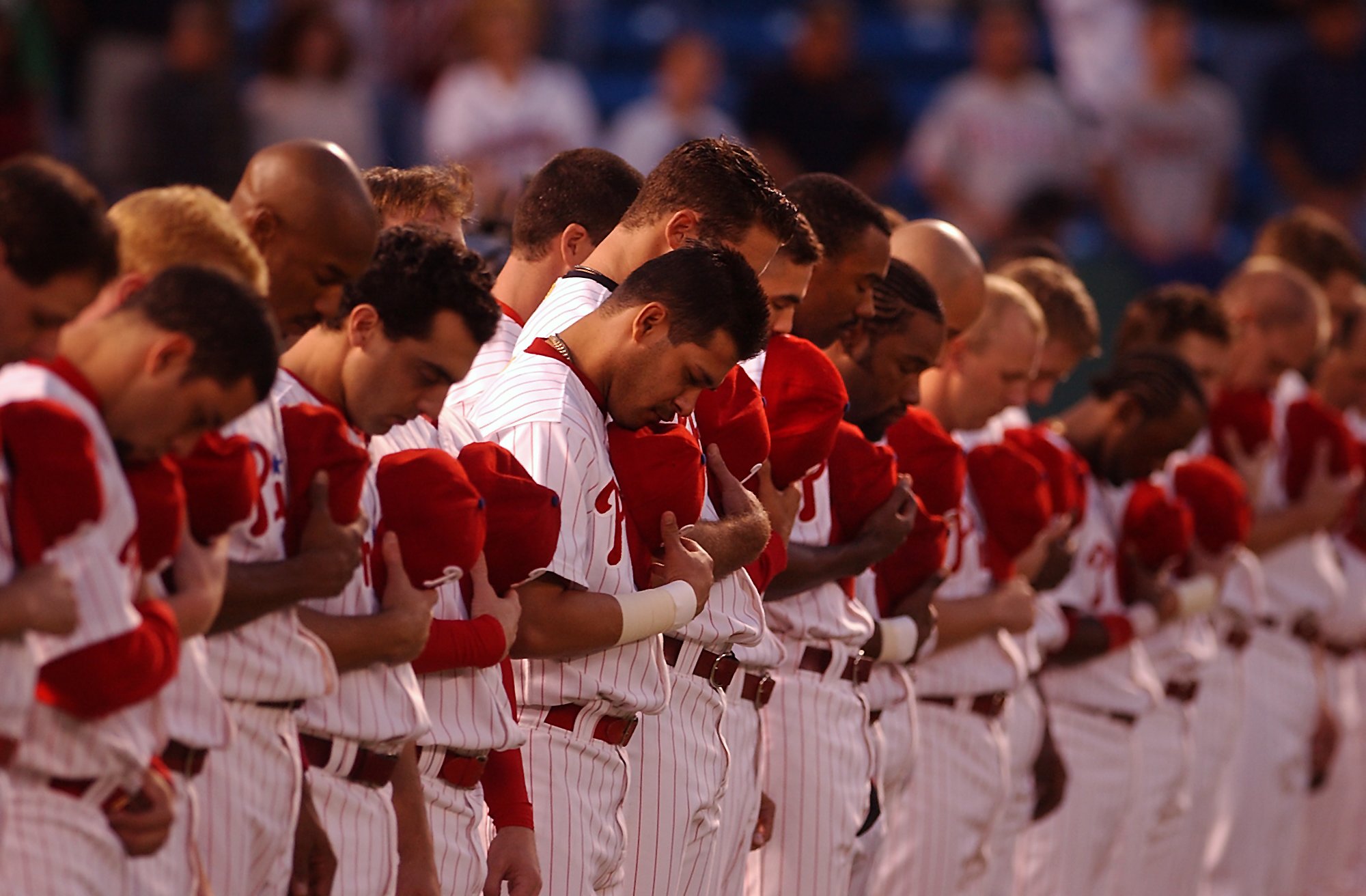
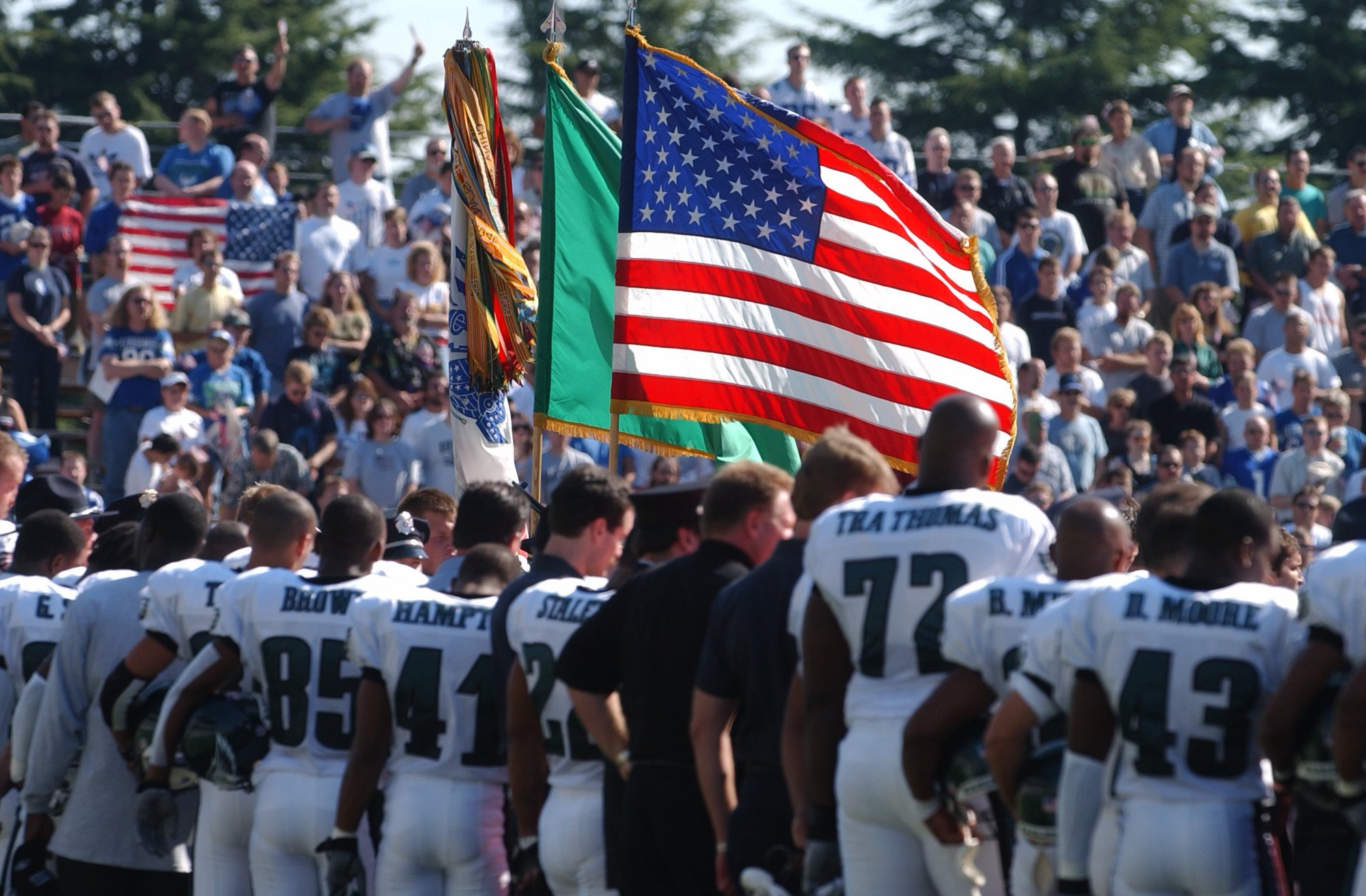
Eagles players line up during pregame ceremonies before the Eagles-Seahawks game on Sept. 23, 2001, the teams’ first game after the attacks.Ron Cortes / Staff Photographer
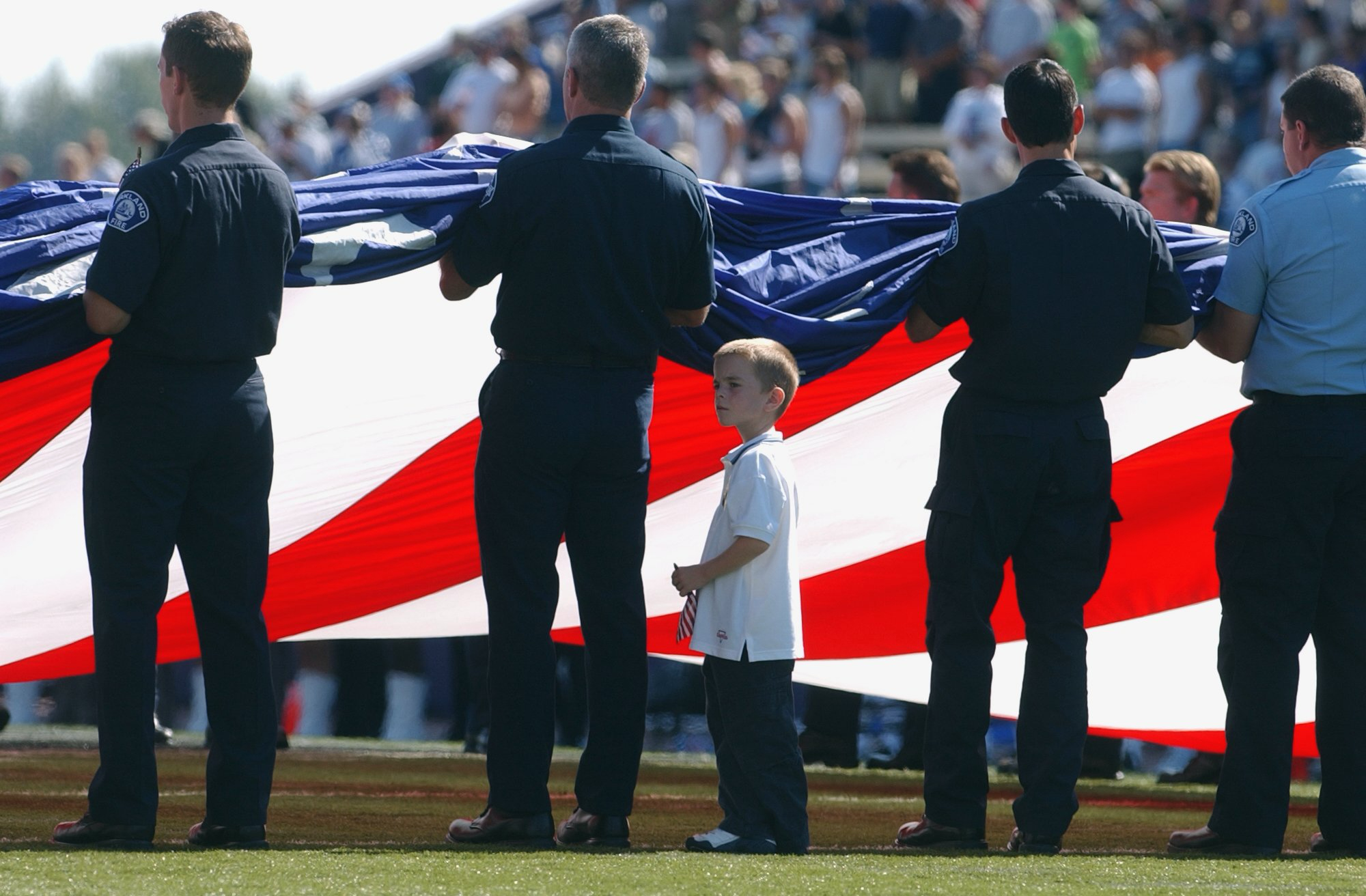
As with MLB, NFL playoffs were delayed by a week, so the Eagles made up their postponed game at Tampa in January after their final scheduled game of the regular season. Their first game after the attacks was in Seattle, where they played the Seahawks at the University of Washington stadium while their new stadium was being built. As in many stadiums that day, the pregame national anthem was performed as a giant flag that covered the entire field.
Who held it? Douglas, his teammates, and his coaches joined their counterparts from the Seahawks and dozens of first responders. Douglas had a hand on that flag, and he remains moved by that ceremony to this day.
“Just, I don’t know,” Douglas said. “Just a sense of pride.”
A giant American flag covers the field before the Eagles-Seahawks game at the University of Washington stadium during pregame ceremonies on Sept. 23, 2001.Ron Cortes / Staff Photographer
‘Tip your cap’
Pride: That’s what Bowa felt on Sept. 17. He’s proud that Philadelphia, the cradle of American democracy, was part of the return to sport. He’s proud that the franchise he played for and managed was, with the Pirates, the first team in the U.S. to resume, and he’s proud that baseball, America’s game, was the first front-line sport to restart.
Bowa is a hard man, but he understood the situation. He held a team meeting before the game and told the players that anyone who didn’t feel like playing didn’t have to; he understood. No takers.
The pregame left Bowa and Glanville shaken. As late Phillies broadcaster Harry Kalas delivered a moving pregame address to viewers, a montage compiled by “Video” Dan Stephenson helped settle the 27,910 fans at Veterans Stadium into their seats.
“People were in tears over that,” Glanville said.
It was the music that got to Bowa. He’d served in the U.S. Army Reserve as a young man, and his patriotism runs deep.
First, he recalled, there was Lee Greenwood’s “God Bless the USA” Then, right before the first pitch, with the teams lined up on the baselines, came “God Bless America” and the national anthem, performed back-to-back by — who else? — the star-spangled Valley Forge Chorus.
Phillies ace Robert Person went eight innings, gave up two runs, Jose Mesa got the save, and the Phillies won, 5-2, and drew to within two games of the Braves in the National League East.
Who’d they beat?
Braves legend Greg Maddux.
Glanville got a hit, Pat Burrell got two, rookie All-Star Jimmy Rollins scored a run, and MVP candidate Bobby Abreu tripled. But all of them — Person, Mesa, Glanville, Rollins, Abreu — they were just co-stars.
Nobody in baseball met the moment like Scott Bruce Rolen.
Chipper Jones’ homer gave the Braves a 1-0 lead in the first inning, but Rolen tied it with a leadoff homer in the second. He drove in Abreu from third base in the fourth for a 2-1 lead.
Then, with two out in the bottom of the sixth inning, Rolen homered again. The Phillies led, 3-2. The Vet rocked and rolled as Rolen returned to the dugout and, as ever, humbly took off his helmet. The crowd was nearly tearing the old stadium down, begging for a curtain call, but that just wasn’t the sort of thing Rolen did. Ever.
Bowa called Rolen over.
“Scotty,” he said, “you got to go out and tip your cap.”
Rolen replied, “Well, you know I don’t do that.”
“Scotty,” Bowa said, “this is something different.”
These are the most compelling conversations surrounding the Eagles’ coming season. Crazy, maybe, considering the success of each and their success in tandem, but here we are.
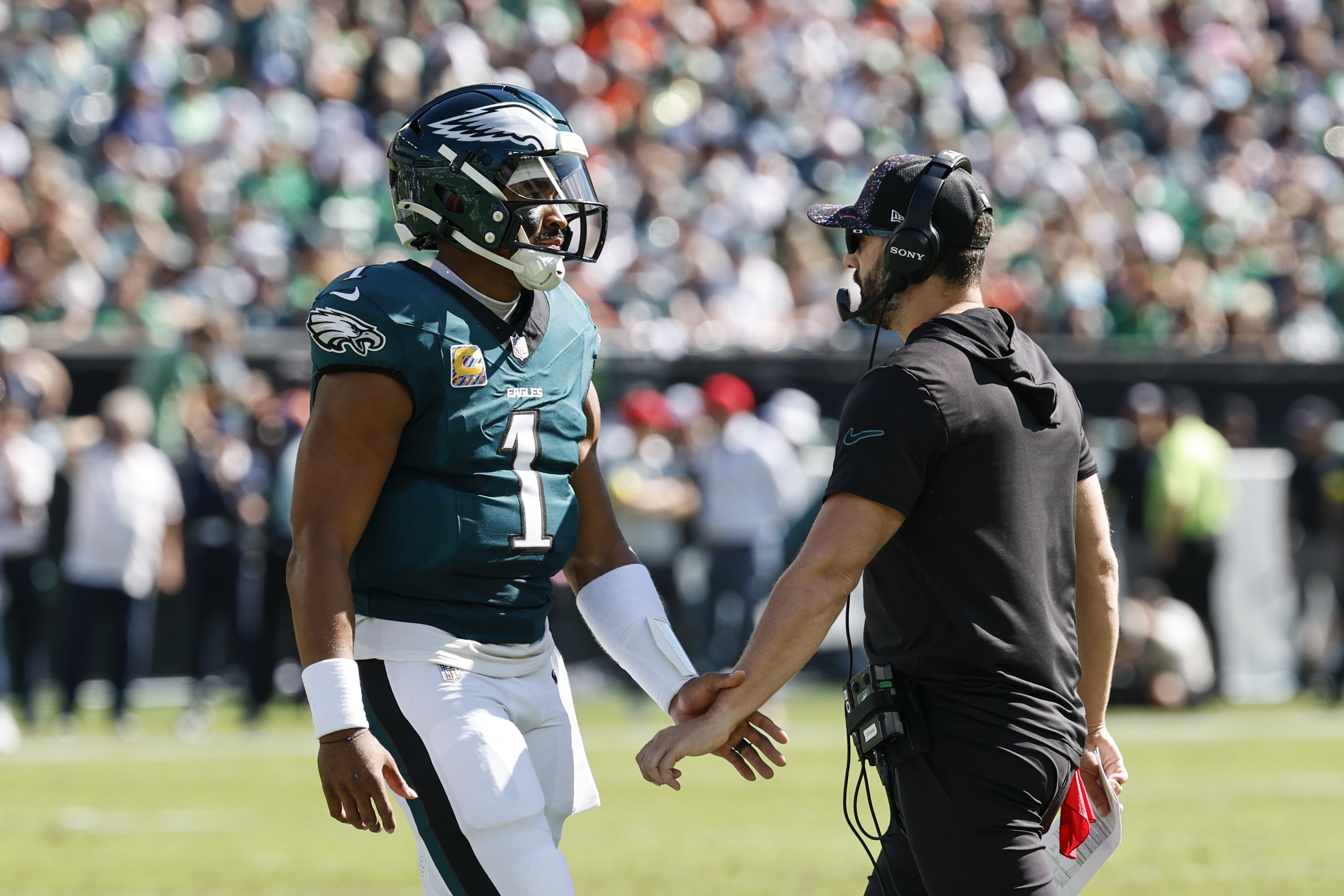
Hurts is under contract for three more seasons, but 2026 is his last season with substantial guaranteed money. Most teams with a $255 million franchise quarterback one season removed from winning a Super Bowl and its MVP award would have discussed an extension that would lock in that QB before the QB market inflates further, but the Eagles have not done that, according to a source. Why? Because Hurts regressed in 2025 and the Eagles are installing a new offense in 2026 and they want to see how he handles it.
Jalen Hurts and Nick Sirianni both have the equity that comes with a title and will be given a learning curve with a new offense. Yong Kim / Staff Photographer
Sirianni, of course, also is one season removed from winning a Super Bowl, a win that, according to an NFL source, earned him a four-year extension that pays him a $15 million salary through 2029. However, for the second time, Sirianni also lost the offensive coordinator that got him to the Super Bowl. Shane Steichen became the Colts’ head coach after 2022. Kellen Moore became the Saints’ head coach after 2024. Each time, Sirianni failed to replace them with a competent hire of his choosing, and owner Jeffrey Lurie and GM Howie Roseman got involved in pursuing the next coordinators. That’s why Moore got hired in 2024, and it’s why new coordinator Sean Mannion, a disciple of Kyle Shanahan and Sean McVay, is installing that new offense in 2026.
So, while they might be overblown, there are issues with both the quarterback and the coach. Any post-2026 divorce would mean that the Eagles would eat either salary-cap money or Sirianni’s paychecks, but Lurie has never been shy to move off a bad investment.
In the NFL, it’s always easier to replace a coach than a quarterback. After all, Doug Pederson and Sirianni won Super Bowls.
Ominous, no? Apparently, no.
Relax
An offseason of communications with various NFL sources indicated two things:
The Eagles do not consider 2026 to be a make-or-break season for either Hurts or Sirianni. That’s because …
Installing an offense that is so philosophically different than what’s come before it is not a 17-game undertaking. It’s a two-season project.
This makes perfect sense.
It is the proper way to view the matter.
I’ll admit, it’s not the way I viewed the matter this spring. I thought Hurts’ limitations as a passer and decision-maker should imperil his status past 2026. I thought Sirianni’s inability to mature and his lack of offensive innovation should imperil his status as well.
I came around.
Jeffrey Lurie and Howie Roseman both understand that Sean Mannion’s (right) offensive installation will be a work in progress. Monica Herndon / Staff Photographer
Several NFL insiders said that this season should not be crucial for either the coach or the QB. Why?
Because, as long as the 2026 season doesn’t deteriorate into disaster, and as long as there is promise in December that the Birds can win big as soon as next season, the Eagles will have a better foundation than ever. They could be building something that lasts for the next decade. Mannion likely won’t be here for that long, since top offensive coordinators usually get hired as head coaches as soon as they show any aptitude. But Hurts is only 28. Sirianni can become a legend in Philly. That’s what the Eagles‘ brain trust wants.
My guys
Lurie is proud of acquiring both Hurts and Sirianni while the rest of the league laughed. As such, he is as invested in them as he was invested in Andy Reid and Donovan McNabb.
Also, Lurie is 74. He’s groomed his son, Julian, to replace him at the top. What better gift to give your princeling than a stable kingdom? As such, stability through change takes time.
Lurie and Roseman realize there will be speed bumps. The offense won’t work smoothly immediately. Mannion will virtually have carte blanche in regard to concepts, Sirianni will have final say over who is asked to do what, and Hurts won’t be asked to do things he’s uncomfortable doing.
However, as long as Hurts shows improvement as the season progresses, his future in Philly will be secure.
And as long as Sirianni commits to the concepts Mannion installs, and displays a willingness to adhere to them when Mannion moves on, his future in Philly also will be locked down.
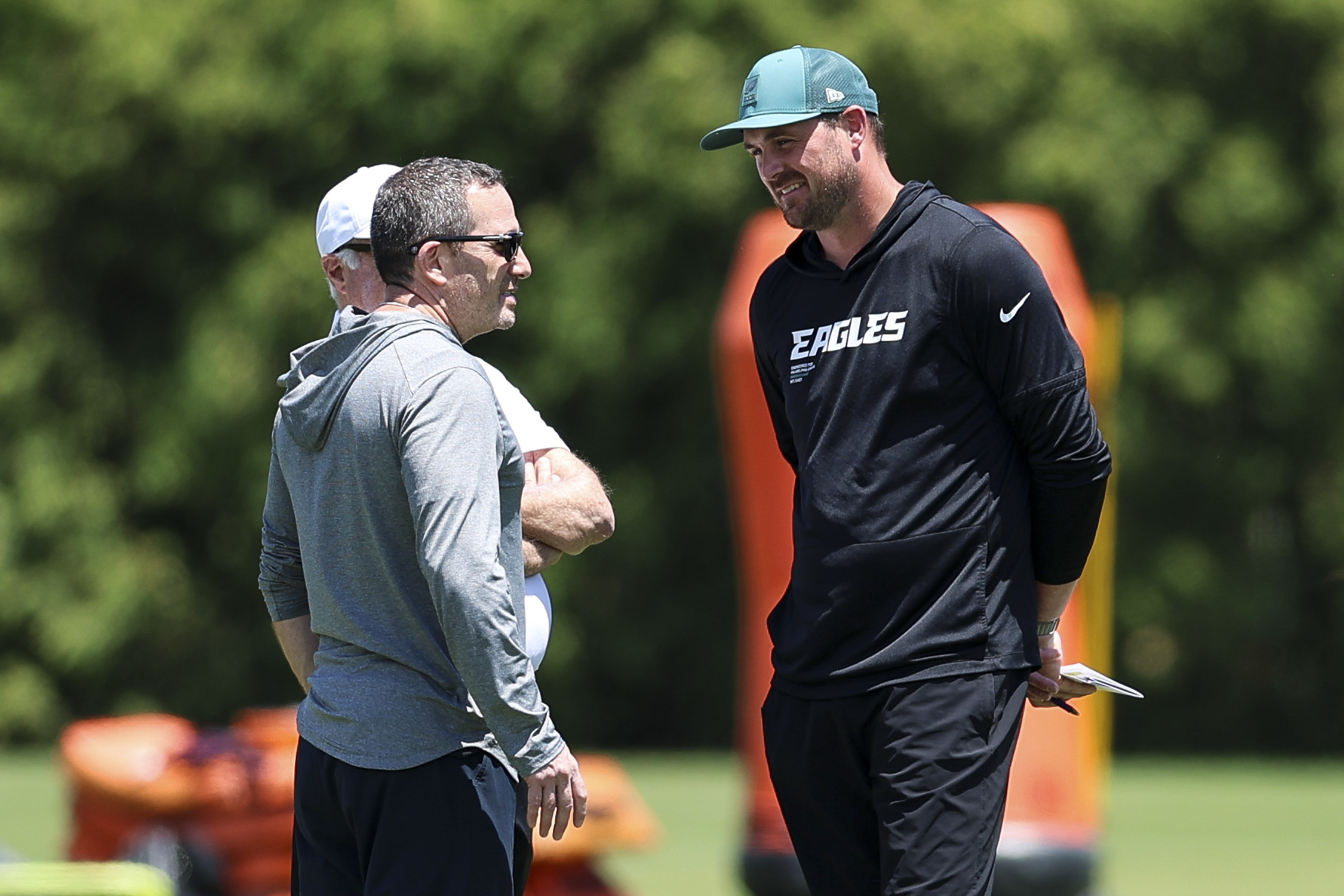
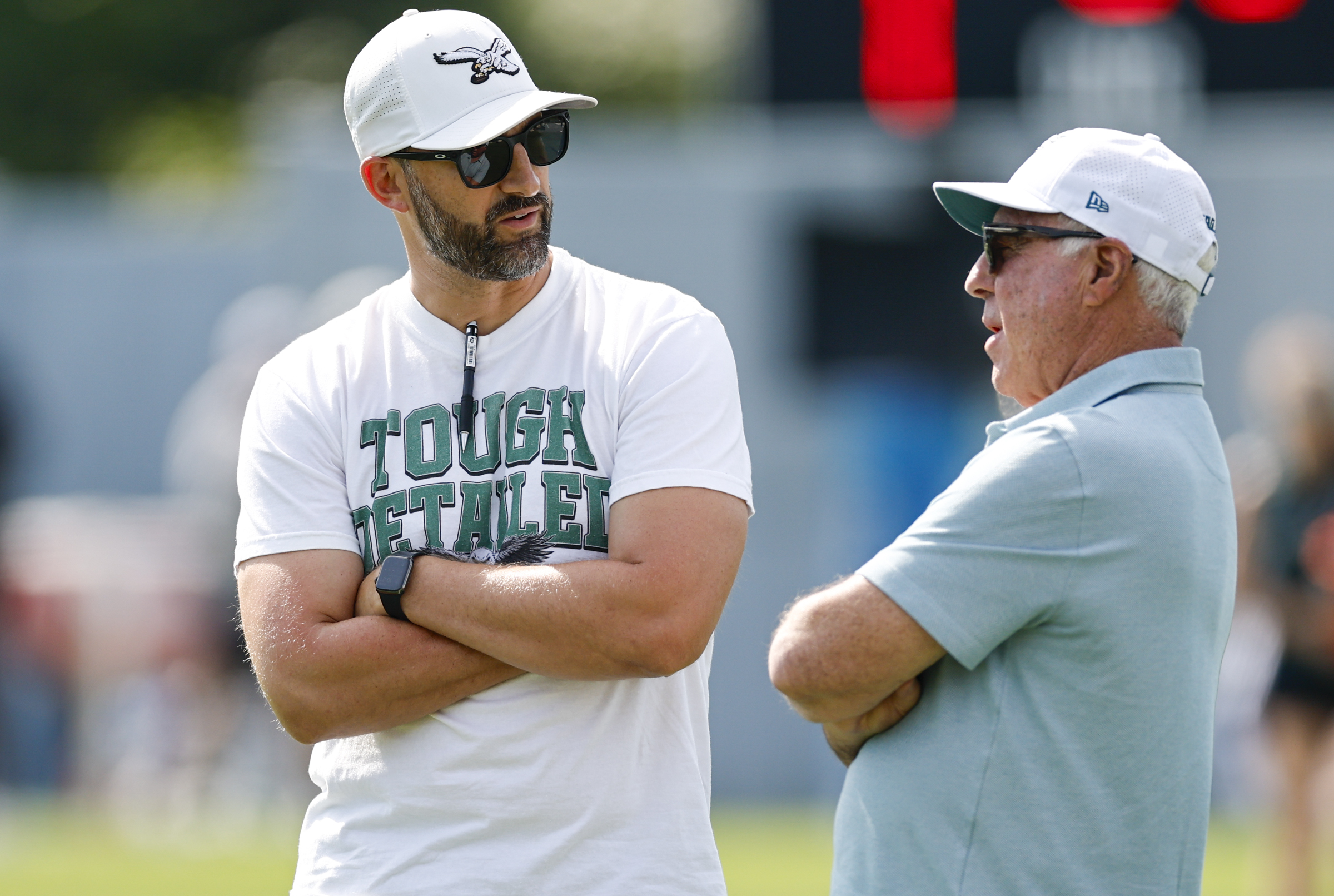
Eagles head coach Nick Sirianni with owner Jeffrey Lurie before a joint practice with the New England Patriots last month. Yong Kim / Staff Photographer
I’ve known Lurie for 30 years, Roseman for 25. They don’t always tell whole truths, but they seemed particularly comfortable and, frankly, honest when, this offseason, they were asked about the futures of Hurts and Sirianni.
Asked last Wednesday on 94-WIP if this was a make-or-break season for Hurts, Roseman replied, “No, I don’t agree with that.”
Asked by reporters in April to review Sirianni’s five-year tenure, Lurie replied, “His performance has been nothing short of outstanding.”
All of this sounds pleasant now, before the first whistle blows. All of this could change drastically. The Eagles’ battered offensive line is being held together by athletic tape and stem cells. The team traded malcontent franchise receiver A.J. Brown, and his replacement, rookie Makai Lemon, doesn’t look ready for the NFL. There’s no proof that superstar running back Saquon Barkley, who carried the club in 2024 when he was 27, didn’t lose a step in 2025 when he was 28; now, he’s 29.
They host a desperate Commanders defense to start the season Sunday, travel to Chicago — where the Bears won a playoff game last season — for Game 3, then host Aaron Donald, Myles Garrett, and the fearsome Rams in Game 4.
There’s a very real chance that the Eagles’ new offense sputters in the first month of the season. There’s a very real chance that Lurie and Roseman become impatient and change their current long-range views regarding the head coach and the quarterback.
For now, though, they seem willing to give them every best chance.
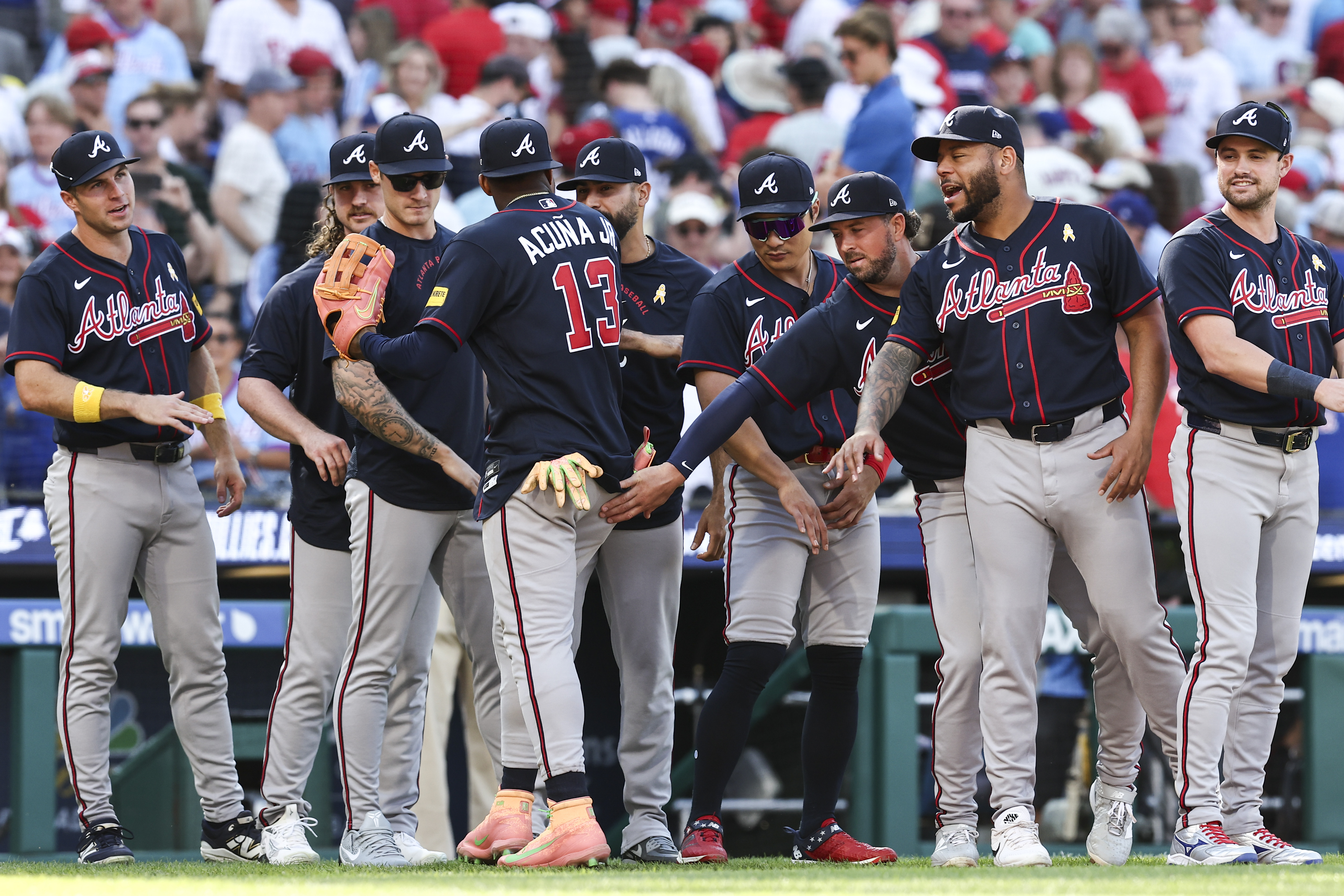
He homered, he flapped, he Euro’ed, he curtain called. It was quite the weekend for Ronald Acuña Jr., the Braves’ right fielder and newest Philly villain.
Acuña is a five-time All-Star, the 2023 National League MVP, and, in many respects, Atlanta’s version of Phillies superstar Bryce Harper, from his sense of style to his sense of swagger. That was amplified during the four-game series against the Braves that began Friday, with supremacy in the NL East at stake.
When he took the field Friday, Acuña was disliked, perhaps because of his general excellence while playing for a rival team, perhaps more so specifically stemming from a leisurely home-run trot in Philadelphia in 2021.
By the time he departed Philadelphia on Monday he had two homers, two wins, and a target on his back. He was hitting .308 with 20 homers and 64 RBIs in 97 career games vs. the Phillies, among his best numbers against any opponent. Further, he gloated in his success and mocked Phillies fans.
It. Was. Awesome.
Can’t wait for more.
The Phillies visit the Braves this weekend but they don’t host Atlanta again until next season unless the teams meet in the playoffs. We pray for that sort of theater. It has always been worth the price of admission.
Not since Phillies killers Mike Piazza and Chipper Jones have Phillies fans had such a legitimate object for their derision, and neither of them had the gall to taunt the most passionate fan base in sports.
For years, the Phillies lacked a great player from another team they could legitimately loathe. Acuña is now that guy.
Fresh meat
Acuña left town with seven hits, among them two doubles and, most significant, two homers.
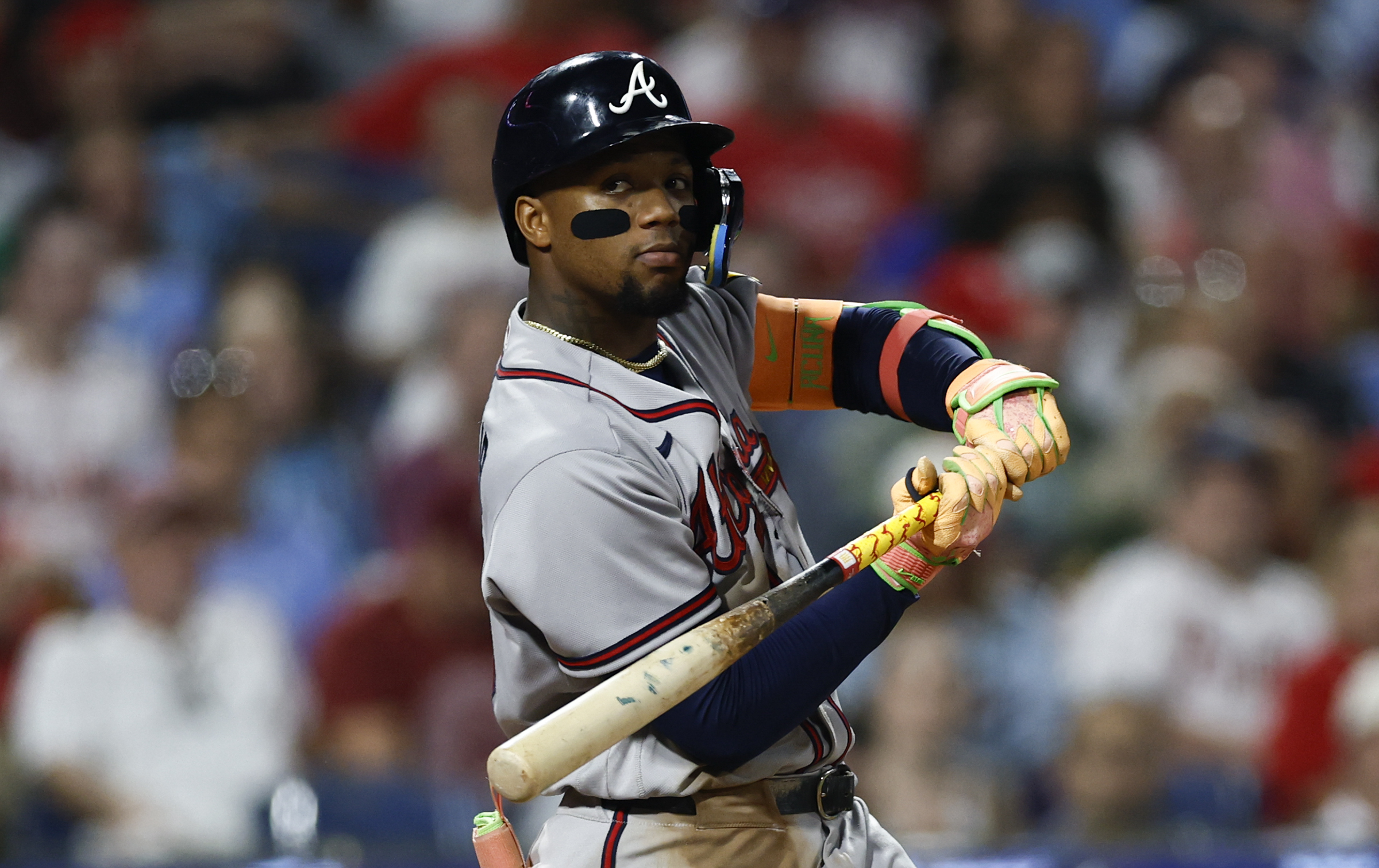
After the first homer, a 450-foot bomb off Zack Wheeler in the third inning Saturday, Acuña took his time getting around the bases. He’d cut the lead to 3-1, but he acted like he’d flipped the lead. He beat his chest at first base, flapped his arms at second base, Euro-stepped at third base, then sauntered home. That’s his home-run trot routine this season, but that didn’t make it any less deplorable. It took 29.51 seconds. Wheeler glared at him.
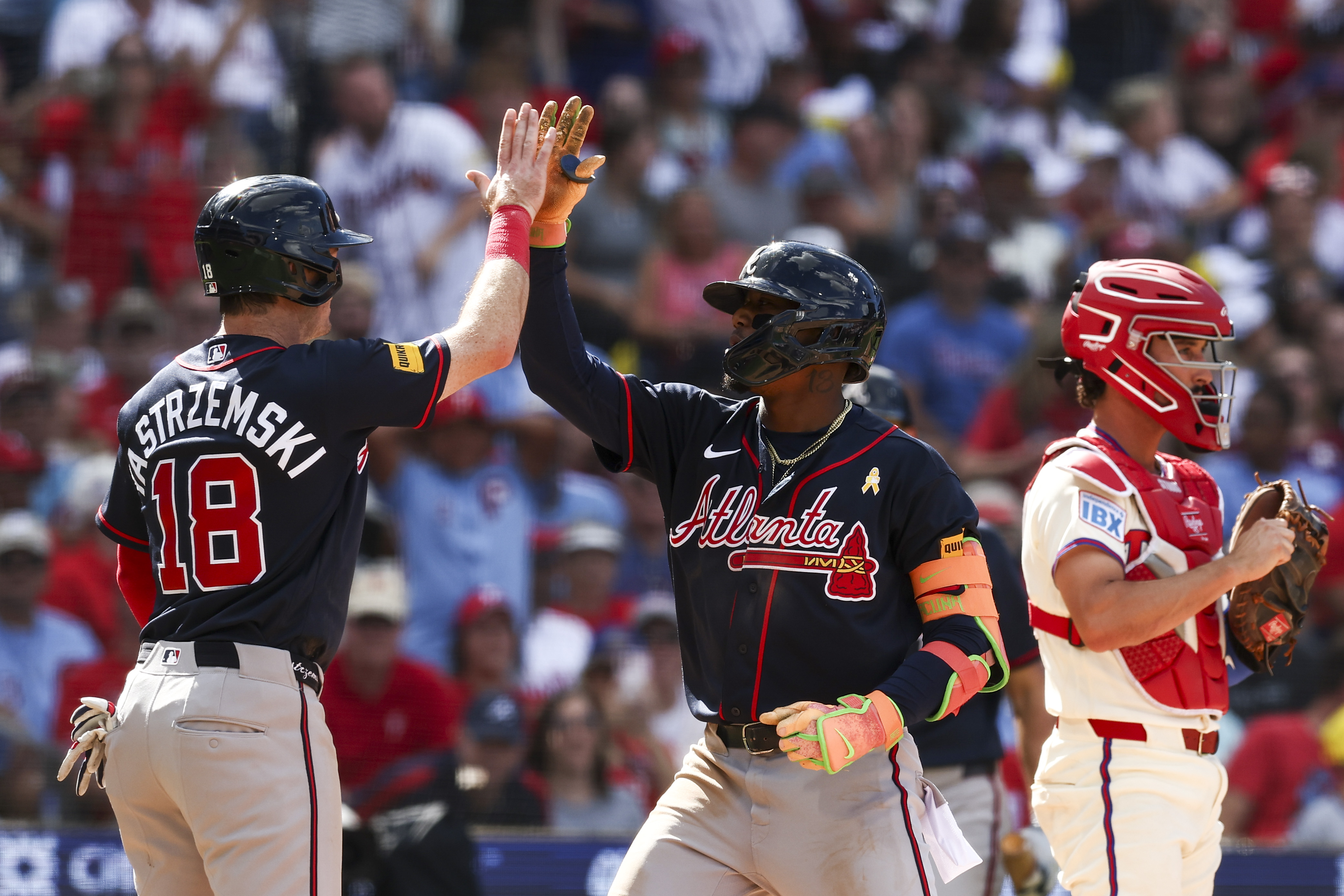
The second homer, a three-run blast off reliever Alex McFarlane on Sunday, was crushing. It tied the game, 4-4, in the eighth inning. Fully aware of the uproar his trot caused Saturday, Acuña poured it on Sunday. He stared into the Phillies’ dugout before beginning the journey. This time, he took 32.36 seconds to round the bases, his slowest of 16 trips this season and the third-slowest of his career 202 trips.
Ronald Acuña Jr. homered twice this weekend against the Phillies.Yong Kim / Staff Photographer
“I love the fans from Philly because they boo me,” Acuña told reporters Sunday.
Acuña also had three hits in Friday’s win.
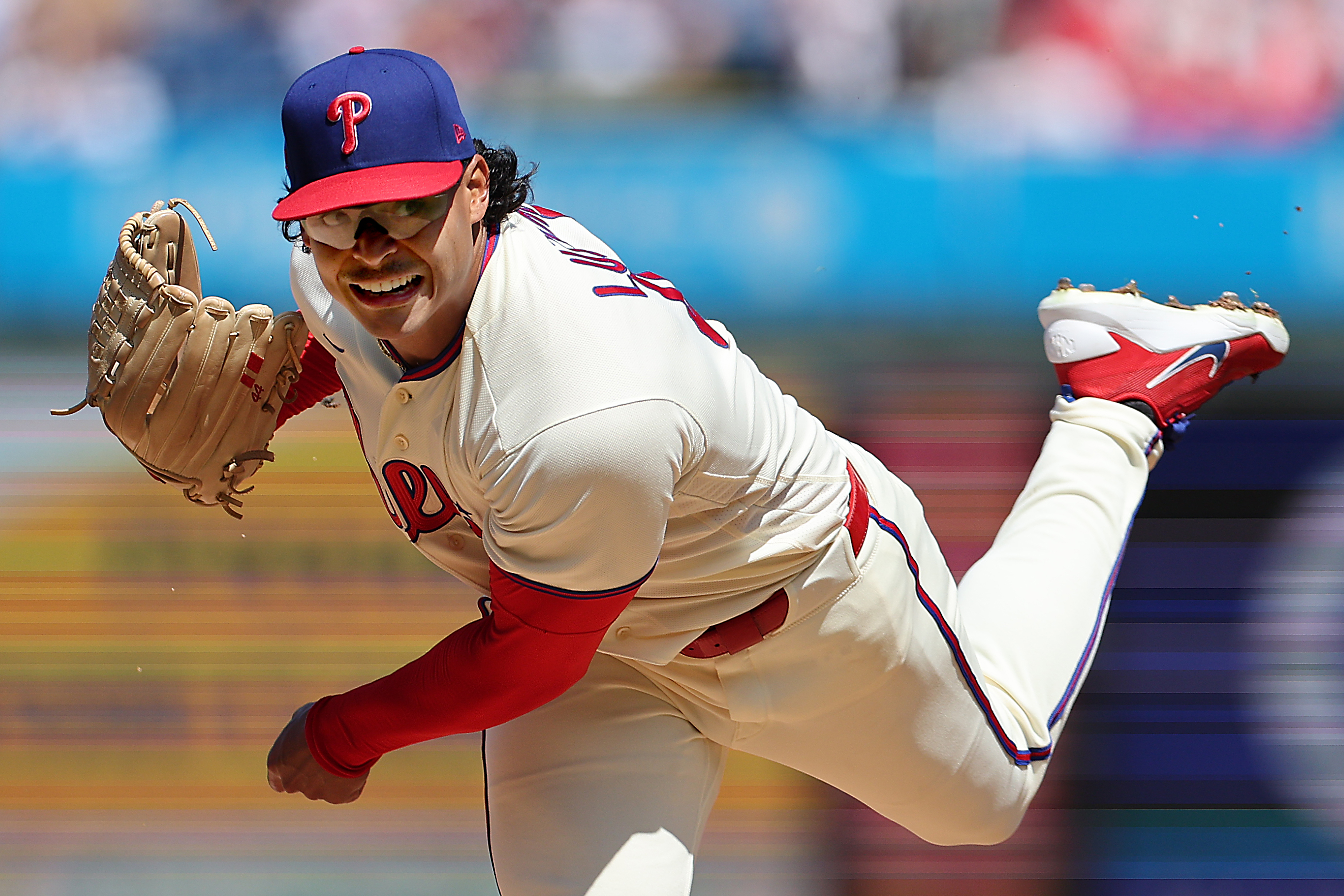
The two Braves wins assured that the Phillies, who trailed them by four games entering the series, could not make up ground in the NL East. Monday, his one-out walk in the ninth inning put the tying run on first base in a 1-0 game. Phillies starter Jesús Luzardo stranded him, to the delight of the 41,820 at Citizens Bank Park. Tragedy averted.
Luzardo logged the first complete game of his career, a shutout no less, but he did so with disaster just 270 feet from home plate.
The fans were delighted by the feat two outs later … but just imagine their angst if Acuña started another comeback and the Phillies had blown a second straight win.
Acuña’s trot Sunday led to questions before Monday’s game regarding how to approach the outfielder, whose hot bat had become a real threat again, and whose cocky attitude had rankled traditionalists.
“What are you going to do? Are we going to knock him down three times and that’s going to make him uncomfortable?” Phillies interim manager Don Mattingly said before the game. “That’s just not part of the game now.”
Saturday night, Mattingly, who is 65, acknowledged that baseball had long since legislated intentionally hitting batters who showboated.
“Today’s game, you see it all the time,” Mattingly said. “It’s more commonplace. Let the kids play, right? We started that.”
Ronald Acuña Jr. celebrates with teammates after helping the Braves beat the Phillies on Sunday.Monica Herndon / Staff Photographer
That doesn’t mean everyone likes it … especially star pitchers.
“Our guy just rounds the bases that hits 50 here,” said Wheeler.
That might be true of the guy in question, Kyle Schwarber. He homered Saturday, and brushed off questions about Acuña’s home-run trot. He homered again Monday, but pointedly declined to become part of the Acuña narrative. He followed his shot in the eighth with a brisk scoot around the bags, and afterward scoffed at the notion that his home-run trots were now being scrutinized.
It most definitely is not true of the more significant guy, Bryce Harper.
Philly’s own
Harper made an art of the home run celebration since he entered pro ball as a teenager; he got into trot-trouble in the minors.
And nobody milks the moment like the guy they call “The Showman.”
After Harper made a baserunning error in Game 2 of the 2023 NL Division Series, Braves second baseman Orlando Arcia mocked him. So, when Harper hit two homers in Game 3, Harper stared down Arcia each time. Later that fall, in Game 5 of the NL Championship Series in Arizona, after he homered, Harper stared down Michael Phelps, who lives in the area and had thrown out the first pitch. Phelps is a 23-time Olympic gold medalist as a swimmer — and Harper’s buddy.
In March, Harper took 35.63 seconds to round the bases after his 432-foot home run for Team USA against Venezuela in the World Baseball Classic. It took him 5 seconds to even leave the batter’s box. He literally threw his bat 30 feet back toward the Team USA dugout. At third base, he paused to salute. As Harper approached home plate, he screamed into the camera and patted the American flag on his left sleeve. It wasn’t even a big-league game and it wasn’t a game-winner. It just tied the game, 2-2, and Harper and the Americans eventually lost.
If Harper is the Prince of Petty, he doesn’t own the most obnoxious trot in Phillies history, but he was there for it. In 2019, after the Mets hit J.T. Realmuto in what appeared to be a retaliation plunking, Rhys Hoskins took 34.22 seconds to circumnavigate the diamond, at that point the longest trot since trots began to be measured, and it was utterly provocative. It was the ninth inning, and it made the score 6-0. Harper had a front-row seat for that one, because it was Harper that Hoskins drove in.
How about the moment that turbocharged the recent Phillies playoff runs?
That was Hoskins’ third-inning, three-run, bat-slam dinger in Game 3 of the 2022 NLDS against … you guessed it — the Braves. Acuña watched that one from right field at the Bank.
💥 BAT ̶F̶L̶I̶P̶ SLAM 💥
The Phillies take a 4-0 lead thanks to this three-run home run BOMB from Rhys Hoskins.
So, yeah, the Phillies and their fans live in glass houses when it comes to criticizing somebody else’s home-run behavior.
And then …
If the Phillies sought revenge, Acuña barely gave them the chance to knock him down Monday. He occupied the designated hitter spot (perhaps protected from Phillies fans in right field), batted first in the order, and swung at the first pitch in his first two at-bats.
Not much drama. Not much satisfaction. Satisfaction arrived in the sixth.
Luzardo struck out Acuña on three pitches, and it was the moment the fans had been waiting for. After he flailed at a sweeper and jogged back to the dugout, fans erupted in cheers and mocked his failure by flapping their arms.
Flapping their arms?
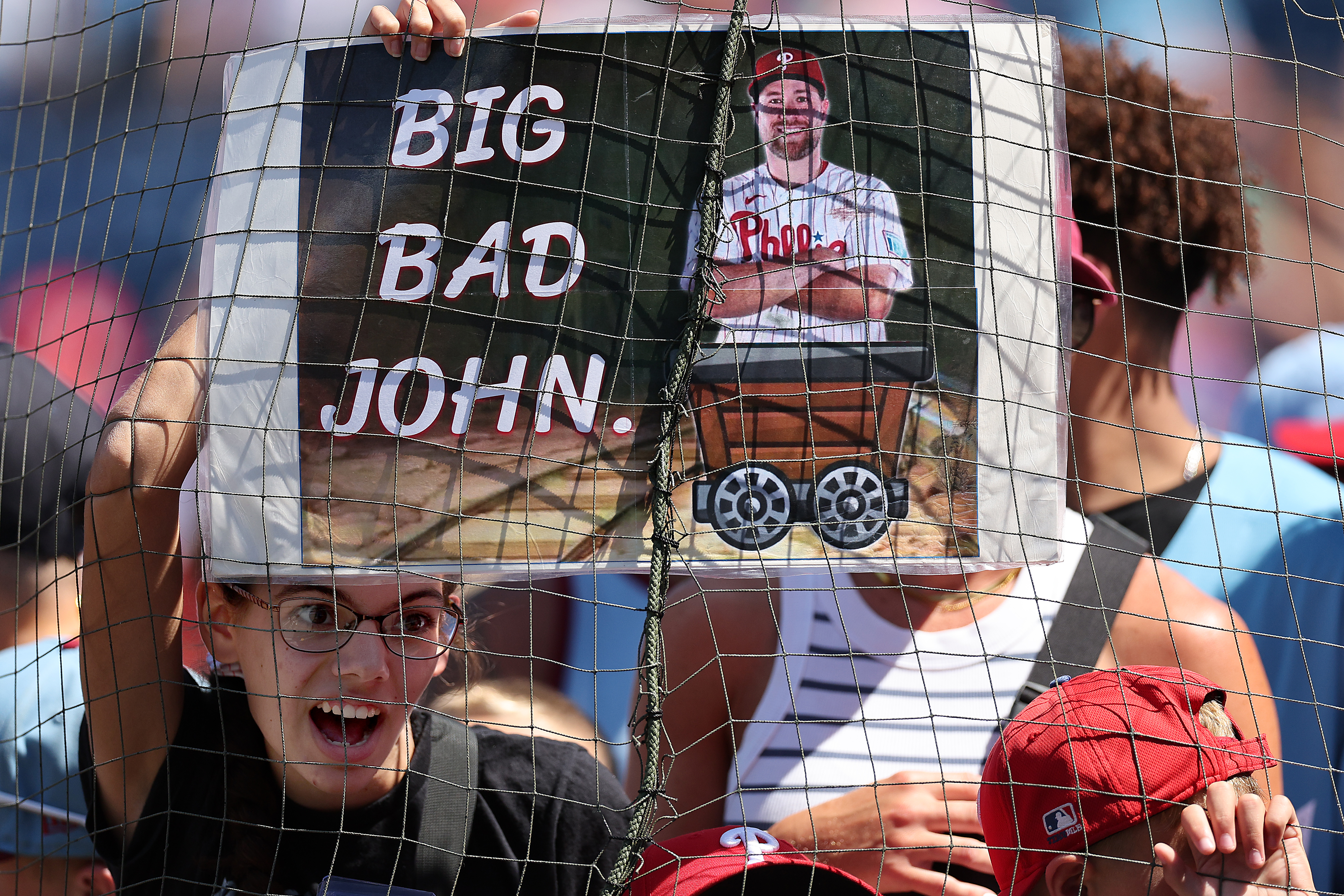
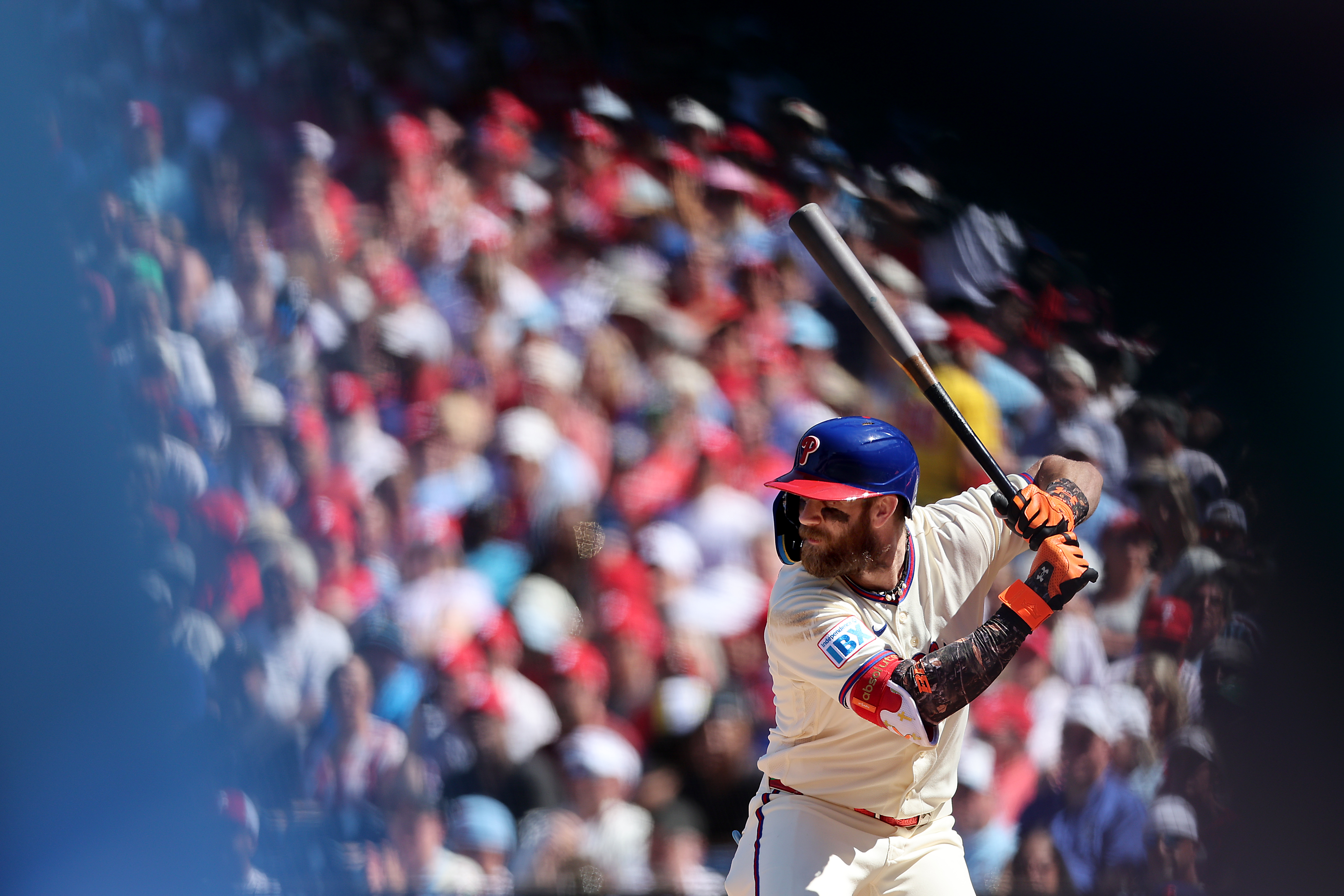
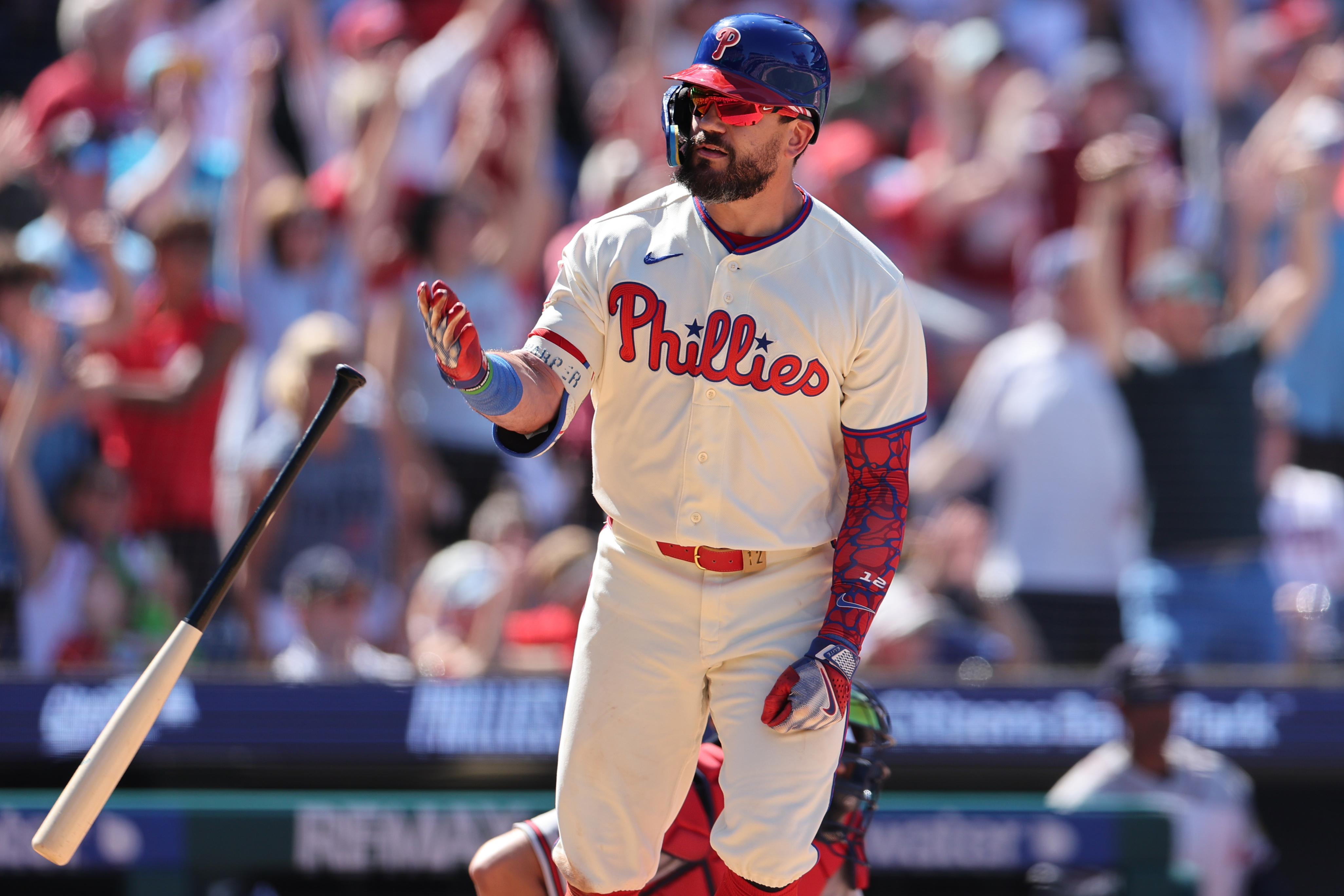
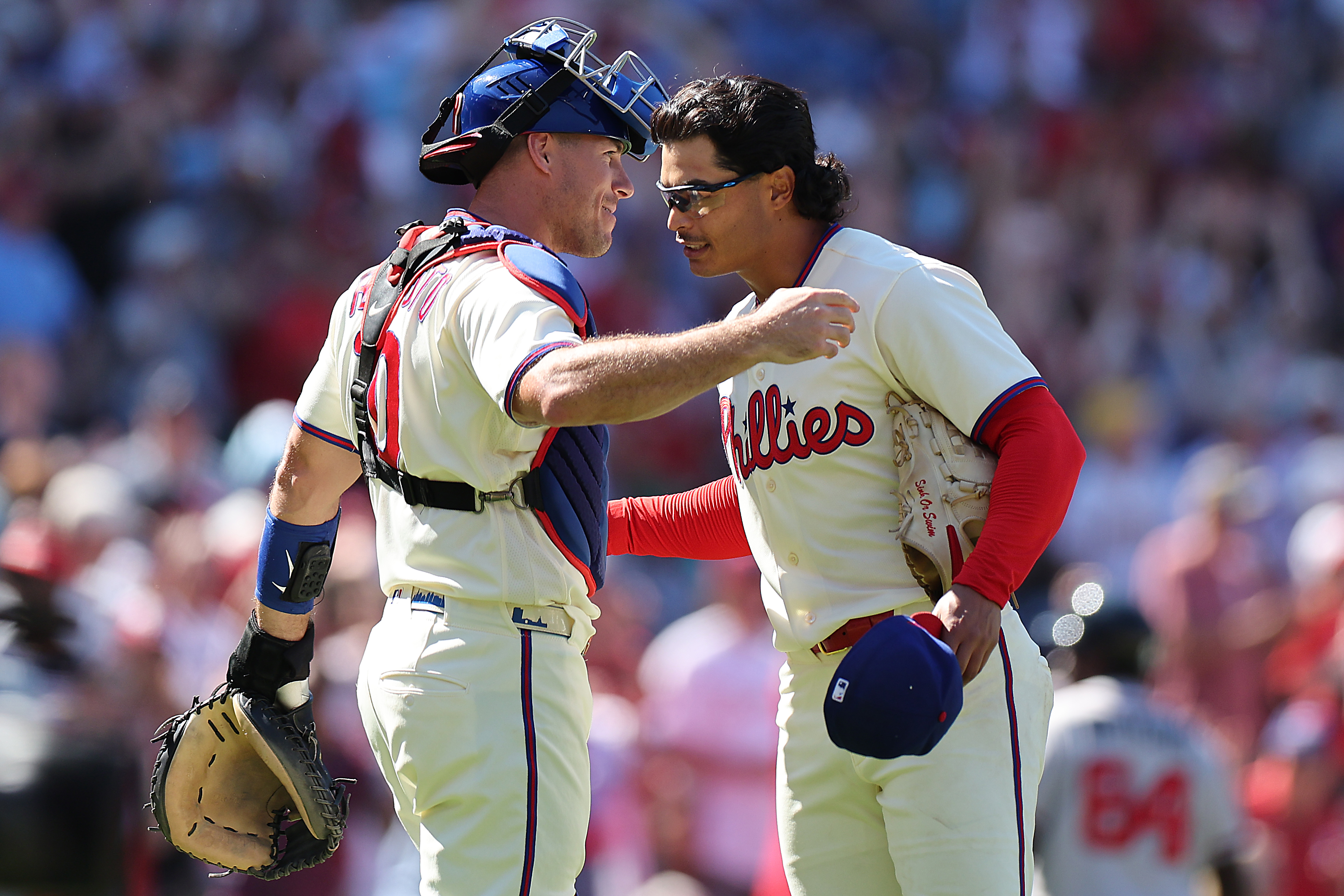
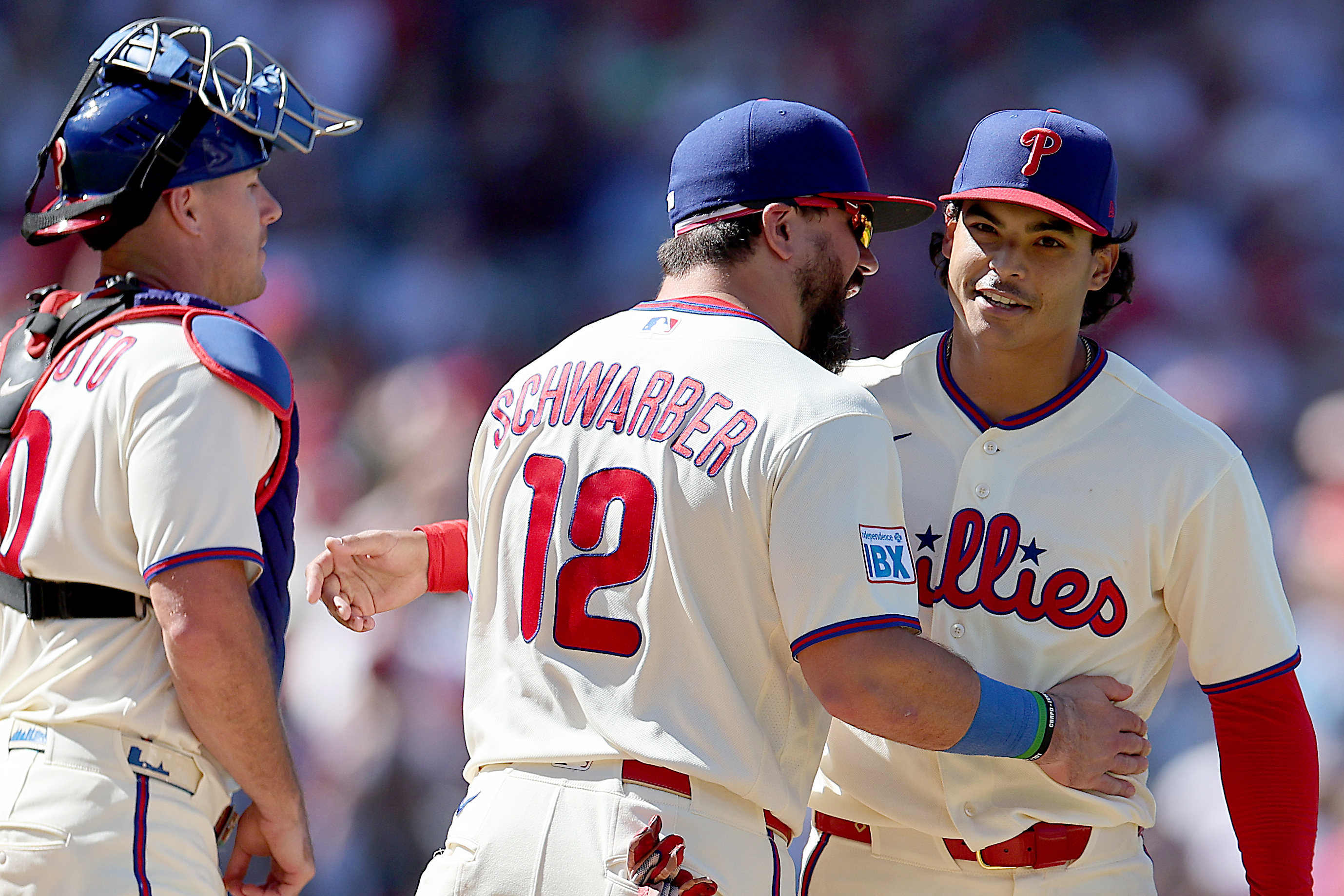
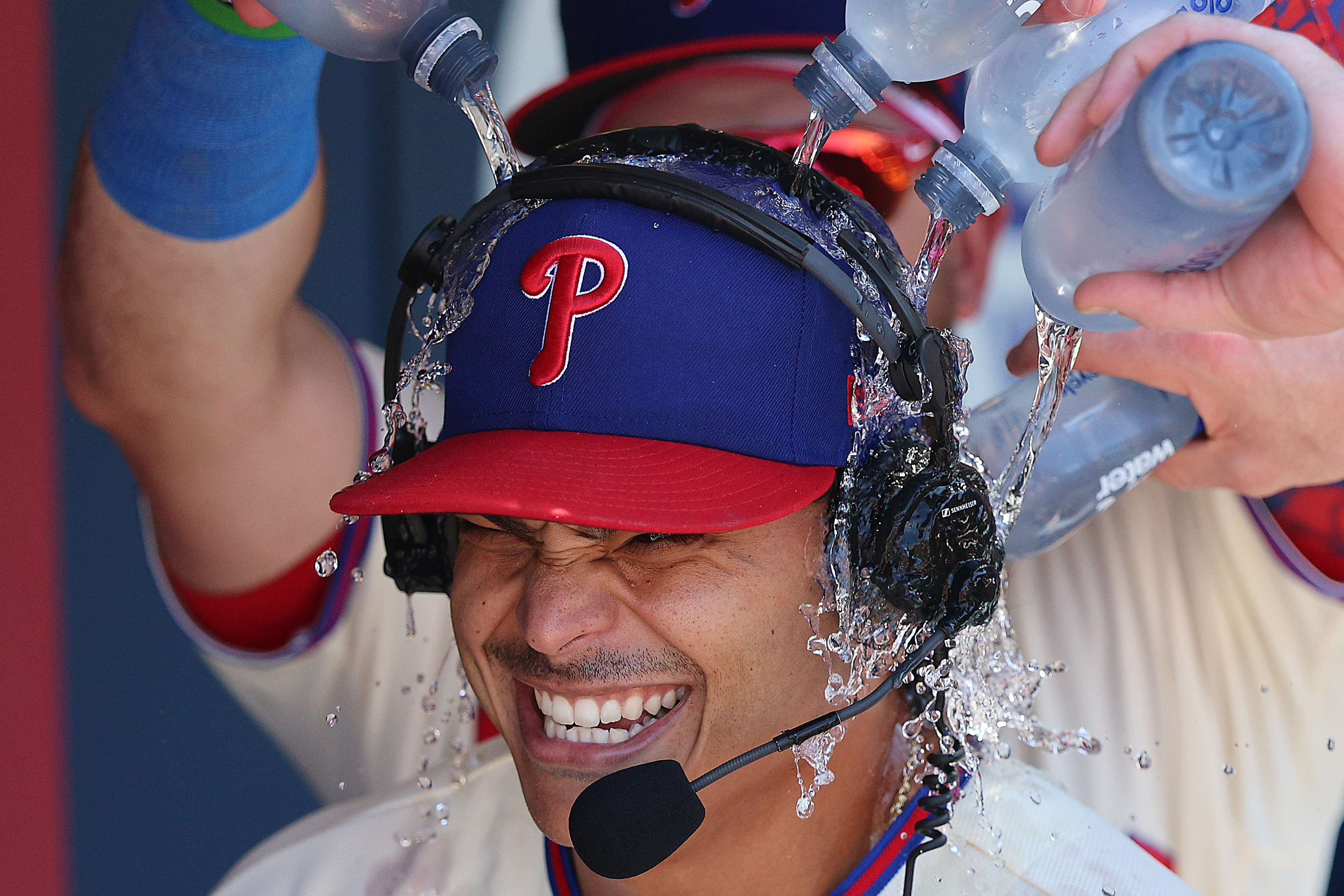
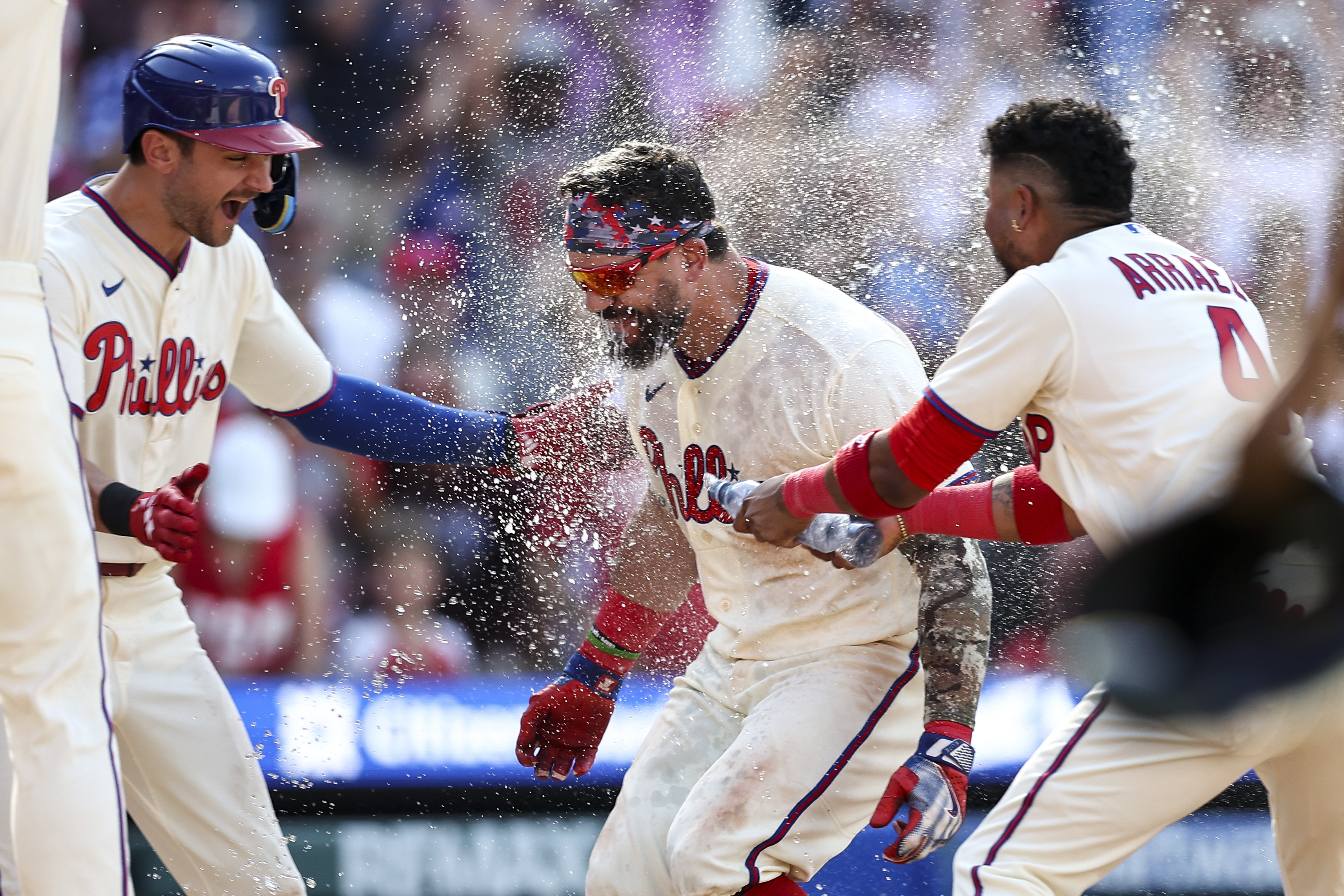
A fans tries to get the attention of Phillies Jonathan Bowlan before the game against the Atlanta Braves.David Maialetti / Staff PhotographerPhiladelphia Phillies starting pitcher Jesus Luzardo delivers a pitch in the first inning.David Maialetti / Staff PhotographerPhiladelphia Phillies Bryce Harper waits for a pitch against the Atlanta Braves.David Maialetti / Staff PhotographerPhiladelphia Phillies Luis Arraez reacts to flying out to end the sixth inning.David Maialetti / Staff PhotographerPhiladelphia Phillies starting pitcher Jesus Luzardo faces the Atlanta Braves.David Maialetti / Staff PhotographerPhiladelphia Phillies Kyle Schwarber hits a solo home run in the eighth inning.David Maialetti / Staff PhotographerPhiladelphia Phillies Kyle Schwarber watches his solo home run in the eighth inning.David Maialetti / Staff PhotographerPhiladelphia Phillies Kyle Schwarber flips his bat as he reacts to hitting a solo home run in the eighth inning.David Maialetti / Staff PhotographerPhiladelphia Phillies catcher J.T. Realmuto (left) and Philadelphia Phillies starting pitcher Jesus Luzardo (right) embrace after the game.David Maialetti / Staff PhotographerPhiladelphia Phillies Kyle Schwarber (center) and Philadelphia Phillies starting pitcher Jesus Luzardo (right) embrace after the game.David Maialetti / Staff PhotographerPhiladelphia Phillies starting pitcher Jesus Luzardo reacts as he is showered with water after finishing the game.David Maialetti / Staff Photographer
Yes.
Philly fans lost their minds Friday when Acuña flapped his arms as he rounded second base, assuming he was mocking their assumed Eagle fandom. Not so.
Most Braves players make that motion when they homer, just as most Phillies raise the index and pinky finger of their right hand as they round second during a home-run trot. Acuña also typically pantomimes a Euro-step basketball move near third base, and he did this, too — though in Philly this weekend, he performed the Euro less at Russell Westbrook speed than at Luka Dončić speed.
As for other historical villains in Phillies history, this sort of animosity is different from the hometown hatred directed at Scott Rolen, who declined a big contract extension and forced a trade to St. Louis, or Dick Allen, whose situation was complicated by racial tensions and his contrarian nature. J.D. Drew also is unique in that it was the Phillies’ hubris and obstinacy that cast him as spoiled and petulant in the late 1990s, when, in fact, he simply was greedy and anti-establishment.
Piazza, meanwhile, was a homegrown talent who represented the Dodgers’ and Mets’ superiority during a fallow Phillies era. His 44 home runs and 130 RBIs against the Phillies are the most he accrued against any team.
Similarly, Jones was the face of the best NL franchise for 20 years. He hit 49 homers against both the Phillies and the Mets, and his 1.036 OPS and .331 batting average are his best against any team that was in the NL his entire career (the Brewers switched in 1998).
For two decades, Jones was assaulted by chants of, “Laaaaaaa-ry,” his given name. For years, Piazza got straight-up boos. From now on, so will Acuña.
It was a historic Sunday afternoon at Atlanta’s East Lake Golf Club in the penultimate Tour Championship in its present form, which begged the question: Why change?
With the exception of contrived, boorish, international gimmickry, golf will never be relevant after majors season ends. With apologies to the British Open, golf’s not particularly relevant after Father’s Day and the final round of the U.S. Open. This was proved again last weekend when everything was up for grabs: golf’s biggest money, its MVP trophy, a Tiger record, all swirling around the game’s biggest star.
And all most sports fans cared about was if Bill Belichick’s lousy college football team would win in Ireland (they did; ugly), how many NFL teams would keep four quarterbacks (four teams did, including the Eagles), whether Aaron Donald would unretire to join Myles Garrett with the Rams (he did; yikes), and if the Brewers and Rays are for real (TBD).
Meanwhile, golf’s most monied weekend delivered. It was a closed, $40 million tournament with mostly the same old names, but it delivered more drama than any 16-man, single-elimination tournament will deliver when the latest format begins in 2028, the year after FedEx’s deal expires with the Tour.
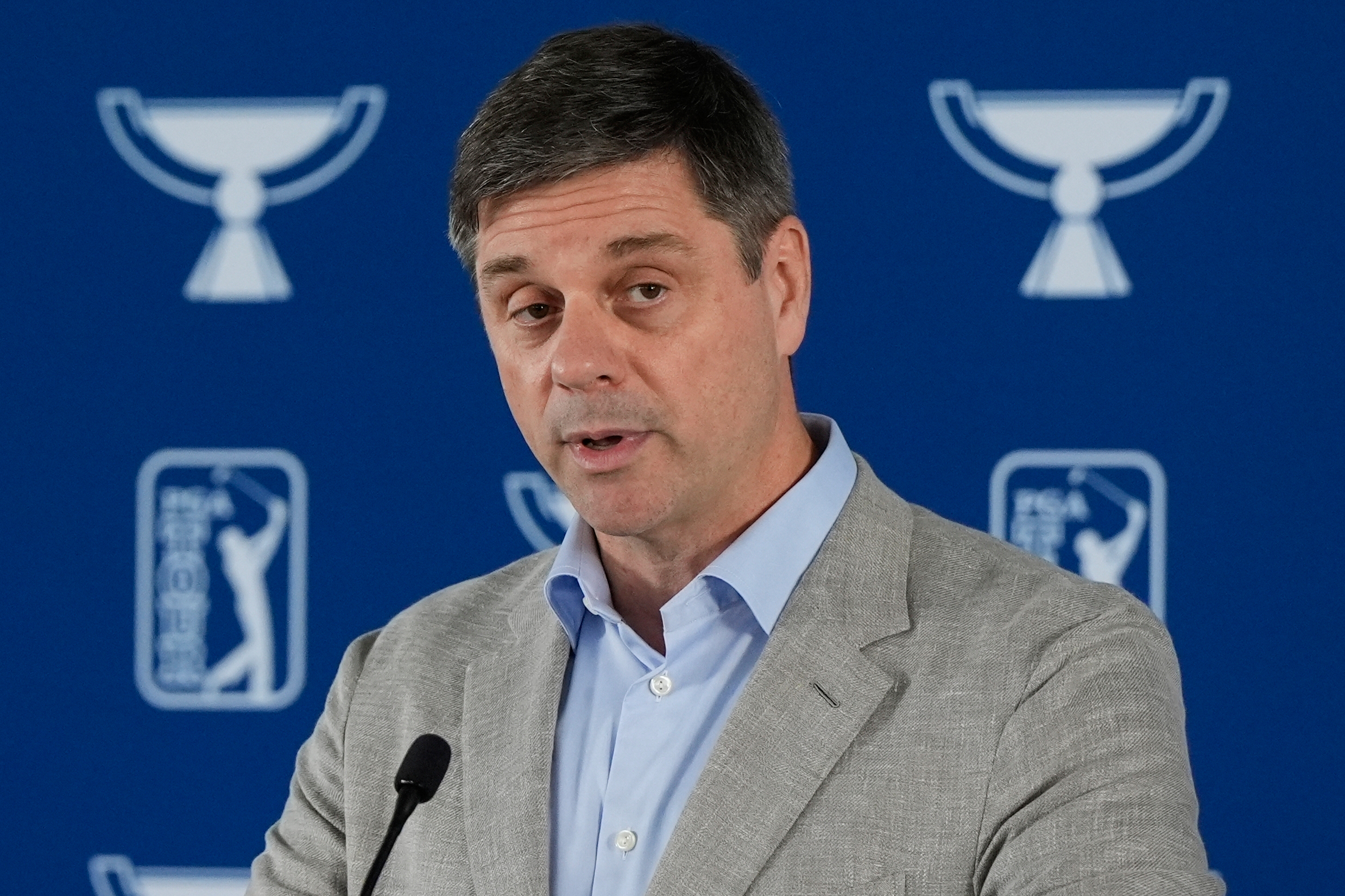
This is the brainchild of a panel of existing Tour stars and new PGA Tour CEO Brian Rolapp, the latest attempt of Big Golf to extend interest to compete with MLB’s stretch run, the NCAA’s kickoff frenzy, and the NFL’s annual four months of dominance. Past formats have included cumulative points systems that rendered playoff events (as many as four of them) moot, as well as a system that awarded the best players with pre-tournament handicaps that absurdly skewed the odds of winning the Cup.
Currently, players compete for FedEx Cup points to determine the field for a playoff tournament for the top 70, which winnows the next field to the top 50, which winnows the next field to the top 30, the winner of which wins the Cup and the $10 million first-place check.
It is imperfect, but it is simple, and it is elegant.
Beginning in 2028, a bifurcated series of Tour events will assign qualifying points to determine the top 90 golfers, who will compete in a stroke-play tournament to determine a top 32 in points. That group will compete for a week in round-robin, match-play in pods of four. The two top players from each pod advance to a Sweet 16, single-elimination, match-play tournament to determine a playoff winner.
The problems:
Match play is boring, even if it winds up at non-traditional venues like Pine Valley or Bandon Dunes. The Ryder Cup is the only exception, but that’s more about jingoism and theater than it is about golf.
Stroke play is a truer test of quality. There’s a very real chance that Min Woo Lee and Viktor Hovland would have been the finalists had the 2028 format been used this year. Yawn.
This year’s tournament absolutely delivered.
Got it right
The best golfer of his generation came from three strokes down for a three-stroke win to claim his second FedEx Cup title and surpass the winnings of the best golfer of any generation.
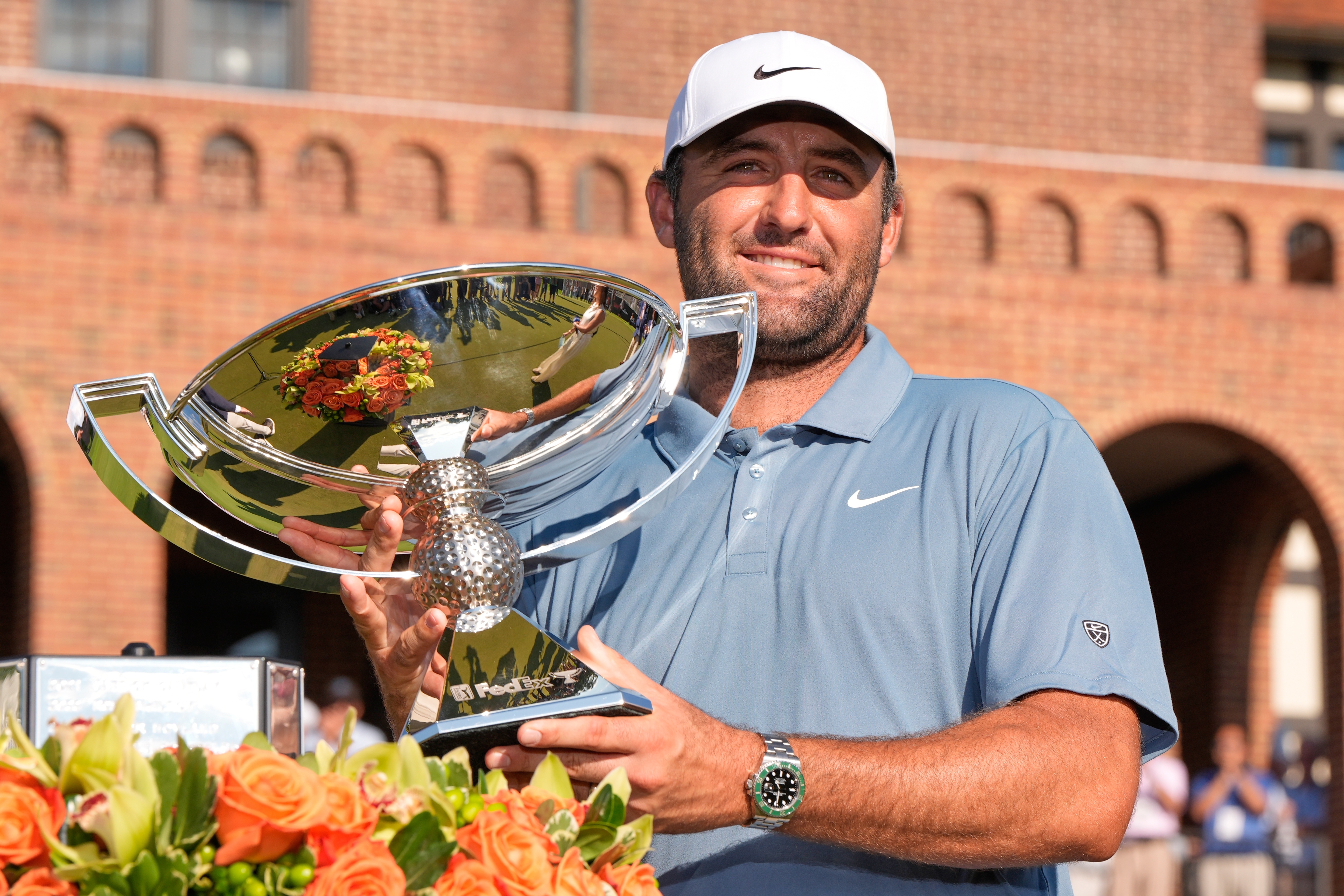
Scottie Scheffler passed Tiger Woods and became the all-time leading money winner in PGA Tour history.
The win, Scheffler’s third of the season, his second of the playoffs, and his 22nd of his career, surely secured his fifth straight Player of the Year award. It will be announced in December, and the five in a row ties him with Tiger. (The award has only existed since 1990, so it postdates Jack and Arnie and Gary Player, but Tiger also won it three times in a row and 11 times overall.)
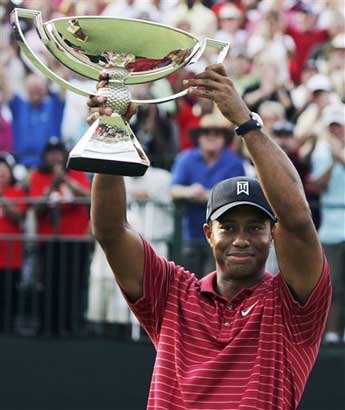
Tiger Woods, who won the FedEx Cup three times, was the tour’s player of the year 11 times.AP
Before the 30-man Tour Championship there was, incredibly, some debate over whether Scottie should win it over a handful of other players. This, even though Scheffler had a lead of more than 1,400 points over the next closest Tour Championship qualifier; had won two tournaments; and led the Tour in second-place finishes (five), top-5 finishes (13), scoring average (by nearly three-quarters of a stroke), birdie average, greens in regulation, scrambling, and, with more than $20 million in the bank, had earned more than $6 million more than his closest competitors — Matt Fitzpatrick, Wyndham Clark, and Cameron Young.
Uphill battle
At any rate, Scheffler took care of business — a business that he has dominated. Since Official World Golf Rankings began 40 years ago, his 207 weeks at No. 1 are third-most in history, including the last 172 weeks, the third-longest streak in history. He recently ended a streak of 78 consecutive cuts made, sixth-best in history.
In a world of self-promoting social media wankers, he’s about as interesting as warm skim milk.
It’s not his fault. In the midst of golf’s most divisive era, Scheffler won’t say anything controversial. In the midst of America’s most heated political climate in 60 years, Scheffler is apolitical. He’s a retiring Christian family man who tries to play the best golf he can every time he plays.
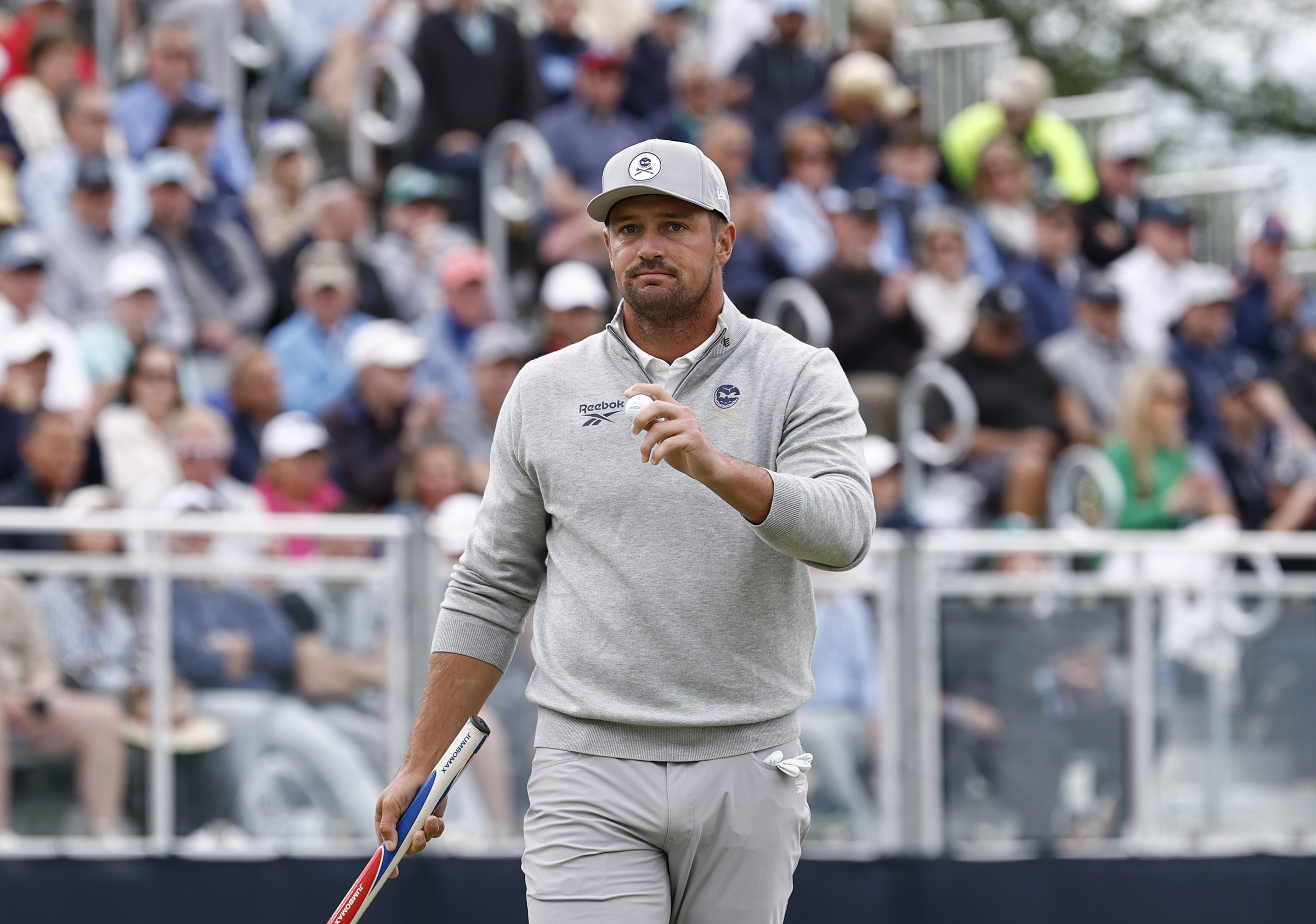
Bryson DeChambeau is always interesting, no matter how he plays.Yong Kim / Staff Photographer
He lacks the additive abrasion of Bryson DeChambeau. He lacks the international appeal and frank assessments of Rory McIlroy, a glib Northern Irishman, or Jon Rahm, a prickly Spaniard.
Exhausted
More than anything, the Tour’s long, top-heavy schedule is its own worst enemy.
Its best tournament, the Players Championship, happens in March. Its most beloved tournament, the Masters, happens in April. Its best major tournament, The PGA Championship, now comes in May. Its toughest test, the U.S. Open, is in June. Its oldest and coolest tournament, the British Open, is played in July.
By August, all but the most rabid golf fans (hand raised) are burned out. Every other year the casuals need the eight weeks between the British and the Ryder Cup to refuel. (We’ll keep ignoring the President’s Cup until it matters.)
As LIV dies and its prodigals return, the Tour Championship in its present form only would have become better. Now, instead of being virtually assured of having DeChambeau, Rahm, LIV stud Joaquin Niemann playing against Rory and Scottie at East Lake on the final Sunday of the 2028 season, you’re guaranteed to have no more than two of them.
In September of 2026, the Diamondbacks will serve as a benchmark as to whether these Phillies even have a chance of achieving what the 2023 Phillies came so close to achieving.
Hard to believe, Harry.
A month ago, as the Phillies foundered on the edges of relevance, none of this seemed to matter much. Today, the Phillies have found an identity grounded in smart at-bats, a solid starting rotation, and unexpectedly competent defense. Suddenly, what seemed like a wasted season through four months has transformed into a season of hope and expectations.
As in, if the Phillies are playing this well now, there’s no reason to think they can’t win their first World Series in 18 years.
The Phillies on Monday night begin a three-game series in Arizona that could determine whether the Phils host a wild-card series in October. The D-backs lead the season series after winning two of three in Philly in April.
As this series begins, the Diamondbacks hold the final wild-card slot but stand 4½ games behind the Phillies. The Phillies are tied with the Cubs, but the Cubs won six of seven against the Phillies in the April games that exhausted the teams’ head-to-head matchups. Should the Diamondbacks surge and the Cubs stall, there’s a chance this week’s results provide the tiebreaker that gives the Phillies the top wild-card spot, the No. 4 seed in the National League playoffs, and home-field advantage over No. 5 that comes with it.
This is the first month the Phillies have had four sweeps of 3 or more games in 35 years.
Of course, the Phillies can render these scenarios obsolete if they clobber the Diamondbacks, pass the Cubs, and maybe even catch the Braves for the NL East title, in which case tiebreakers won’t matter. But the Braves lead by five games with 25 to play, so that seems a bit much to ask.
Manager Torey Lovullo’s Diamondbacks have a half-game lead on the Padres for the third and final wild-card spot going into Monday’s series opener against the Phillies.Colin Hubbard
For the moment, it’s more important to judge whether the Phillies can play excellent baseball on the road against a team that is 13-8 against them since Game 3 of the 2023 NLCS.
The magnitude of the lows might skew the emotions, but the lows against the Diamondbacks seem to be lower than most of the other lows this Harper-Wheeler-Schwarber edition of the Phillies has delivered since 2022.
It begins with that 2023 NLCS, when the Phillies’ bats deserted them and they lost Games 6 and 7 at home. The Phils haven’t won a season series against Arizona since, and their first meeting this season did not portend favorably.
The Phillies struck out 16 times against the Diamondbacks on April 10, 16 games before the Phillies fired manager Rob Thomson and promoted new bench coach Don Mattingly to interim manager. The 16 Ks remain a season high, part of the 8.8 strikeouts per game that was among baseball’s worst rates.
Now, though, they’re striking out 2.5 fewer times per game, the second-best rate in baseball. It is the most promising stat of a slew of numbers that indicate that this Phillies team might even be able to topple the Dodgers in the postseason.
If it’s hard for you to believe, that’s completely understandable. Even in the middle of their recent nine-game winning streak, their longest in four years, the Phillies supplied little real reason to believe they might make another long run into October.
Shortstop Trea Turner’s Season from Hell continued. The bullpen remained unreliable. And the two best pitchers weren’t the two best pitchers.
Things change.
Phillies first baseman Bryce Harper after striking out against the Arizona Diamondbacks on April 10.Yong Kim / Staff Photographer
Struggling aces Cristopher Sánchez and Zack Wheeler just combined to allow one run over 13 innings Saturday and Sunday against the Angels. Which, of course, makes them formerly struggling aces Cristopher Sánchez and Zack Wheeler. Add in Jesús Luzardo’s seven shutout innings in Seattle on Wednesday, and that’s one run allowed for the Big Three in their last 20 innings.
That’s just the icing.
Consider the continued efficiency of No. 4 starter Aaron Nola, who’s on a six-game heater, and rookie Andrew Painter, who’s been better than a No. 5 in five of his six starts since his recall from the minors, and the Phillies transform from Lost Cause to Title Contender.
Since three-time batting champ Luis Arráez played his first game Aug. 4 just after Dave Dombrowski’s latest deadline magic, the Phillies lead Major League Baseball with a .272 batting average and are tied with the Red Sox for the lead in on-base percentage, at .353, improvements of 35 and 48 points, respectively; their .305 on-base percentage had been third-worst. In that same span, they lead the National League with 100 walks. They are averaging 5.5 runs, an improvement of more than a run per game.
Since Arráez slid into the cleanup spot they are 16-7, have gone from eight games above .500 to a season-high 17 games above .500, and are tied with the Cubs atop the National League wild-card standings going into Monday.
Arráez’s arrival shuffled the defense, an unintended consequence that reaps daily rewards. Arráez is best at second base, so Bryson Stott moved to third base, where he has proved to be the best third baseman in baseball since the move. Third baseman Alec Bohm pushed first baseman Bryce Harper to right field, where both are at least average, whereas neither was average in his previous position.
In the middle of it all, Harper has reached base in 32 consecutive games, a career best. A two-time MVP in the midst of his most efficient stretch of offense would be the biggest news of all on a team that didn’t have so much to win, so much to lose, and so much scar tissue since its NLCS collapse in 2023.
But if they take off from PHX on Wednesday night with two or three wins in hand, maybe overtake the Cubs if the Brewers beat up on them the next four days, and sustain this surprising run of professionalism and competence, then yes.
The only thing more disappointing about the slow and weak response by the principals in the Good Good Golf YouTube channel scandal was its utter predictability.
There should have been immediate distancing and disassociation from Callaway Golf and Good Good Golf after they aired an outrageous commercial that endorsed violence against women. Instead, it took almost a week.
Why?
Because corporate America, the foundational structure for the golf industry, hoped it would all blow over.
It did not.
Last Friday, an ad aired online in which Good Good Golf co-founder Garrett Clark rushes across a tee box and levels a female golfer who is looking in his bag, then stands over her, points at her on the ground, and says, “Do not touch my new driver.”
Who thought this was acceptable? Who thought this was funny? Who thought this was anything but horrific?
Good Good, that’s who. Of course they did.
It’s a frat bro content creator and apparel company with more than 2 million subscribers to its YouTube channel, making goofy videos. It also sells ugly hats and even uglier shirts. When you hear some idiot on TV scream, “Get in the hole!” when a pro golfer tees off on a par-5, dollars to doughnuts he’s wearing Good Good gear, hat on backward, shirt untucked.
Then, the commercial.
There was, appropriately, immediate backlash that convinced Good Good to delete the ad. The backlash snowballed into international outrage, with resounding consequences.
By Saturday night the PGA Tour, Tour CEO Brian Rolapp, Callaway, Dick’s Sporting Goods and Golf Galaxy, and Golf Channel all should have cut ties with Good Good. The fact that none did until they were forced by public sentiment tells you everything to need to know about these folks and how they view women.
In case anyone wants to argue that this commercial was not an endorsement of violence against women, know that Callaway, as penance, on Thursday committed $1 million to support initiatives that combat violence against women.
The club in question was a driver made by Callaway in collaboration with the new hip-and-with-it brand. The ad was vetted by both Callaway and Good Good. Incredibly, it raised no alarms at either place, with anyone, until social media began its cycle of outrage.
The irony is few brands had done as much to promote women in golf than Callaway, which has perhaps the most potent brand-to-athlete recognition relationship in the women’s game, the one-time face of women’s golf, Annika Sorenstam. She condemned the ad but, sadly, did not condemn either Callaway or its leadership.
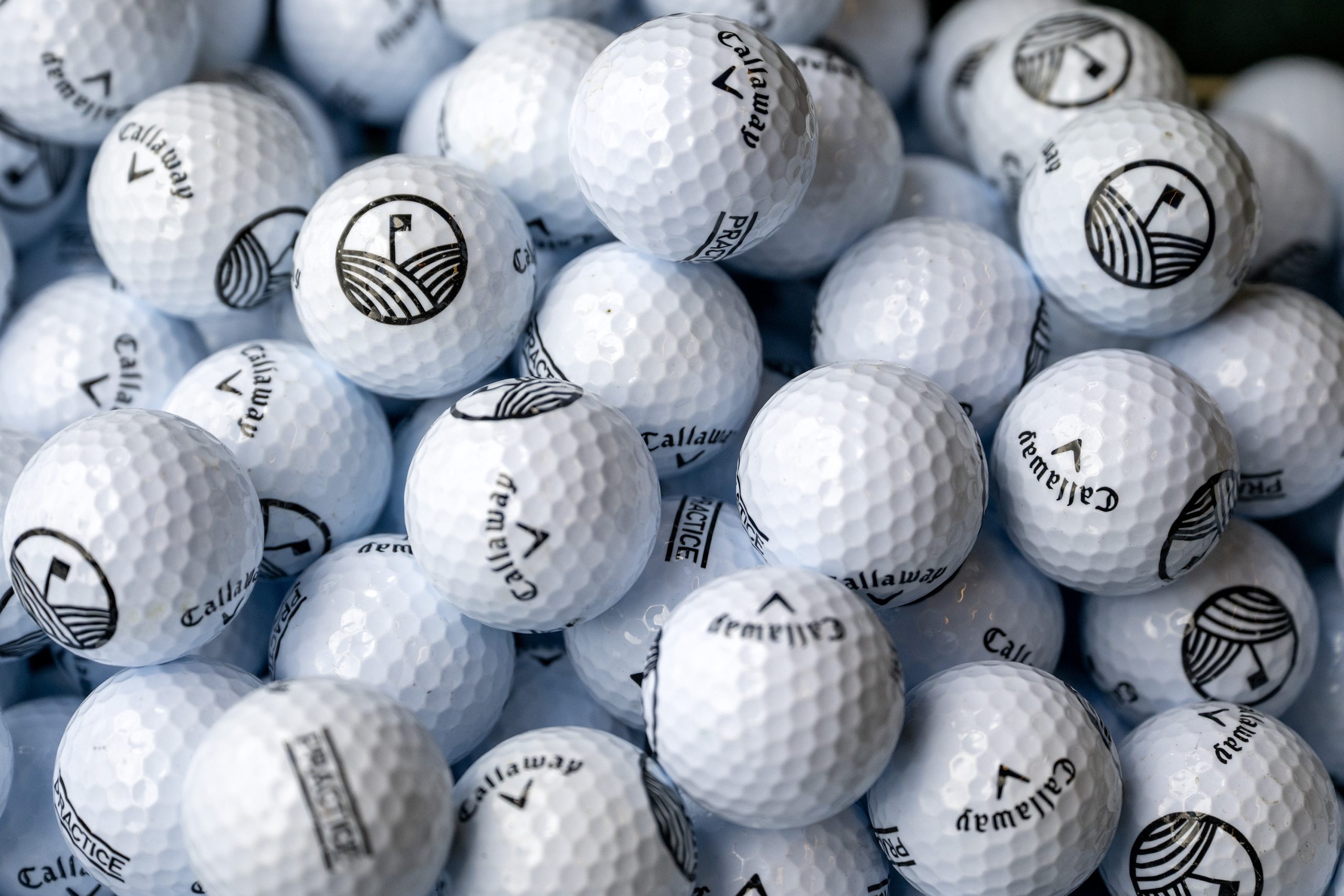
Callaway Golf balls shown at the Cobbs Creek Golf Course.Tom Gralish / Staff Photographer
This comes at the height of the Caitlin Clark era, when women’s sports are surging like never before. She’s a basketball player, but she loves to golf.
Her involvement in the game might have helped spur the biggest growth spurt women’s golf has ever seen. The COVID-19 lockdown triggered massive growth in the golf industry in the United States, and the segment that has grown the most by both percentage and raw numbers is women’s golf, up 45% and 2.5 million golfers compared to 12% and 2.3 million for men, according to the National Golf Federation.
Callaway just scored the worst own-goal in sports marketing history.
More than 8 million women now play golf, but the chairmen of all of the entities in question — the Tour, Callaway, Dick’s, and Golf Channel — all are men. Which might explain the slowness and gradualness of the only acceptable responses.
So we had the scramble, and the admonitions, and the apologies, and the disassociations. The problem with all of it is, nobody wanted to do the right thing unless they had to. Everybody wanted to try to ride it out. Which means they are all as guilty as they could possibly be.
That includes the Tour, which, on Thursday, announced that Good Good would no longer be the title sponsor of a tournament in Texas in November.
That includes Golf Channel, which needed four days to decide to not air the Good Good edition of “Big Break,” which was due to begin Tuesday but, after sponsor Golf Galaxy pulled out, was initially pushed back a week and has since been canceled altogether.
That includes Dick’s Sporting Goods and Golf Galaxy, which needed five days to decide to pull Good Good merchandise from its shelves.
That includes Rolapp, who only responded to the commercial’s misogyny when he was questioned at a press conference four days after the incident, then landed this stinging indictment: “I think what we saw was concerning.”
Rolapp’s milquetoast response was a resounding reminder that, before moving to the PGA Tour last year, Rolapp spent more than two decades working for the NFL, America’s most notorious sports league when it comes to ignoring issues like domestic violence and sexual harassment in the workplace.
That includes Callaway, whose executive roster looks like President Donald Trump’s cabinet. After one day, Callaway issued a chastisement … of Good Good. After three days, Callaway pulled the driver from its website. After six days, as its stock continued to lose value, Callaway finally cut ties with Good Good.
Callaway’s abrupt about-face, after partnering with Good Good for three years, might have been prompted by Callaway being threatened with exclusion by huge retailers like Costco, which apparently removed access to Callaway products Thursday, at least temporarily.
Instead, five days after the commercial aired, as Dick’s, Golf Galaxy, and the PGA Tour Superstores began pulling Good Good stock from their shelves, Clark issued a rambling, 8½-minute “apology.” In it, he explains the process of the production of the ad, and insists that the woman was not injured, and that Good Good is women-friendly — as if any of this matters.
The obtuse and embarrassing statement just paints Clark and Good Good as defensive, tone-deaf, and completely uncomprehending of the gravity of the moment.
As tone-deaf as Rolapp, the PGA Tour, Callaway, Golf Channel, and Dick’s/Golf Galaxy.
All of them did the right thing, eventually, when forced to do so.
But none of them did the right thing for the right reasons in the right time frame.
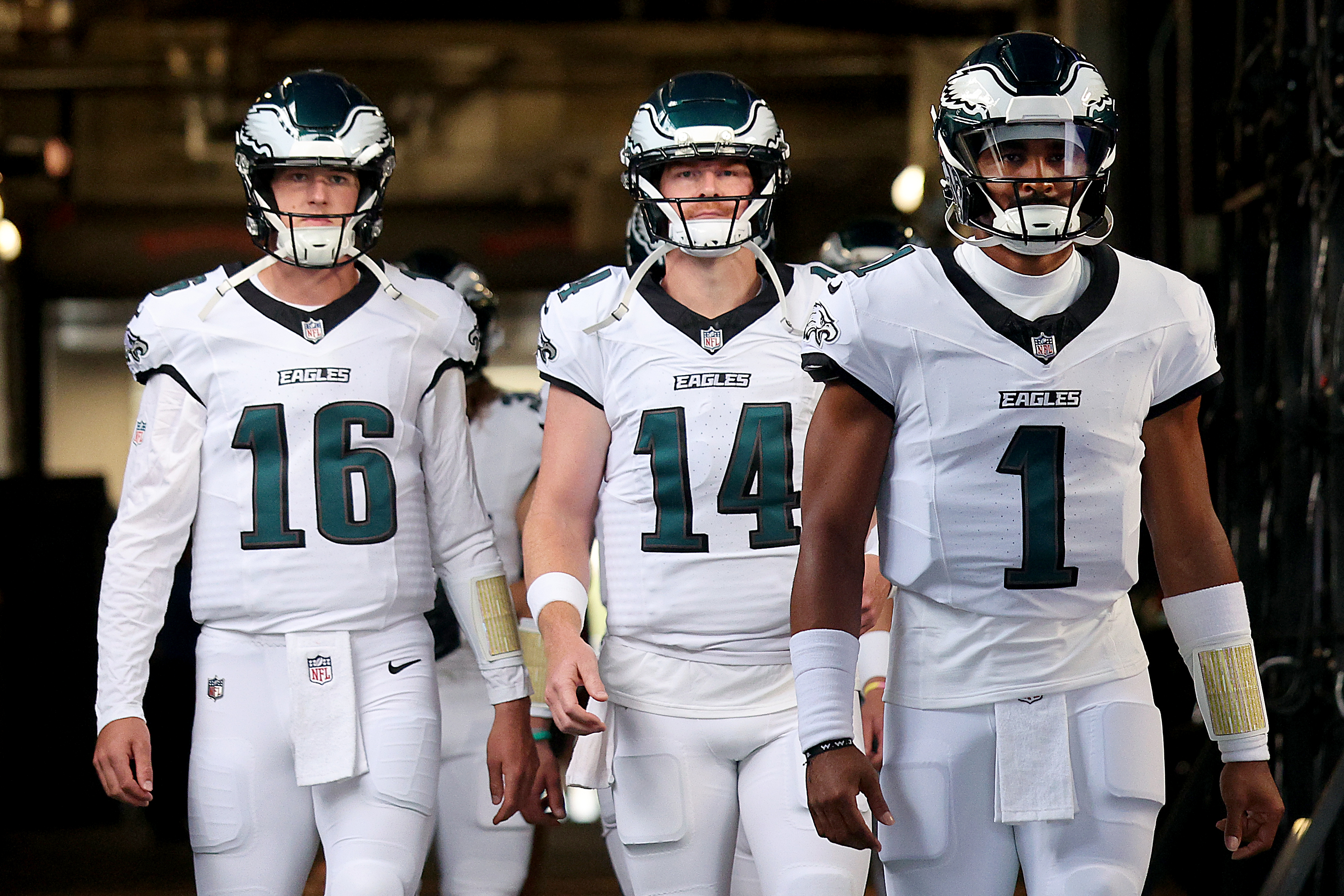
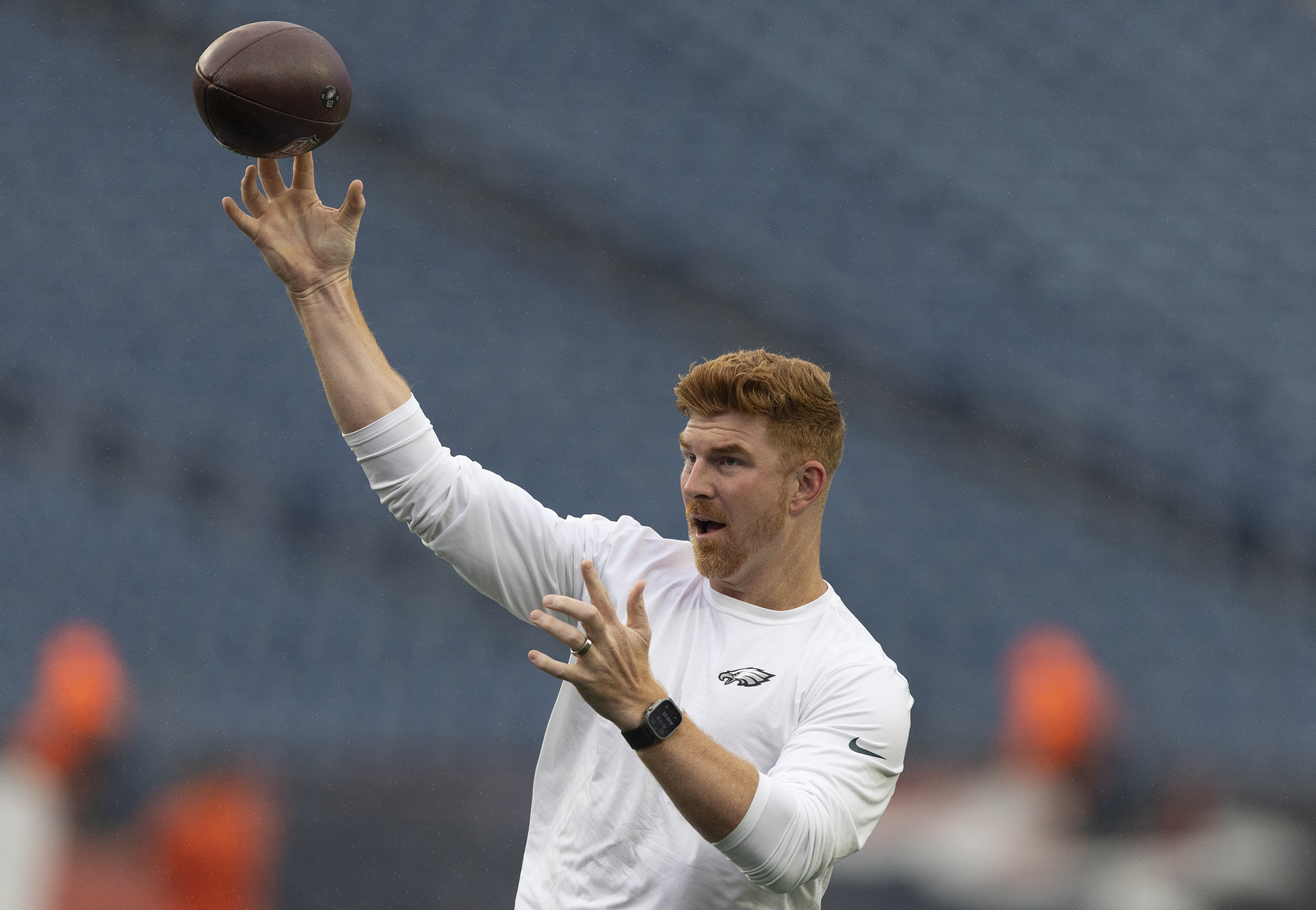
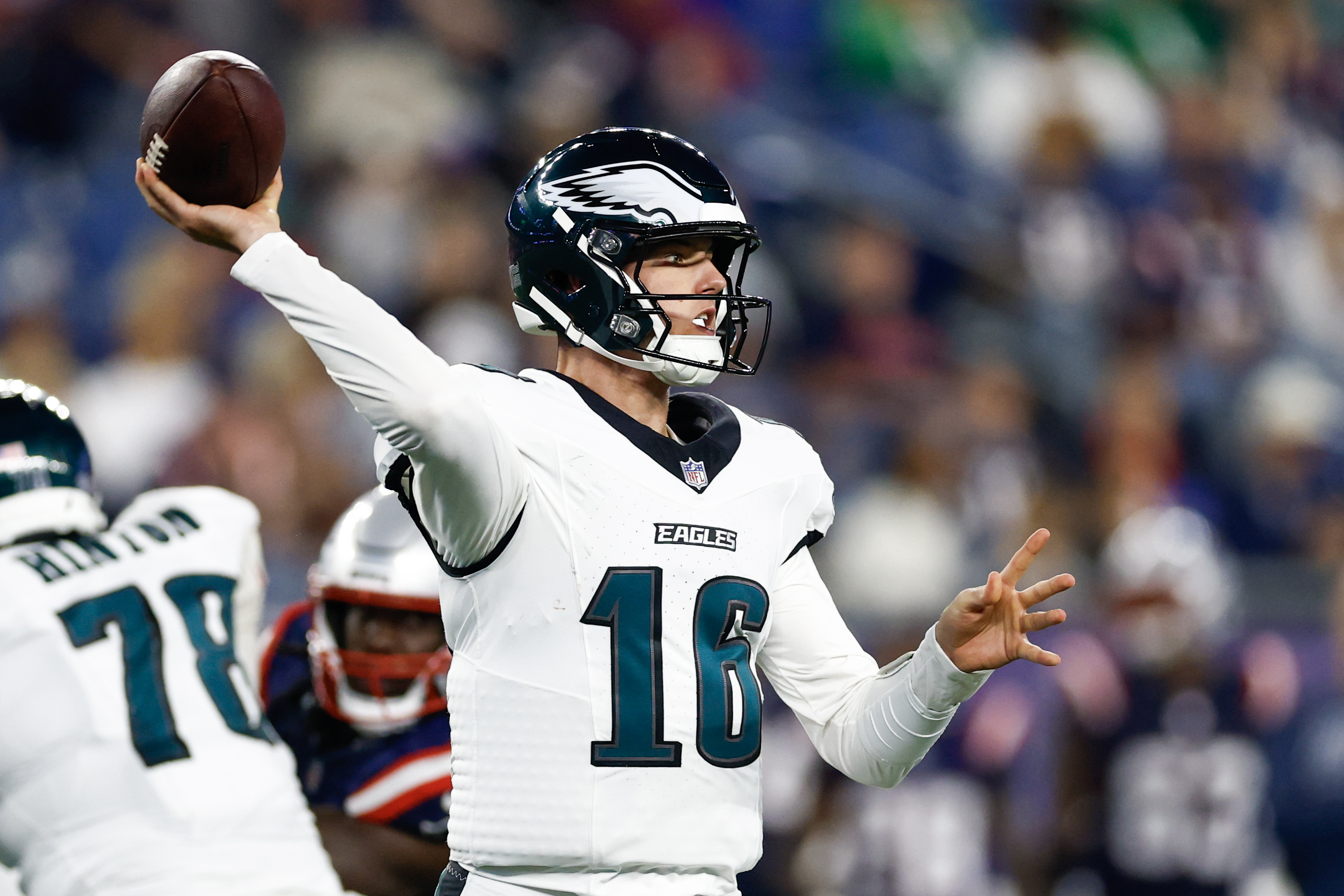
The Eagles used to value the backup quarterback position, perhaps more than any other team in the NFL. Looking at their rosters in 2025 and 2026, it’s hard to believe they still do.
This might not matter at all, except Eagles starter Jalen Hurts gets hurt a lot, and quarterbacks are the most important players in all of team sports.
Still, it seems like a lot of energy to spend on a guy who won’t play much. Backup quarterback angst: The sort of nattering matter that makes the NFL preseason interminable; the sort of infuriating football geek-talk that fantasy nerds Snapchat about.
You know. Guys like Lurie and Roseman.
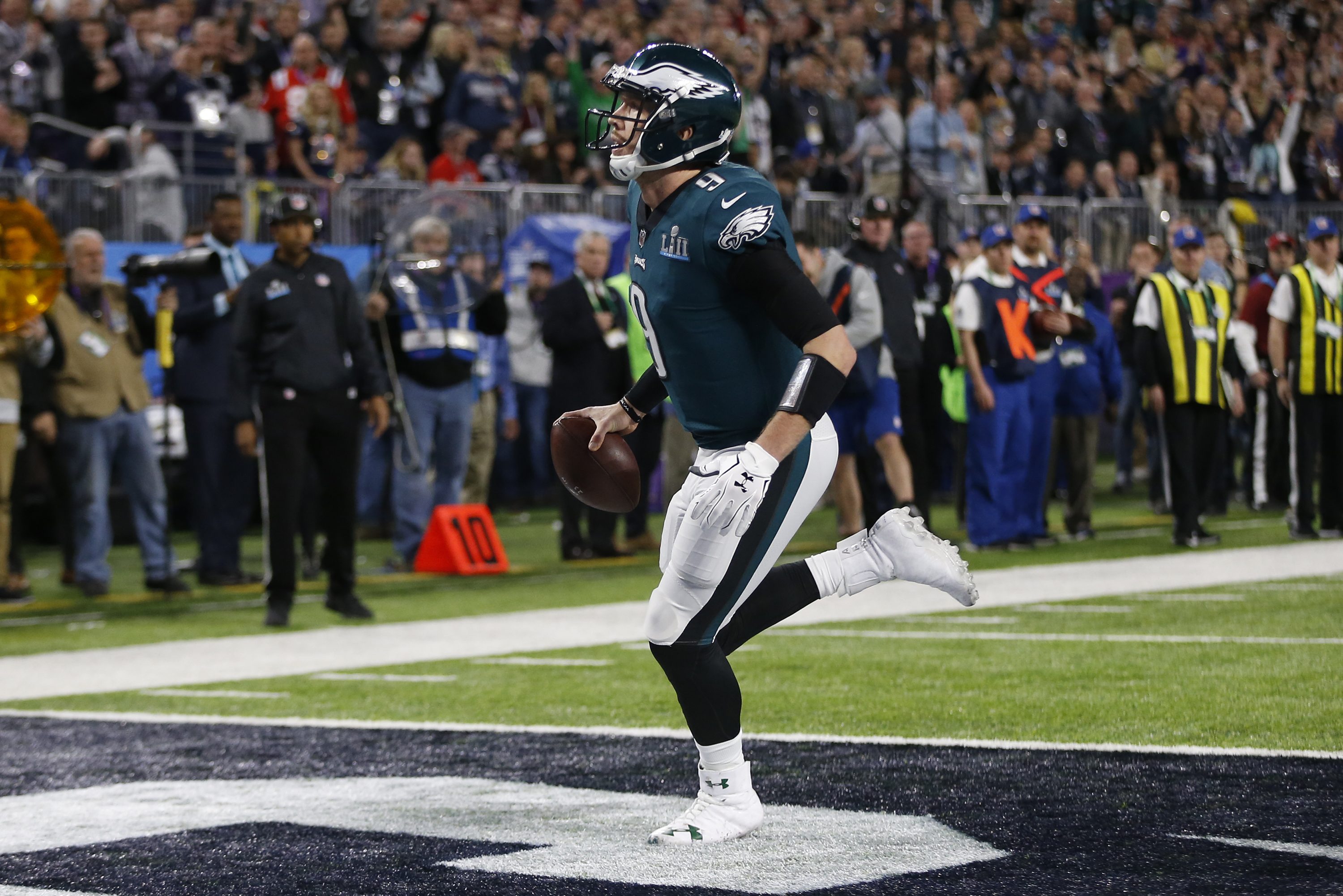
In 2017, the Eagles committed $11 million to their backup quarterback spot. So important was the position to owner Jeffrey Lurie that he told GM Howie Roseman to sign Nick Foles, whom Andy Reid had just cut from the Chiefs. It meant eating $7 million of the contract of Chase Daniel, whom the Eagles promptly released.
Despite missing the playoffs in 2016 with rookie Carson Wentz at quarterback, Lurie saw 2017 as a real chance to win the franchise’s first Super Bowl, and he considered Foles, who’d had a strong run as an Eagle, to be a better option than Daniel, who’d never had a strong run anywhere.
The rest, as they say, is history: Wentz got injured, Foles replaced him, played well down the stretch, and won the MVP award inSuper Bowl LII where he outplayed Patriots legend Tom Brady and outfoxed coach Bill Belichick.
Nick Foles became an unassailable Eagles legend, but that doesn’t mean all backup quarterbacks are created equal. Michael Bryant / Staff Photographer
“Our priority, as you’ve seen, is to make sure we have the very best possible other starting quarterback,” Lurie said during Super Bowl week.
That’s generally been true, and it’s generally made sense for the Birds, since Lurie prefers mobile quarterbacks, who, of course, are more likely to get hurt.
Lurie signed Michael Vick out of prison in 2009, and Vick supplanted Donovan McNabb the next season and went to the Pro Bowl in his second of four years as an Eagle. Lurie drafted Hurts in the second round in 2020 with plans that Hurts would be the long-term backup to Wentz, but that’s before Ginger Jesus lost his job, and maybe his mind. Lurie sanctioned the recent, sensible acquisitions of Gardner Minshew, Marcus Mariota, and Kenny Pickett.
But in 2019, Lurie also approved the signing of Josh McCown, a 40-year-old with a 79.7 passer rating with eight other teams. McCown replaced Wentz early in the Eagles’ home wild-card playoff game, played atrociously (predictably), and cost the Birds their postseason.
Last season, Lurie allowed the Birds to enter the season with third-year sixth-round pick Tanner McKee as the backup of a team defending its second Super Bowl title. It didn’t matter, since Hurts stayed healthy. But McKee got to start game 17 against the Commanders, and he was poor: 21-for-40, 241 yards, one touchdown, one interception, with a forgettable fourth quarter that cost the Eagles their chance to win the game and capture a better seed. It looked OK in the moment, but upon further review, the Eagles (and I) decided that McKee is not the answer.
The Eagles (not I) determined that Andy Dalton is the answer.
They were wrong.
The Eagles’ bet on Andy Dalton does not appear to be going according to plan. Yong Kim / Staff Photographer
The Birds in March traded a seventh-round pick to the Panthers for Dalton.
No player at Eagles preseason work or in training camp has been a bigger disappointment than Dalton.
That isn’t really fair. There should have been minimal expectations of Dalton.
He’ll be 39 in October. He’s 1-6 in his last seven starts over the past three years, during which time his passer rating is 84.5. Aberration? No. In the five seasons before that, his rating was 85.5 in 57 games. He’s been the backup in Carolina the past three seasons, essentially a big brother for Bryce Young, the underperforming No. 1 overall pick from 2023, and an assistant coach of sorts.
That’s the role he was expected to serve in Philadelphia, where new offensive coordinator Sean Mannion has installed a new scheme. Dalton can help with the adjustment for Hurts, and you’d think Dalton would have a significant advantage over McKee in executing the offense.
Tanner McKee again appears to be the best backup option for the Eagles. Yong Kim / Staff Photographer
But no. Dalton has looked appreciably worse than McKee — so much worse that McKee’s unremarkable performance looks good by comparison.
Entering the third and final preseason game Friday, the competition, such as it is, for the backup job clearly tilts in McKee’s favor. Which delivers this uncomfortable truth:
The Eagles, who have made the playoffs five years in a row, don’t really have a viable backup quarterback. That’s the fault of the front office.
Roseman.
Lurie.
What should they have done?
Maybe they should have signed Mitch Trubisky, who got two years and $10.5 million to back up Cam Ward in Tennessee. Maybe another dance with Minshew, who got $8.25 million to back up Jacoby Brissett in Arizona. Both would have cost a lot more than Dalton’s $1.5 million, but that’s also just about what Tua Tagovailoa got from the Falcons to be the emergency plan if Michael Penix Jr. wasn’t back in time from his knee injury.
All three of those QBs are in spots where they will have a likelier chance to resurrect their careers. Maybe that’s why the Eagles weren’t able to land one of them, and why they had to trade a pick for Dalton.
To be fair to Roseman and Lurie, the Birds also drafted a quarterback in April: Cole Payton, in the fifth round, out of North Dakota State, who currently is not close to being an option.
To be fair to Payton, he might be as good an option as the other two.