Philadelphia City Council voted Thursday to formally recognize Black Bottom, a predominantly Black neighborhood in West Philadelphia that was largely demolished in the 1960s to make room for a research park and other institutional development.
The resolution restores official recognition of a name that former residents have kept alive for decades, even as the area between 32nd and 40th Streets and University and Lancaster Avenues became known as University City. It also calls for future city communications and actions to acknowledge Black Bottom’s importance.
The Black Bottom neighborhood includes the area between 32nd and 40th Street and University Avenue and Lancaster Avenue.Steve Madden
The resolution acknowledges that displaced residents were excluded from the prosperity the new development created. But it does not provide compensation or establish a way for families to return. Councilmember Jamie Gauthier, whose district includes Black Bottom, introduced the legislation and described the resolution as a first step. “We still have much more work to do,” she said in an email, “but this is an important milestone in repairing the harm that the City and others inflicted here.”
Black Bottom emerged during the Great Migration, when Black Southerners moved to Philadelphia in search of work and opportunity. By the mid-20th century, it was a thriving community of homes, businesses, theaters, and clubs. But after the passage of the 1949 Federal Housing Act, the city deemed the neighborhood blighted and used federal urban renewal funds to demolish it, clearing homes and businesses for projects backed by the University of Pennsylvania and Drexel University. Thousands of Black residents were displaced as a result, forced to resettle in new parts of the city.
Those former residents and their descendants never forgot about Black Bottom, though. They have held annual reunions since 1974, while activists like Walter Palmer have spent decades documenting the neighborhood and organizing efforts to preserve its history.
A Black Bottom celebration and renaming ceremony will take place on Wednesday, Oct. 7, at the northwest corner of 36th and Market Streets.
As a reporter for “How I Bought This House,” The Inquirer’s series that shares the stories of how people purchased homes, I’ve spent a lot of time asking people about, well, how they bought their houses. How much they offered. What they waived. What they regretted. I’ve learned all sorts of tips and tricks, strategies, and common mistakes to avoid.
So when I bought my first house this August in Philadelphia, I fancied myself savvier than the average first-time buyer. I knew, for instance, that the appropriate response to discovering knob-and-tube wiring is to run in the opposite direction, and that only a fool would waive the inspection.
I headed into the process eager and overly confident, sure I’d be able to nab the perfect house well below the asking price and secure a mortgage at the lowest possible interest rate. I’d planned to use things I learned while helming this column, like seller assists and mortgage buydowns, to finagle the seller into practically giving me the house for free.
Then I found a house I really wanted, and I learned that knowing what to do is one thing. Doing it when you are terrified that someone else might buy your dream house is another.
Most of the hacks I picked up flew out the window the second another couple showed up at the open house. Faced with a competitive seller’s market, I quickly folded on things I would’ve previously considered nonnegotiable.
Like the inspection. While I didn’t waive it entirely, I did agree to it being “information only,” meaning I gave up my right to ask the seller to fix or pay for anything. Information-only inspections can strengthen your offer when you can’t afford to pay more, but they can still end up costing you in the form of a hefty repair bill.
Looking back, I wish I had done a full inspection. I didn’t know the details of the other offers, but I doubt anyone else waived theirs. When the report came back with a list of necessary repairs totaling $15,000, I was stuck.
I knew from interviewing dozens of buyers that people often use inspection findings to negotiate a seller’s credit. I would’ve liked to ask for one to cover some of the $12,000 it cost to replace the cloth wiring. But because I’d agreed to an information-only inspection, my only real option was to walk away. I believe this is what people in business call giving away your leverage.
And speaking of giving away leverage, I don’t know why I offered over the asking price except that fear is a powerful motivator. And by that point, I had developed a healthy fear of being outbid.
I had already been outbid on two houses, both of which sold for more than $40,000 above asking. This time I could afford to offer more, so I did, even though I didn’t know what the other offers were.
In a less panicky state, I might have remembered something I’d heard again and again reporting on homebuyers: If someone else offered more than us, the seller would probably circle back and ask if I could match them. That would’ve been a good time to go above the asking price. Instead, I did it right out of the gate. To borrow another phrase from the business community, I negotiated against myself.
Thankfully, not everything I learned from How I Bought This House was for naught. While debating ways I could fend off the competition I was convinced was trying to steal my house, I remembered a couple from Collingswood who hoped to avoid a bidding war. They had bought and sold several homes before, so they knew how to put together an irresistible offer. One of the things they did was waive the mortgage contingency.
When you waive the mortgage contingency, you’re essentially telling the seller that your financing is your problem, not theirs. If your loan falls through, you can’t back out of the deal and get your earnest money back. You have to be able to buy the house one way or another.
It sounds risky — especially if you’re still planning to use a mortgage — but I felt it was a risk I could safely take. My lender was confident I’d be approved.
Plus, I knew the seller would find it appealing because sellers love certainty. Waiving the mortgage contingency gave them the security of an all-cash offer without requiring us to actually make one. A true “win-win,” as my friends in business would say.
Of course, I have no idea whether it won us the house, but after spending so much of the process paying extra to calm my own nerves, it felt good to finally strengthen my offer for free.
If I learned anything from buying my first house, it’s that you should decide what you’re willing to spend, waive, or risk before you fall in love. Then stick to it. I didn’t. But I still got the house. And I don’t have any regrets.
When Buddy Osborne’s phone rings, it’s because something has gone wrong. An accident. A death. A traumatic event on a job site. This past April, it was a catastrophic collapse. A parking garage had fallen, and three construction workers were dead.
Osborne, 67, the chaplain for the Philadelphia Building and Construction Trades Council, arrived at the scene to find an ironworker being interviewed by investigators from the Occupational Safety and Health Administration. The man had witnessed the collapse. The workers who died had been part of his crew. Osborne did not know him. They had never met. But as a chaplain, Osborne was there to help the workers who witnessed the traumatic event. His job, as he put it, was to “render support to workers in distress.”
In addition to being a pastor at the Rock Ministry, Buddy Osborne is the chaplain for the Philadelphia Building Trades Council and a former Tyger Williams / Staff Photographer
He waited until the interview ended. Then he walked over, introduced himself, and placed a hand on the worker’s shoulder. “He’s a tough guy,” Osborne said, “but he just broke down.” Osborne hugged the worker as he wept. By the time he pulled away, his shirt was wet with the man’s tears.
The ironworker Osborne comforted was part of a workforce that is deeply woven into Philadelphia’s civic identity. Roughly 121,000 people across the Philadelphia metropolitan area work in construction, following a decade of steady growth. The Philadelphia Building and Construction Trades Council alone represents more than 50 local unions. Politicians court their support. The city celebrates the buildings, roads, and public projects they construct. But behind that civic pride is a workforce in profound distress.
Construction has one of the highest suicide rates of any major industry in the country, according to the Centers for Disease Control and Prevention. More than 5,000 construction workers die by suicide each year, roughly five times the number who die from fatal worksite injuries, and male construction workers are 75% more likely to die by suicide than the general population. Construction workers also die from drug overdoses at a higher rate than workers in any other industry.
Those numbers have set off an urgent effort in Philadelphia to confront the mental health crisis roiling the construction industry. Osborne is but one small part of it. An entire alphabet of organizations, from ATAP, the Allied Trades Assistance Program, and CIASP, the Construction Industry Alliance for Suicide Prevention, to CWC, Carpenters Who Care, and MACSC, the Mid-Atlantic Construction Safety Council, now offer expanded access to mental healthcare and substance use treatment.
There are peer-support networks and suicide prevention training programs. On job sites, there are daily stand-downs and toolbox talks devoted to mental health awareness. There is a Construction Suicide Prevention Week every September, and this past May, for the first time, 50 workers gathered in the Wissahickon for the Greater Philadelphia Construction Hike for Hope, sponsored by the American Foundation for Suicide Prevention.
All of this is to say: Everybody cares. All eyes are on the issue.
As Johnathan Davis, a professor at the University of Iowa’s College of Public Health, put it: “The construction industry has had a phenomenal response to this problem, and the awareness, the destigmatization, and the support programs are important parts of that response.” Indeed, it has never been easier for a construction worker in distress to get help.
Yet the crisis of the distressed construction worker persists, in part because, according to interviews with dozens of workers, the industry itself produces the suffering. And, so far, it has done more to treat it than to prevent it. The focus now, Davis said, needs to be on “upstream solutions.” So, not only helping workers once they hit their breaking points, but also addressing the conditions that bring them there in the first place.
Union workers watch as demolition continues in Grays Ferry on Sunday, April 12, 2026, at the site of the parking garage collapse.Tom Gralish / Staff Photographer
The same day Osborne, who lives in Kensington, was at the parking garage, Marianne Wolfe was meeting with the workers in their union halls.
Wolfe is the managed care supervisor for ATAP, an employee assistance program that provides mental health and substance use services for organized labor. After a tragedy like the parking garage collapse, part of her job is to lead workers through critical incident stress debriefing, a structured, therapist-led conversation meant to help people process the trauma they have just experienced.
In this case, that meant sitting with workers who had witnessed the collapse and were still trying to make sense of it.
“They were just trying to wrap their heads around what took place,” Wolfe said. “Survivor’s guilt. It was a ‘Why wasn’t it me?’ type of thing.”
Trauma, Wolfe said, “is a very tricky thing.” It does not always arrive when expected. It can surface weeks or years later. That is why she expected ATAP to keep receiving calls about the collapse for at least several months. If so, those calls will come into an office that is already busy.
“We’re a high-volume call center,” Wolfe said.
Scaffold workers work on a building on North Broad street in Philadelphia Pa.Jose F. Moreno / Staff Photographer
Workers reach out to ATAP when they need help and don’t know where to turn. They call ATAP’s 24-hour emergency hotline when they are desperate, sometimes actively suicidal, and an ATAP employee quickly connects them to the right level of support, whether that is outpatient counseling, substance use treatment, or immediate inpatient care.
For years, Wolfe said, most of the calls coming into ATAP were about substance use that was exacerbated, in part, by wear and tear from demanding physical labor.
“We were still in the opioid epidemic,” she said. “Now we are in what we’re calling a mental health epidemic.” She attributed the shift to years of education and anti-stigma work that made it easier for workers to ask for help.
Some workers call because they are anxious. Some call to discuss family or work-life balance issues. Sometimes they call because they cannot sleep. Their reasons run the gamut, but they all lead back to a simple truth: “Being a construction worker isn’t an easy job,” Wolfe said.
Layoffs and financial instability are par for the course. The hours are grueling. Some work seven days a week. There is hardly any time to see family. Left unaddressed, those pressures can pile up until a worker feels helpless, or hopeless, or, in Anthony Zecca’s case, both.
A nonprofit called ATAP helped Anthony Zecca get a psychiatrist and helped find treatment and services for his son, Salvatore, who has autism.William Thomas Cain / For The Inquirer
“I’ll be honest with you,” Zecca, who lives in Fairless Hills, said in April. “I didn’t want to live anymore.”
He was describing how low things had gotten the previous December. His marriage was on the brink of collapse. His father-in-law had warned him that if he couldn’t get his temper under control, he was going to lose his family. He had been having anger issues ever since he got out of prison in 2023, after serving four years for possession of a firearm. “I had a very hard time adjusting,” he said.
At Christmas, Zecca got so angry that he kicked over the tree and broke his toe. He had to get surgery and could not work for six weeks. But the real wake-up call was his daughter’s reaction that night.
“I saw how terrified she was of me, and I just broke down in tears,” he said. “I couldn’t do it anymore.”
Zecca, 41, called ATAP the next day and spoke to Wolfe. “I told her I’m having a lot of problems at home,” he recalled. “I said I’m really depressed. I’m not doing good.”
Wolfe got to work on Zecca’s behalf immediately. She got him into anger management and found him a therapist and a psychiatrist, whom he now sees every month. She helped his 8-year-old son who has autism, too, by connecting him with a behavioral psychologist. Zecca ended up calling ATAP so frequently that Wolfe gave him her personal cell phone number.
Anthony Zecca (CQ) and his son Salvatore Zecca (CQ), 8, pose for a photograph in their yard Friday, May 08, 2026 at private residence in Fairless Hills, Pennsylvania. A nonprofit called ATAP helped get him a psychiatrist and helped find treatment and services for his son, Salvatore, who has autism.William Thomas Cain / For The Inquirer
Life has been much better for Zecca ever since he reached out to ATAP. He and his wife still fight sometimes, mostly about his hours. He is away from 4 a.m. until 7 p.m. every day. But they have not had any major blowouts since Christmas. His psychiatrist put him on Wellbutrin, which Zecca says helps with both his depression and his ADHD. He uses his therapy sessions to work through the different stressors in his life.
Zecca still has many sleepless nights and considers himself an “anxiety-ridden person.” And the construction industry remains his biggest stressor. He wakes up every day worried he will be laid off and out of work for the next month. “It really wears on me,” he said.
Unable to make peace with the industry’s uncertainty, Zecca is trying to change his circumstances.
“I just want a steady job where I don’t have to worry about being laid off,” he said. He is tired of the stress on the job, the demanding timelines, and the endless hours. He is hardly alone.
John Sobetsky of Royersford at his home on Tuesday, May 12, 2026. John has been dealing with depression over the years and is a major advocate of mental health treatment in the construction industry.Alejandro A. Alvarez / Staff Photographer
John Sobetsky, 35, was among the workers who gathered in the Wissahickon for the Greater Philadelphia Construction Hike for Hope. For him, the cause is personal: Sobetsky survived a suicide attempt in high school and is now active in the industry’s mental health efforts. He also knows firsthand how the pressures of construction can overwhelm the rest of a person’s life.
The former technician and concrete mixer-turned-business development manager said his life is much more manageable ever since he traded the grind and churn of construction work for a 9-to-5.
“It’s almost night and day,” he said. “I don’t have those deadlines weighing on me. I have freedom. I have flexibility.”
Three years ago, Sobetsky, who lives in Royersford, was managing a construction project that was such a “complete cluster from beginning to end. … I wasn’t sleeping. I wasn’t eating,” Sobetsky recalled. “My anxiety was out of control.”
Eventually, it affected his ability to do his job. “I was missing wire runs,” he said. “I was spending way too much time on tasks that should have taken me half the time because I was just mentally out of it.” It got so bad that his boss asked him if he was OK. That, experts say, is often how distress shows up on the job.
“Warning signs often masquerade as performance issues,” said Sonya Bohmann, executive director of the Construction Industry Alliance for Suicide Prevention. “It’s things like not showing up for work on time anymore. It’s things like jumping to conflict when you’re usually the person who’s really the steady Eddie.”
Those sorts of behavioral changes are opportunities for bosses and supervisors to check in and point workers to available services. But, according to Bohmann, culture frequently gets in the way.
“It’s hard to say I’m going to therapy because people will look at you like you’re weak or selfish,” she said, “and you never want someone to think that you’re not fit for duty under the hard hat because then they don’t want you on their crew.”
John Sobetsky of Royersford with books that he enjoys reading for relaxation at his home on Tuesday, May 12, 2026. John has been dealing with depression over the years and is a major advocate of mental health treatment in the construction industry.Alejandro A. Alvarez / Staff Photographer
That fear stopped Zecca from seeing the free mental health counselor at his union hall. “I didn’t want a higher-up to see me go in and out of there and think I was a head case,” he said.
According to Sobetsky, until the culture changes, even the best-intentioned services are nothing more than a “checkbox.” Because when a boss or superintendent treats leaving 45 minutes early on a Tuesday to see a therapist as a problem, the help exists only on paper. “Then you don’t really offer it,” Sobetsky said, “because I can’t use it.”
To Bohmann, that is where the work has to move next: from checking the box to creating what she calls a “culture of care,” built on the understanding that the way the industry functions actually affects workers’ mental health.
That’s not just her hunch. It is what new research from professor Davis and the Center for Construction Research and Training (known by its former acronym, CPWR) suggests. Davis conducted an unpublished study that he says shows the presence of family and paid leave policies correlated with lower rates of suicide for construction workers.
“I believe it,” Zecca said when told about the study’s findings. The implications could not be clearer.
As Davis said: “If you as an employer, you as a contractor, you as a union, are interested in lowering the rate of suicide … these are the type of benefits that you should be working into your programs.”
One upstream, preventive solution the industry so desperately needs? It already exists. It is called PTO.
A construction worker stood in a window at 21st and Washington Streets in Philadelphia, Pa. on Thursday, July 27, 2023. Philly had declared a “heat emergency,” when it felt like 106 degrees in the shade.Monica Herndon / Staff Photographer
Jason Scholl, the owner of LK Miller, based in Ambler, recently transitioned all of his workers from hourly to salaried wages. He gives them Friday afternoons off in the summer and generally tries to create a culture where his team feels safe. “I try to give them every tool in my toolbox to help them handle the rigors of what they’re doing on a day-to-day,” Scholl said.
There are concerned bosses, too. Ones who take decisive action, like Mary Pat Geppert, who runs Geppert Bros., the demolition contractor that cleaned up the site of the deadly January 2025 plane crash in Northeast Philadelphia. The work was horrifying, Geppert said. Debris and human remains were spread across a 12-block area. Geppert’s workers would not even bring their boots home because of what they walked through. She knew they needed help, so she brought in Buddy Osborne and gave everyone the morning off to talk about what they had seen. She bought them new boots, too. And reminded them of one of her favorite sayings: “It’s OK to not be OK.”
But it’s what Geppert does not do that she believes makes the biggest difference to her workers’ mental health. She does not lay people off. Or at least she tries very hard not to. Even when Geppert Bros. does not have a contract, she keeps her guys working in the company’s own yard. “That’s our secret sauce,” she said. “We don’t let our guys go back to the hall.”
A construction worker works at a construction site near Interstate 95 in Philadelphia, Thursday, Jan. 22, 2026.Jose F. Moreno / Staff Photographer
What Geppert Bros. has figured out is what Davis hopes the industry can move toward: steadier, more long-term employment. Such big conceptual changes, like reconfiguring benefits packages and contracts to increase stability, might take more time, but Davis says the industry is well-suited to address these problems.
Zecca is not waiting for those changes to arrive. For more than a year, he has been trying to land a full-time job with Energy Transfer, an oil and gas company headquartered in Texas. The job would involve maintaining the company’s pipelines in Pennsylvania. Instead of starting over with new bosses, crews, and equipment every few months, he would work with the same team on the same project.
It is his dream job. Not because of the work itself or the money. Because it is steady. He wears the company’s navy-and-white hat every day for good luck.
“I just need something with more consistency,” he said one evening in May.
Two days later, he was laid off.
A construction worker helps guide a section of pre-cast concrete in place in the upper level at the site of the new Eagles Stadium on Friday, May 10, 2002.David Maialetti / Staff Photographer
Rep. David Maloney, a Republican who represents parts of Berks County, wants to rename Lake Erie to “Lake Pennsylvania,” arguing that the state’s only Great Lake has become increasingly important to Pennsylvania’s economy and identity.
Maloney plans to introduce a resolution that would urge President Donald Trump, Congress, and the U.S. Secretary of the Interior to take the necessary steps to change the lake’s name, according to a recent news release.
In a memo to fellow lawmakers, Maloney pointed to the millions of Pennsylvanians who visit nearby Presque Isle and the Erie Bluffs each year, and to tourism’s importance to Erie County. He also argued that Pennsylvania plays an outsized role in supporting the lake’s recreational fishery, despite having a small share of its shoreline. According to the Great Lakes Fishery Commission’s 2025 report, Pennsylvania stocked almost 500,000 yearling steelhead last year, or roughly 40% of all steelhead in the lake, and more than any other state or Canadian province.
“This is Pennsylvania’s only Great Lake,” Maloney said in a post on X. “Its modern economy and identity are increasingly tied to the boaters, anglers, families and tourists who come to enjoy it.”
“Ohio has plenty of shoreline. New York already has two Great Lakes. Canada has four others,” he said. “Pennsylvania has one. Let’s call it Lake Pennsylvania!”
The proposal comes shortly after Trump ordered the federal government to begin calling Lake Ontario “Lake America.” Trump signed an executive order on Aug. 27 directing the Secretary of the Interior and the U.S. Board on Geographic Names to make the change in federal records.
Maloney’s resolution has not yet been formally introduced in the Pennsylvania House.
The house: A 1,150-square-foot townhouse in Southwest Philly with two bedrooms and two bathrooms built in 1925.
The price: Listed for $180,000; purchased for $165,000.
The agent: Kristie Bergey, Coldwell Banker
The ask: Dylan Foglesong felt like he was overpaying for his apartment. He was spending $2,600 a month, plus utilities, for a two-bedroom place in Manayunk, and the money was going toward a place he would never own.
Dylan Foglesong tends to an area he calls the shrine in his home.Elizabeth Robertson / Staff Photographer
After six months, he paid the fee to break his lease and moved into a house with friends. His rent dropped to $600 a month, and because he was subletting month-to-month, he could leave whenever he wanted. He was saving more than $2,000 a month, and he realized he could put that money toward buying a house.
Foglesong had a simple wish list. As an avid cyclist, he wanted to be near multiple bike paths. He also wanted outdoor space, two usable bedrooms, and a low price. He did not care about central air or polished finishes. “I just wanted a cheap place that worked,” he said.
The search: Foglesong started searching in January,focusing on a small section of Southwest Philadelphia near Bartram’s Garden and the trail network along the Schuylkill. He wanted to remain close to Center City so he could bike to work.
Foglesong uses the rope wall to work out in the studio of his home.Elizabeth Robertson / Staff Photographer
He saw five houses. The first one was in his ideal location, but the floors were scratched and coming up, the kitchen looked decades out of date, and the upstairs had the cramped three-bedroom layout he wanted to avoid. It would have taken too much work to reach a point where he was not “barfing every morning at how much of an eyesore it was,” he said.
The only other serious contender had a large backyard, a clean basement, and an updated kitchen. But a quarter of the ceiling in one upstairs room appeared to be collapsing because of a leak. The house was listed for about $212,000. Foglesong offered $190,000, figuring he could use the difference to repair the roof, but the seller rejected the offer.
The appeal: The fifth and final house had a great layout. Both rooms upstairs were large. It also recently had “a really thoughtful renovation,” Foglesong said. The updates included a new HVAC system and appliances, while the house also had a finished basement with high ceilings, outdoor space, and an enclosed front porch where he could store his bikes.
Foglesong also liked the location on a quiet side street with little through traffic. “It’s on the kind of street that you wouldn’t drive down unless you lived there or you knew someone who lived there,” Foglesong said. Most of the houses on the block were occupied, which made the neighborhood feel established.
Dylan Foglesong is reflected in a mirror that hangs, next to classic car ads, in the foyer of his home.Elizabeth Robertson / Staff Photographer
The deal: The house had initially been listed for a little more than $181,000 before the seller lowered the price to $180,000. It had been on the market for roughly five months by the time Foglesong saw it.
He offered $170,000 and asked the seller to contribute 3% toward closing costs. They declined the closing assistance but countered at $165,000. The lower price ended up saving Foglesong the same amount of money, so he accepted.
The inspection was clean, save for one issue with the electrical. When Foglesong called Peco to arrange service, he learned that the house was not legally connected, even though the power was on. An electrical inspection found that the breaker box needed work, and the seller hired an electrician to set it up properly. But Foglesong still could not transfer the service into his name until the seller paid thousands of dollars in outstanding utility balances. The whole thing “seemed a little sus,” Foglesong said, but it worked out.
The money: Foglesong put 3% down, or $4,950. Including his closing costs, he paid about $11,600 out of pocket to buy the $165,000 house. His mortgage rate is 6.25%. Today, his monthly payment, including property taxes, is $1,300.
He already had some savings when he moved in with roommates, but the drop in rent allowed him to build the rest quickly. He estimates that he was saving nearly $3,000 a month. Within 3½ months, he had accumulated enough to cover the down payment and closing costs. “You take that little compromise for a couple of months,” Foglesong said about moving in with friends, “and all of a sudden you have $11,000 in your bank account.”
The move: Foglesong closed in April and moved his belongings from the shared house into a 10-foot U-Haul. Everything fit in one load, and he completed the move over two days without hiring movers or asking friends to help.
He managed it alone because he did not own much heavy furniture. His couch comes apart into sections, and he sleeps on a futon that he could fold and carry over his shoulders. For everything else, he improvised. “You put a blanket on the stairs, slide the furniture down,” Foglesong said. “You figure it out.”
Life after close: At first, buying the house felt less momentous than Foglesong expected. He had imagined “a really grand, movie-montage sequence,” he said, but moving in felt much like any of the other moves he had made during his 10 years in Philadelphia.
But as the weeks passed, the difference between his new home and the others became clearer. He was no longer paying rent for a place that belonged to someone else. He owned the house, and the monthly payment was within his budget. “It’s very grounding to wake up in a place that you can afford,” Fogelson said.
The experience also reinforced his belief that young buyers may need to reconsider what they expect from their first home. “You have to be realistic about what you can access right now,” Foglesong said. “Your first house doesn’t have to be your dream home.”
Editor’s note: This article has been updated to correct real estate agent Kristie Bergey’s name.
Did you recently buy a home in the Philadelphia area or South Jersey? Share the story of how you did it. Email Inquirer real estate reporters at properties@inquirer.com.
At 102, Cyrus Bloom does not pretend that old age is pleasant.
“It’s hard,” he said during a recent interview at his Center City apartment. He can barely walk, even with a walker, and he lives with the constant fear of falling. His short-term memory is shot, too. Walking into a room to get something, only to forget what he went there for, is an everyday occurrence. “It’s terrible,” he said matter-of-factly.
But his long-term memory? That’s a different story.
Bloom can still recall names, places, and details from more than 80 years ago, when he was one of the 16.4 million Americans who served in World War II. He can rattle off the details of his first assignment as a meteorologist with the Army Air Corps and the names of the bomber bases that dotted the coast of England where he was stationed. He remembers everything about “the very big war,” as he called it, even though he spent most of his life not talking about it.
Bloom, who was born in Newark, N.J., was a sophomore at Columbia University when he enlisted with the Army Air Corps and began training as a meteorologist. It was March 1943. He received his commission as a second lieutenant on June 6, 1944, the same day the Allied forces landed on the beaches of Normandy.
The invasion, Bloom noted, had originally been scheduled for June 5. But bad weather over the English Channel prompted Gen. Dwight D. Eisenhower to postpone it for a day. Bloom had no role in that decision; he had only just completed his training. But the delay demonstrated how heavily the Allied war effort depended on accurate weather forecasts.
Cyrus Bloom, 102, is photographed at his home in Philadelphia on Tuesday, June 9, 2026. Bloom worked as a meteorologist during World War II.Jose F. Moreno / Staff Photographer
Bloom’s first assignment took him to Bergstrom Air Force Base in Austin, Texas. There, he and the other meteorologists gathered reports on temperature, wind, and air pressure from weather stations across the country. They plotted the information on maps and drew isobars — lines connecting places with the same air pressure — by hand. Those lines revealed high- and low-pressure systems and helped meteorologists predict how the weather would move.
In September 1944, the Army sent Bloom overseas. Like so many young soldiers, he had never been abroad before. Today, he remembers every step of the journey. He left Washington on a military transport plane bound for Europe. The first stop was Goose Bay, Labrador, in northeastern Canada, where the plane refueled.
“It was just wilderness,” Bloom recalled, “very rugged country.”
From there, he flew across the Atlantic to Prestwick, Scotland, then continued south to London. The Army later sent him to the Cotswolds for additional training in British forecasting procedures. He remembers the region for its thatched-roof houses.
His final assignment took him to East Anglia, on England’s eastern coast. The countryside was crowded with airfields used by the U.S. Eighth Air Force, which carried out bombing missions over Germany. Bloom was stationed at Bovingdon, code-named Earl’s Court. His job was to brief bomber crews on the weather they could expect en route to Germany. His briefings were based on forecasts prepared at Eighth Air Force headquarters, which was called Pinetree.
“Everything had a code name,” Bloom said.
That world of code names, weather maps, and high-stakes forecasts is the subject of Pressure, a new film about the meteorologists who advised Eisenhower in the tense days before D-Day. In the film, a meteorologist stands at the center of a decision that could determine the fate of the war. But Bloom describes his own wartime work in much plainer terms. Asked whether it felt consequential, he said he did not think about it that way.
“I was simply doing what I was supposed to do,” he said.
After the war, Bloom returned to college and then attended Columbia Law School. His college roommate was also a veteran. So was almost everyone in his law school class. But none of them talked about the war. Bloom and his roommate didn’t even know what the other one did in the war.
“Everybody knew that they had served,” Bloom said, “but nobody knew how they served.”
The silence continued as Bloom built a life after the war. He became a litigator and, in 1962, married Nanette, who is 13 years younger. They raised two sons in South Orange, N.J. But Bloom rarely spoke to his family about his service. His son Josh said they didn’t hear much about it until Bloom was around 90, and they interviewed him about it.
“It’s funny,” Bloom said of the veterans he knew. “They had the biggest experiences of their lives having been at war, but nobody talked about it.”
For most of his own life, neither did he. And yet, when asked to name the biggest experience of his century-long life, a period that included the moon landing and the collapse of the Soviet Union, Bloom didn’t hesitate.
The buyers: Charlotte Burns, 33, veterinary anesthesiologist; Noah Johnson, 37, battery scientist
The house: a 1,850-square-foot townhome in Fairmount with four bedrooms and three bathrooms built in 1876
The price: listed for $975,000; purchased for $975,000
The agent: Sela Fallt, KW Empower
The ask: When Charlotte Burns and Noah Johnson moved back to Philadelphia in July 2024, they already knew they wanted to buy a house. They had spent the previous decade renting while they went to college and graduate school, and years of lease renewals and rent hikes had worn them down. Now that they both had steady jobs, they wanted a payment that stayed put and a home to call their own.
They started looking casually that fall. Johnson wanted a big kitchen with lots of counter space. Burns wanted enough outdoor space for a garden and a house with character. “I love the old Colonial homes,” she said. “I’ve wanted one since I was 12.” They wanted to stay in Fairmount if they could.
A large kitchen with counter space was a must-have. Erin Blewett / For The Inquirer
The search: The couple’s search was unusually brief. They had only started casually browsing listings online when Johnson bumped into their next-door neighbor, who happened to be a real estate agent. She asked him what they were hunting for. “My husband thankfully knows me quite well, so he told her what I like,” Burns said. A week later, the agent knocked on their door. “I think I found your house,” she told them.
The appeal: The house looked like the old Colonial home Burns had wanted since she was a kid. It still had several of its original details, such as the crown molding, shutters, doorknobs, hinges, marble steps, and 150-year-old wood floors. The previous owners had updated the house, Burns said, but didn’t gut it or turn it into “some modern monstrosity.”
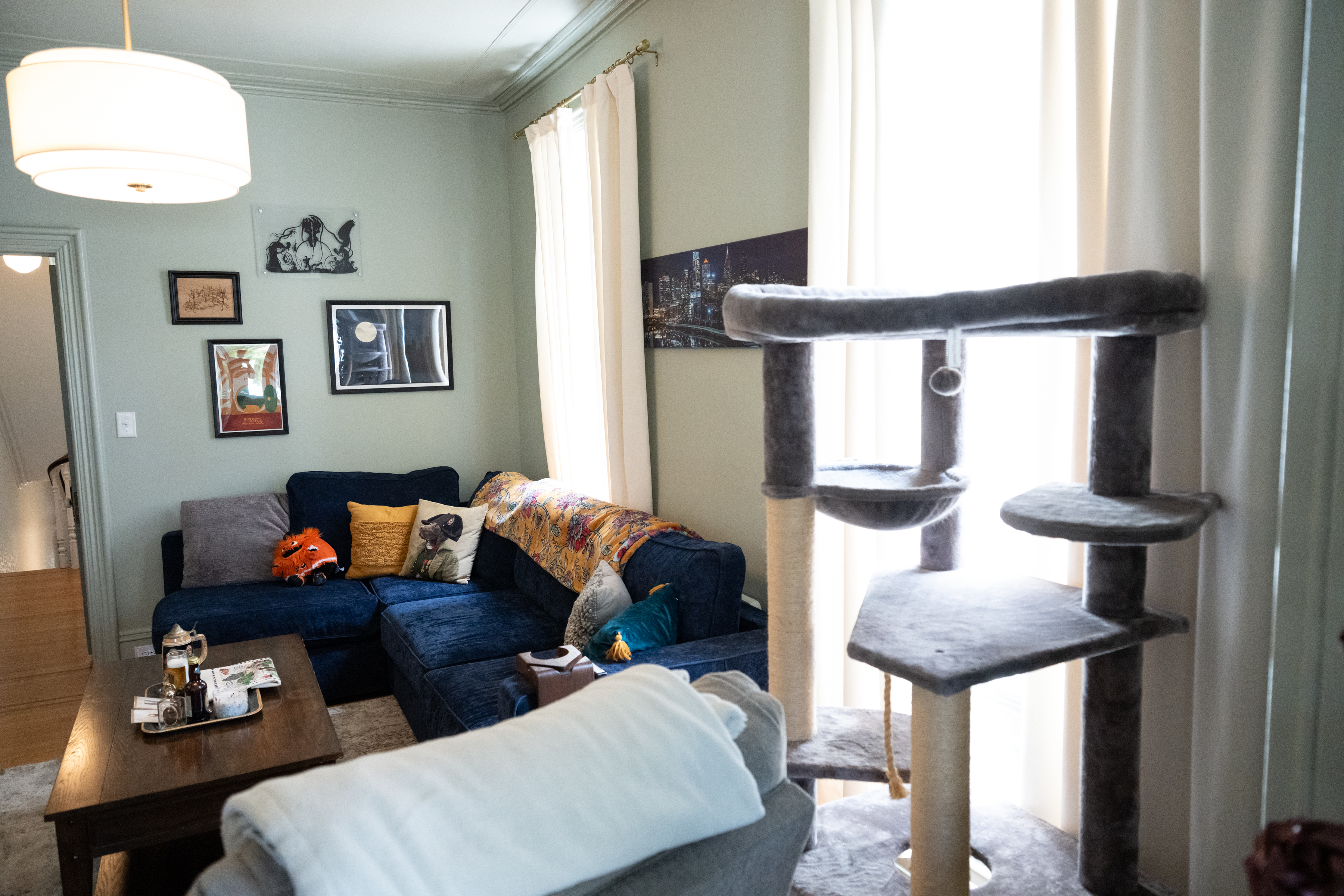
A large red couch is the centerpiece of the first-floor living area in Charlotte Burns and Noah Johnson’s home. Erin Blewett / For The Inquirer
The house also had the big kitchen Johnson wanted and space for a garden for Burns. Then there was the screened-in porch on the second floor. “I feel like that’s a rare find,” Burns said. Her other favorite feature is the third floor, which “felt like your own private suite,” she said.
The deal: The house was listed for $975,000. The couple offered the full asking price and felt good about not going over. “I really was not in the market for haggling or fighting over a house,” Burns said. “We weren’t that desperate.” There was one other offer, but it was lower, so the seller accepted theirs.
Homeowner Charlotte Burns appreciated that the home’s prior owners kept historical details like moldings intact. Erin Blewett / For The Inquirer
The inspection came back mostly clean. Some porch wood and window linings needed work, but the biggest issue was the HVAC system, which was more than 20 years old. Burns and Johnson negotiated a $7,500 seller’s credit for it and later replaced the HVAC and heat pump for about $8,500.
The money: Burns and Johnson bought the $975,000 house with no money down through a professional loan, a mortgage product for borrowers with high future earning potential but not necessarily years of savings. “It’s a very good option if you’re a medical professional,” Burns said. She didn’t know the loan applied to veterinarians until a colleague told her.
The screened-in porch on the second floor was a selling point. Erin Blewett / For The Inquirer
Unlike other low- or zero-down payment loans, a professional mortgage doesn’t require private mortgage insurance, and Burns said her student loan debt was not held against her in the same way it might have been with a conventional mortgage.
The couple actually had $100,000 in savings, most of it from Johnson, who had been working for several years after graduate school. But they decided not to put that money toward the house. They wanted to keep it as an emergency fund instead. “I feel like you should always have at least six months of emergency savings at all times,” Burns said.
Since moving in, the couple has done a lot of painting. Erin Blewett / For The Inquirer
Their mortgage payment was originally $7,200 a month. Recently, they paid a one-time fee of $1,200 to lower their interest rate from 7% to 6.5%, which brought their monthly payment down by about $400.
They plan to refinance if rates drop enough in the next few years.
The couple turned one second-floor room into a living room, including space for their cats to lounge. Erin Blewett / For The Inquirer
The move: The couple closed Feb. 3 and started packing a week or two later. When they signed their lease, they had told their landlord that they might buy soon. She let them leave without issue and found new tenants within a week.
The move itself was a mess. They’d booked it for the day after the Super Bowl parade, and Fairmount was still buried in cars — including in front of their old house, where the no-parking signs Burns had ordered from the city were ignored. So Burns called the Philadelphia Parking Authority and had the cars ticketed and towed. Then, at the new house, the truck blocked the Route 48 bus, so Burns called SEPTA, and they rerouted it.
Mao is enjoying his new home in Fairmount. Erin Blewett / For The Inquirer
Life after close: Since moving in, the couple has been busy making the house their own. Burns has painted, wallpapered, gardened, and gotten “really into stencils,” she said. She painted the green living room herself and added an ivy stencil along the stairs.
Some days, she still can’t believe how easily everything came together. “It’s really crazy,” she said. “But you gotta let the universe do what it wants to do.”
Did you recently buy a home in the Philadelphia area or South Jersey? Share the story of how you did it. Email Inquirer real estate reporters at properties@inquirer.com.
The house: a 2,219-square-foot townhouse with three bedrooms and three bathrooms in Wynnefield.
The price: listed for $499,000; purchased for $499,000.
The agent: Nora DeCristofano, Compass
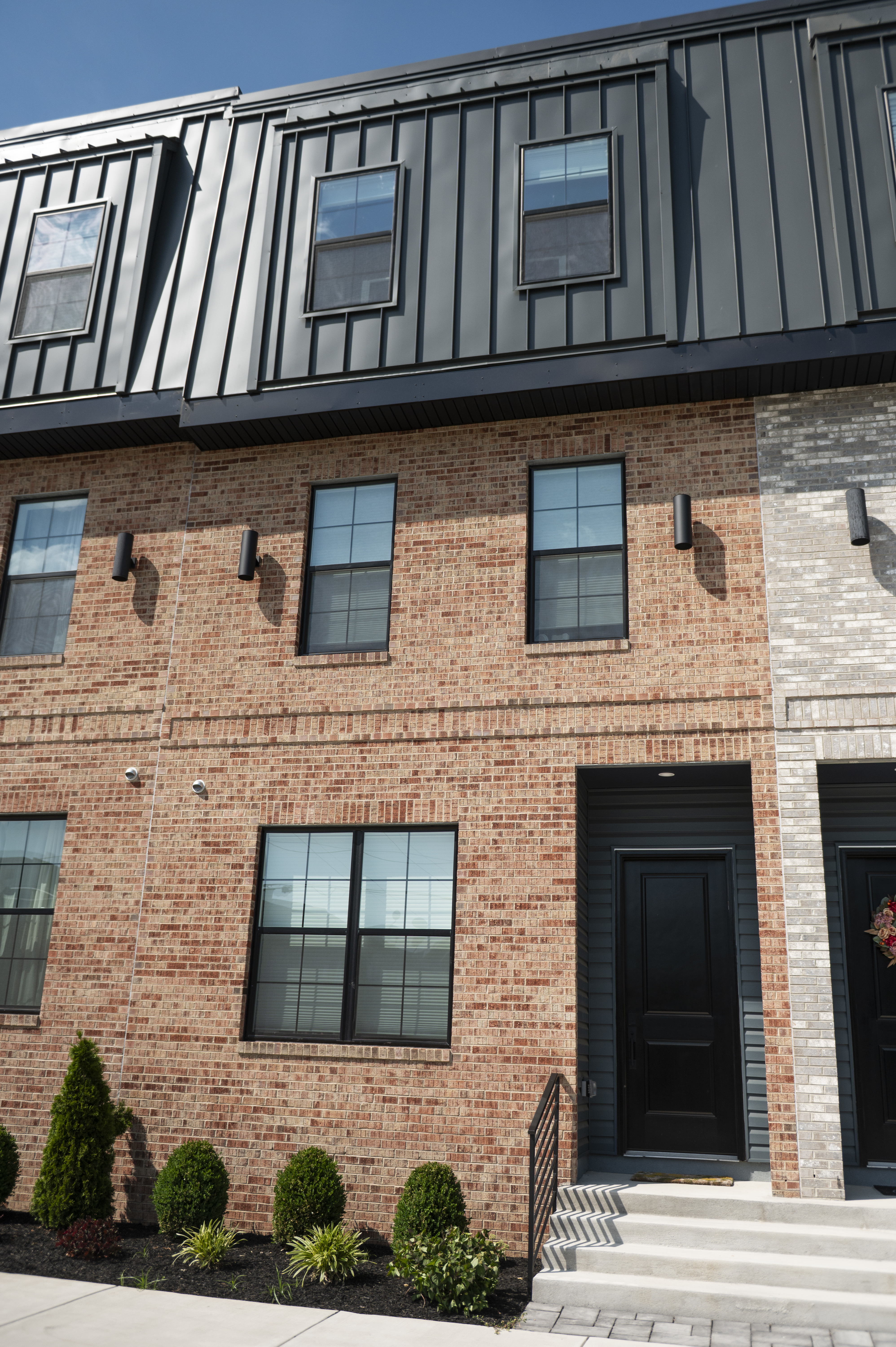
The exterior of Heather Ong’s home in Wynnefield.Allie Ippolito / For The Inquirer
The ask: Heather Ong did not move back to Philadelphia expecting to live with her parents for two years. The plan was to stay with them temporarily — six months at most — just long enough to save money and buy a house.
“What started as a six-month search turned into a two-year search,” she said.
Ong wanted to be in the city but not downtown. She was open to any place that was quiet and had outdoor space for her dog. She also wanted something move-in ready with three bedrooms and at least two bathrooms, and she wanted it for less than $600,000. That combination turned out to be hard to find.
Ong liked the house’s modern, open-concept kitchen. Allie Ippolito / For The Inquirer
The search: Ong started looking seriously in October 2023. She looked everywhere except Center City. In Point Breeze and Brewerytown, she kept running into the same problem. The houses were expensive, and many still needed work. “I refused to spend $600,000 on a home that I’d have to fix up,” she said.
Housing inventory was low at the time. Very few of the listings she saw on Zillow met her criteria, so eventually she stopped checking the site. She did deep dives on local Reddit real estate threads instead. That’s where she saw a link to an Inquirer article about a new development near City Avenue.
The living area in Heather Ong’s home.Allie Ippolito / For The Inquirer
The location was close to where she wanted to be, and the price was close to what she wanted to spend, so she e-mailed the developer. She visited the site, but the townhouses were still under construction. She walked through a few model homes that were almost done to get a feel for the space.
The appeal: The house she saw was a “typical Philly townhome,” Ong said. It had 10-foot ceilings and a roof deck. She liked that it had three full bathrooms and that it was close to I-76 and Martin Luther King Jr. Drive. “Location-wise, it’s very convenient,” Ong said.
And while she didn’t think the neighborhood was very exciting, she saw potential.
“I feel like there are a lot of changes coming to the area,” she said.
Plus, the house offered her more space than she could find elsewhere for the price.
The house is a “typical Philly townhome,” Ong said. Allie Ippolito / For The Inquirer
”I got a bigger bang for my buck out here,” she said.
The deal: The home was listed for $499,000, which is what Ong offered. There wasn’t much to negotiate. The builder was firm on price and told her she couldn’t customize any part of the house. “They said, ‘What you see is what you get,’” Ong recalled.
She did, however, get the builder to agree to a mortgage contingency so that if they didn’t finish the house as promised, she could back out.
Ong hired an independent inspector, who she said was incredibly thorough. “He came back with 100 things that needed to be fixed,” Ong said. The builder addressed all of them. He also installed larger vanities in the bathrooms per her request. The original ones were “barely larger than airplane bathroom sinks,” Ong said.
The money: Ong put 10% down. Between the down payment and closing costs, she spent about $70,000. That included $4,000 to buy down her interest rate from 7% to 6%.
The house has three bedrooms and three full bathrooms, plenty of space for Ong to host family and friends. Allie Ippolito / For The Inquirer
The $70,000 came from her personal savings. She was able to put away a lot of money when she lived with her parents. She also had stock from her job at Zoom Info Technologies, which had vested by the time she was buying. It was worth about $25,000. Without it, she would not have been able to buy.
“If that didn’t happen, I would still be stuck,” Ong said.
The primary bedroom in Heather Ong’s home in Wynnefield. Allie Ippolito / For The Inquirer
The move: Ong closed on May 1, 2025, and moved in on May 22, a rainy, thunderous day. The move itself was quick — most of her things were in storage. But settling in took months. The development was so new that Google Maps didn’t recognize her address yet, so her deliveries kept getting lost.
“That was a nightmare,” she said.
She also didn’t have internet for the first month.
Life after close: After a year in the house, Ong has learned that new construction can still come with plenty of repairs.
There have been nail pops, cracks, leaks, electricity issues, a microwave that keeps breaking, and a brand-new dryer that did not work. The constant repairs have made it harder for Ong to enjoy the house. Still, she does not regret buying it.
“These are first-world problems that I’m dealing with,” she said.
Did you recently buy a home in the Philadelphia area or South Jersey? Share the story of how you did it. Email Inquirer real estate reporters at properties@inquirer.com.
Editor’s note: This story has been updated to clarify the name of Ong’s employer and the specifics of her down payment.
Lilly, age 13, sits on the couch.Allie Ippolito / For The Inquirer